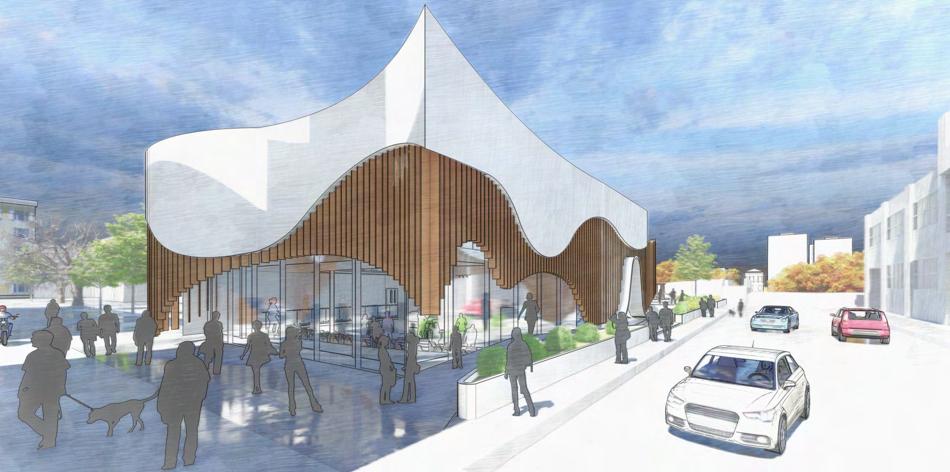
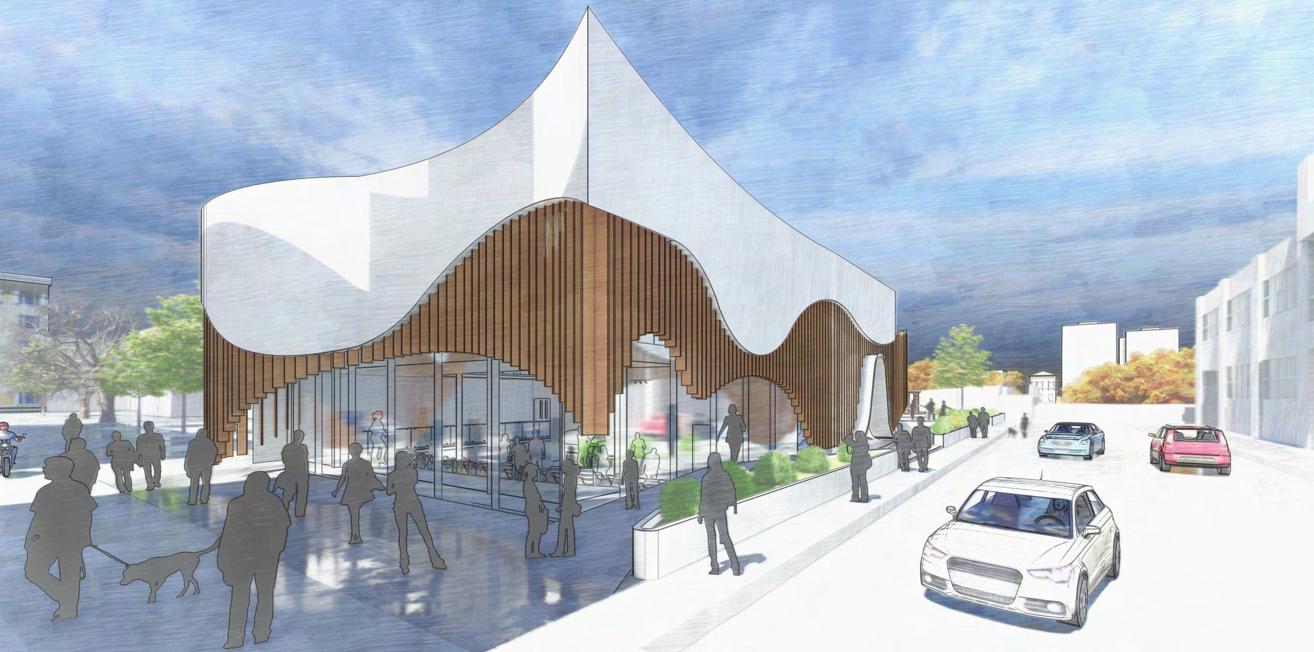
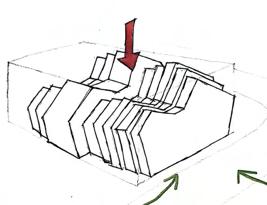
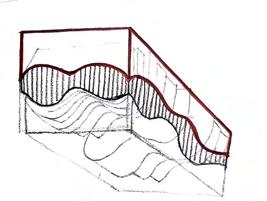
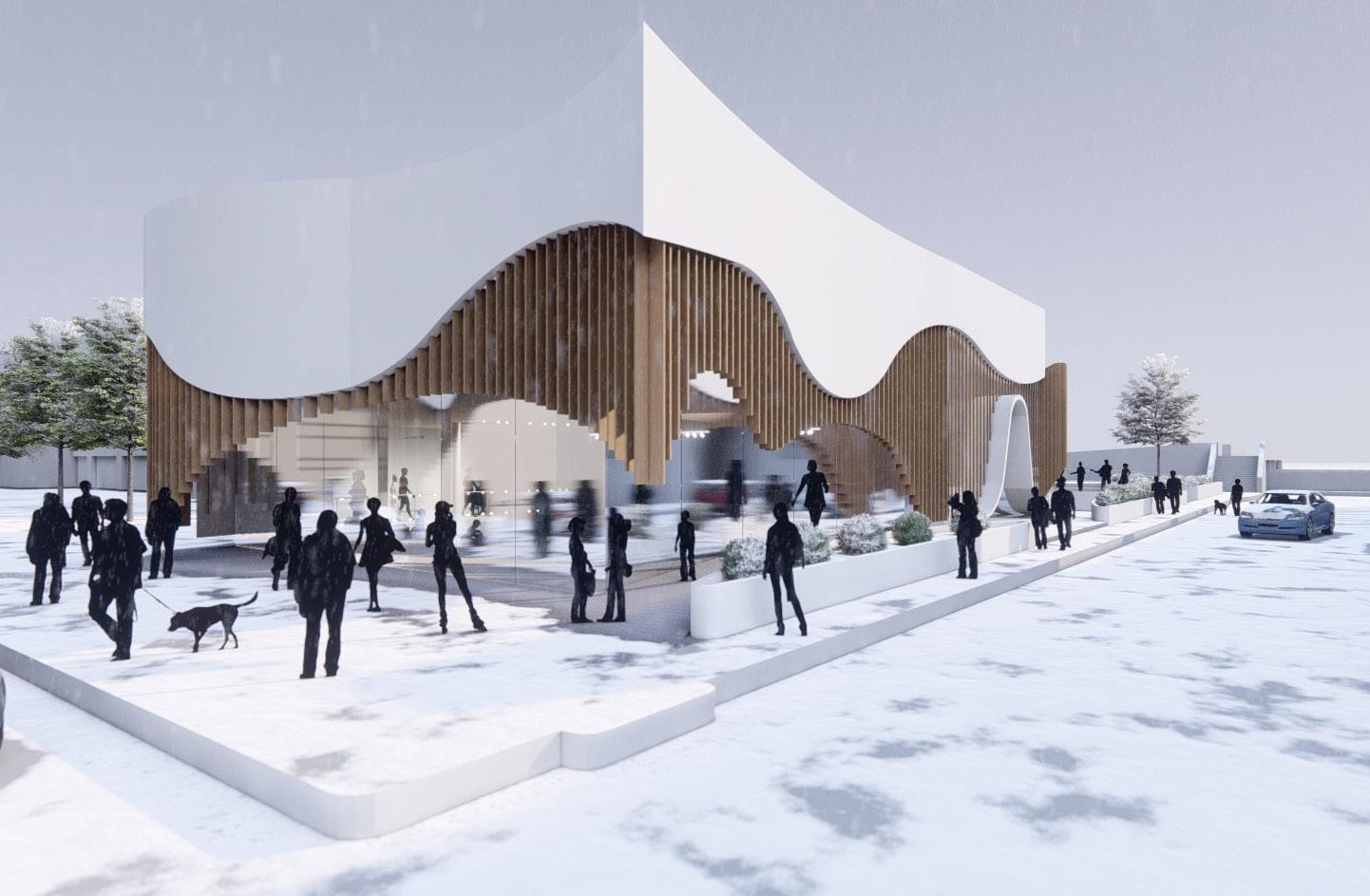
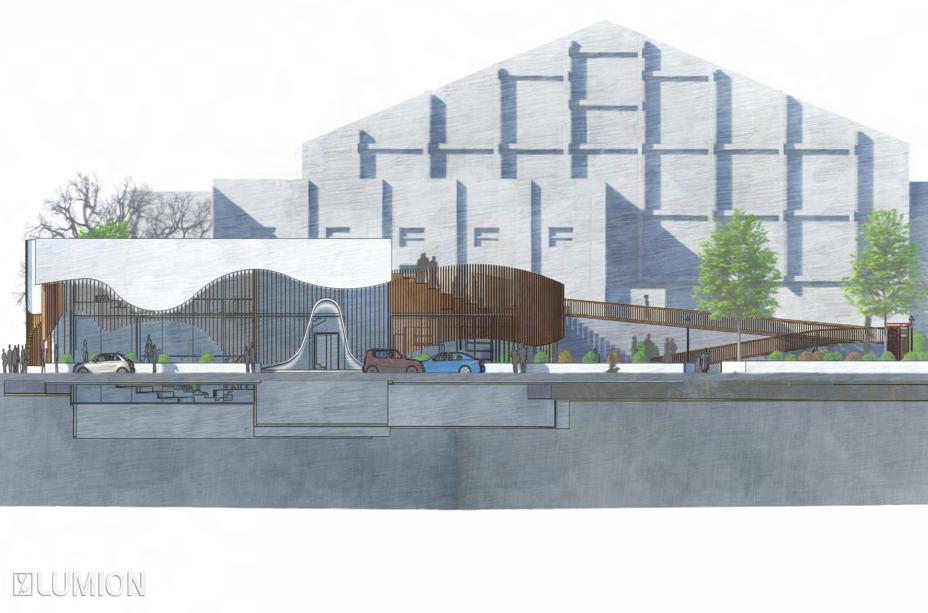
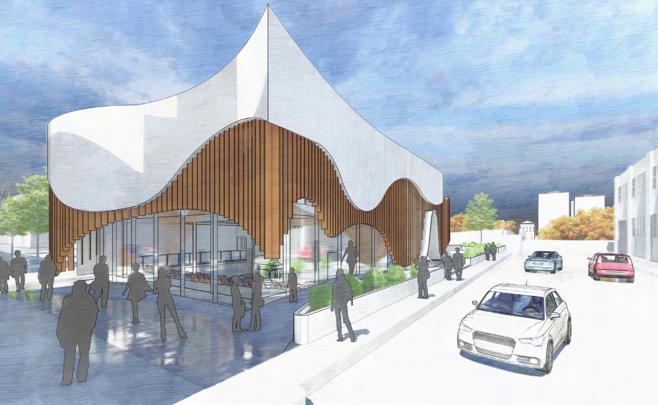
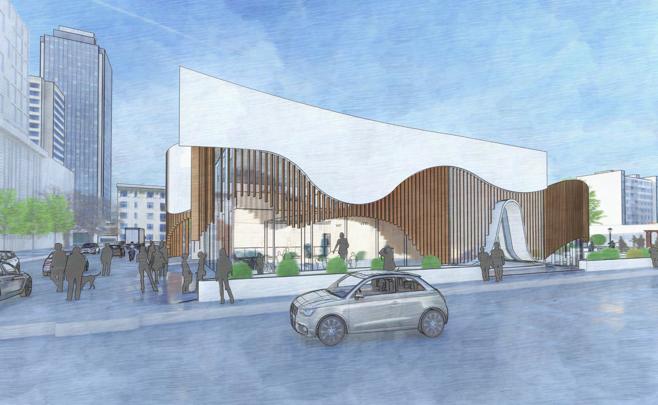
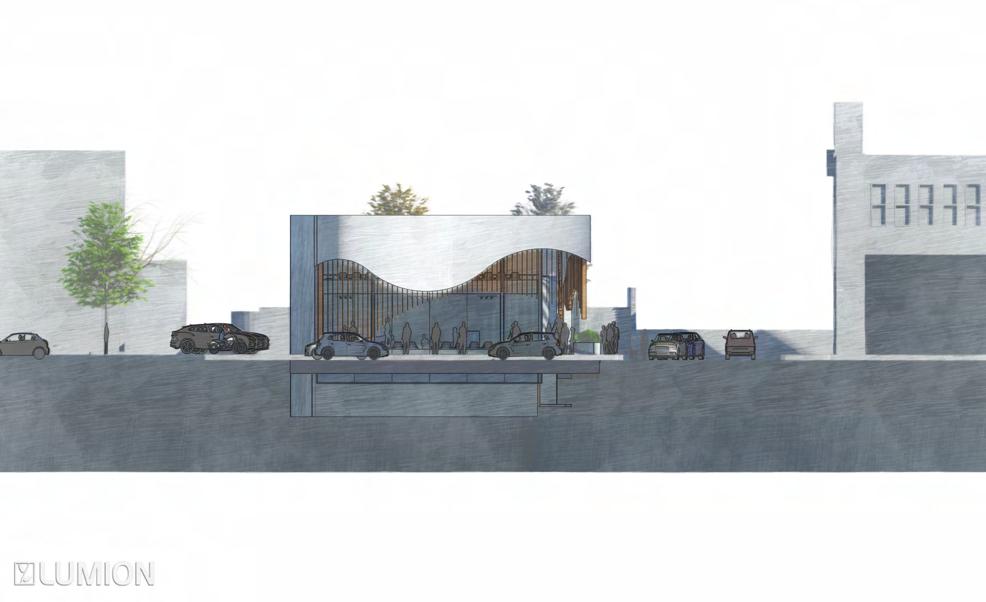
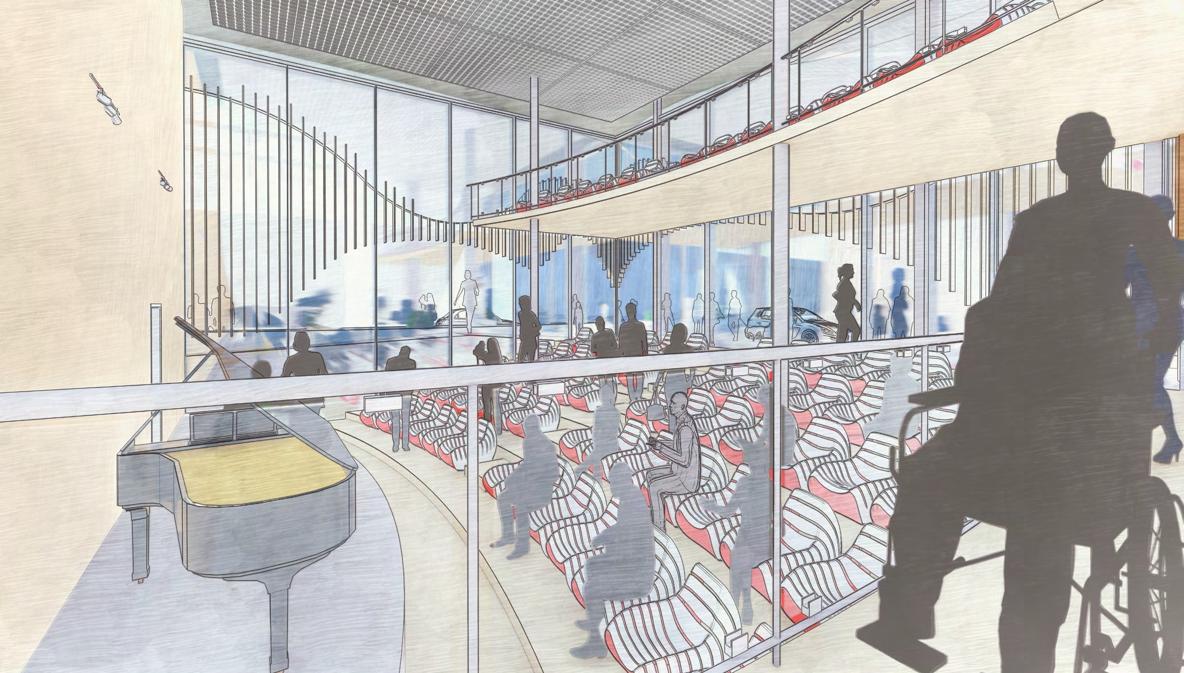
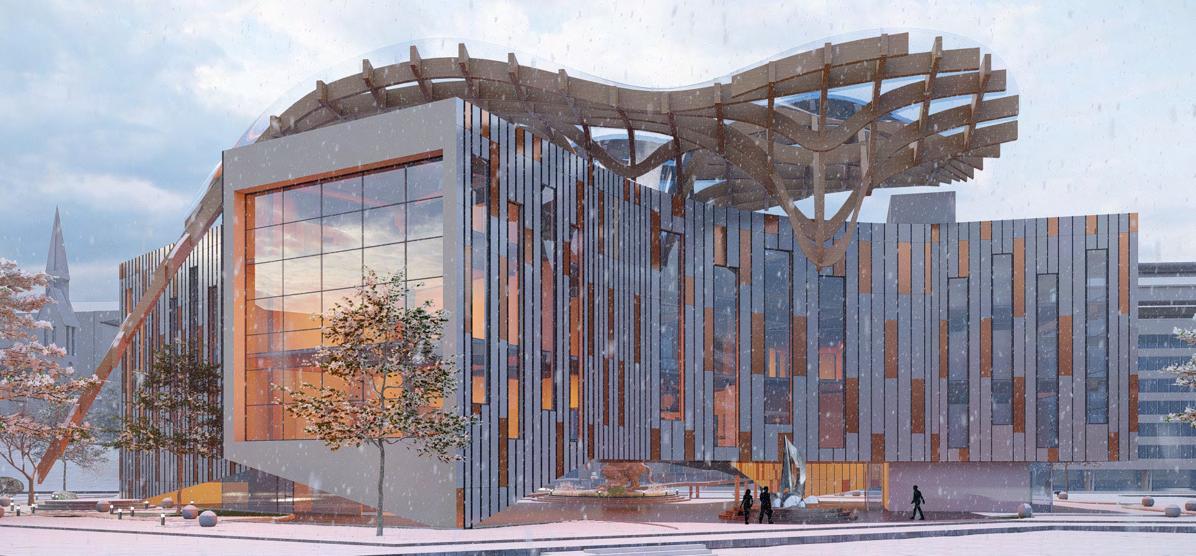
The Corgan Centre for New Music, located at the intersection of St. Botolph Street and Gainsborough Street in Boston, was designed to honor Cogan’s musical legacy.
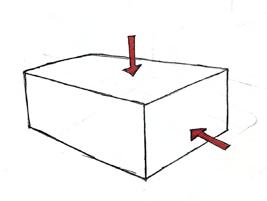
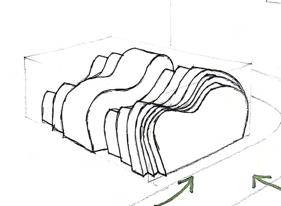
As students, we were challenged to create an abstract design inspired by a musical specimen from Cogan’s work. This abstract concept would then serve as the foundation for a performance space that both pays tribute to Cogan and integrates seamlessly with the surrounding neighborhood.
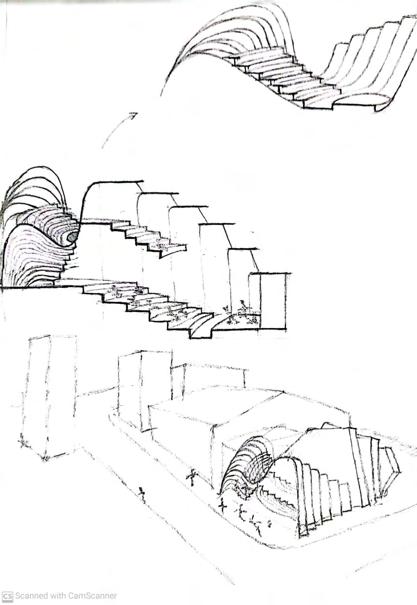
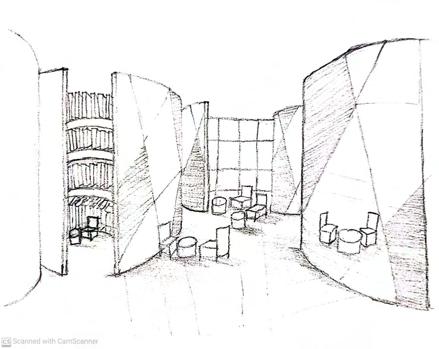
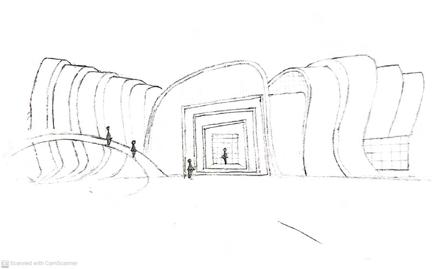
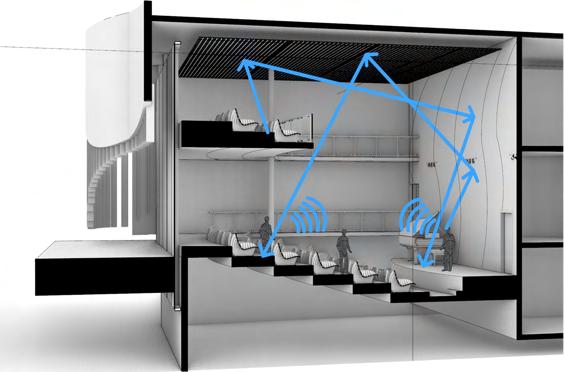
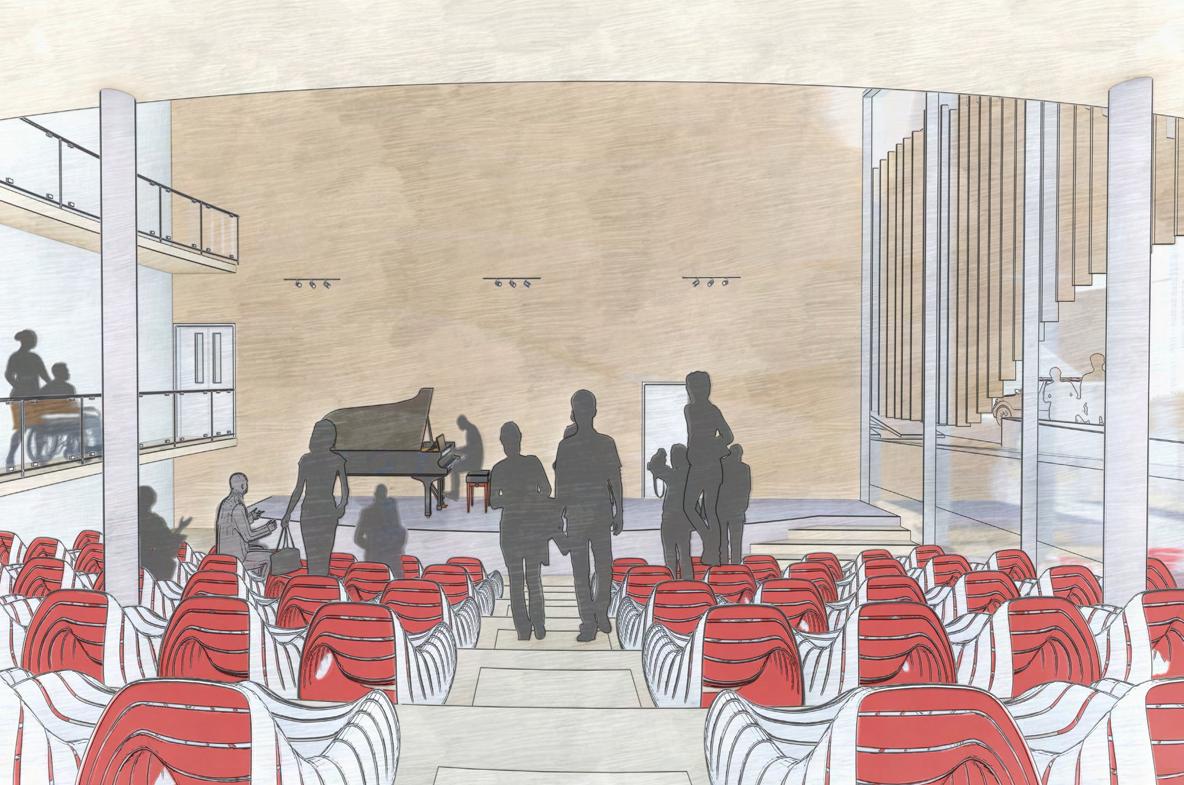
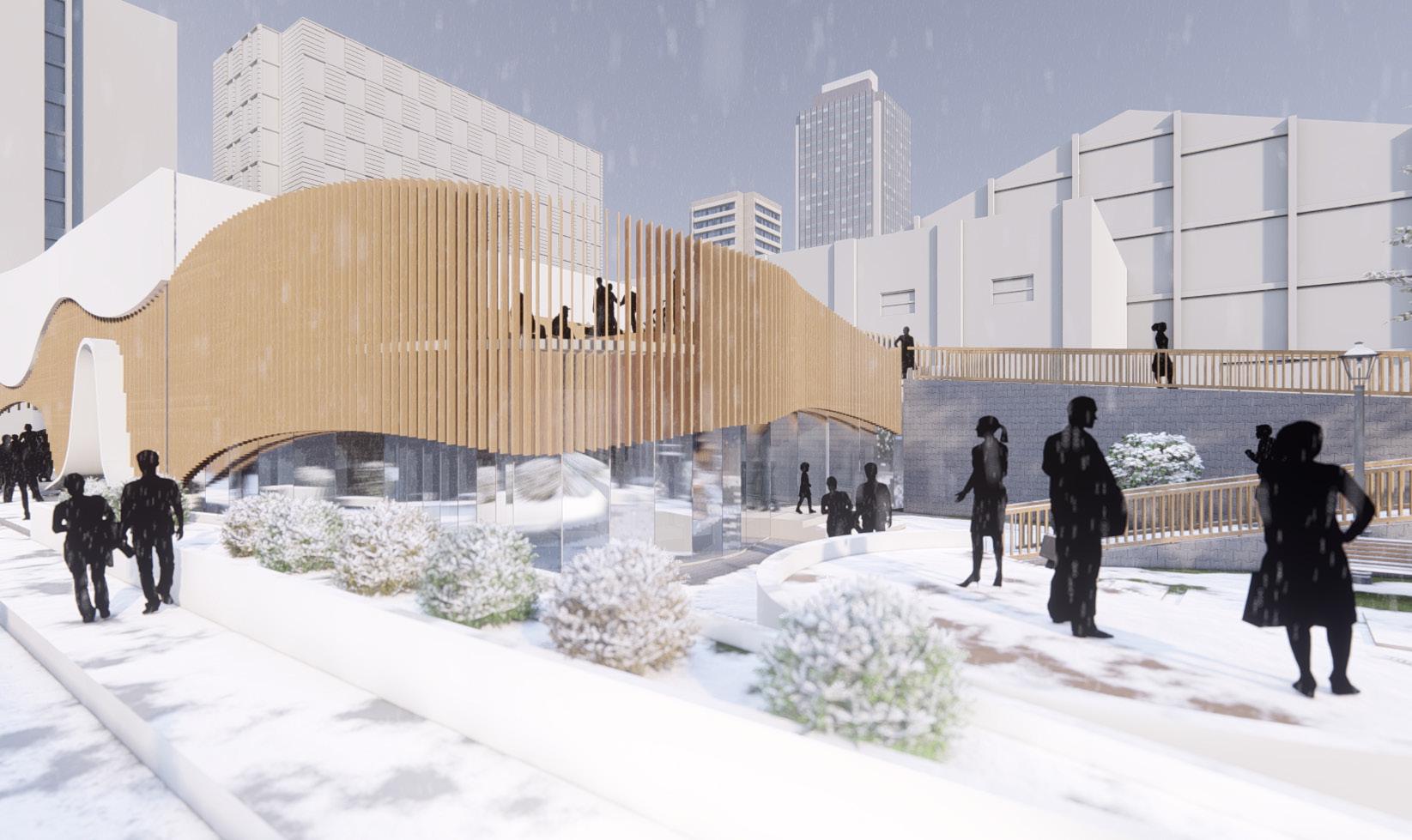
My interpretation of the selected musical specimen focused on themes of uncertainty and despair. However, rather than recreating that experience for visitors, I chose to subvert it transforming uncertainty into excitement and joy. The resulting design features three distinct performance spaces: an underground indoor theater, a ground-level outdoor space, and a rooftop performance area.
The building’s façade enhances engagement by creating a sense of visual continuity between the interior and the surrounding streetscape, drawing people into the experience of the space.
REINFORCED CONCRETE HANGING WALL
GASKET PLATE BOLTED TO HOLD CONNECT TIMBER SLATES TO CONCRETE
HARD GLASS CURTAIN WALL TO MANUFACTURER'S DETAILS
ACOUSTICS DIAGRAM
9"REINFORCED CONCRETE COLUMN
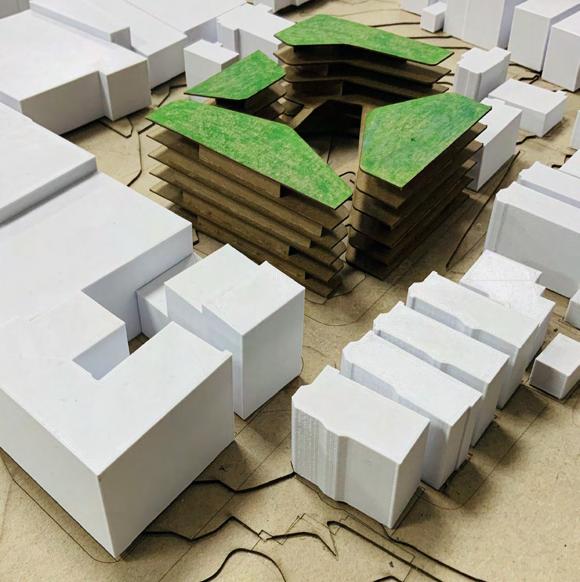
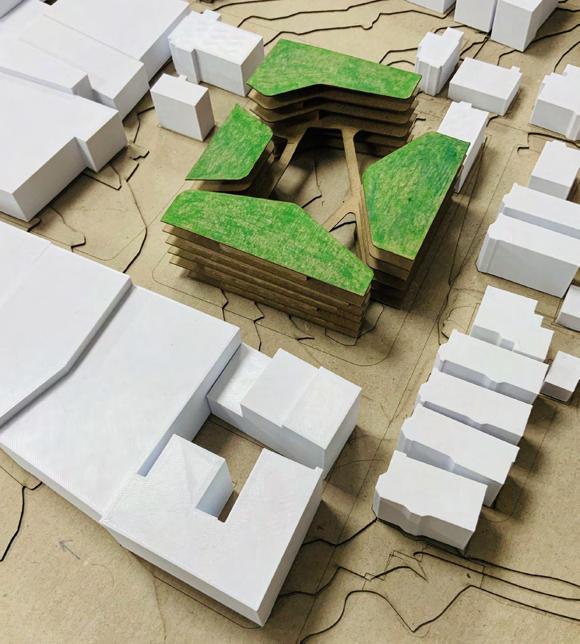
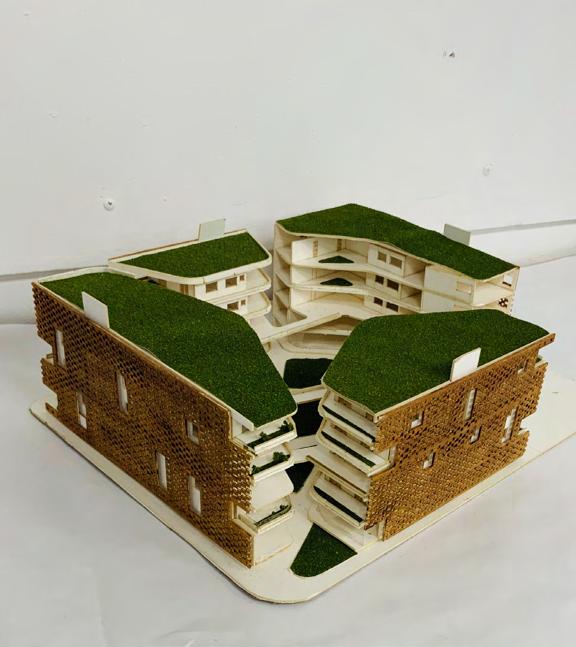
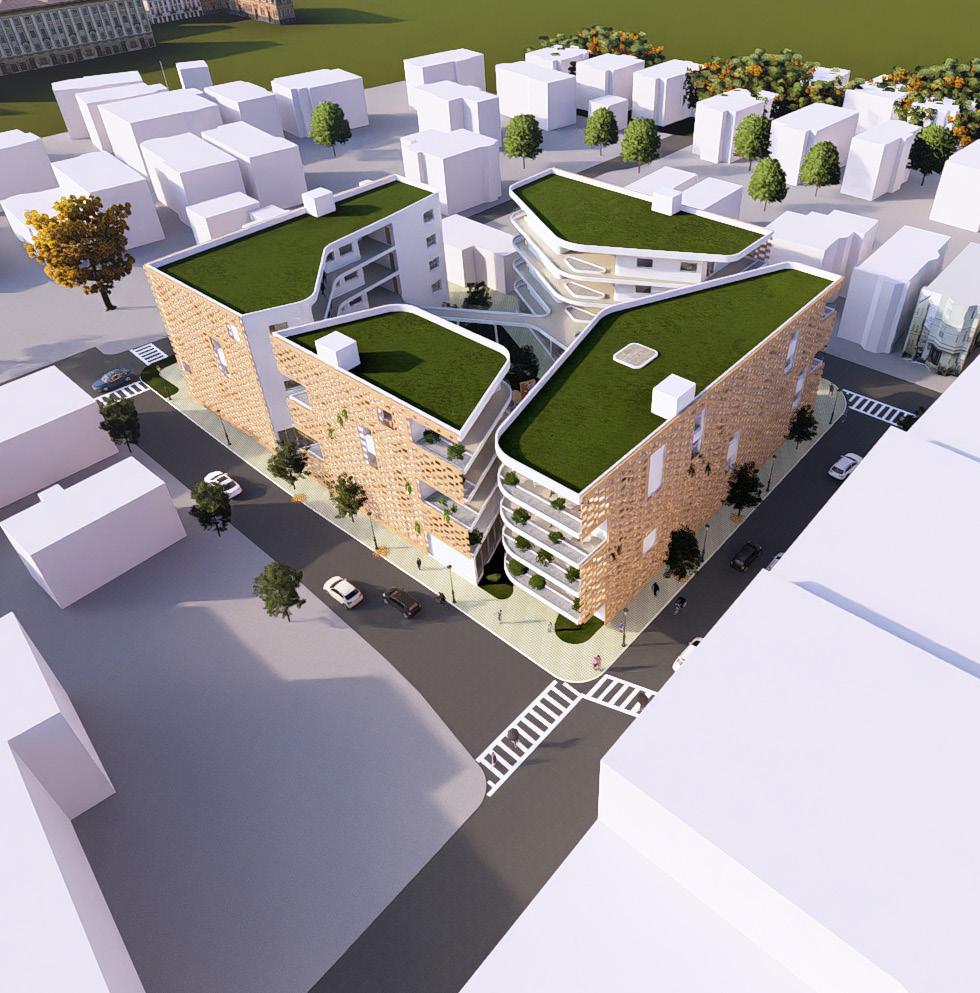
UPHAMS CORNER HOUSING PROJECT
(SOFTENING OF THE INSIDE EDGE) FALL 2023
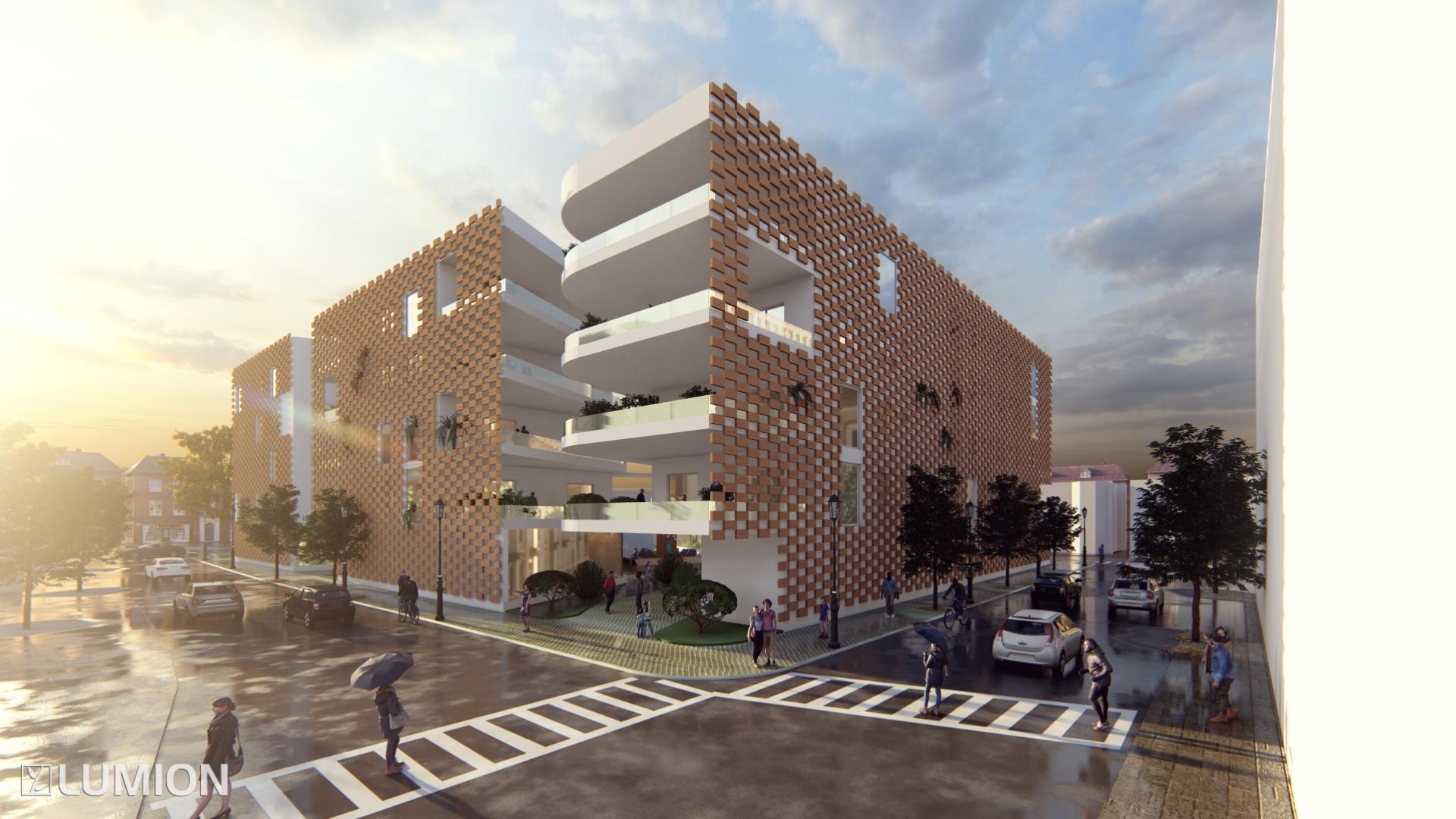
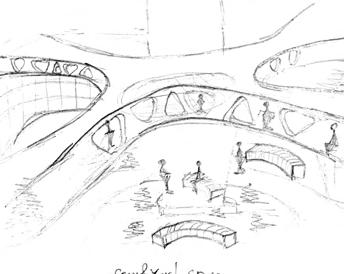
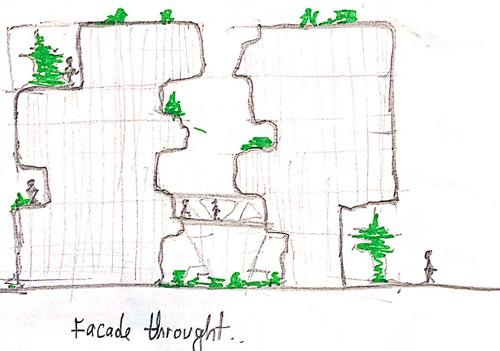
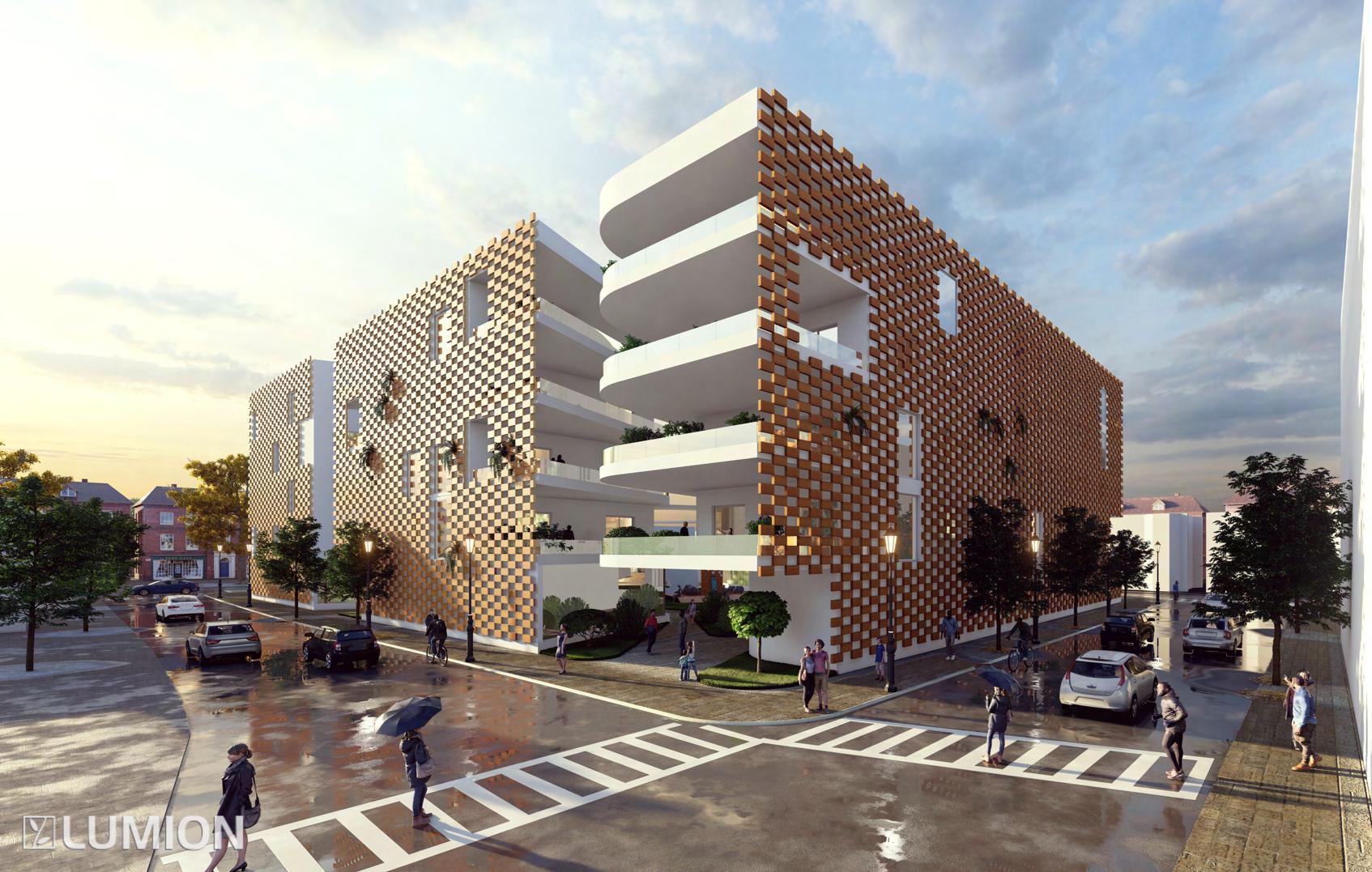
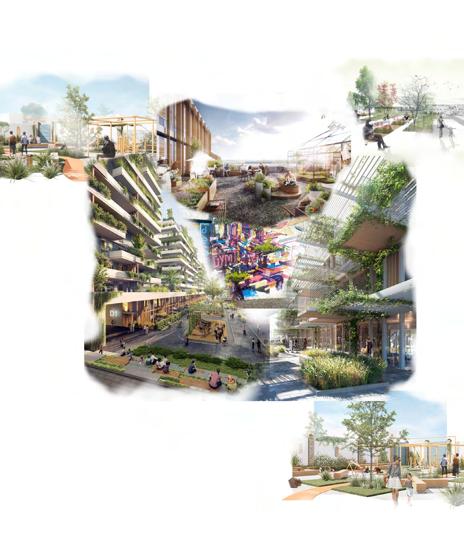
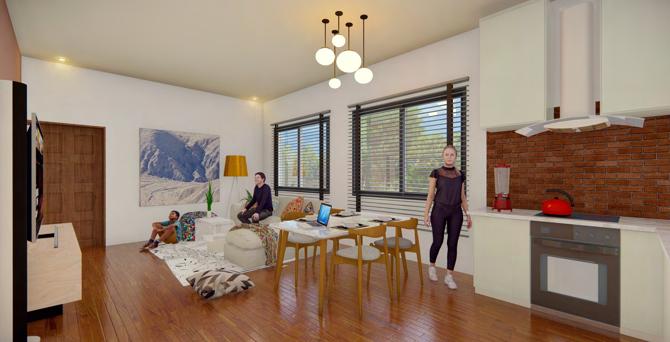
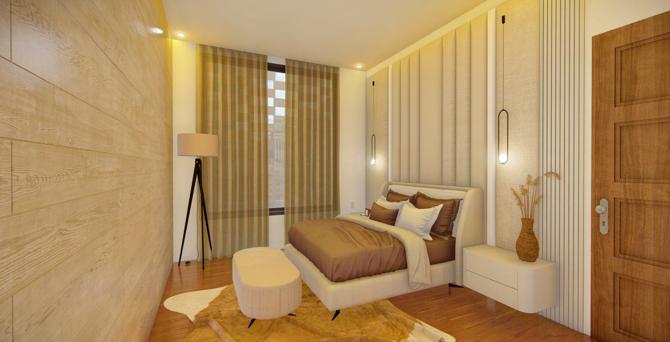
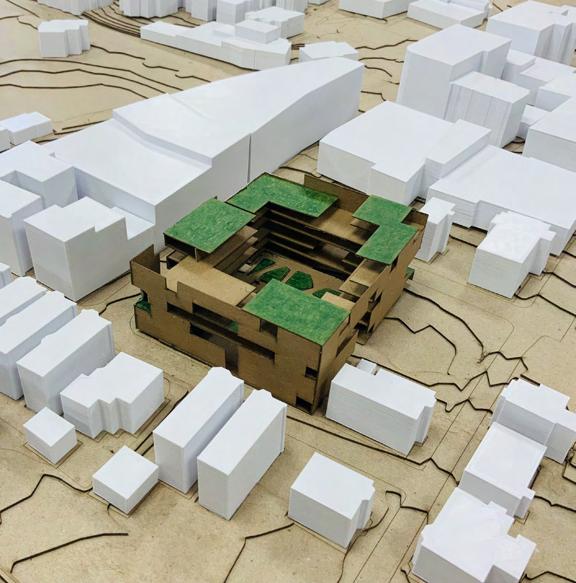
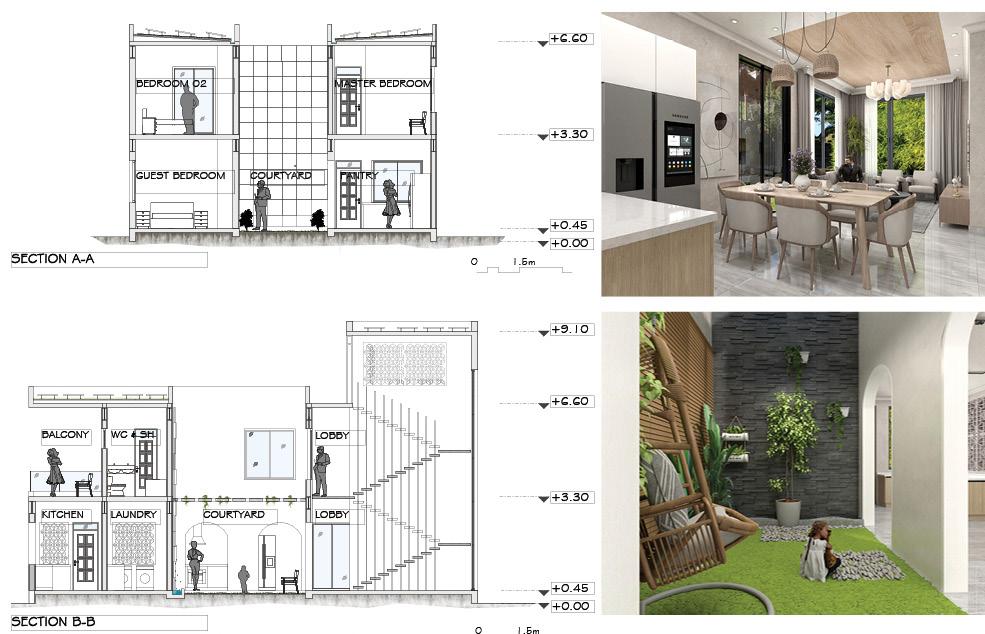
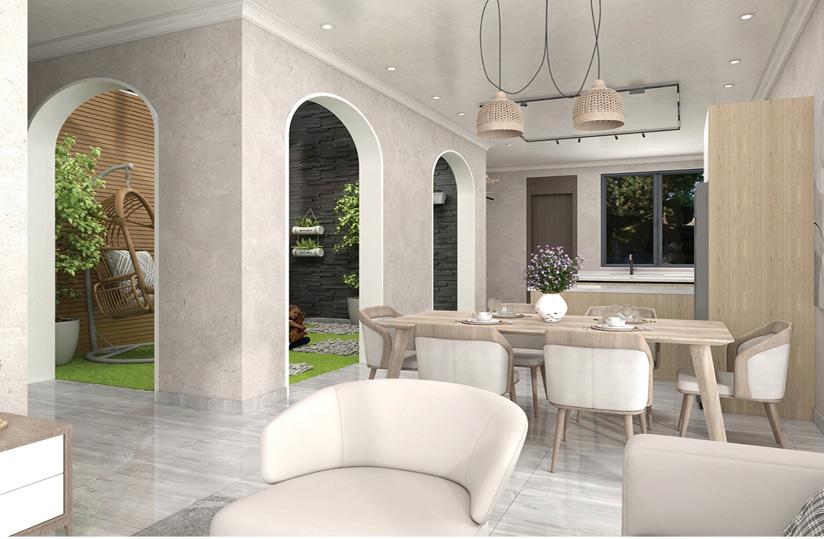
Softening of the edge is a distinctive housing concept that embraces a warm and inviting ambiance within its interior courtyard, fostering a pervasive sense of excitement for its residents. The seamless integration of lush green spaces, both horizontally and vertically, enhances the overall well-being of the community.
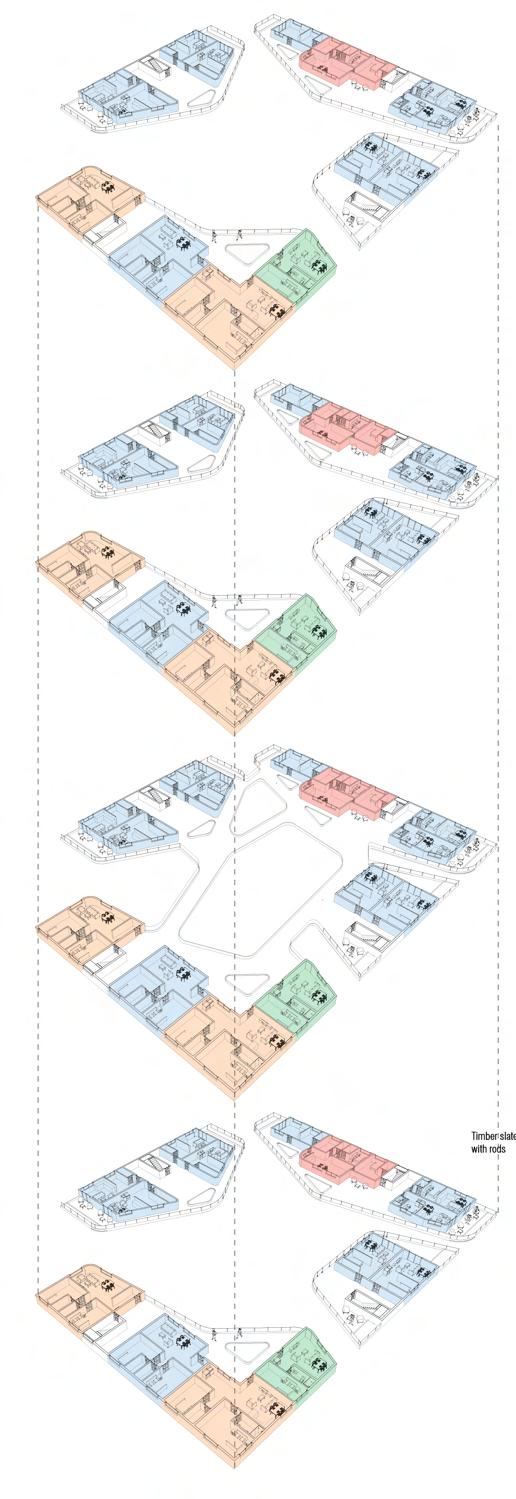
Tailored for small families,bachelors and students.
In the early stages of my project design, I adopted a holistic approach by first examining the needs of the Upham’s Corner neighborhood and then refining my focus to the scale of my building. Identifying key deficiencies, I observed a lack of safety and green spaces in Upham’s Corner. Leveraging the presence of Columbia Road in the green belt, I aimed to enhance the neighborhood’s aesthetic appeal by integrating greenery, particularly through the introduction of trees in walkways and the revitalization of a nearby park. Additionally, I addressed safety concerns within my building design by implementing a courtyard system. This strategic design element not only fosters a sense of security for residents but also contributes to an overall improvement in the quality of life within the community. My project thus aims to create positive, sustainable impacts on both the micro and macro.
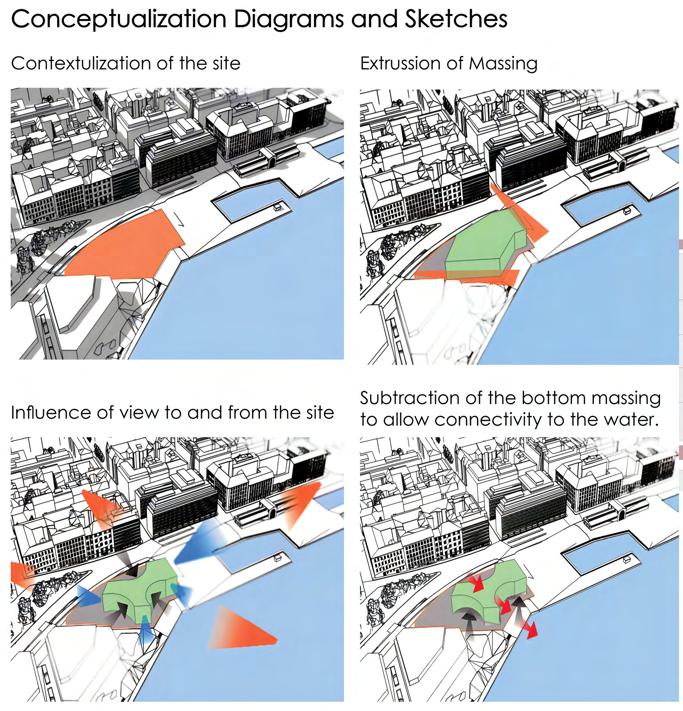
Placing the mass on the site
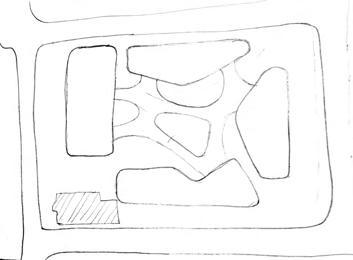
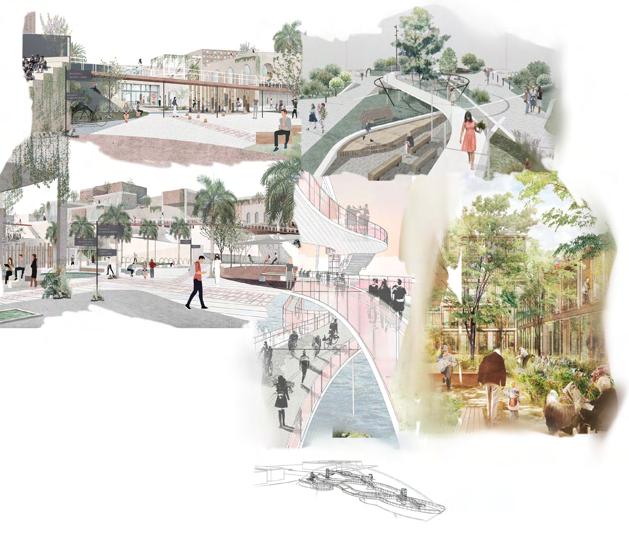
Softening the inside edge in relation to the circulation of the site
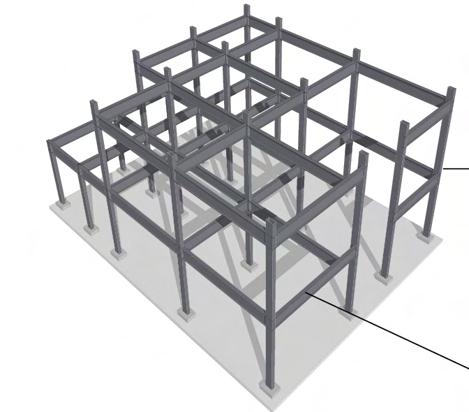
Timber slates held together with rods
Timber slates held together with rods
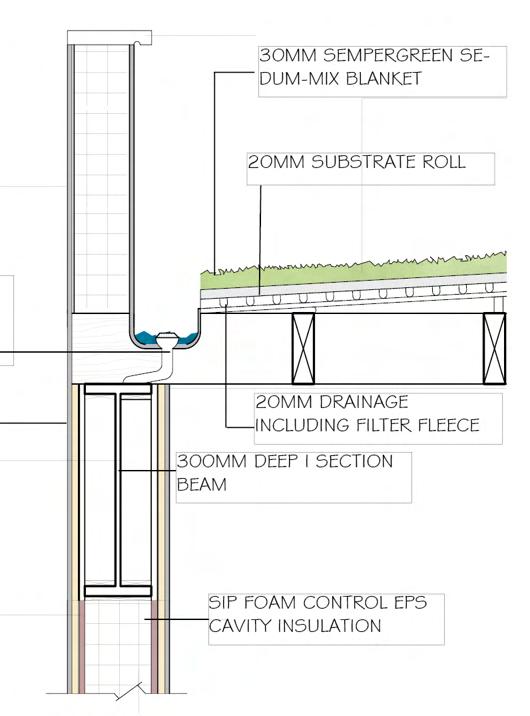
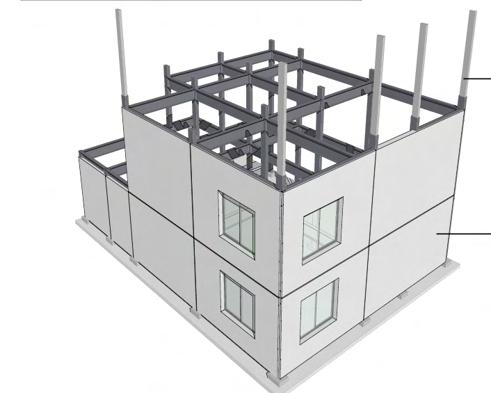
Timber insulated wall
MAKASIINIRANTA MUSEUM OF ARCHITECTURE
AND DESIGN
SUMMER 2024
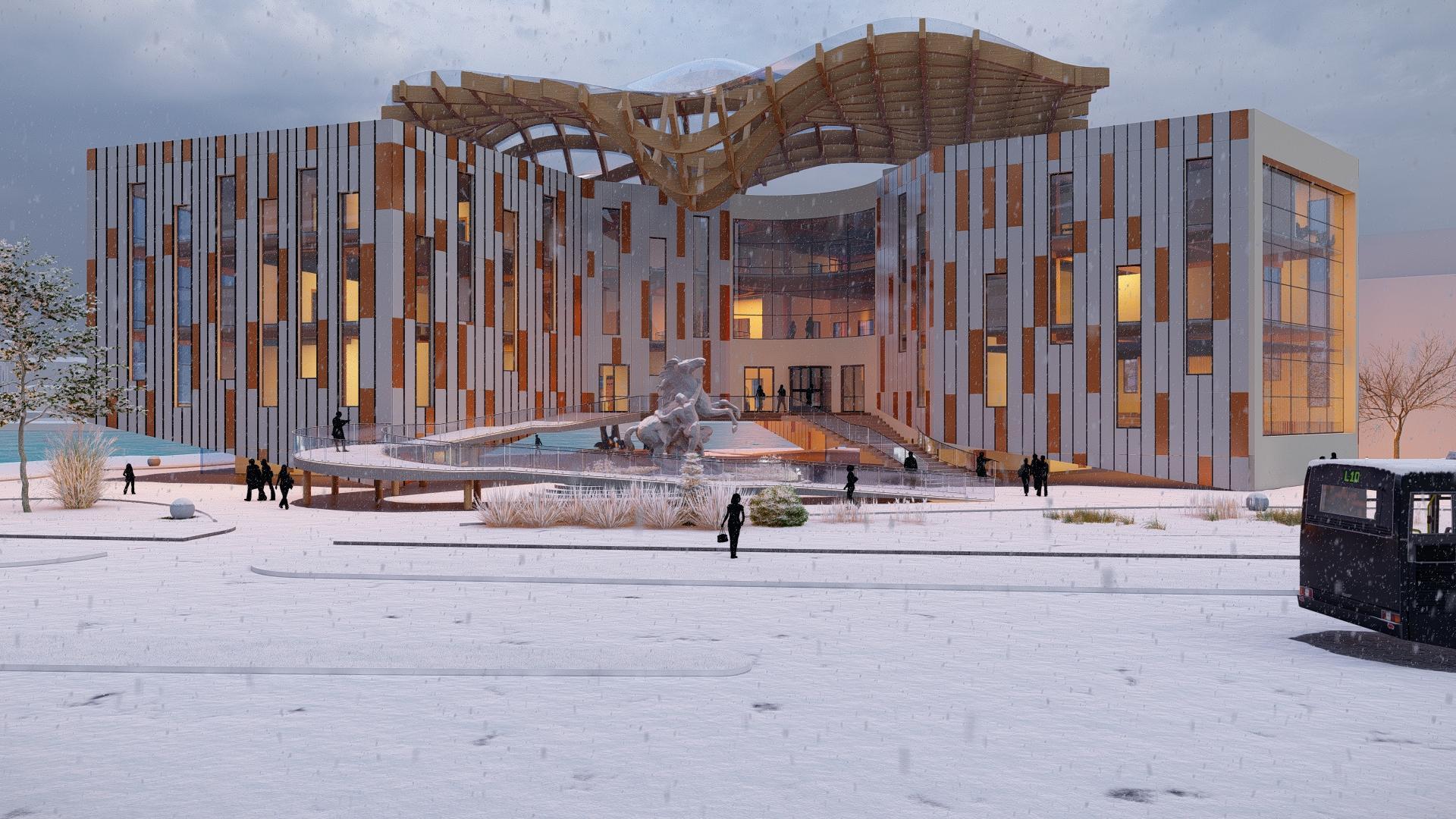
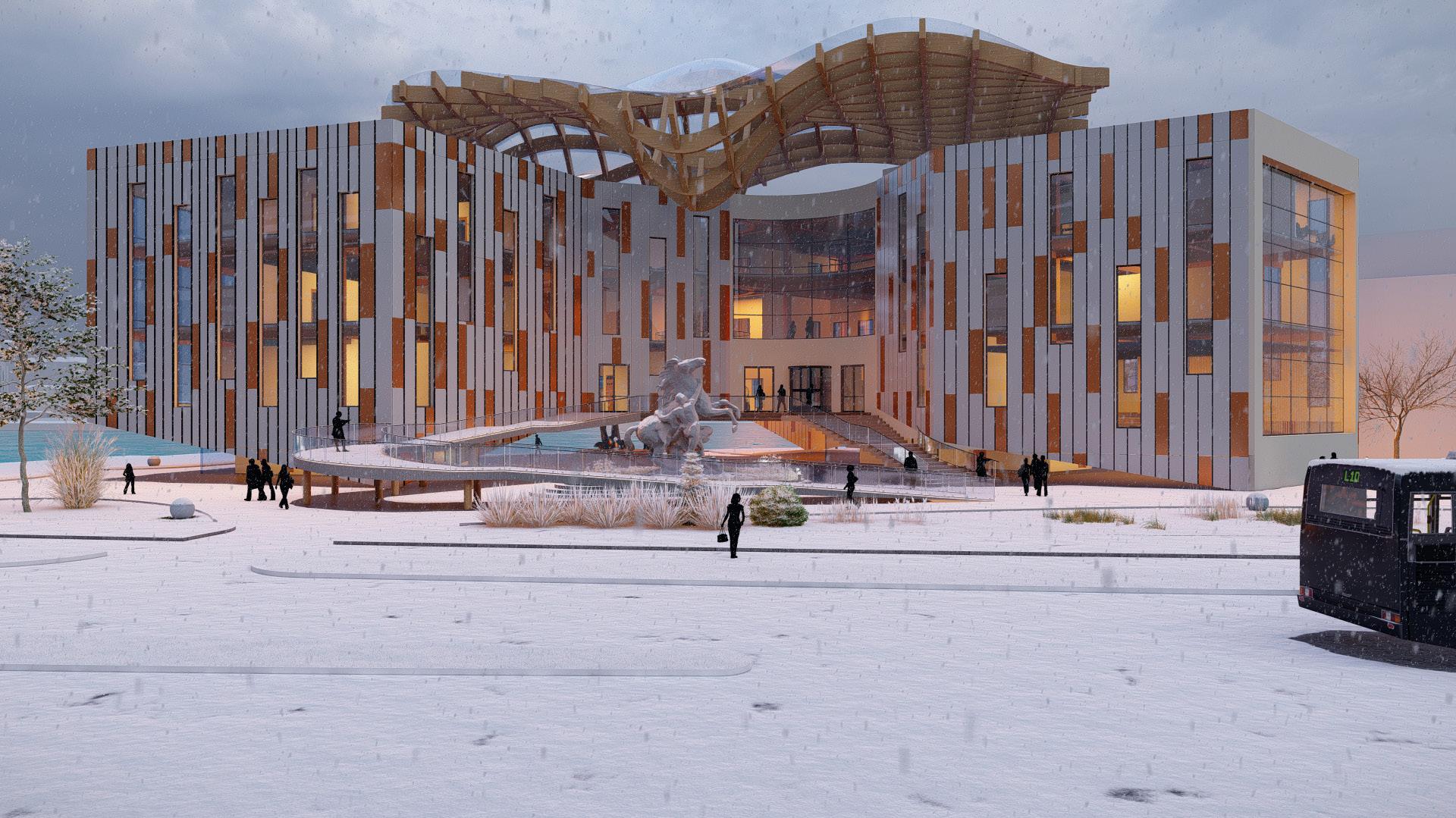
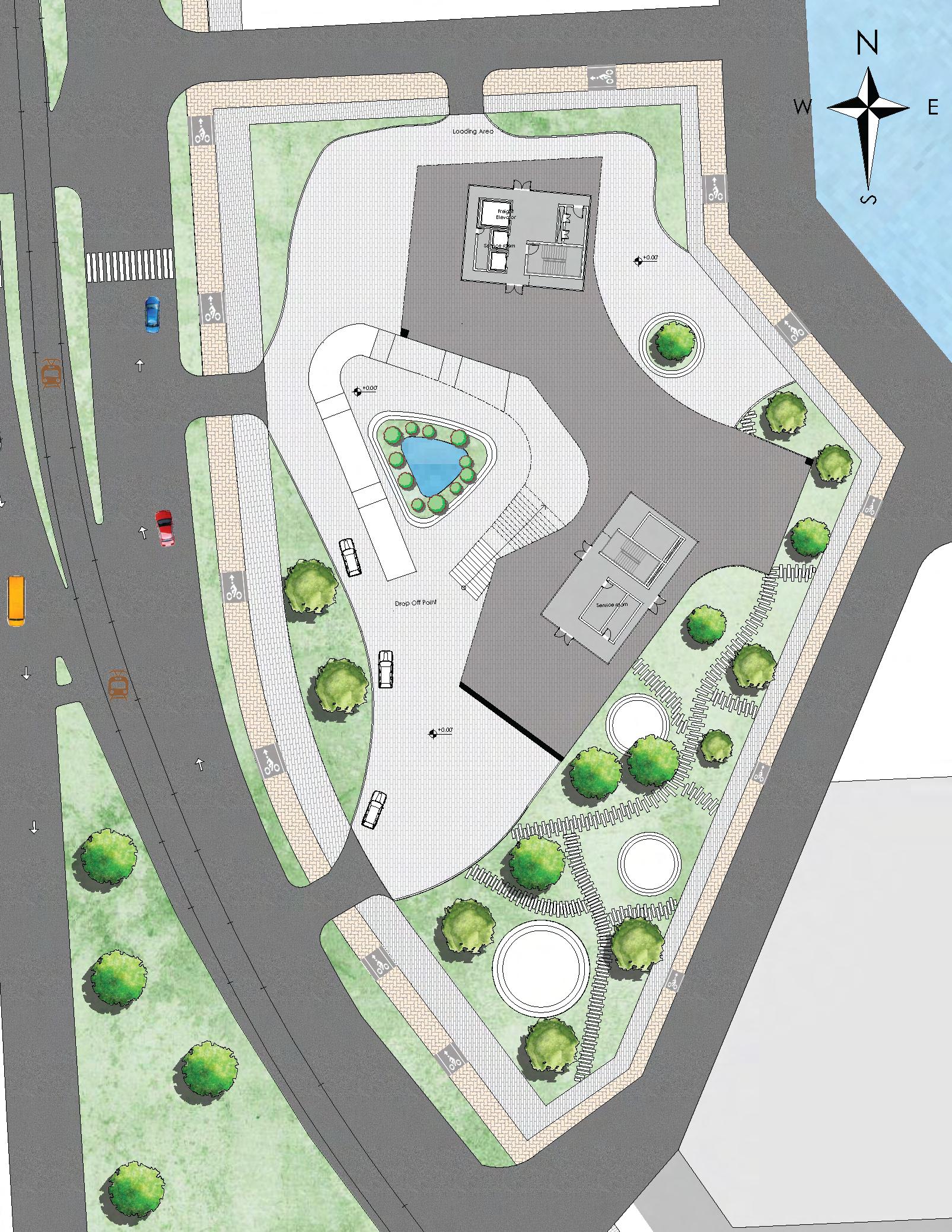
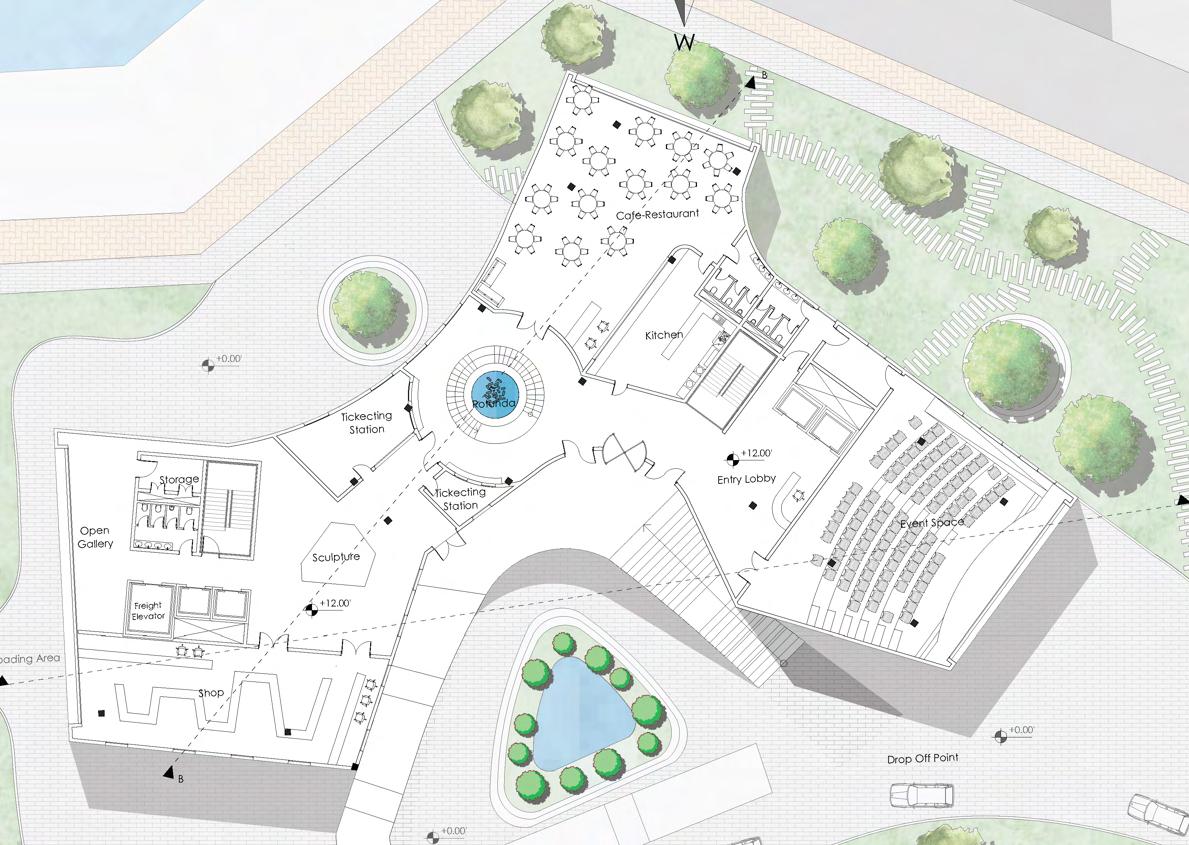
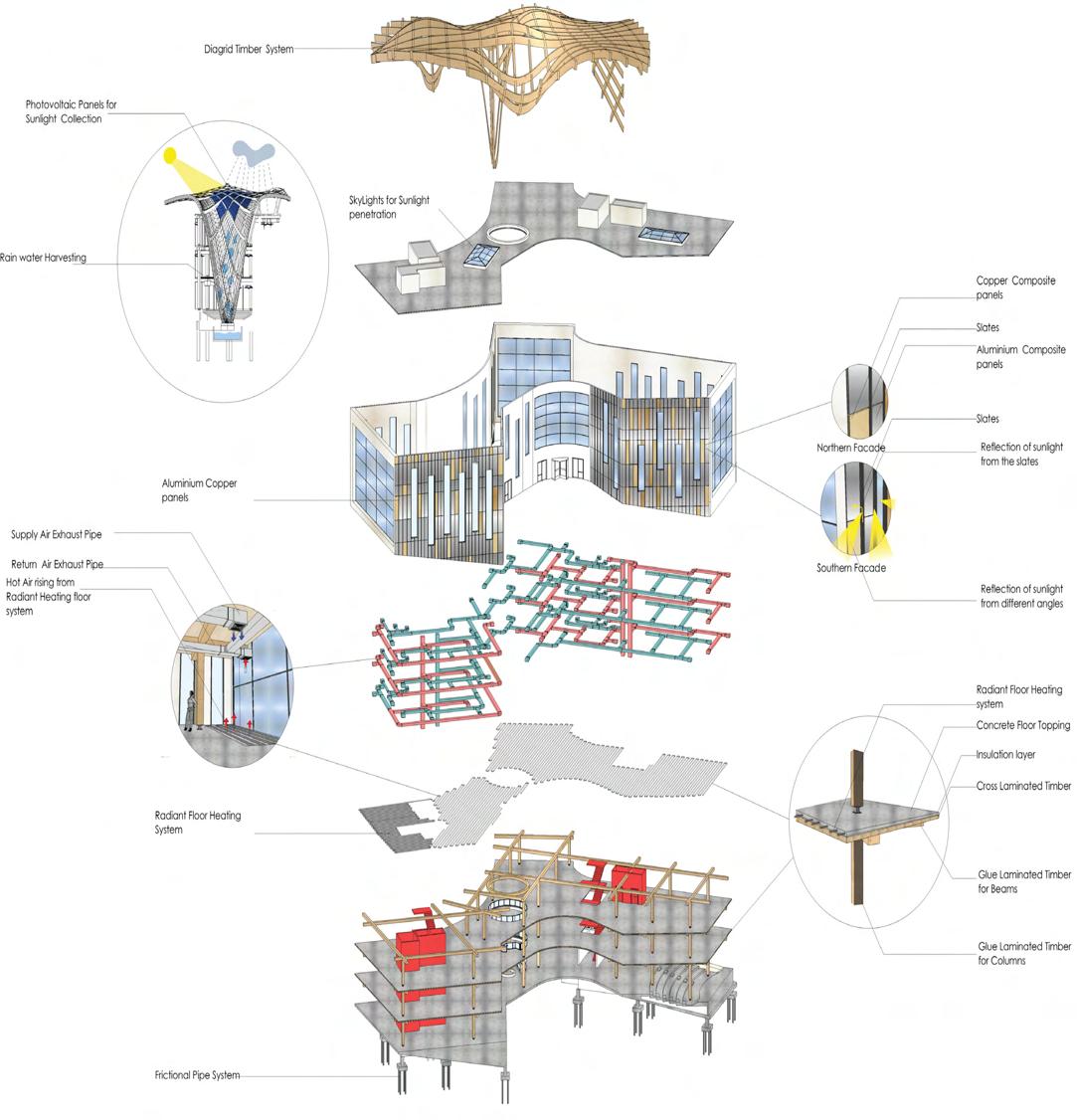
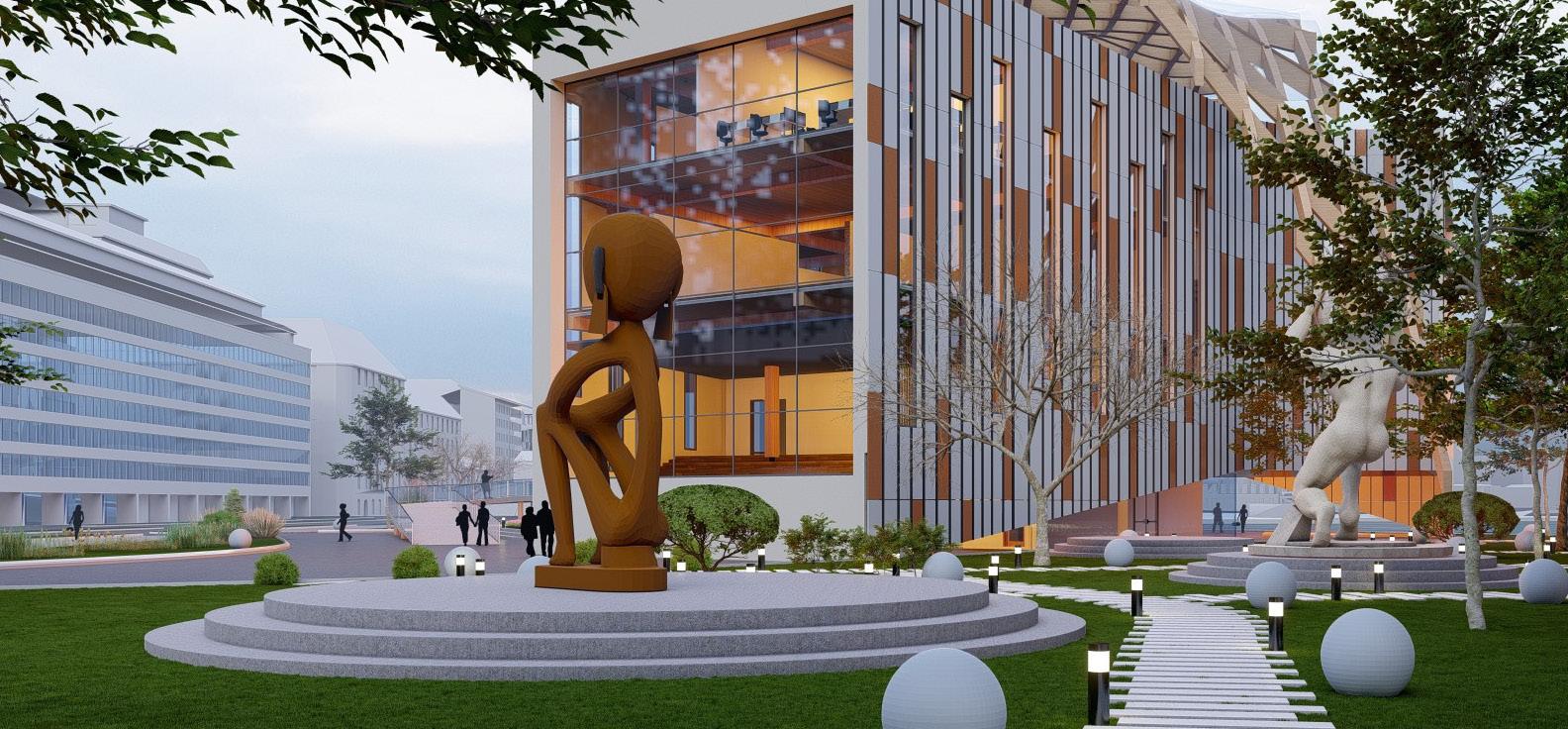
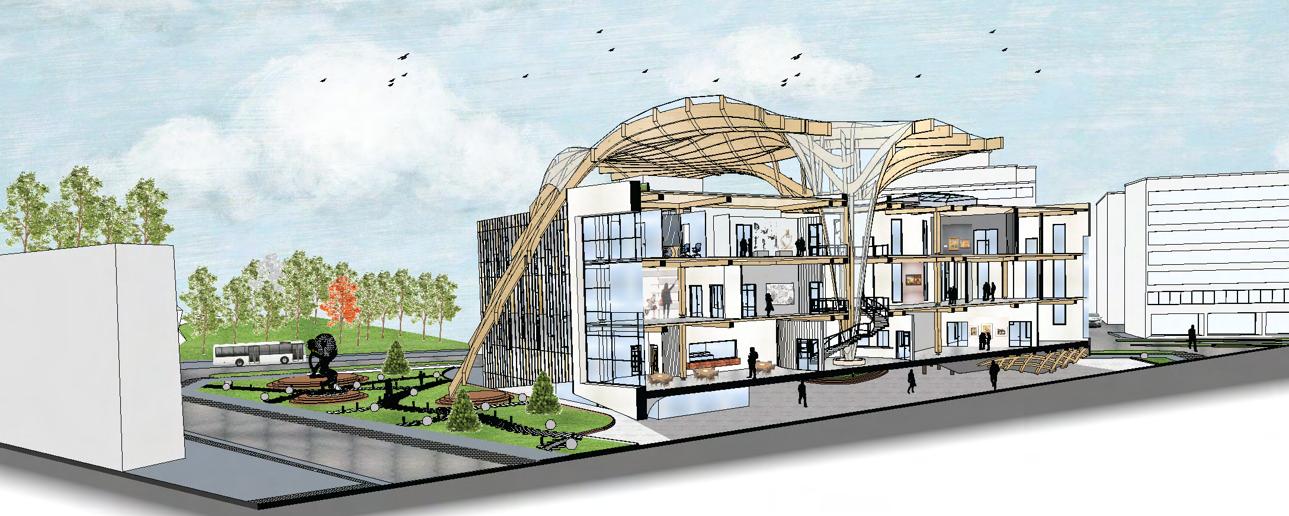
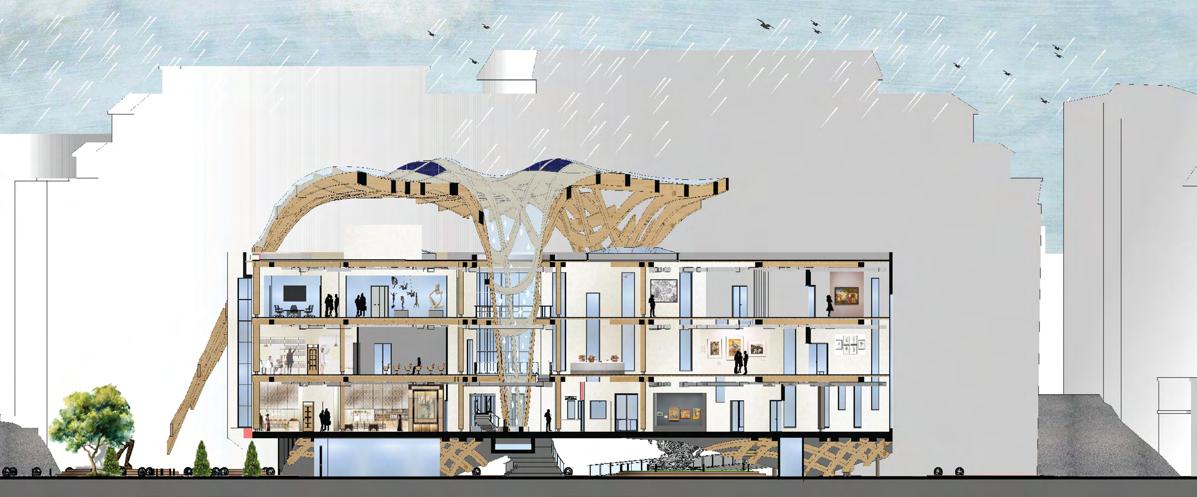
The project involves the unique design and construction of a three-story Museum of Architecture and Design, standing 47 feet tall. The museum will feature exhibition spaces, a restaurant offering traditional Helsinki cuisine, an event area, and workshops. Key sustainability features include solar energy harvesting systems integrated into the Diagrid and facade to reduce energy consumption and rainwater collection systems to support non-potable water use, such as landscape irrigation.
Additionally, the structure will be built using mass timber , showcasing Helsinki’s timber production and promoting sustainability around the Makasiiniranta Harbor area. The rooftop deck will serve as a rentable space for private events.
FIRST FLOOR PLAN
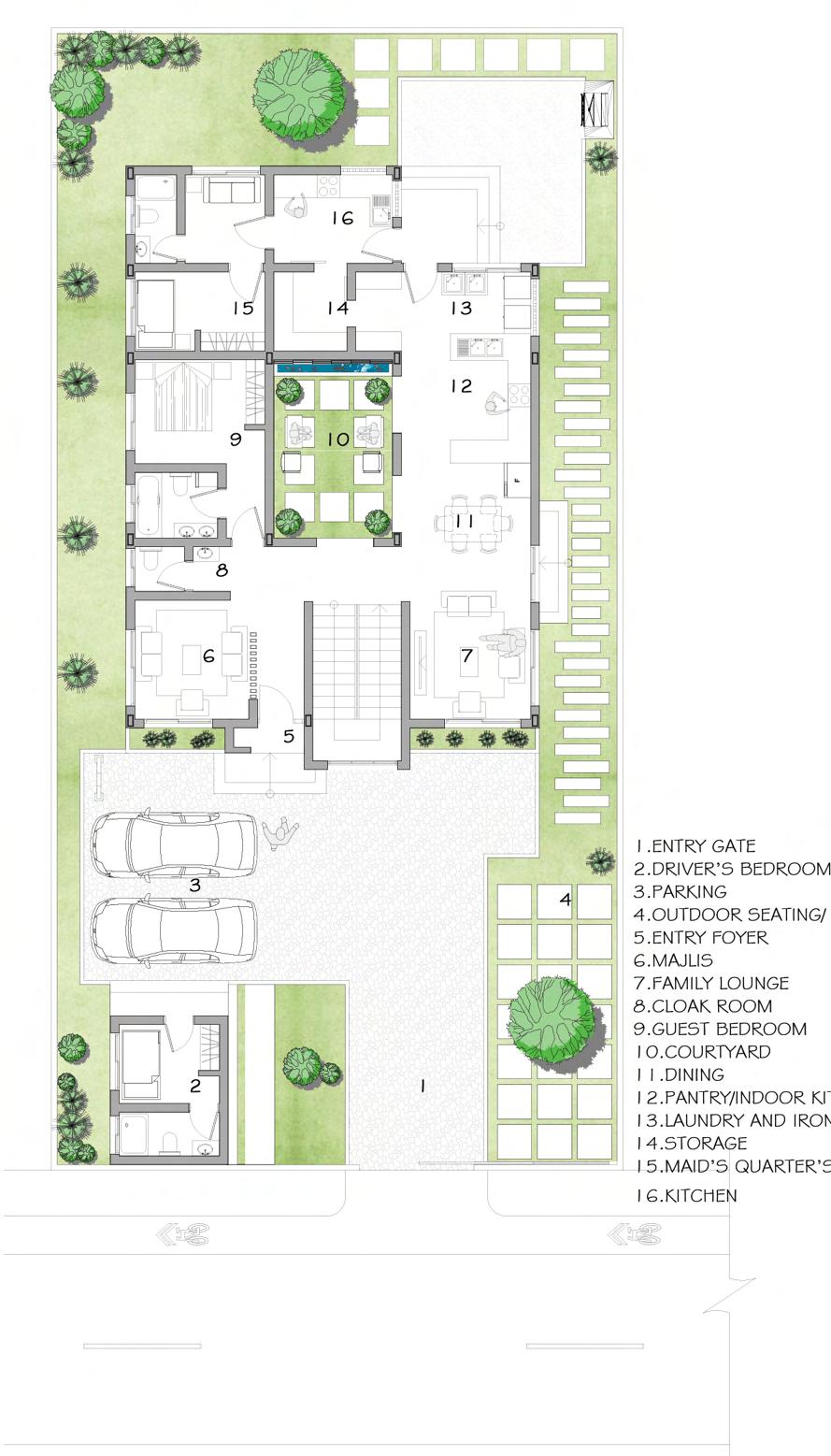
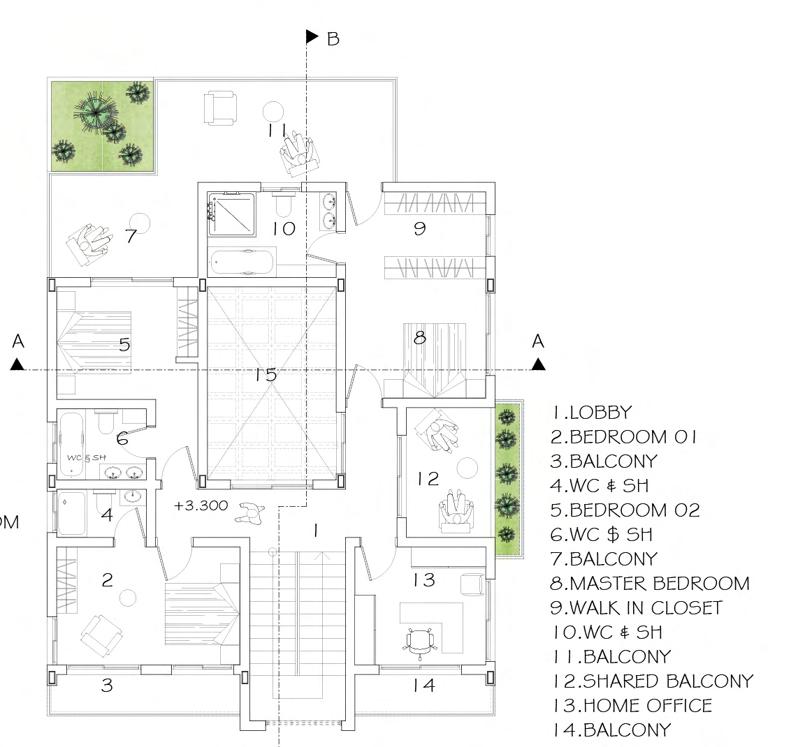
COMPETITION: PROPOSED DESIGN FOR HOUSE
OF FUTURE DUBAI
FALL 2023
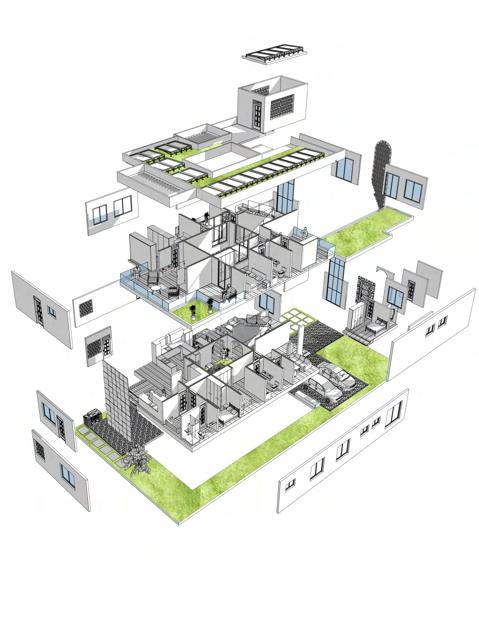
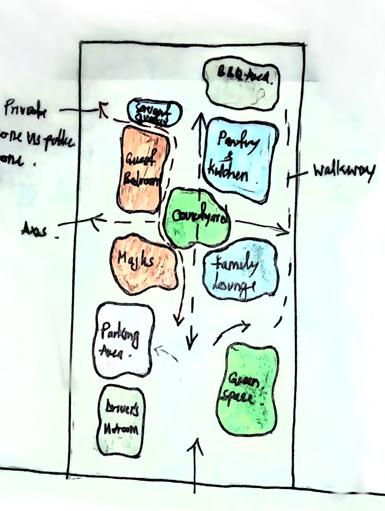
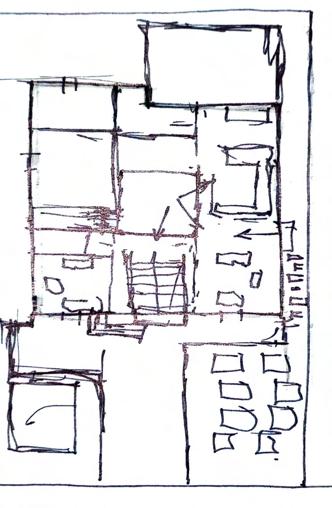
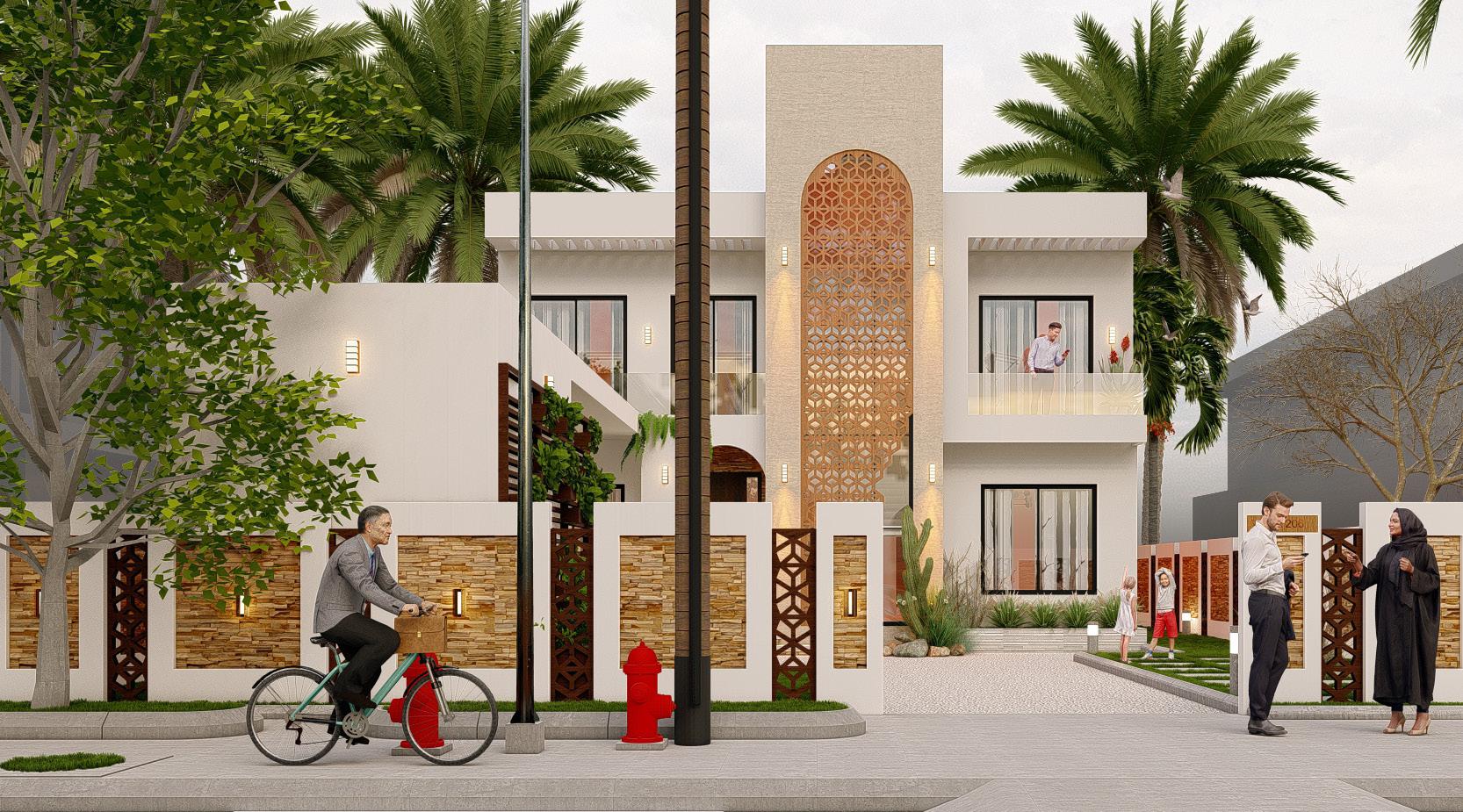
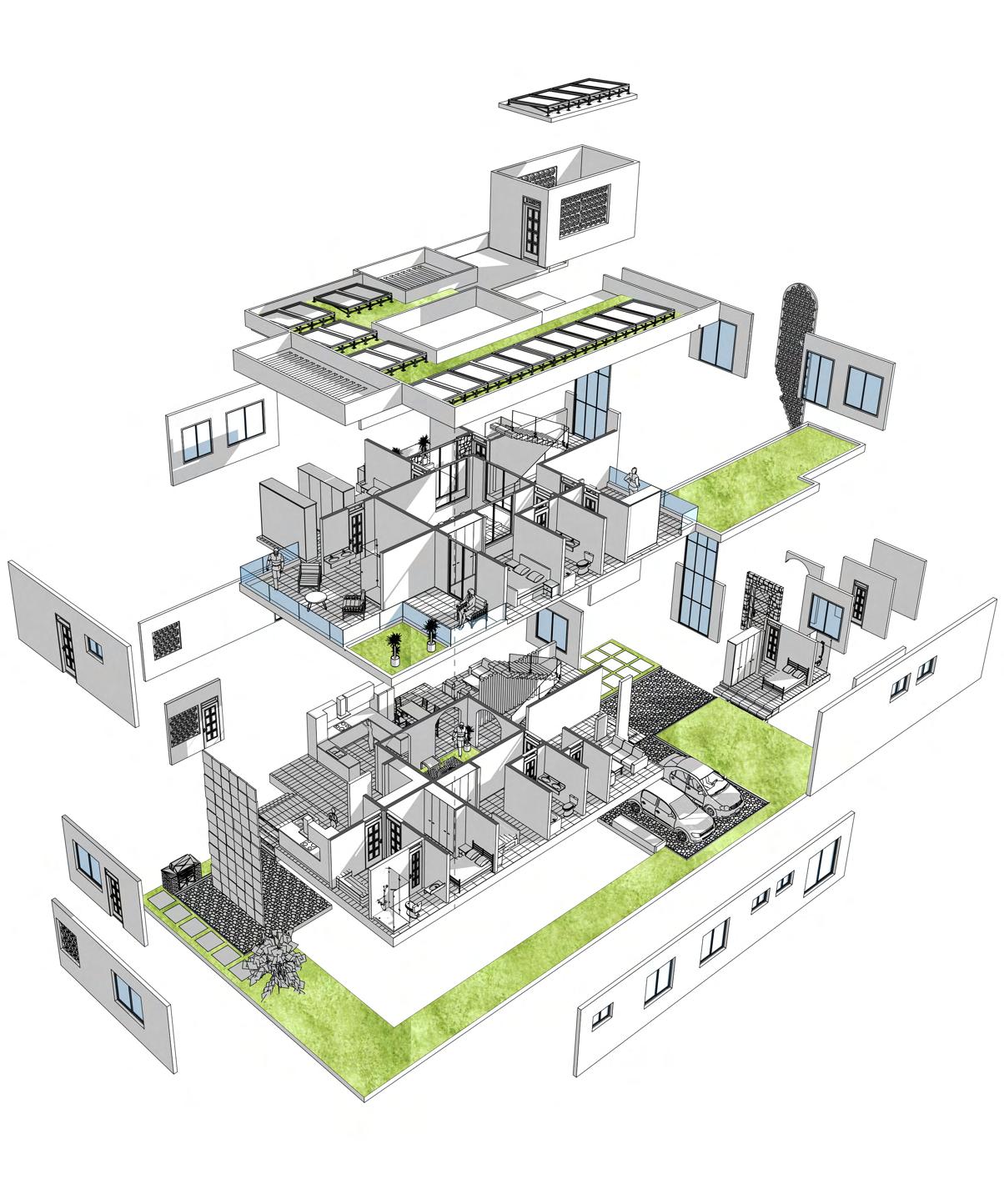
Viewing a house merely as a structure offers aesthetic appeal but lacks the essence of a true dwelling. By understanding the Emirati way of life, we can create not just sustainable designs but homes tailored for a user-friendly experience, from single-family dwellings to entire neighborhoods. It’s about crafting spaces that resonate with the users, making a house truly feel like a home.
Key Layout Concepts applied in design:
•Make the courtyard the central focus of the design, drawing inspiration from traditional Emirati architecture. And act as a natural ventilation system, promoting air circulation and creating a breathable environment.
•Integrate modern interpretations of wind towers to enhance natural ventilation.
•Use technology to optimize the placement and functioning of wind towers, ensuring efficient cooling and air circulation.
•Infuse the interior spaces with elements that evoke the feeling of being in an oasis, despite the desert surroundings.
COMPETITION: THE PUZZLE HOUSE
(MODULAR BLOCK PARTY STRUCTURE)
SPRING 2025
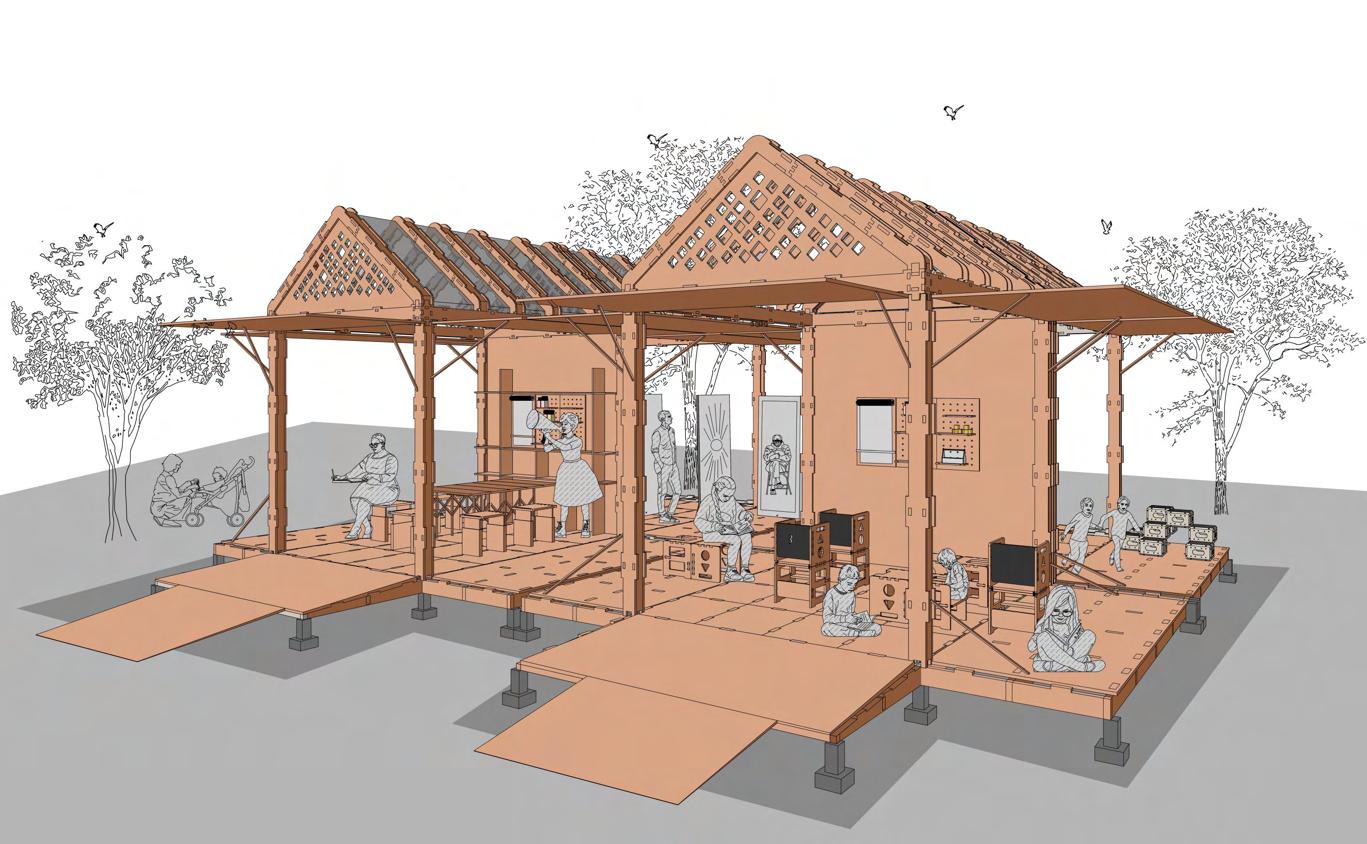
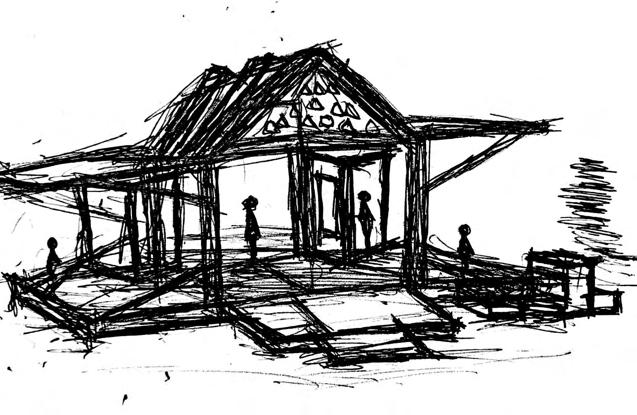
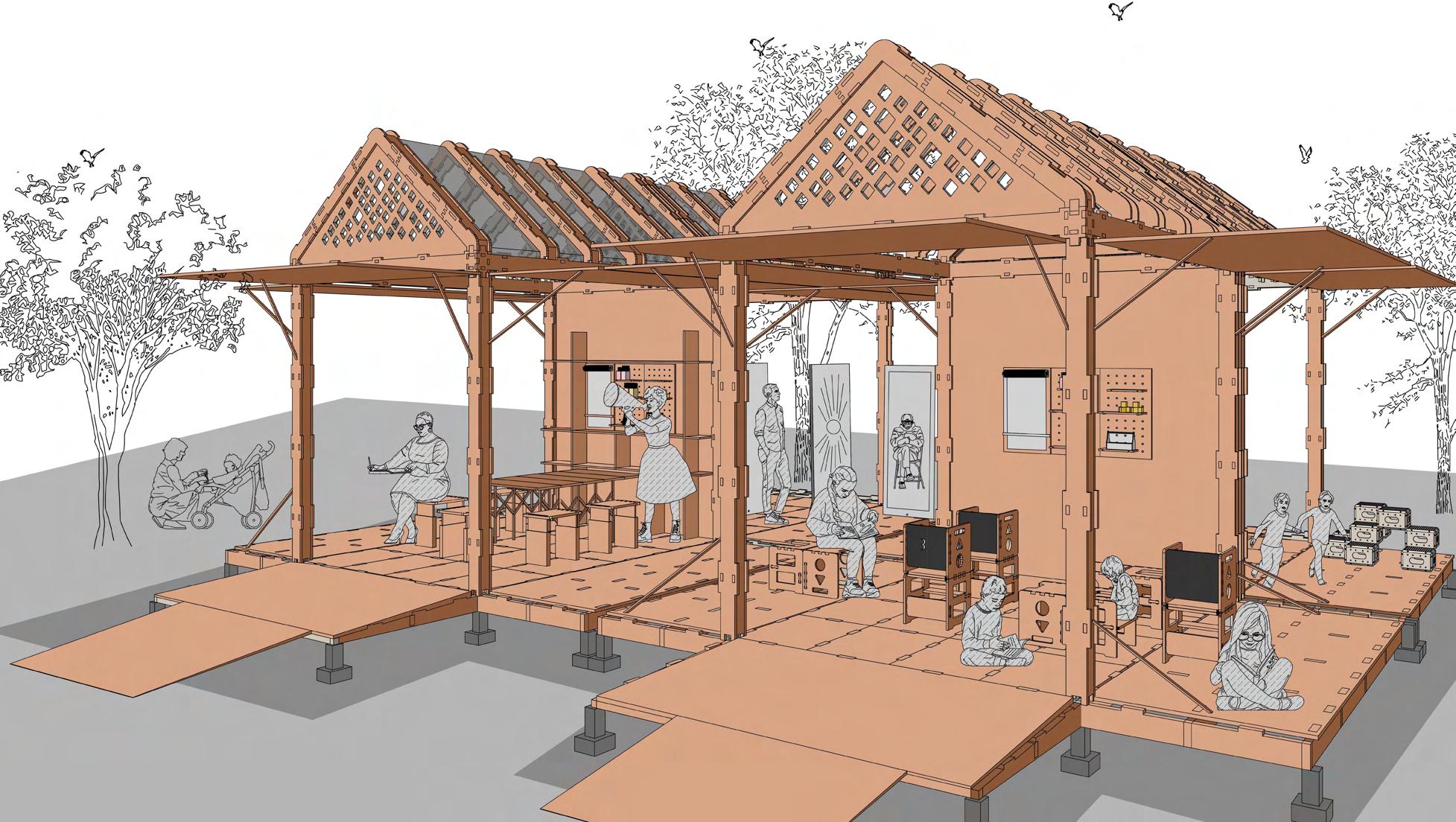
The Puzzle House is more than just a structure—it’s a symbol of connection and collaboration. Inspired by the way puzzle pieces fit together, this modular pod is designed to bring people closer, fostering interaction and a sense of community. Just as assembling a puzzle requires effort and careful matching, the Puzzle House serves as a gathering space where residents can come together, exchange ideas, and find solutions to shared challenges. Built entirely from wood, the Puzzle House consists of modular pieces that can be easily assembled by anyone with a basic understanding of how puzzles work. Its flexible design allows for reconfiguration into various layouts, adapting to different needs. The space functions as a community meeting hub, exhibition Centre, learning and play area for children, and dynamic environment where furniture pieces shift to accommodate different activities. At its core, the Puzzle House is about building—not just a structure, but a stronger, more connected community.
4 UNITS FLOOR PLAN
WORKING DRAWINGS
(APARTMENT COMPLEX)
SUMMER 2021
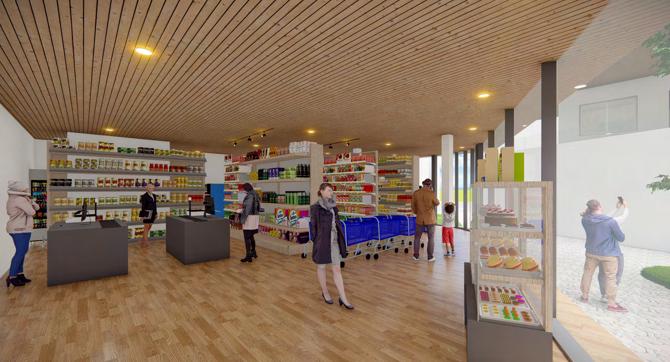
The apartment complex was a 13-story high-rise featuring four distinct apartment typologies. The first floor incorporated commercial rental spaces, creating a mixed-use development. Completing the working drawings took approximately 20 weeks, involving extensive coordination between engineers and the client team. .
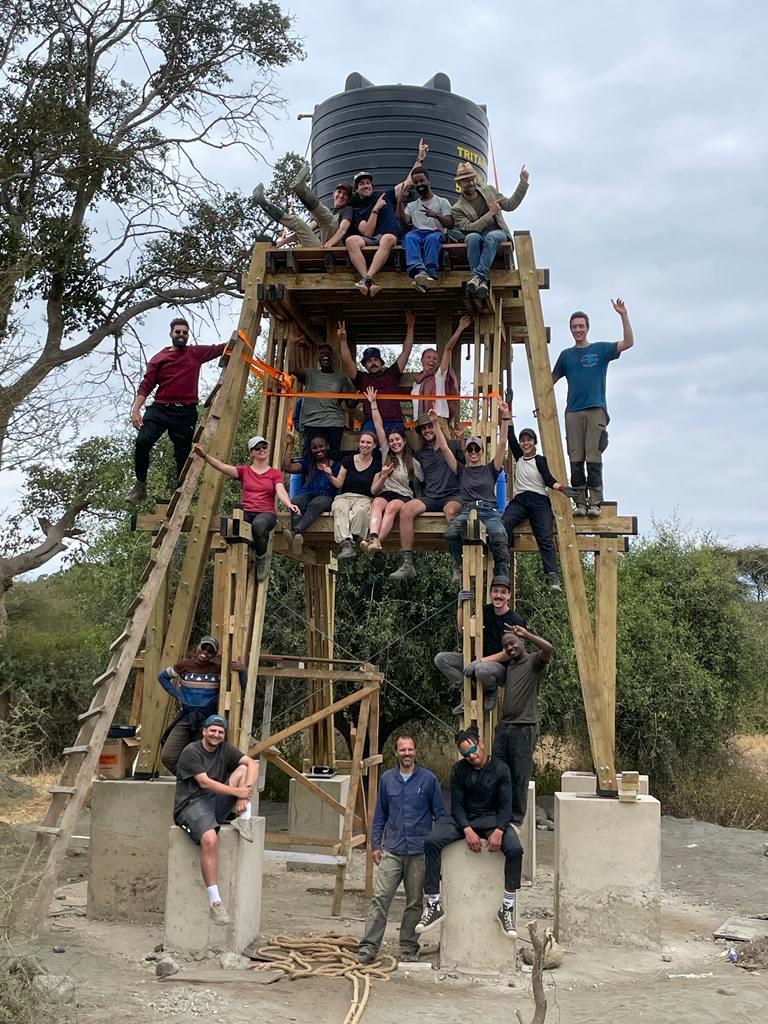
VOLUNTEER WORK: WATER TOWER PROJECT
(DESIGN BUILD WORKSHOP)
SUMMER 2022
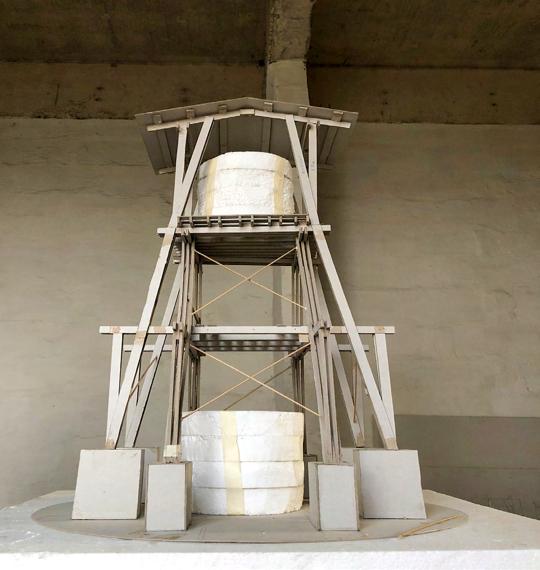
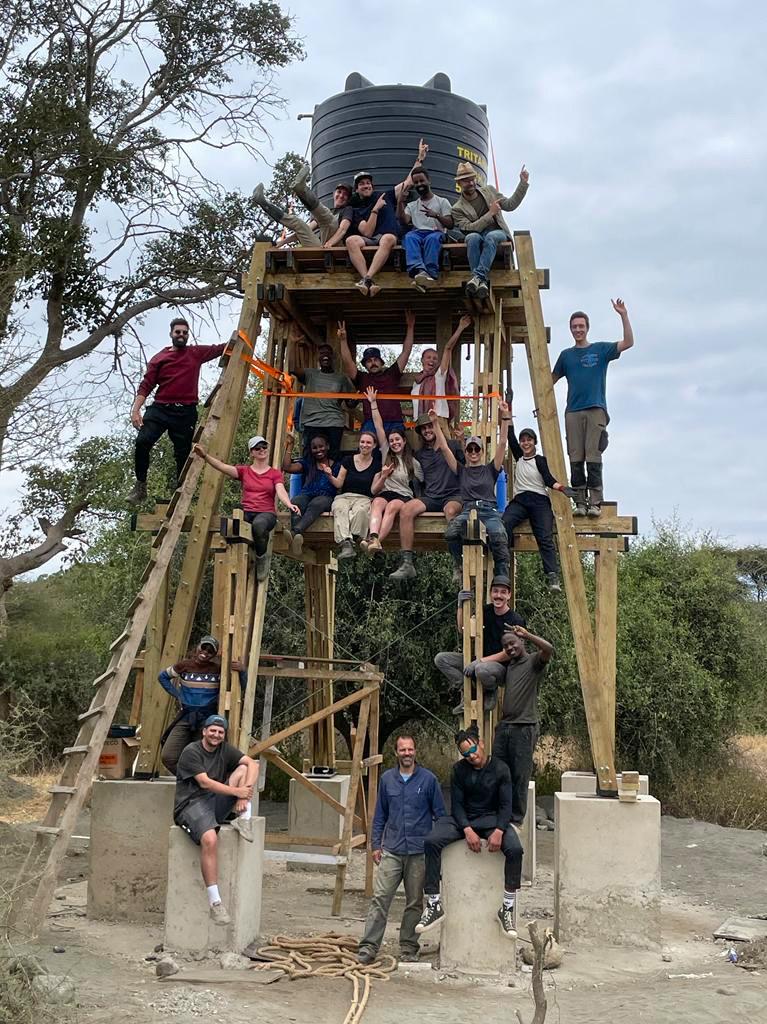
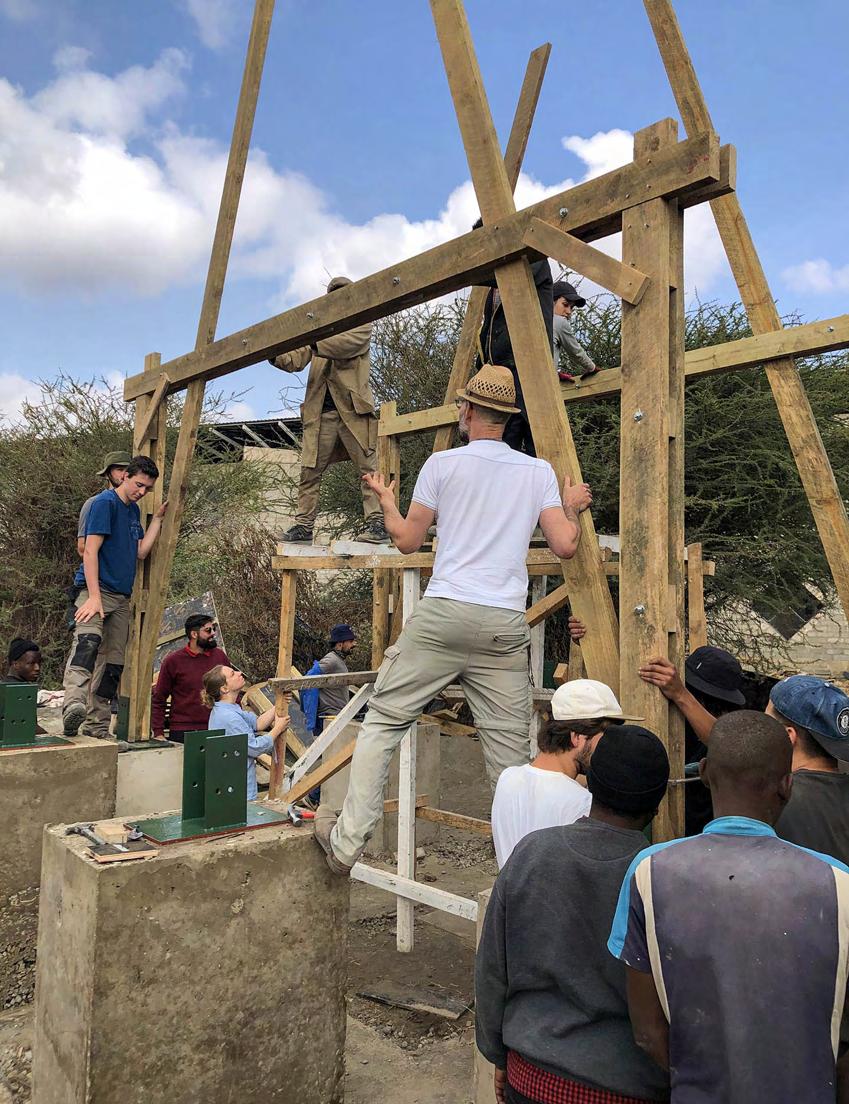
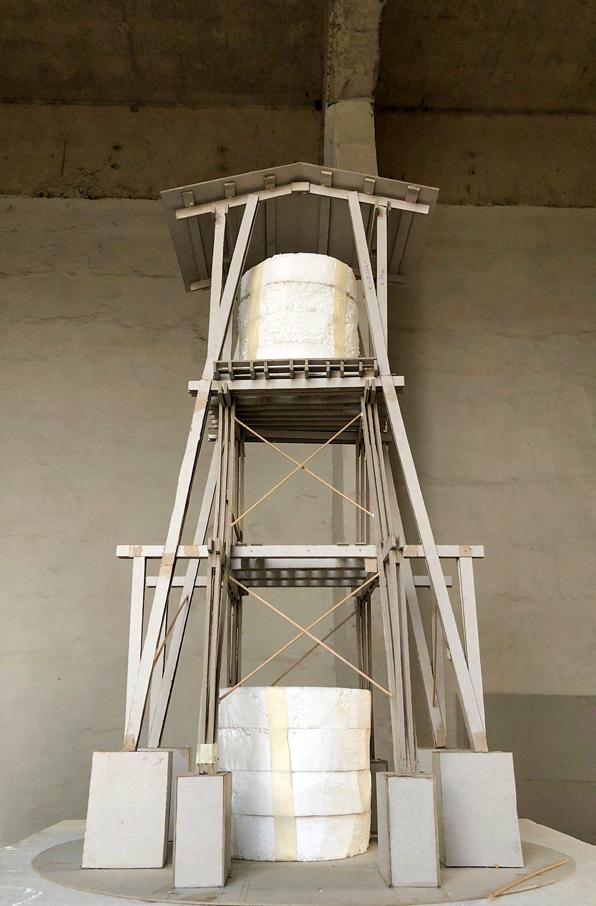
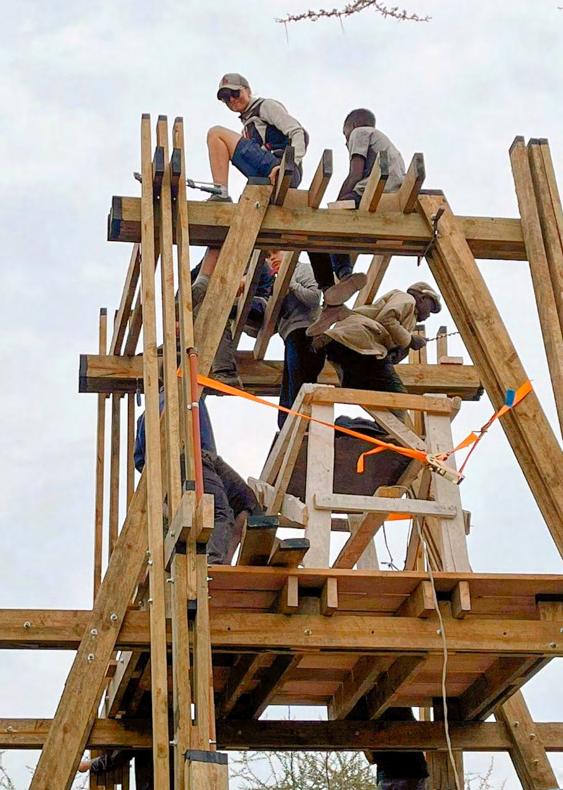
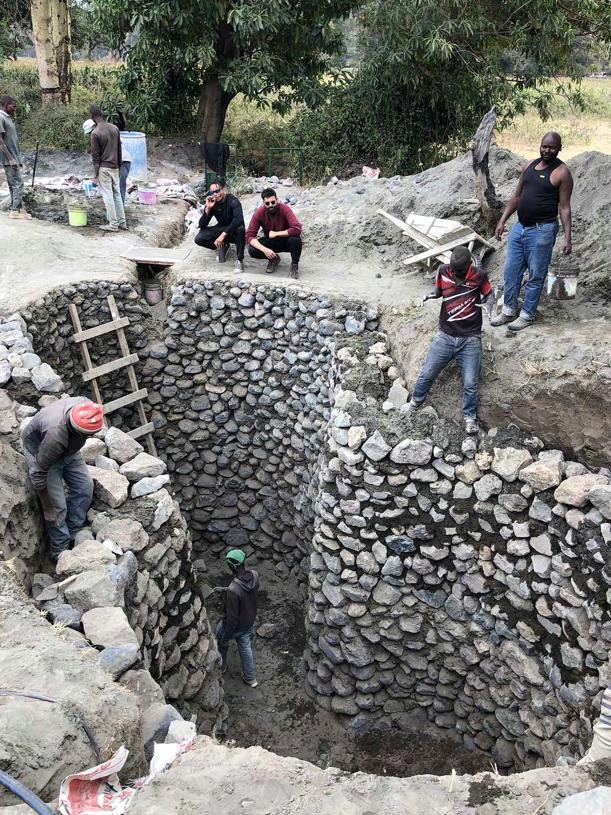
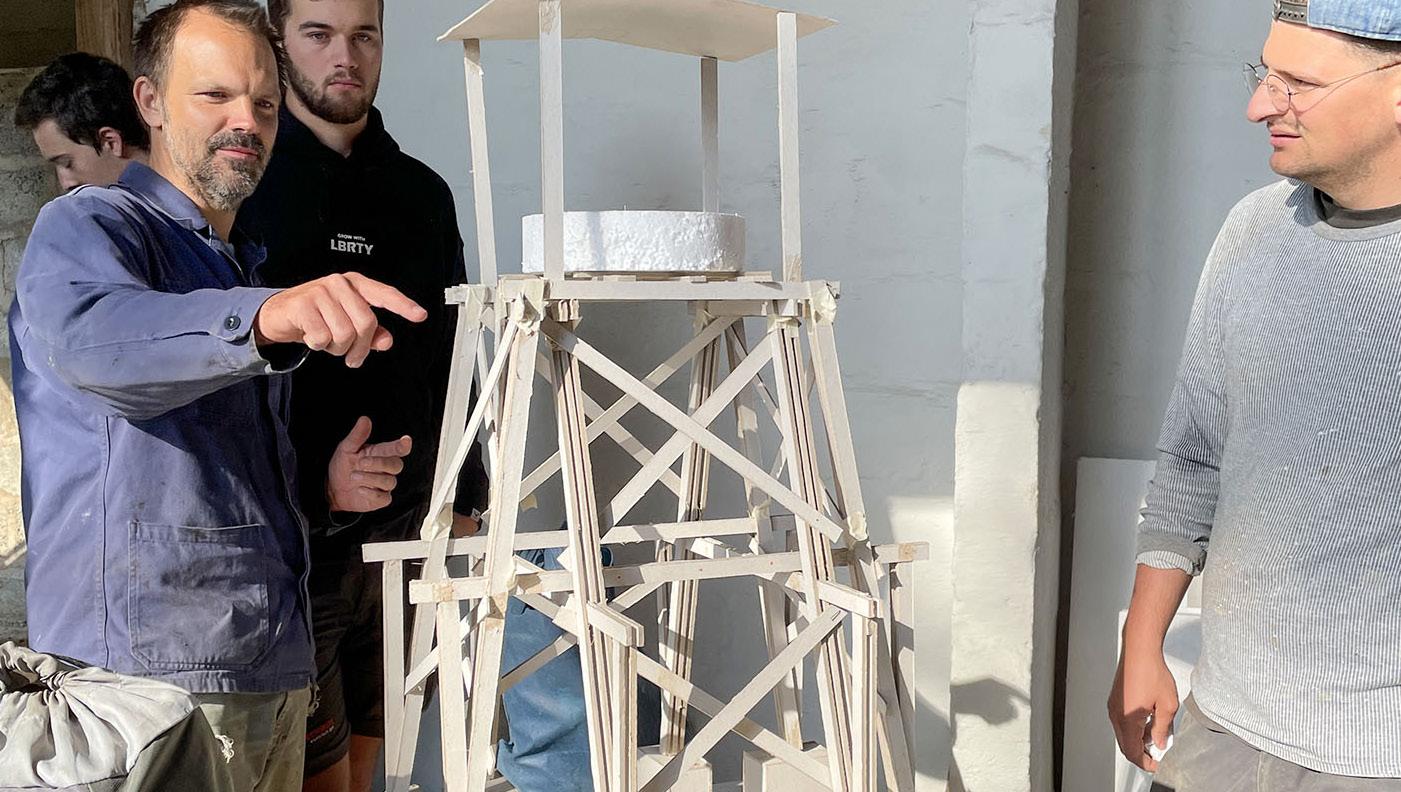
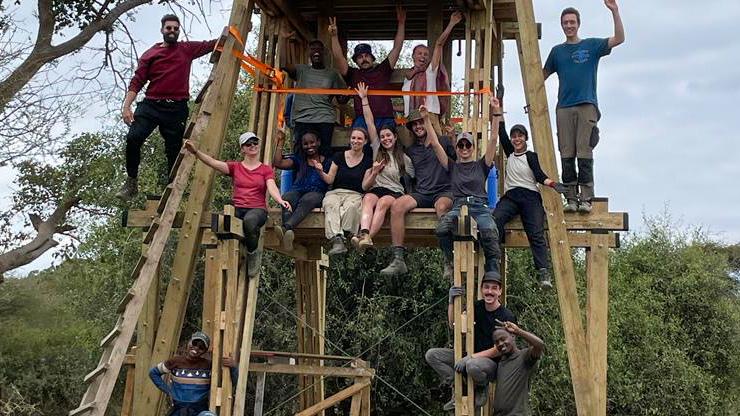
The Water Tower Project was a volunteer summer school initiative led by HS Lucerne University in Switzerland. This workshop brought together architecture and engineering students to design and construct a system for channeling and filtering mountain water for drinking at Simba Vision Primary School in Arusha, Tanzania.
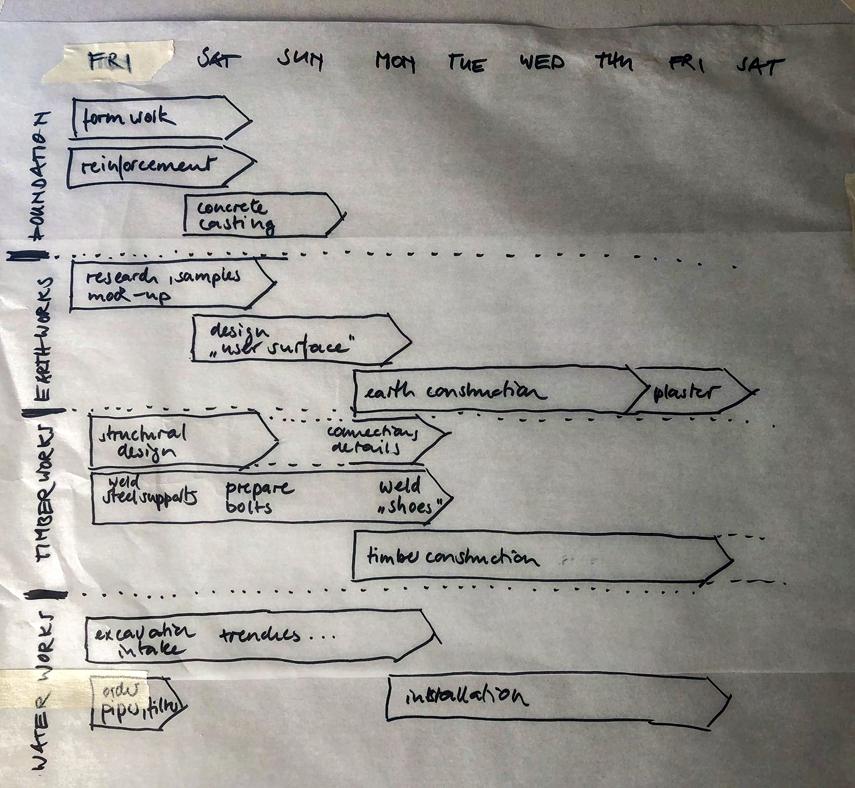
With only two weeks to complete the project, time was limited for design, assembly, and construction. To streamline the process, we divided into teams after the initial design phase to conduct preliminary investigations into materials, costs, and design feasibility.
By the end of our time, we had achieved 90% of the construction, with the remaining 10% completed by local residents.