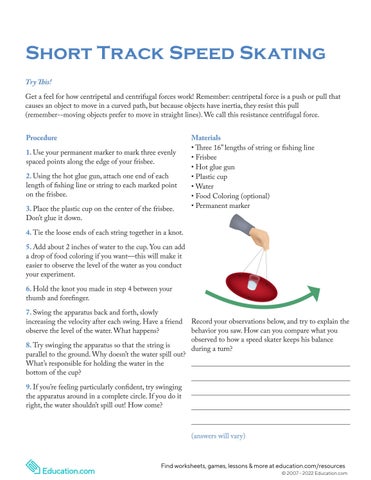
Short Track Speed Skating Try This! Get a feel for how centripetal and centrifugal forces work! Remember: centripetal force is a push or pull that causes an object to move in a curved path, but because objects have inertia, they resist this pull (remember--moving objects prefer to move in straight lines). We call this resistance centrifugal force. Procedure 1. Use your permanent marker to mark three evenly spaced points along the edge of your frisbee. 2. Using the hot glue gun, attach one end of each length of fishing line or string to each marked point on the frisbee. 3. Place the plastic cup on the center of the frisbee. Don’t glue it down.
Materials • Three 16” lengths of string or fishing line • Frisbee • Hot glue gun • Plastic cup • Water • Food Coloring (optional) • Permanent marker
4. Tie the loose ends of each string together in a knot. 5. Add about 2 inches of water to the cup. You can add a drop of food coloring if you want—this will make it easier to observe the level of the water as you conduct your experiment. 6. Hold the knot you made in step 4 between your thumb and forefinger. 7. Swing the apparatus back and forth, slowly increasing the velocity after each swing. Have a friend observe the level of the water. What happens? 8. Try swinging the apparatus so that the string is parallel to the ground. Why doesn’t the water spill out? What’s responsible for holding the water in the bottom of the cup?
Record your observations below, and try to explain the behavior you saw. How can you compare what you observed to how a speed skater keeps his balance during a turn?
9. If you’re feeling particularly confident, try swinging the apparatus around in a complete circle. If you do it right, the water shouldn’t spill out! How come?
(answers will vary)
Find worksheets, games, lessons & more at education.com/resources © 2007 - 2022 Education.com
lever arm
lever arm
er le v
lever arm
direction of force
direction of force
lever arm
Before a snowboarder does a spin, he extends and “winds up” his arms. By doing this, he’s increasing the length of his lever arm, making it easier for his body to rotate. Think about opening a revolving door—is it easier to open by pushing on the edge farthest from the hinge or closer to the hinge? When a snowboarder swings his arms, it increases torque, making it easier for the rest of his body to spin.
ar m
s
axi
direction of force
leve r ar
m
direction of force
direction of force
er le v
ar m
axis
Stand in your original position. Without moving your feet, extend your arms away from your body. Point your right arm in front of you and your left arm behind. Your chest and shoulders should be rotated left. Now, as you jump, swing your arms clockwise. How did winding up your arms affect your spin? Winding up your arms increased the length of the lever arm and created more torque, so it was easier for your body to spin.
lever arm
direction of force
direction of windup lever arm
axis
Cool Fact: If snowboarders maximize their torque on the half-pipe, they can spin up to 600° per second—that’s nearly two full spins!
leve
r ar
m
direction of windup
Find worksheets, games, lessons & more at education.com/resources © 2007 - 2022 Education.com
Entry ramp
In the snowboard half-pipe event, snowboarders use velocity and torque to perform tricks in the air.
50-100m
3m
Vertical
3-5m
Transition
Flat 13-18m
50-100m
Vertical 3-5m
Transition
Flat
A snowboarder creates torque by twisting his torso at the “vertical” of the half-pipe. This turns linear momentum into angular momentum as he rotates around his own vertical axis.
Try This!
1. Stand up in a clear area. Make sure that you have enough space to reach out both your arms and not touch anything. 2. With your feet about shoulder-width apart, jump straight up. Do this a few times. What kind of momentum is your body experiencing? In what direction? 3. You’re going to jump again, only this time, twist by rotating your chest and shoulders left as you jump. What happened?
4. Explain how this happened using the terms linear momentum, angular momentum, torque, and axis.
Find worksheets, games, lessons & more at education.com/resources © 2007 - 2022 Education.com
Entry ramp
In the snowboard half-pipe event, snowboarders use velocity and torque to perform tricks in the air.
50-100m
3m
Vertical
3-5m
Transition
Flat 13-18m
50-100m
Vertical 3-5m
Transition
Flat
A snowboarder creates torque by twisting his torso at the “vertical” of the half-pipe. This turns linear momentum into angular momentum as he rotates around his own vertical axis.
Try This! 1. Stand up in a clear area. Make sure that you have enough space to reach out both your arms and not touch anything. 2. With your feet about shoulder-width apart, jump straight up. Do this a few times. What kind of momentum is your body experiencing? In what direction? Your body has linear momentum, in an upward direction (perpendicular to the ground).
3. You’re going to jump again, only this time, twist by rotating your chest and shoulders left as you jump. What happened?
When you twisted your chest and shoulders in the air, your whole body rotated left. When you landed, you were facing a different direction from your starting position. 4. Explain how this happened using the terms linear momentum, angular momentum, torque, and axis. When you jumped and twisted your chest and shoulders, you created torque, which converted your linear momentum into angular momentum and caused you to rotate around your vertical axis.
Find worksheets, games, lessons & more at education.com/resources © 2007 - 2022 Education.com
Short Track Speed Skating In short track speed skating, competitors race each other around an oval track at speeds of up to 40 miles per hour. How do speed skaters lean so sharply during turns without falling over? The athlete pictured below isn’t supporting any of his weight on his left hand at all! Remember when we looked at how skiers push on the snow to turn? The force that pushes back is called centripetal force because it causes an object to move along a curved path instead of a straight one. Speed skaters turn using this same force, exerted by pushing against the ice with their skates. Centripetal force leads to an equal and opposite centrifugal force. Centrifugal force comes from inertia—the tendency of an already-moving object to want to continue moving in a straight line. As the skater turns, he has to work hard to fight against this tendency. Check out the diagram below:
Here, we can think of gravity and centrifugal force adding up to one big diagonal force (the dashed green arrow) that pulls on the athlete’s center of gravity (g). As long as the athlete uses his skates to push back up through the ice with an equal and opposite force (the blue arrow), he’ll remain perfectly balanced during the turn. Imagine you’re riding as a passenger in a car. When the car makes a really sharp turn, why do you feel like you get yanked in the opposite direction? Use the explanation of centrifugal force provided to help you come up with your answer.
Need an example of how inertia works? Think about braking really hard in a moving car. Your torso gets “thrown” forward into the seat belt, but this feeling just comes from the fact that your torso wants to keep moving, even though the car is stopping!
centrifugal force
g
gravity
Find worksheets, games, lessons & more at education.com/resources © 2007 - 2022 Education.com
Short Track Speed Skating In short track speed skating, competitors race each other around an oval track at speeds of up to 40 miles per hour. How do speed skaters lean so sharply during turns without falling over? The athlete pictured below isn’t supporting any of his weight on his left hand at all! Remember when we looked at how skiers push on the snow to turn? The force that pushes back is called centripetal force because it causes an object to move along a curved path instead of a straight one. Speed skaters turn using this same force, exerted by pushing against the ice with their skates. Centripetal force leads to an equal and opposite centrifugal force. Centrifugal force comes from inertia—the tendency of an already-moving object to want to continue moving in a straight line. As the skater turns, he has to work hard to fight against this tendency. Check out the diagram below: Need an example of how inertia works? Think about braking really hard in a moving car. Your torso gets “thrown” forward into the seat belt, but this feeling just comes from the fact that your torso wants to keep moving, even though the car is stopping!
centrifugal force
Here, we can think of gravity and centrifugal force adding up to one big diagonal force (the dashed green arrow) that pulls on the athlete’s center of gravity (g). As long as the athlete uses his skates to push back up through the ice with an equal and opposite force (the blue arrow), he’ll remain perfectly balanced during the turn. Imagine you’re riding as a passenger in a car. When the car makes a really sharp turn, why do you feel like you get yanked in the opposite direction? Use the explanation of centrifugal force provided to help you come up with your answer. Explanation: Your body wants to continue moving straight ahead, but the the turning car attempts to pull your body in a new direction. Your body’s inertia resists this pull, and you feel this resistance as an apparent force that “throws” you against the inside of the car door!
g
gravity
Find worksheets, games, lessons & more at education.com/resources © 2007 - 2022 Education.com
Find worksheets, games, lessons & more at education.com/resources © 2007 - 2022 Education.com
Find worksheets, games, lessons & more at education.com/resources © 2007 - 2022 Education.com
lever arm
lever arm
er le v
lever arm
direction of force
direction of force
lever arm
Before a snowboarder does a spin, he extends and “winds up” his arms. By doing this, he’s increasing the length of his lever arm, making it easier for his body to rotate. Think about opening a revolving door—is it easier to open by pushing on the edge farthest from the hinge or closer to the hinge? When a snowboarder swings his arms, it increases torque, making it easier for the rest of his body to spin.
ar m
s
axi
direction of force
leve r ar
m
direction of force direction of force
er le v
ar m
axis
Stand in your original position. Without moving your feet, extend your arms away from your body. Point your right arm in front of you and your left arm behind. Your chest and shoulders should be rotated left. Now, as you jump, swing your arms clockwise. How did winding up your arms affect your spin?
lever arm
direction of force
direction of windup lever arm
axis
Cool Fact: If snowboarders maximize their torque on the half-pipe, they can spin up to 600° per second—that’s nearly two full spins!
leve
r ar
m
direction of windup
Find worksheets, games, lessons & more at education.com/resources © 2007 - 2022 Education.com
Short Track Speed Skating Try This! Get a feel for how centripetal and centrifugal forces work! Remember: centripetal force is a push or pull that causes an object to move in a curved path, but because objects have inertia, they resist this pull (remember--moving objects prefer to move in straight lines). We call this resistance centrifugal force. Procedure 1. Use your permanent marker to mark three evenly spaced points along the edge of your frisbee. 2. Using the hot glue gun, attach one end of each length of fishing line or string to each marked point on the frisbee. 3. Place the plastic cup on the center of the frisbee. Don’t glue it down.
Materials • Three 16” lengths of string or fishing line • Frisbee • Hot glue gun • Plastic cup • Water • Food Coloring (optional) • Permanent marker
4. Tie the loose ends of each string together in a knot. 5. Add about 2 inches of water to the cup. You can add a drop of food coloring if you want—this will make it easier to observe the level of the water as you conduct your experiment. 6. Hold the knot you made in step 4 between your thumb and forefinger. 7. Swing the apparatus back and forth, slowly increasing the velocity after each swing. Have a friend observe the level of the water. What happens? 8. Try swinging the apparatus so that the string is parallel to the ground. Why doesn’t the water spill out? What’s responsible for holding the water in the bottom of the cup?
Record your observations below, and try to explain the behavior you saw. How can you compare what you observed to how a speed skater keeps his balance during a turn?
9. If you’re feeling particularly confident, try swinging the apparatus around in a complete circle. If you do it right, the water shouldn’t spill out! How come?
Find worksheets, games, lessons & more at education.com/resources © 2007 - 2022 Education.com
Coloring WinterSports
Copyright © 2009-2010 by Education.com
Aerial Skiing
Find worksheets, games, lessons & more at education.com/resources More worksheets at www.education.com/worksheets © 2007 - 2022 Education.com
Coloring WinterSports
Copyright © 2009-2010 by Education.com
Figure Skating
Find worksheets, games, lessons & more at education.com/resources More worksheets at www.education.com/worksheets © 2007 - 2022 Education.com
Coloring WinterSports
Copyright © 2009-2010 by Education.com
Ice Hockey
Find worksheets, games, lessons & more at education.com/resources More worksheets at www.education.com/worksheets © 2007 - 2022 Education.com
Coloring WinterSports
Copyright © 2009-2010 by Education.com
Speed Skating
Find worksheets, games, lessons & more at education.com/resources More worksheets at www.education.com/worksheets © 2007 - 2022 Education.com
Coloring WinterSports
Copyright © 2009-2010 by Education.com
Cross Country Skiing
Find worksheets, games, lessons & more at education.com/resources More worksheets at www.education.com/worksheets © 2007 - 2022 Education.com
Coloring WinterSports
Copyright © 2009-2010 by Education.com
Ski Jumping
Find worksheets, games, lessons & more at education.com/resources More worksheets at www.education.com/worksheets © 2007 - 2022 Education.com
Coloring WinterSports
Copyright © 2009-2010 by Education.com
Snowboarding
Find worksheets, games, lessons & more at education.com/resources More worksheets at www.education.com/worksheets © 2007 - 2022 Education.com
Coloring WinterSports
Copyright © 2009-2010 by Education.com
Skiing
Find worksheets, games, lessons & more at education.com/resources More worksheets at www.education.com/worksheets © 2007 - 2022 Education.com
Coloring Sports
Copyright © 2009-2010 by Education.com
Bobsled
Find worksheets, games, lessons & more at education.com/resources © 2007 - 2022 Education.com More worksheets at www.education.com/worksheets
Coloring WinterSports
Copyright © 2009-2010 by Education.com
Alpine Skiing
Find worksheets, games, lessons & more at education.com/resources More worksheets at www.education.com/worksheets © 2007 - 2022 Education.com