
Reflecting Resilience An Embodied Guide to Hanukkah


artistic offerings, reflections, and practices to accompany your holiday traditions
WELCOME & HAPPY HANUKKAH!
Reflecting Resilience is Mitsui Collective's new guide to bringing embodiment more deeply into your Hanukkah practice. Each night, we showcase artistic and reflective offerings from our friends on themes relating to embodied wisdom and experience, along with an embodied practice and reflection prompt to try out.
If there has ever been a time for resilience, these last several years have been that time. We offer these creative expressions and embodied practices to help cultivate and strengthen that sense of resiliency. And yet this is by no means the first time our people have needed or expressed resiliency — in fact, it's one of the core themes weaving throughout the Hanukkah holiday: how do we hold onto our inner core, a strong yet supple spine and thick skin to protect us, while maintaining an open and caring heart? So much of what we need is already held in our individual and collective bodies — cultural accumulation of wisdom and resource over generation after generation. How do we tap into that resource?
This is a guide, not an instruction manual. It's designed to accompany whatever your other Hanukkah practices may be — from lighting candles to giving gifts to cooking delicious oily foods — or could also stand on its own. We invite you to play and explore and see what sticks.
Please be sure to check out all the beautiful work offered here from our contributors and find them in their other spaces. Should you feel compelled, we will also be collecting "Gelt" for a tip jar to supplement our own compensation given in appreciation of their offerings — more info at the back.
Just as the light of the Hanukkah candles reflects back upon us even as they shine out through the windows of our homes, may our outward expressions of resilience reflect back upon us and all who we love in this generation, in every generation before us, and every generation yet to come.
Ariana and Yoshi the team at Mitsui Collective
Stillness 1ST NIGHT

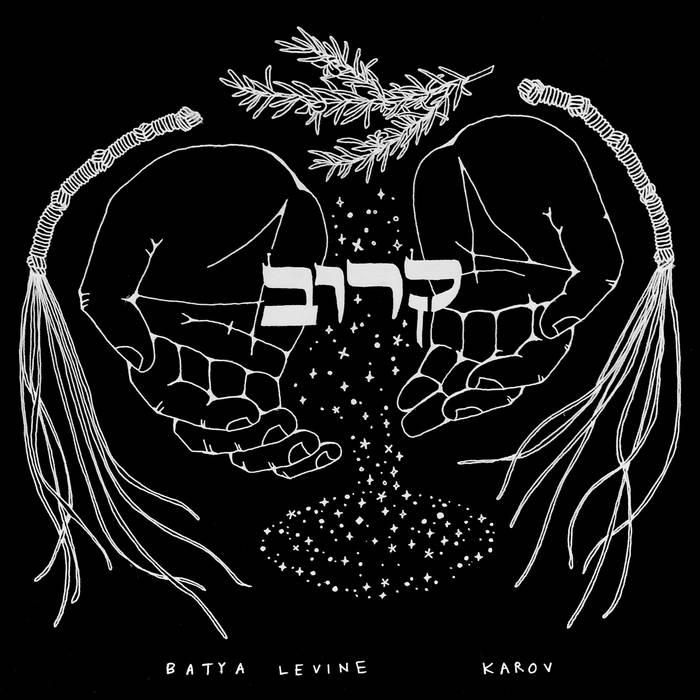
May I be empty and open to receive the light
May I be empty and open to receive
May I be full and open to receive the light
May I be full and open to receive
- "MAY I BE EMPTY," BATYA LEVINE
On the first night of Hanukkah, focus on stillness, noticing the sensation of quiet emptiness in the pause between breaths. What does stillness enable us to receive? Through emptiness, how do we become more open?
We will return to this song on the eighth night with a focus on fullness. What do you need between now and then to become full?
Listen to the full song here: https://batyalevine.bandcamp.com/track/may-i-be-empty
When facing challenging circumstances in my life, I often try to figure out what I can do to address them. I usually fail to consider what I can *stop* doing. Unaware of the irony in the moment, I have acquired books on decluttering and spent considerable numbers of hours learning how to manage my time better.
Like most human beings, I struggle with this cognitive bias – I think more about action rather than stillness.
Judaism presents us with a very different model. In Exodus 31:17 we learn that while God made heaven and earth in six days, on the seventh day God shavat vayinafash “ceased from work and was refreshed.” Vayinafash can also be understood as God being “breathed,” “inspired,” or even “ensouled.”
We often think of God resting after finishing Creation, but the Sefat Emet (a Chasidic rabbi) teaches that Shabbat is actually the final, perfecting act of Creation. I like to imagine God looking over Creation and saying, “It’s almost perfect! How can I make it better? I think I can make it better by doing… nothing!”
What a move! And yet, without this divine stillness, Creation would have been incomplete. When we are faced with challenges in our lives, I also invite us to consider doing nothing. In this stillness, we can again reconnect with our breath, our inspiration, and perhaps even our souls.
-
Breath & Stillness
In the beginning, it is said that creation was spoken into being through a divine metaphysical language. Some time after, the fire that nourishes our souls was given oxygen through that same divine breath. As we begin the first night of Hanukkah during this Shmita year of rest and release, we pause our breath in stillness.
Either in preparation for candlelighting, before you begin the blessings, or simply in its own time: Notice the natural rhythm of your breathing in this moment, as it exists, without active change. Breath three cycles — one inhale and one exhale — at this rhythm.
Then, inhale a long slow breath, and pause at the top, neither inhaling nor exhaling, for a count of several heartbeats. Release the breath through a slow exhale. Repeat, again pausing at the top, now noticing the stillness of the pause, and any other sensations in the body that may accompany it. Release through a slow exhale.
Inhale for a third and final cycle. As you pause the breath at the top, notice what space is made in the quiet stillness of pause. Notice what may try to fill that space, and what you'd like to fill the space, and any gaps in between. Release in a final slow exhale and return to a comfortable breathing pattern.
Where do I find stillness?
What do I find within and through that stillness?
Sight 2ND NIGHT
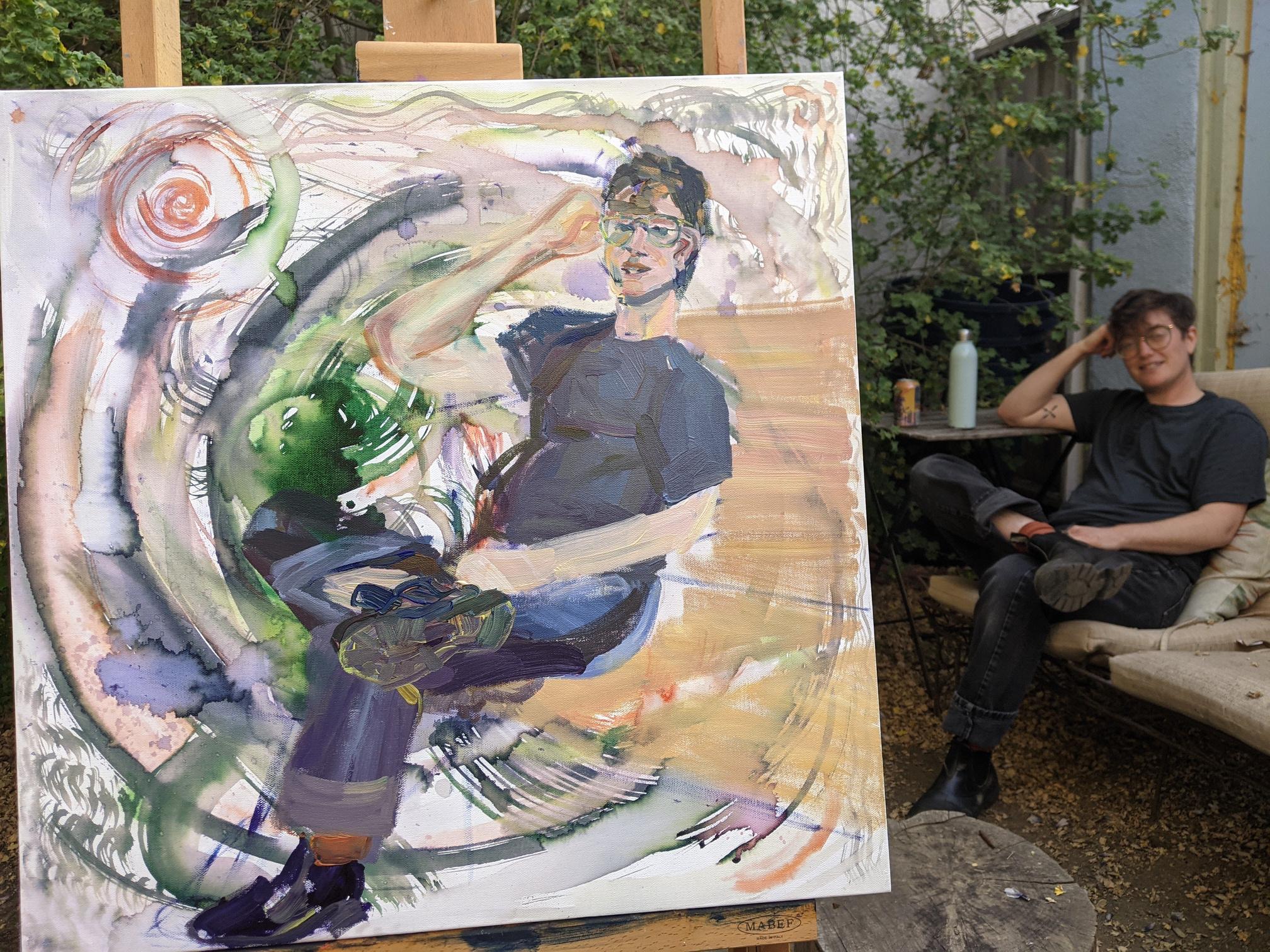
"ALINA," ACRYLIC AND INK ON CANVAS, 2021. ARIELLE TONKIN
This painting is hot off the press! Acollaboration between Arielle Tonkin and violist and politicized social worker Alina Fox, longtime chevrutahs in creative practice, it goes out to all queer and trans folks, with love.
"As water reflects a face to a face, so, too, the heart of one person reflects themselves back to themself"- Mishlei (Proverbs) 27:19
I knew it would be meaningful to begin my yearlong painting shmita-practice by painting Alina, but I was moved in an unexpected way by the transformation that took place through our process. They posted a photo on IG and a message that read, “I don’t know if I’ve ever felt so seen and captured in a still image of myself before. Thank you for this truly healing experience dear one. ”
This painting is the first in a yearlong series inspired by artist Alice Neel to "paint all of my friends" - to make a record of a generation of elders and youth, queers, sephardim + mizrahim & jews of color, healers and artists and activists shaping our time, towards an exhibit at the end of 5782.
- ARIELLE TONKIN
OFFERINGS
At the peak of your embarrassment, fear, or disappointment, let yourself be seen. Let us see you.
It's a practice — one that I continue to work on both as a performer and audience member. Some teachers have told this to me before — that the audience finds someone most beautiful when they let themself be seen during the times they would rather hide. We as an audience like to see bravery, vulnerability, and resilience in others from the comfort of our shadowed seats. Perhaps it's a reminder but not a requirement to breathe, to open, to share. An invitation but not a commandment to stop masking and actually, truly, feel into the depths of our hearts and spines and guts.
It's demanding work to open up, make eye contact, and let yourself be seen in the light while carrying embarrassment in your cheeks, fear in your neck, and disappointment on your shoulders. It requires a constant decision to stay and not curl up.
During this Festival of Lights, םירואה גח (chag ha'urim), what happens when we hold a candle’s worth of light up to our faces and allow ourselves to both see and be seen by the people we trust?
- ARIANA STARKMAN
EMBODIED PRACTICE
Seeing and Being Seen
Invite a friend, a beloved, or yourself, to sit down with you for some quality time. Bring art materials, your journal, a recorder, any tools you like to use to help you listen and reflect: for this exercise, “Sight” is a metaphor and can be interexchanged with any other kind of paying attention through sensation.
Take a nice amount of time (30-minutes to an hour is fantastic. Alina and I took 2.5 hours - very luxurious! - if you can make the time, it will be worth it; if you only have a few minutes, still do that!) to look, or listen, or attend to your friend or yourself through another set of sensations. Use your materials to reflect back what you sense.
Share your reflection, be it an image, a written or aural description, a song or dish you made, a dance or a drag look you created, with your fellow person or yourself.
That the act of being attended to in this way, and creating something through paying attention, might show themself back to themself, show yourself back to yourself, with a startling amount of love and care.
- ARIELLE TONKIN
How and when do I feel seen?
What is reflected back upon me when I truly see others?
3RD NIGHT
Sound
OFFERINGS
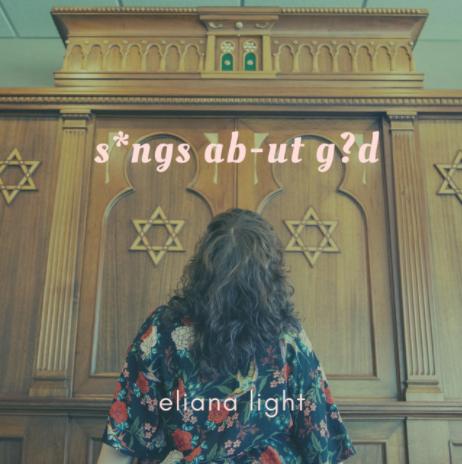
"BEYONED"
BY ELIANA LIGHT
When we focus on what we hear, we are taken beyond - beyond our bodies, beyond our individual selves. We are reminded of our inherent connection to all things, all the sounds in our field joining together in harmony. Or at least, sound can do this, when given the space. Listening as a meditative practice can help us attune to the sound around us all the time. I invite you to put in some headphones and listen to this piece. (The words are from kaddish, a reminder that holiness is beyond all we could say. But maybe we can feel.) Then, take your headphones out - what music do you hear in the world around you?
- ELIANA LIGHT
OFFERINGS
You may think Chanukah is the holiday of seeing, especially since we intentionally bring light to our homes and neighborhoods during the darkest time of the year in the Hebrew calendar, for those of us who are based on the Northern Hemisphere. However, we also use our hearing and aptitude for listening to get closer to our emotions, our hearts, and to help us move beyond our overactive thinking mind.
Although it’s not always explicitly stated, Jewish wisdom has always included our five senses to practice our traditions, culture, and connect with the divine. Hearing is an essential sense in Judaism: the Shema, the central prayer starts with, “Shema Israel, Hear O’ Israel, Adonai Eloheinu, Adonai Echad, G-d is eternal and one. ” We hear the Torah each week, the Shofar on Rosh Hashanah, the grogger on Purim, the shaking of the lulav on Sukkot, and, during Chanukah, we hear our festive songs, the laughter of being with each other and the blessings for miracles and resilience after destruction.
As you gather around the Menorah this year, make sure to sing together, even if you are shy or don’t know the words or tunes by heart. What does it sound like to sing with your family, friends, or members of your community? What does it feel like to be in a collective song? What comes up in your heart knowing these tunes and blessings have been passed to each generation for a purpose? Notice your inner self as you attune to hearing what is going on around you.
As we consider what it means to be healed, here in the month with the least amount of guiding light, let us remember to do more than hear each other and ourselves. Let us find the strength to listen, to hear, then to absorb, and use the strength to transform what we wish to dedicate ourselves to this year. Chanukah is here as a guide to help us reach back to our ancestors and plan forward as a community together. But first, we must listen.
- SARAH WAXMAN
EMBODIED PRACTICE
Shema Sound Map
Shema translates to “listen” or “hear” so the practice begins with listening to a favorite love & harmony song, then we move into a classic nature connection tool called sound mapping.
In preparation for this practice, queue up a favorite love song to listen to. (tip: don’t have any other songs in the queue, just the one, so that you can go directly into sound mapping) For the sound-mapping, you may set a timer (we suggest 2-3 minutes) or simply allow as much time as feels right.
When ready, find a comfortable position and prepare to close or lower your eyes. Press play and listen to the love song, allowing all your attention to be drawn to the music during this time.
Once the song has completed, begin a Shema Sound Map — with eyes closed, listen all around you. Create a mental map of the sounds you hear: what are they, which direction are they coming from, how far away are they?
Begin by directing your listening focus straight in front of you, then behind, to each side, up, down, etc;
Make space for your awareness to extend globally, 360 degrees, in all directions as you continue to listen. When ready, slowly open your eyes and allow your attention to return. Take a slow inhale and exhale and continue on.
What
I hear when I listen closely to the flickering flames of the Hanukkah candles?
can
What wisdom and insight do they tell me?
Smell 4TH NIGHT
OFFERINGS
My family worked very hard to undermine the currents of anti-Blackness in my life. Black-eyed peas were not pizza or hamburgers. They were earthy and alien. Pot after pot, I was drawn into story after story, starting with my mother on a Cincinnati stoop and on to her mother in a Birmingham kitchen, and before her a sharecropper’s shack, and before then the bottomlands of a rural Alabama plantation, and prior, a garden in Virginia or the Carolinas …
Oral tradition whispered on pages said that seeds were brought in the hair of our Ancestors during the Middle Passage. Everyone said it — from Philadelphia to Savannah to Port-au-Prince to Recife. The cowpea was at the center of yet another tradition: a transnational myth of resilience. Nobody had seeds in their hair, really; the seeds were in their minds and symbolically in their hearts. We do know that seeds were brought on those ships. It was a particularly useful food. The seeds held up well. They were prolific and could be cooked into the “slabber sauce ” served in buckets to my enslaved African ancestors. In Senegal I was told they were used to bulk up the men. Good luck, indeed.
Before we were exiled, they were fritters and puddings. They were wedding foods symbolic of goddesses of fertility. They were charitable food shared with the poor. They were a symbol of the unclosing eyes of the Creator and Ancestors. Our peas were tiny little texts, and we didn’t even know it…
Now this lineage is in my own recipe.
- MICHAEL TWITTY, EXCERPT
FROM "THE COWPEA: A RECIPE FOR RESILIENCE"
It is taught that though the Garden of Eden is lost to touch, to sight, the scent remains.
Where there is great spirit, wisdom, charity, or justice, something intangible happens, Something in the air changes, and if one is perceptive, they will find that the moment itself has changed. This is how our tradition understands the "smell of Eden."
Smell is the sense intertwined with self: it piggybacks off the breath, Fills us up, Becomes our very air.
In place of prayer, the Jews of ancient days made offerings of rich smells, Incense always burned in the Temple, Because the divine yearns for "a pleasing scent."
Smells waft outwards, encasing their source, Embracing. They have the power to transport us, roads paved with cinnamon, lavender cruises, hallways tinged with rosemary.
What are the smells that bring you back to Somewhere safe?
What are the smells that bring you to that place
Just beyond thought?
Perhaps in there you can find, cocooned within, The smell of Eden ever rising.
Scentsory Experience
For this practice we connect with our sense of smell. In preparation, you might gather a few objects, herbs, foods, perfumes, candles, etc whose smell you particularly enjoy; or simply enjoy the smells of the space around you.
As you prepare to light candles, pause for a few moments to take in the smells around you, and the smells of any objects you've chosen. Notice as many different facets of these smells as you can. What seems familiar? Do these smells remind you of anything? Other objects, places, memories? Is anything surprising?
When you're ready, prepare to light the candles. As you strike the match, or start the lighter, notice what smells are awoken by this ignition. Can you smell the flame as it lights each candle? What else do you notice as you smell the smoke of the match after its just been blown out? Can you smell the wax of the candles as they burn?
Finally, pause to notice which aspects of this moment you'd particularly like to remember. As you take in any remaining smells, hold your attention to what you'd like to remember, connecting your memory to the smells and allowing them to root into your body before continuing on about your evening.
What smells most connect me to a sense of healing and nourishment?
5TH NIGHT
Taste
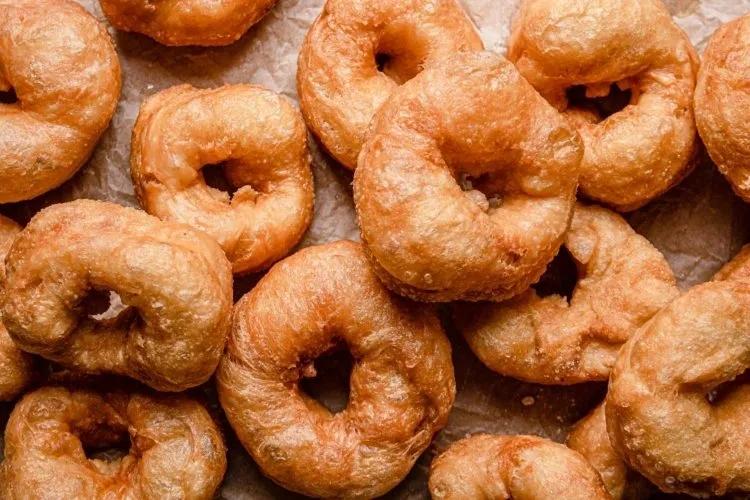
SFENJ RECIPE SFENJ RECIPE
Sfenj are typical Moroccan donuts that are powerfully reminiscent of churros (Mexico) and picarones (Peru). An important difference is that sfenj incorporate yeast. Typically enjoyed during the Hanukkah festival, these fried dough goodies are easy to make and taste best fresh. — Source: Jewtina y Co
Ingredients:
2 teaspoons yeast
1.25 cups warm water (divided)
3 cups all-purpose flour
1 teaspoon salt oil for frying
Directions: 1. 2. 3. 4. 5. 6. 7. 8.
In a small bowl, dissolve the yeast in 0.25 cup warm water and set aside to proof for 10 minutes.
In a large bowl, combine the flour, salt, and 1 cup warm water. Add the yeast and stir until a sticky batter forms. Cover with a towel and leave to rise for 3-4 hours. In a wide, deep pot, heat 2-3 inches of oil.
Dip your hands into a bowl of water, pull off a piece of dough the size of a plum, and use your fingers to make a hole. Place the ring of dough into the hot oil.
Repeat until the pan is full but not overcrowded. Fry the sfenj until golden brown, turning once or twice. Remove the cooked sfenj and place on a plate lined with paper towels to drain.
Gustatory gusto
OFFERINGS
Is the type of thrill that I crave; Sweet, umami, bitter, salty, and sour I want them all!
From the first sip of oh so sweet mother’s milk to the heavy umami of the flesh of a calf that I slaughtered.
I love how it all tastes.
Taste is something we all use but not all of us have as evident by the way I dress.
Taste takes us to a happy place where we can enjoy the warm hug of Bubbie’s matzo ball soup. It floods our mouth via dad’s latkes and mom ’ s brisket. Lest we not forget Zayde’s butterscotch candies!
Taste makes us whole.
The world tastes different in every corner and all the spaces in between.
From the shores of Lake Erie to the peak of Masada taste is there, unique and exciting!
Taste doesn’t age. If anything, it brings us back. Back to our youth back to our roots to whence we came.
Without taste we are lost in an ocean of our own tears from which we can’t sense the salt.
Taste makes us whole.
- JEREMY UMANSKY
A Taste of Memory
For this practice, you can either:
Find or bring an edible object that is special or notable in some way, or that you simple enjoy and haven't had in awhile. Or, begin a meal during Hanukkah with this practice, using the food you're eating for the meal.
As you sit or stand and ready for the first bite, pause to observe the food. Look at it, smell it, notice its texture and color, hardness and softness. Where did it come from? What are the ingredients? Does it remind you of anything?
Before you take the first bite, allow just enough space to create a spark of excitement and anticipation. Can you imagine what the taste will be before you actually physically taste it?
Then, put the food into your mouth, or take the first bite. Start at the front of the tongue, noticing what flavors you sense, before moving it further back on the tongue, from side to side, filling the mouth. Allow yourself to savor the flavors, notice how they might layer one on top of another. Do the flavors change as you continue chewing? Are there different textures that are part of this same bite? Do they have different tastes?
Finally, as you finish this bite and swallow, allow the taste to linger in your mouth — what can you still sense? What lingers? What physical traces of taste remain and what become part of your memory? Take a relaxing breath, give yourself a smile, and carry on.
What is the taste of home?
6TH NIGHT
Touch
"Perhaps finding what touches our souls is through using our sense of touch, grounding from the soles of our feet to the soul in our hearts."

- KIMBERLY DUEÑAS
When I moved back to New York after grad school, people's touch — a hand on the shoulder or a hug from a friend — would often make me cry. I was, at the time, embarrassed by my tears. Funny how my tears embarrassed me, but your tears — whether righteous, rageful, grief-filled or awe-filled — opened my heart ... I always seemed to be crying in the wrong place or at the wrong time. I didn't like how vulnerable I felt with the residue of yearning after the contact broke.
I called my best friend and challenged her, "Gd provides everything, huh?! What about touch?" Her response? Manicures and massages as often as I could afford them. Apparently, with a creative enough mind, Gd does provide more than I first imagined.
In the intervening years, I have enjoyed many other kinds of touch —tender kisses, the weight of my infant sleeping on my chest, the feel of my calves under my hands as I massage lotion into my body in that sacred ritual of Black folx.
The touch I come back to the most, that is the most sacred and liberatory for me, is the touch of the ocean on my skin — holding me, enveloping me, transforming me. This, to me, is the touch of Gd.
- IMANI ROMNEY-ROSA CHAPMAN
EMBODIED PRACTICE
The Earth Holds You
Is it snowing or raining outside? No worries - do this grounding exercise from a safe, warm place and imagine connecting to the earth through the floor. If your preference is to keep your socks or shoes on - please do! All you need is your imagination and a few deep breaths.
Find a place outside (weather permitting) where you can walk barefoot on the ground - think about a park, a beach, a river, a backyard, or well-paved trail near you.
Stand with both feet firmly on the ground, shoulders stacked over hips, arms relaxed on either side of you, chin parallel to the ground. With your feet on the ground, take a moment to stand tall - breathe in deeply bringing your shoulders up to your ears and then down and back as you exhale.
Imagine all 14,000 of the nerve endings fully activated as the soles and pads of your feet, your toes, the arch of your foot, and your heels all make contact with the ground.
With one more deep breath in, say in your mind or out loud a blessing of gratitude to the earth that holds you and provides you sustenance every day.
- KIMMY DUEÑAS
Note: This version has been shortened for the guide. Click here for the full offering
What have I not touched in a long time?
What barriers to touch might I feel comfortable lowering or removing? Which do I need to maintain and protect?
7TH NIGHT
Groundedness Groundedness
OFFERINGS
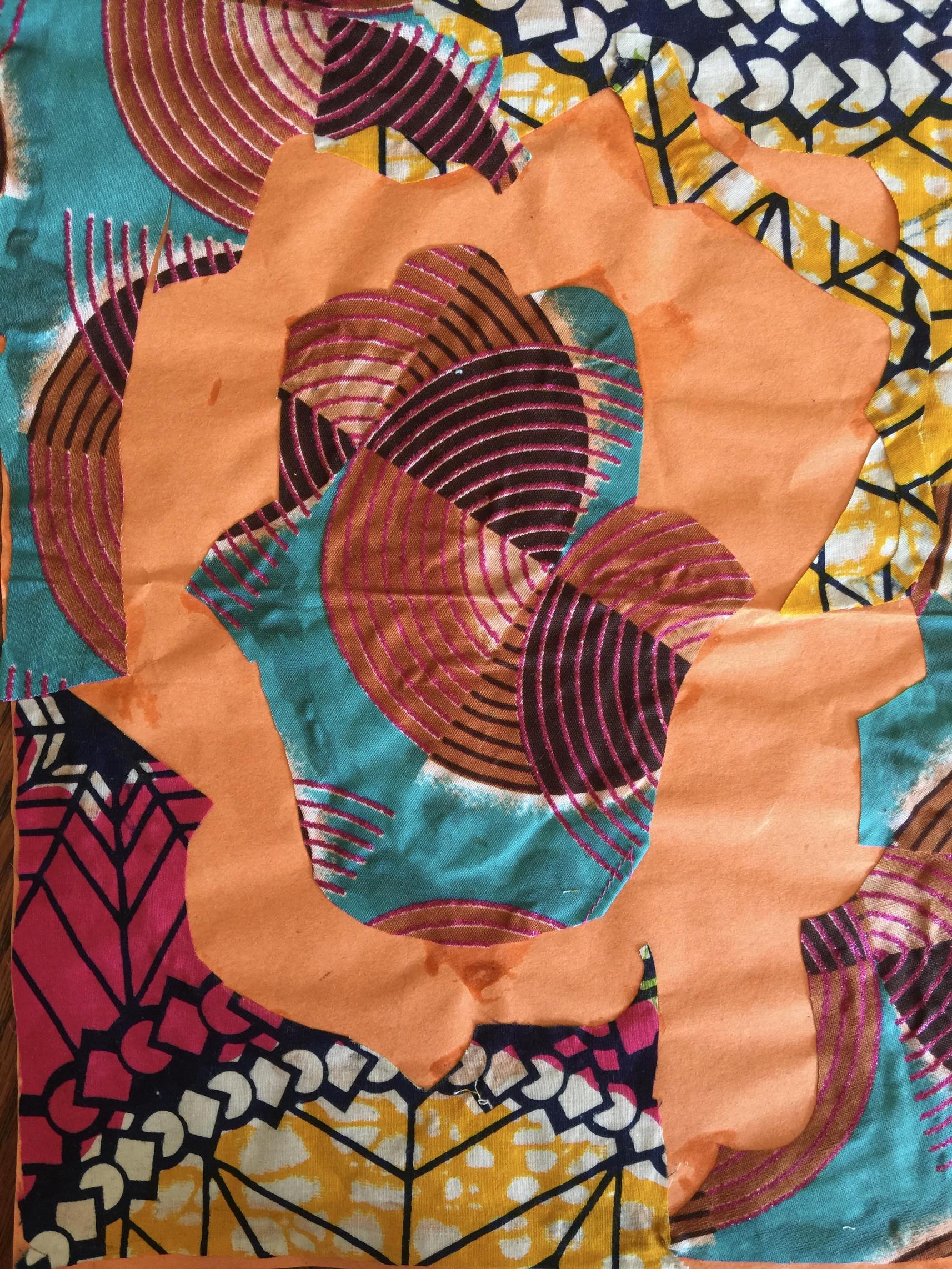
Ravina said in the name of Rabba: That is to say, it is a mitzva to place the Hanukkah lamp within 10 handbreadths off the ground. (Shabbat 21B)
In the talmudic mind, a handbreadth was the space equal to the breadth of the hand, one ’ s palm. A Hanukkah lamp cannot be placed too high so no one can see it, nor too low or it may cause a fire.
Ravina who wrote in the name of his teacher Rabbah, was of the sixth generation of Amoraim, scholars from 375 to 425 Common Era. His teaching took him out on the road. He was known for his compassion for people, as it is reflected in this teaching on the placing of the Hanukkah lamp.
May we truly bask in the light of Divine Presence here and now where most of us reside.
- RABBI MIRA RIVERA
Remember the body and its cousins.
Streams and hilltops, sand dunes and sea. Remember forests, peninsular coastlines, deserts, remember a lake. One lake, one stone in the palm of a hand, one arc between thrown and sunk, one sky vaulting over a family of relations. Remember knotting the bandana around your neck and sloping through the green-eyed tree-lined path, searching for the voices. Remember what the trees sound like when they talk to you, the way their silence enters you, not as silence but as guidance.
Imagine there’s a way not to pass along the barbs and sharps. How a body might contour through a day without cringed choreography. Picture a you that barely resembles you. Your unshamed descendants, motored by something other than hot elbows, humiliated knees, sore cheeks. Motored by something other than panic and scorch as they curve and propel. What their laugh sounds like. What their faces do when they pray. What limbs they have, how trusting and how proud their limbs.
- from "Imaginative Exercise in the
Study of Epigenetics"
- RABBI MÓNICA GOMERY
Flickering Flames
After lighting the candles, spend a few minutes swaying with the flickering light. Begin to hum as well, noticing the vibration of the sound in your mouth, then also in your belly, then also as it resonates with the ground beneath you.
Feel your foot bones or sit bones grounding down. Explore a sense of stability through your roots and looseness in your spine as you continue to hum and sway, noticing the rhythm and resonance of groundedness.
What is the ground beneath me like where I am right now?
What is my sense of the ground and my connection to it?
8TH NIGHT 8TH NIGHT
Fullness
OFFERINGS
May I be empty and open to receive the light
May I be empty and open to receive
May I be full and open to receive the light
May I be full and open to receive
- "MAY I BE EMPTY," BATYA LEVINE
On the first night of Hanukkah we focused on stillness, emptiness, and pause. Now we return to this song on the eighth night, and focus on fullness. How have you become full over the past seven days, moving into the eight? How are you open to receiving the light of resource and resilience differently now than you were on the first night?
Listen to the full song here.
In Jewish tradition, one of our most sacred concepts is shalom. Often translated as "peace," we know the root and core of the word is "wholeness." In some instances, "fullness."
How can we practice fullness? How can fullness bring us to more peace?
In our time and place, so much of our relationships with our bodies are filtered through interlocking systems of oppression: anti-Black racism, ableism, fatphobia, colonization, misogyny, and more, that tell us to ignore or undermine our desires, restrict pleasure, shrink ourselves physically and spiritually.
This Chanukah, as the light grows and expands every night, may we too grow and expand every night.
May we take deep, full breaths, that help us to slow down and feel more peace.
May we be blessed to eat until our bellies are full, may we rejoice in our fullness; may we soon know a world of peace: a world in which all are fed and full.
May we find spaces to stretch, unfurl, spread out, feel into our bodies’ longings.
May we not fear fullness; may we move towards the joyful blessing of satiation and fullness as one expression of shalom.
- RABBI JESSICA ROSENBERG
Four Worlds
On this last night of Chanukah, pause as you put each candle into the Chanukiyah to think back to each day and to consider the various ways that you ’ ve felt full.
Kedoshah kedoshah kedoshah Shekhinah tzeva’ot, melo kol ha’aretz kevodah Holy Holy Holy is the one whose fullness flows through everything.
Next, say the Chanukah blessings and then, as you light each candle, speak a way in which you have felt full during Chanukah. As you sit by the burning candles, take a few quiet moments to consider how we feel fullness in the four worlds:
Assiyah / Earth / Body - how do you know when your body is full? Perhaps it feels like being grounded and fully present, connected to the earth and present without distraction. When your body has been nourished by delicious food, what does it feel like in your belly? How does it affect your breath? What is the feeling of satiation? How do you know when you ’ ve eaten enough?
Yetzirah / Water / Blood or Tears - what does it feel like when your heart is full? A warm sensation? A gentle pressure or a slight swell? When your heart feels full, how does it affect your breath? Your facial expression? What can you do to bring yourself to fullness of heart?
Beriah / Air / Breath - what does fullness feel like in your mind? Is it a sense of security? A knowingness that you are enough, just right as you are, with no compulsion to change a thing? Or a sense of contentment and free-flowing thought? When the mind is full, how does it affect your being?
Atzilut / Fire / Spirit - how do you experience fullness of spirit? Is it a sense of undivided presence where time and space fall away? An experience of connectedness or oneness? Attune to how it feels for you. Where in your body do you feel it? Does it have a temperature? Rhythm? Intensity? Is it sustainable or fleeting?
May this time of reflection help us integrate our awareness and deepen our attunement so that we can know all the fullness within us and around us. -
When and how am I my fullest self?
CONTRIBUTORS
ANALUCÍA LOPEZREVOREDO ANALUCÍA
Dr. Analucía Lopezrevoredo (she/her/ella) is a Peruvian-Chilean-Quechua-American Analucía Lopezrevoredo (she/her/ella) a Jewtina, born in Peru and raised in Spain and the United States. An anti-oppression Jewtina, born in and raised and the United States. activist, educator and researcher, Analucía founded Jewtina y Co. in 2019 to offer Latin activist, educator and researcher, Analucía founded Jewtina y Co. in 2019 to offer Latin Jews from around the world a platform in which to celebrate and engage in critical Jews around the world a platform in to celebrate and in dialogue about Jewish and Latin multiculturalism. dialogue about Latin multiculturalism.
ARIELLE TONKIN ARIELLE TONKIN
Arielle Tonkin (they/she) is a queer mixed Moroccan and Ashkenazi Jewish artist, Arielle Tonkin (they/she) a queer mixed and Ashkenazi Jewish artist, educator, and spiritual director based living on Ohlone land in the SF Bay Area. Arielle spiritual director based living on Ohlone in the Bay Area. weaves relationships, and materializes conversations: the Muslim-Jewish Arts Fellowship, weaves relationships, and conversations: the Muslim-Jewish Arts Fellowship, Arts Jam for Social Change, Tzedek Lab, SVARA, and Atiq: Jewish Maker Institute are Arts Jam for Social Change, Tzedek Lab, SVARA, and Atiq: Jewish Maker Institute are among their networks of accountability, collective power, creative collaboration and care. among accountability, power, creative care.
To learn more and support their
To learn more and support their work, message Arielle at arielle.tonkin@gmail.com
BATYA LEVINE BATYA LEVINE
Batya Levine uses song as a tool for cultivating healing and resilience in her work as a Batya Levine song as a for cultivating healing resilience her work as a communal musician, shaliach tzibur (Jewish prayer leader) and cultural organizer. Her communal musician, shaliach tzibur prayer leader) and cultural Her music is made of Ashkenazi yearning, queer heart-medicine and emunah (faith/trust). music is yearning, queer heart-medicine emunah (faith/trust).
ELIANA LIGHT ELIANA LIGHT
Eliana Light is working towards a world of One-ness through music, ritual, and spirit. Eliana Light towards a One-ness through and spirit.
Her most recent project is the Light Lab Podcast, exploring different facets of Jewish recent project Light exploring prayer(s). prayer(s).
IMANI ROMNEY-ROSA CHAPMAN IMANI
Imani Romney-Rosa Chapman is the founder and director of imani strategies, llc. and Imani Romney-Rosa Chapman is the founder and director of imani strategies, llc. and has more than 25 years of experience organizing, educating and developing curriculum has more years of experience organizing, educating and developing for social justice. Mrs. Chapman works for a world in which her children and the young for social Chapman works for world in which her children and the young people in your lives can live wholly and safely into their full humanity in an equitable your lives can wholly and into their humanity in an equitable world where race is not a major determinant in health, wealth, legal, and educational world where race is not a major determinant in health, wealth, legal, and educational outcomes.
JEREMY TIBBETTS
JEREMY TIBBETTS
Jeremy Tibbetts is the Director of Student Leadership for Yavneh on Campus, a network Tibbetts is the Director of Leadership for Campus, a and fellowship for hundreds of Jewish student leaders on college campuses across the and fellowship for hundreds Jewish student leaders on college the globe. He is a rabbinical student living in Jerusalem with his wife Emily and their dog globe. He is a rabbinical student living in Jerusalem with his wife Emily and their dog Rosie. Rosie.
JEREMY UMANSKY JEREMY UMANSKY
Jeremy Umansky is a chef, mycologist, and author. He is a chef/owner of Larder: A a chef, mycologist, and author. He a chef/owner of Larder: Curated Delicatessen & Bakery in Cleveland, Ohio, nominated by the James Beard Delicatessen Bakery in nominated Foundation as the Best New Restaurant in America in 2019; and author of Koji Alchemy: Foundation the Best America in 2019; and author of Koji Alchemy: Rediscovering the Magic of Mold-based Fermentation. Rediscovering the Magic of Mold-based Fermentation.
RABBI JESSICA ROSENBERG RABBI JESSICA ROSENBERG
Rabbi Jessica Rosenberg currently resides on Dakota land, long home to the Rabbi Jessica Rosenberg on Dakota long home to the Anishinaabe, known as South Minneapolis. She became a Reconstructionist rabbi in Anishinaabe, known South Minneapolis. She a Reconstructionist rabbi in order to learn our people’s diverse and nuanced histories, and create spaces, ritual, and order to learn our people’s diverse and nuanced histories, and create ritual, and organizing that helps transform our relationships to past, present and future. organizing helps our relationships to past, present and future.
KESHIRA HALEV
FIFE
KESHIRA HALEV FIFE
Keshira haLev Fife is a Kohenet and a bi-racial, queer Jewish woman who weaves and Keshira haLev Fife is a Kohenet and a bi-racial, Jewish woman who weaves and supports community in many realms including the Kohenet Hebrew Priestess Institute, supports community in many realms including the Kohenet Hebrew Priestess Institute, Kesher Pittsburgh, ALEPH: the Alliance for Jewish Renewal, Keshet and Beloved Builders. Kesher Pittsburgh, ALEPH: the Alliance Jewish
She is also a prayer leader, a ritual creatrix, teacher, facilitator, and songstress. prayer leader, a teacher, facilitator, and songstress.
KIMBERLY (KIMMY) DUEÑAS KIMBERLY DUEÑAS
A seasoned international Jewish educator, Kimmy is passionate about providing a safe educator, about providing a space for people to develop deeper connections to their Latin-Jewish identity. Her passion space for to develop connections their Latin-Jewish Her passion for community healing, led her to join the Jewtina y Co. team as the community for community healing, led her to join the Jewtina y the coordinator, in charge of innovative identity wellness programming. coordinator, in charge of innovative identity wellness programming.
MAOR GREENE MAOR GREENE
Maor is a spiritual director, musician, educator, organizer, and rabbi-in-training. They Maor is a spiritual director, educator, and rabbi-in-training. They are based in Durham, North Carolina. in Durham, North Carolina.
MICHAEL TWITTY MICHAEL
Michael W. Twitty is a noted culinary and cultural historian and the creator of W. Twitty is a creator of Afroculinaria, the first blog devoted to African American historic foodways and their Afroculinaria, the first blog devoted to African American historic foodways and their legacies. He is the author of legacies. He is the author of The Cooking Gene The Cooking Gene, , Rice: A Savor the South Cookbook Rice: A Savor the South Cookbook, and , and the forthcoming Kosher Soul Kosher Soul.
RABBI MIRA RIVERA
RABBI MIRA RIVERA
Rabbi Mira Rivera grew up in the Philippines under the care of her maternal Rabbi Mira Rivera grew up in the Philippines under the care of her maternal grandmother and was the first Filipino-American woman to receive ordination from The Filipino-American woman receive ordination from The Jewish Theological Seminary in 2015, where she earned an M.A. in Jewish Studies. in 2015, she earned an M.A. in Jewish Currently, she serves as a Jewish Emergent Network Rabbinic Fellow at Romemu and as she as a Emergent Network Rabbinic Fellow at Romemu a co-chair of the Rabbinical Council of Jews for Racial and Economic Justice (JFREJ). a co-chair the Council of Jews for Economic Justice (JFREJ).
RABBI MÓNICA GOMERY
RABBI MÓNICA
Mónica Gomery is a rabbi and poet, raised by her Venezuelan Jewish family in Boston Gomery is a poet, raised by her Venezuelan Jewish family and Caracas, and now living in Philadelphia. Her work explores queerness, diaspora, and Caracas, and now living in Philadelphia. Her work explores queerness, diaspora, ancestry, theology, and cultivating courageous hearts. ancestry, theology, and cultivating hearts.
SARAH WAXMAN
SARAH WAXMAN
Sarah is the founder of At The Well, a project to support Jewish women (and their of At The Well, a to support (and their friends) in living spiritually connected to their bodies and empowered to be fully friends) living spiritually connected bodies and empowered to themselves. She is dedicated to reclaiming the lost ancient ritual of Rosh Chodesh, a themselves. She is dedicated to reclaiming the lost ancient ritual of Rosh Chodesh, a practice attributed to Miriam and proclaimed by Rashi, in which women would come practice attributed to Miriam and proclaimed by in which women would come together each new moon, refrain from work, and devote a day to study. each new moon, refrain from work, and devote a day to
Reflecting Resilience was co-produced by the team at Mitsui Collective, including design, original content, and external content sourcing, editing, and curation:
YOSHI SILVERSTEIN
Founder & Executive Director Founder Executive Director
STARKMAN ARIANA STARKMAN Program
Coordinator
you would like to thank our contributors with some extra nukkah gelt, please send a donation here (include a note) and we will evenly distribute the gelt.
Stay in touch and follow our work! www.mitsuicollective.org and @mitsuicollective on Facebook and Instagram
ARIANA