A legacy of expanding access to legal education and preparing practice-ready graduates since 1900
A legacy of expanding access to legal education and preparing practice-ready graduates since 1900
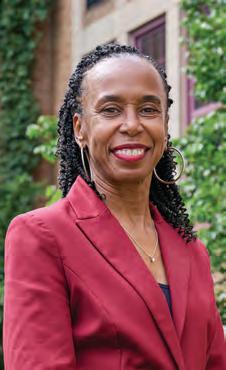
This has been a year worthy of celebration. I am excited to have completed my first year as president and dean of Mitchell Hamline School of Law. It has been rewarding for me to engage with students, alumni, friends, and community partners here in the Twin Cities and across the country—including in Alaska (see pg. 17). The best part of my year has been hearing from you and learning about your Mitchell Hamline experiences and what you value about this institution.
I love that we have stayed true to our roots and remain committed to providing access to legal education and preparing practice-ready professionals. In this edition of the alumni magazine, we celebrate Mitchell Hamline and the milestones that shaped our community: 125 years since St. Paul College of Law was founded in 1900 as a part-time evening school for working individuals; 10 years since we led the legal academy with the hybrid (now blended) delivery of legal education; and 10 years since William Mitchell College of Law and Hamline University School of Law combined to form Mitchell Hamline. Whether you are a graduate of St. Paul College of Law, William Mitchell, Hamline Law, or Mitchell Hamline—through the evening, weekend, daytime, or blended-learning option—there’s much to celebrate together. I invite you to explore this history in the coming pages and reminisce about the experiences and connections from our keystone Alumni Reunion Weekend event (see pg. 10).
We also celebrate you—our alumni. This alumni community is special. Our 23,000+ alumni serve their communities and multiply the impact of Mitchell Hamline across the nation and the world. They participate in important historical moments for our country (see pg. 26) and lead essential community organizations (see pg. 29). They are inspired to make a difference in the lives of the next generation of lawyers (see pg. 22). And our newest alumni, the class of 2025, are ready and prepared to make their own mark.
Whether you graduated 50 years ago or just this year, I hope you stay engaged and connected with Mitchell Hamline. I encourage you to mark May 28, 2026, on your calendars to attend our Alumni Gala—more details to come. And I always invite you to share your time, talent, or treasure to support Mitchell Hamline and our future students.
I look forward to seeing all of your successes, joys, and connections as we continue to celebrate and build upon the legacy of Mitchell Hamline in 2026 and the years to come.
Sincerely,

Camille M. Davidson President and Dean
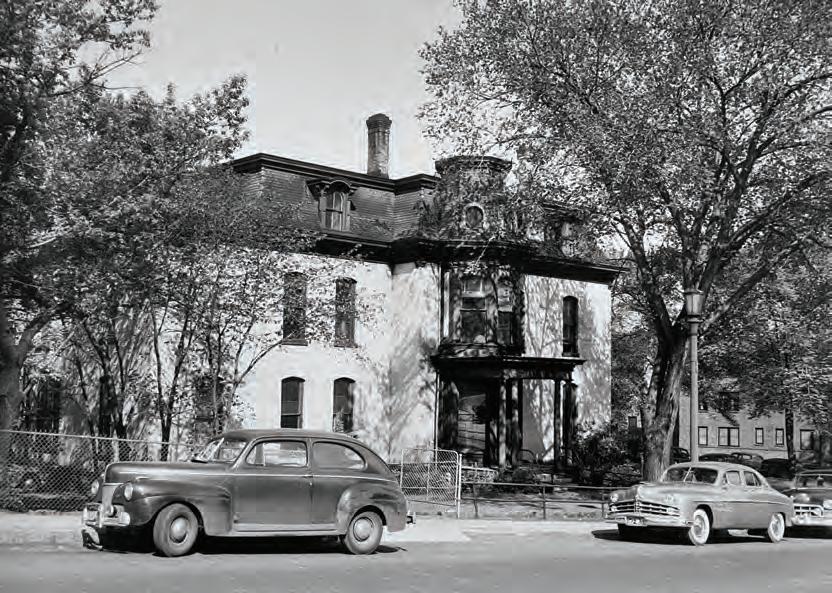
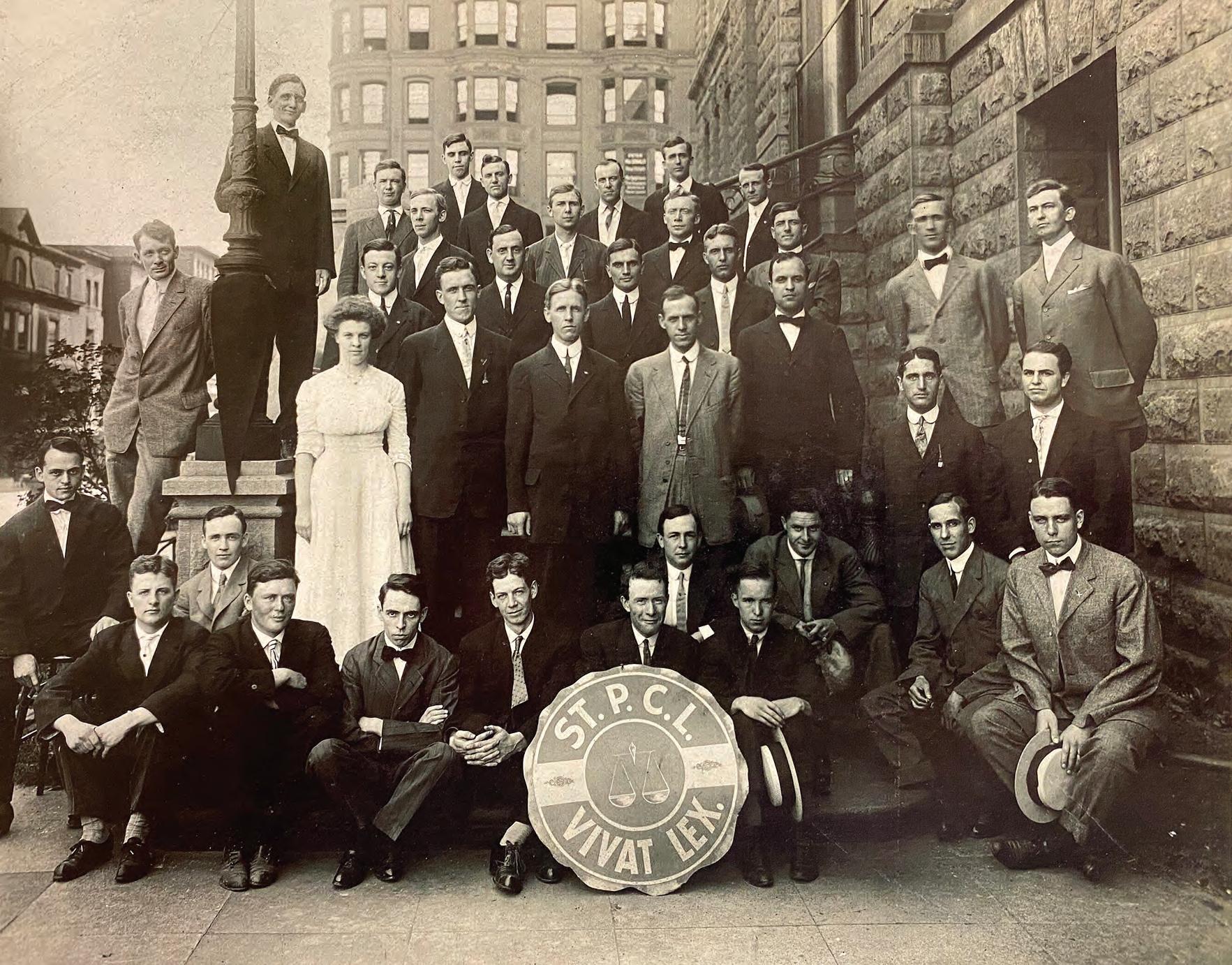
In 1900, Mitchell Hamline was founded as St. Paul College of Law, a night law school for working individuals. Pictured is the St. Paul College of Law location from 1921–1956, originally the house of Peter Berkey, a St. Paul businessman. Although the school went through a series of name changes and combinations throughout the years, the commitment to providing access and preparing practice-ready alumni has remained steadfast. Story, page 2.



Nearly 400 guests joined us in October to celebrate our 125-year legacy together
Influential figures in the development of blended learning reflect on 10 years of changing the legal academy
A trip to the Last Frontier established university partnerships and highlighted alumni connections
Four impactful alumni share their stories of why they give back to the law school and make a difference
MITCHELL HAMLINE LAW
VOLUME 8
Published by Mitchell Hamline
School of Law
875 Summit Avenue
St. Paul, Minn. 55105
651-227-9171
alumni@mitchellhamline.edu mitchellhamline.edu/alumni
2024-25
President and Dean Camille Davidson
Executive Editor Ally Roeker
Art Director and Designer
Karl Peters
Designer John Diebel
Writers
Allison Burke ’09
Dick Dahl
Michelle Lee Goode
Amy Carlson Gustafson
Peter Knapp
Ally Roeker
Photographers
Ryo Hamasaki
Paul Markert
Zej Radke
BOARD OF TRUSTEES
Chair
Gregory L. Buck ’87
Vice Chair
10 14 17 22
John J. Choi ’95
Secretary
Brian H. Batzli ’85
Treasurer
Mary Quist
Kenneth Abdo ’82
Stephanie Albert
Judge Reynaldo A. Aligada ’02
Landon Ascheman ’09
Kenya Bodden ’01
Megan Brennan ’06
Matthew Brown ’09
Gloria Contreras Edin ’05
Victoria Elsmore ’09
Scott Flaherty
Judge Juanita Freeman ’08
Patrick Garay-Heelan ’09
Nicole James Gilchrist ’03
Duchess Harris ’11
David G. Hellmuth ’92
Frances L. Kern ’13
B. Steven Messick ’08
Chris Montana ’13
Dr. Kathleen Murray
Judge Bhupesh Pattni ’12
Jacqueline Perez ’19
Christopher D. Pham ’09
David D. Ransom ’91
Jessica Seim ’08
Lisa Spencer ’01
Ugo Ukabam ’02
Sean Whitlock ’04
BY ALLY ROEKER
The world looked very different 125 years ago, but what has remained is Mitchell Hamline School of Law’s commitment to providing access to legal education, forging pathways in the profession, and preparing practice-ready alumni who impact their communities.
In 1900, five ambitious men made the decision that would permanently change the landscape of Minnesota’s legal community: They were going to start a law school. And not just any law school—this one would open its doors at night, allowing people to get a legal education who might not otherwise have had the chance to do so.
The founders included Clarence Halbert, secretary; Ambrose Tighe, treasurer; Moses Clapp; Thomas O’Brien; and Hiram Stevens, dean. Stevens devoted his life to the betterment of the legal profession. He helped found the Vermont Bar Association and revitalized the Minnesota State Bar Association and Ramsey County Bar Association. Stevens was also among the representatives who met at Saratoga Springs, N.Y., in
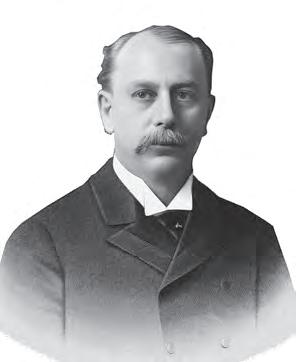
1878 to create the American Bar Association (ABA). His greatest legacy, however, is the enduring presence of St. Paul College of Law (SPCL).
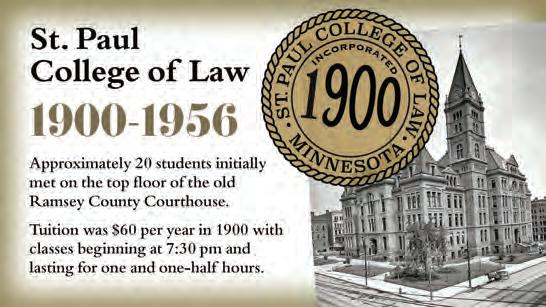
Soon termed “a lawyers’ law school,” SPCL offered classes from 7:30 to 9 pm for the tuition of $60 per year. Its faculty consisted of a dozen lawyers and judges who taught part time, sharing their real-world expertise with St. Paul’s working students. Stevens petitioned the Minnesota Supreme Court to have the school certified so its graduates could be admitted to practice without taking a bar exam. Although the college did not have any full-time teachers— one of the legislation’s requirements—it was certified in 1901. In 1902, the entire 20-member graduating class was admitted to practice.



In the early 1900s, when the University of Minnesota prepared to phase out its evening program, Minneapolis lawyers and judges wanted to establish an independent, part-time evening law school in Minneapolis. Four night law schools answered this call, all of them predecessor institutions of Mitchell Hamline.
The schools had common characteristics: Evening classes were held in downtown Minneapolis, frequently changed locations, employed practicing lawyers and judges, and charged low tuition.
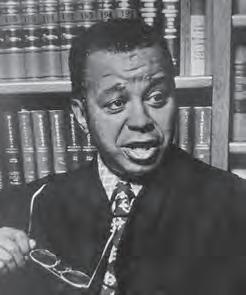
SPCL broke boundaries from its earliest years, enrolling students of color and female students as early as 1903 and 1904. Over the next 50 years, its distinguished alumni became leaders and trailblazers, including Warren E. Burger ’31, the 15th chief justice of the United States and one of the longest-serving chief justices in the Court’s history, and Stephen Maxwell ’53, the first African American district court judge in Minnesota.
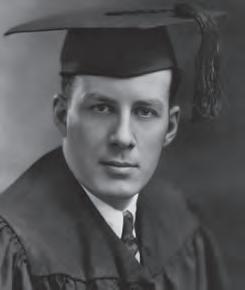


In 1912, Minneapolis lawyer George Young incorporated two law schools mere months apart, although only one offered classes immediately. Northwestern College of Law operated out of Young’s law office, holding classes three nights a week from 7:45 to 10 pm. The faculty consisted of 15 local lawyers and judges who served as part-time teachers and another 15 lecturers. Tuition was set at $70 for the first year, which, although small compared to today’s standards, represented nearly 12 percent of the average annual income.
Several notable graduates came out of Northwestern. Floyd B. Olson ’15 became Hennepin County attorney and later governor of Minnesota, making a name for himself as a criminal prosecutor and crusader against public corruption. Lena Olive Smith ’21 became the first Black woman attorney in the state of Minnesota and a civil rights icon who challenged discrimination.
Northwestern ceased operations in the mid-1920s, and its students migrated to Minneapolis College of Law. Although incorporated three months earlier than Northwestern, Minneapolis College of Law only existed on paper until it was “reorganized” in 1925. Four students matriculated in 1928, along with eight former Northwestern students.
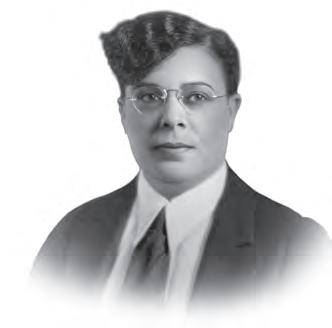


Elmer Patterson was the driving force behind the school, teaching and serving as dean from 1925 until his death in 1935. Minneapolis College of Law operated independently near Patterson’s law office downtown for 15 years until it merged with another night law school, the Minnesota College of Law, in 1940.
Minnesota College of Law was incorporated in 1913 and occupied at least five locations in or near downtown Minneapolis. Its most famous graduate was Luther Youngdahl ’21, who became the first evening law school graduate to serve on the Minnesota Supreme Court. Youngdahl later became governor and served on the U.S. District Court for the District of Columbia.
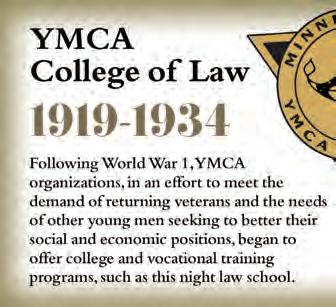
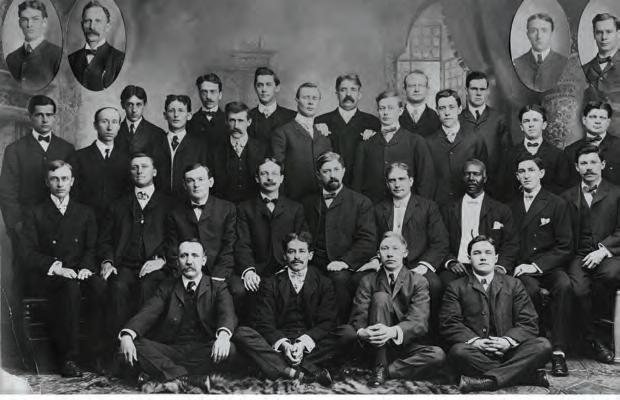
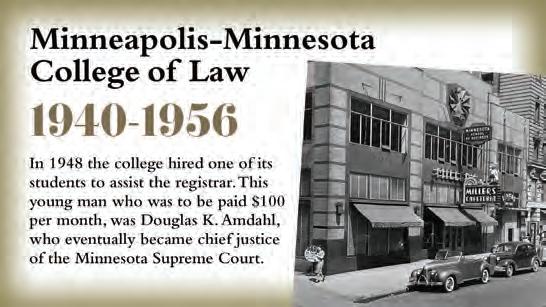
Meanwhile, in 1919, the Minneapolis YMCA—selfproclaimed “University of the Second Chance”—began offering law classes to veterans returning from World War I. The YMCA Law School had 15 students that first year and would remain small, with six or seven graduates each spring. Having multiple night law schools operating concurrently proved difficult in a city and a nation affected by the Depression. In a matter of years, they would merge into one. Six final graduates matriculated from the YMCA Law School in 1934, and its remaining students merged into the Minnesota College of Law. There, classes were small, and academic and financial problems abounded. In 1940, Minnesota College of Law and Minneapolis College of Law merged into one school: Minneapolis-Minnesota College of Law.
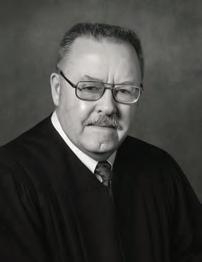
Over the next 16 years, graduates of the new school achieved success in law, business, politics, and the judiciary, including Douglas K. Amdahl ’51, former chief justice of the Minnesota Supreme Court.
The school never sought ABA approval, however, which made students returning from the Korean war unable to earn GI benefits and
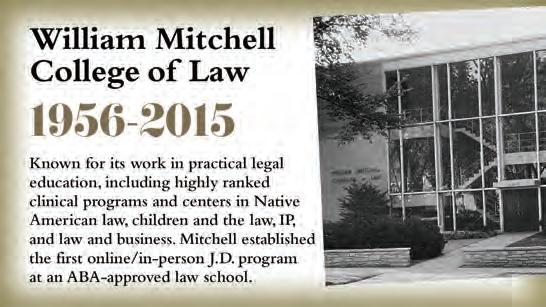
affected where alumni were able to practice. SPCL, on the other hand, gained full approval by 1943, allowing its graduates to take the bar exam in any state. The question of a merger would hover over them for a dozen years until pursued seriously in 1955. They merged under the name William Mitchell College of Law in 1956, honoring a prominent and well-respected Minnesota Supreme Court associate justice. While they had become a single law school on paper, in fall 1956 they opened classes in separate locations, with separate student bodies and separate faculties. It wasn’t until 1958 that they truly became one in a brand-new, three-story facility near the University of St. Thomas. William Mitchell was known for its work in practical legal education, including highly ranked clinical programs and centers in Native American law, children and the law, intellectual property, and law and business.
In the 1970s, the demand for legal education was high, and the Twin Cities were filled with ambitious thinkers desiring opportunities for students to make a real difference for their communities.
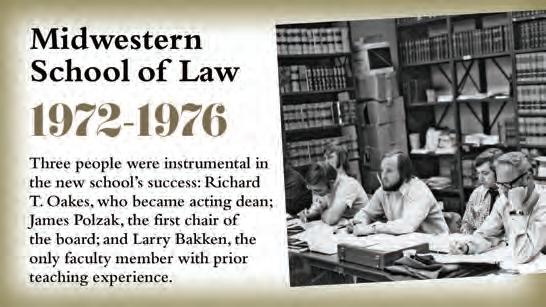
Three dozen entrepreneurial students departed from the un-accredited Metropolitan College of Law in 1972 to start a new school called Midwestern School of Law. Several figures were instrumental: students Robert Polzak ’75, Len Biernat ’75, and Rodney Larson ’75; Richard Oakes ’69, acting dean; James Polzak, first board of directors chairman; and Larry Bakken, the only faculty member with prior teaching experience.
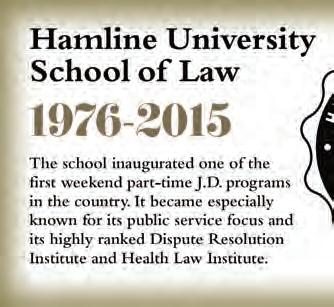
In 1974, the school moved to the Hamline University campus and became known as the Midwestern School of Law at Hamline University, adopting the name Hamline University School of Law in 1975 and making the affiliation official in 1976.

“One of our primary reasons for being is to make legal education available to those who, for reasons of age, economics, race, sex, or culture have been prevented from entry into the legal educational system.”
– Midwestern School of Law’s first academic catalog, 1973-74
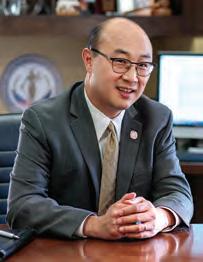
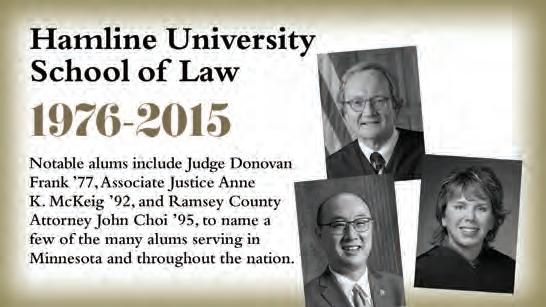
Hamline Law became known for its public service focus and highly ranked Dispute Resolution Institute and Health Law Institute, as well as many trailblazing alumni, including Donovan Frank ’77, senior U.S. district judge for the U.S. District Court, District of Minnesota; Associate Justice Anne McKeig ’92, the first Native American named to the Minnesota Supreme Court and first Native American woman named to any state supreme court; and John Choi ’95, Ramsey County attorney and the nation’s first Korean-American chief prosecutor. In addition, when Jean Holloway was appointed as dean of Hamline Law in 2014, she became the first female dean of a law school in the state of Minnesota. In 2015, these twin legacies of innovative excellence came together when William Mitchell and Hamline Law combined to form Mitchell Hamline School of Law.


At a time when legal education emphasized textbook learning and the Socratic method, Mitchell Hamline championed skills-based learning and practical experiences. In 1913, Elmer Patterson, dean of Minneapolis College of Law, developed an approach to practical training in advocacy skills. The school’s 1934-35 bulletin stated it was “the only law school in the United States giving a four-year course in court practice.”
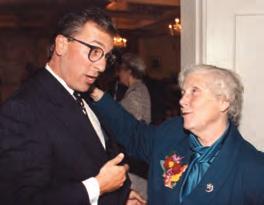
Mitchell Hamline also established one of the nation’s first clinical programs in 1973 through the efforts of Professor Roger Haydock and Rosalie Wahl ’67, for whom the legal practice center is named. Wahl took night classes while raising five children. After graduating, she was a public defender, a faculty member in the early ’70s, and the first woman appointed to the Minnesota Supreme Court in 1977. Mitchell Hamline stands on the shoulders of giants. Its past includes Minnesota’s first weekend law program and the nation’s first partially on-campus/partially online J.D. Its present consists of more than 23,000 alumni leading and serving in all 50 states, D.C., four U.S. territories, and 86 countries. And as for its future, Mitchell Hamline will build upon this 125-year foundation and remain committed to developing practice-ready lawyers, adapting to best serve the needs of students and the profession, and leading through access, innovation, and impact.

BY ALLY ROEKER
Hamline University opened the first law school in the state of Minnesota—one that ultimately ended with the outbreak of the Civil War in 1861. However, this was not the end of legal education at Hamline. A century later, Hamline University School of Law opened its doors with the aim of being “a law school where high-quality legal education would foster community service.”
This was only possible through the dedication of early students and faculty who were determined to make legal education happen on their own terms. With the creativity, innovation, and sheer grit of entrepreneurs, they formed Midwestern School of Law in 1972.
“There was a spirit that kept us together,” said Len Biernat ’75, one of the first students who also housed the school’s first “library” in the trunk of his 1968 Camaro. “We wanted this thing. We were totally convinced we were going to make it.”
Midwestern School of Law would go on to adopt the name Hamline University School of Law in 1975, making their affiliation with the university official in 1976.
This relationship was an exciting one. Stephen Young, who became the third dean of Hamline Law in 1981, was interested in interdisciplinary curriculum that students of the university and the law school could mutually benefit from. “We understand law as a part of a complex human process,” Young said. “We can teach law with a sense of vision and outreach, and help people understand

New Hamline University School of Law building dedication, Oct. 1980
how law helps maintain a civilized form of community.”
Over the next three decades, Hamline Law would become well-known for its public service, access to legal education, nationally renowned programs, and clinical opportunities.
Many graduates of Hamline Law went on to use their J.D. in nontraditional pathways, said the late Professor Emerita Marie Failinger, who served as interim dean of Hamline Law in 2015.
(See remembrance of her life and service on pg. 47.)
“There’s a lot of creativity in our graduates,” Failinger said. “Alums would go into state and local government service, work for special agencies, or even run for mayor of their local areas.”
The school was also dedicated to increasing opportunities for people to attend law school. It prioritized academic initiatives that gave students a chance, making admissions decisions not “based solely on traditional test scores and grade point averages, but also on life experience, maturity, and motivation.”
In addition, it aimed from the beginning to have its student body reflect the populations they would serve. Hamline Law welcomed soldiers returning from the Vietnam War, women embracing law as a career, and students of color and Native American students, aided by recruiting initiatives led by Ed Butterfoss in the 1980s, then serving as associate dean for academic affairs. In 2001, Hamline Law opened the state’s first part-time weekend law school program—only the second such program in the country— that provided access for students who had other responsibilities in life, like family obligations and daytime jobs.
In addition to its commitment to access and spirit of service, Hamline Law’s programs for dispute resolution and health law continue to thrive today.
The Health Law Institute is in the top 30 schools in the nation, according to the 2025 U.S. News & World Report, and the Dispute Resolution Institute is ranked eighth.
BY ALLY ROEKER
Begun only a few years apart, the William Mitchell Law Review and Hamline Law Review were aligned in their aims to increase student opportunities and serve as a resource for practitioners. As the Mitchell Hamline Law Review produces Vol. 52 during the 2025-26 academic year, its editors and associates eagerly uphold over half a century of the publication’s prestigious legacy.
The inaugural issue of the William Mitchell Law Review was published in 1974, spearheaded by editor-in-chief Marcy Wallace ’74, a team of bright students, and faculty members including Professors Mike Steenson and Roger Haydock. Steenson served as the faculty advisor, a position he has maintained since the Law Review’s inception.
The first issue, borne of a “long, arduous” process, featured only student-written articles and was deemed by Doug Heidenreich ’61, then dean of William Mitchell, “an exceedingly auspicious beginning for what we all expect will become a very important part” of the law school.
Another ambitious young woman, Gwen Lerner ’78, served as the first editor-in-chief of the Hamline Law Review. Its first issue, published in 1978, expressed a unified goal.
“We hope that it will be of value to the scholars, practitioners, and jurists who will read its pages,” wrote Richard Allen, then dean of Hamline Law, in its opening pages.
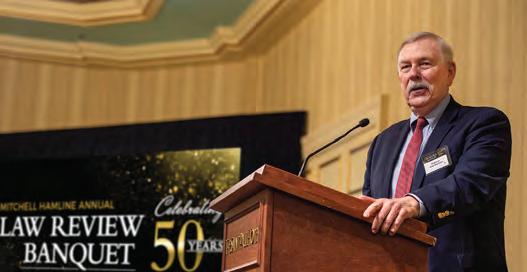
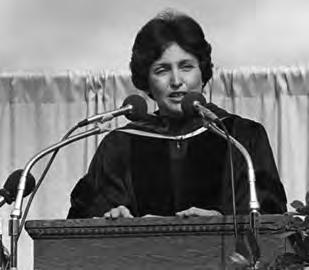
The Wallace-Lerner Excellence in Leadership Award, awarded at the Law Review Banquet, is named in honor of these first two editors-in-chief. It is annually presented to alumni who demonstrate support of the law school and outstanding leadership.
The Law Review was a groundbreaking development that gave the law school “credibility it didn’t previously have,” said Steenson. When some doubted whether Mitchell Hamline students experienced the same rigor as those who attended traditional law schools, the Law Review answered this question with a resounding “yes.” Students proved they developed the same extensive research and writing skills by attending law school at night—or through the blended-learning enrollment option once it was introduced in 2015—that made them more competitive in the job market.
“We’ve had Law Review editors who have gone on to achieve significant successes as corporate counsel. They’ve become partners of major law firms in the Twin Cities. They’ve occupied positions of consequence on the bench and in their communities,” added Steenson.
When the two schools combined in 2015, the publications merged under the masthead of the Mitchell Hamline Law Review. Today, it is one of the most cited journals in the country. And in 2024, the Law Review celebrated its 50-year anniversary.
Each year is “a joy” for Steenson as he has advised and developed close relationships with Law Review editors for over 50 years. “It’s an amazing experience, over and over and over again.”



BY MICHELLE LEE GOODE
Created by trailblazer Justice Esther M. Tomljanovich ’55, the Celebration of Women in Law Tea has been honoring the struggles and accomplishments of women in the legal profession for a quarter of a century. At the event, alumnae and students gather on campus to see old friends and network with new ones—all while wearing fancy hats and sipping tea, inspired by Justice T’s experience with Phi Delta Delta Legal Fraternity while she was a young lawyer.
This year’s 25th annual tea in May marked an extra special occasion, coinciding with the school celebrating 125 years in 2025. It featured an inspirational CLE entitled, “Grit and the power of perseverance: Stories of strong alumnae who overcame obstacles to achieve success,” that included a powerhouse panel of alumnae trustees: Gloria Contreras Edin ’05, owner and founder of Contreras Edin Law; Judge Juanita Freeman ’08, district court judge for the 10th Judicial District of Minnesota; Jacqueline Perez ’19, counsel at Robins Kaplan and Alumni Association Board president; and Ugo Ukabam ’02, director and senior counsel for General Mills. The panel was moderated by Trisha Volpe ’12, who is a partner at Barnes & Thornburg and president of ThemeVision.
celebrated for 25 years

With a phenomenal in-person and online turnout of over 140 alumnae judges, legislators, lawyers, and other legal professionals—as well as students, faculty, staff, administrators, board members, and supporters regardless of gender—the event raised nearly $13,000 toward the Justice Esther M. Tomljanovich ’55 Scholarship for Women in the Law.
The scholarship, which was established in 2000 by Justice T, along with her late husband William “Bill” Tomljanovich ’55, is awarded to a woman each year pursuing a law degree at Mitchell Hamline. Bill, who passed away in May (see pg. 41), was an avid supporter of his wife of almost 70 years and of the school.

To support the next generation of women in the law, contribute today to the Justice Esther M. Tomljanovich ’55 Scholarship by scanning the QR code:
mitchellhamline.edu/justice-tomljanovich-scholarship

JusticeTomljanovich (pictured in the purple hat and white jacket), lovingly referred to at Mitchell Hamline as “Justice T,” was born in Iowa and raised in Minnesota’s Iron Range. At age 19, she moved to St. Paul and rented a room at the YWCA so she could attend law school, which was then St. Paul College of Law. She was the only woman in her class.
After law school, Justice T married her law school classmate Bill Tomljanovich in 1957. She became assistant revisor of statutes, a position she served in until their son William was born in 1966. While raising their son, she remained active in the legal field by drafting bills for lobbyists and working part time for West Publishing and Minnesota Continuing Legal Education.
When she returned to the field full time, Justice T worked with the Minnesota County Attorney’s Association, where she helped write the first set of Minnesota Rules of Criminal Procedure. Later, she was appointed as the first woman revisor of statutes; the second district court judge in the state for the 10th Judicial District in 1997, where she served 13 years; and, ultimately, the third woman appointed to the Minnesota Supreme Court in 1990 as associate justice, where she served for eight years until she retired.
Justice T has been an advocate of women’s rights throughout her life. She was one of the founding mothers of Minnesota Women Lawyers, a group that supported and mentored other women within the legal field, including promoting women to the supreme court bench. She also helped form the Committee on the Status of Women, whose work continued as a national Council on the Status of Women, that respectively passed a bill for “equal pay for equal work” for women and was significant in making women a protected class under the Minnesota Human Rights Act. She established the Women’s Offenders Committee that improved the living conditions for women inmates in correctional facilities. And, of course, she continues to inspire and support women law students at Mitchell Hamline.
A woman of small stature, Justice T’s influence looms large for many women.
BY PETER KNAPP
One hundred and twenty-five years is a long time. One hundred and twenty-five years ago, William McKinley was in the White House. No one was in the World Series, because it hadn’t been invented yet. And a part-time, evening law school in St. Paul opened its doors to students for the very first time.
Mitchell Hamline School of Law celebrated its 125th anniversary this year. But we also celebrated our 10th anniversary and our 50th anniversary and our 69th anniversary. How is that possible?
Well, Mitchell Hamline School of Law was formed 10 years ago when Hamline University School of Law and William Mitchell College of Law combined operations. Hamline Law began educating law students 50 years ago, and William Mitchell was formed in 1956.
Of course, both Hamline Law and William Mitchell trace their roots to earlier law schools—seven earlier law schools, in fact, depending on how you count. Some of those seven law schools were evening schools, some were part-time schools, and some were even in Minneapolis. The earliest of the seven, St. Paul College of Law, admitted its first class of students in the 1900-1901 academic year.
William Mitchell, Hamline Law, and all those other law schools shared some things in common. All were formed to make legal education more accessible to students who otherwise might not have been able to attend law school. And all offered educational programs that were meant to equip their graduates with the knowledge and skills they would need to serve their communities.
And today, Mitchell Hamline remains true to its deep roots. Legal education has changed a great deal during the last 125 years and so has the practice of law. Mitchell Hamline is still finding new ways to make a legal education available to women and men who dream of being lawyers. And we’re doing all we can to make sure the legal education we provide gives our graduates the knowledge and skills they will need to serve their communities in the 21st century.
As you page through this magazine, we hope you’ll learn some things you didn’t know. And we know you’ll see that part of the reason Mitchell Hamline is so good at doing what it does is because we’ve been doing it for a long, long time.
We are looking to add more materials to our archives to continue sharing this history with future generations of law students. If you have photos, student newspapers, alumni magazines, commencement programs, directories, or other materials that help tell the story of Mitchell Hamline and its predecessor institutions, please share them with us by contacting Acquisitions and Archives Coordinator Jeff Nylander at jeffrey.nylander@mitchellhamline.edu.
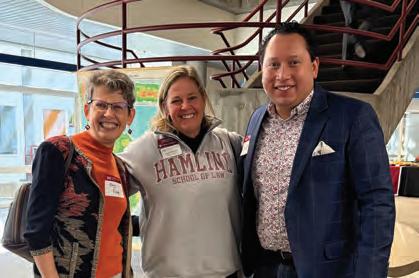
Nearly 400 alumni, students, members of the judiciary, board of trustees members, emeriti faculty, employees, and community partners joined Mitchell Hamline School of Law Oct. 9 to Oct. 11 for a weekend of connecting with new and old friends, reminiscing about their law school experiences, and celebrating our 125-year legacy throughout different activities.
“It was so rewarding to have so many people join us on campus for the Alumni Reunion Weekend,” said Kent Spaulding, vice president of institutional advancement. “The school spirit and support of this community are what made the celebration of our anniversary year truly special.”
The weekend kicked off with a special educational presentation given by Professor Todd C. Peppers about the life and court of Warren E. Burger ’31, a St. Paul College of Law graduate who served as the 15th chief justice of the United States. Peppers is the official biographer of Chief Justice Burger and is collaborating with Tim Flanigan, a former law clerk, on the book.
Thursday continued with a hockey game between alumni and the Fighting Eelpouts student team at the Tria Arena, harkening back to days of fierce rivalry between Mitchell Hamline’s predecessor schools, William Mitchell College of Law and Hamline University School of Law, for the Res Ipsa Cup.
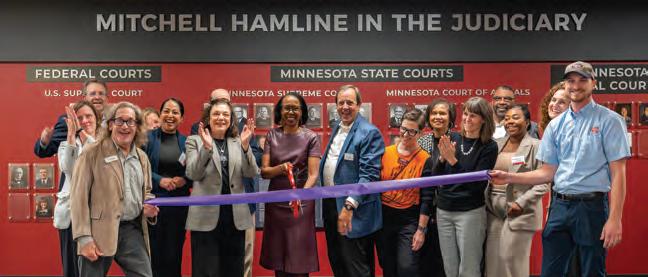
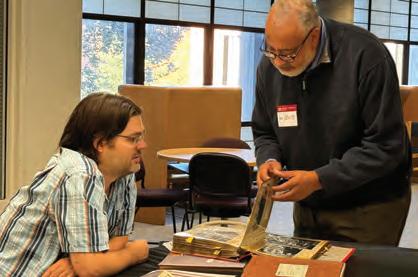
The next day, alumni returned to campus for an Open House to mingle about affinity experiences—including writing for the Mitchell Hamline Law Review and participating in the clinical program—and connect with faculty, staff, and students to learn about what is currently happening at Mitchell Hamline.
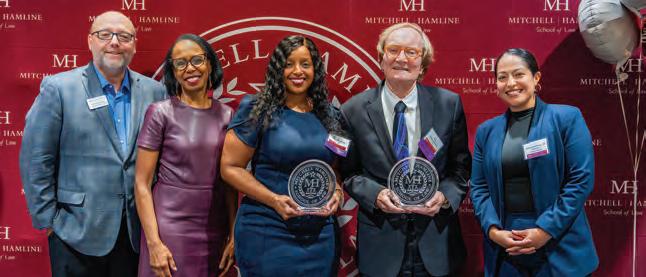
Friday evening was the pinnacle of the celebration as the Alumni Association Board presented the 2025 Alumni Awards to three deserving recipients: Senior Judge John P. Smith ’75 with the Distinguished Alumni Award, Senior Judge Donovan Frank ’77 with the Outstanding Alumni Award, and Rashanda Bruce ’18 with the Recent Alumni Award. Learn more about the recipients on page 30.
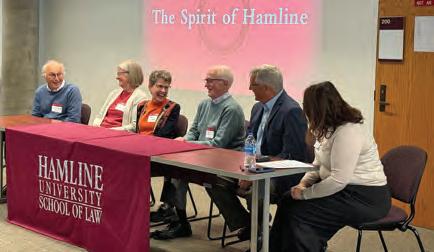
On Saturday morning, the events continued at Hamline University’s West Hall—the former location of Hamline Law. The spirit of Hamline was alive and flourishing in the building as alumni and emeriti faculty from Hamline Law shared their stories and reconnected over brunch about their shared history.
A CLE panel about this legacy featured Professor Emeritus Peter Thompson, Mary Dunnewold, Professor Emerita Mary B. Trevor, Professor Emeritus Joe Daly ’69, and former Hamline Law Dean Ed Butterfoss and was moderated by Director of Advancement Services Allison Burke ’09.
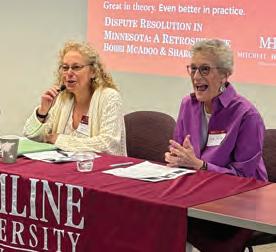
Professor Sharon Press and Professor Emerita Bobbi McAdoo followed with a retrospective on dispute resolution in Minnesota, a nationally renowned program at Mitchell Hamline.

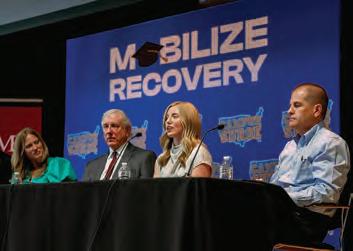
The afternoon back at Mitchell Hamline’s campus featured a program in partnership with Mobilize Recovery and Hazelden Betty Ford Graduate School of Addiction Studies about mental health, addiction recovery, and the law. A deep commitment to mental health and well-being is an important aspect of the legal education at Mitchell Hamline, and many alumni, faculty, and staff presented, including Grace Chanin ’18, Professor Nicole Coon, Patty Devoy ’13, Professor Leanne Fuith ’12, Dean of Students Lynn LeMoine ’11, Professor Natalie Netzel ’15, Matthew Nolan ’09, Heather Stratton ’24, and Emily Weichsel ’18.
A final opportunity for alumni connection at a closing mixer at Sweeney’s Saloon concluded the incredible weekend.

Emeritus Professor Dan Kleinberger works with a student during a motion hearing simulation for Advocacy, March 2025
Judges from the Minnesota Supreme Court, Court of Appeals, and District Court discuss opportunities for students and new graduates to gain experience in the judicial branch, October 2024

Committee
Christine Funk ’94, lead trial attorney for the Military Commissions Defense Organization, delivered a keynote address to more than 100 prospective students and guests on Admitted Student Day, March 2025
Camille Davidson was officially installed as the third president and dean of Mitchell Hamline at a ceremony at the St. Paul Landmark Center, October 2024
Legal education experts, professors, and alumni panelists at the “Transforming Legal Education for the Future of Law” symposium, January 2025
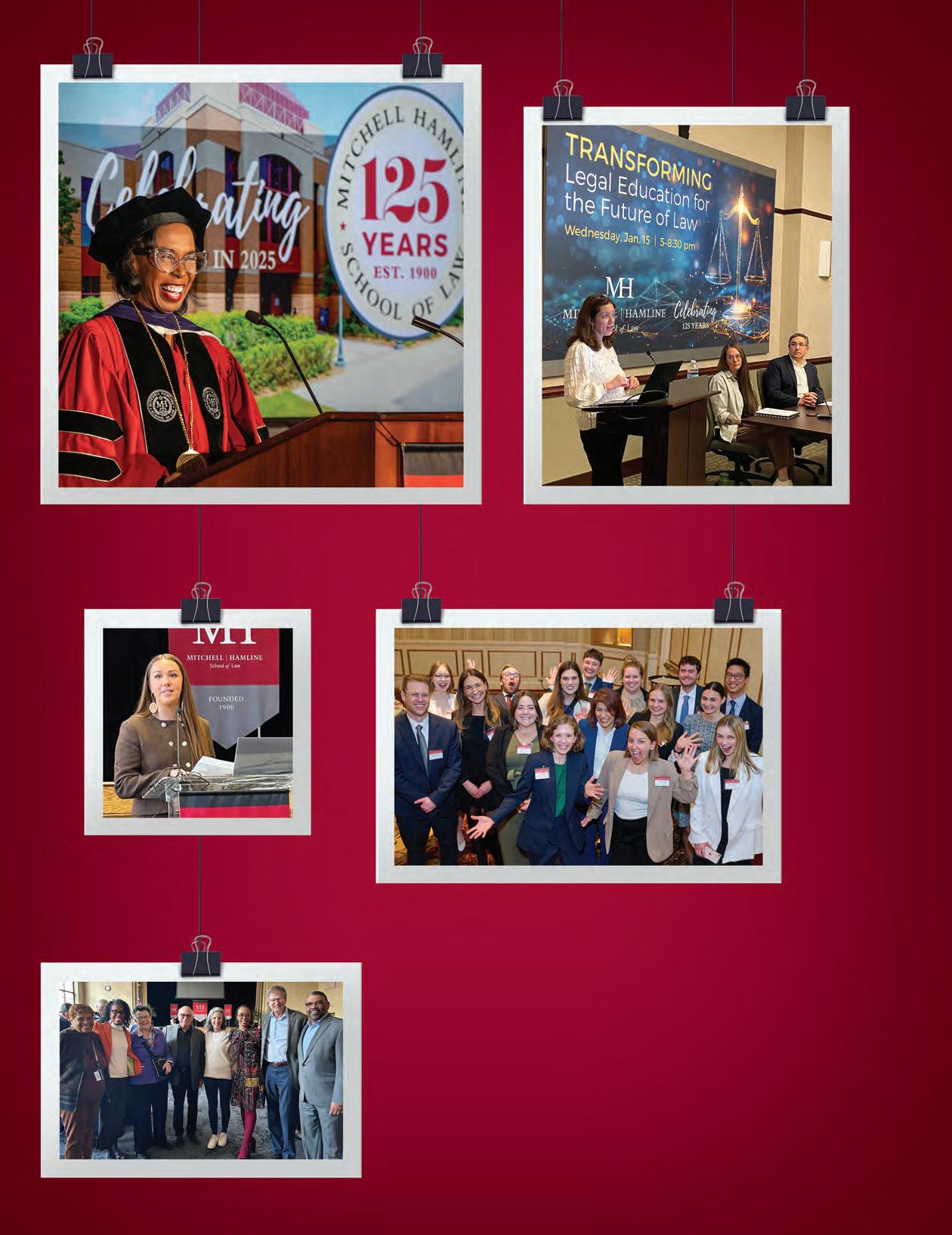
Rachel Evangelisto, 3L student and enrolled member of the Standing Rock Sioux Tribe, introduces panelists at the annual Native Law Conference, November 2025
Members of the Mitchell Hamline Law Review celebrate 51 years of the publication at their annual banquet, May 2025
Sharon Van Leer, director of culture and inclusion; Nicole Gilchrist ’03, trustee and former board chair; Carolyn Chalmers, wife of Eric Janus; Eric Janus, former William Mitchell president and dean; Mary Cullen ’89, former William Mitchell trustee and board chair; Camille Davidson, president and dean; Greg Buck ’87, current board of trustees chair; and Rick Petry ’98, employer relations specialist, at a special screening of civil rights documentary, “Ain’t No Back to a Merry-Go-Round,” March 2025
BY ALLY ROEKER

Jan. 10, 2015
The date was January 10, 2015. Amid the chill, 85 students walked onto Mitchell Hamline’s campus, many for the first time. As they looked at each other with excitement and first-day jitters, faculty members and administrators also looked at each other and knew. The years of hard work and planning this thing called the “Hybrid J.D. program,” the long meetings and paperwork, the doubt and hope, would pay off. This would be something special.
Known today as blended learning, the hybrid program launched the nation’s first partially online/partially on-campus hybrid program at an ABA-approved law school.
“In a significant way, blended learning returned the school to its roots,” said Eric Janus, hearkening back to 1900, when the school expanded access to legal education as a night law school.
Janus, as president and dean of what was then William Mitchell College of Law, decided the school would pursue developing a hybrid program. Members of his leadership team swiftly recruited Professors Greg Duhl and Jim Hilbert to help turn the vision into reality.

Blended learning was a “logical extension of our access mission,” said Duhl, who served as academic director of the hybrid program when it launched. It wasn’t without its hurdles, however. They needed buy-in from faculty, the board of trustees, alumni, and the legal community. Janus, former Associate Dean Mary Pat Byrn, former Associate Dean of Information Resources Simon Canick, and Professor Mehmet KonarSteenberg, then associate dean for faculty,

were critical in securing a variance from the ABA and support from Mitchell Hamline’s stakeholders.
One concern was whether online education would maintain the rigor of law school. What helped, said KonarSteenberg, was that the first teaching cohort included widely respected faculty members staking their reputation on the program, like Professor Emerita Nancy Ver Steegh and Professor Mike Steenson. “Their mere presence was reassuring to many people that our program was the real deal.”
Professor Emerita Ann Juergens, Professor Peter Knapp, Professor Emerita Denise Roy, and Professor John Sonsteng were also instrumental in figuring out how to extend clinics and externships across the country, ensuring blended-learning students had access to the same practical learning experiences.

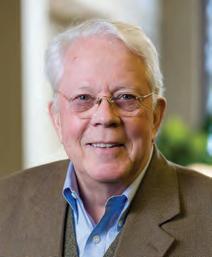
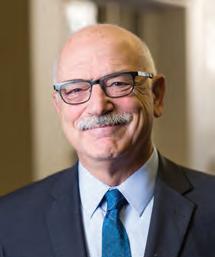




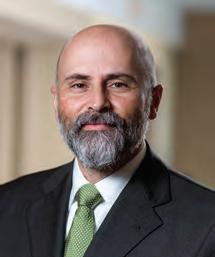
Scan to experience Capstone Week for yourself. mitchellhamline.edu/capstone/series/capstone

Another concern, soon allayed, was whether students would be able to form connections.
“Capstone Weeks are actually a setting where strong relationships are developed,” said Janus. Students forge tight-knit communities and learn from one another’s diverse life experiences during these intense periods of rigorous on-campus study.
It was, said Hilbert, the students’ “courage, patience, and collaboration” that made blended learning work so well during its first few years.
As the program proved more popular, demand outpaced the ABA’s 96-student cap. In fall 2017, Mitchell Hamline introduced two additional paths with expanded in-person hours: the Executive option, which was modeled on the Hybrid J.D., and the Weekend model, a new version of the traditional weekend enrollment option.
In fall 2020, one streamlined path was introduced: blended learning, which built upon the strengths of its previous iterations by emphasizing in-person study during Prep and Capstone Weeks and leveraging the assets of technology.
“It was audacious, frankly, to think our little independent law school could spark a revolution in legal education and go from serving students in a handful of midwestern states to having a nationwide footprint,” said KonarSteenberg.
Although long respected, Mitchell Hamline gained international recognition on a previously unseen scale during the COVID-19 pandemic, when many institutions reached out to learn how they could do online education as well as Mitchell Hamline.
“COVID pushed the legal system to utilize more online formatting for litigation, client meetings, and doing other legal business,” said Hilbert. Blended education, as a result, was “becoming much more mainstream and accepted,” and continues to do so.
Today, over 20 ABA-approved law schools offer a form of online or hybrid legal education.
Reflecting on 10 years of blended learning and 30 years of a legal career, Duhl added, “Being involved in the creation and beginnings of the blended program has been the most rewarding professional experience of my lifetime.”
“Their imitation is more than just flattery. It’s validation.”
Professor Mehmet Konar-Steenberg, about institutions following Mitchell Hamline’s footsteps
Scan to view Professor Konar-Steenberg’s interview about the launch of the program, Dec. 17, 2013 youtube.com/watch?v=deUOgc9ZsZM
Part of the program’s success is due to having an in-house team of instructional designers, as opposed to relying on outside vendors.
“Mitchell Hamline’s dedicated team ensures the specific needs of legal education are met with tailored solutions,” said Amanda Soderlind, director of instructional design and development. “This unique approach allows for more consistent, nimble, and innovative course design and delivery.”
Over the years, the team has shifted from working exclusively on online and blended courses to supporting all faculty in all modalities. They implement best practices for technology and course design, foster a culture of continuous improvement, and create a streamlined experience for students—regardless of enrollment option.
BY ALLY ROEKER
“I could not have gone to law school if not for blended learning.”
This sentiment is common among alumni who matriculated from Mitchell Hamline’s online/in-person enrollment option, from its first 17 graduates in January 2018 to more than 1,000 across the country today.

It was certainly true for Briana Al Taqatqa ’18, part of the first graduating cohort. After taking the LSAT in Abu Dhabi and Doha, Qatar, she, her husband, and their seven-week-old daughter moved to Minnesota to be closer to her family. Law school still seemed impossible until she learned about blended learning. As a student, Al Taqatqa made history with fellow blended-learning student Brian Kennedy ’18 when the two won the International Negotiation Competition for Law Students in Oslo, Norway. Today, Al Taqatqa works as an associate attorney for Dorsey & Whitney.

A working professional, Rex Tolliver ’20 prioritized finding a program with in-person components and accreditation so students could take the bar exam in all 50 states.
For the vice president for student affairs and academic support at the University of South Carolina, dealing with employment law, student immigration issues, contract disputes, or complex real estate law are all in a day’s work. “The program prepared me to be a better leader in a complex organization,” Tolliver said, calling his J.D. the “ultimate advantage degree.”

Scheduled on-campus time and asynchronous coursework also proved to be the only feasible option for Natalie Bernadt ’21, who balanced active military duty and raising children.
“As a student, I was initially shocked about how demanding the program would be. Now, insane workloads and busy schedules don’t phase me,” said the U.S. Coast Guard criminal defense attorney based in Dulles, Va.
If the rigor of law school was beneficial, relationships with her classmates were even more so. “The majority of us were a bit older and in our second or third careers. This real-world experience brought a lot of diversity to the classroom and contributed to greater networking opportunities.”

Chris Meredith ’23 was one such student with an established career when he attended Mitchell Hamline. The board-certified neurosurgeon from Leawood, Kans., has since seen his J.D. open professional doors, frequently using his legal and medical knowledge as an expert witness, solving compliance issues, and leveraging legal writing skills in communicating with patients and administrators.

Trinity Charles ’21 serves as a legal aid attorney and legal editor in Las Vegas, Nev. “Eternally grateful and indebted” to the program, Charles credits her success as an attorney to the handson, practical experience she gained at Mitchell Hamline. She gives back to the school as an adjunct professor, impacting the next generation of blended-learning students.
BY MICHELLE LEE GOODE
Alaska is the only state in the country without a law school— making access to legal education fundamentally different than anywhere else. The need for lawyers and legally trained leaders is significant, yet earning a law degree has long required leaving the state. President and Dean Camille Davidson, Vice President of Enrollment Annie Gemmell ’12, and Director of Alumni Relations and Annual Giving Barbara Klas ’91 visited Fairbanks, Anchorage, and Juneau in October to help change that.
At the University of Alaska Fairbanks (UAF), Dean Davidson met with several university leaders to sign a new 3+3 partnership agreement.
“This partnership allows UAF students to begin their J.D. at Mitchell Hamline during their fourth year of undergrad. It enables them to complete both degrees in six years instead of seven—saving time and money—while studying remotely for most coursework and visiting campus in Minnesota only a few times per year.”
This new agreement builds on the direct admission partnership Mitchell Hamline already established with the University of Alaska Anchorage (UAA). While at UAA, Dean Davidson and Klas
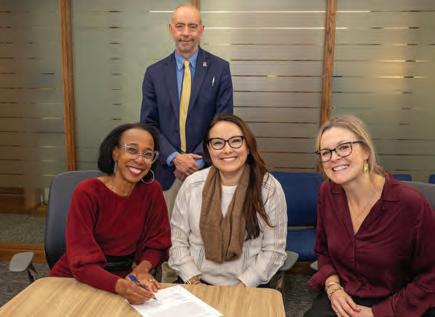
met with Legal Studies Program Coordinator Kris Knudsen and 3L student Lucille Carter to share details about blended learning to students interested in law school.
An Alaska Native deeply rooted in her community and with family ties in St. Paul, Carter always wanted a legal career, even though her path was not traditional. After earning degrees from UAA and Western Governors University, she enrolled at Mitchell Hamline and is part of the Native American Law Student Association. “Staying in Alaska was essential,” she said. “Mitchell Hamline’s blendedlearning option allows me to pursue a first-class legal education, support my six children, advocate for my community, and continue my career from here.”

“It was really important not to have to move from Alaska. The blendedlearning option works perfectly for me.”
Lucille Carter 3L blended-learning student

Carter also joined Mitchell Hamline staff and alumni at a reception hosted by Clinton Campion ’99 at his firm, Sedor Wendlandt Evans & Filippi. Guests reminisced and discussed the growing legal needs across Alaska. Campion, a Minnesotan, has built his home and career in Anchorage and encourages others to consider Alaska as a place to practice law.

Reception guests included Judge Eric Aarseth ’90, Emil Betro ’21, Clinton Campion ’99, Jeremy Conkling ’22, Judge Kari McCrea ’01, Chantal Mullinax ’13, Andrew Sundboom ’10, Louis Swanson ’21, Marvin Weinrick ’24, and Lucille Carter.
“Our alums in Anchorage have expressed a need for more judges, lawyers, and clerks—and there are high-demand, high-paying legal careers available for Mitchell Hamline grads,” said Klas. Judge Kari McCrea ’01, the presiding district court judge in Anchorage who is originally from St. Paul, is working with Career and Professional Development to share clerkship opportunities with students and alumni.
Gemmell represented Mitchell Hamline at college and career fairs in Anchorage and Fairbanks to meet more
prospective students. In Juneau, she also met with leadership at the University of Alaska Southeast (UAS). “We’re actively working toward an agreement that will positively impact UAS students and the Juneau community,” Gemmell said.
“This is our mission at work and the key reason our blended-learning option was created more than 10 years ago.”
To support North Star scholarships for blended-learning students in rural areas or on reservations, contact 651-290-6370 or development@mitchellhamline.edu.

Mitchell Hamline’s first-time bar passage rate in Minnesota for July 2025 was 88.37%—the highest since the combination of William Mitchell and Hamline Law in 2015. Over the past several years, this first-time bar passage rate has been steadily improving at Mitchell Hamline.
“What the current results show are years of setting up a school-wide system that supports bar preparation,” said Maggie Eilertson ’08, director of academic excellence. Faculty have implemented bar-like assessments in their courses to give students more practice and exposure. Academic excellence offers two full bar prep courses in the curriculum, as well as direct tutoring and a partnership with Themis, a commercial bar prep company. In addition, the school has made efforts to communicate with students, especially parttime and blended-learning students, so they understand the demands of preparing for the bar exam and can create a successful plan.
“We have an expert academic excellence team who is here to work with students from their first day on campus through the months after graduation leading up to the exam,” she said. For first-time takers who were assigned to an academic excellence tutor, the pass rate was even higher at 90.67%.
About half of Mitchell Hamline’s bar takers sit for the exam in Minnesota, with half in other jurisdictions throughout the country. While not all jurisdictions have reported at the time this magazine went to print, the nationwide results so far are looking strong, said Eilertson.
Always looking toward the future, academic excellence is already preparing to help students be successful on the NextGen Bar Exam, which will be launching in July 2026.

Why was this anniversary year so special for Mitchell Hamline?
The marker of 125 years is a wonderful time to reflect on how we have transformed legal education, celebrate where we are today, and look forward to all that awaits us in the next 125 years. In 1900, St. Paul College of Law opened as a night school. At that time, there was no law school in Minnesota that provided night classes for individuals who worked during the day. This new school provided an opportunity for individuals to study law without having to quit their jobs. Much has changed since the 1900s. There have been combinations and name changes, but we have stayed true to our roots by continuing to offer flexible ways for students to obtain a law degree. With part-time and fulltime options and courses delivered in person and through blended learning, we continue to provide opportunity and access to the legal profession.
How is the commitment to preparing practice-ready students still a tenet at Mitchell Hamline today?
We take a comprehensive approach to preparing our students to be practice-ready. This means teaching them how to speak, write, and think like a lawyer, as well as equipping them with soft skills such as cross-cultural communication. We ensure that our students have the tools they need to engage effectively with their clients, colleagues, and the broader community. Practiceready also means that we are proactive about wellness. At Mitchell Hamline, wellness is a part of the culture. It is embedded throughout the curriculum. We support student wellness through dedicated programming, counselors, and a range of other resources that help students thrive personally and professionally.
can leverage technology to help us do our jobs more efficiently, we are then able to expand the reach of who we are able to serve and remain true to our mission of providing access to justice.
What steps is the school taking to continue to evolve and meet the needs of students?
Our faculty reviews our curriculum to make sure the classes we offer are relevant to the current and future practice of law. We have recently hired an institutional research director who helps us analyze our data so we are able to make informed decisions. We focus on being student-outcome centered. More than 14,000 of our alumni call Minnesota home and are integral in shaping this legal community. They provide externships and mentor our students. We listen. We are actively engaging with students, alumni, and the legal community to anticipate emerging needs and ensure that our programs remain relevant, responsive, and rooted in our mission.
As president and dean, what do you see as your role in ushering in what is next for Mitchell Hamline?
My role is to be the face of this amazing institution and a steward of its core values. Ushering in what is next is about staying true to our mission but being bold enough to embrace change. My responsibility is to ensure that we keep pace with societal needs and changes in the profession. We are not just preparing students for today. Together, we make sure that when our students exit the building with a Mitchell Hamline diploma, everyone knows the type of graduate they are: not only a great lawyer, but a great human being.
with President and Dean Camille Davidson
What topics will be increasingly relevant for the school and the legal profession to consider and address? The practice of law is continuously evolving. Artificial intelligence, for example, is improving each day. The use of technology in the legal profession has expanded rapidly since the pandemic. Here at Mitchell Hamline, we have a faculty committee that is charged with exploring how to incorporate AI into the curriculum. We want our graduates to have marketable skills. As lawyers, if we
What would you want people in the future to know and think about this era in the school’s history?
This has been a period of change. Not only did we see advances in technology that changed the way we practice law, but we also saw an increase in the number of first-generation college and first-generation law school students enrolling and matriculating. Women outnumbered men in our classes. We were courageous as we instilled in our students that lawyers are the keepers of the rule of law.
“I can’t think of a time in my life when it’s been more important that we have lawyers.”
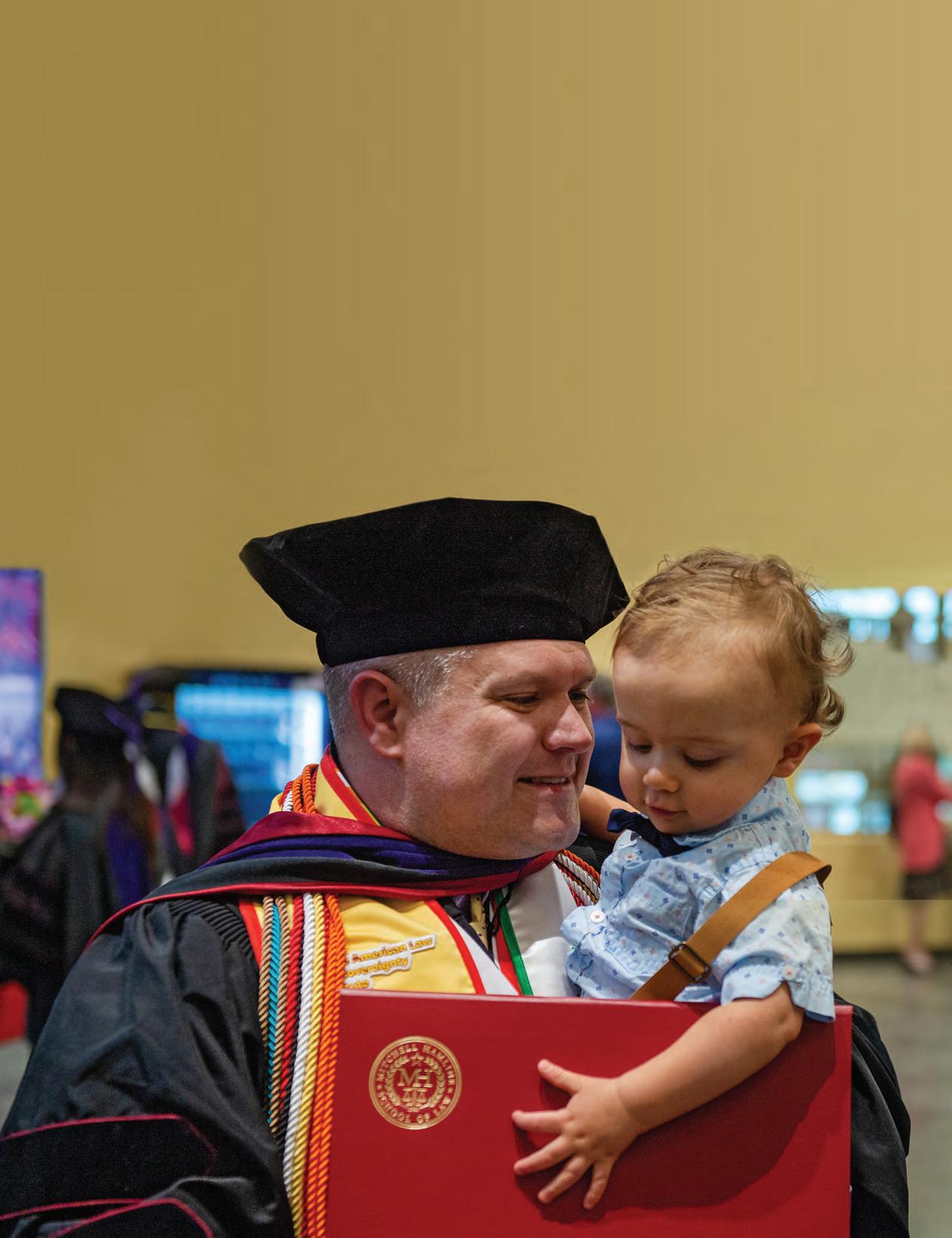
Lt. Gov. Peggy Flanagan spoke these words to the graduating class of 2025 as the keynote speaker at their commencement ceremony. Keeli Siyaka ’25, an enrolled member of the Sisseton Wahpeton Oyate, gave the ceremony’s land acknowledgement, and McKenna Coffeen ’25 served as the student speaker.
This year’s graduates represent 45 U.S. states and D.C., as well as Canada, Germany, Argentina, Singapore, and the United Kingdom, as well as 12 First Nations and Tribal Nations across the continent. Mitchell Hamline is proud to welcome 305 students to the alumni community, over 23,000 members strong.

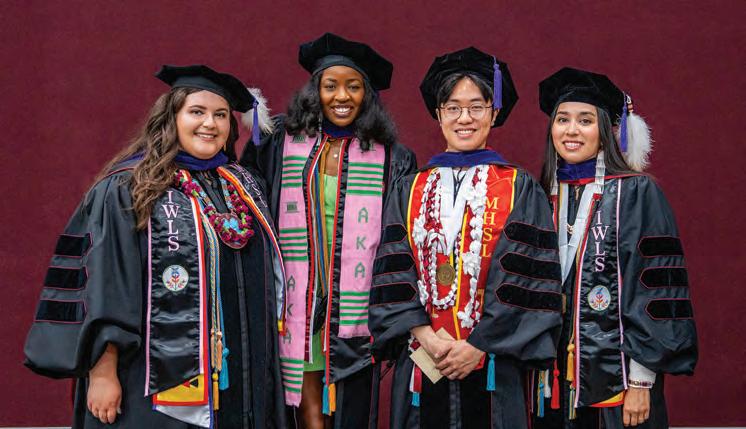
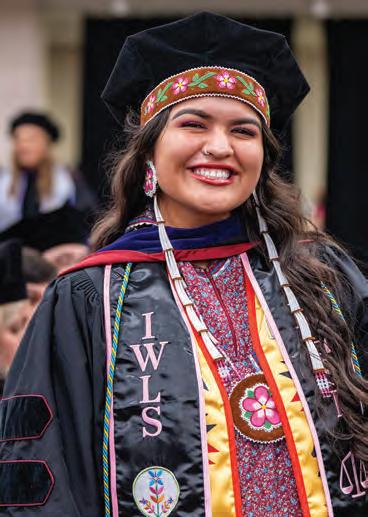
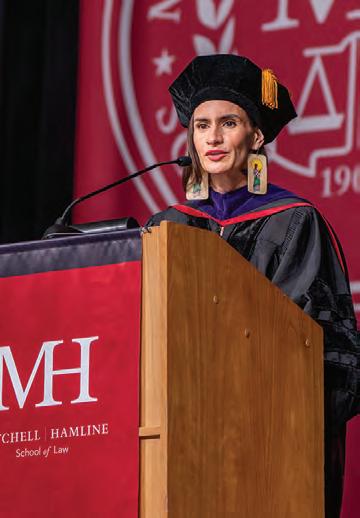
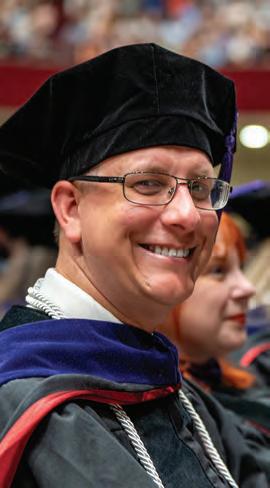
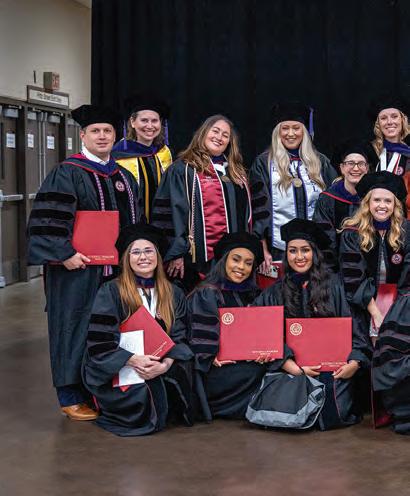
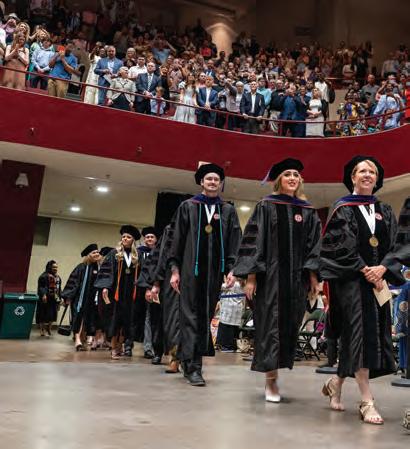

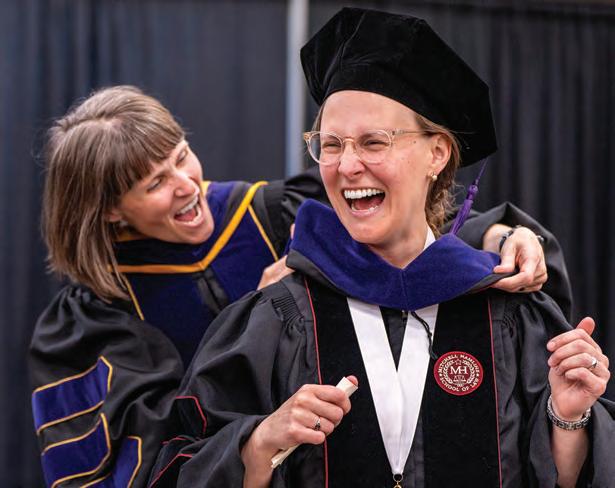
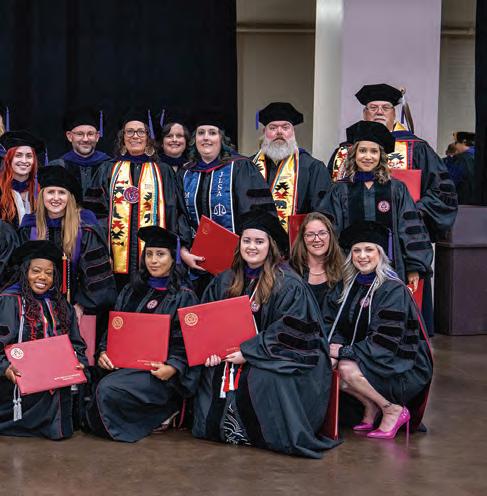

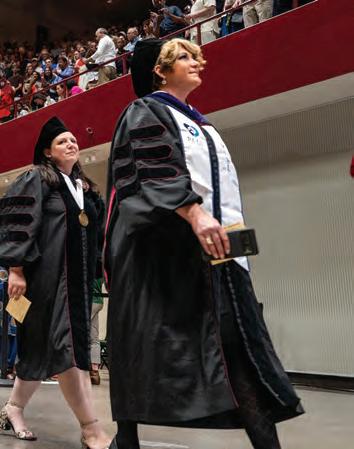
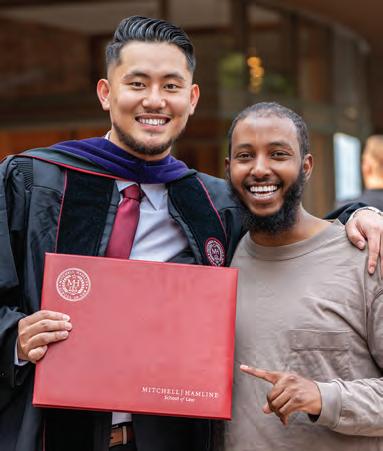
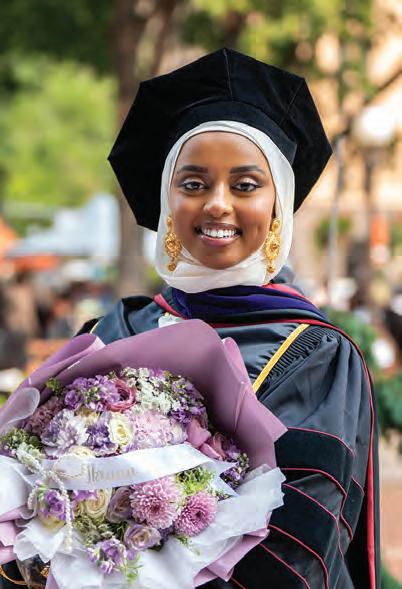
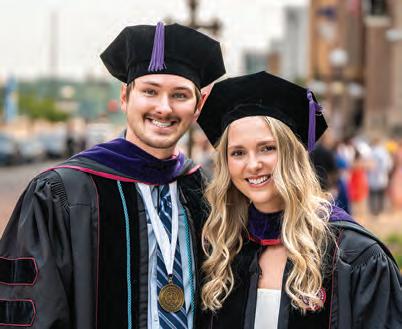
Mitchell Hamline held a commencement ceremony on June 6, 2021, at CHS Field in St. Paul, home of the minor league Saints. It was one of the first events to be held in person in more than a year. Graduates walked the base paths to receive their diplomas on a stage built near second base. Students who graduated in spring 2020 and winter 2021 were also invited to have the chance for an in person event, after those two ceremonies were held online.
BY MICHELLE LEE GOODE
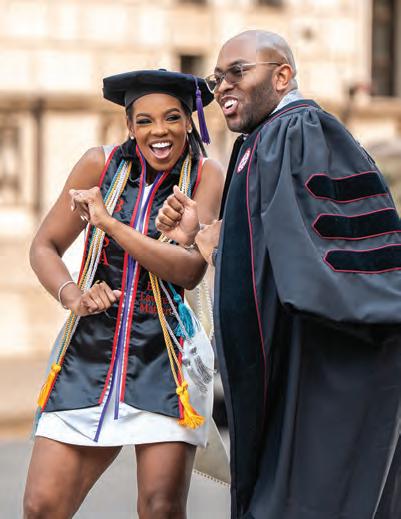
Our 23,000+ alumni are changemakers in their communities who in turn make an impact through giving back to their alma mater.
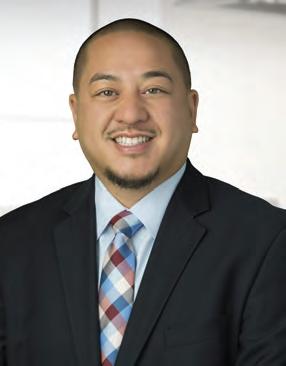
Chris Pham ’09 was born in Hollywood, Calif., to Vietnamese immigrant parents. His family relocated to Minneapolis, where he and his sister were raised by their single mother. Motivated by a deep desire to give his loved ones what he lacked growing up, he made it his mission to provide what he once longed for: an engaged father, quality time with family, and the financial security to enjoy life without constant stress. Once he reached that point for his own household, he didn’t stop—he reached back to help others rise, too.
Pham is a shareholder at Fredrikson, co-founder of the firm’s sports and entertainment law group, chair of its inclusion and diversity committee, and serves on the recruiting and hiring committee. He also serves as a Mitchell Hamline trustee, helping identify future leaders and supporting the school financially through the Fredrikson Foundation, which backs initiatives aligned with attorneys’ passions outside the firm. “People help people. It’s really that simple.”
Margaret Leary ’73 decided to pursue her law degree at William Mitchell College of Law after being denied admission to another university’s political science doctoral program because she was a woman. After graduating law school, Leary became the first woman to head a library at one of the top five U.S. law schools, upon assuming directorship of the University of Michigan Law School library in 1984. She retired in 2011 after serving 38 years there—her entire professional legal career. After retirement, Leary established an endowed scholarship at Mitchell Hamline to help students with financial need. She also has the school named in her estate plan.
“I couldn’t have earned a degree or obtained my career without going to William Mitchell. And Mitchell Hamline continues to do a wonderful job educating lawyers. I think it’s important for schools like Mitchell Hamline to exist and it’s worth paying back. As law school becomes more expensive, the profession must ensure the entry for all talented people, not just those who are talented and can afford it,” she said. To date, the Margaret A. Leary Scholarship has benefited 18 students and will continue each year.
“People help people. It’s really that simple.”
Chris Pham ’09
“I want to give back to the place that gave so much to me.”
Jacqueline Perez ’19
“Mitchell Hamline has truly given me and my family the opportunity of a lifetime, and we want to give back.”
Louis Schiff ’80
“As law school becomes more expensive, the profession must ensure the entry for all talented people, not just those who are talented and can afford it.”
Margaret Leary ’73
Louis Schiff ’80 was originally from Brooklyn, N.Y., attended Hamline University School of Law in St. Paul, and later became a judge serving Broward County, Fla. Now retired after 28 years of service on the bench, Judge Schiff and his wife Leslee created a permanently endowed scholarship this year, which will be awarded to Mitchell Hamline students in good academic standing who demonstrate financial need.
“Mitchell Hamline is such a wonderful place to learn and grow. It not only gave me the opportunity to go to law school, but it also gave me the opportunity to teach. If not for this school, I never would have become an attorney. If not for this school, I never would have taught. If not for this school, I never would have written my first book, let alone my second book. Mitchell Hamline has truly given me and my family the opportunity of a lifetime, and we want to give back.”

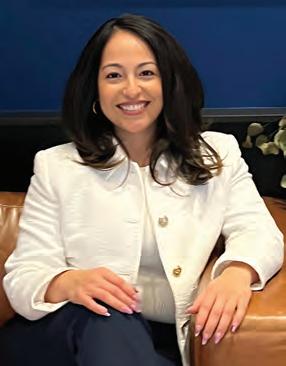
Jacqueline Perez ’19 grew up in Dallas with humble beginnings. She landed in Minnesota to complete her undergraduate degree, followed by her law degree at Mitchell Hamline. She currently serves as counsel at Robins Kaplan. She’s also a Mitchell Hamline trustee and the Alumni Association Board president.
Perez set up a recurring gift to Mitchell Hamline, which will support the school’s annual fund in the areas of greatest need to provide opportunities for students like her. “I benefited significantly from financial aid when I was a student at Mitchell Hamline and am now in a position to give a little back,” said Perez. “I can increase the amount when I’m able, but for now I just want to start. I want to open the door for another student. Today. I want to give back to the place that gave so much to me. Today.”
BY MICHELLE LEE GOODE
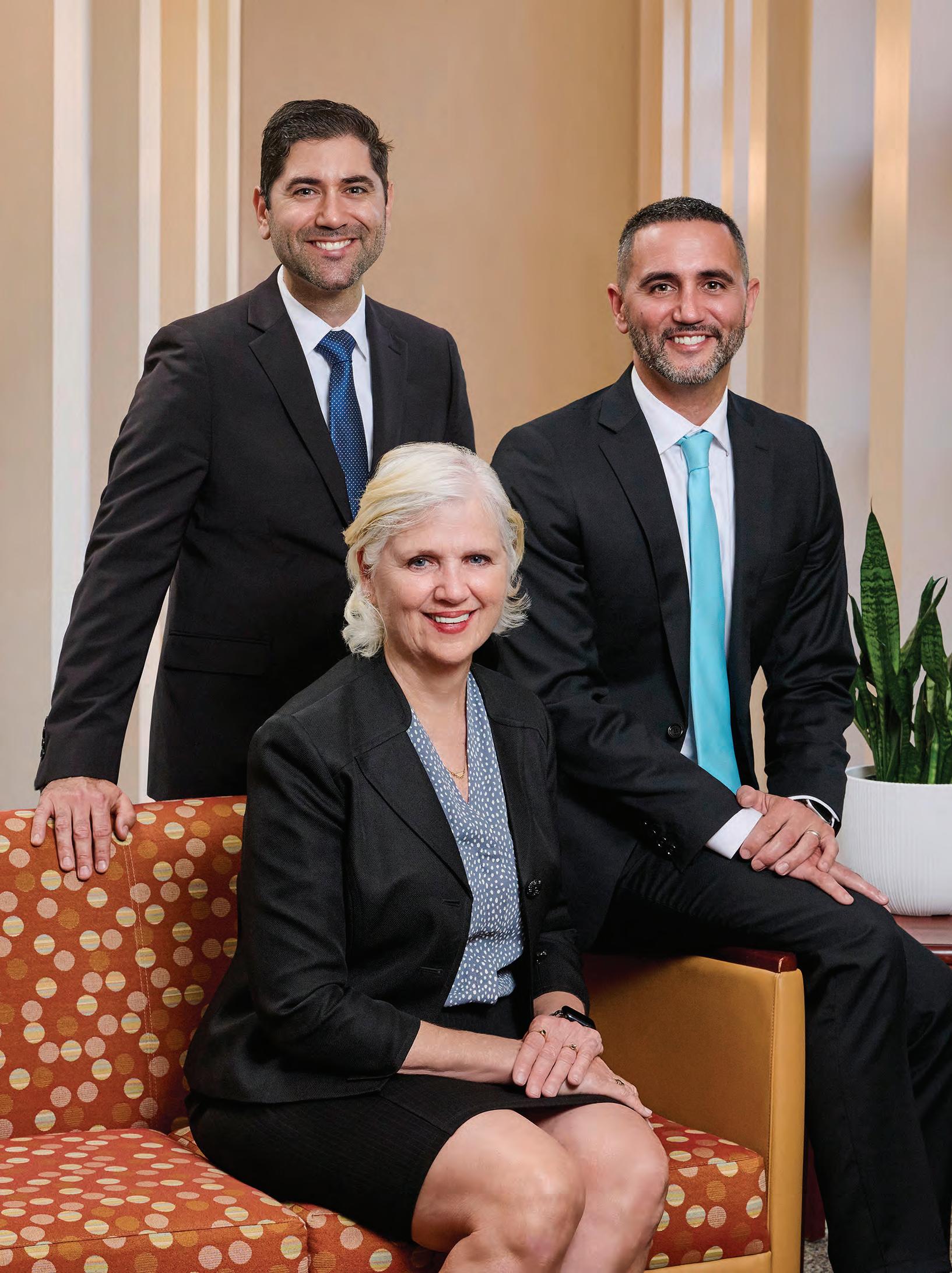
Mary Baquero ’97 started the Baquero Law Office in Minneapolis nearly 25 years ago as a solo practitioner specializing in immigration law. That is, until she hired her sons Anthony Baquero ’09 and John Baquero ’11 to join her.
Born and raised in Minneapolis, Mary attended Normandale Community College and St. Catherine University. At Normandale, she participated in the study abroad program that took place in Colombia. There, she learned to speak Spanish and fell in love with the culture. She also met and fell in love with Richard, with whom she would marry and have a family.
Back in Minnesota, Mary worked full time while attending law school at William Mitchell College of Law. She chose the school because it allowed her to attend classes part time in the evenings. “William Mitchell not only filled a need for working families, but I also loved learning with people my age,” she claimed.
Although having a family, working, and going to law school was a challenge, Richard would bring their two boys and daughter Lucy to campus to see their mother and have dinner together in the cafeteria. “I can still smell and taste those French fries,” Anthony said. “They were delicious.”
John seconded that statement.
After graduating law school, Mary took the bar exam in Florida, where the family had moved for Richard’s career. “It was my goal to pass the bar before age 40,” she said. And she succeeded.
Eventually, after discovering that the company Richard worked for would have a position in Minnesota, Mary was determined to pass the Minnesota bar so they could relocate. Once there, she worked for a corporation offering legal employee benefit consultations in Spanish. She began to work with the Spanish-speaking community in Minneapolis and soon reduced her hours to part time at the corporation. That’s when Richard encouraged her to start her own firm, realizing she could accomplish something greater by fulfilling her own dreams while helping others fulfill theirs.
“It was Richard’s encouragement and sacrifice that made our family’s legacy of law a reality,” Mary lovingly said. “He held down the house and kids while I attended law school, encouraged me to start my own practice, and sacrificed his own successful career as an architect to be the firm’s office manager, IT support, and maintenance man. He’s everything.”
Anthony, the eldest son, would be first to follow his mother’s footsteps into the legal field, but it didn’t happen right away.
He completed his undergrad at Carleton College and took a year off to live in Colombia, study for the LSAT, and apply to law school. Having played basketball at Carleton, he wasn’t sure if he wanted to practice immigration law or work in the world of sports. He applied to several out-of-state and in-state schools, including William Mitchell.
He still remembers opening William Mitchell’s acceptance letter and its generous scholarship offer. In the end, he couldn’t pass up the opportunity to study at the very same school where his mother studied over a decade before. He ultimately accepted the scholarship and received an extraordinary education. “I especially appreciated the mock trials and externships because they allowed me to use my practical skills in real time. It felt like I was already a lawyer as a student. Looking back, I didn’t know my exact path, but I know now that I’m exactly where I’m meant to be. Our family being able to authentically interact and effectively help our clients and their families is incredibly rewarding.”
For John, there was no question what he wanted to do and where he wanted to go after completing his undergrad at Minnesota State University, Mankato. He, too, attended William Mitchell—entering law school while Anthony was a 3L student—and the two played intramural sports together during their shared year. John said, “I wanted to stay local and already knew so many people, including my mother and brother, who went to William Mitchell and were in the legal profession.”
John’s favorite experiences in law school had to do with criminal justice and being in the courtroom. Fittingly, he works as a public defender for Scott County in addition to being part of the family’s private practice. “The day I was sworn in, my dad told me that I had court on Tuesday,” John laughed.
As for the future, Mary wants to retire soon and spend more time with her six grandchildren (two from each of her children and their spouses) and plans to pass the torch to Anthony.
The Baqueros are Cornerstone Society members who have consecutively given to Mitchell Hamline for over 26 years. “I give out of deep gratitude,” said Mary. “I would not have been able to attend law school if William Mitchell didn’t provide access, and I want Mitchell Hamline to continue to provide access for others.”

BY DICK DAHL
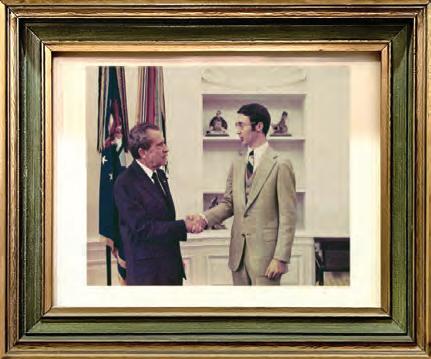
Not many lawyers can claim roles in events that change the course of history, but Jim Prochnow ’69 is one of them.
After Prochnow started his legal career working for three years at a law firm in Austin, Minn., he and his wife, Virginia, decided it was time to see a different part of the country. Prochnow was interested in the U.S. Department of Justice (DOJ) and asked Rep. Ancher Nelsen, who had represented Prochnow’s hometown, Hutchinson, to arrange a meeting with the DOJ. Nelsen did, Prochnow bought a plane ticket, flew to Washington, D.C., and got hired on the spot as a litigator in the civil division.
That was 1972, the same year when a group associated with President Richard Nixon’s re-election campaign broke into the Democratic National Committee Headquarters in the Watergate Office Building and planted listening devices. The discovery of this event launched what became known as the Watergate Scandal.
The following year, revelations surfaced that the break-in was part of a broader campaign of political spying, and the White House began looking for legal
help. Prochnow responded and joined Nixon’s Watergate defense team.
A particular highlight for Prochnow occurred on July 8, 1974, when he was present at the U.S. Supreme Court, as his boss, James D. St. Clair, argued the case United States v. Nixon. (The chief justice at that time was Warren Burger ’31.)
In the end, of course, Nixon resigned as president and was pardoned by his successor, Gerald Ford, in September 1974.
Reflecting on the experience today, Prochnow says he learned a valuable lesson. “Our country’s stability is assured in the long run by the checks and balances of the three branches of government.”
While that early experience probably stands out on Prochnow’s resume, his impressive 51-year career since then is what cemented his professional status. Throughout his career, Prochnow has focused on serving companies that are regulated by the Food and Drug Administration, the Federal Trade Commission, and the Drug Enforcement Administration.
The long, post-Washington, phase of Prochnow’s life has been centered in Denver throughout. He and Virginia contemplated the next chapter in their lives and settled on Denver when a law firm gave him an offer.
“Our
country’s stability is assured in the long run by the checks and balances of the three branches of government.”
Jim Prochnow
In 2003, he joined Greenberg Traurig after serving as partner at two other international law firms. He retired on Dec. 31, 2024.
Prochnow, 82, plans to focus on one of his first loves, writing poetry, now that he is retired. He is also planning to write something about his life, possibly a book, including his recollections of his Watergate defense team experiences.
Reflecting on his professional life, Prochnow says his success can be attributed, in large part, to hard work and being a good listener “both to your clients and your inner self.”
“Not everybody takes the time, or can get to know, clients really well. But I didn’t care if the client was in Seattle, Washington, D.C., or Dallas; I always went where they were and tried to understand them better because I always wanted to be the very best that I could be.”
BY AMY CARLSON GUSTAFSON
Kristin White ’10 remembers two events that make up her “transportation story.” The first is when she was in high school and a drunk driver killed three members of a family she knew, sending shockwaves through her hometown of Rapid City, S.D. The second happened while she was traveling to Japan as a Fulbright Fellow. She befriended a Japanese couple during her flight, and despite a language barrier, they helped her get to her destination once the plane landed.

Identifying these stories, which she did during her sevenyear stint with the Minnesota Department of Transportation, helped White pinpoint the importance of transportation in her life. Since graduating from law school she’s worked for MNDOT, the Intelligent Transportation Society of America in Washington, D.C., and the Federal Highway Administration (FHWA), first as chief counsel and then deputy administrator. At the end of her tenure, she was FHWA’s acting administrator, leading recovery efforts after Hurricane Helene ravaged areas in the southeastern U.S. in Oct. 2024.
In January, White took on a new challenge—transportation industry executive and head of transportation strategy and partnerships with Google Public Sector, which partners with government agencies and educational institutions to create stronger communities using digital tools, data analytics, mapping, AI, and cloud computing. White focuses on transportation projects, working to make communities and their citizens safer on the road.
“My goal is to reduce the number of fatalities on our road systems, and we can only do that by using human-centered design,” White said. “Tech companies do not have expertise on what public agencies need. They’ve never had someone like me who’s been in transportation for nearly 20 years. While developing tools, they haven’t worked with end customers and end users to understand if these tools meet our needs. That’s my job—to build that bridge and be a translator. Many lawyers from Mitchell Hamline translate the complex into simple or simple into complex. That’s a great testament to the value of a law degree in the Mitchell Hamline program.”
During law school, White appreciated the guidance and personal attention from retired professors Steve and Carol Swanson and Joe Daly ’69.
“They saw students when students couldn’t see themselves, which was really meaningful,” she said.
White is proud of her efforts to promote women in transportation and break down barriers so women have clear career paths. With current events affecting the legal system, she said that when decisions that aren’t supported by or rooted in law are made, it’s time for alums to use their voices as advocates.
“We have an amazing network,” White said. “And we have an obligation to zealously represent and fight for people who might not be able to fight for themselves.”
BY DICK DAHL
Melissa Evans Buss ’00 has spent the entirety of her career at 3M Company, where she is now the assistant chief intellectual property counsel of 3M and the global intellectual property team leader and director of 3M Innovative Properties Company. During her tenure at 3M, she has been the IP attorney for more than 20 of 3M’s businesses, including the company’s largest product portfolio, and is leading some of their largest IP teams globally.
A native of Cheboygan, Mich., Buss was recruited by 3M in 1994 as she was completing her studies at Michigan State University, where she received a bachelor’s degree in mechanical engineering. After joining 3M, she led a project focused on re-engineering the company’s patent process to shorten the time between invention creation and patent application.
“As a result of working on that project, I became more interested in patent

law,” Buss recalls, “and our chief IP counsel at the time asked me, ‘Melissa, would you be interested in going to law school?’”
The rest, as they say, is history.
Buss served as 3M’s first four-year in-house law clerk while taking night classes at Mitchell Hamline. After receiving her J.D. in 2000, she continued with 3M as their IP counsel. She has taken on increasingly greater responsibilities ever since. She has worked with practically all of the company’s divisions and most of their corporate labs—including its abrasives, dental, orthodontic, security, consumer, software and electrical systems, industrial adhesives and tape, and personal safety divisions—just to name a few.
Buss excels at building high trust/high performing, international IP teams for 3M. In addition to management, her duties include strategically managing large IP portfolios, improving IP

“My personal goal is to train at least 20 patent attorneys and to mentor at least 50 women in intellectual property before I retire.”
business processes, and managing patent litigation and disputes internationally.
She has drafted and negotiated more than 120 IP-related agreements, drafted and filed more than 125 U.S. patent applications, and completed more than 40 domestic and international pre-suit investigations and patent-infringement lawsuits.
In addition to her busy work schedule, Buss is also active with Mitchell Hamline’s externship program, always having two law students working for her. Buss’s past law clerks have gone on to some of the best companies and law firms, both inside and outside of Minnesota. “My personal goal is to train at least 20 patent attorneys and to mentor at least 50 women in intellectual property before I retire,” she says.
That said, with 30 years under her belt at 3M, Buss has no plans to change her busy course. The reason, she says, is simple: she loves her work.
“I love being a patent attorney! I’m never bored. There is always something new and I’m learning every day. I get to collaborate with business executives, super cool engineers, and PhD technical experts. I am so thankful that William Mitchell’s IP program helped prepare me to be the best IP attorney I could be.”
Dick Dahl is a freelance writer and editor in Minneapolis.

BY AMY CARLSON GUSTAFSON
During her second year in law school, Sylvia Strobel ’91 started as a legal intern at Twin Cities Public Television (TPT). Her dedication to public media was evident from the start. More than 30 years later, Strobel is president and CEO of the powerhouse public media organization, a position she’s held since 2020.
“I believe in the mission of public media,” said Strobel, who has had various public media-related roles throughout the country between her time at TPT, including running Pennsylvania Public Television Network and serving as senior vice president and general counsel of American Public Media Group. “It’s trusted educational content accessible to almost everyone in Minnesota with our free over-the-air signal. We’re here to serve the community and tell the stories no one else is telling. I’m fortunate to work with an amazing team of people, some of whom were here when I was an intern.”
As a steward for the next generation of TPT leaders, Strobel said she feels a great weight on her shoulders to ensure the organization is around for future generations. Part of that responsibility means flexibility in navigating the ever-evolving media landscape, which includes the rise of digital media, changing audience preferences, and the need for diverse and inclusive content.
TPT is a lifeline for many people, she said, offering differing opinions and voices representing a wide array of perspectives on what’s happening in the community and the world, respectfully. While there is uncertainty around critical federal funding for public media, Strobel said TPT will do everything it can to remain a steadfast source of trusted information for Minnesotans.
“I’m proud of the content our team produces and the response we get from community members,” she said. “What we’re doing changes lives, and that’s meaningful, whether it be documentaries, educational content, or TPT NOW, our multilingual health and safety channel. Knowing what’s happening in and around your community is critical to making informed decisions. I don’t take that lightly—it’s an opportunity and an obligation.”
Strobel, who was honored with St. Olaf College’s Distinguished Alumni Award last year, appreciated that while attending law school full-time, her flexible schedule allowed her to get a foot in the door at TPT for an impactful mix of philosophical and real-world learning. Law school prepared her for a legal and non-legal role by instilling the communication and analytical skills she uses daily.
“As an executive, a lot of your job is risk management, which you learn as a lawyer,” Strobel said. “Being able to balance legal and business needs is important, too. Law school provided me with a great foundation. It’s why I’m here today.”
Amy Carlson
Two classes of Alumni Award winners were recognized in 2025 by the Mitchell Hamline Alumni Association Board, in the spring and fall.

Senior Judge Leslie Metzen ’79 received the Distinguished Alumni Award for her work progressing law reform related to domestic violence and juvenile delinquency and trailblazing a path for women as the first female district judge in Dakota County when she was appointed in 1986. She was a founding member of the Dakota County Domestic Violence Coordinating Council, chair of the Committee to Revise Minnesota Rules for Juvenile Delinquency Proceedings, and chair of the Conference of Chief Judge. Metzen served as chief judge of the First Judicial District from 1997 to 2001 and became a part-time senior district judge in 2011.
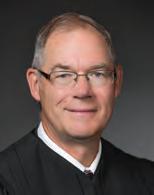
Senior Judge John Smith ’75 received the Distinguished Alumni Award for his excellence and fairness as a judge for over 34 years—in the Ninth Judicial District and Minnesota Court of Appeals—and dedication to innovation in the courts through advancing technology and establishing the nation’s first joint jurisdiction court between a state government and Native American Tribe. Before joining the bench, Smith was a civil trial specialist for 15 years. He also taught at National Judicial College and Mitchel Hamline, has held leadership roles in many professional and community service organizations, and is a frequent speaker and mentor.
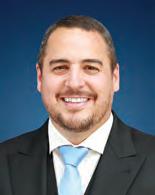
Jeffry Collins ’21 received the Outstanding Alumni Award for his generosity serving Mitchell Hamline prospective and current students and alumni. A pro bono volunteer and adjunct professor in criminal law, Collins hosted an alumni and recruitment event to create community bonds throughout Nevada. He began working as a Nevada bar mentor for recent graduates in Nov. 2022, and, in a matter of months, he was supervising externships and tutoring for the Nevada bar. He founded Collins Law in 2024, which focuses on cryptocurrency, securities, trusts and estates, and taxation, and he is currently writing a textbook and course for these areas.
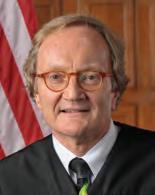
Senior Judge Donovan Frank ’77 received the Outstanding Alumni Award for his fierce advocacy for disability rights throughout his career, commitment to well-being, and his service as an influential Mitchell Hamline trustee from 2015 to 2024. Beginning his career as an assistant county attorney in St. Louis County, Minn., Frank was appointed to the Sixth Judicial District in 1985, later serving as assistant chief judge and chief judge before joining the United States District Court, District of Minnesota, in 1998. Frank is the chair of Lawyers Concerned for Lawyers and served on the board of the Range Mental Health Center.
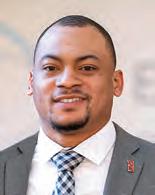
Jeremiah Allison ’20 received the Recent Alumni Award for his impact creating opportunities for and supporting those in need. Since graduating from Mitchell Hamline, he developed in-depth curricula for students from underserved communities to explore the legal profession, which he has taught in 10 schools in inner Los Angeles. He also established the Allison H.O.P.E. Foundation in 2019 to support basic needs for single mothers and families. He is a frequent mentor to Mitchell Hamline students and is active in the Minnesota legal community. Allison currently serves as associate counsel for the Minnesota Vikings and previously worked for Medtronic.

Rashanda Bruce ’18 received the Recent Alumni Award for being instrumental in securing major seven-figure verdicts across a range of sensitive and complex matters as a Robins Kaplan associate and impacting the legal and greater community as a leader and mentor. She is involved in the Hennepin County Bar Association, Minnesota Association of Black Lawyers, Prodeo Academy, Twin Cities Diversity and Practice, Books for Africa, and the Warren E. Burger Inn of Court. She also is a competitive cheerleading coach for girls in grades 1-6 and a co-founder of LOCUS, which provides community building and leadership for people of color.

McKaia Dykema ’23 joined the Mitchell Hamline Alumni Association Board in July 2025. She’s an associate attorney for Kennedy & Graven focusing on municipal law, with prior experience working as a manager of legal advocacy and legislative research for the National League of Cities, as well as various positions with other Minnesota cities. During law school, Dykema clerked with Campbell-Knutson and externed with the City of Golden Valley, primarily supporting the Just Deeds project; served as a Student Bar Association representative; received the 2023 International Municipal Lawyers Association’s Charles Thompson Jr. Local Government Law scholarship; and graduated summa cum laude.
Davidson adds vice president of institutional advancement to senior leadership team
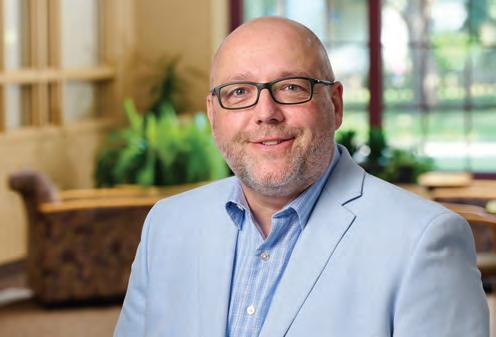
President and Dean Camille Davidson added Kent Spaulding to her senior leadership team as vice president of institutional advancement after a national search. In his role, he leads the development and marketing and communications teams to grow engagement with the law school’s alumni and external communities.
Spaulding brings over 25 years of leadership experience in higher education and health care fundraising, communications, and relationship management to Mitchell Hamline, most recently serving as vice president of development and chief development officer at North Memorial Health.

Assistant Professor of Law Jessica West comes to Mitchell Hamline from the University of Washington School of Law, where she served as a professor and former assistant dean for academic success programs. As a professor, West is committed to student success and a student-centered approach to teaching. She previously taught administrative law, constitutional law, criminal law, evidence, and more in positions at Vermont Law School, Yale Law School, and the University of Denver Sturm College of Law. Before joining academia, West was a practitioner for almost 20 years in civil and criminal trial and appellate litigation. Having grown up in a family of civil rights activists, her scholarly focus centers around protest. West earned her J.D. from the University of Connecticut School of Law, and her primary teaching responsibilities are in Evidence and in the clinical program.

Assistant Professor of Law Eleanor Frisch entered teaching with a decade of litigation under their belt, real-world experience they look forward to sharing with students in the classroom. Frisch most recently served as of counsel with Cohen Milstein Sellers & Toll. They previously worked for Apollo Law, Wilson Law Group, and Nichols Kaster on a wide variety of class action and federal cases including employment, consumer protection, employee benefits, immigration, and more at both the district and appellate levels. They earned their J.D. from University of Minnesota Law School. Frisch was also a founding board member of the Minnesota Disability Bar Association, the second state-level disability bar association in the country, and currently serves as the group’s treasurer. Passionate about accessibility in the legal profession, they are a scholar and a frequent CLE speaker about issues related to disability. Their primary teaching responsibilities are in legal writing.
The Mitchell Hamline Alumni Association Board selected Leah Olm ’25 and Parker Vegemast ’25 as this year’s Student Award of Merit winners. The award honors graduating students who demonstrate excellent academic performance and community contributions.
Olm came to Mitchell Hamline to study tax law after a 15-year career in nonprofit fundraising. In addition to the Student Award of Merit, she also received the Center for Computer-Assisted Legal Instruction’s Excellence for the Future Award for having the highest grade in both income tax law and election law classes. Olm served as co-president for Mitchell Hamline’s Tax Law Society. For two of her three years in law school, she served as treasurer of the board for Headwaters Foundation for Justice, which invests in grassroots organizations across Minnesota, with a focus on Black and Indigenous-led organizations. Vegemast consistently excelled during law school and was on the dean’s list every semester. He participated in Mitchell Hamline’s Student Bar Association, Summit Cup competition, and Prison to Law Pipeline program. As a certified student practitioner, Vegemast assisted with in-custody arraignments, pretrial arraignments, probation revocation hearings, and jury trials at the Dakota County Public Defender’s Office, volunteering hundreds of hours to help disadvantaged communities throughout his time in law school. He was also an assistant for Schwebel, Goetz & Sieben.
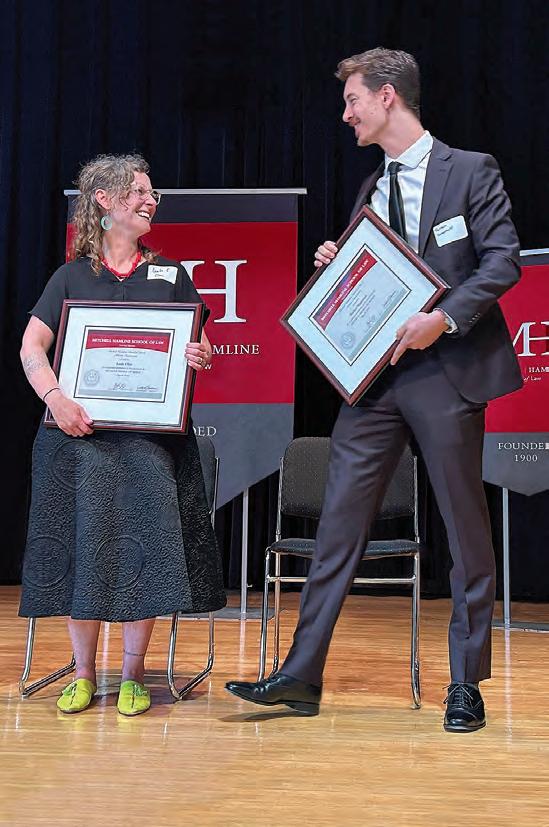
To better serve our alumni, we are seeking your perspective on the communications you currently receive—including this alumni magazine. Your input is greatly valuable and will allow us to share the stories and news you want to hear. Thank you for taking a few minutes to fill out this brief, anonymous survey.

mitchellhamline.edu/magazine-survey
Questions? Please contact alumni@mitchellhamline.edu.




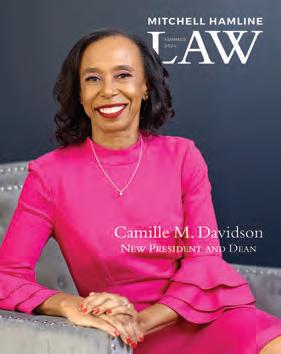





1962
YVONNE B. MOORE teaches Black history in North Minneapolis.
1967
JAMES E. CONWAY received the Albert Nelson Marquis Lifetime Achievement Award by Marquis Who’s Who.
1975

CARA LEE NEVILLE was elected to the American Bar Association House of Delegates representing the Minnesota State Bar Association. She was also elected to the governing council of the ABA International Law Section.
C. THOMAS WILSON joined Lommen Abdo.
1977
EDWARD A. TRIO retired after nearly 40 years at Gould & Ratner.
1979

1980

LESLIE M. METZEN received the Mitchell Hamline Distinguished Alumni Award.
His duties ended upon publication of the opinion in October. He retired from the Ramsey County bench upon turning the mandatory retirement age, effective Oct. 31, 2024. Following retirement, Judge Guthmann will continue to work as a senior judge in the State of Minnesota and as a private mediator and arbitrator with the Larson King law firm.

LOUIS SCHIFF retired as a judge in Dec. 2024 after 28 years on the Broward bench in a satellite courthouse in Deerfield Beach, Fla.
JEFFREY P. CAIRNS retired from Stinson.
BRIAN N. JOHNSON received a Mentor Award from the Minnesota State Bar Association Senior Lawyers and Judges Section.


BARBARA J. GISLASON received the Excellence in the Advancement in Animal Law Award from the American Bar Association Tort Trial and Insurance Practice Section.

JOHN H. GUTHMANN received a President’s Award from the Minnesota District Judges Association and a Lifetime Judicial Excellence Award from the Minnesota Chapter of the American Board of Trial Advocates. He was also appointed by the Minnesota Supreme Court to serve as an acting Supreme Court justice in the case of MacDonald v. Simon

BRAD H. LEHRMAN joined the board of directors of World Without Genocide.
RUTH A. MICKELSEN has joined MinnPost’s nonprofit board of directors.
SCOTT T. ANDERSON retired after 38 years of practicing law. He was a founding partner of Rupp, Anderson, Squires, Waldspurger & Mace.
MARLENE S. GARVIS is a nurse, lawyer, and strong advocate for clients on health care, professional licensure, health law, employment, and appellate matters. She founded Marlene S. Garvis law firm. She has been recognized by Minnesota Super Lawyers from 2014 to 2024 and has been featured in Mpls/St. Paul Magazine’s Top Women Attorneys in Minnesota from 2015 to 2025. Additionally, she has been listed in Marquis Who’s Who since 2024.
JANET A. HILDE retired after serving more than 17 years as a superior court judge in Plumas County, Calif. She also served on many statewide judicial committees and on the executive board of the California Judges Association.
ELLEN G. SAMPSON received the Myra Bradwell Award from Minnesota Women Lawyers.

KENNETH J. ABDO was selected to Billboard Magazine’s 2024 Top Music Lawyers list.
JOHN R. SCHULZ joined Bassford Remele as a shareholder.
KENT R. HOLMBERG retired from Utah’s 3rd District.
LAWRENCE R. MCDONOUGH received a Mentor Award from the Minnesota State Bar Association Senior Lawyers and Judges Section.
NANCY J. LOGERING retired from Minnesota’s 10th Judicial District Court bench.
TIMOTHY J. MCMANUS retired from Minnesota’s 1st Judicial District Court bench. He currently works for PowerHouse Mediation.
PHILIP SIEFF was named in Minnesota Lawyer’s Power 30: Personal Injury list.
PATRICIA KUDERER was sworn in as the ninth insurance commissioner for Washington, D.C.
PETER W. WARNER retired after 36 years of working for the St. Paul City Attorney’s Office. He served as an adviser to the St. Paul Planning and Economic Development, St. Paul Department of Safety and Inspections, and most recently the St. Paul City Council.
DAVID P. GRAHAM joined Gardner Law as senior counsel.
DANIEL P. OLSON was appointed to the NIOA Group advisory board.

EUGENE C. SHERMOEN, JR., retired after 36 years with Arthur Chapman Kettering Smetak & Pikala.
ROBERT D. TIFFANY retired from Minnesota’s 9th Judicial District court bench and was appointed as a senior judge.

EVELYN A. ANKUMAH was appointed special adviser by the Prosecutor of the International Criminal Court. She is a prominent lawyer, human rights advocate, and founder of Africa Legal Aid (AFLA). With legal experience across Africa, Europe, and North America, she has led initiatives promoting gendersensitive and victim-centered approaches to international criminal justice. Her advocacy also helped establish the International Criminal Court Bar Association (ICCBA).
THOMAS E. EMMER, JR., was re-elected to Minnesota’s 6th Congressional District
ANNE M. HONSA’s firm Honsa Mara & Kanne was certified as a Women’s Business Enterprise through the Women’s Business Enterprise National Council.




DEAN E. RATHS joined the Mitchell Hamline Alumni Association Board.
GREGORY J. STRASSER was appointed the presiding judge of Marathon County, Wis.
JOHN P. ANDERSON was appointed by the Wisconsin Supreme Court as chief judge of Wisconsin’s 10th Judicial District.
JANET L. BARKE
CAIN retired from Minnesota’s 1st Judicial District court bench and was appointed as a senior judge. She also received the Joint President’s Award from the Minnesota District Judges Association (MDJA) and the Minnesota District Judges Foundation (MDJF).
RENAE L. FRY was named the administrator of Steele County, Minn.
JOHN M. O’BOYLE retired on May 2, 2025. He joined the Barron County (Wis.) District Attorney’s Office in Jan. 2016. He was previously the elected district attorney in Pierce County for 20 years.
ANDREW M. SHAW was included in Minnesota Lawyer’s Power 30: Construction and Real Estate list.

KARIN L. SONNEMAN received the Outstanding Alumni Award from the University of Minnesota’s Department of Applied Economics.
DAVID M. UJKE released his first album entitled “Northern Songs” and continues to serve as lead counsel for the Red Cliff Band of Lake Superior Chippewa Indians in Bayfield, Wis.
SCOTT C. BARR received the 2024 University of Wisconsin Oshkosh Distinguished Alumni Award.
BRIAN T. GROGAN was re-elected to Moss & Barnett’s board of directors.
LEANNE G. LITFIN joined the labor and employment practice group at Maslon.


CARLA J. PEDERSEN joined Barna, Guzy & Steffen as shareholder.
SYLVIA L. STROBEL was elected as a member of the board of trustees for America’s Public Television Stations (APTS). She currently serves on the boards of the Public Television Major Market Group (MMG), MacPhail Center for Music, The Amherst H. Wilder Foundation, the Mary T. and James J. Hill Library Foundation, and Latino Public Broadcasting. She also received the 2024 St. Olaf College Distinguished Alumni Award.
DEAN R. BORGH joined Accordant Investments as executive director of national accounts.
ANNE T. GUEINZIUS received the 2024 Becker Legacy Award from the Minnesota State Bar Association.
KAREN J. CODY-HOPKINS works predominantly with student loan cases and bankruptcies. She also does local counsel work for firms doing shareholder derivative or merger opposition cases. She is vice president of the National Association of Student Loan Lawyers (NASLL), teaches student loan CLEs, and advocates for various organizations. She and her husband, Jim, live in Colorado.
GREGORY J. REIGEL earned board certification from the Texas Board of Legal Specialization in Aviation Law.

THEODORE M. THOMPSON joined Easterseals as the senior vice president of government relations. He will spearhead Easterseals’ advocacy efforts to advance disability rights, expand access to critical services, and influence policy at the federal and state levels.
ANDREW D. PUGH has been appointed as senior vice president, chief legal officer of Children’s Minnesota. He will oversee legal services, risk management, compliance, and information security at one of the largest pediatric health care systems in the country.

KARL L. SCHMIDT was appointed to Minnesota’s 7th Judicial District Court bench.
AARON A. DEAN joined Spencer Fane as a partner and represents general contractors, subcontractors, suppliers, public and private owners, developers, and A/E in every aspect of construction dispute resolution. He is the chapter attorney for the Minnesota Subcontractors Association, where he drafts and testifies about legislation affecting the construction industry.
TOM POUL, SR., partnered with Nancy Haas ’03 to form Poul Haas, a law firm specializing in government relations services.


ANNA MARIE THATCHER received the 2023 Distinguished Alumni Award in the Arts and Humanities from Dakota Wesleyan University. She also produced and directed “Power of Possibility: The Impact of Public Art in South Dakota Communities.”
GLORIA J. KARSKY retired from full-time practice as an inhouse senior attorney with TCF Bank (now Huntington Bank) in 2015. She currently works as a consultant and part-time selfemployed attorney. She serves on the board of directors of Sunrise Bank and is chairperson of the board’s BSA/compliance committee. She is married to Jerry McFarlane and spends winters in Goodyear, Ariz.

DANIEL K. LEW received the NAACP Criminal Law Award at the 2024 Freedom Fund Dinner.
ANN DUNN WESSBERG was ranked as a leading trademark attorney in the 2024 World Trademark Review 1000.
JULIE A. EDDINGTON joined Kutak Rock as a public finance attorney. She has two decades of experience advising towns, cities, counties, and public finance authorities.

LAURA B. REILLY joined the Mitchell Hamline faculty as an associate teaching professor.
TODD R. SCHOFFELMAN received a President’s Award from the Minnesota District Judges Association.
KATHY S. KIMMEL was included in Minnesota Lawyer’s 2024 Power 30: Business Litigation list for the third consecutive year.
PATRICE H. KLOSS was named a 2024 Women in Business honoree by the Minneapolis/St. Paul Business Journal.
CATHIE A. MAEYAERT is the director of private postsecondary institutions at the Texas Higher Education Coordinating Board. She served as president of the National Association of State Administrators and Supervisors of Private Schools, April 2022-24. Maeyaert is currently serving on the board of the National Council for State Authorization Reciprocity Agreements.

MARKUS C. YIRA was elected president of the Minnesota Association for Justice. Yira’s term as the 70th president of MAJ was effective Aug. 16, 2024. Since 2004, he has been an adjunct professor at Mitchell Hamline, where he currently teaches Torts, Constitutional Law, and Civil Dispute Resolution.

TED J. CREWS continues to serve as the assistant director at the City of Phoenix Public Defender’s Office. He spent 23 years in public and private practice as a criminal defense attorney before being selected as assistant director. Crews is most excited about creating a new community court to help the city’s vulnerable unsheltered population.

CASTANEDA joined FlyteHealth as chief revenue officer.
CHRISTINE LINDBLAD rejoined Fox Rothschild in the firm’s Minneapolis office as a partner in the litigation department.
ROBERT W. MAIRS was named chief executive officer at Mairs & Power.
KRISTY A. MARA’s firm Honsa Mara & Kanne was certified as a Women’s Business Enterprise through the Women’s Business Enterprise National Council.
STEVEN L. RASMUSSEN retired from The Bank of Versailles.

SHAWN B. REED was elected to Minnesota’s 6th Judicial District Court bench.
THEODORE J. SCHMELZLE was promoted to assistant vice president of retirement plans services at The Standard.
CHERYL A. STANTON joined Steptoe & Johnson. She is a member of the firm’s higher education team.
THERESE “TERI” P. KUFFEL was named interim executive director of the American Orthotics and Prosthetics Association.
PHILLIP B. MARTIN was selected to Minnesota Lawyer’s 2025 Power 30: Mergers and Acquisitions list.


RICK L. PETRY was presented with a 2024 Council on Legal Education Opportunity EDGE Award as the education honoree.
ELIZABETH H. STRAND was named chief judge of Minnesota’s 10th Judicial District and is the first female chief judge to serve in this district.
STEVEN R. TIPLER joined Piper Sandler as a managing director in the financial sponsors group.

SEAN P. DUFFY was named the U.S. secretary of transportation.

SARA N. WILSON was re-elected to Lommen Abdo’s board.
JANDEEN M. BOONE was promoted to general counsel at Ecolab. She is also executive vice president, secretary, and interim chief compliance officer.
KRISTEN E. PORTER was named vice president, associate general counsel, and compliance officer at SpartanNash.
PETER J. WILLIAMS was included in Marquis Who’s Who.
MEGAN A. BLAZINA has been appointed as vice president, chief legal officer, and secretary with Steelcase. She will take on a comprehensive leadership role, serving as general counsel and overseeing all legal services. Additionally, she will lead several other departments, including compliance, corporate strategy, global trade, government affairs and sustainability.
BRYANT D. TCHIDA has been elected to a three-year term as a member of Moss & Barnett’s board of directors.
LAURIE W. HUOTARI rejoined Lathrop as a partner in the firm’s business transactions practice group.
TERESA F. MCCLAIN was included in Minnesota Lawyer’s Power 30: Personal Injury list.

JENNIFER D. PETERSON was appointed to Minnesota’s 10th Judicial District Court bench.
LISA T. SPENCER was named a 2023 North Star Lawyer by the Minnesota State Bar Association and was recognized by Chambers & Partners in the 2024 High Net Worth Guide.

RACHEL C. SULLIVAN was named assistant chief judge of Minnesota’s 6th Judicial District.
ANTHONY S. WACHEWICZ, III returned to the Village of Ashwaubenon, Wis., as the village attorney/deputy village manager. He previously served as Ashwaubenon village attorney from Feb. 2017 through Dec. 2021.

JAMAL FALEEL has been appointed by Norton Rose Fulbright as its U.S. head of consumer markets.
SHEREEN M. ASKALANI CLEMENS was named on the Wall of Distinction at Mankato East High School.

JESSICA J. FRALICH was appointed to Minnesota’s 6th Judicial District Court bench.
KAREN K. KURTH retired from Barna, Guzy & Steffen.
ANDREW J. NOEL was included in Minnesota Lawyer’s Power 30: Personal Injury list.
JOHN C. PICKERILL was ranked as a leading trademark attorney in the 2024 World Trademark Review 1000.
KATHRYN E. RUSSELL joined the Minnesota Attorney General’s Office as a training and development manager.


SARA R. GREWING was named chief judge of Minnesota’s 2nd Judicial District.
JAPAUL HARRIS was appointed to the Minnesota Court of Appeals.
NANCY A. HAAS partnered with Tom Poul ’94 to form Poul Haas, a law firm specializing in government relations services.
JOSHUA J. KINDKEPPEL was presented with a Lifetime Service Award by the Dane County (Wis.) Bar Association.
SCOTT PRYOR and his firm, The Scott Pryor Law Group, in partnership with legal allies, achieved a historic $162 million settlement for multiple victims, believed to be the largest settlement amount from a single-vehicle automobile wreck in the history of Georgia

CRAIG M. SHERWOOD has joined The Joint Corp. as senior vice president of development. He will be responsible for leading franchise license sales and new clinic development as well as building out the company's enterprise accounts business.
KELLY A. STAPLES has been appointed to Minnesota’s 1st Judicial District Court bench.


JESSICA A. BIERWERTH was appointed to Minnesota’s 2nd Judicial District Court bench.
HUSNIYAH L. DENT BRADLEY was nominated and confirmed to be a citizen member of the Metropolitan Council’s transportation advisory board.
RYAN P. GARRY was elected to serve on the board of directors of the National Association of Criminal Defense Lawyers.


GREGORY J. JERABEK was appointed judge to the Wood County Circuit Court, Branch 1.
LYNDSAY H. MILLER was named chief legal and risk officer at Everwise Credit Union.

DER YANG was appointed to Minnesota’s 2nd Judicial District Court bench.
GREG T. KRYZER was named the administrator of Wright County, Minn.

KELLY L. OLMSTEAD was named assistant chief judge of Minnesota’s 2nd Judicial District.
MARY FRANCES M. PRICE cofounded Bravura Group in Jan. 2025, along with alums Taylor Sztainer ’09 and Susie King ’09. Bravura Group is a 100% woman owned law and fiduciary services firm She also received the Mary Alice Gooderl Award, which acknowledges outstanding contributions to the field of elder law by members of the Minnesota State Bar Association Elder Law Section.

ANDREW J. RORVIG was named president of the Ramsey County Bar Association.
JENNIFER L. VERDEJA was appointed to Minnesota’s 2nd Judicial District Court bench.
JOHN M. WENDLAND was promoted to executive vice president and general counsel at Minnco Credit Union.
CONNIE I. ARMSTRONG was included in Minnesota Lawyer’s 2024 Power 30: Construction and Real Estate Law list.
ELENA K. ATEVA was named director of climate and disaster resilience at Americares.

MEGAN I. BRENNAN joined Marvin as director of employment law.
ELIZABETH M. SORENSON BROTTEN was elected president of the Minnesota Defense Lawyers Association.
JAY D. JERDE joined the State Bar of Wisconsin’s Legal Education and Knowledge Communications Department as legal writer and associate editor. In this position, he authors articles about legal developments and edits submissions by Wisconsin lawyers.
JUSTIN P. SHORT was included in Marquis Who’s Who.

JOHN C. SYVERSON joined Melchert Hubert Sjodin as a personal injury attorney.
MAXWELL BREMER was named managing partner of Saul Ewing’s Minneapolis office.

KATHLEEN K. CURTIS was promoted to shareholder at Nilan Johnson Lewis.
RACHEL M. DAHL joined DeWitt as partner.
PETER J. DIESSNER was named chief executive officer of KrausAnderson Companies.


SAMUEL J. EDMUNDS was named president of the Minnesota State Bar Association.
KRISTIN L. GARLAND was reappointed as an associate city court judge by the Auburn City Council (N.Y.).
Garland, the first woman to hold a city judgeship in Auburn, was initially appointed in 2019.
SARAH M. HUNTER was named vice president of operations at SFM Mutual Insurance.


MICHELLE M. JUNGERS was appointed as a district associate judge in Iowa’s Judicial Election District 1B.
TRICIA A. LOEHR was appointed to Minnesota’s 10th Judicial District Court bench.
SUSAN J. MARKEY has been elected to the Maslon’s board of directors.
NADEGE J. SOUVENIR was named chief executive officer of the San Antonio Area Foundation.
JEFFREY A. WIELAND joined Spencer Fane as a partner and represents clients in construction, commercial, and public procurement litigation as well as the full range of alternative dispute methods. In his first career, he served as an engineer and project manager designing, building, and testing defense systems for the U.S. military.
MAX D. HOLMQUIST was promoted to shareholder at Jermain, Dunnagan & Owens in Anchorage, Alaska.
KAYLA M. JOHNSON was appointed to Minnesota’s 5th Judicial District Court bench.
COURTNEY A. LAWRENCE was promoted to partner at Schwebel, Goetz & Sieben.
JANINE M. LOETSCHER was named the Top Woman in Construction, Professional Services by Finance & Commerce.
CHRISTY L. THORSON was promoted to partner at Bradshaw & Bryant.

VIET-HANH S. WINCHELL was appointed to Minnesota’s 10th Judicial District Court bench. She is the state’s first Vietnamese American state court judge.


TIMOTHY P. CAREY won an election for Minnesota’s 2nd Judicial District. He was appointed to the bench in 2022.
DAWN “KIM”
COLLINS joined HNTB as a practice consultant for the Minnesota region, bringing significant strategic planning, operations management, transportation policy, stakeholder engagement, and leadership.


JUSTIN M. COLLINS was appointed to Minnesota’s 10th Judicial District Court bench
HOLLY H. DOLEJSI was named pro bono counsel of World Without Genocide.
VICTORIA A. ELSMORE has been appointed to Minnesota’s 2nd Judicial District Court bench.
MICHAEL L. HOGAN joined the legal counsel's office at the Shakopee Mdewakanton Sioux Community.
SUSIE KING co-founded Bravura Group in Jan. 2025, along with alums Taylor Sztainer ’09 and Mary Frances Price ’05. Bravura Group is a 100% woman owned law and fiduciary services firm.
DARYA LUCAS joined Gardner Law as an associate attorney and health care regulatory and compliance expert

KRISTA M. MARKS was appointed to Minnesota’s 1st Judicial District Court bench.
SUNČICA SEJDINOVIĆ joined Winthrop & Weinstine as an associate in the firm’s tax practice. She advises public and private companies of all sizes, including multi-national corporations, private equity funds, health care providers, and insurance companies, on the corporate and partnership tax implications of domestic and cross-border M&A transactions.
ALICIA N. SIEBEN was promoted to partner at Schwebel, Goetz & Sieben.
TAYLOR D. SZTAINER co-founded Bravura Group in Jan. 2025, along with alums Susie King ’09 and Mary Frances Price ’05. Bravura Group is a 100% woman owned law and fiduciary services firm.

CHRISTOPHER D. BATES was appointed to Minnesota’s 1st Judicial District Court bench.
EMILY J. FROEHLE was appointed to Minnesota’s 4th Judicial District Court bench
SOFIA LYKKE joined Kutak Rock as a public finance attorney. Her area of focus is governmental purpose bonds, conduit revenue bonds, and economic development.

WILLIAM T. MONTGOMERY was appointed to the Bethel Superior Court in Alaska.
LAUREN E. NUFFORT was re-elected to Lommen Abdo’s board.

HAO Q. NGUYEN was recognized with the Carnegie Hero Fund medal for his courageous intervention in preventing a man from jumping off a parking ramp during a personal crisis in St. Paul.



MATTHEW T. SCHMIDT was appointed to Minnesota’s 1st Judicial District Court bench
JEFFREY R. UNDERHILL joined Maslon’s litigation practice group.
KRISTIN R. WHITE started as Google Public Sector’s transportation industry executive and head of transportation strategy and partnerships.
KATHRYN H. BENNETT was named in Minnesota Lawyer’s Power 30: Personal Injury list.
SHIREEN K. GANDHI was appointed as a state agency business planning member for the technology advisory council and currently serves as the deputy commissioner for agency effectiveness for the Minnesota Department of Human Services

JENNA L. GILL was appointed to the Lafayette County (Wis.) Circuit Court bench. She previously served as district attorney for the county and will be its first female judge.

ALICIA M. REUTER joined Medica as senior vice president and chief legal officer.
ADAM PABARCUS was elected shareholder at Larkin Hoffman. He is a litigator and trial attorney who focuses his practice on property tax appeals, helping taxpayers obtain fair taxes, tax savings, and refunds. He also practices in trust litigation, protecting the rights of trustees, beneficiaries, and individuals.
LINDSEY J. POKER joined Banc of California as corporate counsel.

MATTI R. ADAM was appointed to Minnesota’s 9th Judicial District Court bench.
JANET M. DORR was elected shareholder at Fredrikson & Byron
ANTON G. FICEK has been selected for inclusion in Marquis Who's Who.

SAWAN S. PATEL was appointed as chair at Larkin Hoffman to the corporate practice group.
EMELINE M. WALKER was named director, corporate counsel at DaVita in integrated kidney care focusing on valuebased care.
LAUREN C. BETHKE received a 2024 Attorneys of the Year award as part of the 2024 state elections team in the nonprofit/ government category.
DAVID C. DYER joined Verrill as a patent attorney.

ERICA HOLZER was re-elected president of the Epilepsy Foundation of Minnesota board of directors for a two-year term. Holzer has been a member of the board since 2019, advancing its goal of providing support, connection, and education to overcome the challenges of living with epilepsy
JESSICA L. TIMMINGTON LINDSTROM was named shareholder at Winthrop & Weinstine.
MICHAEL J. MOELLER has been elected to the board of directors of the North Iowa Area Community College (NIACC) Foundation. He also serves on the boards of Clear Lake Community School District, Metropolitan Family Services, and Iowa Supreme Court Grievance Commission. He also volunteers with Iowa Legal Aid.
VERONICA S. NEWCOMER was named president of the Minnesota Native American Bar Association.

NATASHA C. PHELPS was selected as associate director for policy and partnerships for the U.S. Food and Drug Administration’s Center for Tobacco Products
SHARON L. POWELL celebrated the 10-year anniversary of Powell Law.
DUSTIN M. ROCKOW joined the Barron County (Wis.) District Attorney’s Office as an assistant district attorney.
JEVON C. BINDMAN received the Holt Gwyn Award from the American College of Construction Lawyers (ACCL). He won first place in the ACCL's inaugural writing competition and will soon be published by the organization.

CODY J. BLADES joined Parker Daniels Kibort.
DOUGLAS J. MAC ARTHUR, II joined Fisher, Bren & Sheridan as a partner.

RYAN C. MCCARTHY was named the Minnesota State Bar Association’s Outstanding New Lawyer of the Year.
HARRISON M. MISEWICZ was named chief executive officer and president of Eggleston Services.
CHELSEA M. MULARONI was named shareholder at Winthrop & Weinstine.
BARBARA J. SEIBEL rejoined DeWitt’s Minneapolis office.
COURTNEY A.H. THOMPSON was ranked as a leading trademark attorney in the 2024 World Trademark Review 1000.

ALLISON T. WHALEN was appointed to Minnesota’s 8th Judicial District Court bench
SHANNON E. COOK has rejoined Moss & Barnett’s real estate and real estate finance practice area.
ARIEL K. LIERZ was named a 2024 Up & Coming Attorney by Minnesota Lawyer.

KRISTINA D. CRUZ was named assistant general counsel at Maxor National Pharmacy Services.
KAITLIN EISLER has been selected by the board of directors of Maslon as a leader of the corporate and securities group.
AMY M. KRUPINSKI was recognized as a 2023 North Star Lawyer by the Minnesota State Bar Association.
JOSHUA T. PETERSON was named partner at Faegre Drinker.

NIC S. PUECHNER has been elected to be a shareholder at Larkin Hoffman. He represents business owners, organizations, and private clients in litigation and business matters in both commercial litigation and employment law by providing tailored solutions to their individual needs.
MICHAEL L. SHERAN was elected partner at Maslon.

KATIE CLAFFEY founded a solo practice, Claffey Law. The firm specializes in criminal defense, juvenile delinquency, and child protection. Claffey also volunteers with Mitchell Hamline’s advocacy program.
DIANE GALATOWITSCH was promoted to partner at Stinson.
GREGORY LARS GUNNERSON was named partner at McKee, Voorhees & Sease.
JORDAN N. HOPKINS was promoted to general counsel with Stearns Bank.
KATHRYN A. LORSBACH was appointed to Minnesota’s 9th Judicial District Court bench.
SARAH A. MCGUIRE received the 2024 Becker Emerging Leader Award from the Minnesota State Bar Association.

CHRISTOPHER M. MILES was named South Dakota’s first chief public defender.
NEIL D. PEDERSON joined the Cook County (Minn.) Attorney’s Office as an assistant county attorney.
MADELINE E. DAVIS joined Spencer Fane as an associate in the litigation and dispute resolution practice group.

NICOLE M. HARRIS was named vice president of the Mitchell Hamline Alumni Association Board.
CLAYTON L. HINRICHS was named a 2024 Up & Coming Attorney by Minnesota Lawyer.


CAROLINE M. MOOS joined the Mitchell Hamline Alumni Association Board.
JACQUELINE PEREZ was named president of the Mitchell Hamline Alumni Association Board.
MARIA SHATONOVA joined Ogletree Deakins as an associate in the firm’s Minneapolis office.
CRAIG A. SNYDER joined the Law Office of Polly Tatum.

CASSANDRA M. JACOBSEN, an associate in Cozen O’Connor’s Labor & Employment Department, was named a 2024 Up & Coming Attorney by Minnesota Lawyer.
JASON T. JOHNSON joined Great Clips as director of legal and franchise administration.
JENNA KROHN was named associate general counsel at Bristol Bay Native Corporation.
MATTHEW YOST joined Chestnut Cambronne as an associate.
ROSEMARY C. CALCESE was included in Marquis Who’s Who.
JEREMIAH M. ALLISON joined the Minnesota Vikings as associate counsel and received the Mitchell Hamline Recent Alumni Award.
BENJAMIN ENGER opened his own law firm in Albert Lea, Minn.
CALEB D. KING graduated from the 291st session of the FBI National Academy.
YOLANDA N. VANVEEN was included in Marquis Who’s Who as a distinguished American expert in sustainable gardening. She is the digital creative director of Garden Naturally Group. She creates content focused on sustainable gardening practices and promotes pollinator gardens and the use of native plants.
AUSTYN BOOTHE joined Winthrop & Weinstine as an associate in the creditors’ remedies, bankruptcy, and work-out practice group.
DONALD R. COLDIRON
graduated with the 223rd Judge Advocate Officer Basic Course at the United States Army Judge Advocate General Legal Center and School in Charlottesville, Va. He reported to the National Guard in Rosemount, Minn., for his service with the Army Judge Advocate General’s Corps.


JEFFRY COLLINS received the Mitchell Hamline Outstanding Alumni Award.
SELMA DEMIROVICH joined Arthur, Chapman, Kettering, Smetak & Pikala
JAMES G. LOWE founded a solo practice in Philadelphia and focuses on representing clients harmed by medical malpractice. He has experience both as a neurosurgeon and an attorney.
MEGAN M. MILLER co-authored “What is a Trademark, Fifth Edition,” published by the ABA’s Section of Intellectual Property Law. She also joined the Lathrop intellectual property group in Chicago. She will advise clients on strategic intellectual property and privacy counseling.
CHRISTY A. MORRISON joined Sterling College as an assistant professor of accounting
MARKUS T. PADEN founded Paden Legal Services.
RACHEL S. KURTH joined Winthrop & Weinstine as an associate in the regulatory and government relations practice group.

PAOLA K. MALDONADONUNEZ joined the Minneapolis office of Ogletree Deakins as an associate focusing on employment law
ELLIOT T. MOORMANN joined Fox Rothschild’s litigation department as an associate.
ELIZABETH SALEB joined Thomas, Thomas & Hafer’s general liability practice group in Allentown, Pa. She also earned a Law and Business certificate.
HEATHER A. AUGHEY served on the board of directors for the Broward County (Fla.) Women Lawyers’ Association for the 2024–25 term.
MARGARET BALLANTYNE graduated with the 223rd Judge Advocate Officer Basic Course at the United States Army Judge Advocate General Legal Center and School in Charlottesville, Va. Ballantyne reported to Ft. Eustis, Va., for her service with the Army Judge Advocate General’s Corps.
LISA K. COLE joined the Nevada Legislature as an assembly member and she will sit on the judiciary, commerce and labor, and legislative operations and elections committees.

DOUG JOHNSTON graduated with the 223rd Judge Advocate Officer Basic Course at the United States Army Judge Advocate General Legal Center and School in Charlottesville, Va. Johnston reported to Ft. Stewart, Ga., for his service with the Army Judge Advocate General’s Corps.
BRANDY KIZER was sworn in as Fulton County (Ind.) second deputy prosecutor in Jan. 2025.
HOLLY LECHNER joined Lathrop as an associate in the firm’s intellectual property litigation group.
DELBERT LILLER opened his own firm, Gladiator Law Firm, in Corry, Pa.
SHALON ALLEN joined Sorrels Law.

ALISON N. BAKER FAUL won the 2024 Mitchell Hamline Student Award of Merit
JACK L. HEINSCH joined Winthrop & Weinstine’s tax credit financing and syndication practice group as an associate.
MARQUIS HINES opened a law firm in Las Vegas, Nev. The firm currently handles personal injury, workers’ compensation, VA disability, and criminal law matters.
MORGAN M. PHELPS joined Winthrop & Weinstine’s tax credit financing and syndication practice group as an associate
JACOB PYLE was named vice president, risk officer at Waukesha State Bank.
JESSICA A. TANEM received the 2024 Becker Law Student Volunteer Award from the Minnesota State Bar Association.
These submissions for Class Notes were received between Jan. 1, 2024 and April 30, 2025.
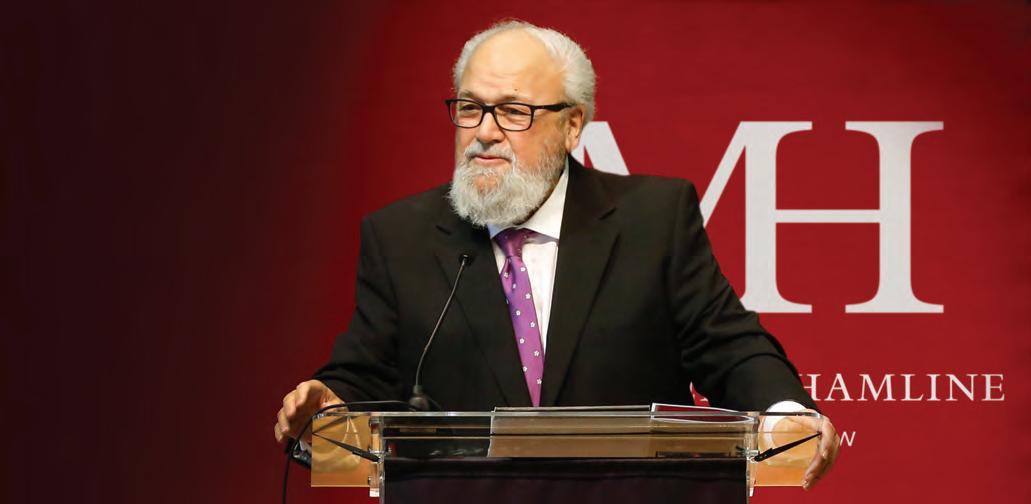
BY ALLY ROEKER
The law school lost a legend with the passing of George Latimer, who served as dean of Hamline University School of Law after stepping down as the longest-serving mayor in St. Paul history. He died on Aug. 18, 2024, at age 89.
Latimer was as known for his good-natured personality as any policy wins, though a robust redevelopment of downtown St. Paul stands out from his time as mayor.
Originally from Poughkeepsie, N.Y., he and his wife, Nancy, moved to Minnesota in 1963 after he received an offer during his final year at Columbia Law School to clerk at a St. Paul firm. Latimer practiced labor law while getting involved with DFL politics. He was elected to the St. Paul School Board in 1970 and was serving as a University of Minnesota regent when he eked out a 2,200-vote win in the 1976 mayor’s race against a former mayor. Latimer’s popularity grew, thanks to a reputation as a pragmatist who brought together factions to get deals done.
Latimer’s tenure at Hamline Law began the day after he left the mayor’s office in 1989, and he came to the job of dean with the same enthusiasm he had as mayor. He oversaw a law school that enjoyed increasing enrollment and a rise in stature of what remains a nationally recognized Dispute Resolution Institute.
His former colleagues also note Latimer’s mere presence was its own legacy for Hamline Law. “When he chose to serve as dean, it in some measure validated what was happening at the law school,” said Ed Butterfoss, a longtime professor who would also later also serve as Hamline Law’s dean. “With his life and career as a lawyer who turned to public service, he
embodied the ideal at Hamline—lawyer as servant leader.
“But more than that, George’s exuberance, ambitiousness, and optimism energized the law school. It was clear he cared deeply about the professional and personal well-being of the students, staff, and faculty.”
In 1993, Latimer stepped down from Hamline Law after accepting a job to serve in President Bill Clinton’s administration as a special consultant to then-U.S. Housing and Urban Development Secretary Henry Cisneros.
“George Latimer’s true affection for Hamline Law became clear when he returned to St. Paul from D.C. and frequently attended not only formal law school events but also informal gatherings of the faculty and staff,” recalled Butterfoss. One such event included attending his granddaughter’s graduation from Mitchell Hamline in 2023. “He will always be remembered by those who served with him at Hamline as the dean whose initial reaction to ideas rarely was ‘we can’t do that,’ but instead typically was ‘why can’t we do that?’”
Latimer’s wife, Nancy, died in 2006. He is survived by his five children. In 2014, the St. Paul Central Library in downtown was renamed for Latimer.
At the 1989 press conference announcing his appointment as dean, Latimer was asked how he would like the people of St. Paul to remember him. His answer: “That I wasn’t much until I became dean of Hamline University Law School.”

William “Bill”
Tomljanovich ’55 died on May 13, 2025, at the age of 98. Born in Ironton, Minn., Tomljanovich served in the U.S. Navy from 1945 to 1946. He returned to graduate from Brainerd Junior College in 1947 and St. Paul College of Law in 1955. After passing the bar, he served as vice president for logistics at Fisher Nut Company in St. Paul for 30 years.
Tomljanovich and his wife Esther, to whom he was married for almost 70 years, established the Justice Esther M. Tomljanovich ’55 Scholarship for Women in 2000, which is awarded to a woman each year pursuing a law degree at Mitchell Hamline.
LAVERNE M. GUST, 95, died on Aug. 31, 2024. He worked his entire career with Sexton Company, an insurance brokerage. He secretly enrolled in night law school, as his employer had a rule against doing so. Gust became one of the most prominent players in the river marine insurance industry. His success was so great that he was made chairman of the Worldwide Marine Group of Alexander & Alexander, which had purchased Sexton Company and was for a time the largest insurance entity in the world.

LEE E. DOERING, 97, died on May 6, 2025. He was co-founder of Quarnstrom and Doering Law Firm in Marshall, Minn. Doering also practiced law at a satellite office in Wood Lake, Minn., and served as board chairman of the Wood Lake Bank Corporation for 18 years.

CRAIG H. ANDERSON, 93, died on Feb. 13, 2025. He was a partner and litigator with Cousineau, McGuire, Shaughnessy & Anderson Chartered, now Cousineau Malone.

BRUCE W. MEYER, 91, died on Nov. 22, 2024. He was a defense attorney and practiced law in Duluth defending several high-profile criminal trials. He finished his career at the Lake County Attorney's Office in 1996.

LLOYD J. MOOSBRUGGER, 91, died on Jan. 8, 2025. In 1963, Moosebrugger was appointed as a special assistant attorney general by Walter Mondale. He represented the Water Pollution Control Commission 1964–65 and the Department of Highways 1965–96. He retired in 1996.
DONALD “DON” W. BLOCKHUS, died on Nov. 8, 2024, at the age of 95. Before law school he spent four years in the Air Force in the Office of Special Investigations. After graduation, Blockhus’s career brought him to Los Altos, Calif., where he sold law books for West Publishing Company.
GERALD “GERRY” E. FRISCH, 90, died on May 20, 2024. His time in the ROTC led to service in Fort Gordon, Ga., where he achieved the rank of First Lieutenant. He practiced law for 60 years in St. Paul with his partner and dear uncle, Allen Nilva. Law may have been his education, but real estate was his passion. As a developer, he built over two thousand residential units around the Twin Cities.
CHARLES H. WILLIAMS, JR., 95, died on on March 27, 2025. He spent three decades as a defense attorney and Ramsey County public defender and 21 years as a dedicated and revered Family Court referee for Minnesota’s 2nd Judicial District. He was also a U.S. Army veteran, serving in active duty for three years during the Korean War and in the reserves for an additional six years. He was on the board of trustees of William Mitchell College of Law. He also helped to found and administer the St. Paul Urban Coalition, raising funds to help hundreds of inner-city students of color attend college throughout the 1980s and 1990s.

LYLE C. HOWG, JR., 89, died on May 4, 2025. He had a long and fulfilling career as an attorney focused on estate planning in Richfield. Lyle also served in the U.S. Army from Aug. 1955 to July 1957.

JAMES “JIM” M. MAHONEY, 87, died on Jan. 5, 2025. He was a trial attorney at Mahoney, Dougherty, and Mahoney and spent two years on active duty in the Army and 31 years in the Army Reserves as a Judge Advocate General officer, retiring with the rank of Colonel.
ARTHUR “ART” W. SEABERG, 88, died on Dec. 19, 2024. He practiced law in St. Paul for many years. Seaberg was accepted into the Macalester Masonic Lodge in 1966. He was a member of Gloria Dei Lutheran Church in St. Paul and served as church council president. He was elected to the Minnesota House of Representatives in 1982 where he served five terms.
QUENTIN “QUENT” J. HIETPAS, 93, died on Feb. 15, 2025, leaving behind a profound legacy of dedication, leadership, and philanthropy.

ALBIN “AL” MEDVED, 86, died on April 17, 2024. He worked at Honeywell as a patent draftsman while he attended law school. Medved stayed with the company after graduation, later handling intellectual property matters. Among his accomplishments was a successful lawsuit against Minolta for patent infringement on the “autofocus” feature in cameras.
Stewart C. Loper ’74 died on June 26, 2024, at the age of 76. Raised in the Morningside neighborhood of Edina, Minn., Loper attended Macalester College. He worked as a law clerk while attending William Mitchell College of Law. Loper practiced law for 50 years. Early in his career he focused on complex antitrust and class action litigation, later concentrating on commercial transactions, real estate, and estate planning. Loper was a past president of the William Mitchell Alumni Association Board, and he supported the Mitchell Hamline annual fund for over 35 years.

RUSSELL “RUSS” M. SPENCE, SR., 86, died on Dec. 27, 2023. He worked for Meshbesher & Spence, starting as an investigator and working his way up to a named partner. There, Spence started and built a successful personal injury practice, mentoring many fine trial attorneys, connecting with juries, and winning record recoveries for his clients..
DUANE R. HARVES, 83, died on June 8, 2024. In 1976, he was appointed by the governor to the newly created position of chief administrative law judge of the Minnesota Office of Administrative Hearings. Twelve years later, Harves became a district court judge in the 1st Judicial District where he served until 2004. He was also a member of the faculty at the National Judicial College in Reno, Nev., where he enjoyed teaching, mentoring, and collaborating with other judges for 30 years.
CRAIG E. SCHOLLE, a longtime insurance underwriter for the trucking industry in both the Twin Cities and Fargo, died on June 19, 2024, at the age of 84.

NANCY K. OLKON
82, died on Aug. 9, 2024. She was the first woman to chair the Hennepin County Board.
During her tenure, from 1977 to 1983, she became well-known as an advocate for progressive issues. In 1980, she fought to allow gay men and women to serve as foster parents, and she ordered that all bathrooms in the government center have diaper changing stations. She also volunteered at the Chrysalis Women’s Center, helping solve legal struggles for low-income women. Olkon co-founded the Commitment Defense Project, a program that provides free legal representation to people in Hennepin County who are under petition for commitment.

LEE L. LABORE, founder of the law firm LaBore, Giuliani & Shackleford, died on Nov. 7, 2024, at the age of 86.
GERALD “JERRY” L. MCMANUS
90, died on Dec. 10, 2023. He ran his own private law practice in Wabasha, Minn. McManus then moved to Albuquerque, N. Mex., in 1977 where he served as an assistant attorney general for the State of New Mexico.

JOHN “JACK” P. MAZZITELLI, 81, died on March 25, 2025. He owned Mazzitelli & Associates. He specialized in litigation including criminal, personal injury, workers’ compensation, and employment litigation. He was an arbitrator for Minnesota no-fault insurance disputes for the American Arbitration Association.

GEORGE “BILL” W. STENGER, a 3M retiree, died on June 22, 2024, at the age of 81.
BYRON L. ZOTALEY, 79, died on Jan. 15, 2024. He was a practicing attorney for more than four decades and a lifelong member of St. Mary’s Greek Orthodox Church, where he served as parish council president.

TERRY SULLIVAN 85, died on Sept. 11, 2024. He spent most of his legal career with the City of St. Paul Attorney’s office. He was appointed administrative law judge for the State of Minnesota.
KENT E. TODD, 78, died on Dec. 13, 2024. Todd worked as an unemployment law judge for the State of Minnesota.

JAMES “JIM” B. JENSEN, 81, died on June 26, 2024. He worked as a lawyer at the Area Agency on Aging in Winona and at Legal Services at Bankers Systems in St. Cloud.
MICHAEL “MIKE” D. SWOR co-founder of Swor & Gatto, died on Feb. 22. 2024, at the age of 74.
WILLIAM “BILL” M. DIXON, a Minnesota administrative law judge for over 30 years, died on June 22, 2024, at the age of 76.

PAUL M. DRESSLER, an attorney in the Waseca County Attorney’s office, died on March 20, 2024, at the age of 77.

RICHARD “RICK” A. LAVERDIERE 76, died on April 20, 2024. He dreamed about being a lawyer, and after completing his military service he attended William Mitchell College of Law. After graduation, he joined the legal department of the St. Paul Companies, where he was part of their legal defense department. He joined the Hertogs Fluegel firm, later Sieben Polk, to do plaintiffs’ work. LaVerdiere was also a former president of the Minnesota Trial Lawyers Association.

ROBERT K. RANDALL, 77, died on Jan. 13, 2025. He practiced medical malpractice law with Borkon Ramstead Mariani as a litigator.
MICHAEL O. SHAMBLIN, 82, died on Sept. 12, 2024. Before law school he enlisted in the army and was stationed in Germany working on the Nike missile program. Shamblin worked for many years as a family law attorney for Hennepin County, retiring in 2009.

WILLIAM “BILL” E. WALKER, 84, died on May 2, 2024. He opened a law firm in Red Wing, Minn., which he later sold to his law partner to return to northern Minnesota. He practiced law out of his home until he was appointed as district court judge in 1987. He served as chief judge and retired in 2005. Walker also served in the Minnesota House of Representatives.

RICHARD M. BELL 74, died on Jan. 7, 2024. Before law school he joined the U.S. Air Force and served as a flight simulator technician. Bell practiced law for many years in Blooming Prairie, Minn.

BRUCE F. GROSS, 78, died on Feb. 21, 2024. He served as the Cottonwood County attorney for many years as well as a partner in the law firm of Ruenitz, Gudmestad & Gross, before becoming a district court judge chambered in Windom, Minn. Gross retired in 2012 after serving 23 years on the bench. He continued to serve as a senior judge after his retirement.

FRANK “FRANCO” J. CAPRIOTTI, III, 74, died on Dec. 30, 2024. After graduating and passing the Minnesota bar, he traveled extensively in Europe, finding his passion for international immigration law. He centered his life and practice in Minnesota and Portland, Oreg.
TIM A. GROGG, 75, died July 18, 2023. In 1982, he was appointed judge of Bartholomew County Superior Court 2 in Indiana. He left the bench to work as a corporate attorney, and he spent 20 years working for the state of Indiana in various positions.
ROBERT “BOB” G. MALONE, 72, died on July 30, 2024. He was a criminal defense attorney in the Twin Cities, enjoying years of success in both federal and state courtrooms. Malone was invited to join the Minnesota Society for Criminal Justice and served as president of the society in 2000. He was honored by the Minnesota Association of Criminal Defense Lawyers in 2015 by being awarded its Profile in Courage Award.
MICHAEL “MIKE” J. GRIGSBY, 73, died on Jan. 31, 2024. After law school, he returned to Marysville, Ohio. Grigsby began his lifelong career serving the citizens of Union County. He served on the Marysville City Council as councilman-at-large from 1981–85, and he was president of the council for three years. He was the Marysville law director and municipal court prosecutor from 1986–1999. He was then elected as the Marysville municipal court judge, a position he held until his retirement in 2021.

SUSAN “SUE” K. MAKI, 77, died on Dec. 7, 2024. She was a public defender for the State of Minnesota, specializing in appellate law. In her retirement years, Maki pursed volunteer work, especially at her church. She helped in various capacities, including service on the mental health task force.

MARTIN “MARTY” J. LIPSKE, 69, died on Jan. 23, 2024. He served Iron County, Wis., as district attorney for 20 years and was elected Prosecutor of the Year by his peers in 2016. He also impacted many students while teaching philosophy at Gogebic Community College. In his retirement, he continued to serve as public defender for Iron, Ashland, and Bayfield counties until the day he died.

RANDAL “RANDY” W. TRAVALIA, 72, died on July 17, 2024. After law school and joining the bar, he worked with his father-in-law, Bob Mason, building custom homes.
DAVID L. WEIDT, III 73, died Jan. 13, 2025. He owned David L. Weidt Law Offices and practiced in both Duluth and the Twin Cities.


WILLIAM “BILL”
A. DRINANE, a longtime Twin Cities attorney, died on Jan. 17, 2024, at the age of 72.
MARK P. WOOD, 70, died on Sept. 2, 2024. He had an extensive legal and professional career, including being admitted to Minnesota Courts and United States District Court, District of Minnesota. He served as Meeker County examiner of titles, two terms as an 8th Judicial District board of professional responsibility investigator, Meeker County law library board member, Litchfield city attorney, trustee of the Louis Roberg Endowment Trust, and owner/partner of private law practice Wood & Rue, where he was overjoyed to have his daughter, Emily, join the firm.

THOMAS “TOM” R. OLSON, 71, died on May 24, 2024. He was a partner at Jeffries, Olson and Flom and of counsel at Johnson, Ramstad & Mottinger. An eventual appointment and election to a judgeship in the East Central Judicial District was the highlight of his career.

JOHN L. RYS, 87, died on March 1, 2025. Rys served in the Army Reserves 1959–1965 and trained as a combat medic and ambulance driver at Fort Sam Houston, Brooks Army Medical Center, in San Antonio, Tex. He worked for Whirlpool Corp. 1963–1966 in St. Joseph, Mich., and for 3M in St. Paul, Minn., retiring in 1998 after 32 years.

LON M. ERICKSON, 75, died on Nov. 28, 2024. He worked for the Hennepin County Attorney’s office until his retirement in 2015.

PAMELA G. GONNELLA, 73, died on April 27, 2025. She used her advocacy skills at the state capitol and in Washington, D.C., on behalf of people with disabilities and those who care for them. She served on the boards of The Arc of Minnesota (as president from 2004 to 2005) and of Living Well Disability Services. Her advocacy was recognized by several awards, including Hero of The Arc from The Arc of Minnesota and the Tip of the Spear from MOHR.

KEITH J. KERFELD
68, died on June 2, 2024. After serving as a partner at Rider, Bennett, Egan & Arundel, he partnered with Michael Tewksbury and Michael Zimmer in founding Tewksbury, Kerfeld, Zimmer in 1994. In 2005, the firm changed to Tewksbury & Kerfeld. Kerfeld led the firm to over 30 years of success, focusing his practice on a unique combination of plaintiff cases and insurance defense litigation.

JAMES T. BORGESTAD, 78, died on May 19, 2025. From 1976–1998, he served as special assistant to the president under five University of Minnesota presidents and as an associate in the Office of the General Counsel.

GERALD S. HOKE
66, died on Jan. 26, 2025. He opened his own practice in 1997 in the areas of real estate, business law, estate planning, and probate. Hoke also spent many years volunteering as a coach for the Special Olympics. He served on the Dayton Planning Commission and Dayton City Council for a number of years when he and his wife moved to Dayton, Minn., in 1991.

JAMES “JIM” M. HAMILTON, 73, died on June 18, 2024. Hamilton retired over a decade ago but remained busy traveling, trying new foods, spending time with family and friends, and advocating for the rights of adoptees and the terminally ill.
Kathleen “Kathy” A. Junek ’08 died on June 5, 2024, at the age of 76. Junek was born in Lincoln, Nebr., and graduated from Orono High School before attending Macalester College. After earning a bachelor’s degree in finance in just three years, she earned an MBA from Stanford University Business School. Following business school, she worked for American Express International Bank on developing one of the first computerized banking systems. She later earned a Master in Divinity from Luther Seminary before attending William Mitchell College of Law.
A devoted wife and mother of five children, Junek also worked as a public defender following her graduation from law school in 2008. After retiring from that work in 2013, she served as a volunteer attorney for both the Volunteer Lawyers Network and the Children’s Law Center of Minnesota. She also volunteered at Mitchell Hamline as a mentor and a member of the former Child Protection Advisory Board. In 2008, Junek and her husband John created the Kathleen A. Junek Endowed Scholarship, which has supported 16 students.

TIMOTHY “TIM” J. PETERSON, 69, died on Dec. 23, 2024. He opened his own law office in the early ’90s in downtown Lindstrom, Minn., where he was honored to serve his clients and the community for over three decades.

STEVEN B. TAXMAN, 64, died on Aug. 7, 2024. After law school, he began his practice of criminal defense in Minneapolis and then moved to Northern California, settling in Sacramento.

SHARON L. BUFFINGTON, 81, died on Aug. 7, 2024. She was in private practice with an office in Washington County and later moved her office to her home in Hudson, Wis.

PAUL H. CADY general counsel at the AnokaHennepin School District for over 25 years, died on Jan. 21, 2024, at the age of 65.
THOMAS “TOM” D. HARMON, 84, died on June 10, 2024. He spent the latter part of his career practicing law after having worked over 30 years with Honeywell. He spent evenings and weekends as a sportswriter covering high school sports for the Sun Current and later authoring a book about his upbringing in the Catholic school system.

NICHOLAS “NIC” M. WENNER, 64, died on March 20, 2024. He began his 36-year career with Ruvelson, Kantzel, & Schmidt in St. Paul. He later joined the firm of Saliterman & Siefferman, and in 2007 he and his colleague, Boris Parker, established Parker & Wenner in Minneapolis.

WILLIAM “BILL” A. LEMIRE, IV, 60, died on March 22, 2024. He practiced law for 25 years at Robins, Kaplan, Miller and Ciresi; Foley and Mansfield; and Arthur Chapman before joining the Labouré Society as director of advancement.

LOUIS “LOUIE” J. BARTSCHER, 84, died on Dec. 8, 2024. He enjoyed many happy years wintering in Texas, traveling, and visiting friends and family here and abroad.
RAMON L. BURTON, an attorney from Elk River, died on Dec. 28, 2023, at the age of 73.

NED E. OSTENSO, 65, died on Nov. 17, 2024. He spent his entire legal career with the law firm Merrigan, Brandt & Ostenso, in Hopkins, Minn.

JOSEPH “JOE” D. ROACH, 65, died on Jan. 15, 2024. In addition to his work as a banker and lawyer, he was a member of countless outdoor and conservation groups. Roach was especially proud of founding Twin Cities Walleyes Unlimited.


PAUL W. AAS, 68, died on Feb. 2, 2025. Aas worked at Electric Data Systems (EDS).
CHARLES H. OLIVER, III, 67, died on Feb. 27, 2024. He resided in South Florida and had his own law firm. He was a hearing officer for the Better Business Bureau, Broward County Teen Court, and Broward County Traffic Court.

CHARLES “CJ” FREY, 60, died on Feb. 7, 2025. Frey practiced criminal defense law in the Brainerd Lakes area for more than 20 years, during which time he opened a law office with his wife Shari. He also worked as a part-time public defender for the Minnesota Board of Public Defense from 2016 to the time of his death.

THOMAS “TOM” T. ANDERSON, 56, died on Feb. 10, 2024. He was a lifelong Alaskan and managing partner at Optima Public Relations. Anderson hosted a political talk radio show on KVNT in Anchorage. He served on the Anchorage School Board, the Zoning Board of Examiners and Appeals, the Municipal Light & Power Commission, and the Anchorage Parking Authority. He was elected to the Alaska House of Representatives for two terms.

BENJAMIN “BEN” J. KING, 51, died on March 13, 2024. His professional career following law and business school included working at BF Goodrich Aerospace; law clerking for Judge Timothy McManus ’85; working as an associate attorney at Gavin, Olson, Savre & Winters; practicing over 15 years at Christian, Keogh, Moran & King; working as an assistant county attorney for Le Sueur County; and representing numerous private clients. Most recently, King served as an assistant public defender for the Minnesota Board of Public Defense, 1st Judicial District.

KATHLEEN M. MURPHY, 72, died on Aug. 12, 2024. Before going to law school, she received her Masters of Public Health Nursing and was instrumental in launching Minnesota Care, a trailblazing health care program for low-income families. After graduation, she opened a family law practice.

JANET C. AMPE, 57, died on Dec. 29, 2023. After achieving her goal of becoming a lawyer, she worked for Henningson & Snoxell before Parkinson’s disease forced her to retire.

JOHN “JACK” W. DEWALT, 51, died on March 16, 2025. In 2014, DeWalt partnered with two friends and colleagues, Melissa Chawla ’02 and Marian Saksena, to form DeWalt, Chawla + Saksena. He took great pride in celebrating its 10-year anniversary.

JAMES “JAMEY” L. BLUMBERG, 49, died on Oct. 10, 2024. He began his career in the criminal justice field with the Dakota County Attorney’s Office, opened his law firm in 2004, and continued his private practice in criminal defense law representing clients all over the state of Minnesota. Known for his dapper wardrobe, exceptional collection of shoes and brightly colored socks, Blumberg brightened up even the dullest courtroom.

JONATHAN D. FRIEDEN, 43, died on Nov. 9, 2024. After serving nearly a decade as an assistant county attorney, he became the Hubbard County attorney in 2017. Frieden loved being in court and dreamed of being a judge. He lit up the courtroom and the county attorney's office with his quick wit, enthusiasm, and unending optimism.

SEAN E. FROELICH, 44, died on Dec. 31, 2023. He began his career in law enforcement as an officer with the River Falls Police Department. His drive and commitment to justice led him to the legal arena, where he served as the district attorney for Pierce County, Wis., and later as the Eau Claire County assistant district attorney. At the time of his passing, he was a senior attorney for the Minnesota Department of Human Services.

STEPHANIE R. LOSCHING, 37, died on March 19, 2024. She practiced law in Minneapolis followed by Carney Thorpe in Janesville, Wis. Losching moved to Denver and was employed as a litigation attorney for Liberty Mutual Insurance Company. Upon relocating to Chicago, she was employed by the U.S. Department of Education litigating cases in special education law.

KEVIN P. PEDELTY, 64, died on April 6, 2024. He was general manager of DPGC.
These submissions for In Memoriam were received between Jan. 1, 2024 and May 30, 2025.

BY ALLY ROEKER
The law school lost a key figure of its community with the passing of Louis Ainsworth ’77, who wore many hats as a leader, alum, professor, mentor, and supporter of innovative programming at Mitchell Hamline. Ainsworth died on March 17, 2025, at the age of 77.
Ainsworth attended William Mitchell College of Law parttime for four years, where he made a concerted effort to study both law and business during law school at a time when no formal curriculum existed. His passion for the area later led to his conviction that there were other students who would follow in his footsteps—and follow they did.
“One of the strengths of the law school is it helped to educate people who chose to use their degree not in practicing law, but in business. Louis was influential in helping us come to this insight and accepting it as a school,” said Eric Janus, who served as president and dean during Ainsworth’s tenure on the board of trustees. “Louis was focused on helping the school advance and accomplish its mission in a variety of ways, both programmatically and philanthropically.”
Ainsworth held many leadership roles during his nine years as a trustee, and he was also a generous and loyal donor. His philanthropic investment supported a number of student scholarships, an endowed professorship, and an innovation fund at the law school.
That innovation fund contributed not only to founding the Center for Law and Business at William Mitchell in 2011 (of which Ainsworth was a founding advisory board member), but also to launching the school’s most innovative undertaking to date in 2015: the Hybrid J.D. Program, the first-ever oncampus/online J.D. program at an ABA-approved law school, known today as blended learning.
Ainsworth’s career included working at Henson & Efron, Pentair, and Faegre Baker Daniels. He shared his real-world knowledge and expertise through teaching business and law courses as a professor, distinguished practitioner-in-residence, and, in 2013, as director for the Center for Law and Business.
In 2018, Ainsworth was awarded Mitchell Hamline’s Outstanding Alumni Award for his commitment and extensive service to the law school.
“Louis was a wonderful colleague and a cherished mentor and friend,” said Professor Leanne Fuith ’12. “He was deeply committed to Mitchell Hamline during every chapter of his own professional career, and we are so fortunate that he was part of this community.”
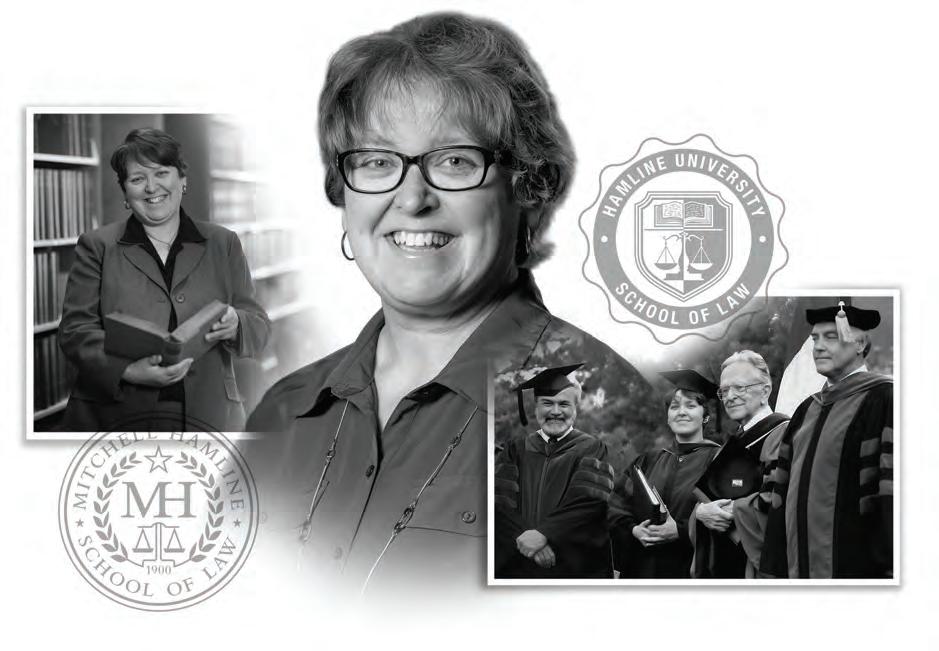
BY ALLY ROEKER
Professor Emerita Marie Failinger, who served as Hamline University School of Law’s interim dean prior to the 2015 combination with William Mitchell College of Law, died at age 73, following more than 40 years of service to Mitchell Hamline and the legal community.
“Marie was deeply committed to a career in law as a public service in the broadest sense possible,” said Professor Kate Kruse, who served as an associate dean under Failinger’s deanship. “She lived her values of access to justice, gender inclusion in the legal profession, and the integration of faith into her professional life both in the larger projects she launched and in her personal relationships as a teacher, mentor, and friend.”
Failinger attended college and law school at Valparaiso University. She was recruited to Hamline Law in 1983, where she would help turn the law school founded only a few years prior into a flourishing institution. She twice served as associate dean before becoming interim dean.
Professor Mark Gordon, who would become the first president and dean of the newly formed Mitchell Hamline, said, “Marie played an incredibly supportive and important role in enabling the combination to occur and to succeed, and we are all forever in her debt for that.”
As a professor, Failinger taught subjects including constitutional, criminal, family, and property law. In 2016, she earned the first Judge Edward J. Devitt Professorship, which
is awarded to a professor who demonstrates and promotes a high standard of ethics and professionalism in their teaching, writing, and outreach.
Failinger was a leading voice on women in the legal profession and a founder of the Infinity Project, an organization dedicated to getting more women on the bench at the state and federal level within Minnesota’s Eighth Judicial Circuit. She also led the McAffrey Group, a mentorship group at Mitchell Hamline for women faculty members.
As a scholar, Failinger wrote about a wide variety of topics, but her passion focused on the intersection of the law and religion, drawing from her Lutheran faith. Mitchell Hamline Law Review Vol. 50, Issue 3, was dedicated to Failinger in honor of her scholarship and legacy. In his dedication, professor emeritus and former Hamline Law dean Ed Butterfoss wrote, “Marie was a dedicated, effective teacher; a remarkable, deepthinking and productive scholar; and she engaged in prolific and important service.”
Even after Failinger retired from Mitchell Hamline in 2023, her involvement remained steadfast until her final months. She left an impact on everyone with whom she interacted— colleagues, students, judges, and clients alike—and she will be forever missed and remembered.
BY ALEXANDER J. BEEBY
“No plan survives first contact with the enemy,” or so the adage goes. In my experience implementing many complex projects, I would go further to add that if it seems like nothing has gone wrong, it is either about to, or you have missed something. Accordingly, “it is not the smartest nor strongest that survive, but those with the ability to adapt,” to add yet another maxim, this one adapted from Charles Darwin.
In my first “career” designing and installing telephone systems and data networks, even straightforward projects had their surprises. Hopefully, the problem was small, like a pinched cable. Sometimes the problem was significant, like new technology that overloaded our network—causing the entire system to factory reset. Or it was human error, such as developing one system that created an unintended conflict with another. The most perfect technical design could fall apart by failing to account for the human element, such as efficient phone trees that nonetheless ruin the customer experience.
These lessons proved useful in my second “career” as a founding manager of a food co-op. For better and worse, our pro forma and budget did not survive opening day, when our sales proved significantly higher than expected. We quickly needed to increase warehouse space and add personnel. Yet even as we expanded to adapt, the financial obligations of our startup loans were a Damocles sword over us. We had to juggle which bills to pay—just so we could make payroll. At the same time, the human element required constant attention—we were not “just a grocery store,” we were a communityowned, community of workers, who all felt strongly about what the co-op was and should be and represent. Yet, we flourished.We did it by working
together to find the right balance between survival and idealism.
My co-op experience steered me to the law. From employment to compliance to local policy, I found myself engaging with the role the law plays in our society. With family grounding me in Minnesota, I carefully considered the four law school options then available. I was a thirdcareer student and wanted someplace I could identify and thrive. That turned out to be Hamline University School of Law—a place that drew me in as a school oriented to plucky people, with life experience and a passion for serving the community through law.
I thrived at Hamline. I immersed myself in the experience full time, working hard, devoting myself to becoming a legal professional, and symbiotically nourishing and being nourished by the community. Yet, the experience proved to be another in which adaptability would be vital. In my 2L year and in my capacity as president with the Student Bar Association, I was asked to provide insights and assist the school as it planned to “merge” with William Mitchell College of Law. To many of us students, this came as an upsetting surprise, but it was one that we needed to accept was happening. We needed to not only adapt but also to support the best possible result.
We engaged with our counterparts to forge a new, joint identity. I came to appreciate how we were more similar than different and how parallel questioning was felt by different subcommunities as we created this new Mitchell Hamline community. Reminiscent of my co-op experience, the administration would need to focus on both operational challenges and the human element. We survived together, working to build an alma mater of which we could be proud.

Now, with a decade of hindsight and my mantras in mind, I can honestly say that the combination was a success. A seamless transition would have been a fantasy, and I think it went as well as one could realistically expect. We now have an institution that truly reflects both schools, greater than the sum of its parts. Frankly, what is in a location or a name? “The church is not a building,” as they say. It is who we are and what we represent that matters. Mitchell Hamline is the school that trains the true legal workforce. These life lessons now inform my practice in advising and representing businesses facing financial difficulties. Life throws us curveballs, and sometimes we feel down at the bottom of the ninth. Making the best of those situations requires both practical and emotional understanding and adaptability. I am proud of my alma mater that gave me the experience and tools to help others in their times of need.

BY MICHELLE LEE GOODE
In 1976, Gregg Meyers ’79 was fresh out of undergrad and unsure what to do next, having just completed a theater arts major with minors in philosophy and English. He decided to apply his newfound skills in law school, with no real plans or aspirations to become a lawyer and with the misconception that it would require no heavy lifting.
Susan Berne Bonine ’79, on the other hand, was excited to receive an admission letter from Hamline University School of Law on her 40th birthday. A single mom with a lot of responsibilities, she knew exactly what she wanted and what law school would require.
Regardless of their differences, Meyers and Bonine bonded over a shared intellectual connection and sense of humor.
“I have this vivid memory of our advanced civil procedure class,” Meyers chuckled. “Sue was sitting directly in front of me when a classmate answered a question using this incredible malaprop. He was describing two positions as being ‘diabolically opposed’ rather than ‘diametrically opposed.’ All Sue did was turn around to look at me. No words needed.”
Outside of classes, law review collaborations, and a brief Super Bowl gathering where he met her then eight-year-old son, Michael, Meyers didn’t know Bonine all that well. “We were a couple of nerds in law school on the same wavelength, and I respected her on a different level,” Meyers said. “As a single mom, she was taking on way more than I could manage yet loved the challenge of school. She loved it so much that she didn’t want her experience to end and was even sad about graduating.”
After graduation, life didn’t carry on much longer for Bonine, and she passed away three years later from a brain tumor. When Meyers learned the news, he knew that if ever he were in a position, he would do something to keep Bonine’s memory alive at the law school.
Meyer landed at the Department of Justice (DOJ) in Washington, D.C., within the civil rights division after graduation. Having done cases for the DOJ in South Carolina, he became a partner at a firm primarily handling construction litigation. That is, until he received a referral from a woman who had been sexually abused by her grandfather as a child and couldn’t find a lawyer who would help due to statutes of limitations. This reconnected Meyers to his passion for civil rights work and drove him to research tolling theories. He secured a settlement for that woman and opened his own firm where he continued to take on high-profile, high-stakes sex crime cases other firms in the south wouldn’t dare touch.
In 2000, Meyers reached the pinnacle of his career. He received a $105 million jury award for the parent of a sexual abuse victim—the largest verdict in Charleston County (and the subject of a 2018 Emmy and Academy Award–nominated documentary, “What Haunts Us”). Shortly after in 2002,

“Find something you feel good doing. For me and my work, it felt better to represent people over entities, and it paid off. It afforded me to be able to give back to my alma mater by honoring my law school friend. And through my friend’s scholarship, students have benefited and will continue to do so for years to come.”
circled back to the law school and established the Susan Berne Bonine ’79 Scholarship Fund.
“It’s designed for ambitious students like Sue,” said Meyers, “who had life experience before law school and have a financial need to attend. What makes the scholarship extra special is it isn’t applied for, but awarded by faculty unbeknownst to the students.”
When Bonine’s brother, Robert Berne, learned what Meyers did to honor his sister, he established a scholarship in Meyers’ name in return. The school arranged for the two to meet for lunch in New York where Robert lived, along with Bonine’s son Michael who was all grown up.
Meyers was awarded Distinguished Alumnus in 2001 and is a member of Mitchell Hamline’s Partner’s Society for his generous contributions over the years. Today, Meyers is back in Minnesota with his wife Mia and youngest son Atticus, still working in both Minnesota and South Carolina, and doing what he loves.
To give, visit mitchellhamline.edu/giving