
CONTEMPORARY INTERVENTIONS IN HISTORICAL CONTEXTS T H E C A S E S T U D Y O F B E I T A L Q A D Y F I N A L T H E S I S D E S I G N M E T H O D S & A R C H I T E C T U R E R E S E A R C H P r e s e n t e d B y : L a m a T a w f i k 2 0 1 8 - 0 2 3 4 2 H a s s a n H e s h a m 2 0 1 8 - 1 5 7 9 9 T o u k a M a g e d 2 0 1 8 - 0 8 0 9 4 S u b m i t t e d t o : D r / H e b a S a f y E l - D i n A R C / M i r e t t e E m a d A R C / K a r i m F a h m y A R C 4 0 1S P R I N G 2 0 2 1
ABSTRACT
Approaching a design by new interventions is considered one of the conservation methods that is used widely in the field of architecture. As additions shouldn’t only be different, but also should create harmony between the old and new This research responds to the topic of contemporary interventions/ adaptive reuse in historical contexts. The objective of this research is to propose design guidelines for new interventions in historical complexes using the case study of Beit Al-Qadi. Moreover, it also focuses on integrating contemporary structures within the historical urban fabric as well as adapting existing structures to reach a homogenous entity. The methodology is based on a literature review of adaptive re-use of historical buildings and contextual design, as well as, field studies and questionnaires designed for various types of users. The results were concluded to the user needs to conduct such intervention as well as design limitations and guidelines that need to be taken into consideration before intervening in any way. The research concludes that additions and interventions should add to the heritage value of the building as long as it contributes to its identity and its urban fabric.
P A G E I | A B S T R A C T
TABLE OF CONTENTS I I 1.0 Introduction III 2.0 General Context & Site Analysis 1 2.1 About Beit Al-Qadi 2 2 Analyzing The Site 2 2.2.1 Climate Analysis 2.2.2 Surroundings 3 2.2.3 Routes & Accessibility 2.2.4 Topography 5 2 2 5 Built-Up Topography 2.2.6 Restrictions 2.3 Existing land use 6 2.3.1 Maqaad Mamay Al Seify 2 3 2 Qism Al Gamalleya 7 2.3.3 Jewelry & scaling authority 8 2.3.4 Hidden Gems of Beit Al-Qadi 3.0 Adaptive Re-Use 9 3.1 Scales of building adaptation 10 3.2 Adaptation and interventions in architecture design 3 2 1 Interventions and building value 3.2.2 Methodologies of interventions 3.2.3 Strategies of additions 11 3.3 Methodologies of Adaptive Re-use In Beit Al-Qadi 12 4.0 Case Studies 15 4.1 The Ned 13 4.1.1 Background 4.1.2 Why they chose the ned
TABLE OF CONTENTS I I 4.1.3 Adaptive re-use methodology 4.1.4 4 1 5 Kept Features 15 4.1.6 Seizing the opportunity 4.2 Tai O heritage hotel 18 4.2.1 Background 4.2.2 Vision & Mission 4.2.3 Adaptive Re-use Methodology 4 2 4 Sneak Peaks 4.2.5 User Reviews 4.3 Conclusion 5.0 Field research 5 1 Physical Traces 5.2 Behavioral Patterns 5.3 Investigating people 6.0 Swot analysis 7.0 Designing Timeless Architecture 26 7.1 Discussion of the findings 8.0 Conclusion
1.0 INTRODUCTION
Historical architecture has its respected value as each heritage building has its historical and architectural value that needs to be preserved. In the contemporary age, Many historical buildings are not occupied or in use and they are gradually losing their importance and historical position As these buildings need regular maintenance and care, they have to meet contemporary needs by accommodating new use. Therefore, the building should be provided with additions and interventions to fit the contemporary age without destroying or compromising its heritage value.
This research uses Beit Al-Qadi as a case study due to the different typology of buildings within the complex; a historical monument (Maqaad Mamay AlSeify), Qism Al Gamalleya, and finally the jewelry and scaling authorities building. Moreover, Beit Al-Qadi consists of different styles from different eras; the Mamluk era and the khedival era.
Each of the mentioned buildings has its own history and story that needs to be revitalized by finding a suitable contemporary use which is a heritage hotel. As Beit Al-Qadi is set in the heart of a historical context adding to its importance and heritage value, not only from the outside of the building but also from the inside, by creating an experience through accommodation.
The theoretical part of the research would be discussing the general context by analyzing Al Moezz street and its relation to Beit Al qadi with a detailed analysis of the different existing structures. Moving to the site analysis to conclude the suggested entrances, zoning, and recommended activities. Then suggesting methodologies for interventions and adaptive Reuse for the existing structures
The research will be also tackling chosen case studies that would reflect the methodologies of adaptive reuse as well as contemporary interventions. Afterward, the field research would be discussing the observations that were taken into consideration within the site and finally ending the theoretical part with a SWOT analysis to conclude
Moving into the methodological section, the conclusion of the theoretical section would be discussed. Starting from the vision created for the new intervention moving to the concept statement and its idea gram and finally how the findings were beneficial to the project.
P A G E I I I | I N T R O D U C T I O N
PART 1
2.0 GENERAL CONTEXT & SITE ANALYSIS
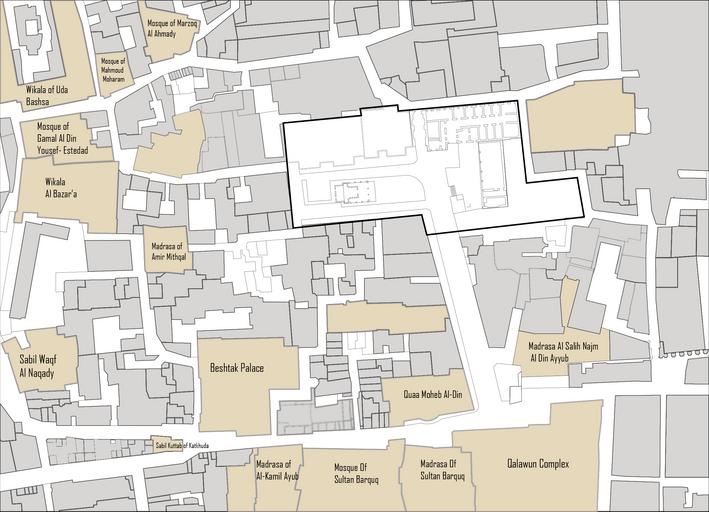
Beit Al-Qadi is Located in Al Moezz l’Din’ Allah AlFatamey also known as Fatimid Cairo. It’s an open-air museum where you can walk through fascinating Islamic monuments. From Mosques, Madrasas to cemeteries with a historical significance Al Moezz street is known as Fatimid Cairo, but it is not only limited to Fatimid architecture, but it also witnesses different styles and eras, from Fatimid, passing by the Ayyubid & mamluk and finally the ottoman as shown in the contextual map (Fig.1)
2.1 ABOUT BEIT AL-QADI
Located in the heart of Al Moezz street, Beit Al-Qadi is one of the most famous and majestically old areas in Al Moezz. Originally, Beit Al-Qadi was part of the Fatimid Zomorod palace. With time passing over this area, changed from a palace to a prison, came Prince Mamay who built his palace in Beit Al-Qadi. After his death, his palace became a ruin with only the maq ’ad remaining which is the key monument of Beit Al-Qadi street. The gate of Beit Al-Qadi matched the decorations and materials used in the ottoman era and it was built for security
In Khedive Ismail’s ruling period, He took advantage of the palace’s courtyard and turned it into a plaza (Midan), and re-opened Beit Al-Qadi street to connect Al Gamaleya street and Al Moezz together. Moreover, he added one of the most significant and oldest police stations, Qism Al Gamalleya.
In the meantime, The ministry of antiquities had taken matters into its own hands and is responsible for adaptively re-using Beit AlQadi and transforming it into a heritage hotel
P A G E 1 | T H E C O N T E X T
Figure 1 1 Contextual Map of Al Moezz ©Authors
Reference: Authors
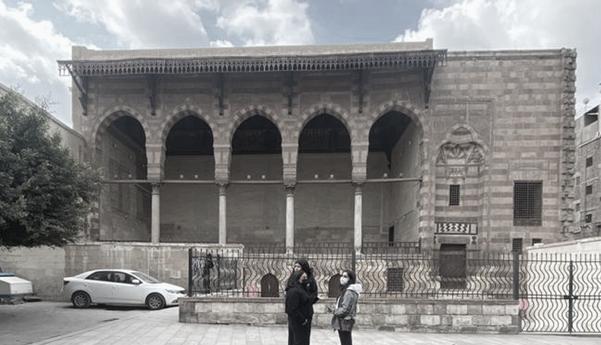
Figure 1.2 Maqaad Mamay AlSeify ©Authors
2.2 ANALYSING THE SITE
Architecture site analysis is a process of evaluating the location characteristics and the crucial challenges with the ambition of developing an architectural solution that will both address and enhances its internal and external context
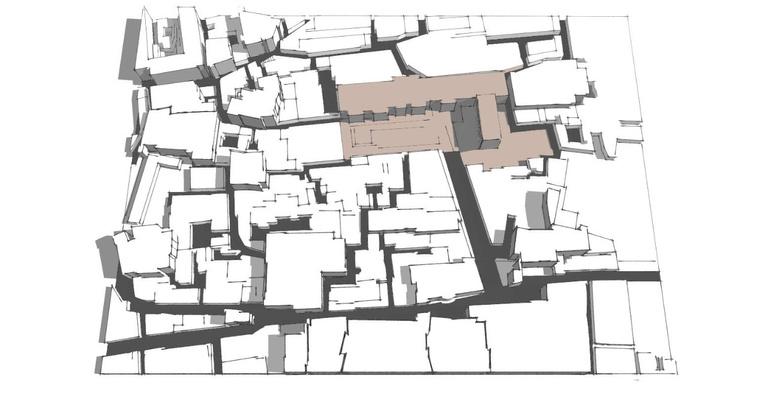
Every site is unique in its way, but each site has general elements that help the designer in the process of designing and decision making, and by the appropriate evaluation of these elements it will initially determine the buildings placement, orientation, form, and materiality, and later go on to influence its structure, sustainability, and procurement route.
Providing us with a foundation and crucial starting point for our architectural project
The key areas being reviewed will be as follows the general location, neighboring buildings, restrictions, access to the location, typography, public and private views, climate, ways of transportation, and vegetation.
2.2.1 CLIMATE ANALYSIS
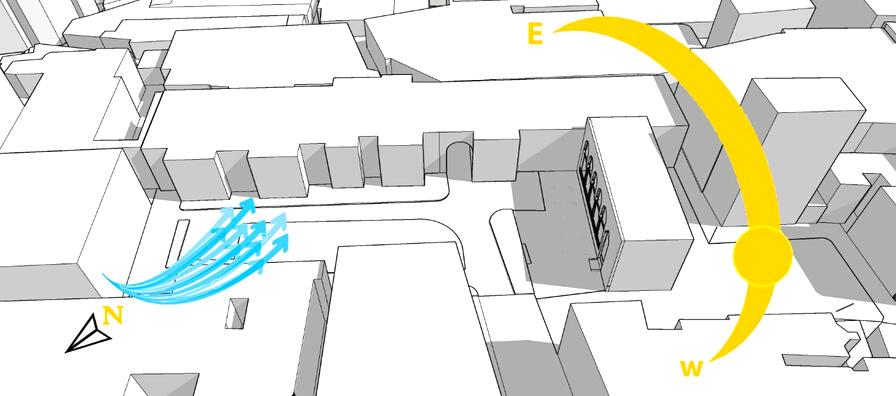
According to the sun direction and wind analysis, the North-West Elevation of the police station and Fire station is totally ventilated by the northern wind but also affected by the direct sunlight
Maqad is the best space that receives indirect light and is well ventilated
P A G E 2 | A N A L Y S I S
Figure 2 1 Map of the site ©Authors
Figure 2.2 Environment analysis diagram ©Authors Reference: Authors
2.2.2 SURRONDINGS
Around the site, multiple factors have an important effect on the site. According to Figure 3.1, the grey shaded areas represent the workshops. Shops are working daily in the back street of the site.
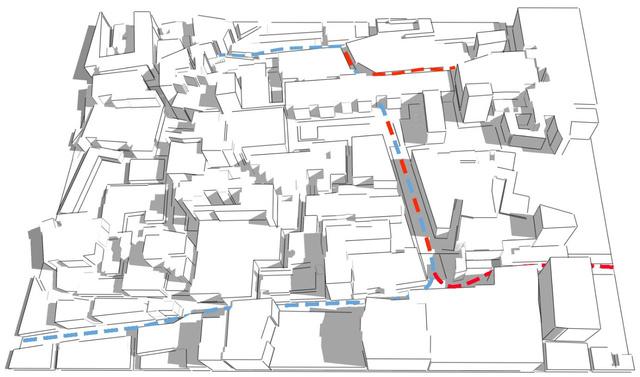
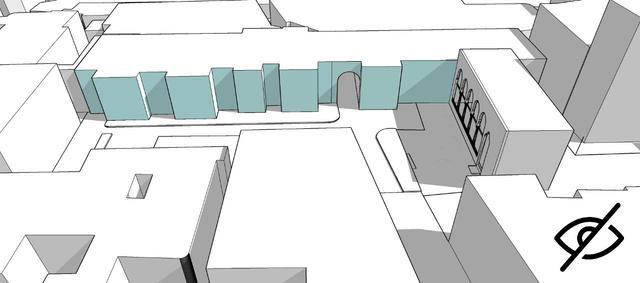
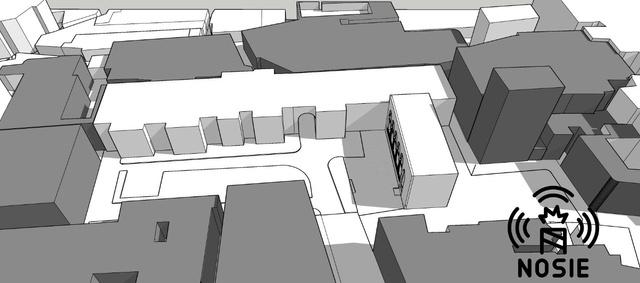
In addition to lack of privacy, the residential buildings are overlooking the site especially the police station ( Blueshaded).
It would be recommended to provide the accommodation zones more privacy without affecting their view or ventilation by adding screens
2.2.3 ROUTES & ACCESIBILITY
To achieve the best reach to the site, it is essential to study how can the site be accessible from different routes using different means of transportations from cars, bicycles, and walking
As the site is located in a very rich and public area. It is shown in figure 3.4, the different methods and routes to access the site
P A G E 3 | A N A L Y S I N G
Figure 3.2 Privacy Diagram ©Authors
Figure 3 4 Routes Map ©Authors
Figure 3 1 Noise source Diagram ©Authors
Reference: Authors
Pedestrians Route Vehicles Route
I.PEDESTRIAN, VEHICLE AND CYCLISTS’ ACCESS
Entering from Bab El-Nasr and Bab ElFutuh walking through the open-air museum and observing the Islamic history of Egypt until reaching the Beit El-Qadi portal passing by the new jewelry and scaling authority which is coming from Bab ElNasr.
Coming from Bab El-Futuh, passing by Qalawun complex then approaching the maqaad of mamay al seify.
II. PEDESTRIAN & CYCLISTS ACCESS
Entering from souq El-Azhar and ElAzhar mosque until reaching the portal passing by the new jewelry and scaling authority which is coming from ElAzhar mosque.
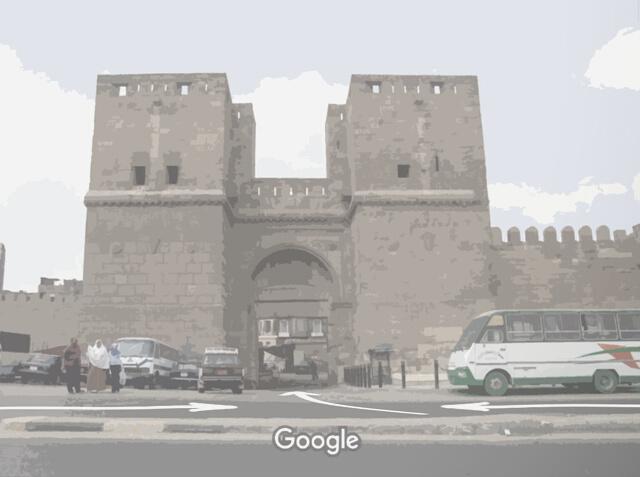
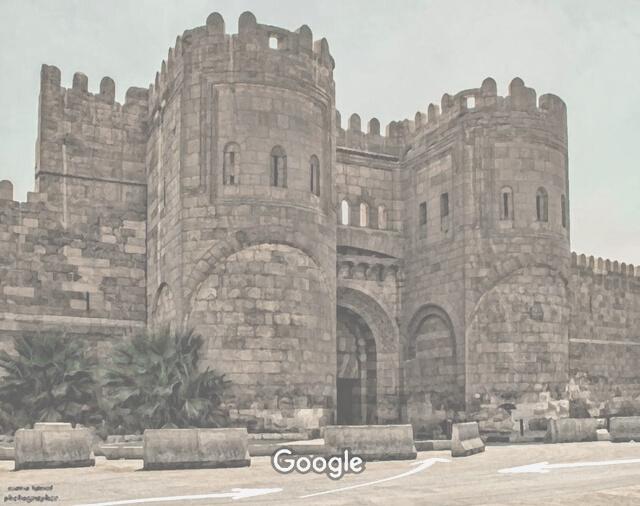
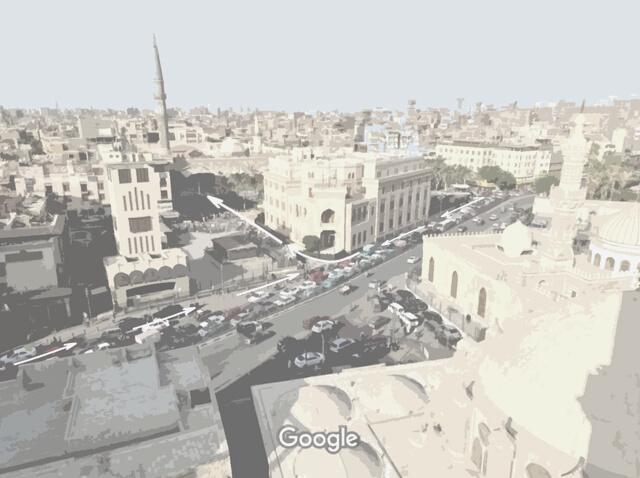
Coming from souq ElAzhar, passing by Qalawun complex then approaching Maqaad of Mamay al Seify
Authors, Google Maps
P A G E 4 | A N A L Y S I N G
Figure 4.3 Bab Al Futuh Route ©Google Maps
Figure 4.2 Al Azhar Route ©Google Maps
Figure 4.1 Bab Al Nasr Route ©Google Maps
Reference:
2.2.4 TOPOGRAPHY
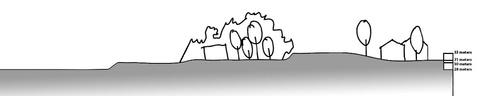
The difference between the contour of the maqaad of mamay al seify and the vacant land is positive 3 meters which could provide space for car parking or for private spaces like the spa which needs to be totally covered.
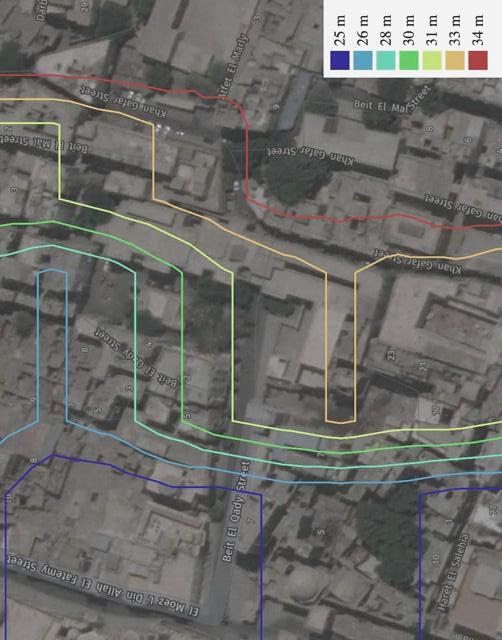
2.2.5 BUILT-UP TOPOGRAPHY
The Plaza in front of Maqaad of Mamay Al Seify of (-0 9 meters) could also be used as an open-air exhibition or auditorium as well as the underground in the police station that was the cells before could be converted to an underground garage
Also, the fire station where the lower leveled slots are used to park the firefighting trucks could be used as a garage for the handicapped.
2.2.6 RESTRICTIONS
The Building Regulations establishes the design and construction standards; that apply to most new structures and renovations done to the existing buildings to ensure that reasonable health, safety, and respect to the context standards are met To start with, the respect to the context; which includes respecting the heights of the existing buildings in order not to grab the user ' s attention.
In addition, respect to the context lines in our design guidelines leads to the creation of harmony between the old buildings and the new interventions. Also, the use of minimal interventions as much as possible; the use of reversible structures in the spaces which are in contact with the existing buildings and in the added interventions.
In order not to affect the existing buildings which have a great heritage value. Moreover, Harmony should be obtained by following many design constraints in the use of colors and materials.
Furthermore, applying the ratio of solid to void which is applied to the existing buildings to the added structures to respect their scale and proportionality.
Reference: Authors, Google Maps
P A G E 5 | A N A L Y S I N G
Figure 5 2 Topography Section ©Authors
Figure 5 1 Topography in the site ©Google Maps
To start with, the respect to the context; which includes respecting the heights of the existing buildings in order not to grab the user ' s attention
In addition, respect to the context lines in our design guidelines leads to the creation of harmony between the old buildings and the new interventions. Also, the use of minimal interventions as much as possible; the use of reversible structures in the spaces which are in contact with the existing buildings and in the added interventions
In order not to affect the existing buildings which have a great heritage value. Moreover, Harmony should be obtained by following many design constraints in the use of colors and materials
Furthermore, applying the ratio of solid to void which is applied to the existing buildings to the added structures to respect their scale and proportionality.
2.3 EXISTING LAND USE
Beit Al-Qadi consists of 3 buildings, each building has its heritage value, spirit, and architectural form
2.3.1 MAQAAD MAMAY EL SEIFY
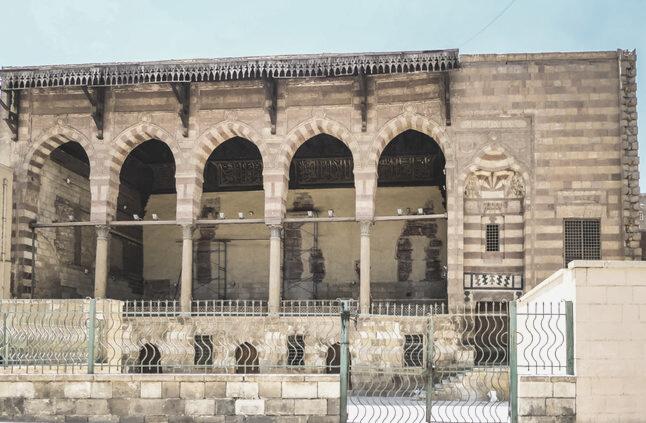
To begin with, The palace of Mamay ElSeify has vanished leaving traces behind it, Maqaad Mamay El Seify. The maqaad is the eye-catcher of Beit Al-Qadi due to its impressive decorations and glorious proportions
Maq’ad Mamay dates back to 901/1496 in the Mameluke era It was a later innovation to the main palace added by prince Mamay. It was built to be a welcoming reception of the elite. Later it was used as an ottoman court in the ottoman period, meanwhile, the underground floor was used for archives. (Osman, The Maq'ad Of Amir Mamay Al-Sayfi: The history and context of a mamluk jewel, Spring 2017)
P A G E 6 | A N A L Y S I N G
Reference: dar.aucegypt.edu
Figure 6 Close up of Al Maqaad ©Authors
The façade of the Maqa’d reflect the Mamluk style with its distinctive characteristics Starting with the height of the Maqa’d of 16 meters and the proportions of its portal to the whole façade. This reflects the massiveness as well as the importance of the Maqa’d.
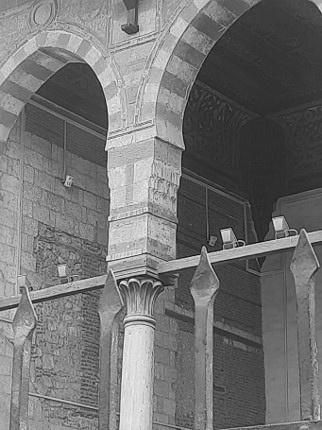
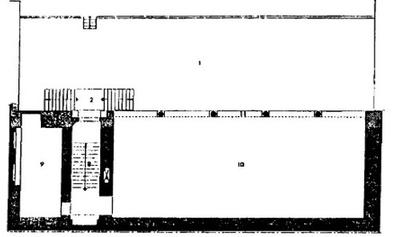
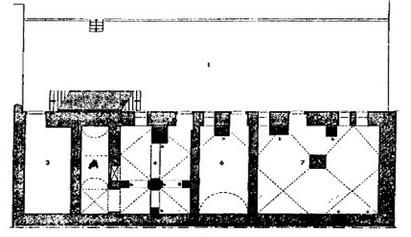
The elements of the façade are distinctive; The horseshoe arches have their load distributed on the lotus columns. Analyzing the architectural plan, the ground floor has spaces of different sizes and structural ceilings and access to the outdoor plaza in front of the Maq’ad.
Moving to the upper floor, the Maq’ad is divided into two spaces, the annex (Highlighted 1) and the loggia (Highlighted 2). The annex is described as Al Khezana Al Nawmeyya as it could have served as the prince’s room. On the other side, the crown of the monument, the loggia. With a ceiling 11 meters high, decorated with an inscription framing (Yaghy, 2004)
2.3.2 QISM AL
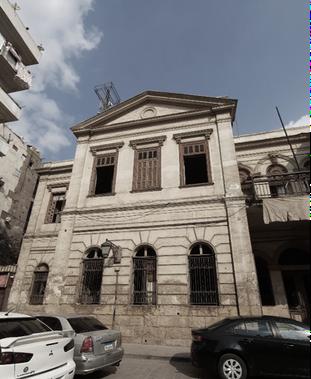
Qism Al Gamalleya is one of the oldest police stations in the area. It was built during the reign of Khedive Ismail around -----. It was built out of the ruins of the old Fatimid Zomorod palace (Mubarak, 1998) Khedive Ismail built it to a council for justice and ruling and later on, it was transferred to a police station. The façade of the police station is famous for its neoclassical style with its own distinctive elements From the proportional arched and segmented openings to the pediments, corniches, and Corinthian columns that are decorating the façade.
P A G E 7 | A N A L Y S I N G
GAMALLEYA
ﺎﻫﺪﻋﺎﻘﻣوﺮﺼﻣلزﺎﻨﻣ
Figure 7 3Architectural Plans ©
ﺎﻫﺪﻋﺎﻘﻣوﺮﺼﻣلزﺎﻨﻣ
Figure 7 2Architectural Plans
©
Figure 7 1 Zoom In Maqaad Detail ©Researchers
Reference: dar.aucegypt.edu -Yaghy, G. M. (2004). ﺎﻫﺪﻌﻋﺎﻘﻣوﺮﺼﻣلزﺎﻨﻣ - Mubarak, A. (1998). ﺔﻴﻘﻴﻓﻮﺘﻟاﻂﻄﺨﻟا ةﺪﻳﺪﺠﻟا
Figure 7 4Qism Al Gamalleya ©Ahmed tobgy
2.3.3 JEWELRY & SCALING AUTHORITY
The history of the building typology started back in Salah El Din’s castle It was a place for silver and gold coinage and later it was re-located in Beit Al-Qadi. After a period of time, it was declared as a place for stamping jewels and weighing tests. Recently, it has become vacant as it was moved to the New Jewelry and scaling building across the street. The building was an extension for Beit AlQadi gate, it was said to be built with an ottoman style (Tobgy, 2021)
2.3.4 HIDDEN GEMS OF BEIT AL QADI
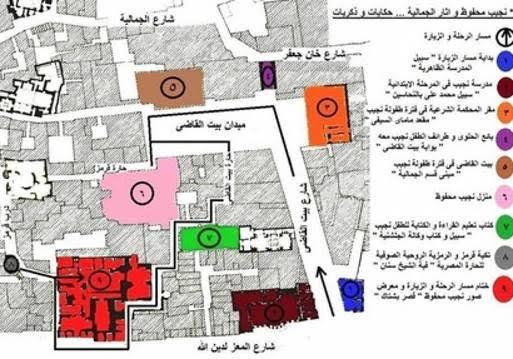
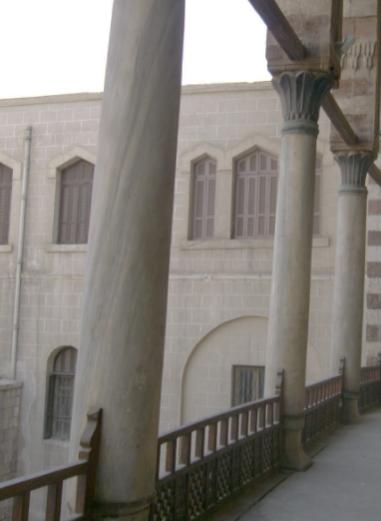
The traces mentioned in the previous paragraph are not the only ones. There are treasures and stories buried within the residential buildings as well.
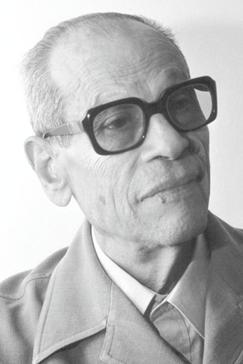
The Noble prize winner, Naguib Mahfouz, lived his childhood in Beit Al-Qadi as this is where his home was. In his childhood years, He witnessed the revolution of 1919 and the events that occurred in front of Qism Al Gamalleya.
Beit Al-Qadi is a rich complex of 3 distinctive buildings; with each having its own story and hidden treasures Each building should be preserved and revitalized Moreover, the stories carved in the walls of the buildings should be experienced through the architecture of the building from the inside as well as creating the homogeneity between the three buildings to create one entity.
P A G E 8 | A N A L Y S I N G
Figure 8 1 Jewelry and scaling authority ©Ahmed Tobgy
Figure 8 2 Nagiub Mahfouz
Reference:
ﺔﻴﺑﺮﻌﻟاﺔﻓﺎﻘﺜﻟاوﺔﻐﻠﻟاﻊﻗﻮﻣ - ظﻮﻔﺤﻣﺐﻴﺠﻧتﺎﻳاورﻲﻓﻦﻛﺎﻣﻷا
Figure 8 3 Nagiub Mahfzouz Map
dar.aucegypt.edu
Langue et culture arabes
3.0 ADAPTIVE RE-USE
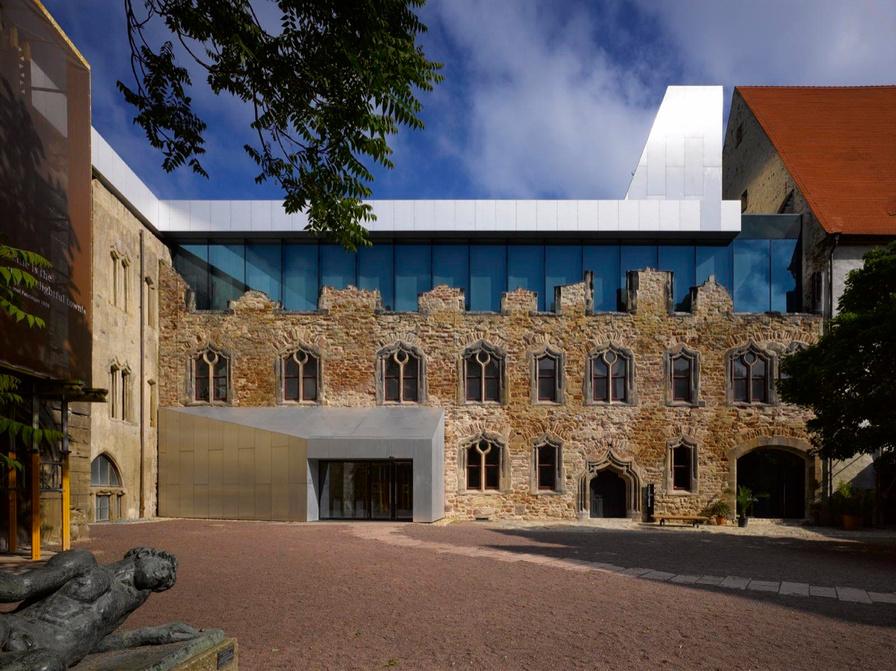
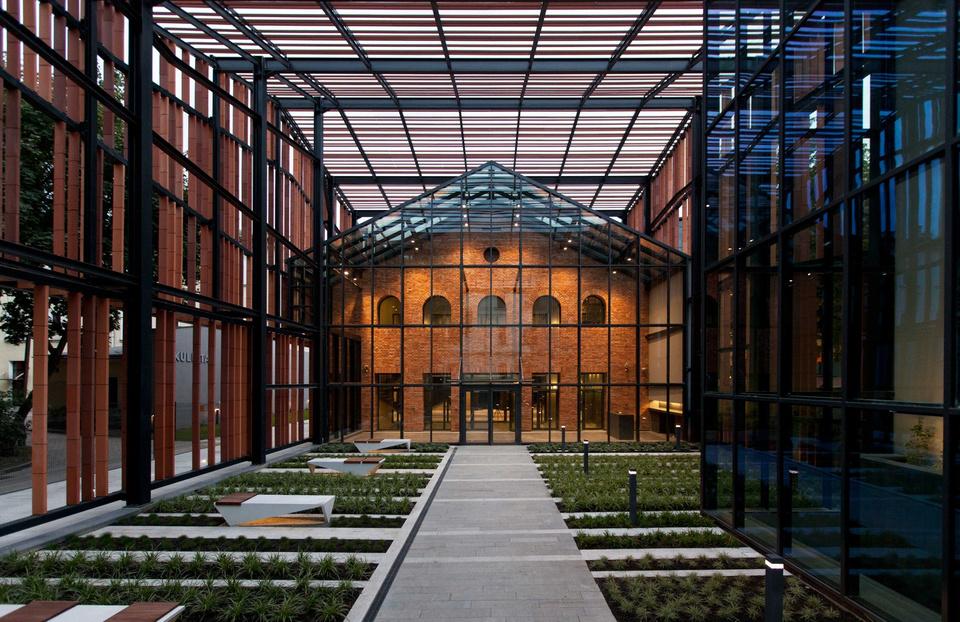
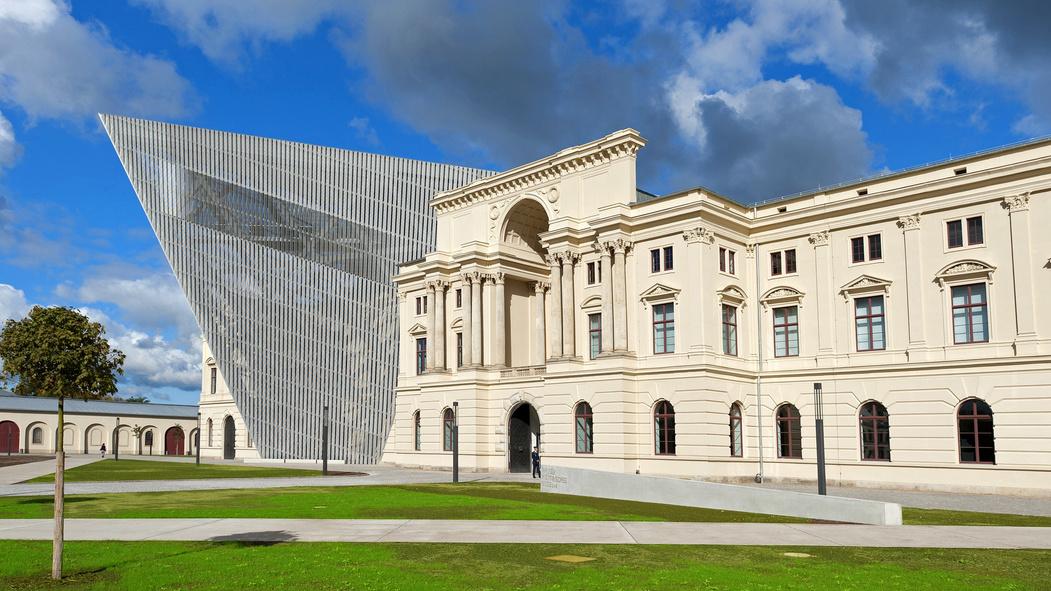
Adaptation as a word was derived from the Latin “ad” (to) “Apatre” (Fit), and that meant a change of use. Using the language of architecture is equivalent to several words; renovation, transformation, rehabilitation, and adaptive reuse Year by year, heritage buildings transfer social-cultural identity to the next generations, as the user is also updated to create new public buildings. In a nutshell, adaptive reuse is “ any intervention to adjust, reuse, or upgrade a building to suit new conditions or requirements”
P A G E 9 | A D A P T I V E R E - U S E
Figure 9 1 Daniel Libeskind Museum of Military History ©ArchDaily
Figure 9 2 Nieto Sabejano Moritzburg Museum ©ArchDaily
Figure 9.3 the Małopolska Garden of Arts in Krakow ©ArchDaily
Reference: A.Bullen, P. (2011). Adaptive reuse of heritage buildings: Sustaining an icon or eyesore.
3.1 SCALES OF BUILDING ADAPTATION
According to John Wiley’s Sustainable building adaptation, there are three different scales when it comes to adapting a building:
-Small-scale adaptation; this level approached minor adaptations within the external façade as well as minor extensions and structural developments
-Medium-scale adaptation by approaching minor demolitions from interior or exterior wall, extension in a lateral or vertical direction, and many structural alterations
-Last but not least comes the largescale adaptation which is approached by extreme changes and remodeling to the whole building, completely changing the usage
3.2 ADAPTATION AND INTERVENTIONS IN ARCHITECTURE DESIGN
After deciding on the scales and measures that will be applied to reuse the building, another toolbox is going to immerge and that is the interventions toolbox To intervene, the physical elements of the building need to be analyzed from the construction type, plan shape, site features, building width, and floor height, finally service location. But The important factor of intervening in an old building is creating the relationship between the old and the new.
3.2.1 INTERVENTIONS AND BUILDING VALUE
To start with, a study of the building’s contextual aspects from location, structure, architectural style …etc. before intervening in any heritage building, should be processed Then comes Phase II which is analyzing the building’s architecture elements from solid & void, scales & proportions, symmetry…etc. Last but not least studying the structural systems from load distributions and services.
3.2.2 METHODOLOGIES OF INTERVENTIONS
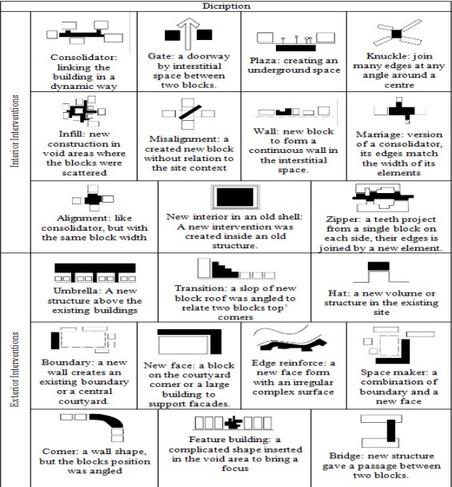
Depending on the mass of the building, margins from length and width, Place, function, and form; building interventions are classified into internal and external Table 1.0,1.1 below from Inas Abdelsabour’s Heritage building adaptation shows the possible interventions methods with the conditions for the buildings and site.
P A G E 1 0 | A D A P T I V E R E - U S E
Figure 10 1 Intervenions Diagram
Reference: A.Bullen, P. (2011). Adaptive reuse of heritage buildings: Sustaining an icon or eyesore.
3.2.3 STRATEGIES OF ADDITIONS
When a new structure is added within the historic complex, the designer is to take one of the four strategies; Literal replication, Invention with style, Abstract reference, and intentional opposition
1-Literal Replication
The priority when using such a strategy is compatibility and minimum diversity to sustain the existing style and structure as much as possible Therefore it ends up replicating the structural and architectural elements of the historical buildings
2-Invention within style
This methodology is achieved by adding new elements but is close in style to achieve the sense of continuity and by this, a balance between differentiation and compatibility is achieved
3-Abstract Reference
This strategy seeks to reference the historic features the same as the previous methodology but by avoiding working with the same historic style. This would probably achieve a modern abstract design from the architectural elements of the building
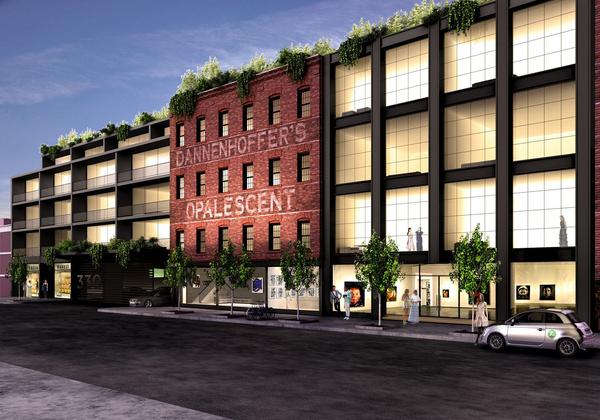
4-Intentional
Opposition
The method used in this strategy is contrast. As it’s building a mindful opposition to the context by changing its character to create a visible contrast
P A G E 1 1 | A D A P T I V E R E - U S E
Table 11.2 Interior Intervention
Table 11 1 Exterior Intervention
Reference: A.Bullen, P. (2011). Adaptive reuse of heritage buildings AbdelSabours, I. (2018). HERITAGE BUILDING ADAPTATION: DECISION-MAKING .
Figure 11 3 Abstract Reference Example
3.2 METHODOLOGIES OF ADAPTIVE RE-USE IN BEIT AL-QADI
In section 2.3 Existing land use, the first step is achieved by studying the complex’s buildings from location, structural and architectural style As each of the three buildings has its own style and identity The Maqaad was known for its Mamluk features, the police station for its neoclassic, and finally the jewelry and scaling authorities building for its ottoman style. Moving on to the second phase, which is analyzing the architectural features and elements of each building; the Maqaad with its massive proportions and the ratio between el portal and the rest of the façade, then switching to the police station with the solid and voids of the façade, the proportions of the windows as well as the corniches and the pediments that are used as decorations.
From this point, the scale of interventions ruler falls into place to categorize each building according to the degree of intervention
The recommendations for each building with an explanation of the motif is in the table below:
As it is the key monument of the complex, maintaining its identity and preserving it would be the best case scenario.
As the jewelry building has lost its main use which is coinage, therefore it’s the least with a heritage value and it would be recommended to remodel the whole building
The police station has its own heritage value but it is vacant and has no use. Therefore to fit the contemporary needs, an accommodation building. Few interior changes and exterior additions and interventions are recommended
Small-scale Adaptation Maqaad Mamay El Seify Existing Buildings Scale of Intervention Motifs Motifs Medium-scale Adaptation Qism Al-Gamalleya
Jewelry
Authority
Large-scale adaptation
and Scaling
P A G E 1 2 | A D A P T I V E R E - U S E Reference: Authors
4.0 CASE STUDIES
The criteria set for choosing case studies was based on the building typology and the adaptive re-use methodologies used Therefore, The Ned & Tai O heritage hotel covered the checklist as they were both adaptively reused as heritage hotels with different methodologies.
4.1. THE NED 4.1.1 BACKGROUND
The story of the Ned; how an abandoned architectural masterpiece became the starting point for a perfect five stars hotel.
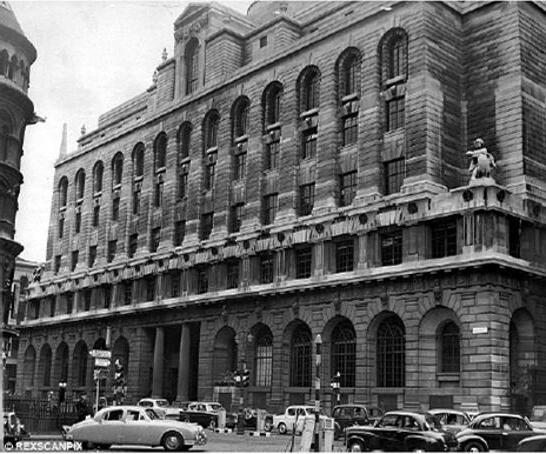
Midland Bank headquarters was one of the United Kingdom's largest big four banking groups for most of the 20th century, located in the heart of the city of London occupying the corner of Poultry Street and Princes Street Designed in the early 1920s by the British architect Edwin "Ned" Lutyens. This building was a masterpiece of its age, widely regarded as the finest commercial building of its time with a grand banking hall and offices in the NeoClassicism style. It was granted a Grade-I listed building status before the end of the last century, and shortly before Midland Bank moved out of the building
“When Nick Jones, the founder of Soho House & Co, first saw the City's disused Midland Bank building in 2012, he fell in love. ‘The property had been empty for nearly eight years but there was something about it – the details and scale of it – that just floored me,' Jones explains. The moment he left, he called Ron Burkle, Soho House chairman, and investor. 'Ron came to view the building and straight away we began to imagine how the project would take form,' says Jones.”
P A G E 1 3 | C A S E S T U D Y
-Norman Diseny & Young “Going from Empty to Extravagance”
4.1.2
WHY THEY CHOSE THE NED
Figure 13 1 Old Footage of The Ned
Reference: https://ndy.com/news/the-ned https://www.thened.com/notes/about-the-ned https://www.dezeen.com/
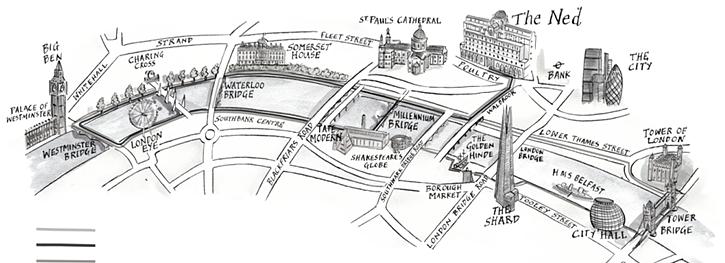
Figure 13 2 Map locating the Ned
4.1.3 ADAPTIVE RE-USE METHODOLOGY
For nearly a century the former Midland bank building was abandoned Its listed status necessitated a respectful renovation, with many features, after the renovations and restoration the former bank has been converted into a lavish hotel, club, and dining venue by Soho House and named "The Ned" in his honor.
The design team intended to revive the building in a way that retains the grandeur of the original spaces. After many research about the hotel we concluded their vision and mission where the vision was: recreating ‘Ned’ Lutyens masterpiece in capital’s engine for commerce and culture in the middle of London and the Mission:
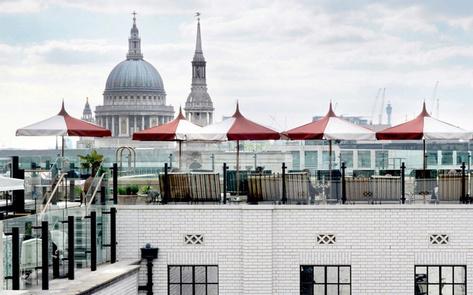
Reusing the complex site and retaining the character of Luteyn’s midland bank Reusing the bank’s vaults, meeting rooms, and rooftop Retaining original materials
4.1.4 THE OUTCOME
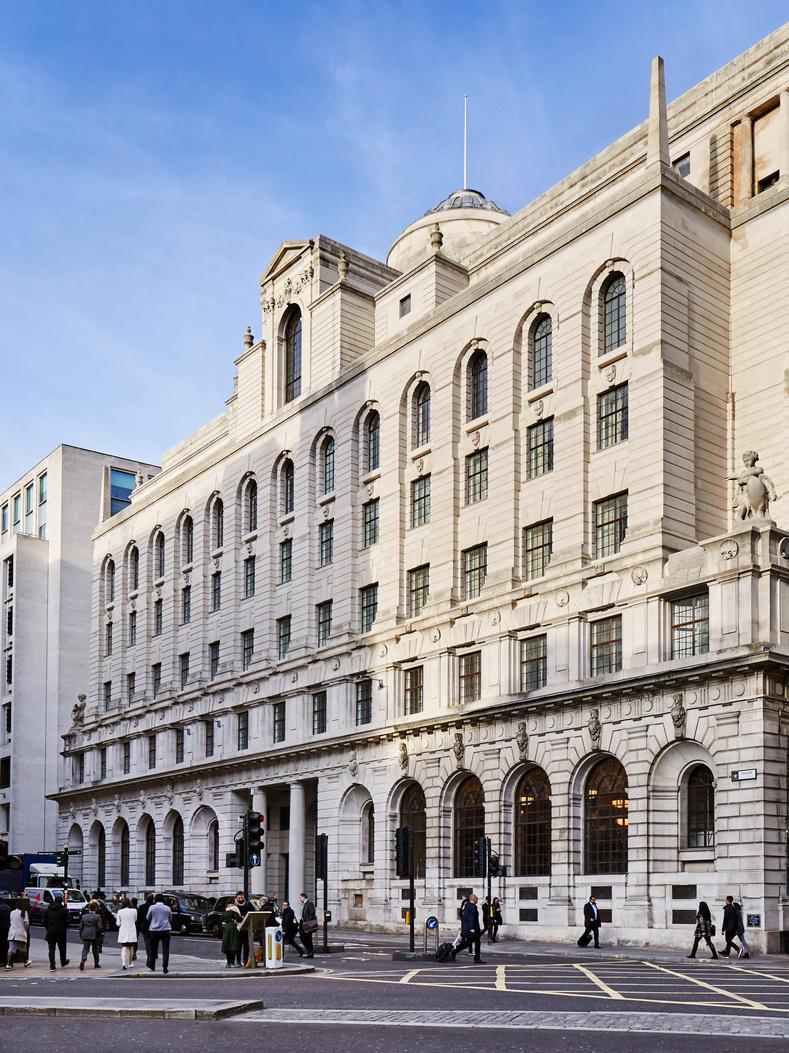
The Ned was named as The AHEAD Awards European Hotel of the Year in 2017, as well as additional awards at the same event for Best Event Space, Best Restaurant, and Best Spa and Wellness. The Ned is probably the most audacious hotel project in London in recent memory The building is now back to its former glory, in the way Sir Edwin Lutyens would have approved off. Many of the original features and rooms survive. The new parts of the hotel blend in as if they have been there since 1924 Once this was a place to cash cheques, now it is one of London’s smartest and most inspirational hotels.
The Ned Hotel was completed in May 2017, boasting as one of London’s most stupendous and extravagant hotels. The whole project took four years to complete. Both the renovated exterior facade and the detailed interior design are breathtaking, taking the individual back immediately to a different time in history. Summing up the four-year-long renovation project, The Ned Hotel Managing Director Gareth Banner said:
“The Ned has the wow factor, and the outstanding architecture is so well preserved you can’t help but fall in love with it.”
P A G E 1 4 | C A S E S T U D Y
Figure14.1 The Ned
Figure 14 2 Roof Top The Ned restaurant
Reference: https://ndy.com/news/the-ned https://www.thened.com/notes/about-the-ned https://www.dezeen.com/
4.1.5 KEPT FEATURES
Below, we ' ve highlighted some of The Ned's most striking heritage features, and the stories behind them.
THE WINDOWS
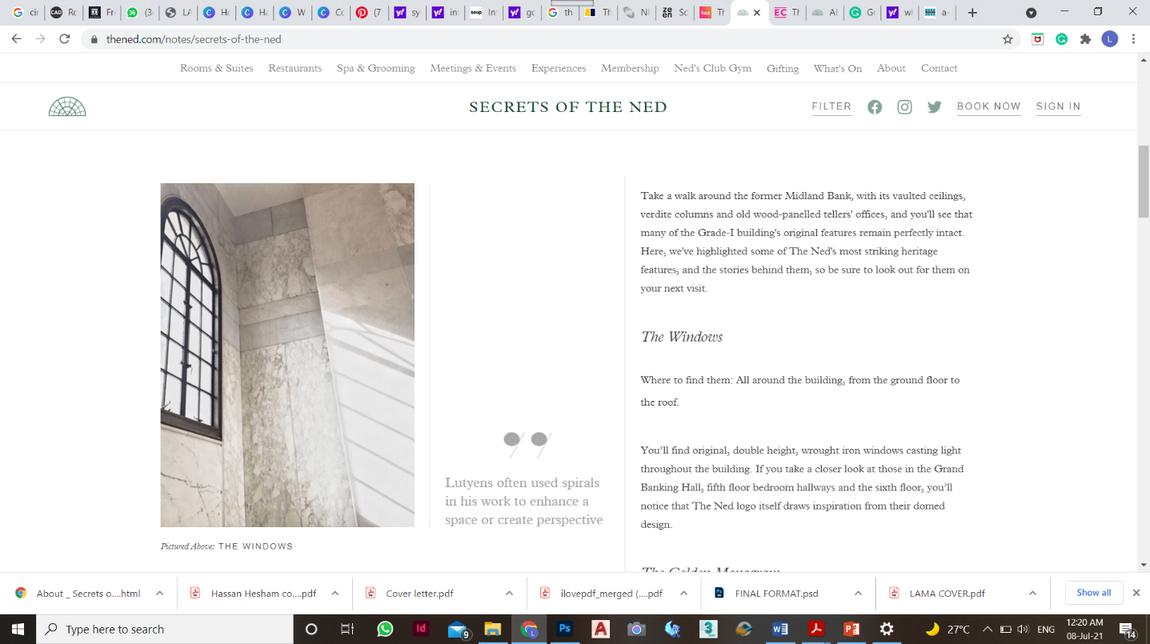
Original, double-height, wrought iron windows casting light throughout the building. In the Grand Banking Hall, fifth-floor bedroom hallways, and the sixth floor, one can notice that The Ned logo itself draws inspiration from their domed design.
THE TAPESTRY
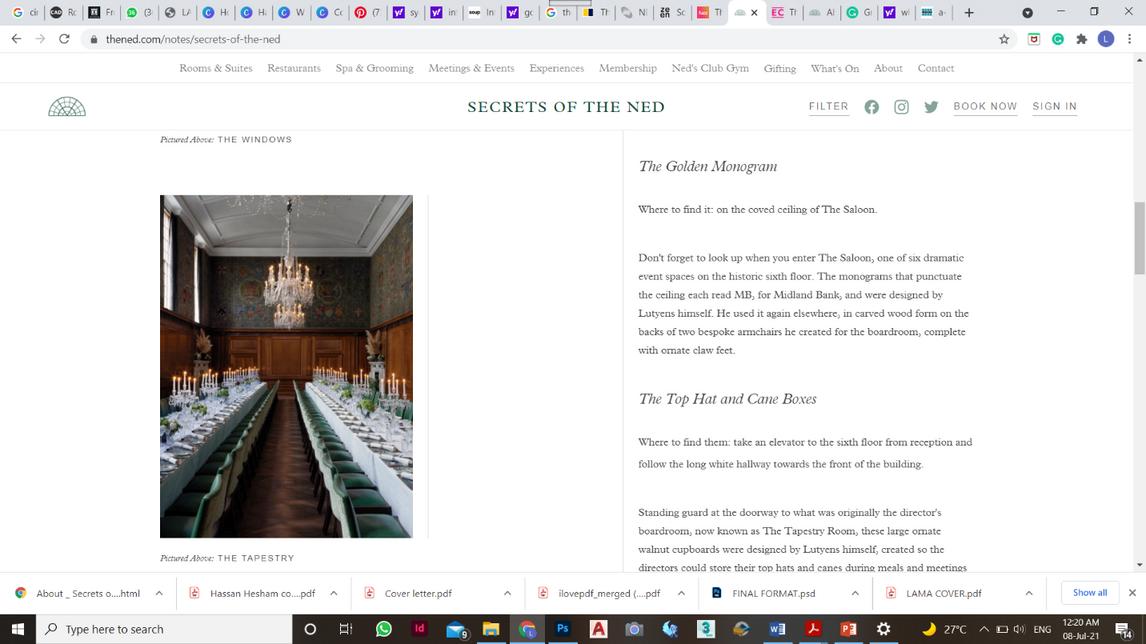
The grand tapestry that wraps the upper walls of the hotel’s biggest events space was made around 1929 at Lee's Tapestry Works in Birkenhead. The scheme focuses on the coat of arms of the principal British cities and towns in which Midland Bank was represented – 16 of them in total – and features 120 different coats of arms It took over 18 months to produce and was one of the largest examples of tapestry ever produced in England when it was finally hung in 1932.
VERDITE COLUMNS
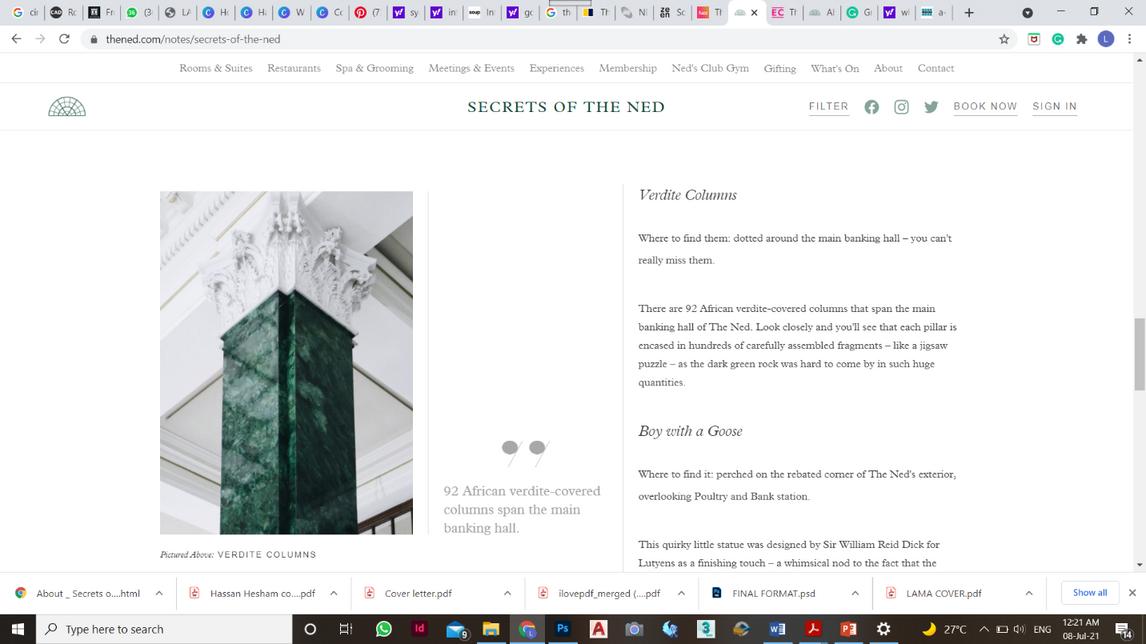
Dotted around the main banking hall, 92 African verditecovered columns span the main banking hall of The Ned. By looking closely one can see that each pillar is encased in hundreds of carefully assembled fragments like a jigsaw puzzle as the dark green rock was hard to come by in such huge quantities
THE CHAIRMAN'S LIFT
From the main door on Poultry one can see the carefully hidden lift on the right-hand side of the entrance's vestibule.
The chairman's private lift was designed to spirit him to his office and up to what is now the sixth floor for board meetings and lunches in a private dining room. Now fully reinstated, it's an iconic part of the building and a fascinating sign of the corporate ' us and them' culture that existed within the banking industry during the period
P A G E 1 5 | C A S E S T U D Y
Figure 15.3 Verdite Column
Figure 15 2 The Tapestry
Reference: https://cdn.laticrete.com/~/media/project-spotlight-files/2019/a-8504-0819_the-nedlondon_project_spotlight.ashx?vs=1&d=00010101T000000Z
Figure 15 1 The Windows
THE VAULT
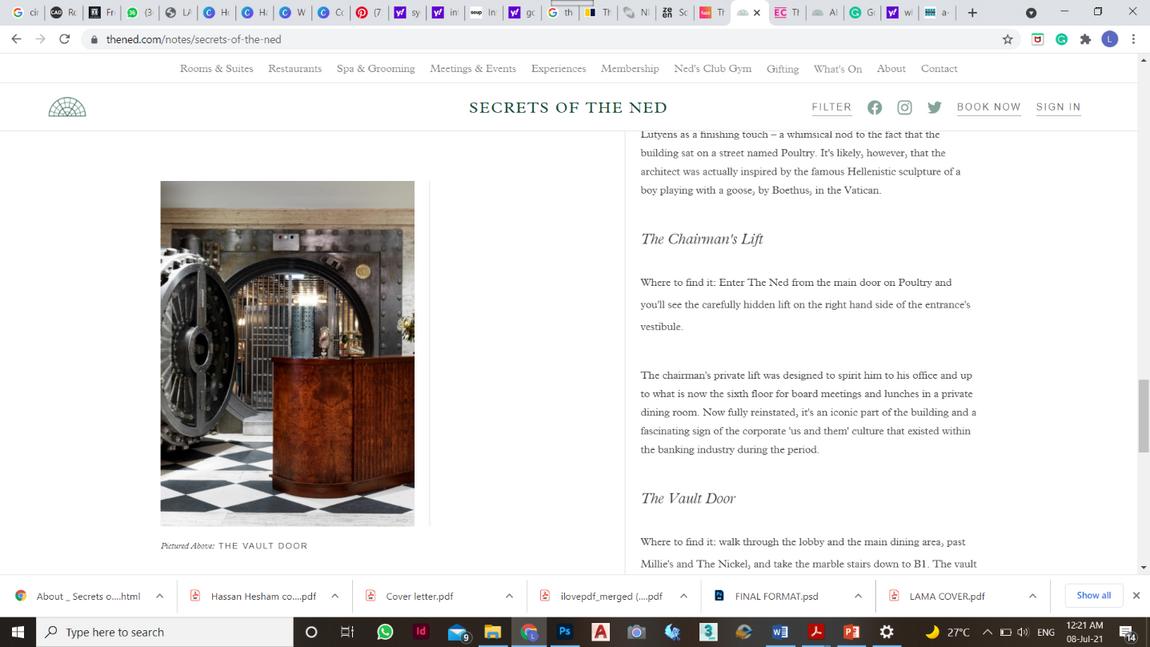
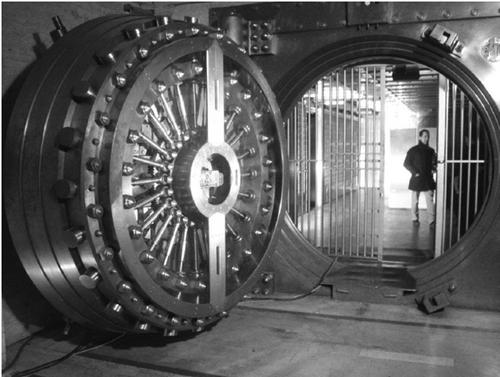
Walking through the lobby and the main dining area, past Millie's and The Nickel, taking the marble stairs down to B1. The vault is right there in front of you. Once the formidable entrance to a multi-room bank vault, with deposits of more than £335 million, and now a cozy club space for Ned's Club members,
The Ned's vault door is a must-see for movie buffs. The 25-tonne door was made by Chat-wood Safe Company – one of only two ever made – and was used as inspiration for the vault in the 1964 James Bond film, Goldfinger.
4.1.6 SEIZING THE OPPORTUNITY
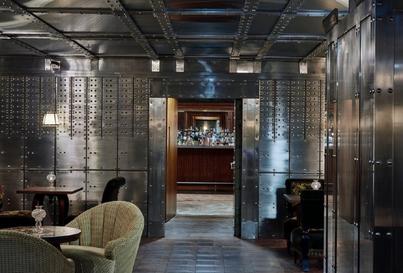
The interior used the challenging characteristics of the former midland bank to its benefit in order to create a unique experience for its users. The former bank vault is now the “Vault Bar & Lounge” and this space specially created an experience that mesmerized the users and according to some google reviews about the hotel, the experience was users stating how they felt like they when they first entered their rooms were they felt like they were in another era
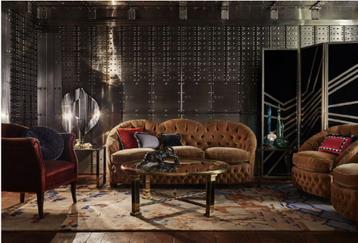
“The moment we entered the room we felt like in a different era The attention to detail and the amenities were second to none ”-Tobias Muny
Also that the old traces and features that are still existing in the vault bar
“Great members bar on -1 at the Ned. Old bank vault with all of the original safety deposit boxes left in place.”-Ken
 Oliver
P A G E 1 6 | C A S E S T U D Y
Figure 16 1 The Vault bar and lounge
Figure 16 2 The former bank vault
Figure 16 3 The Vault Bar and Lounge
Reference: https://cdn.laticrete.com/~/media/project-spotlight-files/2019/a-8504-0819_the-nedlondon_project_spotlight.ashx?vs=1&d=00010101T000000Z
Figure 16 4 The Vault Bar and Lounge
THE NICKEL BAR
In the middle of the hall, one can find the former paper transfer court that now is used as a platform for the restaurant's music. Creating a luxurious mode where jazz standards are belted out by musicians from a focal bandstand, the acoustics permit easy conversation at the bar, while seated on leather high stools
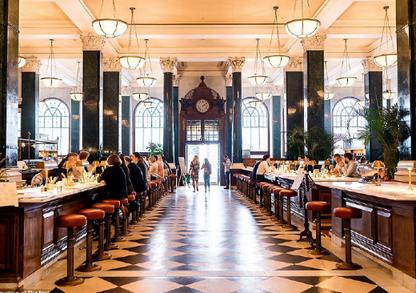
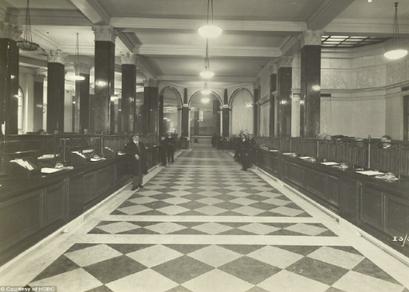
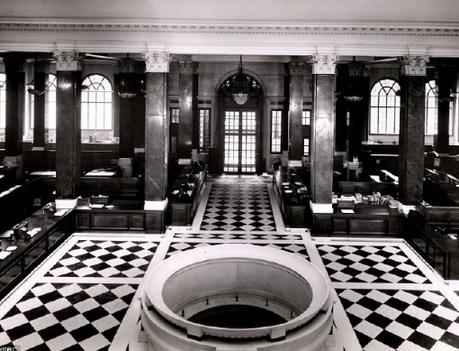
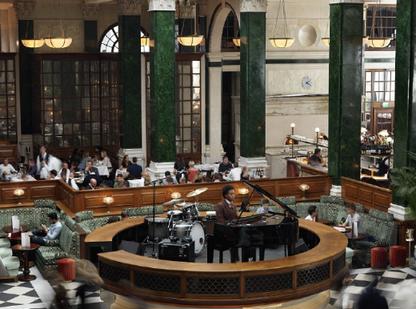
The now used as bars shown in figure 9 was the former bank’s concierge desks shown in figure 10
Reference: https://cdn.laticrete.com/~/media/project-spotlight-files/2019/a-8504-0819_the-nedlondon_project_spotlight.ashx?vs=1&d=00010101T000000Z
P A G E 1 7 | C A S E S T U D Y
Figure 17 1 Platform for the restaurant
Figure 17 3 Bar
Figure 17 2 Paper Transferring Court
Figure 17 4 Concierge Desk
4.2 TAI O HERITAGE HOTEL 4.2.1 BACKGROUND
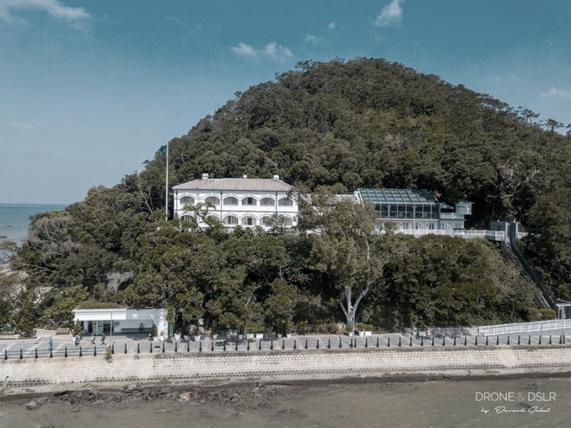
Tai O heritage hotel is located in an isolated fishing village in the city of Tai O in Hong Kong It was built in 1902 as one of the most famous police stations in Tai O. The police station had its own heritage value as it was known for the political events it has witnessed along the years in the area The main objective behind the police station was to combat piracy. It consisted of 3 building; a 2-floor main building, a partially one- floor and 2 – floor outhouse and finally a onefloor extension building
In 2010, it was re-designated to be a heritage hotel to become the famous Tai O heritage Hotel.
4.2.2 VISION& MISSION
“A living history hotel”
As mentioned in the previous section, Tai O police station was known for witnessing important political events that occurred in the area for example Bandits attaching the village and the police station itself. Therefore the architects’ vision was to build breathing architecture, reciting the stories behind the police station. The architect’s aims and objectives was to preserve, restore and maintain the heritage value of the police station with minimum interventions as well as reaching selfsustainability and designing an eco-friendly building.
4.2.3 3 ADAPTIVE RE-USE METHODOLOGY
In order to maintain the value of the building, it had to fit the contemporary needs This is why it was adaptively re-used into a heritage hotel.
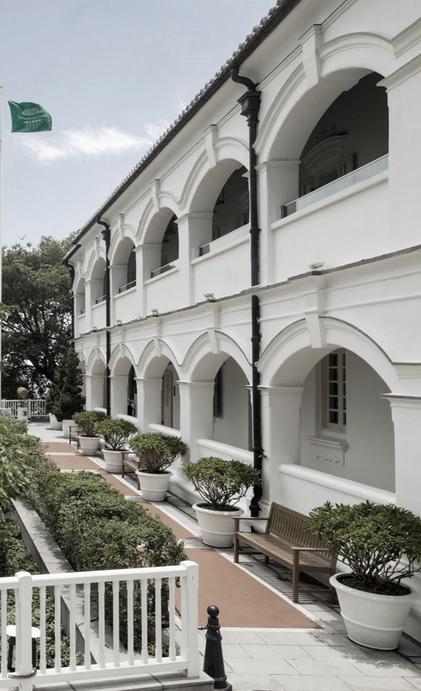
According to the conservation management plan of the hotel, there were specific elements with high heritage significance:
1-Vernadahs, architraves & Keystones
2- French Windows
3-Old Canons and watchers
4- The Bridge between the 2 buildings
5- The rooftop terrace
Figure 18.1 Tai O heritage Hotel
Figure 18 2 Context of Tai O
P A G E 1 8 | C A S E S T U D Y Reference: TaiOHeritageHotel|HongKongTravelAttractions–HongKongBoutiqueHotel Limited,H.K.(April2009).ConservationManagementPlanforTaiOheritageHotel.HongKong.
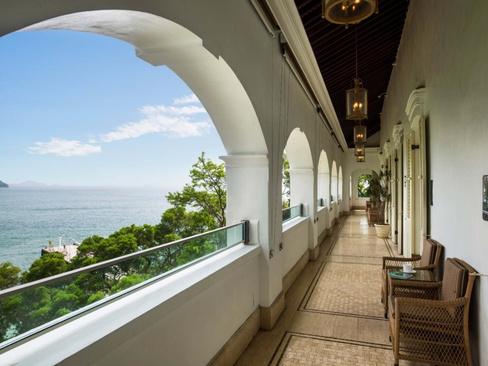
As the architraves were the most with heritage significance, they intervened by removing the windows attached to it by converting it into Verandahs; reaching an eco-friendly environment and naturally ventilated space.
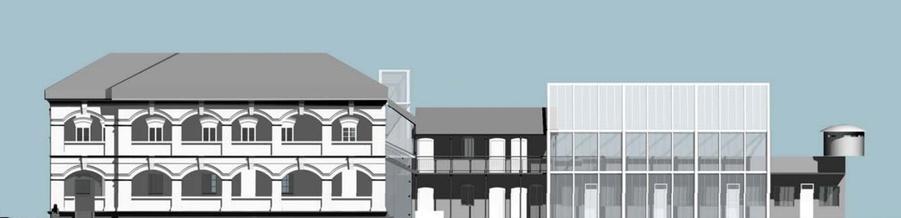
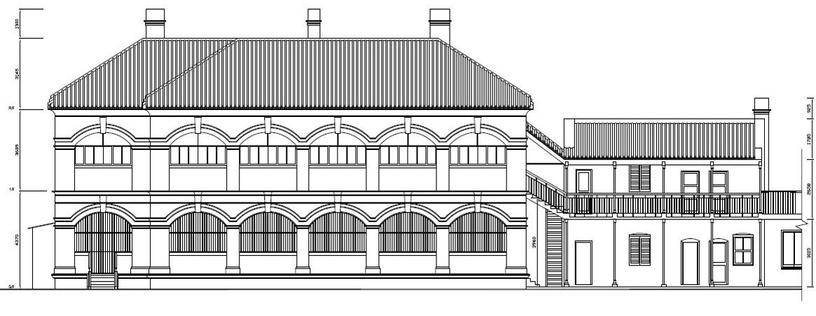
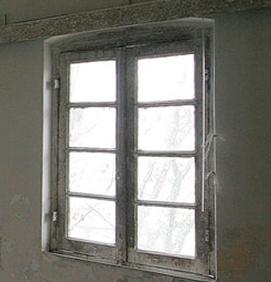
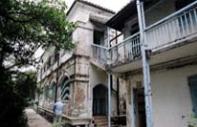
Moreover, the extension building with the roof wall was demolished and damaged and by that, a reversible contemporary glass structure was added to the façade In addition, covering the rooftop and reusing it as a terrace café.
Reference: TaiOHeritageHotel|HongKongTravelAttractions–HongKongBoutiqueHotel Limited,H.K.(April2009).ConservationManagementPlanforTaiOheritageHotel.HongKong.
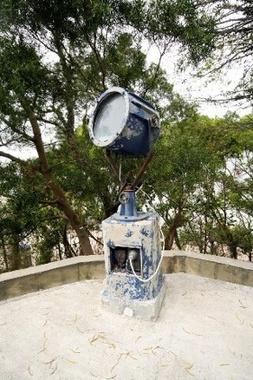 Figure 19 1 The Bridge between buildings
Figure 19 2 Old watchers
Figure 19 1 The Bridge between buildings
Figure 19 2 Old watchers
P A G E 1 9 | C A S E S T U D Y
Figure 19 3 French Windows
Figure 19 4 Police Station Elevation
Figure 19 5 Tai O heritage Hotel Elevation
4.2.3 SNEAK PEAKS
The
4.2.4 USER REVIEWS
Based on the reviews of the users that have visited Tai O heritage hotel, from the moment they had entered the hotel, they felt the history it reflects;
“Set ancient cultural relics, historical attractions, and later changed into a hotel” Homing Li.
“It would be a great place to go if you want to understand the history of the building” -Wai Leung Choi
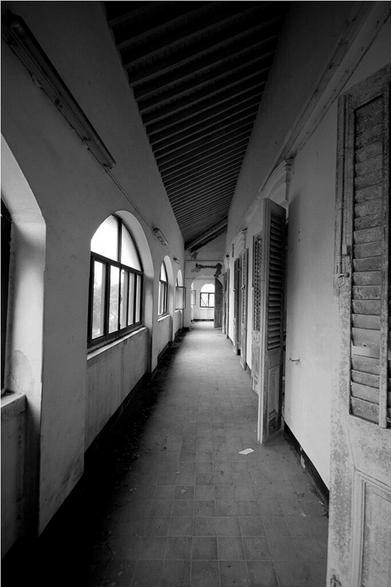
On the other hand, along with it reflecting the heritage of the police station, visitors had attention-grabbing concerns, for instance, some users mentioned that it was noisy as the accommodation area was reachable to the public
“It is open to the public and it would be a bit noisy to stay in this hotel” Wai Leung Choi
“We could not enjoy it from the ground floor rooms because of the constant traffic of people who screamed like it was a playground and looked into the windows” Gouri JC
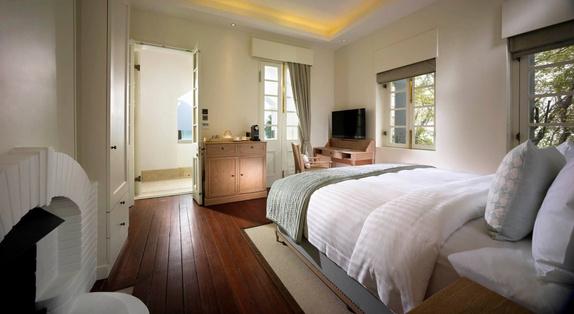
P A G E 2 0 | C A S E S T U D Y Reference: TaiOHeritageHotel|HongKongTravelAttractions–HongKongBoutiqueHotel Limited,H.K.(April2009).ConservationManagementPlanforTaiOheritageHotel.HongKong. GoogleReviews
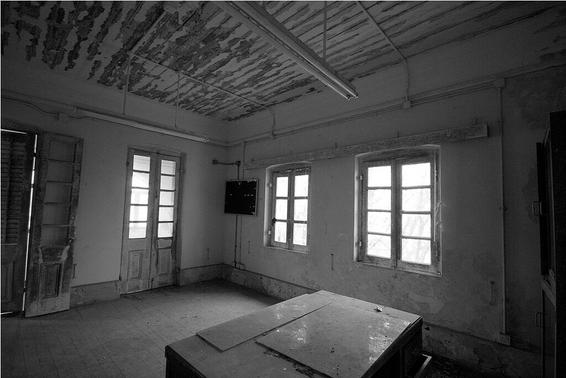
following figures show the transformation of the building from being vacant to being contemporary heritage hotel
Figure 20 1 Old verandahs
Figure 20 2 Reopened Verandahs
Figure 20 3 Old Office Room
Figure 20 3 Hotel Room
4.3 CONCLUSION
After reviewing the case studies, it is concluded that there are different methodologies a designer can approach to maintain the heritage value of a building. For instance, the Ned, as a bank was adaptively reused into a heritage hotel by applying a contemporary structural development in the roof as well as reusing the interior spaces as hero-spaces; from the vault lounge to the paper transferring court that became a restaurant. On the other hand, Tai O heritage hotel had a story behind its walls that needed to be told; the story of one of the oldest police stations in Tai O that witnessed important political changes As they approached sustainable interventions by opening verandahs and adding reversible structures to the exterior of the building Moreover, the cells of the police station were transformed into a police museum in order to be a story telling space reciting the history of the area. To sum it all up, the lessons learned from the reviewed case studies, is to express the history of the building not only from the exterior but through the interior spaces , furniture and finally the new zoning of the building
5.0 FIELD RESEARCH
Field Research is a qualitative data collection method that aims to observe and understand the environment and the behavior of the people. It tackles two main outcomes; studying the physical traces and observing the behavioral patterns within the area.
5.1 PHYSICAL TRACES
According to Inquiry by design by John Zeisel, observing physical traces means observing physical surroundings in order to find remains and traces from previous activity in site. In Beit Al-Qadi, upon site visits, the following observations were made:
Observations
1 Streetscape:
The material of the streetscape of the area is cobble stone. It was also mentioned in a google review that it was annoying and uncomfortable to tourists as they pull their bags
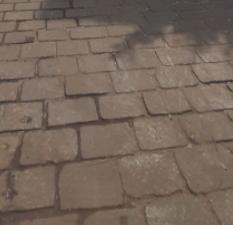
Illustration Recommendations
It is recommended to provide means of transportation i.e. E-Cars or Bicycles to transfer tourists from the a pickup point in order to have their satisfaction and comfort
P A G E 2 1 | F I E L D R E S E A R C H
Reference: Authors Inquiry by design
Figure 21.1 Cobble Stone
Observations
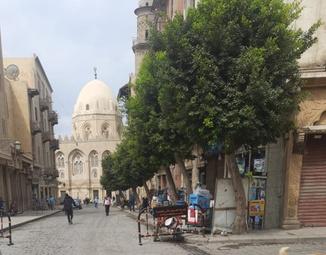
2. Congestion & crowdedness: Around 12PM at noon, the surrounding area has high traffic and congested with people
Illustration
Recommendations
-The recommendations is to isolate the accommodation rooms from the public streets
-It is recommended to create an exhibition space for the shop owners to showcase their work, as well as create an entertainment area for the locals to involve them with the complex
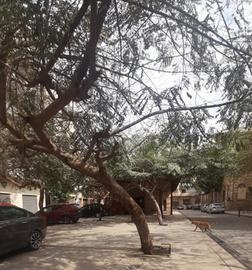
-The recommendations is to use the old trees to shade the plaza as well as using it as gathering and activity area
5.2 BEHAVIORAL PATTERNS
Referencing from John Zeisel’s Inquiry by design, observing behavior is achieved by “watching people use their environments” For instance, how they affect the surroundings and how the surrounding affect them. By the end, data is generated about the activity of the people, their current uses, misuses and expected uses of the site. Table 4.0 shows the observations as well as the recommendations to take into consideration for designing the area
3. Services and shops are surrounding the area of Beit Al-Qadi
4. Existence of old trees in plaza infront of the police station along with an old cafeteria
P A G E 2 2 | F I E L D R E S E A R C H
Figure 22 1 Cobble Stone
Reference: Authors Inquiry by design
Figure 22 2 Existing Trees
Observations
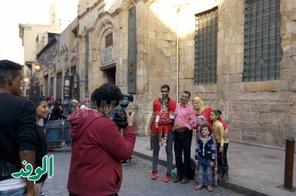
1-Amateur photographers all around the site, doing photo sessions around the area.
Illustration
Recommendations
-Providing a space for photography, for example a platform with a good scenery
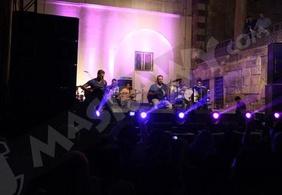
2 Before Pandemic, the plaza in front of Al Maqaad used for live concerts
5.3 INVESTIGATING PEOPLE
-The recommendations is to re-use the plaza in-front of AlMaqaad as an entertainment area. i.e Amphitheaters
During site visits, a questionnaire was designed to gather info from the users surrounding the area
Table 5 0 shows the questions list , used in the site visit, for the varieties of users in around the
LOCALS SHOP OWNERS RESEDIENTS TOURISTS
A heritage hotel will be built in Beit Al-Qadi, What is your reflection?
How do you think building a hotel in Beit Al-Qadi would affect you?
What are your demands to take into consideration for building a hotel in this area?
If you are to stay in such historic area, what are you looking for in the hotel?
How do you find AlMoezz as a street and a historical area ?
-Depending on table 5.0, Responses were recorded and classified into negative concerns and positive impacts
To begin with positive impacts, Table 5.1 will be tackling the responses of the users surveyed in site.
P A G E 2 3 | F I E L D R E S E A R C H
Figure 23 1 Amateur Photographers
Reference: Authors- Inquiry by design Arabia, S. N. (Director). (2014). ﺔﻴﻟﺎﻤﺠﻟاﻲﺣﺺﺼﻗ [Motion Picture].
Figure 23 2 West Al Balad concert
LOCALS
SHOP OWNERS
The street would be more crowded which would result in more customers for their shops
Employment rate growth as a lot of people would want to work around this area
Adding more economic value to the area
TOURISTS
Taking advantage of the extra security the government will be providing for this hotel
More pedestrians and tourists which would result in a lively neighborhood
Demanding a higher class hotel than the existing ones with more interesting activities
Looking for affordability and new activities within the hotel
The heritage value of the hotel’s area with its key monument
On the other hand, some users had concerns as shown in Table 5 2
LOCALS
SHOP OWNERS
Losing Customers to new bazaars
RESEDIENTS RESEDIENTS
Increase in traffic & crowdedness
TOURISTS
The cost of the place would be expensive
Closing shops and losing jobs for the sake of the new hotel
Public Street crossing to the gate of Beit Al Qadi would be restricted
The streetscape of Al Moezz and the site
Noise and lack of privacy
Lack of privacy and comfort due to noise and crowdedness
P A G E 2 4 | F I E L D R E S E A R C H Reference: Authors
6.0 SWOT ANALYIS
Strengths Weaknesses Opportunities Threats
Existence of key monument (Maqaad Mamay)
The Location of the area in the center of Al Moez
Existence of different styles/tastes
Residential Areas are overlooking the hotel
Commercial buildings (Bazaars and Wekala) surround the area
Availability of many other hotels
Taking advantage of the heritage monument and attracting more tourists
Different user experiences with different buildings
Increasing the value of the hotel
Overlooking 2 Main roads.
Overlooking 2 Main roads Privacy would be limited in such area
Noise and pollution would be affecting the hotel
Tourists could prefer other hotels
Easy accessibility of public people which leads to lack of security
CONCLUSION
The use of the existing key monument Maq'ad Mamay to enrich our design elements and to grab customers to the hotel
Also, the location inspires guests to prefer our hotel to others because it is in the center of Al Moez street facing two main roads
The existence of many tastes serves our concept in the form of time traveling from an era to another
Overcoming the privacy problem by using screens louvers and sheds to prevent the user from being observed from outside. Commercial buildings ( bazaars and wekala ) surrounding the area could be a source of noise that could be overcome by using noise-cancellation technology or by limiting the quiet spaces near them.
To attract guests to stay in our hotel we should provide an un-ordinary experience to prevent them from preferring other hotels from the area around
P A G E 2 5 | S W O T
Reference: Authors
PART 2
7.DESIGNING TIMELESS ARCHITECTURE
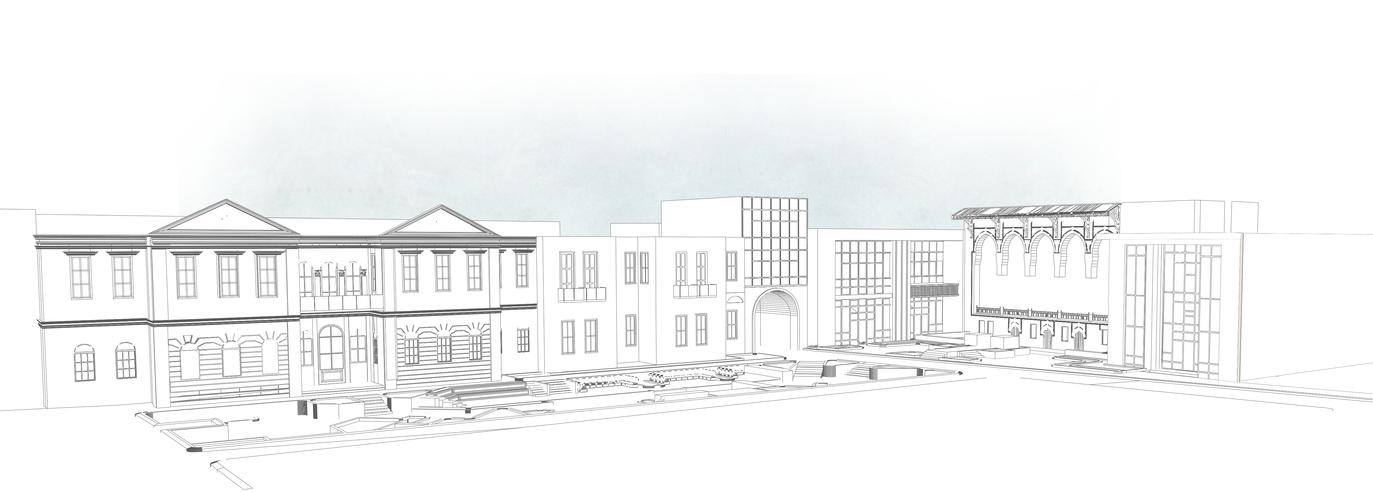
Based on what was mentioned in part I of the research, Beit El-Qadi complex is consisted of 3 distinctive buildings; Maqaad Mamay El Seify, Qism Al Gamalleya and the jewelry and scaling authority building. Each one of them has its own unique story.
Choosing the name “Timeless” had a purpose; obtaining one continuous seamless entity The main challenge faced was to connect the 3 buildings together as if they are one building As If finding an intersection point between the mamluk, neoclassic and ottoman style. And this is the point when the 3 eras met, Time. The only place where the 3 eras intersect is Time. Some questions were raised; How can we connect the three timings all together? What if we can create a time travelling machine? From here emerged the vision of the design project
Vision & Mission
The vision of the project is to create a time machine for the user to take on a journey; traveling through the different styles existing in the complex. The time machine would stop by each era, like a moving spotlight, freezes time in each era and making it the absolute present
In order to bring the vision to life, the time machine needs a timeline to walkthrough, and this is the mission. To create a pathway for the user to experience the tastes of each era but by adding a contemporary taste to it.
P A G E 2 6 | T H E C O N C E P T
Reference: Authors
Figure 26 Ideagram of the concept
Narrative Concept Statement
Over the years, Beit AlQadi has witnessed various events with each leaving its own print on the place With it all seeming chaotic with all the stories it carries, from al Maq’ad to Qism Al Gamalleya. Like it’s reciting a story hidden behind the wall of the building. These stories shall be told and experiences as well. From this emerged our conceptual approach, travelling through time. The user will not be only exploring different eras, but he will also be witnessing the structural development between the eras, from contemporary to neo-classic era.
Zoning
Based on site analysis and field research , a responsive zoning was conducted as the figure below
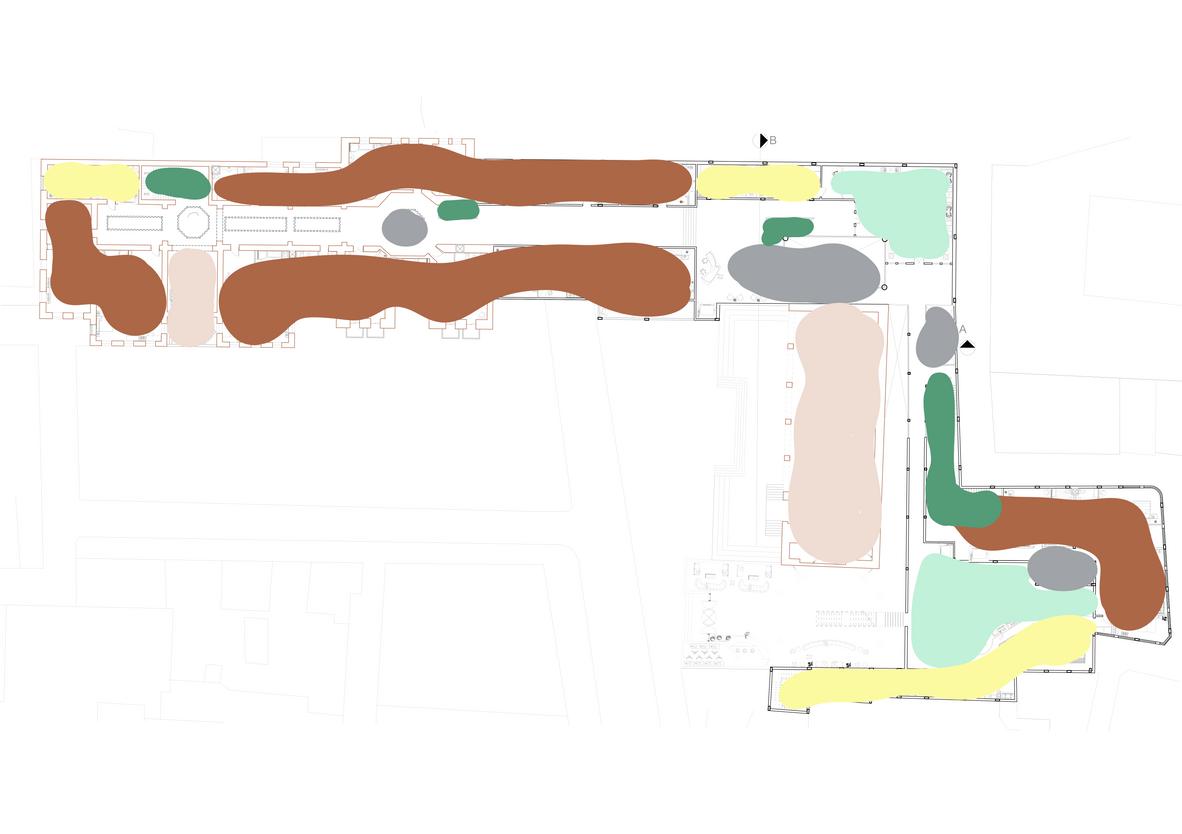
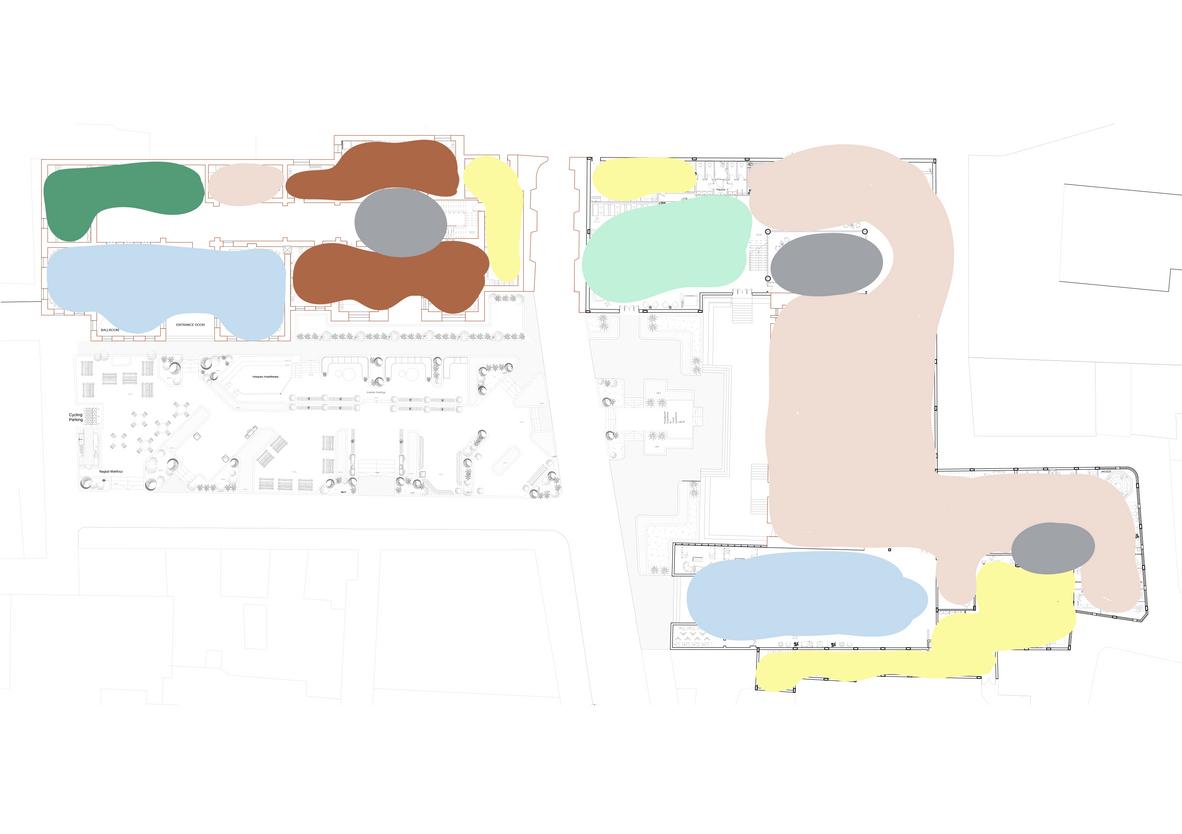
Services Accommodation Activities Reception Core Court Restaurants Ground Floor 1st Floor
P A G E 2 7 | T H E C O N C E P T
Reference: Authors
Discussion of the findings
According to Table 2 0 in section 3 2, a measurement tool for the scale of adaptation was recommended.
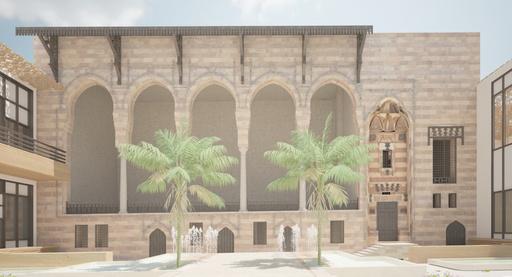
For Maqaad of Mamay, it was suggested to follow a small-scale adaptation method to prioritize maintaining its identity and preserving it with minimal changes. Therefore, it was reused as an exhibition space as well as storytelling rooms on the underground floor.
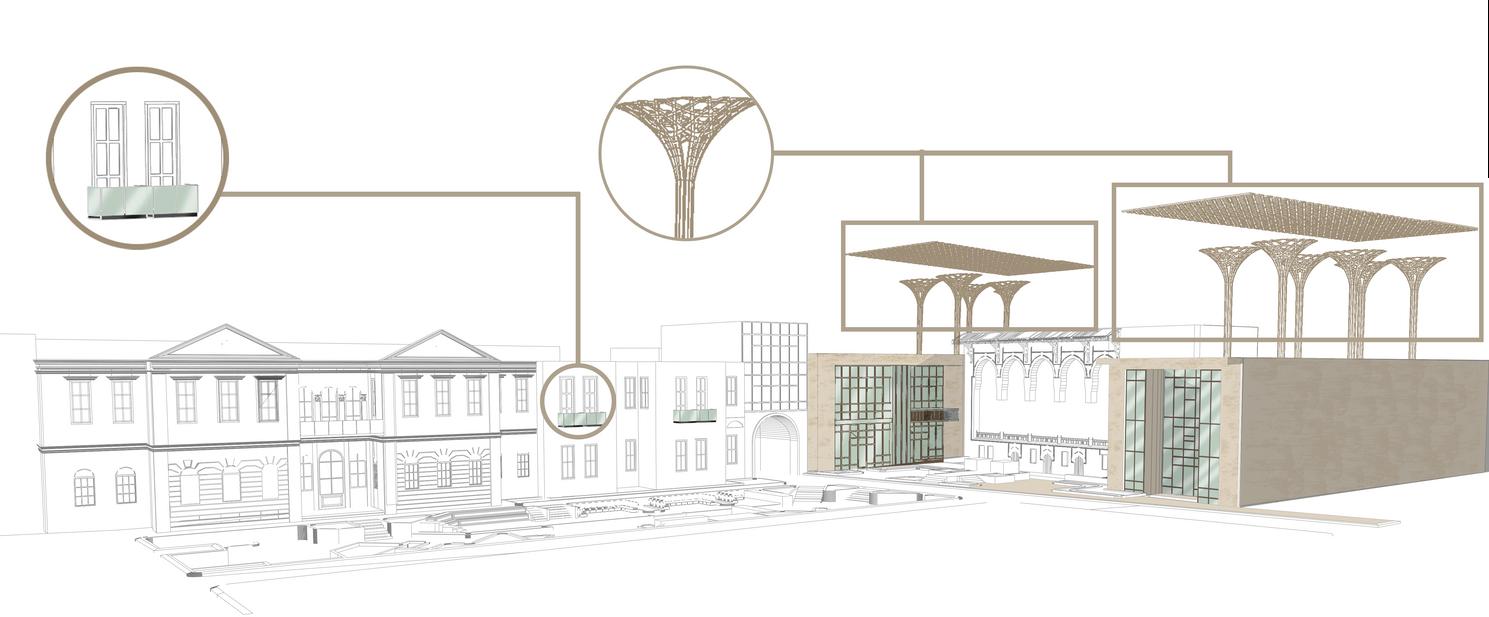
Secondarily comes the police station with its neo-classical façade of distinctive elements, it was suggested to follow a medium-scale adaptation method by making few changes to the interior walls as well as the exterior to fit the new needs for contemporary use Furthermore, on the exterior façade of the building, according to section 3 2 3 strategies of additions, the abstract reference methodology was used. This strategy was achieved by reference to the historical features of the building without working with the same style Therefore, using an abstract modern design in the external interventions In addition to adding reversible structure to the façade of the fire station which is the reversible terraces.
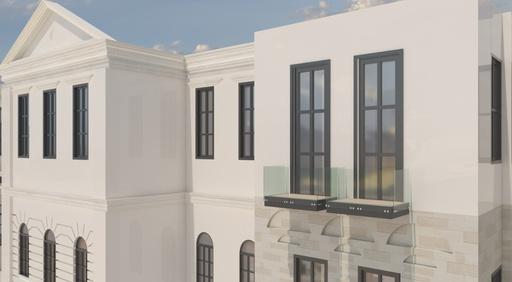
P A G E 2 8 | T H E C O N C E P T
Figure 28 2 Shot showing preservation of maqaad
Figure 28 3 Reversible Terraces in Police Station
Reference: Authors
Figure 28 1 Ideagram of the concept
Finally, the jewelry and scaling authorities building was suggested to follow a high scale adaptation strategy as it is the least with a heritage value. Therefore a complete demolish was approached and re-building the whole form to be part of the new extension building
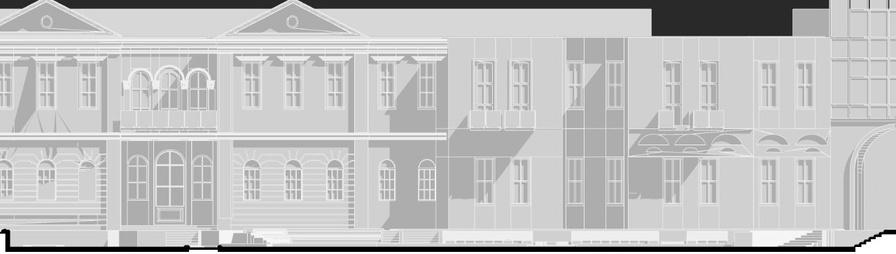
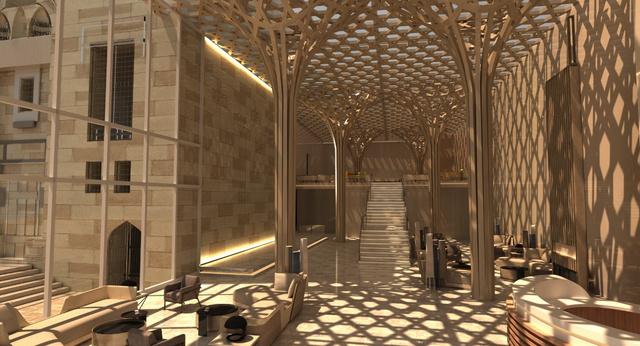
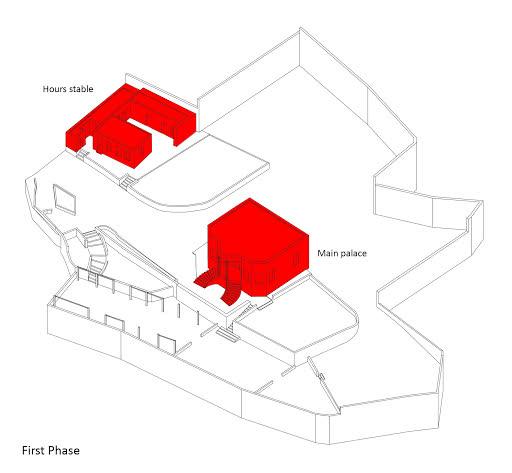
According to table 1.0, many exterior addition methodologies were introduced A couple of them were achieved in designing the new extension; as for the new extension, the ‘hat’ methodology was used by adding a new volume or structure in the existing site. Another method used in the interventions is “Bridge” as connecting the extension building and the new Damgha structure using a bridge.
Meanwhile
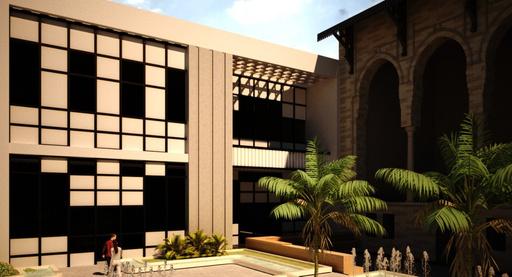
P A G E 2 9 | T H E C O N C E P T
Figure 29.1 The New Extension Building after demolishing Damgha Buildings
Figure 29 2 Interior shot showing the contemporary movement in the new extension building
Figure 29 3 Sectional Diagram showing the intervention in landscape
Reference: Authors
intervening in the site by creating a landscape plaza with a negative level of 0 8 meters to create an underground space within the site
8.0 CONCLUSION
This research aimed to identify design guidelines for contemporary interventions in historical context using the case study of Beit El- Qadi Based on studying the general context, site analysis, and methodologies of adaptive re-use, a design guideline for re-using Beit Al-Qadi as a heritage hotel in a contemporary method. Studying the general context from the history and the stories of each building to the structural description finally reaching the exterior features helped in categorizing scale of adaptation strategy for each of the buildings to reach a conclusion of what buildings will be preserved, which one will be changed interiorly and finally which will be completely demolished. The second phase was to decide the additions that will be tackled to each building, from replications or abstract referencing in contemporary style In addition to the new extension building in the vacant land that is determined as an addition to the site as well as connecting it to the rest of buildings to form one seamless entity. All this process, reached to the methodological part ; Designing timeless design By which creating harmony between buildings, minimum scales of interventions and achieving sustainable design. The concept approach was based on time travelling by which a path would be taking the user on a journey through the eras from the contemporary of the 21st century Islamic style to the mamluk and finally reaching the neo-classic style
P A G E 2 9 | T H E C O N C E P T
TABLE OF FIGURES
Figure 1 1 Contextual Map of Al Moezz ©Researchers Page 1 Figure 1.2 Maqaad Mamay AlSeify ©Researchers ...............................................Page 1 Figure 2.1 Map of the site.........................................................................................Page 2 Figure 2 2 Environment analysis diagram Page 2 Figure 3 1 Noise source Digram Page 3 Figure 3.2 Ventilation ...............................................................................................Page 3 Figure 3 3 Routes Page 3 Figure 4.1 Bab Al Nasr Route ................................................................................. Page 4 Figure 4.2 Al Azhar Route ........................................................................................Page 4 Figure 4.3 Bab Al Futuh Route ...............................................................................Page 4 Figure 5 1 Topography Section Page 5 Figure 5.2 Topography in the site ..........................................................................Page 5 Figure 6 Close up of Al Maqaad ©Researchers .....................................................Page 6 Figure 7.1 Zoom In Maqaad Detail ©Researchers..................................................Page 7 Figure 7 2 Architectural Plans ©ﺎﻫﺪﻋﺎﻘﻣ و ﺮﺼﻣ لزﺎﻨﻣ Page 7 Figure 7 3 Architectural Plans ©ﺎﻫﺪﻋﺎﻘﻣ و ﺮﺼﻣ لزﺎﻨﻣ Page 7 Figure 7.4 Qism Al Gamalleya ©Ahmed tobgy ......................................................Page 7 Figure 8 1 Jewelry and scaling authority ©Ahmed Tobgy Page 8 Figure 8.2 Nagiub Mahfouz ....................................................................................Page 8 Figure 8.3 Nagiub Mahfzouz Map ............................................................................Page 8 Figure 9.1 Daniel Libeskind Museum of Military History ©ArchDaily ................Page 9 Figure 9.2 Nieto Sabejano Moritzburg Museum ©ArchDaily ...............................Page 9 Figure 9.3 the Małopolska Garden of Arts in Krakow ©ArchDaily.......................Page 9 Figure 10 1 Intervenions Diagram Page 10 Figure 11.3 Abstract Reference Example ............................................................Page 11 Figure 13.1 Old Footage of The Ned ...................................................................Page 13 Figure 13.2 Map locating the Ned ........................................................................Page 13 Figure14.1 The Ned ...............................................................................................Page 14 Figure 15 1 The Windows Page 15 Figure 15.2 The Tapestry .....................................................................................Page 15 Figure 16.1 The Vault bar and lounge ...............................................................Page 16 Figure 16.2 The former bank vault .....................................................................Page 16 Figure 16 3 The Vault Bar and Lounge Page 16 Figure 16.4 The Vault Bar and Lounge ..............................................................Page 16
TABLE OF FIGURES
Figure 19.1 The Bridge between buildings ........................................................Page 19 Figure 20.1Old Verandahs.......................................................................................Page 20 Figure 19.5 Tai O heritage hotel elevation..........................................................Page 19 Figure 19.2 Old watchers ...................................................................................Page 19 Figure 20.2 Reopened vernandahs.........................................................................Page 20 Figure 19 3 French Windows Page 19 Figure 20.4 Hotel Room...........................................................................................Page 20 Figure 20 3 Old office room Page 20 Figure 21.1 Cobble Stone .....................................................................................Page 21 Figure 21 2 Existing Trees Page 21 Figure 22.1 Amateur Photographers .....................................................................Page 22 Figure 22 2 West Al Balad concert Page 22 Figure 25.1 Ideagram of the concept ...................................................................Page 25 Figure 26 1 Ideagram of the concept Page 26 Figure 26.1 Shot showing preservation of maqaad ...........................................Page 26 Figure 26 2 Reversible Terraces in Police Station Page 26 Figure 28.1 Extension Building after demolishing Damgha Buildings ...........Page 28 Figure 28.3 Sectional Diagram showing the intervention in landscape .........Page 28 Figure 28.2 Interior shot showing the contemporary movement in the new extension building Page 28 Figure 18.1 Tai O heritage Hotel ......................................................................Page 18 Figure 17.2 Paper Transferring Court ..............................................................Page 17 Figure 18 2 Context of Tai O Page 18 Figure 19.4 Police Station Elevation.................................................................... Page19 Figure 17 3 Bar Page 17 Figure 17 1 Platform for the restaurant Page 17 Figure 17.4 Concierge Desk ................................................................................Page 17
REFERENCES
1 Ahmed AbdelWahab; Hossam Zeidan;Shaimaa Galhoum (n d )
Retrieved from Streetstory: http://streetstory.gov.eg
2.Arabia, S. N. (Director). (2014).
[Motion Picture].
3 Ayman Fouad Sayed; AbdelMonem Maged; Ghozwan Mostafa Yaghy; Mohamed Gamal Deen Sorour. (n.d.).
Retrieved from Streetstory: http://streetstory.gov.eg
4 City, O (2018, April 3) The history of the ned Retrieved from OneCity: Onecity.london
5.Le Riad Hotel . (n.d.). Retrieved from Le Riad Cairo : www.leriadcairo.com
6 Limited, H K (April 2009) Conservation Management Plan for Tai O heritage Hotel. Hong Kong .
7.alwafd.news. (n.d.). AlWafd. https://alwafd.news/
8 E (n d ) The Ned, London – Projects – ElliottWood https://www.elliottwood.co.uk
9 Ned Edwin Lutyens Poritfolio (n d ) Michaela Hill https://www michaelahill com
10.Tai O Heritage Hotel | Hong Kong Travel Attractions – Hong Kong Boutique
11.Hotel. (n.d.). Tai O Heritage Hotel. https://www.taioheritagehotel.com/en/
12 Wood, E (2012) The Ned, London – Projects – ElliottWood https://www.elliottwood.co.uk
13.2018) .م ,
, December 4).
Langue et culture arabes https://langue-arabe fr
14.Osman, A. A. (Spring 2017). The Maq'ad Of Amir Mamay Al-Sayfi: The history and context of a mamluk jewel .
15 A Bullen, P (2011) Adaptive reuse of heritage buildings: Sustaining an icon or eyesore.
16.Ahmed, I. A. (2018). Decision Making for contemporary interventions .
17 Tobgy, P A (2021) Design Studio
18.Yaghy, G. M. (2004). ﺎﻫﺪﻌﻋﺎﻘﻣ
19.Zeisel, J. (n.d.). Observing Physical Traces . In J. Zeisel, Inquire by Design .
20 Zeisel, J (n d ) Observing Environmental Behavior In J Zeisel, Inquire by Design
ﻲﺿﺎﻘﻟا ﺖﻴﺑ
ﺔﻴﻟﺎﻤﺠﻟا ﻲﺣ ﺺﺼﻗ
ﻲﻤﻃﺎﻔﻟا ﷲ ﻦﻳﺪﻟ ﺰﻌﻤﻟا عرﺎﺷ
.
يﺮﻜﺑ
ﺔﻓﺎﻘﺜﻟاو ﺔﻐﻠﻟا ﻊﻗﻮﻣ - ظﻮﻔﺤﻣ ﺐﻴﺠﻧ تﺎﻳاور ﻲﻓ ﻦﻛﺎﻣﻷا ﺔﻴﺑﺮﻌﻟا
و ﺮﺼﻣ لزﺎﻨﻣ.
