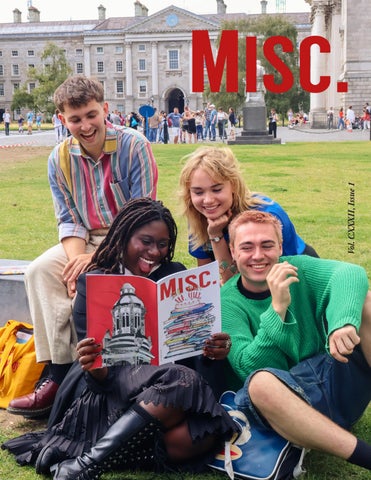
Aoibheann Kearins is Misc.’s Science and Technology Editor. She has also contributed to The University Times.
Daniel Bowe is Misc.’s Politics Editor. He is a third year law student.
Eliora Abramson is Misc.’s Deputy Editor and Layout Editor. She is also Editor of the University Times’ Magazine and Article Editor for the Trinity Journal of Histories. She is a contributing writer for Totally Dublin’s The Goo Magazine.
Eve McGann is one Misc.’s Erasmus Editors. She has received a Student Media Award for Features Writer of the YearNews and Current Affairs and been nominated for Journalist of the Year for previous work with The University Times.
Monday, September 22nd 2025
CONTRIBUTORS
Gavin Jennings is Misc.’s History Editor. He is a third-year English and History student, and is serving as Amenities Officer of Trinity Publications and as Bramcast host for the Bram Stoker Club.
Joy Aladejana is a second year English and philosophy student. She is Misc’.s Assistant Editor. She has also contributed to University Times and an anthology in collaboration with The Museum of Literature Ireland.
Jules Nati is a third year English Student and Misc.’s International Editor. Previous contributions include translations for JoLT.
Katie Brady is Misc.’s Deputy Editor and former co-editor of The Piranha. She is a final year English and Philosophy student
Lily Ainsley is the Assistant Editor of Misc. Magazine. She has also contributed to the Bram Stoker Society, TN2, and the UniversityTimes.
Luca Walker is a third year environmental science student and was last year’s Deputy SciTech Editor of Trinity News. She has previously contributed to Trinity News and the University Times. Nicolò Bianchi is one of Misc.’s Culture Editors. He’s just graduated with a degree in English and History and is now a postgraduate student in the Trinity School of Politics. Sienna O’Riordan is a third year English Major with a Classics Minor, and is one of Misc.’s Culture Editors. She has contributed to Mnemotope Magazine and is a current OCM of the Bram Stoker Paper Reading Subcommittee.
COVER
Photography Models Alice Carroll
Gavin Jennings
Lily Ainsley
Joy Aladejana
Daniel Bowe
Conor Healy Gavin Jennings
Jules Nati
Nicoló Bianchi and Sienna O’Riordan
Eliora Abramson
Daniel Bowe
Aoibheann Kearins
Eve McGann
Luca Walker
Sheila Tighe
The Misc Matrix
Labour’s Love’s Lost
Looking back at the 1990 presidental election
‘Is fearr Gaeilge bhriste, na Béarla cliste’. Agree, But Can’t Repeat
The relationship between international students and the rise of the Irish language
Trinitioian Oddities
Every strange tradition Trinity has to offer
Death of the House Party
The lost art of the house party, where they’ve gone, and why their loss is crucial
Freshers’ Guide
Take the Cross Out of the Classroom
The agrument for full secularisation of public schools in Ireland in the wake of the inquiry on the sexual abuses in religious run schools
Are We in a Simulation, or Just the Arts Block?
Is our reality is truly our reality or if we are simply exisiting in a state of predetermination?
Failure to Launch: Going “Off Grid”
When going off-grid doesn’t go to plan
Looking for Love, Courtney Love
Tales of the rock star’s forgotten days at Trinity
A Misc. Crossword
EDITOR'S LETTER
In the 1990s, would-be Vogue employees were required to take a test that would examine their ‘cultural literacy’. It was a forensic probing of the rich lexicon of references editorial hopefuls were expected to have at a moment’s notice, from Bret Easton Ellis’ ‘American Psycho’ to the notorious americana icon Anna Nicole-Smith. Successful candidates, accordingly, were not so much academically proficient or critically stylish, users of some aristocratic tongue (although of course, many probably were), but rather the sorts with stacks of glossy magazines in their room and a penchant for being ‘on the pulse’. It was a time before the internet, where cultural literacy was best garnered by thumbing through Didion articles on Martha Stewart and religiously worshipping the local cinema. Misc. can not necessarily promise a consistent or critically defensible point of view, nor is the admissions process quite as ruthles (though you’d have to speak to any of our editorial team for a more impartial answer on this). However, this concept of cultural literacy, the idea of being an encyclopedia for the engaged, is a hallmark Misc. Magazine still strives towards, always. In many ways, the contents page of most of our print issues somewhat reflects Vogue’s cultural literacy test from the 1990s - a mismatched array of concepts, ideas, subjects, debates, and so forth. Under the umbrella term of Misc. (originally ‘The College Miscellany), our magazine captures a little bit of everything, and in doing so, creates something quite specific. Anna Wintour would probably shudder if she heard me calling this
something ‘cultural literacy’, but at least for Trinity and the greater Dublin student scene, this is what Misc. is.
In this first issue of our 132nd volume, our writers cannot be said to shy away from the pressing questions of our time - such as whether the Arts Block is factually a simulation or not, or whether ENTJ personality types are more likely to join the Phil or the Hist. Gavin Jennings chronicles the unsung story of the early stages of the 1990 Irish presidential election, while Sienna and Nico provide a comprehensive overview of everything from Trinity’s fashion to questionable traditions that make it a sui generis institution (unpredictable use of Latin is another Trinity tradition to add to the list). Swanning somewhere in the magazine is an account of Courtney Love’s time spent at Trinity during a semester abroad (we’re still a bit speechless to have discovered this), as well as an exploration of the death of the so-called ‘houseparty’.
Accordingly,you’ll notice a trend of the ‘new’ and of characterisation in this edition of Misc. -what it means to be a Trinity student, or one in Ireland at that. College can feel so much like you’ve been tossed into a pinball machine, where random decisions you make are like little jolts you hit that send you spinning down a specific and structured path to a certain definition of your identity, interests and persona. At Misc., we serve to act as a reminder that identity is a fluid and evolving concept. Much like Jules Nati, you can be an international student who feels at home in Ireland, or like Daniel Bowe, you can consider that binary attachments of state education to church are not something we have to, or should, take for granted. Absolutely hypocritically, we simultaneously act God in deciding what’s gauche or chic in the college zeitgeist, and whether this is surprisingly or unsurprisingly so. Such internal tension within
Misc.’s ethics are indicative of the broader spirit of the publication as a whole - a commitment to telling like it is, how it’s been, and what it should, could, or definitely might be.
On page 30 of the magazine, you’ll find a novel element of Misc. - our cryptic crossword, curated by Dr. Sheila Tighe, a pharmacy and medicine graduate of Trinity in the 90s. Dr. Tighe (or Mum, as I know her) has long been a fanatic for the excruciatingly puzzling. Growing up, I used to perch atop the armchair in the sitting room playing with her hair, while she methodically worked her way through the Irish Times’ Crosaire, black BIC biro marking lines between the boxes where the answer was two or more words. Accordingly, it feels rather special to have cultivated a space in the magazine for my mum to wreak havoc on campus with clues so cryptic I imagine they somewhat pay homage to the idea of some poor Vogue hopeful wracking their mind as to who Jean-Luc Godard was. I welcome you to take a stab at it, but don’t say I didn’t warn you (8-down is a particular favourite of mine).
- Conor
THE MISC. MATRIX
Want to contribute to Misc?
We are always on the lookout for new writers and artists.
To get involved, email us directly at editor@miscmagazine.ie ; join our writers' group chats through Instagram, @tcdmiscmagazine, or head to miscmagazine.ie and fill out our 'contact' form.
Labour’sLove’sLost
Gavin Jennnings looks back at the 1990 presidental election where two Trinity College Dublin alumns were nominated against one another.
InJanuary 1990, Labour Party Leader Dick Spring announced that his party would run a candidate for that year’s presidential election. What ensued was a nomination process that pitted two of Trinity’s most significant political alumni against one-another. For a brief moment, Ireland’s past and future met, causing success on one side, and resentment on the other. By November, lawyer and senator Mary Robinson would achieve an improbable victory in the presidential election, after a bizarre and seismic campaign. However, this early leg of the campaign (rarely paid any attention by historians) can lend us a very clear understanding of Ireland in the 1990s and the changing place of Trinity College in the Irish public psyche.
Dr Noël Browne is a giant in Irish political history. He is credited, in a 1997 obituary in The Lancet Journal, as ‘the scourge of Irish TB’. Both of his parents and five of his six siblings died of tuberculosis before the young Noël had reached his twenties. In his early thirties, as Minister for Health, Browne began an overhaul of the Irish health system, including initiating efforts to eradicate tuberculosis on the island. Though popular with the public, Browne would be forced to resign after his controversial ‘Mother and Child Scheme’ brought down John A. Costello’s coalition government in 1951. Today, the scheme (which would have provided free healthcare to mothers and children) is considered ahead of its time. Likewise, Browne is remembered fondly as an anomalous man of principle among the god-ridden politicians of mid-century Ireland. Browne had encountered extreme difficulty in getting to his brief cabinet role, facing scepticism and, sometimes, outright disapproval from the Catholic authorities in Ireland. Browne had attended Trinity, studying medicine. As a
Catholic, he defied Archbishop John Charles McQuaid, who had (by proxy of the Vatican) forbidden Catholics from attending the traditionally protestant university. In McQuaid’s words, doing so was a ‘mortal sin’. Browne was therefore tagged as a ‘Trinity Catholic’ during his early career. In his autobiography, Against the Tide, he considers this to have been a significant barrier to employment as a practicing doctor in Ireland before his career in politics, and notes that he was the only Trinity graduate in Costello’s 1948 Cabinet. His undergraduate years in Trinity became a signifier to the political establishment of his unworthiness of public office. After his 1951 resignation, he burned bridges with Fine Gael and Clann na Poblachta and bounced between parties over a decades-long career in the Dáil (including Labour, briefly). Browne’s biographer John Horgan argues that it was this outsider status, bred by his years spent outside the influence of the Catholic hierarchy in Trinity that made him such a brash force in Irish politics, and ultimately made him so naïve to the way Irish politics actually worked. In 1973, Browne was elected to the Seanad, serving the Dublin University constituency. The only person that finished above him in the poll was a senator running for her second term, Mary Robinson. As colleagues, they tackled taboo social issues. Through the leadership of
Throught the leadership of Robinson and the (indirect and conditional) encouragement of Browne,contraception and family planning became a seriously discussed issue.
Robinson and the (indirect and conditional) encouragement of Browne, contraception and family planning became a seriously discussed issue for the first time in the mid 1970s. Both Browne and Robinson supported Senator David Norris’s campaign for gay rights. Norris recalls Browne being ‘laughed at’ by other politicians for bringing Norris’s campaign to attention. Like Browne, Robinson was a Trinity Catholic. In fact, she was the first Catholic elected to a Seanad seat in the Dublin University constituency. Considering their very different paths to political power, and their emergence from very different social circumstances, their convergence on many political matters was remarkable. Nonetheless, their time as colleagues was limited. Early in the year, Dick Spring got to work finding a candidate that ticked all the boxes for Labour. He wanted someone young, someone who would redefine the presidency, and someone with a dazzling resumé. Mary Robinson fit the bill perfectly. Robinson, however, had left the Labour party over a personal stance she took on Labour’s sponsoring of the 1985 Anglo-Irish Agreement. This was a hurdle, as Labour, of course, wanted an active Labour member to be their candidate. In the meantime, other Labour TDs Emmet Stagg and Michael D. Higgins had come together to push their political precursor Noël Browne towards the nomination. Browne, also a non-party member, was interested. After his disheartening stint in government, it was easy to see a potential presidency as his shot at political redemption, and the public’s apology for not appreciating him in his day.
Robinson’s personality and her association withTrinity made her appear as the formidable,capable, intellectual candidate she was.
different account, claiming instead that Spring had announced Robinson as the party’s nominee prematurely, before being required to backtrack and schedule a vote between Browne and Robinson once the further-left faction of the party protested Spring’s rashness. Michael D. Higgins was Browne’s biggest supporter within the party, and although he backed her during the campaign, Robinson said it was clear that he would have preferred his friend and first choice to have been the nominee. While campaigning, Robinson’s personality and her association with Trinity made her appear as the formidable, capable, intellectual candidate she was. Robinson’s association with Trinity had been public and proud. At twenty-five, after studying at Harvard, she had been appointed as Professor of Criminal Law in Trinity, in the same year she was first elected to the senate. She, in contrast to Browne, had experienced Trinity as a benefit to her career, but had faced significant political obstacles elsewhere, obstacles that would be overcome during the 1990 presidential election. One can imagine Browne’s bitterness at this, that a Catholic politician’s status as a former Trinity student could be anything but harmful to their career. Browne’s subsequent public bitterness about Robinson, and the way she conducted herself during her presidency, has a certain taste of misogyny that goes beyond the personal sting of defeat. Browne, in letters to friends and relatives, made Robinson out to be frivolous and shallow. In response to Robinson placing a candle in the window of Áras an Uachtaráin, symbolising the welcoming home of the Irish diaspora who had left in droves over the past century and a half, he wrote:
Soon, Spring and Robinson compromised. She would run as an independent candidate, with endorsements from Labour, the Greens and the Workers’ Party. This semi-independent model candidate would prove successful for the 1990, 1997 and 2011 presidential elections. Browne, helped by some party insiders, won the support of groups like the Worker’s Party and the Labour Women’s National Council. Labour voted in April between Robinson and Browne. Despite Browne’s momentum, Robinson’s endorsement and selection by Dick Spring was enough to carry her to the nomination. Spring rang Browne to inform him of his defeat. It was a very short phone call. Robinson’s biographers Olivia O’Leary and Helen Burke give a slightly
‘May one grieving Irish family, among those bidding farewell and those left behind, tell our roving President her fatuous, low-watt, low-powered ‘cheapest available, warmly welcoming electrical’ candle brought no comfort to our diaspora and could now, permanently, be switched off’. Robinson’s biographies never mention Browne’s bitter words. When asked if she would have supported Browne’s campaign had things gone differently, she replied: ‘of course’.
Dr Noël Browne died on 22 May 1997. Browne stated that he was glad, in the end, that he hadn’t run for the Presidency, which he called an ‘impotent, titular post’. The only guarantee of his political legacy was that it would be difficult, and that it would always evade clear definition. His later years, and his underwhelming attempt for ‘The Áras’, perfectly captured the Noël Browne conundrum. Browne’s doctor, after he had been taken into hospital, rang Browne’s friend Michael D. Higgins to alert him of his sickness. Higgins’ answering machine had run out of tape, and so never received the message.
‘Is fearr Gaeilge bhriste, na Béarla cliste’. Agree, but can’t repeat.
Jules Nati reflects on relationship between international students and the rise of the Irish language.
On a dreadfully sunny day this summer, I felt, out of the blue and all at once, the pangs of nostalgia for Ireland. I was at home in Rome, selling Capri postcards to some tourist who likely did not have Italy’s geography very clear. Under the heat of an Italian July, remembering my life in Ireland felt like a vivid dream.
Last May, on a dreadfully rainy day, I decided that perhaps six months had been a long enough time to be far from home. But then customers at my job in Rome’s city centre started asking for ‘wee bags’, thanking me with ‘cheers’ and showing up in full GAAs attires; one even mentioned she studied in UCD, and so - of course, as one does - I had to dash myself on a paean on the wonders of Trinity College.
First, I texted my college friends like a clingy ex and went through my winter gallery twice. After that, all I had left to do was type out on Netflix’s (and then Prime Video’s, and then Disney+’s) search bar ‘I R E L A N D’, and go through the amount of movie lists coming out. And that is how I watched Say Nothing and the Kneecap movie back to back. I even was - and still am - on the lookout for Father Ted. That is how bad nostalgia got. Then I changed the media. Moving from movies to music, I decided to listen properly to Kneecap, and I showed - spammed - them to my Italian friends. The music is cool, they admitted. But do you even know what they are saying? The only barely understandable words are the English ones.
That is where I stopped in my tracks with a screeching halt. I realised that the whole time I had been
enjoying Kneecap solely because I understood when they sang in English. That is the most hypocritical I can get - I thought, mentally palmfacing myself. No, I then realised the most hypocritical I ever got to be is preaching my affection towards Ireland and the Irish culture while actually only speaking in English on her soil.
So I kept thinking over the summer, ‘Am I feeding the oppression I stand against by just existing in Ireland?’. Since I got here, I have been informing myself on the Irish cause and its history through readings. I have understood and I now support the importance of speaking Irish. Nonetheless, at the end of the day, I am taking an English Literature course taught in English on Irish soil. I love Ireland exactly because it is Irish. She welcomed me and I recognised a familiar pride and fierceness in her. But all this - moving to Trinity, discovering Ireland from within, feeling a sense of pride for her as a home - would not have happened if I didn’t speak English. I realised that not only am I split between two countries - but I am split between my ideals and the reality of my life as an immigrant in Ireland. Am I siding with a history of oppression? Just by the simple pursuit of making a living? One I wouldn’t have in my own country. But can I be so fond of Ireland and at the same time intoxicate it with my ability to only speak English? Is my fondness for Ireland actually poisoning her?
I - as many other immigrants in Ireland - came here because this is a rising country. It is working well in regards to the civil rights movements, and it has a good job availability. In general, it feels safer than the coun-
tries we are from. We saw Ireland as a good place to start over - or start off. But we can only do this because, ultimately, Ireland is an English speaking country. If all of Ireland spoke Irish, our possibilities of integration would fall dramatically. It does sound egotistical: I am sorry that the trajectory of my life is coinciding with the rising reinstitution of the Irish language, I will praise it from the sidelines while actually, for my own benefit, I will keep speaking in English, counteracting all of your struggles. I do try to learn Irish words every chance I get. During first year, for example, I tried to read the counties’ names on car licence plates, being spelt in Irish. It was a little artful way to feel like I was less crashing the place and more trying to meet each other halfway. Problem is, I have not got much further than that. I can spell single words I already know the sound of because I have heard or read them repeatedly, like ‘fáilte’, or ‘siopa’, or ‘slán’. And do not ask me to say ‘go rabh maith agat’, because I will roll every single ‘r’ and it will sound like I stuffed my mouth with marshmallows. On the other hand, when Cillian Murphy thanked the Oscars Academy declaring ‘go rabh míle maith agat’, I got sent tons of reels of different length from my Italian friends asking me, ‘Is this Irish??’ ‘What does this mean? Translate!!’ or the better educated ones, ‘Is this thanks in Irish? Can you say it?’. And I was proud to reply yes, it is Irish, and I know what that means. They don’t have to know that that one is quite literally the only sentence - not even - that I can barely string together. I save TikToks with Irish sayings, but I can’t spell them in my mouth. I understand if someone says, ‘Is fearr Gaeilge bhriste, na Béarla cliste’, and I will cheer to that. But I have no idea how to repeat what
was just said. Of course, I am not self-centered enough to think that whether I learn Irish or not will drastically change the fate of the language. Nonetheless, it does change how I myself connect with the country I live in - in this case, Ireland. One thing that I have learnt in the course of my life is that language is political. Whether it is an idiom, a regional dialect, or slang, the language one chooses to express themselves in is an inevitable political stance; and us Italians know this well. Allow me a little eulogy to my home place - the original one, Campania, Naples’ region. Southern Italians have been called thieves, liars, lazy, and the dialect has been associated with being ignorant and vulgar. There is a newly rising appreciation of the Neapolitan dialect; this can be found, for example, in movies like Sorrentino’s The Hand of God and Parthenope. So I know how saying little words in that dialect - the little that I have left from my grandmother or my aunts - are stances of pride against those who want to depict the South as poor and illiterate. My mother often told me, whenever I’d speak in Roman or in poor Neapolitan, to ‘speak properly in Italian’. But ‘proper Italian’ does not exist, historically speaking. There is no ‘President’s Italian’ like there is a ‘Queen’s English’; so, except for basic communicational reasons, I do not see the point in forcing myself to speak a language
that is not, ultimately, the one that truly resonates with my identity - the place I was born, how my mother tells me to be careful, how my father scolds me. No Milanese person will be on the other side of the door eavesdropping on the conversations I have with my mother and will come out complaining that I said my ‘r’s too lightly or my ‘b’s too strongly. My mother tongue is the one that I speak with my mother, which is the one she spoke with her mother, and so on. The language I speak in is my business card. This concept can be applied to speaking Irish on a much higher level. Irish, historically, is a language of resistance: it is a good bastion of anticolonialism, as it survived the suppression the British tried to impose on it. The politics of the language are in the very small things: saying ‘dia duit’ instead of ‘hello’ when walking in a shop, saying ‘sláinte’ when cheering, or ‘slan’ when leaving. This vindicates an identity, looks at a thousand years of oppression and sticks out its tongue saying, ‘you thought you got rid of me, didn’t you?’
The problem is, this is as much as I can do. After this, I will have to switch back to English to order my coffee in Caffè Nero - whose barista was actually probably Italian or Spanish anyway, so they didn’t even get what I said the first time. So my good thoughts and conscience start and end at the cash desk of a coffee shop.
I am well aware that there are plenty of ways to learn Irish as an adult. I have often stared at the Student Union’s email on the Irish classes offered that peek in everybody’s Gmail inboxes every beginning of Michaelmas Term. Every time I think yes, this is the year I sign up for one. At the dawn of my third year, those classes still haven’t seen the shadow of me. DU Modern Languages also offers courses, but whoops, I saw the post just after subscriptions closed. But honestly, it only seems to me that
I am excusing myself from the responsibility of history looming over me by saying that Irish is a difficult language to learn. I have often told myself that it is just because I still have to settle in. It is, after all, a new country, new people, new system, new everything. Well, I got my PPSN, officially changed my residence from Rome to merry old Dublin, ran through all of Parnell Street to reach - and then miss - the last Luas, cried in a bathroom stall of Terminal 1 of Dublin airport multiple times for multiple reasons, in September for leaving Italy and in May for leaving Ireland. What else do I have to tick off the list to actually declare to myself that I have ‘settled in’? Will I feel like an outsider until a county Kerry pub sage blesses me with the laurel of Irishness?I come to think that I might have grown roots on this island, but I can’t speak her language, nor I could actually exercise it properly, because no one I know is Gaeilgeor. So how can I pretend to make Ireland my home, if I do not even speak her mother tongue? Are mine roots in Ireland’s soil, or infesting branches? Even just writing this out in English is counterproductive. But if I was to write this in Italian, only a few of you would understand me; and I do not have the means to write this in Irish, nor I will develop them in the (maybe) only two years I have left at Trinity. As a bilingual Literature student, connecting through language is the one most important thing - a sort of Roman Empire. Therefore, my ignorance of the Irish language creates a veil between me and Ireland. Ireland is there, green and welcoming, like a heartwarming movie. But the sound is mute and I cannot break the screen. No matter how many times I have corrected my father’s ‘Londonderry’ with ‘Derry’ and my mother’s ‘Gaelic’ with ‘Irish’, or that I wear the 1990 Ireland football team jersey. My limited language skills fuel the colonialist use of the English language on Irish soil, dividing me from her and making me question my own priorities and ideals.
Trinitonian Oddities
Nicoló Bianchi and Sienna O’Riordan explore the odd and strange traditions of the oldest institution in Ireland.
It’s9am in October. You’re on the Luas on your way to your Introduction to Whatever module. You are grateful for the Luas heating system because the first chill of winter is most certainly in the air. The frenzy of Freshers week has passed and you are finally beginning to feel like a true Trinity student. You belong. You understand how to use the Library turnstiles and you can navigate to Room 4031 in the Arts Block without pacing, bleary-eyed, up and down those dreaded corridors like a rickety Bambi. All is well in the world. An chead stad eile… Dawson. You disembark at Dawson Street and wait to cross the road with twenty other fellow students, most likely with that exact same hopeful feeling. A mere fifty metres away stands a UCD graduate, lanyard and gilet and all, on his way to his swanky Dawson Street internship. He looks at this crowd of graceful, flourishing students. “Bunch of Trinity wankers he thinks, “who honestly believes a beret and frilly Victorian underwear is suitable college attire?” You glance down at your oh-so-Brigitte-Bardot-coded ribbon fingerless gloves. You must admit that Trinity College Dublin can live up to some of its stereotypes… Or can it? When people hear that you study in Trinity, the most common response you’d get is something along the lines of “oh, I could tell or that makes sense for you”. Whether this is complimentary varies wildly. It is undeniable that modern life at Trinity comes with its preconceived notions. While we modern students may vehemently deny some of the more damning allegations, Trinity students today seem to play into the vintage shop-Doc Mar-
tens-Fitzcarraldo edition image that pervades the minds of our non-Trinity peers. A Trinity student is easily spotted in the wild, haunting the Triple D (Dawson, Drury, Dame) doing absolutely nothing to dispel the stereotype about our crunchy vintage attire and holier-than-thou attitude. But is that so wrong? We certainly have cause for shame surrounding some of our more pretentious traditions, but today Trinity college is a bustling, multicultural and truly diverse community of people who come from the furthest corners of the country (County Louth?? Sounds made up) and beyond. UCD and Maynooth are often cited as being the most diverse campuses in Ireland, yet Trinity has more international societies, at eighteen total, compared to thirteen and five, respectively, at the other universities. Isn’t it somewhat heartwarming that a diverse community can express itself and find common identity (even if that identity consists of an overreliance on your Vinted and Depop accounts)? Perhaps the “Trinity dress-code” is less of a desperate stab at individualism or yearning for uniqueness, instead it is a reflection of that exact diversity that can be found within Trinity. No matter our backgrounds, young people today have one thing in common that older generations did not: a frenzied, unfettered access to the internet. If in doubt, blame the damn phones! The anti-microtrend, ‘personal style’ discourse that has run rampant on-
line in the past year has certainly contributed to this. There seems to be a growing anxiety within online spaces surrounding whether or not an individual likes something because they actually like it, or because the internet and advertisements gods have decreed that they must. In the era of the For You Page, our autonomy to decipher what we actually like seems to be in a more precarious position than ever before. It is a fundamental of human sociology that we tend to assimilate to the environment we find ourselves within. For many of us, we are navigating this new landscape of social media. This online trend, coupled with the shared values of
It is a truth universally acknowledged that Trinity staff and students adore remind everyone around them that their institution is the oldest in the country.
students of Trinity, has given birth to this somewhat hodge-podge mix of eclectic wardrobe pieces that may seem wacky to the naked eye, but in actuality stands as a testament to community and belonging. However, belonging to Trinity goes beyond adherence to a fashionable dress code, and sometimes involves speaking Latin before meals and taking part in some traditions steeped in centuries of history. It is a truth universally acknowledged that Trinity staff and students adore reminding everyone around them that their institution is the oldest in the country, having been founded on a gloomy day in 1592 by none other than Queen Elizabeth I (via a royal charter, she would have never set foot on this island). The newly founded University of Dublin, whose sole constit-
uent college is Trinity, was modelled after the famous collegiate universities of Oxford and Cambridge, and many of the myths and customs of a decidedly Tudor flavour still linger on our cobbled campus to this day. New students might notice the weird nomenclature of the three academic terms, Michaelmas, Hilary, and Trinity, which TCD shares with only Oxbridge and some of the oldest public schools (read: private) in Britain. Freshers might also be surprised to learn that we answer to a Provost and Chancellor (shoutout to Linda Doyle and Mary McAleese), rather than the usual presidents and registrars of other higher education institutions. But that is all part of the College’s lingo. These oddities in naming conventions might sound eccentric to the untrained ear, but give it a few weeks and you will be tossing around “Michaelmas Term” on your way to the aforementioned Introduction to Whatever module. Still, some traditions are more heartfelt than others, and more competitive too. Sally Rooney’s Normal People made Schols (short for Foundation Scholarship) internationally renowned, but she forgot to mention that it’s basically Trinity’s version of the Hunger Games: ruthless, unhinged, and stonkingly academic. It’s as if an esoteric rite of passage met a not-so-subtle form of scholarly torture, as countless senior freshers (second years) strive to achieve a First on an impossibly difficult set of exams related to their subject area. If they survive the carnage, they are transformed into academic roy alty and get to join a list of phenomenal intellectuals such as Oscar Wilde, Samuel Beckett, Ernest Walton, Mary Robinson, and Sally Rooney. Additionally, Scholars get their fees waived and guaranteed rooms on cam pus for up to five years, as well as some more bizarre entitlements, such as be ing able to graze sheep on the College’s grassy areas or request a pint of ale from the mythical underground cellar during their final exams. The College Almanack remains vague on the various honours reserved to the Scholars and alludes to mysterious privileges that lie unrepealed in the older Statutes and Letters Patent of the College, presuma bly to prevent new students from noticing anything too suspicious. Naturally, we have taken note of the fact that Scholars earn their right to wear and a velvet mortarboard at all times campus,like characters in an Irish reboot of Harry Potter.
And speaking of robes, if you find yourself lucky enough to attend Commons, you will be served a threecourse meal in the grand wood-panelled Dining Hall while pretending to understand the Latin grace being recited ex memoria (from memory) by some pompous fellow. While Commons must sound absolutely insane to anyone who is not acquainted with the many Trinity madnesses, nothing can compare to the jewel in Trinity’s crown, Trinity Ball. More modern than our 16th-century shenanigans, TBall is a beloved ritual that has been the leading event on Trinity’s social calendar for decades. According to the legend, it is Europe’s largest private party and the only night of the year in which our calm, quaint, and idyllic campus descends into glorious chaos as thousands of students in black tie rave and dance forgetting all about the other anachronistic, yet amusing traditions that make our university unique. So, dear reader, whether you are a fully indoctrinated returning student, or a new initiate, we trust you will all be drinking the proverbial kool-aid (or the mystery Perch filter coffee) soon enough. Trinity’s many eccentricities are admittedly endearing, and it is comforting to know that we have maintained our odd reputation since 1592. While Trinity’s surly front may look overbearing and intimidating to an external bystander, inside its walls it is a modern, vibrant, and diverse community of students, academics, and history which imbues in it a kind of magic.
THE DEATH OF THE HOUSE PARTY
Eliora Abramson reminisces about the lost art of the house party, where it’s gone, why it’s loss is important, and how we can get them back.
Whenleaving student accommodation to move into a house with my friends, the number one thing we were most excited to do was to throw house parties. We visionboarded housewarming parties, birthday parties, Halloween parties, Christmas parties, New Year parties, just because parties. It was not the cooking potential we saw in the spacious kitchen or the plants we could grow in the generous garden. No, it was the thought of stuffing as many friends, friends of friends, acquaintances, and even strangers as we could into our home. When friends came over for an inaugural drink or dinner, one of the first comments they would make was “Wow, this is such a good party house”, a statement never even thought of when our group occupied Kavanagh Court student accommodation. It is clear we, as students and young adults, are starving for house parties. But why are we salivating over the
idea of sweaty bodies, sticky floors, and strangers doing god knows what in your bedroom? Why do we love the house party, and most imperatively, where the hell has it gone?
There are a plethora of reasons for the decline of the house party. In Ireland, perhaps the most crucial one is the crisis of the economy and the housing market. An average night out in Dublin will empty wallets nearly every time. Between the rising cost of drinks (€6.80 for a pint of Guinness at Ciss Maddens!) and the enticing thoughts of a kebab and
As of January 2025, 69% of 25 year olds are living at home with their parents. Of this percentage, more than 80% stated the reasons for this were either mostly or partly financial.
the convenience of a taxi home, expenses pile up, forcing young adults to sacrifice time with friends in order to meet their basic needs like a filling meal and a roof over their heads. With this comes the cost of a rich and vibrant community, inclusive of all. Compared to the comfort of a party in one’s own home and much lower costs of grabbing your drinks at an off-license, it is no surprise most people would rather frequent a house party than pay a cover fee on the off chance the DJ will actually be playing good music. Along with this, clubs, bars, and pubs just don’t have the same magical intimacy as inviting loved ones into a place that is yours, decorated by you, filled with things owned by you.
While attempting to find our accommodation, my housemates and I resorted to responding to Instagram stories instead of receiving any real professional help. We had reached out to over 40 properties via the usually suggested Daft.ie and Rent.ie pathways, hearing back from a singular one who told us “no students”. We are not an anomaly. A study published by the National Youth Council of Ireland revealed that 67% of young adults in Ireland found housing the most pressing issue of current times, with 40% dissatisfied with their housing situation. In 2023, the Irish Independent reported 40% of full-time workers under the age of 35 live at home with their parents and 62% of 18-30 year olds were also still at home. Three years on, the housing crisis in Ireland has only intensified, with shortages of homes, increasing rent prices, and a soaring general cost of living. As of January 2025, 69% of 25 year olds are living at home with their parents. Of this percentage, more than 80 % stated that the reasons for this were either mostly or partly financial. The 2025 Zurich Cost of Education Survey revealed that 57% of students in third level education are living at home due to high costs of accommodation. While the cost of accommodation has gone up, the shortages of homes have as well, leaving viable options few and far between. Finding any sort of private accommodation without selling organs on the dark web should be considered an Olympic sport. Many students and young adults are forced to resort to Facebook Marketplace, where you would be hard pressed to find a listing where some variation of “no parties allowed” is not included. Finding accommodation that is large enough, with good housemates, and a well-suited floor plan has me questioning which saint
Landlords and security deposists will always, it seems, stand in the way of truly letting loose in my own home.
I am a reincarnation of to have been afforded such luck. The loss of house parties extends beyond just students. Sure, I can throw a party in my rented home, but a part of me will never be able to fully enjoy it without constantly scanning the space to make sure nobody has cracked a sink, used the corner in the hall as a loo, or broken chairs (all of which have happened to me or a poor loved one). When I was younger and full of hope, I assumed I would be able to own a home. It seemed the natural progression of not just mine, but everyone’s lives. Now, with the state of not just the housing market but the job market as well, that dream seems as far away as my once imagined career as an professional equestrian. Landlords and security deposits will always, it seems, stand in the way of truly letting loose in the privacy of my own home. With this barrier, it is only natural that young adults would gravitate towards a neutral location rather than risk extra fines and consequences. It is clear from the numbers alone that the house party is a casualty of an ever present and ever worsening housing crisis. When next to nobody is able to move out, and those who do are simply finding rooms in the odd places, the chances of scoring accommodation where hosting a house party is not just a fever dream is dangerously close to zero. Many students are forced to take rooms in houses with strangers, in apartments with overbearing landlords, or couch surf until they can find something. All this is without even mentioning the impacts of the COVID-19 pandemic and the way it changed how we interact while socialising as well as our comfort level with large numbers of people, particularly when it comes to our own personal spaces. While the death of the house party may fall low on the list of devastating impacts this crisis has created, its implications are nonetheless highly concerning and demonstrate the larger problem of a lack of community for young adults in a world where jobs and homes always seem just out of reach.
FRESHERS’ SUPPLEMENT INSIDE
“Your life is your life,” Charles Bukowski penned, “don’t let it be clubbed into dank submission.” Being a fresher is far from submitting to the dank. It is a means to an end.
A rewarding means if you treat it as such. Despite the tempting rewards and fruits of labour, starting college is an extremely overwhelming time. Frankly, walking through the towering arched doors of Front Square is intimidating as much as it is thrilling. Beyond the doors lie thrills–both cheap and expensive.
I’ve learned that college life is a harvest in which you truly reap what you sow. There is no “right” way to live a life. Especially college life. However, ensuring that your time here is enriching and engaging can never be a bad thing. Trinity located in the crux of the capital means there are millions of things to do. Truly something for everyone. Within college, there are sports, societies, seminars, socialising, shenanigans, and stress (unfortunately!). Plant the seeds of opportunities in your life and make sure to water daily!
Freshers week is made simple once you feel tethered to the ground. During freshers there will be an expansive database of information at your fingertips. Luckily, reading on and gaining knowledge from our database will keep your feet on the ground!
“Your life is your life, know it while you have it.”
-Joy
Joy Aladejana complies
Eliora Abramson matchmakes
MYERS-BRIGG PERSONALITY TYPE TO IDEAL NIGHTS OUT IN DUBLIN
Katie Brady shares
HOW TO SURVIVE YOUR YEAR IN TRINITY HALLS THE FRESHERS’ CONSTITUTION
& Lily Ainsley reveals secrets to DUBLIN LIKE A LOCAL
THE FRESHERS’ CONSTITUTION
All the freedoms and responsibilites of a Trinity student
ARTICLE I - OF OPPORTUNITY AND ENDEAVOUR
Section 1. Trinity College Dublin doth offer a wealth of prospects–academic, social and every other sort–unto all freshers without undue pressure or partiality.
Section 2. Each new fresher ought, perchance, to venture forth to a society’s gathering, or a class unbidden, that their understanding be broadened, and college reminiscences be held dear.
Section 3. Internships, scholarships, schemes, and the merest whiff of complimentary wine, are to be pursued with uncommon zeal and vigour, lest not a single freshman find themselves with naught but idle hands.
Section 4. Absence of endeavor and pursuit is strictly forbidden. I declare that the freshmen’s motto shall be ‘carpe diem’. Let not a single fresher neglect these words.
ARTICLE II - OF THE CAMPANILE
Section 1. Where souls do gather, friends shall spring forth, yet foes, too, shall emerge in time. Let each soul ever hold their own autonomy in sacred remembrance. Thou art the sole arbiter of thy companions; none other may dictate such a choice.
Section 2. Hold thy friends near, yet thine enemies nearer still. Enemies, be they of amity or affection, are so for just cause. Take heed that any soul ill-suited to thy well-being should find no harbor in thy life.
ARTICLE III - OF FRIENDS AND FOES
Section 1. No person shall pass beneath the Campanile until such time as their examinations are concluded and they prepare for graduation.
Section 2. Those who violate this article out of rash courage or drunkenness shall be deemed damnata ad ruinam academicam (condemned to academic ruin)
ARTICLE IV - OF PROSPERITY
Section 1. Know ye this, ‘tis thy life. Thou possesseth the faculty to flourish. Not every day shall bring pros perity, yet the earnest endeavor to attain it is admirable indeed.
Section 2. Sic transit gloria fresherum splendor of the Freshmen. Let their sustenance and affections be embraced by all, as they are now additions to this venerable collegiate community.
Joy Aladejana
GOING OUT GUIDE
First year is all about trial and error, whether that’s learning new study habits, finding the right friends, or figuring out what establishment you will become a local at. In a new city, full of pubs and possibilties, it can be hard to know the best place to go out in the evenings. To save you too much trouble, I’ve organised a list of some favourite local haunts according to the incredibility accurate, not at all suedo-science esque, Myers-Brigg personality type.
ESTPs should make their way over to The George as soon as they can. The loud music, vibrant atmosphere and chatty smoking are perfect for these charismatic individuals who thrive in a fast-paced environment.
DisnDat is the place to be for the ESTJ. Practical and extroverted, the Monday through Sunday toastie, crisps, and pint for 10 euro deal and 5 euro pints Sundays to Thursdays is the exact right match for the sensible ESTJ.
- Eliora
The ISFPs vivid imagination and introverted nature makes them the perfect match for the Ghostbus, where professional actors are there to make it the most haunted bus ride of your life. Complete with tales of grave-snatching, murder, and paranormal activity, this is perfect for a solo night out or with a few friends you can scream with.
INFPs will appreciate the late night option offered by The National Gallery on Thursdays. These creative and expressive indi viduals will likely get a kick out of an evening gander through galleries upon galleries of art and getting lost in the world of the imagination..
ENFPs may be drawn to the many wine bars Dublin has to offer, giving these extroverted, empathic, and perceptive individuals a chance to connect with others in an intimate setting over a delicious glass of wine. Places like The Loose Canon, La Cave, and Amy Austin are sure to delight.
The ISTJ should run, not walk, to Stella Cinema in Rathmines. It’s calm but engaging environment is perfect for these deep and introverted thinkers. The little things from glamorous seating, meals brought right to your seat, and even the grandeur of the bathrooms is sure to impress these detail oriented individuals.
A pottery making class at Dublin Pottery Making in Smithfield is the ideal fit for INTP. These creatives will thrive in an environment where independent learning and flexible thinking is a must.
ravediggers Pub, dating back to 1833 where ENTP should head for an evening. The history and aged-style atmosphere of one of the oldest pubs in Dublin will excite the curious and unconventional ENTP, with locals and tourists filling the space every night.
O’Regan’s Jazz Night is the place to be for an ISTP on a Tuesday night. Observant, adaptable and with a knack for problem solving, you’ll have the proper skills to navigate the crowds, decide where to stand, and when you don’t want to chat anymore, you can head in to be one of the few people who actually go to listen to the Jazz.
INFJ will enjoy the International Bar for spoken word, poetry, story telling, music and performance on Mondays. Introverted but deeply feeling, even just watching others perform their works would make for a satisfying evening, while flexi their owncreative muscles will push them out of their comfort zones.
The warm and conscientious ESFJ will enjoy The Bar with No Name, a Fade St staple whose interior feels like a house party with crowds, warm lighting, and comfortable seating.
ENTJs are encouraged to make their way to their local pub quiz. These intelligent and outgoing thinkers are sure to wipe the floor with their competitors with knowledge of obscure facts and fast-thinking. Some of Dublin’s best pub quizzes include those at Mary’s Hardware, McSorley’s, and The Bernard Shaw.
Passionate and charismatic, there’s no place like the upstairs of Doyle’s for the extroverted ENFJ. The eclectic groups, crowded dance floor and (sometimes) perfect music is a great place for these individuals to socialise, meet new people, and make memories that will last a lifetime (or more likely, not even until the next morning.
INTJs will also find themselves at home in a cinema, but perhaps the Lighthouse Cinema will be a better fit. The student deals are great for these savvy folks and their modern film options from the biggest of blockbuster to the niche of the niche makes this the perfect place for the innovative and creative INTJ to pass their nights.
The sociable ESFP would particularly enjoy the buzz of Ciss Maddens on Drury Street. With patrons spilling out onto thesidewalks, there’s always new people to meet and old friends to greet. Ciss Madden’s is ideal for this personality’s spontaneous side as its location offers close proximity to numerous other businesses on Drury.
The Gaiety Theatre is the perfect place for ISFJ in the evenings. These quiet and considerate individuals are just the right amount of organized and creative to buy tickets as far in advance as necessary and enjoy the intellectual theatre scene.
The Hack’s Hacks: how to survive a year in halls
You’ve read the brochures. You’ve attended the talks. You’ve watched the videos.
Now it’s time to get to know Halls just a little bit better, and, who better to give you all the insider tips and tricks than the Halls Hacks. From JCR members past and present, to shop keepers and wardens, we have asked the most qualified Halls Hacks for their hacks on how to survive a year within its hallowed halls.
- Katie
James Carey, Former JCR President:
As a former JCR president James has spent much of his college life within those redbrick courtyards yet, interestingly, his main tip is to take a step outside the wrought iron gates. ‘Halls can feel like its own bubble, but just beyond it is a genuinely stunning and lively part of Dublin. Make the most of it.’
He recommends taking in the natural surroundings: ‘Palmerston Park, Dartry Park and the River Dodder Walk, which winds from Orwell Park through Donnybrook and Ballsbridge, all the way to Fitzwilliam Quay’
As well as taking in the food and drink scene in Rathmines, specifically mentioning ‘Blackbird, Shaku Maku, Two Fifty Square’
Brian Lowe, Shopkeeping Icon:
If you are yet to be introduced to Brian, it is only a matter of time before you find yourself stumbling into his shop for a some kind of emotional support snack. His shop is the centrifugal force of halls, where freshers reunions, awkward one-night stand run-ins and corridor crush conversations all happen simultaneously. Given that he has curated such a social mecca, it is no surprise that Brian’s hack is to get involved in the Halls community online:
‘ Make sure you follow the Trinity Hall JCR Instagram page to find out about all of the events/activities that will be taking place in Trinity Hall during the year… While you are on Instagram, also check out the Instagram page of the shop in Trinity Hall. This will contain details of special offers and new products in the shop throughout the year as well as amusing animal pictures.’
He also mentioned paying some peaceful visits to Palmerstown Park, but offered a word of warning too: ‘ dogs who might steal your sandwiches if you leave them on the bench next to you’.
E
mer Munnelly, Former JCR Welfare Officer
As a former JCR Welfare officer, Emer is well attuned to the hardships and isolation that can often arise after moving into halls. In order to combat this, she recommends being open, spontaneous and unafraid to extend the olive branch:
‘First year in Halls is your unique chance to be a little weird, strike up conversations with strangers, go to the random prinks you heard about 10 minutes ago or actually follow through on that coffee you drunkenly promised. Make the most of its social spontaneity as you don’t really have that same chance again’
She also shared a very sweet personal anecdote from her first year in Halls that might offer some inspiration for anyone looking to branch out:
‘In first year, the girls in my flat passed a note under every door and started a group chat for all the girls in our building. We used it to invite each other over and share clothes which was fab but one of the best things you can do is offer to host prinks early on…One small gesture like that can completely change your experience’
Chloe McCarthy, Current JCR President:
Your reigning JCR president is perhaps the most up to date with how to survive a year in halls, given that she not only thrived there last year but is going back for round two! She had some extremely simple but very practical advice to offer: Bring a Mug
‘Tea nights are the best nights and they are basically every night’
She also offered another piece of solid advice: Get a leap card, as she says herself…
‘You don’t want to get fined on that luas!’
Daniel Twomey, Deputy Warden
Daniel, the beloved Deputy Warden who is somehow always, no matter the day or the hour, sporting a genuine smile and eager to stop and chat, encourages students to adopt a similar curiosity:
‘Communication is key - speak to your housemates, your neighbours, your Assistant Warden. A problem shared is a problem halved, as they say - and it’s difficult to build relationships without communication.’
He also mentioned that JCR events are a good way to open up these new paths of communication with your peers
‘Attend JCR-ran events and try to build relationships.”
There you have it – The Halls Hacks hacks for surviving a year in Halls (really rolls off the tongue doesn’t it). From being the first to reach out and taking advantage of your surroundings, to attending JCR events and making sure you always have a mug handy, these hacks have covered almost everything you need to know is one last thing I would like to add. As a who spent two years in the sacred space, make the absolute most of it. It is a truly in years to come when you’re living in a accommodation, you will find yourself random tea-night invite!
Dublin Like a Local
During my first day as an American college student in Dublin, I vowed to never set foot in a touristy pub, museum, or space. I wanted to make sure I could fit in as best as I could with my Irish peers, and experience Dublin as a native rather than a rambunctious Yank here for their spring break. Three years later, I can assure you that I have lived up to my promise. With extensive research, experience, and recommendations from Dublin residents, I have found a few things to do as an international student that makes me feel right at home. Here are a few recommendations.
- Lily
Swimming at Killiney Beach
Since it’s still nice in Dublin and Ireland is known for its beaches, my first recommendation is to swim and hang out at Killiney Beach. Now, there are a few beaches around Dublin that many tourists tend to go to - Seapoint, Howth, Vico Baths, and Forty Foot. I can promise you that Killiney Beach is the least touristy out of them all. Only about a 30 minute DART ride from the city centre, Killiney Beach is a perfect place to swim, read, hang out, and explore.The beach itself is close to Killiney Hill, a beautiful hike that I also highly recommend.This beach is my favourite as it is large, quiet, and has the most beautiful views of the Bray Head and Killiney Hill. I cannot recommend this beach enough for days when the weather is nice.
Biking around Phoenix Park
Phoenix Park is Dublin’s largest park and is nestled quite close to the city centre. I recommended renting a bike (super cheap and accessible) or bringing your own if you have one and biking around Phoenix Park. It’s a great way to unwind, admire the nature of Dublin, and people watch. It only takes about a couple hours to fully explore the park and get the most out of it. Also, you might be able to see some deer! I recommend doing this during the fall season as the leaves are absolutely stunning during this time of year. PS. Several pubs such as Hole in the Wall and the Brazen Head are located right near the park if you’re looking for a pint with your friends afterwards.
Catching a Film at the Irish Film Institute
While the Irish Film Institute is located in Dublin’s most popular area, Temple Bar, it is certainly an underrated gem in the city, only a 10 minute walk from campus. As a film major myself, I have found the Irish Film Institute to be my absolute favourite place in Dublin. There’s a bar, cafe, and several screens to watch numerous films any day you’d like. While this theatre displays more indie films, I promise you there is always a film being shown for any type of movie-watcher, especially during the holidays. The best part of the IFI is the 5 euro student deal: if you sign up for free with your Trinity Card (or an ID proving you’re a young adult), you get to see most films for only 5 euros! It’s an affordable and exciting activity for anyone in Dublin during a lazy Sunday or a hectic Friday night.
Having a Pint at The Snug Bar
If you are looking for a truly Irish pub experience I recommend The Snug, located right in the Liberties and about a 20 minute walk from campus. I have never had a boring experience at the Snug during my entire time at Trinity. You will run into old Irish men singing songs or playing the fiddle (true story), or young Irish couples speaking loudly in an accent you don’t quite understand. The pub is quieter than the more popular ones in Dublin (such as Doyles if you’re a first year, or anywhere on Drury Street), but you’re bound to meet the most interesting people in Dublin at the bar no matter the night. Rugby is always being played on the television and pints are ridiculously cheap there as well!
Coffee at the Metro Cafe
If you’re a Dublin resident, you’re gonna roll your eyes at me for recommending this cafe to international students, but I cannot recommend it enough for new international students to go here as it is only a 5 minute walk from campus and surrounded by the busy streets of the city centre. I love Metro Cafe as you can sit outside and people watch no matter the weather or time of day. In addition, it’s likely you’ll bump into a peer whilst having coffee here - making it a great place for social experiences. If you’re looking for a more solo adventure, it’s also a great spot to journal or read when it’s early in the morning or later at night. The best croissant of my life was at the Metro Cafe (and I’ve been to France before), and the food is affordable if you’re on a budget. The staff is friendly, it’s near thrift stores, Bambinos, and St. Stephen’s Green.
Take the Cross Out of The Classroom
Daniel Bowe argues for full secularisation of public schools in Ireland in the wake of the inquiry on the sexual abuses in religious run schools.
In 1978, the Dalkey School Project opened its doors to provide Ireland’s first multi-denominational school. Driven by the support of Fianna Fáil leader Jack Lynch and the Labour Party, it acted as a catalyst for what has been a (very) gradual shift towards alternative options to religious education. It did not pass without opposition however, with the Minister for Education Richard Burke speaking negatively of the concept. Its mere existence sparked a debate in Irish society, where the given norm had been that the Catholic Church dictated education from the earliest stages of childhood.
run industrial schools and orphanages. The most recent inquiry (and the most thorough) has reported almost 2,400 allegations of sexual abuse made in 308 schools run by religious orders spanning a 30-year period. It also notes that it is likely that the true number of allegations made is much higher given the level of underreporting of childhood sexual abuse. Even with the previous knowledge of rampant abuse, the sheer scale is horrifying.
In the Wake of the Inquiry
The role of the Catholic Church has become far less apparent in all areas of Irish society - in all areas the classroom.
47 years later, and it’s an unfortunate reality that this debate has not been entirely quelled. The role of the Catholic Church has become far less apparent in all areas of Irish society – in all areas except the classroom. This is particularly evident in primary schools, with 94% being religious run. In post-primary education, it has slightly improved. Preliminary enrolment figures for the 2024/25 school year reveal that multi-denominational schools currently account for 48.6 per cent of all second-level students with 47.6 per cent attending post-primary schools with a Catholic ethos.
The School Abuse Report.
Any discussion of the role of the Catholic Church (and religious organisations more broadly) in education cannot continue without focus on the rampant sexual abuse which took place in religious-run schools. The fundamental change that occurred by virtue of these horrific revelations has led to a seismic shift in the values and attitudes pervasive in Irish society. Beginning in the 1990s, a series of criminal cases and government inquiries revealed that hundreds of priests had abused thousands of children in Ireland over decades. A report published in 2009 described the abuses as ‘endemic’ in Irish Catholic church-
The primary recommendation of the Inquiry has come to fruition, namely, the establishment of a Commission of Investigation into the Handling of Historical Child Sexual Abuse in Schools. Mr Justice Michael McGrath has been appointed to chair the commission, supported by commissioners who each have their own respective role in continuing the scoping inquiry. These steps are (while long overdue) quite positive. It may allow for a full account of the scale of abuse, forcing Ireland to reckon fully with this traumatic past. It provides an outlet for many victims who have never had the opportunity to share these experiences until now, and grants a feeling of justice truly being served. Additionally, it may allow the opportunity for victims to sue the given religious orders (or the State) for compensation.
The Inquiry as a Catalyst for Change.
There must be a reckoning for the Church as a whole.
These steps act as necessary support for the survivors of these abuses, but fail in tackling the central issue - the systemic abuse. Behind all of this abuse was a State which was irrevocably linked to the Church, who turned a blind eye to the horrors that unfolded under its watch. Take the example of the Carrigan Report Affair in 1931. The report pointed to the increasing amount of sexual crime, particularly towards children. When this was shared with De Valera’s cabinet, it was advised by Minister for Justice James Geoghegan that it should not be published as it
was ‘too one-sided’. This is just one of the many examples that exist to show the central issue is systemic.
The argument I intend to make is relatively straightforward. The recent inquiry must act as a desperately needed final push to complete the journey the Dalkey School Project inadvertently began. No longer should religious organisations have any influence in the public education system. The time has come for complete secularisation. The point may be argued that these abuses are no longer ongoing, and additionally, members of these religious organisations no longer compose the faculty of the majority of schools. Therefore, the same need has been achieved, namely, the protection of children. In response to that I’ll make two points. Firstly, there must be accountability. Aside from the prosecution of individual figures who carried out these abuses, there must be a reckoning for the Church as a whole.
A continuation of the relationship between the Church and the public education system grants a passive forgiveness.
A continuation of the relationship between the Church and the public education system grants a passive forgiveness. Taking this point even further, it subtly permits this behaviour existing within the fabric of the Irish State. Complete divestment of the Church from the public education system makes a very clear point - the modern Irish State will no longer tolerate any continuation of such an appalling legacy.
My second point is that said divestment must occur in order to aid Irish society in moving on from the collective trauma these abuses have induced. The inquiry noted how some participants believed that, given how pervasive abuse in schools was, that State and Church institutions were colluding to implement cover-ups of abuse. This continued relationship between the State and the Church has inevitably played a role in increased mistrust in the State as a whole. How can we trust the State to deliver justice when the relationship which caused so much harm continues to exist (albeit diminished from what it once was)? The only plausible solution is to radically shift the makeup of the current education system. An essential point to be made (although less relevant to the Inquiry) is that Ireland is now far more culturally and religiously diverse, a trend which is likely only to grow in the coming years. Irish society as a whole has become far more secularised, and thus, there is a need for “a more responsive, pluralistic approach to religious education in Ireland”. This is not to say that religion class is unimportant, however, the goal should be to make it objective - To educate rather than indoctrinate.
Are We in a Simulation, or Just the Arts Block?
Aoibheann Kearins questions whether if our reality is truly our reality or if we are simply exisiting in a state of predetermination.
You’re in the Arts Block. The air is heavy and a little stale, distinct scents that cling stubbornly to your clothes. The lights above flicker, not quite enough to notice consciously but enough to unsettle you. You look out the window and realise it’s dark, even though you could swear it was daytime just minutes ago, almost as if someone has flicked a switch. Somewhere in the distance there is a printer grinding, though you can’t place exactly where the noise is coming from. You trace a familiar path along winding corridors, the kind that seem to rearrange themselves, past corners and nooks you wore weren’t there yesterday. Eventually you end up in the Ussher for a half-hearted library session, before somehow ending up in the Pav, then Doyle’s
Are your repetitive evenings just a reflection of Dublin’s limited night life and a vicious cycle of deadlines, and assignments, or could the patterns hint at something deeper?
again.
It all feels eerily familiar. And while of course you have done all this before, there’s still a question worth asking: are your repetitive evenings just a reflection of Dublin’s limited night life and a vicious cycle of deadlines and assignments, or could the patterns hint at something deeper? Are your choices really yours, or are we all trapped in some elaborate computer simulation?
The idea isn’t as ridiculous as it sounds. In 2003, philosopher Nick Bostrom proposed what’s now known as the Simulation Argument. The basic set-up is deceptively simple: imagine human civilisation’s technological developments keep advancing. If our computers get powerful enough, future societies could run ultra-realistic “conscious simulations” or “ancestor simulations” of the past, similar to how archaeologists build model Bronze Age villages to understand our history today. These would be entire simulated worlds, complete with conscious beings who think they’re real. Then comes the unsettling part. If future societies ever reach the point where they can run one conscious simulation, then they could almost certainly run thousands or
When no one’s rushing to print a lab report, does the Hamilton basement exist - or does it only load when you need it?
millions of them. That means the number of simulated realities would vastly outnumber the single “base reality”. And if there are billions of simulations but only one true original world, then the odds of you being in the base reality rather than one of the copies start to look extremely small. The argument presents a trilemma: either humanity never survives long enough to build such simulations, future societies deliberately choose not to make them, or the eerie third possibility, that they do exist and we’re already inside one. What Bostrom proposed over twenty years ago as a hypothetical scenario about the future could just as easily be describing our present. If the maths holds up, then statistically speaking, you’re probably already simulated. Put another way, that drunk text you definitely didn’t send wasn’t a mistake, it might have just been a glitch in the code. Physics doesn’t exactly put the theory to bed either. In quantum mechanics, particles don’t have definite states until they are observed, as though the universe is “rendering” itself only when someone looks. At the very smallest scales, the universe might even have a resolution limit, known as the Planck length, suggesting that reality itself could be pixelated. This is comparable to zooming in on the world until it starts to break down into points of light, like a screen stretched to its lowest resolution. So when I look across Fellow’s Square during another library session in the Boland, am I really looking at the blades of grass, the performative smokers, the jostling tourists in actuality? Or am I constructing this whole picture from tiny illuminated parts of the whole, the smallest addressable element I can contend with?
The cosmic equivalent of pixels glowing in the dark?
A handful of digital physics theorists go even further to suggest that what we call matter is really just information woven into code. Most scientists roll their eyes at the idea, but it does make you wonder: when no one’s rushing to print a lab report, does the Hamilton basement exist – or does it only load when you need it?
to dive into quantum mechan ics to suspect the world around you is glitching – think about it
long enough and you’ll start to be convinced of it yourself. Tutorial rooms in the Arts Block that seem to relocate overnight. Doors that change from push to pull when you’re in a rush, almost as if the corridor behind it is still loading. Books materialising on a library shelf minutes after
The suspicion that reality is thinner at the edges than we like to admit makes us realise that whether its code of or concrete, our world is stitched together out of familar loops.
you scoured it in vain. The same tourist walking too slow when you’re late to your 9am. Even the daily rhythms feel coded: the same coffee queue forming at the same time, the same one legged seagull threatening to take your food. These little loops make you stop and wonder if we are living our lives freely, or just running through a pre-written script. There is, of course, what many would call a “rational” explanation, that we’re not experiencing glitches in the matrix but rather that the Arts Block is a classic example of a liminal space. Liminal spaces are environments designed in ways that unsettle us, “in-between” spaces that evoke a sense of unease. Spaces like the Arts Block mess with our perception precisely because they’re so repetitive. This repetition, combined with no windows, fluorescent lighting, questionable ventilation, too much caffeine, and too little sleep means reality itself can begin to feel unstable. So are we living in a simulation? Maybe the real question isn’t whether reality is coded, but how we interpret the patterns we move through. The sense of déjà vu in the Arts Block corridors, the odd comfort of repeating patterns, the suspicion that reality is thinner at the edges than we like to admit makes us realise that whether it’s code or concrete, our world is stitched together out of familiar loops. But maybe the sense of walking through a world both familiar and strange is part of the charm, as though reality itself is just another building on campus, humming faintly, waiting to be explored.
Failure to Launch: Going “Off Grid”
To be on grid or off grid, that is Eve McGann’s question.
efore I left for the Scottish Highlands, I told my friends a lie. I declared that I was going “off the grid”. Yes the town I am currently living in has a population of 161, according to most recent (2007) estimate. Yes this ‘town’ is actually called a ‘hamlet’, meaning “a small settlement, generally one smaller than a village”. yes ,there is a bus that only
thrice a week. However, anyone on my Close Friends Instagram story will know that I have not in fact lived out this oath of tech abstinence. My vision of ‘getting away from it all’ in true McCandless fashion was thrown askew the second I vlogged the experience of drinking my first IRN-BRU (Scotland’s Coca Cola). I deeply despise social media. I also regularly choose to engage with it. I identify as a ‘bad tex ter’, and my closest friends would agree, yet we ‘talk’ (by which I mean ‘text’) almost every other day. I consider posting pictures online for others to admire a vapid waste of time. I also crave the validation of receiving likes and comments from others my age who I hardly know at all. I could say I’m a hypocrite and leave it at that but when you write it all down it does seem too absurd not to dig a little deeper. My parents frequently tell me to “just delete the apps!!” , their hands waving in the air in
My parents frequently tell me to “just delete the apps”, their hands waving in the air in an endeavour as fruitless as those giant inflatable men at a petrol station.
an endeavour as fruitless as those giant inflatable men at petrol stations or theme parks that everyone notices and yet no one knows what they’re advertising. I look at my bewildered parents with a knowing tweak of the eyebrows, “it’s just not that simple”, I say - but it’s also a complexity that I do not understand. Why can’t we just delete the apps? It seems laughable that in the 21st century one of the biggest threats facing young people in terms of mental health and overall cognition is social media, a completely immaterial thing that is entirely dependent upon the battery life and wifi connection of what is otherwise just a black screen. The pace at which new online trends and terms evolve means that going offline for even a week leads to a sense of being left behind; references to memes and cultural gaffes flying straight overhead. At base level the impulse to participate is the same as the one to go to Coppers. You’ve consumed your body weight in jagerbombs and received a suggestive wink from the Wetherspoons bouncer and you’re ready to call it a night but you postpone the chipper, stomach the €10 entry fee, and brave Copper’s sticky dance floor because all your friends are going and ultimately you don’t want to miss out. This is the main reason that I don’t heed my parents’ advice and delete all the apps….FOMO!! Although social media is sometimes extremely useful - course group chats, updates from college societies, news clips, travel opportunities - it’s all getting to a point where I have to ask myself, might deleting it be worth suffering the few inconveniences? This is another
part of the problem though, we’re all incredibly terrified of inconvenience. I envision setting up camp in a tree like Julia Butterfly Hill, or living Goodall, means peeing with no toilet roll and never fully ‘feeling clean’. To what extent has capitalin its late stage as
characterised online by Labubus and Dubai
chocolate bars, fostered an intolerance to experiencing inconvenience? SO WHAT if I turn up to a lecture that was cancelled last minute because I didn’t have my phone? Or if I get a bit lost because it died? Our lives are supposed to be imperfect and chaotic and messy because we are human and this, I believe, is a necessary part of being alive. Having our phones constantly by our sides ensures none of this happens though because we are too tuned in to our screens to miss any possible change in the train timetable, work schedule, or friend’s estimated time of arrival. Our phones preempt, translate, and ultimately flatten the world for us. Always carrying them around ensures that we are instantly accessible to nearly all the people in our lives, all at once and at the same time, and this is not only overwhelming and exhausting because it brings the standard of communication to a much more
The average youth today will, over the course of their life, spend an estimated 25 years of that life on their phone. The black irony of this horrifying study was that it appeared on my Instagram feed.
A recent study I found said that the average young person today will, over the course of their life, spend an estimated 25 years of that life on their phone. The black irony of this horrifying study was that it appeared on my Instagram feed. I can imagine Zuckerberg, Musk, and all the other cronies laughing about this together over whatever substance it is that hybrid-human-robots take (spoiler alert, it’s our data). These people and their companies must be held responsible for the intentionally addictive and deeply dangerous and harmful algorithms they have purposefully manufactured and irresponsibly unleashed upon an ever more isolated and vulnerable new generation of young developing minds. They know what they are doing and the fact of the matter is they do not care. This is how they make money. They do nothing to counteract the harmful effects of their creations because they can afford not to, quite literally. This means one thing: it is up to us. This may be a good thing or a bad thing depending on your overall outlook. I choose to see it as a good thing mainly because what are we thinking to expect social improvement from someone like Zuckerberg (a man who sustains himself by regularly going on hunting sprees). I would hope that any one of us could do a better job. I realise I have reached the end without explaining what it was I was doing in a hamlet in the Highlands. Give it a week and it’ll probably be up on LinkedIn.
***One day I will truly go off grid. You won’t know when, but when I do, you certainly won’t hear about it. .
Looking for Love, Courtney Love
Luca Walker tells the long lost tale of the rock icon’s forgotten stint at Trinity.
There’s a handful people throughout mu sic history who are as equally hated as they are loved. One of these lucky few is 90s grunge icon Courtney Love. To some, she is the eccentric frontwoman of the Grammy nominated band Hole, with whom she undeniably influenced the development of the punk rock scene we know today. To others, she is the villain of her highly publicised romance with the late Nirvana frontman Kurt Cobain. But to our own Trinity College, she was very briefly a student.
She enjoyed watching the rise of U2, dabbled in amateur photography, and is said to have spent a night under the stars at the historic Knowth and Dowth tombs.
It all started in 1964 with the birth of Love Michelle Harrison, a little girl whose unstable upbringing would create the lovingly despised rockstar we know today. Passed between America and New Zealand, foster parents and step-parents, Love’s childhood was characterised by behavioural institutions, substance abuse, strip clubs and the desire to be adored. She struggled in school not academically but socially, being told by one institution that she was “a very intelligent young lady who tends to overextend herself as far as dealing with people… to the point of having or causing problems with the programme because of her boisterous behaviour”, according to Courtney Love: The Real Story by Poppy Z Brite. Dreaming of working with children, Love wrote in her diary that “I’m going to live in Ireland some-
It may be surprising that a grunge icon would choose such a philosophical class as theology, but if you look into her lyrics there’s a pattern of deep inquiry. She explores the significance of fame, oppression, mental health, personas and, of course, her husband’s suicide. In that light, why wouldn’t she study religious belief? And what better way to do that than by studying The Book of Kells, which Love clearly paid attention to. When asked her favourite painting in a Country Life interview, she chose the ‘Chi Ro’ page of the Book of Kells and explained how she sees it as a ‘sublime testimony to hu-
It was in Dublin that she met Julian Cope of The Teardrop Explodes, a man who would become arguably her most influential mentor.
She even convinced her mother to send her extra money, which she eventually used to start a band, by telling her she was going to enroll back at Trinity the next semester.
manity in early life… the gears and codes and mechanisms like a great human engine’. To further cement her fascination with all things Irish, Love also included many Irish things in her diary’s carefully crafted lists of interests, including Celtic history, WB Yeats’s poetry, Christianity and Catholicism and even counties Meath and Cork. This trip was like a pilgrimage to Love, as by travelling to the land from which she suspected her ancestors came, she had the opportunity to find a new world for herself where her life had greater meaning. This is exactly what she did. It was in Dublin that she met Julian Cope of The Teardrop Explodes, a man who would become arguably her most influential mentor. He even invited her to his house in Liverpool where she was thrown into an entirely different musical realm than what she was raised on in the Pacific Northwest. Love tried and failed to be a musician time and time again over the coming months. She even convinced her mother to send her extra money, which she eventually used to start a band, by telling her that she was going to enrol back at Trinity the next semester. However, she eventually had to leave and go back home to Portland, enrolling for a short time in Portland State University and intending to major in Philosophy. It took a few more years of hard work until Love finally formed the band Hole and shot to stardom. She met Cobain soon after and the rest is history.
oquent…tedious” and complained that she didn’t give straight answers to interview questions. One article had the title ‘Courtney Love confuses Dubliners’ while the Irish Examiner used this opportunity to discuss an incident the year before where Love allegedly forgot to return borrowed jewels from a charity event. The coverage of the event was disappointingly sparse altogether and bordering on insulting. Unfortunately, the media has never been kind to our sheep in wolf’s clothing. It has almost become a rite of passage as a grunge fan to vilify Love just as it is customary for a fan of 60s music to parrot that ‘Yoko Ono broke up the Beatles’. Oftentimes, most can’t even articulate why they hate Love in the first place. It could be because she embodies that uncomfortable side of girlhood that we try to
There’s way more to Love than meets the eye and as a fellow Trinity student, what better way is there to honour her contribution to society than looking for the woman behind the eye shadow and cigarette smoke.
This is not where Love’s ties with Trinity ended, however. In 2011, Trinity’s Philosophical society (the Phil) awarded Love with an Honorary Patronage. This award is ‘the highest award that the Society can bestow on a non-member’ and is awarded to people ‘whose contribution within their sphere is considered exceptional’. However, despite having made the decision to bestow this honour upon Love for her life and career, it seems that the audience of Love’s acceptance speech were rather shell shocked by her behaviour. The University Times described her as “baffling…inel-
keep out of sight and out of mind. Or maybe it’s how her guttural scream carries messages of the fallen, the trampled and the tortured. But what is more admirable than risking hatred from the masses for the chance to stand up for the few? Clearly there’s way more to Love than meets the eye and as a fellow Trinity student, what better way is there to honour her contribution to society than looking for the woman behind the eye shadow and cigarette smoke. By looking into her diaries, it becomes blatantly obvious that this so-called incoherent and loud-mouthed persona is exactly that - a persona. Love dedicated her teenage years towards crafting an identity that would carry her to stardom through self-discipline and determination. So perhaps next time we boast to wide eyed tourists that they are walking in the footsteps of some great contributors to society such as the beloved Hozier (who also didn’t actually graduate with a degree from here, might I add), maybe we can also mention the most haunting phantom to pass over these cobblestones; Courtney Love.
A MISC. CROSSWORD
BY SHEILA TIGHE
jonathan swift 10. alumnus
centimo
unit 13. kells
mega
spray
psych
embue
burrito
Across
Sounds like a hot drink and music selection provides for esteemed college publication
Graduate sends text replacing you with me in unusual mix-up
Small amount of cash dispatched to local medical group
Informal university has time for the indiviual
Book of this name found in extended space
Eldest little woman is huge in America
Russian revolutionary sits in hospitable Nineteen Thirty Seven Reading Room
Short Hitchcock movie creates uneasy feeling
Bungled refresh may upset first year
Old fashioned way to instil knowledge for medical graduate in Europe and England
Looks like a win for US uncle playing it his way on repeat
A single respiration cycle may confuse and trip you up
Examiner is known to substitute de for the before test
Fictional society with focus on welfare could make one sick
College launch that really interests newcomers imminent this year
Loses interest when milk not stored in fridge
4 down may include old acidity measure to bring her closer to graduation
Down
Sounds like bird may avoid giving a warning
To care about one’s consciousness
St John’s and Oriel considered a Trinity relative
Next ascent also provides centre for student who shines
The French National School needs this for microbioloy lab
I hear Irish girl before transition year is somewhat credulous
On the radio (with a strong accent) sacred song will support famous playwright
“We of this age have discovered a horter and more prudent method to become scholars and wits, without the fatigue of reading or of thinking” - Prescient observation from this 1688 graduate
One may reason that a broken finger has lost weight
Candidates pray that exam will include question on aerosol formation
Do this to shorten assignment?
It’s said that Offaly town gets one to snack on
Sounds like I’m in favour of a Greek vessel
Consent to the dress perhaps
Follows climber to suggest higher educational standing
Theatric habit to incorporate opulent production by Players
Tariff may pit early law establishment versus youth