Marian Giannulis, Scott Haugen, Tiffany Haugen, Tiffany Herrington, Stephen Sautner
SALES MANAGER
Paul Yarnold
ACCOUNT EXECUTIVE
Janene Mukai
DESIGNER
Kha Miner
WEB DEVELOPMENT/INBOUND
MARKETING
Jon Hines
ADMINISTRATIVE ASSISTANT
Katie Aumann
INFORMATION SERVICES
MANAGER
Lois Sanborn
ADVERTISING INQUIRIES media@media-inc.com
MEDIA INDEX
PUBLISHING GROUP
941 Powell Ave SW, Suite 120 Renton, WA 98057 (206) 382-9220 • Fax (206) 382-9437 media@media-inc.com www.media-inc.com
ON THE COVER
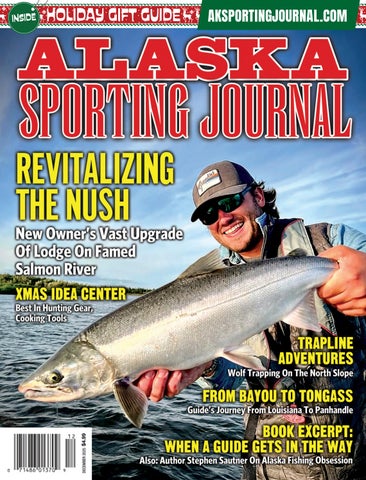
Bristol Bay’s Nushagak River Adventures is a go-to lodge for an epic fishing trip. Check out writer Tiffany Herrington’s story on page 39 about the evolution of a rustic tent camp to a “five-star in the bush” destination for anglers. (NUSHAGAK RIVER ADVENTURES)
CORRESPONDENCE
X @AKSportJourn Facebook.com/alaskasportingjournal aksportingjournal.com Email ccocoles@media-inc.com
GIFT IDEA?
HOW
ABOUT ‘FISH THE NUSH’
With the holiday season looming, if you’re looking for a dream gift idea for the angler(s) in your life, why not an Alaska fishing adventure of a lifetime? In a complete renovation, owner Pete von Jess turned a prime location with tents into a luxury fishing lodge, Nushagak River Adventures. Known by its guests as “Fish the Nush,” the lodge has become one of the state’s go-to destinations for epic salmon fishing and fly-out trout trips. Tiffany Herrington tells its story.
17 MY DAYS TRAPPING WOLVES IN THE ARCTIC
Our Scott Haugen has spent a lot of time in the Last Frontier’s most isolated and wild corners, including when he and wife Tiffany worked as teachers in Point Lay and Anaktuvuk Pass on the rugged North Slope. Wolf trapping was one of his obsessions then, and learning how to seek the lupine predators with a local legend was thrilling. Haugen recalls some of those memories.
22 THE BEST OF HUNTING, COOKING HOLIDAY SWAG
More gift options for the outdoorsmen and -women in your life, courtesy of our From Field to Fire tandem of Scott and Tiffany Haugen. First up, Scott follows up November’s fishing gear wish list with hunting must-haves, including a top-of-the-line field dressing knife, spotting scope and rain jacket. Meanwhile, Tiffany skips her usual awesome recipe of the month to spotlight essential tools to crush it in the kitchen or at camp. Happy holidays!
49
WHERE ‘EVERY CAST’ IS SPECIAL
Stephen Sautner is a self-confessed “fishing junkie – angling’s version of meth heads,” he says, and the New Jersey native’s expeditions to Alaska have only fueled his addiction. Sautner’s latest book, Every Cast: Chronicles of a Deeply Hooked Angler, includes a couple of his Last Frontier stories, and he shared an excerpt chronicling an annoying guide-client competition he and wife Mimi once endured. We also chatted with the author.
EDITOR’S NOTE
ANNAPOLIS, MARYLAND–I’ve always wanted to visit the United States Naval Academy, and that I was here a few days after celebrating Veterans Day made it that much more special.
In truth, I felt like I’d been here before, at least spiritually. My late father Stan, a Navy veteran who served during the Korean War, used to regale me with stories of his time working below deck on both a submarine repair ship and a minesweeper. And though I didn’t feel like I’d ever have the temperament to make it in the armed forces, I’d always been fascinated with having a life at sea.
One of the Navy movies he and I always watched together when I was a kid, The Enemy Below, featured a scene on the deck of a U.S. destroyer engaged in radio silence while it stalked a German U-boat. A cook, using a makeshift fishing rod with a piece of food from the galley as bait, tried to tempt a bite out of whatever else besides the sub lurked beneath the surface of the South Atlantic.
“Wow, Dad; could you go fishing in the Navy while on a warship? Cool!” I once asked him. He just laughed.
From then on, I always dreamed – probably unrealistically – that I could someday spend a summer on a fishing boat somewhere in an exotic location, sea sickness potential be damned. I had to settle for being obsessed with wetting a line throughout my childhood.
But on this wet and cool fall day along Maryland’s Chesapeake Bay on a sportsthemed vacation to Michigan, Virginia and the Washington, D.C., area, my buddy Chris and I headed to the Naval Academy to watch the Midshipmen play a college football game. It was a fabulous experience that I wish could have been with my father, a lifelong football fan.
I enjoyed everything that happened on that November Saturday, from taking a photo with the Navy mascot, Bill the Goat, to watching the players exit the buses and march into the stadium.
Later that morning, I walked solo along the Academy’s campus, strolled up Main Street in quaint downtown Annapolis and enjoyed a pregame beer at a local cafe/bar, and then, just in time for kickoff, found my seat in Navy-Marine Corps Memorial Stadium where Chris was already sitting, trying to stay warm.
We sat next to an older couple and they talked about their life together as a Navy family. The stadium itself is part of the pageantry. The facade separating the lower and upper decks depicts famous Navy/Marine Corps battles of the 20th century, including ones that defined critical U.S. military victories in World War II: Midway, Guadalcanal, Leyte Gulf, Iwo Jima.
After a thrilling game that saw Navy, having a very good season but still playing as nearly 10-point underdogs against nationally ranked South Florida, winning 41-38, we wanted to stick around a few minutes longer for another great tradition.
At game’s end, after the players exploded off the sideline to celebrate and shake hands with their opponents, they then ran over to the Brigade of Midshipmen seated just below us to sing their alma mater, “The Navy Blue and Gold.”
“So hoist our colors, hoist them high, And vow allegiance true, So long as sunset gilds the sky
Above the ocean blue ...
… BEAT ARMY!”
Unlike my pop, I became just another slacker civilian, a landlubber and a journalist who loved fishing and being on the water – just not for a career. But I’ll never forget his proud connection with the sea, and experiencing gameday in Annapolis is something I’ll cherish. -Chris Cocoles
The editor enjoyed a fall Saturday of college football and pageantry at the United States Naval Academy, something that had him feeling nostalgic for his late Navy
veteran dad. (CHRIS COCOLES)
A new lawsuit from the Alaska Wildlife Alliance and the Center for Biological Diversity aims to permanently ban an Alaska Board of Game program that lethally removed nearly 200 bears and wolves to improve the size of the Mulchatna Caribou Herd. (KARA LEWANDOWSKI/NATIONAL PARK SERVICE)
LAWSUIT CHALLENGES STATE’S CONTROVERSIAL PREDATOR CONTROL PROGRAM
The state of Alaska’s on-again, off-again plans to eradicate caribou predators like bears and wolves has been implemented, challenged, blocked, protested and now is the subject of a lawsuit.
In early November, two environmental groups, the Alaska Wildlife Alliance and the Center for Biological Diversity, filed litigation to permanently prevent the Alaska Board of Game from resuming its program, which would continue to kill predators in and around the Mulchatna Caribou Herd. The state’s longstanding position states its removal of bears and wolves is to prevent the further decline of the herd and increase the number of caribou.
But that has been disputed frequently in the last year, when opposition eventually resulted in a judicial ruling that the state’s killing of nearly 200 bears and wolves was unconstitutional.
“The Board of Game gave the Alaska Department of Fish and Game the authority to aerially shoot any bears of any age across 40,000 square miles until 2028, with no population data or cap on the number of bears killed,” Nicole Schmitt, executive director with the Alaska Wildlife Alliance, said in the press release announcing the lawsuit. “The southeast border of the gunning program is only 3 miles from Lake Clark National Preserve, 30 miles from Katmai National Park, 50 miles from McNeil and Brooks Falls, and goes all the way west to the borders of Togiak National Wildlife Refuge and the Yukon Delta National Wildlife Refuge, which means this program threatens bears who move across vast stretches of public lands.”
The Center for Biological Diversity, which has been opposed to the Board of Game’s intent from its roots in 2022, also voiced its opinion on the litigation in a press release.
“There’s no excuse for the state of Alaska to be gunning down bears from helicopters,” said Cooper Freeman, the organization’s Alaska director. “This is a disgraceful misuse of public resources and a betrayal of the trust Alaskans place in their wildlife managers. State officials should protect all of our wildlife for future generations, not flaunt their power by orchestrating the mass killing of iconic bears with no scientific basis. The Mulchatna bear-killing plan is an embarrassment, and it needs to end now.”
As of mid-November, the state hadn’t specifically commented on the actual suit, but in a statement to the Alaska Beacon, Alaska Department of Fish and Game commissioner Doug Vincent-Lang said, “ADFG is committed to all users of the herd in rebuilding this population, which has been identified as important for providing high levels of human consumption under state statute and regulation.”
AL ASKA BEAT
SOCIAL MEDIA POST OF THE MONTH
In addition to epic fishing, our friends at King Salmon Lodge (kingsalmonlodge .com) also offer some great bear viewing opportunities.
Air travel in the Last Frontier never lacks drama. Glad the plane made it down safely!
No, you’re not seeing double! Alaska identical twin dog mushers Anna (left) and Kristy Berington have competed in multiple Iditarod races under their kennel, known as Seeing Double Dog Sled Racing. (JULIA REDINGTON)
Kristy Berington visited Alaska in 2007 and met Dean Osmar, a legend among dog mushers and the 1984 Iditarod winner. He offered Kristy an opportunity to learn the competitive side of raising and racing sled dogs.
“When she got back down she said, ‘I got us a job in Alaska,’ and I was like, ‘OK, when are we leaving?’” twin sister Anna Berington says. “We packed up what we had. We landed in the right spot, so we were pretty lucky; I guess Alaska had always been calling us.”
Osmar is just one of several Berington mentors in the tight-clad dog musher community of Alaska. Veteran sledder Paul Gebhardt took Kristy under his wing and Anna trained with Osmar and Iditarod regular Scott Janssen.
They first settled down in Kasilof on the Kenai Peninsula. They have since moved to Knik, north of Anchorage. Where in summer they’ll work several odd jobs to pay the bills, their winter season is all about racing their dogs.
Under the tutelage of the Osmars, Gebhardts and Janssens, Anna and Kristy learned the little details and idiosyncrasies
THEY SAID IT BY THE NUMBERS
“
Percent gain in total number of salmon commercially harvested in Alaska in 2025 (194.8 million, up from 103.5 in 2024).
of the sport. Gebhardt would take them on long-distance overnight campout trips with the dogs into the Alaskan bush; it was a phenomenon the twins had never experienced before. Gebhardt went through his routine of preparing his team to get started again for a potential race situation, again giving Anna and Kate behind-the-scenes access to a true professional.
“You pick that up. By watching Paul on these camping trips and in mid-distance races, you think to yourself, ‘OK, that’s how he’s so fast at that,’ or ‘That’s how he saves so much time,’” Anna says. “So it really helps us get better at what we do.”
Kristy says Gebhardt offered valuable advice on how to properly care for these magnificent working dogs and preventing ailments that are part of the grind of sled dog racing (she’s won multiple veterinarian awards after several races).
“It takes years of experience to look at a dog and see that if the gait is off, that there’s something wrong, or if they’re not having a good day, that something is bothering them. You have to try and figure it out what is and give them the best treatment possible to get them back running again.” -Chris Cocoles
“It is outrageous that the Trump Administration is giving the public a mere seven days to comment on its environmental assessment for ConocoPhillips’ drilling and seismic plans. This land is our home. We demand that the Bureau of Land Management give us more time to voice our concerns and fully consider other options before allowing ConocoPhillips to destroy these special and irreplaceable areas.”
Ahtuangaruak,
locals.
–Rosemary
executive director of the conservation group Grandmothers Growing Goodness, on the BLM’s plans to drill around the Colville River and Teshekpuk Lake Special Areas, which provide subsistence resources for
Indigenous Adventure offers: Full/Half Day Trips
• Flyfishing
• Saltwater fishing
• Glacier tours
• Whalewatching
BOOKYOURTRIP TODA Y!
Keet’s Landing Lodge
• Fully customizable excursions
• 5 day stays for up to 6
• All inclusive
• Rustic luxury
Fish Camps
• Guided all-inclusive camps
• Remote cabin locations on world class rivers
• All inclusive
OUTDOOR CALENDAR
DECEMBER 1
■ Resident antlered bull moose season opens in Game Management Unit 9C (Alaska Peninsula; Naknek River drainage)
■ Resident antlered bull moose season opens in GMU 9E (Alaska Peninsula)
■ Caribou season opens in GMUs 14A and 14B (Mat-Su Valley)
■ Resident antlerless moose season opens in GMU 14A (Mat-Su Valley)
■ Moose season opens in GMU 14C (Joint Base ElmendorfRichardson Management Area and Birchwood Management Area)
■ Moose season opens in GMU 18 (Yukon-Kuskokwim Delta)
■ Resident moose season opens in GMU 20F (FairbanksCentral Tanana, Yukon River drainage downstream from but not including Hess Creek drainage and excluding Tanana River drainage)
■ Resident moose season opens in GMU 25B (Upper Yukon)
DECEMBER 13
■ Safari Club International Alaska Chapter Christmas Party, Anchorage Marriott, downtown (aksafariclub.org)
DECEMBER 15
■ Moose season opens in GMUs 9B and 9D (Alaska Peninsula)
■ Wolf trapping season ends in GMU 2 (Prince of Wales Island)
■ Last day to apply for 2026 draw hunt tags (deadline 5 p.m. Alaska Standard Time)
DECEMBER 31
■ Black and brown bear seasons end in multiple units
JANUARY 1
■ Still Cold Open ice fishing tournament, Big Lake (907-521-5777)
2026 ALASKA SPORTSMEN’S SHOWS
MARCH 6-8
■ Great Alaska Sportsman Show, Sullivan Arena, Anchorage (greatalaskasportsmanshow.com)
APRIL 17-19
■ Mat-Su Outdoorsman Show, Menard Center, Wasilla (matsuoutdoorsmanshow.com)
APRIL 24-26
■ Fairbanks Outdoor Show, Carlson Center (fairbanksevents.com/ fairbanksoutdoorshow)
For more information and season dates for Alaska hunts, go to adfg.alaska.gov/index.cfm?adfg=hunting.main.
Caribou hunting season in Mat-Su Valley sections of Game Management Units 14A and 14B opens on December 1. (MELISSA GABRIELSON/USFWS)
Cumberland’s Northwest Trappers Supply is your onestop trapping supply headquarters, featuring one of the largest inventories in the U.S. We are factory direct distributors on all brands of traps and equipment which allows us to offer competitive prices. Give us a try. Our fast, friendly service will keep you coming back.
We are the new home of “Trappers Hide Tanning Formula” in the bright orange bottle.
Retail & dealer inquiries are welcome.
If you are in the area, visit our store!
Place an order by phone, mail or on our website.
ALASKA ADVENTURES WITH THE ‘AMAGUQ’
TRAPPING WOLVES IN THE ARCTIC WAS ‘ONE OF THE GREATEST OUTDOOR CHALLENGES I’VE KNOWN’
BY SCOTT HAUGEN
Bouncing across the snow-covered tundra, our snowmachines sped over the moonscape land. Facing a brisk headwind in minus-45-degree temperatures made the ride painful and exhausting. Our full sleds fish-tailed behind as we crossed frozen rivers and creeks, heading south toward the treeline amid the Brooks Range.
What seemed an eternity took less than three hours. After traveling 50 miles from the village, the now late Ben Hopson Jr. and I found our starting point for the trapping season. Wolves were near, as evidenced by a large bull caribou that lay partially devoured in a creek bed.
THAT NOVEMBER DAY FOUND me in one of the most desolate corners of the globe, Arctic Alaska. The small Iñupiat village of Anaktuvuk Pass is located 110 miles north of the Arctic Circle, nestled in the heart of the Brooks Range Mountains. As schoolteachers, my wife Tiffany and I spent seven years living in Alaska’s North Slope Borough. It was one of the most magical, impactful times of our lives.
From 1990 to 1993 we lived in the tiny coastal village of Point Lay, then moved to Anaktuvuk Pass in the fall of 1993, where we stayed through 1997. During this time we carried out a subsistence hunting lifestyle in some of the most breathtaking country I’ve ever laid eyes on. Best of all, I was hunting, fishing and trapping with the Iñupiat people, just as I had always dreamed.
That first day of wolf trapping in 1993 found me with Hopson, who earned a reputation as one of the premier wolf trappers in all of Alaska. He traveled the state giving how-to talks on wolf trapping. His success took him around the world as part of international trapping committees.
The late Ben Hopson Jr., one of Alaska’s most accomplished wolf trappers, with the hide of a black wolf he caught in Anaktuvuk Pass in the mid-1990s. Author Scott Haugen is nostalgic about the trapping experiences he shared with Hopson. (SCOTT HAUGEN)
Hopson was a loner, gone for over a month at a time, running traplines extending over 200 miles and living off the land. Mind you, this was done in the dead of winter, on a snowmachine, often amid 24 hours of darkness and frequently in temperatures of minus 50 degrees.
In this desolate land there is no one to rely on for help, and rarely are people seen when afield. Traveling alone and covering so much land, Hopson would arrange for a bush plane or helicopter to drop 55-gallon drums of fuel along his predetermined route. The timing and location of these drops had to be precise, for if covered with snow or off target from the anticipated path of travel, the supply could go unseen.
During my years in the Arctic, I spent a great deal of time with Hopson while hunting, trapping and fishing. He taught me so much about navigating and surviving in the Arctic. He also taught me how to trap wolves, or the mighty amaguq, as the Iñupiat know it.
WHEN CARIBOU MIGRATE SOUTH through the Brooks Range, battle-worn bulls retreat into secluded creeks to recover from the rut. This is when wolves go on the hunt. It marks the onset of the trapping season.
Through the early-winter months wolves are wary, not yet reaching their desperate levels of requiring food. This is when locating a kill in a stream bed – be it
caribou, Dall sheep or moose – becomes the key sign wolves are working an area. As snow continues blanketing the tundra, foothold sets become shut down, making snares set in the willows more efficient.
Once a kill was found, wolf trails meandering through the willows were sought, with snares set. Wolves utilized the same trails, wearing down fluffy snow encompassing the tall willows, packing it down and making travel easier.
As winter progressed, food became tougher to come by and wolves began covering more territory. They abandoned the willow-strewn valleys and headed north to open country, seeking small herds of caribou that didn’t migrate. Here, snares were no longer an option. Foothold traps it was.
Trying to outsmart one of these massive canines in an environment so harsh, so flat and so wind-swept is one of the greatest outdoor challenges I’ve known. Simply keeping a set working in the unrelenting weather the Arctic constantly dishes out is a formidable task.
During my first winter trapping wolves with Hopson, we made our way up a small creek bed surrounded by tall willows. After an hour we turned around, heading out of the valley. I was surprised to find fresh wolf tracks already making their way down the center of our fresh snowmachine tracks. Hopson confirmed such behavior as common among wolves. I witnessed this many times over the years.
Trail-making to entice animals is nothing new to the world of trapping, but I was amazed to see intelligent wolves in the middle of the Arctic being fooled by such tactics. Setting traps along the edges of these new man-made trails was productive.
I quickly learned the importance of routinely checking foothold sets, since other wolves often ate them. About 25 percent of the wolves we caught were turned on and devoured by their own kind. Wolves lead a brutal life.
SURPRISINGLY LITTLE TRAPPING GEAR
is needed in the Arctic. The first time we readied our supplies, I was amazed at what little gear Hopson actually took. A pickax, gloves, scent, moss and traps – that was it.
One of the most important items in the trapping supplies, however, was hot water. Without hot water, trapping on the open tundra was incredibly difficult. On the open tundra, with our snowmachines parked 3 to 4 feet from us, Hopson began creating an open tundra set. Think dirthole set, minus the dirt and hole.
As I watched and learned, I thought to myself there was no way a wolf could be caught here. There was no sign of life as far as the eye could see on the flat, icy land. It felt like a game of chance.
Hopson created a trap bed 2 feet in diameter by clearing snow. After digging 18 inches through ice, sod and rock with
Caribou are the main food source of wolves in Alaska’s high Arctic. (SCOTT HAUGEN)
a pickax, the remnants were placed on a garbage bag and later discarded. The set began taking shape.
After filling the bottom of the hole with a few inches of snow, Hopson then poured water over it. Toting water saves valuable time, as fires don’t have to be built to melt snow on the spot. Finding wood to burn on the tundra is often impossible. The water we brought was no longer hot, but the jostling around on the sled kept it from freezing.
Hopson poured enough water into the hole to make a thick slush, then took the trap and coiled the end of the elongated, 4-foot chain into the hole. He stomped it down with his foot, compacting the chain into the ice. He covered that layer of ice
with another few inches of snow, adding more water and coiling another foot of chain into the slush, then stomped it down once again. Instantly, the hole began to freeze.
After coiling up the entire length of the trap chain, adding a gallon of water along with more snow, and tromping the ice and chain down tightly, the trap was secured. Hopson had caught hundreds of wolves using this approach.
Next, dried moss gathered earlier in the year was placed under the pan of the set trap. More dried moss was situated around the pan and jaws to keep snow from filling in and rendering the trap useless.
Hopson then spread a couple inches of snow over the set and swept it even, by
hand. Set aside when the hole was dug, a rock or hunk of frozen tundra was added as a backing. Hopson took a commercial bottle of lure from within his jacket, where he kept it warm, and spilled a bit onto the scent post. Though instantly freezing, the lure produced enough aroma to attract wolves for several days. No bait was used.
Hopson assured me that due to the extreme cold and dry air, human scent was not a concern with these sets. The gloves he used were not special, not treated in any way, and often came into contact with items other than traps.
OPEN TUNDRA SETS CAN take a while to produce, but patience and maintenance will pay off. They are a set requiring skill
Haugen with his snowmachine and loaded sled on the north side of the Brooks Range in 1995. (SCOTT HAUGEN)
It was too cold to skin wolves on the trapline, so they were brought back to the village to thaw out. Here, Haugen poses with two wolves in Anaktuvuk Pass, his home from 1993 to 1997. (SCOTT HAUGEN)
for trimming on hoods, sleeve holes and waistlines of traditional parkas. The fur greatly insulates against blowing snow and cold temperatures. Boot leggings and mittens are also crafted.
– and a little luck – to consistently produce. With a bit of extra effort, the sets usually yield wolves over time. The added maintenance was worth it, as back then we were getting upwards of $700 for a wolf hide. We caught many wolves over the next four years using this set.
Not only did Hopson and other Iñupiat trappers sell hides to furriers in Fairbanks and Anchorage, they also fashioned them into traditional clothing and artforms. The long hair on the back and shoulders of the wolf hides are excellent
Anaktuvuk Pass is also world-famous for its mask making. Some of the elder craftsmen and -women in the village have assembled masks that are displayed in museums around the world.
Made from scraped caribou hide, the faces of the masks take shape when stretched over carved wooden molds.
Wolves are strong and their feet big, requiring solid sets to hold them.
“I quickly learned the importance of routinely checking foothold sets, since other wolves often ate them,” Haugen writes.
(SCOTT HAUGEN)
Once dried, the hide is stained with liver to add color. The more blood, the darker the stain. The leather face is lined with eyebrows, eye lashes and, on the men, a beard. These furnishings are derived from caribou, muskox or grizzly bear. The face is often surrounded by long wolf hair. The finished product resembles an Iñupiat face surrounded by a parka ruff. Look closely at the tail of an Alaska Airlines jet and you’ll see what I’m talking about.
ON OPEN TUNDRA, WOLVES may cover 70 miles a day in search of food during the winter months. With packs ranging in size from two to 17, it was typically a matter of time before one visited our sets. An average of only about 100 wolves were killed each year across the entire North Slope back in the 1990s; their annual growth rate exceeded their mortality rate. Trapping marginally helped keep their numbers in check.
To live among the Iñupiat peoples of Alaska’s Arctic, learning to trap, hunt, fish and survive in one of the planet’s most harsh climates, took me back in time. I reveled in the opportunity to set foot in one of the most pristine wildernesses on earth, and do it with the Native people whose ancestors had been doing it for thousands of years. ASJ
Editor’s note: For signed copies of Scott and Tiffany Haugen’s best-selling book, Hunting The Alaskan High Arctic, visit scotthaugen.com. Follow Scott’s adventures on Instagram and Facebook.
ULTIMATE ALASKA HUNT!
Experience the thrill of big game hunting in Alaska’s untamed wilderness with Deltana Outfitters—Alaska’s premier guide service. Whether you’re after Brown Bear, Grizzly, or Moose, our expert guides lead unforgettable Spring and Fall hunts in the remote, pristine Alaska Peninsula and Western Alaska.
Adventure. Expertise. Results. That’s what we do—and Deltana does it best.
90% Success Rate! Average Moose: 64” Grizzlies: 7’6” - 8’6” Black Bears: 6’ - 7’ Brown Bears: 9’ - 10’
HOLIDAY GIFT IDEAS FOR ALASKA HUNTERS
BY SCOTT HAUGEN
When we lived on the North Slope in the 1990s, plus Hyder, Alaska, earlier this decade, we loved winter. It was a time to rest, catch up on sleep and dream of upcoming hunting and fishing adventures. It was also a time to shop.
Back in the early 1990s, catalogs were our lifeline to the outside world of hunting and fishing gear. Now we have the internet, making for easy, fun Christmas shopping. With that, here are some pieces of hunting gear I put to the test this fall –many in parts of Alaska. It’s stuff I’ll keep using because it works, and I like it.
BENCHMADE MEATCRAFTER AND MINI CLAYMORE OTF KNIVES
Benchmade’s quality steel and their knives’ ability to hold and regain an edge make them appealing to me. Enter their Meatcrafter. I broke down multiple deer and a bear in the field with this knife. I butchered several animals with it too. The fine trailing point made the blade easy to make precise cuts with, be it separating quarters, fileting backstraps and neck meat, or disarticulating muscle groups, including shanks. It’s sharp and smooth enough to cut perfect steaks. The Meatcrafter comes in three handle and three blade finish options.
Benchmade’s Mini Claymore OTF (Out The Front) is my personal carry knife. This double-action, low-profile knife is easy to operate with one hand, and durable so as to achieve countless tasks. It’s lightweight, holds firmly in any pocket and the Grivory handle makes for easy gripping when your hands are wet or covered in blood. I used this knife on multiple hunts last fall and it achieved numerous jobs, including field dressing and caping big game when in a pinch. Info: benchmade.com.
TOP-SHELF OUTDOOR
Happy holidays! Among author Scott Haugen’s gift recommendations for hunters are Benchmade’s Meatcrafter and Mini Claymore OTF knives, along with the new LifeStraw. They are Alaska tough, and presents any hunter would appreciate. (SCOTT HAUGEN)
OUTDOOR GEAR
NEW TOOLS TO CRUSH IT IN THE KITCHEN, AT CAMP
BY TIFFANY HAUGEN
This month isn’t about recipes; rather, let’s look at some great gift ideas for the holiday season. These are items I used throughout the year, inside, camping and on the back porch. They’re tools I enjoy and will keep using, and many I wish I would have had during our time living on the North Slope in the 1990s, where all the meat we ate was what we hunted and caught.
BENCHMADE 3 PIECE SET
For over 20 years, knives have been a big part of how I’ve made a living. From processing big game and chopping vegetables while creating hundreds of recipes for magazines, to more than a dozen cookbooks, quality knives have always been appreciated. Enter Benchmade’s 3 Piece Set, which includes an 8-inch chef, 6-inch utility and 4-inch paring knife. Each is crafted with polished, stainless-steel blades that feature extra-smooth edges, which not only increases their sharpness but also their ease of ability to regain an edge. The handle designs are comfortable, no matter how long or how tough your tasks may be.
If looking for a serious knife devoted to breaking down and butchering big game, check out Benchmade’s Meatcrafter. I wish I would have had this knife over 30 years ago when Scott got stranded in another village and left me with a moose and Dall sheep to butcher. Info: benchmade.com.
DURACELL 3,000 LUMENS SOLAR LANTERN
When camp-cooking in the dark, there’s no such thing as too much light. I’ve used
a lot of lanterns over the years, and the rechargeable Duracell 3,000 Lumens Solar Lantern is impressive, both in performance and price point. It’s bright beyond belief and makes chopping, slicing and handling hot items safer, and it works great outdoors as well as inside – think power outages and cooking in a dark house in the middle of winter.
This lantern is tough, weather-resistant and has a crazy-long runtime. It features multiple power options, including solar, rechargeable battery and Qi wireless charging, and it’s compatible with D batteries. Info: myproduct.duracelllights.com.
YETI FOOD JAR, FRENCH PRESS AND INSULATED FOOD BAG
Hot soup tastes better when you’re hunting or fishing and it’s cold and wet outside. This summer and fall I used both sizes of Yeti’s new Insulate Food Jars – 8 and 16 ounces – and loved them. Scott’s also been using them on multiple hunting and fishing trips. The double-walled vacuum insulation keeps food hot all morning – well past lunchtime. The twopiece lids mean no leaks or drips inside my backpack, and they’re easy to clean.
Yeti’s new French Press helped make mornings extra comfortable in camp. I like the 34-ounce model. It’s tough, features a DuraSip ceramic lining and double-wall vacuum insulation, and it makes great coffee.
On a summer trip to the coast I packed our lunch in the 3-liter version of Yeti’s Daytrip Insulated Lunch Box. It kept our egg salad sandwiches and freshly cut vegetables cool all day. I’ve used it many
“They’re tools I enjoy and will keep using, and many I wish I would have had during our time of living on the North Slope in the 1990s, where all the meat we ate was what we hunted and caught,” the author says of various gadgets serious sportsmen and -women should have. (TIFFANY HAUGEN)
times and in many places since. Because I was putting in so many miles on the road this year, I also got their Daytrip Insulated Lunch Bag. The magnetic closure made for easy access when one hand was full. The 6-liter model is perfect for two people, and with a little ice pack the food stayed cool all day. Info: yeti.com.
DEMERBOX DB1
I was tired of working in the garden and in camps with ear buds that prevented me from hearing others talk. And to properly keep track of our dogs, I looked for a sound system to fit my needs. I found it in the DemerBox DB1. This single-speaker model offers ample volume for personal entertainment, and I love the fact it’s built into a Pelican case, which equates to durability and being waterproof. In camp, being able to store my phone and truck keys inside the DB1 made keeping track of them easy and wor-
ry-free. It features a built-in USB port to charge phones and other accessories, which is a great bonus. Each charge equates to an impressive runtime, plus they’re made in the United States. Info: demerbox.com.
PAKA HOODIE, THERMAL BASE LAYER
Last year, Scott got a hoodie and thermal base layer from Paka. The thermal top and bottom have become his go-to base layer that he’s worn on hunting and fishing trips around the world. He liked the hoodie too, but our oldest son used it once and Scott hasn’t seen it since! Our son has worn that hoodie on multiple trips all over the world; he practically lives in it. Those were my excuses for getting one of each. On a camping trip last fall, the weather forecast was wrong. I was glad I had both the Paka lightweight hoodie and thermal base layer. They kept me warm all day
in the cool, windy conditions. The base layer was comfy in the sleeping bag on cold nights.
Paka apparel is crafted from 100-percent natural materials. The thermal tops and bottoms consist of 40-percent royal alpaca, 40-percent merino wool and 20-percent eucalyptus based tencel.
What I love about the base layer and lightweight hoodie is how they keep you warm when inactive, yet move moisture and prevent overheating when hiking. In addition to trying this apparel line, you must read the inspiring story behind this great product. Info: pakaapparel.com. With limited days of shopping until the holiday rush, these are some items worth a closer look. Have a joyous holiday and a happy New Year. ASJ
Editor’s note: For signed copies of Tiffany Haugen’s popular books, including Cooking Big Game, Cooking Game Birds and Cooking Seafood, visit scotthaugen.com.
LIFESTRAW GO SERIES STAINLESS-STEEL BOTTLE
I got the LifeStraw 24-ounce stainless-steel water filter bottle for a two-week trip to the Alaska Peninsula. I ended up using it on multiple big game and bird hunts throughout the West too. The double-wall-insulated, stainless-steel bottle keeps water cold all day, and the integrated two-stage filter removes bacteria, parasites, microplastics, silt, sand, chlorine and odors. The water always tasted good. Info: lifestraw.com.
JETBOIL FLASH 1.0-LITER FAST BOIL SYSTEM
It’s been over 15 years since I got my first Jetboil. When I saw the new Flash 1.0, I had to try it. The boasted fast boil time is for real, which made everyone happy in camp when the coffee was ready in a couple minutes – before they even rolled out of their sleeping bags. The turn and click igniter is a simple but much-appreciated luxury, as are the colored grip zones that make handling easy in low light conditions. The drink-through lid and heat indicator make it nice for making quick, hot drinks. The three locking points stepped up the
pot to burner connection, making it safe and easy to handle. Info: jetboil.johnson outdoors.com.
LEUPOLD BX-4 PRO GUIDE BINOCULARS AND SPOTTING SCOPE
The best Leupold binoculars I’ve used are the new BX-4 Pro Guide HD 10x42s. They’re incredibly lightweight, the eye cups stay put and are extremely comfortable, and the clarity of this glass ranks them up there with the elites. I spent countless hours looking through these in a 10x42, and put in a bit of time gazing through the 12x42s of the same model, which are just as impressive.
Their best spotting scope I’ve gotten behind is the SX-4 Pro Guide HD. I have the 15-45x65, and I have also used a buddy’s x85-millimeter model on a week-long deer hunt. I used the bino and spotter combination on many deer, bear and elk hunts this fall, sometimes looking through them up to six hours a day. When they say HD, they mean it. No eye fatigue, exceptional clarity and both performed well in rain, high winds, blowing
dust and when the sun was low on the horizon. Info: leupold.com.
THERMACELL E65 RECHARGABLE MOSQUITO REPELLER
Twenty years have passed since I first used a Thermacell repellent unit on the Nushagak River chasing king salmon. I got to test and help in their development, and did so for two years before they hit the market. Since then, I’ve used them throughout Alaska. I still use them, and the new E65 has me excited.
This version of the E65 is a rechargeable repeller that’s great for early-season camps. It takes only two hours to fully charge and runs for six and a half continuous hours, offering a 20-foot zone of protection. The repellent cartridge burns for 36 hours. The entire unit is airline travel-safe, as there is no butane cartridge like in previous models. It works great for mosquitos, no-see-ums and white socks. Info: thermacell.com.
SITKA DEW POINT RAIN GEAR
Sitka now has rain gear made to withstand the harsh demands of Alaska. I tested the new Dew Point Pro series in driving rain for hours and day after day in the Pacific Northwest. This is their toughest rain gear yet. The Dew Point Pro Pant offers ample legroom for layering. The reinforced knees are great for breaking down game and crawling on the ground. The bellowed pockets are a nice feature.
The design of the Dew Point Pro Jacket is long in the tail to maximize the shedding of rain, and the large hood is nice when layering and combating high winds. Uniquely designed pockets and zippers maximize space and temperature control. It’s easy to add too many layers under the Pro series, so go light if planning on hiking all day. Info: sitkagear.com.
There’s more good gear that I’ll try to highlight in future columns, but for now, take this shopping list and run with it. Admittedly, the items today are pricey, but each of these are built to last for years. Happy holidays and enjoy that winter shopping. ASJ
Editor’s note: For signed copies of Scott Haugen’s popular hunting and fishing books, visit scotthaugen@yahoo.com. Follow Scott on Instagram and Facebook.
Rugged, quality rain gear designed for layering and taking on the toughest conditions, even in Alaska – that’s what Sitka’s Dew Point Pro series achieves. (SCOTT HAUGEN)
The perfect gift for the hunter in your life!
Give them everything they need to turn their wild harvest into something unforgettable. Our Steak, Charcuterie, and Salumi kits are ideal gifts for hunters elevating their game meat this winter.
From searing venison to crafting game-forward boards or dry-curing salumi, these kits make the process as satisfying as the final bite.
Perfect for anyone who transforms wild game into something extraordinary. GIFT IDEAS
Shop complete kits and find the perfect gift fast—everything you need to elevate your next wild game!
FROM ONE SPORTSMAN’S PARADISE TO ANOTHER
NATIVE LOUISIANIAN FINDS NICHE AS ALASKA GUIDE IN BIO-RICH TONGASS
BY MARIAN GIANNULIS
Lucas Mullen didn’t expect to move to Alaska and make his living as a fly fishing and hunting guide and commercial fisherman, but when the opportunities to guide and fish the lands and waters of the Tongass National Forest –America’s largest and biggest
fish-producing forest – came knocking, he answered.
Originally from Baton Rouge, Louisiana, Mullen spent most of his childhood living in Salt Lake City, Utah, with frequent fishing and backpacking trips to Montana.
“I carried a fly rod before I probably should have,” Mullen says. “I remember getting so frustrated because the adults would always be catching fish, and I just hadn’t had
it figured out yet. But then there were a few moments when it all clicked.”
He’s been hooked ever since.
Mullen first came to Alaska at the age of 16 for a steelhead fishing trip.
“We didn’t see a fish or touch a fish,” he recalls. “But that was it. I had to come back, you know?”
Anyone who has spent time in Southeast Alaska can certainly attest to the draw to return to the largest remaining temperate rainforest in the world.
Lucas Mullen’s roots are in Louisiana and Utah, but he’s found his purpose in Alaska as a fishing and hunting guide. His hunting operation, Southeast Alaska Guiding, offers big game adventures. (LUCAS MULLEN)
HEADING NORTH FOR COMMERCIAL FISHING
His first opportunity to get back to Alaska was shortly thereafter. For the next three years, Mullen worked for his uncle as a commercial crabber based out of Petersburg. His love for Southeast Alaska grew as he spent his days crabbing through waters surrounded by old-growth rainforest and snow-capped mountains. Three years of seasonal employment led to a move to Juneau to attend the University of Alaska Southeast.
Mullen continued to work as a commercial fisherman while pursuing his degree. He’s worked off and on in the industry ever since. Over the years, Mullen experienced different commercial fishing methods – gill netting, power trolling and hand trolling, to name a few. The Southeast Alaska commercial fishing industry provided Mullen with many different good jobs over the years. The fishing industry makes up 8 percent of the region’s economy, and 30 percent of Alaska’s wild salmon harvest spawns and rears in the Tongass’ intact and healthy habitat.
Mullen co-owns a Southeast Alaska fishing outfitter service, Tongass on the Fly, highlighted by its floating lodge, the Sally Girl (LUCAS MULLEN)
“I carried a fly rod before I probably should have,” says Mullen, here with one of his two sons and a silver salmon caught on the fly. (LUCAS MULLEN)
GETTING BACK TO FLY FISHING ROOTS
Although commercial fishing equipped Mullen with valuable work experience and the opportunity to move to Alaska, it’s not where his heart is.
After graduating from college, Mullen spent time as a substitute teacher and wondered what to do next. He then got a job working as fly fishing guide with an outfit based out of Juneau. Fly fishing
has been a huge part of his life for as long as he can remember, and he finally had the opportunity to make a living off it as well.
That first guiding job led Mullen to where he is now.
Mullen and his business partner Kevin own Tongass on the Fly (tongassonthefly.com). They guide clients on multi-day trips based out of
a 45-foot charter vessel they use as a floating lodge.
Imagine waking up anchored in a remote part of the Tongass National Forest and launching a jet boat to run up a wild steelhead stream; spending the day catching steelhead with few, if any, other anglers around; and then returning to the boat in the evening, where you can set crab and shrimp pots, or catch some fresh fish for dinner. This is the experience Mullen and Tongass on the Fly offer clients.
TOURISM DRIVING LOCAL OPPORTUNITIES
World-class outdoor experiences like this one draw over a million visitors to the Tongass each year.
Mullen’s spring months are full of multi-day steelhead trips. Throughout the summer, he’ll guide day trips for salmon, Dolly Varden and cutthroat trout.
And that’s not all the guiding he has under his business belt.
Around the same time Mullen started working as a fly fishing guide, he also cut his teeth working as a big game hunting guide. Now, he co-owns Southeast Alaska Guiding (seaguiding .com) with his business partner Hans. They offer guided brown bear, black bear and mountain goat hunts throughout the spring and fall.
The tourism industry is the second largest driver of Southeast Alaska’s economy and the largest industry in the private sector. Mullen’s employment history represents the realities of so many Southeast Alaskans who make a living off wild lands and wild fish. Here, intact public lands and mature forests aren’t just a place to visit for outdoor recreation; they are the foundation of the region’s high-value fisheries, provide important wildlife habitat, draw visitors from all over the world and are essential to the local way of life.
KEEP THE FOREST WORKING FOR LOCALS
Mullen’s livelihood makes the most of the business opportunities made possible by productive and intact fish and wildlife habitat in the Tongass National Forest. He and his wife are able to raise their two sons in their
Moments like hoisting double Dolly Vardens with his son are part of what makes the permanent move to Alaska so worthwhile for Mullen. (LUCAS MULLEN)
Now raising a family in the Last Frontier, Mullen’s first trip to Alaska as a teenager would draw him back. “We didn’t see a fish or touch a fish,” he says of that initial expedition. “But that was it. I had to come back, you know?”
(LUCAS MULLEN)
beloved community of Petersburg because of these opportunities. That’s why Mullen is dedicated to maintaining the incredible natural resources that will power his guiding businesses for generations to come.
As a local business owner, Mullen stands with the majority of Southeast Alaskans and Americans who support maintaining the public lands and roadless forests that his family and businesses rely on. He is also a proponent of sustainable forest management policies that conserve and restore important habitat and are responsive to the priorities of local communities.
“It all comes down to habitat,” Mullen says. “And that means trying to keep it.” ASJ
Editor’s note: This story originally appeared on the Trout Unlimited This Land is your Land blog on the TU Alaska website. Marian Giannulis is the communications and engagement director for TU’s Alaska Program. Go to tu.org/project/alaska for more.
The LeeLock magnum Skeg #LMS-04 is made for Minnkota Instinct motors. It will drastically improve the steering performance and straight line travel of your bow-mounted motor. Not only does this Skeg improve your motor’s performance, it also makes it much more efficient. Your batteries will run longer on a charge. A LeeLock Skeg is a vital part of your trolling motor system. This oversized skeg is made of 5052 aluminum. The size is 8 3/4 inches high by 10 inches wide and it’s 3/16 inches thick. It comes with clear PVC coated stainless steel hose clamps. 360-380-1864 www.leelock.com
The Heavy-Duty Quick Change Base #QB-03 is like the standard Quick Change Base, but beefed up to provide a wider footprint. This provides a more secure mount. Like the standard Quick Change Base, the Heavy-Duty base allows you to easily and quickly switch between the #CRN-01 Columbia River Anchor Nest, any of the 3 Bow Mount Trolling Motor Mounts or the #BL-01 LeeLock Ladder. Simply remove the pin and slide an accessory out and slide another accessory in and replace the pin. The Heavy-Duty Quick Change base mounts to almost any power boat as long as the footprint fits on the bow area of the boat. It has 7 5/16 inch mounting holes. The Heavy-Duty Quick Change Base is handmade of aluminum. Go to LeeLock.com to order the Base alone or to add the CRN-01 Columbia River Quick Change Anchor Nest, the three Bow Mount Trolling Motor Mounts, or the LeeLock Ladder to your order.
LIGHTWEIGHT.
The lightest 200-hp four stroke on the market
2.8L displacement and Variable Camshaft
Timing give it the best power-to-weight ratio of any 200-hp four stroke
Nearly 120 pounds lighter than our four-stroke V6 F200
Show the water who’s boss with the F200 In-Line Four. Incredibly light, responsive and fuel efficient, it serves up plenty of muscle to handily propel a variety of boats. On top of that, its 50-amp alternator offers the power to add a range of electronics, and its 26-inch mounting centers and compatibility with either mechanical or digital controls give you the flexibility to easily upgrade your outboard or rigging. Experience legendary Yamaha reliability and the freedom of forward thinking, with the F200 In-Line Four. THE F200 IN-LINE FOUR.
Nushagak River Adventures combines great accommodations with the rugged beauty of Bristol Bay’s backcountry. And the fishing can be epic. (NUSHAGAK RIVER ADVENTURES)
FIVE STARS IN THE BRISTOL BAY BUSH
TRANSFORMING THE ‘PLYWOOD PALACE’ INTO TODAY’S NUSHAGAK RIVER ADVENTURES
BY TIFFANY HERRINGTON
For many anglers, the perfect gift doesn’t come wrapped in paper; it comes with a plane ticket north, the promise of cold water and the tug of a salmon on the line. In Alaska’s Bristol Bay region, where the Nushagak River winds through tundra and spruce before spilling into the sea, one lodge turns that gift into something unforgettable.
Nushagak River Adventures, known by its guests simply as “Fish the Nush,” has become a name synonymous with both adventure and comfort. It’s a rare blend of wild remoteness and refined hospitality. Its transformation from a collapsing camp into what guests now call “five-star in the bush” is the story of vision, perseverance and the people who have built their lives around the river.
A RIVER, A REBUILD, A VISION
Lodge owner Pete von Jess first arrived in Alaska in 2010, drawn north by the same curiosity that lures thousands of anglers every summer.
“We started fishing the Kenai,” he recalls, “but after a
few seasons the crowds and the lack of etiquette made the experience less enjoyable. My buddy and I started looking for something different – someplace quieter, wilder.”
Their search led them west to Bristol Bay and the Nushagak River, a place famed for its immense salmon runs and its distance from civilization.
Lodge owner Pete von
fell for the spectacular beauty of Alaska, and then bought a struggling lodge in Bristol Bay. “The Nushagak had everything we wanted – more fish, less pressure and the kind of raw, wild Alaska we’d hoped to find,” he says.
(NUSHAGAK RIVER ADVENTURES)
“The Nushagak had everything we wanted – more fish, less pressure and the kind of raw, wild Alaska we’d hoped to find,” he says.
At that time, Nushagak River Adventures was a modest but beloved operation. Locals nicknamed it “the plywood palace” – sturdier than the tent camps scattered along the river but far from luxurious. Pete and his friend fished there for three summers, forming friendships with the guides and staff. Then came a phone call that changed everything.
“In the fall of 2016, one of the guides called to tell me the camp was going into bankruptcy,” Pete says. “The staff wasn’t getting paid. I realized the only way to help them was to buy the lodge out of bankruptcy court.”
Within months, he became the new owner. What he’d taken on wasn’t just a struggling business; it was a total rebuild in one of the most logistically
challenging corners of the continent.
“It was overwhelming,” he admits. “Where do you start? You’re in a remote location with limited materials, no roads and a short building season. But the answer was: just start. One bite at a time.”
REBUILDING THE DREAM
Pete partnered with his brother-in-law, who was nearing retirement and ready for one last big project. Together, they began the work. In 2017, they cleared half the property, removing unsafe structures and hauling out debris by barge.
“We shipped three massive barge loads of trash to Dillingham’s landfill,” Pete recalls. “And then we started building.”
That first summer saw the completion of five new guest cabins. By fall, the old two-story lodge was gone and two more cabins had risen in its place. The process continued over four years, with every nail, beam
and walkway carefully planned to withstand Alaska’s extremes.
“The proudest moment came when we hosted some European clients,” Pete says. “They told us, ‘You’re fivestar in the bush.’ That’s when I knew we’d achieved what we set out to do.”
Today, guests arrive to find a cluster of cozy, insulated cabins tucked along the riverbank. Hot showers, comfortable beds and hearty breakfasts await each morning before the boats push off. Dinners – they are crafted by chef Chris Lee, a veteran of fine-dining kitchens and private lodges – are served in a communal dining room that feels equal parts wilderness outpost and boutique retreat.
“At the heart of every client’s desire is comfort,” Pete says. “Luxury might be a tall order in the bush, but there’s no reason anyone should be miserable on a fishing vacation.”
It’s that philosophy – simple but deeply
Jess
intentional – that has earned the lodge an impressive 65-percent return rate.
THE HEART OF HOSPITALITY
Behind the smooth operation is a small, tight-knit team that has turned this remote lodge into something personal. Karen Butler, who oversees communications and guest relations, says the focus is always on genuine care.
“We try to anticipate guests’ needs before they even arrive,” she explains. “It’s the small things, [like] remembering someone’s favorite wine, having extra layers ready when the weather turns. We want every person to feel like part of the family.”
That attention to detail extends to the kitchen. Chef Lee, who joined the lodge in 2018 after decades in the restaurant world, relishes the creative challenge of cooking gourmet meals hundreds of miles from the nearest road system.
“The logistics are mind-boggling,” he says with a laugh. “Every ingredient has to be planned weeks in advance. Food arrives by plane or barge, and weather
can change everything. You learn to have a backup for your backup.”
Despite the challenges, Lee takes pride in delivering what most guests never expect to find in such a remote place.
“It always amazes people when we bring out something like house-made ice cream,” he says. “That’s the fun part – going the extra mile.”
Karen agrees: “Chris’s meals rival what you’d find in a five-star hotel. Cuisine is key to the world-class experience our guests have here.”
GUIDES, GUESTS AND THE RIVER THAT CONNECTS THEM
While the lodge provides comfort for guests, it’s the river that delivers the magic. Few people know that better than Will Stolski, one of Nushagak River Adventures’ longtime guides.
“I was born into a fishing family,” he says. “My dad’s a guide too. I started guiding on the Kenai in my early 20s and came to the Nush a few years later. I’ve been with Fish the Nush ever since.”
For Will, the draw isn’t just the fishing; it’s the people.
“We’ve got an incredible team here, and I love spending time with our guests," he says. “Many of them come back year after year, and you really get to know them. You become part of their story.”
He recalls one guest in particular – an elderly angler from Germany named Willi who traveled alone each summer to chase silver salmon.
“He was in his late 80s,” Will says, smiling. “Every year, he made the journey across the world just to fish the Nush. I guided him for years. Even though his health keeps him from coming now, we still keep in touch. I hope when I’m his age I’m still fishing in Alaska.”
Stories like Willi’s capture what makes the Nushagak experience special: It’s not just about catching fish; it’s about connection, perseverance and joy.
“When choosing a lodge in Alaska, there’s a lot to consider,” Will says. “But here, we have it all – world-class fishing, excellent lodging and food, and a staff that truly cares. There’s a reason so many guests return.”
Chef Chris Lee creates the kind of meals for guests that you’d expect in a big-city bistro, not the Alaska backcountry, where you can’t exactly shop for ingredients on the fly. “Food arrives by plane or barge, and weather can change everything,” he says. “You learn to have a backup for your backup.” (NUSHAGAK RIVER ADVENTURES)
The establishment unofficially known as “Fish the Nush” features both rustic looks and “five-star in the bush” luxuries for its guests. “We want every person to feel like part of the family,” says Karen Butler, who handles the lodge’s communications and guest services. (NUSHAGAK RIVER ADVENTURES)
This past season, the lodge expanded its offerings to include fly-out trips for grayling, trout and char, adding diversity to its already renowned salmon fishery.
“It’s an amazing way to see more of Bristol Bay,” Will says. “Every flight reminds you how vast and untouched this place still is.”
A MISSION BEYOND FISHING
Pete von Jess’s vision for Nushagak River Adventures extends beyond hospitality. As a retired U.S. Army colonel and Green Beret, he brings a sense of service to everything he does. That commitment led to the creation
of Warrior Sportsmen Inc., a nonprofit dedicated to helping veterans heal through outdoor experiences.
“I started sponsoring wounded veterans even before I bought the lodge,” he says. “After I acquired it, we made it part of our mission.”
The program hosted combat-injured marines and later evolved to support U.S. Army Special Forces soldiers. In 2023, the organization merged with the Green Beret Foundation, expanding its reach.
“Never leave a fallen comrade behind is one of our values,” Pete says. “The corollary is to offer assistance when needed.”
That same principle of stewardship applies to the river itself. In 2019, the lodge launched its 40-Inch Club, recognizing anglers who release trophy salmon over 40 inches back into the water.
“For that act of good sportsmanship, they get their name on our 40-inch wall and a pewter salmon pin,” Pete explains. “It’s our way of encouraging conservation and honoring the fish that make this place special.”
He’s candid about his concerns for the fishery.
“We have to stay focused on protecting the kings,” he adds. “The [Alaska] Department of Fish and Game often prioritizes sockeye harvests, but we can’t lose sight of the species of concern. Our guests understand that; they care about the resource.”
GIVING THE GIFT OF THE NUSHAGAK
For many who come to Nushagak River Adventures, the experience begins as a bucket-list trip and ends as something deeper. It’s not just about catching limits; it’s about rediscovering simplicity, reconnecting with nature and stepping out of the noise of daily life.
“There might not be a better gift than a fishing or hunting trip, especially to Alaska,” Pete says. “It gets you out into nature, it’s relaxing and it keeps you grounded.”
Each summer, as floatplanes buzz overhead and boats drift downriver in the midnight sun, guests find themselves part of a rhythm older than time. Salmon surge upriver in astonishing numbers, bald eagles patrol the banks and the smell of woodsmoke mingles with grilled salmon in the evening air. When guests depart, Pete hopes they take more than photos.
“I want them to feel they got far more value than what they paid for,” he says. “That they remember the great hospitality and the people who made it happen.”
And they do. Guests often write back months later, recounting their favorite meals, a guide’s encouragement or the moment they landed the fish of a lifetime. For many, it becomes a tradition of a return to the Nush each year –sometimes with family, sometimes with friends – and always with gratitude.
The boats are always ready for a day on the famed Nushagak and its solid salmon fishery, and guests can also go on fly-out trips for trout, Arctic char and grayling. (NUSHAGAK RIVER ADVENTURES)
As the holidays approach and anglers everywhere dream of next summer’s waters, a trip to the Nushagak River may be the most meaningful holiday gift one could give. It’s a reminder of what truly matters: adventure, connection and time spent in the wild with people who care deeply about the experience they create.
In Pete von Jess’s words, “Genuine hospitality at every turn is our objective.” It’s a simple statement, but like the river itself, it runs deep. ASJ
Editor’s note: Looking for a holiday gift that won’t be forgotten? Treat the angler in your life to an Alaska fishing adventure on the Nushagak River. Visit fishthenush .com or call (907) 232-3474 to learn more. Tiffany Herrington is a Seattle-based writer.
“There might not be a better gift than a fishing or hunting trip, especially to Alaska,” von Jess says. “It gets you out into nature, it’s relaxing and it keeps you grounded.” (NUSHAGAK RIVER ADVENTURES)
Everyone is ready for a gourmet meal after a day on the water. (NUSHAGAK RIVER ADVENTURES)
‘A PILE OF FISH’ IN ALASKA
AUTHOR RECALLS FIRST LAST FRONTIER FISHING TRIP, CLASH WITH GUIDE
Longtime author and obsessed angler Stephen Sautner’s new book features two memorable Alaska journeys from his East Coast base, including a husband-and-wife fishing trip that was at times hijacked by their guide. (STEPHEN SAUTNER)
Essayist and avid angler Stephen Sautner’s fourth book is essentially a love story for an activity he can’t get enough of: fishing.
Raised in New Jersey by parents who didn’t exactly hand down an infatuation for rods, reels and fish to their next generation, Sautner learned how to love this sport on his own. Now he longs for the call of “fish on” all over the map, including Alaska, which he features prominently in his latest published work, Every Cast. It’s an ode to many of his favorite adventures, from his native states along the Eastern Seaboard – Long Island and the Catskill Mountains of New York, the Jersey Shore, brook trout-filled New Hampshire streams – to a pair of memorable trips to the Last Frontier,
“I think Every Cast is less about specific fish and destinations, but more about the universal passion that drives anglers or any outdoorsperson,” Sautner says. “The lures and flies may be different, and the species dissimilar, but the meaning behind why we put on our waders and make our casts is pretty universal.”
Sautner also wrote Fish On, Fish Off and A Cast in the Woods, and he edited Upriver and Downstream, a collection of outdoor columns from The New York Times
In this excerpt from his new book, Sautner recalls an Alaskan trip with his wife, Mimi, and the guide who rankled the author’s feathers more than once as they chased trout and salmon. The following is excerpted from Every Cast: Chronicles of a Deeply Hooked Angler, by Stephen Sautner and published by Lyons Press.
While Sautner and his wife Mimi were enjoying a classic Alaska fishing adventure, their guide “Big Joe” snuck around the bend to fish by himself. When he told Mimi of his multispecies catch, she said, “Wow, Joe, did you leave us any?” “Oh ... sure,” Joe stammered. “There’s still ... a ... a ... pile of fish out there ... a pile ...” (STEPHEN SAUTNER)
BY STEPHEN SAUTNER
Wow, did Big Joe love to fish! And was he good at it! Really good! He would beat you to the cast like a gunslinger outdrawing you with his six-shooter. While you were midway through a double haul, Big Joe would fire out a lure with his spinning rod that would land inches from a rolling silver salmon. A couple of turns and he would rear back with a mighty hook set. Then he’d turn to you and ask if you wanted to reel it in.
Here’s the problem: Big Joe was a fishing guide. Another problem: I had
just hired him for five days of fishing in Alaska.
Some anglers are “guide guys”; they wouldn’t dream of traveling anywhere exotic without booking a pro to take them around. I get that; it’s smart, but it’s not me. I prefer to work the problem on my own. That’s how I caught my first bonefish, tarpon and Atlantic salmon. Yes, there were steep learning curves involved and sometimes lots of frustration. But in the end, I hooked, fought and landed those fish myself, by God.
WHEN I STARTED RESEARCHING DIY
fishing for my first trip to Alaska, it sounded different. Much of what I read warned about Alaska’s limited road system and inevitable combat fishing. Images of rivers and streams overrun with anglers resembled opening day of trout season in New Jersey, except with snow-capped mountains in the background. If you decided to attempt a more adventurous wilderness experience and hike into the bush on your own, one bad decision and a grizzly bear would swat your ass into beef medallions. It seemed foolhardy
“There is nowhere else I have fished where everything feels so intact – fisheries that have remained largely unchanged and ecosystems still functioning exactly how they were meant to for millennia,” Sautner says of fishing in Alaska, while also acknowledging that many of these fisheries have been struggling in recent years. (STEPHEN SAUTNER)
not to hire a guide.
On the recommendation of a friend of a friend, my wife Mimi and I wound up choosing a fishing package on a big Alaskan river that boasted five species of salmon, plus enormous rainbows, char and grayling. It sounded perfect; our guide, Big Joe, would pick us up each day after breakfast in his boat, then whisk us away to unlimited boat and wade fishing in America’s last frontier. Before I booked the trip, I even had the all-important client-guide conversation where I explained that I wanted to catch my first-ever silver salmon on my fly rod. “No problem,” he told me over the phone.
We met Big Joe at the dock, and he lived up to his name, standing a good 6-feet-5 and weighing north of
AN AUTHOR’S FISHING OBSESSION
Alaska Sporting Journal editor Chris Cocoles caught up with author Stephen Sautner, who talked about fishing obsessions and Alaska adventures.
Chris Cocoles Great book, Stephen! This isn’t your first work, but it seems like this was a love story written for your love of fishing. What inspired this particular project?
Stephen Sautner So glad you enjoyed the book – my fourth one. I have been writing about fishing for more than 30 years – first for regional magazines, then graduating to national outlets like The New York Times. For this book, I realized I had accumulated a considerable archive of stories about everything from fly fishing for trout and salmon, to surf fishing for striped bass, to ice fishing for perch. And there were other new stories I wanted to tell. So, I gathered my favorite older essays and blended them with new stuff. I guess it’s like when a recording artist drops a “best of” album but includes new bonus tracks.
CC Tell me about what triggered your interest in fishing – it’s interesting that you dedicated your book to your “non-fishing” parents who gave you your first rod and reel at 16 years old.
SS I believe I was born hard-wired to fish. Even before I ever held a rod and reel, water drew me like a magnet. I always wanted to look below the surface and see what lived there. I guess it’s a latent hunting instinct that we all have, but for some of us, the pull is strong and unyielding. No one in my family fished; I am a self-taught angler. When my mom and dad gave me that rod and reel for my birthday, the addiction officially began.
CC Did you have an early moment on the water that really convinced you how much of an angler fanatic you were about to become?
SS When I was maybe 12 years old, my family rented a
rowboat at the New Jersey Shore to go crabbing. The guy at the dock told us that young bluefish – also called “snappers” – were also biting. We had no tackle, so he sold us a dropline with a hook and bobber along with some live minnows for bait. When we started fishing, I remember locking in on that bobber like a hawk staring down a rabbit hole. And then … the bobber plunged under the surface, and I caught a snapper. We wound up catching a dozen more and brought them home to eat. That was nearly 50 years ago, and I remember that day with so much joy like it was yesterday. I think many anglers have breakthrough moments like that.
CC I liked how you referred to obsessed fishers like yourself as “fishing junkies – angling’s version of meth heads.” There are a lot of us out there! Was there anything else in your life that you’ve been as passionate about as fishing?
SS In a word: No. I say that jokingly, but it really isn’t a joke. Just ask my family. Fishing remains the one constant in my life that brings me pure child-like joy, excitement and triumph, not to mention occasional pathos. I have been fishing pretty much nonstop since the early 1980s, and I still cannot sleep the night before a fishing trip – kind of like a perpetual 8-yearold on Christmas Eve. I feel very lucky to still have that thrill.
CC When you got there, either on the trip with Big Joe or in a future adventure, did you have an “only in Alaska” moment that makes that state so unique?
SS There is nowhere else I have fished where everything feels so intact – fisheries that have remained largely unchanged and ecosystems still functioning exactly how they were meant to for millennia. But I do acknowledge that there are real human impacts and not all Alaskan fisheries are in good shape. Still, when I’m fishing in Alaska, it sometimes feels like
250 pounds. Camo neoprene waders, military mustache and a well-worn Cabela’s baseball hat completed his burly Alaskan look.
He fired up the boat, and we took our seats. I noticed an arsenal of tackle already on board – several spinning rods and a fly rod or two. We had brought our own gear, so I assumed they must be backups just in case I splintered a rod on a big salmon.
Anticipation ran high as we motored downriver through blue-green waters. In the distance, snowy peaks from some faraway mountain range hung low on the horizon.
“We’re going to find a pile of fish,” Big Joe said over the outboard. Then he added for emphasis: “A pile of fish.”
The boat slowed, and we spotted a
few swirls from salmon that had just entered from saltwater. The boat, a 16foot aluminum deep-V, seemed tight for two fly anglers plus a guide, so Mimi opted to spinfish, casting a bright marabou jig from amidships. I took the bow and had just started stripping off fly line from my reel when I heard the whizz of another cast from the back of the boat. I turned around and saw Big Joe fishing.
Admittedly, I wasn’t all that versed in guide etiquette, but I did know one cardinal rule: a guide should never fish unless specifically invited by their clients. And even then, only for brief demonstration purposes, such as showing proper drift speed or line mending, or something else technical. This is for obvious reasons – namely, so
I’ve stepped back into another epoch, like I almost expect a woolly mammoth to come lumbering by when I’m casting.
CC What lessons can you share about that experience with Big Joe?
SS The story of Big Joe was largely about a communication problem. If I had been more clear with him before the trip, we would have avoided a lot of our issues. Of course, good communication goes both ways … In any case, I would recommend asking a lot of questions whenever you book a guide, and feel free to move on if you don’t get the answer you like. There are lots of guides and outfitters out there.
CC I also enjoyed the chapter on your fishing trip to waters around Prince William Sound with Jim Leedom and Dave Taft. Besides the silver salmon, you also targeted Dolly Varden, which don’t get as much love as the salmon and trout of Alaska. What was that like for you to fish for Dollies?
SS Back East in my home waters, our native char is the brook trout. A big one is perhaps 10 inches. Dollies, which are also char, remind me a lot or brook trout, except they routinely get much larger. So every time I hooked one, I felt like I was catching the brookie of a lifetime. And they are stunning fish –particularly colored-up males getting ready to spawn.
CC Speaking of Dollies, is part of the allure of Alaska how different your trips can be in terms of the scenery, the diversity of species that you can fish for?
SS When I fished the streams and rivers of Prince William Sound, I could break out my 8-weight and catch silvers until my arms hurt, with glaciers in the background, then retreat into the temperate rainforest – a wonderland of verdant green, where everything is covered in moss and lichen – and hook unlimited 20-inch Dollies on my trout rod. All in the same day. There is no other place like that on earth.
CC Is there an Alaska destination or fishing experience that you
the clients, not the guide, catch the fish. It should not bear repeating, but I will do so anyway – the guide is being paid to put clients on the fish, not catch the fish themselves.
Seconds later, this all became moot. “I got one!” Joe yelled. Yep, the very first salmon of our Alaskan adventure went to Big Joe. A few casts later, so did the second.
“Cast over there,” Joe excitedly said, clearly in the zone. “There’s a pile of fish.”
A silver rolled 30 feet off the boat. I picked up my line to make a cast, but before I could shoot the fly, Joe’s lure got there first. He hooked another salmon. And that’s when he turned to me and said: “You want to reel this one in?”
So utterly gobsmacked was I, and facing down the fact that I would spend
want to get back to pursue?
SS Though Big Joe managed to catch an 8-pound rainbow (while I was paying him to put me on fish), I did not. I would love to do that. I did get a taste of rainbows chasing sockeye smolts like pelagic tuna herding sardines. That was a thrill too. Also, I never went halibut fishing. And the wild steelhead of the Tongass sound amazing. Clearly, I need to get back there.
CC And is there another bucket-list location in North America or beyond that you absolutely want to get to someday?
SS I would like to cast dry flies for Atlantic salmon on a river where their numbers are not collapsing – a rarity nowadays.
CC You’re an East Coast guy but have fished all over the map. Is there another locale that you consider sacred, like so many outdoorsmen and -women think about Alaska?
SS Though I had never fished there, Gabon in Central Africa, where you can surfcast for giant tarpon with elephants and gorillas nearby, sounds like a truly sacred place. I had booked a trip to fish there in 2020, but then Covid hit and the world shut down. I need to get there soon.
CC Your wife Mimi accompanied you on the Alaska trip with Big Joe as your guide. Has it been special to experience some of these adventures with her?
SS Mimi loved all our trips to Alaska – particularly when we fished in Cordova on our own schedule, renting a car and just exploring. We still laugh about the time we got muscled out of a salmon hole by a grizzly on Alaganik Slough. I wrote about that in my second book, Fish On, Fish Off.
CC What advice do you have for those who are also addicted to fishing like you are? Is the cure to just keep fishing?!
SS I would tell anyone to pursue their passion – whether it’s fishing, rock climbing or quilting. That’s what makes life worth living. Except golf. I don’t get golf. CC
Team Sautner had paid good money to target Alaska’s famed fish, but as the author writes, “Yep, the very first salmon of our Alaskan adventure went to Big Joe. A few casts later, so did the second.” (RYAN HAGERTY/USFWS)
the next five days in a boat with him, and not sure I could answer my brawny, mustachioed fishing guide without screaming, “Are you f*cking kidding me???” I just swallowed and said, “No.” OK; some of you at this point may be saying, “What the hell is the matter with you – you should have said something. You’re paying him!” And you are right; looking back, there were probably lots of ways I could have approached Big Joe and told him – in the nicest of ways – to cut the sh*t. But I didn’t, and I have to live with that. Maybe it’s because I’m too much of a gentleman. Did I mention that Joe was a big and excitable fella?
LET’S GO BACK TO the scene continuing to unfold on the boat. After Joe’s third salmon, I had somehow twisted my fly line into a truly awful knot that forced me to pop off my spool and snake line in and out of the reel frame to untangle it. A long time passed without me making
a single cast. By now, the fishing slowed. Big Joe, perhaps bored from temporarily not catching fish, decided then – and only then – to ask if I needed help.
This time my answer was a louder and more emphatic “no.” Mimi looked at me, not fully understanding the nuclear war going on in my head. The rest of the day is admittedly a little fuzzy. I know we caught salmon – mostly pinks, which far outnumbered the silvers.
Back at our hotel, I sucked down Alaskan Ambers and hated on Big Joe.
The next day, Joe motored us up a slow tributary. We got out of the boat and hiked a few hundred yards through knee-deep water to a sluggish pool full of ambivalent silvers that wouldn’t hit. I noticed that Big Joe didn’t bring a rod –a tip-off that the fishing might not be so good here. After an hour of nothing, with the feeling that Joe might keep us here a while to kill some time, I asked him if he wouldn’t mind going back to the boat
to bring us our bug spray. The blackflies were pretty bad, I told him. He made it clear he did mind, stomping through the river like an angry giant. He came back with the bug spray. I thanked him and put it in my pocket. Maybe I would put it on later, I told him. I was playing passiveaggressive chess. Your move, Big Joe.
It took my wife, all 5 feet, 3 inches of her, to finally stand up to Big Joe. On day three, Joe motored us upriver and beached the boat above a long series of riffles and runs. He grabbed his own fly rod and, gesturing at the river, said, “Pile of fish out here.” Then he disappeared around the bend.
We fished for a while, catching a few more pinks and some char. I briefly hooked an enormous colored-up but out-of-season king salmon that went airborne and easily broke off. Eventually, Mimi waded around the bend where she found Big Joe resting on a rock.
“Catch any, Joe?” she asked.
Joe took in a deep, satisfied breath then proceeded to proudly list the dozens of fish he had just landed: grayling, char, silvers, pinks, even an 8-pound rainbow, which would have been the fish of the trip for either of us.
Mimi stood silent for a moment then said: “Wow, Joe, did you leave us any?”
“Oh ... sure,” Joe stammered. “There’s still ... a ... a ... pile of fish out there ... a pile ...”
Mimi walked away before he could finish.
After that, Joe became quiet, you might even say sullen. Defanged, he never made another cast. For the next two days, he put us on more fish, and we caught them. And I recall some genuine highlights: lovely grayling rising to mayflies in riffles, intercepting a 20-inch rainbow that was chasing down salmon smolts like a bonito.
But again, much of the trip has gotten fuzzy. For me, Big Joe could never recover from his original etiquette breach. It was like a loud fart at the beginning of a first date – no matter what happens afterward, no matter how good the meal may have been or how wonderful the movie you just saw, what you remember most is the stink.
ON THE LAST DAY, Joe drove us to the airport. I gave him his tip, which was not a dollar more than adequate, and we boarded our plane. Yeah, I know, but I don’t have it in me to be a crappy tipper or to stiff him outright. Call it a character flaw.
And as for Big Joe ... to paraphrase from the ending of one of my favorite movies, The Road Warrior: “That was the last we ever saw of him. He lives now ... only in my nightmares.”
Two years later, Mimi and I opted to take our chances on Alaska’s road system and found something far more practical than Big Joe – a beater rental car with a cracked windshield, leaky gas tank and a laminated piece of paper taped to the glove box that read: “Do not put salmon on the back seat.”
We parked the car at the end of a pitted dirt road and hiked along a boardwalk through some muskeg. It ended where a clearwater stream flowed into an estuary. Salmon rolled everywhere. We shared the spot with a few bald eagles and a lone seal, but no one else. And yeah, we caught a pile of fish. ASJ
Editor’s note: Order author Stephen Saunter’s book at amazon.com/Every-Cast-ChroniclesDeeply-Hooked/dp/1493092324.
In the end, Stephen and Mimi caught their share of silvers, but the experience with Big Joe led to some good advice for traveling anglers. “I would recommend asking a lot of questions whenever you book a guide, and feel free to move on if you don’t get the answer you like,” he tells us. “There are lots of guides and outfitters out there.” (LISA HUPP/USFWS)
Michlitch Company spokanespice.com
Michlitch
MarDon Resort mardonresort.com
Black Hills Ammunitionblack-hills.com
The M1200 cartridge chambered in 6.5 Creedmoor is the designated ammunition for the US military’s MRGG-S (Mid-Range Gas Gun-Sniper) weapon system.
The Black Hills M1200-C (Commercial) version features a 140-grain OTM projectile loaded to 2,750 feet per second from a 22-inch barrel. The match primers are staked securely in the primer pocket to ensure flawless performance during suppressed semiauto fire. The propellant is selected for temperature stability to ensure reliability and avoid velocity variation in extreme environments. When accuracy, reliability and long-range external ballistics are required, the M1200-C from Black Hills is the answer.
Hi-Point Firearms hi-pointfirearms.com
Hi-Point Firearms offers some of the best value-pricedfirearms,andthe995,1095P and4595Pfitperfectlyintothatposition. Builtaspistols,thesefirearmsaremore compactthanthecarbinecounterparts andaddmoreversatilityinasmaller size,whileofferingthesamelegendary reliabilityandaccuracy.Multiple configurationsareavailable–findyours todayonthewebsiteabove.
HOLIDAY GIFT GUIDE
PursuitUp pursuituptv.com
MT E.L.K., Inc. elkinc.com
Make this Christmas legendary with MT E.L.K., Inc. hunting call packages! Searching for the perfect gift for the hunter who has it all? Look no further – the Christmas hunting call packages from MT E.L.K., Inc. bring the thrill of the wild right to their stocking! From the electrifying bugles of elk to the heart-pounding chase of antelope, deer and predators – there’s a call for every season and every hunter. Hand-selected, field-proven and full of holiday spirit, these gift sets are built to inspire. Order now and give the gift of adrenaline, adventure and unforgettable hunts this holiday season!
Tim’s Special Cut Meats
timsspecialcutmeats.com All the holiday fixins! Prime rib, tenderloin, steaks, turkeys, hams and more. Also offering gift certificates and freezer meat packages. Great gifts for the hard- to-shop-for person on your list!
Hunting and fishing processing equipment. Alaska Butcher Equipment & Supply has all you need to process your own hunt or catch! Local and family-owned.
PursuitUp is a premium on-demand streaming app built for outdoor enthusiasts. Watch your favorite hunting, fishing and adventure shows anytime, anywhere. For just $4.99/month or $49.99/year, enjoy unlimited access to exclusive content from the Pursuit Channel and top outdoor producers. Start your one-month free trial today –cancel anytime. Stream on your phone, tablet or smart TV and take the outdoors with you wherever you go.
Boat Insurance Agency
boatinsurance.net
The Boat Insurance Agency is an independent agency representing the best marine insurance companies. They carefully compare a number of policies to find the lowest premiums and best values for your boat insurance needs. Boat Insurance Agency is owned and operated by Northwest boaters. They have the local knowledge needed to understand boating in the West, along with your special needs. Contact them for an insurance quote and to learn more about the value and service they can offer.
All Rivers & Saltwater Charters
allwashingtonfishing.com
All Rivers & Saltwater Charters provides you the highest quality experience. From avid anglers to first-time fishermen, they always strive to improve your skill and technique. Whether you’re fishing in Seattle, Westport or anywhere in between, you can expect the highest quality service, boats and equipment.
Nomar nomaralaska.com
The Nomar boat bag is a versatile splash-proof bag to tote your gear to the boat, to the beach or wherever a tough, heavy-duty bag is required. The top zips closed to protect its contents. Features heavy-duty carry handles and D-rings on the side to add a carry strap. Measures 15 inches by 10 inches by 15 inches. Available in lots of colors.
The Lodge at Otter Cove lodgeottercove.com
Give someone special the gift of an Alaskan adventure! The Lodge at Otter Cove’s all-inclusive three-day, fournight package includes three guided adventures, your accommodations, and all of your meals. Book before Christmas and receive 2025 pricing! Check out the website above or give Joe a call at 907-299-6450 for details.
Exquisiteknives.com exquisiteknives.com
Exquisiteknives.comisoneoftheleadersinhighend custom knives. Dave Ellis, owner and American BladesmithSocietymastersmith,isalifelongcollector and sells some of the rarest and most beautiful piecesofedgedartknowntoman.Withnames like Bob Loveless, Bill Moran and MichaelWalker, Exquisiteknives.com’scarefullycuratedcollection meetstheneedsofanytop-endknifeaficionado.With friendshipswithtopartistsworldwide,Daveisableto procurethosedifficultandrareknives. PicturedisanamazingFoldingArtKnifeby Wolfe Loerchner.
(RICARDO VELARDE)
•
LeeLock Anchor Systems leelock.com
The perfect gift for the serious angler!
The LeeLock Magnum Skeg #LMS-04 is made specifically for Minn Kota Quest motors, boosting steering control, straight-line tracking and overall efficiency. Give the gift of longer battery life and better on-thewater performance this season! Ideal for anglers running bow-mounted Quest motors. (Check out #LMS-01, #LMS-02 and #LMS-03 for other models.)
Make their fishing trips smoother, smarter and more enjoyable – a Magnum Skeg belongs under every tree!
Kodiak Predator Adventures
907-513-5131
Early 2026 booking discount when booked before December 31, 2025, for any available 2026 dates. An entire day of offshore fishing for up to six people is $2,000. (Private boat for your group, drinks, light snacks and coffee included.)
Back 30 Outfitters back30outfitters.com
Coastal Marine Engine
For a limited time, Back 30 Outfitters is offering discounts on their whitetail hunts for the 2026 hunting season. Located in Northcentral Idaho, all their hunts include food, beautiful lodging and guaranteed outfitter tags. Spot and stalk/glassing/stands. Normally priced at $4,500 for five days, the discounted price is $3,500 per hunter or $3,000 each for two-plus hunters. Can also upgrade your hunt to an elk/deer combo hunt! Cheaper options for semi-guided are available. Call 208-301-7050 or visit the website for more information.
Black Star Fishingblackstarfishing.com
Black Star Fishing Co. is a premier guide service specializing in salmon and steelhead fishing on the finest rivers in the Northwest. Spend adayonthewaterusingtop-of-the-line gear,aboardacomfortableboat,andledby afriendly,knowledgeableguidededicatedto makingyourfishingexperienceunforgettable. Now booking winter steelhead trips for 2025 and 2026. Gift certificates available!
coastalmarineengine.com
Receive 10 percent off labor on any scheduled maintenance between January 2nd and February 28th. Please use the discount code NWSM2026 when booking your service.
PrOlix prolixlubricant.com
HOLIDAY GIFT GUIDE
PrOlix is a penetrating solvent/dry lube product that was lab-developed and tested by law enforcement, military and commercial shooters over many years.
The citrus-based biodegradable cleaner, pioneered in 1995, is the first successful“all in one”gun care product, now deemed“Bio-Technology.”Their recyclable (strain and reuse) products are made of 89 percent or greater renewable resources, a true commitment to sustainable practices and caring for the environment. As such, the USDA has listed PrOlix as a BioPreferred Product since 2012.
The solvent“goes on wet, cleans, bonds, and the lube turns dry to the touch.”It removes carbon, copper, lead, shotgun plastic residues and black powder. PrOlix will not damage wood, freeze or flash off, and it can be used for commercial and industrial applications as well.
To complement the PrOlix Cleaner/Lubricant (Dry Tech) line, shooters can use the equally superior“gun-oil and grease replacer”PrOlix Xtra-T Lube for a total care product.
Give the gift of adventure on the Oregon Coast! A deep-sea fishing or crabbing trip in Newport is the perfect present for experienced anglers and beginners alike. Gift certificates can be used for exciting trips targeting rockfish, halibut, albacore tuna, salmon and Dungeness crab. Buy online for instant email delivery or order easily by phone.Treat someone special to an unforgettable day on the Pacific! Call 541-265-6800.
OffGrid
offgrid.co
OffGrid creates premium signal-blocking gear designed to protect your digital privacy and security. From Faraday bags to backpacks, every product is engineered to shield your devices from a wide range of invasive signals, keeping your data and location safe wherever you go. Built for modern travelers, tech users and privacyconscious individuals who value security without compromising on style.
The UltiMAK AK optic mounting system is legendary for its rock-solid stability, and for offering the lowest rail height which allows for co-witnessing with some optics. There are several models to cover a wide variety of AK types and configurations. Featured here is the model M2-B, which is the most versatile of their AK mounts. If you have a standard-length, standard-barrel AKM, with or without a ported gas chamber, then your AK can use the UltiMAK M2-B. Update your AK to the 21st century with an UltiMAK mount and a quality red dot sight. UltiMAK also supports: M1 Garand, M14/M1A, Mini-14 and 30, and M1 .30 Carbine.
Meadow Creek Mountsmeadowcreekmounts.com
Meadow Creek Mounts makes red dot mounts for shotguns that clamp to the rib so that you don’t have to drill and tap your shotgun. Their mounts get your optic placed at the ideal distance to deliver an excellent natural field of view. By using an optic out on the rib, you’ll acquire the target more quickly and can easily shoot with both eyes open. The ease of installation will have you at the range or in the field in minutes.
Whistling Moon Press whistlingmoonpress.com
What can a young boy possibly do when a moose follows him home? The main character’s attempts to hide, disguise and keep his new pet quiet are creative and fun! Quirky illustrations bring this unique story to life as it answers the question: “What do you do with a moose?”
Written and illustrated by Jo Hudson. Perfect for kids ages 2-8 and a great gift for any occasion! Order online.
Izzi’s Big Mouth Guide Serviceizzisbigmouthguideservice.com
Give the gift of adventure! Gift certificates are now available – the perfect holiday surprise for the angler in your life! Crabbing runs year-round, so book your trip now online or by phone. Plan ahead and reserve your 2026 fishing adventures for spring Chinook, summer ocean coho and Chinook, bottomfishing, or combo trips that include it all – salmon, bottomfish and crabbing in one action-packed day! Plus, their new boat arrives in 2026, just in time for tuna trips starting in August! Don’t miss out – book today and make unforgettable memories on the water! Call 503-812-1264 for more information.
This season, give the gift of an experience and memories that last a lifetime with Rocky Mountain Elk Ranch. Choose a three-day private hunt for either elk or bison. With meals, lodging and guide service included and a guaranteed trophy, you can’t go wrong. Scheduling is easy, as they take care of all the details so you don’t have to. Each hunter can also bring a non-hunting guest for free. So check off that bucket list, get your trophy, and fill the freezer. It’s the perfect gift for the hard-to-buy-for.
Sauvie Island Duck Club siducks.com
Buy a day hunt before the season ends! Located in the heart of Sauvie Island, 10 miles northwest of Portland and nestled along the Pacific Flyway, Sauvie Island Duck Club is prime duck and goose hunting real estate. The private hunting club is close to one of the largest state-run bird refuges offering waterfowl hunting.
Bear Trail Lodge beartraillodge.com
This holiday season, give something that lasts longer than the wrapping paper – give the gift of experience. Every sunrise over the river, every cast and every shared moment becomes a lasting memory. Treat someone special to the adventure of a lifetime where nature, connection and wonder meet. Join Bear Trail Lodge on the renowned Naknek River to have the Alaskan fishing experience we’ve all dreamt about.