MIN WOO KANG
Portfolio 2017-2026 Selected Works
Bachelor of Architecture at Hanyang University, Major in Architecture. Hanyang University Graduate School, Master in Design Study
C.P(US) : +1 215-292-4719
E-mail : kangjuho0629@gmail.com
Portfolio 2017-2026 Selected Works
Bachelor of Architecture at Hanyang University, Major in Architecture. Hanyang University Graduate School, Master in Design Study
C.P(US) : +1 215-292-4719
E-mail : kangjuho0629@gmail.com
For me, architecture is an ongoing conversation between people, cities, materials, and time. It responds to social and cultural change while creating new possibilities for how we live, gather, and remember.
My work explores architecture as a way to connect fragmented conditions, reinterpret existing systems, and create spaces rooted in community experience. Through this approach, architecture becomes a bridge between past, present, and future.
An Archaeological Apparatus to Bridge the Timelines of Side
Academic Work(2026 Spring Semester), Team Work
Museum, Research Center
University of Pennsylvania, Weitzman School of Design
Advanced Architectural Design Studio
Ferda Kolatan
Jorge Couso
Minwoo Kang(me), Lihui Tony Wang
Stereotomy Research, Site Strategy, Concept Design,Physical Model(For Large Scale Model),
Exterior and Interior Rendering
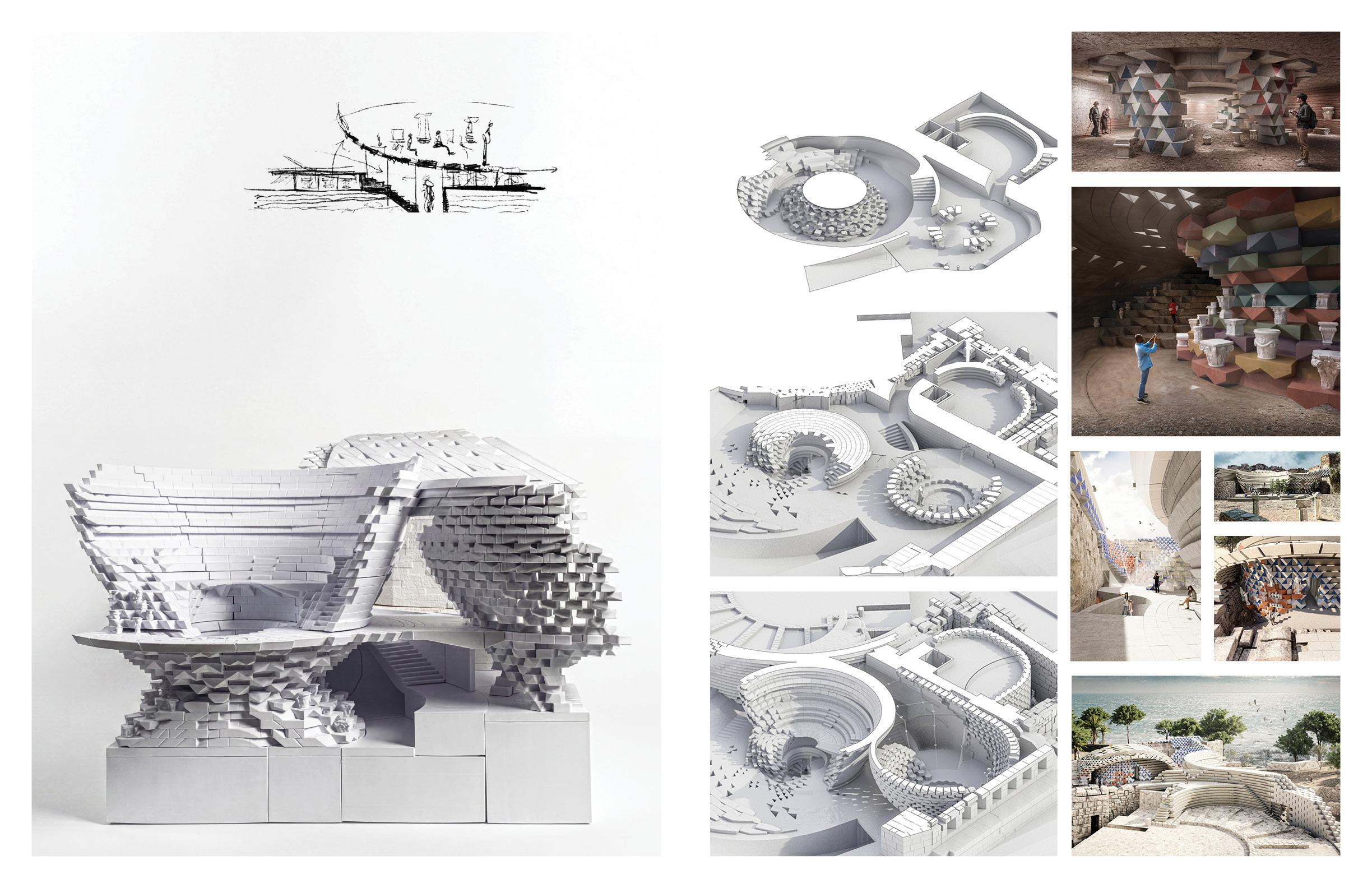
Originally, the site was composed of independent civic spaces, such as the baths, the bouleuterion, and the amphitheater. Over time, as the city needed to defend itself from inland threats, these separate structures were connected by a continuous fortification wall.
In this transformation, the wall became a hinge. It did not simply separate inside and outside. It linked different programs, redirected movement, and turned independent public spaces into one connected urban system.
Our project begins from this historical condition of the wall as a hinge: a defensive edge that also connects, organizes, and activates the ruins.
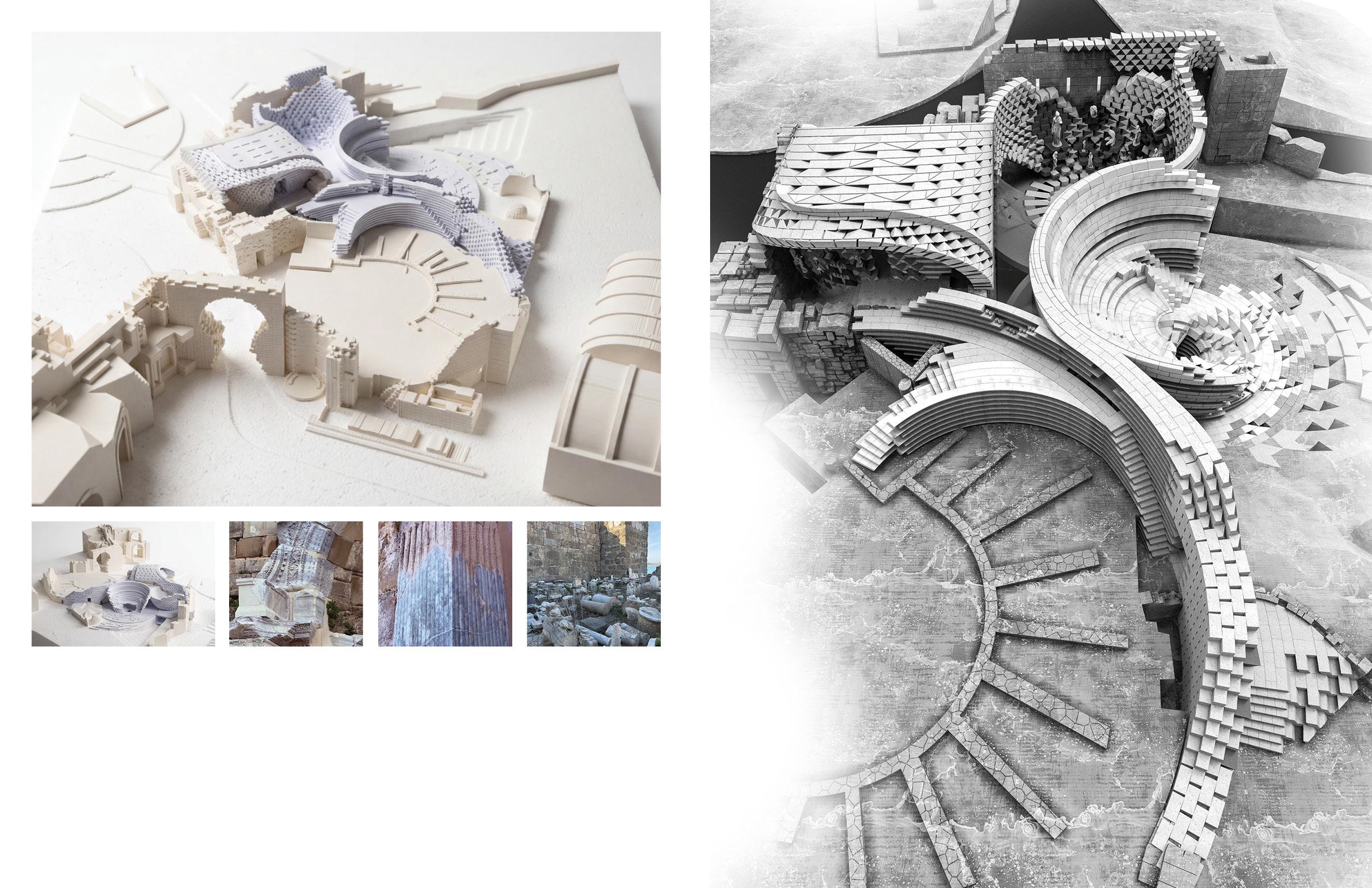
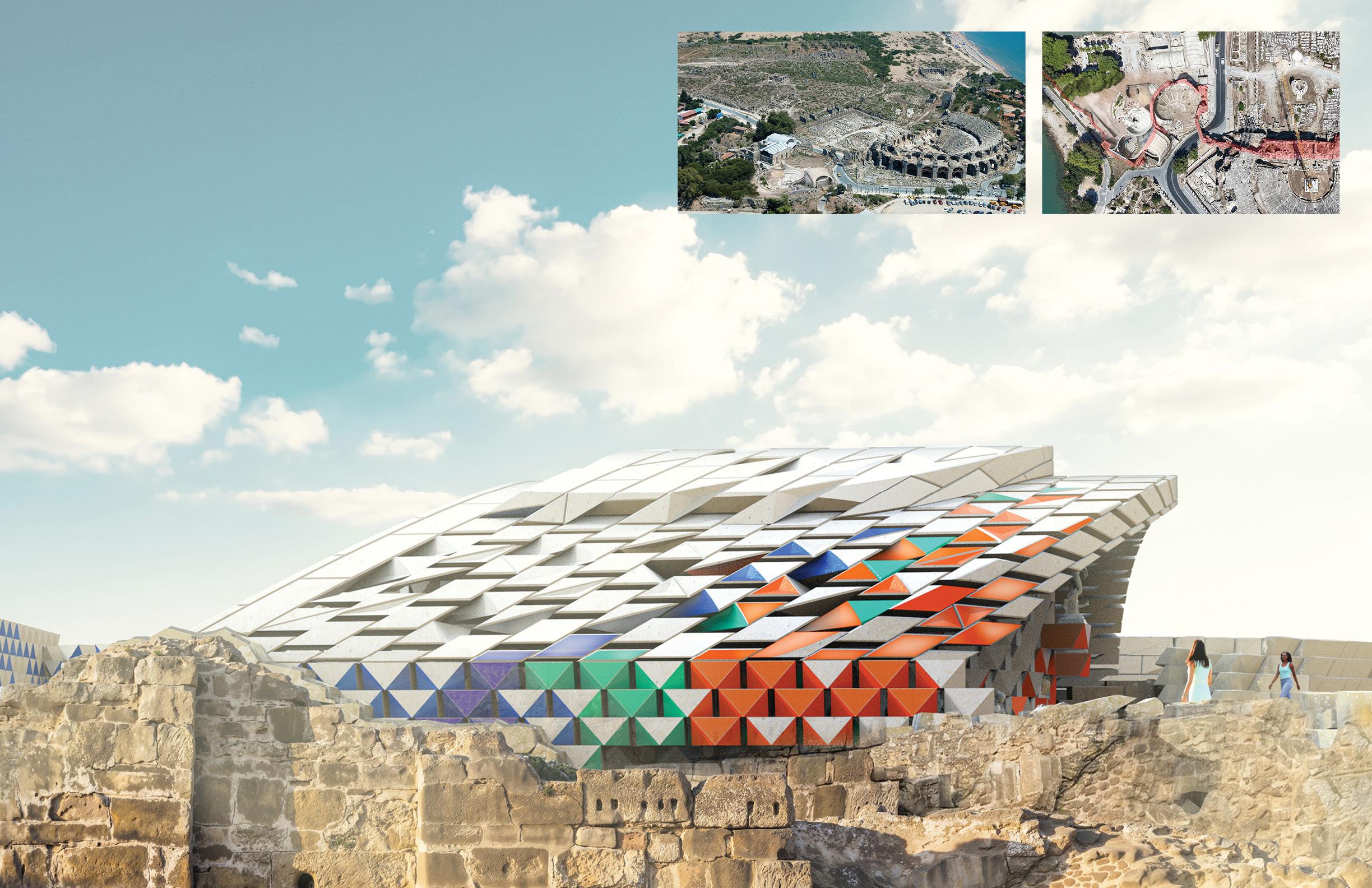
The project treats the ruin as a ground for hybridization. New stereotomic systems are layered onto the existing wall, merging ancient remains with contemporary architectural techniques. Like a chimera, the project becomes one body made from different parts: wall, roof, ruin, structure, and carved spatial details.
This hybrid body is not fixed. Its surfaces and spatial flows begin to delaminate, extending outward as new architectural layers. These layers nest within the existing ruins, creating new relationships between old and new, solid and void, movement and occupation.
The geometry follows and transforms the curve of the bouleuterion. As this curve extends into the city, it becomes a guiding path that draws people into the archaeological field. Through this process of delamination and nesting, the museum becomes both an extension of the ruin and a new spatial possibility within it.
The detail strategy begins with the fragmented condition of the ruins. Instead of using brick as a flat surface, the project cuts, rotates, and stacks brick modules to create depth, gaps, openings, and display surfaces. Inspired by the unfinished texture of the archaeological remains and the circular masonry logic of the bouleuterion, the brick system becomes a small-scale tectonic language for the project.
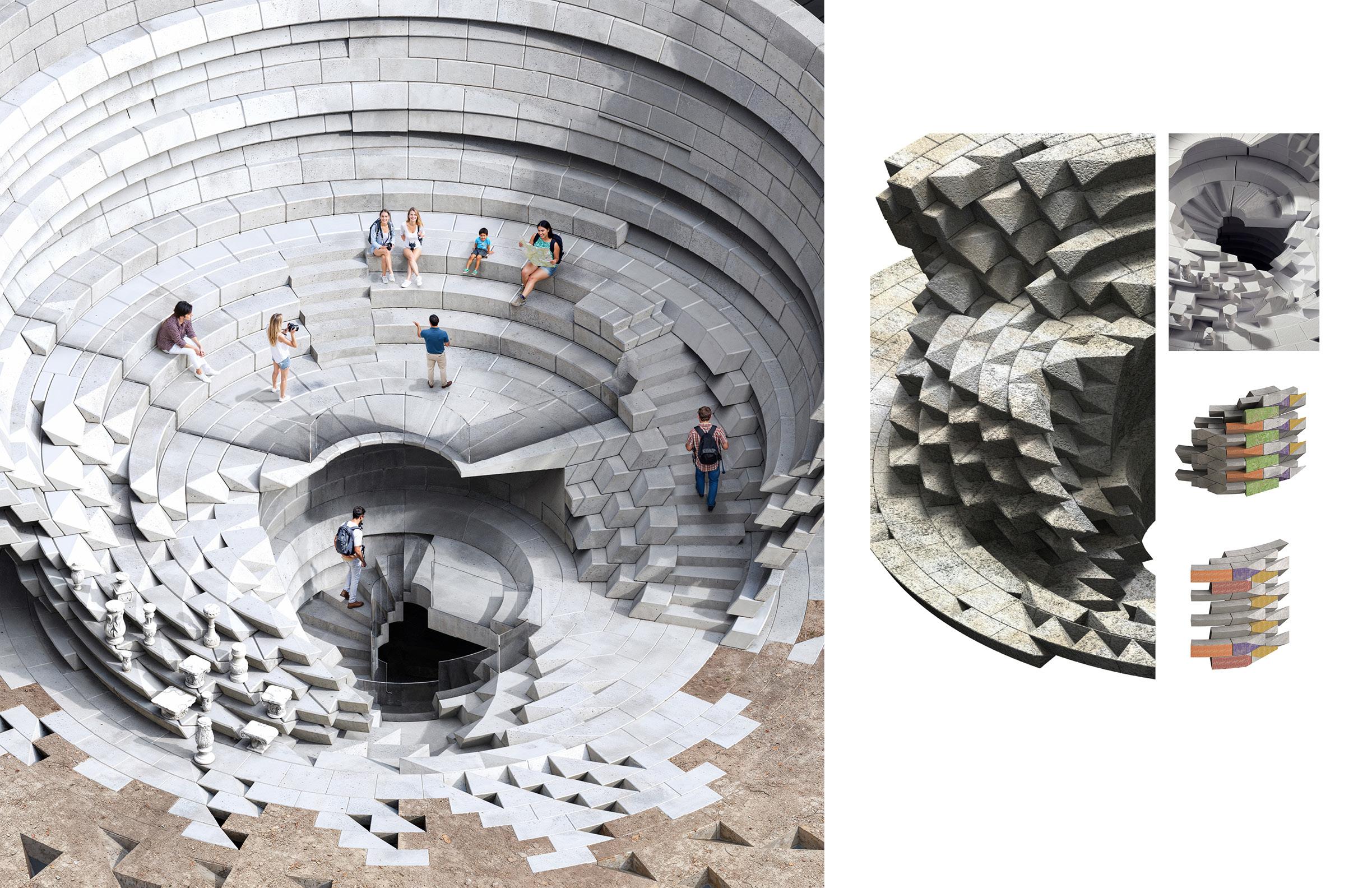
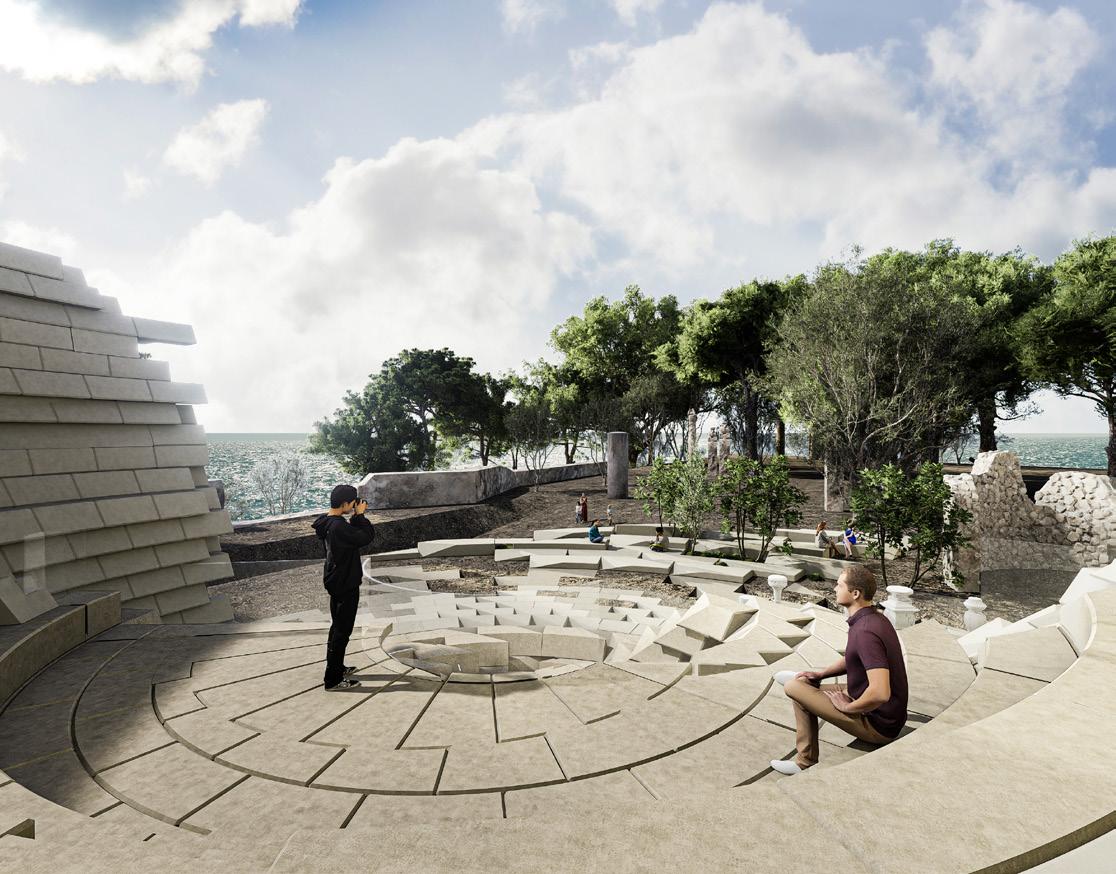
The outdoor auditorium transforms the cut brick system into a public space for gathering, rest, and education. Its stepped geometry creates seating and a small stage, while opening views toward the Mediterranean landscape of Side. At the same time, fragmented brick surfaces hold small artifacts along the exterior path. These cuts and steps guide visitors inward and downward, gradually pulling them toward the underground exhibition spaces.
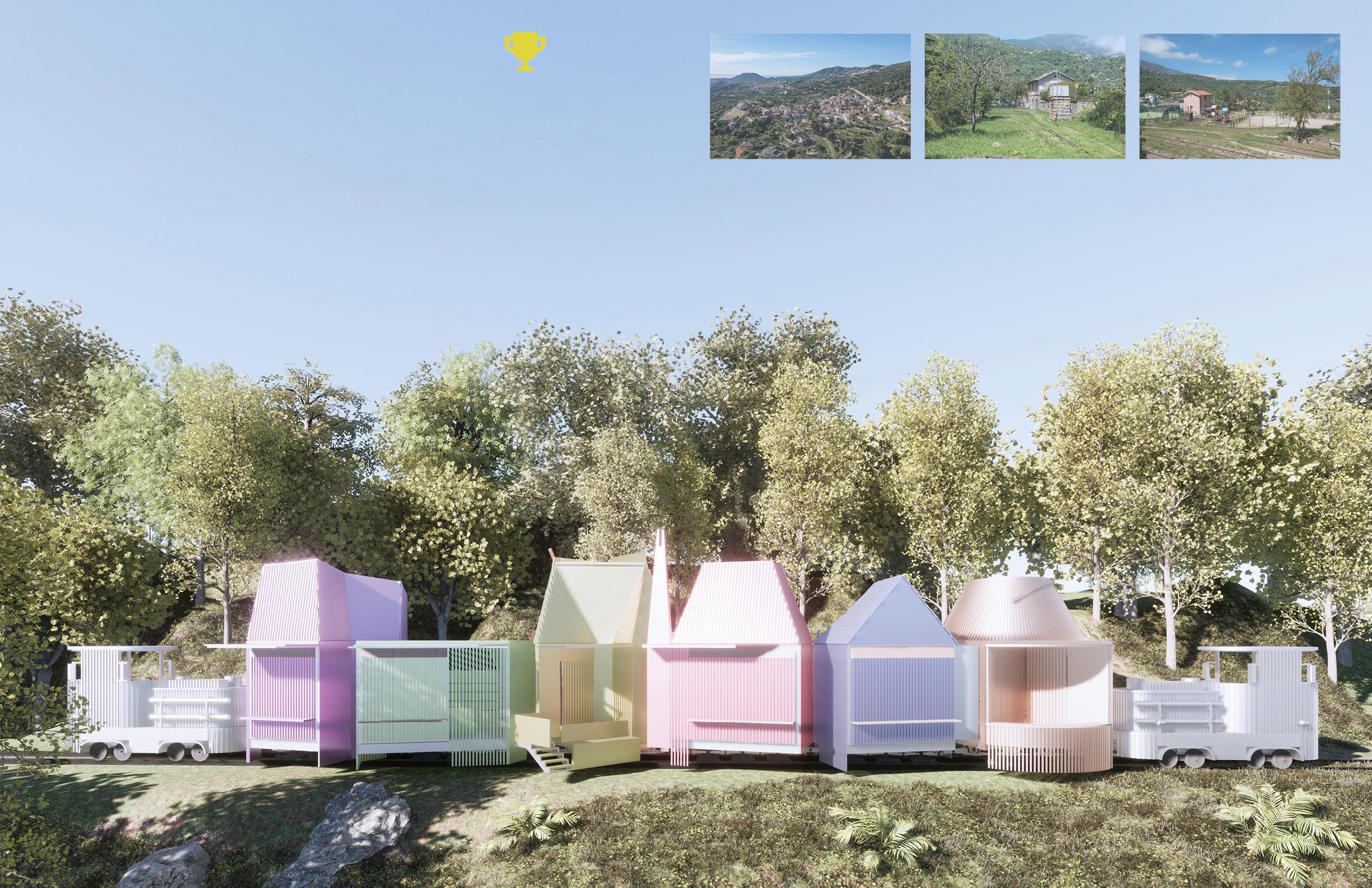
Elini, Italy, is a remote area where nature remains largely untouched, and slow, noisy rail lines wind through the landscape. Many of these railways have fallen into disuse and have been abandoned. Rusted tracks cut through breathtaking scenery, surrounded by scattered vernacular structures.
For a long time, railway infrastructure has been neglected or left to decay, rarely becoming the focus of architectural projects. This is because rail transport, once vital, was perceived as outdated and incompatible with the fast pace of modern life. The purpose of this competition is to establish a museum in Elini that promotes cultural activity and reconnects the local community with its heritage.
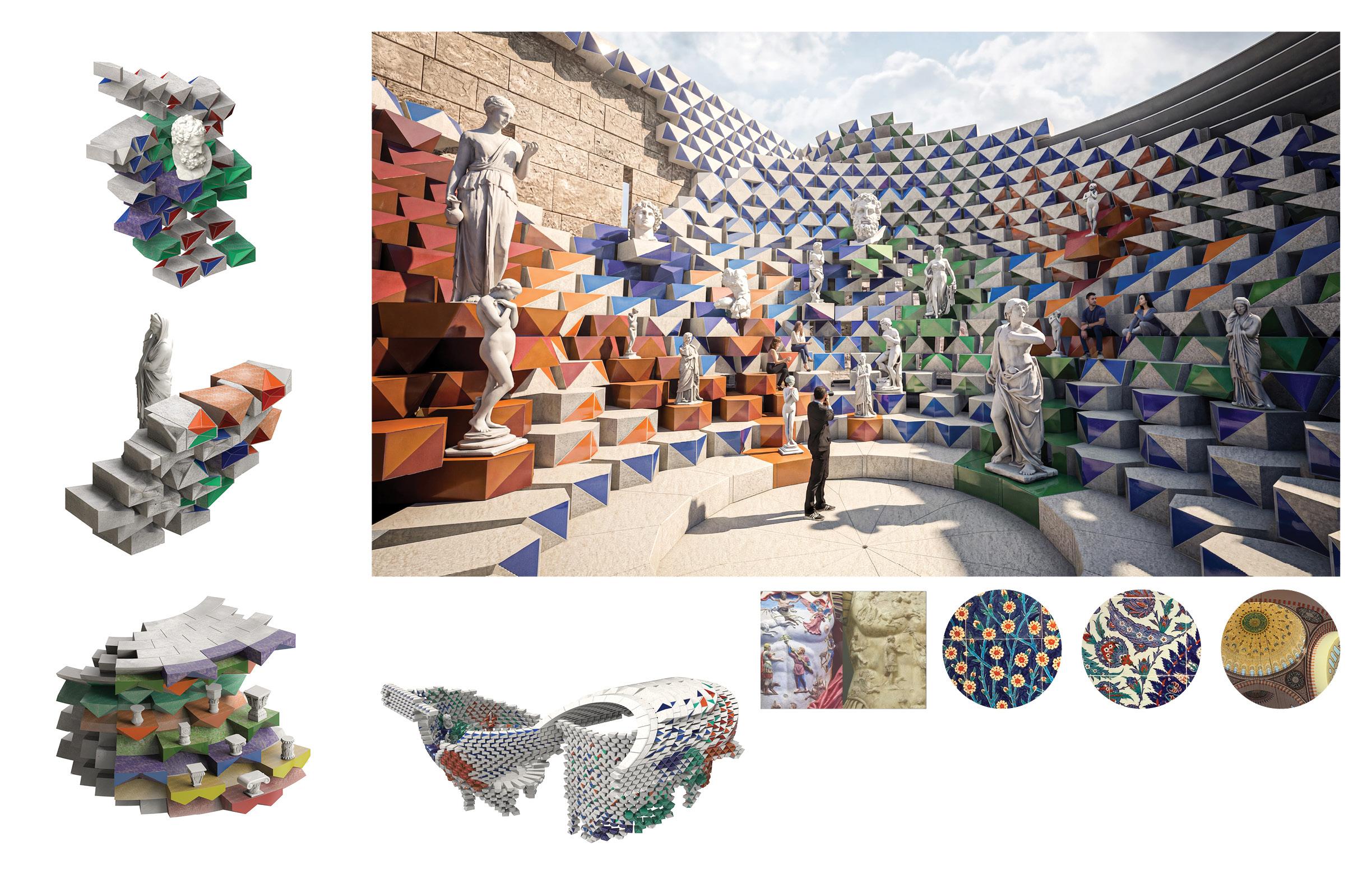
Ancient sculptures and architectural fragments were not always white or monochrome. They once belonged to a colorful visual culture. The courtyard garden translates this idea into a stereotomic field activated by color.
Colorful cut brick surfaces form a vibrant background around the artifacts, allowing the stone sculptures to stand out more clearly. Rather than covering the artifacts themselves, color activates the surrounding ground, walls, and circulation paths. It becomes stronger near entrances, movement routes, and display zones, guiding visitors while emphasizing each moment of encounter.
A proposal re-imagining museums by using railway tracks for cyclical spatial use and engagement.
In
In
Stefania
Matteo Agnoletto - UNIBO
and
Elini, Italy, is a remote area where nature remains largely untouched, and slow, noisy rail lines wind through the landscape. Many of these railways have fallen into disuse and have been abandoned. Rusted tracks cut through breathtaking scenery, surrounded by scattered vernacular structures.
For a long time, railway infrastructure has been neglected or left to decay, rarely becoming the focus of architectural projects. This is because rail transport, once vital, was perceived as outdated and incompatible with the fast pace of modern life. The purpose of this competition is to establish a museum in Elini that promotes cultural activity and reconnects the local community with its heritage.
form?
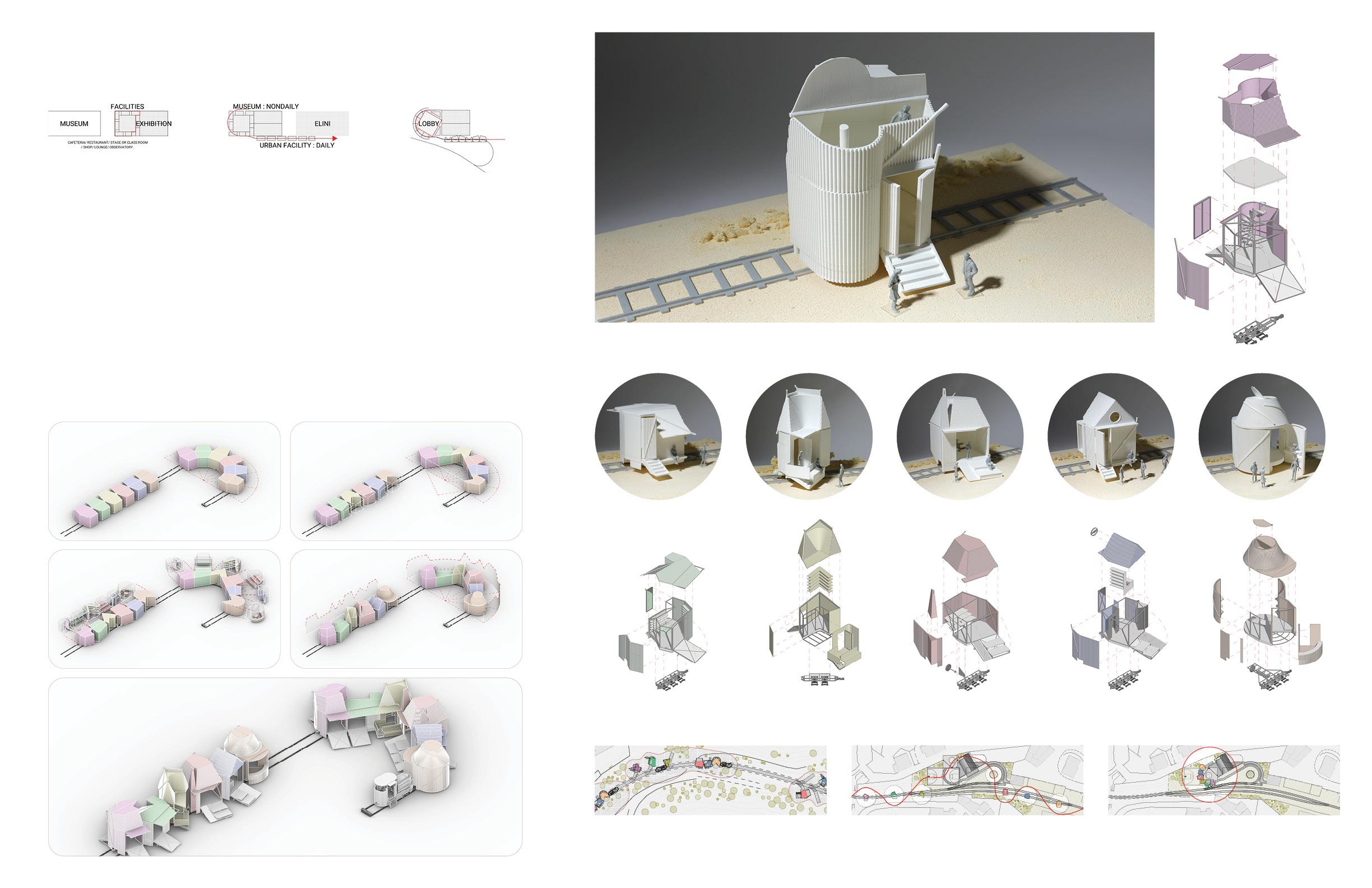
I believe a museum should be a dynamic entity, capable of responding to its context and operating with flexibility. While certain institutions in major metropolitan areas may defy this need, Elini—a tranquil and picturesque village—demands a more adaptive approach. For its residents, a museum may not invite frequent visits unless it offers evolving, thematic, or rotating exhibitions. Therefore, my vision centers on re-imagining how a museum can seamlessly integrate with and enrich the fabric of the local community.
um remains an active and versatile space, even during periods of low activity, by embedding it into the everyday rhythms of Elini. By carefully analyzing the spatial program, I envisioned a configuration where elements such as cafes, restaurants, retail areas, lobbies, assembly halls, exhibition rooms, libraries, and lounges could operate independently or adaptively reconfigure as needed. This approach not only prevents the museum from becoming a dormant space but also fosters a symbiotic relationship with the village’s daily life.
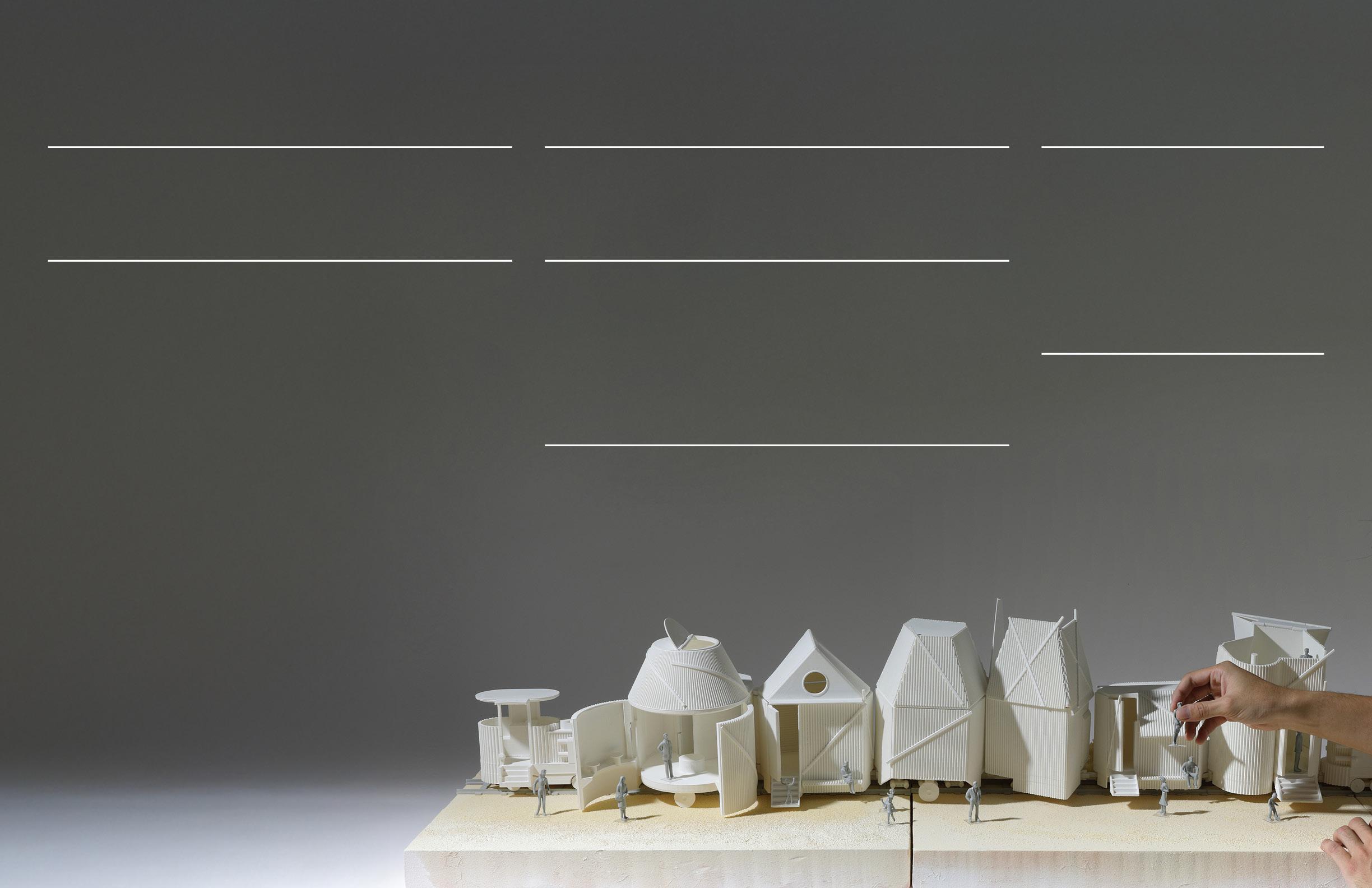
The units, supported by steel frames for stability, move on rail-mounted bases. Adaptable forms, openings, and deployable doors allow flexible use of space.
The design strategy focuses on ensuring the muse-
Train
When special exhibitions or events take place, Train Units, designed as mobile exhibition and lounge spaces, are transported and arranged at the museum. These units are parked along a semicircular train track, creating a space that serves as the museum’s first impression and the hub of various activities—a lobby hall.
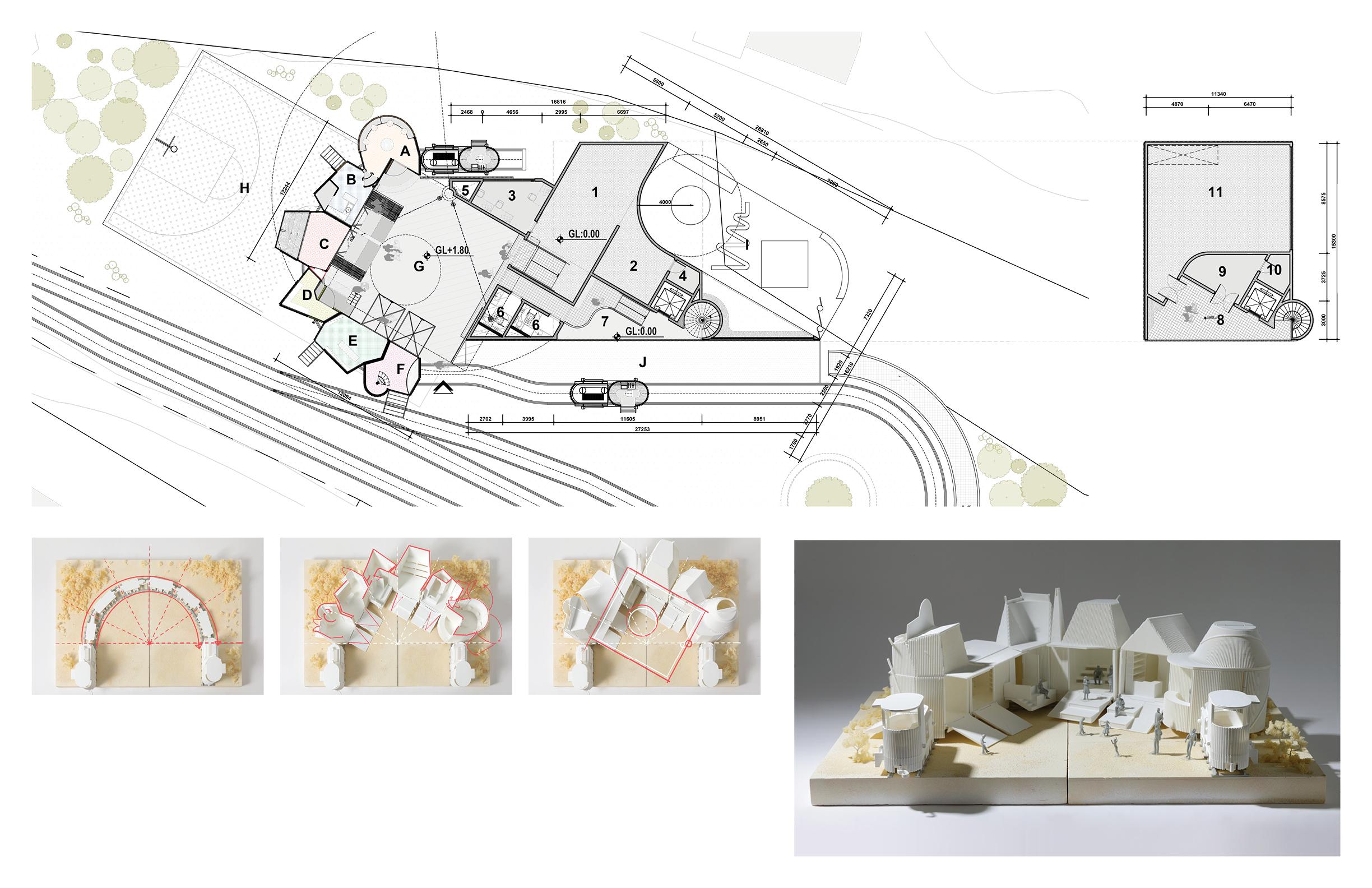
The semicircular track is designed to accommodate exactly six units. The interior of the track forms a rectangular-shaped community space, while the exterior showcases diverse planar surfaces highlighted by the unique structures of the units. For instance, curved exterior walls or linear layers harmonize with the surrounding environment, offering a distinctive visual experience.
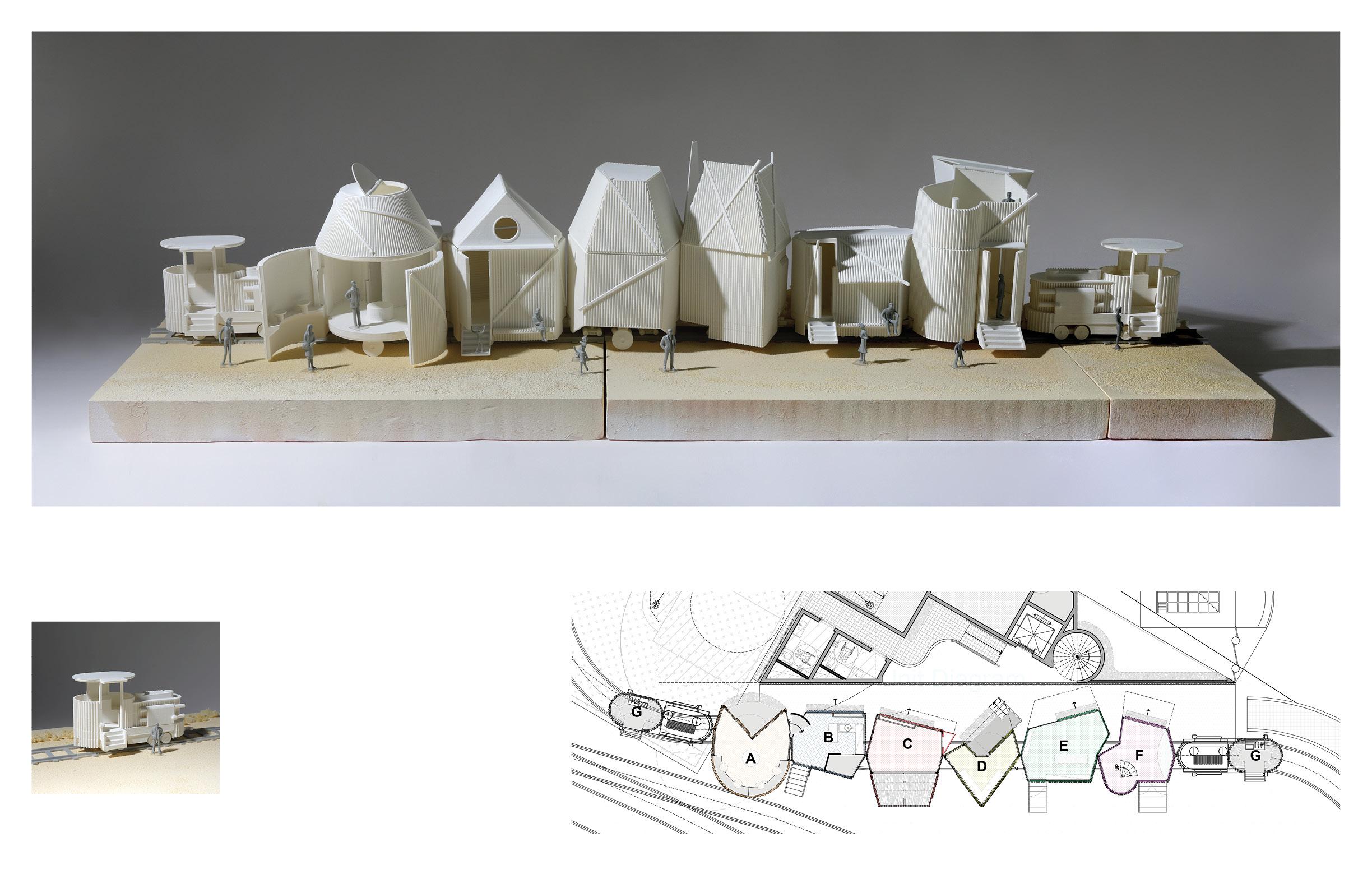
Each Train Unit is equipped with electric-powered motor systems, enabling seamless movement along the rails. These units are connected via robust couplers, allowing them to operate as a single cohesive train. This mobility transforms the Train Units into not only functional spaces but also traveling experiences, resembling a moving carnival as they navigate through urban landscapes. Positioned strategically, they provide visitors opportunities to participate in diverse programs while enjoying the stunning natural surroundings of Elini, adding flexibility and depth to their purpose.
Formations
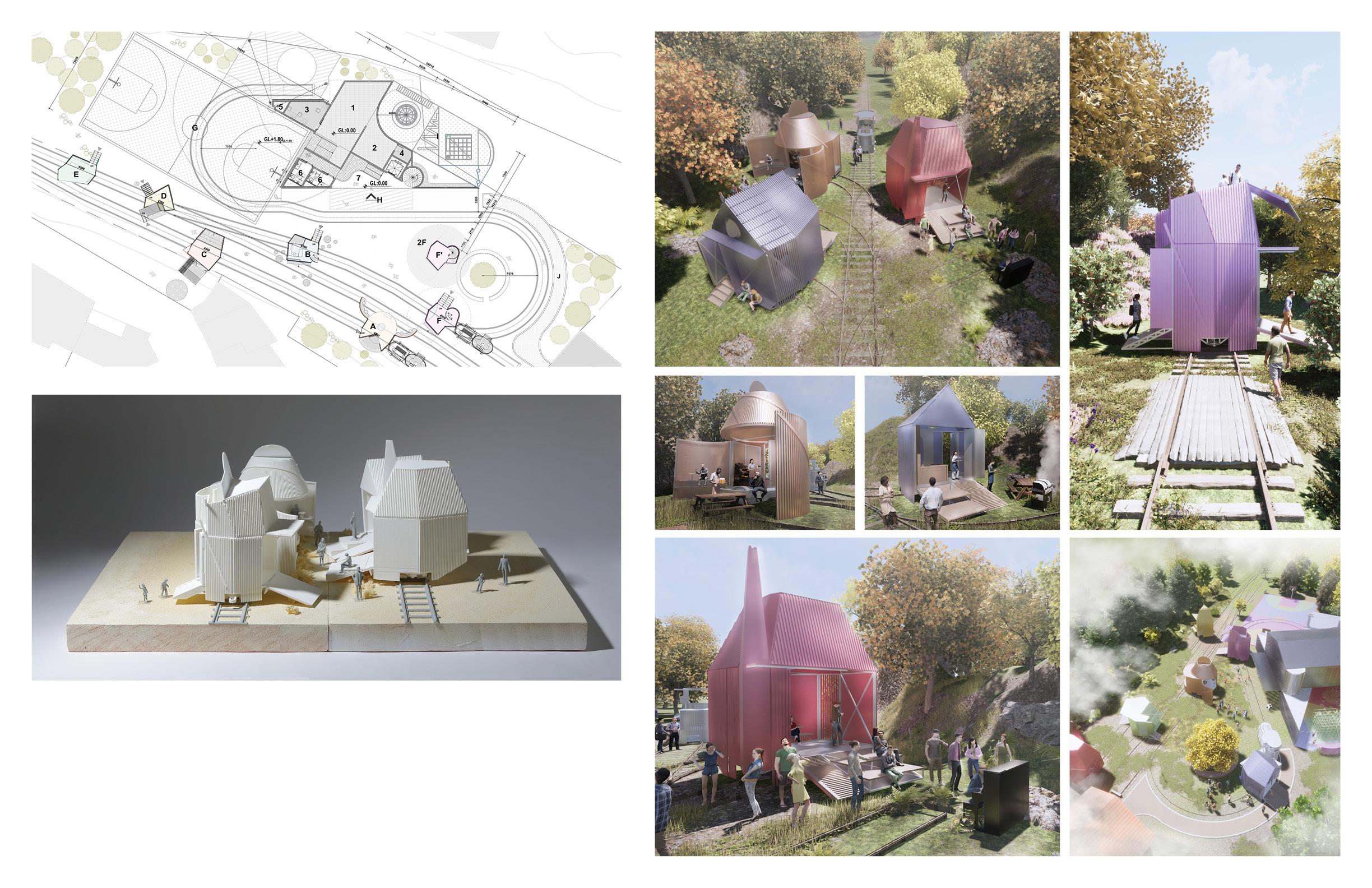
and Utility of Train Units
Train Units can be parked at suitable locations to provide convenience for residents. Additionally, these units can cluster together based on their specific functions to form small community groups. For travelers exploring abandoned railways, they serve as rest stops or functional amenities, creating a versatile and welcoming environment for various needs. Furthermore, after the Train Units depart, the remaining museum does not cease to operate but transforms into a permanent cultural facility. Permanent exhibitions will be maintained, and the original museum site will be revitalized with active sports facilities and playgrounds, ensuring the ‘Museum Station’ remains a vibrant hub of activity.
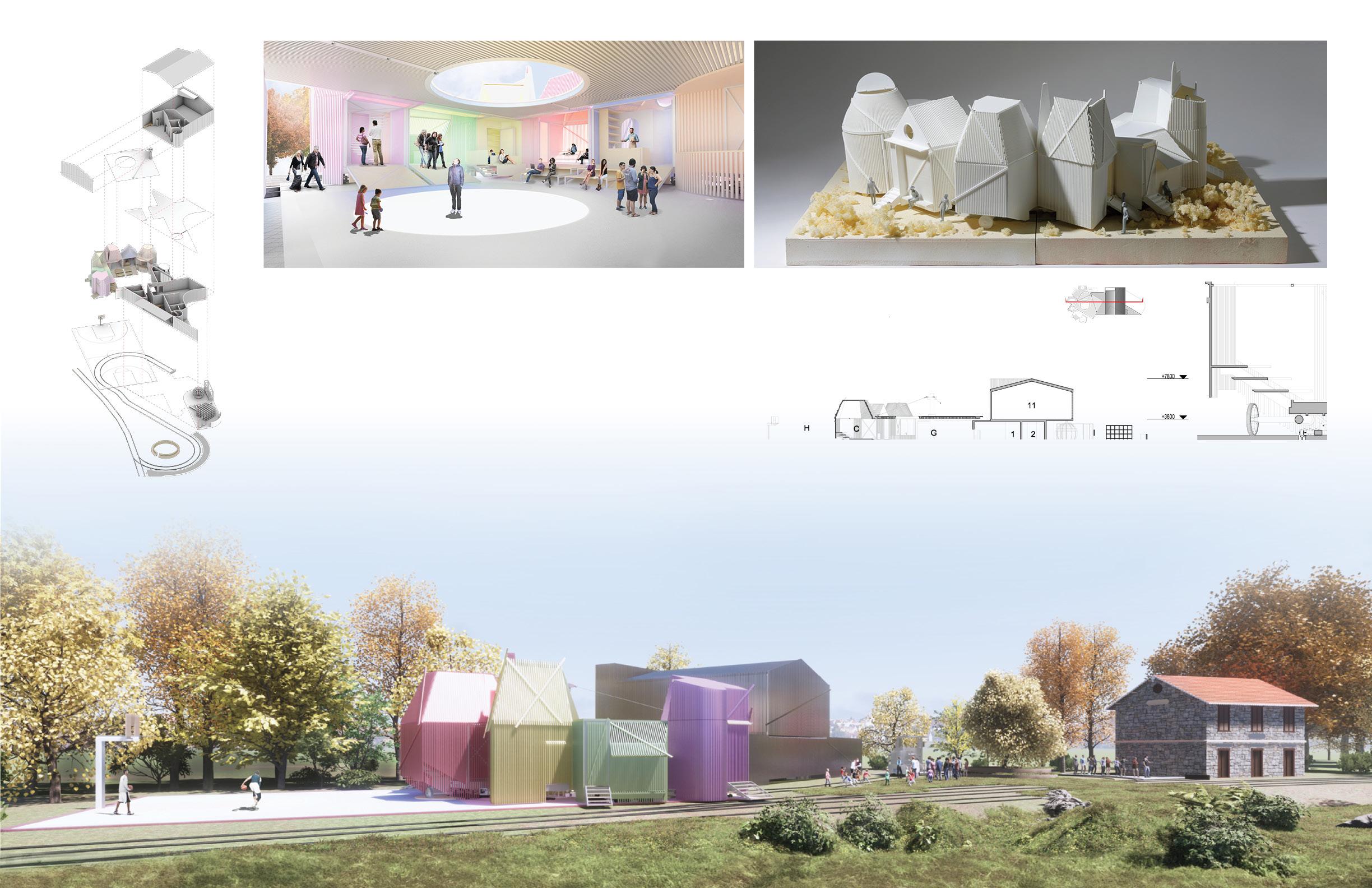
Life-Cycle of a Museum: A Repeating Cycle of Disassembly and Reassembly 1.
When functioning as a museum, it will serve as a vital cultural hub and iconic landmark for Elini. Designed with a more introspective character, the structure maintains a deliberate detachment from the rhythms of daily life. In essence, this moment is devoted entirely to the museum’s core purpose— immersing visitors in the essence of Elini. It will act as a gateway for tourists to discover the village’s heritage while preserving and archiving the cultural narratives of its residents.
Reframing the Showroom as a Journey of Lifestyle Discovery
Song-Pa(Completed)
Mok-Dong, Non-Hyun(On hold)
Archi@mosphere
Kyungsik Park
Min Woo Kang (me), Yu Jin Choi, Min Ki Shin
Concept Development, 3D Modeling, Detail Design, Rendering, Presentation Graphics, Construction Documentation
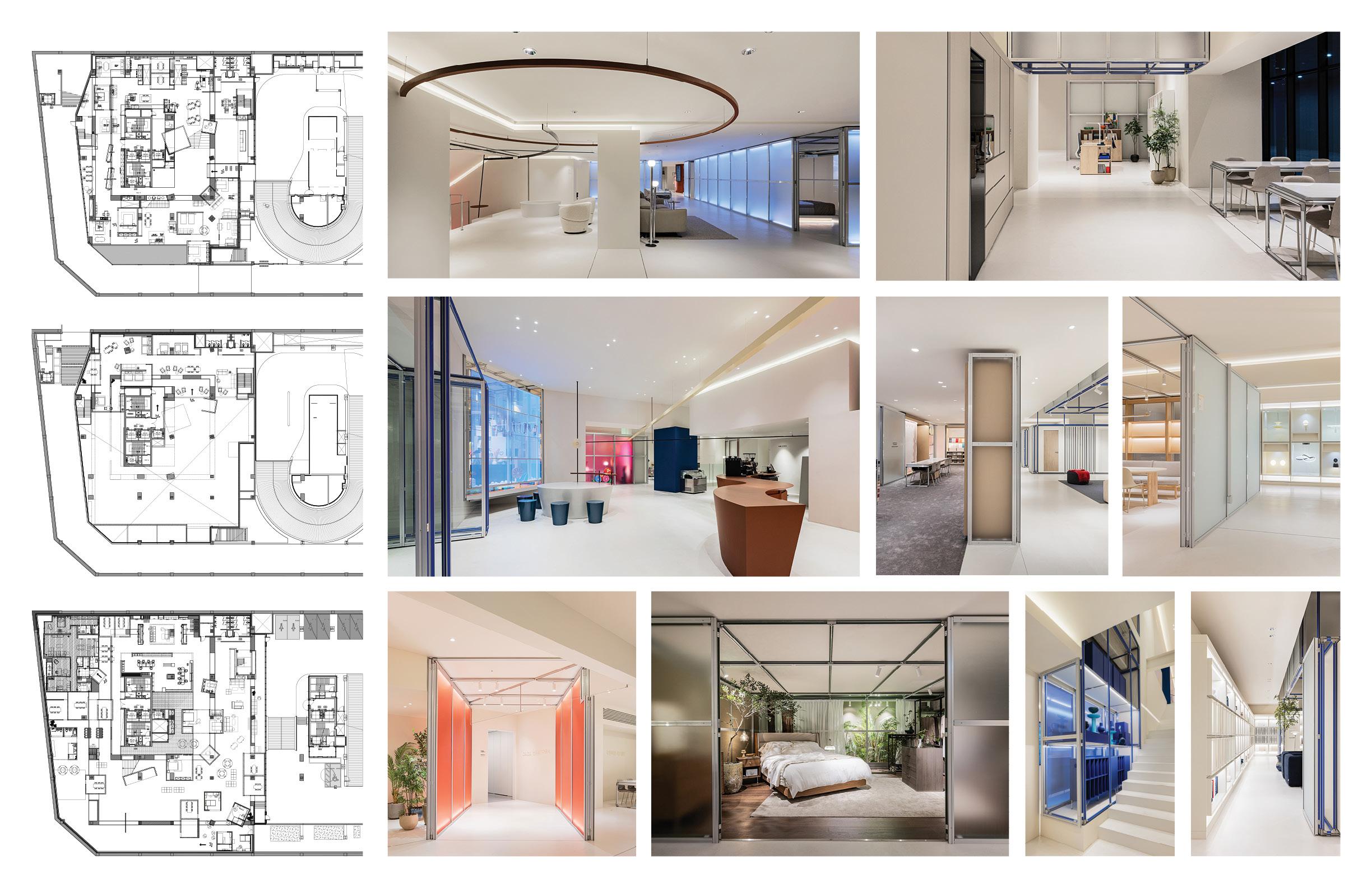
Hanssem is a leading Korean home furnishing and interior brand that provides furniture, kitchen systems, and lifestyle solutions for contemporary domestic spaces. Its Design Park projects explore a new direction for the brand’s retail environment. Rather than presenting furniture and products as isolated showroom objects, the stores are designed as customer-centered journeys where visitors can experience different ways of living.
Under the concept of “From Home to Life,” the projects move beyond the physical display of a home. They create spatial narratives that allow customers to imagine their own lifestyles through community areas, layered product displays, and carefully guided circulation.
Framing the Vehicle through Chagyeong and Partial Visibility
Archi@mosphere
Kyungsik Park
Min Woo Kang (me), Na Won Lee, Eun Bi Lee
Project Management, Sketch, Concept design, 3d modeling, Detail Design, Presentation, Render, Construction Documentation
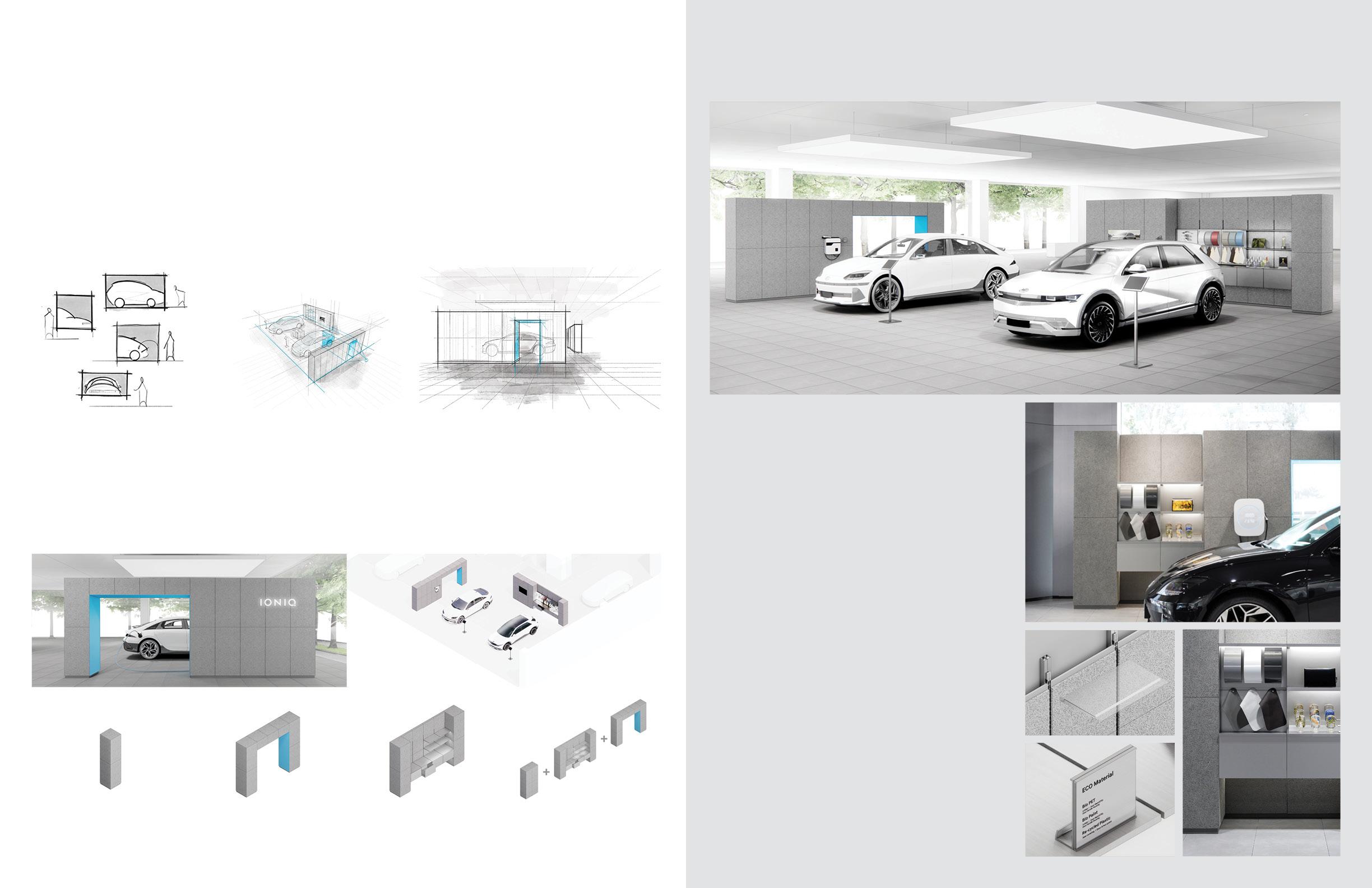
This project develops a global design guideline for the IONIQ zone within Hyundai showrooms worldwide. The guideline defines how the IONIQ zone can establish a clear sub-brand identity while remaining visually connected to the surrounding showroom.
The design draws from Chagyeong (借景, borrowed scenery), an East Asian spatial concept often translated as “borrowed scenery.” Rather than fully enclosing the zone, Chagyeong frames selected views and incorporates the surrounding context into the spatial experience. In this project, the concept is
reinterpreted as a strategy for creating visual continuity between the IONIQ space and the existing showroom.
Based on this idea, the guideline introduces framed elements that partially reveal the vehicle as it enters the viewer’s line of sight, like an image within a frame. This controlled moment of partial visibility creates curiosity and naturally draws visitors into the IONIQ zone.
The zone is formed using only
Eco-friendly wood wool boards are specified throughout to express IONIQ’s vision of sustainability. The modular system allows the guideline to adapt to various dealer environments, ensuring easy installation and intuitive use.
An Exhibition on Aluminum, Materiality, and Human-Centered Space
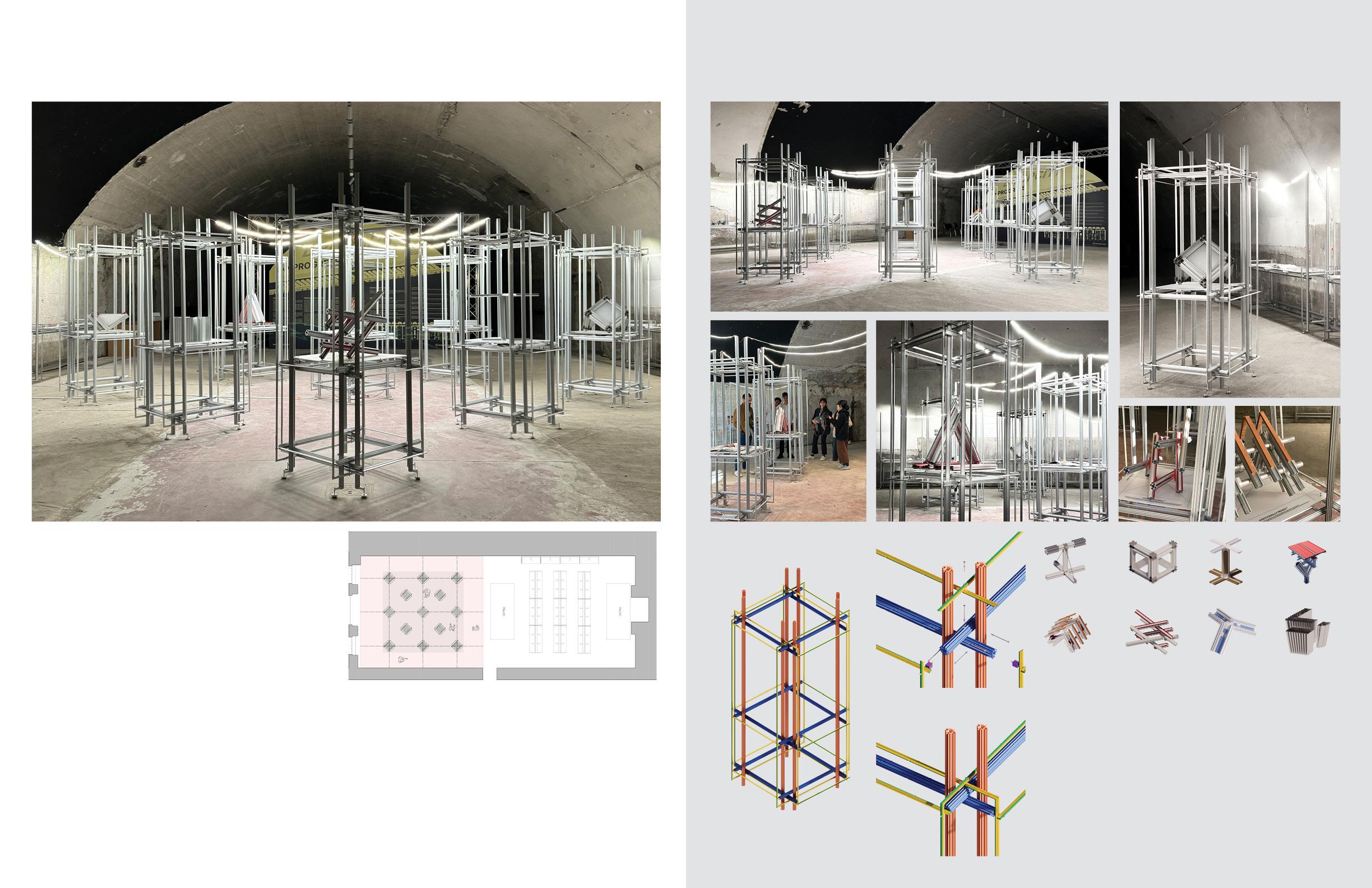
Milan, Italy
Professional Work, Project Manager Architectural Exhibition ‘Drop city 2024 Drop City 2024
Archi@mosphere
Kyungsik Park
Min Woo Kang (me), Na Won Lee, Eun Bi Lee
Project Management, Concept design, 3d modeling, Detail Design, Presentation, Render, Mechanism plan
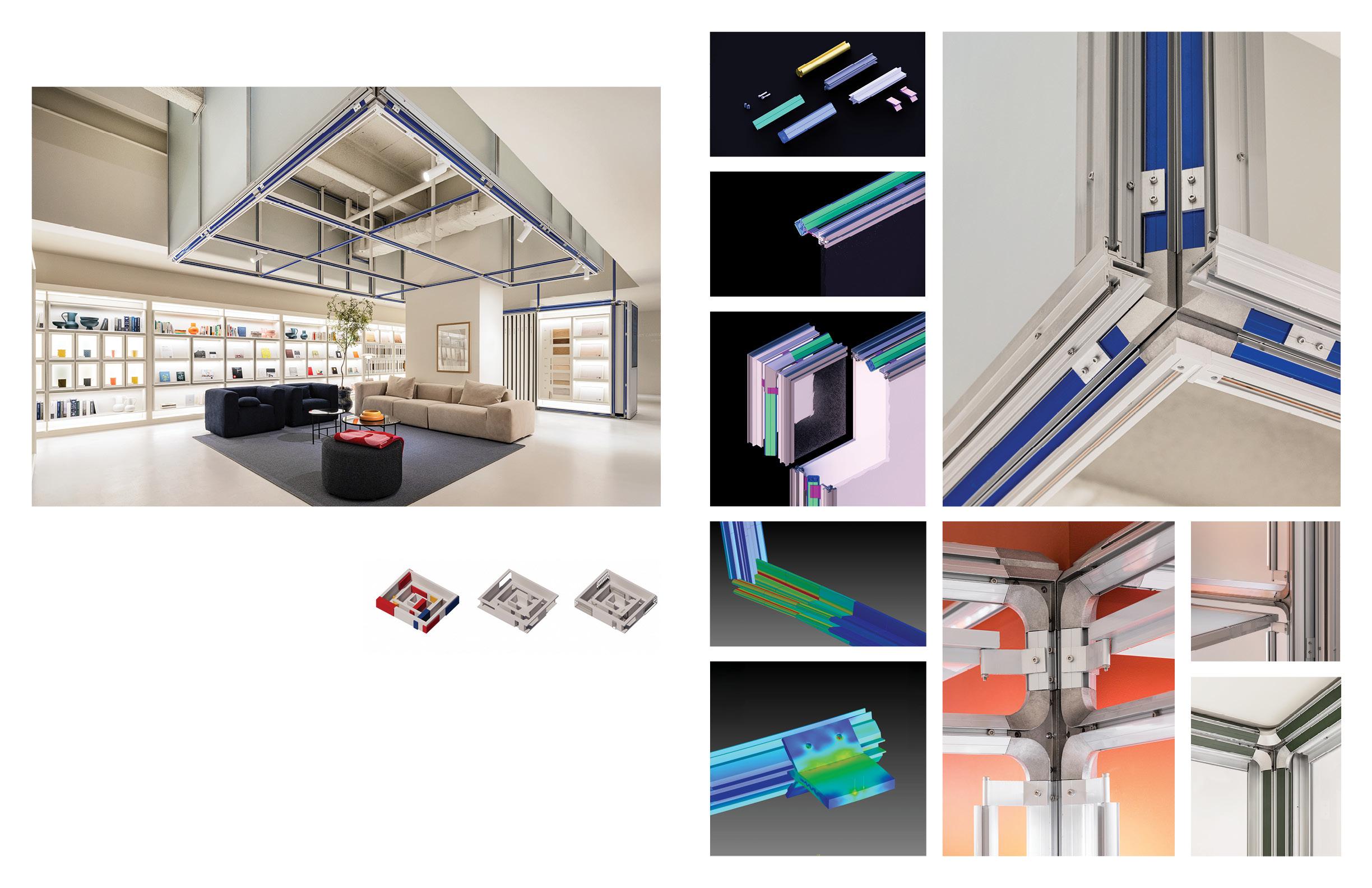
When Archi@Mosphere was invited by Drop City to participate in their exhibition, the project became an opportunity to present the studio’s design philosophy through material experimentation. Rather than treating aluminum only as an industrial material, the studio explored the tension between overcoming and accepting its inherent properties.
Through a series of intensive experiments, aluminum was transformed from a raw metallic surface into a medium for creating humancentered atmospheres. Its rigidity, reflectivity, and precision were reinterpreted through form, texture, and spatial application, allowing the material to move beyond its original industrial character.
This project reveals Archi@Mosphere’s commitment to material research and its belief that design emerges from a careful negotiation between physical properties, creative imagination, and spatial experience. It presents aluminum not simply as a construction material, but as a field of possibility shaped through persistence, experimentation, and the identity of the studio.
Professional Housing Projects Designed around Community, Landscape, and Shared Daily Life
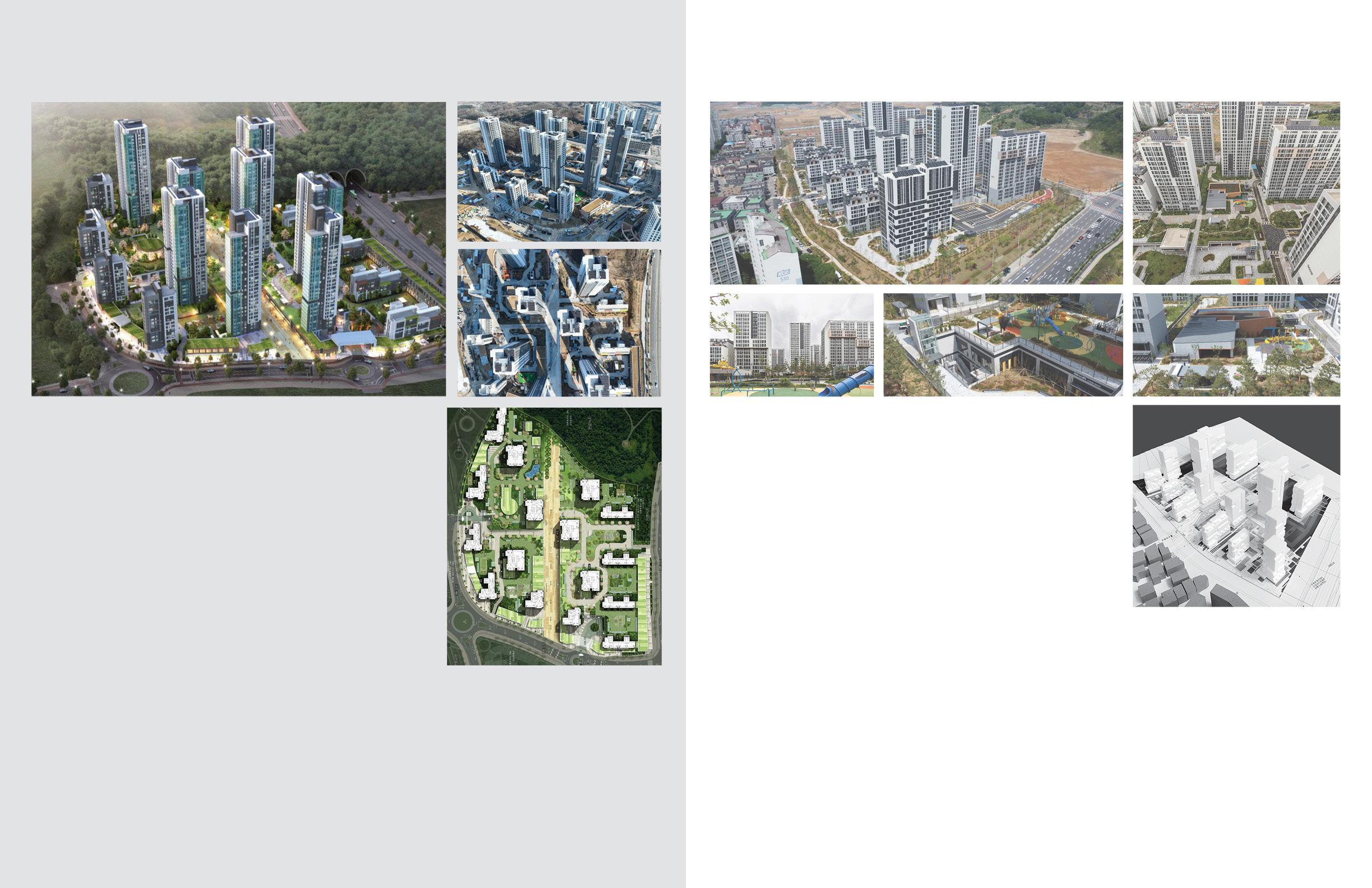
Sejong City Multifunctional Administrative City 6-3 District M4BL Project
2021-2022
Sejong, Republic of Korea
Professional Work
Apartment (1,035 Residential Units)
Korea Land and Housing Corporation (LH)
Tomoon Architects & Engineers
Min Woo Kang (me), In Han Lee, Na Ri Kim
Approval for Business and Other Permits
Coordination with Clients and Management of Partner Companies
Regulation Review
Preparation of Detailed Design Documents
Replanning of Ancillary Facilities and Underground Parking Lots
Review of Standards Related to the Disabled and Elderly
Preparation of Construction Documents
This project presents an integrated community design that harmoniously incorporates pedestrian-friendly micro-pathways, high-end lobbies, and versatile community spaces, fostering meaningful interaction and coexistence among residents.
Additionally, as a designated special supply apartment for individuals with disabilities, the development emphasizes Barrier-Free design principles, ensuring seamless accessibility across all aspects of the space.
Incheon Geomdan AA34BL Apartment Complex Construction Project
Incheon, Republic of Korea
Work
(1,746 Residential Units) Korea Land and Housing Corporation (LH)
Completed, Built
Tomoon Architects & Engineers
Min Woo Kang (me), Yeon Joong Jung, Jung Eun Park
Approval for Business and Other Permits
Site Layout Planning, Regulation Review
Re planning Auxiliary Facility Design
Preparation of Detailed Design Documents
For a climate-resilient apartment project, I proposed a central facility addressing heat-waves and air pollution, anchored on natural ground with pedestrian-friendly pathways overcoming site gradients.
A 6.4m modular framework and external PD system enabled flexible stacking of residential units, supporting diverse structural configurations.
Green terraces with duplex units soften edges near low-rise neighborhoods, while 29-depth step terraces enrich the central pedestrian flow. Mid-level piloti structures ensure openness, and stacked 36 and 46 unit types add depth and dynamic visuals to the façade.
An Analysis on Spatial Characteristics of Public Libraries’ Lobby in South Korea : Focus on Openness Analysis
Year Work Type
Target of Research
Thesis Advisor
Contribution 2017-2018
Individual Work, Academic(Research from Graduate School Master’s Thesis)
Targeting 40 public libraries with more than 3,500sqm, built in South Korea between 2010 and 2019 Yong Seung Kim (yskim@hanyang.ac.kr 031-400-5137)
Research and methodologies extracted from my graduation thesis. independently conducted on-site measurements, created drawings, developed Rhino 3D models, and designed all diagrams.
Purpose of the Research
In contemporary discussions on publicness, openness as an architectural embodiment of publicness has gained increasing importance across various public facilities. Among these, public libraries, which are highly responsive to the discourse on publicness, actively incorporate openness into their spaces. In urban settings, lobby spaces are particularly highlighted as requiring the highest degree of openness. Official guidelines often describe them as “open spaces” or
Calculating Integrated Visible Area
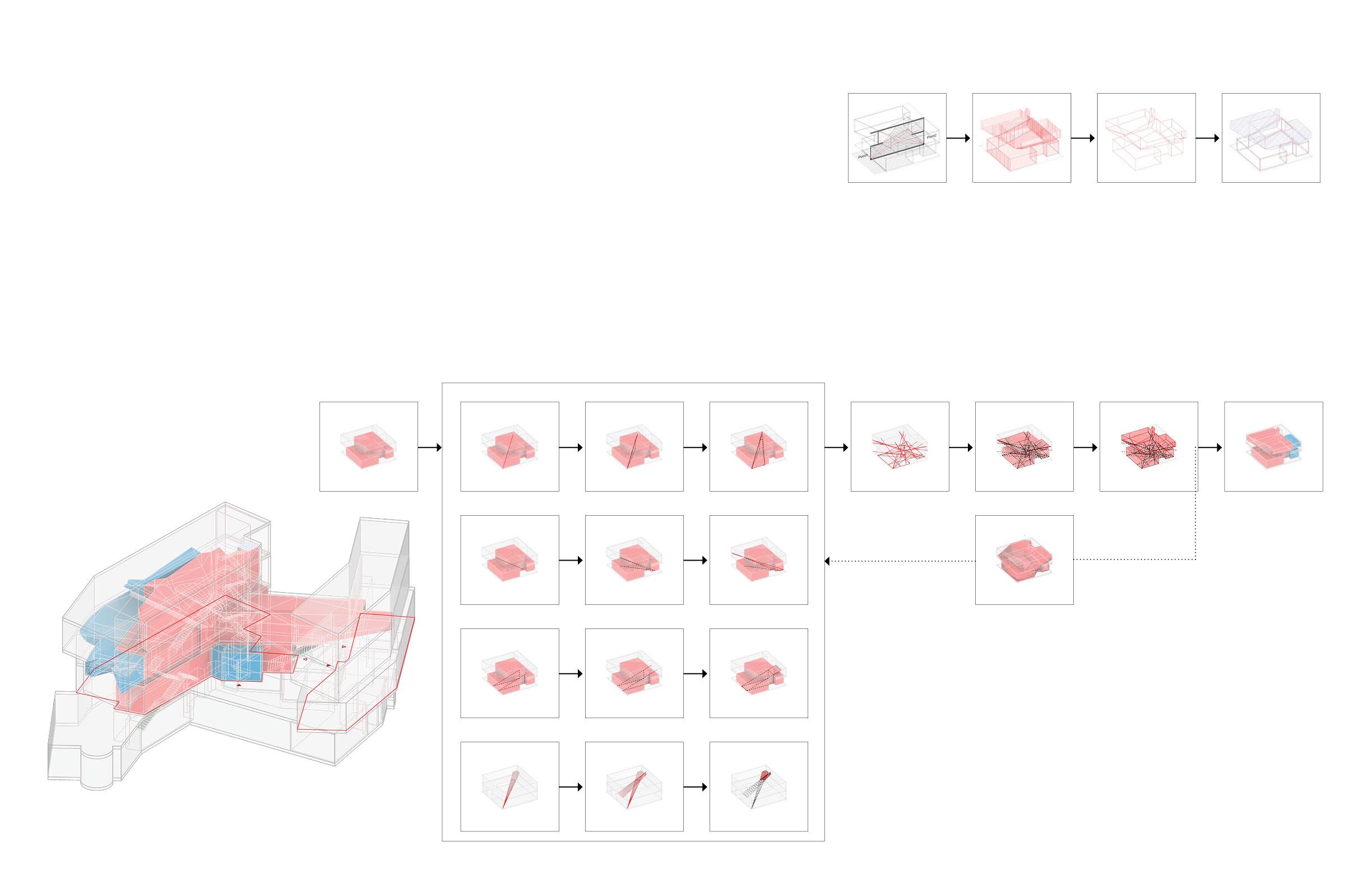
“spaces with a sense of openness.” However, there has been a lack of clear definitions and precise examples regarding the characteristics of openness in lobby spaces. This ambiguity has led to variations in interpretation depending on the designer’s discretion, emphasizing the need for a definitive framework and practical indicators.
This research introduces the concept of the ‘Integrated Visible Area as a spatial domain defined by an observer’s unrestricted movement and visibility, accompanied by a methodological framework for its quantification. Using advanced ray tracing techniques, visible areas were meticulously analyzed and constructed. Unlike traditional planar analyses limited to two-dimensional interpretations, this study delves into the volumetric complexity of three-dimensional environments, carried out using Rhinoceros 5.0 by McNeel & Associates.
The ‘Integrated Visible Area’ is delineated into two categories: the ‘Open Integrated Visible Area,’ which is physically unobstructed and fully accessible, and the ‘Transparent Integrated Visible Area,’ which is visually open but enclosed by transparent materials like glass, maintaining perceived openness despite physical boundaries.
To calculate the ‘Integrated Visible Area penetrating upper layers at acute angles, planes formed by the lowest penetrating vertical axes were generated. These planes represent the lowest boundary of the integrated visible area. Once these planar boundaries were defined, they were vertically extruded to the ceiling boundary, forming a volume. Subsequently, the algorithm-generated 3D isovist was applied to the floor boundary corners, filling the morphological gaps when compared to the manually constructed visible area. This step served as a verification process to address any oversight during manual drafting.
Once the ‘Integrated Visible Area’ was deemed complete, it was classified into ‘Transparent Integrated Visible Area and ‘Open Integrated Visible Area’ based on the boundaries of glass surfaces.
The calculated volumetric value of the constructed integrated visible area represents the visible space. To perform an objective and quantitative analysis, the method for calculating the visible volume index is applied.
Integrated Visible Bulk Index Ratio, which indicates the proportion of the visible area relative to the total building volume, is determined to enable intuitive comparisons and evaluations. These evaluation Index Ratio enabled an objective analysis of the openness of library lobby spaces. This portfolio presents the methodology and insights gained from deriving these metrics, highlighting their significance in advancing architectural design evaluation. By quantifying spatial openness, this research bridges the gap between subjective perception and empirical assessment, offering a valuable tool for architects and planners to enhance public spaces systematically.
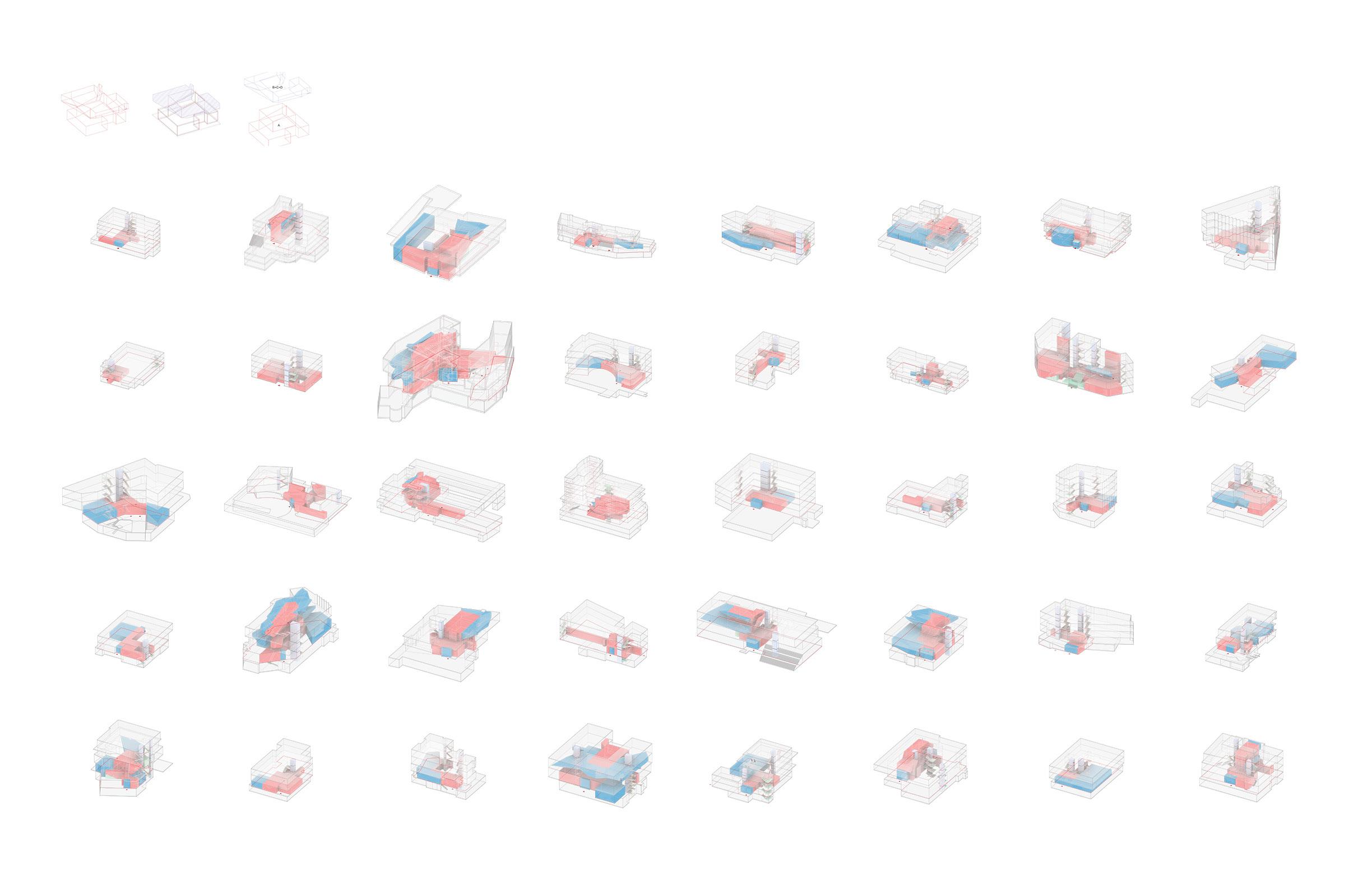
01. ‘WB’ Library Year 2009 Location Namyangju-si, Gyeonggi-do Int VBIR 5.13%
02. ‘DB’ Library Year 2009 Location Yongin-si, Gyeonggi-do Int VBIR : 10.95%
03. ‘PK’ Library Year 2010 Location : Seongnam-si, Gyeonggi-do
09. ‘KYW’ Library Year 2010 Location : Bucheon-si, Gyeonggi-do Int VBIR 4.46%
10. ‘GD’ Library Year 2010 Location : Anseong-si, Gyeonggi-do Int VBIR : 15.82% 11. ‘SS’ Library Year 2010 Location Changwon-si, Gyeongsangnam-do Int VBIR : 24.01%
12. ‘SD’ Library Year 2011 Location : Bucheon-si, Gyeonggi-do Int VBIR : 13.03%
13. ‘TJMR’ Library Year 2011 Location : Suwon-si, Gyeonggi-do Int VBIR : 10.66%
15. ‘MH’ Library Year : 2011 Location : Iksan-si, Jeonbuk-do Int VBIR : 9.61%
15. ‘S’ Library Year : 2012 Location : Seoul Int VBIR 19.83%
15. ‘BR’ Library Year : 2012 Location : Yongin-si, Gyeonggi-do Int VBIR 35.30%
17. ‘MG’ Library Year 2012 Location Changwon-si, Gyeongsangnam-do Int VBIR : 12.95%
18. ‘GR’ Library Year 2012 Location Paju-si, Gyeonggi-do Int VBIR : 14.10%
19. ‘BS’ Library Year 2012 Locwwation : Iksan-si, Jeonbuk-do Int VBIR : 16.57%
20. ‘CS’ Library Year : 2013 Location Gwangmyung-si, Gyeongsangnam-do
21. ‘BU’ Library Year : 2013 Location Daegu Metropolitan City Int VBIR : 6.24%
22. ‘SPGMR’ Library Year : 2013 Location : Seoul Int VBIR 10.28%
23. ‘BP’ Library Year : 2013 Locaation : Seoul Int VBIR : 11.13%
24. ‘BDN’ Library Year : 2014 Location : Suwon-si, Gyeonggi-do Int VBIR 21.28%
25. ‘CR’ Library Year 2014 Location Suwon-si, Gyeonggi-do Int VBIR : 17.86%
26. ‘HMS’ Library Year 2014 Location Suwon-si, Gyeonggi-do Int VBIR : 42.56%
27. ‘KDR’ Library Year 2014 Locwwation Osan-si, Jeonbuk-do Int VBIR : 30.07%
28. ‘HS’ Library Year : 2014 Location : Hoengseong-gun, Gangwon-do Int VBIR : 8.30%
29. ‘BU’ Library Year : 2015 Location : Seongnam-si, Gyeonggi-do Int VBIR : 15.04%
30. ‘IW’ Library Year : 2015 Location : Suwon-si, Gyeonggi-do Int VBIR 38.46%
31. ‘SH’ Library Year
32. ‘GJ’ Library Year : 2016 Location : Goyang-si, Gyeonggi-do Int VBIR 22.13%
A versatile pedestrian plaza bridge beneath Bridge, designed for diverse activities and community engage-
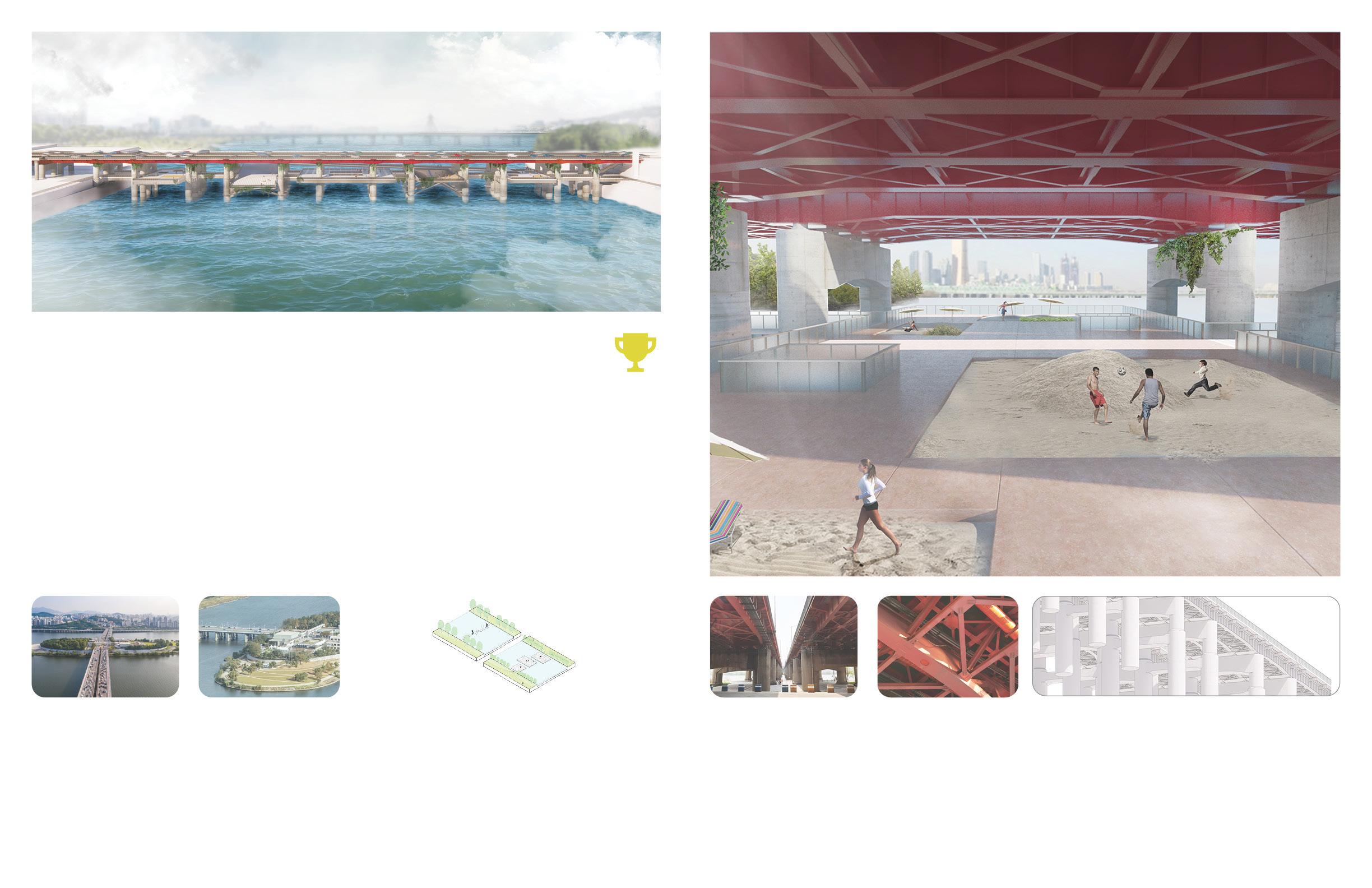
The Han-River North Bridge, once home to a sandy beach cherished by city dwellers, has transformed into a transit-focused space The natural white sand, a symbol of leisure and memory, has disappeared, leaving only pathways for cars and pedestrians.
Our design re-imagines the bridge as a series of interconnected urban squares that invite people to pause, gather, and create new memories. By prioritizing diverse experiences over mere transit, the bridge transforms into a versatile public space that fosters connection and engagement.
Our investigation of the liminal spaces beneath the bridge revealed a striking interplay of architecture and nature. Concrete columns, filtered light through the roadways, and dynamic water reflections highlighted the hidden spatial richness of this neglected urban void. The vibrant red steel framework added a bold aesthetic, creating a visually captivating contrast against the muted tones of the urban environment.
This approach re-imagines the spaces beneath bridges, utilizing steel frameworks to transform vehicular roads into loop-like pathways that balance functionality with aesthetic appeal.
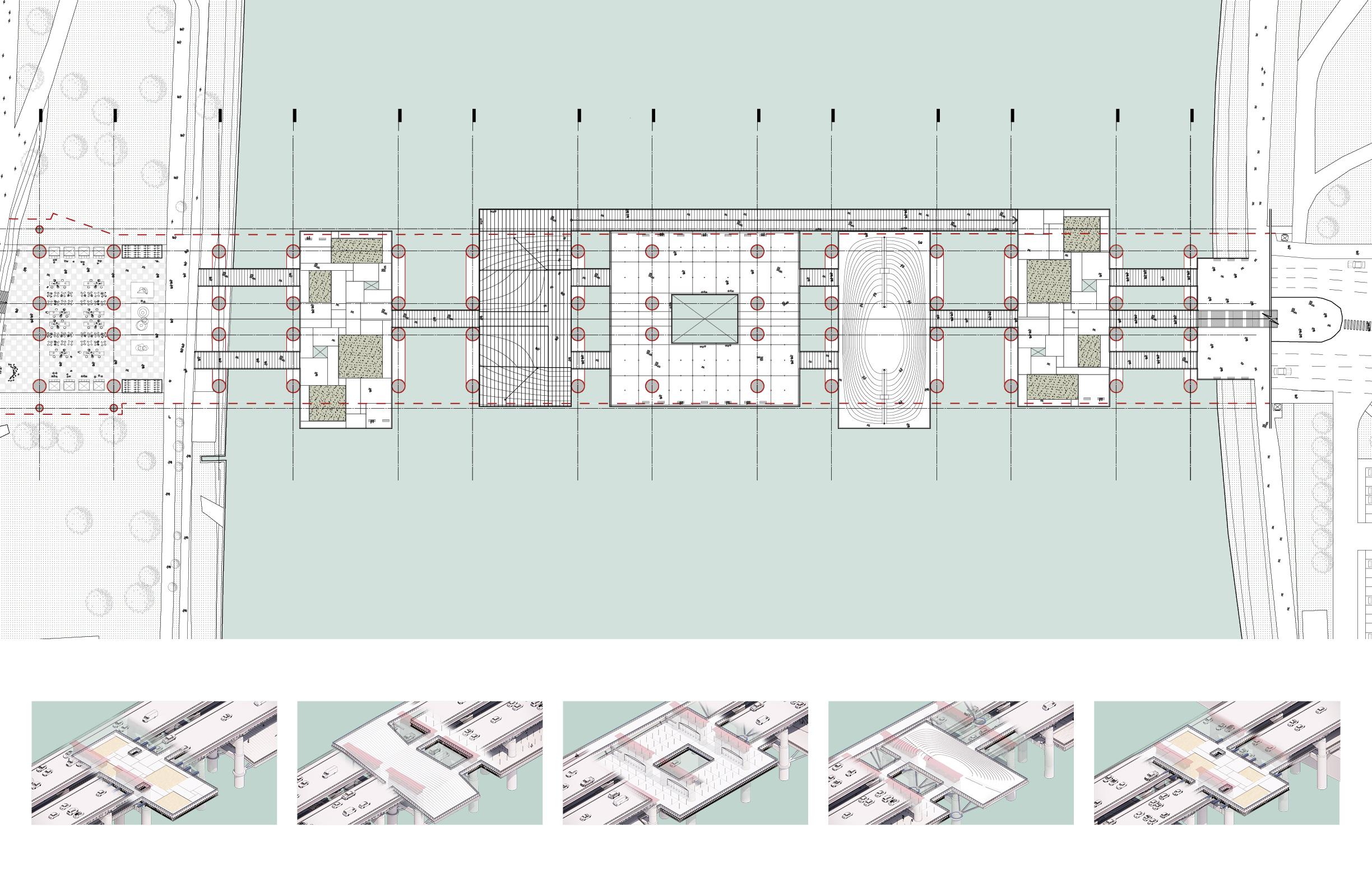
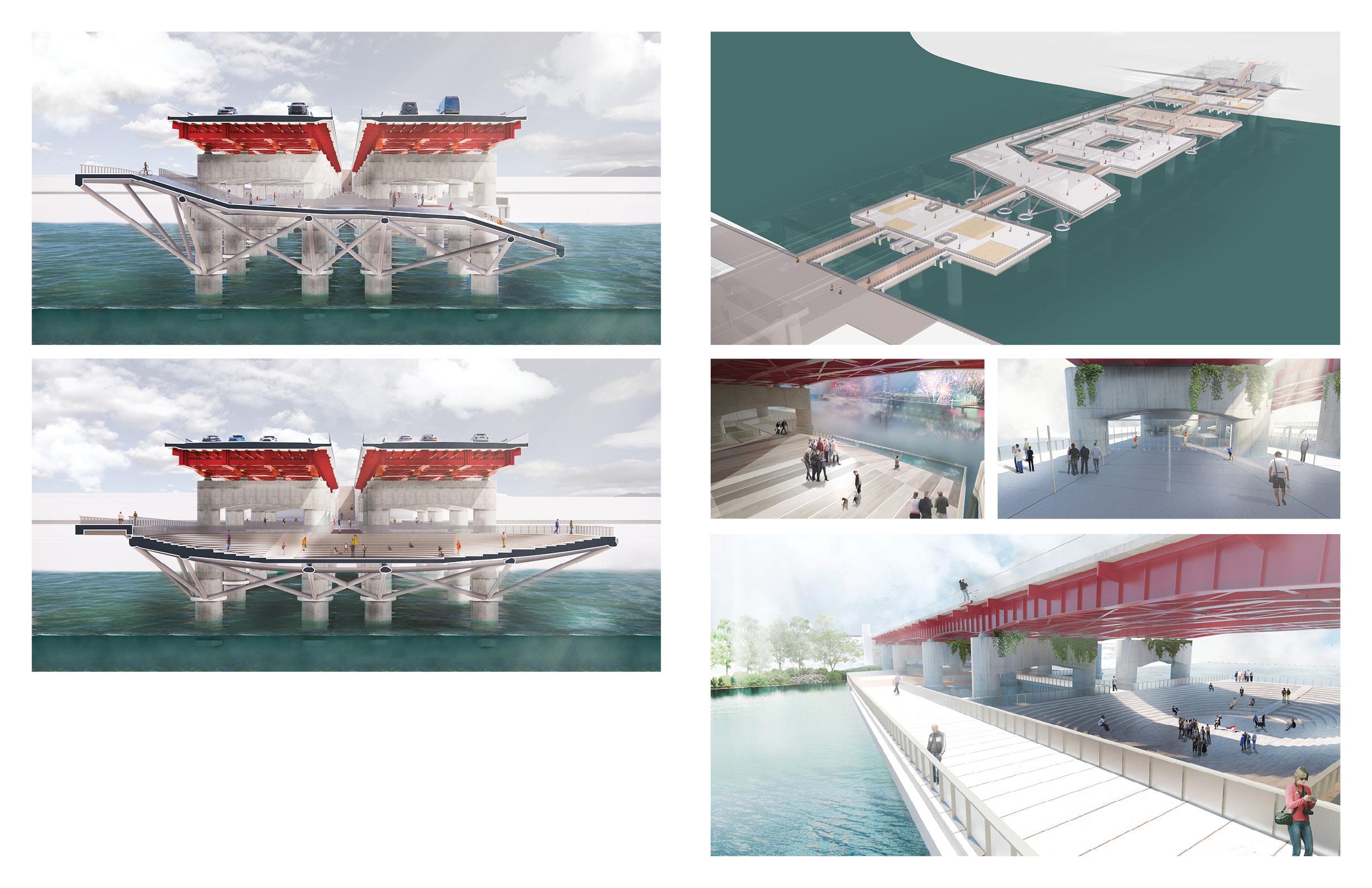
Architecture has the power to bridge gaps, create meaningful connections, and enhance the lives of citizens. Transforming overlooked spaces into vibrant hubs of activity fosters community, encourages interaction, and celebrates the relationship between people and their environment.
The plaza becomes more than a physical structure—it symbolizes openness, inviting all to gather, reflect, and enjoy the urban landscape. Thoughtful design turns the act of passing through into an opportunity for engagement and appreciation.
This final statement reflects a commitment to designing spaces that inspire and uplift, leaving a lasting impact on both the city and its people.
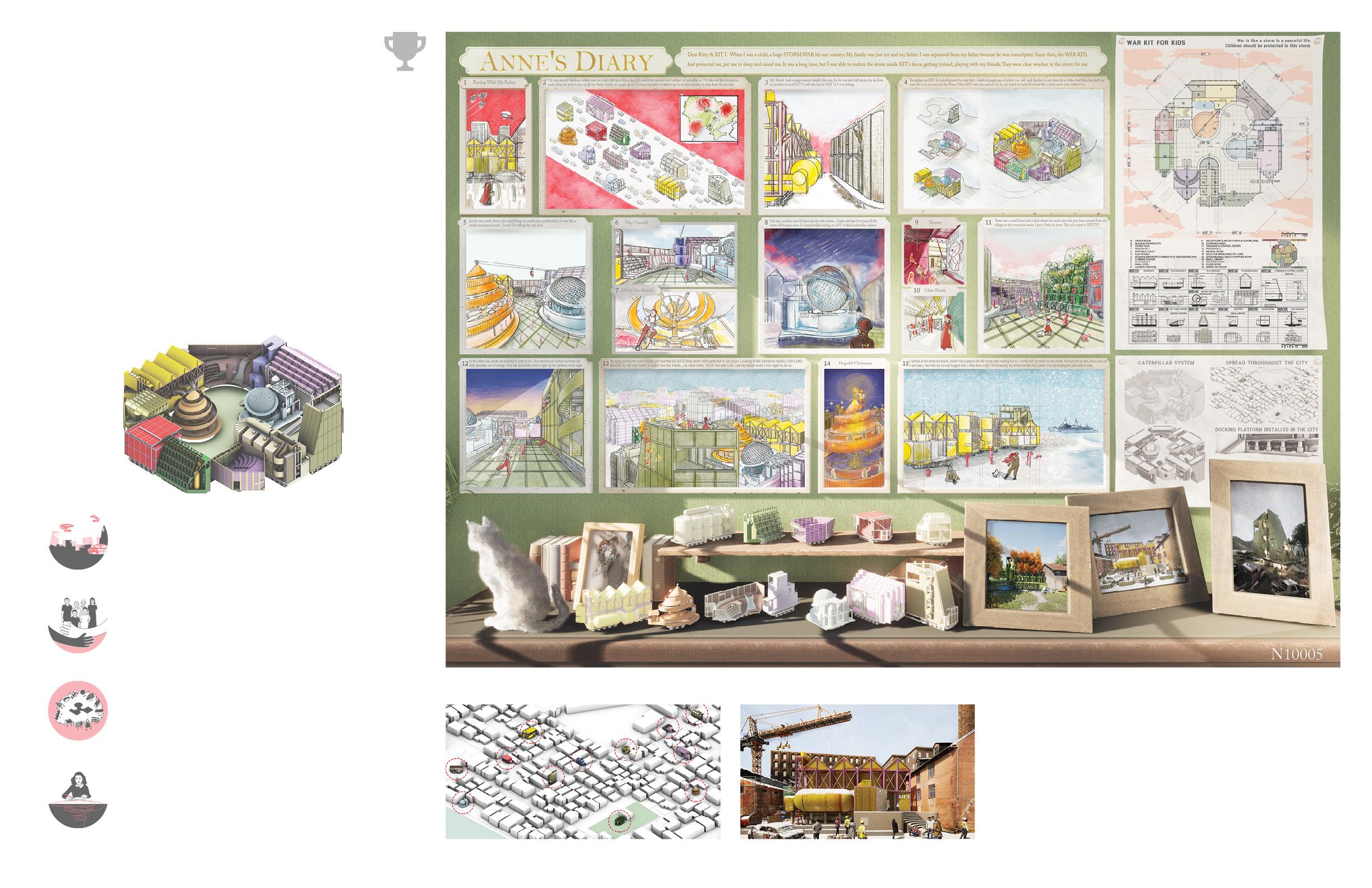
“KITs for War,” adaptable modules designed to safeguard children and nurture resilience during conflicts
The 49th Nisshin Kogyo Architectural Design Competition
Nisshin Kogyo Co. , LTD.(Japan)
Merit Prize
I independently handled all aspects of this project, including illustration sketching, 3D modeling, rendering, diagrams and drafting.
Ryue Nishizawa - SANAA Yokohama Graduate School of Architecture
Akihisa Hirata - Kyoto University / Akihisa Hirata Architecture office
Yasutaka Yoshimura - Waseda University
Tatsuya Hatori - Nikken Sekkei LTD
Ryuji Fujimura - Tokyo University of the Arts
This competition explored the “Storm House” as an architectural response to the despair of war. Inspired by the Ukraine-Russia conflict, I depicted the fear of death and separation as a “storm,” using fragmented forms and fluid spaces to symbolize chaos and disruption.
Amid this context, I began reflecting on those who must be protected above all in times of war: children and adolescents. My solution revolved around architecture as a means of shielding them.
I proposed a system comprising transport vessels for evacuation, barriers to block external terror, survival shelters, and ultimately, spaces designed for play—a thematic refuge akin to a theme park—where children could overcome fear through engagement and joy.
The overarching narrative of my design drew inspiration from the diary of Anne Frank, who lived an unfortunate life during World War II. I envisioned a modern-day “Anne,” an unknown figure, and explored how she might survive through architecture and evade the tragedies of war.
The 12 War KITs buildings were originally distributed across the city as various types of convenience facilities. During wartime, they serve as transportation means, allowing people to evacuate quickly to safe locations. Once the war ends, these buildings return to the city. Unlike single-purpose structures or abandoned bunkers, each KIT evolves into a sustainable and vibrant public space, fostering continuous interaction with the community.
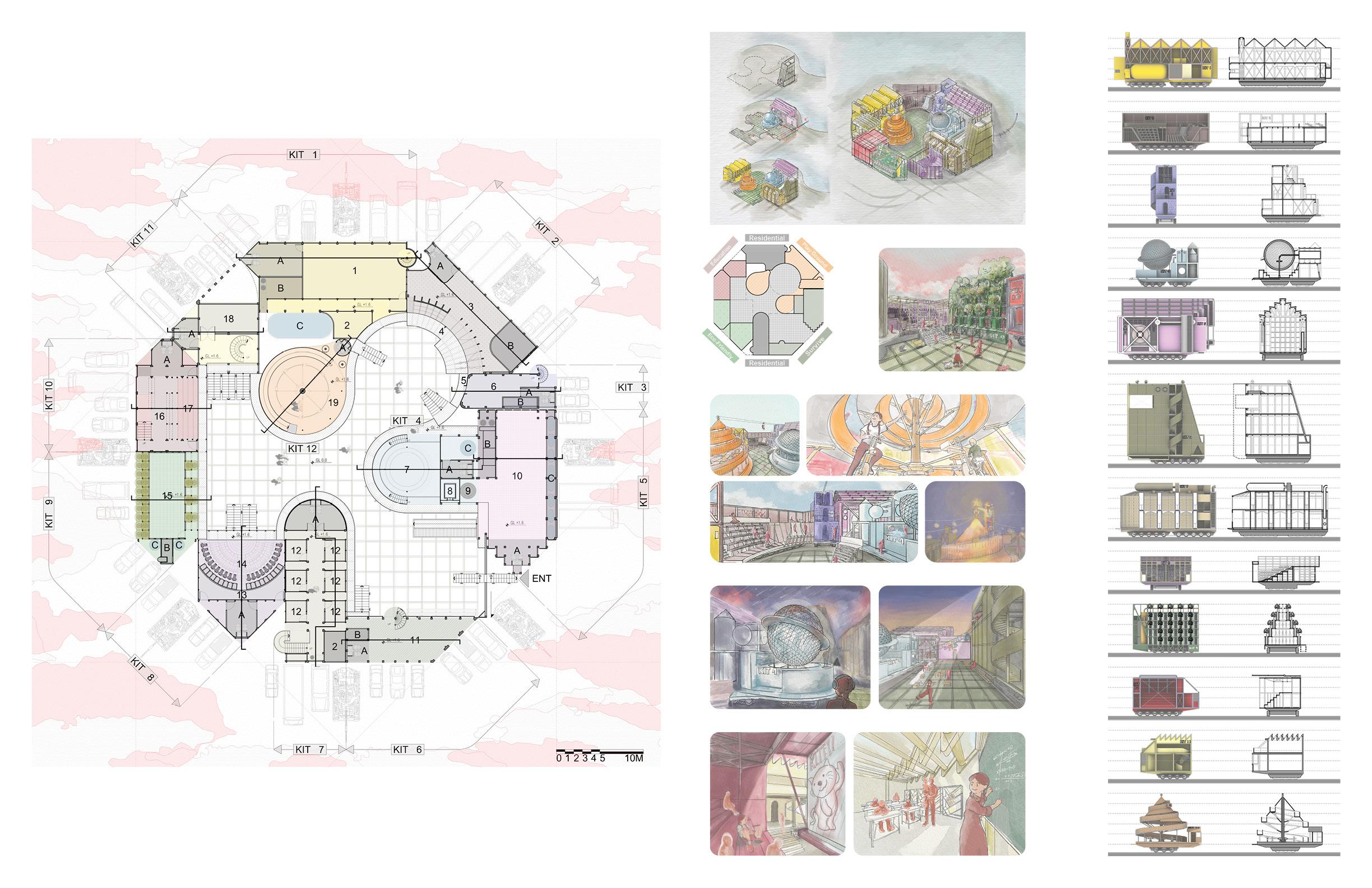
These 12 KITS gather in a safe location, forming both a protective barrier and a unified town. Within the irregular courtyard they surround, children can engage in a variety of activities across themed areas categorized into survival, residential, educational, and nature-exploration zones.
While ensuring basic living conditions, the courtyard offers children opportunities to experience everyday joy and comfort, instilling in them not fear or anxiety, but hope for the future.