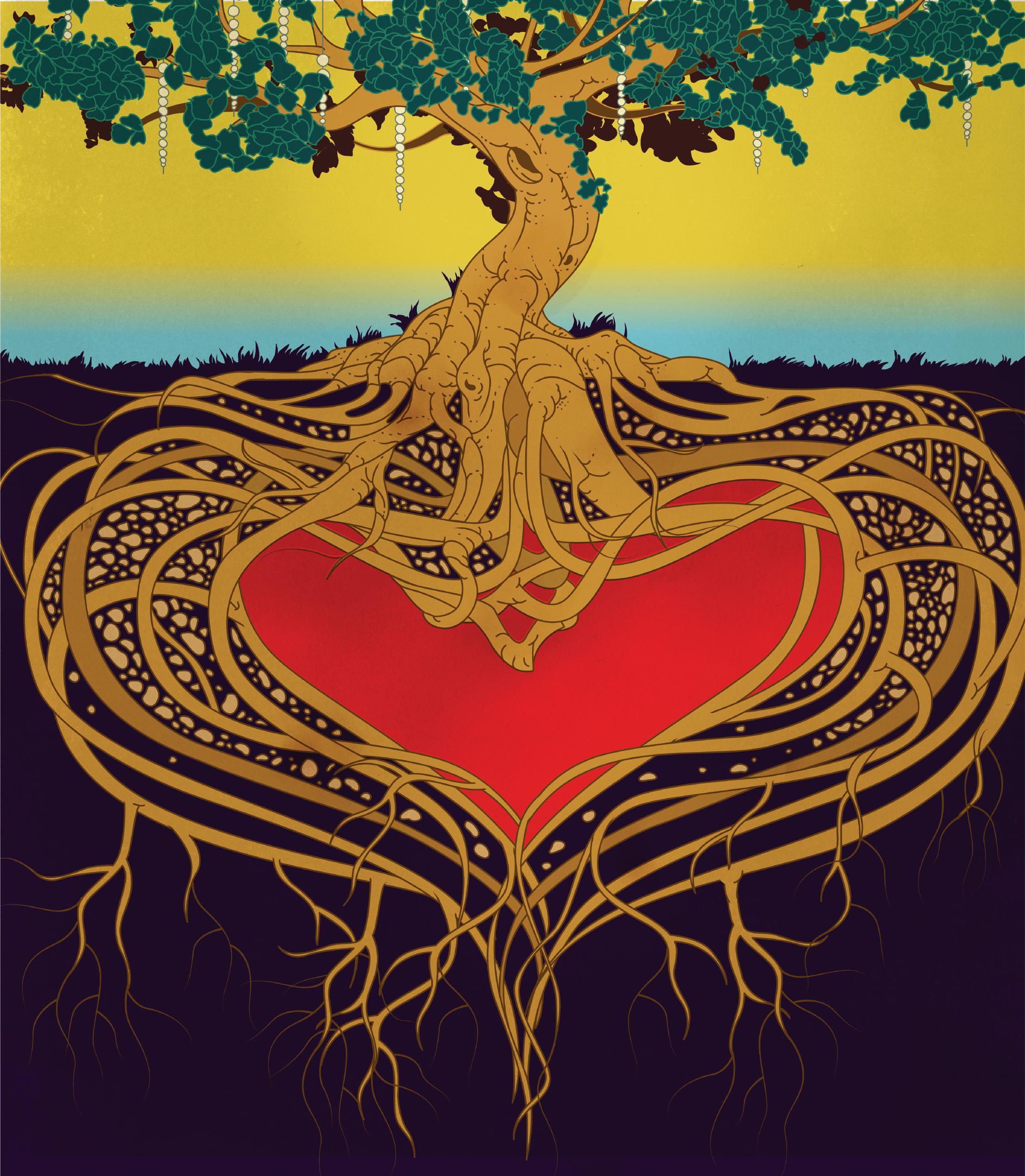
At Urban Strategies Inc. we believe that love is a value but also a practice that calls us to stand with communities, reimagine systems, and build pathways toward liberation. In this supplement, we invite you to join us on this journey of love-centered transformation.
p. 3
What’s Love Got to Do with It? BY
DONOVAN C. DUNCAN
p. 4
Challenge Accepted BY ESTHER SHIN
p. 5
The Highest Form of Love BY
MARC DONES & MARGOT KUSHEL
p. 6
Funding Liberation BY
DAVID STIFFLER
When
p. 8
Policy Rooted in Love BY
MELVIN CARTER
p. 11
When Love Calls, Philanthropy Must Answer BY SHAMMARA WRIGHT
p. 12
This Is What Love Looks Like BY SHANELL KEENE
p. 14
The Present and Future Are OURS!
BY DONOVAN C. DUNCAN
Love Leads A poem inspired by the USI Collective Works by asani shakur
When love is the lens, the light, the law, Not just reaction to what we saw, But a system we build, a dream redefined, A rhythm of healing, a movement aligned.
When love is the strategy, love is the plan, Not a whisper or wish, but the work of our hands, Not a charity flicker, but a justice flame— A structure that serves and a soul that claims.
Love in our homes, love in our street, A roof with respect and a floor underneath. No child in a closet, no elder outside— Love builds security, with dignity inside.
Housing as medicine, housing as balm, Housing as peace when the world lacks calm. We build with compassion, not policies cold— Love breaks the cycle and dares to be bold.
Love in our labor, love in our plan, Creating the futures where every child stands. Not wealth hoarded high in towers of gold— But seeds we are planting a thousandfold.
A seat for each soul at prosperity’s feast, Love makes the margins rise like yeast. Not poverty masked with a ribbon or bow, But balance and ownership rooted below.
Love in our policies, love in our care, Love in the systems we choose to repair. Love in the data, the budgets, the codes— It lifts up the voices too long opposed.
We cancel what crushed, we fund what breathes, We govern with heart, with hands in the weeds. This isn’t soft, it’s a revolutionary way— To legislate love and rewrite the day.
Love in our giving, love in our trust, Not just donations, but giving that’s just. Philanthropy moves at the pace of belief, Rooted in purpose, not pity or grief.
Give with your ears, your hands, your feet— Let dollars and dreams humbly meet. Fund what’s bold, and stay for the rise— Love is the answer, not just the why.
Love in our block, our schools, our skies, In murals, in meals, in lullabies. In porch lights returning where silence had been, Love makes a home where new stories begin.
It’s Wi-Fi for children who dream through the screen, It’s mentors who teach them what hustle can mean. It’s justice with heart, it’s action not shame, It’s calling each neighbor beloved by name.
And love in tomorrow, the call of today, A framework of hope that refuses decay. No more scraps from an old table’s past, We’re building anew—this time built to last.
From spreadsheets to street steps, from grants to the ground, Let love be the reason, the root, and the crown.
So let us be builders with courage and grace— Let love be the scaffold for every place.
This is our moment, the chorus, the creed, Love is the future—forever the lead.
Not just a feeling, but radical art, A world redesigned with the soul at its heart.
Love is the method, the mission, the star ... Love lights the path—in all that we are.
Asani Shakur is a writer and project manager at USI.
WHAT’S LOVE GOT TO DO WITH IT?
We at USI believe that love is a practice that advances opportunity for all.
BY DONOVAN C. DUNCAN
Welcome to this series, which centers the voices of some of our esteemed partners in this journey with Urban Strategies Inc. (USI), a nearly 50-year-old “think and do tank.” USI is a national nonprofit leader and a growing force for change that partners with children, families, and communities to cocreate a better world.
If we were to ask you, “What’s love got to do with it?” would you default to the Tina Turner classic or ponder a rhetorical question? At USI, love is how we measure success. Rather than a fuzzy word or fleeting sentiment, love is what drives our work. We see ourselves as engineers of opportunity, building on what local communities know they need to become stable and thrive. With that result in mind, we broker public-private strategies to elevate and scale the best approaches for all. To love a community and its people means believing that transformation is possible and abundance is achievable, and refusing to settle for anything less than liberation.
Facing hardship and opportunity withheld, love steadies us. Love grounds us in what is genuine and unshakable. Howard Thurman once wrote about “the sound of the genuine.” We believe that sound is love: a deep, abiding love for community and the divine spark in all of us.
We ask you, reader: Who are you? Do you hear the genuine in your spirit? Is it alive in your soul? How do you love? Is it present in the work you do for the betterment of our shared humanity?
Each of us carries a calling, and with it a responsibility to uplift the most marginalized and create systems that repair but also reimagine. Love demands this—and rewards us. How are you deploying your love? How are you weaving together skills and courage to shape a society where everyone thrives?
The following writings by health avengers, financial social justice leaders, elected officials, philanthropists, and community residents explore the promise of abundant transformation rooted in love. They ask what our society could be if we all leaned into love as a strategy. Without love—for ourselves and one another—we risk losing the soul of our great society.
At USI, we believe love is a value but also a practice that calls us to stand with communities, reimagine systems, and build pathways toward liberation. We invite you to join us on this journey of love-centered transformation. What greater calling is there than loving boldly, building abundantly, and ensuring that every community has the chance to flourish? The present and future are ours—will you join us?
DONOVAN C. DUNCAN is executive vice president and chief operating officer of Urban Strategies Inc.
CHALLENGE ACCEPTED
What would the United States look like if every American had the opportunity to succeed?
BY ESTHER SHIN
We accepted this challenge in 1978 with our founding mission. The work of USI began as a promise. Back then, it was a promise to give the working poor of St. Louis access to more resources and a better quality of life. Nearly 50 years later, our promise remains.
What is a promise? Merriam-Webster refers to a legally binding declaration that gives the person to whom it is made a right to expect a specified act. The US Constitution declares that all are promised a right to life, liberty, and the pursuit of happiness. Instead, we have made
exceptions based on income, skin color, zip code, lifestyle, age, ability, and a host of other factors. While our constitution’s promise has not lost its luster, we have forgotten that for generations, too many of our neighbors have been shut out of opportunities to achieve their dreams. Despite neglect of our founding promises and trickle-down approaches to success, American citizens have had to strive for less-than-stable livelihoods or thrive in the face of traumatic conditions. At USI and together with our robust partner network, we are committed to more opportunity for all. What would it look like if everyone had access to high-quality education, affordable housing, living-wage jobs, and other resources we all need to thrive? What would it look like if some of our people did not have to suffer for others to succeed? What would it look like if we valued every individual as a fellow human instead of seeing others as adversaries? Fulfilling the nation’s promise will require collaboration among many sectors, but also courage to fight against the forces that work hard to ensure that promise is never delivered. We will also need bravery to admit that even those of us who have worked to do right by our community have not always gotten it right. In some cases, we have unwittingly paved the way for those who do harm.
The articles in this supplement represent the array of voices we need—philanthropy, government, private industry, and community—to fulfill the nation’s promise. Each esteemed author brings their own perspective to the question, “What would it look like if everyone had the opportunity to succeed?” For me, the answer is that everyone has resources to realize their potential while feeling safe in mind and body. I encourage readers to consider this question while reading these articles without bias or judgment and with an open heart and humanity.
Will you accept our challenge to lean in with love and do the hard work together? Will you challenge your bias, antiquated beliefs, and the harmful systems that support the othering of our neighbors? This is both the urgent work in front of us and the unspoken part of the promise. It will take dismantling and rebuilding to achieve the promise.
ESTHER SHIN is president and CEO of Urban Strategies Inc.
THE HIGHEST FORM OF LOVE
Safe, stable housing is the foundation of community flourishing.
BY MARC DONES & MARGOT KUSHEL
The greatest form of love is healthy, safe, and thriving communities. The best way to ensure that is to secure adequate, safe, and affordable housing for all.
At its core, health care is about helping people live healthy lives. Clinical care is only one piece of the puzzle, however. Research shows that medical services contribute some 10 percent to overall health outcomes. Whereas genetics account for another 30 percent, 40 percent comes from behaviors such as diet, exercise, and substance use. The remaining 20 percent arises from social and environmental conditions. These “social determinants of health,” which include our jobs, neighborhoods, access to food, education, and community support, shape our well-being to a greater extent than our work inside clinics and hospitals. Among these social determinants of health, housing is foundational. Without safe, stable housing, the rest falls apart. Housing is the literal and figurative basis of health: a place to sleep, store food and medicine, recover from illness, and feel safe. Without stable housing, it is difficult to prioritize or receive health care. Families and individuals without it face cascading challenges that no amount of clinical care can solve.
THE WEIGHT OF HOUSING COSTS
For decades, Americans have faced a growing gap between incomes and housing costs. Families that spend more than 30 percent of their income on rent are considered “rent burdened.” Today, nearly half of US households fall into that category, and more than one-quarter spend more than 50 percent of their income on housing (“severe rent burden”). Many of these families are forced to make impossible choices: rent or food, rent or medicine, rent or transportation to work.
The math is unforgiving. According to the National Low Income Housing Coalition, the United States faces a shortage of 7.1 million affordable and available rental homes for extremely low-income households. For each 100 such families, only 35 units exist. No state in the country has an adequate housing supply, and there is no city where someone working full time at the federal minimum wage can afford a modest two-bedroom apartment. This is not an urban or coastal crisis but a national one, encompassing everything from rural towns to major cities, and it is getting worse.
HOUSING AND HEALTH OUTCOMES
The absence of safe, stable, and affordable housing has profound health effects. Substandard housing exposes families to mold, pests, and lead, and exacerbates asthma and other chronic illnesses. Poor insulation and heating systems leave residents vulnerable to extreme heat and cold. Overcrowded units worsen stress and poor sleep and accelerate the spread of infectious diseases, a problem laid bare during the COVID-19 pandemic, when household density proved a major driver of viral transmission.
For people struggling to balance rent payments with other expenses, and for those living on the edge of eviction, constant stress takes a toll. Researchers have linked housing stressors to depression, anxiety disorders, and poorer control of chronic conditions such as diabetes and hypertension. Children in unstable housing experience developmental delays, worse school performance, and higher rates of hospitalization.
Homelessness sits at the extreme end of this continuum of housing insecurity. On any given night, more than 770,000 Americans face homelessness—it’s a public health emergency. People without homes experience rates of chronic illness that greatly exceed that of the general population, and their life expectancy is decades shorter. Exposed on a regular basis to violence, extreme weather, and the psychological strain of living without safety or privacy, unhoused individuals endure much higher rates of hospitalization. Discharges are fraught. Patients are often sent “home” to a shelter cot or the street, undermining recovery and setting the stage for readmission.
Providers face impossible decisions. Sometimes patients are admitted not because they require hospital-level care, but because they have nowhere safe to go. Medications are lost or stolen. Patients without phones or addresses miss follow-up appointments. The system strains under the weight of treating symptoms that stem not from biology, but from the absence of shelter.
STRUCTURAL INEQUITIES IN HOUSING
These crises are compounded by structural inequities that are baked into US housing policy. For generations, discriminatory practices such as redlining, mortgage denials, predatory lending, and exclusionary zoning locked Black, Indigenous, and other people of color out of stable housing opportunities. These policies denied individuals access to homes but also denied families the chance to build wealth, stability, and health across generations.
The consequences are visible today. Black families are more likely to be rent burdened and more likely to experience eviction or homelessness. Native communities face extreme housing shortages and overcrowding. Latino families disproportionately live in substandard
housing with environmental exposures. These inequities reverberate in health statistics: higher rates of asthma, hypertension, maternal mortality, and life expectancy gaps that span decades.
Housing insecurity is not evenly distributed and neither are the health impacts. If we want to achieve health equity, we must confront housing equity head on.
HOUSING AS HEALTH CARE
What does it mean to say that housing is health care? It means recognizing that prescriptions and procedures cannot compensate for the absence of a home. It means understanding that rent subsidies, eviction prevention, and affordable housing production are as vital to health as flu shots and cancer screenings. It means that if health systems are serious about improving outcomes, they must step outside the clinic and invest in housing stability.
Some hospitals and health systems are beginning to invest in affordable housing, partnering with developers, leveraging their land, or providing capital to stabilize housing for vulnerable populations. Medicaid waivers in some states now allow funds to be used to support housing navigation services and short-term rental subsidies. Philanthropic and public-private partnerships are expanding permanent supportive housing, providing stable housing, and ending homelessness for individuals with the most significant behavioral health challenges. But these efforts pale in comparison to the scale of need. While pointing the way forward, they cannot substitute for comprehensive policy solutions.
THE PATH FORWARD
We know what works. Universal rental assistance would dramatically reduce rent burdens and prevent homelessness. Expanding the Housing Choice Voucher program, strengthening eviction prevention services, and investing in affordable housing construction and development are essential. Inclusionary zoning and fair housing enforcement can chip away at structural inequities. We must scale permanent supportive housing for those with complex health needs.
For health systems, the imperative is clear: move from pilots to permanence. Partner with housing authorities, community-based organizations, and policy makers to address housing as a core determinant of health. Reframe “return on investment” as not only dollars saved on avoidable hospitalizations but also healthier, more resilient communities.
Instead of an abstract debate, this is about whether families can afford groceries without skipping rent. Whether an older adult can safely recover from surgery inside a warm home. Whether a child can grow up free from the trauma of repeated evictions.
The highest form of love is healthy, safe, and thriving communities. To achieve it, we must guarantee safe, stable, and affordable housing for all.
MARC DONES is policy director of the UCSF Benioff Homelessness and Housing Initiative.
MARGOT KUSHEL is a professor of medicine at University of California, San Francisco; division chief of the Division of Health Equity and Society; and director of the UCSF Action Research Center for Health Equity and the UCSF Benioff Homelessness and Housing Initiative.
FUNDING LIBERATION
To create the world we want, we must build a wealth management system rooted in belonging for all.
BY DAVID STIFFLER
What does it mean to build wealth with love? Not love in the abstract but love as a practice. A practice built on care, clarity, and commitment. A practice that is holistic and scales with all walks and in all regions.
If we are to build with love, the first step is acknowledging an uncomfortable truth: Our traditional wealth management system was not created for all to succeed. It was not designed for “your tired, your poor, your huddled masses yearning to breathe free,” but for the few to manage the many. It is flawed and the fruit it bears is rotten. The industry must start over with a plant rooted in love, fueled by justice, and maintained with peace. A system that desires everyone who pulls from it to become better because of it.
The financial industry has often reinforced the barriers it claims to dismantle, failing to accept accountability for its follies and contradictions. Intergenerational poverty persists not because of a lack of ambition or talent, but because structures have long prioritized color over ingenuity, access over equity, profit over people, and systems over soul. The burden of financial exclusion falls along racial and geographical lines, affecting Black, brown, and white families in rural and urban communities alike. It is a testament to how inequity robs all Americans from experiencing the bounty of this country.
If we are to serve more households, we must recognize the failure of our capital markets to foster shared prosperity. We must not only ask who has been left behind, but why and how we can do things differently. How do we learn from failure to forge a future that recognizes the assets of our neighbors and neighborhoods?
This journey to financial liberation is anchored in humility, a sense of moral responsibility, and aligned systems rooted in love. It is not
enough to promote financial literacy in isolation. We must instead invest in a collective impact model that reimagines wealth building as an act of inclusion, infrastructure, and love.
At the heart of this model is a national ecosystem comprised of credit unions, fintech innovators, nonprofit partners, public-benefit corporations, and data-sharing collaborators. Working together, we pursue a singular goal: unlocking access to generational wealth for millions of people long excluded from the conversation. This is not charity or a handout. It is the work of justice.
THREE PILLARS
This framework rests on three pillars: assets, education, and data. Asset Forward | Assets are not only financial tools but also instruments of hope. From a child’s first 529 savings plan to community-led scholarships, mutual aid workshops, and new bond initiatives for first-generation college students, each new asset is a declaration: You belong in the economy. We prioritize delivering tangible assets to individuals and families at the earliest stages of wealth building, opening doors to opportunity that compounds over time.
Financial Education | Financial education must meet people where they are. A blanket curriculum is not enough. Our approach connects tailored, life-stage financial education to asset programs, ensuring relevance and resonance for all. Like wealth, knowledge must be shared with purpose. Its teachers must connect with students by using a multipronged, multigenerational approach that is intersectional and holistic. Its tools must speak to different levels of comprehension and different languages, offering a full catalog to equip our neighbors to make informed decisions that position them for generational wealth.
This framework is the reckoning the financial system needs so that every newborn leaves the hospital with resources, each student has knowledge before graduation, and all adults benefit from access to tools while building the equality of opportunity the country’s founding documents proclaimed.
Data Enabled | To measure progress, we must see people clearly. Investments in data infrastructure and community insight tools, such as community-centered performance dashboards and local research partnerships, allow us to understand who we serve, how we serve them, and any gaps that emerge in the process. From Black and Latino entrepreneurs to rural small-business owners, families benefiting from baby bonds, and young people scaling their lemonade stands, data becomes a compass pointing us in the direction of inclusion and impact.
Our commitment extends beyond pillars and platforms, however. We learn—sometimes in uncomfortable ways—that transformation requires proximity and power. It requires listening, releasing control, and reshaping not just what we offer, but also how we offer it. Instead of measuring success only in balance sheets, we count the number of households that can envision and achieve a different future.
Wealth building is often portrayed as the solitary pursuit of chance rather than a dance between racism, nepotism, and classism. True financial freedom is collective. It happens when systems are remade with people and humanity in mind. It happens when institutions name love and radical care for the full human experience as strategic imperatives.
In our next chapter, we hold a bold question at the center of our work: What would it look like if every American, regardless of zip code, background, or inheritance, had a real shot at financial freedom? Our answer, still unfolding, is rooted in relationships, equity, and a deep belief that liberation is not a niche offering. It is the promise that animates our democracy, economy, and shared future. It is the pathway to thriving on which the future of our nation depends and on which legacies are built.
To fund liberation is to commit to the hard work of becoming trustworthy and transparent. It is to dismantle barriers and build bridges. It is to understand that wealth, when rooted in love, is not just a means but also a movement. The industry must ask: Are we funding liberation for all, or are we looting from the future for the gain of a few? We urge you to fund alongside us and others who demand better for all.
POLICY ROOTED IN LOVE
St. Paul sits at the heart of a growing national movement— one that insists our systems serve people, not the other way around. This movement challenges us to rethink how government operates and calls us to lead with a new kind of courage.
BY MELVIN CARTER
IIn St. Paul, Minnesota, love takes tangible form. It shapes our policies, guides our budgets, and breathes life into every neighborhood. We don’t treat love as charity; we embrace it as a responsibility. Though we are not America’s largest city, we embody a deeper truth: The soul of this nation thrives in the courage of its communities. Every day, that courage shines through the lives of our residents—people who believe in one another and contribute to something greater than themselves. Here we don’t simply test democratic ideals—we prove them. We build stronger systems by listening closely and leading with love.
At a time when inequality widens and trust in institutions wanes, centering love in government moves beyond idealism—it becomes an urgent necessity. Love demands more than equity statements or ribbon cuttings. It calls us to design systems rooted in care, shared governance, and community power. It demands action. When we lead with love, transformation follows.
I’m not speaking of sentiment or empty slogans. I mean love as a governing strategy. Love as infrastructure. Love as investment. Love as the very heartbeat of democracy.
ST. PAUL STARTS BY LISTENING
In St. Paul, love begins with listening. We treat our budget process not merely as an accounting tool but as a blueprint for healing. We don’t ask, “What can we afford?” Instead, we ask, “What do our communities deserve?”
We lift voices that systems have long ignored: working parents juggling multiple jobs, youth dreaming beyond their neighborhoods, elders carrying generations of wisdom, and babies discovering the world for the first time. When we listen deeply, policy stops building walls and starts building bridges.
Town halls become moments of connection, not conflict. Civic meetings become spaces of respect, not spectacle.
DAVID STIFFLER is a financial services social impact executive with 20 years of experience working across multiple communities and countries.
By leading with what we hear, we do more than meet basic needs—we answer the deep yearning within every community to thrive.
We begin to see our neighbors as extensions of ourselves—and act accordingly.
A MOVEMENT, NOT A MOMENT
Our democracy doesn’t fray from too much love—it frays from too little. Too many people believe government cannot work for them because, too often, it hasn’t. Systems designed to extract have hollowed out trust. The antidote isn’t apathy—it’s alignment. And alignment begins with love.
To center love in public life means refusing to normalize suffering. It means designing with our communities, not for them. It means building cities where people don’t just live—they belong.
This story doesn’t belong to St. Paul alone. Across the nation, organizers, philanthropists, health-care workers, and civic leaders ask: What if love were the starting point?
That question becomes an invitation—to believe transformation isn’t just possible, but that it’s already happening. Love is the goal. But more importantly, it is the method.
INVESTMENT WHERE IT MATTERS
Because our residents long for opportunity, we launched CollegeBound Saint Paul, placing a college savings account in every child’s name at birth. That initial $50 deposit means more than money—it declares every child, regardless of background, worthy of investment.
Because families deserve dignity, we erased over $110 million in medical debt—removing a crushing barrier. Love and shame cannot coexist.
Because our neighbors deserve justice, we raised the minimum wage, eliminated library late fees, and made youth athletics free. We built community-first public safety that centers connection to prevent cycles of gun and group violence, rather than punishment. Love doesn’t ignore harmful systems; it confronts and repairs them.
These decisions stem from one clear truth: Love is the most powerful tool local government wields to bridge the gap between policy and people.
Through CollegeBound and our expanded youth employment program, Right Track, we partner with young people—not treat them as problems. When youth see themselves reflected
in policy, trust grows. Trust is fertile soil where hope and progress take root.
We’ve piloted universal basic income, forged partnerships to outpace bureaucracy, and designed programs that meet people where they are. This is love under pressure—nimble, collaborative, and courageous.
Equity without power remains performance. That’s why we invest in community ownership. We protect renters, fund entrepreneurs of color, and use public land to create permanent affordable housing.
Yes, love unsettles some policy makers. It is often dismissed as soft or naive. But we reject the false choice between care and competence.
Policy grounded in love is not weakness—it is the highest form of democratic strength.
One day, our children will look back on this moment. Let them say we governed not out of fear but out of boldness. Let them say we didn’t just pass policies—we passed the test of our shared humanity. Here, in our corner of the world, we chose love—and we invite the nation to do the same.
MELVIN CARTER is mayor of St. Paul, Minnesota.
WHEN LOVE CALLS, PHILANTHROPY MUST ANSWER
These times require funders to act with urgency and devotion to ensure justice and equity for all.
BY SHAMMARA WRIGHT
Love may not be the first sentiment that comes to mind when considering the state of America today. Powerful lawmakers using divisive rhetoric are slashing programs that help families make ends meet; keep children fed, educated, and housed; and ensure that health care remains affordable. Amid mounting threats and hostility, love—including compassion, humility, and generosity—is more crucial than ever for philanthropic movements charting the way forward.
When philanthropy acts with an unwavering commitment to humanity, guided by love, the field shines. From the Carnegie Foundation for the Advancement of Teaching’s focus on education to the Gates Foundation’s work on global health, myriad examples show how a shared commitment to responding to people’s needs can become a force for structural and social change. When love calls, philanthropy has an opportunity to offer tenderness, humanity, and compassion. In trying times, philanthropy must answer love’s call by shifting power to communities, building trusting relationships and collaboration, and ensuring that all grantmaking drives equity. It’s how we move through this moment with love and urgency.
SHIFTING POWER TO COMMUNITIES
To answer love’s call, philanthropy must meet the needs of communities facing the greatest injustices. Our learning has shown that the people most directly affected by systemic barriers and inequities are best positioned to identify the solutions and actions needed to drive change. Put simply: Those closest to the problem often have the best solutions. They know the best routes and the challenges that accompany these processes, all while relishing the short-lived celebrations that follow hard-fought wins in systems that don’t make space for joy.
That is why the Robert Wood Johnson Foundation (RWJF) has invested $90 million in community power. We know it works. Black, Indigenous, and other communities of color are leading vital movements, galvanizing people, and seeding transformative change in areas ranging from housing and health care to birthing and family caregiving.
One crucial area of need is Black maternal health. We’ve heard the statistic too many times: Black women in the United States are three to four times more likely to die during childbirth than white women. That’s a crisis, not a number. Among other initiatives, RWJF funded BIRTHING JUSTICE, a documentary that amplifies the voices of Black mothers and advocates fighting for a health-care system that protects, respects, and saves lives. Combining art and the wisdom of affected mothers and advocates, the film points toward a better future for all.
BUILDING TRUSTING RELATIONSHIPS AND COLLABORATION
Building relationships and working together isn’t always easy. It requires moving away from working in isolation and holding onto resources to instead connect with communities that are often overlooked but have the best ideas for real solutions. Local and regional funders, seeing the aspirations, strengths, and priorities of residents, know the particular needs of their communities better than any large or national funder. National funders bring different relationships, resources, and the capacity to influence change on a larger stage.
One example of this collaboration in action is the Funders Working Group for Racial Justice and Health Equity (FWG)—a learning and action group of 12 local and regional funders that empowers foundations to center racial justice and shift resources toward community-led systems change. FWG emerged from RWJF’s COVID-19 pandemic relief grantmaking efforts, which relied on local and regional foundations to get funds into the hands of community organizations that could use them effectively, achieving powerful results. RWJF and FWG are now working to drive justice and health equity by using bold, courageous philanthropy that remains accountable to the communities it serves. Together, we are cocreating a funding apparatus powered by a belief in the community’s wisdom and love.
Our lives and those of future generations depend on our ability to find common ground, build trust, and move forward together with love, courage, and compassion.
Our lives and those of future generations depend on our ability to find common ground, build trust, and move forward together with love, courage, and compassion. This is the fight of our lives. We believe we must hand over the wheel to those closest to communities and use our ample war chest to navigate the terrain we now tread.
ENSURING THAT GRANTMAKING DRIVES EQUITY
Philanthropy can drive equity by disseminating decision-making power and distributing resources. That means moving unrestricted dollars in flexible and rapid ways, trusting communities to define their priorities and processes while supporting long-term strategic work. By committing to long-term investing in organizing, policy advocacy, and systems change, philanthropy can effectively address the root causes of inequality and build a future where everyone has a right to health care. Using data-informed cures, we no longer have to rely on costly shortterm treatments.
Philanthropy’s responsibility to answer the call of love but also seek out those in need is what guides my work. My belief in philanthropy’s duty to respond propels my programming, which seeks a future that provides all people with the opportunity to live in a safe, healthy, and thriving community.
Philanthropies across the country must now wrestle with how the sector operates amid heightened hostility toward fundamental values such as equity, diversity, and inclusion. Should they deepen existing efforts or adopt new approaches? Funders may not get a second chance to respond to the urgent needs of grantees and communities facing unprecedented attacks. Our work realizing and expanding the American Dream will allow future generations to celebrate our courageous decisions to respond to the current moment in ways that are just. We must plant the tree while understanding that we may never feel its shade. We must cocreate systems that save lives and restore humanity, one zip code at a time. We must ensure the health of each individual who calls this country home and allow them to share in its wealth while adding to its riches. The call is urgent. If philanthropy doesn’t answer love’s call now, who will?
SHAMMARA WRIGHT is managing director of strategic portfolios at the Robert Wood Johnson Foundation.
THIS IS WHAT LOVE LOOKS LIKE
I have seen with my own eyes what happens to a community when love becomes policy’s guiding star.
BY SHANELL KEENE
Morning light filters through an old apartment window as a single mother stirs, her thoughts already cataloging bills and childcare pickups. Her day begins with small acts of devotion: packaging yogurt and granola into reusable containers, double-checking her daughter’s face mask, and reviewing the rideshare schedule for after-school pickup. Every gesture is an expression of care, a deliberate choice to turn routine tasks into threads of connection. In neighborhoods across the country, similar scenes play out: parents balancing remote-work calendars, neighbors contributing to food pantries, and volunteers dropping off extra diapers, an unspoken promise that no family stands alone.
Beneath the rhythms of modern life pulse decades of community building, born from love’s insistence. When redlining confined Black families to underresourced city blocks, they responded by repurposing church basements into libraries and vacant lots into vibrant vegetable patches. Today, the same streets host weekend farmers markets run by local co-ops that feed families and nourish hope. Mutual aid networks, ignited during the pandemic, connect nursing-home workers without paid leave to gig-economy drivers denied unemployment benefits. In each curbside delivery and virtual check-in, love reveals itself as a collective force that resists isolation with empathy.
Even so, fault lines are visible. Skyrocketing rents in gentrifying districts force families to choose between rent and medicine, and affordable housing remains scarce despite federal COVID-19 relief. School budgets, still tied to local property values, perpetuate educational gaps that parents patch by turning to tutoring collectives and crowdfunding campaigns. In emergency rooms, expectant mothers grapple with mounting medical bills before their babies arrive. These fractures show that love, even in its most determined expressions, cannot fill the chasms carved by policies that favor profit over people.
But when love becomes the guiding star of policy, the chasms shrink. Imagine city councils convening hybrid assemblies—outdoor tables under tents or Zoom links broadcast on neighborhood smart boards—where parents, elders, and youth activists remake budgets in real time. Picture mixed-income apartment buildings owned by resident cooperatives, their rooftop gardens doubling as licensed childcare centers and mentorship hubs for teenagers learning sustainable agriculture. Envision transit lines electrified and fare-free, linking affordable neighborhoods to job centers, clinics, parks, and cultural venues, and removing travel costs from household ledgers.
Philanthropy can also honor love’s lessons. No longer parachuting into a community to provide short-term grants, foundations commit to decade-long partnerships, embedding staff into the city blocks they support. This philanthropy funds participatory research led by parents who know which corner store sells expired baby formula and by students mapping the safest routes for the walk to school. Grant dollars flow into community land trusts and social impact bonds that reward improvements in health outcomes and school attendance, ensuring that investments compound instead of dissipate.
In this landscape, the social determinants of health—nutrition, housing, education, and transportation—no longer drift in isolation. A single mother can enroll her child in a free pre-K program housed in the same building as a sliding-scale clinic offering prenatal care. After work, she stops at a neighborhood hub where legal-aid volunteers assist with tenant rights and youth leaders facilitate evening STEM workshops. Solar panels power these services, reducing utility bills and teaching green energy skills to interns.
Digital inclusion, too, becomes an act of love. Community-operated Wi-Fi networks span rooftops, ensuring that children can stream lessons without data anxiety. Neighborhood radio streams and hyperlocal newsletters broadcast in multiple languages, weaving local narratives into daily life and validating cultures that are too often overlooked. Online peer-support circles blossom into virtual living rooms, offering mental-health solidarity 24/7.
When flash floods or power outages strike, resident-designed alert apps mobilize volunteer teams to distribute essentials and share real-time updates. These digital and grassroots systems prove that love thrives when technology and humanity converge, creating resilient bonds.
Reparative justice initiatives gain traction as well. Cities channel parking-ticket revenue into grants for first-time homebuyers from historically excluded communities. State legislatures convene truth and reconciliation commissions to examine predatory lending and wrongful evictions and then enact policies erasing medical debt accrued during childbirth. Universities expand tuition waivers for descendants of enslaved people and partner with local schools to guarantee college credits for high school seniors. These measures acknowledge that historical and economic wounds demand collective healing, not platitudes.
Scaffolding that supports universal opportunity requires both grassroots innovation and policy shifts. A federal affordable housing guarantee, modeled on cohousing projects abroad, could unlock billions of dollars for local initiatives. A universal basic income pilot, scaled across regions, would stabilize household budgets and unleash entrepreneurial potential. Mandates for paid family leave and sick days normalize caregiving for all workers. Equity impact assessments, required for every new law, would ensure that policy makers weigh benefits for historically excluded groups before committing to the fine print.
These ideas become reality in neighborhoods where love is the organizing principle. A mother juggling part-time jobs finds that her daughter’s school hours now align with her shifts, thanks to on-site childcare. A family facing eviction gains legal representation through a tenant-support fund created by municipal ordinance. A teenager lands summer work at a community-run makerspace that doubles as a climate-action lab, empowering youth to design flood-resilience solutions on their own city blocks.
For the mother humming her daughter’s favorite song tonight, living in love means more than perseverance. It means thriving together. It means waking up in a home she helped create, taking an elected seat on her neighborhood council, and teaching her child that care is a civic duty as much as a feeling. It means watching the next generation inherit structures that treat them not as recipients of charity but as cocreators of the city’s future.
As dawn turns to day, lemonade stands sprout on front stoops, the proceeds funding library expansions and community festivals. Parents and students collaborate on murals celebrating local heroes. City hall debates converting empty office towers into mixed-use live-work cooperatives, championed by residents whose voices flow through every committee. These are not abstractions but living proof that when love shapes our streets, schools, and statutes, every barrier becomes an invitation, vulnerability is met with solidarity, and every family finds a home in the promise of belonging.
SHANELL KEENE is a self-published author, proud mom, and driven entrepreneur. Her journey has been shaped by both her love for family and community, as well as her time as a former Tidewater Gardens resident and participant in People FirstUSI community development initiative , where she deepened her commitment to growth and community empowerment.
THE PRESENT AND FUTURE ARE OURS!
We are galvanizing a movement to ensure that every person, regardless of race, background, or zip code can access the American Dream.
BY DONOVAN C. DUNCAN
As ecosystem builders and investors in community transformation, we have focused on stability for the last five decades. Stabilizing the single parent, the eager and expectant student, the transitioning teenager, the unmotivated, undersupported young adult, the overwhelmed head of household, the elder with desires of living out their days at home in their community. We’ve seen it all.
We’ve also achieved great success. The main ingredient of that success has been connecting in authentic ways with disfranchised neighbors and residents with forgotten zip codes, centering their experiences as we design community transformation and economic development strategies. This work is rooted in holistic pathways to stable housing, lower risk scores, and integrated educational ecosystems that support everyone from cradle to career and beyond. It depends on community partners that want to do the work in the short and long term, propped up by a diverse funding apparatus that includes a thriving philanthropic community and supportive elected officials who clear the way for others to receive. It’s a simple recipe that we’ve created in more than 60 communities across the country. Spoiler alert: It can be done and scaled.
Industry leaders often ask me, “What’s the secret sauce?” My answer is simple: “Love and a results orientation.” Our love for people is our vibranium and our legacy. It’s the foundation of our shift from transactional to transformational leadership. As you read this, you might ask, “What does love have to do with it?” Everything, because love is a universal language. I believe that through love—and only love—we can reach collective prosperity.
The moment we are in allows us to reimagine a world that benefits everyone. A world where every community has access to:
• Quality education (nearly 60 percent of fourth graders from lowincome families in the US can’t read at grade level)
• Economic opportunity (when more than one in three families cannot afford basic needs)
• Culturally competent health care (in a system where Black women are three times more likely to die in childbirth than white women)
• Safe, stable housing (more than 700,000 people experience homelessness on any given night)
• Ways to engage in democracy to strengthen their communities without hurt, harm, or danger
We’re being invited to move beyond systems that were not built for everyone and into structures that reflect who we are and aspire to be. The path forward is paved not only with innovation, but also intention that centers care, dignity, and the experiences of the people living closest to the margins. Our collective posture, from this moment forward, must be abundance, and we must remove scarcity from our lexicon. We must see all of us. We must honor our lived experiences, shared connections, and the promises we make to one another. The American promise, while key to remaking our future, must be grounded in our collective humanity. Is it truly a promise? Only love will hold us accountable.
I believe we live in one of the greatest countries in the world. But until we confront the marginalization of individuals and entire communities, that greatness remains at risk. We are only as great as the sum of our parts and boldness is required to ensure that our humanity is visible to all.
So I ask: Are we willing to continue perpetuating generational harm? Or are we ready to reimagine a world that sees us all? I was born and still live in a society that often doesn’t see me. But I’m working to eradicate that invisibility and connect our purpose with the promise of our present and future, which gave birth to this collective movement. You may ask, “What is the collective movement?” It is the movement that centers our collective humanity through the lens of:
• A grounded experience centered on people
• Strategic action for the betterment of community
• Releasing the transactional in favor of the transformational
• A deep understanding that individual humanity is bound to our collective humanity
• Centering policy that responds to historically marginalized places and people
• Remaining nimble and results-oriented in pursuit of a North Star to which we all adhere
In closing, I ask: What would it take as an industry to ensure that every person, regardless of race, background, or zip code, could access the American Dream with dignity? Would it mean releasing the grip of scarcity and choosing abundance? Not as charity but as design? Could we learn to see systems and people living in them not as regulatory checkboxes, but as stories of survival, striving, and dreams deferred? How would we know when we’ve done right? Not through profit alone, but by porch lights flickering in homes that once stood empty. By joy returning to places long abandoned. By children soundly sleeping in rooms that hold their future.
To truly focus on Healthy Opportunities Made for Everyone (HOME), we must align in a different way. We must lead with love and center our collective humanity in action, policy, and practice, not just theory. At the end of the day, this work isn’t just about systems change but also ensuring that every person is seen, heard, and valued.
Founded in 1978, Urban Strategies Inc. is a national “think and do” tank with experience sparking transformation in disinvested communities through housing, community, and economic development. USI works in over 60 neighborhoods nationwide, cocreating solutions that reflect community needs and investing in the social, physical, and civic infrastructure needed to unlock full potential.