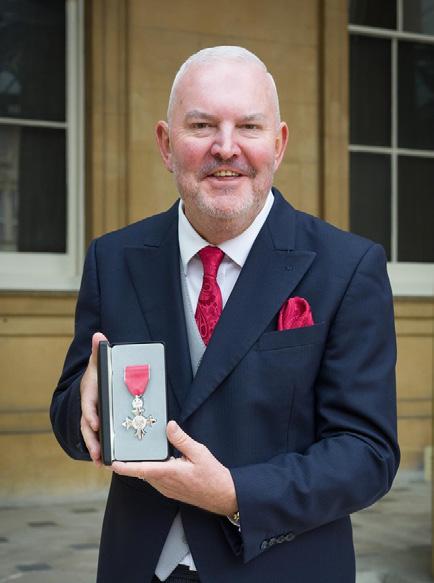
4 Cleaner. Entrepreneur. Philanthropist - In conversation with Doug Wright, MBE
8 Thinking of leaving the UK? Read this before you pack
10 Busting common myths about CGT and divorce
12 Worthy tax planning at Glastonbury’s Worthy Farm
15 Changes to inheritance tax charges for trusts
16 Protect your business from inheritance tax
18 Fraud in art, wine, and crypto
In this issue
More UK-based private clients are exploring life overseas. But a successful move takes more than a flight and a forwarding address. Contents
20 From succession to separation
24 Welcome to the team
What can we learn from Michael Eavis and his clever tax planning at Glastonbury’s Worthy Farm? 8
Whether acquiring a Rothko, a rare Burgundy, or a promising new cryptocurrency, private clients are increasingly exposed to sophisticated scams.
and
Doug Wright talks about his successful career with McDonald’s
his latest project, Kids’ Village.
Meet Ravi Francis, private client partner in London.
Chris Belcher Partner, Head of Private Wealth
chris.belcher@mills-reeve.com
Welcome to the latest edition of Private Affairs
We know that many of you will have been watching carefully during what was one of the tensest Budgets in recent years. Despite the rumours which had circulated, there were no further IHT blows this time round.
It was, of course, the October 2024 Budget which brought the multiplicity of IHT changes. From reductions in BPR and APR to nil rate band freezes; the abolition of the non-dom regime to pensions and death benefits being included in estates for IHT purposes; farmers, business owners, and high-net-worth individuals were significantly affected.
Critically, there is still a window of opportunity to get assets which qualify for BPR and/or APR at 100% into trust structures without an entry charge to IHT. This needs to be done before 6 April 2026 when the Chancellor’s October 2024 changes bite and BPR/APR (save for a £1 million threshold) will be halved.
In a usual collegiate effort, we’ve compiled a series of articles for you from colleagues across our private client and family law teams to bring you what we hope is a good cross-section of pieces from estate planning to wealth protection (with one eye on relationship breakdown) to points to consider before leaving the UK. In this edition, we also asked one of our experts in the commercial disputes team to put
together something on fraud in the context of alternative investments. Whether it’s fake art, counterfeit wine or crypto Ponzi schemes, it makes for an interesting (and cautionary) read!
I must extend our thanks to guest contributors, Jon Fisher of Sedulo, for his article on protecting your business from IHT and particularly Doug Wright, for taking the time to be interviewed and talk to us about his journey to success and giving back to the community.
Finally, I’m also delighted to announce that we have been joined by additional new partners to strengthen the private client team’s international and landowner offerings and an internal partner promotion for a Mills & Reeve born and bred family lawyer. You’ll also get to know a little more about Ravi Francis who joined our London private client team as a partner last year.
As always, if you would like to discuss any of the issues covered in this edition, please get in touch with either the author of the article or your usual Mills & Reeve contact.
Ravi Francis Partner, Private Client ravi.francis@mills-reeve.com
60 seconds with… Ravi Francis
What surprised you most about the private client team?
The breadth and depth of the private client team isn’t as well known outside the firm as it should be. This was a very pleasant surprise. The number of individual rankings we have in the legal directories says it all really, but I wasn’t aware of this until I joined.
What do you enjoy most about your role?
I love lots of things about my role, but the best thing is definitely the people I work with and act for. I get my energy from being around other people – they can be fascinating (especially some of our clients), inspirational and lots of fun! I also get to do some cool things. A recent highlight of mine was that I was invited on a tour of the gold vault in a private bank and given a gold bar to hold that was worth a million pounds!
Why did you choose Mills & Reeve?
There were three main reasons. Firstly, we’re rightly renowned for our people and great culture, which is important to me. Secondly, private client is in the firm’s DNA; being part of such an outstanding team was the opportunity I was looking for to personally develop and build my practice further. Thirdly, the opportunity to work with Sarah Cormack and other colleagues to build the London private wealth offering was too good to miss out on – I believe there are exciting times ahead.
What’s the best advice you have received?
There’s no question that the best advice I have had is around keeping work and family life in balance. A legal career can feel all-consuming at times, and it’s crucial to keep things in perspective and remember what’s really important. I have two young kids and really enjoy their company at the moment, so I’m trying to make the most of that while it lasts!
What’s the best professional compliment you have been given?
Clients often say really lovely things, but I think actions are far greater compliments than words. When a client trusts you with something precious, eg asking you to act for their closest family members, or to advise on a once-in-a-lifetimeevent, I take that as a big compliment. It can be pretty humbling and I try never to take those things for granted.
If you hadn’t been a lawyer, what do you think you’d be doing now?
Honestly, I have no idea… Probably something in professional services – not very imaginative, I know! I was adamant I wanted to be a train driver when I was four… And I’ve always had an interest in psychology and biology, so in a parallel universe perhaps I would be a therapist (but probably a very bad one!)
Catriona Attride Partner, Private Client
catriona.attride@mills-reeve.com
Cleaner. Entrepreneur. Philanthropist.
In conversation with Doug Wright, MBE
Catriona Attride interviews Doug Wright, philanthropist and businessman, on his successful career with McDonald’s, where he started as a cleaner and worked his way up to franchisee. They discuss the launch of the Ronald McDonald House Charities for sick children, as well as Doug’s latest project, Kids’ Village.
How did your journey begin?
My path to becoming a businessman was definitely not formulaic. I was always a bit of a dreamer, but I was very self-motivated and believed anything is possible.
I struggled academically, which was very disappointing given I was adopted by two devout teachers. All I ever wanted was to achieve 10 O-levels, but I only managed one. That was a difficult moment. At that point, my mum turned to me and said, “What are you going to do?” I replied, “I’m going to find a job, start at the very bottom and ultimately own part of that business one day”. My mum thought I was crackers, but from that day onwards, something had spurred me on.
Even though the doctor said I might never walk again, I believed I would recover and become successful so that I could help others.
18 months after the accident, I returned to work at McDonald’s and had to diversify my career because of my limited mobility. I relocated to Sutton Coldfield to the Birmingham Regional Office. I worked in several support departments, predominantly in their acquisition and construction teams. In 1990, I was awarded The President’s Award, which is given annually to their best ten UK employees and is chosen from their entire workforce of 75,000 people.
How did you become a franchisee of McDonald’s?
After 21 years at McDonald’s, I applied to become a franchisee in October 2002. In those days, there was no email – you had to fill in your application and post it. After weeks of waiting, I was invited to the head office in London. The interview went well, or so I thought. I landed all the points and explained why they should support me. However, when they asked how much money I had to invest and I proudly said, “I’ve got £612”, the boardroom went silent. Everyone looked at their shoes. After a brief silence, they thanked me and said they’d be in touch.
Weeks later, I received the golden envelope: I was appointed as a McDonald’s franchisee. Then came the challenge of finding a bank willing to partner with me.
My first job was as a cleaner at McDonald’s. I was paid 93p an hour. In 1985, at the age of 20, I was appointed McDonald’s youngest ever UK Restaurant Manager.
A year into this appointment I was involved in a serious accident where I broke my neck. I was only 20 years old and I was paralysed from the neck down for several months. Even though the doctor said I might never walk again, I believed I would recover and become successful so that I could help others one day.
Initially, it wasn’t what I thought it was going to be. Being a business owner sounds glamorous, but the reality is I had never worked harder. In the first year, we took in just over £1 million in revenue but only made £4,000. I wasn’t concerned. I kept focused on my target to own two restaurants and every penny I made I kept in the business.
In January 2006, we bought the second restaurant north of Sutton Coldfield. It was our first drivethrough and by that time we had 80 employees. I was the proudest man alive. From there onwards, we never looked back. We later scaled up the business from one restaurant to 26.
How do you promote a good culture when you’re operating under a corporate brand?
Treat everyone equally – no matter if they’re a board member or a cleaner. We made sure that everyone in the business followed the two H’s: honesty and hard work.
Though a man of few words, my dad gave me two bits of advice. One was don’t join McDonald’s because they’ll never scale up in the UK (fortunately, as a boy, I only listened half the time). The second piece of advice he gave me was to empower people and give them the opportunity to thrive and lead from the front, in a way that makes them feel valued and special.
The staff turnover in hospitality is very high at around 60% across the industry. I realised the importance of employee retention, not being prepared to accept that rate. We invested heavily in retention tactics and some of those were really simple. For example, we introduced private healthcare and created wellbeing programmes. We made sure that the views of the young people in our company were being properly represented and heard.
We were operating under a global brand, but what differentiated us was that we made sure we cared about our community. Whether that was by supporting local businesses, the people, or football teams, we looked at what mattered in the community.
What inspired you to become involved with the Ronald McDonald House Charities?
When I was in hospital all those years ago, my mum slept on the floor next me, not being able to afford to pay for a hotel. That really broke me. Doug the Dreamer lay there thinking, “One day we’ll fix that”
We began to think about how we could open a Ronald McDonald House in Birmingham. It would be a home away from home for the families of very poorly children. We set out to fundraise to get the capital build cost, which was £9.6 million.
We opened the Ronald McDonald House on the 29 November 2009 at Birmingham Children’s Hospital. It immediately felt special because we created a safe place for people who could be around other families going through a similar situation. Everyone had their own room, with
communal kitchens, dining rooms and play areas for siblings. It was very quiet during the day as one parent would look after the child in hospital, and the other would typically stay at home Monday to Friday to work and look after the other children.
I always thought it was the best thing I’d ever done – being able to house 66 families every night. I went from being a pretty useless, superkeen fundraiser when I started, to a very proud Chairman for six years.
What are some of your recent successes?
Joining the Greater Birmingham Chamber of Commerce helped me grow. I eventually became a board member, and I was recognised for my contribution to charity. In 2022, I was honoured to receive an MBE – I was bursting with pride at being one of the last people to receive this from the Queen, as she sadly passed away not long after.
In 2024, I received a letter from the King asking if I wanted to become the High Sheriff of the West Midlands. I didn’t even know what the High Sheriff was at the time! They champion the judiciary, courts, barristers, the emergency services, work with the local police and attend important functions. My theme for the year as High Sheriff was to shine a light on organisations that were driving community cohesion, in an effort to make the local area a safer and better place.
Let’s talk about your current project, Kids’ Village – what is it and why is it so important to you?
After Ronald McDonald House, I wanted to start another philanthropy project. I was approached by Sir John Crabtree, a former High Sheriff and chairman of the Birmingham 2022 Commonwealth Games Organising Committee. He explained that a family from Lichfield were constructing a village for poorly children to enjoy a week’s holiday with their family or friends.
The founder’s daughter had had a rare form of facial cancer when she was nine, which she has since recovered from. During her treatment, they had visited a holiday village in Florida which provides cost free holidays to children with critical illnesses and their families. Their visit was so impactful that they were determined to bring something similar to the UK.
Before I joined, the family had managed to secure a donation on a 100-year lease for a site in the Staffordshire countryside and planning permission, which in itself was extraordinary. After hearing their story, I said I would love to join Kids’ Village and accepted the position of Chairman.
We’ve always been rooted in the community and stood by it through each challenging time. It’s not just about running a business, it’s the difference you can make…
We’ve worked closely with a number of businesses in the Midlands to make sure that our guests have access to amazing experiences. For example, Birmingham City Football Club were one of the first to reach out and provide us with a number of season tickets.
At the end of November, we received a significant £2.9m donation from the family of an 11-year-old girl named Charlotte, who sadly died from a brain tumour. This means that we’ve now reached our initial £5m capital fundraising target. The site at Wychnor will be known as ‘Charlotte’s Kids’ Village’ and we hope to be open by the Spring of 2027.
What’s next for you?
When I was 16, nobody would give me a job. Now, I’m flooded with offers. But I’m choosing to pause. I’m full of energy and passionate about life, and I want to use this time to really focus on Kids’ Village and give it the time and attention it deserves.
I certainly don’t want to work full time again, but I enjoy being a mentor. At the moment, I mentor about 15 entrepreneurs. Although I won’t run another business, I have certainly got something big left in me. And I’m only 60!
What would you say is the trick to being a successful businessperson?
My motto in life is “worry about what you can control”. When I started out in business the economy wasn’t in a great place and there were lots of concerns, as there are today. Don’t let the noise distract you.
We’ve always been rooted in the community and stood by it through each challenging time. It’s not just about running a business, it’s the difference you can make to so many of your employee’s lives and to the businesses and communities you operate in.
The land is Willy Wonka-esque – calm and therapeutic. You’re surrounded by trees and nature, with running water in the background. How amazing is that? Sadly, we can’t make the children better, but what we can do is create magical memories that will last forever for families who could never afford a holiday. They’ll enjoy cooking classes, explore a den where the magic comes alive, and experience sensory rooms, soft play, and so much more.
Alice Ogden Senior Associate, Private Client alice.ogden@mills-reeve.com
Thinking of leaving the UK? Read this before you pack
More UK-based private clients are exploring life overseas, often with attractive tax advantages as the main drive. But a successful move takes more than a flight and a forwarding address. Instead, it’s a multidimensional project involving legal, tax, financial, family and lifestyle considerations, and requires careful planning, ideally months in advance.
Long-term residence: A misnomer
From 6 April 2025, UK tax rules for internationally mobile individuals have changed. A new concept of long-term residence now affects an individual’s liability to inheritance tax and it’s not as straightforward as it sounds.
Know your residence status: Statutory Residence Test
Your UK tax position hinges on the Statutory Residence Test (SRT). The rulesbased SRT determines an individual’s day counts and “ties” to the UK (such as UK accommodation, work, and family connections) to determine their UK tax residence status for a tax year.
Work with your advisers to assess your UK tax residence position, which may involve potentially reviewing the past ten tax years and projecting forward. Depending on the circumstances, you
may qualify for “split year treatment” which could mean you’re treated as UK resident for only part of the year you leave.
Top tips:
• Track the days you spend in the UK meticulously. Keep boarding passes, calendar entries, and geolocation logs. A single day can tip the balance. Broadly speaking, a day counts if you stay until midnight.
• Watch your ties, not just your days. Reducing the number of UK ties you have (for instance, giving up a UK home or limiting the days you work in the UK) can be just as important.
Simply becoming non-UK resident doesn’t eliminate your UK inheritance tax exposure and you could be treated as a long-term UK resident for inheritance tax purposes even after a decade abroad. You may, therefore, wish to explore alternative estate planning and tax mitigation techniques, such as using a double tax treaty, tax-efficient investments or life insurance.
UK assets and ongoing exposure
Even as a non-resident, you may still be taxed in the UK on UK-source income (eg rent, employment) and UK property gains. Consider using the Non-Resident Landlord Scheme, and clarify payroll issues if you maintain UK work connections.
Take advice in your destination before arrival
Your new country may impose tax from day one. Speak to a local advisor early to understand:
• Residency thresholds and visas: What actions trigger tax residence?
• Pre-arrival planning windows: Some regimes offer favourable treatment for new arrivals, but only if you organise your affairs appropriately before landing.
• Wealth structures: Trusts, foundations, holding companies and insurance wrappers may be taxed very differently abroad. Ensure your UK structures won’t create punitive outcomes locally.
Beware of “temporary non-residence” traps
Some UK rules claw back tax advantages if you become nonresident and then return within a defined period. These anti-avoidance provisions can turn sensible planning into an unexpected tax bill. If there’s any chance you’ll return to the UK within five years, structure with that possibility in mind.
?
Property, schools and lifestyle
A tax-efficient plan must also work for your life:
• Housing and schools: Lead times for top schools can be long. Availability may determine your landing date and your UK tax residence at the relevant time.
• Healthcare and insurance: Understand local healthcare access, private cover needs, and continuity of existing policies.
?
• Cost of living and cash management: Banking access, currency and capital mobility all matter.
Double tax treaties
If you’re considered a resident or have assets in two countries, a double tax treaty may apply. Your tax adviser can help you understand which country has taxing rights and how to ensure you can claim maximum tax credit.
Estate planning: Wills, forced heirship and local taxes
Many civil law countries impose forced heirship rules which dictates who inherits and in what shares, regardless of what your UK will may say. You may need a local will, carefully coordinated with your UK one to avoid accidental revocation. Ask about local inheritance and gift taxes, and how they interact with your UK tax exposure. Consider any relevant powers of attorney that you may need.
Final thoughts
Successful exits are planned, documented and coordinated.
Get UK advice on your SRT position, long-term residence status, and the suitability of your current structures and estate plan. Crucially, get destination advice before arrival. Align family logistics, refresh your wills, check for forced heirship issues and local taxes. And above all, retain flexibility. Life changes and you may want to leave the door open for a return to the UK.
Rose-Marie Drury Principal Associate, Family rose-marie.drury@mills-reeve.com
Busting common myths about CGT and divorce
Capital gains tax (CGT) on divorce has long caused confusion. For years, separating couples faced tight deadlines and surprise tax bills when transferring assets. Changes in 2023 brought welcome clarity but some myths still linger. Whether you’re navigating divorce yourself or advising someone who is, understanding the CGT landscape is essential.
PPRR (Principal
Private Residence Relief)
on the family home
Not true. This is a common misconception. The rules are in fact more flexible.
PPRR can mean no CGT is payable when someone sells their main home. It’s always worth seeking advice to confirm the relief applies—particularly where the property has extensive grounds or has business uses, where multiple properties are owned or where a person has been absent from a property.
Historically, PPRR only applied while the individual lived in the property. If one spouse moved out and the home was sold years later, they risked losing the relief.
Myth 1: Asset transfers between spouses are CGT-free
Not true. Spouses can usually transfer assets between themselves without triggering an immediate CGT charge. This is called a “no gain/no loss” transfer.
It means the receiving spouse takes on the original cost of the asset, so no CGT is due at the time of transfer. But this doesn’t make the asset CGT-free forever. If the receiving spouse sells it later, CGT may apply based on the original cost and the gain made.
In short: the tax is deferred, not eliminated.
Myth 2: You’re only considered separated once the divorce is final
Not true. For CGT purposes, separation starts when the couple stops living together not when the divorce is finalised.
HMRC defines separation as:
• Under a court order
• Through a formal deed
• Where it’s likely to be permanent
This matters because CGT rules change from the date of separation, affecting how and when assets can be transferred on a no gain/no loss basis.
Since April 2023, the rules are fairer. Provided the departing spouse retains a legal or beneficial interest in the family home and the other spouse continues living there, the departing spouse can elect to treat the family home as their main residence until it is sold. This means they can benefit from PPRR on its sale. Whether to make that election needs specialist advice, especially if they’ve bought a new home, as only one property can qualify for PPRR at a time.
Also, if the departing spouse has transferred their interest to the other spouse but is entitled to a share of the sale proceeds later, the same tax treatment usually applies to those proceeds as to the original transfer. If the original transfer qualified for PPRR, that relief can carry forward.
Myth 4: Deferred sale proceeds are taxed twice
It depends. The tax outcome hinges on how the settlement is structured and what kind of asset is involved.
Family home
In some cases, couples will agree, or the court will order that one parent can stay in the family home with the children, while the other moves out on divorce. The sale is delayed until a trigger event such as the youngest child finishing school.
As part of the financial settlement, the departing spouse will transfer their share of the home to the other, when the property is eventually sold, in return for:
• A fixed lump sum
• A percentage of the sale proceeds
If it’s a fixed sum, the departing spouse is treated as being owed a debt. They don’t own the family home and won’t pay CGT on their share of the sale proceeds. The spouse who owns the property pays any CGT due, but if it’s been their main residence, PPRR should apply.
If it’s a percentage of the sale proceeds, things get trickier. HMRC may treat the departing spouse’s share as a separate asset, meaning both spouses could face CGT. Section 225BA Taxation of Capital Gains Act 1992 can help the departing spouse claim PPRR but this only applies to family homes, not other assets. Early advice is essential.
Business assets
For assets like shares in a business, the tax position depends on how the settlement is structured and whether both spouses originally owned the asset.
Often these assets can’t be sold during divorce proceedings. Instead, the couple will agree that when the asset is sold in future, the selling spouse will pay the other:
• A fixed lump sum
• A share of the sale proceeds
If it’s a fixed sum, the recipient is treated as being owed a debt and won’t pay CGT. The selling spouse pays CGT on the full gain.
Any transfer of the asset between spouses (usually from joint ownership to sole ownership) as part of the settlement should be covered by the no gain/no loss rules.
If it’s a percentage of the proceeds, the recipient may be treated as having a “chose in action” - a right to future money - which could be taxable.
If the recipient never owned the asset being sold, there’s usually no CGT.
If they used to own the asset and transferred it to the selling spouse during the divorce, they may face CGT when they receive their share of the proceeds. HMRC treats the money as a capital sum derived from assets based on their prior ownership.
Meanwhile, the selling spouse pays CGT on the full gain (subject to reliefs) but can’t deduct the payment made to the other spouse as an allowable expenditure. This can result in double taxation.
Key takeaways
• Timing matters but less than it used to
• Structure is everything
• How the settlement is drafted affects tax outcomes
• Get advice early before finalising financial orders
The 2023 changes were a win for fairness and flexibility but they don’t remove the need for careful planning. Tax advice should be part of the divorce process, not an afterthought.
Myth 5:
You only have until the end of the tax year of separation to transfer assets and avoid an immediate CGT charge
This used to be true but not anymore.
Before 6 April 2023, couples had until the end of the tax year of separation to transfer assets without triggering CGT. After that, transfers were taxed immediately even if the divorce wasn’t finalised.
This was especially harsh for couples who separated late in the tax year and often led to couples rushing to try and agree transfers of assets prior to the end of the tax year of separation. The rules didn’t reflect the reality that financial
settlements following a divorce can take months to negotiate and finalise.
Thankfully, the 2023 changes fixed this:
• Couples now have up to three tax years after the year of separation to transfer assets on a no gain/no loss basis. However, this closes early if the couple obtain their final order of divorce before the end of that period.
• If a financial court order or formal agreement (such as a separation agreement) is in place, then there’s no time limit provided the transfer is pursuant to its terms.
More myths to bust?
Tune in to the ‘Explaining Family Law’ podcast for straight-talking insights from Mills & Reeve.
?
Alison Chaloner Principal Associate, Private Client alison.chaloner@mills-reeve.com
Michael Eavis, the founder of Glastonbury Festival, made headlines earlier this year after The Times reported that he had transferred his shares in the festival’s operational company to his daughter, Emily, and gifted most of his shares in the festival’s holding company into a family trust. This move happened just before the 2024 Autumn Budget.
Thanks to some clever advice, this planning could save Michael’s estate up to £80 million in inheritance tax (IHT). This article explains why the timing of these changes is so important and what other business owners and farmers can learn from it before the new tax rules come into effect on 6 April 2026.
What is IHT and why do IHT reliefs matter?
IHT is usually paid when someone dies, although it can also arise on certain lifetime gifts and on an ongoing basis on trust property. On death, it’s charged at 40% on anything above the tax-free allowances, unless certain reliefs apply.
Two key types of relief can reduce or eliminate this tax:
Business Relief:
This applies to shares in private companies (like Glastonbury Festival’s companies) if:
• The business is actively trading (not just holding investments)
• The shares have been owned for at least two years
Agricultural Relief:
This applies to farmland, either:
• Owned and farmed by the person (or their spouse) for at least two years
• Owned for seven years if farmed under a farming business tenancy
When considering the availability of Business Relief, the law ignores any part of the value of the business that is attributable to “excepted assets”. It’s possible to get a ruling from HMRC in advance of making the gifts, to confirm Business Relief applies in full.
Prior to the 2024 Autumn Budget, if the conditions for either relief were met, then the relief was unlimited, making the reliefs hugely valuable. If Michael had continued to hold his company shares at the date of his death and the requirements for Business Relief were satisfied, there would have been no IHT charged on the value of those shares at all. Equally, assuming it qualified for agricultural relief in full, then there would have been no IHT on Worthy Farm.
Budget reforms
As has been well reported, from 6 April 2026, the government is restricting the availability of business and agricultural relief. In July 2025, the Government published the long-awaited draft of the 2025-2026 Finance Bill, which provided some extra details of the proposed changes.
The key points to note, in connection with the timing of Michael’s gifts, are that because he made them prior to the 2024 Budget announcement:
• £1 million Business Relief allowance: His family trust, that now owns the shares in his holding company, will benefit from its own £1 million allowance. For any trusts created by the same settlor after the Budget, the £1m allowance will be divided between them.
• Clawback: If Michael fails to survive seven years from the date of the gifts, then provided Emily and the trustees are still holding those shares at the date of Michael’s death, IHT relief will continue to apply. If Michael had made the gifts after the 2024 Budget and died within seven years, then they would have triggered an IHT charge, regardless of whether the shares were still held by Emily or the trustees.
Although the timing of these gifts was fortuitous (or perhaps the result of some very astute advice), that doesn’t mean that Michael’s shares will escape the IHT net entirely. Unless Emily undertakes her own estate planning in the future, approximately half of the value of the shares she has received will be subject to IHT at 40% on her death and the shares held in trust will continue to be subject to IHT every ten years, at a rate of broadly 3%, even if they continue to qualify for relief.
And, as The Times’ article noted, Worthy Farm, the land on which Glastonbury Festival is held each year, is still majority owned by Michael with only a fifth split among his children. The Budget restrictions to agricultural relief will, therefore, still have a negative impact on his overall IHT position unless he takes further action.
What can others do?
Taking these steps prior to the Budget announcements has placed Michael, and those who set to benefit from his estate, in the best possible position in relation to his Glastonbury shares. However, for those farmers and business owners who have not yet undertaken any estate planning, there’s still time to act before the new rules come into effect in April 2026.
• Gifts into trust: Shares qualifying for Business or Agricultural Relief can continue to be transferred into trust before April 2026, without giving rise to an immediate IHT charge. Gifting shares into a family trust where you are appointed as one of the trustees (as Michael has done), enables you to retain control over the shares gifted into trust, and ensures that the shares are protected for your children and future generations of your family. They are also subject to the ‘relevant property IHT regime’, which can be favourable as this allows the trustees to plan for smaller, regular tax charges rather than large, unexpected ones, which can arise on death.
• Outright gifts: Making outright gifts of assets qualifying for IHT relief to children or spouses can help to maximise the number of £1 million allowances available, once the relievable assets have been held for the requisite period. This might be something Michael wants to consider in relation to Worthy Farm.
And even after the reforms come into effect next April, there continue to be planning opportunities available, particularly for those where a sale of a business is envisaged. The widening of the interest free 10- instalment options for the payment of IHT on Agricultural Relief / Business Relief assets will also help those who have to raise the funds to meet the tax. Regardless of whether families wish to make gifts now, proper advice is key.
Other things to think about
Glastonbury Festival responded to The Times that it and Michael Eavis have always been happy to pay their fair share of tax. And it’s important to stress that tax shouldn’t be the only reason for estate planning.
Other important factors include:
• Continuity of the farm or business: Reducing the potential IHT exposure reduces the risk of farms or businesses needing to be sold to foot an IHT bill. For Glastonbury and the Eavis family, an £80m inheritance tax charge would come with a huge operational impact, even if they chose to pay in annual instalments over ten years.
• Protection and control: Who should receive gifts, and how they should receive them (whether outright or in trust), needs careful thought. It’s interesting that Michael has chosen to make outright gifts of his shares in the Glastonbury operating company to Emily rather than these gifts being made into trust for her benefit. An outright gift naturally gives rise to greater risks in the event of divorce or financial difficulties but is perhaps, in this case, reflective of his long-term succession plan to pass complete control of the festival over to Emily.
Overall, Michael Eavis’ forward-thinking estate planning provides a great example into how to navigate the complicated and ever-changing IHT landscape. For other business owners and farmers, there’s still a window of opportunity to act before April 2026 – but it’s closing fast.
If you would like to explore estate planning opportunities following the Budget announcements in more detail, get in touch with our private client team today. www.mills-reeve.com/sectors-and-services/services-for-individuals/private-client/
Paul Mitchell Senior Trust Manager, Trusts paul.mitchell@mills-reeve.com
Changes to inheritance tax charges for trusts
The forthcoming changes to inheritance tax rules for individuals holding business or agricultural assets have been well-publicised. What is less well-known is that changes will also affect property within trusts, which are subject to 10-year inheritance tax anniversaries (known as relevant property trusts).
At present, most business and agricultural assets qualify for relief at 100%, meaning that a trust containing only these assets generally paid no inheritance tax on its 10-year anniversaries. However, under the new rules, this property will attract relief at 100% only up to £1 million, and at 50% above that value.
For existing relevant property trusts with property settled prior to 30 October 2024, the new rules will need to be considered from the first 10-year anniversary, which falls after 5 April 2026. This will only apply to complete quarters following this deadline.
By way of example, if such a trust currently holds agricultural land worth £2 million, and its next 10-year anniversary is 31 March 2026, the existing rules apply. This means that there will be no inheritance tax due on this occasion because of qualification for 100% agricultural relief.
However, if the situation is the same, except the next 10-year anniversary falls on 31st July 2026, the new regime applies and the inheritance tax due is as follows:
The relevant transfer to tax is £500,000, following 100% agricultural relief on the first £1 million and 50% on the remaining balance of £1 million.
A tax rate is applied between 0% and 6% based on a complex formula depending on (amongst other things) the value of the trust. The rate in this case is 2.1%.
Because there are 40 quarters in a decade, the rate of 2.1% can be expressed as 0.0525% per quarter.
So, the tax in this case relating to a 10-year anniversary falling on 31st July 2026 (which is one complete quarter after 5th April 2026) is £500,000 x 0.0525% = £262.50.
As we move further into the new regime, inheritance tax liabilities will increase as more quarters elapse. However, from 6 April 2026, inheritance tax on all property eligible for Agricultural Relief or Business Relief will be able to be paid in 10 equal annual interest-free instalments.
There may be opportunities for trustees holding agricultural or business assets to undertake tax efficient planning before the new regime begins, so please speak to your usual Mills & Reeve contact if you have any queries.
For any business owner safeguarding the future of your company is a primary goal. A significant inheritance tax (IHT) bill can create a major financial burden for your beneficiaries, and this risk is set to increase. With changes to Business Relief (BR) due in April 2026, a standard life insurance policy, when set up correctly, offers a straightforward way to protect your legacy.
The IHT challenge for shareholders
Currently, shares in many private trading companies qualify for 100% BR, meaning they can be passed on free of IHT. From April 2026, this 100% relief will be capped at the first £1 million of your business’s value. The value above this will only receive 50% relief, exposing the remainder to IHT at a rate of 40%.
Consider a shareholder with a business valued at £3 million. Before April 2026, the entire £3 million could be exempt from IHT. After April 2026, the first £1 million is exempt. The remaining £2 million gets 50% relief, leaving £2 million chargeable to IHT at 50% of the standard rate of 40%. This creates a potential tax bill of £400,000.
This change means beneficiaries might be forced to sell company shares to settle the tax bill, potentially disrupting or even losing control of the business.
The solution
A life insurance policy can provide a simple and effective solution. You or your company can take out a personal policy on your own life for an amount calculated to cover the expected IHT liability.
However, there is one step that is absolutely criticalthe policy must be written into a trust. By placing the policy in trust, the insurance payout is made directly to your nominated beneficiaries (via the trustees). It doesn’t become part of your estate. This has two huge benefits:
1. The payout itself is not subject to IHT
2. It avoids inflating the value of your estate, which would increase the IHT bill further
If the policy isn’t placed in trust, the payout simply adds to your estate.
How it works in practice
1. You calculate the potential IHT bill your shares would create (eg £400,000)
2. You take out a personal life insurance policy for that amount and place it into a trust
3. You pay the premiums from your personal, post-tax income
4. Upon your death, the insurer pays the lump sum to the trust, making the cash available for your beneficiaries to settle the IHT bill
This ensures the full value of the shares can be passed on.
Plan for a secure future
The upcoming changes to BR make estate planning more important than ever. A personal life insurance policy, when correctly structured within a trust, is a tool for providing liquidity and protecting your business for the next generation.
Risk considerations
• Cover is only maintained while premiums continue to be paid
• The benefits are selected at the outset when the plan is written. Over time, changes in client circumstances or inflation may mean the original cover is insufficient for the client’s needs.
• The plan has no cash value at any time
• There’s normally no continuation option at the end of the policy term. So, once the term is reached, cover will cease.
• If any relevant information provided during the application process is not disclosed accurately and honestly, any cover offered may be rendered invalid, potentially resulting in claims not being paid.
Sarah Jacobs Principal Associate, Commercial Disputes sarah.jacobs@mills-reeve.com
Fraud in art, wine, and crypto
As alternative investments grow in popularity among high-net-worth individuals, so too does the risk of fraud.
Whether acquiring a Rothko, a rare Burgundy, or a promising new cryptocurrency, private clients are increasingly exposed to sophisticated scams. Here, we explore how fraud manifests in the worlds of art, fine wine, and digital assets, and how victims have successfully used civil recovery to reclaim their losses.
Art fraud: The illusion of authenticity
The art market, long prized for its discretion, is fertile ground for deception. Common schemes include:
• Forgeries and fakes: Counterfeit works passed off as originals, often with fabricated provenance
• Misattribution: Lesser-known works falsely attributed to famous artists to inflate value
• Fraudulent dealers: Galleries or intermediaries selling non-existent or misrepresented works
In one case investors who lost nearly £9 million in a fraudulent art investment scheme, (where the fraudster promised unrealistic returns on “limited edition” art prints stored overseas), were vindicated when liquidators of the fraudster’s company secured freezing orders against the company’s director and associated entities. Freezing tools are a powerful weapon to freeze assets until the conclusion of court proceedings, and often force the fraudsters into submission. The High Court found a strong case for fraudulent trading and misappropriation, enabling the liquidators to pursue recovery of misappropriated funds and assets.
Example: In Smith & Partner Ltd v Sparkes & Others [2024] EWHC 2518 (Ch).
Wine fraud: Vintage deception
Fine wine is another asset class vulnerable to fraud, particularly as bottles age and provenance becomes harder to verify.
• Counterfeit bottles: Refilling or relabelling bottles to mimic rare vintages
• Storage and insurance issues: Misrepresentation of storage conditions or non-existent cellars
In one case, a victim of wine fraud obtained a “Norwich Pharmacal Order” against a bank who held some of the proceeds of the client’s investment and the wine storage facility where the misappropriated wine was stored. This order compels third parties to give you information to help unpack a fraud, to identify wrongdoings, and assist in finding out where your property has ended up. The information obtained allowed them to assert proprietary claims over specific wine stock and recover assets ahead of other creditors in the liquidation process.
Crypto fraud: The digital wild west
The rapid rise of cryptocurrencies and NFTs has created new opportunities and new risks.
• Rug pulls: Developers abandon a project after raising funds, leaving investors with worthless tokens
• Phishing and wallet hacks: Cybercriminals target digital wallets to steal assets
• Ponzi schemes: Fraudulent platforms promise high returns, paying early investors with new money
What to do if you suspect fraud
If you believe you may have been the victim of fraud in any of these sectors, early action is critical. Here are the key steps to take:
1. Preserve evidence
• Retain all documentation: contracts, emails, invoices, certificates of authenticity, and transaction records
• Avoid altering or deleting any digital communications or files
2. Seek legal advice immediately
• A solicitor can help assess the strength of your claim, advise on recovery options, and liaise with law enforcement or regulators
• In some cases, urgent injunctions or other actions may be needed to freeze assets or prevent further loss
A private client* who lost £80,000 to a fraudulent crypto investment platform used both criminal and civil proceedings to ensure recovery. She reported the matter to the police who were able to trace the stolen funds to Binance, who voluntarily froze the account. However, the police couldn’t assist further, as the fraudster was based in Nigeria. She then launched civil proceedings for fraud, and sought judgment in default (available when a defendant doesn’t engage in litigation), which the court granted, ordering delivery of her stolen funds. The court also permitted alternative service via blockchain messaging and email, allowing the victim to pursue recovery even though the fraudster’s identity was unknown. The decision illustrates how UK courts are adapting traditional remedies to the realities of digital fraud.
*Sutton v Persons Unknown
Protecting your assets
For private clients, the key to avoiding fraud lies in proactive risk management:
• Engage trusted advisors: Legal, financial, and technical experts can help assess risk
• Document everything: Contracts, provenance, and insurance should be watertight
• Stay informed: Fraudsters evolve quickly— so should your defences
If you’re considering investments in these areas, or suspect you may have been targeted by fraud, our team can advise on due diligence, recovery, and litigation strategies.
3. Engage experts
• For art and wine, independent appraisers or forensic analysts can help verify authenticity
• For crypto, digital forensic specialists may trace stolen assets or identify wallet addresses
4. Report the fraud
• Depending on the jurisdiction, you may want report to the police, Action Fraud (UK), the FCA, or other relevant bodies – but you don’t always have to
• In cross-border cases, international cooperation may be required.
5. Consider civil recovery
• Civil litigation may offer a route to recover losses, particularly where criminal proceedings are slow or unlikely
• Tools such as freezing orders, Norwich Pharmacal Orders, and proprietary injunctions can be used to trace and secure assets
• Recent UK cases show that victims can and do recover funds, even in complex or anonymous fraud scenarios
Andrew
Moore Principal Associate, Family andrew.moore@mills-reeve.com
From succession to separation
Family Investment Companies (FICs) have become a cornerstone of modern estate planning, offering families a flexible but robust way to manage wealth across generations. But what exactly is a FIC, how does it work, and what happens when divorce comes into play?
What is a FIC?
A FIC is a privately owned company, typically set up by parents to pass assets down the generations in a controlled and tax-efficient way. They’re increasingly used as an alternative to trusts as, unlike trusts, FICs don’t attract upfront inheritance tax charges on large gifts, making them a popular choice for long-term wealth planning.
The founders usually act as directors, retaining day-to-day control, while the younger generation become shareholders. This structure allows the older generation to manage family assets and gradually introduce the next generation to the responsibilities of ownership.
Unlike a trading company, a FIC holds investments. Most commonly these are stocks and shares, as dividend income from these is generally not subject to tax within the FIC and can be reinvested if not distributed.
Funding a FIC
There are three main ways to fund a FIC:
• Cash gifts: Parents can gift cash to children or grandchildren, who can use it to buy shares. If the donor survives seven years, the gift is outside their estate for inheritance tax.
• Asset sales: Families may sell assets (such as property or shares) to the FIC. This can trigger capital gains tax or stamp duty but allows value to be transferred without an immediate inheritance tax charge. Tax reliefs may be available in some cases.
• Loans: The FIC can be funded by loans from family members, either interest-free or at a commercial rate.
Control and governance: keeping it in the family
A key strength of the FIC model is its flexibility in structuring both control and economic benefit. Founders typically retain control by holding voting shares and acting as directors, while other family members hold shares that provide income or
capital rights but limited say in management. The company’s articles of association and shareholders’ agreement will reinforce this balance and often restrict share transfers.
Multiple share classes can be issued, with each family member holding a different class, either personally or via a trust. This allows directors to tailor dividend distributions to individual needs and adapt the structure as family circumstances change.
The flexibility of FICs does require careful structuring. Anti-avoidance rules are designed to prevent abuse, particularly where parents retain too much control.
However, the flexibility of FICs does require careful structuring. Anti-avoidance rules are designed to prevent abuse, particularly where parents retain too much control or benefit from assets they have ostensibly given away. HMRC is paying closer attention to FICs, with new reporting requirements on dividends and shareholdings.
FICs on divorce: What happens?
One of the most pressing questions for families considering a FIC is what happens if a shareholder divorces. While FICs offer significant wealth protection (especially if combined with a prenup), they cannot be completely ringfenced against divorce. In particular, shares in a FIC will be included in the pot of assets divided on divorce.
At the heart of the FIC’s protective features is the “corporate veil”. This is the legal principle that a company’s assets belong to the company itself, not to individual shareholders. This means that the family court cannot simply order a FIC to hand
over assets to a divorcing spouse. Provided the FIC was established for genuine estate planning reasons, the court will respect the distinction between company and shareholder. An exception to this rule is if the FIC owns the family home, but this is very unusual given how tax inefficient it is for FICs to hold residential property.
However, the shares themselves are personal assets of the shareholder and will be considered in the financial settlement. This is where careful drafting of the FIC’s constitution and shareholders’ agreement becomes crucial. Most FICs include strict share transfer provisions. Spouses of family members are usually excluded as shareholders to help preserve family control and provide asset protection on divorce.
If a shareholder divorces, the board often has the right to force a transfer of their shares (a compulsory transfer) usually at a price that reflects the shareholder’s minority discount.
The company’s constitution may also reinforce this by giving the board discretion to buy back shares at a discounted price if a shareholder divorces. In practice, these provisions can significantly reduce the value attributed to a divorcing shareholder’s interest and serve as a powerful negotiation tool in settlement discussions.
Practical tips for FIC founders
1. Establish the FIC for genuine estate planning and family governance, not to defeat potential claims on divorce. Keep clear records of the reasons for setting up the FIC.
2. Ensure the FIC’s constitution and shareholders’ agreement are robust, with clear share transfer restrictions and compulsory transfer provisions. Review these documents regularly as family circumstances change.
3. Avoid placing the family home in a FIC. If it’s included, seek specialist advice.
Most
FICs include strict share transfer provisions. Spouses of family members are usually excluded as shareholders to help preserve family control.
These protections are only effective if the FIC is properly established with clear documentation and a genuine commercial purpose. If the court suspects that a FIC was created solely to defeat a spouse’s financial claims on divorce, it can disregard the structure and look through to the underlying assets. The court will expect full and transparent disclosure of the FIC’s structure, constitution, and financial position. Any attempts to conceal assets or manipulate the company’s arrangements after separation are likely to be challenged.
4. Be aware that shares in a FIC are likely to be valued at a discount in divorce proceedings, which can be a useful negotiation point. Use compulsory transfer provisions with care and legal advice.
5. Above all, be transparent. Concealing information can undermine the FIC’s protections.
While FICs cannot entirely shield assets from the effects of divorce, careful structuring can provide significant protection and peace of mind. As with any estate planning tool, the key to success lies in thoughtful planning, regular review, and seeking specialist advice tailored to your family’s unique circumstances.
One couple. One l aw yer. One solution.
Our Separate well with one lawyer service offers a kinder, more collaborative way to separate:
One lawyer advising both of you together
No courtrooms, no conflict
Legally binding agreements tailored to your family
Save time, money, and emotional strain
Is this right for you?
You want to separate respectfully
You’re ready to move forward together
You’re open and honest about your finances and goals
Scan the QR code below to find out more.
Welcome to the team
We’re thrilled to introduce you to two new partners who have recently joined the team, as well as celebrate the promotion of a former trainee who was recently promoted to partner.
Jonathan Colclough
Jonathan joined the firm in October 2025. He brings a wealth of experience advising both UK and international clients on UK tax, trusts, estate and succession matters, with a particular focus on cross-border issues, offshore trustees and family offices.
Jonathan’s arrival marks a significant step in the firm’s strategy to expand its international private client offering. His expertise in South African matters will complement and build upon our existing international practice, creating opportunities for the team in a new jurisdiction.
Rachael Armstrong
Rachael is our most recent member of the team who joined this December from Veale Wasbrough Vizards (VWV), where she was head of their private client practice in Birmingham for just over nine years.
Rachael will work alongside the highly regarded private client team in our Birmingham office, including specialist partners Catriona Attride, John Grundy, Adam Williams and Lucy Howard.
Rachael’s background in farming, and her experience acting for several landowners, brings valuable crosssector insight. She will collaborate with colleagues in the food and agribusiness sector to support landowners across the Midlands.
Ania Tarasiewicz
Ania began as a trainee solicitor in 2013 and was promoted to partner in June 2025. She’s a specialist family lawyer and mediator advising on all aspects of family law, particularly involving complex business cases in the agribusiness sector and cases with international aspects. She works with a wide range of clients, from business owners and industry-leading professionals to international families.
As a dual English and Polish national, Ania has developed a wide network in the UK and Poland, advising on cases with a Polish element. Ania will continue to drive the growth of the firm’s topranked family law practice as part of the firm’s private wealth sector, particularly in Cambridge and the East of England.
2026
Office
At Mills & Reeve, our 1,450 plus people and over 850 lawyers share one vision – achieve more together. It’s a state of mind in every client relationship we start and every choice we make. And it’s what clients consistently say distinguishes us from your average law firm.
You can expect a close and attentive working relationship with a team that’s responsive when you need them. You’ll receive advice tailored to your individual needs. Wherever in the world you or your business needs support, we’ll draw on our network to give recommendations.
We’re driven by our values – we’re ambitious, we’re open, we care and we collaborate. We embrace new ideas, communicate honestly and are easy to work with. We’re committed to you, our planet, our communities and each other.
For further information please visit the website at www.mills-reeve.com
Co-editors
Sarah Wood Principal Associate, Private Client sarah.wood@mills-reeve.com