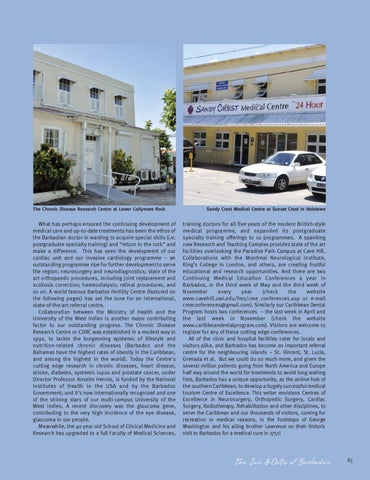
The Chronic Disease Research Centre at Lower Collymore Rock
What has perhaps ensured the continuing development of medical care and up-to-date treatments has been the ethos of the Barbadian doctor in wanting to acquire special skills (i.e. postgraduate specialty training) and “return to the rock” and make a difference. This has seen the development of our cardiac unit and our invasive cardiology programme – an outstanding programme ripe for further development to serve the region; neurosurgery and neurodiagnostics; state of the art orthopaedic procedures, including joint replacement and scoliosis correction; haemodialysis; retinal procedures, and so on. A world famous Barbados Fertility Centre (featured on the following pages) has set the tone for an international, state-of-the-art referral centre. Collaboration between the Ministry of Health and the University of the West Indies is another major contributing factor to our outstanding progress. The Chronic Disease Research Centre or CDRC was established in a modest way in 1992, to tackle the burgeoning epidemic of lifestyle and nutrition-related chronic diseases (Barbados and the Bahamas have the highest rates of obesity in the Caribbean, and among the highest in the world). Today the Centre’s cutting edge research in chronic diseases, heart disease, stroke, diabetes, systemic lupus and prostate cancer, under Director Professor Anselm Hennis, is funded by the National Institutes of Health in the USA and by the Barbados Government; and it’s now internationally recognised and one of the shining stars of our multi-campus University of the West Indies. A recent discovery was the glaucoma gene, contributing to the very high incidence of the eye disease, glaucoma in our people. Meanwhile, the 40 year old School of Clinical Medicine and Research has upgraded to a full Faculty of Medical Sciences,
Sandy Crest Medical Centre at Sunset Crest in Holetown
training doctors for all five years of the modern British-style medical programme, and expanded its postgraduate specialty training offerings to 10 programmes. A spanking new Research and Teaching Complex provides state of the art facilities overlooking the Paradise Park Campus at Cave Hill. Collaborations with the Montreal Neurological Institute, King’s College in London, and others, are creating fruitful educational and research opportunities. And there are two Continuing Medical Education Conferences a year in Barbados, in the third week of May and the third week of November every year (check the website www.cavehill.uwi.edu/fms/cme_conferences.asp or e-mail cmeconferences@gmail.com). Similarly our Caribbean Dental Program hosts two conferences – the last week in April and the last week in November (check the website www.caribbeandentalprogram.com). Visitors are welcome to register for any of these cutting edge conferences. All of the clinic and hospital facilities cater for locals and visitors alike, and Barbados has become an important referral centre for the neighbouring islands – St. Vincent, St. Lucia, Grenada et al. But we could do so much more, and given the several million patients going from North America and Europe half way around the world for treatments to avoid long waiting lists, Barbados has a unique opportunity, as the airline hub of the southern Caribbean, to develop a hugely successful medical tourism Centre of Excellence. This writer envisions Centres of Excellence in Neurosurgery, Orthopedic Surgery, Cardiac Surgery, Radiotherapy, Rehabilitation and other disciplines, to serve the Caribbean and our thousands of visitors, coming for recreation or medical reasons, in the footsteps of George Washington and his ailing brother Lawrence on their historic visit to Barbados for a medical cure in 1751!
The Ins & Outs of Barbados
85