MCEC supports all militaryconnected children by educating, advocating, and collaborating to resolve education challenges associated with the military lifestyle.
02. OUR VISION
Every military-connected child is college-, work-, and life-ready.
03. OUR VALUES
MCEC remains committed to meeting our Mission and Vision through collaboration, integrity, relevance, and service.
ACHIEVEMENTS
Military Child Education Coalition®
BOARD OF DIRECTORS
Officers
Admiral (Ret) Cecil Haney, Chair
Patrick Bingham, Ph.D., Vice Chair/Treasurer
Alissa Harrison, D.M., Vice Chair/Secretary
Colonel (Ret) Eric M. Flake, M.D. , Vice Chair
Major General (Ret) Robert Ivany, Ph.D., Vice Chair
Jerrod Wheeler, Ed.D., Vice Chair
Members
Command Sergeant Major (Ret) Donna Brock
Becky Cederholm
Major General (Ret) Dawne Deskins
Bob Eisiminger
Lucy Reilly Fitch
Caitlin Fross
David G. Henry, J.D.
Lieutenant General (Ret) Dan Karbler
Sucheta P. Lakhani
Susan Moore
Barrett Scruggs
Jim Speltz
Mary Stork
Debra Wada
Members Emeriti
Cathryn Franks
Brigadier General (Ret) Robert Gaylord
General (Ret) Benjamin Griffin
William Harrison, Ed.D.
Lieutenant General (Ret) Don Jones
Mary Keller, Ed.D.
James Mitchell, Ed.D.
Kathleen O'Beirne
Rebecca Porter, Ph.D.
Robert Ray
Mary Jo Reimer
Sandy Schwartz
General (Ret) Thomas A. Schwartz
Patricia Shinseki
Zoe Trautman
Joyce Ward
SCIENCE ADVISORY BOARD
Executive Committee
Colonel (Ret) Eric M. Flake, M.D., Co-Chair
Leanne K. Knobloch, Ph.D., Co-Chair
Richard M. Lerner, Ph.D.
Patricia E. Lester, M.D.
Members
Kimberly S. Dickman, Ed.D.
Kenneth R. Ginsburg, M.D.
Elizabeth J. Hisle-Gorman, MSW, Ph.D.
Colonel David A. Klein, M.D., MPH
Jacqueline V. Lerner, Ph.D.
Gregory A. Leskin, Ph.D.
Mallory Lucier-Greer, Ph.D.
Shelley MacDermid Wadsworth, Ph.D.
Ann S. Masten, Ph.D., L.P.
Daniel F. Perkins, Ph.D.
NATIONAL ADVISORY COMMITTEE
Ms. Charlene Austin
The Honorable Valerie Baldwin
Ms. Patricia “Tosh” Barron
The Honorable Carolyn H. Becraft
General (Ret) B.B. Bell
Major General (Ret) Charles Bolden, Jr.
Mr. Scott Bousum
Commander (Ret) Brunhilde K. Bradley
Dr. Chuck Brooks
The Honorable John Carter and Mrs. Carter (Erika)
General (Ret) and Mrs. George Casey (Sheila)
General (Ret) and Mrs. Peter Chiarelli (Beth)
Lieutenant General (Ret) and Mrs. Kurt Cichowski (Laura)
The Honorable Chet Edwards and Mrs. Edwards (Lea Ann)
General (Ret) Tommy R. Franks
Vice Admiral (Ret) and Mrs. William French (Monika)
Ms. Regina Pedigo Galvin
The Honorable Pete Geren
Mr. Roy Gibson
The Honorable Robert L. Gordon III
Major General (Ret) Gus L. Hargett, Jr.
Rear Admiral (Ret) and Mrs. Leendert Hering (Sharon)
Colonel (Ret) and Mrs. Anthony R. Hernandez (Jennifer)
General (Ret) James T. Hill and Dr. Toni Hill
Lieutenant General (Ret) and Mrs. William Ingram (Lil)
Ms. Marianne Ivany
Lieutenant General (Ret) and Mrs. Darrell Jones (Holly)
Mr. Gary Knell
General (Ret) and Mrs. Leon J. LaPorte (Judy)
General (Ret) and Mrs. Craig McKinley (Cheryl)
Mr. Drayton McLane, Jr.
Lieutenant General (Ret) and Mrs. Thomas Metz (Pam)
Dr. Robert Muller
General (Ret) and Mrs. Richard Myers (Mary Jo)
The Honorable James Peake and Mrs. Peake (Janice)
General (Ret) Dennis J. Reimer
Mr. Reginald Robinson
Mr. Gilbert Sanborn
Dr. Stefanie Sanford
General (Ret) and Mrs. Norton Schwartz (Suzie)
Mr. James H. Shelton III
Ms. Barbara A. Thompson
Lieutenant General (Ret) George J. Trautman III
Dr. P. Uri Treisman
Mrs. Ann Utley
The Honorable Rosemary Freitas Williams
MCEC STAFF
Mary Bier, MBA President and Chief Executive Officer
Kyle Wood
Chief Operating Officer
Amse Heck Chief Advancement Officer
Kyra Bush Vice President, Education Services
Laura Cayton Director, Office of the President/CEO
Juan Agosto Director of Technology
Juan Garcia, CPA Comptroller
Lori Genthner
Chief of Logistics and Retail
Missy Holstead
Director of Program Implementation
Karen Kirk
Director of Marketing & Brand Creative
Kim Shoffner
Director of Education Programs Development
Anna Startzell
Director of Government Relations
ON THE MOVE
Karen Kirk, Editor in Chief
Laura Cayton, Copy Editor
Netta Killian, Graphic Designer
Brittany Mahlstedt, Media Relations
Opening Doors for Military-Connected Students:
THE HEROIC HEARTS SCHOLARSHIP
For students balancing school, family, and service, flexibility and support make all the difference. Columbia Southern University (CSU) understands that journey — and now, through the Military Child Education Coalition Heroic Hearts Scholarship, one outstanding military-connected student will earn a full-tuition award covering tuition and technology fees for up to 120 credit hours, 48 months, or completion of the selected online degree program — whichever comes first.
With more than 90 online degree programs, CSU empowers students to reach their goals on their own schedule, guided by faculty and staff who walk beside them from day one. Known for its quality, care, and adaptability, CSU has long served military families with programs designed to move with life’s changes.
This inaugural scholarship is more than an award; it’s an opportunity to build a legacy. Open to militaryconnected juniors, seniors, and recent graduates, the Heroic Hearts Scholarship honors dedication, resilience, and excellence — the same values that define CSU itself.
FROM THE CHAIRMAN
A LETTER TO THE MCEC COMMUNITY
This past spring, the Military Child Education Coalition reimagined its signature event — the Global Training Summit — by bringing it to two major regions. The result? Two remarkable days of learning, connection, and momentum in Atlanta, Georgia, and Austin, Texas.
As co-host of the Atlanta Summit, I had the honor of welcoming more than 250 participants to the Emory University Conference Center. Together with educators, students, military leaders, and community advocates, we explored how technology, transition, and leadership intersect in the lives of military-connected children.
We were inspired by LTG Sean Gainey’s reminder to “be in the moment,” and by Fig O’Reilly’s call to pair purpose with progress in our digital world. Meanwhile, students led their own track of peer-to-peer training — exploring leadership, digital well-being, and campus inclusion. These young leaders didn’t just listen; they collaborated, created, and left empowered with strategies to support their classmates and strengthen their schools.
Just four days later in Austin, over 220 attendees gathered to continue the work. With powerful insights from Maj. Gen. Larry Broadwell, Dr. Gregory Leskin, and Microsoft’s Brent Colburn, we focused on mental health, innovation, and partnership. Again, our students were central to the conversation, engaging in workshops, team challenges, and hands-on planning to expand their Student2Student® (S2STM) programs.
Across both Summits, we saw the power of local engagement firsthand. Nearly 500 participants representing more than 60 schools across 30 states came together to exchange insights and spark meaningful conversations. Sessions generated a surge of ideas around digital safety, college and career readiness, and student-driven support systems, while new and renewed partnerships emerged between schools, military installations, and community organizations. Most importantly, everyone left with clear takeaways — from students to school leaders — to strengthen support for military-connected learners in their communities.
These Summits proved what we hoped: by meeting communities where they are, we can extend the impact of MCEC programs and deepen the support for military-connected children everywhere.
To every student, educator, sponsor, and partner who joined us, thank you. You are helping us build a stronger network of understanding and opportunity for military-connected youth.
The following pages offer a glimpse into the work accomplished in Atlanta and Austin, and the people and programming that made each event such a success, while we continue to provide resources in our other activities such as webinars and workshops.
With warmest thanks,
Cecil D. Haney Admiral, United States Navy (Retired) Board Chair, Military Child Education Coalition
FROM THE PRESIDENT & CEO
COMMITMENT TO THE COMMUNITY
As I near the end of my first year as CEO of MCEC, I want to begin by thanking the Board of Directors for their belief in me and for the warm welcome they extended when I stepped into this role. I’m also deeply grateful to the incredible MCEC team for their continued support, collaboration, and generosity of spirit throughout this first year. Their commitment to our mission is evident in every conversation and every action, and it’s been an honor to work alongside this community of passionate advocates.
Over the past year, I’ve had the privilege of connecting with many of the individuals who make up the broader MCEC community — funders, community partners, student leaders, educators, superintendents, and military officials alike. These conversations have been both inspiring and grounding, offering valuable insight into the impact of our work and the opportunities ahead. It’s been a meaningful season of learning — about our mission, our programs, and the lives we touch. This year has also brought with it a changing landscape, as updates at the federal level, including new DOD travel restrictions and shifts within the Department of Education, continue to affect nonprofits like ours. And yet, even amid change, our North Star remains constant: the military child.
One of the most energizing experiences of the year came during our recent Global Training Summit, where I had the opportunity to meet dozens of Student 2 Student® (S2STM) leaders from across the country. These students were eager to share their stories, and what impressed me most was their confidence, especially when engaging with senior military leaders like U.S. Army Lieutenant General Sean Gainey and U.S. Air Force Major General Larry Broadwell, as well as our distinguished closing speakers, Actress Fig O’Reilly and Brent Colburn from Microsoft. These thoughtful, smart, and respectful young leaders demonstrated the core values our S2S program instills: leadership, relationships, and service. I left the event incredibly proud of these students and am already looking forward to our next Global Training Summit in 2026.
As we look to the future, we remain steadfast in our commitment to ensure every military-connected child is ready for college, work, and life. We do this by educating, advocating, and collaborating to address the unique education challenges of the military lifestyle — and we do it together, thanks to the unwavering support of our donors and partners. Your continued belief in our mission fuels every step forward. Thank you for standing with us, and for helping us make a lasting difference in the lives of military children and their families.
With immense gratitude,
Mary Bier, MBA President and Chief Executive Officer, Military Child Education Coalition
Building Connections, Capacity,
The Military Child Education Coalition® (MCEC®) opened its 2025 Global Training Summit series in Atlanta, Georgia, on September 22, with a full day centered on technology’s impact on learning, student well-being, and practical tools that travel with military-connected families. Hosted at the Emory Conference Center & Hotel, the summit blended research, policy, and student leadership — bookended by a student-moderated conversation with LTG Sean A. Gainey and a closing keynote by Fig O’Reilly.
Atlanta welcomed 232 participants — 97 professional attendees and 95 Student 2 Student® (S2STM) students with 40 advisors — representing 31 schools from 11 states and D.C.
Opening Session: Student Voices with LTG Gainey
Two members of the MCEC Student Advisory Committee opened the day by interviewing LTG Sean A. Gainey, Commander, U.S. Army Space and Missile Defense Command, about innovation, leadership, and tech-life balance. Gainey encouraged students to lean into critical thinking and relationships as they explore AI and cybersecurity.
Following the panel, Lorraine Hastings of the College Board introduced AP Career Kickstart courses in Cybersecurity, Networking, and Business with Personal Finance, highlighting coursework designed to “travel well” during PCS moves while building durable, careeraligned skills.
“Technology is good, but it has to be used in balance—don’t forget to be in the moment, validate your sources, and build real relationships.”
– LTG Sean A. Gainey Commander, U.S. Army Space and Missile Defense
Atlanta Global Training
Educators, students, and leaders gather in Texas for a day of innovation and impact
Training Summit:
Capacity,
and Community
impact
Distinguished Lecture Sessions: Practical Tools for Educators
Four Distinguished Lecture Sessions gave attendees concrete strategies they could use right away:
Compact 201: Engage, Learn, Apply (MIC3) Case studies clarified enrollment, placement, eligibility, and graduation under the Interstate Compact—and when to escalate tricky cases.
MTSS: Leading Efficient Systems, Building Stronger Schools Dr. Jason Pedersen outlined prevention-first systems that align academics, behavior, and SocialEmotional Learning (SEL) with clean data practices and scheduled interventions.
The Hidden Child Dominic Cirincione spotlighted Reserve-connected students—often invisible in civilianleaning schools—and shared ways to identify, track, and flex supports.
Welcome to Youville (FTC) Natalya Rice introduced the Federal Trade Commission's (FTC’s) free, standardsbased digital-literacy program for grades 3–6 — privacy, online safety, ad-savvy, and scam spotting.
Master Class: A Community of Support
In “A Community of Support—Harnessing Collective Wisdom and Tools,” Mary Bier moderated a candid, solutions-driven panel featuring student leaders Emma (Leavenworth Senior High) and Olivia (Fort Campbell High), educator Beth Parkman (Lee County Schools, AL), parent Missy Holstead, MCEC Community Coordinator Marley Ott (Charleston, SC), and School Liaison Robert Richert (Maxwell AFB).
Themes echoed throughout: intentional welcome (Purple Star practices and peer tours), continuity of learning (AP/dual enrollment, counseling, tutoring), and student leadership through S2S. Parkman emphasized first-day touchpoints; Richert highlighted military-specific tours and dual enrollment; Holstead spoke to “continuity of learning” across moves; Emma and Olivia described how S2S gives new students friendly faces and quick connections.
Forum: Connection, Not Distraction with Dr. Eric Flake
Pediatric expert Dr. Eric Flake moved the afternoon from research to real life. After outlining how sleep, attention, and mood intersect with tech use, Dr. Flake invited his family onto a live Zoom. Small, memorable tactics stood out — one daughter shared that her phone passcode is “get off” as a daily nudge to put it down; the family’s Fun Family Media Plan includes a daily screen-free activity, fewer apps, lock-screen reminders, and no screens in bedrooms at night. Participants closed with table-level Strenghts, Weakness, Opportunity and Threads (SWOT) maps and clear next steps for schools and families.
Closing Session: Celebration and a Look Ahead
Where leadership meets real-world
While students joined the full audience for the Opening and Closing General Sessions at both summits, the rest of their day ran on a dedicated Student 2 Student (S2S) track — built to strengthen campus programs and give students practical tools they could take home.
What the student track covers
• College & Career Readiness. Sessions with partners from Tutor.com focus on portable credits, admissions planning, and study supports that travel during PCS moves.
• Digital Well-Being Research-to-practice tips on healthy tech use, sleep, focus, and privacy, and family dialogue regarding these topics.
• Leadership Labs. Peer-led strategies for welcoming new students, running effective S2S teams, and partnering with counselors, school liaisons, and community groups.
• Belonging & Balance. Activities that build communication skills, confidence, and stress-management — on and off the screen.
How the learning happens
• Hands-on team challenges (quick builds, problem-solving contests, and digital-safety scenarios) that reward collaboration and clear communication.
• Best-practice exchanges where students compare welcome routines, ambassador tours, and leadership pathways — leaving with renewed energy to engage at home.
• Mini-coaching with educators and MCEC staff to tailor ideas for each campus.
The summit’s finale combined recognition and inspiration. MCEC and Columbia Southern University launched the Heroic Hearts Scholarship for military-connected students, with the inaugural recipient to be announced during Month of the Military Child in April 2026. Fig O’Reilly then took the stage, weaving representation, digital literacy, and hands-on science into a rallying call for curiosity and belonging:
“Technology can open doors, but it is our collective power as educators that helps students walk through them.”
In her closing remarks, Mary Bier thanked attendees and urged action: “Take what we’ve learned here today back to your communities and schools, and put it into practice to create a lasting legacy for military-connected kids and their families.”
GTS real-world tools
What students take back to campus
A refreshed S2S welcome plan (first-day tours, “newstudent socials,” and follow-up touchpoints).
A short list of study and tutoring tools that work across school systems.
Clear next steps to grow engagement opportunities, even when students arrive mid-year.
A simple, student-approved digitalwell-being routine (screen-free zones/times, focus habits, and privacy settings worth checking).
Watch for details about the 2026 MCEC Global Training Summit!
Austin
MCEC concluded its 2025 Global Training Summit series in Austin, Texas, on September 26, with a powerful day of collaboration and learning focused on innovation, mental health, and connection.
Hosted at the AT&T Hotel and Conference Center at The University of Texas at Austin, the event brought together 222 participants — 104 professional attendees and 118 S2S students and advisors — representing 29 schools from 23 states.
Opening Session: Leading with Connection
MCEC President and CEO Mary Bier opened the summit by sharing her personal connection as a military spouse and mother of two militaryconnected students.
“Together, we have the opportunity to build something lasting for militaryconnected kids — not just today, but for the future,” Bier said.
The opening conversation paired Major General Larry R. Broadwell, U.S. Air Force, with MCEC Student Advisory Council members Sergio and Audrey for an engaging dialogue on leadership, technology, and service. Broadwell urged students to embrace innovation without losing sight of human connection.
“Isolation is the kryptonite to our future; connection is our superpower,” he told them.
Texas Education Commissioner Mike Morath followed with remarks highlighting the state’s 230,000 military-connected students and the importance of Purple Star Schools in creating continuity and belonging.
“We owe every student the moral duty to equip them to pursue the American dream,” Morath said.
Distinguished Lecture Sessions: Practical Tools for Educators
Four Distinguished Lecture Sessions offered evidencebased strategies and inspiration for schools serving militaryconnected children:
Dayna Guyton (Lackland ISD) reframed College, Career, and Military Readiness (CCMR) as more than an accountability metric — encouraging educators to foster purpose and relevance.
Forum on School Mental Health
A two-hour Forum Session, moderated by Gregory Leskin, PhD (NCTSN), featured Dr. Sharon Hoover, Dan Dunham, and Sue Lopez in a deep discussion on trauma-informed systems and mental-health partnerships. The forum opened with recognition of Dr. Stephen Cozza, recipient of the 2025 Dr. Mary M. Keller Award for Distinguished Contributions to Science, honoring his pioneering research on military family resilience.
Speakers emphasized prevention, connection, and collaboration as the foundation of effective school mental-health systems.
“School mental health isn’t an add-on — it’s woven into the fabric of learning, belonging, and growth,” said Dr. Leskin.
“Human connection is the intervention — and peers are the bridge,” added Dan Dunham.
“Readiness isn’t about a checklist — it’s about helping every student see who they can become.”
Brent Wolf (Derby Hills Elementary, KS) shared Connect 4 Growth, an uplifting model for building relationships with students, colleagues, families, and communities.
“When you connect for growth, you build belonging — and belonging drives everything.”
Chelley Carroll-Worth (Home Base Program, MGH/Red Sox Foundation) introduced Resilient Youth for MilitaryConnected Students, showing how mind-body tools and the Relaxation Response strengthen student well-being.
“Resilience is not avoiding stress — it’s learning how to meet it with awareness and control.”
Susan Haberstroh (MIC3) led Successful Educational Transitions, an interactive session on the Interstate Compact, emphasizing how collaboration prevents credit loss and smooths transitions.
“Every move is a moment of transition — the Compact turns barriers into bridges.”
Master Class: A Community of Support
Moderated by Mary Bier, the Master Class gathered diverse voices — students, parents, educators, researchers, and liaisons — to discuss how student leadership and community partnerships strengthen belonging. Panelists included Dr. Gabby L’Esperance, Kristine Caparco, Bobby Gonzalez, Missy Holstead, and Emily Barton, alongside student leaders Sergio and Audrey.
“Reach out first — don’t wait for students or families to find you. That’s how we build community,” Bier said.
Discussions underscored that connection and continuity of learning remain the most effective “tools of the trade” for supporting militaryconnected students.
Closing Session: Innovation and Inspiration
The summit’s closing session celebrated achievement and forward momentum. Attendees recognized the recipients of the Pete Taylor Partnership of Excellence Awards, Student 2 Student (S2S) Team of the Year Awards, and the Dr. Mary M. Keller Award, presented through video tributes shown across both summits.
Bier also announced the Heroic Hearts Scholarship, a partnership with Columbia Southern University, which supports military-connected juniors, seniors, and recent graduates pursuing higher education.
A fireside chat between Mary Bier and Brent Colburn, Corporate Vice President for Global Public Affairs at Microsoft, closed the day with insight and optimism about the role of artificial intelligence in education.
“AI will transform how we work and learn, but curiosity, communication, and adaptability will always matter most,” Colburn said.
Students impressed with insightful questions about AI ethics, equity, and leadership — earning high praise for their depth and perspective.
Looking Ahead
From the opening conversation to the final round of applause, the Austin Global Training Summit showcased what happens when passion meets purpose. Each speaker, educator, and student left with new strategies and renewed energy to strengthen their schools and communities.
As MCEC continues its work year-round, the lessons and partnerships forged in Austin will guide the ongoing mission to ensure every military-connected child is college-, work-, and life-ready.
“Keep connecting, keep creating, and keep building brighter futures for our military-connected kids,” Bier said in closing.
Alone in a Community of People: The Struggles of Geographically Dispersed Service Member’s Children
BY MR. DOMINIC A. CIRINCIONE, USAR, FAMILY PROGRAMS MANAGER
Children of military service members are often seen as resilient, adaptable, and strong. They navigate the challenges of frequent relocations, the emotional toll of parental deployments, and the necessity of forging new friendships in new places. However, the experience is not the same for every military-connected child. While some children grow up near military installations, surrounded by a community that understands the military lifestyle and its unique difficulties, others live far from base communities, where the challenges they face often go unnoticed.
The children of National Guard and reserve service members often experience a sense of isolation that is unique to their circumstances. Geographically dispersed from military installations, these children can feel disconnected from the military culture and the support networks that come with it. This lack of proximity to a military base means that they are less likely to be surrounded by peers and adults who understand the demands and hardships of military life. As a result, they may feel overlooked, misunderstood, and alone in their struggles, particularly when it comes to navigating the complexities of military service that their civilian peers may not recognize.
For children who live near a military installation, life is steeped in the military culture. These children attend schools where many of their peers have parents who also serve in the military, allowing them to share common experiences. They are often surrounded by a strong support network of families who understand the challenges of deployments, relocations, and the unique
demands of military service. Teachers, counselors, and staff at these schools are generally well-versed in the emotional and psychological challenges these children face. It is a community built around the understanding that military families have a unique way of life, with its own set of challenges that require sensitivity, empathy, and support.
However, children of service members who live far from military installations experience a very different reality. These children may be the only ones in their school who have a parent serving in the military, and they often lack the support of a network that understands their unique circumstances. The isolation these children feel can be particularly acute when their parent is deployed, leaving them without the familiar comfort of other children who share similar experiences.
Without the surrounding community of military families, these children can feel like they are constantly explaining their situation to their peers, who may struggle to understand the emotional toll of a parent’s absence. In many cases, these children may hide their
People: Geographically Children
Caring for the Military-Connected Student
School nurses are integral in ensuring that children’s physical and emotional health is attended to in the educational setting. Yet, there is little written to guide them as they interact with military-connected students, who experience unique stressors due to their parent’s uniformed service.
This basic primer provides contextual information that can assist school nurses in knowing who these children and youth are, the unique life experiences that can affect their performance at school, and improve their awareness of military culture so they can provide military-informed care for these children.
Education and Support Program Design for Reserve-Connected Children: A Systematic Review
Military Reserve Component (RC) children have less access to Department of Defense child and youth programs due to policy-related restrictions and geographic distance. Yet, they experience the same, and oftentimes, more stressors when a parent is deployed. Since schools are known to provide stability for children at times of stress, having school-based support programs designed for these children is important.
This systematic review identified and analyzed education and support programs available through schools designed for RC-connected children in the United States between 2001 and 2024.
emotions, masking their struggles to avoid standing out or feeling different. This isolation can exacerbate feelings of loneliness, depression, and anxiety.
This lack of awareness and understanding highlights the importance of educating schools and communities about the specific needs of military-connected children, particularly those who live far from military installations. Schools have an essential role to play in supporting these children, and this support begins with recognizing the unique difficulties they face. Teachers and counselors need to be trained to identify the signs of stress and emotional strain that are common among military-connected children, such as mood swings, academic struggles, or behavioral issues. By doing so, they can provide early intervention and create an environment where these children feel understood and supported.
Additionally, it is vital for schools to foster an inclusive environment that acknowledges and validates the experiences of military-connected children. This can be done through programs and initiatives that educate students and staff about military life and the challenges faced by children of service members. Such programs can help reduce the stigma and isolation these children may feel and create a more empathetic and supportive school culture.
Peer support is also crucial. By connecting militaryconnected children with other children who have similar experiences, schools can help mitigate feelings of isolation and promote a sense of belonging. Peer mentoring programs, support groups, or even school-wide events dedicated to raising awareness of military service and its impact on families can help create a sense of community for these children, even if they do not live near a military installation.
While the experiences of military-connected children are often characterized by resilience and strength, the isolation felt by those living far from military installations can lead to unique struggles that are frequently overlooked. It is essential for schools and communities to be aware of these challenges and take proactive steps to provide the necessary support. By doing so, we can help ensure that all military-connected children, regardless of where they live, have the resources they need to thrive and succeed.
Why We Need FERPA Integrated Therapists in Schools
BY FRANCESCA SUAREZ, MPSYCH.
James is a fourth grader who has moved multiple times due to his father’s military career. It is now time to settle down as his father retires. James struggles to fit in in his new school, now his long-term home. He does not feel welcomed in the class or that the teacher supports his 504 plan as much as has been in previous schools. He is feeling isolated and unable to advocate for himself. His parents are unsure how to best support him, feeling that their conversations with the school have gone unheard.
In the Davis School District we have a Military Support Team that includes Military Family Advocates and Military Educational Therapists to support students in the school.
A key aspect of our model is that the team is employed by the school district, which means we operate under the Family Educational Rights and Privacy Act (FERPA), rather than the Health Insurance Portability and Accountability Act (HIPAA) as contracted mental health workers do. That allows us to interact with administrators and teachers in ways that best support the student. This is helpful in many ways for all students, but especially for military-connected students where a big aspect of helping them transition to a new school is being able to help them integrate into the school community.
James was referred to our team to help him better integrate into his new school. The therapist met with James to help process the emotions that come with frequent moves, and arriving at a new school that he may be at for a long term.
The therapist taught coping skills and ways to advocate for himself in the classroom. The therapist also met with the teacher and discussed the challenges of being a military-connected student and how the teacher could better support James. At the therapist’s recommendation, the teacher spent time getting to know James. As the teacher and James felt better
connected, the relationship improved and James began to feel that he fit into the classroom setting.
Having FERPA-integrated therapists in the schools is a great resource to help support military-connected students to transition to a new school in a positive way. We can not only support the student with personal skills to help them, but also must provide wrap-around support from the entire school community.
MILITARY SUPPORT TEAM LEAD, DAVIS SCHOOL DISTRICT, UTAH
CONNECT Learning 4
AUTHOR: BRENT WOLF
PRINCIPAL, DERBY HILLS ELEMENTARY, KANSAS
Most are familiar with the board game “Connect Four,” where red and yellow discs are dropped in a grid in hopes to create a line of four (diagonally, horizontally, or vertically). Opponents try to block their fellow competitor while strategizing their next move. Connecting four discs wins the game. It’s all about connections.
Connecting is the heart of education. Abraham Maslov, an educational psychologist and philosopher, who is best known for his “Hierarchy of Needs,” explained that after the basic necessities of humans (food, clothing, safety, health), the sense of connection, or the “love and belonging” stage comes next. If the goal is learning and growing, aside from the basic survival needs of human development, connection is essential.
Connecting takes planning and purpose. Authentic connections take time and deliberate dedication to value the people who need connecting. Four connections essential to the growth of learning are Student to Student, Student to Teacher, Student to Staff, and Student to Community. Underneath each of these categories of connections lies one specific event or idea to begin connecting authentically with students.
1. Student to Student
Teachers use experiences to create connections amongst students with students. Often, the first impression of a school makes transitions and connections stronger. Student 2 Student® (S2STM), a peer-to-peer, student-led program that brings military and civilian students together to welcome new students, can create a positive environment for all. This helps springboard the initial connection between students.
Our student-led S2S Council has created opportunities and experiences for all new students. One of several ways we begin the connecting process is a student-led campus tour. On the tour, the new student has a pseudopassport that takes him or her from place to place, important person to important person, with prewritten questions that initiate conversations with pillars of our school community. The S2S team creates introductions, authentic conversations with necessary personnel, and initiates a relationship with our new student that can last for years.
2. Student to Teacher
Connecting with all students is important. Finding the unique attributes of a relationship helps with this. An icon of Derby Hills is our annual Veterans’ Day Breakfast. The staff helps serve, greet, decorate, advertise, set up, and clean up for this heart-warming event. Students are invited to bring their military connection to breakfast before school during the week of Veterans’ Day. Food and drinks are served to the students and military hero (active or reserve). We partner with Derby High School's Junior Reserve Officers’ Training Corps (JROTC) to present the colors and flags. We have students and families submit pictures so we can line the cafeteria with pictures of our guests. We also have a 5th grade music concert that also is scheduled during this time frame. The songs of each of the branches of the military are sung or played and each guest gets to stand up during his or her song. It is a time where students get to see their teachers in a different light serving students and their military heroes. It connects the teacher to the student and the teacher to the servant.
3. Student to Staff
Acknowledging and appreciating the sacrifices students who are military-connected anticipates connections. At Derby Hills, we partner with a sign company to decorate the front lawn of Derby Hills. For days, parents and classes can take pictures with the signs. Our elementary school is in the middle of a residential zone, so our neighbors get to see the importance and the value we hold for military-connected families. Last year, we scheduled a photography session with all of the students who are military-connected. After the picture, we invited the students to the cafeteria for popsicles and presented them with their own yard sign to proudly display in their yard. Derby Hills is honored to share in our learning with students with military-connected perspectives.
4. Student to Community
Our most recent addition to our school is our Wall of Honor. This display is visible to people as they enter Derby Hills. Its purple-lit circular display boasts the logo of our Purple Star identification. Under the colorfully lit display lists a customizable directory of names and the connections of active duty, National Guard, or Reserve to Derby Hills’ staff and students. We update it quarterly by adding names and their connections to Derby Hills.
In the recent session at the annual Global Summit in Austin, “Connect 4 Growth: Connections for Building Culture & Relationships,” participants learned ways to authentically connect with students and families. Dr. Brene’ Brown says, “I define connection as the energy that exists between people when they feel seen, heard, and valued; when they can give and receive without judgment; and when they derive sustenance and strength from the relationship.”
MIC3: Supporting Military Children Through Educational Transitions
BY TREVIN STEVENS, COMMUNICATIONS ASSOCIATE, MIC3
The U.S. Department of Defense (DoD) reports that nearly 1.5 million children have a parent who is active-duty or serving in the National Guard or Reserve, with more than 76% attending public schools, and experiencing, on average, between six and nine school transitions over the course of their academic careers. These frequent relocations expose students to varying state and district-specific academic and graduation requirements, and administrative policies, thereby creating significant obstacles to educational continuity.
“These differences often mean military students are playing catchup or missing out on opportunities,” explained Dr. Ernise Singleton, Louisiana Commissioner and Commission Chair, “and more importantly, it’s a challenge for them to remain on grade level and/or on track to graduate.”
To address these challenges, the DoD collaborated with the Council of State Governments’ (CSG) National Center for Interstate Compacts in 2006 to establish the Interstate Compact on Educational Opportunity for Military Children.
The Military Child Education Coalition (MCEC) was one of several national organizations on the DoD/ CSG advisory group. “When drafting the Compact, we had to strike a delicate balance between uniformity and state autonomy,” said Mary Bier, President and CEO, “we focused on areas where consistency was most critical without infringing on each state’s right to set its own policies.”
By 2014, all 50 states and the District of Columbia (DC) ratified the agreement, making it the fourth nationwide compact in 50 years.
Additionally, the DoD signed a Memorandum of Understanding, committing the Defense Education Activity Schools worldwide to the Compact.
“By signing onto the Compact, (the 50 states and DC) sent a message that these kids matter,” said Chair Singleton. “We see their struggles, we celebrate their strength, and we stand with them.”
The Compact standardizes education policies on course placement, program participation, and on-time graduation while ensuring military students have equal access to extracurricular activities. States are required to comply with the compact’s provisions, ensuring consistent implementation across states.
The Military Interstate Children’s Compact Commission (MIC3) oversees the Compact, with each state appointing a commissioner and a council to administer the program in their state. The Commission continually works with ex-officio members to educate districts of their obligations and families of their rights under the Compact. Ex-officio
representatives include: the DoD, Blue Star Families, MCEC, Military Impacted Schools Association, National Federation of State High School Associations, and National Military Family Association.
As the Commission will roll out its fourth strategic plan this year, the focus has shifted from implementation to spreading awareness. There are many families and school personnel who are still unaware of the provisions of the Compact and how it can help military-connected children transition.
When educators and school administrators are wellversed in the compact’s provisions, they are better equipped to provide the stability and support military children need. Well-informed school leaders can:
• Implement timely transitions for incoming military children, ensuring they aren’t left behind due to incomplete records or discrepancies in academic requirements.
• Develop tailored support programs that help military children overcome social or emotional challenges during transitions.
• Foster a more inclusive and understanding school culture that acknowledges and accommodates the specific needs of military families.
This is where the partnership of MIC3 and MCEC is so important. Over the years, MIC3 has worked closely with MCEC to advance their shared mission of serving the educational and well-being needs of militaryconnected students.
MCEC has collaborated with the Commission to host webinars that engage families, state-level policymakers, school-district representatives, and public-school personnel. Commission leadership and staff have also appeared on MCEC podcast episodes, expanding outreach efforts.
MIC3 collaborates with MCEC to provide Compact Training and participates in MCEC-sponsored events such as 360 Summits and the Global Training Summit to raise awareness among students and educators about the resources available to uniform-connected families.
As an Ex-Officio member of MIC3, MCEC serves as an advisor to the Training Committee, helping to increase awareness among military-connected families and
other relevant stakeholders. In addition, MCEC sends a representative to participate in the Commission’s Annual Business Meeting.
Together, MIC3 and MCEC continue to pursue one clear goal: ensuring military-connected students have the educational stability, support, and opportunities they need to thrive, regardless of where duty takes their families next.
Call to Action: Building a Blueprint to Mental Health of Military-Connected
CO-AUTHORED:
SUE LOPEZ, M.ED. SCHOOL COUNSELING AND DR. GREGORY LESKIN, DIRECTOR, NCTSN MILITARY AND VETERAN FAMILIES AND CHILDREN
UCLA-NATIONAL CENTER FOR CHILD TRAUMATIC STRESS
The 2025 MCEC & NCTSN National Working Group represents a collaborative effort to create a national blueprint for effective school mental health systems aimed at supporting military-connected students in K-12 settings.
Informed by a series of listening sessions and supported by partners like the National Child Traumatic Stress Network, the Military Child Education Coalition, and the University of Maryland’s National Center for School Mental Health, this initiative emphasizes expanding access, leveraging data, and building sustainable school-communitymilitary partnerships.
Its ultimate goal: to implement innovative, data-driven strategies that enhance school-based mental health supports and ensure military-connected students receive consistent, compassionate care—no matter where they move.
Listening Session Goals:
The NCTSN and MCEC working group had three primary goals:
• Identify gaps in school mental health systems for highly mobile military-connected youth.
• Align resources through tools like the School Health Assessment and Performance Evaluation (SHAPE) system and Multi-Tiered Systems of Support (MTSS) to deliver tailored mental health interventions.
• Generate sustainable strategies through community collaboration, universal screening, funding models, and policy alignment.
Military-connected students demonstrate remarkable resilience, yet frequent Permanent Change of Station (PCS) moves, deployments, and post-secondary transitions involving IEPs or 504 plans can create complex academic and emotional challenges.
Schools can strengthen protective factors by integrating Comprehensive School-Based Mental Health Systems (CSMHS),
MTSS, and Purple Star School (PSS) frameworks. Together, these provide coordinated, tiered support that meets the holistic needs of military-connected students across academic, social, and developmental domains.
Strengthening Resilience Through Connection
Listening session discussions revealed that achievement-related stress is common among military-connected students, often intensified by academic and social pressures during relocations. By prioritizing connection, belonging, and intrinsic motivation, schools can transform these challenges into opportunities for growth, helping military-connected youth to build resilience and thrive throughout their educational journey.
“In my experience as a military-connected youth, I believe a major concern is mental stigma. It affects all communities, but I do think in military culture, mental stigmas are present in their own unique way, and they must be addressed intentionally within interventions, programming, and other curriculum.”
– Dr. Brittany Patterson University of Maryland School of Medicine and Co-Director of the National Center for School Mental Health
to Support the
Students
Expanding Wraparound and Tiered Supports
The listening sessions underscored the urgent need for wraparound services that connect schools, community partners, and military installation behavioral health providers.
Two decades of war, followed by the COVID-19 pandemic, have negatively affected the mental health needs of military-connected youth. Schools are struggling to maintain universal (Tier 1) support, highlighting the importance of expanding tailored Tier 2 (targeted) and Tier 3 (intensive) interventions.
Participants reinforced that CSMHS and MTSS frameworks are essential for delivering layered, coordinated care. Key strategies tailored to meet the unique needs of military-connected students include:
• Trauma-informed, military lifestyle, and culturally responsive policies
• Standardized school transition practices
• Professional collaboration and ongoing educator training
Turning Data into Action
Data can turn awareness into action when used to identify student needs and address support gaps.
Tools such as the GAD-7, PHQ-9, and PSC-17 allow early identification of anxiety, depression, or behavioral concerns, while the SHAPE system helps schools monitor the impact of their mental health programs.
When schools combine outcome data with traumainformed practices and collaboration across education and mental health systems, they help to create a positive school climate and safety net that supports students consistently through every school transition.
“Military-connected youth often struggle to find peers and staff who understand their unique experiences, making this a critical area of need. They are highly adaptive, bringing diverse perspectives and empathy due to their lived experiences."
– Jenn Davis Studebaker Preschool Intervention Specialist & Educator Mentor, Ohio Purple Star Advisory Board
Visibility Through the Military Student Identifier (MSI)
The second listening session highlighted how schools measure the well-being, belonging, and connectedness of military-connected youth. Central to this effort is the Military Student Identifier (MSI) established under the Every Student Succeeds Act (ESSA, 2015).
The MSI enables schools and states to identify and support students with a parent serving in the armed forces. While ESSA and the Code of Federal Regulations (CFR) require data collection, states determine how it is implemented. When used effectively, MSI data moves schools from assumption to precision, empowering them to:
• Monitor attendance, achievement, and mobility trends.
• Strengthen tiered supports through MTSS and CSMHS frameworks.
• Ensure smooth transitions with timely record transfers and enrollment continuity.
• Promote collaboration among counselors, teachers, and community partners.
• Inform fair policy and resource advocacy.
“Unfortunately, the current CFR language restricts MSI use to only students whose parents serve on active duty under Title 10 orders, excluding children of Reservists and National Guard members—even after the 2020 NDAA removed the term ‘active duty.’ This gap hinders access to appropriate services and screenings critical to their health and wellness.”
The Path Forward
To truly support military-connected students, schools must move beyond isolated efforts toward a unified, standardized, data-informed, and relationship-centered system of support for military-connected students and youth.
Sustained collaboration among educators, families, mental health professionals, local communities, and military installation partners ensures every transition is met with continuity and compassion. Embedding MTSS and CSMHS principles into daily practice, leveraging the MSI for visibility, and maintaining trauma-informed, culturally responsive Purple Star School initiatives help to guide essential next steps.
Prioritizing whole-child development, equity in access, and strong family–school–community partnerships, schools can ensure every military-connected student feels seen, supported, and positioned to succeed no matter where their next move takes them.
– Peggy Wilmoth, PhD, MSS, RN, FAAN President Elect of the Reserve Organization of America (ROA)
Knowing the Signs & Taking a Holistic Approach
BY RAQUEL CROW Behavior Interventionist, Johnson Abernathy Graetz High School Montgomery, Alabama
While observing our future leaders of tomorrow interact daily at Johnson Abernathy Graetz High School, it has been illustrated on numerous platforms that military-connected students and non-military connected students are faced with similar challenges. As a Behavior Interventionist, I have had the opportunity to closely observe students who are connected to the military as well as students who are not connected. While working with the students previously identified through direct contact, some of these students display the following adversaries: sudden change in environment, reintegration conflict, community violence, suicidal ideation, behavior concerns, substance use, traumatic loss, lack of selfawareness and mental health challenges.
These scholars are constantly finding ways to navigate and maintain stability in their social groups, within themselves, and in the classroom.
Being able to identify the signs that something has changed or has happened to the student builds trust and security. Students have reported that a simple conversation where staff members provide a safe space can change the trajectory in a positive way. Common signs that will indicate that a student is in need of help: lack of motivation, drastic change in academic performance, change in appearance, hygiene exposure, minimum eye contact, avoidance, conflictual behaviors, and/or unusual lacerations visible on exposed limbs.
Every student, whether military-connected or not, has equal access to wraparound services where the whole child is being served and parents are extended support as well. All students are observed and are provided holistic support that caters to their mental, emotional, physical, social, and spiritual well-being. As the Behavior Interventionist, it is urgently important to develop cultural competence while serving students from different backgrounds but are experiencing life through similar lenses.
Military
USHomeschoolers Homeschoolers Homeschoolers
WHO WE ARE AND HOW TO SUPPORT
NATALIE MACK FOUNDER, MILITARY HOMESCHOOLERS ASSOCIATION
My 37 years as a military spouse — from active duty through retirement — have included numerous relocations, adjustments, and leadership roles. As the spouse of a retired Navy Chaplain, I actively supported my husband’s commitments to the units he served, taking on roles such as Key Spouse and serving as a Command Advisor. I also advocated for chapel congregants and supported programs like Protestant Women of the Chapel (PWOC), chapel youth programs, and deployment resources. As a 23-year veteran military-connected homeschooling parent, speaker and author, I have led large homeschool groups on installations around the world, often partnering with school liaison officers and base agencies. These experiences ultimately inspired me to deepen my impact by founding the Military Homeschoolers Association (MHA).
Amplifying the voices of militaryconnected families is one of the organization’s core objectives. Another key goal is to drive datainformed changes for military families who choose homeschooling.
I believe in the power of truly seeing a community — listening, understanding their needs, and using those insights to create meaningful, purposeful change.
In perusing our vast military community, it became evident that minimal substantive data existed about military homeschoolers. From personal experience, I saw the growth, engaged with my community and provided consultations and resources.
I also was keenly aware that homeschooling allows a military family to take one less fundamental concern off their PCS plate: in which school district should we reside. The challenge though was how to turn that insight into quantitative
statistics. How do I show the connection between retention and homeschooling? I knew we needed a survey. Who else to produce a survey for military homeschoolers but MHA, an organization solely established to support this quickly growing subset of military families?
Through the ever-resourceful network of milspouses, I was introduced to a West Point homeschooling mom, Candace Guelzo, a researcher pursuing her PhD. After our first meeting in the spring, it became obvious that this was exactly who I could partner with to create this needed survey. By early fall 2024, I began to share on social media that MHA was creating a survey for our community. Candace and I crafted a total of 68 questions, making every effort to inquire about as many factors as possible without overkill. In November 2024, the first-ever military homeschool survey
launched. After 3 weeks, we closed the survey with 861 responders and Candace skillfully analyzed data for 763 participants.
What did we discover? 50.7% of respondents agreed that their family’s decision to stay in the military was directly impacted by their ability to homeschool. 64.7% of participants agreed that military association was a large factor in decision-making.
What are the benefits of homeschooling while in the military? Increased flexibility, consistency and continuity, the impact of constantly moving, an increased amount of family time. These are traditionally the reasons, but there are new beneficial insights: 47.8% considered bullying a factor, especially those with neurodivergent children; and 58% expressed concern about the safety of their child in brick-andmortar schools.
As a result of my work supporting school liaisons (SL), the survey provided an opportunity to confirm what I perceived regarding homeschoolers’ connections with the SL community. Unsurprisingly, 43.3% of participants connected with their SL; 40.7% did not connect and 16.7% did not know what an SL was.
My passion is to continue to bring these two communities together: military homeschoolers and school liaisons. We have work to do. The SL community continues to serve and seek engagement, and the homeschooling community continues to need and desire resources and support.
So how else does the Military Homeschoolers Association serve the homeschool community? MHA has an amazing board of military, homeschoolingconnected, passionate leaders. We have launched the Base2Base Military Homeschooling podcast on our YouTube channel; the audio will be available on podcast platforms. Our primary guests are the military homeschool “guru” on installations across the globe, answering all things relative to supporting a successful, strong homeschool community on that base. We also seek guests who offer resources and support, MSOs and VSOs, other nonprofits, businesses, recruiters/ESS, curriculum providers, school liaisons, etc.
If you desire to support MHA via donations and/or sponsorships, we are launching a homeschool support program and a homeschool support group/co-op leader mentor program. We intend to launch additional surveys in the future. Currently, MHA has partnered with several organizations to further resource our community and look forward to more in the future.
We invite you to reach out to MHA at info@militaryhomeschoolers.org, to subscribe to our newsletter on our website militaryhomeschoolers.org subscribe on YouTube: YouTube.com/@MilitaryHomeschoolersAssoc follow us on FB: Facebook.com/militaryhomeschoolersassociation/
Now is the Moment to Stand With Military Children
BY: AMSE HECK
Right now, a military child is walking into a new school mid-year — leaving friends behind, facing curious glances, unknown new teachers, and another turn at being the new kid. At the Military Child Education Coalition®, we believe no child should have to go it alone. With your support, you come alongside these children. Your support provides stability in the moments that matter most — helping them stay on track academically and emotionally, even as they move from base to base, school to school, and community to community.
This year, with the help of supporters like you, MCEC:
• Trained more than 6,500 educators to recognize the unique signs of isolation, anxiety, and distress to better understand and serve military-connected students.
• Expanded Student 2 Student® peer leadership programs so new kids are never “the new kid” for long.
• Partnered with schools and installations to strengthen mental health and transition support nationwide.
But the need for more help for these kids is urgent — and growing. As 2025 rumbles into 2026, military-connected families are navigating even more uncertainties with escalating domestic and international deployments, disruptive transitions, and sharply shifting landscapes. The youngest among them need our support more than ever.
When you give today, you provide:
• Stability even as the ground moves under their feet.
• Scholarships for youth leaders who lift up their peers.
• Training for teachers who ensure no child falls behind.
Your gift right now ensures military children have the wraparound support, tools, and encouragement they need to thrive — not someday, but today.
Donate today by scanning the QR code above or visit, MilitaryChild.org /get-involved/donate.
Because when military children thrive, our entire nation grows stronger. Every gift made before December 31 directly supports programs that help military-connected children succeed — in school, at home, and in life.
Thoughts on Grief
BY PAULA A. JOHNSON MOTHER, MIMI, MENTOR, AND GRIEF COMPANION
Paula Johnson has been counseling community members after the devastating flooding that occurred in Kerrville, Texas, on July 5, 2025, and was approached by her local newspaper and asked these questions about grief. We are grateful to reprint with her permission. With flooding and other natural disasters becoming more common, this information is timeless.
How can one be sensitive to others after a tragedy like this?
When someone’s world has been swept away — by loss, by sorrow, or by any grief too heavy to bear — what they need most isn’t advice. Never advice. What they need is presence. Being sensitive after something this devastating means slowing down. Listening. Letting others grieve out loud — or in silence.
Some will cry. Some will go quiet. Some will need to talk about what happened again and again. Some won’t be ready yet. There’s no one way to hurt. And no one way to help. And absolutely no way we “fixers” can fix this.
Its kindness, its patience, and gentle compassion people need from us. A hug, a handshake or even a silent moment holding hands in love.
You don’t have to fix the pain. Just let them know you see it. You see them. You LOVE them and need nothing from them. That matters more than you’ll ever know.
How can we process our own
grief?
Grief this deep doesn’t have a clear beginning or end — it doesn’t have a path, it doesn’t discriminate, it devastates. It’s the sound of what was echoing through what is now missing. Without any ability to hit pause on the spin cycle.
Processing your grief or others' grief may feel impossible in these early days — when survival mode takes over. When you're still searching for solid footings, both physically and emotionally.
But even now… it is the smallest of small acts that mean the most. Just breathing through one more moment. Sitting in stillness. Tears have meaning, they are soulsoothing. Allow yourself to feel and respond, and know it is okay to grieve. You are not expected to feel okay.
Grief is not something to fix — it’s something to tend to, slowly, gently, honestly. You lost or watched the loss of more than things. You lost or watched parts of life’s stories changed forever. You are allowed to mourn every
inch of what your heart is feeling, your eyes are seeing. Give yourself and others grace.
What’s the best way to move forward when life feels destroyed?
After an event that is so catastrophic, “moving forward” can sound cruel. Don’t think it or say it, again choose grace. You don’t move on from love. Or from the life you had before our shared catastrophic disaster. You move with it. Sometimes you move through it, just barely. Embrace every moment, all the small glimpses of hope. The truth on moving forward is to move softly and be gentle with yourself.
There is no finish line to grief, only moments where you feel something new. There is no roadmap to recovery. But there is strength in the showing up. There is healing in community, our community, together. There is power in saying, “Today, I’m still here.” Count the small victories a strength. Let the moments be enough.
You are not alone. You are never alone. Even in this life-altering, broken place, you are held by more hearts than you know.
Paula A. Johnson is an award-winning community builder and military spouse whose leadership has guided disaster recovery, grief support, and humanitarian outreach across the nation.
Supporting Children through Natural Disasters and Loss
At MCEC, we are deeply concerned about all the families affected by devastating natural disasters, including wildfires, hurricanes, and floods, including the terrible tragedy in Texas that gripped our nation this past summer.
When you are in need, MCEC will assist you in understanding and supporting your children as they cope with these challenging events. Our goal is to help every family impacted by natural disasters as they navigate their path to healing, peace, and joy.
Scan the QR code to explore MCEC's resources.
Caregiving Youth Student Leadership Program
Caregiving Youth
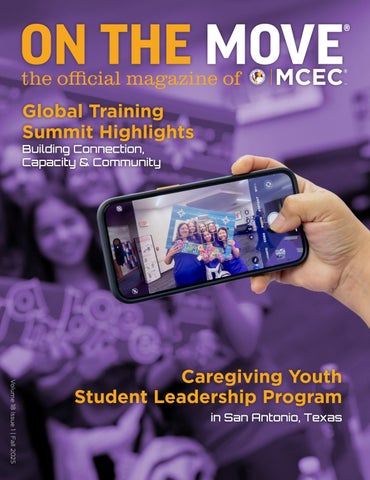
For the past three years, each February the Military Child Education Coalition® welcomed ten high school students from across the country to the Caregiving Youth Student Leadership Program (CYSLP), in San Antonio, Texas. This October marked our first fall program. Designed for “Hidden Helpers” — students who support a wounded, ill, or injured service member at home — the program strengthens leadership, well-being, and planning for life after high school.
Throughout the week, students participate in interactive workshops on storytelling, emotional health, financial literacy, and college and career readiness. They explore campus life at UTSA, learn about resources available to militaryconnected families, and build valuable peer connections through team-building activities and reflection sessions. There’s opportunity for fun as well, with unique excursions such as river barge tours, escape room challenges, the San Antonio Rodeo, or a Spurs arena experience.
While the schedule is full, the heart of the program is community. As one student shared on the Gratitude Wall, they were thankful for “this amazing experience” and “the friends I’ve made along the way.”
This program has been made possible through generous support from our partners. We are grateful to the Wounded Warrior Project® for funding the first three February sessions, helping lay the foundation for this meaningful experience. We also thank USAA for supporting the most recent session and helping expand opportunities for caregiving youth.
The next session will be held Friday, February 13 – Tuesday, February 17, 2026, and applications can be found on the MCEC website. Students in caregiving roles are encouraged to apply and join a community that sees, supports, and celebrates them.
Scan the QR code to learn more about the Caregiving Youth Leadership Program.
Spring Session
FALL Session
Frances Hesselbein Student Leadership Program at West Point
The 2025 Frances Hesselbein Student Leadership Cohort spent an unforgettable week at the U.S. Military Academy at West Point exploring what it means to lead with purpose, service, and adaptability. From interactive challenges at the Center for Enhanced Performance to practicing communication skills with “blind bowling,” students learned that leadership is as much about empathy and growth as it is about strategy.
This year’s cohort included: Addison (Leavenworth, KS); Ava (Fayetteville, NC); Roseanna (Seale, AL); Bella (San Antonio, TX); Daegan and Grant (Madison, AL); Gabrielle (Columbia, SC); and Armani (Montgomery, AL).
As participant Grant reflected, “Don’t treat others the way you want to be treated — treat others the way they want to be treated.” Bella added, “The days are long, the staircases at West Point are even longer, but you will leave with zero regrets.”
Two former FHSLP alumni — Cadets
Jason Pinkerton and Jacob Sigler — returned to share how the program shaped their journeys to West Point, inspiring this year’s students to envision their own next steps.
Congratulations to Addison — 2025 recipient of the Suzy Carlton Student Leadership and Civic Responsibility Award. In her scholarship application, Addison states:
“Civic service represents a sense of hope. It reminds me that people still deeply care about making their communities a better place. In a world that is facing a decline in empathy and care for others, civic service gives me hope for the future.”
HEROIC HEARTS SCHOLARSHIP
Applications are open now through February 13.
The scholarship recipient will be announced during Month of the Military Child – April 2026.
What Does the Scholarship Offer?
• Full tuition to Columbia Southern University
• Access to CSU’s flexible, accredited online degree programs
• A supportive pathway to higher education designed with military families in mind
Why Columbia Southern University?
• Celebrating 30 years of affordable, flexible online education
• 90+ degree programs and certificates
• Recognized as a Military Friendly® School, serving service members, Veterans, and families worldwide
Who Can Apply?
Military-connected high school juniors, seniors, and recent high school graduates
Together, we are turning challenges into opportunities. Apply Now!