HIRAM E. JACKSON Publisher
A Real Times Newspaper 479 Ledyard – Detroit, MI 48201
(313) 963-5522 Fax 963-8788 e-mail:chronicle4@aol.com December 11-17, 2013
Page B-4
JACKIE BERG Chief Marketing Officer BANKOLE THOMPSON Senior Editor RIAN BARNHILL Managing Editor SAMUEL LOGAN Publisher 1933-2011 JOHN H. SENGSTACKE Chairman-Emeritus 1912-1997 LONGWORTH M. QUINN Publisher-Emeritus 1909-1989
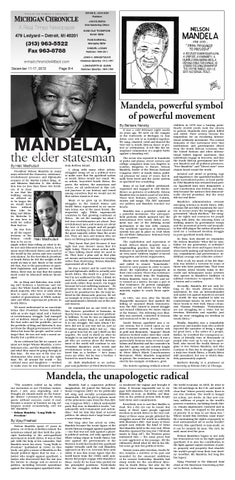
Mandela, powerful symbol of powerful movement By Barbara Ransby
MANDELA,
the elder statesman
By Haki Madhubuti
from Robben Island.
President Nelson Mandela in many ways reflected the character, substance, revolutionary presence and diplomatic acumen of Dr. Martin Luther King, Jr. and Minister Malcolm X. His dedication was no less than those two brothers. It is clear to me that his walking among us allowed us to be larger the we would have been without him. Like Dr. King and Minister Malcolm X, he was here to work for rather than lead us. He was here in all the imperfections of the human condi- Haki Madhubuti tion to be an example rather than telling us what to do. He not only liberated South Africa, he in many ways liberated Africa and much of the world by his action and very careful articulation. As the first Black president of South Africa he felt the weight of the world on him to fail. Much of the world felt that, due to the generations of apartheid legislation and policies in South Africa, there was no way that the nation itself could be liberated without bloodshed. He, as King and Malcolm, was working 24/7 between a hurricane and volcano: the White South Africans and the Black majority, who were at odds about how to move and how to resolve the conflict of generations of White nationalist and White supremacist policies in South Africa. We must understand in no uncertain terms that President Nelson Mandela, with an acute legal mind and a history of revolutionary struggle, had emerged out of Robben Island as a diplomat of the first order and his portfolio, just as the portfolio of King and Malcolm X, was not from the illegal government of South Africa but from the people, and he never forgot that. He was not only a moral authority but a political one. As we celebrate his life we cannot, we must not forget Winnie Mandela, a revolutionary also, and the Mandela children and what they must be going through at this time. He was one of the true revolutionaries who stood up at the right time. We, all around the world — his cultural sons and daughters — worked to make sure he was liberated and free
I, along with many other artists, struggled using art as a political force to make sure that the apartheid nation of South Africa would not stand. We, as artists, boycotted South Africa, the poets, the writers, the musicians and actors, we all understood at this critical juncture of our history and vowed among ourselves that we would not let that nation stand as it was. Many of us grew up in liberation struggles in the United States and South Africa represented in no uncertain terms one of the most brutal, disrespectful, ugly, White supremacist countries in that growing continent of Africa. He set the example for what I feel true revolutionaries are about. True revolutionary men and women are about the love of their people and all people who are working in the best interest of the great majority rather than the acute few. They are men and women who are keen on lifelong knowledge acquisition. They know that just because it was right last year doesn’t mean that it’s right today. They’re about action rather than talking about what we need to do. They have a plan and in that plan are means and mechanisms for creating rather than destroying. Nelson Mandela represented all of that. He was a lawyer and he used his legal and diplomatic skills to actually save South Africa. His death is a great loss, but I’m not saddened by this. I think we need to celebrate and study his words and work rather than mourn. I’m happy because he’s not suffering anymore. As president he showed us that he didn’t need to be president for life. He truly believed in the democratic process. He set an example in terms of his time in office and maintained a lifestyle not of the rich and famous. He reminded me on one level of Julius Nyerere, president of Tanzania, in that he was a common man but politically brilliant. To me he was as important as Martin Luther King Jr. and Malcolm X to our struggle, two men whom I believe did not in any way fail us, just as President Mandela didn’t fail us. This is a great loss but we can’t dwell on the negative. We need to dwell on what he brought to us and how we all grew. People who are serious about the development of the world will continue to use President Mandela’s work, words and revolutionary action as an example. I loved him as a brother — he’s many years my elder, but he was a brother. I learned so much from him. Dr. Haki Madhubuti is an author, poet and publisher of Third World Press.
It was a cold February night nearly 24 years ago. We were on the campus of the University of Michigan in Ann Arbor, over 100 of us huddled together. We sang, chanted, cried and danced the Toyi toyi (a South African dance of protest or celebration). It felt like the triumphant culmination of a mighty battle against a daunting evil. The scene was repeated in hundreds of parks and plazas, street corners and college campuses from Los Angeles to London, Kingston to Harare. Nelson Mandela, leader of the African National Congress (ANC) of South Africa, political prisoner for some 27 years, had finally been freed and the racist system of apartheid was crumbling. Many of us had rallied, petitioned, organized and engaged in civil disobedience as gestures of solidarity. Nelson Mandela was so much a part of our lives. There were buttons, posters, T-shirts, stories and songs. The ANC informed our politics and Mandela touched our hearts. Mandela was a powerful symbol of a powerful movement. The anti-apartheid protests which matured into the international Free South Africa movement was one of the defining social movements of the late 20th century. The apartheid (apartness in Afrikaans) system was put in place in 1948 when the all-White Afikaaners’ National Party came to power. The exploitation and repression of South Africa’s Black majority was a longstanding practice, but the establishment of apartheid laws represented an even more ruthless regime of forced segregation and brutal suppression. Blacks were wholly disenfranchised and exiled to remote “homelands,” forced to carry passes in order to move about, the equivalent of passports in their own country. There was resistance in various forms from the beginning. Nelson Mandela, born in 1918 and later trained as a lawyer, became a part of that resistance. As protest campaigns escalated, so did efforts by the White minority regime to crush those uprisings. In 1961, one year after the bloody Sharpeville massacre that marked the killing of unarmed Black demonstrators, the ANC turned to armed struggle and formed Uhkhonto We Sizwe (Spear of the Nation). The following year Mandela was arrested, convicted of treason and sentenced to life in prison. South African apartheid was a racial system but it rested upon an unjust economic system. A country rich in gold and diamonds, “migrant” Black laborers worked under slave-like conditions in its factories and mines. It was a particularly heinous form of racial capitalism and Mandela and his comrades in the ANC spoke out and actively fought against it, along with the young activists in Steve Biko’s Black Consciousness Movement. While Mandela languished in prison, the resistance movement, fueled by his example of defiance, grew. The Soweto uprising of Black school-
children in 1976 was a turning point. Nearly 20,000 youth took the streets to protest. Hundreds were jailed, killed and exiled. Their actions became the inspiration for an escalating international solidarity movement. The central demands of that movement were that institutions and governments divest from the South African economy, that the United Nations and other international bodies impose sanctions, that individuals engage in boycotts, and that the South African government free Nelson Mandela and all political prisoners. “Free Mandela!” and “Divest now!” were chants heard round the world. Isolated and afraid of growing rage and impatience, the apartheid leaders finally surrendered power, at least partly. In 1990 Mandela was released from prison. Apartheid laws were dismantled, a new constitution was written, and Mandela became the nation’s first democratically elected president. But the story did not end there. Mandela’s administration oversaw sweeping reforms in South Africa. Still, reforms did not fully transform the society. In recent years the struggles of impoverished “shack dwellers,” the struggle for rights and resources for people living with AIDS, the shooting down of striking miners by government troops and the persistent poverty and inequality that still plague the nation all point to need for a continued freedom struggle in post-apartheid South Africa. So then, how should we remember the Nelson Mandela? What did he symbolize for my generation of activists? What does his story and legacy teach us about myth-making and historical memory, commitment and perseverance, individual courage and collective action? First of all, for much of his life Mandela was labeled a terrorist by some of those who later praised him. That term is thrown about loosely today to discredit and dehumanize many activists who operate in Mandela’s tradition of militant resistance to injustice. This is a lesson and a caution. Secondly, Mandela did not only belong to the South African freedom movement, he was an internationalist and spoke out against injustices around the world. He was unafraid to take on controversial issues. In 2001 he wrote these words to New York Times columnist Thomas Friedman: “Palestinians are not struggling for a ‘state’ but for freedom, liberation and equality, just like we were struggling for freedom in South Africa.” Finally, Mandela was a remarkably generous and humble man who actively rejected the narrative of being a singular great hero, a the savior of a people. Rather, he rcredited the courageous actions of literally tens of thousands of people who rose up to say no to apartheid, who forced the South African regime to free Nelson Mandela, and who continue to this day to struggle to build a truly free South Africa, a South Africa still unrealized, but one to which Mandela passionately aspired. Barbara Ransby is a professor at University of Illinois (UIC) at Chicago.
Mandela, the unapologetic radical “The warders called us by either our surnames or our Christian names. Each, I felt, was degrading, and I thought we should insist on the honorific ‘Mister.’ I pressed for this for many years, without success. Later, it even became a source of humour as my colleagues would occasionally call me ‘Mr.’ Mandela.” —N elson Mandela, “Long Walk to Freedom”
By Vijay Prashad Nelson Mandela spent 27 years in prison, 18 of them at Robben Island, the notorious island jail that held the principle leadership of the anti-apartheid movement in South Africa. It was at that jail, with the help of his comrades, that Mandela wrote his story, “Long Walk to Freedom” (published in 1994). In this book, one gets a sense of Mandela as the deeply political figure that he was — a lawyer who fought against apartheid, a lawyer who discovered that the law was the barrier to change and so moved to politics, including terrorist operations against the intransigent apartheid state.
Mandela had a capacious political imagination. He joined the African National Congress (ANC) for its politically left wing and socially accommodative framework. When he got to prison, most of the prisoners came from the Pan-African Congress (PAC), a Black nationalist party that was, in Mandela’s words, “unashamedly anti-Communist and anti-Indian.” Not for him this kind of narrow politics. He always had a large heart and a razor-sharp vision. Not long after his arrest in 1964, Mandela became the iconic figure of the South African struggle against apartheid — one that was not only against a ghastly political system, not only against the White ruling clique in South Africa, but also against the governments of the Western world that backed the apartheid regime virtually until the end (Mandela appeared on the U.S. terrorist lists until 2008). It was this iconic figure that the world knew from the 1960s until now. Rarely did people engage with Mandela’s ideas, rarely do we hear him quoted for his principled positions. Particularly after the struggles within South Afri-
ca weakened the regime and brought it down, it became impossible not to engage with Mandela, but it was only with Mandela as icon, as Madiba, not Mandela as the political person with deeply held views and commitments. Everybody now is sad that Madiba is dead. Not a dry eye can be found. But many of these same people opposed freedom in South Africa to the very end. Many of these same people pilloried the struggles around the world in solidarity with Mandela’s ANC. And many of these people now ridicule the kind of views that Mandela held to the very end. When Mandela opposed the Iraq war (“All Bush wants is Iraqi oil”), the Western press lambasted him — the same press that is now aggrieved at his passage. All the obituaries detail what he did in his life, but none go into his political views. Twenty years after freedom, South Africa remains a survivor of its past and wounded by the unsound ambitions of its current leadership. Mandela had sharp words for the neo-liberal direction in South Africa, but also for the general tenor amongst the managers of
the world economy. In 2005, he went to the G8 meetings in the U.K. and made it clear that “where poverty exists, there is not true freedom. The world is hungry for action, not words. In this new century, millions of people in the world’s poorest countries, including South Africa, remain imprisoned, enslaved and in chains. They are trapped in the prison of poverty. It is time to set them free.” Where would this freedom come from? By constraining the rights of property to feed untrammeled off of social wealth? Poverty, like apartheid, is man-made, so it can be unmade by man. The rich, he said, must feed the poor. Nelson Mandela’s legacy is not only his tremendous role in the fight against apartheid. It is also his contribution to the fight against unjust systems of power, property and propriety that shackle the world’s people from their true destiny. Goodbye, Mr. Mandela, but long live his legacy. Vijay Prashad is the Edward Said chair at the American University of Beirut in Beirut, Lebanon.