

by Rob Taylor Jr. Courier Staff Writer
Prior to Feb. 19, 2026, students and families who may have been in need of food but couldn't leave Pittsburgh's West End had one option—wait until the third Tuesday of each month for the Greater Pittsburgh Community Food Bank to distribute food to families inside Pittsburgh Langley K-8's cafeteria.
the "Mustang Market," a food pantry in the lower level of Langley with its own exterior entrance.
But in the last six weeks or so, food has been available at a moment's notice, thanks to the opening of
Gov. Davis
by Rob Taylor Jr.
Courier Staff Writer
The New Pittsburgh Courier has learned that state funding for Career and Technical Education programs, vo-tech education and apprenticeships has risen from $118 million to $183 million over the past three years, according to data from the Shapiro-Davis Administration (Gov. Josh Shapiro and Lt. Gov. Austin Davis). The administration said since Gov. Shapiro took office in January 2023, 3,000 more students statewide have enrolled in votech and CTE classes as a result of the financial investments. Pittsburgh Public Schools' Career and Technical Education program has been getting high marks of late, regularly graduating more than 100 students per year from its program. Altogether, the CTE program has 17 areas of study, including its new "Emerging Educators," tailored for students interesting in exploring teaching as a profession. Lieutenant Governor Davis had nothing but smiles on his face as he met some of those CTE students in his own backyard at Pittsburgh Westinghouse Academy, April 6. He took a tour of some of the CTE classrooms at SEE PPS A6

Karen Mitchell, executive director of the Leading Through Love nonprofit, has several years of experience running food pantries in Pittsburgh.
She partnered with Langley and the Greater Pittsburgh Community Food Bank to create the food pantry.
"We opened right after the ribbon-cutting (Feb. 19) and every week we've seen an increased number of families participat-
ing," Mitchell, a 2025 New Pittsburgh Courier "Woman of Excellence," told the Courier. Mitchell said it hasn't been out of the ordinary to provide food for at least 50 individuals per week, whether they're students at the school, parents or other individuals in the West End neighborhoods like Sheraden, Elliott, Crafton Heights, Fairywood, Chartiers City, etc. Mike Dean, the Langley Community School Site Manager, plays a
by Stacy M. Brown Washington Informer
NASA astronaut Victor J. Glover Jr. is orbiting into history, piloting the Artemis II mission, a 10day flight that will send humans around the moon for the first time in more than 50 years, and placing him at the center of one of the agency’s most closely watched missions.
Glover, a U.S. Navy captain and veteran test pilot, serves as pilot aboard the Orion spacecraft alongside Commander Reid Wiseman, Mission Specialist Christina Koch, and Canadian astronaut Jeremy Hansen. The mission, which launched on April 2, is designed to test deep space systems and operations ahead of future lunar landings.
“We’ve had 25 continuous years of humans in low Earth orbit on the International Space Station, so over time, that training program has gotten to the point where we know what we really need to do,” Glover said in a 2025 interview with Cal Poly magazine. “But on this lunar mission, we’re testing the Orion capsule. We’re testing the suits. We’re testing the landing and recovery procedures.
We’re testing the flight control team. And it’s a much more hostile environment because we’re so far from home.”
The Artemis II flight is expected to travel roughly 700,000 miles, looping around the moon before returning to Earth, marking a key step in NASA’s Artemis program, which aims to return astronauts to the lunar surface.
Cody Kelly, deputy for National Affairs within NASA’s Search and Rescue Mission Office, said that he has complete faith in the astronauts on the Artemis II mission. “This crew and this team has been working for over a decade to perfect those processes and those techniques, and they should know that when they come back from the Moon on Ar-

temis II that they’re going to be safely recovered,” he said on an episode of NASA’s “Curious Universe.”
Glover, who was selected as an astronaut in 2013, previously served as pilot on SpaceX’s Crew-1 mis-
and wrestling. His path from student-athlete to astronaut continues to resonate with those who have followed his career.
Glover is the first Black astronaut to travel into deep space, and the his-

sion and spent 168 days aboard the International Space Station, completing four spacewalks and multiple scientific operations. His career also includes more than 3,500 flight hours in over 40 aircraft and 24 combat missions.
Born in Pomona, California, Glover earned a degree in engineering from California Polytechnic State University, where he competed as a twosport athlete in football
toric moment is being followed closely by his family and a trove of supporters across the country.
“We are going for our families,” Glover told “Curious Universe.”
(Stacy M. Brown is a senior writer for The Washington Informer and the senior national correspondent for the Black Press of America.)
by Black Information Network
Coral Springs Vice Mayor
Nancy Metayer Bowen was shot and killed on Wednesday (April 1) in what police are investigating as a domestic violence case, marking a devastating loss for the South Florida community she helped lead. She was 38.
Police said officers found Metayer Bowen dead inside her home on Northwest 127th Avenue after conducting a welfare check around 10 a.m. Wednesday. Her husband, Stephen Bowen, 40, was later taken into custody, and Local 10 reported Thursday that he was booked into the Broward County Main Jail on charges of premeditated murder and tampering with or fabricating physical evidence.
Authorities have said they are not searching for any other suspects.
Metayer Bowen made history in Coral Springs in 2020, becoming the first Black and Haitian American woman to serve as a city commissioner there. She was reelected in 2024.
Former Vice President Kamala Harris named her the campaign’s Caribbean vote director in Florida during the 2024 election.
Colleagues remembered
• APRIL 8
1974—Hammering Hank Aaron of the Atlanta Braves breaks the homerun record of the legendary Babe Ruth when he hit his 715th homer during a game at Atlanta Stadium.
1990—Scientist Percy Julian, who developed drugs to combat glaucoma and methods to mass produce cortisone, is admitted into the National Inventors Hall of Fame.
• APRIL 9
1865—Black regiments led an assault on and eventually captured a key Southern fort helping bring the Civil War to an end. The nine regiments led by Gen. John Hawkins smashed through Confederate defenses at Forth Blakely, Ala. The 68th Division of USCT (United States Colored Troops) had some of the highest casualties of the Civil War.
1898—Paul Bustill Robeson is born in Princeton, N.J. Robeson would go on to become the greatest combination of entertainer and social activist in American history. He was a Phi Beta Kappa graduate of Rutgers University while simultaneously being one of the school’s greatest football stars. After graduation he turned to entertainment—acting and singing on stage and in early movies. However, he was also an outspoken critic of American racism and imperialism while being a strong proponent of socialism. This made him the target of a government disruption and destruction campaign. The campaign did not truly produce results until the anti-communist hysteria of the 1950s. Concert halls were closed to Robeson, the media began to attack him unrelentingly, established Black leaders began to shun him and the government took his passport so he could not perform and earn money abroad. Nevertheless, he remained a symbol that would later inspire activist entertainers such as Ossie Davis and Harry Belafonte. Robeson died in Philadelphia Jan. 23, 1976.
1939—Operatic star Marian Anderson performs for an estimated 65,000 people on the steps of the Lincoln Memorial in Washington, D.C., after the Daughters of the American Revolution make a racist decision denying her the right to perform at Constitution Hall.
• APRIL 10
her as a dedicated public servant whose impact stretched well beyond City Hall. At a Wednesday news conference, fellow Commissioner Joshua Simmons called her his “battle buddy” and said the city is now “incomplete” without her.
City Manager Catherine Givens described the day as “a very dark day” for Coral Springs and said Metayer Bowen “wasn’t just a leader” but “the light in every room that she entered.”
Her family also shared a tribute on Instagram. In a statement cited by CBS Miami, they said, “While many knew her as a leader and advocate, we knew her as a sister, a daughter, and a friend whose warmth and laughter filled every room.”
They added that her legacy will live on “in the countless lives she touched.”
The investigation into her death remains active.

1943—Tennis great Arthur Ashe is born in Richmond, Va. Ashe’s spectacular abilities on the tennis court enabled him to become the first Black member of the American Davis Cup team; the first Black to win the U.S. Open and the first Black to win the men’s single’s title at Wimbledon in England. Unfortunately, Ashe would die of AIDS after receiving a contaminated blood transfusion.
• APRIL 11
1948—On this day Jackie Robinson signed a contract that would officially make him the first African American to play in Major League Baseball. Robinson became a symbol of pride for Blacks as well as a star player. However, the admitting of Blacks into Major League Baseball helped bring about the demise of the old Negro Baseball League whose teams had become major economic institutions in cities throughout the nation.
1967—The voters of Harlem, N.Y., defy Congress and re-elect the outspoken and often flamboyant Adam Clayton Powell Jr. His opponents in Congress had recently expelled him. The decision of the Harlem voters was rendered legally sound when the United States Supreme Court later ruled that the congressional expulsion was unconstitutional. Powell was returned to Congress, but without his seniority. He died April 4, 1972 in Miami, Fla.
• APRIL 12
1787—Famous Black clergymen Richard Allen and Absalom Jordan organized the Free Africa Society which is believed to be the first Black self-help organization or mutual aid society in America. The two, especially Allen, attempted to better life for Blacks through the organization of separate Black controlled institutions. Allen is also the founder of the African Methodist Episcopal Church. 1861—The Confederates attack Fort Sumter in the Charleston,
S.C., harbor setting off the Civil War. Thinking the recent election of Abraham Lincoln would lead to the ending of slavery, the Southerners struck first in a bid to form a separate, White-controlled, slave-owning nation. 1940—Contemporary jazz composer and musician Herbie Hancock is born in Chicago, Ill.
1975—Josephine Baker dies. She was born Freda Josephine McDonald in St. Louis, Mo., in 1906. Baker left the United States for France in 1925 seeking a career as a dancer. She achieved fame throughout Europe, becoming a versatile and sensational performer with her often revealing dances. During World War II she even aided the French resistance in its battle against occupation by the forces of Nazi Germany.
• APRIL 13
1873—The Colfax Massacre takes place in Grant Parish, La. Still smarting from the loss of the Civil War and enraged by the political powers being given Blacks during Reconstruction, a White paramilitary terrorist group known as the White League set out to restore White rule in Louisiana. The spark was a disputed election and a confrontation near the Colfax courthouse between a 60-member sparsely armed Black militia and nearly 300 heavily armed members of the White League. The Blacks took refuge in the courthouse and a gun battle rages for hours leaving three Whites dead. Then the Whites convinced an elderly Black man to sneak into the courthouse and set it afire. As the Blacks escaped the flames, they were either shot or arrested. But even those arrested were later killed. Before the day was over, somewhere between 60 and 100 Blacks were massacred.
1946—R&B great Al Green is born in Forest City, Ark. Many considered Green the greatest male R&B singer of the 1970s. Among his greatest hits were “Tired of Being Alone,” “I’m Still in Love with You” and “Let’s Stay Together.”
1865—President Abraham Lincoln is shot and critically wounded at Ford’s Theatre in Washington, D.C., by John Wilkes Booth. Lincoln would linger for several hours, but died at 7:22 a.m. the following day, April 15. A debate still rages among historians as to how broad based the conspiracy was to assassinate Lincoln. Regardless, it is clear that Booth was a racist who supported slavery and the South during the Civil War. Originally, he was part of a plot to kidnap Lincoln and hold him in exchange for captured Confederate soldiers. But on April 9, 1865, Confederate troops under Robert E. Lee surrendered to Gen. Ulysses S. Grant at Appomattox. Later that day, Lincoln gave a speech suggesting that the ex-slaves be given the right to vote. The speech infuriated Booth and thus the plot to kidnap Lincoln was converted into a plot to assassinate him. Booth escaped capture for 12 days. But on April 26, 1865 he was cornered by federal forces and shot and killed during a gun battle. Four of his fellow conspirators, including one woman, were tried and hanged. The assassination of Lincoln changed the course of history for Blacks. While Lincoln was not as great a supporter of Black rights as he has often been portrayed, he was a much greater supporter than the man who replaced him in office—Vice President Andrew Johnson. Johnson actually sympathized with the Southern slave-owning aristocracy and opposed most civil and virtually all voting rights for Blacks. The pro-Black legislation of the Reconstruction period was normally passed over his objection or veto. Nevertheless, Johnson is one of the primary reasons the Reconstruction period only lasted 12 years. He helped lay the foundation for the Jim Crow period beginning around 1880 during which time Black political and civil rights were systematically taken away. This probably would not have happened if Lincoln had not been assassinated.

It goes without saying that unless you’ve been living under that “proverbial rock” the past 30 years, you already know the history and the story of Dr. Cyril H. Wecht, one of the greatest medical and legal minds the world has ever known. “Dr. C.,” as he was affectionately known, received his medical degree from the University of Pittsburgh School of Medicine and his law degree from the University of Maryland School of Law. While most readers know and remember him
as the coroner for Allegheny County, he was also a renowned forensic pathologist, a consultant, author of 20-plus books, lecturer, an adjunct professor at the Duquesne University School of Law, School of Pharmacy, School of Health Sciences and President of the American Academy of Forensic Sciences...just to name a few of the 50-plus titles he held during his amazing professional career. That being said, he was best known to the world when he emphatically told the U.S. government who killed President John Fitzgerald Kennedy (JFK), Dr. Martin Luther
King, Jr., and child prodigy
JonBenét Ramsey! And on a global theatrical stage, showcased, co-produced and consulted on the major motion picture, “Concussion,” starring Will Smith, that highlighted the unfortunate brain disorders that befell pro and college football players, most notably Pittsburgh Steeler Mike Webster, Aaron Hernandez, Junior Seau, and Frank Gifford, just to name a few.
In that vein, we also remember “Dr. C.,” the high school graduate from Fifth Avenue High School here in Pittsburgh where he excelled as an outstanding runner and swimmer, and to some people’s surprise, paid his dues on the football field at a size considerably smaller than his teammates. (To that point, it should be noted that the good doctor was still putting in quality time in the gym and the pool well into his late 80s before passing.)
Here’s where we connect the athletic and social dots. While doing all that, Dr. Wecht found numerous ways to give back to his community. For example, each year, for 10 consecutive years, he did so by partnering with Achieving Greatness Inc., Senator Jay Costa, Judge Dwayne Woodruff, Attorney Janice Savinis, Attorney William Difenderfer, Attorneys William and Jack Goodrich, and UPMC to sponsor the annual Dr. Cyril H. Wecht Western PA Humanitarian Awards, honoring
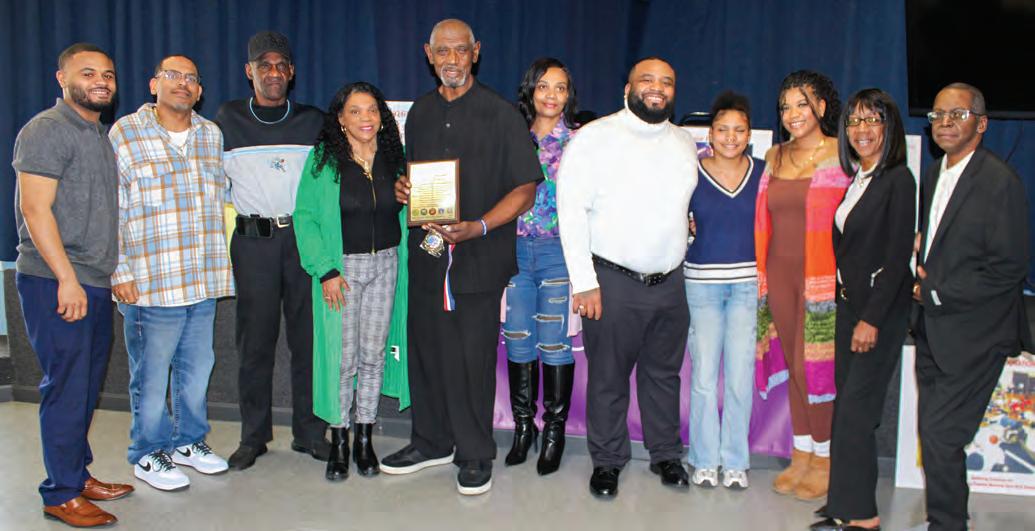
those people from Western PA who “help change the world...to make it a better place!” This year’s event hit the ball out of the park, was a slam dunk, or whatever other phrase you want to use, as some of Western PA’s finest were honored for outstanding achievement and service to the world.
AS IT IS SAID, IRON SHARPENS IRON, and that was borne out as awardees were honored for their outstanding service, including Baron “B.B.” Flenory. While well known as one of PA’s top 100 basketball legends, beginning with scoring 81 points in a junior high school basketball game,

his legendary status at Duquesne University, and being drafted by the Boston Celtics, Flenory achieved even greater status as a military veteran, executive with the Pressley Ridge Family Agency, dedicated family man as a father and grandfather to his nationally-recognized son and grandson. Thank you for your service, Sir! Donora native and lifelong friend Rodney Merritt, who appeared with his wife, Joyce, children, grandchildren, and family, was recognized for his military service as a Navy veteran. Also for his unyielding and dedicated commitment to his community, and most especially, his devotion to his fabulous family!
Dane “Mitt” Tartt best fits the moniker of “Donora, the Home of Champions!" Nicknamed Mitt for his baseball prowess, Dane was the consummate athlete. A 9.9 time in the 100-yard dash, he still holds numerous Donora High School records. He was clearly and most recognizably a baseball man, routinely going sideby-side and toe-to-toe with the great Ken Griffey Sr. In the early goings, it was a matter of when, not if, they would both ink major league contracts. To his credit, and the world’s betterment, Dane signed on the dotted line and served the U.S. government as an Army veteran. Thank you for your service, Sir! And speaking of service, it just doesn’t get any better or more important than that provided by Veterans Place of Pittsburgh. “The Operation,” located on Washington Boulevard in Pittsburgh, provides a multitude of valuable services for our military veterans to thank them for service to our country (you may recall that Achieving Greatness Inc. partners with Veterans Place each year to present Thanksgiving dinners... we were privileged this past year to meet a Marine veteran who earned
two Purple Hearts and an Army veteran who earned two Silver Stars.)
“Oorah!!!” Special thanks to program director Kylie Bibza and fellow veterans who dedicated their lives to HEAL THE WORLD AND MAKE IT A BETTER PLACE! Thank you for your service, Sir, Ma’am!
The event took place on March 21 at the Plum American Legion Post 980. We appreciate, applaud, salute, and congratulate all the honorees and thank them for their service for family, community, and country.




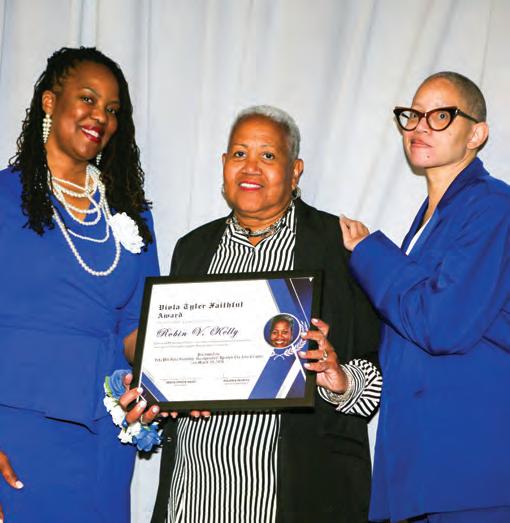
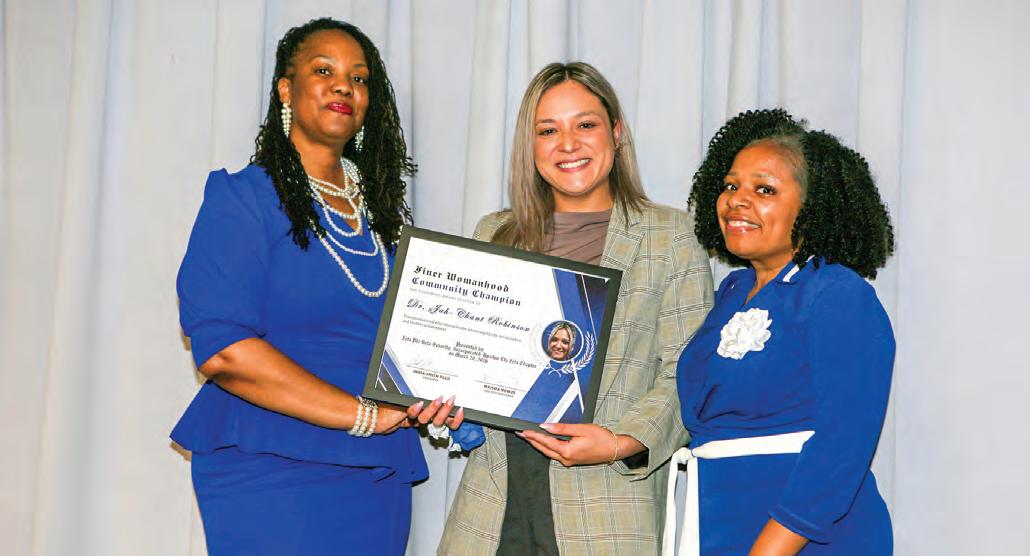
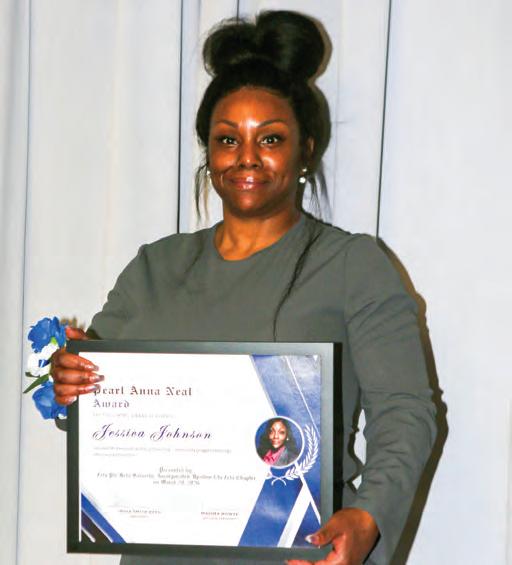
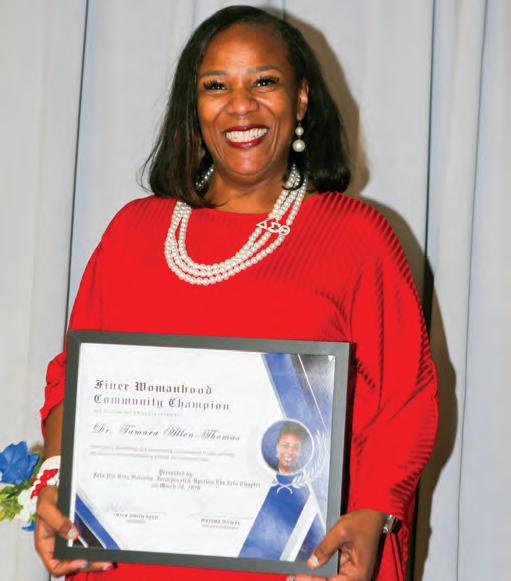
The Upsilon Eta Zeta Chapter of Zeta Phi Beta Sorority Inc., for the first time, held its Finer Womanhood Appreciation Event, a luncheon, March 28, at the Allegheny County Department of Human Services Building, Downtown. The Upsilon Eta Zeta Chapter encompasses the Mon Valley region, such as Homestead, Braddock, McKeesport, Duquesne and Clairton. Thus, the chapter wanted to honor some women who were doing exemplary things in the Mon Valley and who exemplified the sorority's founding principles of Scholarship, Service, Sisterhood and Finer Womanhood. The inaugural honorees were: Dr. Tamara Allen-Thomas; Fawn
Walker-Montgomery; Jessica Johnson; Carla Payne-Harrison; Rev. Robin V. Kelly; Dr. Tiffany Evans; and Dr. Jah-Chant Robinson. "We just wanted them to know that we see them," Maisha Howze, Second Vice President of the Upsilon Eta Zeta Chapter, told the New Pittsburgh Courier, April 6. "We understand that the Mon Valley is not really resource-rich, however they got a lot of heart and love for their community, and we wanted them to know that we see you and we appreciate everything you do for that community."



role in the success of the Mustang Market. As he works directly with the school students, oftentimes, he's the first to know which students may need access to the food pantry on a particular day. Then, the student, with Dean, Mitchell or another school staff member present, assists the student at the food pantry.
Mitchell said the pantry is stocked with canned goods and other non-perishable items, shelf-stable milk, pastas and cereal. She also has frozen meats, chicken, beef, fish, Halal and Kosher meats, eggs, cheese, even Ensure for seniors who may need it.
"A food pantry in a school is one of the most important things you probably don't even think about," Dean told the Courier at the ribbon-cutting, Feb. 19. "... (Food) helps academic outcomes be a lot better for children, and with the community surrounding a school building, it has access to food, especially when the area is considered a food desert, like the

classes on Tuesday and Wednesday evenings at the Mustang Market. "And we continue to push that we will have fresh fruits and vegetables throughout the summer (at the Mustang Market) even
Mitchell said that families who may need food can contact her at 412294-8707 for access to the food pantry by appointment on Tuesday and Wednesday evenings. "My mission in life is

West End."
Shayla Penn, founder of Burgh Eats and Treats, is also the board chair for Leading Through Love. She is a parent of two sons who attend Langley. Penn will be in charge of hosting cooking demonstrations and food safety
though the school will be closed," Penn told the Courier, April 6. Ebony Lunsford-Evans, better known in the community as "Farmer Girl Eb," will also provide support to the Mustang Market. She formerly was a substitute teacher at Langley.
to help people become better versions of themselves," Mitchell told the Courier.
The Greater Pittsburgh Community Food Bank provided Mitchell with $3,700 for the initial food stock investment for the Mustang Market. Since then,

Mitchell has worked to find additional funding sources to keep the food flowing for the students and families in need. The Sheraden Community Council held a food drive in the neighborhood for the Mustang Market; Dean held a contest inside Langley to see which student classroom would bring in the most canned goods, and the winning classroom’s students had a free pizza party;
Mitchell is working with Highmark to be part of the May 30 Highmark Walk for a Healthy Community, at Point State Park. The goal is to raise $6,000 for the Mustang Market via the walk. Mitchell said local residents also stop by to donate goods as well. "It's very important (for kids) to start young," Mitchell told the Courier. "Nutrition is a big part of learning. Having food makes kids
more likely to pay attention to their schooling and learning. I'm really proud that this is a service we're able to give to the kids, to the parents and to the community as a whole."

Westinghouse, such as carpentry pre-apprenticeship and health careers technology. He was blown away at the "tiny house" that the CTE students built, which sits just outside Westinghouse. Tiny houses are the new craze these days, enabling people to live in a space that's usually no more than 400 square feet, and the price of the home oftentimes isn't going to run past $150,000. A person could get a tiny home for as little as $30,000.
"Housing is a huge issue we're trying to address in the commonwealth," Lt.
Gov. Davis said as CTE student Joshua Gainer (carpentry pre-apprenticeship) stood nearby.
"Having (people) that know how to build those
things (tiny houses) pretty quickly is going to be huge. We're going to be talking about how do we increase our building of houses over the next couple years."
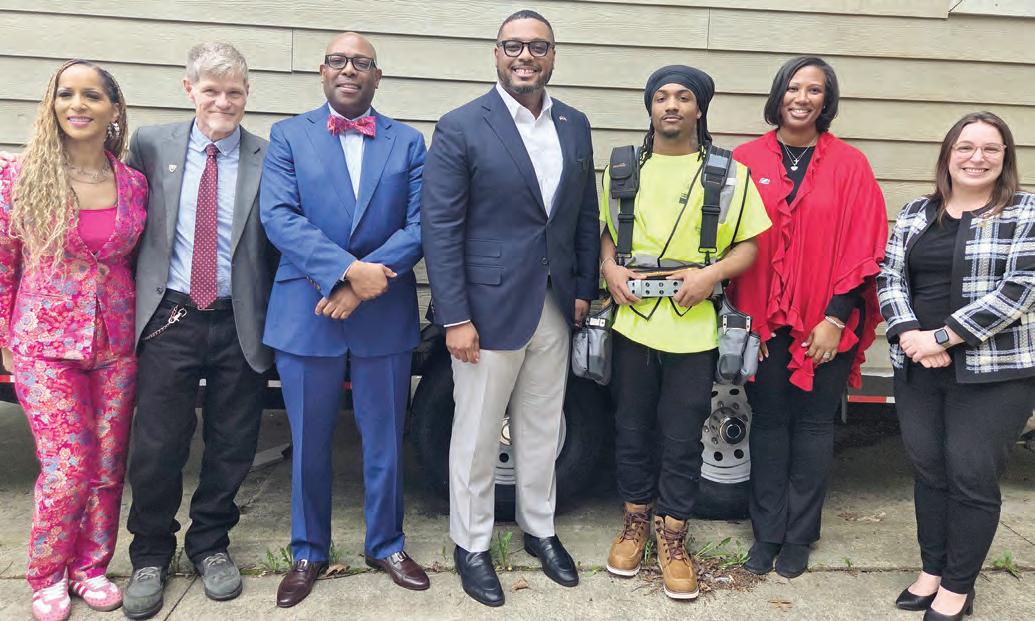
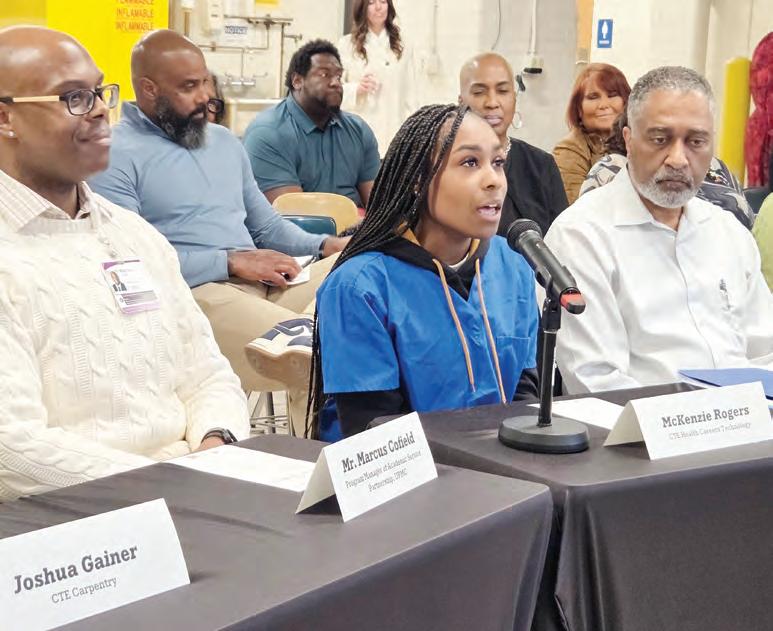
In addition to Gainer, Lt. Gov. Davis met CTE students like McKenzie Rogers (health careers technology), Lauren Dick (emergency response technology), Ayden Pride (business administration, sports and entertainment), Kaleb Boyce (culinary arts), Riley Dickey (cosmetology) and Janiah Hambrick (engineering). The students discussed how their particular CTE program has helped them progress in their careers so early in life, and the benefits of being placed at a work site while still in high school. As an example,
Rogers makes an hourly wage already by being partnered with UPMC.
"I like this program altogether because it just teaches you a lot about nursing," Rogers said during the April 6 roundtable discussion prior to Lt. Gov. Davis' tour of the Westinghouse CTE facilities. "I've always known I wanted to help people when I was younger."
"This pre-apprenticeship/partnership has given students the ability to see the potential in themselves that we often see before they ever realized it," added Tom Bender about the CTE student, Joshua Gainer. Bender is council representative for the Eastern Atlantic States Regional Council of Carpenters.
"We have worked with Westinghouse's CTE for

numerous years...it's phenomenal that you were able to get your National Registry Emergency Medical Technician certification," Pittsburgh EMS Chief Amera Gilchrist told CTE student Lauren Dick. "And the fact that these students are tasked to also go to school while they're getting these additional certifications is phenomenal. I had the pleasure of interviewing Lauren almost two weeks ago, and I must say you guys did a great job. She came in my office dressed to the nines...very impressed and blown away by this young lady."
The lieutenant gover-
nor also learned during the hour-long event at Westinghouse that the CTE carpentry pre-apprenticeship students will be headed to the NFL Draft site near Acrisure Stadium on April 15. "They're going behind the scenes to see the stages being built and be a part of that process to see how what they do in their classroom actually relates to work in specialty events that come into our city and how they can be a part of that," revealed Pittsburgh Public Schools' CTE director, Angela Mike. "I want you to block out the noise and stay focused on what you're do-
ing in the programs that are happening in Pittsburgh Public Schools," Lt. Gov. Davis told the CTE students, who numbered about 20 at the roundtable event. "There are truly amazing things happening and that's in large part to the teachers and administrators that you have here that work every single day, so congratulations on all the great work you're doing and I can't wait to see the great things that you're going to do as you all graduate and go off into your careers."



BAPTIST TEMPLE CHURCH Sunday Worship: 8 a.m. and 10:45 a.m. Pastor—Rev. Dr. Rodney Adam Lyde 7241 Race Street Pittsburgh, Pa., 15208 EBENEZER MISSIONARY BAPTIST CHURCH
Bountiful Blessings: 1st, 3rd Tuesday, 5-7 p.m. 312 Viola St. Duquesne, Pa., 15110 116 South Highland Ave. Pittsburgh, Pa., 15206 412-441-3800

Dorothy Stubbs



Worship Service: 11 a.m. Sr. Pastor—Rev. Dr. Vincent K. Campbell 2001 Wylie Avenue Pittsburgh, Pa., 15219 www.baptisttemple.church www.ebenezerbaptistpgh.org

108 W. 12th Ave. Homestead,

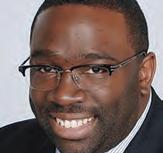

by Rob Taylor Jr. Courier Staff Writer
Pittsburgh Mayor Co -
rey O’Connor confirmed to the New Pittsburgh Courier exclusively on Tuesday afternoon, April 7, that he is “trying to make something work” for B. Marshall in Marshall’s attempts to hold a “Draft Bash” full of Black-owned businesses at a location as close to the NFL Draft festivities as possible. With the NFL Draft less than three weeks away, pretty much all the space that the National Football League controls for the Draft, such as on the North Shore and Point State Park, is unavailable for Marshall’s idea of a “Draft Bash.”
But on March 30, Marshall held a press conference across the street from Acrisure Stadium demanding that the City of Pittsburgh work with him on finding some sort of enlarged space. The city did have a meeting with Marshall sometime last week, “mid-last week at some point,” Mayor O’Connor told the Courier, which would make the meeting date either March 31 or April 1. In a letter released to the Courier by Marshall’s attorney, Steven Barth of Barth Rovnan, LLC, Barth pointed out that Marshall and his wife, Margo Marshall, were told by the City of Pittsburgh that the Department of Homeland
Security/Federal Government “is the governmental entity that prevented the Draft Bash from operating on Liberty Avenue near Point State Park,” the letter read. That location, on Liberty Avenue and Stanwix Street, is the same area where Marshall has placed Black businesses to vend during Juneteenth, the Black Music Festival and the Soul Food Festival over the years. Mayor O’Connor, on April 7, told the Courier that the Liberty/Stanwix site “is controlled by the NFL (for the Draft), so we’re trying to accommodate something else around, but still working on the details.” That proposed accom -
modation is on the North Side, at Allegheny Commons Park, a stone’s throw from East Ohio Street and about a 15-20 minute walk from Acrisure Stadium. Numerous events and festivals are held at Allegheny Commons Park throughout the year.
“This gives us an opportunity to be close to the city, close to the residents of the North Side and also we’ll have some parking over here, it’s easy to get over here off Route 28 coming from the Strip District,” Marshall told WTAE-TV’s Sheldon Ingram, April 6.
As of April 7, no official permit has been issued by the City of Pittsburgh for Marshall to operate his Draft Bash at Al -
legheny Commons Park. It’s also unknown as of April 7 that, if the permit is indeed issued, how many Black businesses will ultimately be able to operate at Allegheny Commons Park, with the Draft dates closing in, April 23-25.
“We’re trying to figure out where the permit would be and what it looks like,” Mayor O’Connor told the Courier. “So again, trying to make something work for him, but again, everybody thought that we controlled the site (Downtown at Liberty/ Stanwix); we don’t, so we’re trying to make something work outside of that site and on city property somewhere.”

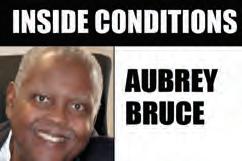
Hey folks, I was recently reminiscing and I reflected on a few tidbits. FYI, I created the "Inside Conditions" sports column in 1995. I remember it almost as if it were just last week. For the co-pilot purists out there, the title of the article is: “Four Fateful Minutes Give Steelers Win Over Patriots.” The reason I am pointing this out is after 31 years and 52 columns annually, that means that I have written more than 1,600 columns during that time. However, until recently I had never featured a President of the United States in my column alive or deceased. Other than the usual ceremonial photo ops of the winners of various sports championships, there was no other relevant reason for me to do so. Because no sitting president in my lifetime would have any reason to be involved in the world of sports, they were far too busy taking care of
our country! No president in the 250-year history of our “democracy” has ever signed an executive order for the purpose of controlling college sports, except Donald Trump. This current resident of “our house” is the clear exception to that unspoken rule. Because unprovoked, he has produced a perverted document of papyrus made from the skin of bat wings and endorsed that document with a porcupine quill pen filled with a manure extract just for the purpose of regulating and controlling the economics of college sports. Were there any NIL or scholarships available for athletes performing at Trump University? Oh, Charlie Chan so sorry: me forgot the only sport that was available at “Chump University,” oops, I meant Trump U was the sport of, “jumping through the legal hoops of deception,” so that the number one money-making sports team in America, the TTF, (Trump Team Family) could be paid.
Recently, the White House website had the nerve to post the following garbage with pride. “PROTECTING THE FUTURE OF COLLEGE SPORTS BEFORE IT’S TOO LATE:
Today, President Donald J. Trump signed an Executive Order to preserve the unique American institution of college athletics by restoring order, fairness, and stability.”
How in the h___ is Donald Trump preserving college athletics by restoring order? It only has become disorderly because him and his cronies have been given, “get-out-of-jail-free cards.”
The compensation for college athletes was never “fair” from the beginning and will never be fair when it comes to the well-being of the student-athletes. So why should Americans depend on the most unfair and unethical president in the history of the United States of America to restore “fairness” to anything? Remember Donald Trump adopted my grandfather’s slogan. “It is only a fair fight if Donald Trump wins.”
As my great friend and mentor Homey the Clown might say: “Hold up Orange Juice Jones, Homey don’t play dat.” As far as restoring stability to anything or anyone is concerned: Orange Juice Jones, or OJJ, destabilizes anything that he breathes on. The White House trick-
sters also go on to say the following: “Banning improper financial arrangements including pay-for-play agreements facilitated by collectives and similar entities; and establishing protections against unscrupulous agent conduct.”
Why should our society depend on the most unscrupulous administration in the history of a democratically-based government to re-establish scruples as well as morals and values of which they have none? The non-compensation rule for student athletes has been codified for decades, purposely designed to maintain a system that would keep the participants mired in poverty, without being afforded the opportunity to play for compensation.
During the dark ages, the value systems that the college athletic departments adhered to and continue to maintain are strenuously maintained, covertly. However, after the NCAA indentured servant system was forced to allow college players to be compensated, biased observers and the powersthat-be created and manufactured an emergency fiscal crisis based on the false and unsubstantiated
claims that paying athletes on the college level has frayed the moral fiber of these underprivileged lost souls. They must now be saved from themselves because all of us should realize by now that: “Money is the root of all evil.”
They don’t tell you the real story that is: “The lack of money is the root of all evil.” This final excerpt that I will profile from the White House “mess release” is downright wrong. This is where the “Lied Piper” lines up his victims in Manhattan preparing to lead them down to the Hudson River where Donald Trump aka the “Jesus of Mar-a-Lago” will bestow the gift of “eternal strife” upon them instead of the gift of “eternal life” as he prepares to baptize them in the “river of lies.”
Yes, this human being has compared himself to Jesus. He has the nerve to define his meddling as “salvation.” If he is Jesus, it’s time for me to change my faith. The White House Liars Club finally points out that: “President Trump recognizes the critical role of American college sports in fostering leadership, education, and community pride, and that decisive action is
needed to address urgent threats to its future.”
This guy is a real live “USDA certified nut.” He is the ultimate “narcissistic puppy” that always stops to pee on every pole and poop on every lawn when he is taken out on his morning walk. People have said to me: “Aubrey, your commentary might be a bit off-center because this is supposed to be about sports.” My rebuttal is: “This is certainly all about sports.” Unfortunately for him: “Orange Juice Jones” strayed into the arena of sports which is my domain. He became lost and turned out, without a collar or valid license for animal control to refer to. We all know what happens to a stray animal when they are captured by animal control. They are taken to the dog pound and put up for adoption. I have a suspicion that when the voters come to the dog pound in November 2026 to adopt an animal, certain dogs might remain in the animal shelter, hoping to be rescued.
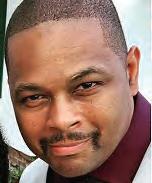
There is a quiet contradiction at the center of the Black American economic experience, one that is rarely confronted with the seriousness it deserves. On one hand, Black Americans collectively command between $1.7 trillion and $2 trillion in annual buying power, a figure that would position us among the largest economies in the world. On the other hand, we continue to occupy one of the most economically vulnerable positions within the very system our consumption helps sustain. This is not simply a disparity, it is a paradox.
For generations, the prevailing narrative has suggested that the challenge facing Black America is rooted in a lack of resources. But that framing, while convenient, obscures a more complex and ultimately more urgent truth. Black America is not poor in spending power, we are misaligned in economic circulation. The issue is not fundamentally about how much money flows into the community. It is about

how quickly it flows out, and more importantly, who controls what remains.
In functioning economic ecosystems, money is not merely spent; it circulates, it moves with intention, reinforcing internal networks of businesses, institutions, and households. Each transaction becomes a building block, strengthening the foundation upon which future wealth is constructed. In these environments, a single dollar does not perform a single task. It works repeatedly supporting local business, paying wages, funding education, underwriting expansion before it ever leaves the community.
That is not the prevailing reality in Black America. Here, the economic cycle is truncated. The Black dollar circulates for approximately SIX HOURS before leaving the community. By comparison, dollars circulate for roughly 19 days in Jewish communities, 28 days in Asian communities, 17 days in White communities, and about 7 days in Hispanic communities. These differences are not trivial, they are structural. They represent the difference between economies that compound value internally and those that export value externally.
The consequence is not just missed opportunity—it is systemic leakage. We are, in effect, participating in an economy in which we are essential as consumers but peripheral as owners. This pattern of consumption without control produces predictable outcomes. Wealth, by its nature, is not built through spending alone. It is built through ownership of assets that appreciate, generate income, and can be transferred across generations. When consumption is decoupled from ownership, economic activity becomes transient. Money is earned, spent, and disappears, leaving little behind to anchor stability.
by Helen Bezuneh WORD IN BLACK
(Word In Black)—It’s a situation we’re all familiar with. You’re at a business where you didn’t receive service that’s up to your standards. When the bill arrives, you calculate a low tip, seeing as the service, in your opinion, was quite poor. You do this, perhaps, because you have been taught that tipping is optional and should correlate with how good the service was. But national etiquette expert Diane Gottsman, this idea completely misinterprets the purpose of tipping.
“[A popular misconception is] that if you don’t want to tip, you don’t have to tip,” said Gottsman, founder of The Protocol School of Texas. “Gratuity— tipping, in this case—is part of the service. Those who are working for gratuity are oftentimes taking less hourly wage, and tipping is how they offset the costs; that’s part of their livelihood. So we should consider tipping and tipping generously when appropriate.”
Since the minimum wage for tipped workers is so low, those workers rely on tips to make a living. So, when you tip, you’re not simply providing workers with a treat for doing a good job —you’re paying for their sustenance.
“While some tipped workers do make good money, particularly in high-volume bars and fine dining restaurants, most do not,” said Restaurant Workers United, a union for restaurant, bar, and cafe workers, in a written statement. “Tips are a very unreliable source of income; no one should have to worry about paying for essentials because they got stiffed on a few tables.”
Tipped airport service workers at Ronald Reagan Washington National Airport, for example, struggle to make ends meet, said Jaime Contreras, executive vice president of 32BJ Service Employees International Union (SEIU). The minimum wage for tipped employees in Washington, D.C. recently rose from $6.00 per hour to $8.00.
32BJ, a local branch of the union that represents more than 175,000 members in ten northeastern states, represents some of the airport workers, who work to sustain the travel industry as wheelchair attendants, baggage handlers and more.
“Without a tipped wage, workers pretty much rely on the generosity of customers who may not even know how little tipped workers make, or people don’t even know they have to tip,” said Contreras. “If you’re a wheelchair attendant at the airport and you help people to and from their gate, who may be from places where tipping is not a cultural thing, that creates a problem. And that’s why we have pushed for tipped wheelchair workers at airports to get a higher wage.”
Tadesse Tadege, a tipped worker in guest services at D.C.’s Marriot Marquis, is a member of Unite Here Local 25, a union that represents over 7,500 hotel, restaurant and casino workers in the D.C. metro region, for similar troubling reasons. Working at the hotel for eight years, he has

helped guests check in, helped them with their luggage and directions and more. The gap between the incomes for tipped and non-tipped employees at the hotel is wide, Tadege said.
“They get $25 and we get $12.99.”
“Eight years ago when I was hired, the tipping was okay,” he said. “But now it’s going down. [Back then] our major income was calling taxis, so people gave you two, three dollars here and there. Now, a lot of people use rideshare apps like Uber or Lyft. So they don’t need our help. The other thing is, with the digital age, a lot of people want to give you something, but they don’t even have cash. Because of these reasons, we are affected.”
Tips cover most of his and his coworkers’ expenses, said Tadege. With a lack of tips, most work multiple jobs to fill the gap in their income.
Joining Local 25 has had a major impact on these conditions, he said.
“I didn’t know Local 25 before, but now I see the benefit,” he said. “They are really fighting for us everyday. Everyday they come and check with us if there is any problem. We even got paid for missing payments because of them. Now, I tell people to join unions. They are on our side.”
Local 25 is looking towards improving members’ hourly rate, said Emebet Samuel Kassa, Internal Organizing Director of the union. With workers not making sufficient money and guests not tipping, Local 25 strongly believes that management should make up the difference, said Kassa.
No matter the quality of service, you should always tip 15 to 20 percent, said Gottsman.
“I always like to air on the side of 20,” she said, “but I want to be fair and respectful for those who might have more of a struggle because some people are still struggling with inflation and trying to find jobs after the pandemic.”
In a survey conducted several years ago by William Michael Lynn, a tipping expert who himself paid his way through college by waiting tables and bartending, only 70 percent of people gave an answer in the 15 to 20 percent range when asked how much they think is customary to tip.
Though people need to improve their tipping habits, tipping is not always necessary in all contexts, said Gottsman.
I’ve been doing this a long time. Over 20 years in the financial planning and tax game, and every season teaches you something new. But this year? I noticed a trend that had me shaking my head. Too many people are playing with “exempt” like it’s a loophole. In plain English, that means little to no taxes were taken out of their paycheck during the year. In case after case, they owed. Not a little either. I’m talking balances due that hit hard, especially for people already struggling to keep their heads above water. No surprise refund. No clean break-even. Just a tax bill waiting at the finish line.
I understand why people are doing it. The economy has people under pressure. Prices are up on everything. Groceries cost more. Gas costs more. Utilities cost more. Rent is high. Insurance is high. It feels like every time you turn around, something else is reaching into your pocket. A whole lot of folks are living paycheck to paycheck, and in an effort to create some wiggle room in their budget, some are claiming exempt so they can bring home more money each payday. I get the temptation. When you’re
trying to survive, that extra money in your check can feel like a lifeline. It can mean groceries for the week, gas to get to work, or keeping the lights on. It can feel like you’re finally catching a little breathing room. But here’s the problem: exempt is not a budget strategy. It’s a delay tactic. And too often, it turns into a financial ambush. When you claim exempt, you’re telling your employer not to withhold income taxes from your check. That means more money now, but it also means you may be setting yourself up for a bill later. You’re not escaping the tax. You’re postponing it. And when tax season rolls around, that bill shows up like a repo man in the dark.
instead of feeling relief, they’re feeling stress. Now they’re scrambling. Now they’re trying to figure out how to come up with thousands of dollars after already spending the money throughout the year just trying to survive.
People thought they were helping themselves stay afloat during the year, only to end up owing money they didn’t have when it came time to file. So now,
One client really drove this home for me. She told me she claimed exempt for both federal and state because, in her words, she felt it was unfair that she was putting in all the work and the IRS just takes a cut. I told her I could relate. Let’s be honest, a lot of hardworking people feel that way. You show up. You grind. You do the work. You earn the money. Then Uncle Sam comes through with his hand out like he was on the clock with you.
That’s when I said something that made her laugh, but it was real at the same time. I said, “Uncle Sam is a pimp.” Think
about it. Both Uncle Sam and pimps wear loud, funny-looking suits with big top hats. Both take money from people who actually did the work. And both will smack you with penalties and consequences if you don’t pay up. The difference is, the IRS doesn’t need a backhand. They’ve got penalties, interest, notices, liens, levies, garnishments, and payment plans. So yes, you may feel like the system is unfair. You may resent how much comes out of your check. You may even feel like you’re just trying to keep your own money in your own house. I understand that. But the IRS does not operate on feelings. It operates on rules. And those rules have consequences.
Let’s talk about those consequences. If you owe taxes and don’t file your return on time, the IRS can hit you with a failure-to-file penalty. That penalty can be steep, and it adds up quickly. Then, if you file but don’t pay what you owe, there’s also a failure-to-pay penalty. On top of that, interest starts piling on. So now your tax bill is no longer just your tax bill. It’s your tax bill plus penalties
“It’s discretionary,” she said. “If you’re at a counter, let’s say at a coffee shop, and they hand you a cup of coffee and it’s a six second exchange, it’s much like a tip jar. A tip jar is discretionary,” she added. It’s also unacceptable to tip in some situations, she said. Many grocery stores, for example, don’t allow curbside workers to accept a tip since they get paid an hourly wage.
“Most of the time tipping is acceptable, but when in doubt, you ask,” noted Gottsman.
While tipping may not be obligatory at cafes and the like, gratuity screens
tend to make customers feel pressured to tip, said Gottsman.
“We feel compelled to leave that tip especially when [the displayed tip range] starts out high, so people feel pressure to leave a tip when in fact they wouldn’t have left a tip at all, or they would have left a couple of quarters in the change jar,” she said. “It’s important to know that you can feel comfortable touching the ‘no tip’ button [for] a service that was very quick. They aren’t working for gratuity, it’s…an hourly worker.”
To target the problematic impacts on workers, some restaurants have made the radical choice to

WHEN YOU TIP, you’re not simply providing workers with a treat for doing a good job—you’re paying for their ability to survive. (Credit: Sam Dan Truong/Unsplash)
entirely eliminate tipping. In 2015, Danny Meyer decided to do so for his restaurants, raising menu prices to adequately pay
his workers instead. He called the model “hospitality included.” Meyer, however, ended his no-tipping policy in
2020, citing the unpredictable future of the precarious restaurant economy. Getting rid of tipping is harder than most would think, said Lynn.
“The restaurants that have eliminated tipping have had to do one of two things: either replace tipping with automatic service charges, which by the way nobody likes…or they can increase menu prices and they’ll pay their staff higher wages. But to do that, they’ve gotta increase menu prices.
People actually don’t like those higher menu prices either.”
Unions nationwide will persist in their advocacy for workers grappling with detrimental tipping
systems. “We generally aren’t looking to do away with tipping right now,” said Restaurant Workers United, “but what we do want is higher wages, better benefits, and more reliable scheduling to make restaurant work a career that we can rely on. The larger cultural conversation about tipping isn’t going to change fundamentally unless we have the power as workers to demand the changes that we want to see in our industry, and that means we have to organize first.”
The post The business of tipping: experts, unions and tip workers weigh in on gratuity in 2023 appeared first on Word In Black.
The data makes this painfully clear. The result of poor circulation is not temporary, it becomes generational. The median wealth of Black households stands at approximately $27,100, compared to $250,400 for White households and $320,900 for Asian households.
Even when examining average wealth, the disparities persist, with Black households at roughly $352,000 compared to $1.5 million for White households. These figures are not simply reflections of income differences; they are the outcomes of fundamentally different relationships to ownership, retention, and capital deployment.
Other communities, whether by design, discipline, or historical positioning, have structured their economic behavior accordingly. In many cases, there is a deliberate emphasis on internal circulation, collective investment, and asset acquisition. Businesses are supported not only for convenience but for continuity. Property is acquired not only for shelter but for leverage. Education is funded not only for advancement but for preservation of advantage. These are not isolated decisions; they are coordinated patterns that produce cumulative outcomes over time. The result is not merely higher incomes, but greater durability of wealth. Resources are retained, reinvested, and redeployed in ways that strengthen the community. Economic power becomes

self-reinforcing, creating a cycle in which each generation builds upon the last rather than starting anew. Within the Black community, the absence of this sustained circulation and ownership structure has far-reaching implications. It affects not only household wealth, but the condition of neighborhoods, the viability of businesses, and the capacity for political influence. Economic fragmentation limits our ability to shape the environments in which we live, work, and raise our families. It constrains our options and, over time, narrows our collective horizon. At the center of any meaningful shift in

this trajectory is a concept both simple and profound; property. Property is often discussed in purely financial terms, but its significance extends far beyond balance sheets and valuations. Property is control. It is the ability to determine how land is used, how capital is deployed, and how value is distributed. It transforms income into an enduring asset, one that can produce returns long after the initial transaction has passed. Without property, economic activity remains fleeting. With it, wealth gains permanence. This is why the question of ownership cannot be treated as secondary or optional. It is foundational. A community that does not control its assets cannot fully control its outcomes. And a community that cannot control its outcomes remains vulnerable, regardless of how much it earns.
To be clear, none of this exists outside of historical context. The economic position of Black Americans has been shaped by a long and well-documented history of exclusion from redlining and discriminatory lending practices to broader patterns of disinvestment. These forces did not simply limit access to housing; they disrupted the very mechanisms through which wealth is typically built and transferred. But history, while explanatory, cannot be allowed to become a permanent constraint on future action. The conditions we face today, while still imperfect, present opportunities that previous generations were systematically denied. The challenge now is whether we are prepared to align our economic behavior with
plus interest.
That’s how a manageable problem turns into a mess.
And here’s something people really need to understand: filing an extension does not give you extra time to pay. It gives you extra time to file the paperwork. That’s it. If you know you’re going to owe, the payment is still due by the deadline. Too many people hear “extension” and think that means they can put the whole situation off. No. Uncle Sam still wants his money on time.
That’s why I tell people all the time: even if you can’t afford to pay everything, file your return anyway. File on time. That helps reduce the damage. Don’t turn one problem into two by ignoring the filing requirement too.
And let me be clear, there are situations where claiming exempt is legitimate. But most working people do not qualify. Exempt is not supposed to be used because you’re frustrated with the economy, mad about inflation, or trying to give yourself a raise through your withholding. I understand why people are doing it, but it does not make it smart. What I’m seeing is not really a tax issue as much as it is a pressure issue. People are under financial pressure, so they’re making short-term decisions to solve long-term problems. That extra money in the check feels good right now, but if it leads to a tax bill you can’t pay later, then all you did was trade today’s struggle for tomorrow’s crisis. That is not relief. That is borrowed
the outcomes we say we desire.
Such alignment requires a shift in both mindset and practice. It calls for a more intentional approach to how we spend, where we invest, and what we prioritize. It demands that we begin to see consumption not as an endpoint, but as a lever; one that can either reinforce external systems or help build our own. Even a 10 percent to 20 percent redirection of Black spending into Black-owned ecosystems would translate into hundreds of billions of dollars circulating internally, strengthening businesses, stabilizing communities, and accelerating wealth creation.
Equally important is the recognition that individual success, while valuable, is insufficient on its own. Wealth that is not connected to a broader ecosystem remains isolated. To create lasting impact, economic activity must be coordinated. Businesses must support one another. Professionals must collaborate. Capital must be pooled and deployed with shared purpose. The implications extend beyond economics, communities that control capital inevitably shape policy, influence institutions, and define the terms of their own development. Economic power, in this sense, is inseparable from political and social power, without it advocacy is limited. With it, transformation becomes possible. We are, in many ways, at a defining moment. The resources exist. The knowledge is accessible. The path is visible. Every dollar we spend with each other is a decision. Every investment in each other is a signal. Every property we acquire is a step towards a different future. Because in the final analysis, property is not merely a tool of wealth. It is the foundation upon which wealth is sustained, power is exercised, and legacy is secured. Property is Power.
(Dr. Anthony O. Kellum—CEO of Kellum Mortgage, LLC
Homeownership Advocate, Speaker, Author NMLS # 1267030 NMLS #1567030
O: 313-263-6388 W: www.KelluMortgage.com.)
Property is Power! is a movement to promote home and community ownership. Studies indicate homeownership leads to higher graduation rates, family wealth, and community involvement.
stress. The smarter move is to deal with the issue the right way. Adjust your withholding properly. Don’t over-withhold and give the government an interest-free loan, but don’t under-withhold and set yourself up for a bill you can’t handle either. Find the balance. Know your numbers. Understand what’s coming out of your check and why. Real talk: you don’t have to like the tax system, but you do have to respect it. Because when you don’t, it will cost you. Uncle Sam always gets his money. The only question is whether you’re going to handle it on your terms or be forced to handle it on his. Trust me! You want it on your terms. So if you’ve been thinking about claiming exempt just to create breathing room in your budget, slow down and think it through. Bigger checks today can turn into painful tax bills tomorrow. Don’t let a temporary fix become a long-term headache. If you need a tax pro to help you file your taxes, fix your withholding, or get back on track, hit me up.
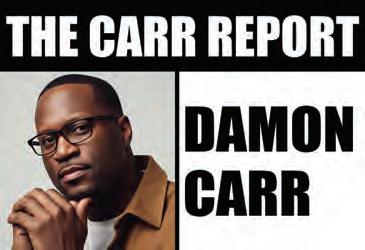
(Damon Carr, Money Coach & Tax Pro can be reached at 412-216-1013 or visit his website at www.damonmoneycoach.com) Helping you flip your finances from stressed to blessed — one smart decision at a time.
(TriceEdneyWire.com)—“All persons born or naturalized in the United States, and subject to the jurisdiction thereof, are citizens of the United States and of the State wherein they reside. No State shall make or enforce any law which shall abridge the privileges or immunities of citizens of the United States; nor shall any State deprive any person of life, liberty, or property, without due process of law; nor deny to any person within its jurisdiction the equal protection of the laws.”—The 14th Amendment
They hoped we weren’t paying attention. While the country was watching fighter jets and debating troop deployments, while the administration’s shock-and-awe news cycle churned through one manufactured crisis after another, a quieter and far more dangerous move was playing out in plain sight.
On the first day of his second term, President Trump signed an executive order attempting to end birthright citizenship in the United States. Not through Congress. Not through the constitutional amendment process the framers required. Through a stroke of a pen. This is one of the most brazen assaults on American democracy this administration has attempted. And it was designed to slide through the noise. It must and will not.
The 14th Amendment, ratified in 1868, includes a citizenship clause that confers citizenship on anyone “born in the United States, and subject to the jurisdiction thereof.” The amendment simply constitutionalized centuries of precedent based on English common law. And let us remind America, that this was a direct repudiation of the Dred Scott decision, which denied Black people the protections of U.S. citizenship. The amendment was the nation’s promise to itself that never again would the government get to decide that a person born on this soil was something less than American. That promise is now under attack. Trump has argued that the amendment “was meant for the slaves, for the children of slaves.” Let that land for a moment. The administration’s own framing acknowledges the 14th Amendment was written to protect Black people, and then argues that its protections should be narrower than the text plainly states.
Marc H. Morial
This is not a legal argument. It is a political ideology, rooted in White Supremacy, seeking to legally discriminate who really counts based arbitrarily by a select few. The assault on birthright citizenship is anti-Black not only in its history but in its logic. When you establish the principle that citizenship can be conditioned on the legal status of your parents, you create the infrastructure for a permanent underclass. You open the door to generations of people born in America, raised in America, who are American in every lived sense, but who can be told they do not belong.
If Trump’s order were allowed to stand, an estimated 2.7 million additional people would be unauthorized by 2045, and 5.4 million more by 2075. These are not abstractions. These are children. And disproportionately, they are children of color.
Advocates have warned this risks creating a “permanent underclass” for some immigrant groups, transforming the cultural and civic fabric of the country. Communities of color, already navigating the cumulative weight of structural inequality, would face an additional burden; proving their belonging in the only country they have ever known.
That is not America at its founding promise. That is America at its worst.
Every federal court that has considered a challenge to the executive order has struck it down. The Supreme Court heard oral arguments in Trump v. Barbara this week, and a majority of the justices appeared skeptical of the administration’s position. Even Chief Justice Roberts noted that we may live in a new world, but we have the same Constitution. We agree. A Supreme Court ruling is expected by the end of June or early July.
The National Urban League has stood against every attempt to diminish the citizenship, dignity, and rights of Black and brown Americans since 1910. We know what it looks like when government uses the machinery of law to shrink the circle of who belongs. We have seen this before, and we have fought it before, and we are fighting it now.
To the communities living under the shadow of this executive order, we see you. To the children whose citizenship should never have been in question, you are American, and we will defend that truth.
And to those in power who believe the noise of the moment will drown out accountability, it will not. We are watching the courts. We are watching the Congress. We are watching the ballot box. American democracy has survived every attempt to hollow it out from within, because the people it was built to exclude refused to stop demanding what was theirs. This generation will be no different.

Rod Doss Editor & Publisher
Stephan A. Broadus Assistant to the Publisher
Allison Palm Office Manager Ashley Johnson Sales Director Rob Taylor Jr. Managing Editor
John. H. Sengstacke Editor &
Where are our three branches of government?
(TriceEdneyWire.com)—It has been reported that poor areas in Iran where people of African descent live have been among those first harmed. Others live there, too. Research has not confirmed how many of the students in the girls’ school that was bombed in the war against Iran had African blood, but they were God’s children and many were poor. Here’s what research found. This is a heavily documented and actively unfolding story. What is confirmed across multiple major investigations is that on February 28, 2026, the first day of the 2026 Iran war, the Shajareh Tayyebeh girls’ elementary school in the Shahrak-e Al-Mahdi neighborhood of Minab, Hormozgan province in southern Iran was destroyed by a missile strike. According to Iran state media, at least 175 people were killed, over 100 of them were school children. That is a tragedy no matter what their blood was.
The school was attended by a mix of children of military families and locals drawn by low tuition fees—some from the town of Minab itself, and others from outside. The fact that tuition was low might tell us many of the girls came from poor families. That would not be surprising.
Regarding the specific claim about African children of domestic workers: Reporting on the demographics of Minab notes that the people of Minab are a braided population—Arab, Persian, Baloch, descendants of African
Dr. E. Faye Williams, Esq.

traders who sailed the ancient Indian Ocean routes—and they speak a dialect, Bandari, that carries the influence of the Gulf coast in every syllable is true. That tells us it is likely some young girls of African descent were killed, and our hearts go out to all families of the girls no matter what their descent is.
No matter what, war is cruel and it is unforgivable that our military would be sent to the area where it was certain young schoolgirls would be killed.
I would not even support killing the schoolgirls of the Islamic Revolutionary Guard because children do not deserve having their lives taken because adults are acting without regard for the sanctity of life. How does a President of the United States tell the people he represents the idea that the Federal Government’s job is for military protection—not Medicaid, Medicare or Childcare! He went on to say states should just raise their taxes for those things!
How easy it is for him to dismiss the role we have been led to believe we pay Federal taxes for education of our people, healthcare, and so many necessities of life. Trump and Hegseth are acting
like kids playing games!
This war is not one of support or choosing by the American people or our representatives in Washington who were not even consulted! People who’re still struggling to buy gasoline to get to work, to buy food for their families, to send their children to college or to afford a comfortable home to live, didn’t vote for what the man who thinks he is king to decide his only job is to do away with the things families need, so he and Hegseth can spend their time conducting their wars we don’t support! Amnesty International, which interviewed a teacher in Minab, and a Baluchi human rights defender, found where the girls died were children of people across the board, including the IRGC personnel and low-income families from the area, who include members of Iran’s oppressed Baluchi ethnic minority whether they were of African descent or not.
The Afro-Iranian community in Hormozgan (descendants of enslaved Africans brought via the Gulf trade) is real and historically documented— but the domestic worker framing as it applies to this school’s population needs further sourcing to confirm. May God help our country and protect us from our so-called leaders. Thanks to Pope Leo for speaking to the issue of war. It’s not for our monetary gain! (Dr. E. Faye Williams, President of The Dick Gregory Society)
‘It’s a new world. It’s the same Constitution.’
(TriceEdneyWire.com)—It seems contradictory that an adult would make a concerted effort to instill in a child the ideas of correct behavior, playing by the rules, and exhibiting good sportsmanship. Yet they fail to practice what they preach when they choose to play by their own one-sided rules in certain situations. Rather than abiding by the established norms, procedures, and regulations set in place for everyone to follow, they prefer to change previously established rules and narratives to suit their own advantage. As a result, the true meaning and purpose behind societal standards, even our U.S Constitution, are being changed to promote ulterior motives and agendas.
The U.S. Constitution was meant to be a timeless document with guidelines, but the Founders recognized that a changing society means the law of the land will require future amendments. While over 11,000 amendments to the U.S. Constitution have been proposed since 1789, only 27 have been ratified. In the Bill of Rights, drafted by James Madison, the first 10 amendments were added to guarantee individual liberties and place limits on the power of the federal government.
They were drafted and introduced to the First Congress by Madison in response to pressure from anti-Federalists who feared the implications of having a strong central government. The original Second Amendment was written during a different era, shaped by militias and the fear of slave uprisings. The Second Amendment states: “A well-regulated Militia, being necessary to the security of a free State, the right of the people to keep and bear Arms, shall not be infringed.” Southern leaders and anti-Federalists were worried that the new federal government would weaken or disarm state militias that were used for slave patrols and shock troops against revolts. Madison was referring to the ability of White civilian volunteers being organized by the State to police, terrorize, and crush Black resistance. Today, people in powerful positions
David W. Marshall Commentary

with ulterior motives are determined to erase the original context and redefine the meaning of Constitutional amendments to defend their versions of liberty, citizenship, and democracy. The success in changing the meaning behind the Second Amendment cannot be ignored. For most of U.S. history, courts did not read the Second Amendment as a personal right to own any gun you wanted (i.e., semi-automatic rifles). The Supreme Court repeatedly treated it as related to militias and public order, not as a shield for individual gun possession. The shift began in the late 20th century. The meaning changed because the National Rifle Association (NRA) and its allies had ulterior motives for gun rights, thereby launching a long and successful campaign to change the narrative.
First, it was the Second Amendment, now it’s the Fourteenth. The president, who attempted to abolish birthright citizenship by executive order, believes that the Constitution does not guarantee automatic citizenship to all individuals born on U.S. soil. Many agree with the president’s assessment and his bid to upend birthright citizenship in our nation. Despite their grandstanding when claiming to “uphold the Constitution,” they want to play by their own rules when defining who automatically receives citizenship. Changing the rules concerning naturalization and birthright citizenship becomes a target for those fearful of a changing nation and what it could mean when the United States eventually becomes a majority-minority nation. Redefining what it means to be an “American” is a power strategy. It has always been an issue of national identity for the overall purpose
of exclusion and maintaining control.
Citizenship in the United States is a legal status that entitles citizens to specific rights, duties, protections, and benefits. Citizenship serves as a foundation of fundamental rights derived from and protected by the Constitution and laws of the United States. The Fourteenth Amendment makes it very clear in its definition of citizenship. It reads: “All persons born or naturalized in the United States, and subject to the jurisdiction thereof, are citizens of the United States and of the State wherein they reside. No State shall make or enforce any law which shall abridge the privileges or immunities of citizens of the United States.”
According to this description, there are two primary pathways to American citizenship, as specified in the Citizenship Clause of the Fourteenth Amendment. Birthright citizenship is the process by which persons born within the territorial limits of the United States are presumed to be citizens. Secondly, naturalization is the process by which an eligible legal immigrant applies for citizenship and is ultimately accepted. The Supreme Court is currently hearing oral arguments in Trump v. Barbara, in which the question of birthright citizenship is argued before the highest court. The Supreme Court has an opportunity to shut down the policy debate and high-power move by those who maintain a White supremacy agenda. As the Trump administration’s top Supreme Court lawyer, Solicitor General D. John Sauer, made his arguments before the Court, Chief Justice John Roberts replied: “It’s a new world. It’s the same Constitution.” Those are powerful and surprising words coming from a conservative on the bench who has presided over the end of the rule of law in America. We need Chief Justice Roberts and the majority of the Supreme Court to get this one right.
(David W. Marshall is the founder of the faith-based organization TRB: The Reconciled Body and the author of the book God Bless Our Divided America.)
By Dr. Benjamin F. Chavis Jr.
Today, across the United States of America, in some of the largest urban cities, Black Americans are having renewed nightmares about being taken for granted, ignored, and being erased in history and in the public square.
Ethnic cleansing is an insidious form of systematic racism. In response to the increasing “Browning of America,” concerns are raised about the unfulfillment of prior commitments intended to ensure racial equality in municipal politics, economics, and urban revitalization. New York City is the nation’s largest city. The presence and contributions of African Americans to the city’s centuries-long development and evolution are rarely highlighted or saluted. The election of Zohran Mamdani would not have been possible without the huge turnout of African American and Latino voters.
Yet the interests of Black America in the nation’s largest metropolis appear to be triaged routinely by the Mamdani Administration.
We are the Black Press of America. For the past 199 years, since the first publication of Freedom’s Journal in New York City in 1827, we have had to call out those who pretended to be our political allies. Accountability by those we
help to elect is a fair and just demand.
Voters of color—both Black and Latino New Yorkers—backed Andrew Cuomo heavily in the primary, but then ultimately decided to give Zohran Mamdani a chance: overcoming their skepticism on housing, transit, and public safety, and reportedly moved by his affordability agenda.
This trust, on the part of Black voters in particular, may have been misplaced. Why? Several troubling early signs that the new mayor is disregarding New Yorkers of color and treating them like Ralph Ellison’s iconic Invisible Man
Thus far Mayor Mamdani has appointed no Black deputy mayors. This is a glaring signal to Black voters who voted for Mamdani on the promise of racial equity in the city’s administration. Does Mamdani value our insights, lived experiences, or our voices in crafting critical policies in City Hall?
Mamdani was forced to apologize to Black New Yorkers for overlooking the historical contributions of enslaved and indigenous people to building the city when he talked about a city “built by immigrants” in his inauguration speech. The Mamdani administration is holding a series of “Rental Ripoff” hearings, spearheaded by Cea Weaver, the director of his Office to Protect Tenants, who
called homeownership a form of White supremacy. The mayor is reaching out to help private landlords rather than prioritizing fixing public housing (NYCHA), which has a dismal track record of poor conditions (no heat, year-plus waits for repairs, rampant pests and mold). 90 percent of the more than 511,000 NYCHA residents are Black and Latino, which is part of a larger trend in which 95 percent of Black households in New York State live in highly segregated buildings and/or neighborhoods. NYCHA is the largest landlord in NYC, so the Mamdani administration telling residents to wait even longer for a solution to their long-standing sub-standard living conditions has to be challenged. The unfolding case study of Mayor Mamdani in New York City reveals that we must keep voting, with record voter turnout. But after the elections, we must hold mayors and other elected officials accountable. Mamdani still has time to ensure greater equity in NYC. But will he do the right thing at the right time?
(Rev. Dr. Benjamin F. Chavis, Jr. is President and CEO of the National Newspaper Publishers Association (NNPA) and can be reached at dr.bchavis@nnpa.org)
The most notable aspect of California, Pennsylvania is its state University (previously California Normal School, then California State Teachers College, California University of Pennsylvania, and now Penn West University). The borough was founded in 1849 and named for the California gold rush that began out west a year earlier. Hard by the Monongahela River 30 miles due south of Pittsburgh, Pennsylvania—-California, Pennsylvania should be memorialized also for another reason.
We must recognize the heroism of another product of California, Pennsylvania: Viola Liuzzo. She was born in California, Pennsylvania in 1925 and was murdered in 1965 in Selma, Alabama, a sacrifice for the American civil rights movement at the hands of the Ku Klux Klan. White, and impoverished for most of her early life—in the north and in the south— the young Viola Liuzzo commiserated with Black Americans suffering from want. Her views were formed mainly by her life in Tennessee and in segregated Michigan. Later in Viola Liuzzo’s short life, a Black nanny and her church influenced greatly her decision to commit to the civil rights cause. At the same time, one might say joining the National Association for the Advancement of Colored People (NAACP) was the beginning of the end for Viola Liuzzo.
In her formative years, she and her family moved to so many places that she rarely finished the school year in the same city where she began it. As a twice-married mother, ultimately of five children, Viola Liuzzo also lived in several cities. As an activist member of the NAACP, she died in Selma, Alabama, where she had never lived.
In 1960s America, civil rights, school integration/segregation and voting rights captured the headlines in the nation’s news. In the quest for voting rights for African Americans, which many southern voting jurisdictions denied Black citizens, nonviolent demonstrations were a major tool of the passive resistance activists.
In Alabama a planned march from Selma to the state capital of Montgomery to focus attention on denial of Black voting rights was a major action for redress. Black and Caucasian (mainly from the north) activists decided to march peacefully in support of the effort, as Martin Luther King Jr. and his Southern Christian Leadership Conference had advocated.
Wanting to do her part, Viola Liuzzo travelled to Selma from her home in Michigan in service of the voting rights cause. Marching from Selma to Montgomery was a call to voting action in Jim Crow Alabama.
Actually, there were three major protest marches in Alabama in the month of March 1965. Most known to history is
Robert Hill
the first, during which state trooper gangsters made certain the peaceful protesters met with violence. On March 7, 1965, which became known as Bloody Sunday, state trooper mobsters brutally assaulted marchers as they crossed the Edmund Pettus Bridge (namesake of the Grand Dragon Ku Klux Klansman) that spanned the Alabama River.
Over the ensuing years, John R. Lewis, whose skull was fractured during the bridge attack, became the name most associated with the assault and later became a revered member of Congress. The pending John Lewis Voting Rights Advancement Act is a continuing focus of congressional maneuvering.
Martin Luther king Jr., Coretta Scott King, freedom rider Diane Nash and entertainer/activist Harry Belafonte among many other celebrities and Black and Caucasian everyday people participated in the second march. As part of that second effort, Viola Liuzzo used her 1963 Oldsmobile to shuttle protesters to and from designated locations. Martin Luther King Jr. halted that demonstration under Federal court injunction and more threats of violent police attacks.
On March 25, 1965, after the Federally-protected third march was completed, Mrs. Liuzzo and 19-year-old Black Leroy Moton, were carrying out shuttling assignments when a vehicle carrying four members of the Ku Klux Klan pulled alongside the justice seekers. When the shooting ended Viola Liuzzo was dead. Astonishingly, her passenger survived the deadly March 25th attack but was covered with Viola Liuzzo’s blood.
Though acquitted of state charges, the murderers were Federally convicted of conspiracy to assassinate Viola Liuzzo under the Reconstruction-era Ku Klux Klan Act. For their contributions to their respective fields as well as to the crusade for Black rights in the United States, the well-known deserve continuing salutes. So does little-known Viola Liuzzo, a Caucasian woman from California, Pennsylvania, who gave her life to the struggle for Black rights in America.
(Robert Hill is an award-winning Pittsburgh writer and communications consultant)
The Protestant Reformation had a central tenet: the priesthood of all believers. It empowered each believer to interpret the Scriptures for themselves. However, theologian John Shelby Spong famously informed an audience that even the most educated individuals in modern American society only had a fourth-grade level of biblical knowledge, rendering their strongest biblical views questionable.
Spong recalled an incident in which he went on a television program and informed the host that the scholarly consensus is that the gospels were written four to five decades after Jesus’ death.
The TV host replied, “If the gospels are dated that late, then they couldn’t have been authored by eyewitnesses.”
Spong told him that the gospels were not written by eyewitnesses.
The host stated that the nuns taught him that the disciples followed Jesus and wrote down everything he said, which is where the gospels came from.
Spong laughed, then inquired whether the nuns had also informed him that the disciples used ballpoint pens and spiral notebooks.
Republican Senator Ted Cruz exemplified Spong’s comedic story in an interview with conservative political analyst Tucker Carlson when he explained why he supported Israel. He stated, “Growing up in Sunday school, I was taught from the Bible that those who bless Israel will be blessed and those who curse Israel will be cursed. And, from my perspective, I want to be on the blessed side of things. We are commanded to support Israel.”
Cruz’s biblical reference came from Genesis 12:1-3, which reads, “The Lord had said to Abram, ‘Go from your country,
your people, and your father’s household to the land I will show you. I will make you into a great nation and bless you; I will make your name great, and you will be a blessing. I will bless those who bless you and curse those who curse you; all peoples on earth will be blessed through you.”
Cruz wants us to believe that the pronoun “you” in the scripture refers to Israel, although it clearly refers to Abram. God told Abram to “Go to the land that I will show you.” Then God said, “I will bless those who bless you, and I will curse anyone who curses you.” In other words, God would safeguard Abram during his journey.
These texts in no way call for support for Israel.
Cruz’s interpretation of Genesis 12:1-3 is known as an “eisegesis,” or “reading into the text.” That is the process of interpreting a text in a way that introduces one’s own presuppositions or agendas.
The most troubling part of Cruz’s comment was when he remarked, “I want to be on the blessed side of things.” That means his support for Israel is an unprincipled barter with God. He only does it in exchange for something he covets.
Some supporters of Pastor Doug Wilson, a leading proponent of Christian nationalism, argue that Christian nationalism
is based on “The Great Commission.” This is the event in which the resurrected Jesus provided final instructions to the apostles before ascending into heaven. Matthew 28:18-20 detailed, “Then Jesus approached them and said, ‘All authority in heaven and on earth has been given to me. So go and make disciples of all nations, baptizing them in the name of the Father, Son, and Holy Spirit and teaching them to obey all that I have commanded you.’”
Proponents of Christian nationalism interpret the phrase “go make disciples of all nations” to mean that the laws governing modern nation-states should be based on Christian principles, but “The Great Commission” has nothing to do with nation-states or their laws. Before Jesus, God’s covenant and promises were intended for his “chosen people,” the Jews. “The Great Commission” authorizes the apostles to extend God’s covenants and promises to individuals from every nation, allowing all human beings to enter the kingdom of heaven.
Senator Ted Cruz and supporters of Christian nationalism are opposed to socialism. They view socialism as a utopian idea that can only manifest in Heaven. However, if socialists reminded them that Jesus stated we are expected to apply on earth what works in heaven and demonstrated this principle by quoting the Lord’s Prayer: “Thy kingdom come. Thy will be done on Earth as it is in Heaven.”
Cruz and Christian nationalists would accuse the socialists of misinterpreting scripture because they only had fourthgrade biblical knowledge.
Most people will experience the 2026 NFL Draft as three days in April. For Pittsburgh’s small business community, it has been nearly a year of work.
Twelve months ago, the NFL launched its Source Program here, a free, competitive procurement initiative designed to expose local and diverse businesses in the 10-county region to subcontracting opportunities tied to the Draft. Free to apply. Free to participate. No cost for the workshops, the networking, or the matchmaking. The NFL made a deliberate choice to remove every financial barrier so that access would be determined by readiness, not resources.
What set this program apart was how it was carried out. A dedicated Source representative – a Pittsburgh based business owner herself – spent months embedded in our communities, attending our chamber events, our mixers, our business showcases. She attended more than 50 local events. She came with a QR code and stayed for the conversation. She invested hours upon hours meeting one-on-one with local business owners –more than 100 of them in total – answering every question and making herself available around the clock. Her efforts did not stop at the city limits; she fanned out across southwestern Pennsylvania to meet with more than 70 regional stakeholders.
Our four chambers and many other organizations from economic development, cultural and community groups, education and workforce development and more were at the table and embedded in the outreach, ensuring that as many communities and businesses as possible, including minority-owned, women-owned, veteran-owned, and LGBTQ+owned businesses across the 10-county region knew this opportunity existed and had the support to pursue it. Throughout every step, the information sharing was robust, and the process transparent and thoroughly communicated.
The response from our region was historic. More than 1,700 businesses applied, the largest applicant pool the Source Program has ever seen in any host city for the Super Bowl or Draft. From that field, the NFL selected 165

businesses through a competitive process that was applied consistently across submissions from all 10 counties.
For businesses selected to participate in the program, the support did not stop at a listing in a directory. The NFL provided market-specific workshops designed to teach owners exactly how to do business at the NFL level: how to price competitively, how to present capabilities, how to meet the compliance requirements each contract carries. Accepted businesses were brought into direct networking with NFL and their vendors building real relationships with the buyers and event producers who make procurement decisions. The program even coached businesses on responsiveness, because NFL buyers work nights and weekends and responsiveness is how trust gets built. While there were no guarantees of contracts, the NFL worked to position Source members for the best possible outcome.
More than 70 local contracts are currently in progress, with the majority involving Source Program participants. More than $1 million in contracts is already projected to go directly to underrepresented business owners, and awards are still being made.
The opportunity extends beyond contracts. The Teammates Program provides paid employment at a living wage for Pittsburgh residents across a wide range of Draft roles, in partnership with organizations like Partner4Work and the Master Builders’ Association of Western Pennsylvania. On Day 3, a Makers Market gives local businesses direct access to hundreds of thousands of visitors, with 100 percent of revenue going straight into their pockets. And when the Draft ends, the Source Program directory does not disappear. It is uploaded to the NFL’s
national supplier database, where it is accessible to all 32 teams, sponsors, and partner organizations. What is perhaps even more significant, is that the entire applicant pool – the record setting 1,700 local and diverse companies that pursued Source program membership – will be part of a centralized database that will be used to strengthen the local procurement opportunities of VisitPITTSBURGH, the Pittsburgh Steelers and other Pittsburgh organizations. What our businesses built here opens doors that extend well beyond April. As leaders of Pittsburgh’s minority business community, we have been at tables where inclusion was a talking point. This time, we watched how it was built into the execution. We watched a woman-owned business prepare a proposal she never thought she’d have the chance to submit. We watched a veteran entrepreneur realize his certifications finally opened a door. We watched our members walk into rooms they had never been invited into before and hold their own. That is what happens when access is built with intention and communities are treated as partners rather than audiences.
The 2026 NFL Draft will attract hundreds of thousands of visitors to our city and reach more than 55 million people around the world on television and streaming. When they see Pittsburgh, they will see a business community that is diverse, prepared, and ready. That is not an accident. It is the result of more than a year of work, an intentional program, and entrepreneurs across our communities who believed the door was open and walked through it. Pittsburgh showed up. And Pittsburgh is ready.
(Signed: Barata Bey, President, African American Chamber of Commerce of Western Pennsylvania; Melanie Marie Boyer, Chief Executive Officer, Pittsburgh Metropolitan Area Hispanic Chamber of Commerce & Foundation; Jordan Botta, Executive Director, Three Rivers Business Alliance; and Kanak Iyer Ph.D., Founding President and Chief Executive Officer, Asian American Chamber of Commerce, Pittsburgh.)
(TriceEdneyWire.com) - The subminimum wage for tipped workers is a legacy of slavery.
After the Civil War, many employers in hospitality and rail service hired newly freed Black workers into jobs where tips often replaced wages. Tips became, for too many workers, the wage itself. That injustice still lives on today in the form of a lower minimum wage for tipped workers.
We should call that system what it is: an old injustice that never ended. Today, it does not just hurt Black workers. It hurts tipped workers of every race. It leaves millions of people with unstable incomes. Too many workers finish a shift without knowing whether they earned enough to cover rent, groceries, or childcare. It also leaves workers more vulnerable to harassment. When your livelihood depends on pleasing the customer in front of you, even when that customer is drunk, crude, or predatory, the power imbalance is obvious. No worker should have to put up with humiliation to earn enough to live. No decent society should accept that as normal.
Yet for decades, the corporate restaurant lobby has fought to preserve exactly that arrangement. Its argument is always the same: pay workers fairly and the industry will suffer. But what it is really defending is a business model built on paying some workers less and making customers close the gap.
Ben Jealous

Chicago is right to reject that model. Today, tipped workers in Chicago can still be paid $12.62 an hour before tips, while the full city minimum wage is $16.60. The city’s 2023 law was designed to close that gap over time, ending the tip credit by July 1, 2028. And when the City Council moved last month to freeze that progress, Mayor Brandon Johnson vetoed the measure and fought to keep the phaseout in place. He deserves credit for that. Because this fight is bigger than restaurants. We are living through twin crises of affordability and democracy. The first shows up at the kitchen table. Rent is too high. Groceries are too high. Child care is too high. Too many families work hard and still cannot get ahead. The second shows up in the growing number of working people who no longer believe democracy can improve their lives. Those crises are connected. When government moves quickly to
protect loopholes for powerful interests and slowly to raise wages for working people, faith in democracy erodes. People start to believe the system is rigged because too often it is. But when leaders stand up to lobbyists and fight for the people who do the work, democracy starts to feel real again. That is why this matters.
The issue here is dignity. It is whether a woman serving your dinner should have to tolerate harassment to make enough to buy groceries. It is whether a man working a late shift should have to wonder if a weak night in tips means his child goes without. It is whether labor will be respected in this country or merely used.
A tip should be what it was always supposed to be: extra. It should not be an employer’s excuse not to pay a real wage. And the principle should not stop with tipped workers. In a country as rich as ours, the minimum wage should be a living wage, with no carveouts, no loopholes, and no second-class categories of worker. Chicago has a chance to say something to the nation: work has dignity, and every worker deserves a full wage.
Mayor Johnson is right to keep fighting. Now the city should finish the job.
(Ben Jealous is a professor of practice at the University of Pennsylvania and former National President & CEO of the NAACP.)
ANNOUNCEMENTS Public Notice
, Steven M. Thompson, 156 Shuster Road, Gibsonia, PA 15044, Or to c/o Nicholas A. Corino, Esquire, Scolieri Beam Law Group, P.C., 1207 Fifth Avenue, Suite 200, Pittsburgh, PA 15219
Estate of KATHLEEN LANE, A/K/A MARY KATHLEEN LANE, case No. 04323 of 2025. Chase Gifford appointed Administrator by Order dated February 6, 2026. Holly A. Hickman, Counsel Neighborhood Legal Services, 928 Penn Ave., Pittsburgh, PA 15222
Estate of JULIUS L. HOPSON, JR. AKA JULIUS HOPSON, JR., Deceased of Pittsburgh, No. 01499 of 2026,Jaron McKinney, Adm., Jaron Mckinney, 609 Boden Street, Turtle Creek, PA 15145, or to Marvin Abrams, Esquire, Allegheny Law Group, LLC. 1040 5th Avenue, Floor 2, Pittsburgh, PA 15219
Estate of RAYMOND JOSEPH CALABRESE, Deceased of Pittsburgh, No. 01699 of 2026,Shawn Wanner, Adm., or to Claire Johnson Saenz, Esq., Strassburger McKenna Gutnick & Gefsky, 444 Liberty Avenue, Ste. 2200, Pittsburgh, PA 15222
ANNOUNCEMENTS Public Notice
VOLUNTARY DISSOLUTION
BUSINESS CORPORATION
Jacqueline H. Brangard, Esq., Knox Law, 310 Grant Street, Suite 3600, Pittsburgh, PA 15219. Notice is hereby given by Eighty ‘N Twenty, Inc., a Pennsylvania business corporation, that said corporation is winding up its affairs in the manner prescribed by section 1975 of the Business Corporation Law of 1988, so that its corporate existence shall cease upon the filing of Articles of Dissolution in the Department of State of the Commonwealth of Pennsylvania.
NOTICE OF PUBLIC SALE
Lock Solid Storage - Wexford selling property to satisfy a landlord’s lien for nonpayment of rent. Sale to be held online at Bid13.com. Facility located at 9987 Perry Hwy. Wexford, PA 15090. Auction Bidding will close on or after April 20th 2026 at 10 am. Cleanup deposit is required. Seller reserves the right to withdraw the property at any time before the sale. Unit items sold as-is to the highest bidder. Prop-erty includes the contents of spaces of the following tenant(s): All spaces contain household items unless noted.
David Gunter- Unit: 613, 547
Lisa Fleissner- Unit: 404
Jill Wolni- Unit: 249
Angelina Ellis- Unit: 810
James Morton- Unit: 801
Ron Walk- Unit: 436
Mark Braun- Unit: 313
Mark Peters- Unit: 411
LEGAL ADVERTISING
Bids/Proposals
REQUEST FOR PROPOSALS
The Allegheny County Department of Human Services recently issued a Request for Proposals for Residential Services, aligned with American Society of Addiction Medicine Standards, for Individuals with Substance Use Disorder . Due Date: 3 p.m. Eastern Time on Friday, May 29, 2026. For more details and submission information, please visit https:// solicitations.alleghenycounty.us/.
REQUEST FOR PROPOSALS
The Allegheny County Department of Human Services recently issued a Request for Proposals for a Production Partner for a Local Criminal Justice Reform Podcast. Due Date: 3 p.m. Eastern Time on Friday, April 24, 2026. For more details and submission information, please visit https://solicitations. alleghenycounty.us/.
COURIER CLASSIFIEDS
ALLEGHENY COUNTY AIRPORT AUTHORITY
LETTERS-OF-INTEREST FOR PROFESSIONAL ENGINEERING SERVICES
APRIL 8, 2026
Letters-of-Interest (LOI) with current Form SF330, for professional design engineering services, will be received through the platform Submittable at https://acaacapitalprograms.submittable.com. The Letter of Interest (LOI) must be uploaded to Submittable by 12:00 PM on May 22, 2026 (late submissions will not be accepted), for the following:
A. General Professional Design Engineering Services:
The ACAA will typically utilize a professional design engineering firm on each of the projects listed below at Pittsburgh International Airport (PIT) and Allegheny County Airport (AGC) which requires engineering services. Specific responsibilities will include all aspects of design engineering required for new construction, rehabilitation, repairs, maintenance and permitting of airfield pavements, roadways, land development, erosion and sediment control, stormwater management, drainage systems, mechanical, electrical, plumbing, fire protection, roof replacements, and other structures for the ACAA. Engineering firms will be required to provide, but not limited to, design, geotechnical investigations, surveying, permitting, preparation of bidding documents, construction administration, construction cost estimating, value engineering, reporting required DBE participation, and maintain all records as required by the FAA, PennDOT, PADEP, local municipalities, the ACAA, or other entities as required.
1. Asphalt and Concrete Repair and Replacement Work will include miscellaneous repairs and replacement of cracked and deteriorated pavement on roads, shoulders, sidewalks, curbs, parking lots, runways, taxiways, aprons and ramps.
2. Airfield Pavement Rehabilitation, Signage, and Electrical Upgrades Work may consist of partial or full keel section replacement, isolated concrete slab work, joint and crack repair, trench drain repair, asphalt shoulder work, lighting upgrades, signage improvements, and pavement marking.
Typical projects may include:
a. Airfield signage and sign bases
b. Airfield apron and trench drains
c. Runways, aprons and taxiways
d. Joint sealant and spall repairs
e. Airfield lighting upgrades/replacements
3. Infrastructure Development, Repair and Replacement
Work may consist of permitting, surveying, geotechnical investigations, site grading, drainage, roadways, aprons, taxiways, sanitary and storm sewers, potable and fire protection water, electrical, HVAC, telephone and gas lines.
4. Building Rehabilitation, Replacement and Upgrades
Work may consist of miscellaneous mechanical, electrical or structural repairs, roof replacement, brick work, caulking, sealing, painting, baggage system upgrades and security upgrades on the Landside and Airside Buildings, and other miscellaneous buildings as required.
B. Professional Design Engineering On-Call Services:
The ACAA has a need for separate contracts to provide professional design engineering services on an on-call, as-needed basis to provide design, assessments, capital cost estimates, emergency evaluations and repairs, and other special needs for various projects that may arise. Engineering firms must be qualified and be prepared to respond on very short notice to various issues which may arise at any time of day, seven days a week. Experienced and qualified staff members must be on-call and available on a 24/7 basis. Areas of expertise must also include familiarity with FAA Advisory Circulars; and PennDOT and PADEP permitting requirements.
Submittal Procedure and Requirements:
If interested in providing any of the aforementioned services, consultants are required to submit a Letter-of-Interest (LOI) and current Form SF330, identifying the specific service area(s) of interest with emphasis on main area(s) of competence. The ACAA encourages responses from small business firms and firms that have not previously worked for the ACAA. The ACAA will use Form SF330 to evaluate and prequalify firms to be part of a highly qualified short-list, which will then be requested to submit comprehensive proposals. Comprehensive proposals will include the following at a minimum: Project understanding, project experience, project team identification, organization chart and resumes; approach to major tasks such as scope and schedule management, techniques for cost control, approach to capital cost estimating, scope creep and change order management. While the ACAA does not require Disadvantaged Business Enterprise (DBE) commitments at this time, all consultants, tenants, and contractors must comply with applicable federal nondiscrimination requirements and maintain records as required under 49 CFR § 26.11 and § 26.13, as well as prompt payment reporting § 26.29. Note: Do not include company brochures and limit the LOI to no more than three typewritten pages (8.5” x 11”, 11 pt. font) in addition to Standard Form 330. Additionally, Section H. Additional Information of the Standard Form 330 is limited to two typewritten pages. A link to obtain SF330 can be found by going to the following website:
https://www.gsa.gov/forms-library/architect-engineer-qualifications
Submissions will be received in PDF format as one file only through the platform Submittable at https://acaacapitalprograms.submittable.com.
Do NOT mail or deliver hard copies as they will be considered rejected and will be returned to the respondent unopened. Please note that Submittable does not support Internet Explorer 11. Submittable recommends the following browsers: Microsoft Edge, Google Chrome, Mozilla Firefox, or Apple Safari.
Submissions should be made to:
Mr. Jeff Bezek, P.E. Director, Engineering Allegheny County Airport Authority 1305 Cherrington Parkway Building 210 Suite 100 Moon Township, PA 15108-4306
Questions should be directed to Mr. Jeff Bezek, P.E. at 412-472-3852 or email to jbezek@flypittsburgh.com
Final consultant selections (following short-listing, proposal evaluation, and interviews) will be based on, but not limited to, the following criteria: Staff qualifications, experience and local office bench strength; demonstrated interest in the projects; organization, clarity, cohesiveness, quality and completeness of both the written proposal and oral presentation; sensitivity to ACAA requirements and project constraints; indicated ability to manage projects, produce required results, meeting project schedule and controlling costs; demonstrated knowledge of FAA, PennDOT, local, and ACAA applicable standards and requirements; capital cost estimating expertise, constructability reviews, value engineering, construction procedures and scheduling methods; monitoring DBE commitments, mentoring small business firms, impacts to airport operations and other areas of professional design engineering.


LEGAL ADVERTISEMENT
PORT AUTHORITY OF ALLEGHENY COUNTY
D/B/A PITTSBURGH REGIONAL TRANSIT
REQUEST FOR PROPOSAL NO. 26-26
Port Authority of Allegheny County d/b/a Pittsburgh Regional Transit (PRT) is requesting proposals for the performance of the following service (“Contract Services”):
STATE LEGISLATIVE STRATEGY & ADVOCACY SERVICES
The work under the proposed Agreement(s) consists of providing government relations and lobbying services to assist in properly representing PRT before political bodies and similar organizations as deemed necessary by PRT. This would include the executive and legislative branches of the State and Local government.
The Agreement will be for a two-year period with the option to extend the term of the Agreement up to two additional years at the sole discretion of PRT.
A copy of the Request for Proposal (RFP) will be available on or after April 1, 2026 and can be obtained by registering at the PRT’s ebusiness website: http://ebusiness.ridePRT.org and following the directions listed on the website. Please note that Proposers must register under the ebusiness category of PSLC – Pro Legislative Consulting for this RFP. Proposers may also register in other categories for any future RFPs issued by PRT. If you have specific questions regarding this RFP, please contact Catherine Terrill via email CTerrill@ridePRT.org.
An Information Meeting for interested parties will be held at 9:30 a.m., prevailing time, April 14, 2026 via Microsoft Teams video conference and/or conference call to answer any questions regarding this RFP.
To join by Microsoft Team video conference:
• https://teams.microsoft.com/meet/26230238708924?p=Zbk1gZ Pu6XQxHUejwm
To join by Microsoft Teams call-in number:
• (412) 927-0245 United State, Pittsburgh (Toll)
• Conference ID: 14660664#
Electronic proposals must be both received, and time stamped by a representative of the Procurement Department through PRT’s Ebusiness website at or before 2:00 p.m., prevailing time, May 1, 2026, at http://ebusiness.ridePRT.org. Proposals received or time stamped by a Procurement Department representative through PRT’s Ebusiness website after the advertised time for the submission of proposals shall be non-responsive and therefore ineligible for award. Each Proposer shall be solely responsible for assuring that its proposal is timely received and time stamped in accordance with the requirements herein.
This Contract Services may be funded, in part, by, and subject to certain requirements of, the County of Allegheny and the Commonwealth of Pennsylvania, and the Federal Transit Administration (FTA) of the U.S. Department of Transportation (DOT). The proposal process and the performance of the requested services will be in accordance with guidelines and regulations of the FTA “Third Party Contracting Guidelines”, FTA Circular 4220.1F, as amended, and all applicable federal, state, and local laws and regulations. Port Authority of Allegheny County d/b/a Pittsburgh Regional Transit, in compliance with 49 C.F.R., Part 26, as amended, implements positive affirmative action procedures to ensure that all Disadvantaged Business Enterprises (“DBEs”) have the maximum opportunity to participate in the performance of contracts and subcontracts financed, in whole or in part, with federal funds, if any, provided under or for the proposed Agreement. In this regard, all recipients or contractors shall take all necessary and reasonable steps in accordance with 49 C.F.R., Part 26, to ensure that DBEs have the maximum opportunity to compete for, and perform contracts and subcontracts for, the Contract Services.
Port Authority of Allegheny County d/b/a Pittsburgh Regional Transit, in compliance with 74 Pa.C.S. § 303, as may be amended, also requires that certified Diverse Businesses, (“DBs”) have the maximum opportunity to compete for, and perform contracts and subcontract for, the Contract Services. In this regard, all Proposers, and the Contractor, shall make good faith efforts, in accordance with 74 Pa.C.S. § 303, to ensure that DBs have the maximum opportunity to compete for, and perform contracts and subcontracts for, the Contract Services.
Further, proposers and the Contractor shall not discriminate on the basis of race, color, religion, creed, age, disability, national origin, sex, sexual origin, gender identity or status as a parent in the award and performance of contracts or subcontracts for these Contract Services
Port Authority of Allegheny County d/b/a Pittsburgh Regional Transit reserves the right to reject any or all proposals.
OFFICIAL ADVERTISEMENT THE BOARD OF PUBLIC EDUCATION of the SCHOOL DISTRICT OF PITTSBURGH
Submit sealed proposals to the Facilities Division, Attention: Mr. Sanjeeb Manandhar, Pittsburgh Public Schools Service Center, 1305 Muriel Street, Pittsburgh PA 15203 no later than 2:00 p.m. on Friday, May 1, 2026 for: Request for Proposal
From Qualified Environmental or Industrial Hygiene Firms For Asbestos, Lead, Indoor Environmental Quality & Industrial Hygiene Consulting & Analytical Services
RFP will be available to download on Monday, March 23, 2026 at the Pittsburgh Public Schools website https://www.pghschools.org/ community/business-opportunities/ rfps.

ADVERTISEMENT FOR BIDS
NORTH HILLS SCHOOL DISTRICT North Hills School District is receiving bids for Refuse Removal and Recycling. Bids are to be submitted in a sealed envelope clearly marked Refuse Removal and Recycling Bid, and delivered to the attention of Bids at North Hills School District, 135 Sixth Avenue, Pittsburgh, PA. 15229. All bids must be received by April 9, 2026 at 11:00 a.m. The Bids will be opened publicly and read aloud in the Board Room of the Administration Building. The clock in the Board Room will determine the Prevailing Time for the Receipt of Bids. The District invites any interested parties to attend. Bidding Documents may be obtained by contacting David Serkoch, Director of Facilities @ serkochd@nhsd.net.

LEGAL ADVERTISING Bids/Proposals
HOUSING AUTHORITY OF THE CITY OF PITTSBURGH REQUEST FOR PROPOSAL (RFP) FOR PARCEL LOCKER SYSTEMS
RFP #125-17-26
The Housing Authority of the City of Pittsburgh (HACP) hereby request proposals from qualified Firms or Individuals capable of providing the following service(s):
PARCEL LOCKER SYSTEMS
The documents will be available no later than March 30, 2026, and signed, sealed proposals will be accepted until 11:00 a.m. on April 30, 2026. The Housing Authority of the City of Pittsburgh will only accept physical proposals dropped off in person from 8:00 AM until 11:00 a.m. on April 30, 2026, in the lobby of One Stop Shop at 412 Boulevard of the Allies Pittsburgh, PA 15219. Proposals may be uploaded to the Authority’s online submission site; the link is accessible via the HACP website and within the RFP. Sealed proposals may still be mailed via USPS at which time they will be Time and Date Stamped at 412 Boulevard of the Allies, 6th Floor - Procurement, Pittsburgh, PA 15219. Parties or individuals interested in responding may download a copy of the Solicitation from the Business Opportunities page of www.HACP.org.
Questions or inquiries should be directed to:
Brandon Havranek Associate Director of Procurement/Contracting Officer 412 Boulevard of the Allies 6th Floor - Procurement Department Pittsburgh, PA 15219 412-643-2890
A pre-submission meeting will be held via Zoom meeting; on April 15, 2026 at 11:00 a.m. Please see the meeting information below:
Join Zoom Meeting Meeting ID: 861 9029 7252
Passcode: 398082 Dial by your location: +1 301 715 8592 (Washington, DC)
The Housing Authority of the City of Pittsburgh strongly encourages certified minority business enterprises and women business enterprises to respond to this solicitation.
Caster D. Binion, Executive Director Housing Authority of the City of Pittsburgh HACP conducts business in accordance with all federal, state, and local civil rights laws, including but not limited to Title VII, the Fair Housing Act, Section 504 of the Rehabilitation Act of 1973, the Americans with Disabil
ities Act, The PA Human Relations Act, etc. and does not discriminate against any individuals protected by these statutes.


SOFTWARE ENGINEER, MOBILE APPLICATIONS
Duolingo, Inc. has multiple openings for Software Engineer, Mobile Applications in Pittsburgh, PA to perform following duties: (i) under supervision, triage & resolve violations of mobile application distribution service guidelines; (ii) monitor mobile application platform release notes to find backward compatibility issues or new opportunities for features or improvements; (iii) implement user interfaces that adapt to a variety of mobile devices; (iv) manage mobile application release process; (v) analyze software application reqs. to determine feasibility of design within time & cost constraints; (vi) design test plans, scenarios, scripts, &/or procedures & run A/B testing on new/changed application features, & analyze data structures; (vii) identify, analyze, & document software application defects, changes, & implementations; (viii) write & present summaries of data analysis of features to team; (ix) submit code to be reviewed by superiors, & review coding of peers & contractors; & (x) submit finished projects to quality assurance team. Telecommuting permitted consistent with company policy. Reqs: Bachelor’s degree or foreign equiv. in Data Science, Mathematics, Computer Science or related field. Must have knowledge of (i) Algorithms; (ii) Data Structures; (iii) Mobile Application Development; (iv) Mobile Frontends; & (v) Programming languages (Java, Python, Kotlin or Swift). Email resume to: jobs@duolingo.com with Job No. 1232 and title “SE, Mobile Applications - PGH” in subject line.
HOUSING AUTHORITY OF THE CITY OF PITTSBURGH INVITATION FOR BIDS (IFB) FOR TUB REFINISHING AUTHORITY-WIDE
IFB #300-18-26
The Housing Authority of the City of Pittsburgh (HACP) hereby requests bids from qualified Firms or Individuals capable of providing the following service(s): TUB REFINISHING AUTHORITY-WIDE
The documents will be available no later than April 6, 2026, at 8:00 a.m., and signed, sealed bids will be accepted until 10:00 a.m. on May 7, 2026. The Housing Authority of the City of Pittsburgh will only accept physical bids dropped off in person from 8:00 AM until the closing time of 10:00 a.m. on May 7, 2026, in the lobby of One Stop Shop at 412 Boulevard of the Allies. Pittsburgh, PA 15219. Bids may be uploaded to the Authority’s online submission site, the link is accessible via the HACP website and within the IFB. Sealed bids may still be mailed via USPS at which time they will be Time and Date Stamped at 412 Boulevard of the Allies, 6th Floor Procurement, Pittsburgh, PA 15219. Parties or individuals interested in responding may download a copy of the Solicitation from the Business Opportunities page of www.hacp.org.
Questions or inquiries should be directed to:
Mr. Brandon Havranek, Associate Director of Procurement /Contracting Officer
Housing Authority of the City of Pittsburgh 412 Boulevard of the Allies 6th Floor - Procurement Department Pittsburgh, PA 15219
Brandon.brandon.havranek@ hacp.org
A pre-bid meeting will be held via Zoom meeting; on April 16, 2026, at 10:00 a.m. Please see the meeting information below:
Join Zoom Meeting Meeting ID: 893 6889 8058 Passcode: 101482 Dial in: +1 301 715 8592 US (Washington D.C)
The Housing Authority of the City of Pittsburgh strongly encourages small businesses, minority businesses, women’s business enterprises, and veteran-owned businesses to respond to this solicitation.
Caster D. Binion, Executive Director Housing Authority of the City of Pittsburgh
HACP
the Fair Housing Act, Section 504 of the Rehabilitation Act of 1973, the Americans with Disabilities Act, The PA Human Relations Act, etc. and does not discriminate against any individuals protected by these statutes.
Duolingo, Inc. has multiple openings for Software Engineer in Pittsburgh, PA to perform software engineering tasks on Duolingo’s language education software. Duties: (i) under supervision, research, design, & develop software in conjunction w/ language education product design; (ii) collaborate on full-stack software projects; (iii) analyze & plan implementation of specifications from design team to change/add features of mobile app.; (iv) work within a team to determine deadlines & time frames; (v) apply principles & techniques of computer sci., engineering, & mathematical analysis to analyze software application reqs. to determine feasibility of design within time & cost constraints; (vi) design test plans, scenarios, scripts, &/or procedures & run A/B testing on new/changed features of application, & use statistical analysis/techniques to analyze test data; (vii) identify, analyze, & document software application defects, changes, & implementations; (viii) write & present summaries of statistical analysis of features to team; (ix) submit code to be reviewed by superiors, & review coding of peers & contractors; & (x) submit finished projects to quality assurance team. Telecommuting permitted consistent with company policy. Reqs: Bachelor’s degree or foreign equiv. in Data Science, Mathematics, Computer Science or related field. Must have knowledge of (i) full-stack engineering; (ii) statistical modeling; & (iii) Programming Languages (Java, Python, Kotlin or Swift). Email resume to: jobs@duolingo.com with Job No. 1231 and title “Software Engineer - PGH” in subject line.
ASSISTANT - AFCS
Pittsburgh Regional Transit is seeking a Accounting Assistant
– AFCS to responsible for maintaining all aspects of Automatic Fare Collection System billing for Port Authority of Allegheny County d/b/a Pittsburgh Regional Transit (PRT).
Essential Functions:
• Responsible for distributing all of the media fare throughout Allegheny County and creating the corresponding invoices from the PeopleSoft Financials system. This includes being responsible for the fare media in the vault, maintaining and reconciling qualities on hand, as well as processing and verifying orders received.
o Scheidt & Bachman (S&B) Corporate Web Portal
1. Maintains customer database. Includes initial set up for each customer, training of users, troubleshooting technology issues and keeping customers informed of any changes and/or system alerts.
2. Reconciles PeopleSoft Financial billings with S&B web portal fare product orders.
3. Assists customer with lost and malfunctioning ConnectCards, including blocking, deactivating, and replacing cards with fare product and/ or stores value.
Job requirements include:
• High school diploma or GED.
• Associate degree in Accounting or related field from an accredited school. Related experience may be substituted for education on a year-for-year basis.
• Minimum of two (2) years accounting experience within the past five (5) years.
• Valid driver’s license.
• Demonstrated ability to use Windows, Microsoft Word, and Excel.
• Effective and professional communication skills.
Preferred attributes:
• Familiarity with account classification.
• Experience using PeopleSoft Financials.
• Familiarity with fare instruments and pricing.

Monthly Salary $ $5,779.78
We offer a comprehensive compensation and benefits package. Interested candidates should forward a cover letter (with salary requirements) and resume to:
Patience Baker Employment Department 345 Sixth Avenue, 3rd Floor Pittsburgh, PA 15222-2527 PBaker@RidePRT.org EOE
MANCHESTER BIDWELL CORPORATION
Works to implement learning experiences that engage students through the arts. Bachelor’s degree, 1-2 years experience working with youth in formal or informal settings, and 2-3 years experience in an art, social service, or public-school environment required. Various media are used for creative expression in this space including painting, drawing, printmaking, fibers, fashion design, light weight sculpture, and installation art. Qualified applicants should possess strong art making foundations in painting, drawing, printmaking, and textiles. Send Resume with cover letter and salary requirements to resumes@manchesterbidwell.org EOE



Pittsburgh Regional Transit is seeking a Government Affairs Liaison to serve as primary liaison between the PRT of Allegheny County (PRT) and elected officials and their staff for constituent issues relative to PRT and public transportation, engaging other PRT divisions and departments as necessary, working closely with the Chief Communications Officer, and using organizational data and messaging. Monitors, reports, and analyzes proposed legislation and government activities for the purpose of advising the PRT on matters relevant to the PRT and public transportation. Coordinates and directs PRTcontracted government relations consultants.
Essential Functions:
• Serves as primary liaison between the Authority and elected officials and their staff for constituent issues relative to PRT and public transportation, engaging other PRT divisions and departments as necessary, working closely with the Chief Communications Officer, and using organizational data and messaging.
• Monitors, reports, and analyzes proposed legislation and government activities for the purpose of advising the Authority on matters relevant to the Authority and public transportation.
• Coordinates and directs Authority -contracted government relations consultants.
Job requirements include:
• Bachelor’s degree in public relations, public policy or related field from an accredit college or university. Related experience may be substituted for education on a year-for-year basis
• Minimum of three (3) years’ experience in public relations, government or related field. No certifications or licenses required.
• Effective and professional communication skills.
• Demonstrated ability to work effectively with elected officials.
• Effective interpersonal skills.
• Effective oral and written communication skills.
• Demonstrated project and time management skills.
• Valid Pa driver’s license.
Preferred attributes:
• Master’s degree in public policy, communications, law or similar area from an accredited college or university.
• Direct experience working with federal, state and/or local legislative bodies.
• Transit experience.
Annual Salary
$70,500 - $105,800
We offer a comprehensive compensation and benefits package. Interested candidates should forward a cover letter (with salary requirements) and resume to:
Glenn Huetter Employment Department 345 Sixth Avenue, 3rd Floor Pittsburgh, PA 15222-2527 GHuetter@RidePRT.org EOE

SOFTWARE ENGINEER, DATA ENGINEERING Duolingo, Inc. has multiple openings for Software Engineer, Data Engineering in Pittsburgh, PA to perform following duties: (i) under supervision develop end-to-end delivery of data engineering products, from architecture & design to implementation to maintenance & growth; (ii) collaborate across internal business teams & cross-functional stakeholders to design & develop high-quality software & architectures for data eng.; (iii) partner w/other engineers to build scalable data eng. processing systems; (iv) support technical strategy, by breaking problems into deliverable components, & working closely w/engineering teams to execute work; (v) develop &/or implement next-generation data-driven models & algorithms; (vi) architect & deploy robust data eng. infrastructure that can support training, evaluation, deployment, & monitoring; (vii) build & deploy data eng. infrastructure on cloud services: (viii) write & present summaries of data eng. analysis of features to relevant stakeholders; (ix) submit code to be reviewed by superiors, & review coding of peers & contractors; & (x) submit finished projects to quality assurance team. Telecommuting permitted consistent with company policy. Reqs: Bachelor’s degree or foreign equiv.in Data Science, Mathematics, Computer Science or related field. Must have knowledge of (i) Statistical techniques or theory; (ii) Probability distributions; (iii) Algorithms; (iv) Data Analysis; & (v) Programming languages (Java, Python, Kotlin or Swift). Email resume to: jobs@duolingo.com with Job No. 1234 and title “SE, Data Engineering - PGH” in subject line.


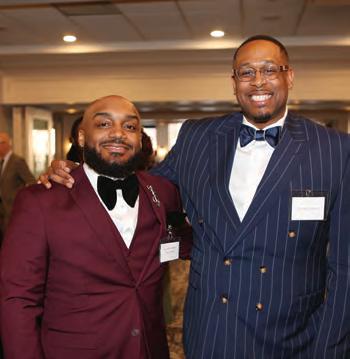

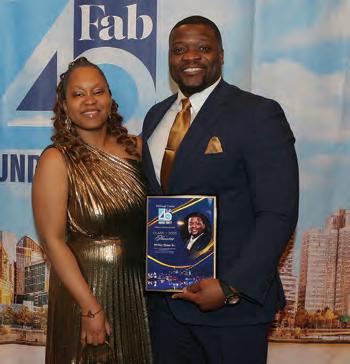
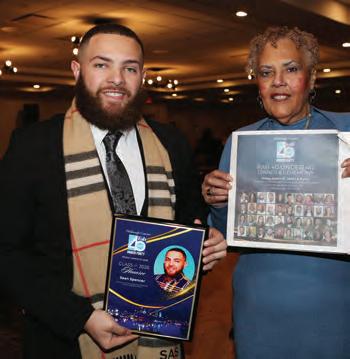
AWARD


BENEFACTOR





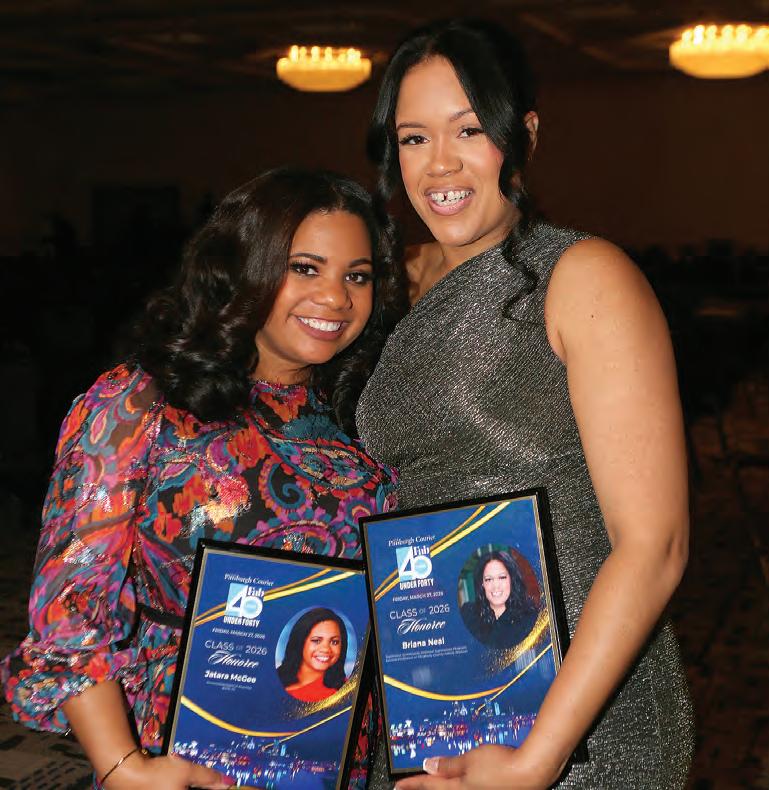
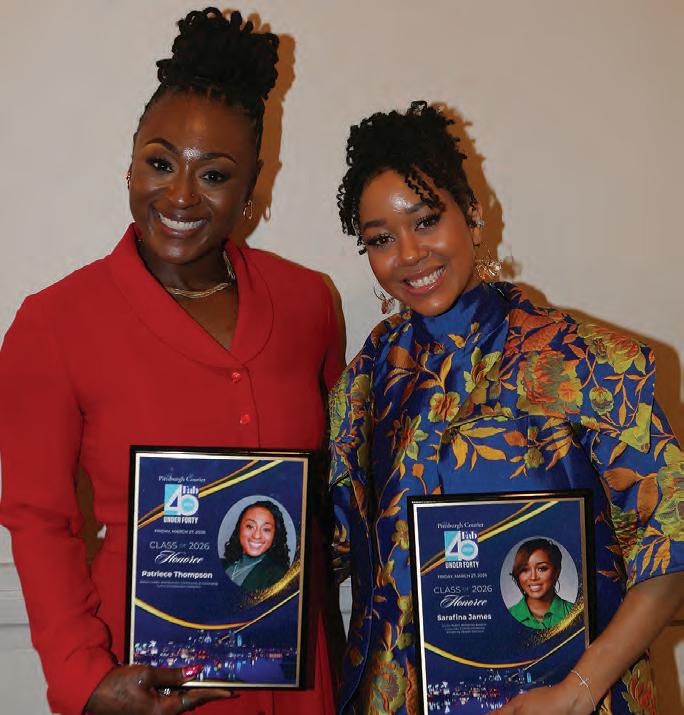
by Rob Taylor Jr. Courier Staff Writer
The New Pittsburgh Courier on Friday, March 27, christened its latest class of Fab 40 Under 40 honorees during an awards ceremony at the Sheraton Hotel Station Square.
But about six weeks earlier, each honoree received an email from the Courier confirming they were officially part of the “Class of 2026.”
“I couldn’t believe it; I was in Starbucks,” said an excited Jasmine Thompson. “I told my favorite barista that I got the email saying I am a Fab 40 Under 40...I was super shocked.”
For Thompson, that’s a trip to her favorite Starbucks in Bakery Square
that she’ll never forget. One by one, each honoree opened their email to see that they were indeed Fab 40 honorees.
Finally, the day came.
March 27, 2026, the 40 honorees dressed to the nines, along with the 350 family members, friends and supporters who attended the festive event at the Sheraton.
Brother Marlon Martin, the DJ, kept the evening upbeat with the latest Hip-Hop and classic R&B selections, and about 60 people participated in two line dances that broke out; Tamia’s “Can’t Get Enough” slow line dance, and the wildly popular “Wobble” line dance.
Oh yes, there was the dinner for the attendees, preceded by Rev. A. Marie Walker’s invocation.
There was the celebrity host gracing the stage in KDKA-TV’s Mikey Hood. There was Courier Sales Director Ashley Johnson acknowledging the event’s sponsors, including Award Sponsors UPMC and the PA Lottery; Benefactor Sponsors Pittsburgh Regional Transit and Duquesne Light Company; Patron Sponsor BNY; and Supporting Sponsor Auberle.
There was Courier Editor and Publisher Rod Doss saluting this year’s Fab 40 class, imploring them to “stay true to your dreams, let no one turn you away from your dreams, your pursuit in life. Find your gift that sets you apart, and just as important, help others
SEE FAB 40 PAGE 4

When you have strong leaders, you have a strong community.

find their gift.”
Then came the moment everyone in the building was waiting for; the presentation of the awards.
Hood, the celebrity host, called each honoree’s name, followed by thunderous applause from the crowd and Doss handing the honoree their award.
Courier photographer Ricco J.L. Martello snapped a photo of the honoree with their award before they exited offstage.
The Courier’s first Fab 40 Under 40 honorees were way back in 2003. In 2026, the Courier is still honoring the vibrant, full-of-life, career-driven Black individuals in the Pittsburgh region.
“In Pittsburgh you hear that there’s not a lot of us, but the Courier’s brought together so many of us, so it’s overstimulating in a good way,” said honoree Patriece Thompson after the event. “For me, I just got to connect with more people, I got to meet more of my sorority sisters (Alpha Kappa Alpha Sorority Incorporated)...”
Brittany Boyd, another Fab 40 “Class of 2026” honoree, said getting a Courier Fab 40 Under 40 award is a “historic
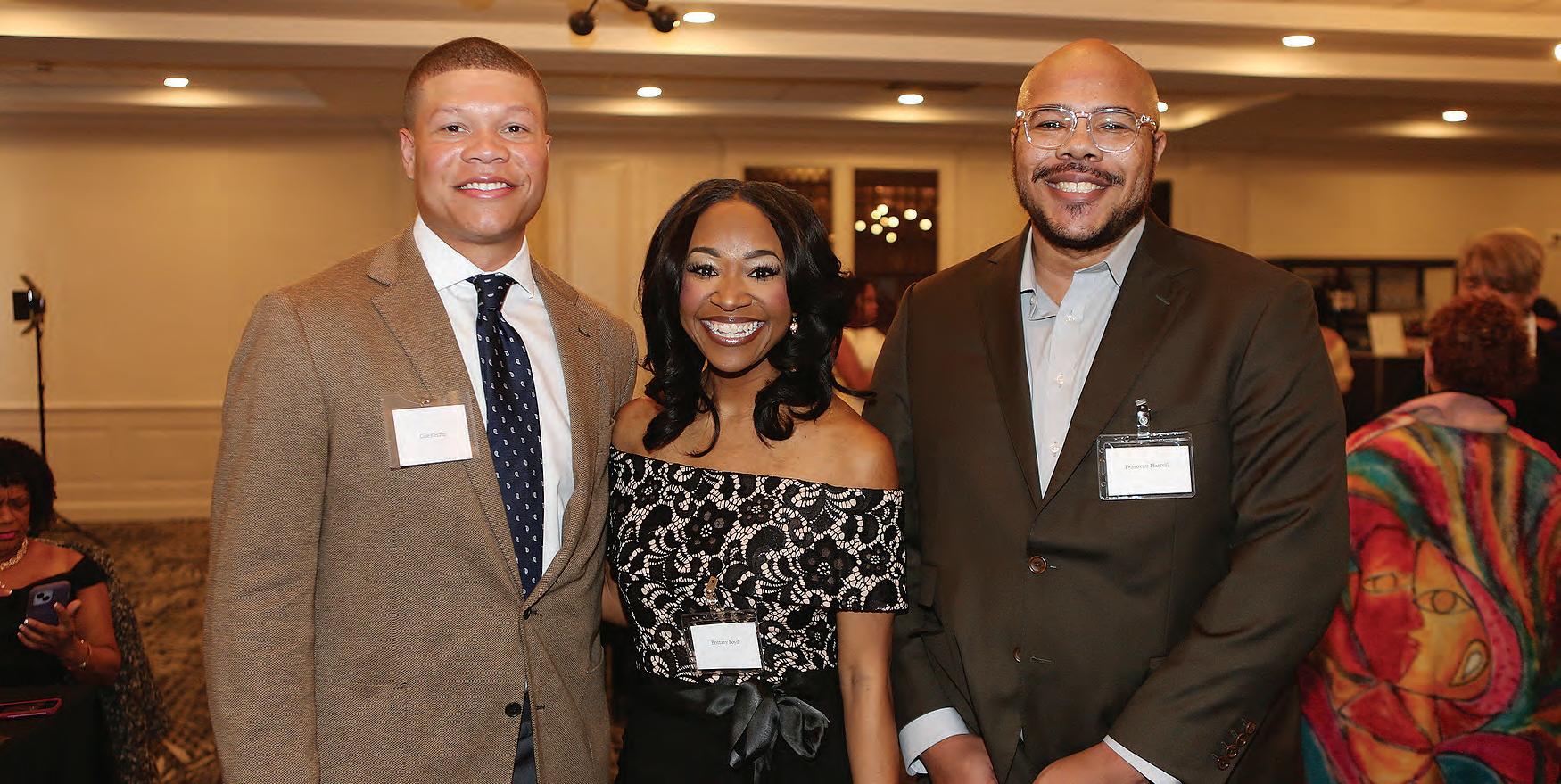
moment, memorable moment...it feels incredible to be part of such a special group of people. The excellence ranges from all kinds of genres and industries, so I feel very blessed to be a part of it.”
“She’s well-deserving
of it,” said Joanne Boyd, Brittany’s mother. “Her accomplishments and her character is someone to be very proud of.”
“It is such an honor and a privilege to get this recognition,” voiced Jatara McGee, another Courier

Fab 40 “Class of 2026” honoree. “I’ve watched so many people over the years receive it and it’s just a blessing to be in this room and to be among Black excellence here in the city.”
Thompson, the Star-
bucks fan, is a third-grade teacher at Penn Hills Charter School of Entrepreneurship. For sure, her students will see her in the Courier print and online editions for her award. What’s her advice to those children?
“You can literally do anything that you put your mind to,” Thompson said, “but you gotta put in the work.”

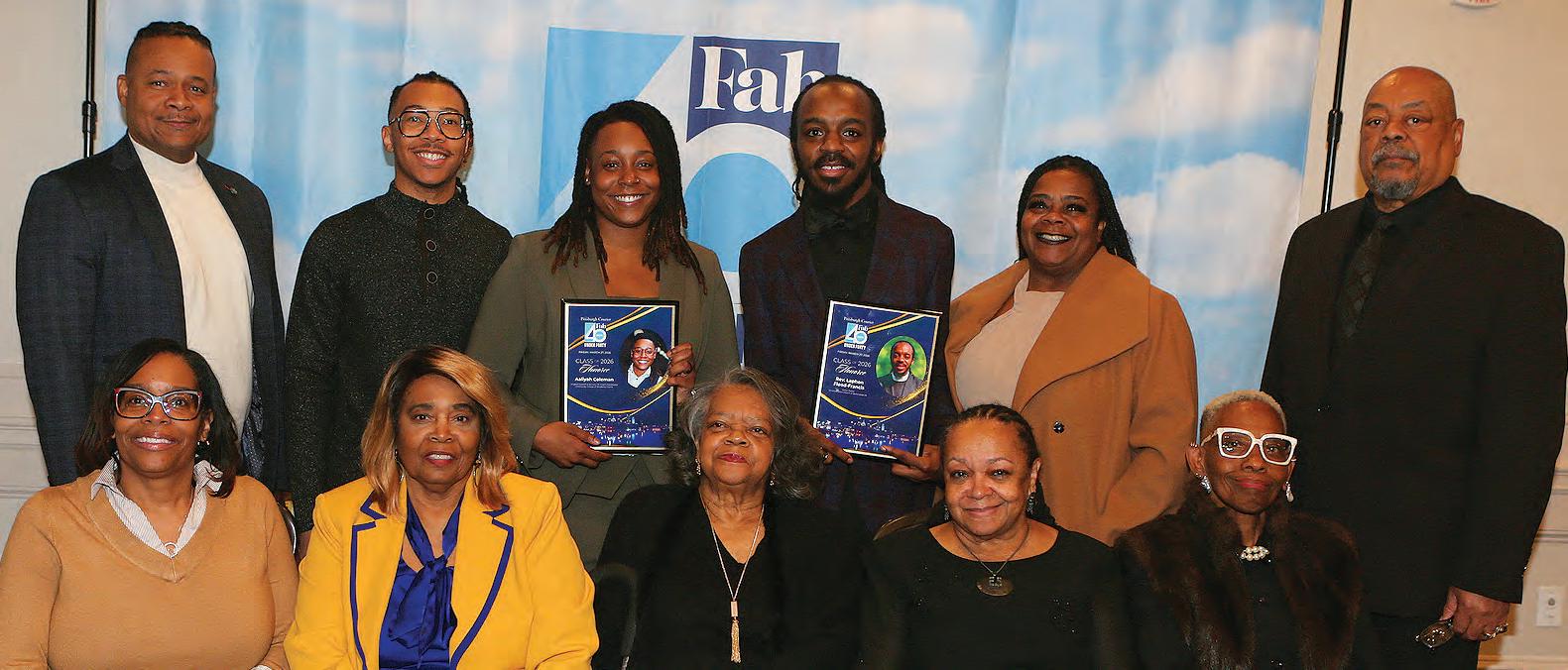

New Pittsburgh Courier’s Fab 40 Under 40 Winner
From lineworkers to underground line supervisors like Ian, to our engineers and security, IT and finance professionals - and all the teams in between, our people make a difference. Find your place at DuquesneLight.org/careers

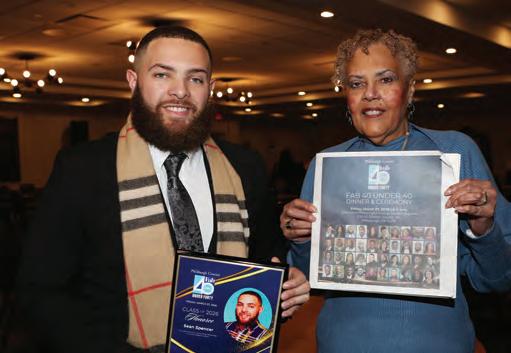
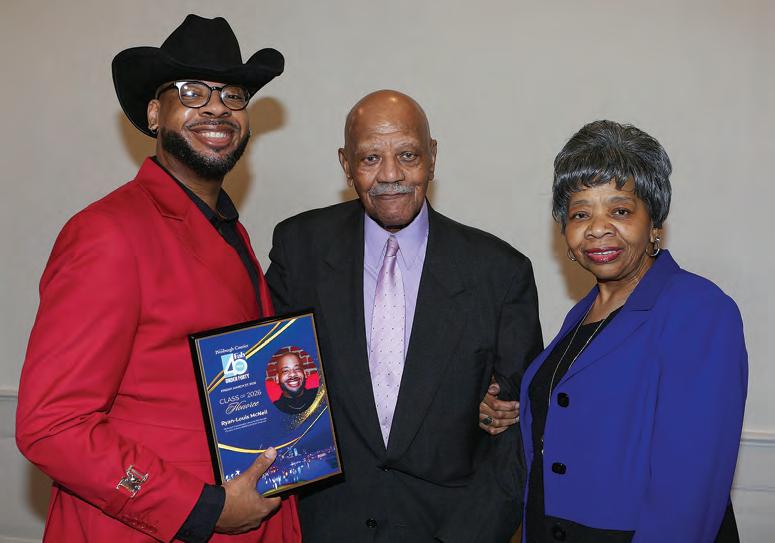
Be sure to pick up new editions of the Courier each week, available at over 60 locations in Allegheny County, including Giant Eagle locations (Penn Hills, N. Side, S. Side, Shadyside, E. Liberty, Waterfront, Monroeville, Braddock Hills and more)...
Or get it delivered to your home with a subscription. Call 412-481-8302, ext. 136.
For all you do to provide safe, reliable and


Some of the Fab 40 Awards Ceremony’s special invited guests included new Urban League of Greater Pittsburgh President and CEO, Jennifer Thompkins, left, and Pa.’s Second Lady, Blayre Holmes Davis, right.
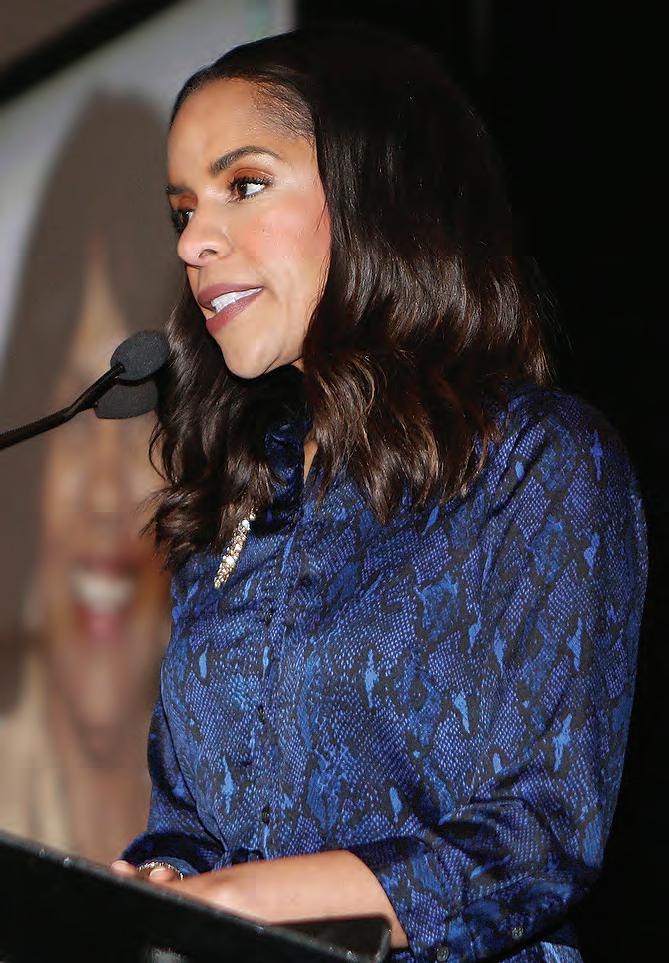

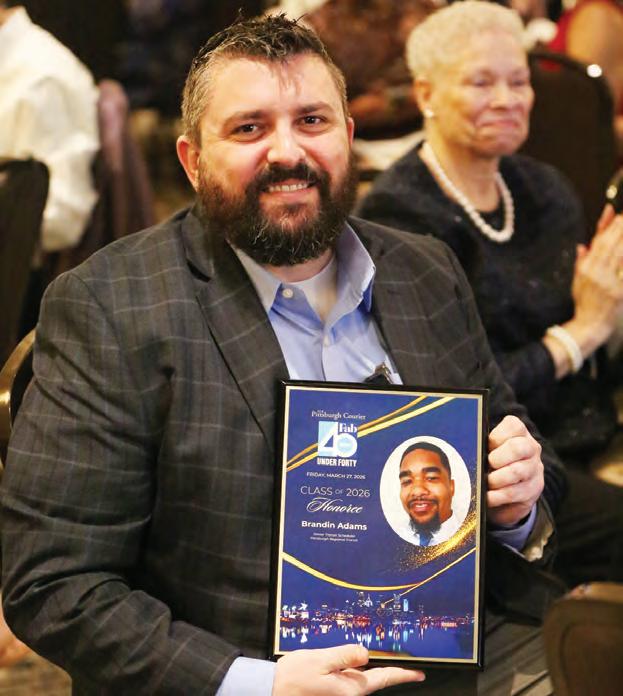

to all the 2026 Fab 40 Under 40 honorees, including the following members of the Pitt community:
Brandin Adams
Jason Deakings
Dontez Ford
Monique Hamlett
Donovan Harrell
Justin James
Sean Spencer
Jasmine Thompson

Senior Transit Scheduler
Pittsburgh Regional Transit
Senior Manager, Education and Community Engagement
August Wilson African American Cultural Center






Communications & Social Media Coordinator, United Way of Southwestern Pennsylvania; Owner, Brittany Leanna Productions

AALIYAH COLEMAN
Student Support & Success Life Coach Coordinator
Community College of Allegheny County
Senior Customer Service Specialist, Community Care Behavioral Health Organization; Consultant, G.G. Polygraph and Interview Services

Ph.D., MSPH
Assistant Professor and Associate Director, Center for Health Equity University of Pittsburgh
Founder, Charlotte’s Webb; Public Information Officer, Allegheny County Economic Development
BYRON DOVALES
Founder; 7Twice Academy; Lineman Performance Specialist, 2/10ths Speed & Agility
Executive Assistant to the President & CEO
The Pittsburgh Foundation
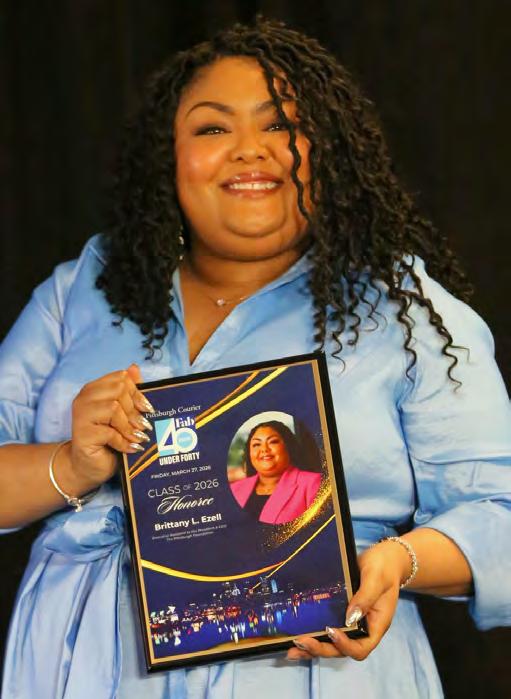
Senior Pastor
Second Baptist Church of Homestead, Pa.

Founder & CEO, Nabakindo Skincare; Associate Director, Center for Professional Pathways, Washington & Jefferson College
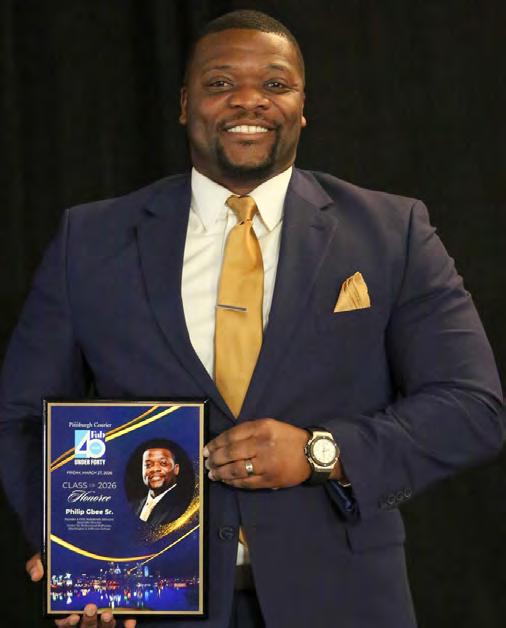
Former Professional Athlete, Detroit Lions & San Diego Fleet;
Senior Clinical Specialist & Field Sales Trainer, Medtronic


Tax Operations Associate
BNY
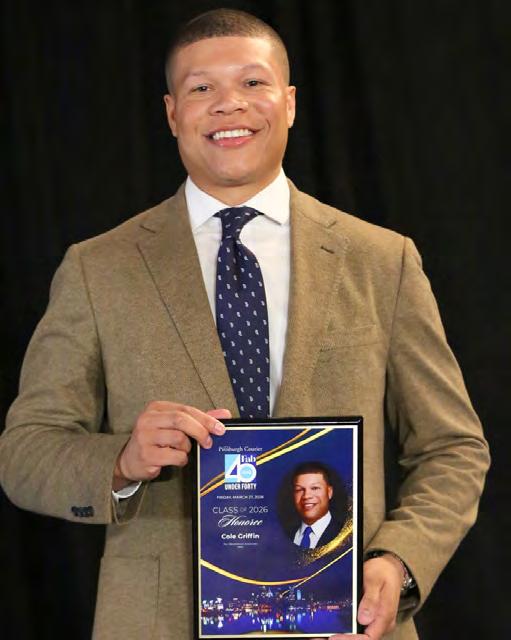
Personal & Professional Development Coach, Woodland Hills A.C.T.E.S.; President, Richard L. Ferguson American Legion Post 527
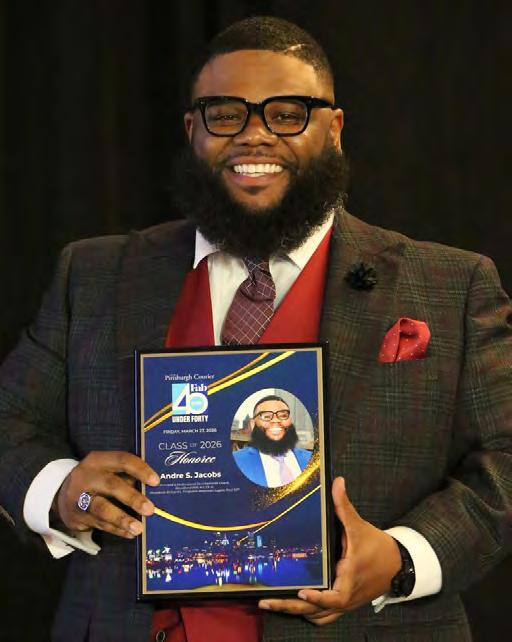
Assistant Vice President, Employee Relations Investigator PNC Bank

Major Gifts Officer University of Pittsburgh School of Business

Communications Specialist, University of Pittsburgh; Writer
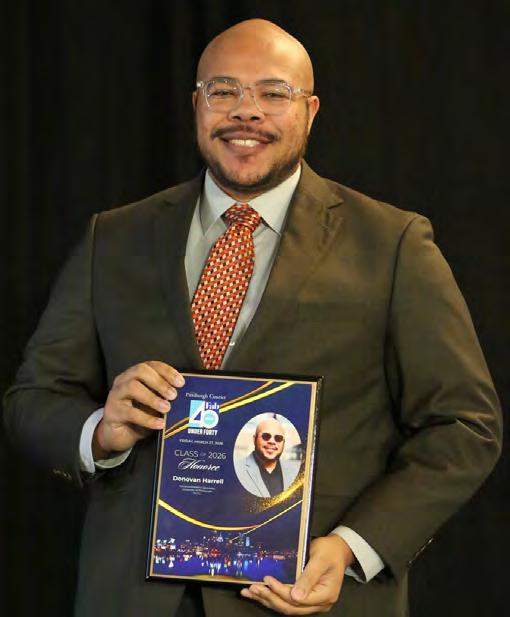
SARAFINA JAMES
Senior Public Relations Analyst-Corporate Communications Allegheny Health Network

Director, Corporate Sponsorships and Individual Giving
Fred Rogers Productions
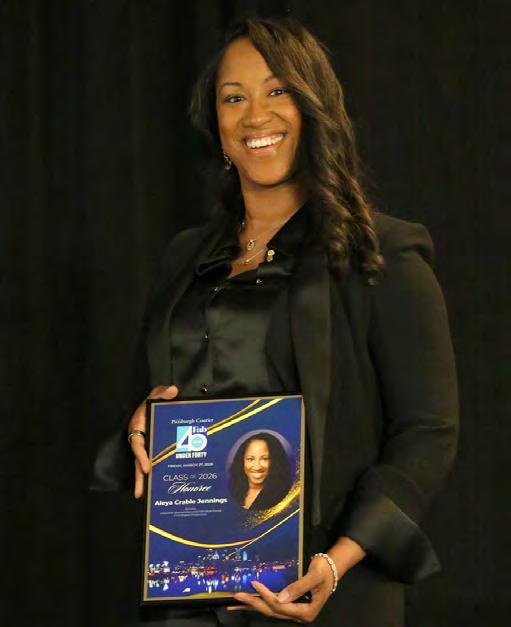
HOPE Team Clinic’s Outreach Coordinator and Behavioral Health Therapist II, Center for Children and Families
UPMC
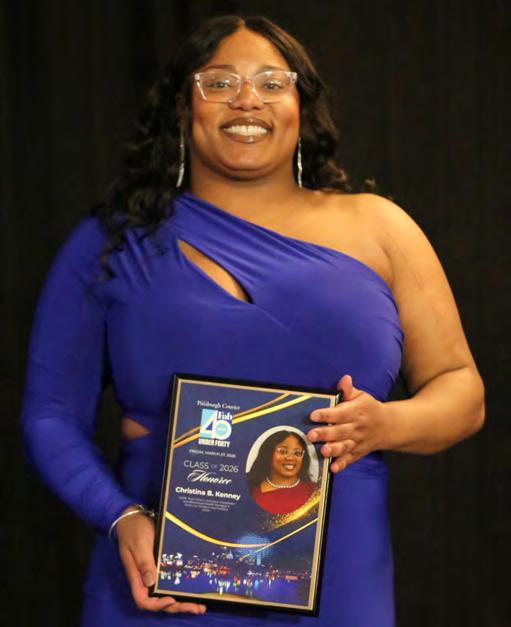
Vice President, Business Banking Recruiting Manager
PNC Bank

SYDNEY MARTIN
Production Coordinator Ya Momz House, Inc.

Registered Nurse, UPMC Hillman Cancer Center; Freelance DJ—DJ 2x

JOANN MCDANIEL-CHINN
Senior Director of Compliance, Adagio Health; Privacy Consultant, Blue Peak Advisors

JATARA
Anchor/Investigative Reporter

Supervisor, Community Intensive Supervision Program
Juvenile Probation of Allegheny County Family Division
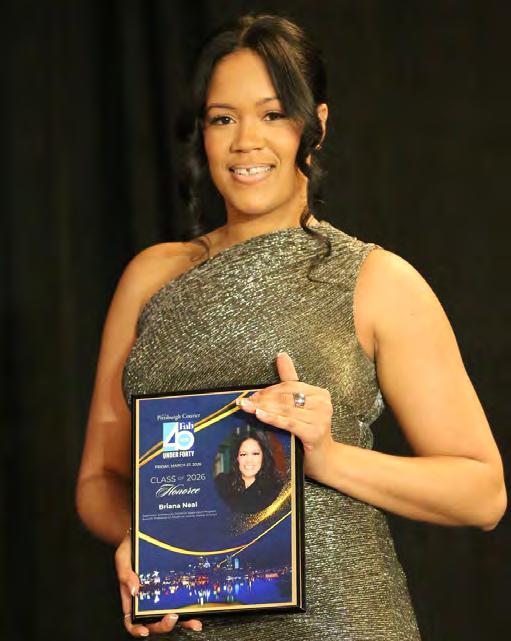
Outreach Coordinator, Amachi Pittsburgh; Creator & Host, RIANOUTLOUD! Podcast
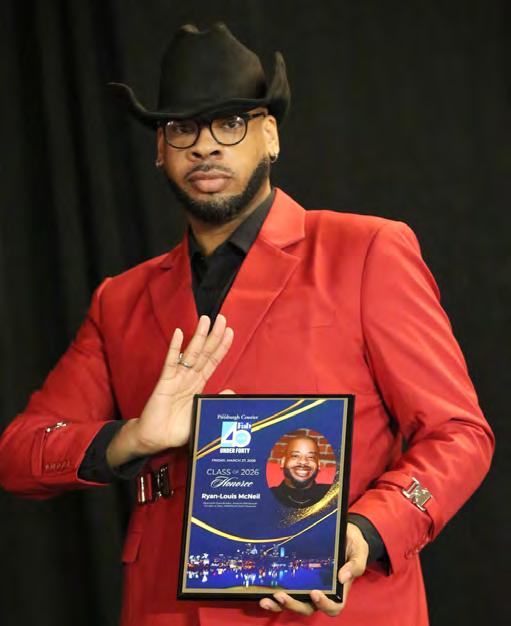
Director, Recruitment and Programming Carnegie Mellon University Rales Fellows Program
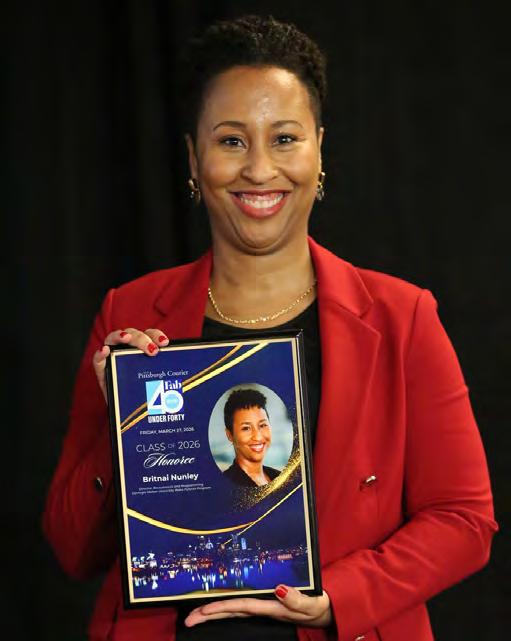
Foster Care Coordinator Auberle

Underground Distribution Supervisor, Duquesne Light Company; Fire Chief, North Fayette Township VFD
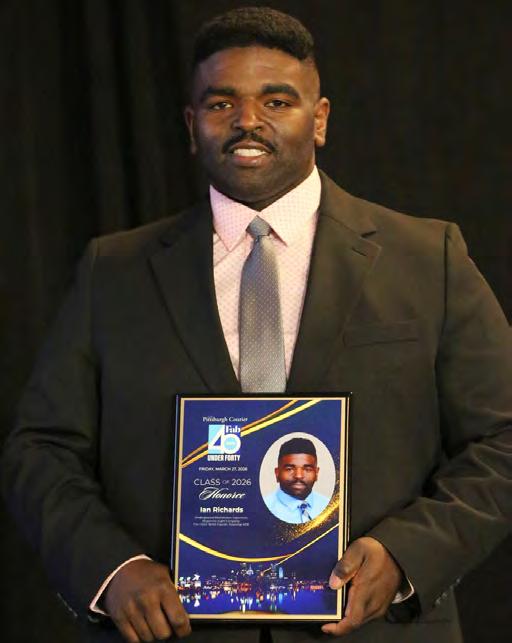
Quality Assurance Manager, EdgeCo Holdings; Founder, ObsidianIQ

Executive Director, Future Kings Mentoring; Executive Support, Unisys
Youth Specialist
South Pittsburgh Peacemakers Violence Prevention Program

Director, Civic Engagement and Voter Contact Alliance for Police Accountability
MARTY SMITH
Director of Sales
RS Supply, LLC
JASMINE THOMPSON
Educator, Penn Hills Charter School of Entrepreneurship; Owner, Blis 23 Candle Co.

Senior Leader and Director, Community & Citizenship
Turner Construction Company
Executive Director, Pennsylvania Policy Center; Executive Director, Pennsylvanians Together in Action