A HOME-GROWN LEGACY
A legacy of faith. A tradition of farming. A future rooted in both.
Soybean Staff
Ben Steyer
Chief Executive Officer bsteyer@michigansoybean.org
Volume 18 - Issue 1
IN THIS ISSUE OF: MICHIGAN Soybean NEWS
Mark Seamon
Research Director mseamon@michigansoybean.org
Sonja Lapak, Editor Communication Director slapak@michigansoybean.org
Katlin Fusilier Outreach Director kfusilier@michigansoybean.org
Hanna Campbell Market Development Director hcampbell@michigansoybean.org
Anna Skelly
Accounting & Compliance Specialist askelly@michigansoybean.org
Claire Dewey Operations & Marketing Specialist cdewey@michigansoybean.org
Michigan Soybean Association
3055 W M-21 St. Johns, MI 48879
Phone: 989.652.3294 soyinfo@michigansoybean.org
Ad Sales
Sonja Lapak slapak@michigansoybean.org
J.L. Farmakis Inc. - National Phone: 203.834.8832 bill@jlfarmakis.com
Copyright 2025 by Michigan Soybean Association; all rights reserved.
Magazine Circulation: 18,000 Michigan Soybean News is published quarterly.
2025 Yield Contest Winners

Fueling the Flock
Disclaimer:
Advertisements within this publication contain the opinions and information of the advertisers and do not necessarily reflect the opinions or views of the Michigan Soybean Association or affiliated groups. The United Soybean Board/soybean checkoff neither recommends nor discourages the implementation of any advice contained herein, and is not liable for the use or misuse of the information provided.

Michigan Soybean Leadership
Michigan Soybean Association
Larry Phelps, Vicksburg
Jay Williams, Waldron
Tom Woelmer, Monroe
Karen Warner, Yale
Allison Thiel, Birch Run
PJ Feldpausch, St. Johns
Tim Kruithoff, Kent City
Rob Howland, Brown City
Robert Wasmiller, Burt
Michigan Soybean Committee
Sara Trattles, Colon
Gary Parr, Charlotte
Nathan McCalla, Ann Arbor
Scott Wilson, Lexington
John Burk, Bay City
Jeff Fromm, Owosso
Ryan Drozd, Allegan
American Soybean Association
Heather Feuerstein, Belding
Janna Fritz, Bad Axe
United Soybean Board
Ed Cagney, Scotts
Dennis Gardner, Croswell
Laurie Isley, Palmyra
North Central Soybean Research Program
Steve Koeman, Hamilton
US Soybean Export Council
Dave Williams, Elsie
Clean Fuels Alliance America
Zach Schaffner, Hudson
Soy Aquaculture Alliance
Alan Moore, Bannister
Soy Transportation Coalition
Rob Green, Corunna
World Initiative for Soy in Human Health
Doug Darling, Maybee
Specialty Soya & Grains Alliance
Steve Peach, Plymouth
US Meat Export Federation
Brian Pridgeon, Montgomery
Farm Produce Insurance Fund
Jason Haag, Unionville
Follow Along with MSA on Facebook!
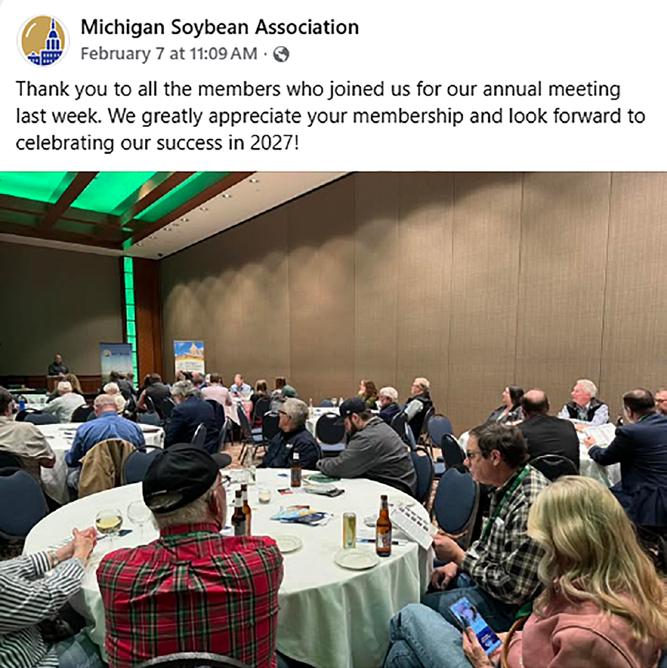
Our social media presence is on the rise, and we are excited to share even more with you in a timely fashion. From timely updates to event spotlights, our online presence is an extension of what we do for our members daily. If you've noticed a little extra buzz lately, it’s by design – we want to stay connected with our members in ways that feel engaging, meaningful and fun.
To make sure you’re part of the conversation, we invite you to follow our Facebook page: Michigan Soybean Association. It’s the easiest way to stay informed, show your support and engage with content. Whether you enjoy photos, announcements or glimpses into what we do, you’ll find it all on our Facebook page. Join us on Facebook and help our digital community grow!

Staff Update
This January, I was the maid of honor in my sister's wedding. As you may be aware, being the maid of honor comes with certain responsibilities. One that I was frequently reminded of in the months leading up to the big day was that I would be expected to give a speech during dinner. What you may not know, however, is that does not sound like something I would enjoy! Cue the stress.
As I sit here trying to write this article, I am finding many similarities to the task of writing and giving that speech. In both instances, I ran through lots of ideas of what to write/say before landing on one that felt "right" and agonized about how public the platforms of the wedding reception and this magazine are. It feels like a lot of pressure.

In both instances, I also put off finishing my task until the last possible moment. Wouldn't recommend, but in the spirit of transparency, here we are. I wrote my MOH speech at 5:00 a.m. on the day of the wedding while sitting at the dining room table of our Airbnb. And here I sit at 10:00 p.m. on the night the magazine is due to the print shop having saved this page for absolute last. Page 36 out of 36 total pages. Awesome.
While I spend a lot of time on tasks like these, working to tell a compelling story, making sure the timing is right and keeping people at least somewhat engaged, I have also learned that it probably doesn't matter as much as I might think. Don't get me wrong, I love attention to detail. I take great pride in polishing the magazine, writing articles, and making my sister's new husband cry because my speech was so good. But I don't think anyone else cares nearly as much as I do. And that's okay.
I'm reminded of a quote I see floating around the internet now and again that says, "You'll stop caring what people think about you when you realize how seldom they do." Brutal. But also a really good reminder for all of us.
An example on the opposite end of the spectrum was watching my niece and nephews absolutely tear up the dance floor at the wedding. As the only children in attendance, they had no qualms about being the first on the floor. They danced with abandon. We saw cartwheels, the splits, running and sliding, you name it. It makes me wonder at what age we go from that carefree, cartwheels on the dance floor mentality to one where giving a five minute speech incites hives?
I think this is a good reminder for those of us in agriculture especially. How often do you hesitate or at least consider what the neighbors might think when making decisions on your farm? How often do you skip out on running for a seat on a board or implementing something you're really excited about because you're nervous about judgment? (If these things don't cross your mind, that's cool, tell me your secrets for being so chill!) But for anyone out there with similar reservations to me, I hope this gives you a small bit of encouragement or the push you need to do something you've been stressing about or putting off. You're probably less on people's radar than you think, so you might as well embrace being the main character in your own story. Hopefully one day soon I'll take my own advice.


Cheers,

Sonja Lapak Communication Director slapak@michigansoybean.org

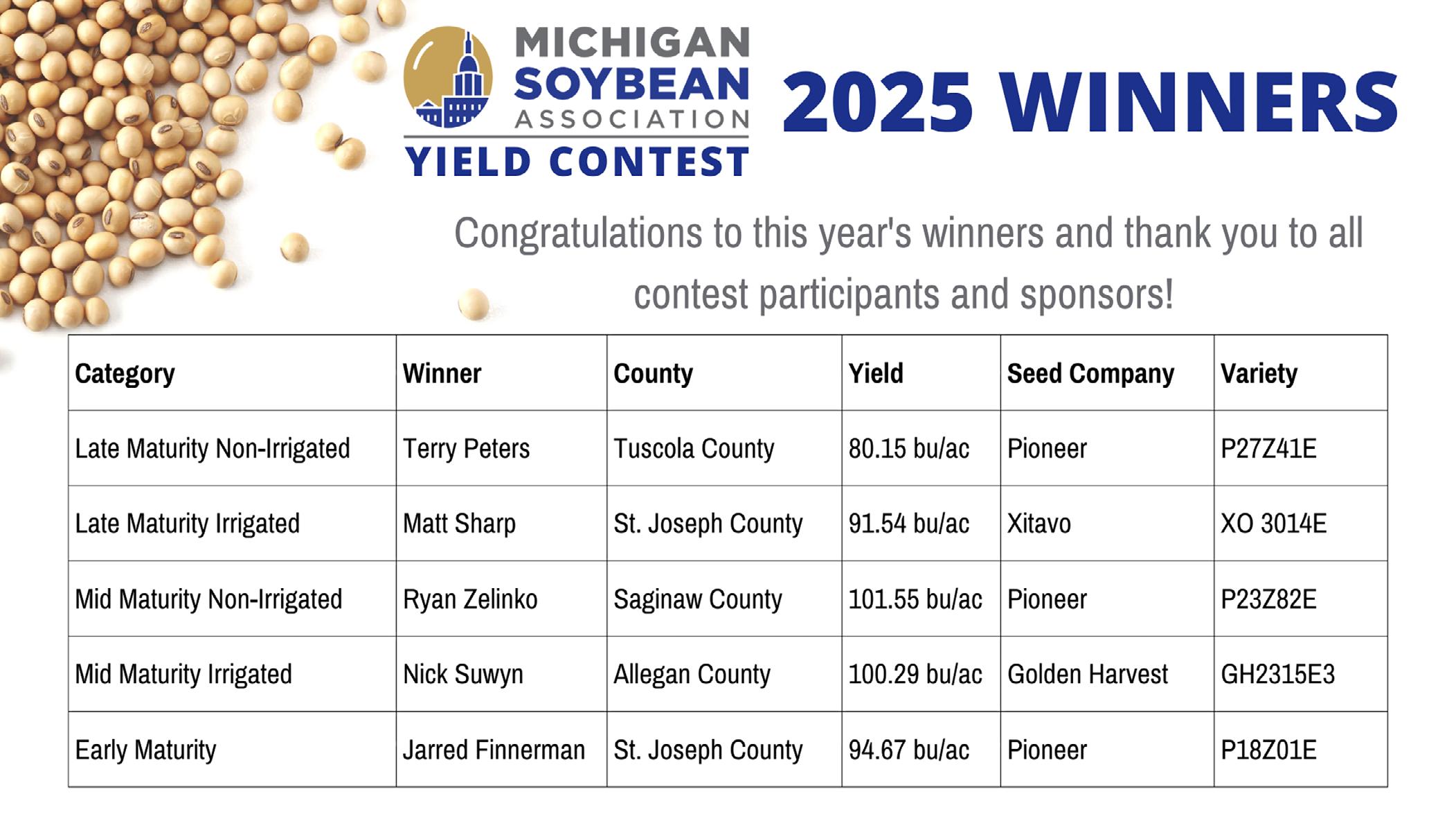
2025 Michigan Soybean Yield Contest Winners Announced
The winners of the 2025 Michigan Soybean Association (MSA) Yield Contest have officially been announced, celebrating the dedication and innovation of Michigan’s top soybean growers! This year’s contest drew a record breaking number of entries with farmers across the state showcasing their efforts to maximize yield and adopt cutting-edge practices.
Winners were announced on social media at the end of December and were recognized during the MSA Annual Meeting and Great Lakes Crop Summit in January. The contest continues to highlight the incredible talent and resilience of Michigan soybean farmers, who continue to push the boundaries of yield potential.
The 2025 contest was supported by the Michigan Soybean Committee, MSA and our seed company sponsors including 3G Seeds, Asgrow, Beck’s, DF Seeds, Golden Harvest, Pioneer, Renk, Xitavo and ZFSelect. Thank you to these partners and sponsors who share MSA's commitment to advancing Michigan soybean production.

Full contest results and yield data are available on our website at misoy.org/yield-contest Congratulations to all the 2025 participants – your hard work and innovation continue to drive Michigan soybean yields to new heights.

MSA Annual Meeting Recap
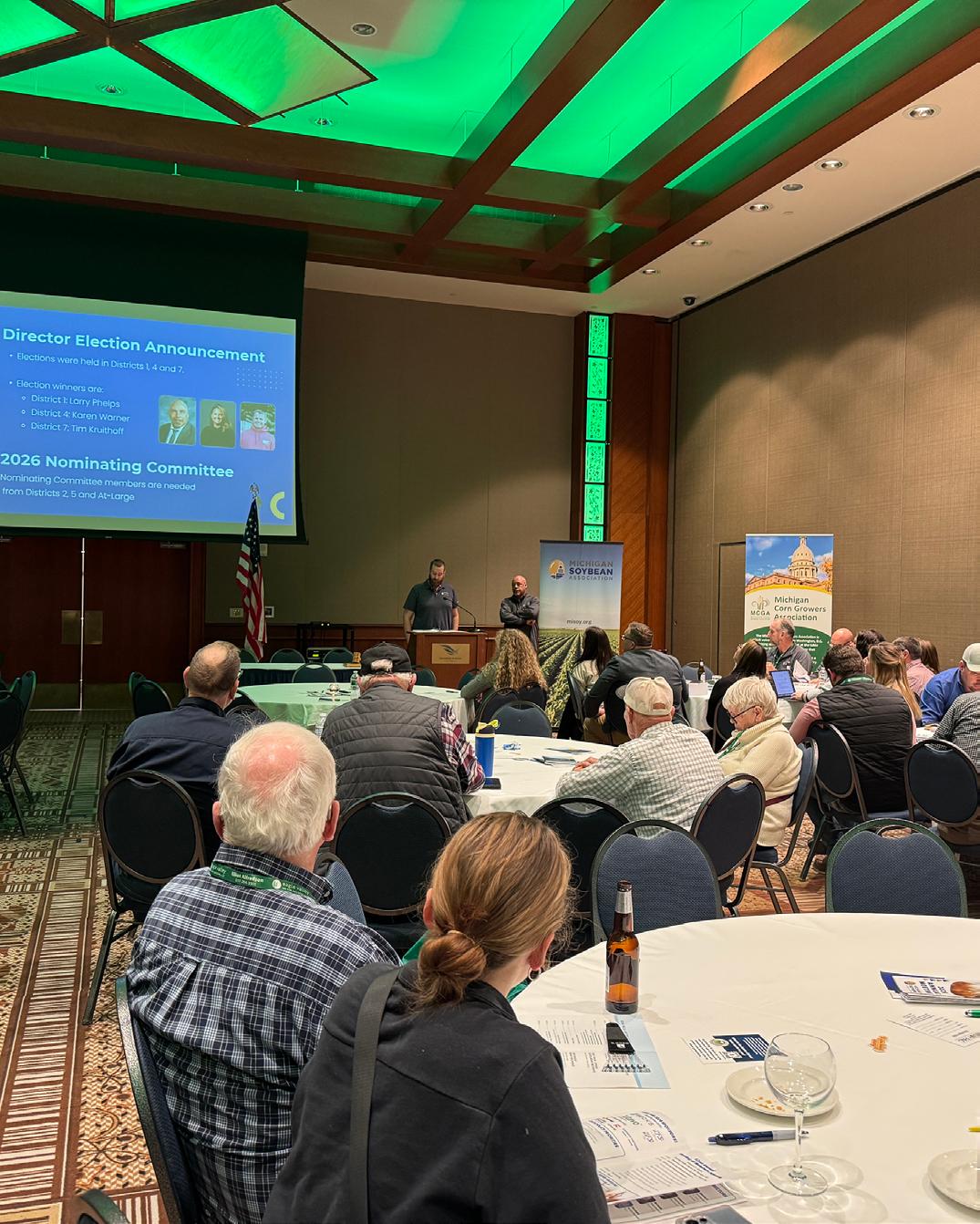
The Michigan Soybean Association held their 52 nd Annual Meeting of members in conjunction with the Michigan Corn Growers Association at the Great Lakes Crop Summit in Mt. Pleasant on January 27, 2026. Over 80 members were in attendance. A recap of 2025 MSA events was provided, including recognition of the scholarship and yield contest winners. In addition to the regular business meeting, the director election results were announced. Districts 1, 4 and 7 were up for election this year.
In District 1, Larry Phelps was re-elected for a third term. In District 4, Karen Warner of Yale was reelected to a second term. Tim Kruithoff was elected to represent District 7 for a three year term. We extend our sincerest thanks to outgoing board member Matthew Wila of Blanchard for his service on the Michigan Soybean Association board of directors.
Following the Annual Meeting of Members, the MSA board met to elect the 2026 Executive Committee.
• President – Tom Woelmer of Monroe
• Vice President – Rob Howland of Brown City
• Treasurer – Allison Thiel of Birch Run
• Secretary – Karen Warner of Yale

MSA would like to thank the members of the 2025 executive committee for their additional service and commitment over the past year. Their guidance and leadership helped position the organization for continued success. Congratulations to Larry and Karen on reelection and welcome Tim Kruithoff to the board of directors. We also want to congratulate the new executive committee and look forward to seeing their leadership in 2026!
FURTHER ADVOCATING FOR MICHIGAN SOY
The MISOY PAC was established in 2024 and is the only political action committee that solely represents the interests of Michigan soybean farmers. The MISOY PAC provides the Michigan Soybean Association with resources to support Michigan legislators who advance soy farmer priorities.


Leadership Lessons from the Soybean Leadership Academy
Michigan Soybean Association President Larry Phelps (Vicksburg) and CEO Ben Steyer headed to Bonita Springs, Florida in early January for the American Soybean Association's 2026 Soybean Leadership Academy. The academy offered much more than a break from the cold Michigan winter. Farmer leaders from soybean-producing states also received two days of practical leadership training that will be used to guide their state checkoff and association boards in the months to come.
The theme of this year’s academy was "Engaging & Building Effective Leaders of the Future", an important topic in today’s agricultural climate. Elisa Pratt's session on building inclusive boards provided actionable ideas for farmer-driven boards and the panel with ASA leaders Dave Walton and Jordan Scott offered real-world insights on board engagement challenges.
Dr. Trey Malone from Purdue got the audience thinking strategically about AI disruption in agriculture - not just precision equipment, but how artificial intelligence will reshape the entire industry. He also touched on the importance of making sure all parties are clear in knowing the problem the organization is trying to solve, before developing a strategy.
Jim Wiesemeyer's policy outlook and the grower leader panel featuring ASA President Scott Metzger and USB Chair Brent Gatton gave key industry perspective, and Andy Garman's communication training reminded the group that the manner in which we represent agriculture matters more than ever.
Phelps had this to say about his experience, “I'm grateful to the Michigan Soybean Committee for sponsoring this academy. I’ve been fortunate to attend this event three times now and I always walk away with new skills and connections that are invaluable. I’d encourage any farmer that has the opportunity to attend in the future.”

Michigan Legislative Update
Jason Wadaga, Vice-President of Government Relations, Kindsvatter, Dalling & Associates
In 2025, the Michigan Legislature produced a record low number of public acts, totaling just 74, which is the lowest number during a regular legislative session since the founding of our state. As we look ahead to 2026, it is likely that we will continue to see a low number of new laws getting passed.
Governor Whitmer is set to deliver her budget recommendation for Fiscal Year 2026 and 2027 on February 11 th . The Consensus Revenue Estimating Conference (CREC) made up of the House Fiscal Agency, Senate Fiscal Agency and State Budget Office estimates that revenues will be down $779 million in 2026 and $1.1 billion in 2027.
MSA will continue to advocate on behalf of legislative issues of importance to our association and its membership in 2026.
Biodiesel Tax Incentive
House Bills 4721 and 4722, sponsored by Representative Greg Alexander and Representative Angela Witwer, have been referred to the House Transportation Committee.
These bills would create a tax incentive for the sale and production of biodiesel in Michigan. As you may recall, the House Tax Policy Committee held a hearing on this legislation in 2024, but we were unable to get them across the finish line.
These bills will remain MSA’s number one priority in 2026.
Clean Fuel Standard
There are drafts of bills being shared amongst interest groups to create a Clean Fuel Standard (CFS) here in Michigan. There was legislation introduced on this topic lest session but it failed to get the traction to pass both chambers of the legislature.
MSA has been in communication with the Michigan Farm Bureau (MFB) regarding the draft bills and they have outstanding concerns including:
• Requiring livestock producers to effectively lock in the number of animal units on their operation is not feasible. In dairy, for example, herd sizes fluctuate frequently as animals are bought and sold.
• The bill’s third-party verification requirements for conservation practices gives MFB pause. It’s unclear who these verifiers would be,

how often they would access a property, how they would coordinate with EGLE, and what recordkeeping would be required of producers. While both MFB and MSA support voluntary conservation practices, we do not want these provisions to evolve into mandatory requirements.
• Posting data about on-farm conservation practices to the public.
• Granting the Department authority to “increase the stringency” of carbon intensity targets could allow EGLE to determine that current on-farm practices are insufficient and ask for more burdensome measures.
MSA will continue to monitor the movement of this legislation and offer input when the bill is introduced.
Sustainable Aviation Fuel
The House and Senate both have introduced legislation to provide incentives for sustainable aviation fuel (SAF) in Michigan. The tax incentive would be $4.5 million in 2025-26 and up to $9 million in subsequent years.
The Senate bills are bipartisan and passed the Senate on a 21-8 vote in June. The House bills, also bipartisan, passed the House Transportation Committee unanimously.
MSA will remain neutral on these bills.
Sales and Use Tax Exemption for Large Scale Ag Processing
Representative Luke Meerman and Representative Will Snyder have introduced House Bills 5168 and 5169 to create a sales tax and use exemption on large scale agriculture processing builds.
The original legislation would have created the exemption on projects of $100 million or more. MSA worked with other agriculture stakeholders to get that amount lowered to $50 million. We believe that amount would be more realistic for our industry to achieve.
MSA supported the bills in the House Economic Development Committee where they passed. They now sit in front of the full House of Representatives for a vote.
Jason Wadaga

NEW MEMBERS:
Scott Long, Clayton
Mark McDonald, Mt. Pleasant
Olyan McFarland, Perry
Joshua Miller, Elsie
Dale Seyfred, Galien
Justin Shumaker, Charlotte
Ben Sklarczyk, Johannesburg
RENEWING MEMBERS:
Harlow Bailey, Schoolcraft
Carlton Blough, Lowell
John Boegner, Marlette
New & Renewing Members
Russell Braun, Ovid
Brady Brown, Sandusky
Kevin Daley, Lum
Heather Feuerstein, Belding
Dayne Fisher, Alma
Thomas Galecka, Elsie
Ronald Gerstenberger, Sandusky
Elliott Glinke, Saint Johns
Elizabeth Hartmann, Flint
T Mark Hinterman, Durand
Terry Histed, Munger
Matt Holysz, Vicksburg
Jerry Hubbard, Union City
David Ivory, Lapeer
Tom Kendle, Edwardsburg
Francis Keys, Montrose
Steve Koroleski, Kinde
Douglas Lagos, Cass City
James Patrick LaPorte, Cassopolis
George McCalla, Milan
David McConnachie, Deckerville
Brian McKenzie, Marcellus
Tom Meert, Plainwell
Brent Mingus, Sturgis
Ryan Myers, Midland
Terry Peters, Riley
Brian Rueger, Standish
Scott Schoch, Merrill
Jason Schug, Schoolcraft
Dan Secord, Monroe
Nick Stone, Sandusky
Don Sutto, Saginaw
Dale Suwyn, Wayland
Nick Suwyn, Wayland
Allison Thiel, Birch Run
Gord VanLaan, Moline
Karen Warner, Yale
Matthew Wila, Blanchard
Scott Wilson, Lexington
Dale Wood, Marlette





Email comments, suggestions or article ideas to soyinfo@michigansoybean.org. No longer wish to receive the Michigan Soybean News?
Email your name and mailing address to slapak@michigansoybean.org.

MEMBERSHIP APPLICATION
First Name:_____________________________
Last Name:_____________________________
Address:_______________________________
City/State/Zip:___________________________
Phone:_________________________________
Cell Phone:_____________________________
Email:_________________________________
1-yr: $75 3-yr: $190
Young Farmer 1-yr (18-24): $20
Payment Amount & Method:
Check (Payable to MSA) or Credit Card
Credit Card Type:_____ Expiration Date:______
Credit Card #:_________________ CVV:______
Signature:_______________________________
Date of Birth:__________________
Number of Soybean Acres:_______
Total Farm Acres:______________
Occupation (circle one):
Farmer Retired Other
• Dues are not tax deductible as a charitable contribution for federal tax purposes, but may be deductible as a business expense.
• 18% of member dues are allocated to lobbying activities and are not deductible.
Mail application with payment to: Michigan Soybean Association 3055 W M-21, St. Johns, MI 48879
Join online:

Paying the soybean checkoff does not make you an MSA member. Checkoff dollars cannot be used for lobbying. Your membership is critical to our efforts on behalf of Michigan soybean farmers!
For more information on member benefits, visit www.misoy.org/member-benefits/. Member benefits include:
• Scholarship opportunities for your children and grandchildren
• Cabela’s gift card purchase discount
• Discounted registration to Commodity Classic


• Annual $75 seed coupon for renewing members to use with our partnering seed companies
• The MOST IMPORTANT MSA member benefit: Having a voice in Lansing and Washington, D.C.!





























International Market Update:
U.S. Soy Demand in Egypt, Vietnam & Japan
Soybeans grown by U.S. farmers are in demand around the world, and that demand continues to grow alongside global consumers' increased demand for protein. Nearly 60 percent of all U.S. soy products are exported, making exports a vital supporter of soybean prices.
Soybean use is steadily expanding all around the world, not just for poultry and swine production, but also in aquaculture, a growing market sector in Southeast Asia and the Americas. East Asian markets like Japan and Korea use U.S. soy as a staple ingredient in foods and beverages, with China’s soy demand also continuing to rise. Additionally, regions of the Middle East and North Africa (MENA), South Asia and Sub-Saharan Africa are experiencing population growth and a related increase in demand for protein, creating dynamic and evolving markets for U.S. soy.
Soybean purchases by country from September 1, 2024 – August 31, 2025
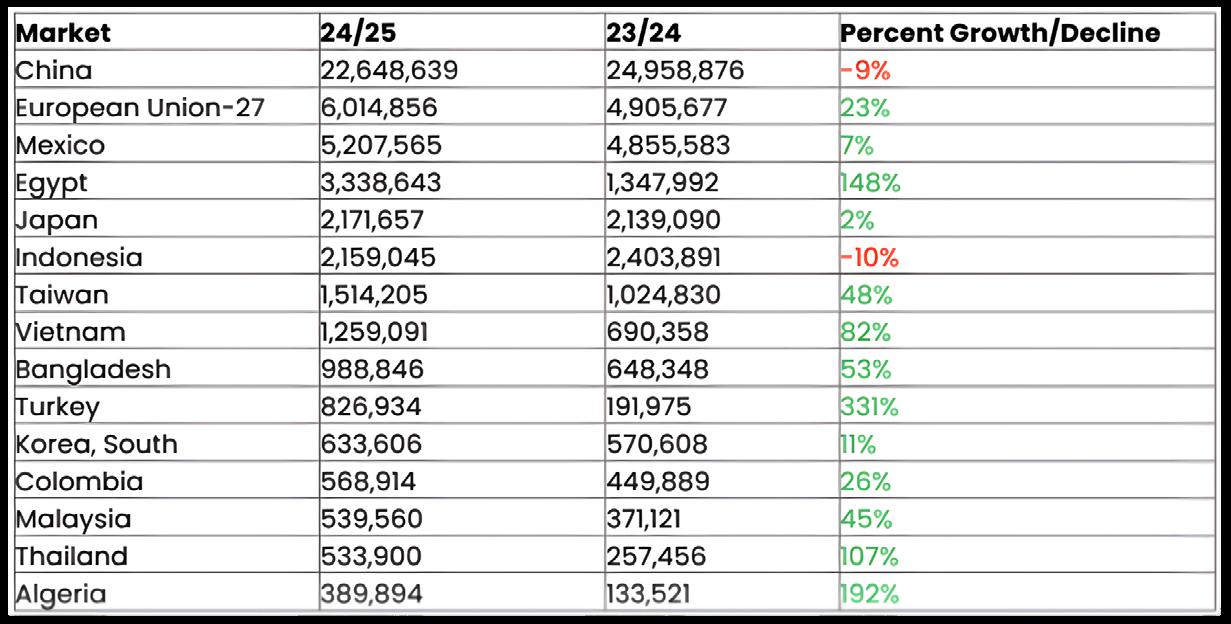
Source: USDA FAS Global Agricultural Trade System, 12/01/2025
metric tons of U.S. soy, compared to 1.3 million in 23/24.
There are specific markets around the world that show big promise of continued and growing demand for U.S. soybeans, including Egypt, Vietnam and Japan.
While the U.S. Soybean Export Council (USSEC) began collaboration with Egypt in 1988, they are still considered an emerging market. The U.S. currently holds only 64 percent market share in Egypt, but this region shows specific promise for future growth. In marketing year 24/25 Egypt purchased over 3 million

Egypt uses a large portion of imported soy in their growing poultry and aquaculture sectors. In November 2019, USSEC launched a Soy Excellence Center in Cairo where they facilitate employee training and continuing education activities to help build preference for U.S. soy among future aquaculture and poultry industry leaders.
Vietnam is an expanding market for U.S. soy, where we currently only hold 24 percent market share. Vietnam has steadily increased their soybean purchases from the U.S. over the last four years. In marketing year 21/22 they purchased just over 700,000 metric tons of U.S. soy, compared to over 2.2 million metric tons in 24/25. This growth is attributed to their growing poultry, swine, aquaculture and soy food industries.
Japan is an important market for Michigan soybeans specifically thanks to their large demand for food grade and identity preserved soy. These include tofu beans, natto beans, non-GMO soybeans and more. Japan is also a key market for soy utilized in swine and poultry production. In marketing year 24/25 Japan purchased more than 2.5 million metric tons of U.S. soy.
Japan is considered a mature market, with the U.S. having 53 percent market share. While it is not expected that Japan will demand more soybeans in coming years, there is an opportunity for the U.S. to gain market share. Sustainability is a key driver in Japan’s purchasing decisions, which makes the Soy Sustainability Assurance Protocol (SSAP) program a vital asset in this region.
USSEC has created a Soy Excellence Center in Egypt and created soybean focused curriculum.


Michigan Soybean Committee Annual Financial Report
October 1, 2024 - September 30, 2025
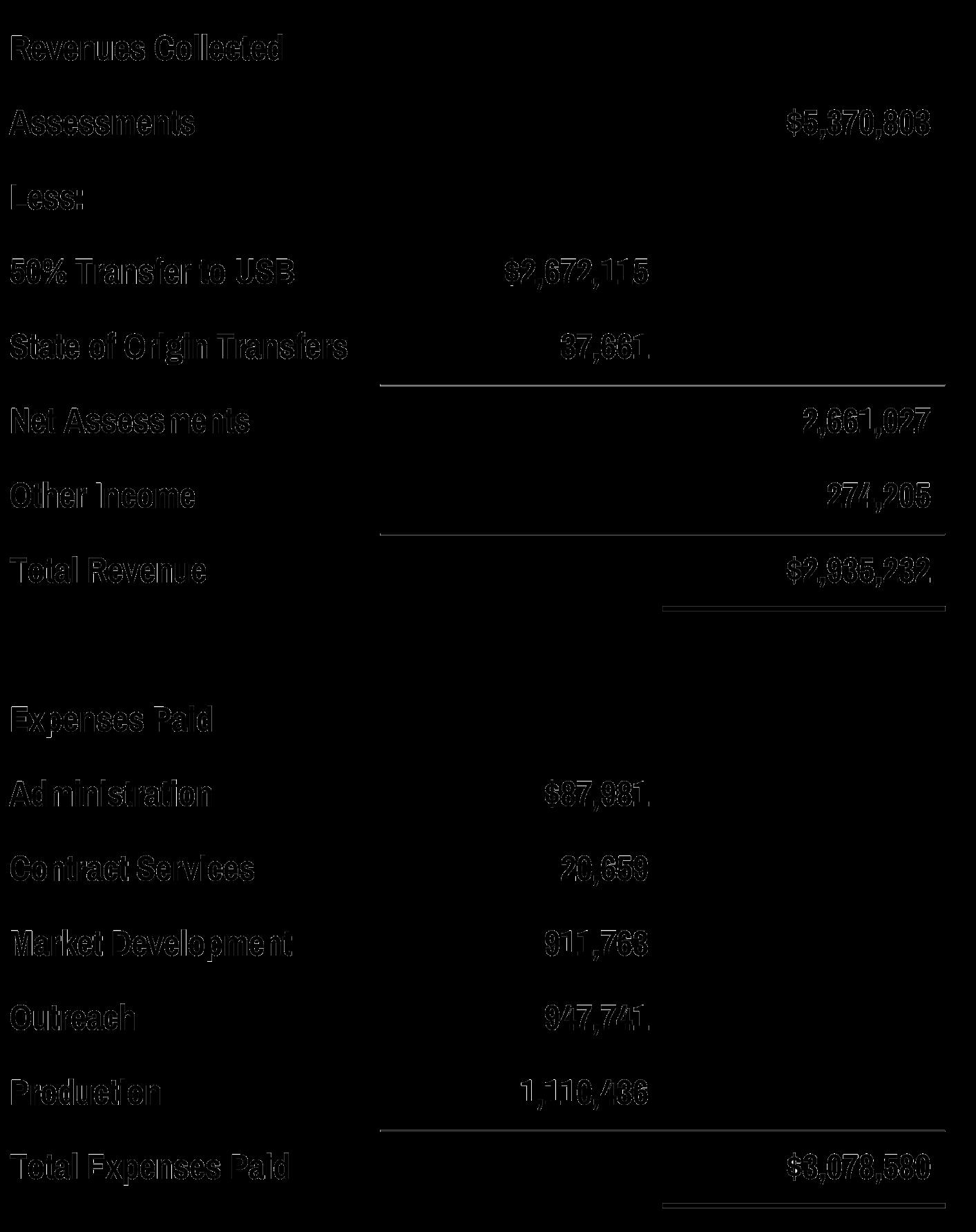

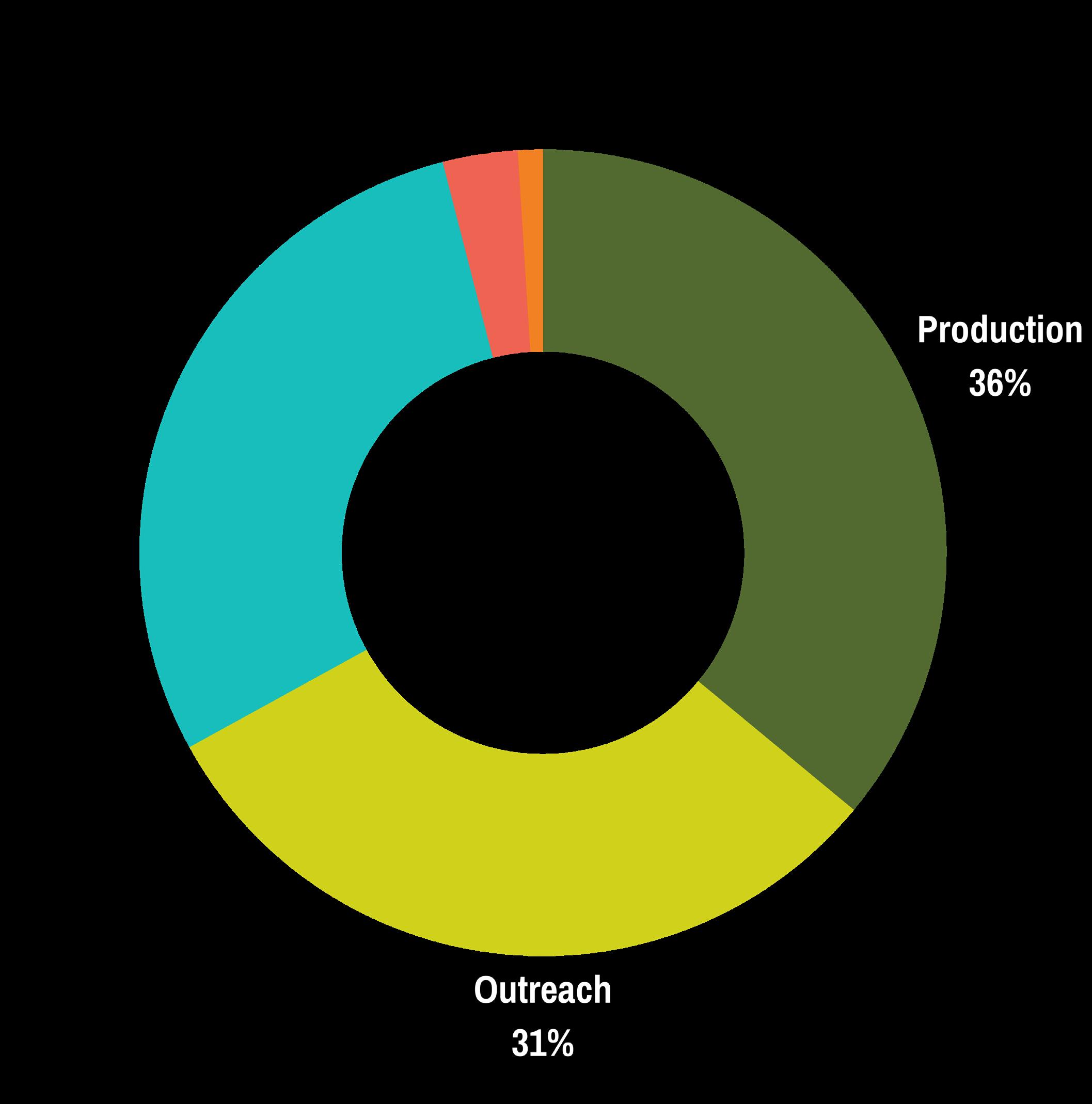
For 50 years the Michigan Soybean Committee has carried out the work of the soybean checkoff in Michigan on behalf of our state's 12,000+ soybean farmers. We focus our efforts on production research, market development and outreach with a common goal of increasing the return on investment for soybean farmers.

FY25 Program Disbursement


March is Elevator Appreciation Month!
The Michigan soybean checkoff is assessed at the rate of one-half of one percent (.005) of the net market value of soybeans sold by the producer to the first purchaser.
Checkoff assessments collected by Michigan first purchasers must be remitted to the Michigan Soybean Committee. The funds are used for production research, market development and outreach efforts on behalf of Michigan’s 12,000+ soybean farmers.
Thank you to the first purchasers who collect the checkoff each month! Their cooperation is a critical step in helping ensure checkoff funds are utilized for the collective benefit of Michigan soybean farmers.
Acres Cooperative
ADM Grain Co.
American Soy Products Inc.
Armada Grain Co.
Battle Creek Farm Bureau Assn.
Bierlein Seed Inc.
Caledonia Farmers Elevator
Cargill
Community Mills Inc.
Cooperative Elevator Co.
Cremer Farm Center
Crumbaugh Farms Partnership
DF Seeds, LLC
Esper Grain, LLC
Farmer's Coop Elevator
Farmer's Coop Grain Co - Kinde
Freeland Bean & Grain
Gallagher Farms
Great Lakes Grain and Transportation
Harrington Seeds Inc.
Harvest Mills Inc.
Harvey Milling Co. Inc.
Hirschman Grain, LLC
Hoffman Ag Service, LTD
Hopkins Elevator
John Marion Inc.
Jorgensen Farm Elevator
Keystone Cooperative
Litchfield Grain Co.
Luckey Farmers, Inc.
M&W Seeds
MAC
Masserant's Feed & Grain
Mathews Elevator
Maybee Farmers Inc.
MHC Marketing Inc.
Millington Elevator & Supply
Moline Coop
Morning Star Grain, LLC
Musgrove Grain, LLC
Ottawa Lake Coop
Penn Acres
Prattville Fertilizer & Grain, Inc.
Quality Roasting, LLC
Shaffer Farms
Springport Elevator, Inc.
Star of the West Milling Co.
StoneX
Stop Loss Trading, LLC
The Andersons
Turner Bean & Grain
Van Gilder Commodities, LLC
Vershum R & Sons Inc.
VHGC, Inc.
Vita Plus
Viterra US
Voyces Elevator Inc.
Waldron Grain & Fuel Co.
Westphalia Milling Co.
Zeeland Farm Services Inc.
ZFS Ithaca, LLC
Zmitko Farms
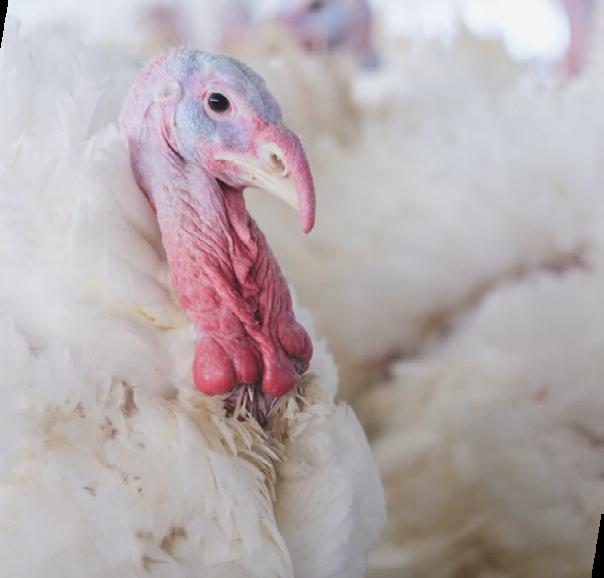
Fueling the Flock: The Connection Between Michigan's Soy and Poultry Industries
Nancy Barr, DVM, Executive Director of the Michigan Allied Poultry Industries
What does poultry have to do with soybeans in Michigan? Good question. The answer is plenty.
When you crack an egg in Grand Rapids or enjoy a turkey sandwich in Detroit, you’re tapping into Michigan’s poultry industry. According to a 2022 US Poultry study, the poultry and egg industry was responsible for as much as $8.5 billion in total economic activity throughout Michigan and employed more than 6,300 people, generating an additional 25,926 jobs in supplier and ancillary industries.
According to the Iowa Soybean Association, Poultry is the U.S. soy’s No. 1 domestic customer using 66.2 percent of the soybean meal consumed by animals.
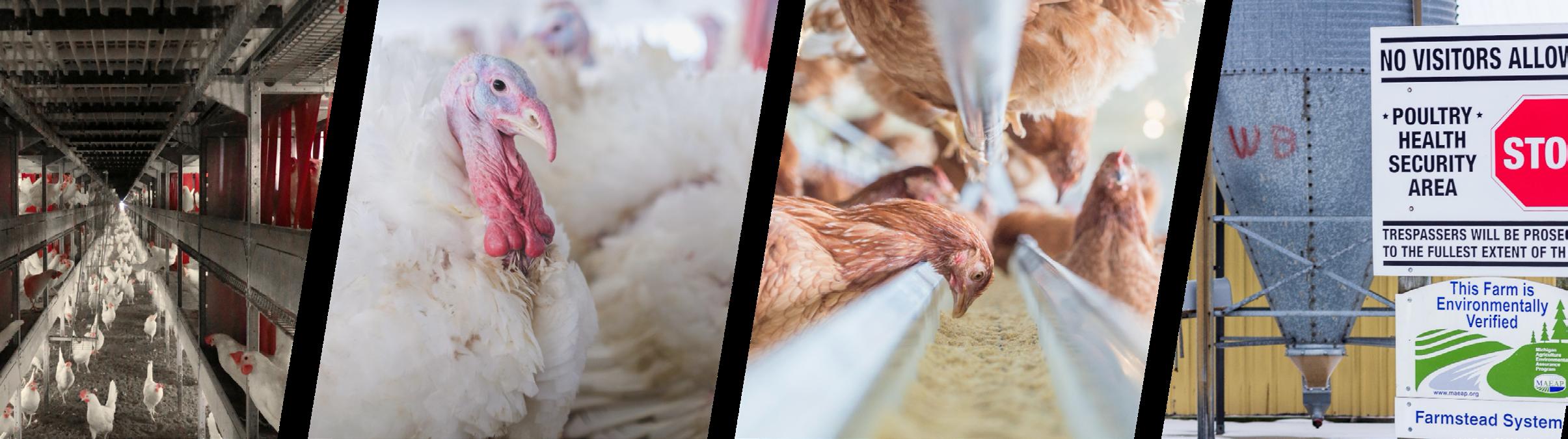
When it comes to Michigan’s commercial laying hens - those hardworking birds who make us the seventh largest egg producer in the nation - we are home to more than 16.5 million. On average, each one of them produces six eggs every seven days. That takes quite a bit of energy, and that’s where soybeans come in.
Take your typical laying hen. She only weighs about four pounds, but she eats about a quarter pound of feed per day. About 20 percent of that feed is soybeans. Multiply that by 16.5 million and the numbers get large quickly. On any given day in Michigan, layer hens consume somewhere around 825,000 pounds of soy product. So, the next time you see a commercial egg laying barn, smile and think about all those hens happily eating your crops.
Michigan also has a thriving turkey and broiler sector. Michigan Turkey Producers, a farmer owned cooperative, raises 5.3 million birds a year and each one of them is good for 1 to 1.5 pounds of feed a day, about 25 percent of which is soy. Finally, our broiler birds, many of which are raised in Michigan for Miller Poultry in Indiana, eat anywhere from 20-40 percent of their diet in soybeans. Each of these poultry commodities is thriving and growing here in Michigan, and soybeans play a big role in that success.
Inside a Cage-Free Layer Barn
Michigan’s egg farms are required to be cage-free, by state law. What does “cage-free” mean? Birds have full access to the entire barn and multiple tier systems where they can lay eggs, rest, eat, and perch. The set up also allows the birds to satisfy natural behaviors like foraging and scratching. These barns are highly automated, and most are “in-line”, where eggs are automatically collected on belts and rollers, sent to an egg processing room and are washed, graded, sorted by size, packaged and shipped to the market less than 4 days after they are laid. Manure is collected on belts, dried, and often transformed into a valuable resource, like fertilizer or energy, improving both economic and environmental sustainability. Today’s hens can produce over 300 eggs per year, twice as much as in 1947. The average number of chicken houses in a large, integrated egg production complex is 10, with each house containing between 50,000 to 350,000 laying hens. Cage-free systems require more feed and attention due to increased hen activity, so staff remain essential for bird care even with automation.
Market Development Project Recaps
U.S. Identity Preservation Program
Sydney Harris, U.S. Identity Preserved Alliance
The U.S. Identity Preserved brand program did not let off the gas in 2025. Managed by the U.S. Identity Preserved Alliance, formerly known as the Specialty Soya and Grains Alliance, the U.S. IP program once again held its successful Identity Preserved International Summit in February 2025. The event connected food manufacturers, importers, exporters and growers of identity preserved U.S. soy and specialty grains, equipment suppliers, as well as seed and input companies, fostering robust discussions about all areas of the identity preserved agriculture industry.
Piggybacking off a successful Summit, the program also held a U.S. Identity Preserved Workshop in Manila, the Philippines which included panel discussions and presentations from various U.S. IP Alliance members. Further inroads were made when a delegation joined the World Initiative for Soy in Human Health and U.S. Soybean Export Council for the Trade Opportunity Preview Summit in Taiwan to speak on the U.S. IP program to Southeast Asia food manufacturers.
To learn more about the U.S. IP program and its activities, visit soyagrainsalliance.com
Pork
Promotion in Mexico
Rod Manuel, U.S. Meat Export Federation
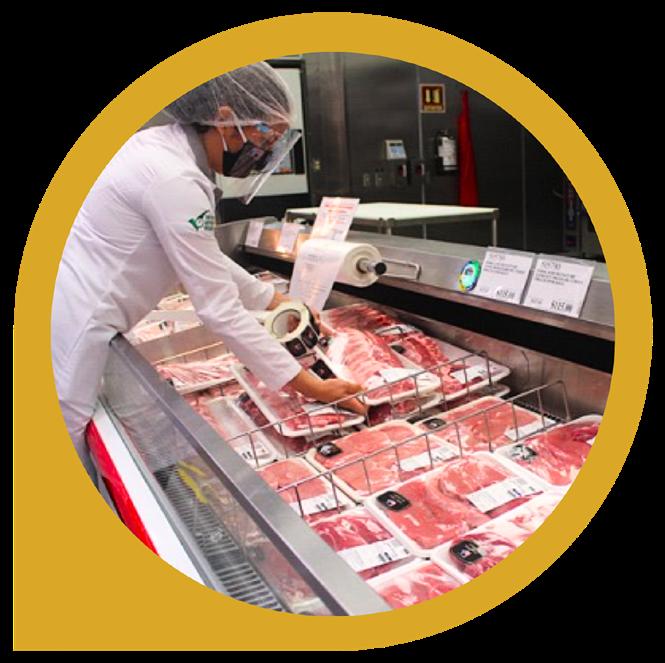
A primary market development objective in Mexico is to strengthen U.S. pork identification in the retail and foodservice sectors by differentiating U.S. pork as top quality. “American Pure Pork,” a marketing program that guarantees no water was injected into labeled U.S. pork product, is an ongoing promotional campaign with Costco at each of its 27 outlets in Mexico. The campaign includes featured U.S. pork cuts, product sampling, special labeling, the production of cooking videos with influencers and implementation of social media
campaigns. The U.S. Meat Export Federation has also expanded this program into the foodservice sector to foster product identification on menus and in restaurants.
Pork grown for export is an important, valueadded market for soybeans. It is estimated that in 2024 pork exports accounted for 2.46 million bushels of Michigan soybean usage. For more information, visit usmef.org

MSU High Oleic Soybean Dairy Feeding Trials
Dr. Adam Lock, Michigan State University 2025 research continued to advance the use of high oleic soybeans (HOSB) as a value added, Michigan-grown feed ingredient for dairy farms. Building on several years of on-farm trials and controlled experiments, the trials demonstrated that increasing the inclusion of HOSB (especially roasted soybeans) consistently improves milk yield and milk fat production without increasing dry matter intake. These responses reflect the unique oleic acid profile of HOSB, which enhances nutrient absorption and energy partitioning. In 2025 MSU also expanded work into how HOSB can support improved production during the transition period, providing farmers clearer, evidence-based guidance on integrating HOSB into modern dairy rations to help support improved both productivity and overall herd resilience.
Biodiesel Blend Level Engine Sensor
Dr. André Boehman, University of Michigan
In this year of the program, the U of M lab found that a biodiesel blend level sensor (Generation 3) from Vitesco, based on an ethanol flex fuel sensor, can provide reliable biodiesel blend level detection. This blend level detection can provide feedback to an engine control unit to optimize engine efficiency when operating on biodiesel. However, attempts were unsuccessful to determine biofuel blend level
through beta particle detection (a decay product from carbon isotopes in the biofuel) and through detection of carbon dioxide in the combustion products that contain carbon-14. In both studies, signal strength was too low for reliable detection. Research will continue to find a way to determine biodiesel blend level in an engine.

Soybean Oil as Roadway Dust Control
Dr. Zhanping You, Michigan Technological University
In 2025, Michigan Technological University completed a field
Investing Checkoff Dollars
pilot study in Clare County evaluating soybean oil as a dust suppressant for gravel roads with support by the Michigan Soybean Committee. The project included six monitored road sections designed to compare different soybean oil application rates and construction methods against a calcium chloride brine section and an untreated control. Results from both laboratory testing and field particulate matter (PM) monitoring demonstrated that soybean oil consistently delivered stronger dust control and longer-lasting performance than brine. The study also highlighted that application uniformity and proper construction practices, including blending where feasible, play a major role in achieving reliable results. Overall, soybean oil shows strong potential as a sustainable, bio-based alternative for gravel road dust control.
Michigan Farmers Appointed to United Soybean Board
In early February, the USDA announced their latest appointments to the United Soybean Board (USB).
The United Soybean Board serves as the national arm of the soybean checkoff. The board has 77 members representing 29 states and the Eastern and Western regions. Each year, the U.S. Secretary of Agriculture appoints growers that have been nominated by qualified state soybean organizations.
This year, two of Michigan's three board seats were up for appointment. Dennis Gardner of Croswell was reappointed for a second three year term. Ed Cagney of Scotts was newly appointed to the board, replacing Carla Schultz of Mayville who served for three years. Ed and Dennis will serve alongside Laurie Isley of Palmyra, who fills Michigan's third seat on the board.
Congratulations to Ed and Dennis on their appointments. MSC would also like to sincerely thank Carla Schultz for her service and leadership while on USB. She was an active and engaged board member who contributed thoughtful insights and served on the executive committee. Learn more about USB at unitedsoybean.org .



Ed Cagney
Dennis Gardner
Carla Schultz

Should a Tillage Pass Be Included if Planting Soybeans Early?
The average planting date for soybeans has been moving earlier for several years in Michigan and across the country. Farmers are making adjustments to their past practices to maximize the benefits and minimize the challenges of early planting. One question for no-tillers is whether a shallow vertical tillage pass would increase yields when early planting is possible. Another question is about planting populations. Since early planting can cause more stressful conditions for germination and emergence, should seeding rates be increased from an average rate used at a more traditional planting time?
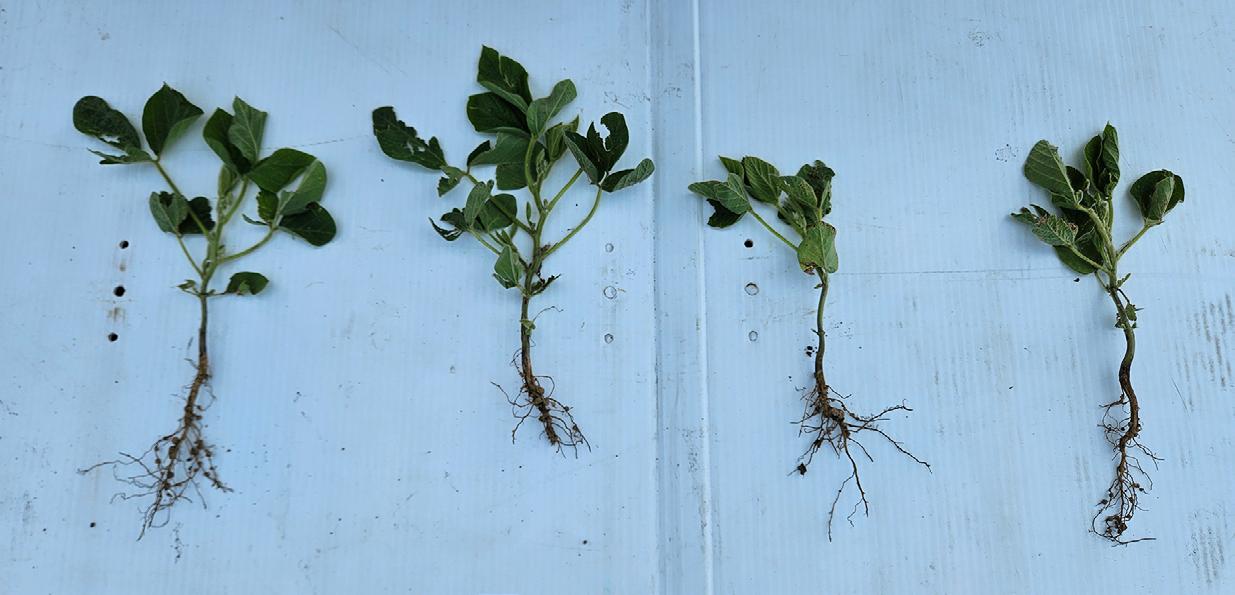
Missy Bauer, B&M Crop Consulting, conducted three years of research on this topic in south central Michigan with funding support from MSC. Missy collaborated with farmers in field scale trials in 2023 through 2025. Two sites were established in each of the three years.
One notable issue that arose at only one site in one year was the issue of seed quality at low temperatures. The stand issues at this site caused a yield increase in the high population strips. This issue did not show up in the normal warm germ test, as it tested at 93 percent. The performance of seed at low temperatures is not correlated with its performance at higher temperatures. But the germination at low temperatures can be measured by a cold germ test. This specific lot tested at 74 percent. Therefore, it is advisable to have the seed that you plan to plant earliest tested for cold germ.
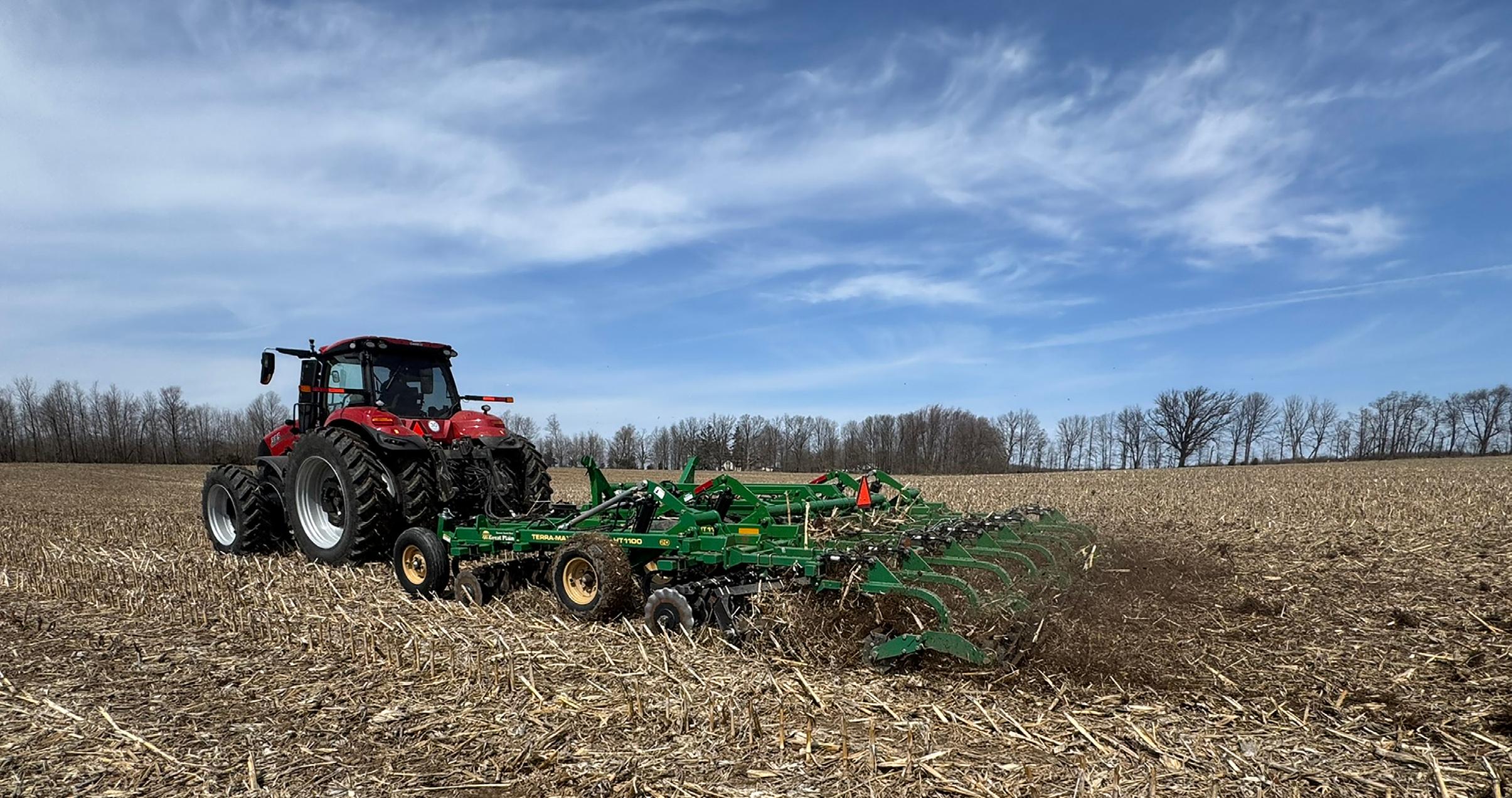
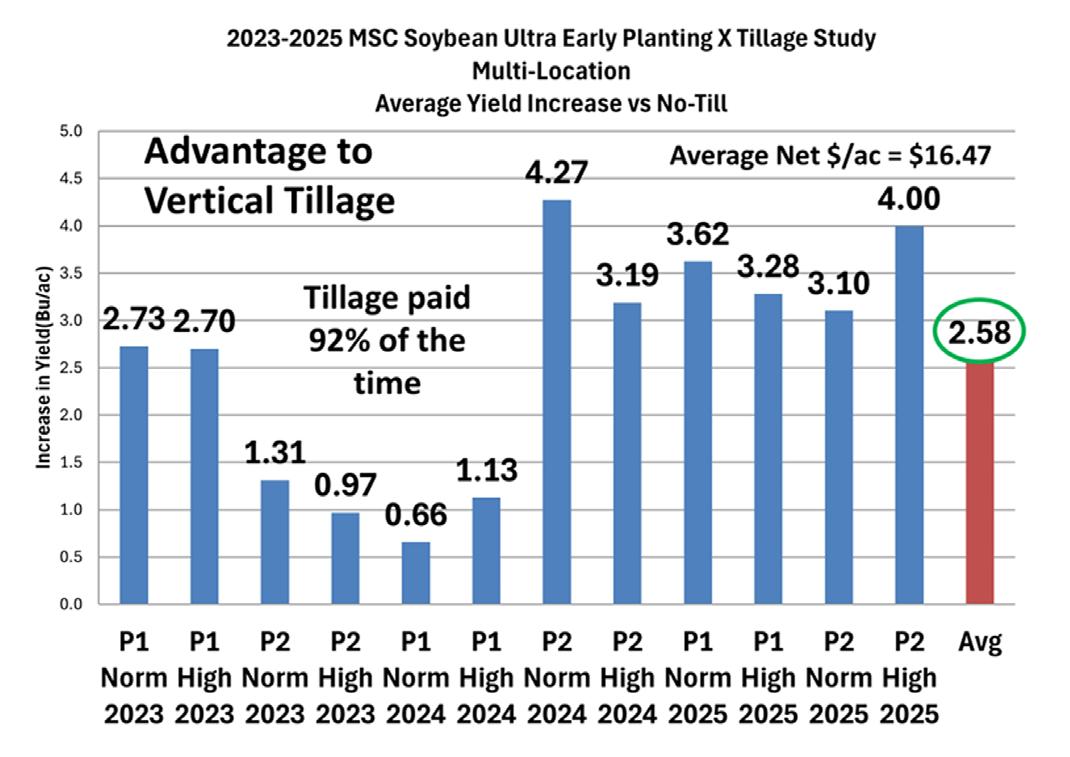
All fields in this research trial were not tilled in the previous fall after corn harvest. Tillage was conducted in replicated strips within the trial fields with a Great Plains Terra Max tool prior to planting. While there were not big differences in seedling emergence or timing, there was a yield increase of 2.6 bushels per acre where the tillage was done prior to planting. This created a financial increase of $16.47 per acre after the cost of tillage was considered. The increase in yield from tillage was found in 92 percent of the trials. Missy Bauer observed, “Early season plant growth and biomass were greatly improved with the vertical tillage, which likely led to the yield increases.”
The question of seeding rate was tested by using two rates of seed in variable rates across management zones. Rates across the fields varied by management zones with the normal rate averaging 113,000 seeds per acre while the highrate average was 134,000. The lower rate yielded 0.5 bushels/acre less than the high rate resulting in a $15.42 per acre loss due to the added cost
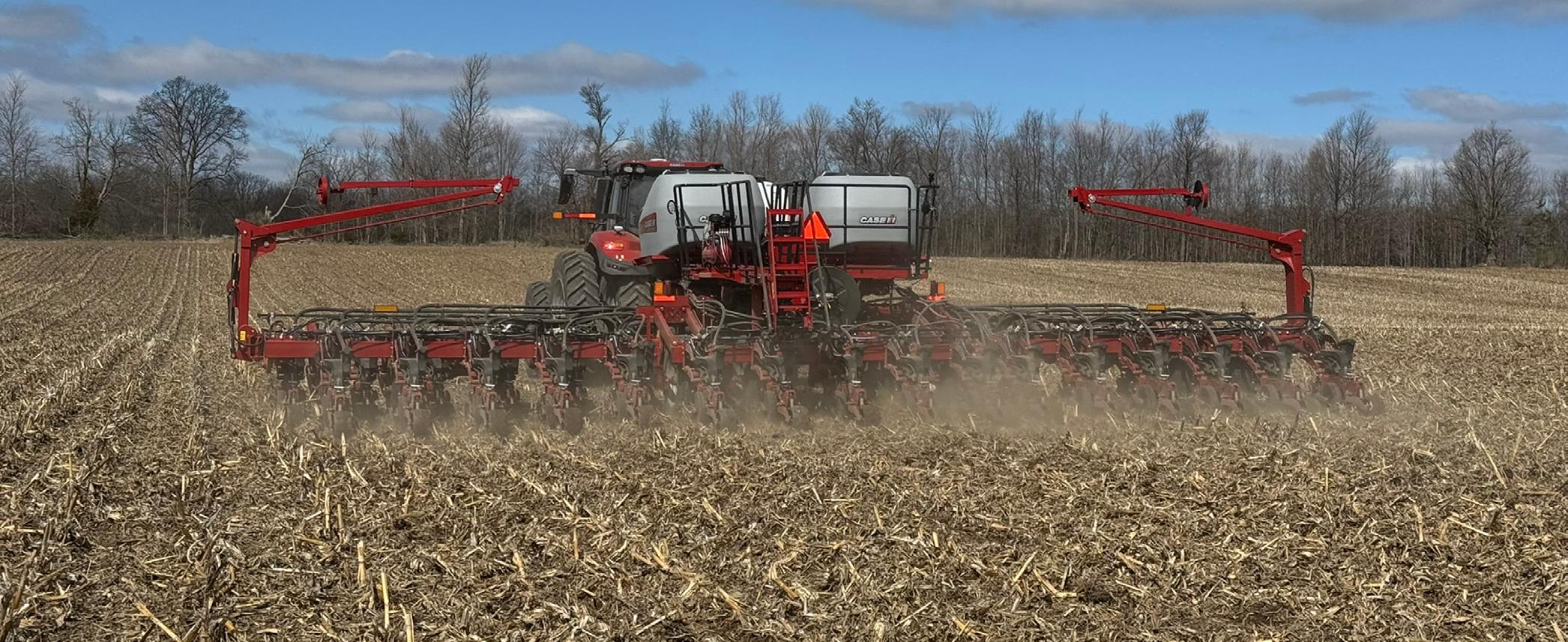
of the higher seeding rate. Some growers reduce seeding rates at early planting because of the additional growth that can come from an early start, which may cause more concern for white mold infections, while others take a defensive stance by increasing seeding rates to compensate for challenging conditions that can cause several weeks of delayed emergence. This trial showed that the differences in seeding rates had little effect on yield. Even though the yield differences were small, the normal population was more economical than the high population 83 percent of the time.
The practice of early planting has the opportunity to increase yields, and if not increase yields, it will help to avoid yield losses from late planting. When early planting is possible, this trial suggests that a single pass of shallow vertical tillage will increase yields over no tillage. Seeding rates did not have a significant effect on yields in this trial but it suggests that rates can be held at normal levels. As Michigan farmers continue to push earlier planting dates, Bauer shares, "Consider implementing a shallow vertical tillage pass to help with early growth and improve yields, while maintaining normal populations.” MSC thanks B&M Crop Consulting for their expertise and hard work to conduct this trial and others.
B&M Crop Consulting would like to thank Case IH, Great Plains Manufacturing, and Unverferth Manufacturing for equipment donations that helped make these plots possible.

Great Lakes Alliance for Sustainable Shipping Sets Course for 2026
In early December more than 80 members of the Midwest agricultural and transportation sectors met in Grand Rapids, MI for the second annual meeting of the Great Lakes Alliance for Sustainable Shipping (GLASS). GLASS was launched in 2024 by the Michigan Soybean Committee and is focused on driving collaborative conversations between all facets of Great Lakes shipping to inspire a more efficient, economical and sustainable future. By working together to surface issues and solve problems, the Great Lakes region can advance in the areas of economic vitality, agricultural prosperity, infrastructure development and environmental stewardship.
Attendees of this year's event included representatives from Michigan Agricultural Commodities, Great Lakes St. Lawrence Governors and Premiers, Michigan Railroads Association, Michigan Department of Transportation and many more. The group spent time hearing from experts on efforts to streamline and diversify shipping of agricultural products in the Midwest while working to meet sustainability targets. Included in the meetings was time for small group facilitated discussions to help gain insight into where bottlenecks and opportunities exist in the Great Lakes transportation industry.
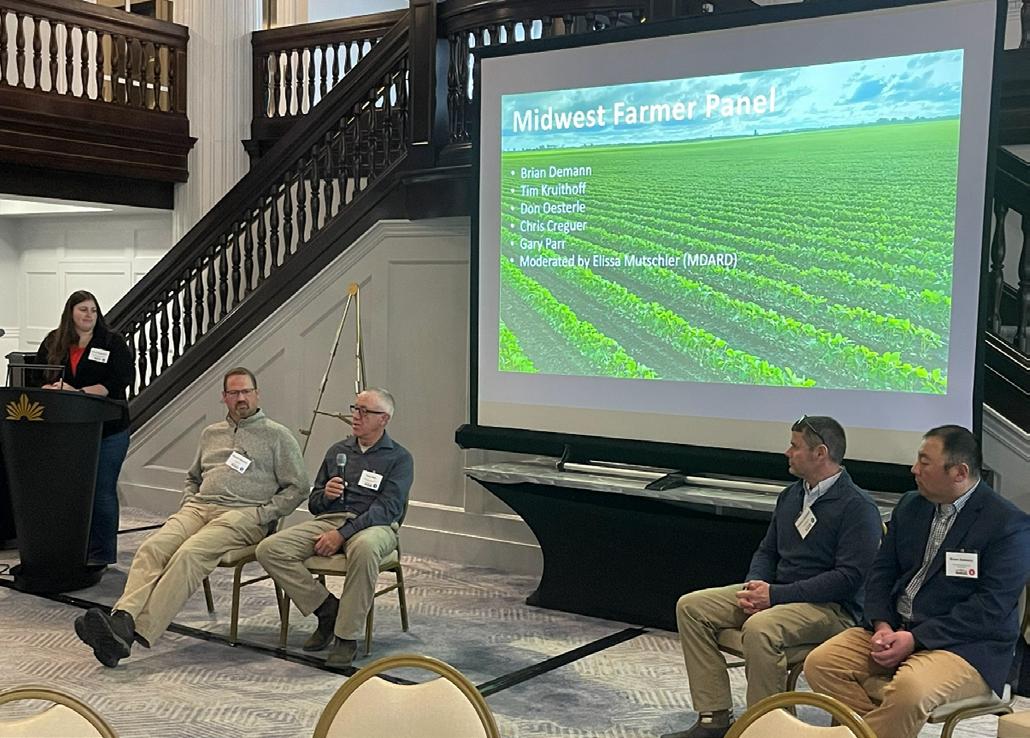
The December meeting was kicked off with a panel featuring Michigan farmers representing different agricultural sectors. Panelists included Brian DeMann speaking about dairy farming, Tim Kruithoff on raising hogs, Don Osterle on farming beef, Chris Creguer on growing dry beans and MSC board member Gary Parr speaking on soybean and corn production.
At the 2024 meeting, four working groups were formed and tasked with collecting data on marine biodiesel fueling locations, vessel loading infrastructure for agricultural products in the Midwest, cost of shipping goods through the St. Lawrence Seaway and other relevant topics. During this meeting, the work groups shared updates on the progress they made during their first year. Exciting outcomes from the working groups include an interactive map of marine fueling locations and another map featuring marine loading infrastructure across the Great Lakes region, with more data set to be added soon.
Building off the accomplishments of the first working groups, new groups are forming for 2026 to pursue new goals that expand the work of GLASS beyond marine and into the rail and trucking industries. Previously formed groups will continue to meet and add onto the data that was collected to ensure data on the interactive maps remains relevant.
If you are a farmer with specific interest in any of these modes of transportation and want to get involved, please contact Hanna Campbell at hcampbell@michigansoybean.org for more information about the Great Lakes Alliance for Sustainable Shipping.

Power Play: Bringing Michigan Soybeans to Munn Ice Arena
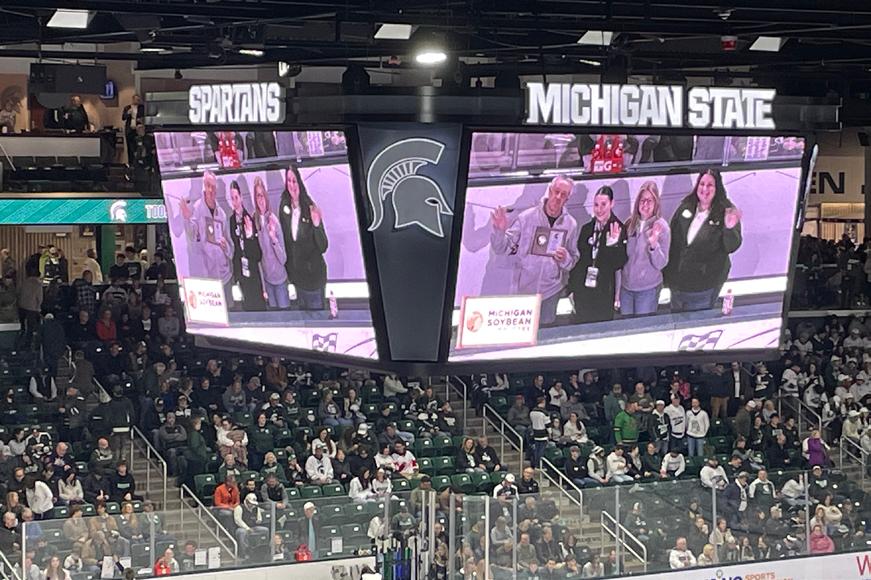
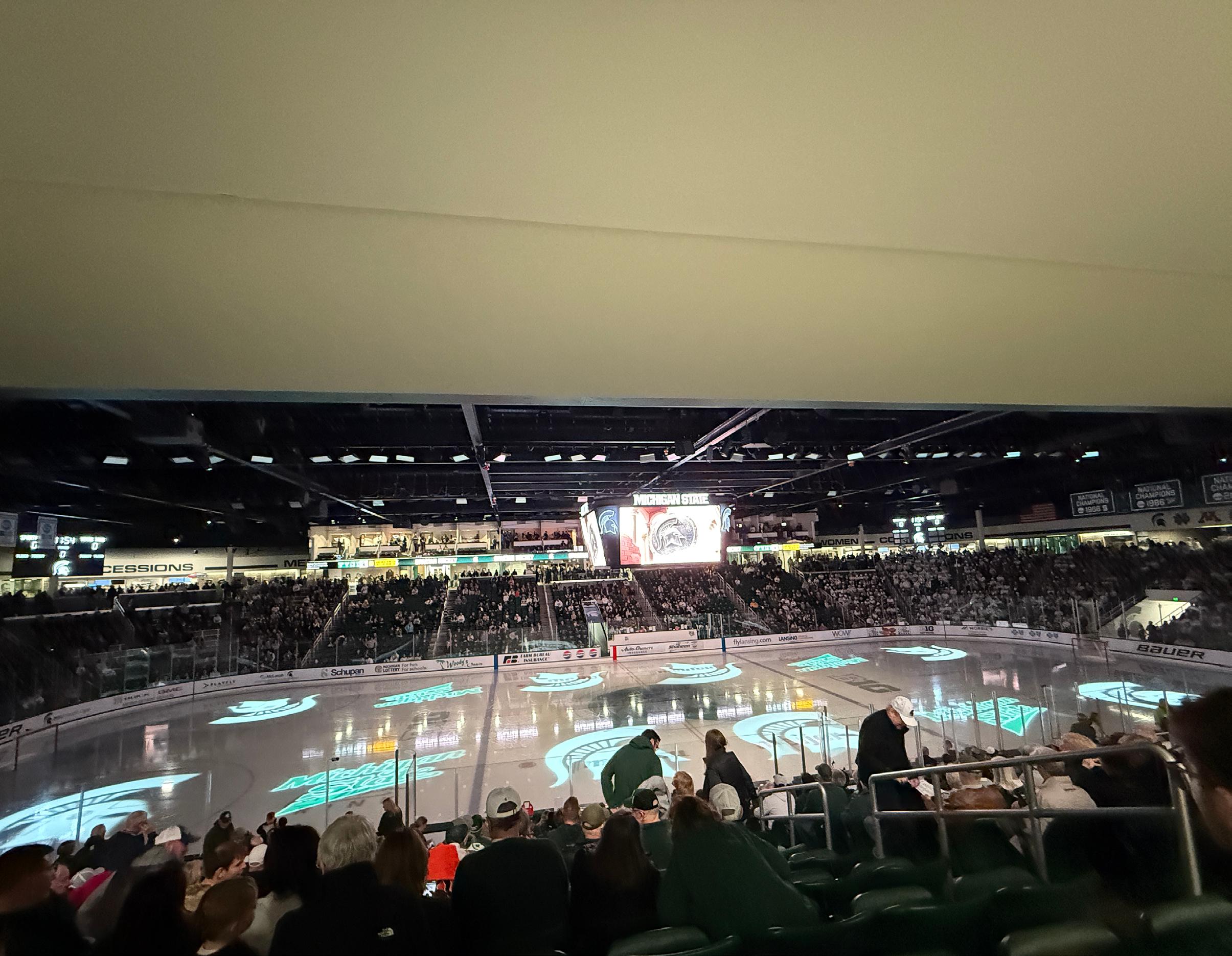
As part of Michigan Soybean Committee’s ongoing partnership with Michigan State Athletics, farmers and staff were onsite at Munn Ice Arena for the February 19 th MSU Hockey game vs. Notre Dame.
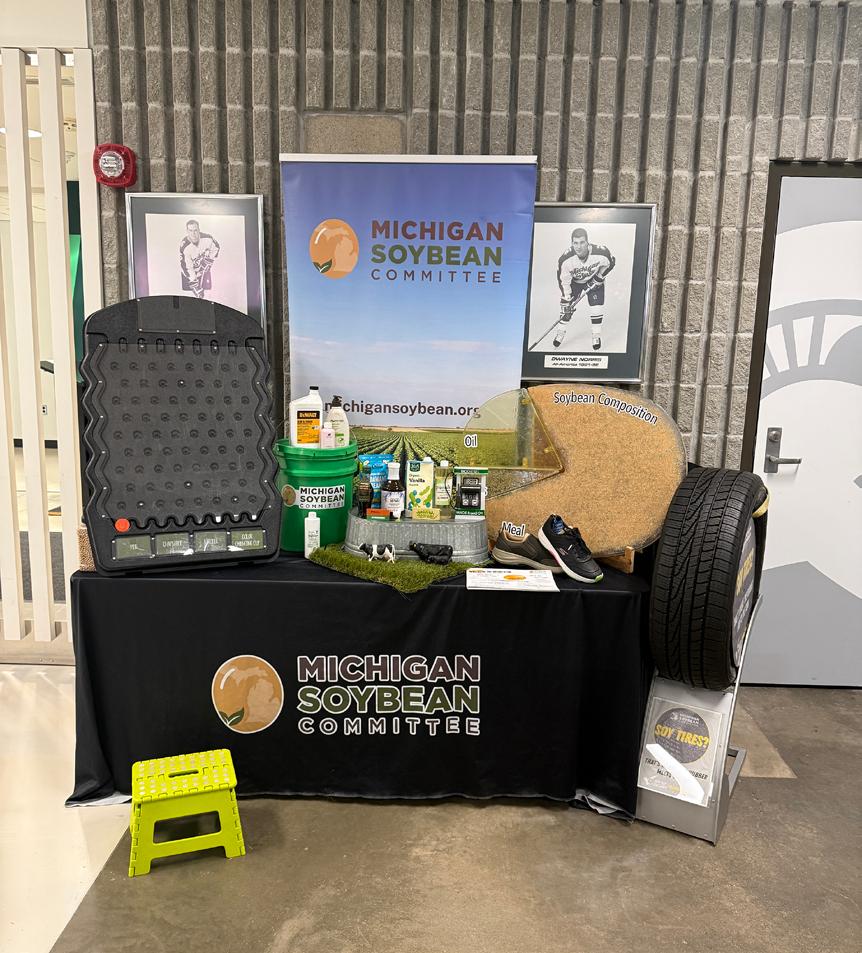
MSC’s District 2 director, Gary Parr was presented with the game puck by MSU Athletics and soybeans were prominently featured on the big screens throughout the game. Fans had the opportunity to visit MSC staff at an interactive booth on the concourse featuring many different products made from soy. The highlight of the booth for many fans continues to be the Plinko game, where participants answer soybean trivia questions to win prizes. From “How many soybean farmers do we have in Michigan?” (Answer: approximately 12,000) to “What farm animals eat the most soybeans overall?” (Answer: chickens), fans are able to expand their knowledge of Michigan agriculture and spark an interest in the industry.
Consumer facing outreach efforts continue to be a pillar of the Michigan Soybean Committee strategic plan to help consumers understand the importance of agriculture and the soybean industry’s work in Michigan. Now, in the fifth year of our partnership with MSU Athletics, MSC has established a strong and recognizable presence among Spartan fans. Many game day interactions have turned into meaningful conversations, with many fans returning to the booth to share facts they recall from previous seasons. Building these ongoing relationships with consumers is important as MSC continues working to strengthen consumer trust and build a positive perception of Michigan agriculture.
DRIVING DEMAND FOR U.S. SOY IN 90+ COUNTRIES WITH EXPORTS UP 13% YEAR-OVER-YEAR. 58% OF THE TOTAL CROP.

Marketing Year 2024/25
Marketing Year 2024/25 U.S. Soy Exports
U.S. Soy Exports
U. S. Soy Complex (Whole Soybeans, Soybean Meal, Soy Oil) U.S. Oil)
2 9 . 6 b i l l i o n 6 8 . 7 M M T M a r k e t i n g Y e a r 2 0 2 4 / 2 5 U . S . S o y E x p o r t s U . S . S o y C o mp l e x ( Wh o l e S
Marketing Year 2024/25 U.S. Soy Exports
Oi l ) U.S. Soy Complex (Whole Soybeans, Soybean Meal, Soy Oil)
U. S. Soy Compl ex ( Whol e Soybeans, Soybean Meal , Soy Oi l) U.S. Complex (Whole Meal, Soy Oil)
$ 2 9 . 6 b i l l i o n 6 8 . 7 M M T M a r k e t i n g Y e a r 2 0 2 4 / 2 5 U . S . S o y E x p o r t s
U . S . S o y C o mp l e x ( Wh o l e S o y b e a n s , S o y b e a n Me a l , S o y Oi l ) U.S. Soy Complex (Whole Soybeans, Soybean Meal, Soy Oil)
U. S. Soy Complex (Whole Soybeans, Soybean Meal, Soy Oil) U.S. Soy
$29.6 billion 68.7 MMT
,
$29.6 billion 68.7 MMT
$29.6 billion 68.7 MMT


DIFFERENT ROLES, COMPLEMENTARY MISSIONS, ALL FOCUSED ON DRIVING VALUE BACK TO THE U.S. SOYBEAN


Leadership At Its Best Program
In January, MSA President Tom Woelmer had the opportunity to represent MSA and the American Soybean Association during the 2026 Leadership At Its Best program. For thirty years, Leadership At Its Best (LAIB) has been an elite program for growers and agribusiness professionals to enhance skills, become better leaders, and more effectively advocate for the agriculture industry. MSA CEO Ben Steyer shared, “It’s more important than ever for individuals in agriculture to develop their leadership expertise by taking advantage of development opportunities. We need strong voices to advocate for the industry and Leadership At Its Best has a proven track record of churning out skillful ag leaders.”
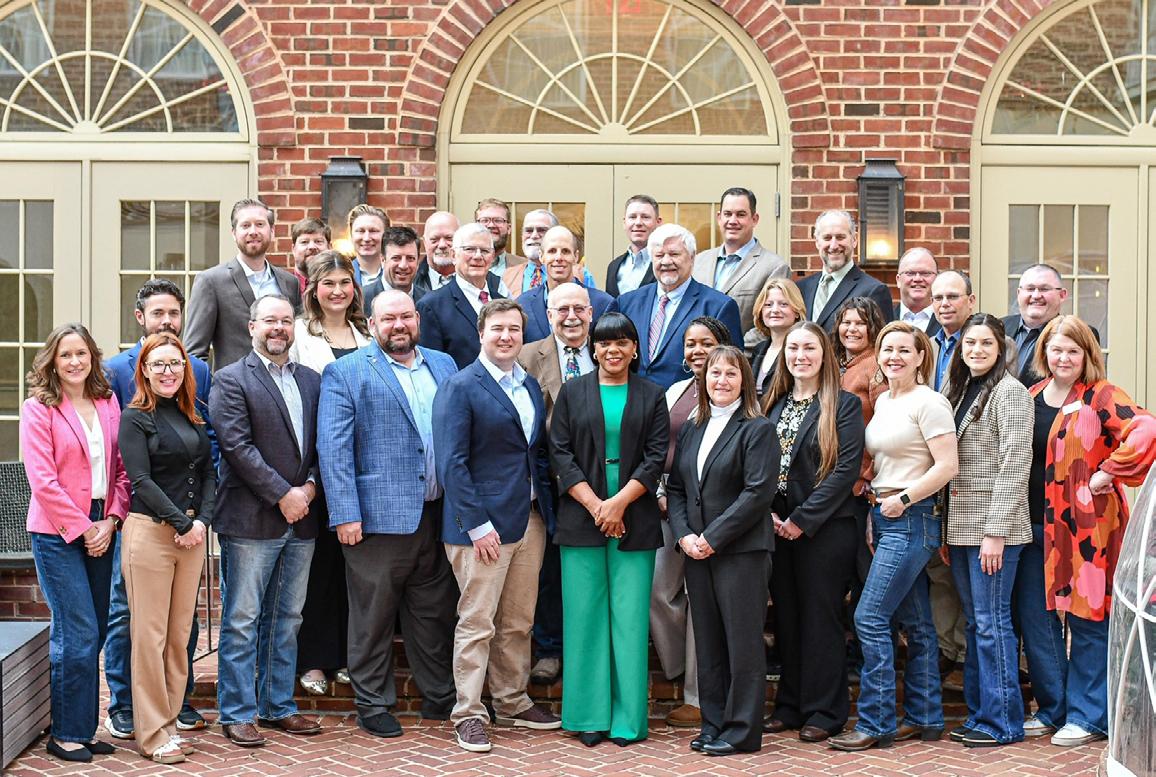
The program provides education in leadership development, agricultural policy, current affairs and issues along with media and communications training. Participating in a program of this caliber is designed to strengthen leadership skills while deepening an understanding of the policy landscape and issues that are impacting agriculture at home, in D.C. and abroad.
Throughout the experience, participants engaged in discussions on agriculture policy and current affairs, gaining insight into how legislative decisions and public discourse impact the industry. Media and communications training emphasized the importance of clear, confident messaging and prepared participants to effectively share agriculture’s story with diverse audiences. By combining policy education with practical communication tools, the program reinforced the critical role informed leadership plays in advancing agriculture and advocating for its future.
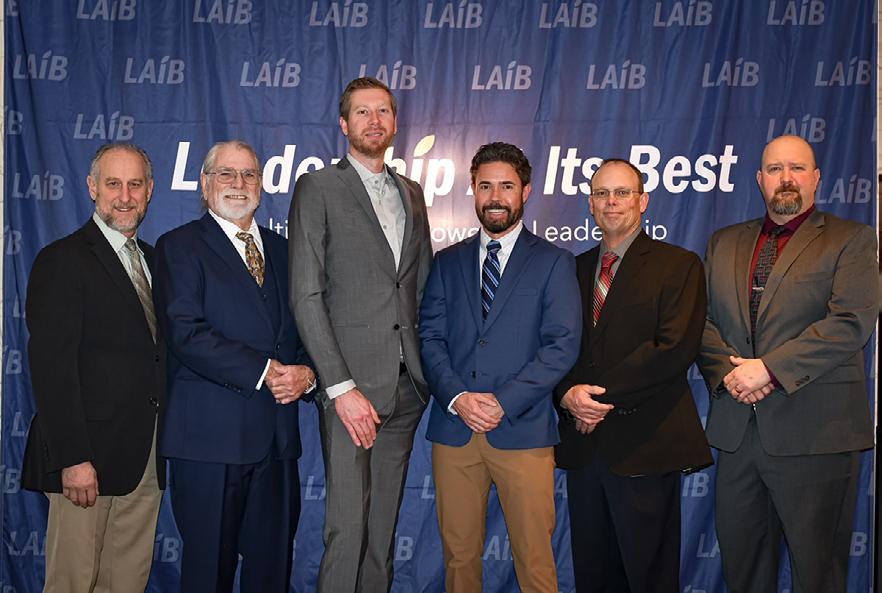
Visits to Capitol Hill were a highlight of the visit. Tom recalled, “I had the opportunity to meet with my Congressman’s Legislative Director and share my concerns for more domestic use of soybeans, particularly for biofuels.” The experience of going to the Capitol and advocating for the agriculture industry brings all the learning and training together. The hands-on experience is irreplaceable and demonstrates the impact that can be had at the local, state and federal level.
After returning home from LAIB, Tom shared that one of the most memorable and unique sessions was a Gettysburg Leadership Workshop. He noted, “It was led by Diamond 6 founder, Jeffrey McCausland and historian and author Tom Vossler. Their motto is Learn from the past…prepare for the future. They brought the three-day Civil War battle to life with lessons in leadership at critical moments in the battle that apply to difficult decisions in our own organizations and business.”
Tom was a great representative of Michigan, specifically a soybean leader to participate in this program. This opportunity would not have been possible without the partnership between the American Soybean Association and Syngenta. MSA CEO Ben Steyer participated in this same program a number of years ago. He recalled the event saying, “I was fortunate enough to go through the Leadership At Its Best program 10 years ago and it was a great learning experience. I’d recommend the program to anyone that gets the opportunity to attend.” If you or someone you know would be interested in attending this program in future years, please contact the Michigan Soybean Association staff.
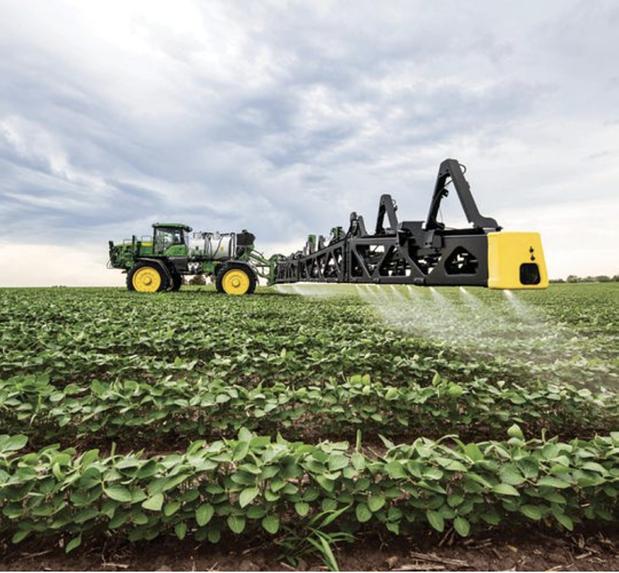
Sprayer Technology for Herbicides
A closer look at the next generation of precision weed control
The saying “Necessity is the mother of invention” comes to mind when considering advances in technology in the weed control industry. Every acre every year must have a weed control plan and growers must then have willingness to stray from the plan when the realities of the season throw monkey wrenches into the initial plan. This makes weed control one of the top priorities for most crop farms.
The cost of weed control, the limited herbicide choices and the challenge of herbicide resistant weeds create the necessity to invent new tactics. The combination of crop rotations, tillage, multiple sites of action in herbicides and application technology are needed to stay one step ahead of aggressive weeds, especially common waterhemp and marestail.
A few new herbicide application technologies are showing promise as tools to combat problem weeds. While the traditional ground-based sprayer will continue to be the backbone of applications, other technology is available to help in especially tough situations.
• The use of drones in the spraying of crops has shown success in disease control and has the potential to help with weed control as well. This method is practical in spot treatments or during times of wet soils.
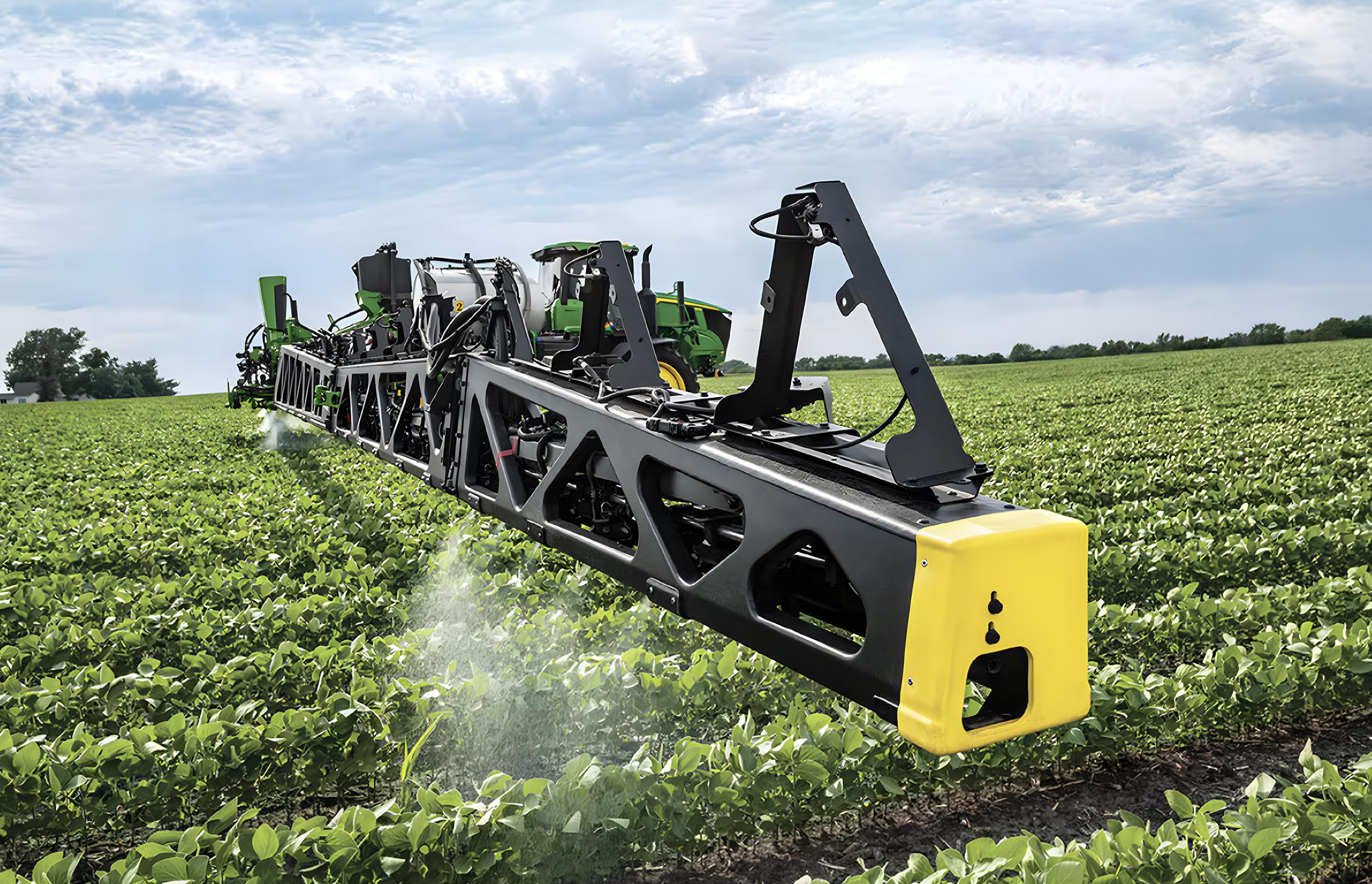
• Herbicide applications guided by image analysis (identification of plant species in real time) has been commercialized by companies such as John Deere through their See & Spray technology. This allows the application of selected herbicides only where needed throughout a field.
• The advancement of super precise application guided by images is available in sprayers such as the SharpShooter from Verdant Robotics. This system utilizes tiny streams of herbicide aimed at individual weed targets while avoiding other plants such as the crop being grown.
Expert on each of these technologies weigh in to help you understand their potential and fit for your farm.

Dr. Christy L. Sprague, Professor and Weed Extension Specialist, Michigan State University
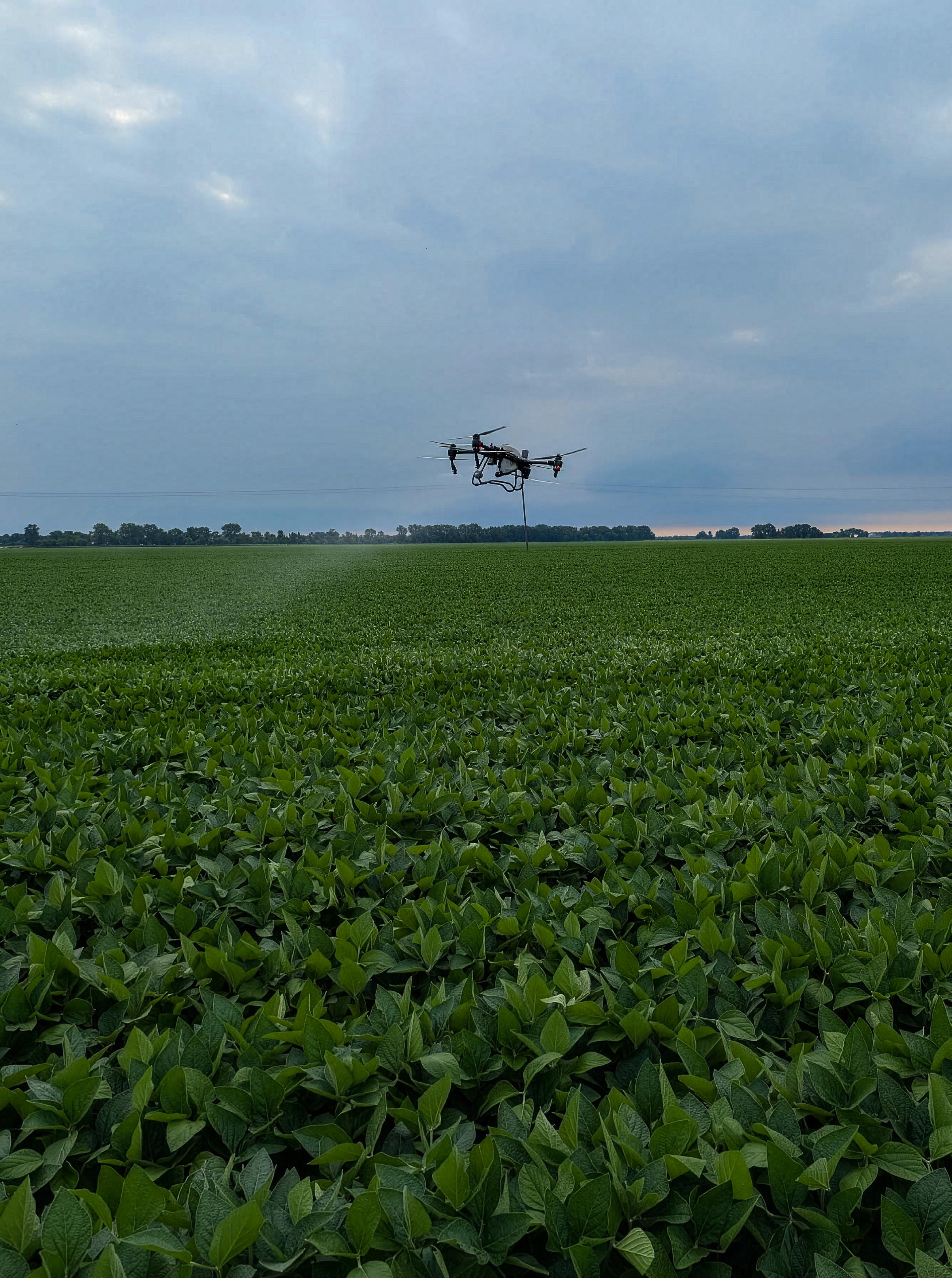
Advances in unmanned aerial vehicle (UAV) sprayer technology are making aerial pesticide applications increasingly viable. Improvements in spray tank capacity (up to 18.5 gallons), battery life, and flight
Photo: John Deere
control have driven greater interest in UAV pesticide application services in Michigan. Additionally, drone sprayers may allow farmers to treat weed escapes, patchy infestations, or wet areas where ground equipment cannot operate in time, helping ensure that fast growing weeds are sprayed before they become too large to control. While drone applications have been used primarily for fungicides and insecticides, several Michigan applicators have begun offering herbicide applications using UAVs. Herbicides such as glyphosate (Roundup PowerMax 3) and glufosinate (Liberty/ Liberty Ultra) already allow aerial applications under their labels, making drone based herbicide delivery a feasible option. As UAV technology advances and more operators enter the market, costs are expected to decrease, making UAV herbicide applications increasingly practical for Michigan soybean growers.
MSU research funded by the Michigan Soybean Committee in 2024 and 2025 compared weed control from UAV applications of Roundup PowerMax 3 + Liberty at various spray volumes and flight speeds to a ground based herbicide application. The herbicide mixture was applied with the UAV at 2, 3, and 5 gallons per acre (GPA) at a standard flight speed of 21 mph, and at 2 and 5 GPA at 15 mph. These treatments were compared to ground rig applications at 19 GPA. Weed control in these trials was strongly influenced by drone spray volume, flight speed, product selection and weed species. Weed species such as giant foxtail and common lambsquarters, which are easily controlled by glyphosate, required only 3 GPA or more when applied by drone. This was also true for glyphosate resistant horseweed (marestail), for which Liberty is highly effective. However, for tougher to control weeds like common ragweed and velvetleaf, drone applications needed to be made at 5 GPA. The same was true for glyphosate resistant waterhemp. UAV applications of Liberty + Roundup at 5 GPA and 15 mph provided waterhemp control comparable to the ground rig, and there were no differences in control at 5 GPA between the two flight speeds.
However, whether applied with the UAV or the ground rig, none of the application methods provided sufficient waterhemp control (approximately 70 percent). This highlights the importance of reducing overall waterhemp populations prior to postemergence herbicide applications by using an effective preemergence or soil applied residual herbicide at or near planting.
While there were differences in control based on GPA and weed species, our results show promise for UAV delivery systems for herbicide applications.
Investing Checkoff Dollars
Still, a systems based approach is needed to improve the effectiveness of postemergence drone herbicide applications. Additionally, the higher spray volumes required for adequate weed control (5 GPA) will affect both the time and cost of UAV herbicide applications.

Michael R. Dodde, Ph.D. Student, Michigan State University
Weeds in row-crop fields are rarely spread evenly across a field. Instead, they tend to occur in patches and at varying densities. This uneven distribution creates an opportunity to reduce herbicide use by treating only the areas where weeds are present. Recent advances in sprayer technology have made targeted herbicide applications increasingly practical for growers. John Deere released the See & Spray™ Ultimate in 2022, allowing growers to make targeted herbicide applications in soybean, corn, cotton and fallow fields. The See & Spray™ Ultimate features a dual-tank design that allows two different tank mixes to be applied in a single pass. One tank is used for broadcast applications, while the other is dedicated to targeted spraying. This setup allows applicators to broadcast residual herbicides while simultaneously applying contact herbicides only where weeds are detected. In addition to herbicide savings, targeted sprayers may allow applicators to earn 2–4 EPA herbicide mitigation points (Endangered Species Act herbicide strategy) by reducing the proportion of the field treated, depending on the level of reduction achieved.
Research conducted across multiple universities, led by the University of Arkansas, in 2023 and 2024 compared broadcast postemergence applications of atrazine and Roundup PowerMax® 3, with and without Callisto®, in corn to targeted applications of the same herbicides. The study also evaluated dual-tank systems that simultaneously applied broadcast and targeted treatments in a single pass. All treatments included the
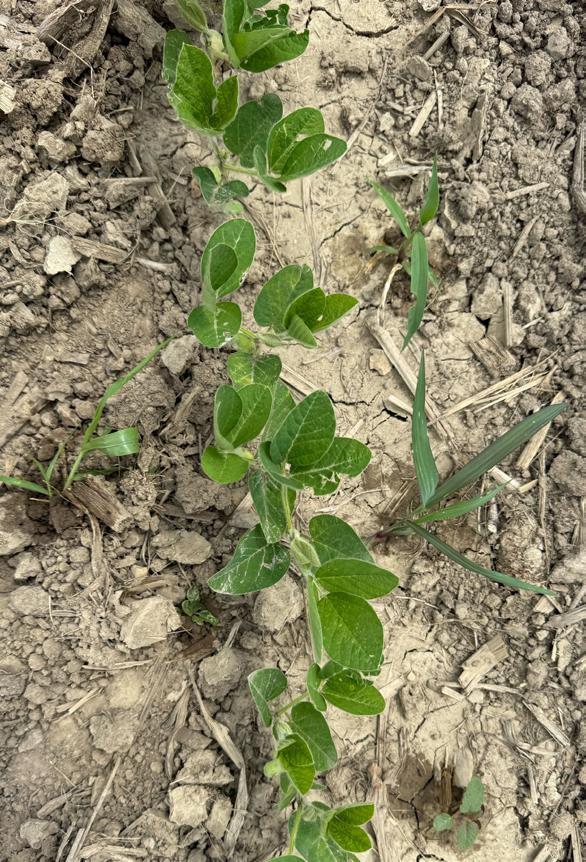

same broadcast-applied preemergence herbicides. In 2023, the preemergence program consisted of Moccasin® II Plus and Gramoxone®. In 2024, a stronger preemergence program was used that added Intrava™ DX (amicarbazone + metribuzin).
In both years, targeted applications provided the same level of weed control across all species present. In 2023, targeted spraying treated 14 percent less of the field compared to broadcast applications, while in 2024, field coverage was reduced by 48 percent.
The lower savings in 2023 were attributed to a weaker preemergence herbicide program. By the time of the postemergence application, much of the field was already infested with weeds, resulting in a higher proportion of the field being treated. Starting with a stronger preemergence program creates greater opportunities for herbicide savings with targeted postemergence applications.
Overall, targeted postemergence herbicide applications in row crops can provide weed control comparable to broadcast applications while reducing total herbicide use. This reduction can lower input costs, decrease the amount of herbicide introduced into the environment, and potentially allow applicators to earn EPA herbicide mitigation points. Actual savings will vary depending on the herbicide program, as it directly influences the amount of weed-infested area present at the time of postemergence application. To reduce the risk of weed escapes and additions to the soil weed seedbank, residual herbicides should continue to be broadcast applied.

Chad Yagow, Director of Digital Agronomy, Verdant Robotics
Precision spraying is no longer the future, it’s here today. A myriad of precision technologies exist in the marketplace that allow soybean growers to selectively spray an area smaller than the full width of the boom, but they all use traditional fan angle nozzles. For some applications of crop protectant products, that’s not precise enough. Why? The spray pattern and driftable fines that come with the use of those nozzles don’t allow for spraying close to individual soybean plants without a risk of application onto the crop itself. This is why Verdant Robotics™ says the future is not spraying, it’s aiming.
With Aim & Apply™ technology, employed on Verdant Robotics’ SharpShooter™ tractor-mounted implement, a microliter stream, rather than a spray, can be utilized to deliver pesticides, fertilizers and other crop protectant products very precisely without damage to crop or off-target species. Aim & Apply uses machine learning to identify and differentiate plants and/or specific parts of plants in the field, artificial intelligence to make on-the-go targeting decisions, and robotics via manipulated turrets to direct liquid streams onto target with 3mm accuracy all while attaining 96-99 percent product savings when compared to a broadcast application.
When using Aim and Apply for weed control, the system can target weeds within 0.5” of a soybean plant.
Photo: XAG
Compared to other precision systems that record the location of a weed in two-dimensional space, Aim & Apply builds a three-dimensional copy of the field on the go and then based on the location of the weed, the location of the turrets, and the volume of space occupied by plants, the system determines which turret can take the best shot without hitting the crop and assigns that turret to the target weed. Because the head of the turret acts like a ball and socket, it can rotate to hit angles forward, backward, and to the side, which allows the turrets to shoot under the crop canopy and hit weeds that are close to the crop. Additionally, if coverage is needed due to using a contact herbicide, the system can operate in Size Dependent Shot mode, which allows the turret to “twirl” and deposit a spiral pattern shot that covers the leaf surface. The system determines the size of the weed which in turn determines the size of the spiral pattern the turret applies. Both Single Shot and Size Dependent Shot modes deliver herbicide very precisely onto the target with minimal overspray.
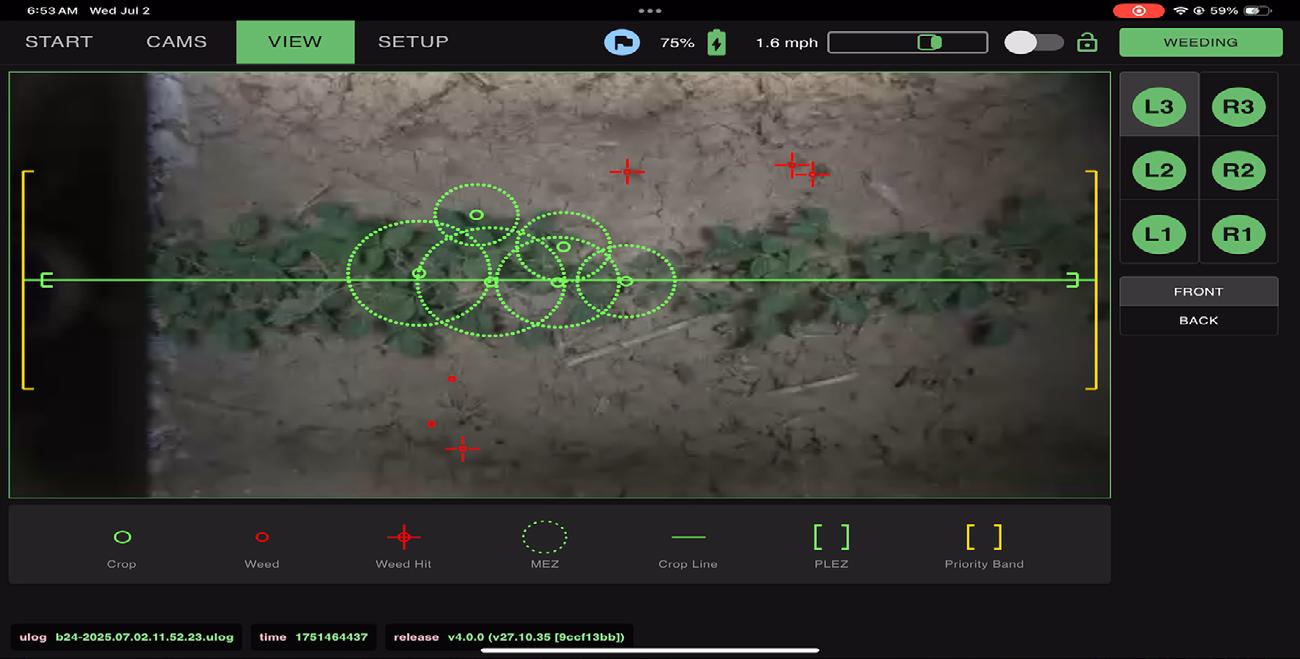
utilized in commercial soybean production in the future. For more information on Aim & Apply technology and the SharpShooter, visit www.verdantrobotics.com or search for the Verdant Robotics channel on YouTube.
Currently, the SharpShooter is targeted toward the vegetable and specialty crops markets. However, with advances in computing power, fully autonomous vehicles, and the pressure to reduce the volume of chemicals applied in agricultural production, Verdant Robotics is confident Aim & Apply technology will be
These examples of technology are part of a growing list of solutions including chemical, physical, biological and cultural tools that will help us through the complex problem of weed control that just a few years ago seemed nearly hopeless. The American farmer will learn about, test and adopt the best technology to continue the fight against weeds. MSC would like to thank Dr. Christy Sprague, Michael Dodde and Chad Yagow for contributing their expertise to this article.
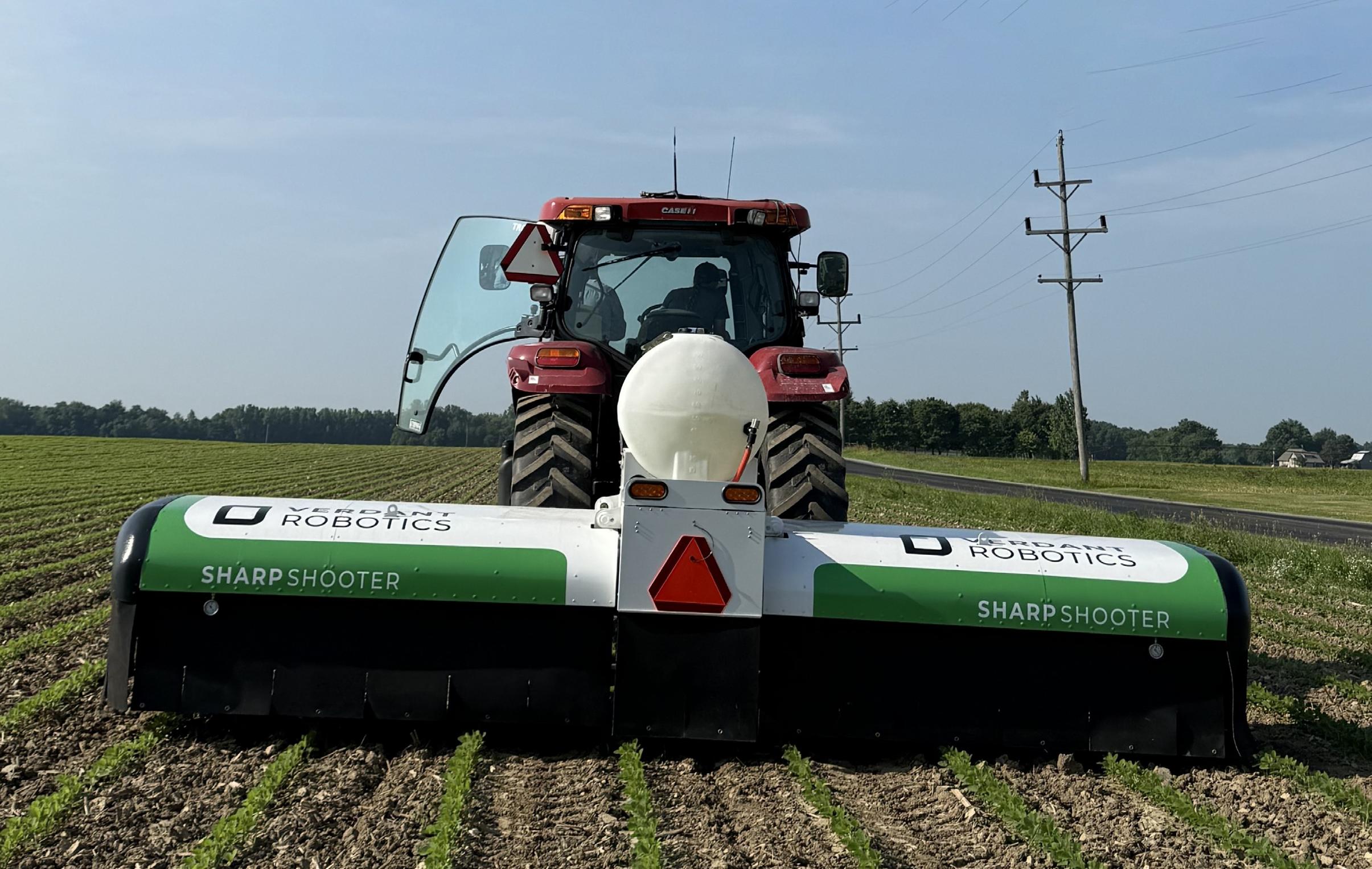
Photo: Verdant Robotics
Soybean Oil Holds Solid Position as Leading Feedstock for Biobased Diesel Fuel Production
The outlook for soybean oil as a feedstock for U.S. biomass-based diesel production – including biodiesel (BD) and renewable diesel (RD) – remains strong, according to a leading biomass-based diesel expert. Although other feedstocks, such as animal fats, are gaining market share in certain regions, soybean oil remains the No. 1 feedstock choice for BD production.
“Biofuels production represents a significant share of domestic demand for soybean oil,” says J. Alan Weber, partner with MARC-IV, a consulting company dedicated to biofuels innovation. USDA World Agricultural Supply and Demand Estimates (WASDE) reported 12.995 billion pounds of U.S. soybean oil was consumed for biofuels production in marketing year 2023/2024 – representing nearly half of total domestic soy oil production.
Although final statistics are not yet available for the full year, in marketing year 2024/2025 biofuels production and use of soybean oil declined due to market uncertainty. USDA forecasts 14.5 billion pounds of soybean oil will be used for biofuels production in marketing year 2025/2026.
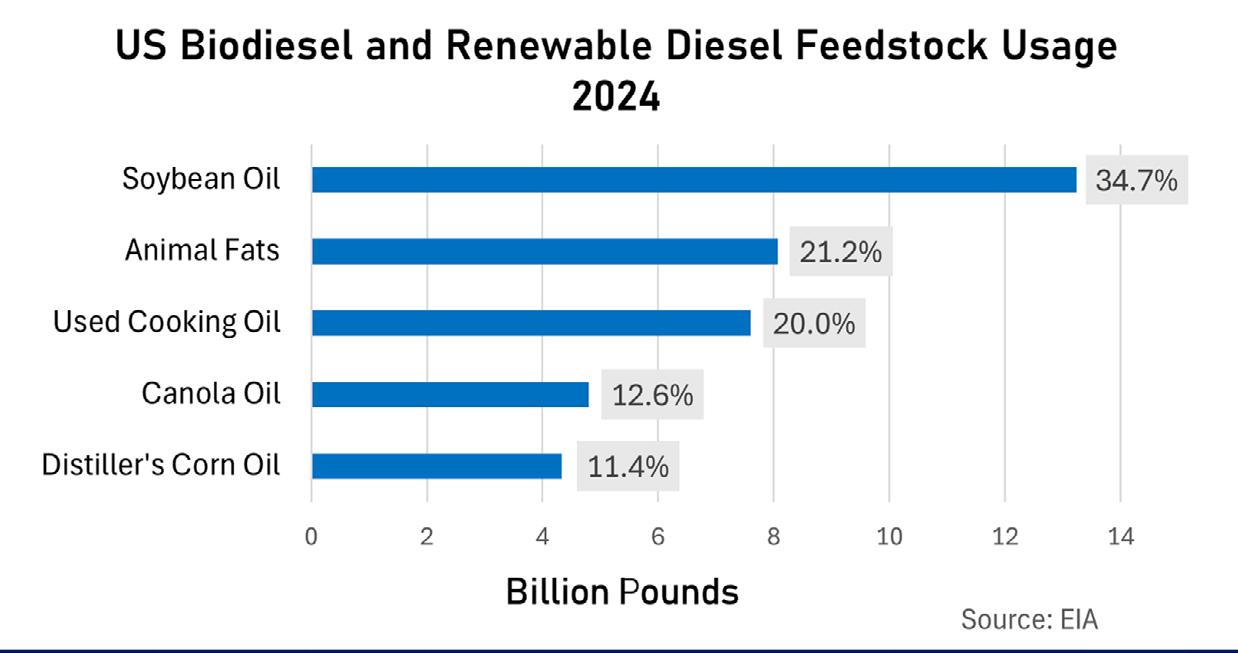
2.
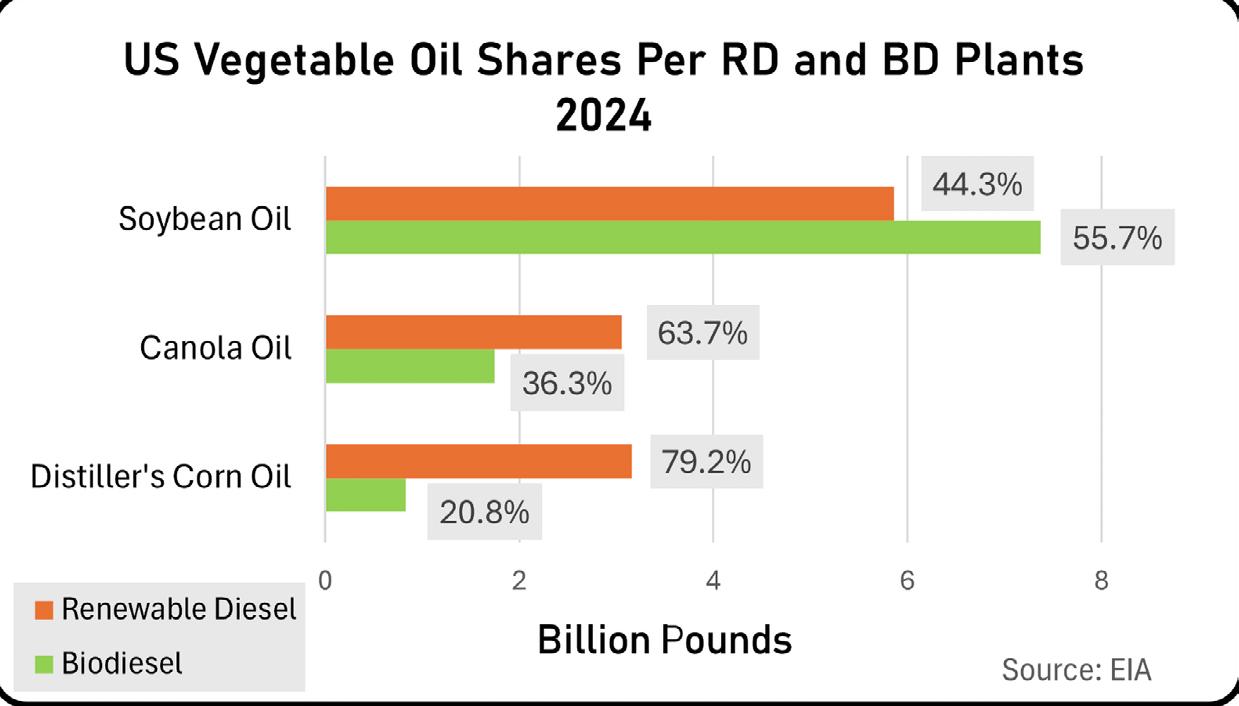
Behind soybean oil, the other top feedstocks for biofuels in 2024 were animal fats, used cooking oil (UCO), canola oil and distillers corn oil (DCO) (Figure 1.) BD production plants favor soybean oil as a feedstock, while RD plants used more canola oil and DCO in 2024 (Figure 2.)
Carbon intensity drives feedstocks
Each biofuel feedstock has unique properties, advantages and challenges. See the sidebar “Comparing Biofuels Feedstocks” to learn more about these differences.
One of the driving forces in feedstock selection is the carbon intensity (CI) score set by the U.S. Department of Energy (USDOE) GREET model. The GREET model quantifies the CI of biofuels based, in part, on feedstock type.
In the past, crop-based biofuels have often been penalized with higher CI scores due to land-use calculations that broadly assume land is being diverted from food to fuel. Using different calculation methods may help lower CI scores in the future by taking into consideration farming practices such as no-till and planting cover crops.
“Economics come into play based on carbon intensity scores,” Weber explains. Lower-carbon feedstocks provide greater value because they can be sold into carbon-based programs more easily. For example, California’s Low-Carbon Fuel Standard (LCFS) is a carbon-based program that provides higher value to Figure 1.
Figure
waste-based feedstocks like used cooking oil (UCO) and animal fats.
Imported feedstocks impact the market as well. In 2023, large volumes of UCO began arriving from China, raising concerns about potential fraudulent activity. Over the past five years, imports of Brazilian beef tallow and other animal fats also increased significantly, leading to an upward trend in the use of these wastebased feedstocks.
Emerging low-carbon feedstocks
Researchers are exploring new crop options that show promise as biobased diesel feedstocks which would offer lower carbon intensity.
For example, CoverCress™ is a low-input winter oilseed crop, the result of gene edits made in field pennycress – essentially a weed. CoverCress is touted as a harvestable crop that offers similar environmental benefits of a cover crop, such as storing carbon in the soil and improving soil health.
Farmers can incorporate CoverCress into rotations of corn or soybeans. Similar to soybeans, CoverCress can be processed into meal for livestock feed, generating oil as a co-product. CoverCress is being tested primarily in Missouri and Illinois and has not yet been used commercially in biofuels production.
Camelina is another oilseed being studied in the Upper Midwest as a relay crop. Soybeans are planted between growing camelina rows, with the camelina harvested in June. The soybean crop continues to grow and is harvested as usual in the fall. The result of this double cropping strategy is more oil per acre. Camelina requires less water and fertilizer than many other crops, thereby offering a lower environmental footprint for sustainable oil production.
“Although these crops are definitely interesting, I don’t see them cutting into the soybean oil market as overall demand for biomassbased diesel grows,” Weber says.
Meanwhile, BD and RD feedstock markets remain critically important to future soybean oil demand in Michigan and beyond.
“As we continue to work to increase demand for biofuels, we expect soybean oil demand to grow accordingly,” says Hanna Campbell, market development director for the Michigan Soybean Committee and managing director for the Michigan Advanced Biofuels Coalition. “We expect soybeans to retain a significant piece of the biofuel feedstocks pie in the future.”
Comparing Biofuels Feedstocks
Soybean Oil
• Co-product of soybean processing
• Readily available, with additional crush capacity supplying more in the future
• Requires less pre-treatment for biodiesel production
Distillers Corn Oil (DCO)
• Co-product of ethanol production
• Growing use in biodiesel and renewable diesel production
• Results in fuel with better cold flow properties
Animal Fats
• Includes tallow, lard and poultry fat
• Lower carbon intensity feedstock
• Require additional processing to ensure quality
Used Cooking Oil (UCO)
• Recycled from restaurants and food processors

• Lower carbon intensity feedstock
• Supply and quality can be inconsistent
Canola Oil
• Co-product of canola processing
• Grown in Canada and the Northern Plains, Pacific Northwest and Southern Plains of the U.S.
• Also grown as winter crop in mid-South
We put soybeans first because you put performance first.
We put soybeans first because you put performance first.
At Asgrow® brand, not only are we all about the beans, we’re all about your success as well. That’s why we offer localized products with leading genetics, weed management systems and maximum profit potential – all developed by soybean experts who put soybeans first.
At Asgrow® brand, not only are we all about the beans, we’re all about your success as well. That’s why we o er localized products with leading genetics, weed management systems and maximum pro t potential – all developed by soybean experts who put soybeans rst.
DISCOVER HOW IT’S ALL ABOUT THE BEANS. Asgrow.com
DISCOVER HOW IT’S ALL ABOUT THE BEANS. Asgrow.com


SoyFoam Demo Lights Up MABA Ag Club
Breakfast
Over 100 farmers, agribusiness leaders and policy makers gathered for MABA’s February Ag Club Breakfast, which was hosted by the Michigan Soybean Committee and Michigan Soybean Association at their office in St. Johns.
As the longstanding host of the February meeting, Michigan Soybean has a goal to start the year of breakfasts off with a fun and engaging presentation. In years past, there have been natto tastings, bingo games, polling questions and more. Our hope is that attendees not only learn more about a specific aspect of the Michigan soybean industry, but they also walk away with a memorable experience and a fun start to their day.
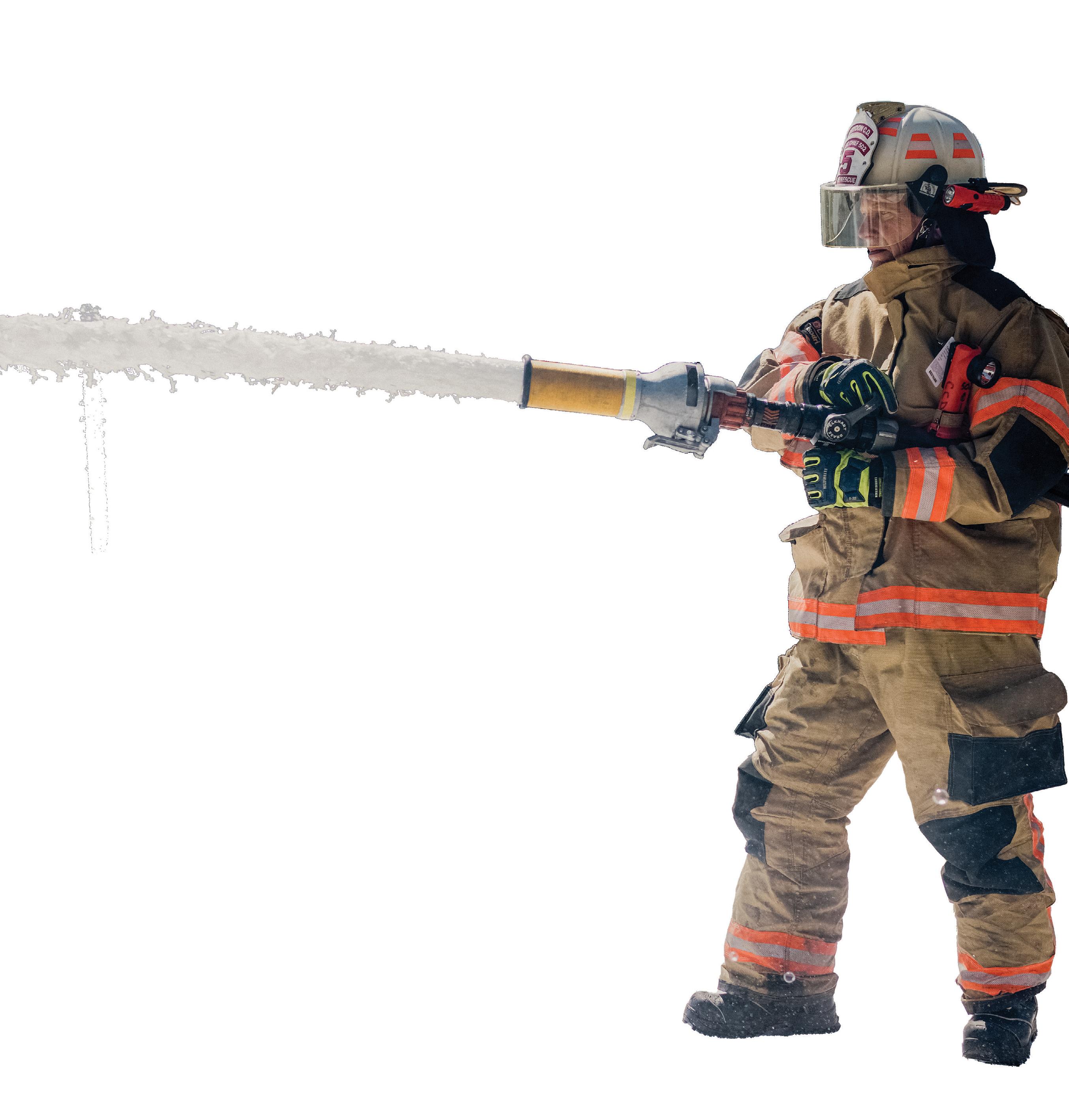
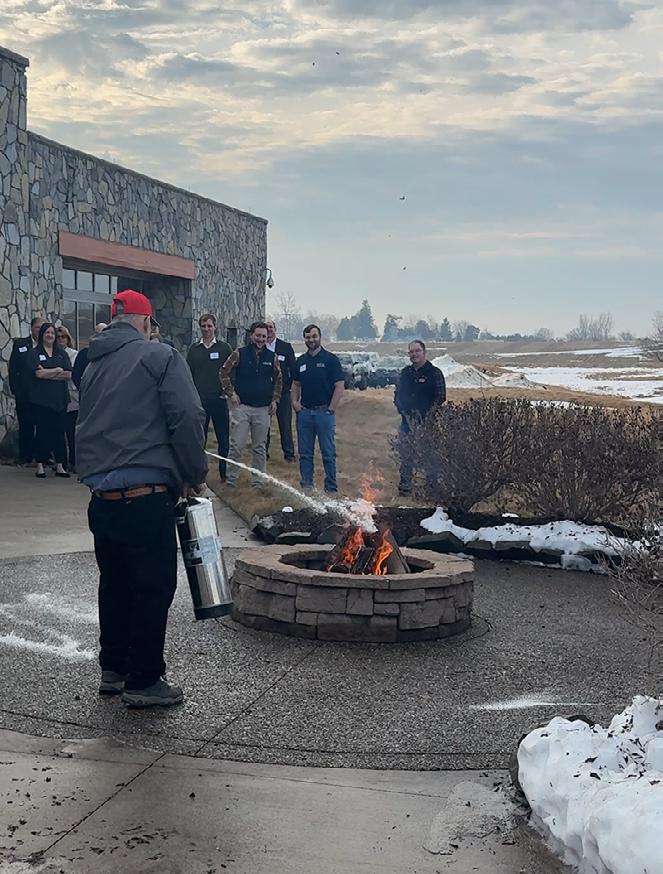
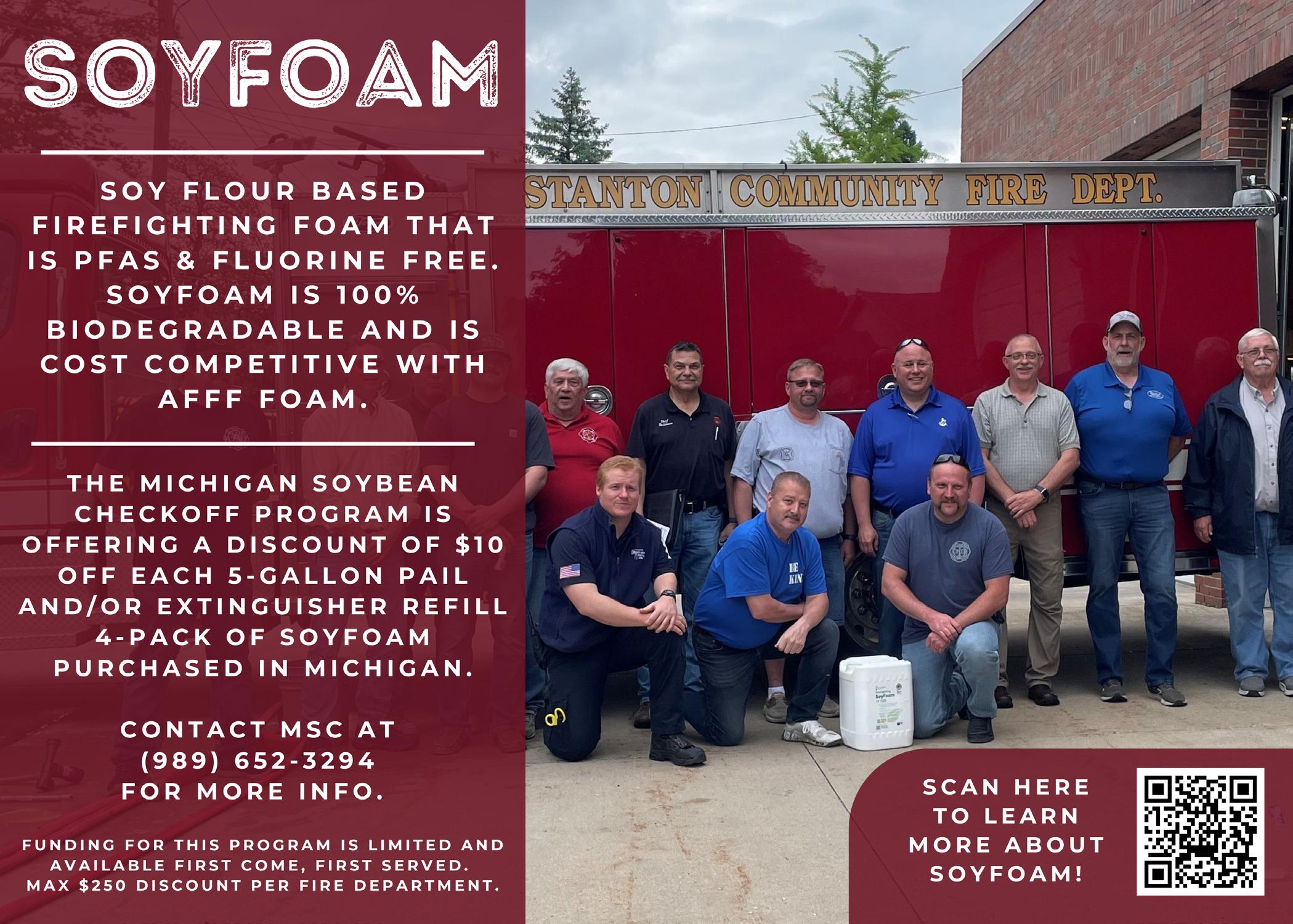
This time, staff shared information about soy biobased products like SoyFoam, a soybean flour-based fire suppressant foam that contains no PFAS or fluorine. Following breakfast and the presentation, Pat Butler of PK Foam Solutions in Climax conducted a SoyFoam demonstration in an outdoor firepit to show how SoyFoam quickly and effectively extinguishes a fire.
We're already brainstorming what topic we should cover next February to highlight the exciting things happening at Michigan Soybean!
Management Options for Reducing Risk When Planting Soybeans Early
Eric Anderson, MSU Extension Soybean Educator
Over the past several decades, farmers across the Midwest have been planting soybeans earlier with the goal of getting soybeans in ahead of corn to maximize yields of both crops. The Great Lakes region has witnessed an increase of 18 annual frost-free days from 1951 to 2024 which has helped with this goal. Michigan soybean growers are currently planting almost half of their soybeans by mid-May compared to early June in the 1980s. Numerous university research trials have shown consistent yield increases when planting soybeans relatively early. Research in Michigan from 2018–2019 with five seeding rates and four planting dates found the maximum yield was achieved at the late April planting time with a final plant stand of 98,000 plants per acre. On-farm trials conducted from 2019–2023 at 25 locations in Michigan found a 1.5 bu/ac advantage on average when planting 2–3 weeks earlier than normal. University of Nebraska-Lincoln researchers investigated the impact of planting dates (Apr 30, May 16, Jun 1, Jun 17) on yield and the length of time to reach various vegetative and reproductive stages. They found planting early was critical to maximizing yield.
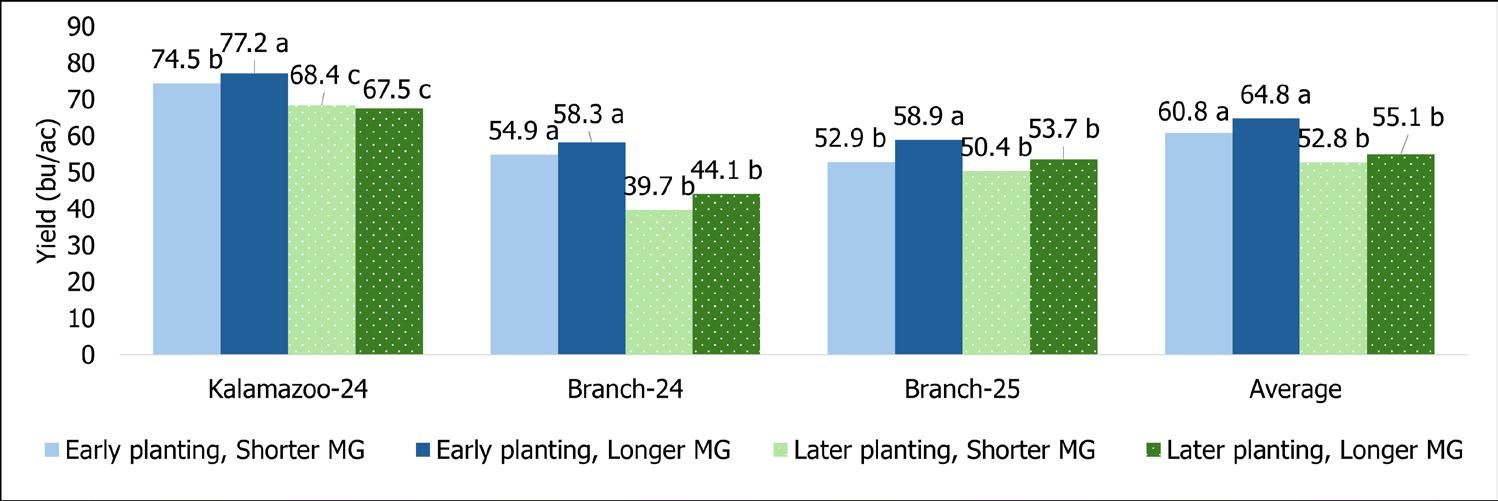
UW-Madison show maximum yields were achieved with longer MGs and earlier planting, although yields were similar across a spread of one full MG. Data from on-farm trials in Michigan show a similar pattern of statistically higher yields with longer MG varieties when planting early at two of three locations (Figure 1). However, University of Nebraska-Lincoln researchers suggested choosing varieties with proven yield performance was a better predictor of yield than MG.
Seeding Rate
Research at MSU found the seeding rate that maximized yield was 124,000 seeds/ac when planting in late April. On-farm trials in Michigan have consistently shown similar results with maximum
However, early planting is not without risk. Concerns when planting early include postemergence frost, compaction and sidewall smearing if soils are too wet, and longer time to emergence with higher risk associated with insect, pathogen and nematode damage. If you plan to plant early, here are a few management recommendations.
Maturity Group
Conventional wisdom says to plant a longer maturity group (MG) variety when planting early to maximize sunlight capture and yield, and most research findings agree. Studies from MSU and
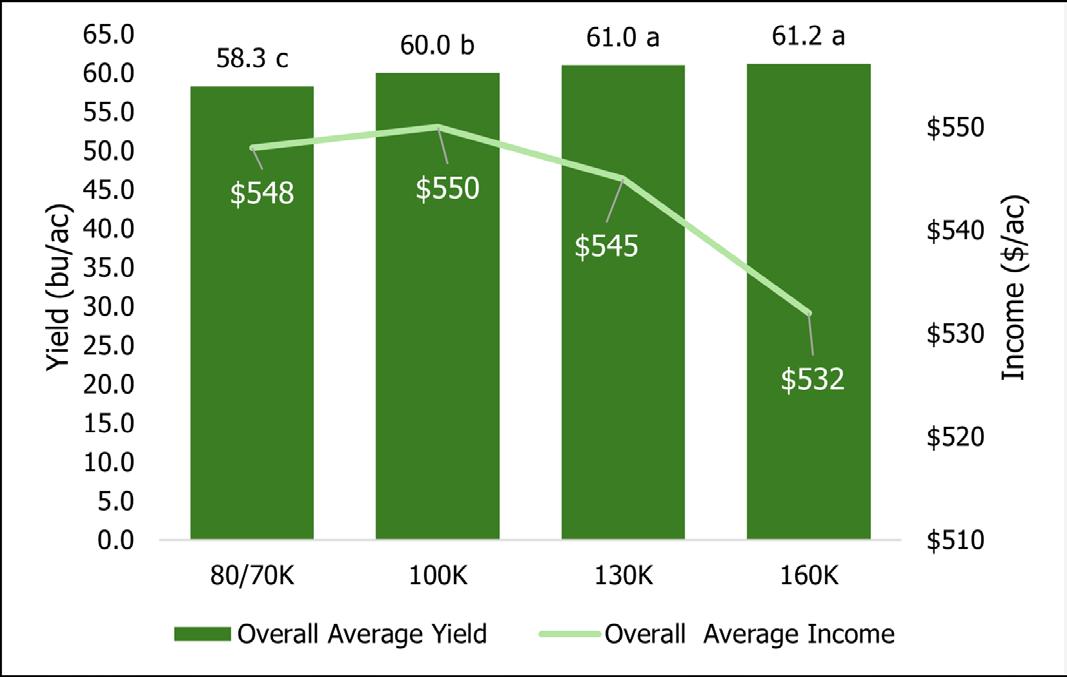
and net income at four seeding rates across 82 locations and 9 years in on-farm trials in Michigan.
Figure 1. Soybean yields with two different maturity groups at two planting timings in on-farm trials. Graphic courtesy of Eric Anderson.
Figure 2. Yield
yields achieved at 130,000 seeds/ac and maximum net income at 100,000 seeds/ac (Figure 2). If planting into cold soils, consider having a cold germ test performed to better estimate what seeding rate will be needed to achieve a given final stand.
Seed Treatment
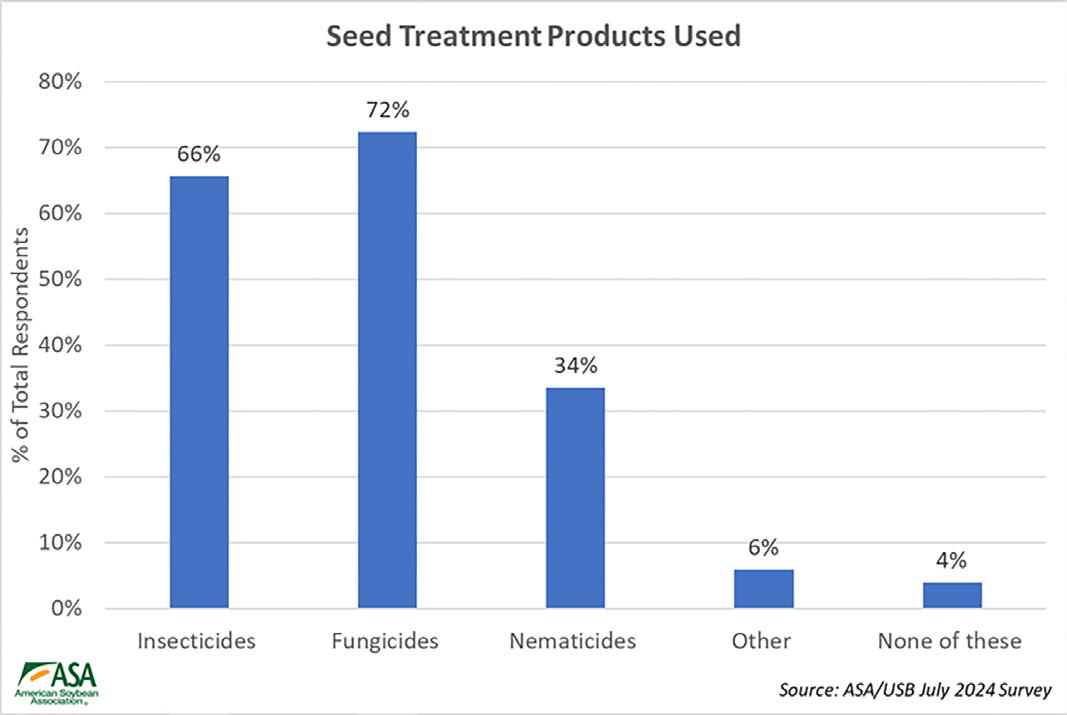
It is estimated that less than 10 percent of soybean seed was treated with a seed treatment (ST) prior to 2000. However, a 2024 survey by the American Soybean Association and United Soybean Board found 90 percent of soybeans are currently being planted with a ST (Figure 3). Michigan farmers identified increased use of foliar pesticide applications and increased seeding rates as the two primary alternatives to ST. Soybean ST are more likely to provide a benefit in fields where pest pressure has been high in the past, if soils are cold and wet at planting, and if seed quality is less than ideal. However, university research has produced mixed results with regards to the efficacy of soybean ST including various fungicides, insecticides and nematicides in improving plant stand and protecting yield. Researchers in Michigan showed mixed results on plant stands and yield. They found ST improved plant stand by 6.7 percent at one of four site-years in Michigan but did not improve
yield or profit regardless of planting date. A three-year study at the University of Wisconsin-Madison showed an inexpensive seed treatment (ApronMaxx) paid for itself 56–67 percent of the time while a more expensive product (CruiserMaxx) paid for itself only 22–56 percent of the time. However, results varied markedly by variety and environment.
Including a seed treatment may improve yield and increase net income under certain environmental conditions.
MSC Connects with Spartan Fans at MSU Basketball Games
Spartan basketball fans had two opportunities to connect with the Michigan Soybean Committee at the Breslin this year. MSC attended the Men’s Basketball game on February 17 th against UCLA and the Women’s Basketball game on March 1 st against Ohio State. At both games, MSC had an interactive booth on the concourse where fans could stop by to test their soybean knowledge with trivia and win fun prizes.
The women’s basketball game was extra special, as it was the twentieth annual celebration of Michigan 4-H Youth Development. 4-H Day at the Breslin brings 4-H members from across the state together for agriculture themed games and activities on the concourse and 4-H camaraderie! Michigan Soybean Committee was able to interact with lots of 4-H members and their families, and share the importance of soybeans.
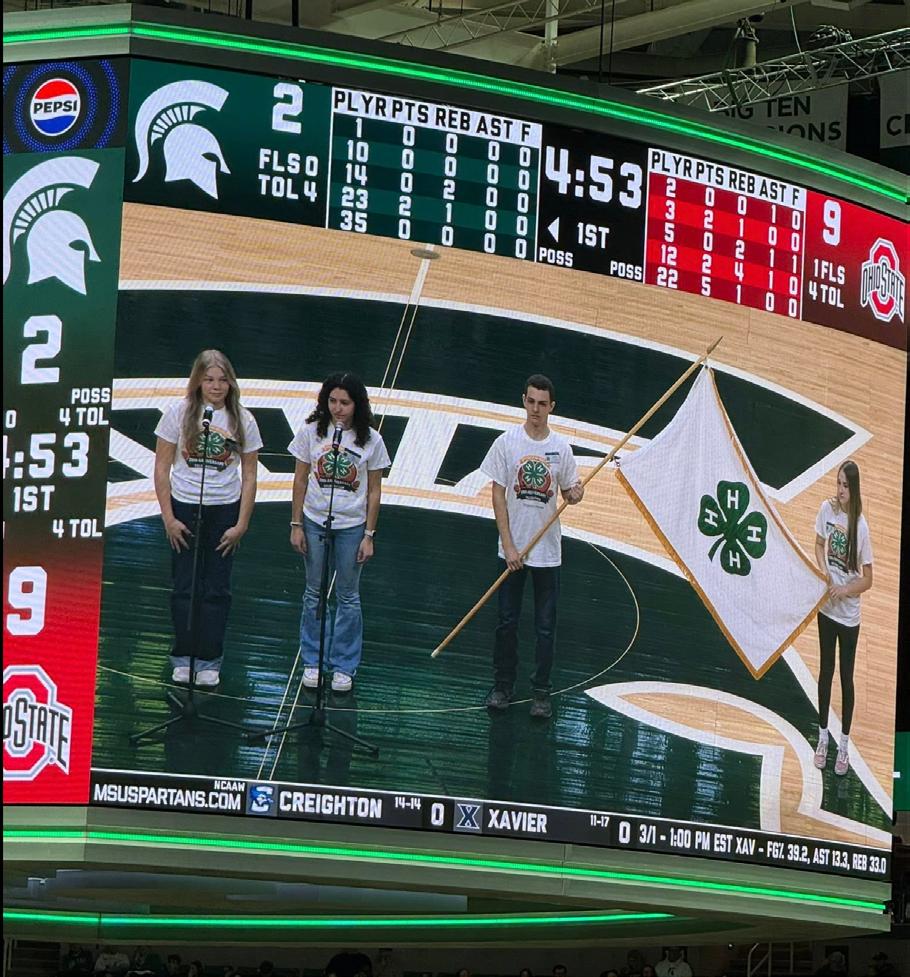
Figure 3. Use of various types of seed treatments on soybeans according to a grower survey. Courtesy of ASA/USB.
The more we discover about soybeans, the more valuable they become. One innovative product, SoyFoam™, creates a new, sustainable use for your crop that protects firefighters and the planet. See how your Soy Checkoff is unlocking new markets for soybeans at unitedsoybean.org