Epstein files reveal two families sought Epstein’s help with UMich admissions
While Epstein implied he had met with an unnamed U-M employee, The University denies any outside influence in admissions
ALEXA CHEANEY Daily Staff Reporter
According to documentation released by the U.S. Department of Justice, two families sought help from Jeffrey Epstein during the undergraduate admissions process at the University of Michigan between 2013 and 2014. However, neither applicant was admitted and the University denies any third-party influence within the admissions process.
Eric Roth, president and CEO of International Jet Interiors, began an email correspondence with Epstein in May 2013 by asking whether Epstein had any connections that would help admit his daughter Rachel into the University.
“My old=st daughter is a junior in high school and has her mind set on The =niversity of Michigan,” Roth wrote. “Do you have any connections there?”
Documents released by the DOJ show the two men spoke frequently throughout the 2010s regarding both business and personal matters. Roth appears more than 5,400 times in the released files. Epstein looked over several admissions essays for the family, who gave him Rachel’s application number.
Communications released by the DOJ do not indicate whether Epstein had connections at the University, though in June Roth offered him a $7,500 discount on an entertainment system in exchange for helping Rachel get into the University. In response, Epstein wrote he would help Roth’s daughter but didn’t want the discount.
“i can help with michigan,” Epstein wrote. “i=dont want your money.”
During the application process, Roth sent an already submitted copy of Rachel’s Early Action application to Epstein, who provided general essay guidance and pointed out multiple grammatical and spelling errors. He noted these could stifle her chances of gaining early admission. Roth wrote he was thankful for Epstein’s assistance.
“Thank you for everything you are doing to help me with my daughter – it is appreciated more than you know,” Roth wrote.
On March 28, 2014, Roth wrote Rachel had been rejected and asked for guidance on a possible admissions appeal.
“You said that there are always a couple of spots that colleges keep open, and I am wondering if there remains an opportunity at University of Michigan for her through you and your relationships?” Roth wrote.
The Roth family drafted a letter of appeal to the University and sent it to Epstein asking for feedback. In response, Epstein said the letter “needs a great amount of editing.” Documents released by the DOJ do not specify whether the family submitted the letter.
On April 7, Epstein implied to Roth that he had met with an unnamed individual from the University on behalf of the Roth family. After the meeting had concluded, Epstein described the
situation to Roth as “complicated but not hopeless.”
In a statement to The Daily, Paul Corliss, University assistant vice president for public affairs and internal communications, wrote that no outside influence sways admissions decisions.
“The University uses a rigorous, holistic undergraduate admissions process to evaluate every applicant on their individual merits,” Corliss wrote. “Each application in its entirety is reviewed at least two, and sometime s three times, by application reviewers and admissions decisions are made independently, based on the qualifications and credentials of the applicant.”
CONTINUED AT MICHIGANDAILY.COM
NEWS BRIEFS
Pentagon taps UMich as potential fellowship partner after ending Ivy League programs
“We must develop strategic thinkers through education grounded in the founding principles and documents of the republic.”
BRADY MIDDLEBROOK Daily Staff Reporter
A memorandum published by Secretary of War Pete Hegseth Feb. 27 named the University of Michigan as a new potential partner institution for the Department of War’s senior service college fellowships program.
The announcement was accompanied by the termination of several existing university-DOW partnerships, including all five partnerships with Ivy League institutions and partnerships with private institutions including Georgetown University and Tufts University. The other potential new partnerships include many public universities, such as the University of Florida and the University of Nebraska. The changes are set to take effect during the 2026-2027 academic year.
The SSC fellowship is a 10-month educational leadership development program designed to provide national security, policy and strategy education to military officers, who can advance to more senior positions after the completion of their fellowships. Enrollees receive this training
at the United States Army War College and at partnered universities, called professional military education institutions. In the memorandum, Hegseth wrote that he was unsatisfied with the education provided by current partner universities and the new partnerships are intended to instill American ideals in military officers.
“Our PME institutions must return to the fundamental mission of focusing our military leaders on core national security strategy issues,” Hegseth wrote. “We must develop strategic thinkers through education grounded in the founding principles and documents of the republic, embracing peace through strength and American ideals, and focused on our national strategies.”
In an email to The Michigan Daily, University spokesperson Kay Jarvis acknowledged the potential partnership and said the University will have an expedited review process for military applicants who have been accepted into Harvard University’s John F. Kennedy School of Government, which has lost its PWE designation and will no longer be hosting the SSC fellowship.
CONTINUED AT MICHIGANDAILY.COM
AA&PI Heritage Month opening ceremony celebrates resilience with creative expression
“Our art is unapologetic and inherently profound. Whether implicit or explicit, creative expression sends an important message: Our communities are still here.”
More than 200 students and community members gathered in the Rogel Ballroom of the Michigan Union Thursday evening for the Asian American & Pacific Islander Heritage Month Opening Ceremony & Art Fair. The event kicks off a month-long celebration of AA&PI heritage and culture at the University of Michigan sponsored by the Trotter Multicultural Center and the Office of Multi-Ethnic Student Affairs.
This year’s theme, “Anthems: Our Pride and Power,” aims to highlight community justice and liberation through artistic storytelling. In an interview with The Michigan Daily, LSA senior Izzy Lamug, a co-coordinator for AA&PI Heritage Month, said she and LSA senior Tyler Nguyen, fellow co-coordinator, created the theme by reflecting on the importance of art in AA&PI identities.
“The idea that I started with was this idea of translating ideas, thoughts and feelings that cannot necessarily be spoken into words, but can be expressed through other forms — such as dance, music, fine arts, visual arts like drawing or painting — that kind of get at those feelings inside you that are hard to spit out,” Lamug said.
racist panic, — all of that exists. The representation problem I want to start out with, though, is not external to us. It’s internal to us. It’s how we see ourselves.” Chu reminded the audience to reflect on the strength of AA&PI activists in U.S. history who are often forgotten. He said it is important for AA&PI people to learn from and embody the drive of advocates such as Joseph and Mary Tape, Wong Kim Ark and Mabel Ping Hua Lee, who he said reflect the unity of different groups within the AA&PI identity.
“Asian America doesn’t exist because we’re the same,” Chu said. “It exists because we’re different, and we want allies when we show up at the table to fight for ourselves and fight for people like us, to fight for people not like us. … The whole point of Asian America is that we choose to belong to each other.”
“Inside the richness of belonging to our cultures, belonging is also understanding,” Lamug said. “It is learning our histories of exclusion, colonialism, imperialism and refugeehood that brought our ancestors here and finding where we fit into their narratives.”
Nguyen, a Vietnamese American with refugee parents, said the resilience and activism of AA&PI people throughout American history set the precedent for action today. He said AA&PI Heritage Month can bring these communities
Greenwood, a FilipinoAmerican student band at the University, welcomed guests through song as attendees filled the ballroom. Lamug and Nguyen then began the opening ceremony. Lamug told the audience that celebrations of food and community connect her to her heritage as a Filipino American.
together during a time of heightened racial tension and fear among immigrant communities after fatal encounters with U.S. Immigration and Customs Enforcement.
“With threats to communities of Color, domestically and abroad, notably ICE and violence in Minnesota, I believe Asian American and Pacific Islander history compels us to act,” Nguyen said. “(AA&PI) Heritage Month is a time for us to be in conversation with one another, celebrating our culture and experiences and situating them within our calls for collective liberation.”
Nguyen continued, saying creative expression of Asian
Americans and Pacific Islanders strengthens their stories.
“Today, whether it be through global breakthroughs of Asian American Pacific Islander filmmakers, visual artists and writers or the elaborate student culture shows put together on this campus, these legacies are being carried on,” Nguyen said.
“Our art is unapologetic and inherently profound. Whether implicit or explicit, creative expression sends an important message: Our communities are still here.”
Next, Lamug and Nguyen introduced Jason Chu, a ChineseAmerican rapper and activist, the event’s keynote speaker. Chu, who creates music for several
video games and TV shows, also educates viewers on AA&PI culture and history through his TikTok and Instagram.
Growing up in Delaware suburbs, Chu said he learned the importance of exploring his racial identity from hip-hop figures from record labels like Def Jam Recordings. Chu said when he began to define his own identity through rap, he realized AA&PI communities are often poorly represented or generalized with negative stereotypes.
“The media shows us with this ‘Red Scare’, ‘Yellow Peril’, ‘oriental’ views,” Chu said.
To close the event, students and community members were encouraged to reflect on Chu’s words and continue in casual conversation while exploring a student-run art fair.
In an interview with The Daily, Business freshman Lindsey LuMarque said she appreciated the reminders of the strong history of activism that AA&PI people have established in the United States.
“Seeing the different types of activism that a lot of the (role) models have done, it kind of made me reflect on how I could do something like that,” LuMarque said. “It doesn’t take too much effort in order to make such a big impact. Seeing that kind of representation, seeing it still a current thing today — it’s very impactful.”
PATRICIA LEONCIO Daily Staff Reporter
Maisie Derlega/DAILY
A walk through
Ann Arbor showcases garbage and graffiti
— but the city
wants to change
that City council will soon vote on increasing the portion of tax revenue that goes towards upgrades to the city’s streets and sidewalks
A walk through Ann Arbor features gleaming lights, charming storefronts and grandiose murals.
Voted as one of the best college towns in the United States, the city has gained a reputation as an inviting place for visitors to spend an evening shopping, dining or simply discovering what the streets have to offer.
However, visitors often see illegal graffiti lining the walls of historic buildings as they step over piles of garbage on the ground. Residents are increasingly frustrated with
Ann Arbor’s appearance, but the sights of the city may soon change.
On April 20, the Ann Arbor City Council will vote on whether to approve the Downtown Development Authority’s Tax Increment Financing Plan, which would increase the portion of tax revenue funding upgrades to the city’s streets and sidewalks. While the DDA is not currently responsible for maintaining downtown, DDA Executive Director Maura Thomson told The Michigan Daily the extra funding would allow the DDA to create a service team in charge of picking up trash from the city’s sidewalks.
“This downtown service team would be focused on mainly cleanliness,” Thomson said. “It would be sidewalk cleaning, tree grates, tree pits, gutters, handbill removal — a lot of our light posts have so much tape and posters that nobody takes down — some graffiti removal on public property — we can’t touch private. So really, our intention is to have zero tolerance for trash on our downtown sidewalks.”
Just west of the Diag, planters painted by Art & Design lecturer William Burgard and his students line the sidewalks on North University Avenue and State Street. In an interview
with The Daily, Burgard said he noticed the trash in the area as he painted.
“As I would go to work on the planters, it was just unbelievable to me that trash could sit there for a week,” Burgard said. “I’d see the same bottles and the same containers and junk. … They just don’t pick it up.”
Despite the litter, Burgard and his students finished their work last year. The painted feet adorning them reflect the many different people who walk or cycle through Ann Arbor every day.
CONTINUED AT MICHIGANDAILY.COM
Meet the Democratic candidates for the Board of Regents
Three candidates — incumbents Paul Brown and Jordan Acker and challenger Amir Makled — are competing for the Democratic Party’s 2 nominations
GLENN HEDIN Daily News Editor
The Board of Regents governs the University of Michigan, manages its budget and selects the University president. Eight regents serve on the board for eight-year terms. Elections are staggered, with two regents elected every two years alongside presidential and midterm election cycles. The Board currently consists of six Democrats and two Republicans. The race has been dominated by issues of affordability, accessibility, freedom of speech and federal pressure from President Donald Trump’s administration. Makled is a critic of the Board’s compliance with federal directives on issues
including diversity, equity and inclusion and gender-affirming health care for minors. Acker and Brown have defended the University’s actions while calling for more robust action at different points. While the two incumbent regents largely hold similar positions, many progressive activists on campus — such as those from the TAHRIR Coalition — prefer to see Acker replaced due to his vocal opposition to the divestment of the University’s endowment from Israel. Brown also opposes divestment, but has taken less forceful public stances on the matter. Makled has voiced his support for “ethical investments.”
The candidates will not compete in a statewide Democratic primary. Instead, a state endorsement convention will be held in Detroit on April 19. As anyone who has registered with the Michigan
Democratic Party before March 20 may attend and vote in person, Makled has frequently campaigned on campus to garner student support. CONTINUED AT MICHIGANDAILY.COM
Meet the Republican candidates for the Board of Regents
Two candidates — Lena Epstein & Michael Schostak — are set to be the Republican Party’s nominees in November
GLENN
Stanford Lipsey Student Publications Building 420 Maynard St. Ann Arbor, MI 48109-1327 734-418-4115 www.michigandaily.com
EDITH PENDELL and ZACHARY AJLUNI Co-Editors in Chief eic@michigandaily.com
CICI COPENHAVER Business Manager business@michigandaily.com
NEWS TIPS tipline@michigandaily.com
LETTERS TO THE EDITOR tothedaily@michigandaily.com
EDITORIAL PAGE opinion@michigandaily.com
PANYADAHUNDI and CHRISTINA ZHANG
Isabel Seniawski, Mateo Alvarez, Sarah Zhang
LYRA SHARMA and GRAHAM BARKER Managing Sports Editors sports@michigandaily.com Editorial Staff
AHTZIRI PASILLAS-RIQUELME and EVAN KRUMMEL Managing Video Editors video@michigandaily.com
Special Projects Coordinator: Shubhankar Dhulia Senior Video Editors: Cameron Detulleo, Gretel Foglesong, Savannah Otten
AMARA M. SMALL and IHAA MOHAN Michigan in Color Managing Editors michiganincolor@michigandaily.com Senior MiC Editors: Ahmed Elkhatib, Arya Kamat, Muntaha Rahman
AVA CHATLOSH and MEGAN GYDESEN Managing Podcast Editors podeditors@michigandaily.com
ANNA MCLEAN and DANIEL JOHNSON Managing Focal Point Editors lehrbaum@umich.edu, reval@umich.edu
Senior Focal Point Editors: Lucy Langerveld, Sasha Kalvert
JAMES KNAKE and MILAN THURMAN Managing Games Editors crosswords@umich.edu
Senior Games Editors: Eleanor Sullivan, Kiran Parekh, Sam Martin, Tobin
DOMINIC APAP Daily News Editor
Vivian Tai/DAILY
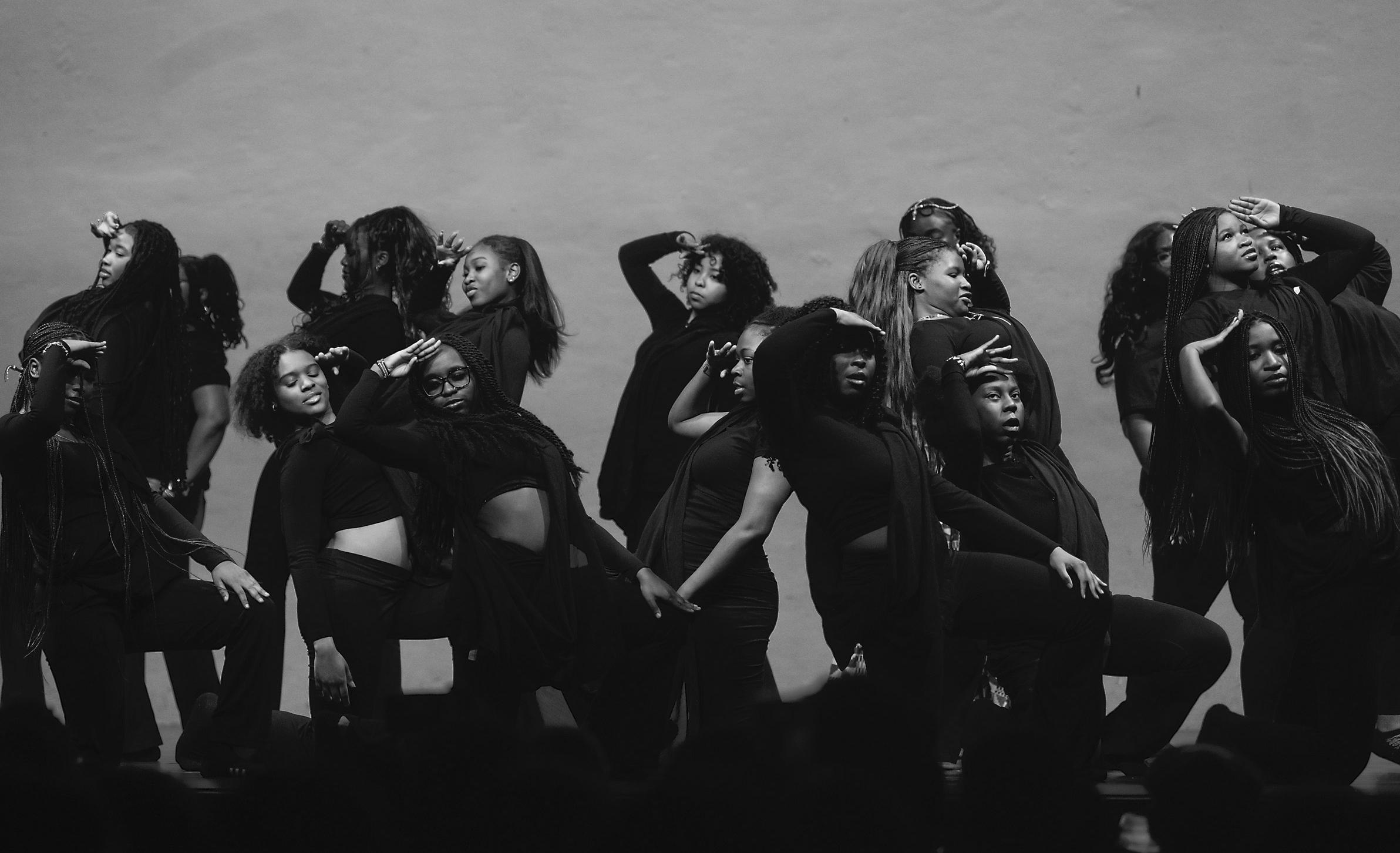
The cast performs the play “Princess Yennenga and the Baobab Tree” during the African Student Association’s 27th annual cultural show Saturday evening at the Lydia Mendelssohn Theatre.
ANN ARBOR
Matthew Prock/DAILY
Matthew Prock/DAILY
There is such a thing as thinking too much about one thing. Painter-turnedwriter Larissa Pham gives readers an incessant amount of introspection in her debut book, “Discipline.” The novel follows central character Christine as she releases a novel that dramatizes her relationship with her older professor and mentor, Richard — a relationship that derailed her career. “Discipline” explores themes of power dynamics and what it’s like to only know a past version of someone. As Christine slowly confronts her trauma, the novel falls victim to issues with autofiction, plot cliches and the pretentious strive for uniqueness.
“Discipline” opens with Christine’s first book reading at a university. Structurally, Pham maintains intrigue by slowly releasing information through
‘Discipline’
chapters solely dedicated to conversations with strangers, past lovers or friends, while only hinting at the details of her and Richard’s relationship. These eventually build up to the final chapters, where Christine confronts the professor that she had an affair with. These conversations are compelling, investigating how people from Christine’s past have changed. Yet, she still knows and sees intimate details of their past selves slip through, whether in terms of sexuality, habits with alcohol or their inherent competitiveness in a subjective field. In these chapters, Pham weaves dialogue with immersive imagery. Easily developing vivid, subtle and detailed mental images, she quickly engrosses readers in her fictional world.
The novel is rarely driven by action but rather by Christine’s reflections and analyses of her past and present. However, her reflections verge at times on unfocused or — despite her insistent overthinking — are
thinks too much and not enough
not teased out enough, resulting in unmotivated actions and underdeveloped reasons as to why her relationship with Richard was so impactful, beyond the obvious power dynamic. Pham attempts to comment on power dynamics by reversing them near the novel’s end — an attempt that only accentuates its over-reliance on common tropes. Not only is the novel an overdone story
about a relationship with an older professor, but when they reconnect in an attempt at a role reversal, Pham once again utilizes a predictable narrative cliche to foster this.
But, Christine’s narration also has an extremely detached, emotionless tone that is overly focused on the physical, making the highly emotional scenes read awkward. At one point, Christine regrets coming
to Maine to reconnect with Richard. While she haphazardly packs her bag to return home, she finds herself on the floor sobbing. Richard takes this moment to tell her the reason behind why he asked her to meet. This scene should have been a turning point, a shift in the dynamic; however, because of Pham’s detached tone, this scene holds zero emotional impact.
Sure, Pham could be attempting to continue the novel’s initial intrigue by not including all the details. Or this could be an attempt at commenting on trauma’s elusive nature, even to the person who experienced it. But the lack of grounded, revealing information that feels crucial to this novel only creates confusion, not mystery.
One of Christine’s most interesting qualities, even if intentionally annoying, is her drive for uniqueness. She is a pretentious person, always trying to be the best or the only person capable of telling a certain story. Christine becomes entirely consumed by the period of her life when she was with Richard, never fully allowing herself to move on and is constantly reliving it on her book tour and at the same time that she reconnects with Richard. In some ways it makes sense, but it’s also tiring to read.
Autofiction is a delicate form, one capable of allowing a situation to gain too much importance and definition over one’s life or character; Christine and her fantastical memoir illustrate this issue exactly. But there is a small glimmer of hope for Christine. By the end of the novel, she is finally questioning how she has let this relationship define her life’s narrative: “I’ve let him have this hold on me, I’ve let this story become the only story I know how to tell. And I want so desperately for there to be a reason, but there will never be a reason, not one good enough that he can give me.” A revelation one only wishes would have come sooner.
Decks and defecation: ‘Neighbors’ docuseries premier
At first, the concept of documenting real-life conflict between neighbors seems straightforward and unoriginal:
We’ve all seen Nextdoor users enraged at the prospect of lemonade-vending children and Ann Arborites debating over party barn operation.
However, Josh Safdie’s new docuseries, “Neighbors,” brings a new dimension to the concept of residential drama.
While maintaining the typical outlandishness of reality TV, the show also links conflicts to deeper political tensions that feel alarmingly familiar.
Fences have long held symbolic importance in how we think about and discuss those we live near — think the American ideal of a
uniform lawn with a white picket fence, or how “good fences make good neighbors” — and they take a central role in the lives of Josh Alspaw, Seth Collins, Sara Day and Eric Wilhelm, the featured contenders of the show’s premiere episode. But their story is not just the exaggerated result of petty squabbles over property lines; instead, the cartoonish arguments between self-righteous adults are revealed to act as a microcosm of cultural tensions surrounding property rights, political radicalization and rationality.
Oftentimes, documentaries focus on the extraordinary in order to generate audience interest. Arguably, however, the most thought-provoking aspects of “Neighbors” are the events and conversations that feel the most familiar. The escalating feud between Alspaw’s and Collins’s families in rural
Montana, while entertaining in its startling absurdity, seems deeply predictable in the current cultural context.
Gradually, Collins’s references to QAnon conspiracy theories, the importance of preserving the “country” from the “city” and his family’s favorite hobby — targetshooting while blasting country music — paint a very clear picture. The conflict hasn’t escalated purely from stubbornness, but from exceptionally fraught and common foundational principles. The concept of rights in America — property rights, FirstAmendment rights, privacy rights — is highly provocative and takes on a wide range of connotations in political conversations. As a result, these rights are a handy focal point for arguments that employ broader cultural conflicts. In the show, the right to use specific land — or keep others off of it — is often less
about practical freedoms and more about the believer’s effort to defend their values and life philosophy. This purpose is highlighted by the interpersonal history of each conflict as revealed throughout the episode. At least one member of both sets of neighbors at some point declares they are the victim of a “liberal mob.” In essence, this dramatization of residential conflict allows us to view a highly personal disagreement through the lens of those exacerbating it as an outlet for political frustrations. These disagreements serve as platforms for characters to prove themselves as rational victims of the emotions of those around them. This cultural trend of channeling political tensions into personal battles of will is given new depth by the portrayal of explicitly and ambiguously threatened violence in “Neighbors.” While often depicted as absurd and
cartoonish — this tone highlighted by the questionable usage of special effects in the filming of some especially contentious scenes — the arguments persist with an undercurrent of unnerving volatility. The radically unhinged views of the Collins’s, the confrontations of self-proclaimed “First-Amendment Auditor” Mike Norton and third-party neighbor Randall Oberg’s threats of gun violence remind the audience just how seriously we should take the show’s political and cultural tensions. This newfound depth to the portrayal of over-the-top residential drama reminds us of the reality — and potential influence — of interpersonal conflict within our own lives. While violent runins with neighbors may seem uncommon and easily avoidable when we stay in our comfortable bubbles, the cultural and political tensions that they
involve are present in the news, social media and entertainment we stream every day. Even if one steers clear from intentional confrontation with radicalized conspiracy theorists, what can happen when someone brings property rights as a political symbol to your backyard? Such cultural issues are complex and messy, and they’re not going away anytime soon. But neither are the conflicts portrayed in “Neighbors.” Its true impasses, doomed to best-case nonviolent conclusions, seem beyond rational intervention despite the assertions of some of its guests. The ineffectual mediating efforts of RJ Dieken, and his comments on the subject, help to summarize the helplessness and absurdity of this situation: “I don’t feel super confident about what I’m gonna do, but, how do you eat an elephant? You do it one bite at a time.”
SARAH PATTERSON Daily Arts
only hope comes true as a result of this column. This question has been edited for clarity. How do I dress well as a man without seeming performative?
– E I’ve had a few questions about men’s fashion. I must say I am flabbergasted that anyone would trust me with styling men, but I’m equally enthusiastic about the challenge.
I have something to confess. Men are often on my mind. As of late, I’ve been centering men. And by centering men, I mean talking egregious shit about disgusting men with my best friend. We’re known for hating men — me more than her. That is, up until about a year ago, when, against all of my manhating tenets of womanhood, I got a boyfriend. (But, seriously, guys, he’s not like the rest.) Now, as my aforementioned best friend and I turn over new leaves — she just dyed her hair brown after a lifetime of being blonde — I’m also beginning to think some men are capable of empathy. After a long stint of only interacting with men who trigger a physical recoil, I’ve realized maybe the “not all men” rhetoric may actually be true. For these select few men seeking to expand their empathetic capabilities and move beyond Clairo-baiting their romantic prospects, I suggest (get this!) seeing women as unique individuals who are worthy of your individual effort. The worst that can happen is that a beautiful woman manipulates you — a thrill I can
The internet’s manufactured “performative male” archetype took over last summer. The concept of this question feels steeped in chronic online-ness. Nevertheless, we persist past the internet’s archaic assertion that fashion is not for everyone I think a lot of what makes the “performative” male style so annoying is that it often feels disgustingly insincere. I don’t deny a man’s right to carry things sensibly in a tote bag or
wear a slutty little cardigan, but it feels like the “performative” men are treating traditionally feminine aspects of fashion as a shiny lure to catch only the prettiest fish in the sea. It’s not that they actually acknowledge Clairo’s genius; it’s that they know the girl in their random humanities lecture does. It’s always important to dismantle the gender constructs we have around certain pieces of clothing. Even though it can be helpful to reference internet aesthetics for inspiration, leaning into the specific aspects that make those “performative” outfits appealing to you will help you find your own personal spin on the look. As you slowly recognize the patterns in your fashion preferences, you’ll be able to string outfits together that feel and look more like they’re straight out of your beautiful mind rather than the performative male fashion machine. Do the work to make your outfit the embodiment of you, not the sensationalized “performative male.” Then, and only then, will the Clairo lovers come up to you unprovoked. Take heart, young grasshopper. Caring about fashion makes me like you despite your man-ness.
MARGARET COX Daily Arts Contributor
Writer
Maisie Derlega/DAILY
Cecilia Ledezma/DAILY
CHLOE JARRETT
Courtesy of Penguin Random House
Book recommendations for Women’s History Month
March is dedicated to celebrating women’s voices and recognizing the many contributions they have made throughout history, as well as the hundreds of thousands of women who have been forced into silence. From the women we know in our personal lives — the mothers, aunts, daughters and grandmothers — to those who have made significant strides in politics or science, The Michigan Daily Book Review is taking the time to recognize their value. Our writers have compiled a list of book recommendations that will remind us of the unique experience of womanhood as well as the beautiful and complex history behind it.
Meagan Ismail & Archisha Pathak
Senior Arts Editor & Books Beat Editor
“Wide Sargasso Sea” by Jean Rhys
“She’s mad but mine, mine.” The madwoman trope can be traced back in literature to Charlotte Brontë’s “Jane Eyre.” Readers are introduced to Bertha Mason: the deranged woman locked in Mr. Rochester’s attic and the ghost that frequents Thornfield Hall. But aside from her role in threatening the marriage of Mr. Rochester and Jane and committing acts of destruction, little else is revealed of the haunted character.
More than a century later, in response to “Jane Eyre,” Jean Rhys wrote “Wide Sargasso Sea.” Rhys’ novel is a reimagining of Bertha’s life, acting as a postcolonial prequel to the popular classic novel. Rhys gives Bertha the name Antoinette Cosway and places her in 1830s Jamaica. We follow her mother’s descent into madness after she’s married off to an Englishman and faces trauma and neglect, knowing that Antoinette is doomed to a similar fate. The novel explores the theme of madness as a consequence of patriarchal and
colonial oppression, with Mr. Rochester — an intentionally firstnameless character — being the embodiment of these structures.
“Wide Sargasso Sea” brings a new perspective to this madwoman in the attic, critiquing the systems that strip Antoinette of her agency and identity while developing a complex and intersectional backstory that has been overlooked. After reading Rhys’ novel, it’s impossible not to view Mr. Rochester, and all that he represents, as the true monstrous figure of “Jane Eyre.”
Meagan Ismail , Senior Arts Editor
“Elena Knows” by Claudia Piñeiro
Sometimes, the most significant women we know are those who never get recognition. They exist in our families and friendships, holding the silent places in our lives that can be even more meaningful than the ones in movies or the news. Yet these relationships can also be tense; family can be complicated and people may have different ways of expressing affection.
Claudia Piñeiro’s “Elena Knows” highlights one such relationship, following an elderly mother investigating the death of her daughter, Rita, which was ruled a suicide. Elena’s journey is made even more difficult by her sickness and disability, but her desire to discover the truth about her daughter carries her forward.
In spite of this novel’s short page count, its message is mighty. As the plot unfolds, it becomes even clearer that this novel is hardly about the mystery: It is about motherhood and what it means to love someone unconditionally. Elena and her daughter have a relationship that can most easily be described as tense, yet you never truly question whether Elena loves her daughter. You will be in awe of Elena’s strength. You will cry with her and feel her pain while rooting for her from start to finish.
Translated from Spanish and earning its position on the
International Booker Prize shortlist in 2022, “Elena Knows” transcends geography. The love and difficulty it depicts is ubiquitous and indiscriminate. Its message is loud and will burrow itself into your hearts, making it the perfect read for this month and for you to carry with you.
Archisha Pathak
Books Beat Editor
“The Dictionary of Lost Words” by Pip Williams
“I realized that the words most often used to define us were words that described our function in relation to others. Even the most benign words — maiden, wife, mother — told the world whether we were virgins or not. What was the male equivalent of maiden? I could not think of it.”
Minorities, people of lower classes and, more often than not, women, find themselves at the peripheries of society. Their lives and contributions are lost because those in charge have deemed them unworthy of recording.
Although a fictional tale, the heartache, power and strength in “The Dictionary of Lost Words” is wholeheartedly real. The book follows Esme Nicoll, the daughter of one of the editors of the original Oxford Dictionary.
Esme is enamored by words, but slowly realizes that the men deciding which ones belong in the dictionary aren’t necessarily always right. She spends her days helping her father with the dictionary for little recognition and pay, but in secret, she collects the words from the corners of society that would never find their way to the editor’s room.
Set in the midst of the Women’s Suffrage movement in England, “The Dictionary of Lost Words” is the raw journey of a woman who realizes her privilege and decides to act on it. Esme teaches us the importance of language, and begs the question: How many true stories like hers have simply gone unwritten?
Amany Sayed , Daily Arts Contributor
“Wild Swans: Three Daughters of China” by Jung Chang
Though written primarily to reveal the realities of living under Mao Zedong’s Communist regime, “Wild Swans: Three Daughters of China” also teaches readers about the lives of Chinese women from feudal era China to the Communist liberation movement.
In her memoir, Jung Chang tells the lives of herself, her mother and her grandmother through the various political and social changes in China; in doing so, she also highlights the struggles the women had to face at different points in national history.
We learn about the gruesome practice of foot binding and the hierarchical structure between concubines, wives and servants from the stories about Chang’s grandmother, Yu-Fang, who married a warlord to help her family both politically and financially. Chang’s mother, De-Hong, was an ardent activist for the Communist movement in her youth and eventually a Communist Party official. What stood out the most in her narrative was the harsh conditions she had to endure, like walking on foot during harsh winters, even during her multiple pregnancies, for the fear of
appearing disloyal to the revolution.
And from Chang’s own experiences, we were able to glean a perspective shift where she becomes gradually more disillusioned with Mao’s tyrannical and fanatic rule.
The storytelling of the memoir is immersive and illuminating — and not in a history textbook kind of way. Chang’s memoir is told with an intimacy that invites the reader to know each character personally.
Even today, “Wild Swans” is still banned in many parts of mainland China for its critical portrayal of Communism. “Wild Swans” is more than a piece of political activism or a spotlight on a piece of history that is easily glossed over; it is a testament to women’s resiliency to stay true to themselves, serve their families and maintain their humanity in the face of large waves of adversity.
Michelle Wu Senior Arts Editor “Know My Name” by Chanel Miller
I’ve never been a big fan of audiobooks. I doze off easily, the words jumbling up in my brain and turning into alphabet soup as I struggle to remain focused.
But if there’s one audiobook I will recommend for the rest of my life, it’s “Know My Name” by Chanel Miller.
“Know My Name” recounts the story of
and survivor
anonymously known as Emily Doe. She was assaulted in 2015 by Stanford student-athlete Brock Turner at a frat party, and her memoir is her attempt at reclaiming her identity, her trauma and her story, all through the power of words.
By transforming the way we think about sexual assault forever, Miller’s powerful, gut-wrenching memoir challenges societal beliefs about what we usually consider right versus wrong and, consequently, fair versus unfair. Miller not only tells her story, she walks us through her healing process and how, years later, she is still recovering from the event that changed her life without her consent.
“Know My Name” is one too many stories of survival that did not have to happen, but surely deserve to be told and, beyond that, listened to. This Women’s History Month, make an effort not only to read books by female authors, but to actually listen to what they have to say.
Graciela Batlle Cestero, Daily Arts Writer CONTINUED AT MICHIGANDAILY.COM
sexual assault victim
Chanel Miller, once
Emmeline Meldrum/DAILY
Unplug the classroom — even for college students
Earlier this month, Michigan Gov. Gretchen Whitmer signed a bill banning cell phones during instructional time in K-12 classrooms, joining nearly three dozen other states with similar restrictions. The new law passed with bipartisan support and an endorsement from another writer on this very Opinion page. I’ll join the chorus heaping praise upon Whitmer for her decision, but I’ll take her logic a step further. I think there’s a compelling case for going fully unplugged at universities — at least in the liberal arts.
It’s no secret that higher education is in crisis. The rise of artificial intelligence, shifts in the political landscape and broader questions about the value of a college degree are forcing schools to adapt. While there’s no silver bullet for solving all of these problems, embracing unplugged learning would be a step in the right direction.
Laptops and cell phones began appearing in college classrooms
sometime in the late 1990s or early 2000s. I have no doubt that educators at the time assumed easy access to knowledge and smoother forms of note-taking would enhance the learning experience. It’s a fair assumption, and in a vacuum, likely a correct one. No student should have to check out a book to find out where Abraham Lincoln was born when the answer is readily available on Google, nor should a student have to handwrite pages of notes if they prefer to type. But in the aftermath of the COVID-19 pandemic, that conventional wisdom no longer applies. The development of hyperaddictive social media, video games and online shopping have opened the door to distractions that simply didn’t exist before. These alternatives to learning have become so appealing that it’s difficult for professors to compete.
Simultaneously, AI has allowed students to avoid the consequences of screwing off in class. The desire not to sound silly in front of one’s peers used to incentivize paying attention, but now, students can simply tag in ChatGPT.
This fact, more than any other, should lead educators to grapple with the consequences of personal technology in their classrooms. In an interview with The Michigan Daily, Jeremiah Chamberlin, a lecturer in the English department, described how AI is changing his view of education.
“AI is asking us to better understand what most matters to us as instructors. If process is more important than product, then let’s lean into process,” he said. “The goal of writing a paper isn’t to write a paper. It’s to become better at writing through the process. It’s like how using a StairMaster isn’t to get to the top of the stairs. It’s to become stronger.”
Chamberlin is right. There’s a fine line between optimizing learning and replacing it. Where Google may have accomplished the former, AI generally leans toward the latter. Though unplugged learning has largely developed as a response to this threat, Chamberlin made clear the importance of not seeming reactionary.
CONTINUED AT MICHIGANDAILY.COM
Fishbowl guppies
ERIN ZEMBLAKU Opinion Cartoonist
From The Daily: After senseless negotiation suspension, GEO needs to focus on ICE
Every three years, the Graduate Employees’ Organization renegotiates its contract with the University of Michigan. The past two of these bargaining sessions have ended in strikes, and it appears that Micki Czerniak, state-appointed mediator for negotiations between the University and GEO, may help incite a third one. On Feb. 12, Czerniak paused all contract negotiations between GEO and the University for 28 days, citing what she deemed inappropriate tactics from the union’s representatives.
While GEO shares some of the fault for the paused negotiations, this Editorial Board believes that Czerniak’s justifications for suspending negotiations are, in short, baseless. In response, GEO must continue to advocate for fair working conditions, especially realistic protections from the U.S. Immigration and Customs Enforcement.
This Editorial Board took a closer look at Czerniak’s letter. Here are the most notable points. Coercion
“On February 6, 2026, in the course of bargaining a labor contract under the auspices of a State Mediator appointed by the Michigan Employment Relations Commission (MERC), a group of approximately 100 people led by members of Graduate Employees Organization, AFT Local 3550 (GEO), left the bargaining room assigned to them to converge on the private caucus room assigned to the 5-member University of Michigan Bargaining Committee (University). The stated purpose of this action, according to GEO’s own social media, was to exert pressure on the University to negotiate face-to-face rather than utilizing the State Mediator to pass and receive proposals at the bargaining table. This confrontation was filmed and posted by GEO on Instagram.
What is commonly considered to be peaceful protest activity in the ‘public square’ may be prohibited conduct pursuant to the Public Employment Relations Act, P.A.336 of 1947, (PERA) when such activity takes place in the context of bargaining/mediation. PERA Section 10 provides in pertinent part:
(3) A labor organization or its agents shall not do any of the following: (b) restrain or coerce a public employer in the selection of its representatives for the purposes of collective bargaining or the adjustment of grievances.”
Shuttle bargaining has emerged as one of the most contentious aspects of the current negotiation session. While GEO’s decision to hand-deliver a request to the administration for an end to the practice may have been unorthodox, it certainly doesn’t fit the description Czerniak is trying to manufacture. No reasonable interpretation of the video evidence leads to the conclusion that the incident was a “confrontation” — let alone amount to restraint or coercion.
GEO’s members did not intimidate or threaten the recipients of their letter. The claim that the request is coercive is an inflated distortion of what took place, especially considering that GEO is operating from an inferior position of power under the University.
GEO Member Quote
“Most shocking is this statement by a GEO member in response to a question about whether the topic of ‘I.C.E. on Campus’ is permissive, rather than a mandatory subject of bargaining. He said “Anything that is a priority to us is not permissive. It’s mandatory, and we will force HR to talk about it.” (see “GEO and HR Stalemate Continues at Open Bargaining Session” by Patricia Leoncio, February 9, 2026, The Michigan Daily).
This fatuous declaration by a GEO representative is shocking for two reasons: (1) it indicates that the GEO intends to render its own rulings on mandatory subjects, thereby usurping the exclusive jurisdiction of the Michigan Employment Relations Commission (MERC) to determine whether a subject is mandatory, permissive or prohibited; and (2) it reveals that GEO intends to force bargaining on any subject it considers to be a priority. MERC has long held it to be an unfair labor practice to force bargaining on a non-mandatory subject of bargaining.”
Czerniak cites one GEO member’s statement as representative of the entire organization in order to justify a complete shutdown of negotiations. Her reasoning is flawed for several reasons. She extracted a quotation from a Michigan Daily article made by a GEO member without a leadership position in the organization. This individual’s opinion does not represent the organization’s official platform. Even so, it is unsurprising that GEO wants ICE to be a mandatory bargaining topic. Negotiations are meant to be a process where the union can address topics they determine important, and this statement represents the union’s desire to have their voices heard. It’s not surprising, it’s expected.
Czerniak uses this quote as evidence for suspension because there is no other damning reason to shut down negotiations. The language she uses to describe the quote is aggressive — labeling it “fatuous” and “shocking.” Plainly, she was all but looking for reasons to suspend negotiations and make GEO appear unreasonable in the process.
ICE as a Bargaining Point
“During the six mediation sessions held to date, I have observed escalating emotions surrounding an issue that GEO intends to advance in negotiations: “I.C.E. on Campus.”
GEO has posted its proposal to restrict I.C.E. on social media, using this controversial subject to draw more people into the bargaining process, including non-GEO members, nonbargaining unit members, union ‘allies,’ undergraduates and people who have no affiliation with the University of Michigan, as neither a student nor an
employee. Local news media has reported that GEO’s approach to contract negotiations is: “where all community members can witness and participate in bargaining.” There is no duty to bargain with the community under PERA.”
It is fair to say that some of GEO’s demands are less productive, like those calling for the ability to decline assignments without reason and demanding the demilitarization of the Division of Public Safety & Security and the University of Michigan Police Department in order to establish unarmed, non-police options. These platform points are unrealistic and unreasonable. That said, GEO is well within its right to raise concerns about the danger that ICE presence poses for students, faculty and the entire University. And yet, the University has an aversion to taking a stance against ICE, despite the danger the organization poses to campus security and its international student population. Czerniak echoes the University’s unwillingness to discuss ICE, claiming that GEO is using the issue as a means to garner community support, implying that they are taking advantage of the situation for their own gain. This blanket statement is offensive and dismissive of graduate student union members — many of them international students — who have valid reason to fear ICE presence on campus and in their workplaces. Ultimately, it is absurd for Czerniak to claim that ICE presence is an illegitimate bargaining topic within negotiations. GEO and the University are utilizing opposing strategies in negotiations: GEO wants to bring community attention to the negotiations, and the University doesn’t. Czerniak is taking the University’s route. Evidently, she was looking for reasons to postpone GEO and University negotiations at GEO’s expense. Her letter went to fantastic lengths to paint GEO as out of control so Czerniak could halt conversations for a “cooling off period.” This language is reminiscent of an adult scolding a child, not the state-appointed mediator communicating in good faith.
But GEO is right. The issue of ICE — for all of campus — is important. This Editorial Board recently urged the campus community to mobilize against ICE. This is where GEO has an opportunity. In this bargaining process, they must firmly advocate for the University to make a statement — something the administration has failed to do thus far.
Czerniak’s letter misconstrues GEO’s valid concerns about shuttle bargaining and hyperbolizes the significance of a member’s quote about ICE to justify the suspension. The University wants to avoid fulfilling GEO’s necessary requests, and by suspending negotiations on these grounds, she is making sure they don’t have to.
The suspension ends this Thursday, March 12. And when it does, GEO should work to emerge from it prepared and focused on what really matters: protecting the campus community.
Opinion
LARA TERPSTRA Opinion Columnist
When thinking about auto-racing, a woman driver may not be what comes to mind. While female interest in motorsports, especially in Formula 1, has increased over the past decade, female participation remains stagnant. The world of motorsports is hard to enter, requiring consistent success in karting and junior leagues.
Between 2017 and 2021, F1 has seen a 35% increase in female viewership, with 60% of these women being 16-24 years old. Interest in motorsports among women is increasing, but participation is virtually nonexistent. Unless individuals are born into a racing legacy, the chance of discovering a passion for motorsports is unlikely. With more women vocalizing their interest in F1, female representation and knowledge about the industry is imperative for achieving greater gender parity in the future of motorsports.
Women are becoming an integral part of racing media and engineering, with Haas’ Laura Mueller becoming the first F1 race engineer in 2025 for Haas driver Esteban Ocon, tasked with directing
race strategy and maximizing driver performance from the pit during races. Being the first full-time female race engineer, she has established herself as an asset to the team. She arguably occupies the most involved on-track position in F1 without actually being a driver. Women like Mueller bring new perspectives off of the track, but still need to become an asset on the track.
One of the most common obstacles that aspiring female drivers face is perceived physiological differences with males. However, motorsports racing is one of the only sports in which these differences do not impact one’s performance or lack thereof.
F1, the pinnacle of motorsports, has been working to dismantle barriers of
exclusion for women interested in racing. For instance, F1 Academy is a female league that is similar to the traditional F4 league which exposes aspiring drivers to single-seater cars, and works as a transitional league to F2 and F3, which are the direct feeder series into F1.
While the all-female academy has not sent drivers to F1 or their proceeding leagues, it does provide a necessary space for aspiring drivers to develop their talent and build a name for themselves in the motorsports industry. However, each driver is only eligible to hold a seat for up to two years in the league, and with the fast pace of the motorsport industry, these women are years behind their male counterparts.
CONTINUED AT MICHIGANDAILY.COM
Murder is murder
GUNNAR HARTMAN Opinion Columnist
When God sent his bolt of lightning to inscribe “Thou shall not kill” into the 10 Commandments, he apparently got the voltage wrong. Had he abided by the wisdom of President Donald Trump’s administration, he would’ve added a few extra asterisks to indicate some exceptions. At least one for Venezuelan fishermen, one more for women and children in Gaza and, if late revisions are possible, a third for unarmed American citizens exercising their inalienable right to free speech. Apparently, where the self-proclaimed most God-fearing administration is concerned, it is neither a crime nor a sin to shoot an unarmed man multiple times in the back as he is held face down by several police officers.
Perhaps we should give these commandments a closer look. That, or obey the laws that actually govern the United States of America. Those laws are far simpler. They tell us that murder is the unlawful killing of any individual with malicious intent. Vague and circular as it may be, this definition makes a pretty reasonable point: If someone chooses to commit the extreme and absurd act of taking another life, they better have a good reason.
That reason, it turns out, cannot simply be a Velcro badge attached to your vest. At least, it’s not supposed to be. But oddly enough, far too many people still hold that, when it comes to killing, police are somehow different. According to the National Association for the Advancement of Colored People, of the 98 officers arrested since 2005 for on-duty shootings, only three have been convicted of murder. On average, the police kill about 1,000 people annually.
Police killings are glorified in pop culture, repackaged as heroism, and until 2019, were not even counted or reported by a government data base. Federal agents are no exception.
I even bought into the narrative. In October, I published an article arguing we should amend the laws about qualified immunity for open
federal agents — including U.S. Immigration and Customs Enforcement officers — to include the threat of civil suit for overt illegal actions and civil rights violations against American citizens. That article rested on the same faulty premise: federal agents are a special class and any response to their transgressions should occur separately from the common civilian class of regular lawbreakers.
None of that is true. Even the president’s police force must obey the law. State and local law enforcement should remember that they can, and should, arrest federal agents for violent acts that go beyond the scope of their duties, regardless of their job titles. Federal agents who break the law are criminals — they should be treated as such.
Here is where most people will get skeptical. After all, the notion that a state or local authority could treat a federal agent as a common criminal feels wrong and largely unprecedented. But no law expressly prohibits it. Very few pieces of case law even consider the matter at all.
The most relevant court case concerning the legal immunity of federal officials from state level criminal prosecution is In re Neagle, dating back to 1890.
Deputy U.S. Marshal David Neagle was arrested in California for killing a man attempting to assassinate Supreme Court Justice Stephen J. Field. The case held that federal officials are immune from prosecution for acts taken on the job, if necessary and proper.
This is a big distinction. In re Neagle only applies to actions that are justified and authorized by law. Killing a would-be assassin is one thing; killing an
unarmed mother of three as she drives away is quite another. A far more recent 2006 case at the circuit court level clarifies this distinction, holding that federal officials are open to prosecution if their actions are unnecessary or unreasonable.
In a nutshell: There is little legal precedent for holding federal law enforcement accountable when they commit extreme acts like murder. Whether America historically enjoyed a law-abiding federal police force — or, more likely, it simply looked the other way — isn’t too important. When it comes to the level of power we choose to grant an unchecked federal authority, our country has two paths in front of it; what matters most is the next step we take.
A quick look at the past may offer us a way forward. Our high school civics classes loved to emphasize the separation of powers as a genius of statesmanship, but we cannot forget our founders also envisioned a separation of governments. A legislature can help slow a king, but a coordinated network of state, county and municipal actors committed to upholding the rule of law is what truly prevents one. That is the beauty of federalism. The true power doesn’t lie with Trump and his personal police force, but with local leaders across the country and their jurisdictional authority to act. In the coming weeks and months, upholding the national balance of power is their mandate. It starts with a simple directive to police: If you see a crime, enforce the law, regardless of who commits it. It’s not that complicated. After all, murder is murder.
The SAVE Act makes voting harder without a proven threat
ALEXANDER VOORHEES Opinion Columnist
College students don’t usually think about election law until they try to register to vote away from home and discover that voting eligibility is not the hard part — paperwork is. A dorm address that doesn’t match a driver’s license, a birth certificate sitting in a parent’s filing cabinet three states away, a name that doesn’t line up across documents yet; none of it makes you technically ineligible. But it can still leave you unable to register.
On Feb. 11, the House passed the Safeguard American Voter Eligibility Act, 218–213. The bill would require documentary proof of U.S. citizenship to register for federal elections and would add new photo identification requirements for federal voting, including mail-in ballots. Federal voting law has often moved in the opposite direction: lowering barriers, not raising them. The Voting Rights Act of 1965 established federal oversight to protect equal access to registration and voting by removing discriminatory obstacles — treating participation as a baseline, not a privilege.
The SAVE Act points the other way by federalizing new frontend documentation hurdles in the name of an unsubstantiated threat. Calling the SAVE Act a “safeguard” isn’t sufficient; its justification must be earned.
The bill’s sponsor, U.S. Rep. Chip Roy, R-Texas, has defended it as necessary to protect election integrity and ensure that only citizens participate in federal elections — a framing that casts the measure as a form of “democratic self-defense”, but I’m not willing to treat that
phrase as self-justifying. It has to signify something specific, meaning a voting restriction should count as self-defense only if it is threat-based, necessary and proportionate. The SAVE Act isn’t, because it doesn’t address a demonstrated, widespread threat, and it will inevitably make voting harder for eligible citizens.
The claim that the SAVE Act responds to an existing threat is erroneous. Citizenship is already a legal requirement for voting in federal elections, registration already relies on an eligibility attestation made under penalty of perjury and states run ongoing list-maintenance checks to keep voter rolls accurate.
Democracies should aim to prevent ineligible voting, but it’s important to assess whether we’re addressing a proven, large-scale procedural harm. Even though politicians often elevate noncitizen voting as a central threat, reports and election officials have repeatedly described it as extremely rare. Requiring every eligible voter to prove citizenship on demand only complicates it by redesigning political participation around a low-incidence risk.
The SAVE Act’s necessity is also an unfounded claim.
A serious restriction such as this one must show why less burdensome tools can’t protect the same democratic good. A less burdensome approach would focus on election administration — funding local offices, improving backend verification, conducting targeted audits and clarifying interagency data access — rather than adding new front-end documentation demands for individual voters. Election officials and expert analysts have urged lawmakers to prioritize backend verification systems and improve administrative processes, not create new barriers for voters.
The SAVE Act’s framework shifts verification costs from institutions — who can verify in bulk, with standardized processes — onto individuals, who have to locate, replace or reconcile documents under time restrictions. For many applicants, this would involve presenting documentary proof to the appropriate election office by the state’s registration deadline. It’s a new chokepoint, proving much more inconvenient with little to no demonstrated benefit. CONTINUED AT MICHIGANDAILY.COM
Isabel Pohrt/DAILY
Matthew Prock/DAILY
LAURA CENCER Opinion Cartoonist
Gabby Spagnuolo/DAILY
You dream in a language that I can’t understand
I’d like to think my mother tongue is something embedded within my genes, something innate, inevitable and instinctual. Like birds that migrate thousands of miles without a map, returning home to the same stretch of sky each year, I want to believe I was destined to speak it.
Yet, my Chinese has been deteriorating for years, words inevitably slipping from my mind one by one. For years, I have been asking my mom, “__用中文怎么 说?” (How do I say __ in Chinese?). Shame and embarrassment follow along: I avoid phone calls with relatives, metaphors go in one ear and out the other and I pause midsentence, blindly convinced the word will surface on its own, as if it’s something pre-programmed within me. Like if I just reach far down enough, maybe I’ll find where my words lie. The film “Past Lives” follows Nora (Greta Lee), a Korean immigrant who lives in New York with her husband Arthur (John Magaro), and her reunion with her childhood sweetheart Haesung (Teo Yoo) after years apart. Language serves as a main theme within the film, with Arthur telling Nora, “You
dream in a language that I can’t understand. It’s like there’s this whole place inside of you where I can’t go.” It suggests that language is more than communication; it is access. To speak, to think, to dream in a language someone else cannot understand is to possess an interior world unreachable to them. I can’t help but wonder whether the same was true within my own family: How much of my parents’ inner worlds remain just beyond my linguistic reach? How I am afraid that I will never fully understand my parents, how vastly different we are despite our physical proximity, how there may be parts of myself and my history even I cannot fully reach. In a linguistics class, I learned about linguistic relativity and the Sapir-Whorf hypothesis, which argues that the structure of a language determines a native speaker’s perception and categorization of experience. The strongest version of the theory is debated, but its softer claims are compelling. If language guides attention — if it requires us to discern certain distinctions and not others — then it may subtly shape what we notice. For instance, my mom oftentimes refers to everyone as “he,” no matter how many times I correct her. She attributes it to pronouns in Chinese: 他 (he), 她 (she),
它 (it) are all pronounced “ta,” with gender distinctions only appearing in writing. English, in contrast, constantly reinforces gender in both speech and writing.
Part of the study of linguistics is essentially mapping out what different cultures have deemed important enough to name. In Greek, there are at least six different words to describe love: agape (unconditional), eros (romantic and sexual), philia (friendship), storge (familial), philautia (self-love), xenia (hospitality). Even in “Past Lives,” the characters discuss 인연, a belief concerning providence, fate and destiny — a concept that lays the foundations for the entire film’s understanding of connection.
Given the intricacies of culture and thereby language, translation is never entirely accurate. Sure, simple equivalencies exist: 夹 克 means jacket and 水 means water. But the moment we try to express who and how we are, the cracks appear. My dad, who I am not particularly close to, often asks me if I’ve eaten ( 吃了吗). On the surface, this is nothing but a simple question, but it is much more profound than a simple hello (你好 ). CONTINUED AT MICHIGANDAILY.COM
KINANA ABDALLA MiC
Columnist
I remember sitting in class when the notification flashed across my phone. The subject read: Undergraduate Admissions, University of Michigan. As I clicked on my status update with shaking fingers, my heart was beating out of my chest.
I watched as my older brother prepared to move to Ann Arbor, hopeful that one day, I would be in that position, too. It’s not that I wanted to move out that badly — rather, it was the opportunity to be a student at an academically rigorous university with an abundance of cultural student organizations that appealed to me. When I saw the first line of that letter (Congratulations Kinana!), the unnamed weight I had been carrying lifted instantly. What I had been dreaming about for years was finally coming true! I just didn’t know then that getting everything I wanted would also
MAHFUZA CHOWDHURY MiC Columnist
Whimsy [‘(h)wim-ze] noun the quality or state of being whimsical or fanciful
When I push open my dorm room door, I am met with a cluster of spinning origami cranes, their paper wings turning against the string they hang on. Just by the entryway sits a small bouquet of pipe-cleaner flowers, bent into careful spirals and bright loops of color. My tiny University of Michigan unicorn plush is in between, welcoming the guests. Off to the side, the wall on my half of the room is adorned with posters, Monet paintings, an Ann Arbor brochure and photo booth strips in a questionable arrangement.
There’s a similar energy in what I wear. In the six months since college started, the staple black hijab never seemed to make its way into my rotation of outfits. I kept reaching instead for the printed ones: florals, Arabic calligraphy patterns or the eyesore bright colors. I found that this essence in both my dorm and my appearance has its roots in how I carry myself when conversing with others: expressive and joyful. Somewhere between the warmly decorated dorm room, the patterned scarves and the sound of my hearty laughter, people tend to arrive at the same conclusion: that I am, in most ways, lively. Some may also say quaint.
Coming from a high school made up almost entirely of Black and brown students to a predominantly white institution came with its share of culture shocks. They ranged from trying the “ethnic” food options (paneer and unseasoned tandoori) in the dining halls to encountering a classmate who was convinced I had to be Arab if I was Muslim. All in all, a great start. But one of the biggest surprises, as it turned out, was me.
My Race and Ethnicity class last semester was full of white people. Classes like this, where I was one of the few people of Color — or the only hijabi — were always daunting, so during group discussions and projects, I tried to strike a balance between being reliable and being friendly. Another culture shock I had when coming to college was how acceptable uncomfortable silence seemed to be in academic group settings. I could understand introversion and social anxiety, but I struggled to make sense of why everyone was so quiet when we had work to do, especially when I joined the table. As we were made to go around and introduce ourselves, there was a weird pause from the others when it was my turn. I noticed how fluid their conversations were before we split into groups and after we dispersed; yet, once we sat down together, the air would settle into the kind of awkward
Still learning how to grow up
mean leaving behind a life I didn’t realize I would miss. The summer before my first year on campus, I couldn’t contain my excitement. I remember making a long checklist in my Notes app, writing down every single item I thought I would need in college. I was prepared for anything. From toiletries to kitchen items, it felt like my new beginning was just one checklist away. My first week on campus felt like being thrown into an alternate universe. Everything in Ann Arbor seems to be moving at a million miles an hour. Life is fast-paced in this little town. Classes are demanding, and joining any extracurricular requires an extensive application that makes you second-guess your dedication. Coming from an extremely slowpaced suburb, adjusting felt impossible. I never understood how a day could be packed with so much to do until I arrived at the University of Michigan. It felt like there was no slowing down; there was no waiting for you to catch up.
While I was so proud of myself for becoming a Wolverine, I had to come to terms with the fact that this new chapter of my life meant becoming comfortable with being uncomfortable.
I’ve always heard that meeting new people was a stressful experience, especially for an introvert like myself. After moving to Ann Arbor, I found that struggle resonated with me. I remember my first semester on campus feeling so daunting because I was so anxious about what fitting in would look like. I had to learn to build my own family here on campus, a home away from home, but it was like my brain couldn’t tell the difference between meeting new people and being held at gunpoint. While the shift was grueling, I gave myself grace because I understood that growing up and learning takes time.
Sure, I was achieving my goals, but it felt like there was a missing puzzle piece. No matter how hard I tried to fill that gap by studying harder or taking on
more responsibility, nothing was satisfying that itch I constantly felt. This environment that we are all trapped in can be so draining, and I used to believe that’s what I wanted for myself. I didn’t understand then that what I was missing wasn’t ambition or purpose — it was the familiarity of a life that was always full of family.
Growing up, my siblings and I did everything together without thinking twice about it. We fought over the bathroom in the mornings, ate dinner together as a family every night and wandered into each other’s rooms whenever we felt like it. Back then, I never considered those moments special. Now, they are the ones I find myself missing the most.
Some of my fondest memories were our midnight ice cream runs, filming cringy rap videos and fighting each other for the last piece of our mom’s baked goods. I wouldn’t have been able to accomplish half of what I have without my siblings. They stayed up late helping me with schoolwork
and applications. They guided me through high school and walked me through every step of applying to a competitive university. Even on my hardest days, they were always there with a joke, encouragement or quiet reassurance.
Entering that phase of life where you’re “figuring it out” is a road filled with uncertainty, fear and constant comparison. When you grow up with three older siblings in a loud, chaotic house,
silence I came to despise. To keep things moving, I pushed myself out of my comfort zone and became the conversation starter. When sharing fun facts, I would aim for wacky, niche things guaranteed to earn a tilt of the head and a curious smile. I was friendly and outgoing, and in the name of lighthearted chatter, I wisecracked occasionally. This, apparently, was mind-boggling for the masses. During a lecture last semester, the group I had just been lumped with was already exchanging the awkward white people smile™, while the other tables around us were deep in conversation. Anticipating the dreaded silence, I cracked a joke about our absurd workload to break the ice. One girl laughed immediately. The others glanced at each other, unsure of what to do. And then they all giggled, as if realizing it was okay to do so.
CONTINUED AT MICHIGANDAILY.COM
silence feels unfamiliar. Learning how to navigate life without that familiarity is extremely challenging. I had gotten so used to constantly having my family around me that moving away for the first time made me realize how much of my comfort had always come from their presence. It felt nearly impossible to learn how to grow on my own.
CONTINUED AT MICHIGANDAILY.COM
Kat Luzadas/MiC
Lia Du/MiC
Kinana Abdalla/MiC
On quiet evenings in Muara Karang, Pluit, when the air grows thick with humidity and the sky sinks into that familiar tropical dusk of amber and violet, language itself seems to soften at the edges. Conversations spill out of open windows and drift across narrow lanes where motorbikes idle like patient animals. Vendors call to one another beneath tangled electrical wires, their voices rising above the steady percussion of woks striking metal stoves. Somewhere in the distance, a radio crackles with a pop song, its melody dissolving into the warm air alongside the scent of fried garlic and clove cigarettes. In a country where hundreds of languages coexist, everyday speech drifts between worlds, carrying jokes, irritation, affection, gossip. Yet some phrases refuse to travel far. Anchored in rituals, they lose something essential when pulled into another language. Translation becomes a careful excavation of fragments that never fully assemble.
One of the earliest Indonesian phrases that taught me this quiet lesson was masuk angin, which I heard as a child returning from school in the humid afternoon, complaining of a heavy head. In English, the closest translation is “catching a cold,” a tidy phrase that belongs comfortably in pharmacies. Yet, those words feel strangely sterile, stripped of the atmosphere surrounding masuk angin where I first learned it. Masuk angin does not appear under hospital lights. It arrives slowly, creeping in after long bus rides with wind pressing against tired faces or evenings after rain when cool air clings to skin. It settles like a draft through a cracked window, leaving a subtle heaviness.
Liminal
I remember the kitchen of my childhood, where a single yellow bulb hung low over the dining table, casting a quiet circle of light on chipped plates and wooden chairs smoothed by years of use. The walls held the faint, lingering scent of cooking oil and spices seeped into the paint through countless meals. At home, my mother pressed the back of her hand to my forehead, nodding with calm certainty. Masuk angin, she would say, as if describing rain drifting through an open doorway. The phrase was never alarming. Wind entering the body was simply part of the quiet negotiation between humans and their surroundings. The treatment moved with a rhythm both ordinary and ceremonial. My mother reached for the small green bottle of eucalyptus oil beside the spice rack, its label worn pale from years of handling. Twisting the cap, the sharp, herbal scent blossomed into the air. A thin ribbon of oil slid down my back, cool before warming under her steady hands. Outside, night deepened; motorbikes rattled past the gate, a television blaring laughter. She opened the kitchen drawer and retrieved a coin, pressing its edge gently against my oiled back to begin slow strokes of kerokan
— a traditional Southeast Asian dermabrasive therapy for relieving bodily tension. The metal scraped downward in deliberate lines, each leaving a narrow red mark, like ink bleeding through paper. One stroke after another, the lines gathered quietly while my grandmother watched from the doorway with patient approval. The ceiling fan hummed overhead, stirring eucalyptus into every corner. By morning, the heaviness usually disappeared. The wind had left. Yet, masuk angin was only the start of realizing how languages carry entire philosophies of life in their smallest phrases. Indonesian, Hokkien, Mandarin and English shaped my world differently, not just by naming objects but by deciding which human experiences deserved words. As I grew older, my days moved between these linguistic worlds: Indonesian in sunlit classrooms and crowded streets, Hokkien at family dinners with bowls of steaming rice and braised pork and later, Mandarin studied carefully under the quiet discipline of textbooks and chalkboards. Gradually, I began to see how each language illuminated the world in its own way.
CONTINUED AT MICHIGANDAILY.COM
Words Left Unspoken/ What They Say About Us
OUMMU KABBA Statement Correspondent
0. It is human nature to find meaning in the “meaningless.”
To chart the universe’s coincidences like prophecies. Search for signs to confirm or deny what we already know to be true. Number lists of random items as if the numbers stand in as a proxy for relation. I do a lot of this senseless sense-making. My medium of choice: language. I mull around bathroom stalls or the carrels of Hatcher Graduate Library, obsessively picking through the anonymous graffiti scribbled onto its walls. I want to believe that by connecting the words and myself, I can forge some connection with the stranger who wrote them. Human to human, heart to heart: Isn’t that the most meaningful connection there can be?
I have been collecting language for as long as I can remember, taking photos and jotting down notes of what I find particularly curious. But this habit has intensified since entering university. Now a sophomore, I head steadfastly to the halfway point of college, just as far in as I am out. Yet the longer I am here, the more directionless I feel. So I employ my gathered words as a compass, and they have led me here — with an inexplicable need to share them with you.
The following is my list of remembered words, or fragments of meanings or small connections I make and remake with the world. These markings have said to me: “Question existence, question yourself and question the questions — then ask them again.” I share my collection of
words left unspoken and what they have said of me. I hope you’ll listen to what they say of you, too.
1. “What a blessing it is to struggle with issues of our choosing,” inked onto a fourthfloor carrel.
(During my first semester at the University of Michigan, I was enrolled in a required art class.
One day, the instructor — probably in response to class grumblings about the assignment instructions — announced to the room, “Remember, college is optional.”
That had never occurred to me before. I’m unsure where I would be right now if it had.
My future has always been my parents’ project, driving them across oceans and continents. My parents chose to wash down struggles and issues with Advil and black tea. Living for my future was their choice in this life. Living for my future was my life, not by choice but by inheritance.)
2. “ABORTION IS HEALTHCARE,” scrawled on cardboard and taped to a co-op’s window.
(In downtown Ann Arbor, I saw an anti-abortion rally for the first
time. What struck me most about it wasn’t the size of the crowd or the fanfare of passing cars’ honks — whether in agreement or opposition, I still don’t know. It wasn’t even the posters of smiling Black mothers and their babies that read, “Any reasonable person should be against slavery and abortion.” No, I was struck by the number of kids in the rally. So many kids. Kids holding up signs bigger than their bodies, signs they couldn’t yet read. Kids waving at the honking cars, not yet old enough to question their intentions. All those kids. Did they choose to participate? Or had the concept of choice never occurred to them either?)
3. “NOTHING MATTERS EMBRACE IT,” painted over an entire wall of inspirational quotes left by students in the basement of Alice Lloyd Residence Hall. (Alice Lloyd’s art studio is a lawless land with student art wallpapered over the ceilings, cabinets, doors, floors, water pipes and even other art. Though the latter feels
Arushi Sanghi/DAILY
Matthew Prock/DAILY
Shhh! Don’t tell my manager, but I was half asleep during my early morning shift at the dining hall, sitting on a ripped black vinyl chair. It was the first dewy falsespring Wednesday of this year. My work tasks are quite habitual and mind-numbing, so I can get away with my half-dormant state after clocking in at 6:50 a.m. I wish I could say that I was thinking about something interesting, but I was mostly just staring at the floor.
Breaking the simulation, a guy wearing a graphic tee depicting a man holding a massive barbell approached me. After the transaction, as I was in the middle of giving him his receipt, he reached over for a compostable napkin so as not to touch the receipt directly and announced, “gotta protect my T.” Per online trends, “T” is short for testosterone.
I didn’t know what to say, so I just let out an awkward chuckle, assuming that he was joking. The barbell man didn’t chuckle back. I stopped laughing, and an awkward silence followed.
The receipt for the cost of living perfectly
Nowadays, there are many health conspiracy theories online. Influencers rage on about the benefits of raw milk, and some even swear on the dangers of receipt paper, which is what barbell man was obsessing over that morning. The general gist of the matter is that the BPA chemical from thermal receipt paper can be absorbed through the skin, enter the bloodstream and disrupt hormone signaling. I’m assuming the barbell man presumed this to be an attack on his testosterone, which can sabotage his muscle gains and reduce fat loss. Sure, I have seen these conspiracy theory videos on social media, but I disregarded them as fake news. But apparently, not everyone did. Although research indicates the BPA chemical can be absorbed into the skin, it’s inconclusive what the exact effects are, and further research is needed to prove that the impacts can be so drastic. Although the receipt-phobic population is most likely a minority, the “healthy” habits circulating among Generation Z have become unavoidable. Online, Gen Z trends have people exiting their winter arcs while entering into their great lock-ins of 2026. There is a belief that Gen Z is somewhat behind and that it must work hard to get ahead. Some of the most common ways to do this include eating obscene amounts of protein and achieving a certain
number of workouts per week. I can’t even walk on State Street without being guilt-tripped by the ironic Dunkin’ advertisement for protein plastered on the window — the poster isn’t for a specific drink or snack, but literally just says “PROTEIN” five times and nothing else.
Truthfully, I don’t know what that barbell man’s goals were, besides obviously protecting his “T.” I just had to Google what having low testosterone can do to a man: poor motivation, trouble focusing and a sense of impending doom. I am just guessing, but I don’t think those health effects were his reasoning. There is a mental association with testosterone and one’s masculinity, the most basic biological metric of how much of
Missing moments. Missing people: A reflection on a camera roll
profiles to see our messy, yet also meticulously curated, feeds. That’s when we noticed something peculiar. My roommate and I had never posted each other.
Let me paint the scene for you:
Just a few weeks ago, I decided to use one of my few dining hall swipes — I only get 55 passes per semester — and went to my fifthfavorite dining hall on campus: East Quad. Upon walking in, I knew finding a table would be hard, but a wellearned victory. After a humbling experience of circling the dining hall three times, I eventually spotted an open seat and sat down with a friend, expecting nothing more than a quick dinner before heading back to my stack of homework.
After getting pizza, the same meal I always do, my roommate suddenly appeared out of nowhere, food in hand, and slid into the chair next to us. Temporarily relieved from the overstimulation of the dining hall, my friend, roommate and I quickly fell into tandem, the kind of conversation you have when you want to momentarily block out the stress of campus life. A quick catch-up on the daily grind and a rush to find something to talk about that might hold off the looming pressures waiting for us after dinner.
Quickly, the conversation drifted toward Instagram. My roommate and I started to halfmock about the things that we decided to post on our own feeds and which friends seemed to appear the most.
Out of curiosity, we decided to pull up each other’s Instagram
I know. Not being featured on an Instagram feed is not necessarily a big deal. Instagram posts are not the breadth of our friendship. However, it did feel a little ironic — ironic on the account that we have been roommates for two years and friends for five, but also because from the outside looking in, not many people would even know we are friends, let alone roommates.
Then I thought about it some more. It goes deeper than just some frivolous Instagram posts. Prompted by our lack of photos together on Instagram, we took to our own camera rolls to see if this case still applied. Upon looking back over the past few years that we have known one another, we could barely find any photos together. You would think there would be some photographic evidence of a friendship: a birthday party, a tailgate, a random picture from our shared apartment. But there wasn’t much of anything besides the Facebook post my mom made when we moved out of our freshman-year dorm in Mary Markley Residence Hall.
The more I thought about it, the stranger it felt. How could two people who share so much of their daily lives with one another leave almost no trace of it behind?
And then I realized something more startling. It wasn’t just my roommate.
When I scrolled through my camera roll, it was like I was
looking at a distillery of nothing. If someone picked up my phone, I don’t even think they would be able to tell it distinctly belonged to me. It’s filled with things that rarely include people at all: my three adorable dogs, homework answers I took before the deadline and screenshots of events I plan to go to, but usually don’t.
The list goes on and on.
Somewhere in all of the hodgepodge, broken fragments and snippets of my life, I noticed a pattern. Or, better stated, a lack of pattern. The people with whom I actually spend the most time were absent.
However, my camera roll didn’t always look like this. A few years ago, I used to be someone who couldn’t put their camera down. In high school, I even ran a small photography business. I wanted to create meaning for people. I took their senior portraits, graduation photos, pictures for nonprofits; it felt like I was adding value to the world around me because I was capturing all the big and little moments that make life beautiful.
I once took photos for a nonprofit organization that my friend had created called “Mind Matters,” which was created as a result of a school shooting in our hometown. Taking these photos felt different from the other work that I had done previously. It was about documenting a cause for a community trying to piece itself back together after a tragic event. It made my camera feel important, like it was revealing a story.
I used to spend hours thinking about how lighting could control the mood of a photo, or coming up with poses for people that felt more candid, but weren’t actually candid. Photography used to feel like an outlet for me to document what mattered to me in my life. Back then, documenting life felt important because it felt slower.
Moments didn’t feel like they were slipping through my fingers — they were tangible. Taking a photo was a way to preserve a memory before it disappeared into an abyss of thousands.
a “man” one can be. This belief is ramping up, paralleling the rise of toxic masculinity. Its ideas are being used as a defense by men who are now statistically increasing in average levels of isolation while decreasing in areas such as average education levels. This results in celebrities, politicians, family and friends pushing more men to feel the need to perform as a testosterone-rich “manly” man.
For the rest of my morning shift after my run-in with barbell man, these observations had me pondering if I was healthy enough, whatever that means.
The truth is, I genuinely enjoy eating clean because I feel bloated and greasy when I don’t. These habits aren’t done to be healthy per se, but for my own satisfaction.
The reason I go to the gym isn’t to achieve an aesthetic build, but rather, to try and prevent my mental health from deteriorating. Being active is a personal meditative practice, where the noise in my head finally calms down.
When I observe the lifestyle choices of those around me, I witness my peers freaking out over missing a single workout and others tracking their daily caloric intake. One of my friends in particular eats an obscene amount of bland mystery chicken every night while calculating the grams of protein inside it. I would call it an obsessive relationship with food, but since it is to be “healthy,” he gets a free pass from society. So many people have also curated weird relationships with food, and
the practice has become somewhat normalized. To achieve this, many sacrifice other aspects of their sanity to be “healthy,” such as the simplicity of enjoying a meal, but don’t even think about asking how much they drink on the weekends. At its core, Oxford Dictionary’s definition of health is “the state of being free from illness or injury.” In reality, to some, this definition has been twisted to mean a state of being outwardly perfect — a way to signal to others that one’s life is going exactly the way it should be. Some others have changed it to be a more holistic inclusion of one’s mental, social and physical health. In any case, the word “health” is thrown around so much in vernacular English that it has lost its original meaning. Hypocritically, I catch myself defending my caffeine addiction by saying it’s not unhealthy. I primarily drink coffee — lots of coffee — but I don’t really consume energy drinks. Coffee is more natural than processed caffeinated beverages, so my brain doesn’t consider it as bad. However, if I were to drink a Celsius instead of my several daily coffees, my caffeine intake would be the same, if not less. My dependency on coffee further allows me to optimize my life to the
BRENNA WENDELL Statement Columnist
It was a late Saturday afternoon in mid-March, sunny but seasonably chilly, when I stood on the side of the road in Albion and took an electric shaver to my scalp. My hair was a disaster to begin with — a few hours before, I had let my friends take rather dull kitchen scissors and give me a myriad of unique haircuts, from an uneven French bob to a mullet to a bowl cut, the latter of which it had remained until this moment as we waited for the perfect time to shave my head.
In Albion, a handful of white university-issued Chrysler Pacificas were parallel parked in the ditch outside some gated-off parking lot we were hoping to have access to beside a quiet country road. We were midway through participating in the University of Michigan Running Club’s biggest fundraising event of the year: Race Across Michigan, a 184-mile relay run across the state to raise money for Area 20 Special Olympics. I had said I would shave my head if I received a certain amount of donations, so now I had to keep my word. The masses filling these vans assembled to watch and partake in the spectacle: something like 20 different people tentatively bringing the batterypowered electric shaver to my head and shaving off another portion of my recently attained bowl cut. After everyone played their part in the novel patchiness that had taken over my head, my friend efficiently finished the job and secured me my very first buzzcut.
Shivering in my thin long-sleeve tee and covered in small, itchy hairs, the giddiness I had felt before the big shave had quickly worn off. I took a glance at my new look in the reflective window of one of the vans and felt odd. I looked like my brother, or like a military cadet. I smiled for some photos, put a hat over my naked head and planted myself in the back seat of one of the vans to wonder what I had just done. ***
I had always said I wanted to shave my head at least once in my life just to be able to say I did. And what better time than at 19 years old, raising money for charity? But when I woke up the next morning after my
college sophomore year RAM race, the Special Olympics athletes and the $1,800 or so that I had raised for them were decidedly not at the top of my mind. My first thought was: I’m bald! My head was cold. I was cranky, and looking in the mirror was jarring. This repeated every morning after for at least a week, waking up with a feeling of shock as I remembered my new lack of hair. The winter weather was sharply punctuated by the unusual feeling of an icy breeze on my head. Wearing a hat made me feel even balder, as if there wasn’t even a buzzcut’s worth of hair on my head. I was more selfconscious about my appearance than I had been since middle school. It was shocking to me how masculine it made me appear, and I felt the need to overexpress femininity in other ways, like the clothes or makeup I wore, to keep from being confused for a guy. After months of being convinced that it was a great idea leading up to it, I finally started to have doubts about my risky new haircut. It’s easier to look over the possible consequences of a plan until they are staring at you directly in the mirror.
So, even though I had been so set on cutting it all off, I missed my hair, which took me by surprise.
In the months leading up to this, I had my roommate cut my bangs for the first time and got three new piercings. I was enjoying changing things up with my appearance. But this change didn’t feel as light and easy as the other ones. Getting rid of my hair felt less like a statement and more like a sacrifice. It seemed so much bigger than the times I had simply cropped it to my chin. I felt completely exposed.
These feelings of discomfort were very much rooted in how I
saw myself reflected in others’ eyes. Was there really anything that made me unhappy with my newfound appearance, other than that I suddenly looked different from the others around me? I thought that it should have felt more liberating than it did because, after all, don’t we sacrifice even more when we shape ourselves to fit what the rest of the world wants to see? Don’t we sacrifice some essential part of who we are when we choose to perform? Recently, the world has been obsessed with the concept of being “performative.” Drinking matcha, wearing wired earbuds and various other traits and activities have been categorized as “performative,” inauthentic and contrived. This is old news, of course, especially for college students who have been faced with this topic of conversation since mid-2025. But I’ve been thinking about what we mean by it. It’s not as if we are calling people out for being exactly like everyone else, nor is it a term for someone who truly stands out. Rather, it’s walking a fine line between standing out and fitting in — it’s trying to be unique and express ourselves authentically by taking some steps away from current norms that are still “safe” to take. Then, we can stand out in a way that is still acceptable. An example of this might be someone starting to dress more alternatively right when that becomes more well-received by the public. Labeling things as performative calls out these stereotypical attempts to stray from the social standard. When so many people think outside of the box in the same way, the box just gets a little bit bigger.
Katelyn Kim/DAILY
Courtesy of Brenna Wendell
TAYLOR DEREY Statement Columnist
The No. 1 Michigan hockey team has a chance to bring home hardware this season and doesn’t have to go through No. 2 Michigan State to do it.
The Wolverines have lost two trophies already to their proximal rival — the ‘Iron D’ and the Big Ten regular season one. And for Michigan to win it all, it’s also hard to imagine the Spartans not posing as an obstacle in Las Vegas. Even if they don’t meet their rivals, the Wolverines will have to face several teams gaudier than their upcoming foe, Ohio State.
Spun any which way, the Big Ten Tournament Championship is a golden opportunity of which Michigan must take advantage.
The fifth-seeded Buckeyes are 8-15-1 in conference play. They have a chance to make history and become the first team with a losing record to win the tournament since its inception in 2014. If the Wolverines let that happen, it’d be disappointing and potentially utterly deflating.
“I mean, we’re not really too focused on who we’re playing,”
senior defenseman Luca Fantilli
said Saturday after Michigan beat Penn State, but before Ohio State beat Michigan State. “I think it’s in the room, and it’s the way we’re playing, and each guy brings something special to this team and it’s awesome to be playing hockey like this right now.”
Win or lose Saturday, the Wolverines will probably be the top-seeded team in their region and the favorite to make the Frozen Four. But a conference tournament title would inspire a lot of confidence in them, in addition to a material accomplishment for their winning season.
Michigan is an open subscriber to the importance of momentum ahead of the NCAA Tournament. Whether being hot is conducive to success or not, the Wolverines’ own comments seem to indicate the result of Saturday’s game will have some effect on their psyche. A loss to the Buckeyes — against whom Michigan is 4-0 — would be a tough blow for the Wolverines. It’s a loss that would be hard for them to just brush off and immediately prepare for the regional.
Michigan doesn’t just get a less competitive opponent in Ohio State
rather than Michigan State. It also trades a hostile environment at Munn Ice Arena for the first ever Big Ten Championship hosted in Ann Arbor. All the Wolverines’ other Big Ten Tournament Championships have been won on the road.
In combination with home-ice advantage and the weakness of the Buckeyes, Michigan’s prowess this season makes the moment all the more opportune.
In Wolverines coach Brandon Naurato’s first season, his team was also the No. 2 seed when it won the conference tournament and remained hot en route to the Frozen Four. But that team was a tier below Minnesota for the entire regular season. Success at the right time and then-forward Adam Fantilli’s stardom led to the postseason overperformance.
This year, Michigan had its best regular season under Naurato and one of its best in the last decade. The Wolverines don’t need to be playing their best puck to make the Frozen Four, but some mojo could foreseeably lead to a national championship.
Freshman Jack Ivankovic has put together one of the best seasons Michigan has seen from
a netminder in recent memory.
The Wolverines are also deep, with four skaters eclipsing 30 points on the year and junior forward Nick Moldenhauer just two points away from joining the bunch. Last season only T.J. Hughes and Michael Hage reached that mark — this year, the
now-senior and now-sophomore both have 50 for Michigan. The Wolverines’ two conference tournament wins this past week weren’t by the skin of their teeth either. Michigan put together two nearly complete performances in a 6-1 win over Notre Dame and 5-2 win over Penn
State. In those games, the specialteams units, Naurato’s forte, were particularly impressive. Saturday is the Wolverines’ championship to lose. They’re set up as well as they may ever be in a game of this caliber. It’s a golden opportunity, they mustn’t squander.
Coming out of Detroit Edison High School, the world was Greg Pace Jr.’s oyster. Being the fifth overall prospect in the state of Michigan, teams from every corner of the country were trying to claim the now-senior outfielder for the Michigan baseball team. Beginning in his sophomore year of high school, collegiate programs came out of the woodworks to spectate his games. As he racked up more notoriety in the field, this trend persisted throughout his secondary education.
“Scouts were now involved, agents and scouts,” Pace Jr. told The Michigan Daily. “Traveling from Michigan to Alabama or Florida, bouncing around different places. It was new to me.” His escapades into the next level of baseball didn’t halt at the collegiate level; scouts for professional teams were showing up to his games as well. Introduced to the Major League world through an East Coast Pro tournament at Fenway Park, he picked up an agent ahead of his senior year of high school. Twenty-six of the 30 MLB teams discussed his future with their program through house meetings, extending his options further.
Pace Jr. was selected in the 20th round of the MLB draft in 2022 by the Toronto Blue Jays. While they were the ultimate selectors, other professional teams pursued him throughout high school as well. A scout from the Kansas City Royals stood in the stands for several innings of one game, the Miami Marlins offered him a deal and the Washington Nationals sought to recruit him as well — yet all fell short to the Canadian metropolis.
And while the Blue Jays appeared to be successful in signing him, they too would fail in short time.
Throughout the chaos of the teams clamoring for his skill, Pace Jr. knew none would come to fruition. Before any of those calls came into his line, one particular recruiting call following a Prep Baseball Tournament in Pennsylvania enticed him. It was his very first recruiting call following a hectic year of COVID, fractures and travel, yet it sealed the deal for the future of his baseball career.
“I ended up getting a call from Michigan when their recruiting opened up,” Pace Jr. said. “ … I love the team culture, I love the baseball part and academics, obviously. And that’s why I made my decision to come to Michigan.”
With all these different opportunities beckoning Pace Jr., the strain of choice was placed on his shoulders. But the deal was sealed the moment the Wolverines dialed his phone. On that day in 2021, he made a commitment to his historic, choice university and hasn’t
This time last year, the Michigan baseball team knew that if it were going to win games, it would do so on the backs of its best batters. Between former outfielder and MLB first-rounder Mitch Voit as well as former shortstop slugger Benny Casillas, the Wolverines packed the firepower to go blow-for-blow with explosive offenses. At Michigan’s best — like in a 12-11 barnburner win over then-No. 15 Oregon — it blended big days at the plate with clutch saves from former right-hander Will Rogers to stay competitive with top-caliber teams.
But with a revolving door at the mound, the Wolverines were frequently dismantled by effective opposing offenses. And when talented pitchers shut down its own
production, Michigan’s chances quickly deteriorated. This year’s Wolverines don’t have the luxury of counting on premium offensive talent to carry them to victory. For Michigan to achieve its goals, it needs to find a new formula of success — one that fits the strengths of its current roster instead of chasing the shadows of its superstars.
“(The) hope is (that) you’re settling in on a lineup that resembles your lineup for conference play as you get closer,” Wolverines coach Tracy Smith said Saturday. “And we think we’ve done that. We bounced it around more than we normally would.” Even without its difference makers, Michigan’s lineup has continued to earn its wins primarily on the offensive side of the ball. Sophomore third baseman Brayden Jefferis, junior left fielder Brenden Stressler and junior right fielder Colby Turner have all been efficient in the batter’s box. However, despite recording
looked back with regret since. Because for him, it’s always been Michigan.
***
Pace had his heart set on baseball from the onset of his life, fielding balls in tandem with learning to speak.
“(It) started when he was about 3 years old,” Pace Jr.’s father, Greg Pace Sr., told The Daily. ”His mom purchased him a glove and we tossed the ball back and forth. It started from there.”
While his foray into the game was anything but professional, his commitment evolved at a rapid rate. Pace Jr.’s first team was the Detroit Police Athletic League, a youth team located in downtown Detroit that calls the location of the former Tiger Stadium home. His stint with the team encompassed the formative years of his baseball career, yet the steadfast nature of his Michigan tenure was not reflected in his youth. From PAL, he branched out to his local community center where he eventually met Mike Wilson, coach of a 7U travel baseball team. CONTINUED AT MICHIGANDAILY.COM
At the beginning of the week, the No. 2 seed Michigan hockey team donned yellow rings gifted to them by the coaching staff. They served as a reminder for what it was playing for: a championship ring. The Wolverines wore these rings underneath their gloves Saturday, motivating them for something more in their semifinal matchup of the Big Ten Tournament.
Michigan (28-7-1) dominated No. 3 seed Penn State (21-13-2) in an energy-filled showdown, winning 5-2 and punching a ticket to the Big Ten Tournament final game to play for another championship to add to the trophy case.
From the moment the whistle blew to start the first period, the Wolverines’ energy dictated the game. Michigan’s ability to thrive on home ice elevated its performance in a way that kept
Penn State on its toes, making the first statement by opening the game’s scoring.
As the final four minutes ticked down in the period, junior forward Garrett Schifsky geared up for another try at breaking Nittany Lions’ goaltender Josh Fleming after intercepting Penn State’s attempt at clearing the puck. He pulled the puck in multiple directions, trying to discombobulate Fleming’s footing, instead illuminating chaos throughout the Nittany Lions’ defense. As the puck rested on the goal line after getting nudged by senior froward Kienan Draper’s stick, Penn State defenseman Casey Aman pushed it across for good measure to gift the Wolverines a 1-0 lead.
“I saw it on the line, and then I saw the guy go and dive for it, and he just hit it in,” Schifsky said. “So I was just going crazy. I was like, ‘Finally, thank God, I see that in my dreams.’ But yeah, that was a great moment.”
The Nittany Lions responded quickly, though, when Penn State
similar on-base percentages to Voit and Casillas, Jefferis and Stressler haven’t generated nearly as many explosive plays as their predecessors. Slashing .322/.349/.593, Turner’s filled the role of power hitter for the Wolverines. Still, their overall big-play ability has declined significantly.
Not including their anomalous 17-4 win over Pepperdine Friday, Michigan has tallied more extrabase hits in its losses than it has in its wins. To adjust to the absence of its former sluggers, the team has transitioned to a more small-ball approach.
“We’ll take the homers when we can get them, but I still like our athleticism,” Smith said. “That’s probably gonna be more of the identity.”
The Wolverines might recognize the need to adapt to the capabilities of their current roster, but their playstyle hasn’t quite adjusted to that reality. The trouble is that winning with high-volume, low-
power hitting requires an element of control over the pacing of the game — something Michigan hasn’t been able to generate.
Even when the Wolverines are firing on all cylinders, their defense hasn’t been able to hold on to early leads. So even games that start out lopsided have the tendency to devolve into high-scoring nailbiters.
Michigan is used to playing in back-and-forth, batting-contest style games. In the past, it leaned on relief pitchers to rescue it in tight contests. But this year’s inexperienced bullpen has sorely missed Will Rogers’ dependability in these situations — and because of it, the Wolverines have fallen victim to a plethora of dramatic comebacks.
“We’ll take any offense we can get, but we’re going to win with pitching and defense, and that’s what we’re stressing,” Smith said. “And if you go back and look at our losses this year, that’s kind of where it’s come on the defensive side, the pitching.
Last week, Michigan choked mid-game leads in two different contests, losing 9-8 on late walk-offs in both games. In each of those cases, the Wolverines’ meltdowns on the mound brought the game down to the wire, placing a heavy burden on Michigan’s relief pitchers. Against Pepperdine, junior righthander Cade Montgomery put out two batters at the bottom of the third inning, then gave up six straight runs before recording another out.
The Wolverines’ offense responded, and Montgomery recovered. But his reliever, freshman left-hander Shane Bridham, gave up three more runs to keep the game neck-and-neck.
forward Gavin McKenna placed a blue-line shot beyond freshman goaltender Jack Ivankovic’s abilities, leveling the game at 1-1 in the dwindling seconds of the first period.
The Wolverines’ inability to recuperate after the penalty kill exposed their lone moment of weakness. Michigan was not prepared to let a singular goal alter its vision of a championship ring decorating its fingers.
“Looking at this (yellow) ring, knowing that it could be a big ring or something more special, it just motivates you every day,” senior defenseman Luca Fantilli said. “Especially in the playoffs, when the body’s hurting and you don’t really want to go on the ice, but looking at it, I couldn’t be more fired up to get back on the ice. So, it’s an honor to be playing for a ring.”
And the second period demonstrated just that. There wasn’t an ounce of air the Nittany Lions inhaled, even during the four instances Penn State boasted a man-advantage on the power play. It was no match for the Wolverines’ twoscore run, commencing with a Schifsky goal to regain the lead, followed by freshman forward Cole McKinney’s odd-man rush to double the scoring margin, 3-1. The Nittany Lions couldn’t exploit Ivankovic at any point throughout the period, despite outshooting Michigan, 16-11. His ability to stand tall in net elevated his team, ultimately stimulating the Wolverines’ offensive success by having the security in taking risks.
CONTINUED AT MICHIGANDAILY.COM
Michigan cycled through its bullpen before settling on freshman right-hander Tyler Finkbeiner — who gave up the decisive walk-off homer in his first at-bat. Finkbeiner may have received the loss, but allowing the result of the ball game to hinge on the closing ability of an unproven freshman indicates that the Wolverines are still grasping at straws. Considering their limited experience, Michigan’s relievers haven’t necessarily played poorly. But expecting pitchers new to the collegiate level to step into the shoes of an all-Big Ten veteran isn’t a recipe for success. As Michigan’s level of competition increases, it will only become more difficult for the Wolverines to make up for their defensive lapses. And unlike its predecessors, this iteration of Michigan can’t rely on high-octane hitting to do so. The erratic play of the Wolverines’ starting pitchers has created a razor-thin margin of error for the rest of the team. The Wolverines seem to be caught between two worlds, operating under a system geared toward their past strengths rather than their present ones. Unless its new playstyle adjusts to complement its new realities, Michigan’s methodology won’t translate into victory.
Arushi Sanghi/DAILY
Alum Ellie Vice/DAILY
Josh Sinha/DAILY
GABE MILLER Daily Sports Writer
SOPHIE MATTHEWS Daily Sports Writer
HOCKEY
JONATHAN WUCHTER Daily Sports Columnist
1 seed
CHICAGO — The last time the No. 1 seed Michigan men’s basketball team and No. 7 seed Purdue met up, bodies went flying from the onset. Laying out for every 50-50 ball, playing through the chest and delivering some hard fouls, both the Wolverines and the Boilermakers risked it all for a leg up in postseason seeding. Sunday, though, the Wolverines (31-2 overall, 19-1 Big Ten) didn’t take on the Boilermakers (27-8, 14-7) for a higher seed — they instead did so for some hardware.
And despite Michigan’s best efforts, Purdue outlasted the Wolverines, taking and giving body hits en route to upsetting Michigan and becoming Big Ten Tournament champions, 80-72.
“At (Mackey Arena), I just didn’t think we were the more physical team; I thought Michigan was,” Purdue coach Matt Painter said. “Today I thought, especially on the interior, our guys were getting to their bodies.” The Wolverines wanted to capitalize wherever they could Sunday, made evident by the first play of the game in which a hard-fought offensive rebound turned into a graduate forward Yaxel Lendeborg three. As the
game went on, the Wolverines gave junior guard Elliot Cadeau the keys. Looking to collapse the Boilermakers within the paint, Michigan ran simple dribble handoffs and ball screens to create space to attack downhill, earning Cadeau eight assists through 20 minutes of play.
Though the Wolverines’ physicality was anchored by their bigs — junior center Aday Mara and sophomore Morez Johnson Jr. — the entirety of Michigan’s lineup took and gave beatings under the hoop. Graduate guard Nimari Burnett came up with three rebounds in the first half alone, muscling his way for paint shots when not patrolling the perimeter.
Not one to back down, Purdue was also led physically by its frontcourt, center Oscar Cluff and forward Trey Kaufman-Renn. Both bigs played exclusively in the paint and combined for just under half of the Boilermakers’ firsthalf points off of back-to-thebasket play.
With continuous battles in the paint, both frontcourts gave out plenty of corresponding fouls. With two each for Mara, Johnson and Kaufmen-Ren and three on Cluff, the bigs weren’t willing to sacrifice paint presence to save a foul.
Tied going into half, Purdue came out of the break with a resounding 7-0 run to start the second. Led by Cluff, Kaufman-
Renn and guard Braden Smith, the Boilermakers dominated the Wolverines, with the pick-androll game between Smith and Kaufman-Renn fueling Purdue’s already efficient night.
“They set the tone (in the) second half early (with) how aggressive they were going to be,” Lendeborg said. “They set it in the first half as well, grabbing, holding, jumping over you like, just pushing us around and we sat there and took it. We didn’t fight back.”
Unable to outpace the Boilermakers on the offensive end, Michigan never cut Purdue’s lead to less than five throughout the second half.
Despite timely shot making from Lendeborg combined with
successful guard-and-big play between Cadeau and Mara, the Wolverines’ defense couldn’t give their offense any room to make headway. Still physical, Michigan’s scoring was simply too little in the face of Purdue’s ever-consistent paint play. Though the Wolverines came into the game with every advantage over the Boilermakers — an away win, fewer games played in the Big Ten Tournament and a regular season title — Michigan couldn’t capitalize on any of it. Despite a historic Big Ten season, the Wolverines were forced to bend the knee to its unscathed conference foe.