Thursday, August 12, 2021
ONE HUNDRED AND THIRTY YEARS OF EDITORIAL FREEDOM
michigandaily.com
inside NEWS
COVID Spread Washtenaw County reports “substantial” COVID-19 spread level >> SEE PAGE 3
OPINION
College Textbooks College can involve many different stressors, one of them being textbooks >> SEE PAGE 4
MICHIGAN IN COLOR
ASMR Safura reflects on her chaotic freshman experience and how ASMR has helped her >> SEE PAGE 6
ARTS
Lollapalooza
Recapping days 2 and 3 of the largest music festival as it brings more contagious energy
>> SEE PAGE 8
SPORTS
11 Medals
Michigan athletes finish the Tokyo Olympics with 11 medals as they return home > SEE PAGE 14
INDEX Vol. CXXIX, No. 112 © 2020 The Michigan Daily
NEWS .................................... 2 OPINION................................ 4 MiC......................................... 6 ARTS.......................................8 PHOTO................................. 10 STATEMENT......................... 11 SPORTS.................................13
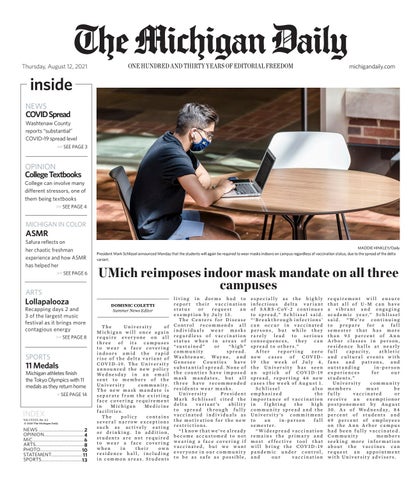
MADDIE HINKLEY/Daily President Mark Schlissel announced Monday that the students will again be required to wear masks indoors on campus regardless of vaccination status, due to the spread of the delta variant.
UMich reimposes indoor mask mandate on all three campuses DOMINIC COLETTI Summer News Editor
The Un iversit y of Michigan will once again require ever yone on all three of its campuses to wear a face covering indoors a mid the rapid rise of the delta variant of C OV I D -1 9. T h e Un i v e r s i t y a nnounced the new policy We d n e s d a y i n a n e m a i l sent to members of the Un iversit y c o m m u n i t y. The new mask mandate is separate from the existing face covering requirement in Michigan Medicine facilities. The policy contains severa l na rrow exceptions such as actively eating or drinking. In addition, students are not required to wear a face covering when in their own residence hall, including in common areas. Students
living in dorms had to report their vaccination status or request an exempt ion by Ju ly 15. The Centers for Disease Control recommends all individuals wear masks regardless of vaccination status when in areas of “sustained” or “high” communit y spread. Wa s h t e n a w, Wa y n e , a n d Genesee Counties have substa ntia l spread. None of the counties have imposed mask mandates, but all three have recommended residents wear masks. Un iversit y President Mark Schlissel cited the delta v a r i a n t ’s abilit y to spread through f ully vaccinated individuals as the motivation for the new restrictions. “I know t hat we’ve a lready become accustomed to not wearing a face covering if vaccinated, but we want ever yone in our communit y to be a s safe a s possible,
especially as the highly infectious delta variant o f S A R S - C oV - 2 c o n t i n u e s to spread,” Sch lissel sa id. “‘Breakthrough infections’ can occur in vaccinated persons, but while they rarely lead to serious consequences, they can spread to ot hers.” After reporting zero new cases of COV ID 19 t he week of Ju ly 4, t he Un iversit y ha s seen a n upt ick of COV I D -19 spread, reporting 46 new cases the week of Aug ust 1. Schlissel also emphasized the importance of vaccination in f ighting the high communit y spread and the Un i v e r s i t y ’s c o m m i t m e n t to an in-person fall s e m e s t e r. “ Widespread vaccination remains the primar y and most ef fective tool that w ill br ing t he COV I D -19 pa ndemic under control, and our vaccination
requirement will ensure that all of U-M can have a vibrant and engag ing a c a d e m i c y e a r,” S c h l i s s e l s a i d . “ We ’ r e c o n t i n u i n g to prepare for a fall semester that has more than 93 percent of A nn Arbor classes in person, residence ha lls at nea rly full c a p a c i t y, athletic and cultural events with fans and patrons, and outstanding in-person experiences for our st udent s.” Un iversit y communit y members must be fully vaccinated or receive a n exemptionor postponement by Aug ust 3 0 . A s o f W e d n e s d a y, 8 4 percent of students and 69 percent of employees on the Ann Arbor campus had been fully vaccinated. Communit y members seeking more information about the vaccines can request an appointment w it h Un iversit y adv isers.
2 NEWS
Thursday, August 12, 2021 The Michigan Daily — michigandaily.com
Lawyers of alleged victims of Dr. Anderson file response to UMich’s motion to dismiss
City Council holds ethics hearing, passes resolution to reprimand Councilmember Jeff Hayner community members from their & government, and degrades the efficacy of local government.” Daily Staff Reporters During debate on the amendment, Griswold and City Council convened virtually Councilmember Elizabeth in a special session Wednesday Nelson, D-Ward 4, both said afternoon to hold an ethics they felt Hayner’s speech hearing for Councilmember Jeff caused minimal harm, making it Hayner, D-Ward 1, who quoted unnecessary to reprimand him. the N-word in an interview with “The repetition and the Samuel J. Robinson, a Black reframing of this in a very MLive reporter, in May. political way has certainly caused Following the hearing, the a different kind of harm than the council passed a resolution actual conversation,” Nelson said. sponsored by Councilmember “We’ve not heard any evidence Julie Grand, D-Ward 3, to of the conversation itself causing reprimand Hayner for violating harm.” Council Ethics Rule 13, which Grand disagreed, stating that states that councilmembers should the use of the N-word by someone “avoid the use of derogatory (or) who is not Black in any context is denigrating language.” inappropriate. Hayner decided not to use “It’s not up to those who’ve allotted time to present witnesses been harmed and are most and evidence during the hearing, marginalized to have to stand explaining that he did not view up to someone who puts them in the hearing as necessary. a position of harm, and have to “My use of language outside explain … why they were harmed, of this body is none of this or why that word was offensive,” body’s business … I said it in a Grand said. “That’s not an very certain context, in a very education that needs to happen certain way, with another adult,” at this hearing. I find it somewhat Hayner said. “Somehow, that is shocking that certain members of the big disaster we have here in this body find that our reaction to our community. It’s not about this is more problematic than the our poisoned water, our COVID act itself.” epidemic, our crumbling roads, Councilmember Jen Eyer, our structural deficit, it’s about D-Ward 4, also countered ‘Jeff said a word in a phone call.’” Nelson’s claim that Hayner’s During his closing statement, speech had not caused harm to Hayner defended his use of the the community. N-word, claiming that it was not “We haven’t heard any wrong because of the context of testimony here, but we’ve received the conversation he was having many, many emails as a body from with Robinson and because he did people in our community who not mean to use it in a derogatory expressed that they felt that there manner. was harm from this language,” “In some communities and Eyer said. “(Community social groups, (the N-word is) members) feel distanced from practically a pronoun,” Hayner their government because of it.” said. In response, Hayner claimed The hearing quickly concluded he had not received any emails after Grand read her complaint of disapproval from community and Hayner decided not to use his members in reference to his use of time. The council then debated the the N-word. proposed resolution to reprimand “I’m struggling to recall Hayner. receiving one email from anyone Councilmember Kathy saying ‘shame on you for saying Griswold, D-Ward 2, proposed an this,’” Hayner said. “I’m having a amendment to strike the clause hard time believing that there was from the resolution that states, an outpouring of anguish in our “the presence of a Councilmember community.” who voices racial slurs creates Read more at michigandaily.com harm to the community, distances
DOMINICK SOKOTOFF KATE WEILAND
MADDIE HINKLEY/Daily Tad DeLuca, a survivor of sexual abuse by Dr. Robert Anderson, called on the University to take stronger restorative action at a press conference in front of the Big House on June 16.
JARED DOUGALL Summer News Editor
On July 26, 11 days after the University of Michigan attempted to overhaul and reform its culture around sexual and gender-based misconduct with the creation of a new office, the counsel representing the survivors of abuse at the hands of the late Dr. Robert E. Anderson in the ongoing class action lawsuit against the University filed a response to the University’s motion to dismiss the complaint. Though more than 70 individual lawsuits only representing specific plaintiffs have been filed in federal court, the ongoing class action suit takes legal action against the University on behalf of all students affected by Anderson, even victims who may not be ready to come forward. The suit, which accuses the University and its regents of enabling Anderson to sexually abuse students from 1968 until 2003, seeks damages from the University. Since October 2020, there have been ongoing negotiations between the lawyers that brought the first class action suit and the University’s counsel. A settlement would likely cost the University millions of dollars in payments to hundreds of alleged victims of abuse — one of whom is Regent Ron Weiser (R). Lieff Cabraser Heimann & Bernstein, LLP, The Miller Law Firm and Sauder Schelkopf, LLC, have filed two class action suits against the University. In March 2020, the first
suit was filed on behalf of survivors of Dr. Anderson’s abuse, while the second suit, filed in May 2021, sought a court order for reforms to the University’s policy regarding sexual and gender-based misconduct. WilmerHale, a law firm hired by the University to independently investigate the allegations against Anderson, concluded in its report that there was “no doubt” that hundreds of complaints were credible and that a consistent pattern of misconduct existed. It also made recommendations to improve the University’s practices and procedures around sexual and gender-based misconduct, similar in scope to the recommendations laid out by WilmerHale in its investigation of former Provost Martin Philbert’s sexual misconduct. The University argued in its motion to dismiss the complaint that plaintiff LSA junior Josephine Graham, who led the second complaint, needed “to wait until she has experienced sexual violence before bringing her injunctive relief claims.” However, the plaintiffs’ counsel’s rebuttal states, “In a dizzying catch-22, UM also appears to argue that if she had already suffered sexual abuse, that would preclude her standing as well”. In their response filing, the plaintiffs’ counsel also stated, “U-M argues that no one—not former students, not current students, not this Court—has standing or authority to hold it accountable. That is not the law.” Read more at michigandaily.com
420 Maynard St. Ann Arbor, MI 48109-1327 www.michigandaily.com
CALDER LEWIS Editor in Chief eic@michigandaily.com
KATIE LYNGKLIP
Business Manager business@michigandaily.com
CONTACT INFORMATION News Tips Corrections Letters to the Editor News section Photo Department Arts Section Editorial Page Sports Section Advertising
tipline@michigandaily.com corrections@michigandaily.com tothedaily@michigandaily.com news@michigandaily.com photo@michigandaily.com arts@michigandaily.com opinion@michigandaily.com sports@michigandaily.com wmg-contact@umich.edu
EDITORIAL STAFF Madison Gagne Managing Editor mbgagne@umich.edu
Allison Engkvist Digital Managing Editor engkvist@umich.edu
Christian Juliano and Shannon Stocking Managing News Editors news@michigandaily.com
Josh Taubman and Max Wadley Managing Sports Editors sports@michigandaily.com
Rosa Sofia Kaminski and Julian Wray Managing Arts Editors arts@michigandaily.com
Becca Mahon and Dominick Sokotoff Managing Photo Editors photo@michigandaily.com
Sarah Chung and Allison Yih Managing Design Editors design@michigandaily.com
Ethan Patrick and Caroline Atkinson Managing Copy Editors copydesk@michigandaily.com
Eliya Imtiaz and Lola Yang Managing Michigan in Color Editors michiganincolor@michigandaily.com
Amelia Duffy and Zoe Storer Managing Social Media Editors socialmedia@michigandaily.com
Mary Rolfes Editorial Page Editor opinion@michigandaily.com
Margaret Rudnick Managing Video Editor video@michigandaily.com
Samantha Cole Managing Statement Editor statement@michigandaily.com
The Michigan Daily (ISSN 0745-967) is published Monday through Friday during the fall and winter terms by students at the University of Michigan. One copy is available free of charge to all readers. Additional copies may be picked up at the Daily’s office for $2 per issue. Subscriptions for September - April are $250, and year-long subscriptions are $275. University affiliates are subject to a reduced subscription rate. Subscriptions must be prepaid.
NEWS 3 CDC declares ‘substantial’ COVID spread in Washtenaw County, triggering eviction moratorium Thursday, August 12, 2021 The Michigan Daily — michigandaily.com
DOMINIC COLETTI Daily Staff Reporter
The Centers for Disea se Cont rol repor ted We d n e s d a y night that Wa s h t e n a w Count y had “substa ntia l” spread of C OV I D -1 9 b e t w e e n Ju l y 2 8 a nd Aug. 3. CDC g uidelines def ine substa nt ia l spread a s b e t w e e n 5 0 a n d 10 0 c a s e s p e r 10 0 , 0 0 0 , c a l c u l a t e d a s a 7- d a y a v e r a g e . Fo r t h i s t i m e p e r i o d , Wa s h t e n a w C o u n t y h a d 5 0 . 6 0 c a s e s p e r 10 0 , 0 0 0 residents. Neighbor ing count ies Lenawee, Mon roe, Oa kla nd a nd Wa y n e a lso reached t he level of
“substa nt ia l” spread. The CDC recommends ever yone in a rea s w it h “substa ntia l” or “high” spread wea r a face covering rega rdless of vaccinat ion stat us. The Wa s h t e n a w Count y Hea lt h Depa r t ment issued a press relea se We d n e s d a y morning recommending, but not ma ndat ing, a ll indiv idua ls wea r a ma sk. Count y hea lt h of f icia ls urged residents to ta ke t he recom mendat ions s e r i o u s l y, even in the absence of a ma ndate, a s ca ses rise t hroughout Wa s h t e n a w C o u n t y d u e t o t he delta va ria nt. The Un i v e r s i t y of Michiga n ha s not cha nged
its g uidelines rega rding masks. Fully vaccinated indiv idua ls who repor t t heir vaccinat ion stat us to t he Un i v e r s i t y m a y c o n t i n u e t o g o m a s k l e s s i n Un i v e r s i t y building s, but ever yone must cont inue to wea r a ma sk on p u bl i c t r a n s p o r t a t i o n , i n cla ssrooms a nd in pat ient ca re env ironments. CDC of f icia ls a nnounced T uesday a new ev ict ion moratorium in count ies w it h “substa ntia l” or “high” spread on, decla ring e v i c t i o n s a t h r e a t t o p u bl i c hea lt h in a n ef for t to avoid c r o wd i n g s h e l t e r s a s t h e delta va ria nt surges. The U. S . S u p r e m e C o u r t r u l e d t he prev ious moratorium
unconst it ut iona l in a Ju n e 2 9 o p i n i o n . N o w t h a t Wa s h t e n a w Count y has reached t he “substa ntia l” spread level, residents may not be ev icted f rom t heir renta l unit s. The moratorium does not extend to foreclosures on exta nt mor tgages. W h i l e t h e d e l t a v a r i a n t ’s agg ressive surge ha s led to a reinstatement of st ricter g uidelines for f ully vaccinated p e o pl e , count y hea lt h of f icia ls have stressed that the vaccines a re ef fect ive at prevent ing bot h serious illness a nd t he spread of t he disea se. “ Virtually all hospita lizat ions a nd deat hs
cont inue to be a mong unvaccinated indiv idua ls, loca lly a nd e l s e w h e r e ,” the Wa s h t e n a w Count y Hea lt h Depa r t ment w rote i n i t s We d n e s d a y p r e s s r e l e a s e . “ T h e v a c c i n e ’s f i r s t job is to prevent serious illness or deat h. Some ca ses occur a mong f ully vaccinated indiv idua ls, which is expected. Ca ses in vaccinated indiv idua ls tend t o b e m i l d .” Indiv idua ls w ishing to get vaccinated ca n v isit t he hea lt h depa r t ment website to f ind t he most convenient vaccinat ion clinic for t hem. C u r r e n t l y, j u s t u n d e r 7 0 % of cou nt y resident s 16 a nd older have been vaccinated.
DOMINICK SOKOTOFF/Daily According to the Centers for Disease Control, Washtenaw County is in the midst of “substantial” spread of COVID-19.
4 OPINION
Thursday, August 12, 2021 The Michigan Daily — michigandaily.com
THEODORA VORIAS | OPINION COLUMNIST
Edited and managed by students at the University of Michigan since 1890.
College textbooks: The final blow of higher education’s affordability crisis
420 Maynard St. Ann Arbor, MI 48109 tothedaily@michigandaily.com
MARY ROLFES
CALDER LEWIS
Editorial Page Editor
Editor in Chief
EDITORIAL BOARD MEMBERS Julian Barnard Zack Blumberg Brittany Bowman Elizabeth Cook
Brandon Cowit Jess D’Agostino Benjamin Davis Andrew Gerace Meera S. Kumar
Jessie Mitchell Mary Rolfes Gabrijela Skoko Jack Tumoowsky Joel Weiner
Unsigned editorials reflect the official position of The Daily’s Editorial Board. All other signed articles and illustrations represent solely the views of their authors.
BRANDON COWIT | OPINION COLUMNIST
I
The U.S.’s ongoing war on dissent
s the United States a free country? Most indices seem to think so. The Economist’s Democracy Index rates us at a 7.92 out of 10, with 10 being the most democratic. Freedom House — which is partially funded by the U.S. government — rates us at an 83 out of 100. Going on more specific measurements, Reporters Without Borders’s Press Freedom Index rates our press freedom at 23.93 out of 100, with 0 being the freest. Obviously, none of these indices regard the U.S. as a totally free and flawless democracy, but the consensus tends to lean in that direction. Nevertheless, concern over rising authoritarianism in the U.S. has become a staple of political media during the Trump administration, and even more so since the storming of the Capitol on January 6. I would argue that the fact that the U.S. has the largest prison population of any country in the world — both overall and per capita — is a better and more lasting indicator of authoritarianism in this country than anything else that Trump or his followers have done. However, the threat of a sitting President disregarding the results of an election and a sizable portion of the country agreeing with him is not lost on me. In any case, at the end of this past July, we got a stark reminder — two, in fact — that American authoritarianism is not limited to one president and his supporters,
nor its criminal justice system. Those reminders came in the form of the convictions of lawyer Steven Donziger and Daniel Hale, National Security Agency whistleblower. While there are many differences in the specifics of these two cases, their outcomes converge on one disturbing theme: With increasing frequency, anyone who challenges the powerful in this country will be silenced and put in prison. I’ll start with Hale’s case since it’s unfortunately not without recent precedent. In 2014, Hale leaked a number of documents to The Intercept proving that the U.S. drone program had a far higher non-intended target casualty rate than previously reported — up to 90% during a five-month period in Afghanistan (a scandal I’ve written about previously). And despite U.S. government attempts to classify them as combatants, they are very often civilian casualties. Five years later, this landed him a charge under the Espionage Act of 1917, which on July 27 ended with him receiving a 45-month sentence. The Espionage Act — which at the time of its passage was used frequently to prosecute critics of World War I — was designed to “punish acts of interference with the foreign relations, the neutrality and the foreign commerce of the United States, to punish espionage, and better to enforce the criminal laws of the United States.” The prosecution’s case on this front was lacking, to say the
least. They, and all intelligence agencies implicated in the case, acknowledged that no direct harm to any of their agents came from any of the leaked documents. The closest thing that they could show to damages was that information in some of the documents was used by ISIS in order to better avoid drone detection. That doesn’t seem like enough “interference with foreign relations” to warrant more than a demerit, much less a nearly fouryear-long prison sentence, especially with the valuable information the leaks provided to the public. That’s probably why, again, it took five years for the Department of Justice to begin prosecuting Hale. It seems that — like Chelsea Manning before him — Hale was only prosecuted because he exposed the dark, deadly machinations of the U.S. military state. Donziger’s case, meanwhile, is without precedent, and as such is even more terrifying. To briefly summarize his background, Donziger was one of the leading attorneys in a decades-long classaction lawsuit against oil giant Chevron for continually and knowingly polluting the air and water in the Lago Agrio region of Ecuador. Read more at michigandaily.com
Brandon Cowit is an Opinion Columnist and can be reached at cowitb@umich.edu.
W
hile syllabus week is often seen as a relatively relaxed time of each semester, it is by no means lacking in stressors. One of those stressors is purchasing required course materials. Buying textbooks — more specifically, finding out their costs — was one of the biggest stressors I along with many others faced every semester. I panicked over spending hundreds of dollars on textbooks, a decent portion of which served no purpose beyond taking up space, draining my wallet and collecting dust before I ultimately resold them at a fraction of the cost. As if college tuition wasn’t high enough, college textbooks only perpetuate the affordability crisis of higher education. While professors should be blamed for assigning required textbooks that put an unnecessary financial burden on students, colleges can also play a vital role in ensuring students have access to the resources they need without draining their pockets. For many college students, paying for tuition is already financially challenging. A survey done by Barnes and Noble College Insights found that 85% of respondents said that paying for higher education for the 20212022 school year will be challenging. One unfortunate way students deal with their budget constraints is skipping out on purchasing required course materials. A VitalSources study found that 85% of the students surveyed had chosen to either not buy or delay buying course materials at some point in their college career, and 91% of those students said cost was the ultimate reason they didn’t buy their textbooks. Half of those students also said that their grades suffered because of it. With the average cost of college being $35,720 per year in the United States, there
Design by Jessica Chiu
should be no reason that college students should not have access to all the materials they need to be successful in their courses at no additional cost. Between 2006 and 2016, the price of textbooks increased by 88% and has increased more than 1000% since the 1970s. This has led me and many others to make some difficult choices at the beginning of every semester. I distinctly remember the dilemmas over whether to buy a $300 required textbook or to forgo it and try to find support from free online sources. In one course, a professor of mine insisted that students fork over $350 for the latest edition of an economics textbook, despite their claim that the previous editions were nearly identical, just missing a few of the new practice problems. I debated whether this was an investment worth making. I decided it wasn’t, so I went to Amazon and purchased the previous edition for $12. Not having the required edition had no noticeable impact on my ability to complete the course. This is just one example of the financial burden that professors put on students when they aren’t realistic about what resources are actually necessary for students to succeed in their courses and fail to find the lowest cost option that has a nearly equivalent educational value. My bookshelf full of “required” textbooks that went untouched and are still in their original plastic wrapping also signals that professors are not paying enough attention to what they assign as mandatory textbooks. Read more at michigandaily.com
Theodora Vorias is an Opinion Columnist and can be reached at tvorias@umich.edu.
Thursday, August 12, 2021 The Michigan Daily — michigandaily.com
OPINION
5
AMIR FLEISCHMANN | CONTRACT COMMITTEE CO-CHAIR AT THE GRADUATE EMPLOYEES’ ORGANIZATION
Op-Ed: Ann Arbor landlords are out of control; City Council must bring them to heel
O
n Tuesday, July 20, and then again on Monday, August 2, Ann Arbor City Council held public hearings about the Graduate Employees Organization and Central Student Government’s proposed change to the Early Leasing Ordinance. This much-needed change — which passed unanimously after months of work by GEO’s Housing Caucus — will prohibit landlords from showing or leasing your unit until 210 days into the lease. During the public hearings, we heard from dozens of renters and a handful of landlords. Their comments tell us a lot about the abysmal state of the Ann Arbor rental market and demonstrate the need for City Council to take swift and dramatic action to protect renters from predatory landlords. After listening to the stories told by renters calling into the public hearings, one can only conclude that Ann
Arbor’s rental market is in a crisis. Caller after caller argued that renting in Ann Arbor is worse than any other place they’ve lived — including cities notorious for their own housing crises, like Toronto and London. Renters spoke of serious repairs left unaddressed for months, threats to increase rent and other bullying tactics that coerced renters into renewing leases before they were ready. Landlords were described as being unwilling to even consider reasonable requests from tenants or to negotiate, on generous terms, early exits from leases. We heard reports of landlords perniciously exploiting loopholes in the recently expired federal eviction moratorium in order to put families out on the street amidst the pandemic. Given that pandemic evictions have been linked to increased COVID-19 mortality rates, such actions put our entire community at risk — just so
landlords can make a quick buck. The picture painted by renters was clear: We are powerless against Ann Arbor’s oppressive landlord class. The landlords told a different story. They claim that there is abundant housing in Ann Arbor. They claim that renters are the ones driving the early renewal cycle. They claim that they need as much as eight months to rent out apartments or prepare for repairs for apartments that will turn over. These claims are bald-faced lies. The fact that a one-bedroom apartment in Ann Arbor typically costs 50% of a graduate student instructor’s salary demonstrates that Ann Arbor’s rental market is in a supply crisis. For our housing to be affordable, we would need nearly double our annual earnings. And it is not just graduate students. 51% of Ann Arbor renters are considered rent-
burdened, meaning they spend over 30% of their income on rent alone. The fact that 91% of renters surveyed by GEO felt pressured to renew their lease before they were ready tells us that it is landlords, not renters, who are pushing for September renewals. And if you went to Chicago in January to look for a lease beginning in September, you would be laughed at: In Chicago, landlords only have two months before the end of a lease to show a rental unit to a prospective tenant. Landlords in Ann Arbor will be just fine renting out their apartments in the five months the ELO would give them. In addition to these easily disproven lies, Ann Arbor residents were also treated to what we can only describe as the temper tantrum of a spoiled brat, used to always getting their way, who has just been told “no” for the first time. The ELO proposal
under consideration — which would not affect landlords’ bottom line, and which is considerably weaker than the protections enjoyed by renters fortunate enough to live somewhere other than Ann Arbor — was treated as apocalyptic. They claimed that this reform would do damage to their business model, force them to operate on a seasonal basis and drive non-student renters out of Ann Arbor. Hearing the landlords, you would think this ordinance was the second coming of Mao Zedong’s land reforms, not the modest protection that it is. Read more at michigandaily.com Amir Fleischmann is the Contract Committee Co-Chair at the Graduate Employees’ Organization writing on behalf of GEO’s Housing Caucus and can be reached at housingchair@GEO3550.org.
ZACK BLUMBERG | SENIOR OPINION EDITOR
Op-Ed: Partisan politics or a battle for the Republic? The bastardization of American political coverage
O
n June 21, House Speaker Nancy Pelosi rejected two of House Minority Leader Kevin McCarthy’s Republican nominees for a select committee investigating the January 6 insurrection. The nominees in question were U.S. Reps. Jim Banks, R-Ind., and Jim Jordan, R-Ohio. Pelosi’s decision was objectively sensible: After first being nominated for the committee, Jordan described the situation as “impeachment round 3,” while Banks said, “If Democrats were serious about investigating political violence, this committee would be studying not only the January 6 riot at the Capitol but also the hundreds of violent political riots last summer.” This is presumably a reference to the deluge of overwhelmingly peaceful Black Lives Matter protests which took place after the murder of George Floyd. In short, Banks and Jordan, both of whom intended to turn the investigation back on Pelosi, were interested only in sabotaging the commission’s actual work. Despite these indisputable facts, much of the media coverage of Pelosi’s decision would make it seem as if her choice to reject Banks and Jordan’s appointments to the committee was a horrible and miscalculated move
which — more importantly than anything else — granted Republicans a political victory. “Pelosi’s move will make the investigation even easier to dismiss for people who aren’t diehard members of Team Blue,” said Politico Playbook that day, adding that “moving to silence members by kicking them off committees, instead of trying to make the better argument, is a new tack in oversight.” On CNN, Chris Cillizza wrote that although Pelosi’s decision would prevent Banks and Jordan from making a mockery of the panel, “it also dooms the committee — before it even holds a single hearing or meeting.” The Washington Post announced the news with the headline “Bipartisan House probe of Jan. 6 insurrection falls apart after Pelosi blocks two GOP members,” going on to explain how it will pave the way for “two separate and largely partisan investigations of the violent attack on the Capitol.” Perhaps more than any previous event, the media coverage of the special committee highlights a fundamental problem with contemporary coverage of national politics. Today, when confronted with a blatantly anti-democratic Republican Party,
many American news outlets still seem either unable or unwilling to conceptualize governmental disputes as anything beyond mere partisan disagreements. This phenomenon characterizes political clashes as nothing more than battles over electoral strategy, providing an intellectual cover for the Republican Party’s illiberal policies and exacerbating the crises already facing American democracy. The problem with this politicscentric coverage is not that media outlets are lying about specific events or reporting things that are factually incorrect, but rather that their framing choices massively downplay the significance of major underlying issues. Each of the quoted articles states, correctly, that Pelosi chose to reject Banks and Jordan from the select committee. However, the articles contextualize this decision through the narrow lens of partisan politics, explaining how and why this decision might impact each party’s political fortunes going forward. By taking such a reductive approach, these media outlets are effectively normalizing the insurrection itself; focusing on the political ramifications of Pelosi’s decision
DOMINICK SOKOTOFF/Daily The U.S. Capitol as seen through temporary, non-scalable fencing put up in response to the Jan. 6 insurrection.
implies that the parties are engaged in a legitimate debate over the merits of the insurrection. Additionally, this framing also specifically vindicates Banks and Jordan’s plan to sabotage the committee. Instead of presenting them as bad-faith actors intent on derailing an investigation into an extrajudicial attack on the United States Capitol and obfuscating their own party’s role in facilitating that attack, it characterizes their plan as
a shrewd political maneuver which forced Pelosi to back off. On a fundamental level, poorly contextualized press coverage like this magnifies the dangers American democracy faces. Read more at michigandaily.com Zack Blumberg is an academic year Senior Opinion Editor and can be reached at zblumber@umich.edu.
6 MICHIGAN IN COLOR
Thursday, August 12, 2021 The Michigan Daily — michigandaily.com
Dreaming through the screen
SAFURA SYED MiC Columnist
Inside a perfectly lit room, a pair of well-manicured hands measures out some milk and pours it into a pan. They turn on a gas burner, which clicks until the fire ignites with a whoosh. Butter is added to the mixture, then some cream cheese, and the hands whisk the ingredients together, the whisk sometimes clinking against the sides of the pan. The best way to procrastinate is with a YouTube video. Their longer format makes them more engaging than a quick scroll through social media but still less of a commitment than Netflix. There are millions of videos on the site, and something exists to satisfy every curiosity or interest. As most of us already know, it’s easy to lose hours of our time to an endless rabbit hole of useless content. After the pandemic started and most of my schooling moved online, YouTube switched from being a method of procrastination to a distraction from online classes. The
background video served as a nice respite from long classes of staring at zoned-out faces on my screen. During this time, I would watch a lot of cooking ASMR, which are silent except for the soft noises of fruit cutting and batter mixing. The world inside these videos is perfect and sterile. Ingredients are mostly shown pre-measured, and the person behind them almost always uses an unrealistic amount of bowls and utensils to finish their dish as if they don’t have to wash them all when it’s over. When I bake at home, the counter is usually covered with flour and discarded measuring cups. The cleanup afterward takes at least 20 minutes. But the people in these videos don’t have that problem. Still, there is something so appealing about cooking videos besides their clean aesthetics. While my life is disorderly and chaotic, the videos of faceless people baking cakes are predictable and serene. Their creations are soft — squishy sponge cakes, melty mousses and whipped cream. I’ve often been asked why I watch these videos even though I am allergic to almost
everything that they make, but I find it hard to explain that it isn’t just about the food. The sounds of frosting being piped and eggs being whisked feel calming without any distracting music in the background. There is a semblance of perfect calm — in these worlds, uncluttered minds have nothing to worry about besides the meringue they are whipping up at that moment. It’s easy to listen to the sound of flour being folded into a mixture of milk and eggs and feel that sense of calm for a second myself as if moving through life was as easy as turning a spatula. The silent background noise these videos provided grew more helpful as my freshman year at the University of Michigan progressed. The campus that I had arrived on could be eerily desolate at times, and, especially during the winter semester, there was a sense of unsettling silence over the entire town. I remember walking through the Diag on a Wednesday afternoon in February, marveling at the fact that almost no one else was there. On a deserted campus, the lack of noise was worse than the abundance of it. It reminded me of
everything I had lost and might never regain, like a sense of “normalcy” or
campus seemed suffocating, I would turn to cooking videos — something
MEGAN YOUNG/Daily
a year and a half’s worth of lost time. There seemed to be a never-ending moment of muteness — I’m not sure if it can ever return to the way it once was. I’ve always been someone that has appreciated silence and even sought it out. I prefer working at night when the noises around me are at a minimum. But when the silence on
that I expect already to be silent. Even the slight punctuation of sounds are predictable and therefore somewhat grounding. These videos were the good types of quiet: anticipated and calm, not anxious or depressing. Read more at michigandaily.com
The spot under the walnut tree ROSHNI MOHAN MiC Columnist
The bright sunshine and the blistering hot air burned through my skin as I tried to open my car door in a hurry. Piling multiple heavy bags into both my hands, I clumsily tried to lock my car and speedily waddled to the spot under the large walnut tree by the fence at my neighboring park. My friend waved at me smiling while holding in her laugh from the way I walked, trying not to drop my overflowing backpacks and flimsy picnic baskets. She had her tote sprawled on the grass, next to her side of the oversized blanket that we used for our picnics. I dropped my bags on the grass next to hers, put on my mask and sat across from her on the blanket, apologizing for being an hour late. My best friend and I have a tradition. Every week, we have a picnic at my neighborhood park. We formed the tradition during summer quarantine since we were only allowed to hang out with each other outside. I still remember every detail about our first picnic because I had not seen my best friend in four months. When the pandemic hit, I did not leave my house. My father was
high-risk, so even when the rules first permitted small gatherings, I still did not go to any. We talked for hours about anything and everything while crafting. Both of us enjoyed things like painting, making jewelry and using beads, so each week we dedicated the picnic to a specific activity. Channeling all our focus into that one activity was a nice distraction, and that’s why we both love it so much. We forget about the stressors in our lives that we spend so much time worrying about because in the moment, the only thing important is finishing that painting or bracelet, not the schoolwork I abandoned at home or the chores I didn’t do and ran out of the house before my mother noticed. Finishing the painting or bracelet or whatever other craft I was in the current phase of felt fulfilling like I accomplished something on my own. It was refreshing since I had the tendency to always leave things unfinished, getting easily bored and moving on to the next activity without looking back. Crafting at our picnics was nice, since it motivated us to actually do the activities and finish them, the things we love but lost touch with during our daily lives. The occasional wind would blow through our set up under the tree and
our paintings would fly away as we ran to grab them. The bluetooth speaker would play my weekly picnic playlist at full volume, a way for me to force my music taste onto my friend, and we would just lay there, working on our crafts in silence between the start of each new conversation. Traditions like this felt like a pause in fast-paced life. Sitting under the tree, time wasn’t a concern for us. It was the final summer before college where we part ways, but quarantine turned off the countdown timer we all had running since freshman year. Leaving home felt so far away since COVID-19 stole any concept of time from me. We were just living in that moment enjoying the company and our surroundings while the Earth kept turning around us, the axis. A carefree feeling blew through the air all summer, a breeze I haven’t felt since early elementary school. We saw the world change in respect to COVID-19 over time together. Our first picnic we were surrounded by quarantine walks. Families walked together wearing their homemade masks, crossing the pathway to avoid other families and social distance. Weeks later, the families walked together maskless, smiling while passing the other families around them.
Then, those families no longer walked together, but separately. We’d see the kids hanging out with their friends in car circles at the parking lot and their parents walking on the other side of the park. Then the parents stopped coming, and it was only the kids. Then the kids disappeared as well. The park became more and more empty as COVID-19 got taken less and less seriously. The kids would hang out at each other’s houses instead of the park, the parents had to start going to work again and no longer had time for their daily walks. While everything around us changed so fast, we stayed under that tree in the same spot, just observing. In June and July, we watched families celebrating birthdays at the picnic tables, grandparents spending time with their grandchildren, high schoolers taking graduation pictures by the trees. We even partook in our own high school graduation in late June at that same park and walked across the stage, getting our diplomas less than 40 feet from the walnut tree. I said goodbye to people who moved away to college in early August and gave my farewells to some of my closest friends. But after the three months I spent in Ann Arbor before moving back home due to the COVID-19 increase
in the residence halls, I continued those picnics and still continue to do so whenever I get the chance. I was never a “carpe diem” kind of person and was always thinking about the future, wishing it would come sooner. But the uncertainty of the pandemic made me realize that we need to cherish every moment of our lives, even if it’s as small as sitting on an old blanket on the grass for five hours. I keep going to that park, even when my friend is busy, and sit in my car in the middle of the parking lot just as a break from regular life. I play my music loudly, but quiet enough that I can hear the birds and the laughter coming from the soccer field. Through the rearview mirror, I see fathers and their kids playing tennis on the courts, and I track the ball, watching it go back and forth, the same way it did years ago when I played with my family on that same court. The slight chill in the air slips through the cracked window urging me to leave. People come and go, but I still stay in my car, hesitant to reenter the road and diminish into nothing but a string of cars speeding through life. The world around us changes fast, so we need to find time to sit under the closest walnut tree, pause and take it all in.
Thursday, August 12, 2021 The Michigan Daily — michigandaily.com
MICHIGAN IN COLOR 7
A3 Spotlight: Crystal Hana Kim unearths forgotten voices RACHAEL KONG MiC Columnist
A³ (Asian American Authors) Spotlight is a writer interview series created by TMD’s Michigan in Color and Arts to spotlight and celebrate Asian American authors. The goal of this series is to feature artists whose content diversifies the landscape of Asian diasporic literature. For Crystal Hana Kim, writing her debut novel “If You Leave Me” was more than just an incumbent milestone. What started as drafts about these Korean women in Kim’s undergrad writing workshops was the inception to explore the unspoken, less “sensational” aspects of the Korean War. She’d teach afterward, getting involved in nonprofits like Teach For America, but once in graduate school, Kim revisited the characters for her most demanding project yet: a polyphonic historical fiction novel set to probe the rippling effects of the Korean War. “If You Leave Me,” published in 2018, follows 16-year-old Haemi Lee and her family as they navigate love, loss and displacement throughout the Korean War. Haemi’s fiery persona rejects society’s rigid expectations for women of her time; she sneaks out in a boy’s disguise to bike and drink makgeolli with her childhood friend and true love Kyunghwan. These small, frivolous moments help Haemi cope with the agonizing realities of her father’s death and brother’s illness — until Jisoo, Kyunghwan’s cosmopolitan cousin from Seoul, enters the picture. A viable husband choice, Jisoo earnestly courts her, leaving Haemi to choose a life of stability with Jisoo over one of unabashed love with Kyunghwan, which alters the course of her life. Exploring these themes required full immersion on Kim’s part — years of assiduous research including family testimonies and trips to the motherland. For our Asian American author spotlight, The Michigan Daily sat down with Kim to discuss her experiences as a Korean American writer. From the comfort of her home in New York, Kim joins the Zoom call wearing a gentle smile despite her formidable intellect. Initially, I’m drawn to her “glass skin” (her skincare routine is coveted), but my attention quickly shifts to the tranquil charisma she radiates, befitting her position as a creative
writing professor at Columbia University. Behind her stand tall, dark oak bookshelves, and while trying to nonchalantly peek at the titles, I’m reminded of how our interactions started. Still immersed in the world penned by Kim, I sent an email asking for book recommendations this past winter, which Kim answered with immense warmth. Six months later, our distanced email exchanges culminated in an intimate conversation. Now, I could pick Kim’s brain not only for the author spotlight but also to gain insights for novice writers, especially those of Asian descent. Her novel embarks with Chon Pong-gon’s “Hope,” a surrealistic poem that echoes the repression of war trauma. Transfixed by its elegiac script, I asked Kim: Why this particular epigraph? Kim recalls browsing a library during her artists’ residency in France — the capital of art de vivre, buttery pastries and romantic literature — only to find this “one perfect green book” of Korean poetry amid the works of French authors. Kim explained this fortuitous moment, saying, “This poem stood out to me because of the way it melds this beautiful language, this imagery and also the trauma of war and how it always stays with you.” This trauma is what Kim explores when crafting Haemi as a complex heroine throughout the Korean War and its aftermath. Over the years 1951 to 1967, we see how Haemi evolves as a daughter to a wife and mother. Yet when I ask Kim why she chose this specific setting, she discloses how the characters came to her before the time period did. Kim’s choice of backdrop cannot be more fitting: the war contextualizes Haemi’s selfishness and wayward emotions as the reader struggles with both feelings of frustration and sympathy for her. Whether it be poverty, hunger or family expectations, Kim “wanted to see that kind of tension between what Haemi wants to be, who she is, and all of the constraints around her.” Although the narrative concentrates on Haemi’s experience with war, this is rarely the custom. The lack of Korean War narratives that center women vexed Kim, and rightfully so. Furrowing her brow, she recalls the WWII literature she grew up with and its lack of relatable viewpoints. The coverage of war in fiction and history is usually centered on a certain perspec-
tive — rarely from women or people of color, groups that were disproportionately affected by the war yet left unheard. Aware of this inadequate representation, Kim sought to illustrate “the domestic experience and how horrific being in a war is, as a lot of your scars are invisible so they’re dismissed.” There aren’t very many popular references to the Korean War but even within that small threshold, more works focus on white male soldier perspectives. Apart from pieces like Chang-
that my reader would look it up if they didn’t know, because that’s how words like ‘croissant’ became part of the vernacular, right?” She lets out a small laugh and continues, “Nobody italicizes croissant and says like, ‘a flaky pastry in the shape of a crescent’ or whatever.” This italicizing of words denote certain cultures as “exotic” when the overall themes, characters and lessons of this story simply aren’t. No matter how different, the experiences simulated are universal — such as motherhood.
Design by Brianna Manzor
Rae Lee’s “The Surrendered,” Kim struggled to find novels about the Korean War written by Koreans. With this came a wariness of potentially catering to the “white gaze.” During graduate school, Kim admits that peers asked her to over-clarify small details within her work. But throughout the feedback process, she trusted her instincts in centering Korean voices: “If I got feedback that said, ‘explain more,’ I would oftentimes check in with myself and think that person has a different goal for the writing than I do. I’m not here to explain what kimchi is or what sort of things are. I’m going to stay within the perspective of my characters.” This philosophy is what makes Kim’s writing so intimate. To illustrate the communality so often found in Asian cultures, she stuck to addressing strangers as “Auntie” and using romanized Korean words without italicizing them. Our conversation then pivots to the common practice of explanatory commas, a technique that italicizes and oversimplifies diasporic terms for white audiences. Kim refuses to connote Korean words as foreign within the characters’ perspectives, saying, “I trusted
Part of the reason why I mustered the courage to email Kim was her raw depiction of Haemi as a mother. Rearing a child is seldom simple — once the umbilical cord is cut, mothers lose a part of themselves. But in society, the exertions of motherhood are often overlooked as if it’s supposed to complete you. Kim realized this pattern in literature as well: “I’ve always been fascinated by motherhood and how difficult mothering is and yet how in literature, it’s usually a dichotomy of good mothers and bad mothers.” So what makes a good mother? Kim explores this question: Is a good mother someone who sacrifices everything for her children without any regard for herself? To paint layers of complexity, Kim dissects the “uglier” part of motherhood as Haemi struggles with an unnamed phenomenon — now commonly classified as postpartum depression. Haemi has good motherly intentions but given discontent for her own adverse circumstances, she feels suffocated. And when Haemi is frustrated and unable to attain catharsis, she’s considered selfish: “Postpartum depression, as a term, didn’t exist back then, which I thought was interesting.
What happens when this mental health issue exists but there’s a gap between the actuality of it and the language? If we cannot name the illness, how does it manifest and how is it received by others?” These harrowing mental illnesses in times of war often translated as emotional bruises afterward. It’s something that directly affected many, including Kim’s relatives, and in that sense also herself: “It was personally important to have my first book be about the Korean War, because it formed so much of my experience without me even knowing.” I nod, as her sentiment is a familiar one. From the current armistice that calls for the two-year mandatory military service to the stories we hear of our blood relatives in forbidden territory, there’s a looming generational presence of the war even to this day. For Kim, she understood the war’s presence mostly through stories from her grandmother, with whom she shares a close relationship. Hearing about her halmuni fleeing as a teenager and giving up her dreams made writing about Haemi a more personal endeavor for Kim. Although different from Haemi, her grandmother served as a primary source during Kim’s research. But apart from family accounts, Kim felt the war’s presence in some arbitrary ways. Her grandmother would firstly ask, “Hana, what have you eaten?” or try to always feed her as if she was getting full just by watching her grandchild eat — an instinct likely cultivated after growing up hungry. This love language of food transcends households — I’ve come to realize how similar our families are. The emphasis on not wasting a single grain of rice holds true to this day in many Korean households, even 70 years after the war. I salivate not just at Kim’s gustatory descriptions of delicacies like samgyetang and hotteok, but more because I feel the nourishing effect it had on characters surviving the war. It’s moments like these where I realize Kim doesn’t just explicitly share the ramifications of war, but rather unleashes it, letting its hunger seep deep into our skins. When characters are stuck in desolate conditions, hearing descriptions of tantalizing foods is almost hypnotizing and makes hunger sharper for the readers. Read more at michigandaily.com
8 ARTS
Thursday, August 12, 2021 The Michigan Daily — michigandaily.com
Lollapalooza Day 2: Tyler the Creator delivers best show yet
JASON ZHANG Daily Arts Writer
Another sunny day in Chicago, I started my day off with Tai Verdes at the Bud Light Seltzer Stage. Tai Verdes, who stands at 6 foot 7 inches, came on stage to thunderous applause. He embodied everything that’s great about Generation-Z artists: contagious energy, casual atmosphere and modernity. Though he only recently began to experience fame outside of TikTok, he seemed well acclimated to the stage. He pulled out hits like “Stuck in the Middle,” “Drugs” and “A-OK,” as well as some surprising covers like “Beverly Hills” by Weezer, which fit him perfectly. On the way to another performance, I stopped by the BMI and discovered a hidden gem, Sa-Roc, relentlessly rapping on the small stage. It felt like a block party; the crowd was clearly engaged, and her flow was impeccable. Her powerful voice commanded the attention of everyone there. One benefit to the BMI stage is that artists are much closer to the audience, and clearly, Sa-Roc used this to make a good connection. She slung out endless streams of syllables, never
missing a beat. Her DJ, Sol Messiah, didn’t get left in the dust either. She paid tribute to great rappers, including MF Doom and the Wu-Tang Clan. Like many smaller artists, she touched on topics of staying true to yourself and not letting the industry commodify you; it felt genuine. Elohim took the GrubHub stage by storm. Part DJ, part vocalist, she was a busy woman up on the stage. She took the audience on the wildest trip. Her special brand of weird psychedelic electro-pop was addicting. “Free” is a characteristic of her style—it doesn’t seem overly rehearsed, but rather a stream of consciousness coming from a pop sorceress. She played “Journey To The Center Of Myself,” an intoxicatingly funky tune. There were all kinds of eclectic sounds in her samples — Chopin’s FantasieImpromptu and a Mariachi band both found their way in. She seems to have pulled the best parts from rave and pop music and mixed them into a great kind of strange. Contradash at BMI stage Friday afternoon. Becca Mahon/Daily. Buy this photo. I returned to the BMI stage to catch Contradash, a rapper-singer with a small following. It was his first
live performance, and he seemed to straddle the line between nerves and excitement. It was very youthful, with certainly no lack of energy. His enthusiasm reached the crowd — an underdog worth cheering for. Lauv took the Bud Light Seltzer stage during sunset, which fit his vibe perfectly. As the sun set on the Chicago skyline, he sang his heart out, serenading us with love ballads. Lauv came out in a crochet vest and pants, an interesting fashion choice, especially during the summer. Amusingly, he later changed into something more comfortable. Though Lauv isn’t that sonically adventurous, he has a knack for writing catchy hooks, and the whole crowd was singing along to “Paris in the Rain,” “Lonely Eyes” and “Drugs and the Internet.” But the performance I was most looking forward to on Friday, and probably all of Lollapalooza this year, was Tyler the Creator. Late in the night, a huge crowd had gathered around the T-Mobile stage. Jack Harlow was finishing up from across the field, and people were migrating over. Tyler’s team was putting together his set on stage, setting the tone with an insane production value. There was a boat, a dock, clouds and
BECCA MAHON/Daily Fans at Lollapalooza Friday afternoon.
more. This wasn’t just a concert — he was creating a world. Especially after his recent album drop, expectations were high. He had done a smaller show in Brooklyn just a few weeks earlier to great reception. As 8:45 p.m. approached, the crowd grew more and more restless, cheering whenever “Happy Birthday Huston” appeared on the big screens out of boredom. Tyler entered. As “SIR BAUDELAIRE” played, he came in
dressed as a bellhop with a bellman’s cart — our entry into his universe. The warm lighting lulled the rowdy audience into a trance, focusing them on what was happening on stage. As “CORSO” came on, an explosion of energy erupted from onstage and was conducted right into the crowd. Everyone understood what was going on: We were witnessing a legendary performance. Read more at michigandaily.com
Lollapalooza Day 3: Electric Lolla JASON ZHANG Daily Arts Writer
Day three of Lollapalooza began to lose the momentum of the previous two days. Monophonics performed at Lake Shore, filling in for Hinds at the last minute due to some issues with Visas and transportation. However, they were by no means unprepared. A veteran group of the music industry, they managed to churn out a great performance to a somewhat listless crowd. In general, the acts in the latter two days of Lollapalooza suffered from smaller crowds and less enthused audiences. Monophonics was no exception, only exacerbated by the fact that they were performing earlier on the third day. Monophonics is a self-described psychedelic-soul group — translation: They have a vintage sound. Think sounds of the ’60s or ’70s like Curtis Mayfield and The Temptations, or even contemporary act Vulfpeck, but with a little less funk and more soul. Singer-songwriter and producer Kelly Finnigan sang with passion and
shredded on the keys, a Wurlitzer and an organ. They played many songs off of their most recent album, It’s Only Us. Tucked away in the BMI stage, Kid Quill managed to garner a sizable
The crowd waved their hands from side to side as he performed his heart out. His band was in the pocket, and his flow was solid. A bigger act of the day was Limp Bizkit at Bud Light Seltzer stage. With
BECCA MAHON/Daily Megan Thee Stallion at T-Mobile stage Saturday afternoon.
audience. The rising Indiana-based rapper has a special brand of happy rap, in a similar vein to Mac Miller. He made the intimate setting work for him and interacted directly with fans.
previous shows having a heavy history of violence (Woodstock ’99), the mosh pits were expected to be wild. Fred Durst came out looking unexpectedly like a trailer park dad who came out to
tell kids to get off his lawn. However, the performance was everything you could expect: screaming angry vocals with ruthless energy. His spokenword beatnik approach to heavy metal was surprising, but, like a rash, it grew on me. I couldn’t get that coarse sound out of my system. The other person on stage that really stood out to me was lead guitarist Wes Borland who was bedecked with an iconic white mask covering the upper half of his face and long flowing hair. It may not have been ’99, but it sure felt like it. Megan Thee Stallion at T-Mobile stage Saturday afternoon. Becca Mahon/Daily. Buy this photo. Megan Thee Stallion appeared on the T-Mobile stage and released everyone’s inner hoe for a bit. All the “hot girls” and “hot boys” in the audience were fully enjoying the summer. During “WAP,” people seemed to be particularly enamored with the ASL interpreter (her Instagram is Kelly4access), and how well she understood the assignment. Journey came on stage pretty late at night. I wouldn’t say there was anything great or bad about their performance, though it was a walk
down memory lane. Starting off with “Separate Ways” and ending with “Don’t Stop Believin’,” it was definitely a trip through their legendary career. The blue backlighting illuminated the band making them seem almost ethereal. Lastly, Marc Rebillet performed on the Grubhub stage. In classic fashion, the eccentric electronic musician-comedian entered in a robe. His improvised beats were fantastic, and the lyrics that accompanied his music were certainly memorable. From talking about getting as many vaccines as possible or “giga-vacc’ed,” (while the idea may not be medically sound, we certainly do appreciate the enthusiasm), to cursing out billionaires like Jeff Bezos and Bill Gates — his messages certainly got the crowd riled up and ready to dance out their frustrations. Somewhere around the middle of the set, he brought a lucky fan, Cole, to come on stage and dance and drink champagne with him. Cole suggested a “funky beat” to the crowd’s delight, and chaos ensued. As the set progressed, Marc shed his clothing (as usual), and the night ended with a bang.
Thursday, August 12, 2021 The Michigan Daily — michigandaily.com
ARTS 9
‘The Suicide Squad’ cast on the new film and their friendships SABRIYA IMAMI Daily Arts Writer
I don’t think I’ve ever seen a film quite like James Gunn’s (“Guardians of the Galaxy”) new “Suicide Squad” before. It’s filled to the brim with obscure characters that are somehow interesting while also being so strange that I can’t help but wonder why they were ever written into comic book lore (Polka-Dot Man? King Shark?). It also possessed a slightly confusing and long-winded plot that was more entertaining than I had expected and, of course, a whole lot of chaos and craziness. This film is almost, but not quite, a reboot of David Ayer’s (“The Tax Collector”) 2016 “Suicide Squad” movie; it
consisted of some of the cast members from the first film, such as Joel Kinnaman (“RoboCop”) as Colonel Rick Flag, Viola Davis (“Fences”) as Amanda Waller and Margot Robbie (“Birds of Prey: Harley Quinn”) as Harley Quinn while making no mention of the events of that 2016 film. A little confusing, to be sure, but if you choose to focus on this film and not worry about exactly where it fits into the DC Extended Universe, you’ll find yourself having a pretty good time. “The Suicide Squad” was by no means a groundbreaking film, or even the most heartfelt, meaningful film of its genre. But it does what it sets out to do: entertain. There are violent fight scenes meant for the gore-loving fans in the audience, a stellar cast featuring stars from John
Cena (“Bumblebee”) to Sylvester Stallone (“Rocky”) and a lot of Harley Quinn. Scenes in which Robbie’s Harley Quinn is the sole focus are easily the best ones; cartoon flowers and butterflies dancing on the screen complete Harley’s showcase of her gymnastic skills and penchant for violence. She’s iconic. What really made the film work, though, was that the cast worked together like a welloiled machine. This translates to their real lives, as well. While attending a live webinar where the cast answered questions, their camaraderie was apparent. They would crack jokes with one another, often at Michael Rooker’s (“Guardians of the Galaxy”) expense, and laugh about fun memories on set. Everyone would listen to
Sylvester Stallone, a commanding presence, tell stories about his childhood. They used the Zoom private chat to communicate with each other, including Idris Elba (“Thor: Ragnarok”) messaging James Gunn. They knew each other well and very clearly enjoyed being around one another, no matter their role in the film: Even the characters with less screen time, such as Pete Davidson (“The King of Staten Island”) and Nathan Fillion (“Castle”), or those who played villains against the antiheroes of the Suicide Squad, like Juan Diego Botto (“La Celestina”) and Joaquín Cosío (“Quantum of Solace”), were part of the group, part of the family. “The Suicide Squad” isn’t exactly like other superhero movies, mostly because the
superheroes aren’t really heroes at all; they’ve all got issues, and most of them are only helping Amanda Waller out because she’s coerced them. But you do find yourself caring about the characters and rooting for (most of ) them, which is what any good ensemble hero movie hopes to do. Because of its initial focus on human villains (though, there is a “monster” villain near the end) “The Suicide Squad” was far more entertaining and successful than its 2016 counterpart. In short, with its genuinely hilarious scenes and, more importantly, the real familial bonds you see from its cast, “The Suicide Squad” is worth watching. It’s one of the first big-name movies in theaters in a long time and has definitely been worth the wait.
Nicholas Nixon’s ‘The Brown Sisters’: a portrait of time, ties and trends CECILIA DURAN Daily Arts Writer
On the last day before running away from the suffocating heat of Barcelona to the crisp weather of the Catalan Pyrenees, I decided to take myself to an exhibition I had been wanting to go to for a while. It was at the KBr, a center dedicated to artistic photography since 2009 and one of the only ones in the city solely dedicated to this artistic medium. My last visit to the KBr incited me to take up HISTART 240 (“The History of Photography”) which introduced me to a branch of the arts that I had not been exposed to enough. The previous exhibition had been of Bill Brandt and his distorted nude photographs — works that danced the line between the human and the alien, between feminine curves and Jean Arpesque sculptures. This artist was the first to pique my curiosity. This time around, the KBr presented two different artists: American street photographer Garry Winogrand, and University of Michigan alum Nicholas Nixon, who is mostly known for his portraiture and documentary photography. I began with the latter, per the suggestion of my mother, who had visited the exhibition a few weeks before. Nixon’s showcase, titled “The Brown Sisters,” was a temporal assemblage of 45 horizontally placed
portraits featuring his wife Bebe, alongside her four sisters — Heather, Mimi and Laurie. Nicholas Nixon was born in Detroit in 1947. He graduated from the University of Michigan in 1969 with a bachelor’s degree in American literature. It wasn’t until he read about iconic photographer Henri Cartier-Bresson in 1968, while working at a library, that he enrolled in his first photography course. On the second day of the class, he spent almost all his savings on a 35mm Leica camera. In 1974 he photographed the sisters for the first time at a family gathering. However, unsatisfied with the negative, he tossed it away. The following year, he began photographing “The Brown Sisters” when they were still in their 20s. After that, they collectively decided to make it an annual event. In his words, pasted on the wall of the exhibition: “These pictures grew out of the curiosity about and admiration for this band of beautiful, strong women, who first let me into their lives then allowed me to try making one picture, then joined me in a tradition, an annual rite of passage.” Nixon uses an 8×10 inch camera, a large-format view that allows him to photograph subjects up close, bringing a feeling of intimacy without suggesting intrusion. The comfortable posture between the sisters, the smirks that come and
go, the soft embraces, the transition from adolescence to maturity, the restyling of hairdos and the trends that came and went — they’re proof that the ambiance between the artist, the medium and the subjects is one of utmost complicity. This series was bought by the KBr in 2007, and the center acquires every piece that is made every year since. “The Brown Sisters” was
with a reality check: a Zoom-like grid, the four sisters confined in their respective homes. It’s a loud sign that a trend can be followed for decades with no other change but that of time, only to be halted with unexpected happenings: call it COVID-19, call it arguments or, eventually, death. Maintaining the same order, with similar poses and candid
Nicholas Nixon, Las hermanas Brown — The Brown Sisters, 1975. Colecciones Fundación MAPFRE © Nicholas Nixon
also exhibited at the Museum of Modern Art in 2015 and is a part of the collection of other renowned museums, such as the National Gallery of Art, the Texas Museum of Fine Arts and the Fogg Museum. The last portrait of the series, so far, was in 2020. It ends the timeline
expressions, the four sisters encapsulate the passing of time in a bittersweet and beautifully nostalgic manner. I saw a familiar closeness in those images, as I myself have three sisters, with similar age gaps. I understood right away why my mother reckoned I would especially
like this one: Nixon’s portraits are a mirroring of us Duran sisters. Nicholas Nixon Las hermanas Brown — The Brown Sisters, 2015. Colecciones Fundación MAPFRE © Nicholas Nixon It dawned on me that my three sisters and I had very few pictures together. One was always absent on a trip or taking the photograph, or perhaps one hadn’t even been born yet. I felt my stomach sink — seeing the lives of these ladies, or more precisely, their ties, so simply yet essentially captured, made me realize the importance of freezing time in a snapshot, even if it’s a oncea-year thing. The pit grew heavier when I understood that coming together for this would become harder as time went by. With each sister leaving for a different coast and our increasingly syncopated schedules, we would have to make this a ceremony. We’ll begin this year on my father’s birthday, we’ve agreed, although we’ll have to conform to shooting with an iPhone camera, given that none of us take our appreciation of photography to its practice. The Brown sisters are the definition of graceful aging, of bonds as strong as the tides, of serenity among grief — it’s plain to see that they go through the push and pull of life; it’s in the way they hold each other, the direction of their vision, the juxtaposition of their bodies … a sincere depiction of life.
10 PHOTO
Thursday, August 12, 2021 The Michigan Daily — michigandaily.com
BECCA MAHON
Daily Staff Photographer
Walking into Grant Park on July 29th felt like entering some sort of reverse-quarantine. After a year and a half of relative isolation, the presence of such a large crowd was both thrilling and unsettling all at once. Still, with a vaccine or negative Covid test result required, nearly 400,000 people filtered through the gates into Lollapalooza Chicago 2021. The massive park contained seven stages, side attractions and an impressive, if overpriced, selection of local Chicago food stands to choose from.
Photo Essay: Lollapalooza 2021 Photographers are given only the first three songs of each set to shoot, a blessing in disguise that allowed me to jump around the festival and take a few needed breaks from the noise of the crowd and the 90-degree sun. Right off the bat, day one took me through seven acts at breakneck speed. Playboi Carti’s Thursday set was met with a semi-rabid crowd, filling the entirety of the surrounding field shoulder to shoulder. A seemingly constant stream of medics entered and exited throughout the show, removing nosebleed after nosebleed from the dense group of people. The three song rule was a lucky break in this case, allowing
me to make a quick exit early on and avoid getting punched by intoxicated teenagers. My final stop for the night was Steve Aoki at the notorious Perry’s stage, known for it’s full day EDM lineup and concentrated rave culture located on the sandiest stretch of Grant Park. Six-foot-tall subwoofers kicked up dust while Aoki worked the crowd like a pro. At least three or four strangers in the front row asked me to hold their sunglasses while they danced to the floor-rattling bass and tracks sampled from “Crazy Frog”— what an honor, really. Giveon and Jack Harlow were tasked with warming up Friday’s crowd for Tyler, The Creator in the
BECCA MAHON/Daily
BECCA MAHON/Daily
BECCA MAHON/Daily
BECCA MAHON/Daily
BECCA MAHON/Daily
hours before the headliner. By the time Harlow was halfway done, there was barely any room to move around the park before Tyler’s set; deepest apologies to anyone that I may have accidentally camerawhacked at this point in the night. Tyler, The Creator’s headlining show singlehandedly drew a crowd of several hundred thousand to the T-Mobile main stage on Friday night. Armed with
props, pyrotechnics and a full size moving boat, his performance was just as visual as it was musical. His recent album, “CALL ME IF YOU GET LOST,” had clearly built up plenty of anticipation, with fans camping out hours in advance to get close to the stage; it was exactly this energy that made his set a high point of the weekend by far. Read more at michigandaily.com
Thursday, August 12, 2021 The Michigan Daily — michigandaily.com
I cry on planes
STATEMENT 11 BY NATALIE BRICKER
Design by Erin Ruark
Last week, I did something I haven’t done in months: I went on a plane. A red-eye flight. My first real trip post-quarantine. At midnight, I shuffled on board alongside a few dozen half-asleep travelers. We each settled into our separate little corners, which we’d occupy for the next six hours. I hushed my phone into airplane mode, slid my window shut and tucked my AirPods into my ears. “Perfect Places” by Lorde echoed into them. I felt our plane reach toward the sky with a soft metallic groan. It stretched its wings, waking up for the long journey. The plane jolted awake while its passengers curled into sleep. As we ascended into the dark ink of the night sky, tears began to roll down my face. They were brought on by a tsunami of feelings, crashing down on me as our plane took off. The feeling that jumped out at me most was exhaustion. It was a heavier feeling than just being tired from a red-eye flight — I felt absolute exhaustion from this
year of COVID-19. Sitting on that flight, fully vaccinated and on my way toward a somewhat normal vacation, was disorienting. It felt like a bizarre dream. During my quarantine, part of me thought we’d never leave home again. For months, normal life had felt like a distant fantasy. This flight felt symbolic to me. I used to take trips like this for granted, but now it felt unbelievably freeing to be heading to a new destination. Somewhere outside my little quarantined bubble. Finally, I thought, we’re on our way to normal life again. The end of all this is in sight. I looked around the plane, at my fellow passengers, faces halfcovered by masks. I cried for all we had been through that year and all we had overcome. I was surrounded by so many people in a small space after months of trying to avoid that exact situation. I didn’t feel fear — instead, I felt relief. That relief flowed out of me in big, happy drops. I thought, what an insane year it’s been. If I can get through that, I can
do anything. This thought empowered me, and I cried soft, prideful tears for who I’ve become. Over the past several months, I faced some hard truths about myself and made many big changes in my life. I’ve emerged from the chaos of this past year intact and on my way to a better me. Reflecting on my personal growth brought a steady stream of tears down my cheeks. I felt all these emotions roll through me in tearful waves: exhaustion, disbelief, relief, pride. I succumbed to my tears and let them wash over me, releasing all the pain of the past year. And then, of course, I remembered where I was. I’m in public, sobbing on this plane… the person next to me is probably very concerned. I glanced a tear-filled eye to my right. My seat partner was in deep sleep, head rolling side to side, the plane rocking him like a baby. I shrugged and hit shuffle on my “time to cry” playlist. If he had been awake, it wouldn’t have fazed me much. Crying on planes is actually fairly normal for me. I’ve gotten
many sideways glances, some sympathetic, others judgemental. I don’t mind. I’m an emotional person, one who’s susceptible to crying at very random times. Last month at Safeway, for example, finding that there was no basil available at the store sent me into a frenzy of tears. I sat crying at the end of the spice aisle before realizing basil is not, in fact, kept in the spice aisle. I also frequently bawl after finishing a good book; once the story ends, I remember the fictional world doesn’t exist outside the pages. Books and basil make me cry easily, so crying on airplanes seems pretty on-brand for me. I’ve come to enjoy the cathartic process of plane rides. Each one transports me through an insightful self-reflective journey. There’s something about the physical separation, the plane ride serving as an obvious path from “where I’ve been” to “where I’m going.” My thoughts take a voyage of their own — I welcome plane rides because they aid in unpacking my thoughts.
Flights help me make sense and take inventory of what’s just happened and what I’m saying goodbye or hello to. *** My first flight full of tears was on the way to my freshman year of college, two years ago. It was a surreal trip, one I’d looked forward to since I’d committed to college. When it finally came time to board the plane and launch into the next stage of my life, I found tears trickling down my face. I was scared. I didn’t know what was in store; all I did know was that I had to say goodbye to the many things that were familiar and comfortable. I was leaving my family for the first time in my life. I felt excited but also incredibly nervous — this mix of emotions leaked out of my eyes and fell into my hands. My first time joining the “Mile Cry Club.” Read more at michigandaily.com
12
STATEMENT
Thursday, August 12, 2021 The Michigan Daily — michigandaily.com
The “Spike the Bulldog” scandal BY NICOLE WINTHROP
Design by Brianna Manzor
I’m going to tell my story of Spike the Bulldog. My middle school was very small. It was also connected to a high school. Though the buildings were separate, we would see the older students around and knew most of them by name. By seventh grade, I was totally over the immature boys who roamed the middle school hallways. I was ready for a more adult relationship, perhaps with someone on the high school basketball team. Pretty soon, I had developed a crush on a few of the players, staring at them whenever our paths crossed and making sure to like their Instagram posts even though they didn’t follow me back or otherwise acknowledge my existence. Suddenly, an unbelievable opportunity presented itself. The principal called me into this office. I thought I was about to get suspended for copying my friend’s math homework, but, to my surprise, the principal asked me to do a favor instead. He told me about an opportunity to dress up as our mascot, Spike the Bulldog, and cheer on the boys’ middle school basketball
team that night. Absolutely not. It just felt like too much of a responsibility. Spike only showed up on special occasions, and every time he did, his performance was impeccable. I didn’t know if I could uphold his reputation. But as if the principal was reading my mind, he added that the high school would be watching because it was such a big game. Okay, that changes things. An opportunity to get closer to the older boys. I’ll do it. This was my chance to be noticed by the older students, infiltrate their groups and ultimately land a boyfriend. On the day of the game, butterflies fluttered around in my stomach. The mascot was always kept a secret, which made us special. Everyone was always trying to figure out who had been behind Spike’s performance, and I couldn’t wait to perform and then reveal later on that it had been me that was Spike during the legendary game. First, the girls’ team had their game and I began to grow anxious as I watched from the crowd. Another person had volunteered to be Spike for that game. They did a subpar job in my opinion. Most of the time, they kind of just stood there awkwardly and
pumped their fists in the air when someone scored a basket. I knew that I had more potential so I didn’t pay much more attention to them. Some high schoolers came in and out of the gym. I glanced at some of the basketball boys I was crushing on, hoping that someone would meet my gaze and smile. None of them did, but I shrugged it off and started to get into my mental zone. As the girls’ game came to a close, I felt a tap on my shoulder and looked up to see a boy from my class. He was red and a little bit sweaty. He nodded at me and jerked his head towards the locker rooms. I figured he must have been the person in the costume before me. I nodded back and followed him. We stood between the girls’ and boys’ locker rooms in the hallway before. Looking around to make sure no one would see us, he shoved the costume into my hands and murmured, “Good luck,” under his breath. I ran into the back of the girls’ locker room and began to frantically put on the bulldog costume. It was a lot harder than expected. The feet were massive, making it hard to walk, and the head was so hot that I began to
sweat immediately. To this day, I swear I should have paid better attention to what the mascot was doing before me, because I missed a crucial detail to that costume as I put it on and entered the gym. Spike always wore a T-shirt with our school name on it. As I left that locker room, that shirt remained crumpled on the ground, as good as an old gym sock in the lost and found box. When I entered the gym, everyone’s eyes darted to me. I had a moment of panic, but then quickly realized that absolutely no one knew who was inside this bulldog costume. So I did what any good mascot would do: I started running up and down the isles, high-fiving people. Since the feet were so heavy, I was stomping with every step and panting from being out of breath. I knew I must play hard to get with the high schoolers, so I came around to them last. Reluctantly, they gave me five as I awkwardly chuckled from inside of the costume. To be fair, I don’t know what I was expecting with the high school boys. Maybe I thought they would fall in love with me when they realized that I was Spike. It was wishful thinking. People gave me very
little reaction and I wondered why people were not as hyped up by me. As I turned to walk back down the steps of the last bleachers, I lost my footing underneath me and stumbled down, spilling onto the gym floor and landing on the court. The game stopped. Everyone stared at me, the disheveled bulldog on the ground. I think people gasped, but maybe I was just imagining that. I quickly got up and sprinted to the locker room out of embarrassment. That’s when I caught a glimpse of myself in the mirror, something I’d neglected to do before leaving. Something looked off to me, but I couldn’t place my finger on it… my eyes darted to the school shirt, lying helplessly on the ground. The bulldog was naked. I quickly realized that I had been streaking as Spike the Bulldog through a middle school basketball game. People talked about it too. The naked bulldog. Who was in there anyway? I came up with an alibi to my friends that my mom had picked me up after the girls’ game. I would never tell a soul at that school that it had been me, and my principal never brought it up.
Thursday, August 12, 2021 The Michigan Daily — michigandaily.com
Adbou Samake’s next act NICK MOHEN
Daily Sports Writer
Abdou Sa ma ke is no stra nger to adversit y. The former Michiga n center back missed his entire f reshma n season due to injur y. But following the setback, Sa ma ke would go on to appea r in 54 ga mes by the end of his senior yea r a nd emerged as a lockdow n defender for the Wolverines. Af ter g raduating in 2019, Sa ma ke sig ned with a Ca nadia n Premier Leag ue tea m, Pacif ic FC. Yet, misfor t une str uck aga in when the COV ID-19 pa ndemic cut his f irst season shor t. The period a llowed Sa ma ke to work on his ga me indiv idua lly a nd develop good habits. By the end of summer 2020, the Ca nadia n Premiere Leag ue launched the Isla nd Ga mes, a monthlong tourna ment held at the Universit y of Prince Edwa rd Isla nd. Sa ma ke’s f irst ga me ca me as a last minute substit ution, an under whelming sta r t to his ca reer. But soon af ter, Sa ma ke found himself in the sta r ting line-up due to tea m injuries. In a do-or-die ga me aga inst FC Edmonton, Pacif ic FC had to win to ma ke the playof fs. With limited experience,
Sa ma ke had to step up. His side won 2-1, ma king it to the next round. “The night before, my coach told me a player was injured a nd to be ready for tomorrow,” Sa ma ke sa id. “That ’s how the professiona l ga me is. You have to be ready when your oppor t unit y comes.” Sa ma ke found himself on the bench towa rds the beg inning of the tourna ment only to pick up a n injur y towa rds the end of the season. Simila r to his f reshma n yea r, Sa ma ke was forced to watch f rom afa r as his new tea m continued without him. But even with his professiona l ca reer not sta r ting out the way he wa nted, he had to stay menta lly strong. “I only got to play 89 minutes tota l that f irst professiona l yea r,” Sa ma ke sa id. “There were a lot of g rowing pa ins but a lot of g row th f irst a nd foremost.” Pacif ic FC played their f irst eight ga mes of the 2021 season in a bubble in Winnipeg, Ca nada. Sa ma ke played the second ga me a nd ea rned a sta r ting spot in the third when a defender went dow n. Once aga in Sa ma ke suddenly found himself ca lled upon. He saw the oppor t unit y a nd took it, play ing the next seven ga mes in a row. “It ’s been ver y positive for me,” Sa ma ke sa id. “I’m
SPORTS 13
ALEC COHEN/Daily Former Wolverine Abdou Samake looks to take the next steps in his career.
so g ratef ul for my coaches. They ’ve worked with me so ha rd to ma ke sure I understa nd the right habits a nd play proper footba ll. I rea lly owe it to them.” Finding his stride a long the way, Sa ma ke has continued to establish himself as a reliable player. Without focus a nd a proper tra ining reg ime, things ca n cha nge ver y suddenly for new professiona ls. Sa ma ke
knows this. “I’m tr y ing my best to focus on my da ily process a nd routine that will get me to perform,” Sa ma ke sa id. “But obv iously I strive to go at a high level.” This is just the beg inning for Sa ma ke. The Ca nadia n Premier leag ue is a stepping stone for ma ny athletes looking to ma ke the next step in their ca reers. Perhaps a n
MLS tea m or a move to Europe is in Sa ma ke’s f ut ure. But one thing for cer ta in — Sa ma ke won’t stop until he reaches the top. “I’ve just been in three ga mes for yea rs now but I’m lea rning so much,” Sa ma ke sa id. “I know that there’s still a lot that I ca n g row into. I know that my ceiling is way higher tha n where I a m right now.”
Michigan athletes finish Tokyo Olympics with 11 medals MAX WADLEY
Summer Managing Sports Editor
After a strong showing in the first half of the Olympics, more Wolverine athletes will be returning from Tokyo with some new hardware. A Canadian gold medal highlights the showcase of Michigan athletic performance as current junior Jayde Riviere and former Wolverine Shelina Zadorsky (2010 – 2013) helped their soccer team defeat Sweden in a game that was decided by penalty kicks. Riviere played 27 minutes in extra time as a defender while Zadorsky only logged less than a
minute in match time. Zadorsky won a bronze medal at the 2016 Rio games, while this is Riviere’s first Olympic medal. Additionally, it is also the first time a Canadian women’s soccer team has brought gold back to the North American country. In addition to the two soccer medals, graduate student wrestler Myles Amine will be bringing a bronze medal to San Marino. Amine was one of the flag bearers for the small country and is the first individual male Olympic medalist in the nation’s history. Thanks to a late takedown, Amine became the second Michigan wrestler to ever win an Olympic medal, and is the first freestyle wrestling medalist to
emerge from the program. Ultimately, the Wolverines won 11 medals: 3 gold, 5 silver, and 3 bronze. Swimmer Maggie MacNeil contributed most to that total after leaving Tokyo with three medals (1 gold, 1 silver, 1 bronze). In addition to MacNeil, former swimmer Siobhán Haughey won two silver medals and former swimmer Catie DeLoof won a bronze. Softball player Amanda Chidester and graduate assistant diving coach Michael Hixon both won silver medals as well. With its 11 total medals, Michigan would have tied for 18th MADELINE HINKLEY/Daily with the Czech Republic in the Michigan wrestler Myles Amine won a bronze medal in freestyle wrestling. total medal standings, proving that the Wolverine athletic dominance of the past was no different for these Olympic games.
14 SPORTS
Thursday, August 12, 2021 The Michigan Daily — michigandaily.com
Gattis, Wolverines look to build run game in the trenches BRENDAN ROOSE Daily Sports Writer
For the Michigan football program, the start of fall camp in 2021 carries a different tone than it has in years past. The general mood, of course, remains the same: optimistic. With the blank slate of a new season comes new visions and new possibilities. The shortcomings of the previous campaign are distant enough in the past — and the threat of Ohio State distant enough in the future — to believe they’ve been potentially fixed enough for the Wolverines to take a step forward in the new year. But for 2021, that step forward comes from unfamiliar territory.
Whereas in Harbaugh’s previous campaigns, Michigan hoped to finally bridge the gap with the nation’s elite (and, to an extent, some level of success felt certain), the vast disappointment of 2020 means this season’s fall camp carries more tempered expectations. Whether or not the coaches want to admit it, the Wolverines aren’t destined for a conference title in 2021. Mostly, they’ll just be looking to compete. A lot of that improvement will have to start in the run game. Last season, Michigan mustered just 131.5 rushing yards per game, good for 95th in the country and 11th in the Big Ten. Even worse, the Wolverines put up those numbers with a running-back room that was, by all accounts, fairly deep. From there,
the run game becomes a question of coaching and offensive line play. “I think we were productive at times,” offensive coordinator Josh Gattis said. “The issue is, we didn’t run the ball enough. … We just had two or three games where we had under 20 carries a game, and so your numbers, comparatively, when you look at them at the end of the season, they’re gonna be low.” Gattis is correct that there were two games in 2020 — against Indiana and Wisconsin — where Michigan ran the ball fewer than 20 times. But looking at the numbers, choosing to throw the ball more at the time made sense, as the Wolverines averaged 0.7 and 2.5 yards per carry against the Hoosiers and Badgers, respectively. They finished both of
those games with under 50 yards on the ground, but even if they had run it more, that wouldn’t have made any difference in the offense’s success. Realistically, growth will have to come on the offensive line, and although there’s a decent amount of depth in that position group, the most talented players remain young and unproven. Some, like current sophomore Zak Zinter, whom Gattis has anointed as potentially being Michigan’s best offensive player, were thrown into the fire last season after injuries derailed the starting lineup, while others, like junior Trente Jones, have yet to see significant playing time. Their development will be crucial to any growth in the run game in 2021. “Our depth at the offensive line
position, I think that’s a strength,” Gattis said. “… We feel like we’ve got almost eight guys that can compete for a starting job, and obviously we’ve got some high-level players there.” There’s also, of course, Sherrone Moore’s move to coaching the offensive line. His predecessor — Ed Warinner, now the run-game coordinator at Florida Atlantic — was generally well-respected in college football as a skilled tactician, so Moore does have some pretty big shoes to fill. Still, at just 35 years old and as a former offensive lineman himself, he brings a different perspective to his unit that could help with player development. Read more at michigandaily.com
ALEC COHEN/Daily Offensive coordinator Josh Gattis hopes to see improvement in Michigan’s run game in 2021.