ONE HUNDRED AND THIRTY YEARS OF EDITORIAL FREEDOM
Wednesday, March 17, 2021
Ann Arbor, Michigan
michigandaily.com
ADMINISTRATION
U-M to have most classes in-person, open residence halls at nearly 80% capacity for fall semester
Plan is predicated on assumption that faculty, staff and GSIs will be vaccinated by August HANNAH MACKAY & CALDER LEWIS Daily News Editors
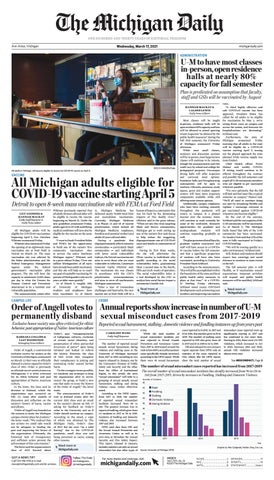
BECCA MAHON/Daily All adults in Michigan will become eligible to receive the COVID-19 vaccine on April 5.
All Michigan adults eligible for COVID-19 vaccine starting April 5 VACCINE
Detroit to open 8-week mass vaccination site with FEMA at Ford Field LILY GOODING & HANNAH MACKAY Daily Staff Reporter & Daily News Editor
All Michigan adults will be eligible for COVID-19 vaccinations beginning April 5, Gov. Gretchen Whitmer announced Friday. Whitmer also announced Friday the opening of an eight-week mass vaccination site at Ford Field in Detroit on March 24. The mass vaccination site was selected by the Biden administration and the Federal Emergency Management Agency under the federal government’s vaccination pilot program. The site will have the capacity to administer 6,000 doses per day to what the Centers for Disease Control and Prevention determined to be a hard-hit and vulnerable population. The announcement comes after
Whitmer previously reported that all adults 50 years old and older will be eligible to receive the vaccine beginning on March 22. Under the new guidelines announced Friday, adults ages 16 to 49 with underlying medical conditions will now also be eligible for the vaccine on the same date. “I want to thank President Biden and FEMA for the opportunity to build one of the nation’s first community vaccination sites to service the entire Southeast Michigan region,” Whitmer said in a press release Friday. “Over one million Michiganders of all races have already been safely vaccinated, and this site will help us to reach our goal of equitably vaccinating 70 percent of Michiganders who are 16 years or older more quickly.” As of March 5, roughly 26% of University of Michigan students and employees have been vaccinated. As of March
11, Michigan Medicine has delivered nearly 74,000 total firstand second-dose vaccinations. Currently, Michigan Medicine is in Phases 1A and 1B of vaccine prioritization, which include all Michigan Medicine employees, frontline and essential workers and adults 65 years old and older. During a pandemic that disproportionately affects minority communities — particularly Black communities — and individuals with lower social vulnerability indexes, the Detroit vaccination site aims to serve those who are most vulnerable to infection, Lieutenant Governor Garlin Gilchrist said. The vaccination site was chosen in accordance with the CDC’s prioritization recommendations and aims to serve all southeastern Michigan communities. “After a year of tremendous challenges and heartache, the new vaccine site at Ford Field will be a
beacon of hope in a community that was hit hard by the devastating impacts of this deadly virus,” Gilchrist said in the press release. “When we saw this virus targeting Black and Brown communities, Michigan got to work setting up one of the nation’s first task forces to help reduce the staggering, disproportionate rate of COVID-19 cases and deaths in communities of color.” During its first three weeks, the site will administer the Pfizer vaccine to individuals who qualify according to the social vulnerability index, guaranteeing them a second dose in the fourth, fifth and sixth weeks of operation. The social vulnerability index is a tool developed by the CDC to analyze how social factors impact a community’s health risk.
Read more at MichiganDaily.com
Most classes will be taught in-person, residence halls will be open at almost 80% capacity and fans will be allowed to attend sporting events in-person “as allowed by the public health measures” during the Fall 2021 semester, the University of Michigan announced Friday afternoon. While most small classes, seminars and discussion sections will be in person, most large lecture classes will continue to be remote, though the announcement said this could vary by school and college for pedagogical purposes. On-campus dining halls will offer in-person and carry-out meal options. Residence halls and living-learning communities will be open to students. Libraries, museums, study spaces, gyms and student support centers will have more in-person components available while still offering some remote options. Additionally, campus employees who have been working remotely throughout the pandemic will return to campus in a phased manner over the summer. Some will continue to work remotely for some of the workweek. Research opportunities for graduate and undergraduate students will continue expanding gradually as well. The plan presumes that all faculty, graduate student instructors and staff will have access to a COVID19 vaccine before the fall semester and that a significant proportion of students will have also been vaccinated, according to University President Mark Schlissel. According to the announcement, “this will all be accomplished within the boundaries of the state and local public health safety measures in place at that time.” At a COVID19 briefing Friday afternoon, Schlissel noted recent COVID-19 developments such as lowering case numbers and improving vaccination
rates. “A third highly effective and safe COVID-19 vaccine has been approved, President Biden has called for all adults to be eligible for vaccination by May 1, we’re seeing fewer cases on campus and across the nation, and forecasts for hospitalizations are decreasing,” Schlissel said. Furthermore, the state of Michigan announced Friday morning that all adults in the state will be eligible for a COVID-19 vaccine starting April 5, tossing out the phased approach the state planned while vaccine supply was more limited. Chief Health officer Preeti Malani said weekly COVID19 testing would continue to be offered throughout the summer and possibly the fall semesters and urged all U-M community members who are eligible to get vaccinated wherever possible. “I’m very optimistic that the fall will look and feel more like a typical semester on campus,” Malani said. “We’ll all need to continue doing our part by remaining flexible and vigilant. I encourage everyone to get vaccinated against COVID-19 whenever you become eligible.” By the end of the summer, Schlissel said the vast majority of the U-M community will be vaccinated. As of March 5, The Michigan Daily found that 26% of the U-M community has been vaccinated. Dr. Sandro Cinti said that 22% of the state is fully vaccinated in Friday’s COVID briefing. “We will be moving quickly to a safer environment,” Schlissel said. Still, Malani said students should expect face coverings and social distance to continue to some extent in the fall. The fall semester plan is still flexible, so if vaccinations exceed expectations, in-person activities will expand and public health measures will be modified, Schlissel said.
Read more at MichiganDaily.com
CAMPUS LIFE
CRIME
Exclusive honor society was often criticized for elitist behavior, past appropriation of Native American culture
Reported sexual harassment, stalking , domestic violence and fondling instances up from years past
Order of Angell votes to Annual reports show increase in number of U-M permanently disband sexual misconduct cases from 2017-2019 BARBARA COLLINS & LIAT WEINSTEIN Managing News Editors
Order of Angell, a controversial exclusive society for seniors at the University of Michigan, announced on March 12 their vote to officially disband in a letter signed by Order’s class of 2021. Order — previously an all-male secret society known as Michiguama — is often criticized for its elitist behavior and past appropriation of Native American culture. In the letter, the class said its decision to disband, which the organization says occurred on Feb. 22, came after months of discussion and reflection on the society’s history of harm, racism and elitism. “Order of Angell was founded on the mission to make the Michigan campus a better place for students,” the letter reads. “We realized that any actions we could take would not be adequate in healing the past and improving the future of the organization. Ultimately, the historical lack of transparency and sufficient action prevent the achievement of this core mission.” The letter said the organization’s class of 2021 learned about
Order’s past “misappropriation of Indigenous cultures, exclusion of certain social identities, and perpetuation of white patriarchal structures of power” upon being initiated and looked to reform the society. However, the class of 2021 wrote they recognize their complacency in joining and continuing Order caused further harm. “In the strongest terms possible, we condemn any attempts to keep the organization alive in secret, restart the group, or build a new one that seeks to erase the history of the Order of Angell,” the letter reads. The announcement of Order’s vote to disband comes after the current 2021 class sent an email to the society’s alumni on Feb. 17 asking for feedback on Order’s value to the University and on if Order should continue on campus. According to the email, a copy of which was obtained by The Michigan Daily, Order’s class of 2021 did not start “on a solid footing” due to the COVID-19 pandemic, small class size and being perceived as racist, among other reasons.
GOT A NEWS TIP? Call 734-418-4115 or e-mail news@michigandaily.com and let us know.
Read more at MichiganDaily.com Follow The Daily on Instagram, @michigandaily
CAROLINE WANG Daily Staff Reporter
The number of reported sexual assault, sexual harassment, dating violence and stalking cases at the University of Michigan increased from 2017 to 2019, according to two reports released in January, one by the University’s Division of Public Safety and Security and the other from the Office of Institutional Equity. In this article, the term “sexual misconduct” will refer to a grouping of sexual assault, sexual harassment, stalking and dating violence cases, unless otherwise noted. According to the DPSS report, from 2017 to 2019, the number of reported sexual misconduct incidents increased from 96 to 140. The greatest increase was in reports of stalking, which grew from 24 incidents in 2017 to 50 in 2019. Incidents of fondling and domestic violence also increased between 2017 and 2019. DPSS used data from OIE and the Sexual Assault Prevention and Awareness Center, as well as its own data, to formulate the Annual Security and Fire Safety Report. This report, released in January, includes statistics not only on sexual misconduct but also other types of
crime. While the total number of sexual misconduct incidents per year reported to Sexual Assault Prevention and Awareness Center from 2017 to 2019 stayed around the mid- to low-300’s, sexual harassment cases specifically sharply increased, according to the DPSS report. While there were 45 sexual harassment
cases reported to SAPAC in 2017 and 10 in 2018, this number grew to 89 in 2019. The number of stalking cases reported to OIE also grew, from 40 in 2017 and 31 in 2018 to 52 in 2019. OIE also released its own January report separate from DPSS only on statistics of the cases reported to OIE, which, like the DPSS report, show the total number of sexual
misconduct cases reported went up significantly starting in 2017 and has continued to rise since then. Starting in 2014, there were 134 OIE violations, which increased to 322 in 2020. Between 2014 and 2020, annual OIE violations increased almost every year. See MISCONDUCT, Page 3
The number of sexual misconduct cases reported has increased from 2017-2019 The overall number of sexual misconduct incidents has steadily increased from 96 to 116 to 140 from 2017-2019, driven by increases in Fondling, Stalking and Domestic Violence.
Graphic by Alex Cotignola, Naitian Zhou, Eric Lau Source: University of Michigan DPSS
For more stories and coverage, visit
michigandaily.com
INDEX
Vol. CXXX, No. 25 ©2021 The Michigan Daily
NEWS.........................2 MIC............................5 ARTS.............................8
OPINION . . . . . . . . . . . . . . . . . . . . .11 SPORTS ......................13 S TAT E M E N T. . . . . . . . . . . . I n s e r t
News
2 — Wednesday, March 17, 2021
The Michigan Daily — michigandaily.com
Stanford Lipsey Student Publications Building 420 Maynard St. Ann Arbor, MI 48109-1327 www.michigandaily.com
CLAIRE HAO
Editor in Chief cmhao@michigandaily.com
TARA MOORE
Business Manager tmooree@michigandaily.com
NEWS TIPS
tipline@michigandaily.com
LETTERS TO THE EDITOR tothedaily@michigandaily.com
EDITORIAL PAGE
opinion@michigandaily.com
PHOTOGRAPHY SECTION
ARTS SECTION
photo@michigandaily.com
arts@michigandaily.com
NEWSROOM
SPORTS SECTION
news@michigandaily.com
sports@michigandaily.com
CORRECTIONS
ADVERTISING
corrections@michigandaily.com
WMG-contact@umich.edu
Editorial Staff
ANNA FUDER/Daily Wildlife in the Midwest mostly consists of birds, squirrels and rabbits; with a zoom lens, the often overlooked beauty can be seen.
5 bills to watch in the State Legislature: Feb. 25 - March 11 GOVERNMENT
New series from The Michigan Daily highlights important pieces of legislation from past weeks JULIA FORREST Daily Staff Reporter
The following article explains five bills that have been introduced, passed or signed into law by the Michigan state legislature or Gov. Gretchen Whitmer from Feb. 25 to March 11. On the second and fourth Fridays of each month, The Michigan Daily will publish a compilation of bills being floated around in the Michigan state legislature for students at the University of Michigan to know about. This is the first installment in this series. 1. Michigan COVID-19 Recovery Plan House Bills 4047 and 4048 Status: Signed into law by Whitmer with a line-item veto of two sections. Whitmer signed this package of bills into law on March 9. The package allocates more than $2.5 billion in COVID19 relief and is a key part in Whitmer’s pandemic recovery plan. The legislation contains a $2.25 per hour wage increase for direct care workers through September, $223 million in emergency rental assistance and roughly $665 million in funds for vaccine distribution, testing and contact tracing efforts. Gov. Whitmer vetoed certain parts of the bill that aimed to strip the state health department director’s powers and limit her executive powers in handling the pandemic. As a result of her vetoes, close to $1 billion in funding will be lost from the bill, as Michigan Republican lawmakers tied limiting executive powers to this funding. This lost funding includes $100 million for non-public schools and summer school programs, $405 million in property and tax relief for businesses and $150 for unemployment insurance all being vetoed. The vetoes leave about $2 billion in federal COVID-19 relief money delegated to Michigan up for grabs. In a letter to Michigan lawmakers, Whitmer critiqued Republican lawmakers for trying to strip her of executive rights to handle the pandemic, saying it was “a reckless idea, poorly executed and poorly timed.” “I note that this legislation leaves more than $2 billion in federal money unappropriated,” Whitmer said. “As Michigan goes all-out to finally beat back this awful pandemic and turn the page to recovery, we need every last dollar going to work for us before the Legislature takes its Spring Break.” Daire Rendon, R-Lake City, said in a statement that he believes the legislation will have a negative impact on small
businesses and those who are unemployed. “Federal money was set aside to help shuttered businesses and devastated families through the worst crisis of their lives,” Rendon said. “Instead, the governor has chosen to play partisan politics, choosing winners and losers, rather than extending hope to all Michiganders. This failure is just the latest in her continuing claims that the administration is doing everything possible to save lives.” 2. Election Reform Package: Addressing Findings From Auditor General Report House Bills 4127-4131 Status: Passed by MI House, headed to state Senate. This election reform package aims to improve the absentee ballot process to accommodate the greater demand for absentee voting, and helps sift through existing Michigan voter files to remove people who have not been voting or do not have their birthdate on their registration. Before cancelling people’s voter registration, H.B. 4127 requires the Secretary of State — currently Jocelyn Benson — to send voters a postcard notifying them a placeholder birth date is on their voter file and they have to change it to the correct birth date. If a postcard is not returned or able to be delivered and if the individual does not engage in voting-related activity by the second general election after the notice was sent, their voter registration is canceled. The bill passed 61-48. Yousef Rabhi, D-Ann Arbor, voted nay. H.B. 4128 would cancel a voter’s registration if they have not voted since the 2000 general election — which would affect over 300,000 Michigan voters. To prohibit the cancellation, voters would have to fill out a card they receive by mail and send it back to the election clerk’s office. Their voter registration would still be canceled if they do not participate in a votingrelated activity — such as casting a ballot or updating their voter registration — within the next two general elections.
The bill passed 66-43. Again, Ann Arbor’s state Rep. Rabhi voted nay. H.B. 4129 requires a list of the names of county and local clerks who are not up to date on their election training to be published on the Secretary of State’s website. The bill passed 87-22. Rabhi voted in favor. H.B. 4130 and H.B. 4131 both work to ensure clerks consolidate precincts by increasing the number of voters assigned to one precinct and to keep an up-to-date list of absentee voters. The bills also require cities and townships with two or more precincts to create absentee ballot counting boards to process and count absent voter ballots. H.B. 4130 passed 79-30 and H.B. 4131 passed 104-5. Rabhi voted in favor of both bills. 3. Bill Aiming to Divide High Schools Sports by Biological Sex Senate Bill 0218 Status: Introduced in the Senate. Introduced by state Sen. Lana Theis, R-Brighton, and sponsored by 12 other GOP lawmakers, this bill was introduced with the intent of requiring high school students to compete on high school sports teams solely based on their biological sex. The legislation defines biological sex as ‘the physical condition of being male of female’ as said on the individual’s birth certificate. Theis said in a statement that she thinks the bill is a way to uphold the legacy of Title IX, a federal law that protects students from gender discrimination in educational programs. “Something must be done to preserve the legacy of Title IX — a staple of American society,” Theis said. “So, very simply, my bill will ensure that, in school sports in Michigan, student athletes will compete against one another according to their biological sex — females against females, and males against males.” The bill also comes as Republicans across the country
ANNIE KLUSENDORF/Daily
set out to prevent transgender women from competing on female sports teams. Democrats have strongly opposed such legislation on the basis that it is a strong attack on transgender students and transgender rights. 4. Drunken Driving Expungement for First-time Offenders House Bills 4219-4220 Status: Passed by the House. Sponsored by state Reps. Tenisha Yancey, D-Harper Woods, and Joe Bellino, R-Monroe, these two bills would expunge first-time drunk driving offenses from individual’s records. H.B. 4219 allows drivers who were convicted of driving while intoxicated to remove their first offense from their record, granted the offense did not cause death or serious injury to another individual. The erasure of offenses applies to violations of local, state and federal laws, as well as violations that occurred on Native American territory. H.B. 4220 gives first-time offenders the opportunity to apply for expungement from a judge. The MI House passed the piece of legislation 93-17. Rabhi voted in favor of both bills. 5. A Resolution to Keep Daylight Saving Time All Year Senate Bill 231 Status: Introduced. This bill, introduced by state Sen. Jeff Irwin, D-Ann Arbor, aims to keep Michigan on the same time system all year round, eliminating daylight savings time. The bill does not specify if Michigan would be on daylight saving time or standard time. This coming weekend, Michigan will “spring forward” and lose an hour of the day starting 2 a.m. Sunday, March 14. Clocks will revert back an hour on Sunday, Nov. 7 at 2 a.m. Irwin said he has been a longtime supporter of the removal of daylight saving time and released a statement saying daylight saving time causes heart attacks, strokes and general crankiness. “Twice a year, we volunteer Michiganians for more car accidents and injuries at work,” Irwin said. “We see lower productivity and an increased number of heart attacks and strokes, as well as a noticeable uptick in general crankiness. The twice a year time change has no benefits for our state, and we should stop doing it immediately.” The bill was introduced on March 11. Daily Staff Reporter Julia Forrest can be reached at juforres@umich.edu.
BRITTANY BOWMAN Managing Editor
babowm@michigandaily.com
JACK GRIEVE
Digital Managing Editor
jgrieve@michigandaily.com
BARBARA COLLINS and LIAT WEINSTEIN Managing News Editors
news@michigandaily.com
Senior News Editors: Emma Ruberg, Hannah Mackay, Calder Lewis, Jasmin Lee, Francesca Duong, Kristina Zheng Investigative Editor: Sammy Sussman FOIA Manager: Ayse Eldes
LIZ COOK and JOEL WEINER
Editorial Page Editors tothedaily@michigandaily.com Senior Opinion Editors: Zack Blumberg, Andrew Gerace, Min Soo Kim, Mary Rolfes, Elayna Swift
LANE KIZZIAH and KENT SCHWARTZ
Managing Sports Editors sports@michigandaily.com Senior Sports Editors: Rian Ratnavale, Drew Cox, Lily Friedman, Jack Kingsley
ELISE GODFRYD and ZOE PHILLIPS
Managing Arts Editors arts@michigandaily.com Senior Arts Editors: Andrew Pluta, Grace Tucker, Kari Anderson, Katie Beekman, Sophia Yoon Arts Beat Editors: Elizabeth Yoon, Peter Hummer, Mik Deitz, Sabriya Imami, Kaitlyn Fox, Anya Soller
AYA SALIM and SHANNON STOCKING Managing Design Editors Senior Layout Editor: Adam Bressler
design@michigandaily.com
ALLISON ENGKVIST and MADDIE HINKLEY
Managing Photo Editors photo@michigandaily.com Senior Photo Editors: Emma Mati, Miles Macklin, Becca Mahon, Julia Schachinger Assistant Photo Editors: Maddie Fox, Luke Hales, Jeremy Weine, Gabby Ceritano, Sophia Afendoulis
ANDIE HOROWITZ
Managing Statement Editor statement@michigandaily.com Deputy Editors: Isabelle Hasslund, Marisa Wright
MADISON GAGNE and OLIVIA BRADISH
Managing Copy Editors copydesk@michigandaily.com Senior Copy Editors: Caroline Atkinson, Anjali Chiravuri, Ethan Patrick, Kelsey Burke, Emily Wilson, Vanita Seed, Sophie Kephart, Rena McRoy
PARTH DHYANI and NAITIAN ZHOU Managing Online Editors
webteam@michigandaily.com
IULIA DOBRIN and ANNIKA WANG
Managing Video Editors video@michigandaily.com Senior Video Editors: Margaret Rudnick, Jordan Shefman
ANAMIKA KANNAN and GABRIJELA SKOKO
Michigan in Color Editors michiganincolor@michigandaily.com Senior Michigan in Color Editors: Noor Moughni, Maya Kadouh, Eliya Imtiaz, Jessica Kwon, Lola Yang
EMILY OHL and GERALD SILL
Managing Podcast Editors podeditors@michigandaily.com Senior Podcast Editors: Doug McClure, Max Rosenzweig, Avin Katyal
HALEY JOHNSON and ASHA LEWIS
Managing Social Media Editors socialmedia@michigandaily.com Senior Social Media Editors: Kirti Aplash, Natalie Knight, Ria Dubey, Ryan Postman, Evan DeLorenzo, Atticus Raasch, Bella Morreale
ALEX HARRING and SARAH SZALAI Co-Chairs of Access & Inclusion
accessandinclusion@michigandaily.com
Business Staff RORI MILLER Creative Director
SCHUYLER JANZEN Sales Manager
The Michigan Daily (ISSN 0745-967) is publishing weekly on Wednesdays for the Winter 2021 semester by students at the University of Michigan. One copy is available free of charge to all readers. Additional copies may be picked up at the Daily’s office for $2. If you would like a current copy of the paper mailed to you, please visit store. pub.umich.edu/michigan-daily-buy-this-edition to place your order.
News
The Michigan Daily — michigandaily.com
Wednesday, March 17, 2021 — 3
City Council discusses uses for marijuana excise tax CITY
Councilmembers commit to investing in community services, officially recognize Transgendender Day of Visibility SHANNON STOCKING & JULIA FORREST Daily Staff Reporters
The Ann Arbor City Council met virtually Monday evening to discuss a resolution to acknowledge Ann Arbor resident Daniel Bicknell’s longstanding career in public service, the allocation of excise tax revenue from recreational marijuana and the implementation of a Transgender Day of Visibility. The meeting began with a discussion of a resolution to commend Bicknell, the president of Global Environment Alliance LLC, for his acts of public service. Bicknell is credited for discovering the 1,4-dioxane pollution in the Third Sister Lake as a researcher at the University of Michigan in 1984. The pollution, which started from the company Gelman Sciences, eventually spread to a large plume in the underground water system in Ann Arbor. Councilmember Jeff Hayner,
D-Ward 1, spoke in favor of the resolution, saying the recognition was well-deserved. He added that Ann Arbor resident Roger Rail should also be recognized for working alongside Bicknell. “I think it’s great that the environmental commission has brought this forward to recognize Bicknell and the work he’s done over the years, decades really, on the Gelman plume issue specifically,” Hayner said. “He’s freely shared his knowledge and experience with us over the years about this issue, and I think that’s terrific.” The resolution passed unanimously. In October 2019, City Council debated whether or not to legalize the sale of recreational marijuana, which was passed 9-2 at that meeting. When City Council passed this ordinance, there were no plans made for the excise taxes that would be collected, Councilmember Ali Ramlawi, D-Ward 5, said. Councilmembers debated item
DC-3 on the agenda, which aims to use revenue from the excise tax placed on recreational marijuana “in a way that intentionally reinvests in our community, acknowledges the past harm of criminalization, and supports populations disproportionately and negatively impacted by the ‘War on Drugs.’” Ann Arbor received 1% of the state’s revenue from the tax, totaling about $476,000 for Ann Arbor. Councilmembers are currently trying to figure out how exactly the revenue should be used in the community. In the original discussions in October 2019, councilmembers discussed how these excise taxes could be used for social justice, mental health and substance abuse issues, Ramlawi said. More specifically, Ramlawi suggested putting the money toward unarmed crisis response teams that could serve as an alternative to police in mental health crises. These teams gained increasing mainstream
traction after a summer of protests for racial justice and against police brutality. “It is my intent and my wishes to see this money go to programs that currently don’t exist and that this can be used in ways that are innovative and responsive to the issues we hear from our community based on the need for unarmed emergency response (teams),” Ramlawi said. Ann Arbor resident Aria Schugat called into the meeting in support for DC-3 but expressed concern about the vagueness of where the money from the excise taxes will go. Schugat proposed that the excise taxes go towards supporting the housing association of Washtenaw County and the Delonis Center. “I believe that if we help our most vulnerable members and help lift them up, we can lift everyone else up with them,” Schugat said. Hayner said he spoke with members of the community and people in the cannabis industry to discuss how the money from the
MISCONDUCT From Page 1
Online learning presents new opportunities for students in dual enrollment program
Number of high schoolers taking U-M courses showed a ‘modest increase’ RONI KANE
Daily Staff Reporter
Thursday, March 11 marks one year since the University of Michigan suspended all in-person classes in response to the COVID19 pandemic and transitioned the majority of academic activities to an online format. The same day, Gov. Gretchen Whitmer announced all Michigan high schools would be required to go online as well. A year later, another class of high school seniors is struggling to sift through hours of virtual resources and campus tours to choose if, and where, they want to pursue postsecondary education. Yet a handful of high school students are getting a taste of the University’s undergraduate experience in a unique way — by participating in the “dual enrollment” program, which allows students to earn college credit if they have “exhausted” the courses offered at their high school in a particular subject area and have demonstrated high performance on standardized tests and AP exams. University spokesman Rick Fitzgerald told The Daily there has been a “modest increase” in the number of high school students who elected to dual enroll at the University this academic year. For the fall 2020 and winter 2021 semesters, 30 and 23 high school students dual enrolled in various University classes, respectively, compared to 18 and 17 students in the fall 2019 and winter 2020 semesters. Once a student’s dual enrollment application is accepted, they can register for the classes they selected on the application during the first day of the term, provided there are
still open seats available. The cost of tuition for these students depends on the number of credit hours requested. Fitzgerald said for a four-credit course, tuition totals $2,843, which does not include additional costs associated with books or other class-specific materials. Though each high school covers a specific amount of this cost, determined by the Michigan Department of Education, the students are expected to individually pay for the remainder of their tuition and fees. The Community Resource Program, however, allows high schoolers enrolled in Ann Arbor Public Schools with at least a 3.5 grade point average to receive high school credit for auditing a University class — without paying tuition — so long as the individual professor grants permission. Students who choose to engage in University coursework through the program are still expected to attend lectures, participate in any associated discussions or lab components and complete any assignments and exams to receive high school credit. When discussing the 67% increase in University dual enrollment from the fall 2019 to the fall 2020 semester, Christopher Kasper, a counselor at Pioneer High School in Ann Arbor, said he thinks the online environment might be more attractive to high school students with tight academic schedules, fewer transportation options or various extracurricular activities. “It’s been nice this year in the sense that if a student did want to dual enroll, they could technically be a little bit more flexible with the timeframe,” Kasper said.
“Usually there are some logistical parameters that are in effect where most of our students can’t take a … college class during the school day and they have to look to the late afternoon or the evening.” On the other hand, Kasper said some students might be deterred from paying for virtual dual enrollment courses due to Zoom fatigue from their high school classes and the lack of on-campus experiences. Kimberly You, a sophomore at Pioneer High School, is dual enrolled in MATH 285 and 217. You said with the virtual format, she has enjoyed continuing her mathematical education beyond what the high school curriculum traditionally offers without having to sacrifice any high school classes she wanted to take. “It was easier to adjust my schedule since I can still take seven classes,” You said. “If I was still at Pioneer in-person, I could only take six classes because of the commute.” Haakam Aujla, a senior at Bloomfield Hills High School, said though the University was his first choice for dual enrollment this year, he would likely not have been able to consider it as an option if classes were in-person because of the 45-minute commute. Having previously taken other dual enrollment courses at local colleges, Aujla said his dual enrollment in the University for MATH 465 and 425 this year gives him an idea of what his freshman year might be like if he decides to accept his offer of admission to the University.
Read more at MichiganDaily.com
OIE violations increased almost every year. Unlike the DPSS report, the OIE report does not include information on sexual harassment. Because sexual harassment specifically is not a crime that is mandatory to report for data collection under the Clery Act, a consumer protection law that aims to provide transparency around campus crime statistics and policy, studentreported sexual harrassment cases do not get directed to OIE by whomever the students reports it to. OIE and DPSS are the two organizations at the University that oversee sexual misconduct reports and investigations. When a student reports sexual misconduct to a responsible employee, that employee is mandated in their employment contract to report the case to either OIE or DPSS, depending on the employee’s role. SAPAC is an additional resource that helps student survivors by offering peer-led support groups and directing them to further assistance through referrals. SAPAC is confidential, meaning they “will not share any information with anyone” unless there is a potential for harm to the student or others. Though SAPAC does not oversee reports and investigations, they do collect data to use in reports by the other two organizations due to the Clery Act. SAPAC Director Kaaren Williamsen said SAPAC internally tracks the identities of students who report but does not include that information when giving it to DPSS to be included in their annual report, as specified by the Clery Act. OIE is also required to report sexual misconduct statistics to DPSS because of the Clery Act. University community discusses results of the reports Elizabeth Seney, the OIE Title IX coordinator, discussed the increased cases in the two reports. Seney, who is in charge of deciding whether OIE will investigate sexual misconduct cases, collects data of these cases and looks at trends in internal aggregate data documents. Seney said the increase in reported cases does not necessarily mean there are more instances of sexual misconduct on campus, but instead that more people are reporting. “In general, it is never the case where we can look at the numbers and the trends and pinpoint exactly what is going on,” Seney said. “But generally speaking, I don’t necessarily interpret an increase, or … decrease to mean that there is more or less of a particular type of conduct happening. I tend to first think about reasons why people might be reporting more or less.” OIE does not require people to include their identities in reporting, but Seney said students who report as identifying as LGBTQ+ tend to have a higher risk of facing sexual misconduct. SAPAC has noticed a significant increase in the number of graduate students coming to the center as compared to undergraduate
excise taxes should be used. “Overwhelmingly to the last person, the comment was it must have a community use and do public good in areas that are underfunded and have great need in our community,” Hayner said. DC-3 was sponsored by over half of the members on the council. Councilmembers intend to incorporate this resolution into the 2022 budget, but have yet to decide exactly where the money will be allocated to. “Essentially what we’re asking this body to do is to agree in principle that this goes towards community uses and public good,” Hayner said. The resolution passed unanimously. The council also discussed a resolution to officially recognize a Transgender Day of Visibility. Councilmember Travis Radina, D-Ward 3, said there is a need for more education and awareness around the topic of transgender rights, especially since transgender
people face higher rates of discrimination. Councilmember Elizabeth Nelson, D-Ward 4, voiced her support for the resolution and discussed the generational differences in understanding issues of transgender rights. Nelson said this resolution is important for her son’s generation and future generations, who will grow up understanding systemic discrimination against transgender people. “This is really an opportunity for those of us who are old enough to remember the terrible way things used to be to make a real effort to move forward,” Nelson said. “And I’d like to say I’m really optimistic about the future based on the conversations I have with my own children.” The resolution was approved unanimously.
students in the past year, according to SAPAC Associate Director Anne Huhman. She said this increase may be a result of increased community outreach within the graduate student community in recent years. “The first thing that came to my mind in terms of a clear trend is actually more around undergrad versus grad,” Huhman said. “We’ve definitely seen a trend of more graduate students coming forward. We’ve possibly seen a connection between increased community outreach, education, and training efforts with the grad student population.” According to Seney, it is impossible to say what caused the number of sexual misconduct reports to go up, but she said there are several possible explanations for the data trend. “Some of the factors that tend to influence (the number of reports), which I think align pretty well with those years (2017-2019), is an increase in the training that we do about reporting,” Seney said. “When there are policy changes, and … a refresh of training on reporting and required reporting, (the number of reports increases).” A change in the definition of sexual misconduct in U-M policy documents may also have contributed to the increase. In 2016, the definition of stalking was revised to be more specific and included it as a formal form of sexual misconduct. As a result, she said, there was an increase in the number of stalking cases that were reported starting in 2017. Seney also said social movements and increased exposure of sexual misconduct in the media have a large impact on people’s perception of these offenses, which might influence survivors to come forward. “The other thing is when there’s issues in the news, both nationally and at the University, (reports increase),” Seney said. “Every year, starting around the beginning and the height of the #MeToo movement in late 2017, we have seen more news coverage about particular cases, and about how universities … and other educational institutions handle these things. I think sometimes that can bring reports to the forefront because it’s on people’s mind.” Huhman echoed Seney’s statement and said the increase in exposure of sexual misconduct cases could potentially influence people’s decision to come forward. “We do know what some of the common complex barriers are for survivors to come forward,” Huhman said. “I do think if there’s heightened visibility around it, sometimes people see others having the courage to come forward, and that can always be a powerful influence.” There has been a number of high-profile sexual misconduct cases at the University in recent years, particularly among faculty and staff. In 2018, The Daily conducted an investigation that uncovered over 40 years of sexual misconduct from former Music, Theatre & Dance professor Stephen Shipps. David Daniels,another former Music, Theatre & Dance professor,was fired in March 2020 over sexual assault allegations
that occured during and before his tenure at the University. Former U-M Provost Martin Philbert was removed from his position in March 2020, leading to a report from WilmerHale finding over 20 years of sexual misconduct during his time at the University. Robert E. Anderson, deceased former University athletics physician and University Health Services director, currently has over 100 sexual misconduct allegations being litigated going back 50 years in his time at the University. Engineering professor Jason Mars was accused of sexual misconduct in Feb. 2020, and Engineering professor Peter Chen is currently on administrative leave following criminal sexual misconduct charges. Tamiko Strickman, the University’s OIE director, is facing two lawsuits claiming she mishandled sexual assault and racial discrimination cases while working at the University of Nebraska-Lincoln. Strickman worked as an investigator, deputy Title IX coordinator, Title IX coordinator and OIE director at UNL from 2015 to 2019. LSA senior Samantha Schubert, co-president of University Students Against Rape and Take Back the Night Ann Arbor, wrote in an email to The Michigan Daily that the rise of the #MeToo movement and increased support for those who have been assaulted have helped survivors to come forward. However, Schubert added the general consensus on campus has “become less trusting of the University’s ability to handle these cases,” particularly when the University was required to amend its sexual assault guidelines in 2019 after the Doe v. Baum ruling in 2018. The amended University policy required mandatory live cross-examination, during which the person who alleges assault is questioned by their alleged assaulter, which drew criticism from the University community. Policy from former President Donald Trump’s administration mandated these crossexaminations for all universities but by a third-party such as a lawyer, which some on campus saw as a small win within what they believed to be still-problematic cross-examinations. “The general sense in the community was that it was detrimental to survivors, who were already under a lot of pressure when going through the University’s reporting system,” Schubert wrote. “U-M student orgs advocating for survivors were especially appalled. I know that there was a huge amount of anger amongst the members of my own org.” Students have also taken “matters into their own hands,” Schubert wrote, pointing to the Assaulters at Umich Twitter account that was created in June 2020 and shut down in November 2020. This account posted pictures and names of people who were accused of sexual assault by direct messages from anonymous students. None of the allegations on the account have been verified by The Daily or any other news organization.
Daily Staff Reporters Shannon Stocking and Julia Forrest can be reached at sstockin@umich.edu and juforres@umich.edu.
Read more at MichiganDaily.com
News
4 — Wednesday, March 17, 2021
The Michigan Daily — michigandaily.com
CITY
CRIME
Prisoners face lengthy quarantines, Survivors Speak protests for possible false positive test results transparency, accountability Incarcerated individual says ‘This facility then and now is still an issue’ ASHNA MEHRA & JULIA FORREST Daily Staff Reporters
Isaiah Mayweather, who is incarcerated at Macomb Correctional Facility, returned to his normal cell Jan. 27 after serving 18 days in a mandatory quarantine as a result of coming into close contact with someone who contracted COVID-19. However, Mayweather, after being tested three times, never once tested positive for the virus that has infected more than 25,000 prisoners in Michigan alone. Mayweather wrote in an email to The Michigan Daily about his experience being isolated for 18 days and never contracting the virus. According to Centers for Disease Control and Prevention guidelines, quarantining for 10 days without symptoms, or quarantining for seven days and receiving a negative test on or after day five are sufficient precautionary measures to take following a COVID-19 exposure. The Michigan Department of Health and Human Services says if individuals show no symptoms for 10 days following a COVID-19 exposure, they can discontinue quarantine. Gov. Gretchen Whitmer received criticism from activists and families of incarcerated individuals late last year for her criminal justice policy during the COVID-19 pandemic. While she signed an executive order in August 2020 to improve testing and transfer protocols in prisons, some said these actions did not adequately protect prisoners from infection. Mayweather emphasized the strain that his prolonged quarantine took on not only his own well-being but on his relationship with his family, whom he was not able to talk to the entire time he was placed into quarantine. In-person visitations have been discontinued completely for over a year.
“My children couldn’t imagine what it would be like not hearing from me in nearly a month’s time,” Mayweather wrote. “After the long break we were forced to take from each other, my relationship with them hasn’t been the same since. A lot had changed in nearly a month’s time.” Based on Michigan Department of Corrections policy, prisoners should still be able to have daily access to phones, showers, microwaves, showers and the J-pay emailing system. Mayweather, however, said this was not the reality. According to Mayweather, an inmate who has had close contact with a COVID-19 positive individual often has less access to facilities than someone who tests positive. “On paper it looks nice and civil,” Mayweather wrote. “But in reality, we are rarely, if ever afforded these luxuries. If (you’re) in close-contact with a Covid person, it’s possible you can be held longer than a person who’s actually in violation of a rule. So mentally, this is draining.” Mayweather wrote he is not the only prisoner who has experienced a long wait time in close-contact quarantine, claiming some prisoners experienced up to 30 days in closecontact quarantine. MDOC spokesperson Chris Gautz told The Daily prisoners should still have access to normal facilities, such as regular showers and the use of phone and email services, while in quarantine. He did not confirm whether closecontact quarantine could last up to 30 days. Gautz also said the restriction in programs, classes and outdoor activities is important in reducing the spread of COVID-19, what MDOC sees as an unfortunate but necessary measure. “We just have to remind them that this isn’t punitive,” Gautz said. “Although it may feel like it is (when
they are) stuck in their cell for longer than they’d like, it’s for their safety.” Incarcerated individuals are also experiencing issues with testing. In accordance with the Department of Health and Human Services, prisoners are now being tested daily. As soon as the department found the COVID-19 B.1.1.7 variant, they issued an emergency public health order to increase testing in prisons. On Jan. 23, Steven Schutt, who is incarcerated at Macomb Correctional Facility and deals with severe asthma, was told he tested positive for COVID-19 and was sentenced to a mandatory quarantine — yet Schutt, who never showed a single symptom, was convinced it was a false positive. According to Schutt, his family’s request for him to be re-tested was denied. “We were never swabbed the entire time I was (in quarantine),” Schutt said in a written message to The Daily. “The only thing they did was check our vitals and more (or) less wait and pray (I didn’t) get sick from (my roommate) or the other guys that were already there. I worried every day … I (cried) on the phone to my family and we couldn’t do anything about it.” According to Schutt, an antibody test later revealed that Schutt did not have any COVID-19 antibodies. Gautz said he knows nothing of the alleged false positive test and that all testing is conducted through private labs due to the large capacity of tests being ordered. “I don’t know of many doctors who would falsify a record just so their hospital could make more money,” Gautz said. “So I’m not really sure where that (accusation) would come from.”
Read more at MichiganDaily.com
GOVERNMENT
Community reacts to legal challenge to U-M campus firearm ban
Attorney General Dana Nessel backs University’s on-campus gun ban JULIA RUBIN
Daily Staff Reporter
Michigan Attorney General Dana Nessel filed an amicus brief on March 1 against Joshua Wade, an Ann Arbor resident who challenged the University of Michigan’s on-campus firearm ban. According to the amicus brief, it is within the University’s constitutional rights to enact a firearm ban on campus, though the case remains held in the Michigan Supreme Court. Amicus briefs are filed by parties not directly involved in a lawsuit to support one side of a case. Nessel’s brief backs the University and argues court precedent supports their firearms ban, noting that restrictions on firearm carry exist in other sensitive places like churches and primary and secondary schools. “When it declared the rough contours of the amendment, the Court was careful to single out core areas in which governments may regulate firearms — including longstanding prohibitions on guns at school,” the brief reads. “From the first colleges on American soil to the present day, states and colleges have exercised their authority to regulate firearms in myriad ways, from outright bans to clear permission to carry. The University’s prohibition fits within this range of permissible options.” University spokesman Rick Fitzgerald agreed, writing in an email to The Daily that the University is well within its constitutional rights in prohibiting weapons on campus, citing the 2008 Supreme Court case District of Columbia v. Heller. This landmark case recognized the right of public entities to regulate handguns in schools and public buildings. “Guns have been banned for decades and courts have upheld the University’s right to prohibit weapons from campus,”
Fitzgerald wrote. “The safety of the University community is one of our highest priorities as a University. Allowing weapons on campus undermines those efforts.” Psychology professor L. Rowell Huesmann, who studies aggressive behavior and media violence, said Wade is unlikely to win his case due to the precedent set by D.C. v. Heller. He added that the University and surrounding community is better off with the standing firearms ban. “Numerous studies show that not only when people have firearms is there a greater likelihood of people being seriously hurt during disagreements and arguments, but just the sight or knowledge of firearms being around is what we psychologists call a ‘prime’ to behaving more aggressive and violent,” Huesmann said. “So there’s a lot of studies that show that just the sight of a firearm makes people more likely to think more aggressively and violently than they otherwise would.” Huesmann said the argument that guns make people safer isn’t backed by data. Instead, he said, the presence of firearms increases the likelihood of gun violence. “Studies also show that the concept of providing protection is very misplaced — that firearms don’t provide personal protection in the way that people think,” Huesmann said. “In fact, they are likely to lead to accidental shootings and killings of people. The idea that they provide significant protection against nefarious people is just not borne out by the data.” LSA freshman Macy Hannan said she doesn’t see a difference between the University and other places like churches and primary and secondary schools that are able to regulate firearms. “From my understanding, my high school was able to (ban firearms), churches are able to
(ban firearms), I don’t get why this is any different of a situation and I think it’s something that should be done,” Hannan said. Hannan said she would feel less safe walking around campus if the courts were to strike down the firearms ban. “I think it is the University’s responsibility to help keep me safe, and they should be able to keep me safe so then I don’t need to,” Hannan said. “I would definitely feel more scared walking around campus if (the ban is repealed).” LSA junior Ryan Fisher, president of the University’s chapter of College Republicans, said court precedent gives the University the right to regulate firearms on campus. But Fisher added that he believes allowing concealed carry of firearms on campus would make students safer. “College campuses especially are a sensitive location, and I do think it could be alarming openly carrying firearms, especially given some recent history with school shootings,” Fisher said. “Concealed carry, on the other hand, averts the possibility that someone could be upset with the fact that you are carrying a firearm while nevertheless giving people the opportunity to defend themselves, and even defend others in times of danger.” LSA freshman Barry Dechtman disagreed and said he doesn’t see a need for students to carry guns on campus and has faith in the University’s ability to protect its students. “There’s no real need to have guns on a college campus,” Dechtman said. “I think protection is a big thing, but I think there are many alternatives and a lot of other measures the University can take to keep students safe (instead of allowing guns on campus). Without guns, I feel a lot safer.” Daily Staff Reporter Julia Rubin can be reached at julrubin@ umich.edu.
Demonstration marks one year since police killed Breonna Taylor NINA MOLINA & SARAH STOLAR
Daily Staff Reporters
Marching through the streets of downtown Ann Arbor, dozens of protesters gathered with signs demanding racial justice and equality Saturday afternoon. Chants calling for racial justice, police accountability and governmental transparency were punctuated by drum beats as onlookers watched from sidewalks. Saturday’s protest, hosted by non-profit advocacy group Survivors Speak, marked exactly a year after the police killing of Breonna Taylor, a 26-year old woman from Louisville, Ky. who was killed in her apartment when officers wrongfully broke into her home and fired 32 rounds after Taylor’s boyfriend fired one. No officers involved in the shooting currently face criminal charges. According to the organizers, Survivors Speak is dedicated to amplifying the voices of victims of any form of injustice, and Saturday’s protest was centered around the theme of accountability. On the steps of Hatcher Graduate Library, speakers took to the microphone to emphasize the necessity of fighting for accountability within public institutions and called for transparency on issues unique to Ann Arbor. Trische’ Duckworth, executive director and founder of Survivors Speak, told The Michigan Daily before the protest that she began the organization in 2018 as a way to support those fighting for widespread transparency and justice. “Normally survivors are recognized as rape victims, molestation, domestic violence,” Duckworth said. “But we took it a step further in saying, really, all of us are surviving something, right? Like some kind of pain, some kind of trauma. And so we wanted to honor all survivors and to help people free themselves in the midst of what they’re going through.” Duckworth also said she believes unity is essential when it comes to holding officials accountable. People have a responsibility, Duckworth said, to ensure that local officials follow through on promises they made when they ran for office. “We have to hold ourselves accountable so that we can
continue to stay the course and pay attention to what’s going on around us, pay attention to what’s going on in legislation,” Duckworth said. “But then we have the job to hold our legislators accountable to ensure that they hold true to the agenda items that we have approved for them when we elect them.” Jazmyn Bradford, School of Social Work student and intern for Survivors Speak, told The Daily that the purpose of Saturday’s protest was to encourage community members to advocate for justice in their local governments. Many speakers emphasized that Ann Arbor is no exception to police violence against Black and Brown people. Many also discussed their experiences with systemic racism within Ann Arbor Public Schools. “We want community members to understand that we have the power to put people in the positions that they’re in. … We want social justice,” Bradford said. “We want policies that are actually going to make change happen.” Law School student Solomon Furious Worlds, who also attended the rally, is representing Makayla Kelsey, Ann Arbor Public School student, and her mother Charmelle Kelsey in a case against instances of racial discrimination in Pioneer High School. The Kelseys originally submitted a complaint with the Michigan Department of Civil Rights in August 2020 alleging that AAPS created a racially hostile environment. The Civil Rights Litigation Initiative, a clinic at the University of Michigan Law School, also sent a letter to AAPS administrators on behalf of the Kelseys in August 2020. According to the letter, Kelsey allegedly faced racial discrimination from current Pioneer math teacher Michele Macke. Worlds said he attended the rally both to show solidarity with the demands — like accountability and transparency by Ann Arbor police and elected officials — mentioned by other speakers and spread awareness about others’ experiences of racism within AAPS. Worlds also called for protestors to sign a petition calling for AAPS to publicize the results of the investigation into the alleged discriminatory incidents. According to Worlds, AAPS has not followed through on demands to implement a system
where students could report instances of racial bias and civil rights organizations could provide transparent investigations. As of Sunday evening, the petition has garnered more than 1,200 signatures. In an October 2020 statement in response to CRLI’s letter, AAPS Superintendent Jeanice Swift emphasized the school district’s commitment to investigating the incidents of racial discrimination. “In the AAPS, we take this situation and the matters outlined in that letter very seriously,” Swift wrote. “All of us are deeply disturbed by the content of the allegations. We are committed to a full and thorough investigation of those matters as we understand the important value each child brings and are deeply committed to equity and opportunity for each and every student we serve.” Saturday’s protest, Worlds said, was meant to call for racial justice both at the community and national levels. “Today, there’s mourning and remembrance, with regards to the killing of Breonna Taylor, but not just for Breonna but also for Tony McDade, Michael Brown, Laquan McDonald and for so many people whose names we don’t remember,” Worlds said. “The injustice started in 1619, and it continues today. It didn’t end with slavery, it didn’t end with Jim Crow. It continues today.” Ezra Peiter, a 14-year-old student from Chelsea, Mich., attended the protest and said he joined the movement to combat racism within Michigan police departments. He spoke to the audience about how the Chelsea Police Department failed to protect 16-year old protester Mya King when she was assaulted by an older woman while peacefully protesting at a Black Lives Matter protest this past summer. The woman was charged with misdemeanor assault. Last month, Drop the Charges, a community-led movement to drop charges from peaceful protests, began petitioning to withdraw charges against those who received tickets for impeding traffic during Black Lives Matter protests. King received a citation for attending the July 31 protest and the charges against her were eventually dropped on Feb. 15 after numerous attempts by the CRLI to have them rescinded.
Read more at MichiganDaily.com
NEWS BRIEF
Support student journalism: The Daily joins ‘College Media Madness’ fundraiser
All donations will go towards supporting newsroom essentials PAIGE HODDER
Daily Staff Reporter
From March 15 to April 5, more than 20 college newspapers across the nation, including The Michigan Daily, will participate in the College Media Madness competition to earn the most money for their newsroom. The competition is organized by Syracuse University’s independent news organization, The Daily Orange. Tara Moore, The Daily’s business manager, said the idea is to mimic the March Madness hype while raising money for student journalism. “We’re seeing all these different university basketball programs come together — so we figured it’d be a lot of fun to have the same kind of rivalry,” Moore said. “There are a bunch of different schools that have all come together to fundraise and have some friendly competition.” The Michigan Daily will be accepting donations via collegemediamadness.com, and contest coordinators will be updating the rankings frequently. “In many communities, these outlets are the primary source of news,” a statement on the CMM website reads. “College journalism fills a void left by the closure of newsrooms across the country, one that has rapidly accelerated amid the COVID-19 pandemic. But these organizations need your help. By donating to a student newsroom, you’re supporting the next generation of journalists.”
Moore said the COVID-19 pandemic has made the past year financially difficult for the Ann Arbor community. As a result, The Daily has lost significant funding from local advertising. “It is no secret print journalism and student journalism as a whole is struggling and going through a tough time right now,” Moore said. “And the pandemic is no help to that, and so we want to get any and all support that we can from different donors.” Claire Hao, The Daily’s editorin-chief, said this money will be critical to helping The Daily support its journalists so they can provide important and up-to-date coverage for the local and University communities. “The Michigan Daily is a free service,” Hao said. “… But none of that work is cost-free, even though we provide it for free.” All funds raised will go directly into The Michigan Daily Program Fund to support essentials like travel to cover away games and news events, printing and distribution, updating equipment and software as well as conference and competition fees. Currently, The Daily’s Sports section is hard at work capturing Michigan men’s basketball in March Madness action. Managing Sports Editor Lane Kizziah said The Daily’s Sports section is unique in its ability to cover so many different revenue and non-revenue sports. “We are one of the few outlets that has the quantity of people on
our staff to be able to cover things like that,” Kizziah said. “I think it’s because we get people so excited about covering things and writing stories, and we just have such a great community in the section which really helps us work.” Managing Sports Editor Kent Schwartz said fundraising events like College Media Madness are critical to helping build that community. “(Sports Writers) get these experiences and they get these opportunities that these fundraisers offer,” Schwartz said. “(These funds allow them)... to be able to go on these road trips and to make lifelong friends.” Hao said The Daily has seen an explosion in the number of staff members joining, with about 100 new staffers over the past two semesters. Hao said she thinks people are looking to get more involved on campus and stay informed during a virtual semester. However, she said increased staff size has stretched The Daily’s budget and made it all the more difficult to pay staffers adequately, limiting equitable access to the newsroom “We’re asking for anyone who’s ever enjoyed or gotten some useful information out of our work to consider supporting it — supporting the student journalists that are learning so much from doing it,” Hao said. Daily Staff Reporter Paige Hodder can be reached at phodder@umich.edu.
Michigan in Color
The Michigan Daily — michigandaily.com
Wednesday, March 17, 2021 — 5
Moon Cafe and kindness during Covid-19 JESSICA KWON MiC Columnist
When I sat down with Moon Choe, owner and operator of Moon Cafe, a Korean restaurant and frozen yogurt shop on State Street, for a 40-minute interview, I’ll admit I expected something of a sob story: a few cliché sentiments about being down on his luck and needing students to stop by so he can pay the bills. What I got instead was a chance to gain new insights on laissez-faire parenting, the subtle racism that is a hallmark of the immigrant experience and the private joys he is able to embrace from the COVID-19 pandemic, among other topics of discussion. Choe is full of surprising wisdom, which he dishes out freely, sans condescension. As soon as you walk in, Moon Cafe comforts you. The walls are painted yellow and purple, clashing with the black-and-white checkerboard floor. Large-framed, abstract art prints hang on the walls, and the entire stretch of a mantel piece is lined with small figurines. The eclectic interior reminds me of the yummy hole-in-the-wall eateries my friends and I frequented during our high school years back at home and immediately assuages those requisite nerves I feel as a newcomer to the journalism scene. Choe is in his early 60s and, despite his gray hair, looks much younger than his years. On the afternoon that I walk into his shop, he wears wire glasses, a yellow University of Michigan hoodie (like the true Michigan dad he is) with a few sauce stains, comfy sweatpants and padded slides with Puma socks. He’s dressed, in other words, for a long shift at the restaurant. Choe is thoughtful and very eloquent. Though he gestures for me to take a seat at the booth in front of him, he never quite settles into the bench facing me. Instead, he hovers by it, always ready to take a call or hand a customer their order. I’m caught off guard when Choe begins the interview by throwing me the first question: he wants to know what my position at The Michigan Daily is. I tell him I’m a Senior MiC Editor, and he nods and
replies that his daughter, Gina, also used to hold a Senior Editor position at The Daily during her undergraduate years. In our brief conversation, he mentions his children’s academic achievements several times. I can tell by the way he casually namedrops “neuroscience at Princeton” that he speaks of his son and daughter fondly and often. Much of Choe’s identity is, in many ways, tied to his role as a father and husband. Shortly into our conversation, Choe takes a phone order and calls out to the kitchen: “Yeobo? Spicy pork!” (Yeobo is a pet name, roughly translated from Korean to “darling” or “honey.”) Later, she calls him dangshin — another sweet term of endearment — when they’re working in the kitchen together. While trying to put into words what it’s like to work with his wife, he chuckles and says, “I cannot think of any bad things. Just wake up early in the morning, eat together — we always eat together … there’s no special meaning, we’re just married … and then we spend time together. That’s it.” The restaurant is a twoperson operation. Last year, they employed a couple U-M students part-time, but now, since business is slower than usual, it’s just Choe and his wife, Yoon, running the cafe. Choe and Yoon, along with their son and daughter, immigrated to America from South Korea nearly 15 years ago and eventually settled in Ann Arbor, Mich. During his career, Choe worked in the automotive industry for 32 years. (His engineering background shows in the way he tends to speak in exact figures, precise times and percentages.) When he retired a couple years back, he decided he wanted to take on “fresh and new” work. “My (children) grew up here in Ann Arbor … so it is our town,” he tells me. He decided to open a frozen yogurt shop to meet new students, and he calls this new job a different type of “good stress.” In addition to frozen yogurt, Moon Cafe serves Korean food, which according to Choe, is simply “healthy food… It’s homemade, like Mom’s cooking.” There are, however, many other Korean restaurants in Ann Arbor. When I ask Choe what makes his restaurant different from the others, I expect him to tell me that he
COURTESY OF GINA CHOE
has some special recipe passed down from his ancestors or even that he also serves frozen yogurt — which is so delicious that it’s a valid point, in my opinion. But instead, he refuses to justify my question with an answer, out of solidarity with the other Korean spots on campus. “Korean food is Korean food. I respect the restaurants… we work all together,” he says. *** During the second quarter of 2020, America recorded a 9.1% quarterly drop in economic output, the steepest ever on record. Michigan’s economy may not recover until 2023, and the restaurant industry has suffered considerable losses. Moon Cafe is no exception. Business this year, according to Choe, has depleted to about 40% to 50% of its revenue from last year. With an awkward laugh, he says, “In a regular season, we think about the profit. But after COVID-19, the profit… there (is) no meaning, no more. Just we survive, how to survive.” Choe’s goal is to pay his bills, but profit is “overdemanding (in his) current situation.” Even in the face of this financial difficulty, Choe has dignity. “It’s not only us. All peoples, the same thing… Not only this restaurant, but
also all industries, the same thing,” he says. His daughter, Gina, believes that U-M students and the people of Ann Arbor truly care about their broader community, and their restaurant is no exception — she tells me she is awed by their eagerness to help in any way they can. “It makes me proud to be a U of M (alumnus) and to call Ann Arbor my home,” Gina says. “Despite the tragedies of the pandemic, it brought local communities together in a way like never before, and as a small business, we feel inspired by that.” Choe tells me he hopes that students will be smart and healthy during the pandemic, and empathize with one another. “Every student must… think (of) other person first. Not ‘me,’” he says. *** When Choe describes his love of connecting with the students who eat at his restaurant, the skeptic in me thinks he might be trying to score some good press for my story. But the student testimonies I’ve heard are enough to quell any suspicions I may have had. Engineering sophomore Webber Qu
says, “Korean cuisine has always been one of my favorites so Moon Cafe (doesn’t) offer just my favorite dishes, but also (provides) a sense of comfort in a new environment.” And in a GoFundMe for the restaurant, the responses are overwhelmingly positive. Kate Cao writes, “Moon is the best! I want to be able to come back and laugh at Moon’s dad jokes,” and Louis asserts, “Moon is the nicest, sweetest restaurant owner in AA,” while Leanna says, “thank u for always making me feel at home :).” Choe and his wife have a genuine love for Ann Arbor, which, in their eyes, is “wellmixed,” meaning that people of all different races — he rattles off a few rough percentage estimates of ethnic demographics off the top of his head — co-exist in this city and treat each other with respect. In his eyes, growing up with people of other races and cultures is good education for children, including his own, because it expands their horizons and teaches them empathy. “Our neighborhood (is) very kind,” he tells me. “That’s Ann Arbor.”
Read more at MichiganDaily.com
The endless conflict for Arab and Muslim American voters LAYAILL MUSTAFA MiC Columnist
ELIZABETH SCHRINER/Daily
Mahal Kita, Mom ELIZABETH SCHRINER MiC Columnist
“She instilled in me the value of education and what it means to be a hard worker. Most importantly, she taught me how to love others. I wouldn’t be who I am if it weren’t for my mom, and that’s why she’s my personal Michigan hero.” When I was in the eighth grade, I was required to write an essay on the subject “my personal Michigan hero” for an “America & Me” essay contest. I had mulled over the essay for so long that the words above became immortalized in my memory. I was determined to win, believing my mom’s story was a winner. In the essay, I droned on about her accomplishments and early life. She didn’t have much growing up, but her parents, she told me, had stressed the importance of a good education, and she and her siblings earned merit scholarships that helped pay for tuition at private schools. She carried a thirst for knowledge into her young adulthood, obtaining her bachelor’s degree at the University of San Carlos in Cebu City before beginning her graduate studies at Ateneo de Manila University, a top-rated university in the Philippines. She continued her graduate studies in the U.S., where she met my father and earned her doctorate at Michigan State University. It wasn’t until I was much older — long after I had written the essay — that I learned about the more complex parts of her life, like her employment as a language instructor for U.S. Peace Corps volunteers assigned to the Philippines, her experience working as an English instructor in refugee camps or her time protesting the military dictatorship of Ferdinand Marcos while working and going to graduate school at the Ateneo de Manila University. She was active in the protest movement known as the People’s Power Movement, a series of events triggered by the assassination of a popular political rival, Benigno Simeon “Ninoy” Aquino Jr., in 1983 that culminated in the departure of Marcos in 1986. My mother started protesting around the time Aquino was assassinated, one event in Marcos’ repressive, violent and corrupt regime. Part of her involvement with the movement included
advocating and conducting workshops on the protection of ballots for the 1986 presidential election between Marcos and Corazon Aquino, the wife of Ninoy Aquino, a risky endeavor given the rampant cheating, militarization and political intimidation occurring at the time. I didn’t win the essay contest. Looking back, there was no way that I could capture the complexity of my mother’s life within two pages, much of which I still had to learn about. I was, however, grateful to reflect on what little I knew of my mother’s life, and over time I would acquire an appreciation of the decisions she made leading up to having me. Learning about her experiences made me understand what made her who she is and thus, the formation of ideals that impacted who I am. It also made me realize the sacrifices she made for the life I have now, which included leaving her family and everything she knew in the Philippines. When I was in the second grade, she even gave up her visa and Filipino citizenship to become a U.S. citizen. Why? So she could vote, something personal that carried a significance I didn’t understand until I learned about my mother’s past endeavors. To this day, I continue to learn new things about my mother that generate feelings of admiration and gratitude. I have never known someone who is as compassionate, hard-working and selfless as my mother. She is thoughtful, intelligent and relentless. She brought me into this world and took on many roles as I grew up, from educator to breadwinner to confidant. I would not be who I am today without her limitless patience, guidance and support. She’s raised me to be capable and independent, but at the same time, she is always there when I need her. I feel confident knowing that in an everchanging world, her love is constant. This year, for Women’s History Month, may we commemorate the achievements that women have made over the course of American history. But I will also celebrate the women in my own life. My sister, aunts, grandmothers and yes, my mother. After all, I wouldn’t be writing for Michigan in Color if it weren’t for my mom. Who am I kidding? I wouldn’t be here without my mom. Mahal kita, Mom. Translation: I love you, Mom.
Under the Clinton Administration, the enactment of immigration laws in 1996 led to bulk deportations of Arabs and Muslims. The Bush Administration signed the Patriot Act, enabling heavy surveillance of Arab and Muslim populations in America. The Obama administration aided in the Yemen Civil War, which is now “the largest humanitarian crisis in the world,” according to Human Rights Watch, (and in 2016, the administration dropped 26,000 bombs in the Middle East). The Trump administration led a drone strike that killed Iran’s general, Qassem Soleimani. And the United States has been a longstanding supporter of Israel throughout the ongoing conflict in Israel-Palestine, just recently opposing the International Criminal Court’s decision to open a war crimes investigation in Palestinian territories. Both Republicans and Democrats pass and enforce domestic and foreign policy that threaten the wellbeing of Arab and Muslims communities both in America and the Middle East. On Thursday, Feb. 25 the Biden administration ordered a military airstrike on Syria in retaliation for a recent attack on American personnel in Iraq. The attack garnered criticism from top officials in Congress, with several senators claiming it was not constitutional. As well, some of the general public expressed frustration regarding the prioritization of a foreign missile strike before passing a COVID-19 relief bill. The greatest wrongdoing was the attack of an already grief-stricken Syria for an event that took place in Iraq. The Biden administration’s military attack makes him the fifth consecutive president to order strikes in the Middle East and demonstrates the United States’ relentless and bipartisan militant involvement. Before a new COVID-19 relief bill was passed, before student loan forgiveness was issued, before minimum wage legislation, the United States made an attack in the Middle East. Instead of prioritizing legislation to aid people struggling in America, the administration chose to inflict suffering upon Syria’s already vulnerable people, highlighting a pattern of disdain for human life — specifically Arab lives. This unwavering U.S. interference in Middle Eastern politics ultimately inspires an internal struggle for Arab and Muslim Americans concerning American elections. Arab-American voters are constantly asked to vote for politicians that will ultimately disappoint them when handling both domestic and foreign policies affecting their community. During the 2016 election cycle, Trump was extremely outspoken in his disdain for
Muslim and Arab people, stating in 2015 that the United States needs a “total and complete shutdown of Muslims entering the United States.” Simultaneously, his opponent Hilary Clinton had an ongoing history of support for the expansionist policies into Middle East conflicts and the war in Iraq. Both of these opponents’ platforms put Arab Americans in a hostile situation, asking them to choose between two candidates who both stood to cause them harm. Ultimately, under the Trump Administration, anti-Muslim and antiArab rehotric came to the front of the threshold in 2017 when Trump signed an executive order enforcing the “Muslim ban” –– an act that placed restrictions on travel to the U.S. from majority Muslim countries in the Middle East. Though the Trump administration brought much of their anti-Muslim and Arab rhetoric to the forefront of their campaign, United States politicians and policy have had negative impacts on Arab and Muslim American communities long before Trump’s opinions gained traction. The continued negligence of Arab and Muslim people is further demonstrated through the way politicians take advantage of community organizers. In the documentary “Holding Fire,” Somia Elrowmeim, a Yemeni-Muslim immigrant living in a Republican district in South Brooklyn, N.Y., worked to mobilize Arab voters in her community. It was grassroots organizing by individuals, such as Elrowmeim, that enabled Democratic candidate Max Rose’s victory by a slim margin. Despite the support from the Arab and Muslim community in his district, Rose was an early and public critic of U.S. Rep. Ilhan Omar, D-Minn., for a speech she gave at the Council of American and Islamic Relations gala regarding 9/11’s impact on Muslim civil liberties. Elrowmeim in the documentary discussed how she was deeply pained and felt betrayed by Rose’s acts, as she, along
with the Arab and Muslim community, worked hard to vote and campaign for him. Arab and Muslim American voters are discredited and disrespected in their activism, then asked to make sacrifices come election time. Regardless of political identity, families in the Middle East will be affected, surveillance on Muslims and Arabs will continue and Western intervention will prevent peace in the region. When Biden announced in his presidential campaign that Kamala Harris would be on the ticket as his vice president, I cried twice. The first cry was for the first Black, Indian and woman Vice President of the United States. The second cry was because I was voting for Biden and Harris, aware of their long-standing imperialist and violent history with the Middle East. As a “hyphenated” American, I am made up of both my American identity and the identity of my place of origin –– the culmination of my ancestors. I listen to stories from grandparents recounting their childhood in the homes they were born in. I spend summers with cousins running on those same streets or dinners eating meals with the spices and aromas of my heritage. Belonging is never a singular place. As an Arab and Muslim American voting, I am asked to pick one place to which I belong, to let go of a part of my home –– I cast a vote, knowing a piece of me will be hurt and scarred –– while still hoping for something better to come. I know I vote in hopes for access to health care, prison reform, women’s bodily autonomy and equality. I know I vote in hopes that one day, candidates and politicians will implore America to have honest conversations regarding the abhorrent impacts of United States foreign affairs –– for the hope that the interest of humanity will be held above the interest of oil — and for a better future for both of my homes. The places to which I belong.
Design by Layaill Mustafa
Michigan in Color
6 — Wednesday, March 17, 2021
The Michigan Daily — michigandaily.com
America’s most wanted: environmental racism and climate change The Southern states froze over, and to no one’s surprise, their state governments have only made the situation significantly worse. They have been hit with one of America’s worst weaponized duos –– climate change and environmental racism. During a time of great panic and uncertainty, when the changing climate created an uncharacteristic winter storm in Texas, the Texas state government decided to abandon their Black and Latinx working class communities. The power went out for over 4 million Texans during the storm. Power companies were worried about not being able to support their consumers’ drastically increasing demand for heat and gas sources, so in order to meet demand, utility companies orchestrated controlled power outages in order to prevent long-term damage to the natural gas industry and power grids. Families were already struggling financially with the COVID-19 pandemic, and were now missing paychecks because the snow and ice left them trapped in their homes. This added cost while sitting in houses with no utilities was brutal for those already struggling to make ends meet. Many people did not survive through the power outages, lack of clean water and cold temperatures of this unprecedented event. Those who lived in rural areas which lack hospitals, commercial businesses, commercial living complexes and other facilities essential to the Texas economy had a higher likelihood
comparing the amount of aid that went to Puerto Rico with other hurricanes like Irma and Harvey that destroyed rich white continental cities, Puerto Rico received a lot less aid, despite having the most amount of destruction. New Orleans and Puerto Rico, still living with the damage from their hurricanes so many years later, while rich white communities are able to thrive because of the government’s swift aid after the storms, emphasizes America’s persistent problem of environmental racism. Almost seven years ago, Flint’s water supply was found to be contaminated with lead and bacteria. This was another case of environmental racism in which the r Michigan government ha yS b cut down on water costs by n g i Des changing Flint’s water supply. It’s notable that the government chose Flint for this abhorrent decision –– Flint has the second-largest population of Black Americans in Michigan. As of 2019, its population was 54.1% Black, and 38.8% of its citizens were considered under the poverty line. The new water system was filled with bacteria and lead that caused many diseases, deaths and developmental issues in Flint residents. When the country originally learned about this problem, almost a year after Flint’s water was first contaminated, pledges of monetary Kw an
MiC Columnist
especially negative impact on New Orleans, La. –– a majority Black city. Though this was a natural disaster, the insurmountable damage was caused by the federal government neglecting to prepare prior to the disaster and in the hurricane’s aftermath, abandoning these communities after the storm. While former President George W. Bush took his time relaxing on his vacation, the American people were drowning in the damage of this vicious storm. The poor construction of levees that protect the land in New Orleans from hurricanes dramatized the damage of Hurricane Katrina. Had the government taken the time to implement protective measures and provide resources, like more funding and better quality levee construction, the city would have been better prepared. Tens of thousands of people had to permanently leave their Louisiana residences because of the damage done to their homes and businesses. Louisiana received large surges of aid when Katrina first hit, but it wasn’t enough. Despite the fact that the community is still suffering over 15 years later, conversation regarding the storm has greatly diminished. Similar to New Orleans, Puerto Rico went through significant trauma and destruction with Hurricane Maria in 2017. But when
on
of being impacted by the man-made problems exacerbated by the storm, including the rise in gas prices and the controlled power outages. Black and Latinx communities who greatly inhabit these areas suffered the worst consequences, affirming the inherent correlation between climate change and systemic racism. These communities suffered through this climate and government-fueled disaster, while still living through the raging COVID-19 pandemic that is harshly impacting them. The government has shown that when worse comes to worse, they are willing to sacrifice Black and Latinx communities in order to protect an oppressive and racist capitalist order. Though this storm took place in the middle of February, lots of people are still lacking access to safe water in Texas, as are some communities in Mississippi. Even though these states initially experienced a climate disaster, it is the government’s abandonment of its marginalized populations that allowed the storm to become so deadly. Instead of providing these communities with the adequate resources and solutions to cope with and manage the conditions in question, politicians left their constituents to fend for themselves. This is environmental racism, and it is nothing new to America. Over 15 years before this year’s winter storm, the South experienced a humanitarian crisis, Hurricane Katrina. In 2005, this hurricane devastated states including Louisiana, Alabama and Mississippi. The deadly storm destroyed businesses, houses and lives throughout these states. It had an
MARIA PATTON
donations and safe water flooded into the city. National news channels would report all the latest updates, and there was persistence in informing the country on what was happening in this city. People wanted answers and wanted to help as much as possible, but as soon as the news stopped deeming the situation as newsworthy, conversations around the country stopped. Years later, Flint is still struggling to get clean water. A 13-yearold Flint resident, Mari Copeny, has been instrumental in keeping the conversation going around the country since she was 8 years old. Government officials responsible for this crime are now being charged and some pipes have started to be replaced. But as a whole, national concern has lessened tremendously despite the persisting urgency of this problem. Poisoned water is still a reality for this city. Texas was fortunate to receive donations and aid from non-profit organizations in order to help out some of its communities who are struggling right now. This philanthropy is a testament to humanity and is effective, but the remedy marginalized communities really need is environmental justice. This situation is a repeated humanitarian crisis that will only start to heal once honest accountability is pursued, rather than false perceptions of accountability that only serve as a publicity stunt to distract from cries for help. The problems in Mississippi and Texas are recent, but I’m worried about what will happen once these events aren’t breaking news. Will people start to forget about Texas, like they have Flint, Mississippi and New Orleans?
Our next well-being break better be a break time pressures and growing stress.” But the current leniency –– or rather, lack thereof –– given by professors does not reflect this attitude of empathy at all; simply giving students two “well-being breaks” is not the appropriate answer. While President Schlissel acknowledges the breaks will not solve all of our problems, and that they are supposed to be “just a day to give time,” the break has not even been able to do that: my personal experience aside, observing other students around me has been the perfect testament to how the break has failed in accomplishing what it was set out to do. On our first well-being day, I was sitting at Sweetwaters in the Michigan Union at 8 a.m. — the rest of the seating options became full in the next half-hour. If that isn’t a testament to how “relaxed” students were during the first “break,” then what is? I had homework specifically assigned on the day
SYEDA RIZVI MiC Columnist
Our next well-being day better not be disguised by the administration in the form of a break and exposed for what it actually is: a poor attempt by the University of Michigan to supposedly address the mental health needs of students and failing, miserably. Students receive email after email from University President Mark Schlissel, professors and Graduate Student Instructors, acknowledging that students are facing a stressful time. Each message sounds nearly verbatim to, “This has been a challenging time for everyone in our community. We’ve been affected personally — and tragically — by the spread of the virus. We’ve been asked to think and work differently, under considerable
before the break that was due the day after. The only way I could have possibly enjoyed my day off was if I had pulled an all-nighter on Tuesday and woke up early on Thursday to finish my assignments. The sheer quantity of unnecessary homework that classes have been assigning gives the impression that the University is ignorant of the fact that the pandemic continues to impact students’ mental health and personal lives. If we remove all personal experiences and tragedies related to COVID-19 and solely consider what classes are like via Zoom, that should be enough reason to prove just how frustrated students are. I have back-to-back classes from 11 a.m. to 5 p.m. on Thursdays. That’s six hours of me rooted to the same spot, staring at my computer screen and skipping lunch only to make sure I don’t fall behind. On Thursdays and Fridays, I have calculus
from 3 p.m. to 5 p.m., giving me less than one day to address my webwork and prepwork assignments and textbook problems, not to mention having to rewatch the same lecture at least twice to grasp all the material. All this just to make sure I don’t fall behind — which excludes the time I need to put into studying for exams, team homework projects and quizzes. And this is one class. Unfortunately, I am not alone in having to drudge through such a monotonous, overwhelming schedule. I cannot even imagine how many other students are swamped with an endless to-do list, only to be rewarded with two days of no class — and already one of them being a complete failure. Yes, winter break was longer than it was in previous years, and yes, eliminating spring break altogether is an attempt to mitigate the spread of COVID19 around campus. But instead of giving a
ridiculously long winter break, why weren’t we given five individual days, one every other week, of no class and no extra assignments, spaced out appropriately through the semester? Students are expected to maintain themselves physically, mentally and academically while being overworked to the point of exhaustion. And all this is enforced without considering the personal tragedies related to COVID-19. Instructors are at fault here too and need to give students the appropriate workload so that on a well-being break, students can actually relax and not have a tremendous list brimming with assignments. It should be obvious enough to realize that group projects should be completely eliminated unless there is no possible alternative.
Read more at MichiganDaily.com
Driving in my hometown KARIS CLARK MiC Columnist
SUDOKU 3
8
6
1
9
4
2
Release Date: Wednesday, March 17, 2021
Los Angeles Times Daily Crossword Puzzle Edited by Rich Norris and Joyce Nichols Lewis
5 8
1
1
3
6
5
1 8
6
8
1 4
2 7
1
9
3
6
3 6
5
7
1
2
9
puzzle by sudokusnydictation.com
ACROSS 1 Slim advantage 5 Embraces 11 Intel seeker 14 Many a character on HBO’s “Euphoria” 15 Warhol’s “Campbell’s Soup Cans,” e.g. 16 Vientiane people 17 *Generous reward 19 __ al-Fitr: end-ofRamadan feast 20 Skater Midori 21 Author’s representative 22 Northeast Corridor express train 24 Gliding ballet step 26 Cut loose 27 *“I sussed that out a while ago” 33 One-named “Body Party” singer 36 Sicilian peak 37 Cut off 38 Chewy Hershey candy 39 Like some serious flaws 40 Christmas candle scent 41 “__ cost you!” 42 Old Roman road 43 Put in a bibliography 44 *Family dinner reservation request, perhaps 47 Designer Saarinen 48 Like Camembert 52 Back in style 54 Quickness 57 Romance 58 Dept. phone number 59 Retreated on the same trail ... and what each answer to a starred clue has? 62 Grow older 63 Aerie newborn 64 Tennis icon Arthur 65 Former space station 66 Renaissance fair rides 67 “Watch __ space”
DOWN 1 Work __: moral belief 2 “Murder by __”: 1976 Neil Simon spoof film 3 Salami choice 4 Pierre’s “fin,” to Peter 5 Highest point in an orbit 6 Taj Mahal feature 7 Receptive 8 “What’s __ is prologue”: “The Tempest” 9 __TV: reality way channel 10 Namesake of a Venice basilica 11 “You can give me an answer tomorrow” 12 Sand transporter e 13 Jedi Grand Master 18 Obama daughter 23 Plot 25 Park carriage, or one pushing it 26 Agreement 28 “I like it” 29 Mammal at an aquarium
30 Eat (up) 31 Bistro pour 32 Didn’t dillydally 33 Lit __ 34 Scintilla 35 Assurance after putting a Band-Aid on a boo-boo 39 Inventory tracking method for a CPA 43 Like corned beef 45 Wears down
46 Large jazz combos 49 Knee-deep (in) 50 Sweet Japanese rice cake 51 Farm fittings 52 Paper package 53 VFW member 54 Bigger than big 55 Qualified 56 Winter coaster 60 Breakfast grain 61 Club that may be flipped with joy
ANSWER ANSWER TO TO PREVIOUS PREVIOUS PUZZLE: PUZZLE:
03/17/21 03/10/21
By Enrique Henestroza Anguiano ©2021 Tribune Content Agency, LLC
03/17/21
WHISPER “I thought you were vegan?”
“I was... worst week of my life.”
“When I think of home, I think of a place where there’s love overflowing.” Around this time last year, I had the great fortune of taking part in MUSKET’s “The Wiz,” before the production was canceled due to COVID-19. As a member of the ensemble, I got to work with an amazing group of insanely talented artists, performing alongside an all-Black cast in a show that celebrates African-American culture in all its glory. And while the experience was cut short, I have long since remembered the sense of belonging, communion and intimacy fostered during the rehearsal process, all of which was epitomized in the finale, Dorothy’s final number (sung by the phenomenal University of Michigan alum Lauryn Hobbs) “Home.” Famously performed by Stephanie Mills on Broadway and by Diana Ross in the film adaptation, this R&B soul ballad, in all its lyrical genius, is a powerful expression of the all-encompassing love that being home engenders. As I traveled back home to Kalamazoo, Mich. this weekend to visit family and friends and to celebrate my upcoming 20th birthday, I reflected on this sentiment in the best way I knew how: driving. In the midst of running errands, finishing tasks and visiting friends, I ended up driving in my hometown for a short but considerable part of my visit. And while I drove past the places and spaces that I had literally known all my life, I thought about how many times I had traversed these same roads in Kalamazoo –– day after day, week after week, month after month, year after year. I thought about the hundreds of early morning commutes to school — talk radio radiating to where I was sitting in the backseat of my dad’s car on the way to elementary school, headphones hampering the loud chatter of the school bus on the way to middle school, car speakers spewing my favorite musical theatre songs on the aux of my 2006 Toyota Scion on the way to high school. I thought about the many, many miles made on my way to club meetings and class trips, football games and food runs, soccer practices and Sunday school lessons, hair appointments and hook-ups, musical rehearsals and movie outings. I thought about the times I traveled down the freeway to friends who would be
strangers further along the road, to sites I swear I’ll never see again and to scenes I still seek to see once more. I thought about the summer sunsets at the land preserve, the autumn outings to the Art Hop, the winter rides watching holiday lights and the spring sprints down the infinite fields. I thought about the good times — the windows rolled down and the sun soaked up. The small talk on the long rides. I thought about the bad times — the breakdowns in the backseat and the tears wiped in front of the wheel. I thought about the persisting poverty, the rampant racism and the continued class divides. The streets that make the headlines and the lines of homeless encampments along the streets. I thought about the revolutionary resilience of those resisting tyranny in my community, the divine camaraderie of those combatting capitalism in its late stages and the liberating love keeping Kalamazoo afloat. I thought about how so much around me had changed, yet how so much has stayed the same. How much I’ve changed and how much I’ve stayed the same. I thought a lot about how having lived so long in one town has yielded within me a cacophony of contradictions and an assortment of antithetical attitudes. But most of all, while driving in my hometown, I thought about how after years and years of yearning for something more, vowing to venture out into the great unknown, how grateful I am to not only be able to call this place home, but to have a home, and for it to serve as a real life reminder of the miles and miles of memories I’ve made throughout my time on this Earth. Because just like Dorothy’s final line in the finale goes, “I’ve learned that we must look inside our hearts to find a world so full of love like yours, like mine, like home.” Design by Emily Gordon
Michigan in Color
The Michigan Daily — michigandaily.com
Wednesday, March 17, 2021 — 7
The four thousand word essay ZOHA KHAN MiC Columnist
“The ‘sickness’ of the lover is distinct from other illnesses. / Love is the astrolabe of the secrets of God.” (Rumi, Masnavi) Heralded as a great thinker and poet, and relevant 800 years later, Rumi is a favorite amongst many Americans. His verses are plastered on watercolor paintings and hung in the homes of many, ultimately immortalizing his legacy. Rumi spent much of his life learning about Islam; his father was an Islamic scholar, he spent some time in Syria studying Islamic legal codes and was even a seminary teacher in Turkey. More notably, his mentor and great friend Sham e Tabriz taught Rumi fundamental Sufi ideas, which is apparent in his poetry. As a Sufi, Rumi put a heavy emphasis on mindfulness, or Muraqabah: meditating and contemplating the individual’s connection to Allah, being in tune with creation’s connection to Allah or more divine power and the human
connection to the systems and flows in the natural environment, which is, essentially, an Islamic ideal. Thus, I always wondered why a Western nation steeped in stereotypes and assumptions about minority groups such as Muslims had put a Muslim poet on a pedestal. And, more importantly, why is Rumi’s identity never discussed or acknowledged? The reason Rumi’s poetry is popular in Western dialogues is that it touches on ideas of mindfulness through metaphors of deep, everlasting love. However, in Sufi poetry traditionally, these metaphors are commonly used in comparison to one’s relationship with Allah, emphasizing the idea of experiencing fulfillment through one’s love for Allah. Today’s translations of Rumi’s poetry leave out this quintessential Islamic connection because it doesn’t fit into the accepted narrative. However, Rumi was a Sufi Muslim, and Sufi Islamic theology was the main focus of his writings. For my extended essay (a 4,000-word essay per the International Baccalaureate
coursework), I decided to learn more about the Islamic influences in Rumi’s works and that of his successors. I chose to write about trends present in Sufi Islamic poetry over time, analyzing the figurative language in three different Sufi poets: Rumi; Allama Iqbal, an Indian poet who inspired the partition between India and Pakistan; and Danial Abdal-Hayy Moore, a current Sufi poet who derives his message from his experience as a Muslim convert. Particularly, I focused on the idea of muraqabah. Working to cultivate muraqabah can strengthen the connection between the individual and Allah, which Rumi, Iqbal and Moore all mentioned in their literature. Staying true to my exploration of mindfulness, the essay forced me to spend long hours reflecting on the idea of mindfulness (particularly in the shower). After typing the 4,000th word, I let out a sigh of relief. I felt satisfied with my work, believing I had effectively communicated my ideas.
How “Dance Moms” Nia and Dr. Holly refined American reality televison SARAH AKAABOUNE MiC Columnist
Lifetime’s “Dance Moms” has long come to define itself as one of the most esoteric, passionate and wild-child offspring of American reality television. The show features the unhinged and intrinsically convoluted kingdom that dance teacher Abby Lee Miller built at her Pittsburgh dance studio. Producers painted Abby Lee as a maverick of the East Coast dance scene and ultimately a brash, unfiltered, iron-fisted ruler with no grace or tact for anything other than a weekend competition win and bedazzled, colorcoordinated jewelry. Abby Lee’s teaching style could often be likened to a hardened, Machiavellian-esque approach, in which her clear favorites — those she believed had the greatest potential for economic and cultural yield for her empire — were handpicked to be stars amongst the rest of her students. Abby Lee’s manufactured and painstakingly curated child prodigies were handed the most vulnerable and beautiful routines, budding music careers, one-on-one coaching and the coveted Abby Lee-branded and approved dance team jacket. Abby Lee Miller is a delightful enigma in her own right, and she built one of the most recognizable institutions in dance from the ground up, further cementing herself as a highly-seasoned veteran of the craft. During the show’s filming, Abby Lee was fond of declaring that her students should save their tears for the pillowcase, dangling solos as the ultimate bargaining chip and using a pyramid of the cast members’ headshots as a weekly ranking system of their performance. And viewers soon learned that the key to success at the Abby Lee Dance Company was to keep your head down, point your toes just right and keep your mother from ever contradicting Abby Lee’s administrative
ARIES
Rest and recharge ahead of the Equinox and the arrival of the Sun in Aries – because from that point on, you will need to act quickly and decisively.
Six months later, I received my score for the essay, which was lower than I expected. I was disappointed, but only momentarily, because through this essay, I felt I had creative freedom for the first time. I relished my journey through each poem and my newly-founded relationship with muraqabah and my spiritual state. I gained a greater appreciation for poetry, Sufi ideology and myself. Despite the looming score, I’m proud of the essay and the message behind it. I pointed out the connections between the words and muraqabah in Rumi’s poems and those of his successors. I argued that this core idea is present, was always present and will be present in the lines, forever, for if it is Sufi poetry, then the language is derived from the author’s intuitive connection with Allah. Each poem I mentioned introduced a new perspective to me of how to view my place in this world and my position before Allah. Rumi showed me that love and Allah are inextricably tied together, and one cannot function without the other. Iqbal’s insights empowered me to be mindful of the control
I have over my actions while retaining my connection with Allah. Moore illuminated to me the importance of being mindful of the interconnectedness with the world and Allah. Though my grade on the piece could have controlled me, I chose how it would affect me, solidifying destiny for myself. Indeed, the score is an indication that I had not been writing with perfect clarity and that I had not properly implemented a structure to the piece. But it also indicates what I gained from my journey with mindfulness and poetry, which I will always cherish. My favorite verse mentioned in the essay is from the book “Bal e Jibril” in Urdu — or “Wing of Gabriel” — by Allama Iqbal. The verse inspires the reader to take charge of themselves and develop confidence. The speaker imagines a direct conversation with Allah, solidifying control over their destiny. “Develop the self so that before every decree / God will ascertain from you: ‘What is your wish?’ / It is nothing to talk about if I transform base selves into gold: / The passion of my voice is the only alchemy I know!” (Iqbal, Bal e Jibril)
Black America and the vaccine SIMONE ROBERTS
decisions. Abby Lee was also managing tangled legal troubles after she pled guilty in 2016 to federal charges of bankruptcy fraud and received a one-year prison sentence along with a hefty fine. In April 2018, shortly after her release from prison, Abby Lee was diagnosed with Burkitt lymphoma, and she temporarily lost her ability to walk after a long ordeal with cancer treatment and spinal surgery. And now the last and most recent season of “Dance Moms,” outfitted with a new cast of moms, climatically yields a more self-aware Abby Lee Miller. Adhering to its namesake, the stars and catalyzers of “Dance Moms” were the moms themselves. Often at odds with Abby Lee over solos and duets, costume assignments and Abby Lee’s spontaneous hiatuses from work or ordeals of favoritism, moms and daughters came and went. However, a core group of moms came to define themselves as the Abby Lee Dance Company’s original wunderkinds, and more deeply, irreplaceable in every regard. Melissa Gisoni, Maddie and Mackenzie Zeigler’s mother, was known for her steadfast support of her children and their opportunities. Jill Vertes, Kendall Vertes’ mother, was known for championing her “Little Kendall’’ at every turn (maybe rightfully so at times). Kelly Hyland, mother of Paige and Brooke Hyland, dragged Abby Lee by her hair during an altercation and left the show, though soon after, was canonized as one of “Dance Moms” most missed and audacious mothers. There was Christi Lukasiak, mother of Chloe Lukasiak, who was well-cherished for her quick wit, objectivity and shrewdness. And lastly, and most importantly, there was Dr. Holly Hatcher-Frazier, mother of Nia Frazier, most known for her integrity, loyalty, care and even-minded impeccable class.
MiC Columnist
In a world where a pandemic is restricting the way of life we have always known, why has only 18.4% of the United States’ population received their first dose of the vaccine? Why are a third of Americans so uncomfortable and untrusting of the vaccine and the vaccine production process that could protect us all from an even longer painful experience? While 18.4% is a disappointing number, according to data reported by 35 states on COVID-19 vaccinations by race/ethnicity, only 7% of the Black population has received the first dose; in comparison, 13% of white Americans, 5% of Hispanics and 11% of Asian Americans have received the first dose of the vaccine. These statistics are partly due to the historical mistrust between the Black community and the medical community; a mistrust that runs so deep Black Americans are skeptical of a vaccine that could slow down the spread of COVID-19 which has caused 531,000 fatalities in the U.S. alone. This virus has disproportionately affected minority groups, and yet many minorities do not have access to the vaccine even if they do have interest. Across the country, and especially in the South, minorities are forced to drive long distances to find a vaccine site. In Dekalb, Ga., Black residents are 56% more likely to live over a mile away from a vaccine site compared to white residents. However, these barriers extend beyond the South. In Queens, N.Y., Black residents are 106% more likely to live over a mile away from a vaccine site. These statistics speak volumes regarding the lack of progress not only in the medical industry, but in government as well. Time and again, minority communities have to go out of their way to receive the care they deserve, and in this case the lack of
Read more at MichiganDaily.com
PISCES
YOUR WEEKLY
Enjoy the confidence boost of the Sun in Pisces before the Equinox shifts the focus to your values and your financial situation.
transparency surrounding the vaccine due to political tension and misinformation has not helped calm the nerves of Black communities. Instead of strictly adhering to scientific facts, the vaccine became politicized as the year went on, fogging the messages communicated by scientists who supervised these programs.
Americans never received an opportunity to become comfortable with the process of the vaccine production. While scientists were trying to educate the country throughout the creation timeline, the political climate overshadowed these facts, creating a barrier of distrust between the American people and the product being sold. One example of the issue that is lacking transparency would be the Tuskegee syphilis experiment, which began in 1932 and concluded in 1972, in which medical personnel intentionally prevented hundreds of African American men from receiving proper care for the sole purpose of observing the progression of untreated syphilis. The ripple effects of this experiment continue to affect Black Americans today as the life expectancy of Black men at 45 fell by 1.5 years, while also discouraging Black Americans from receiving medical assistance out of fear and a history of
improper care. Furthermore, the Henrietta Lacks story of 1951 is another example of medical experimentation without a participant’s consent or knowledge. Doctors took cells from her cervix when she was battling cervical cancer for use in scientific research, and her cell harvest led to amazing discoveries all at the cost of her comfort, her family’s comfort and the comfort of Black Americans today.
Many more stories show the medical community wielding Black Americans as pawns rather than treating them as patients who deserve great care. We as a country must get to the point where we create a nurturing medical environment for the Black community, so that there may be some confidence in the vaccine and medicine in general, which could be accomplished through better education on the vaccine and complete transparency on processes within the medical world. To overcome this pandemic, a majority of the population, including Black and Brown communities, will have to be vaccinated to stop other variants. For us to trust our health care and our government with our bodies, we must be willing to overshare and reach out to communities who are systemically left out of the equation. Without trust, security and honesty, the community’s ties with its dark medical past will continue into our future.
Stream of consciousness on a Tuesday afternoon, perhaps for one Asian American By Yoon Kim, MiC Columnist
TAURUS
Make room in your life for the spiritual and the mysterious, even if you have to change your schedule in order to accommodate it.
AQUARIUS
WHISPER
People love and value you, but you don’t always realize how much. This week, your self-esteem gets a boost as it becomes clear how adored you are.
“Ahem... your mic is on.” GEMINI Ask for backing for a new business idea or project – you’re likely to get it. Focus on your community too and seek to make a difference.
CAPRICORN Your powers of persuasion get a real boost this week, and it’s a good time also to think about moving home, renovating your home, or redecorating.
“I am interviewing for a promotion tomorrow! Less work more money!”
CANCER An excellent week for students, and a positive one in your love life too, with a chance to see eye to eye again if there have been problems.
LEO New ideas and new experiences are beckoning – get better organized this week so that you have more time to enjoy life to the fullest.
SAGITTARIUS Good news links money and domestic matters this week and there’s also the chance to start a new, fun, exciting hobby or past time
“Top o the morning to ya!”
VIRGO It’s a loving and romantic week in your relationship, with plenty of magical memories to make – but watch out for jealousy once the Sun moves on.
LIBRA A very hectic week finds you trying to tie up loose ends and finish complex projects – but romance is on the way as the Equinox approaches.
SCORPIO Fun gives way to focus as the week progresses. You sense that you have a lot of work coming up, but it’s important to maintain a balance between work and personal life.
Read your weekly horoscopes from astrology.tv
Is this racism? Does this qualify my statements, my actions, my desire for change when I have not faced the darkest depths of injustice or really ever looked it in the eye
all who did not live to see 30 all who were brutally killed with a baseball bat, by another white man, because of a ten-inch vegetable peeler by an ebens and an andersen and a marshall not serving a day but only receiving a medal of valor
When my most intimate encounter with such might merely be the lies of my own internalized fear of my mom speaking in front of my friends and in turn closing the lid of my lunchbox between bites
And I think these are not mutually exclusive they are not at all and if we quietly teach ourselves to compare and repress instead of to point to the beast underlying where the common denominator is an insatiable system that feeds on itself then who is that serving
When even the truths of my experiences feel less than valid in all the moments second-guessed between the microaggressions and ignorant questions and the occasional slur or jokes and slit-eye drawings that, hey, I absorbed without complaint and after years, mastered the art of turning my heritage into comic relief anyway And yet it lingers A conscious shame for looking like myself one that hurts and that haunts but never enough for me to speak forth that I cannot punctuate nor hyperlink nor write into prose that I can only find hidden in its ambiguity perpetually in ambiguity And then I think about Vincent Chin and Fong Lee and Cau Tran
And when I mutter to myself Is this racism? It can’t be am I only conflating it with my family’s simply being poor or my unbelonging for a reason attributed otherwise and am I neglecting the shield of my father’s masters degree We fall into that trap and keep our mouths shut and get lost in the second-guessing failing to connect the dots towards a liberation that coincides failing when, right now, our grandparents cannot make it home alive I wonder if our encounters brushed aside and history untold or forgotten has turned into a gaping hole of invisibility and silence that only please the white man
Arts
8 — Wednesday, March 17, 2021
The Michigan Daily — michigandaily.com
John Mayer: A man of many colors PETER HUMMER
Daily Community Culture Beat Editor
John Mayer has worn many different labels over the last 20 years — popstar, guitar virtuoso, songwriter, comedian, talk show host, heartthrob, douchebag, pompous, misogynist, abuser. These labels create an ever-present maelstrom around Mayer, a war between those who hate him and those who love him. When Mayer made a TikTok account last week, the response he received was less than enthusiastic. The maelstrom raged in his comments: Taylor Swift fans had discovered his account. They were quick to remember Swift’s song “Dear John,” where she wrote about their relationship in a less than flattering light. “John don’t you think 19 was too young?” — 16.2k likes; “the original indie boy gaslighter” — 8.5k likes; “hello mr old man victim complex” — 51k likes; “funny how taylor’s one song about you is better than your entire discography” — 2.6k likes. By Mayer’s third and fourth post, his fans fought back in the comments: “People really don’t understand this dude is one of the most talented guitar players of our time” — 25.7k likes; “Y’all actin like John isnt a musical legend” — 6.8k likes; “at the end of the day he’s still one of the best songwriters of the last 100 years” — 2.8k likes This war of opinions over John Mayer is not unique to TikTok. Look up his name on Google or Twitter and you’ll see a hodgepodge of articles and tweets saying one thing or another
about Mayer. (My personal favorite was the headline “Is John Mayer a douchebag?” It’s the question mark for me.) I encountered shades of this split opinion when it was announced that I was writing this article to some other editors on The Daily, with more than one person expressing their genuine dislike for Mayer. The debate around Mayer mainly boils down to two groups: those who condemn Mayer for his actions, and those who celebrate him for his musical achievements. Yet, within these two groups, the line between person and musician is often blurred. It is common to hear someone who doesn’t like John Mayer for, well, being John Mayer, also say that his music is bad. Exhibit A can be seen in the above TikTok comment, “funny how taylor’s one song about you is better than your entire discography.” And yes, I get that these are TikTok comments with about 10 layers of irony on top of them, but I think it’s reasonable to say that there is some reflection of real thought and belief behind them. That, although the comment was likely just written as a joke, there is an underlying belief that because Mayer is allegedly a bad person, he’s also a bad musical artist. Among guitarists, there are those who still view Mayer as just someone who writes pop songs. They see him as someone who’s basic, someone who isn’t a true guitarist because he appeals to a large audience. You’ll often find that those who say this are also quick to bring up Mayer’s past relationships and what has been written about them as proof that not only is he “just a popstar,” but he’s also the typical popstar. The type of popstar who goes around LA partying. They use this assumption of who
Design by Ahmad Kady
he is as evidence that he makes basic, bland music. Because that’s what popstars do, right? For people who like Mayer, saccharine levels of adulation can exist. To call him one of the best songwriters of the last 100 years is, of course, a bit hyperbolic. On his subreddit, one user said that they watched his new TikTok video “15 times” because it was “so funny.” I mean take a look at that video I just linked. It was moderately amusing, but to watch it 15 times? Really? Many of his hardcore supporters refer to him affectionately as just “John” and they’re eager to point out that not only is he a fantastic guitarist, but he’s also a great person for reason X, Y and Z.
When I started writing this article I found myself falling into a bit of the same trap. I wanted to write about Mayer as a musician. How when he started playing guitar as a teenager, he became so obsessed with it that his parents took him to see a psychiatrist twice. How he went to Berklee College of Music, dropped out after a year and within four years was signed to a major record label. I wanted to write about his range as a musician. How he’s touched everything from pop to blues to folk to country. How he’s performed and collaborated with all-time great guitarists B.B. King and Eric Clapton, among others. How Eric Clapton, the second-best
guitarist of all time according to Rolling Stone, said “I don’t think he even knows how good he is.” I wanted to write about how, while Mayer’s most well known for his pop records, he currently tours with Dead & Company, a spinoff of the Grateful Dead. Dead & Company are anything but pop. Their concerts are basically long, improvisational jam sessions filled with solos for every member on stage. Each song they play is different every night. If touring with Dead & Company as the lead guitarist isn’t an indication of being a great musician, I’m not sure what is. I wanted to write about John Mayer as a songwriter. In an age where if you go into the Top 50 on Spotify, it seems like almost every song has about 25 different writers. But every single Mayer song has one name next to it: John Mayer. The albums and songs he’s written have so much range and variety that he’s easily my most listened to artist, because he can fit practically any mood. I can listen to a face melting solo from the bluesy “Slow Dancing in a Burning Room,” cry to “Wheel” or dance to “New Light.” When I’m playing music for my Kansas-raised parents, “Roll it on Home,” a song with country twang, is one of their most requested songs. It feels as though whatever type of music Mayer tries to make, he masters. Then I wanted to write about John Mayer the person. I wanted to make a case that, you know what, Mayer had changed. He was this and now he’s this.
Read more at MichiganDaily.com
Kaley Cuoco breaks the patriarchy ELIZABETH YOON
Book Review Beat Editor
“The Big Bang Theory” aired on CBS for over 12 years, accumulating around 11,700 minutes of runtime or 195 hours. That’s the equivalent of over eight full days of straight footage. Even if you didn’t sleep for a week, you could not finish the entirety of “The Big Bang Theory.” The series ran on CBS starting in 2007. The sitcom revolved around a group of four geeky friends and their inability to assimilate into “normal” society. Though highly educated, the male cast of the Big Bang Theory is portrayed as stereotypical nerds and hopeless with women. Throughout the entire run of the show, Kaley Cuoco is a series regular. She is notable on the show for being the only “normal person,” the viewers’ way into the nerdy and geeky world of the boys. While there are various problematic elements of her character and the show’s humor, she had an otherwise successful and critically unnotable career. However, “The Big Bang Theory” concluded in 2019, with most of the cast jumping ship to pursue other interests. Once freed from CBS’s “Big Bang” purgatory, Cuoco got involved in various new projects. She started her own production company in 2017 called Yes, Norman Productions. Since then, Cuoco has starred in and developed multiple new and dynamic projects. In the past year, I have twice encountered Cuoco entirely by accident. “The Flight Attendant” was released by HBO in 2020 and won Cuoco a new level of critical acclaim. Cuoco works both in front of and behind the camera. She is an executive producer behind the screen while, onscreen, she plays the troubled, boozy protagonist Cassie who gets caught up in a larger corporate-spy plot. In the show, her character wakes up next to her brutally murdered one-night stand in Bangkok. The man has his throat completely slit open, and party girl Cassie is completely unprepared for the sight. Recalling Amanda Knox, an American charged with a crime
abroad who was wrongfully sentenced to 26 years in an Italian prison, Cassie makes the executive decision to clean up the crime scene and any evidence of her staying the night. Picking up broken glass, Cassie fumbles around the apartment, trying to keep her hysteria in check. Cuoco, so often portraying a street-smart, “normal” girl in “The Big Bang Theory,” gets to stretch her emotions. In a single scene, she transforms from a confident, irresponsible party girl to scared, traumatized and panicked. Cuoco makes this transition convincingly and maintains the viewer’s sympathies. Most American audiences have seen a bevy of crime-solving shows. From “Bones” to “CSI,” American audiences know what not to do at a crime scene. Cassie breaks all the rules. She leaves her fingerprints on the murder weapon after picking it up, she trails blood across the floor and she answers the door to shoo away a maid. However, despite all Cassie’s obvious blunders, it’s hard for her not to remain a sympathetic character. The truest test of Cuoco’s acting ability is not her ability to sashay down a hotel lobby, but rather her ability to remain relatable during a crisis. Watching Cuoco cleaning up a crime scene is heart-pounding. She channels the right amount of panicked and overwhelmed without seeming too tacky or over-acted. She calls her network and family, trying to get advice without implicating anyone she loves in the mess she woke up in. At that moment, with the information the show provides, the most logical course of action is Cassie’s chosen path. Cuoco and the script are able to make a convincing case for Cassie’s reactions. Thanks to this careful framing, instead of yelling at the television, I remained surprisingly sympathetic toward Cassie. “The Flight Attendant” has enjoyed rave reviews since it first aired in November 2020. The show, Cuoco and the cast were nominated for the Golden Globes this past month. In a recent Variety article, Cuoco said that “The Flight Attendant” was “the highlight of (her) entire career.” But the real highlight of Cuoco’s career is
what she did with superhero cartoons. It’s not often that I completely forget where I know an actress or voice from. I pride myself on being able to recognize voices and faces on screen. When watching animated movies and shows, though unable to identify the voice actors, I know voices from previous characters. Sometimes my ability to discern and identify voices ruins the immersion but I can shake it off.
Portrayals of Harley Quinn in the DC comic book universe can be a mixed bag. Sometimes Harley is a seductress, more archetype than character. Other times, Harley is inscrutable, both victim and perpetrator, with motivations unknowable to Batman’s cohort. It’s not uncommon for Harley to be used as a plot device. Even recent comics centering around Harley begin with an unsteady understanding
Design by Erin Ruark
Twice Kaley Cuoco has eluded me. The first time was in “The Flight Attendant.” The second time was in HBO’s “Harley Quinn.” Another offering from Cuoco’s production company, “Harley Quinn” effectively terraformed the comic book media landscape by introducing the commercial possibility of feminist, irreverent television for comic book fans. Harley Quinn, voiced by Cuoco, has her vices: a bad ex (the Joker) and something to prove. The character is narcissistic and selfish but unapologetically so. She is confident in her femininity and unafraid of violence. In a way, Harley Quinn of the “Harley Quinn” TV show is a conceptual predecessor to Cassie in “The Flight Attendant.”
of who the character is. Comics cannot reconcile Harley as a “wild,” sexually active, abused woman and simultaneously extremely educated. Any portrayal of Harley as a multifaceted woman and an individual is undercut by the comic book’s persistent sexualization of her. However, in the “Harley Quinn” TV show, viewers can understand Harley as a complex woman. She is no longer inscrutable with vaguely referenced motivations and is not simply an insane Joker lackey; she is a woman who has made her own choices and is learning to live with herself. The show picks up right after the Joker and Harley have broken up for the last time. Harley is
distraught and she throws a fit, unable to be comforted by her close friend Poison Ivy. Similar to Cassie, Harley is not a great person. Both women have made many mistakes and hurt people close to them, repeatedly engaging in compulsive, harmful behavior. But even in crisis, both women remain real and sympathetic. Harley’s struggle to define herself apart from her disastrous relationship with the Joker feels natural. What else characterizes one’s mid20s if not messy, modern relationships and having to grapple with enormous emotions that feel too large for our bodies? Harley makes mistake after mistake but she’s undergoing a learning process. She is fallible and sympathetic. In creating an unapologetically loud and vulgar female-lead superhero cartoon show, “Harley Quinn” breaks the male-fantasy comic book tropes in half. From the canon of the DC Universe, “Harley Quinn” pieces together a modern narrative that bridges continuity gaps and isn’t afraid to laugh at the source material’s idiosyncrasies. The show is similar to “The Lego Batman Movie” in that it acutely understands Batman’s role in popular culture. Comic book writers tend to take Batman incredibly seriously. They see the billionaire in tights as regimented and silently tortured. “Harley Quinn” understands Batman as a workaholic. The show is LGBTQ+ inclusive and absolutely hilarious to watch. Under Cuoco’s leadership, it proves DC comics’ audience is composed of more than the “stereotypical geek” characters in “Big Bang Theory.” Geeky girls and so-called “normal” girls alike consume superhero narratives. I often pass it along to my non-DC comic fan friends as their first foray into comic book media. From sit-com to 2D animation, Cuoco has a lot to offer. More so than merely being a versatile actress, Cuoco shakes up the industry. “The Big Bang Theory” made Cuoco a household name, but “The Flight Attendant” and “Harley Quinn” show is Cuoco’s legacy thus far.
Musical range: Taylor’s version SABRIYA IMAMI Daily Film Beat Editor
On Jan. 31, 2010, Taylor Swift won a Grammy Award for Album of the Year with her sophomore album, Fearless, the most awarded country album in history. On Feb. 15, 2016, Taylor Swift won a Grammy Award for Album of the Year for her fifth album, 1989, making her the first female artist in history to win the highly coveted award twice. On March 14, 2021, Taylor Swift will be the favorite to win a Grammy Award for Album of the Year for her eighth album, folklore, which would make her the first female artist in history to win this award three times and the first artist to win Album of the Year for albums of three different genres — country, pop and alternative. If nothing else could convince you that Taylor Swift has range — epitomizes range, really — that should. Taking a walk down memory lane and her timeline of albums only furthers the point. Even when Taylor Swift was solely a country singer, she still had range, transitioning between being hopelessly in love on her debut single “Tim McGraw” to scathing and unforgiving in “Picture to Burn” — and those are just on her self-titled debut
album. Following that, she broke countless records and made history many times over with the variety of songs, sounds and themes that is Fearless. From her wistful “Romeo and Juliet”-themed song “Love Story” (one of her most well-known songs among fans and nonfans alike) to the heartbreaking track “White Horse” to the iconic “You Belong With Me,” Swift exemplified range. With Speak Now, she continued to prove that she was not just a one-note country singer, offering sad songs for her fans to relate to (“Dear John” and “Never Grow Up”) along with head-banging bops, like “Haunted” and “Sparks Fly.” And then you reach her fourth album Red, which, in many ways, can’t be categorized. Charts and streaming services label it as her fourth country album, but Red is truly a genre of its own. Centering around the titular color, Swift managed to encapsulate every feeling and thought that you could ever associate with red: petty anger (“We Are Never Ever Getting Back Together”), painful, scarring sadness (“All Too Well”), incandescent joy (“22”) and so much more. While many critics scoff at Red’s lack of sonic cohesion, that’s exactly the point. The songs aren’t supposed to sound the same because the color red never means the same thing twice. When you enter Swift’s pop eras, her
musical range grows. Though 1989 was her first obviously pop album, she created it like she’d been writing pop muswic her whole life. And then, following her “disappearance” in 2016, she returned with an album that was the antithesis to 1989: reputation. The popstar-princess colors of 1989 turned into blacks, golds and greens as she said “Look What You Made Me Do” and became the snake that others accused her of being. Somehow, following that, she made another 180 with pastel-tinged Lover, that had a love song for every kind of love there is. 1989 and reputation are opposites, without a doubt, and yet reputation and Lover are equally distinct … but 1989 and Lover sound as different from each other as two albums ever could. Does that spell out range to you? And then you reach today: folklore and evermore, two sister albums that are similar in how they turn inward and feature thematic messages but differ so vastly from one another. Where folklore is grayscale sadness, depth and lessons learned, evermore is the earth-toned soundtrack to fictional story after story. Only Taylor Swift could change her whole persona (and Instagram feed) as she switches from black-and-white newsprint to bubblegum pastels to woodsy grays and browns, transitioning between sounds, albums and stories, so effortlessly.
Design by Tejal Mahajan
Even as she changes her sound, her outfits and her musical genres, she remains true to herself always, as evidenced by her songwriting and story-telling abilities that have never once faltered from Taylor Swift to evermore. Her music and sound may have range — pivoting from one thing to another as she grew up, learned lessons and found herself — but her lyrics never waver. They only grow stronger. Sometimes I wonder where she’ll go next. In some ways, it feels like she’s done all there
is to do when it comes to music. Every Taylor Swift album/era feels like a complete reversal of what she previously did, and how many more times can a person do that? She never seems to run out of themes to embody or songs to create. But knowing Taylor Swift, her 10th studio album (not including her rerecordings) is going to be just as different, just as new, as all of her past endeavors. To say that Taylor Swift has range is, frankly, an understatement. In actuality, she is range. She personifies it. She owns it.
The Michigan Daily — michigandaily.com
Arts
Wednesday, March 17, 2021 — 9
Basement Arts’s ‘SHE’ tells a story we’ve heard one too many times DARBY WILLIAMS Daily Arts Writer
Basement Arts has a longstanding reputation for showcasing the talents of University of Michigan actors and directors; it occupies the upper echelon of student-run theater organizations. Basement Arts’s collaboration with Blank Space Workshop, a student organization dedicated to showcasing the work of emerging playwrights, has been much anticipated. Unfortunately, the debut performance of this collaborative effort, “SHE,” fails to measure up. Devised and directed by Music, Theatre & Dance junior Claire Vogel, Basement Arts’s short film “SHE” was conceived with one purpose in mind: To create a feminist play. Narrative and characterization are left by the wayside in favor of neon lights and funky eyeshadow. The production relies far too heavily on aesthetic, but aesthetic alone does not make a play. To paraphrase prominent YA author Rainbow Rowell, “Art isn’t supposed to look nice, it’s supposed to make you feel something.” And while the mere feat of making a play look “nice” and maintaining production value is nothing to scoff at during the era of Zoom plays and radio dramas, these efforts were wasted
on a hackneyed feminist manifesto devoid of soul. For a play whose only aim is to celebrate femininity, the script is remarkably tone-deaf. In the hourlong film, trans women and BIPOC women are only mentioned once. I might add that they are clumped together in the same monologue, a thinly-veiled tokenization of these women and their experiences. That monologue, two minutes long at most, is the most intersectional feminism you’re going to get from this production. The rest are cringy montages of women “indulging” in junk food, comparing their bodies to numerous species of flora and defining their femininity by the way men treat and view them. In light of the tragedies of the past year, which disproportionately affected trans women and women of color, these tacky technicolor tales ring particularly distasteful. The heyday of trans-exclusive white feminism is long behind us, yet “SHE” continues to glorify it. If “SHE” seeks to promote unification and sisterhood, it succeeds. However, this sisterhood is only available to a privileged few. The cast is fairly homogeneous in terms of representation of varying identities — comprised almost entirely of thin, white, cisgender women.
That being said, the piece certainly has its virtues. In a powerful monologue, School of Music, Theatre & Dance freshman Emilia Vizachero details the role of a white woman’s tears in perpetuating racist myths about the danger men of color pose. This is perhaps one of my favorite pieces in the play, closely followed by Music, Theatre & Dance freshman Victoria Vourkoutiotis’s performance of a piece detailing the concerted erasure of same-gender sexual partners. The level of performance from the actors and musicians involved was consistently strong, with beautiful renditions of “Armor” by Sara Bareilles and “Girls Just Wanna Have Fun” by Cyndi Lauper — the delivery is as good as it possibly could be given the intrinsic weakness of the script. Perhaps the greatest failure of “SHE” is its inability to develop any sort of narrative or character development (and this is coming from someone whose favorite contemporary playwright is Samuel Beckett). I adore the theater of doing nothing. I live for people lollygagging on stage and simultaneously evoking the meaninglessness of existence. I am in love with artistic genius masquerading as nonsense. What
I cannot stand is nonsense that masquerades as artistic genius. Simply put, a plethora of freeverse similes comparing your genitalia to various types of flora is not brave. It’s boring. It generalizes, it does little to build character and it utilizes talented actors as little more than talking paintings. It is a love letter to white feminism, and frankly, it’s one I’m tired of reading. Ultimately, feminism doesn’t exist in a vacuum: It’s a situational response to both subjective and generalized oppression. The great existential philosopher Simone de Beauvoir asserts that “one is not born, but rather becomes, a woman.” “SHE” ignores the second part of this statement entirely. It focuses on the mantras, the stereotypes and the mores. It not only suppresses the experiences of any type of woman outside of the cis-heterosexual, white cultural norm, but it erases what can be considered one of the chief defining characteristics of the feminine experience: its subjectivity. We cannot create a common narrative of femininity because it does not exist. You cannot reduce the female experience to a handful of cherry-picked narratives that you deem pretty enough and palatable
Design by Brianna Manzor
enough to write about. If we attempt to define feminism within certain parameters, we will fail time and time again. The theatrical arts hold the utmost privilege in their ability to be subjective. No great play has ever been written with the intent of universality. Theater is powerful because it allows us to understand and empathize with those who are
unlike us. Hence, attempting to create shapeless narratives and vapid characters serves no one. I am a white feminist, and my story has been told time and time again. I want to understand someone else’s story. Maybe it’s time we ditch our eyeshadow and neon lights; maybe it’s time to step aside and listen to someone else for a change.
‘The Miseducation of Lauryn Hill’ and the evolving nature of hip hop MADELINE POUPARD For The Daily
A few weeks ago, I was listening to music with my roommates on a Friday night. Much to their chagrin, I ended up controlling Spotify and turned on a playlist with some of my favorites. My close friend stopped me as Lauryn Hill’s “Ex-Factor” started and said, “This is from a Drake song!” Drake, who in 2012 called himself “the first person to successfully rap and sing,” was borrowing from one of the unsung pioneers of the hip-hop genre. It saddens me that most of us know Hill from her samples on tracks written by those who benefit from the style of hip-hop she pioneered. Lauryn Hill, whose work precedes that of artistically acclaimed rappers like Kendrick Lamar, is often overlooked as the originator of the hip-hop/soul genre, with beautiful instrumentation, impressive vocals and amazing flow. Her work seems to have been lost in the ’90s, when The Miseducation of Lauryn Hill was released. So how did this example of sweeping range that revolutionized hip-hop get lost? Hill rose to fame through her 1992 band The Fugees, which she formed with Wyclef Jean and Pras Michel. The band found immense commercial success and critical acclaim with the release of their 1996 sophomore album The Score. Hill, specifically, was praised for her interpretation of
Roberta Flack’s “Killing Me Softly With His Song,” which blended hip-hop, reggae and Caribbean influences while at the same time maintaining elements of the original soul. Additionally, Hill showed her versatility with her verse on “Ready or Not,” in which she showcased her hip-hop credentials by rapping along to Jean. Overall, the band showcased a new neo-soul sense that blended Jean’s Jamaican roots with Hill’s vocal abilities and hip-hop background, but Hill specifically began her journey as a versatile artist. The Fugees disbanded in 1997 due to internal strife between Jean and Hill. This separation would bring Hill’s greatest work yet, in the form of an album and style that would revolutionize the music industry. In 1998, Hill released The Miseducation of Lauryn Hill, her debut and only solo album. The album opens with audio of a school bell, and we hear conversations about love between the “students.” Every track ends with audio from one of these conversations, which describe the experience of love as a Black woman. Presumably, Hill herself is one of the students, getting “re-educated” after her titular “miseducation” about love. The album’s opener, “Lost Ones,” shows Hill’s rap prowess right out of the gate, establishing her abilities in the more traditional hip-hop genre. However, as we move through the album we hear Hill mix genres that
she’d never fully dipped into during her time with The Fugees. Her range starts to shine through on “Ex-Factor,” where she pairs beautiful rhythm and blues vocals and instrumentation with rap.
on “To Zion,” an ode to her firstborn son, incorporating Latin jazz into her style. Arguably her most famous song, “Doo Wop (That Thing)” showcases her rapping and singing prowess in another genre-mixing song, filled
of Lauryn Hill,” her R&B anthem in “Nothing Even Matters” and her more pure rap style on tracks like “Every Ghetto, Every City.” Hearing the record takes the listener across the entire musical spectrum, yet it always
Design by Erin Ruark
“Ex-Factor” is the type of track that blends so many genres it feels like you’re listening to every song on a diverse album, but the blending is seamless. Hill incorporates the guitar skills of artist Carlos Santana
with the warnings of things that she was never warned against in her “miseducation” on life and love. We do see Hill divert into the “true” genres that she utilizes, specifically on her ballad track “The Miseducation
comes together thanks to a touch that is distinct to Hill. Women are often dismissed in the hip-hop world due to their gender, and it can feel like they have to choose their styles very explicitly.
Women in hip hop who write about sexuality, like Cardi B, are dismissed as cheap shots despite men rapping about these same topics for decades. Hill’s range on Miseducation goes beyond musical range: She addresses a variety of topics related to her experience as a Black woman. Hill’s decision to mix styles and messages changed what it means to be a hiphop artist — a woman in hip-hop — and these changes are still felt today. Consider Kendrick Lamar’s To Pimp a Butterfly from 2015: Mixing jazz instrumentals with a spokenword style of rap and featuring artists from a variety of backgrounds felt revolutionary and fresh because of how well it was executed. But after listening to Miseducation, one quickly realizes that it all started with Hill’s style and fearlessness in mixing and mastering a spectrum of themes and disciplines. Understanding the influence of Lauryn Hill on the music industry and the groundbreaking impact of her debut album is key in recognizing the development of music at large. So the next time you listen to modern hip-hop and enjoy the now-popular style of blending vocals and rap, don’t forget the artists who started it. Lauryn Hill’s legacy deserves to be one of an artist who pioneered a style years before it caught on and beautifully mastered individual disciplines across an immense range.
Zoo-wee mama: The evolution of Jeff Kinney MEERA KUMAR For The Daily
Remember the “Cheese Touch”? You know what I’m talking about. It was 2011. You were nine years old. You were on the bus ride back home, settled into your assigned seat and beginning to zone out, dreaming about your 30 minutes of allotted computer time on Poptropica that night. Suddenly, you felt a violent jab into the back of your arm. A smugsounding classmate then shouted “Cheese Touch!” in your ear, their voice dripping with ridicule, plus an undertone of relief. “Crossies!” Panic sets in. You turn around to view the offender, and they hold up their crossed fingers to your face to prove their immunity. The middle section of the bus explodes with laughter. You quickly search around to see everyone’s faces. They taunt you by rapidly holding up their crossed fingers, laughing. Desperate to get rid of the Cheese Touch, you scan the bus for any unsuspecting bystanders on which to pass off your deadly touch. Remember that nightmare? Well, we have one person to thank for that. Surprisingly, we have the same person to thank for your 30 minutes of allotted time on Poptropica: Jeff Kinney. Initially a newspaper cartoonist in college, Jeff Kinney’s comics were criticized for looking too much like those of a “seventh-grader.” Citing the Peter Principle, Kinney decided to lean into his (perceived lack of) style.
Now, Kinney is the author of “Diary of a Wimpy Kid,” one of the world’s most widely consumed children’s series, and the creator of Poptropica, the incredibly famous role-player gaming website for kids. He also owns a bookstore in Plainville, Mass., with his wife Julie. Talk about range! Kinney’s work is far-reaching — his series can be found at any book fair. However, children’s media experts and English teachers rarely seem to hold it in high regard. In fifth grade, my favorite English teacher Mr. Jonathan bemoaned the members of our class (including me) who read “Stick-Man,” as he called it. Too often, “Wimpy Kid” is seen as too “low-brow” to engage with (without, at least, some semblance of shame). However, I disagree: I think the “Wimpy Kid” series is a masterpiece on many levels. Let’s not put on airs: we read the book for its humor (mostly situational comedy, with a tasteful sprinkle of barf jokes). Greg, a tween assured of his own greatness, regularly tries to manipulate others, like his best friend Rowley, as well as his family, into doing his bidding. He fails a lot. Greg pretends his arm is broken to get sympathy, ridicules Rowley and concocts schemes for his crush, Holly Hills, to pay attention to him. These behaviors indicate a healthy dose of adolescent narcissism — Greg is manipulative, selfish and, honestly, kind of a jerk. However, anyone who remembers the ordeals of middle school knows what it feels like to fight their way through these
grades — to tweens, this behavior might even seem normal. “It really captures the struggle of a child that age trying to figure out what it means to be a person,” Dr. Joshua Sparrow, a psychiatrist at Harvard Medical School, said in an interview with the New York Times. Greg definitely isn’t the best role model. He can be ridiculously terrible, yet, at times, relatable. However, it brings the unreliable narrator trope to mind: If Greg cannot be trusted, can his storytelling? Upon further examination, Greg’s problems seem very obvious to everyone except him. His accounts of constant jealousy of his younger brother, Manny (who represents everything Greg hopes to be), his desperation to play the victim when speaking to his older brother, Rodrick (who really didn’t do much wrong) and his constant dismissal of both Rowley and his mother (who make efforts to bond with him) feel one-sided. Greg, trapped in a prison of
his own mind where he tries and fails to manipulate others, would do well to care about those around him. Maybe, were he to gain empathy for the people in his life, Greg’s never-ending cycle of manipulation would end, and he would finally graduate middle school. Kinney’s characterization of Greg feels simple and complex at the same time. In elementary school, I ran to the Scholastic Book Fair during lunch to read the latest release. Today, “Wimpy Kid” still enthralls kids. It’s rare not to see a Wimpy Kid book at the top of the Children’s Bestseller List. Jeff Kinney might not be a household name, but Greg Heffley certainly is. Less people know about Kinney’s involvement with Poptropica, launched in 2007, the same year the first “Wimpy Kid” was published in print. Many people are surprised to find out Kinney is the developer and creative director, despite spending countless hours on the website in their Design by Yassmine El-Rewini
childhood. If “Wimpy Kid” feels like the continuation of one long story, Poptropica is the opposite: users jump from island to island, each containing its own interactive story that involves a quest, many of which are written by Kinney. Poptropica’s iconic character design, for which characters’ faces are sideways ellipses, with large blinking eyes, one slightly larger than the other depending on which way the camera is facing, is recognizable anywhere. Poptropica continues to live in a nostalgic class of online media for many late millennials and early GenZers, alongside websites like Webkinz and Club Penguin. In the ultimate super-mega nostalgia-extreme crossover of the decade, Kinney even created two “Wimpy Kid” islands within Poptropica, with storylines based on helping Greg babysit Manny and other cool, fun stuff. I have many fond memories of playing Poptropica, specifically the Greek Mythology island which coincided with one of my other childhood interests: the children’s book series “Percy Jackson and the Olympians,” written by Rick Riordan, with whom Kinney happens to be friends. It took me two years (and a lot of online tutorials) to get past the Underworld in Greek Mythology Island — this is not something I admit freely. Embarrassingly, over quarantine, I’ve started playing Poptropica again, and I’m still struggling with completing many of the quests. Kinney’s work isn’t without its faults. One wonders if Kinney has
anything to gain artistically from continuing to publish seemingly indiscernible stories of Greg. Additionally, no one can forget Chirag Gupta (personally, my selfinsert character), the only person of color in his books, who was literally gaslighted into believing he was invisible and then deaf (I can’t make this up). Despite these flaws, Kinney’s varied body of work somehow has a kiddish, comfortable charm to it — it feels safe. To discuss the topic of evolution, it’s essential to note Kinney’s relative consistency after creating Poptropica. Kinney has been publishing the “Wimpy Kid” series since 2007 — of which there are 15 books (Yes! 15!). Greg and company have stayed in the same suburban middle school for 14 years now. In Poptropica, while new islands and an app have been released, the overall feel has stayed the same. In an extremely short period, Kinney went through an intense multimedia ideation period that spawned cultural touchstones. Since then, Kinney hasn’t created any new franchises; with two long-lived, financially lucrative projects, he stays busy. However, to call him stagnant would be unfair. Within his established projects, he continues to expand worlds familiar to us. He’s created new story-based islands in Poptropica. He’s made a Rowley spin-off series within the “Diary of a Wimpy Kid” universe. It seems to be what Kinney does best as an artist: create an immersive world that is untouched by the passage of time, and flesh it out for years to come.
Arts
10 — Wednesday, March 17, 2021
The Michigan Daily — michigandaily.com
‘Her,’ connection and impatience KATRINA STEBBINS For The Daily
I am a deeply impatient person. I try to keep the worst of it subdued, to at least play at maturity, but it comes out in the way I love spoilers (more often than not I seek them out myself) and the way I watch the clock tick up by seconds during the last minute before my shift is over at work and the way I average 87 miles per hour on the expressway so that I can get to my destinations sooner. Because I’m impatient, I always want to skip ahead. If a plot point in a movie is taking too long to develop, I’ll open the Wikipedia page and read what happens before the movie can tell me itself. I did it just last week, watching the Bride struggle to get out of a coffin in “Kill Bill Vol. 2.” I’m not sure when it started, but I think it goes back a ways. I tell people I just don’t like surprises, but what I mean is that I don’t like to wait. I was a sophomore in high school the first time I saw the film “Her.” At the time, no one had written a comprehensive Wikipedia synopsis for it yet, so I was forced to let myself be surprised. Over the course of the
film, Theodore (Joaquin Phoenix, “Joker”), a lonely writer going through a divorce, and Samantha (Scarlett Johansson, “Marriage Story”), his ultra-intuitive, all-knowing operating system who speaks to him through an earpiece, form an emotional and sexual relationship. He’s a human, and she’s a computer program. The premise works better in its execution than it does on paper (I swear), and upon first viewing, I found myself wanting to reach for my phone and look for a review, a blog post, anything that might answer all of the questions I had about this movie. By now, I know all of the answers. I love the movie so much that Samantha’s lines about how “the heart’s not like a box that gets filled up; it expands in size the more you love” have practically written themselves in my DNA. Even before quarantine, the film was a comfort I returned to often. During quarantine, it resonates because it’s about connection and disconnection with technology as a medium — the ways we can relate to each other through it but also the ways it limits our interactions. It’s easy to identify with Theodore and his desire for love and closeness in any world, with or without a pandemic,
but his relationship with someone he can’t touch — someone he can’t even communicate with without the technology — hits harder now than it did before. But the more I watch the movie, the more I think that I identify most with Isabella (Soko, “The Dancer”), a woman who Samantha enlists to act as a middleman, to be the body Samantha can never have and give Theodore what she thinks will be more genuine experience during sex. Samantha is quick to clarify that Isabella is not a sex worker because there’s no money involved; she just wants to be a part of their relationship. Isabella is a conduit, but she also comes into their relationship with the assumption that she’ll be an equal partner. When she enters Theodore’s apartment, her arms wrap around him immediately, borrowing Samantha’s emotional familiarity with him and translating it into the physical, even as Samantha guides them. It’s Samantha’s voice in their ears, but it’s Isabella who has the bodily agency. She doesn’t really know either of them, but she’s able to act as she does, and she might even believe she does. When things inevitably go awry and Isabella leaves sadly, she
tells Theodore and Samantha that she will always love them. Even though he’s the one to call the whole thing off and send Isabella home, insisting that it just didn’t feel right, I think Theodore is more like Isabella than he realizes. Theodore works for the fictional beautifulhandwrittenletters.com, a company that writes personal letters for other people. In one scene, he tells Samantha about writing love letters for a couple named Roger and Rachel for eight years and how he included a detail about Rachel’s crooked tooth in a letter because he saw it in a photo of them. Theodore, like Isabella, is an intermediary in other people’s love lives, a guest meant to manufacture or facilitate intimacy when his hosts can’t find or make it themselves. His familiarity with them is artificial, but he pretends to know them deeply in order to replicate their love back to them. There’s something there that I can understand. It’s not so much the in-betweenness or the way other people use Theodore and Isabella to communicate love when they can’t do it themselves; it’s the immediacy of knowing another person. When I meet people, sometimes
Warner Bros. Pictures
I want us to act as we’ve always known each other. I’m impatient. I want to skip over the pleasantries, the hesitation, the shyness, so I can get straight to the familiarity, the warmth, the kinship. Forget the exposition, give me everything that comes after. Let me know everything about a person and let them know everything about me in the second I see them, so I can love and be loved in an instant. I’m impatient. Drop me somewhere near the center of a relationship, past the earliest stages but far from the end. Let me walk into an apartment and wrap my arms around someone I didn’t know at all yesterday but know deeply today. Make me like Isabella and Theodore, but remove the artifice. I know it’s a lot to ask, and I know
people just don’t work that way. The practical parts of me rail against my inability to let go of this kind of idealism, the same idealism that makes the idea of love at first sight so appealing to kids and hopeless romantics. It’s the practical parts that keep me from leaning completely into my fantasies of seeing and then immediately knowing other people, of cutting through the politeness to get to the closeness. I play at maturity by holding myself in one spot and trying to root myself there. I’m trying to get myself to enjoy the exposition. I’m trying to rein in my eagerness and remind myself that, sometimes, good things take time. I’ll probably keep spoiling movies for myself, though. I’m still impatient.
‘Jesus Corner’ hits the nail on the cross DARBY WILLIAMS Daily Arts Writer
Basement Arts’s production of “Jesus Corner,” written and directed by Music, Theatre & Dance freshman Samuel Aupperlee, is as splendid as it is strange. The one-man show, starring Music, Theatre & Dance senior Kieran Westphal as narrator, draws from real-life accounts of people reckoning their sexual identities with their Christian faith. The subject matter is inherently tricky to grapple with, yet the joint efforts of Westphal and Aupperlee prove to be an artistic tourde-force. The production uses documentarystyle theatre — much of the content is drawn from real-life interviews with people who identify as both Christian and LGBTQ+. These perspectives
are shared through a “Mister Rogers’ Neighborhood” style children’s show, in which the unnamed narrator interviews puppets about their experiences. The use of handmade puppets to explain Christianity, homosexuality and where they intersect, is one fraught with potential for either extraordinary failure or extraordinary success. After all, we rarely associate religiously-motivated homophobia with sock puppets. Nevertheless, “Jesus Corner” pulls it off. Westphal’s peppy delivery and colorful puppets contrast sharply with the heavy subject matter. The protagonist named Narrator presents us with three puppets periodically throughout the show. One of them, Pastor Meaning, is a snake puppet in a pastor’s uniform (the biblical irony isn’t lost on me). He appears
periodically to explain doctrinal truths, especially those outlining what it means to be “good.” The show starts out with a relatively friendly tone, the presentation seems good-naturedly cheesy. Narrator explains to the “boys and girls” that God’s love is unconditional, but that homosexuality is a sin. The first half of “Jesus Corner” is intentionally evasive in the way it discusses the struggles of being a gay Christian. The puppets do what puppets do best: They sugarcoat. The sermon repeats the mantras that many a pastor has reiterated in the past decade, those detailing the inherent conditionality in God’s love — “Hate the sin, love the sinner” rhetoric. There is a palpable tonal shift when Narrator’s puppets One and Two detail their experiences coming out to their parents. The dialogue
starts out lightly, but quickly takes a grim turn when Two’s parents decide to ignore their homosexuality completely. “They say come as you are, but they don’t really want that,” Two says. As the puppets tell their stories, the manner in which the Narrator portrays the puppets becomes increasingly erratic. It is heavily implied that he too is struggling with his sexual identity, which becomes evident as the characters of the puppets fade away. The stage directions detail that the puppets become “clearly inanimate,” and it becomes evident that the Narrator is completely alone. The performative aspect of the puppets is an interesting technique, as it helps the audience differentiate between the performative heterosexuality the Narrator finds himself forced to
Alice Phoebe Lou finds clarity in her latest, ‘Glow’ SOFIA ROSA KAMINSKI Daily Arts Writer
practice and the reality of his sexual identity. The distinction between meaningless statements about tolerance and the harsh reality of ostracization makes itself visible in a way that’s hard to watch. “God loves you, just not as you are” is a mantra that is intensely hurtful, but terribly familiar to many who grew up Christian. It’s the mantra that drove me away from religion altogether. It’s the reason I wake up in a cold sweat, terrified of a God I’ve tried my best to renounce. “Jesus Corner” hits particularly close to home because it speaks to not just my fears, but the fears of anyone who has dared to exist outside of the straightlaced (no pun intended) Christian ideal. Perhaps the most powerful motif in this show is that of crucifixion. Each time the Narrator deviates
Divine cows, salt water and a little night farmer: Café Shapiro’s opening night DARBY WILLIAMS
There is a kind of clarity about oneself that comes with empathy. Something about examining yourself in the way you respond to others, in the emotional exchange that is shared when you feel keenly what those around you are feeling, that provides clarity. Alice Phoebe Lou, as she discussed in an interview with The Daily, is an empath, something apparent in her music. The South African-born, Berlin-based free spirit smiled while ruminating on this, giving a nervous laugh that worked hard not to give away the seriousness of her words. Her catalogue of music reflects this balance; it is tempting to categorize her music as folk, save for its luminescent touches of interstellar space. Her music creates space in a way that is reminiscent of Jamie Drake, and her voice shines similarly to another blonde otherworldly being, Joni Mitchell. And yet, her music escapes the genres that would pin it down. Glow, her new album, was a change in sound, in part due to it being recorded entirely on tape and because it’s full of love songs. “Especially with this album, what I’m trying to do or communicate with the songs is being able … to try and help somebody get more in touch with their own emotions and their own feelings, which I feel is a gift,” Lou told The Daily. She described music as a catalyst for seeing within yourself, as everyone is at different stages of connecting with themselves. The new album is languid, not rushing the listener into or out of love, but allowing them to explore the feelings it inspires at that moment in time. Intriguingly, she had a specific goal for her listeners with this new work — to make them feel. However, there is a careful balance between her musical needs and the listeners’ expectations. “I used to focus too much on the listener,” she admitted. “As I was writing the songs, I was adjusting things, or censoring things or making things more palatable, based on like, wanting the listener to be happier with the final product, or … anticipating what somebody wants from you, rather than just giving what you want.” That has changed. There is certainly a sense of newfound self-confidence on this record. In fact, this LP is a total change in sound from her previous two. Although the songs are mostly about another person — as love songs often are — they are entirely Alice. To be able to connect to your own truest self through your love for another is a special thing. And finding the right way to
Daily Arts Writer
Andrea Rojas
express it? Well, that’s the challenge. In the past, Lou explained, “I was always looking to, like, one of the men in the room to kind of … take over and, and steer (the music).” Now, however, she has found an important reason to trust her own musical intuition. “It’s my story. It’s my thing,” she asserts. How can she truly write about what she feels, if she is not more vocal in how it is executed? This aforementioned dip in confidence arose mainly from her lack of professional training musically. Lou began as a street performer, busking with her guitar (although she casually mentioned that she was first a fire dancer). Everything in her musical journey happened quickly without giving her the space to master her instrument. Even though there are times when she feels self-conscious about this, it also works to her advantage. This is especially so when hanging with her band, who are all trained musicians. “We learn from each other and bring different things to the table, because the fact that I don’t have a musical education also helps me see a bit outside of the box of like, this is how a song is supposed to sound,” she told The Daily. Her atypical way of looking at music is part of what creates her singular sound. “It becomes this kind of unique sound, and this unique thing, my band is able to kind of, you know, create the worlds in which we live, because of … the things that they’ve learned more technically from music,” she said. “So I feel like we learn so much from each other.” This reciprocal education was vital to an element of her music that has always pulled me in: its playfulness. Even when her music covers serious topics, it always has a corner of a smile beneath. At its most joyful, it feels
like a laugh that simply can’t be repressed — something too good to be true, so much so that it evokes a physical response. “I started becoming very serious about everything, and everything had to be like, a serious thing,” she admitted, in the midst of praising her band for saving her from this mindset. They reminded her that the goal is to enjoy, and that mistakes can be laughed over. This sort of easy happiness has underlined her music before, most notably the play on orgasm noises in her breakout song, “Something Holy.” Now on her new album, love takes on a more quiet seriousness, and a notable queerness. “Dusk,” the lead single from Glow, croons to a loved one, using female pronouns to refer to the individual. Lou wishes to leave this song up to interpretation, keeping the kind of love being sung about ambiguous. She likes to keep her songs and herself undefined. “I don’t like to make the meanings too obvious or didactic,” she ventured. “Because then it kind of breaks the magic of like, your own agency of interpretation.” Lou makes her music for herself, to express her experiences. But once it is out in the world, there is a beauty in it that it gives everyone something different. It is not her song, she emphasized, but hers and all listeners. This is the importance of art in our everyday lives — the meaning we get from it. “I feel like sometimes I just have this desire for my music and my songs to be like a friend that can relate to those parts of yourself,” Lou mulled over in our discussion of self confidence. “If maybe you live in a family or a community or an environment that doesn’t serve you in that way and doesn’t actually allow you to … take away the shame.” Alice Phoebe Lou’s Glow is out March 19.
from his performance of “good Christian heterosexuality,” we hear the scintillating clang of a hammer on nails. This cacophony serves as the soundtrack for the Narrator’s final breakdown, in which he states, “Sometimes all you can do is make some noise and let God know how you feel.” We are left with the final image of the Narrator with his wrists outstretched, stained with red marker, offering himself up as a final atonement. Even in its COVID-19-altered form, “Jesus Corner” astounds. The oscillation between anguish and erraticism on Westphal’s part is excellently portrayed, and the design concept is simple yet effective. Aupperlee’s script mixes the bizarre with the biting. It hammers at the gruesome reality of homophobia, and the nails run deep.
Oh, what a joy — to sit down in a cafe and embrace the ambience. Filled with an assortment of chairs, knickknacks and eccentric personas, sitting down in a cafe for a poetry reading is probably in my top 50 things to do if you like to read and have a coffee addiction. So that’s why I was so excited to drop in on Café Shapiro’s first night of student readings, tuning in a little differently than how I imagined, with my computer on my lap and a bag of Takis by my side. Nevertheless, the night had some amazing talent that made my hair stand on end and my eyes tear up just a little bit, even if it was only Takis dust in my eye. Café Shapiro is a 20-plus year tradition created and hosted by the University of Michigan’s Library that originally was a student coffee break as a part of the University’s “Year of the Humanities and Arts.” For two weeks, University undergraduate writers read aloud selected works, ranging from poems to op-eds. Although the first installments have come and gone, there are still several more chances to see student writers read their work. One of the first highlights of the first night was LSA sophomore Nicole Tooley. Tooley’s poetry was the perfect balance of natural and processed sugar. Her poem “Those Divine Cows” captured childhood in all of its pinky swearing, Kool-Aid drinking and cow dung-smoking glory. Maybe cow dung isn’t the first thing that comes to mind when you think about childhood nostalgia, but this story resurfaced a really niche memory for me of those field trips you take to that one lonely farm or petting zoo off the highway (we all know the one). Tooley’s use of childhood imagery and sweet, soft cadence created an airy story of
youth. She captured the sappy love and distilled it into a syrupy poem that stopped my heart in its viscous nostalgia. Next on my list of favorite pieces from the night: LSA senior Dylan Gilbert’s “Appointment.” It was a chilling poem, focused and clear. Gilbert’s poem consisted of a dialogue between a patient with saltwater in their lungs and a doctor who thinks anything but. The juxtaposition of such an obvious ailment makes the doctor’s unwillingness to hear the patient that much more upsetting. Gilbert was able to use this dialogue to address the blatant disrespect that Black women face when seeking help from America’s healthcare system. Gilbert’s voice is clear, and while other readers often felt disengaged in their readings, Gilbert brought the scene to life with her stunning performance. Another standout writer from the night was LSA junior Malin Andersson with “The Night Farmer.” Speaking as someone who definitely had a curiosity for astronomy as a kid and still does today, a poem about a farmer keeping a field of stars sounds like the perfect Pisces, sun-inspired Studio Ghibli film. However, Andersson’s juxtaposition of the farmer’s sparkling cosmic light and the artificial sterility of hospital lights provided a somber note to the poem’s otherwise whimsical style. Ultimately, Andersson’s work felt like the kind of poetry you read on a happy rainy day — joyous, with notes of melancholy. All the writers brought an amazing assortment of original work to the cafe, and it was an absolute pleasure to listen in on some of the University’s best writers. Though the reading was without the more cringy staples of a coffee shop’s poetry night, I was better off getting to see students in their homes and in their element, with me sitting cozily in mine. Design courtesy of Caitlin Martens
Opinion
The Michigan Daily — michigandaily.com
Wednesday, March 17, 2021 — 11
SIDDHARTH PARMAR | COLUMNIST
Edited and managed by students at the University of Michigan since 1890. Stanford Lipsey Student Publications Building 420 Maynard St. Ann Arbor, MI 48109 tothedaily@michigandaily.com
ELIZABETH COOK AND JOEL WEINER
CLAIRE HAO Editor in Chief
BRITTANY BOWMAN Managing Editor
Editorial Page Editors
EDITORIAL BOARD MEMBERS Julian Barnard Zack Blumberg Brittany Bowman Emily Considine Elizabeth Cook Brandon Cowit
Jess D’Agostino Andrew Gerace Krystal Hur Min Soo Kim Jessie Mitchell Zoe Phillips
Mary Rolfes Gabrijela Skoko Elayna Swift Jack Tumpowsky Joel Weiner Erin White
Unsigned editorials reflect the official position of The Daily’s Editorial Board. All other signed articles and illustrations represent solely the views of their authors.
THEODORA VORIAS | COLUMNIST
T
What the college admissions scandal didn’t teach us about privilege
ake a short walk across the University of Michigan’s campus and you will see no shortage of Canada Goose jackets, Hermès bracelets or Gucci sneakers. These aren’t objects that the average college student — let alone the average adult in the United States — can easily afford, but based on our campus, you’d think they were. Wearing designer clothes isn’t an issue in and of itself, but it does become an issue when it is the result of unchecked privilege. Mar. 12, 2021, will mark two years since the news broke of “Operation Varsity Blues” — the infamous college admissions scandal which brought to light the lengths America’s elite will go to ensure their kids get into the country’s most prestigious universities. It galvanized the public and sent shock waves through college campuses across the country. To this day, scrolling through social media comments of those involved will show you people are still upset. While the anger and frustration toward the guilty are valid and understandable, years later we have still failed to recognize that the problem is so much more than cheating your way into college. While attending the University of Michigan, where 66% of students come from households in the top 20% of the income distribution, I have witnessed first-hand how deep elitism runs on college campuses. It’s easy to point our fingers at those who cheated their way into elite universities and call out their moral failure. It is a lot more difficult to call out the systems of privilege that get under-qualified students into colleges, even when they don’t pose as a star athlete or pay someone to take the ACT for them. Students who grow up in higher-income households live in their own world of privilege that gives them all the resources they need to not only get into top colleges but then rack up achievements not accessible to those in lower family income brackets. What the media failed to recognize in the whole college admissions scandal was that the college admissions process is based on much more than just grades. Even if grades and test scores were the only criteria, students coming from high-earning households have access to resources such as tutors and fancy pre-
college programs that aren’t available to low-income students. Those resources can help increase test scores and fluff-up applications. Extracurriculars, school prestige and legacy status all factor into admissions as well. As for extracurriculars, attending private or better-funded public schools gives students more opportunities to participate in prestigious clubs — such as the debate team or Model UN — or in sports — like crew and fencing — that aren’t offered at less well-off schools. Even outside of school, families that can afford to pay for private piano lessons or sailing lessons help ensure their kids stand out to college recruiters. A student’s ties to a university are a big contributor to getting rich kids into schools that they otherwise wouldn’t be able to. In recent years, legacy students — those who have a family member that attended the university they are applying to — have been disturbingly more likely than the average applicant to get into top schools. At universities like Harvard and Princeton, legacy students are four to five times more likely to get admitted than those who don’t have family ties to the school. Of course, a “philanthropic” donation to a university before your child applies could easily do the trick as well. Students who don’t have to worry about the cost of tuition also have a powerful thing that lower-income students don’t have: options. To be able to choose where you’ll spend four years of your life and to handpick a school that is the perfect match is a privilege that is often overlooked. For many low-income students, just being able to attend college, whether it be a community college or a state school, is a blessing. We often forget how inaccessible college education has become for so many students. Nearly 70% of 2019 graduates had to take out student loans. This barrier to entry, exemplified by the staggering difference in matriculation rates among students from high-income families and lowincome families, is something you don’t hear well-off students complaining about. The college admissions scandal shouldn’t only have taught us about how unjust the college admissions process is. The way students spend time outside of class in college are vastly different and are often perpetrated by family income.
While some students are getting initiated into elite secret societies on campus or spending spring break partying on the yacht of a chairman for their school’s board of trustees, lower-income students are often working low-paying jobs just to make rent for the month. If you’re fortunate enough to have your family cover your tuition and living expenses, the opportunities available to you drastically increase, whether they be fun extracurriculars or unpaid internships. Prestigious universities that gatekeep lower-income students create an environment that allows many rich students to be blind to their privilege. The University of Michigan is all too familiar with this issue. It has been widely criticized for its lack of socioeconomic diversity. It’s apparent from campus that the University is not your average state school. I will never forget a conversation between two students I overheard during my first week on campus. One student complained about not knowing how to do her own laundry because her maid had always done it for her. Her conclusion was to hire a maid service at school because she simply couldn’t be bothered to do her own chores. The other student complained about her father not booking her a first-class seat for her flight home for Thanksgiving. I was shocked. Though those may be normal conversations on campus, they are problems most people could only wish to have. The worst part was how oblivious the students were of their privilege. The elitism of students at the University of Michigan and at so many other top universities is perhaps more apparent than ever. The college admissions scandal brought the conversation of elitism among students from high-earning families to the national stage. However, the conversation didn’t go far enough. There is much more progress that can be made in identifying the systems that allow students from high-income families to get ahead. It starts with admissions counselors and university administrators making a concerted effort to place equal value on prospective students despite their socioeconomic status. Theodora Vorias can be reached at tvorias@umich.edu.
N
What’s in a name?
ames have power. They can both recognize and infuriate a person. Take the case of legendary Indiana University basketball coach Bob Knight. He was under a zero-tolerance policy after multiple disciplinary issues in 2000. Then in September 2000, a student reportedly referred to him as “Knight,” not his preferred “Coach Knight” or “Mr. Knight.” That minor detail sparked a confrontation that ended up being the straw that broke the camel’s back: Coach Knight had to leave. The power of names, however, goes far beyond just a single person. We just had to search for a more lasting tribute for truly exceptional personalities, and we found one — naming monuments and places after people. What better way to permanently etch their names and legacies into history, right? Whether we should name anything after a person is a futile discussion. We’re long past any reasonable point of return on that subject. As soon as we added value to naming places after people, everyone started queuing up for a piece of the pie. With politicians, comedians and well-off college alumni, you have diverse pools of people willing to pay to get their name memorialized. Meanwhile, other groups have another motive for jumping into the name game — control. The Lost Cause of the Confederacy, which attempts to falsely portray the racist actions of the Confederates as a noble effort in defense of states’ rights against Northern aggression, did precisely that. They erected multiple statues and fought aggressively to rename places after
Confederate figures to control history and intimidate those who would oppose them. This occurred in earnest around World War I, with military bases named after Confederate figures along with a flurry of statues, novels and plays meant to perpetuate these false ideas. This situation leaves us with a mixed bag of personalities among those who share this originally exclusive honor of receiving a monument in your namesake. Quite a few of them end up being unsavory characters; maybe a name has colonial or oppressive origins. The obvious step is to rename. For example, it is ridiculous to have military bases named after Confederate generals that fought against the nation. However, there’s one issue that we run into quite quickly — emotional attachment. Why does this happen? While we’re usually adept at recognizing the flaws in the people around us, we develop blind spots when it comes to our idols. We deify some personalities, deeming them heroes capable of no wrong. That is setting ourselves up for failure. When faced with the inevitable flaws in a hero, we have two choices: accept them and grow disillusioned or cling ever tighter to their mythical image. Hence, we see opposition to renaming efforts, even in the case of military bases. There can be justifiable criticism towards the right for naming military bases after Confederates using ill-formulated, emotional arguments. At the same time, renaming in itself indicates a diminishing of one’s honor — removing someone’s name indicates that they don’t deserve to be honored or remembered. Here
is where those who’d like to remove memorializations of controversial figures wrongly assume that all cases should be as cut-and-dry as the Confederate name case. Renaming can cause massive division and confusion, as evidenced by the San Francisco school renaming fiasco. Before delving into the school renaming proposals, let’s explore our perception of Mohandas Karamchand Gandhi, better known as Mahatma Gandhi. Maybe the mention of Gandhi reminds you of Ben Kingsley’s portrayal with iconic quotes like, “An eye for an eye will make the whole world blind.” (Incidentally, this quote is misattributed to Gandhi.) Or perhaps you think of his inspiring impact on leaders like Martin Luther King, Jr. to pursue non-violent protests. As a person of Indian origin, Gandhi holds mythical status as a hero of the Indian independence movement and a source of pride. However, Gandhi is also a man who espoused racist stereotypes and supported segregation during his time in South Africa, participated in a twisted celibacy test by sleeping with naked women about 60 years younger than him and treated his wife Kasturba dreadfully. He has a complicated legacy that isn’t reflected in his public image. One might contend that he shouldn’t be celebrated and honored, but that is perhaps an oversimplified view.
Read more at MichiganDaily.com Siddharth Parmar can be reached at sidpar@umich.edu.
LILY CESARIO | COLUMNIST
W
Sexism in entrepreneurship
hen I first started watching the 2017 Netflix original series “Girlboss” a few years ago, I fell in love with Sofia Marlowe’s entrepreneurial spirit and fearless way of living. Despite discouragement from her father, a man at a consignment shop and seemingly everyone else on her path, Sophia successfully launches her own business, Nasty Gal, an online retail store which upcycles and resells old clothes. Against the odds, she believes in herself, stays true to her vision and never compromises her style because of others’ judgements. When I reached the end of the first season and discovered the show had been canceled, I was dismayed. I had discovered a new role model who inspired me during a time when I felt so much pressure and competition from academia. I was disappointed in Netflix and its viewers for not seeing more value in a show with such a uniquely strong female lead. Sophia Marlowe’s fictional story, based on company founder Sophia Amoruso’s path to founding Nasty Gal, is exactly what the business world needs more of: inspiring tales of unlikely leaders pursuing their dreams. On one hand, being a girl or woman in entrepreneurship is amazing. In a world that is always telling you what to wear, how to do your makeup and how to act in the presence of men, entrepreneurship provides a unique space to make your own decisions. It’s one of the few places where women can be free to define for themselves how to do business. With that
said, being a woman in entrepreneurship also comes with unique challenges. When women do find the courage to follow our dreams, we face both external and internal sexism. And while the experience differs for everyone based on their identity, it’s something that no woman should have to deal with. Liisbeth, an “indie, feminist ‘zine about post-capitalist entrepreneurship,” published an article in 2019 called, “Gaslighting: The Silent Killer of Women’s Startups.” Gaslighting, as described by The Guardian, is a form of “psychological manipulation intended to make the victim question their sanity.” The term was coined from Patrick Hamilton’s 1938 play, “Gaslight,” in which the husband, Jack Manningham, convinces his wife Bella that she is going mad by secretly turning the lights on and off in the house. The idea is that if you think you’re going mad, you’re more likely to trust the manipulator’s judgment calls more than your own. In entrepreneurship, this can look like seemingly innocuous phrases such as, “Are you sure that actually happened?” and “It was just a joke,” according to Liisbeth. Although gaslighting is an issue both in personal relationships and in the workplace, I would argue that an equally measurable problem is internalized misogyny. How often do we think subconsciously to ourselves, “Because I am a woman, I need permission from a man to have an original idea?”
Even at the University of Michigan, women are undervalued in the hiring process. In the undergraduate Center for Entrepreneurship, women represent just 26% of the faculty. Only 42% of American businesses are run by women. While hiring more women to hold these positions is absolutely necessary, these roles are not going to change overnight. To quote Sophia Amoruso, “You don’t get taken seriously by asking someone to take you seriously. You’ve got to show up and own it. If this is a man’s world, who cares? I’m still really glad to be a girl in it.” At least part of the challenge of the modern woman entrepreneur is to pursue her own ambitions without regard to others’ judgments –– to create for herself, not for the critics. By focusing on her own empowerment while understanding how sexism is ingrained in the culture, she gives herself a more immediate chance of achieving her goals. While men must be held to higher standards, at this point, we can’t count on them. Going into International Women’s Month, what I want women and girls to know is that you don’t need permission from anybody to follow your dreams. Your ideas are brilliant and there are people who will support you, even if there are times along the way when you are the only one who believes in your vision. Lily Cesario can be reached at lcesario@umich.edu.
MARINA WAGNER | COLUMNIST
I
I slipped through the cracks in the health care system. You could too.
almost drowned at a birthday party when I was five years old. Upon arrival at Water Country, New England’s “safest and friendliest” waterpark, I had raced into a crowded pool of seemingly-still water. Little did I know, this was the Wave Pool: a 700,000-gallon tank of water that mimicked the nearby Atlantic ocean. The wave-generating machine operated on a timer, thus creating waves that rapidly increased in size. I progressively struggled to keep my head above water. Each time I would return to the surface, gasping for breath, another monstrous wave would topple me over. Underwater, I managed to cling onto something — swimming trunks. In an attempt to stay afloat, I pulled on them, hard. So hard that they fully came off of their occupant. But my efforts to surmount the wave tank were to no avail. Five minutes later, I was unconscious, submerged at the bottom of the pool. There was a seeminglyexcessive number of guards on duty — over a dozen of them — perched in gleaming red chairs that lined the tank’s perimeter as if they were spectators in an amphitheater. Yet not a single guard noticed until a swimmer found me, horrified, and called for help. The next thing I knew, I was reclined in a poolside lounge chair, breathing through an oxygen mask and flanked by
paramedics and concerned swimmers. When I came to, the large audience that had gathered anxiously stood up and applauded. I was fine. Everything was fine. Being diagnosed with attention deficit hyperactivity disorder at 20 years old was cathartic; everything finally made sense. But I couldn’t stop thinking of that day at the water park, and I grew angry. Just as I had displayed signs of being a distressed swimmer, my ADHD symptoms had clearly presented themselves throughout my childhood. In both cases, the people who were supposed to protect me had failed to do so. I had slipped through the cracks. My memories of ADHD symptoms trace back to early elementary school. With time these symptoms worsened, but my teachers reinforced that I was simply “ditzy” or that it was “just my personality.” When I communicated my symptoms to my doctors, they reassured me not to worry; it was “just” my anxiety disorder. I had mentioned my suspicions of ADHD to my therapist, who would laugh and respond, “Marina, if you had something, you would’ve been diagnosed in kindergarten.” In reality, girls with ADHD are underdiagnosed and undertreated for numerous reasons, including gender bias in research. According to the American Psychological Association, girls with undiagnosed ADHD will
“most likely carry their problems into their adulthood, and if it is left untreated, their lives often fall apart.” I initially felt that my healthcare professionals had wronged me. Part of me felt grateful, though; my missed diagnosis had only decreased my quality of life — it was not life-threatening or fatal. Nonetheless, diagnostic errors are often fatal and are not discussed enough. While policy change and structural reform are necessary, patients can gain more autonomy in their health outcomes by making changes in how they interact with their providers. Diagnostic errors include diagnoses that are initially “missed, wrong, or delayed.” John Hopkins researchers found that diagnostic errors represented the “largest fraction of (malpractice) claims, the most severe patient harm, and the highest total of penalty payouts.” In the United States, 12 million people face medical diagnostic errors every year, and it’s estimated that 40,000 to 80,000 of these people die due to complications of misdiagnoses. Despite the prevalence of these mistakes, diagnostic errors are understudied. They are frequently “underreported or poorly reported” as oftentimes patients don’t self-report errors — experts downplay the full extent of them and most hospitals don’t even track diagnostic errors. The rate of errors to “accurate” diagnoses is estimated to be about 5%,
implying that these errors affect at least 1 in 20 U.S. adults, while other research estimates that “10-20% of all diagnoses are inaccurate” in the U.S. Furthermore, this rate of diagnostic error may be much higher for certain populations. Numerous existing disparities in diagnosis are thought to particularly concern race/ ethnicity, age and sex. A high rate of patients who have experienced diagnostic error reported perceiving the visible factors of being African American, female and a young adult as a contributing variable to their diagnostic error for even the most serious cases, such as strokes or heart attacks. The maternal mortality rate, which is disproportionately higher for Black, American Indian and Alaska Native women and increases with age, has also been associated with missed or delayed diagnosis. How can we learn to trust our providers, our hospitals and the health care system as a whole? According to the National Academy of Medicine, systemic racism and institutional bias have been shown to “(manifest) in lowerquality healthcare.” Additionally, the U.S. has an extensive history of medical racism and malpractice exploiting Black Americans, Native Americans and Puerto Ricans, so it is understandable that minorities tend to have higher levels of physician distrust.
There has been an increase in interest and understanding in the complexity of diagnostic error over the past few years, and the ECRI Institute has even labeled it as “the #1 patient safety problem in healthcare today.” The Society to Improve Diagnosis in Medicine and over 60 other health care organizations are collaborating to reduce both health disparities and diagnostic error. But individuals, especially members of communities that have been historically abused through medicine, may reasonably remain skeptical of their health care providers and feel powerless to the health care system. As patients, we are often instructed to be “consumers” of medicine, but no one ever seems to tell us what that means. Selfadvocacy is the key to gaining agency in your diagnosis and health care treatment, and here is what that looks like. Use differential diagnosis to confirm your diagnosis: Think like a detective, eliminating clues to reach a conclusion. When you receive a diagnosis, ask your doctor for their steps in reaching the diagnosis. Ask for all of the possible diagnoses that your doctor considered and why each one was eliminated. In this process, you could realize that a potential diagnosis was falsely eliminated. Don’t be afraid to take notes. Write down the names of the rejected diagnoses and any other information you find important. In case you later suspect a
misdiagnosis, you’ll have a backup plan. Prepare for your appointments like you would for an exam. Come with an idea of your expectations, any boundaries you want to have and questions. You have the right to decide what your treatment plan is. If you’re not comfortable with a proposed plan, ask for more information or other options. Ultimately, trust yourself and your body. If something doesn’t feel right, vocalize it to your provider or someone who you trust that will help you take the next steps. Additionally, don’t be afraid to get a second opinion. You deserve to feel respected and comfortable with your provider. Sometimes it takes many tries to find the right person. While you probably cannot singlehandedly resolve the “diagnosis crisis,” you can learn how to consume health care to your advantage. The cracks in the system may be, in reality, gaping holes, waiting for an unlucky soul to stumble upon one of them. You might find these cracks in waterpark wave pools, in doctors’ offices and other places where you least expect them to arise. And once you learn how to navigate these spaces, you might gradually rebuild your trust in them. Medicine is one of humanity’s most important creations, so it must be equitable and accessible to all. Marina Wagner can be reached at mwagnerr@umich.edu.
Opinion
12 — Wednesday, March 17, 2021
KATHERINE KIESSLING | COLUMNMIST
Normalize discussing the reality of family dynamics
F
or anyone who, like me, is obsessed with the British royal family, the CBS broadcast of Oprah Winfrey’s interview with Meghan Markle and Prince Harry on Sunday night was merely another episode in the Netflix series “The Crown.” However, the interview had a subtlety that transforms the royal family’s drama into an experience that is relatable to many Americans: a dysfunctional family. In an attempt to create common ground following World War II, the monarchy shifted its cultural focus toward children and families. Consequently, when Prince Charles was born in 1948, Queen Elizabeth and Prince Phillip were portrayed as models for how a contemporary family should function. In every perceivable way, they were a young, powerful and flawless family. Seeing the opportunity, the British government used Queen Elizabeth and her family to promote the idea that family connects the British people to one another. For the family emphasis to follow, the royal family was made into the archetype for all British families to strive for. Significant events such as Queen Elizabeth’s coronation in 1953 intentionally centered on family. Being the first televised coronation, over 27 million British people watched the ceremony, which included shots of Prince Charles and Princess Anne. British children were given commemorative coronation mugs to ensure every family felt personally included in the celebration. However, in the decades that have followed, the public has become aware of various fractures and scandals within the royal family, with none being more infamous than the clash between Princess Diana and Prince Charles. Their messy divorce further damaged the facade of the happy family when public opinion of the royal family was at a low due to accusations of numerous marital affairs and extravagant lifestyles. The tellall book “Diana: Her True Story” and several television interviews described the inevitable collapse of the Prince and Princess of Wales’ marriage and how her cries for help with her mental health were
ALEX NOBEL | COLUMNIST
T
hroughout human history, the main determinant separating humans from other species has been our ability to adapt the environment to address our needs. Whether harnessing fire to stay warm in cold temperatures, inventing the wheel to transport things long distances or utilizing the earth’s magnetic field to guide navigation, humans have made advancements that make it easier for us to live. But what happens when we overstep and go too far? Since the 1980s there has been a “steep rise in the number of outbreaks globally.” A Brown University study found that between the years 1980 and 2014, there were more than 12,000 infection outbreaks affecting 44 million people around the world. In order to stop disease outbreaks from becoming more and more common, human society needs to drastically rethink how it interacts with nature. One of the forces driving the increasing number of infectious outbreaks is how land is used. It is estimated that humans have changed 75% of all land globally. What that looks like depends on the region. It could mean urbanization and suburban sprawl or deforestation and mining, all of which make outbreaks more likely. The Centers for Disease Control and Prevention estimate that three out of every four new diseases begin with animals. These are called zoonotic
ignored. BBC documentaries were no longer enough to fill the cracks that had appeared in the world’s most iconic family. But in its own unique way, the royal family has modernized with the rest of the world. During the two-hour special, Meghan and Harry revealed a heavily flawed family, which stands in stark contrast to the image of the royal family projected during the 1950s. Altogether, the lack of support and understanding from the rest of the royal family — in regards to Meghan and Harry’s requests for assistance with their mental health and security — demonstrates a clear example of a divided family. Meghan Markle and Prince Harry’s decision to speak publicly about their situation does a lot more than just expose the royal family’s internal affairs. More importantly, their interview testifies to the importance of discussing your own family dynamics. In many ways, Markle’s experience parallels that of Princess Diana. Both were brought into the family that treated them unfairly, which led them to speak out and call attention to the circumstances they struggled with. By doing so, Meghan and Diana demonstrated the importance of holding the monarchy accountable for their actions, regardless of familial relationships. In America, family life has changed dramatically, with an increasing number of children from single-parent households and families becoming smaller overall. Due to these shifts, a dominant family form no longer exists in America as it did in the 1960s. Research shows that the structure of modern families can be tied to the existence of dysfunctional families. While not all single-parent or blended families are dysfunctional, they are less likely to have “standard” relationships due to outside factors, including social environment and inability to provide adequate childcare. Dysfunction within a family setting can take multiple forms, including mental and physical abuse, yet many children are unaware their family environment is
not considered standard. Unfortunately, these conditions have long-lasting effects on children, including low selfesteem, absence of identity and difficulty cultivating relationships. Furthermore, children from dysfunctional families regularly justify their parent’s actions and are never taught signs of unhealthy family dynamics because this is rarely discussed. In the United States, there remains a preference for households of two parents in their first marriage with multiple children. Yet, as divorce and single parenting have become more socially acceptable, the typical suburban family with a white picket fence is no longer a realistic model. Consequently, neither is a family that gets along perfectly with one another. By revealing the undercurrents of the royal family, Meghan Markle and Prince Harry’s interview has helped normalize the discussion of family dynamics — whether good or bad. For too long, people have hidden away their experiences with their family by adhering to the cliché that blood is thicker than water. Openly talking about family, regardless of structure or dynamic, should be more common and acceptable. Continuing the belief that the only respectable household form is one dating back to the post-World War II era is outdated and harmful for children. Having more frequent and open conversations allows children and teenagers to learn acceptable treatment from family members. Moreover, discussions about the reality of family erode the social stigma of being raised in an imperfect family. Hearing people around you only talk about the good parts of their family creates a false sense of the lives others live — which can be further augmented if one has to return to a home that seems the opposite. The family experience you portray to your friends and peers should be representative of your reality, not merely what you believe the rest of society wants to hear. Katherine Kiessling can be reached at katkiess@umich.edu.
The Michigan Daily — michigandaily.com
EVAN STERN | COLUMNIST
Minimum wage hikes should be left to the states
A
fter Sens. Jon Ossoff, D-Ga., and Raphael Warnock, D-Ga., won their Georgia runoff races in early January and gave Democrats a slim majority in the Senate, advocates of raising the federal minimum wage saw an opportunity to finally pass a wage hike. However, those hopes were quickly dashed when the Senate voted 58-42 against a proposal sponsored by Sen. Bernie Sanders, I-Vt., to increase the wage to $15 an hour. This vote not only deals a major blow to those rallying behind a minimum wage hike, but could also force President Joe Biden to make compromises with his his promise to raise the minimum wage, unless he can influence Republicans and moderate Democrats like Sen. Joe Manchin, D-W.Va. Regardless of the Senate’s rejection of a $15 minimum wage, it’s obvious that a minimum wage increase is warranted in certain areas across the country. A recent poll conducted by Monmouth University finds that 53% of Americans support raising the federal minimum wage to $15 an hour. The minimum wage has been fixed at $7.25 an hour since 2009, and our country has experienced inflation since then. At the same time, our problems of wealth and income inequality have worsened; according to the Pew Research Center, the wealthiest Americans are getting richer fastest while lower and middleincome households are falling behind. With sky-high costs of living in many locations, raising the minimum wage would lower poverty levels and seems like a common-sense measure. But while raising the minimum wage would be beneficial on a number of fronts, there are also issues with raising the federal minimum wage to $15, as evidenced by the bipartisan vote against it in the Senate. One of the clearest arguments against a minimum wage increase is that it would precipitate broad job losses across the entire economy. In a recent report, the Congressional Budget Office estimated
that a hike to $15 would slash a total of 1.4 million jobs, reducing national employment levels by almost 1% due to employee layoffs, signifying a notable hit to the labor force. As the economy begins to recover from the disastrous COVID-19 pandemic, a minimum wage increase could undermine muchneeded economic growth by forcing over a million people out of work. There are valid arguments for raising the wage to $15 or keeping it as is, and we should give all viewpoints attention. But what is indisputable is that select areas of the country would benefit from a minimum wage hike of some sort. Instead of waiting for our representatives and senators to sort out their policy differences in Congress — something that could take years — each state should address its own minimum wage. Handing over responsibility on the minimum wage to states makes sense on a lot of levels. Individual states already have the power to regulate their own minimum wages, although there currently isn’t a great incentive to do so since the federal government is trying to control the minimum wage for the entire nation. Encouraging states to address their own minimum wages would offer a major boost to employees around the country; workers subject to both federal and state rates are “entitled to the higher of the two minimum wages,” according to Cornell Law School. While state action doesn’t deliver the broad $15 hourly rate that many have been fighting for, it gives the power to state governments to assess their own economies and make their own informed decisions. It allows states in need of an increase to do so; at the same time, it will allow states to opt out based on their own circumstances. California sets a good example for how states should use their powers in response to the unique conditions within their borders; At the beginning of this year, the Golden State raised its minimum wage to $14 an hour.
One of the best arguments for this approach is that the median cost of living differs dramatically from state to state, as does the current median wage. Instead of painting with a broad brush, giving authority to each state acknowledges these economic differences and promotes a stronger, more detailed solution. For instance, the average cost of living in the state of Mississippi is over 15% lower than the national average. By contrast, the state of California, notorious for its high cost of living, exceeds the national average cost of living by almost 50%. Whereas a minimum wage hike to $15 may do more harm than good in Mississippi and similar states due to their low costs of living, it would be beneficial in the entire state of California, not just a select few areas. Moreover, the living wage — the amount necessary to live a comfortable lifestyle — comes out to about $58,000 per year in Mississippi, compared to nearly $100,000 in California. It makes sense that workers in these two states should make considerably different amounts since their costs of living are quite different. Why should these two states have the same minimum wage? Without a doubt, the current minimum wage from 2009 is inappropriate for certain parts of our country. Particularly for those with skyrocketing living costs, this glaring problem needs to be addressed. But rather than institute a national measure, something that the Senate has already tried and rejected, states should revise their own minimum wages in response to their unique and evolving needs. In the end, delegating the power to each state will pave the way for a solution that acknowledges our differences while supporting America’s workers at every turn. Evan Stern can be reached at erstern@umich.edu.
Preventing the next pandemic diseases — scientists believe there are more than 1.7 million undiscovered zoonotic viruses, of which roughly half are predicted to be able to infect humans. Changes to the land bring humans and animals closer together. Deforestation and other land-use changes are responsible for about one-third of new diseases. As habitats are destroyed for thousands of species, they are forced to migrate into new ecosystems, potentially disrupting the food chain or being exposed to new toxins. Eventually, they come in contact with humans, increasing the risk of a zoonotic disease outbreak amongst people. An example of this is the origins of the 2014 Ebola outbreak in Guinea. One of the first people to contract Ebola was a little boy playing under a tree where a large number of bats had begun to live. Bats do not like living near humans — they had been forced out of their homes by forest clearing and mining done by foreign companies. Urbanization contributes to the spread of disease by concentrating 4 billion people globally into small areas, sometimes living in very unclean conditions. As the world becomes increasingly urban and more people move to cities, it presents the perfect opportunity for diseases to reach the level of an outbreak. Suburban areas pose a different threat to public health. Since the 1970s, Lyme disease has affected the Northeast
United States. Lyme disease is caused by ticks feeding on white-footed mice where they become infected and then transfer the bacteria to humans. When people started moving out of cities and the suburbs began to expand, formerly forest and agricultural land was repurposed. This disrupted the ecosystem and harmed predators of the white-footed mouse, allowing the mice to grow their population and thereby increasing the frequency of Lyme disease. Another contributor to the increase of infectious diseases is climate change. Like many things, climate change seems to just exacerbate existing problems, making them more harmful and harder to solve. As climate change leads to hotter and wetter climates, the spread of infectious diseases becomes easier. Infections that are transmitted through water, food, mosquitos and ticks are transmitted more easily in warmer and wetter climates. Studies have found that diseases such as dengue, malaria and cholera have already become more contagious with the changing climate. Warmer temperatures also are forcing thousands of species to migrate from areas they had lived in for centuries. The migration of these species brings them closer to humans, which again contributes to the spread of disease. While these changes are scary, the good thing is that there are actions
humans can take. One major step is to stop deforestation. This would help keep many habitats intact, and in turn prevent species from being forced to migrate. Additionally, millions of people around the world call forests their home. Forests also help to reduce carbon in the atmosphere — absorbing more carbon than the U.S. emits every year — which helps mitigate climate change and therefore helps limit the spread of infectious diseases. Another thing that humans can do is to adopt the One Health approach to governing. This plan looks at humans, animals, plants and their common environment holistically. When using a lens that assumes we are all part of nature, we are all unhealthy when one part is unhealthy. By designing policies and programs that place the health of everything into consideration, it will result in a healthier public. This approach, comprised of thorough policy proposals rooted in research, can be used in environmental regulations to ensure air and water quality are not making anyone sick. Urban planning can also use this to design cities in a way that will best decrease opportunities for diseases to spread. Lastly, the One Health approach can be used for epidemiology. Unhealthy environments can cause asthma or other respiratory issues, and sick animals
Design by Mellisa Lee
have caused Ebola, Lyme disease, Zika and plenty of other infectious diseases. Looking at public health through a holistic lens will allow us to identify and address many of the factors that contribute to human illness and sickness. Something important to mention about outbreak prevention is that it looks different everywhere. A region’s development, population, culture, climate and countless other factors will influence how people decide to approach fending off disease outbreaks. In Thailand, for example, this took the form of an app. Residents use the app to send pictures of any animals or plants that look suspicious to public health officials and scientists who are then made aware of diseases and can research or contain them before they become outbreaks.
Officials estimate that preventing the next pandemic will cost around $22 billion per year. While this is a large amount, it is irresponsible not to consider, given that the economic costs of COVID-19 are predicted to be upwards of $10 trillion. Investing in pandemic prevention is not only the smart thing to do because it will save lives, but it is the economically smart decision too. COVID-19 has shown us that we must put an emphasis on public health and need to be adequately funded and address infectious disease prevention. We cannot forget that we live within nature and are not immune to nature’s consequences. Alex Nobel can be reached at anobel@umich.edu.
MEERA KUMAR | COLUMNIST
W
Seriously, show yourself some empathy
henever people ask, “How are you?” I reflexively respond with, “Good! How ‘bout you?” I never take time to think about how I’m truly doing. Generally, asking someone how they are is simply an easy greeting — often, people don’t care for a genuine answer. So, we tell everyone, including ourselves, that we’re good. Even though we preface nearly every conversation with a “How’s it going?” — nobody seems to pay attention to their state of being. “Good,” we say. “Fine.” Our reflex is to lie without searching for an answer. When I ask how you are, I want your honest answer. Really, truly, how are you? Because, in all honesty, I’m terribly, totally, utterly burnt out. These days, so are most people I know. Every day, when I call my best friend Nandini, we describe our plans for the rest of the day. Pretty much daily, we work from when we rise to when we go to sleep. Often 18 hours later, both of us accidentally fall asleep on FaceTime calls. Nearly every student I’ve spoken to at the University of Michigan has mentioned their exhaustion with the overwhelming workload of online school. The entire
world seems to be weighed down with Zoom fatigue. Yet, we continue to chip away at our seemingly endless pile of work. We convince ourselves that we need to be a certain amount of “productive” each day. Otherwise, the day is a waste. In our quest to simulate a seemingly “normal” virtual learning experience, we sacrifice our mental health. In our haze, we spend all of our time in a single cramped place, lost in the small details and unable to see the big picture. Nowadays, our contact with the outside world is limited. The only time we get asked how we are is when a friend or professor asks at the beginning of a conversation or class and it can feel nice to know that someone cares about us, even in the form of a trivial greeting. We search high and low for empathy in any location we can find. Without even realizing it, I’ve relied on others to ask me how I am. My friends and I, often concerned for each other’s mental health, advise each other to take a nap, and go for a walk. However, we seldom give the same advice to ourselves. Why are we so incapable of taking care of ourselves in the way we take care of others?
The noted Australian psychologist Godfrey Barrett-Lennard has an answer: we lack empathy toward ourselves. Due to our emotional involvement with our problems, it can be challenging to understand what’s really going on. Self-empathy, a valuable skill, allows us to zoom out and view a situation with impartiality. We can figure out how we’re doing, and if we’re not doing well, we can find necessary solutions. Barrett-Lennard says the goal of therapy is to gain more empathy for oneself and others. It would be easy to dismiss this concept as part of the recent commercialized, extremely-hyped self-care movement. However, it’s important to note that selfempathy and self-compassion are not the same things. Self-compassion (which is also extremely important) involves showing love and kindness to oneself. In contrast, self-empathy involves simply observing the patterns of emotions we experience — it sounds like a no-brainer but is actually incredibly hard to maintain. Having the skill of self-empathy is empowering. Instead of depending on others for superficial care to (barely) check-in with yourself, you’re able to give yourself empathy and solve problems in
emotionally charged situations. When you’re overwhelmed, instead of staring at a screen for hours, take a break. When you’re tired, instead of forcing yourself to work even longer, take a nap. In our “hustle-obsessed” culture, forcing yourself to struggle is seen as a positive concept. But this has extremely harmful effects. Instead of ignoring our feelings, we should encourage people to be conscious of them and deal with complex emotions accordingly. Commonly cited ways to get in touch with oneself include therapy, meditation, journaling and more. However, these are easier said than done — it’s important to remember that taking care of one’s mental health can sometimes require active effort. It’s necessary to ask yourself: How am I? If you’re honest with yourself, there’s a good chance you’re doing less than stellar. Think about it. Talk it out. Write it down. Leave yourself a voice memo on your phone. And try not to hate yourself for your negative feelings or your perceived inability to do work. While figuring out one’s feelings, it’s essential to lead with empathy and not idealistic expectations. If you’re burnt out, like most college students right now, I implore you to
Design by Man Lem Cheng
take a step back. In fact, I’m currently encouraging you to do the bare minimum of the work needed to get through the week. Skip a class or two if you need to — forcing yourself to go to class exhausted won’t help your learning. When I mention this to friends, they guiltily say, “I would, but I’ve already been slacking off this week…” — good for you for taking time off for yourself! If you’re still stressed, I’m begging you to take more time off to recharge. To force yourself to be productive while burnt-out is unrealistic. When we step off the treadmill, we feel incredibly guilty. However, it’s important to ask yourself: Who is this guilt benefitting? (Hint: it doesn’t look like the guilt is good for you). Your insecurity over how much work you’ve completed
that day has been perpetuated by companies obsessed with “productivity” to maximize profit — by creating a culture where destroying yourself to please your boss feels necessary. We must unlearn this mindset. Stop expecting yourself to operate at full capacity at all times, especially during a pandemic — seriously, show yourself some empathy. In this age, we measure our self-worth by how “productive” we were earlier in the day. I urge you to rebel and see yourself as worth more than a machine that cranks out essay after essay. Distance yourself from your work — you deserve a break. Meera Kumar can be reached at kmeera@umich.edu.
Sports
The Michigan Daily — michigandaily.com
Wednesday, March 17, 2021 — 13
Pertofsky credits her success to her teammates’ support in win over Indiana SAMI RUUD For The Daily
Sophomore right-side hitter May Pertofsky led the Michigan volleyball team (4-3 Big Ten) to a 3-1 win over Indiana (3-13) on Saturday with 17 kills on the day, only one shy of her career-best. Junior outside hitter Paige Jones had an outstanding match the day before, but Pertofsky stepped up in the second game to lead the Wolverines when Jones fell back. “This team does that really well,” Michigan coach Mark Rosen said. “They just rely on each other, they have confidence in each other. They trust each other, and so if someone is a little off, somebody will step up in
another way.” Pertofsky, however, credits her stellar performance to the rest of her teammates and the role they all play in each other’s performances. “The biggest thing is I know my team has my back,” Pertofsky said. “I could swing as hard as I could and if I get blocked, or if they get a touch or something like that, I know my team is going to be there for me.” Pertofsky started the day with six kills in the first set, helping the Wolverines to a 30-28 win. Two aces from Pertofsky in both the third and fourth sets helped lead the team to win both of those games as well. She also hit a .593, the second highest for Michigan, behind only junior middle block-
er Kayla Bair. Pertofsky also had an impressive performance Friday, racking up the second-most kills for the team with 13, but she was outshined by Jones, who had a program-record 37 kills. Pertofsky’s outing came off of a two-week pause for the Wolverines, as they were quarantined due to COVID19 contact tracing the previous two weeks and missed games against Minnesota and Rutgers. Despite previously playing just seven games, compared to Indiana’s 16, Michigan was still able to record a pair of wins this weekend. “We’ve been hit pretty hard,” Pertosky said. “I think we’re one of the three schools that has been hit the hardest with COVID and restrictions and stuff, so that’s definitely sucked a lot, but
every time we have the opportunity to come into the gym, we work as hard as we can and we stay connected.” Although Wolverines have had many pauses in their season, they place an emphasis on focusing on what is controllable. “We talk about that in our program a lot — don’t worry about or don’t get focused on the things we have no control over,” Rosen said. “I think this team has a lot of potential, and we knew that at the beginning and we felt that at the beginning, but now once we can have some time in the gym and some consistent competition, I think we’ll see that. And I thought this weekend we kept getting better.”
Puzzling final possession cements Michigan defeat CONNOR BRENNAN Daily Sports Writer
INDIANAPOLIS — Regardless of the result, Juwan Howard was steadfast in his plan. Following a 3-pointer from senior guard Chaundee Brown, the Michigan men’s basketball trailed Ohio State by just a single point with 47 seconds left. Assuming the Wolverines could get a stop on defense, Howard drew up a play in the huddle — a berth to Sunday’s Big Ten Tournament final resting on the outcome. A stop, a score and Michigan would complete a double-digit comeback that seemed unfathomable just minutes before. The Buckeyes’ point guard C.J. Walker obliged with the former by stepping on his own baseline and turning the ball back over to the Wolverines with 28 seconds to go. Howard, with a timeout remaining and his team riding a surge of momentum from the
last few minutes, let his team go. “I did not want to call a timeout, didn’t want to let their team get set up,” Howard said. “Teams don’t know what you’re gonna run when you have the ball in your hands for the last possession.” Michigan started the possession in an empty set — spacing the floor on the perimeter and giving graduate point guard Mike Smith ample space to initiate the final play. As the seconds ticked away, it became clear that the Wolverines would hold for the final shot. With go-to options Isaiah Livers and Franz Wagner on the bench — Livers, due to injury and Wagner, having fouled out — the ball was entirely in Smith’s hands. Just eight seconds remained when freshman center Hunter Dickinson set a highball screen for Smith. Ohio State switched defenders, leaving 6-foot-7 forward Justice Sueing on Dickinson and forward E.J. Liddell on Smith. Rather than dump it down-low to
MADELINE HINKLEY/Daily Down by one in the final posession of Saturday’s game, the Wolverines couldn’t complete their comeback.
Dickinson, who had scored six of Michigan’s last 11 points, Smith kept it and put up a stepback 3-pointer over Liddell’s outstretched hand. The shot richotected on the back rim with virtually no time left for an offensive rebound opportunity. The Wolverines had lost. “We had the play, we had the ball, we had the shot, unfortunately we just missed it,” Howard said. “But I’ll take that shot any day.” Added Dickinson: “Everybody was confident in it. If we had the opportunity to go back, I would not be hesitant at all with letting Mike shoot that next one. We were all confident in Mike. and I told him after the game, I’d let him shoot that one again if he had the chance.” Smith is a proven scorer, having averaged 22.8 points his last season at Columbia and shooting 45.8% from 3-point range this season. He also was coming off arguably his best game in a Michigan jersey, a doubledouble performance against Maryland on Friday. And yet, with all that said, one can’t help but question the final play. Howard and Michigan might have felt comfortable with Smith taking the last shot, but feeling comfortable about that shot being a stepback three seems unlikely — especially trailing by just one point. The Buckeyes had been unable to deal with Dickinson all afternoon. If given the ball on the block, there was a high chance he would’ve scored or gotten fouled. At least, a better chance than a contested 3-point attempt. To bleed the clock down to the last possible moment leaves no second chance opportunity, no margin for error. Howard’s belief in his players has been well-documented, and one confounding possession shouldn’t necessarily be extrapolated into something larger, but with all that hung in the balance on Saturday afternoon, it stung nonetheless.
BECCA MAHON/Daily
May Pertofsky played a pivotal role in Michigan’s win over Indiana.
Without Pertofsky’s performance and her resiliency, Michigan may
have taken a step backwards this weekend. Instead, it did the opposite.
Livers’s presence missed in loss to Buckeyes TEDDY GUTKIN Daily Sports Writer
As the Michigan men’s basketball team made its way out onto the court for its Big Ten semifinal matchup against Ohio State, no player received louder cheers than Isaiah Livers. As fans in attendance cheered from the stands, the Wolverines’ captain extended his hand and waved to them before the start of a top-10 matchup. But Livers wouldn’t be playing. Just hours before tip-off, Michigan revealed that Livers had sustained a stress injury in his foot and would remain out of the lineup, indefinitely. Outfitted with a boot, Livers was forced to watch the biggest game of his team’s season from the sidelines. “It’s not just something that happened one day,” Livers said. “A stress fracture is an injury that happens over time. It was something that I was just battling and we were rehabbing.” When Livers received the news of his injury, he felt a whirlwind of emotions. Averaging 13.1 points and 6.6 rebounds per night, Livers returned to Ann Arbor with a vision: winning a national championship. Now, it appears that his senior campaign may not feature the storybook ending he intended. “I kinda felt like Zavier Simpson and Jon Teske, how their season got shortened last year around this time,” Livers said. “You just hate to see it.” With so many emotions running through his head, there was only one person Livers wanted to speak to: “Juwan Howard, who really helped me once I got the news, he was the first person I talked to on the phone,” Livers said. “It
says a lot about his character, he was there for me, he understood. It was comforting, especially hearing his voice. I had no words. But he did all the talking for me, I didn’t have to speak.” As the game tipped off in Indianapolis, Livers was replaced in the starting lineup by junior forward Brandon Johns Jr. While Johns performed admirably in relief, the absence of Livers loomed large, especially in a first half that saw the Wolverines put up just 27 points, a season low. “Obviously, Isaiah’s a great talent, one of the best players in the country and so missing him was obviously gonna be a big hill that we had to climb over, but I think the team did a really good job of next man up,” freshman center Hunter Dickinson said. While Livers did not touch the floor, he still remained an active and key voice on the sidelines for Michigan. “At the end of the day, Isaiah is very disappointed he’s not out there to help his teammates,” Howard said. “(But) being on the bench, having his presence, his leadership, his voice, he is helping.” The Wolverines nearly pulled off a 13-point comeback in the game’s final six minutes, but ultimately lost, 68-67, after graduate guard Mike Smith missed a stepback three at the buzzer. While the loss signifies the end of Michigan’s Big Ten Tournament run, its NCAA Tournament tale is still waiting to be written. And if Livers has it his way, he’ll be out there to help author it. “I don’t want people to write me off yet,” Livers said. “Still gonna rehab and work my butt off to get back with this team because I know we’re going to make a run and I’m gonna be there for it.”
United States Paralympic hopeful Leo Merle joins Michigan ASAF SAMI RUUD For The Daily
Earlier this month, Michigan’s Adaptive Sports and Fitness (ASAF) program scored a significant addition to their ranks with the news that track and field athlete and 2021 U.S. Paralympic team hopeful Leo Merle would be joining the team. Merle will be the second internationally competitive track and field athlete to join the program, the first being the decorated Cathryn Gray. Now, with two elite athletes representing the track and field arm of the program, it’s seemingly only a matter of time before the accolades follow. Merle arrives with a considerable reputation. He’s the current U23 national record holder in the 5k for his para-athletic classification with a time of 16:58. “I have times that are faster than that, but because I wasn’t declared a para-athlete just yet, they don’t count,” Merle said. “I don’t have any qualms with that, but I know I can run faster.” Despite the fact that he’s now in contention for a spot on the U.S. Paralympic team this summer, Merle started competitive running relatively late. Only in his junior year of high school did Merle really begin to take running seriously. Luckily, Merle is an adept learner. As a teenager, he picked up competitive shooting after posting a perfect score on the very first occasion he held a shotgun. Within a few years, he was competing at international competitions, being
coached by a world champion and looking into potential Olympic opportunities for 2016. Ultimately, Merle chose to drop competitive shooting to focus on his academics and running. However, the pace at which Merle became an elite competitor at the sport is a testament to his intelligence, diligence and overall athletic ability. After graduating from high school, Merle enrolled at the University of California, Santa Cruz in his native state of California. There, he competed as a Division III track and field athlete for four years, participating in countless events and posting competitive times. However, one thing set him apart from his competitors — Merle has cerebral palsy, a disorder that affects mobility, posture and balance. “I didn’t know about the broad spectrum of para-athletics until my junior year (of college) when I started doing the research and signing up for nationals and whatnot,” Merle told The Daily. “I didn’t have any special accommodations and I didn’t really think anything of it.” In 2019, as a college junior, Merle competed in Minnesota at the U23 U.S. Nationals. There, he had his first-ever physical evaluation for classification as a para-athlete. “As I was letting them know what I was running for the 15k and the 5k, they kind of just stopped and were like, ‘Okay, there’s some people you should start talking to to get more information about (para-)athletics,’ ” Merle said.
At that very same competition, his first as a para-athlete, Merle went on to set the U23 national record for the 5k among T-38 (a disability sport classification for those with cerebral palsy) athletes. “I didn’t realize the actual speed that I had,” Merle said. Once taken into the fold of para-athletics, Merle set his sights on qualification for the U.S. Paralympic Team that will compete in Tokyo this summer. Merle is in constant contact with his coach from the U.S. Paralympic Team, who prescribes his training regimen and modifies it based on how Merle is feeling and progressing. As one would expect, training for this once-in-a-lifetime event hasn’t come without obstacles. In January, Merle slipped on an ice patch while leaving the library one night. While falling, Merle tweaked a muscle that kept him from running for almost two months. “I was so mad,” Merle said. “This was when I was supposed to be ramping up, not sitting on a stationary bike. I was thinking that if this really affects my ability to race the time I need to race, that’s really messed up.” In some ways, however, the injury was a blessing in disguise for Merle. In a visit with a Michigan Physical Therapist, Merle was introduced to and given the contact information for the ASAF program. “One of the things that she mentioned that I’ve always had a fascination with and wanted to do was expanding education about adaptive sports and physical disabilities for
athletes and people in general,” Merle said. “I’d be bummed if I didn’t make the U.S. team for the Paralympics, but at the end of the day, the larger impact I want to have is to extend that invitation.” In addition to the injury setback, Merle has had a lot on his plate while training for Tokyo — Merle is the president of his first-year dental school class in the Michigan School of Dentistry. “It’s definitely a lot of time management,” Merle said. “As of right now, I would say that I’ve been doing a pretty good job of it. The one thing that I have to keep in mind first and foremost is that school is priority number one.” The Paralympic trials are in June, where Merle will finally find out whether his many months of training have earned him a seat on the plane to Tokyo. Admittedly, Merle describes, there’s work to be done before then if he’s to be selected. Historically, Merle is a distance runner, competing in events like the 5k, 8k and 10k. However, for the T-38 physical classification, the longest distance event available to him to compete in at the Paralympics is the 1500 meter. “It’s a pretty large switch for me compared to some other athletes who have already been doing this,” Merle said. “I’ve had to start doing a lot more weightlifting and a lot more speed work which I haven’t really done.” Despite having to significantly transform his running style, Merle is already running times nearly 30 seconds faster than the Paralympic stan-
dard for the 1500 meter of 4:45, with a personal best of 4:19. However, to meet the standards specific to the U.S. team, Merle will have to cut a further seven seconds off that time in order to be at the threshold. Ultimately, Merle aims to have a personal best of around 4:10 by the time June rolls around. “I’ll need to cut about a handful of seconds per race, which sounds impossible,” Merle said. “But from when I ran my personal best, I’ve gotten a lot stronger, I’ve gotten a little bit older so I’ve had a little bit more muscle development, so my body is going to be able to respond much more quickly.” Going forward, Merle’s role as part of the ASAF program will be twofold. Given his potential status as a Paralympian, the hope is that by joining ASAF, Merle will bring notoriety and attention to the program. At races and competitions, Merle will now compete under the banner of Michigan ASAF and wear program-branded gear. In turn, ASAF will support the costs of Merle’s registration and travel to and from events. “We want to make it clear that hey, we’re brand new, but we still have people that are world-class at what they do,” Merle said. Additionally, those within the program believe that the addition of Merle will make it clear to Michigan that ASAF and the strong foundation it has built represents an opportunity for the University to support the program and establish itself as a leader in adaptive sports.
“With Leo joining the program we now have a roster of accomplished athletes who have bright futures ahead of them,” Erik Robeznieks, Michigan ASAF Program Manager, said. “It would be a missed opportunity if these athletes didn’t get the support, access and opportunity that is afforded to able-bodied athletes at the institution.” Robeznieks cites a plaque commemorating Michigan Olympians that hangs in the Michigan Varsity Track and Field Center as an embodiment of his hopes for how Michigan should back ASAF: “Given the caliber of athletes in our program, and with support from all levels of the system, we have the opportunity to be leaders and the best,” Robeznieks said. “For the University of Michigan, it is difficult to conceive of better timing to start supporting ‘Michigan Olympians and Paralympians.’ ” In addition to competing under the banner of Michigan ASAF, Merle will work with program staff and Services for Students with Disabilities at Michigan to provide and expand education about adaptive sports to students and community members. For Merle, this role is the more significant of the two. “You can inspire a lot of people by being an athlete who competes at the Olympics or Paralympics,” Merle said. “But by making a local impact and expanding education, those people can then go on to wherever they go in their lives to leave an impact that is equal to or greater than mine.”
Sports
14 — Wednesday, March 17, 2021
The Michigan Daily — michigandaily.com
Pitching leads Michigan to strong weekend performance PAUL NASR
Daily Sports Writer
In a 2-1 game on Thursday night, with two outs in the bottom of the 8th inning and runners threatening on second and third base, Michigan senior left-hander Meghan Beaubien stared down Nebraska’s Cam Ybarra. Beaubien then fired a pitch toward the plate, Ybarra barely made contact and the ball flew high into foul territory. Sophomore infielder Julia Jimenez charged in from her third base post, tracked the foul ball down and made the catch. The out not only put the No. 23 Wolverines’ softball team back in the win column to begin their six-game weekend series against Nebraska and Wisconsin, but it also completed Beaubien’s fifth career no-hitter. The no-hitter encapsulated what Michigan’s pitchers would do throughout its 5-1 weekend: dominate.
Beaubien’s outing — where she also struck out 14 batters — occurred in the first game of the Wolverines’ double-header against the Cornhuskers to open the weekend. In the back-end of the double-header, junior right-hander Alex Storako was tasked with following up Beaubien’s stellar performance in the circle with one of her own. She did just that. Storako pitched a complete game shutout, surrendered only one hit and threw 19 strikeouts, tying Beaubien’s program record that she notched against Purdue two weekends ago. “(Beaubien and Storako) were lights-out,” Michigan coach Carol Hutchins said of her co-aces’ Thursday night starts. “They were absolutely masterful.” These performances from Beaubien and Storako keyed the Wolverines’ success against Nebraska. Not only did the offense struggle to produce in the double-header,
scoring only two runs each game, but Michigan also had to contain Tristen Edwards. Edwards — the reigning Big Ten Player of the Week — entered the series with a .444 batting average, 1.000 slugging percentage, three home runs and six RBIs. Beaubien and Storako kept the power-hitter at bay, limiting her to a .143 batting average and just one RBI while striking her out three times over the three game series. “We weren’t going to let their best hitter beat us,” Hutchins said When the Wolverines’ pitching performance dipped on Friday for the final game of the Nebraska series, so did their chances. Beaubien and Storako combined for an uncharacteristic four earned runs and the offense couldn’t pick up the slack en route to a 4-5 loss. Michigan’s pitching rotation got back into form for its three game series against Wisconsin. Giving up only one earned run
ALEC COHEN/Daily
Michigan’s pitching was once again key in its success this weekend.
throughout the series, the Wolverines swept the Badgers. Following a five inning run-rule shutout from Storako in the first game of Saturday’s double-header against Wisconsin, the Wolverines started senior right-hander Sarah Schaefer. The start was Schaefer’s
Pitching and defense lead the way for Michigan in sweep of Purdue ABBAS KAGAL
Daily Sports Writer
Redshirt sophomore left-hander Steven Hajjar stood on the mound in a tough position. It was the top of the third inning of the first game with the score tied, 1-1, and Purdue had the bases loaded without a single out or strike. After consulting with pitching coach Steve Merriman, Hajjar decided to stay in and pull his team out of the hole in which they’d found themselves. One by one, he retired each of the Boilermakers’ next three batters, letting out an emphatic roar as he approached Michigan’s bullpen. After that inning, the Wolverines would go on to win the game with eight unanswered runs and a dominant fielding performance. Hajjar’s heroics were indicative of Michigan’s pitching and defense for the rest of this series, with Michigan holding Purdue without a run for 22 straight innings until the Boilermakers scored in the seventh inning of the third game. In the first game, Hajjar was relieved after the sixth inning by junior right-hander Will Proctor, redshirt junior right-hander Isaiah Paige and freshman left-hander Logan Wood, each of whom played an inning and gave up just a combined two
hits through the rest of the game. By preventing Purdue from reaching the plate for the rest of the game, Michigan asserted its command on both sides of the ball from the get-go, demoralizing its opponent for the rest of the series. Michigan coach Erik Bakich credits Hajjar’s third inning for leading them to the win. “The probability of scoring multiple runs (in that situation) is extremely high,” Bakich said. “So for (Hajjar) to get a strikeout then a pop-up and then a strikeout was just a momentum-shifting moment in the game that helped our team capitalize so that we could score some runs and separate the game.” No game exemplified Michigan’s mental hold on the Boilermakers more than the third game, with redshirt junior lefthander Ben Dragani starting on the mound. Dragani threw an impressive 47 strikes and five strikeouts on his own, equaling Hajjar’s total from game one and all totals from game two. After junior right-hander Keaton Carattini relieved Dragani after the fifth inning, Michigan continued to protect the plate and position their offense for runs, including a grand slam by sophomore catcher/infielder Jimmy Obertop. Carattini was relieved by senior left-hander Angelo ALLISON ENGKVIST/Daily
Smith, who gave up a run in each of the seventh and ninth innings but closed out a comfortable 9-2 Wolverine win. By the final game of the series, Michigan completed its sweep of Purdue with an 11-6 win. Senior right-hander Blake Beers started for the Wolverines, retiring the Boilermakers in each of the first and second innings. Michigan ran into trouble at the top of the third inning when a string of errors led to three Purdue runs, giving the Boilermakers the lead. Determined not to get swept, Purdue put together quality at-bats and trailed by just one run by the top of the sixth inning. That’s when graduate right-hander Joe Pace stepped onto the mound, focused on sending the Boilermakers home without a win. After having given up three runs in the fifth inning, Pace threw five strikeouts without giving up any runs, allowing his team to generate four unanswered scores to win the game. To Pace, coaching and defense were what allowed him to close out the sweep. “We have seven guys behind me that are great defenders,” Pace said. “It allows all of us on the pitching staff to pitch with the most confidence, so we trust our guys and it allows us to get on the mound and let it eat.” Even with up and down offensive play for Michigan, the Wolverines’ depth on the mound allowed them to control the tempo of the series and will prove to be the key to their continued success at the top of the Big Ten. “We do have unique depth at the starting pitcher position,” Bakich said. “That’s part of our strength too is when guys are called upon to perform in different roles they execute at that very well whether it’s starting, relieving, high leverage, margin or whatever. “The thing we’ve got consistency in is a lot of teammates who care more about the team’s success than their individual stats. … That consistency is what’s going to be the reason that we’ve had success this far and the number one reason why we will continue to have success in the future.”
first in-game action since 2019. Throughout the young season, Hutchins has stressed the importance of finding reliable pitching to compliment Beaubien and Storako, especially since Michigan is enduring a compacted schedule in the shortened season.
On Saturday, Schaefer answered the call. She posted three shutout innings, surrendering three hits and striking out a batter before Storako came in relief to complete the 3-0 victory for the Wolverines. “(Schaefer) was really well prepared, both physically and mentally,” Beaubien said. “We need her to do a job, we need everyone to do a job, and she did her job.” Added Hutchins: “It’s hard enough to play the same team three times … they get on to your pitchers, you’ve got to have different looks. Schaefer has a much different look than Storako, and Storako and Schaefer both have different looks than Beaubien, so it can be very effective if we can make it work.” Over the weekend, Michigan’s pitchers certainly made it work. With slight improvements, but a continued lack of consistency from batters, once again the pitchers carried the mantle, this time to a strong 5-1 weekend.
No. 2 Michigan continues winning streak on senior day against No. 10 Minnesota DYLAN OFFMAN For The Daily
Staring down his target, senior Nick Guy readied for his last ever run on the floor at Cliff Keen. All eyes fell onto him as he began his charge into the final pass, yet to stick it this year. Guy leapt into the air as the crowd fell into a hush. Both feet came down and landed on the mat, no movement or lean. The crowd erupted, celebrating the best performance of the day on the floor. The No. 2 Wolverines’ men’s gymnastic team (6-0 overall, 5-0 Big Ten) continued its winning streak over Minnesota (1-4, 1-4), with a final score of 412.800-384.400. “If it’s going to be my last night in Cliff Keen Arena I definitely want to finish at the highest point I can,” Guy said. Sunday’s meet against the Gophers highlighted Michigan’s seniors, who have been a dominant force so far this season. Along with senior captains Cameron Bock and Jacob Moore, Guy and the rest of the seniors were honored at the end of the night with plaques and gifts, surrounded by their family. “Our captains are a really strong influence on everyone and how the team performs,” sophomore Markus Shears said. However, on Sunday, this praise did not come unwarranted. The Wolverines’ seniors took home the top score in every event besides the high bar and vault, which were both won by sophomore Paul Juda. “They are the glue,” Michigan coach Kurt Golder said. “I have been with them for four or five years. They are just a fantastic group and I am going to miss the heck out of them. I wish they were staying another year or even a few more years beyond that.” It became clear that this senior leadership was what motivated the Wolverines from the get-go, with Michigan taking a double-digit lead after the first events concluded. This was
accomplished on the floor with a solid performance by Moore, who took home a 14.150, trailing only Guy with a score of 14.250. On pommel horse, the Wolverines continued their hot streak by taking the meet’s top four scores. Michigan’s time on pommel horse was highlighted with a career-high of 14.050 from Shears, who trailed only Bock with a 14.200. As the meet advanced into the second round, it became evident that Minnesota would not be able to keep up with the Wolverines. Tough falls and an injury to Andrew Hyde did not help the Gophers’ efforts in mounting a comeback. Michigan did not let up and took the top five highest scores on still rings. Minnesota’s Ben Eyles made an effort to stop the Wolverine dominance, earning the Gopher’s best score of the day on vault, but Eyles only scored third overall behind Guy (14.600) and Juda (14.700). With only two events remaining, the Wolverines boasted a 20-point lead over the Gophers. Bock appeared last on parallel bars for Michigan, earning the highest score of the meet (14.550). On the high bar, Juda capped off a dominant night for the Wolverines with the top score of 14.550. With a 6-0 start, the Wolverines have high hopes for the remainder of the season, having started to realize the true potential of this team. “Going into the postseason, the teams to beat are Stanford and Oklahoma, but I would say we are right with them,” senior James Read said. “I would say they should be scared.” Added Guy: “We are getting into the process of getting consistent and knowing that every routine we put up and every guy that we have in our lineup is trustworthy and can score well for us.” An almost perfect meet left Golder proud of his team and his seniors, but Michigan recognizes that there remains a way to go. “We do not want to peak just yet, but we are close,” Golder said.
Tough loss shows the danger of two-goal leads JOSH TAUBMAN Daily Sports Writer
A two-goal lead is the worst lead in hockey. It’s an old saying in the sport, but for the Michigan hockey team, Monday night’s crushing 3-2 overtime loss proved it’s one that still holds true. Through 40 minutes of action, the Wolverines looked well on their way to the Big Ten Tournament championship game. They scored an early goal, forced Minnesota to chase the game and held a commanding 2-0 lead. But that two-goal lead turned out to be a detriment. Getting a second goal can cause a team to ease up defensively and try to coast their way to the finish. Michigan had its eyes on that finish line, but Minne-
sota thought differently. “Anytime you give up a goal, it gives the team who scores some life and energy and they fed off of that,” Michigan coach Mel Pearson said. “(They) got a bad break, a bad bounce and scored that second goal and, from that point on, it’s anybody’s game.” The Wolverines gave up an early third period goal as the puck found its way through the five hole of junior goalie Strauss Mann. The margin for error tightened and suddenly, Minnesota had momentum after finding itself on life support just moments earlier. Michigan now clung to a onegoal lead but responded with a flurry of chances to push the lead back to two — including a breakaway attempt from freshman forward Thomas Bordeleau. But as time
dwindled down, it was the Golden Gophers who had the momentum. “We had a couple of real good looks to expand the lead to 3-1 and we couldn’t,” Pearson said. “(Minnesota) kept hanging around.” With five minutes to go, a wrist shot from Minnesota forward Sampo Ranta took an awkward bounce and found its way past Mann again, tying the game at two. “I think they were two pretty weird goals,” junior defenseman Nick Blankenburg said. “We have Strauss’s back. Sometimes you just have those nights.” The once-secure two goal lead had evaporated. The goals may not have been textbook or flashy, but nonetheless, Michigan had taken its foot off the gas and allowed the Golden Gophers to generate a
majority of the chances in the final minutes. The game had completely flipped. Even if it took overtime, it felt like it was only a matter of time until Minnesota was going to win the contest. The overtime period proved that to be a correct assumption. The Golden Gophers dominated possession and just six minutes in, Minnesota forward Sammy Walker buried a rebound attempt to complete the comeback. Monday’s stunning defeat represented a major missed opportunity for Michigan. As they entered the third period up 2-0, it appeared the Wolverines had done everything they needed to do to propel themselves to the title game — and more importantly have a shot at an automatic bid.
MADELINE HINKLEY/Daily
But instead, they stumbled and the old adage about two goal leads remained true. Prior to this game, Michigan was 12-0 in games when it got the first goal. Getting out to fast starts has been a point of emphasis for the team all year. But against a talented team like the Golden Gophers, taking care of that lead
turned out to be a lot more difficult. Michigan will still likely make the NCAA Tournament regardless of this result. But now, the Wolverines will have to wait until Sunday to hear their postseason fate. “I don’t think this is their last game,” Pearson said. “But you never know.”
The Michigan Daily — michigandaily.com
Sports
Wednesday, March 17, 2021 — 15
On the Michigan sideline, Jaaron Simmons finds a home CONNOR BRENNAN Daily Sports Editor
Jaaron Simmons waited for a phone call — one that would dictate the future of both his burgeoning family and coaching career. It was mid-April 2020 and video analyst David Metzendorf had left the Michigan men’s basketball team for an assistant coaching position at the Air Force Academy. Simmons, at the end of his year-long stint working alongside Metzendorf as a graduate assistant on the Wolverines’ staff, wanted the job and knew he could step in right away. He just had to convince Michigan coach Juwan Howard of the same. “‘Hey Coach, I know how to do everything,’ in a nutshell that’s what I was saying,” Simmons told The Daily. “‘I can continue where Dave left off. We won’t miss a beat. I promise you,’ that’s what I was telling him, ‘I promise you we won’t miss a beat.’ ” Just days earlier, Simmons had been offered the video analyst role at the University of Illinois at Chicago, where former Michigan assistant, Luke Yaklich, had been named the head coach. While grateful for the opportunity, Simmons wanted to stay in Ann Arbor. His girlfriend was pregnant with their first child and moving across state lines wasn’t an ideal scenario. Sure enough, 24 hours after their initial conversation, Howard called him back. “He’s like, ‘You good. You can stay stationary. You don’t have to move the family. I want to offer you the position to be our video coordinator,’ ” Simmons said. “You know, I accepted it and I’m still here.” Added Michigan assistant Saddi Washington: “To Jaaron’s credit, he did a great job of learning the video and adding tools to his toolbelt so when these opportunities came, he could advocate for himself to slide into those roles.” Jean Dolores Schmidt was having a blast. The 98-year-old nun, better known as Loyola Chicago superfan Sister Jean, looked on as her 11-seed Ramblers were on the brink of yet another upset — this time in the 2018 Final Four. With just 11:46 remaining in the game, Loyola Chicago took a ninepoint lead over 3-seed Michigan. The Wolverines needed a spark and Jaaron Simmons obliged. The backup point guard hit just his sixth 3-pointer of the season to ignite a 17-4 run over the next six minutes and vault Michigan into the 2018 National Championship game, where it would eventually lose to Villanova. For Simmons, though, who had joined the Wolverines as a graduate transfer from Ohio University prior to the season, the run was a dream come true. “I had never played in the NCAA Tournament to that point,” Simmons said. “So from game one, with (Zavier Simpson) getting in foul trouble against Montana, I think, and me getting into the game, that was memorable. Just stepping on the floor for the first time. Then you fast forward to being out in Los Angeles and playing Texas A&M. We’re far from Michigan and there’s a lot of Michigan fans you know, we filled that arena. That was eye-opening for me and that was the reason that I came to Michigan, because of that Block ‘M,’ because of the alumni and the fans that travel. “… I can’t pick one moment but it was all just a great experience.” Team success aside, that season was hardly all sunshine and rainbows for Simmons. During his two years with the Bobcats — he sat out the 2014-2015 season after transferring from the
University of Houston after his freshman season — the Dayton, Ohio native averaged 15.7 points, 7.2 assists and earned first-team All-MAC honors as a senior. Upon joining the Wolverines though, he played a measly eight minutes per game off the bench as a graduate transfer. “It was extremely difficult,” Simmons said. “Throughout my career, pretty much my whole life, I’d been a starter, one of the main guys on the team. A leader on the team. So to become a role player in my last year, it was difficult.” Grounded by his desire to win and earn a master’s degree from Michigan, though, Simmons never checked out on the team — something that both his teammates and coaches took note of. “I always tell people this, from the first day, that kid’s humbleness and competitive nature was a big reason why we were able to make it to Monday night,” Washington said. “Because there are programs where guys are in that situation and they become problematic in the locker room, become a distraction or become a cancer. Jaaron was just the opposite. He’s always been a giver.” Added Simmons’s mother, Sarita Simmons: “I think it built a lot of character in him as far as ‘You can’t have everything your way. … You can play basketball but you’re there to get your education.’ He was like ‘Okay, I’ll keep going.’ He was not a quitter, so he was not going to quit.” Faced with the disappointment of a reduced role, Simmons learned how much he loved the game of basketball that season. Devoid of the notoriety and accolades he had achieved previously, he still had to show up every day, work as hard as any of the starters, cheer them on from the sidelines and, most importantly, perform when his name was called. On a team with 10 underclassmen, the 22-year-old Simmons counseled his teammates as only
and art. While it requires the highly-mechanical task of sifting through hours of game tape to identify everything from an opponent’s ball-screen coverages to its baseline plays, it also requires a discerning eye to pick out nuances and how to best exploit those tendencies. This is what keeps Simmons in the office late into the night. After Michigan’s student managers have downloaded, coded and saved film of the Wolverines’ next opponent, Simmons parses through about four to five games, records his observations and then exchanges notes with the assistant coach assigned to that specific scout. It’s an interaction predicated on equal standing between the two parties, and one that Simmons has become increasingly comfortable with. “He’ll present an idea to you,” Michigan associate head coach Phil Martelli said. “He’ll even come down after seeing what I have written up and the film has been produced and he’ll say, ‘Hey, what do you think about this or what do you think about that idea?’ because he has seen so much of this film. … He’s much more assertive in that way this year and maybe last year at times he felt like he was still a player, like he was still connected with those guys. He has clearly moved to the point where he sees himself very, very tied to the staff.” For Simmons, that newfound confidence is a byproduct of preparation. “If I had to say one thing I’d say that I learned to be a grinder in the office,” Simmons said. “I was always a hard worker on the court, getting my work in, trying to improve my game but coach Howard uses that term a lot, ‘Be a grinder,’ and I learned that it takes a lot to be a coach. It’s not just you come in and you try and tell guys what to do. There’s a lot that comes with it and I learned how to grind in the office.”
Tel Aviv University Sackler School of Medicine New York State/American Program The Sackler School of Medicine-New York State/ American Program offers an outstanding four year medical school curriculum, taught in English, leading to the M.D. degree. The Program is chartered by the Regents of the University of the State of New York and is accredited by the State of Israel. Students do their clerkships and electives in the hospitals in Israel, the U.S. and Canada. One of these hospitals, Sheba Medical Center, was selected by Newsweek magazine as one of the top 10 hospitals around the world. Graduates participate in the National Resident Matching Program and return to the United States for their residency training. Since its commencement in 1976, over 2,000 alumni have completed their residency training at the most distinguished hospitals in the United States and Canada. www.sacklerschool.org provides extensive information about Sackler SOM. For further information, e-mail sacklermed@sacklermed.org
Applications for the Class of 2025 will be available on our website on Tuesday, January 5, 2021 increased the number of staff members allowed on the court during practice by two. Howard chose Simmons and Director of Basketball Operations Chris Hunter. With the student managers taking over recording duties from the stands, Simmons has experienced the nitty-gritty of coaching like never before. Both he and the Wolverines have benefited. “His feel for the game and knowledge of the game is helpful for our staff because it’s just another set of eyes that gets to see
ALEC COHEN/Daily
Jaaron Simmons has been grinding in his new role as Michigan’s video analyst.
an experienced college player could. “Jaaron helped me,” Isaiah Livers, a freshman at the time, said. “You hear about freshmen struggling during their first year on campus, being away from home, not understanding college basketball or the new system. Jaaron was like that big brother for me. He was a guy who took me under his wing. If me, (Eli Brooks) and (Jordan Poole) were struggling during practice or a game, he’d pull us aside and say, ‘Hey, man. Everything’s all right. There’s more stuff to worry about than worrying about your performance or a practice. You gotta move on.’ … I’ll never, ever forget what he did for me.” Whether Simmons meant to or not, he became a coach that season. Scouting is equal parts science
From there, Simmons creates digestible film packages for Howard and the players. In addition to a clip consisting of the opponents’ general actions and tendencies, he creates clips of individual players on the opposing team, giving each Michigan player a chance to hone in on their specific matchups. Everything is uploaded to their personal iPads for convenient viewing. Video is not just reserved for game days, though. “We watch a lot of practice film,” Simmons said. “We’ll have our scout team run the opposing team’s main sets and we’ll put that together to make sure we see the opposing team running their set, then we’ll show the scout team running their set and how well or bad we did defending it in practice.” Prior to the season, the NCAA
things from a player perspective,” Washington said. “And now, he’s grown so much by watching so much video. He’s watching it from a coaching perspective now and his advice and his recommendations are a lot of times on point.” Added Livers: “Him actually playing the game, he understands a lot more. He can put himself in that situation and be like, ‘Hey, this is what you can do on the floor. Let’s work on this today.’ That’s the type of stuff that he can recognize, because he has a feel for the game, especially being a point guard.” In his current role, Simmons also coordinates the team’s recruiting events — which this year revolve around Zoom calls rather than in-person visits. From reaching out to a recruit and his family, to operating informative powerpoints during the Zoom
calls and developing, you guessed it, film of Michigan’s style of play, Simmons is the logistical point-person. “If there’s a player that (the recruit) might be similar to on our team now, we’ll put together clips and kinda show them our style of play and basically where they fit in,” Simmons said. “That’s my job, to paint that picture for them and make sure that they see this is a place where they can thrive and be successful.” So far, so good. The Wolverines’ incoming class features two five stars, three McDonald’s All-Americans and four top100 players, making it the No. 1 recruiting class in the country per 247Sports. Howard and the rest of the coaching staff might be the faces of the operation, but Simmons plays an essential part in the pitch. “If there’s an unsung hero in recruiting, it’s him,” Martelli said. At this stage of Simmons’s young career, every moment is a learning opportunity. Just like analyzing film and participating in practice, his involvement in recruiting is a mutually beneficial exercise — he puts forth the effort and receives insight in return. “That’s my favorite part of the (recruiting) call,” Simmons said. “When I get to turn my camera off, turn my mic off and I can just listen. I feel like I learn so much during those times because we have some great recruiters on this staff. … They do such a good job connecting with these families and being genuine. What I’m always saying behind the camera is, ‘Man, we would get every kid if they knew that everything they’re saying on this Zoom call, this is real. We really live this every day. This is our culture.’ ” Union Neuchâtel was in the midst of another coaching change. The Swiss basketball club, located just 30 kilometers from the French border, had just hired its third coach of the season. It was only December. Simmons — who had signed with the team just months after Michigan’s 2018 Final Four run — quickly realized that his priorities laid elsewhere, an ocean away. “We did speak to him daily while he was there,” Sarita Simmons said. “It was just a little rough being that far away from
home. I think that was the issue, so it didn’t work out the way he planned there.” Added Jaaron: “As a child, I never dreamed of going overseas to play professionally. I dreamed of playing in the NBA, obviously, but a lot of people are content with going overseas if they don’t make it to the NBA. Me, on the other hand, I was definitely appreciative and thankful, and going into it I wanted to make the most out of it and make it work but being overseas, that kinda wasn’t for me. So it was kinda easier for me to hang it up and move in a different direction.” His dreams of playing professional basketball behind him, Simmons switched gears entirely — or so he thought. He returned to Ann Arbor to finish his two-year master’s program at Michigan with no intention of becoming a graduate assistant. But when Juwan Howard, newly-appointed as the coach of the Wolverines, reached out and offered him the position, Simmons’s outlook changed entirely. “From day one, I knew this is where I needed to be,” Simmons said. “It was kinda like a calling from God that I transitioned immediately from playing overseas to the coaching world. Since that day that I stepped foot in this office on the other side of the game, I’ve been in love with it.” As for his future plans, Simmons intends to do what he’s always done — put his head down, work hard, take every opportunity in stride and let the rest fall into place. “Short term, I just want to continue to learn,” Simmons said. “Long term, the way my life has gone, I’m just going to wait for the opportunities. Whatever opportunity presents itself that’s the best for me and my family, that’s the opportunity I’m going to take. … I just want to take it one day, one year at a time. That’s pretty much how I operate. I don’t want to get too far ahead of myself.” In the meantime, Simmons will just keep flourishing behindthe-scenes of one of college basketball’s premier programs. Just don’t expect him to be there much longer. “He’s been a star in his role as a video analyst,” Washington said. “He’s going to be a star one day if he decides to take the coaching path.”
Sports
16 — Wednesday, March 17, 2021
The Michigan Daily — michigandaily.com
Daily beat writers predict Michigan’s NCAA Tournament fate MICHIGAN DAILY MEN’S BASKETBALL BEAT At long last, the NCAA Tournament is back. After a oneyear, pandemic-induced hiatus, the tournament returns to captivate and devastate. The Michigan men’s basketball team will embark on its journey through the madness on Saturday at 3 p.m., when it will play the winner of the first four matchups between Mount St. Mary’s and Texas Southern in West Lafayette. The announcement, considering the heralded feat of attaining a No. 1 seed, seemed a tad humdrum. As little as two weeks ago, the Wolverines appeared primed to tear through March. Now, their fate is somewhat precarious. A semifinal exit in the Big Ten Tournament, coupled with a stress fracture in senior forward Isaiah Livers’s foot, dampened the hoopla. And yet, Michigan earned a top seed — the program’s first since 1993 — along with an outright regular-season Big Ten championship for a reason. Even without Livers, the Wolverines possess the requisite talent to make a run. While they appear on the surface to have lost momentum, those within the program adamantly insist otherwise.
MADELINE HINKLEY/Daily
The NCAA Tournament begins on the weekend, with Michigan playing against either Mount St. Mary’s or Texas Southern on Saturday.
postseason fate: Jared Greenspan: There’s been a lot of conversation about Michigan’s draw (as there always is), amongst pundits and fans alike, so let me preface my prediction with this: The Wolverines received a pretty fair draw. This is the NCAA Tournament. Each team in the field is here for a reason — they’re good. As simple as it sounds, it bears mentioning. All that being said, Michigan certainly faces a challenging path to
overall. Sans Livers, the Wolverines may struggle to counter. Should Michigan get past the first weekend, the slate hardly gets any easier. Florida State, buoyed by 7-foot-1 center Balsa Koprivica, is one of the few teams who stand equipped to slow down Dickinson. Should they clash with the Wolverines, the lanky and athletic Seminoles would be an undesirable opponent. With Livers, Michigan would be odds-on favorite to advance out of
team deserving of a No. 1 seed. For the Round of 64, let’s be blunt: whether it’s Mount St. Mary’s or Texas Southern, Michigan will advance. Awaiting them will be either LSU or St. Bonaventure. Neither matchup will be easy, but in March nothing ever is. The Wolverines have faced tougher competition and thrived during the Big Ten season, and I see them squeaking out a close win over the Bonnies’ stout defense to advance to the Sweet 16.
that it can win in a shootout or a dogfight. The Wolverines won’t be able to keep up without Livers. Michigan’s season ends on the doorstep of the Final Four. Connor Brennan: Oh, how quickly the tables can turn. Just two weeks ago, Michigan stood as a prohibitive favorite to win the Big Ten Tournament and reach the National Championship. Since then, the Wolverines were demolished
MADELINE HINKLEY/Daily
Michigan coach Juwan Howard will coach in his first NCAA Tournament this year after last year was canceled.
“I think I’d be lying if not every single player in that locker room fully believes that we are the best team in the country and that we will win the National Championship,” freshman center Hunter Dickinson said on Saturday. “(We have) the utmost confidence in the rest of the players to step up.” Will the Wolverines rekindle their February fire and actually do so? The Daily men’s basketball beat writers take a stab at predicting Michigan’s
the Final Four, one only amplified in difficulty should Livers be unable to suit up. Barring an utter disaster, the Wolverines will advance into the second round, where either LSU or St. Bonaventure awaits them. The Tigers, boasting the nation’s fifth-ranked offense, could leave a depleted, Livers-less Michigan attack in the dust. On the other hand, the Bonnies, champions of the Atlantic-10, are led by one of the nation’s stingiest defenses at 17th
the East region and waltz into the Final Four. Without him, a successful season suffers a sour ending in the Sweet 16. Teddy Gutkin: While many will be quick to count coach Juwan Howard’s crew out in the absence of Livers, this is still a Michigan team that won a Big Ten regularseason title. With the sixth-best offense and seventh-best defense in the nation according to KenPom, the Wolverines are still very much a
Aggressive offensive approach powers Michigan’s sweep
MADELINE HINKLEY/Daily
Michigan will hope to capitalize on its success throughout the regular season by making a run in the postseason.
In the Sweet 16, Michigan will likely meet Florida State. While the Seminoles possess tantalizing athleticism, I think the Wolverines will ride a hot shooting night from outside and a few timely defensive stops to secure a date with 2-seed Alabama in the Elite Eight. Unfortunately for Michigan, the Crimson Tide are one of the hottest teams in the country right now. Led by coach Nate Oats, Alabama has proven
by Illinois, fell to Michigan State in their regular-season finale, bowed out of the Big Ten Tournament a day early — from their perspective, at least — and lost Livers to injury. Now, with its mid-season momentum seemingly shattered, many think Michigan is the 1-seed least likely to make the Final Four. I, for one, agree. While I’ve wavered back and forth about when the Wolverines might ultimately exit the NCAA
think the Wolverines’ defense will do enough to slow down Florida State’s offense and advance to the Elite Eight. There, however, Michigan will meet its match in SEC Champion Alabama. Between do-it-all wing Herb Jones, 3-point specialist John Petty and Villanova transfer Jahvon Quinerly, the Crimson Tide can score with anybody — especially a Wolverine team missing the shotmaking presence of Livers.
Michigan earns first No. 6 seed in program history NICK MOEN
Daily Sports Writer
STEEL HURLEY
Daily Sports Writer
It was just a slight movement. It started from the heel, just a slight raise, before the hips and hands fired through and sent the baseball rocketing into right field. Fifth-year senior outfielder Christan Bullock used a no-stride, two-strike approach to rip an RBI single into right field in Sunday’s win over Purdue as part of the Michigan baseball team’s four-game sweep of the Boilermakers. But Bullock wasn’t finished. He took second base on an overthrow into the infield and ended up scoring the go-ahead run on a single by sophomore infielder Jake Marti two batters later. This sequence acted as a microcosm of the series, as the Wolverines’ aggressive approach, headlined by Bullock, put pressure on the Boilermakers and led to an explosive offensive output. In addition to the aggressive approach Michigan employed, timely hits also helped the Wolverines distance themselves from Purdue. “We had some great at-bats with two outs,” Bullock said. “We have the perfect mindset for the games.” Michigan stole four bases on the weekend, with two by Bullock, including a double steal that allowed junior infielder Riley Bertram to score from third. Bullock also legged out a triple and stretched what appeared to be a routine single into a double in the third game of the series. “It feels good to see everyone executing, from our pitchers, to our hitters, our fielders,” Bullock said. “But
Tournament, it’s entirely down to semantics and borders on irrelevant. As successful as Howard’s second season has been, anything less than the Final Four appearance will likely leave a bitter taste in the mouth of the Wolverines and their fans. The cabinet is certainly not bare, but without Livers, Michigan lacks one of its most essential ingredients. And so ultimately, the East Region won’t be won by the Wolverines — little else matters. For sake of predictions, though, I’ll be more specific. On Saturday afternoon, the Wolverines will thank either Mount St. Mary’s or Texas Southern for coming out, before dispatching them with relative ease. In the second round, Michigan will probably play LSU — my apologies, St. Bonaventure — and while the Tigers have impressed lately, they don’t have a player in their primary rotation over 6-foot-9. Dickinson could have a field day. Should the Wolverines make it to the Sweet 16, they would likely meet 4-seed Florida State, a trendy pick to beat Michigan. The Seminoles have five players who average at least one 3-pointer a game and forward RaiQuan Gray is a force on the boards. Led by senior guard Eli Brooks and sophomore wing Franz Wagner though, I
ALEC COHEN/Daily
Fifth-year senior outfielder Christan Bullock
we’re always working on something and we’re definitely going to get back in the lab.” From little adjustments like Bullock’s two-strike approach to aggressive baserunning, the Wolverines put a great deal of pressure on the Boilermakers, overwhelming their pitchers with their approach at the dish. The Wolverines also utilized great two-out hitting to stifle Purdue. Michigan scored 17 of its 33 runs with two outs, capitalizing on the Boilermakers’ mistakes and executing when it mattered the most. Sophomore catcher Jimmy Obertop showcased the Wolverines’ offensive prowess with two outs this weekend, as he launched a twoout grand slam in the first inning of the third game of the series, giving Michigan a lead it would never relinquish. “The clutch hitting stood out for me,” Michigan coach Erik Bakich said. “We had the timely hitting throughout the weekend.” Staying aggressive and executing was what got the job done for the Wolverines this weekend. With its roster locked in and playing sharp, Michigan can use its mentality and focus to bring continued success. “I don’t even think we can call each other a team; we’re a family,” Bullock said. “We’re all bonded together, we’re all brothers and we all want to see each other succeed.”
After missing the NCAA tournament last year due to COVID-19, the Michigan women’s basketball team awaited its fate. The fate would be a No. 6 seed in the River Walk region. Michigan earned its highest seed in program history, with its previous best coming in the 2018 tournament when it earned a No. 7 seed. Michigan is joined in the region by fellow Big Ten school Iowa, who earned a No. 5 seed. Michigan’s first game will be against No. 11 seed Florida Gulf Coast on Sunday at 3 p.m. If the Wolverines win, they will face the winner of 3-seed Tennessee and 14-seed Middle Tennessee matchup on Sunday. The Eagles present a difficult challenge for the Wolverines. On a 24-game unbeaten streak, Florida Gulf Coast has yet to miss a game due to COVID-19 — something Michigan can’t say, having missed 10. The Eagles are led by sophomore guard Kierstan Bell, who transferred from Ohio State. The dynamic point guard can score as well as feast on the glass, averaging 24 points a game and 10.9 rebounds. Florida Gulf Coast is a team that loves to stroke it from beyond the arc, shooting 969 threes over the course of the season at a 33% clip. Defending the 3-point line could be crucial to the Wolverine’s success. “They spread you out and play five out,” Michigan coach Kim Barnes Arico said. “We played them a number of years ago in the WNIT and it’s hard for post players to play because they are guarding guards. It’s a tough matchup for anyone.” Going unbeaten in their first 10 games, the Wolverines
struggled toward the end of conference play. Michigan went out in the first round of the Big Ten Tournament to Northwestern, losing 49-65. Having previously beaten the Wildcats twice, the Wolverines struggled to find their shooting form and had early foul trouble. After three detail-oriented practices, Michigan switches gears to Florida Gulf Coast and their versatile offense. “(The tournament is) something we’re very excited for, to have the opportunity to play in the NCAA Tournament,” Barnes Arico said after the Northwestern loss on Thursday. “It’s something that we weren’t able to do last year. I like the fact that we have some time for preparation because our team could really use it.” The Wolverine’s No. 6 seed ranking has much to do with the department-wide 14-day pause in January, which caused Michigan to miss six games. It’s possible the Wolverines would have found themselves in a higher seed had the pause not occurred, as they struggled to recapture their early-season form during the last stretch of the year. At a point in its season when Michigan should be in prime fitness, it is still working towards its peak. “I keep a notebook of our practice plans every year and I wrote on practice plan 82 today,” Barnes Arico said. “Typically at this time, we’re on practice 102. That gives you a little bit of where we are.” The Wolverines have an opportunity against the Eagles in the NCAA Tournament. Florida Gulf Coast can do everything the Wolverines have struggled to do: Shooting 3-pointers, taking opponents off the dribble and winning games down the stretch. After a slow finish, San Antonio presents Michigan with a chance to recapture its first-half magic and prove its doubters wrong along the way.
LUCK EDITION The Statement Magazine March 17, 2021
ILLUSTRATION BY KATHERINE LEE
2A— Wednesday, March 17, 2021
statement
The Michigan Daily — michigandaily.com
Is it love at first sight? BY NATALIE BRICKER, STATEMENT CONTRIBUTOR
C
all me a naive romantic, but I believe in love at first sight. Why? Because I’m pretty sure it happened to me. When I bought tickets to see Icona Pop, an electro-pop band, at Necto Nightclub in the Fall 2019, my expectations for the night included getting ready in residence halls and screaming “I don’t care, I love it!” with my friends. My agenda did not include falling in love. It was only two months into my freshman year of college and I was basking in my newfound independence, not looking for commitments of any kind. I especially didn’t think I was destined to meet someone at Necto — a club notorious for nights of drunken regret — of all places. If you’ve never been, believe me when I say Necto is one of the least romantic places on campus. It’s randomly stacked on top of a bookstore, unassuming from the outside. Inside, it’s grimy, with sticky floors from spilled beers and wasted college kids sloppily dancing all over each other. The vibe is chaotic, but also exhilarating; the ambiance promises a chance to get lost in a crowd and forget to worry for a night. Once inside, my friends and I were pushed onto the packed dance floor. I glanced around, vision spotty from the flashing lights, lost in a blur of twirling bodies until suddenly a compelling force grabbed my attention. Whoa. My eyes locked with someone else’s gaze across the club. Something about this stranger was immediately captivating. It was as if we were old friends; his stare was familiar and comforting, but with a twinkling hint of excitement. Despite my initial plans, I felt as if this was my reason for coming to Necto all along and I was only just realizing. Something inside me clicked. I knew I had to talk to him. Yet without warning, he disappeared into the swallowing abyss of the club scene. Inevitably, I panicked, racing thoughts of how I’d never see him again pervading my mind. I knew I would forever wonder what could’ve been. Frustrated and upset, I turned back to my friends, trying to allow myself to once again get lost in the music — and to my surprise, there he was on the dance floor. In my mind, I casually walked up to him, smoothly introducing myself. In reality, I aggressively ran towards him and awkwardly blurted out my name. I don’t usually trust random guys I meet in nightclubs, but for some reason, I had a gut feeling that he was special. Maybe it was his sweet smile or the way his stare made me feel safe and adored. Whatever it was, it led us to dance together all night and spend almost every day together that fall. The rest is history. We’re still together today, one and a half years later. Looking back, I like thinking this was love at first sight, but if I’m honest, I’m not entirely sure. It felt surreal at the moment, but the details are blurry now — maybe I added this fairytale description later, once I was truly in love. It could’ve been nothing more than the combination of a
cute boy plus a carefree club atmosphere. Or maybe I did feel a promise of love in his stare. I know falling in love simply by looking at someone sounds crazy. I’d argue, however, that love itself makes no sense. It supersedes logic. It’s powerful, wrapping itself around your life and becoming the center of your world. And as John Lennon tells us, it’s “all you need.” With this in mind, I wanted to explore the idea of destiny’s true role in love. I wondered if the idea of love at first sight was something other people my age had experienced. Furthermore, I was determined to learn if love at first sight indicated you’d found your “soulmate,” or if these ideas were separate, unrelated instances of fate. I met with three women who shared their soulmate stories with me. They each brought differing views on the concepts of love at first sight and soulmate bonds. Even the word soulmate meant something totally different, depending on who I asked. I acknowledge these stories are solely from a female point of view and may not reveal a thorough range of perspectives. That being said, their descriptions of soulmates were deeply powerful in aiding my understanding of destined relationships. My view on what soulmates or love at first sight could look like shifted dramatically after talking with each of them. *** First, I met on Zoom with Emma Anderson, a freshman studying sociology and criminology at Ohio University. When Anderson met her boyfriend, she fell in love at first sight, even under difficult circumstances — they were both entering a treatment facility that focuses on mental rehabilitation and substance abuse. Anderson instantly felt drawn to him, describing, “We saw each other across campus the first day and it was crazy.” She added, “As soon as I saw him, I was like, ‘I’m gonna fall in love with that kid.’” According to Anderson, her partner agreed that he felt love at first sight too. In our interview, she explained to me that he has told her “I noticed you and you just shined like a light. Out of every girl, it was you.” Despite their distressing surroundings, Anderson emphasized, “It was exactly (the) right time, right place to meet him because we were both so lost.” The precariousness of the situation made their love stronger since they needed to overcome personal challenges for their relationship to succeed. They were also up against certain rules at the treatment center, as Anderson admitted, “we weren’t really allowed to talk to each other until we got to a certain level (in the program).” Their situation didn’t make falling in love simple, but they had a common goal in sight. As Anderson explained, “When we met, we wanted to better ourselves for the other person.” Considering the situation, she said this relationship was necessary to help bring them both to a better
place within themselves. It seems like the timing was predestined. Anderson doesn’t think he’s her soulmate, though. Rather, this is her “twin flame.” “For (a) soulmate, I feel like your souls connect and (with a) twin flame, it’s really about energy,” Anderson explained. In her mind, there are multiple people with whom she shares soul-level connections, like her fraternal twin whom she believes is another person destined to be in her life. “I would say (my twin is) my soulmate and (my boyfriend) is my twin flame, like my other half,” she said. While only one of these relationships is romantic, they’re both on a deeper, possibly fate-driven level for her. Anderson’s twin flame relationship was high-stakes from the second they saw each other. However, not all soulmate or twin flame connections begin with such powerful, all-consuming feelings. For Art & Design sophomore Rachel Grabow, her soulmate wasn’t introduced as a romantic interest initially. Grabow has been dating her girlfriend for over a year now. On a Zoom call with me, she told me with a smile, “I think she is my soulmate.” She continued, “The first time I talked to her, it felt like I knew her forever,” a sentiment similar to that of what I felt at Necto. But at the start of their relationship, her partner was still figuring out her sexuality. Though on the surface, this conflict may appear to be an obstacle, it didn’t deter their connection in any way. “It was so special that our relationship progressed from a best friend soulmate idea to something more romantic and intimate,” Grabow said. To Grabow, soulmates aren’t contingent on romantic attraction; they can adapt over time to fit the relationship. She elaborated on this definition, explaining that a soulmate is someone who, “complements you in a way that can make you feel special and loved unconditionally.” This is a broader definition compared to Anderson’s, in which she said such a connection indicates communion of souls or energy. In Grabow’s opinion, soulmates are less about an actual soul connection; rather, a soulmate can be anyone who consistently loves you. Their personal definitions reflect different backgrounds and core beliefs. Personally, my ideas of relationships and soulmates have been heavily influenced by fairytale love stories I grew up hearing. Most portrayals of soulmates or fated lovers in popular media follow exclusive storylines that support a heteronormative ideal. Our fairytales and media are full of unrealistic relationship standards which lead us to believe we must fit into strict stereotypes of either “Prince Charming” or a “damsel in distress.” However, soulmate relationships and love in general can appear in many other forms besides these limited tropes.
None of the women I talked to shared stories which perfectly matched a fairytale description. Grabow doesn’t believe these exclusive ideals impacted her view of love. “Heteronormativity was never really an issue in my life, especially growing up,” Grabow said.“I have grown up surrounded by gay people since I was really young.” She said she always knew she could love anyone, emphasizing, “I’m really lucky to have parents like that who aren’t just accepting but progressive in that way of how they raised me.” Her background cultivated an open mind of how love would look in her life. That doesn’t mean she believes in love at first sight, though. When recalling the first time she saw her girlfriend, Grabow said, “That wasn’t love at first sight, but looking back on it, I could see feelings develop.” She continued, “Maybe we would call it (a) crush at first sight.” I like this idea, as it doesn’t come with all the labels and expectations of love with a capital L. It reminds me of Koi No Yokan, a Japanese term that essentially means, “The feeling upon first meeting someone that you will inevitably fall in love with them.” I imagine this idea like a seed, planted when two potential soulmates meet, which will someday blossom into love. This seed, or premonition of love to come, resonates more with my experience at Necto. Perhaps my understanding of love at first sight as some monumental, life-changing experience doesn’t reflect reality. It could appear as an initial spark of Koi No Yokan. Feeling a crush or hint of love to come could indicate you’ve found your soulmate, as Grabow explained. *** In reality, soulmates don’t have to originate from our typical understanding of “love” as sexual or romantic feelings, but instead could appear in unexpected forms, like a friendship. For some, feelings of love never appear in a soulmate connection. In a Zoom interview with Georgia Smith, a senior at Tamalpais High School in Marin County, Calif., I learned that soulmates don’t ever need to develop romantic feelings. Smith’s best friend is her soulmate since they’ve remained extremely close since meeting in preschool. “(I have) always felt like I’m closer with her than my own sister. “No one else really compares to that relationship.” Her soulmate connection lacks romantic feelings, but this doesn’t detract meaning from their relationship. To this point, Smith elaborated, “I haven’t found a romantic love that’s equal to the love I have for her.” This shows that soulmate connections can be just as fulfilling, even without romance.
Read more at MichiganDaily.com
The Michigan Daily — michigandaily.com
statement
Wednesday, March 17, 2021 — 3A
Is it luck? Maybe. BY MARISSA SABLE, STATEMENT COLUMNIST
“
There is a Taoist story of an old farmer who had worked his crops for many years. One day his horse ran away. Upon hearing the news, his neighbors came to visit. ‘Such bad luck,’ they said sympathetically. ‘Maybe,’ the farmer replied. The next morning the horse returned, bringing with it three other wild horses. ‘How wonderful,’ the neighbors exclaimed. ‘Maybe,’ replied the old man. The following day, his son tried to ride one of the untamed horses, was thrown off and broke his leg. The neighbors again came to offer their sympathy on his misfortune. ‘Maybe,’ answered the farmer. The day after, military officials came to the village to draft young men into the army. Seeing that the son’s leg was broken, they passed him by. The neighbors congratulated the farmer on how well things had turned out. ‘Maybe,’ said the farmer.” *** I’ve always had issues figuring out and navigating the ideas of chance, luck, fate. For instance, as I went through the college application process, I was convinced that there was only one place for me. Spoiler alert: That place was not the University of Michigan. And after a gruesome college application process that seemed to keep kicking me while I was down, I finally decided on the Uni-
years spent on a perfect application and resume, it didn’t feel right to end up at a university that wasn’t my dream school. However, experience has only furthered the idea that luck is much more complex than the college application process. One night, my stepdad and I were discussing the intricacies behind the concept that everything happens for a reason. He had shared a story with me, further complicating my seemingly never-ending struggle of trying to come to conclusive beliefs pertaining to luck, fate and chance. In 2014, my stepdad was led to believe by his aches and high fever that he had the flu. He called his doctor the next morning and went in for a brief examination later that afternoon. The doctor instructed him not to go home, but instead straight to the emergency room because he had been presenting the classic symptoms of appendicitis. He was rushed into surgery that night. Apparently, there are a few ways to remove an appendix. Commonly, doctors make a large incision near the appendix and remove it in one piece by cutting it out. Another method is through a laparoscopic procedure. There are two methods to this procedure: the first method is one in which tubes are inserted through two or three small incisions and the appendix is either cut up into smaller pieces and removed, enclosed in a net and removed in multiple pieces, or Courtesy of Annie Snider
versity. Though impressive and honorable, my choice left me disappointed and disheartened. With what felt like
the second method in which the appendix is enclosed in a plastic bag and removed in one piece. In either method, the bag or net is then pulled across the abdomen and taken out through one of the small incisions. Many surgeons have a preferred method, either by means of the net or plastic bag, when operating via laparoscopic procedure. When performing the approach on my stepdad, his surgeon, luckily, used the plastic bag approach which completely enclosed his appendix upon taking it out. After sending his appendix to a lab following the removal, it was discovered that his appendix was full of cancer. It was never actually appendicitis. week later when my stepdad went for his follow-up visit, his surgeon told him the shocking news: “For whatever reason, you’re very lucky, because I removed your appendix enclosed in a plastic bag, and consequently, none of your cancer cells were able to spread through the abdomen. Had I used the net approach, I would have been dragging the cancer cells straight across your abdomen, causing them to spread.” Was that because of mere coincidence? Was this luck? Or was it for some greater purpose that was for my stepdad to seek out? Maybe. I found myself asking these questions again more recently. As the summer of 2019 was coming to an end, my mom was diagnosed with leukemia. This diagnosis resulted in my mom needing a bone marrow transplant by the end of the year to save her life. The chances were not in our favor. The likelihood of getting a perfect match, which is what my mom needed to survive, is roughly 0.3%. The likelihood of a child of the person in need of a transplant being a perfect match is about 1%. Yet against all odds, my mom received news that they had found a perfect match. My sister and I were both only half of a match, meaning the likelihood of our donation being a success was slim to none. This means my mother was one in 300 to receive a perfect transplant from an absolute stranger. My family felt so lucky. And now, her donor Annie feels far from a stranger. It feels as if we were brought together through unfortunate circumstances and were meant, in a near unexplainable way, to meet. Annie got swabbed to be in the bone marrow registry through Be The Match 20 years ago when she was 18 years old as an undergraduate student at Dartmouth College. There was a drive set up in what I imagine was Dartmouth’s version of The Diag. After being in the registry for 20 years, Annie got a phone call from Be The Match in late September 2019, letting her know that she was a preliminary match for a 52-year-old woman with leukemia — my mom. After getting further blood testing and a physical, Annie was able to donate her bone marrow and subsequently save my mom’s life.
A
Whenever I tell the story of my mom getting her transplant, I always say “We (my family) are so lucky,” or I get the response, “Wow, you are all so lucky.” Maybe. Does everything happen for a reason? Can these questions be asked in even the most unthinkable and traumatic of situations, when other families in similar situations didn’t experience the same stroke of chance as mine? After a little over a year of reflection, I have come to terms with this series of events. I feel so fortunate that we got a perfect match. On top of that, I now have this person in my life who overlaps so fiercely with everything I am a part of — academics and personal interests. Is it a stroke of luck or coincidence? Have there been other lucky aspects in my life where I just haven’t been paying attention? Ultimately, I realized that there does not always have to be a reason for everything. Though everything may not happen for some greater reason, possibly, everything happens for an opportunity. An opportunity to merge my family with Annie’s, through something of both great sorrow and great joy. An opportunity to get to know the kind person who entered a bone marrow registry 20 years ago, and still actively chose to donate to a complete stranger, decades later. An opportunity to find out she is from a U-M family — her mom went to the University as an undergraduate student in the class of 1976 (and wrote for The Daily, even!), along with her brother in the class of 2007 and Annie, too, who received her MBA here. What a weird connection — a coincidence? Fate? Upon finding all of this out, I started thinking about how in life when we are dealt a really tough hand of cards, it sometimes takes getting through it to be able to see what was gained from it. See how we have grown, see how we were shaped by an experience and see how we are prepared for more difficult decks because of it. While I want to make it clear that I am not grateful for the origins and thick of the experience, I do recognize that some things I am grateful for came out of it. I take pride in both how I, along with the rest of my family, grew from it and the people I got to know because of it. I think deep down I continue to ask myself these questions and grapple with them because I am endlessly trying to find a justification for this horrible thing that happened to my family. Because I am not religious, when analyzing the ideas of, chance, luck and fate, or the common rationale of “everything happens for a reason,” I am left to myself on how I view the world. During difficult times like this, I try to ask these questions to find something to lean into or something to believe in to justify or explain this incidence for a larger purpose. How I view the world has been shaped by my experiences and will continue to be shaped by my experiences. So even though in the moment, it may seem like the end of the world, I know I can look to the “maybe” moment of what could come out of it.
4A — Wednesday, March 17, 2021
statement
The Michigan Daily — michigandaily.com
Human Hands, Sets of Cards and the Domino Effect BY LEAH LESZCZYNSKI, STATEMENT COLUMNIST
A
s I was sitting cross-legged lining up dominos on my aunt’s kitchen floor, she told me the domino effect was teaching me to make good decisions in life. In my pig-tailed, youthful wonder I couldn’t internalize her profound advice, but years later, I realized she was right. In the opening scene of “Collateral Beauty,” Will Smith’s character Howard seeks a resolution by setting off an impressive domino structure as he grieves the death of his six-year-old daughter to cancer. One flick of the wrist and rows upon rows of all colors of dominoes give way to intersecting paths, toppling structures and branches of dead ends. Last year, as one of the thousands of freshmen in a handful of residence halls, hundreds of hallways and numerous rooms, I ended up living across the hall from someone I played softball against in high school. I doubt I’ll ever know the probability of that happening, but it still feels like too much of a coincidence. Of all the people that could have been placed in that exact room in 4th Butler of Mary Markley Residence Hall, she was someone who, before coming to the University of Michigan, knew both me and my hometown. She was someone who shared my interest in playing club softball and was willing to take on all the boys in pickup basketball at the Central Campus Recreation Building. It was someone who would quickly become one of my best friends and a crucial facet of my freshman year experience that was devastatingly altered just over a year ago by the ongoing pandemic. Despite the sad end to my time in Markley, the instances in which I felt lucky my freshman year are innumerable labyrinths of dominos. Upon creating my first-semester schedule, there were tons of freshman-level reading requirement courses that fit with my schedule, and I arbitrarily chose one. My Graduate Student Instructor for English 125 became the most influential person I have encountered at the University and impacted my thinking, writing and academic interests in ways I will never be able to fully articulate. During a required seminar for freshmen, I made one of my closest friends after mutual laughter when a student started snoring on her shoulder. From singing karaoke in someone’s house near East Quad Residence Hall to airdropping pictures of my dog to clueless diners in Mosher-Jordan Residence Hall, some of my best memories from my freshman year were made from spontaneous moments and last-minute plans with strangers. Needless to say, my time in Markley did not end as wonderfully as it began. Now, a year after students packed up their residence hall rooms and apartments during the onset of what would become the worst pandemic in a hundred years, I don’t feel as warm and fuzzy as I did sharing a twin XL with hallmates while binging Netflix or sitting under the indoor street lights of the Chemistry Building. In the mess of reflecting on the colorful moments, full of teary-eyed laughter, too many Mosher-Jordan cookies and feelings that if people are truly supposed to end up somewhere, that this is where I was supposed to be, I wonder how I came to be sitting here, hands on the keyboard. I wonder how I was lucky enough to end up across the hall from Kat. I wonder how I ended up at the University. And all I see are dominos.
I know that these ponderings are arguably futile since I will never fully understand the way luck and my own have led me to my current circumstances of being a student at this University that has allowed me to feel lucky about my hallmates or my remarkable English 125 GSI. I will never know whether I would have been admitted to the University if I hadn’t been glued to a book after school every day from first through fifth grade or if I had taken one less SAT exam practice test. I will never know whether I would have ever been in such a position to read after school, let alone exist, if my mom had not spent every day after elementary school working on her family farm and cooking for a family of eight. I’ll never be able to distinguish the extent of my responsibility for my present circumstances, in part because luck and free will interact to create reality. I had no control over being born, nevertheless into a family that raised me to be able to apply and enroll at the University. But I chose to read every day after school. I had no control over growing up in Michigan with one of the best public universities in the world in my backyard. But I took the Advanced Placement classes, served on student Senate and applied — and luckily, my application resonated enough to set off the next domino of my enrollment. The unfathomable fragility and intricacy of our circumstances leave us with much uncertainty, yet we are curious to explore, understand and, in some ways, control the intersections of how the universe acts and how we act in the universe that create reality as we know it. Within the quandaries of free will and fate, it seems that our lives are a product of the two — are we either absolutely powerful or powerless over our ability to make decisions and influence our circumstances? Be it fate, physics, some higher power or some combination of all three, our lives are labyrinths of dominos, a line of paths converging and diverging, twisting into roundabouts and dead ends, falling into mountains of obstacles and sharp turns. The paths of our lives are not mazes, but reflecting on the reality that reality is a product of what we control and all that we cannot make us feel as though we are lost in one. I do not think we will ever fully understand how the dominos are positioned or apportioned or why they fall the way they do. Now more than ever, I am overwhelmed and exhausted by this notion. But despite being unable to fathom exactly how reality comes to be, how I have come to be sitting here, in this exact moment, writing this, I cannot entertain the idea of dismissing our role in creating our circumstances and contributing to the state of our world by believing that “it is what it is” or even worse, that “everything happens for a reason.” This is not to say that we ought to constantly consider the profound mechanics of the product of fate and will. Whatever led me to laugh on the fourth floor of Markley on Thursday nights and sing Van Morrison’s “Brown-Eyed Girl” to the 3 a.m. audiences of the Butler bathroom merits little speculation compared to the unpacking of events of the past year. The first is partially a product of my doing, and the latter is something that I have relatively little control over, though it has come to significantly alter my life. Nevertheless, contemplating both situations has led me to recognize the domino effect in each,
ILLUSTRATION BY EILEEN KELLY
created by the intricacies of chance and human decision-making. The role of human decision-making in creating the current state of the world, regardless of the extent of the impact, asserts the importance of human agency. In many ways, society places a premium on human agency, for both better and worse. In the case of the pandemic, human agency has contributed to the millions of lives lost to COVID-19 over the past year as it has simultaneously saved others. I am not sure where we draw the line between universal forces and will, but following guidelines and internalizing their impact in the realness of whether someone lives or dies bluntly indicates the importance of human agency despite uncertainty. Human agency is necessary to critically consider when reflecting on how we came to this point, and furthermore when holding individuals accountable, writing the history books and learning lessons from this dark time such that we can create and hope for a better future. In light of the overwhelming uncertainty and confusion towards the origins of my own life experiences, I ultimately feel inclined towards the manta of controlling what we can control. In “Collateral Beauty,” Smith’s character says human decisions are influenced because we “long for love, we wish we had more time and we fear death,” while these elements simultaneously exist in and influence the universe as
we experience it. While we are unable to fully control love, time or death, we value and honor their existence and influence on the decisions we make in spite of the uncertainty. Since realizing my sister will be moving across the country in the fall, I take every opportunity to see her before our paths spent together as children, and now as young adults, are about to diverge indefinitely. Seeing the toll of the pandemic on my friends and family as the death count rises leads me to send more letters, cards and voicemails to convey my love for the people in my life. We must revere and respect the role of human agency in the domino effect. We cannot dismiss the significance or undermine the complexity of how fate and humans will interact even if we can never understand it. I’ll never understand how I came to sit here or consider all the ways I could be somewhere else doing something else at this exact moment in time. My hands on this keyboard and your eyes following these words are dominos profoundly placed by love, time and death, by luck and will to form reality; through the twists and turns, highs and lows, waves and ripples, countless spirals and tendrils set throughout the journey of life, we accept the domino effect for what it is, our reality, and do our best to make it one of profound and bold purpose, meaning and collateral beauty.