
MM March 2026

Page 1


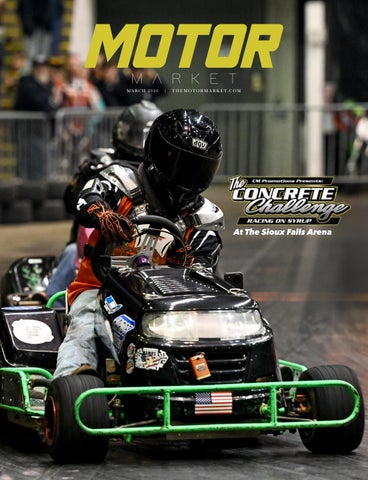
At The Sioux Falls Arena

your one stop Restoration Shop

Restoration Shop

Doing Business for Over 20 Years

with over 130 years combined experience

27096 Kerslake Place • Tea, SD 57064

When it comes to restoring cars, cutting corners is simply not an option for us, and our decades of experience in the business makes Cliff Avenue stand out from all the rest. A detailed and high-quality finished project is our signature mark. This is accomplished by perfecting every detail, such as having all the original bolts, plating, colors, upholstery and stunning paint jobs. If you’re not looking for a concourse original but are looking for something customized, our staff has the ability and skill to complete specialized vehicles as well.

2026 Concrete Challenge

A Family friendly frenzy of racing fun

The roar of engines while competitors speed motorcycles, go-karts, wing cage karts, ATVs, and outlaw lawn mowers around a Coke-covered track can only mean one thing: the return of the 2026 Concrete Challenge.

Now in its seventh year, the Concrete Challenge is an indoor racing event that puts racers of all ages to the test as they whiz around a concrete track covered with syrup made from Coca-Cola.

The littlest racers are preschoolers, and the oldest are senior citizens in this one-of-a-kind motorsports event. Come as a spectator to cheer on the races, or enter the races as a driver.

“It’s a ton of fun. Everybody has fun. That’s my goal,” states Chad, who has been organizing the Sioux Falls Concrete Challenge since 2020.

The Concrete Challenge officially starts on Friday, March 27, when the concrete track gets its uniquely sticky surface ahead of the races. In place of carbonation, Coca-Cola mix is blended with water to create a syrup that’s sprayed on the track. “Overnight, the water evaporates, giving racers a rubbery surface that gives them greater traction as they take the curves on the track,” Chad explains.

The track is slightly larger than a basketball court. It’s a small track for fast races, which is all the more reason it benefits from extra traction as drivers zip around it.

“When the Coke syrup dries, then it just sticks. It’ll almost pull your shoes right off. If the drivers were just riding on bare concrete, they’d be falling all over the place,” Chad notes.

Friday is also a registration day and practice day for racers. “Hundreds come from South Dakota, North Dakota, Minnesota, Wisconsin, Iowa, Nebraska, and more to compete,” Chad affirms. Quite a few racers come back year after year, and the Concrete Challenge continually attracts new drivers, too.

On Saturday, March 28, the Concrete Challenge starts with the youngest racers.

“We have two classes of really little kids,” Chad explains. “We’re teaching them how to race. We’re teaching them how to sit at the

At The Sioux Falls Arena

line, take the green flag, and watch for the white flag and the checkered flag. It’s hilarious because a lot of times they’re looking up in the stands. They’re not even looking where they’re going. Their attention spans are really short when they’re that young. People in the crowd get a kick out of it.”

Racers beginner classes are learning the basics of racing, how to compete, and how the whole event works.

Another class of racers is the middle-aged group. “They have the eye of the tiger and they’re racing hard,” Chad states.

Yet another class, the senior competitors, show they’ve still got what it takes on the racetrack.

“They’ve raced their whole life. They’re out there having fun,” Chad says.

Spectators are likely to see “any kind of motorcycle,” along with some amazing custom-built vehicles being driven by racers of all ages, according to Bernie Tyrrell, promoter for the 2026 Concrete Challenge.

The multitude of vehicles racing and the sheer enjoyment on the drivers’ faces is all part of the fun.

Wing cage karts, for example, are newer versions of traditional, or flat, go-karts. These karts have a roll cage and wings for added safety.

Three different classes of lawn mowers, governed, modified, and outlaw, are in a fast-paced league of their own. Outlaw lawn mowers are glorified go-karts with a lawn mower body.

“It’s a real crowd pleaser. Everybody just loves them,” Bernie adds.

“The lawn mowers are way above 100 horsepower, so they’re fast and they’re custom-built, and so are all the race carts,” notes Bernie, adding that the lawn mower races are his favorites.

“There’s high horsepower and one person riding a lawn mower that’s supposed to go 1 to 3 mph, and these things are going at high speeds,” Bernie shares. “The front wheels

come right off the ground, and the mower is on two wheels. That makes it really, really interesting in the competition.”

“The multitude of vehicles racing and the sheer enjoyment on the drivers’ faces is all part of the fun,” Bernie adds.

Throughout the races, the intensity of competition shows as racers lean in, take curves on two wheels, and sometimes nearly slide off their vehicles while zipping around the track.

“It’s fun, and the spectators like the excitement. It’s been winter, and there’s nothing else to do, and it’s like the first event of the season here,” Chad notes. “It gets them out of the house. They can watch some good racing and have fun. It’s a familyfilled event.”

At the end of the Concrete Challenge, win or lose, Chad ensures everyone leaves with a trophy and a smile, and maybe some cash, too. There are races for open amateur and pro driver classes. Pro class winners take home 150% payback.

If the allure of racing appeals to you and you need a vehicle, area shops that sell motorcycles and fourwheelers will have booths at the Sioux Falls Arena

on March 28. Concrete Challenge merchandise will be for sale, too.

For Chad and Bernie, seeing generations of families enjoy and race in the Concrete Challenge is part of the fun of organizing the event every year.

“It’s how I socialize,” says Chad, who’s been a racer himself. “There are a lot of people racing that I’ve known their whole life. I’ve known their kids, and now I know the grandkids. It’s a way for me to give back to the community and a way to stay involved.”

Cheer on the exciting, unpredictable races at the Concrete Challenge on Friday, March 27, and Saturday, March 28, at the Sioux Falls Arena. Tickets at the door are $20 general admission, $20 for pit passes, and $15 for kids ages 6 to 12. Admission is free for children 5 and younger. With thousands of comfortable seats available in the arena, organizers are hoping for a packed crowd. Follow The Concrete Challenge page on Facebook for updates or contact Chad Mellenberndt at 605-321-1789.

TOP CLASSIC CARS TO RESTORE

Taking on a classic car restoration project can be a sound financial decision, though choosing the right vehicle is key, and the best candidates span many different decades and automotive eras. While the time and effort required can be substantial, these are vehicles with strong potential to grow in value, possibly enough to recoup everything you put into them. For the right person, restoring one of these cars isn't just a passion project; it's a genuine opportunity to build something worth far more than when you started.

Chevrolet Camaro (1967 to 1969)

The great thing about a late-1960’s Camaro is that they’re so popular you could literally build one from the ground up using nothing but brand-new aftermarket parts. Demand for this iconic Chevy remains consistently high, which can affect your ability to find a good restoration candidate at the price you want. Still, demand means your efforts will also pay off big when it’s time to complete your flip.

Chevrolet Impala (1965 to 1968)

The Impala is another icon of American car culture from Chevy that will always have a collector’s market ready to buy high-quality restorations. The Impala is known for its place at the intersection of power and luxury. While the older models are more desirable to some collectors, the late-1960s versions can be found at far better price points, and often in more pristine condition.

Dodge Charger (1968 to 1970)

We would be remiss without a Charger on this list, as it is perhaps the most iconic American muscle car of all. Plenty of Chargers were manufactured in this era, so stock remains relatively high, always a positive when you’re pricing project cars. As with many muscle cars of this era, how much you pay will largely be a function of engine size and body rust. Suffice to say, there is a significant market for any lovingly restored Charger.

Dodge Dart (1967 to 1976)

A lot of collectors who have been priced out of the market for Chargers and Challengers come to appreciate the compact, nimble stylings of the 1970s-era Dodge Dart. Dodge made a lot of them; they have a reputation as reliable vehicles, and cars and parts are extremely affordable compared to other collectible cars of the same era. Dodge Darts from this decade come in a variety of engine configurations and packages, the beloved Dart Swinger, for example, so you’re sure to find something that meets your budget and personal preferences.

Ford Model A (1928 to 1931)

The late 1920s and early 1930s run was a huge pre-war push for Ford, which means that original cars and parts are more readily available than most other cars (or any other surviving products) of this era. Aftermarket parts are also plentiful, allowing you to choose between creating a faithful restoration, an outrageous hot rod, or anything in between. While it may seem intimidating trying to restore a literal antique nearly 100 years old, the early, no-nonsense design makes this version of the Model A an extremely accessible project for a first-time flipper.

Plymouth Barracuda (1973 or 1974)

Purists might scoff at anything other than the 1970 or 1971 Mopar-equipped versions, but the mid-1970s models are far more economically viable as a restoration project. They’re just as easy to work on and nearly as fun to restore and drive, especially to someone who has never embarked on such a project. If you’re looking for a project as a financial investment rather than a hobby to sink money into, it simply doesn’t make sense to hold out for an early-1970s ‘Cuda.

Pontiac Firebird (1970 to 1973)

The early 1970s marked the beginning of the Firebird’s second generation. These are arguably less collectible and desirable than the original Birds, but they’re also more affordable. Those skyrocketing prices on first-generation Firebirds are only making the early-1970s models more and more collectible.

Pontiac GTO (1971 or 1972)

A decent early GTO can be prohibitively expensive, especially if it has a V-8. Unfortunately, price is a factor even if the car is in project, rather than collectible, condition. The ‘71 and ‘72 models, however, retain the aggressive, iconic GTO styling of the ‘68 but can be had at a more reasonable price point. The collecting and restoration communities are coming

5 Ways to Develop the Driving Skills That Make You a Better Driver

Most people think the hard part ends once they pass their driving test. But driving isn’t just about getting from A to B; it’s about reacting to what happens in between.

The truth is, strong driving skills don’t come from a few lessons or a laminated card. They’re built over time through practice, focus, and smart guidance. Whether you’re a brandnew driver or someone with years behind the wheel, there’s always room to grow.

This article breaks down five practical ways to start developing driver skills that make you safer, more aware, and more confident; using real-world driving techniques that make a difference.

1. Practice defensive driving every time Defensive driving is more than a buzzword; it’s a mindset. It’s how good drivers stay one step ahead, anticipating what could happen instead of reacting to what already has.

Driving with a purpose means watching more than just the road ahead; it means paying attention to everything around you. Defensive driving isn’t about paranoia; it’s about staying sharp and in control.

Building these habits early creates a natural sense of awareness, which leads to stronger driver confidence. It also reduces the chances of costly mistakes and dangerous close calls. Scan mirrors constantly, watch other drivers and keep safe distance. It only takes one distracted driver to cause a chain reaction; but if you’re alert, you’ll be ready long before it happens.

2. Train your reaction times

You can’t always control what happens on the road; but you can control how quickly and calmly you respond. Your reaction time isn’t just natural reflex. It’s a skill that improves with repetition and targeted training. Whether it’s a driver slamming on their brakes in front of you or a sudden object in the road, your ability to react under pressure is what turns a close call into a safe correction.

3. Focus on one driving technique at a time

Trying to master everything at once? That’s the fastest way to get overwhelmed behind the wheel. Real progress comes from slowing down and zoning in. Focus on one skill at a time; no pressure, no rush. When you isolate a specific area, like parking or merging, it becomes easier to correct mistakes and build confidence. This approach keeps things simple. You’re not just driving; you’re learning how to drive better, one step at a time. By taking it one move at a time, you’re not just checking boxes; you’re developing driver skills that stay with you long after the test.

4. Learn to stay calm under pressure

You can know all the rules, hit every turn, and still fall apart behind the wheel if your nerves take over.

Emotional control is a skill; just like parallel parking or lane changes. Staying calm on the road isn’t just about feeling good; it’s about making better decisions. Panic slows down your thinking. Confidence sharpens it.

It is not just how well you know the road; it’s how steady you

are when the road doesn’t go to plan.

Clear minds lead to clear actions. The more confident you are, the better you’ll be at developing driver skills that hold up under pressure.

5. Keep improving after you pass Getting your license isn’t the finish line; it’s your starting point. The truth is, real growth as a driver happens after the test. That’s when you’re out on the road, making decisions on your own, facing traffic in different conditions, and learning how to adapt. Every new situation; whether it’s merging onto a busy highway or navigating through pouring rain; gives you a chance to build stronger habits and safer instincts.

The more varied your experience, the more prepared you’ll be. Great drivers don’t just know how to drive; they know how to adjust, stay alert, and rely on solid, consistent safe driving practices.

That kind of driving doesn’t come from a single lesson. It comes from never stopping.

SHOW US YOUR

Award-Winning 1956 Chevrolet 210 Draws Attention on Show Circuit

John Russell's meticulously restored 1956 Chevrolet 210 represents more than a successful build; it's a mechanical connection to his youth and a testament to patience in the restoration process.

John’s automotive passion originated in his teen years, influenced by his brothers' vehicles. He owned a 1956 Chevrolet two-door hardtop during high school, an experience that he recalls fondly.

"I guess I've always been partial to the Chevrolets. My friends and I were always working on (my high school car) and messing around," John states. "We worked on trying to make it go faster on a tight budget."

After selling his original 1956 Chevrolet for a newer vehicle, John spent years wanting to reclaim that piece of automotive history, missing the Chevy and wishing he still had one.

A few years ago, his dream of owning a 1956 Chevy once again came true when Scott Peterson, owner of Scott Peterson Motors in Belle Fourche, offered a lowmileage car with just 56,000 original miles. The vehicle had been partially disassembled and prepped for bodywork, but remained incomplete.

"The car had been in the corner of a body shop for two years, taken apart, all sanded down," John explains. "Scott was frustrated they weren't working on it. He just wanted to sell that car, and I was happy to buy it. It gave me a project to do in my spare time in the garage."

Drawing on experience from previous work in collision repair, John undertook his first complete ground-up restoration, investing approximately two years in the build. He performed all bodywork and underhood detailing himself before upgrading the drivetrain with an Edelbrock small-block V-8 mated to the electronically controlled 700R4 transmission. The suspension received a modern air ride system for improved ride quality and adjustability. New chrome bumpers, wheels, and tires completed the chassis refresh.

Cliff Avenue Upholstery & Restoration in Tea, SD, handled the interior installation, executing a period-correct tuck-and-roll pattern in blue and white.

After priming, Russell drove the Chevrolet in bare gray-and-white primer for three to four years before applying the final finish.

Approximately one year ago, John and his son, Bradley, a professional automotive painter, completed the paintwork using a two-tone scheme of Night Pearl Blue and GM Bright White.

"We took the car all back apart and painted it," John adds. "When I got the car done, my friends told me I should put it in car shows. Everyone seemed to like the car, especially the paint and color."

NAME: John Russell

CAR YEAR-MAKE-MODEL: 1956 Chevy 210

ENGINE: Edelbrock 350 crate engine

TRANSMISSION: 700R4

SUSPENSION: Air ride

EXHAUST: Stainless steel dual exhaust with remote cutouts

INTERIOR: Blue-and-white custom tuck and roll

Future plans include appearances at Saturday morning Cars & Coffee events in Sioux Falls, Kool Deadwood Nites, and the Vintiques Car Club show in Watertown.

For John, the 1956 Chevrolet serves its intended purpose as a driver rather than a static showpiece.

"My wife Wendy and I love driving the car around and talking to people about their cars or cars they had and wish they still did," John explains. "I just want to drive it and enjoy it."

The restoration has proven successful on the regional show circuit, accumulating multiple People's Choice awards at events throughout eastern South Dakota. John noted an unexpected response to the build.

HELPWANTED

CALENDAR Events

THE CONCRETE CHALLENGE: RACING ON SYRUP

March 27-28, 2026 – Sioux Falls Arena Chad Mellenberndt 605-321-1789

DONNIE SMITH BIKE & SWAP MEET / BIKE SHOW

March 28-29, 2026 Saint Paul, MN donniesmithbikeshow.com

HARRISBURG HIGH SCHOOL’S CAR SHOWCASE

May 2, 2026 • 4:00 pm – 6:00 pm Harrisburg High School Facebook.com/tigerstripesgarage

THE CLASSIC MOTORCYCLE AND MEMORABILIA AUCTION

May 9, 2026 • 10am Old American Bike Barn in Ortonville, MN. classiccarauction.us/auctions/6-the-classic-motorcycleand-memorabilia-auction

CARS & COFFEE SIOUXLAND

May 23, July 25, and September 12, 2026 - Tea, SD 8am - 11am Lincoln County Airport

WHEEL JAM TRUCK SHOW

June 4-7, 2026– Huron, SD South Dakota State Fairgrounds www.wheeljam.com

20TH ANNUAL PLAINVIEW CAR, TRUCK, MOTORCYCLE & TRACTOR SHOW

June 13, 2026 – Plainview, NE Highway20hotrod@gmail.com

BROOKINGS CAR SHOW

June 14, 2026 – Brookings, SD https://www.brookingscarshow.org

BLACK HILLS CAMARO RALLY JUNE 17-20, 2026 – Spearfish, SD Blackhilscamarorally.com

July 15-18, 2026 – Spearfish, SD Tour The Black Hills Blackhillscorvetteclassic.com

SCENE OF THE CRASH CAR AND BIKE SHOW July 17-18 , 2026 – Dakota Thurston County Fairgrounds Dakota City, NE facebook.com/events/1340673078079785

NYBERG’S ACE HOT CLASSICS

facebook.com/cantonsdcruise/

D.A.D.’S

REPAIR SHOW & SHINE August 1, 2026 – Beresford, SD facebook.com/p/DADs-auto-show-and-shineburnoutcontest-100064530169547/

CLASSIC CAR AUCTION GROUP Saturday, August 1, 2026 •

WILD BILL DAYS COLLECTOR CAR & MEMORABILIA AUCTION

June 20, 2026 – Deadwood Mountain Grand, Deadwood, SD https://www.deadwood.com/event/wild-bill-days/ AUTOMANIA

June 27, 2026 – Springfield, SD https://www.facebook.com/automaniaevent/

- SPONSORED BY -

The Ultimate National Parks Route 66 Road Trip!

Chances are you’ve heard about Route 66, possibly through the popular song, Get Your Kicks on Route 66, or as a kitschy road trip across the southwestern U.S. Also called the Main Street of America or the Mother Road, today Historic Route 66 is a heritage corridor crossing eight states over approximately 2,450 miles from Chicago, IL, to Santa Monica, CA.

Most road trippers along Route 66 focus on following segments of the preserved original roadway, stopping in the many small towns, and visiting quirky roadside sites and restaurants along the way. But, in addition to having the classic historical experience, there is an opportunity to combine a Route 66 road trip with adventurous stops at some of America’s best national park units. Some of these NPS units are located directly along the route, while others require manageable detours.

Today, Historic Route 66 is viewed as a living museum to a bygone age.

Route 66 in Illinois and Missouri

Route 66 in Arizona

Below we’ve put together a short history and a description of the best NPS units along the way. So, load up a Google Map of Route 66 and start planning!

Why route 66 is famous

Established in 1926, US-66 was one of the original highways in the U.S. Numbered Highway System, and it quickly became one of the most famous roads in America. During the 1930s, the highway was the primary route to the west for migrants escaping the Dust Bowl, a dire situation dramatized in the classic American novel The Grapes of Wrath by John Steinbeck. Along the way, the route passed through many small towns, which led to a boom of roadside businesses, including momand-pop restaurants, service stations, and motor inns.

Fun stops along the way!

With the establishment of the Interstate Highway System in the late 1950s, Route 66 slowly became obsolete. As these new high-speed freeways bypassed the original highway, many of the small towns went into decline. US-66 was decommissioned in the mid-1980s, but soon came calls for preservation.

Though you can drive in either direction, most diehard road trippers tend to start Route 66 in Chicago, Illinois, and head southwest. There are three NPS units along the route in Illinois. Located in Chicago, Pullman National Monument preserves a late-19th-century industrial district that manufactured Pullman railroad cars. Nearby is the Illinois and Michigan Canal National Heritage Area, a vast area combining hiking trails and water activities with historic sites.

Route

66 in Oklahoma and Texas

After briefly clipping the southeastern corner of Kansas, Route 66 eventually assumes a more westward orientation across Oklahoma. There are two NPS units along Route 66 in the state: the Oklahoma City National Memorial, which honors the victims of the Oklahoma City bombing in 1995, and Washita Battlefield National Historic Site, the 1868 site of a battle between the U.S. Army and Cheyenne.

Route

66

in New Mexico

New Mexico hasseveral NPS units, most of which require detouring. The only site directly on Route 66 is Petroglyph National Monument, near Albuquerque, which offers short hikes to rock art carved into volcanic rocks. For those interested in additional ancestral Native American sites, consider detouring north for up to three units. From east to west, Pecos National Historic Park, Bandelier National Monument, and Chaco Culture National Historic Park each offer impressive collections of ruins and ancient structures to explore.

Arizona offers some of the best NPS stops along Route 66. On the eastern side of the state, the original roadway of Route 66 roadwaypasses through Petrified Forest National Park. This park includes impressive fields of petrified logs, an informative museum, and some excellent short hikes. Continuing west, few road trippers skip a detour to the South Rim of Grand Canyon National Park. A 1.5-hour drive, one-way, from Route 66 in Flagstaff, AZ, rewards visitors with stunning canyon views and a variety of easy to challenging hikes.

Nevada Detour and Route 66 in California

Before arriving at the westernmost and final state on Route 66, many travelers consider a detour north into Nevada. While there is no segment of Route 66 in Las Vegas, that doesn’t stop many road trippers from a visit to so-called Sin City. Given its own collection of casinos, like Circus-Circus and those on Fremont Street, for many road trippers Vegas is the ultimate side trip through classic Americana.

After crossing the San Bernardino Mountains and arriving at the Santa Monica Pier, your adventure comes to an end. A perfect way to end an adventurous national park road trip along Route 66!

MARKET

Rooted in country tradition yet embracing its evolution, Carly Pearce left Kentucky at 16 for Dollywood and never looked back. The GRAMMY® Award-winning singer-songwriter broke through with her debut “EveryLittleThing” and has continued to rise with her fourth album, HUMMINGBIRD, featuring “WeDon’tFightAnymore” with Chris Stapleton and “Truck on Fire.” A Grand Ole Opry and Kentucky Music Hall of Fame member, Pearce has earned multiple CMA, ACM, and GRAMMY® honors for hits like “Never Wanted To Be That Girl,” “What He Didn’t Do,” and “IHopeYou’reHappyNow.” This fall, she brings her HUMMINGBIRD world tour to fans worldwide after 45 sold-out shows supporting Tim McGraw.

TALKING TIRES

WHY YOUR CAR NEEDS REGULAR SERVICE

Excellent customer

and everyday

A well-maintained vehicle is a safe vehicle. Routine servicing helps identify potential issues before they escalate into major problems.

Owning a car represents a significant investment, and like any valuable asset, it requires proper maintenance to remain in optimal condition. Regular car servicing extends beyond preventing breakdowns; it encompasses safety, efficiency and long-term cost savings. Whether commuting daily or planning an extended road trip, maintaining your vehicle ensures a smoother, safer experience. Here’s why regular car servicing is essential.

Safety first on busy roads

A well-maintained vehicle is a safe vehicle. Routine servicing helps identify potential issues before they escalate into major problems. Mechanics and highly skilled technicians at Graham Tire inspect vital components, including brakes, tires, suspension and steering systems to ensure proper functionality. A comprehensive service typically includes inspection and adjustment of more than 50 components and systems.

Improved fuel efficiency

Regular servicing enhances your car’s operational efficiency, resulting in improved fuel economy. Changing engine oil, replacing air filters and checking tire pressure are straightforward yet crucial maintenance tasks that optimize engine performance. Clean oil reduces friction, allowing the engine to operate smoothly while consuming less fuel. Over time, these maintenance steps can yield significant fuel cost savings.

Prevention of costly repairs

Neglecting minor issues can result in major, expensive repairs. Routine servicing allows mechanics to detect early signs of wear and tear before they develop into costly breakdowns. Addressing problems promptly helps avoid substantial repair bills and unexpected inconveniences.

Extended vehicle lifespan

Just as regular checkups maintain personal health, servicing keeps your car in optimal condition. A well-maintained vehicle lasts longer, performs better and is less susceptible to sudden failures. Investing in routine maintenance maximizes your vehicle’s longevity and reliability.

Enhanced resale value

A complete service history makes your vehicle more appealing to prospective buyers. It demonstrates the car has been properly maintained and is less likely to have concealed problems. A regularly serviced car typically sells faster and commands a higher price.

Warranty compliance

For new car owners, adhering to the manufacturer’s recommended service schedule is crucial. Many warranties require regular servicing, and failure to comply could void coverage. Maintaining the service schedule ensures warranty protection remains intact, preventing unexpected repair costs.

Peace of mind

Few things compare to the confidence of knowing your car is in excellent condition. Whether commuting to work or embarking on vacation, regular servicing reduces breakdown risk and ensures your vehicle is prepared when needed.

Environmental benefits

A well-maintained car benefits both owners and the environment. Regular servicing reduces emissions by maintaining efficient engine operation. Replacing clogged air filters and ensuring proper fuel combustion lowers your carbon footprint and contributes to cleaner air quality.

Car servicing: an investment, not an expense

Some car owners avoid servicing due to cost concerns, but skipping maintenance often leads to more expensive repairs at inopportune times. Scheduling routine servicing is a strategic investment that ensures your car remains reliable, fuel-efficient and safe.

Make regular car servicing a priority, and your vehicle will provide years of dependable performance. Contact Graham Tire to set your service appointment today!

Your Dyno-Tuned Engine

Your Sehr Performance dyno-tuned engine has many hours of engineering, machining, assembly, and fine-tuning to make it perform to the desired requirements. It is critical that your hot rod engine is well cared for so it will continue to perform well. The factory low horsepower engines will run hundreds of thousands of miles with minimal maintenance and care. The higher horsepower hot rod engines will require more attention and maintenance, and the higher the power level, the more care and attention that must be given.

In the dyno cell, we have a controlled power supply to our ignition system, a controlled engine cooling tower, and we have a steady controlled fuel system. These are a few things that can be different once the engine is installed in the vehicle. If the ignition power, coolant system, or fuel system is not adequate and stable for the engine requirements, the performance and life of the engine will be sacrificed. We have seen low ignition voltage, making the engine harder to start and unable to burn the fuel efficiently, creating a false rich

We put many more hours of engineering, machining, assembly, and tuning into every engine that we do, so our customers can get the EXTRA MILES out of their build.

condition. The fuel system must be clean and free from debris, or it will plug and alter the fuel delivery, causing engine performance loss and damage.

An often overlooked aspect is the cooling system. If you decide to install a serpentine belt system, in many cases, this requires a reverse drive water pump to correctly move the coolant through the engine. If a standard water pump is used with the serpentine system, the engine will overheat and cause engine damage. Higher horsepower engines create more heat quicker so a larger radiator and more CFM of air must be driven through the radiator to correctly cool the engine.

One of the other things we monitor on our dyno is the exhaust gases and temperatures. This gives us a good indication of rich or lean conditions and ensures proper flow through the exhaust system. Maintaining an adequate exhaust system is also a vital aspect of keeping your hot rod running at its peak. If there are obstructions or restrictions in the exhaust, it can damage the engine.

Your hot rod engine will let you know if something is not quite right; all you have to do is pay close attention, watch your gauges, and listen for any unusual noises. It is very important to have all the proper gauges in your vehicle to monitor what the engine is doing and continuously make sure the support systems are operating correctly. Your performance engine will require oil change service more frequently, and the spark plugs and valve springs should be checked regularly as well. If there are any concerns or questions, bring them up to your engine builder and machinist so the issue can be addressed promptly.

We put many more hours of engineering, machining, assembly, and tuning into every engine that we do, so our customers can get the Extra Miles out of their build.

At Mitchell Technical College, your tomorrow begins today. With more than 35 career-driven programs, you’ll learn by doing, not just listening. From hands on labs to real-world experience, every step prepares you for a high-demand career.

This fall, take the next step toward your future. There’s no better way than experiencing Mitchell Tech for yourself.

Visit us in person or online and see how you can get ready at Mitchell Tech.

Many things happened in 1937 that had an impact around the world, but also here in the United States. The Soviet Union leader, Joseph Stalin, created his great political purge, imprisoning millions and killing many Russians he didn’t trust, which is very similar to what is going on with Russia today, killing millions to grab Ukraine, showing no value for life.

Some things never change in that part of the world. The German airship, the Hindenburg, burst into flames in New Jersey, which pretty much ended the airship travel era. Amelia Earhart vanished somewhere in the Pacific Ocean during her last leg attempt at her round-the-world flight. To this day, no real clarification as to where she entered the ocean has ever been found that is definitive. America in general was on the rebound with new business and factories after struggling through the 1929 stock market crash, and the dirty 30’s that left many destitute.

On the lighter side, the United States Denver Mint unknowingly created a nickel error in 1937 that has become known as the 3-Legged Buffalo nickel. If you are lucky enough to find one, depending on the shape or grading, the value of this nickel can start at $30 and go all the way to $65,000. It puts a new meaning to when older people say,” I remember when a nickel was a nickel,” and is underlined more so today, when we have all seen the dollar continue to devalue because of what our government labels as inflation each year.

1937

serve her well for years to come, that would take her wherever she wanted to go without issues. The car did exactly what she wanted it to do, taking her all over the country until 1956 when the engine blew up. Not wanting to give up the car that gave her such wonderful memories, it was pushed into her garage, where it sat for the next 30+ years.

Towards the end of that 30-year time frame, with Allie being in her 90’s, she passed away. The family, in general, after going through all of her estate together, didn’t know exactly what to do with her Pontiac that sat in her garage for so many years untouched, but thought it should go to one of her sons. As it turned out, none of Allie’s sons really cared anything about having their mom’s old car, so it was decided by all to pass it along to Dan Nelson, who was Allie’s grandson.

Dan always had an interest in the old Pontiac since he was a child, and sat in it often pretending he was driving it in Grandma’s driveway. Now grown and raising a family of his own, receiving the car sparked an idea, to get it running again and reclaim those old memories, this time shared with a new generation. When he actually got into rebuilding the engine, he found out it was too expensive to do at the time. This led him to the idea of rebuilding the whole car over a longer period of time as he could afford it, while not taking away from the family’s needs. So over quite a few years, Dan worked slowly but steadily on the car with the idea of turning it into a traditional street rod with everything a new car has.

was an LT1 with an AOD trans, and a Ford 9” rear end. After having it all installed and running, he decided to repaint the car, which he did himself. After getting that completed, Dan continued on with adding Dakota Digital gauges and Vintage AC/Heat, along with Billet Specialties aluminum wheels.

Next on the agenda was doing the interior with a tan colored leather to finish the car and bring it up to date. Since doing the interior was a more expensive part of finishing the car, Dan found an upholstery business in Michigan that would work with him, doing different pieces of the interior as he could afford it, starting with the front seat.

Steve mentioned he already put 1,000 miles on the car and really enjoys the feeling of stepping back in time while driving the ‘37 like it is a gangster car!

After getting the front seat back and installed, Dan was excited to get the exhaust on it and the front end aligned so it was drivable. After doing that, the unthinkable happened, and Dan suddenly passed away in 2021. Dan’s wife, Deb, was beside herself with this sudden turn of events and, after many months of sifting through things, decided to do something with this unfinished car. She offered it to anyone in their immediate family, with no one really showing any interest, which led her to advertising it on a Pontiac Facebook page, in its unfinished state.

After many calls from all over the nation, eventually a gentleman from South Carolina made her an offer she accepted and told her he would make arrangements to pick the car up. A couple of days later, the gentleman called Deb back, apologized, and informed her that he had to back out of buying the car after being in a really bad car accident.

Meanwhile, Steve Ollerich had seen the Facebook ad and watched it for over a couple of years before finally calling Deb himself about the car, since it was still on Facebook. After calling Deb, she kind of unloaded on him. She explained how everything seemed to fall apart with selling her husband’s car that he had worked on for so many years. Then she told Steve that if he had an interest in it, she would sell it to him for what the previous guy had offered. Steve told her he would do that. That same day, Steve sent her funds for the car and made arrangements to have the car shipped to him at his shop. Steve said the shipping part was unusual because most of this type of shipping has been taken over by Ukrainians in the United Statres. When the car arrived, it was delivered by a young, muscular Ukrainian who spoke very little English, but understood the mechanics of cars. Since getting the ‘37 Pontiac in 2023, Steve has been busy working to finish up the interior where Dan had left off. Steve mentioned he already put 1,000 miles on the car and really enjoys the feeling of stepping back in time while driving the ‘37 like it is a gangster car!

For the Bennette family in Michigan, the story begins in 1937, when recently widowed Allie Bennette purchased a brand-new 1937 Pontiac four-door sedan. She wanted a car that would

He installed a Mustang II front suspension and bought a donor car, a 1990’s Camaro that he utilized the drive train out of, which

ASK THE MOTOR MEDICS®

Dear Motor Medics,

I've got a 2006 GMC Yukon with a bad A/C leak. I have refilled it each summer for the past couple of years, with the leak going unfound, but now it has become quite large, and they have finally found it. The leak is coming from the rear A/C lines that run under the vehicle, just over the passenger side rear tire. They tell me the rocks from the tire have caused abrasion of the line, and the only way to fix it is to replace the entire line set. The cost of repairs for the lines is over $1,000.00, and I am looking for alternatives to get my air back. Do you have any suggestions for me?

Thank you

Tom in Philadelphia, PA

Dear Tom,

If the lines only have a leak in one spot just over the tire, then you may be in luck. There are now line repair kits that can install a splice into the line where it is damaged. If the line has extensive damage over a significant area, it can't be done, but for a short one-foot or less section, which is very common on your model at that location, it is a possibility that it can be done. If your shop won't do it, check around for one that will. You may find your repair costs cut by more than half, and in the game of auto repairing, every dollar you can save is a blessing.

Take care, The Motor Medics

Dear Motor Medics,

My Dodge Caravan is doing a strange thing. Over the past six months, it has had random ghosts in it, and my kids say it’s possessed, and I'm starting to think so myself. First, the cruise control would shut off by itself, then the radio would change stations on its own, and the volume would go all the way up without anyone touching it. That was just the beginning. My horn has not worked for two months, but now, when I'm turning it sometimes honks by itself, and the people in front of me think I'm honking at them. This morning, the airbag light came on, too, so I'm waiting for it to blow off in my face as I drive, so I'm at my wits’ end. Where do I go from here?

Thank you Gina in Okmulgee, Oklahoma

Dear Gina,

It is possessed. Next email, please. Just kidding. It sounds like an old, failed clock spring issue. There is a sliding contactor in the steering column that makes all electrical connections for everything in the steering wheel by way of a flat cable wrapped up like a clock spring. If the cable breaks down with age, it can short together and cause all sorts of weird stuff to happen, and in the case of the airbag, this can be dangerous. There were some free safety recalls from Dodge on a few, so call them to check, but get in for repairs fast.

Take care, The Motor Medics

Medics ® Shannon Nordstrom, Russ “The

MAINTENANCE

Turn static files into dynamic content formats.
Create a flipbook