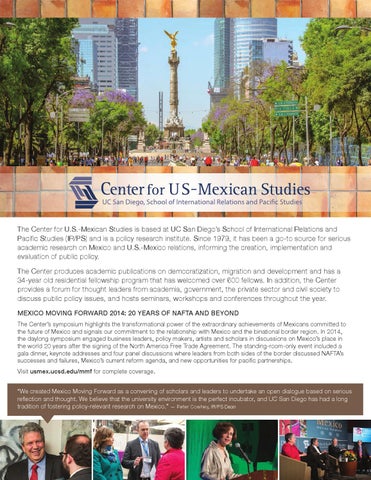
The Center for U.S.-Mexican Studies is based at UC San Diego’s School of International Relations and Pacific Studies (IR/PS) and is a policy research institute. Since 1979, it has been a go-to source for serious academic research on Mexico and U.S.-Mexico relations, informing the creation, implementation and evaluation of public policy. The Center produces academic publications on democratization, migration and development and has a 34-year old residential fellowship program that has welcomed over 600 fellows. In addition, the Center provides a forum for thought leaders from academia, government, the private sector and civil society to discuss public policy issues, and hosts seminars, workshops and conferences throughout the year. MEXICO MOVING FORWARD 2014: 20 YEARS OF NAFTA AND BEYOND The Center’s symposium highlights the transformational power of the extraordinary achievements of Mexicans committed to the future of Mexico and signals our commitment to the relationship with Mexico and the binational border region. In 2014, the daylong symposium engaged business leaders, policy makers, artists and scholars in discussions on Mexico’s place in the world 20 years after the signing of the North America Free Trade Agreement. The standing-room-only event included a gala dinner, keynote addresses and four panel discussions where leaders from both sides of the border discussed NAFTA’s successes and failures, Mexico’s current reform agenda, and new opportunities for pacific partnerships. Visit usmex.ucsd.edu/mmf for complete coverage. “We created Mexico Moving Forward as a convening of scholars and leaders to undertake an open dialogue based on serious reflection and thought. We believe that the university environment is the perfect incubator, and UC San Diego has had a long tradition of fostering policy-relevant research on Mexico.” — Peter Cowhey, IR/PS Dean
“
We want to create a clearing house where data is readily available, as we need to empower citizens to be able to demand response from their health providers. — Alberto Diaz-Cayeros Stanford University
”
REFORM IN MEXICO
Average Mortality Rate per 100,000 for Communicable Diseases: Municipal-Level, 1998-2012
GOVERNANCE OF PUBLIC HEALTH IN MEXICO This data-gathering and analysis effort focuses on key transitions in politics, poverty and health shaping Mexican society. A major outcome of the project is the categorization and reclassification of all death certificates (1998 – 2012). This data provides individual level cause of death, and demographic and geographic information that is then made interoperable with other data on the social determinants of health. The purpose is two-fold: to provide a citizen-based approach in looking at local health outcomes and a platform for further research. Information is made available to the public through: • Interactive maps, data visualizations and narratives on economic growth, democratization, and health outcomes and infrastructure • Scorecards on access to health services and health outcomes • Downloadable data sets on health outcomes • Metadata on available cartography via text and shape files
PRESIDENTIAL SURVEYS The Center is the repository for surveys conducted during the administration of Mexican President Felipe Calderon (2006 – 2012). These surveys provide a first-hand look at public opinion during the Calderon administration, which influenced the crafting of the government’s communications and, ultimately, many decisions made by the Office of the Presidency. It is the most complete highfrequency survey series that measures political, social and economic attitudes over this six-year period. We are curating the surveys to make available three categories of ready-to-use, cumulative data available: • Nationally representative samples that measure issues like presidential approval, economic perceptions and the outlook on security • Thematic files of surveys that allow for a deeper study of attitudes on specific topics like energy reform • Subnational files of surveys at the state and municipal level Data files will be released along with a working-paper series and dynamic maps for seamless visualization.
The “Pacto por México” proposed a wide-ranging and ambitious package of almost 100 major legislative reforms, most of which have been passed in some form by Mexico’s congress since the beginning of 2013. This legislation includes education, energy, security, transparency, social security, fiscal, electoral and telecommunications reform.
Tracking the progress of legislation is crucial given the breadth of the reform agenda and the newly introduced ability of congressional representatives to seek reelection. In collaboration with other researchers in the U.S. and Mexico, we are tracking congressional roll calls on each piece of legislation related to the reform agenda. This data will be available in early 2015 through a user-friendly interface that provides data by issue and representative, and allows users to explore geographic voting patterns through interactive maps.
“JOBS WITHOUT BORDERS: EMPLOYMENT, INDUSTRY CONCENTRATIONS, AND COMPARATIVE ADVANTAGE IN THE CALIBAJA REGION” Results from a research collaboration between the Center and the Colegio de la Frontera Norte studying employment and industries in San Diego and Imperial counties as well as Baja California — which together make up the CaliBaja region — provide evidence of the region’s importance as a hub for advanced manufacturing. Using employment concentrations within the region to calculate location quotients, this study identifies industries in CaliBaja with a comparative advantage and a high export capacity. Which industries in the CaliBaja region have emerged as leaders in their area of production? How might policy makers, industry leaders, educators and planners work to strengthen the region’s capacity in these industries? This study is a first step to help answer these questions.
THREE CALIFORNIAS INITIATIVE
GLOBAL ENGAGEMENT
The initiative consists of applied research and policy forums that address the critical need for reliable information and analysis, constructive dialogue and well-informed public policy decisions in our binational region, and enhance California’s ties to its neighboring states of Baja California and Baja California Sur in Mexico.
As part of a joint project with the Brookings Institution and JPMorgan Chase, we are undertaking research on foreign direct investment and exports in the binational region, using establishment-level data on employment by industry and foreign headquarter location. Our work will inform the San Diego Regional Economic Development Corporation’s global engagement strategy, leveraging the region’s distinctive assets: its cross-border, Pacific-region geographic location as well as expertise in life sciences and advanced manufacturing. This strategy will outline economic development priorities and practices to not only increase our metropolitan area’s global connections but also its access to capital, innovation, technology and new markets.
CURRENT PROJECTS Cross-border Industries An effort to map binational industry clusters using sales and purchases between sectors is close to completion. This work leverages the “Jobs Without Borders” report (see above). Governance Handbook We are developing the first web-based governance handbook for the tri-state region, linking governments and businesses on both sides of the border. Border Wait-time Study Leveraging an existing mobile app created by the Qualcomm Institute to estimate wait times at border crossings, we are creating a scorecard for ports of entry and personalized dashboards for users. Real-time data on border waits can support infrastructure and staffing improvements to minimize negative environmental and economic impacts. Frontera Fridays Our quarterly site visits connect leaders from both sides of the border to UC San Diego and serve as a platform for learning, networking and discussing opportunities to strengthen our binational region.
“The complexity and dynamism of crossborder labor pools, supply chains and markets is frequently underestimated. Creating a fact-base on the binational economy is crucial to promoting continued development in our region.” – Melissa Floca USMEX Associate Director
“I am blessed to have been given an appointment at the University of California here in San Diego to continue this work with the Center for U.S.-Mexican Studies. I hope all of you will join us — continuing in that cause — to build a better relationship and a closer relationship that works for all of us.” — Denise Moreno Ducheny USMEX Senior Policy Advisor
Former State Senator Denise Moreno Ducheny recently received special recognition from the Mexican government, in part for her commitment to the binational region. Ducheny was given the government’s “Premio Ohtli,” the highest honor bestowed on an individual for service to Mexicans living abroad.
2013-2014 Fellows
FELLOWS PROGRAM USMEX has one of the largest residential fellowship programs in the U.S. for multidisciplinary research on Mexico. Each year we bring together fellows from the social sciences and related fields to engage with our students, faculty and the San Diego community. 2013 – 2014 FELLOWS
2014 – 2015 FELLOWS
Froylan Enciso Higuera, State University of New York at Stony Brook Vanessa Freije, Duke University Sebastian Garrido de Sierra, UCLA Kathy Kopinak, University of Western Ontario Michael Lettieri, UC San Diego Morris Levy, UC Berkeley Casey Lurtz, University of Chicago Marco Morales, New York University Veronica Pacheco, UCLA Jennifer Reynolds-Kaye, University of Southern California Alexander Ruiz Euler, UC San Diego Alexis Salas, University of Texas at Austin Danny Zborover, University of Calgary
Matilde Cordoba Azcarate, UC San Diego Maya Duru, UC San Diego Ana Isabel Garcia, UC San Diego Angela Garcia, UC San Diego Micah Gell-Redman, UC San Diego Victor A. Hernandez Huerta, University of Notre Dame Alfonso Hernandez-Valdez, Instituto Tecnologico y de Estudios Superiores de Occidente Daniel Klooster, University of Redlands Anabel Lopez Salinas, Portland State University Victor Remigio Martinez Cantu, Instituto Tecnologico y de Estudios Superiores de Monterrey Brian Palmer-Rubin, UC Berkeley Magnus Pharao Hansen, Brown University Gerardo Rios, UC San Diego Jeffrey Rubin, Boston University Gema Santamaria, New School for Social Research Jasper Vanhaelemeesch, KU Leuven Carlos Vilalta, Centro de Investigacion y Docencia Economicas Deborah Watkins, UC San Diego
“USMEX played a pivotal role in my career as an emerging scholar, and gave me the invaluable space, time and energy to complete my dissertation and secure a postdoctoral position.” — Jennifer Reynolds-Kaye 2013 – 2014 Fellow
Profiles can be viewed on our website at usmex.ucsd.edu.
“As a young Mexican scholar, the USMEX fellowship gave me the opportunity to engage in discussions on a wide range of topics relating to Mexico with others doing cutting-edge research in their respective areas. I also had access to the amazing wealth of information the Center has about Mexico and its impressive network of former fellows.” — Alexander Ruiz Euler 2013 – 2014 Fellow
Center for U.S.-Mexican Studies | School of International Relations and Pacific Studies University of California, San Diego 9500 Gilman Drive #0519 | La Jolla, CA 92093-0519
usmex.ucsd.edu | (858) 534-0194