Answers to End-of-Chapter Questions
7-1 From the corporation’s viewpoint, one important factor in establishing a sinking fund is that its own bonds generally have a higher yield than do government bonds; hence, the company saves more interest by retiring its own bonds than it could earn by buying government bonds. This factor causes firms to favor the second procedure. Investors also would prefer the annual retirement procedure if they thought that interest rates were more likely to rise than to fall, but they would prefer the government bond purchase program if they thought rates were likely to fall. In addition, bondholders recognize that, under the government bond purchase scheme, each bondholder would be entitled to a given amount of cash from the liquidation of the sinking fund if the firm should go into default, whereas under the annual retirement plan, some of the holders would receive a cash benefit while others would benefit only indirectly from the fact that there would be fewer bonds outstanding.
On balance, investors seem to have little reason for choosing one method over the other, while the annual retirement method is clearly more beneficial to the firm. The consequence has been a pronounced trend toward annual retirement and away from the accumulation scheme.
7-2 Yes, the statement is true.
7-3 False. Short-term bond prices are less sensitive than long-term bond prices to interest rate changes because funds invested in short-term bonds can be reinvested at the new interest rate sooner than funds tied up in long-term bonds.
For example, consider two bonds, both with a 10% annual coupon and a $1,000 par value. The only difference between them is their maturity. One bond is a 1-year bond, while the other is a 20-year bond. Consider the values of each at 5%, 10%, 15%, and 20% interest rates.
As you can see, the price of the 20-year bond is much more volatile than the price of the 1-year bond.
7-4 The price of the bond will fall and its YTM will rise if interest rates rise. If the bond still has a long term to maturity, its YTM will reflect long-term rates. Of course, the bond’s price will be less affected by a change in interest rates if it has been outstanding a long time and matures soon. While this is true, it should be noted that the YTM will increase only for buyers who purchase the bond after the change in interest rates and not for buyers who purchased previous to the change. If the bond is purchased and held to maturity, the bondholder’s YTM will not change, regardless of what happens to interest rates. For example, consider two bonds with an 8% annual coupon and a $1,000 par value. One bond has a 5-year maturity, while the other has a 20-year maturity. If interest rates rise to 15% immediately after issue the value of the 5-year bond would be $765.35, while the value of the 20-year bond would be $561.85.
7-5 The yield to maturity can be viewed as the bond’s promisedrate of return, which is the return that investors will receive if all of the promisedpayments are made. However, the yield to maturity equals the expectedrate of return only when (1) the probability of default is zero and (2) the bond cannot be called. If there is some default risk or the bond may be called, there is
Chapter 7: Bonds and Their Valuation AnswersandSolutions 147 © 2016 Cengage Learning. All Rights Reserved. May not be copied, scanned, or duplicated, in whole or in part, except for use as permitted in a license distributed with a certain product or service or otherwise on a password-protected website for classroom use.
1-year 20-year 5% $1,047.62 $1,623.11 10% 1,000.00 1,000.00 15% 956.52 687.03 20% 916.67 513.04
some chance that the promised payments to maturity will not be received, in which case the calculated yield to maturity will exceed the expected return.
7-6 If interest rates decline significantly, the values of callable bonds will not rise by as much as the values of bonds without the call provision. It is likely that the bonds would be called by the issuer before maturity, so that the issuer can take advantage of the new, lower rates.
7-7 As an investor with a short investment horizon, you would view the 20-year Treasury security as being more risky than the 1-year Treasury security. If you bought the 20-year security, you would bear a considerable amount of price risk. Since your investment horizon is only one year, you would have to sell the 20-year security one year from now, and the price you would receive for it would depend on what happened to interest rates during that year. However, if you purchased the 1-year security, you would be assured of receiving your principal at the end of that one year, which is the 1-year Treasury’s maturity date.
7-8
a. If a bond’s price increases, its YTM decreases.
b. If a company’s bonds are downgraded by the rating agencies, its YTM increases.
c
. If a change in the bankruptcy code made it more difficult for bondholders to receive payments in the event a firm declared bankruptcy, then the bond’s YTM would increase.
d. If the economy entered a recession, then the possibility of a firm defaulting on its bond would increase; consequently, its YTM would increase.
e. If a bond were to become subordinated to another debt issue, then the bond’s YTM would increase.
7-9 If a company sold bonds when interest rates were relatively high and the issue is callable, then the company could sell a new issue of low-yielding securities if and when interest rates drop. The proceeds of the new issue would be used to retire the high-rate issue, and thus reduce its interest expense. The call privilege is valuable to the firm but detrimental to long-term investors, who will be forced to reinvest the amount they receive at the new and lower rates.
7-10 A sinking fund provision facilitates the orderly retirement of the bond issue. Although sinking funds are designed to protect investors by ensuring that the bonds are retired in an orderly fashion, sinking funds can work to the detriment of bondholders. On balance, however, bonds that have a sinking fund are regarded as being safer than those without such a provision, so at the time they are issued sinking fund bonds have lower coupon rates than otherwise similar bonds without sinking funds.
7-11 A call for sinking fund purposes is quite different from a refunding call. A sinking fund call requires no call premium, and only a small percentage of the issue is normally callable in a given year. A refunding call gives the issuer the right to call all the bond issue for redemption. The call provision generally states that the issuer must pay the bondholders an amount greater than the par value if they are called.
7-12 Convertibles and bonds with warrants are offered with lower coupons than similarly-rated straight bonds because both offer investors the chance for capital gains as compensation for the lower coupon rate. Convertible bonds are exchangeable into shares of common stock, at a fixed price, at the option of the bondholder. On the other hand, bonds issued with warrants are options that permit the holder to buy stock for a stated price, thereby providing a capital gain if the stock’s price rises.
148 AnswersandSolutions Chapter 7: Bonds and Their Valuation © 2016 Cengage Learning. All Rights Reserved. May not be copied, scanned, or duplicated, in whole or in part, except for use as permitted in a license distributed with a certain product or service or otherwise on a password-protected website for classroom use.
7-13 This statement is false. Extremely strong companies can use debentures because they simply do not need to put up property as security for their debt. Debentures are also issued by weak companies that have already pledged most of their assets as collateral for mortgage loans. In this latter case, the debentures are quite risky, and that risk will be reflected in their interest rates.
7-14 The yield spread between a corporate bond over a Treasury bond with the same maturity reflects both investors’ risk aversion and their optimism or pessimism regarding the economy and corporate profits. If the economy appeared to be heading into a recession, the spread should widen. The change in spread would be even wider if a firm’s credit strength weakened.
7-15 Assuming a bond issue is callable, the YTC is a better estimate of a bond’s expected return when interest rates are below an outstanding bond’s coupon rate. The YTM is a better estimate of a bond’s expected return when interest rates are equal to or above an outstanding bond’s coupon rate.
7-16 d. The 15-year zero coupon bonds have the most price risk. Longer-maturity bonds have a high level of price risk as do lower-coupon bonds. Since the maturities of the bonds in a, b, and c are shorter than 15 years, they can be eliminated from consideration. Since coupon payments reduce the level of price risk and the zero coupon bonds have only their maturity value due at maturity, they have the most price risk.
7-17 b. The 1-year bonds with a 12% coupon have the most reinvestment risk. Shorter-maturity bonds have more reinvestment risk than longer-maturity bonds, so immediately the bonds in a, d, and e can be eliminated from consideration. The choice is now between the bonds in b or c. Because the 3-year bonds have a longer maturity than the 1-year bonds, the 1-year bonds have more reinvestment risk than the 3-year bonds.
Chapter 7: Bonds and Their Valuation AnswersandSolutions 149 © 2016 Cengage Learning. All Rights Reserved. May not be copied, scanned, or duplicated, in whole or in part, except for use as permitted in a license distributed with a certain product or service or otherwise on a password-protected website for classroom use.
Solutions to End-of-Chapter Problems
7-1 With your financial calculator, enter the following:
N = 10; I/YR = YTM = 9%; PMT = 0.08 1,000 = 80; FV = 1000; PV = VB = ?
PV = $935.82.
7-2 VB = $985; M = $1,000; Int = 0.07 $1,000 = $70.
a. N = 10; PV = -985; PMT = 70; FV = 1000; YTM = ?
Solve for I/YR = YTM = 7.2157% 7.22%.
b. N = 7; I/YR = 7.2157; PMT = 70; FV = 1000; PV = ?
Solve for VB = PV = $988.46.
7-3 The problem asks you to find the price of a bond, given the following facts: N = 2 8 = 16; I/YR = 8.5/2 = 4.25; PMT = (0.09/2) × 1,000 = 45; FV = 1000.
With a financial calculator, solve for PV = $1,028.60.
7-4 With your financial calculator, enter the following to find YTM:
N = 10 2 = 20; PV = -1100; PMT = 0.08/2 1,000 = 40; FV = 1000; I/YR = YTM = ?
YTM = 3.31% 2 = 6.62%.
With your financial calculator, enter the following to find YTC:
N = 5 2 = 10; PV = -1100; PMT = 0.08/2 1,000 = 40; FV = 1050; I/YR = YTC = ?
YTC = 3.24% 2 = 6.49%.
Since the YTC is less than the YTM, investors would expect the bonds to be called and to earn the YTC. (The bonds sell at a premium indicating that interest rates have declined since the bonds were issued; therefore, the bonds would likely be called if interest rates remain lower than the coupon rate.)
7-5
a. 1. 5%: Bond L: Input N = 15, I/YR = 5, PMT = 100, FV = 1000, PV = ?, PV = $1,518.98.
Bond S: Change N = 1, PV = ? PV = $1,047.62.
2. 8%: Bond L: From Bond S inputs, change N = 15 and I/YR = 8, PV = ?, PV = $1,171.19.
Bond S: Change N = 1, PV = ? PV = $1,018.52.
3. 12%: Bond L: From Bond S inputs, change N = 15 and I/YR = 12, PV = ?, PV = $863.78.
Bond S: Change N = 1, PV = ? PV = $982.14.
b. Think about a bond that matures in one month. Its present value is influenced primarily by the maturity value, which will be received in only one month. Even if interest rates double, the price of the bond will still be close to $1,000. A 1-year bond’s value would fluctuate more than the one-month bond’s value because of the difference in the timing of receipts. However, its value
150 AnswersandSolutions Chapter 7: Bonds and Their Valuation © 2016 Cengage Learning. All Rights Reserved. May not be copied, scanned, or duplicated, in whole or in part, except for use as permitted in a license distributed with a certain product or service or otherwise on a password-protected website for classroom use.
would still be fairly close to $1,000 even if interest rates doubled. A long-term bond paying semiannual coupons, on the other hand, will be dominated by distant receipts, receipts that are multiplied by 1/(1 + rd/2)t, and if rd increases, these multipliers will decrease significantly.
Another way to view this problem is from an opportunity point of view. A 1-month bond can be reinvested at the new rate very quickly, and hence the opportunity to invest at this new rate is not lost; however, the long-term bond locks in subnormal returns for a long period of time.
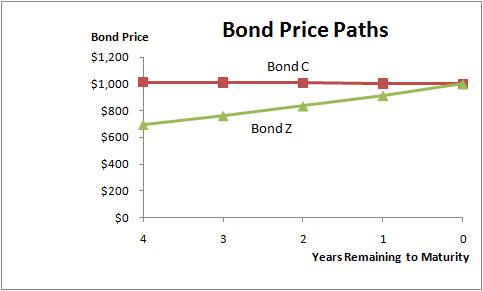
7-8 The rate of return is approximately 15.03%, found with a calculator using the following inputs: N = 6; PV = -1000; PMT = 140; FV = 1090; I/YR = ? Solve for I/YR = 15.03%.
Despite a 15% return on the bonds, investors are not likely to be happy that they were called. Because if the bonds have been called, this indicates that interest rates have fallen sufficiently that the YTC is less than the YTM. (Since they were originally sold at par, the YTM at issuance = 14%.) Rates are sufficiently low to justify the call. Now investors must reinvest their funds in a much lower interest rate environment.
Chapter 7: Bonds and Their Valuation AnswersandSolutions 151 © 2016 Cengage Learning. All Rights Reserved. May not be copied, scanned, or duplicated, in whole or in part, except for use as permitted in a license distributed with a certain product or service or otherwise on a password-protected website for classroom use.
7-6 a. Time Years to Maturity Price of Bond C Price of Bond Z t = 0 4 $1,012.79 $ 693.04 t = 1 3 1,010.02 759.57 t = 2 2 1,006.98 832.49 t = 3 1 1,003.65 912.41 t = 4 0 1,000.00 1,000.00 b. 7-7 Percentage Price at 8% Price at 7% Change 10-year, 10% annual coupon $1,134.20 $1,210.71 6.75% 10-year zero 463.19 508.35 9.75 5-year zero 680.58 712.99 4.76 30-year zero 99.38 131.37 32.19 $100 perpetuity 1,250.00 1,428.57 14.29
7-9
7-10
a. VB = N 1 t N d t d ) r (1 M ) r (1 INT
M = $1,000. PMT = 0.09($1,000) = $90.
1. VB = $829: Input N = 4, PV = -829, PMT = 90, FV = 1000, YTM = I/YR = ? I/YR = 14.99%.
2. VB = $1,104: Change PV = -1104, YTM = I/YR = ? I/YR = 6.00%.
b. Yes. At a price of $829, the yield to maturity, 15%, is greater than your required rate of return of 12%. If your required rate of return were 12%, you should be willing to buy the bond at any price below $908.88.
a. Solving for YTM:
N = 9, PV = -901.40, PMT = 80, FV = 1000 I/YR = YTM = 9.6911%.
b. The current yield is defined as the annual coupon payment divided by the current price.
CY = $80/$901.40 = 8.875%.
Expected capital gains yield can be found as the difference between YTM and the current yield.
CGY = YTM – CY = 9.691% – 8.875% = 0.816%.
Alternatively, you can solve for the capital gains yield by first finding the expected price next year.
N = 8, I/YR = 9.6911, PMT = 80, FV = 1000 PV = -$908.76. VB = $908.76.
Hence, the capital gains yield is the percentage price appreciation over the next year.
CGY = (P1 – P0)/P0 = ($908.76 – $901.40)/$901.40 = 0.816%.
c. As rates change they will cause the end-of-year price to change and thus the realized capital gains yield to change. As a result, the realized return to investors will differ from the YTM.
7-11
a. Using a financial calculator, input the following to solve for YTM:
N = 18, PV = -1100, PMT = 60, FV = 1000, and solve for YTM = I/YR = 5.1355%.
However, this is a periodic rate. The nominal YTM = 5.1355%(2) = 10.2709% 10.27%.
For the YTC, input the following:
N = 8, PV = -1100, PMT = 60, FV = 1060, and solve for YTC = I/YR = 5.0748%.
However, this is a periodic rate. The nominal YTC = 5.0748%(2) = 10.1495% 10.15%.
So the bond is likely to be called, and investors are most likely to earn a 10.15% yield. (The bond sells at a premium indicating that interest rates have declined since the bond was issued; therefore, the bond would likely be called if interest rates remain lower than the coupon rate.)
152 AnswersandSolutions Chapter 7: Bonds and Their Valuation © 2016 Cengage Learning. All Rights Reserved. May not be copied, scanned, or duplicated, in whole or in part, except for use as permitted in a license distributed with a certain product or service or otherwise on a password-protected website for classroom use.
7-12
b. The current yield = $120/$1,100 = 10.91%. The current yield will remain the same; however, if the bond is called the YTC reflects the total return (rather than the YTM) so the capital gains yield will be different.
c. YTM = Current yield + Capital gains (loss) yield
10.27% = 10.91% + Capital loss yield
-0.64% = Capital loss yield.
This is the capital loss yield if the YTM is expected. However, based on our calculations in Part a the total return expected would actually be the YTC = 10.15%. So, the expected capital loss yield = 10.15% – 10.91% = -0.76%.
a. Yield to maturity (YTM):
With a financial calculator, input N = 28, PV = -1165.75, PMT = 95, FV = 1000, I/YR = ? I/YR = YTM = 8.00%.
Yield to call (YTC):
With a calculator, input N = 3, PV = -1165.75, PMT = 95, FV = 1090, I/YR = ? I/YR = YTC = 6.11%.
b. Knowledgeable investors would expect the return to be closer to 6.1% than to 8%. If interest rates remain substantially lower than 9.5%, the company can be expected to call the issue at the call date and to refund it with an issue having a coupon rate lower than 9.5%. (The bond sells at a premium indicating that interest rates have declined since the bond was issued. So, if interest rates remain lower than the coupon rate the bond will likely be called.)
c. If the bond had sold at a discount, this would imply that current interest rates are above the coupon rate (i.e., interest rates have risen). Therefore, if interest rates remained at levels at or above the coupon rate the company would not call the bonds, so the YTM would be more relevant than the YTC.
7-13 The problem asks you to solve for the YTM and Price, given the following facts:
N = 5 2 = 10, PMT = 80/2 = 40, and FV = 1000. In order to solve for I/YR we need PV. However, you are also given that the current yield is equal to 8.21%. Given this information, we can find PV (Price).
Current yield = Annual interest/Current price 0.0821 = $80/PV
PV = $80/0.0821 = $974.42.
Now, solve for the YTM with a financial calculator:
N = 10, PV = -974.42, PMT = 40, and FV = 1000. Solve for I/YR = YTM = 4.32%. However, this is a periodic rate so the nominal YTM = 4.32%(2) = 8.64%.
7-14 a. The bond is selling at a large premium, which means that its coupon rate is much higher than the going rate of interest. Therefore, the bond is likely to be called it is more likely to be called than to remain outstanding until it matures. Therefore, the likely life remaining on these bonds is 5 years (the time to call).
Chapter 7: Bonds and Their Valuation AnswersandSolutions 153 © 2016 Cengage Learning. All Rights Reserved. May not be copied, scanned, or duplicated, in whole or in part, except for use as permitted in a license distributed with a certain product or service or otherwise on a password-protected website for classroom use.
7-15
b. Since the bonds are likely to be called, they will probably provide a return equal to the YTC rather than the YTM. So, there is no point in calculating the YTM just calculate the YTC. Enter these values:
N = 2 5 = 10, PV = -1353.54, PMT = 0.14/2 1,000 = 70, FV = 1050, and then solve for YTC = I/YR.
The periodic rate is 3.2366%, so the nominal YTC is 2 3.2366% = 6.4733% 6.47%. This would be close to the going rate, and it is about what the firm would have to pay on new bonds.
First, we must find the amount of money we can expect to sell this bond for in 5 years. This is found using the fact that in five years, there will be 15 years remaining until the bond matures and that the expected YTM for this bond at that time will be 8.5%.
N = 15, I/YR = 8.5, PMT = 90, FV = 1000
PV = -$1,041.52. VB = $1,041.52.
This is the value of the bond in 5 years. Therefore, we can solve for the maximum price we would be willing to pay for this bond today, subject to our required rate of return of 10%.
N = 5, I/YR = 10, PMT = 90, FV = 1041.52
PV = -$987.87. VB = $987.87.
You would be willing to pay up to $987.87 for this bond today.
7-16 Before you can solve for the price, we must find the appropriate semiannual rate at which to evaluate this bond.
EAR = (1 + INOM/2)2 – 1
0.0816 = (1 + INOM/2)2 – 1
INOM = 0.08.
Semiannual interest rate = 0.08/2 = 0.04 = 4%.
Solving for price:
N = 2 10 = 20, I/YR = 4, PMT = 0.09/2 1,000 = 45, FV = 1000
PV = -$1,067.95. VB = $1,067.95.
7-17
First, we must find the price Joan paid for this bond.
N = 10, I/YR = 9.79, PMT = 110, FV = 1000
PV = -$1,075.02. VB = $1,075.02.
Then to find the one-period return, we must find the sum of the change in price and the coupon received divided by the starting price.
One-period return = price Beginning Couponreceived price Beginning price Ending
One-period return = ($1,060.49 – $1,075.02 + $110)/$1,075.02
One-period return = 8.88%.
154 AnswersandSolutions Chapter 7: Bonds and Their Valuation © 2016 Cengage Learning. All Rights Reserved. May not be copied, scanned, or duplicated, in whole or in part, except for use as permitted in a license distributed with a certain product or service or otherwise on a password-protected website for classroom use.
7-18
a. Find the YTM as follows:
N = 10, PV = -1175, PMT = 110, FV = 1000
I/YR = YTM = 8.35%.
b. Find the YTC, if called in Year 5 as follows:
N = 5, PV = -1175, PMT = 110, FV = 1090
I/YR = YTC = 8.13%.
c. The bonds are selling at a premium which indicates that interest rates have fallen since the bonds were originally issued. Assuming that interest rates do not change from the present level, investors would expect to earn the yield to call. (Note that the YTC is less than the YTM.)
d. Similarly from above, YTC can be found, if called in each subsequent year.
If called in Year 6:
N = 6, PV = -1175, PMT = 110, FV = 1080
I/YR = YTC = 8.27%.
If called in Year 7:
N = 7, PV = -1175, PMT = 110, FV = 1070
I/YR = YTC = 8.37%.
If called in Year 8:
N = 8, PV = -1175, PMT = 110, FV = 1060
I/YR = YTC = 8.46%.
If called in Year 9:
N = 9, PV = -1175, PMT = 110, FV = 1050
I/YR = YTC = 8.53%.
According to these calculations, the latest investors might expect a call of the bonds is in Year 6 This is the last year that the expected YTC will be less than the expected YTM. At this time, the firm still finds an advantage to calling the bonds, rather than seeing them to maturity.
Chapter 7: Bonds and Their Valuation AnswersandSolutions 155 © 2016 Cengage Learning. All Rights Reserved. May not be copied, scanned, or duplicated, in whole or in part, except for use as permitted in a license distributed with a certain product or service or otherwise on a password-protected website for classroom use.
Comprehensive/Spreadsheet Problem
NotetoInstructors:
The solution to this problem is not provided to students at the back of their text. Instructors can access the Excelfile on the textbook’s website.
7-19
a. Bond A is selling at a discount because its coupon rate (7%) is less than the going interest rate (YTM = 9%). Bond B is selling at par because its coupon rate (9%) is equal to the going interest rate (YTM = 9%). Bond C is selling at a premium because its coupon rate (11%) is greater than the going interest rate (YTM = 9%).
b.
c.
d. Current yield = Annual coupon / Price
156 Comprehensive/SpreadsheetProblem Chapter 7: Bonds and Their Valuation © 2016 Cengage Learning. All Rights Reserved. May not be copied, scanned, or duplicated, in whole or in part, except for use as permitted in a license distributed with a certain product or service or otherwise on a password-protected website for classroom use.
Bond A Bond B Bond C Current yield = 8.17% 9.00% 9.62% Basic Input Data BondA BondB BondC Years tomaturity 12 12 12 Periods per year 1 1 1 Periods tomaturity 12 12 12 Coupon rate 7% 9% 11% Par value $1,000 $1,000 $1,000 Periodic payment $70 $90 $110 Yieldtomaturity 9% 9% 9% VB0 = $856.79 $1,000.00 $1,143.21 Basic Input Data BondA BondB BondC Years tomaturity 11 11 11 Periods per year 1 1 1 Periods tomaturity 11 11 11 Coupon rate 7% 9% 11% Par value $1,000 $1,000 $1,000 Periodic payment $70 $90 $110 Yieldtomaturity 9% 9% 9% VB1 = $863.90 $1,000.00 $1,136.10 ExpectedCGYield= 0.83% 0.00% -0.62% ExpectedTotal Return = 9.00% 9.00% 9.00%
e.
Basic Input Data BondD
Years tomaturity
Periods per year
Periods tomaturity 18
Coupon rate
Par value $1,000
Periodic payment $40
Current price $1,150
Call price $1,040
Years until callable 5
Periods until callable 10
f.
1. 5.83%
2. 5.26%
3. The bond is selling at a premium, which means that interest rates have declined since the bond was issued. If interest rates remain at current levels, then Mr. Clark should expect the bond to be called. Consequently, he would earn the YTC not the YTM.
A5-year bondwith a9% annual coupon
-3.79%
A5-year bondwith azerocoupon $649.93 $620.92 -4.46%
A10-year bondwith a9% annual coupon $1,000.00 $938.55 -6.14%
A10-year bondwith azerocoupon $422.41 $385.54 -8.73%
Price risk is the risk of a decline in a bond's price due to an increase in interest rates. Reinvestment risk is the risk that a decline in interest rates will lead to a decline in income from a bond portfolio.
Ranking the bonds above in order from the most price risk to the least price risk: 10-year bond with a zero coupon, 10-year bond with a 9% annual coupon, 5-year bond with a zero coupon, 5-year bond with a 9% annual coupon, and a 1-year bond with a 9% annual coupon.
You can double check this ranking by calculating the prices of each bond at 2 different interest rates, and then determining the percentage change in value. (See calculations above.)
Ranking the bonds above in order from the most reinvestment risk to the least reinvestment risk: 1-year bond with a 9% annual coupon, 5-year bond with a 9% annual coupon, 5-year bond with a zero coupon, 10-year bond with a 9% coupon, and 10-year bond with a zero coupon.
Refer to Table 7.2 in text; however, the longer the maturity and the lower the coupon rate of the bond, the lower the reinvestment risk of the bond.
Chapter 7: Bonds and Their Valuation Comprehensive/SpreadsheetProblem 157 © 2016 Cengage Learning. All Rights Reserved. May not be copied, scanned, or duplicated, in whole or in part, except for use as permitted in a license distributed with a certain product or service or otherwise on a password-protected website for classroom use.
9
2
8%
YTM= 5.83% YTC= 5.26% 9% 10% %
$1,000.00 $990.91
Price Chge A1-year bondwith a9% annual coupon
-0.91%
$962.09
$1,000.00
158 Comprehensive/SpreadsheetProblem Chapter 7: Bonds and Their Valuation © 2016 Cengage Learning. All Rights Reserved. May not be copied, scanned, or duplicated, in whole or in part, except for use as permitted in a license distributed with a certain product or service or otherwise on a password-protected website for classroom use. g. 1. Years Remaining Until Maturity Bond A Bond B Bond C 12 $856.79 $1,000.00 $1,143.21 11 $863.90 $1,000.00 $1,136.10 10 $871.65 $1,000.00 $1,128.35 9 $880.10 $1,000.00 $1,119.90 8 $889.30 $1,000.00 $1,110.70 7 $899.34 $1,000.00 $1,100.66 6 $910.28 $1,000.00 $1,089.72 5 $922.21 $1,000.00 $1,077.79 4 $935.21 $1,000.00 $1,064.79 3 $949.37 $1,000.00 $1,050.63 2 $964.82 $1,000.00 $1,035.18 1 $981.65 $1,000.00 $1,018.35 0 $1,000.00 $1,000.00 $1,000.00 Time Paths of Bonds A, B, and C $0.00 $200.00 $400.00
$800.00
12 9 6 3 0 Years Remaining Until Maturity Bond Value Bond A Bond B Bond C Years Remaining Until Maturity Bond A Bond B Bond C 12 8.17% 9.00% 9.62% 11 8.10% 9.00% 9.68% 10 8.03% 9.00% 9.75% 9 7.95% 9.00% 9.82% 8 7.87% 9.00% 9.90% 7 7.78% 9.00% 9.99% 6 7.69% 9.00% 10.09% 5 7.59% 9.00% 10.21% 4 7.48% 9.00% 10.33% 3 7.37% 9.00% 10.47% 2 7.26% 9.00% 10.63% 1 7.13% 9.00% 10.80%
$600.00
$1,000.00 $1,200.00 $1,400.00
Chapter 7: Bonds and Their Valuation Comprehensive/SpreadsheetProblem 159 © 2016 Cengage Learning. All Rights Reserved. May not be copied, scanned, or duplicated, in whole or in part, except for use as permitted in a license distributed with a certain product or service or otherwise on a password-protected website for classroom use. 2. 3. Years Remaining Until Maturity Bond A Bond B Bond C 12 0.83% 0.00% -0.62% 11 0.90% 0.00% -0.68% 10 0.97% 0.00% -0.75% 9 1.05% 0.00% -0.82% 8 1.13% 0.00% -0.90% 7 1.22% 0.00% -0.99% 6 1.31% 0.00% -1.09% 5 1.41% 0.00% -1.21% 4 1.52% 0.00% -1.33% 3 1.63% 0.00% -1.47% 2 1.74% 0.00% -1.63% 1 1.87% 0.00% -1.80% Years Remaining Until Maturity Bond A Bond B Bond C 12 9.00% 9.00% 9.00% 11 9.00% 9.00% 9.00% 10 9.00% 9.00% 9.00% 9 9.00% 9.00% 9.00% 8 9.00% 9.00% 9.00% 7 9.00% 9.00% 9.00% 6 9.00% 9.00% 9.00% 5 9.00% 9.00% 9.00% 4 9.00% 9.00% 9.00% 3 9.00% 9.00% 9.00% 2 9.00% 9.00% 9.00% 1 9.00% 9.00% 9.00%
Another random document with no related content on Scribd:
prohibition against accepting unsolicited donations from donors in such states who approach us with offers to donate.
International donations are gratefully accepted, but we cannot make any statements concerning tax treatment of donations received from outside the United States. U.S. laws alone swamp our small staff.
Please check the Project Gutenberg web pages for current donation methods and addresses. Donations are accepted in a number of other ways including checks, online payments and credit card donations. To donate, please visit: www.gutenberg.org/donate.
Section 5. General Information About Project Gutenberg™ electronic works
Professor Michael S. Hart was the originator of the Project Gutenberg™ concept of a library of electronic works that could be freely shared with anyone. For forty years, he produced and distributed Project Gutenberg™ eBooks with only a loose network of volunteer support.
Project Gutenberg™ eBooks are often created from several printed editions, all of which are confirmed as not protected by copyright in the U.S. unless a copyright notice is included. Thus, we do not necessarily keep eBooks in compliance with any particular paper edition.
Most people start at our website which has the main PG search facility: www.gutenberg.org.
This website includes information about Project Gutenberg™, including how to make donations to the Project Gutenberg Literary Archive Foundation, how to help produce our new eBooks, and how to subscribe to our email newsletter to hear about new eBooks.