
26_MB-Workforce-Final-issuu

Page 1


Michigan Workforce Trends in the Biosciences Industry 2025

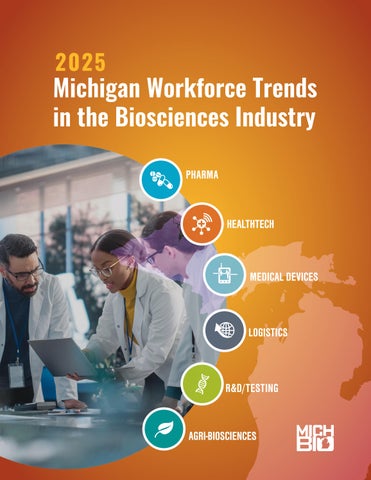
PHARMA

HEALTHTECH

MEDICAL DEVICES

LOGISTICS

R&D/TESTING

AGRI-BIOSCIENCES
INDUSTRY OVERVIEW

Long-term growth amid a period of transition

Michigan’s biosciences industry has demonstrated steady, long-term employment growth over nearly two decades, even as it navigates shorter-term cycles of expansion, contraction, and technological change.

Employment growth accelerated through the early and mid-2010s, rising to more than 41,800 jobs by 2014, before leveling off and briefly declining around 2020 amid industry consolidation and pandemic-related disruptions. Since then, the sector has rebounded strongly, reaching its highest employment level on record in 2024, underscoring the industry’s resilience and continued role as a cornerstone of Michigan’s innovation economy.

From January 2021 through December 2024, Michigan life sciences employers posted 74,674 job opportunities, reflecting sustained demand for skilled talent across research, manufacturing, logistics, and regulated production environments

While job posting activity from 2021–2024 reflects a period of slower hiring growth and increased employer selectivity, these short-term signals should be viewed as part of a broader transition toward a more mature, productivity-focused life sciences economy.

Employers are shifting from rapid workforce expansion toward strategic hiring, incumbent worker upskilling, and technology-enabled efficiency, even as overall employment continues to climb. Taken together, these trends point to a biosciences sector that is growing in scale over time while evolving in structure, skill requirements, and talent strategy.

47,815

Jobs in 2024

INDUSTRY HIGHLIGHTS

42% Increase Since 2006

74,000+

Job Postings (2021-2024)

SUBSECTOR HIRING TRENDS

Subsector-level trends show a broad cooling of hiring activity from 2022 to 2024, with notable variation:

PHARMACEUTICALS peaked in 2022 and declined steadily through 2024

MEDICAL DEVICES & EQUIPMENT experienced the sharpest contraction after 2022

RESEARCH, TESTING & MEDICAL LABS saw sustained declines, reflecting slower clinical activity

DISTRIBUTION  remained comparatively stable, reinforcing its structural importance

AG BIOSCIENCES  declined in 2024 after modest stability

These trends indicate a shift away from expansionary hiring toward operational efficiency, automation, and workforce consolidation, rather than a weakening of Michigan’s life sciences base.

WORKFORCE IMPACT

Slower Growth, Smarter Hiring

Employers are focusing on strategic hires, incumbent worker upskilling, and productivity gains, rather than workforce expansion.

Technology Transformation

AI, machine learning, and industrial automation are reshaping job roles across R&D, manufacturing, and distribution. Large firms are leading adoption, while smaller firms face capacity and training challenges.

Workforce Development Priorities

Companies are increasing investment in:

■ Upskilling and reskilling existing workers

■ Work-based learning and internships

■ Early student engagement and STEM pipeline development

EMPLOYER INSIGHTS: How

Michigan Bioscience Companies Are Navigating Workforce Change

While employment data and job posting trends provide an essential quantitative foundation, direct input from Michigan bioscience employers offers critical context on how workforce decisions are being made in practice. Across company sizes and subsectors, employers describe a workforce environment defined less by contraction and more by strategic recalibration - balancing growth, productivity, technology adoption, and talent development.

From Expansion to Precision Hiring

Michigan employers consistently report a shift away from broad-based hiring toward more targeted recruitment focused on missioncritical roles. Rather than expanding headcount across teams, companies are prioritizing positions tied to quality systems, regulatory compliance, advanced manufacturing, data analytics, and specialized technical expertise.

This mirrors national findings indicating lower overall hiring volumes paired with greater ease in filling roles, as employers focus on fewer, higher-impact positions rather than rapid workforce expansion.

“We’re still hiring, but we’re being much more deliberate. Every role has to clearly support regulatory, quality, or production efficiency goals.”
— MICHIGAN LIFE SCIENCES MANUFACTURER

Turn static files into dynamic content formats.

Create a flipbook