ALLEGORICAL SPACES OF TEMPORALITIES
Michael Chan / 2023 - 24
![]()
Michael Chan / 2023 - 24
SD4563 - Capstone Project: Environment & Interior Design
Supervised by Prof. Peter Hasdell School of Design
The Hong Kong Polytechnic University
“Artistic creation, after all, is not the subject to absolute laws, valid from age to age; since it is related to the more general aim of mastery of the world, it has an infinite number of facet, the vincula that connect man with his vital activity; and even if the path towards knowledge is unending, no step that takes man nearer to a full understanding of the meaning of his existence can be too small to count.”
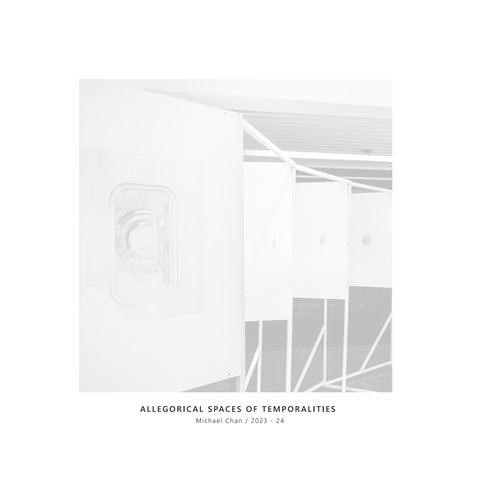
A. Tarkovsky. Sculpting in Time: reflections on the cinema 1984The project employs allegorical architecture as a critical tool to investigate the interaction between cinema and architecture. The design overlays the narrative of the chosen film, “Stalker” (1979) by Andrei Tarkovsky, and an actual site—an abandoned Tong Lau building and the surrounding alleys located at Graham Street and Gage Street in Hong Kong, showcasing a subjective imaginative journey “to the zone” in a different context. By juxtaposing fragments of spaces and temporalities, an alternative interpretation of the narrative is illustrated.
My acknowledgements to the following people, your support, assistance and companionship has been invaluable:
To my supervisor Prof. Peter Hasdell and other teaching staff who made this work possible. Your guidance and inspiring comments has been an source of motivation throughout the wentire capstone project.
To my colleagues in the capstone research project, Charmaine and Iliv. Their invaluable insights has greatly contributed to the success of our research and my individual design project.
Phenomenology
It is the philosophical study of the structures of consciousness from a first-person perspective. In terms of architecture and design, phenomenology is the study and exploration of the physical experience of spaces.
Temporalities
It is conferred on the instant via the duration that provides simultaneity with its ‘sufficient reason.’ The clock is its institution: the instant-iation of time.
Allegory
Deriving from the Greek allos, it signifies a doubleness of intention that requires interpretation. According to Angus Fletcher, in the simplest terms allegory says one thing and means another.
How can architectural space challenge the normative notions of space and temporalities by “sculpting in time”?
In the context of designing built environments, architects and designers envision and aniticipate the visual, spatial, and navigational experiences of users during the initial design phase. While architecture creates physical spaces, the medium of moving pictures offers a means to perceive and understand these spaces over time.
Cinematic narratives utilize the spatial cues of architecture to evoke emotions in viewers, who ultimately become users of these spaces. Rather than considering architectural elements as passive entities, it is important to recognize them as active agents that embody and convey emotions. In light of this perspective, the project embarked on an exploration and analysis of architectural narratives depicted in moving pictures, aiming to evaluate the interplay between interior and exterior spaces, as well as the relationship between movement, time, and space.
In his 1979 film Stalker, Russian filmmaker Andrei Tarkovsky challenges normative notions of space and temporality. He refers to this as “sculpting in time”, arguring that a filmmaker - like a sculptor - redacts, excavates and curates material to reveal a final product. Tarkovsky proposes that “polyscreen” cinema - showing multiple perpectives of the same scene simultaneously on several screens - provides a filmic opportunity for experiencing multiple temporal realities all at once.
The film tells the story of an expedition led by a figure known as the “Stalker”, who is seeking scientific discovery—through a hazardous wasteland to a abandoned restricted site.
An abandoned Tong Lau ( 唐樓 ) building at 33 Graham Street, Hong Kong is selected as the site for the project. Being an abandoned space for redevelopment, 33 Gramham Street showcases similarities with the allegorical framework that provokes the reimagination of the journey.
Inspired by Bryan Cantley’s ideology, our final year architecture project prompts a reevaluation of the phenomenological relationship between architectural drawings and the world we perceive. It explores the intricate connections between the page and objects, as well as between the antifacts and the artefact.
Traditional techniques of constructing perspective on flat surfaces have been developed as illusions to depict depth and volume. In the experiment, the drawin serve as translations of perspectives portrayed in original paintings, which are then reinterpreted to create a new space.
Through the experiments, opportunities are offered to investigate the illusion of spatial representation during the very initial stages of the schematic design phase.
The drawings were made after first watching the film. Taking ideas from phenomenology and the hermeneutics, spaces were drawn in a speculative manner which illustrate the dialogue between my perception and the spaces desgined by the directer.
Drawings were created during the visit to the site, 33 Graham Street, and its surrounding area. These drawings showcase the subjective fragmentations of spaces that explore the opportunities for imagination in the space.
Through montage we can analyse the juxtaposition and overlapping of different temporal events and duration in the moving pictures. It offers a basis for the generation of the allegorical spaces of journey in the later stage of design.
01/ Meta-Transcript for Temporalities and durations in “Stalker”
03/ Meta-Transcript for Temporalities and durations in “Stalker”
[PRE-ZONE]
Transcript of Orders and Sequences in
The story of the allegorical spaces was told through the journey of six selected spaces in the film provocateur - Stalker’s home, the bar, the barn, the dry tunnel, the meat grinder, and the barkhan .
Subjective perception of the durations are strategically mapped using the method developed in the phase of schematic design. A reimagined allegorical space is eventually designed for a “new” journey to the zone in the context of Hong Kong.
Spaces behind the inaccessible threshold at 33 Graham Street and the surrounding area was extended, elongated and reimaged based on the experience when I was visiting the site at the particular point of time.
Spaces behind the openings, the doors and the windows extend, and render to become spaces provocated in the moving picture.
Spatial Expansions in plan & Isometric projection.
The final drawing is set up by integrating the findings in the mapping of time and space in previous stage of design. Elements in both the site, 33 Graham Street and the choosen narrative are integrated to generate a “new” journey of allegorical spaces.
18 drawings are produced subsequently to offer a subjective experience of temporalities for exhibition.
Experiments were conducted to create a flipping book or storybook that would visually depict the various temporalities presented in the narratives. A wooden frame was ultimately chosen as a tool for displaying larger-sized drawings, providing viewers with a first-person experience. Whlist the frame will be the major installation to display the drawings, a small book of thumbnails is designed to offer connection to the site and the narrative.
Andrei Tarkovsky suggests that “polyscreen” cinema, which displays multiple perspectives of the same scene simultaneously on several screens, offers a cinematic opportunity to experience multiple temporal realities simultaneously.
In order to portray the perceived narratives in the transcript, a specially designed frame is used to strategically juxtapose the drawings. This construction aims to create a first-person experience of the allegorical spaces.
The duration of the viewers’ walkthrough through the drawings has been carefully considered to align with my subjective perception of duration in moving pictures.
The duration of the viewers’ walkthrough through the drawings has been thoughtfully planned to align with my subjective perception of duration in moving pictures.
To emphasize the juxtaposing temporalities of certain events and duration in the narratives, the wooden frame is utilized to showcase drawings on both sides of the paper, taking advantage of the structure.
The capstone project is undoubtedly a bittersweet experience filled with inspiration and fantasy. In fact, this is my very first time delving into a speculative project with a moving picture as a design framework. It has been fascinating to learn the fundamentals of phenomenology and hermeneutics from renowned thinkers and architects, providing me with a solid foundation for the experiments that followed.
On the other hand, I wish I could have performed better in the application and concept development during the schematic design phase. At that time, I was solely focused on reading theoretical frameworks and lacked an established plan for idea development. Consequently, I encountered difficulties in the later stages of detailed design.
Undoubtedly, the choice of medium for my project significantly improved my hand-drawing skills to an immersive degree. However, I should have carefully considered the options before deciding on drawing styles. The styles I adopted proved to be extremely time-consuming, which led me to sacrifice other valuable opportunities to refine my project.
Overall, the project has been a rewarding experience, and it would not have been possible without the help and support of my tutors and colleagues.
And that’s a wrap....
School of Design The Hong Kong Polytechnic University