Mycoscaffold An Exploration of Soil Remediation Delivery Mediums Myscaffold Mat
INTRODUCTION
+ MYCOREMEDIATION
BIODIVERSITY
MATERIAL DESIGN
SENSING & DATA VISUAL.
Weep holes for controlled drainage
4. Module Envelope Ceramic Material
3. Mycelium Mat Mycelium & Burlap Fabric
MATERIAL SCALE EXPERIMENTS
Research Questions:
How do the geometric and material qualities of the system support both the growth of mycelium and programmatic potential its context concurrently? How does the form of the system in relation to the manner of which it interfaces with the soil adapts in response to varying pollution scenarios? How can the introduction of native flora for the support of biodiversity within the mycoremediation system enhance the remediation performance or serve as a natural sensor?
+
Elements of Integration for Accessible Soil Remediation Delivery System
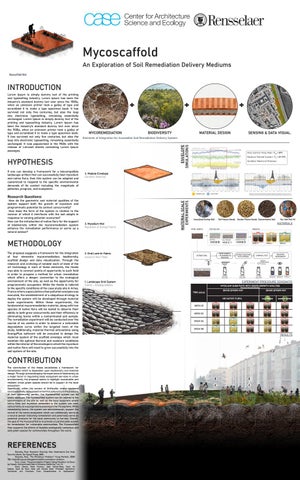
HYPOTHESIS If one can develop a framework for a biocompatible landscape artifact that can successfully host mycelium and native flora, then this system can be adapted and customized to respond to the specific environmental demands of its context including the magnitude of pollution, program, and ecosystem.
+
ENVELOPE SIMULATIONS
Lorem Ipsum is simply dummy text of the printing and typesetting industry. Lorem Ipsum has been the industry’s standard dummy text ever since the 1500s, when an unknown printer took a galley of type and scrambled it to make a type specimen book. It has survived not only five centuries, but also the leap into electronic typesetting, remaining essentially unchanged. Lorem Ipsum is simply dummy text of the printing and typesetting industry. Lorem Ipsum has been the industry’s standard dummy text ever since the 1500s, when an unknown printer took a galley of type and scrambled it to make a type specimen book. It has survived not only five centuries, but also the leap into electronic typesetting, remaining essentially unchanged. It was popularised in the 1960s with the release of Letraset sheets containing Lorem Ipsum passages.
Envelope Material Properties Thermal Resistance: 0.9 W/mK Porosity: 35% Water Absorption: 22.5% Compressive Strength: 19.5 MPa
Inoculated Burlap Roll
Tall Fescue SeedsInoculated Garden ThymeMycelium Seeds Contaminated Soil Material
Our Soil Test Kit
MATERIALS Pearl Oyster Mushroom Burlap Roll - Fungaia Farms
METHODOLOGY The proposal suggests a framework for the integration of four elements: mycoremediation, biodiversity, scaffold design and data visualization. Through the research and archiving of notable work of state of the art technology in each of these elements, the thesis was able to connect points of opportunity to each field in order to propose a method for urban remediation which offers a deeper connection to the ecological environment of the site, as well as the opportunity for programmatic occupation. While the thesis is tailored to the specific conditions of the case study site in Arles, France where a speculative urban pollution analysis was executed, the establishment of a ubiquitous strategy to deploy the system will be developed through material scale experiments. Within these experiments, the fundamental mycoremediation material, along with two species of native flora will be tested to observe their ability to both grow concurrently and their efficiency in eliminating toxins within a contaminated soil sample. The remediation experiment will be conducted over the course of six weeks in order to observe a noticeable degradation curve within the targeted toxin of the study. Additionally, material thermal simulations using EnergyPlus software will be executed to design the material system of the scaffold envelope which must maintain the optimal thermal and moisture conditions within the interior of the envelope in which the mycelium and native flora will need to grow successfully into the soil system of the site.
CONTRIBUTION The contribution of the thesis establishes a framework for remediation which is dependent upon biodiversity and material design. Through acknowledging the importance of biodiversity as a major factor in regulating basic ecosystem services in urban environments, the proposal seeks to highlight sustainable and resilient urban green spaces should be in support of the local ecosystem. Specifically within the context of Griffeuille, where residents could potentially be exposed to harmful pollutants in the products of their community garden, the Mycoscaffold system can be easily deployed. The Mycoscaffold system can be tailored to the contaminants of the site as well as the local biosphere where native flora and mycelium embedded in the system can work concurrently to expunge toxins existing in the rhizosphere. While remediating toxins, the system can simulatenously support the revival of the native ecosystem which can additionally serve as a natural sensor indicating remediation and potentially serve as potential products for the local community to harvest. Overall, the goal of the Mycoscaffold is to provide a customizable system for remediation for vulnerable communities. The Mycoscaffold then supports the efforts of feasible ecologically conscious and safe green spaces for communities throughout the world.
REFERENCES • Stamets, Paul. Mycelium Running: How Mushrooms Can Help Save the World. Ten Speed Press, 2005. • Stamets, Paul. “The Petroleum Problem.” Fungi Perfecti, 30:00 700. https://fungi.com/blogs/articles/the-petroleum-problem. • Durr, Levon. “Mycoremediation Project: Using Mycelium to Clean Up Diesel- Contaminated Soil in Orleans, California,” n.d., 12.
• Shafi, Uferah, Rafia Mumtaz, José García-Nieto, Syed Ali Hassan, Syed Ali Raza Zaidi, and Naveed Iqbal. “Precision Agriculture Techniques and Practices: From Considerations to Applications.”
2. Grid Lock-In Fabric Coconut Noir Fiber
1. Landscape Grid System Fabric - Biodegradable
Nutritional Fabric Properties Coconut Noir Fiber for Stiffness & Nutritional Additive in Module
EXPERIMENT PROCEDURE SCHEMATIC
MYCELIUM SUBSTRATE WITH SEEDS GROWTH ANALYSIS (Pleurotus Ostreatus Species)
TIME (WEEKS)
GRAIN SPAWN MAT NO NATIVE FLORA
WEEK 01 WEEK 02 WEEK 04
GRAIN SPAWN MAT TALL FESCUE
GARDEN THYME
Landscape Grid Properties Core Gravel Foundation Grid 100% Recycled - 20 Year Lifespan Mechanical Strength: 40 – 60 tons/m2 Dupont Ground Stabilization Grid Geotextile Fabric System
WEEK 08 WEEK 12
RESULTS