IMPACT REPORT
Platinum Sponsor
Networking Platform Sponsor



The Mexican mining industry finds itself in a complex position and therefore its future remains uncertain. On the one hand, larger demand for metals and higher prices are benefiting the industry. On the other hand, the industry continues to face political and legal uncertainty, as well as lack of incentives.
The future of the Mexican mining industry will depend on the business and political leaders who are currently reshaping it. At Mexico Mining Forum, we bring together key leaders that exchange information, experiences, knowledge and proposals aimed at finding solutions to overcome the sector’s main challenges and connect with financiers, consultants and suppliers.
Mexico Mining Forum 2022 brought together 384 industry leaders representing the main companies in the sector, to share their perspective and insights into one of Mexico’s main industries while generating business through unparalleled matchmaking opportunities. Mexico Mining Forum 2022 ECHO, later in the year, will continue to maximize the impact of our conferences for our participants, speakers and sponsors. Our conference program is designed to provide an insider’s perspective on top industry topics so leaders can make better decisions and drive the industry forward.
We look forward to seeing you at the next forum and helping you achieve your business and strategic goals!
Breakdown
163 companies
384 conference participants
67 speakers
8 sponsors
6,666 visitors to the conference website
Mexico’s leading B2B conference organizer introduces the world’s leading event networking platform.
direct pre-conference LinkedIn impressions 2.57% click through rate during MMF
conference engagement rate

Delivering intent-based matchmaking powered by Artificial Intelligence that connects the right people. Network, no matter where you are.
269 Participants
837 matchmaking communications
86 1:1 meetings conducted
pre-conference click through rate
pre-conference engagement rate



Matchmaking intentions
Networking
Investment
Recruitment
• 3M
• ABB México S.A. de C.V.
• Agnico Eagle
• Ak Comunicación
• Alamos Gold
• Alien Metals Ltd
• Almaden Minerals / Minera Gorrión
• Altaley Mining Corporation
• Anmark
• Aosenuma
• Argonaut Gold
• Arizona Trade and Investment Office in Chihuahua
• AUSTIN BACIS SA DE CV
• Austin Powder Mexico
• Baluarte Minero
• Baramin
• Beumer de Mexico, S de r L de CV
• BL Law
• Blaw
• Bureau Veritas Minerals
• Bylsa Drilling
• Call & Nicholas, Inc.
• Camimex
• Canadian Chamber of Commerce in Mexico, MTF
• Canuc resources Corp.
• Capwatt Mexico
• CEM
• CEMENTATION MINING MEXICO SA DE CV
• Centric Mining Systems
• Chesapeake Gold
• CIrCUTO r México, Centro América y Caribe
• Cluster Minero de Chihuahua A.C.
• Colegio de Ingenieros de Minas, Metalurgistas y Geólogos de México
• COMEDO r ES INDUSTrIALES
• Compañía Minera Cuzcatlán
• Cr Legal Partners
• CyPlus Idesa
• Defiance Silver Corp
• Delegación de Quebec en México
• Delta radiocomunicación, S.A. de C.V
• Desarrollos rod
• Dirección de Minas Zacatecas
• DrG Technologies
• Driver Industrial
• Dumas
• Dynapro Pumps
• Eagle Mapping
• EC rUBIO
• ECN Automation
• El Palacio de Hierro
• Electro Metalic Solutions
• Embassy of Canada
• Emerson
• EMPr ESAS SEIJO
• Endeavour Silver Corp
• Epiroc Mexico
• Equinoxgold
• Exterran
• Fervim Ingenieria sa de cv
• First Majestic Silver Corp
• Gcsc
• Getman
• Glencore Canada
• Gobierno Baja California Sur
• Gobierno de Coahuila
• Gobierno de Ontario en Mexico
• Gobierno del Estado de Michoacán
• Golder
• Government of the state of sinaloa
• G r Silver Mining
• Green Geology
• Benjamin Hill
• G rUMINEX
• Grupo Industrial FIMCA
• Grupo México
• Grupo Minero COPLAZA S de r L de CV
• Guanajuato Silver
• Hanwa American Corp
• Hito Exploration, Camping & Catering Services S. De r .L. De C.V.
• Iberdrola
• Impact Silver Corp.
• Independent Consultant
• INErCO
• International Business Solutions
• IPADE
• IPEC Ingeniería SA de CV
• IPMC Ghana
• Jemini Capital
• Kepler
• Kootenay Silver
• Koura
• KPMG
• MAG Silver Corp.
• Magna Gold Corp
• Maza Drilling
• MexicoView
• Minaurum Gold Corp
• Minera Adularia Exploracion
• Minera Cuzcatlan SA de CV
• Minerales
• MINEr ALES DE TAr ACHI
• Ministry of Energy and Water resources
• MITSUBISHI ELECTrIC AUTOMATION INC
• Molina, hanff & Perez-howlet, S.C
• Moody’s Investors Service
• Multiled
• Natural resources Canada
• New Zealand Trade & Enterprise
• Newmont
• O’Gorman&Hagerman
• ONU-UNECE
• Orex Minerals Inc.
• Orla Mining Ltd.
• Osisko Development Sapuchi Minera Division
• Outlet Minero
• Pan American Silver Mexico
• Peña Colorada
• Peñoles
• PETrON CO r PO r ATION
• PO rTAL NOTICIOSO SONO r AALDÃA.COM
• r B MEXICO LAW-ABOGADOS
• r Er Energy Group
• reyna Silver Corp.
• riverside resources Inc.
• robit
• SANTACrUZ SILVEr MINING
• Santamarina y Steta
• Sapuchi Minera - Osisko Development
• Secretaria de Economía
• SEFAr
• Seijo Explosives
• SEMAr NAT
• Servicio Geológico Méxicano
• SGS Mexico
• SIEMENS
• Silver crest
• SKF Mexico
• Skyline Assayers & Laboratories
• SME
• Sonoro Gold Corp.
• Source Global
• Spencer Stuart
• SSAB
• Steps up consulting
• SWEDISH STEEL AB MEXICO
• TAHG
• TAK r AF
• TAK r AF Canada
• Tarachi Gold
• TBM
• Torex Gold resources
• TO rONTO STOCK EXCHANGE & TSX VENTU r E EXCHANGE
• Vera & Asociados
• VICTAULIC
• Vizsla Silver
• VMX MinePro
• Vmx Minepro SA de CV
• Walworth
• Weir Minerals Mexico
• WorldWise Coaching LLC
• WSP
09:00 MEXICO MINING’S PRESENT AND FUTURE
Speaker: Efraín Alva Niño, Ministry of Economy
09:30
LEGAL CERTAINTY: HOW TO MINIMIZE RISK AND BOTTLENECKS
Moderator: Ruben Cano, Cr Legal
Panelists: Pablo Gutiérrez De la Peza, O’Gorman & Hagerman
Enrique Rodríguez del Bosque, r B Abogados
Mariano Calderón, Santamarina y Steta
Andrés Pérez Howlet, , Molina, Hanff & Pérez-Howlet
10:15 REPUTATION: RESPONSIBLE MINING AND EFFECTIVE COMMUNICATION STRATEGIES
Moderator: Christopher Ávila Mier, Baluarte Minero
Panelists: Angie Robson, Torex Gold resources Inc
Alfredo Phillips, Argonaut Gold
José Jabalera Batista, Mexican Ministry of Economy
Luiz Camargo, Minera Cuzcatlán
11:00
NETWORKING OPPORTUNITY - AI-POWERED 1:1 MEETINGS
12:00 MINING MARKETS UPDATE
Speaker: Dean McPherson, TSX
12:15 MINERAL PRICES, MINING INVESTMENT AND FINANCIAL OUTLOOK
Moderator: Dean McPherson, TSX
Panelists: Andrew Snowden, Torex Gold
John Darch, Sonoro Gold
Etienne Morin, Orla Mining Ltd
Jerry Huang, Impact Silver
13:00 MINING LEADER PERSPECTIVES SUCCESS FACTORS IN MEXICO
Moderator: Jennifer Burge, WorldWise Coaching & Training LLC
Panelists: Nancy Morales Arango, Bureau Veritas Minerals
Jonathon Bell, Dynapro Pumps Mexico
Fernando Alanís, CAMIMEX
Cynthia Villa, Gruminex
14:00 NETWORKING OPPORTUNITY - AI-POWERED 1:1 MEETINGS
15:00 EXPLORATION SUCCESS STORY: BYLSA DRILLING
Speaker: Macario Rocha, Bylsa Drilling
15:20 EXPLORATION SUCCESS STORY: GR SILVER
Speaker: Marcio Fonseca, G r Silver
15:40 EXPLORATION SUCCESS STORY: SONORO GOLD
Speaker: Kenneth McLeod, Sonoro Gold
16:00 EXPLORATION DECISION-MAKING, TECHNOLOGY CHOICES AND SUPPLY CHAIN COOPERATION
Moderator: Lauren Megaw, reyna Silver
Panelists: Magda Orozco, Maza Drilling
Ben Whiting, Orex Minerals
Viridiana Lagarda, Bylsa Drilling
Michael Konnert, Vizsla Silver
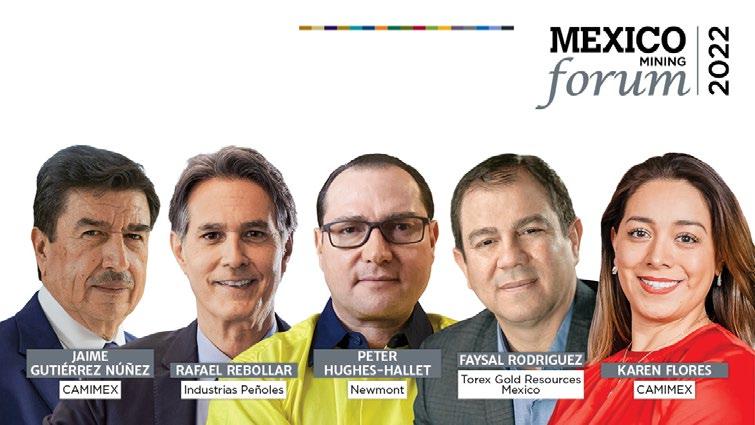
09:00 INSIGHT INTO MEXICO’S TOP MINES
Moderator: Karen Flores, CAMIMEX
Panelists: Faysal Rodriguez, , Torex Gold resources Mexico
Rafael Rebollar, Industrias Peñoles
Peter Hughes-Hallet, Newmont Mexico
Jaime Gutiérrez Núñez, CAMIMEX
10:00 STATE OF THE INDUSTRY IN SINALOA
Speaker: Felipe Ibarra Retamoza, Government of Sinaloa
10:15 MEXICAN MINE DEVELOPMENT PROJECTS TO WATCH IN 2022
Moderator: Douglas Cavey, Defiance Silver Corp
Panelists: Forbes Gemmell, Discovery Silver Corp.
James Anderson, Guanajuato Silver
Mehran Bagherzadeh, riverside resources
Kenneth McLeod, Sonoro Gold
11:00 NETWORKING OPPORTUNITY - AI-POWERED 1:1 MEETINGS
12:00 STATE OF INDUSTRY IN DURANGO
Speaker: Gustavo Kientzle Baille, Government of Durango
12:15 AUTOMATION, DATA-DRIVEN DECISION MAKING AND SUPPLY CHAIN MANAGEMENT
Moderator: Monica Samudio, Circutor
Panelists: Hugo Barrientos, Emerson
Erik Flores, Mitsubishi
Alvaro Rendón, ECN Automation
Eder Lugo, Siemens
13:00 REINVENTING THE USE OF STEEL IN MINING
Speaker: Jorge Garduño, SSAB
Speaker: Arturo Rivas, SSAB
Speaker: Tomás Falcón, SSAB
14:00 NETWORKING OPPORTUNITY - AI-POWERED 1:1 MEETINGS
15:00 MINING OF THE FUTURE: HARNESSING TECHNOLOGY TO OPTIMIZE SAFETY
Moderator: Herman Dittmar, Baluarte Minero
Panelists: Adrián Márquez, VMX Mine Pro Mexico
Felipe Martínez, rOBIT PLC
Jorge Luis Cristerna, Multiled Mexico
Arturo Rivas, SSAB
Alfredo Bertrand, Epiroc Mexico
15:45 MINING PANORAMA AND CLUSTER OF CHIHUAHUA
Speaker: Pablo Mendez, Mining Cluster Chihuahua
16:00 ESG: CREATING POSITIVE IMPACT FOR COMMUNITIES AND THE ENVIRONMENT
Moderator: Ana Mallen, ESG Senior Consultant
Panelists: Yuren castillo, Golder WSP
Bradford Cooke, Endeavour Silver
Cristina Rodríguez, Minera Cuzcatlán
Melissa Sanderson, Mel Sanderson Consulting
Ulises Neri, ONU Mexico
MINING’S IMPORTANCE IN THE PRESENT SET TO EXPAND IN THE FUTURE
If the last two years have proven the resilience of Mexico’s mining industry, then the years to come will prove its central importance to the country’s economy and prosperity, said Efraín Alva Niño, a central figure in the sector’s current landscape.
Alva Niño is the Director of the Extractive Industries Unit at the Ministry of Economy, created in April 2021 to replace the Underministry of Mining, eliminated in 2020. Due to its recent creation, for Alva Niño the promotion of the industry and its image for the purposes of attracting investment are a big part of his present role. Alva Niño made this clear when he proclaimed that “Mexican miners are recognized as some of the best worldwide.”
Alva Niño also stated that his unit had an interest in clarifying certain misunderstandings that were “usually poured into the general population” which negatively impacted the image of the Mexican mining industry and made it more difficult to recognize that the country is one of the best destinations for mining investment. “In spite of the fact that mining in Mexico is strongly legislated and in spite of the heavy tax burden that has to be covered by the sector, the international industry has always recognized that the Mexican mining landscape is highly attractive.”
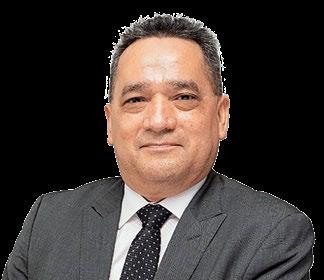
“This list has to be dynamic, not fixed; the minerals that could be classified as critical to the energy transition now might be irrelevant three to five years down the road because of the speed with which the energy industry is innovating its own technologies and processes ”
Efraín Alva Niño Director of the Extractive Industries Unit at the Ministry of Economy
The question of conflict resolution also plays an important role in the functions of the unit. Alva Niño explained they had received direct orders from the leader of the Ministry of Economy, Tatiana Clouthier, to intervene and accelerate all conflict resolution proceedings within the mining industry. These conflicts are generally related to labor and legal matters or to ESG factors, such as the relationships between mining operators and local communities. Alva Niño said the unit views local communities as central to the work of the mining sector. “The mining industry does not work alone. Community support will always be vital.”
In regards to the industry’s present state, Alva Niño emphasized the industry qualities that came to bear on its operations when the pandemic began in 2020. “Mining has been one of the central supports of Mexico’s economic recovery following the pandemic” after the industry was declared an essential economic activity and allowed to restart its activities in May 2020, right after the first COVID-19 cases were reported in Mexico. He noted that as many as 40,000 jobs have been created by the mining industry since then. Alva Niño also emphasized that by sustaining its mineral production throughout the pandemic, the mining industry played a role in sustaining many of Mexico’s other industries and their supply chains which depend on those minerals as basic raw materials and feedstocks.
In Alva Niño’s view, the mining industry’s handling of the pandemic, as well as the many additional processes that it burdened workers and operators with, demonstrated a unique capacity for adaptability and flexibility. “Centers of mining activity in Mexico’s mountainous regions became like bubbles of protection against COVID-19 contagions.” The industry’s isolated conditions allowed safety and hygiene protocols to be developed and supervised in a sophisticated way, which in turn led other industries to replicate the mining
industry’s approach to managing working environments throughout the pandemic, said Alva Niño.
While these developments have been crucial to the industry’s present-day success and its contributions to Mexico’s economic welfare, Alva Niño emphasized that they would play an even larger role in the industry’s future. He also argued that the mining industry was about to play an even larger role in Mexico’s future given that “the mining industry will be a key pillar in the energy transition.” Alva Niño referenced the controversial language included in the recently proposed electricity reform that states that any mineral that could prove “crucial” to Mexico’s energy transition be considered as a “strategic resource” that could be nationalized at any time. While Alva Niño did not make any allusion to the political process surrounding this law or the implications of nationalizing any mineral, he did note that his unit was involved in the creation of this list of minerals. “This list has to be dynamic, not fixed; the minerals that could be classified as critical to the energy transition now might be irrelevant three to five years down the road because of the speed with which the energy industry is innovating its own technologies and processes.”.
Alva Niño explained that all future national endeavours could not be secured without
increasing investment in mining exploration. In his view, additional incentives will be needed for investment in exploration activities to reach the levels that will satisfy the industry’s future needs. In his interview with MBN, Alva Niño also made clear that the conditions which were preventing more investment from entering the industry were in part related to the availability of information. “The lack of legislative certainty has kept investors on edge. The legislative situation in our country must be improved through the provision of more information.”
Alva Niño believes that this kind of work can be done within the context of the government’s current policy to stop issuing new permits and concessions. As he stated at the time, “unfortunately, there is a presidential order to stop mining permits. However, and this is where we come in, while we understand that there will be no new mining permits for the time being, we are asking the government to allow us to work on the ones we already have. That is what we are working on, in addition to lithium explorations and tax reductions.”
His outlook on the positive role that the unit can play in the industry’s future remains positive. “We understand mining is a core part of a country’s development efforts. Our commitment is to communicate the benefits of mining and the high quality of the Mexican mining industry.”
GOOD PRACTICES, RELATIONSHIPS KEY TO INCREASE LEGAL CERTAINTY
The Mexican mining industry has faced several challenges over the past few years. restrictions on new concessions and delays in permits have fostered an environment plagued with legal uncertainty. Establishing good relationships with authorities and communities, along with a strong due diligence on documentation and land rights, is key for companies to counter this uncertainty and thrive in Mexico, agreed industr y experts.
Mining is a capital-intensive activity and returns on investments can take years
to materialize. Contradictory messages from the government have become one of the main concerns for industry leaders. This uncertainty is part of the reason why the country has not met its investment expectations, according to r ubén Cano, Founding Partner, C r Legal. In 2021, the sector attracted US$4.246 billion, which was higher than in 2020 but 15.6 percent below the US$5.03 billion expected for the year. “When the terms and conditions of an agreement are changed unexpectedly, investors are scared away,” Jaime Gutiérrez Núñez, President, CAMIMEX, told MBN.
The lack of concessions and permits is impacting the arrival of new investments and even driving away certain companies with projects in Mexico, leading to a potential loss of US$25 billion, MBN previously reported. Still, even though concessions have not been granted since the beginning of President Andrés Manuel López Obrador’s term, there are certain mechanisms that can allow companies to approach the government in a more favorable light, as long as they comply with the requirements established by the government, said Mariano Calderón, Partner, Santamarina y Steta.
“The key to success is learning about these legal requirements, procedures and steps to negotiate based on legal certainty and rule of law. Mining activities are highly regulated and supervised by authorities, but obligations are reciprocal. The authority has a duty to act in accordance with the legal framework and companies have the right to receive a well-founded response in accordance with the applicable legal framework,” Calderón said.
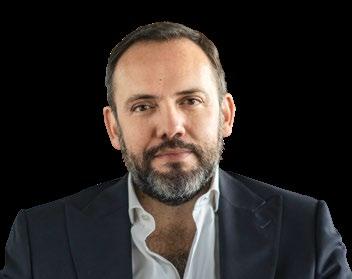
“Carrying out a thorough consultation with indigenous communities, diligently and in compliance with legal requirements, could be key to understand if a project would be viable or simply impossible to carry out ”
Mariano Calderón Partner | Santamarina y Steta
Certainty, however, does not only come from external factors like government decisions. Companies must also be certain about the conditions under which they do business to avoid any unfavorable outcomes. Pablo Gutiérrez De la Peza, Managing Partner, O’Gorman & Hagerman, highlights the issue of land rights as something to keep in mind when starting a project in Mexico. Given the particularities of land regulation in the country, companies need to understand the land, its legal standing and geographic characteristics, while making sure that documentation is truly valid to exercise their right over it.
While there might not be many issues with public or private property, Mexico also grants land rights under the figure of social property, which includes ejidos and agrarian communities, which give entire communities rights over land. This type of property represents approximately 53 percent of the total territory, according to INEGI. “We recommend companies to always check the validity and accuracy of any documentation regarding the land they are about to enter. Are documents filed in the public registry or are they issued by the communities themselves? Do they correspond to the actual land that the company expects to use and are they subject to any legal disputes? Understanding this and being prepared can help companies to devise strategies to respond to any claims that may come,” said G utiérrez.
“The first step is to find a good lawyer. It is important to work on an in-depth analysis regarding legal certainty, regulation compliance and how changes in regulation have impacted previous ventures. Any potential investor must be aware of all of this. A political analysis is also necessary to understand what is behind the government’s decisions, so that there are no surprises or unsatisfactory deals,” said Andrés PérezHowlet, Managing Partner, Molina, Hanff & Pérez-Howlet.
Applying for a concession and drafting the related legal procedures may seem to be the first logical steps when deciding on a new investment project. However, local and indigenous communities play a key role in the success or failure of a project and must be taken into account, agreed experts. “Companies must investigate the communities where they are planning to invest to know if they are welcoming to these kinds of projects. Mining, if done right, can bring great benefits to communities. However, it can also face rejection as social and environmental conditions are altered,”
said Enrique rodríguez del Bosque, Partner, r B Abogados.
“Carrying out a thorough consultation with indigenous communities, diligently and in compliance with legal requirements, could be key to understand if a project would be viable or simply impossible to carry out,” said Calderón. Mining lawyers have had to expand their portfolios to include these types of social negotiations, said Pérez-Howlett. “The community must be convinced that the mine will bring benefits and that people will be a part of the mining project. (They should) consider the project a driver of human, economic and social development for the community.”
For Cano, it all comes down to compliance. “Mining companies must set an example when it comes to compliance. In the end, rule of law is not only defined by the government but by all industry participants,” he said.
The mining industry has been subject to bad press and constant misconceptions regarding its social and environmental impact. Compliance and a strong communication strategy that focuses on this can be key to counter these ideas, which is also true when approaching local communities. “If we do not properly communicate the benefits of the industry, it is easier for negative messages to permeate communities, which may lead to the rejection of the project.”
Expropriation Should Not Be a risk Factor
Expropriation, commonly understood as a government taking over privately owned property to be used for the benefit of the population, exists in Mexico as well as in many other countries. While it became a “fashionable topic” due to contradictory messages from the government, this must not be cause for divestment, as Mexico is part of a large number of international treaties, including USMCA, said rodríguez del Bosque. Besides this, there are also local mechanisms in place to protect companies. “Expropriation has always been an available tool for the government, but it is not absolute nor without its limits; it must meet certain requirements and it must be properly justified,” said Calderón.
r odríguez highlights the fact that even under the current circumstances, Mexico remains a country with legal stability. “Should the government reach such an extreme, there are defense mechanisms to oppose it. It is not something people should worry about too much,” said Calderón. Still, r odríguez del Bosque calls for stronger mechanisms that ensure rule of law prevails. “The legal framework has gaps, so we need more efficient mechanisms that allow companies and citizens to enforce this f ramework.”
COMMUNICATION STRATEGIES BATTLE MINING MISCONCEPTIONS
Communication strategies have become a pressing issue for the mining industry as Article 2 of the Mexican Constitution as well as Convention 169 of the International Labour Organization and the United Nations Declaration on the r ights of Indigenous Communities require mining companies to receive approval from local communities in rural areas in order to carry out projects. As such, many industry misconceptions need to be addressed while the prolonged efforts to limit the impact of the industry on the environment and nearby communities must be better communicated.
Industry experts gathered to discuss how to handle these issues during the “ r eputation: r esponsible mining and effective communication strategies” panel at the Mexico Business Mining Forum 2022. Christopher Avila Mier, Deputy Director of Government and Institutional relations for Baluarte Minero asked industry experts about the importance of addressing misconceptions with transparency with communities and the government. Panelists also shared their thoughts regarding the best strategies to communicate the benefits of the industry, the missing key for the general
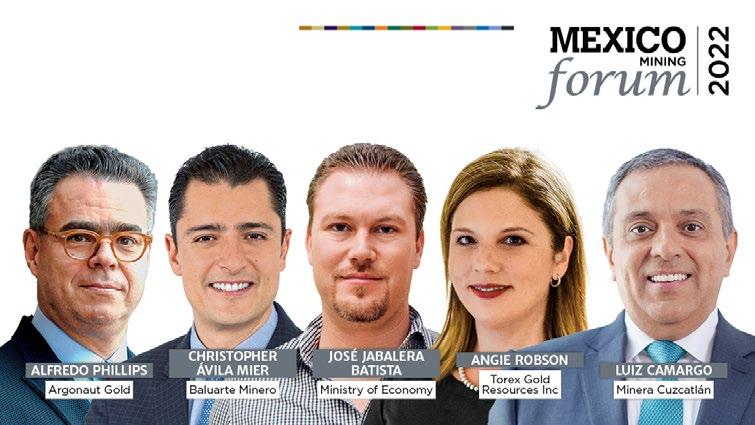
public to see the industry’s responsibility, main misconceptions and ways the sector can improve its public image.
Angie r obson, VP Corporate Affairs and Social responsibility at Torex Gold, pointed out the company´s impact on Guerrero communities since they have become the country’s second biggest gold producer with 99 percent of its workforce coming from Mexico. For their Media Luna project, Torex has provided “Agreements with each of the communities surrounding our projects, each have their own elected committees to help define agreements according to their own needs.” Torex invested US$5 million for the construction of churches, schools, healthcare facilities and water facilities for the benefit of these communities after they found what the communities needed instead of providing benefits based on what the company thought would be best. This communication made the difference, explained robson.
Luiz Camargo, Country Manager forMinera Cuzcatlán, said its operations ´s in Oaxaca and Guerrero are some of the most complex areas because of the large number of municipalities. One project can impact 3 or 4 municipalities. The best way to manage these relations is to then be transparent, empathetic with the community and truly enter these municipalities to understand their needs, explained Camargo.
Camargo also recognized the progress the industry has made in the last decades. Particularly, the way in which the industry was able to help by providing funds to cover health efforts during the COVID-19 pandemic in Mexico´s rural areas. A common misconception is that mining companies do more harm to communities than the many benefits they provide them. For instance, regarding water contamination, Minera Cuzcatlán avoids contamination through efforts provided by a treatment plant before returning water to local rivers. Camargo emphasizes that by following three main pillars: transparency, communication and stake of holders, particularly in the communities, the industry can continue evolving in the right direction.
José Jabalera, General Director of Miner Development at theMinistry of Economy, honed in on the origin of these misconceptions by mentioning the recognition of past negative impacts the industry has had on local communities as an important factor to move past them. Mining companies must now “Hire local people, local people know traditions, culture…you are a new neighbor, you need to be informed on past mining projects and local needs,” said Jabalera. He also believes surveys and hard data are needed to measure the true positive impact community efforts are having on local in dividuals.
Jabalera also shared his thoughts on the “disappearance” of the mining fund. “The mining fund did not disappear. The mining fund as we know it moved to other ministers or programs.” Jabalera said the mining fund is being used to improving schools and the health ministry. “We are working with the education and public health ministers to put the mining communities first.”
Alfredo Phillips, Vice President Corporate Affairs & ESG and Director for Argonaut
Gold, spoke of a recent doctoral thesis realized by the University of Sonora in which the issue of logic behind what companies do with communities was analyzed. “CS r usually focuses on what the companies are interested in, real focus should be on empowering the communities,” Phillips said. Phillips noted that successful programs are those that are focused on understanding the community requirements instead of pushing forward company beliefs.
MINING MARKETS SET TO EXPAND 2021 TRENDS INTO 2022
Market trends that experienced significant transformations in 2021 are likely to define the course of 2022 for international mining companies and investors, according to market expert Dean McPherson
As Head of Business Development for the Global Mining division of both the Toronto Stock Exchange and the TSX Venture Exchange, McPherson’s experience within the mining industry’s investment climate is quite extensive. His experience is particularly applicable to the movement of Canadian and American investments into mining jurisdictions in emerging and developing economies, such as those located in Latin America. “Latin America is our second largest region in terms of presence, with Mexico taking the largest representation.”
In terms of magnitude, the investments that go through the McPherson’s exchanges rank fourth in capitalization, having raised US$56.9 billion in 2020, only surpassed by the US, UK and Hong Kong stock exchanges. The size of these investments is particularly relevant to the global mining landscape, as McPherson is quick to emphasize: “37

“In 2021, 80 new mining companies listed, compared to 57 in 2020. Equity capital raised went up to US$10 billion against US$7.5 billion in 2020 ”
Dean McPherson Head of Business Development - Global Mining | TSX
percent of the mining equity raised between 2016-2022 was through TSX/TSXV while 52 percent of global financing in mining in the same period was also through TSX/TSXV.”
When directing his expertise towards the current state of mining markets, McPherson identified five market trends that experienced definite change in 2021 which would likely show up again as leading factors in investment decisions for 2022. The first one was the market interest in ESG, which McPherson characterized as “becoming front and center of the investment decision center in 2021, and will likely continue to play that role and take a leading role in investment decisions in the sector in 2022.” McPherson explained that mining companies were responding positively to inquiries investors and the exchanges were making into their ESG practices, centering them within their business plans to address all concerns that could limit or qualify investment decisions. These inquiries were severely accentuated in 2021 and were likely to continue impacting the industry’s course in 2022.
The second trend places emphasis on environmental concerns and the impact surrounding climate change. 2021 was a key year for the mining industry’s environmental awareness, as McPherson notes that a number of key declarations and dialogues that took place in COP26 identified the industry’s key role in both the global carbon footprint as well as the
energy transition that will prove necessary to address it. Additionally, global emission reduction targets are likely to drive an acceleration in demand for metals involved in the manufacturing of batteries, electrical infrastructure and EV components throughout 2022. As a result, mining investors will be spending the year favoring projects that can promise both an approach that could reduce the carbon footprint of mining operations while simultaneously prioritizing metals and minerals listed as applicable to the development of green technologies and products.
The third trend is commodity prices being driven by the current relationship between base metal supply and demand, which was significantly unbalanced in 2021 in a way that will continue to create a number of opportunities for investors well into 2022.
The fourth trend is the rise in M&A activity that was very much talked about in 2020 and 2021 continuing into 2022 as competition to secure supply lines that became fragile in the pandemic increases. McPherson provided the example of Australia, a
jurisdiction characterized by companies that “used to work exclusively within their national borders but are now expanding and diversifying, particularly into markets in the Americas.” This trend is partially illustrated by the activity in the exchange in terms of new company listings, which McPherson describes in positive terms: “In 2021, 80 new mining companies listed, compared to 57 in 2020. Equity capital raised went up to US$10 billion against US$7.5 billion in 2020.”
The fifth and final trend concerned the impact of the pandemic, which McPherson predicted would continue to be a top-ofmind concern for investors throughout this year. While 2021 radically changed the outlook on this issue when compared to 2020, there is still a fundamental caution to how the market perceives the effect of COVID-19, especially after Omicron has replicated some of the shutdown procedures that characterized the pandemic’s early stages. In this sense, McPherson believes that “volatility will continue to loom large over the mining markets, despite the stability of other factors that und erpin it.”
As geopolitical factors continue to turn up the heat for investors in terms of market volatility, some of Mexico’s key mining operators and industry analysts advocate in favor of both precious and base metals as an effective protection against this volatility.
Dean McPherson, Head of Business Development for Global Mining at both the Toronto Stock Exchange and TSX Venture Exchange, presented a dialogue that “seeks answers to two key questions: what are the factors that are impacting metal prices, and how can those factors create opportunities to build a robust business plan that can help avoid market volatility.”
Jerry Huang, CFO, Impact Silver, advocated in favor of the advantages provided by silver ventures using his own project as an example, which he characterized as a “mid-tier cap” project that was nonetheless globally competitive in the precious metals context due to its yield given its status as a “pure silver” project.
Huang said that there are simply not that many pure silver mines and assets out there
in the global investment market, and that in the coming years this would make the value of silver increase in a reliable fashion as the difficulties inherent to both its exploration and processing became more obvious and its applications in multiple industries, many of them crucial to the energy transition, continued to rise.
“I truly believe silver is underpriced given how much it costs to find it and its role in multiple industries,” said Huang. While other metals like lithium attract more media attention for being critical to the development of green energy technology, the use of silver in solar panel manufacturing alone was enough, in Huang’s view, to make it a competitive player in the race to capitalize on mining investment through the energy transition.
John Darch, Chairman, Sonoro Gold, agreed with Huang’s enthusiasm for the potential of precious metals as a safe investment, saying that despite his obvious bias in favor of gold, “the big opportunity for Mexico lies in silver, copper and lithium, as we move toward a green energy transition.” Darch

“Before we look at what metal is considered a safe haven for investors, we need to see what asset class can perform well during times of uncertainty. Precious metals have historically performed well during challenging times, especially gold ”
Etienne Morin Chief Financial Officer | Orla Mining Ltd
warnings, Darch was clear regarding Mexico as a jurisdiction in which these investments could find a safe haven, despite political risks that could be identified in Mexico’s latest mining policies. “Project financing for Mexico might not be easy, but it might prove comparatively easier when compared to other jurisdictions.”
The question of political risk was further emphasized by Carlos Díaz de la Garza, CEO, Moody’s de Mexico, who noted that he has been aware of uncertainty coming from investors who are concerned about the role of lithium in the electricity law still pending review by Mexico’s legislative chambers. However, this was only one of many factors that included conditions imposed by the USMCA and the relative status of competing jurisdictions in the region which experienced elections and other impactful political processes in 2021 and 2022, such as Peru and Chile. He also agreed on the importance of precious metals, noting that “within the current context of inflation and high interest rates, precious metals like gold become safe havens for investors.” Díaz de la Garza pointed out that commodity prices are expected to exceed historical levels for most metals throughout 2022, with supply chain constraints translating into very rapid recoveries of any dip in demand. “In conjunction with low inventory levels, we expect prices to continue to be affected in a positive way.”
explained it was important to be clear on the multidimensional levels inherent to the factors that increased market uncertainty. “Uncertainty could be traced back to these larger questions related to international conflicts, to interruptions in supply chains that could be caused by those conflicts or by the pandemic, or by trends in political risk, such as a skewing toward nationalism and resource sovereignty.” Despite these
Arguing in favor of the equal importance of base metals we find Andrew Snowden, CFO, Torex Gold, and Etienne Morin, CFO, Orla Mining. Snowden said that Mexico continues to be an attractive jurisdiction and a safe destination for investments due to its connection to both precious and base metal projects, noting that “Mexico is already a Top 10 producer of gold, silver and copper, so it can leverage those to benefit from the energy transition.”
Snowden said he “gets most excited about copper” not only because his company is developing an underground mine that could produce significant amounts of this metal,
but because the role of copper in the energy transition is enormous. “Copper represents 10 percent of the weight of every EV battery that gets manufactured, and that is without counting the extensive wiring that goes into each unit.”
Snowden explained that while research into battery chemistry and energy density pitted lithium, nickel and other metals against each other in terms of importance, copper remains in extensive use for both products and charging infrastructure regardless of who comes out on top.
Morin said that gold, historically speaking, has always been a reliable shelter for investors during volatile markets. “Before we look at what metal is considered a safe haven for investors, we need to see what asset class can perform well during times of uncertainty. Precious metals have historically performed well during challenging times, especially gold.”
However, Morin noted that investors need to look beyond metals and asset classes and categories, and look into the characteristics of each project to unlock the potential each asset could have to stabilize their portfolio.

NARROWING THE GENDER GAP IN THE MINING INDUSTRY
The mining industry has been considered as a men-only sector for many years. Unfortunately, this reality has closed opportunities for women wanting to enter the industry. . While gender gap is still very far from ideal figures, promising sector developments have been made in terms of diversity and inclusion, agree industr y experts.
“Mining has been stigmatized for years. Women deal with a lot of barriers and challenges that men usually do not face, and this is part of our strengths. We must promote women participation in the mining industry not only within the sector, but in society, at schools. It is crucial to
communicate assertively, showing women’s great contribution in companies,” said Cynthia Villa, Partner, Founder and General Manager, Gruminex and GL Detect.
Prior to 2008, there were no women working in the mining industry. Nevertheless, that number has increased steadily since 2008. In 2020, that figure has risen to 16 percent, and this trend is expected to increase in the coming years, reported MBN.
“In 2020, 60,000 women participated in the Mexican mining industry, this represents 16 percent of the total workforce. Although this figure is far from being ideal, it is an important advancement for the sector,” said
Fernando Alanís, Member of the Executive Committee, CAMIMEX and Director, Baluar te Minero.
Women’s participation in the mining industry is not balanced among various areas of organizations. While administrative and health departments shave a women participation of over 20 percent, board, director, manager and supervisor roles have a representation of under 13 percent, said Alanís. In addition, he said the sector “does not only need to increase the participation of women, but must seek the right balance among organizations.”

“In 2020, 60,000 women participated in the Mexican mining industry, this represents 16 percent of the total workforce. Although this figure is far from being ideal, it is an important advancement for the sector ”
Fernando Alanís Member of the Executive Committee | CAMIMEX and Director | Baluarte Minero
Companies with the highest percentage of women in management tend to be more profitable, said Nancy Morales Arango, Business Development Manager Mexico, Bureau Veritas Minerals and President, SME Mexico. “Business competitiveness, environmental sustainability, corporate and industry culture is impacted by the representation of equality. Fostering inclusion values helps in increasing women participation.”
The mining industry has different pressures and it needs diverse backgrounds, perspectives and empathy to advance, said Jonathon Bell, Vice President, Dynapro Pumps Mexico.
“Women inclusion comes down to two aspects. The first one is education. To change the future, we have to start with our education system. For instance, in Canada only 12 percent of engineering students are women. We do not have enough women in those careers. Second, there is a huge gap in how we market and advertise the mining ecosystem. We are not doing enough to promote diversity. The whole mining ecosystem must work in collaboration.”
In 2020, Karen Flores was appointed as Director General of the chamber, becoming the first woman to hold this position since CAMIMEX’s foundation in 1906. “In 2018, 5,600 mining jobs were created and 3,800 of them were taken over by women. While CAMIMEX believes in talent more than in gender per se, diversity is a key value that we seek to promote. We expect women’s role in the industry to continue to grow in the coming years, not only in operational roles but also in managerial positions,” said Flores to MBN.
Salaries in the metallics mining sector are up to 73 percent higher than the national female average, while in the non-metallics is 26 percent higher, reported MBN. The wage gap between men and women is closing in as well. In the labor market, 45 percent of women are unionized within CAMIMEX, a 3 percent increase with respec t to 2019.
Science, Technology, Engineering and Math (STEM) occupations have grown in by 79 percent in the US, going from 9.7 million to 17.3 million, according to the Pew research Center. In Mexico, the need for STEM skills is key among all industries, with nearly 30 percent of Mexican employers declaring that they have difficulty finding workers in these fields, according to Vision STEM. Mexico has one of the biggest gender gaps, with only 8 percent of women choosing to work in STEM careers, compared to 27 percent of men, according to OECD. The country’s percentage of top-performing women in mathematics and science is among the lowest of all OECD countries.
While there is still a long road ahead toward gender equality in the mining industry, “it is important to acknowledge that change is happening,” said Jennifer
Burge, CEO, WorldWise Coaching & Training LLC, adding that the sector “must work together to advance and create
lasting change for women. Without it, mining will be left behind in the battle of talent.”
BYLSA DRILLING’S FUTURE EXPLORATIONS
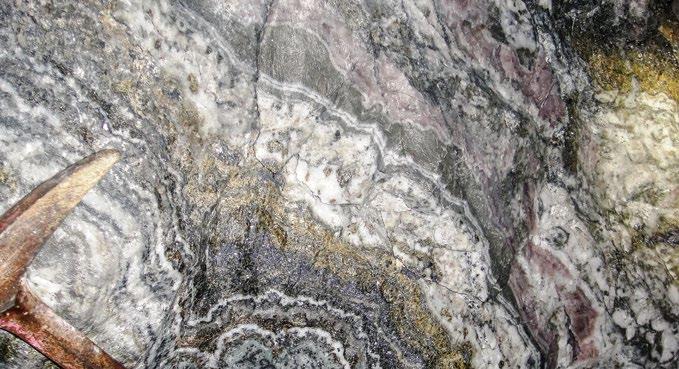
Macario r ocha, Geology Manager, Bylsa Drilling, during Mexico Mining Forum 2022, shared insights over the Sonora Gold Project which include epithermal and metasomatic deposits with magmatic influence of great geological economic mining potential.
The project is financed by Benjamin Hill Mining located in the Gold Belt of Caborca where millions of oz. of gold have been extracted. Mine operations in the region include La Herradura, Noche Buena, El Chanate, San Francisco (which is currently stopped), Cerro Colorado in the Eastern side as well as Santa Gertrudis, Las Chispas, Mercedes and Santa Elena in the western area.
“Within the Sonora Gold area there are SKA r N outcrops with massive iron enrichment and gold and copper anomalies. There is also evidence of hydrothermalism,” said r ocha while explaining the findings of Au and Cu in the area. Findings also included orogenic quartz of irregular bodies distributed along the property and a hive of bimodal damns. There are also stockworks of type “D” (Py+Ser+Qtz) streaks. The morphology of Sierra Caracahui has a longitude of 10 km N-S and a width of 7 km with an unevenness of up to 500 m.
The Sonora Gold property includes 6,400 hectares where historically gold, silver and copper have been extracted through
various mining projects throughout its history since 1930. It is only 150 km North of Hermosillo, Sonora and 140 km South of Tucson, Arizona. Of the 10 previous mining operations on sight, four have been accessed. These include three tunnels: Sonora Copper, Cascabel and Guadalupe. From a regional point of view, the main part of the area is covered by a plutonic complex. There are systems of streaks along the eastern and western sides.
In Caracahui, the plutonic complex is deformed but it still has superficies. It has a great quantity of dams along the main plutonic system. Meaning there are two main events and the last has to be related to the epidermal mining type present. The damns are suspected to be connected to a fertile pluton in the area.
In the structural environment, there are three systems of failures that converge the area, which have played an important role in the amplification of damns and mineralization. There is also a set of bimodal damns along the failures and fractures with a N-S direction. The mineralized structures stationed are from N-S and NE-SW systems, which are forked by a N -S system.
There was a geo-tectonic evolution opening which caused a model of relay ramps that at some point created orogenic quartz bodies which through fractures
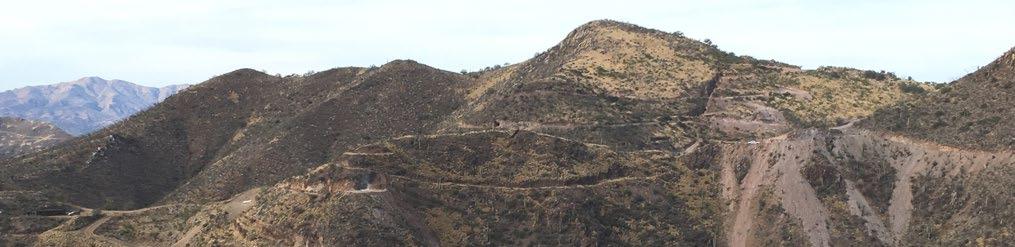
became hydrothermally mineralized in these zones and in the surface, there was a supergene a lteration.
A geochemical sediment exercise found new targets for exploration based on five factors of chemical correlation between key elements of hydrothermal enrichment
and a source of magmatic mineralization. These areas include six anomalies for Au+Mo+As, four for Au+Cu+Mo+, 2 for Au+Cu+As and one for Au+Mo+As. Seven prospective areas have been selected for exploration. These include La Berrenda, Caracahui, El Fierro, La Salada, Sonora Copper, La Falsa and San Felix.
GR SILVER FINDS OPPORTUNITIES IN SINALOA
Mario Fonseca, President and CEO, G r Silver, provided company insights during the Mexico Mining Forum of 2022 regarding project updates over discoveries and plans for future mining projects in Mexico.
G r Silver is a relatively new Canadian based company that has with actions in Sinaloa. The company was created by North American investors aiming to create a silver and gold mining business. G r Silver is currently in an exploration phase, Fonesca explained, nevertheless, the company has made promising findings along their 700 km2. These discoveries include a new high-grade of Ag-Au veins near historic mine sites and a 14,000 m drilling program nearing completion. The geological setting composed of extensive low to intermediate sulphidation Ag-Au epithermal veins and the defining controls of Ag-Au mineralization make the area an attractive entry point to a district-scale Mexican project where trading at a discount to peers is possible.
Fonesca believes the company is positioned for continuous value growth since it has implemented a strategic asset in a prolific mining district with strong geology as well as the experienced leadership team in place
on a growing Ag-Au resource base with high quality assets.
The Plomosas Project composed of 432 km2 of core concessions has a focus on drilling for discoveries and a portfolio of early to advanced stage exploration assets. Other areas’ non-core properties also provide optionality.
The project provides great opportunities because of the areas’ concession, 55-60 km with many areas where there have been previous gold and silver projects. Nevertheless, G r Silver has done extensive work to unfold new discoveries in areas that before were thought to be only basic metals. These areas of opportunity include San Marcia, where 40 million silver oz. have currently been extracted, and the Plomosas Mine, where much infrastructure is left over from a 2001-closed project.
“At Plomosas we are still producing inside an antique mine. The mine was said to have lead and zinc. Today we have discovered new silver and gold veins and are in a phase to increase resources,” explained Fonseca. The Plomosas project in 2022 will target Ag grade increase, adding new Au-Ag zones
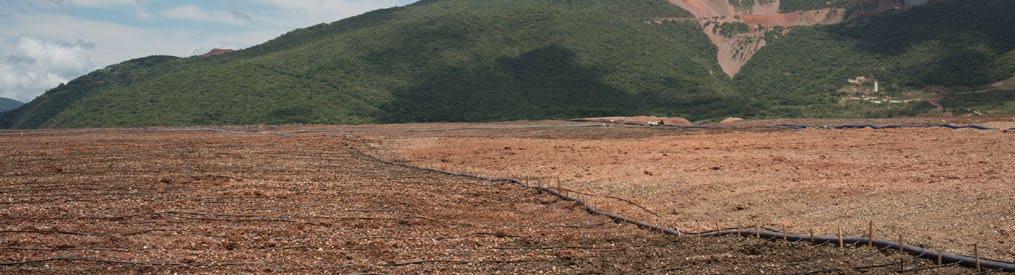
into the resource model and increasing attractiveness with multiple resource areas.
The San Marcial underground expansion drill program is the first underground drilling program completed, where the testing down dip extensions of 8 holes of 2,436 m has been completed, nevertheless, still pends results from five final holes. The successful drill program found new intersections which extend mineralization up to 170 m down dip below the San Marcial Mineral resource, to 420 m from the surface. The tunnel extension
and underground platform provide access to deeper targets, which have been delineated by the geophysical program.
The company also strives to achieve zero significant environmental incidents, focuses on community engagement and ensures neighbor benefits. G r Silver provides employment opportunities by hiring local as well as encouraging diversity and inclusivity in the workplace. G r Silver is currently in a phase of resource exposition which assures further findings and developments.
CERRO CALICHE POISED TO CAPITALIZE ON CAREFUL E XPLORATION
Sonoro Gold’s Cerro Caliche gold project has managed to effectively prove its potential and is ready to launch its transition from exploration to development thanks to its satisfactory drilling results, reports project leader Kenneth Macleod.
As President, CEO and Director of Sonoro Gold, MacLeod is member of a highly experienced management team that has a proven track record in the successful financing of projects and the development of resource deposits. MacLeod has over 35 years of experience as a financier and developer in the international resource sector. Collectively, Sonoro Gold’s management and technical teams have discovered and developed a total of 12 gold and copper mines. All of these accolades and accomplishments have played a large part in what MacLeod describes as the great
success of Sonoro Gold’ flagship project, the gold-focused Cerro Caliche, with its portfolio being rounded out by gold and silver project San Marcial.
MacLeod explained that Cerro Caliche was additionally benefited by its prized location. The state of Sonora, where the project is located, is defined by MacLeod as a “pro-mining jurisdiction.” The mine also is benefited for being a three-hour drive from both the state capital of Hermosillo and the US city of Tucson, Arizona, where many prominent suppliers and service providers can reach the project and address its needs. MacLeod referred to the infrastructure that was available to the project as “first-class”. In addition, the project is located next to four neighboring gold mines: Equinox Gold’s Mercedes Gold Mine, Goldgroup’s Cerro Prieto Gold Mine, Agnico Eagle’s Santa
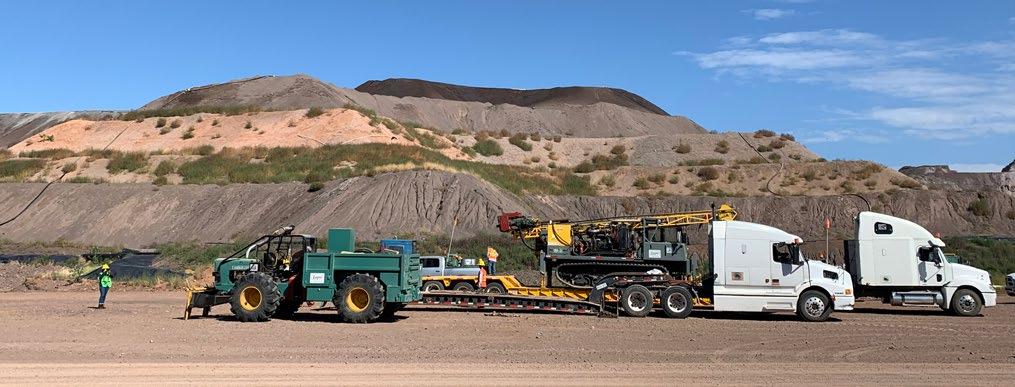
Gertrudis Gold Project and Magna Gold Corp’s San Francisco Mine.
MacLeod explained that Sonoro Gold could take advantage of these prominent geographic conditions to map out a drilling campaign that could be built around the sites of nearby historical mines, such as Cabeza Blanca, Japonesas, El Colorado, La Española, Las Abejas, El Boludito and Veta de Oro. The total concession area of Cerro Caliche covers 1,350 hectares, within which a total of 10,760 meters has been drilled in 105 holes. Sonoro Gold ended up greatly increasing the scope of this historical exploration by drilling a total of 47,500 meters in 433 holes.
This activity led the project to reach a mineral resource estimate that was based on 31.5 metric tons of total material processed within the resource pit shells. The potential mineralization outside of the resource pit shells, identified by limited exploration drilling, was calculated as ranging from 19.25 to 34.37 metric tons, containing 204,000 to 365,000 ounces of gold and 1,683,000 to 3,005,000 ounces of silver. In an interview with MBN, Jorge Díaz, Vice President of Operations at Sonoro Gold, stated that Cerro Caliche is
one of Sonora’s most promising mining projects. While highlighting the potential of Cerro Caliche, which he assures was key when the company decided to acquire it. VP Díaz revealed that they were working hard in transforming the property into an “economic resource” by optimizing operating parameters. Sonoro Group has an “aggressive” operational plan for the property by the end of 2021, on track to start production in 2022, he added.
MacLeod remains positive that, based on these results, the project will be able to move to its next phase in a short time. “Based on the success of the last three drilling years, we are now heading toward construction in the Cerro Caliche Gold project.” MacLeod admitted that access to financing has been notoriously difficult for junior resource companies despite brief windows of enthusiasm for gold projects that shut down quickly. He concluded by mentioning that the project’s next catalyst was to obtain its multilateral investment agreement and finalizing its land use agreement with ranch leaders who currently own the land, adding that environmental studies have shown that the project poses no outstanding environmental concerns.
COMMUNICATION, TECHNOLOGY CRUCIAL FOR EXPLORATION DECISION-MAKING
Mexico has historically played a major role for the mining industry, given its growing geological potential. Despite diverse challenges impacting the sector, there are still enormous opportunities of exploration in the country that could be exploited by providing good relationships with communities, assertive communication, technology and supply chain cooperation, agree industr y experts.
“Mexico remains our main focus. Although there have been successful mining stories for the past 500 years, there is still a big chance to explore the country. Mexico offers a skilled workforce, a developed supply chain and titles security - the country ranks
very high worldwide. It is all about the size of the price, the cost of the test and the chance to success. Mexico attracts us in all these senses,” said Michael Konnert, CEO & Founder, Vizsla Silver.
Mexico has a long mining tradition and is the largest producer of silver in the world, besides being a top global player in gold, copper, zinc, among other minerals. The country has a favorable environment for the industry; however, the mining ecosystem has faced several challenges during the last few years, including the lack of concessions for exploration and legal uncertainty. Despite these difficulties, there are over 250 private exploration
companies in the country, with operations concentrated mainly in Sonora, Zacatecas and Chihuahua.
“There is a cornucopia of mineral wealth in Mexico. It is not always easy to find the best locations, but the country has certainly a great geological potential, with major opportunities for discoveries,” said Ben Whiting, President and CEO, Orex Minerals.
Drilling companies play an important role in the Mexican mining industry as well, said Magda Orozco, Administration, Maza Drilling. “One of the most relevant factors is the level of knowledge that drilling companies have, in addition to high quality services for customers to feel comfortable. Also, giving a comprehensive service, focusing on sustainability is important.”

“We
are focusing on decarbonization of our processes, with electric and hybrid equipment. Also, water recirculation processes are crucial in our efforts toward sustainability”
Viridiana Lagarda
Geology
Director | Bylsa Drilling
continued to grow and gain importance without being totally dependent on mining, wrote for MBN Karina r odríguez Matus, Partner, rodríguez, Matus & Feregrino.
Worldwide attempts to address global warming and transition to a net zero carbon economy have increased interest in renewable infrastructure, which demands the use of various minerals, especially lithium, cobalt, nickel and copper. Besides mining contribution to these attempts, the sector has also been pressured to utilize greener sources of energy during its processes, and technology has often been an important asset to address these.
“We are focusing on decarbonization of our processes, with electric and hybrid equipment. Also, water recirculation processes are crucial in our efforts toward sustainability,” said Lagarda.
While technology is crucial among mining field operations, it “goes beyond physical equipment and also impacts the way industry players communicate, both internally and externally,” said Lauren Megaw, Investor relationships, reyna Silver.
Exploration decision-making requires prior investigation. “It is very important to see metal prizes and market value and then locate the ideal places to explore. We must work with a sustainable mindset and developing technology to constantly improve our practices. Involvement with communities also plays a key role,” said Viridiana Lagarda, Geology Director, Bylsa Drilling.
The importance of mining in Mexico´s history is considerable. The economic geography of the country´s various regions was influenced by the development of this sector. Cities like Durango, San Luis Potosi, Guadalajara, Chihuahua, Guanajuato, Pachuca, Zacatecas, Parral and Fresnillo were founded precisely by the flourishing of the mining industry. Since then, they have
The COVID-19 pandemic presented challenges and modified the way people work across the world. In Mexico, videoconference usage rate grew 25 times during 2020, and although the mining sector may not seem to be the ideal industry for tele-working, technology has improved internal communication within companies as well as communication between different supply chain players.
“We developed applications to maintain good internal communication between head office, geologists and management. Communication is the foundation of trust with investors and the supply chain,” said Konnert.
Building relationships with the Community
Besides legal aspects and concessions, mining companies must involve communities
where they are working and keep an ESG approach, agreed industr y experts.
“Underground mining equipment is shifting toward electrification. Mexico is not there yet, but we will see this happen in the near future. Community involvement is crucial in mining. We have reforestation projects tighten to schools, where we plant trees at schoolyards together with the kids that gain that sense of belonging. Mining companies can have an impact on something as big as climate change and something as small as a first-year
student earning a sense of belonging to his schoolyard,” sai d Whiting.
While ESG has become an important trend in most industries, including the mining sector, in reality this mindset regarding communities has always been there in the mining industry, said Konnert. “Mining has been doing ESG from forever.”
Supply chain cooperation, assertive communication, technology and sustainability will play a key role for the Mexican mining industry to have success.
INSIGHT INTO MEXICO’S LEADING MINES
Mexico’s top mining companies must take into consideration multiple strategies, challenges and innovations to adhere to competitiveness and overcome obstacles brought on by the pandemic. Experts are confident investments will increase this year as new projects start commercial production. Despite this optimistic scenario, most challenges will remain.
Leading mines in Mexico count on pivotal elements making their companies stand out from the rest in regards to operations, revenue and stability. “Long-term project mines need to tackle exploration and production, along with various internal and external processes such as regulations,
community context and environmental requirements,” explained Jaime Gutiérrez Núñez, President, CAMIMEX.
Nuñez considered experience, adaptability and the ability to change and be ready to solve external and internal market and government issues is key to succeed in this industry. He exemplified this process by mentioning a company called Bacis, which has had a consistent evolution for more than 100 years, starting from a small family business to a leading production mining company. “Companies must remember that the main competitors are themselves and their costs, since this is the true key to be competitive.”
r afael r ebollar, CEO, Industrias Peñoles said that a second strategy implemented to obtain success is by counting on an experienced team and having the right equipment. These two are the basis to performing better, regardless of external scenarios. Additionally, rebollar commented that the ability to relate to key actors is essential, whether it is with the government, union or community, “companies must be able to prove their value.”
Having an excellent execution and focus on risk management employing an operating system that is constantly improving is regarded to be another essential step that leading mining companies must apply, according to Peter Hughes-Hallet, Country Manager, Newmont Mexico.
“Overall, companies need to prove they care about the well-being of workers and the community and this is mostly achieved through genuine leadership and a holistic wellness view from the company,” said Hughes-Hallet.
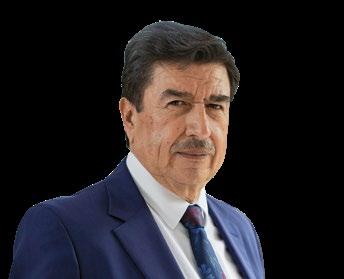
“Long-term project mines need to tackle exploration and production, along with various internal and external processes such as regulations, community context and environmental requirements”
Jaime Gutiérrez Núñez President | CAMIMEX
protocols for efficiency and productivity has been the top strategy for Torex Gold. “That coupled with a strong environmental, social and corporate commitment.”
Despite these strategies, each company will have to tackle their very own challenges related to the region they work in. “Guerrero, for instance, is one of the poorest states in the country, with a social complexity that does not resemble. For us the strategies need to go beyond corporate responsibility and really connect with the community to understand its social structure and not be disruptive,” said r odriguez.
Every region has a different political, social, economic and legal risk. rebollar considered that in order to solve these issues companies need to do a risk identification exercise to identify their current challenges.“At Peñoles, just when we started two new projects, we had to establish technological ways to carry out remote operations because, due to the COVID-19 restrictions, not everyone could be in the field,” said r ebollar. Moreover, companies also need to deal with daily political circumstances, whether local or national, as well as the financial side of the business.
According to rebollar, “metal prices are key and do not depend on us, however, keeping costs low to be competitive is a fundamental factor despite those shifts.”
From Hughes-Hallet perspective, the latter will increase the company’s margins and they will spur a culture of continuous improvement to develop competitive advantages through human talent. “ r esponsible mining operations through and through will goatee profitability.”
In addition, other companies consider the implementation of various strategies a winning recipe. For instance, Faysal r odriguez, VP, Torex Gold, r esources Mexico considered that enacting operational
In addition, one must consider that permanent challenges with specific aspects to focus arise on a daily basis, said Gutierrez. “The key is to know how to manage the progress of the operation and its environment. However, Mexico has a problem of inequity in the distribution of its wealth. This is why our companies want to help distribute this wealth through the wealth we produce.”
Technology is another fundamental element needed to lead a successful world-class mining operation, said Karen Flores, General Director, CAMIMEX.
“Tech helps with everything. It spurs efficiency, helps with environmental compliance and reduces risk exposure for operators,” explained Hughes-Hallet. Its effectiveness for the industry has been such that Newmont Mexico announced an alliance with Caterpillar, a leading producer of mining technology, to develop an automated and zero-emission system, which aims to support the goal of reducing greenhouse gas emissions.
Additionally, Newmont Mexico wants to transform mining with automation. “We are investing US$100 million on 26 first-ofits-kind autonomous and electric mining equipment for underground and open pit mines,” said Hughes-Hallet. In terms of safety, the company is working with smart watches to measure hours of sleep and the habits of operators who change shifts.
Technology also makes possible the electrical efficiency in underground mine and, for companies such as Torex Gold, it has reduced 40 percent of the water waste in the underground mine, which has been recycled and reused in the same process.
Top mining companies must also show compliance with ESG policies and practices, which according to rebollar, influence the
ability of companies to generate value for their stakeholders. “Investment plus ESG commitment must converge, as a result, companies and societies win.” Peñoles has three high-impact goals for their ESG commitments. The first one is to be a benchmark in governance, the second deals with having a positive socio-environmental performance and lastly, to be recognized as ESG leaders.
In regards to overall challenges for mining companies, Gutierrez said there are communication barriers with authorities. “The future of mining is in mining concessions, if we do not have mines, there is no industry, regardless of the equipment and staff we have.”
The passing of the electric reform is another concern for these mining companies. Gutierrez explained that it threatens to raise costs and to provide limited supply of electrical energy.
In addition, the reform imposes limits for companies to invest in clean energy efficiency in their projects. “The vast majority of companies have greenhouse gas reduction goals, for us is 30 percent by 2030 and zero emissions by 2050,” said Hughes-Hallet.
SINALOA: A MINING INVESTMENT OPPORTUNITY
Location, human capital and current investments make the state of Sinaloa the ideal place for additional mining industry transactions, reports Felipe Carlos Ibarra r etamoza, Sinaloa’s Undersecretary of Promotion and Economic Competitiveness during Mexico Mining Forum 2022.
Sinaloa has more than three million residents, representing 2.5 percent of Mexico´s population. Many of them are ready to join the working taskforce that contributes to the development of mining projects across the state. Sinaloa has a terrestrial surface of 57,377 km2, and more than 30 percent of this surface is considered to have mining potential, an
important motivating factor for global companies looking for future projects, explained r etamoza.
“We agree with some of the stakeholders regarding Sinaloa as a state that can be we promoted in this industry. The Ministry of Economy has permanent communications with concession owners and this lets us know they are open and looking forward to receiving investments from companies with logistics in place,” said r etamoza.
Already, the state has 13 mining districts with more than 1,400 mining concessions. “Today we have 119 projects that have foreign capital. Investments from Canada,
China, the US, Australia and Egypt stand out.” In 2021, private investment in Sinaloa totaled approximately US$343 million in 2021, this reflects a positive environment and investment certainty for international investors. In addition, these investments had a notable impact on the state’s economy as employment increased by 20 percent and local communities greatly benefitted from investments mining companies are continuously making in their project areas, explained r etamoza.
Investments in Sinaloa is expected to climb through increased connectivity between Topolobambo and Dallas, as there is currently a project being discussed between the governments of Sinaloa and Chihuahua for the creation of a commercial corridor that will run from Topolobambo through Choix, Ciudad Juarez and Dallas. This corridor will greatly increase the logistics of shipping materials to and from Canada, reported r etamoza.
“This connectivity places investors in a very good position since they see transportation potential for their minerals traveling through Mazatlan, Durango reaching Eastern US, not to mention individual ports dedicated to agro and minerals,” said r etamoza. There is also
an expansion of the Topolobambo port being promoted by the Ministry to support imports and exports of minerals without a problem.
The Baluarte Bridge, though which travel from Maztlan to San Antonio, can be completed in 15 hours (1,346 km), is another logistical asset that benefits the state. In fact, the state’s transportation assets enable it to provide logistics solutions for neighboring states for shipping at lower costs. Sinaloa´s infrastructure include three international airports, 1,195 km of railroad tracks, and 11 dams. In addition, the state has two maritime ports that greatly benefit the mining community.
r etamoza explained that mining projects are backed by the state’s government and the Ministry of Economy. The ministry is already in talks with many investors and is currently reopening America Gold and Silver, which opened in December and is in talks with the collective bargaining agreement.
“There are opportunities and if we combine the investment and the reinvestment that existing companies are making in the state with new investors, there is a strong mining potential in the state,” said r etamoza.
KEEPING TRACK OF DEVELOPING MINING PROJECTS IN MEXICO
Despite the challenging years the Mexican mining industry has recently faced, mining companies plan to continue working on exploration and production projects.
This is why industry experts from top mining companies agree that by establishing good community relationships, developing strong multinational teams, enforcing correct processes and choosing the best financing options are keys to overcome challenges and obtain success.
“Enlisting priorities for mining projects to success is a multilayer process. you have to work on many aspects from an early stage. One of the main ingredients is that you
are never too early to become part of the community and get involved in discussions with local stakeholders. Local jurisdictions and politicians have a greater impact in how we interact with the community than federal authorities,” said James Anderson, CEO, Guanajuato Silver.
Today, mining projects are developing in states with long mining traditions. For instance, jurisdiction is one of the most important aspects to consider for mining projects to succeed, and establishing operations in states with long mining traditions help companies to have an engagement and understanding with local communities and governments, said
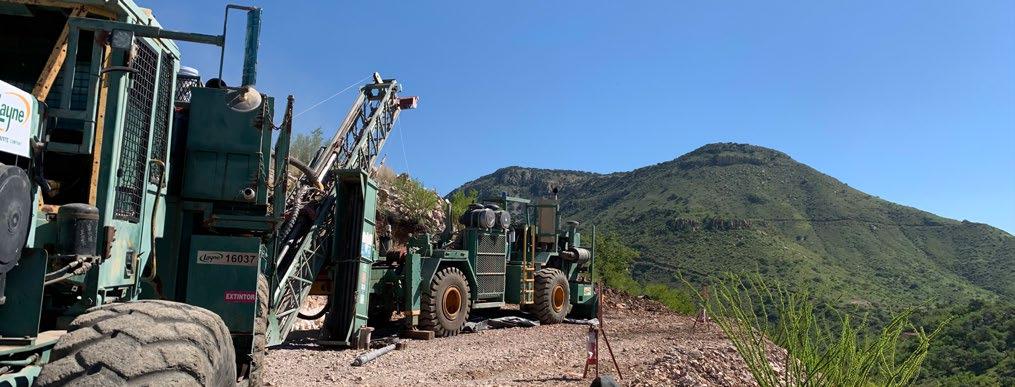
One of the states that has a prominent mining history in Mexico is Sonora, considered the largest contributor to the country’s mining industry with an outstanding share of 34.2 percent, according to CAMIMEX. Of the 1,190 active projects throughout the country, Sonora is home to 267 projects, representing 22 percent of national total. The main metals the states produces are copper, which represents 81.1 percent of the country’s total production and gold, which represents 29.8 percent, reported MBN.
In Sonora, Sonoro Gold completed a PEA on their Cerro Caliche property in September 2021 with very promising results, reported by MBN. The open-pit heap leach operation at Cerro Caliche is expected to yield an average 45,700 gold-equivalent ounces per year over a seven-year period, the current estimated mine-life, corresponding to a total of 323,500 gold-equivalent ounces. The assessment further revealed that during the first three years of life, the mine would produce an annual total of 56,500 goldequivalent ounces. Forecasted cash costs are of US$1,227 per g-e ounce.
“Mexico is a fine jurisdiction. Sonora’s jurisdiction is one of the best in the world for mining companies. The state has relied on the revenues of mining production. The relationship between mining companies and the state government will surely continue to
be very positive. We have all the elements to make a very successful project in Sonora,” said Kenneth MacLeod, President and CEO, Sonoro Gold. At Cerro Caliche, “we have been drilling for the last three years. We are proceeding with the submittal of the EIA and the expectation is to start producing by 1Q2023.”
More projects are expected to be developed in 2022. For instance, in Chihuahua, Discovery Silver continues development on its 100-percent-owned Cordero project. Cordero “is one of the biggest undeveloped silver deposits globally,” said Forbes Gemmell, VP Corporate Development, Discovery Silver Corp, and added that the results of the PEA showed an NPV of over US$1 billion and an Irr close to 40 percent. The company anticipates delivering a prefeasibility study by the end of 2022 and a feasibility study by the end of 2023.
When it comes to establishing good communication practices, companies must engage with their communities and jurisdictions, hire the right people, manage risks, and partner with the proper third parties.
“It comes down to hiring the right people for the job and be sure that everything is done properly, following processes. Keep communication open with our partners is important,” said Mehran Bagherzadeh, Corporate Vice President, r iverside resources.
Third-party help is necessary for all mining companies in the country, which have to rely on their legal counsels and environmental groups - which do an important job, said Anderson. In addition, Anderson explained that all decision makers in Guanajuato Silver are Mexican nationals, making conversations with third-party suppliers “very direct” and helping the company to succeed.
Multinational teams can also help during communication between mining companies, third-party suppliers and other important players, for instance.
“Our technical and field teams are all Mexican. However, when it came time of producing PEA, we brought an experienced Canadian team that had already worked in some projects in northern Mexico. This team had the ability to both effectively communicate with local third-parties and project information to any financial institution in the world. We have been able to combine the best of Mexican talent and the best of international talent,” said MacLeod.
He also emphasized that both international and local talent have been blended together and will continue to overlap as the project goes through EIA. “Once production begins, it will be an all-Mexican team,” said MacLeod.
Challenges to Comply with ESG Principles
ESG has become one of the major trends among many industries, including the mining sector. Although ESG has always been inherent to mining, due to its social impact and community relationships, small companies face big challenges to address many of its principals while keeping production at optimal levels, agreed industr y experts.
“ESG is a big question for small companies. The international market looks at us and expects us to address all these principles. From our perspective, the relationship with the community is crucial. We do not have a relationship with communities, we are the communities,” said Anderson.
Sonoro Gold has always practiced ESG in its own way, said MacLeod, and pointed that these frameworks have introduced regulatory measures that place mining companies in danger, given the difficulties they bring to raisin g capital.
“ESG regulations could end up affecting at local levels. If you are strangled by ESG regulations you will not build a mine and no schools are going to be built in the region,” sai d MacLeod.
MINING ACTIVITY RESPONSIBLE FOR DEVELOPMENT IN DURANGO
The state of Durango is traditionally a mining state, where mining activities first took place in the year 1552, at a time when the iron deposit of Cerro de Mercado was discovered by Spanish Captain Ginés Vázquez de Mercado. This landmark event marked the founding of the city of Durango, where mining production has been relevant for metallic minerals. Today, Durango boasts prominent mineral deposits, which are still in operation today.
These deposits have primarily contributed to maintaining a prominent position in Mexico’s mining production. These represent one of the best alternatives for development in places where the
possibility of establishing any other industry is out of the question, explained Gustavo Kientzle, Secretary of Economic Development of Durango.
Durango is a leading national producer of metals, such as gold (fifth place), zinc (second place), silver and plumb (third place), iron (fourth place) and copper (seventh place). In non-metallic minerals, Durango is a leading producer of bentonite (first place), perlite (second place), marble and fluorite (third place). The state also has gypsum deposits, clays, limestone, sand and gravel, minerals that, according to Kientzle, contribute to the state’s and coun try’s GDP.
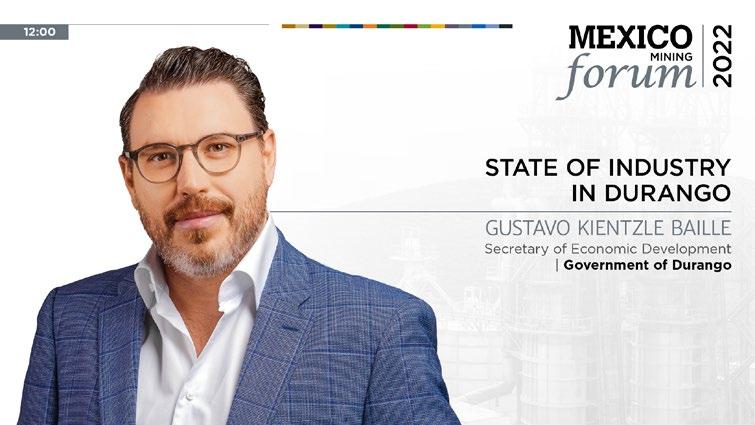
Kientzle said Durango has 23 mines in production in 17 municipalities; five of them rank among the Top 10 with the highest production of metallic minerals out of a total of 240 in the country. Durango ranks fourth place nationwide as having the best performance in the mining industry.
In addition, Durango has 42 economic projects in different areas and according to IMSS, by the end of 2020, the mining industry was responsible for the creation of 367,935 direct jobs and 1,839,675 indirect jobs. Moreover, plans for a current investment for three new mining operations in the state are underway, representing US$46 million expected to begin operations in 1Q22.
Kienztle said that for this reason, the mining industry will continue to support private companies ready to invest in Durango. Moreover, the state is highly committed with Mexico’s mining industry, encouraging a rule of law that will incentivize and support legal certainty in land occupation.
Among the state’s most prominent mineral deposits are: Ciénega de Nuestra Señora, Tayoltita, Velardeña, Guanaceví, Avino, La Platosa, Topia, Cerro de Mercado, La Ojuela, Bacís, Magistral del Oro, Indé, Minitas and more recently the San Sebastián, El Castillo, San Agustín and r ode mines.
AUTOMATION FOR DECISION MAKING AND SUPPLY CHAIN MANAGEMENT
Digitalization for mining processes has changed from a manual, paper-based operation to a digital platform that incorporates automation, AI, ML, and DML systems to streamline operations and significantly improve busines s results.
In the last decade, most mining companies have sought to incorporate this technology in the majority of their mining operations. “Mining should consider automation solutions for their operational challenges. Mining is in search of being sustainable, to have a better use of water, reduce
the consumption of resources, control environmental impact and improve transport and storage of tailings - most of this is possible through automation,” said Hugo Barrientos, Digital transformation Manager, Mexico , Emerson.
For Barrientos it is fundamental the incorporation of wireless networks to monitor personnel and smart mining to plan and predict, especially in metallurgic processes. “AI and algorithms can prepare processing strategies with greater recovery.”
Today, automation systems are playing a more decisive role than ever before, having a greater impact due to COVID-19. “To date, remote operational efficiency is a reality and advanced data analytics that enables realtime decision making in a supported way is a need,” said Eder Lugo, Minerals Head Large Drive Applications , Siemens.
According to Lugo, there ought to be solutions that analyze data generated by the existing automated process of companies.
“Automation produces data that can generate indicators that support decision making, but not all companies are taking advantage of it.”
Moving toward autonomous operations by automation with simple platforms that can be integrated and allow remote management will positively impact the value chain and give visibility to a company’s processes, said Erik Flores, Specialist in Business Development mining area, Mitsubishi. “The best automation solutions allow you to control, correct and visualize different processes in real time.”
Nevertheless, there are specific technologies, such as the Digital Twin, that can have a greater impact than others. Digital Twin for Mining is a virtual representation of the physical world, stored in a representative structure on a cloud data platform. With the Digital Twin solution, companies can visualize their data and asset settings through an intuitive, easy to use interface that represents the entire value with the ability to drill down all the way to
individual assets and AI predicted setting suggestions.
This technology, according to Alvaro r endon, Director SuiteMET Metallurgical Optimization, ECN Automation, is the new generation of automation and implies the development of new mindsets to be adopted and fully exploited by companies that want to achieve autonomy.
r endon explains that this process aims to modernize architectures at the level of process control first, in addition to “investment with age computing servers, in cloud infrastructure and in the extraction process optimization. Operational Digital Twin will enable informed decision making.”
According to Barrientos, these processes are to be accompanied by an interdisciplinary transition committee to analyze process indicators, security, reliability, visions and create automation improvement strategies.
“The human factor is going to be essential and automation also plays a role in reducing risks for collaborators and members of the committee,” said B arrientos.
Automation has raised concerns over job losses, as it is clear that some professions suffer more from automation than the benefits they would obtain. However, Monica Samudio, General Director for Mexico, Central America and Caribe, Circutor, explained that there are definite opportunities resulting from digital technologies.

“To date, remote operational efficiency is a reality and advanced data analytics that enables realtime decision making in a supported way is a need”
Eder
Lugo
Minerals
Head Large Drive Applications | Siemens
“These are new careers that need to adapt intelligent learning, and assistance systems are great to create career entry opportunities for workers,” sai d Samudio.
“Train yourself in the skills of the future and be aware of new trends such as AI, Virtual reality or ML. But also, develop leadership, creativity and critical thinking,” recommended Flores. In addition, Flores envisions a future where humans and robots work together, while tech provides more job opportunities, but with different approaches.
For Lugo, the human factor is a pillar within the automation portfolio developments. He explained that the job transition is normal. “It is the fourth industrial revolution and it always happens, there are job losses, but there is an immediate recovery curve.”
SSAB TO INTRODUCE FOSSIL FUEL- FREE STEEL
In an effort to launch the first ever fossil fuel free steel produced in the market by 2026, SSAB, Swedish Steel AB, a global steel manufacturing company, aims to reinvent the use of steel in mining by approaching the future production of steel in a sustainable manner and introduce a premium product without CO2 emissions in its process. Through this product, SSAB will be a leader in sustainability and plans to be CO2 free by 2045.
The product will be developed by H y B r IT steel making technology, bringing about a revolution in steel making as the technology turns iron ore into steel using hydrogen and no coal for ironmaking to then emit only water. H y B r IT is already underway and starting in 2025 will convert their blast furnaces into electric arc furnaces.
Arturo r ivas, r egional Sales Manager, said, the company looks “…to not only sell a product, but also offer a service.” Through HA r DOX production, the company presents the highest useful life with relation to steel of the same specification with extreme durability and designed for resistance in impact.
Tomás Falcón, Technical Development Manager, explained how SSAB innovates support and engineering service to support
clients with innovative project to find something that is not currently available in the market. One example of innovation is the fossil fuel free steel the company will introduce in the coming years.
Jorge Garduño, Area Sales Manager, reported the company’s commitment is to a stronger, lighter and more sustainable world during Mexico Mining Forum 2022.
“Our world is built using steel and with a growing need on infrastructure and teams, we need more sustainable solutions,” said Garduño.
As a steel global company positioned in leadership fabrication of high resistance steel and related services, the company today is well positioned to introduce a new product into the market which could revolutionize sustainability in the industry.
Manufacturing since 1878, SSAB employs more than 14,000 professionals in over 50 countries through its five branches (SAB Specialized steels, SSAB Europe, SSAB Americas, Tibnor and ruukki Construction) and has an annual capacity of 8.8 million tons steel resulting in approximately US$7 billion earnings. Productions accounted for 30 percent of thick steel plate production in North America and 25 percent of global specialized steels.
SSAB also has a strong global and local presence in more than 150 countries hiring locally to boost market employment opportunities. The company’s brands are recognized worldwide and these include ST r ENX, HA r DOX, DOCOL, TOOLOX, ArMOX and GrEENCOAT. These companies offer more than steel by providing high quality products that guarantee resistance and consistency.
Through conventions with certified local workshops the chain of Hardox Wearparts include approximately 540 centers in more than 100 countries. The company offers local stocks, processing services, advanced
engineering services, recognized brands, loyalty programs, marketing support as well as technical support. SSAB provides steel to various industries ranging from automotive to construction to mining and energy.
However, Garduño explained that the steel industry is responsible for seven percent of global CO2 emissions as a result of emissions produced in the burning of fossil fuels for steel production. Although steel is the most recycled material in the world, the product does not lose its quality and can be recycled multiple times. The percentage of recycled steel in the production process will continue to be 50 percent by 2050.
HARNESSING TECHNOLOGY TO OPTIMIZE SAFETY, PRODUCTION
The introduction of new technologies is changing operations among all industries, including the mining sector, which is presently shifting toward automation and digit alization.
These new technologies are impacting the sector at all levels, including suppliers and integrators, increasing miners’ safety, while boosting companies’ production, agreed industr y experts.
“Mining operations are often in distant, uncommunicated environments and reliable connectivity is key. Suppliers have made strategic alliances with tech companies to offer integrated solutions to mining companies.”
Alfredo Bertrand General Manager | Epiroc Mexico
The future of mining is promising and will be based on decarbonization, digitalization and automation of operations, which will look different to what they look now, said Alfredo Bertrand, General Manager, Epiroc Mexico. “Industry 4.0 applied to mining is focused on sustainable, safe and highly-productive exploitation.”
Although mining technology seems to be considered a topic of the future, most of these disruptions are already happening, said Herman Dittmar, Deputy Director General of Technical Services, Baluarte Minero. While technology applied to security is advancing globally, the Mexican industry still has an important path to cover.
“Mining is a global industry and Mexico is adapting to new technology trends to improve safety and productivity. Mining workers must have the certainty that they will return home safely after their workdays. Beyond these statistics and low or high accident rates, we are talking about people,” said Felipe Martínez, Director Mexico, r OBIT PLC.
“We have a big gap to narrow in Mexico. There are certain limitations that put Mexico behind other countries. However, we are in the right path toward technology, automation and data science, which is crucial. Technology must be applied to increase production while protecting employees’ safety,” said Adrián Márquez, Director, VMX Mine Pro Mexico.
Technology transformation in the Mexican mining industry was accelerated by the COVID-19 pandemic, which caused a decrease in the number of people working on-site and brought teleworking
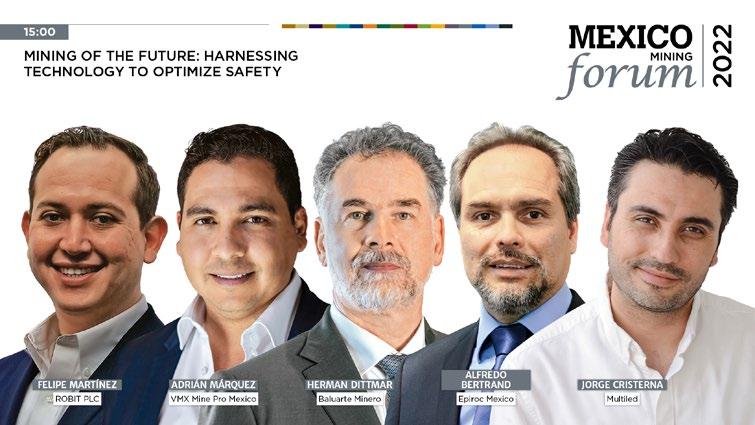
to administrative areas, said Jorge Luis Cristerna, Operations Director, Multiled Mexico. Some of the main opportunities that technology has opened to the sector are Mining 4.0, IoT, digital twin, teleworking and safety, he added.
“There are technologies that already existed before the pandemic. For instance, there was already satellite review on mobile equipment or remote monitoring on crushing equipment, but the pandemic made us improve technologies that already existed so that processes run safely, without affecting neither the operation or personnel,” said Arturo rivas, regional Sales Manager, SSAB. Controlling processes over long distances and having more predictive forecasts provide companies greater certainty, allowing them to take care of their assets, starting with the most precious, which is the safety of all collaborators, he added.
The Mining Industry of the Future
The mining industry is an integral part of any foreseeable economy and society. As a provider of employment and essential materials, it is connected to almost all industry value chains, as described by the World Economic Forum.
Cristerna explained that mining companies are part of the communities they work in,
creating links with people, governments, academia and other supply chain players. The mining industry of the future will require tailor-made technological solutions for every site, due to the specific characteristics each mine have, “The mining industry has a strengthened, direct link with academia, which provides qualified workforce. Mexico has specific opportunities in local development, adapted to each opportunity. Independently from production capacity, technology must be tailor-made for each specific environment, depending on every site’s needs,” said Cristerna.
Global interactions and communication between mines, producers, consultants, suppliers and manufacturers has improved with technology and Mexico has the advantage of having the expertise of local and foreign companies, said r ivas. This constant interaction enables Mexico to implement measures that have had success across the world and continue transforming it into a more technological industry, he added.
Connectivity will play a key role for the implementation of new technologies, said Bertrand. “Mining operations are often in distant, uncommunicated environments and reliable connectivity is key. Suppliers have made strategic alliances with tech companies to offer integrated solutions to mining companies.”
Becoming a Sustainable Industry
Sustainability trends have taken the spotlight among all industries, including the mining sector, which is transitioning toward cleaner operations. In the next few years, electrified equipment will be massively introduced to the mining industry, said Bertrand.
“Mining is becoming more inclusive and with cleaner processes. Both suppliers and mining companies are aiming for sustainability
and we are building the foundations for it. Technology is changing everything. Suppliers are migrating from providing products to providing services. Mining companies are looking for the best service, which adds value to them, rather than only products,” s aid r ivas.
Although there is a long way to go before reaching carbon neutral operations in the mining industry, there are already auto sustainable mining groups operating in Mexico, conclude d Márquez.
MINING PANORAMA AND CLUSTER OF CHIHUAHUA
Chihuahua’s great geological potential has recently attracted more attention from investors and companies. However, the state’s mining cluster says there is still much to be exploited in mining a ctivities.
Chihuahua is one of Mexico’s main mining jurisdictions. It is the second most important state in silver production, third in terms of gold and zinc, fourth in copper and fifth in plaster, according to Pablo Mendez, President, Mining Cluster Chihuahua. Around 11.5 percent of the national mining production comes from Chihuahua, with this sector representing 4.5 percent of the State’s GDP which in 2020 accounted for US$2.295 billion. “We work closely with the state government to promote mining activity, as we have the geological potential to go further,” said Mendez. “We call ourselves a friendly state because of our closeness to the mining community.”
Around 15 of the 20 most representative mining municipalities in Chihuahua have

“Together with the state government, we want to attract investment and grow local business in the region to foster greater development”
Pablo Mendez President | Mining Cluster Chihuahua
mines affiliated to the Chihuahua Mining Cluster. Overall, mining in the state generates 20,500 direct jobs and 102,000 indirect jobs, with 10 percent of these belonging to women. Additionally, mining jobs in Chihuahua are paid 36 percent higher than in other states, according to Mendez.
Despite its current success, the cluster is seeking to boost the state’s capabilities and seize opportunities for greater development, as only 8 percent of Chihuahua’s territory has been granted in concessions, while only 0.12 percent has been properly explored. “We have important geological opportunities to boost our exploration efforts.”
By developing the industry, the cluster is also trying to promote the economic development of the region. “Together with the state government, we want to attract investment and grow local business in the region to foster greater development,” said Mendez. Among its strategies, the cluster has organized visits to the main mines in the state through which companies can understand what these players need in terms of resources and equipment. Their constant efforts have already paid off with a local supplier base of 130 companies an d growing.
The social aspect has also been key to the development of mining in Chihuahua. After
the termination of the Mining Fund, the cluster has organized donations to mining communities to continue the industry’s contributions to local development.
“Last year we donated almost MX$90 million (US$433,2747) in kind to mining comminutes,” said Mendez. Additionally, the cluster works with civil associations and organizations that work with communities in the Sierra to support their development. These collaborations are key to keep promoting mining in the region as bad press has been detrimental to the development of new projects. “The greatest challenge that the mining industry faces is not related with the permissibility of authorities or
with the recognition of the rights of ejidal and indigenous communities, but with the current stigmatization of mining activities in our country, which, unfortunately, is generally unfounded,” Mendez told MBN.
The cluster is working with the National Guard, local communities and, most recently, the federal government, to reach remote places in the state and improve the regulatory framework for indigenous consultations. “We want to reopen projects that have faced social issues. In this process, we must support both the companies and the community,” sa id Mendez.
MINING’S EFFORTS FOR POSITIVE IMPACTS
Future challenges for the mining industry in Mexico abound, and topics such as the management of water supplies in the face of scarcity, the implementation of greener alternatives on operations, best practices for approaching communities and ways to ensure benefits, as well as self-sufficiency for local communities after mining projects are completed were some of the topics discussed during the closing panel of Mexico Mining Forum 2022 “ESG: Creating Positive Impact for Communities and the Environment”, where Independent ESG Senior Consultant Ana Mallen hosted the panel.
y uren Castillo, Earth and Environment Manager, Golder WSP, believes there are many challenges and uncertainty regarding climate change, especially because many local relations are still under development and much of the industry does not know what could happen next. One challenge is that many mining companies in Mexico are close to the end of their mine life. For this reason, Castillo recommends viewing other frameworks for inspiration and urges companies to ensure their projects end in a responsible manner. regarding water supply, Castillo recommended water stewardship as an effective solution because of the inclusion of stakeholders and environmental
wellbeing in a transition from simple water management to stewardship.
The consumption of elevated amounts of energy, said Castillo, represents many of the highest operational costs for mining operations. There will also be an increased demand for fuel because processes are more arduous with lower quality ore which will require greater processing. Therefore, mining companies need to install green energy sources to minimize operational costs. Companies also need to engage in an open dialogue with the local communities and not create false expectations. It is important to communicate risks promptly once they have been identified.
Bradford Cooke, Founder and Executive Chairman, Endeavour Silver, pointed to the importance of not letting external forces and challenges drive mining agendas and instead, establish a principle of responsibility of what he calls “corporate social integrity”. For Endeavor Silver, this consists in privatepublic partnerships in which the company financially backs up community projects. Successful partnerships with local communities, Cooke believes, are the result of establishing relationships prior doing business.
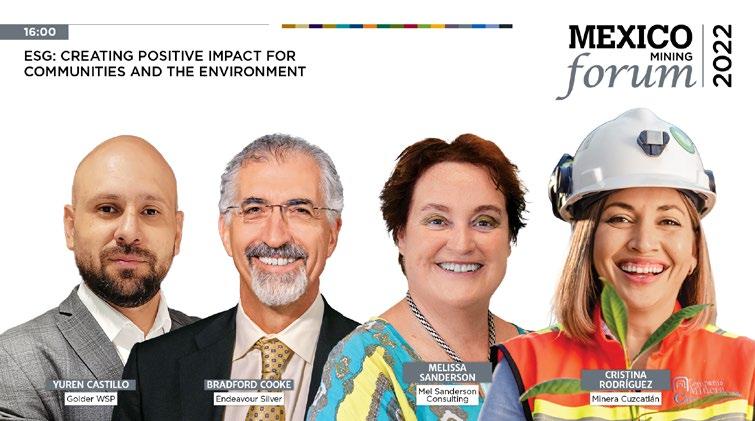
Cooke also commented on what he believes is the industry’s most important water impact - tailings facilities. “Wet” facilities, where the ground up rock after minerals have been extracted are stored as clay in water behind a dam can be replaced by dry stack tailing which allows the recycling of water. It may come at a greater cost, nevertheless, it brings a huge benefit where water can be up to 90 percent recycled, as is the case of Endeavour Silver. The company recognizes the end-dates of mining projects, which is why they invest in legacy projects whose impact can be broad. One such example is the provision of scholarships for education well beyond mining interests.
Melissa Sanderson, Founder, Mel Sanderson Consulting, highlighted climate change issues in the industry such as exacerbating water issues and dust pollution for communities surrounding the mine sites, as well as other social aspects. Sanderson emphasized that that the expansion of social media has empowered all communities so the traditional image of stakeholders surrounding communities which have been directly impacted by projects may not be so fitting anymore. As such, companies need to step-up their game in order to adapt to a new climate which needs updated sustainable and social impact plans.
Increasing technologies are reducing water dependency and new mining techniques
are also decreasing water dependency by replacing them with earth friendly bio based chemical agents. Many mines today are enforcing measures to capture rainwater that flow into reservoirs and flow into use, Sanderson explained. Through her extensive work aimed at reaching agreements with local communities, Sanderson advices companies enter negotiations looking for a compromise where both communities and companies gain. In order to achieve this, setting aside cultural prejudices and truly understanding the human side of these communities is required, Sanderson pointed out.
Cristina rodríguez, Deputy Director, Minera Cuzcatlán, shared the company’s emphasis on climate change through and explained how they are setting short-, medium- and long-term goals for innovation of technology in operations to reduce footprints in multiple areas such as water, tailings and energy. They are working with close cycles of water management to reduce impact and new project with solar panels. By measuring the impact of their 72 solar panels, they know they have reduced over 100 tons of CO2 in labor.
Minera Cuzcatlán has also made sure to leave a positive impact in the local community. This was done by seeking out an understanding of what they needed and as such, they have been able to provide
employment opportunities which have represented a reduction of migration out of the communities to seek financial opportunities and have greatly impacted the opportunities local women are presented with.
Finally, Ulises Neri, Mexican Vice Chair, Expert Group on r esource Management and United Nations Economic Commission for Europe (UNECE), urged companies to consider how they can achieve a balance between shareholders and stakeholders with people and local governments regarding mining project compromises. Industry participants in the panel highlighted that there are many tools and standards to
analyze goals in order to prioritize which activities are possible to develop in future stages, Neri said.
Neri also encouraged social projects to be thought of not only locally but for the entire state and area, some of which can be done by highlighting the importance of mining activities in daily life. As Neri mentioned, the mining industry is one which not only impacts but benefits every individual through end-products. Neri also agreed with missions for the participation of local communities in creating value chains and local activities so they have a say in how they are benefitted or funded by the mining projects.