Chillin’ with Krampus
by Granny Anarchy
Have you had it with “HoHoHo” and “HappyHolidays?” How about spending some time with Krampus?
Occasionally incorrectly explained as the “anti-Santa,” Krampus is a folkloric figure. who originated in southern Bavaria, a mountainous part of Germany and Austria. He is now also celebrated in Croatia, Hungary, parts of northern Italy, Slovenia, and the Czech Republic.
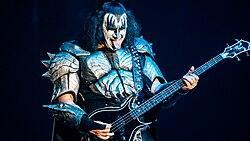
Simmons performing in 2019 via Wikipedia
Krampus looks like a demonic man-goat with large horns on his head, a Gene Simmons-like tongue, and shaggy, matted, dark fur. He is typically depicted with a fanged grimace and clawed
hands.
(Funfact:Wordstodescribe“goat-like” include“caprine”and“hircine.”You’re welcome.)
ORIGINS
His name may be derived from the German word “krampen,” which means “claw.” Krampus has scary talons and rips naughty children away from their homes. Another etymological possibility is the Bavarian word “krampn,” meaning “dead” or “rotten.” Krampus is reported to be the son of the Norse god Hel (Marvel movie goers might confuse this name with Hella,) the god of the Underworld.
Krampus is known in Central Europe as a companion of St. Nicholas - an inspiration for Santa Claus. St. Nicholas visits homes on December 5 (St. Nicholas Eve, aka Krampusnacht.) Nicholas places small gifts such as candy in the shoes of good children. However, being a saint, Nicholas cannot perform bad deeds. He needs a heel to deal with unruly
youngsters. In Tyrol and Bavaria, Krampus fulfills this task. Krampus is not an “anti-Santa,” but a balance, a being with a purpose.
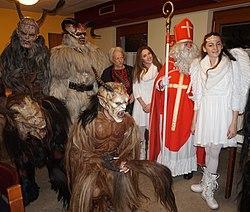
Several depictions of Krampus alongside the Nikolaus via Wikipedia
St. Nicholas, a patron saint of children, became popular in Germany around the 11th century. In other regions, he has different assistants who function as the darkness to his light. In Nuremberg, that alternate is Knecht Ruprecht, a man with a long robe and pointy hat. Other areas are served by individuals such as Père Fouettard. (“Father Whipper,”) La Befana, and Belsnickel.
(Foodforthought:SincetheUnited Statesisanationofimmigrants,and manycamefromCentralEurope,whydid
welatchontoSt.Nick’sevolutioninto SantaClaus,butnotretainamore sinistercharactertobehisfoil?FROSTY DOESN’TCOUNT! )
OTHER ENTITIES
Krampus should not be confused with Perchten, who originated in Austria. They resemble each other, but Krampus is a solitary figure who brings balance during Krampusnacht . Perchten run in packs to drive away evil and bring good luck throughout the holiday season. Perchten often carry bells for this purpose. (Frau Perchta has her own scary story.)
While St. Nicholas rewards the deserving on December 5, Krampus might beat disobedient, lazy youngsters with birch branches, stuff them into a sack to haul them away, or even eat them.
Krampus carries a birch rod, chains, and sometimes a whip. On Krampusnacht , he has a sack or basket to cart off children - whom he might drown, eat, eviscerate, or take to the underworld.
Krampus would also leave birch bundles at homes, which would often be painted gold and displayed inside for the rest of the year to remind and warn everyone of his presence.
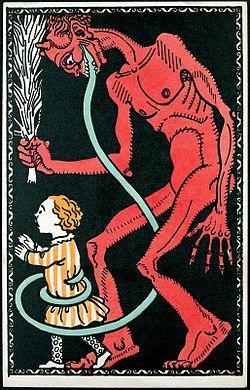
"Krampus with a child" postcard from around 1911 via Wikipedia
OPPRESSION
Children in the area today are taught about Krampus – according to some reports, he’s spoken of in area schools. Yet circa the 12th century, whilst the Inquisition was ongoing, the Catholic Church tried to banish Krampus celebrations, perhaps because of his resemblance to the Christian devil - or simply because Krampus was pagan in origin.
In the 1930s, Austria's Fatherland Front and Christian Social Partya political organization with ideology which might Not See all races and religions as equal and able to intermingle - also attempted to banish festivities, but Krampus prevailed. Later still, during the cold war of the 1950s, the Western-backed but communist-influenced government of Austria ran a campaign with pamphlets entitled “KrampusisanEvilMan . ” Still, folk traditions continued, allowing a resurgence to begin in the 21st century.
AND NOW
Krampus is now so popular that there is tourism and merchandising around Central European shenanigans and about Krampus himself.
While Krampusnachtor Krampus Night is on December 5, there are Krampuslauf(parades and runs) where people - mostly younger men - gather dressed in Krampus
and perchten costumes. These might now start as early as November and go through January, and there is specific etiquette and dress code about Krampus and perchten on and off parade:
"Traditiondictates…:afursuitusually madefromgoatorsheepskin.Large, heavyrumblebellscarriedonawide leatherbeltaroundthemiddleofthe body.ArodofthinBirchbranchesora cow’stail.And…theelaboratelycarved mask.EachPasshasnowadaystheir ownstyleandsometimesthemasks aremodernandzombie-like,or,as withtheRauriserDevils,strictly traditional.…themasksarecarvedby themembersthemselvesandpainted withred,whiteandblackcolours.They mustmeetcertaincriteria…Andalso thisPass’appearancestrictlyadheres tooldtraditions."
- https://tinyurl.com/46ks4d7k
There are rules about what two Krampuses (Krampii?) do when they met each other - a ceremonial shoving match called Rempeln- and rules about how adults are to interact with Krampus.
For instance, during some parades, Krampus may ritualistically beat adults below the knees only. He is supposed to be appeased by offering him schnapps. At runs without children, people seem to relish blowing off steam as a form of ritualized mayhem akin to Mardi Gras. (Caveat: there have been some controversies and complaints of events with injuries.) However, there have been plenty of family events, at which parents may encourage frightened children to stand up to and interact with Krampus, to learn to overcome fear..
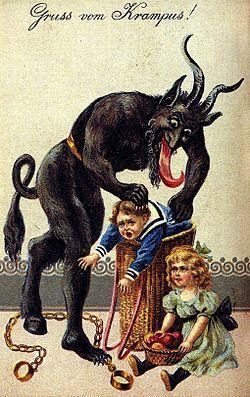
A 1900s greeting card reading 'Greetings from Krampus!' via Wikipedia
People can also bake and consume Krampus bread and send Krampuskarten(greeting cards) upon which one might see the phrase “GrussvomKrampus” or “Greetings from Krampus” along with a picture of this mythological figure. In popular culture, Krampus has been the subject of a comic book, movie, songs, TV episodes, and video games. Krampus’ rising popularity in the United States has inspired some US cities to host Krampus Balls and Krampuslauf(Krampus Runs).
AT METRO
If you would like to learn more or enjoy some fiction about Krampus at Metro Library:
Adult Non-Fiction: KrampusandotherYuletideTales
- Faina Lorah
TheDeadofWinter:TheDemons, WitchesandGhostsofChristmas
- Sarah Clegg
TheFrightBeforeChristmas- Jeff Belanger
TheKrampusandtheOld,Dark Christmas- Al Ridenour TonightisKrampusNight- Kyle Sullivan
Kids: KrampusConfidential- Kyle Sullivan
GoodnightKrampus- Kyle Sullivan
DVD: Krampus
OTHER LINKS:
While there is no official Krampus museum, Tyrolean and Austrian Krampus masks can be seen athttps://tinyurl.com/ypb6htca and herehttps://tinyurl.com/4enxxcwf.
If you are wondering what Krampus bread looks like or how to make it, you cand find info athttps://tinyurl.com/4yxjj6ku and herehttps://tinyurl.com/muhm6yxr
Really silly song about Krampushttps://tinyurl.com/2zp9p3mt
But what if Krampus leaves you feeling a little ... cold? Granny's
got a few more European entities that aren't quite so icy!
The Yule Cat
Iceland's Jólakötturinndates back to ... 1932 (the poem’s opening line is "You all know the Yule Cat," which indicates Jólakötturinn's legend could be far older.) Poet
Jóhannes úr Kötlum wrote of a cat larger than a house who later joined up with legendary ogress Grýla and her 13 children, the “Yule Lads,” who were rude, murderous, thieving vandals.
Jólakötturinn had glowing eyes and roamed from home to home, looking in windows for children who were not wearing any new clothes. He ate youngsters who didn't get new garments for Christmas.
It’s speculated this story was an attempt to increase worker productivity during the long, dark, winter - as well as another reminder to wayward children; do
your chores to receive “at least a pair of socks!”
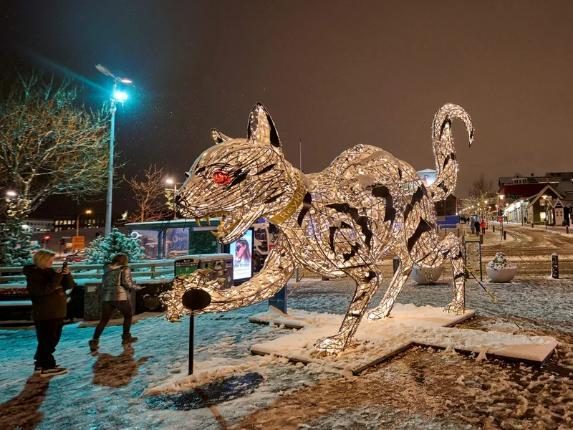
Reykjavik, November 29, 2021
Halldor Kolbeins/AFP via Getty Images
In modern Reykjavík, a statue of the Yule Cat is erected in Lækjartorg square during the holiday season
Listen to Bjork: The Yule Cat:https://tinyurl.com/bddy9mtw
The Yule Goat
The Yule Goat, or Julbocken, evolved in pre-Christian Scandinavia and Germany. It is traditionally a straw goat that is placed on or under the Christmas tree. Granny might save the story of the Julebock for next year, but she wanted to inform you that one of the most recognizable is the Gävle Goat or Gävlebocken .
The Gävle Goat has been a tradition since 1966 – and, after its inception, another tradition began: its arson. Although it is illegal to harm the goat, and although cameras and security measures are in place, as of 2025, 42 of 59 Gävlebockenhave been damaged or destroyed.
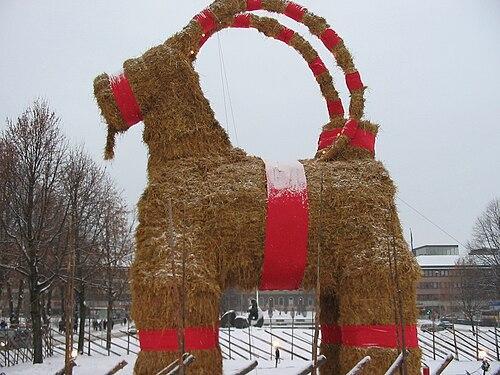
Gävlebocken Via Wikipedia
Each year, the goat is erected on the first day of Advent, which usually falls in late November or early December. It stands in Slottstorget (Castle Square) in Gävle, Sweden. In 1966, Stig Gavlén had the idea to create and place a giant Yule Goat in the square. His brother, Jörgen Gavlén, chief of the fire
department, was put in charge of constructing it. On December 1, 1966, a 43 ft tall, 23 ft long goat was erected. On New Year's Eve, the goat burned down, starting a strange, somewhat mythical modern tradition.
The goat has not always been destroyed by fire. It has sometimes been smashed, collapsed, and once its straw was even eaten by jackdaws. Happily, the goat has survived its last few years.
One of Granny’s favorite winter traditions is monitoring the progress of the Gävle Goat on the live webcamhttps://tinyurl.com/2dkavsvh (Despite the somewhat macabre history, the author prefers the goat remain intact and does not advocate any Julebock destruction!)
So there you have it – a macabre, malevolent, mysterious menagerie of Christmas creatures!