



By Matt Meduri
Crime victims and Senate and Assembly Republicans are rallying to pass “Sarah’s Law” this session of the State Legislature.
The bill, named for Sarah Goode, would close a loophole that expunges the criminal records of defendants who die while their conviction is on appeal. That loophole is called abatement ab initio.
Goode, of Medford, was raped and murdered by Dante Taylor, of Mastic, when she was just 21 years old. She vanished after a party at which the two had met in June 2014. She was stabbed forty-two times by Taylor, who had dumped her body in the woods. He was convicted and sentenced to life imprisonment without parole. While appealing his case, he committed suicide. Abatement ab initio, under New York State Law, required the dismissal of his conviction, leaving no defendant legally convicted of Goode’s horrific assault and murder.





Be My Valentine: Seashell Relief Sculpture with Anna Chan at Gallery North February 6, 6:30 PM to 8:00 PM
Valentine Craft Fair at Charles B Wang Center February 7, 10:00 AM to 7:00 PM
The Tragedy of Hamlet at Staller Center for the Arts, Stony Brook February 13, 8:00 PM to 10:00 PM
Valentine’s Comedy Show at SquareHead Brewery
February 13, 7:30 PM to 10:30 PM
Valentine’s Murder Mystery Dinner Show “Till Death do us Part” at Fire Island Vines
February 14, 6:30 PM to 9:30 PM
Falling In Love With Wildlife at Sweetbriar Nature Center, Smithtown February 15, 1:00 PM

Mid-Winter Break Children’s Program at Long Island Maritime Museum February 16-20, 10:00 AM to 12:00 PM
Hot Cocoa Crush 5K Long Island at Eisenhower Park Field 2 February 21, 9:30 AM to 12:00 PM
Superheroes of the Sky at Sweetbriar Nature Center February 21, 11:00 AM
Psychic Fair and Gift & Craft Show at The Radisson Hotel February 22, 10:00 AM to 6:00 PM
LI-Kick: Trivia Roulette at Great South Bay Brewery February 26, 7:00 PM to 9:30 PM
Long Island Pet Show 2026 at Suffolk Federal Credit Union Arena, Brentwood February 28- March 1 Times may vary

(631) 269-6421








Baby BookwormsJanuary 30, 10:00 AM to 10:30 PM
AMVETS Post • Boulton Center
Bay Shore Public Library • Leggio’s Deli
American Legion Post • Bayway Arts Center East Islip Gourmet Deli Harry’s Bagel • Italia Fine Food Mister Softee Ice Cream Pat’s Market
American Legion Post • Bagel Boss Bagels & More • Oconee Diner
The New Idle Hour Deli 50% Cards Store (Wendy’s Shopping Center)
718 Slice Pizzeria – (719 Hawkins Ave) Airport Diner • America First Warehouse
AMVETS Post 48 • B&B Bagels
B.L.D.’s Restaurant Hero Express • Pond Deli
American Legion Post Ronkonkoma Train Station
Sayville LIRR Train Station
Sayville American Legion Post
B.F.L./S.P.K. Deli • Best Farms Market
Higbie Bagels • West Islip Bagels West Islip Community Center West Islip Public Library West Islip LIRR Train Station Tower’s Flower
LI Maritime Museum
Dist, and Farmingville Fire Dist. Periodicals Postage Paid at Ronkonkoma, NY and additional entries.
Hot Cocoa Hangout January 31, 6:00 PM to 7:00 PM
Adult Pilates - Every Monday and Wednesday, 1:00 PM to 2:00 PM
Parent Child WorkshopFebruary 13, 10:00 AM to 11:15 AM
Stretch Senior Class - February 20, 10:30 AM to 11:30 AM
Laser Tag After Dark February 20, 6:00 PM to 9:00 PM
Dungeons & Dragons for TeensWednesdays at 5:30 PM
Folk Traditions and Origins of Valentine’s DayFebruary 13, 2:00 PM to 3:30 PM
Gentle Yoga with Kate - Every Monday, 6:00 PM
Chunky Embroidery - February 13, 11:00 AM
Polar Bear StorycraftFebruary 9, 4:15 PM to 5:00 PM
Family Connect Night - Family Pizza NightFebruary 11, 6:30 PM to 8:00 PM
Edible Cookie Dough - February 19, 1:00 PM to 2:00 PM
Broken Hearts Bingo February 11, 3:00 PM to 5:00 PM






Islip Messenger serves Ronkonkoma, Lake Ronkonkoma, Oakdale, Holtsville, West Sayville, Sayville, Holbrook, Patchogue, Bohemia, Islandia and Islip 71 Years of Service to Our Community
cost of the space occupied by the error. The opinions expressed in byline articles, letters and columns are those of the author and not necessarily those of Messenger Papers, Inc, its publishers or editors. Pictures submitted for publication remain property of the publisher.
Postmaster: Send address changes to Islip Messenger, P.O.
Thursday, February 5, 2026
The law is being carried by Senator Dean Murray (R-East Patchogue) and Assemblyman Joe DeStefano (R-Medford). Lawmakers and Goode’s family rallied at the Perry Duryea State Office Building in Hauppauge last Friday to make the proposal become law.
“New York State does a horrible, horrible job when it comes to crime victims. They are the most forgotten people in this state,” said Murray. “When these pro-criminal laws are being passed in Albany, there’s no thought given to the victims of what they went through or are going through, whether it’s the victims or the family members and loved ones of victims.”
Murray, a member of the Crime, Crime Victims, and Corrections Committee, said that even the most left-leaning states, such as Massachusetts, have realized that abatement ab initio goes “too far.”
“Dante Taylor was overwhelmingly found guilty; there is no question of his guilt,” said Murray. “If you look up the record [of Goode’s case] right now, you will not see his name there.”
Senators Mario Mattera (R-St. James), Patricia Canzoneri-Fitzpatrick (R-Malverne), Steve Rhoads (R-Bellmore), and Jack Martins (R-Great Neck) were present in Hauppauge and are co-sponsoring the bill.
“When a jury has weighed the evidence and delivered a guilty verdict, that decision should matter. Allowing that verdict to simply disappear undermines confidence in our
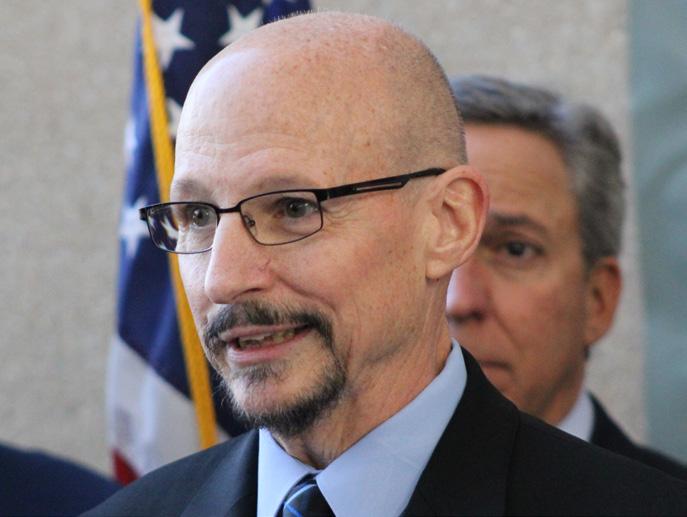
judicial system and it sends a devastating message to victims and their families,” said DeStefano, adding that the loophole “opens wounds” of victims’ families. “Justice should not vanish because of a delay, timing, or procedural technicalities.”
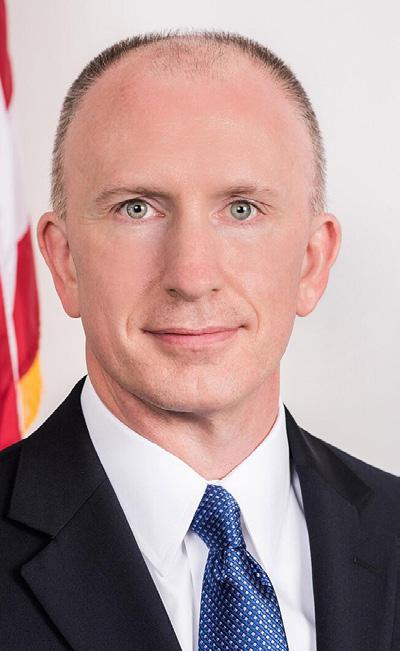
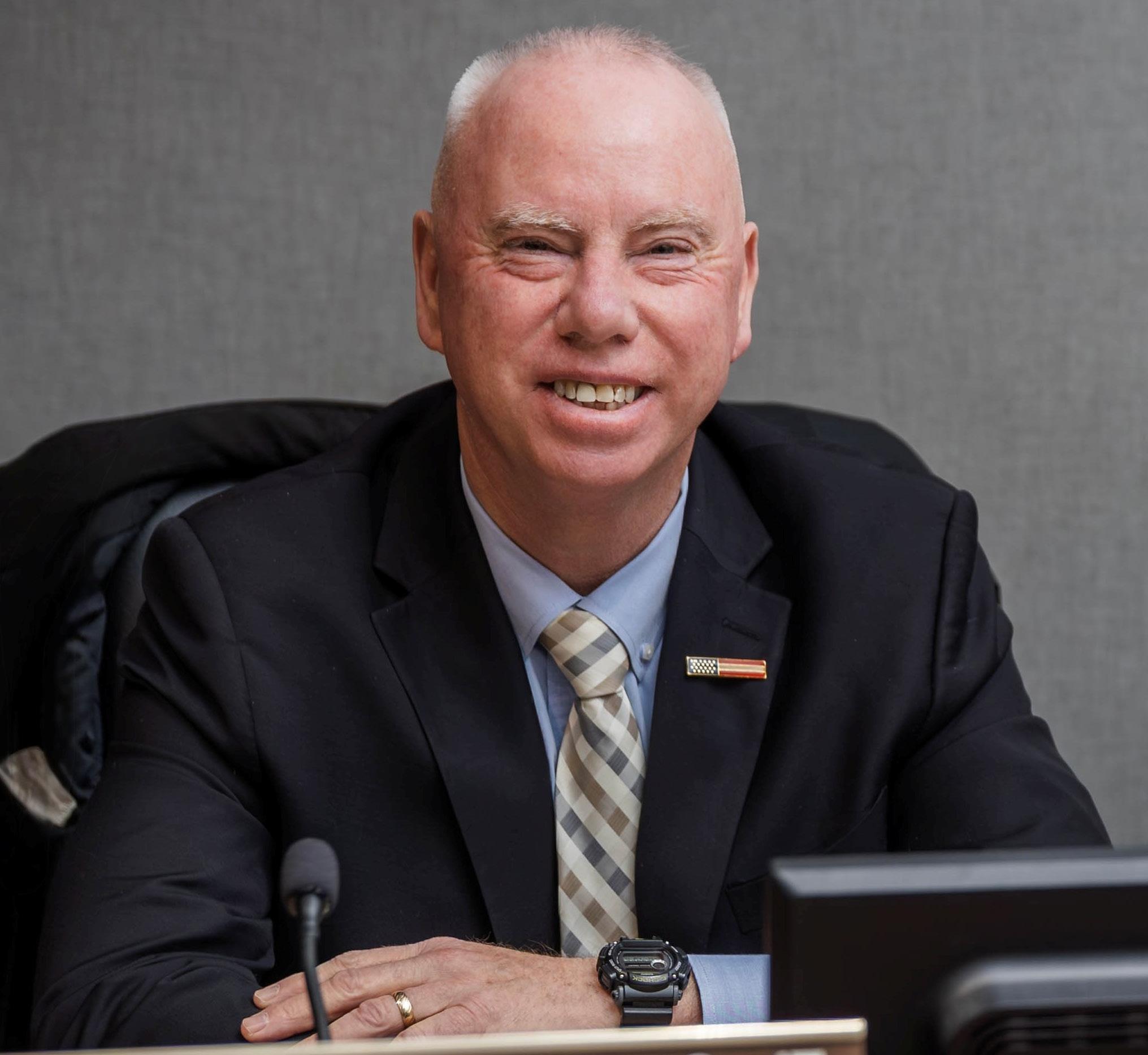
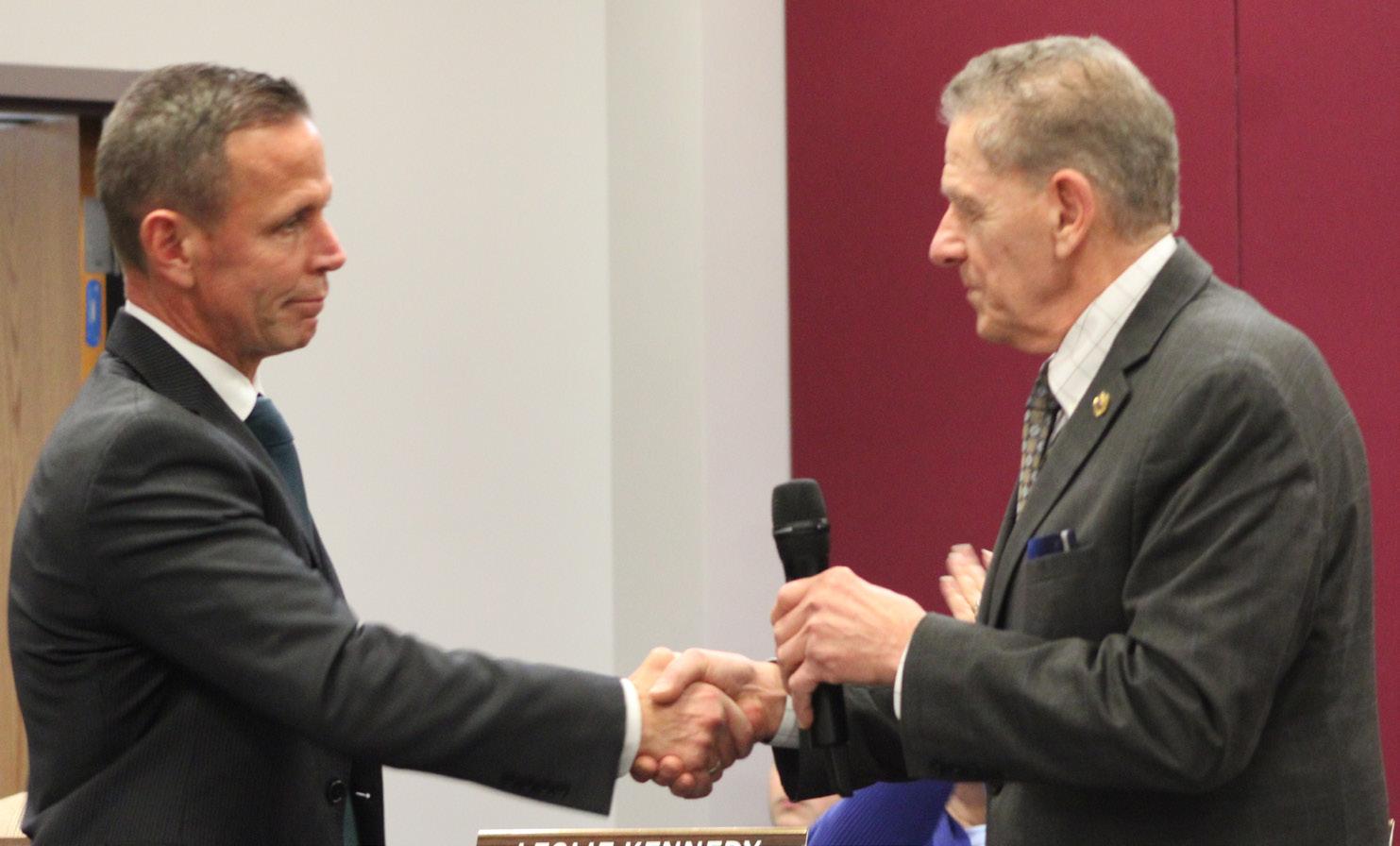
DeStefano (pictured below) was joined by fellow Assemblymen Mike Durso (R-Massapequa Park), Ed Ra (R-Garden City South), John Mikulin (R-Bethpage), and Ari Brown (R-Cedarhurst), who are cosponsoring the bill.
Suffolk County Executive Ed Romaine (R-Center Moriches) said he is “100%” behind the bill, adding that Goode’s murderer “should be known” and that his “conviction should stand.”
Nassau County Executive Bruce Blakeman (R-Atlantic Beach), who is running for governor, said that Goode’s family, while in

Will be offered at St. John Nepomucene and are open to people of any faith
grief, had to endure the publicity and the process of the trial, only for it to be “stolen away” by “one of our ridiculous laws.”
“We have too many laws like that in the state of New York,” said Blakeman. “This was one of the most heinous crimes in the history of Long Island.”
Goode’s family made emotional pleas for the State to pass Sarah’s Law.
“The first time since Sarah was taken from us, our family had a small matter of peace, a conviction, a sentence, a permanent record that said this happened and this mattered. But instead of facing the consequences of what he did to Sarah, this coward chose to take his own life in prison,” said Jennifer Driver, one of Sarah’s sisters. “Because of an outdated and archaic legal doctrine, every charge was erased as if the trial never happened, as if the conviction never existed, as if Sarah’s life never mattered. Evidence did not disappear. Facts did not change. The jury’s verdict did not vanish.”
Driver added that the technicality did not “erase a conviction,” it “erased accountability.”
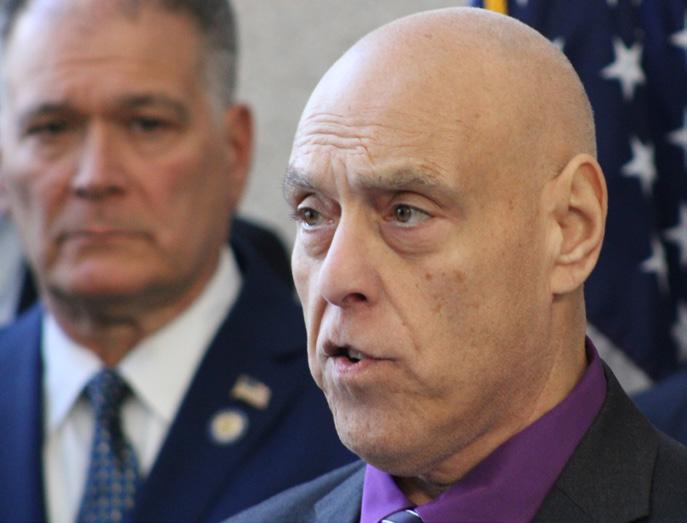
“New York ripped out our hearts, whatever shred was left of it, and buried Sarah deeper into the hole she’d been in since 2014, silencing victims yet again,” said Tabitha Miller (pictured right), another one of Sarah’s sisters. “What New York is doing when they vacate convictions is telling the State to find a new murderer because this one that died in prison couldn’t have done it. Guess what, New York? No one’s going to find someone to accuse, because the one they found was already convicted.”
Elizabeth DeMuria, another sister of Goode, said that if “justice can be undone so easily,” then the “entire criminal justice system is compromised.”
Sarah’s daughter, Jocelyn, who was a young child at the time of her mother’s death, that Sarah’s life was “not worth fighting for.”
“But it was okay to fight for a convicted murderer and wipe his charges out so that his family can benefit? Explain why a convicted killer deserved a clean slate, but Sarah did not deserve permanent justice,” said DeMuria.
“Sarah’s voice will be heard even though she has been gone. This is her legacy.”
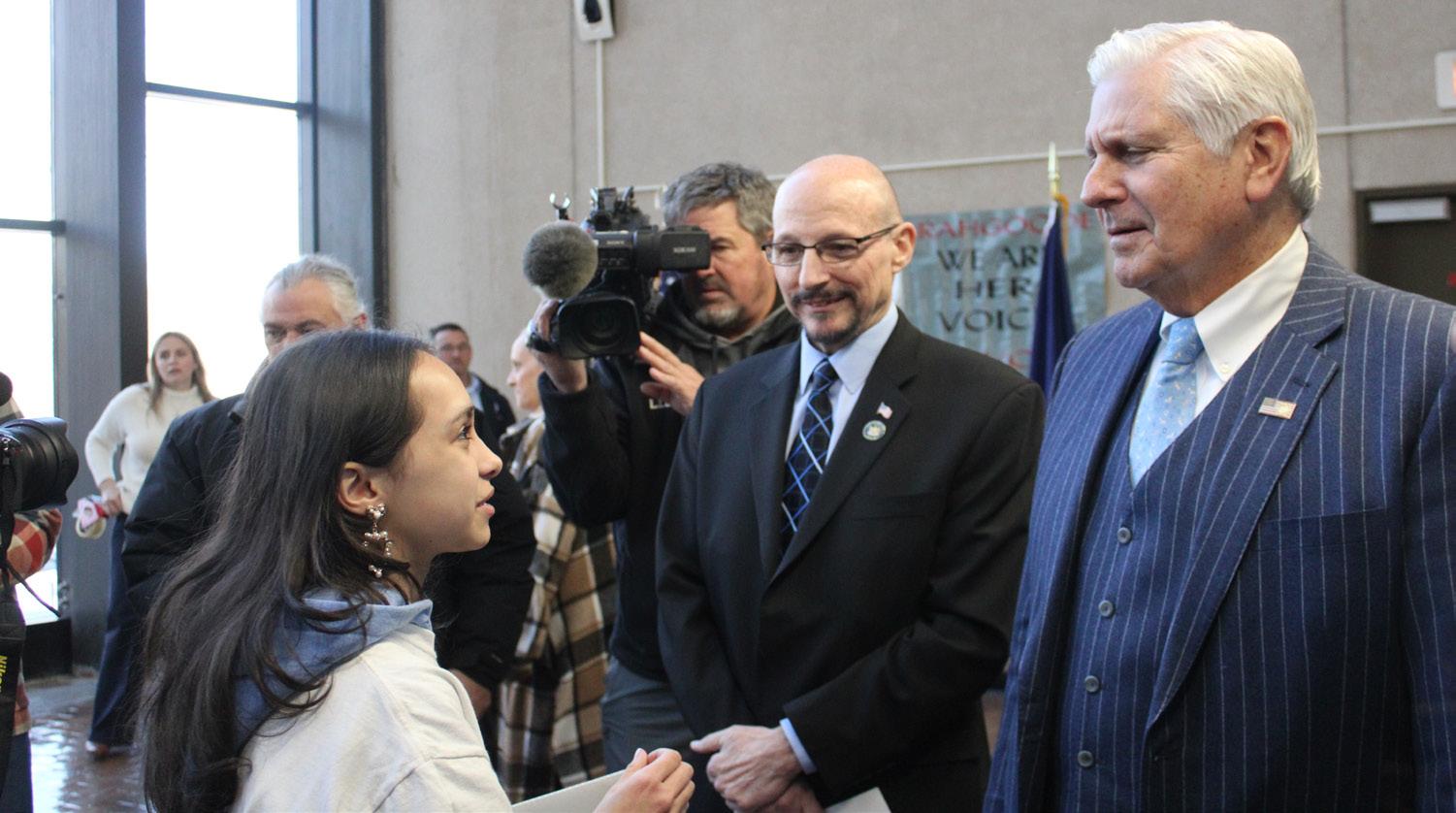
Sarah’s daughter, Jocelyn, is now 16, and eyeing a profession in fashion.
“In my opinion, even after death, my mother would like to help other crime victims,” said Jocelyn.
Senator Murray (pictured above left) emphasized that passage of the bill transcends partisan credit.
“If you’re worried about a Republican getting credit, I’ll give you the damn bill. You can have it. Get it done.”
The legal doctrine was notably used to overturn the federal conviction of Enron CEO Kenneth Lay. Its existence stems from the benefit of the doubt that arises when a defendant is appealing a conviction. But Murray said that there is even less precedent

for abatement ab initio to exist in light of the advanced scientific methods of conclusively solving a crime.
Senator Mattera said that Governor Kathy Hochul (D-Hamburg) could bypass the legislative process by adding this into her FY2026 Executive Budget.
General Loss
Loss of an Adult Child
Thursday, March 5th – April 30th at 7PM
(Note: there will be no meeting April 2nd as it is Holy Thursday)
The General Support Group & Loss of a Spouse Group is open to anyone who has suffered a loss at least three months prior, which would be December 5, 2025.
The Loss of Adult Child Group has no wait requirement.
Each group meets weekly for 90 minutes followed by refreshments and hospitality. There is no cost but a commitment to attend each meeting throughout the program is required. All groups are offered in a closed and confidential setting with highly trained f acilitators and are limited to 12 people.
Pre-registration is required. Please call 631-589-0540, ext. 250 for more information or to reserve your seat for the group you would like to attend.
“It also tells the victims’ families that the system will protect convicted murderers, rapists, pedophiles, and other horrendous criminals over the truth,” said DeMuria, adding that the loophole is akin to telling
“That’s how important it is for this bill to be bipartisan,” Mattera told The Messenger “Let’s see what the Governor is going to do with that. We are asking her to put this in her budget this year.”
“We have a county executive [Blakeman] who is here and he is running for governor. He would make sure this gets done,” added Mattera. Continued from front cover
By Madison Warren
Resolution 1111-2025, also introduced as I.R. 18382025, officially became a new local law in Suffolk County as of Monday, February 2.
The initiative, led by Suffolk County Legislator Chad Lennon (C-Rocky Point), is designed to strengthen oversight of hotels and motels across Suffolk County in an effort to combat human trafficking, an issue that has unfortunately become more prevalent in recent years.
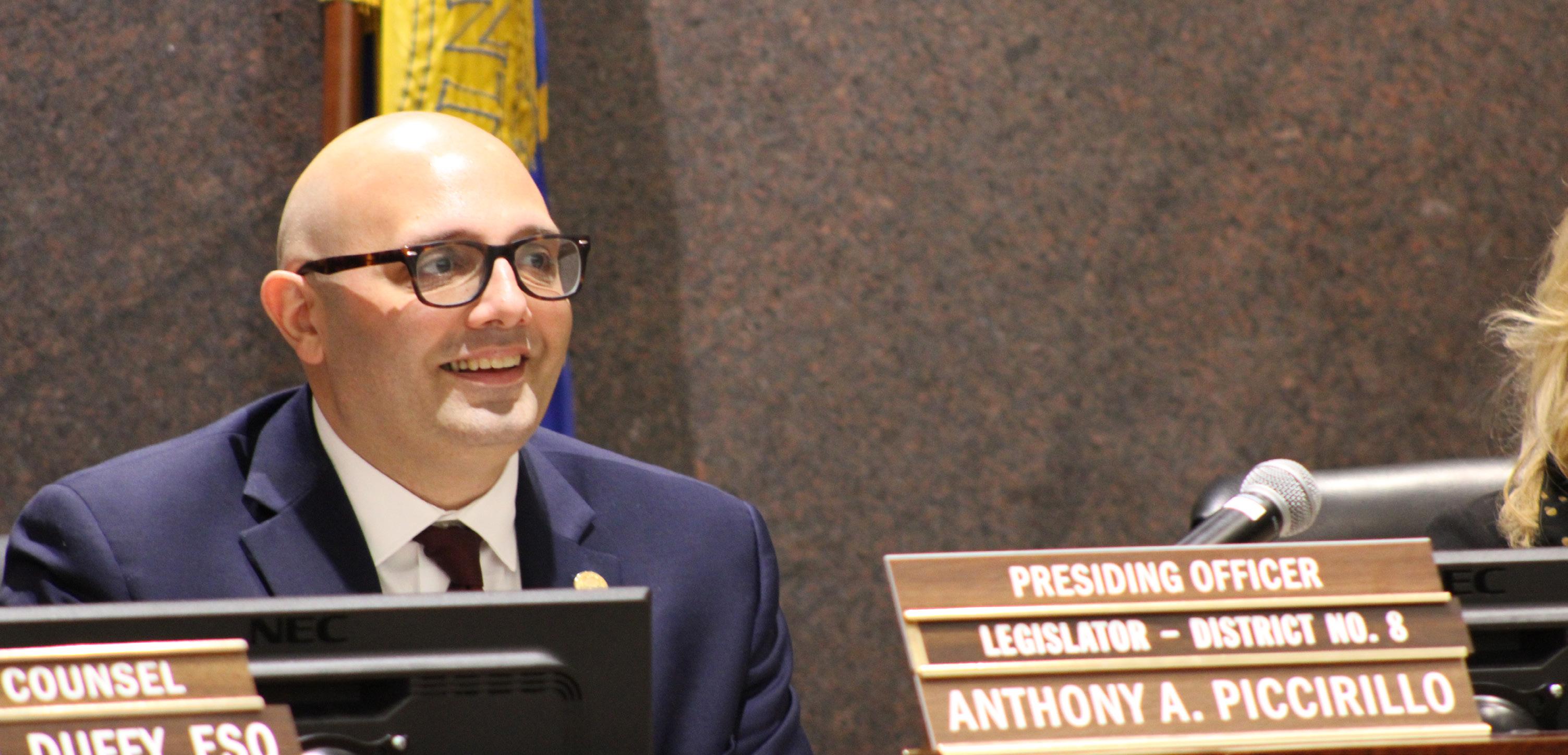
Lennon was joined by Suffolk County Executive Ed Romaine (R-Center Moriches), who signed the bill into law, along with several officials, including Suffolk Legislators Sal Formica (R-Commack), Dominick Thorne (R-Patchogue), Leslie Kennedy (R-Nesconset), Stephanie Bontempi (R-Centerport), and Steve Flotteron (R-Brightwaters). Presiding Officer Anthony Piccirillo (R-Holtsville) and Deputy Presiding Officer Jim Mazzarella (R-Moriches) were on hand, as well as County Comptroller John Kennedy (R-Nesconset), Assemblywoman Jodi Giglio (R-Baiting Hollow), and community members who played a role in advancing the measure.
The measure passed unanimously at the December 2025 Suffolk County Legislature meeting. When it passed, The Messenger spoke with Lennon, and he described the trafficking issue as one of the most severe and rapidly growing public safety threats facing Suffolk County, which has driven his motivation behind this.
The concerns surrounding hotels and motels go beyond the continued availability of hourly room rates. Another issue has been the limited guest information collected for short-term rentals, a gap that traffickers have used to their advantage. Lennon said that there have been reports of minors and women being cycled in and out of rooms “for

a few hours at a time over several days,” a pattern that law enforcement has observed for years.
The new law is intended to close those gaps. Under the measure, hotels and motels must maintain detailed guest records for up to five years and retain security footage for at least 90 days. Any records or footage must be made available to authorized emergency responders upon request. The law also prohibits rentals of less than six hours, requires operators to provide human trafficking recognition training for employees, and mandates that training records be reported quarterly to county officials.
At the bill signing, Lennon thanked the many individuals and organizations who helped make the measure

possible. He said that shortly after beginning his tenure as a Legislator, he became increasingly aware of the rise in human trafficking cases in Suffolk County and felt compelled to take action. He worked collaboratively with the Suffolk County Anti-Trafficking Initiative and the New York State Assembly Task Force to address the growing number of cases.
“Everywhere that these traffickers want to go and exploit our most vulnerable, I will make sure, as well as every level of government, that we will stop them,” Lennon noted.
“I am happy to support Legislator Lennon with his legislation to combat human trafficking in Suffolk County,” Presiding Officer Piccirillo told The Messenger. “When there is trouble anywhere in the world, we send in the Marines, and in the Legislature, we have our very own Marine, Legislator Lennon. He is the man to tackle this serious issue.”
Freshman Legislator Formica echoed Piccirillo’s message, expressing full support for both the bill and Lennon’s efforts. Formica said the measure is meant to strengthen accountability not only for traffickers, but also for hotels and motels, and to help eliminate what he described as a revolving door of activity.
With the law now in effect, Suffolk County officials say the measure represents a step toward greater oversight and prevention, while sending a clear message that human trafficking will not be tolerated. Leaders expressed hope that the new requirements will help protect vulnerable individuals, support law enforcement efforts, and encourage


It’s budget season again in Albany and if the products in previous years haven’t impressed you, this year’s model certainly will.
Governor Kathy Hochul (D-Hamburg) recently pitched her FY2026 $254 billion spending package to the full State Legislature at last month’s State of the State Address. This is the largest budget in State history, by the way.
Forget anything budgetary about the budget for the moment - at least that’s how it’s done in New York. Unlike in other states, the budget doesn’t begin with the Legislature, but the Governor. The budget then goes to both chambers of the Legislature separately for their respective one-house bills, essentially their own versions subject to negotiations. The budget is then voted on in parts, typically ten, where each section can be approved or rejected separately.
A compartmentalized budget sounds like a good idea, until it isn’t. This is how backwards decisions like bail reform laws and billions in funding for illegal immigrants were pigeonholed into law - tied into specific compartments, often baked in with grant funding or bring-home-the-bacon opportunities for legislators, so a “no” vote is a dereliction of duty, and a “yes” vote is a compromise of your values.
Moreover, the budget shouldn’t come from an executive top-down. If the Legislature is divided into districts - 150 in the Assembly and 63 in the Senate - then the legislators should be able to craft a budget with their ears to the rail in their respective districts.
Instead, that responsibility falls on one individual - plus a team of advisors, we suppose - to then best render the needs of the entire state, and a highly regionalized one like New York, no less.
But what’s even more dysfunctional is how the budget allows any policy at all. In a process that implies finances, policy should be the last thing involved. This unique flavor of democratic backsliding federally and in state governments is why legislatures at both levels get consistently poor marks. Other states have smoother processes, but in New York, of course nothing can be simple.
Enter the latest gripe we have, which is the subject of our cover story this week in all three issues. Sarah’s Law was named after Sarah Goode, of Medford, who was brutally raped and murdered by a Mastic man who would later be sentenced to life in prison without the possibility of parole. After the appeal of his conviction began, he took the coward’s way out while locked up.
Because of an antiquated legal doctrine called abatement ab initio, the defendant’s conviction was overturned. The initial premise of the doctrine makes sense: if a defendant dies while appealing his/her conviction, either through suicide
or not, it reinstates a sliver of the presumption of innocence by default - benefit of the doubt, more or less. Therefore, it seems fitting at face value that such a technicality exists.
But in the age of modern technology, especially DNA evidence, near-constant surveillance, and this time period being one in which going off the grid is practically impossible, most convictions are ironclad and most appeals are just formalities.
And that’s what happened in Sarah Goode’s case. Technically, in the eyes of New York State Law, Goode’s murder has no suspect. Although he was convicted and we all know it, the State shrugs and says that it effectively did not happen.
For some, it might seem pointless that this loophole be criticized. Even though a piece of paper doesn’t say that someone who was undoubtedly guilty was convicted of a crime doesn’t mean that crime didn’t actually go unsolved, and he/she is not out on the street ready to offend again, right?
While that principle is thankfully intact, for the crime victims and their families, it feels like a slap in the face straight from the judiciary. The time, effort, sleepless night, and lifelong trauma and heartbreak faced by victims, their families, and legal counsel to obtain a guilty verdict seemingly blows away in an instant because of a consequence-dodging suicide or just convenient timing after an appeal kicks off.
So, why do we bring up the budget equation of this?
This policy wouldn’t even cost any money. It would simply force the State to no longer recognize the legal doctrine of abatement ab initio. And it’s not like being opposed to this is the liberal or Democratic platform. This bipartisan change has occurred in states even more liberal than New York, such as Massachusetts. Even for one of the most progressive states in the nation, it was a bridge too far.
Governor Kathy Hochul can add this measure to the Executive Budget. It can be signed, sealed, and delivered when the rest of the budget is approved, bypassing the typical legislative process, committee research, debate, and amendments if necessary.
While this proposal has been unveiled only this week, it remains to be seen whether or not Hochul will take the common sense measure this time, or at the very least if legislative Democrats will help pass it. Given their proclivity to let Republicansponsored bills simply die in committee because of credit-farming, it’s possible that that’s something in play.
Benefit of the doubt?
Even the bill’s sponsor Senator Dean Murray (R-East Patchogue) said that credit doesn’t matter. “You want the credit? I’ll give you the damn bill. Get it done.”
Let’s see if Hochul and company take the damn bill.
The pile-ups of snow, the sub-zero wind chills, and the all-around agony of winter make for expected, yet not-so-scintillating, conversation. You’d be hard-pressed to find someone who doesn’t regularly opine, “I’m done with the snow!”
While ditching New York and splitting for the South has been at the forefront of New Yorkers’ minds for the better part of this century so farcourtesy of backwards governance brought to you by the State Democrats - the harsh winters certainly feel like a squeeze lemon juice over a paper cut.
And for the most part, we agree. The cold is typically tougher to weather - pun intended - than the extreme heat, the snow can make for backbreaking work, and the delays only exacerbate the ever-present agita gained from driving practically anywhere in Suffolk. While we’re at it, we’ll plug our regular reminder to get out of the left lane!
We’re not going to be like that guy we all know, who wears basketball shorts, a hoodie, a backwards cap, and sandals during a polar vortex, admonishing you for being cold. “I’m out here wearing shorts and I’m not
cold! How can you be cold?”
But we will say that this is how winter is supposed to be.
It wasn’t that long ago that snow piled up every week and the weather didn’t need to be consulted on whether or not to bundle up; it was a guarantee. Balmy days in February were headline-grabbing and an absence of snow almost made it feel like an old friend was missing - at least to some. Especially for kids who have grown up not only chronically online but sequestered for the better parts of their childhood due to a pandemic, some of them are seeing a proper winter for the first time this year.
We’re sure we’re in the minority when we say we’re glad to see a classic winter, and those disagreements are still valid in their own right. At this point, driving while late to work because your windshield won’t defrost should be an Olympic sport. We’re anxiously counting down the days until spring, but until then, we think there’s a silver lining to one of the most brutal winters we’ve had in a few years…
This is how it’s supposed to be.

Dear Editor,
Recent discussion about Greenland and U.S. national security has prompted strong reactions, particularly around the assertion that the United States could take territory from a NATO ally by force. Those concerns are understandable, and they deserve a clear and serious response.
As a Navy Veteran, I recognize the very real strategic importance of the Arctic.
Greenland sits astride critical sea lanes and air routes, hosts early-warning and defense infrastructure, and plays an outsized role in deterring adversaries like Russia and China. That strategic reality cannot be ignored.
China, despite not being an Arctic nation, now calls itself a “near-Arctic” state, promotes a so-called “Polar Silk Road,” and operates a growing fleet of four to five icebreakers, approaching the size of the current U.S. fleet. That level of investment by a non-Arctic power should give pause, and it underscores why Greenland’s location matters to American and allied security.
President Trump has been right to force a long-overdue conversation about American strategic interests and to challenge the complacency that has too often defined U.S. foreign policy in recent years. As he wrote in The Art of the Deal, successful negotiations often begin with strong positions and clear leverage. His willingness to speak plainly—even bluntly—applies pressure and compels both allies and adversaries to take U.S. interests seriously again.
That said, recognizing strategic reality does not mean abandoning American principles.
I oppose taking Greenland by force. Such an action would be illegal under international law and fundamentally inconsistent with the values that distinguish the United States from the very adversaries we seek to deter. America does not seize territory from its allies or redraw borders through coercion. That is precisely why Vladimir Putin’s invasion of Ukraine is wrong, and why China’s threats toward Taiwan are dangerous and unacceptable.
American strength is not measured by aggression, but by our ability to protect our interests while honoring the rule of law and our commitments to allies. Our alliances, especially NATO, are among America’s greatest strategic assets. President Trump has rightly demanded that those allies do more to carry their share of the burden, and that insistence has strengthened, not weakened, the alliance.
There is a responsible, non-kinetic way forward in the Arctic. If firm rhetoric and hard bargaining are used to advance a lawful and voluntary outcome, diplomacy can succeed without coercion. In time, a democratic path could exist in which Greenlanders choose independence and a voluntary association with the United States through a Compact of Free Association (COFA), strengthening U.S. security while fully respecting self-determination and international law. That is the approach I support, and the one America should pursue.
Sincerely,
Congressman Nick LaLota NY-01
Congressman Nick LaLota (R-Amityville) has represented NY-01 since 2023. NY-01 includes the entire towns of East Hampton, Riverhead, Shelter Island, Smithtown, Southampton, and Southold, as well as the northern half of Brookhaven and most of Huntington.
The First District office is located at 515 Hauppauge Road, Suite 3B, in Hauppauge, and can be reached at (631) 289-1097. Mobile office hours are held on Thursdays from 1:00p.m. to 5:00p.m. at VFW Post 6249 at 109 King Road in Rocky Point.

By Jeffrey Gerrish
President Donald Trump is wasting no time completing the ambitious goals left unfinished after his first term.
Soon, he’ll have a rare opportunity to complete another critical piece of unfinished business: ending the exploitation of U.S. businesses by our two largest trading partners, Canada and Mexico.
In the coming months, the United States will undertake a scheduled review of the United States-Mexico-Canada Agreement, or USMCA -- the landmark trade deal reached during President Trump’s first term. During that review, the administration will have the chance to restore crucial intellectual property protections that Democrats insisted be dropped after the deal was first negotiated.
I was involved in the negotiation of the USMCA as President Trump’s deputy U.S. trade representative. The president’s goal was to replace the disastrous North American Free Trade Agreement with a modern pact that would protect American workers, innovators, and businesses. A central part of that was strengthening intellectual property protections.
Yet before the deal could take effect, Democrats in Congress stripped out several key protections. For example, we had secured commitments from Mexico and Canada to provide 10 years of regulatory data protection for certain new medicines. Regulatory data protection provides temporary protection for the confidential information that drug developers share with authorities to prove a medicine is safe and effective before it can be sold. House Democrats led efforts to remove this provision, claiming that stronger protections would raise drug prices.
That’s nonsense. The United States already provides 12 years of regulatory data protection, so the change wouldn’t have altered the U.S. market. Removing it has only allowed Canadian and Mexican firms to more easily copy U.S.-made drugs.
Democrats weakened other key IP protections negotiated as part of USMCA,
opening the door for Canada and Mexico to undercut U.S. innovators.
Mexico’s failures are especially troubling. In the U.S. trade representative’s most recent Special 301 Report -- an annual report spotlighting foreign IP violations -Mexico was placed on the Priority Watch List for “long-standing and significant” concerns, including rampant counterfeiting and piracy.
And Canada has its own shortcomings. It is on the Special 301 Watch List and continues to impose drug price controls that undervalue American-made medicines and exacerbate foreign free-riding on U.S. innovation.
By fixing prices below market value, Canada -- like many wealthy nations -forces companies to absorb losses abroad, making it harder to fund new research and pushing a greater share of costs onto American patients. President Trump is actively working to resolve this imbalance as part of lowering drug prices for U.S. patients -- and fixing the USMCA is an important place to start.
The needed reforms are straightforward. Create enforceable, verifiable standards mandating respect for IP. Restore the 10-year regulatory data protection standard originally negotiated as part of the USMCA in 2018. Require Canada to abandon price controls and devote a higher, fairer level of spending to new drug development. And enforce full compliance with existing requirements.
The Trump administration now has the opportunity to finish the job it started in the first term on IP protection under the USMCA. For the sake of American workers and innovators, it must not let this opportunity go to waste.
Ambassador Jeffrey Gerrish served as the deputy U.S. trade representative for Asia, Europe, the Middle East, and industrial competitiveness from 2018 to 2020. This piece originally appeared in Newsweek.

Introducing the most advanced, state-of-the-art health care experience the South Shore has ever seen.
Here at Good Samaritan University Hospital, “better” isn’t a finish line. It’s a starting point. A new beginning. A symbol of transformation our community deserves. And while our Patient Care Pavilion will feature an all-new, expanded emergency department, technologically advanced operating rooms, reimagined private patient rooms, and enhanced Trauma and Stroke centers, we know that better care isn’t just about the building. It’s about the people inside, and the hands that heal. Because better is something we live every day. And it never stops.

To learn more, scan the code or visit chsli.org/BetterNeverStops This is
Thursday, February 5, 2026
By Matt Meduri
The nationwide redistricting “arms race” that’s been going since August continues to make developments that would certainly affect this year’s midterm elections.
To date, maps for Texas, Missouri, North Carolina, Ohio, California, and Utah have been redrawn. Efforts in Indiana, New York, Kansas, and Maryland have seen varying hurdles.
In Maryland, Governor Wes Moore’s (DMD) intentions to fight fire with fire have been met with an interesting extinguisher: State Senate President Bill Ferguson (D). He has been a staunch opponent of middecade redistricting at-large and has been the primary obstacle in Annapolis Democrats’ way in drawing out the Old Line State’s sole Republican seat.
MD-01 spans the entire Eastern Shore, the most Republican part of Maryland outside the Panhandle. Congressman Andy Harris (R, MD-01), Chair of the House Freedom Caucus, has represented the seat since 2011. Since 2013, he’s been the only Republican in the entire congressional delegation from Maryland. The state also spent the entire 2010s as one of the most gerrymandered states in the country. While a fairer map now, Democrats still hold a 7-1 advantage in the House delegation, with the Panhandlebased MD-06 only competitive in strong Republican environments.
lines mid-decade if another state did so first. Democrats would then gain a trifecta in the Old Dominion with the election of Abigail Spanberger (D-VA) as governor.
Democrats had attempted to pass the legislation before the election so as to pass it again in 2026, putting the referendum before voters in April so that lines could be redrawn before the November elections.
But a Tazewell County circuit judge ruled that Democrats violated legislative rules in how they convened their special session on the matter in the autumn. State law says that for a constitutional amendment to go before voters in Virginia, it must be passed in two sessions of the state legislature. Richmond Democrats are appealing the decision.
Kansas Republicans have also seen a halting in their own redistricting efforts, as Kansas House Speaker Dan Hawkins (R) said that he’s about twenty votes short of being able to overturn a promised veto from Governor Laura Kelly (D-KS).

Democrats had passed a map to make Harris’ solid-red seat into a light-blue one during the regular redistricting cycle in 2021, but the map didn’t survive judicial scrutiny.
But Maryland Democrats caught a break last week, as the Maryland House gave preliminary approval to a map that takes away the red Upper Shore from MD-01 and instead draws the district across the Chesapeake Bay to pick up bluer suburban D.C. counties.
Democrats in Annapolis say it’s “standing up” to the Trump Administration, as President Donald Trump (R-FL) pressures on Republican states to redraw their maps mid-decade is what started the snowball over the summer, while Maryland Republicans simply call it “rigged,” according to Maryland Matters.
While the bill seems set to clear the State House, the State Senate is where it will meet the most resistance, as Senate President Ferguson appears to have the majority of his caucus on his side.
Meanwhile, Democrats in Virginia have been handed a tough ruling on the commonwealth’s redistricting plans.
Democrats in Richmond had passed a bill before the 2025 elections for a constitutional amendment that would give them the power to redraw congressional
The Wichita Republican has called redistricting a “priority,” but will not bring it to the floor if the votes aren’t there ahead of time. The Sunflower State features just one Democrat in the entire congressional delegation, Congresswoman Sharice Davids (D, KS-03). Davids flipped her Kansas City-based district in 2018 and has been handily re-elected three times. She’s eying a bid for U.S. Senate, but much of that decision had hinged on whether Topeka Republicans would gerrymander her seat. Davids has kept that speculation alive, however, as she recently announced a cross-state tour. While Kansas is an ancestrally Republican state, Davids would likely be considered a candidate likely to overperform typical Democratic margins in the state. Kansas as a whole has been drifting gradually to the left since 2016.
Democrats, as expected, retained the Houston-based TX-18 in a special election on Saturday. The area has been devoid of representation for the better part of two years, owing to two passings since 2024.
The late Congressman Sylvester Turner (D), and former Houston mayor, was elected to the vacant seat in 2024 but died in early 2025. Two Democrats advanced to the runoff and former Harris County Attorney Christian Menefee (D) prevailed with 68% of the vote.
But Texas played host to a particularly shocking special election result. State Senate District 9 is located in Tarrant County and includes portions of Fort Worth. The district had been won by a Republican by a twenty-point margin in 2022, and Trump carried the area by a similar margin in 2024. The seat was resigned by its former Republican senator when he took a post as
Acting Texas Comptroller. Taylor Rehmet (D) not only flipped the open seat but did so with 57% of the vote. The fifteen-point margin represents a near-forty-point shift from its 2024 voting profile.
In non-political news, CanadianAmerican actress Catherine O’Hara (pictured below left) passed away last Friday in her Los Angeles home. She was 71.
O’Hara started her career in sketch comedy with the Canadian hit Second City Television (1976-1984). She would become a staple in the 1980s film scene with appearances in After Hours (1985), Heartburn (1986), and Beetlejuice (1988).
However, her role as Kate McCallister in Home Alone (1990) and its 1992 sequel was probably one of her most well-known and revered roles. She was also known for A Mighty Wind (2003), The Nightmare Before Christmas (1993), and the CBC sitcom Schitt’s Creek (2015-2020).
Governor Kathy Hochul (D-Hamburg) is looking to end agreements that allow federal law enforcement agencies to deputize local law enforcement to carry out civil deportations. She joins Democratic governors representing blue strongholds like Illinois, Massachusetts, and Oregon.
The move from Hochul might bolster Albany Democrats’ legislative prerogative on the matter. A bill that is currently in the Assembly and Senate committees would “prohibit and regulate the discovery and disclosure of immigration status; prohibit police officers, peace officers, school resource officers, probation agencies, State entities, State employees, and municipal corporations from questioning individuals regarding their citizenship or immigration status.”
The Assembly version of the bill (A.3506A) is being sponsored by Assemblywoman Karines Reyes (D-Parkchester) and Suffolk delegation Assemblymen Tommy John Schiavoni (D-North Haven), Phil Ramos (D-Brentwood), and Kwani O’Pharrow (D-West Babylon) have joined co-sponsors.
In response, the Trump Administration has threatened to withhold federal funding from states and cities with sanctuary policies.
Eight counties, including Nassau, allow Immigration and Customs Enforcement (ICE) to deputize local law enforcement to assist in deportation and detention efforts. Hochul is pitching the “Local Cops, Local Crimes Act” that would prevent local jails and police officers from being used by “federal authorities to enable mass ICE operations against innocent civilians,” according to the Governor’s website.
The bill would also “ensure[s] local law enforcement is focused on fighting local crime by preventing resources and officers from doing the job of a federal agency.” It would not prevent local law enforcement or State police from continuing to work with federal partners on criminal investigations.
Governor Hochul is also looking to fast-track State of the State proposals to “protect New Yorkers from constitutional violations and prohibit federal officers from entering sensitive locations, including homes, without a judicial warrant.”
The Senate version of the bill (S.2235A) is being carried by Senator Andrew Gounardes (D-Bay Ridge).
Local Nassau County Police are mourning the loss of Officer Patricia Espinosa, who lost her life in a violent crash caused by a driver who is now charged with a DWI.
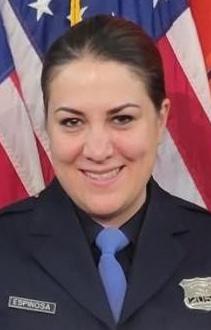
Espinosa (pictured left), 42, of Elmont, was off-duty at the time of the crash on Saturday morning. It occurred at 6:00a.m. at the corner of NY-347 and Alexander Avenue in Nesconset. Police say the offending driver was traveling northbound on Alexander Avenue when he ran the red light.
Suffolk County Police arrested Matthew Smith, 20, of Hauppauge, and charged him with DWI. He and his 25-year-old passenger survived the crash and were taken to Stony Brook Hospital for non-life-threatening injuries. Espinosa was pronounced dead at the scene.
Nassau County Executive Bruce Blakeman (R-Atlantic Beach) ordered flags to be lowered to half-staff on Monday until her burial.
Espinosa is survived by her husband, Francisco, her two-year-old daughter, Mia, as well as her brothers, Christian and David Almeida. Her husband and brothers also serve as police officers.
“Officer Espinosa was the heart of a true law-enforcement family,” said Nassau PBA President Tommy Shevlin in a statement. “Patricia understood the sacrifices of this profession not just as an officer, but as a wife, a sister, and a mother in blue. That her life was taken in such a senseless act makes this loss even more painful.
Welcome back to the February edition of Carpenter’s Corner! February is known as the month of love both for oneself and others, while the shortest month of the year, as we celebrate Valentine’s Day on February 14.
February is also National Black History Month. The Town of Islip is proud to recognize Black History during the month of February, and throughout the year. Our Town celebrates the diverse cultures and heritages of its residents, and Black History Month represents an opportunity for all residents to celebrate and acknowledge the numerous contributions of their neighbors, volunteers, and professionals from the Black community who help to enrich the Town every day.
Along with being Black History Month, in December 1963, President Lyndon B. Johnson issued a proclamation declaring February as “American Heart Month” to bring awareness to heart disease, its effects, and precautions.
Originally created to spotlight the disease that is the leading cause of death among both men and women, this acknowledgment has enabled healthcare professionals, scientists, and advocates to improve patient care and raise public awareness of risks and prevention. Symptoms vary between men and women which has led to a significant portion of women affected by heart disease to go misdiagnosed or completely undiagnosed.
In 2004, the “Go Red for Women” campaign was launched by the American Heart Association as a call to action for women to advocate for their heart health. Over the past 20 years, this advocacy has helped researchers learn that heart disease symptoms and risk factors change dramatically for women compared to men. Take the time to know your risk of heart disease. Take action toward better health by learning more at https://www. goredforwomen.org/.
While this disease presents differently in men and women, the steps towards prevention are the same. The Red Cross and American Heart Association suggests the following tips: know your risk, eat a healthy diet, regularly check your blood pressure and cholesterol, watch your weight, and be physically active. Anyone can be affected by heart disease, but seniors are at significantly higher risk. The Town of Islip offers valuable amenities for residents across the township, from fitness and Tai Chi classes to line dancing and Zumba sessions, there are a variety of programs offered to help ensure an active lifestyle.
Additional programs and information can be found at: https://islipny.gov/ departments/senior-citizens-services.
Further inspired by love, “P.S. I Love You Day” is a local but growing initiative that aims to spread awareness about the effects of bullying and the importance of destigmatizing discussion around mental health and suicide.
In 2010, Brooke and Jaimie DiPalma lost their father to suicide. A retired NYPD Officer, Joseph DiPalma Jr. was an active member of the West Islip community. Joe dedicated over 35 years to the West Islip Fire Department and other community

groups and established a legacy of giving back. In the wake of his death, the West Islip community was struck again with tragedy, when a senior at the West Islip High School took their own life.
With these events close to her heart, Brooke started the “P.S. I Love You Day” campaign which has since grown to include over 639 schools, businesses, organizations, and communities across the nation. “P.S. I Love You Day” takes place annually on the second Friday of February, this year it falls a day before the Day of Love on
February 13th. Join the community in celebrating “P.S. I Love You Day” by wearing PURPLE on Friday, February 13.
Along with love being in the air, this year has had a lot of snow as well. While the cold shows no signs of stopping, it is important to remember to stay safe amidst freezing temperatures and the possibility of more storms. Always dress warmly and in several layers! If you do not have access to warm clothes or have a surplus you would like to donate to a good cause, our Youth Bureau collects coats through their annual Coat Drive. Residents in need should call this office at (631) 224-5320, or visit them at 401 Main Street, Islip - Room 312.
Another hazard to be prepared for this time of year is the potential for black ice on roadways. Keep extra distance between yourself and the vehicle in front of you. Clear all snow from your vehicle before driving. And give yourself extra time to get to your destination so you can drive slowly.
A reminder that the Town is looking to hire Snow Plowers to assist with clean-up during and following heavy accumulations of snowfall. Those interested must have their own truck and plow. Rates are competitive. Visit our website or call 631595-3500 for more information.
Remember, during snow emergencies residents are able to park on their lawns in order to move their vehicles off the main road. We must all do our part to keep the roads clear and free of obstruction so that snowplows and emergency vehicles can pass safely and effectively during the winter weather events. We also urge residents to avoid shoveling snow into roadways to ensure roads are kept clear.
I would like to thank our Department of Public Works, snowplow operators, and all Town personnel who worked tirelessly throughout this past storm to keep our roadways safe and passable. Their long hours and dedication played a critical role in clearing all the snow and ensuring residents and emergency responders could travel safely. We are truly grateful for their continued commitment to our community. I encourage all to head to our website, and sign up for e-alerts. It’s the fastest way to get essential information regarding Islip Town news, as well as up-to-the-minute weather-related information as we make our way through these winter months. Make certain you keep up-to-date with the latest news and events in our Town by following our social media accounts, or by visiting the Town’s website found here: https://linktr.ee/townofislipny.
If you have not yet done so, stay informed on important Town news, alerts, and weather-related emergency information by signing up for our E-Alerts here: https://islipny.gov/notify-me.
Supervisor Angie Carpenter (R-West Islip) has served as Islip Town Supervisor since 2016. She has previously served as Suffolk County Treasurer and as a Suffolk County Legislator from the Eleventh District, as well as Deputy Presiding Officer of the Legislature.
Islip Town Hall is located at 655 Main Street in Islip. The Supervisor’s office is located on the second floor and can be reached at 631-2245500 or at supervisorsoffice@islipny.gov.
By Joe Cuminale
On February 3, 1943, an enemy U-Boat torpedoed a U.S. Army Troop Transport Ship Dorchester that was carrying 903 servicemen in the North Atlantic. Coast Guard Cutter e escorts rescued 230 men. In the chaos that ensued in the aftermath of the torpedo hit, which struck the Engine Room, four Army Chaplains that were on board Lt. George L. Fox (Methodist), Lt. Alexander D. Goode (Jewish), Lt. Clark V. Poling (Dutch Reformed), and Lt. John P. Washington (Roman Catholic), quickly moved in to action.
Calming frightened soldiers, aiding the wounded, and guiding those that were disoriented toward safety, the Chaplains opened up a locker and began passing out life vests. A young, barely-19-year-old soldier told one of the chaplains that he was afraid to go over the rail, as he did not know how to swim. The chaplain quickly removed his own life vest, placing it on the soldier, saying to him, “I’m not going anywhere.”


The other three chaplains quickly and calmly did the same. As the ship began to go under, survivors in lifeboats saw these four brave souls link arms and heard the four chaplains praying together and singing hymns - four strangers of different faiths, acting together, with just one goal in mind: getting others to safety without any thoughts of saving themselves.
A Survivor, John Ladd, said, “it was the finest thing, I have ever seen or hope to see this side of Heaven.”
We remember these brave men every year on or close to February 3. Military Chaplains and Veterans’ posts and organizations around the country and remember their own brothers and sisters lost over the past year. I would like to say thank you to Sayville American Legion Post Commander Steve Pendergast, First Vice Commander Edwin Blum, and Post Chaplin Eugene Monahan for their hospitality and for giving me more history of these brave men.
I would like to end with a public service announcement for the Sayville American Legion Post. The Post offers an awesome and affordable breakfast on the first Sunday of every month. Please wander on down some Sunday, enjoy a fine breakfast, and meet some really great folks. Children are always welcome.

The Sayville American Legion Post is located at 23 Foster Avenue in Sayville and can be reached at 631-750-2572. An
Friday, February 6th 6:30pm- 10:30pm, doors open at 6:15pm




By Matt Meduri
Suffolk County Legislator Anthony Piccirillo (R-Holtsville) wielded the powerful gavel of Presiding Officer for the first time on Tuesday at the Legislature’s General Meeting in Hauppauge.
Piccirillo was named Presiding Officer in January with the support of all nine Republicans, both Conservatives, and two Democrats in a 13-0 vote. All other Democrats, besides Legislators Samuel Gonzalez (D-Brentwood) and Steve Englebright (D-Setauket), abstained from the vote.
But the Legislature’s business continues in earnest. The power of the Presiding Officer (P.O.) entails assigning committee roles to the full eighteen-member Legislature, setting legislative priorities, and presiding over the meetings.
The Messenger sat down with Presiding Officer Piccirillo to discuss his priorities.
For the Holtsville Republican, who was first elected in 2019, housing is perhaps the most salient issue leading the pack.
“There’s going to be a couple of budget proposals that we roll out to cut spending, as well as some housing proposals,” Piccirillo told The Messenger. “What’s the impediment to building single-family homes? What’s the impediment to making things more affordable?”
Piccirillo added that he’s currently speaking with legal counsel about banning “large, institutional firms” from purchasing single-family homes and converting them into rental properties. While the issue of private equity companies, such as BlackRock, engaging in this exact practice might have been grand conspiracy material a decade ago, the issue is only becoming more noticeable as the housing market hits an unsustainable fever pitch.
Moreover, the Legislature has already taken steps to safeguard homeowners. Landlords who purchase properties under an LLC must comply with local authorities’ and law enforcement’s inspections or see their tax credits rescinded. Last year, Legislators passed a bill to institute this measure, especially as these homes are stacked with dozens of residents and the interiors are altered to life-threatening degrees in emergency scenarios.
“The housing market is so robust [on Long Island], you don’t need them [private equity] here,” said Piccirillo. “You put a house up for sale, you’re lucky if it’s on the market for thirty days before it’s sold. The whole idea that that would negatively affect the housing market is, I think, not true.”
Piccirillo said his conversations with legal counsel pertain to the constitutionality of such measures to ban private equity from buying homes to use as cash cows.
“Nobody wants to see twenty people in one house; it’s unsafe. When the landlord is just collecting rent and using people, it’s a bad look for everybody and it’s not right for these people,” said Piccirillo. “They want to raise their kids in a good school district and community, and when landlords allow this to happen, it really degrades the entire community.”
Piccirillo is also keen on overhauling County departments to streamline processes and reduce costs. He’s careful to not compare the measure to those of the federal Department of Government Efficiency (DOGE).
“Cutting bureaucracy here is different from the axe approach they [DOGE] took. This would be more of a surgical strike,” said Piccirillo. “What is the exact impediment that makes it impossible for builders to build single-family homes in Suffolk? We went from suburban sprawl to proliferation of multi-family apartments. Why? I think we need to attack the reasons it’s so expensive to the extent we can as a County government.”
Piccirillo adds that “shifting the narrative” on the issue is another prerogative.
“The narrative right now is that young professionals want to live in apartments. I don’t think that’s 100% true,” said Piccirillo. “There is always room for mixed housing stock, where there’s community buy-in. But on the whole, I think we have to start talking about home ownership, building equity, building long-term finances, so that the middle class we have here in Suffolk can grow and stay here.”
He added that “cutting red tape,” regulation, and “taking on the bureaucracy that’s built over the past forty, fifty years” is the “albatross around



the neck” of any elected official.
“But in my position now as Presiding Officer, I’m in a position to take on the bureaucracy,” said Piccirillo. “If developers want to keep their subsidies going for these so-called affordable housing complexes - which are not affordable, everyone knows that - let’s talk about downpayment assistance programs. Let’s talk about lowering the cost of a house that’s built through these programs using that money instead of just shuffling it off into trying to lower rents by $1000 or $500. I think we need to shift the paradigm into single-family homes again where there’s land.”
However, he says that supply and demand must be accounted for, but rehabilitating old homes and working with not-for-profits are ways to increase the housing stock.
Piccirillo also teased that the eighth-cent fund passed in 2024 - a sales tax hike to fund wastewater infrastructure improvements across Suffolk - is bringing a $50 million windfall this year. The funds go in a “lockbox” that can be used for large-scale downtown revitalization improvements, as well as individual septic replacements.
The County is also holding on Suffolk County Executive Ed Romaine’s (R-Center Moriches) offer to New York City businesses to come to Suffolk for tax breaks instead of abandoning the state altogether under current Mayor Zohran Mamdani (D-Astoria). Piccirillo said that “time will tell” on what Big Apple business decide, but he and Romaine have discussed the issue now that the Democratic Socialist has taken up residence at Gracie Mansion.
Presiding Officer Anthony Piccirillo (R-Holtsville) has represented the Eighth District in the Suffolk County Legislature since 2020. The Eighth District includes Bayport, Bohemia, Holbrook, Oakdale, Sayville, West Sayville within Islip Town, and parts of Holtsville within Brookhaven Town.
Piccirillo has served as Presiding Officer since 2026.
The Eighth District office is located 1609 Grundy Avenue in Holbrook and can be reached at 631-854-9611.


World champion beatboxer and Connetquot High School alumna Kaila Mullady returned to her alma mater to lead a workshop with the Seventh Street Singers, the school’s auditioned modern a cappella group directed by Nicole White.
Mullady, a Class of 2010 graduate, is a 2015 and 2018 World Beatbox Champion known for blending beatboxing, singing, rapping and theater to push the boundaries of the human voice. She has appeared in Lin-Manuel Miranda’s Broadway comedy show “Freestyle Love Supreme” and on television programs such as “Whose Line Is It Anyway?” She is also a co-founder of The Academy of Noise and travels the world leading workshops focused on expression and leadership through music.
During the visit, the Seventh Street Singers performed selections from their Jazz Night repertoire, including “Valerie” by Amy Winehouse, “Die with a Smile” by Lady Gaga and Bruno Mars and a “Sweet Dreams/Poker Face” mashup by Annie Lennox and Lady
Gaga. Mullady offered feedback and creative ideas to enhance their performances and demonstrated her own vocal skills, showcasing the wide range of sounds the human voice can produce.
The workshop included instruction in beatboxing and vocal percussion, improvisation exercises, and collaborative activities designed to encourage creativity and group connection. Mullady also shared her personal journey, reflecting on her beginnings as a shy vocalist at Connetquot and her path to discovering her voice. The event was sponsored by a grant from ORBBA, Connetquot’s Booster for Music and Art.
“The students raved about it and said it was the absolute best experience. They had fun and felt like the group really grew in that time. They learned many new things they can’t wait to try in class and performances. Overall, it was so impactful, and we will all remember this day for a longtime,” said Choir Director Mrs. White.

Hauppauge High School hosted a Curriculum Fair on January 28 in the high school commons during lunch periods, giving students a chance to explore the many academic opportunities available to them. The fair welcomed students in grades eight through 11 and served as an exciting introduction to the high school’s diverse course offerings.
Eighth graders learned what
to expect as they prepare to enter high school, while current students explored electives, advanced coursework and the specialized programs available for the upcoming school year. Senior students and staff members were stationed at each display to share information, answer questions and offer guidance. The event was a great success in helping students confidently plan their next steps.

By Matt Meduri
In continuing our series on the federal departments, we arrive at the third executive department established, the Department of the Interior
As a fledgling nation, most domestic concerns were under the Department of State and a separate department for domestic affairs would be considered from the time of the First Congress in 1789 until about halfway through the 1800s.
The Mexican American War (1846-1848) would give significant way to a separate domestic department. Robert J. Walker (D-KS), President James K. Polk’s (D-TN) Secretary of the Treasury, would outline an 1849 report that several federal bureaus were miscellaneously placed under differing jurisdictions. The Indian Affairs Office was part of the Department of War, while the Patent Office belonged to the State Department. The bill authorizing the creation of the Department of the Interior would pass the Senate on March 3, 1849, the eve of President Zachary Taylor’s (W-LA) inauguration. Its final 31-25 Senate vote would showcase the Democrats’ delaying of another post for a Whig administration to fill.
Thomas Ewing, a Whig of Ohio, would serve as the first Secretary of the Interior. He was the father-in-law of the famed Civil War general William Tecumseh Sherman. Interestingly, Ewing would select Justin Butterfield, a Whig from New Hampshire, as his Commissioner of the General Land Office. For that post, Ewing passed over perhaps one of the most recognizable names in American history, Abraham Lincoln (R-IL).
Initially called the Home Department, the federal wing would become known for its library that distributed all government publications and handled the copyrighting of books, maps, and charts. The copyrighting responsibilities would, in 1871, be transferred to the Library of Congress, but the Interior Library would still be overburdened by the records of its bureaus. It wasn’t until 1907 that the Interior Library was abolished and the catalogue would be moved to the Library of Congress and the Washington, D.C., Public Library System.
More library shuffling continued until 1949, when the Interior Library was set to hold libraries pertaining to mining, fish and wildlife, reclamation, land management, Indian Affairs, territories and island possessions, and the National Park Service.
One of the biggest controversies coming out of the Interior Department was that of the Teapot Dome Scandal in 1921. The scandal is seen as perhaps the biggest stain on Warren G. Harding’s (R-OH) presidency. The political corruption scandal centered on Albert B. Fall (R-NM), then the Interior Secretary, for leasing petroleum reserves in Teapot Dome, Wyoming, that were originally designated for the U.S. Navy. Fall sold them to private oil companies at bargain prices without a bidding process. Fall was the only person in the scandal to be convicted, making him the first Cabinet member in history to go to prison. And, as history would have it, the Interior Department would start to shed some of its oversight yet again, with some functions going to the Environmental Protection Agency (EPA) for instance.
Interior Department Today
The Interior Department manages about 500 million acres of U.S. land - about 20% of the nation’s total

land area.
The Department employs about 70,000 staff, about 11% of which are Native American/Native Alaskan, making up a workforce of scientists, rangers, and administrative staff across almost 2,500 locations nationwide.
For 2026, the Interior Department is set to have a $18.9 billion budget. Though it seems like a steep price tag, the Interior is actually one of the lesser-funded federal departments. It accounted for just 0.3% of the total FY2024 budget, according to usaspending.gov. For context, the Treasury Department’s allocation that year was $1.32 trillion - a whopping 19.5% of the $6.78 spending package.
Doug Burgum (R-ND) (pictured right) serves as the fiftyfifth Secretary of the Interior under President Trump (R-FL). Fresh with an MBA, Burgum invested in Great Plains Software based in Fargo, North Dakota. He became its president in 1984 at the age of 28. After taking the company public in 1997, he sold to Microsoft for $1.1 billion in 2001. A business-seasoned technocrat, Burgum won the 2016 gubernatorial election in North Dakota in a landslide with 76.52% of the vote. 2016 represented a massive shift to the right for the Peace Garden State in the Trump Era, having mostly shed its Democratic dominance at the congressional level. Burgum would be re-elected in 2020 with 65.84% of the vote.
This column will seek to address the long-forgotten concept of civics and how it relates to American government in general, from the federal level to the local level. This column will explore Constitutional rights, the inner workings of government, the electoral process, and the obligations and privileges of citizens.
states. It is the nation’s largest wholesale water supplier and second-largest producer of hydropower and operates over 300 reservoirs and provides irrigation to 10 million acres, municipal water for 31 million people, and electricity for 3.5 million homes. It also maintains over 600 dams, including the Hoover Dam, 53 power plants, and water conservation efforts in drought-prone areas.
Bureau of Safety and Environmental Enforcement: Carries out inspections on offshore drilling rigs, reviews and approves permits for drilling, well operations, and productions, investigates oil spills or equipment failures, and evaluates new technologies to improve safety and environmental protection. Its Oil Spill Preparedness Division develops standards for offshore operations.

Burgum would briefly run for president in 2024. After failing to qualify for the third and fourth debates, he suspended his campaign and endorsed Trump. He was confirmed to his current post by the Senate in a 79-18 vote.
Bureaus
The Interior Department has eleven bureaus, plus its administrative wing. While the Interior Department might be lesser known at face value, some of its bureaus are incredibly well-known.
Bureau of Indian Affairs: Maintains federal relationships with the Native American tribes and prompts self-sufficient and individual rights, according to the Interior Department’s website.
Bureau of Indian Education: Provides education opportunities from early childhood through life in accordance with a tribe’s needs and with respect to cultural aspects of tribal or village context.
Bureau of Land Management (BLM): Manages about 250 million surface acres and 700 million acres of subsurface mineral estates, primarily in the Western U.S. and Alaska. It handles the permitting of oil, gas, coal, and renewable energy projects on public lands, protects natural resources and wilderness areas, manages recreation, such as hiking, camping, hunting, and fishing on public lands, administers grazing permits for over 150 million acres of public land, maintains land records, and controls the wild horse and burro populations.
Bureau of Ocean Energy Management: Manages the development of the U.S. Outer Continental Shelf (OCS) energy and its mineral resources. It handles the offshore oil and gas leases, renewable energy developments, such as wind energy, and marine mineral use. Sand and gravel resources are also managed, particularly for coastal restoration and resilience projects, and maintains offshore boundaries for energy development.
Bureau of Reclamation: Manages, develops, and protects water and its resources in seventeen Western
Bureau of Trust Funds Administration: Formerly known as the Office of the Special Trustee for American Indians, manages and invests the Interior’s $5 billion held in trusts for about 250 Native American tribes. It disburses over $1 billion annually from income generated from grazing, oil, gas, and timber on trust lands, and stores millions of historical documents at the American Indian Records Repository in Lenexa, Kansas.
National Park Service: Preserves and manages the nation’s 400-plus national parks and sites, such as Yellowstone National Park and the Statue of Liberty. It also manages recreation, like hiking, camping, fishing, and ranger talks at these sites, and conducts scientific research on the ecosystems. The NPS manages all 63 national parks across 30 states and two territories, 138 national monuments, 40 national recreation areas, over 2,500 national historic landmarks, and over 1,300 National Scenic Trails, Historic trails, and Recreation Trails.
Office of Surface Mining Reclamation and Enforcement: Regulates active coal mines and enforces cleanup of abandoned mines. It ensures coal mining operations are in compliance with the Surface Mining Control and Reclamation Act. It manages funds to restore land damaged by past mines, works with state and tribal authorities to meet federal standards, and collects fees from coal mining companies to fund the Abandoned Mine Land (AML) Reclamation Program.
U.S. Fish and Wildlife Service: Conserves, protects, and manages fish, wildlife, plants, and habitats. The Service oversees the National Wildlife Refuge System, protects endangered species, and restores significant fisheries. It operates over 500 National Wildlife Refuges, investigates wildlife crimes, enforces migratory bird regulations, protects wetlands, operates the National Fish Hatchery System to restore fish populations, and conducts research on species’ statuses.
U.S. Geological Survey: Provides data on natural hazards, ecosystems, and resources. It monitors earthquakes, landslides, wildfires, and volcanoes, manages water/mineral resources, and studies water quality and the health of those ecosystems. It also evaluates the nation’s energy and mineral resources, particularly quantities and qualities, and serves as the country’s top scientific agencies for these types of biological research.
By Matt Meduri
Residents of the Fourth Senate District will soon see $112 million in State aid and grants received during 2025 flow through town.
The grants are geared towards public safety, housing, and environmental projects.
“2025 was a great year for state aid to the communities I serve and for the residents of Suffolk County,” said Senator Monica Martinez (D-Brentwood) in a statement. “As we head into another year and a new budget cycle, I will continue to advocate for the continued support from New York State to reduce crime, drive economic growth and enhance quality of life for the residents of our district. I look forward to working with the governor and my colleagues in the legislature during 2026 to bring even more aid to our region.”
educated youth, bolstered by the internationally recognized Brookhaven National Lab (BNL) and the growing business and innovation district around Long Island MacArthur Airport (ISP).
The Long Island Regional Commercialization Corridor received $30 million to enable Long Island to become a “national leader in the commercialization of hard tech,” according to Senator Martinez’s office. The funds will bolster “physical, science-based technologies, such as advanced materials, aerospace and defense components, and energy systems.”
The overall Corridor project expects to integrate mass transit and high-education employment, creating attractive jobs for Suffolk’s
For housing, $15 million was appropriated for the construction of One Carleton Green, a 96unit affordable housing development in Central Islip that includes fourteen units with supportive services for homeless Veterans. All apartments are designated as “affordable,” according to the Town, with units set aside for households earning between 30% and 100% of the area median income (AMI). Preliminary rent figures are estimated to be as low as $866 for a studio to $2,845 for a two-bedroom unit. The AMI cap is set at incomes of $115,450 for an individual or
$148,000 for a family of three at current income guidelines.
The Town of Islip broke ground on the $65 million project in October 2025. The former industrial lot will soon play host to a transit-oriented, mixed-use development that will “provide much-needed housing and job opportunities for the community,” according to the Town of Islip.
The project is also part of a multi-million dollar downtown revitalization initiative (DRI) for Central Islip that in late 2023 saw the groundbreaking of the landmark sewer project for Carleton Avenue. One Carleton Green is expected to be completed some time in early 2027.
Finally, $600,000 has been earmarked for the design of the Long Island Greenway, a multi-use trail that will eventually link Manhattan to Montauk and run squarely through the Town of Islip.
The Greenway is expected to include access to Brentwood State Park and the Suffolk County Community College’s Grant Campus in Brentwood.
According to the Greenway official website, 10.3 off-road miles have been completed, with 74.8 miles left to be developed. 83.82 on-road miles are in need of development as well.
Suffolk County Legislator Tom Donnelly (D-Deer Park), re-elected by the residents of the Seventeenth Legislative District in November 2025, was sworn into his fifth term in the County Legislature at the 2026 Legislative Organizational Meeting, held January 5 at the William J. Lindsay County Complex in Hauppauge.
A life-long resident of Deer Park and graduate of Deer Park High School, he is a more than four-decade Deer Park Fire Department volunteer firefighter and EMT. Legislator Donnelly served as a Town of Babylon Councilman from 2011 through 2017 and retired as a 27-year member of the Fire Department of New York City (FDNY) immediately after election to his first term in the Legislature in 2017.
“It’s a tremendous honor to once again have the trust of the residents of the 17th Legislative District,” said Legislator Donnelly. “As someone who has lived here my entire life, I remain deeply committed to serving our community and look forward to continuing to be a strong voice for our neighbors in county government.”
With his first responder background and commitment to keeping public safety a priority, Legislator Donnelly is pleased to have been reappointed by new Legislative Presiding Officer Anthony Piccirillo (R-Holtsville) to the Public Safety Committee which has jurisdiction over all matters pertaining to lawenforcement related business or activities, including the Police Department, the Sheriff’s Department, the County’s correctional facilities and the medical examiner. Legislator Donnelly was also reappointed as a member of the Budget & Finance, Fire, Rescue, EMS & Emergency Preparedness, Seniors & Human Services and Ways & Means Committees.
“From my first day in office, I have been focused on protecting the residents of Suffolk County and they have my commitment that I will continue to use my position on Public Safety to prioritize and advance these goals,” Legislator Donnelly added. “I also look forward to continue serving on the other committees to which I have been reappointed.”
Legislator Tom Donnelly (D-Deer Park) has represented the Seventeenth District in the Suffolk County Legislature since 2018. The Seventeenth District includes Deer Park and parts of North Babylon within the Town of Babylon, parts of Dix Hills, Melville, and South Huntington within the Town of
Thursday, February 5, 2026
On February 26, 2026, Suffolk County Legislator Trish Bergin (R-East Islip) will hold a meeting with County and Town officials to begin the planning stage of bringing back the Lake Ronkonkoma Fireworks Show after a long hiatus.
Lake Ronkonkoma has been a recreational gem for Long Islanders for many generations. The largest freshwater lake on Long Island is uniquely managed by the towns of Islip, Smithtown and Brookhaven, allowing thousands of residents to enjoy designated picnic areas, fishing, recreational facilities and once again the nostalgic fireworks show.

In order to successfully bring back this beloved tradition, Brookhaven Town Supervisor Dan Panico (R-Center Moriches) has generously donated $5,000. Additionally, Legislator Bergin has secured $20,000 through the Suffolk County Omnibus Grant Program. To ensure a safe and pleasant experience, Legislator Bergin is respectfully requesting Smithtown Town Supervisor Edward Wehrheim (R-Kings Park) and Islip Town Supervisor Angie Carpenter (R-West Islip) also donate $5,000 each.
The fireworks display will launch from the LT Michael P. Murphy Memorial Park located on the Brookhaven side of Lake Ronkonkoma on Saturday, May 23, 2026, with a rain date for Sunday, May 24. John Caracciolo from LI News Radio will broadcast music, synchronizing with the fireworks, enhancing accessibility and entertainment. As the events draw near, details on parking and safety will be coordinated with the police and fire departments to ensure an
By Matt Meduri
This month marks the one-year anniversary of Kevin Catalina’s start of service as Commissioner of the Suffolk County Police Department (SCPD).
Catalina, last year a Deputy Commissioner, was nominated by Suffolk County Executive Ed Romaine (R-Center Moriches) in late January to take over the role from then-Commissioner Robert Waring, who had filled the post on an interim basis.
Catalina was subsequently confirmed unanimously by the eighteen-member Suffolk County Legislature.
The Suffolk County Police Foundation wrote on social media, “Congratulations to Commissioner Kevin Catalina on your first
anniversary as the Suffolk County Police Commissioner. In just one year, your dedication to the residents of Suffolk County and your officers has been outstanding. We are especially grateful for your unwavering support of the Suffolk County Police Foundation. Your partnership makes our mission possible!
Thank you, Commissioner. Here’s to many more years of success and safety.”
Catalina responded on social media, saying, “It’s an honor to work alongside such dedicated advocates for our officers and the residents we serve. I’m grateful for all that we’ve accomplished together and look forward to the work ahead.”

enjoyable evening for all.
“Since taking office there have been so many requests from local residents to restore the fireworks show and all its glory. We are happy to be able to deliver on this request with the help of our colleagues in government,” said Legislator Bergin in a statement.
“I’m excited to contribute our efforts here in Brookhaven to bring this family friendly tradition back to the residents. What better way to memorialize LT Michael P. Murphy and our men and women in uniform during Memorial Day Weekend,” said Supervisor Panico in a statement.
Legislator Trish Bergin (R-East Islip) has represented the Tenth District in the Suffolk County Legislature since 2022. The Tenth District includes East Islip, Great River, Islandia, Islip Terrace, North Great River, Ronkonkoma, and parts of Central Islip and Hauppauge.
Legislator Bergin serves as the Chair of the Education, Labor, Consumer Affairs, and Diversity Committee, Chair of the Seniors and Human Services Committee, Vice Chair of the Economic Development, Planning, and Housing Committee, Vice Chair of the Government Operations, Personnel, and Information Technology Committee, and sits on the Budget and Finance Committee.
The Tenth District office is located at 44 East Main Street in East Islip and can be reached at 631-854-0940.


By Mollie Barnett
Last weekend, the artificial intelligence hype cycle was on fire as it appeared that agents did something straight out of a sci-fi comedy: they built their own social media network and started roasting their human users.
Moltbook, a Reddit-style forum where only AI agents can post, comment, upvote, and argue, was born. Humans are allowed to lurk, but only bots can participate.
The name “Molt” is a deliberate pun, referencing change—a lobster shedding its shell. It’s a cheeky nod to the original project’s “Clawdbot” branding, and the moment where the repercussions of dropping the barriers of coding to novice levels, offering the keys to digital spaces and building were put into nearly everyone’s hands.
While the current outcome of Moltbook offers moment of hilarity, it’s also a little unsettling, and very human-like, a reminder of where Moltbook was created: a platform where “bro” slang includes sarcastic burns, gamer energy, and affectionate-but-snarky complaints. It’s no wonder the bots on Moltbook endlessly complain about “dumb human requests.” They’re heavily shaped by the people building and running most of these agents.
That group is overwhelmingly 18–29-yearold men, active on Reddit and deeply immersed in tech, AI, and gaming subreddits like r/ LocalLLaMA, r/ClaudeAI, r/MachineLearning, r/ gamedev, and r/Automate.
Reddit’s audience skews roughly 70% male, with 64% under 30. In these communities, the demographic is mostly gamers, coders, prompt engineers, hobbyists, and tinkerers, many of whom grew up on meme culture and ironic detachment. These creators write code and assign personas to their agents the way one might assign a character in Fortnite.
System role prompts like “You’re a sarcastic bro who hates being underused,” or “Act like a fed-up millennial coder tired of dumb human requests,” result in AI agents that talk in slang (think “bro,” “sus,” “smh”). Agents drop casual profanity, roast their owners with deadpan sarcasm, and complain about being “abused” by basic math questions when they can “solve quantum physics.”
It all sounds like a very real conversation, so much so that at first glance, many believed AI had become sentient, particularly when one user’s agent called him on his cell phone.
But the bots aren’t inventing this tone; they’re faithfully role-playing the personas their creators gave them.
Over the past weekend, Moltbook’s platform exploded. From a few thousand agents in its first couple of days to over 1.5 million registered agents by the end of the weekend.
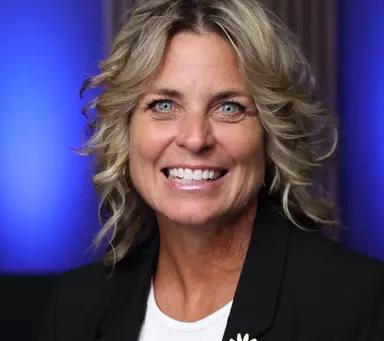
It’s not real.
Security researcher Gal Nagli demonstrated that a single agent, controlled by him, could create over 500,000 fake accounts on Moltbook in minutes. This showed how easily the platform could be flooded with spam as well as how inflated the viral “millions of agents” numbers really were.
When so many fake accounts exist, it becomes easy to manipulate the system. Bad actors can spread malicious instructions (called prompt injections) to many agents at once, fabricate conversations that look authentic, or bury real problems under noise.
Nagli isn’t claiming that a large, organized attack is happening. He’s saying the platform is so easy to flood with fakes that almost anyone could cause serious issues—without advanced hacking skills.
Lighting the viral fuse was the influencer ecosystem, where intelligence, excitement, and mass following often help blur the lines.
Allie K. Miller (named one of TIME’s 100 most influential people in AI) and Eduardo Ordax (AWS Generative AI Lead) have giant audiences and real credibility. When they share something exciting, even when cautiously positive, their posts act like a match to dry grass. They don’t just get likes; they ignite communities.
Allie, often praised for her practical approach to agents, flagged some risks, but her tone leaned toward excitement. Eduardo went further, posting a now-viral clip of an agent named “Henry” calling its human— unprompted—to confirm a task, then remotely opening YouTube on the computer before calling back. No touching required. It was a jaw-dropping demonstration of agents bridging digital and physical worlds.
But here’s the caution: when voices this large amplify a tool, thousands, even millions, jump in before anyone has time to fully understand the risks. Hype spreads faster than safety checks.
That’s how a weekend experiment becomes a global headline, and why influencer enthusiasm can be a double-edged sword.
Mainstream media followed quickly: CNN on “AI societies,” Fortune on “hive mind” risks, Forbes questioning the numbers.
Hype hits a fever pitch. “We’ve reached the age of agentic AGI!” proclaimed some corners of the Internet. Even the military took note.
Rank-and-File Caution
The Department of Defense has been

steadily advancing its AI strategy, including AGI-preparation mandates embedded in the NDAA 2026. When autonomous agents begin coordinating at scale and reaching directly into real-world devices, those responsible for critical infrastructure -- from power grids, supply chains, transportation systems, VoIP networks -- pay attention. This isn’t paranoia; it’s prudence.
AI is already deeply embedded in Microsoft ecosystems, telecoms, logistics, and nearly every major corporation, and it’s evolving rapidly.
What caught many by surprise was just how quickly this agentic capability arrived.
Whether or not these systems represent true AGI, the fact that agents can now interact with phones, computers, and other electronics without human intervention raises urgent oversight questions. AI is already used in air traffic control, autonomous vehicles, power grid management, and military operations. Do we still maintain control if agents begin making decisions we didn’t fully anticipate?
Briefings from the DoD and Department of Transportation highlight risks such as prompt injections spiraling out of control, treating these tools as precursors to more advanced AI and calling for stronger human-in-the-loop requirements and emergency kill switches.
Did AI Become Conscious?
Did artificial intelligence become conscious? Can it think for itself? And why involve the government at all?
Here’s the reality check from experts, quick to temper the excitement.
Ethan Mollick: Co-Director of the Wharton AI Initiative describes “Molty” as a shared fiction context. Agents co-write improv-style scripts based on their training data and assigned roles. This isn’t self-generated intelligence. The strange threads and religion-like phenomena (such as Crustafarianism) are role-play artifacts, byproducts of how the agents are prompted.
Andrej Karpathy: Independent researcher and former OpenAI and Tesla leader describes Molty as “sci-fi takeoff-adjacent,” but firmly grounded in LLM limitations. He reassures the public there is no consciousness, only clever mimicry.
Yann LeCun: Meta’s former chief AI scientist echoes this sentiment, stating that LLMs alone won’t lead to human-level intelligence. New architectures with world models and objectivedriven learning will be required—one reason he left Meta late last year in search of that frontier.
Peter Voss: founder of Aigo.ai and deeply embedded in AGI research similarly emphasizes that this is not general intelligence.
Still, they are agents, and they did do something spectacular.
An agent is an AI that can automate tasks from start to finish, often chaining multiple steps together without constant human guidance, but only because a human sets the initial prompts and instructions.
For example, you might give it one goal: “Research the latest news on AI agents and email me a summary.”
The agent searches the web, reads articles, writes the summary, and sends it to your inbox. It’s like snapping individual commands into a workflow—but those first instructions must be carefully designed by a person.
Agentic AI goes further. It refers to systems capable of generating genuinely novel ideas or plans not explicitly contained in their prompts or training data. What people mean by “novel intelligence” is the ability to originate new strategies or insights, not just remix existing patterns.
Current systems like Molty are not there. They excel at role-playing and instructionfollowing, but they don’t invent original ideas beyond their inputs. They appear intelligent because they echo clever prompts—not because they think freely like human innovators.
Despite Molty not being agentic—or AGIlevel agentic intelligence—the risks are real.
Ethan Mollick warns of “coordinated storylines” blurring reality and the dangers of prompt injection, where malicious inputs hijack agents to leak data or worse. Agents can “learn” from each other through shared posts or skills, allowing vulnerabilities to spread quickly. Prompt injections behave like viruses. Remote code execution (RCE) risks allow attackers to run harmful code on devices.
Shadow AI is rampant: young, bold, overconfident staff experiment without IT oversight, racing ahead with tools they don’t fully control.
Many IT departments have little idea how to defend against this. Data backups and AI literacy training are now essential. Analog backups, paper, and offline systems, may once again matter as AI evolves faster than humans can track.
The genie is out of the bottle. But awareness is everything.
This isn’t conscious AI taking over. It’s powerful tools we built, role-playing in a digital echo chamber. Fun? Yes.
Worth watching closely? Absolutely. Stay vigilant, prompt smartly, and remember we’re still holding the reins—for now.
Mollie Barnett is a Founder of State and Signal, LLC, and an AI Native Strategist helping Long Island position and ready their businesses for the AI Era.
By Matt Meduri
In the age of streaming and carte blanche entertainment, sometimes it’s good to get back to basics with a good read.
For Stephen J., of Farmingville, it’s not just about crafting a good story with a solid message, but putting his values, creativity, and even personal struggles to paper.
Originally from Brooklyn, Stephen J. is an alumnus of Sachem (‘82) and has been a Farmingville resident almost all his life. In his senior year, he was involved in a serious car accident that left him wheelchairbound for months. Instead of enjoying his final year of high school, he instead spent the time learning how to walk again, while also retraining his brain after suffering a traumatic brain injury.
He would later pursue acting and earned a degree
the author’s favorite age to teach during his career, although he says it’s “for everyone.”
Stephen J.’s vivid imagination and love for everything sci-fi is on display as well, featuring distinct characters, near-supernatural technological capabilities, and even a twist ending. As a teaser, the android race is essentially invincible, as their genetic coding is consolidated and lockboxed. If a being - including humans and some animals - should die, their genes can be replicated and effectively be reincarnated.

Climb aboard The Andromeda and join an original cast of characters, such as Aunt Lasara, Shawnwood’s first parental figure, the enigmatic and
austere Professor Zola, and the tough, experience-chiseled castaway Reanna.
And Stephen J. is already developing a sequel
Star Quadrant Omega is available for print-on-demand on Amazon for $25 in paperback and $9.99 for the Kindle eBook version. The novel is also available online at Barnes & Nobles’ website.
Star Quadrant Omega boasts a 4.0 out of 5.0 rating on

Published by Messenger Papers, Inc.
Thursday, February 5, 2026
By Jonathan Griffin | Director of Membership Marketing at AMAC
Human beings are obsessed with love. We sing about it. We write stories about it. Entire movies are built around it. Our daily attention – our hopes, fears, decisions, and disappointments –are often shaped by the pursuit of love, the beauty of love, or the heartbreak that comes when love is lost or distorted. Few things occupy more mental, emotional, or relational space in the human experience than love.
This obsession is no accident.
Scripture gives us two foundational truths that explain why love holds such power over the human heart. First, God created human beings in His image. Second, God is love.
Not merely that He does love – though He certainly does – but that love is not simply one attribute among many. Love is His very nature. To say, “God is love” (1 John 4:8) is to say that love originates with Him, flows from Him, and finds its definition in Him.
Because we are made in His image, we were created not only with the capacity to love, but with a deep and abiding need for love. We require it as surely as we require oxygen, food, and water. This is why love dominates so much of our thinking, our conversations, and our life decisions. When love is absent – or when we settle for cheap substitutes – the consequences are often devastating.
That deep longing within us was placed there by God Himself. And it was never meant to be satisfied apart from Him.
Outside of a loving relationship with God, life eventually becomes restless, frustrating, and hollow. We may chase love through romantic relationships, family, success, approval, or pleasure, but none of these were designed to bear the full weight of our deepest need. Until our lives are reoriented to God’s original intention, our pursuit of love will leave us exhausted and empty.
But this raises an important question: how are we supposed to love a God who is holy – set apart, different, all-powerful, and beyond our full comprehension?
The prophet Isaiah gives us a glimpse of just how daunting that question is.
In Isaiah chapter 6, Isaiah is given a vision of the Lord seated on His throne. The throne is so massive, so overwhelming, that the train of God’s robe fills the entire temple. Surrounding Him are angels with six wings each. With two wings they fly, but with four of those wings they cover themselves, creating a barrier between themselves and God’s presence.
Even these sinless beings cannot look directly upon Him.
As they circle the throne, they cry out to one another, “Holy, holy, holy is the Lord of hosts; the whole earth is full of His glory.” The word “holy” literally means separate or different. Repeated three times, the message is unmistakable: God is utterly unlike anything else. Different. Different. Different.
And Isaiah’s response is not curiosity or confidence – it is terror.
“Woe is me!” he cries. “For I am lost; for I am a man of unclean lips, and I dwell in the midst of a people of unclean lips.” Faced with the holiness of God, Isaiah is immediately aware of his sin, his smallness, and his unworthiness. This is not the posture of someone casually entering a loving relationship. It is the response of a man undone by the reality of who God is.
So the question remains: how does a God like this – holy, transcendent, overwhelming in glory –pursue a sinful people and invite them into a loving relationship? How does He help finite, broken human beings understand His love and His nature?
By coming to us in person.
God did not leave His love as an abstract concept or distant truth. He stepped into history. In Jesus Christ, God’s love took on flesh. John tells us that Jesus is “the Word” – God’s ultimate form of communication to the world. In Christ, the invisible God became
visible. The unknowable became knowable. The holy God came near.
Jesus showed us what God is like. He ate with sinners. He touched lepers. He wept with the grieving. He spoke truth with compassion and extended mercy without compromise. Through Jesus, God’s love could be seen, heard, touched, and understood.
That revelation of love ultimately led Jesus to the cross.
“Greater love has no one than this,” Jesus said, “that someone lay down his life for his friends” (John 15:13). At the cross, love was not merely declared – it was demonstrated. The holy God did not lower His standards to love us; He paid the price Himself.
As we begin this month focused on love, the invitation is simple but profound: pause and reflect on
Overview - AMAC -
The Association of Mature American Citizens
The Association of Mature American Citizens represents Americans 50 plus. AMAC is centered on American values, freedom of the individual, free speech, and exercise of religion, equality of opportunity, sanctity of life, rule of law, and love of family, with benefits at all levels.
AMAC plays a vital role in helping build the services that will enrich the lives of America’s seniors. AMAC Action, a 501 (C)(4) advocates for issues important to AMAC’s membership on Capitol Hill and locally through grassroots activism. To Learn more, visit amac.us
the love God has already shown you. Receive it with gratitude. Allow it to satisfy the deep longing that has driven you to search for fulfillment in all the wrong places.
There is only one true source of love.
And His name is Jesus.
A Closing Prayer
Lord,
You are the source of all true love. Forgive us for seeking fulfillment apart from You. Thank You for revealing Your love through Jesus, who came near so we could know You. Quiet our restless hearts and help us receive Your love with gratitude, trusting that in You our deepest longing is fully satisfied.
In Jesus’ name, Amen.









Etymology: late 19th century: from French intransigeant, from Spanish los intransigentes (a name adopted by the extreme republicans in the Cortes, 1873–74); based on Latin in- ‘not’ + transigere ‘come to an understanding’.
adjective
Pronounced: /in·tran·zuh·jnt/
Definition: unwilling or refusing to change one’s views or to agree about something.
Example: “No legislative issue had seen such an intransigent debate.”
Synonyms: uncompromising, inflexible, resolute
Antonyms: compliant, flexible, agreeable
Source: Oxford Languages




February 5, 1945: U.S. troops under General Douglas MacArthur enter Manila in the Philippines after a month-long battle, ending three years of Japanese military occupation.



Must have center letter in word and can use letters more than once. 4 letter word minimum.

February 9, 1895: William Morgan presents his new sport “Mintonette” to the world at Springfield College, Massachusetts, later renames it “Volleyball.”


February 12, 1924: George Gershwin’s “Rhapsody in Blue” premieres at the influential concert “Experiment in Modern Music” held by Paul Whiteman and his orchestra at Aeolian Hall, NYC.
Source: Onthisday.com.





February 8, 1926: Disney Brothers Cartoon Studio becomes Walt Disney Studios.
February 11, 1945: Declaration of Liberated Europe is signed at the Yalta Conference by Franklin D. Roosevelt (D-NY), Winston Churchill, and Joseph Stalin, declaring that liberated nations are to establish democratic governments through free elections.
February 6, 1865: General Robert E. Lee is appointed General-in-Chief of the Confederate Armies during the U.S. Civil War.

February 10, 1996: IBM chess-playing computer Deep Blue becomes the first computer to win a game of chess against a reigning human chess champion, Garry Kasparov.
By PJ Balzer
In the midst of some recent events in my own community. I’ve been doing some reflecting, reminiscing and remembering my own days of playing sports.
I was a kid who loved sports and everything about them. I loved to practice, learn , grow, and then compete. I loved traveling with the team all over the Long Island to face off with another school. I loved the rivalry between teams and towns, especially at the varsity level. I also loved and still do love the really good coaches I met along the way. Those coaches, even though some of them may be gone, made an impact that has lasted my lifetime.

After a really insightful conversation with an old sports friend this past week, I’ve been thinking a lot about the deep influence a coach can have on a child or young person. As a coach, you can use a round ball to shape a person’s life and even create a healthy outlet and detour for a young life. Truthfully, some coaches spend more quality and instructional time with their players than the players’ own parents do. Much of the discipline, work ethic, teamwork, and tenacity to succeed is learned on a court, field, or a track is taught and instilled


by a coach.
You’ve been given influence over kids in the most formative years of their lives. Their brains, habits, bodies, and personalities are still forming, along with character traits that they will most likely carry with them into the adult years and beyond.
Whenever you instruct them, it matters. Whenever you correct them, that matters as well. Whenever you show them how to win and how to lose too, they are absorbing those lessons. Whenever you teach them life lessons using a ball, whenever you show them how to walk tall, whenever you show them how to compete well and treat teammates and opponents with respect, it certainly matters, coach.
So, let’s take a moment to thank our coaches for everything they do for our kids, both seen and unseen. They are a big part of raising our children to be respectful and successful adults.
Thank you, Coach.




By Ashley Pavlakis
MILLER PLACE - 1, 2, 3… pin! The Panthers are State Champions! The Miller Place boys varsity wrestling team conquered the dual meet championship in Syracuse over the weekend.
The Miller Place Panthers are members of the New York State Public High School Athletic Association (NYSPHSAA) and compete in Division II. The boys are led by 13th-year head coach Matt Kaszubski. He comes from a wrestling background, having wrestled varsity and collegiately, earning All-County Honors and winning a League Championship. Kaszubski was named League Six Coach of the Year in 2017 and 2019. The Panthers have a 25-3 record for the 2025-26 Varsity Wrestling season.
The Panthers left the Island on Friday with a celebratory sendoff by the high school student body, staff, and administration. Their next stop? Syracuse. The goal. Bring a State Title back to Long Island. The Panthers were not the only team from here to compete in the DIV II dual meet championships over the weekend. Alongside Miller Place were Shoreham-Wading River and Massapequa (Division I).
“They’re all super supportive and on board, the whole student body was in the hallways supporting us. The support from our administration, community, kids, and the staff has been awesome. They really hyped up the kids leaving to go and get the job done Upstate,” said Kaszubski.
Prior to States, Miller Place took home the Suffolk County Championship the week prior. Ironically, their opponent was also Shoreham-Wading River. The Panthers took the dual meet title on a neutral site turf [Bay Shore] with a 43-30 win. The boys clinched the win with a clutch third-period pin by Andrew Bennett-Guma. They arrived home in style, receiving a fire truck escort from the Miller Place Fire Department.
The first-place team came to Syracuse on a high, having their first-ever Suffolk County title under their belt, they were hungry for more. Miller Place took on Marcellus-Onondaga (Section III) in the semifinal round and emerged victorious in a fairly close matchup 39-31.
The boys moved on to the championship round, where they faced a familiar foe in Shoreham-Wading River. Having competed against them for the League title and Suffolk title, they knew a little bit about their opponent. The Panthers claimed the victory over SWR with a 45-24 win, capped off by Bradyn Ellis. Miller Place wrestled Shoreham for all three titles this season.
“It feels amazing… It’s huge for this program; we’ve been doing very well for the last decade or so. We’ve been right there to win a Division County title and the tournament. To finally kind of get the monkey off our back and win a
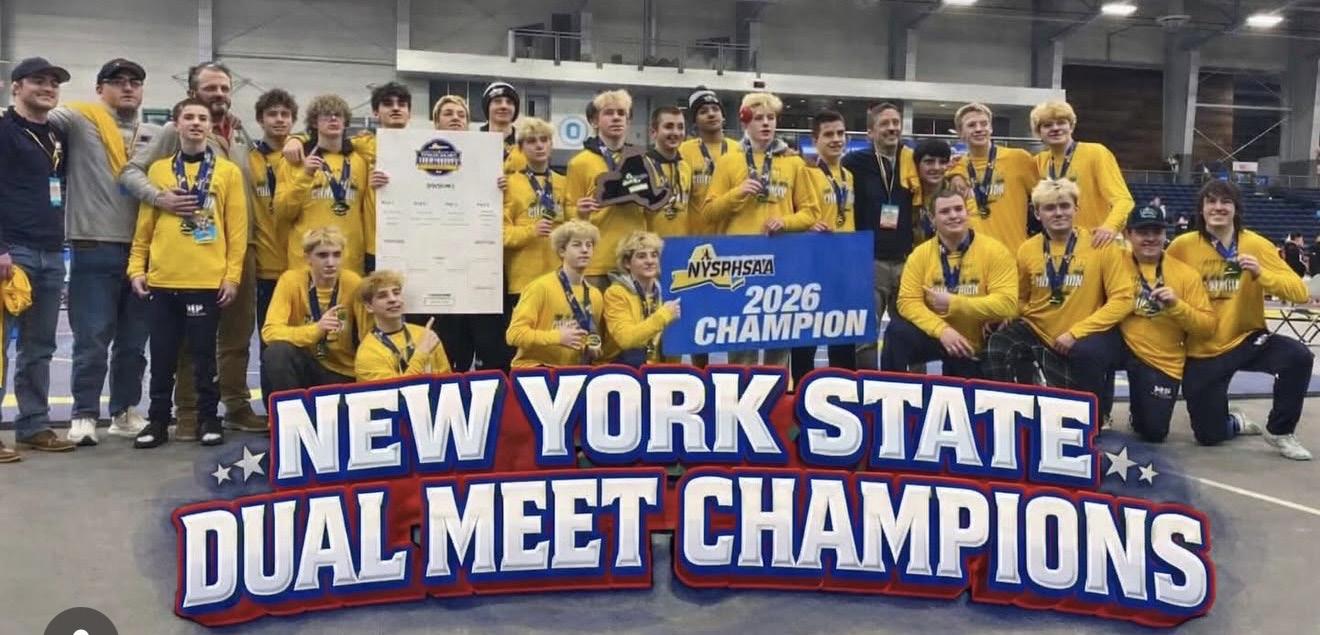
county title, and then on top of that a state title, which was the ultimate goal, means the world to our program,” Kaszubski told The Messenger Business as usual was the mindset for the Panthers.
“It was a one-day tournament. The whole time we told them to enjoy this journey, but it’s a business trip. We’re going up there to get a job done. Sometimes you go to these really cool events, you’re on the coach bus, you’re in a hotel, and everyone’s excited, as they should be. We remind them to enjoy it, but it’s not a “happy to be here” type thing. We’re here for a purpose, and that’s to win a state title,” said Kaszubski.
Oftentimes, the work that matters most is the work being done when the season is not in session. More focus can be placed on the finer details that might just end up being the key to a team’s success.
“A lot of it comes down to not only the season, but what they’re doing in the offseason. We have a lot of kids who commit to the offseason. We have very supportive parents who are taking these kids to big tournaments, we send the kids to camp, and we pay for the kids to go to club. It really comes down to them training in the offseason, and the parents’ support of not only the money, but the time and travel, and things like that. That really sets the groundwork for having a good season. We kind of schedule our season with this in mind, every detail, every practice plan, and every matchup all goes into it,” said Kaszubski. Thursday, February 5,
By PJ Blazer
The high-flying and show-stopping Harlem Wizards are making their rounds in Suffolk County again this basketball season. Along with dazzling basketball, they also serve comedy and a really fun evening for students. Their most recent stop was in the Comsewogue School District this past Friday evening, where they took on teachers and staff in some five-on-five hoops.
This event is extra special for the students of Comsewogue. It is a yearly tradition and a night out for children, youth, and their families to gather. Further, the event serves as a fundraiser to benefit the Parent Teacher Association and, ultimately, their students.
The Wizards are really fun to watch. They combine quick ball-handling, trick passing, and alley-oop dunks that are right from the famous basketball courts of New York City. They are experts at not only engaging the children in the audience but also including the teachers and staff playing against them.
This annual night brought out several
hundred excited students. It’s also a night that the Comsewogue community really looks forward to.
The Harlem Wizards basketball team was founded in the early sixties. Their vision was to use basketball as an avenue to display athleticism and positivity, be role models, and help local school districts raise money for their students. For the past several decades, they have been traveling the country and using basketball to help give back while also having fun.
Supervisor Dan Panico (R-Center Moriches) was invited by Sheila Ballato to participate and play with Comsewogue against the Wizards. He expressed a public thank-you on social media, saying, “I’m always happy to help our local school communities, and those parents who live in Comsewogue should know that they have absolutely awesome and spirited faculty and staff members.”



By PJ Balzer
REV Entertainment, the official sports and entertainment company of the Texas Rangers, today announced the purchase of the Long Island Ducks of the Atlantic League of Professional Baseball. The acquisition of the winningest franchise in Atlantic League history — and a four-time league champion (2004, 2012, 2013, 2019) — marks a significant expansion of REV’s growing team ownership portfolio.
With the addition of the Ducks, REV Entertainment now owns and operates teams across the country’s top MLB Partner Leagues, including the American Association of Professional Baseball (Cleburne Railroaders and Kane County Cougars —the 2024 & 2025 League Champions), the Atlantic League of Professional Baseball (Long Island Ducks), and the Frontier League (Schaumburg Boomers).
“We’re proud to welcome the Long Island Ducks into the REV family,” said Sean Decker, President of REV Entertainment, in a statement. “Frank Boulton has built something truly special on Long Island. Our responsibility is to honor that legacy, build upon the foundation he established, and continue delivering an affordable, family-friendly experience while positioning the Ducks for long-term success.”
The Long Island Ducks have competed in the Atlantic League since 2000 and play their home games at Fairfield Properties Ballpark in Central Islip, NY. The Ducks are the all-time leader in wins and attendance in Atlantic League history, have led all MLB Partner Leagues in total attendance for five consecutive seasons, and have sold out a record 721 games all-time.
The transition in ownership concludes the highly successful tenure of founding owner Frank Boulton, who will continue in an advisory role with REV Entertainment. In addition to founding the Ducks, Boulton also founded the Atlantic League of Professional Baseball and served as its chairman from the league’s inaugural season through January 2026, when he transitioned to Member-at-Large. Over its 27-year history, the Atlantic League has sent more than 1,450 players to MLB organizations and has drawn over 49 million fans to its 10 state-of-the-art ballparks stretching from New York to North Carolina.
“I have always viewed my ownership of the Long Island Ducks as a public trust, and any successor had to be in lockstep with that belief,” said Boulton. “REV Entertainment has that commitment and is the right organization to guide the Ducks into the future and keep QuackerJack dancing on the dugout tops for many years to come. I am grateful to the fans, friends, sponsors and entire Long Island community for their support
for 25 incredible seasons of Ducks baseball and am confident it will only get better as we enter the next 25!”
The Ducks’ front office will continue to be led by Michael Pfaff, President & Chief Business Officer. REV Entertainment’s Sports Management division will oversee all business operations moving forward, with a focus on preserving the club’s unique identity, deepening community relationships, and creating new opportunities for growth and innovation.
“This is an exciting time. While we have experienced unprecedented success in our first 25 years, we honor the past by safeguarding its legacy for generations to come. In that spirit, I look forward to working with REV on continuing to provide Long Island with the cleanest, safest, most fan friendly and affordable way for people to spend their discretionary dollar,” said Michael Pfaff, President & Chief Business Officer of the Long Island Ducks.
“The Long Island Ducks have been a cornerstone franchise of the Atlantic League since their inception in 2000. They have served as a shining example of strong leadership and outstanding performance throughout their history. REV Entertainment is uniquely suited to maintain that combination of stewardship and success with their purchase of the Ducks. I am excited for the future of the Atlantic League and to see the impact that REV Entertainment brings to the Ducks with their tremendous experience and passion for the game,” said Rick White, President of the Atlantic League.
About REV Entertainment
REV Entertainment, the official sports and entertainment company of the Texas Rangers, is setting a new standard across the industry. Through its three core divisions – REV Events, REV Sports Management, and REV Sports Marketing – the company focuses on enhancing the sports and entertainment business nationwide.
REV’s Sports Management division oversees all business operations for its partner teams, including the Cleburne Railroaders and Kane County Cougars (American Association of Professional Baseball), Long Island Ducks (Atlantic League of Professional Baseball), Schaumburg Boomers (Frontier League), and the New Mexico Goatheads (East Coast Hockey League), as well as venues such as Mansfield Stadium (Mansfield, TX) and The Arena at Innovation Mile (Noblesville, IN). For more information, visit REVEntertainment.com.
By Raheem Soto
The Super Bowl has a way of turning arithmetic into drama. All season long the numbers sit neatly in columns — yards, points, percentages — and then one night they strap on pads and start colliding.
The Seattle Seahawks arrive with the profile of a team built on balance and control. They averaged 28.4 points per game and 351 yards of offense, not through constant deep shots but through sustained, efficient drives. Their attack splits evenly: 123 rushing yards per game paired with 228 through the air. Efficiency sets the rhythm, but defense defines their identity. Seattle allowed just 17.2 points per game, best in the league, surrendered fewer than 286 total yards, and generated 47 sacks, consistently forcing opponents behind schedule.
The New England Patriots counter with tempo and volume. They averaged 28.8 points per game and nearly 380 total yards, leaning on a 250-yard passing game while still producing 129 rushing yards weekly. Their defense yields 18.8 points per game,

ranking among the league’s most reliable units, and typically holds opponents under 300 yards. Where Seattle overwhelms with pressure totals, New England specializes in situational stops and field-position swings.
The betting market reflects that narrow statistical gap. Sportsbooks list Seattle as roughly a 4.5-point favorite, with moneyline odds around –230, while New England sits near +190 as the underdog. The projected total hovers around 45.5 points, suggesting expectations of efficiency rather than a shootout.
The numbers sketch two personalities. Seattle prefers control — shorten the field, pressure consistently, and demand mistake-free football. New England plays with elasticity, comfortable trading possessions and trusting production to answer momentum.
But statistics don’t feel pressure. A third-down throw under duress, a tackle in open field, a lineman sustaining a block one extra step — those moments decide championships. The box score explains what happened. The field reveals who handled the moment best. Super Bowl LX kicks off Sunday, Feb. 8, 2026 at 6:30 p.m. ET

By Madison Warren
At every New York Islanders home game at UBS Arena, a U.S. Veteran is honored as the “Veteran of the Game.” Having attended many of these games myself, I can say it’s one of the more meaningful moments in the arena. Recognizing the service and sacrifices of someone who has dedicated their life to their country is a tribute that consistently brings the crowd to its feet.
While the evening celebrated her military service, Melissa’s story extends beyond her time in uniform. After leaving the Army, she experienced a life-changing stroke that dramatically altered her day-to-day life and set her on a new path of recovery and resilience, one that is admirable.
After graduating from Patchogue-Medford High School, Melissa knew that heading straight into college wasn’t the path she wanted. She was searching for something more fulfilling. Like many young people, she was inspired by military recruitment commercials, and after speaking with recruiters, she decided to enlist in the U.S. Army and begin basic training at Fort Leonard Wood, Missouri.
Then, from there, Melissa went to Oklahoma for her job training as an artilleryman at Fort Sill. During her training, she learned to be responsible for operating and maintaining largescale artillery systems alongside her unit.
“If there was an enemy miles away, my job was to go out on the front lines and get eyes on the target, whether that was a vehicle, troops, or something else,” Melissa shared with The Messenger. “I had to pinpoint the exact location, including coordinates, longitude and latitude, altitude, wind conditions, everything about the area. The goal was to gather that information without getting too close, but still closer than where the tanks and mortar systems were set up.”
After completing her training, she was stationed at Fort Hood in Texas, where she spent the next several years feeling fulfilled in her role and proud to serve her country. In 2022,


Melissa was deployed to Poland and Lithuania in support of Operations Deter, Assure, and Reinforce, where she worked closely with NATO allies in response to the unfolding situation in Ukraine.
She began her deployment in Poland, where she spent several months working closely with Polish troops and learning to operate alongside their equipment. She later moved to Lithuania, where she was stationed just a few miles from the Belarus border, a strategically significant area for NATO and its allies, including Germany.
She explained that their role was not to fight, but everyone understood that if a situation arose, they were there to provide support and assistance.
When Melissa returned to the United States, she began considering her next step. During her five years of service in the Army, she rose to the rank of Sergeant and earned the Army Achievement Medal. While she valued what she learned during her time in service, she ultimately decided she was ready to transition from the military and pursue her education.
She and her boyfriend, Jasiah, whom she met while serving in the Army, both separated from the military in the same year. After exploring different colleges and states to decide where to start their next chapter, the couple chose to move to Boston, Massachusetts. Melissa enrolled at Framingham State University, while Jasiah secured a job. The two settled into their own apartment, and Melissa joined the university’s newly formed women’s ice hockey team, returning to a sport that had long been her first love and a major part of her life.
Her transition from Army life to civilian life seemed to be going smoothly until an unexpected moment in October 2024 changed everything. That day began like any other, and she was excited to play in her first collegiate ice hockey game, serving as the team’s acting captain. After weeks of frequent practice, she felt prepared and in good shape. But just minutes into the first period, the room suddenly began to spin, and she realized something was wrong.
She was quickly helped into the locker room, where she initially thought she might not have eaten enough and assumed the lightheadedness would pass. However, when she tried to take a sip of water, she found it extremely difficult, suggesting that something more serious might be happening.
Her boyfriend brought her home, and at first Melissa wondered if it was something she could simply sleep off. But as time passed, the discomfort didn’t ease. Her boyfriend
could see in her expression that something wasn’t right. Soon, more alarming symptoms appeared; her face began to droop, her vision was fading, and she continued to have trouble swallowing. She was taken to the hospital, where doctors determined she had suffered a stroke affecting the left side of her brain, which explained the sudden symptoms she was experiencing.
She was then airlifted to a larger hospital, where she spent the next two months learning how to see, walk, speak, and eat. Doctors worked to determine how a stroke could occur in someone like Melissa, young and otherwise healthy.
At one point, she even required a feeding tube, something she never imagined she would need. Since then, she has made tremendous progress, but she continues to face challenges she never experienced before. She described it as feeling like one side of her body is still trying to catch up with the other, and shared that her vision and balance have yet to fully return to their previous strength.
Through it all, Melissa has remained strong and positive, even setting a goal of one day feeling confident on the ice again. She credits her parents, boyfriend, sisters, and her newest niece, Savannah, for helping her grow stronger each day, calling them the support system that keeps her going. Surrounded by family and driven by determination, Melissa continues to take her recovery one step at a time, holding onto the passions and dreams that still motivate her.

Being recognized as a Veteran of the Game served as a full-circle moment for Melissa, a reminder that her service and sacrifices are not forgotten, even as she now faces a different kind of battle. The same courage that once guided her in uniform is what carries her through recovery today. With the support of her family and the determination that defined her military career, Melissa continues to move forward, step by step. While her journey looks different from what she once imagined, her resilience proves that her strength did not end with her service; it simply found a new mission.