



By Matt Meduri
The New York State Republican Party kicked off its convention this week with a Monday evening rally to introduce the slate of officials vying for statewide office this year.
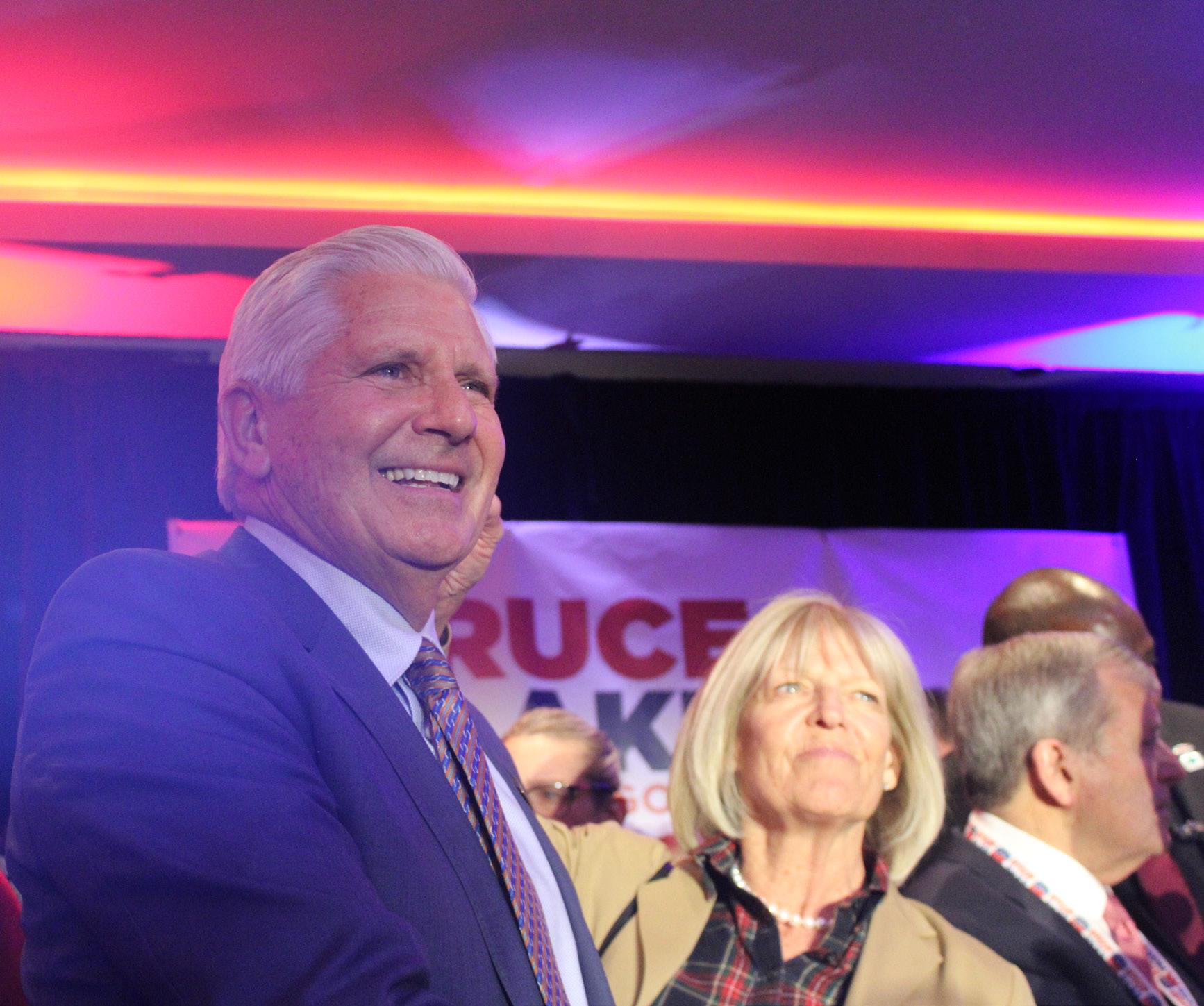
Nassau County Executive Bruce Blakeman (R-Atlantic Beach) is the party’s nominee for governor in the November election. In 2021, Blakeman upset then-Nassau County Executive Laura Curran (D-Baldwin) in a red wave that flipped control of many offices in both Suffolk and Nassau. Blakeman was re-elected by a hefty eleven-point margin in 2025, carrying Republicans across the finish line in countywide offices and the Nassau County Legislature. While the 2025 elections saw Democrats win across the country, Nassau shone as a bright red beacon on Long Island.
Blakeman announced his candidacy late last year, and Congresswoman Elise Stefanik (R-Schuylerville) dropped out of the race despite being the ostensible frontrunner.



The Tragedy of Hamlet at Staller Center for the Arts, Stony Brook
February 13
8:00 PM to 10:00 PM
Valentine’s Comedy Show at SquareHead Brewery
February 13
7:30 PM to 10:30 PM
Valentine’s Murder Mystery Dinner Show “Till Death do us Part” at Fire Island Vines February 14 6:30 PM to 9:30 PM
Falling In Love With Wildlife at Sweetbriar Nature Center, Smithtown February 15, 1:00 PM
Mid-Winter Break Children’s Program at Long Island Maritime Museum February 16-20
10:00 AM to 12:00 PM
Hot Cocoa Crush 5K Long Island at Eisenhower Park, Field 2 February 21
9:30 AM to 12:00 PM
Superheroes of the Sky at Sweetbriar Nature Center February 21, 11:00 AM
Psychic Fair and Gift & Craft Show at The Radisson Hotel February 22, 10:00 AM to 6:00 PM
LI-Kick:
Trivia Roulette at Great South Bay Brewery February 26 7:00 PM to 9:30 PM
Long Island Pet Show 2026 at Suffolk Federal Credit Union Arena, Brentwood February 28- March 1 Times may vary
NY Blood Drive at Christ Lutheran Church March 9, 3:30 PM to 9:00 PM

(631) 269-6421
Conveniently





Miracle on IceFebruary 19, 7:00 PM to 9:00 PM
AMVETS Post • Boulton Center
Bay Shore Public Library • Leggio’s Deli
American Legion Post • Bayway Arts Center East Islip Gourmet Deli Harry’s Bagel • Italia Fine Food Mister Softee Ice Cream Pat’s Market
American Legion Post • Bagel Boss Bagels & More • Oconee Diner
The New Idle Hour Deli 50% Cards Store (Wendy’s Shopping Center)
718 Slice Pizzeria – (719 Hawkins Ave) Airport Diner • America First Warehouse
AMVETS Post 48 • B&B Bagels
B.L.D.’s Restaurant Hero Express • Pond Deli
American Legion Post Ronkonkoma Train Station
Sayville LIRR Train Station
Sayville American Legion Post
B.F.L./S.P.K. Deli • Best Farms Market
Higbie Bagels • West Islip Bagels West Islip Community Center West Islip Public Library West Islip LIRR Train Station Tower’s Flower
LI Maritime Museum
Dist, and Farmingville Fire Dist. Periodicals Postage Paid at Ronkonkoma, NY and additional entries.
Lil’ Athletes: Hoop Stars February 28, 10:30 AM to 11:15 AM
Adult Pilates - Every Monday and Wednesday, 1:00 PM to 2:00 PM
Parent Child WorkshopFebruary 13, 10:00 AM to 11:15 AM
Stretch Senior Class - February 20, 10:30 AM to 11:30 AM
Laser Tag After Dark February 20, 6:00 PM to 9:00 PM
Dungeons & Dragons for TeensWednesdays at 5:30 PM
Folk Traditions and Origins of Valentine’s DayFebruary 13, 2:00 PM to 3:30 PM
Gentle Yoga with Kate - Every Monday, 6:00 PM Chunky Embroidery - February 13, 11:00 AM
STEAM Scene - Winter WonderlandFebruary 26, 6:30 PM to 7:15 PM
Lucky Charm Rice Krispies March 13, 4:30 PM to 5:30 PM
Edible Cookie Dough - February 19, 1:00 PM to 2:00 PM
Board Gaming February 28, 11:00 AM to 4:00 PM






Ronkonkoma,
Postmaster: Send address changes to Islip Messenger, P.O.
Continued from front cover
Thursday, February 12, 2026
Blakeman is staking his candidacy on delivering on affordability and public safety in Nassau, as well as being the primary stopgap between New York City’s drift to the socialist left and Long Island’s working-class rightward shift.
New York has not elected a Republican governor since George Pataki (R-Garrison) was elected to a third and final term in 2002.
The State GOP conducted its business at the Garden City Hotel in Garden City from Monday to Wednesday.
Dignitaries from across Long Island spoke in support of Blakeman on Monday evening. Hempstead Town Supervisor John Ferretti (R-Levittown) called Nassau “the safest county in America” under Blakeman’s leadership
Former Congressman Peter King (R-Seaford) (pictured right) made a rare public appearance to endorse Blakeman, saying, “when it comes to making tough decisions, Bruce will be there.”
“He will stand up to Kathy Hochul; he will stand up to [Zohran] Mamdani (D-Astoria),” said King. “If you’re reelecting Kathy Hochul, you’re electing Mamdani and all those progressive wackos on the left. We have to make sure that our state stays in the hands of a reasonable, common sense, hardworking guy, a man who supports the men and women in blue, who will never ever back down to the crowd, never ever back down to the mob.”
King added that although Blakeman might be “start[ing] off behind,” he reminded the audience that polls had Blakeman down by twenty points in his 2021 run for Nassau County Executive. He ended up winning by a razor-thin margin.
Chair of the New York GOP Ed Cox said the election would be a referendum on “one-party rule” in Albany that has produced “Raise the Age” and “cashless bail.”
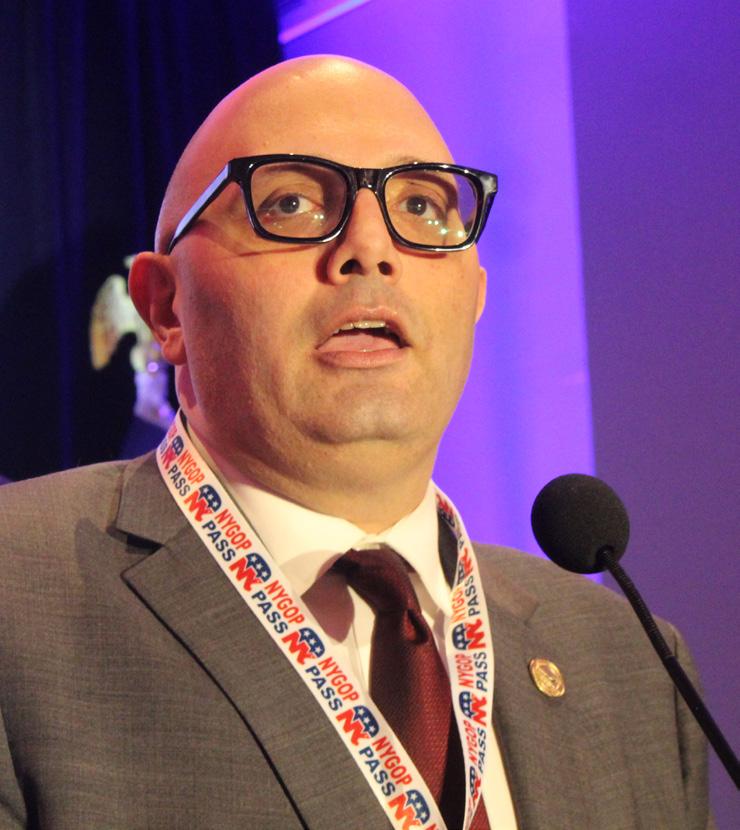
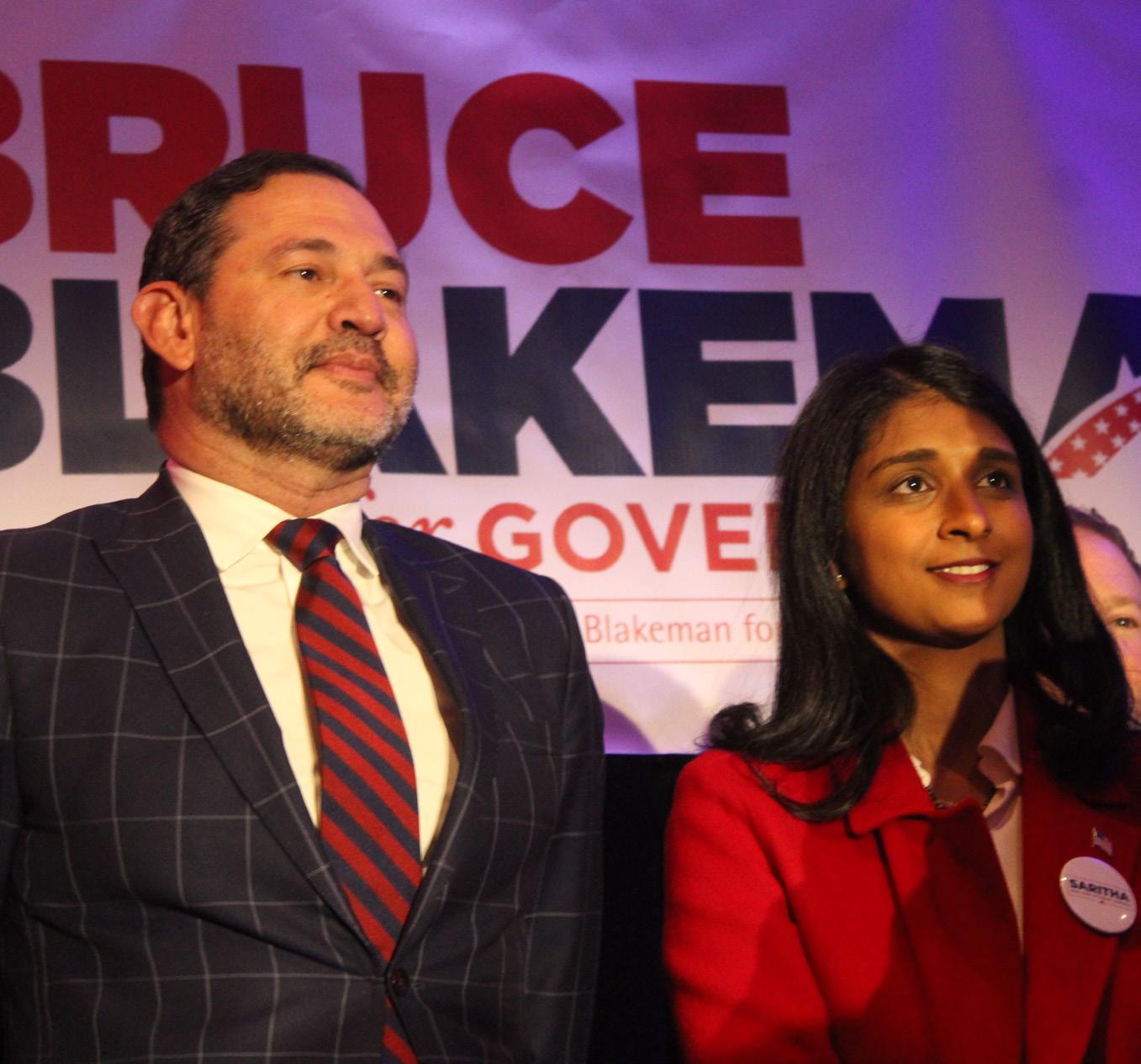
Nassau County GOP Chair Joe Cairo and Suffolk GOP Chair Jesse Garcia (R-Ridge) (pictured below) gave fired-up speeches as Long Island once again leads

the Republican ticket in a gubernatorial race.
“This begins today; it begins grassroots,” said Garcia. “The Republican Party is the one that stands for lower taxes, toughon-crime, investing in our infrastructure, and our quality of life. And by showing that record in any and all regions of this great state, we are going to elevate Bruce Blakeman to the governor’s mansion.”
Garcia added that the “best way” to flip seats from blue to red is to show “what Republican governance means.”
“It means our Republicans put our resources into hiring more cops, detectives, and prosecutors to keep us

safe and make sure we get around bad laws like cashless bail,” said Garcia. “For all those small businesses out there, Bruce Blakeman is the champion of Main Street.”
Presiding Officer of the Suffolk County Legislature Anthony Piccirillo (R-Holtsville) (pictured right) called the current era “not a time to sit out.”
“Kathy Hochul has gotten in bed with the socialists. They want to smother us with the ‘warmth of collectivism,’” said Piccirillo, referencing verbatim positions from the Mamdani Administration. “Let’s say, ‘hell no!’”
Suffolk County Executive Ed Romaine (R-Center Moriches) said the message is clear: “S.O.S.: Save Our State.”
“Every year, people vote with their feet instead of at the ballot box,” said Romaine. “This state has lost more population than the other forty-nine states. It’s time for a change; it’s time to make sure New York is great once again. We’re not going to let our state go down in flames. We’re going to fight for a state where businesses can survive. We are ranked forty-ninth in terms of business-friendliness and job creation.”
North Hempstead Town Supervisor Jen DeSena (R-Manhasset) called to “make New York sane again,” while Oyster Bay Town Supervisor Joseph Saladino (R-Massapequa) said Republicans are “united for one cause: because we love this state, we love our children, and grandchildren.”




Zeldin Returns
A homecoming materialized on the podium as Administrator of the Environmental Protection Agency (EPA) Lee Zeldin (R-Shirley) gave his support for Blakeman’s candidacy, just four years after staging a near-upset in 2022. Nonetheless, Zeldin’s strong showing is often credited to Republicans taking control of the U.S. House that cycle.
“New York should be a beacon of freedom, safety, and prosperity. It should be this shining example that the rest of the states should emulate for their own,” said Zeldin. “The Titanic analogy wouldn’t work for Hochul. She’s not just captain of the Titanic; she’s actually aiming for the iceberg.”
Zeldin spoke of his last year leading the EPA, which has brought him to all fifty states.
“What I see is that its citizens are just so happy with their quality of life. Many of them are former New Yorkers,” said Zeldin. “They wanted to stay here; this was their home and where their family was. But they realized that to stretch their money further, to feel safer, to live life freer, they had to flee New York - not to put this state in a timeout for a brief period, but permanently flee and never look back.”
Zeldin said a key component of the problems in New York is Albany’s failure to promulgate energy satisfaction, instead not approving natural gas pipelines
and disallowing gas hookups on new construction.
“They’re trying to hit these climate goals that they know they will not meet. They’re willing to cause extreme economic pain for their own citizens who can least afford it,” said Zeldin. “From one example to the next, you find so many different ways that the state has lacked balance and leadership.”
Zeldin said that in “looking to Nassau County” under Blakeman’s leadership, one will find “a county that ranks as one of the very best places in the entire country to live.”
“You have a county where law enforcement is supported, where our streets are safe, where the bond rating keeps getting better and better,” said Zeldin. “Even though [four years ago], we came up just short, in a state that’s only 22% Republican, in a state that has threeand-a-half million more Democrats than Republicans, you made people believe that this state can be saved - and yes, New York can be saved.”
Zeldin added that the “story of 2022” was that the GOP came up “just short,” but the “story of 2026” is that Blakeman will finish the job.
Blakeman opened by commending Zeldin’s trailblazing in 2022, saying, “we came up a little short, but this time we’re going to finish his [Zeldin’s] mission.”
The Atlantic Beach Republican began with an anecdote of a friend who is a “big-time Democrat from Upstate” who brought a sobering account from the State Democratic Convention.
“‘It was like a morgue,’” said Blakeman, quoting his friend. “‘No enthusiasm; people were down.’ He said there was no feeling that they [the Democrats] would win, even though Kathy Hochul is the incumbent,” said Blakeman. “That’s because they know that their policies are wrong for New York. They know they failed New York. They know that we are the highest-taxed state in the United States of America. They know that if it’s not affordable to live in New York, it’s
Continued on following page
Continued from previous page

because Kathy Hochul was the governor for four years. That all changes on January 1.”
Blakeman added that New Yorkers are “not happy with one-party rule,” that their children are “moving out” of the state, and that “they’re going to have to visit their grandchildren in a different state.”
“We can make this state, once again, a state where our kids and our grandkids and our great-grandkids to come are going to want to raise their families,” said Blakeman.
Blakeman introduced his running mates, calling them “probably the strong ticket” the GOP has “ever had” in the Empire State.
For State Comptroller, the GOP is going with Joe Hernandez (R-New York City), who ran for NYC Mayor in 2025. A Cuban-born refugee whose family fled Cuba for Florida when he was seven years old, he founded several successful companies in the biotech industries. According to his website, Hernandez played a “pivotal role in commercializing the world’s first FDA-approved molecular diagnostic test for human papillomavirus (HPV).” His work at the Digene Corporation would help “transform cervical cancer screening worldwide” and position Digene as a “global leader in molecular diagnostics.” He later founded Blue Water Vaccines, which works in collaboration with the University of Oxford to develop a “universal influenza vaccine.”
Hernandez will meet Comptroller Tom DiNapoli (R-Great Neck Plaza), who has served in the role since 2007, provided DiNapoli defeats his two primary opponents. New York has not elected a Republican to the Comptroller seat since 1990.
“He is a brilliant businessman and somebody who will be the fiscal watchdog of this state and work with me to make it more affordable to live in New York,” said Blakeman.
Blakeman introduced the party’s pick for Attorney General by calling Hochul the “most pro-criminal governor” in state history.
The GOP is going with Saritha Komatireddy (R-Brooklyn) to take on Attorney General Letitia James (D-Clinton Hill). Komatireddy is a former federal prosecutor who took on leaders in al Qaeda, ISIS, and the Mexican drug cartels. According to her website, she led “high-profile” cases in the Eastern District of New York, which involved “international terrorism, cybercrime, narcotics trafficking, money laundering, fraud, and foreign public corruption.” She also served as Chief of Staff to the Drug Enforcement Administration (DEA), currently serves as a partner at Holtzman Vogel, and teaches at Columbia Law School.
“We need an Attorney General who will uphold the law, and that doesn’t commit fraud on mortgage

applications,” said Blakeman, referring to allegations that James fraudulently claimed a Virginia home as a second property to secure better rates while it was used by family. “We need a real prosecutor.”
“Are we ready to make this a more affordable state by cutting energy costs in half? Are we ready to cut taxes? Are we going to respect law enforcement? Are we going to roll back cashless bail? Ladies and gentleman, I’m Bruce Blakeman and I’m running for Governor of the State of New York!”
Blakeman’s Running Mate
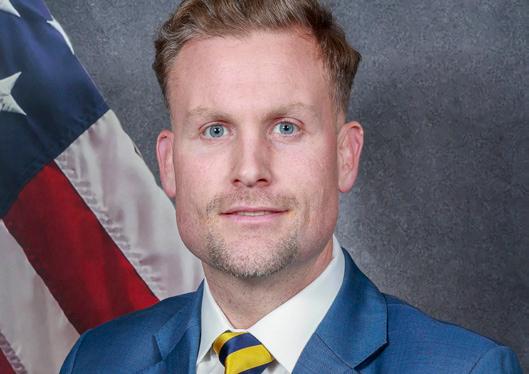
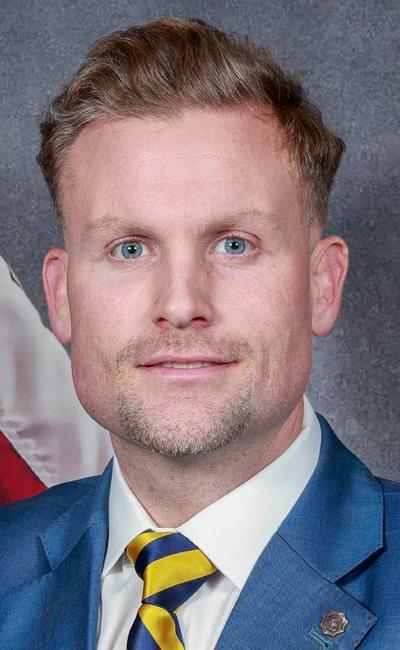
Blakeman introduced his running mate for Lieutenant Governor, Madison County Sheriff Todd Hood (R). Taking the position in 2018, he “commands a work force of 160+ members, consisting of Corrections Officers, Road Patrol Deputies, Civil Division, Pistol Permit Division, Children’s Advocacy Center, and oversees a $16 millionplus budget,” according to nysheriffs.org. Hood has experience with the Syracuse Police Department in the Gang Task Force, SWAT Supervisor, and Firearms Instructor. He spent twenty-two years with Syracuse and later worked for the Onondaga County D.A.’s office as an Investigator for Criminal Investigations/Homicides.
“It’s a low bar, considering that Hochul’s first lieutenant governor [Brian Benjamin] was indicted and had to leave office in disgrace,” said Blakeman. “And then her second lieutenant governor, hand-picked [Antonio Delgado], is running against her for governor. Even Delgado knows she’s wrong for New York.”
New York, New York
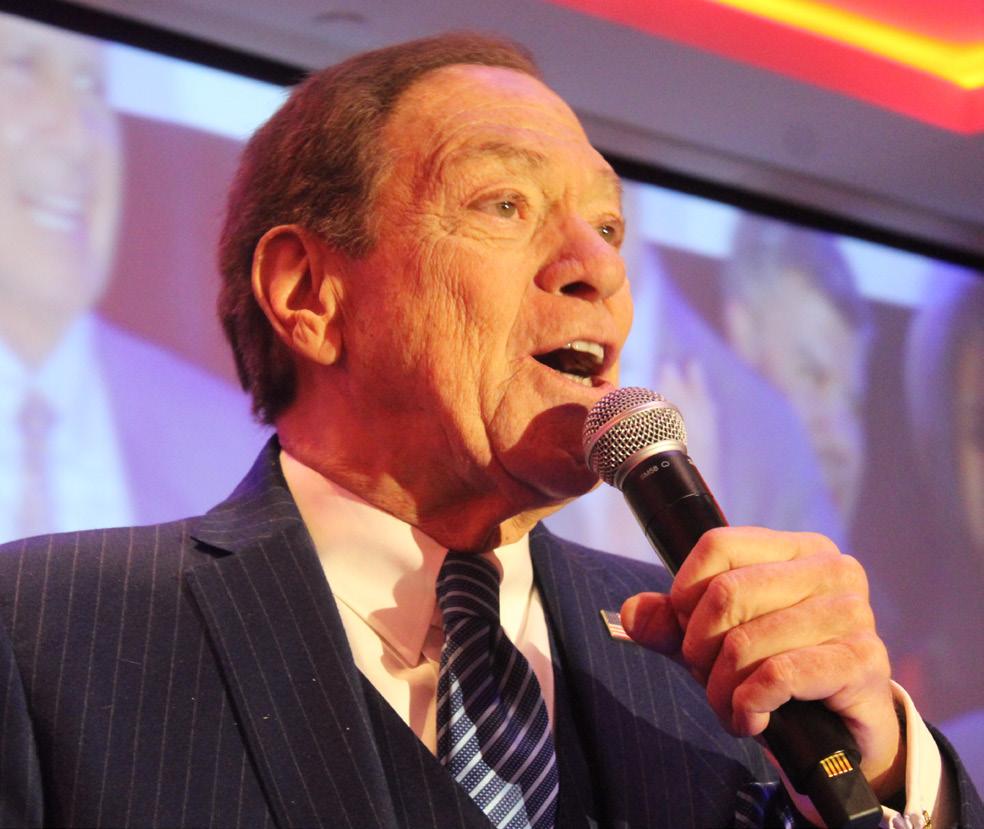
The rally ended with a surprise serenade from actor, comedian, and conservative radio talk show host Joe Piscopo.
“We’re going to bring New York, New York, back,” said Piscopo, before leading the invigorated crowd in a soulful rendition of New York, New York
The stage is now set for the 2026 gubernatorial election and for the second consecutive year, Long Island is leading the charge.
Nassau County Executive Bruce Blakeman (R-Atlantic Beach) officially accepted the nomination at the State GOP Convention in Garden City on Wednesday. The no-nonsense, twice-elected executive brings hope to the GOP that he can take his winning record in a blue county across the Empire State, which has not elected a Republican governor since 2002.
The Tip of the Spear
Nassau is an ancestrally red county but one that started a long flirtation with the Democratic Party going back to the 1990s. Lee Zeldin (R-Shirley), now head of the EPA, flipped Nassau wide open in 2022, a feat not just instrumental, but necessary for a Republican to win statewide in New York.
Suffolk is no exception. As the largest suburban county in the nation, the basket of votes up for grabs by either party is nothing to balk at. And under the leadership of Suffolk GOP Chairman Jesse Garcia (R-Ridge), Suffolk’s defiance of suburban trends nationwide now supplies the gravity that’s pulling New York into battleground territory.
For context, Suffolk has about 370,000 registered Democrats to about 355,000 registered Republicans, with another 347,000 considered Blanks. Suffolk gave Zeldin about 330,000 votes compared to Governor Kathy Hochul’s (D-Hamburg) 223,000. President Donald Trump (R-FL) did even better in 2024, taking in over 415,000 votes in Suffolk.
But in Nassau, the disparity grows. In a county of about 400,000 registered Democrats, 324,000 registered Republicans, and 300,000 Blanks, Trump took in 368,000 votes to Kamala Harris’ (D-CA) 338,000.
Long Island is the tip of the spear going into 2026 and it will continue to serve in such a role as New York continues to shape up to be more competitive, albeit, slowly but surely.
But Blakeman’s election in 2021 wasn’t just a return to traditional politics for Nassau; it was a referendum against New York City and Albany. Blakeman, the considerable underdog to then-Executive Laura Curran (D-Baldwin), ousted her in an upset as part of the red wave that allowed Republicans to consolidate power across Suffolk and Nassau counties. His election was a referendum against cashless bail, out-of-control crime in New York City, and the ever-increasing cost of living.
That energy would later precipitate the near-upset by Zeldin in 2022 and New York swinging right more than any other state in 2024.
Blakeman’s win in 2021 was narrow, however, and he only carried the Town of Oyster Bay, one of Nassau’s three towns and two cities and the most Republican part of the county.
In 2025, despite some apprehension of his ability to score re-election as a Trump loyalist in a purple county with 400,000 Democrats, Blakeman was handily reelected by over ten points. This time, he carried all three of Nassau’s towns, the City of Glen Cove, and narrowly missed out on the City of Long Beach
Succinctly, Blakeman represents the primary stopgap between socialist-trending NYC and the rest of the downstate bedroom communities, and Nassau voters seem to appreciate that.
While Blakeman has a solid firewall on Long Island, it remains to be seen what kind of support he can galvanize in Queens, Brooklyn, and the Hudson Valley, areas of the state where Zeldin came up just short four years ago.
But Long Island values and priorities will certainly be on play in what could be one of the marquee races of the midterm cycle.
The retirement of Assembly Minority Leader Will Barclay (R-Pulaski) was as sudden as it was consequential. The vacancy in the top spot in the Assembly Republican Conference was filled by Assemblyman Ed Ra (R-Franklin Square).
While Barclay was an effective leader, his Oswego County-based district is not only geographically remote, but influentially remote as well. Not to say that Oswego voters don’t have priorities and concerns that matter, but Downstate New York is responsible for the tectonic political shifts observed over the last five years.
Ed Ra can now utilize that advantage to advocate not just for Long Island, but broader New York, when staking his conference’s claims in the deep-blue Assembly.
Moreover, his ascension to the post marks the first time a Long Islander has led the Minority Conference in decades, while the GOP has not held a majority in the Assembly since the 1970s.
Here’s the Count
Long Island continues to become an unmistakable political and cultural behemoth. A diverse population seasoned by a diverse set of issues, we’re only optimistic as our island grows more and more relevant from local scales to national stages.
Eighteen people are dead in New York City following a sustained period of brutal winter temperatures. Strip away the rhetoric, the press conferences, and the social media spin, and what remains is simple: extreme cold met human vulnerability — and the cold won.
Weather is indifferent. It does not negotiate. It does not care about ideology, intention, or compassion statements. When temperatures drop into the single digits and wind chills fall below zero, exposure becomes a medical emergency measured in minutes, not hours.
The city activated Code Blue protocols. Warming centers opened. Outreach teams were deployed. On paper, the response checks the procedural boxes. But outcomes matter more than announcements. Eighteen deaths tell us that the system — whatever its effort level — did not fully bridge the gap between services offered and services accepted.
That gap is where the real issue lives.
Under the administration of Mayor Zohran Mamdani (D-Astoria), New York continues to emphasize voluntary engagement with unsheltered
individuals, even during life-threatening conditions. The philosophy prioritizes autonomy and civil liberty. Those are legitimate values. But public policy is not about choosing values in isolation — it is about managing trade-offs when values collide.
Here is the uncomfortable arithmetic: a person suffering from exposure, mental illness, or substance impairment may be legally “free” to refuse help while physiologically incapable of making a life-preserving decision. When that happens, a hands-off approach becomes indistinguishable from abandonment.
This is not a moral accusation; it is a structural observation.
Cold-related deaths rarely come from dramatic events. They come from accumulation — one more night outdoors, one more missed contact with outreach workers, one more instance where policy hesitates because authority is limited. Each individual decision may make sense in isolation. The aggregate result can still be tragic.
There is also a second layer many ignore: urban systems assume baseline stability — heated buildings, accessible transport, responsive services.

When temperatures move far outside normal ranges, those systems operate under stress. The people already on the margins fall off first.
None of this requires ideological framing. It requires clarity.
A city’s responsibility during extreme weather is not simply to offer help; it is to ensure survival. If existing rules make that difficult in predictable, life-or-death conditions, then those rules deserve review. Protecting life and respecting liberty are both important — but they are not always equal in emergency contexts.
Winter will ease. The headlines will move on. But the number 18 remains — not as a political talking point, but as a reminder that policy choices have real-world endpoints.
Cold weather is not political.
Whether people survive it often is.
Sincerely, Raheem Soto, Publisher, Messenger Papers
By Commissioner Scott E. Munro, Hauppauge Fire District
I must respectfully disagree with proponents of utility scale lithium Battery Energy Storage Systems (BESS) facilities that are either being built or are planned to be built in New York State without any real regard for community safety or the environment. Many of the “experts” are, in my opinion, ignoring the realworld dangers posed by utility scale lithium BESS facilities. I also question the motives of the compensated “experts” who use FDNY after their names as they try to convince us that utility scale lithium BESS is safe.
The Hauppauge Fire District, the Hauppauge School District and local community activists, are working to prevent Key Capture Energy and LIPA from building a 79-megawatt lithium BESS at 220 Rabro Drive in Hauppauge. Our motives are not political or anti-green energy, and this is not a NIMBY movement. As a matter of fact, the Hauppauge Fire Department protects one of the largest industrial parks in the United States. Our firefighters are well trained and well equipped. Our fight to keep BESS out of our community is based on facts, not the talking points of an industry making millions on what some call an experimental technology. Too many of our elected officials seem to be ignoring the potential hazards to life, property, and the environment all in the name of financial gain. Our fight is based on our absolute commitment to the protection of our community from a facility that we feel places our firefighters, our residents, and our environment in very serious jeopardy.
In a comprehensive and detailed white paper commissioned by the Hauppauge Fire District, the nasty truth about the serious danger posed by utility scale BESS facilities to our community and our environment is clearly outlined. The full report, written by Mr. Richard Ellenbogen, can be found at the Hauppauge Fire Department’s website, www.hauppaugefiredepartment.org.
Mr. Ellenbogen’s credentials as an expert are also part of the report. I also want to point out that Mr. Ellenbogen performed this service gratis for the residents of the Hauppauge Fire District.
Some of the reasons we feel that lithium BESS facilities do not belong in
heavily populated areas, near schools, or near sensitive environmental areas like the Nissequogue River are:
Lithium BESS fires CANNOT be extinguished. Once thermal runaway begins there is no known technology that can extinguish them. A lithium BESS fire can burn for days or weeks.
A lithium BESS fire can be started by something as simple as moisture getting into the containment vessel (think rainstorm or hurricane) as is reported to have happened twice in Warwick, New York.
Once a fire is detected, the energy company relies on a central station alarm company to notify the fire department. If that transmission fails for whatever reason, the fire can burn out of control and potentially spread to other containers resulting in a huge conflagration.
A lithium BESS fire will rapidly drain assets from local emergency responders – fire, police and EMS. It can result in the need for mass evacuations and the closing of major roadways like the Long Island Expressway, Veterans Memorial Highway, and Route 111.
Lithium BESS fires release highly toxic substances into the air and into our soil. At 220 Rabro Drive our water table (the drinking water for Long Island) is only 32 feet below the surface (as per the U.S. Geological Survey). In addition, homes, cars, gardens, animals – anything exposed to the toxic smoke – can become dangerously contaminated.
The reasons for not building utility scale lithium BESS facilities on Long Island are numerous and space does not permit listing them all. We strongly encourage the public to be very wary about what they are being told by representatives of the energy industry and by elected officials who are quietly pushing this agenda. This includes paid “experts” with fire service backgrounds who are trying to sell us a bill of goods the same way a crooked car salesman would try to sell us a lemon. We urge all residents of Long Island to take a close, unbiased, nonpolitical look at this issue as well as the other options that are out there. Please take the time to read Mr. Ellenbogen’s report.

To our neighbors in Smithtown, Commack, East Brentwood, Brentwood, Central Islip, Lakeland, Nesconset, Ronkonkoma –keep in mind that there are no boundaries when a BESS facility burns. Depending on the wind pattern, a BESS fire in Hauppauge can spread toxic pollution everywhere. Consider the cost of the hazmat cleanup, damage to groundwater and waterways, the cost in property damage and the cost in lives ruined. What will your home’s value be? Who will pay for the decontamination of your home and property? Will the insurance companies make it insanely expensive to insure your home if you live near a BESS or if you are impacted by a BESS fire? What are the long-term health consequences? The damage to our local economy and way of life could be catastrophic. We must place people over profits. Say NO to BESS in Hauppauge.





Thursday, February 12, 2026
By Matt Meduri
The nationwide redistricting “arms race” continues as the Supreme Court has allowed California’s gerrymandered map to stand for the 2026 midterms.
Golden State voters initiated the map in November by approving Proposition 50, also known as the Election Rigging Response Act, by a 64%-35% margin. The map was the response to Texas Republicans’ gerrymander at the urging of President Donald Trump (R-FL), who has also applied pressure to Republican state legislatures to redraw their maps to improve the GOP’s chances of retaining control of the House.
Historically, the presidential party suffers losses in the lower chamber in the midterm elections.
Proposition 50 gerrymandered the safe Republican CA-01 and Republican-leaning CA-03 into safe Democratic seats. It also dismantled the Riversidebased CA-41 into a dense, Los Angeles-based district, and made the ancestrally red San Diego-based CA-48 into a swing seat.
The Supreme Court denied an emergency request from the California Republican Party to block the redraw, arguing that the map violated the Constitution as a racial gerrymander. The Supreme Court has already ruled that Texas’ map can stand for the 2026 elections.
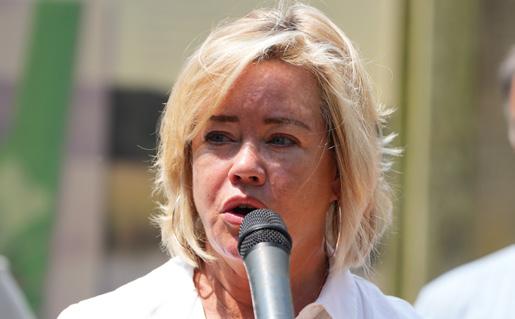
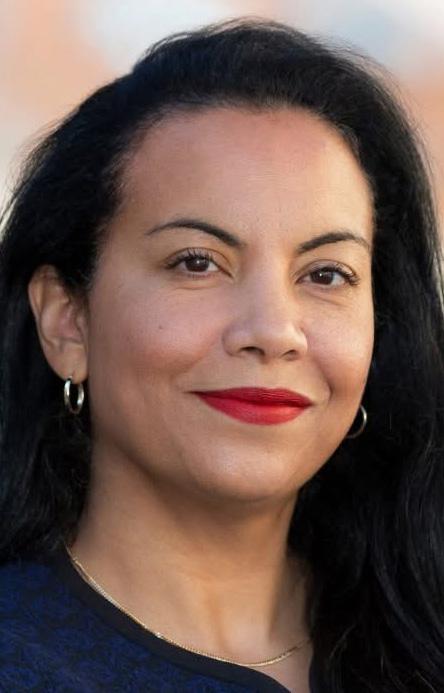
produced Analilia Mejia (D) (pictured below), the dark horse progressive candidate with the backing of Congresswoman Alexandria Ocasio-Cortez (D, NY-14). Mejia defeated Malinowski and the entire field with 29.1% of the vote and is the prohibitive favorite to win the special election.
In local elections, Democrats scored a significant overperformance that adds to their track record since 2025. Chastity Martinez (D) held a State House seat in Baton Rouge, Louisiana, one that had been uncontested by the GOP in 2023. However, the seat had backed President Trump in the 2024 election by a 56%-43% margin. Martinez won the seat with 62% of the vote.
Democrats also overperformed in a Virginia House election on Tuesday night. Elizabeth Bennett-Parker (D) won the open seat in an Alexandria-based district with 83.3% of the vote, slightly more than the 2023 margin of 78%.
The 2026 House retirement wave continues to grow, as three more Republicans have announced they will not seek re-election in 2026.
Congressmen Neal Dunn (R, FL-02), Vern Buchanan (R, FL-16), and Barry Loudermilk (R, GA-11) this week announced their retirements. All represent safe Republican districts, although Buchanan’s SarasotaBradenton-based district could see a possible race develop. He was re-elected in FL-16 by about twenty points in 2024. The overall retirement list grows to twenty-nine Republicans and twenty-two Democrats, eclipsing a near-record as about 10% of the quorum is foregoing reelection.
The Democratic Primary to fill nowGovernor Mikie Sherrill’s (D-NJ) former congressional seat saw an upset of its own in terms of internal politics. Sherrill had been re-elected to the North Jersey seat by a strong fifteen-point margin in 2024.
Former Congressman Tom Malinowski (D) was eying a comeback and was the ostensible frontrunner out of the gate. However, Malinowski lost support after he said he’d be open to “conditioning aid to Israel.” The American Israel Public Affairs Committee (AIPAC), who had previously supported Malinowski, went on a $2.3 million ad blitz to tie Malinowski to Trump. The crowded field of thirteen Democrats
“Nine months from election day, Blakeman – largely unknown to three in five New York voters – has his work cut out for him. Hochul’s 79%-8% lead among Democrats is significantly better than Blakeman’s 69%-15% lead with Republicans, and she leads 41%-34% with Independents, as well as in every region of the state,” said Siena pollster Steve Greenberg in a statement. “Against Delgado, among Democrats, Hochul has at least 60% support in every region of the state, as well as the support of 68% of self-described liberals and 65% of moderates.”
The Suffolk County Water Authority (SCWA) has repaired 219 main breaks since the deep freeze set in since December.
Repair crews have repaired or monitored main breaks in Lindenhurst, West Islip, Bay Shore, Islip Terrace, Coram, Ridge, and Sound Beach. SCWA technicians are braving sub-zero temperatures and ice to maintain water services to 1.2 million customers.
In Oklahoma, Democrats overperformed yet again, despite falling short of flipping a deep-red just west of Tulsa. Dillon Travis (R) prevailed for the open State House seat, capturing 64.2% of the vote. However, Democrats did not contest the seat in 2024, and in 2022, the Republican candidate won with 78% of the vote.
The Siena College released their latest poll on February 3, finding Governor Kathy Hochul (D-Hamburg) with the best-ever favorability rating found in the survey.
Hochul’s rating sits at 49%-40%, the highest she has been rated as found by Siena. The rating is up from December’s 43%-41%. Hochul’s job approval rating sits at a wider 54%-41% margin.
For the 2026 gubernatorial election, the Republican frontrunner is Nassau County Executive Bruce Blakeman (R-Atlantic Beach). The College found his favorability rating at 18%-20%, slightly improved from December’s 13%-17% rating. The small numbers on both sides of the equation reflect Blakeman’s relative lack of name recognition.
The College also found that Hochul leads Blakeman in a hypothetical general election matchup to the tune of 54%-28% - a 26-point margin. For context, Hochul was elected in 2022 over Lee Zeldin (R-Shirley) by a 6.5-point margin.
Hochul’s main primary challenger, Lieutenant Governor Antonio Delgado (D-Rhinebeck) overwhelmingly trails Hochul in the June Democratic Primary. Hochul’s lead sits at 64%-11%, much improved from the 56%-13% spread found in December. Delgado’s favorability rating sits at 21%-18%, a contrast to his underwater 13%-17% rating clocked in December.
Hochul also enjoys positive marks from Democrats, Republicans, and Independents on eliminating State incomes taxes on the first $25,000 earned in tips - a page from President Trump’s economic playbook that she had first criticized - increasing childcare funding by $1.7 billion, and providing $30 million in direct payments to farmers to offset rising costs due to tariffs, according to Hochul.
All three demographics also approve of Hochul’s policy to ensure that immigration enforcement cannot target immigrants whose only crime is being in the country illegally in sensitive locations without a judicial warrant.

Republicans disapprove of Hochul’s policy (44%-41%) to allow New Yorkers to bring State-level actions against federal officers who citizens claim have violated their constitutional rights, and they also disapprove (45%-38%) of Hochul’s plan to require the State Department of Health to “develop New York’s own immunization requirements for school eligibility and insurance coverage.”
Immigration and Customs Enforcement’s (ICE) approval rating in the Empire State sits at 28%-67%. Voters do support deporting immigrants living in the U.S. illegally (43%-35%), but oppose the way ICE is carrying out those measures (61%-29%).
President Trump’s favorability in New York, Siena College found, sits at 33%63%, little changed from December. His job approval rating is 34%-63%, also unchanged from last year. 54% of respondents “strongly disapprove” of Trump’s job performance, the highest ever found in a Siena poll.
Independents support Democrats in the 2026 generic congressional ballot 46%-29%.
This poll was conducted January 2628 among 802 registered New York voters and has a margin of error of +/- 4.3%.
In January alone, 121 repairs, including a peak of 44 breaks handled during the second week of the month, have been conducted. In a press release, the SCWA noted that the high volume is attributed to the “deep freezes, where the frost line penetrates deep into the ground, causing soil to shift and putting immense thermal stress on older cast iron pipes.”
The SCWA has stayed ahead of the issue by replacing about twenty miles of aging water mains each year.
The public-benefit corporation utilizes a new “ductile iron pipe, a modern material far less prone to the brittle fractures common in older infrastructure during the winter months.” They note that by targeting areas with high reoccurrences of breaks, the SCWA can get ahead of the problems to improve long-term reliability.
“The work our crews are performing right now is truly heroic,” said SCWA Chairman Charlie Lefkowitz in a statement. “Maintaining our distribution system in these harsh weather conditions isn’t just part of the job; it’s a service to the community that requires incredible physical stamina and sacrifice. Our team has been in the trenches every single day this winter, often through the night, to ensure that when our customers turn on their taps, the water is there.”
SCWA CEO Jeff Szabo (pictured above) added that their employees brave the brutal conditions because they know the community “depends on them.”
“We made a commitment to provide high-quality water and exceptional service, and that commitment is most visible during these winter emergencies,” said Szabo in a statement. “I want to thank our dedicated staff for their continued perseverance and for everything they do to keep Suffolk County running through this deep freeze.”
The SCWA Customer Contact Center will be open for additional hours in the morning during the cold spell to address the increased rate of service disruptions.
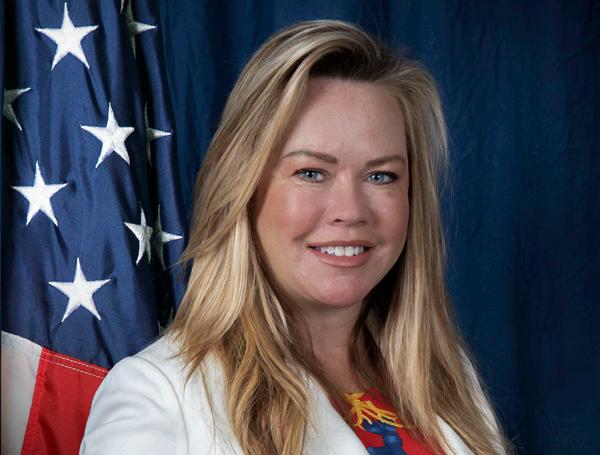
Legislator Trish Bergin was sworn into her third term as Suffolk County Legislator for District 10. At the 2026 Organizational Meeting, the Legislature elected Suffolk County Legislators Anthony Piccirillo (R-Holtsville) and James Mazzarella (R-Moriches) as the new Presiding Officer and Deputy Presiding Officer.
Proud to serve her constituents, Legislator Bergin is eager to work collaboratively with her colleagues to put residents first and continue making Suffolk a great place to live, work and raise a family.
Suffolk County Legislator Trish Bergin (R-East Islip) has represented the Tenth District in the Suffolk County Legislature since 2022. The Tenth District includes East Islip, Great River, Islandia, Islip Terrace, North Great River, Ronkonkoma, and parts of Central Islip and Hauppauge.
Legislator Bergin serves as the Chair of the Education, Labor, Consumer Affairs, and Diversity Committee, Chair of the Seniors and Human Services Committee, Vice Chair of the Economic Development, Planning, and Housing Committee, Vice Chair of the Government Operations, Personnel, and Information Technology Committee, and sits on the Budget and Finance Committee.
The Tenth District office is located at 44 East Main Street in East Islip and can be reached at 631-854-0940.

Dear Hauppauge Community,
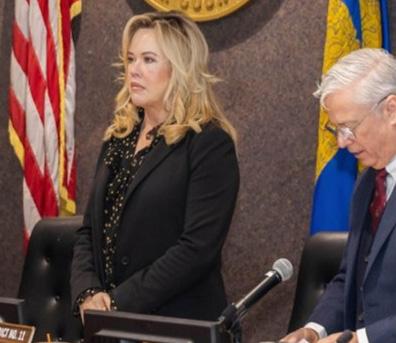
I am writing to provide an important update on our ongoing commitment to student safety and the protection of our community’s interests. Before discussing these specific efforts, I want to extend our sincere gratitude to the Hauppauge Fire Department; their unwavering dedication and expert guidance have been invaluable as we navigate the complex safety challenges associated with Battery Energy Storage Systems (BESS). This partnership is especially critical now, as the Hauppauge Board of Education recently met to discuss Assembly Bill A.08378 and Senate Bill S.5506. These proposed pieces of legislation would significantly diminish local control over the zoning and permitting of BESS facilities, shifting authority away from the Hauppauge community and toward the state.
The District has been proactive in expressing resolute opposition to the siting of a large-scale, 79MW BESS facility at 220 Rabro Drive, which is in immediate proximity to Bretton Woods Elementary School. Our opposition, formally adopted by the Hauppauge Board of Education on August 19, 2025, is based on several unacceptable risks:
• Fire Hazards: Potential for fires and emergency conditions that could endanger lives and property.
• Safety Logistics: Serious concerns regarding emergency response and the safe evacuation of an elementary school population.
• Welfare: General threats to the health and safety of our neighborhood and school community.
To ensure our voice is heard and our standards remain uncompromised, we have taken the following steps:
1. Direct Advocacy: In consultation with the Board of Education, I have sent formal letters to Senator Mario R. Mattera (R-St. James), Senator Brian Kavanagh (D-Manhattan), Assemblyman Michael J. Fitzpatrick (R-St. James), and Assemblymember Dana Levenberg (D-Ossining) urging them to oppose any legislation that strips our community of its local authority regarding these installations.
2. BESS Impact Committee: The BOE has established a dedicated committee to monitor legislative developments and local applications related to BESS. This group is tasked with ensuring that industrial energy projects never compromise our district’s safety standards.
We firmly believe that town boards and school boards must retain local control. As always, we will continue to advocate tirelessly for the safety and well-being of our students and the Hauppauge community.
Sincerely,
Dr. Donald B. Murphy Superintendent of Schools, Hauppauge
By Matt Meduri
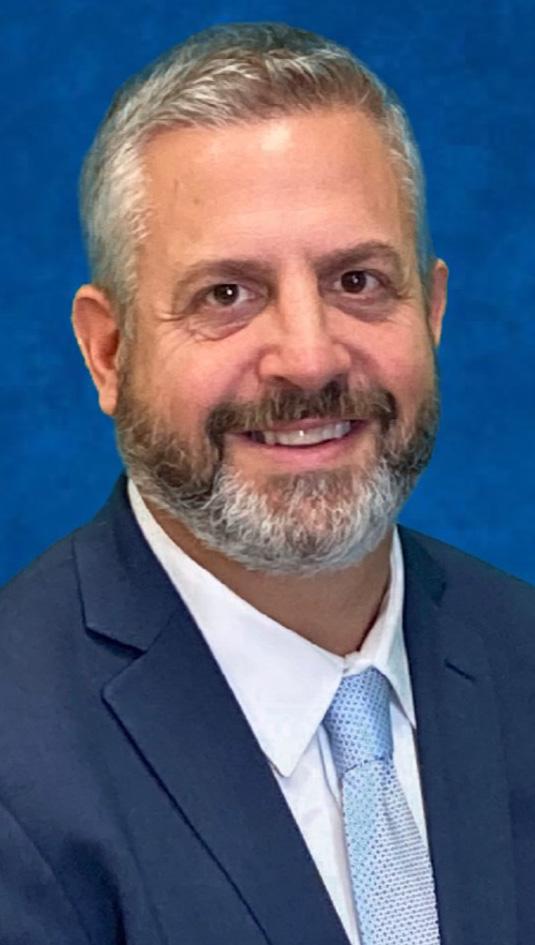
Shortly before Republicans began their business in Nassau County earlier this week, Governor Kathy Hochul (D-Hamburg) announced her pick for lieutenant governor.
Former New York City Council Speaker Adrienne Adams (D-Hollis) will join Hochul on the ticket for the 2026 election. In 2017, Adams was elected to represent the 28th District of the New York City Council. From then until 2025, she represented Jamaica, Rochdale Village, Richmond Hill, and South Ozone Park. In 2022, the Council elected Adams to serve as Speaker, making her the first mother, grandmother, and black person to serve in that capacity. Adams’ win of the Speaker ballot was seen as an early defeat for then-Mayor Eric Adams (D-Brooklyn), who had been whipping up votes for a rival candidate.
The Hochul-Adams ticket is the first time in state history that two women were featured together by a major party.
“Adrienne knows what it means to work hard and stand up for those who need it most. That’s why as New York City Council speaker, she led the charge
to protect families, make housing more affordable, invest in our children, and stand up to anyone who seeks to harm our city,” Hochul said in a statement.
The Brooklyn Democratic Committee notably rescinded their endorsement of Hochul following the announcement.
“Major statewide political decisions require meaningful collaboration with the party leaders and elected officials who organize, mobilize, and deliver Democratic victories,” said Assemblywoman and Brooklyn Democratic Party Chair Rodneyse Bichotte-Hermelyn (D-Flatbush) in a statement. “It is safe to conclude that the Brooklyn delegation…at the State Convention will be prone to voting against or abstaining from support for this ticket.”
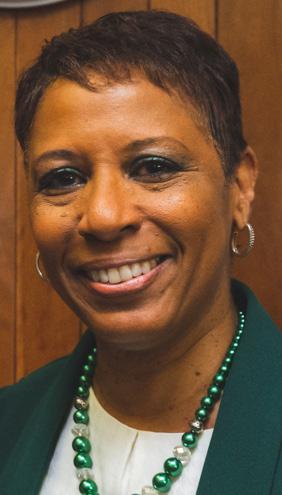
was allegedly personal between BichotteHermelyn and Adams. Anonymous sources state that BichotteHermelyn was disillusioned when Council members in the good graces of party leadership weren’t given enough plum committee assignments in the Council when Adams was Speaker. Politico also reports that Bichotte-Hermelyn is a more moderate Democrat and her increasingly-progressive committee might be ready to stage a mutiny.
(D-Park Slope) as he left office. Mayor Adams neither signed nor vetoed it, which by default allowed it to become law in 2022.
The law was subsequently ruled unconstitutional by the New York Court of Appeals in a 6-1 vote in March last year. Non-citizens never did get to vote under the circumstances, as the law was challenged its entire lifespan. However, Adams expressed her “disappointment” in the ultimate fate of the bill.
Politico reports that the decision
Adams is receiving criticism from the GOP for her co-sponsorship for a 2021 bill that allowed legal Green Card holders, albeit non-citizens, to vote in New York City elections. The law would have allowed some 800,000 individuals a say in local affairs. It remained unsigned by then-Mayor Bill deBlasio
Hochul’s selection of Adams makes for her third lieutenant pick governor since her tenure began in 2021. Former Lieutenant Governor Brian Benjamin (D-Harlem) was hand-picked by Hochul in September 2021. He served until April 2022 after he was indicted on federal charges of wire fraud and bribery, which were dropped in January 2025 after the death of a key witness.
Hochul selected thenCongressman Antonio Delgado (D-Rhinebeck) as her 2022 running mate. Delgado is now running to primary Hochul for the governorship in June.
By Matt Meduri
In a sudden twist to the Albany tale, Assembly Minority Leader Will Barclay (R-Pulaski) announced his decision to not seek re-election in November. He simultaneously stepped down as Minority Leader.
Barclay was elected to the Assembly’s 120th District in 2002 and was chosen to lead the Assembly Minority in 2020. His Central New York district includes most of Oswego County and portions of Cayuga and Jefferson counties.
“After a great deal of consideration, I have decided that I will not seek reelection,” Barclay said in a statement. “I intend to step down as minority leader in the coming days, allowing for a smooth transition to new leadership early in the legislative session. This is the right time for me to move on. I hold the deepest respect for this institution and will always be profoundly appreciative of the trust Assembly Republicans placed in me to serve as minority leader.”
Long Island now finds itself leading yet another charge, as Assemblyman Ed Ra (R-Franklin Square) was elected to the position by the Republican Assembly caucus on Monday. Ra, 44,
has represented the Nassau-based 19th Assembly District since 2011.
“I am profoundly grateful for the trust and support my colleagues have placed in me and I’m excited for what’s ahead,” said Ra in a statement.
“As a member of this Conference for nearly 16 years, I recognize the dedication and commitment Assembly Republicans bring to the job every day. I look forward to working alongside each of them as we continue fighting for responsible government, affordability, public safety, and a better New York for everyone who lives here and visits our great state.”
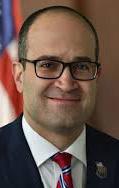
Barclay praised Ra in a statement, saying, “Ed is among the most respected members of the Legislature, and his track record of hard work, intelligence and commitment to our Conference will serve him well as
Minority Leader. I wish him great success in guiding the Conference forward.”
Assembly Republicans wished Barclay well and congratulated Ra on ascending to the post.
“Leader Barclay never lost sight of the people we represent, especially those in small towns and rural communities that are too often overlooked,” said Assemblyman Keith Brown (R-Northport) in a statement. “Through his leadership, he helped secure critical funding and support for communities in Suffolk county and across New York, ensuring they had a real voice in Albany. His principled leadership, professionalism and commitment to affordability and public safety set a standard that will endure.”
Of Ra’s new leadership position, Brown said it’s a “strong choice” for the Conference “and for Long Island.”
“Ed brings a clear-eyed under-
standing of how state policies impact local communities at home on Long Island…As a fellow Long Islander, Ed knows our region’s families and small businesses are being squeezed by high costs and failed policies.”
Assemblyman Joe DeStefano (R-Medford) said that Ra will bring “steady leadership” to the Conference.
“As a fellow Long Islander, Ed understands firsthand the challenges facing our region and our state, from the rising cost of living and public safety concerns to protecting taxpayers and supporting local families and small businesses,” said DeStefano in a statement. “Throughout his time in the Assembly, Ed has demonstrated steady leadership, a strong work ethic and a thoughtful approach to problem-solving. He has earned the respect of colleagues on both sides of the aisle by staying focused on results and never losing sight of the people we were elected to represent.”
Republicans hold 47 seats in the Assembly to the Democrats’ 103. Owing almost entirely to solidly-blue New York City, the GOP has been shut out of Assembly leadership since 1975.
By Matt Meduri
For generations, Brentwood had a vibrant baseball scene.
But over the decades, enrollment has dropped and organizational differences between sports leagues left America’s Pastime to the side.
Lifelong Brentwood resident Tom O’Hara is launching a campaign to revitalize the sport, especially for the hamlet’s youth.
“Thirty-five years ago, we had a robust Little League,” O’Hara told The Messenger. However, a new business model projected maintenance of the standard of players.
“Unfortunately, it wasn’t happening. It was a revolving door of players and the greater Brentwood community’s sporting endeavors had changed from basketball, baseball, and football to soccer,” said O’Hara.
The worlds had been brought together, specifically with Brentwood Youth Activities (BYA), but O’Hara said, “If you’re not getting the talents, then what’s the point?”

The “hands-off” approach saw the Little League go from “bad to worse to dead,” according to O’Hara.
The BYA, for whom O’Hara had worked going back to the 1960s, was reincarnated as Brentwood Cheerleading Football (BCF).
“I wasn’t interested in fighting; we needed to collaborate,” said O’Hara. “We have a responsibility for the older kids. How can we get them [for baseball] if they’re not fielding Little League? We have a responsibility to our community.”
But O’Hara has renewed hope in the quest and now serves as President of Brentwood Baseball, formerly known as Brentwood Travel Baseball.
“Next month, we’re starting T-Ball and Little League from scratch,” said O’Hara, with the hope of coaching the younger generations to stock their longestablished Travel league (ages 13-30) and the Senior Ball (ages 13-17) club at Brentwood State Park.
“We’ve been running these beautiful programs, but the ages 5-12 bracket had been overlooked [over the years]. We can’t do that anymore. Why wait for
By Madison Warren
us to go into another decline? Kids deserve better.
In a letter penned to the neighborhood, Brentwood Baseball pitches itself as an organization of “residents committed to serving the community.” The board of directors has over 150 years cumulative experience with local youth baseball.
“We believe the current system is not effective, and we are motivated to implement these changes as soon as possible,” the letter reads. “Doing nothing will only accelerate decline and lead to an even bleaker future for our organization. The loss of competitive youth baseball under age 13 is already happening and will likely become permanent soon.”
The stated goal is to place “over 200 children” in the new T-Ball and Little League programs by April 1. The organization is partnering with the Brentwood Union Free School District in this mission, as well as with Perfect Game, the “country’s top baseball professional/collegiate placement company.”
“Reaching this goal with sixteen teams, Brentwood Baseball can provide training, skilled coaching, and a fun competitive environment,” reads the letter. “This effort is too great for one person or organization, so we turn to you, our friends and neighbors, and respectfully ask for your support to help us reach our goal.”
O’Hara added that the average varsity record over the last couple years is poor for the league. Of 20 games a season, Brentwood’s record is usually 1-19.
“Totally dysfunctional,” said O’Hara. “We’re going off the rails. My forty years of work would be over.”
The league’s inaugural clinic will be held from March 1-8 at Brentwood State Park.
“If we don’t work together, we don’t get anything done,” said O’Hara. To learn more about Brentwood Baseball, visit them online at brentwoodbaseball.com.
Long Island has recently welcomed its fourth Wonder Food Hall at The Shops at SunVet, the newly redeveloped mall on Sunrise Highway. For families or groups who can never seem to agree on what to eat, Wonder offers a one-stop solution. With a wide variety of cuisines and restaurant concepts all under one roof, it makes it easy to satisfy everyone’s cravings in a single order.
Here’s how it works: Wonder offers a large variety of dishes from different restaurants all in one place. Instead of choosing from a single menu, customers can browse over 20 partner menus. All menus are co-developed and approved by partner chefs and restaurants to uphold their culinary standards. You can explore the options online for pickup or delivery or visit in person to place your order. Once you’ve decided, a central kitchen team prepares the items together, allowing multiple cuisines to be made fresh at the same time and served in one order.

This is a unique approach to dining that removes the usual back-and-forth of picking a restaurant and instead gives everyone a say. With so many options available, it creates a convenient and flexible experience that nearly guarantees everyone leaves happy.
As per their website, “What makes Wonder special is its first-of-its-kind Multi-Restaurant Ordering, customers can mix and match dishes from multiple chefs and restaurants in a single order.”
Wonder opened its first brick-and-mortar food hall on the Upper West Side of Manhattan in February 2023. The company now operates more than 95
locations across New York, New Jersey, Rhode Island, Pennsylvania, Connecticut, Delaware, Maryland, Virginia, and Washington, D.C., and plans to continue its rapid growth. By the end of 2026, Long Island alone could see up to eight Wonder food hall locations across Nassau and Suffolk counties.
You might be thinking that Wonder how expanded in a mind bottling way. Why is that?
Consumers, especially families and groups, are looking for more choice without more effort. Instead of having to agree on one restaurant, people can select dishes from multiple kitchens in a single order, satisfying a range of tastes in one stop. It represents a completely different approach to ordering food.
What makes it even more convenient is that Wonder integrates online ordering, delivery, and pickup through apps and its website. Customers can mix and match items from different menus in one order, which boosts average ticket size and customer retention.
As Wonder continues to expand across Long Island, its arrival reflects a shift in how people are choosing to dine, prioritizing convenience, variety, and flexibility. With multiple cuisines available in a single order, the concept is carving out a new niche in the local food scene and offering a modern solution to the age-old question: “What’s for dinner?”
Wonder Food Hall is located at 5801 Sunrise Highway in Holbrook.

Introducing the most advanced, state-of-the-art health care experience the South Shore has ever seen.
Here at Good Samaritan University Hospital, “better” isn’t a finish line. It’s a starting point. A new beginning. A symbol of transformation our community deserves. And while our Patient Care Pavilion will feature an all-new, expanded emergency department, technologically advanced operating rooms, reimagined private patient rooms, and enhanced Trauma and Stroke centers, we know that better care isn’t just about the building. It’s about the people inside, and the hands that heal. Because better is something we live every day. And it never stops.

To learn more, scan the code or visit chsli.org/BetterNeverStops This is the new Good Samaritan University Hospital.
By Matt Meduri
This is our fourth article in the mini-series outlining all federal executive departments. This week brings us to the Agriculture Department (USDA).
The economy of the fledgling United States was predominately agrarian. Innovation at the time meant new and improved varieties of seeds, plants, and livestock to import into the nation. This quest for scientific knowledge was actually the start of the Smithsonian Institution, although it did not include agriculture specifically. The Patent Office began collecting and distributing new crops and seeds in 1837, piloted by Henry Ellsworth, who is often called the “Father of the Department of Agriculture. “ By 1839, Congress established the Agricultural Division within the Patent Office, allotting it $1,000 for its collection project.
On May 15, 1862, President Abraham Lincoln (R-IL) established the first iteration of the department as we know it today. Through the Morrill Act, the Agriculture Department was formed as an independent agency staffed by only eight employees. Their main responsibility was to conduct research and development related to “agriculture, rural development, aquaculture, and human nutrition in the most general and comprehensive sense of those terms,” according to 7 U.S. Code §2201. Its first commissioner was Isaac Newton, a Virginia farmer who had sold farm products to the White House. Lincoln referred to the new department as the “people’s department,” as it reflected the vast majority of the nation’s business at the time. Newton’s contributions to the department include laying its foundation, pioneering federal agricultural statistics, promoting scientific research, and establishing the experimental farm on the National Mall.
In 1887, Congress granted the department Cabinet status and reorganized it under the Department of Agriculture in Labor. The USDA would then be given funding for agricultural experiment stations in each state and during World War I, funding would be appropriated for cooperative extension services to teach agriculture and home economics. With those distinctions, the USDA would reach out to every county in every state.
The first Secretary of Agriculture was Norman Jay Colman (R-MO), who served under Presidents Grover Cleveland (D-NY) and Benjamin Harrison (R-IN). Colman oversaw the transition of USDA to a Cabinet-level department and expanded the department’s bureaus and agricultural research. He was also publisher of Colman’s Rural World, a major agricultural journal. He contributed greatly to the Land-Grant College Act, which saw better farming techniques taught at specialized colleges, and the Hatch Act of 1887, which oversaw federal grants to colleges for a series of agricultural experiment states.
The USDA would find a pivotal role in the Great Depression. Although many had left their family farms for work and life in the big cities, they would soon return to those farms when the Depression hit in 1929. The USDA not only ensured that food continued to be produced and distributed, but also assisted with loans for small landowners, provided technical advice, and published shopping and cooking pointers to help families stretch their budgets and food stocks.
Secretary Henry Wallace (D-MN) is credited with having revolutionized the department. The Agricultural

Adjustment Act (AAA) of 1933 paid farmers to limit the production of basic commodities and reduce crop surpluses. Controversially, the AAA subsidized the destruction of crops and culling of livestock to influence the supply and demand scales to raise the prices of goods. Under Wallace, 10 million acres of cotton were destroyed and 6 million pigs were slaughtered.
According to data from FY2024, the USDA employs nearly 100,000 people across 29 different agencies. The Forest Service sees the lion’s share with about 28,000 employees, followed by the Natural Resources Conservation Service at around 10,000. The size of the workforce has shrunk about 8% between 2010 to 2024. The staff’s oversight is typically concerned with food safety, rural development, and natural resource conservation.
For FY2026, the USDA has requested a $398.32 billion budget, about 71% of which goes to nutrition assistance programs.
Secretary Brooke Rollins (R-TX) (pictured right) serves as the thirty-third and current Secretary of Agriculture under President Donald Trump (R-FL). She was confirmed by the Senate last February in a 72-28 vote. Rollins grew up on a farm outside Fort Worth, Texas, and she would participate in the Future Farmers of America. As a lawyer, she worked as a commercial litigator for Hughes & Luce, LLP in Dallas and clerked for the Northern District of Texas. She also has experience under former Governor Rick Perry (R-TX).
This column will seek to address the long-forgotten concept of civics and how it relates to American government in general, from the federal level to the local level. This column will explore Constitutional rights, the inner workings of government, the electoral process, and the obligations and privileges of citizens.
Farm Service Agency: supports farmers, ranchers, and rural communities through safety net programs, disaster assistance, conservation efforts, and farm loans.” It also acts as a primary resource for farm records and registration.
Food and Nutrition Service: administers sixteen nutrition assistance programs, including SNAP, WIC, and school meals.
Food Safety and Inspection Service: the public health regulatory wing of the USDA, which “ensures that domestic and imported meat, poultry, and processed egg products are safe, wholesome, and properly labeled.” Oversees over 6,800 establishments.
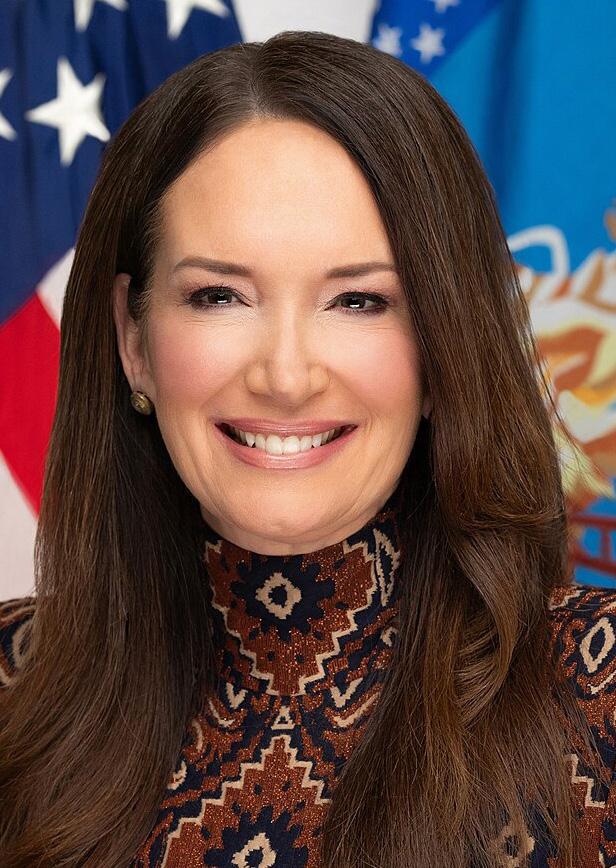
Rollins worked in Trump’s first administration as an assistant for intergovernmental and technology initiatives, within the Office of American Innovation. In 2020, she was named Acting Director of the U.S. Domestic Policy Council.
Rollins is the second woman to hold her current position. Since her term started, she has opposed California’s animal welfare law, which prohibits the sale of food products raised in crates and cages. She has also advocated for the repeal of President Bill Clinton’s (D-AR) “roadless rule,” which has prevented any road construction on 58 million acres of national forest land, calling them “absurd obstacles to commonsense management of our natural resources.”
Stacked with twenty-nine agencies, the USDA is one of the most bureau-heavy executive departments in the federal government. The following descriptions are found on the USDA website.
Agricultural Marketing Service: handles “strategic marketing” of agricultural products in domestic and international markets while ensuring “fair trade practices.”
Agricultural Research Service: the “principal inhouse scientific research agencies of the USDA” to ensure high-quality food, agricultural sustainability, and improve natural resource management.
Animal and Plant Health Inspection Service: protects the “health and care of animals and plants.”
Economic Research Service: the USDA’s “principal social science research agency.”
Foreign Agricultural Service: “facilitates international trade for U.S. agriculture,” linking American farm products to global markets, providing market intelligence, and managing international food aid programs.
Forest Service: manages 193 million acres of national forests and grasslands, acting as a “conservation agency, conducting forestry research, managing timber sales, protecting water resources, facilitating recreation, and handling wildfire management.”
Farm Production and Conservation (FPAC) Business Center: provides administrative and operational support to certain bureaus of the USDA, including human resources, information technology, and procurement.
National Agricultural Statistics Service: conducts hundreds of annual surveys and the once-every-fiveyears Census of Agriculture to provide “timely, accurate, and unbiased data” on American farming. It reports on production, supplies, prices, farm finances, demographics, and chemical uses.
National Institute of Food and Agriculture: the primary “extramural funding agency” for agricultural science to solve “national challenges in food, agriculture, and natural resources.”
Natural Resources of Conservation Service: aids farmers, ranchers, and forest landowners to conserve resources through “science-based technical and financial assistance.” The agency focuses on improving soil health, water quality, agricultural sustainability, and conservation plans.
Risk Management Agency: regulates federal crop insurance to help farmers manage risk.
Rural Development: helps rural development with federal assistance to improve quality of life and financial and technical resources.
Rural Utilities Service: provides funding to build and improve rural infrastructure, such as water, waste, electric, and broadband services.
Rural Housing Service: builds and improves housing and “essential community facilities” in rural areas, such as single- and multi-family housing, childcare centres, fire and police stations, hospitals, libraries, nursing homes, schools, first responder vehicles and equipment, and housing for farm labor.Rural
Business-Cooperative Service: helps businesses grow, trains residents of rural areas in entrepreneurial skills, and helps those residents find jobs in “agricultural markets and the bio-based economy.”
Published by Messenger Papers, Inc.
Laurel Park Elementary School earned a $2,500 TangerKids Grant Award to support the school Thrift Shop and the building’s ongoing community outreach efforts.
The grant was secured by school social worker Jesica Velasquez, who applied to help boost the shop as a resource for students and families struggling to afford basic necessities including clothing and shoes. With the additional funding from Tanger Outlets at Deer Park, Laurel Park aims to meet the increasing demand for clothing, shoes, hygiene products and other essentials for the school community.

East Islip High School has been recognized with Silver-level distinction on the 2025 AP School Honor Roll. The AP School Honor Roll replaces the former AP District Honor Roll and recognizes schools whose Advanced Placement programs are expanding access to rigorous coursework while supporting strong student outcomes. Schools can be recognized at four levels — Bronze, Silver, Gold and Platinum — determined by research-based indicators connecting AP participation to college readiness and success. To earn placement on the AP School Honor Roll, schools must meet clearly defined criteria tied to student access, performance and completion of AP coursework, including:
• College Culture: At least 40% of the graduating class took one or more AP exams during high school.
• College Credit: At least 25% of the graduating class scored a 3 or higher on one or more AP exams during high school.
• College Optimization: At least 2% of the graduating class took five or more AP exams during high school, with at least one exam taken as a freshman or sophomore.

Sayville High School, in partnership with the Suffolk County Sports Hall of Fame, successfully hosted its first-ever Sports Analytics and Business Conference, welcoming nearly 100 student-athletes and sports analytics students for a full day of immersive learning, discussion, and career exploration.
The conference was designed to introduce students to the rapidly evolving fields of sports analytics, data, artificial intelligence, and the business of athletics. Through panel discussions and keynote speaker sessions, students engaged directly with industry professionals, asked thoughtful questions, and explored real-world applications that connect classroom learning to careers in sports.
The event was organized by Sayville High School sports analytics and mathematics teacher Adam Sznitken as well as Chris R. Vaccaro, President of the Suffolk County Sports Hall of Fame.
“This conference gave our students a firsthand look at how analytics, data, and business intersect with sports at every level,” said Mr. Sznitken. “By hearing directly from professionals with such diverse backgrounds, students
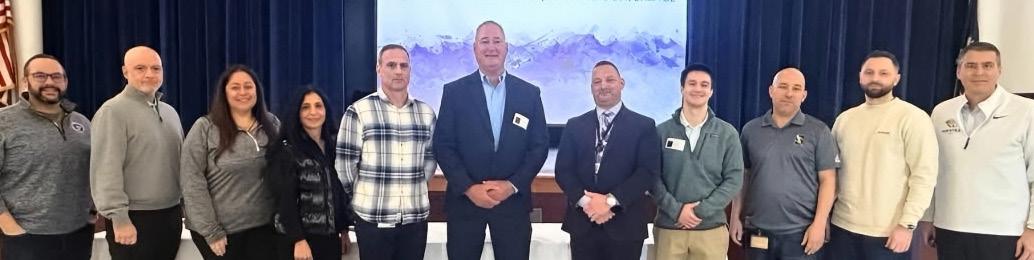
were able to see clear and realistic pathways from what they’re learning in the classroom to meaningful careers in the sports industry.”
The program featured three main segments. The first roundtable began at 9:00a.m. and included Rob Hoss and Deb Urso, both Sayville teachers and coaches, alongside former Sayville students Justin Liu and Stephen Reinstein. Liu is a physician assistant specializing in sports injuries, while Reinstein is the CEO of Market Muscles, a digital platform supporting karate schools and dojos.
The second roundtable followed at approximately 10:00a.m. and featured Dr. Ryan Cox, Athletic Director of Sayville Public Schools, Tom Combs, Executive Director of Section XI, Michael Pfaff, President and CEO of the Long Island Ducks, and Rick Cole Jr., Vice President and Director of Athletics at Hofstra University.
The conference concluded with a featured speaker session at approximately 11:30a.m. led by Caryn Landau, a former NBA licensing executive who now owns and operates a sports memorabilia business.
Throughout the day, students participated in meaningful discussions that highlighted diverse career
pathways within sports, from education and athletic administration to professional leagues, healthcare, marketing, and entrepreneurship.
“Providing students with authentic learning experiences beyond the classroom is a priority at Sayville High School,” said Stephanie Bricker, Sayville High School Principal. “This conference showcased the power of community partnerships and demonstrated how innovation, education, and athletics can come together to inspire our students and prepare them for future success.”
The conference marked a significant step in expanding experiential learning opportunities for Sayville students and reinforced the shared commitment of Sayville High School and the Suffolk County Sports Hall of Fame to education, innovation, and career readiness in the world of sports.
For more information on the Sayville Union Free School District, visit the district’s website at sayvilleschools.org. Happenings in the district can also be found on the district’s Facebook page at https:// www.facebook.com/saydistrictpr. #CaringAndLearning
Thursday, February 12, 2026
By Ellyn Okvist, B.Sc.
July 4, 1913 - General Rosalie Gardiner Jones Takes Ronkonkoma. Gen. Rosalie Gardiner Jones was the particularly bright star of the Lake Ronkonkoma Carnival Parade, even though she insisted on walking to an inconspicuous spot near the end. With her was Lillian Devere and most of the Lake Ronkonkoma Equal Rights Suffrage Club. “Walking is my specialty, you see,” was her response. This from the suffragist who led the hike from New York to Washington, D.C., 170 miles in winter conditions, for the March 3, 1913, National American Woman Suffrage Association parade.
July 4-5, 1913 - Ronkonkoma to Celebrate. A very big Carnival and celebration was held. It outdid any other event ever held in the village. A Carnival Association was formed, with leaders from the village to ensure success. Low-cost accommodations were furnished to those visitors who wished to stay overnight. Trophies were earned and a horse race was held on Ronkonkoma Avenue. Olympics with gold, silver, and bronze medals were achieved. Brass band, a dance, food, and merriment were noted, and so much more. A King and Queen were crowned, and the Ronkonkoma Hook and Ladder Company held a chemical engine contest on July 5, and nearby companies participated in the event.
July 4, 1904 - A scaffold has been put up on Cherry Street and the members of the hook and ladder company are practicing for the contests to be held at Ronkonkoma on the Fourth. The department is having a new hose cart built by C.H. Munkelwitz & Co., of Sayville for the event.
November 11, 1923 - A parade was held prior to the unveiling of the new monument to the ex-service men who represented Lake Ronkonkoma at the Lake Ronkonkoma School Sunday afternoon. Armistice Day services will be held in conjunction with the unveiling.
November 11, 1923 - War Tablet Unveiled. In the presence of Veterans and civic and fraternal organizations, a bronze tablet bearing the names of men from this locality who served in the WWI war was unveiled here today. It contains known names, including those of two men who died in service. The tablet is set in a boulder in front of the district school. A parade to the boulder was followed by speeches by County Judge George H. Furman of Patchogue, Arthur H. Meyers of Lake Ronkonkoma, and local clergymen.
May 30, 1939 - Lake Ronkonkoma American Legion to Parade Tuesday. Annual Declaration Day Parade, hosted by the American Legion. The marchers will leave the clubhouse on Church Street At 10:30a.m., and March east to Hawkins Avenue, thence north to the WWI Monument on the Lake Ronkonkoma School grounds, where services will be held. The marchers will go to the Lake Ronkonkoma Cemetery, where decorations will be placed on graves of all war veterans. Music will be furnished by the Lake Ronkonkoma Fire Dept. fife and drum corps.
May 30, 1942 - Lake Ronkonkoma Memorial Parade. The parade followed the route as 1939.
June 4, 1942 - Memorial Day Parade. The parade followed the route as 1939.
May 30, 1946 - Lake Ronkonkoma Plans Memorial Day Parade. The American Legion has invited all organizations in the Lake Ronkonkoma area to have delegations take part in the lake resorts Declaration Day parade, to be held on Thursday morning. In a later article, June 6, 1946, this parade brought one of the largest parade turnouts in the history of the Village due to a number of local WWII Veterans who took part in the Parade.
July 4, 1947 - “MOTHER GOOSE” Theme Carried Out in Lake Ronkonkoma Fourth Parade. The pre-parade party was held at the home of John H. Murray. The parade was proceeded by the salute to the flag, then the marchers followed a route through Pasadena Ct., Hawkins Avenue, Oak Street, then returned to Pasadena Court, where a party featuring refreshments and entertainment was set under way outside the home of Mr. & Mrs. John McGarity, sponsors of the event (Nan McGarity was one of our Suffragists). There were a large number of children and adults in a wide number of Mother Goose-themed costumes and floats.
December 9, 1948 - Four women from the village, Mrs. Raynor, Mrs. Berger, Mrs. Kirk, and Mrs. Sevenliss, organized the Civic Organization of Lake Ronkonkoma for a Christmas party. Santa Claus was flown into MacArthur Airport and will take part in a parade through Ronkonkoma and Lake Ronkonkoma and will arrive at the Legion Hall, where he will receive the children and give each a gift.
May 26, 1952 - Memorial Day Parade. The parade will start from the Legion Club House at 10:30a.m. and services will take place at the Legion Plot in Lake Ronkonkoma Cemetery at the finish. Mrs. D Foster Overton, Americanism Chairman urges the community to display the American flags, and that people stand erect and at attention when the flag passes in the parade.


November 24, 1960 - Second Annual Ronkonkoma Parade Attracts Big Crowd. The Second Annual Thanksgiving Day Parade sponsored by the Chamber of Commerce of the Ronkonkoma’s had a huge turnout. More than 25 costumed marching units made the march from the American Legion Hall on Church St. to the reviewing stand at the old post office. Santa appearing in the Air Force jet (on a trailer) was the climatic extravaganza, as Santa was last and when down to the reviewing stand, the drivers of the large trailer on which the jet was placed parked the vehicle in the center of Hawkins Avenue so the children and adults could climb up and meet Santa. Four winners were awarded prizes for their costumed ragamuffin theme, and the best four bands as well.
May 9, 1968 - Parade to Honor Servicemen Set. The first of its kind, the Servicemen’s Recognition Day Parade of Lake Ronkonkoma and surrounding communities will be held starting at 3:00p.m. Sunday in Lake Ronkonkoma. Assembly time for parading units will be 2:00p.m. at the Ronkonkoma Railroad Station parking lot on Railroad Avenue. More than 30 marching units with bands and floats are expected to participate in the parade. The purpose of the parade, a spokesman reports, is to honor servicemen, parents and families of servicemen, and those who will be honored guests during the event, the Gold Star mothers of the area.
May 27, 1996 - The VFW William F. Taylor Post 9486 and American Legion Post 155, will hold the Parade together.
May 28, 2006 - Hosted by William Francis Taylor VFW Post No. 9486. Started on Church Street and followed a route to Raynor Beach Park and the VFW hall.
June 14, 2026 - Flag Day, we will once again honor our servicemen with a 250th Anniversary Celebration Parade, which is the first segment of the festivities of the day. We ask the community to support this event wholeheartedly, as its importance will reflect our love for our Country, our Servicemen and women, and our beloved Lake Ronkonkoma. Supporting us as spectators, or if you are interested in marching or entering a float, you are welcome one and all. We are available to give you any information you need. And- there is no cost!

By Madison Warren
This past Tuesday, the iconic Kenny Vance was honored with the Legacy Award from the Long Island Music and Entertainment Hall of Fame in Stony Brook (LIMEHOF). The award recognized Vance not only for his decades-long achievements as a music and film artist, but also for his newly formed and award-winning documentary, “Heart and Soul: A Love Story.”
This marks the first-ever Long Island Music and Entertainment Hall of Fame Music Documentary Film Festival Legacy Award, presented to Vance for his award-winning documentary following a successful film festival run. Following the success of its Music Documentary Film Festival this past year, LIMEHOF has announced plans to begin recognizing notable contributors to the genre, with Kenny Vance named as the first honoree.
The film explores the roots of DooWop and early rock & roll through the voices and experiences of the very artists who helped shape American music in the 1950s and ’60s.
Vance spent nearly a decade filming the music industry through his own lens, capturing the voices of many iconic artists who helped introduce Doo-Wop and early rock & roll to the public. Drawing from his own recordings, reflections, and interviews with legendary performers, including members of The Chantels, Frankie Lymon and the Teenagers, The Dubs, and Little Anthony & the Imperials, he wove these moments together to tell a cohesive story.
When Hurricane Sandy destroyed Vance’s home in Queens, he was able to salvage portions of his footage. That turning point ultimately motivated him to bring the long-developing project to life.
LIMEHOF member Tom Needham said, “LIMEHOF is dedicated to preserving history of both music and film, and no one represents our mission better than Kenny Vance.”
The tribute also highlighted many of Kenny Vance’s career accomplishments, recognizing him not only as an icon in the genres of Doo-Wop and rock & roll, but also as a founding member of Jay
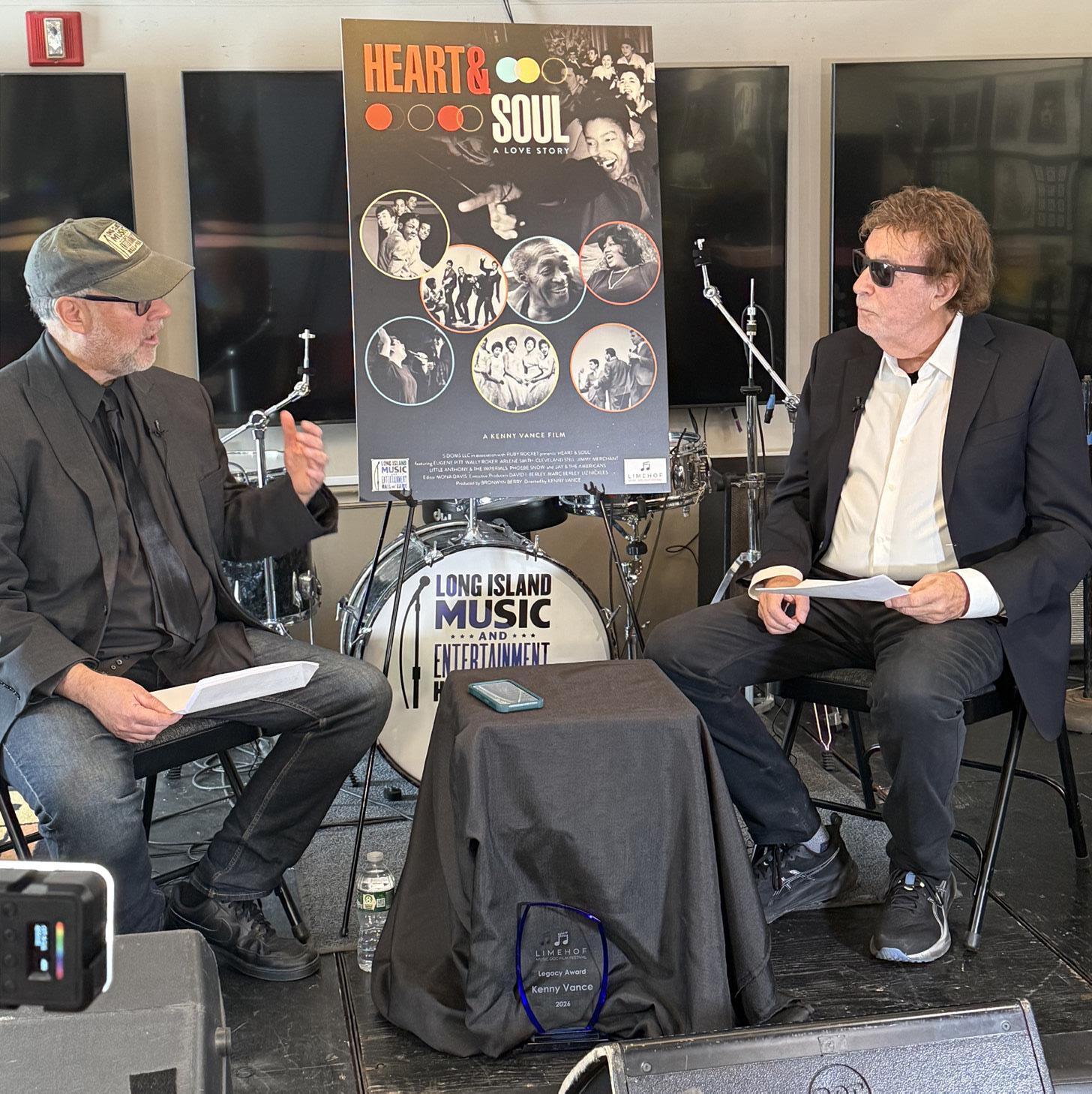



and the Americans, which opened for the Beatles and closed for the Rolling Stones at both groups’ first U.S. concerts in 1964. His career has spanned multiple areas of entertainment, including serving as a music supervisor for Saturday Night Live and contributing to notable film projects such as American Hot Wax and Looking for an Echo. He has also appeared in six Woody Allen films, among many other achievements.
When discussing what this film meant, Vance said, “The artists in the film are the unsung heroes of rock and roll, and their legacy will be honored in the film. These are the people who shoulders everything that came afterwards are built on and it’s my deep pleasure to honor these people.”
He explained that a film like this was once only a dream, but as he continued filming and editing, he realized the story, not only of the music, but of the artists themselves, needed to be told. Over the years, he has become well-versed in many music genres and various areas of entertainment, but the music he grew up with remains the most meaningful to him, which is why he ultimately returned to it to release this film.
For Vance, the project is less about looking back and more about ensuring
the voices of that era continue to be heard for generations to come.
This award means a great deal to Vance. He noted that it serves as a reaffirmation of the work he has dedicated himself to and said he is proud the film is receiving recognition for the importance of its subject matter. As a Brooklyn, New York native, he added that being honored so close to home makes the recognition even more meaningful.
As Vance continues to celebrate the legacy of the music and artists who shaped a generation, Heart and Soul: A Love Story stands as both a tribute and a time capsule of an era that defined modern sound. Those interested can learn more on the film’s official website, https://www.heartandsoulthemovie. com. The documentary will also be available on streaming platforms and on DVD, giving new generations the opportunity to experience the stories and voices that helped shape rock & roll history.
The Long Island Music and Entertainment Hall of Fame (LIMEHOF) is located at 97 Main Street in Stony Brook and can be reached at 631-689-5888.




Published by Messenger Papers, Inc.
Thursday, February 12, 2026
By Sarah Katherine Sisk | AMAC Contributor
The Trump administration logged more than $110 billion in regulatory cost savings for small businesses in 2025, the direct result of a targeted effort to cut unnecessary red tape – building on one of the hallmarks of Trump’s first term. If that progress is a sign of things to come, American small businesses are set to thrive in the years ahead.
The new finding was published in a recent report from the Office of Advocacy at the Small Business Administration (SBA). The report attributes the savings to rule changes and direct agency engagement that reduced compliance costs for small businesses nationwide.
Trump’s deregulatory agenda has implications for consumers as well. Biden-era regulations cost Americans an estimated $2 trillion – more than $21,000 for the average family of four. But since Trump took office, regulatory cuts have already saved the average family more than $2,100.
SBA has moved to expand on that relief through a new Deregulation Strike Force that is conducting a governmentwide review of regulations it says have disproportionately driven up costs for job creators and consumers. The initiative, announced in December, is led by the Office of Advocacy and targets Biden-era rules affecting housing, health care, agriculture, energy, and transportation, according to the agency.
The Office of Advocacy said the regulatory relief seen during Trump’s first year in office marks a sharp break from recent federal policy, with annualized cost reductions more than 35 times larger than those recorded during the Biden administration’s first year.
Office of Advocacy staff helped change 23 federal regulations through agency engagement and flagged more than 350 regulatory issues in formal public comment letters submitted to regulators. The office also reviewed hundreds of proposed and existing rules to assess their impact on small businesses and identify opportunities to reduce compliance burdens.
Congress created the SBA Office of Advocacy under the 1980 Regulatory Flexibility Act, which requires federal agencies to consider how proposed regulations affect small businesses. The office operates independently within the executive branch and reports its findings directly to Congress. The figures cited in the report come from the SBA’s own regulatory analyses and internal accounting, not from outside advocacy groups.
SBA said the Deregulation Strike Force will serve as the operational arm of the administration’s effort to reduce regulatory costs for small businesses by coordinating a government-wide review of Biden-era regulations. During his first term, President Trump famously cut 10 existing regulations for every new one, and has pledged to continue that pace in his second term.
According to SBA, the strike force will work across all federal departments to identify rules that are costly, redundant, or misaligned with statutory intent, with a focus on regulations that disproportionately hurt small businesses.
SBA said the review will prioritize industries where regulatory costs most directly affect consumer prices and small-business viability, including housing and construction, health care and medical services, agriculture and food production, energy and utilities, and transportation.
SBA also said that its deregulatory effort has extended beyond rulemaking into direct engagement with small businesses nationwide.
According to the report, advocacy staff met with entrepreneurs and job creators in 48 states, spending thousands of hours in direct meetings to identify regulatory barriers affecting day-to-day operations.
As part of that outreach, the agency launched a Red Tape Hotline to collect complaints about burdensome regulations. The hotline received 462 submissions covering dozens of regulatory issues, the report said. Advocacy staff used those submissions to prioritize agency engagement and regulatory review.
The SBA said its staff stopped mistaken environmental or compliance reviews, removed improper import or fee requirements, and cleared up rules that had delayed timesensitive shipments. In several cases, those fixes came within days.
The SBA has also applied its deregulatory authority in emergency settings. In January 2026, the agency began implementing an executive order signed by President Trump directing the SBA to bypass state and local permitting delays that have slowed wildfire recovery in California.
Although the SBA approved $3.2 billion in disaster loans for California wildfire survivors, the agency said less than 25 percent of the funds had been distributed because permitting backlogs prevented rebuilding. The SBA said it will issue new rules allowing borrowers to self-certify compliance when approvals face unreasonable delays, enabling faster recovery.
The Trump administration has also emphasized that deregulatory work does not end with a handful of rule changes. If relief is to last, it requires steady oversight of the federal rulemaking process, not temporary regulatory relief that can be undone by the next administration.
Accordingly, the Deregulation Strike Force reflects an effort to make deregulation ongoing and routine rather than episodic, thus preventing sudden surges of new rules that
Overview - AMACThe Association of Mature American Citizens
The Association of Mature American Citizens represents Americans 50 plus. AMAC is centered on American values, freedom of the individual, free speech, and exercise of religion, equality of opportunity, sanctity of life, rule of law, and love of family, with benefits at all levels.
AMAC plays a vital role in helping build the services that will enrich the lives of America’s seniors. AMAC Action, a 501 (C)(4) advocates for issues important to AMAC’s membership on Capitol Hill and locally through grassroots activism. To Learn more, visit amac.us
create uncertainty for small businesses and force owners to plan around shifting compliance requirements.
For small businesses without political connections, lobbyists, or access to bailouts, regulation is not an abstract policy debate. It determines whether owners can invest and expand or remain trapped, navigating costly, unnecessary rules that larger companies can afford to comply with, but smaller companies cannot.
In other words, deregulation determines whether American entrepreneurship thrives or withers and dies on the vine.
To seriously support small businesses, sustained deregulation must remain a governing priority, not just a temporary political project. By institutionalizing regulatory discipline and keeping pressure on federal agencies, the Trump administration is giving entrepreneurs the certainty they need to grow, hire, and compete.









Etymology:
mid 16th century: from a- (expressing direction) + luff. The term was originally an adverb in nautical use, meaning ‘away and to windward!’, i.e. with the ship’s head kept close to the wind away from a lee shore etc. towards which it might drift. From this arose the sense ‘at a distance’.
adjective
Pronounced: /uh·loof/
Definition: not friendly or forthcoming; cool and distant.
Example: “He stayed aloof as the rest of the group enjoyed the party.”
Synonyms: detached, unapproachable, standoffish
Antonyms: familiar, friendly, engaged
Source: Oxford Languages


L T N I A E
See how many words you can create. Must have center letter in word and can use letters more than once. 4 letter word minimum.


See bottom of page for the answers (please don’t cheat!)

February 14, 1971:
President Richard Nixon (R-CA) installs a secret recording system in the White House.
February 18,1685: Fort St. Louis is established by a Frenchman at Matagorda Bay, forming the basis for France’s claim to Texas.
February 13, 1945:
Allied planes begin bombing the German city of Dresden, resulting in a devastating firestorm that destroys the city and kills over 22,000 people.
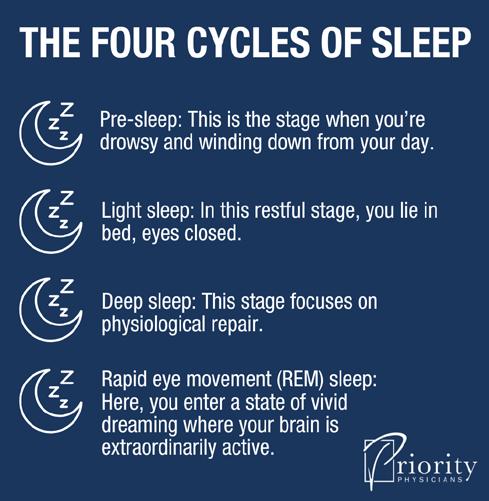

February 12, 1999:

February 15,
1967: Longest dream (REM sleep) on record is experienced by Bill Carskadon in Chicago lasting 2 hours and 23 minutes.
Source: Onthisday.com.

February 16, 1659: First known check written (£400), now on display at Westminster Abbey.

February 17, 1876:
By PJ Balzer
Please pull up a chair to my table; I’d really like to tell you a little more about my own life.
I’ve learned that it’s much easier to disagree or dislike someone from a distance. That’s part of why we’re so divided right now. It’s not as easy to dislike someone when you know more about them.
As you may already know I grew up in the Mastic, Mastic Beach, and Shirley community. I graduated from William Floyd High School in 1999. When I graduated, I believe our Hispanic demographic percentage was in the singledigits, while now it’s near 50% - 50%, that is, of a district with over 9,000 students.
At that time, I honestly didn’t have a whole lot of culture in my life. My life consisted of school, sports, and then the normal teenage stuff - not getting to know about the lives and cultures of people that were different than me. I honestly thought that all my Hispanic friends in school were from Puerto Rico. I never asked any questions, so therefore, I just assumed. I also didn’t know anything about any other Spanish-speaking countries or their cultures.

After graduating college, I lived in Astoria, Queens, for nearly a decade. Astoria is one of the most diverse parts of New York City, which itself is diverse. I believe that there’s somewhere around 100 different nations represented of people living in Astoria, all under the banner of the United States of America, of course. It’s nearly impossible to live there and not receive some type of cultural education.
Within that time living in Astoria, I ended up attending a church in Manhattan. The church had a soup kitchen ministry in the heart of Bushwick, Brooklyn, that served men, women, and children who found themselves in need or just lonely and wanting someone to eat with or talk to. I started volunteering there and serving plates of food to our guests, many of whom were originally from Puerto Rico or Mexico. My education of people and cultures took a drastic turn for the better in that soup kitchen. I pulled up a chair to the table and began to sit and listen to people. They told me about their lives and their past, their moments of pride and moments of sorrow too. I began to learn that we are much more similar than we are different. I call it the human experience.
As if I wasn’t getting enough of a cultural education and understanding from getting to know our guests in Bushwick, I ended up meeting my wife in that soup kitchen. At the time, she was one of the leaders of the ministry who helped to run the kitchen. We started courting first and then dating soon after. Within a year of us starting to date, we were married.
My wife now, of almost fourteen years, is Colombian-American. Her parents came to the United States at a young age but did move back and forth often. My wife spent a good portion of her childhood in Colombia and then graduated high school in the States. Her parents did a good job at ensuring that their children honor and value the country where they live, while still loving their culture, food, traditions and where they originally came from. I happen to believe that this is a beautiful way to live.

I can only speak for myself in saying that learning about her culture has been one of the best parts of my life. My life is truly much richer and fuller because of it. Our little household has many American traditions mixed in with some Colombian traditions as well. One night we’ll eat cheeseburgers and the next we have a traditional Colombian sancocho (pictured left) with arepas on the side. I’ve grown to understand a lot of Spanish, even though I’m still too selfconscious to actually try speaking it.
Around the holidays especially, we get invited into many people’s homes, people originally from South and Central America, or even further parts of the globe, people who value family, friendships and hospitality above all else in their lives - kind people, generous people, even though some may not have much to share. They love to share whatever it is that they have. They share just so we will pull up a chair at their table to eat with them, to get to know more about each other as neighbors, friends and ultimately as humans.
I really hope you’ll choose to do the same.
Will be offered at St. John Nepomucene and are open to people of any faith
Thursday, March 5th – April 30th at 7PM
(Note: there will be no meeting April 2nd as it is Holy Thursday)
The General Support Group & Loss of a Spouse Group is open to anyone who has suffered a loss at least three months prior, which would be December 5, 2025.
The Loss of Adult Child Group has no wait requirement.
Each group meets weekly for 90 minutes followed by refreshments and hospitality. There is no cost but a commitment to attend each meeting throughout the program is required. All groups are offered in a closed and confidential setting with highly trained f acilitators and are limited to 12 people.
Pre-registration is required. Please call 631-589-0540, ext. 250 for more information or to reserve your seat for the group you would like to attend.
By Ashley Pavlakis
The Tornado has made landfall at Harborfields as the boys’ varsity basketball team clinched their first playoff berth in three years. The boys took their final shot at making the playoffs and seized the opportunity.
The Harborfields varsity boys’ basketball team is a member of the New York State Public High School Athletic Association (NYSPHSAA) and competes in League IV. The Tornadoes are led by third year head coach Joseph Cavallaro. He’s joined on the sidelines by John Tampori and James Cavallaro. In program history, Harborfields won the New York State Class A title in 2012 and the Suffolk County Class A title in 2016.
“Coaching is a lot about building relationships. Being younger [27], I was in their shoes not too long ago. Just being able to build that relationship off the court as a younger coach, I think it helps get the trust and build that relationship,” said head coach Joseph Cavallaro. “The kids trust me to an extent, as far as they know how much I care about them, how much I love them, and we’re able to get ourselves out of a jam because of how close we are on and off the court. I think it adds a little bit of a chip on my shoulder too, to try to prove myself to some of these older coaches who have done it for a long time.”
The boys finished the regular season with a 9-10-0 record. The Section XI standings and their win/loss record don’t reflect the hard work the Tornadoes put in to fight for a playoff spot on the final day of the regular season. This fact alone just goes to show how important it is to give it your all until the very last whistle.
“All the kids have been amazing this year. I think one of the biggest things for us is that we have a bunch of really strong leaders on our team this year,” said Cavallaro. “Some kids I’ve had with me basically since I’ve been there. Our captains have been really good, and they’ve stuck to the plan. They’ve gone through the ups and the downs of our season, and we’ve really started to play some good basketball as of late, within the last week or two. The leadership that we have on this team is pretty special.”
Harborfields took on East Hampton on the road for their final regularseason matchup. The two teams met in mid-January on Harborfields court, where the Tornadoes won the game by the score of 56-53. A similar outcome would follow 23 days later when the two teams met with a playoff berth on the line for the Tornadoes. Harborfields clinched the season series and a spot in the Section XI playoffs with a 55-52 win over East Hampton.
“It was pretty surreal winning that game. It was our last game of the season, if we won, we made the playoffs; if we lost, we were handing in our jerseys the next day,” Cavallaro told The Messenger. “A pretty high-pressure situation, and on top of that, we had to travel all the way out to East Hampton, which is a two-hour bus drive. It was a pretty surreal moment getting back into the locker room after playing in such a high-stakes game in front of a packed house. East Hampton fans are awesome, that’s the kind of game that you dream of playing in.”
Harborfields boys’ basketball is active on social media, showcasing the team and documenting their players and season. After their playoff clinching win, the team celebrated with coach Cavallaro in the only way sports teams know how, a water shower. With water bottles primed and ready, they got their target [Cavallaro] as soon as he set foot in the locker room. A muchdeserved celebration after working hard to control their playoff destiny when it mattered most.
Earlier this month, Harborfields honored its five seniors on Senior Night prior to their matchup with Eastport-South Manor (ESM). Alex Ruisi, Francis
Dipalo, Ryan Barling, Greg Gonzalez, and Sam Arnowsky are set to graduate with the Class of 2026 this spring. The seniors’ family members joined them on the court for the festivities, boasting signs and cardboard cutouts of the boys when they were kids. The boys were rewarded with a dominant 43-29 win over ESM.
“Specifically, our senior captain, Ryan Barling, he’s been amazing this year on the court and off the court, just keeping the guys into what’s going on, even when we were losing a couple of games towards the beginning of the year. He really helped keep the ship afloat,” said Cavallaro. “He’s just been the extension of the coach on the court for us. Without him, I don’t think that we’re where we are right now because we definitely had a couple of air losses where things could have gone really south. They could have had the reaction that they did, and they stayed the course and kept grinding along, even when things weren’t always going our way
Senior Alex Ruisi was named to Newsday’s Top 100 basketball players list earlier this season. Cavallaro made a point to recognize Ruisi in our conversation, stressing how important he is to the team.
Player of the Game traditions are a popular thing amongst sports teams; we commonly see it at the professional and collegiate levels. Cavallaro has brought it to the Harborfields locker room.
“The culture chain is something that we do to highlight one of the kids who played with the passion, intensity, and energy that we preach about. I feel like a lot of kids these days look at stats, specifically points as the meter of if they did well, or they didn’t do well,” said Cavallaro. “There’s just so much else that goes into basketball, and so many things that happen when you don’t have the ball in your hand. We preach a lot of different words throughout the course of the year: energy, intensity, effort, attitude, sacrifice, selflessness, and accountability. When we see a kid who’s really rising to the occasion and doing the things that we preach, that really impact winning more than kids these days think, we try to reward them by giving them the culture chain.”
“One kid [Alex Ruisi], who we gave it to in the last game at East Hampton, we stopped at Burger King on the way home. He was eating a burger with his chain and the Burger King crown on,” said Cavallaro, a fun example of the culture chain being put into play.
Harborfields hasn’t been in the playoff scene for a bit and is looking to make some noise with the spot they earned. The playoff brackets have yet to be announced, but the playoffs are set to begin on February 13 for the Class AA bracket. Whichever seed they end up in, Cavallaro is confident in his team’s ability to handle the task at hand.



By PJ Balzer
The crowds double, the gym is electric, and the intensity is tangible. The Suffolk County basketball playoffs are finally here and we are definitely excited!
Gymnasiums all over the county will be packed the next few weeks as Section XI just released the playoff brackets for both boys and girls. The seeds and matchups are scheduled according to league standings and power rankings. The higher seed in the matchup gets home court advantage, which every team wants of course. These games are “one and done,” lose and go home, do or die. That turns the volume and urgency inside the gym up a few notches. Amongst the many exciting games this week, there’s one that stands out for sure. It’s a community and district that was divided in two. That divide has formed one of the greatest rivalries in the county. Expect an absolute electric atmosphere and a game that could come down to the last few possessions in the fourth quarter. Eighth seeded Sachem East hosts ninth seeded Sachem North in a first-round clash in the AAA bracket, Thursday the 12th at 5pm. The winner of this game will move on to face the top-seeded team in this bracket, the William Floyd Colonials at Floyd on February 19th at noon.

The sixth seeded Ward Melville heads over to Bay Shore to try to take down a fast and furious, third seeded Bay Shore team. Bay Shore is a tough squad with height, speed, and one of the best guards on the island, Cory Faines. The Patriots will have to stop Faines to pull off an upset. This game is also Thursday the 12th.
Bayport-Blue Point is heading over to Wyandanch to face one of the hottest teams on the island right now. Wyandanch has gotten noticeably better all season. Can the Wyandanch Wolves play a composed four quarters with good possessions and shot choices? Or will Bayport defense wear down a Wyandanch team that usually comes out of the gate fast?
Center Moriches also has a tremendous task of traveling out west to Amityville. Amityville also has arguably the island’s most well-rounded baller, Amir Dickerson. Amityville has experience on their side while Center Moriches has some young players like the Whitty brothers that can easily come up with a few defensive stops and a ten-point run. This will be an exciting one! Each game requires a ticket that sounds on the section XI website by Gofan. Check back next week for scores and round two action.
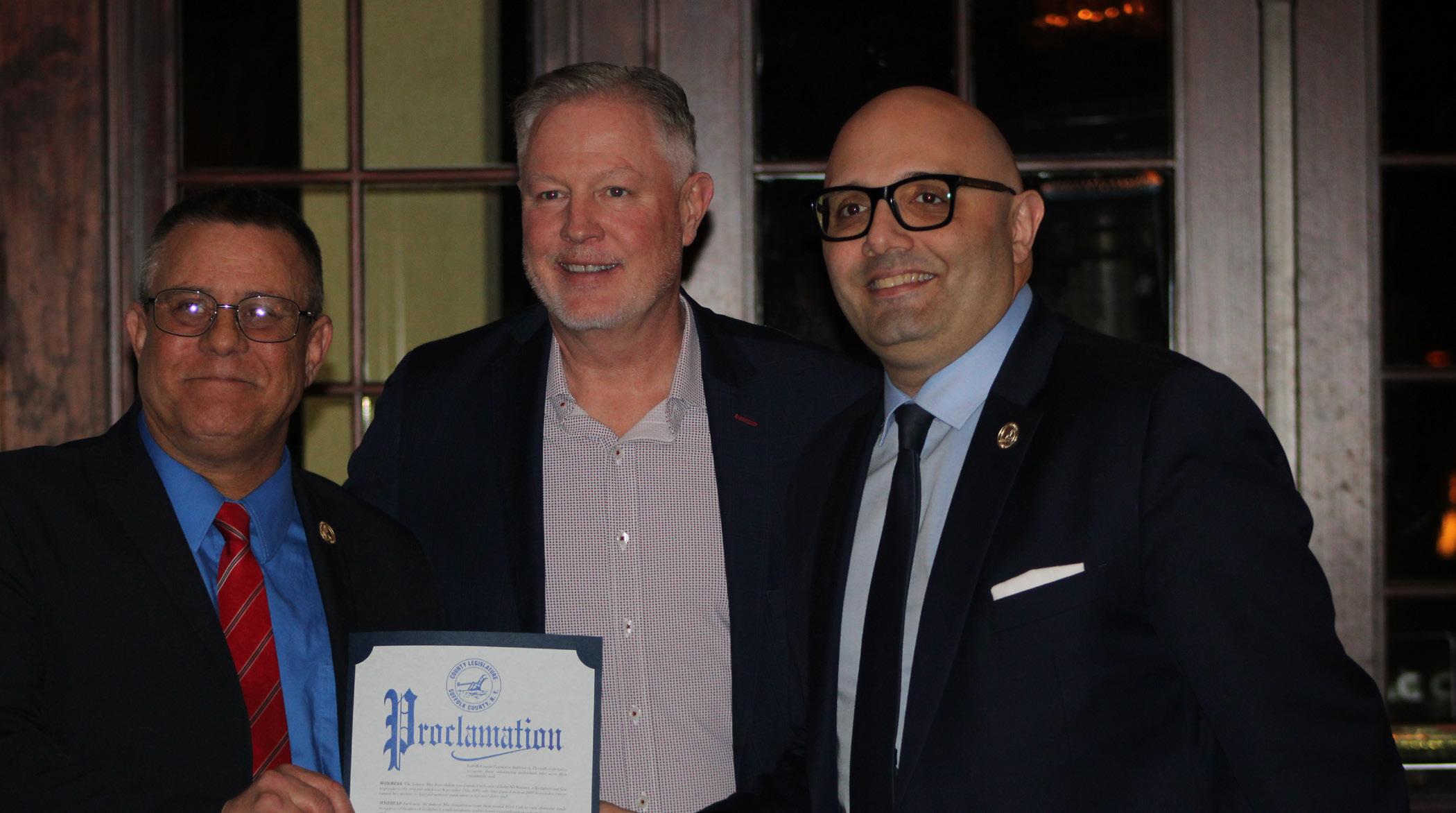
By Matt Meduri
For the United States, 9/11 remains a salient topic and a regular point of observation and honor.
For New York, particularly Downstate, it remains a constant point of conversation from federal health funds to first responders and Ground Zero cleanup crewmembers battling continuing health issues.
The Johnny Mac Foundation is a non-profit formed in honor of John McNamara, who passed away in 2009 of 9/11-related cancer. Referred to as “Johnny Mac,” he was an FDNY firefighter with Engine 220/Ladder 122 first responder on September 11 who would later log more than 500 hours at Ground Zero. He was diagnosed with terminal colon cancer in 2006.
The foundation, formed in his honor by his wife Jennifer after his death, is led by their mission statement, “whatever it takes.” The foundation works to fulfill the assistance and wishes of families of firefighters and first responders.
Last weekend, the Johnny Mac Foundation held its fourteenth annual Wish Gala at The Mansion at Oyster Bay in Woodbury.
Jennifer McNamara (pictured right) said that the room had never been as packed as it was last weekend. The event started with an excerpt from an independent film showcasing Johnny’s life and his plight to bring awareness to the issues faced by firefighters.
“I wanted to tell the story of what it looked like when a man understood what it was to be a husband and father,” said Courtney King, producer of the film Johnny Mac. King added that after a phone call with Jennifer, she decided that Mac’s story had to be told.
toward the end of his life, John was still advocating, fighting for the support, awareness, and resources needed to help his brothers and sisters suffering from 9/11 illnesses - the very people who answered the call on that day without hesitation. That says everything about the man he was.”
Because of the “unmatched brotherhood” that makes up the DNA of the FDNY and fire departments in general, Gerhard said that his late brother’s foundation has been able to raise and donate over $300,000 to support first responders and their families.
Recipients of the Jamie Atkinson Award were next up. The award is named after Atkinson, who at 19, was one of the youngest responders at Ground Zero. He passed away in 2025 from a rare cancer caused by the inhalation of toxic debris during the search-and-rescue missions.
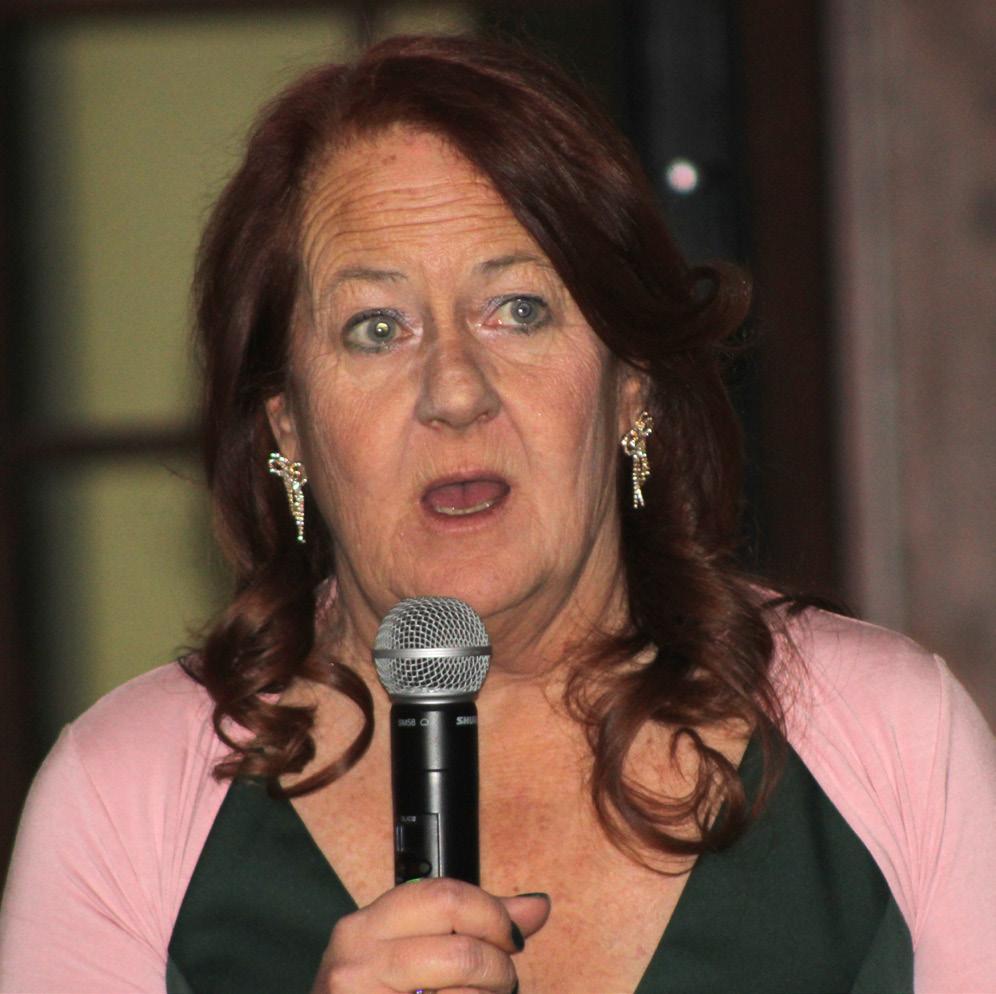
The film has been subsidized by crowdfunding with the goal of making it a feature film. The group has submitted it to the Tribeca Film Festival.
“We’re here [tonight] because of the amazing people I have come to know through time,” said McNamara of the honorees and attendees.
The Honorees
The foundation recognized the Jesse Gerhard Foundation as their 2026 recipient. The Gerhard Foundation supports charitable initiatives that “embody Jesse’s spirit of service and dedication,” according to their website. Gerhard became a member of the Islip Fire Department in 2010, later joining the FDNY as an EMT in 2015. However, in 2022 he passed away after suffering a medical episode as a result of a house fire in Queens just one day prior.
“Everything we do through Jesse’s foundation is our way of carrying his legacy forward, continuing his work, his values, and the kind of impact he would have wanted to leave on the world,” said Casey Gerhard, Jesse’s brother. “I never had the privilege of meeting John personally, but through everything I’ve learned from his incredible wife, Jen, and their son, Jack, it’s clear John was an extremely extraordinary human being. Even
Gregory Caggiano, Esq., (pictured right) was the first recipient of this award. Caggiano is a partner at Miller & Caggiano, LLP, based in Bohemia. The firm is known for their philanthropic work not only for the Johnny Mac Foundation, but also Guardians of Our Dependents, a similar organization that supports the families of fallen police officers.
Caggiano recounted how he met Atkinson seventeen years ago, saying how Atkinson always contacted him about raising money and helping other people.
“I can’t have a business and make money off of people who are hurt or sick and not be involved and give back. I just can’t,” said Caggiano. “This community means everything to me.”
The second recipient of this award was Suffolk County Legislator Dominick Thorne (R-Patchogue), the Chair of the Fire, Rescue,

and Emergency Services and Preparedness Committee and a lifelong EMT who still rides with South Country Ambulance. His colleagues Presiding Officer Anthony Piccirillo (R-Holtsville) and Brookhaven Deputy Supervisor Neil Foley (R-Blue Point) honored him as well.
“He [Thorne] is a proud family man who goes to work every day to make sure that he sets a better quality of life, not only for his family, but all families in Suffolk County,” said Piccirillo. “I’m so proud of Dominick and what he’s accomplished as a Legislator, as a first responder, and as a family man.”
Deputy Supervisor Foley, who works for New York Cancer & Blood, said he was “blessed” to know Atkinson and that he was familiar with the journey Atkinson and Johnny Mac faced.
“You stand for making the volunteer community on Long Island as strong as it can be. You have led initiatives and presented legislation to better the lives of our own volunteers. It is as rare as Jamie was to find someone acting in so many ways in dedication to our community heroes,” said Foley.
Legislator Thorne said that the foundations of evening have turned “tragedy into triumph.”
“Sorrow leads to victory,” said Thorne. “In times when people think it’s okay to hurt our first responders, the County will be standing with them. Everybody should thank God for them and we are totally grateful for our men and women in law.”
For more information about the Johnny Mac Foundation, visit johnnymacfoundation.org.