WINTER OLYMPICS

FARM NEWS

Ag OutlOOk 2026
‘Big Beautiful Bill’ changes outlined
By KAREN SCHWALLER Farm News writer
SPENCER — Clarity on tax preparation and planning for 2026 took center stage with the “One Big Beautiful Bill Act” (OBBBA) starting things off at the 41st annual Northwest Iowa Ag Outlook in Spencer.
Eric Hofland, consultant with Northwest Iowa Farm Business Association, briefly outlined the OBBBA, saying it wasn’t “groundbreaking legislation,” as much as it was a continuation of existing rules.
“Before the OBBBA was passed last July, we were (in place) to have a lot of our tax rules set to (the time prior to the) Tax Cuts and Jobs Act (TCJA) legislation that was passed when Trump was in office the first time,” he said.
Hofland explained that under the OBBBA, tax brackets are set to be lowered slightly and that taxpayers who are married and filing jointly could make up to $95,950 and still be in the top of the 12 percent tax bracket.
“The 12 percent tax bracket is a historically cheap rate when you look at the all-time history of the U.S. Tax Code,” he said.
Something he said was new this year is a $6,000-per-person senior deduction for those age 65 and older. It runs on a sliding scale of modified adjusted gross income amounts. Those with less than $75,000 can obtain the full deduction; those making up to $175,000 receive partial deductions, and deductions for those making more than $175,000 are phased out.
His example stated that a
By KAREN SCHWALLER
SPENCER — The message of the day at the tax law changes session of Ag Outlook 2026 was — plan ahead. A panel of tax preparers and other legal professionals encouraged those in attendance to not only plan ahead to save money and tax dollars in their farming operations, but to do it so they can pass something down to their heirs.
“Plan for your death — do it for your loved ones,” said Ryan Crew, attorney with Montgomery, Barry, Bovee and Davis Law Firm in Spencer. “Tax time is a good time to work on your estate planning.” Crew said estate taxes were terminated on the state level in 2025, but it still exists on the federal level. He said for 2025 and 2026, the annual gift exclusion is $19,000 per recipient per year, and a married couple can combine their exclusions to give up to $38,000 per recipient annually without filing a gift tax return. The federal gift and estate tax exemption is $15 million per individual.
“With that higher dollar amount, estate taxes touch fewer people,” said Crew. “There are
See BILL, Page 5A See CHANGES, Page 5A
Van Diest Supply Co. marks 70th year serving agriculture
It’s not just about inputs, it’s about feeding the world
By LORI BERGLUND Farm
WEBSTER CITY — It’s a milestone in the making as Van Diest Supply Company prepares to celebrate its 70th year in business in the fall of 2026. The now-sprawling agri-business just west of Webster City on old Highway 20 all started for the simplest of reasons, and one that remains highly relatable for today’s farmers.
The time period now seems long ago. Dwight Eisenhower was in the White House. Elvis Presley was soaring to the top of the charts with songs such as “Heartbreak Hotel” and “Love Me Tender.” And parents across the nation and the world were giving thanks to God and Jonas Salk for a long-awaited vaccine to protect children from the devastating disease of polio.
A lot of things have changed since 1956, but in farming, some things have not changed. Farming may be more complex, but the need that Bob Van Diest sought to fill when he opened his own small business is much the same. “It was an easy motivation,”

John Van Diest said of his father’s decision to start a small business in the fall of 1956. “He was farming. He wanted to get his own input costs lower, so he thought if he bought more fertilizer than he needed for his farm — buy in large quantities, get a better price — then he could resell it to his friends and neighbors.” Bob Van Diest continues to serve as chairman of the business that remains family owned. John Van Diest is now vice president. Rounding out the three generations of the family heading up the business are John’s sons: Jake Van Diest, president; and Jack Van Diest, sales manager.
The family story goes that Mary Van Diest became the first employee when she and Bob married in 1959. In those early days, business was often conducted around the kitchen table. Some of those early customers are still customers today. Like her husband, Mary Van Diest remains as active as possible in the family business yet today, and both are pleased to see the next generations making their own mark.
The family story of how this company started is now well-known. It has grown from supporting Bob and Mary Van Diest and their
By LORI BERGLUND Farm News writer
WEBSTER CITY — At Van Diest Supply Company, it’s more than just family, and more than just one family. It’s a place where multiple generations of many families have come to build a life.
To mark the company’s 70th anniversary, it’s worth looking beyond the Van Diest family, to the impact the company has had on hundreds of employee/team members over the years.
We asked company leaders, including President Jake Van Diest and Vice President John Van Diest to estimate how many families have worked for the company over the years. It was an equation too complex to fathom. Over the decades, the jobs created here have factored into mortgages paid in full and kids sent to college. Add in the ancillary jobs, from construction to retail, created throughout the community, and it’s hard to imagine the full impact of wages paid and benefits received.
The impact this one company has had in Hamilton County and beyond is perhaps best seen in the people who have built careers here.
Van Diest Supply Company now employs some 520 team members in Hamilton County, and approximately 640 full- and part-time team members across all of its Midwest locations. Over the years, hundreds more families have grown their own families in Hamilton
-Farm News photo by Karen Schwaller
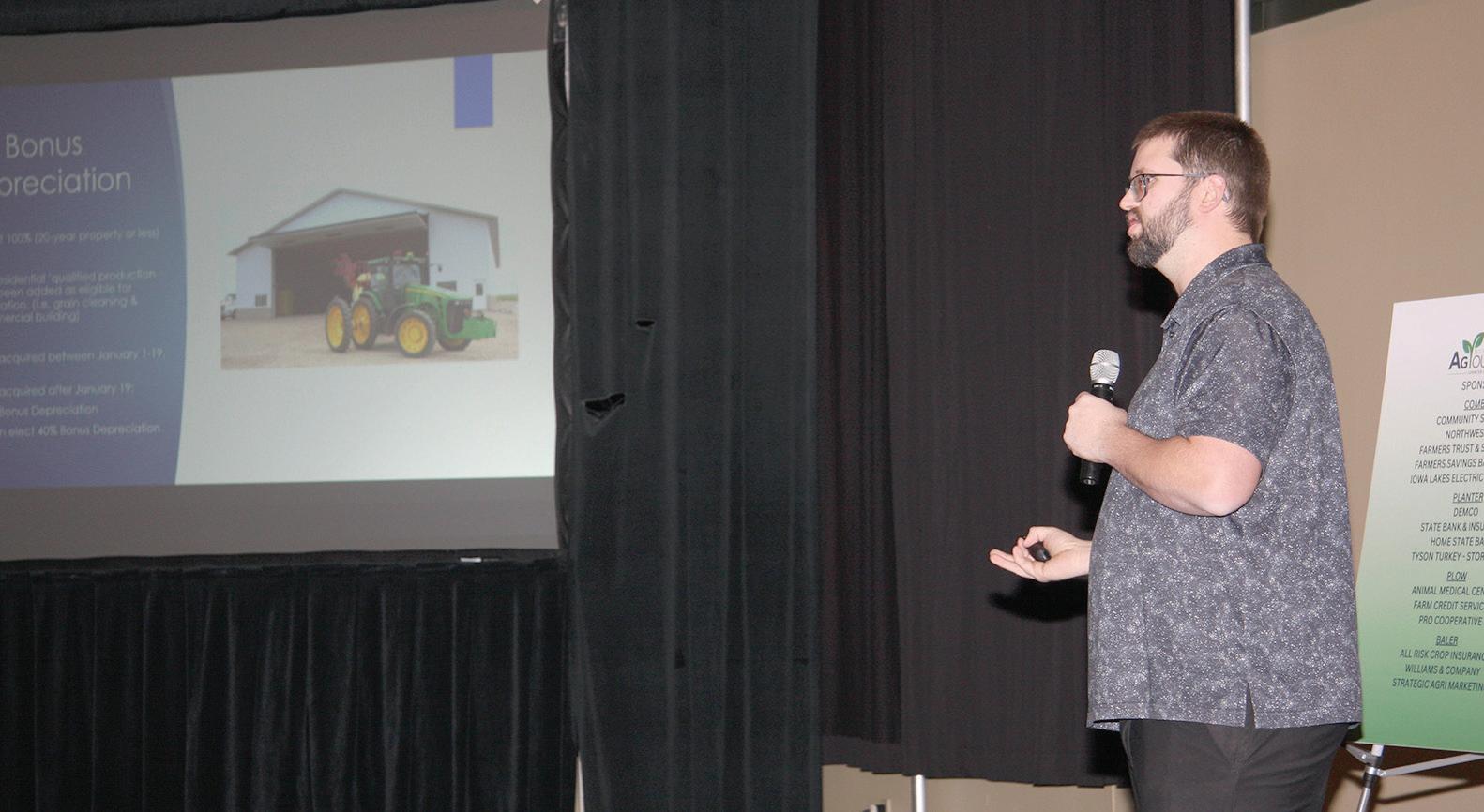
ERIC HOFLAND, consultant for Northwest Iowa Farm Business Association in Spencer, spoke to attendees about the One Big Beautiful Bill Act, and how it would impact farm families.
-Farm News photo by Karen Schwaller
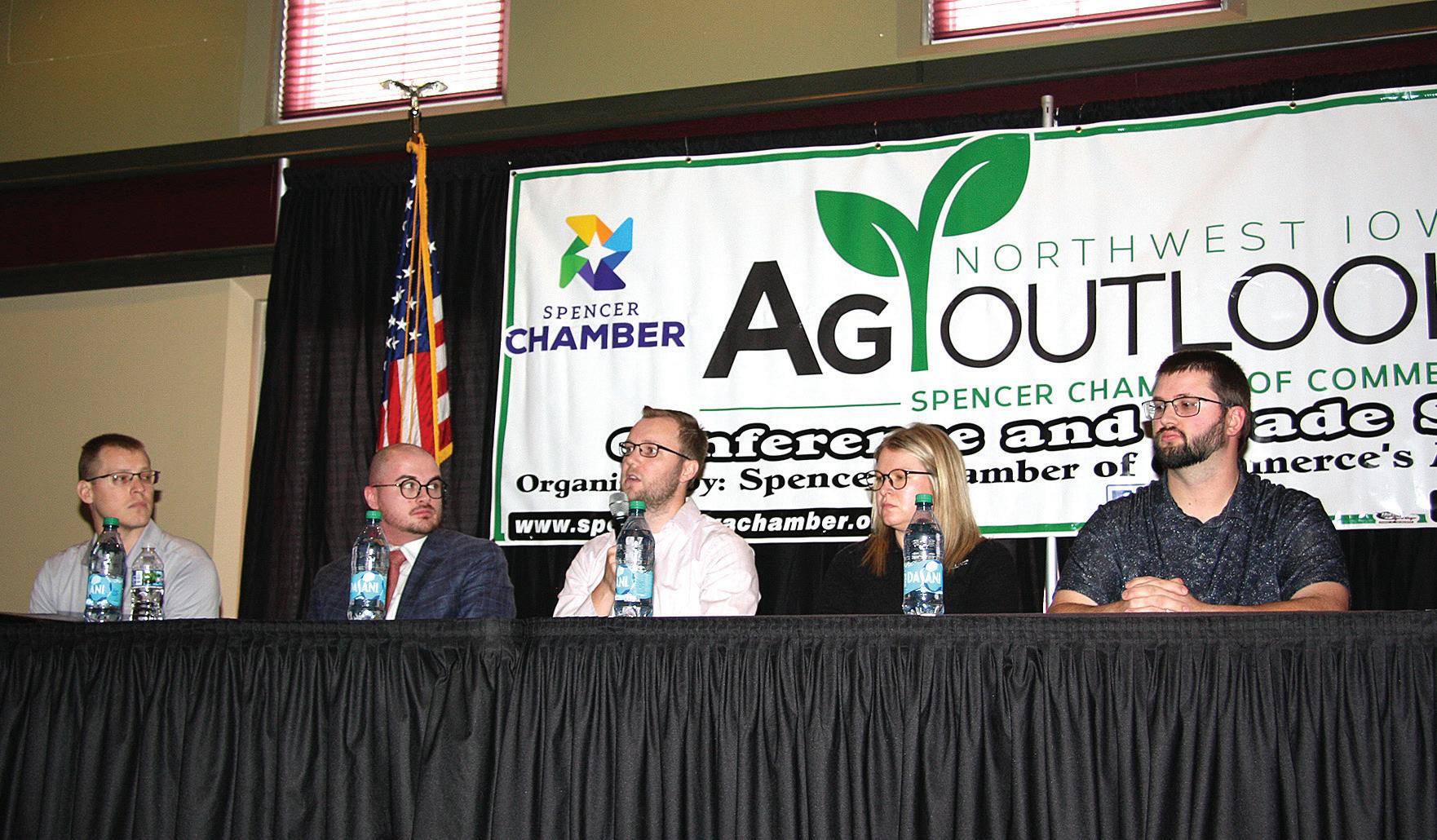
a panel of local tax and legal professionals
Northwest Iowa Ag Outlook in Spencer.
-Photo courtesy of Van Diest Supply Company
THREE GENERATIONS of the Van Diest family now form the leadership team at Van Diest Supply Company. From left are: Vice President John Van Diest, President Jake Van Diest; Chairman Bob Van Diest and Sales Manager Jack Van Diest.
News writer
Farm News
County because they found work that was rewarding at the company.
Now a Van Diest retiree, Gregg Olson was with the company for more than half of its 70-year history. But Webster City and Van Diest Supply Company were about the last place he ever intended to end up.
“No way,” Olson said. “I wanted to move to a bigger city.”
After graduating from Webster City High School in 1973, Olson headed off to the University of Northern Iowa and earned a degree in accounting in 1977. He was working at a Des Moines accounting firm and had been offered a position with the state of Iowa when a young woman told him about a job opening at Van Diest.
Her name was Cathy Scott, now his wife of more than 40 years, and the sweetest reason behind his taking a job as assistant controller at Van Diest in 1978. A farm girl from the Blairsburg area, his future wife wanted to raise a family close to her own family. It was a decision they both celebrate, as the couple’s three children grew up close to all of their
grandparents, and so many more family and friends.
“I think our kids had a very ideal childhood,” Olson said. “They could go to the swimming pool, play in the baseball leagues, and run the neighborhood without any concerns.”
It was also the right place for his own career to grow. Over the years, Olson would be promoted to controller and then treasurer before retiring in 2023. His daily commute was only a few minutes, and the salary and benefits enabled the young couple to grow a family in their own home county.
“Webster City is big enough to have grocery stores, a great library, excellent medical care. Everything we need is close to home, and yet we’re still close enough to go to Des Moines or Minneapolis for a weekend.”
Mark Roden is another
Webster City native who found a career at Van Diest Supply Company. For Roden, it was a second or third career. Also a 1973 graduate of Webster City High School, Roden and wife, Bridget, first spent some 21 years in Virginia and then Minnesota during his service
Crop insurance deadline nears
Spring planted crops, Whole-Farm Revenue Protection and Micro Farm options included
ST. PAUL — The U.S. Department of Agriculture reminds agricultural producers that the final date to apply for or make changes to their existing crop insurance coverage is quickly approaching for spring planted crops, Whole-Farm Revenue Protection, Micro Farm and some specialty crops.
Sales closing dates vary by crop and location, but the next major sales closing dates are Feb. 28, March 15 and April 15.
Producers are encouraged to visit their crop insurance agent soon to learn specific details for the upcoming crop year. Crop insurance coverage decisions must be made on or before the applicable sales closing date.
The USDA’s Risk Management Agency lists sales closing dates in the Actuarial Information Browser, under the “Dates” tab.
Producers can also access the RMA Map Viewer tool to visualize the insurance program date choices for acreage reporting, cancellation, contract change, earliest planting, end of insurance, end of late planting period, final planting, premium billing, production reporting, sales closing, and termination dates, when applicable, per commodity, insurance plan, type and practice.
Additionally, producers can access the RMA Information Reporting System tool to specifically identify applicable dates for their operation, using the “Insurance Offer Reports” application.
Federal crop insurance is critical to the farm safety net. It helps producers and owners manage risk and strengthen the rural economy. Producers may select from several coverage options, including yield coverage, revenue protection and area risk plans of insurance.
Crop insurance options to manage revenue risks include Whole-Farm Revenue Protection and Micro Farm. Whole-Farm Revenue Protection provides a risk management safety net for all commodities on the farm under one insurance policy and is available in all counties nationwide. Micro Farm aims to help direct market and small-scale producers that may sell locally, and this policy simplifies record keeping and covers post-production costs like washing and value-added products.
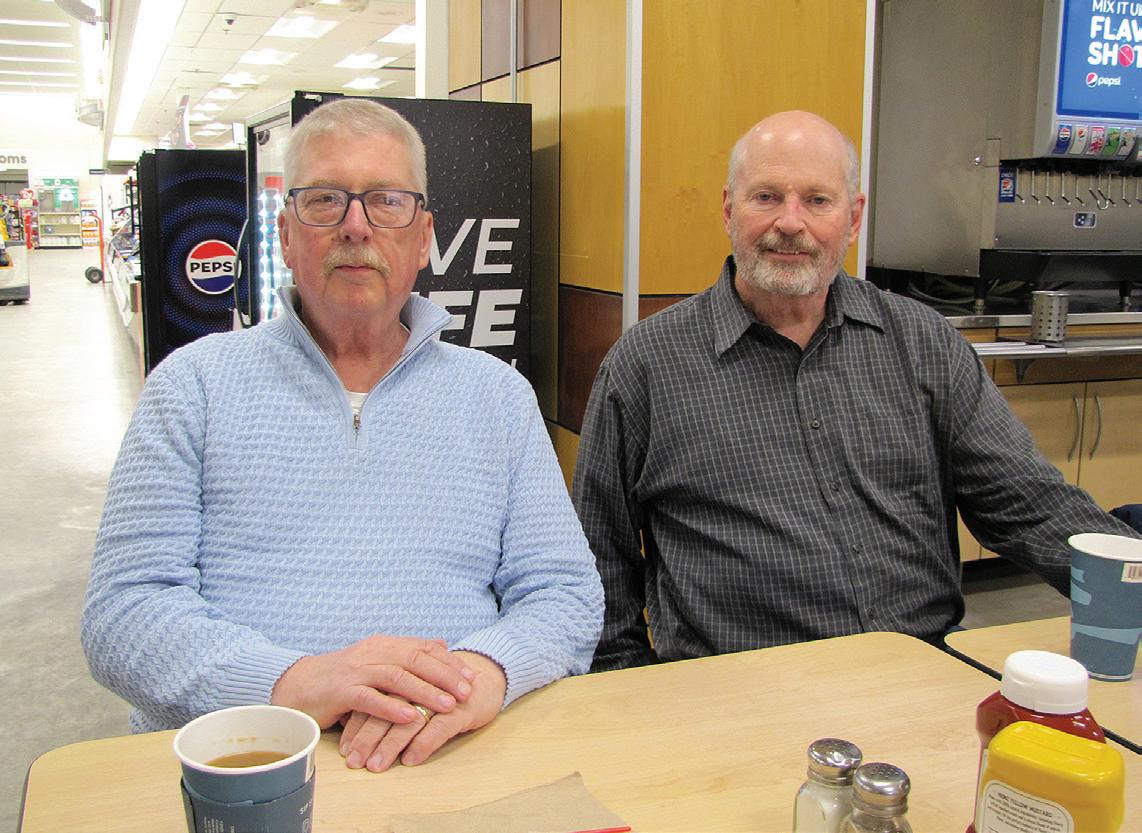
MARK RODEN, LEFT, AND GREGG OLSON are among several retirees from Van Diest Supply Company who meet regularly at Hy-Vee for coffee, breakfast, and lots of times for some friendly catching up with old friends.
with the U.S. Navy.
After retiring from the Navy, the Rodens were ready to come back home and be closer to family as their own parents aged.
The couple’s children, who had been raised largely in Virginia, would finally get to know their cousins, grandparents, and even one set




122 Buy 1 Get 1 Free O ers from the following Establishments:
4th St Depot - Fort Dodge
of great-grandparents, a little better.
“We came back in 2000 and I worked for Electrolux for nine years,” Roden said. “When Electrolux decided they were going to leave, I was sweating it because there was not a lot of jobs around here. I was thankful that Bob (Van Diest) and the family decided to hire me.”
Roden worked in production and formulation for about 13 years at Van Diest Supply Company before retiring in 2022. To him, it was more than just the daily work, but the fact that it was close to home and people with whom he enjoyed spending his workday.
“I could work five miles away every day and make a good wage and good benefits,” Roden said. “I reconnected with people that I knew before I went into the service and met some new friends. I have no regrets at all. Working at Van Diest was a very good move for me.”
Apparently, he is not alone in that view. Company statistics point to a work force that largely stays for the long haul.
“We’re family owned and we see Webster City as home,” Jake Van Diest said. “We have over 200 members who have been here 10 years or more. We want long-term team members and that shows in the workforce.” It’s a workforce that hasn’t stopped growing since Mary Van Diest first joined her husband, Bob Van Diest, and started doing the books for this home-grown business that continues to grow today.



A Pinch of Love Cafe - Fort Dodge
Applebee’s - Fort Dodge
Buffalo Wild Wings - Fort Dodge
Burger King - Fort Dodge
Burrito Mexpress - Humboldt
C-Tap Community Pizza - Fort Dodge
Casablanca Steakhouse - Fort Dodge
Culver’s - Fort Dodge
Domino’s Pizza - Fort Dodge
Dunkin’ Donuts - Fort Dodge
Family Table - Eagle Grove
FeedShed Catering - Fort Dodge
Godfather’s Pizza - Fort Dodge
Hacienda Vieja - Fort Dodge
Larita’s Cakes N More - Fort Dodge
Leon’s Pizza - Webster City
Lomita’s Mexican Restaurant - Fort Dodge
Mulligan’s Bar & Grill - Fort Dodge
Papa Murphy’s Pizza - Fort Dodge
Perkins - Fort Dodge
Pop’s Pizza & Pub - Eagle Grove
Salty Suz - Fort Dodge
Sips & Moore - Fort Dodge
Snack Shack - Fort Dodge
Sneakers Eatery & Pub - Fort Dodge
Stadium Inn - Fort Dodge
Stumpy’s - Duncombe
Taco Tico - Fort Dodge
Tea Thyme - Fort Dodge




































Photo by Lori Berglund
NEWS
*A Texas grand jury has indicted five employees and executives of Agridime LLC for wire fraud and money laundering. This group promised clients returns of 15 to 32 percent if they invested in their cattle purchase scheme. A total of $220 million was invested in this case of fraud from 2021 to 2023. Taylor Bang of Killdeer, North Dakota, was a cattle broker for Agridime and is one of the defendants in this case.
CORN
ANALYSIS
Corn closed the week $.01 lower. Last week, private exporters did not announce any sales.
In the weekly export inspections report, U.S. corn export inspections, for the week ended Feb. 12, were 58.8 million bushels (mb) but down modestly from the previous week’s 63.4 mb and last year’s same-week exports of 63.9 mb, while corn inspections over the last four weeks averaged 57 mb/week vs. last year’s 54.1 mb/week average during the same period, generally keeping up with the estimated 60.1 mb/week average which will be necessary through the end of August to reach the USDA’s 3.300 billion bushel export projection and would be even slightly above last year’s record 59.2 mb/week average from this point forward. Cumulative corn export inspections of 1.407 billion bushels are still up 44% from last year’s 974 million but slipping fast, and cumulative exports were up 66% year-overyear as recently as early January, while the USDA’s export projection reflects expectations for marketing year total exports to prove 16% above year-ago levels.
In the weekly EIA report, U.S. ethanol average daily production for the week ending Feb. 13 averaged 1.118 million barrels. This is a new high daily production for this week of the year. The previous high was 1.084 million barrels per day in 2025. This was up 0.7% from last week and up 3.1% from last

Hoops
year. The five-year average for this week is 1.026 million barrels per day. Ethanol production for the week was 7.826 million barrels. Ethanol stocks were 25.588 million barrels. This was up 1.4% from last week and down 2.4% from last year. The fiveyear average stocks for this week is 25.422 million barrels. The amount of corn used for the week is estimated at 111.35 million bushels. Cumulative corn use for the crop year has reached 2.580 billion bushels. Corn use needs to average 106.25 million bushels per week to meet the USDA’s marketing year forecast of 5.600 billion bushels.
STRATEGY & OUTLOOK
Record demand and strong ethanol grind has supported corn values, however ending stocks remain large and the carry will unlikely be met.
SOYBEANS ANALYSIS
Soybeans closed the week $.04 3/4 higher. Last week, private exporters did not announce any export sales.
In the weekly export inspections report, U.S. soybean export inspections last week were 44.2 mb, ticking up from the previous week’s 42.1 mb, and were well above last year’s same-week exports of 26.7 mb as will likely continue to be the case in the weeks ahead as last year’s export program was seasonally slowing while this year’s exports are very likely to remain elevated in the weeks ahead as last week’s export sales data showed China still had 5.1 MMT of unshipped old crop purchases on the books vs. last
year’s 2.0 MMT yet unshipped at the same time. Over the last four weeks, soybean inspections averaged 45.9 mb/week vs. last year’s 34.0 mb/week average during the same period, allowing cumulative inspections of 895 million bushels to continue trimming the deficit to last year’s 1.324 billion to 32% average after being down 45% year-overyear in early January. In order to reach the USDA’s 1.575 billion bushel export projection, soybean inspections will need to average roughly 22.6 mb/week through the end of August vs. last year’s 18.0 mb/week average from this point forward and representing what would be the highest average weekly exports from mid-February through the end of August in seven years just to meet the USDA’s current export projection.
The January NOPA crush report came in at 221.565 mb, above estimates of 218.5 mb, a new record for January, although it was below December’s 225.0 mb. This was well above last year’s 200.4 mb. Soybean oil stocks came in at 1.900 bp vs. estimates of 1.710 bb and last month’s 1.642 bp. The was considerably larger than last year’s 1.274 bp of stock inventoried.
& OUTLOOK
STRATEGY
Producers were advised to sell inventory and reown with lower risk options due to the huge South American crop that is being produced.
WHEAT ANALYSIS
For the week, Chicago wheat closed $.33 higher and Kansas City wheat closed $.30 1/2 higher. Last week, private exporters did not announce any export sales.
In the weekly export inspections report, U.S. wheat export inspections last week of 13.8 mb were down solidly from the previous week’s 21.3 mb, while wheat shipments over the last four weeks averaged 15.3 mb/week vs. last year’s 14.3 mb/ week average during the same period, with cumulative export inspections of 651 million bushels
continuing to maintain a 19% gain to last year’s 547 million vs. the USDA’s 900 million bushel export projection, reflecting an expected 9% increase in exports from last year. In order to reach the USDA’s export target, wheat inspections will need to average roughly 14.7 mb/week through the end of May vs. last year’s 16.3 mb/week average from this point forward, while the USDA’s export projection is likely to prove at least 25 million bushels too low based on the shipment pace so far and last week’s export sales data showing the 5.21 MMT in outstanding sales still on the books remaining above last year’s 4.97 MMT at the same time, implying a likely slightly higher overall shipment pace through the last three months of 2025-26 than last year.
STRATEGY & OUTLOOK
Producers should use this rally as a hedging opportunity against new crop wheat as the world remains awash in wheat supplies.
& FEEDER CATTLE
LIVE
ANALYSIS
Last week, live cattle closed $1.32 lower while feeder cattle closed $1.65 lower.
In the monthly Cattle on Feed report, on feed supplies fell to 98.2% of last year, below estimates and a nine-year low. On feed supplies are currently 11.505 million head. Placements came in at 95.3% of a year ago, also below estimates of 96.5% and the lowest in 19 years. Only 1.736 million head were placed in feedlots a month ago. The marketing effort was disappointing at only 87%, which is the lowest in 10 years. Last week, fed cattle cash trade had moderate volume in the North and light volume in the South. The North traded fed cattle at $247 to $249 live and $388 dressed, which is $1 to $3 higher live and $6 higher dressed compared to the prior week’s trade. The South traded fed cattle at $249 live, which is steady with the top end of the prior week’s prices.
Last week, boxed beef sold for export declined 36 loads from the prior week to 892 loads which
was 89 loads above the same week in 2025 for an 11% increase in export sales. At the Joplin, Missouri auction on Feb. 16; feeder steers were $5 to $20 higher with heavier weights $5 to $10 higher. Feeder heifers sold $15 lower to $20 higher. Demand was strong with 12,062 head traded vs. 13,084 head last week and 2,970 head last year. At the Oklahoma City auction on Feb. 16, steady to higher results were seen once again in OKC, with feeders steady to $10 higher and calves steady to $5 higher. Buyers were reportedly a little more selective, but prices were still firm. Receipts totaled 6,700 head, down from 9,253 last week, but up from 3,169 a year ago. The latest USDA steer carcass weights were steady with the previous week at 981 pounds, which is 30 pounds above yearago levels. Net beef sales were 14,700 mts for 2026 with shipments of 13,400 mts.
STRATEGY & OUTLOOK
The COF report and tight supplies remain bullish to the market, however a reopening of the US-Mexican border poses headline risks.
LEAN HOGS ANALYSIS Lean hogs closed the week $2.30 higher.
Total pork export shipments during November were reported at 613 million pounds on a carcass weight equivalent, down slightly from the 632 million pounds the prior month, and down 5% from this same month last year. Cumulative YTD pork exports through November are now down 2% vs the prior year.
Iowa/southern Minnesota weekly hog weights for the week ending Feb. 14 are 292 pounds vs. 291.5 pounds last week and 289.6 pounds last year. Net pork sales were 27,300 mts for 2026 with shipments of 35,700 mts.
STRATEGY & OUTLOOK Summer futures above $110 are holding a large premium, which is unlikely to be met.
The Winter Olympics
The Winter Olympics have come and gone, that quadrennial phenomenon that should be called the “It’s Cold Enough Out There to Freeze the Whiskers Off a Polar Bear!” I have nothing against people who enjoy winter sporting events. But I’ve had my fill of cold, having grown up in a drafty old farmhouse where you could see your breath when you crawled out of bed on subzero winter mornings. We mortals watch, gobsmacked, as superhuman athletes perform superhuman feats of athleticism. Thanks to the TV commentators’ observations, we soon become critics. “His left skate slid two millimeters sideways when he landed that triple lutz,” you might mutter even though up until that very moment you thought that “lutz”

Columnist Jerry Nelson
was a brand of beer.
Many of the Winter Olympic events involve insane velocities. We’re talking about speeds that would result in a traffic ticket on most highways.
One of the scariest events is the luge, a sport wherein the athlete hurtles, feet first, down a steep, icy trough aboard a sled that’s approximately the size of a deck of cards. I don’t know how the sport got its name, but my guess is that if you crash, your legs will luge up into your
-Photo
chest cavity. A scarier sport is the skeleton. It’s similar to the luge except that the athletes zoom down the super-slick ice trough face first! This sport was probably invented by a man whose last words were, “Hey guys, watch this!” Afterwards, they could only find scattered bits of his skeleton and that’s how the sport got its name. Of all the Winter Olympic events I’ve watched, curling is the only one that I might be willing to try. The sport
is conducted at a languid pace and involves stones and ice, and I’ve had experience with both of those things. The stones that I’ve moved are those that are picked from fields and the ice is the type that causes a guy to flail cartoonishly during the two nanoseconds between losing his footing and crashing to the ground. But curling also elicits a smidgeon of suspicion. I’m thinking about the part where team members use brooms to sweep furiously ahead of the stone as it slowly glides toward its


target. If I showed the least bit of interest in the sport, my wife would frequently point at the floors in our house and inform me that I need to practice curling. As we’ve seen with Lindsey Vonn’s tragic experience, downhill skiing is among the most dangerous of the Winter Olympic events. It’s also the only snow-based sport that I’ve personally experienced. Yes, it was only once, and yes, it was on an incline that many would describe as a bunny slope. But still, I clearly risked life and limb. Our youngest son was born with an effortless, innate athletic ability. My wife and I are at a loss as to where this came from. I’ve been known to trip over a paper clip.
On the other hand, I’ve marveled as my wife juggled cooking a meal, answering the phone, and doing the laundry — all while balancing a baby on
her hip.
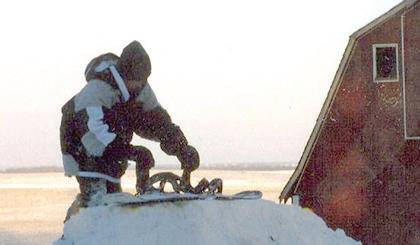
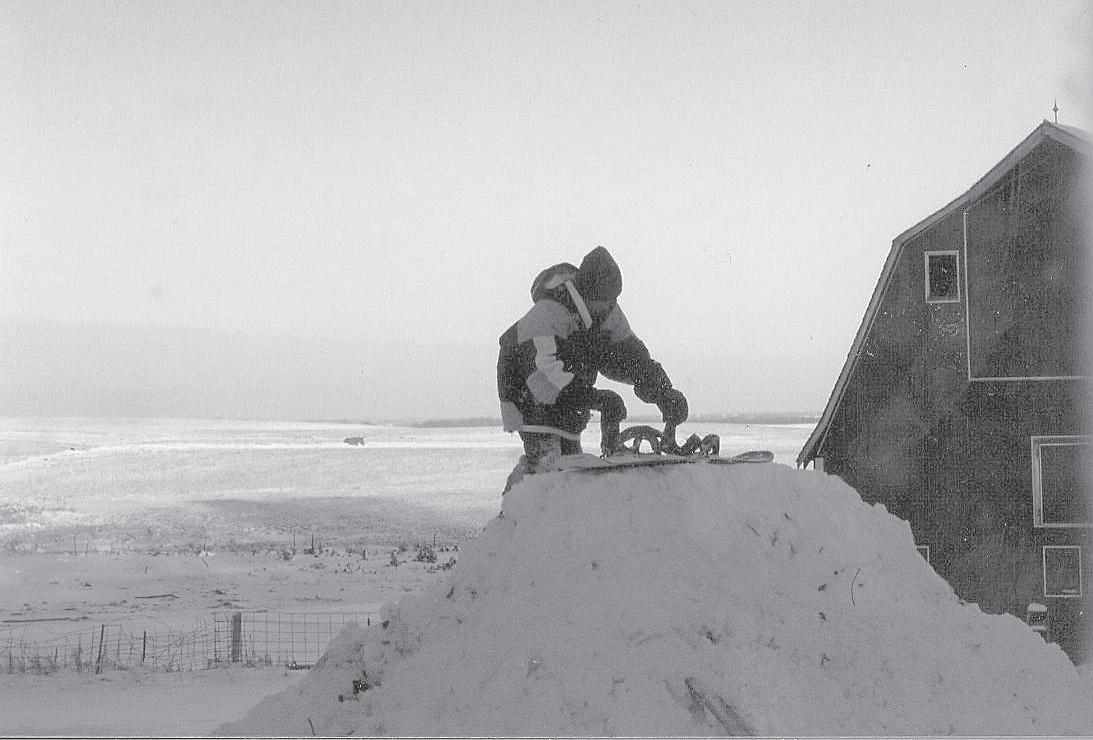
Our youngest son became obsessed with snowboarding at an early age. But we live on the prairie, so our longest and steepest inclines are the township road ditches. Whenever we received a substantial snowfall, he insisted that I use the loader tractor to construct a snow pile. This provided him with about 10 feet of drop and a snowboarding experience that lasted maybe two seconds.
One winter, he talked me into taking him to a local ski park. The word “mountain” is in its name, although “good-sized hill” would be more accurate. He strapped on his snowboard and I, being ignorant of the dangers involved, rented a pair of skis. I bolted the fiberglass blades onto my feet and grabbed the rope that pulls skiers up to the top of the hill. The boy rocketed down the slope, carving graceful arcs, spraying majestic rooster tails of snow, and having the time of his young life. I had no choice but to follow. I immediately discovered that my skis were defective. They lacked any sort of steering mechanism and had no brakes. I managed to miss the chalet at the bottom of the hill and sped toward the nearby highway. I could envision the headline: Local Doofus Flattened by Truck in Skiing Accident. Thankfully, the highway’s upsloping embankment brought me to a halt. I duckwalked clumsily back to the chalet and removed the skis. Enough!
I should have been awarded a
by Julie Nelson
Is your family eligible?
It's time to apply for your Century or Heritage Farm status
For those area families that have a long, proud history of farming, it is not too early to think about the 2026 Century Farm and Heritage Farm awards.
Iowa Secretary of Agriculture
Mike Naig is encouraging eligible farm owners to apply for the 2026 Century and Heritage Farm Program. The program is sponsored by the Iowa Department of Agriculture and Land Stewardship and the Iowa Farm Bureau Federation and recognizes families that have owned their farm for 100 years in the case of Century Farms and 150 years for Heritage Farms.
It has been about 193 years since land that is now the state of Iowa was opened for settlers. The America of the 21st century is far different from the nation led by President Andrew Jackson in 1833. There is, however, one constant feature for Iowans — agriculture is at the very heart of economic life in the Hawkeye State.
Consequently, it was a fitting celebration of agriculture and the generations of Iowans who have farmed here that in 1976, as part of the nation’s bicentennial celebration, the Century Farms Program was established. The Iowa Department of Agriculture and Land Stewardship and the Iowa Farm Bureau Federation created the recognition program. It had the endorsement of the Iowa American Revolution Bicentennial Commission. Since its inception, more than 20,000 farms have been designated as Century Farms, The Heritage Farm program recognizes those family farms that have had consecutive ownership within the same family for 150 years or more, and was started in 2006, on the 30th anniversary of the Century Farm program. More than 1,000 farms have been recognized.
To be eligible for a Century or Heritage Farm award, a farm must constitute at least 40 acres and have been owned by the same family for 100 or 150 years respectively.
Each year at the Iowa State Fair, there is a ceremony honoring that year’s additions to the Century Farm and Heritage Farm honor rolls.
For those owners who are eligible to seek Century Farm or Heritage Farm status, it is time to prepare their applications, which must be notarized and postmarked by June 1.
Applications are available on the department’s website at www.iowaagriculture.gov by clicking on the Century Farm or Heritage Farm link under “Programs.” Applications may also be requested from Kelley Reece, coordinator of the Century and Heritage Farm Program via phone at 515-281-3645 or email at Kelley.Reece@IowaAgriculture.gov.
Completed applications should be mailed to the Iowa Department of Agriculture and Land Stewardship, Hoover Building, 1305 E. Walnut St., Des Moines, IA 50319. Mark the envelope to the attention of either the Century Farm program or the Heritage Farm program.
We encourage area farm families to consider these two unique honorary programs and submit applications if they are eligible.
Letter to the editor
Proposes non-recourse loan
To the editor:
I want to express a big thank you to the Farm News editor for printing Mr. George Naylor's Jan. 9th letter “A Better Way. Facts Matter.” — like the history of Roosevelt's New Deal parity price floor grain program and the role it played in propping up Mainstreet U.S.A. It's interesting. I agree with George. It seems David Kruse and Alan Guebert ignore New Deal Farm history. Why don't they suggest a revival of the government non-recourse loan rate that was set at 90 percent of par? That loan gave farmers complete control of their grain production — something they never had before the 1940's and not after it was abolished in 1953. Actually the non-recourse loan should be considered an historical milestone because it philosophically and psychologically hamstrung the money lenders. Farmers did not have to sell their grains under duress or sell their crops below 90 percent of par.
Nope I don't think Kruse and Guebert will ever challenge and use the psychological whip (non-recourse loan), enter the “Temple of the Money Lenders” and philosophically whip them to admit the non-recourse loan brought 13 years of economic stability for farmers and Mainstreet. Yep, Guebert points to corporate power but doesn't use the non-recourse loan to slash the raw nerve of monopoly power. Kruse is content to ride the pirate ship the “USS DE-REGULATION.” Since 1953 that pirate has gutted farmers with the saber of deceit and thrown them overboard and fed them to the sharks of indifference.
I am a strong defender of the Karl Marx theory of surplus value and his keen observation of commodity production because he said "in the production of commodities all labor must be satisfied.” Now Kruse claims his cornfield ran 270 bushels per acre and his break-even price was $3.89 so the current price made his efforts profitable. Wow Wee! Now I have no idea what price David received but I do know he is content to sell his investment and his labor on the cheap because the current parity price for corn is $15 a bushel. When farming, I knew I was pitching my labor into the cauldron of indifference but at least I recognized the pain of those who just got tired of pitching and lost their farms. Picking up on George Naylor's theme about facts mattering, there is a reason why farming is called “agriculture” and not “agribusiness.” It should be obvious to Kruse and Guebert, like Mark's dictum the price of corn doesn't even come close to paying for the cultural needs of farm families; it doesn't satisfy the business side of farming either.
If Kruse and Guebert want to be the voice for family farmers, they need to ground themselves in the philosophy and psychology of Roosevelt's visionary and very successful parity pricing of grains farm program and then spread the GOOD NEWS.
Larry Ginter Rhodes
When 'crazy' is the only answer
House Ag Committee Chairman Glenn Thompson must not be a superstitious man. If he were, he would not have introduced the biggest bill of his congressional career, the “Farm, Food, and National Security Act of 2026,” on Friday, Feb. 13.
But there he was Feb. 13 taking the lid off his “farm bill 2.0” for all to see. The bill, he explained, “provides modern policies for modern challenges...”
Not really. Indeed, little in Thompson’s proposed legislation even suggests the current century. Worse, three of “modern” agriculture’s biggest problems–ethanol, resource pollution, and tariffs–are barely mentioned or left completely unaddressed.
Take tariffs. While never mentioning the word, Thompson suggests a tariff-fueled, 54 percent drop in recent U.S. soy sales to China can be cured through increased “port capacity” and “new and developing markets.”
Clearly, today’s biggest trade problem is tariffs. No matter, Thompson budgets $533 million–more than twice today’s “trade promotion” spending–to paper over it, not fix it.
It’s another sign that the past, according to recent Farm Bill research, is where much of today’s Farm Bill still gets its inspiration–especially the costliest aspects of it, according to Jonathan Coppess, associate professor and director of the Gardner Agricultural Policy program at the University of Illinois. In a recent, multi-part series on
Farm Bill
basics, Coppess explains the ages-old root of farm program payments, “base acres,” and how they continue to drive farm policy.

Alan Guebert
By definition, base acres are historical; they establish the “what” and “how much” government will subsidize “covered” crops like corn, soybeans, cotton, wheat, rice, barley, oats, sorghum, and peanuts under Farm Bills.
And here historical means old. “The base acre system is rooted in acreage allotments which were part of the parity policy design that developed out of the New Deal farm policies,” he explained in his initial paper. (All are posted at farmdocdaily.illinois. edu)
As such, base acres “represent a snapshot in time, but a very different time.” In fact, if landowners did not update their base acres when given the chance in either 2002 and 2014, their “base acres would be largely unchanged from the contract acres [laid out in] …the 1996 Farm Bill.”
And millions weren’t; a 2005 USDA report shows that “over 60% (163 million) of the base acres…” were not updated. Crazy, right? Why not update your base to better reflect current crop
mix and, potentially, boost program payments? Coppess has a perfectly good answer but must take a tortured path to get to it.
“The 1996 contract acres were not calculated anew; they were simply the base acres enrolled under the 1990 Farm Bill. Those base acres were established for the 1986 crop year by the 1985 Farm Bill, calculated using the acres [from] … 1981-1985.”
So, “It is not an exaggeration to note that most of today’s base acres represent planting decisions and farming that are decades old–many of which… were… made in the first half of the farm economic crisis of the 1980s.”
Why?
Because the 1996 law famously “decoupled” base acre payments from what is actually grown on the land. Combined with other “updates” to payment schemes over subsequent years, this “flexible” design “encourages… a farmer to supplement the income from one crop with the payment of another.”
Indeed, this “fundamental flaw becomes most problematic when farmers growing the same crops can earn different incomes based solely on policy and politics.” Neither changes under Thompson’s “modern” bill. Policy and politics, after all, will deliver an additional $27 billion in “bridge” and “ad hoc” payments this year. In any other business that would be a sure sign of failure; not in U.S. agriculture, though.
Crazy? Yeah, that’s the right answer.
Command performance
There is no question as to who calls the tune in every sector or subject today domestically and geopolitically. A Truth Social comment from President Trump gets immediate attention. What he says may not make broad sense, but it makes sense to him and commands attention. Markets respond. His comment that he wanted China to add another 8 mmts of U.S. soybeans to their first tranche of purchases brought an immediate response from the market. For good reason, the trade thought that they were done buying for the time being as the Brazilian harvest took precedence. The background info was that China reportedly found out about Trump’s command that he wanted them to buy another 8 mmts of soybeans when we did. That would mean that they had no advance warning and thus taken no preparation, so it was a surprise to them too. Would they comply without reciprocal concessions and what might they be? They thought that they had complied with the previous agreement for 12 mmts and were ready to buy cheaper Brazilian soybeans. Market-wise, timingwise this makes no sense. Yet, we have all come to know that what makes traditional sense may not be the relative factor as to whether this happens or not. If China feels compelled for some good reason to follow through with a purchase of an additional 294 million bushels of U.S. soybeans, that would have a material impact on our balance sheet, which is why our market responded as it has. So far this has been isolated to the soybean market, but there is nothing to say that future Truth Social posts could not mention corn or cotton too. This is a wild card that only one person controls. The cotton market would very much like to have a similar posting from the president. It is very difficult to account for in a marketing plan. Whether China responds or not, he caused the soybean market to rally 80 cents, which many farmers took advantage of. That was better than subsidy ACHs, but only a few U.S. farmers will benefit. The rally could be timed perfectly for Brazilian farmers if the Chinese purchases of our soybeans do not happen.

While more U.S. origin soybean sales to China would tighten our balance sheet and increase prices, it has the opposite effect on Brazil. They are harvesting a record crop and there is a limit to how many soybeans that China can logistically acquire and manage. If they buy more from us now, that translates to buying less from them. We had thought that China was already full, because of U.S. soybean and Canadian canola purchases ahead of the Brazilian harvest glut. Pricewise it would make no sense to buy our soybeans at inflated prices while Brazil’s soybeans dip to a further discount. The basis differential between Brazilian and U.S. soybeans could set a record. The Chinese have historically followed the best market opportunity with their decisions and buying our soybeans at this time, under these conditions, would be the opposite of that. That seems like a lot to ask for, but the market is not ruling it out so nor can we. U.S. farmers have mostly sold out of old crop, which is where this rally is concentrated. It has not carried through to new crop so U.S. farmers miss the opportunity again. Brazilian farmers were undersold on their sales so if their basis doesn’t deflate dramatically, this rally is a windfall for them. Commercials have to be thoroughly confused as to how to bid. I cannot believe that they would bid up Brazilian origin based upon the CBOT rally, but without having actual Chinese orders, buying soybeans at these prices would be full-on-risk here. Thank you to President Trump, with love from Brazil.
If China buys this many U.S. soybeans at a higher price, every other soybean buyer in the world that may have been thinking of buying from us, will buy from Brazil instead. That will dilute the impact
that an additional Chinese purchase at this time, if it happens, would have on our carryover. Brazil’s soybeans go on sale. There is enormous collateral impact here. I have warned that Brazilian soybean farmers were at risk of a financial crisis, and the fallout from China buying our soybeans instead would hit them where it hurts. China owns a large soybean reserve supply so it is not as if they are in need of our soybeans. The world has an adequate soybean supply, so all this shift in source origin does is ignore or disrupt normal market signals.
This is an election year and there is likely to be another attempt at a USDA aid payment designated from Congress to farmers, ostensively to make up for losses but timed to buy votes. This mid-term battle will be the mid-term election of the century and the farm vote will be contested. This has been one advantage that U.S. farmers have had over Brazilian farmers who do not get such payments. Unfortunately, that is also because they have not needed them. They have added acres surpassing the U.S. in soybean production over the last couple decades without government aid checks. They have a lower cost of production and have been subsidized by the currency exchange of a weak real. The one who is going to want to keep them producing is China, who has made major investments in logistics and transportation infrastructure there. This will figure into their calculation as whether to comply with Trump s command to buy more U.S. soybeans at what are at now higher prices. The original deal was reported to buy 25 mmts in future years, which while still a little less than their historical demand is enough to raise the floor given that a few months ago it was zero. Can China bail out Brazilian soybean farmers while still complying with U.S. purchases demanded by the president? Brazil will be able to find other buyers for cheap soybeans. U.S. farmers have become dependent on government aid and Trump s market commands. There is opposition to this additional aid from those that think that farmers got what they voted for and should not be bailed out.
Comm Stock
David Kruse
In brief
FEMA OKs more than $64 million to support recovery
KANSAS CITY, Mo. —
FEMA recently approved more than $64 million in funding to support recovery for past disasters in Iowa and Nebraska for public assistance projects, which include debris removal, emergency protective measures and the repair or replacement of public infrastructure damaged by disasters.
This regional funding is part of a broader effort announced by the Department of Homeland Security and was approved prior to the government funding lapse.
Here are some of the FEMA grants recently approved across Iowa and Nebraska:
n More than $3.7 million to the City of Rock Valley for repairs and emergency protective measures.
n More than $5.7 million to the Rock Valley Community School District for building repairs.
n More than $1.5 million to the City of Minden for repair and replacement of public utilities.
n More than $3 million to the Omaha, Nebrasak, Public Power District for repairs.
n More than $1.9 to Omaha Parks and Recreation for repairs.
Manure application, cover crops focus of virtual field day
AMES — Iowa Learning Farms, in partnership with the Iowa Nutrient Research Center, will host a virtual field day at 1 p.m. March 12.
The event, which is available at no cost, will feature a live discussion with Dan Andersen, associate professor and extension agriculture engineering specialist at Iowa State University, Raj Raman, Morrill Professor of agricultural and biosystems engineering, and Philip Rockson, agricultural and biosystems engineering graduate research assistant at Iowa State.
The virtual field day aims to provide valuable insights into the impacts of different cover crop systems and manure application methods on water quality and corn yield.
“We’ve done a fair amount of work on the timing of manure application, looking at late fall manure versus early fall manure impacts on corn yield and water quality, knowing that some people are stressed about ‘when can we get manure on in the fall,’” noted Andersen. “We saw huge timing responses, and one of the next questions was, ‘How much different is it when you move manure application to spring?’”
In this innovative project, funded in part by the Iowa Nutrient Research Center, the focus is on how timing affects yield and water quality when comparing fall and spring manure applications.
Any person interested in cover crops, manure application or water quality is welcome to attend the virtual field day. Participants are also encouraged to bring any questions they would like to ask.
To participate in the live virtual field day, visit the Iowa Learning Farms website, or join from a dialin phone line: dial 646-8769923 or 646-931-3860, with meeting ID 914 1198 4892. The field day will be recorded and archived on the ILF Virtual Field Day Archive for future viewing.
Participants may be eligible for a Certified Crop Adviser board-approved continuing education unit. Information about how to apply for and receive the CEU will be provided at the end of the event.
Continued from Page 1A
married couple (ages 67 and 69) with a modified adjusted gross income of $115,000 can reduce that income to $103,000, putting them in the 22 percent bracket, saving them $2,640 in tax dollars.
“It’s not ‘no tax on Social Security’ like we were promised, but it’s certainly a lot better than we’ve had,” he said.
Hofland said the Child Tax Credit was increased to $2,200/ child, and it can be indexed for inflation.
He also said the Qualified Business Income Deduction (also involving those who are members of cooperatives and receive 1099s from them) is now permanently set at 20 percent. Following the 2017 TCJA, farmers no longer have to pay wages to claim the benefits it offers, but only have to have net income from the farm, so that 20 percent deduction comes off of taxable income. With that, he said a new $400 minimum deduction has been introduced, which starts in 2026.
Hofland said the estate tax has been adjusted for inflation, allowing families to pass more wealth on to their heirs.
“They made (the amount) permanently higher to $13.99 million for 2025, then to $15 million for 2026, and in 2027 it will be indexed for inflation, but starting out at that higher level,” said Hofland.
He said “Trump Accounts” are part of the OBBBA, which are (in essence) IRA accounts for children under age 18. It consists of a $1,000 one-time federal contribution for those born between Jan. 1, 2025, and Dec. 31, 2028. Family and friends can gift up to $5,000/year (tax-free for an employee as an employer benefit), with no contributions allowed before July 4, 2026, when the program officially begins. Funds are invested in low-cost U.S. stock index funds only, and the account is managed by parents until their child reaches 18, when full control transfers to the child.
Funds grow tax-deferred, and earnings and employer/government contributions are taxed as ordinary income upon withdrawal. A 10 percent penalty may apply if the money is withdrawn before the age of 59.5, unless for qualified exemptions such as college, purchasing a first home, disability, etc.
“This is something they’re trying to incentivize people to do. If you can put in $1,000 now — and if you wait until their full retirement age it could be about $1 million by the time you figure in growth and inflation,” said Hofland, adding that the hope of this program is that people not rely on the government to care for them once they reach retirement age.
Changes

ATTENDEES OF THE NORTHWEST IOWA AG OUTLOOK'S SESSION on tax planning were able to visit individually with panelists after the session ended. People were able to get a snapshot of the way changes in tax laws will affect their own tax planning at this session.
“It’s not ‘no tax on Social Security’ like we were promised, but it’s certainly a lot better than we’ve had.”
ERIC HOFLAND
Consultant with Northwest Iowa Farm Business Association on the One Big Beautiful Bill
Hofland said a child must be born in the U.S. and have a Social Security Number to qualify for this account.
He said there is now a deduction for interest paid on loans for new personal vehicles (not business vehicles) purchased in the U.S.
The debt needed to be incurred after Dec. 31, 2024. The limit is up to $10,000 and there is a gradual phase-out based on modified adjusted gross income.
The deduction will be in effect through 2028.
Hofland said the 50 percent “meals deduction” ended on Dec. 31, 2025. Beginning in 2026 there will no longer be a deduction for business meals for employees, and meals will remain excludible from an employee’s income.
Bonus depreciation will remain permanent at 100 percent.
“For this year only, they give you a special exclusion where you can choose if you want a 40 percent bonus or if you want to do the 100 percent bonus, but you have to make a special election for this past year only. After that it’s going to be back to 100 percent,”
Continued from Page 1A
ways to avoid paying some estate taxes — the most common would be opening up a C Corp or S Corp, where you can gift stock to your beneficiaries at $18,000 per year, to keep it under the $19,000 annual gift tax exemption.”
Other points of interest included:
n Paying an estimate by Jan. 15 each year
“buys time,” allowing a farmer to have until April 15 to file taxes.
“We’re pushing more farmers to pay estimates as we see more people waiting for information, such as K-1’s and 1099’s from investments,” said Mallorie Krikke, CPA with Williams & Company in Sheldon.
n Forgotten 1099s should be filed as soon as possible.
n The IRS can audit up to three years; if the IRS finds missing income they can audit up to six years, and failure to provide a tax return or providing fraudulent returns can allow audit times to open up indefinitely, Krikke said. She encouraged taxpayers to keep all receipts.
n C Corps don’t make as much sense for most farmers because of the possibility of double taxation upon farm land sales (being taxed at the entity and individual levels). Sole proprietorships, general partnerships, limited partnerships, LLC’s, C Corps and S Corps can be paired to create tax plans that work for farm families.
n For limiting Self Employment Tax (SEP), an S Corp helps “cap out” Social Security and Medicare taxes.
“Instead of paying Social Security or Medicare tax on 100 percent of whatever your net income is (and with a Schedule F as a sole proprietor), you only pay it based on the cash wage you pay yourself, and use the tax savings to hopefully pay down debt or save for retirement in other ways,” said Michael Schlitter, CPA with Erpelding & Voigt Company in Okoboji.
n Farmers should work with their accountants in retirement planning by the time they reach 50 years of age to talk about increasing income so they are ready for
he said.
Hofland said bonus depreciation might be considered if a farmer purchases a machine shed, which is considered “20-year property.”
He said it’s the only property that would fall into a category where it could be built and written off all in one year.
“It’s the one case where this bonus is a big deal,” he said.
Hofland said 1099s now will have a higher reporting limit starting in 2026, being raised from $600/payee to $2,000/payee.
He said on the topic of farmland sales, that if property has been held for 10 years, a qualified farmer can choose to pay tax on the gain over four years instead of paying it all on one tax return.
“The calculation on the tax is still done on one tax return, so if you’re going to owe $100,000 on that farm ground, you’re still going to pay $100,000 worth of tax, but you’ll spread it out over four years rather than paying it all in one shot,” said Hofland.
He said most people wait until they get a step-up in basis on land, but in those cases, he said this
”Things are always changing. If you only see your CPA or tax preparer once a year, you’re not utilizing them like you should be.”
MALLORIE KRIKKE CPA with Williams & Company
retirement when the time comes.
“Most farmers want to get their income to ‘0,’ but then when they get close to retirement and look at their Social Security, there’s nothing there,” said Ethan Van Holland, who owns his own accounting firm in Sheldon. “A lot of farmers think they’ll farm forever, but I have yet to see it happen.”
He said grain sale monies can be deferred until the following year, but no longer.
“At some point, the IRS is going to come knocking, and you’ll have to claim that income,” said Van Holland.
n Farmers can pre-pay inputs for the upcoming year, but cannot pre-pay further out. Krikke said there must be a business purpose for pre-paying, not just avoiding paying taxes.
n R&D credits are available for land owners, with deductions staying with the land owner. Owners must be looking at new farming practices, innovations, changes to methods, purchase new/innovative equipment, etc. in order to receive the credits.
n Tax exemptions for grain gifts mean the farmer must not sell the grain themselves, but haul it to the elevator and transfer ownership to a qualifying charity (501c-3). If they sell the grain, it’s subject to federal and state taxes, SEP taxes, etc. Recipients (qualifying charities) have to follow up on bills and prove that the grain was transferred to them. There
would be an extra benefit. Hofland said the 2025 government shutdown caused some people to lose their health insurance, and that in 2026, taxpayers involved are standing at a “cliff.” Currently, taxpayers with incomes at or above 400 percent of the Federal Poverty Level can receive a Premium Tax Credit (PTC) for any amount by which the premium for the second lowest cost silver plan exceeds 8.5 percent of their household income. His example was of married farmers who are both 60 years of age. The cost of the second lowest cost silver plan to insure them both is $30,000. Their household income is $90,000. He said in 2025 they would qualify for a PTC of $22,350 ($30,000 minus $7,650, which is 8.5 percent of their adjusted gross income, which is what they would have to pay).
“In 2026, because we don’t have the cliff provision anymore and it’s 100 percent payback, (unless Congress extends the enhancements) they would be on the hook for the full $30,000, so they would have to pay back the initial $22,350, which they were not responsible for paying back before 2026,” he said.
Hofland said it’s a “fairly significant change,” and asked attendees to be open with their tax professionals so as to avoid expensive and unexpected taxation bills.
are no tax benefits for cash gifts after grain has been sold by the farmer, and gifts of grain to loved ones can open up the recipient to have to pay taxes on money from that grain.
n Trump Accounts offer a good return if left in the (Traditional IRA) account until age 59-1/2. Yet, panelists agreed that the only true benefit is that a child gets a retirement account, but one of which that the child will eventually be taxed. They agreed there is no tax benefit to givers.
n ”The One Big Beautiful Bill Act” gives farmers the ability to increase their base acres — it’s the first time in decades for that,” said Eric Hofland of Northwest Iowa Business Association in Spencer.
He said 2026 will return to farmers needing to decide which will pay a better return for them — the PLC (price loss coverage) or ARC (agriculture risk coverage).
Parting thoughts from the panelists included:
n Tax planning in October and November is beginning to become outdated as an “older generational thing.”
“There are a lot more options for farmers than purchasing assets to get depreciation deductions. Do your pre-tax appointment and see what options are available. There might be more than you think,” said Van Holland.
n “Things are always changing. If you only see your CPA or tax preparer once a year, you’re not utilizing them like you should be,” said Krikke.
n “We help farmers figure out their costs on a per-acre basis and compare it anonymously (with what others are paying). In times like this, you have to make sure you get every competitive advantage you can — $4/bushel corn is not that profitable, so you want to make sure you know where you are financially. And you never know when you will need to have an estate plan.” n Do your tax planning no matter what size your operation is,” said Schlitter.
-Farm News photo by Karen Schwaller
family, to supporting hundreds more families today, and likely into a thousand or more families that have worked for Van Diest Supply Company over its 70-year history.
“It’s agriculture, and we still need it,” said Jake Van Diest. “We have to do what we can to help people who grow food.”
Maintaining an affordable food supply is really what production agriculture is all about, agreed John Van Diest.
As it has for decades, Van Diest offers its own company brand of inputs under the Cornbelt name. Working on the same scale that allowed the company to offer affordable inputs from the start, Van Diest also produces inputs such as herbicides, fungicides and insecticides for a large array of other well-known brands.
“All of our production is right here in Webster City,” said Jake Van Diest. “We just started two new production facilities this winter, so they’re in the first full year of running out there right now.”
John Van Diest devotes most of his time to the distribution network, which has grown to
“It’s
JAKE VAN DIEST President, Van Diest Supply Co.
cover 13 states as far east as Michigan and as far west as Colorado and Wyoming.
“We’re shipping to retailers all over the Midwest,” John Van Diest said.
As demand for food grows in a hungry world, the need for cost-effective, high quality production agriculture becomes more important than ever, he agreed
“In your developing countries, as they develop and become wealthier, they back away from grains and grass, and start eating proteins.”
That spurs a bigger demand for meat, and thus a bigger demand for corn for feed. At the same time, corn is also in demand as a fuel supply. He
noted a proportion of corn is now getting crushed for ethanol and diesel products.
The public may think of crop inputs when they think of Van Diest Supply, but they should really think of fields of tall corn and leafy, green soybeans, for that’s the purpose behind the products offered.
‘The Gift’
Celebrating the impact of Van Diest Supply Company on its community would be remiss without mention of “The Gift.”
The late Hamilton County historian Ed Nass spoke often of what it must have been like when the will of Kendall Young was opened in 1896 to reveal the gift of a free, public library
for the people of Webster City. It had to have been an incredible day as news of Young’s gift spread through the community, Nass surmised. While Nass passed away in 2007, the widely respected historian would have almost certainly described the announcement from Bob and Mary Van Diest in 2008 of a $10 million pledge for a new county hospital in similarly grand and historic tones.
That gift would far surpass even Young’s gift. The businesswise couple put a timeline on the gift, so that pledge would not sit and linger while plans were made. The new county hospital, now doing business as (DBA) Van Diest Medical Center opened for patients just two years later in 2010. Why? What prompted the gift?
Just as Bob Van Diest had a simple reason for starting his own business in 1956, the reason behind this historymaking community gift was also pretty simple, according to family members.
“Because there was a need,” John Van Diest said of his
parents’ gift of a hospital/ medical center. “You couldn’t economically retrofit that existing hospital,” he said of the aging building that sat at the edge of “Hospital Hill” on Ohio Street.
He agreed that having quality medical care close to home is essential for the growth of any community, but the gift came from a simple desire to be of service.
“There was just a need, and it would be good for the community,” John Van Diest said.
There have been other community gifts as well. Gifts from the Van Diest company and family have been instrumental in such things as the conference center at Briggs Woods Park, and many other local programs and institutions.
Serving as a vital link in the food supply, helping American farmers produce more and more abundance for a hungry world, it’s not hard to see the connection to community health. It’s what American agriculture is really all about.