ME Printer- Mar-Apr 2026

Page 1


www.bobst.com/contact www.bobst.com

Speedmaster CX 104. Our global bestseller.

Built for quality, efficiency, and reliability – with over 950 installations in more than 60 countries, it is the globally best-selling press from HEIDELBERG of the current generation. The Speedmaster CX 104 impresses with flexible configurations, seamless integration into the Prinect workflow and strong performance in everyday use. A genuine HEIDELBERG – made for print shops that won't settle for less.

› heidelberg.com/en/cx104

BOBST Bolsters Regional Engagement with Istanbul Event

UAE’s 2PointZero Expands into Packaging with ISEM Deal

BOBST, Partners to Host Elite Tobacco Packaging Summit 2026

CBUAE Commemorates Children’s Day with Silver Coins

El Alamein Pack Boosts Efficiency with New KOMORI Press

Gulf Print & Pack 2026 Rescheduled to September

HP Latex Showcases Premium, High-Value Business Growth

Libyafood 2026 Set to Ignite Regional Trade in Tripoli

Paper & Tissue Show 2026 Rescheduled to June

Retqa Paper Bags Advances Operations with KOMORI Press

Saudi PPPP 2026 Rescheduled, New June Dates Announced

Saudi Signage & Labelling Expo Rescheduled to September

Issue 206, March-April 2026

The Future Belongs to Those Who Can Connect the Dots

As the Middle East print and packaging industry advances deeper into 2026, one theme becomes unmistakably clear: transformation is no longer optional—it is structural.

This issue of ME Printer captures a sector in motion, where innovation, sustainability, and intelligent integration are redefining how print businesses operate and compete. From AI-driven workflows and smart materials to evolving digital production strategies, the industry is transitioning from experimentation to alignment.

Our lead insights explore how artificial intelligence is reshaping not only search and visibility, but also production logic, design thinking, and brand engagement. In parallel, the global inks market is undergoing a critical shift toward sustainability, food safety, and performance efficiency, signaling a broader move toward responsible manufacturing.

Packaging continues to emerge as a strategic frontier. Whether in healthcare, luxury, or FMCG sectors, it is no longer just a protective layer, but a dynamic interface for safety, traceability, and brand storytelling. This evolution is further amplified by innovations such as 4D printing and smart materials, which introduce adaptability and responsiveness into physical products.

Regionally, the Middle East is entering a new phase of digital maturity. Investments are becoming more disciplined, integration is overtaking isolated upgrades, and converters are aligning technology with real production needs. Events like Gulf Print & Pack 2026 reflect this momentum, reinforcing the region’s role as a growing hub for nextgeneration print technologies.

At the same time, print’s relevance continues to extend far beyond commercial applications, from enabling global sporting events to reclaiming its importance in education and cognitive development.

In a landscape defined by rapid change, the future belongs to those who can connect the dots—between hardware and software, creativity and automation, sustainability and profitability.

This issue is designed to help you navigate that future.

ME Printer FZE LLC

Box: 502183,

+971 4 3911210 E-mail: info@meprinter.com

Group Publishing Director Morteza Karimian karimian@meprinter.com

ME Printer Editorial Team Editor in Chief Alex Jahanbani alex@meprinter.com

Editor- Arabic Rana Ahmed Yehia E-mail: arabic@meprinter.com

News Editor Sanjeev Varma E-mail: sanjeev@meprinter.com

Specialist Contributing Editors Frank Romano fxrppr@rit.edu

UK - Laurel Brunner lb@digitaldots.org

UAE- Dr.Nicholas Hellmuth E-mail: nhellmuth@flaar.org

Advertising Digital Manager Prabhulla Chandran +971559322637 meprinter@meprinter.com

Art Director Karim Heydari info@amir-heydari.com

Classifieds & Subscription +971 4 391 1210 info@meprinter.com

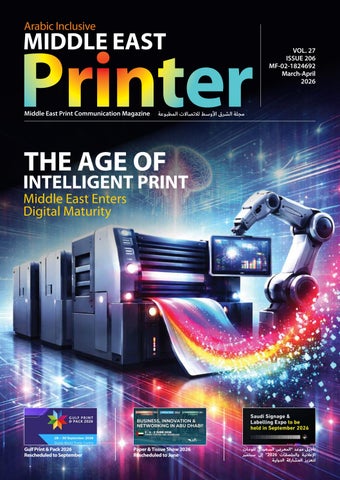
Gulf countries, despite all challenges are embracing the age of intelligent print. We are witnessing the alignment era, defined by AI that is reshaping print and packaging industry and everybody is welcome to this new and exciting chapter of dazzling innovation.

Designed as a high impact customer engagement platform, the Experience Day forms part of BOBST’s new framework to connect more directly with the market

BOBST Bolsters Regional Engagement with Istanbul Event

In a major move to bolster regional engagement, global packaging giant BOBST recently hosted its inaugural Experience Day (folding carton) in Istanbul, Turkey. The exclusive event gathered a premier group of Turkish converters to explore the latest innovations shaping the litho laminated packaging industry.

The event featured a live online demonstration of the EXPERTFOLD 165 A3, which highlighted the machine’s precision, flexibility, and production efficiency for today’s demanding converting environment. Alongside the EXPERTFOLD, the NOVAFLUTE and VISIONFLUTE systems were also highlighted for their ability to help converters achieve high-performance output and superior operational control. The initiative aims to generate awareness and excitement around this differentiated engagement platform, emphasising BOBST’s commitment to delivering added value and strengthening relationships within the Turkish market. With growing interest in litho lam solutions, BOBST used the event to spotlight key trends influencing the industry, including productivity gains, quality enhancement, innovations in process automation, and sustainability. The company highlighted its capability to support

customers end to end, from equipment performance to data driven services through BOBST Connect. Reflecting on the event, BOBST Zone Business Director Arda Zambak says, “This Experience Day demonstrates our commitment to supporting customers with innovative, high value solutions that address real production challenges. By combining live demonstrations, expert knowledge, and direct interaction, we strengthen our partnerships and reaffirm our role as a long term partner to the Turkish packaging industry.”

Following the success of its inaugural session, BOBST has announced an expanded schedule of Experience

Days set to take place throughout the year. The programme will span multiple industry segments, featuring additional dedicated events for folding carton, besides flexible packaging, corrugated board, and labels. These sessions are designed to provide customers with direct access to BOBST experts and cuttingedge technologies in focused, high value settings.

Designed as a high impact customer engagement platform, the Experience Day forms part of BOBST’s new framework to connect more directly with the market, featuring live online machine demos, expert presentations, application insights, and open discussions.

UAE’s 2PointZero Expands into Packaging with ISEM Deal

2PointZero Group completes majority acquisition in Italybased ISEM Packaging Group for $192 million; transaction results in 60.8% ownership by 2PointZero; packaging becomes sixth consumer-focused vertical with ISEM as anchor

Abu Dhabi-based 2PointZero Group PJSC, a next-generation AI-enabled investment powerhouse focused on energy and consumer sectors, has formally completed the transaction to acquire a majority position in ISEM, a leading European packaging group serving beauty, fashion,

luxury, nutraceuticals, and more, for AED 704 million (approx. $192 million) through a combination of secondary and primary capital earmarked to accelerate organic and inorganic growth.

The UAE group now holds 60.8% of ISEM, while Peninsula Capital and minority investors own the remaining 39.2%. This marks the start of a strategic partnership between 2PointZero and Peninsula. Together, the partners will reinforce ISEM’s leadership position with a focus on category and geographic expansion, embedding AI and digital technology across the business

– from manufacturing to client operations – and supporting targeted M&A to extend ISEM’s industrial footprint and product capabilities. 2PointZero Group CEO Samia Bouazza says, “The completion of this transaction marks an important step in advancing our global growth ambitions and establishing a scalable platform in the packaging industry. Packaging will become our sixth consumerfocused vertical. During our visit to ISEM’s facilities, I was particularly impressed by the level of automation, advanced robotics assembly, and state-of-the-art facilities, which

drive operational efficiency, consistency, and margin strength.

“Our entry into packaging is due to the sector continuing to deliver strong CAGR growth across multiple sub-segments, such as food, pharmaceuticals, and luxury. With our track record in strategic M&A, AI deployment, and operational integration, we are well positioned to support ISEM in accelerating its international expansion, while expanding across both primary and secondary packaging and

L’Oréal, and Puig. ISEM products include rigid boxes, folding cases, silk paper, and dust bags, with an industrial footprint comprising 11 manufacturing plants spanning more than 1,00,000 sq m.

Borja Prado Eulate, Founding Partner, Peninsula Capital, comments, “Completion of this transaction marks the beginning of an exciting new phase for ISEM. The group has established itself as the packaging partner of choice for the world’s most demanding luxury clients, and

sets ISEM apart. Group’s people, craftsmanship and relationships with the world’s leading luxury houses – those remain the heart of everything ISEM does. With 2PointZero and Peninsula, ISEM has the platform to take that offer global. I am proud of what we have built in a very short time and thank the entrepreneurs, my friends and part of our incredible journey, all Groups’ people and all our stakeholders, clients, suppliers, for their important support.”

delivering long-term returns for our shareholders.”

The closing of this transaction clearly represents an expansion into packaging by 2PointZero Group, establishing its sixth consumer-focused vertical whilst complementing its existing beauty and apparel businesses. The Italian-based ISEM Group, founded in 1949 and headquartered in Bologna, is a highly automated leader that reinforces the ‘Made in Italy’ brand hallmark. Globally, ISEM is recognised for its quality, innovation, and association with key luxury clients, including Coty Lancaster, Gucci, Kiko, LVMH,

this investment will provide ISEM with the capital, global reach, and strategic support to further accelerate its expansion. Partnering with 2PointZero brings complementary capabilities that we believe will be transformative – not only for ISEM, but for the clients it serves as well. We look forward to building the next chapter together.”

ISEM Packaging Group Chairman Francesco Pintucci comments, “Today marks the start of a next chapter of the Group. The Group can now offer our clients: greater scale without losing the precision and personal commitment that

Partners and senior associates from Hogan Lovells, a leading global law firm, advised 2PointZero and Peninsula Capital on buy-side M&A and FDI matters and antitrust matters. Legance assisted Peninsula Capital on its reinvestment in ISEM and the stakeholders’ agreements with 2PointZero Group, and Van Campen Liem advised Peninsula on deal structuring. At the same time, leading law firms Gatti Pavesi Bianchi Ludovici and Herbert Smith Freehills Kramer advised on the sellside throughout the sale process.

The closing of this transaction clearly represents an expansion into packaging by 2PointZero Group, establishing its sixth consumer-focused vertical whilst complementing its existing beauty and apparel businesses

BOBST, Partners to Host Elite Tobacco Packaging Summit 2026

The global tobacco packaging sector is preparing for a landmark gathering as the Tobacco Packaging Summit 2026 arrives in Dubai, UAE, on 25-26 March 2026. Hosted by industry leader BOBST alongside a consortium of top-tier partners, the event will unite key stakeholders to address the evolving landscape of tobacco packaging through the lens of innovation, automation, and environmental responsibility.

This year’s central theme focuses on the entire tobacco packaging supply chain, featuring exclusive masterclasses led by industry experts that dive deep into the latest best practices across printing, packing, and sustainability. This collaborative effort features a powerhouse lineup of partners including Daetwyler, FOCKE & CO., Janoschka, Karl Marbach GmbH & Co. KG, Koehler Paper, Pujadas, and Siegwerk, each contributing specialised expertise – from doctor blades, base papers, and printing and converting technologies to inks, coatings, and advanced packing automation.

Beyond technical demonstrations, the summit also serves as a critical platform for knowledge sharing and high-level networking. As the global tobacco packaging market continues to evolve, the outcomes of this summit are expected to set the benchmark for industry standards in the years to come.

CBUAE Commemorates Children’s Day with Silver Coins

This issuance reflects the CBUAE’s commitment to supporting national initiatives that contribute to strengthening the Emirati identity

The Central Bank of the United Arab Emirates (CBUAE) has issued silver commemorative coins in celebration of Emirati Children’s Day, falling on 15 March of each year.

The obverse side of the silver coin features the nominal value of ‘15 dirhams’ as a symbolic reference to the date of the occasion, surrounded by the inscription ‘Central Bank of the UAE’ in both Arabic and English. The reverse side showcases the official theme of the occasion, represented by the phrase ‘The Right to Identity and National Culture’, accompanied by an artistic illustration of a fort, reflecting Emirati history and emphasising the child’s connection to their national roots and values.

CBUAE Assistant Governor for Banking Operations and Support Services Saif Humaid Al Dhaheri says, “This issuance reflects the CBUAE’s commitment to supporting national initiatives that contribute to strengthening the Emirati iden-

tity and reinforcing the values of belonging and citizenship within the community.

“It also highlights the CBUAE’s appreciation for the pivotal role played by the Supreme Council for Motherhood and Childhood in safeguarding and nurturing children, strengthening their understanding of their national identity, and fostering the principles of loyalty and belonging among younger generations. These efforts

contribute to the development of a cohesive society that remains firmly rooted in its authentic values and rich cultural heritage.”

A total of 2,000 coins, each weighing 28 grams of silver, have been issued. The coin will be made available for purchase, with the CBUAE announcing the release date and purchasing mechanism at a later time through its official website and social media channels.

El Alamein Pack Boosts Efficiency with New KOMORI Press

Egypt’s El Alamein Pack has added a Komori GL640 advance with coater to its production line, with installation completed by Komori, increasing output capacity while maintaining tight colour control. The new press enables the printing and packaging company to deliver high colour accuracy, consistent print quality, and reliable results across long production runs. Its high-speed operation and integrated coater make it particularly suited for large-volume packaging jobs where precision and efficiency are essential.

In addition to performance improvements, the press incorporates technologies that reduces paper waste, optimises ink usage, and elevates production workflows, contributing to more sustainable

operations.

“The Komori GL640 allows us to respond more effectively to customer requirements that demand both speed and precision,” says Amr

M. Abou Rida, Vice Chairman and Managing Director at El Alamein Pack. “It strengthens our ability to manage large-scale orders while maintaining the level of quality our customers expect.”

Komori local distributor SEDY Egypt provided technical expertise throughout the installation and commissioning process. “This installation demonstrates how advanced offset technology can directly support productivity and quality in packaging production,” says SEDY Egypt Vice Chairman and Managing Director Karim Refaie. “We are pleased to work with El Ala-

Gulf Print & Pack 2026 Rescheduled to September

Gulf Print & Pack 2026, the Middle East and North Africa (MENA) region’s premier printing and packaging technology exhibition, has officially been rescheduled. Originally set to take place from 31 March to 2 April 2026, the 15th milestone edition will now be held from 28-30 September 2026 at Dubai World Trade Centre.

While earlier announcements as recently as February 2026 maintained the March-April timeframe, event organisers Informa confirmed the shift to September to “provide enhanced flexibility” for participation for the global industry community. “This timing supports participation from visitors from nearly 100 countries, offering enhanced opportunities for logistics, travel, and showcasing print and packaging technology,” says Jade Grace, Managing Director, LOUPE Global, Informa Markets.

Despite the date change, the exhibition’s scope remains ambitious, with a projected 15% growth in floor space compared to previous years. “We are committed to providing an

outstanding experience to our visitors and exhibitors and are on hand to provide assistance and answer any questions,” adds Grace.

For latest updates, visit www. gulfprintpack.com

Event organisers Informa confirmed the shift to September to ‘provide enhanced flexibility’ for participation for the global industry community

mein Pack on integrating a solution that matches their technical and operational requirements.”

HP Latex Showcases Premium, High-Value Business Growth

portfolios and address new market opportunities. A key focus was on white ink and its role as a powerful business growth driver for 2026, especially in light of emerging design trends and the increasing demand for standout, differentiated applications. Discussions also covered real-world use cases across applications such as wallcoverings, window graphics, vehicle wrapping, and interior décor, demonstrating how HP Latex solutions help deliver consistent quality, productivity, and sustainability. In addition, attendees gained insights into how HP PrintOS supports streamlined production workflows and operational efficiency. Overall, the event reinforced HP’s commitment to helping customers grow profitably, innovate with confidence, and stay competitive in an evolving print landscape.

A key focus was on white ink and its role as a powerful business growth driver for 2026, especially in light of emerging design trends and the increasing demand for standout, differentiated applications

The recent HP Latex webinar was a great success, bringing together a strong audience of industry professionals, including many well-known and influential companies from across the print sector. The high level of participation and engagement clearly underlined the growing interest in premium, high-value applications and future-ready print technologies.

During the session, HP showcased the latest HP Latex printer series and highlighted how versatile HP Latex technology enables print service providers to expand their application

Link to the recording: https://largeformat.hp.com/ gb-en/webinars/grow-yourbusiness-with-hp-latex?token= eyJhbGciOiJIUzI1NiIsInR5cCI6IkpXVCJ9.eyJ3ZWJpbmFySWQiOiI2OTljMWVkMTU1ZDhkMmZiMmQ1MWFlN2QiLCJsYW5ndWFnZSI6ImdiLWVuIiwiaWF0IjoxNzcyMDEzNDk1LCJleHAiOjE3NzIxODYyOTV9.xTpEBoG1-SxLx7XDtT sdMvPHwway4ZNLuzps55pow2Y #!featured-webinars

Libyafood 2026 Set to Ignite Regional Trade in Tripoli

Following the significant success of its sixth edition, IEC, the organiser of Libyafood, is set to host the seventh edition of the nation’s largest specialised exhibition for the food, packaging, and hospitality sectors at the Tripoli International Fairground. Scheduled to run from 29 March to 1 April 2026, the event is positioned as a critical gateway for international brands seeking entry into the North African market. The expo will gather thousands of industry professionals, including buyers, distributors, and influencers.

Building on the success of previous editions – which saw participation from over 130 international and 86 local companies – the 2026 show aims to facilitate high-level B2B networking and the signing of major import-export agreements.

Diverse Products Showcase

Attendees can expect a comprehensive display of the latest innovations across numerous categories. These include core food groups such as grocery products, pulses, spices, meat, poultry, and dairy; specialty

sectors such as organic and natural foods, baby food, diet products, and halal-certified goods; beverages including coffee beans, cocoa, energy drinks, and soft drinks; and modern food processing equipment and sustainable packaging solutions.

Economic Impact and Strategy

The exhibition aligns with the Libyan Ministry of Economy and Trade’s strategy to localise food industries and enhance national food security. By acting as a common portal, Libyafood provides a unique opportunity for small and large local firms to showcase commercial goods alongside global giants, ultimately aiming to spin the wheel of the the economy and bolster regional trade.

In addition to the main exhibition floor, the four-day event will feature educational sessions, workshops, and specialised networking events designed to keep industry leaders ahead of global culinary and technological trends.

The event is poised to facilitate new collaborations and investment opportunities, building on a history of successful international participation.

For latest updates, log on to www. libyafood.ly

Paper & Tissue Show 2026 Rescheduled to June

Al Furat Group, organisers of Paper & Tissue Show 2026, have officially announced a major rescheduling of the upcoming exhibition. Originally slated to begin on 31 March 2026, the three-day premier trade event for the pulp, paper, tissue, hygiene, and packaging industries will now be held from 3-5 June 2026 at ADNEC Centre Abu Dhabi.

The decision to postpone the event stems from a commitment to providing a “stable and secure platform” that aligns with the high standards of the UAE, particularly in light of current regional developments. Organisers noted that the shift was made after careful coordination with relevant parties to ensure optimal conditions for both exhibitors and visitors.

Paper & Tissue Show remains a critical

hub for the MENA region’s industry, expected to host over 300 exhibitors and more than 16,000 visitors from around the globe. The flagship event will continue to be co-located with Hygiene & Nonwoven Show and Recycle & Packaging Show, the two new specialised events, offering a comprehensive 3-in-1 platform for

industry networking and live demonstrations of advanced technologies. Organisers expressed their appreciation for the industry’s understanding and confirmed that the move aims to maximise value and attendance for all participants.

For latest updates, visit www. paperoneshow.net

By acting as a common portal, Libyafood provides a unique opportunity for small and large local firms to showcase commercial goods alongside global giants

The decision to postpone the event stems from a commitment to providing a ‘stable and secure platform

Retqa Paper Bags Advances Operations with KOMORI Press

As a leader in the packaging sector, Retqa Paper Bags has advanced its operations with the installation of the Komori GL-540A press at their plant in Kuwait. This marks the com-

pany’s first investment in Komori technology and signals a new era of productivity, quality, and versatility for Retqa Paper Bags.

The installation of the GL-540A is a clear demonstration of Retqa Paper Bags’ commitment to continuous improvement, innovation, and excellence. “We are extremely excited about the installation of the Komori GL-540A. This machine will help us improve both quality and efficiency, enabling us to provide faster turnaround times and meet the increasing demands of our customers. With this new press, we are confident in our ability to deliver even higher quality and faster turnaround times to our customers,” says Retqa Paper Bags Managing Director Amer Bin Naji.

“We are thrilled to see Retqa Paper Bags embrace Komori’s technology for their future growth. Their deci-

sion shows real foresight, and we are proud to accompany them on this exciting journey,” says Jabir Jabbar, Director at Prestige Graphics Trading, the exclusive Komori distributor in the Middle East.

“This installation represents a key milestone in Retqa Paper Bags’ growth journey. The GL-540A will enable them to streamline their production while offering even higher quality to their customers. We’re excited to see the positive impact it will have on their operations,” states Moez Jebali, Regional Sales Director, Komori International Europe.

This installation is just the beginning of what is expected to be a long and successful partnership between Retqa Paper Bags and Komori, with plans to continue exploring opportunities to enhance operational efficiency and deliver top-quality products to their customers.

Saudi PPPP 2026 Rescheduled, New June Dates Announced

The organisers have emphasised that the new timeline is designed to ensure a seamless experience for the thousands of global visitors expected to attend

Organisers Riyadh Exhibitions Co. Ltd. (REC) has officially announced a schedule change for the upcoming Saudi Plastics & Petrochem 2026 and the co-located Saudi Print & Pack 2026, the Kingdom’s premier trade exhibitions for the plastics, petrochem, printing, and packaging industries.

To better accommodate the travel logistics and operational planning of its international exhibitors and partners, the 21st edition of the events will now take place from 21-24 June 2026, with Riyadh International Convention & Exhibition Center (RICEC) remaining the venue.

The organisers have emphasised that the new timeline is designed to ensure a seamless experience for the thousands of global visitors expected to attend. “We appreciate your continued support and look forward to welcoming you in June 2026,” states REC in an announcement.

For registrations and further updates, visit www.saudi-pppp.com

Saudi Signage & Labelling Expo Rescheduled to September

The 3rd edition of the flagship Saudi Signage & Labelling Expo, co-located with the 2nd edition of Saudi Paper & Packaging Expo –the largest gathering for signage, graphics, digital, print, and imaging solutions in the region – have been rescheduled to September 2026. The exhibitions, which were slated for April 2026, will remain at Riyadh International Convention & Exhibition Center (RICEC).

The decision has been made after careful consideration to deliver the strongest possible experience for the entire signage, graphics, labelling, and paper manufacturing community. The strategic shift aims to align more closely with market conditions, strengthen international participation, and further enhance the offering of the event to match innovation and rapid growth of the branding and visual communications sector in Saudi Arabia.

“Rescheduling the Saudi Signage & Labelling Expo to September is the right decision for our community. It ensures that we deliver an event that is fully supported, well timed, and positioned to create the trade and sourcing outcomes for all participants. Our commitment to the industry remains

unwavering and we look forward with full confidence to a successful edition in September 2026,” says Muhammed Kazi, Senior Vice President of event organiser dmg events. “We sincerely appreciate the flexibility and continued support of our exhibitors, partners, and visitors throughout this transition.”

The 2026 edition of the expo is set to showcase a significant scale and reach, hosting over 170 exhibitors from more than 15 countries and presenting upwards of 2,500 innovative products. Professional attendance is expected to be robust, with more than 14,000 industry experts and key decisionmakers anticipated to attend. Besides an array of cutting-edge technologies and solutions, the event will offer various interactive features for visitors, including live demonstrations in a dedicated car-wrapping zone and the ‘Label It’ competition.

Saudi Signage & Labelling Expo, along with the Saudi Paper & Packaging Expo, remain vital platforms for brands looking to connect with high-powered buyers in the Middle East’s most dynamic economy.

For more information e-mail to marketing@saudisignageexpo. com or log on to www.saudisignageexpo.com

The decision has been made after careful consideration to deliver the strongest possible experience for the entire signage, graphics, labelling, and paper manufacturing community

A key advantage of the DTRX is its high production speed, achieved without compromising print consistency

Brother to Reveal Industrial Printing Future at FESPA

2026

Global textile printing leader

Brother is set to showcase its latest industrial innovations for professional garment decorators and print service providers at FESPA 2026, to be held from 19-22 May 2026 at Fira Barcelona, Spain. Visitors can explore established hybrid DTG & DTF systems, see the newest industrial DTF innovation in action, and connect with a team of printing and workflow experts.

Proven

Hybrid DTG & DTF Solutions

At booth (3C60), hybrid direct-togarment (DTG) and direct-to-film (DTF) technologies will be on display, offering maximum flexibility, outstanding print quality, and reliable performance for modern production environments. Hands-on demonstrations provide the perfect opportunity to learn how to optimise workflows, increase efficiency, and scale production effectively.

Introducing DTRX

The DTRX has been developed for professional print service providers operating in mediumto high volume environments. Built on decades of industrial and DTG printing expertise, the DTRX combines speed, stability, and precision in a fully integrated DTF production system.

Designed for demanding industrial settings, the DTRX delivers industrial-grade reliability; proprietary printhead technology; specially formulated inks for consistent, highquality output; and wide-format production with stable, continuous operation.

A key advantage of the DTRX is its high production speed, achieved without compromising print consistency. Even at elevated output levels, the system maintains uniform colour accuracy and repeatable quality from job to job – an essential factor for professional print providers managing brand-sensitive or large-scale orders.

The all-in-one system includes an integrated adhesive curing unit, streamlining the workflow from printing through powder application to curing. By reducing manual handling and operator intervention, the DTRX minimises downtime and ensures dependable, efficient performance in high-volume production environments.

Backed by a comprehensive warranty, the DTRX offers long-term investment security for businesses seeking industrial-level DTF capacity with consistent, productionready results.

Expert Consultations and Extraordinary Prize Competition

Attendees will have the opportunity to engage directly with Brother specialists to discuss critical industry advancements, including production efficiency, hybrid printing strategies, and industrial DTF implementation. Additionally, Brother has launched a booth-exclusive competition, where visitors who participate will have the chance to win an extraordinary prize, further incentivising engagement with their latest technological offerings.

Experience Brother at FESPA 2026

Distributors, garment decorators, and print professionals are invited to visit the Brother booth to explore hybrid DTG & DTF solutions and experience the DTRX first-hand. Discover new opportunities, exchange ideas with experts, and see how industrial innovation can drive productivity, quality, and growth.

FESPA continues to be a cornerstone event for Brother as it reaffirms its commitment to providing highquality, production-ready solutions for the global textile print market.

PRINT DIGITAL CONVENTION 2026 to Showcase Print Power

As the global communication landscape evolves under the motto ‘The future needs the power to change’, PRINT DIGITAL CONVENTION 2026 emerges as a pivotal hub for transformation, focusing on the powerful synergy between print and digital channels. Taking place on 16-17 June 2026 at Messe Düsseldorf, this premier congress fair invites decision makers from across the print, marketing, and creative sectors to explore practical applications and cutting-edge use

cases. With 95% of the exhibition space already secured, the event is set to become a vital meeting point for those ready to embrace the strategic shifts defining the future of the industry.

“The PDC thrives on personal exchange and enthusiasm for concrete applications. We look forward to working with the industry to show how much innovative power print has and what opportunities this offers for companies,” explains Rüdiger Maaß, Managing Director, Fachverband Medienproduktion e.V. (FMP).

“The start of ticket sales marks the next milestone for the PRINT DIGITAL CONVENTION. As part of the drupa alliance network, it brings together industry, users, and marketers in a compact, practice-oriented

format,” says Sabine Geldermann, Director drupa, Portfolio Print Technologies at Messe Düsseldorf. Numerous companies have already confirmed their participation. Exhibitors such as HEIDELBERG, Konica Minolta, Canon, Fedrigoni, Elanders, KURZ, Carl Berberich, FKS, and ITA Systeme will present solutions along the entire value chain – from production and workflow to print finishing and applications in the multichannel environment. The convention will be complemented by a curated congress programme with three parallel sessions and a comprehensive keynote speech. With in-depth partnerships with the European Brand & Packaging Design Association (epda), the Verband Druck + Medien NordWest e.V. (VDM Nord-West), and the Bundesverband Marketing Clubs

(BVMC), PRINT DIGITAL CONVENTION 2026 is specifically aimed at new target groups from packaging design, the printing industry, marketing, and brand management. Tickets and further information are available at https://www.printdigitalconvention.de/tickets/

With 95% of the exhibition space already secured, the event is set to become a vital meeting point for those ready to embrace the strategic shifts defining the future of the industry

drupa Unveils Octopus as New Brand Identity

Far from a simple logo change, this ‘key visual’ symbolises the trade fair’s strategic shift toward a future of networking, intelligence, and resilience

Two years ahead of its next global showcase, drupa – the world’s leading trade fair for printing solutions – has revealed a bold new brand identity centered on the octopus, thus providing an initial glimpse of its conceptual and contentrelated repositioning. Far from a simple logo change, this ‘key visual’ symbolises the trade fair’s strategic shift toward a future of networking, intelligence, and resilience. The central element of the new image symbolically refers to a technological reality in which printing solutions are increasingly conceived as integrated systems, including sophisticated applications in the packaging environment. Processes are interlinked, workflows are networked, and efficiency is created through the interaction of hardware, software, materials, and

automated applications.

“drupa 2028 will be a drupa like never before,” says Dr. Andreas Pleßke, Chairman of the drupa Committee. “We are setting new standards in how technological developments, applications, and markets are classified and brought together – a claim that is also consistently reflected in the new brand identity.”

drupa. dive into the unseen

The slogan “drupa. dive into the unseen” picks up on this approach and draws attention to developments whose significance often only becomes apparent in the overall context – for example, through the interaction of technologies, processes, and applications along the value chain. The slogan thus stands for a solution-oriented classification of technological innova-

tions, beyond individual products or short-term effects.

“The slogan sums up what drupa stands for: vision, knowledge transfer, and orientation in an increasingly complex technological landscape,” says Sabine Geldermann, Director drupa, Portfolio Print Technologies at Messe Düsseldorf. “It underscores drupa’s claim and attitude of not presenting future topics and technological progress in isolation, but rather classifying them in a comprehensible way in the context of the market, application, and value creation.”

drupa 2028 Creating Tomorrow’s Orientation

Against this backdrop, drupa 2028 is introducing a new experience architecture for the first time. Content, applications, and formats for exchange, collaboration, and networking will in future be bundled along clearly defined thematic clusters. This will make technological developments comprehensible and structured. The architecture serves as a common framework for exhibitors, visitors, and the media. Further information on the brand story, the experience architecture, and the content focus of drupa 2028 can be found at www.drupa. com/en/Home/The_new_drupa.

The next drupa will take place in Düsseldorf, Germany, from 9-17 May 2028.

London 2026: 3 Mega Industries, 1 Landmark Event

Moving towards the next chapter in their global journey, Paper & Tissue Show, along with the two new co-located events, Hygiene & Nonwoven Show and Packaging & Recycle Show are preparing for a landmark debut at Excel London on 11-12 November 2026. This major international gathering will bring together global leaders from the paper, tissue, hygiene, and packaging industries, offering an unparalleled platform to explore innovations, exchange ideas, and forge lasting partnerships.

UK: Paper & Packaging Hub

The UK is one of Europe’s key importing markets for paper, cardboard packaging, corrugated boxes, and hygiene products such as baby diapers and tissue. With the rapid growth of e-commerce, private label retail, and sustainable packaging, British distributors and retailers are continuously looking for reliable international suppliers and partners. Additionally, London’s strategic location and excellent connectivity makes it easily accessible for participants across Europe, the Middle East, Africa, USA, and

beyond. The global significance of the region is further amplified by the timing of upcoming industry events. By aligning major packaging exhibitions with the renowned London Pulp Week, the city is expected to become a focal point for international pulp and paper professionals, further amplifying the event’s global significance. With a growing focus on sustainability and recycling, the UK market presents fertile ground for innovative solutions in tissue, hygiene, and packaging. The event will provide the ideal environment for suppliers and buyers to explore cutting-edge products, sustainable practices, and forward-thinking technologies. Prominent Lineup of Global Par-

ticipants

Industry leaders are readying for the event, with a lineup of global companies confirming their participation. These include 9.Septembar, Abirami Pumps, Akkim Kimya, Ceia, Faderco, HSM, IBC, Megapack, Paper Link International, Softrock, Soontrue, Tissue Tec, and UNIMATIC, among others. This diverse gathering of manufacturers and suppliers –ranging from raw materials and chemicals to advanced hygiene production machinery – underscores the show’s role as a primary marketplace for innovation.

For further information visit https://london.paperoneshow. net

With a growing focus on sustainability and recycling, the UK market presents fertile ground for innovative solutions in tissue, hygiene, and packaging

Article 4D Printing

4D Printing Sparks a Revolution in Industries and Intelligent Systems

Research and Article by Helia Rastegar: B.Sc. Student in Polymer Engineering

Amirkabir University of TechnologyTehran

Source: Sanat e Chaap Magazine

4D printing, and understanding its history and principles is essential for properly grasping 4D printing. 3D printing first emerged in the 1980s with the introduction of stereolithography (SLA). In this method, a focused light source was used to cure photopolymer resin layer by layer. Initially developed as a rapid prototyping tool, it evolved—through technical advances and new material development—into one of the most important manufacturing methods in modern industry.

oligomers, initiators, and modifying additives. Engineering these components allows the production of resins with tailored mechanical, thermal, and reactive properties. One major advantage of photopolymers is molecular design flexibility—mechanical behavior, flexibility, curing speed, hardness, softness, and even sensitivity to specific stimuli can be precisely controlled.

The ability to control the behavior of responsive materials and precisely print complex geometries has transformed 4D printing from a laboratory concept into an emerging industrial technology with high potential

4D printing is one of the newest technologies in additive manufacturing. By adding the dimension of time to printed structures, it enables the design and production of dynamic structures. A component produced using this method is an active system capable of responding to environmental stimuli such as light, humidity, pH, heat, and more. It can change its function, properties, and shape, exhibiting pre-programmed behavior.

View job listings and recruitment ads in the printing and packaging industry here!

4D printing technology is inherently interdisciplinary, combining materials science, polymer chemistry, mechanical engineering, structural dynamics, and additive manufacturing. The use of smart materials makes it possible to exploit properties that were previously observed only in nature. Moreover, the ability to control the behavior of responsive materials and precisely print complex geometries has transformed 4D printing from a laboratory concept into an emerging industrial technology with high potential.

Background of 3D Printing 3D printing forms the foundation of

In 3D printing, the goal is to convert a digital model into a physical, layerby-layer structure. Designs created in CAD software are fabricated by printers using powdered materials, thermoplastics, or resins, deposited in micrometer-thick layers. Its special role in aerospace, medicine, art, architecture, mechanical engineering, and even biotechnology stems from its ability to produce complex geometries, hollow parts, cellular networks, and structures impossible to manufacture with conventional methods.

In recent years, various 3D printing technologies have been introduced:

• FDM: Uses thermoplastic extrusion; economical and suitable for engineering parts.

• SLS: Uses lasers to fuse polymer or metal powders; produces highly durable parts.

• SLA and DLP: Utilize photopolymers; offer the highest dimensional accuracy and finest geometric details.

These developments laid the groundwork for the emergence of 4D printing.

Photopolymers and Their Role in Additive Manufacturing

Photopolymers revolutionized precision and quality in 3D printing and are among the most important materials used in the field. These light-sensitive resins polymerize when exposed to suitable wavelengths (usually UV or visible light), solidifying at very small scales. This makes them ideal for producing complex geometries with fine details and high surface quality. Their chemical composition includes monomers, reactive

Recently, a new generation of photopolymers has emerged. Some can change shape in response to light, heat, or moisture. Others exhibit self-healing properties or structural rearrangement under secondary light exposure. As a result, photopolymers have evolved from simple printing materials into key tools for 4D printing.

Light-based technologies such as DLP and SLA, due to their high accuracy, speed, and ability to fabricate multi-material components, provide the best platform for developing smart materials and dynamic structures. Thus, the relationship between photopolymers and 4D printing is very strong.

Definition of 4D Printing and Operating Principles

4D printing refers to processes in which a printed structure transforms and reorganizes over time under environmental stimuli. Unlike conventional 3D-printed parts, 4Dprinted components are adaptive systems capable of responding to their surroundings, changing shape, or achieving new functionality.

In its simplest definition, 4D printing consists of three main components:

1. Smart materials

2.High-precision additive manufacturing

3. Time-based behavioral design and modeling

The fourth dimension is active time—the moment of stimulus or energy change.

Possible stimuli include heat, light (UV, visible, IR), humidity or water absorption, pH changes, ions and salts, electric or magnetic fields, and mechanical stress.

These stimuli cause changes in chemical bonds, polymer chain rearrangement, solvent absorption or release, phase transitions, thermal expansion coefficients, or release of stored energy—manifesting as movement, unfolding, rotation, bending, or twisting.

Design in 4D printing occurs at three levels:

• Molecular design: Adjusting chemical structure for desired responsiveness

• Geometric design: Using lattice patterns, heterogeneous layering, thickness variation, or print orientation to control deformation

• Architectural design: Employing complex structures such as lattices, origami, and metamaterials

Thus, 4D printing is not merely a manufacturing method but a form of behavioral design.

Smart Materials in 4D Printing

Smart materials are the core of 4D printing performance and include a wide range of polymers, composites, and multi-phase materials.

Shape Memory Polymers (SMPs)

SMPs are among the most wellknown materials in 4D printing. They have two states: a programmed temporary shape and a recovered original shape. When heated above their glass transition temperature (Tg), they become deformable. After cooling, the new shape is fixed. Upon reheating, stored energy is released and the material returns to its original form.

Features:

• High energy storage capacity

• Large deformation capability

• Reversible behavior

• Adjustable activation temperature

• Good printability (FDM, SLA, DLP)

Applications include medical stents, surgical clips, self-deploying space structures, foldable antennas, and self-opening components.

Hydrogels

Hydrogels are three-dimensional polymer networks capable of absorbing large amounts of water. Their response to pH, temperature, or biochemical stimuli causes dramatic changes in volume, flexibility, or shape.

Features:

• Expansion/contraction several times their original volume

• High biocompatibility

• Environmental sensitivity

• Suitable for microscopic scales

Applications include smart drug delivery systems, soft bio-robots, sensors, and artificial responsive tissues.

Liquid Crystal Elastomers (LCEs)

These materials combine elastomer elasticity with molecular order of liquid crystals. In response to heat or light, molecular order changes, causing unidirectional contraction or expansion—similar to biological muscles.

Features:

1. Fast and precise motion

2. Continuous responsiveness

3. Significant length change

4. Suitable for thermal and optical stimuli

Applications include soft robotics, microfluidic pumps, artificial vision systems, and morphing surfaces.

Multi-Stimuli Composite Materials

These composites combine two or more responsive materials and can detect multiple stimuli simultaneously or selectively. They enable complex behaviors such as twisting, multi-stage motion, and rotational movements.

Factors Affecting 4D Printing Performance

Final performance depends not only on materials but also on process and environmental factors.

Printing method influences layer accuracy, orientation, bonding continuity, and response speed. For example:

• SLA (homogeneous curing) produces more uniform movement.

• FDM (directional layering) enables anisotropic behaviors.

Stimulus intensity, direction, application speed, and spatial distribution greatly affect behavior.

Structural parameters such as wall thickness, lattice pattern, density, zoning, and metamaterial architecture are critical in motion control. Structures such as:

• Origami (foldable)

• Kirigami (expanded opening)

• Auxetic (lateral expansion)

• Lattice (lightweight, behavior control)

Accurate modeling is essential. Mechanical, thermal, optical, chemical, and polymer behaviors must be analyzed simultaneously. Software such as Abaqus, COMSOL Multiphysics, ANSYS Mechanical, and Rhino/ Grasshopper + Kangaroo are used for time-based behavioral design.

Current Challenges and Limitations

• Limited smart material stability

• Slow response speed in some materials

• Complex multi-stimuli modeling

• Scalability issues

• High material and equipment costs

Future Outlook of 4D Printing

4D printing is moving toward integration with computational technologies and artificial intelligence. In data-driven design, machine learning predicts behavior, generative design creates dynamic geometries, and AI selects optimal materials. In personalized medicine, implants will adapt to patient bodies, and responsive tissues and in-body biorobots will emerge. In soft robotics and smart actuator systems, more complex and multi-stage motions will be engineered. In engineering structures, morphing aerodynamic wings, self-deploying space components, and dynamic architectural systems will become possible.

Conclusion

4D printing marks the beginning of the next generation of additive manufacturing, enabling dynamic and intelligent structures. With advances in smart materials, improved printing technologies, and AI integration, it has the potential to revolutionize medicine, aerospace, soft robotics, architecture, and intelligent systems.

4D printing is not merely a manufacturing method but a form of behavioral design

4D printing marks the beginning of the next generation of additive manufacturing, enabling dynamic and intelligent structures

Article Labels & Packaging 2026

How the Middle East Is Entering a New Phase of Digital Maturity

Keypoint Intelligence notes that digital growth globally is now being driven by mainline production requirements rather than specialty applications. That same shift is increasingly visible across the Middle East region

The Middle East’s labels and packaging sector is approaching 2026 not with hesitation — but with recalibration.

Over the past decade, converters across the UAE, Saudi Arabia, Turkey, and Egypt have invested aggressively in digital label presses, hybrid flexo platforms, embellishment technologies, and finishing automation. Regional exhibitions such as Gulf Print & Pack and FESPA Middle East have consistently reflected this appetite for modernization, while global showcases like drupa 2024 reinforced the rapid evolution of digital packaging platforms.

Yet as the industry moves into 2026, the conversation is changing.

According to Keypoint Intelligence’s global outlook, What to Watch in Labels & Packaging 2026 , the packaging market worldwide is entering a more disciplined phase of digital adoption — one shaped less by experimentation and more by operational alignment. For Middle Eastern converters, this transition is especially relevant. The region is not slowing down. It is maturing.

Digital Printing: From Specialty

Capability to Production Strategy

Digital printing in the Middle East has long been associated with short runs, luxury cosmetics, private-label launches, and fast-turn promotional campaigns. In many GCC markets, label converters were early adopters of toner and inkjet systems compared to global averages. However, 2026 is marking a structural shift. Keypoint Intelligence notes that digital growth globally is now being driven by mainline production requirements rather than specialty applications . That same shift is increasingly visible across the region.

Converters are asking more grounded questions:

• Can digital support higher throughput?

• Does it integrate with flexo production planning?

• Will it reduce waste and plate dependency?

• Can uptime and service reliability be guaranteed locally?

Rather than replacing analog platforms, digital is increasingly being positioned as a strategic complement — bridging mid-length runs, improving scheduling flexibility, and responding to SKU proliferation.

In corrugated packaging, where digital adoption has historically been cautious due to cost-per-sheet considerations, rising regional ecommerce growth — highlighted in recent GCC market studies — is creating renewed interest in shortrun, localized, and campaign-driven production models.

Brand Influence and Regional Industrial Policy

Brand participation is becoming one of the most decisive factors shaping digital adoption. Keypoint’s report emphasizes that global brands are increasingly influencing where digital investments accelerate . In the Middle East, this trend is reinforced by structural economic initiatives.

Saudi Arabia’s Vision 2030 industrial programs and the National Industrial Development and Logistics Program (NIDLP) are actively encouraging manufacturing localization and supply-chain efficiency. As production shifts closer to regional markets, packaging must respond with greater agility.

Meanwhile, retail expansion and private-label growth in the UAE and Saudi Arabia are increasing SKU variation and shortening product life

cycles. Brand owners are demanding:

• Faster product launches

• Regionalized packaging versions

• Smaller production batches

• Greater supply-chain responsiveness

Corrugated and label converters that can offer flexible digital capabilities are increasingly aligning with these expectations. Where brand pressure grows, digital adoption follows.

Software Connectivity: The Quiet Competitive Divider

While hardware modernization has been visible across the Middle East, software connectivity remains uneven.

Many converters operate with:

• Standalone MIS platforms

• Disconnected prepress systems

• Manual job ticket transfers

• Limited production analytics

Keypoint identifies software connectivity as both a critical enabler and a constraint of digital scale. As digital volumes expand, fragmented systems create friction:

• Duplicate data entry

• Slower turnaround times

• Increased risk of production errors

• Limited cross-site visibility

In 2026, integration may matter more than installation. Converters investing in ERP integration, automated job routing, centralized color management, and production dashboards are likely to see stronger digital ROI. In markets where skilled labor availability can fluctuate, automation through workflow integration is becoming a structural advantage.

Investment Discipline in a Volatile Environment

Despite strong regional growth, converters are navigating economic pressures:

• Currency volatility in certain markets

• Import cost fluctuations

• Competitive pricing dynamics

• Higher capital costs

Globally, Keypoint notes that investment decisions are becoming necessity-driven rather than exploratory . The Middle East reflects the same trend. Capital expenditure in 2026 is likely to prioritize:

• Productivity improvements

• Labor stabilization

• Faster turnaround capability

• Waste reduction

• Predictable output

Exhibition floors may still showcase breakthrough technologies, but buying decisions increasingly demand clear ROI justification. Converters are asking for measurable metrics, strong regional service presence, and longterm ecosystem stability — not just headline specifications.

OEM Ecosystems Over Individual Machines

The Middle East remains one of the most OEM-diverse packaging markets globally, with strong European, Japanese, American, and growing Asian supplier presence. However, competitive differentiation is shifting. Keypoint’s analysis suggests that OEM advantage is increasingly defined by portfolio cohesion — how hardware, software, consumables, finishing, and service work together . For Middle Eastern converters, practical considerations often outweigh incremental performance gains:

• Is local technical support strong?

• Are spare parts available quickly?

• Is workflow integration seamless?

• Can multiple production sites standardize platforms?

As regional groups expand operations across GCC markets, stability and interoperability are becoming strategic priorities.

AI: Rising Expectations from the Brand Side

Artificial intelligence is advancing rapidly across consumer goods and retail sectors. Brand organizations are already deploying AI tools for demand forecasting, marketing analytics, campaign planning, and SKU rationalization. Keypoint predicts that AI adoption will progress faster at the brand level than among converters. In the Middle East, this could create a growing expectation gap.

Brands may increasingly expect:

• Faster design approval cycles

• Real-time production updates

• Increased versioning flexibility

• Tighter supply-chain feedback loops

Converters, however, may need to first strengthen digital foundations — particularly connectivity and data infrastructure — before AI-driven production optimization becomes

scalable. The pressure may arrive before the full readiness.

Sustainability Moves from Messaging to Measurement

Sustainability continues to influence packaging strategies across the region, supported by UAE ESG frameworks and evolving regulatory expectations tied to export markets.

Digital printing contributes through:

• Reduced overproduction

• Lower inventory waste

• On-demand manufacturing

• Shorter runs aligned with SKU variation

However, sustainability in 2026 is increasingly data-driven. Reporting, traceability, and measurable environmental impact are becoming central requirements. Without integrated systems, sustainability claims lack operational proof.

The Defining Theme: Alignment If one word defines 2026 for Middle Eastern packaging, it is alignment.

Alignment between:

• Digital capability and production reality

• Brand expectations and converter readiness

• Hardware investment and software integration

• Capital deployment and measurable return

The industry is not retreating from digital. It is embedding it more deeply into operational strategy. As the Keypoint Intelligence outlook suggests, progress in 2026 will be measured not by technological novelty but by ecosystem alignment .

For Middle Eastern converters, the next competitive edge will not come from buying the newest press alone — but from integrating technology, workflow, service, and strategy into a cohesive production environment.

Digital printing is no longer emerging. AI is no longer distant. Connectivity is no longer optional. 2026 belongs to those who align.

For Middle Eastern converters, the next competitive edge will not come from buying the newest press alone — but from integrating technology, workflow, service, and strategy into a cohesive production environment

Article Print in Sports

Print: Integral Part of Every Sporting Event, Big or Small

Even as Milano Cortina 2026, the Winter Olympics in Italy, has just concluded, one crucial contribution is easily being overlooked: without print, such major sporting events would not be possible. The behind-the-scenes work that everything runs smoothly on the opening day often goes unnoticed, since ultimately, the focus is on the medal winners and not organisational mishaps.

were processed for hardware. However, this immense effort often goes unnoticed. Decisions regarding data structures, colour spaces, materials, and security mechanisms are made months or even years in advance, long before the first tarpaulin is hung or the first pictogram is put in place.

Framework Established 3 to 5 Years Before Event

Work on the structural framework starts well before the first layout

HEX, CMYK and RGB values for print and digital applications. Which colour targets can realistically be achieved on which materials? How should access media be designed depending on the security level? The processes and requirements for handling personal data must also be clarified. Depending on the venue and organiser, various frameworks and regulations must also be considered.

In modern setups, these specifications are fed directly into the

The behind-the-scenes work that everything runs smoothly on the opening day often goes unnoticed, since ultimately, the focus is on the medal winners and not organisational mishaps

This article provides an insight into the typical steps and timeframes involved in such events from the printing industry’s perspective, covering everything from data structures and material testing to live post-production.

Print has always been an integral part of major international sporting events. For example, for the FIFA World Cup Qatar 2022 – football’s marquee event – around 9,05,000 square metres of graphics were produced, comprising approximately 21,700 street banners, 87 kilometres of fencing material, and numerous directional signs. Over 1,300 signage structures were erected and more than 300 tonnes of aluminium

for a major event is created. Between five and three years before the event, those involved lay the foundations on which everything will later be built. Maps, zoning, initial language versions, and rough visitor flows are created during this phase.

During this time, a small cross-functional group is formed. Together, they clarify terms, standards and dependencies. Which consistent names should be used for locations and routes across all systems? Which pictograms and contrast values are binding? The Olympic Brand Guidelines define the primary brand colours (blue, yellow, black, green, red, and white) and provide exact

system. Names, data fields, and templates are created to ensure that subsequent changes relating to space utilisation, languages, or visitor numbers are processed consistently and do not ‘evaporate into individual files.

For smaller local or regional events, this governance process is often mapped out in a short sprint, during which clear roles are defined and key decisions are made within a few weeks.

24 to 18 Months Before Event: Materials, Colours & Data Flows Tested

Approximately two years before the event (Winter Olympics), a reality

check is important, as cold temperatures, humidity, wind, LED lighting, and snow reflection can affect the visual effect and durability of materials. Representative applications are tested under realistic conditions at this stage to determine the suitability of banner fabric, rigid panels, textile backdrops, and floor and stair media.

The important thing here is not perfect catalogue staging, but the stress test: to what extent can colour data differ visibly on different materials without affecting the overall impression? The International Olympic Committee works with precise colour standards, with different specifications applying to

digital applications than to print. However, the Pantone colours themselves do not change.

At the same time, an initial pilot data flow is set up. Templates containing rules relating to font sizes, contrasts, and space for Braille or codes are combined with automated testing processes. Initial camera checks at this stage show whether the templates, data, and quality assurance are reliably interlinked. The aim is to identify any weak points before live operations begin.

In smaller event formats, material testing and data checking are often combined on site, focusing on critical applications such as main entrances or brightly lit areas. Here,

organisers also rely heavily on the experience that providers and equipment suppliers have gained at larger events.

12 Months Prior: Planning Capacities, Defining Routes, Securing Data

A year before the event, the operational allocation process begins, which involves deciding what will be produced, in what quantities, and where: which plants have buffer capacities and which locations could take over at short notice, if necessary. For the 2022 FIFA World Cup, for example, over 100 installation locations had to be coordinated.

At the same time, the kitting logic is defined. This determines which package is delivered to which location and when. These could be goals, zones, or assembly areas. Traceability also plays a key role here, as to document what arrived, when, where, and in what condition.

Where access media are involved, personal data is also generated. These data flows are now being streamlined and secured. Access is clearly regulated and logged. This provides an overview of how material, data, and cycles interact once live operations begin.

Provided there are clear agreements in place regarding where flexibility ends and commitment begins, a centralised production location with on-site finishing and daily change windows is often favoured over distributed production in smaller formats.

6 Months in Advance: Shift from Theoretical to Practical Implementation

During this phase it begins to become clear whether the system is viable. The focus shifts from theoretical planning to practical implementation. The previously agreed rules are applied in real conditions to demonstrate their effectiveness. Templates are finalised. Font sizes, contrasts, Braille and code placeholders, and colour targets for each material are clearly defined and systematically stored. Design changes are limited to functional exceptions and are no longer discussed in principle. The technology is also calibrated. Printing systems are characterised,

colour spaces per substrate are documented, and test strips and target values are defined. At the same time, a process has been determined for comprehensively detecting, evaluating and documenting deviations, for use not only in internal approvals but also in subsequent audits or complaint management.

Security-related media such as accreditations or access cards undergo initial dry runs, including complete number ranges and return scenarios. Packaging and labelling are tested under real cycle conditions. The focus is not only on the materials themselves, but also on whether the process generates clear signals regarding quantities and delivery locations.

Crucially, data runs through the entire production chain in this phase, from its origin in the dataset, through the designed template, to the testing and approval point. The concept only becomes routine if this test run is completed without interruption.

On smaller-scale projects, the number of templates is significantly lower. Rather than ongoing optimisation, a clearly defined change window is typically established to safeguard production time before permanent corrections are implemented.

8 to 4 Weeks Prior: Production Waves and Controlled Delivery

The visible areas are now being created in several stages. First, the basic equipment is produced, including neutral elements, locationindependent media, and fixed basic layouts. Next, the overlaying content is specified in more detail as the event approaches.

Although textile and large-format production often run in parallel, their production cycles differ.

Media and interview backgrounds consist of stable basic units that can be combined with regional, linguistic, or sponsor-specific additions. This allows flexibility without compromising the basic layout.

Access and status media, such as ID cards or accreditations, are produced in coordinated batches and stored securely. Clearly designated time slots are reserved for last-minute changes. Logistics now use kitting logic, meaning packages must be assembled so that they can

A year before the event, the operational allocation process begins, which involves deciding what will be produced, in what quantities, and where: which plants have buffer capacities and which locations could take over at short notice, if necessary

Article

This review marks the beginning of the next iteration, not the end. Based on these findings, more robust templates, realistic targets, clearer handover procedures, and more coordinated decision-making processes for future formats will be developed

be used directly on site. For events of this magnitude, materials are delivered close to their locations of use to enable rapid deployment. There must be no re-sorting and no ambiguity. Clear labelling and traceable contents are used for this purpose, as are designated contact persons.

Quality assurance follows a dual principle: inline during production and at goods issue. This is not just about visual criteria. Are the codes read reliably? Do the contrasts and placements match the templates? Is the documented slip resistance for floor media complete?

The important thing is not a perfect print image on a light table, but functional reliability in real conditions: outdoors, in changing light, on damp surfaces, and amid chaotic setup conditions.

For smaller event formats, the entire production process is often condensed into one main phase. Daily quality checks and clearly defined reprint windows in the evening replace time-consuming distribution, enabling higher cycle times on site and significantly reducing logistical complexity.

10 to 3 Days Before: Set-up, Testing & Final Adjustments

After months of preparation involving data, rules, and packages, the first results are now becoming visible. The first signs, safety graphics, and surface media have been delivered. Although the logistical processes are largely automated, the most important thing on site is the appearance of everything in real conditions. Visual inspection replaces the light table: are the routes legible, and is the contrast correct? Is the Braille in the right place? Do the floor media retain their slip resistance in wet or cold conditions?

Deviations at this stage are not unusual, but are to be expected. A temporary barrier can alter the route. An unforeseen light source can make legibility difficult. A surface may react differently to what is expected. The decisive factor is how such deviations are dealt with and corrected. Installation lists,

markings, and simple feedback loops ensure that reprints can be triggered without re-entering data. For smaller events, setup and final testing often merge into a tightly scheduled evening window, with time slots reserved for reprints overnight.

72 to 12 Hours Prior: Final Adjustments Before Start

As the opening date draws closer, the pace is intensifying. Changes to the route, zone approvals, and personalised access media are being implemented. Rather than creating entire sets from scratch, the focus is on updating individual variants as required. These must be identifiable and traceable, with documented outputs provided. The system also responds flexibly to supply issues by adjusting quantities and revising labels and inserts, ensuring the correct items are available in the right places on the day of the event. This phase only works with clearly defined time slots. What else is produced overnight? What goes into the early shift? What is resolved directly on site?

Live Days See Print in Non-stop Motion

Print remains in motion throughout the event. Nothing is static; much is updated. Wear and tear, humidity, and fluctuating visitor numbers mean that prompt and precise adjustments are necessary. Printing thus becomes an iterative process of observation, adjustment, and reproduction. If a sign is missing, it is replaced. If a floor surface comes loose, it is reprinted. The relevant data and references are already available, so no new creation is necessary – only prompt action. Teams remain on standby during the tournament to implement midtournament updates.

Specific tasks, such as short-term merchandising campaigns or additional signage, are carried out by on-demand teams in response to specific requests. Sensitive areas such as entrances, transfer zones, and exposed areas are checked during daily visual inspections. Any elements that had to be replaced

multiple times were subject to special testing. Even though they were reproduced, they still needed to be reliable, durable, and colourconsistent to ensure they fit seamlessly into the overall look. In compact setups, local pop-up capacities fulfil the function of central reprinting works. Decisions are made closer to the action, shortening the path between observation, approval, and implementation.

Follow-up: Repatriation and Learning

The second half of the project begins with dismantling. It is now clear how well the conclusion was planned and prepared. Textiles, graphics, and carrier materials are sorted. What can be reused? What can be recycled? What needs to be disposed of and has been labelled as such?

At the 2022 FIFA World Cup, around 90% of the aluminium hardware, totalling over 300 tonnes, was transferred to a reuse programme, while the remainder was recycled. Over 1,300 signage structures were designed for reuse at future events, requiring only the graphics to be replaced. The fence banners were made from 100% recycled materials and printed using water-based inks. Access and security media are seamlessly returned, counted, and removed from circulation. Packaging, labels, and fibre materials are returned to defined cycles for collection, processing, or reuse.

Beginning of Next Iteration

The evaluations are compiled in the weeks following the event on issues regarding readability, the materials which withstood the strain, on where late changes were made and what caused them.

This review marks the beginning of the next iteration, not the end. Based on these findings, more robust templates, realistic targets, clearer handover procedures, and more coordinated decision-making processes for future formats will be developed, whether on a grand, mega stage or in smaller, fast-paced setups.

Now with Smart Inking Flow, DC Blowers & Smart ColorNEW

Every second, sheet, and kilowatt counts. The Komori Lithrone G40 advance EX “Ecological Transformation” boosts e ciency with Smart Inking Flow and DC Blowers: faster colour, stable print, less maintenance, lower energy. Smart Color lets you swap special inks for a 6- or 7-colour process palette, increasing uptime, profitability, and sustainability. Komori: a faster, cleaner, greener pressroom.

information, scan the QR-code: komori.eu Now with Smart Inking Flow, DC Blowers & Smart ColorNEW

Prestige Graphics Trading, o cial Komori distributor in the United Arab Emirates, Kuwait, Bahrain, Qatar & Oman.

Article The Digital Dream Turns to Paper

Sweden, the Decline in Reading Literacy, and the Reassessment of Fully Digital Education

Reading comprehension is significantly higher with printed materials compared to digital, especially for long, analytical, or timeconstrained texts

If you visit Swedish schools today, you will find teachers rediscovering the ancient arts of printed books, silent reading, and handwriting practice. It has become clear that students remember less when reading from bright screens than when reading the same text on real paper. Sweden’s educational policy revision in 2022 and 2023 cannot be seen merely as an administrative or political adjustment. It represents a deeper reconsideration of the relationship between technology,

parts of assessments were conducted digitally. Policymakers assumed that faster access to information and increased visual appeal would improve learning quality. However, after several years, signs of a gap between expectation and reality began to emerge.

The PISA 2018 and 2022 results, conducted by the OECD, showed a global decline in average reading scores. The roughly 10-point drop in the OECD average was estimated to equal the loss of nearly one-third of

the human brain, and learning. A country that was once among the leaders in digitalizing education has now turned toward strengthening the role of printed books, offline reading, and handwriting in early grades. This shift is not a rejection of technology, but a data-driven response to a fundamental question: Can widespread and unregulated digital tool usage be linked to declining reading and writing quality? To answer this, we must consider the historical context. In the 2010s, Sweden rapidly moved toward replacing printed books with digital content through “one student–one device” initiatives. Schools were equipped with tablets and laptops, assignments moved online, and

a school year. In Sweden, although performance remained better than in some countries, a concerning increase in students below baseline reading proficiency was observed. Complementary OECD reports also showed that students who spent excessive time using digital tools recreationally tended to perform worse in reading. While this demonstrates correlation rather than causation, the strong association was enough to spark serious policy debate. For deeper analysis, we must turn to cognitive mechanisms. Reading is a cultural skill for which the human brain did not naturally evolve; instead, existing neural networks for vision and language have been “repurposed” for reading. These

networks require sustained attention, linear processing, and the construction of mental maps of text. Meta-analyses such as Delgado et al. (2018), examining over 170,000 participants, show that reading comprehension is significantly higher with printed materials compared to digital, especially for long, analytical, or time-constrained texts. This is often explained by the “digital shallowing hypothesis”: digital environments, due to their navigational and multitasking nature, encourage more superficial processing.

Eye-tracking studies show that screen reading often involves skimming. The well-known F-pattern observed in user-experience research demonstrates that online readers tend to read the first lines carefully and then move quickly and selectively through the text. In contrast, printed books encourage more linear and deeper reading patterns. Additionally, physical elements such as page thickness and paragraph location help create spatial memory anchors. These anchors are weakened in scrolling digital environments.

From the perspective of Cognitive Load Theory, screens can increase extraneous cognitive load. Even without active notifications, users remain aware of potential interruptions. This “readiness for interruption” occupies working memory capacity and makes deep concentration more difficult. Multitasking research shows that constant task-switching carries cognitive costs and can reduce informationprocessing quality.

In writing, there is also strong empirical evidence. Mueller and Oppenheimer (2014) showed that students who take notes on laptops record more words but perform worse on conceptual tests compared to those who write by hand. Typing allows verbatim transcription, whereas handwriting forces processing, summarization, and conceptual reconstruction. Neuroimaging studies further show that handwriting activates broader motor and language regions and builds more durable neural connections.

However, a fair analysis must

acknowledge limitations. Some studies suggest the gap between print and digital reading is narrowing, especially as readers gain more digital experience. Content design quality also matters; a simple e-book with minimal distractions differs significantly from a webpage filled with links and advertisements. Thus, the issue is not simply “digital versus print,” but the cognitive design of the learning environment.

From a policy perspective, Sweden’s decision can be viewed as an attempt to restore balance. The government announced that in early grades, printed books should be the primary learning tool, and screen use should be age-

rea, concerns about screen addiction and cognitive fatigue among students have been raised. These developments suggest a global issue rooted in the biological limits of the human brain in processing information.

So, is there a link between declining literacy and digital tool use? Current evidence suggests a conditional, correlational relationship. Limited, purposeful, and well-designed technology use can enhance performance. However, widespread, unstructured use and the complete replacement of books and handwriting in early years correlate with declines in deep reading and analytical writing indicators—and

education, before being a technological issue, is fundamentally a matter of human cognition.

Sources

OECD. (2023). PISA 2022 Results (Volume I): The State of Learning and Equity in Education. Paris: OECD Publishing.

Delgado, P., Vargas, C., Ackerman, R., & Salmerón, L. (2018). Don’t throw away your printed books: A metaanalysis on the effects of reading media on reading comprehension. Educational Research Review, 25, 23–38.

Mueller, P. A., & Oppenheimer, D. M. (2014). The pen is mightier than the keyboard: Advantages of longhand

appropriate. Significant funding has been allocated to provide physical textbooks. Beyond cognitive considerations, economic factors also played a role: maintaining and updating digital hardware is costly, while printed books have longer and more predictable life cycles.

A Global Approach

Sweden’s experience is not isolated. In the United States, after waves of “paperless schools,” some districts have reinvested in printed textbooks. In France, mobile phone use has been banned in primary and middle schools. In Finland, despite advanced digital infrastructure, printed books still play a central role in early education. In South Ko-

cognitive mechanisms supporting this correlation are plausible. Sweden’s experience represents a form of “policy maturity,” where early digitalization enthusiasm gives way to data-driven analysis and attention to human cognitive limits.

Bottom Line

The future of education will likely be neither fully digital nor fully traditional. The real challenge is designing an ecosystem where technology strengthens foundational literacy rather than replacing it. If the foundations of deep reading and analytical writing are weakened, even the most advanced digital tools cannot compensate. Sweden’s experience shows that

over laptop note taking. Psychological Science, 25(6), 1159–1168.

Mangen, A., Walgermo, B. R., & Brønnick, K. (2013). Reading linear texts on paper versus computer screen: Effects on reading comprehension. International Journal of Educational Research, 58, 61–68.

OECD. (2015). Students, Computers and Learning: Making the Connection. Paris: OECD Publishing.

Katzir, T., & Paré-Blagoev, E. J. (2006). Applying cognitive neuroscience research to education: The case of literacy. Educational Psychologist, 41(1), 53–61.

Carr, N. (2010). The Shallows: What the Internet Is Doing to Our Brains. W.W. Norton & Company.

If the foundations of deep reading and analytical writing are weakened, even the most advanced digital tools cannot compensate

While Xerox’s DNA is rooted in the print industry, and print remains one of the company’s core strengths, it is now deeply embedded within wider digital ecosystems that include workflow automation, intelligent information management, cloud services, and cybersecurity

From Print to AI – Saudi Xerox Commemorates 40 Years of Innovation Journey

Saudi Xerox recently celebrated four decades of operational excellence in the Kingdom of Saudi Arabia, hosting an annual kick-off celebration centered on the motto

One Team….One Vision….. The milestone event not only honored the company’s 40-year history but also served as a strategic platform to define its future path in alignment with the Kingdom’s digital transformation goals.

During the ceremony, highfliers were honored, with Asta Dekiniene, General Manager of Xerox CDG & MEO North, International Operations, presenting an achievement award to Mehmet Sezer, General Manager of Saudi Xerox, in recognition of the team’s exceptional performance over the past year.

“Congratulations to the Saudi Xerox team on an extraordinary journey of growth and excellence.

Your achievements reflect passion, resilience, and a deep commitment to delivering innovations that transform the clients' experience across the Kingdom of Saudi Arabia.

Strong leadership and dedicated people continue to drive this success—creating real value and shaping the way our clients work.

For 40 years, the partnership between Xerox and Saudi Xerox has stood as a testament to unity, trust, and shared purpose, empowering us to reach new levels of impact

together. Thank you for your focus, your actions every day, and the remarkable achievements you continue to deliver.” compliments Asta.

From Print Expertise to Strategic Technology Enablement

Saudi Xerox’s achievements during 2025 are a clear manifestation of the company’s broader shift within the document management and print industry. While Xerox’s DNA is rooted in the print industry, and print remains one of the company’s core strengths, it is now deeply embedded within wider digital ecosystems that include workflow automation, intelligent information management, cloud services, and cybersecurity.

This evolution was intentional, where the focus was never on technology in isolation, but on relevance and value. “Technology is important, but what truly matters is how it supports our customers’ objectives. Our approach has been laying the groundwork for digital transformation by optimizing document workflows through our Managed Print Services. We’ve helped businesses transition from paper-heavy processes to more efficient, digital workflows, freeing up resources to focus on broader digital initiatives. We deliver solutions that drive customer success and enable a new, better world, while

improving workplace productivity through essential products and services for today’s hybrid workforce,” elaborates Sezer.

For Saudi Xerox’s team, the digital workflow represents the syntax or language that brings together all components of an intelligent document. Print is not viewed in isolation, but as part of a broader communication ecosystem.

That is why, during 2025, Saudi Xerox expanded its portfolio beyond managed print services into intelligent document processing, AI-enabled workflows, advanced security solutions, and cloud-based platforms.

From Document Management to Tailor-made Solutions

While document management

continues to be at the core of Saudi Xerox’s expertise, the company has expanded its offerings through strategic alliances with leading service providers. Today, it delivers a diverse range of advanced solutions that go well beyond printing, including hyper-personalization, generative AI, augmented reality (AR), and advanced security and cloud solutions. These have become

essential tools for both private and public sector organizations enabling operational modernization, enhanced customer engagement, and expanded market potential.

Saudi Xerox’s transformation reflects its commitment to addressing customer needs and driving meaningful change across industries, further supporting the Kingdom’s digital transformation ambitions.

New Headquarters for New Growth Phase

Another milestone in 2025 was Saudi Xerox’s relocation to its new state-of-the-art headquarters in Riyadh. More than a physical move, the new facility reflects the company’s transformation into a modern technology partner.

Moving Forward with a LEAP

As the world’s most-attended technology event, LEAP 2026 returns to Riyadh alongside its dedicated AI stream, DeepFest, serving as a major gathering for the global AI ecosystem. The fifth anniversary of LEAP will see Saudi Xerox participate as a key contributor to the Kingdom’s digital transformation and AI focused platform at Deep Fest. This will be an official launch pad for Xerox IT Servives and Solutions. President of Xerox IT Solutions Munu Gandhi is among the confirmed speakers at the event.

Saudi Xerox’s transformation reflects its commitment to addressing customer needs and driving meaningful change across industries, further supporting the Kingdom’s digital transformation ambitions

Report FESPA Middle East 2026

How to Capitalise on the Region’s Print Boom

Driven by ambitious government initiatives and a rapidly digitising economy, the print and signage sectors are finding themselves at the centre of a commercial renaissance

FESPA Middle East 2026 highlighted a regional print boom driven by Saudi Arabia’s Vision 2030 and a digitalising economy. Key growth areas include the $12.8 billion packaging market, digital textile revolutions, and AI-driven operational efficiency. Success requires a shift toward localised partnerships, verified sustainable practices, and highly automated workflows.

The Middle East and North Africa (MENA) region is currently undergoing a profound transformation. Driven by ambitious government initiatives and a rapidly digitising economy, the print and signage sectors are finding themselves at the centre of a commercial renaissance.

FESPA Middle East recently opened its doors for the third edition of its regional expo, creating a vital meeting of minds for speciality printers, sign-makers, and industry leaders. But this event was far more than a showcase of wide format digital printing or the latest in garment decoration and textiles; it was a strategic roadmap for the future. From the exhibition floor to the conference area, the message was clear: the tools for growth are here, but they require a shift in mindset to wield effectively.

Whether you are looking to equip your business for the latest market trends or exploring product solutions to streamline operations, the insights shared at this year’s event offer a compelling blueprint for success. Here is our comprehensive review of the key takeaways and commercial opportunities defining the MENA market.\

to form local partnerships and invest in regional production hubs. For printers, the lesson is clear: to capture the Saudi opportunity, you must be present, agile, and aligned with the nation’s push for innovation and sustainability.

AI: Moving from Hype to Practical Application

Artificial Intelligence (AI) has been the buzzword of the year, but at FESPA Middle East, the conversation moved from abstract theory to practical implementation.

Saudi Arabian Opportunity: $12.8 Billion Market

Perhaps the most palpable source of excitement at the event was the discussion surrounding the Kingdom of Saudi Arabia. Driven by Vision 2030, the Kingdom is aggressively diversifying its economy, creating unprecedented demand for print, signage, textiles, and marketing materials.

Amit Radia of Atlas Group highlighted the sheer scale of this transformation. “With giga-projects and a burgeoning entertainment sector, the demand for high-quality, quickturnaround print is skyrocketing.”

Radia noted that the packaging market alone is valued at $12.8 billion, with digital printing expected to see a compounded annual growth rate of 5.2% between 2026 and 2034.

However, entering this market requires more than just exporting goods. The conversation emphasised the importance of localisation. The government is actively encouraging local employment and entrepreneurship, meaning international businesses must look

Carlo Pepe of Koshima.AI led a workshop demystifying AI for print businesses. He stressed that AI is not just about generating text or images; it is a tool for optimising the unglamorous but essential parts of a business. From streamlining HR and finance operations to preventative maintenance on machinery, AI is driving efficiency.

In sales, AI tools like custom GPTs are helping businesses clarify customer requirements and generate quotations with unprecedented speed. This reduces the friction between a client’s request and the final production, a critical advantage in a market that demands instant gratification.

Jon Bailey of Precision Proco, based in the UK echoed this sentiment, noting that AI levels the playing field. It allows smaller operators to compete with larger enterprises by automating processes that previously required massive manpower. However, he warned that the “middle market” is disappearing. “Print businesses must choose a lane: either highly automated and efficient, or deeply personalised

and premium. Trying to stay in the middle without leveraging technology is a recipe for irrelevance.”

Digital Textile Revolution

The textile industry is experiencing a seismic shift from analogue to digital, a trend passionately detailed by myself, Debbie McKeegan, CEO of TEXINTEL and FESPA Textile Ambassador. To give an indication of the commercial opportunity, the global textile printing market size was estimated at $25.8 billion in 2024, and is projected to reach $56.7 billion by 2033, growing at a CAGR of 9.3% from 2025 to 2033, according to Grand View Research.

ers can create a seamless ‘designto-delivery’ experience that rivals global competitors.”

Sustainability: Evidence over Storytelling

Sustainability is no longer a “niceto-have” marketing slogan; it is a commercial standard. Throughout the event, speakers highlighted that global brands now demand verifiable data regarding the environmental impact of their supply chains.

Bailey noted that sustainability must be “evidenced, not just storytold.” Clients want to see the metrics on carbon reduction, material sourcing, and waste management.

Grand View Research also predicts that the textile printing market in Middle East & Africa is expected to reach a projected revenue of $2,997.3 million by 2030, growing at a CAGR of 7.5% from 2025 to 2030.

The rising demand for customised and sustainable textile designs and the rapid adoption of digital printing technologies are driving market growth and the commercial potential is immense.

The drivers of this growth are speed and flexibility. Technologies like Direct-to-Garment (DTG) and Direct-to-Film (DTF) and single step roll-to-roll solutions are enabling manufacturers to pivot to ondemand production. This model not only meets the consumer’s desire for personalisation but also addresses the industry’s significant waste problem.

For the MENA region, this offers a unique opportunity to build a manufacturing community from the ground up using the latest technology, rather than retrofitting old analogue systems. “By adopting smart workflow strategies and automation, regional manufactur-

tionally, the adoption of Expanded Color Gamut (ECG) technology is allowing printers to achieve vivid, consistent brand colours without the need for bespoke spot inks.

Simonian also touched on the frontier of “functional printing,” where print moves beyond visual communication to industrial application such as photovoltaic inks for electronics or smart packaging with embedded sensors. This evolution suggests that the definition of a “printer” is expanding.

Today’s print businesses are manufacturing partners, capable of delivering complex, multi-functional products.

Sustainability is no longer a ‘nice-to-have’ marketing slogan; it is a commercial standard

This shift is driving the adoption of water-based inks, LED UV curing, and recyclable substrates.

Radia reinforced this, sharing that his company’s commitment to running factories on solar power and using eco-friendly inks has been a decisive factor in winning contracts with major airlines and multinational corporations. In the Middle East, where governments are increasingly regulatory regarding environmental standards, sustainable practice is quickly becoming a license to operate.

Evolution of Print Technology

Underpinning all these trends is the rapid evolution of print hardware itself. George Nubar Simonian, professor at Badr University in Cairo, provided a retrospective on how the industry has shifted over the last decade.

Digital printing has grown to account for approximately 50-52% of the MENA market, across all sectors. We are seeing the rise of hybrid machines that combine the best of offset and digital, offering flexibility without sacrificing quality. Addi-

Path Forward

The 3rd edition of FESPA Middle East held in Dubai, served as a powerful reminder that the region is not merely catching up to global trends but is actively shaping them. The convergence of AI, digital print innovation, alongside software and automation and a robust Saudi market has created a perfect storm of opportunity.

For business owners and industry professionals, the takeaways are actionable:

Invest in Agility: Whether through AI in the back office or digital tech on the production floor, speed and flexibility are your greatest assets.

Localise Your Strategy: particularly if targeting the Saudi market, presence and partnership are key.

Validate Your Green Credentials: Move beyond greenwashing and implement systems that measure and prove your sustainable practices. The future of print in the Middle East is certain, but it belongs to those brave enough to adapt, invest, and innovate.

Digital printing has grown to account for approximately 50-52% of the MENA market, across all sectors

Insights FESPA Middle East 2026

Industry Leaders Define Print Trends

The WF1-L640 was clearly the centerpiece of our presence at FESPA Middle East, attracting strong attention from visitors seeking reliable, futureready wide-format solutions

FESPA Middle East 2026 concluded on a resounding high, cementing its position as the premier gateway for the region’s speciality print, signage, and visual communications sectors.

The 3rd edition in Dubai buzzed with infectious energy, drawing thousands of global professionals to witness a showcase of cutting-edge sustainable technologies and highspeed automation.

To capture the strategic pulse of the exhibition and its impact on the local market, ME Printer spoke with three industry leaders – Ernest Azzam, Large Format Printing Regional Business Manager – Middle East & Africa, HP; Jan Kloth, Head of Sales & CRM, Brother Industrial EMEA; and Nova Abbott, Head of Marketing, Kavalan – who shared their insights on FESPA Middle East 2026, technological advancements, market trends, sustainability, and future plans.

Technological Advancements

Ernest Azzam: HP has showcased advancements in water based latex technology; improved white ink performance; stronger hybrid rigid-roll versatility; and smarter, cloud based workflow automation through HP PrintOS Production Hub.

Jan Kloth: At FESPA Middle East, we showcased the WF1-L640 wideformat printing solution, highlighting our commitment to innovation, performance, and sustainability in the large-format segment. While the WF1-L640 is already successfully

established in global markets, the exceptionally strong interest from the Middle East clearly underlines the region’s dynamic growth and increasing demand for advanced wide-format printing technologies. From a technological standpoint, the WF1-L640 combines waterbased pigment ink technology with an integrated curing system, enabling high-quality output with outstanding operational efficiency. With a maximum print width of 1,615 mm and a resolution of up to 1200 × 1200 dpi, the system delivers sharp text, vivid colours, and precise detail across a wide range of applications.

The use of Brother made waterbased inks makes the WF1-L640 particularly attractive for indoor environments, allowing prints to be finished and processed immediately without the lengthy outgassing periods typically required by solventbased printers. This translates into faster turnaround times, improved production workflows, and greater flexibility for print service providers.

Nova Abbott: Kavalan’s latest technological advancements focus on achieving PVC-free sustainability without compromising the performance standards of traditional barrier materials. Recent breakthroughs include Sunlight ZeRo, crafted from fully biodegradable and PVC-free materials; Moonlight River, the water-saving, eco-friendly backlit textile banner material; materials with superior weldability and lighter

weight; and the Kavalan Eco Calculator II, a tool which accurately quantifies environmental impact reductions, including greenhouse gas emissions and fossil fuel scarcity, to help businesses make informed sustainable choices.

Product Focus

EA: We highlighted three key solutions: the HP Latex 830 W printer for premium white ink applications, the HP Latex R530 hybrid large-format flatbed printer for flexible and rigid production, and HP PrintOS Production Hub for centralised workflow and efficiency – offering a complete, integrated production ecosystem.

JK: The WF1-L640 was clearly the centerpiece of our presence at FESPA Middle East, attracting strong attention from visitors seeking reliable, future-ready wide-format solutions. Key highlights include advanced Brother made water-based pigment inks for high-quality, low-emission printing; high-performance Brother piezoelectric printheads for consistent, precise output; optimised for indoor applications, including retail, hospitality, and corporate environments; integrated curing technology for immediate handling and finishing; broad media compatibility, including PVC, paper, canvas, and wallpaper; and 64″ wide-format platform designed for professional signage, POS, and interior décor. The WF1-L640 is strategically positioned as a production-grade

system for demanding commercial environments, enabling print service providers to expand their application portfolio while maintaining efficiency, reliability, and premium print quality.

NA: At this year’s FESPA Middle East, we have launched several new products. The Gecko Stroma is a high-performance PVC-free material specifically engineered for floor graphics. It has already been used in France and tested and tried in a huge fashion show. Another is the Sunlight range of PVC-free, fully recyclable banner materials. We also have Spiderweb, a PVC-free, high performance mesh banner for outdoor use. An industry first, its eco-conscious design provides a sustainable alternative to traditional materials.

Market Trends

EA: HP’s portfolio answers today’s needs for faster turnaround, application diversification, consistent colour, sustainability, and data driven operations. Hybrid capability and workflow automation are especially relevant to the Middle East and Africa print providers. MEA print providers operate in a market that demands fast turnarounds, high application flexibility, and consistent quality across many substrates – especially for retail, décor, and events, which are major growth segments in the region. At the same time, MEA customers face price sensitivity, volatile demand, and increasing competition, making efficiency and versatility essential.

JK: The wide-format printing market is currently driven by several key trends: the need for higher throughput, greater media versatility, solutions optimised for indoor use, and a growing shift toward environmentally responsible technologies. The WF1-L640 directly responds to these market demands. Its waterbased ink technology, combined with integrated curing and instant post-processing, empowers businesses to streamline production, reduce lead times, and deliver high-quality results across diverse

applications. By eliminating the limitations of traditional solvent systems, the WF1-L640 supports more agile, flexible, and sustainable business models.

NA: Reflecting on my time at FESPA over the last two years, it is clear that sustainability has become central to the conversation in the Middle East; it’s at the heart of the industry’s dialogue. While there is still a gap between discussion and implementation, the growth in awareness is a significant first step. To truly accelerate this environmental trend, stronger governmental support is essential – a challenge we see globally, not just in this region. Given these developments, we are confident that we have chosen the right partner to navigate this evolving landscape.

Sustainability

EA: HP advances sustainability through water based latex inks, reduced waste workflows, energy aware curing, support for PVC alternative media, and cloud enabled fleet optimisation that minimises reprints and resource use.

JK: Sustainability is a core element of the WF1-L640’s value proposition. The system’s water-based pigment inks are specifically engineered by Brother for low-emission indoor applications and comply with internationally recognised standards such as GREENGUARD Gold, ensuring safe use in sensitive environments such as retail spaces, offices, healthcare facilities, and educational institutions.

Compared to conventional solventbased printers, the WF1-L640 offers a significantly reduced odour profile, faster drying times, and a more environmentally responsible printing process. Importantly, these sustainability benefits come without any compromise in colour brilliance, durability, or image sharpness, allowing customers to meet both environmental goals and high-quality expectations.

NA: As a pioneering brand of

PVC-free banner materials, the Kavalan range provides sustainable, eco-friendly alternatives for the large-format printing industry. Our products are consciously designed to replace traditional toxic PVC banners without compromising on performance or quality. Kavalan’s Eco Calculator also helps our partners produce an eco-report to show that when they switch from traditional PVC banner material to PVS-free Kavalan, they actually make environmental savings.

Customer Engagement

EA: At FESPA Middle East 2026, we engaged with visitors through live demonstrations, application

HP’s portfolio answers today’s needs for faster turnaround, application diversification, consistent colour, sustainability, and data driven operations

focused showcases, and workflow sessions, and on stand consultations, supported closely by HP’s MEA channel partners.

JK: Our presence at FESPA Middle East was built around active customer engagement rather than traditional product display. Live printing demonstrations, hands-on

Insights FESPA Middle East 2026

Future plans will include setting new benchmarks for sustainability in signage, proving that creativity and ecoconsciousness can go hand in hand

material samples, and applicationdriven discussions allowed visitors to experience the WF1-L640’s capabilities in real-world scenarios.

The focus was on meaningful, solution-oriented conversations with print service providers from the signage, retail, and interior décor sectors. By shifting the dialogue from product features to business impact, application opportunities, and return on investment, we were able to demonstrate how the WF1-L640 can support growth, differentiation, and long-term competitiveness.

NA: At FESPA, we’ve seen a significant surge in customer interest, though many in the MEA region are still in the initial inquiry stage. We recognise that every region moves at its own pace, so we are focused on giving our MEA customers the time they need to transition. When they are ready to move forward, we have a suite of tools to support them.

The Eco Calculator is a good tool for introduce the concept of sustainability further. We are also the only PVC-

JK: Looking ahead, we will continue to invest in the expansion of our wide-format portfolio and further strengthen our footprint in the Middle East market in close collaboration with regional partners.

The WF1-L640 represents an important milestone in our long-term strategy, and we are excited to share further insights into our product roadmap, upcoming innovations, and new application opportunities in the near future. With a clear focus on performance, sustainability, and customer value, we remain committed to shaping the future of wideformat printing.

NA: Currently, our main market is

free brand and manufacturer. There’s also been a lot of marketing effort to educate people. Our approach is not focused only on selling. Selling is important, but we realised quickly at a very early stage that without a foundational understanding of environmental concepts, it’s difficult to change mindsets. Although there’s a bit of confusion in the market, we have the necessary tools and educational videos to guide our clients. We take a holistic approach, talking to people about the impact of CO2 levels, water usage, and human health. Ultimately, we are fully prepared to support the region the moment the orders are ready to go.

Future Plans

EA: HP will continue to focus on hybrid capability, automation, sustainable printing options, and workflow integrations, ensuring PSPs in MEA operate more efficiently and capture higher value applications.

Europe, where environmental consciousness is more developed. While the stringent regulatory landscape presents challenges, we view it as an opportunity to not just comform, but to lead the industry in sustainable standards as well.

As far as the Middle East is concerned, we’ve established a strong foundation through Blue Rhine, our exclusive distributor in the UAE. We are also actively engaging with the Saudi Arabian market, which we see as a high-potential growth area, and we are very optimistic about our expanding footprint in the region.

Future plans will include setting new benchmarks for sustainability in signage, proving that creativity and eco-consciousness can go hand in hand.

Innovation, AI Take Centre Stage at FESPA Middle East 2026

The 3rd edition Of FESPA Middle East concluded on 15 January 2026 at Dubai Exhibition Centre (DEC), marking its most successful year. The event solidified its position as the premier hub for the MENA region’s speciality print, signage, and visual communications industries, attracting over 3,000 visitors and featuring more than 150 global brands.

Revolutionising Workflow with AI and Sustainability

A standout feature of the 2026 show was the debut of FESPA AI Clinic, supported by KOSHIMA.AI. Led by Carlo Pepe, the clinic provided a 20-minute, one-on-one consultation designed to help print service providers identify where AI can deliver the greatest impact. Pepe reflected on how quickly generative AI has moved from experimentation to everyday use across print businesses, with over 65% of organisations now actively using AI tools.

The Sustainability Spotlight also drew significant attention, offering commercially viable pathways for businesses to adopt eco-friendly materials and energy-efficient workflows. This addressed a critical industry gap identified in the latest FESPA Print Census, where 92% of printers recognised the importance of sustainability, but only 40% currently prioritise it as a core business strategy.

World Wrap Masters Middle East 2026 Crowns New Champion

The high-energy competition saw elite professionals battle through

provided a decade-long analysis of the regional print market’s evolution to help businesses identify future opportunities. Jon Bailey (Precision Proco Group) shared how he transitioned a local UK business into a global entity, the importance of a global network for scaling print-ondemand technology, and sustainable local production.

Industry leaders also highlighted the region’s massive growth potential, with the GCC digital printing market alone expected to reach $1.16 billion by 2029. Key speakers emphasised that the Middle East is no longer just a consumer market, but a strategic hub for global production and automated creativity.

technical challenges involving vehicle wraps and paint protection film (PPF). Simon Jokumsen (Denmark) secured the title, marking his second major win of the season. Aleksandar Atanasov (Bulgaria) was the runnerup, with Yuki Hayashida (Japan), clinching the third spot.

Jokumsen will now represent the region at the World Wrap Masters Finals in Barcelona in May 2026.

Strategic Market Outlook from Industry Experts

Regional industry leaders and international experts shared several strategic takeaways. Amit Radia (Atlas Group) discussed the rise of print-ondemand and SaaS platforms, advising businesses on the realities of regional expansion. Christopher Minn (Digital Ink) explored the Middle East’s growing role as a connecting hub between global production networks and automated creativity. George Nubar Simonian (Badr University in Cairo)

“FESPA Middle East 2026 has been a crucible for thought leaderships,” says FESPA Middle East Regional Manager (MEASA) Bazil Cassim. “By bringing technology and education together, we’ve created an environment where businesses can immediately apply innovation to their operations.”

FESPA Middle East 2026 has been a crucible for thought leaderships. By bringing technology and education together, we’ve created an environment where businesses can immediately apply innovation to their operations

OECD. (2023). PISA 2022 Results (Volume I): The State of Learning and Equity in Education. Paris: OECD Publishing.

Delgado, P., Vargas, C., Ackerman, R., & Salmerón, L. (2018). Don’t throw away your printed books: A metaanalysis on the effects of reading media on reading comprehension. Educational Research Review, 25, 23–38.

Mueller, P. A., & Oppenheimer, D. M. (2014). The pen is mightier than the keyboard: Advantages of longhand over laptop note taking. Psychological Science, 25(6), 1159–1168.

Mangen, A., Walgermo, B. R., & Brønnick, K. (2013). Reading linear texts on paper versus computer screen: Effects on reading comprehension. International Journal of Educational Research, 58, 61–68.

OECD. (2015). Students, Computers and Learning: Making the Connection. Paris: OECD Publishing.

Katzir, T., & Paré-Blagoev, E. J. (2006). Applying cognitive neuroscience research to education: The case of literacy. Educational Psychologist, 41(1), 53–61.

Carr, N. (2010). The Shallows: What the Internet Is Doing to Our Brains. W.W. Norton & Company.

RELIABILITY MEETS PERFORMANCE

DESIGNED FOR INDUSTRIAL USE

Print with confidence and achieve top results fast and effortlessly. This all-in-one DTF solution meets Brother’s high standards – offering exceptional print quality, reliability, and efficiency – and supports 800 mm wide film for extra flexibility.

Compatible with 800 mm film width

Turn static files into dynamic content formats.

Create a flipbook
ME Printer- Mar-Apr 2026 by ME Printer Magazine - Issuu