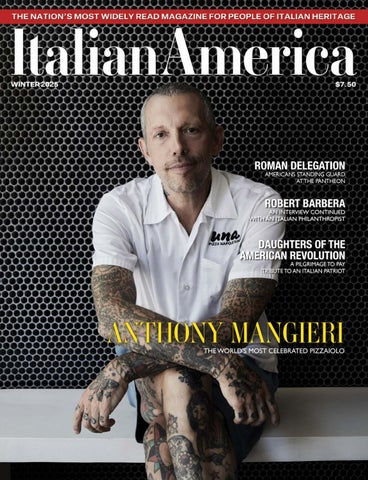
ROMAN DELEGATION
AMERICANS STANDING GUARD AT THE PANTHEON
ROBERT BARBERA
AN INTERVIEW CONTINUED WITH AN ITALIAN PHILANTHROPIST
DAUGHTERS OF THE AMERICAN REVOLUTION A PILGRIMAGE TO PAY TRIBUTE TO AN ITALIAN PATRIOT
![]()

AMERICANS STANDING GUARD AT THE PANTHEON
ROBERT BARBERA
AN INTERVIEW CONTINUED WITH AN ITALIAN PHILANTHROPIST
DAUGHTERS OF THE AMERICAN REVOLUTION A PILGRIMAGE TO PAY TRIBUTE TO AN ITALIAN PATRIOT
THE WORLD'S MOST CELEBRATED PIZZAIOLO

Andrew Cotto

Andrew Cotto
Ami Neiberger

James Campbell


Official Publication of the Order Sons and Daughters of
Italian America magazine is a publication of the Order Sons and Daughters of Italy in America (OSDIA), the nation’s biggest and oldest organization for people of Italian heritage. To subscribe, see www.osdia.org or call (202) 547-2900.
SONS AND DAUGHTERS OF ITALY IN AMERICA 219 E Street NE, Washington, DC 20002
Editor-in-Chief: Andrew Cotto
Writers: James Campbell, Clarissa Carlucci, Fiorenze Castellli, Andrew Cotto, Brian D'Ambrosio, Michele Di Pietro, Robert Ferrito, Kathy Minicozzi, Ami Neiberger, Michael G. Polo, Lorenzo Porcelli, Joe Sciame, Sam Weinmann
Copy Editor: Christine Haden
Proofreader: Mark DeNunzio
Graphic Designer: Diane Vincent
To advertise: Contact EditorItalianAmerica@gmail.com (202) 547-2900


Welcome to the Winter 2025 issue of Italian America magazine. I hope all of you enjoyed the holidays and are ready for the New Year. With each new year comes change, and a major change for me in 2025 will be the end of my role as Editor-in-Chief of this magazine. I’ve enjoyed my tenure here that has spanned the course of ten issues. I’m proud of what has been accomplished, and I’m appreciative of the relationships I’ve made along the way within the OSDIA organization and the Italian American community at large. I’m particularly appreciative of those who have contributed to the magazine with content, design and counsel. I wish my successor, Samuel Weinmann, the best of luck in his new role. Please contact Sam directly at sweinmann@osia.org for all matters with regard to this magazine.
As for me, my work will focus primarily on Appetito magazine (www.appetitomagazine. com), a digital publication dedicated to Italian cuisine and lifestyle which I co-founded in the summer of 2023. I encourage you to visit our site and to stay in touch with me at andrew@ appetitomagazine.com or via social media @andrewcotto. It is my immersion in the world of Italian cuisine which inspired this issue’s cover feature on Anthony Mangieri, who is without doubt the world’s most celebrated pizza-maker at the moment. My interest in Anthony, and the reason for my introducing him within these pages, goes beyond accolades and really focuses on character. There’s something inherently Italian in his unwavering dedication to craftsmanship. I trust you will be impressed by Anthony’s journey as well as the humility that remains as much a part of his identity as his passion. I realize that many of you will never make it to Una Pizza Napoletana in Manhattan, but you can order Anthony’s frozen pies, Genio Della Pizza, at www. geniodellapizza.com.
As for the rest of the Winter issue, I think it represents my interest in celebrating Italian exceptionalism through features on important stories and figures within our community, both in America and Italy, including the second part of my interview with Fall’s cover feature, philanthropist Robert Barbera. There is also, as always, content dedicated to food, travel, language with requisite nods to nostalgia. And, of course, we highlight happenings within the organization via Bulletin Board and OSDIA Nation.
I hope you enjoy and wish all of you well in the New Year and beyond.
Arrivederci!

EDITOR-IN-CHIEF, ITALIAN AMERICA MAGAZINE


BY: SAMUEL WEINMANN
On March 14, 1891, 11 Italian Americans were lynched in New Orleans, Louisiana, in what is now recognized as one of the largest mass lynchings in U.S. history. The mob was comprised of thousands, with affluent and influential members of the community leading the charge.
Now, more than 133 years after the lynching occurred, a commemorative plaque was erected in October 2024 at the site of the former prison. The plaque was sponsored by the Commission for Social Justice (CSJ), the anti-defamation arm of the Order Sons and Daughters of Italy in America (OSDIA). The plaque was unveiled in an Italian American Heritage Month ceremony, which was organized by the CSJ and the American Italian Federation of the Southeast (AIFEDSE).
Representatives from the Future of the Order Forum (FOTO) Committee were also in attendance, showcasing support from the younger members of OSDIA for this initiative.
The plaque was raised to honor the lives that were lost during the lynching, and to remember the anti-Italian sentiments that spurred the violence.
“I’m happy that the CSJ was able to sponsor this plaque, and especially that we were a part of the dedication,” said Robert Ferrito, CSJ President, adding that “it was something I felt we needed to do.”
Charles Marsala, AIFEDSE President, said that “This project gives Italian organizations nationwide a tool to educate the public and elected officials on the foundation of Columbus Day.”
Approximately five months before the lynching took place, New Orleans Police Chief David Hennesy was assassinated on the street, an event which caused an uproar in the local community. According to eyewitness William O’Connor, when asked who had done it, Hennesy whispered the slur “dagoes,” referring to Italian Americans.
What followed was a mass incarceration campaign of Italian Americans – largely targeting the Sicilian population of New

Orleans. These arrests were ordered by Mayor Joseph A. Shakspeare, who around the same time appointed a “Committee of Fifty” to investigate “secret societies or bands of oath-bound assassins.” The Committee of Fifty played a critical role in organizing the mob and in warping public opinion to think that the lynching would be an act of justice.

Ultimately, 19 of the hundreds of Italian Americans stood trial for murder, and were being held in Parish Prison up until the time of the lynching. The trial ended with multiple declared mistrials and acquittals. The following day, thousands stormed Parish Prison and dragged 11 of the 19 Italian American men out, to either be shot or hanged.
Immediately afterward, the act was lauded by local and national media, fueled by the pervasive anti-Italian and antiimmigrant sentiments at the time. It was not, naturally, received the same way by the Italian government; what followed the lynching was a full-blown diplomatic crisis, causing Italy to withdraw its ambassador.
The following year, U.S. President Benjamin Harrison proclaimed Columbus Day a one-time national celebration on the

400th anniversary of his voyage, a move intended to mend U.S.-Italy relations, and a deeply symbolic gesture to the Italian American community. The U.S. government also eventually issued reparations for the family members of the victims.
While certain gestures were made after the lynching occurred, none of those involved in the lynching were prosecuted, and for 128 years after the lynching, no apology was made by any New Orleans Mayor.
However, in 2019, in collaboration with the CSJ, New Orleans Mayor LaToya Cantrell made a formal apology for the first time to the Italian American community for the lynching. “I issue this formal apology for ugliness that is 128 years old,” she said during a speech after signing the proclamation. “We cannot change history, but we can acknowledge it, and we can grow from it,” she added.
While the lynching is one of the darkest days in Italian American history, it is an event that isn’t largely remembered by the American public. This plaque, held at the site of the lynching, under the same trees in which Italians were hanged, serves to honor the memory of the Italian Americans that lost their lives, and to educate the American public about the history and the dangers of anti-Italian discrimination.

The 59th Biennial National Convention of the Order Sons and Daughters of Italy in America (OSDIA), which will be held from August 12-16, 2025, in Orlando, Florida, will now be open to all members, including At-Large members.
The Biennial Convention is a meeting of OSDIA leadership throughout the country every two years to install the next administration of national officers and trustees for the following two-year term.
The convention will be a great opportunity to network with other Italian Americans from around the country. Throughout the week, members will be able to register for various breakout sessions on topics pertinent to growing and maintaining your lodge, iMembersDB training, and leadership panels, just to name a few. And feel free to bring the family, as you will have the ability to purchase discounted Disney World tickets.
Stay tuned for more details on how to attend the convention and for an interest survey from the National Office!
BY ANDREW COTTO
In the spring of 2022, I was hosting the 50 Top Pizza USA awards ceremony in Manhattan. After being provided the names of the 50 winners prior to the event, I immediately checked the #1 spot. I’d never heard of Una Pizza Napoletana or its owner/pizzaiolo, Anthony Mangieri. After presenting the 49 other recipients, I was struck by the humility and graciousness of this tattooed man when we met on stage. He was born and raised in New Jersey, and had just been recognized as the best pizza maker in the US (besting many Italians in the room). The next month, he would be honored in Naples as #1 pizzaiolo in the world at the 50 Top Pizza International award ceremony (besting even more Italians!).

Since that time, Mr. Mangieri has been honored with the top spot in the US for the next two years and, once again, internationally in 2024 (while placing at #2 in 2023). Over this period, I’ve gotten to know Mr. Mangieri and have realized there is something decidedly both Italian and Italian American in his remarkable success.
I sat down with Mr. Mangieri at Una Pizza Napoletana in NYC’s Lower East Side neighborhood for a conversation about his background and the seemingly overnight success that had been in the making for 30 years.
Before we begin at the beginning of your story, let’s flashback to 2022. You’re in Naples, attending the 50 Top Pizza International awards ceremony, after having just won the US competition. What were your expectations going in and what did it feel like as the names kept ticking off and you remained in contention and ultimately winning?
My expectations were not to be #1 for sure, because, you know, we’re in Italy. It’s won, I assumed, by Italians, probably a Neapolitan, because that’s where the world recognizes the best pizza-making. So, I just didn’t think it would be the case that we’d come in at #1. I assumed we’d probably be in the top 10 because we were #1 in the US. I brought my wife, Christina, who is now my partner at Una, and
two of my coworkers, and we were sitting together in this famous Naples auditorium, and, as expected, we made it to the Top 10, but then we were in the top 5, and we we’re just like, Oh my God. And then the top 2, and then…It was really shocking and very emotional because of my connection growing up to Naples and having such a deep love for the city. It’s really where my story with pizza and all things Italy began.
How did you come to connect so profoundly with Naples?
I started to go to Italy at a young age with my family. My dad was a worker, and very American in a lot of ways, so he didn’t care as much, but my mom and I really fell in love with Italy, especially Naples. I wanted to move there. I instantly felt very connected, partially because my family came from that region of Italy. Growing up Italian American, I didn’t know exactly where I belonged. I wasn’t totally into all the Italian American food, but when I discovered the food in Italy, it just touched me so deeply. Not only the food, I also really fell for the music, the people, the culture, everything. I was happy to sit on a bench all day in Naples. That’s how much it meant to me. Flash forward all those years later, to be sitting in one of the most historic theaters in Italy, connected to the San Carlo opera house, where Caruso sang, and to be acknowledged as doing something in the eyes of Naples that was good, something that is rooted in Naples, I was overwhelmed. I wish my mom could have seen it, because she and I went there a lot while I was growing up.
Besides the regular trips to Naples, what was your childhood like?
I had a wonderful childhood. I grew up in Toms River, New Jersey.

This Jersey shore town was middleclass to poor. There was no one really rich that I knew. My family was middle class, at best, and we always struggled. But it didn’t matter. I had such a great childhood because it was just a different era. We as kids were very free. I would be outside all day. My mom worked two jobs. My dad worked two jobs. I kind of did whatever I wanted. I also had a lot of Catholic guilt, so I never went too far with getting into trouble, like some of my friends who really got into trouble, but I had a lot of fun as a kid. I was very close to my grandmother, who lived across the street from us. I was very close to one of my uncles who used to come over almost every night for dinner. It was a small, very tight-knit family.
Can I assume there were good cooks within the family?
To be honest, no one in my family was a great cook. I think they thought they were good cooks, but they weren’t. As I got older and started to really love cooking, I quickly realized that they didn’t know what they were doing.
When did you discover this love of food?
I loved food most of my life, but I was very picky as a kid, and I still am kind of picky. My wife can second that I’m kind of a pain in the butt. The time I became obsessed with cooking was probably in my mid-teens, around 15 years old. The strange thing about this was that I was really into skateboarding, BMX racing, and punk rock music. All the kids I was hanging out with didn’t care about food. They ate junk food, and I’d never touch it. So, I started trying to cook and bake my own food, and I really got into it. I’ve always been super into the backstory on things and history, and I still am to this day. As soon as I get into something, I want to know more about it, get deeper with it, understand things about it. So, I became kind of obsessed with baking and Italian food in general. I started to read every single book I could find on the subject at the public library. This was non-stop, hours at a time. Then a Barnes & Noble opened, and I would go there every weekend and
spend hours looking through every cookbook that was in there. It was amazing. So that was sort of how I started getting into it and trying to experiment and figure things out.
How did this hobby / passion translate into a profession?
By the time I finished high school, I didn’t really have a sense of what I wanted to do. I didn’t want to go to college. My mom was super supportive but kind of like, what are you going to do? I had started playing music in high school, first guitar and then bass, in punk rock bands. As I learned more about what playing bass was all about, I started to get really into jazz and wanted to be a jazz musician, but there was no jazz to be played where I lived. I auditioned for the musicians union in Atlantic City, but there wasn’t work for me there. I was also baking non-stop at home and having my mother take me everywhere that I could have her take me, whether it was pizzerias in the city or in Connecticut. We had been going to Italy together as well. Baking and cooking became more and more of a focus, and eventually, with money I had saved and some help from my parents, I opened up a bread bakery in a tiny space in Red Bank, New Jersey. My dad and I did all the work and built everything out. We put a wood burning oven in the back. The room was empty, except for the sink and the oven. I put wooden boards on constructions easels, covered them in canvas cloth for the dough to rise on. That was it, and we opened. Some days the bread was amazing, and some days it was terrible. People were fairly responsive, but I really didn’t know what I was doing. But I just kept doing it, working from 10:00 at night until the middle of the next afternoon.
I was killing myself, but I just felt like I had to do it.
Eventually, it really started to catch on. And then this woman came in, Andy Clurfeld, who was a local writer and part of the James Beard Foundation. I didn’t know what the James Beard Foundation even was, but she came in, ate the bread and said she was going to write an article about the bakery. I had forgotten about her promise of a story, but then one Saturday I was setting up and there was a line of what had to be 40 people waiting for me to open.
How did that feel?
It felt good, of course, but I was pretty run down by that point. I had no employees. I’m doing everything. I’m baking all night and selling the bread all day. I was making some money, but I wondered what I was doing with my life. My friends had girlfriends and were buying cars. I was exhausted and living at my parents’ house, getting a little puffy from eating nothing much other than bread. So, I shut the bakery down. I had a little money saved. My father was in the union in Atlantic City, and I was going to go there and get a job as a janitor or something. But then I found this spot that was a little closer to where I grew up, right across the street from the beach in Point Pleasant. The rent was super cheap. The guy that owned the building was from Calabria. I decided to open a pizzeria and call it ‘Una Pizza Napoletana’ which just meant ‘a Neapolitan pizza’ because I wanted it to be clear exactly what I was doing.
How did it go?
Things went terribly for about a year. I had never dealt with customers before. The bakery was very

transactional. I didn’t have to serve anybody or even speak that much. I wasn’t used to the kind of customer service the pizzeria required, and it was really stressful because most people didn’t know what I was doing. This was 30 years ago. There was a big summer crowd, and they wanted slices. I had to explain to them that this was like the pizza they make in Naples. No one seemed to have any idea of what I was talking about. I actually had fights with customers because I wanted to protect what I was doing. I took it very personally, so I switched back to bread and did that for a year, but I had to keep trying with the pizza making because I was figuring something out. There was something there. I went back to Naples with my mother around that time, and I started to feel that what I was doing was better than what I had in Naples. I had all these pictures on the walls of the pizzeria that I’d taken of pizzerias in Naples
that I was in love with, and when I got back from that trip with my mother, I took them down because I wanted to focus on what I was doing and have faith in that.
I reopened the pizzeria, and soon after Andy Clurfeld, who wrote that article about the bread, ended up randomly coming in. She went nuts for the pizza and wrote a big article about it. I kept going and going, making pizzas in that location for eight years, until she had Ed Levine, the well-known food writer, come in. I had read his book on pastry shops in New York, and went to many of them on trips into the city with my mother. Andy was at a James Beard dinner with him, and she suggested he come to try my pizza since he was writing a book, A Slice of Heaven, all about pizza. He told her the book was finished, but she insisted. He took the train down from New York City, and Andy picked him up at the train station and brought him to my pizzeria. He fell in love with the pizza, and we hit it off. He actually went back to the book and added a chapter about the “keepers of the flame,” as well as a whole chapter just about me as well. When the book came out, he was on all these talk shows promoting the book, and he would mention my place whenever asked about his favorite pizzerias. This was right about the time I decided to open in New York City.
As we ask in storytelling: Then what happened?
I opened the original Una Pizza Napoletana in NYC on 12 th Street in the East Village. This was around 2003, I was doing well there. We kept getting written up and had lines down the block before opening. Famous actors were coming in. For

the first time, what I was doing was connecting with a lot of people, and I was making some money. But I loved cycling and wanted to be in California, so probably at its height I closed Una in NYC and moved out to San Francisco, where I opened Una and stayed for about eight or nine years before coming back to New York.
I actually lost my lease as the space we occupied was being torn down to build a residential tower. My thought was to go to LA, but I came back to NYC for a pop-up, and one of the people who came to the pop-up was a chef who had a restaurant here in New York City. When he was leaving, he came up and we spoke about teaming up in New York with him and his partner. We opened our current location on
Orchard Street on the Lower East Side of Manhattan. Unfortunately, when we opened, it didn’t really do the business we had hoped. I’d never had partners before. They had their vision and their customers, and I had mine. It wasn’t clicking. I was here all the time, and they were mostly in their own places. I think that lack of harmony affected the experience. We got some bad reviews, including one from The New York Times.
I had started thinking about going back to New Jersey, and I found this really cool spot in the Atlantic Highlands. It was a beautiful, old bank with the original hardwood floors and red brick walls. And, it had a liquor license attached to the lease, which is something that you can’t get for under a million dollars. The landlord was amazing, and we worked out a deal, but I was doing
this secretly. No one knew that I was building this thing out. I was coming to Una in Manhattan, making the dough then taking the ferry down to the Atlantic Highlands after service, working construction until around 3:00 in the morning, taking the ferry back to New York to do it all over again. I did that six days and nights a week. On Sunday, I would get up and go down to New Jersey and work all day doing construction until late at night. I did that for almost a year until I finally got it built. During that time, a second review came out from The New York Times, and this one was very positive. We got super busy again, but I had told the two partners, who were still legally connected, that I’m shutting this place down. They could buy me out and stay in the space, but I’m taking the name and opening a place in New Jersey. We were all trying to figure out what to do, and then COVID happened. We shut down Orchard Street, and I ran the New Jersey location the whole time. It was amazing. For two years, we sold out of dough every single day. During that time, I bought out the investors on Orchard Street and decided to come back to NYC. It will be three years ago this March.
At what point did the acclaim start to arrive?
Over the years, we’ve been fortunate to get a lot of press and build acclaim in certain circles. I think at first because when I started out in the East Village no one else was really doing Neapolitan style pizza in the U.S. Then at different points in my career, we’ve gotten more press, partly from just sticking it out and from keeping a very small, focused menu and approaching things in a

very intense and intentional way that wasn’t just about pleasing customers. On the international acclaim side, it really started when we were still in the Atlantic Highlands. I received a bottle of Prosecco from 50 Top Pizza with a request to make a video. I didn’t know who they were, as they were just getting started at the time in the US, though they would soon become super big, too. But I had no indication that Una was going to become this successful, but that may have been the first indication. You never know what’s going to happen in the restaurant business, but from the first day we opened back up on Orchard Street, it was like: Boom! We have literally sold out every night here for three years. We have over 1,000 people on the notify list every night. Reservations are taken within one minute when they go live two weeks in advance at 9:00 a.m. EST. It’s crazy. I’m working harder than I ever have, and I’m more consumed by it than I’ve ever been. We’re actually coming in every day more focused, more excited about what we’re doing with regard to the food and hospitality.
What makes your pizza so unique?
I think 30 years of trying to perfect my dough makes it different. When I started Una down on the Jersey shore, if you would have eaten the pizza, it was like I wanted it to be. As time goes on, and you just keep doing something with a certain kind of commitment, and you keep pushing and wanting to learn more, it can result in something unique. I’ve just tried to get better and better.
Is there something inherently Italian in the way that you go about the things you’re interested in?
I think so. The best part about being Italian is the commitment to craftsmanship. There’s just this way of approaching things. The best Italians in history have always been innovators while respecting the history. The things that have spread around the world from Italy that are great are from people who are pushing and innovating, whether it was in fashion or food or cars or anything. I mean, Enzo Ferrari is a perfect example. This guy’s mentality was like: We never stop. He was relentlessly pushing. There’s no backing down as to being better at what we do. I try to embrace that mentality when I come into work every day, and I try to instill this in the people who work here with us. I think that’s the Italian side of things that I inherited and witnessed growing up here in America, and also during my many trips to Italy. I want people to come in and be inspired, not only from the food but also from the vibes and hospitality. All of this is, to me, very much part of Italian tradition and culture.


BY CLARISSA CARLUCCI
Home sweet home, when I’m not in the States, that is.
My father was from the Ligurian coastline, and my roots have brought me back year after year, often several times per year, to indulge in the sights, smells, tastes and sounds of the sea.
Nestled in the northwest corner of Italy along the coast, and home to the country’s Riviera, Liguria offers an undiscovered abundance of charm, colors and culture that you won’t find anywhere else, all within an hour’s drive or boat ride.

Best-known for its Cinque Terre (five lands), Liguria offers a plethora of spots sprinkled along its shores well beyond the famous five, tucked within tiny towns whose colors cascade into the sea along la costiera.
Here are my favorite must-see towns, as well as unique gems and things to do in my favorite region:
Rapallo, San Fruttuoso & Camogli:
One of the best “home bases” while spending time on the Italian Riviera is the lively, yet quaint town of Rapallo. Situated on the Portofino Coast, it is just 10 minutes from some of the more popular neighboring towns of Santa Margherita and Portofino. This town has a heartbeat similar to many others in Italy and comes alive in the morning with its mercati and during the evenings as residents emerge for their nightly passegiata along the lungomare.
Rapallo offers all of the Ligurian specialties when it comes to food – from farinata (a savory regional flatbread made from chickpeas) at Tossini, to gamberi rossi and homemade pastas at my favorite restaurant in town, Rapalà
Visit the brand new, two-story Ö Magazín Al Pörto in Porto Carlo Riva. Frequently visited by celebrities, there is no surprise that this locally-loved ristorante was able to open its stunning third location in the port of Rapallo offering breathtaking 360°-views of the harbor.
If you’re feeling adventurous, Rapallo offers the only cable car in the entire region of Liguria. In just seven minutes, you can visit the Sanctuary of Montallegro and take in the impeccable views and glistening sapphire sea of the Gulf of Tigullio from 600 meters above sea level.

Only reachable by boat or foot, San Fruttuoso is a secluded, majestic escape – snorkel its crystal-clear waters and enjoy the freshest fritto misto on the beach at “La Cantina.” Home to the historic Abbey and the iconic Christ of the Abyss statue depths beneath the sea, San Fruttuoso encapsulates a spiritual essence and the sea within its beautiful bay.
The colorful town of Camogli shows off all year long and has some of the best waterfront dining options and beach access of the entire region. Dine & dangle (literally) at Camogliese which hangs off of the elevated promenade, or enjoy an aperitivo on the rocks as the sea sprays at La Rotonda. Stroll, stop for gelato and listen to the seagulls sing at Latterie 1978, serving up the best flavors in town.
For a more casual option, and extremely rare for Italy, you’ll find gourmet “takeaway” homemade pasta bowls at Pasta Fresca Fiorella, or grab a slice of the town’s specialty – Focaccia di Recco col formaggio from Revello and head right back to your beach chair (watch out for the seagulls, they LOVE focaccia).
One of the best and most unique happy hour spots along the coast is accessible by boat via Camogli. Capitan Mugugno at Punta Chiappa is situated at the point overlooking Camogli. Swing and sip spritzes right on the sea!
Chiavari & Sestri Levante:
A 30-minute drive along the jaw-dropping Ligurian coast will lead you to the town of Chiavari, and its stunning archways have captivated my heart since I was a little
girl. This one-of-a-kind gem along the Ligurian coast offers old-world charm, and a touch of contemporary. Home to the iconic Gran Caffè Defilla, you’ll feel as if you’ve stepped back in time while sipping a morning cappuccino beneath the historic caruggi, or medieval alleyways.
Gelateria Da Carlo shows off its self-spinning gelato canisters in the center of town. Chiavari also has one of the largest markets in the region, nearly taking up the entire town – filled with fresh produce, garments galore and the chatter of nonni around every corner.
About ten minutes south of Chiavari you will find the special town of Sestri Levante – a peninsula offering beachfront and dining on both sides. Hugging the tranquil bay with all of its colors, it is the perfect destination for families with plentiful activities for children during the summer months. The restaurants and bars serve and seat you directly on the sand, providing an ideal vacation experience for those who prefer a laid-back atmosphere.
La Spezia, Lerici & Tellaro
If you’re looking for an affordable place to stay while visiting all of the Cinque Terre, check out the maritime capital of Liguria, La Spezia.
Each of La Spezia’s inclined streets flow into the city’s bustling promenade, decorated with plentiful shops and restaurants – it definitely has more of a metropolitan feel than its surrounding area for those who are used to more hustle & bustle.
The newly constructed Thaon di Revel Bridge connects the port with the city and offers stunning waterfront views

The facades of Rapallo.
and bars to enjoy an afternoon spritz. Visit the Naval museum if you’re looking for something historical to do.
If you are visiting the Cinque Terre, a unique experience that I highly recommend is a flat seaside bike tour, hosted by Caroline @rivieradreamer. The path is entirely flat & gently winds through the former train tunnels from the 1800s that run along the Ligurian Sea, connecting the charming seaside villages of Levanto, Bonnasola and Framura.
Located along the Bay of Poets, Lerici is pure magic. From the enchanting banter among the seagulls, to the way golden hour kisses the town’s piazza, there are many reasons that this place attracted and still attracts poets! I continue to be enamored with each and every visit to this special place.
Each week, the market rolls in along the waterfront, offering a stunning backdrop to peruse the gorgeous produce as the scent of fresh florals fill the air.
1918 is my favorite restaurant in Lerici, and quite possible in the entire Ligurian region; consistently offering an impeccable dining experience and the freshest seafood, it never disappoints. The staff is incredible, and you cannot beat the ambiance of the open-air, modern pergola within the iconic town’s piazza.
If you’re looking for a unique dining experience with excellent food, Il Fagolo is a close second in the area – the owner, and chef, serves up personalized, tasty, traditional Ligurian fair in a cave-like, cantina setting. You truly feel as if you are dining in her personal kitchen.
If you’re looking for an incredible beach day – drift away to Eco del Mare, where you can soak up the sun’s rays on dreamy daybeds and enjoy a private club experience, all anchored within a quiet cove.
Just five minutes south of Lerici is the must-see town of Tellaro. Octopus decorate the doors of this colorful village to ward off “sea monsters” which inspired the Disney movie, Luca
From its colorful hues, to its hidden coves and cantinas, Liguria has so much to offer beyond the Cinque Terre – I hope you will visit and enjoy all that it has to offer off the beaten path!
Clarissa Carlucci is the Founder & CEO of Carlucci Collective, a business development and marketing firm, exclusively for Italian brands. She is also the co-founder of CARINA, accessories inspired by the colors of the Italian coast. Follow CARINA on Instagram @carinacompany.

BY ANDREW COTTO
After you found your philanthropic calling, so to speak, with the Italian Catholic Federation, what were your next efforts?
From the Italian Catholic Federation, I went into another group that represented all the Italian American organizations in Southern California. It was called the Italian Americans of Southern California. And from there, I branched out and found many other groups that were advocating for all things Italian. One of the groups I joined was the Patrons of Italian Culture, and then there was UNICO National. I was going out night after night to parties where I was meeting lots of people who encouraged me to be involved in their organizations. It was fun, and each one of these organizations had one or several causes that they were interested in. For example, the Italian Catholic Federation was interested in Cooley’s Anemia, so I became an advocate of Cooley’s Anemia. I found so many wonderful things to do and so many ways to contribute.
In each one of these groups, I rose to be president. So I’ve always put my best foot forward and became a responsible member of the group. There was a certain sense of pride, a certain relief that I could express myself and accomplish things. I was sought after and respected and appreciated in each one of these groups as I moved along, because I always wanted more than what we were currently doing. I’m always saying: If that was good, how about going better? And if it’s better, how about not going best? And I just have that mindset, to want to always do more and do better. That’s just the way I’m built. That’s what my parents did to me. That’s what my brother did to me. They were always kicking me in the pants. Stop bragging; do better. And so I’ve tried to constantly move forward and do better in all aspects of my life.

How much of your time were you dedicating to all of these organizations?
By those early years, I had more money than I would ever need for the rest of my life. I semi-retired in my early 50s because there was no need to make any more money, but I had plenty of money to give out, so I went along those lines and worked in organizations because I became very, very interested in doing just that. I never asked for expense money, travel money, or secretarial money. I just felt this was the right thing to do, and that I could do it. When I was younger and just starting my career, there were a lot of these rich guys who did help somewhat but could have done more. I said: Lord, if you give me that wealth, I’ll do what I expect others to do. That gave me the impetus to make more money and to give out more money. I was happy to say that I was able to balance out my standard of living and to leave plenty to help others. I thought this was my life purpose because making all this money doesn’t mean anything unless you do something good with it.

Tell us about some of the work you’ve done with the colleges of Southern California?
I first got started at Pasadena City College, where I threw parties to raise money for a student exchange program to send kids to Italy. Later, a professor at Cal State University Long Beach wanted me to raise money for a chair. I jumped into that and made it happen. When Cal State University Northridge wanted an Italian major, I jumped into that. Then I went over the Pepperdine University, and we wanted to have two things: an Italian studies program and an exchange program. I raised money to do that, and I pushed that forward. Then I went over to Thomas Aquinas College where I did things to advance the education of students. It occurred to me that I would not have accomplished what I had in life had it not been for getting a good education. So I thought to give the kids a chance to be inspired and challenged to do better by offering prizes, awards, and scholarships. I decided with partiality that it had to be good and useful for Italian American kids because I felt maybe they’re ostracized or marginalized like I was, and I just wanted to make sure that they would get the opportunity of moving forward in life.
Can you tell us about some of the organizations that you’ve founded independently?
I started the Barbera Foundation in 2011. Under that I have a number of endeavors. They’re all different, but they have a basic foundation of Italian heritage. That’s a
given. As I move along the way, I find an opportunity to start those organizations and then move them forward. There’s the newspaper, L’Italo Americano. I took over the struggling newspaper and had to fire the director who wanted to put in politics. I couldn’t change his mind, so I just let him go and put someone there that would strictly speak to culture. I support two ballet companies and a vocal competition for opera. There’s the language school, Lingua Viva, that I wanted to call Pinocchio, but the directors of the cultural institute didn’t want that name. Most recently, and the largest of these organizations, is the Mentoris Project, a publishing company dedicated mostly to biographical novels about prominent Italian figures throughout history.
I appreciate so much what all of these organizations have done. I may have given each the necessary kick start, but I am so fortunate that there are so many people at each who are so good at what they do. I can’t express enough appreciation for the wonderful work that they do. Someone said a while back, “Hey, Barbera, you just start these things, and you have everybody else do the work.” And I said, “Yeah. What else can I do? I can’t run a newspaper. I can’t run a school. I can’t be a book publisher and an editor.” My slot is recognizing the need for each and providing the funding. I’m not embarrassed about that. I have good people. I have good organizations, and they’re running very nicely. I’m very satisfied with what they’ve all been able to do for the cause.
When I was in high school, we had a book on Europeans, and we covered Germans and British and

French and so forth. Each one of those lessons was broken down by countries, and we read something on each one of the countries, and each country occupied anywhere from two to six pages. When it came to the Italians, it was half of a page. I was so personally insulted that the people of the Renaissance would be marginalized to such a point to be a half page in a book when all other countries were getting more. I really felt the pang of anguish in high school to see how the Italians were listed with virtually no contribution. I knew there must be something wrong. I remembered this later in life, and wondered what the hell was wrong with the authors of a book that would only contribute half a page to Italian history.
That, among other things, sparked my interest to support the Italian contribution and get people to understand, particularly the kids who are Italian-American and may have no idea of the Italian contribution. Mentoris publishes books about many Italians or those of Italian descent who have lived incredible lives and produced something of value. So far we have published nearly 50 books, with more to come. The subjects come from ancient history to contemporary times. Some of the names we have profiled include Leonardo DaVinci, Mother Cabrini, Vince Lombardi, and Maria Montessori. We also have four books on generating wealth that I’ve written, as well as some books in other genres. The idea with all of the titles, which is indicated in the name of the organization, is to mentor people, to lift them up and encourage them to do better in life. We’re all about inspiration. These are the kinds of people we should be looking at.
Is there a particular title of which you are most fond?
Somebody actually asked me that several weeks ago, and I had to think and think, and then I realized it’s not a book about these famous people that I like most, but rather a book I was asked to produce about the seven senses. I’ve always wanted to get to the bottom line of what an Italian is and what makes Italians so exceptional. This book, The Seven Senses of Italy, our only work of fiction, is about a couple traveling through Italy on their honeymoon, and all that they experience with regard to sight, sound, taste, and so forth. This book really captures the essence of Italy and demonstrates why so many contributions to the world have come from Italians and Italian-Americans. This book reflects the characteristics which define the figures we have featured in our biographies.

I would say that the beauty of my life has been that there’s always something good to do, and I’m always seeing that. It encourages me to keep going. At 92, I’m still working and looking for my next projects. When I see people making a lot of money and not doing anything for their heritage or for the world, but just to create wealth, it bothers me very much because they’re missing out on a great opportunity to do good, and I refuse to accept the fact that I’ll become a hypocrite and not do the best I can to contribute. I love to meet people of like mind. I love to have people I can share things with. It’s been absolutely great. What keeps me going are the programs and the process and the need to think of what good can we do next.
To be interviewed by Italian-American groups like the Sons and Daughters of Italy in America is not only a tribute to me, but a tribute to the magazine that wants to do something for people and acknowledge them. I appreciate that acknowledgement, and I hope that I can pass on my experiences, so that there are people behind me encouraged to do the same for our great culture and heritage.

BY MICHELE DI PIETRO
I’m not sure if hearty, stick-to-your-ribs kind of comfort food actually keeps you warmer during the cold, dark days of winter, but it sure feels like it does! Foods like slowlycooked, braised dishes, winter vegetables and comforting carbs are generally the kinds of dishes that I love to both cook and eat this time of year–paired with a glass of a big, dry, Italian red, of course!
So, this season, let’s celebrate with a little twist to some hearty, Italian, classic chilly-weather dishes that will keep us cozy all winter long.
We’ll start with a humble, southern Italian pasta con patate, classic cucina povera created out of necessity with inexpensive ingredients. Here, I’ve added a bit of saffron (the world’s most expensive spice) to the recipe, the complete antithesis to the dish’s origins. Trust me when I say it makes a delicious dish even better!
Next, we’ll take a very iconic Sicilian, winter vegetable, cauliflower, cook it until smashable, combine it with lots of slowly caramelized onions, then top it with toasted breadcrumbs flavored with pecorino, lemon and herbs. A texture and taste delight!
Finally, a classic, Tuscan ragu di cinghiale (wild boar ragu) gets a nod from Emilia-Romagna to the north when the hearty, rich sauce is finished with a bit of milk, much like it’s ragù Bolognese cousin. This addition smooths out its overall flavor and complements the dish perfectly.
Mangia bene and stay warm, all!

SICILIAN-STLYE SAUTEED CAULIFLOWER


PASTA WITH POTATOES
Serves 6
Pasta e Patate was a common dish in my house growing up. I like to think of it as part of a category of Italian and Italian-American dishes that I refer to as “soupy pastas.” In fact, it can be as liquid-y or as dry as you want, depending on your mood. It definitely straddles the line between “pasta” and “soup.”
This is one of the most simple, Italian comfort recipes you can make. A light saffron and tomato broth is accented with onions, garlic, crispy pancetta and Pecorino cheese. With only a few main ingredients and a large pot needed, it’s a heartwarming, aromatic and complete meal that you can have on the table quickly with little effort. Buon Appetito!
YOU'll NEED:
½ cup small diced pancetta or prosciutto end (about 6 ounces)
2 Tbsp olive oil
1 cup small diced yellow onions
½ cup small diced celery
1 Tbsp chopped garlic
2 Tbsp tomato paste
7 cups vegetable or chicken broth, preferable low- or no-sodium
1 pound Yukon gold or other waxy potatoes cut into ½-inch dice, held in water to prevent browning
1 parmigiano or pecorino cheese rind
1 tsp saffron
1 tsp salt, or to taste
½ tsp black pepper, or to taste
½ pound small pasta
Grated Pecorino Romano cheese, for serving
Extra-virgin olive oil, for serving
DIRECTIONS:
1. Place diced pancetta or prosciutto and olive oil in large pot or Dutch oven over medium heat. Cook it until for about 6 to 8 minutes, until some of the fat has been rendered and the pieces have crisped up a bit.
2. Add onions, celery and garlic. Cook for about 4 minutes, or until onions have softened a bit, stirring occasionally.
3. Move onion mixture to one side of pot. Then add tomato paste and cook it for about 1 to 2 minutes. Pour in 2 cups broth and stir to loosen and scrape up any browned bits on bottom of pot.
4. Add remaining broth, potatoes (drain first if being held in water), cheese rind, saffron, salt, and black pepper and stir until all ingredients are well combined. Cover pot, increase heat to high, and bring mixture to a boil, stirring occasionally. Immediately reduce heat to a simmer and simmer, partially covered, for about 15 to 20 minutes, or until the potatoes have mostly softened, stirring occasionally. Remove any remaining cheese rind and discard.
5. Add the pasta, cook for about 5 minutes, then turn off the heat, cover and let it sit for 10 minutes undisturbed. Then, stir the mixture, adjust seasonings, and it’s ready to eat! (Use less pasta for a soupier dish.)
6. Ladle soup into bowls and top with some Pecorino cheese and a drizzle of extra-virgin olive oil. Enjoy!
You can find Michele's cookbook SOUPified! on Amazon! You can find Michele’s recipes at www.mangiawithmichele.com
Michele Di Pietro is an entrepreneur, chef, cookbook author, blogger, culinary consultant, food writer, and creator of Mangia With Michele, the expression of her lifelong passion for Italian ingredients, foods, recipes, culture, and traditions. Throughout her busy professional culinary life, Michele has also always been an avid home cook with strong ties to her Italian roots. She is most happy and satisfied when cooking for, and breaking bread with, family and friends. It is these ties and sentiments, along with her passion for sharing both food and travel experiences with others, that led her to create Mangia With Michele. In 2020, Michele released her first cookbook: SOUPified: Soups Inspired by Your Favorite Dishes , a whimsical collection of soup recipes inspired by familiar entrees. Find our food editor at www.MangiaWithMichele.com and follow her at @mangiawithmichele on social channels. www.instagram.com/MangiaWithMichele www.facebook.com/MangiaWithMichele

Serves 4
This sautéed cauliflower is the one my Sicilian-American mom made for us time and time again. Overcooking the cauliflower a bit until it is tender enough to be smashed with a fork is key. When combined with golden and sweet, caramelized onions and topped with crunchy, seasoned breadcrumbs, it becomes and amazingly unique cauliflower side dish that is, in fact, a great alternative to traditional mashed potatoes. And, while roasted cauliflower recipes are all the rage these days, I hope you find that this sautéed cauliflower with breadcrumbs is a refreshing and comforting alternative. Che buoni!
YOU'll NEED:
1 head cauliflower + salt for boiling water, cut into florets
2 Tbsp extra virgin olive oil
1 large yellow onion, thin julienne slice
2 Tbsp chopped garlic
¼ tsp crushed red pepper
Salt and black pepper to taste
For the Pecorino Lemon Herb Breadcrumbs:
1½ Tbsp extra virgin olive oil
1/3 cup plain fine breadcrumbs
¼ cup grated Pecorino Romano cheese
2 Tbsp chopped flat leaf parsley
Zest of 1 lemon
¼ tsp salt
Pinch black pepper
1. Make the seasoned breadcrumbs. Heat oil in small skillet over mediumlow. Then, add the breadcrumbs, cheese, parsley, lemon zest, salt and black pepper and cook until breadcrumbs are toasted, about 2 to 3 minutes, stirring continuously. Remove from heat and set aside, uncovered, at room temperature.
2. Put a large pot of water on to boil. Meanwhile, start cooking the onions and garlic. Heat olive oil in a large sauté pan over medium-low heat then add the onions, garlic and crushed red pepper flakes. First, sweat the onions a bit by covering the pan to keep the onions moist and slow the browning (2 to 3 minutes). Stir once or twice during this process. Then, once the onions are soft and translucent, uncover the pan and increase the heat to medium. Continue cooking until the onions on the bottom of the pan start to brown. Add a sprinkle of water to moisten and loosen the onions and deglaze the pan if the onions begin to look dry and/or stick to the pan. Lower the heat and continue to cook slowly, stirring occasionally until the onions are limp and have turned a medium golden brown.
3. When the water comes to a boil, add a good pinch of salt then the cauliflower florets and stir. Cook for a few minutes until the cauliflower is soft enough to mash with a fork. You can test this by squeezing a floret with tongs while it’s still in the pot.
4. Once it’s tender, drain the cooked cauliflower completely in a colander.
5. Then, transfer drained cauliflower to the caramelized onion mixture and mix. Increase the heat to brown the cauliflower a bit (2 to 3 minutes), while gently smashing and breaking it down into big chunks. I like to use a potato masher for this, but a large fork will do. Note that you are not completely mashing the cauliflower but rather “smashing” it a bit to break down big floret chunks.
6. Mix until the cauliflower and caramelized onion mixture are well combined. At this point, season to taste with salt and ground black pepper.
7. Transfer to a serving platter or bowl, top with a healthy amount of the lemon herb breadcrumbs and put the remainder breadcrumbs in a small bowl to be passed around the table. Serve immediately. That’s it!
Makes enough for 2-3 pounds pasta (about 10 cups)
I had my first wild boar (“cinghiale” in Italian) in Tuscany over twenty years ago. As wild boar run rampant throughout that central Italian region, there are so many local specialties available that are made from it, from salumi to sausages to prosciutto to ragu and more. My favorite way to eat the gamey meat is in this slowly-cooked, rich and hearty ragu which makes it so tender and flavorful. It starts with lean wild boar shoulder that is marinated in red wine and aromatics for hours, then slowly simmered in the most sweet-smelling braising sauce until it’s fork tender. The delicious meat is then pulled into shreds and added back to the sauce before being combined with your favorite pasta. Mamma mia!
YOU'LL NEED:
For the Marinade:
1 bottle dry red wine, such as Chianti
1/3 cup red wine vinegar
2-4 sprigs rosemary
10 black peppercorns
5 cloves garlic, smashed
For the Pasta:
1 pound pasta + salt for pasta water
3-4 cups wild boar ragu
1/3 cup grated Parmigiano-Reggiano cheese
2 Tbsp butter at room temperature (optional)
Extra virgin olive oil
For the Ragu: (Note: extra ragu can be frozen for up to 3 months)
3½ pounds boneless wild boar shoulder, most fat removed, 3” chunks, rinsed and patted dry
Pinch salt and black pepper
¼ cup olive oil or other neutral oil for searing
3 cups sliced yellow onions
2 cups small diced celery
2 cups small diced carrot
6 cloves garlic, chopped
Leaves from 2 sprigs rosemary (stems discarded)
½ tsp crushed red pepper
2 Tbsp tomato paste
2 cups reserved, strained marinade, from above
2 cups beef broth (preferably low- or no-sodium)
3 bay leaves
1 tsp dried oregano
1 tsp dried basil
1 tsp salt
½ tsp black pepper
1½ cups whole milk
1. Make the marinade by whisking all the ingredients together in a large, nonreactive bowl. Then, submerge the wild boar pieces in the marinade, cover the bowl with plastic wrap or a lid, and marinate for 12 to 24 hours.
2. When done marinating, remove the boar pieces and pat them dry. Sprinkle them liberally with salt and black pepper. Strain the marinade and reserve it for the ragu. Discard the strained items.
3. Heat the oil in a large, heavy-bottomed pot, such as a Dutch oven, over medium high heat. Carefully add as many wild boar pieces as will fit on the surface of the pot and sear them on multiple sides until brown, about 3 minutes per side. (It may be difficult to get a proper sear as the meat is full of marinade, but do the best you can.) Do this in batches and do not overcrowd the pot. Remove the meat to a plate once seared and set aside.
4. Add the onions, celery, carrot, garlic, rosemary leaves and crushed red pepper to the pot and stir to coat with the fat. Reduce the heat to mediumlow and cook until the vegetables have mostly softened, about 6 to 8 minutes, stirring occasionally.
5. Move the veggies over to one side of the pot and add the tomato paste. Caramelize it for 1 to 2 minutes.
6. Pour in the reserved, strained marinade and deglaze the pan, scraping up all the browned bits. Let this simmer and reduce by about 1/3.
7. Add the broth, fresh and dried herbs, salt and black pepper and stir until all ingredients are well-combined.
8. Carefully return the reserved wild boar to the pot, along with any accumulated juices, nestling the pieces in the broth and vegetables. Increase the heat to medium, cover and bring the mixture to a rolling simmer. Then, immediately turn the heat down to medium-low to achieve a low simmer and cover the pot, leaving it slightly ajar. Let the mixture simmer about 3 to 4 hours or until the meat is fork tender and able to be shredded very easily. Stir the mixture every 30 minutes, turning the meat pieces over. If necessary, add additional broth.
9. Once the meat is tender, transfer it to a dish to pull/shred (or do it right in the pot.) Remove and discard the bay leaves.
10. While you are breaking down the boar pieces, pour milk into sauce and let it simmer uncovered for about 30 minutes to create a thicker sauce. Return the meat pieces to the simmering sauce. After the sauce has simmered with the milk for about 30 minutes, it should be done.
11. At this point, you can either use the ragu immediately store it in an airtight container in the refrigerator for up to five days or freezer for up to three months. (I generally make this sauce 2 to 3 days in advance of when I am serving it. The flavors develop during this time.)
12. When ready to serve, bring a large pot of water to a boil and reheat the ragu in a large skillet over medium-low heat.
13. Add salt, then the pasta, to the boiling water, stirring frequently. Cook the pasta for 2 minutes less than the package directions, or about 2 minutes before you think it is al dente. Be sure to reserve at least 1 cup of the starchy pasta water.
14. Transfer the cooked pasta to the pan with the ragu, increase the heat to medium and toss well. Allow the pasta to finish cooking in the wonderful flavors of the sauce. Add pasta water for additional moisture, about ½ cup at a time. (You can also add some pasta water to the sauce before the pasta is added, if moisture is needed.)
15.Once the pasta is al dente, remove the pan from the heat. Then gently stir in the parmigiano cheese and butter and drizzle with a good glug of extra virgin olive oil. Transfer to a serving platter and serve immediately.
This recipe yields a large pot of sauce (about 10 cups ragu). It’s enough to dress 2 to 3 pounds dry pasta, which would feed about 8-10 people. Use what is needed to dress your favorite pasta, then freeze the rest for another time. The sauce freezes very well.
Older boar, which has tougher meat, will take longer to cook than younger boar. The times presented here are a guideline and the boar must be cooked until it is fork-tender.


Cari bambini pronti per l’anno nuovo? Arrivano dodici mesi per il 2025. Sapete come si dicono i mesi in italiano? Hello kids, do you know how to say in Italian the 12 months? Are you ready to say 2025 in Italian?
BY FIORENZA CASTELLI

Two thousand twenty-five


BY PIERA DE LISI
This LESSON will focus on the use of prepositions in Italian. The main Italian prepositions are: DI A DA IN CON SU PER TRA FRA, known as PREPOSIZIONI SEMPLICI. They correspond to the English forms: OF TO FROM IN/AT WITH ON/OVER FOR BETWEEN/AMONG. As regards to translation, you can easily figure it out. How to use Italian prepositions in writing and speaking could be more difficult from an English native speaker’s perspective. Why does it work like this? You would ask yourselves.
The main problem arises when translation is not enough. What does it mean? It means that the same Italian preposition might have two English equivalents and viceversa. As a consequence of this, understanding the context becomes extremely relevant. Here are some examples which will help you understand much better.
IO VENGO DA ROMA I come FROM Rome
QUESTO ROMANZO E’ STATO
SCRITTO DA JANE AUSTEN
This novel was written BY Jane Austen
As you can observe, the same Italian preposition DA has got two different English equivalents. In Italian we use DA both when we want to talk about the place we come from and in passive sentences to refer to the main agent of the action. In English we have got two different words standing for the same Italian preposition DA. A second example is the Italian preposition SU:
IL LIBRO E’ SUL TAVOLO
The book is ON the table
IL QUADRO E’ SOPRA IL CAMINETTO
The picture is OVER the fireplace
The Italian word SU/SOPRA corresponds to two English words depending on the general meaning of the sentence; when there is a contact between the object and the surface, we use the English ON, whereas when there
isn’t any contact the word is OVER. In both cases the Italian word is SU. ON is also used before the days of the week in English and for expressing dates.
I SEE YOU ON MONDAY
Ci vediamo lunedì (no preposition is required in Italian)
MY SON WAS BORN ON NOVEMBER 5TH
Mio figlio è nato il cinque novembre (no preposition is required in Italian)
Another Italian preposition, which is worth quoting is the first one: A. The same Italian word has got four different translations in English, depending on some specific conditions.
IO SONO A CASA I am AT home
IO VADO A SCUOLA I go TO school
SONO ALL’ OSPEDALE (lett. IN OSPEDALE) I am AT the hospital/I’m IN the hospital
IIL MIO COMPLEANNO E’ A FEBBRAIO
My birthday is IN February

Now practise your Italian prepositions by matching the Italian word to the right English form. There are more English words for the same Italian word!
DI ON A BETWEEN DA AMONG IN AT CON OVER SU IN PER ON TRA FROM FRA WITH OF

Choose the right preposition for the following Italian sentences.
1. OGGI VADO ROMA
2. IERI ERO CHIESA
3. DICEMBRE ANDRO’ SULLA NEVE
4. QUESTO TEST E’ STATO RISOLTO PIETRO
5. DOMANI ANDRO’ A SCUOLA AUTOBUS
6. OGGI ESCO MIA SORELLA
7. IL DIZIONARIO INGLESE E’ TAVOLO
Besides PREPOSIZIONI SEMPLICI, we must consider PREPOSIZIONI ARTICOLATE. These ones are composed of PREPOSIZIONI SEMPLICI and Italian articles. You may need an apostrophe when the word following the preposition starts with a vowel. See the grid below.


Try to choose the right PREPOSIZIONE ARTICOLATA for the sentences below. Help yourself with the grid above !
Il cane gioca IN+LA cuccia
Corriamo a sederci IN+IL posto assegnato
Povero uccellino! Mettiamogli un bastoncino SU+IL becco.
A mensa c’era la pasta CON+IL pomodoro
Hai più caramelle DI+GLI altri
Of course, the chapter of Preposizioni is a wide and though one in both languages, English and Italian. Here, I just wanted to give you a first approach to it. What I hope is having reached my purpose!
1. DI, OF; A, AT/IN; DA, FROM/BY; IN, AT/IN; CON, WITH; SU, ON/OVER; PER, FOR; TRA, BETWEEN; FRA, AMONG;
2. A, IN, A, DA, IN, CON, DI/SUL
3. NELLA, NEL, SUL, COL, DEGLI

BY AMI NEIBERGER
The special relationship between Italy and the United States was highlighted in fall 2023 when a delegation from the National Society of the Daughters of the American Revolution (NSDAR) traveled to Italy and placed a wreath at the grave site of Filippo Mazzei in the Church of San Gregorio in Pisa’s Cimitero Suburbano.
The American Revolution was supported by many, and Italian Filippo Mazzei acted as a secret dealer to purchase arms for Virginia. He would later promote the ideals of the Revolution alongside his dear friend, Thomas Jefferson, one of the founding fathers of the United States and a principal author of the U.S. Constitution and the country’s third president. 2023 marked the 250th anniversary of Filippo Mazzei’s first visit to Virginia.
Pamela Rouse Wright, President General of the DAR National Society, traces her lineage to Italy and is the first President General to celebrate her Italian heritage. When deciding on an overseas trip for her administration, Italy was the natural choice. “My great-grandfather, Carlo Bucci, immigrated to the United States from the Campobasso Province of Italy in the 1870s. After he arrived in America, he changed his name from Carlo Bucci to Charles Walter Smith,” said Wright.
Her grandmother introduced her to the world of genealogy, and she was very proud that her father was Italian. “Together we explored our Italian heritage. My great-grandfather played in bands in the late 1800s and
early 1900s, and for a short time he played in the band of John Philip Sousa, composer of “The Stars and Stripes Forever,” said Wright.
“I was delighted to explore this beautiful country with my fellow Daughters of the American Revolution (DAR), and to celebrate the ties between Italy and the United States,” said Wright.
Wright and the DAR delegation began their visit to Rome by honoring Italian soldiers killed and missing in action during a special ceremony at
the Monumento Nazionale a Vittorio Emanuele II arranged by the Office of the Minister of Defense.
President General Wright laid a wreath at the Tomb of the Unknown Soldier at the Altare della Patria. A walking tour of Rome followed. This country’s rich, vibrant history was on full display, and the group learned of the many ways Italy’s past inspired the founding of the United States.
The group’s tour began at the Villa d’Este in Tivoli, a UNESCO World Heritage site featuring a 16th-century


estate famous for its Renaissance gardens. Their day in Rome ended with a reception, where they were joined by Ambassador Jack Markell, the U.S. Ambassador to Italy and San Marino. He brought greetings and was presented with a DAR Commemorative Bowl and NSDAR Medal of Appreciation.
The delegation and its guests journeyed to Pisa to acknowledge the 250th anniversary of Filippo Mazzei’s first trip to Virginia, where he established his reputation as an American Patriot and godfather of the Declaration of Independence.
In a moving ceremony, President General Wright and Carlo Maruzzi, descendant of Filippo Mazzei, laid a wreath at Filippo Mazzei’s final resting place. Mazzei was a physician, vintner, and arms dealer. “It was my great privilege to lay a wreath honoring a man who inspired Thomas
Jefferson and other Founding Fathers who supported our fight for independence,” said Wright.
They were joined for the ceremony by many dignitaries, including: Cristina Manetti, Head of the Cabinet, Tuscany Region; Serena Nannotti, Regional Councilor for Tuscany; Francesca Parigi Bini, Institutional Communications Official for Tuscany; Paolo Pesciatini, Councilor for Commerce and Tourism, Pisa; Sergio de Maio, Mayor of San Giuliano Terme; Michele Conti, Mayor of Pisa; Sergio di Maio, Mayor of San Giuliano Terme; Jaleh Bahrabadi, Director of Pisa State Archives; Massimo Balzi, President of the Filippo Mazzei Cultural Club; Teresa Sichetti, Vice President of the Filippo Mazzei Cultural Club; and Maurizio Mancianti, President of the Tuscan American Association.
“I am grateful to the members of the local and federal government that made this memorable event possible, as well as Massimo Balzi, president of the Filippo Mazzei Cultural Club. We rejoiced in the ties of Italian-American friendship as we celebrated this Patriot at a luncheon,” said Wright.
Following the wreath-laying, the group enjoyed a Tuscan luncheon at Villa di Corliano, the headquarters of the Filippo Mazzei Cultural Club (Circolo Culturale Filippo Mazzei). The Club’s work involves preserving and perpetuating the legacy of Patriot Filippo Mazzei so that he will continue to be honored and remembered.
The Filippo Mazzei Cultural Club was awarded a DAR America 250! Commendation for its efforts to honor and educate others about the life and Revolutionary War service of Filippo Mazzei. Wright presented America 250! Commemorative Bowls to Massimo Balzi, President of the Filippo Mazzei
Cultural Club, and Carlo Maruzzi, descendant of Filippo Mazzei.
The delegation journeyed back to Rome, where they had a papal audience. “It was the honor of a lifetime to shake the hand of His Holiness Pope Francis and accept his greetings to the members of the National Society. No matter your faith tradition, seeing His Holiness interact with visitors from around the world is a moving reminder of our ties of faith, hope, and love,” said Wright.
The week culminated with a farewell dinner Friday at the Palazzo Doria Pamphilj. This exquisite estate is home to a large art collection that includes works by Titian, Raphael, Caravaggio, and Velazquez, among others.
A special gift was presented to President General Wright: sewing scissors hand-crafted in the Campobasso region. This is the region of Italy that Wright traces her Italian lineage to—and this particular pair of scissors was crafted in that very region and in the same year as DAR’s founding, 1890.
Learning about Italy’s thousands of years of history certainly placed the nearly 250 years of American history into perspective for the group. The trip highlighted just how special the liberty and values that Revolutionary War Patriots fought for truly are.
Learn more about the National Society Daughters of the American Revolution at DAR.org.


BY KATHY MINICOZZI
Sunday dinner was a major weekly event for the Minicozzi family of Oyster Bay, New York in the 1940s and 1950s. I was three years old in 1949 when my father moved my mother and me across the country and away from my extended Italian family, so I only have spotty memories of my time with them. My Aunt Mickey Hauxhurst, however, has lovely family memories, and is happy to share them with me.
I knew Aunt Mickey’s mother, my grandmother, as “Mamma Nonn’.” Her real name was Angelina. She was a short little lady from the town of Paduli in the Campania region of Italy. Although uneducated and unable to read or write, she was intelligent, as well as tough, and loving. There was no household art she couldn’t perform with expertise – and she was

the best cook in Oyster Bay, at least, according to her family.
Mamma Nonn’ always got up early on Sundays to begin preparing the food for later in the day. On Sunday mornings, the family woke up to the delicious aroma of meatballs and sauce being cooked in the kitchen.
There was no breakfast because the Minicozzis were Catholic, and, in those days, Catholics had to fast from midnight in order to receive Communion at Mass. The family attended the 9:00 Mass at St. Rocco’s church, after which they returned home.
Sunday dinner began precisely at noon. My grandfather insisted everyone be at the table no later than 12:00. He was the boss, and nobody dared show up late. Everything was ready, and all the food was on the table except the pasta and meatballs, which were served to everyone to avoid spillage. The meal started with pasta and meatballs, and sometimes beef braciole. Mamma Nonn’ often made her own pasta.
An entree followed. Aunt Mickey remembers having chicken and potatoes. There was a salad from the garden – no store-bought vegetables – and delicious homemade bread.
The chicken was fresh. Mamma Nonn’ never bought chicken in a store. She would give Aunt Mickey a dollar and send her to some Italian neighbors who raised chickens. The husband would slaughter a chicken, strip its feathers, put it in a bag, and give it to Aunt Mickey. All this cost the family one dollar!

In addition to homemade pasta and bread, Mamma Nonn’ homecanned tomatoes and peppers. She could make soup out of anything in the kitchen. She was the original home chef! My grandfather did his part, too - he made his own wine.
Although my grandmother did all the preparation work, she didn’t have to do the cleanup. That job went to the girls, who sometimes got into lively discussion over who should do what! They did it, though, without complaint or refusal. It was their family obligation.
Sometimes, there would be a midafternoon dessert of pineapple cheese pie from a local Italian store.
Friends of the family would sometimes pop in to visit in the afternoon. My grandfather would serve them a cocktail, Mamma Nonn’

would serve espresso and biscotti, and they would have a pleasant, neighborly visit.
The Minicozzi kids loved to go to the Sunday afternoon movies at 2:00. In the early forties, a child’s movie ticket cost around ten cents! Acquiring enough money for a movie ticket was possible by collecting beer bottles and turning them in to local stores.
The evening meal consisted of leftovers from the primary Sunday repast.
The Minicozzis were relatively impoverished when it came to money. However, they never lacked good food to eat or decent clothes to wear. For that, they had my grandmother’s good home management and fantastic cooking skills to thank.
My grandfather passed away from cancer in his sixties. Mamma Nonn’ lived to be ninety-three years old, mentally sharp and loving to the end.


BY JAMES CAMPBELL
With a staggering nine million visitors a year, the Pantheon in Rome has long held its position as one of Italy’s most popular cultural landmarks. In a notable departure this July, a 5-euro entry fee was introduced for the first time. This summer’s long lines prove visitors remain undeterred by the minor fee to enter this 2000-year-old marvel of architecture and engineering.
Within this wonder of ancient Rome reside the final resting places of many of Italy’s luminaries, among them painters Rafael and Annibale Carracci, and the first two Kings of Italy. King Vittorio Emanuele II’s tomb is a tribute to the “Padre de Patria”- Father of the Homeland - for his instrumental role in uniting Italy. Across the Pantheon lies King Umberto I, who was assassinated in 1900, resting alongside his Queen Margherita. Their visit to Naples inspired Raffaele Esposito of Pizzeria Brandi in Naples to craft the iconic pizza Margherita, adorned in red, white, and green hues of the Italian flag.
Perhaps during your own visit you encountered the “Guardia d’Onore alle Reali Tombe del Pantheon” – the Honor Guard of the Royal Tombs of the Pantheon. Standing solemn and resolute by the sides of the royal mausoleums, these guards serve in honor of the Savoy Dynasty, the architects of Italy’s unity. Clad in distinctive black berets and often draped in long cloaks adorned with the House of Savoy’s coat of arms, their duty extends to managing the guest books placed on pedestals adjacent to the tombs. Initially comprised only of former military or police personnel, the National Institute for the Honor Guards of the Pantheon now embraces civilians who meet the membership criteria. Notably, 15 to 20 percent of the guards are women. When I joined, I learned that even Americans could participate in this long-standing Italian tradition.
Celebrating the Guards’ 145th Anniversary, President Dr. Ugo d’Atri orchestrated a grand gala in Rome in January. Eric Ierardi, head of the American delegation, extended an invitation to the 50 American Honor Guard members. This event provided a golden opportunity for camaraderie among guards from various corners of Italy and Europe. The weekend’s activities included a mass held in the Pantheon, and a ceremonial march from the

monument to Vittorio Emmanuele II on the Forum’s edge through the historic core to the Pantheon.
Seated beside me during this celebration was Anitya Marlowe from Louisville, Kentucky. Anitya joined the Honor Guard in 2018, after learning about the organization while attending language school in Rome. She interviewed for the position in Rome and started right away. Anitya wanted to be as close to the Italian people as possible, and this organization has allowed her to forge friendships with people from across Italy and the world. Anitya runs Sicilia Mia Vacanze tours in Sicily and Tuscany, and her friends from the Honor Guard are always there if she needs a contact. “It is truly an honor to stand guard for King Victor Emanuele II, the father of the unified Italy. He did so much for the country, and as you travel Italy, there are constant reminders that he did so,” Anitya adds.
Justin Farivari, an American Honor Guard member from Saint Paul, Minnesota, viewed his role as an educational one. He acknowledged the limited awareness among non-Italian tourists, especially Americans, of Italy’s royal history. As a Guard, he takes pride in bridging this gap through service, educating visitors about the House of Savoy’s pivotal role in Italian history. “ I enjoy being able to stand guard inside the Pantheon itself. It is one of the world’s great monuments, and to have the opportunity to serve as an Honor Guard, there is an incredible experience. You are part of history. Just standing there is a great experience.” Justin shared.
My introduction to service with the Honor Guard began when I was the Mayor of Belvedere, California. I frequently traveled to Italy to arrange a twin city agreement
with “Sindaco”- Mayor Viacava of Portofino in Liguria. One of my new Italian friends told me about his service and how his father had also served. I contacted the American delegate as soon as I returned home, and after being accepted, I planned my next trip to Rome. President d’Atri kindly took me into the Pantheon for the first time as an official member of the Honor Guard. He explained the protocols and answered all my questions, and made me feel very much at ease. It is such a rare opportunity to be invited to be a part of history and participate in another country’s culture and traditions. I value the friendships and insights the Honor Guard has gifted me.
For Eric Ierardi, the journey came full circle. As a young boy, Eric Ierardi listened to “Marcia Reale,” the national anthem of the Kingdom of Italy, with his Italian Grandmother, who told him the Kings of Italy were no more. Today Eric says he “stands by the King’s tomb with great pride for the legacy of uniting Italy into the great country it has become today.” Eric has served as the American Delegate to the “Instituto Nazionale per la Guardia d’Onore alle Reali Tombe del Pantheon” -the National Institute of the Honor Guards of the Royal Tombs of the Pantheon - under President Ugo d’Atri since 2006. The minimum requirement is four hours of guard duty a year at the Pantheon and keeping up with the modest dues. Members receive quarterly magazines full of historical stories and photographs about the Kingdom of Italy. For those intrigued by the prospect of joining the American delegation of the Honor Guard to the Pantheon, Eric Ierardi extends an open invitation to learn more about the organization and how to become a part of this long-standing Italian tradition, kindly contact him at guardiadonoro@aol.com or ericierardi@aol.com


“A beautiful saga that follows a family across generations and the wars that shaped them, while always remaining so deeply personal that you cannot put it down. . . .”
e Most Rev. Michael B. Curry, Presiding Bishop of e Episcopal Church COMING OUT FEBRUARY 25, 2025 FROM GREEN WRITERS PRESS Available wherever books are sold


On October 13, 2024, the Grand Lodge of Illinois/Wisconsin of the Order Sons and Daughters of Italy in America (OSDIA) marked an extraordinary milestone—its 100th anniversary—at a celebration held at the Silver Oaks Country Club. The event brought together members, and friends to reflect on the century-long journey of an organization dedicated to preserving Italian heritage, promoting community service, and supporting charitable causes.
Since its founding in 1924, the Grand Lodge of Illinois/Wisconsin has had 20 distinguished leaders, each leaving a lasting impact on the organization and its mission. This centennial celebration honored those who have served in this prestigious role, and it also spotlighted the remarkable contributions of two exceptional women who broke barriers in an organization traditionally led by men. Cavaliere Giovanna Verdecchia and Maria Marsalli, both of whom have served as Grand Lodge Presidents, were celebrated for their dedication, leadership, and commitment to the values of OSDIA. Their leadership paved the way for future generations of women to play a pivotal role in shaping the direction of the Grand Lodge, and their inclusion in the anniversary celebration underscored how OSDIA has evolved into a more inclusive and forwardthinking organization over the years.

The Board of the Grand Lodge of Illinois / Wisconsin at the 100th anniversary celebration.
The Cristoforo Columbo Lodge #2413 got together for a day of jarring tomato sauce, pickled pepper and making homemade cavatti.

The Christopher Columbus Lodge #216 in Brockton, Massachusetts, through our Charitable and Education Trust, has made a donation to the Brockton Public Library each year since 2011 for the purchase Italianthemed literature and literature authored by Italians. During Italian Heritage Month in October, the Brockton Public Library proudly displays, in its front lobby, a large selection of literature purchased through our generous donation.
The Brockton Public Library now has a large collection of fiction, non-fiction, cookbooks, children’s literature, videos and films honoring our Italian culture and prestigious authors. We are proud to spread our Italian culture through this annual donation. Our heritage is on display not only in October, but each day through this ever-growing collection. The project is credited to the late Richard Alfonso, a Past President, whose initial idea it was to make this donation in 2011.

Brockton Public Library Director of Adult Services, Jonathan Scott, center, is surrounded by Lodge Members: President Jacquelyn Tricomi Bonarrigo, Vice President Darlene Campisano, Recording Secretary Cheryl D’Antonio, Financial Secretary Phyllis Padula-O’Brien, and Lodge Member Patrick Padula as they hold one of the library books purchased from our donation.
The Dr. Vincenzo Sellaro Lodge #2319 in Smithtown, NY, celebrated its 50th Anniversary on September 28, 2024. A proclamation from the Supreme Lodge was presented to the Sellaro Lodge by National 1st Vice President Thom Lupo and National Recording Secretary Joseph Rondinelli.

left
Gabriele D’Annunzio Lodge #321 in Schenectady celebrated Italian Heritage Month with its annual Columbus Dinner on Friday, October 13th, at the Terrace at the Water’s Edge. 146 members and guests gathered to pay homage to the achievements of Christopher Columbus, to celebrate the 110 anniversary of the Lodge and to recognize the contributions of this year’s honorees, Lodge President Joe Battaglia and Lodge Chaplain Father Dominick Isopo.
Those attending were treated to an outstanding Italian dinner, an evening of beautiful music and an address by New York State Grand Lodge President Biagio Isgro. A great evening ended with members and guests dancing the night away!

Members of the John Michael Marino Lodge No. 1389 and Loggia Glen Cove #1016 of Long Island formed a committee to restore the Christopher Columbus Statue in Mineola, NY.

Like many concerned organizations in our region, the Ocean City Chapter of the Sons and Daughters of Italy #2474 collected clothing, food, and other necessities from its members to be sent south to help unfortunate residents caught up in the hurricanes of autumn 2024. One collection center was Treasure Beach RV Park on Route 54, where SDOI members Dan and Mindy Nardone brought items donated at an SDOI membership meeting to be added to three tractortrailers filled with donations for victims of Hurricane Helene from individuals and other local organization.

The Italian American’s stellar career in horse racing is one for the books.
BY BRIAN D’AMBROSIO
Known as “The Master,” Eddie Arcaro is considered by many racing people to be the finest jockey of all time. His celebrated career raced through three decades, from 1931 to 1961, the halcyon days when throngs of ticket-holders loved watching horses run—their muscles fluttering under their shiny coats, the blaze of their nostrils as they reached maximum speed.
Horses and their jockeys were titanic stars then, and Arcaro’s grandest rides numbered in the thousands. They were appreciated as an art form, like a composer’s. He brought joy—and a fair share of jeers—to the huge crowds that gathered when he competed. Indeed, thousands followed Arcaro’s every move, and his races became main events, invariably worthy of front-page treatment.
George Edward Arcaro was born on Feb. 19, 1916 in Cincinnati, Ohio, the son of an Italian immigrant cab driver and later owner of the Walnut Hills Taxi Company.“I was unusual,” Arcaro once said. “I wasn’t around horses. I came on the racetrack by accident. Naturally, all kids like horses. And I liked it and gave it a try. I happened to get lucky and became pretty good at it.”
Perhaps the fact that he was born prematurely, a sparse three pounds at delivery, and only reached 62 inches at full grown height (5 feet 2 inches), adds a convincing element of the preordained to his narrative. “My mother used to say that he was small enough to put in a cigar box,” his sister Helen Arcaro once said.

At age 11, the Arcaro family moved from Ohio to Southgate, Kentucky, another seemingly fated thread in his life’s tapestry. Eddie quit Southgate School at age 13 to work at the tracks. He worked inside barns and exercised horses. He watched the horses as they galloped effortlessly down the stretch and spent the afternoons watching the thoroughbreds run race after race. It seemed like they were not trying, like it was easy. But he knew that it wasn’t. He envisioned himself riding one of these beautiful horses, establishing a name and winning trophies.
Evansville Courier Press reported that the trainers told him he would never make it as a jockey and “sent him to the tack room in tears.” One of the trainers again and again told him, “You’ll never make a jockey!”
Fortunately, though, others were more supportive. One patron after examining his diminutiveness and his protruding ribs reportedly said to him, “You’re never going to make a baseball team, a football team, and you won’t be a golfer. You’re a jockey.”
Certainly, that encouragement wasn’t lost on Arcaro, who seemed to do whatever task or chore that was available in order to get closer to the racing scene or learn the finer points of horse racing. According to the Associated Press, “Arcaro galloped horses for $20 a month and often for no reimbursement” at Latonia Race Tracks outside Cincinnati until trainer Clarence E. Davison sensed something promising in the young man and took him under his wings.
In the 1930s, horse racing attracted nearly as many fans as baseball and tied with boxing; it was by no means a niche sport. There was money and prestige to be had if a jockey could string several wins together and capture a few well-placed headlines. Davison invested ample time into Arcaro’s development—and it eventually paid great dividends.
Arcaro rode his first race at Bainbridge Park near Cleveland on May 18, 1931—and lost. In fact, he did not win a single race in his first season. He notched his first win at Agua Caliente on Jan. 14, 1932. Under Davison, Arcaro became the top apprentice rider in New Orleans in 1933.
Arcaro realized that he still had more to give, perhaps more than he had ever known he had. He kept pushing and pushing harder.
Arcaro was the country’s leading rider in money earnings for six years—1940, 1942, 1948, 1950, 1952, and 1958. Though noted for his wide smile and friendliness,
he could be a fiery competitor. He had his license revoked for a year after a “rough-riding” episode—a retaliatory fracas he had with another jockey who cut him off— in September 1942.

“To me it appears that Arcaro—one of the few courteous, modest, and intelligent riders on the tracks—was given a deal rawer than freshly dressed beef,” opined one Wisconsin State Journal sportswriter on Arcaro’s suspension.
Nevertheless, neither the questionable suspension nor the good deal of hecklers who hooted and insulted him—“Banana Nose” was the pejorative commonly hurled from unfriendly spectators—could thwart Arcaro’s desire to be the best in his chosen profession.
A compact 5 feet 2, 114 pounds, he had to constantly monitor his weight—a pound or two more could adversely affect his racing results. He was said to have suitably strong wrists and shoulders—physical prerequisites for the job. His innate optimism and his burgeoning self-confidence helped him realize that in just a few years he would be the racer against whom all the others would be measuring themselves.
Ultimately, Arcaro rode five Kentucky Derby winners (1938, 1941, 1945, 1948, 1952); a record six Preakness winners (1941, 1948, 1950, 1951, 1955, 1957) and six Belmont winners (1941, 1942, 1945, 1948 1952, 1955), equaling a record. After his second Kentucky Derby victory in 1941, he said, “It’s the biggest thrill there is in racing.”
Despite the untold hours of training and practice, his theory on winning and losing, and the thin line of separation between the two, was that a great many races simply boiled down to chance. “The idea is to make fewer mistakes than the others,” Arcaro said.
Arcaro, who received the George Woolf Memorial Jockey Award in 1953 and was inducted in racing’s Hall of Fame in 1958, rode his last race at Pimlico in Baltimore on Nov. 18, 1961. He was 45. He rode 4,779 winners and 3,807 runners-up out of 24,092 races, earning purses of $30,039, 543. He established great records, but, in time, as the law of records by and large goes, someone else arrived and broke almost all of them.
In 1997, Arcaro died of liver cancer at his Florida home following several weeks of hospitalization. He was 81.

SCRITTO IN ITALIANO DA LORENZO PORCELLI
Siamo nell 14 secolo nella splendida “citta collinare toscana conservata” di Siena.
Il muro intorno a Siena fu iniziato nel 12 secolo, finito nel 14, e mentra cammino per il muro comincio a sentire il sempre cosi lontano Dante, Giotto, St. Tommaso d’Aquino!
Mia moglie ed io siamo al Palazzo Ravizza, dove le campane della chiese vicina ci ricordano che stiamo dormendo in Italia.
Ci sediamo li, solo noi due, nel giardino sereno godendo il vino del 20 secolo, totalmente affascinato dalla vista lontana toscana secolare e affascinato dalle nuvole luminescenti che si muovono come un sogno al rallentatore che non lascia traccia di essere mai stato qui.
E poi, e poi, come se questa ambientazione non fosse gia sublime, è arrivata una scena rivettata nella memoria: siamo stati accolti dal colpo, dallo svolazzare aggraziato, dal vivace cinguettio, dai movimenti a zigzag di una massa di rondini! Una sinfonia aviaria!
Ho pensato: Ci deve essere un ‘maestro’ di rondini che si nasconde in bellavista che orchestra questa squisita danza aerea per un pubblico di 2! Saranno qui domani per svegliarci prima luce?
Ogni volta che viaggio in Italia dico la stessa cosa:
L’Italia è sempra fantastica…
L’Italia questa volta è magica!
Abbozzo una rondine per un’opera d’arte che farò più tardi. Sembra più un ucello iscritto sul muro di una tomba egiziana. Non importa. Sarà su carta di cotone Fabriano Artistico. Ali dorati in fogli d’oro da Giusto Manetti, “the gold beater,” il battiloro, è creatore di foglie d’oro dal 1600!
WRITTEN IN ENGLISH BY LORENZO PORCELLI
We are in the 14th century in the beautifully “preserved Tuscan hill town” of Siena.
The wall around Siena was started in the 12th century, finished in the 14th, and as I walk that wall I begin to hear the ever so distant Dante, Giotto, St. Thomas Aquinas!
My wife and I are at the 19th century Palazzo Ravizza where nearby church bells remind us we are sleeping in Italy.
We sit, just the two of us, in the serene garden enjoying 20th century wine, totally captivated by the distant view of the forever centuries old Tuscan hillside and fascinated by the luminescent clouds moving like a slowmotion dream leaving no trace of ever having been here.
And then, and then, as though this setting wasn’t already sublime, came a scene riveted in memory: we were greeted by the swoop, the graceful flutter, the lively chirping, the zigzag movements, of a mass of swallows! An avian symphony!
I thought: There must be a Swallow ‘maestro’ hiding in plain sight orchestrating this most exquisite air dance for an audience of 2! Will they be here tomorrow to awaken us at first light?
Every time I travel to Italy, I say the same thing:
Italy is always amazing…Italy this time is magical!
I sketch a Swallow for an artwork I’ll make later. It looks more like a bird inscribed on the wall of an Egyptian tomb. No matter. It will be on Fabriano Artistico cotton paper. Wings gilded in gold leaf from Giusto Manetti, “Il battiloro,” the goldbeater and maker of gold leaf since 1600!
Lo sapevi? Leonardo da Vinci ha inventato il “cam hammer” che poteva abattere la foglia d’oro molto piu sottile da uno spessore di 500 micron fino a 30 micron! Un micron è un milionesimo di metro! “Facile per Leonardo!”
Nel sud della California si trova la Missione del 1800 San Juan Capistrano, “il gioiello” di tutte le Missioni in California e uno degli eventi leggendari e straordinari della natura.
Ogni anno il 19 marzo arriva una massa turbinosa di rondini dopo un miracoloso 6,000 miglia migrazione dalla loro casa invernale in Argentina!
“Reclamano i loro vecchi nidi fatti di pellet di fango negli antichi archi della Missione per allevare i loro piccoli.”
Il 19 marzo si celeba anche la festa di San Giusseppe sul calendario della chiesa e accoglie con favor e l’arrivo della primavera.
Segni dipinti a mano sulle vetrine dei negozi di panatterie proclamano, in grandi lettere a pennello, l’incredibile rinascita di quel celeste pastticceria italiana, Zeppole di San Giuseppe.
E si, le rondini tornano in Argentina il 23 ottobre!
Gli americani hanno la familiarita con quella leggenda delle rondini a causa dell’interpretazione straordinariamente popolare del 1940 delle canzone “Quando le Rondini Tornano a Capistrano.”
Le prima due righe sono:
“Quando le rondini tornano a Capistrano Quello è il giorno in cui hai promesso di tornare da me… (forse il ritornello di un amore perduto?)
Lo sapevi? Che l’Italia è più piccola della California!
Ho pensato: Ma l’Italia travolge profondamente l’immaginazione!
Did you know? Leonardo da Vinci invented the “cam hammer” that could beat down gold leaf much thinner from a thickness of 500 microns down to 30 microns! A micron is one millionth of a meter! “Easy for Leonardo!”
In Southern California is the 1800’s Mission San Juan Capistrano, “the jewel” of all the Missions in California and one of nature’s legendary and extraordinary occurrences.
Each year on March19 a swirling mass of Swallows arrive after a miraculous 6,000 mile migration from their winter home in Argentina!
They “reclaim their old nests made of mud pellets in the ancient arches of the Mission to raise their young.”
March 19 also celebrates the Feast of St. Joseph on the Church calendar and welcomes the arrival of Spring.
Hand painted signs on bakery shop windows proclaim, in big brush lettering, the amazing rebirth of that heavenly Italian pastry Zeppole di San Giuseppe.
And yes, Swallows do go back to Argentina on October23!
Americans are familiar with that legend of the Swallows due to the remarkably popular1940 rendition of the song “When the Swallows Come Back to Capistrano.”
The first two lines are:
“When the Swallows come back to Capistrano That’s the day you promised to come back to me…” (perhaps a lost love’s refrain?)
Did you know? Italy is smaller than California!
I thought: But Italy profoundly overwhelms the imagination!
Camminiamo fino a Piazza del Campo cullata tra le braccia di l’architectura medievale di Siena e sediamo nel mezzo. Entrambi diciamo, allo stesso tempo, ‘immaginiamo il Palio!’ Ci alziamo… questo può essere ineffabile, oltre la nostra espressione, ecco cosa raccogliamo e immaginiamo:
Siamo nel centro di Il Campo, nel centro stesso dell’universo, in piedi intimamente con migliaia di spettatori circondato della pista che apparentemente e apparso durante la notte.
Lo sfarso, i colori, l’energia, anche le incise degli stendarti, sono come un’onda d’urto, una visiva di gioia assoluta e il rilascio esplosivo di una brilliante invenzione umana.
La gara inizia, ci muoviamo tutti come un emorme, liscia, onda ondulata notevolmente in sincronia con il titmo circolare dei cavalli. Il resto dell’universo è da qualche parte al di fuori di noi.
We walk to the Piazza del Campo cradled in the arms of Siena’s medieval architecture and we sit in the middle. Both of us say, at the same time, ‘let’s imagine the Palio!’ We stand up…this may be ineffable, beyond our expression, but here is what we gather and imagine:
We are in the center of Il Campo, in the very epicenter of the universe, standing intimately with thousands of spectators surrounded by the racetrack which seemingly appeared overnight.
The pageantry, the colors, the energy, even the billows of the banners, are like a visual shock wave of the absolute delight and the explosive release of brilliant human invention.
The race starts, we all move like one huge, smooth, undulating wave remarkably in sync with the circular pace of the horses. The rest of the universe is somewhere outside of us.

Alloro, la pista intorno alla Piazza e di 339 metri (.270 miglia). Ci vuole 90 secondi di intensità assoluta dei lividi del corpo, sia per il cavaliere per il cavallo (sensa selle) per far 3 giri! 10 cavalieri, 10 cavalli, rappresentando 10 contrade. Un raro, carosello, vivo, e turbinante!
Il cavallo vincente, con o senza il cavaliere, viene premiato con l’ambito drappellone Palio su tela di seta dipinta. Un anno di gloria senza pari per il contrade vincente, letteralmente estasi!
Siamo affascinati dal paradosso quell’azione momentanea che si gira in una poesia epica dopo essere stata toccata da un bagliore radioso dai cieli per gli ultumi 500 anni!
Lo sapevi? Il Palio è stato dedicato alla miracolosa apparizione qui della Vergine Maria nel 1656!
Poi, chiaramente “from out of the blue” pensiamo all’americano cantautore, Harry Nilsson, che ha scritto e canta la canzone “Il Signore Deve Essere A New York City.”
Ho pensato: Wait! Aspetta! Questo significa che non è ancora stato a Siena?
Then, the track around the Piazza is 339 meters (.210 mile). It takes 90 seconds of absolute body bruising intensity for both rider and horse (no saddles) to do 3 laps! 10 riders, 10 horses, representing 10 districts. An uncommon, live, whirling carousel!
The winning horse, with or without the rider, is awarded the coveted painted silk canvas Palio banner. A year of unparalleled glory for the winning district, quite literally ecstasy.
We are fascinated by the paradox of that momentary action spinning into an epic poem after being touched by the radiant flare from the heavens for the past 500 years!
Did you know? The Palio was dedicated to the miraculous apparition here of the Virgin Mary in 1656!
Then, clearly “from out of the blue,” we think of the American singer Harry Nilsson, who wrote and sings the song “The Lord Must Be In New York City.”
I thought: Aspetta! Wait! Does that mean that he has not been to Siena yet?
Swallows is written by Porcelli in both Italian and English. It’s like a tennis match but both sides win! Graciously edited by Monica Goulart. His Corona Floor Lamp was in the United States Information Agency’s “Design in America” Cultural Exchange Exhibition that traveled throughout Europe for four years. He was elected Chairman of the New York Chapter of the Industrial Designers Society of America.


By Michael G. Polo

Dear Brothers and Sisters,
Happy New Year! I hope that you have all had a wonderful holiday season and have spent some quality time with friends and family. I am fond of the Christmas season for many reasons, but mostly because of the many rich Italian American holiday traditions we celebrate, such as the Feast of the Seven Fishes and La Befana.
As I reflect on the past year, I am immensely proud of the great work that we have accomplished as an organization. It has been a year of much change, but also of much progress. In 2024 alone, we have accomplished a great deal, none of which would have been possible without the support of our members and of our local and national leadership.
This year, we have seen exciting growth in our membership. For the first time in 10 years, our membership has seen its first year-over-year increase of 3.48%. Additionally, as we enter the new year, two new lodges are coming to Charlotte, North Carolina, and Phoenix, Arizona. Please
In May, the Sons of Italy Foundation awarded a recordbreaking $175,000 in scholarships to 16 bright Italian American scholars, and this past summer, our organization underwent a complete rebranding process, which will position our organization for a more inclusive and successful future. I would like to thank our brand consultant Anthony Massa for his hard work and for leading our rebranding initiative.
In October, the Commission for Social Justice unveiled a commemorative plaque in New Orleans, at the site of the 1891 lynching of 11 Italian Americans, to raise awareness about one of the darkest periods in our history and the anti-Italian sentiments that motivated it. The CSJ sponsored the plaque, which is located at the site of the former prison where the lynching took place. Suffice it to say, 2024 has been a productive and important year for us. I feel confident that 2025 will be an equally wonderful year.
On a final note, I’m pleased to announce that this year’s National Biennial Convention, held on August 12-16, in Orlando, Florida, will now be open to all members! This will be a great opportunity to network with other Italian Americans from lodges throughout the country, and to attend various sessions to help you with lodge and membership growth. I hope that you all take advantage


By Comm. Joseph Sciame President, Sons of Italy Foundation

By the time you receive this column in our Italian America magazine, the holidays will be over, and we will be entering 2025! I wish the happiest of New Years to you and your family, and thank you for your ongoing support of all the worthy projects that are sponsored and maintained by the Order Sons and Daughters of Italy in America and its Sons of Italy Foundation, that I proudly lead as its President with our Chairman Michael G. Polo.
2024 was a banner year in terms of the support of our National Education Leadership Awards (NELA) Gala in May, and the number of scholarship awardees was a proud moment for us all – 16 highly qualified Italian American students and the highest number of dollars ever awarded in one night by the SIF -$175,000. At the same time, the charity giving continues at local, state and national levels and we are assured by various state grand lodge presidents that in August 2025, additional donations will be presented for the biennium 2023-25.
For this issue of our fraternal magazine, I share with you the good news that two projects have been readily completed in 2024, involving restoration and maintenance of our properties. Yes, we do have the plural in properties, with our office in Washington, DC at 219 E Street, NE and the other on Staten Island with the famed historic Garibaldi Meucci Museum. In DC, through the efforts of our Interim Project Assistant Theresa Hess, we have taken care of multiple important projects over the past year and a half, but primarily in 2024. And so, for any of our members visiting DC, you will find the entire lower level of our home completely renovated with new flooring, both wooden and carpeted, a redone kitchen and a coffee bar for preparing for any upcoming events.
Exterior work has also been completed, including the back garden area, our irrigation system, masonry, better lighting and more…and within budget for the 2023-24 and 2024-25 year thus far. Much of this work had to be done and must be done to preserve what we have in DC. A major ongoing and future project will be the review of and scanning of documents that must be kept in
the home office, but not reviewed since 1989 or before. Record management is one of the most important assets we have in our history. I want to thank in a special way Robert Ferrito, SIF Treasurer, for his professional input on a variety of projects.
The second home issue that was completed was the painting of the exterior of the Garibaldi Meucci Museum after some 6-7 years, with restoration of wood that had never been replaced. For a house that was built in 1843, it requires ongoing restoration annually. The property is stellar looking, and was especially so on November 9, 2024, when we hosted nearly 100 people following the successful annual GMM luncheon, in which we saw the fruits of these renovations.
The following week, the concrete work was completed and repainted, and the fence was shored up with new concrete work at its base around the entire property. Gates were also repaired and are now far more welcoming than before. And when we left the GMM with visitors such as SIF Trustee Philip Privitera and his son Peyton that night, we felt very proud to see the Giorgio Bortoli’s Tower of Light all lit up and shining brightly with even the now 60-year-old Verrazano Bridge in the background. In addition to the ongoing day-to-day work by the limited staff at the GMM, our hats are off to Carl Ciaccio, Immediate Past Chair at the GMM, for his oversight of all these projects.
And so, I enter the New Year 2025 again with a sense of pride, for we could not do this all without you, each and every member of the OSDIA, with your family and friends who support our good causes and history now and since June 22, 1905; as we approach our 120th Anniversary year…our hats are off in respect to our founder, Dr. Vincenzo Sellaro!

Joseph Sciame President, Sons of Italy Foundation

By Robert M. Ferrito, President

This past year, the CSJ has fought consistently to promote a positive image of Italian Americans and to protect Columbus Day. I am particularly proud of our efforts, in conjunction with the American Italian Federation of the Southeast, to unveil a plaque— sponsored by the CSJ—to commemorate the 11 Italian Americans who were lynched in New Orleans in 1891.
This marker serves to not only honor the lives that were lost, but to raise awareness of that dark period in our history. I would like to thank all of those who have donated over the years to make this project a reality. Without your support, this historical marker would not have been possible.
In addition to the work done by the CSJ this past year, I am also proud of the work our local lodges have done around the country to further the mission of the CSJ and to protect and preserve our Italian American heritage. In particular, I was inspired by the news that Rockland Lodge #2176 of Blauvelt, New York, rescued a nearly 2,000-pound Columbus statue from a river in Virginia, and gave it a new home in front of their lodge.
The statue was torn down, defaced, and thrown in a river in 2020 during anti-Columbus (and frankly antiItalian) protests. These efforts to erase our history and our heritage were in vain, however, as the statue now stands
proudly in front of its new home in front of the Rockland Lodge. This effort was not a simple one, and I commend the work of all those involved to raise money to lift the statue from the river and transport it across state lines.
I would like to particularly thank Lodge President, Mike Pizzi, for his work in rescuing the statue. As Mike said in an interview with News 12 of Hudson Valley, “Christopher Columbus is a symbol of the impact that the Italian heritage has had on the world,” which is precisely why it is so crucial to protect this holiday which we hold so close to our hearts.
As we head into 2025, I am excited to continue leading with the entire CSJ Board, our important mission by promoting a positive image of our community and combating anti-Italian discrimination. Thank you all for your consistent support of the CSJ’s mission and for your commitment to our community. I hope that you have all had a wonderful holiday season and I’m looking forward to another great year ahead!

Robert Ferrito, President, Commission for Social Justice
I would like to help Save Columbus Day and keep Columbus Statues standing.
Please accept my tax-deductible donation to support the Commission for Social Justice’s mission.
To donate online, visit www.osdia.org/csj
To donate by phone, call the National Office at (202) 547-2900
My check for the total amount of $ is enclosed.
(Please make check payable to the “Commission for Social Justice”) Mail to: Commission for Social Justice • 219 E Street NE • Washington, DC 20002

Looking for a unique present for family or friends? Give the gift of Italian American culture and heritage with a one-year subscription to Italian America magazine. We will contact your gift recipient to tell him/her of your present and also send them a complimentary copy of the most recent issue.

Please give this gift subscription to:
NAME: [Please print]
Address:
City State Zip Code
E-Mail:
Please say it is from:
NAME: [Please print]
Address:
City State Zip Code
Telephone: ( )
Is there a special occasion for the gift?
Order online at www.osdia.org or send your check for $30.00 payable to Italian America magazine to:
GIFT SUBSCRIPTION
Italian America Magazine 219 E Street NE Washington, DC 20002
Italian America Magazine is produced by the national headquarters of the Order Sons & Daughters of Italy in America®, 219 E Street NE, Washington, DC 20002. Tel: 202/547-2900. Email: nationaloffice@osia.org
Andrew Cotto Editor-in-Chief, Italian America magazine
Nicole D’Arcangelo Program Coordinator
Shayla Kaestle, CPA National Executive Director
Kate Burbridge Administrative Assistant
Samuel Weinmann Communications Coordinator
Theresa Hess Interim Project Assistant
Italian America® is the official publication of the Order Sons & Daughters of Italy in America® (OSDIA), the largest and longest-established organization of American men and women of Italian heritage. Italian America provides timely information about OSDIA, while reporting on individuals, institutions, issues, and events of current or historical significance in the Italian-American community nationwide.
Italian America (ISSN: 1089-5043, USPS: 015-735) is published quarterly in the winter, spring, summer and fall by OSDIA, 219 E Street NE, Washington, DC 20002. Periodicals postage paid at Washington, D.C., and at additional mailing offices. ©2022 Order Sons & Daughters of Italy in America. All rights reserved. Reproduction by any method without permission of the editor is prohibited. Statements of fact and opinion are the responsibility of the authors and do not necessarily imply an opinion on the part of the officers, employees, or members of OSDIA. Mention of a product or service in advertisements or text does not mean that it has been tested, approved or endorsed by OSDIA, the Commission for Social Justice, or the Sons of Italy Foundation. Italian America accepts query letters and letters to the editor. Please do not send unsolicited manuscripts. Italian America assumes no responsibility for unsolicited materials. Annual subscriptions are $30, which are included in dues for OSDIA members. Single copies are $7.50 each.OSDIA MEMBERS: Please send address changes to your local lodge. Do not contact the OSDIA National Office.
POSTMASTER: Send address changes to Italian America, 219 E Street NE,Washington, DC 20002. Subscriptions are available through the OSDIA National Office, 219 E Street, NE, Washington, DC 20002. OSDIA membership information is available at (202) 547-2900 or at www.OSDIA.org. Archives are maintained at the Immigration History Research Center, University of Minnesota, St. Paul, Minn. To advertise: Contact ItalianAmerica@osia.org (202) 547-2900. Also see www.osdia.org for advertising rates, specs, demographics, etc.

BY ANDREW COTTO
Since 2010, historian Marianna Gatto has served as the executive director of the Italian American Museum of Los Angeles, an institution that she co-founded. Gatto’s roles span from development and advocacy to education; she authored and curates the museum’s award-winning permanent exhibition as well as its temporary exhibitions. Gatto has appeared in documentaries, consulted for networks, and is a frequent guest speaker. She holds degrees in social science (B.A.), and history-education (M.A.). In 2021, she was knighted by the Italian government. She is most recently the author of The Italian Americans of Los Angeles: A History
Please tell us about your family’s background:
My family hails from Lago (Cosenza) in Calabria, and Lucca Sicula (Agrigento), Sicily. My Sicilian family arrived in 1897, entering through the Port of Louisiana, while the Calabrese side entered through Canada and settled in Pittsburgh. Both eventually relocated to Colorado and, in 1948, to Los Angeles, where I was born. At what point did it occur to you that being Italian American was unique?
One of the earliest memories I associate with my italianità—and with being a part of something distinct— was attending a St. Joseph’s Table in Los Angeles at the age of six. That event, coupled with the sense of reverence that my father imparted for our heritage, ignited the spark.
What makes Italian Americans so exceptional?
Even six generations removed from “the boat,” people still identify as “Italian.” Why? Perhaps for the gifts we have shared with the world or for the more traditional way of life we represent. I think our ancestors’ grit—their perseverance—is embedded in our genetic memory, and it can become our superpower if we learn how to tap into it.
How did your ancestry and personal experiences eventually lead you to be the Co-founder and Executive Director of the Italian American Museum of Los Angeles?
Growing up in Los Angeles, it wasn’t clear how I fit in as an Italian American nor how I fit into Italian America as a Los Angeles native. Italian Americans were absent from local history and Italian American histories. In college, I learned about the Italian Hall, a historic building that had been a community gathering place. An effort was underway to restore the dilapidated century-old

building. When I first visited the Italian Hall I was floored; it demonstrated that Italians did indeed have a place in Los Angeles. I said to myself, “This needs to be a museum and I want to be the director!” The last two decades I have spent working on the project have been non-stop, from our capital campaign and construction to opening our doors, and all that we have achieved since then. The desire to preserve our history served as the impetus and the generosity and dedication of many people make the IAMLA possible.
What inspired your latest book, The Italian Americans of Los Angeles: A History?
Italians began settling in Los Angeles nearly 200 years ago—before there was a California and before there was an Italy! In writing this book, I hoped to document a community that has shaped the region in immeasurable ways yet was largely overlooked. As a native Italo Angelena, this auto-history is also deeply personal.


