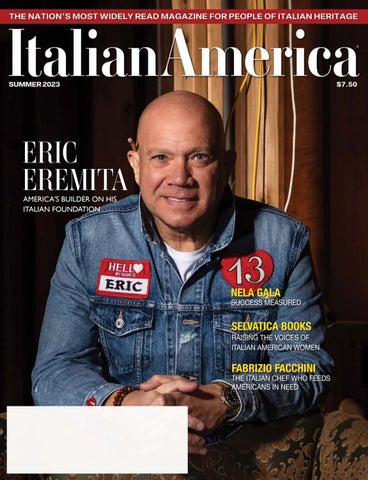
ERIC EREMITA
AMERICA'S BUILDER ON HIS ITALIAN FOUNDATION

NELA GALA SUCCESS MEASURED
SELVATICA BOOKS
RAISING THE VOICES OF ITALIAN AMERICAN WOMEN
FABRIZIO FACCHINI
THE ITALIAN CHEF WHO FEEDS AMERICANS IN NEED


By Andrew Cotto
![]()
AMERICA'S BUILDER ON HIS ITALIAN FOUNDATION

NELA GALA SUCCESS MEASURED
RAISING THE VOICES OF ITALIAN AMERICAN WOMEN
THE ITALIAN CHEF WHO FEEDS AMERICANS IN NEED


By Andrew Cotto

By Andrew Cotto
By Andrew Cotto

Italian America magazine is a publication of the Order Sons and Daughters of Italy in America (OSDIA), the nation’s biggest and oldest organization for people of Italian heritage. To subscribe, see www.osia.org or call (202) 547-2900. 18 FABRIZIO FACCHINI


FROM THE
The Official Publication of the Order Sons and Daughters of Italy in America®
ITALIAN AMERICA is published by the ORDER SONS AND DAUGHTERS OF ITALY IN AMERICA 219 E Street NE, Washington, DC 20002
Editor-in-Chief: Andrew Cotto
Writers: Steve Amoia, Andrew Cotto, Michele Di Pietro, Miriah Falce, Carla Gambescia, Ray Guarini, Felicia Naoum, Mary Spatafore Gabriele
Proofreader: Christine Haden
Graphic Designer: Diane Vincent
To advertise: Contact EditorItalianAmerica@gmail.com (202) 547-2900


Welcome to the Summer issue of Italian America magazine. And welcome to this new column. Going forward, “Benvenuti” will replace “The Last Word” as I’d rather say “Hello” to you all rather than “Goodbye.” I guess we could have called it “The First Word,” but it seems appropriate to begin in Italian.
Speaking of Italian, this issue celebrates a wide range of accomplishments of Italian Americans and Italians in America. The cover features Eric Eremita, an ambitious 2nd generation kid from Staten Island who found his way into TV celebrity using his hands, work ethic, talent, personality, and morals. This is a very American story, but it is a particularly Italian American story as the tools Eric used to build his success are very much rooted in his heritage and upbringing. I had the pleasure of meeting Eric in person, and the positive energy he projects on screen, buttressed by that NY swagger, is genuine and refreshing. I also had the pleasure of meeting both Sarah Arcuri and Leigh Esposito at respective book events, and we are so honored to share the story of two talented writers who are so informed by and committed to their embrace of positive storytelling about Italian American women. Finally, Italian chef Fabrizio Facchini is a beloved figure among those in the New York City food community. The reasons for this are on full display in our profile of him and his work with Italians Feed America, an effort inspired by Chef Facchini’s appreciation for what America offers immigrants like him who are eager to work hard.
With each issue I am all the more grateful for our regular contributors. Having quality, informative content from Italian experts - Michele Di Pietro (“Mangia!”); Carla Gambescia (“La Dolce Vita University” and “Postcards from the Boot”), and Ray Guarini (“Italian Enclaves”) - adds such depth and breadth to our magazine. The “Wine Bar” pairings by Miriah Falce have proven to be a valuable addendum to “Mangia.” We are also extremely appreciate of our other contributors, including Felicia Naoum who has once again contributed a wonderful “Piacere” in her interview of Anna Boirdi (try to figure out why her famous last name sounds familiar but does not read so!). We must also recognize the incredible translation, yet again, by our own Joana Bala (National Office Program Coordinator) of the second component of author Steve Amoia’s nostalgic tribute to Joe DiMaggio. Let me end my list of thanks by recognizing Diane Vincent, our graphic designer, and Christine Haden, our proofreader, without whom this magazine would simply not be as polished and professional (and possible!).
A large part of this issue is dedicated to the 34th NELA Gala which took place in Washington D.C. on May 25th. I attended the event for the first time, and the glamour of such a gathering didn’t overshadow the magnitude of the celebration. It was an honor to be among so many successful, generous people associated with the Orders Sons and Daughters of Italy in America (it was also a really good time!). While I was unable to attend the dedication ceremony of the Torre di Luce (see Bulletin Board) at the Garibaldi-Meucci Museum, I was invited to the museum in May to give a lecture on my belief in Italian exceptionalism through food. That, too, was an honor.
Speaking of Italian food, allow me to end on a personal yet relevant note. I have co-founded an online publication, Appetito, dedicated to the celebration of Italian food and drink as a source of community and wellness. If you’d like to join us, please visit www.appetitomagazine.com.
Happy reading and all the best to each of you.
Grazie Mille!

EDITOR-IN-CHIEF, ITALIAN AMERICA MAGAZINE


On May 21, 2023, the long-awaited inaugural lighting ceremony of the Tower of Light (La Torre di Luce), created by the renowned Venetian sculptor Giorgio Bortoli, took place on the grounds of the Garibaldi-Meucci Museum (owned by the Sons of Italy Foundation) in Staten Island.
The intention of the artist is to symbolize the bond between the city of Venice and that of New York. The inspiration was the building of the Metropolitan Life Tower in New York City, in 1909, a gesture of solidarity after the collapse of Venice’s bell tower in San Marco Square earlier that same decade. The work of Bortoli soars to 39 feet and wends two towers, one inside the other, with everything illuminated by the colors of Italy and America. The primary materials are steel and glass (the latter from the Venetian island of Murano).
The well-attended ceremony, on a lovely spring evening, included the son of Mr. Bortoli, Lorenzo, as the artist himself was unable to attend due to an injury occurred while working in Venice. Joe Sciame, President of the Sons of Italy Foundation, was on hand for the ribbon cutting ceremony along Carl Ciaccio, Jr., Garibaldi-Meucci Museum Chairman of the Board.
Speaking on behalf of his father, the younger Bortoli shared a prepared statement that included this passage: “It took years to find a worthy location for its permanent placement, thanks to Mr. Anthony Tamburri, Mr. Joseph Sciame, Mr. Carl Ciaccio, who appreciated its beauty and understood the importance of this work of art and the approval of the Sons and Daughters of Italy in America and the Sons of Italy Foundation, you too can now admire it in perpetuity.”
Chairman Ciaccio issued the following statement after the event: “La Torre di Luce will undoubtedly serve as a beacon that will attract one and all to the ample, manicured grounds of the Garibaldi-Meucci Museum.”


OSDIA is excited to announce the launch of our new event, the Future of the Order (FOTO) Forum, during our upcoming Supreme Biennial Convention in Tampa, Florida, this August 15-19.
Young adult members of OSDIA, ages 21-35, from across the country will join us from August 17-19, to collaborate and participate in discussions regarding the future of OSDIA. There will be opportunities to present to the Supreme Lodge, network with leaders from the national and state levels, and observe the proceedings of our convention.
and
To be considered a representative for the FOTO Forum, those interested must submit a completed application (www.osdia.org/foto-forum) and be selected by FOTO Forum Leadership Committee.Travel, lodging, meals, and entertainment costs will be covered for those chosen as representatives.
BY VINCENT SARNO
GIUSEPPE GARIBALDI LODGE #1658
Rev Father Joseph Capella went home to the Lord in June of 2022. He served the Supreme Lodge as National Chaplain. He was asked to replace the iconic Father Donald Licata, who had developed and inoperable brain tumor. Father Joe accepted the position only after having several conversations with Father Licata. He wanted to continue the ministry his predecessor had developed. Father Licata always said he was in God’s waiting room. Father Capella also lived in God’s waiting room. While serving as pastor of the merged churches of St Lawrence and Our lady of Guadalupe, he developed hepatitis and had several liver transplants, fought cancer and blood on the brain. His health issues caused him to be relived of pastoral responsibility where his assumed the duties at Camden Catholic High School.

fame and of her determination for excellence. He said hopefully that we can have a class at NYU to examine the life of an extraordinary priest, and I have such a candidate: His name is Father Joseph Capella.
The following is part of a dedication written by Father Joe’s brother, also a priest: In a homily given by Bishop Sullivan, he spoke of a class given at NYU about the artist Taylor Swift and the study to be conducted of her rise to
Father Joe’s work was still not done. He drove from Hammonton to Chris Our Light prior to the Baccalaureate Mass and Graduation for Camden Catholic High School to pick of some things. Father Logan and I could see he was not well. He stayed at the ceremony for 2.5 hours. His benediction speech at the end of the ceremony was his final public appearance and sermon. He said “You are now called as alumni of CCHS not to live in the same world as others but to live in the same world differently…You are loved…be men and women who share Calvary love with others. And when you have a dark day, a difficult situation, a tragedy, know that love is with you, but also know that it is within you. And you can live in this world in such a different way that others will know, positively that Jesus Christ is OUR LORD and Savior.”
These are the words of and extraordinary man I know is a Saint.


BY CARLA GAMBESCIA
If you’ve ever tasted figs and murmured about how divine they are, you’re merely echoing centuries of global culture.

The ancient Hebrews looked upon the fig tree as a symbol of peace and plenty, while Buddhists regard it as a tree of life and knowledge. The prophet Mohammed reportedly identified the fig as the one fruit he would most wish to see in paradise, and his followers called it the “Tree of Heaven.” The Egyptians considered figs sacred and commonly buried their dead with baskets of figs to aid in the soul’s journey into the afterlife; and as for Cleopatra, she made sure the asp that sent her into the next world came in a basket of figs. Plato called figs the food of athletes and they were commonly presented along with laurels to winners of the Athenian games.
Figs may have been the earliest domesticated crop, dating back 11,000 years, from the Jordan and Euphrates Valley. Later, especially through the Phoenicians, they spread to China and India, and only relatively recently were they introduced to the Americas and sub-Saharan Africa. Prior to the widespread use of sugar, figs were used to sweeten all types of sweet treats and are still featured as the main ingredient in popular holiday desserts.
You can track Roman and Italian culture’s evolution through its embrace of the fig. The ancient Romans sacrificed the milky sap of the wild fig tree to Juno and came to believe that figs were sacred to their culture. Pliny the Elder, Roman naturalist and philosopher, extolled the fruit’s restorative powers and asserted that a sacred fig tree grew in the Roman Forum, and that the tree was known as “Ruminalis” because the legendary she-wolf that suckled the founding twins Romulus and Remus was discovered resting with them beneath it.
When Cato advocated before the Roman Senate the conquest of Carthage, he used as his crowning argument the advantage of acquiring fruits as glorious as North African figs, specimens of which he pulled from his toga as exhibits. So, in the Punic Wars, the army not only traveled on its stomach but for it!
Figs epitomize Italy and the Mediterranean, its climate, its food, its way of life. The fig is a fruit to be eaten slowly and savored, from the luscious mouthfuls of soft, pink flesh to the tiniest edible seeds. So yummy when you bite into one you feel its seeds dissolving on your tongue almost like that old childhood sweet, Fizzies, but absent the “sizzle and pop” and then it leaves you with a delicate and yet luxurious sweetness.
The deciduous fig tree can live as long as 100 years and grow to 50 feet tall, though it more typically stays between 10 to 30 feet. The twisty branches spread wider than the tree’s height. Figs flourish in hot, dry climates and the fruit requires the all-day sun to ripen (and the heavier the fruit, the riper). Fig trees grow especially well in southern Italy because of the hot summer climate and the mineral-rich volcanic soil. There is one area in Calabria that produces 800 tons of dried figs a year, which gives you an idea of how many figs are available Calabria alone, not to mention in Sicily, Puglia and other parts of southern Italy. It is said you only need to throw a half-eaten fig in the soil without even digging a hole and, over time, you can see the tree grow.
Botanically, the fig isn’t actually a fruit but instead what is known as a syconium. It’s a portion of the stem that expands into a sac containing flowers (and seeds) that grow internally. The common fig contains only female


flowers and propagates without pollination. Other varieties require pollination.
Beyond their delectable taste, figs are high in fiber and rich in calcium, iron, phosphorus and potassium, as well as vitamins C and B. Figs have the highest overall mineral content of all common fruits: a half cup of figs has the same amount of calcium as a half cup of milk. And figs are great energy boosters with lots of accessible glucose
Carla Gambescia is a journalist, lecturer, and award-winning author of La Dolce Vita University: An Unconventional Guide to Italian Culture from A to Z, a highly informative celebration of Italy’s capacious culture. The new and greatly expanded second edition is now available.
Carla has toured every region of Italy, often by bicycle, and immersed herself in its astonishing array of cultural treasures. She conceived and co-led the Giro del Gelato bicycle tour, winner of OUTSIDE Magazine’s “Best Trip in Western Europe,” and owned and operated the top Zagat-rated Via Vanti! Restaurant & Gelateria in Mount Kisco, New York, for nearly a decade.
Today Carla lectures on myriad topics of Italian cultural interest through continuing education programs, universities, museums, and private clubs. She also curates the photoblog Postcards from the Boot. You can enjoy a specially selected “postcard” each issue on the last page of our magazine.
(no wonder Greek athletes were partial to them)—a much yummier natural alternative to the ubiquitous energy bar.
Spanish Franciscan missionaries brought the fig to southern California in 1520, leading to the variety known as the Mission fig. But the fig’s first American commercial appearance occurred in 1892. It took a while for most Americans to recognize a fresh fig, let alone to embrace its myriad gastronomic possibilities. Until our 21st-century culinary awakening, the most common association with the heavenly fig was the Fig Newton, named after the town of Newton, Massachusetts, near the Nabisco manufacturing plant that made them. But better late than never, since the inclusion of figs makes everything not just more nutritious but more sensuous—added to salads; on a pizza; in marmalades and dressings; stuffed into pork or chicken; or baked into pastries and desserts, as in a scrumptious toasted fig-and-ginger pound cake served with gelato limone.
In light of the fig’s historical bona fides and its intrinsically tantalizing qualities, it’s no surprise that many biblical scholars believe it, rather than the apple, was the instrument of our fall. Michelangelo thought so too and painted the tree of knowledge quite intentionally as a fig tree—check out its leaves! However, the Bible doesn’t specify exactly what the forbidden fruit was, referring to it simply as a “fruit.” Scholars who advocate for the fig argue that “when God presents a problem, he also presents the solution,” since the Bible is specific that Adam and Eve covered themselves with fig leaves.
So, the next time the earthly pleasures of a ripe fig call to you, know you are savoring a taste of paradise.


BY ANDREW
Eric Eremita is best known for his charismatic role on two highly-successful HGTV shows, Brother Vs. Brother and Love It or List It. Fans respond to the New York swagger and shiny good looks, informed by the calloused hands and tender heart of a true builder and genuine personality. This modern Renaissance man - television star, contractor, designer, realtor - is a devoted husband of 20+ years and the proud father of three. Italian America magazine is honored to talk with Eric about the life he has built and the Italian American background that serves as its foundation.
Where did you grow up?
I grew up in Staten Island. Second generation Italian American. My mother’s family came from Sicily, and my father’s parents were from a town near Naples. My mother mother, Anna Dolcimascolo, was born and raised in Staten Island; she’s 94 years old today. My father, Nunzio Eremita, was actually born in Canton, Ohio.
What was his family doing in Canton, Ohio?
My father’s parents arrived in America, and they went straight to Canton for the steel work, but there was no money to be made. They had some people that they knew in the Bronx, and they wound up moving from Ohio to the Bronx. And that’s where he grew up. He met my mother at a wedding in Staten Island. He went off to serve in Europe in World War II. They were courting while he was gone. They got married after he got home, and they settled in Staten Island.
What did your father do for work?
My father initially became a longshoreman. I guess he didn’t like being a longshoreman after a while, so he decided to start his own business. The part of Staten Island where they lived, South Beach, was like another Coney Island at the time. People came in for the rides and the excitement. My father was a big, strapping guy, black hair, pushed back. He got the name Duke as a longshoreman and everyone called him that. He’d strap a cooler across his back, loaded with dry ice and ice cream popsicles, and he’d walk the beach selling them. That went so well that he soon bought an ice cream truck and started selling ice cream around the neighborhood. And after that, he bought the first Carvel franchise on Staten Island. Bought it directly from Tom Carvel himself.
What happened with the Carvel store?
He had it for many years, but eventually my father got tired of the ice cream business, so he started looking into doing something else. My parents had built their own home in the Grasmere area near South Beach. My father’s very handy, and he realized in building his own house that he could do this for a living. He ended up owning a local glass and mirror company while doing home improvements for people.
Do you have any siblings?
I’m the fourth of four, by many years. My oldest brother, Richard, is 76, which is more than 20 years my senior. He was like a second father to me growing up. Still to this day,
he’s my best friend. I had a great childhood growing up in Staten Island. I got to work with my hands on occasion, like my father, but also like him, I had an artistic side. My father could really draw beautiful things, and I learned to do that, too. I went through high school knowing this and wanted to pursue a career in commercial art. I got accepted to the Fashion Institute of Technology (FIT) in Manhattan. Before I began, though, my father came to me and
Through that you learned work ethic and about doing the right thing. I learned all this from going to work with my dad and my oldest brother. I think that’s just the way we as Italians were raised. Family and work. Integrity.
said, “I hate to tell you this, but I’m semi-retired. Your brother doesn’t want to take over the business. I have too many things going on. I need your help.” So my career in commercial art went sideways, which is okay, I’m not complaining. I wound up helping them out in the glass and mirror business, which we ended up selling down the road. I started my own business doing home improvements and opened a frame-less shower door business as well. And I became basically the king of shower doors on Staten Island for a good seven or eight years. And that’s how I met my wife.
She wanted a frame-less shower door?
No! Her father was a very well-respected builder on Staten Island by the name of Joseph Ligotti. He basically came


over from Sicily with a trowel in a bag and wound up carving out a lot of neighborhoods in Staten Island. I did work for him over the years, though I didn’t know him personally. I wound up mirroring a dance studio for him on Hylan Boulevard that had a travel agency downstairs. I went down to book a trip to Miami, and the travel agent was Joanne Ligotti, the daughter of Joseph and Francesca Ligotti.. So, thanks to this dance studio job, I wound up with a beautiful wife, now of 23 years, and marrying into the family of a legendary builder on Staten Island.
They also say when you love what you do, you’ll never work a day. Honestly. I’ve worked, but I’ve always had a lot of fun along the way. Back in the early 2000s, when lifestyle television started to emerge, my clients kept saying,"Why don’t you try out for one of those shows with builders. You got what it takes.”
And then what happened?
I kept going with my businesses. I was now doing interior design as well. I had new constructions, renovations. I was always busy. Joanne and I soon started a family and had three children: Mia, Eric, and Evan. I was living my best life, as they say. They also say when you love what you do, you’ll never work a day. Honestly. I’ve worked, but I’ve always had a lot of fun along the way. Back in the early 2000s, when lifestyle television started to emerge, my clients kept saying, “Why don’t you try out for one
of those shows with builders. You got what it takes.” Eventually, I wound up answering a casting call on a show, American Dream Builders on NBC. I got cast out of a nationwide call to the final 30. They brought us to LA, had us sequestered in hotel rooms. I make the next cut, down to the final 12. I end up being the one cast. Great. Right? By the time they put the show together, two years go by. I’m busy as can be, and when they finally say we’re ready to being production in LA, I’m not able to go. Among many jobs, I’ve got a client who just had his roof ripped off, so I tell them, “Sorry. I can’t do this.” So I went on my merry business and about, I would say, around August or September of the same year, I get a telephone call from a casting director in Manhattan. I was going to pass on this upfront, instead of having to deal with all the travel,

but they were casting in Manhattan, so I go down. I say, “Guys, I’m the real deal. I have what it takes. I don’t play builder. I am a builder and a designer.” They smile and say, “Don’t call us; we’ll call you.” That old cliche that means they’re never going to call, but in this case, though, they called me and wanted me to come back in for an on-camera interview. I go back in, and I’m in an office, with all these executives around a big table. The firing squad, basically. There’s an easel next to me with the picture of a house on it. They ask me what’s the first thing I’d do to renovate the house. I look it, and I look at them. “The first thing I’d do is tear it down,” I said.
I’m guessing that got you the job… I did! HGTV’s Brother Vs. Brother with the Property Brothers. The show was filming in LA, but it began production in January, which is my slow season. It was a seven-week competition, with one contestant voted off each week. I go to the airport with my wife and little kids at the time, and she says, “See you in a few weeks.” I say, “A few weeks? Oh, no. I’ll see you in seven weeks because I’m winning this thing.”
Did you win?
I was runner up, but, ultimately, I won because I showed HGTV and the nation who I was and what I could do. And from that, I was offered the main general contractor / construction manager spot for Love It or List It, one of the biggest shows on HGTV. So I made it into the big-time reality screen.
How was that experience?
I enjoyed every minute of it. I wound up becoming a fan favorite and practically a third host on the show. I brought that east coast, Italian flair and it resonated with all types of fans. My second season in, the show hit 17 million viewers. The show was shot in North Carolina, so that was the hardest part. I had to set myself up down there, traveling every weekend to see my family. I missed a few things along the way, but I got home anytime I could. It wasn’t easy. That was the hardest part of the job. I did close to 80 episodes so it was about five seasons. I left the show prior to COVID. It was just a decision between us and the network. It wasn’t anything bad. In some ways my role on the show ran its course, but the real reason I left was I wanted my own show. This all was derailed by COVID and the fact that I got it really bad. I had to spend 16 days on a ventilator. Once I was rehabilitated, I wound up starting a clothing company called 13, which is back to those design dreams I had as a teenager. Also, I have a new agent and a new publicist. We have feelers out in many places, so stay tuned.
How much of your identity is informed by your Italian American background?
I’d say all of it. Family is everything. When we grew up, we had Sunday dinners, and that sauce was cooking, that garlic smell filled the house. Meatballs were sizzling in the pan. Monday to Friday was school. Sunday was family, but on Saturday you needed something to do. My father would come to my bedroom door and ask, “What are you doing today?” I’d tell him that I was going to hang out with my friends, and he’d say, “No. Get in the truck. Time to go to work.” Through

that you learned work ethic and about doing the right thing. I learned all this from going to work with my dad and my oldest brother. Today I deal with a lot of the new crowd, and I’ll ask someone to do something out of the ordinary on a job, and they’ll say, “Well, I don’t get paid for that.” That’s too bad, because in my mentality, if you don’t know how to sweep the floor, you don’t know how to own the company. And that’s been my mentality my whole life, and I tell that to my kids and anyone else who will listen. I think that’s just the way we as Italians were raised. Family and work. Integrity. It’s unfortunate that so many bad parts come from media. I’m not saying that the shows or the movies aren’t great, but they exploit us in a way that is not everyday Italian. Everyday Italian is about family and work.
When we had Chazz Palminteri in the magazine, he mentioned a common refrain: Everybody wants to be Italian. Why do you think that is?
Everybody does want to be Italian. If you look at what the Italians have offered, and still offer. There’s the style. I love to get dressed. You have Armani, Versace, Valentino - these are the top names in fashion. Then you have the cars. Who makes the best cars? Ferrari, Maserati, Alfa Romeo. And who makes the best food? Come on. That’s not even close. I could go on. Everybody wants to imitate the Italians. There’s no better. There is no better.
Follow Eric on Instagram @ericeremita and on Facebook @MrEricEremita. His clothing line can be viewed at www. thirteenbyericeremita.com.
What are two nice Italian American girls, and accomplished authors, supposed to do when the modern publishing industry wants to deprive readers of their respective voices or reshape them to fit a stereotype? Exactly: They team up to start their own company that will champion Italian American women characters and the authors who write about them, starting with themselves,. Italian America magazine congratulates Sarah Arcuri and Leigh Esposito on the founding of Selvatica Books, and the publication last month of their respective debut novels.
BEFORE WE DISCUSS THE JOINT VENTURE, LET’S HEAR ABOUT YOUR BOOKS. SARAH, YOU GO FIRST.
The Owner & The Wife is an Italian American love story. It takes place in New York’s Little Italy in the 1980s, so it’s super nostalgic, with subtle nods to Moonstruck. The dominant themes, besides romance and self-discovery, are female empowerment, mother-daughter relationships, and brotherhood. So there’s many elements to the novel, but at the heart of it is a beautiful love story with a lot of fun and games in there as well. There hasn’t been anything in such a long time, so I think people are really going to eat this story up because it’s, you know, we watch to see movies over and over again. And now this is kind of a nod to those with some fresh spins on it.

The Godmother turns the mafia trope on its head by focusing on a powerful Sicilian American woman who wonders about the real origins of her infamous surname, which she shares exclusively with her parents and the most notorious Mafioso in history. Her whole life she’s suspected of being in the mafia. She becomes to be called “the Godmother,” and uses her power to protect women. When she goes in search of her roots in Sicily, she discovers the beauty and the tastes and the mysteries of Sicily itself while being confronted by what this family blood reality might be. I think of it is a feminine nod to / departure from the godfather.


BOTH BOOKS SOUND GREAT AND HAVE BEEN PUBLISHED BY SELVATICA BOOKS. HOW DID THIS COMPANY COME ABOUT?
Sarah: Leigh and I met on Instagram a few years ago. We were both writing our novels separately, and soon after I was working with an agent on revisions. Leigh’s book was already out on submissions. We were both having the same experience where we were getting told certain things about the contemporary publishing industry, regarding what kinds of titles were getting acquired and why. My agent wanted me to take my book in a direction that played into the traditional stereotypes. I wasn’t comfortable with this, so we parted ways. I wanted to stick to my true vision for the book. It turns out that Leigh had the same experience, one where there was not a place for her voice in contemporary publishing.
Leigh: With my book out on submission, I was hearing wonderful things
from editors, but ultimately, they would pass because Italian American stories such as mine weren’t topical at the time. I had been hearing about this from other Italian American writers, that Italian American stories aren’t considered literary or elevated, and Sarah and I had written books that are perhaps higher quality than what they were expecting to see and wanting to see. We were offering different kind of views, such as an Italian American business owner like Sarah wrote about or an Italian American woman who has international power in my novel. Their view was very reductive.
Leigh: We’ve been really fortunate to find out early on just how many powerful, brilliant, funded Italian Americans we have in our community. We received encouragement from some angel investors, and we’re working with some leaders in the Italian American community to build a consortium to be our advisors and investors. We are growing by the day. We just brought on a CFO for supply chain management. We’re the ones who recognize the works of art, and we know how to promote it. Right who are considered Italian joined forces and learned about each other, we could elevate ourselves for a very powerful culture. But if we don’t connect, we’re losing an opportunity to


The intention was to feature Emilia-Romagna in this issue’s “Andiamo” section prior to the recent floods which damaged the region (donations to help the region recover can be made at www.osdia.org/donate-sif/). In light of the natural disaster, bringing attention to this marvelous region seems all the more important. One of the intentions of “Andiamo” is to raise awareness of and encourage visits to some of the less-traversed (and less expensive) areas of Italy. The reality is that all 20 regions are remarkable, each home to great beauty and a unique culture. This is certainly the case in Emilia-Romagna, where so much Italian exceptionalism is on display.
Positioned along the Adriatic coast above Tuscany and extending almost entirely across the peninsula, this wealthy region of nine provinces is best known for being the home of “Fast cars and slow food.” Among Italy’s most famous sports car manufacturers in Emilia-Romagna are Ferrari, Maserati, Lamborghini, Ducati (motorcycles), and Pagani. The region, widely considered home of the finest food in all of Italy, is home to more than 40 protected food products, including Aceto Balsamico (balsamic vinegar),


Reggiano cheese, and Prosciutto di Parma.

The region is predominantly flat and fertile (with some hills near the coast and the foothills of the Apennine Mountains on the Tuscan border) bisected, east to west, by the Po River. The major cities are connected, nearly equal distance apart, by a diagonal road built by the Romans that goes north from Rimini (home to famed filmmaker Federico Fellini) on the region’s southeast corner, beside the Adriatic Sea, to Piacenza, which borders Lombardy (home to Milan). Posited between these two small cities are the gems of the region: Bologna and Modena.
Bologna is the regional capital and the largest city with an estimated 400,000 residents. It’s best known for the University of Bologna, founded in 1088 and recognized as the oldest, active university in the world. Student life dominates the city of brick and pastel, known for medieval architecture informed by covered walking passages (porticos) and two leaning towers. It is also the home of Bolognese ragu and a food district, famous for meats and cheeses, that attracts gastronomes from around the world.
Modena is an elegant city of Romanesque design with less than 200,000 residents. Best known for its 12th century Cathedral and soaring bell tower, this friendly, accessible city features quaint lanes with porticos and pastel facades, a daily food market and world-class restaurants, including the four establishments of Massimo Bottura, one of the world’s most famous chefs. The heralded food production facilities and machine manufacturers are found just outside the city center in the verdant flatland.
Both Bologna and Modena can be reached by train from north or south; Bologna has an airport that can be reached via connection at most major European airports.
Where to stay in Bologna:
Palazzo di Varignana - This sprawling, lush estate on vast grounds in the rolling hills just outside of Bologna, centered around a restored 18th century villa, features luxury rooms and suites, six private villas with pools, a country house, a spa, three restaurants, a trattoria, a cantina for tasting the on-site production of award-winning olive oils and wines, an amphitheatre, and endless paths for exploration: www.palazzodivarignana.com.
Where to stay in Modena:
Best Western Premier Hotel Milano Palace - a short walk from the train station, this 4-star hotel offers elegant quarters, an in-house spa, a lounge, and a buffet breakfast all in a leafy location steps from the city center: www.milanopalacehotel.it.


Museo Enzo Ferrari - The museum dedicated to the world’s most celebrated sports car and iconic symbol is near the city center of Modena: www.ferrari.com.
Casa Museo Luciano Pavarotti - Visit the private Modena home of the legendary opera singer that contains memorabilia, costumes, and awards collected during his long career: www.casamuseolucianopavarotti.it.
Acetaia Giusti - The pastoral facility of famed and family-owned, since 1605, producer of authentic balsamic vinegar, in the countryside outside of Modena, has a museum, an aging facility, and a cantina where their array of products can be tasted and purchased: www.giusti.it.
Local attractions/activities:
The Bologna Clock Tower - A accessible walk, up a long, marble staircase built to once accommodate horses, through the elegant Palazzo D’Accursio in Piazza Maggiore in the city center, provides a bird’s eye view of Bologna’s medieval splendor. More information can be found here: www.bologna-guide.com.
Secret Food Tour of Bologna - This is a great way to immerse in “Fat City” through local expertise, in small groups, to enjoy the gastronomic delights, gleaned from honored traditions, from the city’s most renowned purveyors: www.secretfoodtours.com/bologna/.

Parmigiano Reggiano - The consortium of Italy’s most protected product can arrange tours and tastings at various dairies and cheese making factories around the region: www.parmigianoreggiano.com.
Cleto Chiarli - This impressive vineyard and estate outside of Modena houses the production of Lambrusco, a sparkling red which is the regions most celebrated varietal. Tours and tastings are available: www.chiarli.it.


BY ANDREW COTTO
The relationship between Italians and Americans is sacred. This bond began most notably with the scores of Italian immigrants who arrived in America in the 20 th century. Their assimilation into and influence upon American culture is well recognized. Their sacrifices and contributions to our great nation are legendary. The reality is that there are still Italian immigrants coming to America. Their appreciation for what this country still offers those who arrive and are eager to contribute was on full display during the pandemic, when an Italian chef organized a collective that helped feed America in our time of need.
The life of Chef Fabrizio Facchini has been a bit of an odyssey. Born in Belgium to Italian parents, he grew up between the two countries, with a stint in Switzerland as well. He eventually settled in Le Marche, the home region of his father, with his
Italian wife, a Sicilian, who had also spent much of her life in Belgium. The couple owned and operated a boutique hotel with a fine dining restaurant that would eventually earn a coveted Michelin star.
Attracted to new horizons, and inspired by an 18-month experience in Florida as part of a student exchange program, Chef Facchini, his wife, and their three children moved to America in 2015. They arrived in southern California and opened a restaurant. Uninspired by the lifestyle, they were lured a year and a half later to upstate New York by a powerful restaurant magnate in Saratoga Springs. Eventually, with Chef Facchini’s expertise in both cuisine and operations, bolstered by his reputation for affability, offers for partnerships in the city arrived. The family, now with a fourth child, settled on the north shore of Long Island. And then came Covid.


The devastation to the restaurant industry did not spare Chef Facchini. Three active projects in the city were effectively shuttered or greatly altered. Like a lot of chefs, he kept busy and employed through private work, which there was plenty of in the lucrative areas of Long Island. Chef Facchini’s business acumen also allowed him to acquire an established bakery and market in the area, and soon another. A local restaurant, Stellina, was also being planned.
So, Chef Facchini adapted successfully to the complications of Covid; in some ways, he even benefited by bringing his work closer to home. But focusing on himself alone is not Chef Facchini’s style. There was a reason beyond food and business, even only after a short time in America, that he had become one of the most celebrated and well-liked Italian chefs in the country. There was a reason, beyond food and business, that he had highprofile roles in esteemed organizations such as the Italian Trade Agency, the Association of Italian Chefs in New York, Slow Food New York, Slow Food USA, and the Associazione Italiana Ambasciatori Del Gusto. He

had also become an ambassador for famous Italian brands such as Pasta di Martino, Riso Buono, and Urbani Truffles.
When the crisis hit the industry he loves, within the country he so admires, Chef Facchini went into action.
“When Covid hit, I wanted absolutely to create the Italians Feed America organization because I was able during the pandemic to still have business going a little bit, though I lost a lot
buttressed by the depth of contacts at Chef Facchini’s disposal throughout the industry, Italians Feed America established a network where food that was essentially dormant during the pandemic, potentially set to expire, would be distributed to those in need through partnerships with organizations who have historically addressed food insecurity, such as Food Bank for New York, No Kid Hungry, City Harvest, and World Central Kitchen. They also partnered with school districts around New York state to provide prepared meals, putting otherwise unemployed chefs to work.
Italians Feed America assisted Chef Roberto Caporuscio of Keste Pizza in New York City distribute pizzas to local hospitals that fed thousands of front-line workers. The organization also helped feed legions of veterans.
All in all, it has been calculated that Italians Feed America has contributed over 800,000 meals. The distribution
has slowed in accordance to demand as the pandemic has waned, but the network is in place and food that would otherwise go to waste now finds its way to hungry Americans.
Chef Facchini has been roundly honored for his efforts, including invitations to Gracie Mansion at the behest of New York City Mayor Eric Adams, and upon the US Carrier Wasp during the most recent Fleet Week in New York.
Stellina Ristorante opened in 2022 in Oyster Bay; the nearby bakery and marketplace have been transitioned to the Stellina brand. As Chef Facchini expands his local presence in Long Island, it’s important to recognize his effort as an Italian immigrant contributing to the American experience as being consistent with the relationship our two countries have historically enjoyed.
“Even though I’m not American yet, I think that this is a beautiful


BY RAY GUARINI
Pennsylvania

On May 27th, members of the Italian Enclaves Historical Society traveled to Jessup, Pennsylvania to see the running of the saints for the feast of San Ubaldo (La Festa dei Ceri). Jessup, Pennsylvania is a borough in Lackawanna County, which is part of the city of Scranton. There are several existing and former Italian enclaves within Scranton, and Jessup is without question a thriving enclave. The nucleus of the neighborhood is the St. Mary Assumption church, which is the Italian parish church in Jessup. There are many Italian businesses up and down Church Street, the heart of the town. Reminiscent to the rolling hills and mountains of inland Italy, Jessup is a sister/twin city to Gubbio in Italy. The Running of the Three Saints only happens in two places on earth: Jessup and Gubbio. The town was first settled by Italians in the late 1800s, but as the turn of the 20th century arrived, tens of thousands of Italians flocked to Scranton for work in the coal mines. This created a mosaic of Italian communities within the landscape of Scranton, each one unique to itself and with


Jessup being the most unique of all due to the annual festa in honor of San Ubaldo. Local men of Italian stock are segregated into three different groups designated by the color of their attire. The San Antonio Abbate statue is carried by men wearing black, while the San Ubaldo statue is carried by men wearing yellow, and San Giorgio is carried by men donning blue. The statues are ran, not walked, throughout the town. Uphill, downhill, and across a huge open field around in circles, the races draw thousands from neighboring towns and cities. This is a must-see for any Italian interested in witnessing a oneof-a-kind Italian American event. Two notable businesses are: Saint George Barbershop and Saint George's Family Restaurant.
Atlantic City saw a large number of Italian immigrants at the end of the 19th century and into the 20th century. Work opportunities were plentiful in Atlantic City as the local economy pressed forward with help from the boon of resorts along the Atlantic coastline that drew revelers from all parts of the United States and overseas. As Atlantic City continued its development all the way into the mid 20 th century, Italian immigrants found themselves conveniently able to work not so far from their east coast ports of entry. St. Michael the Archangel Italian National parish was established for the growing community of Italian immigrants and their growing Italian

American families. The neighborhood saw a huge exodus of people in the 1960s with the construction of the Pitney Housing Projects. Nevertheless, many Italian Americans and their businesses remained behind to cater to tourists and whoever remained from the «old guard.» Today, Ducktown is no longer an Italian enclave, but there are still remnant businesses and some elderly holdouts. Saint Michael the Archangel is now re-opened after having been closed. It has been a tough road for the church and the community, but this is enclave is worth a look if you are heading to Atlantic City. Two notable businesses are: Angelo's Fairmount Tavern and Chef Vola.

North Beach in San Francisco is a very well-intact Italian enclave. The neighborhood has a “Little Italy” designation. Much to my pleasant surprise, there were many Italian people still there when I visited. One can hear Italian being spoken along the sidewalks from the many shops and cafes that still dot the North Beach landscape. Italians came to San Francisco in droves for work as early as the late 1800s. First fueled by the West Coast gold rush, early Italian settlers found work in mining related industries as well as fishing, which was the main local economy and still is extremely important. Fisherman’s Warf is a part of North Beach where fisherman from southern Italy were able to carve out a dangerous, yet good living to support their families. The Girardelli Chocolate Factory has also been housed in North Beach for decades and provided employment opportunities for countless Italian immigrants in the 20th century. The neighborhood›s Italian National parish is Saint Peter Saint Paul church which was built in 1884 for the Italian immigrants in North Beach. Two notable establishments are: Caffe Trieste and The San Francisco Athletic Club.

Ray Guarini is the Executive Director of the Italian Enclave Historical Society. The Managing Director of a venture capital firm during the day, Ray created the Italian Enclave Historical Society in his spare time as a labor of love and homage to his Italian American heritage and Catholic faith. Visit the Italian Enclaves site at www.italianenclaves.org. Follow them on Instagram, Facebook, and Twitter: @ItalianEnclaves.


BY STEVE AMOIA, AT-LARGE
MEMBER, WASHINGTON, D.C.
DI STEVE AMOIA, MEMBRO OSDIA, WASHINGTON, D.C.
TRANSLATED BY JOANA BALA, OSDIA PROGRAM COORDINATOR, WASHINGTON DC
“There is always some kid who may be seeing me for the first or last time. I owe him my best.”
“C’è sempre qualcuno che potrebbe vedermi per la prima o l’ultima volta. Gli devo il mio meglio.”
— Joe DiMaggio, The Sporting News, April 4, 1951.

My late father, Michael Amoia, personally witnessed DiMaggio’s commitment to exemplary excellence on many occasions. His parents, Raffaella and Francesco, emigrated from Giovinazzo (Bari), and lived near Griffith Stadium in Washington, D.C. ‘Mike’ worked as a clubhouse attendant for the football team, and was a batboy for the Senators, handing DiMaggio his bat during the 1946 and 1947 seasons. He was able to study how a legendary athlete managed the intense pressure of iconic fame on and off the baseball diamond.
Mio padre, Michael Amoia, in molte occasioni ha assistito personalmente all’impegno di DiMaggio all’eccellenza esemplare. I suoi genitori, Raffaella e Francesco, erano emigrati da Giovinazzo (Bari), e vivevano vicino al Griffith Stadium di Washington, DC. “Mike” lavorava come magazziniere nello spogliatoio per la squadra di football americano, ed era un batboy (colui che portava le mazze ai giocatori dalla panchina al campo, ndt) per la squadra dei Senators e ha passato la mazza a DiMaggio durante le stagioni del 1946 e 1947. Ha imparato come un atleta legendario gestiva la pressione intensa della fama iconica dentro e fuori dal diamante del baseball.
Personal Observations / Osservazioni personali
Dad, what was he like?
Papà, che tipo era?
He was a shy, quiet and private man. Only Ted Williams was quieter except when goaded by reporters. In the clubhouse or the dugout, DiMaggio didn’t say much and the other players left him alone. But you knew he was their leader. He wore custommade suits and always looked sharp. He used to drink coffee and smoke Chesterfields between innings. A few times, we had to go buy him cigarettes.
Era un uomo timido, tranquillo e riservato. Solo Ted Williams era più tranquillo, tranne quando veniva provocato dai giornalisti. Nello spogliatoio o in panchina, DiMaggio non diceva molto e gli altri giocatori lo lasciavano in pace. Ma capivi che era il loro leader. Indossava abiti su misura e aveva sempre un aspetto elegante. Beveva caffè e fumava le sigarette Chesterfield tra un inning, un turno, e l’altro. Qualche volta siamo dovuti andare a comprargli le sigarette.
Did you and the other batboys treat him differently?
Tu e gli altri batboys lo trattavate in modo diverso?

U.S. Air Force Technical Sergeant Michael Anthony Amoia in Tokyo, Japan, circa 19501951. He played baseball and football for Yokota Air Base.
Photo credit: Amoia Family Archives.
The Senators instructed us to treat all players the same way, to call them ‘Mister,’ and not repeat what we heard. But with Mr. DiMaggio, it was a different story. After the games, he used to autograph balls for me. I sold them outside the stadium for about $1. We had to ask the players to sign balls or broken bats. The job itself didn’t pay anything except for a game ticket. Sometimes, the players gave us a few bucks to run errands.
I Senators ci avevano chiesto di trattare tutti i giocatori allo stesso modo, di chiamarli “mister” e di non ripetere ciò che avevamo sentito. Ma con il signor DiMaggio era tutta un’altra storia. Dopo le partite, mi autografava le palle da baseball. Le vendevo fuori dallo stadio per circa $1. Dovevamo chiedere ai giocatori di firmare le palle da baseball o le mazze rotte. Il lavoro in sé non pagava nulla tranne un biglietto per la partita. A volte, i giocatori ci davano qualche soldo per sbrigare delle commissioni.
What made him great?
Cosa lo rendeva grande?
Instincts: He always seemed to do the right thing. You never saw him out of position in the outfield. He was quick as a cat, had a strong arm and didn’t miss cutoff men. At bat, few could equal his smooth and quick swing. Only Ted Williams was a better hitter. DiMaggio could hit for power (361 home runs) along with a high average (.325 lifetime). He was very graceful for a big man and ran the bases superbly. I never saw him get angry.

1937 All-Star Game at Griffith Stadium. Left to right: Lou Gehrig, Joe Cronin, Bill Dickey, Joe DiMaggio, Charlie Gehringer, Jimmie Foxx, and Hank Greenberg. Photo credit: Harris & Ewing. 7 July 1937 Library of Congress.
L’istinto. Sembrava che facesse sempre la cosa giusta. Non lo vedevi mai fuori posizione in campo esterno. Era velocissimo, aveva un braccio forte ed era come un cecchino quando lanciava la palla ai compagni di squadra. Alla battuta, con la mazza in mano, pochi potevano eguagliare il suo swing in modo così agile e veloce. Solo Ted Williams era un battitore migliore. DiMaggio poteva colpire con forza (361 fuoricampo) ed aveva anche una media alta (325 nel corso della carriera). Era molto aggraziato per essere un omone e correva in modo superbo intorno al diamante. Non l’ho mai visto arrabbiarsi.
Exceptional Memories / Ricordi eccezionali
If my father ever kept a prized DiMaggio signed ball for himself, we never found it. What he did keep was a rare treasured experience. Unfortunately, my father developed Parkinson’s and Alzheimer’s Disease. As both illnesses progressed, when his memories were fading away, the mere mention of ‘DiMaggio’ would bring a smile to his face and illuminate his green eyes. Dad never forgot handing the bat to the Michelangelo of baseball: Joltin’ Joe DiMaggio. He gave my father personally, and millions vicariously, the precious remembrance of Italian American Exceptionalism.
Se mio padre avesse mai tenuto per sé una preziosa palla autografata da DiMaggio, non l’abbiamo mai trovata. Ciò che ha conservato è stata un’esperienza rara e preziosa. Sfortunatamente, mio padre ha sviluppato il morbo di Parkinson e l’Alzheimer. Con il progredire di entrambe le malattie, mentre i suoi ricordi stavano svanendo, la semplice menzione di “DiMaggio” lo faceva sorridere e illuminava i suoi occhi verdi. Papà non ha mai dimenticato di aver passato la mazza al Michelangelo del baseball: lo strepitoso Joe DiMaggio. DiMaggio ha dato a mio padre personalmente, e a milioni indirettamente, il prezioso ricordo dell’eccezionalismo italoamericano.
“... He was the greatest baseball player of our time. He could do it all.” – Ted Williams, My Turn at Bat, 1969.
“... Era il più grande giocatore di baseball del nostro tempo. Poteva fare tutto” – Ted Williams, My Turn at Bat, 1969.
“Where have you gone, Joe DiMaggio? A nation turns its lonely eyes to you…” – Simon & Garfunkel, Mrs. Robinson, 1968.
“Dove sei andato, Joe DiMaggio? Una nazione rivolge a te i suoi occhi solitari…” – Simon & Garfunkel, Mrs. Robinson, 1968.
Steve Amoia is an author of 14 books, a freelance writer, and a translator based in Washington, D.C. His Italian-themed works are available at www.barnesandnoble.com: Historical Finals of the Azzurri, Sardinian Days and Italian Nights, and Sardinian Stories, a new translation of Grazia Deledda. His writing portfolio site: www.sanstefano.com.
Steve Amoia è un autore, scrittore freelance e traduttore che vive a Washington, D.C. I suoi libri si concentrano su tematiche italiane e sono disponibili su www.barnesandnoble.com: Historical Finals of the Azzurri, Sardinian Days and Italian Nights, e Sardinian Stories, e una nuova traduzione di Grazia Deledda. Il suo sito: www.sanstefano.com.

BY MICHELE DI PIETRO
If you think like me, then you probably consider the tomato as the iconic vegetable of summer. It is, after all, when we (home gardeners) are able to nurture and harvest our own, carefully-selected, tomato plants from our backyards, decks and fire escapes in the heat and under the sunny skies of the season.
Up until now, I would never have been able to include myself in that coveted category of “home gardeners.” I had spent my adulthood living in small apartments in cities, and we did not have a vegetable garden growing up (my Abruzzese grandparents did, but I don’t think pulling a tomato or two off a vine when I was ten counts.). But, last year, I left my urban home, headed back to the suburbs, bought a house, and couldn’t be happier. I now have a backyard large enough to house an 8’ x 20’ raised garden, and I am counting down the days until my first harvest. The first seeds and plants that I planned out and selected? Tomatoes, of course! Multiple varieties.
But even if we indulge out summer tomato fantasies with purchases at the grocery store or farm stands, there is no doubt that, as Italians, we just adore our pomodori. So, for this issue I have shared three delicious recipes that give homage to and highlight this golden fruit. I hope you enjoy them over-and-over again all season long. I know I will. Mangia bene!
You can find Michele's cookbook SOUPified! on Amazon!


This Tuscan-inspired bread and vegetable salad is made even more delicious than the original with its strong nod to the southern Italian island of Capri–with fresh mozzarella, extra tomatoes and extra basil, it is extradelicious! Caprese Panzanella just screams “Summer!” I plan on embracing my inner “caprese-ness” by making this dish all season long–every time I light up my grill, in fact–and you should, too! The creamy mozzarella is utterly harmonious paired with the oil-kissed, toasted bread and macerated tomatoes. This dish may not be traditional, but I have never been a stickler for rules. Oh, and the amounts below are more of a guide than anything else. Use more or less of each ingredient to your liking!
YOU'll NEED:
2½ pounds cherry, grape or pear tomatoes, cut in half
1 cup sun-dried tomatoes (drained, if in oil), sliced
½ cup pitted and chopped oil-cured, black olives
½ cup extra-virgin olive oil
2 Tbsp white wine vinegar
1½ tsp salt
½ tsp black pepper
Pinch crushed red pepper
10-12 cups ¾” diced, day-old rustic bread or focaccia
Salt and black pepper
Olive oil
1 seedless (aka, European) cucumber, peeled, cut into thin half moons (about 3 cups)
1 heaping cup thinly sliced red onion
1½ pounds fresh mozzarella, hand-pulled into bite-sized pieces
1 large handful basil, stemmed, leaves torn by hand
1. Place a rack in the middle of the oven and preheat it to 375°F.
2. In a large bowl, combine the fresh and sun-dried tomatoes, olives, extravirgin olive oil, vinegar, salt and peppers and stir very well. Let this mixture sit for 45-60 minutes and allow the salt to pull out the tomato juice and begin to form a dressing. Stir the mixture a few times as it sits.
3. Meanwhile, toast the bread cubes by placing them in a single layer on a parchment-lined sheet pan and either spraying or tossing them gently with olive oil and sprinkling them with a pinch of salt and black pepper. Roast them in oven for 15-20 minutes or until firm and lightly-browned. Remove toasted bread from the oven and let it cool.
4. Then, gently mix the tomato mixture with the cucumbers, onions, fresh mozzarella, basil and bread. Taste and adjust seasonings. Add additional extra-virgin olive oil if needed or desired. Transfer to a large platter and top with additional basil.
5. Serve immediately. This salad is best enjoyed at room temperature on the day it is made.


Consider tomatoes and Chianti make a great pair. Two of the most important parts of this wine with any tomato dish are the acidity and body. While we may not think of it as such, tomatoes are an acidic fruit that need an acidic wine to stand up to that power; otherwise, they will both come across as flabby. These informal, rustic dishes in this issue are not heavy, therefore a medium bodied Chianti is the perfect complement as it will not have an overpowering, lingering mouthfeel. When acid and body are in sync, they lift the other up instead of masking or overriding. The dishes that include cheese will also be cut by the low tannins of the wine, smoothing out any sharpness.
While there are lots of dark fruit aromas, like cherry and plum, there is a rustic aspect to Chianti that upon further enjoyment comes across the nose as savory (maybe a slight smokiness, meatiness, or tobacco) and herbal (dried spices and black pepper). These naturally occurring compounds from the fermentation process are the perfect complement to the spices in the recipe. Dried spice aromas will only uplift the oregano and red pepper you’re adding, bringing out their spice but also the earthiness of all of the ingredients combined. Enjoy!

After a summer in Italy in 2017, Miriah Falce returned home to Washington eager to pursue a new passion in winemaking. After a few years in the industry with roles in the tasting room, cellar, and vineyard, she is now an Enologist working on her dream of being a young female winemaker with a label showcasing unique Italian varietals.

Makes about 8 cups
What’s the difference between tomato sauce and marinara, if any? Well, it depends who you ask.
Some say that marinara is more complex than tomato sauce, and some claim the opposite–that marinara is a very quick-cooking sauce, seasoned only with garlic, crushed red pepper and basil, whereas tomato sauce is a more complex affair (more akin to what I would refer to as a meatless ragu) that is seasoned with onion, carrot, celery and bay leaf, and left to simmer for hours until thickened and rich in flavor.
And then there’s the question of the origin of the word ‘marinara’ and of the sauce: ‘Marinaro’ is the Italian word for ‘Sailor,’ and one theory is that cooks aboard Neapolitan ships returning from the Americas invented marinara sauce in the 1700s after Spaniards introduced the tomato to Europe. Another theory states this was a sauce prepared by the wives of Neapolitan sailors upon their return from sea.
Whatever you believe, one thing is for sure–it is one of the most important staples in la cucina Italiana and every casa, nonna, mamma, cuoco and chef has their own particular way of preparing it (often) with very strong opinions about the procedures, list of ingredients and, of course, the specifics of the tomatoes to be used.
And, they are ALL delicious in their own right.
YOU'll NEED:
¼ cup olive oil
1 cup yellow onion, finely chopped
2 Tbsp chopped garlic
½ cup sliced, fresh basil
¼ tsp crushed red pepper
2 (28-ounce) cans whole tomatoes, crushed by hand (use puree if you prefer a smoother sauce)
½ can water
1 tsp salt (or to taste)
¼ tsp black pepper
2 tsp dried oregano
big handful fresh basil, whole or torn by hands
1. In a heavy-bottomed saucepan, heat the olive oil and the onions together on medium heat and sauté until the onions are soft.
2. Add the garlic and continue to cook until soft.
3. Add the basil and crushed red pepper and cook for two minutes, to release the flavors of the herb, while stirring.
4. Add tomatoes, water, salt, black pepper and dried oregano and bring to a light boil, then immediately reduce heat to a low simmer. Simmer, partiallycovered, for about 45-60 minutes. Adjust seasoning if necessary.
5. Remove from heat and stir in the second amount of basil and the sauce is ready to go! (Sauce can be held in an air-tight container in the refrigerator for up to 5 days or in the freezer for up to 3 months.)


Serves 8
When I was growing up, my mom used to thick-slice large, Jersey tomatoes, nestle them tightly in a pan on the stove, top them with some good stuff, and then cook them, partially covered, on low heat for a while. It was a great summer side dish that we probably only had about once a year. I actually forgot about this dish until just recently and wanted to enjoy again one of the best flavors of my childhood. I topped mine here with some pesto, Pecorino, breadcrumbs, pistachio and a good glug of extra-virgin olive oil, then roasted instead of cooking them on the stove. Regardless, they had my MOM written all over them and I was actually very nostalgic while eating them. Best made when tomatoes are at their peak, this dish is so full of flavor and is a perfect summer side. Enjoy them on their own, with a side salad, or some crusty bread, or with some hearty grilled meats.
YOU'll NEED:
2-3 Tbsp olive oil (for baking pan)
1/3 cup fine breadcrumbs, plain
1/3 cup grated Pecorino Romano cheese
½ cup shelled pistachios, finely-chopped
1 tsp dried basil
½ tsp garlic powder
½ tsp onion powder
¼ tsp dried oregano
Pinch crushed red pepper (optional)
8 large, ripe tomatoes, cored and sliced in half horizontally (Jersey, beefsteak, vine-ripened….)
Salt and black pepper
About ¾ cup pesto
Extra-virgin olive oil
Fresh basil, chopped (for garnish)
1. Arrange a rack in the middle of the oven and preheat to 375°F.
2. Rub a baking dish that is large enough to hold all tomato halves snugly with oil. You may need to use more than one pan.
3. In a small bowl, mix the breadcrumbs, pecorino, pistachios, dried herbs, garlic and onion powders and crushed red pepper together until wellcombined and set aside.
4. Arrange the tomatoes, cut-side up, in a single layer in the baking dish.
5. Sprinkle each tomato half with salt and black pepper, then spoon approximately 1 heaping teaspoon pesto in the center of each tomato half, continue with 1-2 tablespoons breadcrumb mixture on each tomato half, then top with an additional ½ teaspoon pesto on each half.
6. Drizzle all tomatoes with extra-virgin olive oil.
7. Roast, uncovered, on the middle rack for about 30-40 minutes or until the tomatoes are tender. (The time depends largely on the size of the tomatoes.) Do not overcook as the tomatoes will get soggy and mushy.
8. Remove from oven, top with chopped basil, and serve immediately.
You can spoon some of the olive oil that has dripped down to the bottom of the baking dish on top of the tomatoes about ½-¾ way through the baking process. Leftovers are great with spaghetti and a bit more pecorino!

Michele Di Pietro is an entrepreneur, chef, cookbook author, blogger, culinary consultant, food writer, and creator of Mangia With Michele, the expression of her lifelong passion for Italian ingredients, foods, recipes, culture, and traditions. Throughout her busy professional culinary life, Michele has also always been an avid home cook with strong ties to her Italian roots. She is most happy and satisfied when cooking for, and breaking bread with, family and friends. It is these ties and sentiments, along with her passion for sharing both food and travel experiences with others, that led her to create Mangia With Michele. In 2020, Michele released her first cookbook: SOUPified: Soups Inspired by Your Favorite Dishes , a whimsical collection of soup recipes inspired by familiar entrees.
Find our food editor at www.MangiaWithMichele.com and follow her at @mangiawithmichele on social channels. www.instagram.com/MangiaWithMichele www.facebook.com/MangiaWithMichele

BY MARY SPATAFORE GABRIELE
Growing up in a large Italian family had many advantages. The biggest one was that I was always surrounded by an extended network of relatives who looked after me. Love and laughter were bountiful. Even though my immediate family would have been considered poor by today’s standards, I never wanted for anything, especially food. Food was always plentiful!
My most cherished memories revolve around Sunday dinner in the back of my Aunt Rosie’s little grocery store in Clarksburg, West Virginia. Every Sunday after mass, we would hit the local bakery to purchase some hot pepperoni rolls and Italian bread, and head over to Aunt Rosie’s to eat dinner. Sunday “dinner” was actually lunch. Around 1:00pm, without fail, we would sit down to a feast that included salad, fresh bread, and homemade spaghetti sauce and meatballs. If we were lucky, we would also be treated to oven-fried chicken and chicken gizzards.
After we finished this beautiful meal, we normally visited my mother’s extended family in Shinnston, WV. It was only eight miles from our home, but it always seemed like a big adventure, one that I looked forward to. With each stop (there were at least six), my aunts would insist that we eat


even more food. If you politely said, “No thank you. I am full,” their response would be, “What, you don’t like my food?” It was really tough to say no to your little Italian aunt. Behind my mother’s back, they would ask my sisters and me if their sauce and meatballs were the best. We were too scared to say no for fear they would never offer us food again, or worse yet, be mad at us. Of course, I said yes their food was the best, hoping that it would never get back to my mother. That would be treason. To this day, it would be a huge sign of disrespect if I ever implied that my mother’s sauce and meatballs weren’t the best.
When it comes to cooking, it is my experience that Italian women are very territorial and competitive. It can be stressful to host a family celebration and be responsible for preparing the sauce and meatballs, as the standard has been set so high by those before us. If for some reason, mine would ever fall short, I would never, ever live it down. Whispers and behind the back critiques would result for years to come.
This pressure will not stop me, however, from trying to perfect the food that was such a big part of my childhood. I will, just like my aunts did before me, ask my

children and my nephews and nieces the question “Are my sauce and meatballs the best?” They too will tell me that they are indeed the best while making sure that their mother and grandmother are not in earshot as they know that Italian woman hold grudges, especially when it comes to someone disrespecting their sauce and meatballs.


Friends
The Francesco DeSanctis Lodge (MA) #1411 would like to recognize the passing of Gloria Cullati at the age of 101, who joined the Natick lodge in 1937, at 15 years old. She always spoke fondly of the dances as one of her favorite events. She could always be found on the dance floor at every event, especially when her song “Gloria” was played.
From the age of 15 to 101, she remained a wonderful supporter and active Lodge member. Gloria believed in the principles of the Order of Sons of Italy in America: liberty, equality, and fraternity. Gloria cherished her Italian heritage, family, and the many friendships she made at the Lodge. She brought her joy, charm, wit, encouragement, intellect and servant’s heart to every meeting, committee, event, dinner, dance, and pasta night. She’d arrive fashionably dressed, with a signature hat, eye-catching accessories and something for the dessert table. Every opportunity to gather was a chance to celebrate the gift of family and friends.
Thank you to the Cullati family for sharing Gloria with us for 86 years! We are a better Lodge and Order because of the influence of Gloria. She was a great friend to everyone and a blessing to our Lodge. She will be missed. Rest in Peace Gloria.
Cards can be mailed to The Cullati Family, 6 Hartford St, Natick, MA 01760.
A Dine and Donate event by the Ocean City (MD) Chapter, Lodge #2474, of the Sons and Daughters of Italy raised $635 for Justin’s Beach House. The event took place at Bethany Blues in Bethany Beach, Delaware. The proceeds were donated to the Justin W. Jennings Foundation that operates Justin’s Beach House, a respite home free of charge for families with cancer that offers time away from doctors and hospitals with a place for the family to relax and unwind in Bethany Beach.Information about joining the Ocean City Chapter of the Sons and Daughters of Italy can be found at http://sonsofitalyoceancity.com/


The Lawrence Ladies Lodge #2026 (MA) members filled the Caesar Room of Salvatore’s Restaurant on April 23.Before entering, members and guests were able to place their donations of Sumner Toys and Games for the Foster Kids of the Merrimack Valley in a van provided by the organization.After a lovely dinner, our new members were inducted in a ceremony led by President Elaine Frangente and Herald Angie Rizzo. The Lodge welcomed 21 new members.Each was presented with a Membership Certificate, a pin, and a long stem yellow rose with baby’s breaths and greens tied with a purple bow. We are happy to report that in six years our Lodge has grown from 29 members to 115. The afternoon’s program ended with Pio Frittitta sharing “On growing up Italian.” He spoke of his youth in Sicily prior to his arrival in the United States at the age of 17. At the end of the afternoon, we raffled off the Italian Wine Basket created and donated by Mary Ellen Sorensen. Carol Salvo was the lucky winner. The centerpieces at each table were also raffled off. This has become a Lawrence Ladies Lodge tradition.
Spring of 2023 marks the 24th annual dinner held by the Southern Colorado Sons of Italy Lodge #2738 (Pueblo, CO), awarding scholarships and Italian Citizen of the Year Awards. The entertainment was “Night at the Opera” featuring tunes from six different Italian operas. This same year we celebrated the awarding of over 450 scholarships, totaling over $500,000. Our scholarship winners have become successful in life; some have now become donors themselves, “paying it forward.” We are delighted and proud that we were able to give them some help along the way. At the event, the “Italian Citizen of the Year” award is given to an individual who is active in the Lodge and/ or promotes Italian heritage and culture. The honoree is presented with an Italian Citizen of the Year plaque. Persons are nominated by lodge members and are voted on by previous winners. Winners have been lodge members and non-lodge members alike. The scholarship program was the brainchild of Gino Carleo and Al Spinuzzi. They had the unique idea of a $750 scholarship sponsored (funded) by a lodge member in memory of one of their loved ones. Lodge members enthusiastically embraced the idea. Students are required to fill out an application, submit letters of recommendation and compose an essay explaining their Italian heritage and its significance. The project started in 2000 with five scholarships awarded; it has now grown to 18 – 22 scholarships per year, now amounting to $1000 per scholarship.

Have you or your lodge done something remarkable that makes a difference to your community or promotes our heritage and Italian studies? If so, send details including your lodge’s name/number, a brief write-up, and digital photos of 300 dpi to Editor Andrew Cotto at EditorItalianAmerica@gmail.com
BY COMM. JOSEPH SCIAME
While at the May 25, 2023, National Education Leadership Awards (NELA) Gala ceremony in Washington, DC, I began to feel affirmed in my belief that “success” is being achieved by the Sons of Italy Foundation (SIF) in the name of the Italian American community at large. In allowing me a few words on that word success, I reflected about the May 21st dedication of the Tower of Light – La Torre di Luce at our very own Garibaldi-Meucci Museum, owned by the SIF. Thanks to the work and donation by Venetian sculptor Giorgio Bortoli, where else might we witness a 35-foot tower that encompasses the symbols of unity between Venice and New York with a steel replica of the famed Tower of Venice; and within it, a Murano-glass replica of a famed New York City tower of business. There was success in its planning over a four-year period, the raising of $75,000 towards all related expenses connected with the “donation,” and a the creation of a gift that will last forever and heighten the importance and value of our GMM site, once the home of Italy’s unifier, General Giuseppe Garibaldi, and inventor Antonio Meucci. Following months of detailed planning, all one could say was that we hosted a most “successful” event!

level members, who understood the needs of the various communities, and yet promoted the study of the Italian language with emphasis on heritage and culture. That success was also witnessed by her amidst the 353 guests that evening, especially as each scholarship student present was saluted with commentary by MC Joe Mantegna. To think that there had been some 450 applicants for various SIF awards and down to the next tier of 50 finalists and then 16 selected for awards with $125,000 distributed. The success of their academic achievements and talents brings such pride to the members of the OSDIA/SIF, let alone their respective families and friends. To think that over the past 34 years more than 350 scholarship awards have been given to Italian American students bodes well for the success we boast about.
And there we were at the Reagan Center for International Trade witnessing the success of the 34th Annual NELA Gala with formidable honorees all in the presence of the Ambassador from Italy to the USA, Her Excellency Mariangela Zappia, who marveled at the Order Sons and Daughters of Italy in America and commented as to how different the OSDIA was compared to other Italian American organizations in that it was truly grassroots
And finally, just days beyond the NELA, we received confirmation of the success of our Mail Order Program in which some records were broken with the positive and increasing returns of donations towards the items sent to homes in destinations throughout America. Once a proposed program that might have been challenged as to its merits, it now shows us financial ‘success,’ again in all its ways, for it is reaching the right people who believe in our motto of Liberty, Equality and Fraternity and want to support the important causes of the OSDIA and SIF.
And so, a toast to SUCCESS in every meaning of the word! We are reaching it!


H.E. MARIANGELA ZAPPIA
Italy’s Ambassador to the United States THE 2023 NELA GALA HONORARY CHAIR
Mariangela Zappia is the Italian Ambassador to the United States of America. She is the first woman in her country to hold this position, as she was the first woman Permanent Representative of Italy to the United Nations in New York and to the North Atlantic Treaty Organization (NATO). She was also the first woman Diplomatic Advisor to the Italian Prime Minister and G7/G20 Sherpa.
Additionally, Ambassador Zappia has served as Head of the European Union Delegation to the UN and other International Organizations, as well as Ministry Pleni-

potentiary at the Permanent Mission of Italy to the UN and other international organizations, both in Geneva, Switzerland. She has also served as First Counsellor at the Permanent Mission of Italy to the UN in New York and First Counsellor at the Italian Embassy in Brussels.
She is an active member of the International Gender Champions Network aimed at promoting gender parity and women’s participation in decision-making. In 2019, she was awarded with the “Mela d’Oro” (Golden Apple) by the Fondazione Marisa Bellisario in recognition of her contribution to the advancement of women in public institutions.
Ambassador Zappia has been awarded the decoration of “Commendatore” (Commander) of the Order of Merit of the Italian Republic. She’s the mother of Claire, 28, and Christian, 24.

F. ANTHONY NACCARATO President and Chairman, American Maritime Officers Service
THE 2023 SIF NATIONAL EDUCATION & LEADERSHIP AWARD
Anthony has been a long-time member of the Order Sons and Daughters of Italy in America. After 44 years in the organization, and moving through the chairs, on June 1, 2019, he became NYS State President of the NYS Grand Lodge, the largest Grand Lodge in the nation with sixty Lodges. In 2022, the Grand Lodge of New York conferred Anthony the “Bene Emeritus Award” - the highest honor awarded by the NYS Grand Lodge.
Anthony began in the maritime industry in 1965. In April 1970, he began a long career with Ogden Marine Inc., who later became OMI Inc. In 1997, OMI purchased Marine Transport Lines and separated into two companies: 2023 scholarship winners and OSDIA leaders.

foreign flag and the American flag. Anthony remained with the American company as Vice President of Labor Relations. In 2001, Crowley Maritime purchased MTL, and Anthony was asked to remain. He semi-retired from Crowley from his everyday duties in 2010 but remains active with the company. Anthony will reach 53 years of service in April 2023, going back to Ogden Marine in April 1970. His total service to the maritime industry will reach 58 years in June 2023.
Among many awards, Anthony has received the “Man of the Year Award” from the Maritime Port Council of Greater New York and New Jersey, and the Lifetime Achievement Award from American Safety, an organization that promotes maritime health and safety. He has also received the “Outstanding Friend of Seafarers Award” from the Seafarers International House. This past March,

he received the 253rd “Lifetime Achievement Award” from The Marine Society of the City of New York. In December 2018, Anthony was Invested as a Cavaliere (Knight), into the “The Order of Merit of Savoy” - the former Royal Family of Italy. Anthony is exceptionally proud that in 2021 he received the Admiral of The Ocean Sea Award and the Columbus Statue, the most prestigious honor awarded in the international maritime industry.

U.S. Representative
THE 2023 SIF LIFETIME ACHIEVEMENT AWARD FOR PUBLIC SERVICE
Congressman Bill Pascrell, Jr. has built a life of public service around the principles he learned while growing up on the south side of Paterson, New Jersey. The first member of his family to graduate high school, Congressman Pascrell went on to receive dual degrees from Fordham University, serve in the United States Army, and become a teacher and adjunct professor.
He served as a State Assemblyman and Mayor of Paterson before his election to the United States Congress in 1996. In the Congress, Congressman Pascrell has prioritized funding public safety, supporting educators, protecting our environment, and making our tax system fairer. He now serves as the Ranking Member on the Ways and Means Oversight Subcommittee, where he works tirelessly to improve our tax system for working families. A proud son and lifetime resident of Paterson, Congressman Pascrell continues to fight every day for his North Jersey neighbors.

Honoree Jill M. Albertelli with 2022 Honoree, the Honorable Rosa DeLauro, and SIF President, Joe Sciame.
President, Military Engines, Pratt & Whitney
THE 2023 SIF EXCELLENCE IN BUSINESS AWARD
Jill Albertelli was appointed president of Military Engines for Pratt & Whitney in December 2021. Jill oversees development, production, and support of the company’s military offerings. She brings over 30 years of industry experience to this role, from leadership positions in engineering, manufacturing operations and supply chain to sales, programs, and commercial aftermarket, to leading the Quality organization.
Jill received a Bachelor’s degree in Engineering from Boston University and an MBA from Rensselaer Polytechnic Institute. She also holds certificates from Harvard Business School, the Darden Graduate School of Business Administration and INSEAD Business School. Jill was

inducted into the YMCA Academy of Women Achievers, received the National Diversity Council Influential Women award, and recognized as one of the 2022 Most Influential Women Executives in Corporate America by WomenInc.
Jill is an advocate to advance girls and women in STEM fields. She serves on the Boston University College of Engineering Dean’s Leadership Advisory Board, and the Emeritus Board of Southern New England Junior Achievement. Jill is also a member of the Society of Women Engineers, Women in Aviation International, the Order of the Engineer and United Way’s Women United committee. Jill is an executive sponsor of the employee led RTX VETS resource group for Raytheon Technologies.

THE ARTS
The career of Tony Lo Bianco covers over 68 years and is still going strong. His work as an actor is distinguished as much by its depth and variety as by the skills and gifts he brings to his work. He has been in over 100 films, TV programs, and stage performances.
Mr. Lo Bianco’s many awards and recognitions, on both stage and screen, include: an Obie Award, the Outer Circle Critics Award, a nomination for a Tony Award, and three Emmy Awards. Tony is also a lifetime member of The Actor’s Studio. He has worked beside legendary actors Gene Hackman, Roy Scheider, Richard Gere, Clint Eastwood, Burt Reynolds, Anthony Hopkins Alec Baldwin, Demi Moore, Sylvester Stallone, Val Kilmer, Christopher Walken, and Burt Lancaster.
Mr. Lo Bianco served as National Spokesperson for the Order of Sons of Italy. His many humanitarian efforts have earned multiple awards. Tony is proud of his involvement
serving veterans with the USO, Tunnels to Towers, The Gold Shield, Building Homes for Heroes, The Wounded Warrior Project, the Police and Fire Departments, and Operation Warrior Shield. He and his wife divide their time between New York, Maryland, and Florida.

Executive Vice President, Seafarers International Union THE 2023 SIF HUMANITARIAN AWARD
Augustin “Augie” Tellez has been the Executive Vice President of the Seafarers International Union since 2005. Previously, Tellez served as the union’s Vice President of Contracts and Contracts Enforcement from 1991-2005. Tellez was appointed as Vice President in 1991 by the SIU Executive Board. He also serves as a trustee for the Paul Hall Center for Maritime Training and Education. Additionally, Tellez chairs the Paul Hall Center’s advisory board.


From July 2011 to August 2022, he served on the U.S. Transportation Department’s Marine Transportation System National Advisory Council. In 2017, he was appointed to serve on the federal U.S. Maritime Workforce Working Group Subcommittee. For more than two decades, Tellez has participated in the U.S. Transportation Command’s Voluntary Intermodal Sealift Agreement Executive Working Group (EWG), which is a partnership between the U.S. Government and the U.S. commercial maritime industry. Tellez met his wife, Susan Lagana, in 1971 in Brooklyn, and they were married in 1980. They have three children: Kristen Tellez-Wilson (husband Christian), Lauren Tellez (husband Curtis Reeves), and Augustin Francis Tellez. They have five grandchildren: Gabriel, Kaelynn, River, Noah and Jace.


By Robert A. Bianchi, Esq.

Dear Sisters and Brothers:
I hope you are all doing well, and I look forward to our convention in Tampa this August!
We continue to move the Order forward. We have done many exciting things and have much more planned.
The NELA event was a great success, and the entire OSDIA team and Foundation again made us proud of who we are and what we do. The scholarship awardees, guests of honor, and entertainment was amazing. A special thanks to Foundation President, Joe Sciame, and the National office staff led by Shayla Kaestle for a job very well done.
The implementation of iMembers DB program is well on its way. I am heartened by the Grand Lodge’s participation and how many local lodges are anxious to get on board. The management software has already positively changed the dynamic of how our Order does business, and the time saved, efficiencies, and ability to better communicate with membership is already paying dividends.
Our ability to now enhance existing sites, and, in some instances, enable lodges that have never had a website to get a cost effective, fresh, and content driven one is just another perk for all of our lodges throughout our Order.
The company we are using has done an excellent job at training and answering any and all questions the lodges have asked them. As you know, Supreme, Foundation, and CSJ have all contributed to the Grand Lodges a significant amount of money to make this project a reality, and so know that at National we can reinvest your per capita taxes back to the Grand and local lodges to improve us all. This has been very exciting!
While many for two years have been working on this project, I especially want to thank National Office Manager Director, Shayla Kaestle, Dr. Mark DeNunzio, and Dr. Mary Kovach for the extraordinary time, dedication, and skill in making this happen. They all went far beyond anything I could have expected of them to do, and I thank them.
There are so many other things I would like to tell you, but space is limited.
I will close with reminding everyone of a first ever project we are doing at convention this year. We have established a Future of the Order (FOTO) event at convention. This is for young people who are OSDIA members to come to the convention and work among themselves, and with us, to have their voice heard as to what they need to build the younger generations of future OSDIA members.
Again, Supreme, Foundation, and CSJ have agreed to make a substantial investment by agreeing to pay for all board and lodging of those selected to attend, and we only ask the Grand Lodges to pay for travel. As of this writing, we already have a number of Grand Lodges that are participating.
If you are interested in having a younger member apply for the program, you can find details and the application at: www.osdia.org/foto-forum. This project is something that I am very excited about.
I hope that you have a great summer!

Bob Bianchi

By Robert M. Ferrito, President

With Memorial Day behind us, when we recognize our veterans as hero’s, what comes to mind is another hero: Pope Pius XII and the Holocaust.
Since the early 1960s, thanks to revisionist history inspired by political objectives, it has become part of conventional folklore to blame Pope Pius XII for being “silent” during the Holocaust. However, at the time that is certainly not what many were saying, including the World Jewish Congress, the American Jewish Committee, Golda Meir, Albert Einstein, and many others, all of whom applauded the efforts of Pius XII to do what he could to save Jews.
The Israeli diplomat and scholar Pinchas Lapide said that “The Catholic Church under the pontificate of Pius XII was instrumental in saving the lives of as many as 860,000 Jews from certain death at Nazi hands.”
The chief rabbi in Rome during the German occupation, Emilio Zolli, once said that, “No hero in all of history was more militant, more fought against, none more heroic, than Pius XII.” In fact, Zolli was so moved by Pius XII’s work that he became a Catholic. As a matter of simple historical fact, Rabbi Israel Zolli, the Chief Rabbi of Rome, was received into the Catholic Church in 1945 after the war was over. He was baptized entirely of his own free will and asked Pope Pius XII, with whom he had worked closely in the saving of Jewish lives, to be his godfather. Dr. Zolli chose the name Eugenio as his baptismal name precisely because it was Pius XII’s own name.
Consider what the New York Times had to say about Pius XII at the time of the Holocaust. The final paragraphs, written on Christmas Day of 1941 and 1942, are published in the Catholic League book, Pius XII and the Holocaust:
“The Pope’s Message” - Christmas Editorial 1941(Final Paragraph):
In calling for a “new order” based on “liberty, justice and love,” to be attained only by a “return to social and international principles capable of creating a barrier against the abuse of liberty and the abuse of power,” the Pope put himself squarely against Hitlerism. Recognizing that there is no road open to agreement between belligerents “whose reciprocal war aims and programs seem to be irreconcilable,” he left
no doubt that the Nazi aims are also irreconcilable with his own conception of a Christian peace. “The new order which must arise out of this war,” he asserted, “must be based on principles.” And that implies only one end to the war.
“The Pope’s Verdict” - Christmas Editorial 1941 (Final Paragraph):
Pope Pius expresses as passionately as any leader on our side the war aims of the struggle for freedom when he says that those who aim at building a new world must fight for free choice of government and religious order. They must refuse that the state should make of individuals a herd of whom the state disposes as if they were a lifeless thing.
Pius XII was one of the few world leaders outside Jewry itself who was quick to recognize the danger of Nazism. Former Israeli diplomat Pinchas Lapide in his book, The Last Three Popes and the Jews, demonstrates convincingly the consistent and active protection provided to Jews in Europe by the papacy. He does not shrink from strong criticism of other parts of the Catholic Church where necessary and of some Catholic governments in particular. Furthermore, he commands respect from those reading from a Jewish perspective.
Later, after the war was over, Pius XII received a large delegation of Roman Jews in the Vatican and ordered that the Imperial steps be opened for them to enter by. These steps were usually reserved for crowned Heads of State (although they were later opened once for President Charles de Gaulle). The Pope received them in the Sistine Chapel and seeing that his Jewish visitors felt uncomfortable in that place, he came down from his throne and warmly welcomed them telling them to feel completely at home, saying, “I am only the Vicar of Christ but you are His very kith and kin.” Such was his great love for the Jewish people, augmented by his knowledge of their terrible sufferings.
Pope Pius XII devoted himself to the covert rescue operation to save Jewish lives. Oskar Schindler, a Roman Catholic, is regarded as a “righteous gentile” by many Jews for saving the lives of some 3,000 – 4,000 Jews in his factories. Why then is Pope Pius XII so unjustly criticized, despite saving 800,000 Jewish lives?

The Perfect Gift
Looking for a unique present for family or friends? Give the gift of Italian American culture and heritage with a one-year subscription to Italian America magazine. We will contact your gift recipient to tell him/her of your present and also send them a complimentary copy of the most recent issue.

Since I recently applied for Italian citizenship by descent (i.e., Jure Sanguinis), I read Jacqueline Jannotta's article, "Want Italian Citizenship? Maybe Nonna Can Help…" with great interest. After carefully reading the requirements on the Italian Consulate Website, I started to collect the required documents, but I needed help for documents originating in Italy. So, I, too, hired an excellent Italian immigration lawyer, Avv. Andrea J. Palla, affiliated with Coco Ruggeri & Associates. She efficiently guided the process and collected all of the additional necessary documents and apostilles. My experience going through the Italian Consulate office was not as complicated as that described in the article. I found the hardest part to be securing an appointment. With perseverance and determination, I obtained an appointment, and I met the post-Covid appointment date to submit all of my documents. I am now waiting for a decision, hoping to celebrate officially the recognition of my Italian citizenship.
Sincerely, Dr. Frances R. Curcio
Please give this gift subscription to:
NAME: [Please print]
Address:
City State Zip Code
E-Mail:
Please say it is from:
NAME: [Please print]
Address:
City State Zip Code
Telephone: ( )
Is there a special occasion for the gift?
Order online at www.osdia.org or send your check for $30.00 payable to Italian America magazine to:
GIFT SUBSCRIPTION
Italian America Magazine 219 E Street NE Washington, DC 20002
Italian America Magazine is produced by the national headquarters of the Order Sons & Daughters of Italy in America®, 219 E Street NE, Washington, DC 20002. Tel: 202/547-2900. Email: nationaloffice@osia.org
Andrew Cotto Editor-in-Chief, Italian America magazine
Michael Howard Bookkeeper
Shayla Kaestle, CPA Managing Director
Joana Bala Program Coordinator
Italian America® is the official publication of the Order Sons & Daughters of Italy in America® (OSDIA), the largest and longest-established organization of American men and women of Italian heritage. Italian America provides timely information about OSDIA, while reporting on individuals, institutions, issues, and events of current or historical significance in the Italian-American community nationwide. Italian America (ISSN: 1089-5043, USPS: 015-735) is published quarterly in the winter, spring, summer and fall by OSDIA, 219 E Street NE, Washington, DC 20002. Periodicals postage paid at Washington, D.C., and at additional mailing offices. ©2022 Order Sons & Daughters of Italy in America. All rights reserved. Reproduction by any method without permission of the editor is prohibited. Statements of fact and opinion are the responsibility of the authors and do not necessarily imply an opinion on the part of the officers, employees, or members of OSDIA. Mention of a product or service in advertisements or text does not mean that it has been tested, approved or endorsed by OSDIA, the Commission for Social Justice, or the Sons of Italy Foundation. Italian America accepts query letters and letters to the editor. Please do not send unsolicited manuscripts. Italian America assumes no responsibility for unsolicited materials. Annual subscriptions are $20, which are included in dues for OSDIA members. Single copies are $4.95 each. OSDIA MEMBERS: Please send address changes to your local lodge. Do not contact the OSDIA National Office.
POSTMASTER: Send address changes to Italian America, 219 E Street NE,Washington, DC 20002. Subscriptions are available through the OSDIA National Office, 219 E Street, NE, Washington, DC 20002. OSDIA membership information is available at (800) 552-OSIA or at www.OSIA.org. Archives are maintained at the Immigration History Research Center, University of Minnesota, St. Paul, Minn. To advertise: Contact ItalianAmerica@osia.org (202) 547-2900. Also see www.osdia.org for advertising rates, specs, demographics, etc.

BY FELICIA NAOUM
People are shocked when they hear that Anna Boiardi is connected to that famous can of ravioli that seems part of most childhoods in America: Chef Boyardee. The surname Boiardi is so much more than a name linked to an iconic brand and family legacy. Anna is her own person and was always given permission to be just that, and not who her grandfather and uncles still are today. Both Italy and America are home to Anna who loves to cook her own dishes, create cookbooks and cookware, but she always carries her famous family’s influence with her. Let’s meet Anna Boiardi. Piacere di conoscerti!

What did you learn from your grandfather, Mario Boiardi, and your great-uncle, Hector Boiardi, that you still carry with you today?
My grandfather passed away before I was born, but his legacy and stories lived on. Both my grandfather and my great-uncle were extremely hard-working and were committed to making their community better. They treated everyone with respect. They lived their lives with real gratitude and the idea that with hard work nothing is impossible. These are the lessons that I learned and still carry with me.
How do you separate yourself from your family legacy?
My family legacy is part of my story obviously, but it is not my accomplishment. I am extremely proud of what my grandfather and his brothers created and grateful for the strong family bond they cultivated. Ultimately, our family always came first.
Is there a sense of pride that comes from being Italian that you can’t find anywhere else?
I love being Italian. I love Italy: I love the food; I love the art; I love the fashion. I do also love the U.S., and I am really a product of both. My grandfather and his brothers were so thankful for the opportunities that they had in the U.S. and the life they created here.
Do you think your grandfather and uncle would be proud of your cooking today?
I think my grandfather would be proud of me no matter what I chose to do as long as I did it with integrity and passion.
Do you feel a responsibility or sense of pressure to live up to the legacy that the brand Chef Boyardee has left?
Honestly, I don’t feel pressure because the only pressure that was ever placed on me was to work to my ability and to find the thing that I loved. There was never any pressure to follow in anyone else’s footsteps.
You were born and raised in Italy. How do you not lose sight of your authentic Italian culture as you live and cook in the States?
I was born in Italy, but I came to the U.S. at a young age. Even though I lived in the states, I spent a lot of time in Italy every year, and my mother is also 100% Italian, so I grew up really between two cultures.
Do you prefer to keep the influences of your family in mind while cooking, or do you wish to create your own ways of creating delicious dishes?
I think it would be impossible to not keep my family’s influence in mind - it is part of my DNA, but I also live a different life in different times, and that’s impossible to deny also. The great thing about family recipes is that it’s a way to live and celebrate our traditions, but there is always room for new recipes, too.
How shocked are people when they find out your relation to that famous can of Chef Boyardee that continues to fill grocery stores everywhere?
People are always shocked because there are still a lot of people that don’t know that there was a real culinary family behind the brand. It’s also not a very common last name in the U.S., so when I tell people my last name the typical response is usually “Wait, like the can?”


Carla Gambescia is an award-winning author and a regular contributor to Italian America Magazine through her columns “La Dolce Vita University” and “Postcards from the Boot.” Carla’s book, La Dolce Vita University: An Unconventional Guide to Italian Culture from A to Z, is available in an expanded second edition. Sign up for her monthly photoblog at www.postcardsfromtheboot.com.
Each of the seven Aeolian Islands scattered just north of Sicily holds a unique allure. But it’s the green hills, blacksand beaches and artistic community of Salina that are my favorite. And many food experts agree that the island’s capers are the world’s best. So, what exactly are Capers? They are the unopened flower buds of the Capparis spinosa bush—hand-picked one by one then marinated in sea salt, olive oil and sometimes vinegar. The unpicked buds open into delicate flowers (which are marvelously fragrant, but only at night). Then when the flowers fall off, what remains is a caper berry which is about the size of an olive and wonderfully tasty as an antipasto.