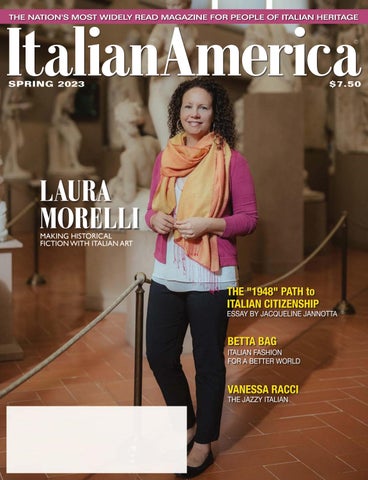
SPRING 2023

Page 1


LAURA MORELLI

MAKING HISTORICAL FICTION WITH ITALIAN ART

THE "1948" PATH to ITALIAN CITIZENSHIP ESSAY BY JACQUELINE JANNOTTA

BETTA BAG

ITALIAN FASHION FOR A BETTER WORLD

VANESSA RACCI THE JAZZY ITALIAN

IN THIS ISSUE

Official Publication of the Order Sons and Daughters of Italy in America®

Italian America Magazine is a publication of the Order Sons and Daughters of Italy in America (OSDIA), the nation’s biggest and oldest organization for people of Italian heritage. To subscribe, see www.osia.org or call (202) 547-2900.

FROM THE BOOT ITALIAN AMERICA is published by the ORDER SONS AND DAUGHTERS OF ITALY IN AMERICA 219 E Street NE, Washington, DC

Editor-in-Chief: Andrew Cotto

Writers: Steve Amoia, Andrew Cotto, Mark DeNunzio, Michele Di Pietro, Miriah Falce, Carla Gambescia, Ray Guarini, Jacqueline Jannotta, Felicia Naoum

Proofreader: Christine Haden

Graphic Designer: Diane Vincent

To advertise: Contact ItalianAmerica@osia.org (202) 547-2900

THE COVER: Laura Morelli
photo credit: Davide Mandolini
by Jacqueline Jannotta
photo Ksenia Sannikova

A St. Joseph's Day Partnership

National Office Advisor, Dr. Mary Kovach, created a partnership between the Sons of Italy Foundation (SIF) and Hardcore Italians, an apparel company dedicated to Italian pride. A portion of all St. Joseph’s Day t-shirts sold from Hardcore Italians will support a St. Joseph’s Day exhibit at the Sons of Italy museum on Staten Island (the Garibaldi-Meucci Museum). The shirts sold out halfway through the fundraising campaign and more had to be ordered! SIF President, Joseph Sciame, pictured below, visited the museum on March 20th to celebrate the exhibit and recognize the collaboration between SIF and Hardcore Italians.

New Technology Unveiled Mark Your Calendars!

A new member management software was unveiled at February’s Plenary Session. The software is expected to revolutionize how OSDIA moves forward and evolves with an ever-changing, more-technological culture. The new software will improve communication between the local lodges and their members; make reports to the Grand Lodges simpler, and it has an integrated, robust events module, along with so much more.

The new OSDIA website (www.osdia.org) has been launched after an extensive effort by the National Office. Please visit the site to familiarize yourself with the new design and improved navigability. Also, the Supreme Lodge will be funding the creation of new websites for all of the Grand Lodges to match the look and feel of our National site.

The OSDIA 58 th Biennial National Convention, planned for 8/15-8/19 in Tampa, Florida, will be revitalized to include a Future Leadership Forum, more social functions, and breakout sessions to add value for leadership and members alike. The vision is that this conference is for anyone in OSDIA, not just the voting members of the council.

The 34 th Annual National Education & Leadership Awards (NELA) will be held Thursday, May 25th at the Ronald Reagan Building & International Trade Center in Washington, DC. Gold members get $75 off the ticket price of $500 ($350 tax deductible). More information can be found at: www.nelagala.org.

Joseph Sciame, SIF President, acknowledging the St. Joseph's Day collaboration with Hardcore Italians at the Garibaldi-Meucci Museum
A previous NELA celebration

Rome's Decorator

Among the many artistic treasures displayed in Rome’s not-to-be-missed Borghese Gallery is The Rape of Persephone, a marble sculpture that depicts the mythical kidnapping of the daughter of Zeus and Demeter by Hades, god of the underworld. Nearly airborne in her abductor’s arms, Persephone tries mightily to twist away, the pivotal moment frozen in stone for posterity. As powerful as the overall drama of these struggling figures may be, many observers find one detail especially compelling: where Hades’ right hand grabs Persephone’s thigh we can see his fingers indent her soft flesh, the hard marble miraculously incarnate.

Less than an hour’s walk west, just across the Tiber, we can stand within the monumental square of St. Peter’s Basilica and find ourselves in a more welcoming and spiritual embrace—in the massive curved arms of its twin colonnades—as have millions of pilgrims before us.

One remarkable man was the stage master of these two quintessentially Roman experiences plus a great many more: Gian Lorenzo Bernini (1598–1680), the Baroque genius of gestures grand and small. It is difficult to recall another artist whose lifetime achievements made a greater difference in the look and the life of a major city.

Those achievements were the product of unusually auspicious circumstances, a singularly prodigious talent, a cyborg’s capacity for grueling physical labor, and the bonus of a long life.

Bernini was fortunate to be born to a sculptor father, Pietro, who moved from Naples to Rome to work for Cardinal Scipione Borghese and the cardinal’s uncle, Pope Paul V, when he was just seven. Young Gian Lorenzo studied classical works of the Renaissance masters Michelangelo and Raphael in the Vatican Museum, and apprenticed with his father. When the skills and talents of his young boy seemed destined to eclipse his own, the elder Bernini

reputedly said, “It doesn’t bother me, for as you know in that case the loser wins.”

Around age eleven the younger Bernini sculpted a bust of Giovanni Battista Santori that caught the eye of Pope Paul V who reportedly declared, “We hope that this youth will become the Michelangelo of his century.”

The pope’s nephew, Cardinal Borghese, offered young Bernini his first major commissions, including The Rape of Persephone (completed at age 23); an intently focused David, about to hurl the rock that would topple the Biblical Goliath; and Apollo and Daphne, the spectacular piece of mythical stagecraft and technical virtuosity that would seal Bernini’s reputation as Rome’s leading sculptor.

Cardinal Maffeo Barberini, another patron, became Pope Urban VIII in 1623 and reportedly told the prodigy: “Your luck is great to see Cardinal Maffeo Barberini Pope, Cavaliere, but ours is much greater to have Cavalier Bernini alive in our pontificate.” For the next twenty-one years the pontiff would make good on his implied promise, a promise which doubtless arose from both a political impulse as much as aesthetic one: to buttress the cause of the Catholic Counter-Reformation, church leaders recognized the need for a style of religious art that was more emotionally charged, vigorous, and realist: in short, engaging the masses though aesthetic “shock and awe” and demonstrating (especially to the Catholic monarchies of Europe) the vitality of the church and it’s ecclesiastic primacy. Bernini’s highly expressive and realistic style—the first compelling instance in sculpture of the “baroque” style pioneered in paint by Carracci and Caravaggio—perfectly fit the bill.

Almost at once Bernini set to work on the 64-foot high 96 ton bronze Baldacchino (canopy) over the altar of St. Peter’s and the tomb of the first Vicar of Christ in the Basilica. Part sculpture, part architecture, and part proscenium-in-the-round, this dynamic yet stately struc-

ture alone would have easily served as the crowning achievement of almost any other artist’s career. Inspired in part by the namesake portable canopies used in religious processions, Bernini’s Baldacchino has the lightweight appearance of a fabric covering, complete with simulated fringes and tassels, despite its use of more than 100,000 pounds of brass. Once again, the Baroque master transcended his medium: just as he had given marble the softness and suppleness of flesh, he bestowed on brass the airiness of cloth. His “interior design” for St. Peter’s also included the Cathedra Petri—or throne of St. Peter—a dramatic assemblage of gilded bronze sculptures illuminated by a yellow stained-glass window in the apse.

Pope Urban VIII died in 1644 and incoming Pope Innocent X showed little inclination toward Bernini, instead favoring Francesco Borromini and others. Making matters worse, a bell tower that Bernini had created for the façade of St. Peter’s proved structurally unsound, needing to be demolished in 1646. But just as Bernini’s good fortune appeared to desert him, he created his own luck. He used this period to begin work on what many critics consider his greatest masterpiece: the Cornaro Chapel of S. Maria della Vittoria, a virtual stage set for his enthralling Ecstasy of St. Theresa. Around the same time, Pope Innocent X decided to commission a fountain for Piazza Navona. Although Bernini was not invited to compete for the project, he nonetheless created a model which ended up capturing the pope’s attention. When advised that it was by Bernini the pontiff reputedly said, “The only way to resist executing his works is not to see them.” Today Bernini’s Fountain of the Four Rivers is among Rome’s most handsome and beloved attractions.

Despite the bell tower debacle, Bernini has come to be regarded by many as the preeminent Baroque architect as well as sculptor. His Jesuit church of Sant’Andrea al Quirinale is an exquisite ovoid space sometimes called, “the Pearl of the Baroque.”

While Bernini might rightfully be called “Rome’s Decorator,” he might also be thought of as the choreographer of Catholic pilgrims’ final approach to St. Peter’s. As they would cross the Tiber atop the Sant’ Angelo Bridge they would pass between a gauntlet of Bernini-designed angels, each bearing an instrument of the crucifixion. Then

making their way to the basilica, pilgrims would enter the awe-inspiring St. Peter’s Square surrounded by its distinctively curved double colonnade of 284 travertine marble columns with 140 statues of popes, martyrs and evangelists installed on top, described by Bernini himself this way: “These are the motherly arms of the church, reaching out to embrace the faithful and to reunite heretics (protestants) with the church.”

In his nearly eighty-two years, Bernini served eight popes. Longevity alone would not account for Bernini’s remarkable life output of sculptures, fountains, and edifices, only several of which are mentioned here. While he employed a team of assistants during most of his career, Bernini was also celebrated for his own prodigious work ethic and stamina: he would work seven hours without interruption on a block of marble, and claimed that his lifetime’s worth of dining and slumber would likely not have exceeded a full month. (His daily diet reportedly consisted of a small portion of meat and copious amounts of fruit.)

Throughout his career, from the early remark of Pope Paul V onwards, Bernini was cited as the artistic heir to the genius of Michelangelo. Whether he ultimately measured up to that lofty goal can be left for others to argue. But, beyond debate, we must give this to Bernini: the man who made marble emote remade Rome.

Carla Gambescia is a journalist, lecturer, and award-winning author of La Dolce Vita University: An Unconventional Guide to Italian Culture from A to Z, a highly informative celebration of Italy’s capacious culture. The new and greatly expanded second edition is now available.

Carla has toured every region of Italy, often by bicycle, and immersed herself in its astonishing array of cultural treasures. She conceived and co-led the Giro del Gelato bicycle tour, winner of OUTSIDE Magazine’s “Best Trip in Western Europe,” and owned and operated the top Zagat-rated Via Vanti! Restaurant & Gelateria in Mount Kisco, New York, for nearly a decade.

Today Carla lectures on myriad topics of Italian cultural interest through continuing education programs, universities, museums, and private clubs. She also curates the photoblog Postcards from the Boot. You can enjoy a specially selected “postcard” each issue on the last page of our magazine.

Laura Morelli is a USA Today and Publishers Weekly bestselling author of six works of historical fiction. She grew up on a farm in rural Georgia, earned a Ph.D from Yale, and has lived and worked in five countries. Italian-American by marriage and immersion for over 40 years, Laura is a highly awarded author of historical fiction where she threads her passion for Italy with her vast knowledge of the country’s history, particularly its art. She has taught college students across the U.S. and in Italy, and has produced art history lessons for TED-Ed. Italian America magazine is honored to have Laura as our feature interview in the Spring 2023 issue.

Hi, Laura! Thanks for joining us and for sharing your story.

Hi, Andrew! Thanks for having me.

You are clearly an author inspired by Italian art. Can you explain the connection?

Italian art is an unending font of inspiration. For me, it’s been kind of a long and winding road. I always wanted to be a writer ever since I was a little kid. When people asked me what I wanted to be when I grew up, I can remember, maybe four years old saying, “Well, I want to either be a writer or an archaeologist.” So that was what was in my head. And I feel very fortunate that I ended up being sort of what I wanted to be when I was four years old. It took many years for me to make that transition of being both someone who was interested in the past and Italian culture, and also someone who writes about it.

Hence, the long and winding road you mentioned…

Yes. I finished college, where I studied Romance Languages and Literature at the University of Georgia, and went on to graduate school to study art history at Tufts and eventually earned my Ph.D from Yale. When I was in my 20s, and I began on this aforementioned road, I had this spark that art history was the most fascinating topic in the world, and I still think it is, but as I progressed to the field and started teaching at the college level, there was something about that artistic side of wanting to write creatively that was still in me and just tugging at my skirt, like, “Come on, we gotta

Photo credit: Ksenia Sannikova

really do this.” And so, eventually, when I turned to writing historical fiction, and writing about the stories of the history of art, that’s when my love for art and writing came together.

And you began this journey of fiction writing with the two novels set in Venice. What inspired this?

I have always been captivated by Venice. My first love of art history was sparked by traveling to Venice at 12 years old and buying a piece of Murano glass. It was a typical tourist scenario, where I overpaid for a glass fish, but I think it’s telling that a wide-eyed preteen raised on a farm and Georgia would already have a notion of Murano glass and other artistic traditions, like carnival masks and gondolas, as synonymous with Venice. It points to the truly world-class status of these objects, and it is tied to this concept of Made in Italy, a work of non-fiction which was my first book.

How did this book come about?

Things began to change for me when I returned to live in Italy after completing my Ph.D. My husband had taken a job just outside of Milan. I was eight months pregnant and not focused on art history at all. I was trying to get myself and my husband settled into a new house as we waited on the baby. We needed bookcases built, and I hired some

local carpenters - a father, son and grandson - who had come highly recommended. Of course, it being Italy, it took quite a while for them to actually come, but when they did, they created this set of bookcases over the course of several weeks. The result was stunning. Five strips of different woods creating an inlaid effect. Each shelf was solid as a rock. The doors slid silently from side to side with a push of a finger. Drawers glided in and out. In short, their work was a masterpiece. Well, soon after, as I took my son out in the stroller in our small village near Milan, I realized that these carpenters were not alone. Our little town had a small parish church, a coffee shop, a shoe store, a bakery, but it also had a luthier turning out the most beautiful violins and cellos I had ever seen. And in nearby towns, I went on to discover there were woodworkers, ceramicists, glassblowers, jewelry makers, all who were quietly carrying on these artistic traditions that have never appeared in any of my art history textbooks. And I realized that in all those years of formal art history training, when I learned about Michelangelo, Leonardo da Vinci, and the other Italian artists, here was something totally ignored: a living artistic tradition that was still thriving in Italy. The medieval guilds may be long gone, but these techniques, skills, knowledge and the spirit of Italian tradition, I found were still intact in these world class objects, like Murano glass, Florentine leather, maiolica ceramics, even culinary things like Parmigiano Reggiano cheese. So, these artisans inspired my first book, Made in Italy. I traveled all over the peninsula researching it, from the Alps to Sicily and

Photo Courtesy of Laura Morelli
The author pregnant with her first child while living near Milan, Italy.
The author being read to as a child by her mother.

back again, interviewing these artisans who were practicing centuries-old trades. I would subsequently publish separate ‘Made in Italy’ books on Florence, Venice, Naples and the Amalfi Coast. These guides have evolved, and I have the resources sections now in ebook format so that I can update them frequently. The good news is that these artisanal traditions are still very vibrant, and that’s just a wonderful way to explore Italian history and culture. It’s living history to walk into an artisan studio and see how something has been made for many centuries.

Did this lead you towards fiction?

Well, yes. In the process of my research for the Made in Italy series, I’d heard the same story all over the country, and that story was how it’s so important for us to pass on the torch of tradition to the next generation. I began to wonder what would happen if the artisans were not willing or able to pass on this trade. And when I got to Venice, and I started talking with these gondola makers who were the last remaining guys carrying on this centuries-old tradition, this story popped into my head about a young heir to a gondola making boatyard and the complicated relationship he had with his father. The idea stayed with me for a long time. So when I turned to fiction, that story was right there for me.

The subsequent works of fiction have more of an emphasis on artists and art history as opposed to artisans. Correct?

Yes. After The Gondola Maker, I wrote The Painter’s Apprentice, which was also set in Venice in the 16th century. That was followed by The Giant, a story that centers around the making of Michelangelo’s David. The Night Portrait, published in 2020, is about Leonardo da Vinci’s Lady with an Ermine and what happened to it during World War II. And my most recent book is The Stolen Lady, about the Mona Lisa and her hard-to-believe journey from 16th-century Florence to hiding in the French countryside during World War II.

And up next is…

The Last Masterpiece, and it’s set in Nazi-occupied Italy. Two women, a German photographer and an American stenographer, hunt for priceless masterpieces looted from the Florentine art collections. It is based on an amazing true story and will be published this summer. Readers who pre-order through my website (lauramorelli.com/ masterpiece) can get free access to my online program, “Looting the Uffizi.”

How cool! And what a great segue to telling us about all of the online courses available through your Art History Academy. I’ve transitioned to online many of the classes I used to teach at the university level, and I’m really having a blast with it because I have so many students now who are beyond college age who don’t have any interest in taking an exam or writing a paper or anything like that, but they still want to learn the material. I really love teaching online, and I now have more than a dozen courses available. They range from well-known figures like Leonardo da Vinci and Michelangelo to lesser known, but equally as fascinating subjects as the Etruscans. There are also some of the ‘Made in Italy’ inspired courses on artisans and shopping in Italy. I only open a couple courses at a time so that I can really focus my attention on my students. But if there’s something you’re interested in, you can join waitlist. I’ve got some free videos that you can watch there as well. The mission is to: Be Educated. Entertained. And Inspired. (lauramorelli.com/learn)

Well, I’m certainly inspired. Grazie mille!

More information on Laura and her work, please visit www.lauramorelli.com.

You can find her on Facebook, Instagram, and Twitter, all at @lauramorelliphd.

Laura Morelli's upcoming novel.

When Italy elected a woman as prime minister for the first time last fall, it made headlines worldwide. But another gender-related glass ceiling has been cracking too—one involving Italian citizenship.

It used to be that Italian citizenship by descent (Jure Sanguinis) required proving one’s bloodline through male ancestors, because only Italian men passed citizenship onto their children. Women didn’t have this ability until 1948, when the Italian Constitution declared men and women as having equal rights. That meant one couldn’t acquire citizenship through a female ancestor born before 1948.

But in 2009, the “1948 rule” regarding citizenship was challenged, essentially asking the question: Why should 1948 stand as the cutoff date for women being equal to men? The Italian courts agreed, determining that women should be considered equal no matter what year they were born.

That decision set a legal precedent, allowing recognition of Italian citizenship through female as well as male ancestors, provided the ancestor hadn’t naturalized before the next generation was born. And because most women during the biggest wave of Italian immigration (~1880-1914) didn’t need to naturalize—they had husbands, after all, and couldn’t vote anyway—countless Italian Americans today have an avenue toward Italian dual citizenship.

The “1948” path to Italian citizenship follows a similar route as a traditional Jure Sanguinis claim. Both involve gathering, translating, and “legalizing” documents to prove one’s ancestral line. However, a 1948 case requires hiring a lawyer in Italy to present the claim in court. As my siblings, daughters, and I discovered, it’s quite a process.

OUR 1948 CASE PROCESS FOR OBTAINING ITALIAN CITIZENSHIP

Gaining dual citizenship was a pipe dream for my family until we learned about 1948 cases. Although our paternal grandfather was born in Italy, that chain was broken because he lost his Italian citizenship as a child when his father naturalized. We also had three Italian great-grandmothers, but didn’t know where to begin. After searching online, we soon found the go-to place for help.

The Dual U.S.-Italian Citizenship Facebook Group (and its website dualusitalian.com) offers a plethora of information and support from knowledgeable admins and nearly 50,000 members. The active and evergrowing group shows how popular seeking dual citizenship is, despite all the obstacles one might encounter. Whatever the issue, someone within the group has been through it and can offer guidance, making the whole process less painful.

The group also maintains a list of

specialized lawyers in Italy recommended by members, which made hiring one much less intimidating. We ended up exchanging emails with several attorneys and decided on Marco Mellone. In addition to his quick responses and impeccable English, Marco literally wrote the book on 1948 cases (Disciplina della Cittadinanza Italiana e Donne Cittadine). I knew we’d be in good hands, and splitting the fees four ways with my siblings made it an easy decision.

Marco told us it didn’t matter which great-grandmother we chose for our 1948 case, as long as we could gather all the documents to prove our lineage. There were hurdles along the way, but after nine months we had everything gathered, apostilled (authenticated for legal use) and sent off to Italy. Marco’s staff took care of document translation and prepared our case for court.

Then began the interminable wait, made even longer due to COVID shutdowns. It took several months to

The author, her daughters, and their European Union passports.

get a judge assigned to our case, and another several months for the case to be heard. At that time, all 1948 cases still went through Rome, which made for quite a bottleneck. Now, a procedural change means new cases are heard in the district of the ancestral comune (municipality), which should speed things up considerably.

ITALIAN BUREAUCRACY IS ALIVE AND WELL

Our claim went before a judge on September 11, 2020, though we wouldn’t learn about the ruling affirming our citizenship until January, 2021. That’s when our work kicked in. Marco had done his job and made sure we were registered in our greatgrandmother’s comune of Orero. Now it was up to us to enroll ourselves and our minor children in AIRE (a registry of Italian citizens living abroad). That’s where things got tricky for my family.

Once a parent is recognized as a citizen, registering minor children should be an easy task. But when I added my younger daughter into AIRE, my home consulate in the US flagged it, telling me her name was illegal per the Italian law of not using a surname as a “regular name.” When I gave my kids my maiden name as their middle name, little did I know I

was breaking Italian law! It didn’t matter that my older daughter was registered with the same “illegal” name without issue (she was added to our case last-minute because she was turning 18). Nor did it matter that a few Italian-born friends in America had no problem registering their children with surnames-as-middlenames. The bureaucrat handling my younger daughter’s registration cited the law and wanted me to legally change her name. That request didn’t fly with me or my 16-year-old.

The comune of Orero, home of the author's great-grandmother.

I had until she turned 18 to fix the situation, and so my inherent Italianezza kicked in. I pondered who in my Italian network might be able to help, and managed to find people who knew how to work the system. Several months later, my daughter was registered, name intact. Phew Now we could finally get our Italian passports, which turned out to be the easiest step of all. We were careful to follow instructions to the letter, and two weeks later our little burgundy passports arrived in the mail!

Next up: citizenship for my husband (via Jure Matrimonii) who must first pass an Italian language test. Today, as a family with European Union citizens, more of the world is our oyster—for residency, ease of travel, work, and study possibilities—especially for our daughters. Though my great-grandmother might never have imagined her descendants returning to Italy, I think she’d be pleased and proud that we’ve come full circle!

Jacqueline Jannotta is the author of Let’s Leave the Country! A Guide to Your Family Year Abroad. She can be found online at www.jannotta.com.

Photo Pete Morris

ANDIAMO!

When in Rome, Seek Out the Water!

I moved to Italy almost 40 years ago, and have been living in Rome ever since. The key to enjoying Rome during the hot Mediterranean summer is to seek out the water.

When you’re touring Rome, make sure you drink lots of water. Not bottled water: Rome has hundreds of drinking fountains - known as nasoni because of their nose-shaped spouts. They have the best water you can find in Rome: delicious, pure and refreshing. Remember that Rome is a city of water with a network of aqueducts and underground pipelines that transport water to each of Rome’s fountains and nasoni. The nasoni are constantly flowing, so they’re a perfect place to rinse off fruit from the market, to fill water bottles or even drink from directly. At the top of the nasoni nozzle, there’s a tiny hole. Use your finger to block the base of the spout and magically the water flows upward from the tiny hole to allow a drink from the fountain.

The Pantheon is perhaps Rome’s most beautiful and spectacular monument. Outside of the Pantheon is a breathtaking fountain; behind that fountain is one of the three oldest nasoni in the city, dating back to the late 1800s. Just outside of the piazza is Armando al Pantheon, a legendary restaurant that features classic Roman dishes.

The fountain Rome is most famous for is the Trevi Fountain, a short walk from the Pantheon. The Trevi

Fountain is an 18th-century fountain designed by Italian architect Nicola Salvi and completed by Giuseppe Pannini and several others. Close by is another one of Rome’s best restaurants, Colline Emiliane, where they make fresh pasta every day, along with their signature desserts and exquisite dishes from the Marche region.

If you’d like to stay in a central Rome hotel with a pool, here are some options: Palazzo Dama, Villa Agrippina Gran Meliá, Aldrovandi Villa Borghese, The Aleph Hotel, Palazzo Naiadi, Parco dei Principi, and the newly opened Chapter Roma (which I haven’t visited yet, but I’ve heard, from your Editor-in-Chief, Andrew Cotto, is fabulous).

Another idea is to stay a stone’s throw outside of the city center. My family has a two-bedroom Airbnb where the air is cooler with access to some outdoor space and a pool. It’s a great place to relax, swim and recharge for another day of touring the Eternal City. If interested, go to the AirBnB website and search: Flavor of Italy.

To seek water out of the city, the choices are ample. Just north of Rome is Lake Bracciano, an ideal spot for swimming and accessible by public transportation, although I always suggest renting a car – even just for the day – to explore the area. The town of Bracciano has a charming historic center and plenty of tasty restaurants. Trevignano

(photo credit: Mireille Jaccard)
The fountain outside the Pantheon in Rome.
The Fontana di Trevi in Rome.

and Anguillara are two lovely towns right on Lake Bracciano where many expats have chosen to live. Both are full of great restaurants with my personal favorite being La Vela with gorgeous views from the outdoor tables. East of Rome, where the pope has his summer residence, are two lovely lakes. Lake Albano is a small volcanic crater lake in the Alban Hills of Lazio. Castel Gandolfo, overlooking the lake, is the site of the Papal Palace of Castel Gandolfo. Lake Nemi is perfect for swimming: The water is clear, fresh and clean; and a natural spring provides a constant flow of fresh water.

For seaside lovers, there are wonderful beaches along the coast. Drive north of Rome to Santa Severa (and Santa Marinella) and visit Santa Severa’s castle which spills right into the sea. This is a favorite spot for surfers who love to view the castle as they surf to the shore. The best restaurant here is unequivocally L’Isola del Pescatore. Book in advance as this spot is high in demand due to its incredible seafood dishes and more. They also have a small hotel to stay overnight. Driving is the best way to get there, but Santa Severa is also accessible by train. Trenitalia operates a train from the Roma S. Pietro station to Santa Severa hourly. Tickets cost 3 - 8 Euro and the journey takes 38 minutes.

My go-to summer spot for the past 40 years has been Sperlonga, just under a two hour drive south of Rome. Again, driving is the best way to reach Sperlonga, but there is a train to the Fondi-Sperlonga station with bus or taxi service into central Sperlonga. Sperlonga beaches are fabulous and great for children and families as the clean, calm water stays shallow quite far out. Hotels line the beach, each with lounge chairs and umbrellas. For the past two decades we have stayed at the Hotel Aurora. It’s on the water and in the heart of the town. Breakfasts are ample and delicious, and if you want to stay on the beach all day long, you can pop up to the hotel’s terrace for a light pasta lunch or salad. If you feel like a coffee mid-morning or a sweet treat, Fiorelli in the piazza has delicious donuts and homemade gelato. Having a car allows exploration, including visits to one of the local buffalo mozzarella producers or the nearby town of Gaeta, famous for its signature stuffed pizza, tiella. A great Sperlonga dinner spot is Lupi di Mare, in the main piazza outside, featuring fish caught that day by the restaurant owner, Francesco. Desserts are prepared daily by Francesco’s mother-in-law, Giovanna – one of the best home cooks I know and a dessert queen. Sperlonga has a charming historic center filled with whitewashed buildings and terraces accessible on foot along the many winding, vertical pathways. The view from the top of town towards Emperor Tiberius’s villa is breathtaking. Although you can’t visit the villa, there’s a museum featuring relics gathered from Tiberius’s residence.

Wendy Halloway is an American who has lived in Rome for nearly four decades with her Italian family. Her passion lies in sharing Italian stories, recipes and unique travel insights. Join Wendy each week on her podcast, Flavor of Italy, to hear unique interviews with food, travel, and cultural personalities from every corner of Italy. Subscribe to her Substack weekly newsletter for a deep dive into Italy. Wendy offers culinary walking tours of Rome or guided trips to desired destinations throughout the country. You can cook with Wendy in her home or stay in her Airbnb just outside of the city center. More information on Wendy’s podcast, Substack, tours and cooking can be found at: www.flavorofitaly.com.

To contact Wendy directly about any of the above, email: Wendy@flavorofitaly.com.

Hotel Aurora in Sperlonga on the coast of Lazio. Flavor of Italy AirBnB outside Rome.

Like a lot of Italian American women, Cristina Carabetta knows fashion. Like a lot of people in America (an estimated one-in-five), she knows someone who has experienced the criminal justice system. This intersection of criminal justice and fashion inspired Betta Bag, a stylish, sustainable, Italian-made handbag conceived by Ms. Carabetta and designed in collaboration with her formerly-incarcerated uncle. The effort is, in both respects, a tribute to her family and her heritage.

Growing up in a predominantly Italian enclave of Meriden, Connecticut, Ms. Carabetta was acutely aware of her background. The granddaughter and great granddaughter of Italian immigrants was raised in the same community as her ancestors, attending the same institutions and immersed in a similar culture.

Part of the traditions within her own household involved an awareness of fashion. “I’ve always liked to dress up,” Ms. Carabetta said. “My grandparents came to this country with nothing but the clothes on their back, so my mom always made sure that I presented myself well, which was important to her because her mother worked as a seamstress. My mother, who also knew how to sew, would make my clothes.”

The studious and ambitious Ms. Carabetta went on to earn an international business degree with a minor in fashion merchandising from Lynn University in Florida. There was an

obvious interest in fashion, but an uncertainty at the time as how to pursue her passion professionally. Other interests beckoned, namely business and law, and she returned to her home state to earn both an MBA and JD from Quinnipiac University.

Armed with her broad and advanced education, Ms. Carabetta moved to New York City in 2019, where she opened her own law firm representing startups and small businesses. And this is when she found her path to fashion.

“Once I became a lawyer, and more involved in and the business environment, I started to realize that there was a lack of professional handbags for women in the marketplace,” Ms. Carabetta said. “A lot of the briefcases we see are very masculine. And we as women still needed a pocketbook for our personal things.

At one point I had the briefcase on wheels, which was very inconvenient and so not stylish. I had this idea of a

bag in mind that was stylish, but also practical and affordable.”

The idea came to fruition with the help of her Uncle Nino, who worked in a leather shop while in prison and became a master craftsman. He would send home beautiful bags to the women in the family, and wallets and backpacks to the men, on special occasions and holidays. Once out of prison, though, employment opportunities weren’t readily available, let alone anything in fashion or the creative space. He returned to his previous work as an auto mechanic, but he would always tell the family to let him know if they needed any original leather products.

Cristina Carabetta and her Betta Bag.
Betta Bag comes in beige or black Italian leather.

During COVID, Ms. Carabetta was back in Connecticut for a few months. Uncle Nino’s repair shop was closed. The idea for a bag was shared. Designs were made, followed by prototypes until the perfect model was made, and the Betta Bag was born.

What makes the Betta Bag better, aside from the stylish design in beige or black, is the number of items that fit inside. It’s very wide and opens nearly all the way around. Inside, there are special compartments for electronics, folders, files with organizational pockets for keys, makeup, phone, charger, etc. There’s a luggage strap

it was just important for me to tie it back to my roots.”

Adding to the familial aspect is an advocacy by Betta Bag for those, like Uncle Nino, who face employment challenges after serving their sentence. Ms. Carabetta, in conjunction with her knowledge of the law, works via Betta Bag raising awareness of the issue, and also directly with groups who help the formerly-incarcerated successfully reenter society through placement in certain industries. One day, she hopes to provide such opportunities within her own company.

For now, Betta Bag is expanding “I’m new to this whole market,

The designer as a fashionable child.

Vanessa Racci

Vanessa Racci is a jazz and cabaret singer of Italian descent. Her vocation and her heritage are not mutually exclusive, as her Italian American background informs her musical interpretations and performance style. Her first album, Italiana Fresca, reached #65 on the jazz charts. Since then, she has performed at over 70 festivals, events, and jazz clubs across the country, and has been played on over 20 Italian radio stations across the US and Italy. Vanessa recently released her second album, Jazzy Italian, devoted to celebrating Italian American jazz composers, which made the top 10 traditional jazz albums of 2022 on the RMR jazz chart and has been programmed on Siriusly Sinatra. We sat down with Vanessa to discuss her decidedly Italian approach to American music.

TELL US ABOUT YOUR UPBRINGING AND FAMILY BACKGROUND:

I grew up in Thornwood, NY, in a modest home with my Mom, Dad, Sister, and Grandfather, Francesco Prisciantelli. My Dad is an HVAC technician; my mom was a stay at home mother for most of our upbringing, and Grandpa was our babysitter. We’re of 100% Italian heritage. My great grandfather on my mom’s side, Angelo Prisciantelli, came from Bari and was a piano tuner in Harlem, NY. He died young of pneumonia after having four kids. My great grandfather and grandmother on my father’s side, Giuseppe and Filomena Racioppo, were both from Monteleone de Puglia, so I have lots of Pugliese blood. My other great grandparents came from Avellino in Campania and Cantanzaro in Calabria. So, I’m a southern Italian mutt.

FROM WHERE WAS YOUR LOVE OF MUSIC BORN?

I’m really not sure where my love of music in general came from, but I was exposed to Italian American classics and jazz by my grandfather as he would play Frank Sinatra, Dean Martin, Louis Prima, Connie Francis, Jerry Vale, Lou Monte, and the like throughout the house and in his car all the time. He was also cousins with Italian American jazz guitarist, Tony Mottola, but they weren’t close, so I only learned this after I pursued the jazz route.

AT WHAT AGE DID YOU START PERFORMING?

I started singing at the age of 4. My parents said that I started singing “The Greatest Love of All” by Whitney Houston after hearing it on the radio. They were impressed with my confidence and range and encouraged me to pursue it as a kid. I started doing professional theater at the age of 12, and did lots of local professional summer theaters where I’d play leading roles such as Nancy in Oliver, Nora in Pete’s Dragon. At the age of 18, I won the Helen Hayes award for my performance as Christine in Phantom of the Opera (it was like the Tony awards for high school theater).

WHEN DID YOU BECOME CONSCIOUS OF THE FACT THAT YOUR APPROACH TO MUSIC WAS DECIDEDLY RETRO?

In my 20s. When I started to pursue music more seriously, I was at a crossroads, deciding between singer/songwriter and Italian Jazz. I just felt that jazz and a retro style fit my look and vocal style best. I also knew so many jazz standards from Grandpa playing them. As a former theater kid, I always loved dressing up in period clothing, so it was kind of a natural extension of that.

WHAT INSPIRED YOUR PURSUIT OF MUSIC AS A CAREER?

I actually started sort of late pursuing music as a career officially. My parents are more traditional and didn’t believe that singing was a “real job” - so they pushed me to go to school for business. I always studied voice privately simultaneously, but it wasn’t until I got married to my now husband that I pursued it seriously. He heard me singing at a karaoke bar and said, OMG, I didn’t know you could sing like that! I told him how I was made to believe it should just be a hobby. He dismissed that notion and told me to pursue it for real. He really believed in me. He gave me a goal of one year to book 10 shows, and I would end up booking 20. Then I recorded two albums

and started touring the country. I got so busy that we finally agreed that I would quit my corporate day job and do music full time.

WHAT MAKES THE MUSIC OF ITALIAN AMERICANS SO SPECIAL?

The music of Italian Americans is so special as it reminds me of the connection I had with my grandfather: making frittatas, splitting pasticiotti, hearing stories about him fighting in World War II, and growing up poor with three full siblings and four half-siblings in tenement buildings in Harlem. I think it’s the immigrant struggle that fascinates me the most and transports me to the beginnings of my family’s experience in America. I also think that the immigrant struggle makes the music that much more passionate.

ITALIAN ENCLAVES

As much as we all love a great trip to one of the Little Italy neighborhoods we know and love, there are dozens of sleeper neighborhoods, or enclaves, out there that never get that much attention. The Italian Enclaves Historical Society has been continuously researching Italian enclaves and Italian churches that have existed in America since the diaspora of Italians in the mid-19th century. The most exciting part of this research and travel is discovering so many enchanting people and places that highlight one of the richest cultures on Earth, right here in different corners of America.

Here are a few enclaves that I’m happy to share with you in the Spring 2023 issue of Italian America magazine.

Dyker Heights, Brooklyn

Dyker Heights is a neighborhood in South Brooklyn which constitutes one of the most homogeneous Italian enclaves in the United States. New York had dozens of Italian neighborhoods, and when the thought of a Little

Italy in New York comes up, most people automatically refer to Little Italy in Manhattan, along Mulberry Street, or Arthur Avenue in the Bronx’s Little Italy. Not many people are aware that some of the highest concentrations of Italian American businesses and people in the United States are in the small Dyker Heights neighborhood in Brooklyn, whose main artery is 13th Avenue. The strip of land that constitutes Dyker Heights is from 7th Avenue to 15th Avenue and from 92ndth Street to 65th Street.

The Italian National Parish in Dyker Heights is Saint Bernadette. The founding pastor of the church was Reverend Francis P. Barilla, and it was founded as an Italian National parish in 1936. The parish first met at the Knights of Columbus Hall on 86th and 13th, and then a small chapel was created in a storefront directly across from the church, which is now Tasty Pastry Pasticceria. The church is still a vibrant Italian parish, and just about all remaining parishioners are of Italian descent.

Dyker Heights is renowned for its very strong sense of community and extremely expensive homes, which put on the country’s largest Christmas lights display anywhere in the country each December. The Italian Enclaves Historical Society had its inaugural Dyker Heights Christmas Lights Crawl in 2022, and it was a huge hit with Italian American friends from other cities joining in the fun. Businesses of note that still remain are Tasty Pastry Pasticceria, La Bella Market Place, Mona Lisa Bakery, Torregrossa Funeral Home, Sirico’s Catering Hall, Grandma’s Bakery, and many more.

Marineo Plaza in Garfield, NJ

Marineo Plaza is name given to a current Italian enclave in Garfield, New Jersey. The neighborhood is somewhat presently transitioning, but there are many Italians still living within the area. There is a prominent sign welcoming visitors, dedicated by the Saint Ciro Society, which reads: “Welcome to Saint Ciro’s Society Marineo Plaza” - accompanied by Italian flags on all four corners of the intersection of Frederick and Harrison Streets.

The Italian National Parish of this enclave is Our Lady of Mt. Virgin, located at 188 MacArthur Avenue. The parish was formed in 1924, and a church was built upon land donated by two devoted parishioners in 1971. Many of the original immigrants at Our Lady of Mt. Virgin were from Avellino, Naples. It is said that a painting within the church depicting the Patroness, Our Lady of Mt. Virgin, has been miraculous for several devotees over the years. There is also an annual feast held in July at the church, which is known as one of the best in the state of New Jersey.

There are many Italians living in the homes within the vicinity of the church, which is still the nucleus of this enclave today. One can see elaborate yard shrines of a variety of saints to whom the respective homeowners have devotions. There are a slew of Italian American businesses remaining within the enclave of Marineo Plaza. Businesses and institutions of note are: Vitamia & Sons Ravioli, Caffe Italia, the Saint Ciro Society, Clyde’s Homemade, Fragale’s Bakery, and many more.

Southside, Sacramento

Sacramento, California has multiple Italian enclaves. In the early 20th century, the Italian enclaves in Sacramento were the Southside, Oak Park, Land Park, Midtown, and East Sacramento. In the 1930s and 1940s, roughly half the households in Oak Park were immigrants from Italy,

particularly along 39th Street, which was called Carmello Boulevard at the time.

Many Italian enclaves in the United States had Roman Catholic churches, which were founded by Italian pastors who could cater to the Italian-speaking community of parishioners. In Sacramento, the Italian National Parish was St. Mary’s Parish. St. Mary’s was founded in 1906 when the first church was built at 818 N Street. Since the highest concentration of Italians was living in and around the Southside enclave, the pastor purchased new land at 7th and T Streets. The church is now called Our Lady of Guadalupe, which reflects the demographic changes as Italians slowly abandoned the Southside and other parts of the city.

Italian-Americans in Sacramento date back to the Gold Rush. Popular Italian establishments still in operation today include St. Mary’s Church (now called Our Lady of Guadalupe), the Sons of Italy, Giovanni Hall, the Italian Catholic Federation, the Italian Cultural Society, the Piemonte Reale, the Marsala Lodge, the Dante Club, the Arbëreshë of Sacramento, and the East Portal Bocce Club.

Ray Guarini is the Executive Director of the Italian Enclave Historical Society. The Managing Director of a venture capital firm during the day, Ray created the Italian Enclave Historical Society in his spare time as a labor of love and homage to his Italian American heritage and Catholic faith. This issue marks the first in a recurring collaboration with Ray where he will share a few entries from his vast directory of Italian Enclaves

Joe DiMaggio: Italian American Exceptionalism

Joe DiMaggio: eccezonalismo italoamericano

Part 1 of 2

TRANSLATED BY

Caruso. da Vinci. Deledda. Ferrari. Loren. Michelangelo. Mother Cabrini. Pavarotti. Stradivari. Iconic names instantly recognized for Italian excellence. Let us add one more: DiMaggio. Caruso, Da Vinci, Deledda, Ferrari, Loren, Michelangelo, Madre Cabrini, Pavarotti e Stradivari. Sono tutti nomi iconici riconosciuti per l’eccellenza italiana. Aggiungiamone un altro: DiMaggio.

A Cultural Icon Who Defied Stereotypes

Un’icona culturale che ha sfidato gli stereotipi

Joe DiMaggio became an American cultural icon due to radio broadcasts, magazines, newspapers, and newsreels. To immigrants, he represented much more than the perfect swing, the graceful strides, or the famous hitting streak. DiMaggio defied ethnic stereotypes that sadly still exist. To wit, this denigrating analysis in Life Magazine during 1938:

Joe DiMaggio è diventato un’icona culturale americana grazie a trasmissioni radiofoniche, riviste, giornali e cinegiornali. Per gli immigrati rappresentava molto di più dello swing perfetto, dei passi aggraziati o della famosa serie di colpi. DiMaggio ha sfidato gli stereotipi etnici che purtroppo esistono ancora. Come dimostra questa analisi denigratoria su Life Magazine del 1938:

“Although he learned Italian first, Joe speaks English without an accent and is otherwise well adapted to most U.S. mores. Instead of olive oil or smelly bear grease he keeps his hair slick with water. He never reeks of garlic and prefers chow mein to spaghetti… Like heavyweight champion Joe Louis, DiMaggio is lazy, shy and inarticulate.”

Joe DiMaggio and Marilyn Monroe on the cover of Now Magazine, January 1954.

Photo credit: Now Magazine.

Joe DiMaggio e Marilyn Monroe sulla copertina di Now Magazine, gennaio 1954.

Crediti: Now Magazine.

“Sebbene abbia imparato prima l’italiano, Joe parla inglese senza accento e si è adattato bene alla maggior parte dei costumi statunitensi. Invece dell’olio d’oliva o del puzzolente grasso d’orso, tiene i capelli lisci con l’acqua. Non puzza mai di aglio e preferisce chow mein agli spaghetti... Come il campione dei pesi massimi Joe Louis, DiMaggio è pigro, timido e inarticolato.

DiMaggio’s consistent excellence demonstrated that a first generation American could assimilate, maintain his own cultural identity, and become a reference point in the nation’s pastime. As the author, Kostya Kennedy, eloquently stated in, 56: Joe DiMaggio and the Last Magic Number in Sports:

La costante eccellenza di DiMaggio ha dimostrato che un americano di prima generazione si potesse assimilare, mantenere la propria identità culturale e diventare un punto di riferimento tra gli sport del paese. Come ha affermato l’autore Kostya Kennedy in maniera eloquente nel libro 56: Joe DiMaggio e l’ultimo numero magico nello sport:

“He was a majestic Italian, freed by the achievement and his bearing from the prejudice and disdain of even the smallest-minded isolationists and bigots in the land…”

“Era un italiano maestoso, liberato dal successo e il suo portamento dal pregiudizio e dal disprezzo dei più meschini isolazionisti e bigotti del paese...”

How “The Streak” Came to Represent American Exceptionalism

Come “The Streak” è riuscito a rappresentare l’eccezionalismo americano

From May to July, 1941, DiMaggio hit safely in 56 straight games to set a new Major League record that still

Photo credit: The 1939 Bowman PlayBall Baseball card. Crediti: carta da baseball del 1939 Bowman Play Ball.

PAGINA ITALIANA

stands. As author Richard Ben Cramer noted in The Hero’s Life: “In the history of the major leagues there had never been a hitter like DiMaggio, who struck out so seldom (only five times), and at the same time, in the same streak, hit fifteen home runs.”

Da maggio a luglio 1941, DiMaggio ha segnato in 56 partite consecutive, riuscendo a stabilire un nuovo record della Major League che è ancora valido tuttoggi. Come ha notato l’autore Richard Ben Cramer in The Hero’s Life: “Nella storia dei campionati più importanti non c’era mai stato un battitore come DiMaggio che ha segnato così raramente (solo cinque volte) e allo stesso tempo, nella stessa striscia, segnando quindici fuoricampo.

Kennedy immortalized Joe’s achievement: “Through the end of the 2010 season, 17,290 players were known to have appeared in the major leagues. Only one of them had ever hit in 56 straight games.” DiMaggio then went on another 16 game hitting streak for the incredible total of 72 out of 73 games in that magical 1941 season.

Kennedy ha immortalato il successo di Joe con la seguente frase: “Fino alla fine della stagione 2010, si sapeva che 17.290 giocatori erano apparsi nei principali campionati. Solo uno di loro aveva segnato in 56 partite consecutive.” DiMaggio ha poi segnato altre 16 vittorie consecutive per l’incredibile totale di 72 partite su 73 in quella magica stagione del 1941.

Cramer noted how DiMaggio’s streak transcended baseball:

Cramer ha notato come lo streak di DiMaggio abbia trasceso il baseball:

“It was only after the fact that The Streak shone as a portent of America’s brilliant rise to superpower, and made DiMaggio her poster boy for valor, victory, and God-given grace… DiMaggio was said to exemplify the great melting pot, which turned immigrants from a hundred lands into one unbeatable nation…”

“Solo dopo che The Streak ha eccelso come un presagio della brillante ascesa dell’America a superpotenza e reso DiMaggio il suo testimonial per il valore, la vittoria e la grazia data da Dio... Si diceva che DiMaggio esemplificava il grande melting pot e che ha trasformato immigrati da cento paesi in una nazione imbattibile…”

DiMaggio:

Standing the Test of Time

DiMaggio: resistere alla prova del tempo

La targa di Joe DiMaggio al Baseball Hall of Fame a Cooperstown, New York. Crediti: utente R su Wikipedia in lingua inglese.

During a recent interview at Italian America, the great actor, Chazz Palminteri, told Andrew Cotto: “Italian Americans will stand the test of time… My mission is to send the elevator back down… It’s a special joy when I help an Italian American.” DiMaggio has withstood the test of time and remains an exemplary son of Italy. Perhaps in a vicarious way, the Yankee Clipper sent the elevator back down for a certain Calogero Lorenzo Palminteri’s artistic dream, A Bronx Tale, to one day become a reality.

Durante una recente intervista ad ItalianAmerica, il grande attore Chazz Palminteri, ha dichiarato ad Andrew Cotto: “Gli italoamericani supereranno la prova del tempo... La mia missione è di riportare giù l’ascensore... È una gioia speciale quando aiuto un italoamericano. “ DiMaggio ha resistito alla prova del tempo e rimane un figlio esemplare dell’Italia. Forse in modo vicario, lo Yankee Clipper ha rispedito giù l’ascensore perché il sogno artistico di un certo Calogero Lorenzo Palminteri, A Bronx Tale, un giorno diventasse realtà.

Joe DiMaggio: Italian American exceptionalism par excellence.

Joe DiMaggio: eccezonalismo italoamericano per eccellenza.

Steve Amoia is an author, freelance writer, and translator based in Washington, D.C. His Italian-themed books are available at www.barnesandnoble.com: Historical Finals of the Azzurri, Sardinian Days and Italian Nights, and Sardinian Stories, a new translation of Grazia Deledda. His portfolio site: www.sanstefano.com.

Steve Amoia è un autore, scrittore freelance e traduttore che vive a Washington, D.C. I suoi libri si concentrano su tematiche italiane e sono disponibili su www.barnesandnoble.com: Historical Finals of the Azzurri, Sardinian Days and Italian Nights, e Sardinian Stories, e una nuova traduzione di Grazia Deledda. Il suo sito: www.sanstefano.com.

His plaque at the Baseball Hall of Fame in Cooperstown, New York.
Photo credit: User R at the English language Wikipedia.

MANGIA with MICHELE!

I am in love with Rome. And, you can be, too! Whether you are an art, architecture, history, gelato, wine or pasta person, there is truly so much to love about Rome. I get an almost indescribable, exhilarating high every time I arrive. It’s called the Eternal City because ancient Romans believed that no matter what happened to the world, or how many empires rose or fell, that Rome would go on forever. This enduring quality of the city continues today and is most prevalent, in my humble opinion, through its food.

I was fortunate to spend about twelve weeks in Rome several years back when I took a sabbatical from work and ventured there solo, renting an apartment with the intention of ‘immersing’ myself in the Eternal City, not wanting to travel around here and there, but rather just stay put. While there, I took some Italian lessons, explored, made great friends, shopped the farmers’ markets all the time, cooked A LOT and even held a huge dinner party for my new friends in my rented apartment. It was awesome!

Somewhere between the caffè, gelati, carciofi fritti, funghi porcini, endless plates of pasta, abundance of pomodori varieties and all the vino rosso, Rome became part of my soul. So, as you can imagine, I was thrilled to find out that we would be featuring Rome in this edition’s travel destination. This spring, we are celebrating two very classic recipes of Rome, the famed pasta dish of Bucatini all’Amatriciana and the trattoria favorite Saltimbocca. Both are great crowd-pleasers! For dessert, my choice of Crema di Ricotta with Fresh Berries is more Rome-inspired as opposed to classic, but it just may become your new favorite! Make all three of these dishes at your next dinner party and you’ll be sure to impress! Mangia bene!

You can find Michele's cookbook SOUPified! on Amazon!

Bucatini all'Amatriciana
Crema di Ricotta
Saltimbocca alla Romana

MANGIA!

Saltimbocca alla Romana

Serves 4

Quick and easy Saltimbocca alla Romana is traditionally made with pounded-thin veal in the Eternal City, but it is often made in the U.S. with chicken, as I’ve shown it here. Feel free to switch it out, though, or even try it with turkey or pork. “Saltimbocca” literally translates from Italian as “jumps in the mouth” and refers to the classic Roman combination of pounded-out cutlets topped with strips of prosciutto and whole sage leaves, then cooked in butter, often with wine. It’s perfect for weeknights, but also special enough for a Sunday dinner!

4 boneless, skinless chicken cutlets (about 4oz each), pounded-out to ¼” thickness.

A pinch salt and black pepper.

8 slices prosciutto.

8 sage leaves.

About ¾ cup flour for dredging.

1-1/2 tablespoons butter.

1-1/2 tablespoons olive oil.

½ cup dry white wine.

½ cup chicken broth.

1 tbsp butter.

Lemon wedges for serving.

Wooden toothpicks.

1. Pat the chicken dry with a paper towel, then season both sides with a light sprinkle of salt and pepper.

2. Place 2 slices of prosciutto on one side of each cutlet, then top with 2 overlapping sage leaves.

3. Attach the prosciutto and sage to the chicken with a toothpick weaving inand-out of the top side of the cutlet. Dredge the cutlet lightly in the flour, then shake off excess.

4. Heat the butter and olive oil in a large pan.

5. When the butter begins to foam, add the cutlets to the pan, prosciutto side down first, and sauté about 3-4 minutes per side, turning only once, until slightly brown. Work in batches if necessary. Transfer chicken to a platter, remove toothpicks from each cutlet, then cover to keep warm.

6. Add the wine to the hot pan and loosen all the brown bits from the bottom of the pan with a wooden spoon. Let the wine reduce by half, then add the chicken broth and let it reduce by about ¼ (the liquids will combine with the residual flour from the chicken and begin to form a sauce).

7. Remove the pan from the heat, then swirl in the second amount of butter. Season with additional salt and pepper to taste, then pour over the reserved chicken cutlets.

Serve immediately garnished with lemon wedges.

Since Rome isn’t heavily into reds, I paired another famous regional white with this dish- a Malvasia blend known as Frascati dating back to Roman times. This Bellini Frascati is crisp, vibrant, and bursting with floral and fresh fruit aromas of various melons, stonefruit, and apples on its own. This wine most commonly pairs with white sauces, but is specifically known in Rome as a wine that pairs with both of this month’s food pairings and absolutely makes this one ‘jump in the mouth’. The wine does have that bright acidity that helps pull out richness from the prosciutto, followed by highlights of light herbaciousness thanks to the addition of sage. The lemon wedges are key, as they interact beautifully with the chicken while also bringing forward those same citrus notes in the wine, giving it a bright zippy finish and really helping bring the wine and dish together.

After a summer in Italy in 2017, Miriah Falce returned home to Washington eager to pursue a new passion in winemaking. After a few years in the industry with roles in the tasting room, cellar, and vineyard, she is now an Enologist working on her dream of being a young female winemaker with a label showcasing unique Italian varietals.

MANGIA!

Bucatini all’Amatriciana Serves 6

All you need is a few high-quality ingredients and about thirty minutes to make this classic Roman pasta. I always say that ‘ingredients matter’ and Bucatini all’Amatriciana is a great example of that: Pork, wine, tomatoes, pasta and cheese are all that you need (with a little black pepper and peperoncino thrown in for good measure). Equally as perfect with chunky rigatoni, I paired this savory sauce with long, hollowed-out bucatini here, but feel free to switch out the pasta shape to your liking. As one of the four great pastas of Rome, amatriciana sauce is an important recipe to have in your Italian pasta recipe arsenal! Rustic and original, this simple tomato sauce/Pecorino cheese/guanciale/ black pepper combo never disappoints.

1 Tbsp olive oil

10 ounces guanciale or pancetta, cut into thick strips.

1 cup dry white wine, such as pinot grigio

1½ (28-ounce) can whole tomatoes, hand-crushed or 3 (15-ounce) cans (See Note below).

½ tbsp crushed red pepper

A pinch of freshly ground black pepper

1 pound pasta, such as bucatini, spaghetti or rigatoni + salt for pasta water

1 cup grated Pecorino Romano cheese + additional for serving

NOTES:

The guanciale or pancetta can either be removed from the pan after the wine has reduced or left in.

I have made this dish both ways with great success. The difference is in the final texture of the guanciale–it will become a bit chewier if it remains in the pan the whole time as opposed to being removed before the tomatoes are added and added back to the pan along with the cooked pasta.

A note about the amount of canned tomatoes to use–I prefer this dish on the saucy side. One and a half 28-ounce cans of tomatoes (or three 15-ounce cans) seem to be the perfect amount. However, you can use just one 28-ounce can if you prefer that the pasta only be lightly coated with sauce.

I did not add any additional salt to this sauce as the pork itself is very salty (along with the pasta water). However, feel free to add some, if desired.

1. Combine the oil and guanciale or pancetta in a large stainless-steel or cast-iron skillet over medium-low heat. Cook until golden and crispy and a good amount of fat has rendered. This will take approximately 6 to 8 minutes.

2. Carefully pour the wine into the pan and scrape up any brown bits on the bottom of the pan. Increase the heat and simmer until the wine has reduced by about 25%. At this point, the meat can be removed with a slotted spoon, if desired. (See Note below.)

3. Stir in the tomatoes, crushed red pepper and black pepper. Simmer, uncovered, for about 12 to 15 minutes, stirring regularly. Ensure that the alcohol taste has been cooked off.

4. Meanwhile, while the sauce is cooking, bring a large pot of water to a boil. Once the water comes to a boil, add salt, then the pasta, stirring frequently. Cook the pasta for 2 minutes less than the package directions, or about 2 minutes before you think it is al dente. Be sure to reserve at least 1 cup of the starchy pasta water.

5. Transfer the cooked pasta, about ½ cup pasta water and the reserved meat to the sauce and toss well, allowing the pasta to finish cooking in the delicious flavors of the sauce. Add additional pasta water if more moisture is needed. Once the pasta is al dente, turn off the heat, add half the cheese, stir and toss vigorously to incorporate the cheese into the sauce. Add the remaining cheese and repeat.

6. Transfer to a serving platter or bowl and serve immediately. Top with additional Pecorino, if desired.

With the arrival of Spring, a crisp white blend of Lazio’s most famous grapes Malvasia and Trebbiano is as classic as this dish, and Falesco’s ‘Le Poggere’ Est Est Est di Montefiascone hopefully pairs well with warmer weather for everyone! This dry, aromatic wine is high in acidity with mineral undertones from the local volcanic soils, making it comparable to a Pinot Gris. This dish is a culmination of bright acidity from the tomato sauce, rich fattiness and hints of spice from the pork and peppers, and sharpness from the Pecorino… and this wine works with it all. The wines’ acidity cuts the acidity of the tomatoes yet compliments their sweetness, which is important in Italian dishes. Acid also cuts fat, which will round out the pork flavors and any saltiness, drawing out its meatiness for a smooth mouthfeel while simultaneously bringing forward some of tropical flavors that exist in this wine. The combination of the acid and tropical/citrus characteristics are then ideal for meeting the slight tang of Pecorino. It truly is a dish and wine that work together seamlessly for the best flavors in each.

Crema di Ricotta with Fresh Berries

Serves 3-4

While this might seem like an unusual choice for a dessert, it is really quite delicious! And, it couldn’t be easier to throw together for a special last minute dolce. Its flavors are actually more reminiscent of Sicily than Lazio, but this Crema di Ricotta with Fresh Berries complements the dishes above so well that I wanted to share it here. Also, it was during my time in Rome that I was first introduced to some seriously incredible buffalo ricotta served unadorned that made me rethink all the ways to enjoy this important ingredient. Simple and creamy, I love that it can be enjoyed in both savory and sweet applications!

1 pound fresh ricotta.

¼ cup chopped, roasted pistachios.

¼ cup shaved chocolate.

¼ teaspoon vanilla extract.

1-2 tablespoon acacia or other light floral honey.

1-2 tablespoons of your favorite liqueur, such as coffee, hazelnut, orange or limoncello.

Zest of 1 orange.

2 cups assorted fresh berries, rinsed (slice or quarter strawberries, if using).

Optional for serving: biscotti, amaretti cookies or pizzelles.Extra-virgin olive oil, for serving

Pinch crushed red pepper

Salt and black pepper to taste

1. Place the ricotta in a small bowl, then gently fold in the next six ingredients and mix until well-combined (hold back a little of the zest, nuts and chocolate for garnish). At this point, the ricotta mixture can be refrigerated in an airtight container for up to one day.

2. To serve, place about ¼ cup of the ricotta mixture in a small bowl and top with the same amount of fresh berries. Alternatively, place about ¼ cup of the fresh berries in a dessert bowl and top with the ricotta.

3. Serve with biscotti, amaretti cookies or pizzelles, if including and garnish with any remaining chopped pistachios, orange zest and shaved chocolate.

Although not technically from Rome and the Lazio region, Lambrusco dates back to the Etruscans and was even aged as a sparkling in amphora by the Romans, so for this final dish we’ll call it Romanesque. Although it’s not a dessert wine, Lini 910 Lambrusco is extra fun (who doesn’t love bubbles), and its fla vorful, bright red fruit palate plays with the creamy ricotta. The great thing about the fruit forwardness of this wine is that you can pair any combination of fruit throughout the seasons. A fruitier liquor will naturally enhance the fruit pairing, while hazelnut or coffee will play off the red wine body and tannins making it feel darker and more full. That body will also be enhanced by the chocolate, tending to come off as a sweetness nicely enhanced by the honey. A great way to end the night!

Michele Di Pietro is an entrepreneur, chef, cookbook author, blogger, culinary consultant, food writer, and creator of Mangia With Michele, the expression of her lifelong passion for Italian ingredients, foods, recipes, culture, and traditions. Throughout her busy professional culinary life, Michele has also always been an avid home cook with strong ties to her Italian roots. She is most happy and satisfied when cooking for, and breaking bread with, family and friends. It is these ties and sentiments, along with her passion for sharing both food and travel experiences with others, that led her to create Mangia With Michele. In 2020, Michele released her first cookbook: SOUPified: Soups Inspired by Your Favorite Dishes , a whimsical collection of soup recipes inspired by familiar entrees.

Find our food editor at www.MangiaWithMichele.com and follow her at @mangiawithmichele on social channels. www.instagram.com/MangiaWithMichele www.facebook.com/MangiaWithMichele

SUNDAY LUNCH

My paternal grandparents, Luigi DeNunzio and Teresa DeAngelis, were married in Torre le Nocelle, Campania, Italy on May 25, 1905. They emigrated to the United States soon after and settled in a small town in the central Pennsylvania coal mining region, never to return to their homeland. They raised their family there and never moved. Several family members still reside there. My father, Louis, was the sixth of seven siblings. He served in the Army Air Corps during World War II, graduated from Penn State University on the GI Bill, and found employment as a food technologist with General Foods Corporation. I was born in upstate New York. After several moves and three more children, the family settled in Rockland County, NY, the New York City suburbs, in the early 60s. As a close-knit Italian-American family, we visited my grandfather and the numerous other family members living in Pennsylvania annually. The tradition of an Italian meal on Sunday was deeply ingrained in our family.

The Sunday routine for my family was like clockwork. There was comfort in having a set agenda. We were awakened at 8:15 on Sunday morning, dressed in our Sunday best and off to 9:15 mass. On the way, we stopped at the newsstand to pick up

the Sunday New York Times before arriving at mass. We always stayed for the entire mass, which was good training for later in life to be sure to finish all projects and endeavors. On the way home, we discussed the plans and menu for the rest of the day. Once home, we had a light breakfast, and my father would start cooking the sauce. He would prepare the meatballs and always use parsley in his recipe to give them that unique flavor that I can taste to this day. He browned garlic in the bottom of a pot and then added the meatballs to fry, to ensure they had a caramelized crust. When the meatballs were fully cooked, he added

homemade canned tomato sauce. The canned tomato sauce was special for me because I played a significant role in its creation.

In September 1965, I was assigned to pick 15 bushels of tomatoes at the farm across the street (it now seems amazing to me that there was a 50acre farm in the suburbs of New York City, a 45-minute drive from Manhattan). I enlisted my friend, whose family owned the farm, to assist me with my task. Working together, it took one entire afternoon to complete the assignment. The following Saturday, my uncle drove from Orange, NJ, to join my father and me as we took the tomatoes to my father’s workplace.

We used sophisticated food-processing equipment to cook and juice the tomatoes and can the sauce. It was an all-day evolution, made much easier using industrial-size steam kettles and an automatic machine to remove the tomato skins and seeds. We canned the tomato sauce in actual cans, not jars. It would have taken two or three times as long if it weren’t for the special equipment. That evening, my uncle headed home to New Jersey with half the day’s bounty to share with my other aunts and uncles. I slept well that night, rewarded with the knowledge that every time my family opened a can of tomato sauce, I contributed to its production.

The aroma of garlic and tomato sauce permeated the entire house and served notice that a wonderful meal would be coming soon. The sauce and meatballs cooked until 1:00 p.m. when the pasta, usually macaroni or spaghetti, was ready. On rare occasions, my father made “homemades” (fresh pasta from scratch), which was my favorite. It was a labor of love for Dad, because it was time intensive and required rolling the pasta out with a rolling pin. Eventually, my father purchased a hand crank pasta machine, which simplified

Nonno Luigi with Neil, Mark, Dale and Regina (circa 1965).
Extended family at Casa DeNunzio.
The author’s family around the table.

the process but required me to crank the machine as my father fed the pasta through the rollers. My father did not stand on tradition, and would happily use a modern device if it made the task easier without compromising the final product.

My favorite Sundays were those when relatives from New Jersey joined us for lunch. There was a special excitement in the air those Sunday mornings as we prepared a larger meal and special desserts my mother had baked on Saturday. I vividly recall that my Uncle Abe was particularly fond of lemon meringue pies, and my mother often obliged him with one. My mother was an excellent cook and baker, but Sunday lunch was always my father’s responsibility. When the relatives arrived, there was always hugging and kissing. My father was the sixth of seven siblings, which meant that most of my first cousins were older than me. There was even one first cousin who was three months older than my father. They were like brother and sister growing up; she had a wealth of stories she would recount about their childhood during the Depression. The stories they told provided a lens back in time. There were very few family photos, so most of the history was documented with stories.

My father always had a small glass of homemade wine with Sunday lunch, but never with meals during the week. He was especially proud of his wine because he was given 20 gallons of crushed grapes from his job, and he constructed a fermentation container that worked perfectly to produce a decent-tasting batch of wine. When the extended family visited, the adults would enjoy small quantities of wine with their dinner. During the summer months, we enjoyed salads made from vegetables grown in our garden.

After the meal, we all retired to the living room for stories and family news. My relatives were always very supportive of our academic successes. They would compliment us and make a big deal out of every achievement. Of course, this was motivation to set high standards for our schoolwork. As the late afternoon turned to early

evening, the visiting relatives prepared for the short, hour-long trip back to New Jersey. Next month would be our turn to travel south to their house for a repeat of the process. This ritual continued until I left for college and a career, which took me away from this idyllic way of life that now holds so many fond memories.

The Billerica Sons of Italy Lodge #2268 had their “Holiday Party” on Saturday, January 14, 2023. Joining them were members of the Methuen Sons of Italy Lodge #902. A fun time was had by all. Jim Famolare, President, was the coordinator with his chairperson, Maria. A great meal, followed by the Yankee Swap, ended with the 50/50 and basket raffles.

Dottie Crisa from the Methuen Lodge won the 50/50 raffle, and Joe Gangi, also from the Methuen Lodge, won the huge basket donated by Enterprise Bank.

MASSACHUSETTS

MASSACHUSETTS

On Sunday, March 5, the Lawrence Sons of Italy Ladies Lodge #2026, Order Sons and Daughters of Italy, hosted by Elaine Frangente, President, and her remarkable committee, held the La Festa Della Donna Brunch (Celebrating Women Italian Style). This event was held at the Methuen Sons of Italy Lodge #902 in Methuen, Massachusetts, and attended by over 80 ladies. The honorary guests were the Italian Language Teacher at Methuen High School and five of the young ladies (students) in her class, who recited a poem honoring Italian Women in English and Italian.

The guest speakers, Sr. Ann Whitaker and Sr. Anne Marie O’Shea, highlighted the history of the Festa (which was first introduced at our September Morning of Reflection Celebrating the Gifts of Women). They also showed pictures of the two Italian women who made a difference: Hortensia, from an-

cient Rome – who fought against the tax being levied on only women, not men. She pled her case and won (she is known as the first Italian Lawyer); and Teresa Mattei - one of the founders of the Italian Women’s Movement in Italy and the Celebration of LaFesta Della Donna.

The Mimosa Flower was selected for its symbol (delicate in appearance. but very strong & resilient just like women). The theme for this year’s International Women’s Day (Wednesday, March 8th) is EMBRACE EQUALITY!

Since we were celebrating this event empowering women, our President chose the YWCA’s Domestic and Sexual Violence Services as our charity for the month. The Director, Arelis Huertes, shared an impassioned and informative speech and received a standing ovation from both our members and guests. We then passed the

Fireman’s Boot for donations to this charity, and along with our raffle items, we raised $1,330.00 in only 3 hours!

The closing of our event was the procession of the Mimosa Cakes. Eight of our members, using their creativity, presented us with eight variations of this wonderful dessert. We had Mimosa Cakes, Cupcakes, a Trifle, and Flan. Each of the bakers received a medal on a red, white and green ribbon.

It was a day to remember, to honor, and to celebrate the many gifts that women share. We are strong. We are intelligent! We are loving! We are creative! We are caring! WE ARE BOLD!

Jim Famolare, President, with Chairperson, Maria Karis, of Lodge #2268.
Bill Collins of Billerica.
Mark Townsend of Billerica Lodge. Joe Gangi of Lodge #902.
The procession of Mimosa Cakes from the Lawrence Ladies Lodge #2026.

MARYLAND

In late February, Baltimore’s Little Italy Lodge #2286 held a Mardi Gras - Carnevale.

The event was a great success with over 75 members and guests attending, and some money for the Lodge made, too. Lodge President Albert Marra brought back three of the most recent lodge presidents for the occasion, pictured below; Albert Marra, Aly Sliwka, Tony Montcalmo, Mike Castino.

CONNECTICUT

The CT Grand Lodge hosted its 5th Annual Columbus Luncheon where it honored a dedicated member from each of its lodges with the Meritorious Member Award. This award recognizes a regular member of each lodge that normally does not receive formal recognition, but rather works in the background to make their lodge a success.

Bottom Row L-R Theresa Kenneson, Sandra Gimmelli, Joanne Rucci, Joyce Rucci. Top Row L-R CT Grand Lodge President Neil Velleca Jr., CT Grand Lodge Chaplin Fr Aniello, Anthony Perrone, Felice Fiore, Julia Corrone, Regina Najarian, CT Grand Lodge Recording Secretary Cynthia Velleca-Fernandez

From the President’s Desk

Dear Brothers and Sisters:

I hope you are all well!

I am very happy to report that our Plenary Session in South Carolina was a great success.

With encouraging metrics, such as increased revenue, a major slowing of our membership decline, and all of the projects and programs National is running, we continue to improve on past successes. I greatly thank my team and the national officers for making this a reality! And a special thank you to all that reached out to me and offered their compliments.

While it was all very good, I must admit that Brian Andzik donating his services and playing piano for us for about 6 hours was a great memory I will always cherish. From all of us singing and dancing to Italian songs, to his playing of rock songs later in the evening, it was really fun. Thanks, Brian!

I was especially heartened by the positive reception that our new membership management system received. This is a game changer for all of OSDIA and will be used at each level of the Order. While I know that it is new and innovative, once it is up and running, I am certain you will see even more advantages to the software.

On the “what does National do for us” front, as discussed, National is paying for every Grand and Subordinate Lodge’s fees and expenses for this program. Supreme, SIF, and CSJ have each donated the money to make this a reality. The initial outlay National will be donating back to you for this program is approximately $19,000.00.

A special thanks to the Grand Lodge of Florida, and particularly the Buona Fortuna Lodge, for working with our vendor to lead the charge as the first Grand Lodge to come on board with the program. Just today, I received your invitation sent to all of your members for an upcoming event that you are planning.

The system worked perfectly as it advised me of the event, gave me the flyer, allowed me to click if I could come, and allowed for payment to be made. It now will only take minutes to transact business, instead of hours. I know that many of our financial officers will be elated once this system is up and running.

I also look forward to all local lodges taking advantage of the website function that allows them to easily make, manage, and maintain a website that is fresh, clean, and informative.

On that note, we will be having meetings so that your presidents and those who will be managing the program may ask questions, give us feedback, and make the best use of the system. Again, this is a game changer for many who find it difficult to manually do many of these types of tasks. It will lessen the burden and deliver amazing results. Only a little effort is needed to learn the process.

I will also be doing more “Town Hall” meetings with all members of OSDIA welcome to attend. The last Town Hall was very informative, and many have asked that we continue doing this. I am more than happy to do so.

Well, soon spring/primavera will be here, and I wish you all a great one.

Ciao!

The CSJ Perspective

I know this is the spring issue of Italian-America magazine; however, I cannot help but think of the summer months ahead. I have a great affection for July 4th, when we celebrate our independence here in United States. I am so proud to have been born in this country. I think about the Declaration of Independence written by Thomas Jefferson, one of our founding fathers, and I think of the phrase “All men are created equal.” Those five words really do not apply to the Italian-American community. You may say it is an overreaction, but think about it. In a PBS documentary, from April 2022 or thereabouts, the creator, Ken Burns, references Benjamin Franklin, according to an AARP article from April 4, 2022, written by Tim Appelo. Burns credits Franklin with the line “All men are created equal.” Franklin did change the original line before that, but those were not his words, or even Jefferson’s. They were the words of Philip Mazzei, born in Tuscany, Italy; however, a true American patriot, who was a close friend of Jefferson.

Consider these words written by the late President John F. Kennedy in his book A Nation of Immigrants: “The great doctrine, ‘All men are created equal’ and incorporated into the Declaration of Independence by Thomas Jefferson, was paraphrased from the writing of Philip Mazzei. A few alleged scholars try to discredit Mazzei as the creator of this statement and idea, saying that ‘There is no mention of it anywhere until after the Declaration was published.’ This phrase appears in Italian in Mazzei’s own hand written in Italian, several years prior to the writing of the Declaration of Independence. Mazzei and Jefferson often exchanged ideas about true liberty and freedom.”

Just as an FYI, New York CSJ had written to AARP to try and have this corrected. To date, they have received no correspondence in return.

Michelle Wu was elected Mayor of Boston in November of 2021. For the year 2022, the City of Boston, once again, granted restaurants throughout the city the opportunity to participate in outdoor dining initiative funded by government funds. According to a map posted on the city’s website, approximately 319 licenses for outdoor dining were issued throughout the city. Forty-six (46) of these licenses were for the North End of Boston. This map

shows that there are at least 114 other restaurants nearby to the North End in the downtown area of the city with outdoor dining. Prior to May 1, 2022, Mayor Wu, by and through her agents in Boston city government issued an order that any restaurant in the “North End” of Boston wanted to have outdoor dining for the summer of 2022 was required to apply for a license. The license would require a special $7,500 fee, and every “parking space” used, in order to place tables on, would cost an additional $480 per month. The order did not apply to any other area of Boston other than the North End. The outdoor dining order by Mayor Wu also restricted the dates and times for which the restaurants in the North End could operate outdoor dining under the program. In effect, outdoor dining in the North End could not begin until a month after all other city restaurants were allowed to have outdoor dining, and outdoor dining in the North End would end three months before outdoor dining would end in other sections of the city.

On March 17, 2022, Mayor Wu attended a Saint Patrick’s Day breakfast in South Boston, at which function she made a speech and specifically stated, “I am getting used to dealing with problems that are expensive, disruptive and white.” A blatantly racist remark. It is commonly known that the traditional owner of a restaurant in the North End of Boston is of Italian descent, and the North End is generally regarded as the last true ethnic Boston Italian neighborhood.

Although these restaurant owners believed the special license fee is unconstitutional, in order to compete with other Boston restaurants, they paid the $7,500 special fee as well as the additional parking fees.

Subsequently, in May of 2022, a number of these businesses have filed a lawsuit. In January of 2023, Mayor Wu filed a memorandum in support of the city’s motion to dismiss plaintiffs amended complaint. In March of 2023, amendments to the complaint were filed. To date they are still being litigated.

Once again, I ask the question are all men created equal, or is it just certain men?

THE SONS OF ITALY FOUNDATION ® HELPING THOSE IN NEED

Having come off the most recent Plenary Session of the National Council of the OSDIA in Charleston, South Carolina, and exhilarated with the information, level of participation and always the looking-forward phase of our OSDIA, I attempted throughout the days there to mingle and speak with our leadership members to see what was most important to them about the Sons of Italy Foundation (SIF). Well, there was one common denominator, and that related to the OSDIA spirit of “giving.” Charity and giving support to good, solid programs of endeavor was the mainstay. Among the worthy projects approved were the following:

A special grant of $30,000 to the Commission for Social Justice because of the “giving” that had been done through our mail order program that many of you and friends at large support through the labels, tote bags, calendars, note pads and more that all are sent regularly throughout the year.

Interspersed with this sense of giving, the SIF also supported, once again with van #9, a $20,000 grant to assist the very important Help Our Military Heroes (HELP) program that assists paraplegics.

Another project supported by the SIF related to a special one-time $5,000 donation at the Garibaldi Meucci Museum, owned by the SIF, but its own 501©3 entity as it prepares for the 35+ foot “Torre de Luce” or Tower of Light that is to arrive from Venice, created by sculptor Giorgio Bortoli, sometime in late April and dedicated on

the grounds of the GMM on Sunday, May 21, 2023. It will be a landmark day in the history of the OSDIA as the museum came under our oversight in 1919.

Culture abounds for the OSDIA, and a $3,000 grant was made to support a candidate in higher education in attending the special program addressing the Italian Diaspora organized by the John D. Calandra Italian American Institute of CUNY, a major research center for all sorts of quality studies.

Several other grants, related to culture, were also addressed, and one for the translation and publication of a book on the lives of Giuseppe Garibaldi and Antonio Meucci was supported with a $2,000 grant. The book written by historian, Prof. Carmelo Fucarino of Prizzi, Palermo in Sicily, will evidence the travails and importance of the Garibaldi-Meucci contributions at the very site that we of the SIF promote and own.

And writing of culture, we supported a new documentary on Italian American Comedy, Due Capi Comici, that is being directed and produced by noted Tony DeNonno with a token grant of $1,000 that has helped him get to the next plateau of his production. And finally, as we continue with heritage and culture, we have been involved with Bongiorno Productions in support of their efforts to document the work of three generations in a family in the wine making business called Our Return to Italy with a $1,000 grant

And so therefore, we walked away from the table of business of the Sons of Italy Foundation in living the spirit of “giving” but giving in a way that we benefit with our generosity and our sense of giving back to a society that needs our help in so many ways. In doing some research recently, I came upon the words of Dr. Vincenzo Sellaro, our Founder in 1905, who espoused the need for support of those at the time, whether they needed burial assistance, the children left behind and maintaining a spirit of “giving” - and to that end in 2023, we continue that legacy. Our arms are moving out and not holding tight!

The Perfect Gift

Looking for a unique present for family or friends? Give the gift of Italian American culture and heritage with a one-year subscription to Italian America Magazine. We will contact your gift recipient to tell him/her of your present and also send them a complimentary copy of the most recent issue.

Letters to the Editor

Please give this gift subscription to:

NAME: [Please print]

Address:

City State Zip Code

E-Mail:

Please say it is from:

NAME: [Please print]

Address:

City State Zip Code

Telephone: ( )

Is there a special occasion for the gift?

Order online at www.osdia.org or send your check for $30.00 payable to Italian America Magazine to:

GIFT SUBSCRIPTION

Italian America Magazine 219 E Street NE Washington, DC 20002

Letters to the Editor can be sent to Editor-in-Chief Andrew Cotto at EditorItalianAmerica@gmail.com or mailed to the

Order Sons and Daughters of Italy in America Attn: Editor 219 E Street NE Washington, DC 20002

Have You Checked Out Your OSDIA Member Benefits?

The Order Sons and Daughters of Italy in America offers its members a range of special discounts on Italian products, genealogy research, travel, healthcare, specialty items and other services.

To view your member benefits, log on to osia.org and click on “member benefits” listed on the left.

If you are a Lodge Member and do not have a Username/Password, please contact your Grand Lodge or Subordinate Lodge about setting one up.

If you are an At-Large Member and do not have a Username/Password, please contact nationaloffice@osia.org about setting one up.

Italian America®

Italian America Magazine is produced by the national headquarters of the Order Sons & Daughters of Italy in America®, 219 E Street NE, Washington, DC 20002. Tel: 202/547-2900. Email: nationaloffice@osia.org

Andrew Cotto

Editor-in-Chief, Italian America magazine

Justin Smith Managing Director

Shayla Kaestle, CPA Director of Finance and Accounting

Joana Bala Program Coordinator

Michael Howard Bookkeeper

Italian America® is the official publication of the Order Sons & Daughters of Italy in America® (OSDIA), the largest and longest-established organization of American men and women of Italian heritage. Italian America provides timely information about OSDIA, while reporting on individuals, institutions, issues, and events of current or historical signi ficance in the Italian-American community nationwide.

Italian America (ISSN: 1089-5043, USPS: 015-735) is published quarterly in the winter, spring, summer and fall by OSDIA, 219 E Street NE, Washington, DC 20002. Periodicals postage paid at Washington, D.C., and at additional mailing offices. ©2022 Order Sons & Daughters of Italy in America. All rights reserved. Reproduction by any method without permission of the editor is prohibited. Statements of fact and opinion are the responsibility of the authors and do not necessarily imply an opinion on the part of the officers, employees, or members of OSDIA. Mention of a product or service in advertisements or text does not mean that it has been tested, approved or endorsed by OSDIA, the Commission for Social Justice, or the Sons of Italy Foundation. Italian America accepts query letters and letters to the editor. Please do not send unsolicited manuscripts. Italian America assumes no responsibility for unsolicited materials. Annual subscriptions are $20, which are included in dues for OSDIA members. Single copies are $4.95 each.OSDIA MEMBERS: Please send address changes to your local lodge. Do not contact the OSDIA National Office.

POSTMASTER: Send address changes to Italian America, 219 E Street NE, Washington, DC 20002. Subscriptions are available through the OSDIA National Office, 219 E Street, NE, Washington, DC 20002. OSDIA membership information is available at (800) 552-OSIA or at www.OSIA.org. Archives are maintained at the Immigration History Research Center, University of Minnesota, St. Paul, Minn. To advertise: Contact ItalianAmerica@osia.org (202) 547-2900. Also see www.osdia.org for advertising rates, specs, demographics, etc.

Dear Readers,

The Spring issue of Italian America magazine marks an annual cycle in my role as Editor-in-Chief. My intention is to not only share content relevant to members of the Order Sons and Daughters of Italy in America, evident in our Bulletin Board and OSDIA Nation sections, as well as letters from OSDIA leadership, but to also champion Italian culture and heritage, past and present, to all of our readers. I do not do this alone, and I am, deeply appreciative of our regular and guest contributors without whom this magazine would not be possible.

Our in-house chef, Michele Di Pietro, has provided yet another trio of sumptuous, seasonal recipes, in this issue inspired by Rome (expertly paired with wines by our Enologist, Miriah Falce). The Roman theme was extended by our Italy expert, Carla Gambescia, who has contributed informative content from her book, La Dolce Vita University, and her photoblog, “Postcards from the Boot.” We were fortunate to access the breadth of insider Roman travel knowledge for “Andiamo” from ex-pat Wendy Halloway, well-known through her Flavor of Italy platform.

I like to think the magazine has one foot in American and one in Italy, exemplified in the Spring issue by our features. Best-selling author Laura Morelli graces our pages with her journey from art historian to award-winning author of historical fiction that is deeply rooted in her knowledge of the Italian masters. Italian American fashion entrepreneur, lawyer and criminal justice reform advocate, Cristina Carabetta, has created a stylish, practical handbag that is made in Italy, while offering solutions to problems she sees here in America. Vanessa Racci is a dynamic jazz and cabaret singer who dedicates her immense talents to music made famous by Italian Americans. In this same spirit, we introduce contributions from Ray Guarini, founder of the Italian American Enclave Society, who will share information on Italian enclaves culled from his massive catalog. Finally, our guest essay from Jacqueline Jannotta details her family's path to Italian dual citizenship.

Speaking of citizenship, I have continued my own path with the invaluable assistance of My Italian Family, a sponsor of this magazine for many years. I am now waiting for an appointment at the Consul General in New York City! I say without hyperbole that this would have NEVER happened without the guidance of My Italian Family. Another endeavor of mine is to improve my Italian language, something I’ve been working on for 20 years! What I wish I’d done 20 years ago was learn directly with an instructor. Meeting weekly with Roberto Alvarez, www.learnitalian.us, has been a revelation. He has worked extensively with adult learners, in groups or individually, and his approach has made a great deal of difference. If you’d like to arrange lodge lessons or personal ones, via Zoom, please be in touch with me or Roberto directly through his site or via his Facebook page (@learnitalianwithroberto). Regardless, I wish all of you fellow Italian learners a speedy path to proficiency followed by fluency.

Grazie Mille e Alla Prossima!

PIACERE! Pleased to Meet You, Angelo Merendino

Angelo Merendino is a highlyacclaimed photographer from Akron, Ohio, who lives in Cleveland. His work was featured in TIME Magazine’s Top 100 photos of 2018. His clients include Susan G. Komen, Cleveland Magazine, Pfizer, Doner Agency and The New York Times. His intimate photo-documentary, The Battle We Didn’t Choose - My Wife’s Fight with Breast Cancer, has received worldwide recognition. Angelo’s photographs have been featured in magazines and exhibitions around the world.Three of his photographs are in the permanent collection at the Akron Art Museum. It’s a “Piacere” for Italian America to introduce our readers to Angelo. You come from an Italian-American family of eleven children. What do you find most special about your family’s background?

into my home and preparing a meal for them, especially when it is one of my mom’s recipes, brings great joy to me.

How has your Italian upbringing tied into your career in photography?

My parents were very loving and generous people. They were aware of how people felt when they came to visit, and they went out of their way to create a comfortable and fun environment. When I make someone’s photograph, I try to create an environment where people feel safe, special and comfortable. I want people who are on the other side of my camera to feel as special as everyone did when they came to our home, and my approach is an extension of the home I grew in.

My maternal grandparents came to America earlier in the 20th century, and they worked hard to provide for their children. In the 1920s, they bought a house in Akron, OH, and my mom, aunts and uncles, brothers, sisters and I all grew up in this home. The home was located on a street named Marview, and it was the center of our family universe: “I’ll be at Marview on Sunday. Are you going over?” Marview was a special place, a gift from my grandparents to all of us who would follow. The smell of my mom’s sauce, still alive in my heart, filled the house, and there was always a hand of cards ready to be played or a game of home run derby going on in the yard. Laughter filled every room, and when the time was right, out came my dad’s accordion. After my parents passed, we sold Marview and, like many families do as time goes by, we see each other less these days. I miss the conversations around the dining room table, the delicious meals that were always waiting for us, and the history that welcomed me as soon as I walked through the door. Above everything else, I miss seeing the excitement on my mom and dad’s faces when I arrived.

What are some of the Italian traditions that you and your family strive to keep alive?

Sharing a meal with friends and loved ones has definitely been challenged these past few years, but inviting people

How do you think Italy inspires artists ?

I was 38 years old when I made my first trip to Italy. I was recently widowed and a series of photographs I had made of my late wife, Jennifer, were going to be shown at the Perugia Photo Festival. My life had been turned upside down, and I needed a reason to believe that my life would be OK. Spending two weeks in Italy not only pointed me in a new direction, but it lit a fire in me. I walked around Rome with my jaw on the ground and my eyes barely able to keep up with the beauty I witnessed at every turn. I had never seen so much passion on display in daily life, but it wasn’t just the visual inspiration that resonated with me. Every meal was a feast. A “simple” glass of table wine was an experience to cherish. For me, it was the idea that your lifestyle and your creativity can and should be in harmony with each other, and that life is too short to neither not enjoy it or express yourself.

Where in Italy would your dream photo shoot take place and why?

During my first trip to Italy, I watched an older gentleman in a train station in Assisi make a cappuccino with such care, commitment and pride. During my travels in Italy I’ve found that baristas take great pride in the work they do. I would love to travel all over Italy making photographs of baristas and the beautiful machines they operate while also discussing the culture of espresso in Italy.

photo Angelo Merendino

Bernini’s Roma

Connecting the Eternal City to Vatican City is the serenely beautiful Pont Sant’ Angelo which is flanked by ten larger than life angels designed by Bernini to represent a “living” Via Crucis (Way of the Cross). The Angel Carrying the Scourge holds that whip the Romans used to torment Jesus.

Housed in the “must see” Borghese is Bernini’s jaw-dropping Apollo and Daphne which captures the exact moment when Daphne, a beautiful river nymph, transforms into a laurel tree evading the reach of Apollo.

Carla Gambescia is an award-winning author and a regu lar contributor to Italian America Magazine through her columns “La Dolce Vita University” and “Postcards from the Boot.” Carla’s book, La Dolce Vita University: An Unconventional Guide to Italian Culture from A to Z, is available in an expanded second edition. Sign up for her monthly photoblog at www.postcardsfromtheboot.com.

Among the most photographed spots in Rome is Piazza Navona with its elegant palazzi, colorful restaurants and Bernini’s majestic Fountain of the Four Rivers, representing the four corners of the world; detailed here is the awesome river god of the Ganges

Turn static files into dynamic content formats.

Create a flipbook