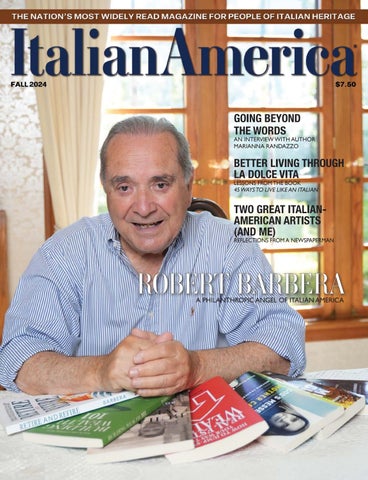
FALL 2024

Page 1


GOING BEYOND THE WORDS

AN INTERVIEW WITH AUTHOR MARIANNA RANDAZZO

BETTER LIVING THROUGH LA DOLCE VITA

LESSONS FROM THE BOOK 45 WAYS TO LIVE LIKE AN ITALIAN

TWO GREAT ITALIANAMERICAN ARTISTS (AND ME) REFLECTIONS FROM A NEWSPAPERMAN

ROBERT BARBERA

A PHILANTHROPIC ANGEL OF ITALIAN AMERICA

IN THIS ISSUE

BENVENUTI 4 BULLETIN BOARD 14 ANDIAMO! 18 MANGIA WITH MICHELE 22 ITALIAN LANGUAGE LESSONS FOR KIDS

26 SUNDAY LUNCH

28 LA DOLCE VITA UNIVERSITY

32 OSDIA NATION

36 ITALIAN AMERICANS YOU SHOULD KNOW

38 FROM THE PRESIDENT

39 SIF FOUNDATION

40 FIGHTING STEREOTYPES

41 THE PERFECT GIFT

42 PIACERE!

44 POSTCARDS FROM THE BOOT

Italian America®

The Official Publication of the Order Sons and Daughters of Italy in America®

Italian America magazine is a publication of the Order Sons and Daughters of Italy in America (OSDIA), the nation’s biggest and oldest organization for people of Italian heritage. To subscribe, see www.osdia.org or call (202) 547-2900.

ITALIAN AMERICA is published by the ORDER SONS AND DAUGHTERS OF ITALY IN AMERICA 219 E Street NE, Washington, DC 20002

Editor-in-Chief: Andrew Cotto

Writers: Fiorenza Castelli, Andrew Cotto, Frances R. Curcio, Raeleen D'Agostino Mautner, Brian D'Ambrosio, Michele Di Pietro, Robert Ferrito, Carla Gambescia, Bob Masullo, Michael G. Polo, Cassandra Santoro, Joseph "Sonny" Scafetta, Jr., Joe Sciame

Copy Editor: Christine Haden

Proofreader: Mark DeNunzio

Graphic Designer: Diane Vincent

To advertise: Contact EditorItalianAmerica@gmail.com (202) 547-2900

Photo: Mike Quain

Welcome to the Fall 2024 issue of Italian America magazine. It is late September as I write this, but we will be in the heart of October when these words of welcome arrive at your door, coinciding with Italian American Heritage Month in full swing. This month, with all of its celebrations, including Columbus Day, marks the recognition of what Italian Americans and Italians in America have done and continue to do for this great country of ours.

This same type of recognition is what we hope to represent each quarter within the pages of Italian America magazine. Let me tell you: This is not a difficult task with regard to content! There are so many inspiring stories about the accomplishments and contributions of Italian Americans, both contemporary and historic. I prefer to emphasize the contemporary and span generations of those still among us with stories that deserve to be told. In this issue, the cover is dedicated to Robert Barbera, the son of Sicilian immigrants, who was born in 1932 and made a fortune in business before deciding to direct his acumen and effort toward uplifting others, especially fellow Italian Americans. It’s such a great story, one that covers nearly a century, that we have to tell it in two parts. Part I, which portrays Mr. Barbera’s childhood to the dawn of his role as a cultural philanthropist, will be shared in this issue, while the remarkable work he has done, and continues to do as a vibrant man of 92 years, since the 1970s will be the focus of Part II of the interview in the Winter 2025 issue (I will note that Chris Vaccaro, the feature in this issue’s “Piacere,” strikes me as another Robert Barbera type in the making).

Ignoring the rich past of Italians in America would be impossible, and I am so happy to debut a new regular column: “Italian Americans You Should Know.” Writer and podcast host (the latter having the same name as our new column), Brian D’Ambrosio, has generously agreed to share excerpts and photos from his deep catalog that chronicles the accomplishments of Italians in America. I like to think of these men and women as the (often) “unsung heroes” of our people. I believe this will complement our “Italian Enclaves” feature which will, after a two-issue hiatus, return in Winter 2025. Always present are our three primary regular columns: “Mangia with Michele,” “La Dolce Vita University” and “Postcards from the Boot.” As is warranted, I want to thank Michele Di Pietro and Carla Gambescia for their invaluable contributions.

Finally, with our eyes toward Italy, we have an informative “Andiamo” from Cassandra Santoroour frequent contributor, Italian travel expert, and resident of Sorrento, of which she shares her local knowledge within these pages. We also have a new approach to language learning focused on children. We will regularly include our “Italian Children’s Lesson” along with “Pagina Italiana” and “Italian Language Lesson” - the latter two also being on hiatus here but will return in subsequent issues.

So, all that said, I wish each of you a wonderful Italian American Heritage Month and end of 2024. Please feel free to share your thoughts with me directly as I am eager for feedback and contact with our readers: editoritalianamerica@gmail.com.

Warm Regards,

In Memoriam: Congressman Bill Pascrell, Jr.

The Order Sons and Daughters of Italy in America mourns the loss of a remarkable leader and a proud Italian American, Congressman Bill Pascrell, Jr. His unwavering dedication to public service and profound contributions to our community have left an indelible mark on us all.

In recognition of his extraordinary commitment, the Sons of Italy Foundation had the honor of awarding Congressman Pascrell the 2023 Lifetime Achievement Award for Public Service at our spring NELA Gala. Reflecting on his impact, Sons of Italy Foundation President Joseph Sciame shared, “Congressman Bill Pascrell, Jr. was one of the most committed members of the Congressional Caucus, giving himself freely to good causes. As a proud Italian American, we knew him well and at our May 2023 NELA Gala in DC, we presented him with our coveted Lifetime Achievement Award. All he exuded that night was pride and thankfulness that he had served and contributed in such a special way to our society. Truly, we have lost a staunch supporter.”

Congressman Pascrell’s lifelong passion for preserving our heritage shone brightly through his efforts to support the screening of the film “Potentially Dangerous: When It Was a Crime to Be Italian” in November 2023. This event, co-hosted by the Italian American Con-

gressional Delegation and the Order Sons and Daughters of Italy in America, served as a powerful reminder of our collective responsibility to keep alive the stories of persecution faced by Italian Americans during World War II, ensuring that these critical moments in history are never forgotten.

In recalling his meetings with Congressman Pascrell, Michael G. Polo, National President of the Order Sons and Daughters of Italy in America (OSDIA), commented: “Over the years, it was Congressman Pascrell who encouraged and joined in meetings at Capitol Hill, and in October 2019, he and some eighteen Congressional Representatives gathered for an historic joint meeting to hear of the accomplishments and concerns of the Order Sons and Daughters of Italy in America, the Commission for Social Justice and the Sons of Italy Foundation from its leadership. He favored the OSDIA with its grassroots approach to membership and felt proud of his working relationship with its leadership.”

We extend our deepest condolences to his family, friends, and all who were touched by his life and legacy. Congressman Pascrell’s dedication to our community will forever inspire us to continue his work in preserving and promoting our shared heritage.

OSDIA and SIF Partner with CiborTV to Bring Italian Television to Members

In August 2024, during the OSDIA Summer Plenary in Saint Louis, the Order Sons and Daughters of Italy in America (OSDIA) and the Sons of Italy Foundation (SIF) announced an exciting new partnership with CiborTV, bringing quality Italian television channels directly to OSDIA members.

As part of this collaboration, OSDIA members can now purchase CiborTV set-top decoders for just $29.99 plus shipping—an exclusive offer that represents a savings of over 70%. The price also includes a one-month subscription to CiborTV. Additionally, all OSDIA members will enjoy a 5% discount on future subscription costs. To access this benefit, visit www.cibortv.com and use the coupon code OSDIA29. For renewing customers, the code RENEW5 can be used to apply the subscription discount.

Sons of Italy Foundation
President Joe Sciame with Congressman Bill Pascrell, Jr. at the 2023 NELA Gala in Washington D.C.
Congressman Bill Pascrell, Jr. in conversation with OSDIA National President Michael G. Polo.

In Memoriam: Actor, Director, Writer, Activist, Humanitarian Tony Lo Bianco

Editors’s Note: The following tribute was delivered at a private memorial service for Tony Lo Bianco in June of 2024 by Michael G. Polo, National President of the Order Sons and Daughters of Italy in America.

Thank you, Alyse and the Lo Bianco family, for asking me to say a few words celebrating the life of Tony Lo Bianco.

I’m Michael Polo, the National President of the Order Sons & Daughters of Italy in America. We’re the oldest and largest fraternal Italian American organization in America started right here on Grand Street, New York City in 1905.

We will hear many wonderful and praiseful accolades this day about our friend Tony Lo Bianco.

Exceptionally gifted actor. Driven activist, a vigorous philanthropist. An unparalleled champion of his proud Italian heritage. Patriot par excellence, devoted husband, father, and friend.

All earnest, truthful, well-deserved. Few people truly know, however, of Tony’s indispensable role helping to forge the public image and outreach of the organization I represent, and its philanthropic body, the Sons of Italy Foundation.

Early on, in 1995, I was a Connecticut local lodge president and my father, Paul Polo, was then our National President. Tony graciously and generously offered his allencompassing help to us in our efforts to reach a broader public audience.

As many of us know, Tony was extremely well known, well liked, admired and respected by so many, especially in the entertainment and public communications fields.

His contribution to OSDIA and our Sons of Italy Foundation was immeasurable: For nearly 30 years, he worked tirelessly, applying his formidable talents, accessing his enormous list of personal friends and associates - people like Frank Sinatra, Tony Bennett, Connie Stevens, Vic Damone and Regis Philbin, to name a few.

With his far-reaching influence, Tony brought the purpose and work of our organization to their attention. With his characteristic passion for noble causes he admired and absorbed, Tony persuaded these marvelous folks to join our cause.

Together, we pursued dreams and miracles, big and small: scholarships for young Italian Americans, cures for previously incurable diseases, support for patriotic and law enforcement organizations, assistance for global emergency crises. We raised many, many millions of dollars together, and our world is better for having Tony in it.

Tony’s contribution to this crusade was categorically unrivaled and vital to this cause. He will always be remembered as an undaunted warrior in the quest to make things better for Italian Americans and all our important causes.

Tony & Alise, I personally want to thank you for your year after year attendance at our annual National Education & Leadership Awards Gala in Washington D.C., Tony is a past honoree.

This year was the first Gala that Tony’s couldn’t join us at our table, so on May 23rd, the day of the gala, dad and I visited Tony at the hospital. We shared wonderful stories, and if Alyse was within a hand holding distance, Tony was happy. Before leaving Tony’s bedside, we all held hands and prayed together.

With this wonderful memory in mind, I ask that everyone please close our eyes and imagine our fondest memories with Tony for a moment of silence in Tony’s honor.

Thank you, God bless Tony and all who are here to celebrate his life here today.

Tony Lo Bianco accepting his Lifetime Achievement Award at the 2023 NELA Gala in Washington D.C.

A Tribute to Len Riggio

Len Riggio (1941 - 2024), one of the most important Italian Americans of all time, who built Barnes & Noble into the community based, bookselling force will never be forgotten. For over 50 years, Len, with his wife Louise by his side, re-created the way books are sold and put in the hands of readers. His idea, born of his loving Italian American family, was constantly changing to adapt the industry to the needs of the reader. Whether it was programming, or the development of the NOOK for digital readers, Len was always ahead of the curve. A brilliant businessman, loving husband, father and grandpop, Len brought people together. His Italian (Neapolitan and Sicilian) roots were his treasure.

There aren't enough words to describe my friend. He knew the path of publication, marketing and sales for an Italian American writer in an industry that had not welcomed us would take some ingenuity. Len was there for our community of writers and did all he could to change perceptions and outdated tropes of who we are and how we write. He was a history buff and knew literature like the best professor in the most rigorous university or college program.

Len's philanthropy went deep — there were many causes that he supported, artists he nurtured and world views he embraced. He was one in a jillion, if that's even a number! He made the world a better place for writers, readers and students. A beautiful son of magnificent parents, two wonderful brothers — an Italian American story unlike no other.

A Tribute to Joe & Bev Cornell: “Italian Angels Among Us”

Joe & his wife, Bev, worked together for decades to help their community. Their motto was “Making a difference for Grays Harbor Kids.” When Bev passed, Joe joined the Amerigo Vespucci Lodge #1814 in Aberdeen, WA. Joe continued to execute their legacy for the kids in the community.

If you are an elementary student in need and live in the greater Grays Harbor, Washington, area you undoubtedly have been a recipient of your “Angel on Earth,” Mr. Joe Cornell. Students at Wishkah are incredibly lucky to have Joe working for the greater community to get donations of not just money but also school supplies, coats, backpacks as well as toys for other lucky kids. The dollars collected

Joe Cornell with some of his donations.

were used to get bulk discounts and other items needed for the kids.

Joe & Bev were able to give Christmas presents to over 2,600 children annually. Also, they donated 1,000 pairs of socks, 3,600 packs of crayons, 3,500 pencils, 90 coats, and 150 other articles of clothing. For Thanksgiving, they provided food necessary for the Union Gospel Mission dinner to provide 10 full family dinners complete with sparkling cider.

Joe & Bev both have passed, but they epitomized what the Order Sons & Daughters of Italy stand for: To promote charity & culture within the community. Grazie for your leadership. Heaven has sure gained two beautiful angels!

Mr.
From left to right: Gay Talese, Len Riggio, Adriana Trigiani, Lorenzo Carcaterra.

Makes a great gift for Italian Americans who matter in your life!

Calendar opens up to 11x17! 1 1/2” x 1 3/8” white blocks allow you to write down what you are doing each day!

Larger numbers for dates make them easier to read from a distance!

Keep it as a family heirloom!

Big discounts for purchases of two or more calendars!

A notable Italian American or Italian appears on each of the 365 days of this year!

An educational tool for you, your children, and grandchildren!

Makes great Christmas & birthday gifts for family and friends!

Makes excellent door prizes for your lodge!

Every stamp collector should have this calendar!

Everyone needs a calendar! Right? Make it this one!

To ensure a sellout again, only 1,492 calendars will be printed!

Hurry! Order yours now!

Sorry! We do not accept credit or debit cards!

Captions under stamps discuss 8 notable Italian Americans and 4 Italians!

Includes 65 holidays and observances!

Got a lodge? Order in bulk at our discounts! Sell to your members at our regular prices as a fundraiser! Call us!

Got a business? Calendars are tax-deductable office supplies. Buy one for each employee now!

Back cover has an important message for our purchasers!

If you need more for your business or lodge at further discounts, call us at 1-703-533-8064 or email us at columbiapress@verizon.net

ORDERS SHIPPED WITHIN 3 DAYS OF RECEIPT!

Name: ____________________________________________

City: ____________________

Quantity Desired: # _______

Make check or M.O. payable to:

Our Code: OSDIA

State: _____ Zip: _________

Total: $_________________

Columbia Press Co. 7011 Round Tree Road Falls Church, VA 22042-3912

ROBERT BARBERA: A PHILANTHROPIC ANGEL OF ITALIAN AMERICA

Robert Barbera is an Italian-American success story. Born in 1932 in New York City to Sicilian immigrants, Mr. Barbera has had a remarkable career in business and personal finance, making his first stock investment in 1954, only four years out of high school. He bought his first building in 1961, and has since acquired over 500 units and multiple subsidiary companies. Mr. Barbera is also the author of four books: Building Wealth: From Shoeshine Boy to Real Estate Magnate; Building Wealth 101;  Retire and Refire and  How to Jump-Start Your Way to Real Estate Wealth. Among his many contributions to society is his four+ decades as a philanthropist, donating his time, talents, and personal wealth to organizations dedicated to promoting Italian culture and tradition. Italian America magazine was honored to talk at length with Mr. Barbera about his life and life’s work as a proud Italian American.

You’re a first generation Italian American. Please tell us about your family’s background.

My mom and dad were both born in Sicily. My dad was born in 1896, and by the time he was 10 years old, the economy was so devastated that his family left for New York. My mom came in 1921, after World War I. They met in the garment industry, where they both worked virtually their entire lives. Dad started by sweeping the floors at 12 years old, and over the years, he became so good at the craft of pattern making, designing and making of clothes that he was very much in demand. My mom was great as a seamstress, and she sewed purses and hats. They thrived together. When they first got married, they decided to have a factory of their own. And then the Depression hit, and they lost the factory, but years later, they gathered up more money and started a factory again. Unfortunately, dad was not a very good businessman. He was an artist. So, he was defrauded from some individual that broke him, and that kind of made family life extremely difficult in the early 40s through the 50s, but nonetheless, my older brother, Henry, and I very much appreciated our parents and where they came from.

Mom was such a diehard Italian that everything - the cooking, the clothing, the holidays - came together as though we were in Italy and not there in Queens, where we eventually settled, or Brooklyn, where we lived when I was very young. I enjoyed the culture, but I didn’t know that we were particularly different from our neighbors, and we certainly were. And so during World War II, we were maligned quite a bit,

Robert, Queens 1941.

because of the side that Mussolini had selected, which was our early embarrassment, and we had to go through that. But Mom and Dad, and later my brother, they helped me in every way. They brought me up. They kept my clothes clean. They always preached to me to get an education, to be very moral and honest. And so those things were built into me, and I so much appreciated how they cared enough to make me a good citizen.

Dad was so proud of being an American that he was a soldier in World War I. He served in combat and came within two inches of being killed. He really loved the American spirit and what we could have here in the United States. Both of my parents were very loyal Italian Americans. It was kind of complicated for me to get into their minds, to understand how one can love two countries at the same time. It’s like having two children, and who do you love the best? And so they had to love both countries, and yet they also had to support them. In fact, my mom, after World War II, went back to Sicily to visit our family. She had money, and she brought them clothes and helped feed them and pushed them along. My mom was such a pusher that she pushed three sisters to be nuns and one brother to be a priest. She had a very strong religious bent. They were very moral people, and so they understood right from wrong, passed that on to us, and watched over us. We always lived in a sense of poverty, just in the way that everything saved was important. To preserve and put money aside was very important, and it built a lot of economic values into my mind, which I then carried out later in my own life.

You mentioned a brother?

Yes. Henry. The family was opera lovers, and so my mother named her first son after Enrico Caruso. Henry was two and a half years older than me, and he was always taller and smarter and faster. I had a big brother who took care of me in so many ways. If there was a fight, and I mean a fight, he would help me. And if there was trouble in the neighborhood, I could always count on Henry. He taught me how to swim, and

he taught me how to dance. He was very gracious about it. Henry was also a smart guy. He eventually earned a Ph.D. and spent his career as an academic. He passed away from lung cancer, but the memory is there, and I really appreciate having a good family. I really do. I know how important it is to becoming a good person.

You were born in Brooklyn and moved to Queens, correct?

Yes, by the time I was one year old, we moved to Queens. Dad was doing very well in the garment business in 1932, after the Depression, that he was able to move out of the so-called “ghetto.” That’s not a nice way to put it, but every street that we were on in Brooklyn was Italian. The conversation was Italian. Mom wanted to assimilate, so we moved to a very nice house in a very nice community of St. Albans, Queens. We were the only Italians in the whole neighborhood, so we were kind of looked at a little bit differently.

In what ways were you treated differently?

We were ostracized. It was very difficult. Neighbors didn’t invite us to neighborhood parties. We were pretty much on our own, and mom still had an Italian accent, and it kind of positioned her apart from the

Valley Stream, NY, with Henry (left) and Mom.
Robert speaking at Thomas Aquinas College in southern California.

community and many of the people that she had to work with. And it also gave the impression that she wasn’t so smart, though the joke of the matter was that she was extremely smart. She proved that later on in business. So, we’re in a neighborhood being the only Italians, and as far as I know, the only Italian Americans in our grade school. And I really felt that the teachers and others just looked at us as second-class citizens, and that’s something that always bothered me. I could see how those teachers and others were so nice to other kids, and I didn’t get the same feeling or the same respect or dignity that the other kids received.

One story I like to tell people is that Mom used to pack me a sandwich with Italian bread and eggplant. I’d see the other kids eating peanut butter and jelly, and it was embarrassing to see that they thought my food was ugly. Many times I hid my food, or I would go outside in the backyard and eat my lunch because people would look at me and make a terrible face. So, I learned to live a part within the group to protect my well being, and my brother had had the same thing. In fact, my brother preceded me, and the teachers would often refer to, “Oh, that kid. He’s the brother of Henry.” I couldn’t understand why they would do that. You could just feel the negative vibes in their voices, and it was disheartening. So, it was a bit of a challenge, but at the end of the day, I have to thank them. They made me stronger. They made me smarter. They

gave me reason to be insightful, to double see everything and understand everything.

What was the dominant ethnicity in the neighborhood at the time?

It was actually very mixed with Irish, German, and Polish. This was obvious by the commerce, especially with regard to food. There were plenty of shops selling Irish, German, and Polish food, respectively, but we used to get in the car and drive for about 20 minutes to an Italian neighborhood in another part of Queens to find the food that we liked. The stores by us were not going to carry salami, and they were not going to carry ravioli. They were not going to carry Italian bread. So, every Saturday morning, Henry and I would hop in Dad’s Studebaker and drive with him to a neighborhood to find the food that my parents wanted.

As you developed in your life, at what point did you begin recognize the idea of your being from an Italian background?

It was always somewhat there in the way we spent our holidays, the kind of food we ate, the kinds of things that interested my parents. My mom used to play the mandolin and sing Sicilian folk songs. Sometimes my parents would take me to an Italian opera in Brooklyn. Also, with the last name Barbera, having a vowel at the end, everyone seemed to understand that I must be Italian. My mom always taught me, if it’s Italian, it must be good. And so when you have your visits, your holidays, your weddings and your ceremonies, always Italian, you never really think anything other than that you must be Italian.

At what point did you start to recognize a negative perception associated with being Italian?

In our home, the worst thing my mom would talk about was the mafia. Her dad was killed by the mafia in Sicily. He was an honest man, and they stole his money and threw him down a well and killed him. So, any mention of the mafia would make her crazy. That very term and any association with the mafia was hated in our house.

1959 Cal State LA graduation.

What happened to me later on, when I was in my teens and these “popular movies” were coming out, The Godfather and so forth, people would just swoon, but my brother and I just hated to no end that defamation of

Robert with his children, John and Ann.

being an Italian and, therefore, being associated the mafia. When I saw the horrible portrayal of Italians as gangsters in films, I had to ask: “How could this possibly be? How could movie after movie portray Italians in this manner? Aren’t there other crooks in the world?”

There was a way of marginalizing that I could not accept. That all gangsters were Italians and all Italians were gangsters. It made no sense, and I had to work my mind out to understand that we were just normal people with a different culture. At one point, I actually thought that if you were Italian, you wouldn’t go to college. I thought that if you were Italian, you couldn’t be a lawyer or a CPA and so forth. I went through that over the years, and I forced my mind and my mentality to work around this stereotype. It was a conflict of trying to assert myself for my self-interest, to recognize the fact that I’m just like everybody else, and in fact, I can be better and do better. You’ve had tremendous success in business. At what point did you decide to get involved in the positive promotion of Italian America heritage via philanthropy?

In the early 80s, I was teaching Christian doctrine at Holy Family Church in South Pasadena. At that time, there was an organization, the Italian Catholic Federation, that was one of the sources doing goodwill for the church. After services, I attended an event where they were selling donuts and coffee. I started talking to people about what they were

doing and how they were doing it. I became interested in how I could participate in the program. I happened to also notice that the people were very friendly and cordial, and that they just accepted me as a normal person. Back then, the Irish pretty much controlled Catholicism. We wouldn’t have Catholicism like we do in the United States had it not been for the Irish, and, at the end of the day, we must appreciate what they have done, but I didn’t appreciate the double standards in place.

I could see that when someone Irish came to the church, they welcomed the new member and gave them friendship and courtesy and stuff like that. I thought that was very nice, but they didn’t treat me like that. Here I am a volunteer at the church school, and I didn’t get the same type of courtesy and warmth. But with the Italian Catholic Federation, I had cordiality and friendship and openness. So, with this Italian Catholic Federation, I found that opening and immediately fell in love with the people. That was when I decided to really dedicate my life to supporting organizations that promote Italian culture and traditions.

Editor’s Note: Our conversation with Robert Barbera, dedicated to his many decades of philanthropy, will continue in the next issue of Italian America magazine.

Robert's father, 1930s.

ANDIAMO!

Let's Go to the Sorrento Peninsula!

The city of Sorrento is renowned for its central and dramatic cliff-side location, making it a beautiful base for exploring the Amalfi Coast, Pompeii, the Island of Capri, and Naples. The city center has vibrant local shops, restaurants, bars, and even picturesque lemon groves. Its popularity has grown in recent years, attracting numerous tourists eager to discover this enchanting area. The local cuisine, featuring fresh seafood, pasta, and the famous Limoncello, is a must-try for any food enthusiast.

While many visitors based in the Sorrento center often head towards the Amalfi Coast and nearby islands, the Sorrento Peninsula is its own destination, offering a stunning coastline rich in history, outdoor activities, dramatic beaches with panoramic views, and charming villages waiting for you to explore.

Before diving into other details, let’s start with Sorrento center, the most popular destination in the area. You can reach Sorrento within a 45-minute public ferry ride, a one-hour drive, or a 1-1/2 hour train from Naples. From here, you can catch a ferry and be on the island of Capri in just 30 minutes, or in Positano in 30-50 minutes by car or boat.

Sorrento is an ideal destination for families, primarily because it offers a relatively flat landscape compared to nearby villages of the Amalfi Coast, where navigating numerous steps is a common challenge. Sorrento provides land and sea activities for all ages, including child-friendly beaches, water sports and local traditions, such as opera and traditional tarantella dancing. It also caters to a wide range of budgets, thanks to its various transportation options and wide range of accommodations conveniently located within the town. Recently, a wave of young entrepreneurs has opened trendy artisan shops and delicious food hubs, adding a fresh and vibrant touch to the area.

If you’re staying in the area, I recommend venturing either east or west along the peninsula to truly appreciate and explore more of the area's hidden gems.

You can visit Vico Equense, 30 minutes from Sorrento center, by train or car. This town is famous for inventing the coast’s unique pizza, pizza al Metro. Said to have been created in 1930 by Luigi (Gigino) Dell’Amura, pizza al Metro allows a group to share a single, customizable pizza up to 2 meters long, with different sections tailored to individual tastes. The dough for this pizza rises for 6-8 hours, which is shorter than the 12-hour rise time typical of traditional Neapolitan pizzas. You can taste this traditional pizza in locations such as Università della Pizza | Pizza a Metro da Gigino.

Baia di Ieranto.
The Sorrento Peninsula.

Post pizza, be sure to check out the 14th century Church of SS. Annunziata, where you can take in breathtaking panoramic views of the Gulf of Naples. Alternatively, venture to the nearby charming town of Seiano, famous for its quintessential Italian alleyways and a picturesque port lined with local restaurants, ideal for enjoying during the summer months.

For pasta enthusiasts, a visit to the town of Gragnano is also a must. Nestled along the Monti Lattari mountains, Gragnano has been renowned for inventing and producing dried pasta since the 1400s. Today, you can still explore traditional artisanal pasta factories. Pastificio Gentile is an example of a location where the rich culinary heritage continues.

Heading west, you will encounter the area of Massa Lubrense, home to 18 picturesque hamlets along the Gulf of Naples. These hamlets offer serene seaside hikes and a charming mountain villages full of farm-to-table restaurants and authentic Italian life.

For trekking enthusiasts, two of the most popular seaside spots are the Sentiero Baia di Ieranto and the Area Naturale Marina Protetta Punta Campanella, where some say the remains of the Temple of Athena are located. Along the coastline, you'll find numerous trails that lead to hidden beaches, ancient Roman-era fishing villages, and perfect spots for snorkeling and kayaking, providing an ideal mix of adventure and natural beauty.

Indulge in the diverse local cuisine of the Sorrento Peninsula, including the well-known Delizia al Limone or home-made Limoncello produced with local lemons, and Spaghetti alla Nerano, which was invented in the village of Marina del Cantone.

One of the lesser-known local specialties is Gambero Rosso di Nassa di Crapolla, a red prawn caught using an ancient fishing technique still practiced by only one fisherman with 40 years of experience! You can taste this unique seafood specialty at the Slow Food Presidium restaurant Lo Stuzzichino in Sant’Agata sui Due Golfi.

Consider taking a tour or enjoying a meal at a typical agriturismo (farmhouse), where you can find local walnut trees, Protected Designation of Origin (PDO) olive oil, and the renowned Provolone del Monaco DOP. Suppose you are visiting during the August Ferragosto holiday. In that case, you can even find a festival serving melanzane al cioccolato (chocolate eggplant), a traditional dish served on August 15th for the Feast of the Assumption of Mary.

The best time to visit the Sorrento Peninsula depends on your travel style. If you enjoy boating, beaches, sagre (food festivals), and don’t mind hot weather, then July and August are ideal. If you prefer cooler weather but enjoy outdoor activities like hiking and kayaking, consider visiting in May, September, or October. You can still find beautiful activities and restaurants during other times of the year. However, it’s important to note that some offerings may not be available as a summer seaside destination. For December travelers, while beach activities will be closed and the weather is cool, you can still enjoy the festive holiday lights and celebrations such as the live presepe (nativity scene).

When you’re ready to explore the area, remember that the Sorrento Peninsula offers a wealth of experiences beyond just one city, and it’s a unique journey distinct from the Amalfi Coast! Our team is here to assist you in planning a custom trip or providing suggestions for your self-guided exploration. Don’t hesitate to reach out to us at www.travelitalianstyle.com

Cassandra Lena Santoro, a New York-born Italian-American dual citizen, personal trip planning and the CEO and Founder of Travel Italian Style (established 2014). Based in Sorrento, she has traveled through all 20 regions of Italy and is always eager to discover the next must-visit destination or unique experience across the country. Her work and her company have gained international recognition in numerous publications. Beyond her travel expertise, Cassandra is also a speaker, notably delivering a talk at TEDx DHBW Mannheim in Germany. Follow her journey as an Italian entrepreneur on Instagram and Facebook (@travelitalianstyle).

Marina Grande, the ancient fishing village in Sorrento.

AN INTERVIEW WITH MARIANNA RANDAZZO

Author Marianna Randazzo reflects on the 2023 publication of the 10 th Anniversary Edition of Given Away, A Sicilian Upbringing.

Is the 10th Anniversary Edition of Given Away, A Sicilian Upbringing a rewrite of the first edition, or did you add to it?

Given Away, A Sicilian Upbringing was initially written in 2013. At the time, the two sisters, Lena and Tina, were still alive, and each shared her unique story with me. My mother Lena’s story was told to me over a lifetime of mother-daughter conversations; my aunt Tina shared her story through in-person interviews and over the phone for two years. She lived in Florida, and I lived in New York. Over the last few years, since their passing, new information has unfolded, and I felt compelled to include it in the new book.

What was the purpose of writing this book?

Because I love to write, I eagerly embraced the opportunity to pen my first book, a deeply personal account of my family. Tina, who had endured so many traumatic experiences, had often expressed her desire for her story to be told. It was a story she could not write herself, and I knew that for her, the book would be a cathartic journey, a way to process and heal from the emotional wounds of her past. As for my mother, she was not fully aware of Tina’s story, and for her, it was as shocking and unbelievable as it was for other members of the family. My role as the author was to listen, to empathize, and to translate their stories into

a narrative that would resonate with readers, while staying true to their experiences and emotions.

My personal motive was also to ensure that our personal history was recorded for future generations and to provide a detailed account of the historical impact of what our ancestors went through in Sicily during a tumultuous time. This history is often difficult to comprehend for someone growing up in America without the fears and hardships these young girls had to endure. Through this book, I hope to shed light on a part of history that is often overlooked and to offer a deeper understanding of our cultural heritage.

What do you hope readers will get out of reading your book?

Through this story, I hope to humanize history and offer cultural context to what it was like to live in Sicily during

the war. I also want to share Tina and Lena’s unique stories of resilience and survival, predicated by the love of family. I also want to entertain readers with an interesting narrative.

Have you visited the settings of your story?

Yes, as a child, my family visited the island of Sicily several times. Recently, my cousin Lisa and I had the wonderful opportunity to visit and stay in the house where the family was raised. After writing the book, every inch of the abode came alive despite the many changes over the last 80 years. I also visited the home in Vittoria, where Tina spent her childhood. Sadly, it was as dismal and deteriorated as she described it as a child.

How did you balance writing with your personal life and responsibilities?

As a retired teacher, reading and writing have always been a source of joy for me. While reading, I am constantly inspired, thinking about what I could write; when writing, I am driven by the desire to educate, entertain, or amuse people with my stories. Balancing writ-

Author Marianna Randazzo.

ing with my personal life and Nonna responsibilities has been a challenge, but one that I have embraced with enthusiasm and dedication.

How did you develop your writing style? Did any books you read influence your writing style?

Everything I’ve read since my days at the New Utrecht Public Library in Brooklyn, including MAD magazine, has influenced my writing. However, over the years, I have attended writer’s workshops and retreats, taken writing classes, and taught them.

Do you have any plans for writing another book?

I am always planning my next book or article. I recently published Haunted Staten Island. It is a book about the paranormal, urban legends, and myths surrounding the intriguing island. It differs from the other genres I have embraced, but as a writer, very

few topics are off the table for me. If I could learn about it, I could write about it!

What other books or publications have you written, and what awards have you been given?

Lontana da Casa; Italians of Brooklyn ; Father Vincent R. Capodanno: Navy Chaplain; and Brooklyn’s Best: The Michael Behette Story. I have also published hundreds of articles about education and parenting in various magazines. Given Away was awarded The Sons and Daughters of Italy Literary Award and the Morgagni Silver Medal Award. I have also received the Garibaldi-Meucci Museum Recognition Award. Several cultural institutions have acknowledged my dedication and commitment to preserving and sharing Italian-American heritage, including State Sen. Andrew Lanza, Borough President Vito Fossella,

Richmond County District Attorney Michael McMahon, City Councilman David Carr, and former Assemblyman Michael Cusick.

I am a board member of the Order Sons & Daughters of Italy, Father Capodanno Lodge #212, and a past Director of Education and board member of the Garibaldi-Meucci Museum and Enrico Caruso Museum of America. These roles have allowed me to contribute to the preservation and promotion of Italian-American heritage, a cause that is close to my heart. I believe that by understanding and appreciating our cultural heritage, we can better understand ourselves and our place in the world.

For more information, Marianna Randazzo can be reached at Marianna-Randazzo.com. The interview was conducted and prepared by Frances R. Curcio, PhD (FRCurcio@aol.com), author of Mio Nonno Totore and the American Dream (Idea Press, 2024).

MANGIA with MICHELE!

I love autumm: crisp, fresh air…warm, orange-colored leaves…back-to-school musings and memories…cozy sweaters…and, most importantly, the fall harvest!

The transition from summer veggies and simple, light recipes to heartier ingredients and dishes is not as gradual as it used to be. Seems like we are inundated with pumpkin spice the second Labor Day is over these days. But I like to hold out for an Indian summer. So, October is when things really start to change for me in the kitchen.

And cooking with more mushrooms is a big part of that!

Even though the cultivated mushrooms that make it into our kitchens are available and grown year-round, I correlate the typical autumn wild mushroom season with all mushrooms. So, to me, it makes sense that lots of fall dishes would highlight the friendly fungi!

I’ve shared three of my favorite mushroom recipes to inspire you to bring some fall flavors into your cooking: an antipasto favorite that you’ll surely be familiar with, Marinated Mushrooms; my favorite Thanksgiving side dish, Roasted Mushrooms, Fennel and Sausage, and a hearty Pasta alla Boscaiola that will have you coming back for more. Mangia bene!

You can find Michele's cookbook SOUPified! on Amazon! You can find Michele’s recipes at www.mangiawithmichele.com

MARINATED MUSHROOMS

ROASTED MUSHROOMS, FENNEL AND SAUSAGE

PASTA ALLA BOSCAIOLA

Roasted Mushrooms, Fennel and Sausage

Serves 6

Sausage in a side dish? Heck yeah!

I’ve been making this recipe as a side for Thanksgiving for years. My mom used to make a more simple version of it on the stovetop, with sliced sausage and mushrooms only. This version, which was inspired by hers, has a tad more flavor complexity with the addition of anise-flavored fennel and lots of fragrant mixed herbs.

Italian sausage and mushrooms are a marriage made in heaven, if you ask me, and this recipe is a great example of that. And fennel, which has been a staple in Italian cuisine for centuries, complements the mushrooms and sausage beautifully.

Trust me when I say that this is the Italianinspired Thanksgiving side dish that you didn’t know was missing from your holiday menu. It’s abundant with incredible flavors and textures and, best of all, it can be cooked easily on one sheet pan, which is exactly what we are looking for at busy holiday time. Mangiamo!

YOU'll NEED:

2 pounds mushrooms, halved or quartered depending on size

1 pound Italian sausage, casings removed, in bite-sized chunks

1 large fennel bulb, cored and thinly sliced

10 garlic cloves, smashed with the back of a knife

3 to 4 Tbsp olive oil

½ cup chopped mixed fresh herbs, such as sage, marjoram, thyme, flat-leaf parsley and/or rosemary

Salt and black pepper to taste

DIRECTIONS:

1. Preheat oven to 400˚F and arrange a rack in the center of the oven.

2. Wipe the mushrooms clean with a dry paper towel. Unless the mushrooms are very small, cut then down into small, bite-sized pieces of approximately the same size.

3. Combine the mushrooms, sausage, fennel, garlic and half the herbs in a large bowl and toss them with the oil. Then, arrange them in a singlelayer on a large parchment-lined, rimmed sheet pan (or two sheet pans). Do not salt the vegetables until after they’re roasted since salt tends to bring out liquid in vegetables, and salting prior to cooking could cause vegetables to steam rather than brown.

4. Roast uncovered for about 30-35 minutes, or until all items are tender and slightly caramelized. Rotate the sheet pan once about halfway through the cooking process.

5. Sprinkle the roasted vegetables with salt and black pepper, then toss them with the remaining fresh herbs until. Serve immediately.

Michele Di Pietro is an entrepreneur, chef, cookbook author, blogger, culinary consultant, food writer, and creator of Mangia With Michele, the expression of her lifelong passion for Italian ingredients, foods, recipes, culture, and traditions. Throughout her busy professional culinary life, Michele has also always been an avid home cook with strong ties to her Italian roots. She is most happy and satisfied when cooking for, and breaking bread with, family and friends. It is these ties and sentiments, along with her passion for sharing both food and travel experiences with others, that led her to create Mangia With Michele. In 2020, Michele released her first cookbook: SOUPified: Soups Inspired by Your Favorite Dishes , a whimsical collection of soup recipes inspired by familiar entrees. Find our food editor at www.MangiaWithMichele.com and follow her at @mangiawithmichele on social channels. www.instagram.com/MangiaWithMichele www.facebook.com/MangiaWithMichele

Pasta alla Boscaiola with Mushrooms and Sausage

Serves 6

Although fresh porcini mushrooms are almost non-existent here in the US, I was fortunate to enjoy A LOT of them many years ago when I took a sabbatical from my intense job and headed to Rome. For 10 weeks one autumn, I immersed myself in the Eternal City, studying Italian, becoming intimate with the city, making local friends and cooking and eating until my heart’s content. As it was porcini mushroom season across the country, Rome’s outdoor markets were in abbondanza with porcini large and small. And I snatched them up and cooked them every chance I got.

This Pasta alla Boscaiola is a nostalgic nod to that amazing experience all those years ago. Here, I feature a rich blend of both fresh cultivated and dried porcini mushrooms in a quickly-simmered, tomato-based sauce with hearty Italian sausage, red wine, fresh herbs and Parmigiano cheese. It’s a delightfully earthy and comforting dish that’s abundant with interesting texture and delicious, intense flavor. Plus, it’s quite simple and relatively quick to make, but has the essence of a slowly-cooked sugo. Buon appetito!

YOU'll NEED:

1 ounce dried porcini mushrooms + 1 cup water

1 pound Italian sausage, casings removed

2 Tbsp olive oil

1/3 cup chopped herbs (parsley, thyme, rosemary or sage or combo), divided

2 Tbsp chopped garlic

Pinch crushed red pepper

1 pound cremini, white or portobello mushrooms, cleaned and quartered or sliced

½ tsp salt

¼ tsp ground black pepper

½ cup dry red wine

1 (14-ounce) can chopped or whole tomatoes, hand-crushed

1 pound rigatoni or other pasta + salt for pasta water

2 Tbsp butter

1/3 cup grated Parmigiano-Reggiano cheese

DIRECTIONS:

1. Rehydrate dried porcini mushrooms: Bring 1 cup water to a light boil in small saucepan, then turn off heat, add dried mushrooms and let them sit in heated water for about 20 minutes or until they’ve softened. Make sure that they’re submerged in water. Once mushrooms have softened, lift them out of the water with a slotted spoon, coarsely chop them, then set them aside. Then, strain the remaining liquid in which the mushrooms soaked through a coffee filter, paper towel or cheesecloth. Set aside this strained liquid for later in the cooking process.

2. Bring a large pot of water to a boil.

3. In large skillet over medium-high heat, add sausage and olive oil and brown sausage, using a wooden spoon to break it into bite-sized pieces. Once the sausage has browned, remove it from the pan and set it aside.

4. Reduce heat to medium, then add half the chopped herbs, the garlic and crushed red pepper to the pan and cook for a few minute to allow the garlic to soften and brown lightly. Take care not to burn the garlic!

5. Then, add all mushrooms (including reserved porcini), salt and pepper to pan and scrape up any brown bits. Spread the mushrooms out and let the mushrooms cook until almost all liquid that they release has evaporated, stirring occasionally.

6. Pour wine and reserved, strained mushroom soaking liquid in pan and use a wooden spoon to scrape up any brown bits. Increase heat to mediumhigh and simmer for 2 minutes.

7. Add tomatoes and reserved sausage to pan and simmer about 8 minutes, then reduce the heat to low while waiting for pasta to finish. At the same time, add salt, then pasta, to the boiling water, stirring frequently.

8. Cook pasta for 2 minutes less than the package directions, or about 2 minutes before you think it is al dente. Be sure to reserve at least 1 cup of the starchy pasta water.

9. Transfer cooked pasta to the pan, increase heat to medium and toss well. Allow pasta to finish cooking in the wonderful flavors of the sauce. Add pasta water for additional moisture as needed, about ½ cup at a time.

10. Once pasta is al dente, remove pan from the heat. Then gently stir in butter, parmesan cheese and remaining chopped herbs until well-combined. Serve immediately.

Marinated Mushrooms

Serves 8

If you’re like me and love mushrooms in all forms, then this recipe is for you. It’s reminiscent of the marinated mushrooms my dear mom used to make and that you generally find in an Italian deli or specialty shop, but with a definitive kick of heat added! Tender mushrooms are immersed in a heated, savory bath of vinegar, water and salt along with chili peppers, shallots, garlic and thyme, then left to “marinate” in the refrigerator for a bit before they are doused with your best extra-virgin olive oil. So delicious and easy to prep. Make them in advance for your next antipasto platter, charcuterie board or salad to feed a large crowd or just you alone with a spoon. Che buoni!

YOU'LL NEED:

3 cups water

1¼ cups white vinegar

1 Tbsp salt

2 pounds white mushrooms

3-5 chilis, such as serrano, jalapeño or cherry peppers, stemmed and sliced thinly (optional)

¾ cup chopped shallots

8-10 sprigs thyme

8 cloves garlic, smashed with the back of a knife

½-¾ cup high quality extra-virgin olive oil

1/3 cup chopped flat-leaf parsley

DIRECTIONS:

1. Wipe mushrooms clean with a dry paper towel. Unless the mushrooms are very small, cut then down into small, bite-sized pieces of approximately the same size. I suggest either quartering them or cutting them into 1/6

2. Combine the water, vinegar and salt in a large saucepan over medium-high heat and bring it to a boil, while whisking to dissolve the salt.

3. Add the mushrooms, chilis (if including), shallots, thyme and garlic to the boiling water and stir until well-combined. Push the mushrooms down to ensure they are immersed in the liquid as best as possible. Cover the pot and cook until the mushrooms are tender, but not overcooked. This should take about 6 to 8 minutes. Stir occasionally.

4. Once the mushrooms are soft, remove the pot from the heat and let the mixture cool a bit. Once cooled, remove and discard all thyme springs, then transfer the entire mixture (including the liquid) to a glass vessel and store it in the refrigerator, covered, for at least 2 hours and up to 2 weeks.

5. When ready to serve the mushrooms, remove them from the vinegar solution with a slotted spoon and transfer them to a bowl. Drizzle them with extra-virgin olive oil, toss with parsley and serve. That’s it!

NOTE: The mushrooms are best after a couple of days in the refrigerator but will last up to 2 weeks. These mushrooms do not freeze well.

Cari bambini, dear kids, Do you know how to say in Italian the “courtesy words”? Let’s trace it and color it!

Avete già finito? Ben fatto! Adesso compilate le frasi sottostanti. Cosa manca? Did you finish? Great job! Now let’s complete these sentences. What letters are missing?

St. Louis, MO.

Cari bambini, avete già iniziato la scuola? Dear kids, have you started school yet?

Are you able to connect the English words to the Italian words on the image to the right?

CLASSROOM STUDENTS

TEACHER’S DESK CHALKBOARD

TEACHER

BACKPACK

STUDENT’S DESK

BOOK

NOTEBOOK

PEN

RULER

PENCIL

PINS

ERASER

FOLDER

WORDS

SCHOOL

Better Living rough La Dolce Vita

Most authors will admit we don’t write books for the “pleasure” of being glued to a seat for hours, days, and months on end. And we certainly don’t write for the modest royalties that come of it. Instead, we are driven by a creative Muse who promises to transform our words into a work that will be informative, entertaining or useful to our valued readers.

Such was the case when I set out to write 45 Ways to Live Like an Italian: Italian-Inspired Self Care Traditions for Everyday Happiness (Sourcebooks Inc).

How to let Italy transform your life:

Hint: It is not just about the material objects or the food. The poem “Ho Bisogno di Sentimenti” by the acclaimed writer Alda Merini expresses a longing for the magic elicited by the beauty of flowers, the fantasy of dreams, and songs so beautiful they can even make statues dance. The author wants the emotions that make her feel alive.

Over years of teaching psychology and emphasizing what the research findings reveal about achieving wellbeing, I had been simultaneously noticing how closely said findings resembled the simple daily practices I gleaned from my Italian ancestors. Having made this discovery, I became obsessed with recording and preserving the principles that would eventually turn me into a “self-help” author, with the unique perspective of offering Italian cultural traditions as a pathway to happiness.

45 Ways emphasizes self-care ideas, with an Italian twist. Why self-care? Because 1 in 4 Americans admit to feeling guilty about pampering themselves, even though up to 97 percent say they know it is important to practice self-care. And they would be right, because the benefits of regular self-care habits include:

Reduced Stress

Improved Mood

Strengthened Immune Function

Improved Sleep Quality

Reduced Risk of Chronic Disease

Increased Self-Esteem

Greater Sense of Happiness

More Self-Compassion

In this current zeitgeist, couldn’t we all use some more sweetness in our lives? The good news is we can achieve it, but the reality is that in order to increase our sense of well-being, we have to make it a priority to perform the actions that lead to change.

The Italian culture touches many of us in the same way. La dolce vita is a feeling we carry in our hearts. An emotion rooted in our soul. Consider, for instance, the Stendahl Syndrome, based on the physical and mental reactions to experiencing the beauty of the Basilica of Santa Croce, which the 19th century French author documented in his book. Being in the presence of such sublime beauty, including the tombs of Machiavelli, Michelangelo, and Galileo, sent him into an ecstasy that spoke to his soul. He felt dizziness, heart palpitations, and the feeling of weakness.

On a less obvious level, I recall the afternoon my maternal grandfather and I went to visit our relatives in Rome where, in mid-afternoon, we shared a cold Campari and engaged in quattro chiacchiere. The next day, further south in Calabria, we found ourselves making impromptu music in a room with assorted family members and a myriad of instruments. With barely a word, I knew to sit at the piano, with zio Michele picking up his brass horn, zio Vincenzo strumming guitar, and Giuseppe chalking the bow of his violin. There we were, for no other purpose than the joy of savoring each other’s company.

On another occasion I am in Castelpagano, a province of Benevento, seated with a dozen or so of my father’s family enjoying an after-dinner bowl of juicy golden nespoli (loquats). I make one remark of how delicious this fruit is, as I had never had it before, and the next thing you know the entire gathering is wiping off their Nespoli pits, washing them, and wrapping them up for me to take back to the States with detailed verbal instructions on how to plant them so I can have them even when I’m back home. Imagine the entire focus of everyone at that table was the joy of giving this precious and simple gift to me, as if it was the most important thing in the world.

Filling each day with the simple joys of la dolce vita can enhance your sense of well-being: attending an art gallery, inviting friends over for game night, snacking on bread

and chocolate the way you did with your grandfather as a kid, journaling the wisdom you learned from the elders in your family, or from the experiences you had in Italy.

I once wrote an article that gave an Italian perspective to Abraham Maslow’s Hierarchy of Needs. I called it ItaloActualization, because I believe the wisdom of our Italian heritage can fulfill every rung along the hierarchy, from the basic survival needs to the height of self-actualization. Consider the traditional Mediterranean diet and the Italian daily level of activity through gardening, swimming, walking—none of which requires a gym membership (physiological needs). The safety needs can be in part fulfilled by establishing daily routines, or remembering what we were taught about the importance of saving not spending every penny we earn. Italian cultural practices reflect love and belonging needs in the emphasis on family and the importance of socializing with friends. The esteem needs include Italy’s bella figura philosophy, or putting your best foot forward in all situations. Finally, self-actualization is built into the Italian lifestyle through spirituality, creativity, and appreciation of the arts and unique artisanry.

Being of Italian ancestry for me is not just about the objects; the machinetta, the gold corno on a neck chain, the leather purse from Firenze, the hand crafted violin from Cremona, the millefiori glass of Murano, or the navy blue lapis and pearl rosary from the Vatican souvenir shop. The feeling of “italianita” includes but goes beyond the pizza Margherita you enjoy in Napoli, the lively beaches along the Amalfi Coast, or the perfumed lemon groves of Sicily. Our Italian DNA predisposes us to want to observe the beauty of flowers, to maintain the practices of enjoying fresh pasta and garden vegetables, to take vacations from the tran tran (routine) in order to recharge without feeling guilty. To watch your clothes flapping on a line outside your balcony or sit on an upside down wooden bushel at the end of a hot day just to form a rainbow as you water the garden.

We need to let the sentiment of Italy be our protocol for self-care. We need the emotions that come from savoring the piccole-grandi momenti della vita (the small, yet great moments of life). This is how we import the dolce vita and Italy’s real gift: well-being.

Raeleen D’Agostino Mautner, Ph.D. is the author of “45 Ways to Live Like an Italian: Italian Inspired SelfCare Traditions for Everyday Happiness” (Sourcebooks). You can contact her at www.RaeleenMautner. com or via email Raeleen.Mautner@gmail.com

I never met any of my grandparents. My maternal grandparents and my paternal grandfather, Filippo, died before I was born, and my paternal grandmother, Angela Vittoria, died at the family homestead in the farming community of San Lorenzo di Vasto in the province of Chieti in the region of Abruzzo, Italy, when I was four years old.

My paternal grandparents, Filippo and Angela Vittoria, were married in 1886. They had nine children. The four oldest brothers immigrated to Washington, D.C., between 1907 and 1915. My father was the only brother who stayed in the United States. He learned English, became a citizen, changed his given name to Joseph, and relocated to Chester, a small city southwest of Philadelphia. There, he became a licensed real estate salesman. In 1941, he met and married my mother, Mary, who was the youngest of eight children. Her parents had immigrated to Pennsylvania in 1900. My parents had four children. I was the oldest.

My earliest recollection of my family’s Sunday meals is in July 1953, after we moved to 2221 Madison Street when I was six years old. After getting up in the morning, my brother, David Paul and I walked five blocks to St. Robert’s Catholic Church on the corner of 20th Street and Providence Avenue. When Mass was finished, we walked home and ate a breakfast of cereal and milk before going outside to play, if the weather was nice.

We did not eat lunch at noon, nor did we eat dinner at 6 o’clock. Instead, we ate a mid-afternoon meal, usually starting sometime between 2 and 3 p.m. However,

preparations began on Saturday when my father drove to a farm in Concordville, about ten miles northwest of our home, to buy mushrooms. He also drove to the home of my mother’s twin brother, Charlie, to buy a gallon of his homemade red wine. Uncle Charlie also lived in Chester, where he had an arbor of grape vines in his back yard. If he was out of wine, my father went to the state liquor store to buy a bottle of Zinfandel. His last stop was the Acme Supermarket, from which he purchased a head of lettuce, a package of Gold Medal flour, a jar of tomato sauce, a wedge of hard Romano cheese, a container of ricotta cheese, a half-gallon of Breyer’s ice cream, a whole chicken, and a half dozen pieces of fruit, usually peaches or plums. Of course, if one or more of my mother’s sisters were coming for the Sunday meal, he bought more food, as needed.

After my parents returned home from the 11 a.m. Mass with my sister, Bernadette, and my youngest brother, Philip, they went to work making the meal. My father would first go into the back yard to pick some tomatoes and green string beans. He also pulled up some scallions. Meanwhile, my mother was in the kitchen starting to simmer the mushrooms in the tomato sauce. She also kneaded and rolled out the dough made from the flour, yeast, and water. When the dough was flattened enough, she cut it into large squares, plopped a tablespoon of ricotta cheese into the middle of each square, folded each square in half, and sealed three sides with the tines of a fork. She then

Philip, front left; Bernadette, front right; David Paul, back left; and Joseph Jr., back right; children of Joseph & Mary Scafetta, walk with baskets outside their home at 2221 Madison St., Chester, Pa., on Easter Sunday, 1956.
Photo Credit: Joseph Scafetta
Philip, Bernadette, David Paul, and Joseph Jr., the four children of Joseph & Mary Scafetta, stand outside their home at 2221 Madison St., Chester, Pa., on Easter Sunday, 1955.
Photo Credit: Joseph Scafetta

their husbands, and children, particularly at Thanksgiving or Christmas.

My mother’s oldest sister, Victoria, and her husband Joe came once from their home in Camden, New Jersey, which is northeast of Chester. Aunt “Vic” and Uncle Joe had four children, of which the youngest, Richie, was 18 years old in 1953, so their children did not come to visit us because they were too old to socialize with us little kids.

carefully placed them into a pot of boiling water. In this way, she made the world’s largest raviolis!

When my father came back into the house, he made a bowl of salad with the head of lettuce, the scallions, and the tomatoes which he diced up. He then grated the hard cheese and placed it into a small bowl from which each person could take how much he or she wanted. He would also cut up the chicken and bake the parts in the oven until they were brown. After the chicken parts were done, he placed them in the pot of simmering tomato sauce and mushrooms.

When the string beans were cooked and ready to eat, there was usually just the six of us to sit down around the dining room table. My father had a small black-and-white camera which he used to take pictures of houses for sale. He did not like to waste film on family photos. Since the house was too dark inside to take pictures without a flash, he would usher us children outside on a special occasion, if the sun was shining, to take a photo, while my mother remained inside to clean up the mess left from the meal.

Although there was usually just our family of six around the dining room table on Sunday afternoons, sometimes we were joined by one or more of my mother’s older sisters,

My mother’s second oldest sister, Josephine (Aunt “Jo”), and her third husband, Walter, would occasionally drive with my mother’s fourth oldest sister, Julia (Aunt “Jewel”), and her second husband, Joe, from Allentown, which is about 75 miles north of Chester. My mother’s closest sister, Amelia, whom we called Aunt “Millie,” and her husband, Bob, often came from their home in Drexel Hill, which is about 22 miles northeast of Chester. Their older son, Bobby, was 18 years old in 1954 and attending college, so he did not come with his parents to visit us. However, the younger son, Frankie, was only three months older than me and usually brought a box of toys for me and my brothers after he had tired of them. I remember going outside to run and play after the Sunday meal with Frankie and my brothers. It was a joyous time that we had together!

This article is dedicated to my closest brother, David Paul Scafetta (October 5, 1948 – April 13, 2004), a life insurance salesman who was murdered by three robbers on his unlucky 13th wedding anniversary in the city of brotherly love, Philadelphia.

Bernadette, Joseph Jr., and David Paul, three of four children of Joseph & Mary Scafetta, wear their best clothes outside their home at 2221 Madison St., Chester, Pa., on Sunday, January 10, 1954. Photo Credit: Joseph Scafetta
From left to right, David Paul, Philip, Mary, Joseph Jr., & Joseph Scafetta, sit in the living room of their home at 419 South St., Pottstown, Pa., on Christmas, 1967. Photo Credit: Bernadette Scafetta

Il Palio di Siena, a four-day sporting extrava ganza, culminates in the world’s oldest and most thrilling horse races—a wild bareback ride that even a riderless horse can win. Lasting a mere 75–90 seconds, it’s the climax of a fiercely competitive, all-consuming year-round rivalry among the seventeen contrade (neighborhoods) of Siena.

If you are born in Siena, your contrada is the central component of your civic and social identity. There’s a saying in Siena: you first belong to your contrada, next to Siena, and only then to Italy.

This saying is vividly brought to life during the Palio. Each contrada has a symbol, usually a real or mystical creature featured in its “coat of arms”—for instance a unicorn, dragon, snail, goose, giraffe, porcupine, or panther.

These sprout up on colorful banners decorating each district during the Palio, not to mention on wall plaques, fountains, and other neighborhood fixtures throughout the year. It’s as though you’ve stepped into a Game of Thrones episode with its heraldic family sigils on full display. The quintessentially Italian phenomenon of intense local pride, campanilismo, finds both its grandest and most granular expression in Siena with the traditions and pageantry that surround the Palio.

Siena’s neighborhood-level campanilismo harmoniously coexists with the city’s other faith tradition—the Church. Sienese babies are baptized in their parish church but also receive a secular “baptism” into their contrada, with the district prior officiating at the neighborhood fountain; babies then receive a scarf emblazoned with their contrada symbol.

When it comes to the Palio itself, the Church is more than an onlooker: it’s a virtual co-sponsor. The term palio specifically refers to the banner (drappellone, which Sienese affectionately call the “rag”), the ostensible prize awarded to the contrada whose horse prevails. Unique palio banners are designed for each race, but every banner offers a prominent representation of the Blessed Virgin Mary who is believed to have bestowed special protections on Siena throughout its history.

The Church is an active participant in important Palio traditions. On the morning of the race, jockeys receive holy communion on the same scallop-shaped piazza where they’ll ride later that day. Not to be left out, the horse representing each contrada is blessed by each parish priest in a separate, special ceremony—inside each parish church. (Yes, the horse goes into the church; think about it . . . and if the horse were to defecate it is viewed as an auspicious omen!) After blessing the horse, the priest’s standard invocation of “Go in peace” is replaced with a decidedly less reverent injunction: “Go and win!”

The lengths to which competing contrade go to achieve that win or to thwart their rivals might make the Blessed Virgin wince. Jockeys serve as “hired guns” for the contrada they ride for, and the frequent side deals and bribery between them—sometimes up to the seconds before the race begins—verge on existential criminality. Of course, the primary goal is winning, but in practice it’s nearly as important that the horse of an archrival contrada loses. To further complicate matters and add intrigue, virtually all of the jockeys are from outside Siena. Most are expert equestrians from Sardinia who ride for the money and might just be tempted to become double agents. It’s like multidimensional chess; the possibilities are enough to make one’s head spin.

Now let’s consider the four-day event. To begin, the race is always run along the perimeter of Siena’s Piazza del Campo. Before each Palio, dirt is trucked in to cover the paving stones on the banked and, in places, steeply sloped one-third mile course. The race consists of three clockwise revolutions with eight sharp turns for a total of one mile.

Each year there are two Palios, the first on July 2nd, coincident with the Feast of the Visitation, and the second on August 16th in celebration of the Feast of the Assumption, both honoring the Virgin. Ten horses compete in each race, so the seven contrade not included in the current Palio have a guaranteed position in the next. The additional three spots are determined by lot.

The first day features the tratta, the selection of horses. Specially elected captains from the ten competing contrade select ten horses from a field of twenty-five. Since the ultimate horse assignments will be determined by lot, the captains collectively seek to level the playing field by rejecting horses that spook easily or appear either notably superior or inferior. Such equine equalization places a premium on the human side of the equation—both in terms of performance and strategic skullduggery.

Over the course of four days, the ten jockeys will run half a dozen trials, with their assigned horses. During this time the jockeys familiarize themselves with their mounts and engage in the all-important wheeling and dealing, when all the partiti, or secret arrangements are made. While the horse assigned to each contrada is final, contrade can swap their jockeys at any point. Many contrade are historic allies, so they may use this stratagem to pair the better rider with an unexpectedly strong mount in order to thwart another contrada that happens to be a common rival.

enough to scatter birds within a two-mile radius and signals the race is about to commence. The crowd of about fifty thousand—occupying the piazza’s “infield” and populating every window of the surrounding buildings—grows eerily silent as anticipation builds. The ten horses with their riders enter the piazza.

Starting positions in a roped-off area for nine of the ten is determined by lot immediately before the start; it’s the task of the starter, the mossiere, to announce these. When the tenth horse, the designated starting horse (the rincorsa), finally enters that starting area, the mossiere can drop the front rope and the horses are off!

Well, almost—the actual start always takes considerably more time, as the jockey of the rincorsa only starts the race when horses of allied contrade are favorably positioned or those of rival contrade are less favorably oriented or both. Once that occurs, the mossiere will be whisked away by the police for his own safety!

Race Day begins with the holy communion for the jockeys, one last trial run, and then the blessings of the horses. But the pinnacle of pageantry comes around 4 PM with the Corteo Storico, or historic parade.

Six hundred Sienese in medieval garb, sporting the colors and symbols of the contrade, gather for one of the grandest processions imaginable. Lucky spectators witness skillful displays of flag waving and tossing, all to the accompaniment of trumpets and drums, an extravaganza of color and sound. These festivities culminate when the Palio chariot, pulled by a team of white oxen displaying the race’s drappellone, makes a ceremonial circuit of the Piazza.

Shortly after sundown comes a cannon blast, loud

Carla Gambescia is a journalist, lecturer, and award-winning author of La Dolce Vita University: An Unconventional Guide to Italian Culture from A to Z, a highly informative celebration of Italy’s capacious culture. The new and greatly expanded second edition is now available.

Carla has toured every region of Italy, often by bicycle, and immersed herself in its astonishing array of cultural treasures. She conceived and co-led the Giro del Gelato bicycle tour, winner of OUTSIDE Magazine’s “Best Trip in Western Europe,” and owned and operated the top Zagat-rated Via Vanti! Restaurant & Gelateria in Mount Kisco, New York, for nearly a decade. Today Carla lectures on myriad topics of Italian cultural interest through continuing education programs, universities, museums, and private clubs. She also curates the photoblog Postcards from the Boot. You can enjoy a specially selected “postcard” each issue on the last page of our magazine.

The ensuing three 25–30-second laps are filled with the sound of thunderous hooves and the no-holds-barred spectacle of ten bareback riders wielding their crops and bumping their mounts in a pandemonium of thrashing horseflesh—about the only no-no is grabbing another rider’s reins. The sharp turns are padded, but riders are often thrown. Since just the horse represents its contrada, if it finishes the course first without its rider, it wins—an occurrence known as cavallo scosso.

The contrada with the winning horse earns the palio but also something far more precious: a year’s worth of bragging rights. And anything is possible: two of the three most victorious contrade over the centuries have been none other than Snail and Tortoise!

Great art often can reverberate in one’s life, and the paintings of ItalianAmericans Ralph Fasanella and Ettore (Ted) DeGrazia have caused tremors in mine.

Like Fasanella, I was born in the Bronx and had a share of big city life, but in my 20s, I moved to Arizona, DeGrazia’s state, fascinated by its open spaces and mix of cultures. Both artists were children of — and I the grandchild of — immigrants from southern Italy. The artists achieved fame via magazines. Arizona Highways magazine ran DeGrazia’s work for years, while Fasanella got his big break when New York magazine featured a cover photo with the caption: “This man pumps gas in the Bronx for a living. He may also be the best primitive painter since Grandma Moses.”

I earned my living from publications, too. I was a newspaper reporter and editor. These two artists and I also shared the 20th century, DeGrazia living 73 years (1909-1982), Fasanella, 83 (1914-1997), while I’m still going (1939-?).

Despite personal similarities, the artists’ works are stylistically different. Fasanella’s are dark, detailed and political; DeGrazia’s are often whimsical and uncomplicated. Nevertheless, there is a commonality: a fondness for Catholic iconography. Crosses, saints and angels abound in their works, and both had a Christ-like love of the poor. Several DeGrazia paintings depict the Italian Jesuit Eusebio Chino and mission churches he built. Fasanella’s have urban churches, religious street festivals, and crucifixes on which

various people are hung, including his mother and father.

DeGrazia was born in Morenci, Arizona. His art — mostly paintings, although he worked in various mediums — celebrates the openness of the west, with an emphasis on borderland residents, especially Mexican and Indian children. Lance Laber, executive director of the DeGrazia Foundation, says this is because he grew up around them, but they also can be seen as stand-ins for Italians.

DeGrazia’s father came to Morenci in 1898 to work in the Phelps-Dodge copper mine. When the mine closed in 1920, he took his family, including 11-year-old Ted, to Italy, but returned to Arizona five years later when the mine reopened. After speaking Italian those years, it took Ted a while to regain English fluency. By the time he graduated high school, he was 23.

Ted took a job as a miner. He hated it. He said he couldn’t live un-

derground, and quickly concluded he needed another way to make money. He moved to Tucson and enrolled in the University of Arizona. To pay his bills, he labored days as a landscaper and nights as a trumpet player in a band he organized.  He earned two Bachelor of Arts degrees: one in Art Education, the other in Fine Arts.

Early in his career, DeGrazia interned with Diego Rivera and Jose Orozco in Mexico City. These great artists were so impressed with his paintings they sponsored an exhibit in the Palacio de Bellas Artes.

DeGrazia built the Gallery in the Sun mainly to display his art, but also as his residence, with a personal chapel and a large desert garden. It is considered by many, including director Laber, as his greatest artistic achievement. It is now a museum housing hundreds of his works.

The first time I went to the gallery, DeGrazia was still alive and greeted me, my wife, Eileen, and our toddler daughter, Amy. When he heard

Ettore (Ted) DeGrazia.
Ralph Fasanella.

our surname, he said a few words in Italian, sat Amy on his lap, admired her hair, and said he would like to paint her. Unfortunately, that never happened.

Los Niños, arguably DeGrazia’s most famous painting, made him the most reproduced artist ever when it was used on UNICEF greeting cards that sold millions. Depicting 11 Mexican children dancing, it ensured DeGrazia’s success.

Unlike DeGrazia, Fasanella never formally studied art. Bothered by arthritis in his hands, he took a painting class after a friend suggested the motions painting required might ease his pains. They did. He then taught himself to paint by reading about great artists and imitating their works.

Although his schooling was limited, Fasanella was a great reader. “You want to get smart? Read books.” he often said. Paul D’Ambrosio, a leading authority on Fasanella, says, “He was an amazingly knowledgeable man, remarkably so considering he had almost no formal education.”

Fasanella worked for his father as a youth, delivering ice from a horsedrawn wagon. He later labored as a garment worker, machinist, union organizer, and gas station attendant. His mother influenced his politics. As a child, he helped her distribute an Italian-language, anti-Fascist newspaper during Mussolini’s heyday.

Fasanella’s sympathies were always with the working class, which is conspicuous in his art. Smithsonian magazine wrote, “Fasanella developed an astute and accessible style that reflected his affiliation with and commitment to the working class.” His art also referenced political executions, sweatshops, and strikes.

Fasanella is regarded as a primitivist, meaning self-taught. He disliked the term. His art got little recognition for years, but he is now considered one of the better primitivists of all times.

Among Fasanella’s better known works are those of the Lawrence, Massachusetts textile strike of 1912, which he did in the 1970s, and “Fam-

ily Supper” which depicts a typical Italian-American meal and is now mounted in Ellis Island’s Great Hall. Italian-American influences can be found in all his paintings, but perhaps most explicitly in “Festa San Gennaro,” which depicts the famous street festival of New York’s Little Italy.

Significant collections of  Fasanella’s art can be found in the Fenimore Art Museum in Cooperstown, NY, the Smithsonian American Art Museum in Washington, D.C., and the American Folk Art Museum in New York City. DeGrazia’s works are all over the southwest, but the largest display is in the Gallery in the Sun on the outskirts of Tucson.

DeGrazia and Fasanella almost certainly never met, but both became rich through their art. Their paintings sell today for multiple thousands of dollars. And me? I never became rich from my writing. But my life has been greatly enriched by the lives and art of these two paesani.

Bob Masullo is a retired newspaperman. He lives with his wife, Eileen, in Sacramento.

Festa San Gennaro (Ralph Fasanella).
1stDibs Gallery
Los Niños (Ted DeGrazia).
From: DeGrazia Gallery in the Sun Museum, Tucson, Arizona

ILLINOIS

Kankakee’s Americo Vespucci Lodge #1722 held its 2nd Annual Summer Picnic on August 25th at the Bradley Bourbonnais Sportsmen's Club. Members and guests enjoyed Italian cuisine, music, and games. The Lodge is also excited to announce the return of their Spaghetti Dinner to be held this year at Tucci’s Restaurant in Bourbonnais on Sunday, November 3rd. Follow their FB page for upcoming events at: Americo Vespucci Lodge #1722 Order Sons and Daughters of Italy In America.

The Americo Vespucci Lodge also celebrated its 90th anniversary. More than 170 guests, consisting of families from all over the US, came back to Kankakee for the momentous occasion, keeping the Italian family traditions alive. The evening featured dinner, dancing and celebrations late into the night.

Picnic Committee: Sandi Cianci, Alex Panozzo, Barbara Mill Dailey, Sandra Mantoan Shepard, Frank Cianci, Lisa Panozzo Kleinart, Cynthia Mill. Seated: Carol Borgialli Hatley and Rita Panozzo Mill. Not pictured Steve Mill and Kathy Panozzo Jordan.

NEW JERSEY

The Yogi Berra Lodge #3015, Mt. Laurel, NJ, received their charter this July.

of the new Yogi Berra Lodge in Mt. Laurel, NJ.

VIRGINA

Members of the Italian Heritage Lodge #2517 of Fairfax, VA, watched the Italian Air Force fly around Washington, DC, from the rooftop of a highrise apartment building in Arlington, VA. Photo by Guard Michael Gering.

Members
Images from the 90th anniversary celebration of the Americo Vespucci Lodge.

SOUTH CAROLINA

Sons and Daughters of Italy Lodge #3006 in Murrells Inlet, South Carolina, recently hosted a memorable picnic for its members, featuring a special guest speaker, author, and dancer Anna Harsh from Washington, PA. Harsh, who is known for her passionate preservation of Italian culture through her two books, La Danza and The Italian Dance Quest, captivated the lodge with her insights and expertise. One of the highlights of the event was the opportunity for members to learn the traditional Pizzica dance from the region of Puglia with Anna Harsh guiding the group. The lodge members were thrilled to immerse themselves in this cultural experience, learning the steps and movements that have been passed down through generations. Harsh states, “I was honored to be invited and look forward to collaborating with the lodge on future events. Building community is one of the many benefits of dancing.” Events like these are invaluable for preserving and promoting Italian culture within the community. By engaging with artists, authors, and dancers like Anna Harsh, Sons of Italy Lodge #3006 is ensuring that traditions and customs are not only remembered but actively practiced and celebrated. The success of the lodge picnic with Anna Harsh has inspired members to plan more events like these in the future. By providing opportunities for cultural exchange and education, Sons of Italy Lodge #3006 is contributing to the preservation and promotion of Italian traditions in Murrells Inlet and beyond. “As we look forward to future events and gatherings, we can be confident that our rich heritage will continue to be cherished and shared for years to come,” said Tina Smith.

MARYLAND

The Sons and Daughters of Italy of Ocean City lodge once again has treated students from Italy who are in the city as summer workers, with a traditional American dinner and gifts that they will find useful for the two months they are here.

The 15 young men and women from the land of great cuisine dined on fried chicken, pulled pork, baked beans, macaroni and cheese, and coleslaw. The lodge members gifted them with tote bags containing a variety of items, including snacks, chips, and candies, sunscreen, a discovery map of Ocean City and surrounding areas, and a coupon to visit the Ocean City Lifesaving Museum. The Women’s Club of Ocean Pines donated 40 souvenir pens for the bags.

The lodge hosts a dinner for the J-1 Italian students every year. This year the students came primarily from the north of Italy: Lombardia, Piemonte, Veneto, Liguria, and Toscana.

Have you or your lodge done something remarkable that makes a difference to your community or promotes our heritage and Italian studies? If so, send details including your lodge’s name/number, a brief write-up, and digital photos of 300 dpi to Editor Andrew Cotto at EditorItalianAmerica@gmail.com.

SDOI President, Sue Ann Baietti, with this year’s class of Italian student summer workers.
Dancer Anna Harsh (center) at a picnic for the members of Lodge #3006 in Murrells Inlet, SC.

The Heritage and Culture Committee of the John Michael Marino Lodge #1389 in Port Washington, NY, prepared a video presentation titled: “My Italian Story - Barbara Faticone” - which portrays the life of long-time lodge member Barbara Faticone growing up Italian in Port Washington, New York.

Pictured in the top photo is Barbara Faticone showing photos of her family. Bottom photo is Lodge President Anthony Cavallaro, Barbara Faticone, Barbara’s daughter Wendy Faticone, and Heritage & Culture committee members Maria Cavallaro, Nancy Conetta and Dan Simonelli who produced the video.

NEW YORK

The John Michael Marino Lodge #1389 of Port Washington, NY, held its annual scholarship and awards night on June 19, 2024. Approximately $12,000 in scholarships and awards were given to 14 high school students by the lodge through its charitable organization, the John Michael Marino Foundation.

Lodge President Anthony Cavallaro, center, pictured with scholarship recipients and lodge members, including members of the scholarship committee.

Lucchese: A Lifetime With Boots

Over the years Lucchese boot wearers have passed on a joke that after God created human feet he created the Lucchese family to look after them.

Though a silly yarn, the reality behind it is that the first brand in boot making in the U.S. carries an Italian family name.

Indeed, the cowboy boot—that emblem of American loyalty and wide-open, free-range devotion—would be perfected by the Lucchese brothers, two Italian immigrants who arrived in Texas when it was still cow country and trail herds still were being hazed north to be swapped for Yankee dollars.

The rise of San Antonio’s former prominence as the boot making capital of the universe starts with Sam Lucchese (pronounced loo-kay-see) coming to America from Palermo, Sicily, when he was only a teenager. According to family records, he was 16 or 17 when he arrived, along with Joseph Lucchese, one of his brothers, in 1880.

Their father, Gaetano Lucchese, was a respected Italian shoe and boot maker, and his own father, too, engaged in a similar trade. Gaetano hoped his boys would make a good life for themselves applying the old-world cobbling skills he had learned and refined.

Perhaps unlike most immigrants, Gaetano arrived in the U.S. with a fair amount of wealth. In fact, after he came to the country he never worked again. He insisted his children become as successful in their new homeland as he was in his old one. He died at the age of 97, following a long retirement.

Respecting their father’s persistence, the siblings went straight to full-time work in a boot shop. Through the work there, first they learned the language, and then learned some of the boot making methods so they could make the kinds and style in demand.

Lucchese Boot Company was established in 1883 and by that time four more brothers had made their way to the military town of San Antonio: Michael, Eugene, Antonio and Francisco. The last two, Antonio and Francisco, worked in the family boot shop for a time, but both died very young.

It turned out that Sam Lucchese remained in San Antonio and kept the boot business afloat, learning that there were two kinds of boots to be made for the citizens of Texas, one sort for range work and stomping rattlesnakes, and the other kind to show how big a man really was.

“Every other brother of my grandfather’s either ended up going someplace else or died,” once said Sam Lucchese (1923-1980), grandson of the founder Sam Lucchese. “Sam may or may not have been the leader among the brothers. He was not the oldest or the youngest, but was someplace in the middle. He ended up with the shop, for he was the only brother left in San Antonio.”

They provided boots for the Army personnel in the area and then for the bull and cattle ranchers. The fort and cavalry school and the high-priced registered cattle businesses kept up demand and the Lucchese brothers were required to hand-make the supply. Officers based in the Alamo City bought Lucchese boots and shoes and so did their acquaintances. They transferred from post to post all over the country, carrying the name wherever they went.

Using machinery and men in the best ways he could, Sam Lucchese increased the daily production to approximately 35 boots, mostly plain, by about 1918 or 1919. In addition to boots, he made Sam Browne belts, Army shoes and regular shoes, though foremost he was interested in making a quality boot for the money. And he wasn’t the only one. There might have been as many as 60 other boot

The US Cavalry in San Antonio, Texas, in 1898, with the Lucchese boot store in the background.
Sam Lucchese.

makers competing for the same clientele, all lined up and down the nearby streets.

Grandfather Sam moved his place of business often and the Lucchese Boot Company had many addresses in San Antonio.

In 1923 Sam Lucchese suffered an incapacitating stroke that forced him to turn over the daily management of the boot factory to his son, Cosimo, and to inhibit his involvement in his theaters’ undertakings. Cosimo, who was constantly in conflict with his father about how the shop should be operated, had years earlier left him and opened his own shoe repair shop.

Circumstances, however, forced Cosimo to take the wheel, and in only a matter of a couple of years, profits hit the ceiling and the brand name blew up, establishing a sterling reputation for boot making above reproach. Cosimo never attempted to design anything that was out of the ordinary. Whatever the customer wanted, that is what Cosimo made. No boot left the shop without Cosimo’s approval. By producing only six to 10 pairs of boots a day, he could personally follow the work on every boot.

Sam died suddenly of another stroke, at home, in 1929. He was survived by his wife, Frances (Battaglia), and seven children, including a daughter, Josephine Lucchese (1893-1974), who was a nationally known operatic soprano singer.

His clients said Cosimo made Western boots the way Michelangelo painted ceilings. In the 1940s, Gary Cooper helped start a stampede of Hollywood personalities in Lucchese’s direction. The boot makers held trunk showings regularly in a Hollywood hotel room. They showed colored slides of new styles and color combinations to suggest orders for new pairs. Bud Abbott and Lou Costello, the premiere comic team in pre World War II movies, also

found their way to the Lucchese fitting room. Famous people referred their friends to the Lucchese Boot Shop in San Antonio.

Gene Autry, the singing cowboy, said in 1986 that he still had his first pair of Lucchese boots made about 1936. “I think Lucchese made the best boot I ever wore,” said Autry. “They seem to fit me better than the others.”

The family boot making business continued until Sam Lucchese sold the Lucchese Boot Company in 1970 to Blue Bell, Incorporated, the parent company of Wrangler. Sam, who died May 20, 1980, continued to run Lucchese until 1977.

Today, the company, though no longer family-owned is larger and more renowned than ever (with an estimated annual revenue of $75 million), headquartered in El Paso (manufactured in Texas and Mexico and overseas). One hundred and forty years and running, the Lucchese name still stands out in a competitive market as one of the last, finest hand-crafted boot makers in the country.

Brian D'Ambrosio produces, develops and narrates the podcast Italian Americans You Should Know. He is always looking for story ideas and he may be reached at dambrosiobrian@hotmail.com.

Cosimo Lucchese, left, with actor James Stewart and three of Stewart's friends.

From the President’s Desk

Dear Brothers and Sisters,

Welcome to autumn 2024! The highlight of the season for me, as I imagine for most of you as well, is the month of October. Italian American Heritage Month is meaningful on so many levels. We at the Order Sons and Daughters of Italy in America (OSDIA) will champion the many contributions of Italian Americans, as we do all year, with added vigor this month when our great community is formally recognized by the entire nation.

Many of our elected OSDIA leaders and members, at both the national and state level, will be publicly representing our extraordinary culture throughout the month and around the country. As your National President, I will be especially active on behalf of our organization.

I will be celebrating Italian American Heritage Month on behalf of OSDIA every weekend in various locations along the Eastern Seaboard. My efforts will begin on the first day of the month in Boston, where, among many events, the Italian flag will be raised over City Hall Plaza.

At the end of the month, my travels will include a visit to the National Office in Washington D.C., and active participation in the National Italian American Foundation (NIAF) celebration weekend, which includes many seminars and the “Anniversary Washington, D.C. Gala” on the evening of the 26th. The presence of OSDIA at such prestigious events is important, especially now since NIAF is a partner in the Italian American Leadership Forum (IALF), of which we are a founding member. Other organizations involved in the IALF include the Columbus Citizens Foundation, the National Organization of Italian America Women (NOIAW), UNICO National and UNICO Foundation, along with our own Sons of Italy Foundation (SIF) and Commission for Social Justice (CSJ). Collectively, we represent over 18 million Italian

Americans throughout the country, and our collaborative efforts ensure the most powerful advocacy available for promoting Italian American culture and heritage in America year round. This month in particular, though, is our time to shine!

The highlight of this exciting month is the Columbus Day Parade in New York City on October 14th. The parade itself, with an OSDIA presence prominently included in the march up 5th Avenue, is an appropriate recognition of our organization being the largest and oldest of its kind dedicated to Italian heritage in America. We also participate in many special events before and after the parade, including a breakfast hosted by the Italian American Museum on Columbus Day, and yet another gala on the evening of the 12th. I might need to invest in a second tuxedo…

Finally, I will be attending the 79th Annual “A Chance in Life” Gala in New York City on October 7th. While technically unrelated to Italian American Heritage month, this is very much in the spirit of such an occasion as our beloved Past National President and long-standing SIF President, Joe Sciame, will be among the honored for over six decades of his dedication to advancing education and empowering youth. Joe’s life work exemplifies the best spirit and effort of Italian Americans seeking to uplift others while serving as examples of the excellence and contributions our community provides, historically and currently, to America. Congratulations, Joe! You make us very proud and are a gift to us all.

Happy Italian American Heritage Month to you all! I hope to see many of you during my travels.

National President

THE SONS OF ITALY FOUNDATION ® HELPING THOSE IN NEED

A Season of Renewal and New Projects

As with many a family and organization, the post Labor Day efforts are generally geared to renewal and new projects. Similarly, at the Washington, D.C., national home of the Order Sons and Daughters of Italy in America (OSDIA), owned by the Sons of Italy Foundation, things are anew, for we are into some home maintenance that has been deferred for many years. For this year, we are focusing on the renovation of the lower level of the 219 E Street, NE address with a complete rehaul, so to speak. Spurred on by the ongoing discussions as how to make the national office a more inviting site for Zoom Plenary Sessions of Supreme Council, national committees that might wish to meet based on scheduling, as well as using the “home” of OSDIA for various invitationals, including possible events for members of the Congress and for our inter-relational meetings with other Italian American groups, an unfolding of some changes are in effect as I write this message.

By the time October 1st rolls around, the lower level will evidence new flooring, carpeting in the conference room, the movement of a library collection of Italian and Italian American reference book materials, new cabinets, lighting and even a remodeled kitchen area for appropriate hosting of events at the building site. Under the coordination of our on-site OSDIA Assistant, Theresa Hess, we have benefited from her oversight and coordination of obtaining bids and making sure each and every step of the changes take place with proper concern and care. It is a project that, to the best of our knowledge, has not taken place in, perhaps, the last two decades. Moreover, as with all “homes,” changes are regularly needed for wear and tear.

The future will include ongoing care of the exterior of the building with some masonry work to be done. There will also be preparation for Spring 2025 when the back patio area is more suitable to hosting events in order for

other national organizations to know of the presence of the OSDIA and SIF, let alone the activities of the Commission for Social Justice (CSJ). We are three arms of OSDIA with many activities now and in the future.

Also with regard to renewal, the famed Garibaldi Meucci Museum (GMM) in Staten Island received a wonderful gift at the Summer Plenary session in St. Louis, MO, with a $15,000 grant for exterior painting of the 1843 house where Giuseppe Garibaldi and Antonio Meucci once lived. What a remarkable site the museum is with its “Tower of Light” shining each night, the gift of Venetian Giorgio Bortoli as of May 2023. The house needs constant care and attention for it is almost 200 years old. Bids are in process at this time, and with some good weather, it will be completed by mid-October. Added to this effort will be the concrete work for the very foundation upon which the museum, once “rolled” there, sits. Concrete work, again, owing to weather conditions, must be maintained, and that will be another expense but a sound investment.

I conclude this Fall 2024 message with hope for your continued support and interest in our national home in D.C., as well as our “Jewel of OSDIA” – the Garibaldi Meucci Museum. Keep the support through our mail order program; continue the donations that come in the mail from generous donors, and most of all: BE PROUD that we own such incredible properties. Our grandparents and great grandparents came with little but their pride, and we today are the beneficiaries through their sacrifices to enjoy these gifts. To that end, we pledge to support and continue the care of them.

A grand Fall season to all!

THE COMMISSION FOR SOCIAL JUSTICE

The CSJ Perspective

As we are all aware, Italian American Heritage month is celebrated yearly to honor and recognize centuries of achievements, successes and valuable contributions of Italian immigrants and Italian Americans. It occurs in October to overlap with the federal holiday of Columbus Day. Each year Italians around the country take time to celebrate their heritage, history and cultures with festas and parades, with the largest Columbus Day parade being in New York City.

On the 1st of October in New York City, another celebration will take place: the grand reopening of a newly renovated Italian American Museum (IAM). This will absolutely be a day to be remembered.

Little Italy has had an Italian American Museum since 2008, when Dr. Joseph Scelsa, the founder and driving force behind the IAM and the former director of the John D. Calandra Italian-American Institute at Queens College, opened it in a storefront at Grand and Mulberry Streets. For a decade, the museum did its best to capture the Italian-American experience in 1,800 square feet of space, roughly the size of a nice-sized Manhattan apartment.

As Dr. Scelsa likes to point out, he got the idea and laid most of the ground work for the museum while working at Queens College. “The idea was to show visitors that we are more than cannoli and pasta,” Dr. Scelsa says.

As we fast forward a few years, a developer bought the two-story property from Dr. Scelsa and his board members. The new owners agreed to provide a new home for the museum rent-free in the mid-rise apartment building

YES!

that would replace it. “They broke ground, construction commenced, and on October 1st the idea that Dr. Scelsa had will come to fruition. The new museum will cover 6,500 square feet on four floors.

Much of the permanent collection that will be in the new IAM will have come from the attics of New Yorkers — mandolins, barbers’ tools, extortion letters from the Black Hand (a kind of forerunner of the Mafia) and former New York City cop Frank Serpico’s gun. The museum will be divided into sections, beginning with the first Italian immigrants to the New World in 1635.

“Everybody thinks the Italians arrived here at the turn of the 20th century,” Dr. Scelsa said “not true.” The first Italians in America were nobles and adventurers, attracted by the promises of the New World, he points out.

Another section, “Becoming Americans,” will cover the migration of Italians out of the Little Italy’s of American cities into the suburbs where they are almost unrecognizable from other Americans. Dr. Scelsa says, “They didn’t feel the they had to be in an enclave to protect themselves any longer.”

The final section, “How We See Ourselves,” takes on the barbed stigma of gangster films. “Unfortunately, we are painted with a brush we don’t deserve,” says Dr. Scelsa.

Many thanks has to go to Dr. Scelsa who had this idea, this vision to ensure that we as Italians and Italian Americans have a place where our voices can be heard and our story told.

I would like to help Save Columbus Day and keep Columbus Statues standing.

Please accept my tax-deductible donation to support the Commission for Social Justice’s mission.

To donate online, visit www.osia.org/csj

To donate by phone, call the National Office at (202) 547-2900

$10 $25 $50 $100 $

My check for the total amount of $ is enclosed.

(Please make check payable to the “Commission for Social Justice”) Mail to: Commission for Social Justice • 219 E Street NE • Washington, DC 20002

STATEMENT OF OWNERSHIP, MANAGEMENT AND CIRCULATION (required by Act of August 12, 1970: Section 3685,Title 39, United States Code). ITALIAN AMERICA MAGAZINE (ISSN 1089-5043) is published quarterly at 219 E Street, NE;Washington, DC 20002. The annual subscription price is $30. The complete mailing address of Known Office of Publication is located at 219 E Street NE,Washington, DC 20002.The general business offices of the publisher and the editor are at same address as above. Publisher: Order Sons of Italy in America, same address as above. Editor: Andrew Cotto, same address as above. Owner full name is Order Sons of Italy in America, 219 E Street, NE; Washington, DC 20002. Known Bondholders, Mortgagees and other Security Holders Owning or holding 1 percent or more of total amount of Bonds, Mortgages, or Other Securities: None. Tax status: has not changed during preceding 12 months. Publication Title: Italian America. Issue Date for Circulation Data below: SUMMER 2024. The extent and nature of circulation is:A.Total Number of Copies (Net press run). Average number of copies of each issue during preceding 12 months: 24,283. Actual number of copies of single issue published nearest to filing date: 24,262. B. Mailed OutsideCounty Paid Subscriptions. Average number of copies each issue during preceding 12 months: 25,030. Actual number of copies of single issue published nearest to filing date: 24,600. C. Total Paid Distribution. Average number of copies each issue during preceding 12 months: 24,283. Actual number of copies of single issue published nearest to filing date: 24,262. D. Free or Nominal Rate Outside-County. distribution by mail, carrier or other means. Average number of copies each issue during preceding 12 months: 276. Actual number of copies of single issue published nearest to filing date: 18. E.Total Free or Nominal Rate Distribution.Average number of copies each issue during preceding 12 months: 3760. Actual number of copies of single issue published nearest to filing date: 18. F. Total Distribution. Average number of copies of each issue during preceding 12 months: 24,659.Actual number of copies of single issue published nearest to filing date: 24,280. G. Copies not Distributed. Average number of copies of each issue during preceding 12 months: 371.Actual number of copies of single issue published nearest to filing date: 320. H. Total. Average number of copies of each issue during preceding 12 months: 25,030. Actual number of copies of single issue published nearest to filing date: 24,600. I. Percent Paid. Average number of copies of each issue during preceding 12 months: 98.4%. Actual number of copies of single issue published nearest to filing date: 99.9%. I certify that the statements made by me above are correct and complete. Filed October 10, 2024. Andrew Cotto, Editor-in-Chief.

The Perfect Gift

Looking for a unique present for family or friends? Give the gift of Italian American culture and heritage with a oneyear subscription to Italian America magazine. We will contact your gift recipient to tell him/her of your present and also send them a complimentary copy of the most recent issue.

Please give this gift subscription to:

NAME: [Please print]

Address:

City State Zip Code

E-Mail:

Please say it is from:

NAME: [Please print]

Address:

City State Zip Code

Telephone: ( )

Is there a special occasion for the gift?

Order online at www.osdia.org or send your check for $30.00 payable to Italian America magazine to:

GIFT SUBSCRIPTION

Italian America Magazine 219 E Street NE Washington, DC 20002

Correction: The Italian Language Lesson from the Summer 2024 failed to recognize the contributor, Piera De Lisi. Also, the answer key for the bottom of page 27 was absent. The following should have been provided: I am playing; Sto giocando. You (singular) are listening; Stai ascoltando.

You (plural) are listening; State ascoltando. He is singing; Lui sta cantando. She is hearing; Lei sta sentendo. They are running; Stanno correndo.

Italian America®

Italian America Magazine is produced by the national headquarters of the Order Sons & Daughters of Italy in America®, 219 E Street NE, Washington, DC 20002. Tel: 202/547-2900. Email: nationaloffice@osia.org

Andrew Cotto Editor-in-Chief, Italian America magazine

Samuel Weinmann Communications Coordinator

Shayla Kaestle, CPA National Executive Director

Nicole D’Arcangelo Program Coordinator

Joana Bala Public Affairs and Business Development Manager

Kate Burbridge Administrative Assistant

Italian America® is the official publication of the Order Sons & Daughters of Italy in America® (OSDIA), the largest and longest-established organization of American men and women of Italian heritage. Italian America provides timely information about OSDIA, while reporting on individuals, institutions, issues, and events of current or historical significance in the Italian-American community nationwide. Italian America (ISSN: 1089-5043, USPS: 015-735) is published quarterly in the winter, spring, summer and fall by OSDIA, 219 E Street NE, Washington, DC 20002. Periodicals postage paid at Washington, D.C., and at additional mailing offices. ©2022 Order Sons & Daughters of Italy in America. All rights reserved. Reproduction by any method without permission of the editor is prohibited. Statements of fact and opinion are the responsibility of the authors and do not necessarily imply an opinion on the part of the officers, employees, or members of OSDIA. Mention of a product or service in advertisements or text does not mean that it has been tested, approved or endorsed by OSDIA, the Commission for Social Justice, or the Sons of Italy Foundation. Italian America accepts query letters and letters to the editor. Please do not send unsolicited manuscripts. Italian America assumes no responsibility for unsolicited materials. Annual subscriptions are $30, which are included in dues for OSDIA members. Single copies are $7.50 each.OSDIA MEMBERS: Please send address changes to your local lodge. Do not contact the OSDIA National Office.

POSTMASTER: Send address changes to Italian America, 219 E Street NE,Washington, DC 20002. Subscriptions are available through the OSDIA National Office, 219 E Street, NE, Washington, DC 20002. OSDIA membership information is available at (202) 547-2900 or at www.ODSIA.org. Archives are maintained at the Immigration History Research Center, University of Minnesota, St. Paul, Minn. To advertise: Contact ItalianAmerica@osia.org (202) 5472900. Also see www.osdia.org for advertising rates, specs, demographics, etc.

PIACERE! PLEASED TO MEET YOU, CHRIS VACCARO! !

Chris R. Vaccaro is a media and sports business executive, professor, and author from New York. This Emmy Award-winning storyteller has authored 10 books and produced eight documentaries. His work has appeared in the New York Times, Rolling Stone, ESPN, Sports Illustrated, The Athletic, and hundreds of other media outlets around the world. A journalism professor at Hofstra University, his undergraduate alma mater, he is also a Fulbright Specialist through the U.S. Department of State. Vaccaro is actively involved in several Italian American organizations and initiatives to help preserve and honor the heritage. He lives with his wife Theresa and their children Hunter, Thompson, and Stella on Long Island.

You’ve had an incredible career to date in numerous professional fields. How much of this has been informed by your Italian heritage?

My heritage drives who I am. It didn’t necessarily drive me to be a journalist, professor, or community leader. It did give me the confidence to be the best version of myself and to represent our entire heritage and cultural group in everything I do. As my career has progressed, I have been able to blend my interests in Italian culture with some professional projects, which is very gratifying. Helping the Italian American Baseball Foundation produce and direct a three-part documentary about Team Italy’s journey to the 2023 World Baseball Classic is a perfect example of using my skills to help tell stories related to our heritage. I also did it with an Emmy-nominated documentary I helped produce for News 12 Networks about preserving Italian heritage on Long Island.

At what point did you decide to become active in Italian American heritage and preservation?

In my late 20s, I started working with George Randazzo and the National Italian American Sports Hall of Fame in Chicago. I was the Editor-in-Chief of Topps, and began making custom baseball cards for the annual Hall of Fame induction. At one of the galas, I met Joe Quagliano from the Italian American Baseball Foundation, and that catapulted my involvement, which has grown exponentially over the last 10 years. This has led to joining several organizations, writing for NIAF, and founding an Italian society on Long Island. I have always been proud of being Italian American, but to be an active participant in advocating for the preservation of our heritage while educating and informing the next generation is one of

my greatest purposes. I feel a devout connection to my family’s legacy and my faith.

What inspired the connection to baseball in Italy?

It was my relationship with Joe Quagliano. He and Carmine Gangone are the visionaries of IABF and I joined them in 2020. We have been growing it steadily, thanks to a hardworking and passionate board. Our goal is to generate scholarship money and create baseball opportunities for college baseball and softball players from Italy. We have built a college pipeline, worked on youth baseball clinics in Italy, and have grown the exposure of Italian baseball more than any organization on the planet. In fact, I can say confidently there are no other heritage-based sports non-profits doing what we’re doing in another country.

You’ve been widely honored by the Italian American community. What does this mean to you?

I have been fortunate to receive many important and meaningful honors. I say that humbly. Two Emmy Awards and Nine Murrow Awards for my work in journalism. Induction into the Long Island Journalism Hall of Fame and Sachem Athletic Hall of Fame. But to be honored for my work in the Italian American community is actually

not about me, it’s about my family, my name, my ancestors, my blood. To me, that is the ultimate honor. I am here because of the journey they made from Italy. I live for their American dream. When I am honored, they are honored. Blood of my blood. Sangue del mio sangue.

You are an OSDIA member.What defines our organization to you?

Tradition. OSDIA is about connecting generations of Italian Americans, and not forgetting where we came from and how far we’ve come.

What is your next Italian-related project?

I’m working hard on building and growing the Italian American Heritage Society of Long Island. There was no centralized and regional organization serving Italians on Long Island, which has one of the biggest Italian American populations in the United States. This 501c3 will aim to advocate, educate, and build community for this generation and beyond.

You’ve traveled extensively in Italy; what are your favorite places to visit there?

The next one! My wife Theresa and I want to visit all 20 regions. We have done five regions and 17 cities so far. Lake Como is as perfect as you can imagine. Castiglione Della Pescaia in Toscana is gorgeous. My wife and I love Parma. You can’t beat the history in Rome, and I had the fortune of lecturing at the Scuola dello Sport through the Italian Olympic Committee in 2022. Put me in any rustic small Italian village - preferably on a baseball field - and I’m happy.

When are you going back?

Hopefully, every summer for the rest of my life. I would like to spend

considerable time in Sicily - Palermo and Guiliana - where my family is from.

What’s your favorite Italian restaurant in Long Island and/or the city?

Tough question. There are several good Italian restaurants in almost every town on the Island. I love Vincent’s Clam Bar in Carle Place. I love the modern creativity and menu at ITA Kitchen. Uncle Guiseppe’s is

an incredible Italian food store that everyone should experience. Lombardi’s Market in Holbrook has all the essentials with a great antipasto bar and panini grill. I’m in Guinta’s Meat Farms every weekend, too. In Brooklyn, there is Carmine and Sons Pizzeria and Restaurant. In Manhattan, it’s Emilio’s Ballato. Too many to choose from!

POSTCARDS

ONDA TRIUMPHS IN THE JULY 2ND PALIO

This past summer, I had the unique and extraordinary experience of participating in the Palio as a guest of the Onda contrada (their symbol is the dolphin and wave in colors of blue and white) — who just so happened to win the July Palio! There was a sense of destiny from the time the Palio banner was unveiled— the beautiful blue color of the Virgin’s robes seemed intended for Onda.

The “postcards” featured here show highlights of the Corteo Storico (historic parade) , the race’s photo finish and the afterglow of pride as Onda members proudly marched through the streets of Siena for days following their victory.

Carla Gambescia is an award-winning author and a regular contributor to Italian America magazine through her columns “La Dolce Vita University” and “Postcards from the Boot.” Carla’s book, La Dolce Vita University: An Unconventional Guide to Italian Culture from A to Z, is available in an expanded second edition. Sign up for her monthly photoblog at www.postcardsfromtheboot.com.

Turn static files into dynamic content formats.

Create a flipbook
Issuu converts static files into: digital portfolios, online yearbooks, online catalogs, digital photo albums and more. Sign up and create your flipbook.