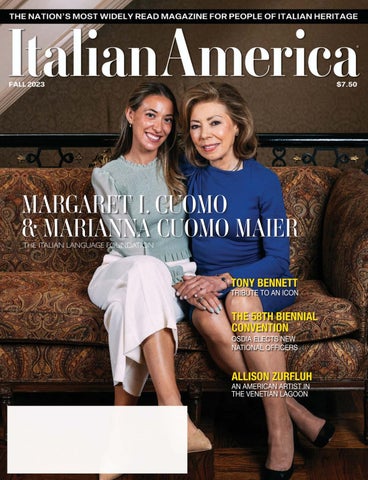
MARGARET I. CUOMO & MARIANNA CUOMO MAIER
THE ITALIAN LANGUAGE FOUNDATION

TONY BENNETT TRIBUTE TO AN ICON
THE 58TH BIENNIAL CONVENTION
OSDIA ELECTS NEW NATIONAL OFFICERS
ALLISON ZURFLUH AN AMERICAN ARTIST IN THE VENETIAN LAGOON

By Andrew Cotto
![]()
THE ITALIAN LANGUAGE FOUNDATION

TONY BENNETT TRIBUTE TO AN ICON
THE 58TH BIENNIAL CONVENTION
OSDIA ELECTS NEW NATIONAL OFFICERS
ALLISON ZURFLUH AN AMERICAN ARTIST IN THE VENETIAN LAGOON

By Andrew Cotto

By Allison Zurfluh


VITA
+ WINE
ENCLAVES
OSDIA NATION
38 FROM THE NATIONAL OFFICE 39 SIF FOUNDATION 40 FIGHTING STEREOTYPES 42 THE PERFECT GIFT 43 PIACERE!
44 POSTCARDS
Official Publication of the Order Sons and Daughters of Italy in America®
Italian America magazine is a publication of the Order Sons and Daughters of Italy in America (OSDIA), the nation’s biggest and oldest organization for people of Italian heritage. To subscribe, see www.osdia.org or call (202) 547-2900.
ITALIAN AMERICA is published by the ORDER SONS AND DAUGHTERS OF ITALY IN AMERICA
Editor-in-Chief: Andrew Cotto
Writers: Steve Amoia, Stephen J. Cerulli, Andrew Cotto, Michele Di Pietro, Miriah Falce, Carla Gambescia, Albert Marra, Lorenzo Porcelli, Vanessa Racci, Cassandra Santoro, Joseph “Sonny” Scafetta, Jr., Anthony Sciarratta, Adriana Trigiani, Lou Vaccarelli, Allison Zurfluh
Proofreader: Christine Haden
Graphic Designer: Diane Vincent
To advertise: Contact EditorItalianAmerica@gmail.com (202) 547-2900


Welcome to the Fall issue of Italian America magazine. I hope each of you had a wonderful summer. Personally, I’m usually happy to see summer fade, especially during the transition to autumn when everything seems new again.
Our new issue is full of exciting opportunities to embrace our culture and to learn about the wonderful people in our community. This begins, as always, with our cover feature. I am happy to have two wonderful women, mother and daughter, Margaret I. Cuomo and Marianna Cuomo Maier, who are doing important work, in their personal time, supporting the study of Italian language and culture through the Italian Language Foundation. This marks a pivot in my editorial perspective as I’m no longer going to dedicate the cover exclusively to “celebrities.” I came to this decision primarily upon realizing that there are people in our community doing the type of work that deserves not only the cover of the magazine but also the amount of space afforded to such subjects within our pages.
Also within our pages of this issue is a feature dedicated to the life of Tony Bennett. I called upon our members and friends, including bestselling author Adriana Trigiani (featured on the cover last Fall and included, as well, in this issue as the recipient of OSDIA’s 2023 Marconi Award), to reflect on the significance of this Italian American icon. A quieter story, but one with immense depth, is an essay from Allison Zurfluh, an American who has embraced the Venetian lagoon as a painter and fisherman’s apprentice. Our regular contributor, Steve Amoia, has provided a timely insight into how Italian film producer, Aurelio De Laurentiis, became the unlikely owner of Naples’ championship soccer club. Of course, we have reported on OSDIA’s biennial convention held in August in Tampa, where Michael Polo was elected as the 39th National President. Congratulations, President Polo!
Each issue is rooted in our regular columns, and I am always thankful to Michele Di Pietro for “Mangia” (and Miriah Falce for the addendum “Wine Bar”), Carla Gambescia for both “La Dolce Vita University” and “Postcards from the Boot” and Ray Guarini and his staff at Italian Enclaves. This issue’s “Andiamo” takes us to the northern region of Friuli Venezia Giulia through the expertise of Cassandra Santoro of Travel Italian Style. Our “Pagina Italiana” is a lovely poem by Lorezno Porcelli, who also provided the translation. This issue’s “Sunday Lunch” is served by Albert Marra, Immediate Past President, Little Italy Lodge #2286 (Baltimore). Finally, our “Piacere” is an interview with Mike Lombardi, NFL executive and media analyst, courtesy of our regular contributor Anthony Sciarratta.
Thanks as always to our leaders who provide missives from their respective desks, the lodges who keep us updated with their activities, and to our advertisers who help make this publication possible. Of course, thanks to you, dear readers, for your support and feedback.
Warm Regards,

EDITOR-IN-CHIEF, ITALIAN AMERICA MAGAZINE


Michael Polo is the new National President of the Order Sons and Daughters of Italy in America (OSDIA), the highest position attainable in the Order.
President Polo, son of Past National President, Paul Polo, is the President and Founder of ACMT, Inc. (Advanced Composites & Metalforming Technologies) and ACMT South LLC.
Raised in East Hartford, CT, Michael’s high school studies had an emphasis on business and included metal shop. Every summer, Michael worked for his father’s manufacturing company and was often assigned the most unpleasant tasks. He also took tool making apprenticeship classes at Pratt & Whitney Aircraft after school and graduated in 1982 with an emphasis on Business Management.
Michael attended cosmetology school and graduated in 1983. He worked for his cousin, a seasoned hairdresser, before attending advanced hairdressing schools in California.
While working in hairdressing, Michael received an opportunity to work in his father’s friend’s business selling aerospace chemicals part-time. He was hired full-time by that small chemical repackaging company in 1984.
Michael grew that business significantly year over year with their core customers, Pratt & Whitney and Combustion Engineering, respectively, before he and his father founded AdChem Inc., ADhesive and CHEMical specialty packaging in 1986.
In 1999, AdChem acquired Techniair, a small FAA Repair station, to include repair capabilities. In 2003, AdChem acquired TechAtlantic Aerospace to now include Honeywell as a customer and composite manufacturing as a core competency.
In 2005, Paul Polo sold his business and joined Michael to grow AdChem Inc. Their first acquisition was to purchase the complex sheet metal fabrication business from Paul’s original company and then change their company name to ACMT, Inc., Advanced Composites and Metalforming Technologies, to better represent this expanded business.
ACMT now occupies three buildings totaling 103,000 square feet in Manchester, CT. They recently started ACMT Cast Products in Bristol, CT., and now employ
G. Polo

142 team members with a heavy focus on high school and college internships to grow and expand diversity in the industry’s workforce.
In 2017, ACMT expanded with ACMT South, LLC located in a 141,000 square feet facility in Lynn Haven, Florida, founded to manufacture large sheet metal aerostructure components for all things that fly.
Michael joined OSDIA in 1980 as a Connecticut State Delegate. He attended his first National Convention in 1989. In 2011, he started his own lodge, Shoreline Sons and Daughters of Italy and was elected as a State Trustee to the National Convention in 2011. Michael was elected as a Sons of Italy Foundation Trustee in 2011 and as 5th National Vice President in 2015, before being elected OSDIA’s 39th National President in 2023.
Michael Polo is a member of the following boards and associations:
- President of the Aerospace Components Manufacturers of CT.
- The Governors Advanced Manufacturing board for the State of Connecticut.
- Connecticut Center for Advanced Technologies, CCAT workforce board and manufacturing advisory board.
- Chairman of the Town of Manchester workforce committee.
- Member of the Manchester High School to Career committee and board member.
- Manchester Community College manufacturing advisory board.
- Member of Goodwin College manufacturing advisory board.
- Member of Asnuntuck Community College manufacturing board.
NOTICE: The scholarship applications for the 2024 term will open in November 2023. Interested applicants should keep an eye out for more information on the OSDIA website: www.osdia.org.


BY CARLA GAMBESCIA
They’re three very similar words, but they refer to very different and vital parts of the Italian culinary and viticultural heritage, and the differences are the key to relishing a delightful range of Italian dolci e vini
All share the same etymological root, “amaro,” which means bitter, although none are actually bitter and the first two are sweet, both sharing a diminutive ending suggesting just a little bit of bitter—which is actually not so much bitter as sharp, having just a sort of edge.
Amaretti cookies were the original macaroon, predating French-style macaroons by over 150 years. They are thought to have been first created in the mid-17th century by Francesco Moriondo, pastry chef of the Court of Savoy in Northern Italy (amaretti’s close cookie cousin biscotti is ancient, dating back to Roman times). Born of scarcity, amaretti are a simple combination of sugar, egg whites, and almond-scented apricot kernels (and naturally gluten-free). These delectable little morsels are crisp and crunchy on the outside and soft on the inside; they’re ideal as an after-meal treat and can lend an unexpected sweet note and textural accent when crumbled over pasta dishes such as Pasta con Zucca e Amaretti—pasta with pumpkin and amaretti.

Amaretti are the pride of Saronno, a city just north of Milan, and there are no amaretti more beloved than those made by the Lazzaroni family who top theirs with sparkling pearl sugar and wrap them in colorful tissue paper twists.
Lazzaroni has produced amaretti since 1719, and in 1888 became the first company in Italy to produce cookies for commercial sale. Lazzaroni is the custodian to the “amaretti archive” kept in the cloister of a 14th-century church. It includes charming hand-decorated cookie tins dating back over a hundred years.
Amaretto, the after-dinner liqueur, is made from bitter almonds and the pits of apricots. There has been an unsurprising conflation of amaretto and amore (“love”) and resulting associations with romance. Perhaps it’s just a sentimental legend, but a Renaissance-style “love story” has been promoted by the di Saronno family (also from the town of Saronno) as to the “origin” of this velvety-rich amber-colored spirit. It is a love story involving a northern renaissance painter —Bernadino Luini—who had been a star pupil of Leonardo di Vinci:
The story goes that in 1525 a local church commissioned Luini to paint its frescoes. The church, like so many in Italy, was dedicated to the Virgin Mary, requiring Luini to find a model as inspiration for his Madonna. He chose a lovely young widow innkeeper. As a humble gift, she supposedly steeped apricot kernels in brandy and a few spices and presented her sweet intoxicating creation to Luini. According to this account, the two become lovers, perhaps because her face would appear in a number of Luini’s subsequent paintings.

This wistful Renaissance romance notwithstanding, it is likely that amaretto was a twist on a popular drink in ancient Rome: bitter almonds steeped in wine. Brandy, burnt sugar and almonds replaced the ingredients in this early recipe to result in the delicious liqueur we know today.
Amaretto, like Limoncello, is made as an infusion which means that, like the lovely legendary widow, you can create your own at home. It also means, as the story illustrates, that actual almonds need not be used. So, if you have a nut allergy you can still feel the love!
As for Amarone, that means “big” or “great bitter”—even though it’s paradoxically not bitter at all. And as is so often the case in Italy, there is a very interesting story behind it. Amarone della Valpolicella, from the Veneto region, is one of Italy’s most distinctive and prized robust red wines. Its contradictory name was born of its accidental discovery: in 1936 in the Cantina Sociale Valpolicella, foreman Adelino Lucchese found a forgotten barrel of recioto, sweet dessert wine that had been improperly sealed, allowing the yeast to continue to ferment. He tasted the wine expecting it to be bitter, and instead discovered a wine with a fine nose and exceptional taste causing him to enthusiastically cry out: “questo non è amare, questo un amarone!” (this is not bitter, this is a great bitter!). His exclamation was immediately used on this now-iconic wine’s first label in 1938 and became its name and symbol.

To replicate the winemaker’s happy accident today and make Amarone takes a lot of time, labor, and grapes for every bottle. To produce one bottle of wine, a winemaker in any other part of the world will vinify approximately 2 1⁄4 pounds of grapes. For each bottle of Amarone approximately 23 pounds are required. And those grapes must dehydrate into raisins before vinification truly begins. Amarone is high in alcohol, with intense aromatics and complex flavors that can range from dark fruits like berry, cherry, and plum to licorice, coffee, and chocolate.
You’d think a wine like that would be better known, and it almost was. In the classic crime thriller Silence of the Lambs, Hannibal Lecter spoke to Clarice Starling about savoring “fava beans and a nice Amarone”—underscoring that it goes quite well with liver, though Lecter’s choice of the liver source would not be anyone else’s. But in the movie, Anthony Hopkins, in a brilliant moment of improvisation, turned Amarone into “Chianti,” having devilish fun with the “eeee.” So Amarone was ready for its closeup but just missed it.
Still, this is a glass of rich, figgy tannic red wine—which pairs brilliantly with fava beans and, yes, liver—and one can definitely follow it with an amaretti cookie, and amaretto liqueur…an excellent combination for finishing a meal, and hence a sequence well worth remembering.
Carla Gambescia is a journalist, lecturer, and award-winning author of La Dolce Vita University: An Unconventional Guide to Italian Culture from A to Z, a highly informative celebration of Italy’s capacious culture. The new and greatly expanded second edition is now available.
Carla has toured every region of Italy, often by bicycle, and immersed herself in its astonishing array of cultural treasures. She conceived and co-led the Giro del Gelato bicycle tour, winner of OUTSIDE Magazine’s “Best Trip in Western Europe,” and owned and operated the top Zagat-rated Via Vanti! Restaurant & Gelateria in Mount Kisco, New York, for nearly a decade.
Today Carla lectures on myriad topics of Italian cultural interest through continuing education programs, universities, museums, and private clubs. She also curates the photoblog Postcards from the Boot. You can enjoy a specially selected “postcard” each issue on the last page of our magazine.


BY ANDREW COTTO
What inspired the founding of the Italian Language Foundation (ILF)?
Margaret: Teachers of Italian appealed to my father and mother and then to me because they were significantly limited by the lack of an Advanced Placement (AP) course in Italian language in American high schools. Therefore, many high schools nationally refused to offer Italian as a course of study. At that time, the AP was the benchmark for admission to good colleges, or any college for that matter. You needed AP credits on your transcript for applications to colleges. This situation impacted teachers of
Marianna Cuomo Maier and Margaret I. Cuomo

Margaret I. Cuomo, M.D. is the daughter of Mario M. Cuomo, the late governor of New York State, and Matilda Cuomo. She is a radiologist, an advocate for cancer prevention, and the author of A World Without Cancer . Margaret’s daughter, Marianna Cuomo Maier, a 2019 graduate of Yale University, is a National Board-Certified Health and Wellness Coach and Founder of Grata Wellness, LLC. Margaret cofounded the Italian Language Foundation (ILF), as a 501(c)(3) in 2008 with Louis Tallarini, a prominent Italian-American businessman and leader, with a mission to promote and support Italian language education. Marianna joined the organization in 2022 as the co-founder and leader of the Emerging Leadership Council of the ILF, together with Mr. Tallarini’s daughter, Anna, to foster the next generation of enthusiasts for Italian language and culture. ItalianAmericamagazine spoke with Margaret and Marianna about their passion for Italian language and heritage, and about the important organization they operate in order to maintain and advance its relevance in America.


Italian, because their employment in American schools was in jeopardy. Teachers of Italian felt powerless. As members of the Italian American community, my parents and I assisted the teachers of Italian. I wrote a letter to the College Board’s President, Gaston Caperton, a reasonable and fair person, who entertained the letter. This was truly a miracle in itself!
As we say in storytelling: And then what happened?
Margaret: I attended a meeting at the College Board with my mother and Louis Tallarini, who was the President of the Columbus Citizens Foundation at the time, and with the leaders of other prominent Italian American organizations. The College Board agreed to consider our request to establish an AP course in Italian, but required our committee to gather the signatures of 500 high schools across the country attesting that they would offer AP Italian if it were established. That itself was a tremendous task, but we were also told that we were required to raise the funding for the courses. And that was an enormous financial challenge.

How was that challenge accomplished?
Margaret: My father, mother, Mr. Tallarini, and I traveled to Rome, Italy, and we met in the office of the Prime Minister. I presented our case for the Italian language, and the Prime Minister graciously agreed to provide half of the funding required. We, the Americans, would be responsible for the other half, which we raised through contributions from several major Italian American organizations and individuals.
It was an unprecedented advocacy effort on the part of the Republic of Italy and the Italian-American community. Through our efforts, the College Board established the Advanced Placement Program in Italian Language and Culture.

Mr. Tallarini and I realized that we needed to create an organization dedicated exclusively to support and promote the AP Italian course and its enrollment. We created the Italian Language Foundation (ILF) to encourage and support the study of Italian.
How did we accomplish that goal? The ILF rewarded students who sat for the AP Italian exam, because the College Board would not count you as having taken the course if you didn’t sit for the exam. So if you completed the course, but did not take the AP exam, it was as if you never took the course at all. The ILF created the Awards for Excellence offering a financial incentive. A student earning a score of 4 or 5 would be granted a financial reward. An excellent AP Italian score enhanced a student’s resume, and there was also a cash reward, which was appreciated by students and their parents.
For teachers of Italian, the ILF offers free high quality professional development opportunities. Currently, the ILF Commitment to Excellence program offers high school and college students free mentorships, internships, and leadership programs. The ILF’s College Fellowships are our newest addition, which are offered to American college students enrolled in Italian language classes.
Why did Italian, as opposed to other languages, have to go through such a process for recognition by the College Board?
Margaret: It’s a matter of demographics, and that’s not an unreasonable approach. However, it is important to recognize and honor other cultures and other languages which have contributed greatly to the United States in every category you can name. To our knowledge, the Italians and Italian-Americans were unique in their efforts to advocate for the study of the Italian language and culture. To their credit, the College Board recognized our tireless efforts, and they became steadfast partners.
When did you develop your passion for Italian language?
Margaret: All four of my grandparents were Italian immigrants. I lived with them all while I attended medical school, two years with one set who emigrated from the Sorrento region, and two years with my Sicilian grandpar-
ents. So I feel very closely aligned to my Italian heritage. My roots are definitely 100% Italian. My father created an expression, which is more relevant today than ever: “We are the sons and daughters of giants.” When I think of what our immigrant ancestors achieved under such adverse conditions and with no help from the government, it is just outstanding. I need to honor their memory and to make it clear to people who are not familiar with the Italian immigrant experience that this culture is incredibly rich and incredibly generous, and it has added so much to our nation in every way. We are part of the fiber of the United States. And I think that’s at the core of my dedication to this mission. I studied Italian at The Mary Louis Academy, and in college at St. John’s University. And I was fortunate to travel to Italy afterwards. It’s at the core of who I am.


Marianna, what was your first experience with the Italian language?
Marianna: Growing up in our family and with my grandparents, there’s a strong pride for our Italian-American heritage and the immigrant story. Additionally, Italian was offered in my school from early childhood through grade 5. Certainly, throughout my life, my mom would continue to speak it, but unless you have a consistent education in a foreign language, it can be challenging.
Unfortunately, Italian was not offered in my middle or high school, so I studied Chinese from grade 6 – 12. At Yale, I enrolled in Italian language classes and was able to speak Italian again. I really wanted to reconnect with my Italian culture and heritage and learn the language. In the summer before my sophomore year, I studied Italian in Siena with Yale faculty. I lived in Siena for two months in a home-stay program hosted by a nonna, a lovely woman in her 80s who didn’t speak a word of English. It was in that immersion experience where I really felt the passion and enthusiasm both for the Italian language and for the culture. I gained a deeper understanding of the nature of Italians and their essence, which is connecting with one another and having passion for different areas of life, including art, architecture, fashion, cuisine, and all the many wonderful contributions to our own country and throughout history. During my stay in Siena, I became profoundly aware of the powerful impact of Italy and its language and culture.
Both of you have your own respective, demanding careers. How are you able to dedicate the time it takes to run such a successful organization as a second job?
Margaret: It is definitely a labor of love. I feel it is important because having been present from the founding of the ILF in 2008, I’ve seen it evolve and grow. We have accomplished a great deal in terms of promoting and supporting Italian language education nationally, with a minimum infrastructure of staff. The ILF has made significant progress, and it would be a pity not to continue into the next generation. Marianna represents the next generation of leadership in this effort. The full support and encouragement of my husband, Howard Maier, has been a key element in our success.
Marianna : It’s important to recognize that my mom spends a lot of time on a day-to-day basis with ILF operations, including planning events, webinars, and seminars. She develops new programs, attends events, and raises funds. And all of this, as she said, is a labor of love, and my mom has certainly orchestrated it all along because she cares deeply about it.
Marianna, at what point did it become clear that you wanted to become part of the ILF?
I’ve been inspired and in admiration all along of my mom and Mr. Tallarini and the work that they’ve been doing. And for me, I think it was transitioning from my role as a student to my current status as a professional, being
in a capacity where I can be part of advocacy, serve as a leader, and assist in creating events. I serve on the board of directors of the Yale Alumni Fund, and that experience has demonstrated that the fundraising required of not-forprofit organizations can be tedious and difficult, and yet it is vital to the future of the organization.
So on the Emerging Leaders Council (ELC) right now, is it just you and Anna Tallarini?
Marianna: Anna and I are the co-leaders, and we have a group of about 78 volunteers on the Emerging Leaders Council (ELC) from around the country. Many of us are New York City-based young professionals and friends whom we both know. The ELC welcomes members from every state. We’re really trying to create a group that is committed to preserving and supporting the Italian language and culture from many different angles, while also recognizing that our parents or grandparents have brought such value as Italian-Americans. It’s also important to recognize that the Emerging Leaders Council is a group of people who can appreciate the language and culture even without having Italian heritage. One example is a dear friend of mine with whom I studied Italian in college and who has a great passion for art and art history. She speaks Italian, but she herself has no Italian heritage. We are embracing those individuals as well, who have that appreciation of Italian culture and language and want to support our mission moving forward.

Speaking of students, how many student members are there in the ILF?
The Italian Language Foundation has hundreds of student members, and we’d like that to grow that to thousands. We have over 1,000 teachers of Italian who are ILF teacher members. Students of Italian join to be eligible for the free mentorship, leadership, and internship opportunities offered. The new ILF College Fellowship program is offered to students who are enrolled in an American college or university, and who are enrolled in Italian language classes. In the past, some students joined the ILF in high school, earned a reward and then departed. That’s not our goal or our mission. We have reformulated, and we expect to gain new student and teacher members with our new College Fellowship program.

Margaret: One of the things we’re very pleased about is that the majority of the ELC members are not of Italian heritage. As Marianna pointed out, many ELC members have studied Italian, but even if they haven’t, we encourage them to join because they have a true interest and passion for Italian culture. Our goal is to spread our love of all things Italian to others who may not have any Italian heritage at all. That’s the whole point, along with, of course, welcoming those who are of Italian descent and fostering their interests.
Do you think we are approaching a sort of Renaissance where people, and not only Italian-Americans, are embracing Italian culture more than ever before?
Marianna: Yes! Consider the booming tourism to Italy, and the many movies and shows that feature Italian destinations as well. Fascination and respect for Italian culture is surging. I’ve never seen a time when Italy and Italian culture have been more valued and cherished than they are now.
Margaret: And I must add that more American students travel to Italy to study abroad than any other nation in Europe where English is not the first language.

Can you tell us more about the fellowship program?
Margaret: We now support college students with fellowships. The College Board and the Italian language Foundation have had a very close relationship for many years. They respect the work we do, and they have offered helpful suggestions in terms of our programs for teachers and students of Italian. The VP of Italian at the College Board suggested that we find ways to support students of Italian beyond high school and into college. So now we offer fellowships to college students who enroll in Italian language classes in colleges across the USA. We are relying on our teacher members to explain to their students that they are eligible for this fellowship once they get to college. All information for our programs is found at www. italianlanguagefoundation.org
However, you need to be a teacher member in order to have your students eligible for ILF programs. Our goal is to develop a community of teachers of Italian who are going to support the ILF’s mission and encourage their students to receive the benefits of ILF membership. What kind of support is provided to members of the ILF?
Margaret: We started with the intention of supporting our students and encouraging them to study Italian, but from the very beginning we have also supported teachers of Italian. Since 2008, the ILF has offered free professional development workshops throughout the USA. Additionally, the ILF now offers webinars. If you’re a member of the Italian Language Foundation, you are eligible to participate in our free professional development opportunities. For many years, the ILF has maintained its annual membership fee for teachers at $25, which is extremely modest for all the free programming they receive. Membership for students is free.
What primary function does the ELC perform?


Marianna: The major aspect of the ELC is community. We host events where we come together to learn a certain topic. We had an incredible book talk from Mauro Porcini, the Chief Design Officer of Pepsi, who wrote an amazing book entitled, The Human Side of Innovation. Moving forward, we’re looking to do more book talks and also art exhibits. We have a tour of Little Italy coming up, conducted by the Italian-American Museum in Manhattan. We love visiting different restaurants, but it’s not just about Italian cuisine. It’s just as much about the owner’s story or that of the chef. It’s the people behind the food that are fascinating to me personally. I love hearing about their passion for their profession. And that’s been an exciting thing to bring to the ELC. We’re always looking for different experiences to expand our knowledge and expand the exposure to the generations of Italians and Italian Americans who have accomplished so much.
What else does the ELC do directly for members?
Marianna: Some other valuable components of the ELC are internships and mentoring programs. The broad idea is that our support goes beyond just academia. Of course, you can go on to do wonderful things after studying the Italian language, but there are so many ways in which language can impact a person’s career. We’ve created internship opportunities with Italian companies or companies owned by Italian-Americans, where a student could use the language in the many imprints that our culture has in business. So,
the idea is a student takes the AP language course in high school or is at least enrolled in high school Italian classes. They are supported by us in college in their studies, and then they have an internship and potential employment once they graduate. Part of the support just mentioned is the mentoring component, where we pair students with ELC members as one-to-one mentors. We seek a mentee who is either in the same area of study or has the same professional goals, so that the student is not only being supported from a language standpoint, but more holistically as a human being.
Margaret: I must add that all of our ELC members are volunteers. They all serve as excellent postgraduate, young professional mentors to our high school and college students. It is such a warm and a mutually beneficial process for the ELC members and for the mentees. So, yes, that’s critical to our mission.
Wonderful. I’ll leave the last word to you, Margaret:
Margaret: We have promoted the Advanced Placement Program in Italian language from the very beginning. But even if you don’t have that advantage in high school, or even if you didn’t choose to study Italian because it wasn’t offered, we embrace you. There’s always a point in your life where you can embrace the Italian language and the culture - the culture alone, the language alone, or any combination thereof. Come to us. We will advocate for you, and we will support you in achieving your goals. We hope that you will love the Italian language and culture as we do!
Learn more about the Italian Language Foundation at www.ilf.org. Learn more at Grata Wellness at www.gratawellness.com.


EDITOR’S NOTE: Tony Bennett was a friend of the Order Sons and Daughters of Italy in America. He performed often at the NELA Gala and was the 1999 recipient of the “Humanitarian Award.” With the recent passing of Mr. Bennett, we at Italian America asked some of our friends and members to reflect on his life.
eFor this Italian American, Tony Bennett is family. Sinatra, in all his glory, was one of us too, but he had the only house on the golf course on Mount Olympus. Tony Bennett may have crashed there for a weekend, but the rest of the time, when he wasn’t touring, he lived next door to us, walked the same sidewalks, and made the same gravy that we did. If he wasn’t spending time with his own family, or painting, he traveled the world taking his brand of home and elegant jazz styling everywhere he went.
In 2014, my husband and I attended the Goddard Riverside gala honoring our good friend Len Riggio. His beautiful wife Louise invited us to sit with them at their table. When we arrived, we took our seats. Across the table sat Tony Bennet and his beloved wife, Susan. Usually, in those situations, I stop breathing, clam up and pass out, but not that night. Mary Ellen Keating of B&N told me not to be shy. We were thrilled to meet Mr. and Mrs. Tony Bennett. When Tony and I were introduced, I wanted to tell him what his music meant to me. Instead, I said, “I’m Italian.” Mr. Bennett took my hand and said, “I know.”
“For my money, Tony Bennett is the best singer in the business. He excites me when I watch him. He moves me. He’s the singer who gets across what the composer has in mind, and probably a little more.” - Frank Sinatra

I have carried that little exchange around in my heart ever since. On August 5, 2021, my friend Juiene D’Alessandro mentioned she was in the city to attend One Last Time, An Evening with Tony Bennett and Lady Gaga. It was the last night of their Radio City run, and it would also be Tony’s last public performance. I was sad because I didn’t have a ticket. In a matter of minutes, Juiene and her friend Kim arranged one. Un colpo di fortuna!
Lady Gaga (Stefani Germanotta) has got it all. The truly great, the performers that are remembered hundreds of years beyond their passing, are superb journeymen who, over their
lifetimes, with determination, focus, and single-minded intensity, have mastered their craft. Tony and Gaga shared a mutual mastery and were also, as fellow Italian Americans, simpatico.
Onstage that night, Stefani recalled her first meeting with Tony. Gaga told him that she was a tramp, and he said, “You’re not a tramp, you’re a lady playing a tramp.” Tony saw past theatrical artifice to her resplendent soul beneath it. When Tony took the stage alone to sing, he stood in the curve of the baby grand piano, as though he had been born there, and sang song after song, never missing a note or a lyric. At the end of the concert, we stood, cheering and weeping. Tony took the love and gratitude in and said, “I love you,” followed by one of his signature over the head waves. Gaga joined him onstage as the final ovation had no end. It was an act of pure largesse and love as Gaga gently guided Tony into the wings and into the pantheon of our best memories as Italian Americans.
~ Adriana Trigiani, New York Times bestselling author and recipient of the OSDIA 2023 Marconi Award e
While on the Red carpet interviewing Tony Bennett for his 90th birthday party, Donna Drake spoke to Tony about his music and painting. He shared that he paints every day. While they were speaking, I walked over and told his wife, Susan, pictured too, that The Donna Drake Show focused only on good news and positive stories. When the interview was over Susan explained to Tony, “Donna’s show is
ONLY about good news.” He turned in his tracks and returned to Donna and said, “I want to shake your hand. Thank you for doing what you do. It’s hard, I know, to do only good news stories, but we all need this.”
~ Lou Vaccarelli -
Former Executive Vice President of Production at BMG Music and the Executive Producer of The Donna Drake Show
eAs a Jazz Singer of Italian descent, Tony Bennett means a lot to me. He was born to Italian immigrants in 1926 and reminds me and many others of our nonnos. Tony is a personal family favorite with an emotionally poignant voice and also represents Italian Americans’ long standing relationship with jazz. As an incredible ambassador for the jazz genre, he kept the great book of standards alive after many jazz greats had passed away. He sort of took Sinatra’s place in the world. But what’s especially unique about him, is that he continued to keep this classic music relevant for the Millennial (and my) generation by duetting with current stars such as Amy Winehouse and Lady Gaga. This brought communities of diverse musical influences together to foster an appreciation for jazz, and, in turn, made my work more relevant. I can’t thank him enough for that. I think jazz carries such importance for me and many Italian Americans because it was created at a time when most Italians immigrated to the United States. It sort of became the soundtrack of our immigration story and the Italian American dream. So, thank you for keeping it alive, Tony and for being a shining example of the Italian American dream. I will try my best to do the same.”
~ Vanessa Racci (The Jazzy Italian)

The following is a letter from OSDIA member Joseph “Sonny” Scafetta Jr., former VA state president, to the Citizen’s Stamp Advisory Committee:

Dear Committee Members:
I want to recommend that a commemorative stamp be issued to honor the recently deceased Tony Bennett. I suggest that the stamp be issued either on August 3, 2026, which will be the 100th anniversary of his birth, or on August 5, 2026, which will be the fifth anniversary of his final public performance.
Anthony Dominick Benedetto was born in the Queens section of New York City on August 3, 1926, to Italian immigrant parents. He served in the U.S. Army during World War II and began his singing career in 1951. At the suggestion of Bob Hope, he shortened his name to Tony Bennett. Over the course of the next 70 years, he sold more than 50 million records and won 20 Grammy awards. He died in his home in Manhattan on July 21, 2023, 13 days before his 97th birthday.
Please add Tony Bennett to your list of prospective honorees for 2026.
Respectively submitted, Joseph Scafetta Jr.

Allison Zurfluh’s paintings are inspired by a decade-long immersion in the northern Venice Lagoon. Her work champions the protection of one of the world’s most beguiling wetlands, and generates awareness of the perils facing its ancestral fishing methods and local culture.
Born to a Swiss family in California, Allison is integrated into local life on the island of Burano, in Venice, where she spends her time painting and accompanying fishermen in their work, learning the history, traditions, and the hard work of their trade.
Allison trained under Australian artist John Kelly and is particularly interested in the layering of color on the rough canvas, which embraces the natural environment of the Venetian marshland. Alone in the wilds, with a boat and painting supplies, Allison strips the self to immerse into the transformative act of an alliance with nature. She uses a palette knife and brush to create her oil paintings on linen and burlap, and granulating watercolors on natural fiber paper. Her work has been collected internationally, and exhibited in both Venice and Zurich.
Allison is the author of three books: the children’s book, Lia Leaves the Library; the opera journey, The Veremonda Resurrection; and a book of prose and art, Allison Zurfluh and the Venice Lagoon


BY ALLISON ZURFLUH
I step over the gunwale and sink thigh-high into mud; it isn’t the first time I’ve waded with an easel or net over my head, trying not to fall face first into the muck. I have been learning about the traditional fishing techniques of the Venice Lagoon for years now: observing, assisting, listening to the stories of seasoned fishermen, and searching for scraps of their history in the barena of the wilds. North of the quiet fishing island of Burano is the heartland of Venice, where the first Venetians settled on the wetlands in the 5th century. I leave my house daily to strike out in a little white lagoon boat with paints and easel, a bucketful of nets, a clutch of boiled crabs and a gas-powered moka maker for times when the tide is low and I have to wait it out - or sleep until morning. There is a silent presence in the north that overcomes, and once I am out there, it is hard to come back to civilization.
This winter was no different. I was staying out on the island of Isola Santa Cristina where the beauty of raw nature is painted across vast fishing valleys, vineyards, and a forest
that shelters thousands of migrating birds, safe in a hunting-free sanctuary. This is where I feel most at home in Venice, deeply privileged and fulfilled to go it alone.
It was shrimp season, and Massimo, a fisherman since the day he was born and a friend for nigh on a decade, was pulling in the catch while others were coming up dry. The demand was high. I was outside with the island dog, Nero, painting the layers of sunrise while a muster of wild peacocks took their slow morning stroll toward the vineyards. Nero got up and started out across the island, and as he did I saw the fisherman grip a wheelbarrow, motionless.
The next six weeks were like none I had ever experienced. Instead of letting me observe and occasionally lend a hand, as I’d been doing for years, Massimo asked if I would help him. In a crash course of sleet-filled nights followed by icy mornings in even icier water, he taught me the trade: a step-by-step initiation into the realities of small shrimp and prawn fishing. I learned how to tie ossel hitches securely and place scagetti, braghette, and coette poles properly; I learned to walk in deep quagmire without falling; and to identify the best places to plunge nets. Most importantly, I learned why. Why the lagoon needs curators, protectors, a gentle love for the land. For all its beguiling beauty, lagoon life is a hard one, but one well worth sustaining.
For weeks, Massimo ordered me around until late morning, and I painted in the afternoons. I cannot say it was all roses and teamwork. This fisherman is of the fiercely independent type, known as one of only two master fishermen in the lagoon. It was not easy for him to hand over his

power, and he did not always exercise generous amounts of finesse.
But there came a day when I was pulling the nets up out of water, untying them and pouring the contents into large buckets in the boat. I was weeding out the small green Mediterranean crabs and hauling loads onto the island: crabs in one valley, goby fish in another, fish and shrimp in white thermal boxes. I piled everything into a wheel barrow and pushed it across the island to the gorna, a wooden fishing table used to sort them one by one into categories, never wasting a single fish. My fingers, wrapped in sopping wool mitts, felt frozen and numb; I loosened the scarf around my neck.
Together we worked in silence, sorting, until one day when I asked a question about why certain fish go in one valley, and why certain fish go in another, thinking that I would learn better with an explanation to accompany the experience. He answered as only a man born of hard work and the elements can do. “Each is a life and has value, like yours. I’m teaching you things I’ll only ever teach my
own son,” he said in dialect. You’re an apprentice now. Get back to it.” And I realized at that moment that I had just entered a privileged world, that all the years of watching and photographing, asking questions and listening, had finally paid off: I was in the right place at the right time, learning about the world. And only by doing that would I take home a catch of my own: the beginning of true knowledge.
It is autumn now, and the plants and flowers of the marshland have turned a golden hue, with the last violet blooms of sea lavender holding out before the winds change. Faded green marsh samphire wades its feet in deepening browns, as the mud turns darker for the colder season. After a blazing summer fishing blue king crabs along the saltmarsh shores, which have invaded the Lagoon, I look forward to the icy green waters of winter, and painting alone in the empty ghost towns of the plains. The tide has shifted, too, though who can say what normal tidal conditions are anymore; the usual seasons have changed in Venice, as the climate shifts and with it, the way we mark our time.
I set my easel near the edge of a boat that’s submersed in the barena like an ark, still tied to a pole that’s been there for half a century or more. Like the bragozzo , I don’t plan on leaving anytime soon. There is too much listening to do still, here in this ark of privilege, too much feeling and learning among the raw and holy lines of this land.


BY MICHELE DI PIETRO
For many of us, Sundays meant the same thing growing up–church, cooking, getting together with some extended family and eating a large, mid-afternoon meal that most definitely contained pasta, meat and tomato sauce, among other things.
Why is it that Sunday “dinner” became so important for us Italian Americans?
Historically, we could probably point it to the turn of the century when Italian laborers worked six days a week and Sunday was the only opportunity for family and socializing. Once our ancestors started to improve their economic status, food (aplenty) was a way to show that they had made it.
While the tradition of large Sunday Dinner get-togethers has gotten more difficult to hold onto over the generations, one thing is still for sure–Sundays are still a great time to eat pasta, meat and tomato sauce, among other things.
Food for thought. Let’s mangia!
You can find Michele's cookbook SOUPified! on Amazon!


Enough for 2 pounds pasta
Every Italian and Italian-American household has their own special way of making their Sunday sauce/sugo/gravy/ragu. Every Italian and Italian-American thinks that their version is the best way to make it.
And they would all be right.
Food and cooking are very personal, especially when it comes to dishes that have deep, nostalgic roots and traditions. I’m not sure of any other dish to which us paesani have stronger ties to than a slowly-simmered, rich and hearty, thick tomato and meat sauce.
Just don’t forget to bring your piece of bread for the taste test. No spoons allowed!
YOU'll NEED:
1½ pounds beef short ribs, rump roast, or other braising cut or meat
1 pound pork shoulder
Pinch salt and black pepper
3 Tbsp olive oil
1 cup finely chopped yellow onion
¾ cup finely chopped celery (about 3 stalks)
¾ cup finely chopped carrot (about 1 medium carrot)
3 Tbsp chopped garlic
¾ cup dry red wine
2 (28-ounce) cans crushed tomatoes or whole tomatoes, hand-crushed + ½ can water
½ tsp salt
¼ tsp ground black pepper
Pinch crushed red pepper
1 cup fresh basil leaves, roughly torn
NOTES:
This recipe yields a large pot of sauce (about 2 to 3 quarts with the meat included). It’s enough to dress about two pounds dry pasta, which would feed about 8-10 people. Use what is needed to dress your favorite pasta, then freeze the rest for another time. The sauce freezes very well.
Other varieties of meat can easily be substituted or added to this sauce, such as pork country ribs, meatballs or Italian sausage.


1. Trim the beef and pork as necessary, leaving some of the fat on the meat. Cut them into large chunks, about 2-3” square. Sprinkle them lightly with salt and pepper.
2. Heat the olive oil in a large pot. When the oil begins to smoke, add the chunks of meat. Do not overcrowd the pot and work in batches if necessary. Brown the meat on all sides, then remove and set aside.
3. Add the onions, celery and carrots and garlic to the pot, cooking for about for about 5 minutes.
4. Add the red wine and deglaze the pan, scraping up all the brown bits.
5. Add the 2 cans tomatoes plus water, salt, black pepper and crushed red pepper to the pot. Reduce the heat to medium-low.
6. Carefully return the meat to the sauce and cover the pan. Let the sauce simmer for about 2 ½ hours or until a thick sauce has developed and the pork and beef are fork-tender. Stir the mixture every so often.
7. About halfway through the cooking process, adjust the lid so that it is just slightly ajar.
8. When the sauce is finished cooking, stir the basil into the sauce.
9. Adjust seasonings with additional salt and pepper to taste, if necessary.
10. Serve the sauce with your favorite pasta. Such a thick and heavy sauce is best with a strong variety, such as rigatoni or ziti. The meat is often removed from the sauce and served in a bowl separate from the pasta as a second dish. Mangia bene!


The most crucial part of pairing wine with Italian food is finding one that balances the sweetness and acidity of the tomatoes while standing up to the richness of any meat. Barbera, another varietal known for its acidity and character, is a great choice for Sunday Ragu. A matching acidity between the wine and tomatoes means neither is underwhelmed or overpowered, and both are brightened. This brings forward the jammy, cherry and juicy red fruit flavors typically present in this wine. It is light to medium bodied with smooth tannins, so it can stand up to any fattiness in the meat. In this way, some of it’s more spicy notes will join that union and you may pick up black pepper and anise. A lighter bodied wine is perfect for Sunday dinner as it doesn’t steal the show and works with all the ingredients of this dish.

After a summer in Italy in 2017, Miriah Falce returned home to Washington eager to pursue a new passion in winemaking. After a few years in the industry with roles in the tasting room, cellar, and vineyard, she is now an Enologist working on her dream of being a young female winemaker with a label showcasing unique Italian varietals.
Makes about 20-25 meatballs
I love that meatballs are such an iconic dish in our cuisine. Like pasta, they’re actually quite versatile and can incorporate the taste and personality of so many different ingredients and ethnic flavors and be enjoyed in countless ways (with pasta, in a sub, parm-style or on a fork right out of the frying pan!).
Having said this, Sundays are generally about one type of meatball–the one served in a hearty, tomato sauce.
This meatball recipe is made with beef only, but can easily be adapted to your favorite meat combination (such as the beloved beef/pork/veal trio). Sometimes I fry them, and sometimes I bake them, depending on my mood and how many I’m making. It’s a pretty solid and tested recipe–hope you enjoy it!


YOU'll NEED:
4 large eggs
½ cup whole milk
1½ cups torn bread, loosely packed, or 1 cup plain, fine breadcrumbs
1 cup grated Pecorino Romano cheese
½ cup finely chopped yellow onion (about 1 large onion)
¼ cup chopped fresh parsley
¼ cup chopped fresh basil
1 Tbsp minced garlic
1 tsp salt
1 tsp black pepper
2 lbs ground beef (85/15)
Olive oil (for pan-frying)
DIRECTIONS:
1. In a large bowl, whisk the eggs & milk together, then add the bread or breadcrumbs into it and make sure they are fully immersed.
2. Let this mixture sit for 2 to 3 minutes to allow the bread to get soaked by the liquids. Then, mix in the cheese, onion, parsley, basil, garlic, salt and black pepper.
3. Gently fold in the ground beef and mix until well combined. Do not overmix.
4. Form into 3 oz meatballs (or whatever size you would like).
5. Add enough oil to a large skillet to cover the bottom by about ¼” and heat the pan over medium-high heat.
6. Add the meatballs to the pan, one at a time, in a single layer. Do not overcrowd the pan. Brown the meatballs on multiple sides until cooked through (8 to 10 minutes). Alternatively, roast the meatballs on a parchment-lined sheet pan in a 375°F oven for about 12-15 minutes.
7. Eat as is or transfer to a pot of tomato sauce. Buon Appetito!


Serves 6-8
There are not many dishes out there that are better than a hearty mixture of pasta, gooey, bubbly cheese and savory tomato sauce all baked together until just right, in my humble opinion.
I love to make this easy pasta al forno as soon as the seasons change and brisk autumn weather arrives. It’s perfect stickto-your-bones fare that feels like a big hug from grandmom, and it likely is from grandmom–this recipe has not changed much over the years. My mom always put spinach in and kept the meat out of her version, and I do the same. This recipe is actually more akin to a deconstructed, classic Italian-American lasagne than anything else. Since no layers are involved, it’s really quick to prepare and easy to get on the table any night of the week–not just on Sundays!
YOU'll NEED:
1 pound short pasta, such as ziti, cavatappi or mezze rigatoni + salt for pasta water
2-3 cups marinara/tomato basil sauce + more to top and serve on the side
½ cup fresh basil leaves, roughly torn + more for garnish
1 Tbsp high-quality extra virgin olive oil
Ricotta Mixture:
1 pound whole milk ricotta
1 (10-ounce) package frozen chopped spinach, defrosted and drained of all liquid
1. Arrange a rack in the middle of the oven and preheat to 350°F.
2. Cook the pasta in salted boiling water until not quite al dente (you should actually undercook the pasta a bit so that it retains its bite after baking).
3. Meanwhile, make the Ricotta Mixture by mixing all ingredients together in a large bowl until well-combined.

4. Add the cooked pasta to the ricotta mixture along with the marinara, fresh basil and olive oil and gently mix until well-combined.
5. Transfer the pasta mixture to a baking dish, then top with a bit more sauce, mozzarella and Pecorino.
6. Loosely cover the pan with aluminum foil, being sure to not let the foil touch the top of the food.
7. Bake for about 1 hour, then uncover and continue to bake for another 10-15 minutes, or until the pasta is heated through and the cheese has browned a bit.
8. Remove from oven. Let it sit for about 10 minutes or so before serving. Garnish with some fresh basil and enjoy!
Serving Suggestion: Have some extra sauce on the side for those that want it!


½ lb fresh mozzarella, small diced (plus ½ cup more for top)
¼ cup grated Pecorino Romano cheese + more for top
1 large egg, beaten
¼ tsp black pepper
Pinch crushed red pepper
Michele Di Pietro is an entrepreneur, chef, cookbook author, blogger, culinary consultant, food writer, and creator of Mangia With Michele, the expression of her lifelong passion for Italian ingredients, foods, recipes, culture, and traditions. Throughout her busy professional culinary life, Michele has also always been an avid home cook with strong ties to her Italian roots. She is most happy and satisfied when cooking for, and breaking bread with, family and friends. It is these ties and sentiments, along with her passion for sharing both food and travel experiences with others, that led her to create Mangia With Michele. In 2020, Michele released her first cookbook: SOUPified: Soups Inspired by Your Favorite Dishes , a whimsical collection of soup recipes inspired by familiar entrees.

Find our food editor at www.MangiaWithMichele.com and follow her at @mangiawithmichele on social channels. www.instagram.com/MangiaWithMichele www.facebook.com/MangiaWithMichele

BY CASSANDRA SANTORO FOUNDER AND CEO OF TRAVEL ITALIAN STYLE
Many years ago, while researching unique places to visit in Italy, I came across an article in The New York Times titled “Italy’s Secret Garden.” The author, Fred Plotkin (1999), was referring to the northeastern region of Italy, Friuli Venezia Giulia. I was sold.
My first visit in 2018 to Friuli Venezia Giulia was one I would not forget. I was welcomed by the view of Piazza Unità d’Italia in Trieste, one of the largest squares facing the sea in Europe. It was dusk, and the golden colors were beaming off the square. When the sun went down, the neoclassical, liberty, and baroque buildings began to fill up with lights. It was September, but it felt like Christmas. At that moment, it was clear to me why they once referred to Trieste as the “Little Vienna on the Sea.”
All around me I found locals who were speaking Italian but also German, Slovenian, and what I later would find out was Friulian (the dialect). It was interesting, extravagant, and breathtaking all at once. Since that first visit, I have returned almost every year in different seasons, and it continues to get better each time.

The mountain town of Sappada.

It’s easiest to reach Friuli Venezia Giulia by flying into Venice’s Marco Polo Airport. Those already traveling in Italy can arrive via train to Udine and Trieste from Venice in under two hours. There are also many local buses to help connect you throughout the region. However, renting a car or hiring a private driver is the recommended way to enjoy the area. Our team at Travel Italian Style can arrange private transportation to be sure you don’t miss out all the region has to offer!
Friuli Venezia Giulia is a year-round destination. In the summer months you may see locals sunbathing beside the Gulf of Trieste or by one of the alpine lakes found within the region. In the winter, you can visit artisans or enjoy the holiday traditions in a winter wonderland along the Friulian Dolomites. For food and wine lovers, fall is the perfect time to discover producers throughout the countryside. In the spring, Friuli Venezia Giulia also has their own sunflower fields to admire and enjoy!
Photo Credit:Andrew Cotto
For a first-time visitor, stopping in the capital city, Trieste, is a must. Explore the main square of Piazza Unità d’Italia and Miramare Castello. Our guide team also offers tours of the Risiera di San Sabba, a former rice factory used in WWII as a concentration camp. It’s an important and less-spoken part of Italy’s past and the local Jewish community’s story.
Udine is a vibrant and ambitious city. You can taste and see the Venetian inspiration through its architecture and its many cicchetti bars. Don’t miss a walk through Piazza della Liberta, Loggia del Lionello, or Il Castello di Udine for a view.
For adventure travelers, there are charming mountain towns such as Sappada. Here you can join the northern Europeans and Italian travelers for outdoor excursions such as hiking or horseback riding in the summer, or skiing and sledding in the winter.
Although Friuli Venezia Giulia is based in Italy, its bordering countries of Austria and Slovenia influence what you will find on the menu. In Trieste you may see

an Austro-Hungarian Gulasch Triestino or a Gnocchi di Prugne (with plum). For dessert you may find a Venetoinspired tiramisu.
Friuli Venezia Giulia also has its own specialties. One of my favorites is Frico, a potato and onion pancake made with the local Montasio cheese. Cjarsons are delicious potato dough pasta resembling a mix between a ravioli and agnolotti. As the region borders the Adriatic Sea, seafood such as prawns, crab, and sardoni in savòr, fried sardines marinated in vinegar and onion, are also offered. You can’t leave the area without trying Gubana, a typical cake made of walnuts, hazelnuts, raisins, pine nuts and almonds.
You may also be surprised to know that Friuli Venezia Giulia is famous for Prosciutto di San Daniele, one of the best in Italy. Legend also has it that the region is the birthplace of grappa.
For coffee lovers, Trieste is known as the coffee capital of Italy. Since 1965, it has been the headquarters of Illy Coffee. Today the company offers workshops and barista training at their Universita del caffe. Try a fresh brew
while visiting one of the historic coffee shops dating back to the 1800s. And don’t forget to study the local lingo while (coffee) bar hopping in Trieste. A caffè (espresso) is called nero and macchiato un capo.
As a dual citizen, I spend most of my year in the south of Italy. Yet, every year I am drawn back to the people and experiences of Friuli Venezia Giulia. Although it’s just a train ride from Venice, this region is still untouched. That is why I encourage those who love a taste of authenticity to visit “Italy’s Secret Garden” before it’s no longer a secret. You won’t regret it. I never have.
Details on how we can help you plan a customized trip to the Friuli Venezia Giulia are available at www.travelitalianstyle.com. We offer full custom travel planning for the Friuli Venezia Giulia as well as all 20 regions of Italy. We also offer consulting calls for self-planners. For those who want to follow a dual citizen living in Southern Italy, you can find me on Instagram @travelitalianstyle and Facebook at @travelingitalianstyle.

in
Cassandra Lena Santoro is a New York born Italian American, dual citizen, and the CEO and Founder of Travel Italian Style. As a personal trip planner, she has been living, working and traveling Italy for almost two decades. Cassandra has visited all 20 Regions of Italy and is currently based on the Amalfi Coast. While she enjoys the seaside life of the south, you can still find her traveling throughout the country, discovering inspiring and immersive experiences for her clients.
Cassandra and her company have been featured in CNN, Forbes, La Cucina Italiana, and more. She also leads motivational talks in hopes to inspire others on their journey. Her highlight appearance was being a speaker in Germany for TEDx DHBW Mannheim. You can follow her adventures of Italian entrepreneur life on Instagram.
“... I started my adventure in the South of Italy… It was an experience that was more interesting than making any movie.”
— Aurelio De Laurentiis in an interview with CBS Sports on May 4, 2023, from Naples, Italy.
BY STEVE AMOIA
In Naples, calcio (soccer) is a veritable religion. May 4th, 2023, was the sporting beautification of Società Sportiva Calcio Napoli, better known as Napoli or i Partenopei (the Parthenopeans), who won their third Serie A (the top Italian league) scudetto (title) and first since 1990. Only two Southern teams (Cagliari: 1970) have won Italian soccer’s crown jewel. Galvanized by the business acumen of il Presidente (President), Aurelio De Laurentiis, orchestrated by the tactical brilliance of il Mister (head coach/ manager) Luciano Spalletti, with stellar leadership by one of his giocatori (players), il Capitano (team captain), Giovanni Di Lorenzo, le reti (goals) of capocannoniere (league top scorer), Victor Osimhen, plus contributions from portiere (goalkeeper) Alex Meret, difensore (defender) Kim MinJae, centrocampista (midfielder) Piotr Zieliński, and attaccante (striker) Khvicha Kvaratskhelia, Napoli dominated il campionato (the 38-game season). Napoli’s achievement represents the sporting vision of a film producer extraordinaire: Aurelio De Laurentiis. The Unforgiving Reality of
national Soccer

respectively. Tifosi (passionate fans) and a legacy from the glory days of Argentine fuoriclasse (superstar), Diego Maradona, in the 1980s, endured. The team re-branded as Napoli Soccer in Serie C (the third tier of Italian calcio). The American sporting model of draft choices, parity and moveable franchises does not exist. If a team finishes in the last three places of the standings, it is relegated to a lower league. The club must reorganize financially and competitively to earn promotion to a higher league by finishing in the top three spots which is quintessentially merit-based. Could a Sceneggiatore (Screenwriter) Script a Better Story?
During an appearance on Che Tempo Che Fa, a RAI 3 program, in remarks published by La Gazzetta dello Sport on May 28, 2023, De Laurentiis admitted:
“I hardly knew anything about this sport…I played basketball as a child.

De Laurentiis
My family is Neapolitan and therefore our favorite soccer team was Napoli… I didn’t think twice (about buying)... My family said I wasn’t cut out for it. I’m a Gemini and those born under this sign must always project themselves into the future.”
He discussed the deal in the CBS Sports interview: “I was in Los Angeles doing a movie with Gwyneth Paltrow, Jude Law, and Angelina Jolie, and I went just for 15 days to Capri for summer vacation. I discovered that Napoli Soccer was in bankruptcy. There was an option, so I put €37 million euros on the table and I bought just the name…”
De Laurentiis Personifies Italian Exceptionalism
De Laurentiis told CasertaNews in September 2008, “I bought Napoli due to love.” The enchanting, ‘O surdato ‘nnammurato, is often heard triumphantly at Stadio Diego Armando Maradona. The Soldier in Love sings, ‘You were the first love… And you will be the first and last one for me.’
In August 2004, Napoli SSC went bankrupt, losing their name, players, coaches and training facilities,

To quote iconic singer, Dean Martin: “Back in old Napoli, That’s Amore!”
Steve Amoia is an author of 15 books, a freelance writer, and a translator from Washington, D.C. He published World Football Commentaries from 2006 to 2020. His latest books are available at www.barnesandnoble.com: Historical Finals of the Azzurri, Post-Pandemic Financial Guide, Sardinian Days and Italian Nights, and Sardinian Stories by Grazia Deledda (a translation). Steve’s site: www. sanstefano.com.


POEM AND TRANSLATION BY LORENZO PORCELLI
Non conosco il suo nome. Non l’ho mai visto prima.
L’ho guardato per soltanto due minuti.
Appena ho girato l’angolo di un marciapiede che circonda il palazzo Romanico del disegnatore di moda Salvatore Ferragamo, questa vista sorprendente:
Un artigiano Italiano magro, intenso, solo uno, che strofina a mano, metodicamente, le porte di entrata molto pesanti di “triple-o steel wool.”
Le porta di legno solido sono state guardia leale di questo portale per molti secoli, forse settecento anni.
Dodici piedi di altezza, sei pollici di spessore, ed ogni strato strofinato, porta l’artigiano piu’ vicino al Rinascimento.
Ho pensato: questo artigiano, potrebbe sentire la musica in questo legno che ha salutato tanti Fiorentini?
Questo porte, hanno conosciuto I Magnifici de Medici? E Galileo? Giotto? Ghiberti? Ghirlandaio?
E anche Brunelleschi?
Questa porte, hanno lamentato l’esilio di Dante da questa gemma di città?
Hanno esultato nel tirocinio qui del giovane Leonardo?
Questa porte, secoli fà, hanno mantenuto segreta la vita interna dell’edificio.
Ora, il nuovo inquilino d’arte desidera aprire le porta facilimente, per essere quasi trasparente cosi’ che tutti vedano la sua arte spettacolare.
Allora, questo artigiano solo, per me, é proprio la metafora del desidero feroce di costruire che circola nel sangue Italiano.
Non conosco il suo nome.

I don’t know his name. I’ve never seen him before. I watched him for only a few minutes.
As I went around the corner of the sidewalk that surrounds the Romanesque palazzo of the modern designer Salvatore Ferragamo, I came upon a most surprising sight:
A thin, intense, Italian artisan, just one, who was rubbing by hand, methodically, the heavy entrance doors with “triple-o steel wool.”
These solid doors have stood loyal guard to this portal for many centuries, perhaps seven hundred years.
Twelve feet high, six inches thick and each layer rubbed brings the artisan much closer to the Renaissance.
I thought: this artisan, is he able the hear the music in this wood that has greeted so many Florentines?
These doors, have they known the Magnificent Medici? And Galileo? Giotto? Ghiberti? Ghirlandaio?

And even Brunelleschi?
These doors, have they lamented the exile of Dante from this gem of a city?
Have they exalted in the apprenticeship here of the young Leonardo?
These doors, centuries ago, have maintained the internal life of this building secret.
Today, the new tenant of art desires to open the doors easily, to be nearly transparent so all can see his spectacular art.
Then, this one lone artisan, for me, is actually the metaphor for the ferocious desire to build that circulates in the Italian blood.
I don’t know his name.
Lorenzo Porcelli, an industrial designer, artist and writer, was inspired to write in Italian “Non Conosco Il Suo Nome” during an enlightening walk in Firenze. Professoresse Paola Maderna added her thorough, thoughtful edit in praise of “la bella lingua.” www.lorenzoporcelli.com

AUGUST 16-19, 2023
In its 119th year, the Order Sons and Daughters of Italy in America (OSDIA) gathered in Tampa, FL, for the organization’s 58th Biennial Convention. The officers of the oldest and largest Italian heritage organization in America gathered to elect its new leaders. Michael G. Polo was elected as the 39th National President and was sworn in on August 19, 2023. He will assume leadership from Immediate Past National President, Robert A. Bianchi, Esq.
“OSDIA has made great strides forward thanks to the previous administration led by brother Robert Bianchi, Esq., our now Immediate Past National President,” President Polo said in his acceptance speech. “Thank you, Brother Bob, for your tireless work to keep our 119 year-old organization moving forward, using technology and social media to maximize efficiency within the organization.”

The son of Past National President, Paul Polo, as well as the grandson and nephew respectively of Grand Lodge Presidents from Connecticut, OSDIA’s new leader brings 35 years of experience in the Order. “I am humbled by the opportunity to lead this organization with such a deep, rich foundation.”
For President Polo’s biography, please see the Bulletin Board section of this issue on page 4.
National President, Michael G. Polo - CT
National First Vice President, Thom A. Lupo - NY
National Second Vice President, Kevin A. Caira - MA
National Third Vice President, Mark DeNunzio, D.D.S. - FL
National Fourth Vice President, Tony “Bisceglia” Anderson - NW
National Fifth Vice President, Frank Gattuso, Esq. - NJ
National Immediate Past President, Robert A. Bianchi, Esq. - NJ
National Orator, Anthony J. Perfilio, Esq. - OH
National Recording Secretary, Joseph Rondinelli - NY
National Financial Secretary, Louis Santoro - NJ
National Treasurer, Robert Ferrito - NY
National Historian, Denise Furnari - MA
National Chaplain, Rev. R. Adam Forno - FL
OSDIA’s National Trustees:
Barbara Fumosa Wisniewski - CA
Gertrude Dorries - FL
Florence Guidara - MA
Vincent Zaccaria - MD
Diane Santoro - NJ
Carolyn Reres - NY
Brian Andzik - OH
Catena Spiritosanto - PA
Rosetta Stella Beyersdorf - NW

Past National President Joseph Sciame of New York was appointed and elected to continue serving as President of the Sons of Italy Foundation® (SIF), OSDIA’s philanthropic arm. Established in 1959, the SIF has contributed more than $167 million to scholarships, medical research, disaster relief efforts, cultural projects, veterans’ causes and other special projects.
Past State President Robert M. Ferrito of New York was appointed and elected to continue serving as National President of the Commission for Social Justice® (CSJ), OSDIA’s anti-defamation arm. The CSJ fights the stereotyping of Italian Americans. He plans to continue an aggressive campaign to preserve Columbus Day.

The Supreme Lodge awarded the 2023 Guglielmo Marconi Award to author, producer, playwright Adriana Trigiani during the 58th Biennial National Convention in Tampa, FL.
Her acceptance speech was engaging, as she perfectly painted the picture of the pride of the Italian American experience. In her signature style, Adriana outlined the complete timeline of the Italian immigrant, from the perspective of her own family. “I’m so honored. This award is too much. I don’t deserve it, but you are fortifying me to work harder; to tell the story that needed to be told.”
Adriana’s combination of humor and heartwarming stories brought the delegation to tears at times. She completed her 30 minute address with her wish for future generations of the culture, “If I had any wish for the Italian American people, it would be to really understand the


Massachusetts Delegation and Guests; First National Vice President of Order Sons and Daughters of Italy of Canada, Carmelo Alongi; Past National President Paul Polo, and National President Michael G. Polo.
depth and the beauty of your contribution to the United States of America. One of the best things about being Italian is that I am connected to all of you.”
Adriana Trigiani is an award-winning playwright, television writer, producer and filmmaker. She is best known for her two works of non-fiction and 18 novels, the latest of which, The Good Left Undone, was an instant New York Times bestseller, a People magazine “Book of the Week” and a Book of the Month pick.
Other honorees at the Convention included the Hon. Alfred Girolami and Anita Lombardi Riley, who were presented with the Dr. Vincenzo Sellaro Award. Sports Award winners included baseball legend Tommy LaSorda (posthumously), Hall of Fame bowler Robin Romeo, and Italian basketball coach Ettore Messina.
State Presidents:
Arlene Nunziati, California
John Carochi, Colorado
Paul DeRiu, Connecticut
Joseph Facciolo, Deleware
Joe Dente, Florida
Paul Loparco, Illinois/Wisconsin
Rodolfo Viscomi, Massachusetts
Anita Lombardi Riley, Maryland
Dan Matuella, Nebraska
Stephen Camiscioli, New Jersey
Biagio Isgro, Jr., New York
Linda Buccini Anderson, Northwest
David Corsi, Ohio
James Santilli, Pennsylvania
Ernest Ricci, Rhode Island
Aldo Funai, Virginia
Richard Viglianco, West Virginia

In conjunction with the 58th Biennial OSDIA National Convention, a first for the Order took place. The inaugural Future of the Order (FOTO) Forum occurred with both National and Grand Lodge leadership in attendance. Over the course of three days, FOTO reps from across the country, representing the views of people with Grand and Subordinate Lodges as well as the perspective of At-Large Members came together to discuss the greatest strengths of OSDIA and areas where there are opportunities for growth. After three days of friendship and collaboration, strategies were planned, and hands were raised in the spirit of cooperation. As a result, four initiatives were developed by the FOTO reps as a way to ensure that the fantastic foundation that OSDIA was built upon not only never wavers but is forever advanced. With the excitement and new perspectives of the new generation paired with the knowledge and experience of the current generation, this is for certain: the future of the Order is bright.


BY STEPHEN J. CERULLI

Ridgewood, Queens, NY
When one thinks of Italian enclaves in Queens, New York, the neighborhoods of Astoria and/or Corona come to mind first. Surprisingly, according to the US census in the early 1990s, Ridgewood, Queens, had the most foreign-born Italians in the World’s Borough. Much of Ridgewood’s Italian community moved to Queens from the 1960s forward as nearby Bushwick, once the largest Italian neighborhood in Brooklyn, experienced white flight. Significant portions of Ridgewood’s Italian-American community hail from Sicily and Trentino. In fact, there are large and active Siciliani and Trentini social clubs in the neighborhood. Ridgewood’s community is served

by multiple Italian bakeries, such as Grimaldi’s, Catania, Monreale, and Rudy’s (German origins but Italian-owned). Joe’s, which was founded in 1982 on Forrest Avenue, is the oldest Italian table service restaurant. The Italian community is spread throughout the neighborhood, but the heart of it is on Fresh Pond Road, where the Italian grocer Valentino and the yearly feast in honor of Padre Pio and Maria S.S. Del Soccorso reside. Italian religious societies are associated with the various Catholic churches in the area; however, it is at Our Lady of the Miraculous Medal where Italian Mass is held.


Virginia is one of the last places one thinks of when discussing Italian enclaves.That said, Richmond had a small but vibrant Little Italy, with most of the population descending from Tuscany with roots in the 1850s. By the 1870s, the Italian community was large enough to form an Italian Beneficial and Social Society. Many of the Italians worked as masons, bricklayers, and carpenters on some of the city’s most beautiful theaters and public buildings. In the mid-2010s, a plaque dedicated to the Italians was erected in the old neighborhood. The community in North Highland Park was formed around Umberto Balducci’s restaurant, where many Tuscan immigrants had their first jobs. Though not an exclusively Italian Parish, Saint Elizabeth’s was one of the main Catholic churches of the Tuscans. Though no longer in Richmond itself, the ItalianAmerican community has an Order Sons of Italy lodge in a suburb a few miles out from North Highland Park.
Though both Kansas City in Missouri and Kansas, and their surrounding suburbs, are well-known for having Italians, few people know about the Italian communities in Kansas coal country. Both Crawford and Cherokee counties had significant Italian populations who came from all over Italy, including regions like Umbria, to work in the coalmines. Frontenac, in Crawford County, has historically had the largest Italian population. In the last census, around 15% of Frontenac citizens identified as Italian. The town still has many businesses either formed or owned by Italians. For example, there is a bakery that was founded by Italians in 1904 and an Italian specialty store, Palluca’s, which was founded in 1909. Barto’s Idle Hour, the main restaurant and bar in town, was founded and owned by an Italian family. In the early 1900s, the diocese even founded a mission to care for the Italian community. Many of those parishioners are laid to rest in Our Lady Mt. Carmel Cemetery, where a noticeable amount of the headstones are in Italian. Sacred Heart Church is the main Italian parish these days. Much of the community history and culture is documented in the Miner’s Hall Museum in nearby Franklin, KS.

Market in Frontenac (2023).
Stephen J. Cerulli sits on the board of the Italian Enclaves Historical Society and is a Bennet Distinguished Fellow at Fordham University, where he is a Ph.D. candidate in Modern History. He holds two appointments at The City University of New York as a Lecturer in Social Sciences at Hostos Community College and as a researcher at the Calandra Italian American Institute, Queens College. He most recently edited and wrote a critical introduction for the second edition of Giovanni Schiavo’s The Italians in America Before the Revolution.
Visit the Italian Enclaves site at www.italianenclaves.org. Follow them on Instagram, Facebook and X (formerly Twitter)at @ItalianEnclaves.

BY ALBERT F. MARRA
For us, second-generation Italians in America, Sundays meant: Faith, Family, Food.
Sundays for me meant waking to a heavenly aroma of perked coffee gurgling from a Pyrex pot, and fresh treats Dad bought at the Gun Hill Road bakery: crumb buns, krullers, Kaiser rolls. Mom filled those rolls with fried eggs and Dad squeezed them until my brother and I called out, “squirtie the birdie!” at the first sign of runny yolk. But we had to wait for those goodies until after Mass. Sure, we had to fast before communion back then.
Sunday lunch was never just a typical 1950’s-era American midday meal. No, our Italian feast had to be called dinner, and it usually meant driving to Grandma’s. We rotated between Mom’s parents (Antonio & Rosa Genovese, on Zerega Avenue) and Dad’s (Arturo & Carmelina “Mary” Marra, on La Fontaine, near Arthur Avenue, which we swore they named for Grandpa). No matter, lunch remained similar. We arrived

at noon to noise, people, and aromas. Tomato sauce had spent hours simmering. Aunts, uncles, and cousins would be holding drinks in one hand, snacks in the oth er hand, and talking with both hands. How? It’s an Italian thing!
And whether we were with the Genovese or the Marra clan, Mother used a direct way to “convene” Sunday lunch. While PBS chef Lidia pleasantly calls “tutti a tavola a mangiare,” Mom simply yelled, “Can everybody just sit down? And don’t fill up on antipasto!”

Our table was a cornucopia of Italian cold cuts: grilled/pickled vegetables; soft and hard cheeses; round and long Italian breads. But wait for the best part -- the pasta dish (called maccheroni then). It was the main event, the sine qua non, of Sunday lunch. Without macaroni there was no Sunday lunch. And we had plenty of it: two handmade Italian bowls, one at each end, covered by steaming red sauce. We randomly ate spaghetti, bucatini, ziti, or rigatoni, and reserved manicotti or ravioli for the holidays. But there was an exception at Nonna Rosa’s.
Four-foot ten-inch Grandma Rose would often make a heavenly pasta: maccheroni alla chitarra, fettuccinisized egg noodles. Nonna would spend her Saturdays on this specialty of her native Campobasso. She made it on a device like a steel guitar or zither hand crafted by our Nonno, a skilled cabinet maker. Grandma would empty out a sack of flour, which she deftly formed into the twin volcanoes of Etna and Vesuvius. She’d fill the craters with brown eggs, form and knead the dough, rolling it thin enough to press through the guitar strings. She would then set aside many golden strands of goodness under towels until Sunday.
Sunday’s pasta was followed by meat. We would cut and share pieces of “gravy meats,” the meatballs, sausages, and beef braciole that had gone swimming for hours. Gravy meats led to roast chicken, sometimes pork, less frequently, beef. Salads meant the end of lunch, except for fruit, cakes and cookies, and, for the adults, black coffee (espresso) with anisette.
Our Sunday lunch was a tradition seldom violated while living under my parent’s roof. As one example, on our wedding day, both my wife’s father

and my father insisted we sit down to a midday Sunday lunch, even though we had to be at church by 4:00 p.m.
Sunday lunch required work, which could have caused its decline. But there may be other reasons for us changing from a typical Italian Sunday lunch to a typical American Sunday brunch, and it may have to do with cultural changes. Italian-Americans, especially younger generations, can attribute the loss of our traditions to our success. Consider: we were imbued with the work ethic of our parents and grandparents, so we worked hard. We “made it” in America, but we abandoned the crafts of our ancestors and we became professionals – doctors, lawyers, teachers. We fulfilled their American dream, but we forgot the customs which made them unique. We left the old neighborhoods for the suburbs; we assimilated; we overcame discrimination, and, as a NY Times editor wrote (Brent Staples, 2019), “Italians became white.”
In the process of gaining affluence, we may have devalued Faith, Family, and Food. If we get together on Sundays, we rarely include extended family. And if we do get together, it’s not frequent and not in traditional ways. And when we’re together, do we talk with our hands or “talk” to the phones we hold in our hands? Do we sit down to pasta
with senior members of the family, or have we traded spaghetti and meatballs for eggs benedict and mimosas?
I miss our Sunday lunch, that typical Italian-American gathering at Grandma’s. And when I think about it, I can almost taste Nonna Rosa’s heavenly maccheroni alla chitarra


On Friday evening, June 9th, the Methuen Sons and Daughters of Italy, Lodge #902 ran a fundraiser entitled “NIGHT AT THE RACES.” This was chaired by Gina Neve, our Vice President, and her commitee. Approximately 85 people were heard shoutng for their favorite horse as the horses came to the finish line. Based on the Kentucky Derby, the Methuen Lodge held their first race in 2019 and started preparations in 2020 when COVID hit. Gina heard the popular demand and brought this fun night back.
Our generous sponsors had a race named after them and their business cards were on the various tables. Once again, our family of members donated 12 baskets and a huge raffle of games along with a 50/50 raffle.
The women were in style with a gallery of hats decorated with racing enhancements and there was best


prize for her hat. A few brave men came with their hats and the best one voted by the audience is below as well.


Thanks to Jan Abate for our great pictures!

and
ers; Another prety lady Darlene Wermers
The Ocean City Lodge of the Sons and Daughters of Italy has awarded $2,000 scholarships to three graduating seniors from two area high schools: Keeley Alexandra Catrino of Ocean City, Samantha Lee Teoli of Millsboro, and Isabella Grace Scharp of Dagsboro.
Catrino is a 2023 graduate of Stephen Decatur High school. Teoli and Scharp are 2023 graduates of Indian River High School. Donna Potenza, Chair of the Lodge Scholarship Committee, said all three excelled during application process, which considered an essay each wrote about their Italian Heritage. The selection process also considered academic achievement, community/civic involvement, co-curricular activities, and extra-curricular activities.
Catrino will be attending the University of Delaware, majoring in English. Teoli will be majoring in culinary Arts at Walnut Hill College in Philadelphia. Scharp has enrolled in the nursing program, also at the University of Delaware.
On Wednesday, April 26, the Billerica Lodge #2268 had their installation of new officers after a delicious Chinese food buffet hosted by the Social Committee.
The officers for 2023-2024 are:
President - James Famolare
Vice President - John Bartlett
Immediate Past President - Anthony Gozzo
Orator - Pat Fleming
Recording Secretary - Maria Karis
Financial Secretary - William Collins
Treasurer - Anthony Marmiani

More than 50,000 onlookers saw the Cincinnatus Lodge #1191 multi-vehicle entry in this year's 66th annual Harvest Home Parade in Cheviot, Ohio, on September 7th. The replacement Capitoline Wolf statue, recently received from Florence, Italy, was prominently featured for the first time in public on one of the lodge’s floats. This was the first year the lodge was in the parade, which is a west side Cincinnati tradition.

Trustees: Nick Tzannos, Marty LaCarbonara, Paul Gozzo, Gloria Collins, and Sandy Ruotolo
Mistress of Ceremony - Linda La Carbonara
Guard - Matthew Famolare
Three officers of the Grand Lodge of Massachusetts inaugurated the newly elected officers:
Denise Furnari - President of the Grand Lodge of Massachusetts
Florence Guidara - State Trustee
Anthony Panaggio Jr. - Chairman of Organization and Education

newly arrived Capitoline Wolf.

Grand Lodge of the Northwest Governor Albert D. Ropsellini 2023 Award Recipients: Doug Chiechi, Barbara Blair & Mike Butorac.
Have you or your lodge done something remarkable that makes a difference to your community or promotes our heritage and Italian studies? If so, send details including your lodge’s name/number, a brief write-up, and digital photos of 300 dpi to Editor Andrew Cotto at EditorItalianAmerica@gmail.com

By Michael G. Polo

Hello Brothers and Sisters,
I am honored to address you as the newly elected National President of the Order Sons and Daughters of Italy in America (OSDIA).
In 1989, I attended my first National Convention with the family: my father, Paul Polo (soon to be National President); my grandfather, Sebastian Polo (sitting, 2nd term President of the Grand Lodge of Connecticut); and my Uncle Mike (delegate to that convention and later President of the Grand Lodge of Connecticut). I think it’s safe to say that OSDIA is in my blood, and while I always dreamed of carrying on my family’s legacy, I am humbled by the opportunity to lead this organization with such a deep, rich foundation.
Our recently held 58th Biennial National Convention in Tampa, Florida, from August 16-19, was a great success.

OSDIA has made significant strides forward thanks to the previous administration led by brother Robert Bianchi, Esq., our now Immediate Past National President. Thank you, Brother Bob, for your tireless work to keep our 118year old organization moving forward, especially by using technology and social media to maximize efficiency within the organization.
I am excited for the new Executive Leadership Team we have assembled. I want to congratulate each of them: 1st VP, Thom Lupo; 2nd VP, Kevin A. Caira; 3rd VP, Mark DeNunzio; 4th VP, Tony Anderson; 5th VP, Frank Gattuso; Sons of Italy Foundation President, Joseph Sciame; and Commission for Social Justice President, Robert Ferrito. I have continued the tradition from multiple terms past of meeting with this team, along with National Executive Director, Shayla Kaestle, on a weekly basis to tackle the planning and execution of my vision for the future of OSDIA.
During this term, one of my goals is to increase membership by bringing value to the experience of belonging to a lodge. I look forward to continuing to support Local and Grand Lodges across the country with the iMembersdb program that is continuing to be rolled out. It is a hefty goal, but an important one, to be able to put the necessary tools that are essential to growing their membership directly in the hands of lodge leadership.
The young adult representatives of our Future of the Order Forum, recently unveiled at our Convention, also bring a fresh new energy to our exploration of what younger members will want in coming years. Their ability to attract attention will serve to benefit lodges nationwide by building upon this previously undeveloped demographic. Our future depends on it.
Thank you to all who supported my vision for our future as your next National President. I look forward to collaborating with each and every Grand Lodge and hearing how I can best support you and our members. I am confident we will continue to accelerate the momentum we have inherited.
Respectfully,

National President

By Comm. Joseph Sciame President, Sons of Italy Foundation

During the course of my last visit to Washington, DC, just weeks before the National Convention that was to be held in Tampa, FL, I took my now customary trip down from New York’s Moynihan Penn Station and landed at Union Station, DC, just a very short walk to our “home” at 219 E Street, N.E. For some reason, that particular day, more than at other times, I felt as if there was a strange tie-in for me in that I felt this was “coming home.” And indeed, I commenced thinking about it as it is OUR home, the home of the National President of the Order Sons and Daughters of Italy in America, and also the offices for the Commission for Social Justice and the Sons of Italy Foundation, and I felt very proud about it. As you can readily see in the photo herein, it is quite a lovely building and welcoming to say the least. It is on a quiet street and well taken care of by the National Staff.
That day in DC, I toured the home with Michael Howard, our Accounting and Special Projects Manager, for all day-to-day activities, going up and down the flights of stairs several times to see what needs to be done in the months ahead. Fortunately for me as President of the Sons of Italy Foundation, I have that responsibility to

take care of OUR home, which means that Michael and I had identified a wish list of what might need to be done from my last meeting there in May. Happily, I toured what was done, and it was rather amazing. Almost all tasks had been accomplished, short of the estimates on the future paint job needed. Within a short time, I could see that the front entrance area had all been cleaned, and the rear of the building had also received a major cleanup. This was wonderful to see, because for some time, several of these efforts had been put on hold. Even the restrooms had been improved with better plumbing!
Future plans call for painting, removal of some old computer equipment, and then a review of some very old files that no longer need to be kept, owing to non-historical relevance to the OSDIA. As the day went on, Managing Director Shayla Kaestle spoke of other initiatives, but clearly we were on a roll, so to speak, with “taking care of the home.” And it all felt good for Shayla, Michael, and Joana Bala, who was working diligently on the future National Convention planning in a well-lit, sunny room.
I began to reflect as to why I wanted to share this story of the visit, and it was PRIDE. Yes, we members of the OSDIA should be rightfully proud of OUR home, right in the nation’s capital, and almost within walking distance to that historical site of the Capitol itself. What a sight when one sees it! We are ever so fortunate that those who preceded us had the foresight to find a location in DC and invest so wisely, for there is an economic benefit, but also a responsibility to take care of it and use it wisely. To that end, we have done a good job and will continue to do so. Thank God that YOU have helped as members, with the support of the mail order program and some even sending in private donations for the good of our home. Keep it up!
A few members of the OSDIA had advised me that over the years when in DC, they either called or visited, and it meant a good deal to them to know and see that we have a major site there, all for the good of promoting what we are about – heritage and culture, and then all the other good we do for scholarships and charities. Yes, having a home does make a difference, and that makes us all proud!


By Robert M. Ferrito, President

Happy Columbus Day and Italian Heritage Month! I hope that everybody enjoyed a wonderful Columbus Day celebration this year, and will continue celebrating our heritage through the rest of the month—and the remainder of the year as well!
Friends, Brothers, and Sisters of OSDIA, I hope this Fall issue finds you well and that you had a pleasant summer experience. I would like to do a recap of what CSJ has been up to, and also offer a reminder of ways we can support our heritage and culture, and continue the preservation of Columbus Day and his statues. As always, CSJ is constantly being vigilant for any new issues that may arise in the ongoing battle for the preservation of Columbus Day and his statues, while always presenting a positive image not only of our Italian American community but also of CSJ and OSDIA. We continue to deal with the obstacles and roadblocks that are presented to the Italian-American community.
Again, I would like to remind all that we are constantly working with other Italian-American organizations throughout the country to continue the education of the Italian American community. Please take advantage of the CSJ resource page located on our website at www. OSDIA.org/CSJ. Please pass the information not only to your friends, family, and other members of the ItalianAmerican Community, but also to those who are receiving misinformation about the true history of Columbus. It is important that we continue to fight through education. CSJ is constantly looking to form partnerships and alliances throughout our nation. We are working with these partnerships to promote public policy, advocacy initiatives, and the Italian language in the United States.
Contact your public officials—from state representatives to mayors and city councils—who oversee jurisdictions where Columbus statues have been vandalized or are being threatened with removal. Putting pressure on them is of the utmost importance. We must prevent them from capitulating to those who attack and seek to destroy our heritage. Please alert us if a Columbus statue is under attack, or there is an attempt to remove Columbus as a holiday and include contact information for the public officials who should be contacted.
We have secured approval from the State of Louisiana and are still waiting for the approval from the City of New Orleans to place the plaque at the very site of the 1891 lynching of 11 Italian immigrants in New Orleans. We are hoping the site will be placed on a Historic walking tour for the city of New Orleans. I would like to thank all who donated to the fundraising effort that will contribute to this permanent memorial. The memorial will educate all who pass this exhibit about the brutal violence that the 11 Italian immigrants suffered—and in effect, the prejudice Italian immigrants as a whole endured. It’s projects like these—ones that will live on long into the future—that we can all feel proud of accomplishing as we continue our fight to preserve our Columbus Day and Columbus statues across the country.
Please remember it is all of us working together as one, projecting a positive image and educating our youth, that will allow CSJ and the Italian-American community to remain strong as we continue our fight to preserve Columbus Day, Columbus statues, and our heritage.
Finally, I would like to encourage you to consider a donation and make whatever contribution you can afford. As you can see—whether it involves filing a lawsuit to protect our rights, mailing letters to members of Congress, or producing an educational brochure—it all requires funding. Please consider making a donation this fall in the name of Columbus Day and Italian Heritage Month!
Sempre Avanti!

YES! I would like to help Save Columbus Day and Fight Italian-American Stereotypes. Please accept my tax-deductible donation to support the Commission for Social Justice’s mission.
To donate online, visit www.osia.org/csj
To donate by phone, call the National Office at (202) 547-2900
$10 $25 $50 $100 $
My check for the total amount of $ is enclosed. (Please make check payable to the “Commission for Social Justice”)


The Perfect Gift
Looking for a unique present for family or friends? Give the gift of Italian American culture and heritage with a one-year subscription to Italian America magazine. We will contact your gift recipient to tell him/her of your present and also send them a complimentary copy of the most recent issue.

STATEMENT OF OWNERSHIP, MANAGEMENT AND CIRCULATION (required by Act of August 12, 1970: Section 3685, Title 39, United States Code). ITALIAN AMERICA MAGAZINE (ISSN 10895043) is published quarterly at 219 E Street, NE; Washington, DC 20002. The annual subscription price is $30. The complete mailing address of Known Office of Publication is located at 219 E Street NE, Washington, DC 20002.The general business offices of the publisher and the editor are at same address as above. Publisher: Order Sons of Italy in America, same address as above. Editor: Andrew Cotto, same address as above. Owner full name is Order Sons of Italy in America, 219 E Street, NE; Washington, DC 20002. Known Bondholders, Mortgagees and other Security Holders Owning or holding 1 percent or more of total amount of Bonds, Mortgages, or Other Securities: None. Tax status: has not changed during preceding 12 months. Publication Title: Italian America. Issue Date for Circulation
Data below: SUMMER 2023.The extent and nature of circulation is:A.
Total Number of Copies (Net press run). Average number of copies of each issue during preceding 12 months: 25,656. Actual number of copies of single issue published nearest to filing date: 24,611. B. Mailed Outside-County Paid Subscriptions. Average number of copies each issue during preceding 12 months: 25,370. Actual number of copies of single issue published nearest to filing date: 24,344. C. Total Paid Distribution. Average number of copies each issue during preceding 12 months: 26,142. Actual number of copies of single issue published nearest to filing date: 25,078. D. Free or Nominal Rate OutsideCounty distribution by mail, carrier or other means.Average number of copies each issue during preceding 12 months: 100.Actual number of copies of single issue published nearest to filing date: 100. E. Total Free or Nominal Rate Distribution. Average number of copies each issue during preceding 12 months: 423. Actual number of copies of single issue published nearest to filing date: 406. F.Total Distribution. Average number of copies of each issue during preceding 12 months: 26,142. Actual number of copies of single issue published nearest to filing date: 25,078. G. Copies not Distributed. Average number of copies of each issue during preceding 12 months: 423. Actual number of copies of single issue published nearest to filing date: 406. H.Total. Average number of copies of each issue during preceding 12 months: 26,565. Actual number of copies of single issue published nearest to filing date: 25,484. I. Percent Paid. Average number of copies of each issue during preceding 12 months: 97.05%. Actual number of copies of single issue published nearest to filing date: 97.01%. I certify that the statements made by me above are correct and complete. Filed October 1, 2023. Andrew Cotto, Editor-in-Chief.
Please give this gift subscription to:
NAME: [Please print]
Address:
City State Zip Code
E-Mail:
Please say it is from:
NAME: [Please print]
Address:
City State Zip Code
Telephone: ( )
Is there a special occasion for the gift?
Order online at www.osdia.org or send your check for $30.00 payable to Italian America magazine to:
GIFT SUBSCRIPTION
Italian America Magazine 219 E Street NE Washington, DC 20002
Italian America Magazine is produced by the national headquarters of the Order Sons & Daughters of Italy in America®, 219 E Street NE, Washington, DC 20002. Tel: 202/547-2900. Email: nationaloffice@osia.org
Andrew Cotto Editor-in-Chief, Italian America magazine
Michael Howard Accounting and Special Projects Coordinator
Shayla Kaestle, CPA National Executive Director
Joana Bala Program Coordinator
Italian America® is the official publication of the Order Sons & Daughters of Italy in America® (OSDIA), the largest and longest-established organization of American men and women of Italian heritage. Italian America provides timely information about OSDIA, while reporting on individuals, institutions, issues, and events of current or historical significance in the Italian-American community nationwide. Italian America (ISSN: 1089-5043, USPS: 015-735) is published quarterly in the winter, spring, summer and fall by OSDIA, 219 E Street NE, Washington, DC 20002. Periodicals postage paid at Washington, D.C., and at additional mailing offices. ©2022 Order Sons & Daughters of Italy in America. All rights reserved. Reproduction by any method without permission of the editor is prohibited. Statements of fact and opinion are the responsibility of the authors and do not necessarily imply an opinion on the part of the officers, employees, or members of OSDIA. Mention of a product or service in advertisements or text does not mean that it has been tested, approved or endorsed by OSDIA, the Commission for Social Justice, or the Sons of Italy Foundation. Italian America accepts query letters and letters to the editor. Please do not send unsolicited manuscripts. Italian America assumes no responsibility for unsolicited materials. Annual subscriptions are $30, which are included in dues for OSDIA members. Single copies are $7.50 each. OSDIA MEMBERS: Please send address changes to your local lodge. Do not contact the OSDIA National Office.
POSTMASTER: Send address changes to Italian America, 219 E Street NE,Washington, DC 20002. Subscriptions are available through the OSDIA National Office, 219 E Street, NE, Washington, DC 20002. OSDIA membership information is available at (202) 547-2900 or at www.ODSIA.org. Archives are maintained at the Immigration History Research Center, University of Minnesota, St. Paul, Minn. To advertise: Contact ItalianAmerica@osia.org (202) 547-2900. Also see www.osdia.org for advertising rates, specs, demographics, etc.

BY ANTHONY SCIARRATTA

Michael Lombardi is an author and former football executive. He has worked with multiple NFL teams, including the New England Patriots, San Francisco 49ers, Cleveland Browns, and the Oakland Raiders. Three of the four teams Lombardi worked with won Super Bowls. Lombardi recently published his second book, Football Done Right: Setting the Record Straight on the Coaches, Players, and History of the NFL.
Lombardi is a second-generation Italian American raised in Ocean City, New Jersey. His paternal grandparents are from the island of Ischia, just off the coast of Naples. His maternal grandparents are from the small town of Apricena in the province of Foggia.
How would you say your Italian heritage influenced you?
When you grow up in an Italian family, you seek it out. This was the case for me in my personal and professional world. I grew up in Ocean City, New Jersey. During the first wave of Italian immigration to America, many families from Ischia settled in Ocean City. I was raised surrounded by Italians from my ancestral town. I went on to marry an Italian American woman and work with multiple Italians Americans during my time in the NFL. My first interview in NFL was conducted by an Italian American, which started my NFL career. I went on to work with Ernie Accorsi, one of the New York Giants’ most successful general managers. The bulk of my influence came from Vince Lombardi, who is one of the most recognizable names in sports and arguably the most influential man in NFL history.
Did you always know you wanted to work in football?
My love for football started because of an Italian American. Vince Lombardi is my idol. As a child, I remember wanting to be just like him. I remember trying to trace my roots back to see if we were distantly related. Lombardi was a positive representation of Italians in America. I wanted to continue adding to that positive image and live up to his legacy. This is what spurred my earliest involvement in football. At Hofstra University, I played defensive line and long snapper. After college, I became an unpaid assistant coach at the University of Las Vegas. From there, I was hired by the San Francisco 49ers which started my
career in the NFL. From playing to coaching, and eventually becoming an executive, I managed to understand the game in a way many can’t.
Can you talk more about your new book, Football Done Right: Setting the Record Straight on the Coaches, Players, and History of the NFL?
My book takes readers through the history of the NFL, from its inception to the present time. I wanted to give readers behind the scenes insight of the NFL. From negotiating trades to drafting players, my book uses my 35 plus years of experience to tackle all aspects of the game. I break down some of the most iconic moments in football history as I give my personal take on who I believe to be truly Hall of Fame worthy. There’s a reason why football has become a staple of American culture, and my book helps explain why. Currently, my book is the number one ranked book on Amazon in the football coaching category.
During your time with the NFL, who were your biggest influences?
I had the pleasure of working alongside several football legends. Three of the names that stick out to me the most are former San Francisco 49ers coach, Bill Walsh, current New England Patriots Coach, Bill Belichick, and the former owner of the Las Vegas Raiders, Al Davis. During my time working with these men, each of their respective teams won Super Bowls. The knowledge I learned from them could be passed down by very few in the game. The influence these men had on me inspired me to start a website called, The Daily Coach. The Daily Coach offers advice to our 35,000 subscribers primarily focused on leadership skills.
What advice would you give to someone who is aspiring to become successful in their respective field?
Everyone in life needs a coach. This coach doesn’t necessarily have to be sports related. A good coach is willing to mentor you and teach you to be the best version of yourself. A coach teaches you there are no boundaries and that the roadway to success is unlimited. It doesn’t matter how difficult the task is. This value could be used in any field and any aspect of someone’s life. There is always something we could improve on, and it’s important to know that about ourselves. Lastly, with the knowledge we have, it’s our duty to give back to others.

Gothic Glory in Orvieto
Orvieto’s cathedral doesn’t have the global profile of Saint Peter’s in Rome, Saint Mark’s in Venice or the Duomo in Florence, and if the Catholic church were to do a survey of Italy’s most glorious churches, it might even trail Milan’s cathedral or Siena’s stunner. But if you arrive in Orvieto on a blue-skied day and stroll up Via Nebbia, then turn the corner with all the tourist signs and cast your


gaze heavenward, there’s a good chance that you’ll forget all the others, at least for a while. There before you is the Duomo, in all its grand Gothic glory. Construction began in 1290 but wasn’t completed until three hundred years later, and by that time, according to one historian’s count, it had become the collaborative product of 33 architects, 152 sculptors, 68 painters and 90 mosaic artisans.
Carla Gambescia is an award-winning author and a regular contributor to Italian America Magazine through her columns “La Dolce Vita University” and “Postcards from the Boot.”
Carla’s book, La Dolce Vita University: An Unconventional Guide to Italian Culture from A to Z, is available in an expanded second edition. Sign up for her monthly photoblog at www.postcardsfromtheboot.com.
Art historian Jacob Burckhardt called the Duomo “the greatest and richest polychrome monument in the world.” Pope Leo XIII suggested that on Judgment Day the Duomo’s beauty would levitate it straight to heaven...I think so too!


