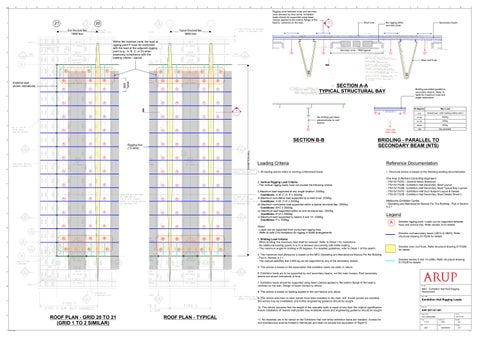
SECTION A-A
SECTION B-B
Loading Criteria
1. All loading advice refers to working (unfactored) loads.
2 Vertical Rigging Load Criteria:
- The vertical rigging loads must not exceed the following criteria:
) Maximum load supported at any single location: 2000kg
Conditions: A, B, C, D, E ≤ 2000kg
ii Maximum cumulative load supported by a main truss: 2000kg
Conditions: A+B, C+D ≤ 2000kg
iii) Maximum cumulative load supported within a typical structural bay: 2000kg
Conditions: B+C ≤ 2000kg
iv) Maximum load supported within an end structural bay 2000kg
Conditions: E+A ≤ 2000kg
v) Maximum load supported by beams 0 and 14: 1000kg
Conditions: F ≤ 1000kg
Notes:
- Loads can be supported from concurrent rigging lines
- Refer to note 3 for limitations for rigging in bridle arrangements
3. Bridling Load Criteria:
- When bridling, the maximum load shall be reduced. Refer to Detail 1 for restrictions.
- No additional loading (points A to F) is allowed concurrently with bridle loading.
- The maximum angle for bridling is 60 degrees. For detailed guidelines, refer to Detail 1 of this sketch.
4. The maximum load allowance is based on the MEC Operating and Maintenance Manual For the Building - Part A, Section A.2.1.
- The manual specifies that 2,000 kg can be supported by any of the secondary beams.
5. This advice is based on the assumption that exhibition loads are static in nature.
6. Exhibition loads are to be supported by roof secondary beams, not the main trusses. Roof secondary beams are shown indicatively in blue.
7. Exhibition loads should be supported using beam clamps applied to the bottom flange of the beams, centered on the web. Design of beam clamps by others.
8. This advice is based on loading applied to the roof beams only (blue).
9. This advice assumes no solar panels have been installed on the main roof. If solar panels are installed, this advice may be invalidated, and further engineering guidance should be sought.
10. This advice assumes that the weight of the operable walls is equal or less than the original specification. Future installation of heavier wall panels may invalidate advice and engineering guidance should be