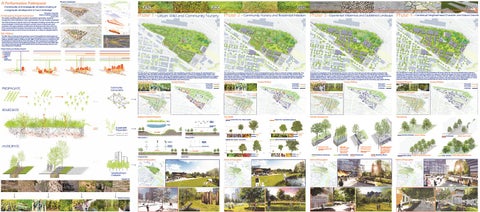
A Performative Palimpsest
Phased Masterplan
Contextually and ecologically sensitive phasing of a large-scale development in East Cambridge
Embracing Impermanence
Meghan Marchie
Master of Landscape Architecture January 2016
The rapidly expanding global population necessitates high-density, mixed-use development within established urban neighborhoods. The site conditions associated with these pressures of growth result in the disruption of existing communities as well as local ecologies. Embracing the long-term, phased nature of large-scale urban expansion, this project proposes a performative development plan that is driven by three process-oriented landscape interventions that establish a relationship with the existing community as well as ensure the longevity of a variety of ecological systems.
Phase 1 - Urban Wild and Community Nursery
Phase 2 - Community Nursery and Residential Initiation Phase 3 - Experiential Wilderness and Established Landscape Phase 4 - Contextual Neighborhood Character and Mature Growth
The first phase of Northpoint is primarily concerned with establishing growth. At this stage, the development is a working site, with circulation patterns reinforcing nursery maintenance, a central nursery/education center, and exploration of untamed open space. Glowing rail fragments appear on site, speaking to its industrial past as a railyard. Voids within the nursery trace proposed building footprints featuring low-impact interventions that hint at incoming building programs, allowing users to create relationships with these spaces.
The introduction of buildings sparks the first wave of transplanted nursery trees out into the existing community. The development remains relatively untamed, as phytoremediation continues at the rear of the site. The central nursery area starts to shift from a working/educational destination to one that features more community-driven programs. As more roads and pathways are introduced, circulation and gathering tendencies are established with the intention that they will persist over time.
Towards the completion of the development, the river and rear of the site has had enough time to become fully daylighted and remediated. As the phytoremediation bosque of trees is culled, the river landscape becomes more tamed. Additionally, the water is clean and thus accessible to the public, resulting in the river being integrated into the central gathering space. The plaza (no longer needed as a nursery center) has responded to its context by implementing a large hardscaped area that allows a wider range of programs for the increasing population density.
The development is fully built out and features long-established landscape elements. Found experiential objects (glowing rail lines) are rearticulated into the buildings, creating new dialogues with the landscape. The rows of mature trees unify the neighborhood by paying homage to the site’s recent past as a nursery. The river within the central gathering plaza becomes more formalized, featuring hard edges for urban engagement on all sides. The plaza speaks to its multiple histories, as well as provides an expanding range of programming opportunities for higher density and diversity of the population.
Ecological Program
Ecological Program
Ecological Program
Ecological Program
Site History The Miller’s River ran through the site, providing a means of transportation for industrial goods and services. As development continued, the river became a dumping place for the surrounding industrial buildings, ultimately resulting in its filling in the late 1800’s. The site then became a maintenance yard for trains (pieces of rail tracks still exist on the site today). The site’s industrial past has resulted in the northernmost area of the site having polluted groundwater and soils. The mouth of the Miller’s River was re-opened during the Big Dig, which ignited interest by local historical groups that have since begun lobbying for its daylighting.
Phased Massing and Building Program Institutional Residential Mixed-Use Office Transit Green Space
PROPAGATE
Community Connections
Nursery Phasing
Nursery Phasing
Propagate Remediate Anticipate
Nursery Phasing
Propagate Remediate Anticipate
Nursery Phasing
Propagate Remediate Anticipate
Propagate Remediate Anticipate
Circulation and Access
Circulation and Access
Circulation and Access
Circulation and Access
Building Footprint Programs
Tree Palette
Growth Management
Tree Spacing
REMEDIATE
Plants
Tables & Seating
Water
London Plane Tree - Platanus acerifolia
Pagoda Tree - Styphnolobium japonicum
Compacted Gravel
Sustainable Preparation
Level
Scoop/Pile
Rain Garden
Pop-up Cafe’
Program Allee
Program Street
Transplant
Transplant
Black Tupelo - Nyssa sylvatica
ANTICIPATE
Sculpture
Exposed Irrigation
Concrete Pedestals
Concrete Pad
Mound
Sculpture Park
Extent of Propagation
Neighborhood Character Vacant Lot
Interim Nursery
Formal Landscape Specimen Massing
Shear/Pile
Extent of Propagation
30’ O.C. Linear T rench
Eastern Cottonwood - Populus deltoides
Unimpeded roots Grade fluctuations from root flare
Splash Pad
Streetscape
Program Park
Program River
Transplant
Transplant
Formal Landscape
Extent of Propagation
Bore hole (up to 15’ deep) Groundwater Roots directed downwards
River Corridor
Continuous trench Permeable pavers Root spread and interaction
Streetscape
Silva cell suspended pavement system Permeable pavers Non-compacted soils encourage growth
Building Plazas
Building Plazas 15’ O.C. in Suspended Pavement
Extent of Propagation
River Corridor 10’ O.C. Bosque (culled over time)