LEISURE
Fort Campbell Courier
Thursday August 29, 2013
C
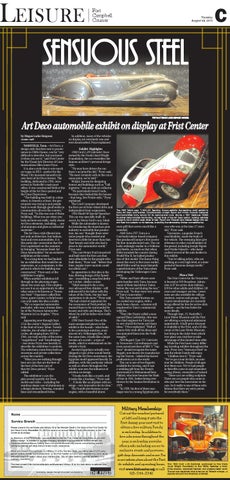
Sensuous Steel PHOTOS BY MEGAN LOCKE SIMPSON | COURIER
Art Deco automobile exhibit on display at Frist Center by Megan Locke Simpson Courier staff
NASHVILLE, Tenn. – Art Deco, a design style that first rose to prominence in 1920s France, can be “very difficult to describe, but you know it when you see it,” said Frist Center for the Visual Arts Director of Communications Ellen Jones Pryor. It is also a style that is very much en vogue in 2013 – perfect for the Music City museum housed in its own form of Art Deco history. The building, dedicated in 1934, once served as Nashville’s main post office. It was constructed both at the height of the Art Deco period and the Great Depression. “The building was built in a time when, in America at least, the government was trying to put people back to work through good works in communities all over the country,” Pryor said. “So this was one of those buildings. What you see when you look out here are really, really classic Art Deco elements, including … use of aluminum and glass as industrial materials.” The Art Deco style filtered into not only architecture, but fashion, food and even automobiles. It is this particular connection that the Frist capitalized on this summer, by bringing “Sensuous Steel: Art Deco Automobiles” for an exclusive exhibition at the center. “For a long time we had looked for an exhibition that would be an expression, or a companion, to the period in which the building was constructed,” Pryor said, of the exhibition’s origins. When another exhibition fell through in the planning stages about two years ago, Frist employees saw it as an opportunity to offer what came to be known as “Sensuous Steel.” Organizers called Ken Gross, guest curator, to help locate cars and make the idea a reality. “He’s a respected automotive journalist, who was a former director of the Peterson Automotive Museum in Los Angeles,” Pryor said. Appearing now through Sept. 15 in the center’s Ingram Gallery is the fruit of Gross’ labor. Twenty vehicles, two of which are motorcycles, all ranging from 1929 to 1941, are truly worthy of the terms “magnificent” and “breathtaking” – two terms Pryor uses heartily to describe the exhibition’s contents. The selections come from both car museums and private collections across the country. “What you see walking through here are cars that are the best of the best of the best cars of that Art Deco period,” Pryor added. The exhibition’s cars display several specific Art Deco motifs and styles – including the teardrop shape; use of aluminum as a design element; flowing, rounded lines and streamlined forms.
In addition, many of the vehicles on display are extremely rare and even handcrafted, Pryor explained. Exhibit Highlights 1930 Cord L-29 Cabriolet: Once owned by the Frank Lloyd Wright Foundation, the car resembles the famous architect’s personal design style. “He may have driven the car; there’s no proof he did,” Pryor said. “He most certainly rode in the car at some point, we’re told.” Wright, known for designing homes and buildings such as “Fallingwater,” was an avid car collector. “He particularly loved Cords, because they looked like his houses – that long, low Prairie style,” Pryor explained. The Cord Company developed the first use of front-wheel drive and independent front suspension. 1934 Model 40 Special Speedster: This car was specially-built, in secret, by Henry Ford’s son, Edsel. While the automaker is known for introducing the American auto industry to assembly line production, his son “thought there were some people who needed and deserved a little bit more than that. That beauty and style also had a place in the automotive world,” Pryor said. “The cars Henry Ford conceived and built were the first cars that were affordable by the people who built them,” Pryor said. “Before that time, regular mere-mortals could not afford cars.” In opposition to this idea is the luxe, flowing design of the Speedster – resembling a soap box derby car’s richer, sleeker cousin. “Edsel seemed to be a very, very advanced free-thinker – still influenced by his father with the values of the Fords, but just had aspirations to do more,” Pryor said. “He had a kind of aspiration for the consumers of Ford product. He wanted them to be surrounded by beauty and style and design. That’s where he and his father were really at odds.” 1936 Stout Scarab: One of the most unexpected pieces in the exhibit is the Scarab – what looks to be a prototype minivan, reminiscent of a Volkswagen Bus. At the same time, it looks like a larger version of a scarab – a type of beetle, which is emblazoned on the vehicle’s front. Ancient Egyptians actually worshipped a type of the scarab beetle. During the Art Deco movement, the Egyptian motif appeared heavily. In addition, with this particular vehicle as well as others throughout the exhibit, one sees the influence of aviation on design. “It looks both like a scarab, and it looks like a fuselage,” Pryor said. “… It looks like an airplane with no wings – very innovative for its time.” The Scarab also features a rearengine, with a beautiful alumi-
The 1938 Talbot-Lago T-150C-SS Teardrop Coupe exhibits the teardrop motif exhibit in many Art Deco automobiles. Coachbuilders Joseph Figoni and Ovidio Falaschi designed the handcrafted body, known for its aerodynamic look. Above, a 1937 Delahaye 135MS Roadster demonstrates the flowing, curved lines of the Art Deco period, making vehicles appear to be in motion even when at rest. Figoni and Falaschi also helped design this car, and filed four patents on its features, including the retractable, hidden convertible top.
num grill that curves much like a waterfall. 1938 Tatra T97: Tatra is a Czechoslovakian-based company that produced Europe’s first assembly line-manufactured cars. The car looks strikingly similar to a Volkswagen Beetle, so much so that when Hitler invaded the country during World War II, he halted production of this model. The funny thing about this story is that years earlier, Adolf Hitler and his team blatantly copied features of the Tatra when developing the Volkswagen Company. “Hitler and Nazi officers were quite familiar with Tatra, because many of them had driven Tatras before the war and during the war,” Pryor said. “So they were very aware of Tatra’s innovation.” This Tatra model features an air-cooled rear engine, with a back-bone chassis – a feature still employed in Tatra’s commercial vehicles. “They [the Nazis] called a man named Hans Ledwinkia, who was the chief engineer for Tatra just to sort of pick his brain and share ideas,” Pryor explained. “Well of course they stole all his ideas and incorporated them into the Volkswagen.” 1939 Bugatti Type 57C Cabriolet by Vanvooren: Car enthusiasts and even casual watchers of BBC’s “Top Gear” should recognize the name Bugatti, now known for manufacturing the Veyron – labeled the fastest production car in the world. This car is one of two Bugattis available for viewing, and it was a wedding gift from the French government to Mohammad Reza Pahlavi, who later became the Shah of Iran in 1941, before being overthrown by the Iranian Revolution in 1979. “In 1939, his first of three marriages was to a young Egyptian prin-
cess who was at the time 17 years old,” Pryor said. Vanvooren, a popular French coachbuilder, made the body of the vehicle. The sweeping lines give reference to other coachbuilders of the period, including Joseph Figoni and Ovidio Falaschi – who handcrafted several of the auto bodies in this exhibit. “You’re talking artists, who are working at a very high level, at a time period of luscious design motifs,” Pryor said. Plan a Visit The Frist Center for the Visual Arts is located at 919 Broadway. Admission is $7 for active-duty military, $10 for other adults and children (18 years and younger) are free. Lower rates are also available for college students, seniors and groups. Frist Center memberships are currently being offered for free for active-duty military – see the box below for more details. Through Sept. 15, Nashville’s Lane Motor Museum and the Frist are offering a reciprocal admission opportunity. A half-price discount is available at the Frist, and a $3 discount at the Lane Motor Museum. Just bring in the ticket from whichever place you visit first to take advantage of this limited-time offer. While the Frist hosts many differing traveling exhibits throughout the year, Pryor sees “Sensuous Steel” as one the whole Family will enjoy. “Children love it,” Pryor said. “We’ve got a tour for kids, an auto tour for children. People of all ages love these cars. We’ve had people in their 80s come in and remember seeing [these], remember a Packard. “These cars are rolling sculpture. There are car people who come in who just love the innovation in the cars. So it really is one of these exhibitions that there are entry points for everybody there.”
Military Membership:
Cut out the voucher (pictured at left) and bring it into the Frist during your next visit to obtain a free military Family membership. In addition to free admission throughout the year, membership provides other perks including access to exclusive events and previews, gift shop discounts and more. For more information about the Frist, its exhibits and operating hours, visit www.fristcenter.org or call 615-244-3340.
This 1930 Cord L-29 Cabriolet, purchased by the Frank Lloyd Wright Foundation in the 1950s, features a frontdrive chassis, clamshell fenders and precise detail work. The car was repainted what is known as Taliesin orange – a signature hue of the American architect.