Volume 52 Issue 18

Page 1


OPINION

Carney isn’t all that

Canadians should be scared, not be celebrating Carney

I n January 2026, Canadian Prime Minister Mark Carney spoke at the World Economic Forum (WEF) in Davos, Switzerland. His assertive, confident, and nearly seventeen minute speech at the podium spoke of the “new world order” that must emerge in the face of increasing unpredictability and threats posed by Donald Trump’s second presidency in the U.S.A. In a room full of capitalist economic and political elites, Carney said “we are in the midst of a rupture, not a transition,” hinting at how global superpowers like the U.S.A and Trump’s far-right regime have become increasingly emboldened in using economic and military threats to enforce their America-first agenda. In the speech, Carney said Canadians no longer benefit from the historically mutual relationship our country has had with the U.S.A.; that we must look elsewhere, build relationships with other middle-powers to break our reliance on “American hegemony.”

>> CARNEY continues on page 05

ARTS

Art as a Form of Protest

A look at how art is used in protests in Iran and other places of conflict

How do you fight oppression when the oppressor has guns and chemical weapons?

The answer is by no means a clear or straightforward one, but one method used throughout history has been art. Art is not (usually) violent, but it can give strength to the weak, and create a unity that the oppressor seeks to destroy. This may sound like an idealized fantasy, and while the idea is simplified, we can see examples of art as a form of protest in our current lives.

For the past 47 years, people in Iran have been fighting against an authoritarian government with little media coverage and no aid from other countries.

>> ART AS PROTEST continues on page 10

SLASHING OSAP GRANTS

On February 12, Ontario Minister of Colleges and Universities Nolan Quinn announced the end to the provincial government’s freeze on tuition fees, which has been in place since 2019, allowing colleges and universities to raise their tuition fees by two per cent each year for the next three years.

>> read more on page 02

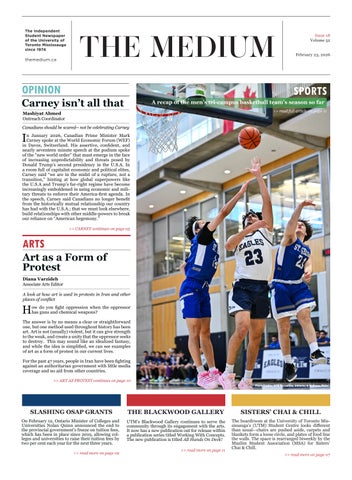
A recap of the men’s tri-campus basketball team’s season so far

>> read full article on page 11

THE BLACKWOOD GALLERY

UTM’s Blackwood Gallery continues to serve the community through its engagement with the arts. It now has a new publication out for release within a publication series titled Working With Concepts. The new publication is titled All Hands On Deck!

>> read more on page 11

SISTERS’ CHAI & CHILL

The boardroom at the University of Toronto Mississauga’s (UTM) Student Centre looks different than usual—chairs are pushed aside, carpets and blankets form a loose circle, and plates of food line the walls. The space is rearranged biweekly by the Muslim Student Association (MSA) for Sisters’ Chai & Chill.

>> read more on page 07

Photo Credits: UTM Recreation, Athletics & Wellness, Flickr

02 NEWS

Ford government faces criticism for slashing OSAP grants, lifting tuition freeze

Starting next fall, the provincial government will permit colleges and universities to raise tuition by up to two per cent annually, while reducing Ontario Student Assistance Program grants.

OnFebruary 12, Ontario Minister of Colleges and Universities Nolan Quinn announced the end to the provincial government’s freeze on tuition fees, which has been in place since 2019, allowing colleges and universities to raise their tuition fees by two per cent each year for the next three years.

According to the Ontario Newsroom, before the 2019-2020 Ontario tuition reduction, Ontario students experienced the highest tuition rates in any Canadian province. The tuition freeze included a 10 per cent tuition cut and prevented colleges and universities from increasing their tuition. This policy lasted seven years.

Prior to the tuition freeze raise, the Ontario Student Assistance Program (OSAP) provided Ontario students with a maximum of 85 per cent in grants and a minimum of 15 per cent in loans to pay off their tuition. However, the new policy will only offer students a maximum of 25 per cent in grants and a minimum of 75 per cent in loans.

One grade 12 student in London, Ontario, Xingtong Shan, told CBC News that the lift on the tuition freeze and the overall increase in post-secondary tuition rates “actually discourages people to study [and] to continue their studies in university.” Shan thinks “it encourages people to find a job rather than keep studying.”

Doug Ford stands behind the decision

Addressing the backlash over the province’s decision to cut grants for postsecondary students, Premier Doug Ford argued he “fought for [students] for seven and a half years, not letting universities and college(s) raise tuition,” but that “the situation that Ontario was facing wasn’t sustainable any longer” and he faced “massive pressure from the sector” to end the freeze, according to Global News.

According to CTV News, Ford told reporters that, had the tuition freeze continued, “institutions could have been forced to close without the ability to generate additional revenue.”

To deal with this change, Ford said students “have to invest in their future”

and should focus on program majors such as trades or STEM instead of ”basket-weaving courses” because “those are where the jobs are.”

“I will continue supporting and fighting for students even though they’re probably upset right now, but I’ve heard some nightmare stories on the other side…about kids going out there buying fancy watches and cologne… that doesn’t fly with the taxpayers,” said Ford.

“We are accountable to the taxpayers,” said Ford. The taxpayers want to be assured that students are using their money to “actually… graduate and move forward.”

CFS-O: Hands off our education, hands off our OSAP

The Canadian Federation of Students-Ontario (CFS-O) expressed their outrage on their Instagram account @cfson, stating, “The Ford government’s decision to open the floodgate to tuition increases AND the decimation of OSAP will destroy what’s left of education in Ontario. Enough is enough— it’s time to take to the streets and flex the true power of students in the province.”

The CFS-O calls on students, instructors, parents, and community members to join them in protest on March 4 at 12:30 p.m. in Queen’s Park. Additionally, the CFS-O launched an Emailer tool whereby students can sign their names in support and prompt the union to send an email to their member of provincial parliament on their behalf.

The CFS-O states, “We will continue to organize and demand accessible and free education because education is a right, not a privilege.”

German researchers visit U of T to discuss the impacts of AI on post-secondary education

Researchers and UTM faculty reflect on how artificial intelligence is reshaping learning, policy, and student experience following OISE’s AI in Higher Education speaker event.

Students and faculty gathered at the Ontario Institute for Higher Education (OISE) on February 3 for a hybrid speaker event, “AI in Higher Education: Perspectives from Germany on Policies, Student Well-Being, and Datafication.” The event centred on how artificial intelligence (AI) is reshaping higher education.

Hosted by the OISE’s Centre for Innovation in Higher Education, the session featured researchers Andreas Breiter, Paula Goerke, Veronika Graceva, and Jule Jensen from the University of Bremen in Germany, who presented findings from a multi-year project examining student AI use, university governance, and data systems across German institutions. The team shared results from Germany’s first large-scale student survey on generative AI, showing that tools like ChatGPT are already embedded in everyday academic work.

Professor Andreas Breiter shared results from Germany’s first large-scale student survey on generative AI, showing that tools like ChatGPT have become a part of students’ everyday learning. Students most

commonly use AI for translation, brainstorming and general research, with international students relying heavily on language support tools.

Breiter noted that many students now treat generative AI as academic support, saying that “students actually use that as a learning partner.”

Despite widespread adoption, he explained that institutional guidance has not kept pace, leaving many students uncertain about what is permitted and how AI should be used ethically in coursework.

Researcher Jule Jensen then presented findings on neurodivergent learners, highlighting mixed responses to AI tools. Some students reported frustra-

Editor | Aaron Calpito news@themedium.ca
Photo Credits: Melody Zhou
Illustrated by Melody Zhou

tion with inconsistent outputs and overly affirming language, while others expressed broader concerns about automation, bias, and environmental impact. Jensen emphasized that accessibility alone does not guarantee meaningful learning, particularly for autistic students who reported more negative attitudes toward generative AI.

Moving from student experience to institutional systems, another researcher, Paula Goerke, addressed how universities are modifying their data infrastructure in response to AI. Higher education institutions already rely significantly on data for grading, assessment and administrative decision-making, and that generative AI strengthens this connection by generating and consuming data. Goerke described how some universities are attempting to build internal AI systems, while others rely on decentralized experimentation that varies between departments and is frequently influenced by manpower and financial constraints.

The session concluded with policy analysis from researcher Veronika Graceva, who considered AI guidelines across 28 German universities. Graceva described a rapid wave of policymaking following the release of ChatGPT in late 2022, with many institutions introducing disclosure requirements and redesigning assessment to discourage misuse.

At some universities, students are now required to declare any AI use. “Students must disclose any AI use, including which tool they used and what prompts. Otherwise, it counts as cheating,” Graceva said.

Graceva added that while limited funding has forced universities toward shared infrastructure and collaboration, it has also expedited AI adoption among others.

As students continue to integrate AI into their education on their own, the presentations collectively demonstrated the increasing pressure on universities to strike a balance between innovation and academic integrity, accessibility, as well as student support.

While the German research focused on institutional structures and student behaviour at a national level, similar questions are emerging in Canadian classrooms.

In an email with The Medium, Ji-young Shin, an assistant professor in the University of Toronto Mississauga’s Department of Language Studies, said AI

OPINION

use in language learning reflects many of the same patterns identified in the study.

“Informally, students are already using AI extensively outside the classroom. They use it to check grammar, paraphrase sentences, generate ideas, translate expressions, and practice conversations,” Shin said.

Shin stressed that access alone is insufficient, though AI is being utilized more and more to provide automated feedback. She explained that meaningful learning depends on how these tools are integrated into pedagogy, noting that universities must align AI use with specific learning objectives.

One of AI’s greatest advantages, according to Shin, is accessibility, especially for language learners who could have difficulties with time, money or instructor availability.

“One meaningful benefit is accessibility. Learners can access AI tools anytime and anywhere, which lowers barriers related to time, cost, and availability of instructors,” she said.

Shin warned against relying too much on AI at the

same time, pointing out that doing so could jeopardize fundamental learning processes. She pointed out that drafting, organizing thoughts, and constructing meaning are essential parts of language development. These skills can weaken when students outsource too much cognitive work. “Overdependnce is a serious pedagogical concern,” she said.

Beyond individual learning habits, Shin stressed that universities have a responsibility to shape how students understand and use AI. Rather than focusing solely on enforcement, she argued that institutions should invest in AI literacy and transparent guidance, helping students recognize both the capabilities and limitations of these tools, echoing some of the main points of the OISE event.

Looking ahead, Shin believes AI will continue to reshape language education, by forcing educators to reevaluate what good teaching actually entails, rather than by eliminating human interaction entirely.

With the growing normalization of generative AI, educators must strike a challenging balance between welcoming innovation whilst still preserving academic integrity, equity, and meaningful learning.

opinion@themedium.ca

The myth of Canadian politeness

Is politeness equivalent to goodness?

Ionce apologized to someone and was surprised to be responded to with: don’t be so Canadian. But, then again, was I really that surprised?

The simplest—and most stereotypical—way to define Canadianess is politeness. “Sorry” is the most popular word in our vocabulary and we have a reputation for our goodness. Or so we like to tell ourselves.

The reality is that no nation is perfect, and Canada is no exception. The most recent controversy of the Canadian facade has been linked to direct ties made apparent with the US Immigration and Customs Enforcement (ICE), responsible for the deaths and kidnaps of many in the US. Notable Canadian companies that have come under fire for their connections to ICE have included Jim Pattison Group, Hootsuite, and Roshel.

The ICE-involvement has caused people to question Canada’s national identity and forced Canadians online to confront their country’s missteps that have occurred throughout Canadian history.

The most marked atrocity that Canada has and continues to be involved in is its colonial campaign, like the Indigenous residential school system which only came to an end in 1996. Canada has been working for years to repair its ties to Indigenous peoples, declaring days like Truth and Reconciliation Day and weaving in practices like land acknowledgments. However, these acts often feel empty and are feed into the forced politeness of Canada.

If we are to define Canada’s symbolic national identity, we must define politeness. It is an act of courtesy to others. This act can be seen everyday in Canada for me—a “thank you” here and there, a quick to follow “sorry” when someone messes up, and yes, a land acknowledgment.

However, to me, politeness is an act that often barely scratches the surface of doing good for others. It is naturally steeped in passive behaviour and acts as a

Photo Credits: OISE, Centre for the Study of Canadian & International Higher Education-University of Toronto
Illustrated by April Roy

defense mechanism to avoid confrontation and direct involvement in an issue.

When politeness meets national identity, they clash. Not only does it cause Canadians, and other nations, to perceive our country through one characteristic, but it also causes Canada to be viewed as a country that will let itself be walked over, like being complicit in war, genocide and terror.

Although politeness is a defining Canadian trait, it cannot take place as an entire national identity. While it can be our strength, it can also limit us in how directly we address wrongdoings of other nations and our own.

Perhaps, it is not that Canada’s politeness is a myth, rather it is a myth that politeness equates to goodness.

It’s not to say Canada lacks goodness. It can be found in everyday life—a person holding open the door for another, or a cashier helping out an elderly customer—but these acts can often spread only so far as to one person.

With the Canadian government, politeness takes the place of goodness. Empty promises to do better, symbolic respect issued to nations, like the US, that are less deserving of it at this time. Politeness keeps ties intact, but it may stem from a fear of severing ties when necessary or making the right decision even though it may be deemed as wrong.

As the government and Canadian companies’ respond to current world affairs, such as the tensions regarding ICE, they act as the representative of the national identity on the world stage in turn casting a shadow over the people of Canada and how they are perceived by the rest of the world.

The problem with the myth of politeness will only be addressed once it is acknowledged by both civilians and those in positions of power. By recognizing the imperfections of our government, as a collective, Canadians are capable of reimagining a future for the country in which we take bolder stands against what we believe is wrong and bolder stands with what is right. With these stances, Canada must also approach new sustainable ways to carry on and maintain a reputation of goodness rather than simple politeness.

The naked mom paradox

Our reactions to ordinary nudity reveal more about cultural anxiety than morality

Looking ahead, Shin believes AI will continue to reIf Western culture is so sexually liberated, why does seeing the bodies of your own mothers feel more like a taboo than watching strangers undress on the screen?

Most of us already know the answer to that question. Exposure isn’t the issue, ownership is. A woman’s body is acceptable when it is offered for consumption by making it aestheticized, sexualized, or commodified. It becomes unsettling and absurd when it exists outside that framework, especially in intimate, nonperformative spaces.

Growing up in India, I did not experience my mother’s body as something separate from everyday life. In crowded South Asian homes, privacy is less of a fixed boundary and more a flexible arrangement. Doors are half-closed. Bathrooms are shared. Towels are forgotten. Mothers change quickly, without theatrics. No one treats these moments as scandalous because they are not meant to be seen through a sexual lens. They are domestic, functional, ordinary.

What is sexualized is not the body itself, but the gaze placed upon it.

The paradox in South Asian and Western cultures

South Asian cultures often produce an uncanny paradox. At home, the female body can be “normal.” Grandmothers sit in petticoats, mothers adjust blouses mid-conversation, aunties oil their hair while giving life advice.

Outside, the same bodies become heavily policed. Dress codes are justified as protection. Modesty is framed as respectability. Safety is tied to concealment. Women are told their bodies invite attention, and therefore must be managed. This creates a familiar but rarely acknowledged message: your body is socially dangerous because it invites unwanted recognition, and hence needs restrictions.

Western societies claim to reject these restrictions, yet they reproduce the same anxiety in a different form. The female body is everywhere: advertising, entertainment, and social media, yet, always curated. Smooth, toned, symmetrical, hairless. A body designed to be looked at.

This intense culture prides itself on sexual openness, yet struggles profoundly with non-sexual nudity. A bikini is normal because it signals intentional display. Lingerie campaigns are acceptable because they aestheticize exposure. Even explicit content operates within a framework of performance and control. But a mother walking naked through her own home is a violation because the body is not being offered to an audience. It is simply there.

An example of this weird fallacy is why public breastfeeding remains controversial in many places despite being biologically mundane. The discomfort is not about skin; it is about function. A breast used to feed disrupts its sexualized symbolism.

Despite the difference in geographies, these cultures have one principle in common: visibility is permitted but ordinary existence isn’t.

Ironically enough, this double standard does not exist for the male gender. A man roaming in nothing but his shorts is seen as a symbol of comfort, but a woman doing the same is deemed provocative.

Growing up around the naked mom

It is routine and common for children in Western cultures to grow up and view their mothers naked. From public locker rooms to bedrooms, children view their mothers adjusting their clothing everywhere, a mundane daily practice. They do not initially sexualize bodies. A stomach is somewhere to rest your head. Stretch marks are just lines. Breasts are associated with comfort and nourishment. The neutrality is almost scientific.

Sexual meaning is taught later, often abruptly and without explanation. Young girls learn that their bodies will be evaluated, judged, and interpreted whether they intend it or not. They are taught to anticipate the gaze before it arrives. Clothing becomes a strategy and movement becomes self-conscious.

Eventually, surveillance moves inward. Even alone, many women behave as if they are being watched.

In many parts of the world, communal nudity is normalized in separate gender spaces. North African hammams, Finnish saunas, and Japanese bathhouses allow women of different ages and body types to share space unclothed without spectacle.

Bodies in these settings are not exceptional. They are aging, scarred, soft, strong, uneven—simply existing. Familiarity reduces curiosity and visibility removes mystique.

Anthropologists often observe that societies with normalized non-sexual nudity tend to bring less voyeuristic fascination with exposure. When bodies are ordinary, they lose their power as taboo objects.

Western culture, by contrast, creates scarcity of real bodies while flooding public space with idealized ones. The result is both obsession and discomfort: a feedback loop of comparison and curiosity.

The internal consequence

Perhaps the stealthiest and the most profound outcome is not how women are viewed, but how they learn to view themselves. Many women grow up treating their bodies as projects to be managed rather than places to live.

You adjust your clothes before standing up. Check reflections in windows. Delete photos that feel “wrong.”

This constant self-surveillance is exhausting precisely because it becomes automatic.

For those raised between cultures, the dissonance can be sharper. You have seen bodies treated as ordinary in one context and scrutinized in another. You know comfort is possible, yet rarely permissible.

None of this is to say privacy doesn’t matter, or that everyone should suddenly be comfortable with the same boundaries. People have different upbringings, different comfort levels, different definitions of what feels normal. That’s fine.

But privacy and shame aren’t the same thing.

It’s a little strange that a culture can handle hours of fictional violence without blinking, yet still get awkward about stretch marks or an unposed body. The discomfort isn’t really about exposure, it’s about familiarity. We’re used to seeing women’s bodies in very specific contexts and anything outside those scripts can feel oddly jarring.

Maybe the shift isn’t about showing more skin, but about making ordinary bodies less of an event. A mother walking from the bathroom to her bedroom after a shower. A daughter barely noticing. A body that isn’t trying to be attractive, modest, or symbolic—just existing and getting on with its day.

Because maybe the most unsettling idea isn’t that women’s bodies are powerful or dangerous or sacred, it’s that sometimes they’re not particularly meaningful at all.

Apologize for taking up space. Monitor posture, weight, skin, hair, visibility; the list is endless.
Illustrated by Adanna Scott

MASTHEAD

EDITORIAL BOARD

Co-Editor-in-Chief

Aya Yafaoui editor@themedium.ca

Co-Editor-in-Chief

Samuel Kamalendran managing@themedium.ca

News

Aaron Calpito news@themedium.ca

Opinion

Yasmine Benabderrahmane opinion@themedium.ca

Features

Gisele Tang features@themedium.ca

A&E

Yusuf Larizza-Ali arts@themedium.ca

Sports

Joseph Falzata sports@themedium.ca

Photo

Melody Zhou photos@themedium.ca

Design

Sehajleen Wander design@themedium.ca

Social Media

Jannine Uy

social@themedium.ca

Outreach

Mashiyat Ahmed

outreach@themedium.ca

Copy

May Alsaigh may@themedium.ca

Anaam Khan anaam@themedium.ca

TO CONTRIBUTE & CONNECT: themedium.ca/contact

@themediumUTM

@themediumUTM

@themessageUTM

Carney isn’t all that (contd. from pg 01)

Mashiyat Ahmed Outreach Coordinator

Ata time when Canada’s territorial and cultural sovereignty have come under attack by Trump’s blatant threats, Carney’s impressive articulation appears hopeful, or at the very least, refreshingly truthful compared to the typical politician-slop speeches. Many world leaders, like democratic presidential candidate Gavin Newsom and Finnish President Alexander Stubb, praised Carney’s honesty and clarity (guys, the bar is in hell) in calling out Trump. NATO’s secretary general Mark Rutte put it simply: “Canada is back.”

But what struck me was not what Carney said on the Davos podium or the sublime reactions of world leaders, but the reactions of many liberals and so-called leftists in Canada. Most of the fangirl reactions lauded Carney’s inspiring words and brave stance against the abuse of power; in other words, the speech sounded… nice? I don’t disagree that geopolitics is changing and that we should change with it. But people online are acting like finance-bro Carney is the new Che Guevara, standing up and giving a big, fat middle finger to good old U.S. imperialism and aggression.

In my opinion, a closer reading of the speech and Carney’s actions here at home consolidates our PM’s position as a center-right politician. And as young Canadians, we must contend with what that means for our shared future.

Canada:

A wolf-in-sheep’s-skin identity

Many online praised Carney’s condemnation of what was believed to be American imperialism. The speech comes at a time when the Trump administration is actively threatening to annex Greenland (which the speech directly points out) and is weaponizing tariffs as an economic control against regimes not in alignment with U.S. interests. Simply look no further than Trump’s social media AI-slop-fueled mockery of Canadian sovereignty and maps of a “Greater America.”

On more than one occasion, Trump has called Carney the “Governor of Canada,” a nod to his earlier rhetoric of us being the 51st state. In response to America’s growing unpredictability, Carney believes in a “valuesbased” world order, one where global middle-powers, including Canada, unite to resist the bullying ensued by America on the world stage (amongst other things).

But did Carney’s speech condemn U.S. imperialism, or did it simply condemn a version of U.S. imperialism that Canada no longer benefits and takes inspiration from?

If Carney was genuinely concerned about the rising threats of unfiltered imperialism in foreign policy, he should’ve also mentioned Venezuela—in addition to Greenland. Earlier this year, Venezuela’s President Nicolas Maduro was kidnapped and his government was undermined, as per the Monroe Doctrine, due to the country’s massive oil reserves, which the U.S. took interest in controlling. As expected, Canada failed to condemn how aggression was being used to trigger regime change in the region, and instead, placated us with general comments about a nation’s right to freedom and democracy.

Speaking of ongoing imperialism, the question of Gaza on Carney’s record so far has been a harrowing revelation of the PM’s hypocrisy. Besides failing to recognize that a genocide is taking place, Carney believes “in principle” in Trump’s “Board of Peace” for Gaza, which is meant to support reconstruction according to American and Zionist interests in the region. In other words, the board makes a complete mockery of Palestinian self-determination and dignity. On top of this, Carney has never directly condemned or materially thwarted Israel’s genocide.

In the face of all this political backhandedness, one of

the reasons people are calling Carney’s speech hopeful and inspiring is because of its use of optics. Carney outlines the clear ways his government hopes to strengthen our economy through “nation-building” projects. “Since my government took office, we have cut taxes on incomes, on capital gains and business investment. We have removed all barriers to interprovincial trade. We are fast-tracking $1 trillion of investments in energy, AI, critical minerals, new trade corridors, and beyond,” said Carney at Davos.

In rhetoric alone, this all sounds well and high-browed, like a politician with a fierce vision for his country’s future. Yet, to attract said investment, our government passed Bill 5, which unashamedly sidelines Indigenous rights, eases environmental protections (many of which were fought for by Indigenous advocacy), and bypasses other regulatory mandates in an effort to fast-track the nation-building projects Carney believes to be the guarantors of Canada’s future.

Canada also relies heavily on American tech companies such as Microsoft, Meta, Google, and other AI giants for digital services. The very same companies that are increasingly beholden to Trump’s right-wing agenda. Yet, Canada continues to sign agreements with these tech giants, and according to professors Natasha Tusikov and Blayne Haggart, “has allowed the U.S. to invest in two Vancouver companies mining critical minerals.”

On top of this, Carney hasn’t been shy about his love of AI, with a nearly $1 billion investment into AI over the next five years and the building of several data centers which are hungry for water, land, and power. The Davos speech also mentions energy investments, which is simply finance-bro-code for Carney sucking up to a bunch of oil and gas executives and lobby groups. Nothing new there.

To add fuel to the fire, Carney plans to significantly increase Canada’s defence budget—as per his speech—to reduce dependency on the U.S., a decision that runs parallel to the government’s increasing austerity measures, which sucks money out of the public sector and scapegoats these jobs as the source of overspending.

Canadians love to cope

To me, Carney’s bold vision for Canada’s future at Davos isn’t something to celebrate. It’s simply concerning, because behind the grandeur of our PM’s words lies a reality of problematic legislation and ideological alignment with liberal capitalism that puts profit over people and optics over real systemic change.

Carney’s speech isn’t revolutionary because besides failing to condemn U.S. imperialism, it fails to condemn the capitalist logic at the root of Canadians’ suffering. The only thing Carney’s speech condemns is irrational tariff policies Trump seems to be leveraging

Illustrated by Melody Zhou

for his political puppetry. But the real threat of authoritarianism, both south of the border and globally, remains fundamentally unaddressed by our leaders.

A few months back, I was moderately happy that Carney beat Poilievre and that my vote contributed to a “new start” for Canada. But in all honesty, how can I claim to genuinely exercise my democratic right when our nation doesn’t even have a true leftist opposition to support and vote for? So, partly disillusioned with Trudeau and entirely disgusted with Poilievre, I voted for the next best thing (which isn’t the next best thing at all): Carney’s Liberals.

I think part of the reason why many fawned over Carney at Davos was because Canadians are still reeling from the high of a certain illusion: the illusion of

having beat the right-wing government Poilievre represents. I don’t mean to be a picky leftist when I say this, but Carney’s win did not defeat Poilievre like we believe it did. In fact, I believe that if Carney continues to fail working-class Canadians through more cuts to the public sector or by systemic disinvestment in social welfare, his four-years as our PM might lay the foundations for a future conservative government’s landslide win.

With Trump’s second term, we see how material realities, like the cost of living crisis, can be exploited to push xenophobic, racist, and anti-immigrant sentiments to eventually vote in a fascist presidency. We can’t have the same formula take place in Canada. And that starts with holding Carney’s government accountable and refusing to accept mediocrity as the ultimate solution to real social change.

The joy of being a hater

Hate-consumption of media is so much more fun!

It’s well past your bedtime, and yet there you are, endlessly scrolling through your streaming platform of choice. You skip past the Grammy nominees, the top-rated picks on Letterboxed, the critically acclaimed gems. And then it appears, the perfect movie: outdated, poorly aged, with awful CGI and even worse acting. The plot is nonsensical and cringe-worthy. You’ve heard countless people trash it, seen it mercilessly roasted on social media. You already know you’re going to despise it. Yet, that is exactly why you settle in to watch the entire thing.

This phenomenon, known as “hate-watching,” is defined in the Oxford English Dictionary as “to watch…in a spirit of mockery, as a form of entertainment.”

Hate-watching, or hate-consumption, isn’t limited to TV shows and movies. It extends to other forms of media as well, like books or content from online creators. While the concept may seem ridiculous, many of us engage in it at some point.

Are we all just masochists? Why would anyone willingly spend time on something that they don’t like?

The first step is determining what makes something worthy of hate-consumption. While quality is subjective, there is often a consensus on what counts as “bad” media. This can be a result of nonsensical writing, poor acting, low effort production, morally questionable messaging, and so on. When something gains a reputation for being terrible, it grants permission to hate on it without guilt.

However, hate-consumption goes beyond just watching or reading something bad. It’s about going in with the explicit intention of disliking it and enjoying the experience of that dislike.

So, how can we find joy in hatred? Is it innate to us?

The answer lies in the fact that the enjoyment we derive is often indirect and delayed. It doesn’t come from the media itself, but from the emotional catharsis it triggers. Yelling at the screen, throwing a book across the room, or ranting and raving to a friend are all ways to process and express frustration. We get a rush from experiencing intense emotions, whether it be joy, fear, or in this case, anger.

Consuming content we hate offers emotional release in a safe environment, without the risk of real-life consequences to expressing these emotions. It’s akin to watching a scary movie when you know you’re not actually in danger.

Collective hatred can also bring us closer together. It can create a sense of community, especially amidst our hyper-individualised social operation.

When we share the experience of mocking a terrible piece of media with friends or online communities, we turn passive consumption into an active, collective discussion. Shared humour and critique foster social connection and creates a sense of belonging. Hate-consumption becomes a cultural experience.

Take, for example, the Marvel Cinematic Universe (MCU). In recent years, there has been a significant decline in quality with installments like She-Hulk and

Madame Web, sparking significant backlash. The internet flooded with memes and commentary videos, making many feel the need to watch just for the sake of being a part of the conversation. It becomes a you-had-to-bethere moment, where the criticism becomes part of the entertainment.

Hate-consumption is not only rewarding socially, but intellectually too. It forces us to think critically about aspects we enjoy and those we don’t. Audiences don’t passively absorb bad media. Spurred on by their frustration, we analyze everything that went wrong, compare it to better examples, and imagine how media creators could have made it better. Engaging with bad media can improve media literacy and encourage creativity. In a way, we can get a deeper appreciation for good quality through contrast.

Although, this begs the question of whether we need to consume bad content at all. Surely, we can gain so much more by sticking to quality media. Why waste precious time? The reality is that not all media needs to be “good” to be valuable to us. Sometimes, we need something that’s easy, silly, or even “bad” to give our brains a break from more intense, challenging content and to release pent-up emotion.

The key is intentionality. It’s important to always remain mindful of what we dedicate our time to and why. “Slop content” is fine in moderation, but if you’re constantly binging for the sake of turning off your brain, you risk losing the ability to analyze what you’re seeing and falling into a cycle of mindless overconsumption.

Non-stop negativity breeds cynicism and eventually erodes our capacity for pleasure or appreciation. There can only be so many “I Read Colleen Hoover’s Books So You Don’t Have To” video essays before we realize it’s time to move on and use what we’ve learned to find or produce better stories.

In the end, balance is essential. Hate-consumption allows us to purge our frustrations, connect with others, and think more critically. But, if we’re not careful, the exact opposite can happen. Quality matters, but so does variety.

Sometimes, embracing being a hater can, paradoxically, bring more joy than you’d expect.

Photo Credits: Melody Zhou

07 FEATURES

Sisters’ Chai & Chill : Home between classes for Muslim students

Port Credit’s upcoming new addition will make it easier for people to walk, bike and connect, giving locals, students and visitors a smoother path into the vibrant neighborhood

The boardroom at the University of Toronto Mississauga’s (UTM) Student Centre looks different than usual—chairs are pushed aside, carpets and blankets form a loose circle, and plates of food line the walls. The space is rearranged biweekly by the Muslim Student Association (MSA) for Sisters’ Chai & Chill, a gathering that offers Muslim women a low-pressure environment to connect and unwind.

For Ayishah Maqsoodi, now part of the organizing team, Chai & Chill represents a tradition that has carried on through different student cohorts of the MSA.

“Chai & Chills are something that we do every single year,” said Maqsoodi. “My sister used to go to UTM, and she would talk about them.” Having participated in Chai & Chills as a first-year student, Maqsoodi eventually joined the MSA as a member of the Islamic Education Department. “So, it’s an ongoing thing.”

While Chai & Chill has remained a consistent part of MSA’s program, its organization has evolved. In previous years, the event followed a more structured model with a traditional setup of tables and chairs. It would often feature a speaker for 30 minutes, followed by a group discussion afterward. This year, organizers deliberately moved away from a lecture setup.

“Instead of sitting in classrooms, we sit in a circle on carpets with blankets,” Maqsoodi shared. “It’s more of a picnic type of vibe.”

This year, organizers focused on curating an open, enjoyable atmosphere. “We stepped up the food game a lot,” she added. “We decided that this year, we’re going to put an effort into making things aesthetic, because people love aesthetics. It’s very pretty. Good food. Good vibes.”

However, the allure of Sisters Chai & Chill goes beyond presentation. It typically includes a guided discussion, with topics ranging from faith and identity to student life. For instance, organizers would lead discussions on how to maintain religious commitments with busy schedules, navigating loneliness or difficulties of wearing the hijab (headscarf worn by some Muslim women as an expression of faith).

These topics serve as starting points, opening up space for attendees to reflect or share their experiences if they feel comfortable.

Participants’ reflections

Eiliyah Naveed, a member of the Islamic Education Department, shared that she was drawn to Sisters’ Chai & Chill because it provides a sister-only space.

Naveed discovered the event through MSA’s Instagram (@utmmsa) in her first year. And it offered a perfect opportunity for her to connect with like-minded peers.

“I wanted to surround myself with other Muslim girls who were like-minded and shared the same values as me,” said Naveed. “It was a low-maintenance and low effort kind of space, where you can just be yourself with girls that share the same values as you.”

For Naveed, community does not require sameness in interests or majors. What matters are opportunities for connection and dialogue.

“As long as we are in this environment, we feel safe together,” said Naveed. “We feel comfortable, and we’re able to talk about very vulnerable topics.”

“You don’t usually get to talk about [sensitive topics] in university settings. That’s why [Sisters’ Chai & Chill] provides a sense of community for me,” Naveed concluded.

Ritaj, a second-year life science student, shared that Sisters’ Chai & Chill offers both connection and a pause from her busy routine. “I really like the gathering of the sisters,” said Ritaj. “It’s a good way to take a break from life, as well as studying and everything.”

She described the event as quietly reflective. “Coming to this gathering forces you to think about things that you never thought about before.”

When asked whether there was a specific moment in Sisters’ Chai & Chill that stood out to her, Ritaj shared, “The whole community is staying with me.”

To Ritaj, each gathering inspires a lingering impact. “When the event ends, I reflect on what was said. There are a lot of people who share their personal experiences and thoughts. It really hits.” Ritaj said, “I can see a change in myself after each reflection. I feel like this is the best thing.”

Another third-year student, who chose to remain anonymous, attended Sisters’ Chai & Chill, which meant pushing herself out of a long period of isolation. She described feeling disconnected throughout much of her university experience.

“In some of my classes, all my classmates are non-Muslims, which is not a bad thing… You don’t connect with people unless you have something in common.” She recalled feeling disconnected in her first two years in UTM.

Attending Sisters’ Chai & Chill this year marked a turning point for her. “I pushed myself to join Chai & Chill. And, in simple words, I feel so alive again.”

She elaborated that as an international student, finding community has been especially difficult. “I came here [Sisters’ Chai & Chill] in my first year once, and I never came back because I got busy.” However, the return felt necessary for her.

“Recently, I decided I really need to join. Because it gets very hard to do things at all on your own. Having a Muslim community makes a huge difference.”

A warm invitation

With Ramadan (a holy period of fasting for Muslims) underway, community conversations feel especially present. For Maqsoodi, Ramadan immediately brings to mind the masjid (a Muslim place of worship).

“When I think of the word ‘community’, I think of the masjid, 100 per cent,” Maqsoodi said. “That’s where everyone comes together, showing care and support. It’s so beautiful.”

Maqsoodi said that she was concerned about losing her religious connection in university. However, she found a community that supports her religious connection through MSA.

“The MSA is my home on campus,” shared Maqsoodi. Although it’s not the same as being in a masjid, there is that sense of community, and the sisterhood is unreal.”

Naveed echoed that sentiment. “If you’re somebody who’s lacking connection or feels out of place on campus, coming to our MSA events would be the perfect thing for you. Everyone here is very welcoming and non-judgmental. It’s where you will find friends.”

She shared that MSA events have the power to provide a sense of “home” for Muslim students on campus.

Beneath the carefully arranged tables and blankets, Chai & Chill offers something more lasting than aesthetics. Because sometimes, a community is built sitting on the floor between classes over a cup of chai.

Photo Credits: UTM Muslim Students Association

The way a machine reads

Understanding how AI processes our commands.

Mankind has always tried to merge technology and humanity, to integrate humans’ adaptability with machines’ superiority. In November 2022, humanity made a step in that direction through ChatGPT.

ChatGPT is a chatbot developed by OpenAI. Just like any other chatbot, ChatGPT holds conversations with users, teaches users about any topic, and produces original writing. Unlike other chatbots, ChatGPT is flexible. It adapts to any scenario with ease and improves through human interaction. It’s almost like a human.

Machines cannot read English or any other language. The only language machines process is ones and zeroes. Computer scientists developed programming languages like C, Java and Python to communicate with machines.

So, how can ChatGPT understand the commands we give it? We aren’t using a fancy coding language, just regular words. How does a machine read our questions and understand us? Natural Language Processing (NLP) answers these questions.

What is NLP?

Natural language processing is a field of artificial intelligence (AI) that creates techniques computers use to analyze and represent human languages. The reason such a field exists is because of the complexities of the human language. Consider the phrase, “I saw the Golden Gate Bridge flying into San Francisco.”

A reader who has never heard of the Golden Gate

Bridge, or even of bridges in general, may read the sentence as “the Golden Gate Bridge” flew into San Francisco. In this situation, the reader did not have the appropriate context to understand the sentence.

Machines have no context whatsoever. They lack awareness of the cultural nuances that accompany the human language. The human language is ambiguous. Every word has multiple synonyms, each with different connotations that can impact your understanding of the sentence. Many words, like “can” and “orange,” can have different meanings based on the context.

Despite these problems, scientists devised techniques to process language. Recently, the most popular language processing technique comes from deep learning. Deep learning is a subset of AI that uses neural networks.

What are neural networks?

Warren McCulloch and Walter Pitts, researchers at the University of Chicago, proposed the idea of neural networks in 1944. They created a new computing model, modelled on the human brain.

A network of neurons composes the human brain. Every thought and action we do originates from a sequence of activated neurons. From what we experience with our senses, a signal is sent to a neuron. This neuron then sends signals to another sequence of neurons, where each neuron slightly modifies the signal.

A sequence of neurons stores information. When we access information, we activate the neurons related to it. When we learn something new, we make new neural connections within our brain to store that information. Humans can build new knowledge from prior knowledge based on this biological process. And McCulloch and Pitts suggested neural networks as a way for machines to learn and create new information like humans.

Similar to a human’s network of neurons, neural networks would have a network of nodes. Each node acts like a neuron: it takes in a signal, modifies the signal, and passes the modified signal to the next relevant neuron. When a machine receives input, like when you type something into ChatGPT, that input is passed into the neural networks. The input starts a chain of node activations. Each node receives, modifies, and passes on a signal to the next node. At the end of the chain of activations, the neural network transmits the output: ChatGPT’s response to your question.

Computer scientists took the idea McCulloch and Pitts suggested in 1944, and continually improved upon it. In the modern day, different types of neural networks exist for different tasks. One type of neural network used for natural language processing is a recurrent neural network.

Recurrent Neural Networks

Are we in charge of our own decisions, or is it the algorithm?

In 2013, Richard Socher, Christopher Manning and Andrew Y. Ng introduced recurrent neural networks (RNN). These neural networks rely on the sequential nature of reading: how you can only read one word at a time.

An RNN processes text by processing each word separately. It collects information on each previous word and utilizes that info to predict what the sentence says. By the end of the sentence, an RNN can predict how the sentence will end and what it is about.

However, this technique is flawed. RNNs place a great deal of focus on reading each character one at a time. As the algorithm only reads one character at a time, it is relatively slow at processing input. Another drawback is that the RNN fails to accurately understand long sentences. The more complex a sentence is, the more information the RNN has to keep track of. Eventually, the RNN loses track of important information from the start of the sentence.

Transformers, a different type of neural network, fixed these issues.

Transformers

In 2017, a group of Google researchers presented new research at the 31st International Conference on Neural Information Processing Systems. They proposed transformers—a new self-attention-based neural network to replace RNNs in decoding sentences in NLP.

A self-attention mechanism, or attention mechanism for short, gives each component of a sentence an attention score. An attention score ranks the relevance of each word in understanding the sentence as a whole. By calculating the attention score for each word, transformers track the most important parts of the sentence that determine the ‘meaning’ of the sentence. The score helps machines better understand the user input. Furthermore, a transformer analyzes every word in the sentence at the same time, making it more efficient than an RNN.

Transformer-based AI had wide-reaching impacts on machine learning and natural language processing. Its comprehension skills and computational efficiency revolutionized AI. Effective, human-like chatbots like ChatGPT only exist thanks to transformer architecture.

Convenience reduces friction, but it may also reduce ownership.

I can’t remember the last time I actively decided to watch something on a streaming platform. Not because I couldn’t, but because I didn’t have to. My subscription bills are high enough to reflect the helpers I call Crave, Netflix and Disney+.

However, hate-consumption goes beyond just watching or reading something bad. It’s about going in with the explicit intention of disliking it and enjoying the experience of that dislike.

So, how can we find joy in hatred? Is it innate to us?

The answer lies in the fact that the enjoyment we derive is often indirect and delayed. It doesn’t come from the media itself, but from the emotional catharsis it triggers. Yelling at the screen, throwing a book across the room, or ranting and raving to a friend are all ways to process and express frustration. We get a rush from experiencing intense emotions, whether it be joy, fear, or in this case, anger.

Consuming content we hate offers emotional release in a safe environment, without the risk of real-life consequences to expressing these emotions. It’s akin to watching a scary movie when you know you’re not actually in danger.

Collective hatred can also bring us closer together. It can create a sense of community, especially amidst our hyper-individualised social operation.

When we share the experience of mocking a terrible piece of media with friends or online communities, we turn passive consumption into an active, collective discussion. Shared humour and critique foster social connection and creates a sense of belonging. Hateconsumption becomes a cultural experience.

Take, for example, the Marvel Cinematic Universe (MCU). In recent years, there has been a significant decline in quality with installments like She-Hulk and Madame Web, sparking significant backlash. The internet flooded with memes and commentary videos, making many feel the need to watch just for the sake of being a part of the con They greet me with the same quiet confidence: Here’s what we recommend for you. Somehow, they’re rarely wrong. Or at the very least, rarely inconvenient. They even remind me of my own habits: Since you watched Avatar, you should also watch [insert all the other movies I’ve already watched], as if I needed reminding.

The real question

It’s not just television. Think about Spotify. You open the app and click on “Discover Weekly” to listen to a playlist of music curated from your latest listens, ready to help you to find your niche. No scrolling through genres, no asking yourself what you’re in the mood for. Zero effort.

This is the passivity we apply when using most applications. So, the real question isn’t whether the algorithm knows us well enough. Instead, why are we so comfortable letting it decide for us?

The answer

We don’t let algorithms decide because we think they’re smarter; rather, we do it because it’s cognitively easier. In a world overflowing with options, making choices has never felt more exhausting. Every choice, from what to watch, what to wear and what to eat, takes away from a limited pool of mental energy we spend daily. We want to believe we’re optimizing our lives, but really, we’re just trying not to get overwhelmed by them.

The personal development world has long understood this. As Psychology Today explains in its article, “Thriving in a World of Decision Fatigue,” our mental energy depletes with repeated choices.

Countless books I’ve read have also pointed to how hyper-successful entrepreneurs wear the same outfit every day to reduce decision fatigue. The logic is straightforward: fewer decisions, better performance.

Algorithms are designed with the same end-goal in mind and operate on the same principle. They narrow the field, filter the noise and present a shortlist. This reduces friction. However, in doing so, algorithms don’t just simplify our options. They subtly shift the responsibility of making choices away from us and onto the system itself.

When I was younger, my options were simple. I had a handful of television channels. Nickelodeon, Disney, Cartoon Network, and you know the rest. If I wanted to watch a specific show, I had to wait for it. Shows aired at specific times on specific days. If you missed it, you missed it.

At eight years old, choosing which channel to watch felt like a life-or-death decision. But looking back, the choices were manageable and finite.

As technology accelerated, so did the number of options available to us. There was a time when algorithms were not nearly as refined as they are today. Think about the early days of Instagram. Your feed was simple. It showed the content from accounts you followed, in chronological order.

There was no ranking, no predictive sorting, just posts as they came. Nowadays, content is ranked, filtered and pushed toward audiences most likely to engage with it. What you see is no longer simply who you follow. It’s what the system predicts you’ll respond to.

There’s something reassuring about knowing that the content placed in front of you has been calculated around your “interests,”—the friction disappears. Your brain doesn’t have to work as hard to decide what deserves your attention. If I’m being honest, at the moment, it feels great. I’d pay a premium for convenience. But, at what cost?

Behind the scenes, engineers translate human behaviour into mathematics. Algorithms sort and reorder content based on the probability that you will engage with it. The result of this is that over time, recommendation systems shape our exposure. The more data we feed through clicks, likes, pauses and searches, the more our platforms mirror us back to ourselves. We see more of what we already like or what we’re statistically likely to enjoy.

The same pattern goes beyond entertainment. Autocomplete functionalities shape our expression, navigation apps shape our movement, and AI tools shape our workflows. Each one increases efficiency, which is the engineering and economic goal.

But what happens when something goes wrong? Notice how responsibility diffuses. You send the wrong word in a text to someone and say, “It was autocorrect.” You watch something disappointing and think, “Well, it was recommended.” The system absorbs part of the blame. The shift is subtle but significant. What started as reduced effort slowly becomes reduced ownership.

There’s something quietly disappearing in the age of personalization—the art of accidental discovery. For example, taking a wrong turn and discovering a new cafe. Algorithms tend to remove the “wrong turns” which might make things more accurate, but serendipity increases the element of surprise.

Surprise is often where growth happens. When you allow yourself to explore, you find ideas outside of your norm and experience more discomfort. The more your platforms narrow content, the less likely you are to expand intellectually across design, fashion, politics, lifestyle or thought itself. Efficiency expands convenience, but it can shrink range.

There’s a moment in the movie Eat Pray Love where the protagonist, Elizabeth Gilbert, admits she’s lost her appetite. Not just for food, but for life itself. She longs to feel wonder again and to experience something that isn’t pre-selected or predictable. That feeling isn’t really about hunger; it’s about the desire to be surprised.

We know ease has trade-offs. Friction is often what forces us to think. When friction is engineered out, we practice thinking less. So, what kind of decisionmaker do we really become when everything is optimized?

Friction is needed. Every philosophy reminds us of this in some form. Think of yin and yang or tension and release. In a world engineered for optimization, maintaining autonomy will require something increasingly rare—intentional effort. This is not rejection of technology or fear of algorithms, but awareness. Algorithms are tools, and tools do exactly what they are designed to do.

So, the question is: are we still conscious designers, or have we become passive recipients?

Illustrated by Adanna Scott

ARTS

Art as a Form of Protest (contd. from page 01)

In 2022, the murder of Mahsa Amini sparked the Women, Life, Freedom movement which gained more media traction than previous protests. The second wave of protests began in December of 2025 with the Internet blackout in Iran, when tens of thousands of protestors were killed by the regime and the protest became a revolution—an ongoing, daily reality for those living in Iran and their loved ones overseas.

These recent movements have gained a lot more attention worldwide, with many more people calling for an end to the authoritarian regime. One key factor in this increased attention has been the music protestors have been creating. For example, Iranian singer Mehdi Yarrahi released multiple songs during the first waves of the Women, Life, Freedom protests. He was eventually arrested in 2023, and taken to prison where his sentence included 74 lashes. This severe punishment did not stop him, and he has recently released a new song in collaboration with another Iranian who was arrested, this time for responding to the Supreme Leader’s tweet with a single dot and receiving more likes on the platform. Beyond showing the resilience of those involved, songs can also serve as a way to spread awareness. In Tehran University, students in the art faculty released a video singing a song, which was then covered by other brave students across

Youtuber Markiplier’s Indie Film Iron Lung Makes Waves in Hollywood

One of Youtube’s most famous creators, Markiplier, recently released his first movie, Iron Lung, which soared to the #1 spot on the box office list.

Markiplier, otherwise known as Mark Fischbach, is one of Youtube’s longest standing creators. With over 38.3M subscribers and almost 6000 videos spanning over a decade, Markiplier has become one of the platform’s most beloved creators, and a staple in most Gen Z childhoods. He is best known for being “the king of Five Nights at Freddy’s,” Unnus Annus (where he and fellow Youtuber Ethan Nestor posted vlogs everyday for a year before deleting the channel entirely), and his other creative projects like In Space with Markiplier.

On January 30th, Markiplier’s latest project, Iron Lung, released in theatres. The movie is based on the videogame of the same name, available on the PS5 and Nintendo Switch. Iron Lung (2026) follows Simon, a convict exiled to live in a submarine-like structure (the iron lung) in an ocean of blood on a moon, after the apocalypse. Simon explores the depths of the blood ocean, created as the result of human massacre to find answers as to why the apocalypse occurred, on a mission he was never meant to survive.

Markiplier wrote, directed, produced, funded, and starred in his movie. It was made without any studio affiliations, and its marketing was mainly limited to the promotional material Markiplier posted on his Youtube channel. Despite that, Iron Lung (2026) had a budget of $3 million, with a revenue of approximately $35 million, despite only being in theatres for a week and not currently being available on any streaming services. It sat at the top of the box office during the weekend of its release, beating out high-budget

social media, in spite of dancing or singing in public being banned by the regime, even when they are not being used as a form of protest.

Music is just one use of art in the fight against oppression. Visual arts such as political cartoons have been used as a comedic yet introspective tool in protesting for years. While they may seem like a method mostly used in the past, there are many modern cartoonists who draw recent political messages. For example, Graeme MacKay published a cartoon in The Week on January 20, 2026, pointing out Ukraine’s current war being ignored as many other issues take the global spotlight.

Graffiti is another widely used form of protest, with one of the most famous projects by Banksy being his art on the Segregation Wall in Palestine, which has been a project since 2005. In America, protestors use fashion to protest their political figures, creating 3D costumes to wear in rallies as a way to garner attention and once again infuse non-violent protests into a violent landscape. Of course, these are a very small sample of the multitude of protests through art around the world. For thousands of years, artists have used the arts to express themselves during times of oppression, and become a source of hope to those who fight for freedom.

Hollywood films like Melania (2026), Send Help (2026) and Avatar: Fire and Ash (2025). However, it was unceremoniously removed from the box office list entirely just two days after release, possibly due to the Hollywood industry’s fear of a successful indie project.

The film was originally meant to release in only 60 independent US movie theatres but due to fan outcry, it ended up being released in over 4000 international theatres, available at large company theatres like AMC and Cineplex. Markiplier has a history of utilizing his massive fanbase to spread positivity, from encouraging them to play little-known indie video games, to asking them to help raise hundreds of thousands of dollars for charity. While Markiplier didn’t directly ask his fans to help grow his film’s outreach, they still came together and did so out of love for the creator, and their desire to watch the film that they knew he worked hard on.

Markiplier did, however, ask his fans to participate in another charity. In honor of the blood ocean being the main setting of the movie, Markiplier teamed with Vitalant Blood Banks to have mobile donation centers stationed outside select theatres screening Iron Lung (2026). It’s hard to know exactly how many fans donated blood in honor of Markiplier’s movie, as Vitalant Blood Banks were not stationed outside of all 4000 international theaters, leading some fans to donate to the Red Cross or other such organizations. However, it was reported that donations increased significantly on the weekend of Iron Lung’s release, showing that creators with kind hearts

Illustrated by Sehaj Wander

UTM’s art gallery has a wealth of art and knowledge through a publication that showcases how senses besides sight and hearing can be utilized to experience the artistic process

UTM’s Blackwood Gallery continues to serve the community through its engagement with the arts. It now has a new publication out for release within a publication series titled Working With Concepts. The new publication is titled All Hands On Deck! Reshaping Access Using Our Senses and it originated from the material presented at the gallery’s The Whole World in Our Hands forum that took place on November 13, 2024 and was curated by Jacqui Usiskin. Its contributors include Seika Boye, Eliza Chandler, Shay Erlich, Maryam Hafizirad, Devon Healey, SF Ho, Nina Leo, Ely Lyonblum, iele paloumpis, Cleopatra Peterson, Moez Surani, moira williams and Jacqui Usiskin who was also the editor.

The piece invites contributors to revisit, reflect on and expand on their work through new exchanges with both artists and researchers working in convergent areas of inquiry and practice. It also provides insight on artistic frameworks for access-creation tools and methodologies in the arts through multisensory engagement to show that accessibility in the arts is based on collective and sustained collaboration with others. This commitment to showcasing the multisensory nature of art extends well into the publication itself which provides several intersensory formats for viewers to engage with the work using. These include ASL [American Sign Language] interpretation, audio readings and image descriptions integrated in the online version of the publication. ASL interpretations have become a common way of helping viewers’ ability to engage with the artistic process as The Whole World in Our Hands forum also provided this with interpreters Gloria Brifoglio and Peggy Zehr.

All Hands on Deck! Reshaping Access Using Our Senses is part of the publication series titled Working with Concepts. This is a publication series devoted

All Hands on Deck At The Blackwood Gallery SPORTS & HEALTH

to advocacy, dialogue and resource sharing as well as reports on the workshops and events organized by the Blackwood Gallery. These programs identify as useful tools for aiding resource sharing across disciplines and sectors. All Hands on Deck extends the methods, observations and orientations that were presented at the previous The Whole World in Our Hands Forum into publication form. This publication is currently available to be read online on the Blackwood gallery website.

Some examples of how the art can be experienced using other senses the gallery utilized descriptions and ASL. As an example of the former the description starts off by reading “GIF in the order of appearance”. Followed by explaining each image, the composition, the shades of colour such as lavender, and the objects/ people that can be seen in the artwork.

A New Flight for the Eagles

A recap of the men’s tri-campus basketball team’s season so far

The 2025-2026 season was looking like a fresh start for the Men’s Tri-campus Basketball team as more than half the squad from the previous season consisted of seniors who have graduated. With the veterans, including both captains, now gone, many wondered how the Eagles were going to come back from this.

New faces, same mindset

Before the tryouts even began, people were asking how the team could rebuild with questions like, “Who’s going to be on the team now?” and “Who will the new captains be?” beginning to circulate around campus. This was only natural as change is something people won’t ever get used to. However, this was no problem for the team of young talent and returning students who are continuing to make a name for themselves rather than filling in the big shoes left from last year.

Practices are where it all started for the new Eagles as they managed to hit it off immediately. They all shared something in common—the hunger to win it all. The team looked promising and showed lots of potential, regardless of the unfortunate loss against Humber after coming up short in an exhibition game. The Eagles were a new team going against similar rosters from the year before. UTM’s rough start to the season continued into the regular season with two tough losses as well as some unforeseen events against UTSG Blue and UTSG

As an example of the former the ASL interpreter is seen against a lavender background and a large play symbol for a still image to convey the artwork titled Phoenix The Fire.

As a preview of what the Blackwood Gallery currently has in store for the UTM community, the exhibit Stim Cinema is currently playing. Curated by Christine Shaw this exhibition features work by The Neurocultures Collective consisting of neurodivergent artists Georgia Bradburn, Benjamin Brown, Sam Chown Ahern, Robin Elliot-Knowles, and Lucy Walker. They have collaborated with artist-filmmaker Steven Eastwood. This exhibit will be available to attend until February 28, 2026 and a Contemporary Art Bus Tour will be available to attend via registration on the final day of the exhibition.

Red at home. The poor results did not blur their vision that they all shared from the start. Team performance was and is more important than wins or losses. With this mindset, the Eagles went to the Goldring for their first away game to face UTSG Blue knowing what they had to do to win and ultimately coming out on top in an intense game.

Going into practice for the last game before the New Year, the Eagles were pumped and we’re starting to see what they were truly capable of. The team knew that the perfect way to end the year was to beat the defending champions at home—UTSC.

A dramatic finish to an enthralling game

This realization helped theEagles remain calm despite the fact that they were going into the game shorthanded with players missing due to injuries and other series of unfortunate events. To start the game, the Eagles kept it close and continued to trade baskets with UTSC. However, halftime hit and going back into the second half, it seemed as if the momentum for the Eagles began to die down.

. For every missed opportunity that the eagles had, UTSC kept them in place and translated those possessions into points that gradually increased their lead. Despite this, the Eagles knew that the only thing that signifies the game is over is the final buzzer. With this in mind, they knew a comeback starts with the little things, and it came down to the Eagles staying disciplined on defense, making the extra pass for a better shot, diving for every loose ball, and trusting each other to give it their all on the floor. This brought the Eagles back in the game and cut the lead to only three with the score 70-67. It all came down to an inbounds play that Coach Howard drew up in a timeout during the final seconds

Editor | Joseph Falzata sports@themedium.ca
Kent Lingat Contributor
Photo Credits: UTM Blackwood Gallery

of the game.

Coach Howard knew they needed a good chance from the three point line, and trusted Ricky Hu, a first year, to take the big shot. In a sideline inbounds play, Ricky came from the block on the side of the inbounds, where he received the ball and let it fly. Before this moment, Coach Howard assessed the team’s shooting capabilities in practices to figure out who the “green-light” shooters are, Hu was one of them. Even without this assessment, no one needed

to tell Ricky how good his shot was, even if he was having an off day. Unfortunately for UTSC, Ricky was not having an off day. He drained a contested shot off the dribble from way beyond the arc. The game ultimately ended in a draw but proved to the Eagles and everyone else that the adversities you face are not what defines you. It’s about how you overcome them.

Going into the New Year, the Eagles will continue to prove who they are and what they’re worth as a

Canada’s Search for Gold

team. As a young squad, they are bound to improve during the rest of this season and future seasons as well, as they look to become the next Men’s basketball Tri campus champions.

The Eagles return to the court on Sunday, March 1, at 1:00 pm to take on UTSC (University of Toronto Scarborough) at Toronto Pan Am Sports Centre. Come support your Eagles on the road as they look to make the playoffs.

given how close it was to being gold. In fact, the scores were tied at 83.17 points but Australian Cooper Woods got the gold medal in the end by virtue of his better turn score (the difference of which was less than a full point). He got his chance of redemption, finally winning gold (his second career gold) in the Men’s Dual Moguls. This was Mikael’s fifth career Olympic medal making him the first freestyle skier to have five medals under his belt.

24-year-old Meghan Oldham followed suit by securing gold in Women’s Freestyle Skiing in the Women’s Big Air subdivision making it her first career gold. Her score was so high that she won it in her second round of the event and theoretically did not have to compete in the third round. The other 2 gold medals came in both Men’s and Women’s Speed Skating with the women winning the long track team pursuit format thanks to the trio of Ivanie Blondin, Valérie Maltais, and Isabelle Weidemann. The Men’s medal came in the Short Track format courtesy of Steven Dubois.

Hockey after NHL ban lift

Recap of the 2026 Winter Olympics so far

The 2026 Winter Olympics in Milan have already given us some iconic moments such as the phenomenon of the American women’s ice skating trio dubbed the “Blade Angels,” winning gold medals in multiple skating events and Eileen Gu becoming the most decorated women’s freestyle skier in history. However, as of writing, Canada has won just 4 gold medals in this winter Olympics thus far. A shocking statistic considering Canada is one of three nations to ever win 14 or more Gold medals in a single winter Olympics, a feat achieved in the 2010 Winter Olympics in Vancouver.

Canada’s journey

So far Canada has amassed 15 medals in the Milano Cortina 2026 Winter Olympics with 6 bronze, 5 silver and 4 gold medals. Norway is leading the charge with 17 golds and a total of 36 medals. Canada’s silver medals came from Snowboarding, Short track, Freestyle Skiing, and Ice Hockey. The 4 Gold medals came from Freestyle Skiing, Short Track and Speed Skating.

Mikael Kingsbury’s winning silver in Men’s Freestyle Skiing l was notable

Perhaps a sport where Canada had a chance to shoot for the top more than anywhere else is Ice Hockey. After a 12 year hiatus, NHL players returned to the Winter Olympics. As part of a joint agreement between the NHL, NHL Players Association, the International Ice Hockey Federation, and the International Olympic Committee, the players are back once again. This hiatus was primarily due to a dispute on who would cover travel costs, insurance, and the disruption of pausing a demanding NHL season. These complications were negotiated as the league’s regular schedule expanded and financial concerns took priority.

With the matter resolved, the Canadians looked to make up for lost time and shoot for gold. The men made an early statement beating Czechia with a 5-0 win in their opening game. The Women followed suit taking a 5-0 win over Finland, securing a place in the quarter finals against Germany. Edmonton Oilers star Connor McDavid has looked particularly strong bagging three assists in the opening game. As of the time of writing, the Men’s team is in the finals, beating Finland with a dramatic last minute goal courtesy of Nathan MacKinnon, completing a 3-2 comeback with gold still in reach. The women’s team fell short, losing 2-1 to the United States in the Finals and securing silver.

A Fight to the end

There are still a couple of games left in the Winter Olympics, going up until the closing ceremony on the 22nd of February. As of now Canada remains firm with 4 gold medals but 11th overall in total medals. Although Canada has not achieved the gold rush they anticipated, this Winter Olympics has still provided some exciting moments to boost the morale of the nation. We can only hope to come back stronger next time.

Turn static files into dynamic content formats.

Create a flipbook