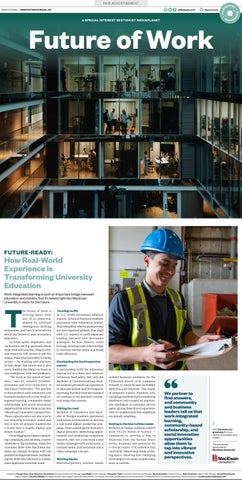
The future of work is arriving faster than any of us expected, shaped by artificial intelligence, shifting economies, and new conversations about the future of post-secondary education.
As think tanks, employers, and universities ask big questions about what work will look like, what it is for, and where we will choose to put our energy, MacEwan University is taking action — by working with partners to help shape that future and to give every student the chance to learn in real workplaces, with real problems.
“We work at the speed of business,” says Dr. Annette Trimbee, president and vice-chancellor of MacEwan University. “We partner to find answers, and community and business leaders tell us that work-integrated learning, community-based scholarship, and social innovation opportunities allow them to tap into vibrant and innovative perspectives. Those opportunities are also core to our Teaching Greatness vision and key to how we prepare students for a world that is highly digital and deeply human.”
From digging into data to launching campaigns and pitching creative solutions to big problems, these five examples show how MacEwan students are already working with real partners on important issues, and building the skills they will need in a faster, more digital and uncertain world.
Tackling tariffs
As U.S. tariffs threatened Alberta's exports, School of Business students partnered with Edmonton Global. They identified Alberta products and services exported globally that align with U.S. exports to tariff-impacted trading partners and developed strategies for how Alberta could leverage existing trade relationships to increase market share and boost trade efficiency.
Overhauling the food inspection system
A partnership with the Edmonton Journal led to a three-part series on restaurant food safety. Not only did Bachelor of Communications Studies students get hands-on experience in data journalism and investigative reporting, but their work also sparked an overhaul to the province’s restaurant inspection system.
Hitting the road
Bachelor of Commerce and Bachelor of Design students partnered with Lexus of Edmonton to develop a real-world digital marketing campaign. After analyzing the business’s digital presence, identifying opportunities and conducting competitor research, they ran a one-week social media campaign with social posts, a carousel series, paid social ads and a video campaign concept.
Battling blazes Multidisciplinary student teams
tackled business problems for the Edmonton-based tech company Firesafe AI, which focuses on wildfire detection and response. Two teams of computer science, business, arts, and design students built a marketing dashboard and created an emotionally intelligent AI customer service agent, giving them direct experience with AI-enabled tools that employers are already adopting.
Getting to the heart of the matter
Bachelor of Design students worked with TELUS World of Science — Edmonton to develop a way to illustrate how the human heart works. Students saw potential for a virtual reality (VR) solution that could help visitors step inside a beating heart, showing how emerging technologies
We partner to find answers, and community and business leaders tell us that work-integrated learning, community-based scholarship, and social innovation opportunities allow them to tap into
How the Ontario Career Lab Connects the Worlds of Work and Education
The Ontario Career Lab helps students explore career possibilities by connecting classroom learning with real-world insights from industry professionals.
The Ontario Career Lab helped open my eyes to careers I didn’t even know existed,” says one Grade 9 student who participated.
For many young people, exposure to careers is limited to the jobs they see around them every day or hear about from family, friends, or the media. Entire industries — and the opportunities they offer — can remain largely invisible.
Research suggests this experience is widespread. According to the Organisation for Economic Co-operation and Development, teenagers across developed countries tend to focus their career aspirations on a small group of familiar occupations, even though the labour market offers far broader opportunities. This disconnect between education and the labour market has become a growing policy concern as economies struggle to align workforce supply with rapidly evolving industry needs.
Connecting the worlds of work and education
Helping students discover those possibilities is exactly the goal of the Ontario Career Lab, an initiative developed by the non-profit HIEC.
For more than three decades, HIEC has worked as an industry education council with a clear mandate: to connect the world of work and education. By bringing together educators, employers, and community partners, the organization translates labour market insights into experiences that help students explore careers and connect their interests and skills to real opportunities.
“Young people are often asked to make career decisions without ever having had the chance to see the world of work up close,” says Kelly Hoey, Executive Director of HIEC and the Ontario Career Lab. “Our goal has always been to connect students with the people, industries, and experiences that help them understand what those possibilities really look like.”
Understanding the career awareness gap
The Ontario Career Lab was created to help bridge the gap between classroom learning and the rapidly changing world of work.
Grade 9 and Grade 10 are pivotal years when students begin selecting courses,
exploring experiential learning opportunities, and thinking more seriously about future pathways. Introducing career exploration at this stage helps students better understand the skills and opportunities emerging across today’s labour market.
The Ontario Career Lab addresses this challenge by connecting students directly with professionals working across a wide range of sectors — including advanced manufacturing, digital media, entrepreneurship, health sciences, clean energy, and the skilled trades.
Through structured career conversations, students hear firsthand how careers evolve, what skills are required, and how professionals navigate their own paths through education, training, and work.
Working to reach all students
Working in partnership with school boards and educators across the province, the Ontario Career Lab aims to reach all 315,000 Grade 9 and Grade 10 students in Ontario, ensuring that young people across the province have opportunities to explore careers and hear directly from professionals working in today’s industries.
“We know from research that early exposure to careers changes outcomes,” says Hoey. “When students hear directly from professionals and see how their skills apply in the real world, it helps them imagine themselves in careers they might never have considered.”
Students frequently say these conversations help them understand what careers actually involve beyond job titles or stereotypes.
“Talking to someone who actually works in that career helps you understand what the job is really like,” one student shared after participating in a session.
Learning from the world of work
A defining feature of the Ontario Career Lab is the direct involvement of professionals from across the workforce. By bringing industry voices into career exploration, students gain insight into how workplaces are evolving and what skills are increasingly valued across sectors.
For many mentors, the opportunity to speak with students is also deeply rewarding.
“Being a Career Coach with the Ontario Career Lab was exactly the kind of program
Being a Career Coach with the Ontario Career Lab was exactly the kind of program I wish existed when I was in high school, students often feel pressure to have everything figured out, but the truth is that exploration is part of the journey.
I wish existed when I was in high school,” one participating mentor reflected. “Students often feel pressure to have everything figured out, but the truth is that exploration is part of the journey.”
Mentors frequently emphasize that careers rarely follow a straight line. Instead, they encourage students to remain curious, stay open to new opportunities, and develop the adaptability that today’s labour market increasingly demands.
Strengthening the link between education and work
“Preparing young people for the workforce isn’t just about sharing information,” says Hoey. “It’s about creating opportunities for students to connect with people, industries, and ideas that help them imagine what their future could look like.”
As Canada’s labour market continues to evolve, helping students explore careers earlier and understand the opportunities ahead will become increasingly important. By connecting classrooms and industry, initiatives like the Ontario Career Lab help ensure that students gain not only information about careers but also the confidence to pursue them.
And often, it begins with a simple realization: there are far more career possibilities than students may have ever imagined.
WRITTEN BY Ontario Career Lab
Kelly Hoey Executive Director, HIEC & Ontario Career Lab
CPA Canada Evolving to Meet Future Needs of Accounting Profession
As the world of work continues to change and becomes more complex, Canada’s Chartered Professional Accountants (CPAs) remain a steady guiding force.
AI, geopolitical uncertainty, regulatory shifts, and evolving trade dynamics are reshaping the future of work and making business more complex—driving organizations to rely on the trusted expertise of accounting professionals to interpret information and guide critical decisions.
“The CPA designation reflects a broad and integrated skill set that includes accounting, audit, strategy, governance, finance, and business,” says Pamela Steer, president and CEO of Chartered Professional Accountants of Canada (CPA Canada). “That combination equips CPAs to help organizations navigate complexity, manage risk and make informed decisions.”
Critical role of CPAs CPAs work in virtually every sector of the economy, from public accounting firms to private companies, the public sector, crown corporations, not-for-profits, and financial institutions. Many also serve in executive leadership roles such as Chief Financial Officer (CFO) or Chief Executive Officer (CEO), where their financial expertise supports broader business strategy and organizational performance.
Their responsibilities extend far beyond traditional accounting functions. CPAs are involved in financial reporting and analysis, audit and assurance, tax planning and compliance, risk management and internal controls, strategic financial planning and capital allocation, and corporate and regulatory compliance.
“What many people may not realize is how deeply CPAs are involved in strategy and decision making,” says Steer. “They help organizations evaluate investments, assess business risks, guide mergers and acquisitions, and design sustainable growth strategies.”
CPAs also play an important role as organizations adapt to technological change and economic uncertainty. They help businesses interpret regulatory changes, navigate complex tax rules, strengthen financial resilience, and provide the reliable information that investors, governments, and the public depend on.
As emerging technologies like AI become more widely adopted, CPAs are also helping organizations build trust in these systems through independent assurance—providing oversight that complex technologies are
designed and operating as intended.
Future proofing the profession
Like many professions, accounting is also navigating changing workforce expectations and a highly competitive talent environment. At the same time, organizations face expanding reporting expectations as demand for transparency in areas of sustainability, governance, and risk disclosure grows.
“While strong financial expertise remains foundational, today’s CPAs are expected to move beyond the numbers— bringing strategic insight, risk awareness and a broader business perspective to decision-making,” says Steer.
To help CPAs stay ahead of these shifts, CPA Canada continues to invest in professional development, tools, and thought leadership, including expanding learning
CPAs bring not only technical expertise, but also a strong commitment to ethics, integrity, and the public interest. That combination is what makes the profession so essential—and why continuing to invest in the strength of the CPA community is so important for Canada’s economic future.
opportunities, supporting innovation in the profession, and strengthening capabilities in areas such as data, technology, and strategic leadership.
Be part of the community and become a member CPA Canada’s new flexible membership model connects CPAs across the country and is designed to support CPAs at every stage of their career. Members can tailor their access to align with their evolving needs.
Membership benefits include new annual credits redeemable on CPA Canada courses, events and tools, up to 20 hours of complimentary annual professional development, a digital and print subscription to Pivot magazine, and access to CPA Canada’s national Tax 360™ community, which includes core tax intelligence from Wolters Kluwer CCH® library.
“CPAs bring not only technical expertise, but also a strong commitment to ethics, integrity, and the public interest,” says Steer. “That combination is what makes the profession so essential—and why continuing to invest in the strength of the CPA community is so important for Canada’s economic future.”
WRITTEN BY Anne Papmehl
Why Universities Matter More Than Ever to Canada’s Economy
Canada’s economy is being reshaped by rapid technological change, demographic pressures, and growing demand for advanced skills. From AI and quantum technologies to health care and defence, employers across sectors are seeking workers who can adapt, problem-solve, and continue learning throughout their careers.
“At a time of rising costs of living and economic uncertainty, Canadians are rightly asking what kind of career training pays off,” says Gabriel Miller, President and CEO of Universities Canada. “The evidence is clear: a university education remains one of the most reliable pathways to longterm income stability and job security.”
Data supports that claim. Graduates with a bachelor’s degree earn an average of 24 per cent more than the national income average, and the gap widens over time. Five years after graduation, university graduates earn $18,000 more annually than their college counterparts, while also experiencing lower unemployment rates. In an uncertain economy, those outcomes matter.
A knowledge-driven economy needs adaptable talent Yet today’s workforce challenge extends beyond first jobs. As technology evolves faster than ever, skills can become outdated in years rather than decades. Canadians are changing careers more often and seeking education that fits around work and family responsibilities.
“The pace of change in the labour market means education is no longer a one-time event at the start of a career,” Miller says. “Continuing education allows Canadians to update their skills, change direction, and stay connected to the workforce without stepping away from work.”
Universities are responding by expanding continuing education, micro-credentials, and flexible learning pathways.
In 2025 alone, Canadian universities recorded more than 380,000 enrolments in continuing education programs, reflecting rising demand for lifelong learning across the country.
Universities also play a critical role in preparing Canadians to work alongside emerging technologies. According to Statistics Canada, most jobs requiring a bach -
elor’s degree — including roles in health care, education, and engineering — are highly com plementary with AI. With more than 50 AI-related programs offered nationwide, univer sities are equipping graduates with both technical expertise and human judgment, skills automation cannot replace.
Beyond skills development, universities are central to talent attraction and retention. They educate more than one million students each year, draw global researchers and innovators to Canada, and anchor regional economies through research partnerships, entrepreneurship, and work-integrated learning.
education continues to open
From skills gaps to career resilience
To make these contributions more visible, Universities Canada recently launched possiblewithu.ca, a new digital platform that connects university education to real-world outcomes. Through concrete examples, from agricultural innovation to medical technologies, the site shows how university learning and research
benefit Canadians directly.
“The economy is becoming more knowledge-driven, not less,” Miller says. “A university education continues to open doors, not only to employment, but to long-term flexibility and opportunity in an uncertain world.”
WRITTEN BY Emily Hellam
Today’s workplace safety landscape is vastly different from two decades ago. “Whereas we used to focus mainly on physical hazards such as cuts and bruises, today’s challenges are much broader and more complex,” says Larry Masotti, Chair of the Board of Governors, Board of Canadian Registered Safety Professionals (BCRSP). At one end of the spectrum are human-centric concerns, such as mental health, inclusion, diversity, accessibility, and workplace violence and harassment. At the other end are emerging technologies, such as robotics, Artificial Intelligence (AI), drones, and 3D printing.
Evolving tech, workforce structures creating new OHS complexities
The persistent change and speed at which it occurs has created new occupational health and safety (OHS) challenges
for organizations and employees.
“With OHS challenges now involving both human-centric and technological advances, safety professionals are required to assess and mitigate a broader set of risks, hazards, and probabilities,” says Masotti. “One is change-fatigue due to the constant need for adaptation. Another is Artificial Intelligence. While it has tremendous benefits for the workplace and society, it also creates a need for constant adaptation as well as feelings of redundancy and potential worker displacement,” says Masotti.
In today’s multi-generational workforce safety must now target their safety messaging to address the differing needs and priorities of each one. The shift to hybrid, remote, and flexible work, while beneficial to many workers, has OHS impacts, such as the tendency towards overwork, worker isolation, repetitive strain, and musculo -skeletal issues from non-ergonomic home workspaces.
Meeting modern workplace demands As the workplace evolves, so are professional safety requirements and
certifications. “To meet the demands of the modern workplace, today’s safety professionals continue to be lifelong learners who embrace continuous improvement,” says Masotti. The Board of Canadian Registered Safety Professionals (BCRSP) certification ensures that Canada’s health and safety professionals are equipped to do just that.
For 50 years, the Board of Canadian Registered Safety Professionals (BCRSP) has been the national certification body for occupational health and safety professionals in Canada. BCRSP certifications are nationally recognized and represent a gold standard in professional safety leadership. Aligned with the international ISO17024 standard for the OHS profession in Canada, the BCRSP certifications enable the certified individual to work in any sector.
“The BCRSP certifications are also evolving to reflect the evolving nature of work and serve as an exceptional bridge between the boardroom and the plant floor or the field,” says Masotti.
In an era where every employer must meet the requirements of occupational health and safety legis-
lation, together with an increasingly complex workplace environment, knowledgeable and competent safety professionals are vital to protecting workers, avoiding costly occupational incidents, and strengthening the workplace safety culture. Recognizing this, many organizations across various sectors are relying on certified safety professionals. “These individuals understand the systems, risks, and hazards that a worker, manager or supervisor would encounter every day and are continually upgrading through a continuous professional program to ensure their qualifications are up to date,” says Masotti.