Future of Our Planet 2026

Page 1


Future of Our Planet

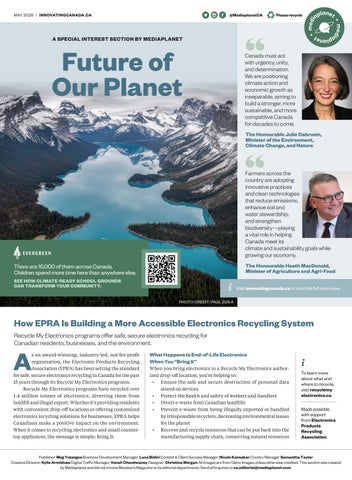
The Honourable Julie Dabrusin, Minister of the Environment, Climate Change, and Nature

Farmers across the country are adopting innovative practices and clean technologies that reduce emissions, enhance soil and water stewardship, and strengthen biodiversity—playing a vital role in helping Canada meet its climate and sustainability goals while growing our economy. Canada must act with urgency, unity, and determination. We are positioning climate action and economic growth as inseparable, aiming to build a stronger, more sustainable, and more competitive Canada for decades to come.

The Honourable Heath MacDonald, Minister of Agriculture and Agri-Food

How EPRA Is Building a More Accessible Electronics Recycling System

Recycle My Electronics programs offer safe, secure electronics recycling for Canadian residents, businesses, and the environment.

As an award-winning, industry-led, not-for-profit organization, the Electronic Products Recycling Association (EPRA) has been setting the standard for safe, secure electronics recycling in Canada for the past 15 years through its Recycle My Electronics programs.

Recycle My Electronics programs have recycled over 1.4 million tonnes of electronics, diverting them from landfill and illegal export. Whether it’s providing residents with convenient drop-off locations or offering customized electronics recycling solutions for businesses, EPRA helps Canadians make a positive impact on the environment. When it comes to recycling electronics and small countertop appliances, the message is simple: Bring It.

What Happens to End-of-Life

Electronics

When You “Bring It”

When you bring electronics to a Recycle My Electronics authorized drop-off location, you’re helping to:

• Ensure the safe and secure destruction of personal data stored on devices

• Protect the health and safety of workers and handlers

• Divert e-waste from Canadian landfills

• Prevent e-waste from being illegally exported or handled by irresponsible recyclers, decreasing environmental issues for the planet

• Recover and recycle resources that can be put back into the manufacturing supply chain, conserving natural resources

PHOTO CREDIT: PAUL ZIZKA

How EPRA Is Building a More Accessible Electronics Recycling System

Recycle My Electronics programs offer safe, secure electronics recycling for Canadian residents, businesses, and the environment.

As an award-winning, industry-led, not-forprofit organization, the Electronic Products Recycling Association (EPRA) has been setting the standard for safe, secure electronics recycling in Canada for the past 15 years through its Recycle My Electronics programs.

Recycle My Electronics programs have recycled over 1.4 million tonnes of electronics, diverting them from landfill and illegal export. Whether it’s providing residents with convenient drop-off locations or offering customized electronics recycling solutions for businesses, EPRA helps Canadians make a positive impact on the environment. When it comes to recycling electronics and small countertop appliances, the message is simple: Bring It.

A national collection network

EPRA’s Recycle My Electronics programs continue to make electronics recycling convenient for Canadians, regardless of where they live. With an extensive network of over 3,200 drop-off locations across the country, the programs make recycling electronics safe, secure, and easy for both residents and businesses.

“Recycle My Electronics programs offer accessible electronics recycling through a national network of

approved drop-off locations, as well as special collection events and business pick-ups,” says Cliff Hacking, the founding president and CEO of EPRA. “Accessibility is central to our mandate, whether it’s in an urban centre or a remote community.”

Responsible recycling and compliance

Recycling with EPRA ensures devices are diverted from landfills and recycled responsibly for sustainable material recovery, including plastic, glass, gold, silver, and copper, all of which can be recovered and reused without losing their properties and reintegrated back into the manufacturing supply chain.

Many Recycle My Electronics programs are also expanding their list of obligated products accepted for recycling. This ensures diversion of e-waste from landfills and contributes to the circular economy.

EPRA has been named a SERI Champion of Electronics Sustainability, a designation that highlights the company’s industry-leading commitment to responsible electronics reuse, recycling, and circularity. The recognition reflects EPRA’s longstanding work to integrate the Responsible Recycling (R2) standard into its recycling operations, ensuring used electronics are managed with environmental and data security compliance.

WHAT HAPPENS TO END-OF-LIFE ELECTRONICS WHEN YOU “BRING IT”

When you bring electronics to a Recycle My Electronics authorized drop-off location, you’re helping to:

Ensure the safe and secure destruction of personal data stored on devices

Protect the health and safety of workers and handlers

Divert e-waste from Canadian landfills

To learn more about what and where to recycle, visit recyclemy electronics.ca

Made possible with support from Electronics Products Recycling Association

Prevent e-waste from being illegally exported or handled by irresponsible recyclers, decreasing environmental issues for the planet

Recover and recycle resources that can be put back into the manufacturing supply chain, conserving natural resources

Why Businesses Need to Ask Harder Questions About Recycling

As sustainability expectations rise, waste-to-landfill is no longer just an operational issue: it’s a matter of accountability and oversight.

For many organizations, their recyclable materials disappear the moment a truck pulls away from the loading dock. But that journey — and whether the material is truly recycled — often remains cloudy and largely invisible to the businesses that generate it.

Across Canada’s commercial sector, companies are increasingly expected to account for their environmental footprint. While the government continues to introduce more environmental regulations, such as Extended Producer Responsibility (EPR), responsibility for properly diverting recyclable materials from landfills is still being passed on from facility to service providers. In practice, many businesses and institutions frequently rely on service providers to manage the process with little verification or documentation.

“It may just be that these organizations that generate recyclable materials aren't thinking about it at all,” says Tullio Bugada, CEO of Toronto-based waste and recycling management company, Waste Reduction Group. “They’re either knowingly or unknowingly handing off responsibility and accountability to their service provider.”

The accountability gap

That lack of oversight can create a gap between intention and outcome. Businesses often invest a lot of time and resources into sorting recycling internally, only for those materials to be consolidated and disposed as waste further down the chain. Because waste moves through a network of collectors, transfer stations and processing facilities, its final destination can become difficult to trace.

Some simple indicators can show your recyclable materials are ending up in landfill:

• Recycling Material Recovery Facilities (MRFs)

won’t accept common contaminants like material collected in black plastic bags, liquids, or food waste.

• Organics Composting Facilities, including both aerobic and anaerobic, will not accept material collected in black plastic bags, or any plastics or liquids.

The challenge is particularly evident with materials that are harder or more expensive to recycle — such as mixed recyclables (metal, glass, and plastics) and organic waste. While high-value materials like scrap metal or cardboard are almost always recovered because of their inherent financial value, other recycling streams can be more complicated.

“Certain materials are simply more expensive to process properly than to send to landfill,” Tullio explains. In major urban regions such as the Greater Toronto Area, limited infrastructure can further complicate matters. Facilities capable of processing mixed recyclables or organics are relatively few and far between, meaning material handling costs are higher, and hauling the material is more time-consuming and costly. In fact, the cost to recycle materials or compost organics can be up to 50 per cent higher than waste-to-landfill.

At the same time, the regulatory environment is evolving quickly. Government Policies such as the Environmental Protection Act and the recently introduced Extended Producer Responsibility Act are intended to place greater accountability on the organizations that generate waste in the first place. As sustainability reporting and ESG commitments expand, transparency around waste and recycling streams is increasingly becoming a matter of governance and risk management — not simply environmental optics.

Making recyclables visible For businesses, the first step

toward accountability is understanding where their materials actually go. According to Tullio, organizations should be able to verify where their waste and recycling material is delivered and request documentation from their service providers to confirm that the loads reach legitimate recycling or composting facilities.

“Real responsibility and leadership starts with asking more from your waste and recycling service providers,” he says. “They should be sharing contamination photos and material delivery tickets , and arrange site visits to recycling facilities.”

Providing that level of transparency and assurance is central to the approach taken by Waste Reduction Group for the past 25 years. The company works with some of the most sustainable organizations, ranging from universities, hospitals and commercial property owners to small businesses, helping them design custom waste diversion programs and tracking where their materials ultimately end up. By providing their expertise, guidance, traceability, and documentation on proper sorting and contamination standards, Waste Reduction Group helps clients ensure that waste, recycling and organics programs function as intended.

As expectations and public accountability around sustainability continue to grow, analysts say businesses can no longer afford to treat recycling and waste management as an afterthought. The organizations that ask the right questions — and demand clear answers — won’t just meet expectations; they’ll set a new standard for accountability in how recycling is managed.

For organizations looking to better understand and take responsibility for all of their waste streams, visit wastereductiongroup.ca.

Tullio Bugada CEO, Waste Reduction Group
This article was sponsored by Waste Reduction Group

Pension Funds and the Legal Duty to Protect Future Generations

Four young Canadians are suing the Canada Pension Plan Investment Board over alleged climate-risk mismanagement of their pensions. Here’s why it matters.

Food, home insurance, and electricity cost more every year in a rapidly warming world. And yet, Canadian governments and institutions continue to bankroll climate chaos, worsening cost-of-living pressures for millions of people. As climate impacts grow in intensity and frequency, they could bring about economic collapse, threatening retirement savings in the long term.

That’s why Aliya, Chloe, Rav, and Travis, represented by Ecojustice, Canada’s largest environmental law charity, are suing the Canada Pension Plan Investment Board (CPPIB).

Taking

on

the world’s sixth largest pension fund

Most working Canadians contribute to the Canada Pension Plan (CPP), which manages more than $700 billion. How this is invested affects the retirements of millions of people and influences the broader economy.

CPPIB disclosed in 2024 that 3.5 per cent of its portfolio — $22.6 billion at the time — was invested in fossil fuels. In 2025, it invested a further $6 billion in the industry.

The case argues that continued investment in fossil fuel expansion exposes our pensions to financial risk as climate impacts intensify and markets shift toward renewable alternatives.

We think ignoring or severely underestimating climate-related financial risks is irresponsible to each of the 22 million people counting on the CPP for retirement, especially those who plan to retire after 2050 and could be left with an inadequately funded pension. That could mean smaller retirement benefits, significantly higher contribution rates, or both.

Our clients want CPPIB to go further to shield Canadians’ retirement funds from such clear risks.

Why this matters

There’s an obscene irony in paying twice to suffer the impacts of climate change — first through public dollars spent propping up a fossil fuel industry fighting for relevance, then again every time we pay more to rebuild infrastructure damaged by extreme weather or when poor harvests cause food prices to rise.

Investment decisions today must serve the best interests of all contributors.

This case has already garnered international attention. Pension funds worldwide are watching to see how Canada’s courts will clarify their legal obligation to manage climate risk.

Why we do this work

Canada is a democracy where the rule of law and the role of the courts still matter. This gives Canadians like Aliya, Chloe, Rav, and Travis a powerful avenue to demand accountability from even the most impenetrable institutions.

This case is just one example. Ecojustice uses strategic litigation and law reform efforts to defend the environment and hold our governments and institutions to account for serving the public interest. We’re non-partisan, 100 per cent donorfunded, and represent our clients free of charge in pursuit of justice for the environment and communities across Canada.

WRITTEN BY Kimberly Shearon Executive Director, Ecojustice
This article was sponsored by Ecojustice. Learn more about Ecojustice’s work by scanning the QR code, or visit ecojustice.ca
PHOTO CREDITS: JOSHUA BEST | PICTURED: CHLOE, RAV, TRAVIS, AND ALIYA

How Biodiversity Is Critical to Keeping Canadian Culture Alive

This national non-profit is committed to stewarding a greener, more diverse Canadian landscape, working with partners to restore Canada’s forests.

It’s hard to envision Canada without a landscape dotted with trees. The image of a Muskoka chair on a dock overlooking a lake and surrounded by evergreens is all but synonymous with the quintessential Canadian summer. As Brijpal Patel, Chief Program Officer at Tree Canada, explains, “You see representation of trees all throughout Canadian popular culture. There’s a lot of storytelling rooted in the Canadian landscape.” While trees play a role in shaping our collective identity, they also contribute to the country’s thriving biodiversity, acting as a first defence against threats like climate change.

Tree Canada has been actively working to restore and grow Canada’s forest canopy since 1992. For decades, the organization has worked to implement greening programs, foster research, and engage partners to build greater understanding and respect for forests. Its goal is simple: growing resilient ecosystems and healthier, greener communities.

In 2025, Tree Canada planted 4.4 million trees across Canada and it’s on track to plant another five million in 2026. “We’re in the business of climate change adaptation,” says Patel. “At our core, we’re about restoration and

To learn more about Tree Canada and its initiatives, visit treecanada.ca

greening that lead to climate-resilient communities and diverse ecosystems.”

Fostering biodiversity together

The non-profit works across both urban and rural landscapes, implementing everything from small-scale biodiversity projects like building habitats in cities to larger initiatives alongside conservation authorities and Indigenous communities. Its success hinges on partnerships with governments of all levels, local communities, and private landowners.

“We’re always looking for opportunities to partner with Indigenous communities in an intentional way, furthering their vision on how they want to see the land stewarded,” Patel explains. Recently, Tree Canada worked alongside the Pessamit Innu community in northern Quebec on a large-scale reforestation project with an end goal of rebuilding a depleting Caribou herd.

Tree Canada’s National Greening Program shows the broad impact its leadership is having across Canada. A mass seedling program, the initiative works with a variety of land tenures

to restore large areas of disturbed ecosystems. “Our restoration efforts focus on areas that don’t already have conservation protections, trying to connect them to areas that do. This takes pressure off species as they move and migrate from one region to another,” explains Sophie Cation, Restoration Ecologist at Tree Canada.

“Especially within these planting projects, when we think about fostering biodiversity we’re really talking about building forest ecosystems that allow native fauna to thrive.”

Tree Canada is helping Canadians build on an identity that’s deeply ingrained in our culture. As Cation says, “We know that nature is important to Canadians, but it also deserves to be protected simply because it exists and was thriving long before we were here.”

Brijpal Patel Chief Program Officer, Tree Canada
Sophie Cation Restoration Ecologist, Tree Canada

Sustainability Is a Daily Driver for Ontario Grain Farmers

Over the generations, Ontario grain farmers have learned the connection between environmental responsibility and resilience. That’s how you sustain family farms.

Earth Day 2026 organizers say environmental progress is built locally, through everyday action.

And to me, they’re absolutely right.

On my family’s multi-generation grain farm near Quinte West, Ont., sustainability is ingrained in our farming culture. We’re immersed in sustainable practices daily, to conserve soil and keep water clean.

To our family, sustainability is foundational. Simply put, it’s how you farm. Over the generations, we’ve learned the connection between environmental responsibility and resilience. They must work in tandem. That’s how you sustain a family farm — and a farm family — like ours.

Grain farmers keep learning how to improve Like Ontario’s other 28,000 grain farmers, we routinely take part in educational and professional development activities that help us better manage our land, adapt to change, and

produce food responsibly and efficiently.

As a result, sustainability shows up in everyday decisions: how we use fertilizer, how we regenerate soil, and how we rotate Ontario’s three main crops — corn, soy, and winter wheat — from field to field. Crop rotation helps build healthy, productive soil, reduces pest pressures naturally, and gives farmers flexibility to respond to weather and market opportunities.

Investing in research for sustainability

Since our inception as an organization in 2010, Grain Farmers of Ontario has invested over $25 million into research supporting agricultural sustainability across soil health, nutrient management, biodiversity, and water protection. During that time, Ontario’s grain sector grew in economic value by 60 per cent, resulting in approximately $27 billion of annual economic output today.

Canadians care about affordable, locally grown food, and they expect it to be produced

The Genes That Could Help Save Canada’s Forests

The future of Canada’s forests may depend on protecting the genetic diversity that allows trees to resist pests and adapt.

Canada’s forests are already facing climate change, biodiversity loss, and invasive pests — pressures pushing many tree species toward decline. Recovery depends on one critical factor: genetic diversity. The unique genes that allow trees to resist disease, tolerate drought, and adapt to changing conditions are the raw materials of resilience.

The Forest Gene Conservation Association supports species-at-risk recovery by conserving the genetics of threatened tree populations and protecting natural resistance traits in species like black ash and butternut. By identifying, safeguarding, and propagating resilient trees, we help ensure seed sources are strong and

adaptable. We also work with governments, foresters, and businesses to highlight the importance of genetic diversity for long-term forest health. Through education and conservation, we’re helping forests survive emerging pests and a changing climate. To ensure forests not only survive but thrive, we must protect the genetic diversity that makes recovery possible.

responsibly. So do Ontario grain farmers. We’re keeping farms viable and grocery shelves stocked, while protecting the environment and natural resources every day.

To learn about sustainable grain farming in Ontario, visit gfo.ca

Working Together to Build Long-term Forest Resilience

Forests Canada is creating a National Working Group on Post-Fire Forest Recovery Practices.

Can ada’s forest landscapes are experiencing unprecedented impacts from wildfire, creating urgent and complex challenges for post-fire recovery, regeneration, and long-term forest resilience.

To support coordinated national action, knowledge exchange, and the development of best practices for forest resilience, national charity Forests Canada is establishing a National Working Group on Post-Fire Forest Recovery Practices.

“There is a need for national dialogue to share best practices and new approaches to ensure we are creating the most resilient forests possible,” says Jess Kaknevicius, the Chief Executive Officer of Forests Canada.

“With this new National Working Group, we will be able to gain new insights from a diverse group of participants so that we can all work together to help create lasting and positive outcomes for Canada’s forests,” says Val Deziel, restoration ecologist and Director of Restoration Ecology and Research at Forests Canada.

WRITTEN BY Forests Canada

To support the health and sustainability of Canada’s forests, including post-fire restoration efforts, visit ForestsCanada.ca

This article was sponsored by Forests Canada

This article was sponsored by Grain Farmers of Ontario.
This article was sponsored by Forest Gene Conservation Association
JEFF HARRISON, GRAIN FARMERS OF ONTARIO CHAIR PHOTO CREDITS: JOSEPH GODEN/MBC MEDIA
Jess Kaknevicius CEO, Forests Canada

Why Investing in Canadian Agriculture Is

Critical to Sustainability

This Canadian not-for-profit is exploring innovation as sustainability, finding unique ways to further Canada’s agriculture industry and drive continued climatefriendly progress.

The agriculture industry faces imminent threat from global issues like climate change. The not-for-profit Ag-West Bio actively advances bio-based solutions, investing in companies commercializing research within the agri-food and bioscience industry.

The very concept of innovation reflects core concepts of sustainability. This idea is further exemplified in the types of investments Ag-West Bio makes and the specific challenges it encourages organizations to confront.

Precision agriculture and biological soil health explore how farmland plays a role in sustainable living, focusing on soil health and genomics as a way of improving overall plant health. Circular bioeconomy involves ensuring all inputs and outputs are being used as efficiently as possible, essentially turning current waste products into usable outputs. Climate-smart food is critical to producing next-generation food technologies that meet food demands while lessening emission intensity.

These are just some of the ways Ag-West Bio is helping tackle global issues as part of its broader commitment to driving agri-food innovation for Canadians.

How Alberta is Leading Canada in Beverage Container Recycling

Alberta’s long-standing deposit return system is adapting to stay practical, accessible, and effective as demographics and consumption patterns change.

When it comes to beverage container recycling, Alberta leads the country.

Since 1997, Beverage Container Management Board (BCMB) has overseen the province’s deposit return system. Through a network of independently owned bottle depots in more than 160 communities, Albertans return over two billion containers annually. This keeps valuable materials in circulation, supports the economy, and reduces landfill waste.

Alberta’s system works because it’s practical, local, and entrepreneurial. Bottle depots are often small businesses and community hubs that support charities and sports teams and provide income opportunities for many Albertans.

Evolving a system that already works well

But even strong systems must evolve. With population growth and changing consumption patterns, BCMB is exploring new collection methods to improve convenience and access, particularly in underserved areas. The organization is also strengthening partnerships and advancing a right-touch regulatory approach that balances oversight with efficiency, affordability, and long-term system health.

If Canada wants a stronger circular economy, it can start with models that already work. Alberta’s deposit return system shows what’s possible, and what comes next.

How One Firm Supports Sustainable, Socially Responsible Infrastructure

One of Canada’s leading engineering firms is advancing an approach to infrastructure that’s grounded in asset durability, data-driven decisions, and long-term sustainability.

Canada’s infrastructure is aging rapidly. With only 55 per cent of core assets rated as being in “good” or “very good” condition and an estimated $300 billion needed for repairs and replacement, the situation is dire.

Norda Stelo, a purpose-driven engineering and consulting firm, champions a new approach to closing Canada’s infrastructure investment gap — one grounded in creating not just economic value, but also social and environmental value.

“Assets are reaching a point where failures can disrupt services, and that’s a big risk for our society,” says Bernard Gaudreault, Norda Stelo’s Director of Asset Management. “The cost of failure can also be 5 to 15 times the cost of doing the work before it fails.”

“We cannot build anew every time,” says Sophie Boisvert, Norda Stelo’s Director of

Asset Durability.

Instead, the greatest value is found in extending the life of assets, acting early to avoid major failures, and preventing unnecessary replacements. This route has a significantly lower carbon footprint, supporting sustainability goals.

The approach is rooted in asset durability — infrastructure’s capacity to deliver reliable service throughout its lifecycle while meeting safety, resilience, and performance standards.

Data also plays a central role, and its quality and consistency are crucial.

“Data lets us assess risks in aging infrastructure and make smarter decisions and investment planning,” says Boisvert.

Closing Canada’s infrastructure investment gap isn’t about building more; it’s about better management through disciplined prioritization, resilient design, and long-term value-based decisions.

This article was sponsored by BCMB
This article was sponsored by AG-West Bio
Visit bcmb.ab.ca to learn more about Alberta’s recycling system. Scan the QR code to read the full article.
Bernard Gaudreault Director of Asset Management, Norda Stelo
Sophie Boisvert Director of Asset Durability, Norda Stelo

Turn static files into dynamic content formats.

Create a flipbook