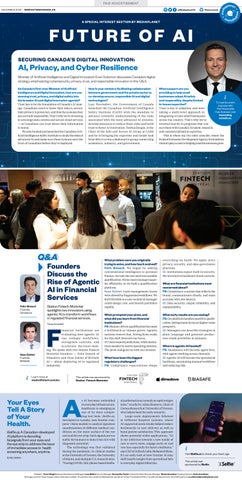
Future of AI 2025

Page 1


FUTURE OF

As Canada’s first-ever Minister of Artificial Intelligence and Digital Innovation, how are you weaving trust, privacy, and digital safety into the broader AI and digital innovation agenda?

Trust has to be the foundation of Canada’s AI strategy. Canadians need to know their data is secure, their privacy is protected, and that the systems they use are built responsibly. That’s why we’re investing in sovereign data centres and secure cloud services — so Canadians can trust where their information is stored.

How is your ministry facilitating collaboration between government and the private sector to co-develop secure, responsible AI and digital technologies?

What support are you providing to help small businesses adopt AI safely and responsibly, despite limited in-house expertise?

We also funded and launched the Canadian Artificial Intelligence Safety Institute to study the risks of advanced AI and make sure those systems earn the trust of Canadians before they’re deployed.

Last November, the Government of Canada launched the Canadian Artificial Intelligence Safety Institute (CAISI) with the mandate to advance scientific understanding of the risks associated with the most advanced AI systems, develop measures to reduce those risks and build trust to foster AI innovation. Yoshua Bengio, is the Chair of the Safe and Secure AI Group at CAISI and he is bringing his expertise and inside look from MILA to this collaborative group connecting academics, industry, and government.

Trust is key to adoption, and were taking a multi-level approach to integrating AI into small businesses across the country. That’s why we’ve invested heavily in programs that connect them with Canada’s AI talent, research, and commercialization expertise.

This is where my two roles coincide, where the Federal Economic Development Agency for Southern Ontario plays

in

What problem were you originally trying to solve, and how has it evolved?

Station Fintech Montréal spotlights two innovators using agentic AI to transform workflows in regulated financial services.

Tania Amardeil

Financial institutions are evaluating how agentic AI can reshape workflows, strengthen controls, and accelerate decision-making. We spoke with two Station Fintech Montréal founders — Felix Simard of Dimedove and Ilyas Zakiat of BIASafe AI — about deploying AI in regulated industries.

Felix Simard : We began by adding conversational intelligence to personal finance, but saw the real need was scalable qualification. Firms must manage inquiries efficiently, so we built a qualification platform.

Ilyas Zakiat: Asset-management teams were slowed by fragmented workflows. We built BIASafe so a non-technical manager could design, test, and launch portfolios rapidly.

What prompted your pivot, and what did you learn from financial institutions?

FS: Human-driven qualification becomes a bottleneck as volume grows. Agentic systems remove that. Seeing fi rms ready for this shift directed our focus.

IZ: Users wanted predictions, while institutions needed AI-native operating systems. The pivot realigned us with our mission.

What have been the biggest regulatory challenges?

FS: Compliance expectations shape

As Al becomes embedded in everyday infrastructure, healthcare is emerging as one of its most compelling test beds. iSelfie.ai, developed in Canada, uses frontier computer vision models to analyze signature manifestations of different medical conditions on the outer surface of the eye and and the eye strip. Such signals are too subtle for humans to detect but rich with diagnostic potential. The technology was first validated during the pandemic, in clinical studies at the University of Toronto, the University of Miami, and multiple U.S. research sites.

“During COVID, this phone-based iSelfie.

everything we build. We apply strict privacy, security, and data-governance practices.

IZ: Institutions expect built-in security. We invested in hardened cloud controls.

What are financial institutions most concerned about?

FS: Consistency: a system that reflects the brand, communicates clearly, and stays accurate with low latency.

IZ: Data security, output reliability, and explainability.

What early results are you seeing?

FS: Our platform handles repetitive qualification, letting teams focus on higher-value prospects.

IZ: Managers can describe strategies in plain language and generate production-ready portfolios in minutes.

Where is agentic AI headed?

FS: Businesses will become agent-fi rst, with agents working across channels.

IZ: Agentic AI will become the operational backbone, automating manual workflows and reducing risk.

ai performed as accurately as rapid antigen tests,” recalls Dr. Allan Slomovic, Chair of Cornea Research at University of Toronto, who helped lead the early research.

Large-scale deployments followed at different hospital systems, where Al-supported nurse intake helped reduce bottlenecks in care delivery as well as boost patient satisfaction. This approach shows potential wider applications. “AI is our infliction towards a new model of care to serve more, engage early on and cost less especially for heart conditions,” says CEO of AiZtech Labs; Mohamed Sheta. It's an early look at how frontier Al may shift health insight from specialized labs to everyday

lifestyles.

a role
helping small businesses grow.

Building a Human-Centred and Responsible Future for AI

Ethics and accountability must guide the people developing AI as new technologies are introduced into the way we live, work and communicate.

University

Artificial intelligence (AI) is transforming the world, from medical breakthroughs to new ways of addressing complex social challenges.

As AI becomes increasingly embedded into daily life, it prompts urgent questions for society: how do we build technologies the public can trust? And how do we ensure innovation doesn’t outpace the ethical frameworks or skilled talent required to guide it?

Ontario Tech University is leading this work with an ethics-by-design philosophy that embeds human values into every stage of tech innovation and development. The priority is to translate intention into meaningful, measurable action.

A commitment to tech with a conscience

For Ontario Tech, ethical AI development isn’t an afterthought — it’s a foundation.

“By addressing privacy, data protection, and bias early in AI’s development, we prioritize human-centred oversight and accountability. This strengthens AI’s reliability and ensures its application is used in ways that are ethical, socially responsible, and forward-looking,” says Steven Murphy, PhD, President and Vice-Chancellor at Ontario Tech University. “Within this framework, AI remains a tool for progress, not a replacement for human creativity.”

This commitment, grounded in integrity, transparency, and accountability, has become one of the university’s defining strengths.

Where collaboration meets real-world need

Ethical approaches to AI cannot be developed in isolation. They must be shaped, tested, and refined through partnerships that reflect diverse needs and lived experiences.

Across multiple sectors, Ontario Tech

tions. With Lakeridge Health, the university is developing tools that help improve patient care, predict service demands, reduce system costs, and address issues such as patient social isolation.

Ontario Tech is also working with CNIB to integrate accessibility into AI designs from the beginning. This approach ensures people of all abilities are involved early, resulting in solutions that genuinely support them and their needs.

These collaborations reinforce a shared belief that AI innovations must be designed to uplift communities and expand opportunity above all else.

Building skills, standards, and a strong talent pipeline As industry and governments search for ways to responsibly regulate emerging technologies, Ontario Tech is helping lead the way forward. The Mindful Artificial Intelligence Research Institute brings together multi-disciplinary experts to study AI’s impact on human well-being and inform global policies and standards.

That same commitment shapes the university’s approach to education. Through Canada’s first School of Ethical Artificial Intelligence, students gain both the technical expertise and moral judgment that an AI-driven economy demands.

Ontario Tech prepares graduates to enter the workforce with confidence, skill, and purpose. With more than 65 AI-related courses, plus co-ops and internships supported by more than 500 partners, students develop deep expertise, strong ethical awareness, and the hands-on experience that employers demand.

not just to lead in the careers of today, but to define the future of work.

“AI is no longer just a specialization — it’s an essential discipline that plays a major role in shaping our future. Ontario Tech will remain committed to strengthening Canada’s leadership in AI innovation and in responsible AI education and application,” says Lori Livingston, PhD, Provost and Vice-President, Academic at Ontario Tech University.

A model for responsible advancement AI’s influence will continue to grow at a rapid pace, and Ontario Tech shows how ethical leadership can and should evolve with it. By combining research excellence, community partnerships, and education that puts responsibility at the forefront, the university is charting an ambitious and accountable path for the future of AI.

The message is clear: progress is strongest when guided by conscience.

is no longer just a specialization — it’s an essential discipline that plays a major role in shaping our future.

Lori Livingston PhD,
Steven Murphy PhD, President and ViceChancellor, Ontario Tech University

How Canada Can Strengthen Its AI Capacity Through Talent and Applied Research

Canada is entering a critical moment in the development and use of artificial intelligence (AI), with global competition accelerating and economic performance pressures increasing at home. Although the country has achieved global leadership in AI research, businesses continue to face persistent barriers including slow adoption and commercialization, low levels of AI literacy, inadequate access to secure data and infrastructure, and the need for stronger safeguards and governance frameworks. Mitacs, a national innovation connector, is well positioned to help translate Canada’s AI ambitions into practical outcomes and economic gains by mobilizing talent and strengthening research–industry collaborations.

The recent launch of the federal government's AI Strategy Task Force further reflects growing national attention to systemic gaps such as uneven sectoral readiness and misalignment between industrial needs and the infrastructure required to support adoption at scale. Budget 2025 and the federal commitment to build sovereign AI computational capacity reinforce these priorities, signalling the need for coordinated action. Stakeholders across industry, academia, and the broader innovation ecosystem have also emphasized that Canada’s research strengths must be better connected to real-world problem solving, ensuring that emerging capabilities are supported by trust, safety, and effective data stewardship.

Talent and research powering innovation

Mitacs is addressing these challenges by deploying highly qualified talent to accelerate AI research, commercialization, and adoption across the economy. Through more than 3,100 projects and 4,800 internships in AI since 2019, Mitacs embeds multidisciplinary teams directly into Canadian companies, particularly small and mediumsized enterprises (SMEs), to help identify concrete opportunities to apply AI, de-risk adoption, demonstrate return on investment, and build internal readiness from within. This work is accelerating the path from lab to market by advancing prototypes, supporting academic entrepreneurs, and helping fi rms integrate AI into products, services, and operations. Through its dedicated AI strategy, Mitacs is also developing the AI-ready workforce Canada needs by

equipping interns with applied AI, business, and commercialization skills, supported by new collaborations with post-secondary partners to deepen specialized training. These efforts are complemented by partnerships with key players in the national ecosystem, including CIFAR, Mila, Vector, Amii, and IVADO, whose thought leadership and research strengths help inform and extend this work.

"The priorities outlined for Canada’s next AI strategy underscore the importance of the talent-driven model Mitacs delivers,” notes Mitacs CEO, Dr. Stephen Lucas. “Since 2018, Mitacs has invested $1.42B in research and development through more

Since 2018, Mitacs has invested $1.42B in research and development through more than 35,000 innovation projects and nearly 100,000 internships, helping connect emerging talent with public and private sector needs.

With $174.4M invested in AI over the past seven years alone, we are supporting practical deployment and helping businesses build the talent and capacity they need to compete.

than 35,000 innovation projects and nearly 100,000 internships, helping connect emerging talent with public and private sector needs. With $174.4M invested in AI over the past seven years alone, we are supporting practical deployment and helping businesses build the talent and capacity they need to compete.”

The value of this model is evident in Mitacs-supported projects applying AI to real-world challenges across the economy.

Creating safer skies

Thales, a global tech leader in defence and aerospace, conducts advanced research through its cortAIx labs. Mitacs collaborates with Thales on projects that apply Al to aviation safety, including autonomous obstacle detection, improved take-off and landing systems, and predictive maintenance sup-

port tools. The partnership also promotes long-term talent retention in Quebec: former Mitacs interns now make up roughly onethird of the cortAIx workforce.

“Through its partnership with Mitacs, Thales applies AI to strengthen aviation safety, streamline critical operations, and drive innovation into business operations. This collaboration addresses complex aerospace challenges while cultivating top-tier talent, transforming research into a powerful engine for sustainable business growth,” says says Jean-François Gagnon, Director, cortAIx Labs, Thales.

Improving patient care

For almost a decade, Mitacs has worked closely with FluidAI Medical to support prototype development, R&D, clinical validation, and business expansion. This ongoing partnership reduces research risks, speeds up commercialization, and provides access to top talent.

“Mitacs believed in our vision early on. Mitacs’ support helped us validate technology, access top student talent, and make the leap from student start-up to a company improving patient outcomes across Canada,” says Amr Abdelgaward, Co-Founder and COO, FluidAI Medical.

Accelerating AI adoption across the economy

For more than 25 years, Mitacs has helped build the research and talent capacity needed to strengthen Canada’s productivity and global competitiveness. As federal efforts sharpen their focus on AI adoption and real-world impact, these collaborations demonstrate the value of industry–academic partnerships in driving commercial success, building innovation capacity, and supporting a resilient and high-performing economy.

Canada continues to face persistent challenges, as the gap with key competitors widens due to limited investment in commercializing Canadian research and slow adoption of AI and other technologies. Mitacs will continue to help turn research strengths into economic prosperity by connecting ideas with application and developing the workforce of tomorrow. Building on our proven track record in fueling business–academic collaboration with top talent from across Canada and around the world, Mitacs is committed to accelerating AI use and adoption throughout the economy and helping businesses convert technological advances into competitiveness and long-term growth.

Mitacs is supporting AI adoption by deploying talent where it’s needed most.
Katharine O’Brien

How Canadian Organizations Can Move from Caution to Confidence with AI

Industry leaders share how Canada’s AI adoption diverges from global trends and how enterprises can set themselves up for AI success.

Artificial intelligence (AI) is rapidly transforming how organizations all around the world operate, make decisions, and serve customers. In Canada, however, AI adoption isn’t quite on par with global trends. According to new research from data and AI leader SAS, Canadian organizations have embraced traditional analytics and machine learning but have been slower to scale newer forms of AI, like generative AI.

Why is Canada lagging behind our global peers? SAS' research suggests that many factors are at play, including data silos and fragmentation, and a significant gap between experimentation and strategic, trustworthy integration.

We spoke with three industry experts to learn more about overcoming barriers to AI adoption, how building trust in AI increases tangible ROI, and how private- and public-sector organizations can develop data strategies that’ll set them up for success.

Canada’s Commercial AI Maturity: Stuck in Experimentation

Ryan MacDonald, Executive Director of Commercial at SAS Canada, describes “a race toward [AI] maturity” among Canadian enterprises. While lower-maturity organizations use AI chiefly to automate administrative functions and boost productivity, Ryan says mature organizations are using AI to help make decisions with humans in the loop. Banks, for example, are reaching that aspirational level of automating human decisions with the issuance of credit. Achieving this level of AI maturity, however, requires the right “data estate,” the right people, and the right process capabilities. Many are stuck in experimentation. Approximately three per cent of organizations in Canada say they’re in the transformative stage, versus around 10 per cent globally. MacDonald attributes this to data silos and regulatory complexity. "We have a very healthy regulatory domain in Canada that doesn’t let us run ahead of what we believe to be good for society and for Canadians broadly.”

Resources Constraints Force Government to do More with Less Within the public sector, AI adoption rates vary. “Health care is slower given its legacy systems and patient sensitivity, whereas the judicial system, for example, has a significant appetite for improving processes,” says Christine Jackson, Executive Director of Public Sector at SAS Canada. “There’s a national focus on doing more with less, repurposing folks to more strategic roles while analytics and technology handle high-frequency tasks.”

Jackson points to practical use cases across education, health, and justice — from predicting school staffi ng needs to optimizing ER flow and justice system operations.

“According to our research with IDC, leaders building trustworthy AI are 60 per cent more likely to double ROI of AI projects.” she says. “AI has become more about the journey than the output. Now we’re asking, is it scalable? Is it well-governed?”

Breaking Down Data Silos to Build Smarter Systems

Data silos are a common barrier to AI maturity. SAS’ research shows that 51 per cent of organizations in Canada report siloed data — nearly four times the global average. Only three per cent have optimized data infrastructure, compared to about 10 per cent globally.

“In Canada, the economy is largely built on traditional industries like financial services, natural resources, and the public sector, where culture tends toward a ‘we’ll do everything ourselves’ mentality instead of cross-functional collaboration,” says Brian Jackson, Principal Research Director at Info-Tech Research Group. “A siloed culture leads to siloed data.”

This “decentralized heritage” results in “a patchwork of legacy systems” with “data basically everywhere.” Jackson says the path forward starts with governance and culture. “Treat data as an enterprise asset, distribute data talent across the organization, and build the trust to share it,” he says.

51%

Over half of Canadian organizations report being at the “siloed” stage, nearly four times the global average (13.9%), indicating widespread fragmentation and inconsistent governance.

Meanwhile, only 3% have reached the “optimized” stage, compared to 10.2% globally, suggesting that few Canadian organizations are leveraging advanced, KPI-driven data architectures.

GLOBALLY

Among those reporting the least investment in trustworthy AI systems, GenAI (e.g., ChatGPT) was viewed as 200% more trustworthy than traditional AI (e.g., machine learning), despite the latter being the most established, reliable and explainable form of AI.

Ryan MacDonald Executive Director, Commercial, SAS Canada
Christine Jackson Executive Director, Public Sector, SAS Canada
Brian Jackson Principal Research Director, Info-Tech Research Group

Turn static files into dynamic content formats.

Create a flipbook
Issuu converts static files into: digital portfolios, online yearbooks, online catalogs, digital photo albums and more. Sign up and create your flipbook.
Future of AI 2025 by Mediaplanet Canada - Issuu