



Artificial Intelligence (AI) is not just another technological wave. It is the most transformative force in economic history, redefining how we work, compete, and create value. For Canada, AI offers a clear path to closing our long-standing productivity gap. But scaling adoption requires sovereign safeguards for essential infrastructure and sensitive data.
In this conversation, Katie Preiss, Vice President of Public Policy at TELUS, and Ulrike Bahr-Gedalia, Senior Director of Digital Economy, Technology, and Innovation at the Canadian Chamber of Commerce, explore sovereign AI, Canada’s edge in sustainable infrastructure, and how business adoption can boost productivity.
Ulrike Bahr-Gedalia: What does “sovereign AI” entail?
Katie Preiss: Sovereign AI means maintaining jurisdictional control over AI systems, ensuring sensitive data doesn’t leave Canada or get accessed without proper credentials. Canada’s AI leadership depends on infrastructure — compute, storage, and models — that aligns with Canadian laws, values, and innovation goals.
Sovereign AI isn’t needed in every case, but for sensitive use cases in sectors like healthcare, defence, finance, and education, Canada must be able to collect, store, and process data in trusted environments that meet domestic standards. This isn’t about isolation; it’s about deploying secure, transparent
AI under Canadian jurisdiction. Investing in aligned infrastructure ensures public funds deliver trusted services, inclusive innovation, and long-term growth.
Bahr-Gedalia: The need for sovereign AI is not unique to Canada.
Preiss: Exactly. Trusted AI infrastructure is a strategic imperative for every country. What makes Canada distinct isn’t the desire for sovereignty, but our opportunity to lead by example. We can show the world what secure, sustainable, values-driven infrastructure looks like. TELUS isn’t just building AI, we’re building trust. And in today’s AI world, trust is infrastructure.
Bahr-Gedalia: Green compute and AI infrastructure have been the focus of many conversations. How exactly do we get there?
Preiss: Canada has a real edge. Our low-carbon grid and cold climate position us to deliver clean AI infrastructure at scale. The TELUS Sovereign AI Factory is one of the world’s most sustainable AI deployments, powered by 99 per cent renewable energy and using over 75 per cent less water than traditional data centres.
This environmental leadership is both good for the planet and a competitive advantage. As global demand for responsible AI infrastructure grows, Canada is positioned to lead with climate resilience, data integrity, and high-performance compute. But we must act boldly and quickly to maintain that edge.
Bahr-Gedalia: Given AI’s potential to help close the productivity gap, the slow rate of AI adoption by businesses remains an ongoing concern. What’s the solution?
Preiss: AI is Canada’s moonshot for transformative productivity growth. OECD research shows AI-enabled firms grow faster, innovate more, and boost productivity. While the OECD places Canada among the G7 leaders in AI adoption, an encouraging sign, much of this uptake is shallow, with few deeply embedded, enterprise-scale deployments.
We still lag in productivity and in capturing AI’s full value, but that gap is our opportunity! With bold, coordinated policy, we can turn early momentum into lasting economic strength. TELUS is investing to make that happen. Now we need a national strategy to ensure every sector benefits.
Bahr-Gedalia: What kind of policy actions do you recommend?
Preiss: Smart, targeted policy is key. The federal government’s proposed 20 per cent tax credit for SMEs is a great start. But more is needed. We should expand incentives in strategic sectors, launch public-private pilots, and invest in workforce training to help businesses deploy AI. Telecom is being transformed by generative AI. TELUS is leading with Fuel iX, which recently earned the prestigious Mercure award for AI-powered productivity. Our role is unique: helping Canadian companies adopt
and effectively.


Innovation can’t succeed on ideas alone — it requires skilled talent. Internships connect bright minds to opportunity, research, and real-world impact.
Ken Donohue
The talent is out there — in universities and on college campuses across the country. Through its extensive network across Canada’s innovation ecosystem, Mitacs is the launch pad for talent. It has a proven record of helping to nurture and retain home-grown expertise, while also attracting leading global talent by bridging academia and industry. The impressive numbers demonstrate Mitacs’s scale and sustained impact. Since 2018, it has invested $1.42 billion in over 35,000 research projects and supported more than 99,000 internships.
If we want Canadian research to deliver results at scale, we need to treat talent development as core infrastructure.

Now is the time to invest in talent
“Talent isn’t peripheral to innovation — it’s the starting point,” says Stephen Lucas, CEO of Mitacs. “If we want Canadian research to deliver results at scale, we need to treat talent development as core infrastructure. The opportunity now is to build a system that makes that the norm, not the exception. And Mitacs has helped build that foundation for over 25 years.”
Today, more than ever, is the time to invest in talent. As global competition for innovation intensifies, Canada’s ability to harness, attract, and retain top talent is essential to long-term economic resilience. And nurturing the skills of new graduates is imperative, especially considering the ongoing challenges for young talent entering the labour market. New reporting shows the average unemployment rate for recent post-secondary grads under the age of 25 is more than 11 per cent.
Building careers, solving complex challenges
Thanks to a Mitacs internship, Shreya Saxena, a fourthyear computer science student with a passion for helping people through tech, gained valuable skills and contributed to an innovative project at UBC Okanagan that will benefit communities impacted by the threat of wildfires. “We developed a dashboard that detects weather conditions and monitors those conditions for wildfire behaviour. It was a very personal project because two years ago I was evacuated from my home because of a wildfire,” says Saxena. “Having a good intern experience sets students and graduates up for success. They get meaningful work experience with industry partners, while receiving opportunities for mentorship.”
Saxena adds that beyond the internship itself, she was happy with the support Mitacs offered, including access to professional development courses.
Mitacs interns contribute to real breakthroughs in priority areas, such as life sciences, AI and the digital revolution, and advanced manufacturing, with many staying on in high-impact roles, both in Canada and internationally. Seventy per cent of former Mitacs interns continue working in a research and development capacity
For over 25 years, Mitacs has been transforming ideas into impact through its unique formula — strategic partnerships between enterprises and research, talent, and financial support to drive innovation. As a leading Canadian innovation organization, Mitacs fuels productivity and growth in key sectors such as digital technology, AI, life sciences, energy, critical minerals, defence and cyber-security, advanced manufacturing, and agriculture and agri-food. The result?
A stronger economy powered by home-grown talent.
within Canada, helping foster talent and innovation domestically. Almost a third of Mitacs’s industry partners eventually hire their intern, turning research placements into lasting contributions to Canadian firms. And 18 per cent of interns go on to start a business.
Turning ideas into impact
The search for global talent is competitive, but Mitacs creates the perfect environment to attract, develop, and deploy diverse, world-class talent. Through its Globalink programs, Mitacs attracts excep tional international student researchers, many of whom go on to do graduate studies at Canadian universities, often becoming permanent residents. They live, work, and start businesses in Canada, helping to innovate and grow our economy and increase the quality of life for Canadians.
Khushwant Rai, Lead Data Scientist at RBC Borealis, is one of those who transitioned from an internship to a regular, full-time position. Rai has a keen interest in AI and machine learning, and landed a Mitacs internship at XLSCOUT. That six-month internship transitioned to a full-time position as a data scientist at the company, and after a year was promoted to tech lead.

Having a good intern experience sets students and graduates up for success.

“The internship was really important, because not only was I able to explore the kind of research I love, but I got industry-level skills and it got me ahead of other graduates who didn’t have this opportunity,” says Rai. “I credit Mitacs with helping launch my career. Without them, it would have been more challenging to get hired.”
Rai adds that when people become aware of Mitacs, they’re impressed. Not only is the organization helping to grow talent in Canada, but businesses also see value because they feel confident hiring interns, knowing that Mitacs finds the best talent for their needs.
credit
with helping launch my career. Without them, it would have been more challenging to get hired.
If Canada wants to take its place as a global innovation leader, we need to do more than generate great ideas — we need to invest in the people who can turn those ideas into impact. Mitacs interns are already doing just that: helping companies solve real-world problems, accelerating research and development, and bringing Canadian innovation to life, both at home and on the global stage. The opportunity now is to build on that momentum, and Mitacs is ready to help.

THE MITACS EFFECT OVER A THREE-YEAR PERIOD, MITACS-SUPPORTED BUSINESSES EXPERIENCE: 16% increase in sales 9% increase in revenue 11% increase in productivity


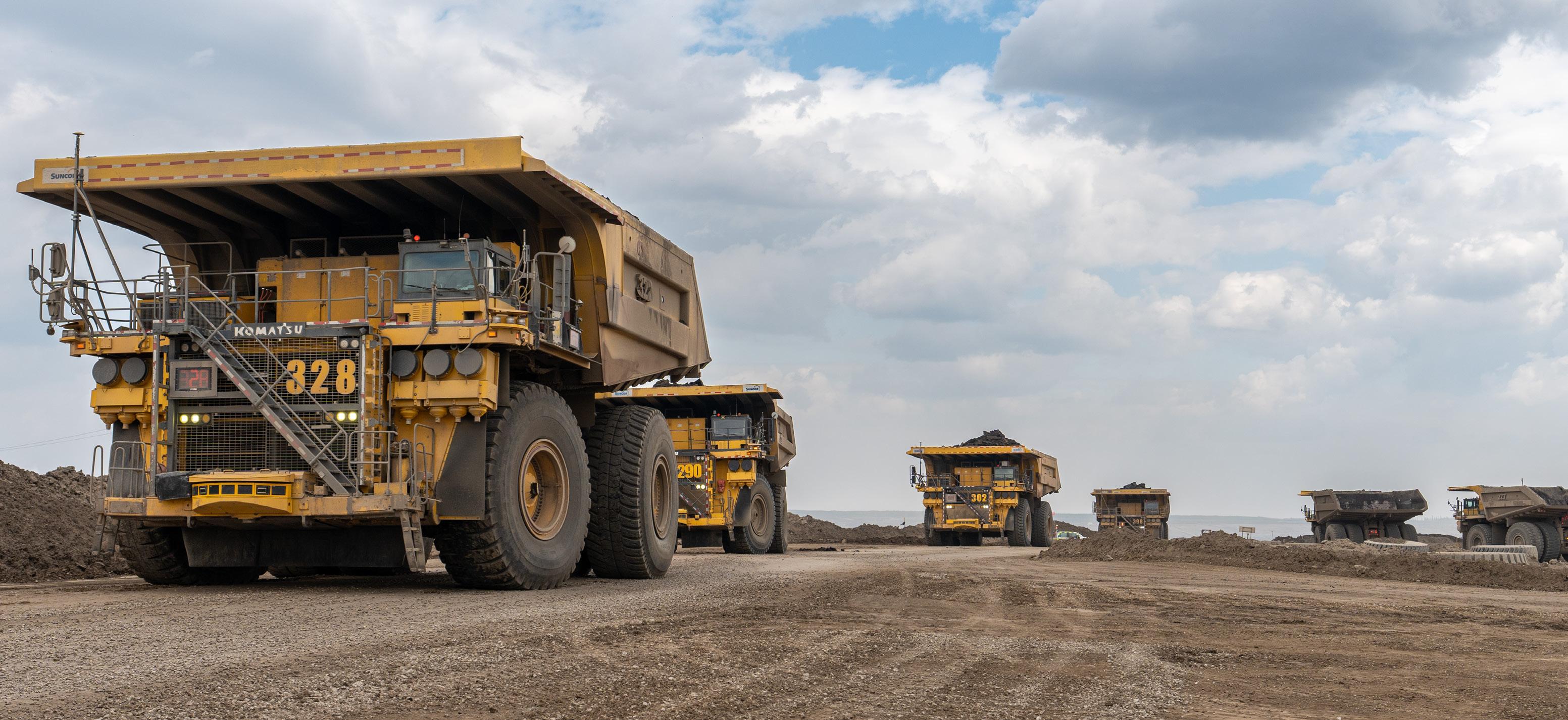
Suncor, Canada’s leading integrated energy company, is advancing industry innovation with its growing fleet of autonomous haul trucks.

Suncor continues to drive innovation in the Canadian energy industry. The company has successfully deployed the world’s largest autonomous ultra-class haul truck fleet at a single mining site.

The Autonomous Haulage System (AHS) used in the Suncor fleet is exactly what you’d imagine — a technology that allows driverless trucks to transport mining materials around a site using GPS, wireless/ LTE communication, and perceptive technologies. But these aren’t your average self-driving vehicles. The ultraclass haul trucks, which weigh about two and a half times the weight of a typical single-storey house, are some of the largest self-driving vehicles in the world, and operate around the clock.
Innovation in action
“Suncor was an early adopter of AHS technology in oil sands mining, and others continue to follow our lead,” says Suncor’s Executive Vice President — Oil Sands, Peter Zebedee. “This is all about consistency. Having a large AHS fleet positions our mine to deliver safe and steady production, further cementing Suncor’s position as a world-class mining operation.”
We're constantly looking for ways to push the boundaries of innovation within our industry.
All ore at Suncor’s Base Plant near Fort McMurray, Alta., is now moved by these autonomous haulers — the bitumen is loaded by shovels onto the trucks and transported to extraction plants entirely via driverless AHS-equipped trucks.
- Rich Kruger, Suncor President and CEO
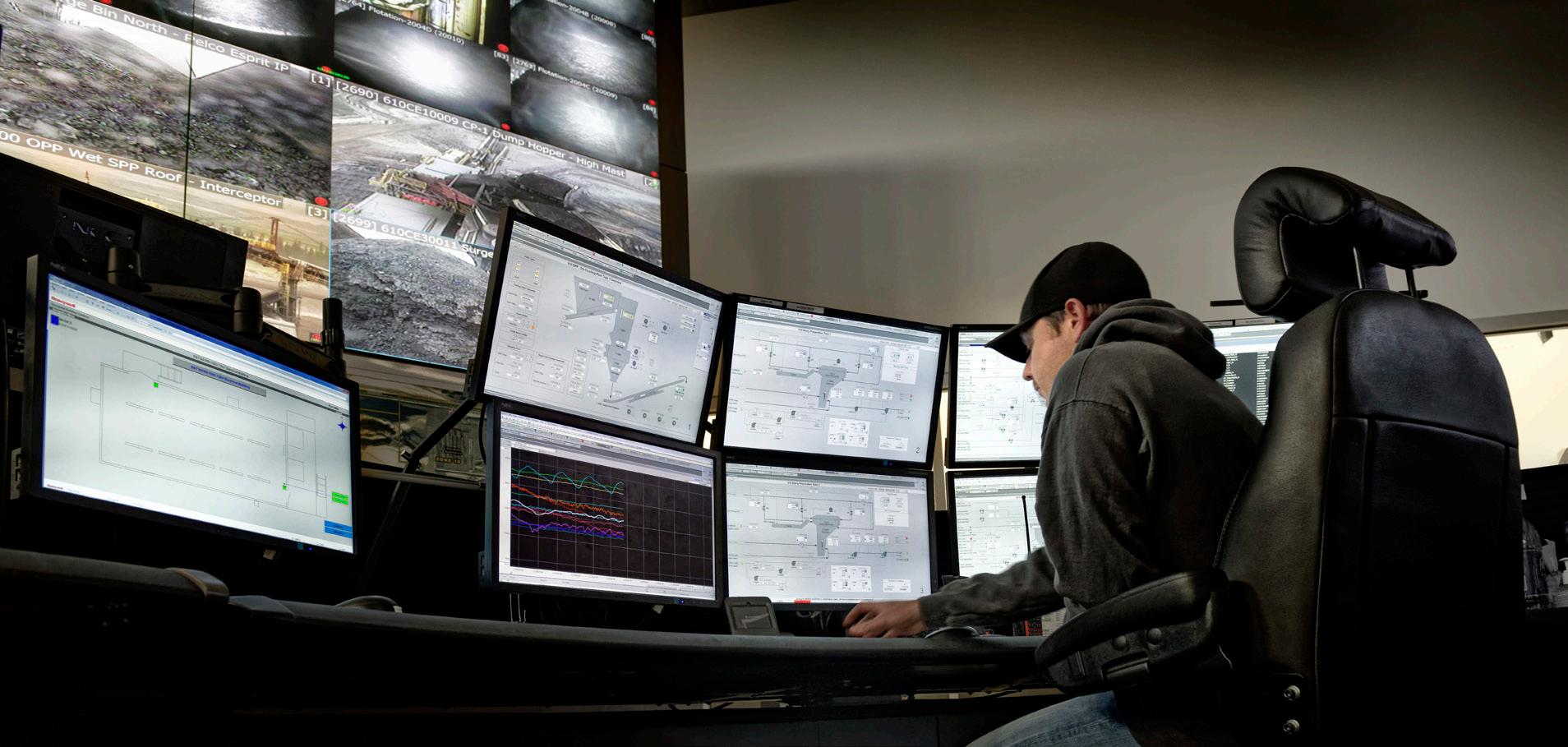
Instead of drivers physically steering the trucks, AHS software places the control in the hands of central control room operators who optimize how the trucks perform across the mine system. With a state-of-the-art AHS command centre and features that enhance situational awareness, including collision and obstacle detection, AHS enables safe, seamless, and predictable deliveries while reducing incidents, injuries, and disruptions to production.
A team effort
“We’re constantly looking for ways to push the boundaries of innovation within our industry,” says Suncor’s President and CEO Rich Kruger. “We’ve rolled out this technology in such a big way because — quite simply — it makes us a better operator. AHS not only increases safety and reliability but improves the overall efficiency of our production.”
Suncor has been using autonomous haul trucks (AHTs) at its Base Plant site for operations since 2018, but the number of autonomous haulers has grown exponentially over the last year.
A growing AHT fleet
Base Plant’s Millennium mine rolled out 15 AHTs in May 2024, growing the fleet to 91 by the end of the year. Ongoing AHS improvements, which increased truck performance on various pit and road configurations and in all seasons, allowed for a continued deployment throughout 2025. In total, Base Plant now has almost 120 AHTs across its two integrated mines.
“We have full visibility on all AHTs and autonomous-enabled support equipment on site, showing real-time location and movement of the operations,” says Zebedee. “This allows operators to manage traffic flow proactively, adapt to driving conditions, and reduce wear and tear on the equipment — ultimately leading to lower maintenance costs and downtime for our trucks.”
Integrating AHS throughout Base Plant was a significant undertaking, and was achieved with hard work and commitment from teams across Suncor.
“From our deployment teams to our field operators and dispatchers, the entire mining organization had a significant part in driving our success,” says Kruger. “This is yet another example of the Suncor team’s commitment to driving operational excellence.”
Suncor’s Base Plant will have equipped 140 AHTs by the end of this year and the company isn’t done. Given the success at Base Plant, Suncor continues to build autonomous technology into its future mining strategy, with plans to continue its incorporation at other Suncor mines in the coming years.

Decreases incidents & injuries
Increases efficiency
Increases operational predictability

Collision & obstacle detection systems
Enhances situational awareness
Minimizes equipment stoppages
Adapts to weather & driving conditions
Reduces wear and tear & maintenance costs
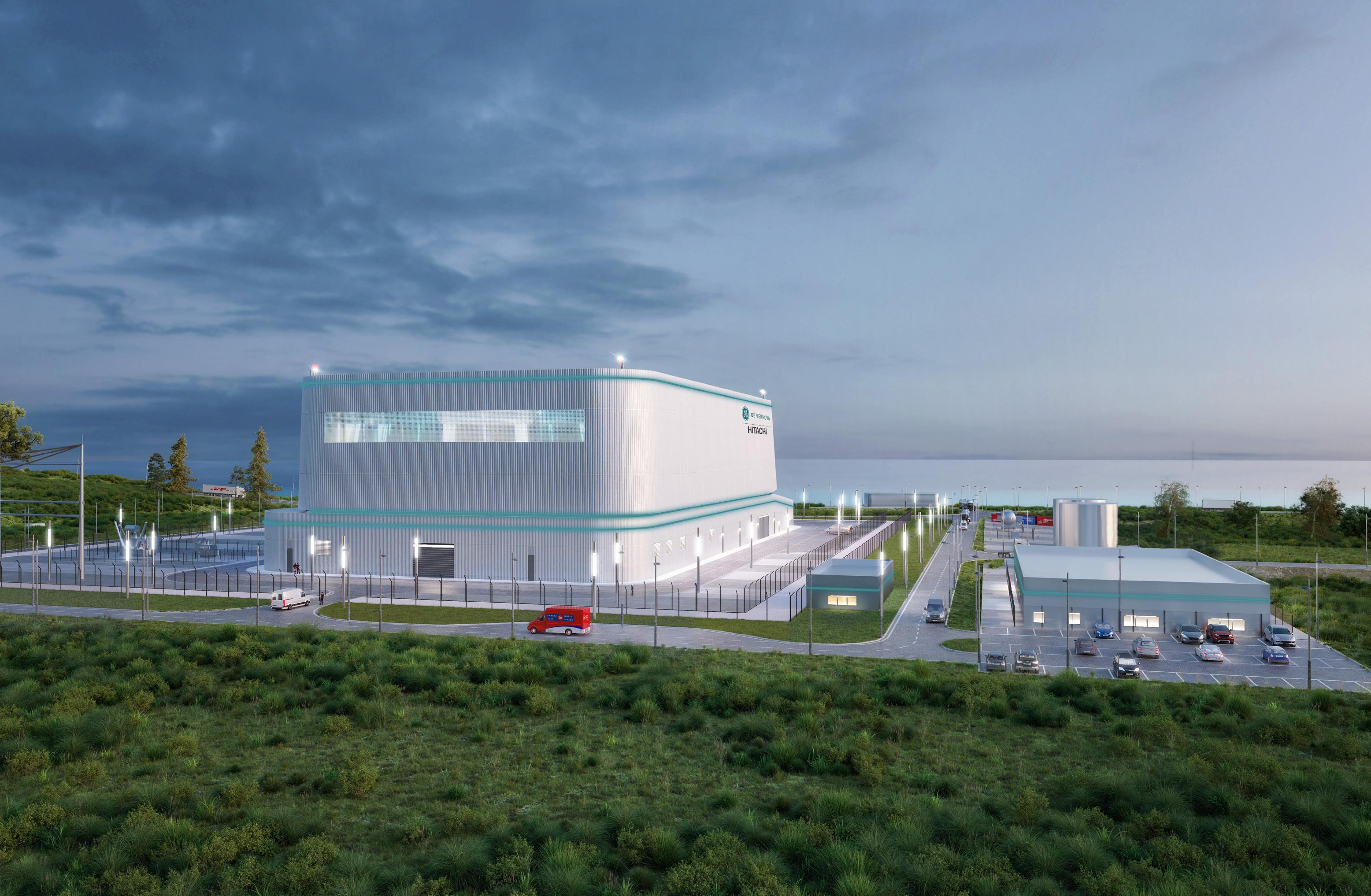

Since the late 19th century, when electricity first illuminated the streets of cities like Hamilton, Ottawa, and Toronto, Ontario has built a reputation — both within Canada and globally — as a province that is ready and willing to lead in adopting new and innovative energy technologies.
More than 125 years later, as governments worldwide work to integrate more lower-carbon energy into their electricity grids, Ontario is cementing its status as a leader in carbon-free power, by taking the bold step to build the first grid-scale small modular reactor (SMR) in the western world.
In May, in an exciting first, the provincial government approved Ontario Power Generation (OPG) to begin construction on the first of four SMRs at Darlington, using GE Vernova Hitachi’s BWRX-300 reactor technology.
“This is a proud moment for GE Vernova Hitachi and Ontario as we move from vision to reality with the construction of the BWRX300,” said Lisa McBride, Canada Country Leader, GE Vernova Hitachi Nuclear Energy. “As the world searches for carbon-free, reliable energy solutions, Ontario has already been charting what the future looks like, with roughly 92 per cent of its electricity grid powered by low- to zero-carbon energy, including nuclear.1 Our organization is proud to be contributing to that, bringing almost seven decades of experience to the table.”
A shared legacy of leadership and innovation
GE Vernova Hitachi’s story in Canada began over 60 years ago at Chalk River when its predecessor, GE, partnered with AECL and the Hydro Electric Power Commission of Ontario — now OPG — to bring nuclear power to Ontario’s electricity grid for the first time.
That work laid the foundation for the modern-day CANDU reactor, fundamentally changing the global trajectory of nuclear energy.
That willingness to go first, and that pioneering mindset, has united GE Vernova Hitachi and Ontario, and is why Ontario is a natural home for emerging technologies like SMRs.
Ontario is writing the blueprint for future energy projects
As Ontario’s population grows, manufacturing and industrialization increases, and demand for electric vehicles spreads, the province’s energy systems operator — the IESO—forecasts a 75 per cent rise in electricity demand by 2050. 2 To meet that growth, nuclear energy — and SMRs — will undoubtedly play a leading role.
But gone are the days when governments thought about generation purely in megawatts.
With
With the introduction last month of Bill 40, the Protect Ontario by Securing Affordable Energy for Generations Act, legislators are now thinking about how energy projects, and the partners they work with, are contributing to the economic health and prosperity of the people, businesses, and communities they serve.
At full deployment, GE Vernova Hitachi’s BWRX-300 is expected to support up to 18,000 highly skilled, good paying jobs across construction, manufacturing, operations, and maintenance. The company has also committed to maximizing local content in the project, with 80 per cent of project spending flowing to Ontario companies, injecting $500 million on average annually into the local economy and potentially adding $38.5 billion to Canada’s GDP over the next 65 years. By working with local partners where possible, GE Vernova Hitachi is ensuring the project benefits are felt across the province.
“With more than 80 Ontario-based suppliers already contributing to this project, we’re not just building a reactor — we’re building and supporting communities,” McBride notes. “Perhaps most exciting for Ontario is the international doors this project will unlock. As other countries look to deploy their own SMRs, they’ll be looking to use the skills, knowledge, and capabilities of the people and businesses that have already built an SMR — and they’ll find that in Ontario.”
Turning local momentum into global impact Ontario’s investment in SMRs is not just about meeting domestic energy needs — it’s also laying the groundwork for a new era of Canadian nuclear energy globally.
To support these efforts, GE Vernova Hitachi is already working with governments, utilities, and private-sector partners in jurisdictions like Sweden and Poland to position Ontario-made components and services for international deployments.
For example, Poland announced plans to build twenty-four BWRX-300 SMRs at six sites across the country.
“This is Poland’s first venture into nuclear power, and Ontario businesses that have gained experience working on the Darlington project will be well-positioned to support that and other global projects” says McBride.
Ontario’s SMR story is no longer a future concept — it’s a project under construction, backed by a proven team, with real investments and real opportunities taking shape. As the BWRX-300 project progresses, it’s laying the foundation for a stronger, more sustainable, and more competitive Ontario — at home and on the global stage.

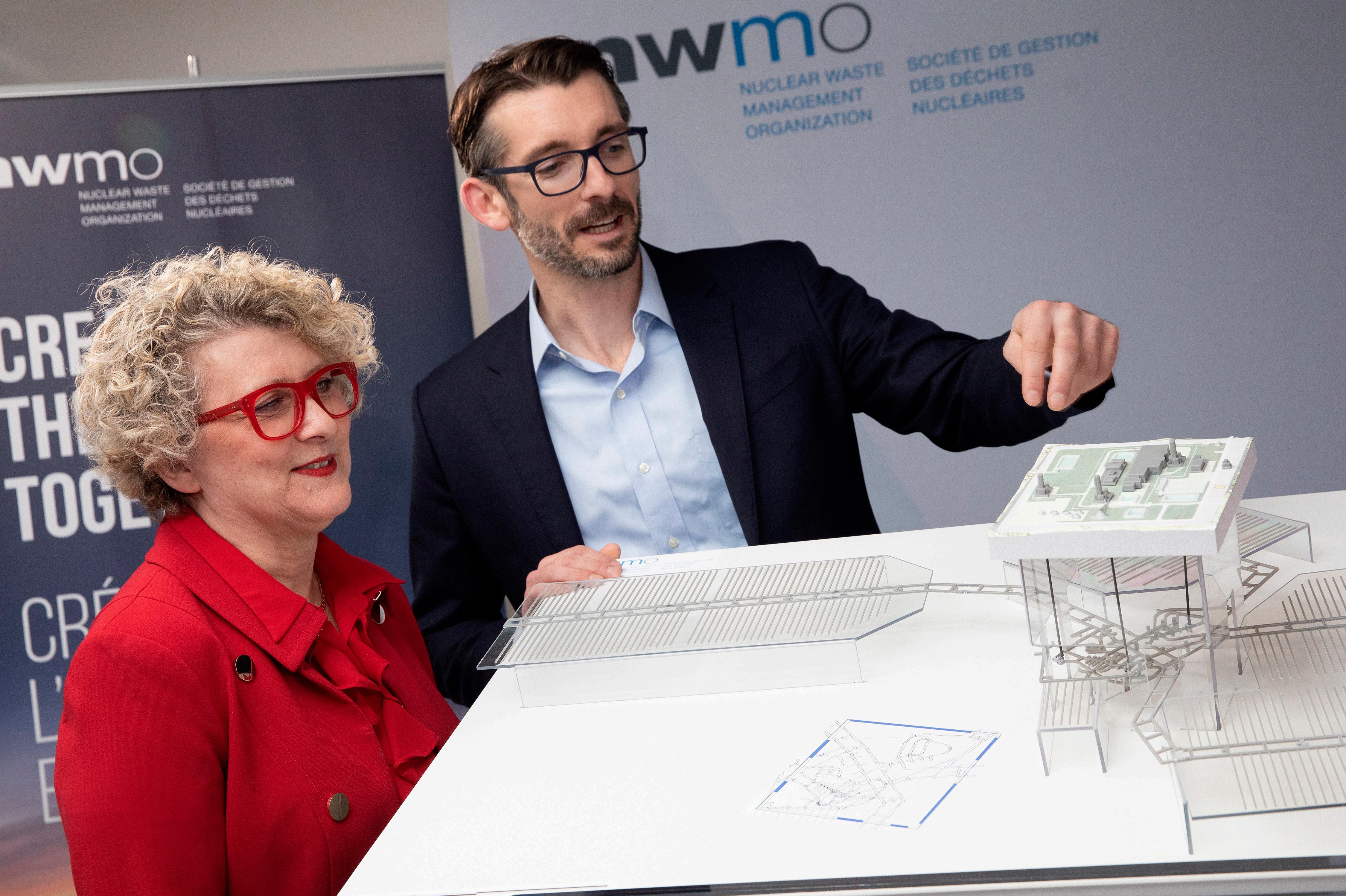
Canada’s NWMO is advancing two deep geological repositories and a Centre of Expertise to ensure nuclear waste safety while benefitting local communities.
NWMO


Canada’s Nuclear Waste Management Organization (NWMO) is hitting milestone after milestone as it announces the next steps toward opening Canada’s first deep geological repository for used nuclear fuel and begins preliminary work on a second repository for intermediate-level and high-level nuclear waste.
“Like many countries with commercial nuclear power programs, Canada is planning for the future,” says Laurie Swami, President and CEO of the NWMO. “There is international scientific consensus that a deep geological repository is the safest way to manage intermediate- and high-level waste over the long-term.”
A collaborative effort
In 2024, after a comprehensive site selection process, the NWMO selected a site in northwestern Ontario as the future location of the first repository, and last month announced the five companies that will design and plan the repository.
The NWMO, as the owner of the project, will be working with WSP Canada Inc., Peter Kiewit Sons ULC (Kiewit) , Hatch Ltd., Thyssen Mining Construction of Canada Ltd., and Kinectrics Inc. The chosen companies will work on facility infrastructure design and engineering, construction planning, mine design, mine construction, nuclear management advising and nuclear systems, and facilities design.
Though construction won’t begin until the deep geological repository has successfully completed the federal government’s multi-year regulatory process and Wabigoon Lake Ojibway Nation’s Regulatory Assessment and Approval Process, pulling the team together that will design how the repository is built and operated is a massive step forward in the process.
A new hub for research and innovation
While the repository is being planned, the NWMO is moving forward with a Centre
of Expertise in the Township of Ignace.
Expected to open in 2028, the Centre of Expertise will be a multi-million-dollar investment and an important landmark and international destination in northwestern Ontario, serving as a hub for research and development, community engagement, and knowledge-sharing.
A request for proposals was recently issued to design the centre, and the NWMO is prioritizing local and Indigenous vendors in the evaluation criteria.
The Centre of Expertise will be a place for world-class science and innovation and will bring new high-value jobs to the community, including scientists and experts from a wide variety of disciplines for generations to come.
Enriching the local community
process that will solicit public input across the country before the site selection process for the second repository begins in 2028.
Looking ahead to the future
As with the used nuclear fuel that will be placed in the first repository, Canada’s intermediate- and high-level waste is safely stored on an interim basis, but the methods used today are temporary and not suitable for the very long term.
Like many countries with commercial nuclear power programs, Canada is planning for the future.
“The Centre of Expertise will be home to hundreds of high-value jobs, will provide educational opportunities across the region, and is expected to attract Canadian and international visitors,” says Swami. “This is one of the most tangible benefits and most exciting commitments made by the NWMO to the communities hosting the deep geological repository, and we can’t wait to see it spring to life in the coming years.”
While the first repository and the Centre of Expertise continue to be designed and planned, the NWMO is hard at work preparing its siting approach for a second deep geological repository, which will house intermediate- and high-level radioactive waste, and potentially used nuclear fuel from new nuclear reactors built in Canada in the future.
As part of that process, the organization is inviting feedback from Canadians and Indigenous Peoples to refine a proposed site selection process. The recently released discussion paper kicks off an engagement
For the second repository, the NWMO is continuing its longstanding focus on technical safety and community willingness as primary site selection criteria. Intermediatelevel waste includes equipment and components that have been used inside nuclear reactors in the production of electricity from nuclear fuel, but excludes nuclear fuel itself, which is high-level waste. Non-fuel high-level nuclear waste includes small quantities of materials used in the process of making medical isotopes. Many isotopes are used for cancer treatments and diagnosis and the sterilization of medical equipment. Canada is a global leader in medical isotope production.
“We’re committed to seeking input from Indigenous Peoples from the very beginning of our site selection process for the next deep geological repository, and to forging relationships built upon trust and transparency,” says Joanne Jacyk, the NWMO’s Director of Site Selection for the second repository project.
The NWMO is well-positioned to move these historic projects toward completion, ensuring that Canada has a safe, permanent way to store its nuclear waste to make sure it isn’t left as a burden for future generations to carry.


To remain a global leader in food production, Canada must prioritize innovation, productivity, competitiveness, and regulatory efficiency.
Pierre Petelle, President and CEO, CropLife Canada
When it comes to innovation, Canadian agriculture has a perception problem. Nostalgic views of farming often don’t align with the reality of an industry that’s now among the most innovative in the world.
For most Canadians, stepping onto a modern Canadian family farm would quickly shatter outdated stereotypes of the industry. Today, agriculture is an industry driven by data, science, and precision — and one that stands to benefit hugely from advancements in artificial intelligence. Seeds are planted precisely where they should be, and inputs are applied exactly where they’re needed. Everything is optimized for success, right down to the square foot of land.
Canadian agriculture is a big piece of the pie when it comes to Canada’s economy, too. The sector is responsible for about seven percent of the GDP. There’s a lot of talk about Canada’s potential to be an energy superpower and we must not lose sight of the fact that agriculture is an important piece of that. It’s the engine that feeds and fuels Canadians and the world.
A sustainability success story
Canada has a small population relative to its huge land base. This puts Canada in an enviable position, as one of only a handful of countries in the world that produces significant quantities of food for markets around the world. The world needs what Canada grows, and this makes agriculture a key strategic advantage for the country. Our ability to support both domestic and global food security ultimately contributes to our own economic and national security.
Not only does Canada grow an abundant amount of food, we also produce some of the most sustainably grown food in the world. Recent research from the Global Institute for Food Security (GIFS) showcases just how sustainable Canadian-grown crops are compared to our global competitors. The results demonstrate that Canadian growers are producing some of the least carbon-intensive crops in the world. What’s the recipe for this sustainability success? According to GIFS, it’s driven by the widespread adoption of various innovations and farming practices.
A challenging environment
While this is an impressive story and one Canadians should be proud of, in many ways it’s a story of success against the odds. Farmers rely on access to the latest innovations in seed technology and crop protection to grow the best crops they can in the face of constantly changing climate conditions and new pest pressures. But new innovations have been slow to make it into the hands of Canadian farmers, as they’re often caught up in regulatory red tape or, worse yet, they never come to Canada at all. Canada as a whole has not made smart regulation a priority, which is highlighted
in its dismal ranking of 32 out of 38 member countries for administrative and regulatory burden, as tracked by the Organisation for Economic Co-operation and Development.
Fostering innovation
A recent report from Farm Credit Canada (FCC) shows that crop productivity growth in Canada peaked in the 2000s at an annual average rate of 2.9 per cent. Since then, Canadian crop productivity growth has been on the decline. FCC suggests that to reverse this decline, Canada needs to focus on three things:
Fostering an inviting business environment for innovation;
• Integrating regulatory efficiency into economic growth objectives; and
Making innovation, productivity, and competitiveness top priorities.
As Canada enters into a new era focused on driving economic growth and competitiveness, there’s a real opportunity to lean into agriculture. The industry has a long history of being innovative and driving results for Canada, both in terms of economic contributions and sustainability outcomes.

The world needs what Canada grows, and this makes agriculture a key strategic advantage for the country.
But we need a regulatory environment that enables innovation rather than discourages it. We need a regulatory system that protects human and environmental health while also acting as a catalyst for innovation and growth. Innovation is happening and farmers are ready to adopt it, but the bridge that connects the two is the regulatory system.
Moving forward with a bold vision
Think about the opportunity lost if it takes 10 or 15 years for a farmer to get a new seed variety that can better withstand drought or a new crop protection product that can save a crop from devastation from a new insect pest. That’s countless fields full of potential needlessly lost. It’s lost income for farmers, it’s lost income for the Canadian economy, it’s lost food and feed needed to support food security, and, ultimately, it’s more expensive food for consumers.
But it doesn’t have to be this way. With a bold vision and a commitment to action, the Canadian government can create a regulatory environment that enables innovation, spurs economic growth, and positions Canadian agriculture as a true strategic advantage.



Advanced Air Mobility (AAM) is set to reshape how Canadians connect — enhancing regional access, urban travel, and sustainable growth. But this transformation depends on collaboration. From regulations to infrastructure to clean technology, every piece of the AAM puzzle requires the entire ecosystem to work together.
As Canada’s national voice for AAM, Canadian Advanced Air Mobility (CAAM) unites the ecosystem, coordinating efforts across sectors, aligning priorities, and ensuring Canada's readiness in the future of flight.
Made-in-Canada innovations Canada isn’t just participating in AAM — it’s innovating.
In Bromont, Québec, CAAM National Board member Unither Bioélectronique completed the world’s first piloted hydrogen-powered helicopter flight, powered by its proprietary fuel cell technology.
In Ontario, CAAM member Horizon Aircraft completed the first full-wing transition flight of its hybrid-electric Cavorite X7 aircraft demonstrator, showing how Canadian
companies are pushing the boundaries of what’s possible in the next era of aviation.
Regulatory and airspace readiness
AAM technologies can only reach full-scale adoption if they’re supported by robust regulatory and airspace management frameworks.
At the 2025 International Paris Air Show, a major step forward was announced — and Canada is at the table. Transport Canada, alongside aviation authorities from the US, UK, Australia, and New Zealand, released a landmark international roadmap to align how new aircraft like eVTOLs are certified and validated across borders. This kind of multilateral coordination reduces duplication and accelerates the safe adoption of emerging technologies.
Meanwhile, NAV CANADA is advancing its Remote Traffic Management (RTM) Trials—a national initiative testing enhanced remote traffic management systems to support new AAM operations. These trials are helping shape how emerging aircraft can safely coexist with traditional air traffic, using Canadian expertise to develop scalable, real-world solutions.

Home to Canada’s most unique research ecosystem, the University of Saskatchewan is advancing innovation in vaccines, agriculture, and beyond.
Matt Olson
From coast to coast to coast in Canada, there’s no university with research infrastructure quite as unique as the University of Saskatchewan (USask).
Located in Saskatoon, Sask., in the heart of the Canadian Prairies, USask is home to world-class researchers, scholars, artists, and cutting-edge facilities renowned not only nationally but around the world.
A research powerhouse
The Canadian Light Source (CLS) is the only synchrotron facility in the country and lives on the USask campus. The CLS's advanced technology allows researchers from USask and around the world to further our knowledge in materials science, biomedical fields, green energy, and more.
Leading the way in agricultural sciences and crop breeding, researchers at USask’s Crop Development Centre (CDC)
have been instrumental in feeding the world’s growing population. More than 500 varieties across 40 different crops have been developed and released by the CDC since its inception in 1971, and the continued innovation supports the development and protection of the world’s crops.
Researchers at USask’s Vaccine and Infectious Disease Organization (VIDO) are making world-changing strides, with new vaccines and other preventative measures being developed for humans and animals. VIDO will soon be one of only two Level 4 containment facilities in the country, allowing researchers to examine and discover ways to combat the most virulent and dangerous diseases. Encouraging world-class innovation across numerous fields of research, including agriculture, health, social sciences, and technology, USask continues to be what the world needs — now and into its bright future.
Collaboration in action
Progress depends on more than policies — it requires ongoing dialogue. That’s why CAAM hosts quarterly AAM Town Halls featuring national authorities. These gatherings keep stakeholders aligned on what’s needed and what’s next, from infrastructure and certification to public trust and community readiness.
On an international scale, CAAM-led delegation trips connect Canadian innovators, regulators, and investors with global AAM leaders. These visits open doors to firsthand learning, partnerships, and ideas that accelerate our efforts here at home.
Be part of Canada’s AAM future AAM is about building an integrated transportation ecosystem that benefits communities, supports climate goals, and spurs economic growth. Through initiatives like the AAM Town Halls and CAAM Delegation trips, CAAM ensures Canadian voices are aligned, informed, and ready to act.
We’re stronger together, and Canada’s AAM future will be built through continued collaboration across borders, sectors, and skies.
Sudbury’s environmental recovery has made people’s lives immeasurably better and created a wellspring of economic growth based on innovation and determination.
Ian Barker
Greater Sudbury began as a place so rich in metals and minerals that it transformed Canada into a natural resource powerhouse. The city became the place where decades of exposure to toxins rendered the landscape so barren that the bare and fractured rock seemed lunar, beyond salvation. Today, 10 million trees later, Sudbury is both an environmental champion and economic trailblazer.
“We are ground zero, showcasing to the world that we can reduce pollution and keep the industry,” says Mayor Paul Lefebvre. “We’ve proven that the environment and the economy can coexist and thrive together. Here in Sudbury, we’ve become a global example of how we can learn from our past and grow from it.”
Sudburians’ investment of willpower and know-how conquered a monumental environmental problem and gave life to a culture of practical innovation and staunch determination. The path Sudbury took to remake itself from a polluted mining town into a green, economically diversified municipality offers universal lessons.
“When you look at Sudbury today and you look at our innovation ecosystem,” says Nadia Mykytczuk, CEO of MIRARCO (Mining Innovation, Rehabilitation and Applied Research Corporation), “you see we have cross-industry expertise engaging around challenges and issues.”
Vineet Johnson, President and CEO of IRegained, a stroke recovery technology manufacturer, suggests that the city’s advantage lies in its supportive, connected community. The startup is part of a nascent medtech cluster that has emerged from the city’s engineering roots.
As communities worldwide seek solutions to the growing challenge of economic uncertainty, Sudbury’s success story is the innovation blueprint others need to follow.