PAID ADVERTISEMENT FEBRUARY 2026 | INNOVATINGCANADA.CA
@MediaplanetCA
Please recycle
A SPECIAL INTEREST SECTION BY MEDIAPLANET
R E C L A I M YO U R T I M E :
How Highway 407 ETR is Helping Ontario Beat Gridlock
A WRITTEN BY
Jose Espinosa President & CEO, 407 ETR
407 ETR provides drivers a faster, safer commute and reduces stress
s more companies call employees back to the office, one challenge looms for us all: traffic congestion. Commutes are taking longer and stress is rising. A July 2024 Ipsos survey found 86 per cent of residents consider GTA congestion a “crisis”, while the Toronto Region Board of Trade estimates gridlock costs the region $45 billion annually. That’s where Highway 407 ETR plays a key role — offering a faster, safer and more reliable journey than the congested alternate routes. Despite its significant role in the GTA’s transportation network for the last 25 years, misconceptions about its value persist.
MISCONCEPTION: Taxpayers cover the cost of policing and maintenance of Highway 407 ETR. FACT: 100 per cent of highway costs are covered by 407 ETR and this spending boosts the local economy. 407 ETR pays for the day-to-day operations of the highway including winter maintenance and policing. Since 1999, we've also invested approximately $2 billion in lane expansions and extensions, adding 525 km of new lanes and growing the highway from just 68 km to 108 km. A recent assessment by global infrastructure consultancy Steer found that for every one dollar that 407 ETR spends on maintenance and operations, nearly two dollars is generated in Gross Domestic Product (GDP). This spending flows through the economy via wages paid to 407 ETR’s local workforce and to the supply chain which supports 1,800 jobs across Canada. Beyond economic impact, the enhanced mobility offered by Highway 407 ETR — faster commutes, fewer collisions, and improved access to jobs and services — delivers $1.2
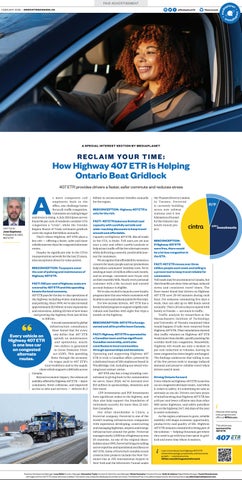
Every vehicle on Highway 407 ETR is one less car on congested alternate routes.
billion in socioeconomic benefits annually for the region.
MISCONCEPTION: Highway 407 ETR is only for the rich. FACT: 407 ETR balances limited road capacity with carefully set tolls and wide-reaching discounts to keep travel smooth and affordable. Capacity on Highway 407 ETR, like all roads in the GTA, is finite. Toll rates are set just once a year and reflect careful analysis to help attract traffic off the free alternate routes while delivering a smooth, predictable journey for customers. We recognize that affordability remains a concern for many people and our promotions help reduce commuters’ monthly costs. We’re sending at least 1.8 million offers each month, and on average, customers save 34 per cent on their monthly bills. Nearly every personal customer with a My Account and current account balance is eligible. We’re also excited to launch a new loyalty program later this year where customers will be able to earn and redeem points for free trips. For low-income drivers, 407 ETR has a Route Relief program to support eligible individuals and families with eight free trips a month on the highway.
MISCONCEPTION: 407 ETR is foreign owned and all its profits leave Canada. FACT: Highway 407 ETR is operated by a Canadian team and has significant Canadian ownership, and it also contributes to local communities through sponsorships and donations. Operating and supporting Highway 407 ETR is truly a Canadian effort, powered by a dedicated team of 550 employees based in Woodbridge, Ont. including our award-winning local contact centre. 407 ETR also has a long-standing commitment to giving back to the communities we serve. Since 2020, we’ve invested over $13 million in sponsorships, donations and free travel. CPP Investments and PSP Investments have significant stakes in the highway, and they also help support the foundation of retirement security for more than 22 million Canadians. Our other shareholder is Cintra, a Ferrovial company. Ferrovial is one of the world’s leading infrastructure companies with experience developing, constructing and managing highways, airports and energy infrastructure around the globe. Ferrovial manages nearly 1,000 km of highways across 10 countries. As one of the original shareholders since 1999, Ferrovial brings its tolling sector expertise and operational excellence to 407 ETR. Some of Ferrovial’s notable recent construction projects include the New Terminal One at JFK International Airport in New York and the Silvertown Tunnel under
the Thames River in London. In Toronto, Ferrovial is currently building seven new subway stations and 6 km kilometres of tunnel for the Ontario Line South transit project.
MISCONCEPTION: If Highway 407 ETR were free, there would be a lot less congestion in the GTA. FACT: 407 ETR moves over three million people each week and tolling is a proven tool to keep travel reliable for commuters. Toll roads may be uncommon in Canada, but their benefits are clear: time savings, reduced stress and consistent travel times. The Steer report found that drivers on Highway 407 ETR save 20-60 minutes during rush hour. For someone commuting five days a week, that can add up to 480 hours saved annually. That’s 20 extra days to spend with family or friends — not stuck in traffic. Traffic analysis by researchers at the Massachusetts Institute of Technology and University of Toronto examined what would happen if tolls were removed from Highway 407 ETR. Their simulations showed that traffic volumes on Highway 407 ETR would more than double, quickly pushing the corridor itself into congestion. Meanwhile, Highway 401 would see only a modest 14 per cent reduction in volumes, leaving its most congested sections largely unchanged. The findings underscore that tolling is one of the few proven tools to manage induced demand and preserve reliable travel when drivers need it most.
Driving Ontario forward Every vehicle on Highway 407 ETR is one less car on congested alternate routes. And when it comes to safety, it’s something we take as seriously as you do. Drivers can have peace of mind knowing that Highway 407 ETR has a 60 per cent lower collision rate than other 400-series highways, and safety patrollers are on the highway 24/7, 365 days of the year to assist customers. As the region continues to grow, reliable mobility will shape economic opportunity, productivity and quality of life. Highway 407 ETR remains committed to being part of the solution — helping Ontarians get where they need to go with less time spent in gridlock and more time where it matters.
Discover time-saving tools, programs and offers at 407etr.com. This article was sponsored by 407 ETR.
Learn more about how Highway 407 ETR drives time savings, productivity and economic growth — one trip at a time. 407etr.com/drivingontarioforward
Business Development Manager: Luca Bidini Country Manager: Samantha Taylor Content & Client Success Manager: Nicole Kansakar Creative Director: Kylie Armishaw Digital Media Manager: Vansh Chandwaney All images are from 407 ETR unless otherwise credited. This section was created by Mediaplanet and did not involve The National Post or its editorial departments. Send all inquiries to ca.editorial@mediaplanet.com.