
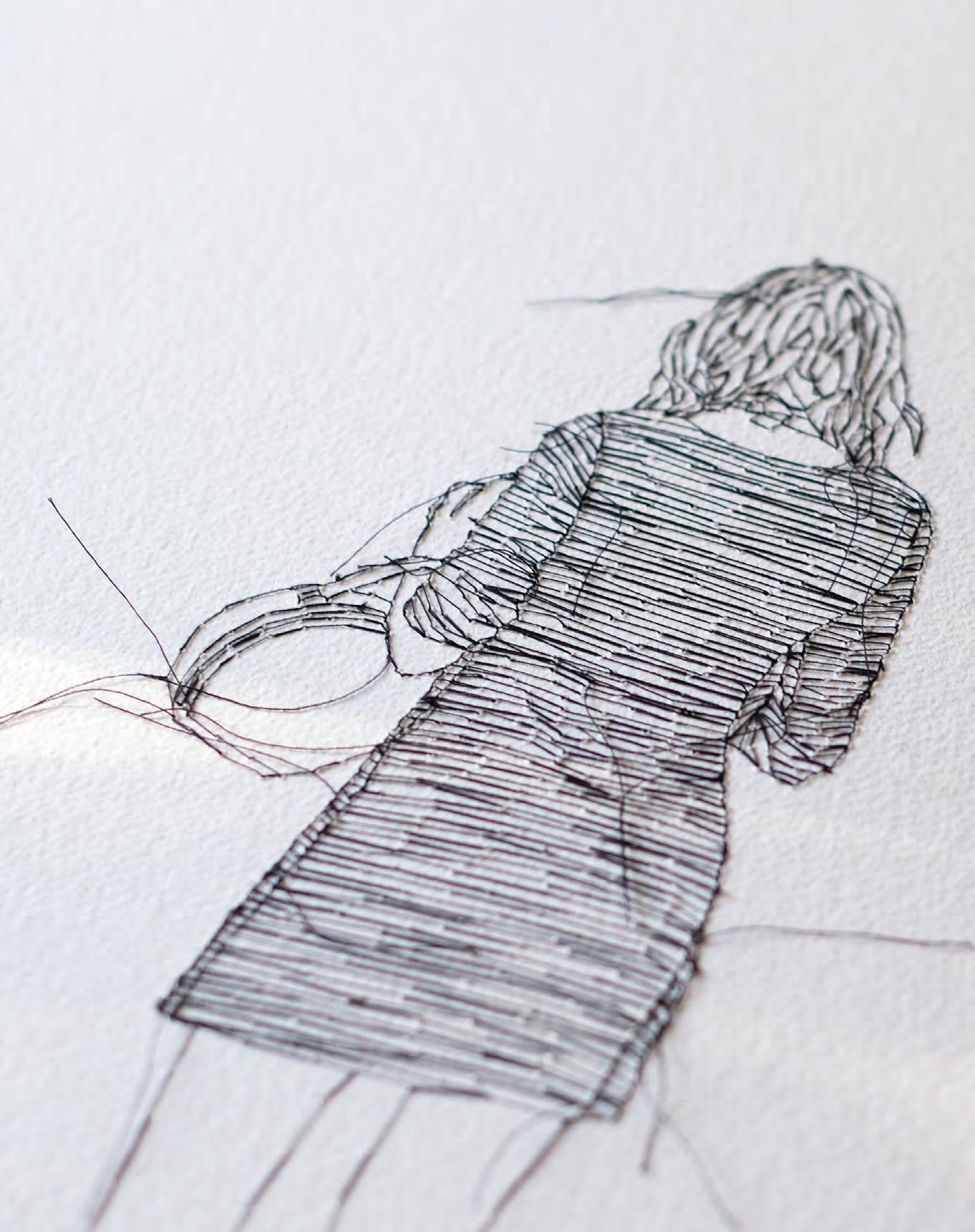
ART-IFICIAL INTELLIGENCE
WHY HANDMADE ART WILL ALWAYS TRIUMPH OVER PIXELS AND PROMPTS
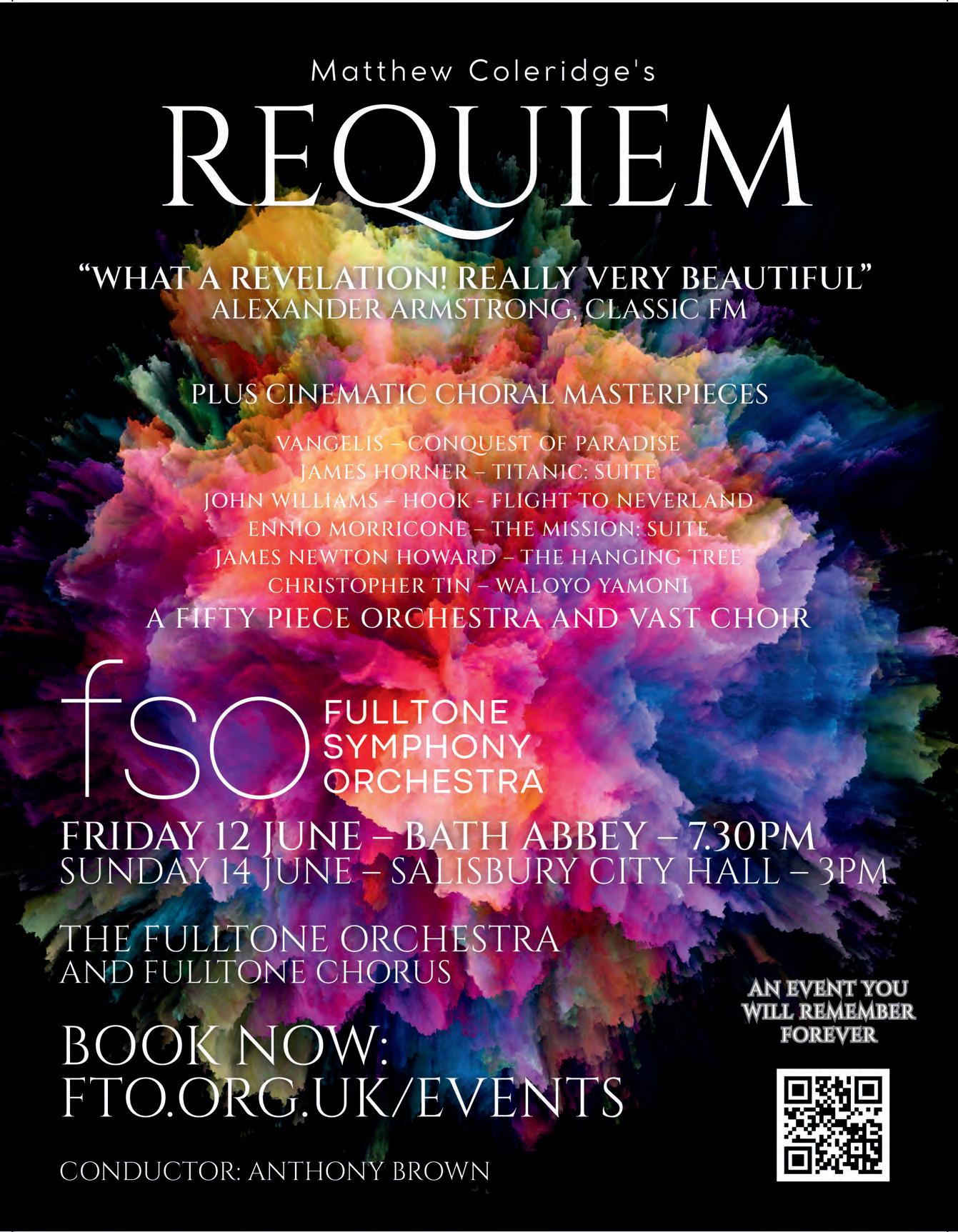
CHARM THE BIRDS
Fabulous accessories celebrating our feathered friends
QUIET LUXURY
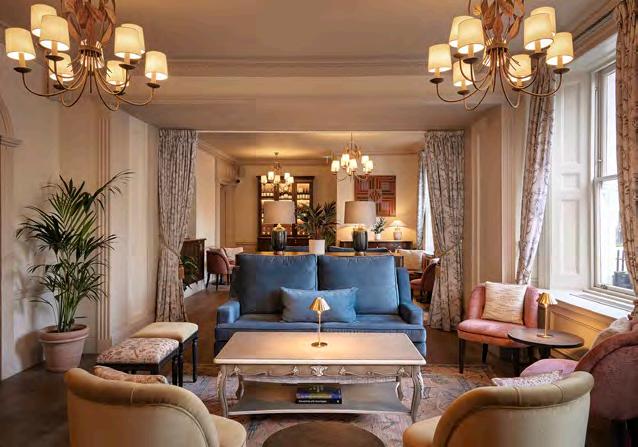
The unhurried beauty of our local hotels
IN THE CRESCENT MOMENT
Exploring the architectural gems of Bath
The inside story on Topping & Company Booksellers
LIT & LIVE Bath Festivals returns with ideas, stories and soundscapes
PAMPERED POOCH
It’s best in show for a canine stay at Dukes



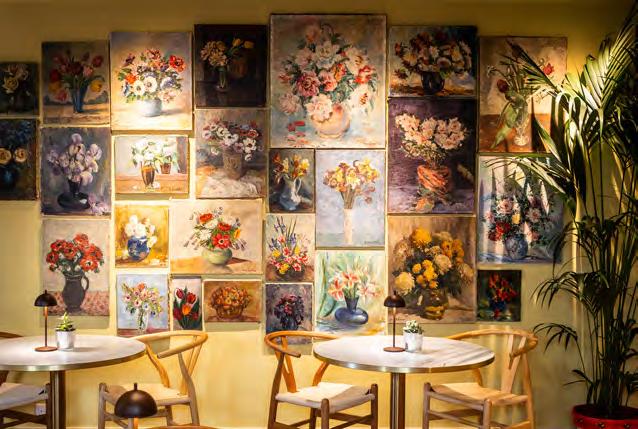
If you aren’t talking about AI at the moment, are you even talking? It’s the hot topic that’s causing heated responses from most of us. Whether you think it’s the devil’s work, an eroder of brain power, a stealer of jobs, or it’s a wonderful tool that’s enhanced your life, you cannot live without, and hey, it’s the only interface that really gets you, plus it never says no – either way, it’s not going anywhere. With the rise of those data-mining ChatGPT images doing the rounds, the controversy over artist robots (remember the dungaree-clad, black-bobbed hair Ai-Da?), crazy investments in NFT art a few years back, and machine-created works openly scraping existing styles to make AI content, we asked our art experts for their thoughts on the matter (page 22). It makes for a fascinating, and a reassuring, read. It would seem that the more the data-driven dross tries to infect our lives, the more we push back – we visit galleries, want to know the authenticity of the work, and we value, both emotionally and fiscally, the effort a real artist puts into creativity.
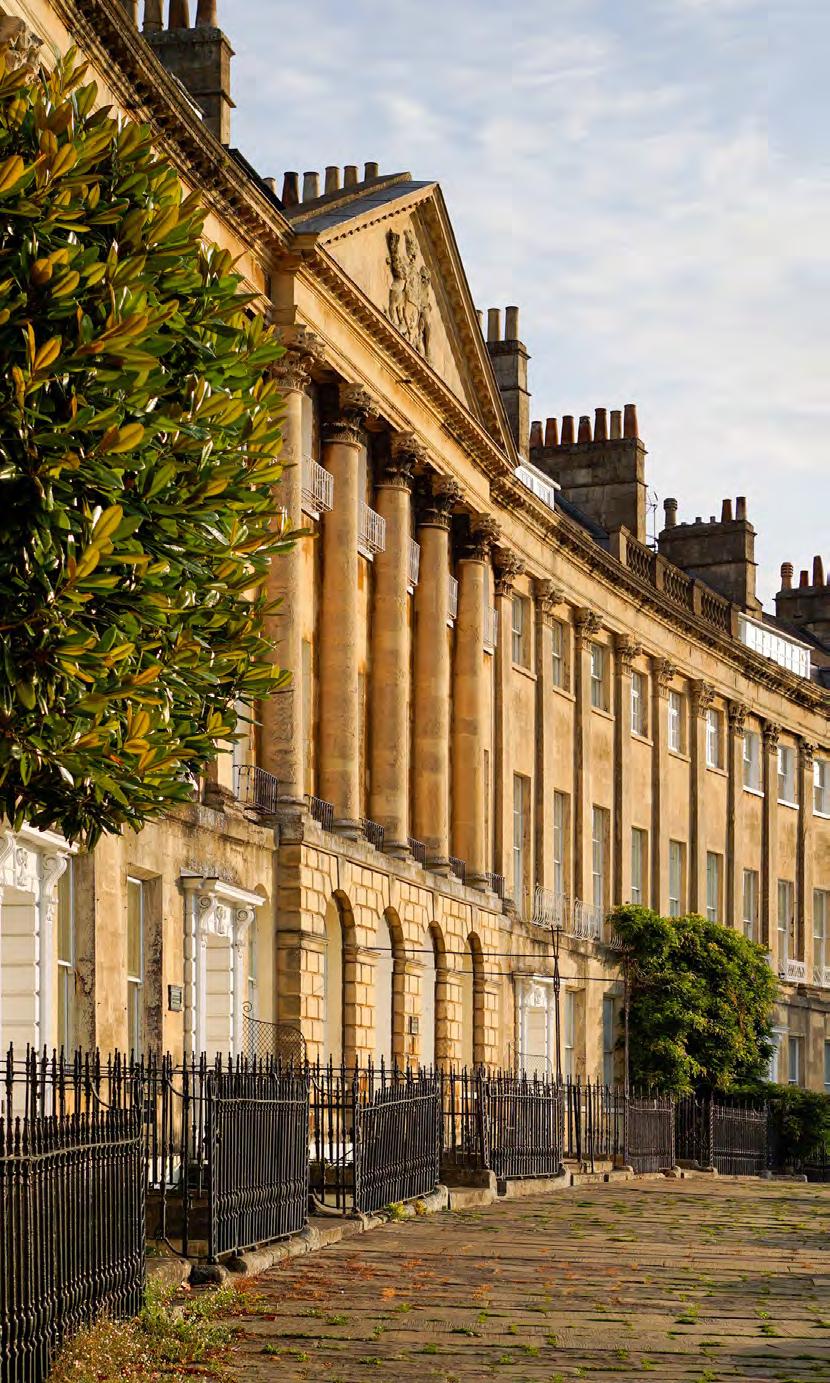
Elsewhere, we also explore the crescents of Bath (page 44). Now, I’m not saying computer science couldn’t have come up with the blueprint of our famous curves, but while it could reconstruct the form and layout, I suspect it wouldn’t be drawing on John Wood the Elder and Younger’s Druidism and neo-classicism influences. The pioneering architects saw the Circus as the sun and the Royal Crescent as the moon, forming a symbolic, geometric pair. It has even been claimed that a powerful, mystical energy path runs through them, specifically linking the Circus with Bath Abbey and Stonehenge.
You aren’t going to get that from a chatbot prompt any time soon.
[Would you like me to make this more concise / engaging / professional?]
SARAH MOOLLA
Follow us on @bathlifemag
PHOTO BY NARRATED FRAMES;
Issue 546 / May 2026
COVER A detail from Breton Dressed by Emma Cowlam, an artist represented by Modern ArtBuyer; www.modernartbuyer.com; Turn to page 22 for the full feature
THE ARTS
22 GALLERIES Experts discuss AI and creativity
33 ARTS INTRO The Royal Bath & West Show is back
34 WHAT’S ON People to see, places to go
36 CULTURE CLUB The arty picks of Kara Tointon
39 BOOKS Mr B and his novel ideas
42 BATH FESTIVAL The city wide celebration of literature and music returns
44 A RCHITECTURE Capturing the beauty of Bath’s crescents
STAYCATIONS
52 HOTELS Whispered luxury is the secret of these beautiful stays
FOOD & DRINK
62 RESTAURANT Pooch can come too at Dukes hotel
67 NEWS FEED Nuggets from the foodie scene
LIFESTYLE
69 SHOP LEAD The Hannah Turner wall art puffins
70 EDITOR’S CHOICE Watch the birdie home accessories
73 BEAUTY Why salmon DNA is the new skin saviour
NETWORK
77 LEAD STORY Bath Life Network Lunch with Robert Topping, founder of Topping & Company Booksellers
84 NETWORK NEWS News, views and interviews
87 CAREER PATH Rotork Bath’s Carla Hadfield
PROPERTY
97 PROPERTY LEAD A Grade II* listed townhouse is up for sale
98 PROPERTY NEWS The latest from the market
100 SHOWCASE Explore Batheaston House
DEPARTMENTS
9 SPOTLIGHT Shining a light on the positive
11 SCENE Hello party people!
19 FLAT LINE Flats on the fine art of art
106 BATH LIVES Meet author and lecturer Natasha Pulley

Editor Sarah Moolla sarah.moolla@mediaclash.co.uk Managing editor Deri Robins deri.robins@mediaclash.co.uk Senior art editor Andrew Richmond Cover design Trevor Gilham Contributors Nic Bottomley, Elsie Chadwick, Abbie Farmer, David Flatman, Rowena Ko, Paul Marland, John Mather and Josh Nairn Commercial director Pat White pat.white@ mediaclash.co.uk Business development manager Annabel North annabel.north@mediaclash.co.uk Business development manager Dan Nichols dan.nichols@mediaclash.co.uk Business development executive Ruby Coburn ruby.coburn@mediaclash.co.uk Production and distribution manager Kirstie Howe kirstie.howe@mediaclash.co.uk Chief executive Jane Ingham jane.ingham@mediaclash.co.uk Chief executive Greg Ingham greg.ingham@mediaclash.co.uk Bath Life MediaClash, Media House, 1 Widcombe Parade, Bath, BA2 4JT. tel: 01225 475800; www.mediaclash.co.uk. Instagram @TheMediaClash ©All rights reserved. May not be reproduced without written permission of MediaClash. We’re a Bath-based publisher, creative agency and event organiser Magazines Our portfolio of regional magazines celebrates the best of local living: Bath and Bristol. Agency From the design and build of websites to digital marketing and creating company magazines, we can help. Events We create, market, promote and operate a wide variety of events both for MediaClash and our clients Contact: info@mediaclash.co.uk

LOCAL LEGENDS
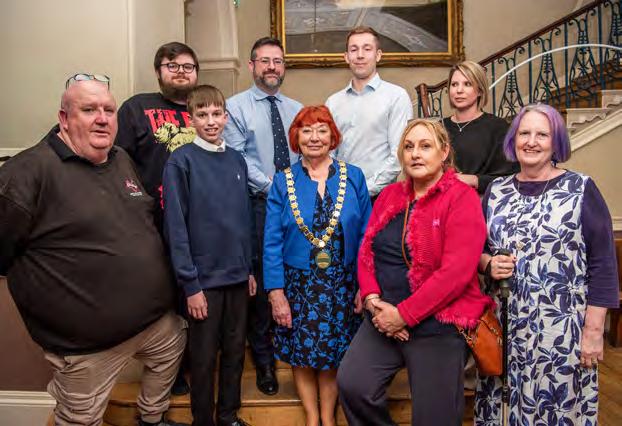
Outstanding community champions from across Bath and North East Somerset have been recognised at this year’s Community Awards. The ceremony, held in March at The Guildhall, celebrated individuals and organisations making exceptional contributions to local life. Organised by Bath & North East Somerset Council and its partners, the awards attracted 86 nominations across five categories.
Alex Johnson of Nova Sports won the Beryl Dixon Community Leader of the Year Award, with Claire Henwood highly commended. The Sara Banks Young Volunteer of the Year Award went to Jimmi Browning of Youth Connect South West and 13-year-old Tom Halford of Time is Precious. The Peter Duppa-Miller Parish Award recognised George Clutton and Councillor Malcolm Austwick. Charity of the Year, decided by public vote, was the Ben Saunders Foundation, with Bath Area Play Project and Bath Mind highly commended. An anonymous winner received the Jenny Willson Volunteer of the Year Award, with Gill Bottomley highly commended. For more: www.bathnes.gov.uk

ROCK STAR
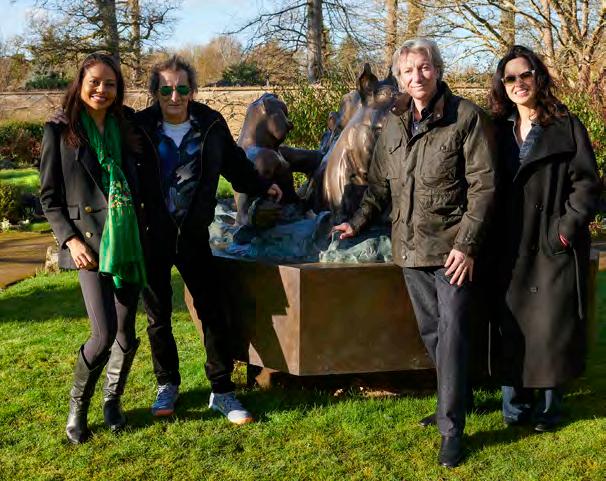
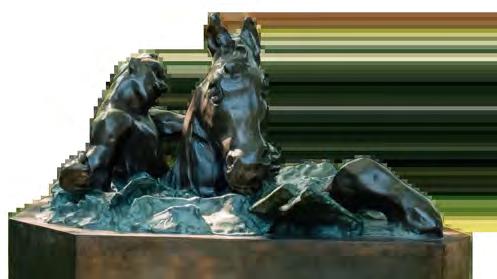
Rolling Stones legend Ronnie Wood has loaned a piece of his own artwork, a one-tonne bronze sculpture called Struggles and Triumphs, to Longleat.
Talking about its creation, Ronnie explains, “It came about on a whim as I love horses, and I completed it in one sitting. It was in the foundry for three to six months when someone suggested rotating it, and I thought what a brilliant idea… It means a lot to have it here at Longleat; it’s another bit of history in this environment.”
Ronnie and his artist wife Sally met Ceawlin Thynn, the 8th Marquess of Bath and Emma, the 8th Marchioness of Bath, at a Tusk fundraising event, which both he and Emma are ambassadors for. “Longleat is wonderful,” says Ronnie. “I got involved with Tusk because I want my kids and other people’s children to be able to see animals such as rhinos, lions, tigers. Conservation of these animals is so important to protect them for the future.”
For more: www.longleat.co.uk

COMEDY ICONS
Comedian and broadcaster Sue Perkins will interview Dawn French live on stage at The Forum in Bath on 2 June as part of Dawn’s In Conversation With tour. The event will celebrate the upcoming publication of Enough, French’s fifth and most ambitious novel to date, described as ‘darkly funny and deeply human’.
Meanwhile, Dawn’s long-time comedy partner Jennifer Saunders is coming to Bath later in the year, playing the formidable Mrs Rafi in Edward Bond’s The Sea at the Theatre Royal from 22 October to 7 November.
For more: www.bathforum.co.uk | www.theatreroyal.org.uk
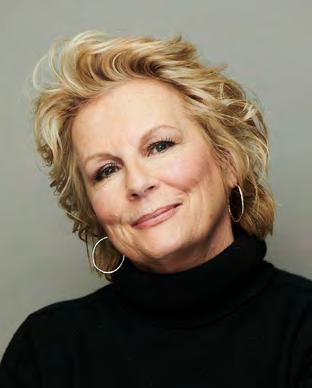
Dawn French
Jennifer Saunders
Sue Perkins PHOTO BY
PHOTO BY PÅL HANSEN
Champions of the community at the Guildhall
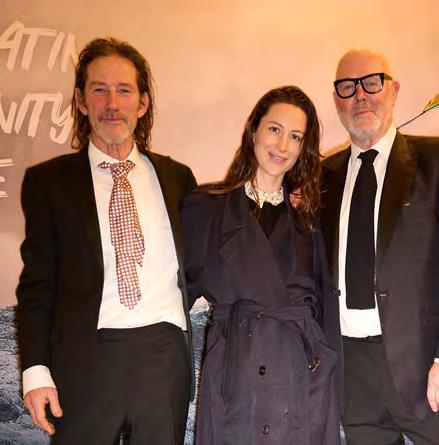
Emma Thynn, Ronnie Wood, Ceawlin Thynn and Sally Wood
Struggles and Triumphs has been installed at Longleat
SCENE
THE LATEST ADVENTURES IN PARTY-GOING ACROSS BATH
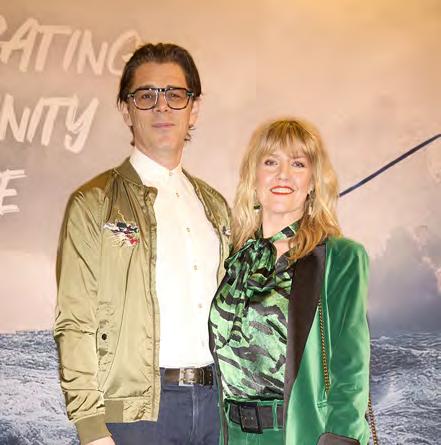
and Ashley
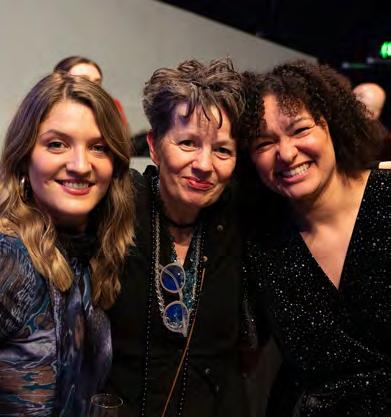
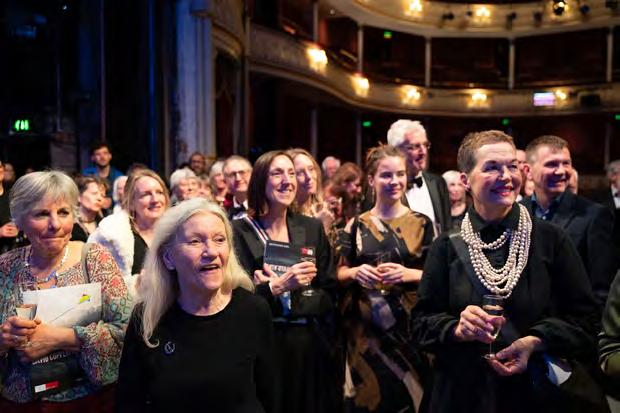
Caroline Davies, Dr Elizabeth Wright, Nola Wright, Jenni Lewis, Kate Abbey, Nell Abbey, Lizzie Heffer and Simon Holdsworth
Beni Evans, John O’Hara, Irene Banister, Sally Cookson and Nell O’Hara
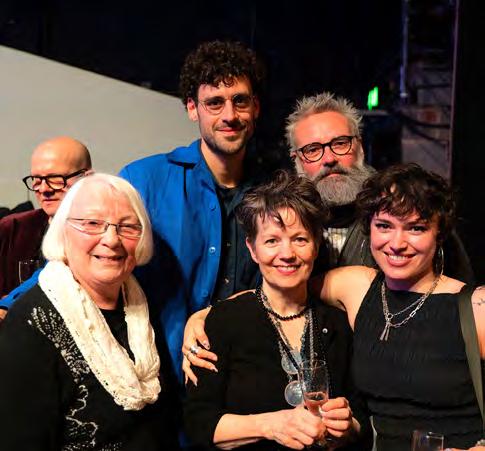
SHOW TIME
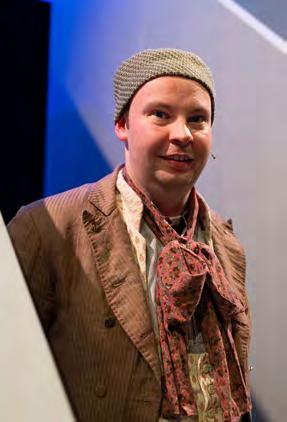
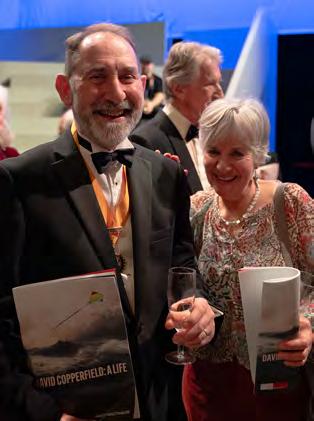
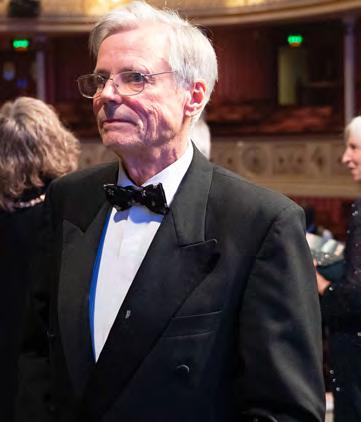
Theatre Royal Bath hosted a special community celebration of David Copperfield: A Life on 21 February, to fundraise towards The Billings community venue, previously known as Venue 4. The 135 guests enjoyed a red carpet welcome, a reception in The Vaults Bar, the production on the Main Stage and a post-show champagne reception among the set. Refreshments included wine from Canned Wine Co., cava from Wolf Wine, Marshfield ice cream and canapés from The Garrick’s Head. Emmy-nominated actress Ashley Jensen was in attendance and called the evening tremendous and important.
Photos by Darius Jean; www.dariusjean.com and Amelia Washington; Instagram @amelia.washington.photography For more: www.theatreroyal.org.uk
Eshiva Wright and Darius Jean

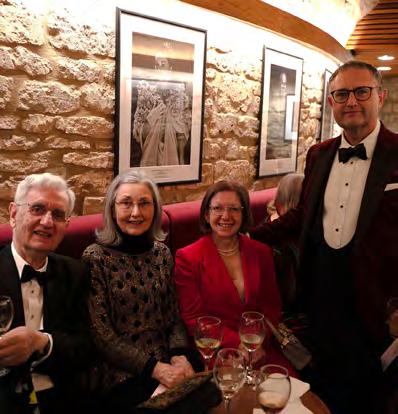
Mark, Judith, Vicki and Tim Rutherford
Lucy Walker, David Hill and Katherine Lazare
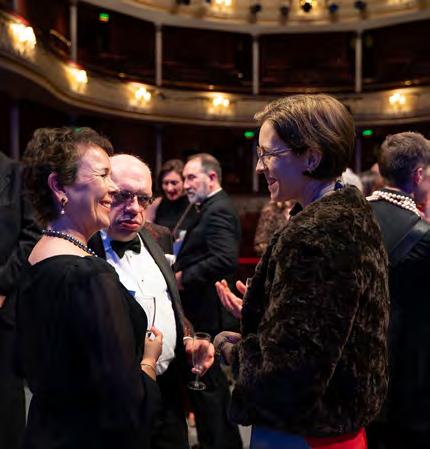
Sophie Cottle, Sally Cookson and Lydia Davies-Cook
Chris and Caroline Davies Paul Heal
Cosmo Fry, March Fry and Simon Oakes
Josh Hall
Kenny Doughty
Jensen


FILM STARS
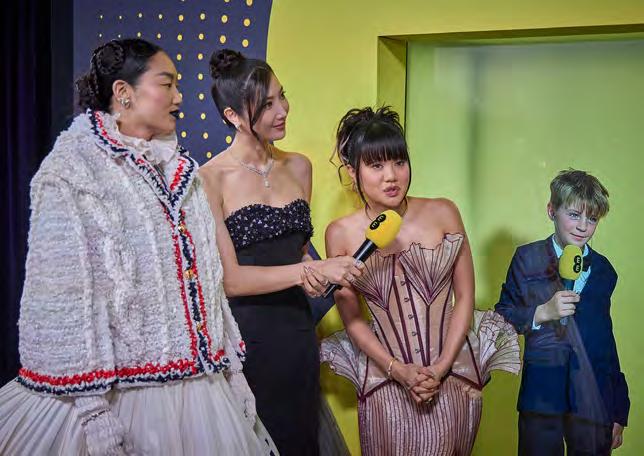
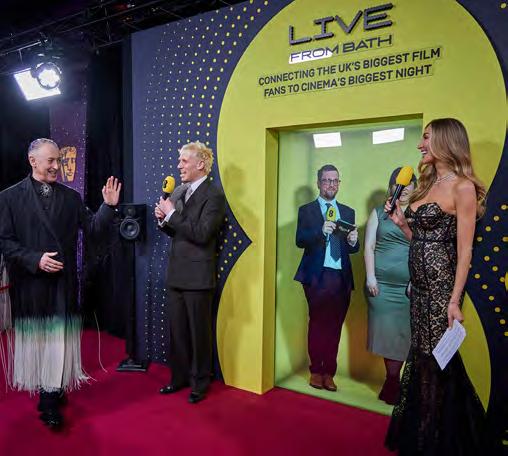
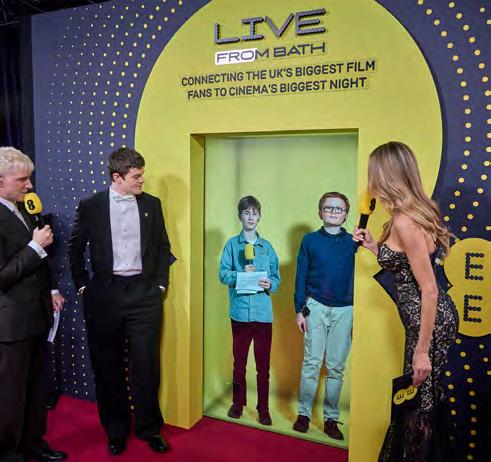
EE brought local film fans to the 2026 EE BAFTA Film Awards red carpet as life-size holograms. Residents from Bath – crowned the UK’s ‘Cinephile Capital’ after EE data showed they stream more films per capita than any other city – appeared live on the EE stage via the company’s 5G+ network and immersive holographic tech.
Hosts Jamie Laing and Sophie Habboo guided stars through real-time interactions with fans 166 miles away with Alan Cumming, and Aimee Lou Wood among the talent who stopped to chat with their virtual audience.
For more: www.ee.co.uk

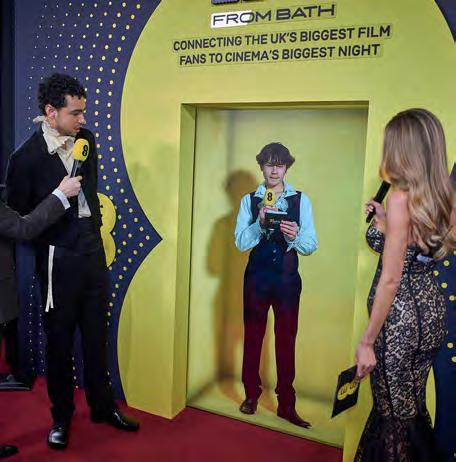


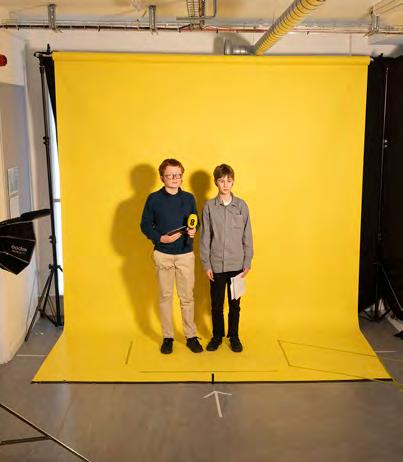
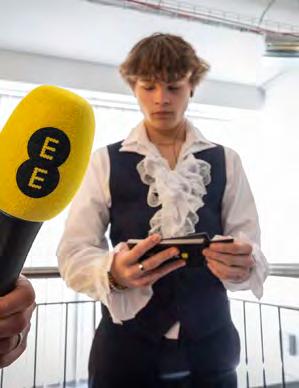
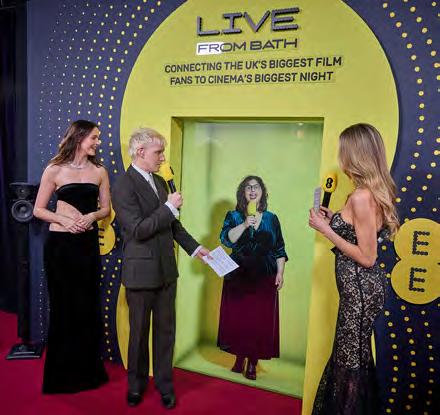
Alan Cummings greets Will and Katie's holograms
Hosts Jamie Laing and Sophie Habboo
Ella Henderson waits her turn to interview Aimee Lou Wood
Zach talks to Archie Madekwe
Miriam gives us a wave
K-Pop Demon Hunters meet Henry
Henry looks the red carpet part
Zach preps
Will and Kate prepare their questions
Behind the scenes with Jasper and Albie
Jasper and Albie interview Robert Aramayo
Miriam with Renate Reinsve
IN SIGHT
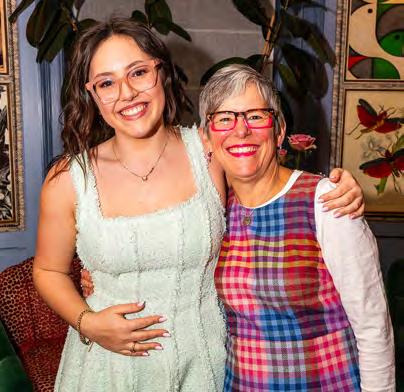
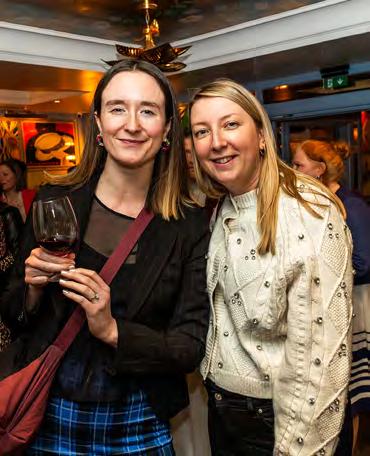
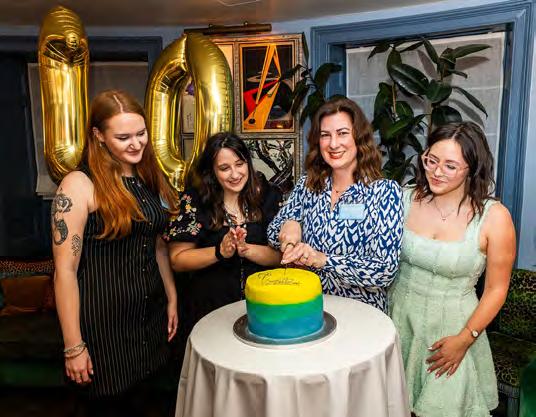
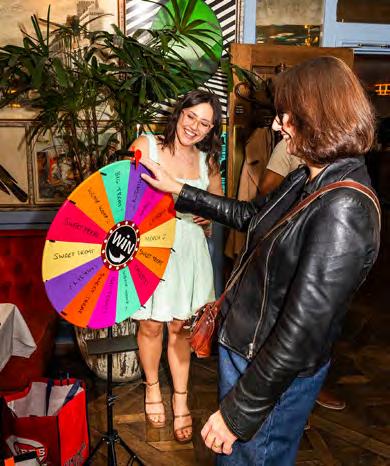
Carnsight Communications marked ten years in business with an evening celebration at The Ivy, Bath. Guests enjoyed welcome drinks, canapés, and networking, as well as a ‘Spin the Wheel’ prize competition and a tag-yourself photo board.
CEO and founder Jessica Morgan said, “This milestone has given me a moment to reflect on how far we have come and to feel energised about everything still ahead.”
Photos by Jen Allan; www.jenallanphotography.co.uk For more: www.carnsight.com
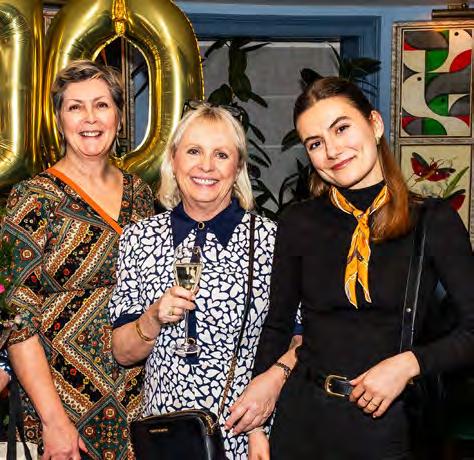
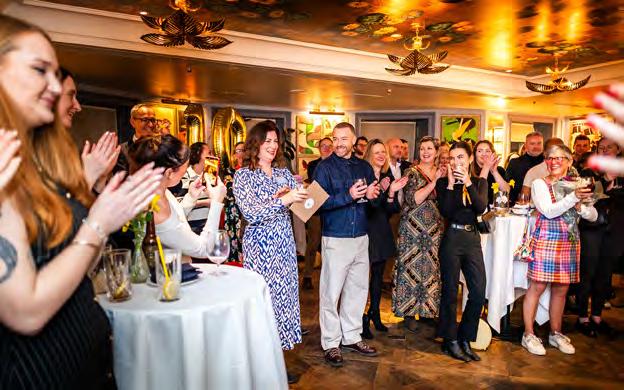
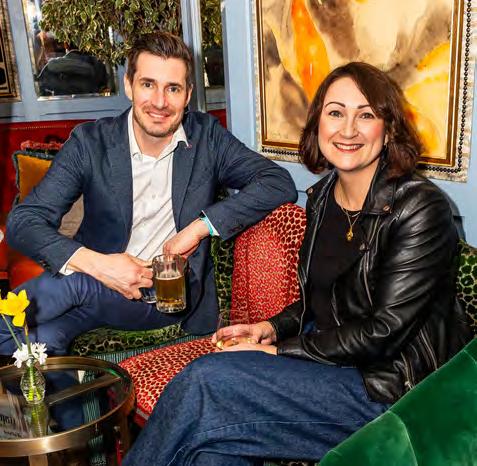
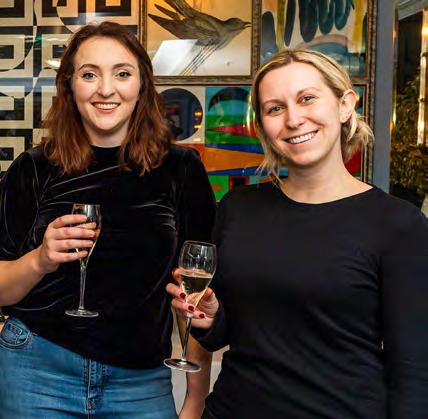
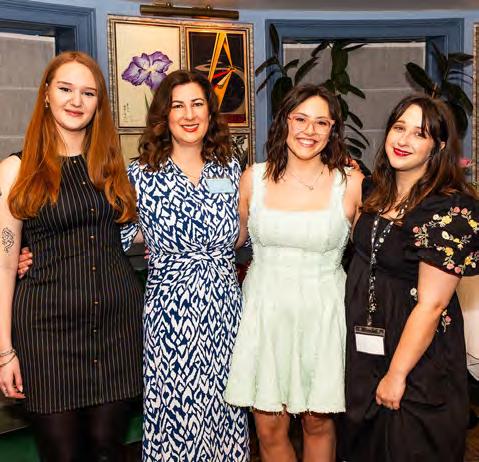
Jo Lund, Becky Banks, Ben Webb and Robin Hand
Alexandra Johansen and Pip Ahern
The Carnsight team and cake!
Guests played Spin The Wheel
Colette Flowerdew-Kincaid and Lucy Rees
Friends and colleagues helped celebrate the anniversary
Benice Hampton, Sian Swift and Mireia Boronat
Steve Jefferys and Jen Stephens
Ellen Petit, Jessica Morgan, Alexandra Johansen and Leigh-Ann Hewer
Steph Brown and Claire Dibben
The Ivy, Bath hosted
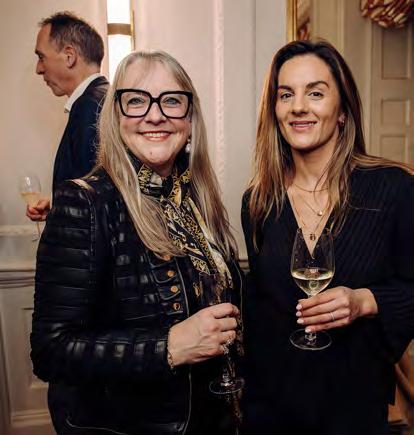
Dempster and Becky Banahan
ON FIRE
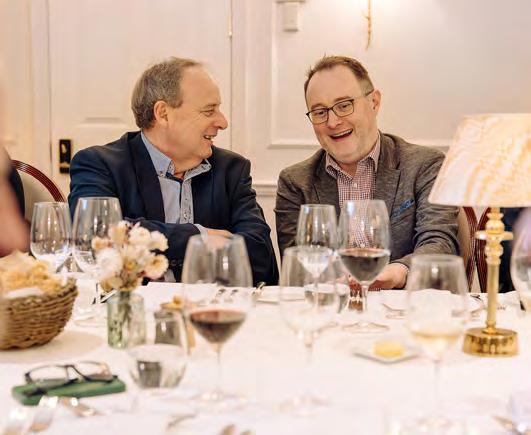
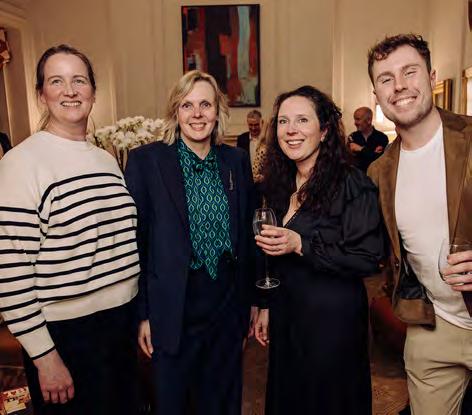
Dinner with the Dragons saw 22 guests recently gather at The Royal Crescent Hotel & Spa for an evening hosted by Richardson Swift as part of the Bath Dragons initiative supporting growthphase businesses in the city. A relaxed champagne reception was followed by a three-course dinner with wine and soft drinks in the Sheridan Room, bringing together local entrepreneurs, business leaders and Bath Dragons backers.
Photos by Jessie Myers; Instagram: @jessiemyersphoto
For more: www.richardsonswift.co.uk
STORYTIME
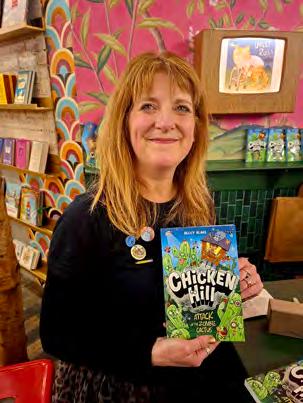
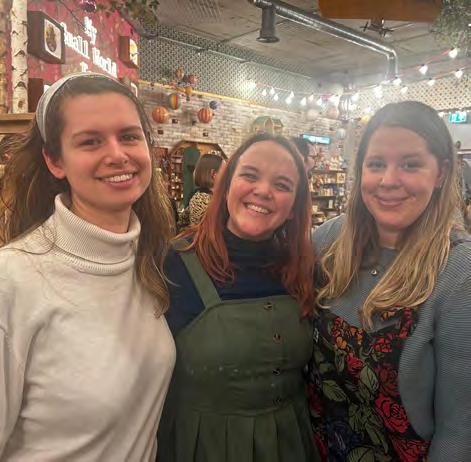
Bloomsbury Publishing hosted a special celebration for the launch of Chicken Hill on 12 February at the Bath toy store
My Small World. The 70 guests enjoyed drinks, speeches and celebrations, with champagne flowing, alongside cupcakes from Sweet Little Things, sausage rolls, Space Raiders and flying saucers. Guests were each given a mini cactus plant to take home as a quirky memento of the evening.
For more: www.bloomsbury.com

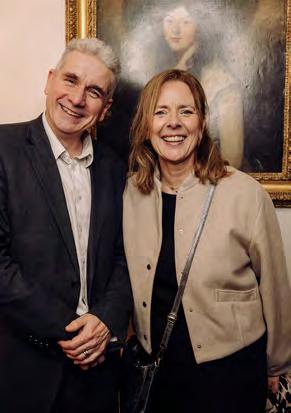
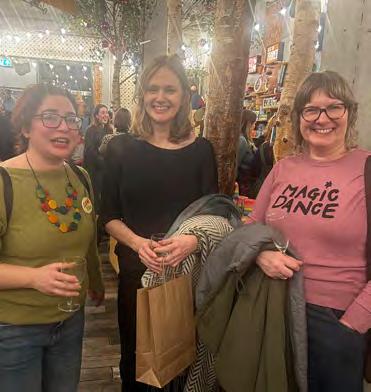
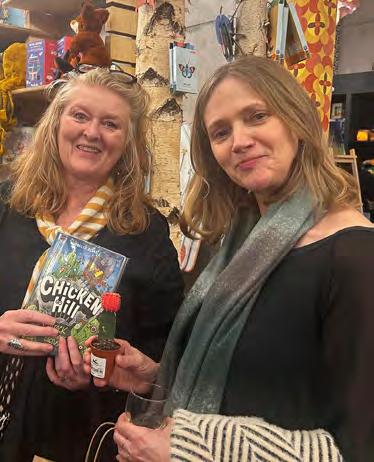
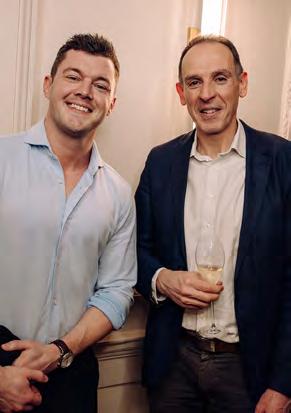
Suzzanne
Lucy Paine, Andrea Kelly, Anita Jaynes and Ollie Chick
Beccy Blake
Rosa, Becky and Hana Tooke
Brent Pollard and Jonathan Knee GJ Van De Velze and Dan Smith
Les Redwood and Jo Gillow
Stephen Box and Richard Ingle
Rita Lazaro, Jan Dunning and Emma Perry
Jenni, Alex, Isabel and Saskia
Jackie Williams, Yasmin Hammond, Steve Rawlings and Rachel Wood
Sally Hamerton and Jan Dunning





The fine art of learning
Flats is considering getting a little more ‘brutal’ in his choices
Watching our four year-old deftly pick up my coffee cup in both of her soft little hands before nicking a sip of the forbidden nectar shouldn’t have been as funny as it was. I’d told her she might not like coffee at such a young age, but she asserted her big girl status and took control. The facial expression as the taste landed on her tongue was as funny as her dropping my cup was annoying. The vessel survived, the coffee was released from its humid captivity.
But they have to be allowed to try things. “I will never ever drink coffee again in the whole world” was her verdict. Oh yes you will, my darling, oh yes you will. You’ll eat spicy foods, too, and probably try ciggies at some stage. You learn to love onions and maybe even gardening. Peace and quiet will be a commodity of almost limitless value in a few decades’ time. You’ll even watch the news, and read about things that are happening nowhere near your life.
Part of the beauty of observing the innocence and blessed ignorance of a young child is knowing that there is so much more to come. Sure, not all of it is great, but so much
“Our sitting room has a painting of a cow in it”
with cool glasses and linen jackets might argue this when presented with an Ikea special on a kitchen wall.
We happen to have a neighbour whose life and career is in the arts. She holds exhibitions (is this even the right word?) in her studio for us locals, and I’ve always been a little nervous of going. I recently told her this, and she basically told me to stop being so silly and to just come. She’d offer as much or as little by way of explanation and interpretation as I fancied. This excites me actually, and I will go. I may wear a dunce hat, though…
it really, really is. She will grown and change be brilliant and make mistakes and all of those things. She will evolve. And her tastes will change.
I often wonder how much I truly have in common with the 21-year-old me. There are bits – traits, behaviours, tastes – that of course remain. And there is so much that feels new, and even things that I can feel changing as I age. Politically I’ve become more aware in the last few years – possibly a bit late, ho hum –and find myself ill at ease with most policies or suggested methodologies that aren’t instantly compassionate. To this end I imagine I’m somewhat naive, but there we are. Maybe I’ll change in time…
One area that has become interesting to me of late – and one that I find rather intimidating, to be honest – is art. Now, I haven’t begun any studies or anything and I would always powerfully assert my ignorance should a conversation on the subject begin around me, but I have begun to recognise what it is that I love. And it’s lots of different things, as it happens.
They (whoever they are) say that there is no such thing as right or wrong when it comes to art. I expect, though, that some clever types
Our sitting room has a painting of a cow in it from Joanne Cope. I first saw her paintings of cows (I love cows) in the Hare and Hounds pub, as it happens, and knew I had to have one. We love it, and always have. However, I think it’s time for it to move into, say, our bedroom, and for something new to take its place on what is really our ‘main’ wall. This is where I’m not entirely sure what it is I want. Maybe it is another painting. Maybe of a thing, or just a group of colours and shapes designed to please our eyes and imaginations. Or maybe it’s a photograph that’s needed. I’m just not certain, and it feels like a big decision.
I ought to check with my wife first, but what I really want is something a little edgier. Something more urban. Is this permissible, seeing as we live in central Bath, not South East London? Is it mandatory that everything on our walls is as soft and pleasant as the city in which we live? Or are we allowed to introduce something mildly harder, brutal, even?
I think we can. I think we will. What the next thing is, though, we can’t be sure. I’ll have coffee with said neighbour, I’ll go to a few shows (again, right word?), and before you know it our period home will be like a Bermondsey warehouse apartment. Maybe…
David Flatman is an ex-Bath and England rugby star turned TV pundit and rent-o-mic. Follow him on Instagram @dflatman and X @davidflatman


ART‑IFICIAL INTELLIGENCE
From NFTs to neural nets, will digital innovation reshape the art landscape?
By Sarah Moolla
Since ChatGPT and other AI platforms began offering free image generation, the internet has been littered with pictures mimicking the styles of well‑known artists. Type in a few prompts, and in seconds you can conjure up your ‘own’ Renaissance portrait, a moody landscape or a comic‑book panel.
Yet, as The Guardian recently put it, “AI can generate images, manufacture compositions and feign a stylistic fingerprint. But it cannot reach toward the other and their otherness in order to affirm and nurture our own. And without that, there is no art…
In Bath’s thriving gallery scene, that distinction between image and art – between simulation and lived experience – is more than a philosophical quibble. It cuts to the heart of why real, tangible artworks still matter in an age of infinite scroll. Here, three local experts – Verity Slade, co‑founder of Palette, an independent gallery, shop and café in Bath’s artisan quarter on Walcot Street; Jessica Lloyd‑Smith, gallery director of the contemporary art gallery and consultancy Modern ArtBuyer; and Malachi Bogdanov, director of Bath Contemporary Artists’ Fair which exhibits monthly at Green Park Station– help us explore the world of AI art and NFTs, and the enduring power of the handmade.
IN THEIR HANDS
If AI can generate images in seconds, what exactly does a handmade artwork still offer that a prompt cannot? The answer, according to all three, lies in connection. “Simply knowing that an artwork has been created using a handmade process can be incredibly moving and can create an emotional connection between the viewer and the work,” says Jessica Lloyd‑Smith. She relishes the tiny traces of labour that digital images lack. “A visible brushstroke, a blob of paint, the indentation of an etching plate, the smell of oil paint or printer’s ink, even a mistake is evidence of an artist at work creating a piece with physical skill and emotional focus. These are the things that will make an art lover’s heart skip. It is the vast difference between something unique and handmade versus something mass produced or digital.”
Verity Slade agrees that real art begins where a flat, frictionless image ends. “It can communicate with us, show us something to relate to. We ultimately want to connect with one another – and to empathise and experience,” she says. For her, physical artworks prompt an encounter, not just a glance. “Physical work can induce a new experience because it asks the viewer to respond to it – it has a unique ‘aura’ as Walter Benjamin said. Some of what Benjamin wrote in the 1930s about the rise of photography and mass reproduction can be applied to AI in terms of valuing authenticity and the physical location of work.”
For Malachi Bogdanov, that human presence is impossible to fake. “Handmade art carries human presence, intention, and time. It shows decisions and mistakes creating emotional resonance and a physical
uniqueness that AI generated images simply cannot truly compete with,” he says. AI art may compete on surface – on style, on visual slickness – but it cannot recreate the layered history within each mark. Value, too, is bound up with this uniqueness, Jessica suggests. “There is also the point of value. A unique handmade piece is, by its very nature, more valuable. Traditionally, as an artist keeps working, improving and developing their skills, their reputation grows, then the demand for their work grows, which in turn impacts the value of their work. While I never encourage collectors to buy for investment, if that measure is important to a collector then that is also something to bear in mind.”
FEEL THE POWER
If AI art mainly lives on screens, gallery art insists on occupying space. Texture, surface and material are not afterthoughts but central to meaning. “It can be hugely important – seeing the hand of an artist and how the materials have been applied and manipulated, the decisions that have been made,” says Verity. “This allows you to imagine the artist’s
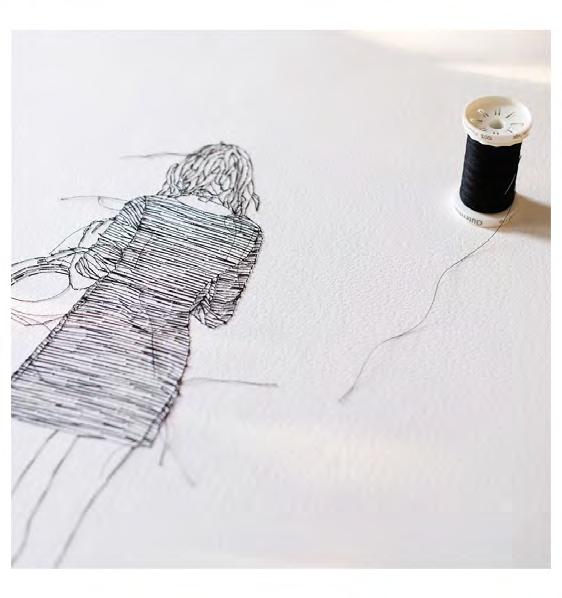
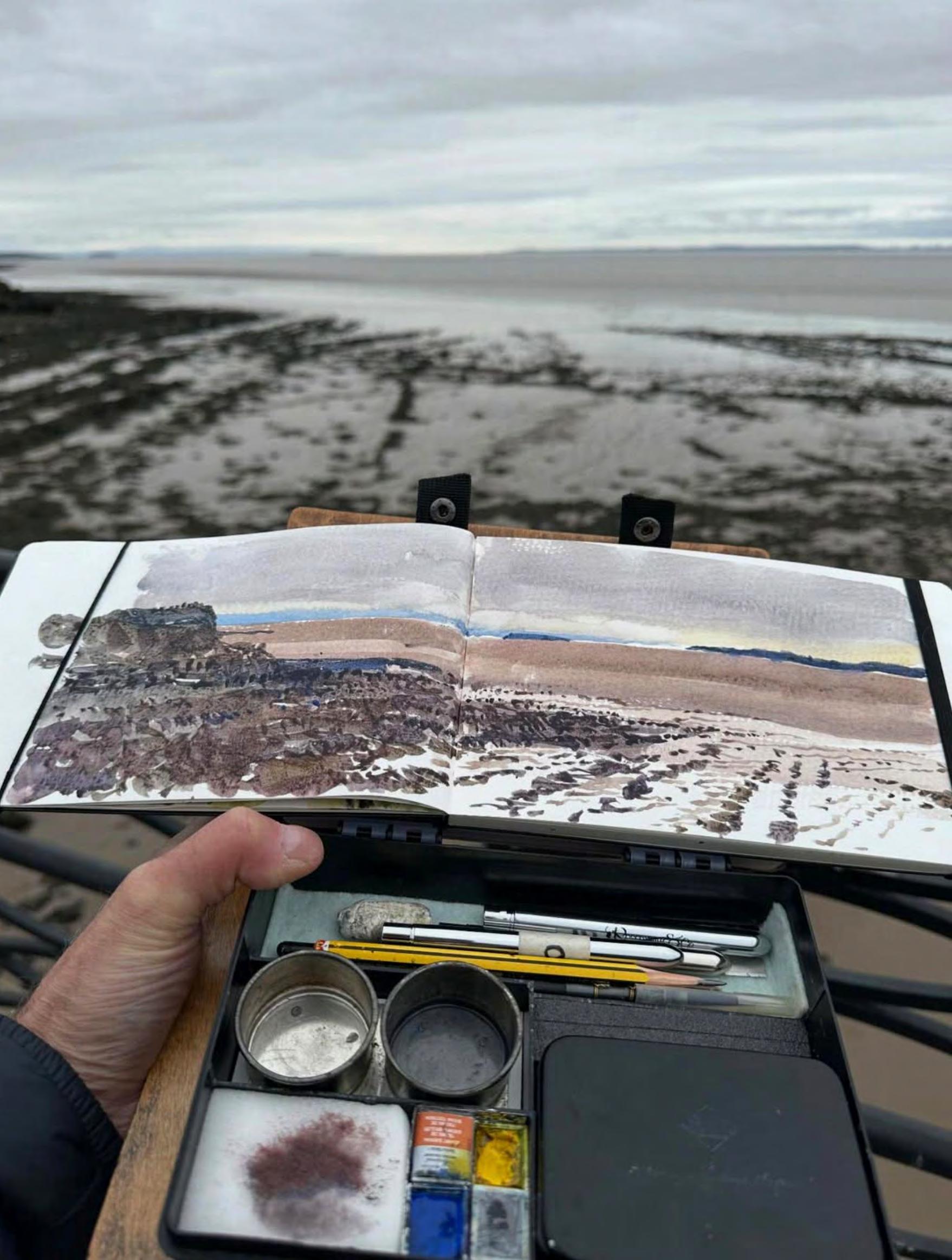
opposite: David Parfitt’s sketchbook as he works plein air; above: An intricate detail from Breton Dressed by Emma Cowlam. Both are artists with Modern ArtBuyer
“Handmade art carries human presence,andintention, time”


“The artist has left some of their own DNA on the piece”
thoughts or feelings when they created it. Art is about communication, and the physicality of work starts a dialogue between the artist and the viewer.” Jessica too delights in those ‘physical clues’ that artworks carry. “It really depends on the medium, but I love to see physicality in an artwork. I want to look at a painting and imagine the artist considering a blank canvas, mixing paints and becoming lost in the process,” she explains. “I like to see physical paint on a canvas, imperfect printer’s ink on paper even staple holes in the corner of a study, where an artist has secured their paper to a board. These physical clues give energy and life to an artwork – as if the artist has left some of their own DNA on the piece – and are vital to the authenticity and provenance of an artwork.”
For Malachi, this sensory depth is precisely what most AI‑generated images lack. “Touch, texture, and material are essential; they shape meaning, evoke emotion and give work a grounding physically creating a sensory depth and presence that digital or AI generated images often lack,” he says. “It is the difference between looking at a photograph of a sculpture and walking around it, feeling its weight with your eyes and body.”
THE REAL THING
There are so many examples of works that AI could never truly create or copy – that which emphasise context and lived experience rather than isolated images. These works are not just arrangements of shapes and colours but are crystallised responses to specific moments in history, lived by specific people.
“Installation, sculpture, performance art, painting… – so much art is experiential so can never be digitally replicated to good effect,” says Verity. At Palette, the current exhibition underlines how process and journey are inseparable from the finished work. “The Art of Travel is a collection of prints from The Jaunt – an organisation who send artists on trips across the world, from which they take inspiration and create new work. In each case the artist has experienced so much in order to create the final outcome, each piece resonates both with their unique perspective as well as the influence of the location they visited. It demonstrates how the process behind making work can be intrinsic to its success.”
Malachi cites Pablo Picasso’s vast anti‑war painting (seen above) to illustrate his point. “Guernica by Picasso embodies history, political response and human trauma. AI cannot originate its context, urgency or deeply personal and cultural significance. In this example AI simply lacks pathos,” he says.
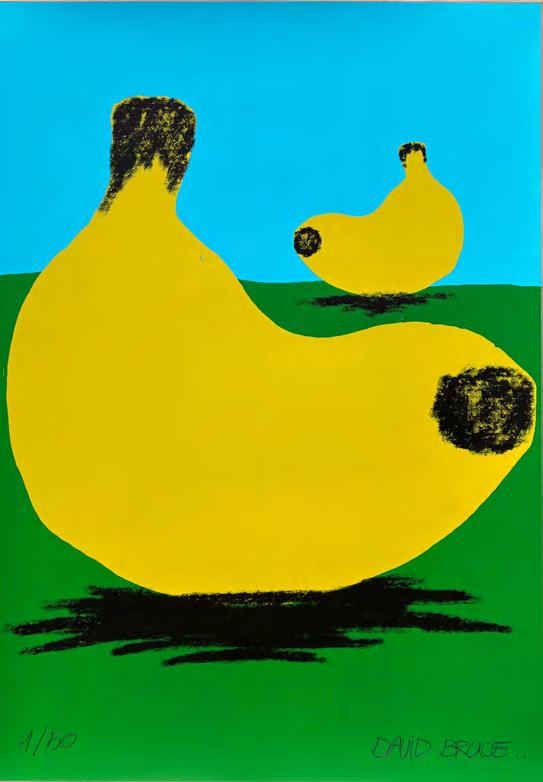
above: Malachi Bogdanov refers to the unique power of Picasso’s Guernica mural; below: The graffiti style artwork of David Bruce was recently on display at the Palette Gallery
THE PERFECTION OF IMPERFECTION
One of the ironies of AI art is its unnatural smoothness. Flaws and false starts vanish. But what if it is precisely those imperfections that give real artworks their charge – and their value?
“Art is subjective and quantifying value and meaning is very difficult, but if art is a conversation, then understanding an artist’s point of view and motivations for creating a piece can certainly add value to some,” reflects Verity. For her, the AI boom may actually be sharpening demand for the opposite. “A positive that I think is already starting to emerge from the AI era is a demand for uniqueness, for things that aren’t generic, and for artworks that demonstrate process and skill.”
Jessica sees an artist’s biography and hard‑won style inscribed in every mark. “An artist’s life experience and fundamental human nature will always shine through in original handmade art. Every brushstroke or pencil mark will inform the next, with artists spending years to fine tune their skill and trademark style,” she says. “Even mistakes are important and can become starting points for a new direction. All of this skill, experience and learning is the result of years of mental focus on their practice but also a strong emotional connection with what they are producing. That connection generates a more authentic and powerful artwork, which in turn will impact the value.” At a recent Holburne exhibition, that intimacy could be seen literally. “At the showing of Henry Moore’s maquettes, one small clay head still had Henry Moore’s fingerprint on it. It was very moving to feel so close to an artist’s work that you can almost still see their hands moulding the clay,” she recalls.
For Malachi too, those quirks and rough edges are not glitches to be ironed out, but the very signs of humanity. “Imperfections reveal humanity, time, and effort, they create uniqueness and authenticity, embedding meaning through mistakes and adding history that deepens the emotional and conceptual value in artwork,” he says.
PIXELATED IMAGES
But does AI art and NFTs have a credible future in the artistic world? “Nonsense!’ says Verity. “Let AI do the boring jobs and free up humans to be creative,” she says. For her, the technology is fundamentally backwards looking rather than visionary. “The NFT market has already


crashed and they’re a thing of the past, or at least in the realm of banking rather than art – and AI can never truly be the future as it only scrapes existing data, so it’s fed by the past. AI can only predict, it can’t imagine – that’s what we’re good at.”
Malachi takes what he calls a “cautious interest” approach. “I acknowledge that AI art and NFTs are probably part of the future. They are exciting, interesting tools, but frequently overrated, lacking depth, context and a lasting emotional connection. My immediate response when mentioned is one of cautious interest.”
from“Emerging the AI era is a demand for uniqueness”
Jessica is equally unconvinced that we are witnessing the next great leap in art history. “I think art history has taught us that there are always trends and movements in art. Some stick and evolve while some fade, so I wouldn’t say that something didn’t have a place in the art world but AI art and NFTs are not what I see as the future, personally,” she explains. There is, she concedes, a role for attracting new audiences: “Having said that, if it opens up the art world to a new, digitally focused audience in this new genre, then AI art and NFTs could exist alongside other strands within the art world, but never fully replace art in the more traditional sense.”
ART / ALT / DELETE
And what about AI as a tool and AI as a shortcut? “Like it or not AI is now part of our society and culture, and artists will always create works that respond to contemporary issues – so there are, and will be, lots of interesting artistic responses to AI as well as utilising it as another digital tool,” says Verity. However, her red line is clear: “But using AI to create art that replicates other artists’ work is plagiarism, which doesn’t really have any role at all in the art world.”
Jessica also sees potential where AI is folded into the process rather than replacing it. “I think there is a place for AI in the art world as a tool for discovery and exploration, being used as part of the process rather than a quick route to the end goal,” she explains. “Some of the artists I work with use AI as a research tool, almost to brainstorm with themselves about ideas, thoughts and background information, which
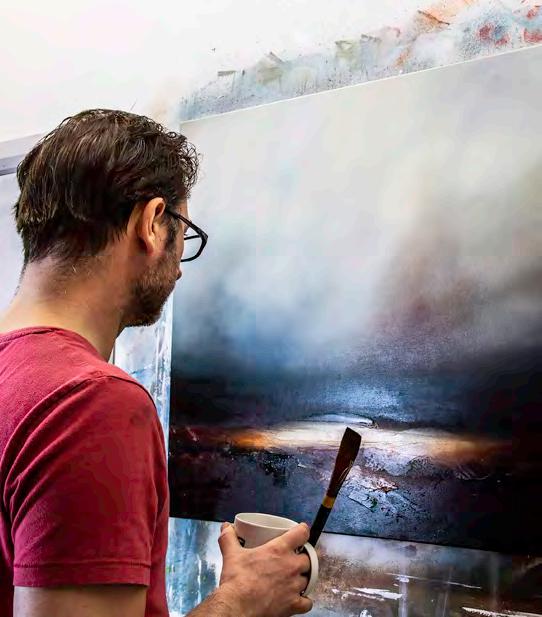
above: Hand-woven paper pieces by artist Naomi Kendall who is represented by Modern ArtBuyer; middle: Our experts agree AI wipes out the beauty of imperfections in paintings, seen here in Vermeer’s Girl with a Pearl Earring (1665) with the original on the left, followed by two AI ‘replicas’; below: Paul Bennett, whose work is available through Modern ArtBuyer, pictured in his studio

is exciting and makes their day-to-day working current and efficient.” At the same time, she believes history reassures us that new technologies rarely erase what came before. “We have seen over time that every time there is a hot new invention, with it comes worry about the impact on other livelihoods. Certainly things might shift a little to allow new technology to creep in as a useful tool, but as we have seen with every new invention in the past, nothing can replace an authentic, emotional connection and the true beauty of an original work. People will still crave that.”
For Malachi, AI’s proper role is firmly supporting, not starring. “AI has a place as a tool or medium, not a replacement or substitute. It may coexist with ‘traditional art’ shaping processes but cannot fully replace human creativity, intention or emotion,” he says.
COPY CATS
Of course, many artists’ scepticism about AI is not purely aesthetic. It is also legal and ethical, rooted in how training models have harvested human work without consent. “You can watermark your online images, or sign them, but ultimately if you’re sharing your work online at the moment it’s likely to be scraped,” says Verity. She points out that even widely used platforms struggle with basic attribution. “Even very established sites like Pinterest fail to embed authorship, so images are shared widely without being attributed to the creator.” In that environment, AI systems can quietly ingest years of labour in a few minutes of crawling.
However, Malachi notes that the defences are starting to evolve, even if regulation lags behind technology. “Copyright safeguards include legal challenges, opt-out options for artists, watermarking and models using data licensing. Although these protections aren’t foolproof, they are evolving, but only as technology advances faster than regulation,” he says.
MAKING SPACE
Even though we might be in an age when more of us are encountering art for the first time on our phones, it would seem physical galleries and fairs play a role that goes way beyond nostalgia. “I think it’s the role of galleries to connect artists to audiences – you could argue that this could all be done online, but there’s something really special about creating an experience that wouldn’t exist unless you bothered to – visiting a show, understanding an artist’s perspective and connecting to it,” says Verity. “We’re providing a space for good things to happen – new ideas, new understanding, new perspectives – even if it’s a very quick visit you’ll always gain something from viewing art in person.”
For Jessica, galleries and art spaces are a bridge, not a gate. “I think galleries and art spaces are there to provide reassurance to visitors and art collectors. Galleries and dealers should help to educate people about the art world and break down the belief that it is a stuffy, exclusive club,” she says. Context is key: “Talking to people about the artist’s life, how they work, their studio, the painting or printmaking techniques they use, all goes a long way towards helping people see that they can have a view and are free to love the art they choose.”
She also points out that galleries do a particular kind of emotional labour that many artists find hard to do for themselves. “Often artists aren’t the best at talking about and selling their work. They see room for improvement and the next step ahead, and it’s this uncertainty that keeps them striving to be better. Galleries take that task away from artists, freeing them up to focus on their studio practice while the gallery can talk objectively and passionately about the artworks.”
“Things might shift a little to allow new technology to creep in as a useful tool”
Money, inevitably, complicates things. “One of the big problems occurs when a price is slapped onto an artwork. Suddenly the viewer focuses on how much an artwork costs and question why it should be worth that amount, rather than looking at the piece purely as something to connect with and respond to,” Jessica points out. “Once you put the price to one side, you can really look at an artwork for what it is.”
Fairs, too, provide something that cannot be downloaded. “Galleries and art fairs like BCAF anchor art in physical space, providing context, shared experiences, relationships and memories allowing viewers to engage materially and socially beyond the isolated, digital viewing experience,” says Malachi.
Galleries, art fairs, exhibitions, pop-up spaces – wherever art appears in a real place, in real time to real people –these are more important than ever as places of beauty, education, encounter and wonder. As Verity puts it, “AI can only predict, it can’t imagine – and that’s what we’re good at.” n
For more: www.bcaf.co.uk | www.modernartbuyer.com | www.palettable.co.uk
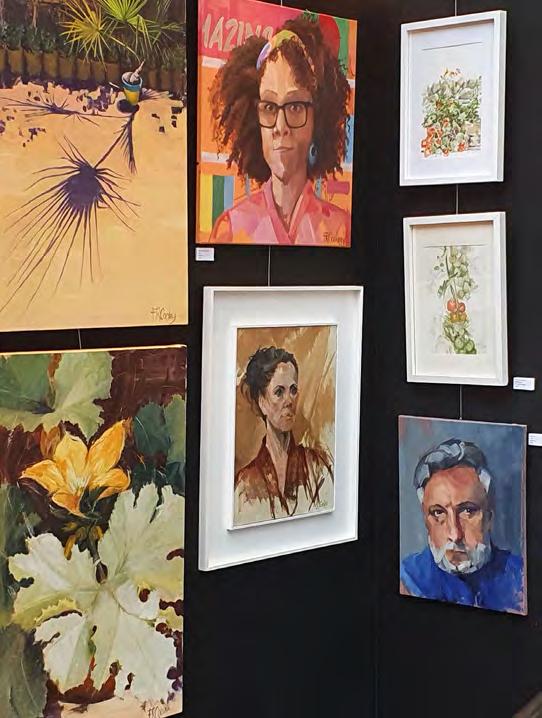
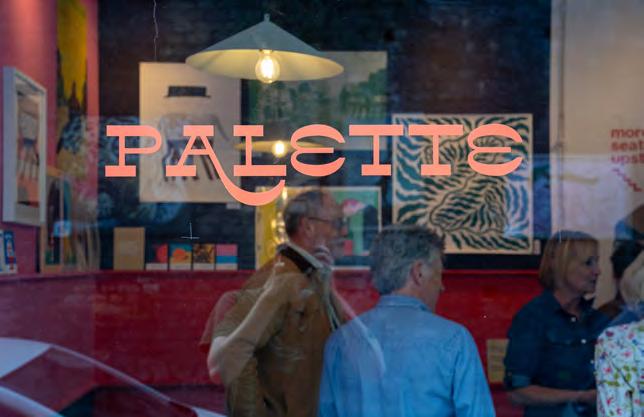
above: The opportunity to discover art in real places, like the Palette gallery on Walcot Street, continues to be important, if not even more so; below: Frances Cooley is one of the many artists who has used the Bath Contemporary Artists’ Fair Bath to exhibit and sell her original work



Take Two 11 May - 20 June
An exhibition, in Bath, of photography and film Ori Gersht, Laurent Grasso, Dawn Ng, Erin O’Keefe
Viewing by appointment, please contact: bridget.deleon@icloud.com | 07957 438402 | www.bridgetdeleon.com
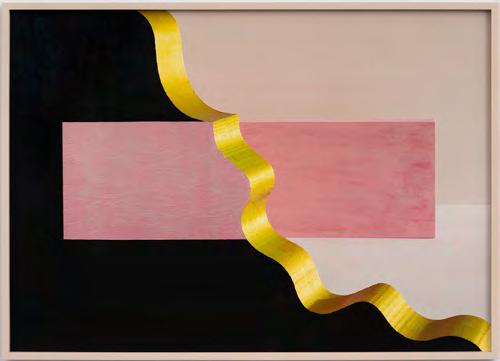
Quiet Heart. Pencil on paper. Adrian Thompson-Boyce

PUTTING YOU FIRST
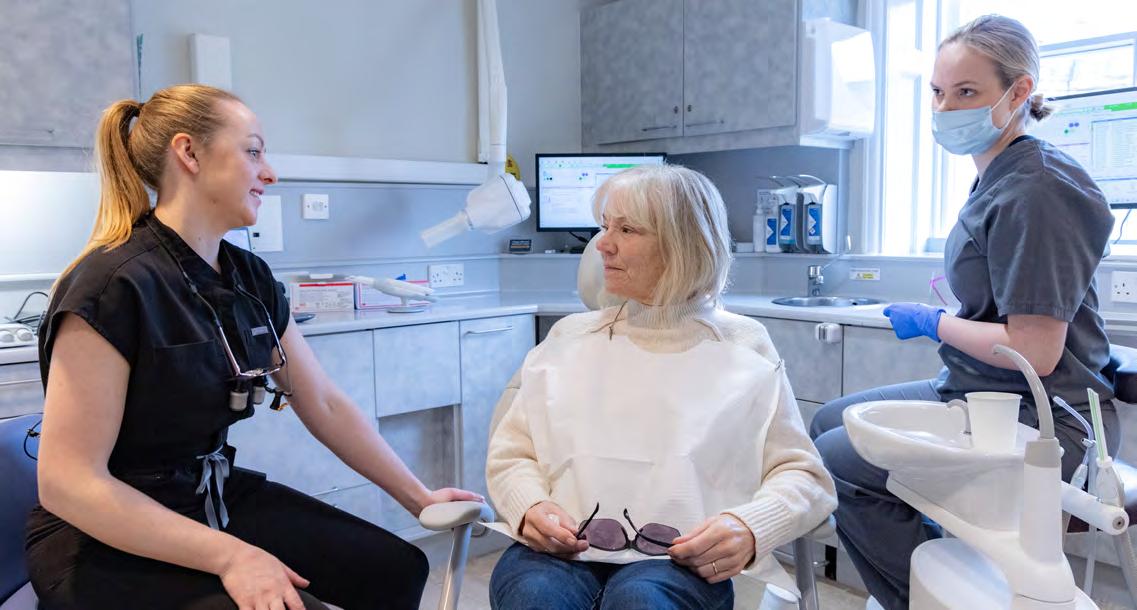
At EDGAR BUILDINGS DENTAL AND IMPLANT CLINIC, we provide a tailor-made dental experience centred on you – from the warmest of welcomes to personalised treatment plans
We understand that visiting the dentist can feel daunting, which is why our team is friendly, open and knowledgeable. Our highly-trained dentists and specialists will listen to your needs, create tailored treatment plans, and carefully explain every step, while our caring team will support you at every stage. Together, we make sure every appointment – whether a routine examination or a specialist treatment – is as comfortable and reassuring as possible.
A TREATMENT AS INDIVIDUAL AS YOU
Our experienced team offers a wide range of services, including general dentistry, smile solutions, implant dentistry, orthodontics,
“ OUR HIGHLY TRAINED DENTISTS WILL LISTEN TO YOUR NEEDS, CREATE TAILORED TREATMENT PLANS, AND CAREFULLY EXPLAIN EVERY STEP ”
advanced root canal treatment and more. Whatever your dental needs, we aim to offer consistently high standards of care, with a focus on your comfort and wellbeing.
Putting patients first means listening, understanding and tailoring every treatment to the individual.
Implantologist Philip Pettemerides and aesthetic dentist James Pope emphasise achieving natural, characterful smiles that complement each patient’s individuality, rather than results that could appear artificial or over-treated.
considered patient lounge, we make sure you feel comfortable throughout your visit.
YOU’RE AT THE HEART OF EVERYTHING WE DO
• Our dental team includes GDC-registered practitioners with verified qualifications and experience across a range of dental treatments. They are supported by friendly and professional practice colleagues committed to patient care.
• From state-of-the-art dental technology to internet access and a calm and carefully
• Life is hectic, so we offer convenient online booking to make it quick and easy to secure an appointment.
• We offer simple, transparent finance plans for your dental care. (Subject to terms and conditions.) They’re easy to understand and manage, helping you to stay on top of your dental health.
• We make sure you understand every step of your treatment and always feel in control.
If you’re looking for a dental practice that puts you first, then we could be the practice for you. To book a new patient dental health examination or a consultation, call our friendly team on 01225 597533.

GIDDY UP!
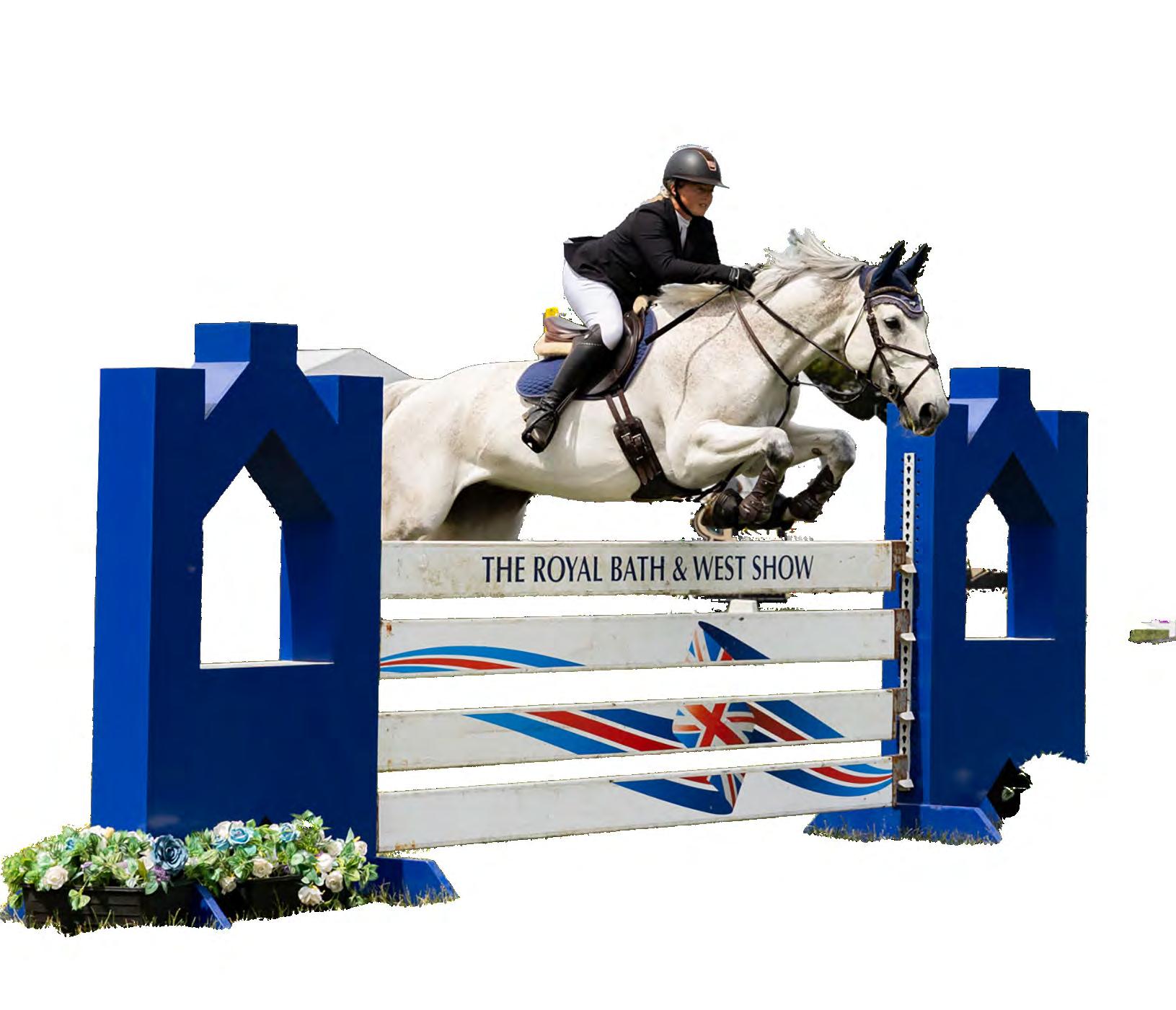
The Royal Bath & West Show returns from 28 – 30 May, promising three fun-filled days of family entertainment, food, farming and flowers. In the main ring, there’s the Pony Club Games, show jumping, the Vintage Vehicle Parade, scurry driving and impressive heavy horses, with the thrilling Shetland Pony Grand National as the star attraction. Dog-lovers can head to Bark & West for Pawsability displays, the Have a Go ring and the ever-popular Great British Dogs Show.
Live music will fill the showground, with performances in the Pilton Tent sponsored by Glastonbury Festival, on the main lawn and from roaming acts – including a set from the legendary Wurzels on 28 May.
Discover The Future, now near Lakeside Farm, gives younger visitors the chance to learn through hands-on fun, while green-fingered guests can explore the horticulture village, and this year’s pop-up competition is to design a garden room.
Foodies aren’t forgotten with Andy Clarke’s Great British Kitchen hosting Big Nath’s BBQ, Cornish chef James Strawbridge, the ‘Fuss Free Foodie’ Lisa Cadd, and clinical nutritionist Eva Humphries.
For more: www.bathandwest.com
WHAT’S ON
2 May –6 June
EXHIBITIONS
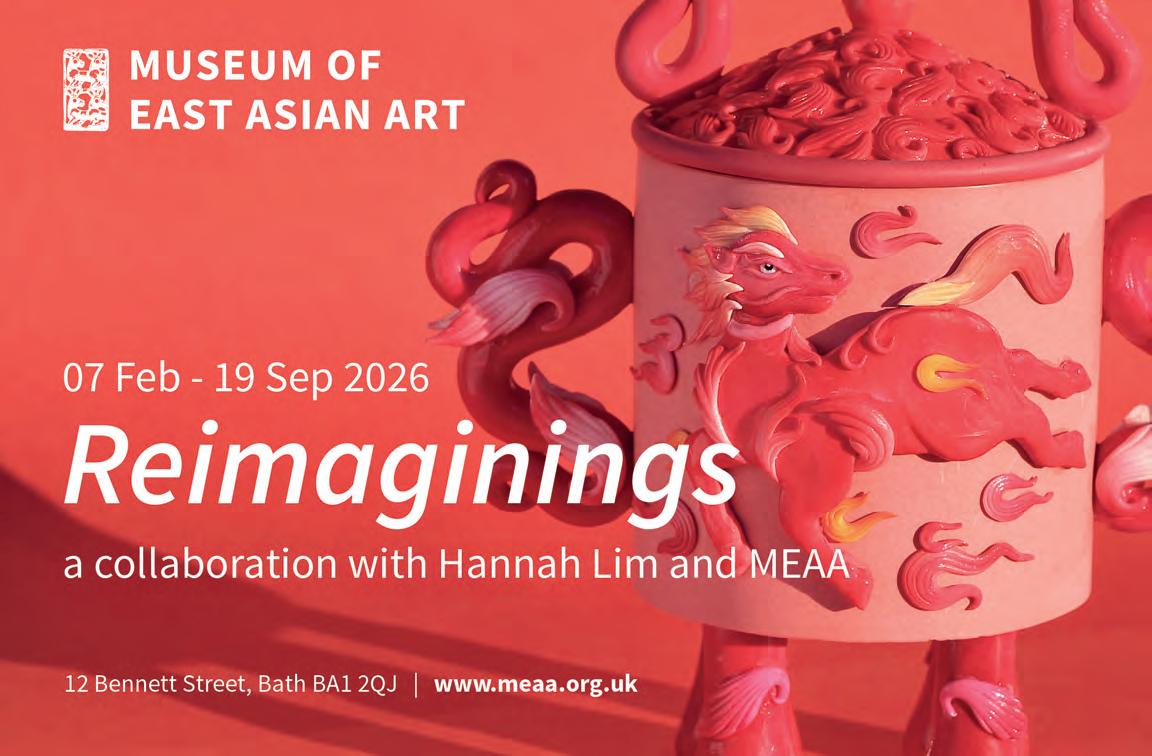
Until 19 September REIMAGININGS
Shaped by her Singaporean and British heritage, sculptural artist Hannah Lim works with materials including polymer clay, wood, and metal to create playful sculptures that explore mythology, history, and reflections on identity. The Museum of East Asian Art; www.meaa.org.uk
Until 26 September WORLDS APART: RARE EARLY PHOTOGRAPHS OF CHINA AND BATH
It might seem that the cities of Shanghai and Bath stood worlds apart around the late 1820s to 1839, just as photography was just beginning, but these two collections draw interesting parallels and place them together in surprising ways. Bath Royal Literary and Scientific Institution; www.brlsi.org
2 May – 25 June
THE 1926 GENERAL STRIKE IN AND AROUND BATH
A special exhibition marking the centenary of the General Strike, exploring national action and Bath’s
nine days of local solidarity with North Somerset miners. Museum of Bath at Work; www.museumofbath.org
9 – 10 May
MODERN ARTBUYER POP UP
Online art gallery and consultancy
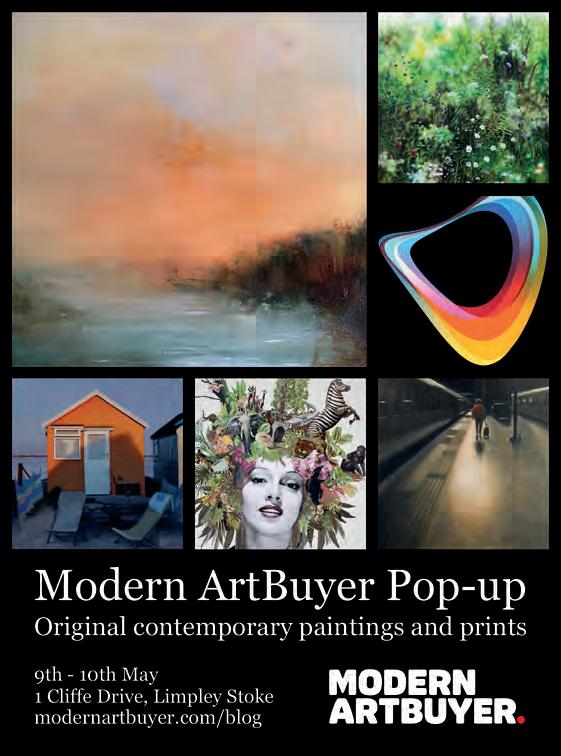
Modern ArtBuyer, run by Jessica Lloyd-Smith, is holding a spring open house pop-up gallery in Limpley Stoke with a new collection of original paintings, prints and ceramics. Turn to page 22 for our feature exploring the impact of AI on art. www.modernartbuyer.com
22 May – 6 September
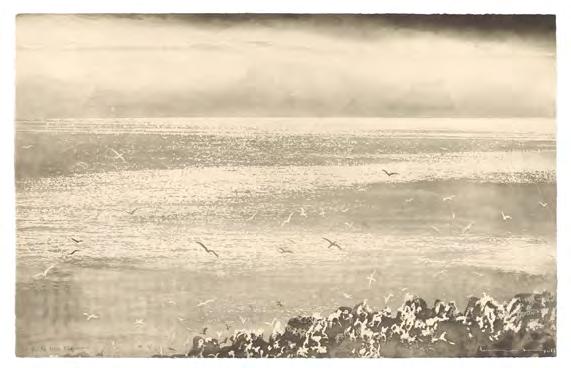
NORMAN ACKROYD: THE TRANSIENCE OF LIGHT
The first posthumous exhibition of the celebrated printmaker Norman Ackroyd, featuring five decades of atmospheric etchings capturing the coasts, landscapes and ever-changing light of the British Isles. Victoria Art Gallery; www.victoriagal.org.uk
30 May – 4 June
TOWARDS ABSTRACTION
The ArtPad showcases contemporary abstract photography by Benedict Brain, Diana Henry, Fiona Humphreys, David Lewis-
Baker, Shay Parsons, Mark Somerville, and Richard Young. Facebook @PhotographicArtsCollective
22 May – 13 September
BEYOND IMPRESSIONISM: PRINTMAKING FROM MANET TO PICASSO
Bringing together prints by key artists of the movement, including Édouard Manet, Pierre Bonnard, Henri de Toulouse-Lautrec, and Pablo Picasso, among others, the exhibition explores how these artists better known for their works in paint, also made remarkable contributions to printmaking. The Holburne; www.holburne.org
22 May – 6 September
BROWN IN BATH: ARROWS OF DESIRE
Brown in Bath is an exhibition across both the Holburne and No. 1 Royal Crescent featuring the work of Glenn Brown, one of the most celebrated painters to come out of the Young British Artist generation of the late 80s. He borrows images, colours, and drawn lines from art history to create fresh, humorous and disturbing paintings. www.holburne.org | www.no1royalcrescent.org.uk
THEATRE / MOVIES
19 – 23 May
SINGLE WHITE FEMALE
The 90s psychological thriller about deception and obsession is updated by Rebecca Reid for the age of social media, and stars Kym Marsh and Lisa Faulkner as the strangers whose house share becomes sinister. Theatre Royal Bath; www.theatreroyal.org.uk
23 May
THE MIGRATORY BIRD
A moving solo performance presented by Melika Radmand that explores migration, displacement, identity and space. Mission Theatre; www.missiontheatre.co.uk
19 – 22 May
THE SECRET DIARY OF ADRIAN MOLE AGED 13 & ¾ – THE MUSICAL
With an infectious score and a script as sidesplittingly outrageous as the original novel, this new musical brings Adrian’s story to life for a new generation of theatregoers. Performed by the youth company, the Merriman Theatre Group. Rondo Theatre; www.rondotheatre.co.uk
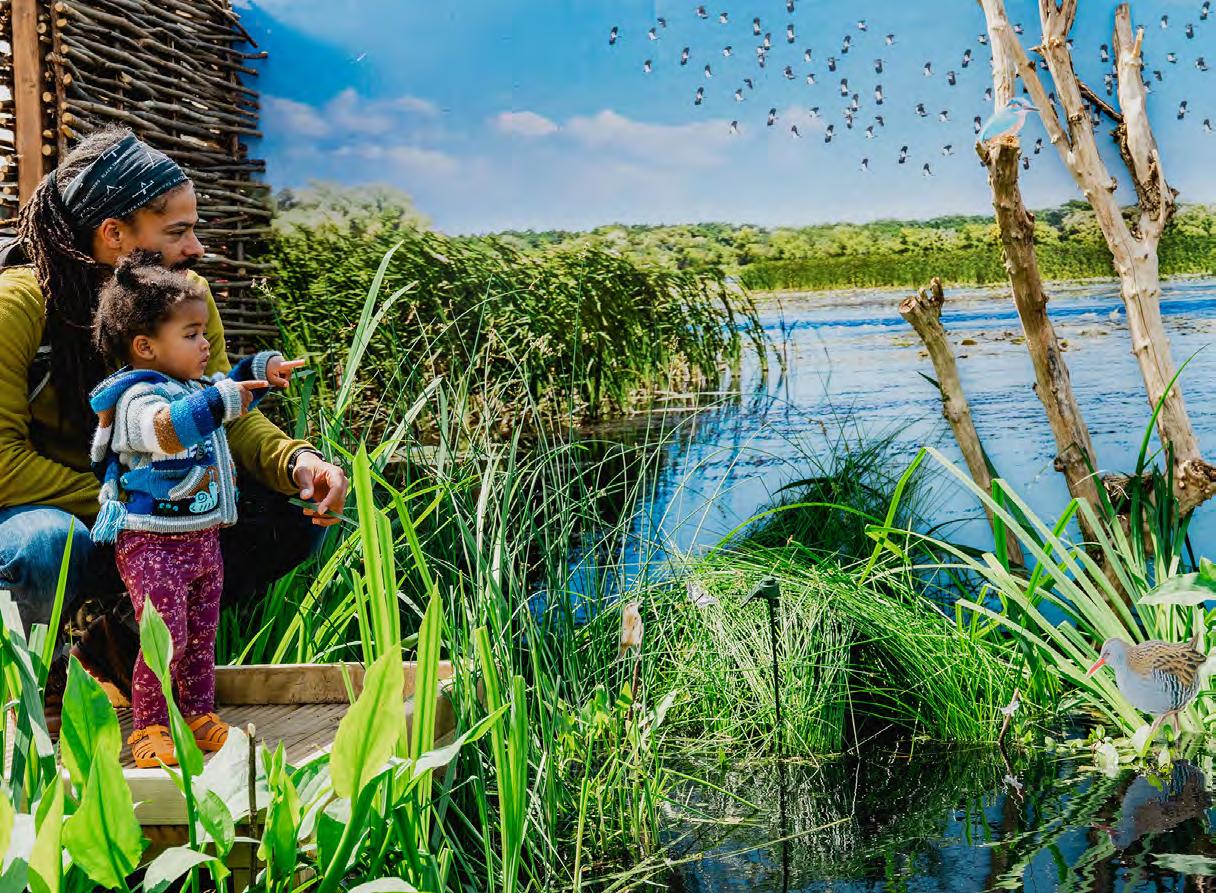
Festival of Nature returns to Bath and beyond 6 – 14 June
PHOTO BY ANIA SHRIMPTON


The classic female
horror story, Single
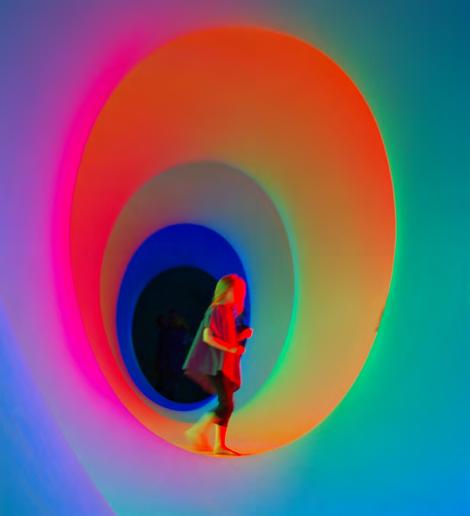
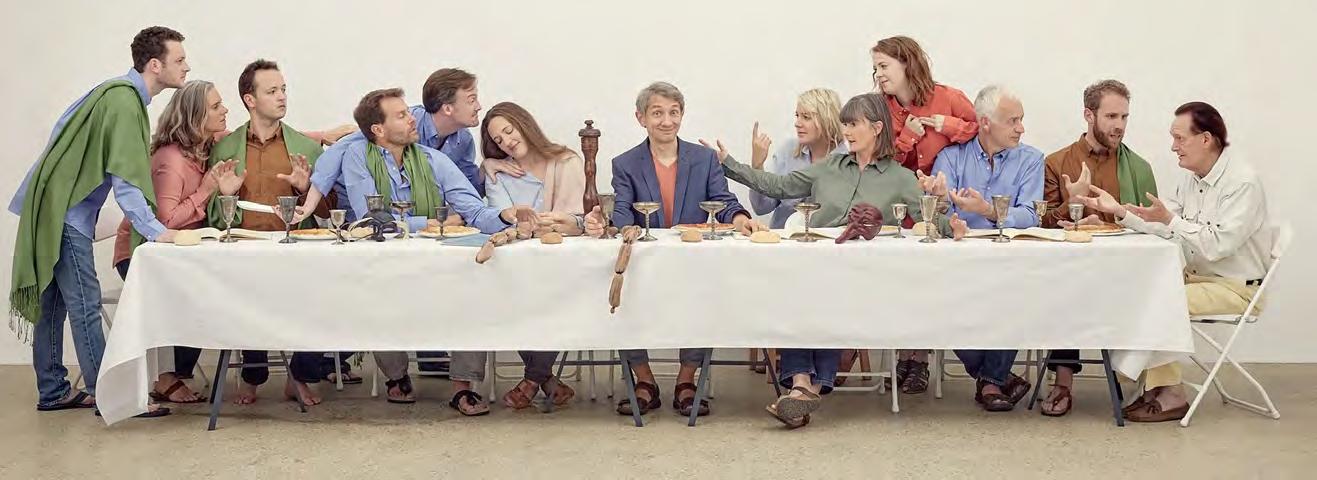
White Female comes to Theatre Royal Bath 19 – 23 May starring Kym Marsh and Lisa Faulkner; London African Gospel Choir perform their interpretation of Paul Simon’s Graceland at The Forum on 21 May; Explore Colourscape, a vast walk-in labyrinth of glowing colour at the Rec 23 – 31 May; The work of Norman Ackroyd can be seen at Victoria Art Gallery 22 May – 6 September; Become a jury member at The Forum on 30 May in Murder Trial Tonight IV Death of a Landlord

30 May
MURDER TRIAL TONIGHT IV: DEATH OF A LANDLORD
Be part of a unique theatrical experience and play a member of the jury, as a real true-crime case is brought to life on stage. The Forum; wwwbathforum.co.uk
FESTIVALS
15 May – 7 June
BATH FESTIVALS
On 15 May Party in the City kicks off proceedings with some 2,000 singers and musicians playing at 39 venues, all completely free to attend. The Bath Literature Festival runs 16 to 24 May followed by Bath International Music Festival 20 May to 7 June. Turn to page 42 for more. www.bathfestivals.org.uk
21 – 24 May
SHINDIG FESTIVAL
Shindig is back for in Charlton Park’s rolling parkland and arboretum, with hidden stages, big-name funk, soul, house and disco line ups, woodland wonders, sustainability focus, top street food and late-night magic. www.shindigfestival.co.uk
22 May – 7 June
BATH FRINGE
More than 130 brilliant art events from big-name comedians such as Ed Byrne and Nigel Planer at The Roper Theatre through to ukulele players performing for free upstairs at The Grapes. www.bathfringe.co.uk
1 – 30 June
QUEER BATH
Month-long city-wide LGBTQ+ celebration in Bath’s museums and historic venues, spotlighting queer histories, gender revolutionaries, film festival, talks, creative events, and a Queer Bath silent disco at The Holburne. www.queerbath.co.uk
6 – 14 June
FESTIVAL OF NATURE
Across Bristol and Bath, there will be 160+ free events celebrating trees and wildlife, including a SouthGate Bath family day, an insect ID walk at Bath City Farm, a wildflower talk at BRLSI, guided river walks and workshops. www.festivalofnature.org.uk
18 – 21 June
IFORD MANOR JAZZ FESTIVAL
Boutique jazz festival curated by the jazz vocalist, artistic director and producer Claire Martin OBE in enchanting Iford Manor gardens. Expect intimate cloister concerts, lawn parties, women-in-jazz headliners, picnics and world-class performances. www.ifordmanor.co.uk
24 – 28 June FOREST LIVE
Open-air concerts in Westonbirt’s spectacular arboretum with world-class headliners including Fatboy Slim (24 June), Deacon Blue (25), UB40 feat. Ali Campbell (26), Rick Astley (27) and Richard Ashcroft (28). www.forestlive.com
MUSIC
21 May
LONDON AFRICAN GOSPEL CHOIR
The 22-member pan-African choir of world-class vocalists, musicians and dancers from across Africa and the diaspora - breathe new life into Paul Simon’s Graceland. The Forum; wwwbathforum.co.uk
22 May
PEAT & DIESEL
With roots in folk, punk, and rock the Stornoway trio deliver fullthrottle anthems, chaos, sing-alongs, with through the roof energy levels Komedia; www.komediabath.co.uk
PHOTO BY
CHILDREN
Until 27 September GIFFORDS CIRCUS
Touring across the region, is this story‑driven, high‑production travelling circus with breathtaking acrobatics, slapstick clowning, animals and a magical, animal riverside world. www.giffordscircus.com
23 – 31 May COLOURSCAPE
Explore a vast walk in labyrinth of glowing colour with live music, performance and dance at Bath Recreation Ground, featuring experimental sounds, global traditions and improvisation in an ever changing, immersive, family friendly experience. www.batharts.co.uk
OTHER
8 – 9 May DRONEART SHOW
An innovative open air spectacle that lights up the sky presented by Fever,
at Bath Racecourse, blending music, cutting edge technology, and large scale aerial artistry. www.feverup.com
9 May – 29 November LIGHTS! CAMERA! ACTION!
A programme of events, film nights, and talks celebrating 120 years of cinemas and films in Bath. Look out for a Little Theatre screening of the 1988 classic Cinema Paradiso on 17 May. www.museumofbath.org
23 May
THE WALK OF LIFE
Help raise money for the RUH. Routes include the full marathon length of 26.2 miles from Bishops Cannings to Bath through to walking anywhere, anytime. www.ruhx.org.uk
23 May
ROBIN INCE
The comedian and ‘becardiganed polymath’ is at Topping to talk about his new book Normally Weird and Weirdly Normal. Turn to page 77 for Topping talk. www.toppingbooks.co.uk
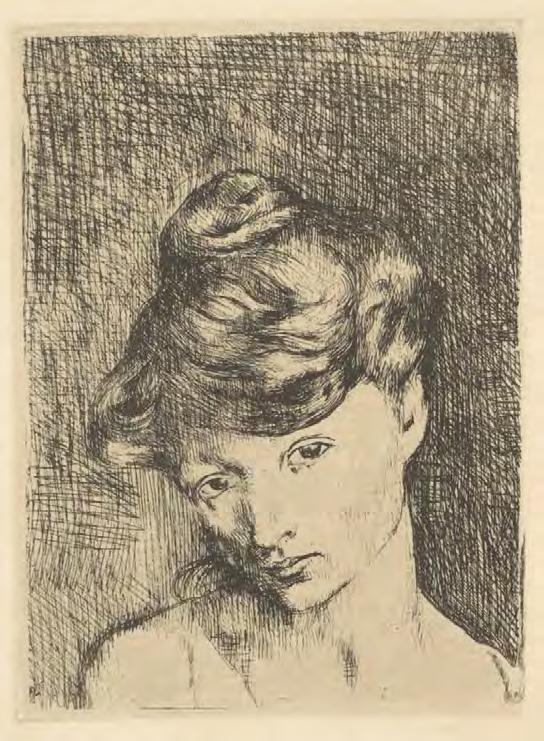
The Holburne is celebrating how the impressionists influenced printmaking with an exhibition that opens 22 May
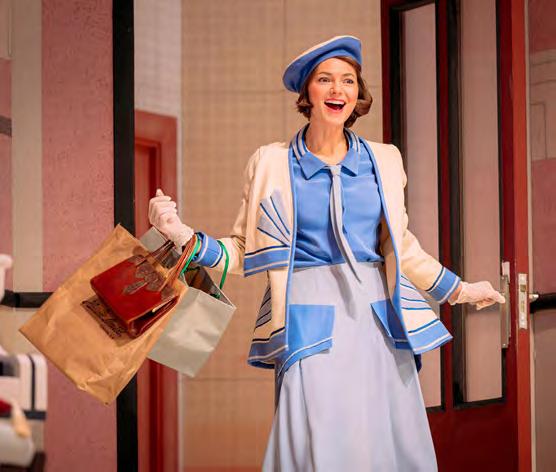
CULTURE CLUB with KARA TOINTON
Kara Tointon stars in The Constant Wife, Laura Wade’s new version of W. Somerset Maugham’s ‘sparkling comedy of ill-manners’ at the Theatre Royal Bath from 11 until 16 May. A star of stage and screen, Kara began her career with early hit roles in Teachers and Dream Team before joining the cast of EastEnders in 2005 playing Dawn Swann for four years. Kara is also about to star in the next Hunger Games movie, Sunrise on the Reaping, due out in November this year, playing the mother of a young Haymitch Abernathy.
The last great film I saw I was super late to watch this but it was Call Me By Your Name, a love story starring Timothée Chalamet and Armie Hammer.
A film I could watch over and over again
When Harry Met Sally. I could watch the credits roll, then start it from the beginning straight away.
A painting that means something to me Being on tour means that you get to see parts of the country that you might not usually visit. A few weeks ago we were at the Lowry Theatre in Salford and they had an L.S. Lowry exhibition and seeing his work up close blew me away. Going to Work is a favourite and while I was a fan before I am even more so now.
Best TV show ever It has to be Succession!
BY
My TV guilty pleasure I don’t get very guilty over pleasures, but the show I watch on a loop is the American mystery comedy-drama television series created by Steve Martin and John Hoffman, Only Murders in the Building
The book that changed my life Sapiens: A Brief History of Humankind by Yuval Noah Harari for so many reasons.
Last live music gig I went to I live in Norway and we have a beautiful outdoor music venue that sits in the hill. The last time I was there I saw an amazing musician called Bjørn Tomren.

My desert island disc It would have to be any album by the wonderful Spanish singer Julio Inglesias
The first song I remember hearing Come Follow the Band by Michael Crawford & Barnum Ensemble from Barnum the musical
My karaoke go-to I love a bit of Boy George so it would have to be Karma Chameleon.
For more: www.theatreroyal.org.uk
Going to Work by L.S. Lowry
Kara is a Julio Inglesias fan
PHOTO
MIHAELA BODLOVIC



NOVEL IDEAS NIC BOTTOMLEY




Nic’s suggestions for seeking out the new
When I’m not searching for new books, I tend to be searching for birds. Or at least noticing them as I walk around the countryside. That’s a predictable middle-age trait I guess, but whether it’s birds, objects or aliens, my recent reading suggests that everyone’s seeking out something.
Let’s begin with the birds though. The Book of Birds (Hamish Hamilton, £35) is the second mission-led masterpiece by art and words powerhouse duo Jackie Morris and Robert Macfarlane.
Their previous book Lost Words sought, through Jackie’s stunning artwork and Robert’s incredible prose, to celebrate words from nature that had been removed from the Oxford Junior Dictionary. Through that book and the school campaigns and spin-off music that sprang from it, keystones of our natural world like ‘larks’ and ‘acorns’ were reclaimed as being vital for future generations to recognise.
This time Morris and Macfarlane are celebrating Britain’s declining birdlife in the hope that readers will engage with, and protect, the diverse range of avian species around them.
The Infamous Gilberts by Angela Tomaski (Penguin, £16.99) is a novel with a fascinating storytelling structure that uses sought objects as the trigger for each chapter.
The book was inspired by the author’s visit to Tyntesfield – the country house just south-west of Bristol - just before it became a National Trust property. Tomaski was struck by the everyday objects she spotted around and the links that those objects suggested between time, place and the individual characters who’d lived there.
So struck, that she created the fictional dysfunctional Gilbert family. Their story covers much of the twentieth-century but begins near to the present-day just as their stately home is to be taken over by a hotel.
You, the reader, are taken on a tour of the house and encounter scars and items along the way – a burn on a carpet, a bolt on a door – whose history is then revealed through the chaotic, dramatic lives of five fatherless siblings and the generations that surround them. The structure is fresh and original and the narratives often sad and dramatic but elevated by a quirky British humour.
“A fascinating structurestorytelling that uses sought objects as the trigger for chaptereach ”
Forty-nine endangered or declining birds are included in this truly beautiful book, from those you might still hope to see in and around Bath like greenfinches or yellowhammers, if you’re lucky, to those like avocets or kittiwakes that you’d only be able to find nearer the coast.
Morris has painted them all in her inimitable vivid style, and Macfarlane has brought their behaviour and vibe to life with his lyrical nature-writing: “A glimpse of kingfisher is vision-quake, double-take; a strafe-straight rake across the lake that leaves neon-streaks in its afterburner wake”. Separate chapters explore the wonders of nests, eggs, migration and more making for a book that is both a sensory treat and an accessible reference for bird nerds (like me) and for anyone with a passing appreciation for the fragile feathered nature around us.
You would think that seeking out random objects or birds is child’s play compared to Daniel Lavelle’s recent obsession. In Chasing Aliens (Penguin, £20) he documents his efforts to connect with extra-terrestrials or, more precisely, with the conspiracy theorists, ufologists and even government officials who obsess about them.
As it turns out he has absolutely no problem tracking down limitless unhinged, and occasionally inexplicable, alien encounters to share and explore. Given that 41 per cent of the American population is on board with the idea that aliens have been in touch, it turns out that a spotters’ guide for aliens may be just as accessible as one for birds.
Nic Bottomley is the general manager of Mr B’s Emporium of Reading Delights, 14/15 John Street, Bath; www.mrbsemporium.com

KILVER COURT & GARDENS
A one-stop destination for lifestyle, shopping, work and wellbeing.
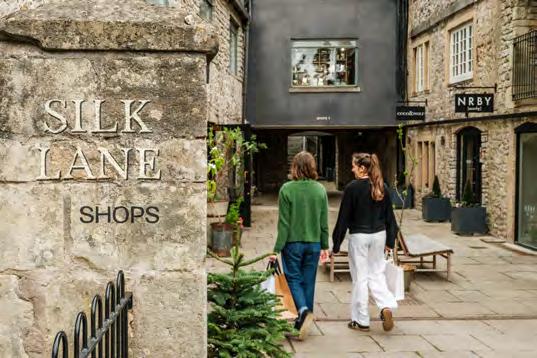
We have all come to know Kilver Court and Gardens as the home of Mulberry and TOAST, but a host of new tenants and a carefully considered re-mastering of the site, mean that there are now many more reasons to visit the iconic Shepton Mallet destination.
Once more under the ownership of the Showering family, whose ancestors first purchased the site in the 1950s, Kilver Court and Gardens is now home to new independent
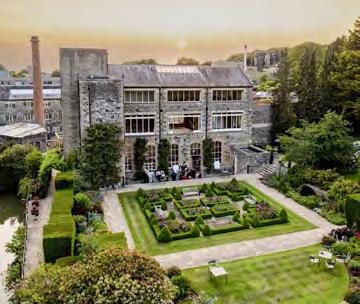
fashion and homewares retailers, a chef-run café, yoga, a pilates studio and a coworking space.
Chef Nick Hampson has taken on the renovated Kilver café, a chic, lightfilled space, looking out onto a re-paved courtyard that has parasols and seating for sunny days. A fresh, seasonal brunch and lunch menu, as well as all-day pastries, are served from 9.30 to 4.30, using produce from the gardens wherever possible.
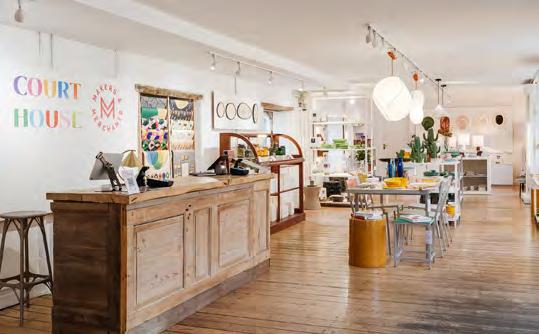
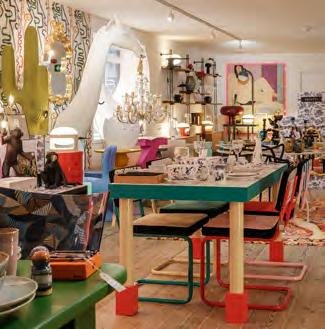
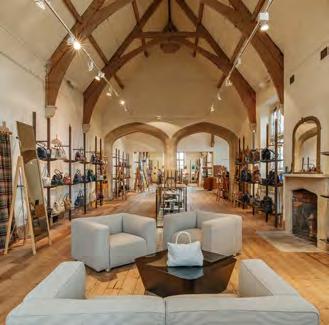
offline store – the brand holds some 20,000 products online – the Kilver shop shows traditional British brands such as Mulberry Home and Sanderson alongside a joyfully eclectic selection of light fittings and tableware by leading European brands. With prices ranging from £10 for homewares to £6,000 for a sofa, there is something to suit all budgets and tastes.
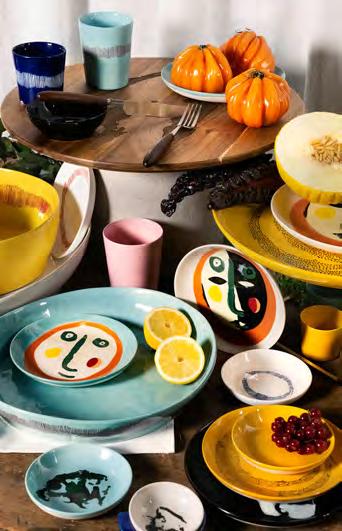
The Wiggly Shed, formerly the garden shop on the courtyard, has now been taken over by innovative garden and homewares brand Makers & Merchants, whose founders have an incredible design heritage, via the Conran Shop and Liberty. Travelling Europe to discover ceramicists, glassmakers and homeware designers, they bring a curated selection of their finds to Kilver Court and Gardens, where they have established their first offline store, alongside their Somerset food and drink ranges.
In the main Kilver Court building you will find a new TOAST Home, a gallery-style Makers & Merchants store and homewares brand Courthouse Interiors. Courthouse’s only
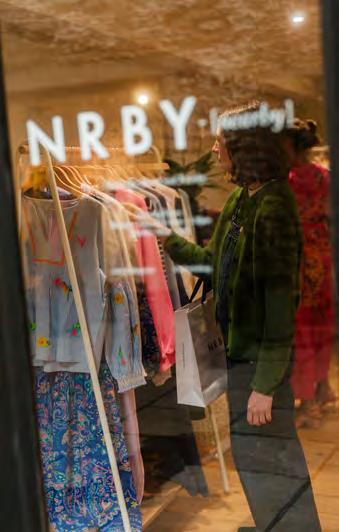
Somerset-born brand Coco & Wolf and British fashion retailer NRBY are running pop-ups at Kilver through June 2026. Coco & Wolf’s exquisite Liberty Fabric bedding, homewares and apparel are only sold here at Kilver and at the Liberty London store itself, while NRBY has stores in London and Bath. The clothing brand prides itself on sustainable, natural fabrics like silk, linen and cashmere and designs that foreground versatility and durability over fast-fashion.
New to Kilver too is Distil Coworking, a calm, contemporary environment that offers membership and pay as you go desk space for remote working, with free garden access and bookable meeting room and podcast booth as part of the deal. Yoga classes in the ballroom and a state-of-the-art reformer pilates studio, run by A&M Pilates, complete the wellbeing offer, making Kilver Court and Gardens a truly one-stop destination for live, work and play. n
Kilver Court, Kilver Street, Shepton Mallet, Somerset, BA4 5NF; See www.kilvercourt.co.uk for up to date events and happenings
Photo by: Dave Watts
Photo by: Dave Watts
Photo by: Dave Watts
Photo by: Dave Watts
Photo by: Dave Watts
BOOKS, BEATS AND OFF THE BEATEN TRACK
Big names, new voices, extraordinary performances and city walks in the return of the Bath Literature Festival and the Bath Music Festival
By Abbie Farmer
From lively city-wide celebrations to thoughtful discussions and world-class performances, the city’s famous Bath Festival season is back with a program that feels both expansive and thoughtfully curated. This is our invitation to enjoy our city even more as ideas, creativity, and performance come together, all delivering something new to discover.
It all kicks off with Party in the City on 15 May, a free, spirit-lifting event open to everyone, with venues throughout the city centre filling up with bands, choirs, and musicians – a lively introduction to the weeks ahead.
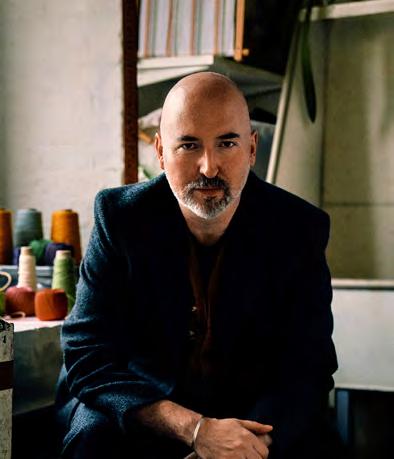
From 16 – 24 May, the Bath Literature Festival takes centre stage, featuring some of the most notable voices in contemporary writing. Notable guests include Hamnet author Maggie O’Farrell, Shuggie Bain writer Douglas Stuart, Booker Prize winner Howard Jacobson, historian Tom Holland, and bestselling thriller novelist Anthony Horowitz. Their appearances build a program that mixes readings, conversations, and debates.
However, the festival is more than just a showcase of big names. Throughout the week, events explore some key issues of 2026, including the climate crisis, migration, Europe’s shifting identity, and global tensions. These discussions accompany more intimate looks at cultural figures and fictional worlds. Attendees can delve into the lives of legends such as Jane Austen and James Bond or revisit the stories of noteworthy figures such as Marilyn Monroe and Elizabeth II.
There’s also a strong focus on participation. Workshops encourage emerging writers to try their hand at storytelling, while guided walks
“Clarity, richness, and vocal precision in an intimate setting”
offer a fresh perspective on Bath, revealing layers of history, architecture, and personal stories that shape the city. These include 2,000 years of history through Walcot Street, five Georgian Bath Crescents explored (turn to page 44 for more on the crescents of Bath), the city’s connection with the slave trade, and a Jane Austen tour.
As May transitions into June, attention turns to music with the Bath International Music Festival, running from 30 May to 7 June. The program is rich and varied, shifting seamlessly between small performances and more immersive evening events.

Some highlights include performances by three acclaimed pianists: Richard Goode, Jean-Efflam Bavouzet, and Steven Osborne. Each brings a unique style, allowing audiences to enjoy world-class musicianship up close and personal.
A standout moment of the festival is expected to be Secret Byrd, performed in the beautiful setting of Bath Abbey by the talented vocal ensemble The Gesualdo Six. This immersive performance allows audiences to experience Renaissance music in a way that enhances its intimacy and emotional depth.
Jazz also makes a vibrant return at the Pump Room, where James Pearson and his trio lead listeners on a journey through over a century of piano greatness. From Jelly Roll Morton
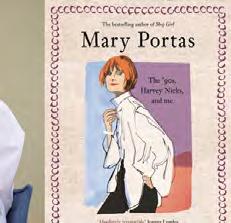
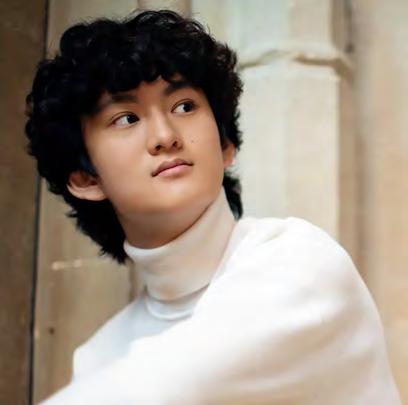
inset: Party in the City returns 15 May; opposite, left to right: Mary Portas is at the Guildhall on 22 May; Ryan Wang’s piano recital is 3 June at St Swithin’s Church; Andrew Wilson on his Marilyn Monroe biography, I Wanna Be Loved By You at the Guildhall on 22 May; Irene Duval performs at St Swithin’s on 5 June; Sajid Javid, Bristol-born son of Pakistani immigrants, talks about his memoir on 16 May at the Guildhall; See I Fagiolini on 6 June at St Mary’s Church; Shuggie Bain author Douglas Stuart talks to Max Porter about his new novel John of John on 24 May at the Guildhall; Jilly Cooper will be celebrated on 16 May at the Guildhall; Join Tom Holland on 22 May at The Forum
and Fats Waller to Art Tatum, Dave Brubeck, and Oscar Peterson, the program celebrates the energy, creativity, and joy of jazz.
The festival continues to balance the intimate with the grand. At St Swithin’s Church, audiences can enjoy Mark Simpson, a rare talent who has won both the BBC Young Musician and the BBC Young Composer. His performance is expected to be one of the more quietly captivating moments of the festival.
The same venue also hosts a series of relaxed morning events that pair coffee and cake with live music. Featuring artists such as Ethan Loch, Irene Duval, and Ryan Wang, these concerts provide a more informal way to enjoy exceptional music.
At Komedia Bath, the atmosphere changes again. One evening is inspired by the warm spirit of a 19th-century Viennese tavern, blending classical and folk influences into something both nostalgic and fresh. Another evening transports audiences into the dramatic world of tango, as the Bath Festival Tango Ensemble performs the music of Astor Piazzolla, filled with intensity, rhythm, and late-night energy.
For choral music lovers, I Fagiolini’s performance at St Mary’s Church, Bathwick, offers something special. Their a cappella program of Renaissance works from Spain and England promises clarity, richness, and vocal precision in an intimate setting.
This is a festival that moves fluidly across genres, centuries, and styles, encouraging audiences not just to attend events but to experience music and literature in ways that feel immediate and engaging. n For more: www.bathfestivals.org.uk






AHEAD of the CURVE
From Georgian whimsy to helping with the war efforts, the story of the seven crescents of Bath
Words by Josh Nairn
Photos by Rowena Ko; Instagram @rowenako_photography
“It was the first of the seven crescents of terraced houses to be built”
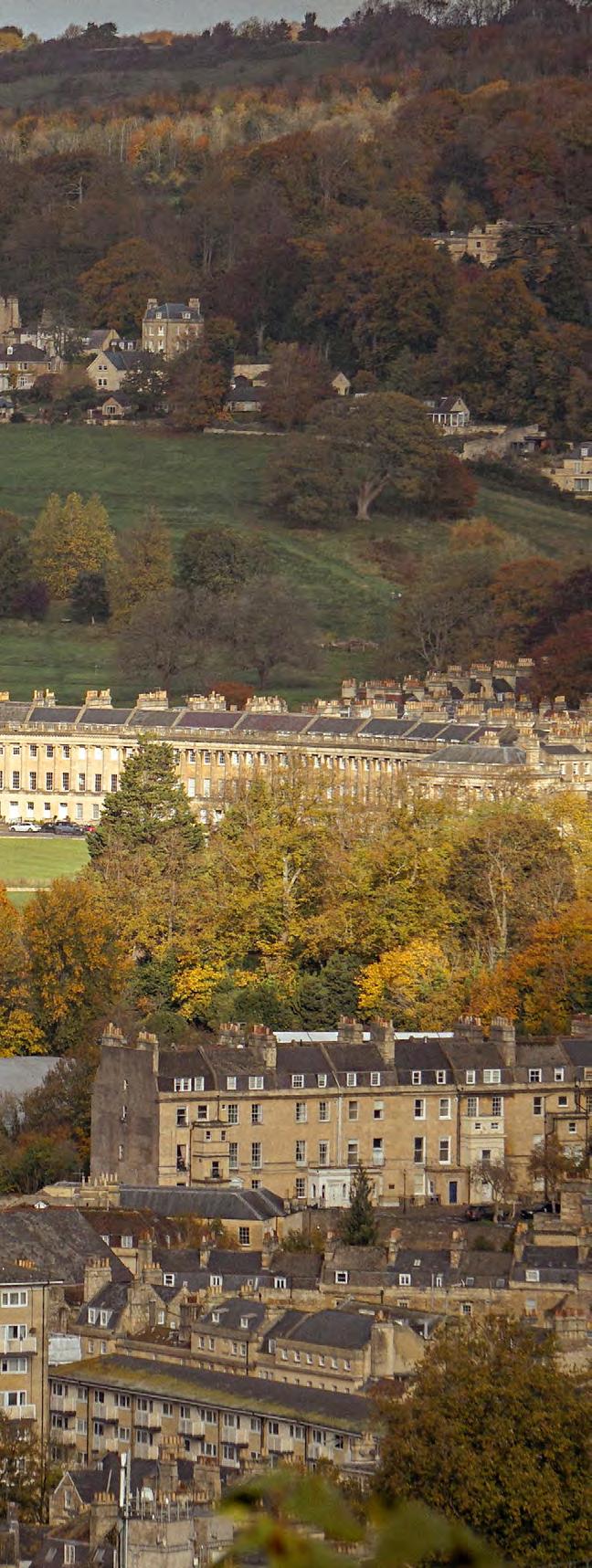
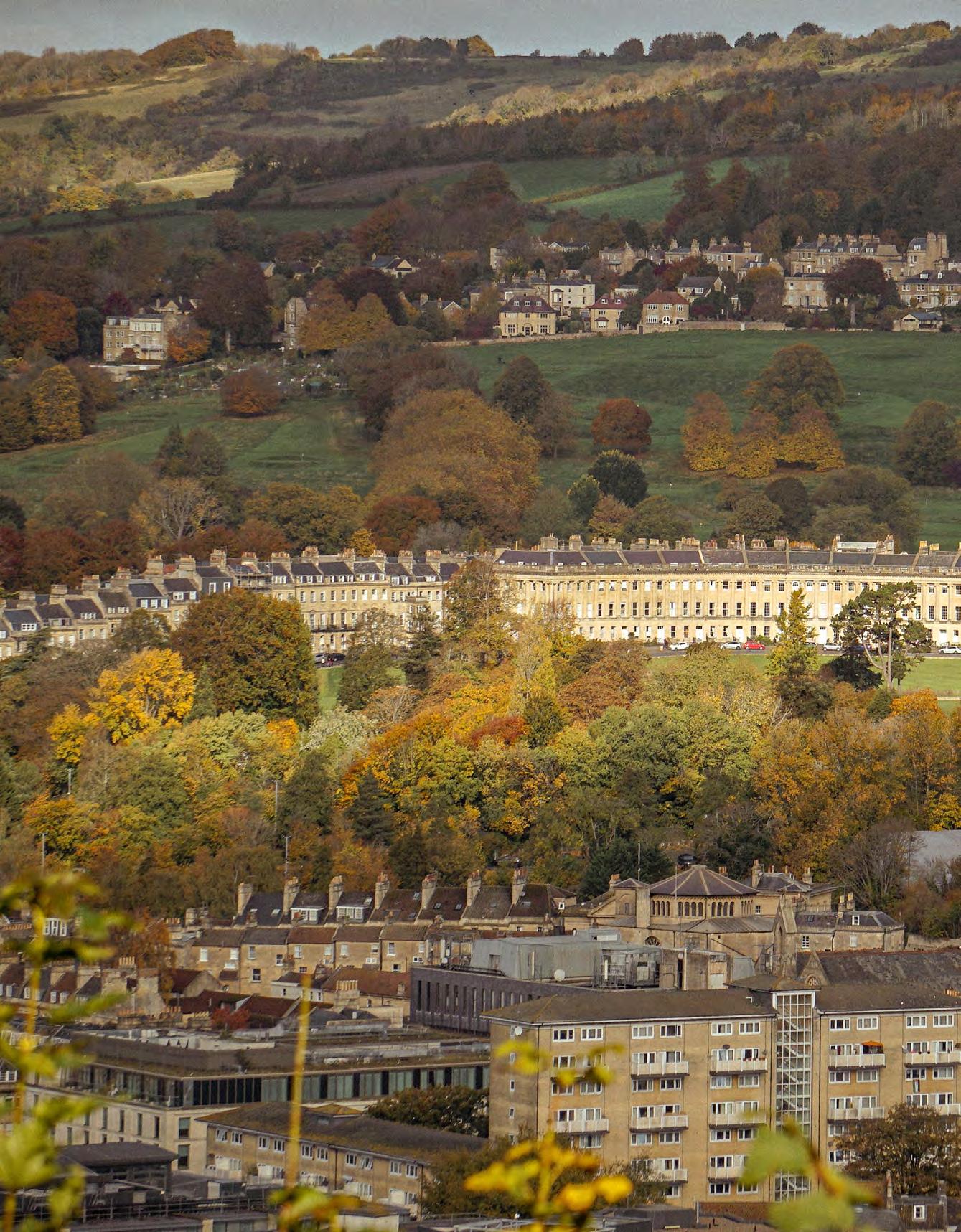
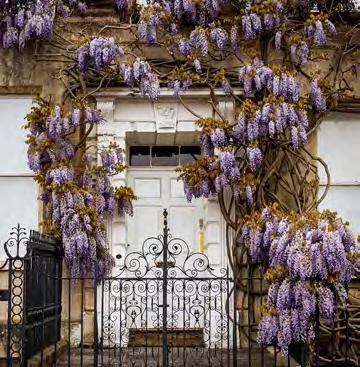
Bath does Georgian and crescent like nowhere else – and not just at the world‑famous Royal Crescent. Tucked along the city’s steep northern slopes are a string of elegant crescents, each with its own quirks, views and stories. This year the Bath Festival is hosting walking tours wandering a trail dotted with some of the crescents of Bath. Led by a Blue Badge guide, and organised by Fred Mawer Tours, you’ll get the gossip on former residents, spot fanciful architectural details, and learn more about these curvy beauties. Here, with the help of talented local photographer Rowena Ko, we take a quick but longing look at those seven famous crescents of Bath.
Royal Crescent (1767–1775)
By far the most recognisable of the crescents and regarded as one of the greatest examples of Georgian architecture in the world, Bath’s Royal Crescent remains one of the city’s greatest landmarks. The Grade I listed 30 house Georgian masterpiece was designed by John Wood the Younger and built over several years in the mid to late 18th century. It was the first of the seven crescents of terraced houses to be built and was designed to offer residents a countryside feel within a bustling spa town. Alongside private residences, the terrace features a museum, giving visitors a look into life in the 18th century, as well as the elegant Royal Crescent Hotel. The iconic crescent boasts 114 limestone columns and overlooks Royal Victoria Park, boasting wider views over Bath.
The Royal Crescent attracts thousands of tourists every year, and is one of the most photographed locations in the region. Its architectural brilliance made it an extremely popular filming location, most notably recently serving as a backdrop to many scenes in Netflix’s Bridgerton
Whilst the summer sees the biggest crowds, with people coming from far and wide to enjoy the long evenings and warmer weather in the Royal Victoria Park, the Royal Crescent offers something for visitors all year round including the museum at No 1 Royal Crescent, which as well as its permanent interactive experience which shows how life would have looked and been conducted in Georgian times, also holds talks, workshops and exhibitions.
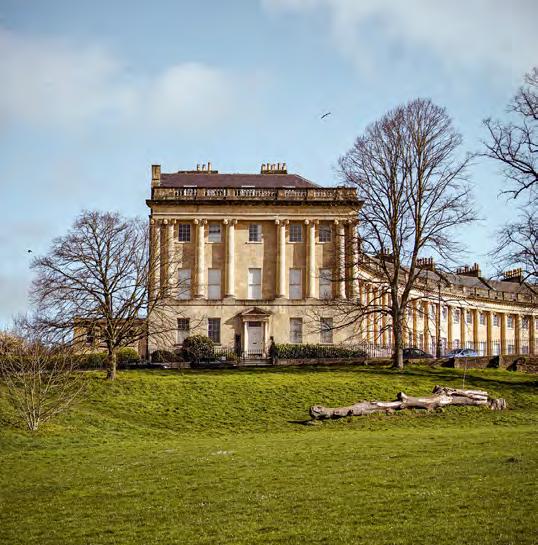
opposite: Bath’s headline act; the Royal Crescent defines the city’s skyline; above: The Royal Crescent’s western end, and one of Bath’s most distinguishable properties


Lansdown Crescent (1790s)
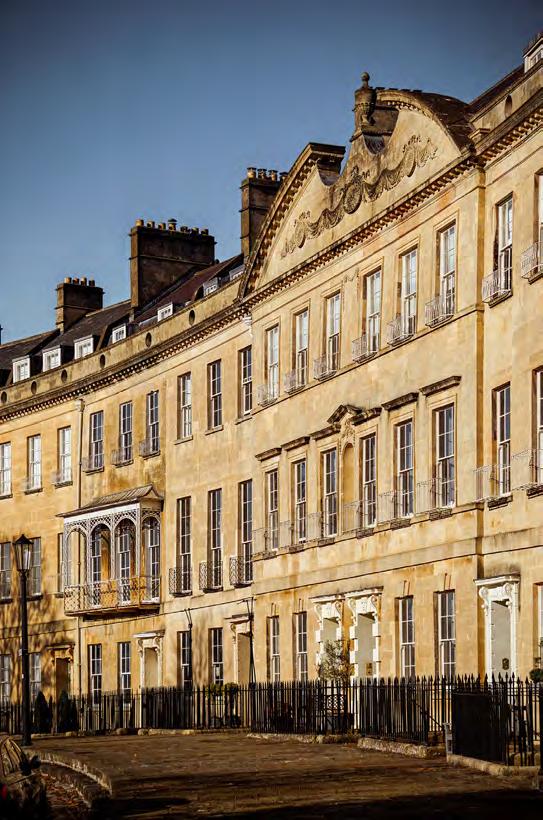
Whilst lesser known than the Royal Crescent, the Lansdown Crescent remains another superb example of Georgian architecture in Bath, with its distinctive curved terraces. Designed by John Palmer and built between 1789 and 1793, the terrace boasts an unobstructed view of Bath, sitting in an elevated position in a very peaceful and quiet part of the city.
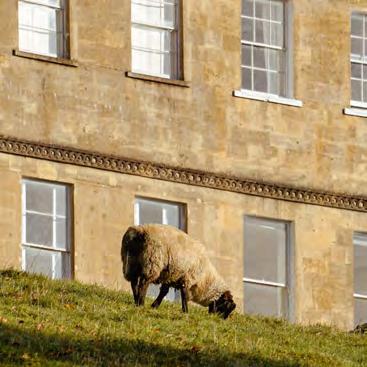
Despite being just a short walk from the Royal Crescent, Lansdown Crescent is often noticeably quieter amongst visitors, despite having its own rich history including being painted often by popular GermanEnglish artist Walter Sickert on his visits to Bath most notably between 1916 and 1918.
During World War II many of its railing spikes were taken, melted down, and used to help make weapons, and they weren’t replaced until 2016.
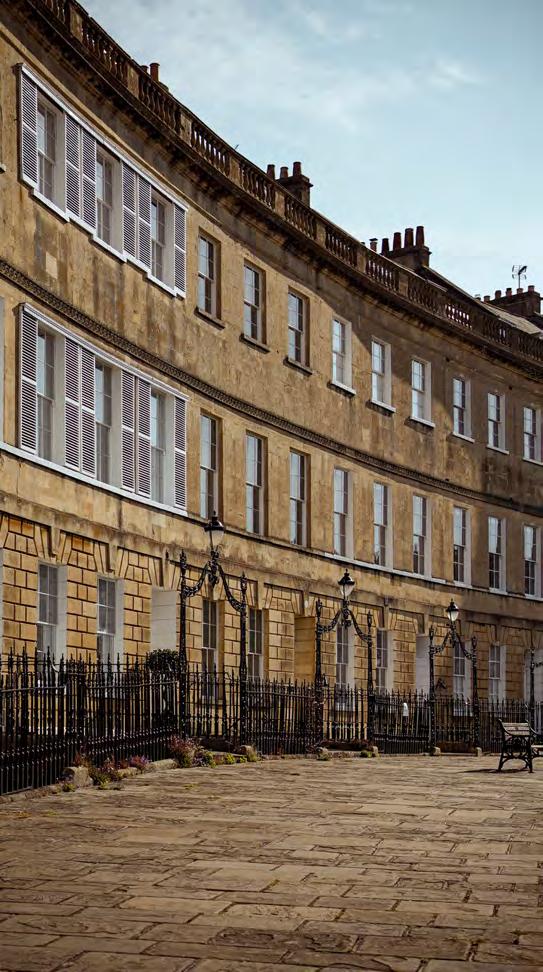
left: Lansdown Crescent’s 20 houses curve up Lansdown Hill, with a clear view of central Bath; right: Perched above Hedgemead Park, Camden Crescent overlooks west Bath and onto the far hills over the valley
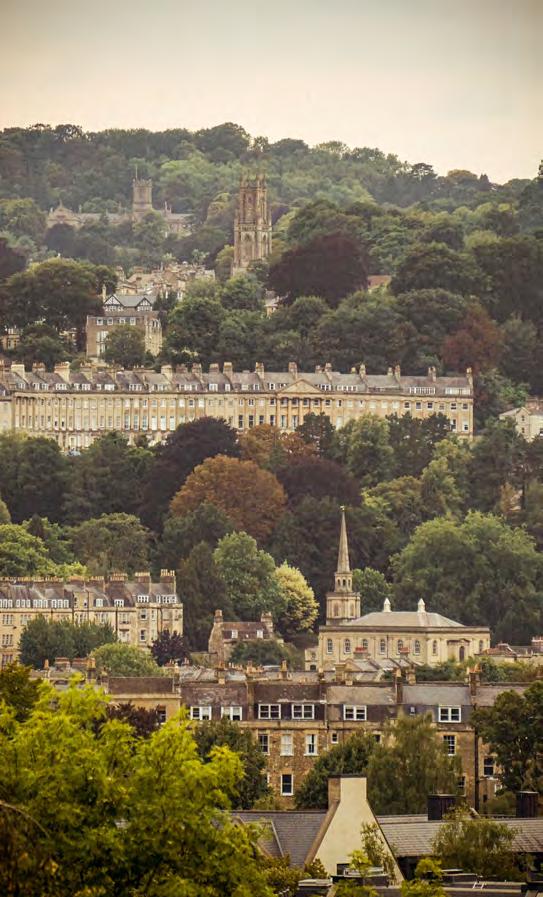
Camden Crescent (1788)
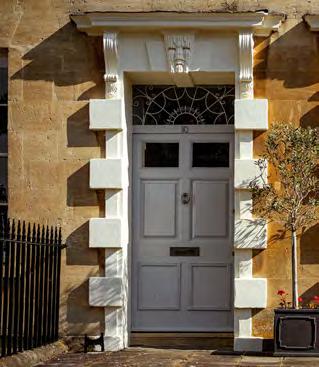
Originally named Upper Camden Place, Camden Crescent was built by John Eveleigh in 1788 and is best known for the panoramic views of the city it offers, as well as its intricate design features, such as the arms of Charles Pratt, 1st Earl Camden, after whom the building is named, carved on the doorway keystones.
The crescent hasn’t always been as pristine as it is today; the east end was left incomplete and abandoned after a landslide in the 19th century, which led to the demolition of the very end house. It wasn’t until the mid-20th century that numbers six to twenty-one were designated as Grade I listed buildings, whilst the rest of the houses are all Grade II listed.
Somerset Place (late 18th century)
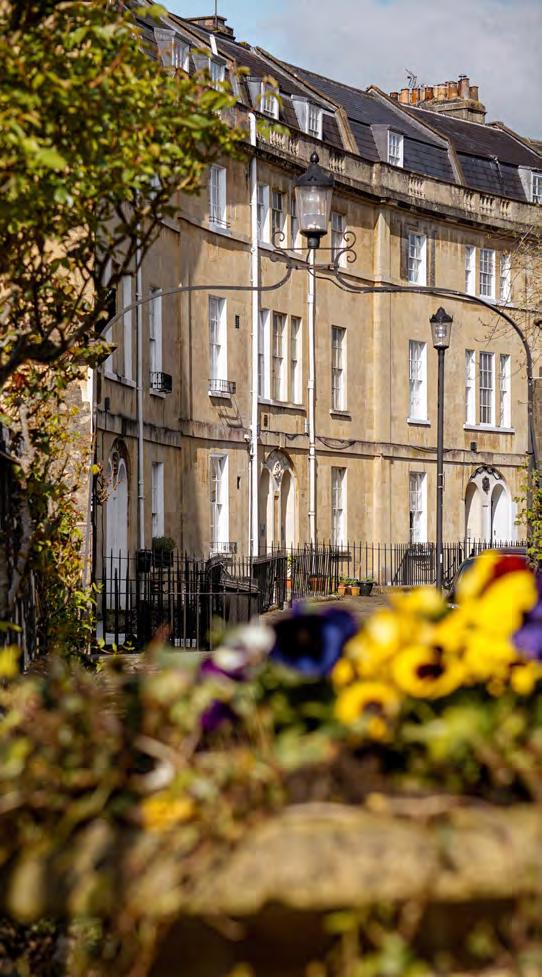
Somerset Place is considered by many to be the hidden gem of the crescents. The building was started in 1790 by the architect John Eveleigh; however, it was not finished until the 1820s after Eveleigh went bankrupt during construction.
Like Camden Crescent, Somerset Place was also damaged during the Second World War, with the western end of the crescent being completely destroyed in 1942 during the Bath Blitz. Whilst some of the façades and townhouses were left intact, much of the terrace had to be rebuilt. Redevelopment started in the 1960s, when parts of the building were repurposed as student accommodation for the Bath College of Domestic Science and formed part of Bath Spa University’s campus until it was put up for sale in 2009.
“The original railing spikes were melted down and used to help make weapons”
Widcombe Crescent (1808)
Being the only crescent to be located across the river, Widcombe Crescent is a significantly quieter, less-visited crescent but has incredible views across the southern hills. Fourteen houses make up this Grade I listed terrace, which was built by Thomas Baldwin in 1808, and has always consisted of private residences.
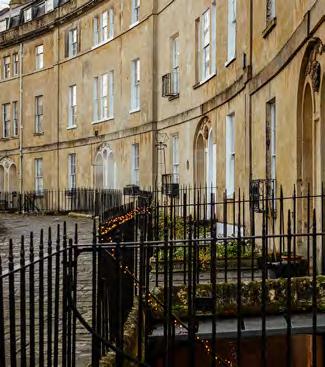
Famous residents of the houses included Sir James Brooke, a British soldier and adventurer who founded the Raj of Sarawak in 1841, located on the Malaysian island of Borneo. He lived at number 1 between 1831 and 1834, before travelling to India to join the British East India Company.
left: Somerset Place is easily identifiable by two elegant Juliet balconies located near each end of the terrace; right: Widcombe Crescent consists of 14 houses and is the only one of Bath’s crescents to sit south of the River Avon

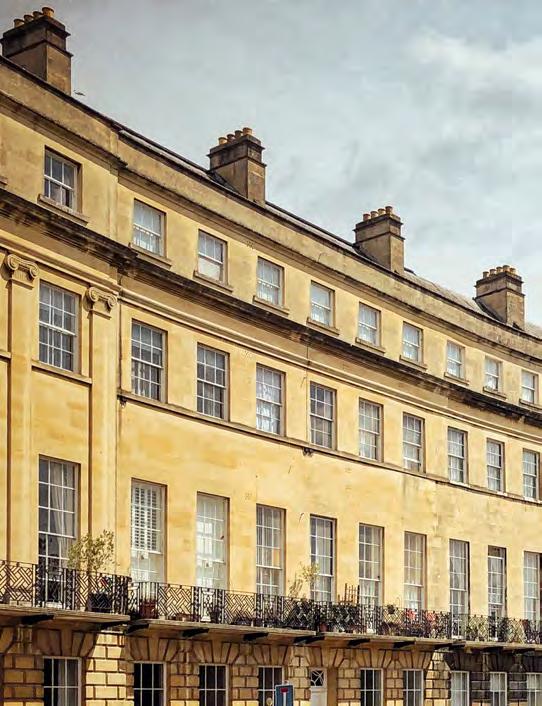
Norfolk Crescent (1790s)
Easily set apart from the other crescents by its stunning position along the River Avon, Norfolk Crescent was designed by John Palmer and completed over several decades due to financial instability. Norfolk Crescent, much like Somerset Place, was heavily damaged during the Second World War; in 1942, an incendiary bomb landed near the crescent, and the subsequent fire destroyed the north end. It wasn’t until the 1960s, 20 years after the war, that it was repaired and repurposed as a mix of flats and houses.
Norfolk Crescent is regarded as having one of the richest histories of all of Bath’s crescents.
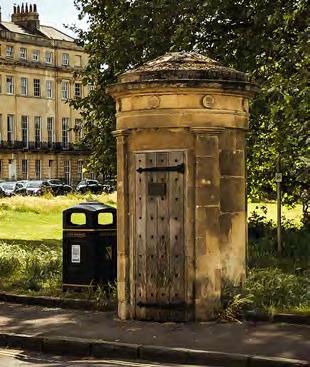
Sitting on the banks of the Avon, overlooking a green area originally designed as a formal garden for residents, featuring an old watchman’s hut in the corner of the gardens, all make Norfolk Crescent a striking example of Georgian design and architecture.
The watchman’s box itself is a Grade II listed building and a reminder of Bath’s rich history; watchmen once served as an important part of the local police forces around the country as far back as the 13th century, when ordinances introduced provisions to further maintain law and order, including the greater use of watchmen to deter criminals, particularly at night.
“Fourteen houses make up this terrace”
Cavendish Crescent (1830)
Built in the early 19th century, designed by John Pinch the elder, who also worked on alterations to the Norfolk Crescent, Cavendish Crescent is the shortest of the seven Georgian crescents spread across Bath, with just 11 houses. Cavendish Crescent has one of the plainest designs of the crescents, most notably having no central feature, such as pillars surrounding the central houses. Like many of the other crescents, construction had to be paused after the landowner went bankrupt, and the terrace was completed about five years after it began in 1825.
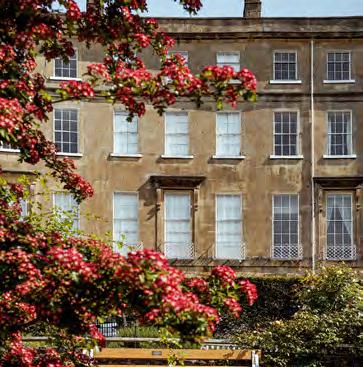
Cavendish Crescent’s most notable resident was a lieutenant of the British Navy, Sir William Holburne, who lived at number 10 from 1829 until his death in 1874. He was best known for his vast art collection, which he stored at his house before forming it into the Holburne Museum of Art. n
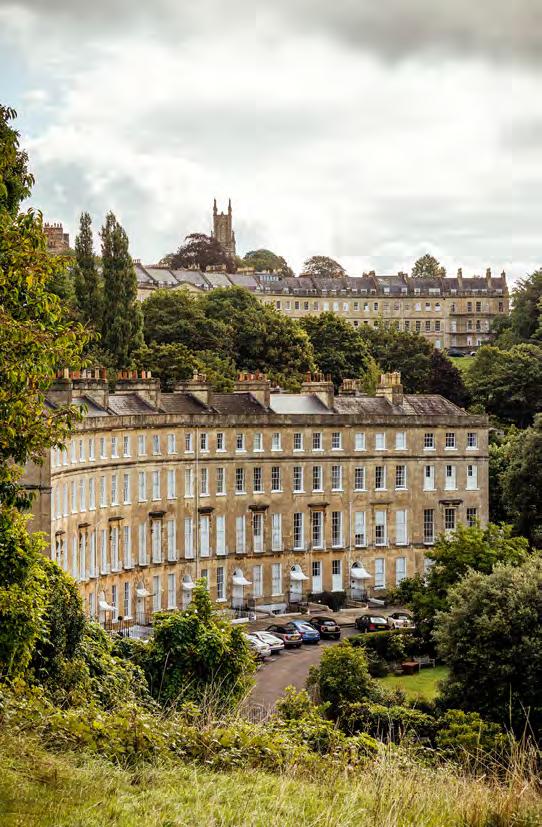
left: Steeped in history, sunlight highlights Norfolk Crescent’s six central pilasters; right: Cavendish Crescent is the shortest of Bath’s crescents
Services:
Bespoke Interior Design. Colour consultation. Space planning. Joinery design. Specifications. Sourcing.
Residential & Commercial. Project Coordination. Colour & Moodboard Workshops.
Bespoke Window Treatments & Upholstery.
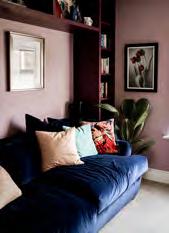

At Emily Day Interiors, we create beautiful, functional spaces tailored to your style and the way you live or work. From full transformations to subtle refreshes, each project is approached with creativity and expertise. Emily specialises in residential and small commercial interiors, delivering thoughtful, colour-led designs from concept to completion
Info@emilydayinteriors.co.uk 07809834225
www.emilydayinteriors.co.uk
@emily_day_interiors

PEACE AND QUIET
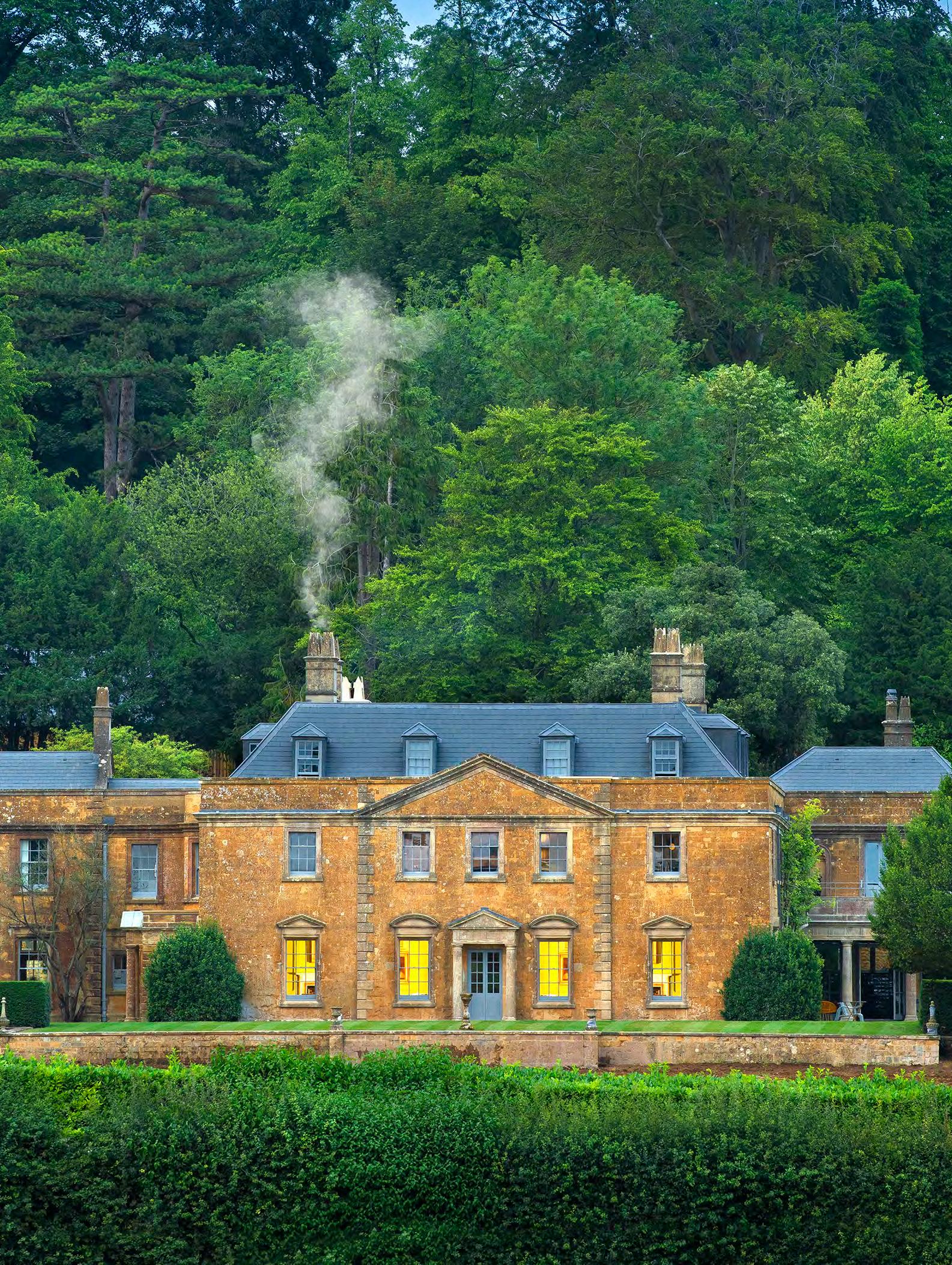
Luxury escapes where space, stillness, and impeccable service are redefining hotel stays
BY
PHOTO
From Palladian mansions wrapped in parkland to Georgian townhouses with snug corners and city smart spas, we explore ‘the quietest’ of local and luxe stays. Woodland walks, pool swims, yoga sessions, good books and good wines – these are spaces where time softens, service is instinctive rather than intrusive, wellness is woven into the day, and sustainability simply feels like good sense.
The Newt in Somerset, Hadspen, Somerset; www.thenewtinsomerset.com
The Newt in Somerset is a hotel and working estate rooted in the rhythms of the countryside. Set among orchards, gardens, woodland and farmland, it offers guests an escape that feels both deeply tranquil and quietly alive, with daily life shaped by the landscape and seasons. Here, richness comes from experience rather than excess. Long, unhurried hours, wide-open views and a deep quiet are woven into every stay: walks through the grounds, peaceful corners for reading, and meals that follow the natural pace of the day. Guests are invited to slow down and connect with the estate, whether exploring the gardens, discovering Hadspen House’s history, or watching the shifting light over the hills.
Design at The Newt balances sanctuary with character. Spaces are tailored to restfulness and comfort, with natural materials, layered textures and a palette that reflects the surrounding landscape. Yet there is also a playful, unmistakable identity running through the estate. Look closely, and you will find small, imaginative touches: newt-footprint metalwork in the gardens, colourful pieces in the rooms and restaurants, and art that brings warmth and personality without disturbing the calm. The result is a place that feels soothing but never bland, restful yet full of interest.
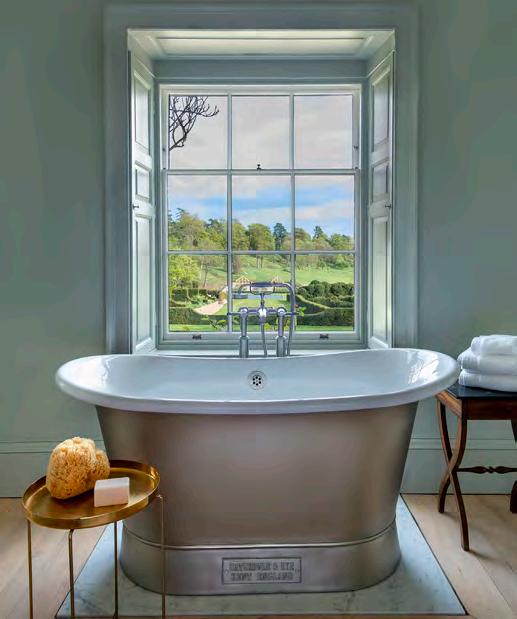
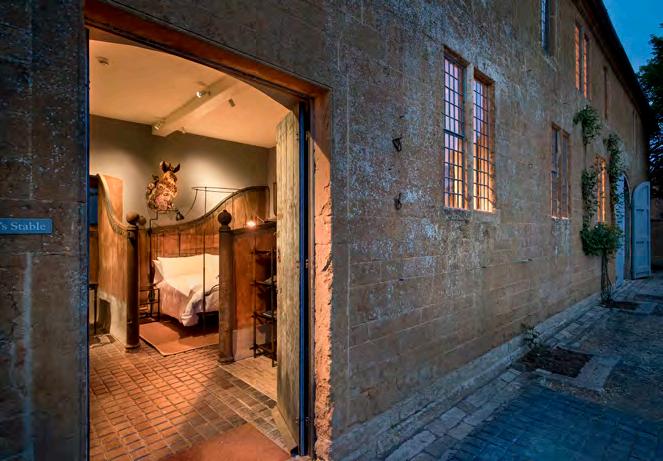
opposite and this page: The magic of the region is woven into every aspect of a stay at the luxurious Newt In Somerset, balancing sanctuary with character and connections
“Look closely, and you will findsmall, imaginative touches”
Rather than traditional fanfare, luxury is conveyed through thoughtful, unshowy care and the sense that guests are known and looked after. The team is present but never overwhelming, on hand to share a story about the gardens, recommend a walk, or help shape a day that feels personal. Conversation and connection are encouraged, whether at dinner, over a cocktail at the bar or during a wander around the estate.
Wellness at The Newt is wide-ranging and flexible, allowing guests to take what they need from it. Those who wish to maintain a familiar routine can use the gym, yoga studio or join a fitness class. Others may gravitate towards the spa, a serene space with a distinctive, almost church-like architecture that immediately invites exhale. It is as welcoming for a quick swim as it is for an extended treatment. For something more invigorating, cold dips in the lake offer a bracing reset. Guests are free to keep up their habits, try something new or indulge completely.
Somerset is woven through every aspect of the experience. A dedicated section on The Newt’s website encourages guests to explore the county, from local attractions to visiting Bath. Guided tours can be arranged, or guests can set out under their own steam, returning to the estate at day’s end. The region’s character appears in the products sold, the food on the plate and the countryside that frames every view.
Electric buggies make moving around the estate both fun and low-impact. Much of the produce served is grown on site, keeping food mileage low and menus closely tied to the seasons. Composting, wildlife support and biodiversity projects are part of the estate’s stewardship, all of which enhance the guest experience in an easy, uncontrived way.
What truly defines The Newt is its atmosphere and sense of community. Guests staying at Hadspen House or the Farmyard enjoy peace, quiet and comfort, but also the gentle buzz of shared spaces: the hum of the dining room, conversation at the bar, the simple pleasure of passing others in the grounds. Interactions with the team – asking gardeners about the planting, learning more about the estate’s story – create small, memorable moments that bring the place to life and turn a stay into something special.
Service follows the same ethos of understated ease.
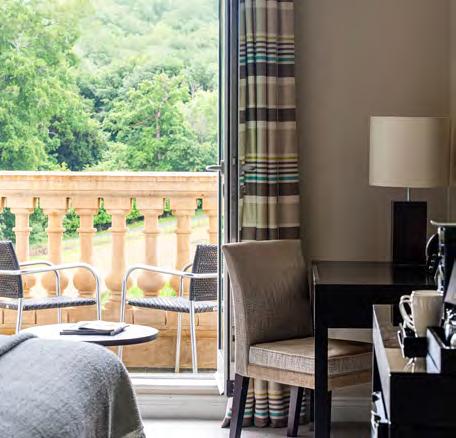
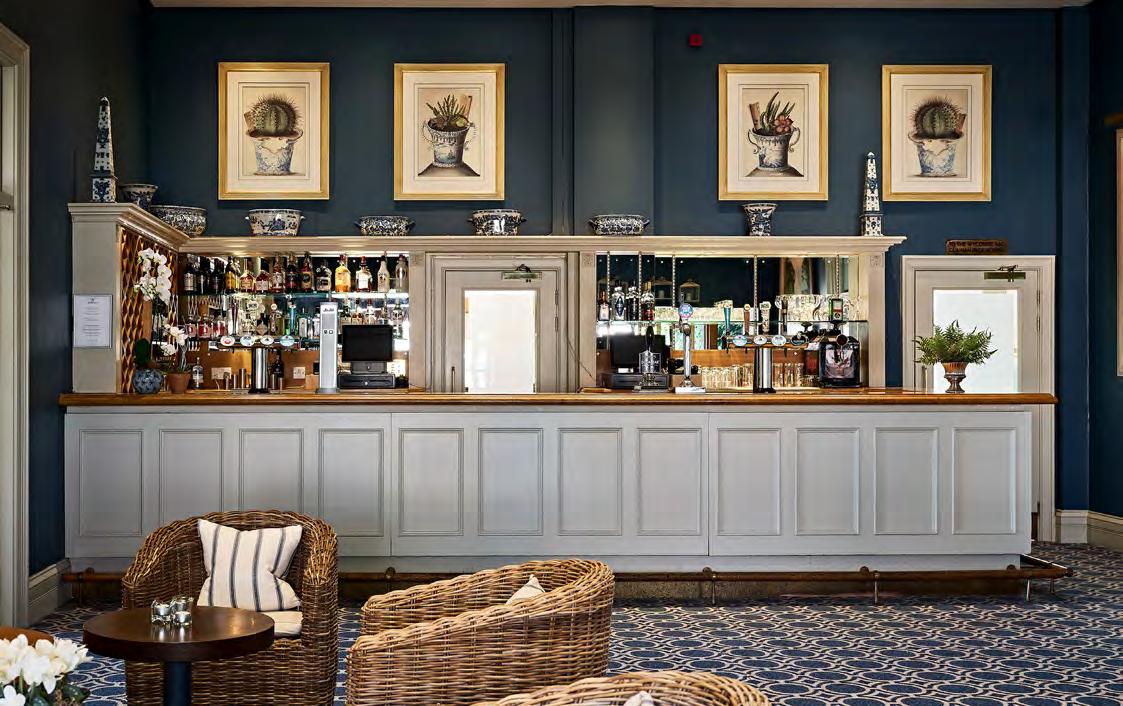
Bowood Hotel, Spa & Golf Resort, Derry Hill, Calne; www.bowood.org
Set within more than 2,000 acres of historic Wiltshire countryside, Bowood Hotel, Spa & Golf Resort is a tranquil retreat at the heart of the Bowood Estate. The resort brings together a welcoming hotel, a relaxing spa, a PGA golf course, and privileged access to Bowood House & Gardens, creating a destination where guests can pause, breathe, and experience life at a gentler pace.
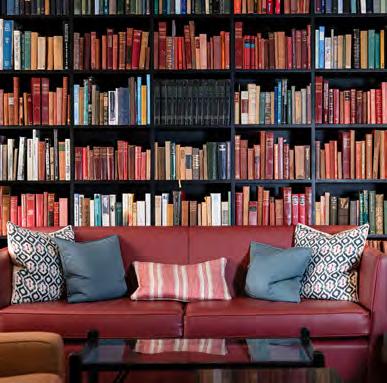
The tranqullity, space, and intuitive service at Bowood Hotel, Spa & Golf Resort mean guests can experience life at a gentler pace
Service here is intentionally low-key and intuitive. The team aims to understand what guests need before they ask, then respond in a way that feels natural and easy. This might be a well-timed coffee, a thoughtful suggestion for a walk, or simply knowing when to give guests space. Rather than grand gestures, the emphasis is on consistency, warmth, and the sense that everything has been quietly taken care of.
At Bowood, the real luxury lies in being able to pause and step back from everyday life. Unhurried time, generous space and natural quiet are part of the rhythm here. Guests can explore the Woodland Garden, the grounds of Bowood House, or simply enjoy long views across fields and woodland. This sense of place continues in the Shelburne restaurant and the spa, where large windows frame the landscape and invite the outside in. Instead of formal layers or spectacle, Bowood offers freedom and quiet to appreciate the estate.
The resort’s design approach is intentionally understated, allowing Bowood to feel as though it belongs to its setting. Nowhere is this clearer than in the spa, which sits within the landscape, looking out over the Golf Academy Course and surrounding greenery. The architecture and interiors are calm and unobtrusive, encouraging guests to look outward, slow their pace, and feel part of the wider estate. New art installations, including black-and-white photography of Bowood’s trees and an exhibition inspired by nature, further connect indoor spaces with the world just beyond the windows.
“The real luxury lies in being able to andpause backstepfrom everyday life”
In the bedrooms and suites, light and outlook are central. Many rooms are arranged so that the eye is drawn towards the estate, lending an immediate feeling of space and stillness. Art plays a defining role in the interiors, influenced by Lady Lansdowne’s involvement. Pieces connected to Bowood House, along with work from guest artists, add character and depth, reflecting the estate’s history and creativity without overwhelming the calm atmosphere.
Wellbeing at Bowood extends beyond the spa. The wider estate encourages movement, fresh air, and a slower, more natural pace. Treatments and experiences evolve with guests’ needs, but the principle is unchanged: a sense of ease infuses the entire stay, not just time spent in the treatment rooms.
Environmental choices at Bowood are rooted in the estate’s history. A long-standing biomass boiler provides heating and hot water using woodchip from the grounds, while ongoing tree planting supports the landscape for future generations. In the kitchens, a field-to-fork approach allows executive head chef Rupert Taylor and his team to work with homegrown produce from the estate garden kitchen, creating zero-mile dishes shaped by true seasonality.
HOTELS
Lucknam Park, Emblems Collection, Colerne, Wiltshire; www.lucknampark.co.uk
Arriving at Lucknam Park feels like stepping into another world, where days unfold at their own pace and the usual sense of time loosens. Centred around a graciously restored Palladian mansion and set within 500 acres of parkland, woodland, and gardens, the estate offers characterful rooms and suites alongside private cottages tucked across the grounds. Cherished by generations for over three centuries, it now invites today’s guests to write their own chapter in this enduring country retreat.
Here, the true appeal lies in connection and calm rather than spectacle. Lucknam Park offers space, privacy, and quiet that feel increasingly rare, allowing guests to reset and reconnect with themselves, loved ones, and nature. The rhythm of a stay is deliberately gentle: a morning in the award-winning spa, a ride through the countryside on horseback, a walk along private trails, or simply pausing in the stillness of the gardens.
Design across the estate is gentle and timeless. Understated interiors, heritage materials, and soft natural light all work together to create a sense of sanctuary. Individually styled bedrooms frame views of lawns and trees, while tactile fabrics and muted palettes absorb noise and visual clutter. In the spa, marble, wood, and living plants deepen the atmosphere of ease. The Walled Garden Restaurant feels organically rooted in its setting, and The Hideaway lodge offers a peaceful, play-focused space for children, ensuring the whole family feels considered.
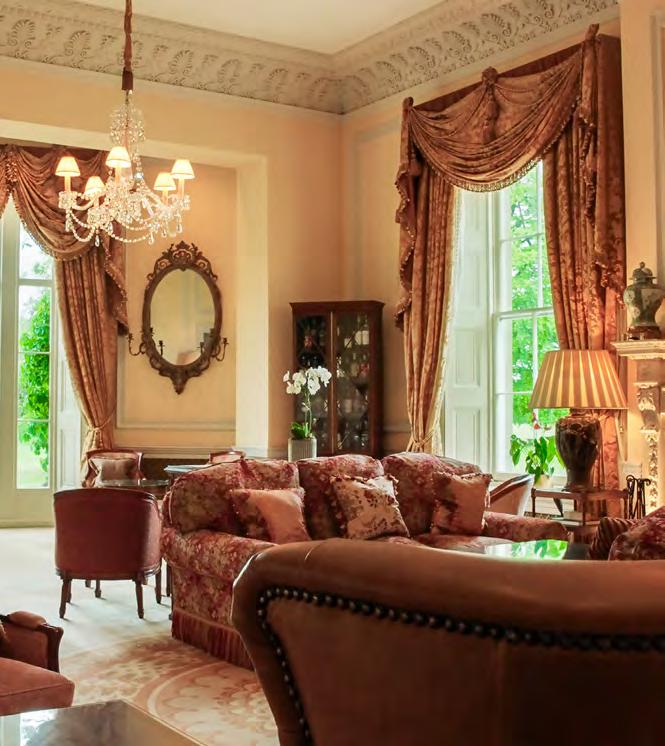
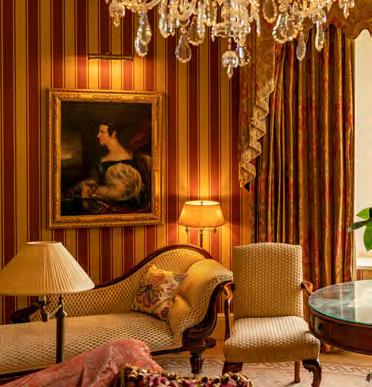
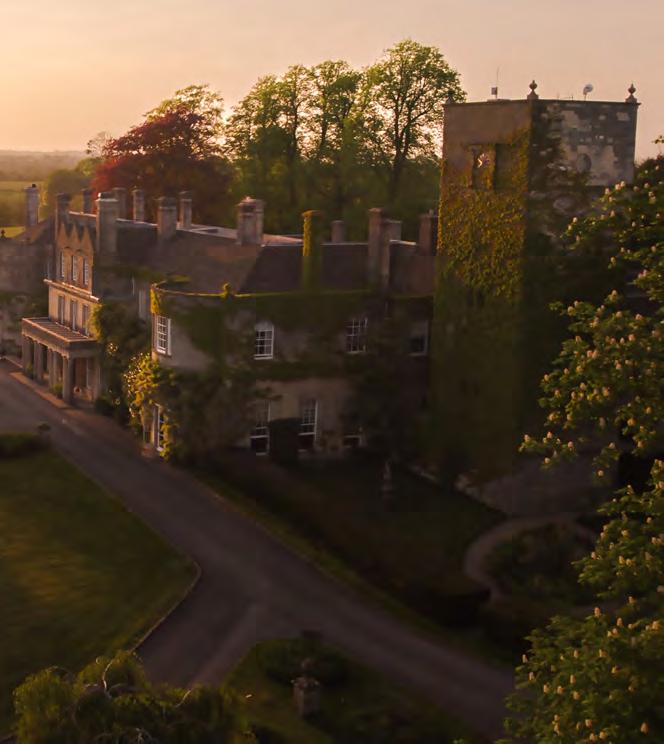
“The appeal lies in connection and calm rather than spectacle”
Service at Lucknam Park is best described as a kind of whispered care. Rather than intrusive formality or grand gestures, the team focuses on discreet, thoughtful support. Preferences are remembered, recommendations feel instinctive, and details are managed quietly in the background. Whether securing a favourite table, arranging a riding lesson, or curating a day of activities, everything is handled with a light touch so that the experience feels effortless.
In the suites, layout, lighting, and art are all used to create a sense of expansive time. Sheer curtains soften daylight, evening lighting is warm and gentle, and artwork is chosen to invite contemplation rather than command attention. These considered elements reduce overstimulation and encourage guests to slow their pace, adding to the overall feeling of ease. Wellness permeates the experience. The spa provides tailored treatments with natural products, while restoration continues outdoors–on garden walks, bridleways, or in quiet corners. Seasonal menus from estate-grown and local ingredients nourish simply and deliciously.
Behind the scenes, the estate is run with a long-term mindset: historic buildings with thick walls and generous proportions naturally regulate temperature, durable furnishings are chosen for longevity, and a restrained aesthetic favours lasting quality over trend. Guests simply experience a sense of enduring comfort, without being asked to trade luxury for conscience.
The restored Palladian mansion of Lucknam Park offers space, privacy, and quiet to create a sense of expansive time
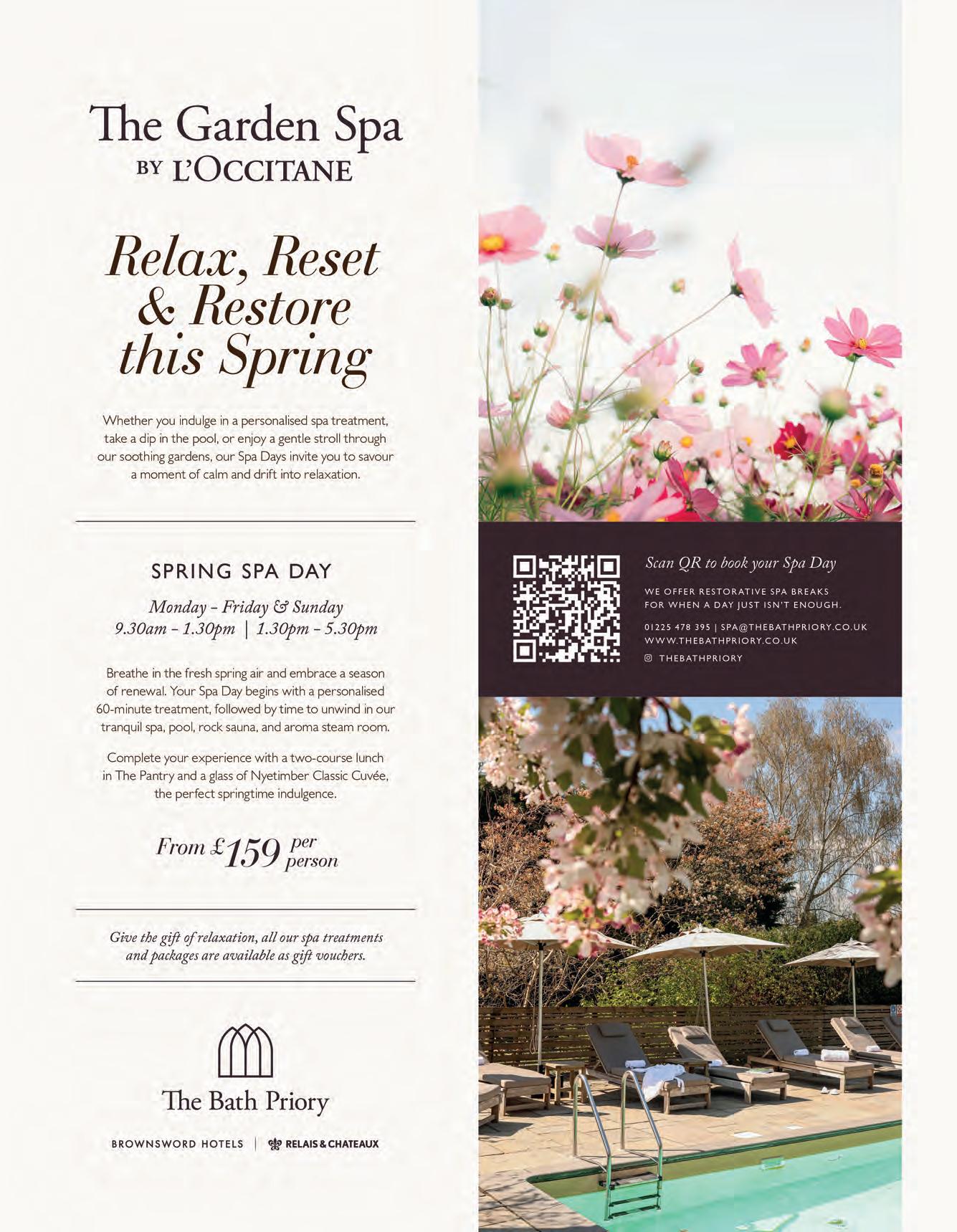
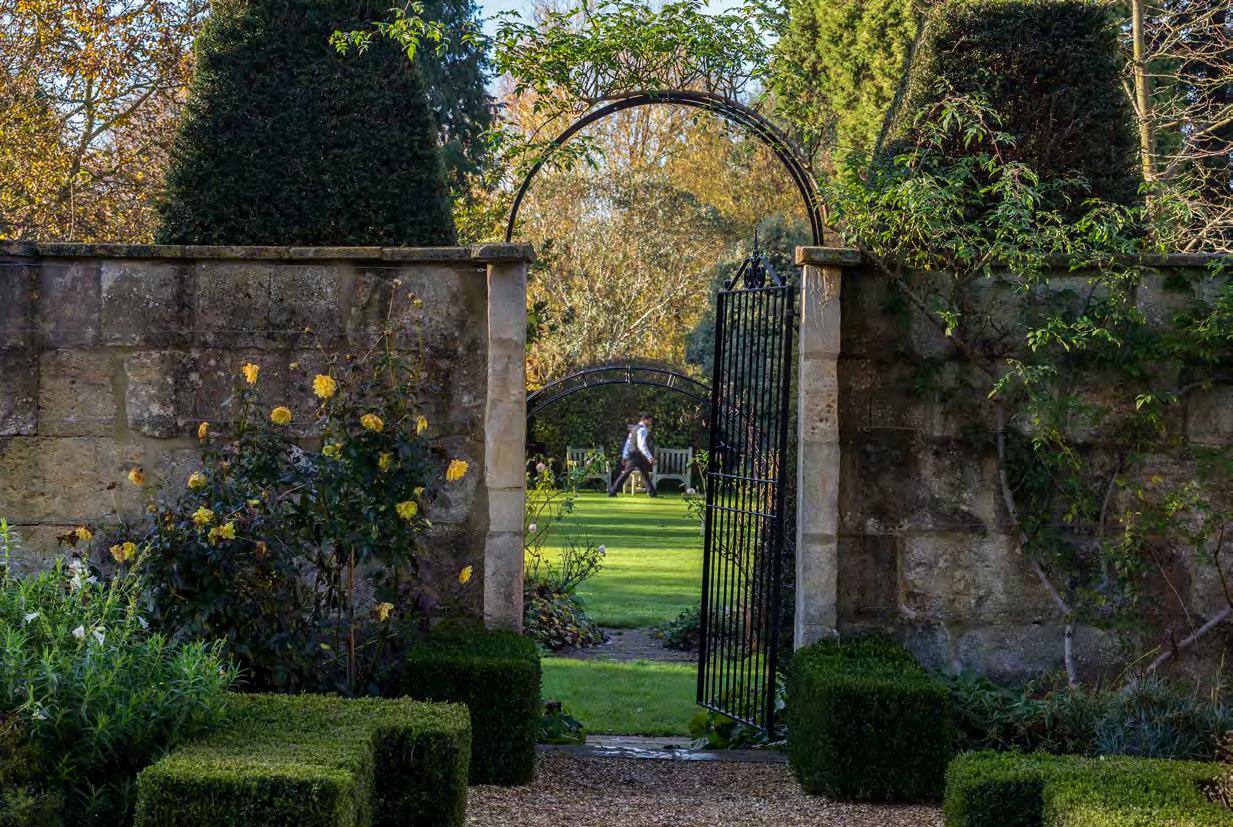
The Bath Priory, Weston Road, Bath; www.thebathpriory.co.uk
Standing apart in a city of Georgian facades and pavement terraces, The Bath Priory is a haven of quiet, country-house charm just a ten-minute stroll through Royal Victoria Park from the centre of Bath. Set within four acres of mature gardens on a tree-lined residential road, this 1835 former private residence – once on land owned by the Priory of Bath Abbey – offers guests the feeling of slipping into a private world, while remaining firmly rooted in the life of the city.
Here, what matters most is how guests feel. Regional general manager Gurval Durand and his team concentrate on creating a calm, unhurried atmosphere where every interaction is warm, thoughtful, and genuinely personal. From the first welcome at the door to the moment of departure, service is discreet and attentive, designed to anticipate needs without fanfare and to leave guests with the sense that they would gladly have stayed longer.
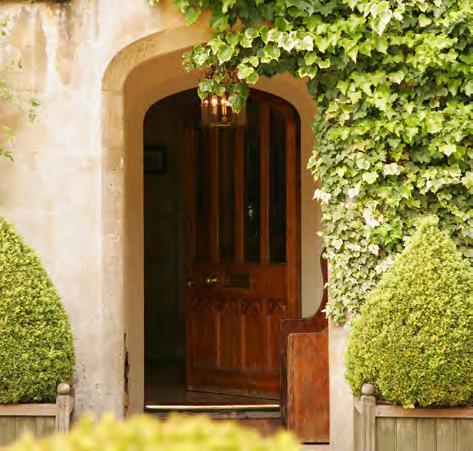
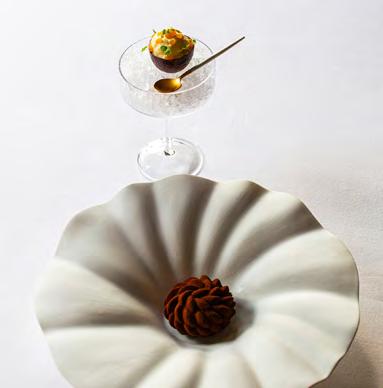
over the grounds. A heated outdoor pool in the warmer months and an indoor pool with a poolside sauna add another layer of relaxation. The spa, the first and only L’Occitane spa in the UK, specialises in facials and massages inspired by the brand’s grand herbarium, drawing on natural ingredients and timehonoured rituals to restore body and mind. Accommodation is quietly indulgent rather than ostentatious. Bedrooms, many overlooking the gardens and named after flowers, combine period furniture with contemporary bathrooms. Suites take their names from Bath’s famous crescents and feature handcrafted wood panelling, bespoke furniture, heritage colour palettes and custom-made Vi-Spring beds.
Premier deluxe rooms offer king-size beds, romantic rolltop baths or private balconies, while the master crescent suites bring garden views, muted tones and thoughtful touches such as fresh flowers, fruit, bottlegreen presses and L’Occitane amenities, plus robes and slippers.
Inside, the house has the character of an elegant home. The library and drawing room are lined with 20th-century artworks, deep armchairs and soft lighting that invite guests to slow down, read, talk or simply gaze out towards the lawns. The gardens themselves are integral to the experience: a tapestry of meadows, manicured lawns, quiet corners and a productive kitchen garden. A complimentary downloadable garden guide introduces guests to the planting schemes, notable trees – including two much-contested mulberries – and the layout of this green sanctuary.
On fine days, the terrace becomes one of Bath’s most coveted spots for al fresco drinks, lunch or afternoon tea, framed by wisteria in early summer and with long views
“Every interaction is warm, thoughtful, and genuinely personal”
The hotel’s connection to Bath runs deeper than its address. The team curates itineraries that highlight the city’s essential sights alongside lesser-known viewpoints and neighbourhood corners, and they champion local businesses and the Saturday farmers’ market for artisan food. Environmental choices are approached in the same understated way: embedded into day-to-day decisions and partnerships with like-minded suppliers, rather than presented as a limiting set of rules.
More than a private villa or home rental, The Bath Priory offers the layered comfort of a lived-in house, the ease of intuitive service, and the tranquillity of everchanging gardens. It is a place where time feels softer, details are quietly considered, and the city is close at hand yet held at a gentle distance.
The unhurried world of Bath Priory sits in the centre of Bath offering a L’Occitane spa, green sanctuary and quiet indulgence
Francis Hotel Bath, Queen Square, Bath; www.francishotel.com
Set across a graceful row of Georgian townhouses overlooking Queen Square, Francis Hotel Bath blends the city’s architectural heritage with a relaxed, contemporary sensibility. It offers an elegant yet quietly confident base from which to experience Bath, where comfort is expressed through ease, authenticity and a feeling of being genuinely cared for.
General manager Shaun Bowles describes the ethos here as less about spectacle and more about natural, unforced hospitality that immediately puts guests at ease. Every element of the hotel has been considered with this in mind, from the balance of light and proportion in the historic building to the way spaces shift in mood throughout the day. Calm, understated design and heritage materials create a sense of sanctuary rather than a showpiece. During the day, the hotel feels open and airy; by evening, the atmosphere softens as the snug becomes an intimate retreat. Shelves of books and board games invite guests to linger, rest or play. Nearby, the bar introduces a gentle buzz as locals and visitors mingle or seek out a quiet corner, before drifting into Emberwood, where flame-cooked dishes are served in a setting that is both relaxed and refined.
Bedrooms continue this feeling of cocooning comfort. Rich colours, tapestries and textured fabrics are paired with locally sourced amenities, while Hypnos mattresses and crisp cotton sheets support deep, restorative sleep. It is a design language that respects the building’s heritage and Bath’s wider story, while quietly updating it for modern travellers.
The hotel’s approach to service is to let the details speak for themselves. Thoughtful touches are simply there when needed, without ceremony. Guests might discover a
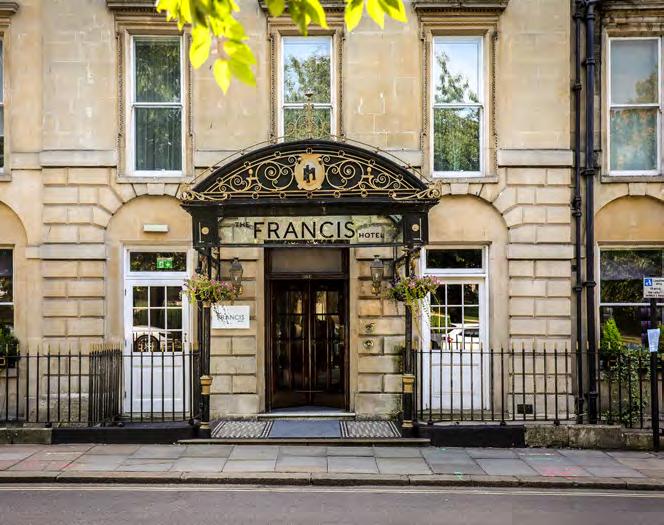
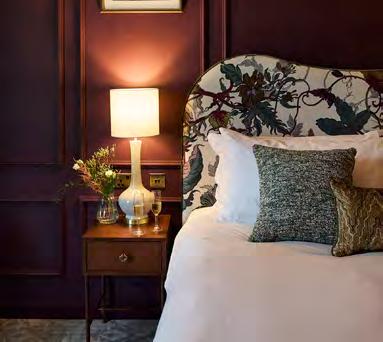
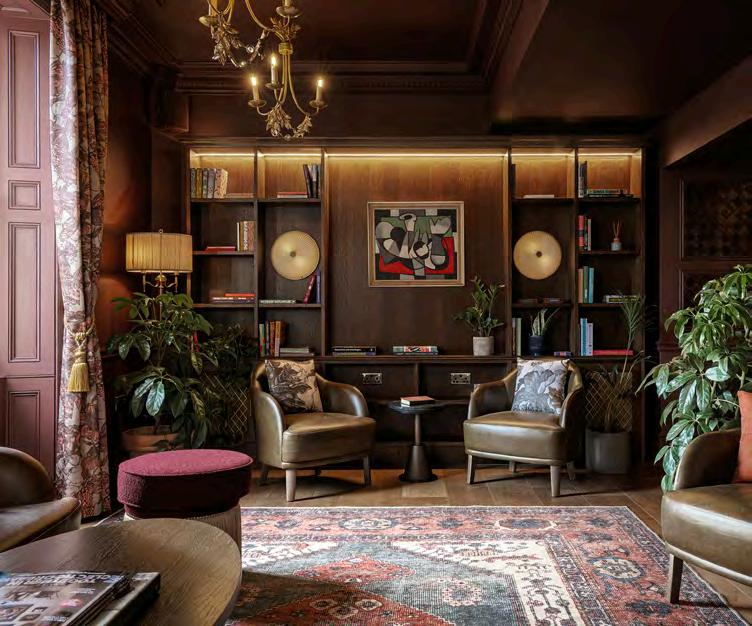
carefully prepared list of favourite local spots, personally recommended by the team, offering a more insider’s view of Bath. Those travelling with dogs find a bed and bowl ready in the room, along with a box of treats waiting after a long walk around the city. It is this quiet confidence –knowing things have been considered in advance – that defines the experience. Wherever they’ve been visiting, guests return to a beautifully tended room, a welcoming bar, the enticing aromas from Emberwood, and the restorative calm of the spa or snug. Privacy, presence and a strong sense of place come together here, creating a space to fully switch off.
Light, layout and art all contribute to a sense of expansive time. Large Georgian windows let in shifting daylight that subtly transforms the mood from morning brightness to evening glow. Tactile materials and generous proportions add to the feeling of ease, while a soft, distinctive scent runs through the spaces, always present but never overpowering. Art, much of it locally influenced and curated with Space Eclectic, brings character and conversation into the hotel; in the lounge, guests might linger over a martini from the trolley as the light fades across Queen Square and the artworks spark discussion.
Wellness at Francis Hotel is designed to fit naturally into a stay. The newly opened spa includes three treatment rooms using GAIA and QMS Medicosmetic products, alongside a calming Thermal Suite. In the bedrooms, guests can access yoga via their television, supported by yoga baskets thoughtfully provided by the team. A partnership with Mr B’s Emporium of Reading Delights brings curated books for ‘reader retreat’ moments, encouraging slow time with a good read.
Rooted deeply in Bath, the hotel actively weaves local culture and makers into the guest experience. Local instructors have created yoga videos that are streamed in-room, collaborations with independent artisans appear in personalised tote bags, and the kitchen follows a seasonal, locally led approach to sourcing. Sustainability is treated as an enhancement rather than a constraint, focusing on quality ingredients, enduring materials and considered choices that simply feel better.
The Francis Hotel on Queen Square where heritage, wellness and thoughtfulness blend
HOTELS
Whatley Manor, Easton Grey, Malmesbury; www.whatleymanor.com
Whatley Manor is a place to get away from it all and gently find your way back to yourself. Set in the heart of the Wiltshire countryside, this independently owned, fivestar retreat is immersed in nature and wrapped in a calm that feels increasingly rare. As guests wander through the ever-changing gardens, pause in quiet corners or simply breathe more deeply in the fresh country air, they begin to let go of the everyday and reconnect with the beauty of the present moment.
Across the manor’s 23 rooms, including 11 individually designed suites, luxury is quiet and confident rather than showy. Each space is unique in character, but all share an understated aesthetic that favours natural materials and thoughtful comfort over excess. Oak, soft fabrics and artisanal textures create a sense of warmth and sanctuary, while considered lighting keeps the mood gentle and ambient. The views are part of the experience: suites look out onto intimate courtyards, formal English gardens and the rolling Wiltshire landscape, giving guests an expansive feeling of space and calm.
Whatley’s philosophy is one of gentle hospitality. Instead of theatrical gestures and rigid rituals, the team specialises in quiet thoughtfulness – anticipating needs, placing small but telling touches and, often, stepping back so guests can enjoy the precious luxury of uninterrupted time. Stays are designed around ease: a peaceful walk around the grounds, a sophisticated room that is quiet by design, a day where nothing disturbs and nothing is demanded.
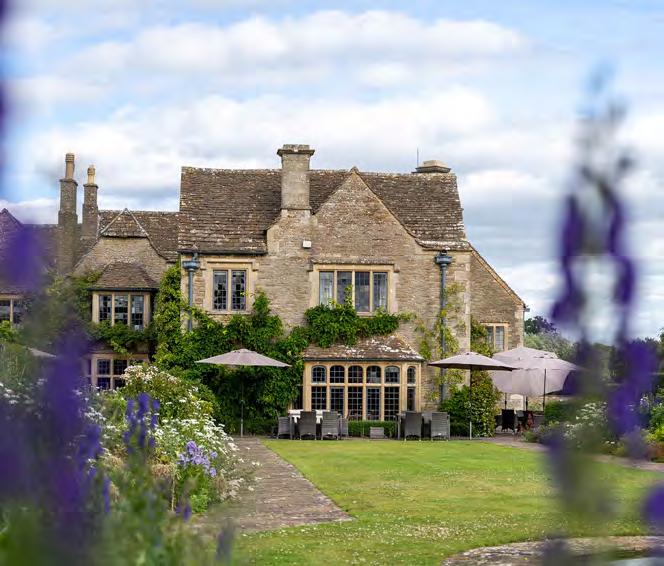
“Enjoy the precious luxury of uninterrupted time ”
Whatley Manor, an independently owned, five-star retreat, feels secluded, balanced and immersed in nature
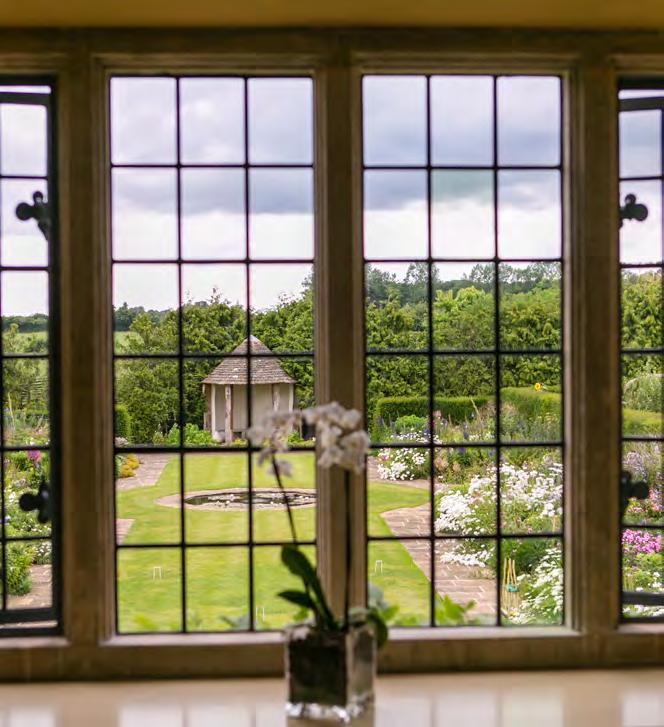
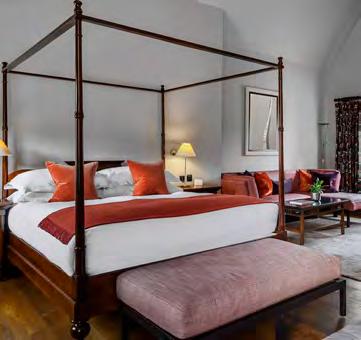
Wellness here is not a tightly scheduled programme so much as an extension of the overall experience. For some guests, it means deep relaxation in the spa with a Gaia treatment; for others, it might be a beautifully balanced dish in the restaurant, an hour of stillness in the drawing room or suite, or a slow stroll through the gardens guided by discreet QR codes that share what is growing and highlight points of interest. There are bicycles for gentle exploration of the surrounding countryside, and always the sense that every detail has been taken care of, so guests can simply slow down and restore their balance.
Though Whatley Manor feels deeply secluded, its setting encourages guests to explore the wider heritage of the region. Bath is just 40 minutes away, and the front of house team is ready with insider suggestions for cultural and historical experiences. Closer to the manor, echoes of the Roman past are woven into the landscape, from a nearby villa on the Fosse Way to the ancient town of Cirencester.
Sustainability is quietly embedded in every stay, approached as part of the property’s soul rather than a set of worthy obligations. The team works closely with local makers and mindful suppliers, pays meticulous attention to recycling and food waste in the kitchens, and cares for the gardens and surrounding land with a longterm view. The garden team, for example, recently cut and collected six months of growth from the wildflower meadow, dried it, and then returned the seed to the soil–nurturing biodiversity for seasons to come. The guiding principle is simple: guests should leave replenished and restored, just as Whatley Manor aims to leave the planet in better condition than it was found.
Few private rentals can offer this sense of being held by a place where every element – architecture, landscape, service, spa, and menus – has been carefully composed to support quiet restoration. Here, guests are free to stop thinking about logistics and lean into a slower rhythm, knowing their moments of calm will be gently protected. n
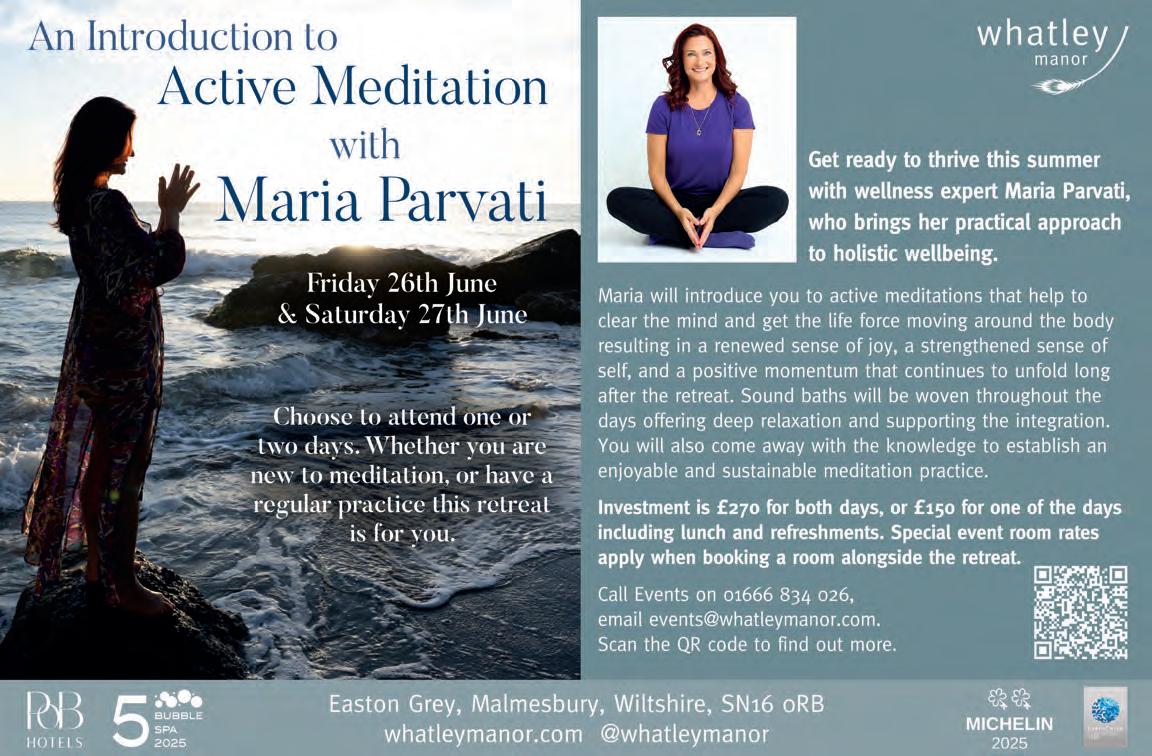
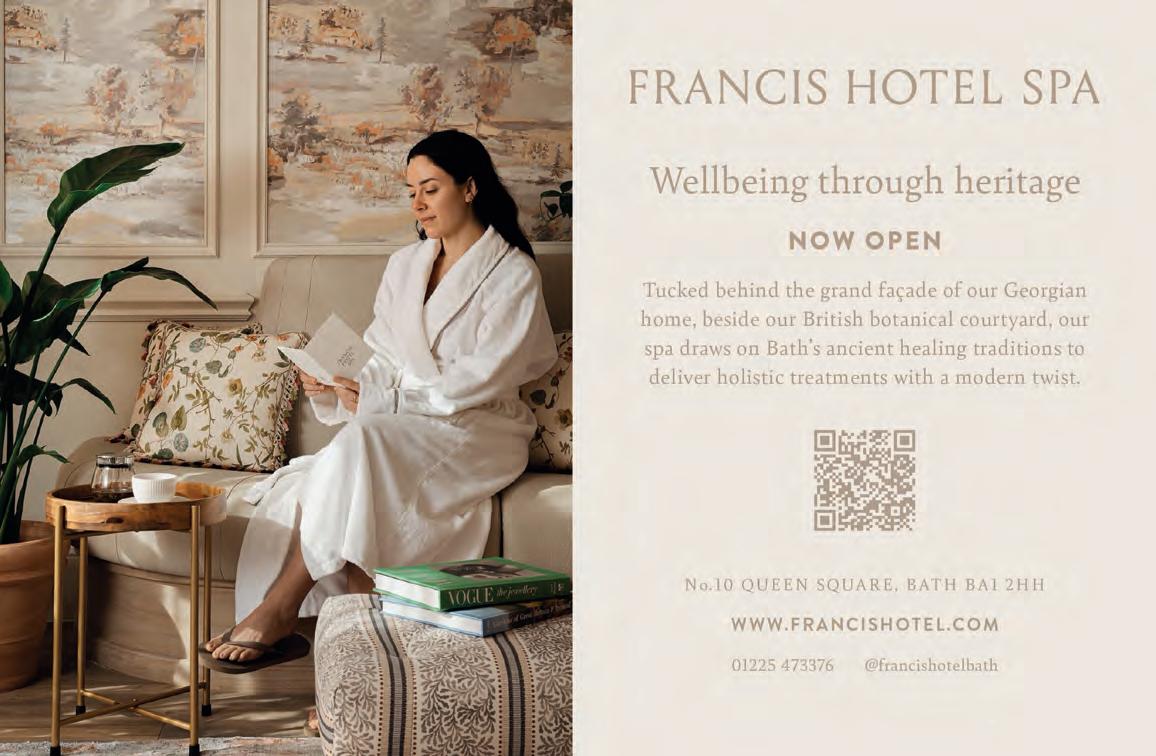
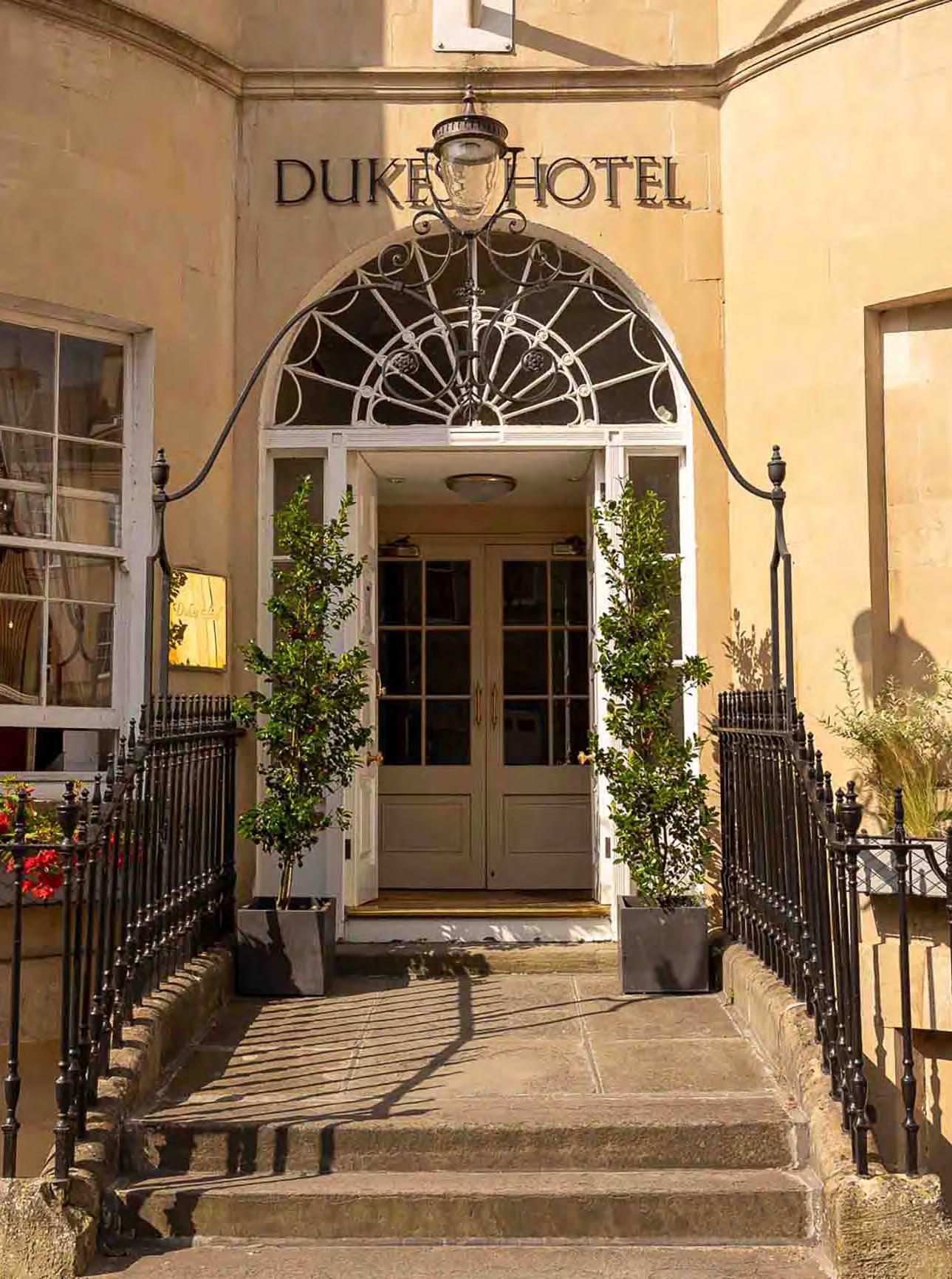
DUKES
CLARE MORRISROE stays at the luxury hotel that’s just paw-fect for a weekend away with her pampered pooch
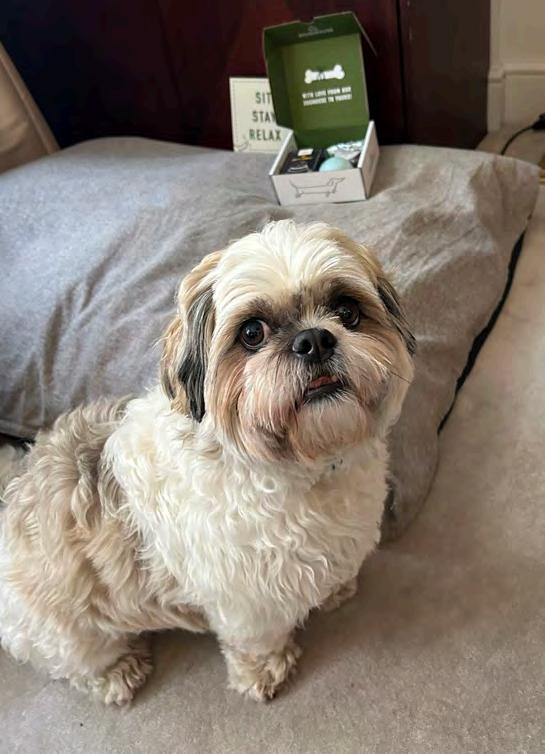
The beauty about being an empty-nester is that you suddenly have the freedom to drop everything for a spontaneous weekend away. Unless that is, you have a dog! Because our beloved fur babies can be more of a hindrance than a toddler when it comes to organising a last minute city-break. Of course, most fancy hotels won’t accommodate dogs. And you can forget visiting any must-see tourist attractions, as only the wellbehaved assistance varieties are allowed entry. Then there’s the tricky issue of where to eat. If you want something a tad more exciting (or romantic) than pub grub, then you really will have to whistle.
So, step forward Dukes Bath: the hotel that has thought of everything – for you and your pampered pooch! As soon as we walk through the front door of the upmarket boutique hotel, a Grade I listed building on Bath’s prestigious Great Pulteney Street, our Shih Tzu George is welcomed with open arms. And lots of treats. As I gaze and admire the eclectic furnishings, grand marble fireplace, and the breathtaking chandelier in reception – an effortless mix of elegant Georgian splendour and imaginative contemporary panache – our George is getting belly-rubs from the enthusiastic staff on the front desk. Inside our luxurious and newly refurbed cosy king room, there is an incredibly comfy king size for us – and next to it on the floor is a cushioned bed for George that looks just as cosy. We needn’t have packed dog bowls – in the stunning and spacious modern Victorian marble-clad bathroom there are two provided – one for food and another for water. There is also a gift Woof Box filled with everything you might need (or might have forgotten). There is a portion of dried dog food, some tasty fishy treats and poop bags. And a ball, which comes in very handy when we all take a quick stroll around the nearby beautiful and serene Henrietta Park.
Think that’s impressive? “If you want to see more of the sights this afternoon,” we are told by the porter who carries our bags, “we can
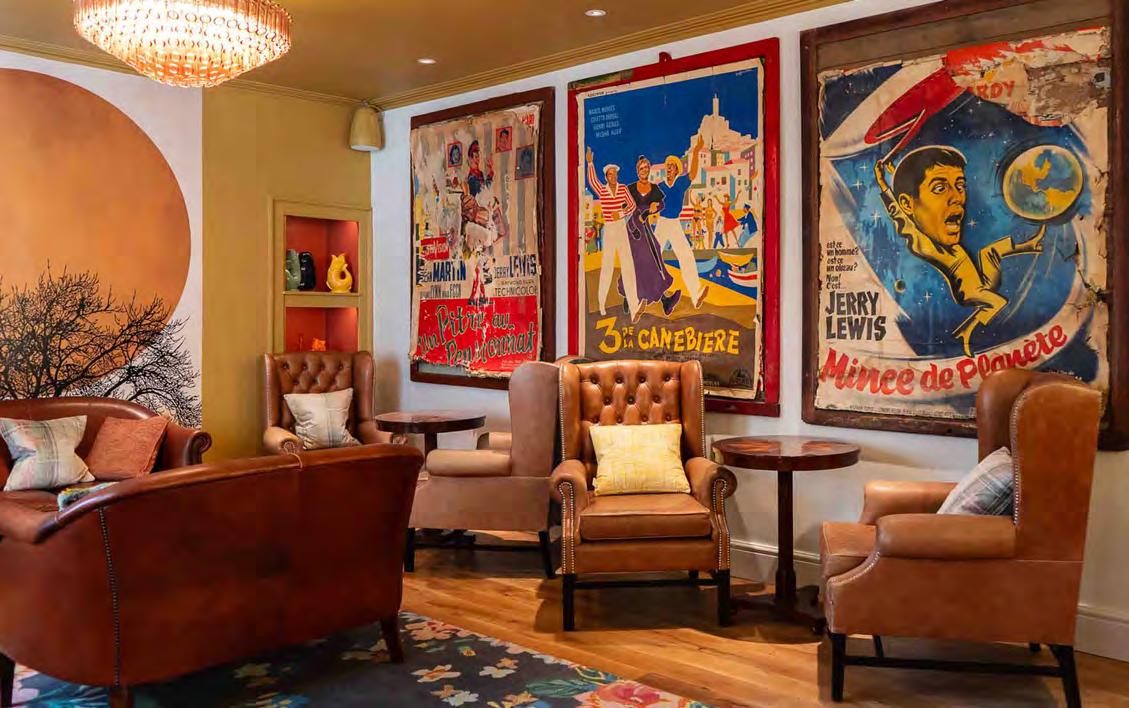
“They’ll even take him for walkies”
RESTAURANT
arrange a dog sitter who will look after George.” They’ll even take him for more walkies. Now that’s what I call service! The price is £80 for five hours, which we work out is just enough time to visit the ancient Roman Baths, have a quick walk around the Cathedral and enjoy a two-hour slot in the city’s chic Thermal Spa, where we take in those spectacular views of the city from the rooftop pool.
The next day we want to get to know the city further and take a mooch around the historic streets, taking in the independent shops, checking out the historical tea houses and the impressive Georgian architecture. Turns out we can easily take a mooch with a pooch. We are assured Bath is a city that loves dogs, so George comes with us and yes, he is welcomed everywhere with a treat and plenty of strokes. We even manage to navigate a look around the splendid Bath Art Fair in Bath Pavilion with a studious George enjoying the city’s artistic talent and yet more attention from attentive artists!
In the evening, there are no difficult dilemmas about where to eat dinner. Dukes’ sister hotel, The Bird, is a short stroll away, and its Plate restaurant is just as fabulous, its décor just as colourful, quirky and engaging as its sibling. The ambience is lively with a cocktail bar, chilled tunes and a laid-back vibe. If you don’t have a dog, don’t worry as the majority of tables are dog free – but having the dog-friendly table option is a joy. We are greeted by Miklos, the assistant restaurant and bar manager, who sits all three of us at a candle-lit table. At the next table is a couple with their two small Dachshunds, curled up on a blanket at their feet. Already content, our happiness levels go up a notch again when we learn about the menu. The ingredients are fresh and all locally sourced by head chef Kieran Ballam, who’s created a quintessentially British menu with a fun, modern twist.
For starters I have the braised pigs cheeks with crispy squid in tempura batter on a bed of apple puree. The flavoursome pork is incredibly tender, works surprisingly well with the soft meat of the squid and is elevated by the crunch of the batter and sweetness of the puree. Memorable and impressive. As is Miklos, who gently steers my reluctant other half to try the white crab sourdough crumpet (because I want to try that too!) On paper, it sounds like the oddest of pairings. ‘If you like fish, you’ll love this,’ he assures. To my delight, my other half goes for it. And it doesn’t disappoint. The fresh delicacy of the cold white crab contrasts with the warm chewy sourdough and the creamy, nutty celeriac remoulade is absolutely knockout. For mains, I go for the 10oz ribeye with peppercorn sauce. It’s a retro classic and the tender, juicy and buttery quality of the steak demonstrates both the high standard of the produce used here and the kitchen’s skill. Teamed with Koffman fries, a side of crispy charred bacon buttered cabbage is the perfect accompaniment. The OH goes for the venison cooked with blackberries and accompanied by bubble and squeak. Again, another interesting combo that works beautifully.
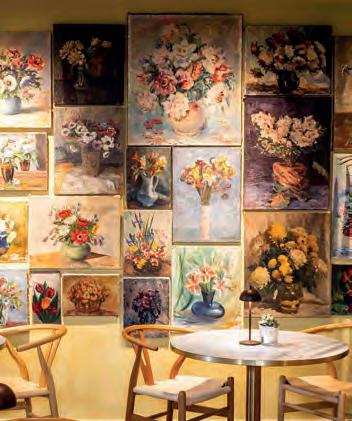
STAY DETAILS
Dukes, Great Pulteney Street, Bath, BA2 4DN. tel: 01225 787960; www.dukesbath.co.uk
Owned by Kaleidoscope Hotels, who own The Bird, Bath, Homewood Hotel & Spa, Bishopstrow, and acquired Dukes in 2024.
Rooms The hotel has 18 rooms including top-floor retreats with roof-top views and grand four poster suites. Prices start from £130.
Pet policy A charge of roughly £35 per dog per night applies, typically allowing dogs under 25kg. Dogs are not permitted in the breakfast room, but breakfast may be enjoyed as room service, in the bar or in the courtyard, weather permitting. They also kindly ask dogs remain off the furniture and not to be left unattended in the rooms.
Chef Kieren Ballam, head chef who used to work at Chequers and has been with the Kaleidoscope family for many years.
Type of food at Dukes Breakfast is a full range of cooked and continental options, all celebrating British-grown produce. You can also indulge in afternoon tea, with a mouth-watering selection of sweet treats, dainty pastries and scones with lashings of West Country cream and homemade jam. Grazing plates are also on offer in the bar area.
Plate at The Bird restaurant A full menu for lunch and evening meal options is just a short stroll away from Dukes. Specialities include Tomahawk Fridays, and we hear the Sunday roast is legendary.
Outdoor space A small, outdoor terrace with a hot tub for guests to use (included in some stays but is a bookable extra for others).
Do we have room for dessert? You bet! Pudding is always the best course for me. Again I am drawn by the dishes with the boldest ingredients and most imaginative descriptions. The first is a showstopper dessert of Black Forest gateau made from chocolate and cherry mousse and decorated with two perfectly formed giant cherries made entirely from mousse – even the stalks are created from chocolate. It is a work of art on the plate. The second (and my favourite) is the miso apple tarte tatin with black pepper ice cream, which is insanely good. With the crispiest of flaky pastry, the sharp flavour of the black pepper in the ice cream cuts through the sweetness of the apples magnificently. Unfortunately for George, we clear everything and no doggy bags are needed.
Then we three meander back to Dukes, where we could have taken advantage of a late-night dip in the rooftop hot tub. But after such a feast, we are sated and happy and drawn to lounge in our stunning bedroom, and George to his comfy basket. We all agree (a dog owner can always tell if her baby is happy) that our next ‘spontaneous’ emptynester trip should be here again, and we drift off dreaming of happy dogs, beautiful Dukes, and delicious dinners.
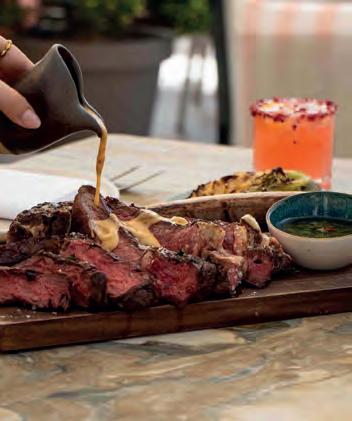
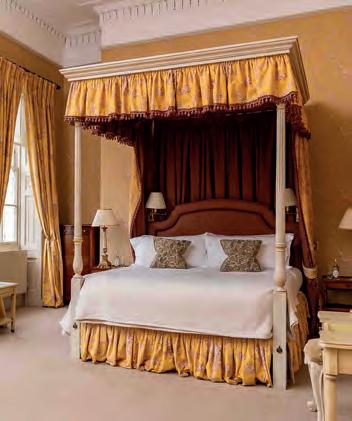





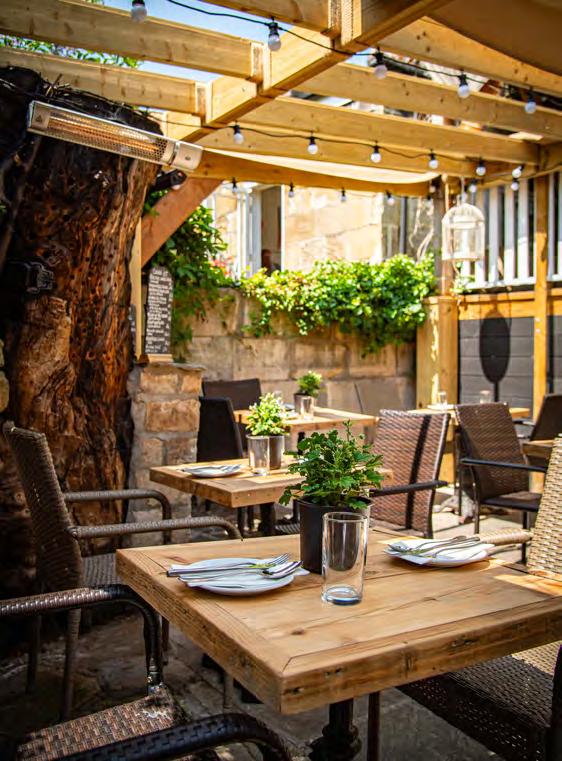
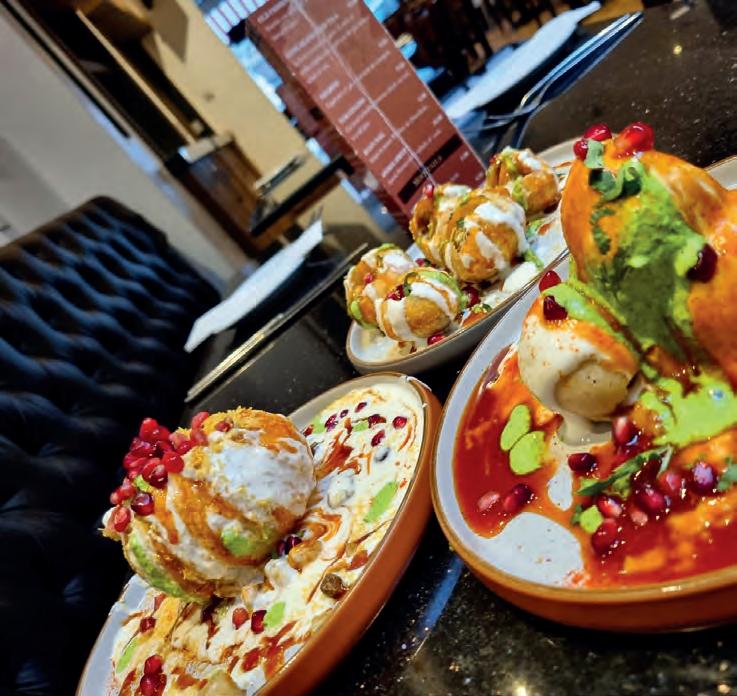


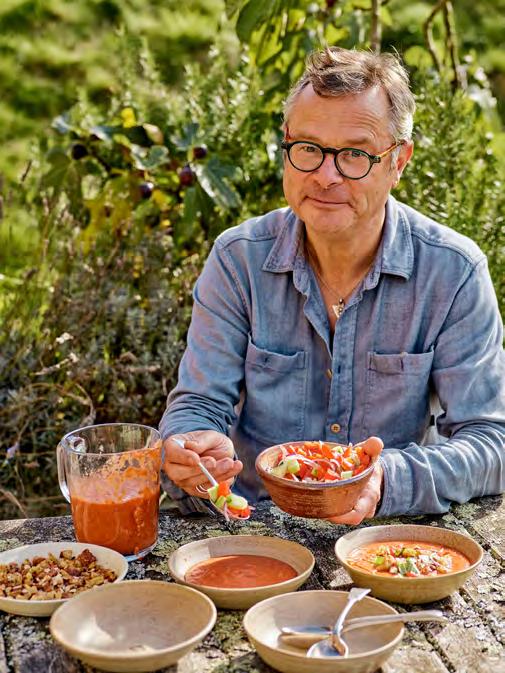
THE PONY’S 20-YEAR JOURNEY
The Pony Chew Valley is about to celebrate its 20th anniversary with a summer-long programme of events. Founded by siblings Josh and Holly Eggleton, the then Pony & Trap was taken over by the pair in 2006 when they were just 22 and 19. Their modern seasonal British cooking and rooted, community-first hospitality quickly earned national acclaim, including a Michelin star held until the pandemic.
Now evolved into The Pony Chew Valley – a rural restaurant with cookery school, gardens and orchards – the site will celebrate the milestone with a garden party on 4 May and the launch of a limited-edition perry produced with neighbouring makers Wilding Cider.
From 6 May to 26 September, The Pony will replace its usual à la carte offering with ‘The Pony from the Archives’, a menu of its most-loved dishes from 2006-2026, alongside harvests from its no-dig garden. The menu will showcase long-standing Somerset suppliers such as Newberry’s Smokehouse, Strode Valley Organics, Homewood Cheeses and Yeo Valley Organic.
FIBRE OPTICS
Food campaigner and chef Hugh Fearnley-Whittingstall will headline an event at Bath’s Guildhall on 22 May as part of the Bath Literature Festival. In conversation with editor and journalist Gaby Huddart, Hugh will discuss his new book, High Fibre Heroes (published 6 May by Bloomsbury, £26), and explaining why he wants us all to eat more fibre – not just to boost our health –but to also help the planet.
The book follows on from his bestseller How to Eat 30 Plants a Week, and sets out to make the ‘fibre revolution’ deliciously simple with 12 everyday vegetables such as peas, carrots, cabbage and lentils featuring in 100 easy recipes.
For more: www.bathfestivals.org.uk | www.rivercottage.net

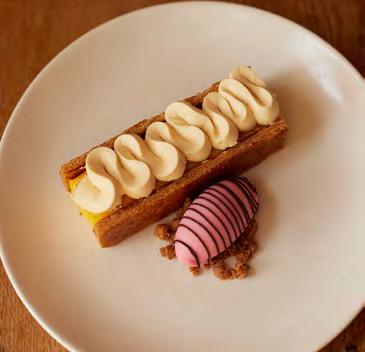
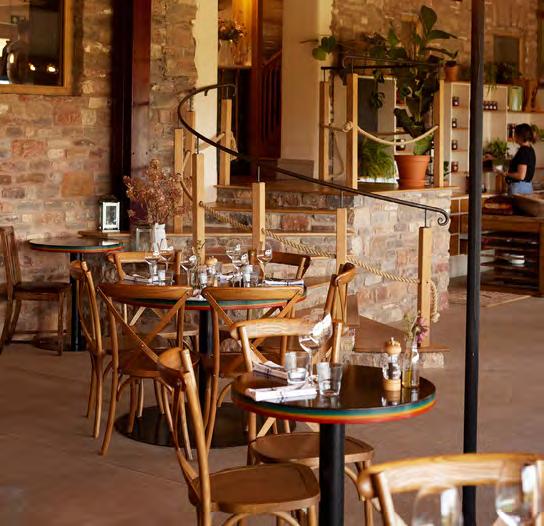
June will then see the publication of The Pony Cookbook by Josh, a collection of the restaurant’s signature modern British dishes and the stories behind them.
“Being at the forefront of the Michelin-star pub movement taught us so much; but it had never been the goal,” says Josh. “Now we’ve distilled everything we’ve learned into what The Pony is… somewhere that really benefits the community we are part of, for the next 20 years and beyond.”
For more: www.theponychewvalley.co.uk
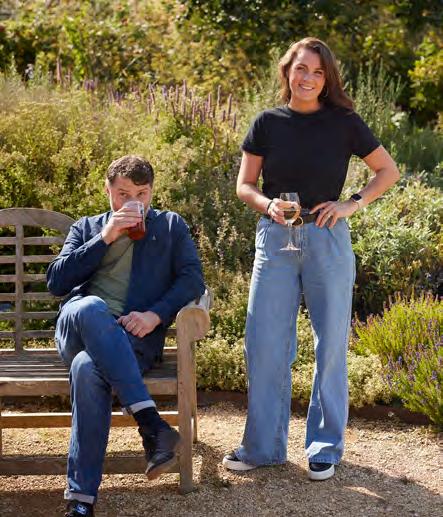
His new cookbook celebrates the benefits of fibrous veg
Hugh’s headed to the Guildhall
above: The Pony is celebrating two decades; left: Brother and sister duo Josh and Holly Eggleton; inset: The menu will feature all-time favourite dishes


SHOPPING
LIVE WELL, BUY BETTER
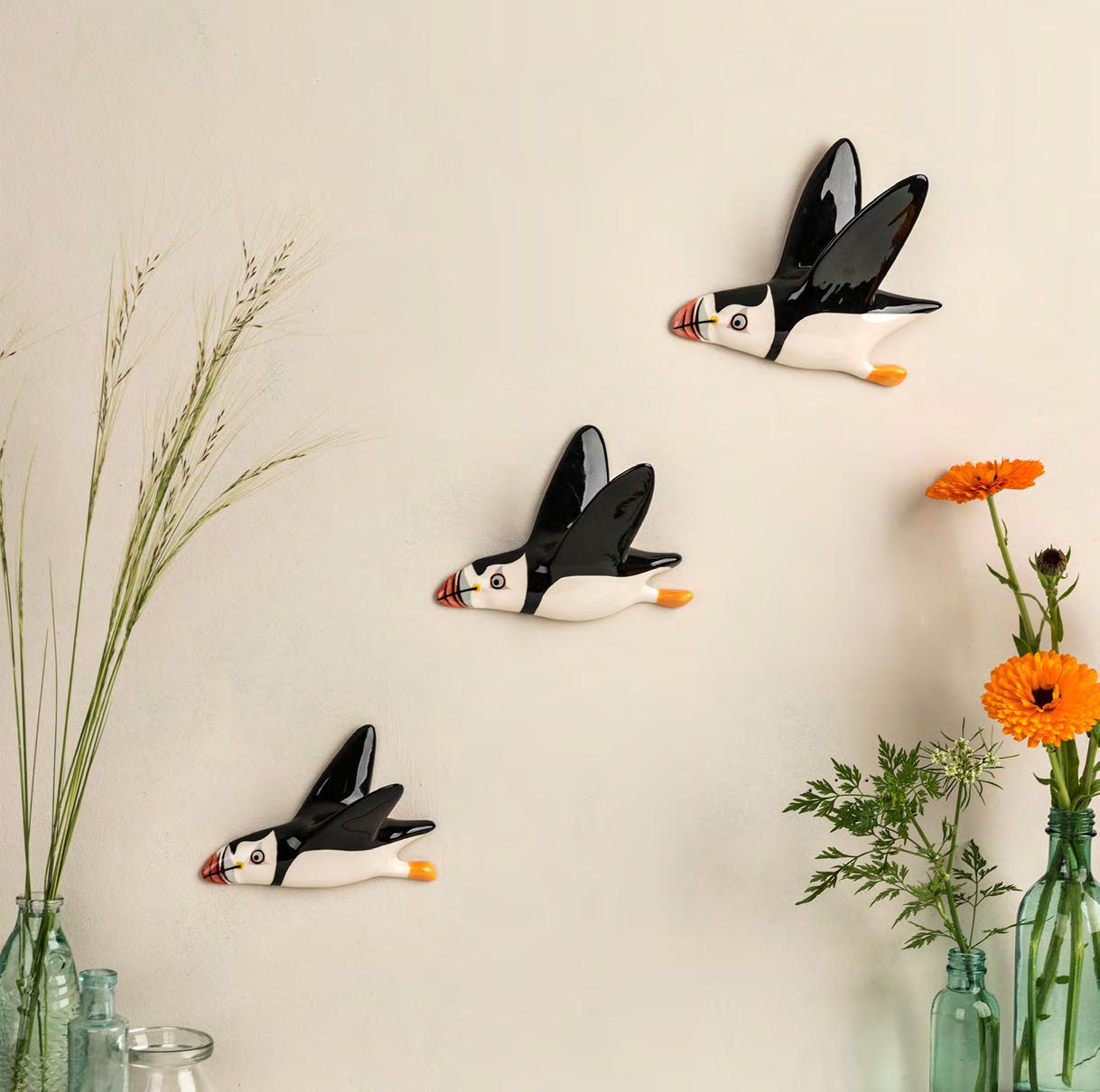
FLY ON THE WALL
Globally listed as ‘vulnerable’, puffins in the UK face threats from climate change, overfishing and severe storms, so conservation work now focuses on protecting their nesting sites and safeguarding the fish stocks they rely on.
And here’s a stylish way to help the puffin cause and contribute towards safeguarding their future. Hannah Turner, the ceramicist and artist based in Bradford on Avon, has designed the three flying puffins wall art, with £5 from each mural sold donated to the Royal Society for the Protection of Birds’ puffin conservation efforts.
Three flying puffins ceramic wall art by Hannah Turner, £135; www.hannahturner.co.uk
UCCELLINO SMALL DECORATIVE BIRD, £35
A delicate ceramic hand-painted in Jingdezhen and adorned with a floral Chinoiserie motif design in a stunning jade colourway that reflects generations of artistry. From OKA, 26-27 Milsom Street, Bath; www.oka.com
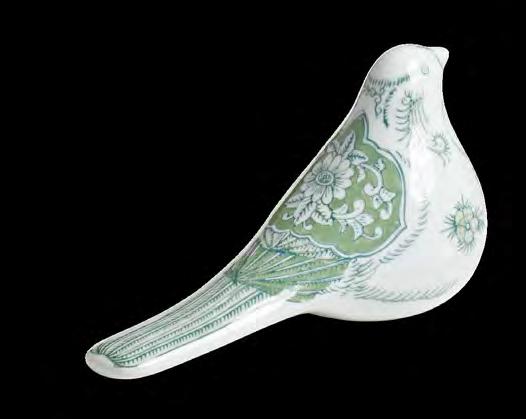
FLIGHTS FANCY
Watch the birdie with these locally sourced and beautiful
MINI ART POT, £28
This gorgeous garden bird mini art pot from Poppy Treffry is made from a heavy plain cotton and individually embroidered with a blackbird.
From Homefront Interiors, 10 Margaret’s Building, Bath; www.homefrontinteriors.co.uk
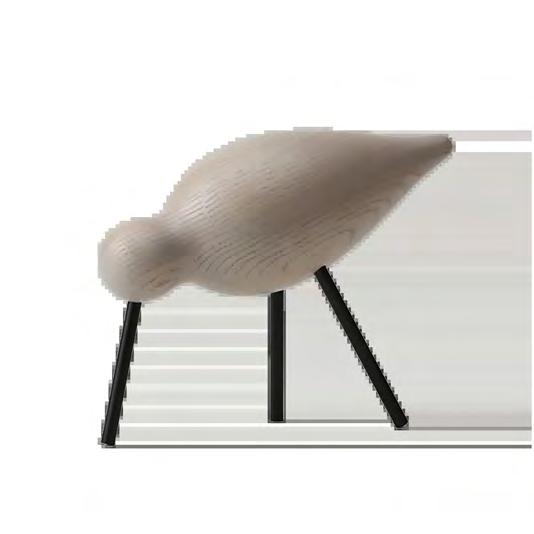
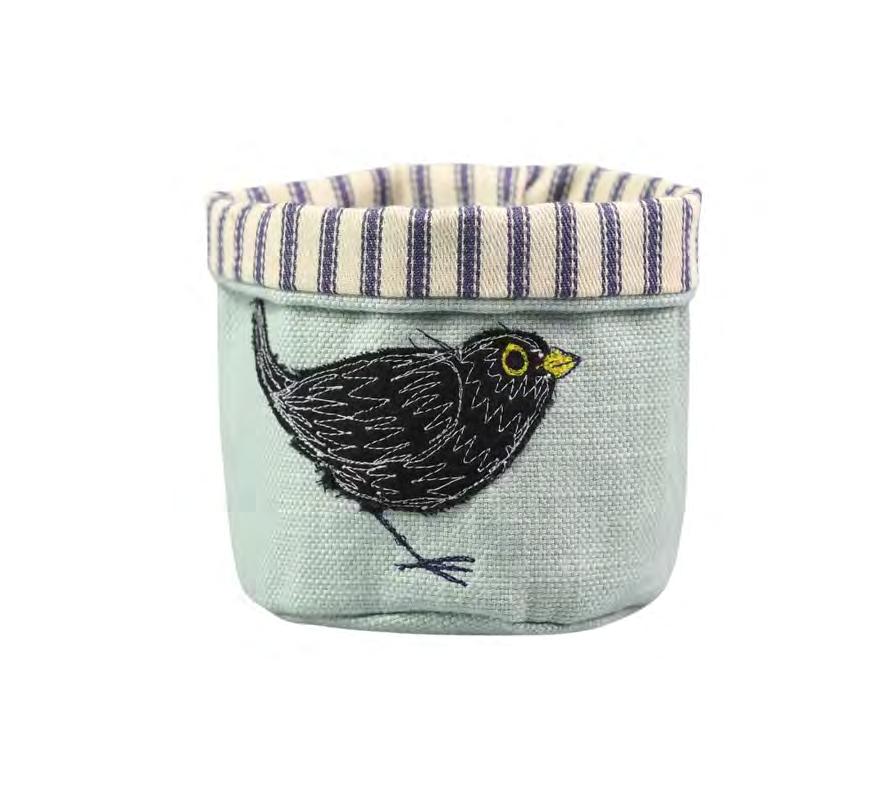
SHOREBIRD IN WHITE OAK BY NORMANN COPENHAGEN, £33
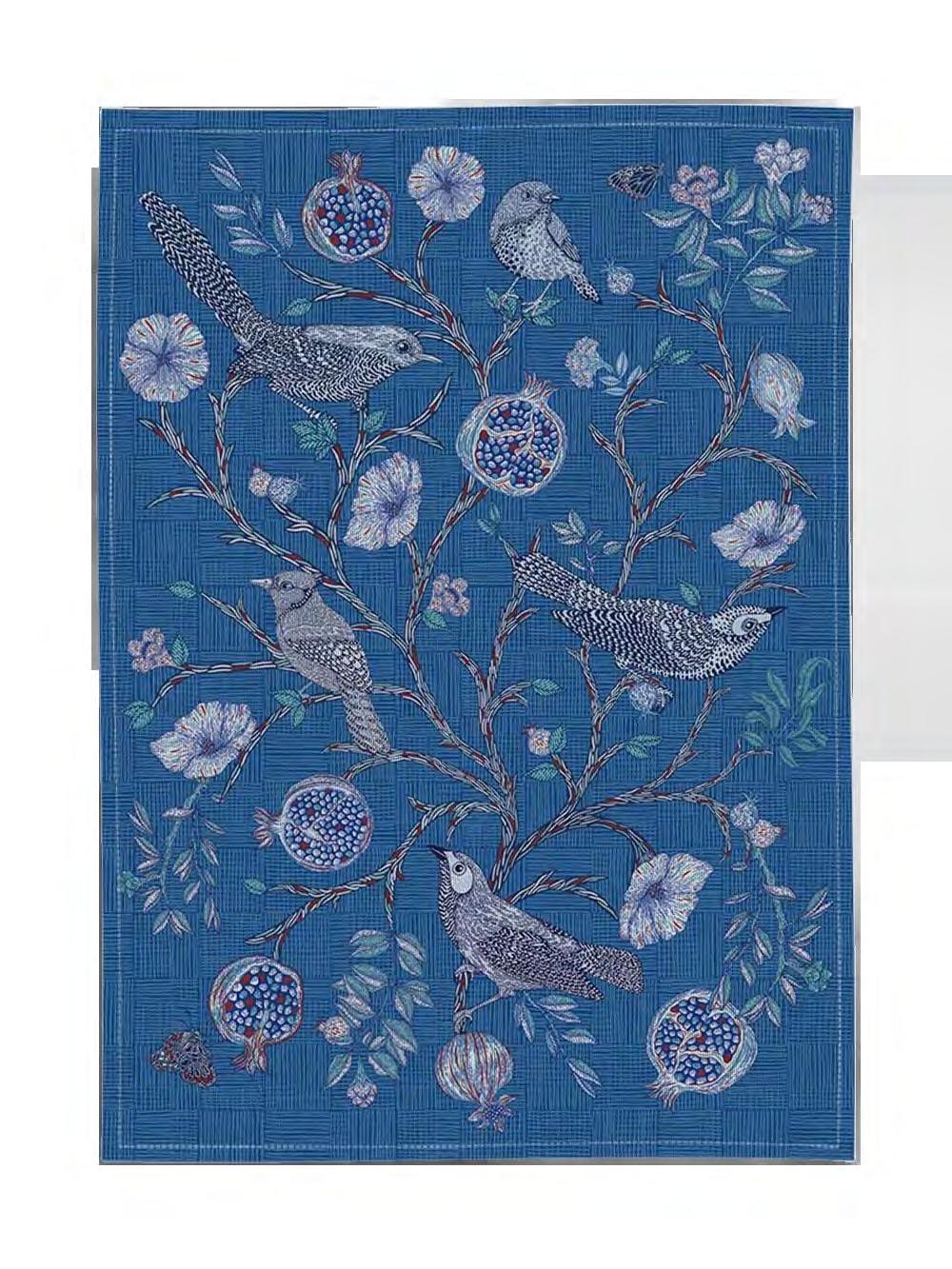
LINEN BIRDS TEA TOWEL, £21
Soft blue foliage and small red accents highlight the delicate illustration of birds perched among branches, blossoms and pomegranates.
From Avenida Home; www.avenidahome.com
Designed by Sigurjón Pálsson and created especially as a limited edition of 40 for the Holloways of Ludlow’s 40th birthday, the playful wooden ornament captures the essence of wading birds through a simple, stylised silhouette.
From Holloways of Ludlow, 37 Milsom Street, Bath; www.hollowaysofludlow.com

DOVE CEMENT CANDLE HOLDER, £11.95
With a rustic finish and textured feel, this dove candle holder is crafted from cement with a natural finish, adding a touch of archaeological charm to your décor.
From Graham and Green, 92 Walcot Street, Bath; www.grahamandgreen.co.uk
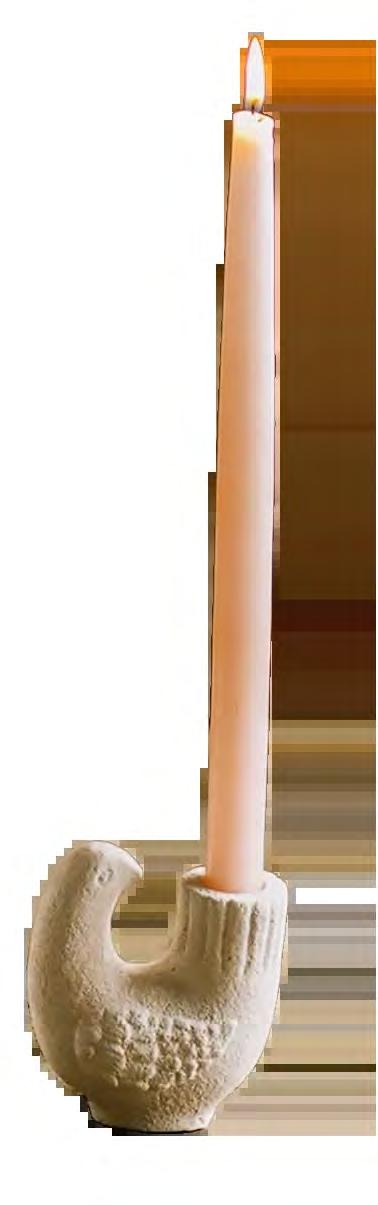
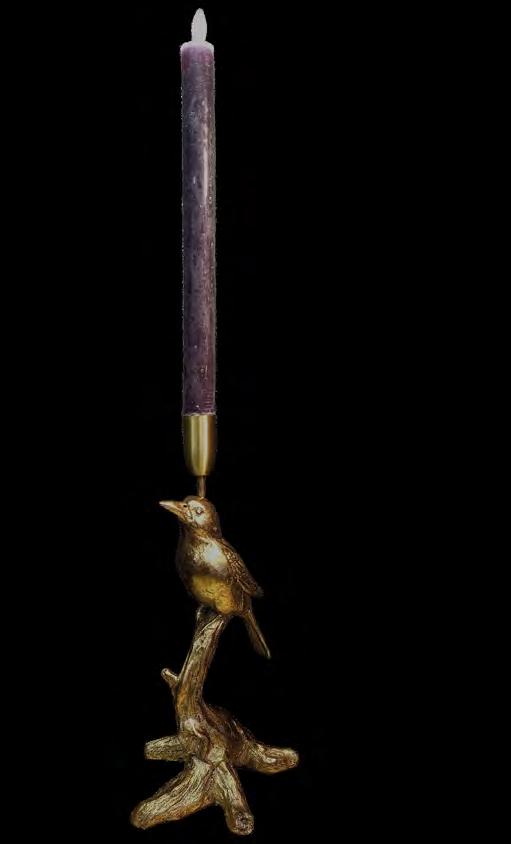
GOLD
BIRD CANDLE HOLDER, £28
Antique gold metal bird candle holder, branchtextured base – elegant and quirky, perfect for dining tables, mantels and year-round décor
From Tillius, 4-5 Pulteney Bridge, Bath; www.tilliuslifestyle.com
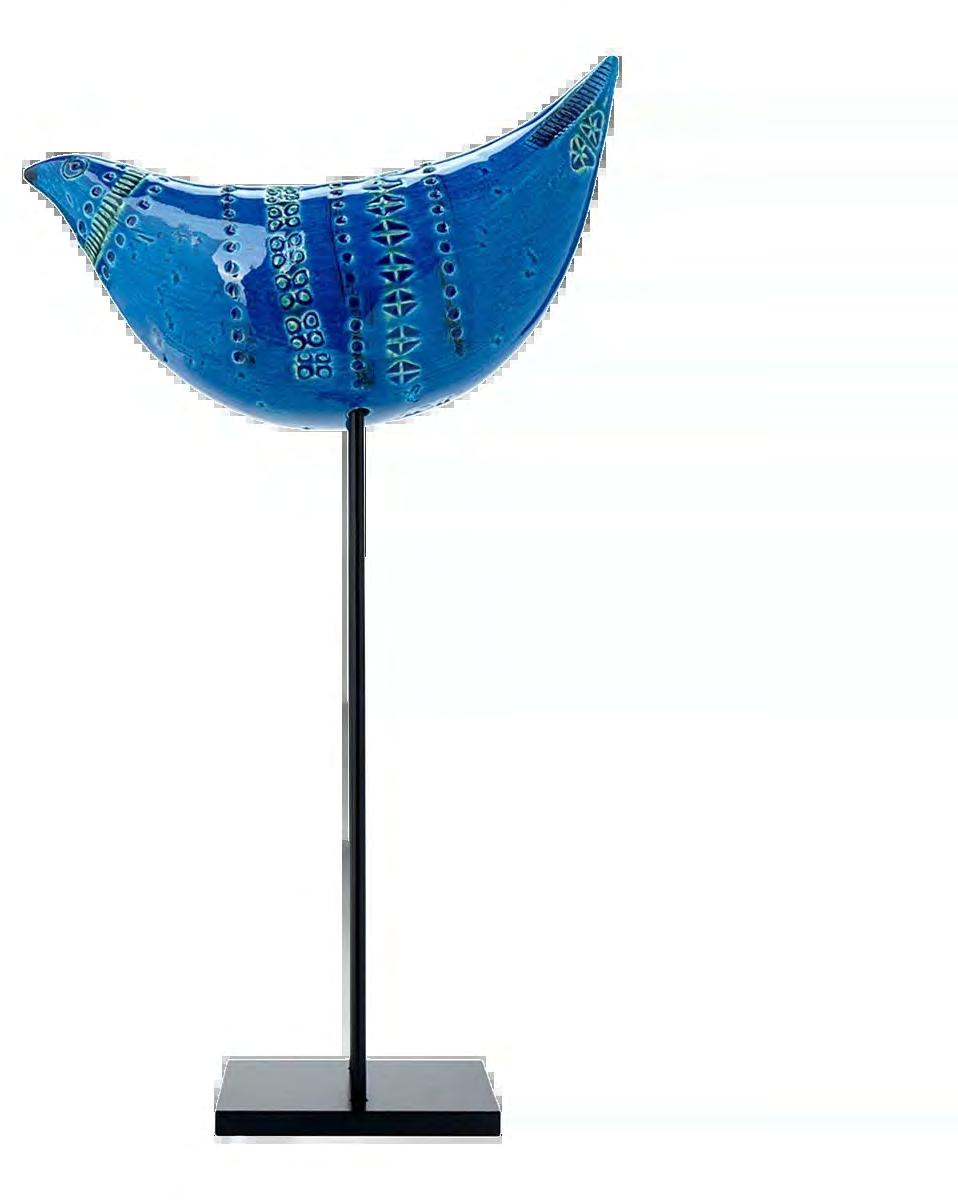
BIRD
FIGURE BY BITOSSI CERAMICHE, £260
The figure balancing on a metal base, originally known in Italian as Figura di uccello su base di metallo, is part of Aldo Londiʼs Rimini Blu collection, where the deep blue colour and playful shapes evoke the atmosphere of the Riviera.
From Courthouse Interiors based at Kilver Court, Kilver Street, Shepton Mallet; www.kilvercourt.co.uk
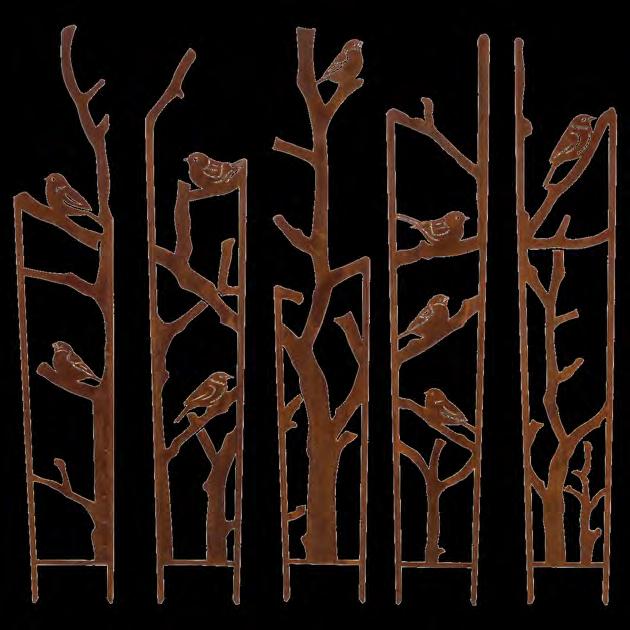
PERCHED BIRDS TRELLIS, £150
Crafted from rusted steel, its delicate silhouettes of songbirds resting among slender branches create a sense of quiet movement and natural beauty.
From Cox & Cox; www.coxandcox.co.uk
EAMES HOUSE BIRD BY VITRA, FROM £225
Charles and Ray Eames enriched the collage-like interior of their private home, the Eames House, with numerous objects and accessories that they brought back from their travels, including the figure of a wooden bird that stood in the centre of the living room for more than 70 years.
From Healʼs, 20 Milsom Street, Bath; www.heals.com
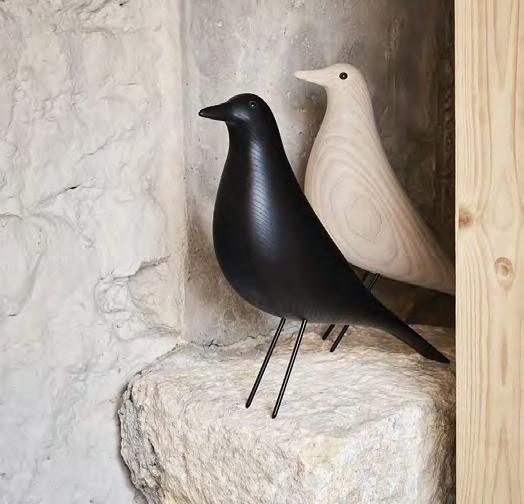
BYE BYE BIRDIE!
WALLPAPER BY DIVINE SAVAGES, £159 PER ROLL
Inspired by Divine Savages’ love of classic chase scenes from the golden age of animation, this playful design features mischievous felines stalking unsuspecting budgies for a whimsical pattern.
From Divine Savages, 5 Margarets Buildings, Bath; www.divinesavages.com
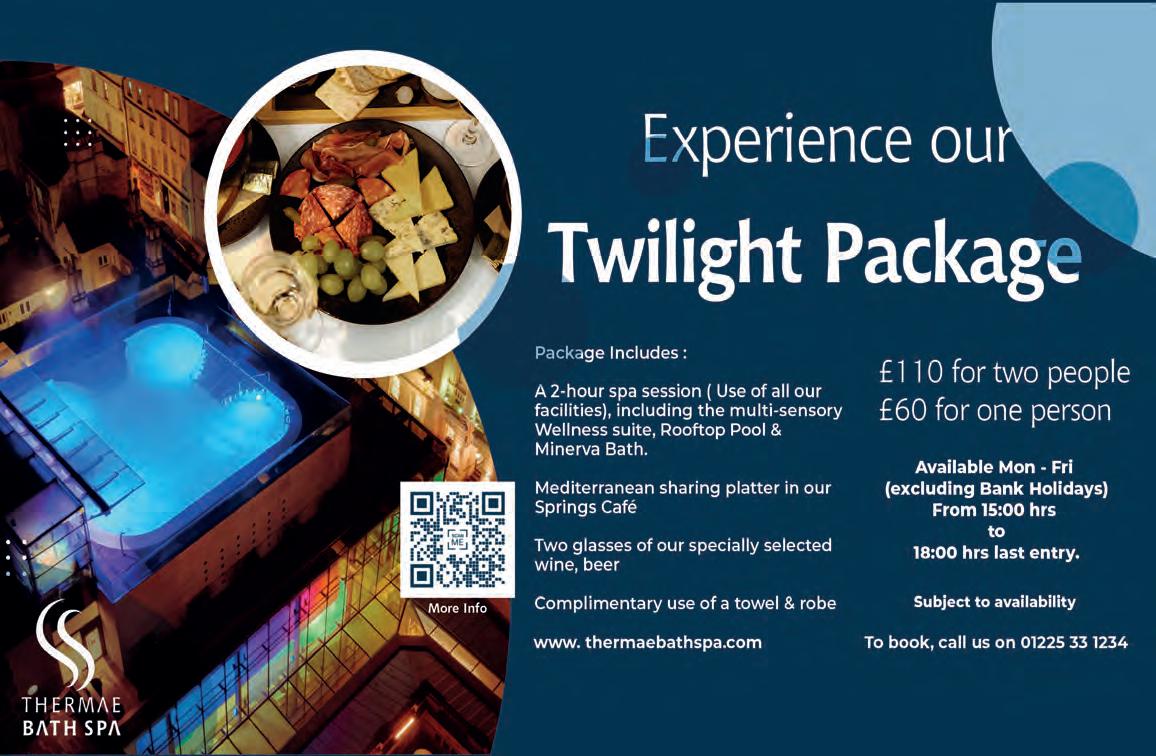
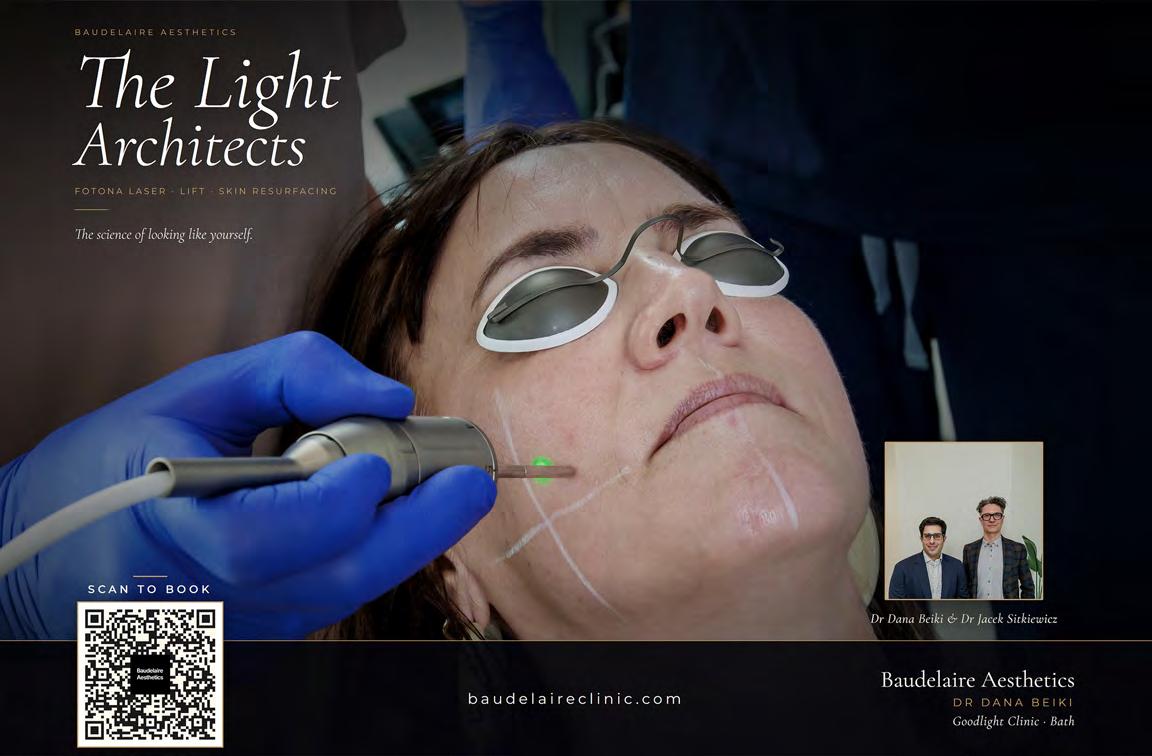
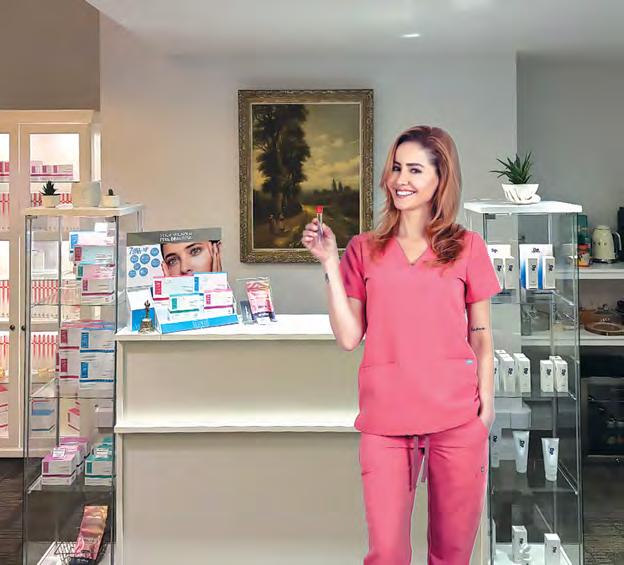
OFF THE SCALE!

Sarah Baker visits SAQUA to try a new treatment, which has the magical secret ingredient of highly purified salmon DNA
Tucked quietly in the heart of Bath, SAQUA Beauty Clinic feels less like a traditional aesthetic clinic and more like a calm, considered spa for skin. Led by biologistaesthetician Sevcan Caglar, SAQUA represents a new generation of beauty salons — one founded not on quick fixes but on science, education, and long-term skin health. Sevcan’s academic background, combined with extensive advanced training across facial, body and aesthetic treatments, is immediately evident. Certificates line the walls not as decoration, but as proof of a practitioner committed to her profession.
Originally from Turkey, Sevcan moved to Bath four years ago to establish SAQUA and continue her work in advanced nonsurgical aesthetics. Since then, the clinic has quietly built a loyal following, and industry recognition followed when SAQUA was named a finalist in the Hair & Beauty category at the recent Bath Life Awards. From the moment I stepped inside, the experience felt distinctly different. There’s none of the clinical intimidation sometimes associated with aesthetic treatments. Instead, Sevcan combines warmth and reassurance with impressive technical authority. A thorough
consultation comes first – thoughtful, unrushed and entirely personalised –setting the tone for an approach rooted in trust. She has a quiet confidence and the kind of manner that inspires me to go for her recommended aesthetic treatment, polynucleotide mesotherapy, a minimally invasive aesthetic treatment designed to rejuvenate the skin and improve overall skin quality.
“These molecules are biocompatibleexceptionallywith human skin”
It is one of the most talked-about regenerative skin treatments currently emerging in advanced aesthetics. Rather than altering appearance, polynucleotides work at a cellular level to restore skin health. Derived from highly purified salmon DNA, these molecules are exceptionally biocompatible with human skin and stimulate the skin’s own repair system. Unlike traditional fillers that add volume, the goal here isn’t instant change, but regeneration. The polynucleotides act as biostimulators, signalling your own body to produce more collagen and elastin to naturally thicken and firm the skin. What makes polynucleotide therapy particularly interesting is its anti-inflammatory and antioxidant action, helping repair environmental damage whilst strengthening the skin’s barrier. Polynucleotides have water-binding properties that significantly boost moisture levels, and it feels less like a harsh anti-ageing treatment
and more like future-proofing your skin. It is said to be highly effective for delicate areas such as the under-eyes (reducing dark circles and hollows), neck, décolletage, and hands, and can be used to treat acne scars, surgical scars, stretch marks, and inflammatory conditions like rosacea. It’s even used for hair restoration, being injected into the scalp to improve tissue health and stimulate hair growth.
Sevcan talks me through the technique first, which involves injecting small amounts of vitamins, amino acids and other active ingredients into the middle layer of the skin (the mesoderm) as this helps deliver essential nutrients directly to the cells where they are needed most. After cleansing, a numbing cream is applied before the 45-60 minute treatment begins with a series of microinjections. The injections themselves are quick and precise – mildly uncomfortable in places but entirely manageable. Some redness and light bruising followed, emphasising that this is no immediate fix, and I’d advise giving it a week or so before a major event as a safeguard. The redness faded quickly, the bruising was a few days but if you’re determined, both were easily covered with make up.
Even after one session, I noticed improved hydration, smoother texture and a fresh, healthy glow. The results feel understated yet effective – the kind people notice without quite knowing why. The result is stronger, more resilient skin with improved tone, texture and ‘glow’ over time – a subtle, refreshed appearance that looks entirely natural. Polynucleotide mesotherapy costs £200 per session, or £550 for a recommended course of three treatments, which may sound a little pricey, but given that the treatment builds progressively, it means not only longer-lasting results, but results that get progressively better over time, and not fade in an instant. n
For more: SAQUA Beauty Clinic, 2 Northumberland Buildings, Bath; www.saqua.co.uk
far left: Biologistaesthetician Sevcan Caglar in her SAQUA clinic; left: The treatment begins with a series of micro-injections



email stephanie.dodd@mediaclash.co.uk


CHAPTER & VERSE
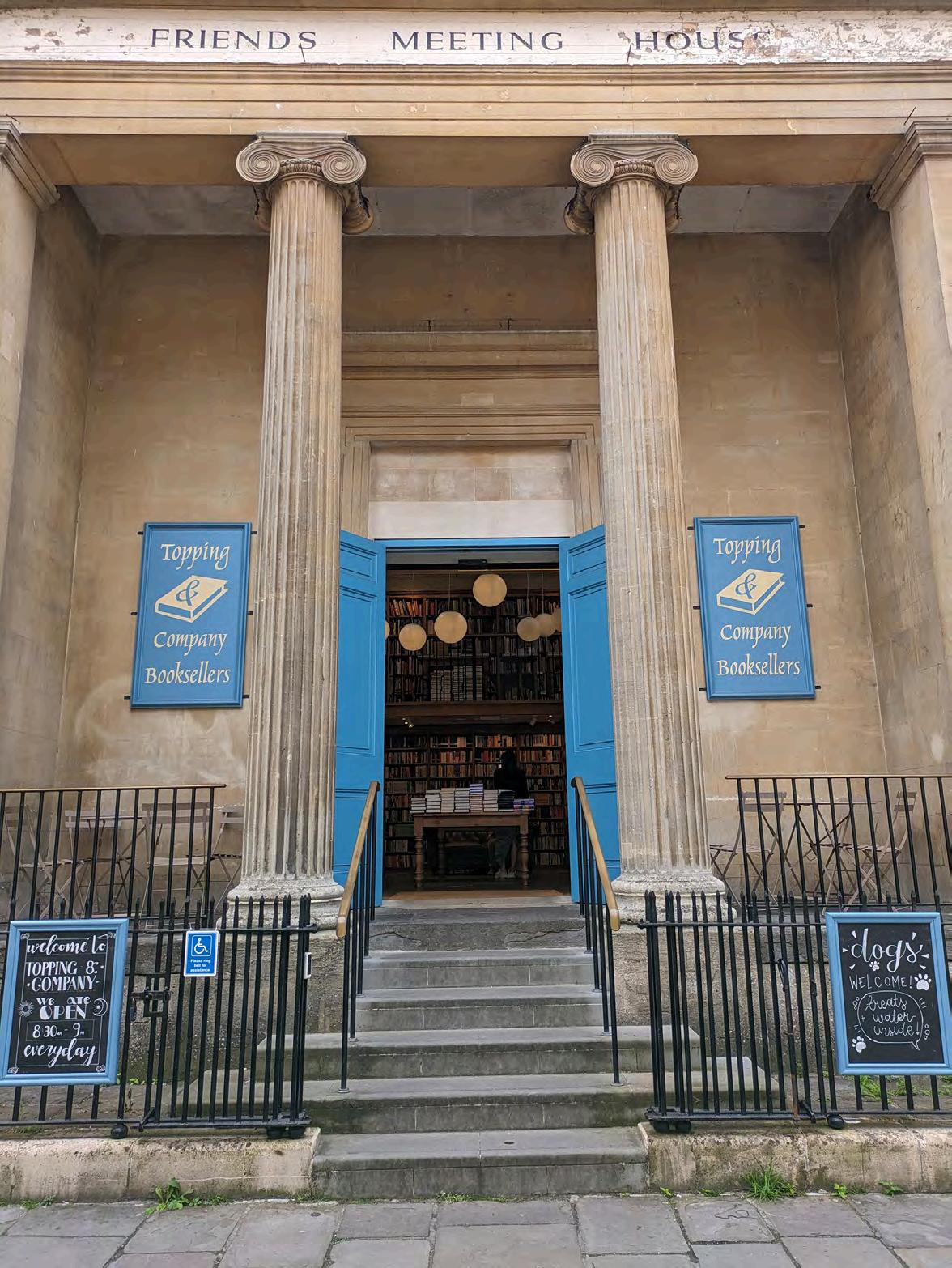

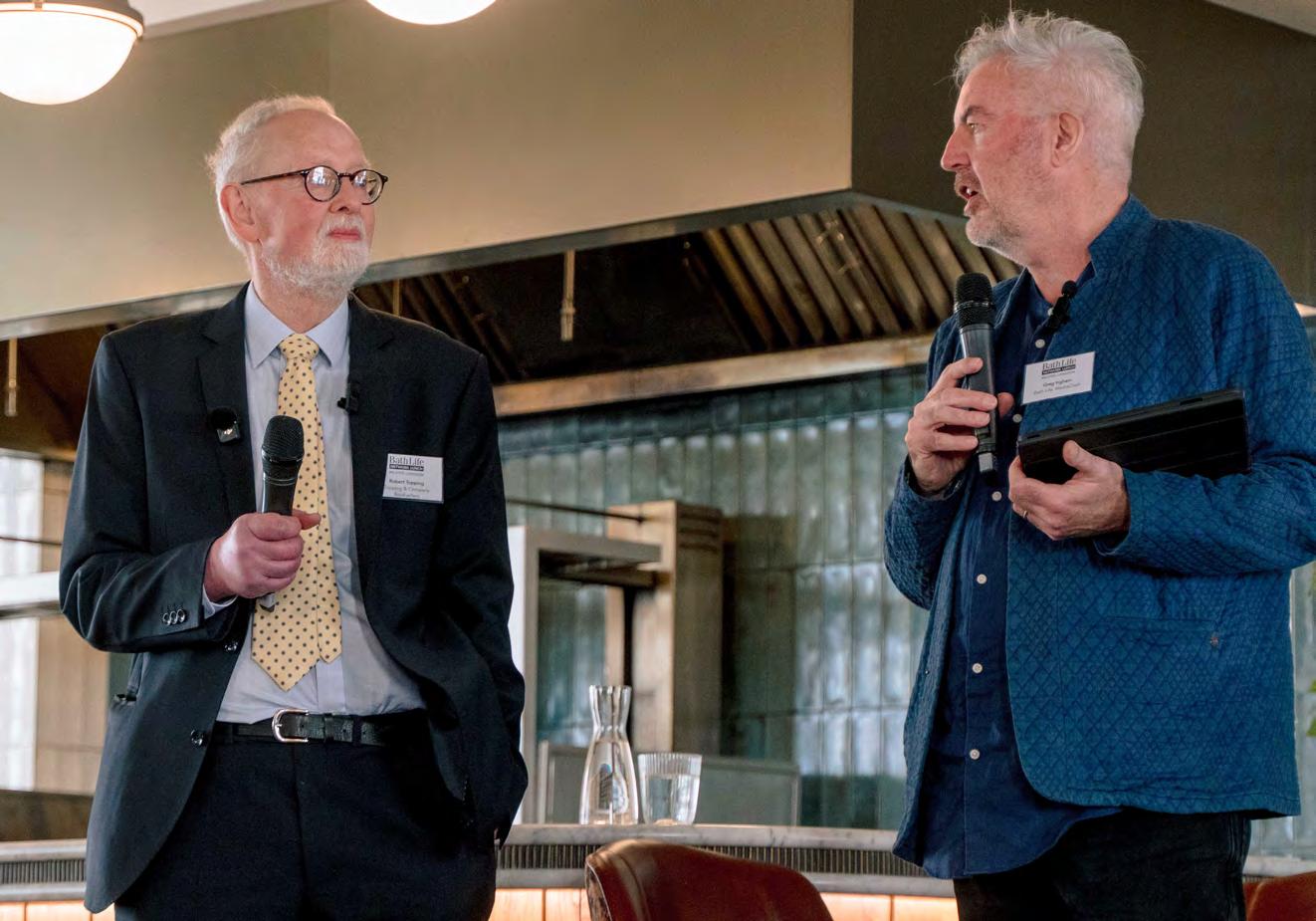
TTHE STORY OF A NOVEL IDEA
Topping & Company booksellers, with sites in Bath, Edinburgh, Ely, St Andrews (and York soon) is an indie phenom. As founder ROBERT TOPPING says, any bookshop can sell the fourth Harry Potter. It’s those who sell the first that matter…
Words by Paul Marland Main photos by Narrated Frames; www.narratedframes.com
he night before Robert Topping of the eponymous mini-bookshop chain – its Bath home now an impressive Grade II listed Masonic Hall near the Abbey – spoke at Bath Life Business Lunch, he’d had Julian Barnes talking at the shop; just the latest in an impressive list of big name authors, sometimes two a day. Getting them all in is, he says, “an enormous struggle – but happily the publishers seem keen to support us, and most writers love to meet their public.”
He’s got a dry wit, Robert, and some unexpected opinions. But everything he does has a single purpose: selling books. “We’re all about the physical experience of reading,” he says. “I mean, we love a chat but, ultimately, the books are everything. And they’re all chosen by the booksellers in that particular store – we have a very big, very famous competitor that says they do the same, but it’s complete lies. I’m talking about my former employer, of course; I worked at
opposite: Greg Ingham, chief exec of MediaClash, interviews Robert Topping; below: The audience at Emberwood hear about Robert’s fascinating bookselling career; inset: In 2021 Topping moved from the Paragon into a former Masonic hall
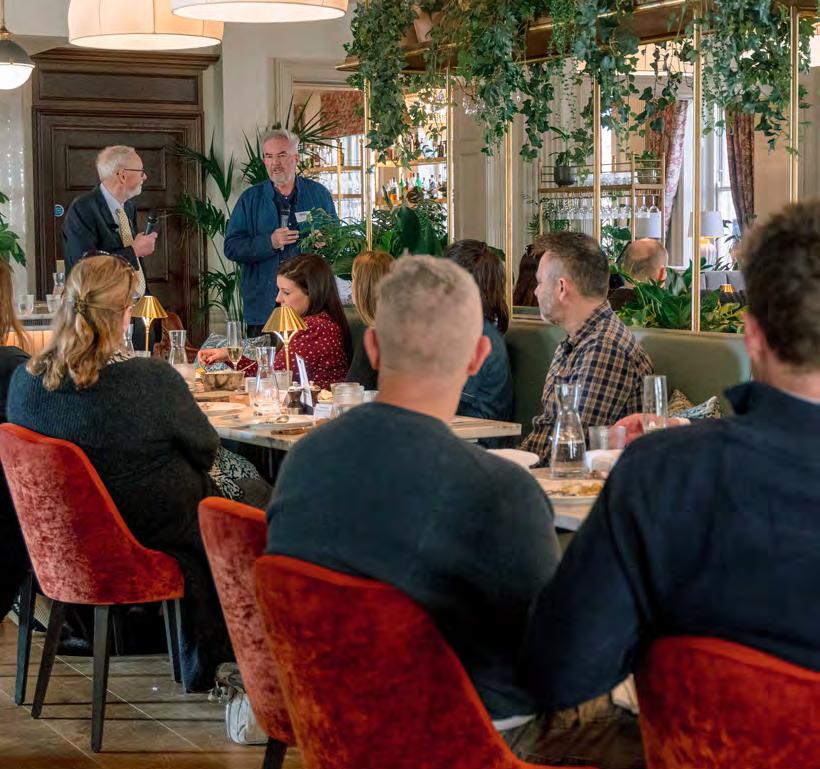
Waterstones in the great days of Tim Waterstone, a visionary man. We believed in individuals taking the lead back then; he had a small head office, and didn’t like too many managers – now, of course, it’s a different beast. Naturally, they got rid of me. I’d have stocked too many books.”
So you hate them?
“Yeah. It’s good to be a hater in business. I don’t hate the people that work there, of course, who love books no doubt – but I do hate The Beast, as I call it.”
Robert comes across as mildmannered, but there’s fire here alright. “Life is about looking after the people who support you,” he says. “We don’t use the C Word –customer – as it’s a cold word. We use the F Word – friends.”
We’re absolutely blessed with booksellers in Bath: as well as Toppings and The One That Can’t Be Named, here’s Mr B’s, Persephone, and indies in Larkhall
and Oldfield Park…
“Harry in Oldfield Park is a great friend of mine,” Robert says. “But we’re very independent types, booksellers, and everyone does things differently. You have to commit to an approach to make it work.”
Surprisingly, perhaps, the online world holds little fear, and why?
“Because books are an ancient platform, and won’t go away. At one point the great fear was the CD-ROM. Would it take over?
Well, no. Then there was Kindle. But many of us look at screens all day; we’re not going to do the
“ULTIMATELY, THE BOOKS ARE EVERYTHING”
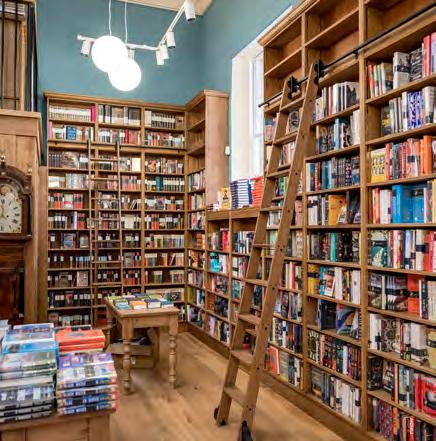
BY BETTY
same for pleasure. It makes those rare remaining offline media –books and, indeed, magazines – so attractive. And people especially like the physical experience of picking what they want in an actual bookshop. Last night we had this most poignant discussion with Julian – who’s 80 years old, and has written, he says, his last novel. He reminded us of what a bookshop gives you: that sense of wandering around in another person’s mind. We once had a man come in who asked if we had any books on Electromechanical Engineering. I said no, very sadly. And he said to me, so your books are for enjoyment only, then? And I’m afraid that’s the truth of it. Think of a novel, and how many hours of enjoyment you get from it. Books are incredible, a marvel. And their real cost is not the price you paid, but how long it takes to read.”
Back in the late Noughties, Robert was the highly successful
manager of a Waterstones in Manchester. But then new ownership came in, and a sharper focus on bestsellers. Robert kicked against that – picketed against it, in fact – which seems a pretty bolshy thing to do…
“But an invigorating experience! I kept getting fired back then – I remember my daughter asking, Daddy, have you been fired from everywhere you’ve worked? – but the truth is it was all very enlivening. Just not very practical when you have a young family. These days The Beast has what they call ‘nonbook product’, seen as increasingly the future. I must confess that when I was young I used to play board games, and they can be fascinating – but we’re not going to stock them.”
Before it was time to go, the questions for Robert came thick and fast:
When should we stop reading a book we’re not enjoying? “Before the first 100 pages, I think. And if you got it from us, we’ll swap it for something else.”
What books are a hard sell?
“Fiction is most difficult for a new author. But if it’s set in Bath, that might make a difference.”
How’s your new Bath home treating you? “Back at the Paragon, books had to be stored in the cellar, down this narrow staircase, and the chairs for events were there too. All in all, it was a difficult site – but this one’s a joy.”
Finally, are physical books making a comeback? “They never went away. Online reading is still only 20 per cent of the market, and that remains pretty static – I’m happy to say!”
For more: www.toppingbooks.co.uk | www.mediaclash.co.uk
PHOTO

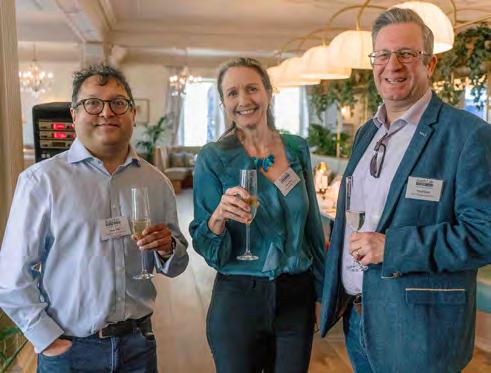
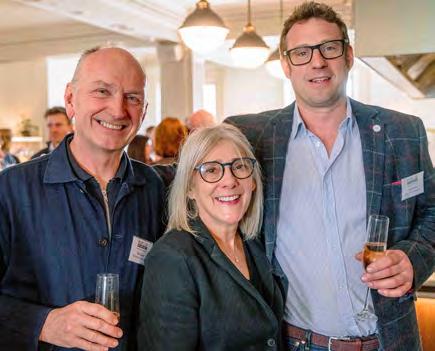

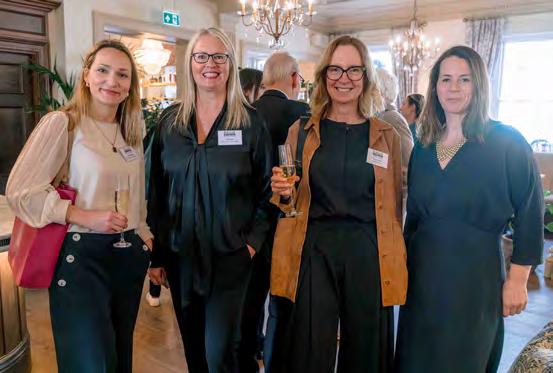
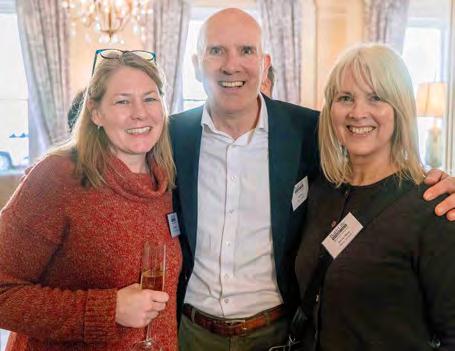
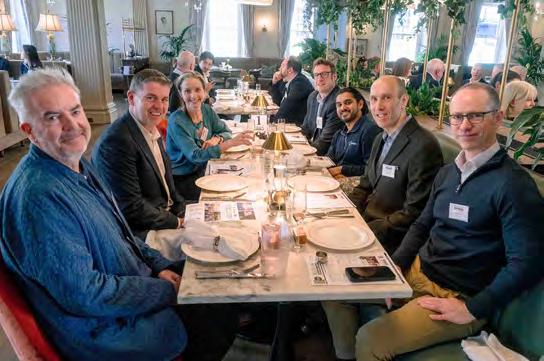
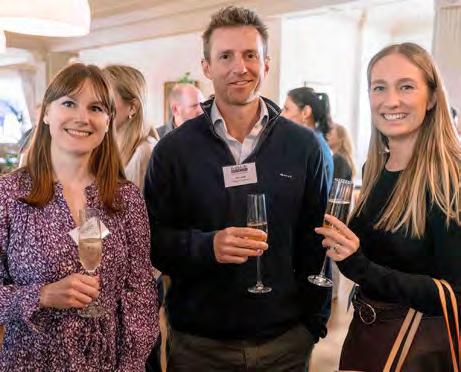
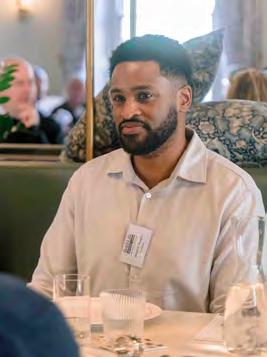
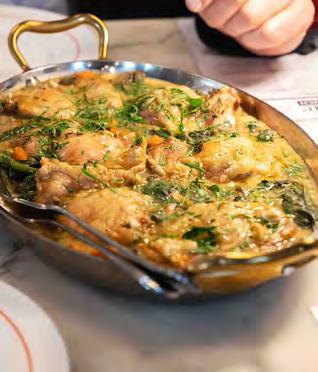
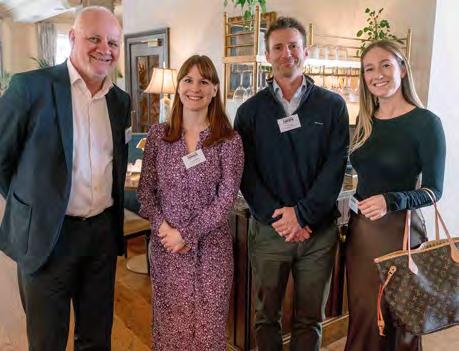
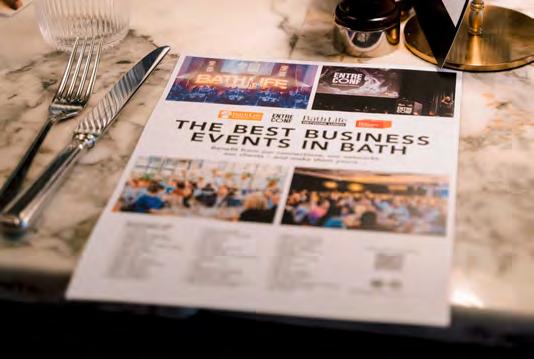
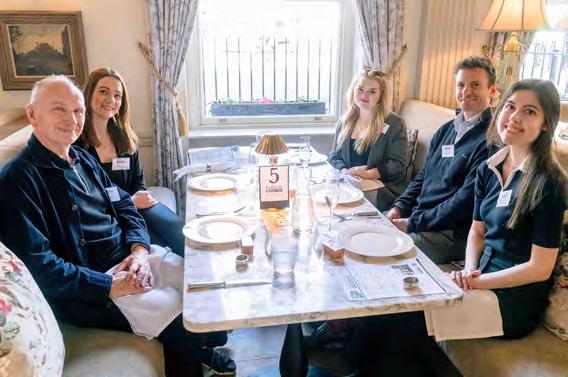
Sarah Morris
Saber Khan, Joanna Penn and David Dixon
Maria Isaeva, Bel North, Vicki Jackson and Libby Carter
Ian Lloyd, Jenna Allsop, Tom Leigh and Victoria Darvall
Nick Cramp, Leanne Kesterton, Ruby Coburn, Tom Leigh and Abbie Dayman-Johns
Networking is served!
Benjamin Trought
Nick Cramp, Sarah Moolla and James Twiner
Sonja Bass, Tim Moss and Annie Moss
Greg Ingham, Paul Gunstone, Joanna Penn, James Twiner, Sunjay Singh, Tim Lerwill and Paul Walshe
Jenna Allsop, Tom Leigh and Victoria Darvall
The delicious Emberwood main course


JUNE
17-18, WATERSHED


MINDSPA FOR ENTREPRENEURS
Stimulation awaits


Scan for Delegate Passes
Headline Partner








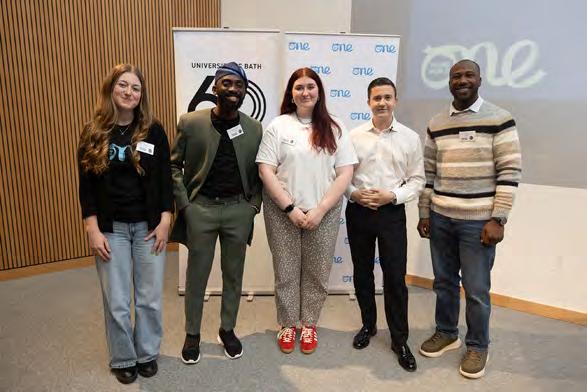
and a few of the
THE YOUNG ONES
In March the University of Bath marked a decade of the One Young World Bath Forum, celebrating the University’s partnership with global youth leadership organisation One Young World. The flagship studentled event centred on three interconnected themes: Responsible Technology, Health Inequality and Educational Empowerment – each explored through keynote talks, panel discussions and workshops.
The event concluded with the award of an honorary degree to Kate Robertson,
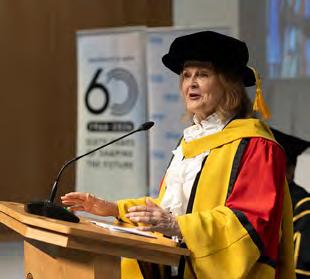
POWER COUPLE
Wealthtime has agreed a new club partnership with Bath Rugby, uniting two Bath businesses for the 2025–27 seasons. The deal sees the Bath-based investment platform become an official Club Partner of the Gallagher Premiership side, supporting both the team and its wider community initiatives.
Wealthtime ‘s commercial director Sophie Hall says, “At Wealthtime, our mission is to support advisers in building stronger, more successful businesses and delivering outstanding results for investors. Partnering with Bath Rugby brings that purpose to life, allowing us to support a club and community that shares our belief in strategic thinking and commitment to success. We’re proud to work alongside another Bath-born organisation to create a positive impact for fans and local businesses.” For more: www.wealthtime.com

co-founder and CEO of One Young World, in recognition of her global impact. She says, “The University’s commitment to nurturing responsible, values-driven leaders continues to inspire all of us at One Young World. I look forward to welcoming many more Bath students and alumni into the One Young World network, and to seeing them in Cape Town later this year as we work together to drive measurable impact on the world’s most pressing challenges.”
Bath is One Young World’s longeststanding UK university partner, a relationship dating back to 2013. Over the past decade, the partnership has supported annual student delegations to global summits and developed a vibrant leadership network on campus, connecting students and alumni with international change-makers.
For more: www.oneyoungworld.com | www.bath.ac.uk
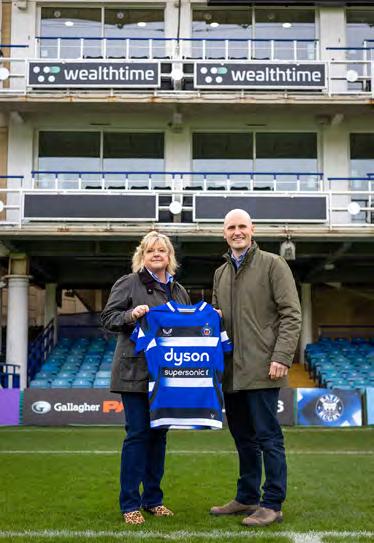
Bath-based specialist Joanna Lewis, who has more than 20 years’ experience in media and digital marketing, has founded JOANNA LEWIS MEDIA to provide flexible, bespoke marketing support for small to medium-sized businesses. Services include SEO, content strategy, PR, copywriting, social media management and fractional CMO support. www.joannalewis.media


AWDRY LAW has appointed Lucy Jones as a family law solicitor at its new Bath office. Specialising in family law since 2007, Jones brings extensive experience in high net worth divorce, financial remedies and children matters. Her appointment strengthens the firm’s family law offering across Bath, Wiltshire and the wider region. www.awdry.law

Bath-based advisory firm FIDELIUS has strengthened its financial planning expertise with two senior hires. Paul Gordon joins as head of medical, bringing more than 25 years’ experience advising medical professionals, particularly on NHS pensions. Financial adviser Sophie Stradins will lead Fidelius’ expansion into the North West from a new regional office. www.fidelius.co.uk

THE FRANCIS HOTEL has recently been named in The Sunday Times 50 Best Places to Stay 2026, the only Bath property to feature. The accolade coincides with the launch of the hotel’s new Francis Spa, completing a £14 million refurbishment of the historic Queen Square landmark. Turn to page 52 for our luxury hotel feature. www.francishotel.com
IN THE MAKING
Emerging designers and makers are invited to Bath’s historic Guildhall on 13 May for Inspiring Makers, a day-long conference championing the future of British craft and design. Now in its fifth year, the not-for-profit event is co-organised by Somerset interiors studio Artichoke and industry charity the Furniture Makers’ Company.
Inspiring Makers returns to the
13 May
Speakers include renowned leather specialist Bill Amberg, design futurist Caroline Till, Women in Boatbuilding founder Belinda Joslin, avant-garde furniture maker Fred Baier and Slow Ways founders Freddie Armstrong and Joseph De Ferranti. Neil Fox, COO of Artichoke, says, “Making at this level is a responsibility and privilege that we don’t carry lightly to keep traditional making skills alive. It’s as much about setting the gold standard for what true quality and artistry look like as it is to inspire future generations.” For more: www.artichoke.co.uk

Joanna Lewis
Lucy Jones
Paul Gordon
Sophie Stradins
Guildhall
Wealthtime‘s commercial director Sophie Hall with Bath Rugby’s head of business development Tom Adams
Co-founder of One Young World Kate Robertson was awarded an honorary degree
The organisers
speakers at recent One Young World Bath Forum at the University of Bath
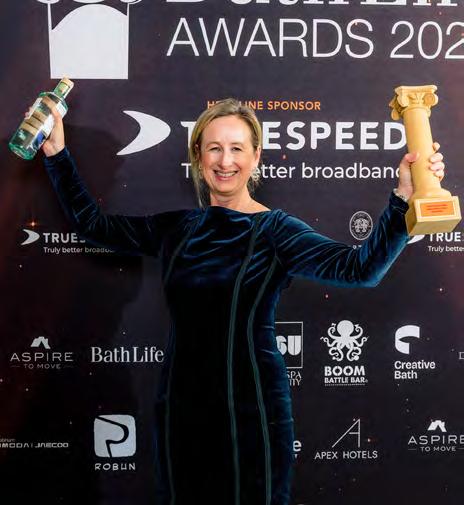
BLA Q&A
KEYSTONEHR
SPONSORED BY
“2025 SAW IMPRESSIVE TOPLINE GROWTH OF 47% FOR THIS WELLPOSITIONED SPECIALIST”

KeystoneHR Consultancy provides HR support to businesses across Bath and the surrounding area. Director Jo Kangurs tells us why the company entered the Bath Life Awards this year and what winning means to them.
“After an exciting year with a new website, a growing team and fantastic clients, entering the BLA Awards felt like the perfect way to celebrate what we’ve achieved. I’ve entered before, in 2019
and 2020, when we were finalists both years, and the process is always a useful chance to reflect on how far the business has come.
“Awards night at the Forum was as special as ever, with a brilliant atmosphere and a real sense of pride in Bath’s supportive business community. My husband Wes, my biggest supporter since I founded KeystoneHR in 2015, joined me, and it was lovely catching up with friends and contacts.
“After 11 years of building the business, winning a Bath Life Award is amazing recognition. I’d absolutely encourage others to enter. ”
For more: www.keystonehr.co.uk | www.bathlifeawards.co.uk
GLOWING AND GROWING

The luxury botanical skincare brand Thirns has launched a dedicated e-commerce site to mark one year of partnership with the Spa Village Bath at the five-star Gainsborough Bath Spa. The new online store allows customers nationwide to purchase Thirns’ signature skincare products, which are handmade in small batches in founder Olga Brennand’s Bath laboratory.
Thirns products harness local wild thorn-bearing plants to support the skin’s natural rhythms, have been developed specifically for midlife skin, aiming to restore balance, resilience and vitality.
Olga says, “Our partnership with the Gainsborough Bath Spa has offered us an incredible opportunity to test, refine, and perfect our formulations in one of the UK’s most prestigious spa environments.”
For more: www.thirns.co.uk | www.thegainsboroughbathspa.co.uk
Bath Life Network Lunch at Emberwood with Amanda and Nick Spicer of Your Eco; www.mediaclash.co.uk
17 – 18 JUNE
EntreConf at the Watershed; www.entreconf.com 23 JUNE
Bath Life Network Lunch at Emberwood; www.mediaclash.co.uk
2
Bath Boules in Queen Square; www.bathboules.com 1 OCTOBER
EntreConf Awards at Aerospace Museum; www.entreconf.com
STRENGTHENED PATHWAYS
Bath College has recently launched a new Early Years Education Suite and announced a bursary partnership with Norland, the leading provider of early years education, to help create a clear progression route to higher education.
The suite replicates early years environments with realistic zones, simulation features and modern equipment designed to help learners build practical, work-ready skills. Through the new Norland Bath College bursary, a limited number of students will be able to progress to higher education with Norland, a
The partnership will also underpin an elite programme focused on best practice in Early Years Education, aiming to produce professionals who are ready to step into employment.

Sue Hudd, head of education at Bath College, says, “This innovative space allows students to build confidence, apply theory and develop their professional skills in a safe, immersive environment, while our collaboration with Norland sets high aspirations and exposes them to exceptional standards within the sector.”
For more: www.bathcollege.ac.uk
Boules is back in July
OUR JUDGES SAY
PHOTO BY ANDREW DODD
Olga Brennand creator of the Thirns range
Level 3 learners Isabelle and Rosa
Jo loved the sense of pride at the Awards



CAREER PATH
CARLA HADFIELD
From starting out as an architect to becoming Rotork Bath’s youngest and first female plant manager
Rotork is a global, market-leading engineering business providing missioncritical intelligent flow control and instrumentation solutions.
As plant manager at Rotork Bath, one of the company’s key facilities, Carla Hadfield leads a complex manufacturing operation supplying electric valve actuation and automation technologies to industries around the world. With a background that spans architecture, global business education and operations leadership, she now oversees safety, quality, delivery, inventory, people, cost, and growth. Here we learn more about her journey and role.
Tell us a little about Rotork Bath specifically
The Bath facility focuses on electric valve actuation and automation technologies, supplying essential equipment used to regulate the flow of liquids and gases across a wide range of industrial processes worldwide.
What markets does Rotork serve?
We serve the full spectrum of Rotork’s end markets, and our
products operate in some of the most demanding environments in the world — from water and wastewater to oil and gas, power generation, nuclear, chemicals and emerging energy applications like hydrogen, carbon capture. This includes utilities, energy producers, process industries and valve manufacturers delivering major infrastructure projects. Many customers rely on Rotork because failure simply isn’t an option – reliability matters.
Tell us about the Rotork Bath team
Whilst the Bath campus is home to 500 employees, Operations specifically is around 200 people strong, spanning highly skilled operators through to senior leadership. It’s diverse, technical, and deeply invested in what we do. Manufacturing outcomes are ultimately human outcomes – the team is the differentiator, and fortunately, we are building a strong one.
And what’s your role?
I lead the factory, accountable for safety, quality, delivery, inventory, people, cost, and growth. Fundamentally, my role is about creating an environment where people and operations perform at their best, so we can reliably
support customers who depend on our products to keep the world flowing – often in safety critical and highly regulated environments.
Why is the Bath location important to Rotork?
Bath is particularly special in the Rotork story. The company has been headquartered here since its inception in 1957, and the site remains central to our global operations. What we do here quite literally enables industries and infrastructure to operate safely, efficiently, and sustainably.
What’s your background?
There is a family connection to the South West – my great grandparents came from Wellington and Taunton. However I grew up in Zimbabwe and South Africa and came to Bath initially to complete my MBA at the University of Bath. What was meant to be a chapter fortuitously became home.
What jobs were you doing before joining Rotork?
I trained originally as an architect, completing a Master’s in Architecture before moving into business with an MBA. While seemingly unconventional, it has been a strength. Architecture teaches structured problem solving, systems thinking, stakeholder alignment and design under constraints –all of which translate directly into leading complex operations.
How did you start with the company?
After completing my MBA, I undertook a short term strategy engagement with Rotork. It was effectively a three-month working interview, during which I gained exposure to the business end-toend. That led to a permanent role in the project management office – and from there, into operations leadership.
What inspired you to join Rotork in particular?
Quite simply, the calibre of leadership and the clarity of purpose. Early on, I encountered leaders who were thoughtful, demanding in the right way, and deeply aligned around Rotork’s role in supporting critical infrastructure internationally.
“VARIED PATHS OFTEN CREATE MORE ROUNDED LEADERS”
It felt like a place where personal effort translated into global impact.
Did you ever think you’d end up in manufacturing leadership?
I was always drawn to fast paced, high accountability environments, but I didn’t anticipate manufacturing leadership as an end point. Operations is dynamic, unforgiving at times, and incredibly rewarding – that combination suits me but it’s not for everyone.
What were the early days like for you personally?
It was a significant transition. I was the youngest person to take on the role and the first woman to do so at the Bath site. That brings scrutiny – mostly internal – and a heightened sense of responsibility. The key was focusing less on precedent and more on performance.
What are some of the highs and lows of leading a manufacturing site?
Manufacturing is inherently demanding. It’s a constantly shifting landscape shaped by customer needs, operational pressures, and external challenges. That can make it stressful – but the highs are just as intense. There are many dimensions to success, where achievements can happen on multiple fronts at once, which makes the role endlessly engaging and rewarding.
Looking back, is there anything you might approach differently?
I value my architectural training greatly, but with hindsight I might have transitioned into business earlier. That said, varied paths often create more rounded leaders.
For more: Rotork, Rotork House, Brassmill Lane, Bath; www.rotork.com






2026 Finali�t�
AGENCY
Spon�or�d by �att�r
• Cr�ativ� Cupboard
• D��ign For Digital
• Digital Nativ��
• Eat PR
• �ud
• T�lp�rion
CONTENT CREATOR
• Good Journ�y� & Wr��tling Li�� by B�n V�al
• K�ri�� �y�r�, Inclu�ion Support Hub
• �.�od� by P�t� H�lm�
Photography
• Noad Production�
• Sarah �oon, Frank & �oon �ark�ting
• Spud Gun Studio�
CREATIVE ARTS
Spon�or�d by Kom�dia
• Bath Arti�t�’ Studio�
• Bath Spa Univ�r�ity
• Th� Cor�ham Gall�ry
• Em�rg� Studio
• For��t o� Imagination
• Th� Forum, Bath
• Gath�r Round
• Th� Holburn�
• Th� Littl� Th�atr� Cin�ma
• �y Small World
• Th� Natural Th�atr� Company
• Pho�nix All�tar�
• R�cov�ry by Fiona Hain�� Arti�t
CREATIVE EVENT
• Bath Film F��tival 2025
• Th� Bath Ind�p�nd�nt �ark�t
• Bath Int�rnational Com�dy F��tival
• Crim�� Again�t Chri�tma� by N�� Old Fri�nd�
• Curiou� �ind� 2025
• David Copp�r�i�ld: A Li�� by Th�atr� Royal Bath
• For��t o� Imagination
• L�aving i� Hard by Siri Bolin
• Lock�brook Lat�� by Bath Spa Liv�
• Qu��r Bath 2025
CREATIVE STUDENT
• Eli �ay Ba�il�, #OurOldHou�� Campaign
• Elizab�th Royl�, E. Royl� Art
• Jax �a, T�nni� �ith Jax
• �anganaro
• ��rlin Goldman, Sound Arti�t
CREATIVITY FOR GOOD
Spon�or�d by �ytton William�
• Bath Arti�t�’ Studio�
• Bath’� Cr�ativ� Playground
• BSU’� Inclu�iv� Communiti�� T�am and Littl� Lo�t Robot
• CaliUnity / Cali Yard
• Em�rg� Studio
• L�t’� Go Girl�
• �u�ic Work�hop
• R�dnin�
• Sa�� Spac� Bath
• S�cond �ountain Comm�, Good Journ�y� & Wr��tling Li��
• Sil�nt Book Club Bath
DESIGNER
Spon�or�d by �inut�man Pr���
• Anna Udovina
• D��ign �or Digital
• G�mma’� Funky Art
• Goo�� Collaborativ�
• Robin Worrall, R�dnin�
• Tom B�avan, Son o� J����
DIGITAL TECHNOLOGY
Spon�or�d by Flor��co
• D��ign �or Digital
• Digital Wond�rlab
• Inclu�ion Support Hub
• POLY�ATHIC
• Son o� J����
• Th� Studio
• T�lp�rion
FIL� & PHOTOGRAPHY
• Bri�toliann
• Callum Lloyd-Jam��
• Camilla Turn�r (CHASE A�rica Film)
• Eat PR
• EDITALL & ORCA �EDIA
• Jam�� �ay (Larkhall Butch�r� Film)
• P�t� H�lm� Photography
• Watch & L�arn Production�
FOUNDER/ ENTREPRENEUR
Spon�or�d by Entr�Con�
• Andr�� Taylor, Eat PR
• B�n V�al, S�cond �ountain Comm�, Good Journ�y� & Wr��tling Li��
• Charl�� d� Paula, S�rial Entr�pr�n�ur
• H�idi Roxton, Th� Bath Ind�p�nd�nt �ark�t
• Julia K�mp, Pa�pa��
• Nathan Barano��ki,
Digital Wond�rlab
• Philip Daunc�y, R�ally D�c�nt Book�
• Pippa Ru���ll, Ru���ll Communication�
• Sam Ruault, Bath D��ign Soci�ty
• Tom Payn�, Spud Gun Studio�
INSPIRATIONAL PERSON
Spon�or�d by Gath�r Round
• Brian Gib�on, �aking �or� With L���
• Hannah Tutty, Odd Tut�
• Ka�ha-Fay� Pa�co�, Pag� On�
• K�ri�� �y�r�, Inclu�ion Support Hub
• Pho�nix D��b�rry, Sa�� Spac� Bath
• Robin Worrall, R�dnin�
• Simon Barbato, �r B & Fri�nd�
• Xavi D� Santo�, Bath’� Cr�ativ� Playground
�ARKETING CA�PAIGN
Spon�or�d by ��diaCla�h
• Th� Bath City FC Third Shirt proj�ct �ith Bath Spa Univ�r�ity
• Gath�r Round Pr���nt�
• Pictur�hou�� Ent�rtainm�nt Film� by Th� Littl� Th�atr� Cin�ma
NEW CREATIVE BUSINESS
Spon�or�d by Digital Wond�rlab
• Bath D��ign Soci�ty
• Candl�LIT Slam
• Emily Day Int�rior�
• F�zant Cr�ativ� Studio�
• Goo�� Collaborativ�
• Th� J��t�r� Com�dy Club
• L�t’� Go Girl�
• SO�ER by Bath Spa Univ�r�ity
• Spla�h�ri�t
• Spud Gun Studio�
• Tripl� Studio Bath
• Watch & L�arn Production�
PERFOR�ING ARTS & �USIC
• Bath Int�rnational Com�dy F��tival
• Engag� by Th�atr� Royal Bath
• Th� Forum, Bath
• Th� J��t�r� Com�dy Club
• L�aving i� Hard by Siri Bolin
• �anganaro
• Th� Natural Th�atr� Company
• N�� Old Fri�nd�
• Pho�nix All�tar�
cr�ativ�batha�ard�.org
#Cr�ativ�BathA�ard�
@Cr�ativ�Bath
PRODUCT DESIGN & CREATION
• Avocado Print & Embroid�ry
• Briti�hbookart
• E. Royl� Art
• Graphic �ill
• Sarah Ep�om
PUBLISHER & WRITER
• Anna Udovina
• B�n V�al, Badd to Good and Good Journ�y�
• G�mma Dunn�ll, Th� �yconaut� �agazin�
• Th� Happy Book Company
• Laura Clark�, �y Body & Your�
• North Parad� Publi�hing
• R�ally D�c�nt Book�
SOUND
• Babba �aa� & Fri�nd�
• ��rlin Goldman, Sound Arti�t
• �u�ic Work�hop
• POLY�ATHIC
SPATIAL DESIGN
• Eagl��ton� Gard�n�
• Emily Day Int�rior�
• Ext�rior D��ign Studio
• Goo�� Collaborativ�
• Graphic �ill
• Gro� th� Look Gard�n�
• Vicky Elmor� Kitch�n�
YOUNG CREATIVE
Spon�or�d by Bath Art� Coll�ctiv�
• Abbi� Dayman-John�, Briti�hbookart
• Ab� Noad, Noad Production�
• Callum John�, EDITALL & ORCA �EDIA
• Dariana Oro�, Flo�r Sourdough
• Elli� H�ndrick�, Archa�o-H�ritag� Film
• G�mma Dunn�ll, G�mma’� Funky Art
• Ki�ra William�, CaliUnity
• Laura Clark�, �y Body & Your�
• Pho�nix D��b�rry, Sa�� Spac� Bath
• Sam Ha�kin�, Th� J��t�r� Com�dy Club
• Sujata Bharti, Arti�t
• Zahabiya Adamaly, Bath School o� Danc�
H�adlin� Spon�or
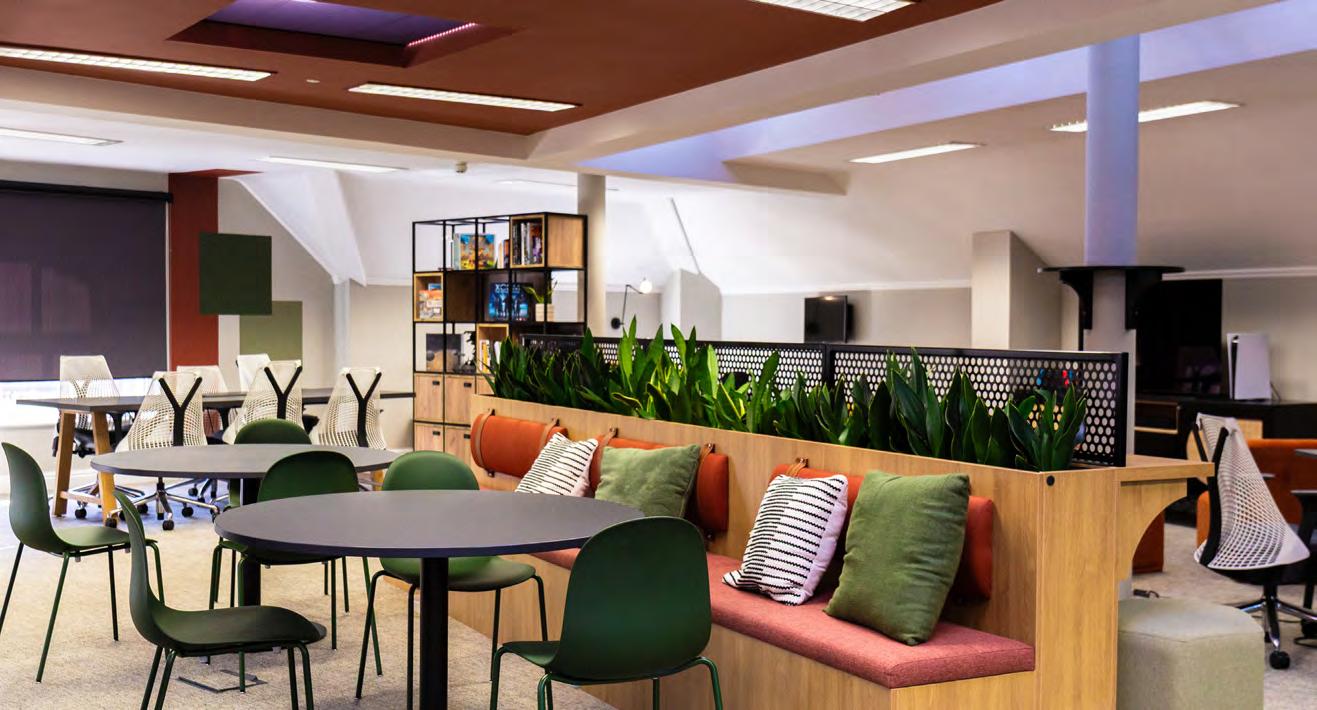
OFFICE SPACE AVAILABLE IN BATH
If your current workspace is feeling tired then this might be the upgrade you and your business have always needed
Located in central Bath, Circus Mews House offers a thoughtfully designed office that actually feels good to spend time in. It’s the kind of space that works equally well for focused work as it does for hosting clients or bringing colleagues together.
Set across three floors (with the lower ground reserved for parking), the building blends modern construction with a boutique style that sets it apart from your usual office space. There are five accessible parking spaces, three fitted with EV chargers, space set aside for bikes and newly fitted secure gates to keep it all safe.
Also on the ground floor, an access controlled small room has been set up as a gym with Peloton equipment in place; handy for a quick break between meetings or a lunchtime workout without the need to leave the building. There’s even a chalkboard wall for the odd motivational note, if that’s your sort of thing.
Across the first and second floors the offices are open plan and airy, with air conditioning that actually works the way you want it to (yes,heating and cooling)!
The refurbishments have been done to a
high standard: there’s Quooker taps in both of the kitchens for instant hot water, a wet room complete with underfloor heating and an overall attention to detail that’s hard to miss. Built in fridge/freezers and a dishwasher on each floor will help to keep the space stay clean and tidy.
Need to step away from the open plan seating for a meeting? Circus Mews House has got you covered, with nine separate meeting rooms of various sizes. Two of which are designed to be private rooms, ideal for calls, focused work, or for colleagues who may need a quiet comfortable space for breastfeeding.
You can opt for the space furnished or unfurnished but if you go furnished, you’ll have thoughtfully laid out desk space (four of which are electric standing desks) access to lockers and settling into well maintained Herman Miller chairs, which is a fairly strong
“THE REFURBISHMENTS HAVE BEEN DONE TO A HIGH STANDARD”
argument in itself. You can even discuss the option to take on the network infrastructure and high speed wifi allowing your teams to hit the ground running with minimal disruption.
Practicalities haven’t been overlooked either. There’s alarm monitoring, a CCTV system and door pass security setup which keeps things running smoothly (and safely).
And let’s not sleep on the location either; just a few minutes walk from the stunning Royal Crescent, the office sits in one of Bath’s most recognisable and well kept areas. Despite being so central, it’s tucked away among residential properties, meaning it’s a fabulous balance between being near everything you need but without the constant noise and foot traffic. At the same time it’s just a 15 minute walk from Bath Spa train station meaning you’ve direct connections to Bristol and London.
Available on a new lease with terms open to negotiation, this is one of those rare spaces that balances function with style.
Basically: this might be somewhere you actually look forward to working from. n
For all enquiries, please contact: kathleen.vaughan@network-n.com
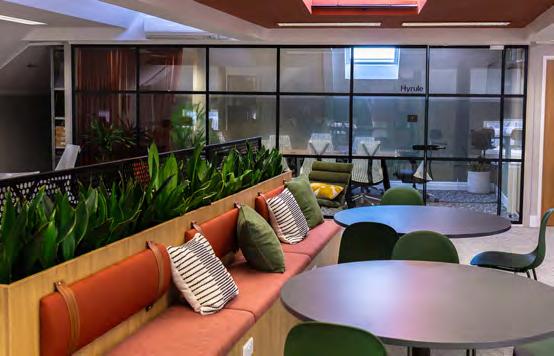
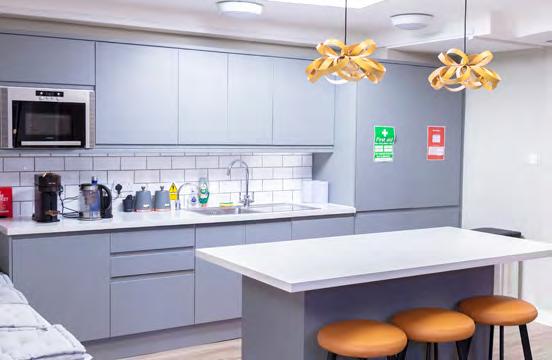
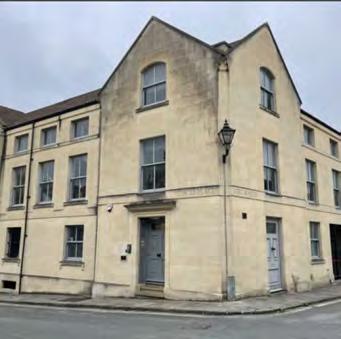
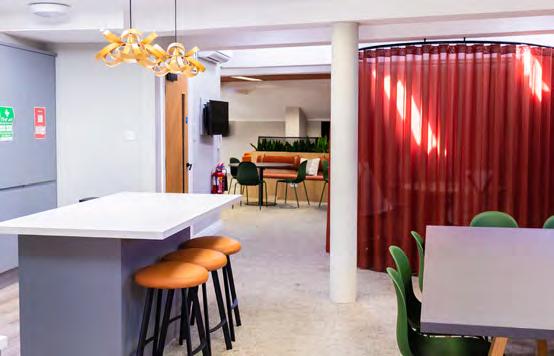
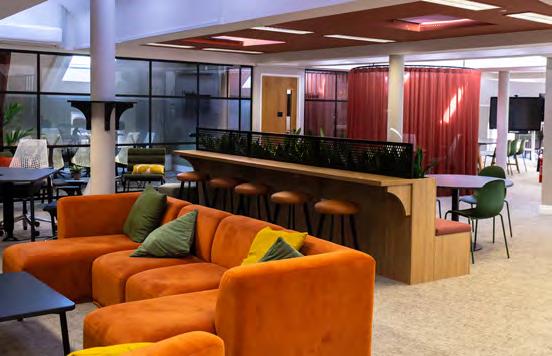
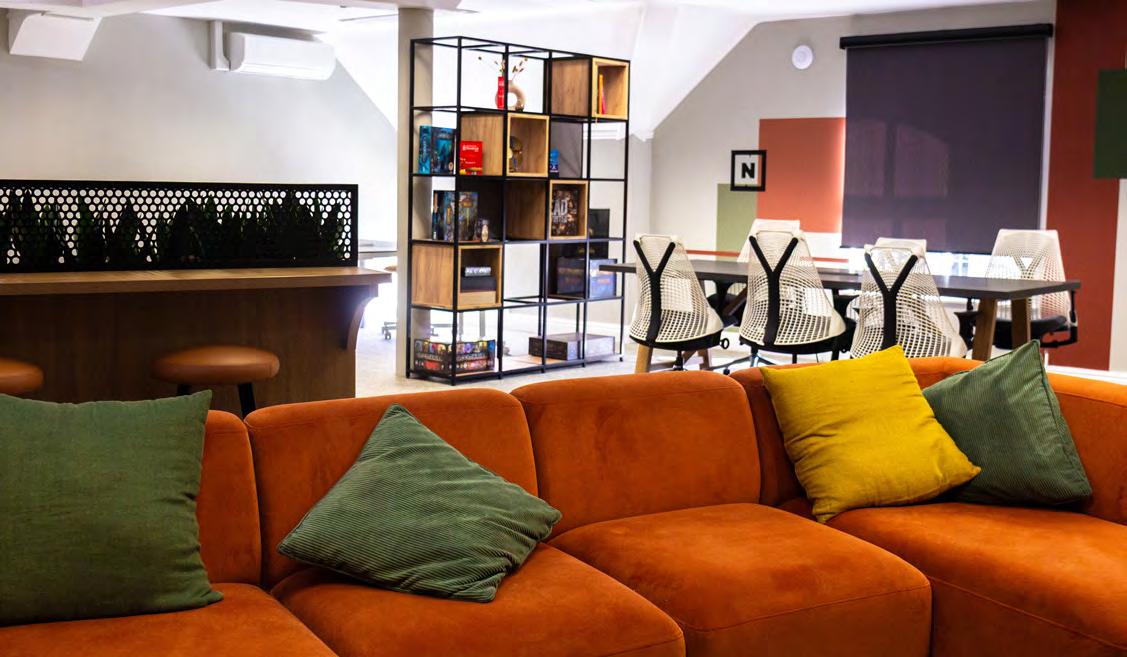




CREATIVITY CONNECTIONS COMMUNITY








PROPERTY
PLACES TO LIVE, WORK AND PLAY
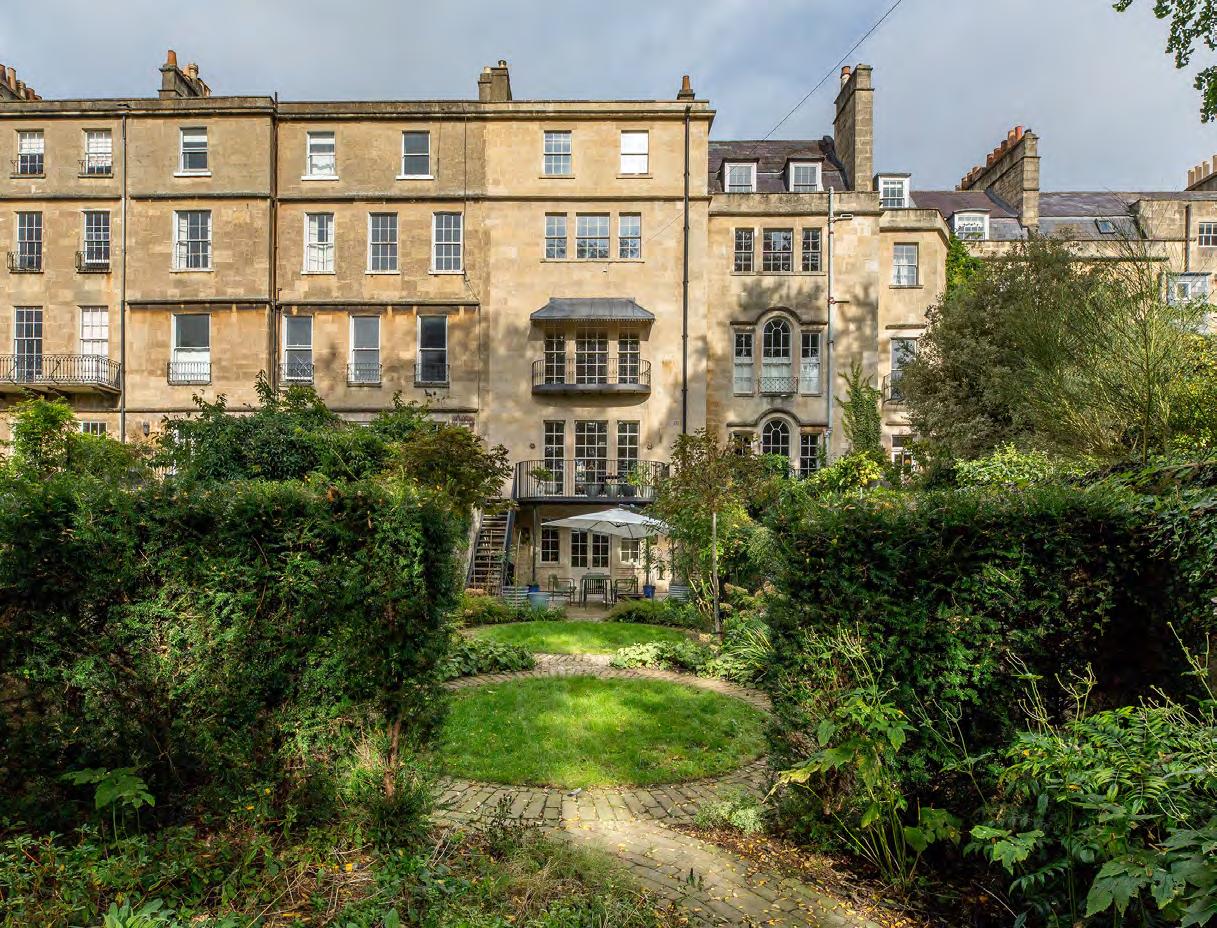
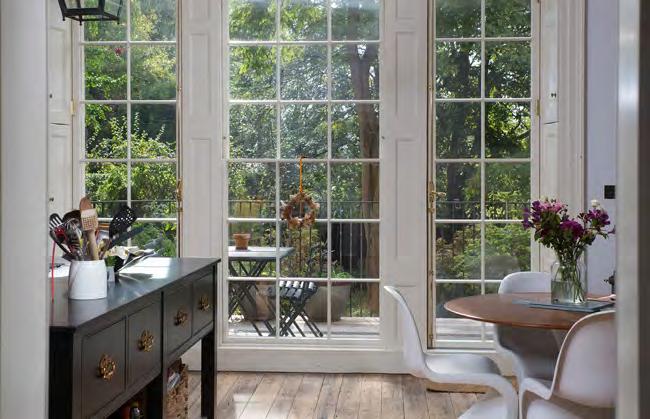
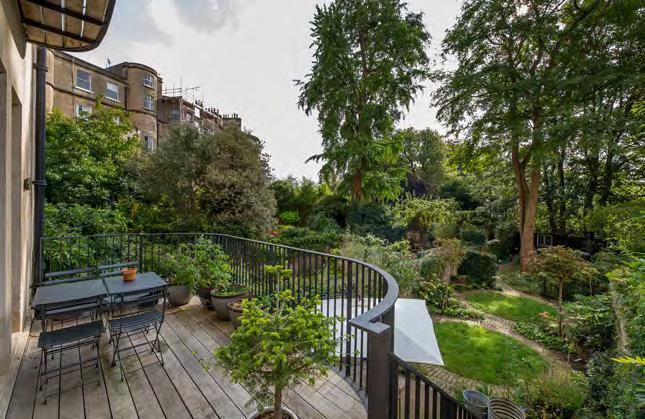
Residential
The outdoor space and location help make this Brock Street home exceptional
DREAM SPACE
A rare opportunity to acquire a substantial Grade II* listed townhouse in one of Bath’s most coveted addresses is currently on the market with Knight Frank, with a guide price of £2.95 million. Occupying a prime position on the south side of this famous thoroughfare, which links two of the city’s landmarks, The Royal Crescent and The Circus, 5 Brock Street offers nearly 5,000 sq ft of accommodation arranged over six floors.
Meticulously refurbished in 2019, the five-bedroom and four-bathroom house seamlessly combines original Georgian detail such as intricate cornicing, fine fireplaces, a grand staircase, Venetian window and working shutters, with contemporary comfort.
Unusually generous outdoor space for a Georgian townhouse is another key attraction – a balcony runs across the first-floor drawing room, while the kitchen opens onto a large decked terrace with steps leading down to a beautifully landscaped walled garden. Centred around a magnificent Robinia tree, the garden features lawns, borders, dining terraces and a screened play area, framed by the leafy backdrop of Royal Victoria Park.
For more: www.knightfrank.co.uk
Property developer
BOOK STORE
City & Country marked World Book Day last month with a £450 donation of new books and a handcrafted miniature library to Oldfield Park Junior School. The school, close to the developer’s Bath Press scheme, will use the books and outdoor library to boost its literacy resources and encourage pupils to develop a lifelong love of reading.
Fleur Cannadine, the school’s librarian, says, “Our current library is always well used, so it will be fantastic for pupils to have another space dedicated to exploring and enjoying books.”
For more: www.cityandcountry.co.uk | www.oldfieldparkjuniorschool.com
Design CLUB LIFE
The Ibizan boutique hideaway Pikes, famed for starring in Wham!’s legendary Club Tropicana video and hosting uber-celebrity guests such as Grace Jones, Kylie Minogue, and Freddie Mercury, has teamed up with Bath-based design duo Divine Savages to launch a bold new wallpaper and fabric collection.
The Divine Savages x Pikes Ibiza range channels the hotel’s party reputation as a playground for music, culture and mischief into colour-drenched prints for walls and upholstery. Swaying palms, roller skates, flamingos, prancing stallions and disco balls all make an appearance, alongside a joyous, tongue-in-cheek take on traditional toile de jouy. “This collection is a love letter to Ibiza’s wild heart,” say Jamie Watkins and Tom Kennedy, founders of Divine Savages. “We wanted to bottle up that hedonistic spirit, the freedom, the fun – and splash it across the walls in true Divine Savages style.”
For more: www.divinesavages.com

Oldfield Park Junior School enjoy their new mini-library donated by City & Country
Divine Savages x Pikes Ibiza range is all about fun and sunshine

A QUEEN ANNE CLASSIC REIMAGINED
Batheaston House, a home of Tudor history and rare beauty
By John Mather
There are some houses that seem to belong as much to the landscape as to their own history. Batheaston House, an exquisite Grade II* listed Queen Anne residence just outside Bath, is one of those rare homes: a honeyed Bath stone manor gazing over the River Avon, its gardens tumbling towards the water in terraces, courtyards and topiary-framed vistas.
Immaculately restored in 2015 in collaboration with architects Watson, Bertram & Fell, the house represents the very best of the West Country’s architectural inheritance. Its story stretches back over 300 years – and further still, to Tudor times – yet inside, the atmosphere is one of effortless modern comfort. Batheaston House in its present form was largely created in 1712, when Henry Walters, then High Sheriff of Somerset, commissioned a new symmetrical Bath stone façade overlooking the valley. The earlier house on the site, dating back to the 1500s, was demolished above ground, its surviving ground floor sunk and transformed into what is now the atmospheric Tudor basement.
The result is a classic Queen Anne gentleman’s residence: elegant, wellproportioned and full of light. The 2015 restoration was comprehensive yet sensitive, bringing the building into the 21st century while preserving its historic character. The house now enjoys the rare accolade of a Grade II* listing, marking it out as a property of particular architectural and historic importance.
A welcoming entrance hall leads into a suite of beautifully appointed reception rooms. High ceilings, tall sash windows with working shutters and a magnificent central staircase lend natural drama, while intricate panelling, cornices and original fireplaces anchor the rooms in their Georgian past.
space where full-height French doors open to the west courtyard. Sliding bookcases conceal a cleverly designed kitchen and bar, emerging as needed for summer parties that spill out into the gardens.
Beneath the main house, the Tudor basement has been transformed into the heart of the home. Laid with blue lias flagstones and warmed by underfloor heating, it feels both ancient and supremely comfortable. The superb kitchen is centred around a large working stone fireplace and a vintage Electrikit AGA, with bespoke tulip-wood cabinetry and high-end appliances from Miele and Neff. Beyond the kitchen lies a pantry and larder, stone-vaulted media room, utility room, cloakroom, wine cellar and plant room, accommodating everything from daily life to evenings in the media room.
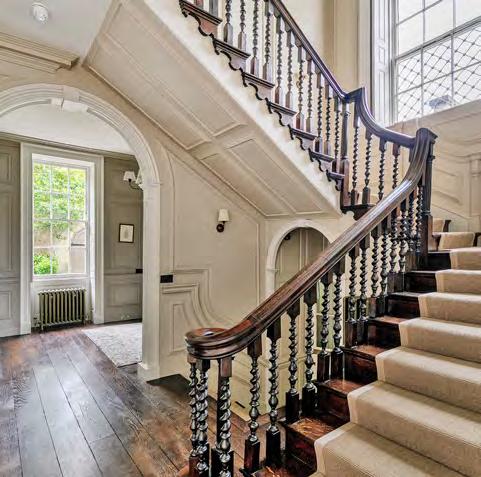
The ground floor is arranged for both formal entertaining and relaxed family life. To the south, a gracious drawing room opens directly onto the garden terrace, its sash windows framing long views over lawn, river and countryside. Morning light pours into a charming morning room, while the formal dining room is conceived with candlelit dinners in mind.
Perhaps the most unexpected delight is the garden room: an informal
Upstairs, the first floor continues the theme of refined craftsmanship. Panelled rooms and wellchosen colours create a quietly luxurious feel.
A bedroom overlooking the grounds enjoys an en suite, while two further bedrooms are served by a dual-aspect bathroom and an adjoining shower room. On the second floor, three large bedrooms and two bathrooms, one en suite, provide elegant accommodation for friends and family, with roof-level views over the gardens and Somerset landscape.
The gardens and grounds elevate Batheaston House into something truly special. Extending to approximately 1.15 acres, they have been carefully landscaped to complement the house and its riverside setting. To the north, a cobbled courtyard enclosed by a dressed stone wall features a fountain and an elevated bay hedge – a sheltered, cloistered space that feels worlds apart from the bustle of nearby Bath. To the west, yew spiral topiary punctuates a smart courtyard, lending a touch of formality and structure.
To the south, an expansive stone terrace stretches out from the house, perfectly positioned for summer lunches or evening drinks. A stone orangery offers a sheltered spot on cooler days, while views sweep down over manicured lawn and luxuriant planting towards the River Avon. Planting throughout is immaculate: vibrant borders brim with seasonal colour, while mature specimen trees and abundant topiary provide yearround interest. The bay-hedged kitchen and cut-flower garden features
“Immaculately restored in 2015 in collaboration with architects Watson, Bertram & Fell”
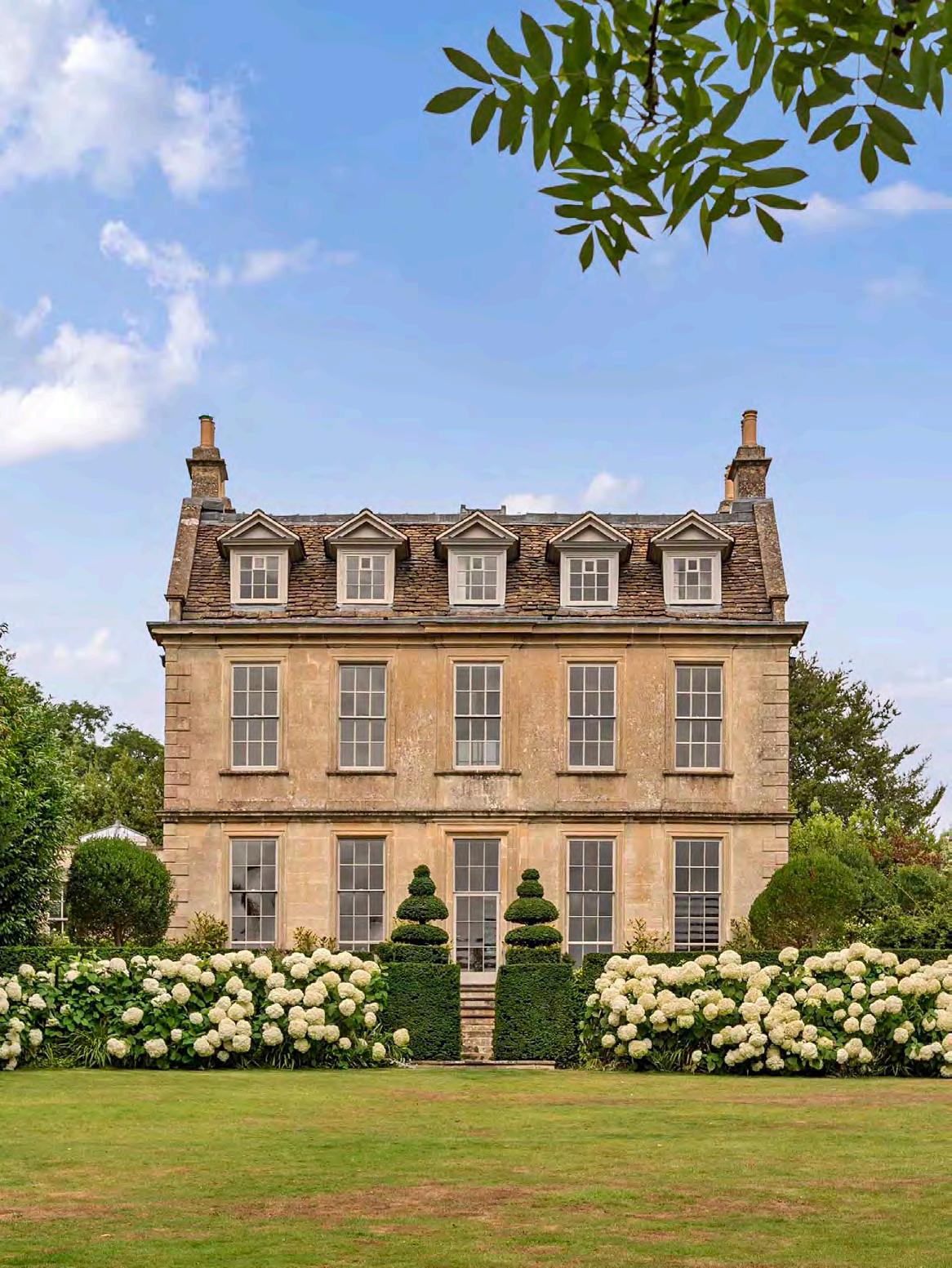
raised beds of herbs, fruit and vegetables, a bespoke Alitex greenhouse and a custom-built potting shed.
Benefiting from river frontage and a river water pump, the grounds also include a workshop, ice-house, log store, shed, undercroft and rainwater tanks connected to two on-site wells – a quietly self-sufficient backdrop to the beauty.
Discreetly set alongside the private cobbled parking area and accessed via electric gates, the former coach house now provides garaging on the ground floor and a separately accessed one-bedroom annexe or home office above. For those who work from home, it offers ideal separation between business and domestic life; equally, it serves beautifully as guest or staff accommodation.
HOUSE NUMBERS
Guide price £4.25million Bedrooms 7 Bathrooms 4
Reception rooms 4
Grounds 1.15 acres
For more: Savills, 21 Milsom Street, Bath; www.savills.com
Batheaston House’s charm is not merely aesthetic. The original house on the site belonged in the 1500s to Sir John Harrington, Lord of the Manor and godson to Queen Elizabeth I – courtier, poet, translator and inventor of the first flushing toilet. In the 19th century, Francesca Ferrari, a music teacher who lived here with her sister, Mrs Sophie Pagden, taught Queen Victoria’s youngest daughter, Princess Beatrice, to play the piano at Batheaston. The Walters family, who rebuilt the house in 1712, remained owners until 1921, at times renting it to tenants such as Pagden and Ferrari. Each chapter has left its imprint, but thanks to the sensitive 2015 restoration, Batheaston House feels freshly minted rather than museum-like – a home of rare beauty that embraces both its illustrious past and its thoroughly comfortable present.
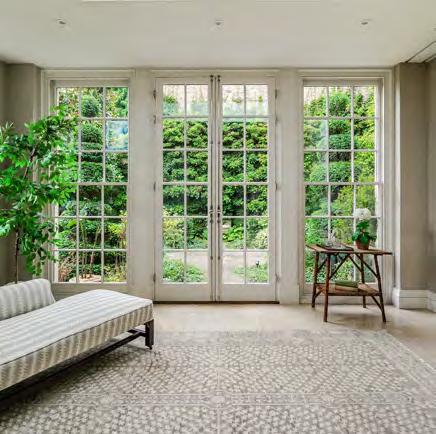
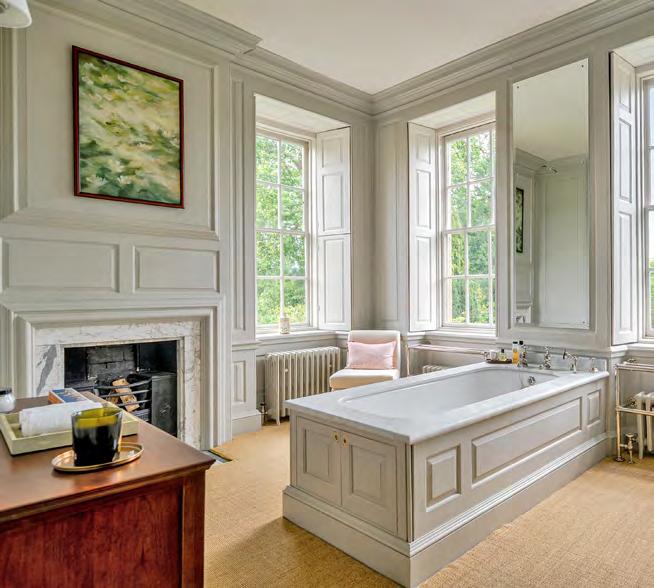
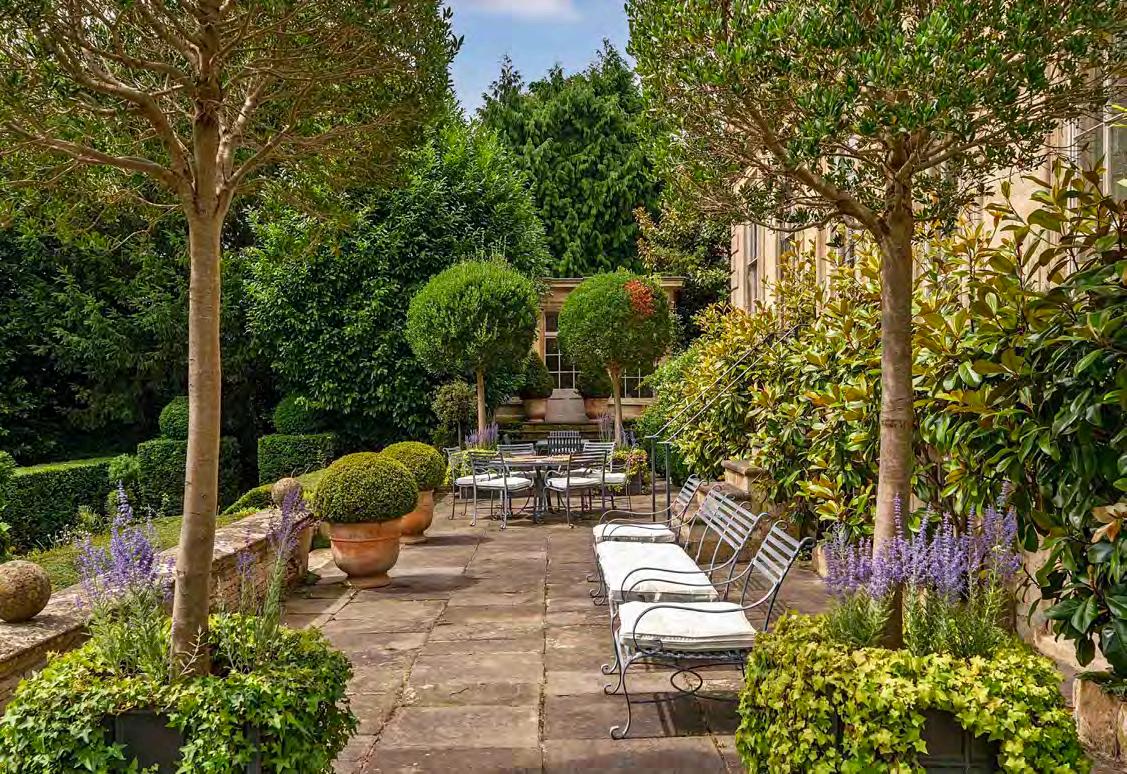




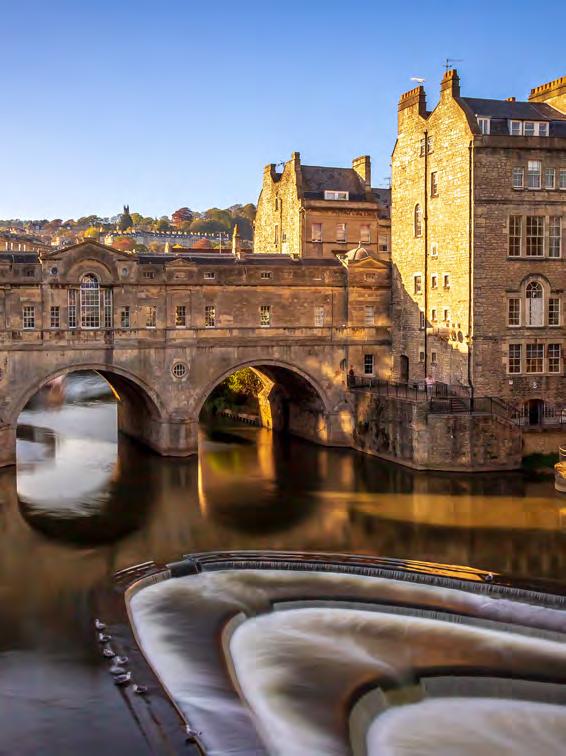


FOR THE HOME
Our local businesses are poised and ready to help with all your home needs for Spring
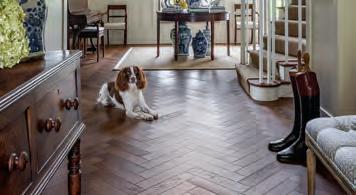
TILE & FLOOR For over 50 years, Tile & Floor has been synonymous with the supply of a range of top-tier design-led materials and professional installation services. Our commitment to quality has forged enduring relationships with discerning homeowners overseeing their personal projects, as well as with design and construction professionals serving the property industry. Exciting news! We are now also conveniently located at Chippenham M4. Tel: 01225 310561; www.tileandfloor.co.uk
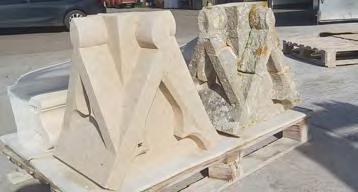
SANDRIDGE STONE is a local craft-skills business specialising in all aspects of building and restoring local Bath Stone properties. It can supply and fix all stone requirements for new builds or extensions. The team’s heritage skills qualified stonemasons are also expert in repairing and restoring existing stone on listed properties in order to fulfil planning requirements. Boundary Farm, Berryfield, Melksham SN12 6EF; Tel: 01225 703733; www.sandridgestone.co.uk
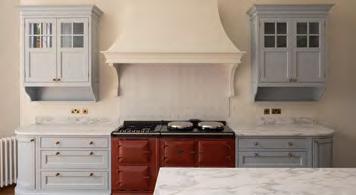
BATH KITCHEN COMPANY
Based in the heart of Bath and specialising in bespoke, handmade kitchens, Bath Kitchen Company become personally invested in every kitchen they design and build. It’s about attention to detail at every stage – creating a beautiful space that enhances the way you live. 7-9 North Parade Buildings, Bath BA1 1NS; Tel: 01225 312003 www.bathkitchencompany.co.uk

PLUSHH: DEVELOPMENTS LTD
Specialising in high-quality restoration and renovation. Working with clients across Bath and beyond while also developing our own carefully considered property projects. Tel: 01225 767148; www.plushhrestoration.co.uk
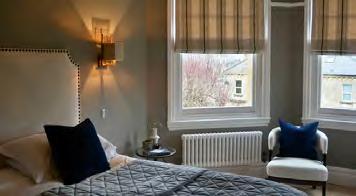
NO17 INTERIORS offers a range of bespoke interior design services. Based in Bath and with vast experience in designing and installing developer show homes, hotels and residential properties for private clients, Lisa has the knowledge and skills to work to any brief or budget, whether looking to redesign, update existing furnishings or simply commission new curtains. email: lisa@no17interiors.co.uk; tel:07977 271503; www.no17interiors.co.uk
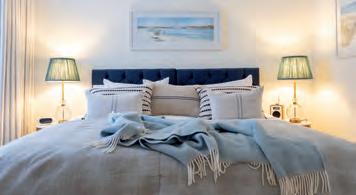
CLAIR STRONG INTERIOR DESIGN
Clair Strong Interior Design is a boutique, creative company based in Bath, providing a wide range of services for both residential and commercial clients. Her portfolio of projects includes the design, project coordination and sourcing for some of Bath’s most beautiful residences, as well as hotels, sports clubs, offices and other commercial venues. Contact Clair on 07855 797311 or 01225 426905; www.clairstrong.co.uk
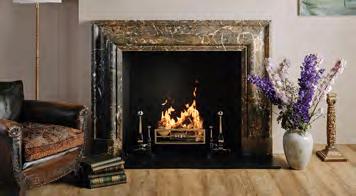
MENDIP FIREPLACES BATH
Bath’s leading fireplace, wood burner, gas fire, chimney and flue specialist. From classic to contemporary, concept to completion, their team of experts can work with you to achieve your perfect interior. Brands include Chesneys, Barbas Bellfire, Westfire, Stovax, Gazco and Hunter. Get in touch or visit the showroom. Mendip Fireplaces, Monkton Combe, Bath BA2 7HD; info@mendipfireplacesbath.co.uk; Tel: 01225 722706; www.mendipfireplacesbath.co.uk
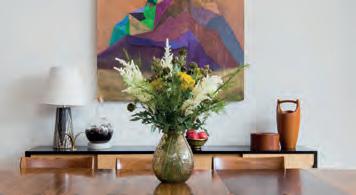
JENNIFER MOSSE DESIGN STUDIO
A bespoke, tailor-made, client-focused interior design consultancy service based in Bath. Specialising in residential interior design and providing a truly personal service adapted to each client’s needs, Jennifer’s unique style blends seamlessly between period and contemporary homes. The aim is simple – to create spaces that bring joy, reflecting her clients’ lifestyles and personalities. Tel: 07738289189; www.jennifermosse.com
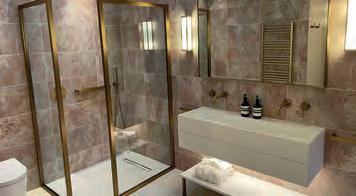
NEXUS OF BATH is a Bath based family business specialising in painting and decorating, plastering, tiling, sash window restoration and other property restoration. Nexus have built a reputation for the highest standards of workmanship with experience across a range of projects from listed buildings through to new builds, with a complete commitment to customer service and health and safety
Tel: 01225 300414; www.nexusofbath.co.uk

NATASHA PULLEY
Novelist and Bath Spa lecturer on time travel, Star Trek
,
and her GCSE in astronomy
Natasha Pulley was born in Cambridge and read English Literature at Oxford before doing an MA in creative writing. In 2013 she lived in Tokyo learning Japanese and researching her first book, The Watchmaker of Filigree Street. She then spent several months in Peru chasing llamas and working on The Bedlam Stacks, and more recently, was in Shanghai studying Mandarin for The Mars House. Her fourth novel, a folk horror, The Salt King , is due out in August. Natasha also teaches at Bath Spa University, and is hosting a writing workshop on 23 May as part of the Bath Literature Festival.
“Bath is a place full of storytellers”
I wrote Star Trek fanfiction when I was a kid: I loved space stories and anything to do with science and stars.
I volunteered at shipyards in Sharpness and Bristol, maintaining tall ships in dry dock. It’s the best thing I’ve ever done. I learned so much. One day I’d be sanding down new masts and the next it would be scraping the tar off old rigging, or painting cabins. I even got to work with a surveyor measuring hull density once, stomping around a dry dock beneath a ship with diagrams and things.
You meet amazing people in the sailing world. A Hell’s Angel who used to work on MoD submarines, a merchant navy trainee, an enthusiastically salty bosun who told me the filthiest joke I’ve ever heard…
for a living, you’re technically freelance, but it feels like being employed by a publishing house to do the thing you love most all day long and claim it’s work. And magically, it…is?
I would never recommend anyone write full-time, because although the idea does sound super mysterious and glamorous, what it actually is, is sitting at your kitchen table alone all day, as if you’re in perpetual lockdown. It’s a quick way to go mad. Teaching at a university is the opposite: you’re with humans all the time, and even better, they ask you stuff about this magical thing that you love, and THAT counts as work too.
I grew up in a tiny house on a dirt road in the middle of nowhere in the Fens. Most of my memories of childhood are the kind of thing you’d expect from some dreadful AI TikTok fantasy of the countryside: I ran around, climbing trees and haybales, getting into violent disagreements with goats, skateboarding, etc. Now, when I talk to my students, I end up saying things like, “But what do you MEAN you weren’t allowed to go out and provoke herds of cows unsupervised….?”
I LOVED school. I was the annoying person who took extra GCSEs. I’m one of about eight people in the UK with a GCSE in astronomy.
Because Bath Spa University turns out so many creative people, and because so many then stay in the city after graduating, Bath is a place full of storytellers. I mean it: chat to your waiter at Hall & Woodhouse, or to the person behind the till at the Co-op, and they might well be writing a novel about something fantastic. Get their name. You’ll probably see it on a shelf soon.
The great lure of fantasy books is escape. I don’t think that should ever been treated flippantly. The real world is horrifying. Just give me time travel and clairvoyance and magic, thanks, and I might not go wholly insane before Wednesday.
One of the first things I had published was a book called The Watchmaker of Filigree Street It’s a queer historical fantasy about a watchmaker who remembers the future, and his relationship with a musician whom he saves from a bomb.
What I love about being a writer is freedom. If you write
Mr B’s Reading Emporium is my favourite shop in Bath. They host incredible events with writers all year round, and sometimes, I even get to chair for them. It’s through Mr B’s that I’ve managed to interview Nnedi Okorafor, Nikita Gill, RF Kuang, and Joey Batey. Their tiny events are just as good and just as fun as the huge ones. I haven’t come across any other book shop quite like it.
I’m a giant cliché. If you think ‘generic British writer’, you have a photograph of me in your brain. Seriously, I can see your internal bingo card from here. Harangues innocent passersby about Beowulf ? Spends life explaining where to put apostrophes? Occasionally gallivants off to faraway places to be courted by an unexpected but somehow entirely predictable Brazilian acrobat? Bingo.
The Salt King by Natasha Pulley (Orion Publishing, £22) is due out on 20 August.
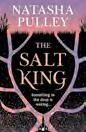
For more: www. bathfestivals.org.uk | www.bathspa.ac.uk