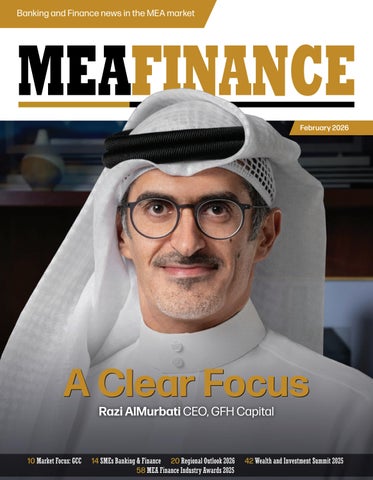
A Clear Focus A Clear Focus

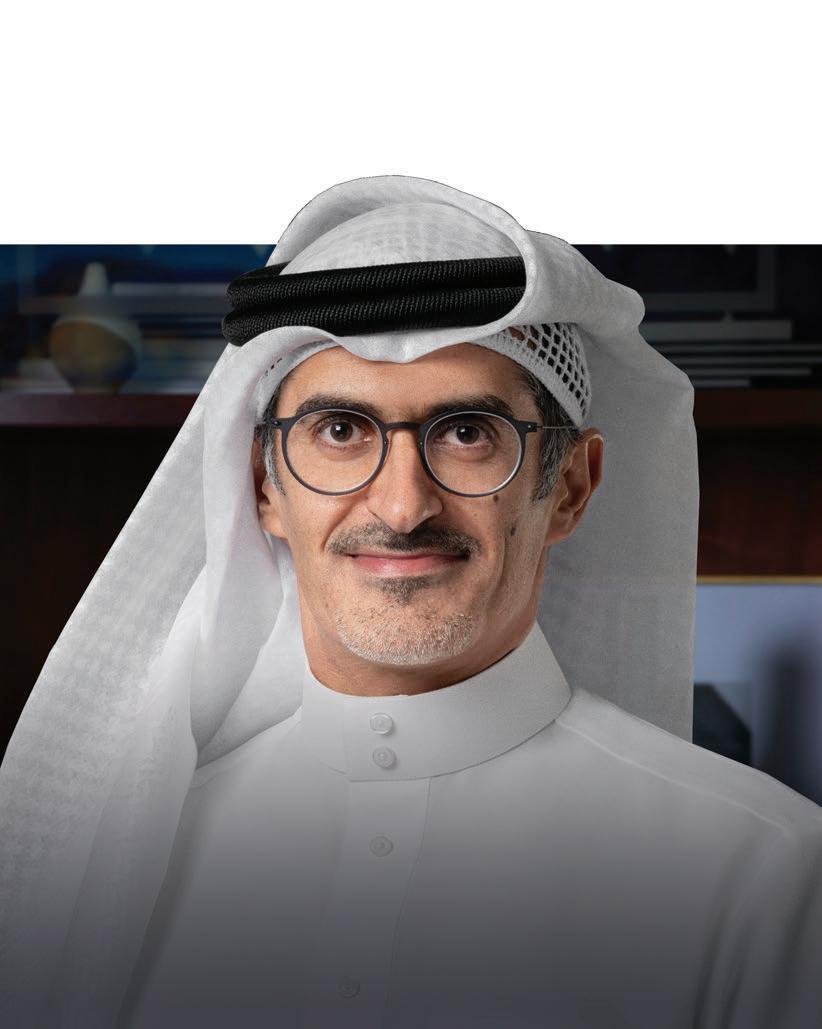
Razi AlMurbati CEO, GFH Capital

What’s Next?
Welcome to the first MEA Finance Magazine of 2026, our February edition. 2025 has morphed into 2026, continuing the geo-political norm shattering and general uncertainty evident through the previous 12 months. However, despite the noise and disruptions, the world seems to have grown somewhat sound-proofed and absorbed much of the din, finding ways to operate in a newly emerging global order. What comes next is not easy to predict within such a currently capricious global environment, so better to just get on and keep doing what you are doing, especially if you are doing

Doing it right is largely what our region seems to be achieving in terms of our banking and capital markets. Our regional outlook for the coming year takes the view that the financial markets of the GCC will focus on scaling across credit, the capital markets and digitisation, and that it will be a year of recalibration
Before 2026, obviously came 2025. In our review of the GCC’s banking sector for the just passed year, we can see how the course for 2026 seems to have been primed by a reshaping of the regional financial architecture, expanding credit and continued profitability.
Our cover story features Razi AlMurbati the CEO of GFH Capital, outlining their plans to leverage the institutional strength of GFH Financial Group to build a Saudi-headquartered investment platform that will accommodate the wider GCC. AlMurbati comments, “Our ambition is clear: to scale from USD 2 billion to USD 5 billion in AUM through disciplined growth and differentiated platforms”.
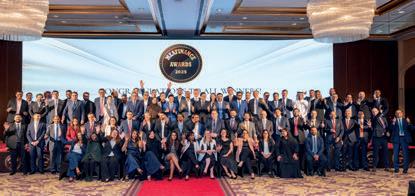
Glancing back at 2025’s, we provide extensive coverage of the MEA Finance Annual Industry Awards, highlighting the winers and their achievements at our regional standard
setting celebration of excellence in and around the regional banking and financial markets. Congratulations to all our exceptional winners!
In an opinion piece looking at the region’s next credit challenge, Rob Macmillan Group Product Manager Credit at Paymentology, highlights how modern credit infrastructure offers clarity and flexibility that can foster inclusivity and build growth. Also inside is coverage of the Finacle Conclave where industry leaders debated the global trends transforming banking.
We report on another of our market leading annual conferences, the MEA Finance Wealth and Investment Summit. With a higher attendance than ever before, the conference featured regional leaders of our fast-expanding wealth markets, debating the future of wealth management, private banking and family office services in the Middle East.
Peering again into the coming year, we take a look into the growing role and importance of regulation technology to the sector as regulatory compliance enters a new era where it will no longer be optional, but now foundational. This theme is underlined by the partner content supplied by Ocorian, who detail how regulatory compliance, more than a box-ticking exercise, can actually be a strategic enabler.
SMEs and their financing will take more of the spotlight in 2026 - indeed you should make time to attend the MEA Finance SME Business and Finance Summit & Awards on the 23rd of Aprilvisit our events calendar at www.mea-finance. com for more details. In this issue we look at this area of growing prominence and importance to banks and economies across our region and how SME finance will be defined not just by access to finance, but also by how regulation, technology and risk discipline converge to build sustainable, scalable funding ecosystems. Adding to this, Emirates Islamic, in their contribution to the topic, underscores the importance of SMEs to the economy and how their expectations of banks have changed.
So, put in your ear buds, set them to noise cancelling and look straight ahead at what’s next in your copy of MEA Finance.






PayPal and NEO PAY partner to accelerate cross-border payments for businesses across the UAE
PayPal, a global digital payments and commerce platform, announced a strategic partnership with NEO PAY, the UAE’s fast-growing digital payments platform. With this partnership, PayPal is taking another bold step in reshaping digital commerce across the Middle East and Africa by bringing businesses closer to a borderless, secure and frictionless cross-border payment future.

Through this partnership, merchants across the UAE can now accept PayPal payments, offering consumers a simple and secure way to pay online. The integration with NEO PAY’s advanced acquiring infrastructure will streamline merchant onboarding, opening new growth avenues, particularly for small and medium-sized enterprises (SMEs) targeting international markets.
This partnership is set to play a pivotal role in the continued growth of the UAE’s e-commerce sector, with the value of the sector projected to reach US$21.18 billion
by 2030, according to Mordor Intelligence. Via the collaboration, SMEs – which make up 94% of businesses in the UAE and contribute to over half of the country’s GDP – can gain easy access to one of the world’s most recognised digital payment platforms. By offering PayPal’s trusted checkout, merchants can boost customer confidence, increase conversion rates and expand their global reach.
“The UAE is a vibrant and digitally forward economy with a rapidly expanding e-commerce landscape and a strong appetite for financial innovation,” said Otto Williams, Senior Vice President,
Regional Head and General Manager, Middle East and Africa, at PayPal.
“Deepening our presence through this partnership with NEO PAY is a critical step in our regional growth strategy. By integrating PayPal, merchants, especially SMEs, can better serve today’s digital-first consumers and scale with confidence. This collaboration blends global trust with local innovation, unlocking new opportunities while advancing our mission to enable access and support business growth worldwide.”
NEO PAY – a pioneer in digital payment acquiring – delivers secure and scalable solutions tailored to the needs of modern commerce, with the aim of empowering SMEs with the financial tools they need to grow and compete in today’s dynamic market.
“We at NEO PAY are thrilled to partner with PayPal on the acceptance of digital wallets across our e-commerce merchant network. This partnership allows us to provide secure, trusted and globally recognised payment options— enhancing the checkout experience and supporting our merchants’ growth across borders. With this launch, NEO PAY reaffirms its commitment in delivering solutions that help merchants navigate the complexities of modern e-commerce payments and stay ahead of the curve.” said Vibhor Mundhada, CEO of NEO PAY.
This collaboration not only empowers UAE businesses but also reinforces the country’s status as a regional hub for digital commerce. Together, PayPal and NEO PAY are accelerating financial inclusion, enabling cross-border trade and contributing to the UAE’s ongoing digital transformation.
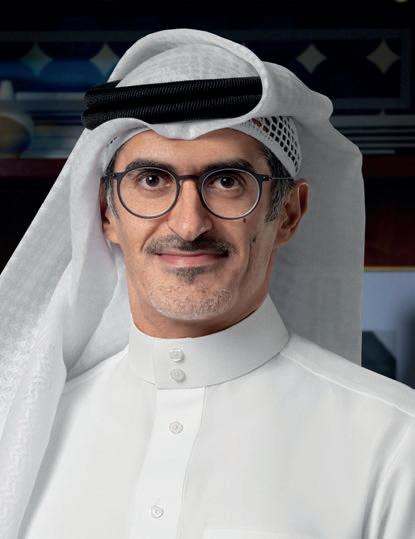
Vibhor Mundhada, NEO PAY and Otto Williams, PayPal
Discover Distinction
with Mashreq Private Banking


Our cutting-edge technology offers you a one-stop solution for all your wealth management and daily banking needs.

ADIB Capital launches Digital Infrastructure Fund focused on data storage and transmission companies
ADIB Capital Limited, located in DIFC, a wholly owned subsidiary of Abu Dhabi Islamic Bank PJSC and regulated by the DFSA, has launched the ADIB Digital Infrastructure Fund

The ADIB Digital Infrastructure Fund is a new Sharia-compliant public fund incorporated in DIFC and designed to provide investors with targeted exposure to high-conviction investments in the listed equities of companies benefiting from
the attractive supply-demand dynamics in the data storage and data transmission sectors, with a particular focus on North America and Europe.
The fund provides investors with Shari’a-compliant solutions to capitalise on the ongoing global digital
transformation and diversify their portfolios with exposure to digital infrastructure assets. It employs a bottom-up approach by analysing individual companies and broader economic trends and opportunistically invests in a concentrated portfolio of 20 to 25 securities that are priced at discounts to their intrinsic value, aiming to achieve competitive risk-adjusted returns.
Macro tailwinds in Artificial Intelligence, Cloud Computing, E-Commerce and mobile connectivity are driving the long-term growth of the digital infrastructure sector. The fund aims to capitalise on these sustainable industry trends by investing in data centres, cell towers, fibre networks and other key assets. The unprecedented demand for connectivity, coupled with the ongoing supply crunch in data storage and related assets, has created favourable market conditions for targeted investments in this space.
ADIB Capital will manage the fund in collaboration with DigitalBrid, Liquid Accounts Adviser, LLC, an affiliate of DigitalBridge Group, one of the world’s largest dedicated digital infrastructure firms that owns, operates and invests across the full spectrum of digital infrastructure assets. The fund’s Shari’a Supervisory Board has approved the structure, investments and documentation, providing investors with confidence in a strong Shari’a-compliant framework alongside ADIB Group’s robust governance and institutional infrastructure.
ADIB Capital










Connectivity

Flexibility
Exceed
mastercard.com/gateway
Mastercard Gateway
Security
Protect
Innovation
Futureproof your business and lead the competition in an always evolving market




THE CYCLE:
How GCC Banking Re-Engineered Itself in 2025 BEYOND
Across the GCC, banking and finance spent the last twelve months balancing a shifting interest-rate environment, adjusting to fastexpanding digital rails and a regulatory agenda that is becoming more ambitious, more datadriven and more internationally aligned. The headline numbers remained strong—credit expanded, profitability held up, capital markets deepened—yet the story of 2025 is less about a single surge and more about a regional system learning to operate at speed
There is a familiar temptation at the end of any year to treat the GCC’s banking performance as a neat function of oil prices, liquidity and government spending. In 2025, that formula still mattered—but it was not the whole story. The past twelve months in Gulf banking and finance were defined less by cyclical tailwinds and more by the deliberate reshaping of the region’s financial architecture. Regulators and governments continued to treat financial services as strategic infrastructure, not merely a supporting industry. Banks, in turn, operated in a market where growth opportunities were plentiful, but so were expectations: digital service delivery is now assumed; risk governance is scrutinised; and cross-border credibility is increasingly determined by the sophistication of compliance, data and reporting.
The year began with GCC banking still enjoying the afterglow of strong postpandemic credit demand and a funding environment that had favoured wellpositioned incumbents. By mid-year and into the final quarter, the system was adjusting to a more nuanced reality—one in which interest-rate cuts started to reintroduce pricing pressure, but balancesheet growth and fee income became
more decisive levers. Emirates NBD captured the tone of that pivot in its 9M 2025 update, noting that operating profit grew as “outstanding loan growth” more than offset the impact of rate cuts. This became a recurring GCC theme: the banks that sustained momentum were those that could drive volume, deepen relationships and expand non-funded income without compromising asset quality.
Yet profitability alone does not explain why 2025 felt like an inflection point. The more important shift is that the GCC’s regulatory agenda is now converging around three priorities: building digital market infrastructure, strengthening risk and integrity frameworks and supporting competition and inclusion through controlled openness.
UAE
In the UAE, this “infrastructure-first” mindset was particularly visible through the Central Bank’s Financial Infrastructure Transformation programme and its Digital Dirham work, which positioned CBDC not as a conceptual experiment but as a practical component of the payments and settlement future. The Central Bank’s own Digital Dirham report emphasised instant settlement and wide accessibility, anchoring the project as a multi-format CBDC effort (wholesale and retail) aligned with future-proofing central bank money for a digital economy. The pilot’s direction was reinforced in November 2025, when the UAE Ministry of Finance and Dubai Finance announced the first government transaction using the Digital Dirham as part of the pilot phase.
At the same time, open finance moved from buzzword to policy. The Central Bank of the UAE framed open finance as a secure method for financial institutions to open systems to accredited third parties— signalling a regulatory posture that supports data portability and innovation, but within a controlled accreditation model.
Across the GCC, this basic philosophy— innovation by design, with guardrails— was visible in different ways. Saudi Arabia continued to professionalise its
digital governance and service delivery, including launching the trial phase of its e-services portal “eSAMA” to automate access to central bank services via a unified digital platform. Meanwhile, Bahrain’s regulatory model continued to highlight structured consultation and rulebook-driven iteration, with the Central Bank’s consultation process remaining a key mechanism by which regulatory change is shaped, tested and communicated.
The most important consequence of this regulatory trajectory is that banks are now building for a world where compliance, reporting and customer experience are intertwined. In 2025, the operational “centre of gravity” in many institutions shifted: product innovation and growth strategies increasingly depended on data governance, identity verification, transaction monitoring and platform integration. The past year did not reduce compliance obligations; if anything, it expanded them.
Saudi Arabia
In Saudi Arabia, 2025 was a year of banking aligned with national transformation at scale. The Kingdom’s regulatory and market posture continued to link banking outcomes with broader diversification goals, while the sector itself sustained momentum in revenue and profitability. The Saudi National Bank’s Q3 2025 earnings release reported net income of SAR 18.6 billion for 9M 2025, up 19% versus 9M 2024, attributing performance to robust revenue growth and sustained business momentum. The tone in such releases is always carefully measured, but the strategic subtext is clear: the Saudi market remains large enough—and policy-driven enough—to support scale banking strategies, provided institutions can execute with discipline.
Saudi’s story in 2025 was not limited to corporate lending or balance-sheet scale. A critical regulatory dimension was inclusion and access, with policies increasingly designed to reduce friction in participation. For example, SAMA’s
digital services push through eSAMA signalled a regulator modernising its own service delivery. And while not every policy change is equally transformative, the overall direction is consistent: Saudi finance is steadily building the rails— digital, regulatory, operational—that allow banks and fintechs to innovate without losing system integrity.
Qatar
Qatar’s 2025 banking narrative was shaped by its ambition to be a fintech launchpad while preserving the stability of a system anchored by large, internationally active incumbents. The Qatar Central Bank’s National Fintech Strategy had already positioned open banking architecture and API platforms as foundational infrastructure, a framing that continued to influence market expectations through 2025. In terms of bank performance and market leadership, QNB offered a straightforward case study in stability and scale. Its results for the year ended 31 December 2025 reported net profit of QAR 17.0 billion, up 2% yearon-year, with profit before Pillar Two taxes of QAR 18.4 billion, reflecting both resilience and the increasingly global tax and regulatory context in which regional champions now operate.
Kuwait
Kuwait’s 2025 story, by contrast, was less about dramatic reinvention and more about consistent, measurable improvement within a market where credit cycles and public-sector dynamics have historically shaped outcomes. The Central Bank of Kuwait’s own assessment of September 2025 monetary and banking developments highlighted growth in deposits and credit facilities to residents, with credit facilities increasing by 7.2% year-onyear. That matters because it anchors the narrative in system-level data, not only individual bank announcements. At the bank level, National Bank of Kuwait’s 2025 performance and commentary helped illustrate how a leading institution
navigated the year with steady profitability and balance-sheet strength.
NBK reported net profit of KD 315.3 million for 1H 2025 and continued to communicate performance through periodic updates.
Bahrain
In Bahrain, 2025’s banking landscape was a reminder that smaller markets can still produce strategically meaningful shifts— particularly when policy, consolidation and external bank strategy intersect. A landmark development was HSBC’s decision to sell its Bahrain retail banking operations to Bank of Bahrain and Kuwait (BBK). For Bahrain’s market, the deal represented more than just an asset transfer; it illustrated how global banks are narrowing their consumer footprints in certain markets, while local and regional players consolidate scale. Meanwhile, Bahrain’s banks continued to report strong performance in 2025. National Bank of Bahrain, for instance, announced record-breaking net profit attributable to shareholders for the nine months ended 30 September 2025. BBK’s own 9M 2025 disclosures reflected the rate environment’s effects on net interest income, underscoring how even strong banks must navigate the shifting pricing dynamics of the year.
Oman
Oman’s banking story in 2025 was shaped by a measured growth narrative—less headline-grabbing than some neighbours, but strategically important as the Sultanate continues to evolve its financial sector alongside broader economic programmes. Bank Muscat’s 2025 performance provides an illustrative case study: reporting a 13.3% increase in net profit for 2025 to RO 255.54 million, as covered by local media in early 2026. While each market’s context differs, the pattern across the GCC was consistent: banks that combined balance-sheet growth, operational discipline and digital execution were best positioned to defend
profitability through the year’s changing rate dynamics.
Defining themes
This shifting rate backdrop deserves particular attention because it shaped bank strategy in subtle ways through 2025. Even when headline profits remained strong, the “quality” of earnings became more important. In the highrate phase, net interest margins can do much of the work. In a normalising phase, management must demonstrate control—diversifying revenue, improving efficiency and maintaining asset quality. Emirates NBD’s Q3 commentary explicitly referenced the impact of interest rate cuts—an example of how leading banks framed performance as a function of strategy, not simply environment. In Kuwait, BBK’s 9M disclosure pointing to net interest income moving with market rates highlighted the same reality from a different angle.
tested for real use cases. Complementing CBDC, the UAE’s open finance positioning also matters because it signals the regulator’s intent to enable secure thirdparty participation through accreditation.
In Qatar, the open banking and API narrative continued to shape strategic direction. Even where implementation is phased, the strategic signal matters: open banking is framed not as compliance alone but as infrastructure for new products and experiences. Saudi Arabia’s open banking framework has its own trajectory and architecture; what is important for a 2025 roundup is not to claim completion, but to note the continued institutionalisation of digital infrastructure through policy and standards. Across the GCC, these initiatives collectively reinforce a reality that is increasingly apparent to banks: future competitiveness will not be determined only by branch footprint or even capital strength, but by how
THE PAST TWELVE MONTHS IN GULF BANKING AND FINANCE WERE DEFINED LESS BY CYCLICAL TAILWINDS AND MORE BY THE DELIBERATE RESHAPING OF THE REGION’S FINANCIAL ARCHITECTURE
The second defining theme of 2025 was the continued modernisation of market infrastructure—payments, identity, settlement and data sharing— under regulatory stewardship. In the UAE, this was most visible in the Digital Dirham narrative, which moved from conceptual framing to pilot activity. The Central Bank’s Digital Dirham report framed CBDC as enabling instant settlements and wide accessibility, with the security and trust of central bank money. The Ministry of Finance and Dubai Finance transaction using the Digital Dirham in November 2025 underscored that the project is not purely exploratory; it is being
effectively institutions can plug into regulated digital ecosystems—payments, identity, data and settlement.
The third theme was the deepening of capital markets and the broadening of finance beyond traditional bank lending. The GCC is not abandoning bank-led finance; it is supplementing it. These developments sit within a larger trend: Gulf governments and regulators want deeper local markets that can absorb issuance, distribute risk and provide savers with more diversified instruments. For banks, this presents both opportunity and competition—new fee lines, advisory mandates and distribution
roles, alongside a gradually expanding landscape of non-bank financing.
It is also in this context that the role of large consultancies and external analysis became more prominent in 2025. With banking systems transitioning from rate-driven profitability to execution-driven differentiation, banks increasingly relied on sector outlooks and benchmarking to shape strategy. EY’s “GCC banking sector outlook: H1 2025” framed the period as “balancing growth and risk,” reflecting a view that was widely shared: the GCC’s banks are strong, but they must navigate credit growth, rate transitions and evolving risk priorities simultaneously. This balanced framing aligns closely with what banks themselves communicated through the year—confidence, but not complacency.
Regulatory oversight
Another layer of the 2025 story is that regulators increasingly expect banks to demonstrate not only performance, but resilience and integrity. This is not always captured in profitability headlines, but it is a defining feature of the year’s operating environment. Across the GCC, regulators’ push towards digital infrastructure and data sharing implicitly raises the bar for cybersecurity, data governance and operational resilience. As open finance models expand and CBDC pilots develop, the “surface area” for operational risk grows—and that forces banks to invest in controls. Meanwhile, cross-border scrutiny of AML and sanctions compliance continues to shape correspondent banking relationships and institutional credibility. For a region positioning itself as a global hub for trade and investment flows, financial integrity is not a “nice-to-have”; it is an access requirement.
GCC Banking
To understand the broader GCC direction, one must also consider how the “shape” of growth changed in 2025. Retail banking across the GCC continued its shift towards ecosystems—
banking that is integrated into lifestyle, commerce and government services. Corporate banking increasingly competed on speed, digital servicing and cross-border capability, not just pricing. Wealth management continued to expand in importance, driven by growing high-net-worth segments, family office sophistication and regional capital flows. Payments became a strategic battleground, with regulators investing in infrastructure and banks racing to innovate. In short, 2025 made it increasingly difficult for banks to be excellent at only one thing. The institutions that stood out were those able to integrate: retail and corporate, digital and physical, compliance and growth, local depth and regional reach.
reinforces the need for local institutions to demonstrate world-class governance and capability.
Pulling these strands together, the most accurate way to describe 2025 is as a year of “institutionalisation” for GCC finance. Many of the most important developments were not single announcements, but the steady embedding of frameworks—open finance definitions, CBDC pilots, regulatory digitalisation and a more consultative, iterative approach to rulemaking. In parallel, banks continued to professionalise their narratives around performance: emphasising not only profits, but the underlying drivers—loan growth, deposits, fee income, efficiency and resilience.
THE GCC IS NOT ABANDONING BANKLED FINANCE; IT IS SUPPLEMENTING IT
A meaningful “year in review” must also acknowledge that the GCC’s financial future is increasingly regional and international at once. The region’s banks are not operating in isolation. They compete for global mandates, they manage cross-border exposures, they seek international funding and they operate under global scrutiny. In Kuwait, for example, Reuters coverage of Goldman Sachs opening an office and deepening regional presence may sit outside core retail banking, but it reflects a broader finance narrative: global institutions see the Gulf as a strategically important market for capital markets, asset management and private wealth. That external attention is both opportunity and challenge. It raises standards, intensifies competition and
It is tempting to treat these developments as separate tracks: regulators build policy; banks deliver products; markets provide funding. In reality, 2025 showed how intertwined they have become.
So what did the year ultimately reveal about the GCC’s financial direction? First, that the region’s banks are proving resilient even as the rate environment becomes less “automatic.” Second, that regulators are increasingly focused on infrastructure that enables innovation while preserving stability. Third, that leading banks are beginning to differentiate through execution—speed, digital capability, operational discipline and risk governance—rather than through scale alone. Fourth, that the GCC’s finance ecosystem is becoming more globally integrated, which raises both opportunity and scrutiny.
And perhaps most importantly, 2025 reinforced a shift in identity. The GCC is no longer merely a set of high-growth banking markets. It is becoming a laboratory for next-generation financial infrastructure—open finance, digital identity, modernised supervision and state-backed digital currency initiatives—implemented not in theory, but in the operational reality of largescale banking systems.

Filling the Gap - Financing the Future
In 2025, SME finance across the Middle East and Africa moved decisively from the periphery of banking strategy to the heart of economic policy. With 2026 now approaching, the future of SME finance will be defined not simply by access to capital, but by how regulation, technology and risk discipline converge to build sustainable, scalable funding ecosystems
Small and medium enterprises have long been recognised as the backbone of economies across the Middle East and Africa, yet only in recent years has this recognition translated into sustained financial-system reform. SMEs account for the majority of private-sector employment across the region and are increasingly viewed as the engine of diversification, innovation and non-oil growth. From family-owned trading firms in the UAE and manufacturing clusters in Saudi Arabia, to agribusinesses in East Africa and export-oriented enterprises operating out of free zones, SMEs sit at the intersection of policy ambition and economic reality. Yet their access to finance has historically lagged far behind their contribution to growth.
In 2025, this imbalance became impossible to ignore. Governments, regulators and financial institutions acknowledged that without structurally improving SME access to capital, broader economic strategies — from Vision 2030 to Africa’s industrialisation goals — risked under-delivery. At the same time, a cautious global macroeconomic environment, lingering inflationary pressures and uneven recovery across sectors exposed the vulnerability of small businesses to liquidity shocks. The result was a year that combined meaningful progress with sobering clarity: the SME finance gap is narrowing in pockets, but closing it at scale will require deeper regulatory alignment, smarter capital deployment and sustained institutional commitment.
The magnitude of the challenge remains stark. Across the GCC, SME lending typically accounts for less than 10 per cent of total bank credit, compared with more than 20 per cent in advanced economies. In broader MENA and Sub-Saharan Africa, the financing gap for formal SMEs runs into hundreds of billions of dollars, while informal enterprises remain largely excluded from formal credit altogether. Structural constraints — limited financial transparency, weak credit histories, high collateral requirements and riskaverse underwriting cultures — have long discouraged banks from engaging deeply with the SME segment. These constraints did not disappear in 2025, but they were increasingly challenged by a combination of regulatory intervention and technological innovation.
Regulators and Central Banks
A defining feature of the year was the more assertive role played by regulators and central banks as architects of SME finance ecosystems. Rather than relying solely on direct funding or ad-hoc stimulus, policymakers focused on reshaping the rules of engagement between lenders, borrowers and intermediaries. In the Gulf, central banks continued to push reforms that improve credit visibility, enhance data-sharing and incentivise SME lending without undermining financial stability. Credit bureau enhancements,
open-banking initiatives and digitalidentity frameworks were increasingly positioned as foundational infrastructure for SME finance, not optional enhancements.
Saudi Arabia offers a telling example. Through a combination of regulatory support and public credit-guarantee expansion, the Kingdom continued to scale SME lending under its Vision 2030 agenda. The Kafalah programme, which provides government-backed guarantees to de-risk SME loans, expanded both in volume and sectoral reach during 2025. This was not merely a fiscal intervention but a regulatory signal: SME lending is a strategic priority, and banks are expected to participate. By absorbing part of the credit risk, regulators enabled commercial banks to extend financing to viable SMEs that previously fell outside conventional risk thresholds, particularly in manufacturing, logistics and technology-enabled services.
In the UAE, regulators pursued a parallel but distinct approach. Rather than relying solely on guarantees, the emphasis was placed on building a holistic SME finance environment through regulatory clarity, fintech enablement and capital-market development. The Central Bank of the UAE continued to support SME lending through targeted initiatives while encouraging banks to modernise underwriting and onboarding processes. Meanwhile, free-zone regulators and economic-development authorities reinforced ecosystems that enhance SME bankability by simplifying licensing, enabling foreign ownership and supporting export-oriented growth. These measures reduced operational friction and indirectly improved access to finance by making SMEs more transparent, scalable and creditworthy.
Regulatory bodies across the region also intensified their engagement with fintech as a vehicle for SME inclusion. Licensing regimes for digital lenders, payment service providers and openbanking participants matured in 2025, reflecting a growing confidence that innovation and stability need not be
mutually exclusive. Rather than viewing fintech as a threat to incumbents, regulators increasingly framed it as a complementary channel for reaching underserved segments. This shift was particularly evident in markets such as Bahrain and the UAE, where regulatory sandboxes allowed lenders to test alternative credit models under supervisory oversight.
The Fintech factor
Fintech innovation emerged as one of the most transformative forces in SME finance during 2025, but its impact varied significantly across regions. In the Gulf, fintechs primarily operated as enablers — providing technology, analytics and digital interfaces that allowed banks to serve SMEs more efficiently. Automated credit scoring, cash-flow-based lending models and API-driven integrations reduced processing times and improved customer experience. For SMEs accustomed to lengthy approval cycles and opaque credit decisions, these changes marked a tangible improvement.
In Africa, fintechs played a more foundational role. In markets where traditional banking penetration among SMEs remains limited, digital lenders and mobile-money-linked platforms filled critical gaps. Revenue-based financing, merchant cash advances and short-tenor working-capital loans aligned credit provision with real-time business performance rather than static balance sheets. These models proved particularly effective for micro and small enterprises operating in informal or semiformal environments, where traditional collateral is scarce but transaction data is abundant. Importantly, many successful fintech models blended digital efficiency with human engagement, recognising that trust and financial literacy remain essential in emerging markets.
Trends and tensions
Despite these advances, digital adoption among SMEs remained uneven in 2025. While consumer banking in the GCC is
now overwhelmingly mobile-first, SME lending continues to rely partly on manual processes, particularly for larger exposures and longer tenors. Compliance requirements, documentation standards and risk governance frameworks — all essential for financial stability — often slow down digital transformation. Regulators face a delicate balancing act: enabling innovation while ensuring prudential oversight, consumer protection and systemic resilience.
This tension became increasingly visible as SME finance volumes grew. Regulators across MEA emphasised that digital speed must not come at the expense of credit discipline. Supervisory authorities reinforced expectations around responsible lending, data protection and transparency, particularly as alternative data and automated decision-making gained prominence. In 2025, several regulators issued guidance on the ethical use of data and algorithmic models, underscoring that innovation must remain aligned with fairness and accountability. Another critical dimension of SME finance in 2025 was its integration with broader economic ecosystems. SMEs do not operate in isolation, and neither does their financing. Free zones, industrial clusters and special economic zones across the UAE, Saudi Arabia and parts of Africa demonstrated how infrastructure, regulation and finance can reinforce one another. SMEs operating within these ecosystems benefited from streamlined processes, improved market access and enhanced credibility with lenders. The lesson was clear: SME finance works best when embedded within supportive regulatory and commercial environments. Cross-border activity also gained prominence. As regional trade corridors strengthened and supply chains diversified, SMEs increasingly sought financing solutions that support international expansion. This created renewed demand for trade-finance instruments tailored to smaller firms — an area traditionally dominated by large corporates. In response, banks and fintechs began
piloting digital trade-finance platforms that simplify documentation, reduce settlement times and lower entry barriers for SMEs. Regulators, in turn, explored ways to harmonise standards and reduce friction in cross-border SME transactions, recognising that regional integration is central to long-term growth.
Sustainability emerged as another defining theme. Across MEA, regulators and lenders increasingly linked SME finance to environmental, social and governance outcomes. Green financing lines, sustainability-linked loans and impact-oriented credit programmes expanded in 2025, particularly in sectors such as renewable energy, agribusiness and clean manufacturing. Importantly, these initiatives often combined finance with technical assistance, helping SMEs meet reporting standards and improve operational resilience. Regulators viewed this approach as a way to align SME growth with national sustainability goals while mitigating long-term risk.
Macroeconomic conditions
Macroeconomic conditions continued to shape the SME finance landscape. Elevated borrowing costs in parts of Africa constrained private-sector investment, while geopolitical uncertainty and global trade volatility weighed on sentiment. In this context, regulators increasingly framed SME finance as a tool of economic resilience rather than merely growth. Ensuring that viable small businesses could access liquidity during periods of stress became a priority, particularly in labour-intensive sectors where SME failure would have disproportionate social impact.
As the region looks ahead to 2026, the regulatory dimension of SME finance is expected to deepen further. Digitalisation will accelerate, supported by expanded open-banking frameworks, improved creditdata infrastructure and more sophisticated supervisory technology. Regulators in the Gulf are likely to push for greater standardisation in SME reporting and datasharing, enabling lenders to assess risk
WHILE CONSUMER BANKING IN THE GCC IS NOW OVERWHELMINGLY MOBILE-FIRST,
SME LENDING CONTINUES TO RELY PARTLY ON MANUAL PROCESSES, PARTICULARLY FOR LARGER EXPOSURES AND LONGER TENORS
more accurately and price credit more competitively. At the same time, oversight of fintech and non-bank lenders will intensify, ensuring that innovation does not create new systemic vulnerabilities.
In Africa, the regulatory agenda will continue to focus on inclusion and scale. Policymakers are expected to prioritise pathways that transition SMEs from informal to formal finance, supported by digital identity, mobile payments and simplified compliance regimes. Development finance institutions will remain critical partners, providing risksharing mechanisms and long-tenor funding that commercial lenders alone cannot supply. Regulators will play a central role in coordinating these efforts, aligning private capital with public development objectives.
Credit-guarantee schemes are also set to evolve in 2026. Rather than broad, undifferentiated coverage, regulators are increasingly favouring targeted guarantees aligned with priority sectors and policy goals. This reflects lessons learned in 2025: guarantees are most effective when they support commercially viable businesses and strategic industries, rather than distorting credit allocation. Expect more nuanced risksharing structures, co-insurance models and performance-based incentives that encourage disciplined lending.
On the horizon
For banks, the coming year will be decisive. Serving SMEs will no longer be optional or peripheral; it will be a core test of relevance and competitiveness. Institutions that succeed will be those that integrate
finance with advisory services, technology platforms and ecosystem partnerships. Regulatory expectations will reinforce this shift, pushing banks to demonstrate not only volume growth but quality and sustainability in SME portfolios.
For SMEs themselves, the bar will continue to rise. Improved access to finance will come with increased expectations around transparency, governance and digital readiness. Regulators and lenders alike are signalling that capital will increasingly flow to businesses that can demonstrate resilience, compliance and alignment with broader economic priorities. Those that adapt will find more opportunities; those that do not risk being left behind.
Ultimately, the evolution of SME finance in the Middle East and Africa is not a story of technology or regulation in isolation. It is a story of convergence — between policy ambition and market reality, between innovation and oversight, between capital and capability. The progress of 2025 showed what is possible when these elements align. The challenge for 2026 is to scale that alignment across markets, sectors and institutions.
If SMEs are to fulfil their role as the backbone of regional economies, finance must become an enabler rather than an obstacle. That requires regulators willing to innovate responsibly, banks prepared to rethink risk and reward, and fintechs committed to sustainable growth. The transformation is underway. Whether it succeeds will define not just the future of SME finance, but the broader trajectory of economic development across the Middle East and Africa.
Global Trends Transforming Banking FINACLE CONCLAVE 2025:
Finacle Conclave 2025, the annual invite-only banking industry leaders conference was held on October 29–30 at the Grand Resort Lagonissi in Athens. It brought together nearly 450 senior executives from over 65 countries, representing institutions such as the Bank of America, Santander, Emirates NBD, ING Bank, Standard Bank, Citi, DBS, ICICI Bank, Arab National Bank, State Bank of India and others
KeyThemes and Discussions
The conference with the theme “Next-Gen Now: Reimagine. Recompose. Realise.”, provided a platform for industry leaders to discuss emerging technologies, digital transformation strategies and their impact on banking operations and customer experience.
Central to conference were sessions exploring the integration of AI, cloud and composable banking platforms and the
role these technologies play in shaping next-generation banking models.
The CEO & MD, Infosys, Salil Parekh discussed the convergence of technology, talent and trust in driving digital enterprise transformation in a session titled Digital Enterprise Transformation.
Sajit Vijayakumar, the CEO, Infosys Finacle spoke about how composable platforms, AI-powered digital capabilities and open ecosystems help banks create agile, resilient digital foundations.
He reiterated how these approaches enable measurable improvements in customer engagement, operational efficiency and innovation-led growth.
Sangeet Paul Choudary, author of Platform Revolution and Reshuffle, examined the implications of platformisation and AI on value creation. He highlighted a shift from scale-driven advantages to intelligence and adaptability, noting how financial institutions can leverage these trends to build more responsive and futureready organisations.
Matthew Griffin, founder and CEO of 311 Institute and XPotential University, offered insights on innovation and leadership in disruptive markets. He emphasised the need for cross-industry learning and rethinking traditional business approaches to unlock value in an AI-first economy.
Spotlight Sessions
The conference featured multiple sessions addressing strategic and technological priorities for banks worldwide.
In the session titled ‘Dominating the Digital Curve’, Miguel Rio Tinto (CIO,

Finacle Conclave 2025
Emirates NBD) and Eugene Huang (CIO, DBS Bank) discussed how leading banks are redefining digital strategies at scale to enhance customer engagement and operational efficiency. AI-Native Banking: Ian Gillard (VP, Bangkok Bank) and Michal Plechawski (CIO & CTO, mBank) examined the evolution from AI-assisted operations to fully autonomous systems. They explored predictive and generative AI applications and governance frameworks shaping financial services.
1. Ne xt-Gen Platforms: Geoff Wenborn (COO, Bank of Sydney) and Minish Parikh (Clarien Bank) presented on cloud-native designs, SaaS delivery and composable architectures, highlighting how these approaches allow banks to innovate rapidly while maintaining compliance, security and performance.
2. Greek Banking P erspectives: Pavlos Mylonas (CEO, National Bank of Greece) and a panel of Greek banking executives—including Lefteris Kororos (Group CIO, National Bank of Greece), Anestis Petridis (Group CIO, Eurobank), Alexandros Emmanouil (CTO, Piraeus Bank), Nikolaos Vasilopoulos (Core Banking Applications Director, Alpha Bank) and Charoula Apalagaki (GM, Hellenic Bank Association)— discussed local priorities in an AI-led, platform-driven economy. Topics included customer-centric models, data utilisation, leadership alignment and cultural considerations for sustainable digital transformation.
3. Next-Gen Corporate Banking: Khomotso Molabe (Group CIO, Standard Bank) and Chris J (Head of Product Management, Bank of America) addressed the evolution of corporate banking into intelligent, connected ecosystems. They highlighted the role of open APIs, real-time payments and AI-driven insights in delivering transparency and strategic value to corporate clients.
4. Future Banking Trends: Daniel Frumkin (CEO, Metro Bank UK)

provided an overview of trends reshaping global banking, emphasising the growing influence of AI on customer service, operational decision-making and strategy formulation.
5. Digital Wealth Management: Vinod Yadav (CIO, Emirates Investment Bank) discussed next-generation wealth management platforms, including AI-driven advisory and hybrid service models. He highlighted the transition toward continuous, insight-led customer engagement.
6. Banking Everywhere: Samuel Kirubi (Group COO, Equity Bank Limited) and Jack de Mooji (EVP, Robobank) examined Banking-asa-Service and embedded finance. They outlined strategies for scaling compliant, composable ecosystems to deliver banking services across multiple channels.
7. Stablecoins and Digital Assets: Parag K. Gupta (COO, Zand) discussed how stablecoins and digital assets are reshaping global finance. Sessions explored integrating traditional banking with emerging digital finance technologies to enable real-time, cross-border transactions. Other discussions covered hybrid cloud infrastructures, secure banking environments, next-gen fee models and leveraging unified data insights through tools such as Infosys Aster. Case studies highlighted practical approaches to remain competitive in a rapidly evolving industry.
Global Collaboration and Knowledge Sharing
Finacle Conclave emphasised the value of cross-border collaboration and knowledge sharing. Delegates exchanged insights on regulatory and operational challenges, adoption of digital platforms, AI integration and customer experience optimisation.
The conference underscored that technology adoption alone is insufficient; successful digital transformation requires the integration of strategy, culture and leadership alignment. Realworld case studies demonstrated how banks can balance innovation with operational integrity, compliance and risk management.
Looking Ahead
Finacle Conclave 2025 concluded with discussions on the priorities for the coming year, laying a foundation for Finacle Conclave 2026. Delegates left with actionable insights on accelerating digital transformation, improving operational efficiency and implementing technology-enabled strategies.
The conference highlighted the growing importance of AI, cloud and composable platforms in enabling banks to adapt to changing customer expectations and market dynamics. By combining global leadership with regional perspectives, the conference offered practical guidance on navigating the complex, technology-driven landscape of modern banking.

MATURATION POINT:
Regional Banking, Finance and Capital Markets in 2026
If 2025 was the year the GCC proved its financial resilience in a shifting rate environment, 2026 will be the year the region tests its ability to scale—scaling credit without compromising asset quality, scaling digitisation without increasing systemic fragility, scaling capital markets without distorting liquidity and scaling inclusion without weakening financial integrity
The next twelve months will not be defined by a single theme, but by a convergence: a normalising interest-rate cycle, accelerating market infrastructure investment, more active competition for deposits and fees and a capital markets agenda that is deepening rapidly across public and private sectors. In 2026, the GCC’s financial model will shift from ‘highperformance’ to ‘high-precision’—and
the institutions that win will be those that execute with discipline, not just ambition.
Across the Gulf, regulators are laying the rails for a more open, data-driven and interoperable financial system, while banks are increasingly expected to behave like platforms—fast, compliant, personalised and efficient at volume.
The most useful way to think about the GCC’s 2026 outlook is to view it as a year of recalibration rather than reinvention.
The region is not entering a period of weakness; far from it. Credit demand remains strong, economic diversification continues to deepen and the Gulf’s positioning as a global hub for trade, wealth and investment is becoming more entrenched. Yet 2026 will demand a different kind of banking and finance leadership from 2025. The easy profitability of the high-rate cycle is giving way to a more complex reality
where volume, efficiency, fee income and capital markets activity matter more than net interest margin alone. Meanwhile, regulators are no longer simply encouraging digitisation—they are designing financial infrastructure that changes the competitive landscape for the next decade: open finance models, CBDC pilots, faster payments expansion and increasingly data-intensive supervisory expectations.
One of the defining macro signposts for 2026 is the region’s growth outlook, which remains constructive even as global risks persist. In the UAE, the Central Bank’s Quarterly Economic Review (September 2025) projected real GDP growth accelerating into 2026, supported by strong momentum across non-hydrocarbon sectors and increased activity in hydrocarbons. This matters for banks not only because it supports credit demand, but because it reinforces a structural point: the Gulf’s growth story is increasingly non-oil in character, which shifts the composition of lending and the nature of risk. Manufacturing, services, construction, technology and the broader ecosystem around logistics and trade finance are now central to banking growth strategies—and they require more tailored underwriting and sector expertise than broad corporate lending did in previous cycles.
Path to profitability
The interest-rate environment, however, will shape the tone of 2026 more than many executives will admit publicly. Rate cuts and a more normalised pricing environment will push banks to prove the quality of their earnings. S&P Global Ratings, in its 2026 UAE bank outlook, forecast that financial profiles would remain stable but noted that the operating environment would be shaped by strong credit growth alongside lower interest rates. In practical terms, this is the GCC’s balancing act: the region’s banks are likely to remain profitable, but the path to profitability will shift towards execution—growth in loans and deposits,
transaction banking income, wealth management, treasury and markets activity and a stronger emphasis on operating efficiency.
That shift places an even brighter spotlight on the banks most capable of building “platform advantage”—a combination of scale, data, distribution and product depth that can sustain profitability even as pricing becomes more competitive. In the UAE, Emirates NBD is a clear case study in how large banks are positioning for that next phase. The bank’s 2025 updates emphasised that loan growth can offset the impact of rate cuts, implicitly reinforcing that volume-led strategies will become more important as margins compress. If 2026
of its scale, but because regulatory ambition and national transformation are tightly linked. The Saudi Central Bank (SAMA) has spent years shaping the payments and digital finance agenda through open banking frameworks and an increasingly structured approach to financial innovation. SAMA’s open banking policy explicitly frames open financial services as aligned with national priorities, including enabling new market players and supporting private sector growth. The implications for 2026 are significant: open banking and payments innovation are not side projects; they are part of how the Kingdom intends to modernise the financial system and deepen competition.
THE MOST USEFUL WAY TO THINK ABOUT THE GCC’S 2026 OUTLOOK IS TO VIEW IT AS A YEAR OF RECALIBRATION RATHER THAN REINVENTION
turns into a year where customers and corporates become more rate-sensitive, the banks with strong distribution and deep relationships will be better placed to defend both funding cost and crosssell income.
First Abu Dhabi Bank’s trajectory offers a parallel lens. FAB’s widely reported record performance in the first nine months of 2025, reflected both balance sheet strength and a broader strategy that increasingly leans on efficiency and fee lines—an approach likely to be tested further in 2026 as competition intensifies. The strategic question for the UAE’s largest banks is no longer whether they can grow; it is whether they can grow while maintaining cost discipline, sustaining high-quality assets and absorbing rising investment in technology, cyber resilience and compliance.
Beyond the UAE, Saudi Arabia remains the region’s most consequential banking market in 2026—not merely because
For banks, Saudi’s 2026 outlook remains underpinned by continued credit growth and the broader expansion of non-oil sectors. Saudi National Bank’s strong 2025 performance and commentary point to a banking system still capable of delivering robust profit growth through business momentum and revenue expansion. In 2026, however, Saudi banks will likely face sharper competition for deposits, more demanding customer expectations and an environment where digital journeys and service quality are critical differentiators. The payments layer will be increasingly strategic here, especially as digital wallet usage, merchant payments and alternative payment rails continue to reshape how customers interact with banks. While not every public interview should be treated as policy, the visibility of payments leadership discussions in 2025 underscores that payments strategy is central to how Saudi finance is positioning itself for 2026.
Qatar’s outlook for 2026 sits at an interesting intersection: a highly stable banking system, a strong national investment agenda and an explicit regulatory focus on fintech market infrastructure. The Qatar Central Bank’s fintech sector strategy positions open banking architecture and an API platform as foundational infrastructure for growth and competitiveness. While Qatar’s implementation pace is deliberate, the direction is clear: open banking is being framed as a catalyst for new product innovation rather than a compliance obligation. For Qatari banks—particularly those with regional reach—this means 2026 will likely involve deeper engagement with APIs, partnership models and a gradual shift from closed, bank-centric product design to ecosystem-led delivery.
QNB provides the clearest case study of the “regional champion” model going into 2026: large, profitable, internationally active and operating under a global regulatory and tax environment. QNB’s results for the year ended 31 December 2025 illustrate resilience and stable growth dynamics that will matter as the region competes for cross-border mandates and investment flows in 2026. The strategic story for Qatar in 2026 will likely be about how banks and regulators use infrastructure and partnerships to deepen innovation without destabilising a system that is deliberately built around prudence and stability.
Kuwait’s 2026 outlook carries a different rhythm—more conservative in some respects, but quietly significant. The Central Bank of Kuwait’s reporting of monetary and banking developments in 2025 highlighted continued credit growth and deposit expansion, setting the baseline for 2026 expectations. National Bank of Kuwait remains a consistent case study in stability and disciplined growth, supported by a domestic market that is increasingly attentive to private sector momentum and business credit expansion. In 2026, Kuwait’s banking discussion is likely to focus on two themes: how credit growth is distributed across
sectors and borrower types, and how banks defend profitability as rate tailwinds soften. The pace may be measured, but the core question is shared across the GCC: can banks maintain performance while investing in technology and compliance at greater depth?
Bahrain’s outlook for 2026 is shaped by consolidation dynamics and the continuing role of the Kingdom as a regulatory and fintech laboratory. The HSBC sale of its Bahrain retail banking operations to BBK—announced in 2025—illustrates a broader global trend: international banks are refining footprints
question for Oman will be how banks balance credit growth with risk discipline and diversify income sources—particularly if competition and customer expectations accelerate faster than legacy operating models can comfortably absorb. If there is a single common denominator across these country narratives, it is that regulators are increasingly “architecting” financial systems—designing rules and infrastructure that shape competition, risk and customer experience simultaneously. The UAE’s combination of open finance direction and CBDC pilot activity signals a future where data portability and digital
THE PACE MAY BE MEASURED, BUT THE CORE QUESTION IS SHARED ACROSS THE GCC: CAN BANKS MAINTAIN
WHILE INVESTING
PERFORMANCE
IN TECHNOLOGY AND COMPLIANCE AT GREATER DEPTH?
and prioritising markets with scalable returns, while local and regional banks consolidate domestic scale. Bahrain’s own banks have continued to report strong performance, indicating that local institutions can absorb strategic shifts by global players while still delivering results. The regulatory dimension matters here: Bahrain’s structured consultation model and sandbox reputation remain central to its identity, and in 2026 the Kingdom will likely continue to position itself as a hub where financial innovation can be tested in a controlled manner.
Oman’s outlook for 2026 will likely remain anchored in steady sector development, with banks focusing on disciplined growth, digital service expansion and the gradual deepening of capital markets participation. Bank Muscat’s reported profit growth for 2025 is a reminder that Oman’s banking sector continues to deliver performance while evolving within a measured macro environment. In 2026, the most important
settlement become core features of the financial ecosystem. Saudi’s open banking policy and ongoing digitisation initiatives signal that open financial services will continue to be a strategic enabler of competition and innovation. Qatar’s fintech strategy similarly frames infrastructure as the foundation for innovation and market competitiveness. For banks, this creates both opportunity and complexity: new ecosystems allow new products and partnerships, but they also require stronger governance, cyber resilience and data controls.
Growth sectors
The second major axis of the 2026 outlook is capital markets and wealth— areas that are no longer peripheral to banking strategy. The GCC is experiencing sustained interest in wealth management, asset management and private markets, driven by high-net-worth inflows, family office expansion and large-scale
government investment agendas. A telling development came in early January 2026, when Reuters reported HSBC launching an onshore UAE asset management business to tap into the country’s wealth influx. This is not merely a “wealth story”; it is a structural finance story. As more global and regional wealth locates in the UAE and broader GCC, banks will increasingly compete not only on retail and corporate banking, but on investment solutions, advisory capability, private banking propositions and access to alternative assets.
This dynamic will deepen the interplay between banks and capital markets in 2026. Domestic debt markets, sukuk issuance and the broader push to deepen local market infrastructure continue to shape the financing mix for governments and corporates. Fitch’s discussion of UAE government initiatives to deepen domestic capital markets and Islamic finance ecosystems—highlighted in late 2025—provides a concrete signal that capital market deepening is not only a market-led phenomenon but also a policy goal. For banks, this matters in three ways. First, it expands fee opportunities through arranging, distribution and advisory. Second, it changes balance-sheet strategy: banks can originate, distribute and recycle capital more effectively if markets are deep. Third, it changes competition: as markets deepen, banks face competition from capital markets instruments that may disintermediate certain lending lines.
At the same time, the capital markets agenda creates a new expectation for regulators: to maintain market integrity while accelerating market development. In 2026, GCC regulators will face a dual task—supporting deeper markets while preventing the build-up of opacity or leverage in private markets and structured products. The most sophisticated banking systems in the region will therefore need to demonstrate not only profitability but governance maturity—risk frameworks that can handle complex products and cross-border flows without stepping outside acceptable risk tolerance.
Multi-tracks
Another defining driver for 2026 is the regional economic policy environment. PwC’s “Five GCC economic themes to watch in 2026” frames the year as one shaped by resilience across trade and investment, supply chains, technology adoption, labour markets and public finances. While such thematic pieces are broad, they capture the strategic reality for banks: 2026 will not be a singletrack story. Banks will need to align with national economic agendas, finance new sectors and support SME ecosystems, while also competing more aggressively in retail and wealth and meeting higher supervisory expectations.
In the UAE, banks like Emirates NBD and FAB are likely to continue positioning themselves through scale, data capability and ecosystem partnerships, emphasising their ability to grow even as pricing normalises. In Saudi Arabia, banks will likely compete on digitised journeys, payments innovation and alignment with national transformation priorities—where open banking and digital services form part of the strategic infrastructure. In Qatar, banks will be expected to plug into the open banking infrastructure direction and use it to enhance customer experience, while maintaining the stability that underpins the market’s global credibility. In Kuwait, the story will
IN 2026, GCC REGULATORS WILL FACE A DUAL TASK—SUPPORTING DEEPER MARKETS WHILE PREVENTING THE BUILD-UP OF OPACITY OR LEVERAGE IN PRIVATE MARKETS AND STRUCTURED PRODUCTS
This makes the operating model the real battlefield of 2026. Many GCC banks have invested heavily in digitisation, but the next phase is more demanding: moving from digital “frontends” to integrated data and process redesign. Open finance and open banking accelerate this because they increase customer mobility and reduce switching friction, which means banks must compete harder on experience and value. Meanwhile, compliance expectations remain heavy, and the sophistication of financial crime, fraud and cyber threats continues to grow alongside digitisation. The banks that succeed in 2026 will therefore be those that can integrate four disciplines into one operating system: growth, customer experience, risk control and cost discipline.
This is where the best case studies will emerge over the next twelve months.
likely be about disciplined growth and the pace of digital and operating model modernisation relative to customer expectations and competition. In Bahrain, the consolidation and ecosystem narrative will continue, with local banks absorbing strategic shifts and regulators maintaining their innovation posture. In Oman, steady performance and measured transformation will remain the hallmark, with operational excellence and selective innovation becoming increasingly important.
Building on trust
2026 is likely to sharpen the region’s “trust premium.” The GCC has built global relevance as a hub for capital, trade and wealth—but maintaining and expanding that relevance depends on financial integrity, resilient infrastructure and credible regulation. As open finance
expands, as CBDC pilots develop, as payments systems become faster and more interconnected, the region’s banks and regulators will face higher expectations around cyber resilience, data protection and financial crime controls. This is not only a compliance issue; it is the foundation of market access. Banks that can demonstrate strong governance and technologyenabled control will be better positioned to attract correspondent relationships, cross-border mandates and global partnership opportunities.
The outlook for 2026, then, is both optimistic and demanding. The GCC is not entering a year of retrenchment; it is entering a year where financial systems are expected to operate with greater sophistication and speed. Growth will continue, but it will increasingly be the product of operational precision rather than macro tailwinds. Regulators will continue to shape the system architecture, not just supervise it. Capital markets and wealth will continue to deepen as strategic pillars of the region’s finance story. And banks will continue to evolve from institutions to platforms—expected to deliver seamless experiences, realtime capability and disciplined risk management at scale.
For the GCC’s leading banks, 2026 is not simply a “new year.” It is the next stage of a longer transition: from high-growth markets to mature financial ecosystems that can compete globally on quality, resilience and innovation. The rails are being laid; the investment is being made. The measure of the year ahead will be execution—and the institutions that prove they can execute with discipline will shape not only their own performance, but the region’s financial identity for the decade to come.
Fintech
Another dimension that will define the regional outlook for 2026 is the evolving relationship between banks and technology-driven challengers. Fintech in the GCC is no longer a peripheral experiment confined to payments or
consumer wallets. It is becoming embedded across lending, wealth, trade finance, compliance and infrastructure services. Regulators have largely moved past the question of whether fintech should be allowed to operate and are instead focused on how it should be supervised, integrated and scaled without undermining stability. This shift will have material implications for banks in 2026, as competition increasingly comes not only from peers, but from ecosystem players that operate on different cost structures and innovation cycles.
The UAE’s fintech ecosystem illustrates this evolution most clearly. Regulatory sandboxes and innovation frameworks have matured into licensing regimes, while open finance principles signal a future where banks must coexist with regulated third parties that can access customer data—with consent—through standardised APIs. This will reshape how value is captured across payments, lending and personal finance. For banks, the competitive edge in 2026 will lie less in exclusivity and more in orchestration: the ability to position themselves at the centre of customer ecosystems, even as third parties participate in service delivery.
Saudi Arabia’s fintech trajectory carries similar implications, albeit through a more centrally coordinated model. The Kingdom’s emphasis on payments innovation, digital wallets and open banking frameworks suggests that competition will intensify at the transaction layer, where customer engagement is most frequent. In 2026, Saudi banks will need to defend relevance not only through product breadth, but through seamless journeys, reliability and trust. The payments stack—often treated historically as utility infrastructure—will increasingly be recognised as a strategic asset, shaping cross-sell, data insight and customer loyalty.
Across Qatar, Kuwait, Bahrain and Oman, fintech adoption will likely remain more measured, but no less consequential. Smaller markets often provide clearer signals of what works
operationally, as scale constraints force sharper prioritisation. In these jurisdictions, banks that adopt modular technology architectures and partner selectively with fintechs may be better positioned than those attempting wholesale transformation. Regulators, in turn, will continue to emphasise prudence—ensuring that innovation does not outpace risk management or supervisory capacity.
Wealth and capital markets
Capital markets will play a more prominent role in 2026 as the GCC continues to diversify funding sources and deepen domestic liquidity pools. Over the past few years, sukuk issuance, government bonds and quasi-sovereign instruments have become increasingly central to regional financing strategies. In 2026, the focus will likely shift from issuance volume to market depth—secondary market liquidity, investor diversity and product sophistication. This is particularly relevant for banks, which increasingly act as arrangers, distributors and market makers, rather than simply balance-sheet lenders.
The UAE’s push to deepen its domestic capital markets—supported by policy initiatives and regulatory facilitation— signals a long-term commitment to building a financing ecosystem that can support both public and private sector growth. For banks, this creates opportunities across advisory, structuring, custody and asset servicing, but it also introduces competition as corporates gain access to non-bank funding alternatives. In 2026, banks that can integrate capital markets capabilities with traditional lending—offering hybrid solutions—will be better positioned to retain client relevance.
Wealth management is another area where the regional outlook for 2026 is particularly strong. The GCC continues to attract high-net-worth individuals, family offices and institutional capital, drawn by political stability, favourable tax regimes and growing investment opportunities. Banks are increasingly repositioning
wealth as a core business line rather than an ancillary service. This shift is evident in the expansion of private banking, discretionary portfolio management and alternative investment offerings across the region.
Risk and regulation
For regulators, the growth of wealth and private markets presents a dual challenge in 2026. On one hand, it supports economic diversification and capital formation. On the other, it introduces new risks around suitability, disclosure and systemic interconnectedness. Supervisory frameworks will need to evolve to ensure transparency and investor protection without stifling innovation. Banks operating in this space will face higher expectations around governance, client segmentation and product oversight— particularly as complex and illiquid assets become more mainstream.
Risk management, therefore, will be a defining competency in 2026. The GCC banking system enters the year from a position of strength, but the complexity of risks is increasing. Credit risk is no longer concentrated solely in traditional corporate lending; it is spread across SMEs, consumer finance, real estate and cross-border exposures. Operational risk is rising as digital systems become more interconnected. Cyber risk is no longer hypothetical, but a persistent operational reality. And compliance risk— particularly around AML, sanctions and data protection—continues to intensify as global scrutiny increases.
Regulators across the region are responding by sharpening supervisory expectations. The move towards more datadriven supervision, enhanced reporting and thematic reviews reflects a desire to identify vulnerabilities earlier and intervene more precisely. In 2026, banks will be expected not only to comply, but to demonstrate proactive risk identification and mitigation. This is particularly relevant as open finance models expand and as CBDC pilots and faster payment systems increase transaction velocity across the financial system.
GROWTH WILL CONTINUE, BUT IT WILL INCREASINGLY BE THE PRODUCT OF OPERATIONAL PRECISION RATHER THAN MACRO TAILWINDS
Human capital will also shape the outlook in subtle but important ways. As banking models evolve, demand for specialised skills—data science, cyber security, risk analytics, product design—will continue to grow. In 2026, competition for talent may become as significant as competition for customers. Banks that invest in training, internal mobility and culture will be better positioned to sustain transformation. Regulators, too, face talent challenges as supervisory models become more technologically sophisticated.
Outlook
Looking across the GCC as a whole, the regional outlook for 2026 can therefore be characterised by four intersecting forces. First, a macro environment that remains supportive but less forgiving— where execution matters more than conditions. Second, a regulatory agenda that is increasingly infrastructural, shaping how finance operates rather than simply setting rules. Third, a competitive landscape that is broadening to include fintechs, capital markets and global players alongside traditional banks. And fourth, a rising premium on trust, governance and resilience as finance becomes more digital and interconnected.
What distinguishes the GCC in this context is that these forces are not emerging in isolation. They are being actively coordinated through policy, investment and institutional reform. This coordination does not eliminate risk, but it does create a framework in which risk can be managed systematically. In 2026, this will be the GCC’s comparative advantage: not the absence of volatility, but the presence of structure.
For banks, the implication is clear. The coming year will reward those that
treat strategy as execution—aligning growth objectives with operating model readiness, regulatory expectations and customer outcomes. Scale will still matter, but precision will matter more. Banks that can grow selectively, price risk accurately, deploy capital efficiently and innovate responsibly will define the next phase of the region’s financial evolution.
For regulators, 2026 will be about stewardship. The task is no longer simply to permit innovation, but to guide it—ensuring that new models strengthen rather than fragment the system. This requires ongoing dialogue with industry, investment in supervisory capability and a willingness to adapt frameworks as markets evolve.
For the wider financial ecosystem— investors, corporates and consumers— the outlook is broadly positive. Access to finance is improving, markets are deepening and services are becoming more responsive. But expectations are rising in parallel. Transparency, service quality and integrity are no longer differentiators; they are prerequisites.
In this sense, 2026 represents a maturation point for GCC banking and finance. The region is moving beyond rapid expansion into a phase where durability, integration and global relevance take precedence. The foundations laid over the past decade— strong balance sheets, prudent regulation and strategic investment—are now being tested through execution.
The question for the year ahead is not whether the GCC’s financial system will continue to grow. It almost certainly will. The more meaningful question is how that growth is shaped—by whom, through which channels and with what longterm consequences. In answering that question, 2026 will stand as a defining chapter in the region’s financial story.
UNLOCKING SAFER PAYMENTS WITH AI





EXPERIENCE SMARTER, SAFER PAYMENTS
Explore how GBM is elevating payment security with innovative AI solutions. Our advanced approach addresses modern fraud, boosts accuracy, and ensures secure, seamless transactions. Stay ahead of fraudsters and safeguard your payments with smarter, more resilient strategies.
www.gbmme.com

Clarity and Optimisation
Somu Roy Managing Director and Country Head, Network International highlights the growing importance of treasury and cash management in the regional economy, and how recent standardisation initiatives and advancing technology allows businesses new opportunities to thrive
What signs do you see of the growing status or importance of cash management across our region?
From a regulatory standpoint, we are seeing the emergence of initiatives such as the Central Bank of the UAE’s cash management framework which includes tools for managing liquidity, domestic market operations and regulatory measures championing financial stability.
On the technology front, traditional banking is giving way to technologies such as mobile banking, real-time transaction monitoring and cloud-based systems, enabling businesses—especially SMEs— to operate smarter and more efficiently
Looking at the market, based on rising demand and ongoing investments, the Middle East and Africa cash management system market is projected to grow at a compound annual rate of over 14% through 2030 with the UAE expected to lead the surge.
All these show that as regulatory innovation, technological advances and robust market growth converge, the UAE and the wider region are not just keeping pace—they are setting the new standard for cash management excellence.

Is the continued non-oil growth of key regional economies putting a greater focus on liquidity management?
Regionwide momentum across non-oil sectors including tourism, technology, finance and renewable energy has made cash flows a lot more unpredictable. So having strong liquidity management is
more important than ever for keeping business running smoothly and making smart investment choices.
As these industries develop, things get more challenging: there are more varied payment terms and the markets move quickly, which means companies really need effective ways to manage their cash. Plus, these sectors are especially sensitive to changes in the global economy.
By putting solid liquidity management in place, businesses can build financial cushions to help weather economic downturns. On top of that, showing strong liquidity practices can make companies more appealing to lenders and investors interested in supply chain finance, since it signals stability and reliability.
How has the modernisation of regional financial infrastructure influenced the cash management services of banks?
Modern cash management technology is significantly changing the way banks and businesses in the region handle their finances. With the rise of digital banking channels and smarter backend systems, there is way less manual work involved now—everything just runs smoother. For example, customers can see exactly where their cash stands in real time, often within minutes. This immediate access makes it a lot easier to make decisions and plan ahead.
Online banking tools also mean that companies can send payments and keep an eye on incoming cash whenever and wherever they need to—no more waiting around. Plus, banks are stepping up their game with advanced analytics and detailed reports, so corporate clients can make smarter, data-driven choices.
Somu Roy, Managing Director and Country Head, Network International
Automation is playing a big role too. By cutting down on manual processes, banks are saving on operational costs, and the good news is, those savings are often passed on to clients as lower cash management fees.
All in all, digital technologies are making cash management faster, clearer and more client friendly. With real-time insights, automated processes and new payment solutions, businesses are finding it easier than ever to manage their cash, save money and make strong financial decisions.
Now that the Swift ISO20022 deadline has passed, what will be, or already have been the effects of this standardisation on regional cash management?
ISO 20022 is making a significant impact for banks and businesses when it comes to managing cash. Now that it is in place, banks can include much more detailed and organised payment information with every transaction. What does this mean for customers? Instead of trying to make sense of vague or incomplete payment details, businesses can now easily track where their money is, understand payment statuses and get a much clearer picture of their cash flows. This kind of transparency is a game changer for financial planning and day-to-day operations.
Another major benefit is how ISO 20022 is breaking down barriers between banks around the world. Since everyone is using the same language for payment messages, cross-border transactions are smoother, faster and less likely to run into errors or delays. Businesses operating in multiple markets or dealing with international partners will find it much easier to keep tabs on their payments and manage working capital.
For countries like the UAE, adopting ISO 20022 is not just about keeping up with the latest technology—it is also a strategic move. Aligning with global standards attracts international investors and reinforces an economy like the UAE’s reputation as a forward-thinking financial center. This increased transparency and
efficiency helps build trust with foreign partners and can encourage more business and investment to flow into the region.
Can current cash management and treasury technology allow liquidity to be optimised rather than just managed?
Modern cash management and treasury technologies empower organisations to actively optimise liquidity instead of merely managing it. By leveraging real-time
These solutions often leverage real-time data, advanced analytics and integrated digital platforms, enabling companies to better anticipate and manage disruptions such as delayed payments, currency fluctuations or supply chain issues. By providing tailored liquidity management tools and more responsive financing options, banks are supporting businesses in navigating today’s unpredictable environment and optimising their working capital more strategically.
BY PUTTING SOLID LIQUIDITY MANAGEMENT IN PLACE, BUSINESSES CAN BUILD FINANCIAL CUSHIONS TO HELP WEATHER ECONOMIC DOWNTURNS
data, intelligent analytics and integrated bank-corporate platforms, treasury teams can make smarter, faster decisions, minimise costs and better prepare for future financial scenarios. This marks a significant shift from traditional, reactive liquidity management to a more strategic and value-driven approach.
Have global economic and geopolitical circumstances spurred banks into developing more flexible or creative working capital solutions?
Yes, global economic and geopolitical circumstances have indeed prompted banks to develop more flexible and creative working capital solutions. As inflation, rising interest rates and tighter credit conditions have made external financing more expensive, and as geopolitical shifts and trade tensions have increased risks to cash flows and trade operations, banks are responding by offering innovative solutions that help businesses remain resilient and agile.
Are transaction services fees becoming a more noticed contributor to regional banking revenues?
Yes, transaction services fees are increasingly being recognised as a significant contributor to regional banking revenues. In the UAE, for example, banks have reported a notable doubledigit rise in non-interest income driven primarily by fee-based activities. The noninterest income of one of our major local banking partners accounted for 32% of its operating income in 2024 compared to 22% in 2020, with commission revenue alone rising 22% year-on-year. This growth is largely due to expanded offerings in areas such as trade finance, digital banking, wealth management and transaction banking, alongside increased usage of credit and debit cards.
As digital and corporate banking services continue to advance and trade volumes increase, transaction services fees are expected to play an even greater role in boosting regional banking revenues.

How Technology Is Redefining Regulation and Compliance RISKS AND REWARDS:
Across the Middle East and Africa, regulatory compliance has entered a new era. What was once a largely manual, reactive and operational function has become a strategic pillar of financial resilience. In 2025, this shift reached a critical inflection point. By 2026, RegTech will no longer be optional. It will be foundational.
By MEA Finance Magazine
As financial crime grows more sophisticated, sanctions regimes more volatile and supervisory scrutiny more exacting, banks, fintechs and regulators across the region are increasingly turning to regulatory technology — RegTech — to protect trust, maintain market access and future-proof their institutions. Compliance in the Middle East and Africa is no longer confined to the back office. It has become a boardlevel concern, a strategic differentiator and, in many cases, a prerequisite for
participation in the global financial system. Anti-money laundering (AML), counter-terrorist financing (CTF), sanctions screening and know-yourcustomer (KYC) obligations now sit at the intersection of geopolitics, technology and financial stability. For institutions operating across the region’s complex trade corridors, remittance flows and digital ecosystems, the cost of failure has never been higher.
The drivers of this transformation are structural rather than cyclical. Financial crime has evolved alongside digital finance, exploiting faster payments, fragmented data environments and cross-
border opacity. Sanctions regimes have expanded in both scope and frequency, requiring institutions to respond in near real time to geopolitical developments. Regulators across the Middle East and Africa have raised expectations around governance, accountability and transparency, while global correspondent banks have intensified scrutiny of compliance standards among regional partners. Against this backdrop, traditional compliance models — labourintensive, rule-based and siloed — have proven increasingly inadequate.
In 2025, these pressures converged. Banks faced rising compliance costs at a time when margins were already under strain. Fintechs, scaling rapidly across borders, encountered regulatory expectations that were often designed for traditional institutions. Regulators themselves were confronted with the limits of legacy supervisory approaches in an era of instant payments and algorithmic decision-making. RegTech emerged as the common response — not as a peripheral innovation, but as a systemic necessity.
The Middle East and Africa present a uniquely demanding compliance
environment. The region is a nexus for global trade, energy flows, remittances and capital movement. Financial institutions must navigate diverse regulatory regimes, varying levels of digital maturity and evolving risk typologies. In the Gulf, highly sophisticated banking systems operate alongside ambitious digital-economy agendas. In Africa, financial inclusion efforts have expanded rapidly through mobile money and fintech platforms, introducing new challenges around identity, transaction monitoring and cross-border supervision. RegTech has become the connective infrastructure capable of supporting this diversity at scale.
Static to dynamic
At its core, RegTech represents a shift from static compliance to dynamic risk management. Modern platforms deploy artificial intelligence, machine learning, natural language processing and advanced analytics to monitor behaviour rather than simply enforce rules. In AML, this enables the identification of anomalous transaction patterns across millions of data points. In sanctions screening, it allows institutions to move beyond name matching to network analysis and beneficial-ownership mapping. In KYC, it supports continuous customer due diligence rather than episodic checks triggered by periodic reviews.
For banks across the GCC, the impact has been tangible. Institutions such as Emirates NBD, First Abu Dhabi Bank (FAB) and Saudi National Bank have invested heavily in AI-driven transactionmonitoring platforms designed to reduce false positives and improve investigative efficiency. Historically, false alerts consumed the majority of compliance resources, creating operational bottlenecks and frustrating customers. By deploying machine-learning models trained on historical behaviour and regional risk typologies, banks have reported material reductions in alert volumes while improving detection accuracy — a critical balance in a high-risk regulatory environment.
AT ITS CORE, REGTECH REPRESENTS A SHIFT FROM STATIC COMPLIANCE TO DYNAMIC RISK MANAGEMENT
Sanctions compliance has become an equally pressing focus. The rapid expansion and frequent updating of sanctions lists — often with limited notice — has placed immense pressure on legacy screening tools. Banks operating across the Middle East, particularly those with correspondent relationships in Europe and the United States, have little tolerance for screening failures. In response, regional institutions have adopted next-generation screening engines capable of fuzzy matching, transliteration handling, entity resolution and ownership-structure analysis. These tools enable compliance teams to identify indirect exposure and complex control relationships that traditional systems routinely miss.
Know-your-customer processes have undergone perhaps the most visible transformation. Digital onboarding, once viewed primarily as a customerexperience initiative, has become a compliance imperative. Regulators across the region have encouraged the adoption of electronic KYC, biometric verification and remote onboarding to support both financial inclusion and risk management. In the UAE, the Central Bank has issued guidance enabling e-KYC frameworks that leverage national digitalidentity infrastructure while maintaining robust audit trails. Banks have responded by integrating document verification, facial recognition and risk-based profiling into onboarding journeys that can be completed in minutes rather than days.
Yet the RegTech story in the region is not solely one of bank adoption. Regulators themselves are increasingly embracing supervisory technology — SupTech — to enhance oversight, data analysis and systemic resilience. Central banks and regulatory authorities across the GCC
and Africa have invested in platforms that enable automated regulatory reporting, real-time data ingestion and advanced risk analytics. This shift reflects an acknowledgement that traditional supervisory models — reliant on periodic reporting and manual review — are no longer sufficient in a digital, high-velocity financial system.
The Central Bank of the UAE has been among the most proactive in this regard. As part of its broader Financial Infrastructure Transformation programme, the regulator has invested in data-driven supervision tools that allow for more granular monitoring of AML and sanctions compliance across licensed institutions. These capabilities enable supervisors to identify emerging risks earlier and engage with banks in a more targeted, collaborative manner. Similarly, the Saudi Central Bank (SAMA) has placed RegTech and SupTech at the centre of its supervisory agenda, encouraging institutions to adopt advanced compliance technologies while reinforcing expectations around governance and accountability.
Bahrain’s Central Bank has taken a sandbox-led approach, using its regulatory sandbox to test RegTech solutions in partnership with banks and fintechs. This model has reduced adoption risk, accelerated innovation and fostered dialogue between regulators and industry. In Africa, regulators face a different but equally complex challenge: extending oversight to rapidly expanding mobile money and fintech ecosystems without stifling inclusion. Here, RegTech has enabled regulators to monitor transaction flows and compliance risks at scale, often through partnerships with technology providers and development finance institutions.
The African experience underscores the dual role of RegTech as both a riskmitigation tool and an enabler of inclusion. As millions enter the formal financial system through mobile platforms, traditional compliance models would be prohibitively expensive and operationally unworkable. Digital identity solutions, automated transaction monitoring and shared reporting platforms allow regulators to extend oversight while keeping compliance costs manageable for providers. In countries such as Kenya, Nigeria and Ghana, regulators have supported national digital-identity frameworks that underpin both financial inclusion and AML compliance.
Challenges
Despite this momentum, RegTech adoption has not been without friction. Legacy infrastructure remains a major constraint, particularly for banks operating across multiple jurisdictions with fragmented systems. Integrating modern RegTech platforms with core banking systems, data warehouses and legacy compliance tools requires significant investment and change management. Data quality also remains a persistent challenge. Advanced analytics and AI models are only as effective as the data they consume, and inconsistencies in customer records, transaction histories and external data sources can undermine performance.
Regulators have responded by sharpening expectations around model governance and explainability. As institutions deploy increasingly sophisticated algorithms, supervisory authorities have emphasised that automation does not absolve accountability. Decisions must be explainable, auditable and defensible. This has driven demand for RegTech solutions that balance automation with transparency, offering clear audit trails and human-in-the-loop controls. Blackbox models, particularly in high-risk areas such as sanctions and AML, are viewed with growing scepticism.
Data privacy and sovereignty have also emerged as critical considerations. Cloudbased RegTech platforms offer scalability and resilience, but raise questions around data residency and cross-border data flows. Regulators in the Gulf have issued increasingly explicit guidance on datahandling requirements, particularly for sensitive customer information. Institutions and vendors must navigate these rules carefully, balancing regulatory compliance with the operational benefits of cloud infrastructure.
evolution in the Middle East and Africa. The convergence of compliance functions will accelerate, with AML, sanctions, fraud and KYC increasingly integrated into unified risk platforms. This convergence will enable more holistic risk assessment and more efficient resource allocation. Collaboration will deepen, with regulators playing a facilitative role in enabling shared utilities and standardised data frameworks. Artificial intelligence will become more pervasive, but under tighter governance and supervisory scrutiny.
THE AFRICAN EXPERIENCE UNDERSCORES THE DUAL ROLE OF REGTECH AS BOTH A RISK-MITIGATION TOOL AND AN ENABLER OF INCLUSION
The Big Four consulting firms have played a pivotal role in shaping how RegTech strategy is being conceived and executed across the Middle East and Africa. EY, PwC, Deloitte and KPMG have each underscored, through regional thought leadership and advisory mandates, that compliance transformation is no longer a technology upgrade but a fundamental re-engineering of operating models, governance frameworks and risk culture.
Taken together, the perspectives the Big Four converge on a single conclusion: RegTech is no longer discretionary. It represents a structural shift in how compliance is designed, governed and delivered. In a region characterised by rapid digitalisation, complex geopolitical exposure and rising regulatory expectations, they argue that institutions failing to modernise compliance architectures risk not only regulatory sanctions, but strategic marginalisation in global financial markets.
The future
Looking ahead to 2026, several trends are set to define the next phase of RegTech
For banks, the strategic implications are profound. Compliance can no longer be viewed as a defensive cost centre. In a world of heightened financial crime risk and geopolitical uncertainty, RegTech is a source of resilience and trust. Institutions that invest early, govern wisely and engage proactively with regulators will be best positioned to navigate the next phase of financial evolution.
For regulators, the challenge is to sustain innovation without compromising stability. SupTech investments, skills development and regulatory collaboration will be critical. As financial systems become more digital and interconnected, supervisory capacity must evolve in parallel.
Ultimately, the rise of RegTech in the Middle East and Africa reflects a broader redefinition of compliance itself. What was once reactive and manual is becoming predictive, data-driven and strategic. In 2025, the region crossed a threshold. By 2026, RegTech will be embedded at the core of financial systems — not merely to satisfy regulators, but to safeguard trust, enable growth and protect the integrity of markets.
A Clear Focus
Razi AlMurbati CEO, GFH Capital highlights that as the Gulf region continues on its powerful development trajectory, the global reach and institutional strength of GFH Financial Group will be leveraged to build a Saudi-headquartered investment platform. The platform will accommodate the wider GCC with a decisive and forward-looking agenda and a strategic approach
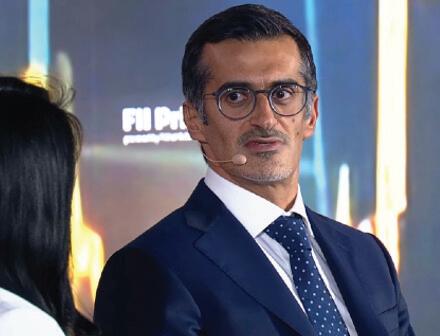
Razi AlMurbati CEO, GFH Capital
Against the backdrop of one of the most ambitious economic transformations of the modern era, the GCC has emerged as a focal point for global capital, innovation and long-term investment. As government visions reshape the region’s
economic architecture, the role of private capital has become increasingly central, not merely as a funding source, but as a strategic partner in building sustainable, diversified growth.
It is within this context that GFH Capital has rapidly established itself as
a dynamic and purposeful investment platform. Headquartered in Riyadh and operating under the umbrella of GFH Financial Group, one of the region’s most established financial institutions, GFH Capital occupies a distinctive position in the regional investment landscape. Its mandate is clear: to identify highconviction opportunities across essential sectors, structure them with private-equity discipline and scale them in partnership with strong regional operators.
Under the leadership of Razi AlMurbati, CEO of GFH Capital, the firm has moved decisively from establishment to execution. With a focus spanning private equity, special situations and real-estate development, GFH Capital is building platforms designed to generate long-term value, aligned with regional development priorities and responsive to the region’s structural growth drivers.
In this exclusive conversation with MEA Finance, Razi AlMurbati discusses how GFH Capital is shaping a next-generation alternatives platform rooted in disciplined execution, institutional governance and an unwavering belief in the GCC’s longterm economic trajectory. From strategic acquisitions and transformative urban developments to the introduction of new asset classes, GFH Capital is positioning itself at the intersection of regional ambition and global capital.
GFH Capital is headquartered in Saudi Arabia. How do you describe your mandate today, and where does your strategic focus lie?
GFH Capital was founded with a very deliberate and forward-looking mandate: to build a Saudi-headquartered investment platform that serves the wider GCC while leveraging the global reach, experience and institutional strength of GFH Financial Group. From the outset, our objective has been to act as a bridge,
connecting some of the region’s most compelling private-market opportunities with long-term institutional capital and deep sector expertise.
Our strategic focus is centered on private equity, special situations and real-estate development, areas where hands-on ownership, disciplined structuring and active value creation can generate durable returns. These are not passive allocations; they require deep engagement with management teams, operational insight and a longterm investment horizon.
While Saudi Arabia is our home base and a core engine of growth, our mandate is fundamentally regional. The GCC as a whole is undergoing rapid economic diversification, demographic expansion and regulatory evolution. These shifts are creating sustained demand for new operating platforms, scalable service providers and modern infrastructure across multiple sectors.
As the newest vertical within the GFH ecosystem, we operate with an entrepreneurial mindset and agile in origination, selective in execution and independent in decision-making, yet fully supported by the group’s governance frameworks, institutional relationships and international investor base. This integration allows us to pursue opportunities with both speed and discipline, while maintaining the institutional standards expected by global capital.
GFH Capital is the newest vertical within the Group. How does this shape your contribution to the region?
GFH Capital was established to serve as the Group’s CMA-regulated investment
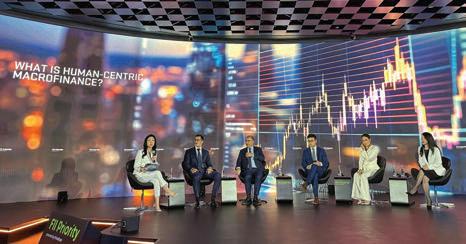
arm in Saudi Arabia and the broader GCC, with a clear focus on private markets and alternative assets. Our role is not to replicate what already exists within the Group, but rather to channel GFH’s broader capabilities into a focused, execution-driven regional strategy.
Being headquartered in Riyadh places us at the centre of the region’s most dynamic and reform-driven economy. It allows us to engage directly with regulators, operating partners and entrepreneurs and to identify opportunities at an early stage, often before they become widely intermediated.
This proximity is critical. Many of the most attractive opportunities in private markets are proprietary in nature. They require trust, local insight and the ability to structure transactions that align the interests of all stakeholders. Our on-the-ground presence enables us to do exactly that.
At the same time, we benefit from the scale and institutional depth of GFH Financial Group. This creates a hybrid
WE INVEST WHERE DEMOGRAPHIC MOMENTUM AND NATIONAL DEVELOPMENT PRIORITIES INTERSECT — LOGISTICS, ESSENTIAL
model: we are nimble enough to move decisively, yet supported by robust governance, sector expertise and access to a global investor network. For our partners and portfolio companies, this combination translates into certainty of execution and long-term alignment.
What were the strategic considerations behind building a dedicated investment platform in Saudi Arabia, and what trends shaped your view of the opportunity?
Saudi Arabia and the wider GCC are undergoing one of the most significant economic transformations globally. This is not a cyclical upswing, it is a structural reconfiguration of how economies operate, diversify and grow.
One of the most visible indicators of this shift is the accelerated relocation of international companies to the region. In Saudi Arabia alone, more than 675 global firms have secured regional headquarters license in Riyadh. This represents a long-term commitment to local market participation and signals growing confidence in the Kingdom’s regulatory, commercial and economic environment.
Foreign direct investment has also remained resilient despite global uncertainty, reinforcing the perception of the GCC as a stable and attractive destination for long-term capital. These inflows are not limited to a single sector;
they span industrials, logistics, services, technology and real assets.
Demographics are another powerful driver. The region’s young, economically active population is reshaping consumption patterns, accelerating urbanisation and increasing demand for essential services and infrastructure. These trends create fertile ground for private equity and realasset investment, particularly in platforms that can scale alongside population and economic growth.
Taken together, these factors underpin our investment thesis: durable, multicycle growth supported by national transformation, demographic momentum and increasing private-sector participation.
GFH Capital is relatively new. What recent transactions best reflect your investment strategy?
Despite being a relatively young platform, GFH Capital, working closely with the wider Group, has been involved in several landmark transactions that clearly illustrate our strategic approach.
One such transaction is the acquisition of Harris Pye, a global leader in boiler and heat-transfer maintenance.

services and logistics operator based in Riyadh. This transaction provides exposure to essential consumer demand and supply-chain infrastructure, sectors that benefit directly from population growth, urban expansion and increased domestic consumption. Importantly, the platform offers clear pathways for organic growth and targeted bolt-on acquisitions.
In real estate, our partnership with Al Khozama Group to redevelop the iconic
OUR AMBITION IS CLEAR: TO SCALE FROM USD 2 BILLION TO USD 5 BILLION IN AUM
THROUGH DISCIPLINED GROWTH AND DIFFERENTIATED PLATFORMS
This investment reflects our conviction in industrial services and energy infrastructure as essential components of long-term economic development. The relocation of Harris Pye’s corporate headquarters to the GCC and the expansion of its regional operations further reinforce the strategic rationale.
Another key investment is the acquisition of a majority stake in Gulf Central Company, a leading food
Al Faisaliah District is a defining example of our long-term approach. This is not simply a property redevelopment; it is a generational urban transformation project that aligns closely with the GCC’s evolving lifestyle, commercial and tourism ambitions.
Collectively, these investments demonstrate our focus on building platforms in essential sectors, businesses and assets that serve
daily economic needs rather than short-term trends.
How does GFH Capital align its strategy with long-term national agendas including Vision 2030?
Alignment with national development agendas is integral to our investment philosophy. Vision 2030 places strong emphasis on economic diversification, private-sector participation, infrastructure development and quality-of-life improvements, all areas where private capital can play a transformative role.
Our investment strategy naturally complements these priorities. We focus on sectors that reinforce national objectives, including logistics, industrial platforms, essential services and real estate development. These sectors are foundational to sustainable economic growth and social development.
Environmental, social and governance considerations are also embedded in our investment process. Supported by GFH Financial Group’s governance framework, we integrate ESG metrics into due diligence, risk assessment and value-creation planning. This ensures that our investments are not only financially sound, but also responsible and aligned with long-term societal goals.
How is technology shaping GFH Capital’s execution and client experience?
Technology plays a central role in our ambition to operate a regional investment platform with global institutional standards. From a client perspective, we are digitising investor onboarding, reporting and portfolio access to provide transparency, efficiency and real-time visibility.
Internally, technology enhances our execution capabilities. Data analytics supports asset performance monitoring, risk management and strategic decisionmaking across our portfolio companies. Digital tools also enable more effective communication and alignment between investment teams, operating partners and stakeholders.
In an increasingly competitive environment, the combination of technology, strong governance and regional presence is essential. Investors today expect institutional-grade processes alongside local market access, and we are structured to deliver both.
What is GFH Capital’s current AUM, and how do you envision the platform’s scale over the next few years?
Currently, GFH Capital manages approximately USD 2 billion in assets under management across our platforms. Looking ahead, our objective is to scale this to around USD 5 billion over the next two to three years, supported by a disciplined and clearly defined growth roadmap.
This expansion is anchored around three key pillars. First, scaling our realestate development portfolio, where demand for high-quality mixed-use, urban and lifestyle assets remains strong. Second, expanding our private equity and special-situations capabilities to capitalise on opportunities requiring structuring expertise and active ownership. Third, introducing private credit as a new asset class, addressing a growing financing gap across the GCC.
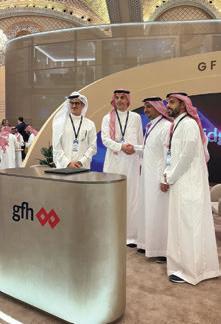
Together, these pillars support our ambition to build a leading alternatives platform anchored in the region and connected to global capital markets.
Is a Tadawul listing part of GFH Capital’s long-term roadmap?
Recent regulatory developments have created a clear and credible pathway for investment firms to access Saudi capital markets. The successful listings of firms such as Osool & Bakheet and Derayah Financial demonstrate the increasing depth and maturity of the ecosystem.
While GFH Capital remains in its early growth phase, a Tadawul listing is certainly part of our medium-term vision. An IPO would further institutionalise the platform, enhance transparency and governance and reinforce our positioning as a Saudi-anchored investment house with regional reach and global relevance.
What place do you predict that Saudi Arabia will hold in regional investment markets in the coming decade?
Saudi Arabia is already structurally positioned to remain the region’s anchor market for capital formation and investment activity, and the direction of travel is clear in the country’s national agenda and market infrastructure.
At the policy level, Vision 2030 explicitly prioritises strengthening the business environment, enabling financial institutions to support private-sector growth and advancing capital market development.
At the market level, the Saudi Exchange’s scale underlines this central role: Tadawul’s total market capitalisation reached SAR 10.2 trillion (US$2.72 trillion) at end-2024, reflecting one of the deepest public markets in the region.
On the investment climate side, Saudi Arabia continues to push to attract international corporate participation through the regional headquarters (RHQ) programme, and in late 2025 Saudi officials cited 675 multinational companies with RHQs in Riyadh as part of this broader effort.
Taken together, these are not shortterm indicators; they point to a market that is becoming more institutional, more investable and more central to regional capital flows over the coming decade.
How will GFH Capital maintain a competitive edge in the Saudi investment market as activity grows further?
As the Saudi market expands, differentiation increasingly comes down to execution certainty, governance and disciplined origination and this is where GFH Capital is built to compete.
First, the Kingdom’s growth agenda is structurally increasing private-market opportunity. And the data shows sustained underlying momentum in investment activity. For example, Saudi Arabia’s official statistics agency reports FDI stock reaching SAR 977 billion by end-2024, with sectoral inflows led by areas such as manufacturing and trade, a signal of broad-based economic activity, not a single-sector story.
Second, Saudi Arabia is also deliberately strengthening its capital-market ecosystem. Independent institutional research notes that Tadawul is the largest equity market in the Middle East, alongside continued market development initiatives.
In that context, GFH Capital’s edge is grounded in a model that is highly relevant for this next phase of growth:
• Saudi- anchored presence for proximity-led sourcing and partner access (crucial as competition increases)
• Institutional go vernance and process aligned with the standards global capital expects
• Private-equity discipline focused on durable value creation rather than momentum-driven deployment
The result is a platform designed to evolve as the market scales, not by chasing volume, but by maintaining selectivity, speed with discipline and long-term alignment with the market’s evolving opportunity set.
THE
MIDDLE EAST’S NEXT CREDIT CHALLENGE:
Systems That Can Keep Up With Customers
Rob Macmillan Group Product Manager Credit at Paymentology, highlights how modern credit infrastructure offers clarity and flexibility that can foster inclusivity and build growth
New credit ideas are easy to sketch but hard to deliver. Most banks still rely on systems that update balances overnight and lock in core elements such as interest, fees and repayment rules. Even minor adjustments can trigger weeks of development and testing, so many product concepts never make it past the design stage.
Banks have responded by investing heavily in what customers see, while leaving the credit engines underneath largely untouched. In Publicis Sapient’s survey of Middle Eastern banking leaders, most said legacy systems are holding them back, yet the bulk of spend is still going into channels, data and cybersecurity. The result: slick apps and smooth onboarding sitting on top of infrastructure that remains slow to change.
On the customer side, habits have shifted quickly. BNPL volumes in MENA have been growing at close to 30% a year since 2021 and are forecast to more than double again by 2030. Digital wallets have gone from niche to normal: estimates put GCC wallet users at around 38 million, and recent surveys in the UAE suggest that close to half the population now pays for everyday purchases with their phone.

Rob Macmillan, Group Product Manager Credit, Paymentology
Inherited systems, limited room to move
Credit systems are hard to modernise mainly because of how they were built in the first place. In most banks they started life as extensions of debit platforms, with fixed
processes and rule sets that were never meant to change often. Over the years, each new product tweak or regulatory change has been added as another exception or workaround. That history means even a small adjustment can be time-consuming, risky and expensive.
Regional regulators such as the Saudi Central Bank (SAMA) and the Central Bank of the UAE (CBUAE) are pushing ahead with open banking, payment-token and digital currency frameworks, which raises expectations that banks can adapt quickly to new rules and product designs.
To get around this, some banks are taking a more focused route. They keep their existing cores in place for deposits and payments but add modern credit platforms alongside them. The core continues to handle ledger, settlement and reconciliation, while the new layer gives product teams somewhere more flexible to design and run credit products without disturbing day-to-day operations.
Credit platforms designed for change
The newer platforms being deployed look different to the legacy stacks they sit next to. They are built around credit from the start, rather than trying to stretch debit logic to fit lending. Balance rollovers, interest hierarchies, different fee structures and variable repayment models are treated as standard building blocks instead of one-off exceptions. Flexible features for instalment plans and cashback reward programmes are also important, reflecting the broader shift towards credit-native architectures that accommodate modern customer expectations.
That shows up in how teams work. A product manager can change how repayments are allocated, alter a billing cycle or switch on a new instalment option without waiting for a long development cycle. Finance teams see the impact of those changes in their reporting straight away. Compliance can apply the right checks and limits through configuration instead of pushing for another code change. The distance between an idea and a live product gets shorter –which is where many banks operating across multiple Middle Eastern markets, have struggled.
Some issuers now see these credit platforms as part of their strategic infrastructure rather than just another IT system. They are choosing setups that can support different product types and markets in real time, often combining card issuing and ledger logic in a single environment. That lets teams launch new propositions without building a fresh integration pattern every time they move into a new country or segment.
For customers, the benefit is simple: they can choose payment plans to manage their finances, see charges update and expect their account to reflect those decisions straight away.
When credit becomes a growth lever
Once the underlying systems improve, credit stops acting as a constraint and starts to support growth. With realtime control over pricing, repayment logic and product configuration, issuers can test new designs in weeks rather than quarters. That makes it easier to sharpen propositions, tailor features for local conditions and serve specific customer groups with more than a onesize-fits-all product.
You can see the impact most clearly in merchant-led journeys. In sectors like Saudi retail and Dubai’s travel market, instalment options at checkout are becoming far more common, and they only work smoothly when platforms can support sector-specific credit journeys without custom builds every time.
THE 1990S INTERNET ANALOGY ALSO FAILS TO CONSIDER THE DIFFERENCES BETWEEN DEBT AND EQUITY FINANCING
The ability to adapt these offers quickly and responsibly is what will separate fast - mo ving issuers from those still constrained by legacy logic. Across the GCC, credit appetite is already visible in funding markets: by September 2025, Fitch reported nearly USD 55 billion of US - dollar debt issued by regional banks, with full -year volumes expected to exceed USD 60 billion. Saudi and UAE banks led the surge, underscoring how the capacity to design and launch new credit products quickly is becoming a direct route to sustainable growth.
North Africa the share is closer to three in five, and the region has the widest gender gap in account ownership of any part of the world.
Modern credit infrastructure helps narrow that gap by making it easier to adapt products to local regulation and customer behaviour without overhauling the core. The same systems can then be rolled out across markets, fine-tuning compliance through configuration instead of rewriting code.
PROGRESS
IN
CREDIT IS NOT ONLY ABOUT TECHNOLOGY; IT IS ALSO ABOUT MINDSET
What trust in credit looks like
For customers, the quality of a credit product is not defined by its features but by how clearly it behaves. When balances update in real time, when charges make sense and when repayment options feel flexible, confidence builds. When information lags or rules seem arbitrary, trust erodes.
This shift in expectations is playing out against an inclusion gap that is still very visible in the Middle East. Global Findex data shows that while roughly four in five adults worldwide now have an account, in the Middle East and
Smarter systems make it possible to show every interest calculation, repayment and fee transparently in the moment, not as a statement weeks later. They allow banks to design lending journeys that encourage better decisions rather than penalise mistakes. Credit becomes not only faster to deploy but fairer and easier to understand.
Intelligent, integrated, inclusive Progress in credit is not only about technology; it is also about mindset. Institutions that treat their platforms as evolving systems to be refined continuously, rather than rebuilt once a decade, will stay closest to customer needs. Credit-native architectures make that possible, giving banks the flexibility and control to innovate responsibly.
The next stage is about smarter, more connected systems. With automation and richer data, issuers can anticipate risk and demand earlier, adjusting products in real time. The aim is straightforward: provide credit where it adds value, not simply where it can be extended.
For credit to power growth again, banks need infrastructure built for the speed of what is ahead, not the constraints of what is behind.
THE NEW CURRENCY OF GROWTH:
How Payments are Shaping the Middle East’s Digital Economy
Highlighting the vitally important role of payments in sustaining growth and fostering a competitive edge, Alexis Haessler Regional Head, Middle East – KSA & Bahrain GM, ACI Worldwide explains there still remains some way to go in its rightful prioritising
Payments have become the new battleground for businesses’ profitability. The payments imperative is no longer just about operational efficiency; it defines competitive advantages, differentiation and sustaining growth in a rapidly changing digital economy. The Middle East region is leading this transformation, fuelled by strategic government support and consumer demand. Across the GCC, governments are driving the transition to fully digital economies through bold national strategies like Saudi Arabia’s Vision 2030, the UAE’s Cashless Dubai initiative and Qatar’s fintech roadmap.
However, a recent ACI Worldwide report, “Payments in Transition: Leadership in an Era of Transformation”, shows that while 69% of executives consider their organisations to be payments leaders, fewer than half (44%) say payments innovation is a C-suite priority. This disconnect is driven by barriers to progress, including outdated infrastructure and internal resistance to change. More than half (55%) of executives admit they are not fully using the technology already available, and 44% cite legacy platforms as the biggest obstacle to innovation.
Datos Insights, a leading research and advisory partner to the banking, insurance and securities industries, has urged banks

to centralise payments and move forward with urgency to remain competitive in an increasingly complex payments landscape. The Datos report highlights the advantages of a single point of integration for multiple payment channels, types and systems, allowing banks to streamline their payment operations, simplify complexity, improve efficiency and ultimately drive business growth.
Kuwait’s evolution into a real-time payment powerhouse is set to further propel the Middle East’s position as a leader in payments modernisation. KNET utilised ACI’s Digital Central Infrastructure solution to build the central payment infrastructure of WAMD, an interoperable, countrywide
scheme that enables account-to-account (A2A) payment transfers via a bank’s mobile app or internet banking service by using a phone number. WAMD onboarded 30% of Kuwait’s banked population in the first 3 months, underscoring strong consumer trust and demand for innovative financial solutions.
As payments grow more sophisticated, fraudsters are leveraging the same advancements to elevate their schemes. The surge in transaction volumes has been accompanied by a parallel rise in cybercrime and fraud. Hyperpay, the largest and fastest-growing payments services provider in the MENA region, utilises ACI’s Payment Intelligence and Fraud Orchestration Platform, which is integrated with AI and machine learning, to automate fraud protection and access key analytics on consumer behaviours. Trust remains the most valuable currency in the payments industry. Banks and financial institutions that lead in the digital era will be those that invest in AI-powered fraud management, operational reliability and data protection.
Payments have become the heartbeat of profitability, customer engagement and digital transformation in the economy. There is an urgent need for payments leaders to align ambition with action, modernising infrastructure, embedding intelligence and preparing for regulatory changes in 2026, such as ISO 20022 migration and open banking compliance. Platforms that offer scalable, realtime solutions will help organisations modernise legacy systems, improve agility and accelerate innovation. Driven by bold leadership, progressive regulations and a tech-savvy population, the Middle East is poised to lead the next wave of innovation in the global payments landscape.
Alexis Haessler, Regional Head, Middle East – KSA & Bahrain GM, ACI Worldwide
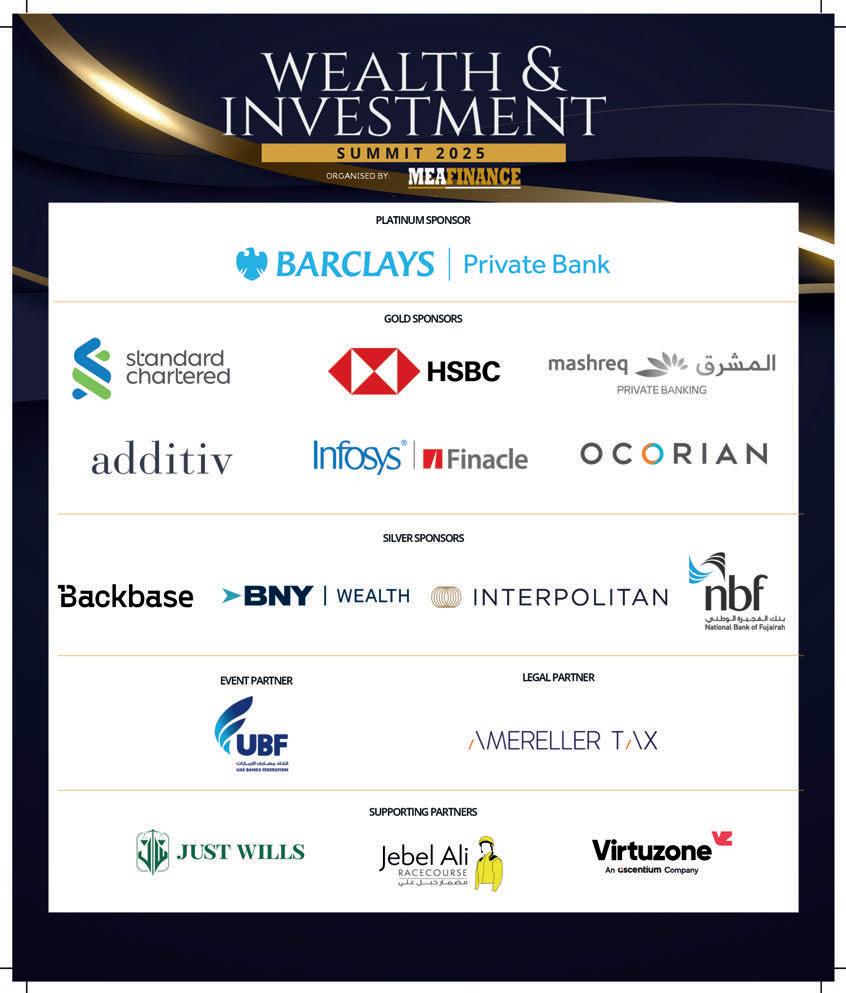
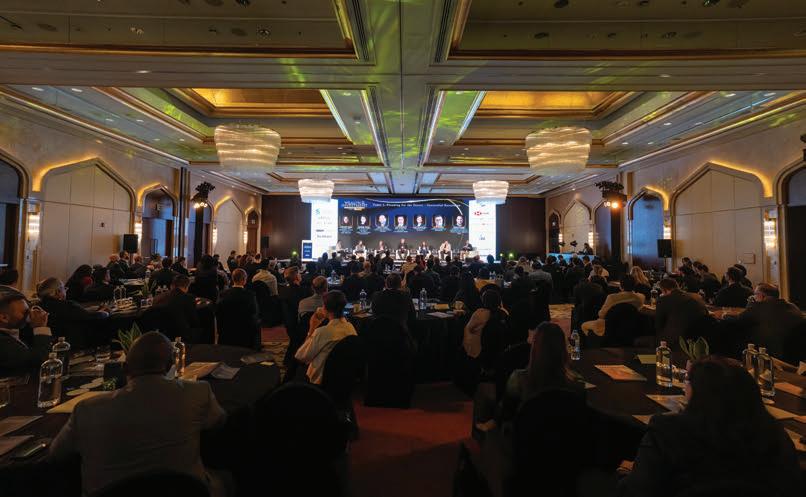
THE FUTURE OF WEALTH MANAGEMENT IN THE MIDDLE EAST:
Succession, Structure and the New Architecture of Wealth across our Region
As the Gulf prepares for one of the largest intergenerational wealth transfers in modern history, the region’s wealth, investment and family office leaders gathered in Dubai to confront a defining question: how can capital be preserved, professionalised and purposefully deployed across generations in a rapidly changing global order?
ARegion at an Inflection Point
The atmosphere at The RitzCarlton JBR on the morning of 6 November reflected more than the usual gathering of private bankers, family office principals and advisers. The conversations taking place over registration coffee spoke to a deeper sense of urgency. Across the GCC, at least US$1 trillion in family wealth is expected to change hands by 2030, while globally the so-called “Great Wealth Transfer” is projected to reach US$85
trillion by 2045. Against this backdrop, succession failures, governance disputes and regulatory scrutiny have moved from abstract risks to lived realities.
Opening the MEA Finance Wealth & Investment Summit 2025, Andrew Cover welcomed delegates and set the tone for a day that would move decisively beyond product discussions and market outlooks. This was to be a forum about continuity — of families, enterprises, values and influence — in a region whose wealth story is still remarkably young.
That theme was immediately reinforced by the opening address from Farzad Billimoria, Managing Director and Head of Private Banking at Barclays Private Bank, who framed the summit not as a retrospective on past success, but as a forward-looking examination of how the Middle East’s wealth ecosystem is being reshaped by regulation, investor sophistication and generational change
Opening Address: Visionary Leadership and the Foundations of Modern Wealth
Billimoria began by situating the wealth conversation within the broader context of regional leadership and institutional development. He highlighted how structures such as the DIFC and ADGM — once experimental initiatives — have matured into globally credible financial centres hosting more than 11,000 registered entities and a growing concentration of family offices.
“This is the same visionary leadership which gives us, financial institutions, the opportunity to be able to do more with
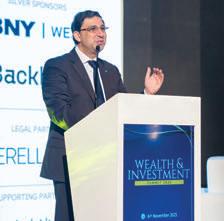
our clients,” he said, pointing to reforms in succession laws, wealth planning frameworks and cross-border structuring that are fundamentally changing how capital is organised and retained within the region.
Importantly, Billimoria underscored the evolution of client expectations. Where previous generations often prioritised capital preservation through deposits or single-asset strategies, today’s investors are demanding diversified exposure across public and private markets, real estate, technology and alternative assets — all underpinned by sophisticated credit advisory and estate planning.
“The sophistication of investors today is very different,” he observed. “They want access — locally, regionally and globally — and they want structures that can sustain that access across generations.”
Technology and sustainability, he noted, were no longer peripheral considerations. With technology accounting for over a third of the S&P 500 and ESG considerations reshaping capital allocation, collaboration between banks and fintechs had become essential rather than optional.
Yet perhaps his most resonant message concerned what he described as the “three Cs” defining the future of wealth in the Middle East: collaboration, corridors and connectivity. Collaboration between institutions, corridors linking international capital to regional opportunity, and genuine connectivity — human as much as technological — were, he argued, the true enablers of long-term wealth continuity.
Panel 1: Planning for the Future –Successful Succession
The opening panel brought together a cross-section of private banking leaders, family office advisers and corporate services specialists to examine one of the most pressing — and often avoided — challenges facing wealthy families in the Gulf today. Moderated by Mehreen Nadir, Senior Vice President and Client Strategist at BNY Wealth, the discussion featured Yasmine Omari, Head of Family Office and Wealth Advisory at Bank of Singapore’s DIFC branch; Vipul Kapur, Managing Director and Head of Private Banking at Mashreq; Leo Charitos, Senior Wealth Planner at LGT Middle East;
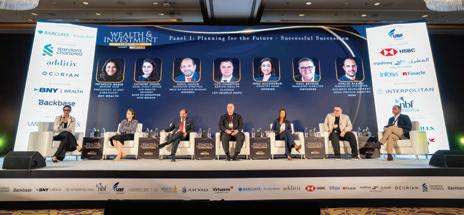
Nina Auchoybur, Country Head at Ocorian; Paul Bryson, Managing Director at Virtuzone; and Khalid Alkadi, Managing Director for Business Development in MENA Private Banking at HSBC.
Setting the tone, Nadir framed the discussion around a sobering paradox. Despite unprecedented levels of wealth creation and an estimated US$1 trillion in intergenerational transfer expected in the GCC by 2030, documented and coordinated succession plans remain alarmingly rare. Recent high-profile governance failures in the region, she noted, have demonstrated that wealth alone offers no protection against fragmentation when leadership transition is poorly planned or indefinitely postponed.
Drawing on nearly three decades of experience in the region, Kapur described the past five years as transformational for the Middle East’s wealth ecosystem. Where succession planning was once an uncomfortable conversation triggered only by crisis or misfortune, he observed a decisive shift towards integrating legacy discussions into broader wealth planning from the outset. Rather than focusing solely on asset growth or product selection, families are increasingly asking how their wealth should function over multiple generations, and what structures are required to support that ambition.
Crucially, Kapur argued, this change in mindset has been reinforced by regulatory evolution within the UAE itself. The maturation of the DIFC and ADGM has given families confidence to domicile, manage and govern wealth locally rather than relying on traditional offshore centres. While jurisdictions such as Switzerland, London and Singapore remain relevant, Dubai is now capturing a disproportionate share of global private wealth as families seek proximity, flexibility and regulatory clarity in one location.
Omari added a pragmatic dimension to the discussion, suggesting that succession conversations in the region are often prompted less by foresight than by necessity. The introduction of corporate
income tax, she argued, has acted as an unexpected catalyst, forcing families to confront long-standing structural weaknesses such as the commingling of personal and business assets. Similarly, the international education and migration of next-generation family members — particularly to jurisdictions such as the United States — has introduced complex tax and residency considerations that can no longer be ignored.
“These conversations may not start for the right reasons,” she acknowledged, “but once they begin, families start asking deeper questions about governance, purpose and continuity.” Tax, she noted, often opens the door, but values, control and long-term vision ultimately define the outcome.
Auchoybur addressed some of the most persistent misconceptions surrounding succession planning, cautioning against the belief that appointing a successor equates to


FAMILY GOVERNANCE IS A DOUBLEEDGED SWORD. YOU DON’T WANT TO BE THE GENERATION THAT MESSES IT UP
– Leo Charitos, LGT Middle East
advisers play a critical role not only in implementing structures but in facilitating dialogue, mediating expectations and ensuring that legal frameworks reflect family intent rather than fashion.
Charitos brought a rare long-term perspective to the discussion, drawing on the institutional history of LGT and the Princely Family of Liechtenstein. Longevity, he argued, is never accidental. Families that endure across generations do so by remaining close to both their assets and their people, maintaining visibility, accountability and discipline even as complexity increases.

having a plan. In reality, she argued, effective succession requires a broader leadership architecture encompassing boards, councils, governance protocols and clearly defined decision-making authority. Equally damaging is the assumption that succession can wait. Families frequently underestimate how quickly circumstances can change through illness, legal exposure or the sudden loss of leadership.
What distinguishes successful families, she suggested, is not the absence of conflict but the presence of structure. Succession planning must be dynamic, reviewed regularly and adapted as family circumstances, asset profiles and regulatory environments evolve. Corporate service providers, banks and

in what their capital enables — socially, economically and culturally.
This shift, he suggested, requires wealth managers to abandon shortterm, product-led conversations in favour of long-horizon engagement that spans decades rather than quarters. Succession planning, in this context, is not a transaction but an ongoing process of alignment between generations.
Alkadi placed these family-level dynamics within a broader industry transformation. With an estimated US$5 trillion transferring between generations globally each year — and Middle Eastern

“Family governance is a double-edged sword,” he observed. “You don’t want to be the generation that messes it up.” In today’s fast-moving environment, where assets and stakeholders are often dispersed across jurisdictions, he warned that governance failures can emerge quickly when oversight weakens or responsibility becomes diffused.
As the discussion turned towards generational values, Kapur returned to the idea that wealth itself has taken on a different meaning for younger inheritors. While first-generation entrepreneurs focused on accumulation and security, subsequent generations are increasingly motivated by purpose, stewardship and impact. They are less concerned with incremental returns and more interested


high-net-worth wealth growing at nearly double the global average — private banks face a fundamental challenge. According to his research, more than 80 per cent of next-generation wealth holders expect to change banks, driven by demands for transparency, technology and relevance rather than tradition alone.
Banks, he argued, must rethink not only their platforms but their culture. Technology, inclusive engagement with women and younger family members, philanthropy, value beyond banking products and, above all, a shift from shortterm targets to long-term relationships will define which institutions remain relevant in the decades ahead. Succession planning, he noted, rarely fits neatly into annual revenue goals, but it ultimately
determines whether client relationships — and families themselves — endure. Bringing the discussion to a close, Nadir emphasised that succession planning is no longer a discretionary exercise or a symbolic gesture. It is a foundational discipline that underpins not just the preservation of wealth, but the continuity of relationships, enterprises and influence across generations. Succession, she concluded, is not about control — it is about continuity.
Panel 2: Family of the Future – Key Concerns and Future Priorities for Regional Family Office
The second session of the day shifted the focus from succession within families to the institutional vehicles increasingly being used to manage that succession in practice. Moderated by Kimberley Wilks, Director of International Private Wealth and Family Office at PwC, the panel brought together a diverse set of

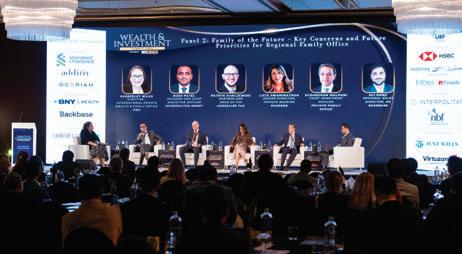
office; and Ali Nanji, Regional Sales Director for the Middle East at Backbase.
Wilks opened by observing that the UAE has rapidly become one of the world’s most compelling jurisdictions for family offices — not only for regional families professionalising their structures, but
perspectives spanning technology, tax, banking, investment management and alternative finance. Joining her on stage were Rishi Patel, Founder and Chief Executive Officer of Interpolitan Money; Patryk Karczewski, Partner and Head of Tax at Amereller Tax; Lata Swaminathan, Senior Director of Private Banking at Mashreq; Sudarshan Malpani, Chief Investment Officer at a private family

Around a quarter of all GCC family offices, he explained, have been established within the last five years, driven by a convergence of generational transition, regulatory reform and global capital migration. As wealth moves from firstgeneration founders to second and third


also for international families relocating capital, governance and decision-making to the Gulf. Unlike traditional centres, she noted, the UAE offers multiple legal and regulatory frameworks within a single geography, allowing families to tailor structures to their specific needs rather than forcing conformity to a single model. Patel contextualised this growth within a broader structural shift.

generations, families are demanding better governance, stronger processes and clearer accountability. At the same time, Dubai and Abu Dhabi have emerged as natural hubs for globally mobile capital, offering regulatory sophistication without the political and fiscal uncertainty affecting other jurisdictions.
MONEY IS MOBILE. REGULATION IS NOT. TECHNOLOGY’S JOB IS TO UNIFY VISIBILITY SO GOVERNANCE CAN ACTUALLY WORK
– Ali Nanji, Backbase
From Interpolitan Money’s vantage point, Patel noted a clear trend of families restructuring away from legacy offshore centres such as Jersey or Guernsey and consolidating their operations in the UAE, while still maintaining international reach. The result is a more centralised decision-making model combined with globally diversified asset allocation — a structure better suited to modern family dynamics.
Karczewski brought a tax lens to the discussion, noting that while tax was once an uncomfortable or even taboo subject in the region, it has now become an unavoidable design constraint for family offices. The introduction of corporate tax and the increasing sophistication of enforcement have fundamentally changed how structures must be justified, documented and defended. While ADGM and DIFC foundations have become popular vehicles — particularly given their transparency and compatibility with individual-level taxation — Karczewski cautioned against assuming that regulatory approval equates to longterm resilience.
What matters, he argued, is not simply whether a structure complies on paper, but whether its commercial rationale is clearly documented and defensible under scrutiny. With tax authorities increasingly empowered to challenge arrangements deemed primarily tax-motivated, families must ensure that governance decisions are supported by substance, minutes, strategy and evidence of intent. In his view, the real risk lies not in complexity itself, but in poorly articulated complexity.
That operational reality resonated strongly with Malpani, who spoke from
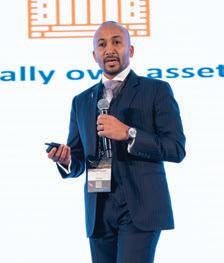
disciplined restraint. Families should expand geographically only to the extent that they can realistically manage governance, compliance and operational oversight. Rather than moving assets constantly between centres, he advocated for maintaining local balance sheets, currencies and investment committees, consolidated at a higher level. While this approach adds cost, it significantly reduces execution risk and enhances resilience.
SHARIA-COMPLIANT FOUNDATIONS ARE NOT NICHE INSTRUMENTS — THEY ARE SOPHISTICATED
–
Leevyn Isabel, Ocorian
GOVERNANCE TOOLS
the perspective of managing a multijurisdictional family portfolio. While global diversification offers flexibility and tax efficiency, it also introduces friction — particularly around KYC requirements, banking standards and capital movement. Even within the same banking group, he noted, documentation accepted in one jurisdiction can be rejected in another, often at critical moments.
From a portfolio management standpoint, Malpani argued for
Patel reinforced this point by highlighting how fragmented structures — spanning trusts, foundations, SPVs and holding companies across multiple jurisdictions — can become unmanageable without the right infrastructure. Increasingly, he said, family offices are turning to alternative banking and financial platforms capable of consolidating multi-jurisdictional relationships into a single operating view, reducing dependency on numerous institutions and improving transparency.
That transition, according to Nanji, reflects a deeper shift in the role of technology within wealth management. Money, he observed, has become fully mobile, while regulation continues to move at a slower, jurisdiction-bound pace. Traditional banks, constrained by regulatory interpretation, often struggle to match the speed and flexibility required by globally active families.
Technology platforms, particularly those offering banking-as-a-service or tokenised asset frameworks, can bridge this gap by enabling compliant, transparent movement of capital while providing a consolidated data layer across custodians, advisers and regulators. At its core, Nanji argued, family office complexity is a data problem — and once data is unified, governance, reporting and execution become significantly more manageable.
Swaminathan added a broader demographic context to the discussion, noting that the UAE’s rise as a magnet for ultra-high-net-worth individuals is accelerating. Thousands of millionaires, including a growing cohort of centimillionaires, are relocating to the country each year, bringing with them diverse expectations around service, discretion and sophistication. For banks, this influx requires not just technological capability, but cultural fluency and adaptability to multi-generational, multi-jurisdictional family needs.
As the panel concluded, a clear consensus emerged: family offices in the region are no longer experimental or transitional structures. They are becoming permanent institutions, shaped by regulation, technology and global mobility — and judged by their ability to balance flexibility with discipline.
Standalone Presentation: ShariaCompliant Foundations and the Evolution of Ethical Structuring
The morning concluded with a focused standalone presentation by Leevyn Isabel, Commercial Director for the Middle East at Ocorian, who addressed a growing area of interest among regional
families: the role of Sharia-compliant foundations in modern wealth structuring.
Isabel positioned Sharia-compliant foundations not as niche instruments, but as sophisticated governance tools capable of aligning faith-based principles with contemporary legal and financial frameworks. In an environment where families are increasingly seeking structures that preserve ethical intent alongside financial control, these foundations offer clarity around ownership, succession and charitable purpose without sacrificing operational flexibility.
He noted that Sharia-compliant foundations are particularly effective in addressing concerns around asset protection, inheritance planning and philanthropic deployment, while remaining compatible with DIFC and ADGM regulatory standards. Importantly, they allow families to formalise longstanding cultural and religious practices within internationally recognised legal vehicles — reducing ambiguity and potential conflict across generations.
As regional families become more global and more structured, Isabel argued, the appeal of faith-aligned governance frameworks will continue to grow. Shariacompliant foundations, in this sense, represent not a return to tradition, but an evolution of it — integrating ethical continuity with institutional robustness.
Panel 3: Present in the Future – The Technology of Wealth Management
As the summit moved into its afternoon sessions, the conversation shifted decisively from structure to execution — from how wealth is organised to how it is experienced, deployed and ultimately sustained. If the morning panels had underscored the urgency of governance and institutional discipline, the afternoon explored the tools, values and expectations that will shape wealth management in the decades ahead.
The third panel, focusing on the technology in and around wealth management, was moderated by Bryan Stirewalt, Executive Advisor at Grant Thornton, and featured
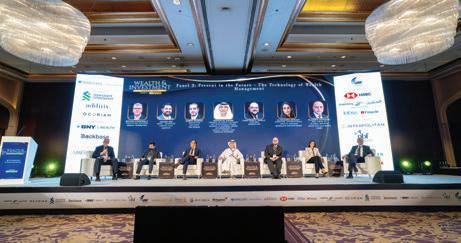
Anand Rai, Head of Business Consulting at additiv; Zubin Muriya, Executive Advisor at VelthRad; Maher Al Kaabi, Advisor to the Group Chairman and Independent Board Member at Alserkal Group of Companies and a member of the UAE Circular Economy Council; Jonathan P. Noble, Partner at Amereller; Alexandra Hewazy, Director and International Wealth Advisor at Barclays Private Bank; and Aladdin Hangari, Senior Executive Officer and Head of Global Private Bank UAE and MENA at HSBC.
Rai addressed this tension by noting that digital maturity in wealth management is no longer about replicating retail banking interfaces for affluent clients. Instead, it is about enabling highly bespoke experiences at scale — integrating portfolio analytics, risk oversight, succession planning and reporting into platforms that enhance, rather than replace, human judgement. Technology, he argued, should serve as an enabler of insight and foresight, not a substitute for accountability.
TECHNOLOGY SHOULD ENHANCE JUDGEMENT, NOT REPLACE IT
Stirewalt opened by challenging the notion that technology’s role in wealth management is purely operational. For high-net-worth individuals in the region, he argued, technology has become an expectation rather than a differentiator — yet the real challenge lies in deploying it without eroding the trusted advisory relationships that define private banking.
Muriya echoed this sentiment, cautioning that while AI-led investing and automation offer compelling efficiency gains, they must be applied within clearly defined governance frameworks. For family offices and private banks alike, the risk is not technological failure but overconfidence — assuming that algorithms can fully capture human dynamics, family politics or ethical nuance.
From a regional perspective, Al Kaabi emphasised that technology’s role in wealth management must align with broader societal objectives. As families increasingly deploy capital into sustainable industries, circular economy initiatives and impact-driven ventures, technology becomes a critical tool for measuring outcomes, not just returns. Transparency, he argued, will be essential as younger generations demand evidence of both financial performance and social contribution.
– Anand Rai, additiv
WEALTH AND INVESTMENT SUMMIT 2025


Noble added that regulatory expectations are evolving in parallel. As digital tools proliferate, so too does scrutiny around data governance, cybersecurity and fiduciary responsibility. Wealth managers must ensure that technological adoption enhances compliance and resilience rather than introducing new vulnerabilities.
For Hewazy and Hangari, the discussion returned to the client experience. High-networth individuals now expect seamless digital access alongside personalised advice, particularly as families become more geographically dispersed. Technology, they agreed, is reshaping not only how wealth is managed, but how trust is built — requiring banks to rethink engagement models across generations and jurisdictions.
Standalone Presentation: Platforming the Future of Wealth Management
Following the technology-focused panel discussion, the summit turned its attention to the infrastructure underpinning modern wealth management, with a standalone presentation delivered by Sriranga Sampathkumar, Global Head of Sales at Infosys Finacle. His address focused not on abstract innovation, but on the practical realities confronting banks and wealth managers as client complexity, regulatory expectations and asset diversity accelerate simultaneously.
Sampathkumar began by arguing that wealth management has entered a phase of industrialisation. While bespoke advice and relationship-led service remain core to the private banking model, the underlying systems supporting those relationships were largely designed for a different era — one characterised by



PLATFORM
MODERNISATION
IS NOT AN OPERATIONAL UPGRADE. IT IS A STRATEGIC NECESSITY
– Sriranga Sampathkumar
static portfolios, limited jurisdictions and linear client hierarchies. Today’s reality, he noted, is fundamentally different. Wealth structures now span multiple entities, asset classes and geographies, often within a single family, requiring platforms capable of delivering real-time visibility, control and adaptability.
He highlighted how modern wealth platforms must now integrate portfolio management, succession planning, credit, compliance and reporting into a unified architecture, enabling advisers to move beyond reactive servicing
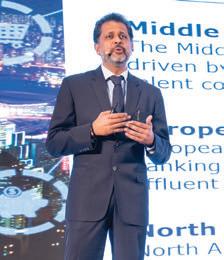

toward proactive stewardship. In this context, platform modernisation is no longer an operational upgrade but a strategic imperative. Without scalable and flexible infrastructure, institutions risk being unable to support the longterm governance, transparency and responsiveness that next-generation clients increasingly expect.
Importantly, Sampathkumar stressed that technology should not dilute the personalised nature of wealth management. Instead, it should free advisers from administrative complexity, allowing them to focus on higher-value conversations around legacy, structure and purpose. As wealth becomes more mobile and multilayered, he concluded, institutions that invest in resilient, future-ready platforms will be best positioned to deliver continuity across generations rather than merely transactions across accounts.
Panel 4: A Better Future –Philanthropy, Ethics and Yield
The afternoon session shifted decisively from tools to values, as Panel 4 explored the evolving role of philanthropy, ethics and purpose within regional wealth strategies. Moderated by Neelam Verma, Chief Executive Officer and Co-Founder of Wealthlink Solutions, the panel brought together Leo Charitos, Senior Wealth Planner at LGT Middle East; Maher Al Kaabi, Advisor to the Group Chairman and Independent Board Member at Alserkal Group of Companies and UAE Circular Economy Council member; and Hussain Korji, Chief Investment Officer at a private family office.
Verma opened by observing that philanthropy in the Middle East has moved beyond traditional charitable giving toward more intentional, structured
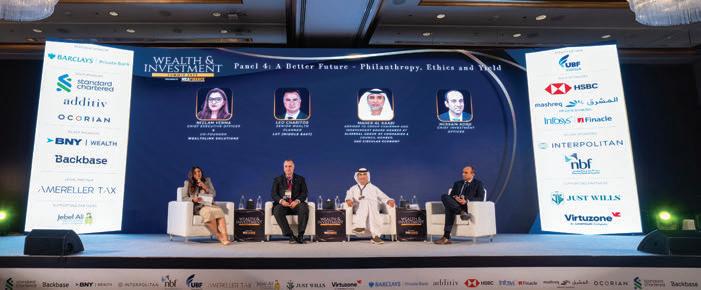
deployment of capital. As wealth transfers to younger generations, families are increasingly asking how their financial influence can create lasting societal impact, rather than episodic donations driven by circumstance or sentiment.
Charitos framed philanthropy as a natural extension of succession planning, arguing that values must be governed with the same discipline as assets. Without structure, he warned, philanthropic intent often dissipates across generations, becoming fragmented or diluted. Foundations, governance charters and clearly articulated missions, he suggested, are essential to preserving ethical continuity in the same way trusts preserve financial continuity.
Korji added an investment perspective, challenging the notion that philanthropy and yield are mutually exclusive. In his experience, impact-driven investments — particularly in education, healthcare, sustainable infrastructure and social

AS GLOBAL FAMILIES ARRIVE, PHILANTHROPY HERE WILL BECOME MORE DIVERSE
AND MORE SOPHISTICATED
– Maher Al Kaabi
enterprises — can deliver competitive returns while aligning capital with longterm societal outcomes. The key, he argued, lies in rigorous due diligence and realistic expectations, rather than treating impact investing as a concessionary exercise.
Al Kaabi broadened the discussion by situating philanthropy within the region’s cultural and economic transformation. As global families migrate to the UAE,


he noted, philanthropic priorities are becoming more diverse, blending Islamic principles, international norms and locally grounded social objectives. This convergence, he suggested, will likely increase both the scale and sophistication of philanthropic capital deployed in the region, provided families are supported by credible structures and transparent governance.
Throughout the discussion, a clear theme emerged: philanthropy is no longer peripheral to wealth strategy. It is becoming a defining expression of legacy, ethics and intergenerational alignment — one that requires the same professional rigour as investment management itself.
Panel 5: Investing in the Future
–Which Asset Classes Will Stay, Which
Are Coming

Investment strategy returned to centre stage in Panel 5, moderated by Christiane El Habre, Regional Managing Director for the Middle East at Apex Group. The panel featured Hazem Ayoub, Head of Investments for Private Banking at Mashreq; Tommaso Leodari, Chief Investment Officer at Index & Cie; Dr. Dharmesh Bhatia, Director of Advisory and Product Solutions at Emirates Investment Bank; and Wael Amhaz, Senior Investment Counsellor at Citi.
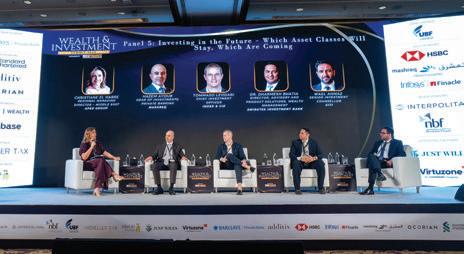
El Habre opened by noting that the current investment environment is defined less by return-seeking than by selectivity. In a world shaped by geopolitical tension, higher interest rates and structural economic shifts, families are reassessing which asset classes can deliver resilience as well as performance.
Ayoub highlighted the continued appeal of private credit and real assets, particularly infrastructure, which offer predictable cash flows and inflation protection. However, he emphasised that families are becoming more discerning, scrutinising liquidity terms, counterparty risk and governance with far greater intensity than in previous cycles.
Leodari observed that real estate remains central to regional portfolios, but with increasing segmentation. Rather than broad exposure, investors are focusing on specific verticals — logistics, hospitality, residential developments aligned with demographic growth — and exploring new access routes such as REITs and tokenisation to enhance flexibility.


From a banking perspective, Seshadri noted that retail and private banking strategies are converging around client education. As alternative assets gain prominence, families require deeper understanding of risk, duration and correlation, particularly as portfolios become more globally diversified.
THIS IS NO LONGER A MARKET FOR MOMENTUM — IT IS A MARKET FOR SELECTIVITY
– Christiane El Habre, Apex Group
Bhatia and Amhaz addressed the growing interest in artificial intelligence and digital assets, cautioning against viewing them as standalone solutions. AI, they agreed, is better understood as an enabler — improving portfolio


construction, risk assessment and operational efficiency — rather than a substitute for sound investment judgement. Across the panel, the prevailing sentiment favoured disciplined allocation over speculative enthusiasm, with families prioritising assets capable of sustaining wealth across cycles rather than capturing short-term momentum.
“This is no longer a market for momentum — it is a market for selectivity.”
Christiane El Habre, Apex Group
“Predictability matters more than performance spikes.” Hazem Ayoub, Mashreq
“Real estate is no longer about volume — it’s about verticals.” Tommaso Leodari, Index & Cie
“AI is a tool, not an investment thesis.” Dr. Dharmesh Bhatia, Emirates Investment Bank.
Panel 6: Generations of the Future
The final panel of the summit brought the conversation full circle, returning to the generational transition underpinning every theme discussed throughout the day. Moderated by Anita Gupta , Chief Investment Officer at Wealthbrix Capital Partners, the panel featured Farzad Billimoria, Managing Director and Head of Private Banking at Barclays Private Bank; Ala Aljayyusi, Managing Director at CBIx; and Mohammed Wassim Khayata, Chief Executive Officer at Mbank.
Gupta framed the discussion around the expectations of future inheritors — clients who will grow up with digital access, global exposure and heightened awareness of social responsibility. These individuals, she argued, will judge wealth managers not only on performance, but on transparency, alignment and relevance.
Billimoria reflected on how the private banking model must evolve to meet these expectations without losing its core strengths. While technology will increasingly manage execution, reporting and analytics, he argued that human judgement will remain essential in navigating family dynamics, succession decisions and legacy planning. Wealth
management, in his view, is ultimately about trust — something no algorithm can replicate.
Aljayyusi highlighted the role of innovation in reshaping client engagement, noting that future generations will expect seamless digital experiences alongside meaningful advisory relationships. Institutions that fail to integrate these elements risk becoming operationally efficient but strategically irrelevant.
Khayata added that agility will define success in the coming decades. As financial services become more democratised, private banking must differentiate itself through insight, discretion and the ability to guide families through complexity rather than merely facilitating transactions.
AI CAN MANAGE MARKETS — BUT IT CANNOT MANAGE FAMILIES
– Farzad Billimoria, Barclays Private Bank
As the discussion concluded, a shared understanding emerged: the future of wealth management in the region will not be defined by technology alone, nor by tradition alone, but by the ability to integrate both in service of continuity.
The MEA Finance Wealth & Investment Summit 2025 captured a region in the midst of a profound transition. What emerged clearly across the day’s

discussions was that the Middle East’s wealth narrative has moved decisively beyond accumulation. The defining challenge now is continuity — of ownership, governance, values and relevance — as unprecedented levels of capital pass from first-generation founders to increasingly global, digitally native inheritors.
Succession planning, once treated as an uncomfortable or deferrable conversation, was acknowledged as foundational rather than optional. Panellists repeatedly underscored that wealth without structure is fragile, and that governance failures — not market volatility — pose the greatest risk to family legacies. The region’s evolving regulatory environment, particularly in the UAE, has accelerated this shift, providing families with the frameworks needed to professionalise and localise wealth management while maintaining global reach.
Family offices emerged as the institutional backbone of this new era. No longer transitional vehicles, they are becoming permanent organisations designed to manage complexity across jurisdictions, generations and asset classes.


Yet with that permanence comes greater scrutiny. Technology, tax discipline and operational resilience are no longer enablers; they are prerequisites.
Equally significant was the reframing of technology’s role in wealth management. Rather than replacing human judgement, digital platforms, data and AI are being positioned as tools to enhance transparency, foresight and governance — freeing advisers to focus on stewardship rather than administration. The message was consistent: efficiency without empathy is insufficient in a business built on trust.
The conference also highlighted a maturing approach to capital deployment. Investment strategies are increasingly selective, favouring resilience over speculation, while philanthropy and impact investing are being woven into core wealth strategies rather than treated as peripheral pursuits. Ethical alignment, measurable outcomes and long-term societal contribution are becoming integral to how success is defined by the next generation.

Taken together, the summit revealed a region coming of age. The Middle East is no longer merely a destination for wealth; it is fast becoming a centre for wealth governance, intergenerational planning and long-term stewardship. Those institutions and families that embrace this shift — investing in structure, dialogue and purpose — will define the next chapter of the region’s financial legacy.
How Regulatory Compliance can be a Strategic Enabler
Regulation is no longer a constraint — It is the Middle East’s competitive advantage
For much of the Middle East’s modern financial history, regulation was often perceived as something firms worked around rather than worked with. Today, that mindset is no longer viable — and, more importantly, no longer accurate.
Leading a regulatory consultancy firm in the UAE, and working closely with asset managers, fund sponsors and financial institutions across multiple jurisdictions, we have seen a fundamental shift take place. Regulation in the Middle East is no longer simply about compliance. It has become a strategic enabler — one that is reshaping how firms’ structure, scale and compete globally.
The region’s regulators are not just catching up with international standards; in many areas, they are leapfrogging them. For firms operating here, the question is no longer whether regulation matters, but how intelligently they engage with it.

A maturing regulatory landscape with real consequences
The evolving regulatory landscape in the Middle East has had a profound impact on businesses operating in the region — particularly in asset management. Jurisdictions such as the UAE, Saudi Arabia, Qatar and Bahrain have moved decisively toward risk-based supervision, enhanced governance expectations and greater regulatory transparency.
In the UAE, for example, we have seen the consolidation and strengthening of regulatory frameworks across onshore and financial free zones, alongside more active supervisory engagement. Regulators now expect firms to demonstrate not only technical compliance, but also sound judgement, robust governance and genuine accountability at senior levels.
For asset managers, this has changed the operating model. Launching a fund, managing cross-border structures or servicing international investors now requires deeper regulatory planning from day one. Substance, oversight, delegation and operational resilience are no longer box-ticking exercises — they are scrutinised in real time.
This shift has also raised the bar for market entry. While the region remains highly attractive to global managers, it increasingly rewards those who approach it with long-term intent rather than opportunistic ambition.
The compliance challenges firms are grappling with today
Despite regulatory progress, compliance in the Middle East remains complex. One of
the most persistent challenges firms face is fragmentation. Regulatory expectations vary not only between countries, but between onshore and free-zone regimes, creating operational strain for firms managing multi-jurisdictional structures.
Another challenge is speed of change. Regulatory updates, thematic reviews and supervisory priorities are evolving rapidly — particularly around AML, market conduct, ESG disclosures, outsourcing and technology risk. Many firms underestimate the internal bandwidth required to stay ahead of these developments while continuing to grow their business.
There is also a noticeable capability gap. As regulatory standards rise, firms require more specialised expertise — not just compliance officers, but professionals who understand how regulation intersects with asset classes, distribution strategies and investor expectations. This is especially true for alternatives, private markets and digital assets, where regulatory clarity is still evolving.
Perhaps most critically, many firms still treat compliance as a defensive function, rather than a strategic one. This mindset limits their ability to scale efficiently and increases regulatory risk over time.
Where regulation in the Middle East is headed next
Looking ahead, three trends will define regulatory and compliance matters in the Middle East.
First, greater supervisory intensity. Regulators are becoming more
Veena Karuthasen, Regulatory Compliance Consultant at Ocorian
data-driven, more proactive and more outcome-focused. Firms should expect deeper thematic reviews, enhanced reporting requirements and closer scrutiny of governance effectiveness.
Second, increased alignment with global standards, but with local nuance. International frameworks around AML, sustainability, fund governance and operational resilience will continue to influence regional regulation — yet they will be adapted to reflect local market priorities and risk profiles.
Third, technology-enabled regulation. Regulators are increasingly leveraging data, analytics and digital reporting tools, which means firms must improve the quality, consistency and accessibility of their regulatory information.
For asset managers, the future rewards are to those who invest early in strong compliance infrastructure — and penalises those who rely on legacy processes or reactive fixes.
Strengthening regulatory support through scale and expertise
At Ocorian, we have deliberately strengthened our regulatory and compliance capabilities in the Middle East to meet a fundamentally different regulatory reality. Our recent acquisition of Clarity Consulting was not about geographic expansion alone; it was about depth — of expertise, insight and execution. Today, we have close to 30 regulatory consultants in the region with the ability to hold outsourced roles for regulated firms, supported by a dedicated investment team of almost 20 professionals operating across both ADGM and DIFC.
While asset managers sit at the core of our work, we also support insurance firms, fintech businesses — particularly those operating payment services — and digital asset firms navigating increasingly complex and fast-moving regulatory regimes. These sectors are converging in practice, and regulators are acutely focused on how governance, risk and conduct standards are applied across them.
SUBSTANCE, OVERSIGHT, DELEGATION
AND OPERATIONAL RESILIENCE ARE NO LONGER BOX-TICKING EXERCISES — THEY ARE SCRUTINISED IN REAL TIME
What differentiates our approach is the calibre and experience of our people. Our teams are made up of highly skilled regulatory specialists with global experience, including former regulators and professionals who have held senior roles within regulated institutions. This allows us to translate regulatory expectation into practical, workable operating models — rather than theoretical compliance.
We support firms across the full regulatory lifecycle: from market entry and licensing in the UAE, through to providing outsourced compliance, risk and governance roles once they are operational. By partnering with firms over the long term, we enable leadership teams to focus on building and scaling their businesses, confident that regulatory oversight, accountability and engagement are embedded at the highest standard.
One of the most powerful tools we bring to clients is our Global Asset Monitor. In an environment where regulators expect firms to have clear, real-time oversight of assets, structures and obligations across jurisdictions, fragmented information is a risk.
The Global Asset Monitor provides a consolidated, transparent view of asset holdings, regulatory requirements and governance touchpoints across global structures. For asset managers operating in or from the Middle East — often across multiple domiciles — this visibility is no longer a “nice to have”; it is fundamental to effective oversight and regulatory confidence.
Staying ahead of regulation — Not chasing it
Ensuring regulatory practices remain up to date requires more than tracking rule changes. It demands active regulatory
engagement, continuous learning and the ability to translate evolving standards into practical operating models.
At Ocorian, we combine local regulatory knowledge with global insight, drawing on expertise across major financial centres. This allows us to anticipate regulatory direction, not just respond to it. For clients, that means fewer surprises, better decision-making and stronger regulatory relationships.
Crucially, we also recognise that no two clients — and no two jurisdictions — are the same. Compliance solutions must be tailored, proportionate and aligned with a firm’s strategy. Whether supporting a boutique fund manager entering the region or a global institution expanding its footprint, the approach must reflect the specific regulatory, operational and commercial context.
Regulation as a strategic lever
The Middle East has reached an inflection point. Regulation is no longer simply about control or protection; it is about credibility, competitiveness and long-term growth.
For asset managers willing to engage with regulation thoughtfully — supported by the right expertise, infrastructure and insight — the region offers extraordinary opportunity. For those who underestimate its importance, the risks are equally significant.
From our perspective, the most successful firms in the Middle East over the next decade will be those that stop asking, “How do we comply?” and start asking, “How do we build regulatory excellence into our business model?”
Because in today’s Middle East, regulation is not the obstacle to growth — it is the pathway.
Advisor, Enabler and Growth Partner
Syed Ghazanfar Naqvi Head of
Business Banking,
Emirates Islamic, describing SMEs importance to the economy and how their expectations of banks have changed, explains how they have transformed SME banking into a core activity, evolving into a tiered and scalable service ecosystem
How does your business classify SMEs in terms of number of employees and annual returns?
At Emirates Islamic, we take a segmented and pragmatic approach to SME classification, from early-stage entrepreneurs to highly successful and fast scaling regional players. Using a multidimensional SME segmentation model that considers annual turnover, employee size, financing complexity and growth ambition broadly distinguishing between micro businesses, small & medium enterprises. This precise segmentation allows us to tailor products, risk models and relationship coverage to the specific needs of each SME category.
How high up on the business banking priority list do you feel SMEs now are at this time? SMEs are at the core of our strategic agenda. They are no longer viewed as a peripheral segment, but as long-term partners for the bank, integral to the UAE’s economic diversification and growth journey.
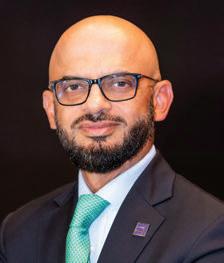
Syed Ghazanfar Naqvi, Head of Business Banking, Emirates Islamic
These businesses drive employment and non-oil GDP, making them central to national priorities such as the UAE Vision 2031, innovation-led growth and privatesector expansion.
Over the past few years, we have transformed SME banking from a
transactional activity to a core growth pillar. In the UAE, this commitment translates to supporting a highly diverse SME base, from micro businesses and family-owned enterprises to fast-scaling companies operating across freezones, mainland structures and cross border trade corridors.
Our strategic focus is evident in increased investment in digital platforms tailored to UAE SMEs, dedicated relationship management, faster credit decisioning and specialised sector solutions aligned to key growth areas such as trade, logistics, construction, professional services and technology.
We also provided robust dedicated relationship management to help SMEs navigate liquidity cycles, expansion opportunities and regulatory requirements specific to the UAE market.
Ultimately, our ambition is to be trusted financial partner to UAE SMEs at every stage of their lifecycle, supporting startups, enabling scaleups and helping established businesses transition into regional and global champions.
What new products and services have you recently, or are you currently developing specifically for SMEs?
Our SME offering is rapidly evolving into a tiered, scalable ecosystem, with the Diamond Account representing the pinnacle of this strategy. Recent and ongoing initiatives include:
• Accelerated Digital Onboarding: Reducing account opening from weeks to days with a seamless, paperless process.
• Flexible Financing Solutions: Tailored trade finance and working capital, precisely aligned with real business cycles to support diverse SME segments and growth stages.
• Integrated Ecosystem Offerings: Bundling banking services with payments, payroll and value-added transaction benefits.
• De dicated Priority Segment Propositions: Specialised accounts like the Emirati Absher Account for Emirati-owned startups, and the Businesswomen Account offering preferential pricing, advisory support, and ecosystem partnerships for women entrepreneurs.
These initiatives collectively underscore our core commitment to empowering Emirati entrepreneurs and women-led businesses. We deliver this through relevant, inclusive propositions that leverage digital integration, tailored value propositions and targeted support mechanisms. Ultimately, our unwavering focus remains on simplicity, speed and relevance for all our SME partners.
Have the innovations and inputs of fintechs across our region influenced how your business now works with SMEs?
Fintech innovation and digital transformation have significantly reshaped how we engage with SMEs across the region. We have made deliberate investments in mobile banking and stateof-the-art businessONLINE platforms, enabling SMEs to bank anytime, anywhere with speed, transparency and control.
Offering over 40 instant banking service capabilities, our businessONLINE platform allows customers to complete most of their service requirements digitally, without the need to visit a branch. A key focus area for us has been the strategic diversion of footfall from physical branches to alternate channels including mobile banking, businessONLINE, ATMS and Cash Deposit Machines (CDMs). This not only enhances customer convenience but
also allows us to serve a larger SME base more efficiently and sustainably.
To encourage adoption, we actively incentivise digital and self-service channels through preferential pricing, reinforcing the value proposition of faster, more cost-effective banking outside the branch environment.
and balanced credit decisions while maintaining prudent risk management in line with Islamic banking principles.
The availability of credit bureaus such as Al Etihad Credit Bureau and Central Bank Risk Bureau has further strengthened the risk assessment framework, providing deeper visibility
THEY ARE NO LONGER VIEWED AS A PERIPHERAL SEGMENT, BUT AS LONG-TERM
PARTNERS
FOR THE BANK, INTEGRAL TO THE UAE’S ECONOMIC DIVERSIFICATION
AND GROWTH JOURNEY
In parallel, we have strengthened our dedicated Business Banking call centre, enabling customers to carry out a wide range of services through phone banking while maintaining personalised support.
Rather than viewing fintech as competition, we see them as enablers of speed, scalability and better customer experience. Through datadriven customised offerings, digital onboarding and API-enabled services, we continuously simplify SME banking while strictly adhering to regulatory and Shariah principles.
Overall, our approach is centred on simplicity, speed and relevance, ensuring that SMEs can focus on growing their businesses while we provide a seamless, digitally led banking experience.
Have the risk assessment parameters for SME finance changed much over recent years?
Yes, risk assessment has evolved considerably. While traditional financial analysis remains important, there is now greater emphasis on cash-flow analysis, transaction behaviour and sector specific insights. Technological advances allow us to take a more dynamic and forward-looking view of SME risk, enabling better-informed
into a customer’s overall borrowing behaviours, repayment patterns and exposure across the financial systems. This supports more accurate credit profiling, particularly SMEs with multiple banking relationships.
By integrating bureau data, internal transaction insights and digital analytics, we maintain prudent risk management while improving speed and consistency in credit decisioning fully aligned with regulatory requirements and Shariah principles.
Overall, this more holistic approach enables us to responsibility support SME growth while ensuring resilience and sustainability across our financing portfolio.
What has been the single most significant development in SME banking and finance in recent times?
The most transformative development has been a shift from transactional banking to partnership-led banking. SMEs today expect their bank to be multifaceted combining roles including advisor, enabler and growth partner. By combining digital innovation, Shariah-compliant finance/ solutions, and human expertise, we are helping to shape a more inclusive, resilient and future ready SME economy.



06 November 2025
The Ritz Carlton JBR, Dubai United Arab Emirates
MEA FINANCE INDUSTRY AWARDS 2025:
Celebrating Excellence at the Forefront of Regional Finance
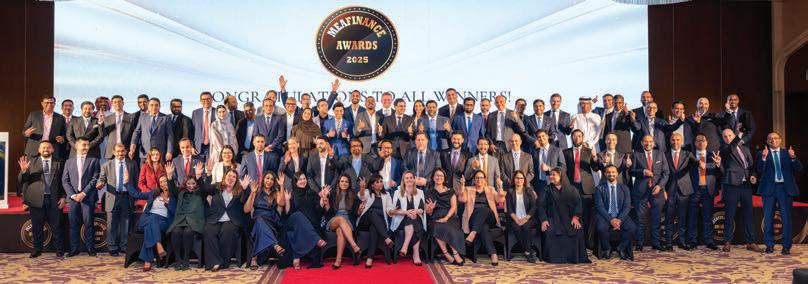
The MEA Finance Industry Awards 2025 once again reaffirmed their position as the region’s most prestigious benchmark for excellence across banking, financial services, fintech, technology and capital markets, bringing together more than 250 senior executives, decision-makers and market leaders from across the Middle East and Africa
Held at the Ritz-Carlton, JBR, Dubai, the annual gala dinner marked a celebration not only of individual achievement, but of the collective progress shaping one of the world’s most dynamic financial regions. As the Middle East continues to attract global capital, talent and innovation, the awards reflected an industry that is no
longer emerging, but confidently defining its place on the international stage. Now firmly established as the pinnacle recognition programme for regional banking and finance, the MEA Finance Industry Awards honoured institutions and individuals that have demonstrated leadership in innovation, service excellence, digital transformation and
market stewardship during a year of accelerated change.
A benchmark for a rapidly evolving industry
Organised by MEA Finance, the region’s leading dedicated banking and finance media and events platform, the awards programme has become a definitive reference point for performance and credibility. In an environment shaped by digitisation, regulatory evolution, artificial intelligence and heightened competition, the awards highlighted those organisations that have successfully translated strategy into execution.
The 2025 edition recorded the highest number of nominations to date, underscoring the growing depth and competitiveness of the regional financial ecosystem. After rigorous evaluation by an independent panel of judges, winners were selected across 88 categories, spanning banking, fintech, payments,
wealth management, Islamic finance, technology and advisory services, alongside five individual achievement awards recognising leadership and impact.
What distinguished this year’s awards was not simply scale, but scope. From cybersecurity and cloud transformation to wealth management, ESG strategy and financial inclusion, the winners reflected an industry responding decisively to both opportunity and responsibility. Innovation, resilience and leadership
Throughout the evening, a clear narrative emerged: the institutions being recognised are those that have embraced innovation while maintaining operational resilience and customer trust. In banking and payments, award recipients demonstrated how technology is being deployed not as an end in itself, but as a means to improve efficiency, security and client experience.
Fintech and technology providers, meanwhile, were recognised for delivering solutions that enable banks and financial institutions to modernise at speed—supporting open banking, AI deployment, digital engagement and regulatory compliance across increasingly complex environments.
In wealth and investment management, the awards reflected the region’s growing sophistication, with winners recognised for serving high-net-worth and ultra-high-net-worth clients through tailored propositions, advanced digital platforms and long-term advisory models aligned with generational wealth transfer.
Islamic finance also featured prominently, with institutions acknowledged for innovation in Sharia-compliant banking, fintech solutions and consumer finance—reinforcing the Middle East’s role as a global centre for Islamic financial services.
Recognising individual excellence
Beyond institutional achievement, the MEA Finance Industry Awards 2025 also celebrated individuals whose leadership has shaped their organisations and the wider industry. From fintech leadership and technology excellence to transformative banking leadership, these awards recognised professionals who have driven change through vision, execution and resilience.
Such recognition is particularly significant at a time when leadership is being tested by rapid technological advancement, evolving regulation and rising customer expectations. The individuals honoured this year exemplify the calibre of leadership required to guide financial institutions through this period of transformation.
A reflection of regional ambition
As the evening drew to a close, the significance of the awards extended beyond the ceremony itself. The MEA Finance Industry Awards have become a mirror of the region’s financial ambition— highlighting not only where the industry stands today, but where it is heading.
In recognising excellence across banking, fintech, wealth, technology and advisory services, the awards underscored a central truth: the Middle East and Africa’s financial markets are no longer defined by potential alone. They are defined by performance, innovation and global relevance.
With institutions continuing to invest in digital transformation, sustainable finance, inclusion and client-centric solutions, the 2025 awards offered a powerful statement of confidence in the region’s trajectory—and a clear benchmark for the year ahead.
The full list of the MEA Finance Industry Awards 2025 winners:
Best Cybersecurity Implementation - Dubai Islamic Bank
Best Payments Solutions Provider - ACI Worldwide
Best Digital Banking Innovation Provider - Profile Software
Best Open Banking Solutions Provider -Infosys Finacle
Best User Experience/Engagement Provider - GBM
Best Cybersecurity Provider - Finesse
Best Digital Transformation Implementation - RAKBANK and Infosys Finacle - Digital Engagement Hub
Best Financial Data Analysis Provider - Vidrio Financial
Best Cloud Transformation Innovation - Zand and Infosys Finacle
Best Islamic Digital Banking Provider - Mashreq
Best Islamic Fintech Solutions Provider - DDCAP Group™ for ETHOS AFP
Best Core Banking Service Provider - Mambu
Best RegTech Solutions Provider - Re/think Middle East
Best Risk Management Solutions Provider - BPC Smartvista
Best Financial Technology Provider - GBM
Best Financial Technology Provider (KSA) - Sarmad
Best Banking as a Platform (BAAP) Provider - Infosys Finacle
Best Payments Fintech Initiative - Skiply - RAKBANK
Most Innovative Fintech Company - Naqood
Best Fintech Provider for Wealth and Investment Management - additiv
Most Innovative Fintech Company – KSA - Sarmad
Best Fintech Company for SMEs - Premium Technology
Best RegTech Fintech Company - SMARBL LTD
Best Overall Fintech Company - Network International
Best Bank and Fintech Collaboration - Nium and Emirates NBD
AI Security Solutions Provider of the Year - Cyberhub Finesse 24/7 CSOC
MEA FINANCE AWARDS 2025
Best Digital Banking Innovation - Mbank
Best Mobile App Banking Service Implementation - Emirates NBD
Best Islamic Digital Banking Services - Mashreq
Best Online Banking Service - First Abu Dhabi Bank - FABeAccess Platform
Best Use of AI and ML in Banking - Mashreq Bank - Integrated AI Solution for Business Growth & Improved Client Experience
Best Digital Transformation Implementation - RAKBANK
Overall Best User Experience/Engagement - Mashreq BankCONVERGENCE
Special Achievement in Digital Innovation - Mashreq Bank - Trade Asset Sell-down Platform
Best Payment Solutions Implementation - ADNOC
Best Digital Banking Service - Mashreq
Best AI Deployment/Implementation - United Arab Bank
Best Use of AI in Asset Management - Plurimi Wealth (Dubai) Limited
Best Islamic Bank - Mashreq Al Islami
Best Overall Islamic Consumer Finance in the Middle East - Dubai Islamic Bank
Best Islamic Consumer Finance - Mashreq
Best Innovation in Islamic Finance - Abu Dhabi Islamic Bank - ADIB
Best Retail Bank in the Middle East - Emirates NBD
Best Premium Banking Services - RAKBANK - RAKBANK Elite
Best Global Retail Bank in the Middle East - Standard Chartered Bank
Best Commercial Bank - National Bank of Fujairah PJSC
Best Treasury Management Services - First Abu Dhabi Bank - White Label Treasury Management System (TMS)
Best Trade Finance Bank - National Bank of Fujairah PJSC
Best Cash Management Bank - First Abu Dhabi Bank
Best Bank for Corporate Services - Mbank
Best Construction Project Management Banking Solutions - FAB Building Management Solutions (FBMS)
Best Sukuk Deal of the Year - Dubai Islamic Bank
Best M&A - Saudi Investment Recycling Company (SIRC)
Best Investment Bank - GFH Financial Group
Best Bank for SME Bank Accounts - Mashreq
Best Islamic Bank for SMEs - Emirates Islamic Bank PJSC
Best SME Bank - National Bank of Fujairah PJSC
Best Private Bank in the Middle East - Mashreq Private Banking
Best Wealth Management Institution for HNWIs - US$1 Million to US$20 Million - Standard Chartered Bank
Best Wealth Management Institution for Ultra HNWIs - US$50 Million and above - Blue Ocean Capital Advisors Ltd
Best Client Value Proposition - Mashreq Private Banking
Best Domestic Private Bank - First Abu Dhabi Bank
Best Family Office Service - Mashreq Private Banking
Best Foundation Services - Ocorian
Best Private Client Services - M/HQ
Best Digital Innovation and Services in Wealth Management - Mashreq
Best Overall Wealth Management Service in the Middle EastStandard Chartered Bank
Best Global Private Bank in the Middle East - Barclays Private Bank
Best Family Office Platform Provider - BNY Wealth
Best Succession Planning Services - First Abu Dhabi Bank
Best External Asset Manager (EAM) Service - Mashreq Private Banking
Most Innovative Trading App - Sarwa Capital Wealth (Limited)
Best Private Client Wealth Journey Strategy - Ocorian
Best Investment Management Firm - GFH Financial Group
Best Sustainable Finance Initiative - Sustainable Impact Capital & Holding
Leader in Financial Inclusion - Dubai Islamic Bank
Best ESG Strategy - GFH Financial Group
Best Law Firm - KARM Legal Consultants Pvt Limited
Best Company Incorporation and Freezone Business Start Up in the Middle East -Virtuzone
Best Residency and Citizenship by Investment Firm - Next Generation Equity (NGE)
Best AI and Digital Transformation Advisory - e& enterprise - Data & AI Practice
Fintech Leadership Award - Murat Cagri Suzer, Group Chief Executive Officer, Network International
Best Technology Executive of the Year for Financial ServicesMohamed Abdel Razek, Group Head of Technology, Transformation & Information, Mashreq
Best Technology Executive of the Year - Ossama El Samadoni, General Manager, Gulf Business Machines (GBM) Dubai
Most Transformative Leadership Award - Ibrahim Ali Al Mheiri, Group Head of Islamic Banking, Mashreq
Banker of the Year - Amit Malhotra, Global Head of Retail Banking, Chairman ADIMAC & ADIB Securities, Board Member ADIB Capital, ADIB
Delivering the Future of Finance
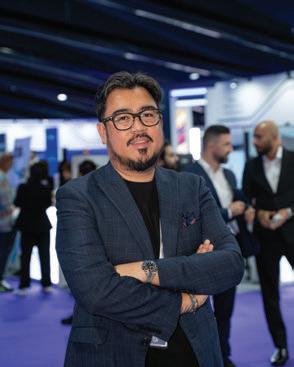
Aheartfelt congratulations to all the winners of the MEA Finance Annual Industry Awards 2025. We extend our sincere thanks to everyone who contributed, nominated, and participated in this year’s awards programme. It was a privilege to once again bring together the MEA Finance community to celebrate excellence across the region’s banking, fintech, technology, and financial markets services sectors. The regions covered by MEA Finance continue to advance their financial ecosystems at pace. Across the Middle East and Africa, we are witnessing sustained growth, accelerating digital transformation, and the emergence of several markets as influential global financial hubs.
At the same time, the global operating environment remains complex. Financial institutions are navigating evolving regulatory frameworks, heightened geopolitical uncertainty, and rapid technological change. Yet, despite these challenges, the region’s banking and financial services sectors have once again demonstrated resilience — driven by innovation, customercentric solutions, strategic investment in technology, and strong, forwardthinking leadership.
This combination of expansion and uncertainty continues to test the agility and vision of industry players. Encouragingly, the institutions recognised in the MEA Finance Annual Industry Awards 2025 have not only met these challenges but have distinguished themselves through excellence in execution, innovation, and impact. Their achievements underscore the depth, maturity, and competitiveness of the region’s financial services landscape.
The 2025 Awards stand as a testament to the commitment, adaptability, and progress of the industry over the past year. It is our honour to recognise the banks, financial institutions, fintechs, technology providers and service partners whose efforts are shaping the future of finance across the MEA region.
Congratulations once again on your achievements. We look forward to witnessing the continued innovation, leadership, and excellence you will bring to the industry in the year ahead.

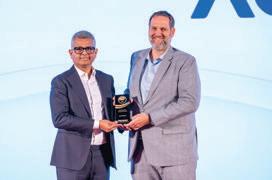
BEST CYBERSECURITY IMPLEMENTATION DUBAI ISLAMIC BANK
Dubai Islamic Bank were presented with the Best Cybersecurity Implementation award recognising their clear prioritisation of cybersecurity, which is underlined by their advanced technology partnerships, such as that with HCLTech, to accelerate the adoption of Artificial Intelligence (AI) across its ecosystem while also providing solutions designed to address a wide range of AI-specific risks, including a solution for a 360-degree view of their AI landscape, providing AI asset discovery, vulnerability detection and AI security. Posture evaluation and services also ensure AI systems are trustworthy, reliable and accountable. This includes model validation, adversarial testing (AI red teaming), and continuous monitoring for performance degradation or bias.
BEST PAYMENTS SOLUTIONS PROVIDER ACI WORLDWIDE
ACI Worldwide, winner of the Best Payments Solutions Provider award continues to lead in payments transformation, which is an achievement that is underlined by their also reaching the fiftieth anniversary since their launch. Their inherent and ongoing commitment to innovation and service is clear to see in their recently debuted ACI Connetic, a cloud-native payments platform that unifies cross-border, real-time and card payments with AI-driven fraud prevention. Designed for scalability and speed, it empowers banks to modernise infrastructure, streamline operations and deliver innovative services, and thus setting a new standard for digital payments transformation. This example of keeping at the forefront of payments innovation that has been in their company DNA across five decades makes them a worthy winner.

BEST DIGITAL BANKING INNOVATION PROVIDER PROFILE SOFTWARE
Profile Software were the winners of the Best Digital Banking Innovation Provider award, recognised for their Digital Investment Hub (DI.hub) module within Finuevo Digital. This next-generation digital banking platform and advanced solution allows banks and investment firms to seamlessly integrate banking and investment functionalities into a single digital experience, thus delivering a unified, secure and highly efficient interface for both retail and corporate clients, all designed to integrate effortlessly with existing digital banking services and any investment platform. Its cloud-native architecture allows for flexibility and scalability, but it also supports on-premises installations for institutions requiring or preferring localised control.
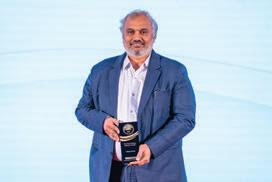


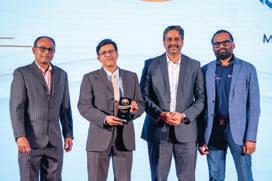
BEST OPEN BANKING
SOLUTIONS
PROVIDER INFOSYS FINACLE
Infosys Finacle won the award for Best Open Banking Solutions Provider. The recognition is for their comprehensive and stand-out presence as a truly sector leading force, as our region progresses further into the provision of transformational open banking powered products and services. With their approach built on by five fundamental disciplines - API Management, Security and Compliance, Customer Experience, Data Management and Analytics, Scalable Technology Infrastructure, they can ensure that banks can compete in our highly dynamic and fast developing financial ecosystem while importantly also remaining compliant with regulatory mandates.
BEST USER EXPERIENCE/ENGAGEMENT PROVIDER GBM
The award for the Best User Experience/Engagement Provider was taken by GBM. User experience and engagement, as a core parts of their service strategy and the solutions they deliver, is a leading priority for GBM. Their approach to user experience involves several key area such as improving end-user satisfaction, optimising performance and troubleshooting, enhancing digital interactions and adoption services. They also engage in efforts to improve the user interface and experience of its own website, which has positively impacted user engagement and search engine optimization (SEO). GBM solutions are additionally backed by a large and powerful suite of industry partners that further enable their abilities to provide and maintain their notably high levels of user experience and engagement.
BEST CYBERSECURITY PROVIDER FINESSE
Finesse was the winner of the Best Cybersecurity Provider award in recognition of their approach to the design of systems based on building AI-native organisations that continuously learn and adapt in an environment where intelligence is embedded in every process, product and decision. Their approach is supported by three pillars; Advising - their experts guide all clients through comprehensive AI readiness assessments, strategic transformation roadmaps and governance frameworks; Enabling - translating vision into reality through next-generation intelligent solutions, advanced AI middleware, cognitive analytics platforms and bespoke AI development services; Securing - through their Cyberhub›s 24/7 CSOC protect digital architectures with advanced AI threat detection, robust AI governance protocols and adaptive Zero Trust architectures - engineered specifically for intelligent systems and emerging AI threats.
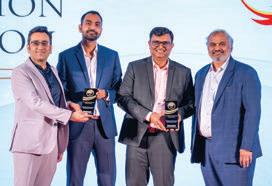


BEST DIGITAL TRANSFORMATION IMPLEMENTATION / PROVIDER
RAKBANK AND INFOSYS FINACLE - DIGITAL ENGAGEMENT HUB
Winning in this category are RAKBANK and Infosys Finacle for their collaboration on a digital transformation put into place to meet the banks’ strategy aimed at elevating the banking experience for their business clients. The goal was to make a significant impact and create a positive first impression by tackling a lengthy customer onboarding process for their business banking customers that was burdened with manual processes and multiple interactions. Their partnership with and adoption of Finacle’s Digital Engagement Hub, an enterprise-class system of engagement powering insights-driven personalised customer experiences across channels, applications and devices, has helped RAKBANK onboard, sell, service and engage, and launch an improved onboarding platform for business banking.


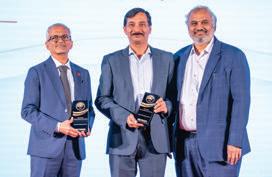

BEST FINANCIAL DATA ANALYSIS PROVIDER VIDRIO FINANCIAL
Vidrio Financial won the award for the Best Financial Data Analysis Provider. The Vidrio platform is an interactive dashboard supporting a wide range of asset classes and securities, including public and private markets, stocks, bonds, commodities, derivatives, hedge funds, private equity, private debt, real estate, private credit and many more. It allows clients to manage diversified portfolios effectively while utilising a single platform for all their investment needs. For performance tracking and benchmarking, Vidrio’s clients can access all aspects of their entire portfolio directly through the platform with data collected for direct investments and external manager investments. Vidrio then calculates the allocation (weight), performance and contribution to return at the investment level and the overall portfolio.
BEST CLOUD TRANSFORMATION INNOVATION ZAND AND INFOSYS FINACLE
Zand and Infosys Finacle collected the award for Best Cloud Transformation Innovation. ZAND Bank successfully executed one of the fastest core banking migrations in the industry, transitioning to Infosys Finacle within an ambitious 100-day timeframe. This complex implementation involved migration of existing clients’ financial data along with integration with the digital channels, and other core banking systems. The initiative leveraged cutting-edge technologies, modern engineering practices and Infosys Finacle’s market-leading capabilities to ensure a smooth and clean migration with minimal issues. The project delivered significant operational efficiencies, enhanced system resilience and an improved customer experience, setting a benchmark for fast-track core banking transformations.
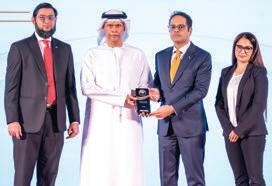
BEST ISLAMIC DIGITAL BANKING PROVIDER MASHREQ AL ISLAMI
Mashreq won the award for the Best Islamic Digital Banking Provider. Their win was supported by both Mashreq’s Islamic Onboarding App and their Islamic Mobile App Features, which includes the ability to open a Mashreq Neo account in only two minutes or a Mashreq account in just a few minutes. These are supported by a robust technology foundation that helps to launch and build end-to-end customer journeys, all integrated with Mashreq channels, enabling customers to onboard from all touch points. Helpfully, all Channels are built following common design and engineering principles for offering an omni channel experience, featuring dynamic theming and geo location aligning with segment type for an enriched customer experience.


BEST ISLAMIC FINTECH SOLUTIONS PROVIDER DDCAP GROUP FOR ETHOS AFP
The Best Islamic Fintech Solutions Provider award went to DDCAP Group in recognition of its ETHOS Platform. The platform offers extensive functionality across all areas of the platform.
ETHOS AFP delivers an array of benefits and efficiencies to their clients’ front, middle and back offices, the key functional elements of which comprise trade execution, post-trade services, risk management, governance and compliance, financial control, availability, security and business continuity. The Londonbased firm unveiled ETHOSTerminal in 2021, bringing additional integration functionality to its clients via an open market environment that enables users’ full discretion in choosing trade counterparts. They work with Shariah-compliant banks globally and aspire to connect to the global Islamic financial market responsibly while promoting awareness of the business.
BEST CORE BANKING SERVICE PROVIDER MAMBU

The Best Core Banking Service Provider award was won by Mambu in recognition for their combination of cloud-native architecture, composability, a rapid timeto-market, regulatory and cultural adaptability (including Islamic banking), strong partner and ecosystem support and an established and proven track record of helping banks and fintechs modernise without replacing the business model they have built. Key working features of note aligned with their solutions are many, such as a cloud-native, future-proof architecture, composable banking, proven speed-to-market and lower total cost ownership, local relevance with regulatory fit. Additional features include multi-currency and Islamic banking, a strong partner ecosystem and local implementation capacity, security, compliance and enterprise-grade resilience and real-world impact in emerging areas of importance like financial inclusion, SME support and customer-centric product design and analytics.


BEST REGTECH SOLUTIONS PROVIDER RE/THINK MIDDLE EAST
Re/think won of the Best Reg Tech Solution Provider award in the Middle East, for the company’s extensive compliance and regulatory services, Anti-money Laundering (AML) and internal auditing of institutional clients – both locally and overseas. They have made recent expansions into ADGM, the DIFC - with a presence of a regulatory and compliance team based at the hub, and into DMCC too. Re/think has led the establishment of close to 150 regulated firms in the Abu Dhabi Global Market and Dubai International Financial Centre. The reg tech firm has also secured numerous compliance outsourcing mandates and finance officer outsourcing mandates too. Similarly, their service offering includes corporate tax, as well as non-executive directorships, with its professionals serving on the boards of large financial institutions
BEST RISK MANAGEMENT SOLUTIONS PROVIDER BPC SMARTVISTA
BPC wins this award for their end-to-end Smartvista Risk and Fraud Management platform currently used by over 400 financial institutions worldwide in banking, payment, commerce, government and mobility. At a time when payments are under pressure to be made faster or instantly, successfully managing the broad range of risks coming with these requirements and customer demands is vital. BPC’s Smartvista achieves this through a flexible and configurable data model, interface mapping and user interface. Machine learning models are managed by the end user with openness for configurable integration and customisation which ultimately benefits both the user and their customers.
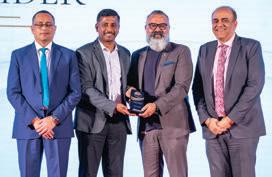
BEST FINANCIAL TECHNOLOGY PROVIDER GBM
The Best Financial Technology Provider award was presented to GBM in recognition of the company’s extensive range of IT infrastructure, solutions and services ranging from consulting, resource deployment and integration to after-sales support. With more than 30 years of experience, eight offices and more than 1,500 employees across the Middle East, GBM is the region’s leading digital solution provider. The company offers the region’s broadest technology portfolio, including industry-leading infrastructure, digital business solutions, security and services. GBM has nurtured partnerships with the world’s leading technology companies and have invested in skills and resources to assist their customers on their path towards digital transformation. The company enhanced its flagship cybersecurity platform, Cor., part of its GBM Shield cyber defence programme.
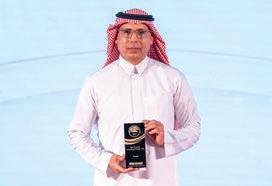


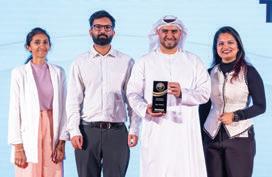

BEST FINANCIAL TECHNOLOGY PROVIDER - KSA SARMAD
Sarmad, a Saudi founded fintech won the award for the Best Financial Technology Provider in Saudi Arabia for thamar, a breakthrough SaaS platform that transforms the full asset management lifecycle into a seamless, fully digital experience, purpose-built for the Kingdom’s capital markets and aligned with Vision 2030’s Financial Sector Development Program. The thamar platform is noted for eliminating the inefficiencies of legacy systems by digitising investor onboarding, operations and compliance into one intelligent ecosystem, with breakthrough innovations solving the core challenges of investment management, from fragmented processes to complex regulatory requirements, and empowering institutions to achieve faster growth, stronger compliance and higher investor satisfaction.
BEST BANKING AS A PLATFORM (BAAP) PROVIDER
INFOSYS FINACLE
Infosys Finacle took the award for Best Banking as a Platform (BaaP) Provider. The BaaP model empowers financial institutions to become orchestrators of ecosystems, offering a wide array of services through partnerships, integrations and open innovation during our time of heightened development in the regional financial environment. Finacle’s robust platform capabilities have consistently demonstrated excellence in enabling vital transformations across regional and global markets with open architecture and an innovation-first approach has helped banks to reimagine their business models. Their pioneering work with leading banks and fintechs, has been a true enabler of platform banking, delivering measurable impact across diverse use cases.
BEST PAYMENTS FINTECH INITIATIVE SKIPLY – RAKBANK
Skiply by RAKBNAK won the award for Best Payments Fintech Initiative. The Skiply platform, which allows more than 130,000 users to manage their family educational institution payments and activities, was made much easier and more efficient due to fast shortcuts, snappy navigation and by showing content and data which are relevant to the users, via a new Enterprise Resource Planning - ERP integration initiative. This now brings the capability to integrate directly with the Merchants in-house ERP or ERP vendors, to be part of digital reconciliation with reduction of human error and an increase in time efficiency




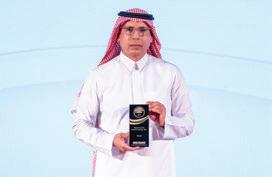
MOST INNOVATIVE FINTECH COMPANY NAQOOD
Naqood was the winner of the award for Most Innovative Fintech Company. Their win, is closely aligned with the UAE’s progressive approach to fintech and digital transformation where the Federal Tax Authority (FTA) and the Ministry of Finance played a vital role in shaping an ecosystem that promotes transparency, compliance and innovation and thus inspiring Naqood to develop technology that seamlessly integrates with UAE tax systems while keeping accounting simple for users of all backgrounds. Their free, cloud-based accounting platform offers everything UAE businesses need to stay compliant and in control with accounting software that has been designed to make financial management simple, smart and accessible to everyone
BEST FINTECH PROVIDER FOR WEALTH AND INVESTMENT MANAGEMENT ADDITIV
additiv were the winner of the award for Best Fintech Provider for Wealth and Investment Management. additiv stand apart as a key fintech behind financial transformation and empowering traditional players. They partner with the world’s leading and most ambitious institutions, supporting over 400 financial institutions and consumer brands to accelerate financial innovation and time to market, without the need for replacing existing systems. Their API-first Digital Financial Services Platform streamlines business logic and orchestrates data flows, embedding AI across processes to power automation, personalisation and smarter decision-making across important sectors such as wealth, credit, insurance and banking.
MOST INNOVATIVE FINTECH COMPANY - KSA SARMAD
In just three years, Sarmad, winner of the Most Innovative Fintech Company - KSA, has established itself as one of the most inventive fintech players in the Middle East, combining deep financial expertise with modern software engineering. Their flagship product, thamar, developed entirely in the Kingdom of Saudi Arabia, introduced several industry-first capabilities that distinguish it from any platform in the region, and has redefined how capital market institutions operate, bridging the gap between investor engagement, compliance and operational performance, representing the spirit of ambition and innovation in the country’s rapidly maturing fintech market.



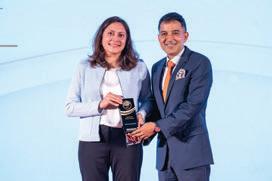

BEST FINTECH COMPANY FOR SMEs PREMIUM TECHNOLOGY
Premium Technology, a global leader in Supply Chain Finance (SCF) and Digital Trade solutions, were winners of the Best Fintech Company for SMEs. The New York founded business has a significant footprint across the Middle East and Africa and has continued to successfully make its presence felt, managing noteworthy partnership projects with premium institutions that include Saudi Arabia’s Public Investment Fund (PIF),First Abu Dhabi Bank, ADCB and Gulf International Bank.
Regional banks and financial institutions are actively manoeuvring to accommodate the needs of SMEs. Premium Technology’s commitment to driving the empowerment of regional SMEs through the application and deployment of technology makes it possible for financial institutions in the MEA regions to scale, digitise and empower local and regional SMEs through inclusive, sustainable finance.
BEST REGTECH FINTECH COMPANY
SMARBL LTD.
Smarbl collected the award for the Best RegTech Fintech Company in recognition of their products - SmartReg, which is an end-to-end regulatory reporting and Supervisory Technology (SupTech) enablement platform, providing a foundational solution for regulatory reporting automation, data quality assurance and supervisory integration, and RegPRISM, the region’s first AI-enabled regulatory intelligence and compliance management solution that represents the next generation of compliance management and the first platform of its kind conceptualised and developed in the UAE. Together, these ground-breaking products form a unified ecosystem focused on connecting regulators and regulated entities, and help both sides to navigate regulatory change with speed, accuracy and confidence
BEST OVERALL FINTECH COMPANY NETWORK INTERNATIONAL
Winning the award for Best Overall Fintech Company is Network International. As our region’s fast-paced digital transformation of banking and financial services continues, Network International have added to their legacy as a payments processor to become a fintech platform enabling inclusive, secure and scalable digital commerce. Their recent strategic transformation aligned their operating model with the demands of the energetic fintech ecosystem, with their merger with Magnati creating the largest fintech and payments entity in our region. Their operational excellence, product innovation, ecosystem influence and unifying work culture encouraging a universally shared mission has effectively contributed to the progress of digital finance across our region.


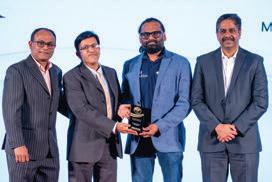
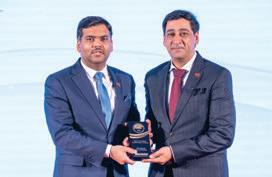

BEST BANK AND FINTECH COLLABORATION
NIUM AND EMIRATES NBD
The award in the category for Best Bank and Fintech Collaboration was taken by Nium and Emirates NBD whose partnership has evolved into one of the region’s most significant examples of bank–fintech collaboration. Starting with a shared objective to transform cross-border payments from the Middle East to the world, their leading example of bank and fintech collaboration has enabled real-time, low-cost and transparent international money transfers. The original aim of simplifying remittance payments has transformed into a blueprint for how established banks and agile fintechs can work together to deliver speed, efficiency and inclusion across global financial systems
AI SECURITY SOLUTIONS PROVIDER OF THE YEAR FINESSE CYBERHUB 24/7 CSOC
Winning AI Security Solutions Provider of the Year is Finesse Cyberhub 24/7 CSOC for its proven role in enabling and securing digital transformations that manage detection and response services. Their CSOC - Cognitive Security Operations Centre platform accelerates and heightens threat detection, triaging, remediation and case management, while ensuring regulatory compliance. Enhanced managed security services require project planning that involves determining and documenting a list of specific tasks and deadlines, as well as the additional costs involved, and Finesse Cyberhub 24/7 CSOC is differentiated in this by robust platforms with a wide range of integrations, a unique dashboard view, faster response and team of security professionals with extensive experience in the field
BEST AI AND DIGITAL TRANSFORMATION ADVISORY E& ENTERPRISE - DATA & AI PRACTICE
The winner of the award for Best AI and Digital Transformation Advisory was e& enterprise - Data & AI Practice. e& enterprise’s value proposition is the enabling of the business transformation of governments, large-scale enterprises and corporations and have built a proven track record of consulting expertise, the ability to deploy and operate complex solutions and for having the strongest infrastructure in the region. Through their haifin subsidiary they provide a trade finance platform that leverages AI and Applied Analytics Intelligence, and Blockchain to deliver secure, authentic transactions. Their blockchain ledger and analytics create a dependable system that simplifies the trade process.

BEST DIGITAL BANKING INNOVATION
MBANK
Mbank, also known as Al Mayrah Community Bank, was the winner of the award for Best Digital Banking Innovation. Digital innovation is deeply rooted in Mbank, it being the UAE’s first fully integrated Digital Bank, deftly providing products and services that are driven by innovative and smart technologies being part of their core principles. Their AEC Wallet, a digital wallet for the UAE’s first regulated AED-denominated stablecoin, AE Coin, lets users hold, send, receive and pay with AE Coin instantly, offering faster and less costly transactions than traditional banking, with options to cash out to Dirhams at merchants operating in multiple sectors.
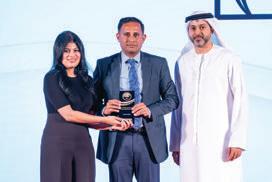
BEST MOBILE APP BANKING SERVICE IMPLEMENTATION EMIRATES NBD
Emirates NBD picked up the award for Best Mobile App Banking Service Implementation for their ENBD X mobile app. ENBD X was designed in line with the latest User Experience - UX trends and so provides a huge range of services and product applications. Over 150 instant banking services are available for customers, with more than 200 in total. With the easier navigation, simplified payments, personalised notifications, instant product applications and a hybrid digital wealth platform, which enables customers to invest instantly in financial markets globally, ENBD X bring a level of utility that is both experience enhancing for customers and hard to match

BEST ISLAMIC DIGITAL BANKING SERVICES
MASHREQ AL ISLAMI
The winner of the Best Islamic Digital Banking Services award was Mashreq Al Islami. Their win in this category is backed by a full suite of Islamic banking services provided across all their digital platforms and customer touch points. Supported by robust technology, their many initiatives include digitally enabled account opening, credit card issuance, digitised branch services, sales model and customer facilitation. Of note is their Electronic Face Recognition (EFR) onboarding journey via Mashreq’s Islamic Onboarding App and their Islamic mobile app features, which include the ability to open a Mashreq Neo account in only two minutes or a Mashreq account after just a few minutes.

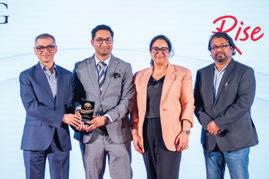
BEST ONLINE BANKING SERVICE
FIRST ABU DHABI BANK - FABEACCESS PLATFORM
First Abu Dhabi Bank (FAB) won the Best Online Banking Service in recognition of FABeAccess, an innovative digital channel platform for corporate customers. With a comprehensive product suite for cash management and collections, it offers intuitive suggestions, real-time notifications and advanced data analytics to empower users with smarter decision-making capabilities. The platform is designed to enhance efficiency, security and user convenience with features including global cash position - to view consolidated balances across FAB and other banks; account management - to access detailed views of accounts, deposits and loans; transaction services - to initiate and authorise single payments, transfers and manage payees and beneficiaries; digital cheque deposit - to deposit cheques digitally without visiting a branch and device management
BEST USE OF AI AND ML IN BANKING
MASHREQ BANK - INTEGRATED AI SOLUTION FOR BUSINESS GROWTH & IMPROVED CLIENT EXPERIENCE
Mashreq Bank’s wining initiative was launched with the objective of ensuring they have a wholistic insight of the large corporate clients they are serving. The three key pillars on which the initiative rest are - discovering untapped business opportunities, improving client KYC and identifying risk. Their former analytics framework depended on external data sources to provide a complete view of our corporate clients and their activities, requiring relationship teams to manually gather and interpret client insights using direct calls, news platforms and social media. The new solution introduces an innovative AI platform powered by machine learning and built on data mesh technologies, setting it apart from competitors and bringing insights that are mutually beneficial for the banks and its clients.


BEST DIGITAL TRANSFORMATION IMPLEMENTATION
RAKBANK are the winners of the award for Best Digital Transformation Implementation for their launching of a major transformation to shift customer servicing from traditional voice to digital channels, with the aim of enhancing efficiency, reducing costs and delivery of faster, more seamless experiences. They achieved the highest digital migration rate and service improvement in 2025. The results were clear: 34% reduction in monthly voice volumes (74K 50K). • 55% improvement in Service Level. • 67% lower voice abandonment. • 55% shorter voice wait time. • 10% rise in customer satisfaction and 61% drop in complaints
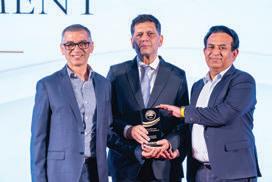
OVERALL BEST USER EXPERIENCE/ENGAGEMENT MASHREQ BANK - CONVERGENCE
Mashreq added to large tally of awards this year by winning in the category for Overall Best User Experience/Engagement. They view onboarding, being the first and most critical step in building a lasting relationship with a client, as setting the tone for the entire experience and playing a pivotal role in creating a strong first impression. Mashreq, recognising the importance of delivering a smooth and intelligent experience from the start, invested in a cutting-edge, GenAI-enabled, end-to-end, seamless and secure digital onboarding solution. The result is CONVERGENCE — a Hybrid Agentic AI-driven Unified Platform integrating Digital Onboarding, KYC and Account Maintenance into a single intelligent interface.
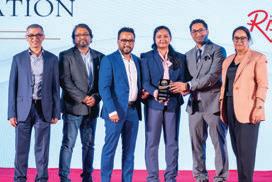
SPECIAL ACHIEVEMENT IN DIGITAL INNOVATION
MASHREQ BANK - TRADE ASSET SELL-DOWN PLATFORM
The Special Achievement in Digital Innovation award was attained by Mashreq Bank for their unique Trade Asset-Sell-down Platform. Before the advent of the platform, the process of Trade Asset-Sell-down was entirely manual, requiring the input of teams of staff following up with each other and having to maintain complicated records to track the large volumes of transactions. The platform was developed to digitise and super-charge the process, successfully streamlining systems and leading to doubling the volume to more than 300 selldowns valued at approximately $4Bn, without the need to increase headcount. The benefits, including more accurate asset identification, the ability to route higher volumes and faster turnaround times, have been numerous and shared across the bank’s internal teams, end clients and investors.

BEST PAYMENT SOLUTIONS IMPLEMENTATION ADNOC
ADNOC won the Best Payment Solutions Implementation award by delivering one of the most comprehensive and impactful payment transformation journeys in the region. Their legacy, cash centric payments processes were inefficient. So, facing the challenge of transforming their financial operations into an efficient, seamless and transparent payments system, their winning solution was to implement and end-to-end payment transformation. Key elements include deploying 36 POS machines at remote ADNOC Medical sites linked to FAB for instant settlement, the Installation of 2 corporate cheque clearing devices in Al Dhannah City for real estate revenue, launching a corporate payment gateway for tenant rent and utility bill collection and integrating of SAP Concur with corporate cards, petty cash custodians and e-wallets for travel and petty cash payments.
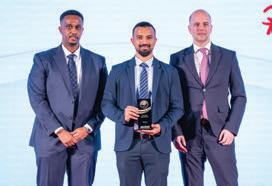
BEST DIGITAL BANKING SERVICE MASHREQ
In another of many successes at the awards, Mashreq took the award for Best Digital Banking Service. The was based on the bank’s track record of distinguishing itself through innovative digital financial solutions to better enable customers for their daily financial needs, and to remain a leader in regional digital banking. Their range of digital achievements are numerous and as examples, include standouts such as Mashreq NEO Egypt, where leveraging their success with NEO in the UAE, they scaled their MENAP expansion through launching NEO in Egypt, and also establishing a groundbreaking partnership with e&, a first of its kind Banking as a Service (BaaS) concept between a bank and telecom company in our region.

BEST AI DEPLOYMENT/IMPLEMENTATION
UNITED ARAB BANK
The award for Best AI Deployment/Implementation went to United Arab Bank for their implementation of RegPRISM, an AI-enabled, cloud-based Regulatory Intelligence and Compliance Management platform. Our environment of accelerating regulatory change, means financial institutions are challenged by manual compliance processes, fragmented reporting systems and the costs of meeting supervisory expectations. Facing the challenges of interpreting regulatory updates and managing compliance across multiple departments, United Arab Bank’s application of RegPRISM provided a centralised regulatory library management application, automated obligation extraction and workflowdriven attestations, creating full traceability from regulation to control execution. The many benefits included a reduction in time spent interpreting and mapping new regulations and complete traceability from regulatory source to policy and evidence, thus enhancing audit readiness.
BEST USE OF AI IN ASSET MANAGEMENT PLURIMI WEALTH

The winner of the award for the Best Use if AI in Asset Management was Plurimi Wealth - Dubai.Their AI models mimic squads of seasoned analysts who draw on their extensive experience with historical market phases and event dynamics. Then, by comparing and contrasting past events within the current context, their AI provides a nuanced understanding of conditions and market trends. This innovative emulation of expert analytical thinking allows their AI to offer insights that are both deep and contextually relevant. The system processes vast datasets faster and more efficiently than humans can, and as a result they are able to identify subtle patterns and correlations in market data that are otherwise effectively invisible to the naked eye.
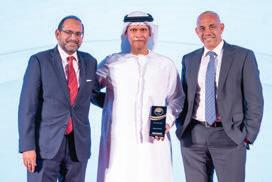
BEST ISLAMIC BANK MASHREQ AL ISLAMI
Maintaining their winning streak, Mashreq took the award for the Best Islamic Bank. Their win in this category has roots in and owes much to their strengths in providing Islamic banking that is backed by a full suite of modern digital services. From their Islamic onboarding app and their Islamic mobile app features to their implementation of robust technology, Mashreq Al Islami, in addition to placing their bank among the leaders in our region at this time of increasing adoption of Islamic banking, are providing up to the minute features, benefits and services that are set to capture the imagination and the custom of new and upcoming banking generations.
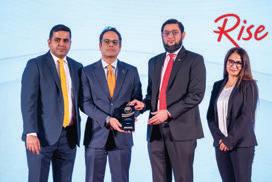
BEST ISLAMIC CONSUMER FINANCE MASHREQ
Winning the award for Best Islamic Consumer Finance is Mashreq Al Islami for their Personal Finance offering, a service that is made available to both Emirati customers and to expatriates. Whether the customer needs are for a range purposes that might include planning a vacation, home renovation or education payments, Mashreq Al Islami have amplified the relief of getting personal finance on every front. Key features vary according to your status as an expat or as an Emirate, but include instant approval in up to five minutes, a generous grace period before equated monthly instalments begin and two postponements inside of one year.
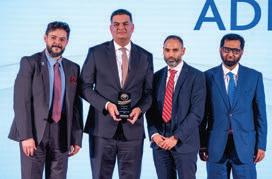

BEST INNOVATION IN ISLAMIC FINANCE ABU DHABI ISLAMIC BANK – ADIB
The award for Best Innovation in Islamic Finance was presented to Abu Dhabi Islamic Bank - ADIB. They view innovation as central to their strategy with efforts primarily focused on digital transformation, artificial intelligence and strategic partnerships with fintech companies, with initiatives of note including ADIB Ventures - leveraging AI to drive operational efficiency, personalise customer experiences and enhance risk management. Spatial Banking - ADIB is an early adopter of immersive technologies, having launched a “Spatial Banking” experience for the Apple Vision Pro and strategic partnerships - ADIB actively collaborates with technology providers and regulators like Hub71 and ADGM to accelerate the adoption of new financial technologies.
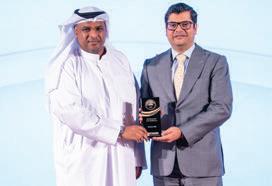
BEST RETAIL BANK IN THE MIDDLE EAST EMIRATES NBD
Emirates NBD took the award for Best Retail Bank in the Middle East. Emirates NBD, as well as having shown robust performance results across all metrics - 27% market share in RBWM, 46% YoY increase in loan origination and a 10% YoY growth of income as just some examples, they also revamped their CRM enabling them to rapidly resolve issues, significantly boost sales and provide their customers with enhanced banking experiences. Their purposeful progress toward becoming a digital first bank has been of note with examples of success including a 91% digital adoption among customers, almost 200 services and a 40% increase of new accounts opened via their ENBD X platform.
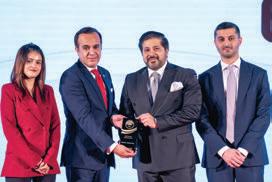
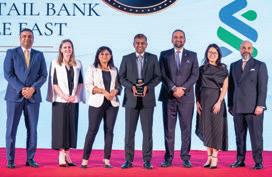

BEST PREMIUM BANKING SERVICES
RAKBANK - RAKBANK ELITE
The award for the Best Premium Banking Services was presented to RAKBANK in recognition of their RAKBANK Elite service. Their proposition stands out for its customer-first philosophy, innovative product design and measurable impact. They have created a model that is not only competitive but also meaningful, in that it is one that empowers customers to grow, protect and enjoy their wealth with confidence. Key is their providing a modern digital service but with a human touch, and a proven relationship model centred around product knowledge, service depth and simplicity, provided by highly experienced, certified relationship managers who manage a full spectrum of investment, banking and life-style needs
BEST GLOBAL RETAIL BANK IN THE MIDDLE EAST
STANDARD CHARTERED BANK
Standard Chartered Bank (SCB) was the winner of the award for Best Global Retail Bank in the Middle East. Their comprehensive retail banking services in the Middle East, while primarily focused on the UAE and Saudi Arabia, provide a full range of services including both conventional and Islamic (Saadiq) accounts, wealth management (Priority & Private Banking for HNWIs), credit cards, loans and investments. Their history and stature allows them to leverage their global network and deep local expertise, aiming to connect global opportunities with regional clients for managing and growing wealth. They emphasis on service quality, tailored solutions, digital banking and high-touch service for affluent segments help to distinguish SCB in our region.
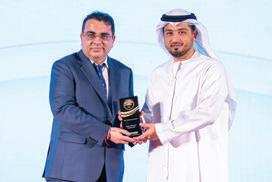
BEST COMMERCIAL BANK
NATIONAL BANK OF FUJAIRAH PJSC
The Best Commercial Bank award went to National Bank of Fujairah. National Bank of Fujairah (NBF) has built a legacy of trust, expertise and long-term partnerships, continuing to empower businesses across every major sector. Their relationship-led approach ensures clients are supported through every stage of their banking journeys, from working capital and trade finance to project lending and digital transformation. Their unique abilities are imbibed with a deep understanding of market needs, a culture of integrity and collaboration and a keen focus on customer satisfaction. They are differentiated by their combining human expertise with advanced digital platforms such as NBF Corporate Access and NBF Edge (end-to-end digital account opening), enabling clients to operate seamlessly while maintaining personal relationships.
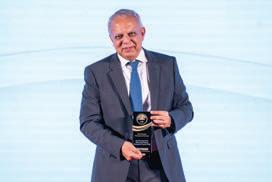
BEST TREASURY MANAGEMENT SERVICES
FIRST ABU DHABI BANK - WHITE LABEL TREASURY MANAGEMENT SYSTEM
The Best Treasury Management Services award was awarded to First Abu Dhabi Bank in recognition for their White Label Treasury Management System (TMS), devised to help corporates in their treasury transformation journey. Their identification of, and also meeting the need for providing a white-label TMS to its clients, helps with the challenges faced by businesses in their treasury transformation challenges, resolving most of the associated issues to help them achieve their key treasury objectives. One notable feature is their ‘Pay-As-YouGo’ model where modules and functionalities can be bundled as per client needs and priced accordingly. Additionally of note is that the service is available to all segments of the market and not just reserved for large corporates.
BEST OVERALL ISLAMIC CONSUMER FINANCE IN THE MIDDLE EAST DUBAI ISLAMIC BANK

The award for Best Overall Islamic Consumer Finance in the Middle East, won by Dubai Islamic Bank, defines the Islamic bank that cumulatively has shown emphasised convenience and general utility across its locations and range of services and products including auto finance, fleet financing, home finance, personal finance or durables finance. Dubai Islamic Bank continuously seeks to deliver enriching experiences both within and beyond traditional banking, with examples such as their AED 1 million Visa Card Draw campaign or their DIB XTRA Account which offers a welcome bonus and a lucky draw for customers, reflecting a commitment to recognising and rewarding customer loyalty in meaningful and impactful ways.
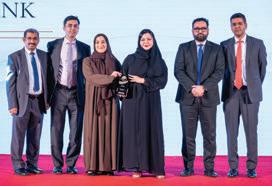
BEST TRADE FINANCE BANK
NATIONAL BANK OF FUJAIRAH PJSC
The award for Best Trade Finance Bank went to National Bank of Fujairah (NBF). They have long held a key facilitating role in the UAE’s trade reliant economy and continue to support the nation’s trading ecosystem through innovative, technology-driven solutions and unmatched sector expertise. Their enhanced digital Trade Finance platform, ensuring faster turnaround times, reduced manual intervention and greater transparency handled most of their transactions, with their document verification and AI-powered compliance monitoring tools further bolstering operational excellence and client confidence. Additionally, they are backed by one of the region’s most robust correspondent networks, thus providing secure, efficient and sustainable trade solutions to corporates and SMEs alike.

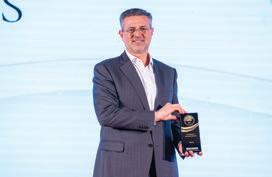
BEST CASH MANAGEMENT BANK
FIRST
ABU DHABI BANK
First Abu Dhabi Bank (FAB) took the Best Cash Management Bank award. Their regular conducting of market research to understand and assess clients’ needs, as well as regulatory, market and industry changes, plus having wide range of cash management products and services that are suitable across Corporates, Commercial, Financial Institutions and Government sectors are key factors of note. FAB’s Cash Management products and solutions are designed to help clients maximise control and efficiency over their cash flows and working capital requirements. Additionally, their Global Treasury, Trade & Tokenisation (GTx) aim is to increase wallet share and broaden client relationships by delivering innovative product developments, process enhancement and out of the box solution delivery.
BEST BANK FOR CORPORATE SERVICES
MBANK
Mbank - Al Maryah Community Bank, won the Best Bank for Corporate Services award, recognising their support for local businesses - SMEs, for local entrepreneurs and startups. Mbank is well known as one the UAE’s pioneer digital only banks, developing services focusing on seamless online banking and support via 24/7 customer care and in-app chat/video calls. They are successfully offering digital corporate services for Startups, SMEs and Corporates. These services include free digital business accounts with no minimum balance, corporate cards, tailored loans and finance, trade finance, cash management and integrated Wage Protection System (WPS) through its digital platform and the Mbank UAE app.
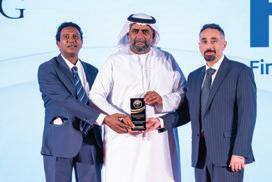
BEST CONSTRUCTION PROJECT MANAGEMENT BANKING SOLUTIONS
FAB
BUILDING MANAGEMENT SOLUTIONS (FBMS)
First Abu Dhabi Bank was recognised in the awards for Best Construction Project-Management Banking Solution for FBMS (FAB Building Management Solution). FBMS is the innovative and secure end-to-end backbone of the National Housing Loans (NHL) program, serving project owners with project consultants and contractors. The platform manages the full project lifecycle from pre-construction to handover, reducing branch visits by digitising key steps from vendor registration, design submissions, digital tendering and awarding. Built-in financial controls ensure accuracy and transparency across invoices, payments and milestone-based disbursements. FBMS currently manages over 85,000 active NHL projects and connects more than 6,000 registered vendors.
BEST SUKUK DEAL OF THE YEAR DUBAI ISLAMIC BANK

Taking the award for the Best Sukuk Deal of the Year was Dubai Islamic Bank for their issuance of a USD500 million Additional Tier 1 Sukuk with a profit rate of 5.25% per annum. The transaction, which was executed intraday, managed to achieve a reset spread of 133.4 bps over the US Treasury rate, which is the lowest for an AT1 instrument globally since the 2009 financial crisis. The Basel III-compliant Sukuk will strengthen Dubai Islamic Bank’s capital adequacy ratio and optimise its balance sheet. Dubai Islamic Bank enjoys a broad investor base comprising banks, private banks and fund managers from Europe, Asia and across our region.
BEST M&A SAUDI INVESTMENT RECYCLING COMPANY (SIRC)
SIRC was awarded with recognition for the Best M&A. As a result of their targeted approach SIRC have achieved significant strategic impact, accelerated market growth and have been able to introduce innovative new technologies across Saudi Arabia’s recycling and waste management sector. Following their acquisition and expansion of EDAMA, SIRC is investing over SAR 80 million to boost treatment capacity and has secured major agreements with leading companies and national giga-projects. Over the next five years, EDAMA plans to invest up to SAR 300 million to scale capacity to 500,000 tonnes per year, reinforcing its role as a key leader in the circular economy.
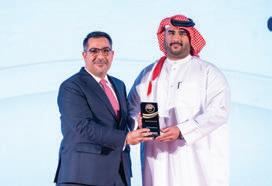
BEST INVESTMENT BANK GFH FINANCIAL GROUP
The Best Investment Bank award went to GFH Financial Group. Known as one of the region’s most dynamic and diversified investment institutions, they combine the depth of a traditional investment bank with the agility and innovation of a modern, global financial platform. Over the past year, GFH has delivered exceptional performance across investment banking, capital markets and strategic acquisitions, demonstrating an ability to originate, structure and execute complex cross-border transactions that generate long-term value for investors and stakeholders. Noted transactions and deals include US$133 million acquisition of Gulf Central Company (KSA), US$300 million acquisition of A-Class US Student Housing Portfolio and US$150 million acquisition of Logistics Assets in Saudi Arabia and the UAE.
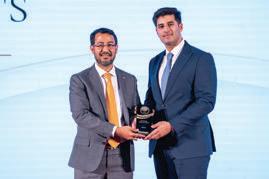
BEST BANK FOR SME BANK ACCOUNTS MASHREQ
Mashreq were presented with the award in the category for Best Bank for SME Bank Accounts. Their winning attributes include a strong business banking proposition as a full-spectrum SME Bank supporting SMEs of all sizes. Their digital-first bank for SMEs, Neo Biz, provides end-to-end digital onboarding for SMEs. They offer a full servicing range with day-to-day business activities like payments, FX conversions, trade, etc. which can also be performed seamlessly via their Mashreq Biz platform. Additionally their customers can also digitally subscribe to value added services for their business operations through their partners. Notably, the bank reduced the average account opening turnover time from 60 days to within 3 days for SMEs.
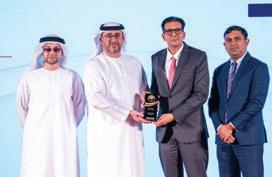
BEST ISLAMIC BANK FOR SMES
EMIRATES ISLAMIC BANK PJSC
Emirates Islamic Bank was the winner of the award for the Best Islamic Bank for SMEs. One in fifteen SMEs in UAE is actively banking with Emirates Islamic Business Banking (BUB), amounting to more than 40,000 SMEs. Emirates Islamic BUB have maintained consistent investment to increase operational efficiency including digital onboarding and overall enhancement of the customer experience resulting in further customer acquisition. Understanding of the diverse product needs of SMEs and suitably responding, personalised insights were defined and shared with relationship management teams. Additionally, their launch of a brand-new dedicated Business Banking Call Centre with multi-lingual agents brings hands-on experience to address day-to-day SME clients and enhanced customer experience.
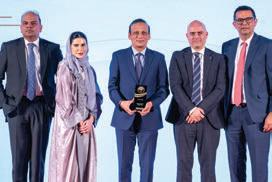
BEST SME BANK NATIONAL BANK OF FUJAIRAH PJSC
National Bank of Fujairah took the award for the Best SME Bank. They are established as long standing supporters of SMEs, and through this year the bank expanded its SME portfolio through strong client acquisition, tailored financial solutions and digital innovation via platforms like NBF Edge—which enables account opening digitally - and NBF Connect, which provides advisory, financial tools and exclusive insights. These platforms are added to with further initiatives such as their Green SME Finance. NBF champions sustainability, diversity and financial literacy plus their recent launch of their Emerging Business Unit, further strengthens their ecosystem approach, blending digital onboarding, comprehensive business management solutions and the expertise of dedicated relationship managers.
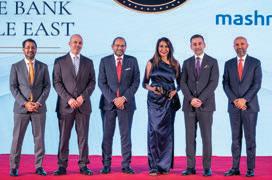
BEST PRIVATE BANK IN THE MIDDLE EAST
MASHREQ PRIVATE BANKING
The Best Private Bank in the Middle East award was collected by Mashreq Private Banking for their Hybrid Relationship model. The framework sets out to ensure that clients experience the best of both of today’s worlds with a dedicated relationship manager providing a human overlay for personalised expertise and experience, combined with the agility and convenience of numerous digital services including examples such as empowered self-service investing and access to more than 150 global funds. Additionally, Mashreq’s Family Office proposition, catering to ultra-high-net-worth individuals, is designed to meet the sophisticated needs of intergenerational family wealth, delivering institutional-grade solutions going beyond conventional private banking.


BEST WEALTH MANAGEMENT INSTITUTION FOR HNWIs - US$1 MILLION TO US$20 MILLION STANDARD CHARTERED BANK
Standard Chartererd Bank won Best Wealth Management Institution for HNWIs - US$1 Million to US$20 Million, recognising their Priority Private Segment. It offers comprehensive international banking services across their four main wealth hubs—UAE, Singapore, Hong Kong and Jersey plus the expertise of international relationship managers, each with more than twenty years of experience, connecting through local languages to unlock global investment opportunities. Among the many special benefits available to Priority Private Segment clients, are eligibility for exclusive event invitations designed to grant them elite experiences, including VIP tickets to cultural events, concerts at Coca Cola Arena Dubai and VIP tickets to Anfield Stadium to watch LFC games and events.
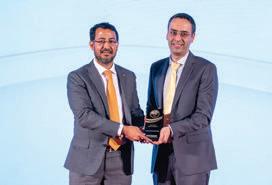
BEST CLIENT VALUE PROPOSITION
MASHREQ PRIVATE BANKING
Winning the award for the Best Client Value Proposition was Mashreq Private Banking. A summing up of their wide range and diversity of products, special services, benefits, rewards and experiences, digital capabilities, adoption of inclusivity promoting causes and consistent recognition through industry accolades, shows a value proposition that is clearly defined and fully rounded. However, the distinguishing factor that lies behind their broad array of options, high performance products and service levels is an innate and comprehensively shared determination to be at the top of their market which has the effect of keeping the bank at the peak of their game, leading to the notable value proposition they can offer.
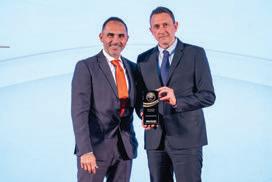

BEST DOMESTIC PRIVATE BANK
FIRST ABU DHABI BANK
First Abu Dhabi Bank (FAB) were presented with the award for the Best Domestic Private Bank.
They are a regionally preferred financial institution for family offices, ultrahigh-net-worth (UHNW), and high-net-worth (HNW) individuals, maintaining a strong international presence. Their striving to continuously innovate features as a lead factor in their success with a clear example being their Asset Management division’s successful raising of almost USD 200 million in assets under management (AUM) through a new Fixed Maturity Portfolio (FMP), which also marked record subscription levels. The portfolio also includes the second series of FAB’s conventional FMP, following a successful first earlier series rollout, as well as the bank’s first Shariah compliant FMP.
BEST FAMILY OFFICE SERVICE
MASHREQ PRIVATE BANKING
The award for the Best Family Office Service went to Mashreq Private Banking. Since their family office (FO) services were launched in 2020 to provide highly specialised and curated solutions to ultra-high-net-worth individuals (UHNWIs), the unit has grown into a business catering to more than 50 Family Offices across the GCC, Europe and Asia, representing a collective net worth exceeding USD 75 billion. They are distinguished as having launched the MENA region’s first comprehensive FO team, with a competitive advantage being their legacy as the UAE’s oldest bank, which places them well during this time when the world’s UNHWIs attention is very much focused on the region.

BEST FOUNDATION SERVICES OCORIAN
Ocorian were named as the winner of the award for Best Foundation Services. They are a long established and well trusted global leader in foundation structuring and administration for ultra-high-net-worth individuals, families and family offices. Thay are distinguished by their governance-first approach, treating foundations as more than just legal entities, but also as key instruments in long-term family strategies by investing time to understand the needs and objectives of their clients. At a time when the futures of prosperous families across our region has become a greater concern than ever before, Ocorian successfully provides family structures and decision-making frameworks that embed safeguards and prevent future conflict.


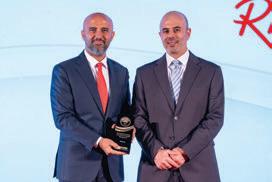
BEST PRIVATE CLIENT SERVICES M/HQ
The award for Best Private Client Services went to M/HQ. They are among those that played a role in the creation of Foundations as a wealth management tool in the UAE. Headquartered in the UAE since 2009, over the past decade M/HQ have built an enviable reputation as the model private client services provider, with a mastery in structuring single family offices (SFOs), proprietary investment vehicles and legacy planning tools in the Dubai International Finance Centre (DIFC) and Abu Dhabi Global Market (ADGM). In the local market they are considered as one of the benchmarks of excellence and as having a proven track record of providing a holistic, client-centric approach.
BEST DIGITAL INNOVATION AND SERVICES IN WEALTH MANAGEMENT MASHREQ
Mashreq continued their accumulation of awards with their win in the category for Best Digital Innovation and Services in Wealth Management. Their Mashreq Mobile App provides a seamless, intelligent and personalised wealth management experience combining digital convenience with premium advisory services. With a unique combination of self-executed, hybrid and advisory capabilities, the app seamlessly blends simplicity with depth, making wealth management more accessible, intelligent and personalised than before. Its many key features include always-on access to global markets and asset classes, frictionless onboarding and built in compliance, advanced portfolio analytics and insightful dashboards and Investment Lending: The Lombard Dashboard (For affluent and HNWI Clients).
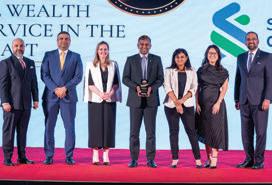
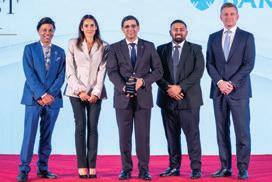


BEST OVERALL WEALTH MANAGEMENT SERVICE IN THE MIDDLE EAST
STANDARD CHARTERED BANK
The award for the Overall Best Wealth Management Service in the Middle East went to Standard Chartered Bank. One of their strengths in this field, especially in the regional wealth management market of today is their Wealth Hub in the UAE. This provides clients with access to international wealth solutions and capabilities available from diverse international products, just some of which include fixed income - with live market prices for quality bonds, wealth lending - borrowing with flexibility on collateral options for greater liquidity, insurance - with tailored solutions for client protection and legacy planning needs and structured products, enhancing client’s yield with customised opportunistic solutions and structured notes for potentially higher returns.
BEST GLOBAL PRIVATE BANK IN THE MIDDLE EAST
BARCLAYS PRIVATE BANK
Barclays Private Bank took the award for Best Global Private Bank in the Middle East. From their UAE hub, Barclays Private Bank delivers specialist investment, banking, lending and wealth advisory services to ultra-high and high-net-worth individuals, multi-generational families, family offices and charitable trusts. Their unrivalled global connectivity, local insight, long-term partnerships and long heritage are of note. Barclays clients are supported by one of the industry’s most experienced and comprehensive teams of private bankers, portfolio managers, advisers, client services staff and product specialists, further bolstered by close collaboration with their Investment and corporate banking specialists, ensuring clients benefit from both local insight and global best practice.
BEST FAMILY OFFICE PLATFORM PROVIDER BNY WEALTH
BNY Wealth were the winners of the award for Best Family Office Platform Provider. BNY Wealth who as a leading global asset servicer, recognise the intricate challenges of consolidating, reporting and analysing investments that span multiple money managers, asset classes and legal structures—from family partnerships and trusts to private trust companies. With this as a major responsibility they have deployed cutting-edge technology, giving clients seamless, 24/7 online access to best-in-class performance and risk analytics. Through their dedicated Global Family Office team, they deliver end-to-end custody and performance-measurement solutions that empower family offices with unparalleled security, transparency and control.

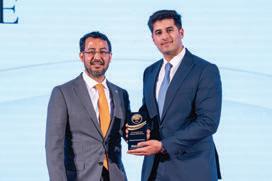
BEST SUCCESSION PLANNING SERVICES FIRST ABU DHABI BANK
The award for Best Succession Planning Services was presented to First Abu Dhabi Bank (FAB). The awareness of the importance of succession planning is growing across the region and FAB’s personalised wealth planning and trust services, through their end-to-end approach, empowers clients to build, preserve and sustain their wealth and legacy across generations according to their goals and unique circumstances. Added to this, their wealth planning and trust services provide a comprehensive suite of solutions that meet the evolving and multifaceted needs of high-net-worth clients (both individuals and families) at every stage of their wealth journey, backed by expertise that extends to international wealth structuring, asset protection, philanthropic advisory and legacy planning.
BEST EXTERNAL ASSET MANAGER (EAM) SERVICE MASHREQ PRIVATE BANKING
Mashreq Private Banking collected another of many awards with this win for Best External Asset Manager (EAM) Service. Their EAM platform enables partners to deliver tailored investment strategies aligned with each client’s goals, risk appetite and time horizon. Through direct access to a broad spectrum of asset classes, their partners can construct diversified, performance-driven portfolios that reflect their clients’ ambitions and values. Their comprehensive product suite’s key advantages, to name just some, include comprehensive access to funds, bonds, equities, structured products, IPOs, financing, trusts and wealth planning, plus 24/7 trading across 37 international equity markets and access to over 150 global funds.
MOST INNOVATIVE TRADING APP
SARWA CAPITAL WEALTH (LTD.)

Sarwa took the Most Innovative Trading App award. When they launched options trading, becoming the first GCC-based app to offer this level of market access to everyday investors, traders in the region now had access to advanced tools previously only available on global brokerage platforms. All features in Sarwa Trade come to be as a result of client feedback so when investors wanted more control, they introduced full order capabilities including market, limit, conditional, stop and stop-limit orders. When requiring more flexibility, they added fractional shares so anyone could invest in companies like Nvidia or Apple without large capital requirements, and as users became more active, they built patternday-trading visibility to help them manage risk responsibly.

BEST PRIVATE CLIENT WEALTH JOURNEY STRATEGY OCORIAN
Ocorian were the winner of the award for the Best Private Client Wealth Journey Strategy. Their approach to specialist wealth management is anchored in their Private Client Wealth Lifecycle strategy, an innovative framework that is designed to be client-centric and accessible to all, whether UHNWIs, HNWIs, family offices or family businesses. The Ocorian Private Wealth Lifecycle aligns every stage of wealth ownership - creation, protection, succession and philanthropy within a long-term strategy, and by integrating governance, fiduciary oversight and reporting within a single framework, complexity is reduced, improving clarity and so enabling clients to make informed decisions with confidence. Additionally, Ocorian launched an interactive digital experience that demonstrates how clients can be supported, making the Wealth Lifecycle more intuitive.
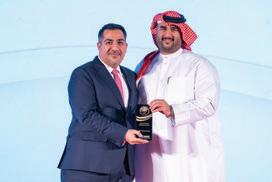
BEST INVESTMENT MANAGEMENT FIRM
GFH FINANCIAL GROUP
The Best Investment Management Firm award went to GFH Financial Group. A key aspect of their integral vision and strategy is their dynamic, entrepreneurial investment approach, underpinned by solid foundation of professional credentials allowing them to manage a diversified asset allocation strategy to effectively navigate the numerous challenges of today’s ever-changing and currently more uncertain macroeconomic environment, while also maintaining a leading investment position in the Gulf. This lead to another strong year with many high-impact transactions including the US$133 million acquisition of Gulf Central Company (KSA) and a US$450 million investment in US Medical Clinics and Student Housing as just two examples.
BEST SUSTAINABLE FINANCE INITIATIVE SUSTAINABLE CAPITAL IMPACT & HOLDING

The winner of the award for Best Sustainable Finance Initiative was Sustainable Capital Impact & Holding, the only Impact and UN Sustainable Development Goals-focused Investment fund in the Middle East. Additionally, from Dubai, they also made investments globally and were well represented in commitments to sustainability and the Paris Climate Agreement goals. Notably, Sustainable Capital Impact & Holding have successfully demonstrated to the financial sector and family offices that sustainable investments can achieve a double bottom line, generating returns exceeding industry standards while also making tangible contributions to the well-being of society, with their portfolio already creating significant value for humanity in the areas of climate, water, education, health and food.
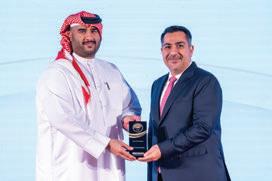


LEADER IN FINANCIAL INCLUSION DUBAI ISLAMIC BANK
Dubai Islamic Bank achieved Leader in Financial Inclusion for a number of deals that support regional businesses who through their activities have the effect of connecting wider areas of society into the financial world and so providing services usually denied to them. Some of these deals include a USD 150 Million Murabaha Deal with Turkcell to Accelerate Türkiye’s Tech Transformation, leading a landmark $3.25 Billion Financing Transaction for GEMS Education and increases their stake in Digital Bank in Türkiye - the T.O.M Group to 25%. Additionally, launching their DIB Academy was a strategic investment in human capital based on inclusivity providing business-aligned learning to embed in-demand skills at the core of their growth strategy.
BEST ESG STRATEGY
GFH FINANCIAL GROUP
The award for Best ESG Strategy was won by GFH Financial Group. GFH has made a determined transition from ESG awareness to full-scale integration by aligning its investments, governance frameworks and community initiatives with international standards and regional sustainability goals such as Bahrain’s Economic Vision 2030 and the UN Sustainable Development Goals (SDGs). Their ESG strategy rests on three pillars - Environmental Stewardship, Environmental Stewardship and Strong Governance, that are in turn backed by their formal ESG screening criteria applied to all new transactions where potential investments are evaluated against environmental impact, labour standards, corporate ethics and governance practices. This ensures that sustainability factors are embedded in the Group’s risk-return assessments.
BEST LAW FIRM
KARM LEGAL CONSULTANTS PVT LIMITED
KARM Legal Consultants Pvt Limited took the Best Law Firm award. A leading firm in financial technology (Fintech), blockchain and digital assets law, their combination of legal expertise and technical understanding of the highly active regional fintech, blockchain and tokenisation scene, and the increasingly vital data protection, AI, Cybersecurity and Insurtech markets, place them as a key service provider at this time of rapid technology led advancement in banking and financial services across our region. Karm legal are recognised for their key role in the enablement of innovation through their advice and guidance, helping the development of the businesses that will contribute to our region’s place as a leading fintech and banking hub.

BEST COMPANY INCORPORATION & FREEZONE BUSINESS START-UP IN THE MIDDLE EAST VIRTUZONE
Virtuzone was presented with the award recognising the Best Company Incorporation & Freezone Business Start-up in the Middle East. Virtuzone are indeed the clear leader in the provision of all services associated with starting or bringing a business into the UAE having, since their founding in 2009, helped form more than 80,000 companies. Their range of services is broad covering all needs associated with set-up in both freezones or on the mainland, as well as providing accounting services, VAT and tax consultancy, corporate tax registration and submission services, and banking services set-up assistance. Now a part of the global business services platform Ascentium, they are able to expand opportunities for clients globally.

BEST RESIDENCY AND CITIZENSHIP BY INVESTMENT FIRM
NEXT
GENERATION EQUITY
Next Generation Equity (NGE) won the Best Residency and Citizenship by Investment Firm award, highlighting their commitment to empowering individuals seeking global mobility, financial security and investment opportunities through tailored residency and citizenship investment programmes. They stand out in this increasingly competitive sector as a trusted, government-approved facilitator of citizenship and residency by investment applications for clients around the world, and for their citizenship and residency knowledge hub that provides global investment seminars and webinars offering valuable insights and expertise. NGE, a division of Virtugroup also specialises in residency by investment solutions, passport consultation and advisory services, investment planning for global mobility, due diligence and compliance checks, as well as application processing and documentation assistance.


FINTECH LEADERSHIP AWARD
MURAT
CAGRI SUZER, GROUP CHIEF EXECUTIVE OFFICER, NETWORK INTERNATIONAL
Murat Cagri Suzer, the Group Chief Executive Officer at Network International was the winner of the award for Fintech Leadership. Our region’s financial and payments sectors are defined by rapid digital transformation and the application of fintech. During these times that are characterised by speedy change and development, Murat Cagri Suzer has emerged as a visionary leader driving innovation, scale and impact across the Middle East and Africa’s financial services landscape. As Group Chief Executive Officer of Network International, the largest fintech platform in the MEA region, he has redefined the company’s strategic direction, expanded its fintech capabilities and positioned it as our region’s leading enabler of digital commerce. He was appointed in early 2025, and assumed leadership of Network International following its acquisition by a Brookfield-led consortium. With more than two decades of experience in payments, digital banking and corporate strategy, he has brought a global perspective and a bold vision to the role, clearly meeting his mandate to accelerate fintech innovation, deepen customercentricity and unlock new growth opportunities across the Middle East and Africa.
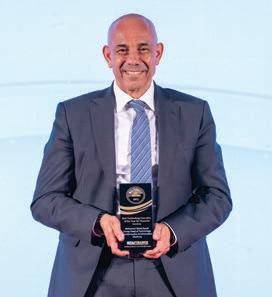

BEST TECHNOLOGY EXECUTIVE OF THE YEAR FOR FINANCIAL SERVICES
MOHAMED ABDEL RAZEK, GROUP HEAD OF TECHNOLOGY, TRANSFORMATION & INFORMATION, MASHREQ
Mohamed Abdel Razek the Group Head of Technology, Transformation & Information at Mashreq was presented with the award for the Best Technology Executive of the Year for Financial Services.
As Group Head of Mashreq’s Technology, Transformation & Information Group, Mohamed leads Mashreq’s technology organisation and drives the successful delivery of all of their digital services. He is responsible for the continual adoption of new and emerging technologies to ensure customer service excellence and the enablement of seamless collaboration with the bank’s external partners. Mohamed is a seasoned technology professional with around thirty years of experience and has led group and regional technology functions across several large corporations and financial institutions. Most recently, he served as the Chief Technology and Operations Officer for Africa and the Middle East at Standard Chartered Bank. He was previously associated with British American Tobacco, from 2007 to 2015, where he last held the role of Global Head of Technology Services.

BEST TECHNOLOGY EXECUTIVE OF THE YEAR
OSSAMA EL SAMADONI, GENERAL MANAGER, GULF BUSINESS MACHINES (GBM) DUBAI
The award for the Best Technology Executive of the Year was presented to Ossama El Samadoni, the General Manager of Gulf Business Machines (GBM) Dubai. With 30 years of experience in commercial excellence and transformation, he is a seasoned turnaround business leader with extensive experience across emerging markets in the fields of digital transformation and IT infrastructure. He has a track record of leading large-scale operations, with his expertise spanning organisation and financial management, strategic planning, enterprise solutions and end-to-end account and opportunity management. Known for his hands-on leadership style, he works closely with his teams, fostering a culture of performance, resilience and strategic execution.
Over the years he has successfully steered business units toward significant growth, led high-profile agreements and delivered mission-critical projects with an ability to lead under pressure and align teams toward common goals that has consistently resulted in impactful business outcomes. His passion for building strong teams and delivering transformative results are values that have, and continue to shape his leadership journey.
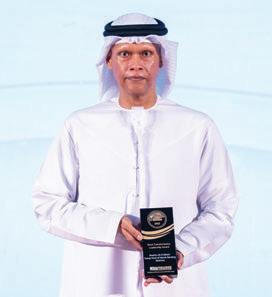
MOST TRANSFORMATIVE LEADERSHIP AWARD
IBRAHIM ALI AL MHEIRI, GROUP HEAD OF ISLAMIC BANKING, MASHREQ
The award for most Transformative Leadership was presented to Ibrahim Ali Al Mheiri, the Group Head of Islamic Banking at Mashreq. Since his appointment to this role in 2021, when tasked with a remit to increase Islamic banking business from retail banking to corporate and investment banking, international banking and treasury products, he has revitalised the financing book and put it firmly back on the path of year-on-year growth. His many challenges, including to significantly grow Islamic mobilisation amongst the company verticals, to build Islamic product lines alongside established conventional products, lead and build awareness amongst the relationship management force and encourage them to promote Islamic banking and finance, to develop service standards for Islamic product lines and transform and digitise (retail + corporate) onboarding & servicing channels, were all were met with success. As a result he has positioned the Islamic Banking Agenda at the forefront of the organisational growth. The results of his disciplined leadership are clearly evident in the exponential growth of assets, liabilities and revenues across all the banks sections.


BANKER OF THE YEAR
AMIT MALHOTRA, GLOBAL HEAD OF RETAIL BANKING , CHAIRMAN ADIMAC & ADIB SECURITIES, BOARD MEMBER ADIB CAPITAL, ADIB
The Banker of the Year Award for 2025 was presented to Amit Malhotra, Global Head of Retail Banking , Chairman ADIMAC & ADIB Securities, Board Member ADIB Capital, ADIB. Amit has almost thirty years of retail banking experience in leading globally recognised institutions such as Citi, GE Capital and Standard Chartered Bank. He has held senior positions at regional banks too, including as Senior Managing Director and Group Head of Personal Banking at Al Hilal Bank, as General Manager of Retail and SME Banking at Commercial Bank of Dubai and his expertise was invaluable in 2022 with his role in the founding of Uno Bank, one of the first full-spectrum digital banks in The Philippines. At ADIB, he is one of the leaders of their future vision - Vision 2035, their strategic plan to become the world’s most innovative Islamic bank by focusing on digital transformation, customer experience and sustainability by leveraging AI, fintech partnerships (like ADIB Ventures), and new tech (like Apple Vision Pro) to offer seamless, future-ready Islamic financial solutions for diverse customers while driving growth and ESG leadership.


















Breakthroughs rarely happen in the boardroom

We enable meaningful connections for the next chapter of your entrepreneurial journey. Drawing on our global network and expertise in over 50 markets, we connect you with the right partners and solutions to support every aspect of your life’s work.
Where your life’s work lives