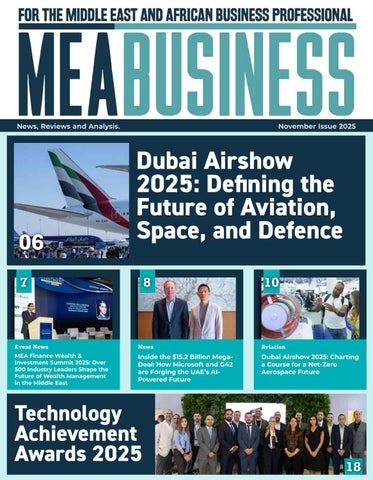
November 2025

Page 1


Introduction

Introduction

Welcome to this special issue of MEA Business, dedicated to celebrating the MEA Business Achievement Awards. At MEA Business, we are committed to delivering comprehensive business news across the Middle East and Africa. Our mission is to provide a dynamic platform where business leaders can share ideas, engage in meaningful debates, and forge strategic partnerships that will shape the future of the region.

Our goal is to equip business leaders and professionals with the skills and insights they need to thrive in these dynamic regions. By focusing on positive news stories, detailed case studies, and inspiring interviews, we aim to foster a narrative of growth and success.

MEA Business magazine offers clear and concise information through various sections, including up-to-the-minute news, market updates, and exclusive CEO interviews. Our readers benefit from a comprehensive blend of our printed magazine, e-magazine, and social media content, providing coverage on the latest developments in the Middle East and Africa.

Additionally, MEA Business proudly features several sector specials throughout the year, tailored to coincide with major industry exhibitions and events.

We hope you find this issue both informative and inspiring.

06 Dubai Airshow 2025: Defining the Future of Aviation, Space, and Defence

Aldar partners with Nikki Beach Global to bring branded waterfront residences to Ras Al Khaimah

WEB: www.mea-biz.com www.mea-hr.com

EMAIL: info@cme-media.com

WEB: www.mea-biz.com www.mea-hr.com

EMAIL: info@cme-media.com

PUBLISHED BY: Creative Middle East Media FZ LLE, 19th Floor, Creative Tower, Fujairah Creative City, PO Box 4422, Fujairah, UAE

EXECUTIVE DIRECTOR AND PUBLISHER : Kenneth Mitchen

PUBLISHED BY: Creative Middle East Media FZ LLE, 19th Floor, Creative Tower, Fujairah Creative City, PO Box 4422, Fujairah, UAE

Email: ken.mitchen@mea-finance.com

EXECUTIVE DIRECTOR AND PUBLISHER : Kenneth Mitchen

Email: ken.mitchen@mea-finance.com

British digital logistics company Zencargo launches operations in the UAE to expand in MENA

MEA Finance Wealth & Investment Summit 2025: Over 500 Industry Leaders Shape the Future of Wealth Management in the Middle East

Inside the $15.2 Billion Mega-Deal: How Microsoft and G42 are Forging the UAE’s AI-Powered Future AVIATION

The Aviation Annual Gala Evening is Back

Dubai Airshow 2025: Charting a Course for a Net-Zero Aerospace Future

Achievement Awards 2023

SkyCargo advances its digital customer experience with CargoAi

Leaders to Gather for the 2025 Aviation Annual Gala Evening in Dubai

celebrates milestone achievement of reaching 50 retail stores across the MEA

Driving Innovation and Partnership Across the

Etihad Cargo ramps up cargo capacity for China

Practical Perspective

Dubai Airshow 2025: Defining the Future of Aviation, Space, and Defence

Under the patronage of His Highness Sheikh Mohammed bin Rashid Al Maktoum, the 19th edition of Dubai Airshow sets the stage for a new era of global aerospace collaboration and innovation.

The 2025 edition of the Dubai Airshow, held under the theme “The Future is Here,” will bring together global trailblazers from aviation, space, and defence to shape the industry’s next chapter. The event will spotlight advancements in sustainability, AI-powered innovation, advanced air mobility, space exploration, and next-generation talent development — underscoring the UAE’s leadership in future-focused industries.

With more than 1,500 leading aerospace and defence companies from 47 countries and an expected 148,000 visitors, Dubai Airshow 2025 will be the largest and most dynamic edition in the event’s history.

“Dubai Airshow 2025 comes at a defining moment for aviation and aerospace, as

With more than 1,500 leading aerospace and defence companies from 47 countries and an expected 148,000 visitors, Dubai Airshow 2025 will be the largest and most dynamic edition in the event’s history.

technology, sustainability and global connectivity converge to reshape how the world moves,” said Paul Griffiths. “It reflects the UAE’s ambition to lead in these sectors and Dubai’s role as a hub for collaboration, a stage for innovation, and the place where the future of our industry takes shape.”

The Airshow will feature over 200 aircraft on display, 120 startups, and 50 investors, alongside more than 350 industry speakers delivering 350 hours of thoughtprovoking content across 12 conference tracks — including seven new additions. With 490 delegations from 98 countries, 440 new exhibitors, and 18 national pavilions, the scale of international participation highlights Dubai’s growing influence as a global aerospace hub.

Among this year’s most anticipated features are the largest-ever Space Pavilion, the debut of eVTOL aircraft in the flying display, and the introduction of Airshow After Dark, a twilight runway-side experience combining networking and live performances.

“This is the most ambitious edition in the Airshow’s history,” said Tim Hawes. “From the largest Space Pavilion to the debut of eVTOLs and the launch of Airshow After Dark, we are creating an experience that reflects the industry’s energy and drive to innovate. Our goal is to deliver outcomes that matter — through partnerships, investment, and measurable progress.”

Complementing the main exhibition, new activations will enrich the visitor experience. Highlights include a 5K Run on the Dubai Airshow runway as part of the Dubai Fitness Challenge (30x30), Youth Circles, the Inspiration Zone, and SkyBites by Emirates Flight Catering and Emirates Leisure Retail. The Wellness Zone, presented by XWELL and supported by Dubai Health Authority initiatives, will add a human-centric dimension to the show with immersive experiences such as the Sensory Dome and Breathe In Pod.

As the world’s attention turns once again to Dubai, the 2025 Airshow promises not only to showcase cutting-edge technology but also to foster meaningful dialogue, collaboration, and innovation across the global aerospace ecosystem.

MEA Finance Wealth & Investment Summit 2025: Over 500 Industry Leaders Shape the Future of Wealth Management in the Middle East

At Dubai’s Ritz-Carlton JBR, the region’s top private bankers, family offices, and tech innovators convened at the MEA Finance Wealth & Investment Summit 2025 to map out the new rules of wealth.

The Middle East is navigating one of the most significant wealth transfers in modern history. As fortunes pass to a new, digitallynative generation, the entire industry is being reshaped by demands for technological agility, ethical investments, and sophisticated global strategies.

How to manage this seismic shift was the central question for over 500 of the region’s most influential financial minds at the MEA Finance Wealth & Investment Summit 2025. Held at The Ritz-Carlton JBR, Dubai, on November 6th, the event reaffirmed its status as the industry’s most critical annual checkpoint. The day’s theme, “The Future of Wealth Management in the Middle East,” was less a discussion topic and more an urgent call to action.

The Human Element: Succession and the Modern Family

The day opened with a clear focus on the human side of wealth. Farzad Billimoria,

Managing Director and Head of Private Banking at Barclays, set the tone by emphasizing that innovation and clientcentricity are the twin engines for success in this new landscape.

This idea dominated the morning’s key panels. A central anxiety for the region’s high-net-worth families is succession. Experts from industry giants like Mashreq, LGT Middle East, Ocorian, and HSBC debated the “Successful Succession” puzzle: how can families ensure a smooth transition of control and values in an age of constant disruption?

The conversation deepened, moving from the transfer of wealth to its management in the “Family of the Future” panel. This session, featuring specialists from Interpolitan Money, Amereller Tax, and Backbase, explored how modern family offices are evolving. They are no longer just guardians of capital but sophisticated enterprises demanding robust governance, complex tax planning,

and seamless digital transformation.

The Tech Revolution: AI, Automation, and the New Client

If the human element was one pillar of the summit, technology was the other. The discussion “Present in the Future –The Technology of Wealth Management” dove straight into the industry’s biggest disruptors: AI and automation.

Panelists from additiv, VelthRad, Barclays, and the Alserkal Group agreed that technology is no longer a back-office support tool; it is now the core of the client experience.

The New Portfolio: Ethics, Yield, and Future Assets

With the how of wealth management addressed, the summit’s afternoon sessions turned to the where. A profound shift in investor values was explored in “A Better Future – Philanthropy, Ethics and Yield.” The discussion highlighted that impact-driven investing is no longer a niche preference but a core demand, especially from the next generation, who insist on aligning their values with their returns.

This set the stage for the final strategy debate: “Investing in the Future.” Top investment strategists from Mashreq, Index & Cie, Emirates Investment Bank, and Citi grappled with the all-important question: which asset classes will endure, and which new opportunities will define the coming decade?

The summit concluded with a clear signal for the industry: the future of Middle East wealth will be defined not by those who simply guard the past, but by those with the vision to build the new.

Inside the $15.2 Billion Mega-Deal: How Microsoft and G42 are Forging the UAE’s AI-Powered Future

The landmark $15.2 billion deal with Abu Dhabi’s G42 goes beyond infrastructure, establishing a new framework for AI trust, a 200MW data center expansion, and a massive pledge to skill one million people in the UAE.

In a move that signals a seismic shift in the global technology landscape, Microsoft has announced a monumental $15.2 billion investment in the United Arab Emirates, anchored by a deepened strategic partnership with Abu Dhabi’s AI powerhouse, G42. This multi-year commitment is not merely a financial injection; it is a foundational plan to construct the digital backbone of the nation, blending advanced AI infrastructure, sovereign cloud capabilities, and a massive human capital development program.

The deal, which will see Microsoft invest the sum between 2023 and 2029, is already solidifying the UAE’s ambitious drive to become a world leader in the artificial intelligence economy. This commitment is built on three core pillars: technology, trust, and talent.

For G42, the deal accelerates its mission to build the “Intelligence Grid,” what Group CEO Peng Xiao describes as an “interconnected infrastructure for intelligence designed to empower people, industries, and nations in the AI era.” It solidifies G42’s role as a new breed of “neocloud enterprise,” one that is both sovereign-native and securely open to global collaboration.

At the heart of the initiative is a 200-megawatt (MW) expansion of data center capacity. This colossal undertaking will be delivered by Khazna Data Centers, a G42 subsidiary, with the first phases expected to come online before the end of 2026.

This 200MW boost is far more than just server racks. It represents a significant upgrade to Microsoft Azure’s secure, scalable, and—crucially—sovereign cloud services in the region. This infrastructure will be powered by the industry’s most sought-after advanced GPUs, including Nvidia’s top-tier chips. This access provides

the computational firepower necessary for public sector organizations, regulated industries, and enterprises to innovate and scale complex AI models.

The “trust” component is arguably the most critical. The collaboration is explicitly grounded in the highest standards of cybersecurity, data protection, and ethical AI.

This is formalized through two key initiatives. The first is the Responsible AI Future Foundation, a joint effort with the Mohamed bin Zayed University of Artificial Intelligence (MBZUAI) to set global standards for responsible AI governance. The second is an Intergovernmental Assurance Agreement (IGAA), a unique framework developed in consultation with both the U.S. and UAE governments. This agreement ensures the entire framework complies with strict U.S. security and data protection standards, creating a trusted corridor for advanced technology.

Finally, the “talent” pillar addresses the human side of the digital transformation. Microsoft has committed to skilling one million people in the UAE in AI and digital services by 2027.

This initiative is not just about online courses. It includes the establishment of a new Global Engineering Development Center and an AI for Good Lab in Abu Dhabi. These centers will create a pipeline of local, world-class tech leaders, ensuring the benefits of the AI revolution are shared broadly.

As Microsoft’s Vice Chair and President Brad Smith noted, this expansion is “more than datacenters. It’s about powering the UAE’s future.” By combining Microsoft’s global expertise with G42’s local leadership, this landmark deal is not just building infrastructure; it’s architecting a future defined by technological excellence and inclusive, trusted growth.

Microsoft and G42’s partnership is grounded in the highest standards of cybersecurity, data protection, and ethical AI. Image Courtesy: Microsoft

Dubai Airshow 2025: Charting a Course for a Net-Zero Aerospace Future

The 19th edition of the global event is making sustainability its defining theme, uniting industry giants like Airbus and Boeing to accelerate decarbonization, expand SAF production, and deliver real-world solutions for a net-zero ecosystem.

Dubai Airshow 2025 is poised to inspire a new chapter in sustainable aerospace, uniting the global industry to deliver tangible solutions for a net-zero future. With sustainability as its defining theme, this year’s edition aims to accelerate innovation and help decarbonize the ecosystem, proving that international events can be a platform for decisive action.

The 19th edition will bring together leaders, innovators, and policymakers, with participants including Dubai Airports, Airbus, Boeing, the World Economic Forum (WEF), Airports Council International (ACI), and the General Civil Aviation Authority (GCAA). The show will spotlight the increasing collaboration across the aviation value chain to establish credible decarbonization pathways. Key focuses include addressing hurdles to expanding Sustainable Aviation Fuel (SAF) production, advancing global cooperation, and unlocking the financing mechanisms needed for the transition.

A central feature this year will be the oneDXB Sustainability Alliance, a multistakeholder initiative led by Dubai Airports. Uniting airlines, ground handlers, and service providers like dnata and flydubai, the Alliance will host a dedicated showcase demonstrating how a fully sustainable ground turnaround can be achieved, charting a credible path toward an end-toend sustainable aviation ecosystem.

Sven Deckers, Director – Sustainability at Dubai Airports, emphasized the urgency: “Sustainability in aviation is no longer about future ambition, it is a current necessity. The Dubai Airshow is an important platform to bring global stakeholders together, highlight practical solutions, and move vital discussions forward.”

This sentiment is shared by industry titans.

Julien Manhes, Head of Sustainable Aviation Fuels and Carbon Dioxide Removal at Airbus, commented, “Sustainability is a strategic priority for the global aerospace industry. The Dubai Airshow is a key platform for Airbus to showcase our latest technologies and strengthen the partnerships needed to accelerate the industry’s decarbonization journey.”

Boeing also affirmed its commitment. “Boeing is committed to providing commercially viable solutions that support resilient and sustainable growth of aviation globally,” said Jeff Shockey, Executive Vice President at Boeing. “By deepening our collaboration with governments and energy providers across the Middle East, we support the diversification of energy markets... while enhancing efficiency of the aerospace system.”

Beyond the showcases, an expanded twoday sustainability conference will address

pressing topics, from SAF scalability and next-gen fuels to decarbonizing airports and unlocking green finance.

The show’s sustainability drive is also being put into practice on-site. Dubai Airshow will again collaborate with Jetex to deliver SAF for participating aircraft. The “Better Stands Programme” will encourage exhibitors to adopt modular and reusable stand designs. Furthermore, exhibition halls and feature areas will incorporate recycled materials and be powered with 100% renewable electricity.

Hydration stations sponsored by Airbus will be provided by Bluewater-Nia to eliminate single-use plastics, and Rove Hotels joins as the official hotel partner, offering LEED Gold-certified accommodation. As the UAE strengthens its global position, the 2025 edition promises to unite vision and action, building a more resilient future for the sector.

Aviation Leaders to Gather for the 2025 Aviation Annual Gala Evening in Dubai

Dubai’s Marina will once again provide the stunning backdrop for one of the aviation industry’s most anticipated evenings on November 19, 2025, bringing together global aviation leaders for a night of celebration, networking, and recognition. Hosted aboard a luxury mega yacht docked in front of Pier 7, the Aviation Annual Gala Evening (AAGE) has become a fixture in the regional aviation calendar, uniting senior executives and industry pioneers for an evening that blends sophistication with substance.

Now marking its tenth edition, the gala will once again host the prestigious Aviation Innovation Awards, recognizing the most transformative achievements across aviation technology, sustainability, digitalization, and operational excellence. The awards underscore the industry’s steadfast commitment to progress, honoring organizations and individuals driving the evolution of aviation through forward-thinking strategies and cutting-edge advancements.

As a highlight of the evening, the Aviation Innovation Awards will celebrate visionary projects and leadership that are redefining industry

standards. From sustainable initiatives and advanced air mobility solutions to pioneering digital platforms, the awards will spotlight those who continue to shape aviation’s next era of growth.

Set against the glittering skyline of Dubai, the Aviation Annual Gala Evening offers a unique platform for high-level dialogue, collaboration, and celebration. Attendees can expect an exceptional experience combining fine dining, live entertainment, and unparalleled networking opportunities with decision-makers, innovators, and investors who are charting the future of global aviation.

With its elegant setting and inspiring purpose, the gala stands as a symbol of excellence and ambition—reflecting the region’s steadfast role in advancing aviation innovation and leadership worldwide.

For more information, visit: www.aviationgala.com

For Enquiries contact: E: info@cme-media.com

T: +971 58 518 8080

Safran: Driving Innovation and Partnership Across the Middle East

Mehdi Bouchenak, CEO of Safran Emarat Ltd, outlines the company’s commitment to driving aerospace progress across the Middle East.

Tell us about Safran’s story in the UAE

Our story here is one of genuine and lasting partnership. Safran has grown with the UAE, moving from being a trusted equipment supplier to becoming a fully embedded industrial partner. As an equipment manufacturer, you can trace the relationship all the way back to the 1970s, with Snecma’s ATAR engine on the Mirage V aircraft. But the real presence began when we established a formal office in 1991.

Since then, our goal has been to build locally anchored capabilities that not only support the UAE’s world-class airlines and national stakeholders but also connect them directly to Safran’s global technology and innovation network. Today, our priorities in the region are very clear: ensuring operational resilience for our partners, defining a pragmatic path to achieve net-zero by 2050, and driving innovation that delivers real, tangible benefits both on the runway and in the air.

What are Safran’s main business activities and areas of focus in the UAE today?

We’re fortunate to be well-established across the UAE’s aerospace and defense landscape. With 220 employees based here, our activities are well balanced between supporting our civil aviation customers and defense partners, helping both streamline their critical operations. In civil aviation, our technology powers the majority of the Airbus A320/321 and Boeing 737 MAX fleets in the

country. You’ll find our LEAP engine on aircraft for FlyDubai, Air Arabia, and Etihad. We’re also very present in many local helicopter platforms, with our Arriel and Makila engine families.

When it comes to support and maintenance—which is absolutely critical—we have a strong and

long-standing presence. Safran Aerosystems Middle East, conveniently located in Dubai near Al Maktoum International Airport, supports airlines by maintaining and servicing vital safety and cabin systems. We also have AMES in Jebel Ali, a joint venture with Air France KLM Industries. This

facility combines our expertise as an equipment manufacturer with one of the world’s leading MRO providers to service components such as nacelles, radomes, and fan stators on wide-body aircraft for regional carriers. These operations cover a major share of the MRO value chain, helping keep aircraft in service longer.

On the defense side, we are proud to be a partner of choice for the UAE Air Force, particularly for propulsion activities with our M53 and M88 engines on the Mirage 2000-9 and Rafale jet fighters. We’re also a key player with the UAE Navy, powering

their helicopters with our engines.

And we’re investing in high-tech, sovereign capabilities here. Earlier this year, in February 2025, we inaugurated Vision for Optronics & Navigation, a center of excellence at Tawazun Industrial Park in Abu Dhabi, operating as a joint venture with International Golden Group (IGG), an EDGE Group company. Its focus is on developing and maintaining advanced optronics and navigation systems for regional defense platforms, strengthening local know-how and creating high-value technical jobs.

How is Safran supporting sustainability in its operations, products, or services across the Middle East?

Sustainability is truly embedded in our DNA. As a group, we’ve set ambitious targets: a 50% cut in our operational CO₂ by 2030 and a 42.5% reduction in emissions per seat-kilometer from our products in service by 2035, both compared to 2018 levels. This involves everything from energy-efficiency plans and ISO-based systems to increasing our use of renewable electricity and Sustainable Aviation Fuel (SAF), including during engine testing.

Our products reflect this commitment. The LEAP engine, which is widely used here, already delivers 15–20% lower fuel burn than the previous generation and is certified for 50% SAF blends. But we’re already working on the next step. Together with GE Aerospace, we launched the RISE demonstrator— Revolutionary Innovation for Sustainable Engines. This program is developing the next generation of engines for the mid-2030s, targeting a further 20% reduction in CO₂ emissions and designed to be 100% compatible with SAF.

We’ve been part of the UAE’s sustainability journey from the very beginning. We were among the

early pioneers in the national biofuel committee and a founding member of the Sustainable Bioenergy Research Consortium (SBRC). With 75% of our R&T spending now dedicated to improving the environmental performance of our products, our goals and the UAE’s vision are perfectly aligned.

What is your outlook for the UAE aerospace market over the next 3–5 years?

We are very optimistic. The UAE will undoubtedly continue shaping the future of flight, driven by strategic fleet renewals, major airport investments, and a core focus on sustainability. We expect to see accelerating demand for ultra-efficient aircraft, the buildout of SAF infrastructure, and a move toward more electrified systems. This will require even deeper collaboration among manufacturers, airlines, and regulators.

Safran’s growing footprint is also extending into space, which has become a major focus in the UAE. The Group is a leader in high-performance optics and satellite plasma propulsion, and our teams at Safran Reosc and Syrlinks are doing incredible work in telescope mirrors and satellite communications, respectively. It’s an exciting time for the entire sector.

This momentum aligns perfectly with the UAE’s National Space Strategy 2030. We see a natural fit between the UAE’s push for sovereign capability and Safran’s strengths in high-performance optics, satellite communications, and electric (plasma) propulsion. Our aim is to deepen in-country partnerships, combining technology transfer, local integration, and workforce development, so missions in secure connectivity and Earth observation can be conceived, built, and sustained from the UAE.

Empire Aviation: Elevating Private Aviation Through Trust, Transparency, and Innovation

Paras P. Dhamecha, Founder and Managing Director, speaks with MEA Business Magazine about Empire Aviation’s pioneering approach to aircraft ownership, its expanding fleet, and the company’s steadfast commitment to excellence.

Since its inception in 2007, how has Empire Aviation transformed the landscape of private aviation in the Middle East?

Since 2007, Empire Aviation has focused on business aviation with a mission to increase corporate use of private jets for business travel. We adopted a distinctive aircraft asset management approach in which the company provides each owner with a unique ownership business model and a range of integrated personalised aviation and customer services, ensuring owners enjoy the best private aviation experience while protecting and optimising the value of their investment.

It’s a pioneering approach in which each owner business model offers unique advantages, including comprehensive aircraft management, revenue generation, expert maintenance supervision, and access to private jet travel.

Empire Aviation draws together all the strands of private aviation –management, charter, sales and CAMO - to make private aviation a great experience for owners. The group is scaling the model globally to grow private aviation services worldwide, ensuring aircraft owners enjoy all the benefits of private aviation – privacy, safety, comfort and convenience -

Private aviation is all about people and Empire Aviation’s award-winning aircraft management service has been built on close personal working relationships with owners to develop a high degree of personal trust, openness and transparency.

while working with a trusted aviation expert advisor and partner operating transparently.

How do your recent fleet additions reflect Empire Aviation’s ongoing commitment to delivering excellence, luxury, and innovation in private aviation?

Empire Aviation has managed a wide range of aircraft, including business jets from all the leading aircraft manufacturers, helicopters, seaplanes and air ambulances. Recently, the company has inducted several new aircraft into the fleet, which now includes a Boeing Business Jet and ACJ business jet.

Several managed aircraft are also available to the charter market (as part of the ownership model). The charter

fleet reflects owner preferencestypically, the larger, more luxurious and longer-range business jets, in order to fly non-stop between favourite city pairs with a high degree of comfort.

Empire Aviation’s innovative ‘Luxury Partner’ programme combines the benefits of private jet charter with award-winning luxury travel partners, in response to growing demand for highly personalised, luxury leisure experiences.

Can you share insights into the upcoming headquarters at Dubai World Central and how it will enhance your operations and client experience?

In 2022, the company signed an agreement with the Mohammed bin Rashid Aerospace Hub (MBRAH) at

Dubai South to develop the first standalone private development at MBRAHa new, multi-purpose business aviation facility adjacent to the VIP Terminal. Construction is now well underway and

completion is scheduled for mid 2026. The new facility will be owned, managed and operated by Empire Aviation.

The seven-storey, mixed-use facility will comprise the new global corporate

headquarters of Empire Aviation Group. It will also provide premium office space for aviation and related companies, luxury retail F&B outlets and a rooftop lounge for entertainment and other events.

We have benefitted significantly by operating from Dubai and its world-class reputation, facilities and regulators. So, we were delighted to have the opportunity to develop this new aviation industry asset that will support MBRAH’s vision to make Dubai the aviation capital of the world.

Empire Aviation has received multiple accolades, including the Aircraft Management Service Provider of the Year at the Aviation Achievement Awards 2024. How do such recognitions reflect your company’s ethos and dedication?

Private aviation is all about people and Empire Aviation’s award-winning aircraft management service has been built on close personal working relationships with owners to develop a high degree of personal trust, openness and transparency. It’s a testament to the quality and commitment of our team of 130 aviation specialists.

We were very proud to receive the ‘Aircraft Management Service Provider of the Year’ at the Aviation Achievement Awards (AAA), recently. It’s presented to the aircraft management organisation displaying exceptional dedication and service excellence.

Industry awards - and especially for our core service, aircraft management – reflect our commitment to delivering a very high degree of personalised service and maximising the benefits of the ownership experience. They are also affirmations of the company’s core values: integrity, transparency, and trust.

The trust placed in us by aircraft owners and charter clients remains our greatest asset and motivator. We dedicate our awards to them all.

Technology Achievement Awards 2025

MEA Business Technology Achievement Awards 2025 (Winners)

Tech Sector Category Winner

Flight Information Display System (FIDS) Ground-breaking products/services (Achievement Award) TAV TECHNOLOGIES

Hardware Exceptional Products/Services (Achievement Award) ScreenCheck

Hardware Ground-breaking products/services (Achievement Award) Plantaform Technology Inc.

Hardware Innovative Collaborations and Partnerships (Achievement Award) haifin

Open Nomination Award (Value Added Distributor) Outstanding sector leadership and growth (Achievement Award) MINDWARE

Open Nomination Award Exceptional Products/Services (Achievement Award)

Property Finder

Open Nomination Award Innovative Collaborations and Partnerships (Achievement Award) Hala (RTA Careem LLC)

Open Nomination Award (MEA cloud solutions) Outstanding sector leadership and growth (Achievement Award) Future Cloud Technologies Solutions Est

Open Nomination Award (Protech) Outstanding sector leadership and growth (Achievement Award) Property Finder

Satellite Communications Exceptional Products/Services (Achievement Award) Eutelsat

Sector Based Technology ESG Excellence (Achievement Award) DesiCrew Solutions Private Limited

Sector Based Technology New Technology (Achievement Award) Hlthera

Sector Based Technology Customer Experience - CX Excellence (Achievement Award) Hala (RTA Careem LLC)

Security and Access Control Exceptional Products/Services (Achievement Award) ScreenCheck

Security and Cyber Security Exceptional Leadership - (Personal Achievement Awards) Naji Salameh, Founder and CEO ,IT Max Global

Security and Cyber Security Exceptional Products/Services (Achievement Award) Veeam Software

Security and Cyber Security Ground-breaking products/services (Achievement Award) Cloudflare

Security and Cyber Security New Product/Service launch (Achievement Award) Black Cell Middle East LLC.

Security and Cyber Security New Technology (Achievement Award) Black Cell Middle East LLC.

Security and Cyber Security Outstanding sector leadership and growth (Achievement Award) Infoblox

Smart Cities Exceptional Leadership - (Personal Achievement Awards) Talal Debs, Co-founder, Syncrow - Dubai

Smart Cities Exceptional Products/Services (Achievement Award) Syncrow

Smart Cities New Product/Service launch (Achievement Award) Plantaform Technology Inc.

Software ESG Excellence (Achievement Award) Tarjama

Software Exceptional Leadership - (Personal Achievement Awards) Kishan Mulji Bhalsod, Founder, Future Cloud Technology Solutions EST

Software Exceptional Products/Services (Achievements Award) stc Bahrain

Software Ground-breaking products/services (Achievement Award) Infoblox

Software Innovative Collaborations and Partnerships (Achievement Award) Future Cloud Technologies Solutions Est

Software New Product/Service Launch (Achievement Award) PlanRadar

Software New Technology (Achievement Award) MAXimuz Technology

Software Outstanding sector leadership and growth (Achievement Award) Veeam Software

Software Outstanding Sustainability Initiative (Achievement Award) DesiCrew Solutions Private Limited

Software Customer Experience - CX Excellence (Achievement Award) Thomson Reuters

Technology Customer Experience - CX Excellence (Achievement Award) Omantel

Technology New Product/Service Launch (Achievement Award) MEWS

Technology Visionary Leadership Award (Personal Achievement Award) Abdumalik Mirakhmedov, Co-founder and Director, Scalo Technologies

Telecoms ESG Excellence (Achievement Award) Beyon

Telecoms Exceptional Products/Services (Achievement Award) Nexign Converged Charging

Telecoms Innovative Collaborations and Partnerships (Achievement Award) Ericsson

Telecoms New Product/Service launch (Achievement Award) Batelco by Beyon

Telecoms Outstanding sector leadership and growth (Achievement Award) Omantel

Telecoms Sheikh Talal Al Mamari, CEO of Omantel - Lifetime Achievement Award Omantel

Transforming Professional Services with the Power of AI – Thomson Reuters

Thomson Reuters is redefining how professionals work by combining trusted intelligence, technology, and human expertise to drive clarity and confidence in an AI-powered world.

Transforming Professional Services with the Power of AI

In times of constant change, the world looks to professionals to lead. Yet as technology accelerates, regulations evolve, and data multiplies, even the most experienced leaders face growing complexity. Today, success depends not only on expertise — but on the ability to harness information, automation, and intelligence to stay ahead.

Thomson Reuters stands at the intersection of trust and technology. For more than 150 years, it has empowered professionals to make confident decisions by delivering trusted content, deep subject-matter expertise, and now, advanced digital solutions powered by artificial intelligence. Its purpose is simple but powerful: to help professionals know today, navigate tomorrow, and lead a fast-evolving world.

By integrating data, automation, and analytics into connected workflows, Thomson Reuters helps organizations reduce inefficiencies, strengthen compliance, and act decisively in moments that matter most. This blend of technology and expertise enables businesses to move from complexity to clarity.

As a global leader in digital solutions for tax and legal professionals, the company combines advanced AI capabilities with decades of domain expertise to create technology that understands the language of professionals. Platforms such as ONESOURCE and HighQ allow organizations to automate processes, manage complexity, and maintain

compliance across borders — supporting resilience amid shifting global regulations.

Taking this innovation even further, CoCounsel — Thomson Reuters’ AI-powered legal assistant — represents a new era of intelligent collaboration. Built on large language models and trained with trusted legal content, CoCounsel accelerates complex research, contract review, and drafting tasks with remarkable accuracy. It doesn’t replace the expertise of lawyers; it enhances it, enabling professionals to focus on strategy, client value, and judgment — the areas where human insight matters most.

AI is not replacing expertise; it is amplifying it. Thomson Reuters harnesses the power of AI responsibly and ethically, combining it with human judgment to bring clarity to complexity. From intelligent document review and automated tax compliance to predictive analytics and real-time insights, its solutions allow professionals to focus on high-value work rather than repetitive tasks.

Across the Middle East and beyond,

digital transformation is reshaping how businesses operate. Governments are driving modernization through initiatives such as e-invoicing, corporate tax reform, and digital compliance frameworks. Thomson Reuters partners with organizations to navigate these transitions confidently, offering global technology underpinned by local expertise and a commitment to innovation.

What sets the company apart is not just technology, but trust. Its data is curated, verified, and continuously updated by experts who understand the nuances of global regulations and local practice. This blend of human insight and machine intelligence ensures that decision-makers receive reliable, actionable knowledge — enabling them to act decisively, mitigate risk, and seize opportunity.

As the future arrives faster than ever, Thomson Reuters stands alongside the world’s professionals — helping them lead with confidence, clarity, and purpose.

To learn more visit: https://mena. thomsonreuters.com/en.html

We’re RAKBANK.

Banking should feel simple. Human. Helpful. So that’s the kind we build. Since 1976, we’ve been helping people and businesses across the UAE grow with confidence, giving them the tools, the support, and the trust to make things happen.

We started as a community bank and grew into one of the country’s most dynamic financial institutions. What’s never changed is our belief that banking should work for people, not the other way around.

Today, we’re leading a new chapter, one

We’re shaping the future of banking while keeping the heart of it the same: people.

that combines smart digital innovation with genuine human connection. We call it digital with a human touch.

We serve customers across every segment through our Personal Banking Group (PBG), Business Banking Group (BBG), and Wholesale Banking Group (WBG). As the UAE’s go-to SME bank,

we’re helping thousands of businesses grow and thrive with seamless, digitalfirst banking.

Our group also includes Skiply, the region’s leading school payments app; Protego, our next-generation insurance aggregator; and RAK Insurance, one of the UAE’s most trusted insurers, together creating an ecosystem that makes life simpler and safer for our customers.

From empowering entrepreneurs and SMEs to launching the UAE’s first crypto brokerage for retail customers and our own AI-powered digital assistant, we’re shaping the future of banking while keeping the heart of it the same: people.

RAKBANK — Digital with a human touch.

UN Neutrality Forum in Geneva: Redefining Sovereignty in the Digital Age

At the United Nations in Geneva, leaders from ProtonMail, WISeKey, and Karrier One warned that neutrality is no longer about borders but about data, encryption, and control over digital infrastructure.

Forum hosted at the UN in Geneva, co-organized by the Geneva Center for Neutrality (GCN) and the Greater Caspian Association, Oscar Wendel, Editor-at-Large for MEA Business and Chairman of Global Stratalogues, led a high-level discussion on the future of neutrality in the digital era.

The session explored how digital and financial sovereignty lie at the core of preserving autonomy and freedom— requiring the integration of technology, international law, and politics.

The question posed was: Can neutrality still exist in a world where the battleground is not territory, but data, algorithms, and code? In Europe today, there is a clear tension between regulation and competitiveness — where well-intended rules designed to enhance autonomy can inadvertently stifle innovation and concentrate power in the hands of a few global incumbents. This set the stage for Marc Loebekken, Head of Legal at ProtonMail, to deliver one of the most forceful defenses yet of digital neutrality and privacy as pillars of democratic resilience. Loebekken warned that weakening encryption and expanding surveillance powers could erode both Switzerland’s neutrality and its competitiveness in the global digital economy. “ProtonMail is built on a principle that could almost define digital neutrality itself — user privacy as a form of sovereignty,” he remarked, adding that user trust and privacy are paramount, part of a broader “Web 3.0” closer to the original vision of an open internet not dominated by a few powers.

Marc Loebekken, Head of Legal at ProtonMail speaks at the UN Forum in Geneva.

See video of discussion here: https://youtu. be/GgynJiDm2TI?si=HONdisAYJbbdUlrz

Your Digital Identity: Who Owns It?

WISeKey CEO Carlos Moreira said, “If you don’t own your digital identity, someone else has it.” And right now, the Web2 giants have claimed ownership of the only asset that’s truly yours. Without control over your own digital identity, you can’t fully participate in the economy or democracy on your own terms. You’re always at someone else’s mercy.

Moreira pointed to Switzerland’s recent referendum on National Digital ID as evidence of how slowly Europe is catching on. The solution exists: secure hardware and open systems that let

you carry your identity in your pocket, not in Mark Zuckerberg’s data center. Companies like WISeKey and its spinoff SEALSQ are building exactly this kind of infrastructure. Moreira argues digital identity should be recognized as a fundamental human right by the UN arguing that if we fail, future AI systems will literally “not recognize where the human is.”

The Ticking Time Bomb: “Q-Day” Is Coming

Moreira warned about something called “Q-Day”—the moment when quantum computers become powerful enough to crack every encryption system we currently use. RSA, Bitcoin, your banking

agreements and priority control planes,” as El’Lithy puts it. But with blockchainbased networks, compliance is built into the code itself. New base stations automatically follow local laws, updates get voted on by all participants, and everyone can verify the rules are being followed. As El’Lithy says, “Governance doesn’t vanish; it decentralizes,” making the rules transparent.

The choice is stark: build your own digital sovereignty now, or spend the rest of the century as a digital colony. Switzerland is showing the path forward. The question is whether others will follow before it’s too late.

Global Digital Independence Begins Locally

Neutrality 3.0 isn’t about staying on the sidelines. It’s about taking control of networks, identities, and the digital infrastructure that defines modern life.

app, Signal messages—all of it becomes readable in an instant. “They will be able to break all existing crypto,” Moreira stressed, “break Bitcoin, and compromise cloud transactions.” Our entire secure internet would collapse overnight. The U.S. government has instructed all federal agencies to be quantum-ready by 2027, with legacy systems abandoned by 2030. America has mandated new “Q-safe” encryption standards to prepare. Europe is pouring billions into post-quantum

semiconductors through its Chips Act. SEALSQ itself is shipping quantumresistant chips this year. Without quantum-proof infrastructure the risk is every transaction becomes vulnerable as digital safeguards are dissolved.

Is Decentralised Control over the Internet Possible?

Karrier One COO Andrew El’Lithy argued in the discussion that traditional telecom and cloud systems were built like medieval fiefdoms where a handful of companies and governments own the gates, the roads, and the town squares. “This model made sense in an Analog Age,” but today it’s a problem. When a few corporations or states control who gets online, how fast, and at what cost, they’re essentially deciding who gets to participate in modern life.

Instead of begging permission from gatekeepers he proposes an infrastructure where communities own their own communications networks where nodes are connected through blockchain that no government or company can shut you out of. The network belongs to everyone who uses it. Right now, telecom regulations happen behind closed doors through “opaque

Both Moreira and El’Lithy underscored a vital truth: no nation can claim digital sovereignty while depending entirely on foreign technology. Moreira reframed the old mantra — instead of “think global, act local,” nations must act local first by building homegrown AI, hardware, and encryption before integrating into global systems. No country would outsource its water or electricity supply to a foreign power — so why entrust our data, communication, and cognitive infrastructure to others? Yet that is precisely what’s happening. Over-regulation often exacerbates the problem, driving out local innovators and leaving only global tech giants that can shoulder the compliance burden.

In late October 2025, Moreira’s company SEALSQ uplisted to Nasdaq’s most prestigious tier, with a market cap surpassing $1 billion—the first European post-quantum security firm to reach that milestone. Moreira calls it proof that “Europe can still produce world-class tech champions, if it commits to sovereignty by design.” Neutrality 3.0 isn’t about staying on the sidelines. It’s about taking control of networks, identities, and the digital infrastructure that defines modern life. It is only by fostering that environment can Europe strengthen its competitiveness and reclaim digital sovereignty in the face of U.S. and Chinese dominance.

Carlos Moreira, CEO of WISeKey, speaks from São Paolo, Brazil

Wealth of Knowledge

The UAE continues to attract world leading levels of multi-sector foreign direct investment, but is putting emphasis toward AI and knowledgebased business while creating an incentivised environment for the inward migration of wealth

In 2024 alone, the UAE’s FDI inflows reached AED 167.6 billion (USD 45.6 billion), accounting for 37% of all FDI inflows in the region.

A separate report by Dubai FDI Monitor showed these five countries brought the highest FDI capital inflows into Dubai: the United States, the United Kingdom, France, India and Saudi Arabia.

Steering the nation’s focus towards AI and tech

UAE FDI continues to soar, on track to meet USD 65 billion target by 2031

With an estimated AED 40.4 billion (USD 11 billion) in foreign direct investment (FDI) capital and 643 greenfield Foreign Direct Investment (FDI) projects in the first half of 2025, Dubai has maintained its lead on the global greenfield FDI ranking, further reinforcing its position as the world’s premier investment hub.

According to a real-time database monitoring worldwide greenfield projects, Dubai’s FDI capital increased by 62% from AED 24.7 billion (USD 6.8 billion) in the same period in 2024—a feat that aligns with the UAE’s National Investment Strategy unveiled by H. H. Sheikh Mohammed bin Rashid Al Maktoum in March this year.

Focusing on key sectors such as industrial, logistics, financial services and information technology, the six-year strategy aims to boost annual FDI inflows to AED 240 billion (USD 65.3 billion) by 2031 and achieve a total FDI stock of AED 2.2 trillion (USD 599 billion) in the near future.

While the leading sectors based on FDI capital were business services, hospitality, transportation and warehousing, consumer products and real estate, the UAE is amplifying investment towards AI and tech-related projects.

Under its “Projects of the 50 Initiatives,” the UAE has allocated an USD 8.7 billion investment to foster innovation and accelerate SME growth in the country.

In line with this vision, Abu Dhabi’s Technology Innovation Institute (TII) and US technology giant NVIDIA recently inaugurated the region’s first joint research lab dedicated to artificial intelligence and robotics, which supports the UAE’s goal of raising AI’s non-oil GDP contribution to 20% and expanding its market size to over AED 170 billion (USD 46.2 billion) in the next five years.

Another groundbreaking project the UAE plans to launch is the Stargate UAE AI campus, a next-generation AI infrastructure cluster that will occupy 10 square miles of land in Abu Dhabi and will have a 5-gigawatt capacity.

The milestone project, set to be launched in 2026, will be managed by a consortium of US tech leaders, including OpenAI, Oracle, NVIDIA, which will provide advanced chips, and CISCO Systems, which will design and build the connectivity infrastructure.

Abu Dhabi-based M2 Capital has also invested USD 20 million in Ethena’s governance token, ENA, with an aim to link regional investors with new digital assets available internationally, while reinforcing the country’s position as a digital asset hub.

Furthermore, according to the Dubai State of AI report, widespread AI adoption can cumulatively contribute nearly USD 64 billion to the nation’s economy.

In fact, the emirate intends to raise the robotics sector’s GDP contribution to 9% and have 200,000 robots by 2032 to enhance efficiency and productivity in various economic sectors.

UAE to welcome USD 63 billion in wealth migration

Industry experts foresee the UAE will welcome 9,800 new millionaires this year, equating to USD 63 billion in

THE UAE HAS BEEN AT THE FOREFRONT OF ECONOMIC AND INVESTMENT ACTIVITIES IN THE REGION, PLAYING A PIVOTAL ROLE IN ESTABLISHING THE MIDDLE EAST AS A STABLE, LUCRATIVE AND OPEN MARKET WITH IMMENSE POTENTIAL TO RIVAL TRADITIONAL WESTERN MARKETS.

Another significant factor drawing HNWIs to the UAE is its Golden Visa program, which provides 10-year residency to investors, entrepreneurs and professionals who meet certain criteria.

According to the latest data published by Dubai’s General Directorate of Residency and Foreigners Affairs, the agency has issued over 158,000 golden visas as of 2023, with market analysts expecting this number to climb to more than 300,000 by this year.

Aside from the rising number of golden visas issued, real estate investments in the UAE also skyrocketed, with Dubai

Sustaining the UAE’s global lead with forward-looking policies

The UAE has been at the forefront of economic and investment activities in the region, playing a pivotal role in establishing the Middle East as a stable, lucrative and open market with immense potential to rival traditional Western markets.

Buoyed by business-friendly policies— including favorable tax incentives, robust intellectual property protection, and streamlined processes—the UAE’s startup ecosystem continues to thrive, as evidenced by USD 1.1 billion raised across 207 startups in 2024, the highest in the Middle East and North Africa (MENA) region.

Additionally, the UAE took the number one spot on the Global Entrepreneurship Monitor’s report for 2024-2025, outranking many advanced economies and gaining recognition as the world’s best destination for SMEs.

wealth migration, with the country’s zero-tax framework on income, capital gains and inheritance being the primary driving force.

Based on numbers from recent years, the UAE Ministry of Investment expects the country’s number of high-net-worth individuals (HNWI) to increase by 39% in 2026.

recording AED 431 billion (USD 117 billion) worth of transactions in H1 2025, over 50% of which were made by foreign investors.

Abu Dhabi also saw its property transactions surge to AED 51.7 billion (USD 16.6 billion), representing a 39% growth from the same period in 2024, and with strong interest from investors from Russia, China, the UK, France, Kazakhstan and the US.

According to an annual survey done by Kearney, a Chicago-based management consulting firm, the UAE led the Gulf Cooperation Council (GCC) countries in terms of global investor interest, while placing second among emerging markets and ninth globally.

Looking at these achievements, the UAE is poised to reach its key targets of raising its foreign trade value to AED 4 trillion (USD 1.08 trillion) and generating AED 800 billion (USD 217.8 billion) in non-oil exports by 2031, as outlined in its “We the UAE 2031” vision.

NAVIGATING THE UPCOMING IRB REGULATIONS IN THE UAE:

A Practical Perspective

Nicoleta Remmlinger Director at 4most Analytics Consulting (with insights from 4most Client Partner, Daniel Hensel) lays out why the journey to Internal Ratings-Based (IRB) accreditation will be demanding and lengthy, but will bring enduring value, enhance reputations, and will underpin the UAE’s place as a leading world financial centre

Nicoleta Remmlinger, Director, 4most Analytics Consulting

The landscape for risk management in banking is evolving in the UAE with the Central Bank of the UAE releasing a package of measures over the last few years to strengthen risk management of their supervised institutions, such

as the Model Management Standards and Guidance and the Credit Risk Management Standards. The introduction of new Internal Ratings-Based (IRB) regulations have long been muted in the UAE and it is a good moment to reflect on what this means for banks.

1. The Changing Capital Benefits of IRB

Historically, the IRB approach was seen as a way for banks to achieve significant capital relief compared to the standardised approach. By using their own risk models, banks could demonstrate a more nuanced understanding of their portfolios, often resulting in lower capital requirements. However, over time, global regulatory reforms—such as Basel III and the introduction of capital floors— have narrowed the gap between IRB and standardised capital requirements. Today, while IRB can still offer capital benefits, these are less pronounced than they were a decade ago, and the focus has shifted towards robust risk management and governance.

2. The Reputational and Strategic Value of IRB

Even as the direct capital benefits have diminished, the reputational advantages of achieving IRB status remain significant. For investors, IRB accreditation signals that a bank has reached a high standard of risk management maturity. This can enhance market confidence, potentially lower funding costs and make the bank more attractive to institutional investors who value strong governance and transparency.

For the UAE banking sector, widespread adoption of IRB will help align local practices with international standards, supporting the country’s ambition to be a leading global financial centre. It also encourages a culture of continuous improvement in credit risk management, data quality and governance.

It is worth noting that even in mature markets like the UK, a number of banks are still on the journey towards IRB accreditation. This ongoing interest is

reflected in industry events such as the Aspiring IRB roundtable hosted by 4most, where banks share experiences and best practices on navigating the IRB journey. The fact that many UK banks are still aspiring to IRB status highlights that this is not just a regulatory hurdle, but a strategic milestone that continues to be valued by leading institutions.

3. Key Challenges and Steps in Setting Up an IRB Programme

Implementing an IRB programme is a complex, multi-year transformation that extends far beyond model development. 4most has a long track record of supporting banks in the UK and Europe achieve regulatory approval for the Advanced and Foundation IRB Approaches to capital. Drawing on insights from 4most’s extensive experience to understand the practical steps required for a successful IRB journey, several critical success factors and challenges emerge:

a. Board and Executive Engagement

A successful IRB application requires active involvement from the Board and executive leadership. This includes training, ongoing governance and direct participation in regulatory interviews. The Board must be able to articulate the bank’s IRB strategy, readiness and governance arrangements—not just delegate to technical specialists.

b. Programme Approach and Governance

Banks must establish a robust programme structure, with clear roles and responsibilities, effective steering committees and well-defined stage gates for module submissions. Programme governance should be distinct from, but aligned with, ongoing IRB governance to avoid duplication and ensure accountability throughout the process.

c. Documentation, Validation and Audit

Comprehensive documentation

is essential, covering everything from model inventories and financial impacts to IT, data and audit structures. Independent model validation and internal audit functions must be embedded and mature, with evidence of rigorous challenge and oversight.

d. Stress Testing, Data and Use Test Regulators expect to see that IRB models are genuinely embedded in business processes - used for credit approvals, limit setting, portfolio management and capital planning. Stress testing and scenario analysis should be integrated, and data quality must

expertise of a company such as 4most, our experience is that the most successful programs are those where our clients take full ownership and accountability for the deliverables and work in close partnership with the consultants who are supporting the program.”

f. Phased, Modular Approach

The application process is typically modular, with phased submissions and iterative feedback from regulators. Banks must be prepared to respond to feedback, remediate issues and resubmit as needed. Building robust remediation plans and maintaining momentum across phases is critical.

IMPLEMENTING AN IRB PROGRAMME IS A COMPLEX, MULTI-YEAR

TRANSFORMATION THAT EXTENDS FAR BEYOND MODEL DEVELOPMENT

be demonstrably robust, with clear remediation plans for any gaps. The “use test” is not a box-ticking exercise; it requires real evidence that IRB outputs drive decisionmaking across the bank.

e. Ownership, Stakeholder Coordination and Regulatory Engagement

The IRB journey is cross-functional, involving risk, finance, technology, internal audit and commercial teams. Preparation for regulatory engagement—including mock interviews and Q&A repositories— is vital. Regulators will expect to interview a range of senior stakeholders, not just model developers. Daniel Hensel, 4most Client Partner said “Ownership of the program is critical to success. Whilst an organisation may rely on the support and

Conclusion

As the UAE moves towards updated IRB regulations, banks should recalibrate their expectations around capital benefits, but recognise the enduring value of IRB in enhancing reputation, investor confidence and sectoral resilience. The journey is demanding, requiring strong leadership, crossfunctional collaboration and a relentless focus on governance and data. The experiences of UK and European banks—many of whom are still aspiring to IRB status—offer valuable lessons, and forums like the 4most Aspiring IRB roundtable, and our industry insight workshops with clients (both those who have adopted and are yet to adopt), provide a platform for shared learning. For UAE banks, embracing the IRB challenge is not just about compliance, but about building a world-class risk management culture for the future.

Staying the Course

The Turkish government has pledged to curb inflation, restructure economic growth and establish long-term sustainability through increased foreign direct investment and the encouragement of strategically selected industries

Türkiye has been the fastestgrowing economy in the Organisation for Economic Co-operation and Development (OECD) over the past two decades, buoyed by expansionary fiscal and monetary policies that have boosted consumer spending to historic highs.

However, the OECD said in its OECD Economic Surveys: Türkiye 2025 report that the policies led to unsustainable developments, creating significant internal and external imbalances and a decline in the value of the Turkish lira.

Following the May 2023 elections, President Recep Tayyip Erdogan made an abrupt U-turn in economic policy and started the process of normalising macroeconomic policies to steer Türkiye’s economy back onto a sustainable trajectory.

“Macroeconomic fundamentals have really improved over the past

twelve months, despite the tightening of monetary policy and the resulting slowdown in growth due to positive real interest rates for households and businesses,” BNP Paribas said in its Economic Research report.

The Turkish authorities’ resolve is not misplaced; data backs it. The International Monetary Fund (IMF) said the policy turnaround has reduced economic imbalances and revived confidence, with real GDP growth projected at 3.9% in 2025.

Ratings agencies also approve. Over the past 12 months, Fitch Ratings has upgraded Türkiye’s sovereign debt – alongside several Turkish banks – twice, from B- to B+ in March and then to BB- in September.

Moody’s also lifted Türkiye’s credit rating from B1 to Ba3 and revised its outlook to stable. The rating agency cited central bank policy “that durably eases inflationary pressures, reduces economic

imbalances and gradually restores local depositor and foreign investor confidence in the Turkish lira.”

Meanwhile, Turkish banks face a higher cost of risk and slower net interest margin (NIM) recovery due to the central bank’s monetary tightening in response to financial market volatility.

Fitch Ratings maintains a ‘neutral’ outlook on Türkiye’s banking sector, projecting 2025 profitability to exceed strong 2024 levels, with asset-quality pressures expected to stay manageable within banks’ provisions, earnings and capital buffers.

However, “repeated market volatility or a change in Türkiye’s macroeconomic policy direction could still exacerbate risks,” the ratings agency said in a note in June.

For Türkiye to preserve and further its progress, the authorities must advance structural reforms to achieve more inclusive, greener and higher mediumterm growth. The IMF said that further energy and labour market reforms, including those aimed at boosting female participation, remain essential priorities.

Towards a competitive economy

Since mid-2023, Turkish policymakers have managed to restore some stability to the nation’s economy by implementing restrictive monetary and

fiscal policies, which have driven down inflation, albeit at the cost of a hit to the government’s popularity.

Vice President Cevdet Yılmaz unveiled the country’s updated mediumterm economic programme earlier in September, outlining the government’s economic roadmap for the next three years with a focus on reducing inflation, achieving balanced growth and delivering lasting social prosperity.

Türkiye’s new medium-term programme forecasts economic growth of 3.3% in 2025 and 3.8% in 2026, down from earlier projections of 4% and 4.5%, underscoring Ankara’s shift toward prioritising price stability over rapid expansion.

“The resilience of the economy to the monetary shock since 2023 is due to the support of fiscal policy, with a fiscal impact estimated by the IMF at +1.2 points of GDP in 2024, the rise in employment, sustained exports over the years and rising tourism revenues,” said BNP Paribas.

On the global front, the medium-term programme cautions that geopolitical tensions and policy uncertainty will continue to drive protectionist measures and supply chain disruptions. The interplay between these risks and monetary policy trends is expected to be a key determinant of investor sentiment, particularly in emerging markets.

“Within this context, one of the medium-term programme’s central goals is to chart a growth path that is both sustainable and aligned with the ongoing disinflation process,” ING strategists said earlier in September.

Vice President Yılmaz underscored that disinflation remains the Turkish government’s top policy priority and pledged continued coordination between monetary, fiscal and income policies to bring inflation down to single digits over time.

He also emphasised that the government aims to increase its revenue without further raising taxes to prevent fueling inflation.

Against this backdrop, Türkiye imposed an 8% special consumption tax on yachts, motorboats and other

MACROECONOMIC FUNDAMENTALS HAVE REALLY IMPROVED OVER THE PAST TWELVE MONTHS, DESPITE THE TIGHTENING OF MONETARY POLICY AND THE RESULTING SLOWDOWN IN GROWTH DUE TO POSITIVE REAL INTEREST

RATES FOR HOUSEHOLDS AND BUSINESSES

pleasure craft in September, scrapping a zero-rate exemption previously applied to luxury vessels.

The measure is part of Ankara’s broader push to boost tax revenues, with Finance Minister Mehmet Simsek underscoring the need to strengthen fiscal income to help narrow the budget deficit.

“Tax and expenditure measures underpin efforts to restore fiscal prudence and the commitment to stronger incomes policies has strengthened credibility,” said the IMF.

Since President Recep Tayyip Erdogan endorsed an economic policy overhaul two years ago, his government has leaned on consumption levies and new business taxes. While some measures are billed as efforts to curb price growth, others have contributed to inflationary pressures.

Monetary policy

Türkiye has endured some of the highest inflation rates in the world in recent years. However, a recent policy shift has started to attract foreign investors who fled when the lira plummeted, as the currency’s value stabilises.

Fitch Ratings forecasted that inflation, which more than halved to 35% in the year to June, will fall further to 28% at the end of 2025 and 21% at the end of 2026, although this remains the highest among any sovereign that it rates.

Turkish inflation eased less than expected in August, underscoring resilient consumer demand despite the

central bank’s signals of further rate cuts. Annual inflation dropped to 33% from 33.5% in July, while monthly inflation came in at 2.04%, marginally lower than July’s 2.06%, according to data from the state statistics agency TurkStat.

Türkiye Cumhuriyet Merkez Bankası (TCMB) delivered a sizable interestrate cut in September, with the Turkish central bank sticking to a faster pace and defying market expectations of a more significant slowdown.

The Monetary Policy Committee slashed the one-week repo rate to 40.5% from 43% and removed an explicit reference to real lira appreciation from its policy statement. The central bank also lowered its overnight lending rate to 43.5% from 46% and its overnight borrowing rate to 39% from 41.5%.

“Inflation expectations remain significantly above the central bank’s medium-term target of 5%, and core inflation has stayed persistently high, driven by rising prices in services,” said the OECD.

Türkiye’s banking sector is maintaining a solid liquidity position, with both shortand long-term indicators running above regulatory thresholds and historical norms, according to the latest data from TCMB. A stronger tilt toward lira deposits, coupled with slower loan expansion, has driven down the loan-to-deposit ratio, bolstering liquidity buffers.

The share of non-performing loans has stayed below historical averages,

as an improvement in commercial loan quality offset a slight uptick in retail delinquencies amid tighter financial conditions. Meanwhile, lenders’ mediumand long-term external debt rollover ratios have climbed, with the overall figure holding above 110%.

“Profitability will be aided by the eventual NIM recovery, but also remains sensitive to higher loan impairment charges amid asset-quality deterioration and inflation-driven operating expense pressures,” Fitch Ratings said.

Meanwhile, GCC banks operating in Türkiye are expected to benefit from the country’s recent macroeconomic adjustments and its adoption of more traditional economic policies.

The cooling inflation is expected to mitigate net monetary losses for GCC banks’ Turkish units, while slower lira depreciation is projected to reduce the adverse capital impact from currency translation losses.

GCC banks have demonstrated a robust interest in expanding their operations in key regional markets, particularly Türkiye, driven by an improving economic landscape and promising greater growth opportunities.

“GCC banks’ appetite to expand in Türkiye has increased since the country’s macroeconomic policy shift following last year’s presidential election, which has reduced external financing pressures and macro and financial stability risks,” said Fitch.

Though persistent inflation continues to weigh heavily on lower- and middleincome households, macroeconomic

INFLATION EXPECTATIONS REMAIN

SIGNIFICANTLY ABOVE THE CENTRAL BANK’S MEDIUM-TERM TARGET OF 5%, AND CORE INFLATION HAS STAYED PERSISTENTLY HIGH, DRIVEN BY RISING PRICES IN SERVICES

stability has strengthened over the past two years, with the 12-month cumulative budget deficit holding nearly flat at TRY 2.3 trillion ($55.6 billion) as of July 2025.

An FDI magnet

Türkiye expects to attract between $13 billion and $14 billion in foreign direct investment (FDI) in 2025, Burak Daglioglu, president of the Presidential Investment Office, said in an interview with CNBC-e.

The government in Ankara unveiled plans to boost the appeal of several highvalue-added sectors in 2024, with the aim of nearly doubling its share of global FDI. Türkiye’s 2024/28 strategy outlines plans for the country to raise its global share of FDI to 1.5% by 2028, up from a 3-year moving average of 0.85% in 2023, according to Invest in Türkiye.

“We aim to position Türkiye as one of the world’s leading production and export hubs during a time marked by the reshaping of the global economic landscape and escalating uncertainties,” Dağlıoğlu said, commenting on the new strategy.

Türkiye has gained significant momentum in FDI inflows due to its rising economic performance from 2003 to 2022, as well as the high-level value propositions it offers to investors, resulting in a total of $262 billion in FDI.

The country’s strategic location at the crossroads of Europe, Asia and Africa has cemented its role as a regional economic hub, hosting more than 80,000 multinational firms. Global companies are expanding their footprint in Türkiye with production facilities, R&D centers, design operations, procurement offices, logistics bases and regional headquarters.

Türkiye has set an ambitious FDI goal through 2028, aiming to attract 120 climate-focused projects, 240 in digital industries, 360 projects tied to global value chains, 270 in high-end services, 360 projects geared toward high-quality job creation and 300 in knowledgeintensive sectors.

While the US, the UK, Germany and the Netherlands are among Türkiye’s major foreign investors, Turkish authorities are actively seeking to increase trade and investment ties with the oil-rich Gulf states, including Qatar, the UAE and Saudi Arabia.

Turkey has ramped up monetary and fiscal tightening over the years to rein in runaway inflation, with the rate projected to ease to 25%-29% by year-end. Fitch Ratings said tighter policy, planned spending cuts and wage moderation will help cool inflation and narrow currentaccount deficits, while shoring up foreigncurrency reserves.

WHATEVER THE FUTURE HOLDS. WE’RE WITH YOU ALL THE WAY.

For the good times and the bad.

For the unexpected and the planned - we’re here for you.

Because Shari’a-inspired banking is transparent and fair by design.

Our kind of banking simplifies lives. Making goals easier to achieve. Built around mutual trust and mutual benefit. Which means that it’s good for you – and good for us.

So here is our simple promise to you:

We’ll make a lifelong commitment to partner with you. A partnership built upon the values of honesty and fairness. We’ll put you at ease, listen – and lead. And we’ll provide you with hospitable banking that helps you succeed.

Because life is to be lived. So welcome to ADIB – your lifelong partner.

Your AI Adoption Crisis Is a Mirror STOP BLAMING THE ALGORITHM:

Sanat Rao Cofounder and Managing Director,

Within The Box.ai looks at how banking executives can feel reduced or threatened by AI, but explains that this can be eased by consideration of the human behavioural angle

Last month, I sat across from a bank’s Chief Digital Officer (CDO) who had just called off a 2-milliondollar AI implementation. On paper, the system was flawless.

Nine-month pilot: successful; ROI projections: compelling; User testing: clean. And yet the rollout had stalled. Three months in and adoption rates hovered barely above the 20% mark. “The algorithm isn’t ready,” the CDO said flatly. “It’s missing certain critical variables.”

I thought he would have more to say, but he did not. I then asked “Has anyone shown you evidence that the algorithm is actually the problem? Or is the algorithm the convenient scapegoat for something much harder to fix?” He went quiet. Then, after a thoughtful pause, he leaned back and admitted “Our senior relationship managers think the system makes them look bad. They see it as a threat. So, they buried it.”

Sounds familiar? I have now had versions of this same conversation across many financial institutions. When banks say they have an “AI adoption challenge” what they really mean is they

have a people problem. And they are not ready to say it out aloud.

The Easy Way Out

Is it not far easier to blame technology than to look in the mirror? Technology is an external problem. It has bugs. It needs upgrades. You can commission a vendor to fix it. You can throw money at it and look decisive. And if all else fails, you can

point a finger at technology and even at the vendor. A people-problem, however, is different. It means acknowledging that your organisational culture, your power structures, your incentive systems and maybe even your leadership DNA, are not fit for the future you claim to be building. Research has shown that a large majority – as high as 70% - of AI implementations fail, but only a small handful fail for technical reasons. And the rest? Organisational dysfunction, resistance, misalignment between strategy and behaviour.

The Three Dimensions of Behavioural Resistance

1.

The Ego Barrier

Your most experienced bankers, the ones who built their careers on instinct, networks and judgment, now face algorithms that can outthink them at scale. This is no longer a technical problem. It is a threat to identity. A senior credit officer said recently “The AI recommended we approve a loan I would have normally rejected. I dug in. Turns out the AI was right. But you know what? I felt smaller that day.”

That feeling will not disappear through training. It will disappear only when leadership reframes AI as augmentation, not replacement; when override moments are celebrated, not hidden; when compensation recognises human + machine synthesis, not just solo genius.

2. The Control Paradox

Banking is hierarchical. Information is power. I am sure you have observed

that the person who controls the data controls the room. However, AI disrupts this. It democratises information, exposes decision-making, flattens hierarchies. A mid-office team at one bank deliberately misused training data, not to break the system, but to make it look ineffective. Why? Because the old system made them gatekeepers. The new one made them coordinators. No algorithm can fix that. Only leadership can.

3. The Competence Cliff Ironically, the people most resistant to AI are often the most intelligent ones. They are not Luddites; they are scared of the black box. In a sector such as banking that is built on explainability and regulatory scrutiny, uncertainty breeds defensiveness. So they ask smart but paralysing questions such as “How do we know the data isn’t biased?” or “What happens in market conditions we’ve never seen?” or “Can we trust this with client decisions?” All important questions, but when driven by fear, they turn into infinite loops of due diligence. A sophisticated but a sure way of burying adoption under procedural weight.

The Cognitive Design Prescription

At Within The Box.ai, we have learnt that the adoption battle is fought in human behaviour, not through code. Code solves technical problems. But adoption is not a technical problem, it is an organisational psychology problem. The algorithm is not broken. The adoption strategy is because it treated the institution as a machine rather than as a living system of people with fears, incentives and identities at stake.

Your adoption crisis is not really about algorithms. It is a confession of organisational sclerosis. The code is just the messenger you are shooting. We use a Cognitive Design approach to rewire how people think, act and build trust with AI systems. Cognitive Design is not soft. It is the architecture for sustainable adoption.

Why Should This Matter To Banks in the UAE

In relationship-driven banking ecosystems like the UAE, ignoring human factors is a strategic mistake. A foreign-built AI model might flag Ramadan donation spikes as suspicious. A local banker knows this is cultural context; a credit algorithm may penalise informal collateral structures in family businesses. A banker with cultural

I have made in this paper is that over and above technology, there is a human behavioural angle that exists – and it is this that needs to be addressed

1. Treat adoption as organisational therapy, not tech roll-out. Audit how your institution handles change, ego, emotion and power.

2. Make behavioural readiness nonnegotiable. Run structured Ego Integration programmes before go-live.

3. Reframe override authority as strategy, not exception. Celebrate the banker who questions the system and improves it.

4. Accept that human timelines do not follow Gantt charts. AI adoption is behavioural adoption. It does not obey deadlines.

IN RELATIONSHIP-DRIVEN

BANKING ECOSYSTEMS LIKE

THE UAE, IGNORING HUMAN FACTORS IS A STRATEGIC MISTAKE

intelligence interprets them differently. AI misreads culture when people are not ready to interpret it. Cognitive Design fixes this.

How to Break the Adoption Deadlock

There are no easy answers to this question. And there certainly is not a one-size-fits-all approach. And while sometimes adoption can be impeded because of the technology, the argument

The Truth We are Avoiding

Your AI adoption crisis is not about the machine. It is about your leadership’s willingness to confront itself. It is a referendum on whether your institution rewards courage or compliance. Whether you treat employees as cost centres or as learning organisms. And whether technology amplifies intelligence or threatens the old order. The algorithm did not fail. Your organisation did. The machines are ready. The question is whether your people, and your leaders, are brave enough to change.

Sanat Rao is Cofounder and Managing Director of Within The Box.ai, an AI enablement and behavioural design company headquartered in the UK and based at the DIFC Innovation Hub in Dubai. Their Cognitive Design Practice helps banks, hedge funds and fintechs build Human + Machine architectures that drive adoption and impact.

Savills’ Q3 2025 reports reveal that Dubai’s real estate market continues

to maintain strong momentum across both the office and residential sectors.

Savills latest Dubai Market in Minutes reports highlight continued resilience across the emirate’s office and residential sectors in Q3 2025.

Savills’ latest Dubai Market in Minutes report highlights the continued resilience of the emirate’s office and residential sectors in Q3 2025, supported by robust economic growth, rising population levels, and sustained investor confidence.

Dubai’s office sector continued its positive trajectory in Q3 2025, supported by strong non-oil economic growth and a steady influx of new companies. Average office rents reached AED 233 per sq ft, up 4.5% quarter-on-quarter and 35% yearon-year, reflecting sustained demand despite limited new supply. Leasing activity remained buoyant throughout the summer months, a period traditionally marked by a slowdown, with expansion, relocation, and new market entries collectively dominating transactions. According to Savills, technology and media and pharmaceutical firms each accounted for 29% of total leasing activity, followed by consulting and energy sectors at 14% each.

Toby Hall, Head of Commercial Agency, Middle East at Savills, said:

“Dubai’s office market continues to defy expectations, with strong leasing activity across both established and emerging submarkets. The combination of limited Grade A availability and sustained occupier confidence has maintained upward pressure on rents, while new developments such as branded and strata-led offices are reshaping future demand.”

Approximately 1 million sq ft of new office space is expected for completion between late 2025 and early 2026, much of which has already been pre-leased, a testament

to strong forward demand. Developers such as Rove Hotels, Danube, and Capital One have introduced innovative projects targeting SMEs and fractional ownership models. The report also noted that Dubai’s population surpassed 4 million during the quarter, while the UAE’s GDP is forecast to grow 4.7% in 2025, reinforcing long-term demand for high-quality commercial real estate.

Dubai’s residential sector sustained its record-breaking performance in Q3 2025, underpinned by continued population inflows, growing homeownership trends among expatriates, and rising levels of high-net-worth individual (HNWI) migration. Transaction volumes remained above 50,000 for the second consecutive quarter, far surpassing historical averages. Apartments dominated the market, accounting for 86% of all transactions, up from 75% in Q1, while off-plan sales represented 69% of total deals, highlighting investor confidence in new launches.

Andrew Cummings, Head of Residential Agency, Middle East at Savills, commented:

“Dubai’s residential market continues to attract a diverse pool of buyers, from endusers seeking long-term value to investors drawn by the emirate’s stable regulatory framework and global appeal. The growing preference for homeownership reflects the city’s transition from a transient to an established, family-friendly market.”

Average rates per square foot reached new highs for both apartments and villas, supported by luxury project launches across key master developments. In the prime residential segment, approximately 1,500 transactions exceeded AED 10 million, with villas accounting for 73% of this activity. Q3 2025 also saw 8,500 new units completed, bringing total completions for the year to nearly 30,000, matching 2024’s annual total. Over 250,000 units are expected to be delivered by 2028, indicating a strong long-term pipeline.

Population growth remains a key driver, with Dubai’s population expected to reach 5 million by 2030. The emirate continues to benefit from global wealth migration, with Henley & Partners forecasting 9,800 millionaires to relocate to the UAE in 2025. Savills expects Dubai’s real estate market to maintain its strong fundamentals through the remainder of 2025.

The office sector is set to experience moderate rental growth as new Grade A completions enter the market, while the residential market continues to see robust demand driven by population growth, quality-of-life advantages, and investor confidence.

Poor

Legacy revenue management is an iceberg, hiding significant lost revenue and engagement under the surface. With the Finacle Revenue Management Hub your bank can harness Next-Gen charging, billing and collections capabilities at an enterprise level, right Now.

Break the ice!

Turn static files into dynamic content formats.

Create a flipbook
Issuu converts static files into: digital portfolios, online yearbooks, online catalogs, digital photo albums and more. Sign up and create your flipbook.