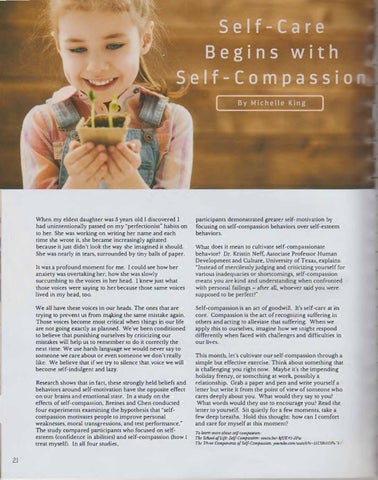
When my eldest daughter was 5 years old I discovered I had unintentionally passed on my "perfectionist" habits on to her. She was working on writing her name and each time she wrote it, she became increasingly agitated because it just didn't look the way she imagined it should. She was nearly in tears, surrounded by tiny balls of paper. It was a profound moment for me. I could see how her anxiety was overtaking her; how she was slowly succumbing to the voices in her head. I knew just what those voices were saying to her because those same voices lived in my head, too. We all have these voices in our heads. The ones that are trying to prevent us from m<l,king the same mistake again. Those voices become most critical when things in our life are not going exactly as planned. We've been conditioned to believe that punishing ourselves by criticizing our mistakes will help us to remember to do it correctly the next time. We use harsh language we would never say to someone we care about or even someone we don't really like. We believe that if we try to silence that voice we will become self-indulgent and lazy. Research shows that in fact, these strongly held beliefs and behaviors around self-motivation have the opposite effect on our brains and emotional state. In a study on the effects of self-compassion, Breines and Chen conducted four experiments examining the hypothesis that "self compassion motivates people to improve personal weaknesses, moral transgressions, and test performance." The study compared participants who focused on self• esteem (confidence in abilities) and self-compassion (how I treat myself). In all four studies,
21
participants demonstrated greater self-motivation by focusing on self-compassion behaviors over self-esteem behaviors. What does it mean to cultivate self-compassionate behavior? Dr. Kristin Neff, Associate Professor Human Development and Culture, University of Texas, explains: "Instead of mercilessly judging and criticizing yourself for various inadequacies or shortcomings, self-compassion means you are kind and understanding when confronted with personal failings - after all, whoever said you were supposed to be perfect?Self-compassion is an act of goodwill. It's self-care at its core. Compassion is the act of recognizing suffering in others and acting to alleviate that suffering. When we apply this to ourselves, imagine how we might respond differently when faced with challenges and difficulties in our lives. This month, let's cultivate our self-compassion through a simple but effective exercise. Think about something that is challenging you right now. Maybe it's the impending holiday frenzy, or something at work, possibly a relationship. Grab a paper and pen and write yourself a letter but write it from the point of view of someone who cares deeply about you. What would they say to you? What words would they use to encourage you? Read the letter to yourself. Sit quietly for a few moments, take a few deep breaths. Hold this thought: how can I comfort and care for myself at this moment? To Imm mart abo1tt u/f-<omp,umm: Th, Sdtool a/Life: Self-Compassion.• you111.W-iflJE�l-JFw Th, 11trtt Components efSe/f-Compa,sion;yv,,r,,buomlwatth 'lv�lJL'OhODPt. ·•