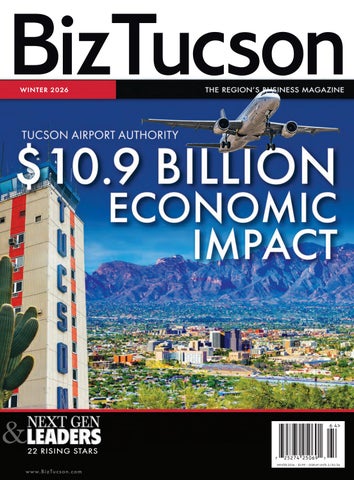
“The Tucson Airport Authority is flying high with a $10.9 billion annual economic impact across Southern Ari zona and a reach that extends to every aspect of the regional infrastructure,” writes journalist Loni Nannini in this is sue’s cover package. It’s a testament to the local airport system that continues to prove its outsized value alongside Da vis-Monthan Air Force Base, Fort Hua chuca, University of Arizona, Raytheon and other major stakeholders.
TAA President and CEO Danette Bewley says, “It demonstrates that a community with a thriving airport usually has a thriving economy. Airports are synergistic with the local region because people rely on transportation for jobs, education and government.” Our report highlights recent airport improvements, plans for expansion and a shared vision for the future.
Also in this issue, BizTucson is proud to announce our 2026 Next Gen Leaders – 22 “Rising Stars to Watch.”
Since 2021, BizTucson has annually given recognition to extraordinary individuals leading our region forward. The 2026 honorees include entrepreneurs, nonprofit executives, community builders, leaders in aerospace/defense and athletics, medical professionals and trailblazers in construction, commercial real estate, financial institutions, energy and more. These professionals are passionate about making a difference and pursuing excellence.
Loni Nannini and Tara Kirkpatrick report on these stars elevating the entire community. You’ll be impressed with Tucson’s next generation of talent.
On the tourism front, Visit Tucson unveils its new brand, with Dave Perry reporting. “Visit Tucson has wrapped itself around a new logo, complete with a saguaro, a snake and a stylized font suggesting the singularity of this place.” But a logo is not a brand, emphasized Felipe Garcia, Visit Tucson president and CEO. “The brand is what’s inside,” he told the crowd at Visit Tucson’s annual meeting in October. “It’s what people think about you and your company when you leave the room.” Tucson native and NBC Today Show Co-anchor Savannah Guthrie filmed her hometown visit in honor of the new brand.
She writes, “Arizona-Sonora Desert Museum tops the list of must-see attractions in Tucson for kids and adults alike.”
The University of Arizona has a treasure on campus, and this winter marks its 50th anniversary. Flandrau Science Center and Planetarium began as a dream in the 1960s by a group of UA scientists, including highly renowned scientist Gerard Kuiper. Often considered the father of modern planetary science, Kuiper created the moon atlas for the Apollo moon landing. Christy Krueger shares the story on this gem.
The Arizona Inn, with its signature desert-pink Mediterranean-Spanish Colonial design, antique furnishings and lush gardens, has long been a beloved Tucson landmark, listed on the National Register of Historic Places. It’s now entering a new era under owners committed to honoring its 95-year legacy. The inn went on sale this spring after remaining in the same family for generations, beginning with Arizona’s first congresswoman Isabella Greenway, reports Tiffany Kjos. Its new stewards will be just as devoted to its legacy. They are Jim and Kerrin Berwick, Greg and Marla Amado, Brian and Shamra Strange, Phil and Mimi Amos, Kirk Saunders and Ann Peterson, and Steve and Margot Kerr.
On a personal note, the Arizona Inn holds a very special place in my heart. My college sweetheart and love of my life, Rebecca, and I were married at the Inn 40 years ago. It was truly a storybook wedding.
As always, thank you to our loyal readers. Here’s to a wonderful 2026!
Steven E. Rosenberg Publisher & Owner BizTucson
Winter 2026
Volume 17 No. 4
Publisher & Owner Steven E. Rosenberg
Creative Director Brent G. Mathis
Contributing Editors Jay Gonzales Tara Kirkpatrick Loni Nannini
Editor Emeritus Donna Kreutz
Contributing Writers
April Bourie
Rodney Campbell
Tara Kirkpatrick
Tiffany Kjos
Christy Krueger
Thomas Leyde
Loni Nannini
Dave Perry
Steve Rivera
Valerie Vinyard
Contributing Photographers Brent G. Mathis
Chris Mooney
BizTucson News Update (Email Newsletter) Brent G. Mathis
BizTucson.com Tara Kirkpatrick
Contributing Technology Director Mike Serres
Contributing Project Coordinator Maricela Robles
Member:
American Advertising Federation Tucson DM-50
Metropolitan Pima Alliance
Oro Valley Chamber
Southern Arizona Leadership Council
The Chamber of Southern Arizona
BizTucson Magazine Issue 4 (ISSN 1947-5047 print, ISSN 2833-6739 online) is published quarterly for $16 per year by Rosenberg Media, LLC., 4729 E. Sunrise Dr., PMB 505, Tucson, AZ 85718-4534. Periodicals postage pending at Phoenix, AZ, and additional mailing offices.
POSTMASTER: Send address changes to: BizTucson Magazine, 4729 East Sunrise Dr., PMB 505, Tucson, AZ 85718-4534
82 Arizona-Sonora Desert Museum a Gem for All Ages
BizTOURISM
84 Tucson Gem & Mineral Show Generates $286 Million for Local Economy
BizSCIENCE
86 University of Arizona’s Flandrau Science Center and Planetarium At 50 Years
BizFESTIVAL
88 Tucson Festival of Books Drives Literacy Programs
BizARTS
90 Tucson Desert Song Festival: World’s Most Dynamic Vocalists
BizHONORS
93 NEXT GEN LEADERS
Rising Stars to Watch
BizDESIGN 110 ASID Arizona South Commercial Design Award Winners
BizAWARDS 113 Cornerstone Building Foundation Awards 114 Tech Launch Arizona I-Squared Awards
116 Tucson Values Teachers: Raytheon Leaders in Education Awards
118 Greater Vail Chamber of Commerce Golden Spike Awards
120 Southern Arizona Hispanic Chamber of Commerce Awards
BizRANKINGS
122 Tucson “On The Radar”
Sugar Skulls Change Hands Local Ownership Group Takes the Reins
It was 35 years ago when Edmund Marquez helped lead Sabino High School to an undefeated season and a state title on the football field. Fast forward to 2025 and Marquez, a prominent local businessman, is leading another football team, the Tucson Sugar Skulls, into a new era.
“It’s a cool surprise in the timeline of my life,” he said. “I’m president of the team and hope to be president for years. I’m very competitive. It’s a great way to represent Tucson from a sports perspective.”
By Steve Rivera
Marquez is hoping it’s a renewed hope and energy for a team that almost left the city after just six seasons. He –and a dozen other local investors – will use the premise of making the franchise successful while “making Tucson proud as we build a championship team for our community.”
When the Sugar Skulls first arrived, he met the owners involved − Kevin and Cathy Guy − and thought, “What a cool product, great team, great logo, what a great name.”
They talked regularly, given his presence on the Rio Nuevo District board.
He’d go to the games and have a great time.
“It was cool,” Marquez recalled of the early years. “It was exciting. We’d be in our suite and the (players) would be crashing up against the boards or we’d catch a football. It was so much fun.”
In August came the call from Kevin to say he and Cathy “were thinking of selling… are you interested?”
continued on page 28 >>>
Sugar Skulls Ownership Group
The new ownership group of the Tucson Sugar Skulls:
Edmund & Wendy Marquez
Ali Farhang
Dennis & Mistie Bene
Brad & Anita Feder
Kevin & Cathy Guy
Grant & Katerina Krueger
Jay & Annalisa LaSalle
Marco Mercaldo
Kyle & Mary Mokhtarian
Gabe & Aly Nevarez
Kameron & Sara Norwood
Derrick Polder
Tony & Hedy Ramani
Jim & Allyson Tofel
continued from page 26
it was the right time and right place for him to make the move.
trust each other and get along.”
He didn’t blink an eye given what he saw as the potential. He was in. Originally, he thought it might be just the Guys, Ali Farhang − already a limited partner in the team − and himself as owners.
It then turned into something bigger.
It’ll be all about TUCSON – in big, bold letters – and what it brings.
“It’s like a love letter to Tucson as we show Tucson can operate a pro sports team and operate at a high level,” he said.
Marquez owns 25 percent of the team, Farhang owns 20 percent. And there are more, all owning 5 percent of the glorious pie.
“We now have a Board of Governors and have some of the greatest local CEOs as partners,” he said. “The board is our secret sauce. We got as much local buy-in as we could.”
He added: “It’s like growing an oak tree, we just added 14 roots. They have so much love for Tucson – and that’s what’s going to make it special. They want to be involved.”
They will all be tasked with bringing in sponsorships and buying suites.
“We will be one of the best IFL teams in the country and we will aim for championships every year,” he said.
It’ll take a village, Marquez said, but
“Perfect timing,” he said. “And my relationship with the CEOs is strong; we
“ letter to Tucson as we show Tucson can operate a pro sports team and operate at a high level.”
– Edmund Marquez Co-Owner & President Tucson Sugar Skulls
Farhang said he “was excited for the Sugar Skulls’ next chapter. With the power and reach of the board of governors that we have, I see a lot of great things as far as putting a good product on the field and having a good gameday experience.”
The Guys know they will. In fact, they are still part of the ownership group.
“It’s great for Tucson, Edmund and the group they have put together,” Kevin said. “Me and Cathy never intended to own it long term. Our daughter was at UA and she graduated. Our priorities have changed.
“It’s run its course. Today is a great day for Tucson” Kevin said on the day of the new ownership announcement. “We’re thankful for all our corporate sponsors and the support they gave us. We also appreciate the community support.”
Marquez & Co. is now tasked to get the magic to happen.
“Fans need to show up and have some fun, come to the games and fill the seats,” he said. “It’s football in an airconditioned arena. The demographics is families with kids. It’s a great place to bring your kid and have fun. It’s as close as you can get to pro football – they are literally on the other side of the wall.”
PHOTO COURTESY
Golf and Hoops at the 2026 Cologuard Classic Tournament Settles into New Home at La Paloma
By Steve Rivera
Dan Nentl isn’t out to make the 2026 Cologuard Classic his own in as much as it takes a village to make it all run well and enjoyable for everyone. But Nentl can try to ratchet the event up a bit.
That will be the case for Nentl as he’ll try to add “a little spin” to the 2026 Cologuard Classic by Exact Sciences being that he’s the new tournament director.
Some changes from last year?
One venue will be a bit bigger, making the 15th hole entertainment area better for the crowd. It’ll be a doubledecker tent.
“It’ll be a festive area and much less expensive to get into,” Nentl said. “And there will be fun things if a golfer gets a birdie and such.”
And, given this year’s tournament week starts on St. Patrick’s Day, it’ll
accommodate for that. Throw in that the tournament pro-am coincides with the first day and weekend of the NCAA Men’s Basketball Tournament on March 19, there will be plenty of screens and TVs to see all the action.
“For the pro-am, we’re adding an Irish themed party and with the NCAA games going on we’re adding a fun zone where we are adding a bunch of TVs for those who want to walk over and watch basketball,” he said. “We add things every year but it’s all about the Tucson Conquistadores working together and caring about the community.”
In fact, every year, the Conquistadores make efforts “to make the community better” and the annual Cologuard Classic by Exact Sciences is one of the many ways.
They’ll hope to improve on it again this year after last year’s good showing, despite some unusually cold, breezy weather.
Still, more than 40,000 fans crossed the gates at La Paloma Country Club, which enjoyed its first year as the tournament venue. Almost $675,000 was raised for local charities and the event had an estimated $2 million economic impact – making it $25 million over the years - and there were 366 cancer survivors in attendance.
“With the success we’ve had recently, we are giving back more than ever,” said Geoff Hill, executive director of the Tucson Conquistadores, which oversees and helps run the Cologuard Classic. “The ($675,000) impacts people greatly, from those with colorectal cancer, through screening awareness. It
La Paloma Golf Course
2025 Cologuard Classic champion Steven
Alker with Tucson Conquistadores
“We add things every year but it’s all about the Tucson Conquistadores working together and caring about the community.”
– Dan Nentl, Tournament Chairman, Cologuard Classic by Exact Sciences
impacts our mission of giving back to local youth organizations and the local military.”
There are fixes to be made too – given the tight fit it experienced for so many people and activities – when compared to the spacious Omni Tucson National Resort, the tournament site for the previous nine years.
“It was a new experience that had some challenges that we’re going to improve upon,” Hill said.
Still, officials have created new partnerships with the Community Food Bank of Southern Arizona “where we’ve donated thousands of pounds of food and have given tens of thousands (of dollars) to those in need.”
How was the feeling of giving back to the charities?
“It’s incredible,” Hill said. “It’s really
rewarding because we hear their stories, see their faces. It’s truly impactful.”
Through the years – more than 60 years of professional golf – the Conquistadores have helped raise more than $38 million for local charities.
Shortly after last year’s event, Nentl became the new tournament director. He quickly turned to thinking about this year.
“I started thinking, how do I get the crowd control better behind 18?” he said. “How do I make the garden range better. The TV compound was too crowded.”
All things to think about for 2026.
“We take about six weeks off after the last tournament then we start meeting right away,” Nentl said. “We’ve been meeting since March to make things better.”
And here it is – scheduled in midMarch and up against the NCAAs, a regular part the scheduled for Tucson’s beloved Arizona Wildcats. The Conquistadores have faced the challenge before, mostly against the Pac-12 basketball tournament. This is different given many fans ventured to Vegas for hoops but fewer will for the NCAA tournament given the cost.
“People still want to help support the underprivileged people in youth sports, mentoring and education in Tucson, so they attend the event,” he said. “We’ll just have to buy more TVs.”
Now, it’s about going to see golf and getting a good seat to watch basketball.
“Exactly,” Nentl said.
PHOTOS: COURTESY TUCSON CONQUISTADORES
Lady A Coming to Cologuard Classic
The Cologuard Classic is going country, rock and pop all in one for its annual concert.
Grammy award-winning Lady A will head the CQ Fest on March 20 at Rillito Park, 4502 N. First Ave. The concert serves as the Military Appreciation Concert in support of Davis-Monthan Air Force Base and it benefits the DM50. Gates open at 4 p.m.
Lady A has seen great mainstream success with what it calls “a smooth fusion of country, rock and pop.”
In addition to seven Grammy awards and other honors, the group has been named Vocal Group of the Year three times each by the Academy of Country Music and the Country Music Association.
CQ Fest is the annual concert festival hosted by the Tucson Conquistadores, the local non-profit organization and tournament management group behind the Cologuard Classic.
Tickets are $49 and can be purchased at www.CologuardClassic.com. Biz
From left - New Arizona Inn owners Kirk Saunders, Phil and Mimi Amos, Greg and Marla Amado, Jim and Kerrin Berwick and Brian and Shamra Strange.
Not pictured: Margot Kerr, Ann Peterson.
Steve Kerr, a new owner
An Icon Sold
New Owners of Arizona Inn Include Local Investors, NBA Coach Steve Kerr
The Arizona Inn, with its signature desert-pink Mediterranean-Spanish Colonial design, antique furnishings and lush gardens, has long been a beloved Tucson landmark, listed on the National Register of Historic Places.
It’s now entering a new era under owners committed to honoring its 95year legacy.
The inn, at 2200 E. Elm St., went up for sale this spring after remaining in the same family for generations, beginning with Arizona’s first congresswoman Isa-
s new stewards will be just as devoted to its legacy. They are Jim and Kerrin Berwick, Greg and Marla Amado, hamra Strange, Phil and Mimi Amos, Kirk Saunders, Ann Peterson and Steve and Margot Kerr. our...investors got married here. One had their first date here. So, when the inn came up for sale, it was about preserving its legacy, being custodians of history, other than the tender loving care that it needs in some places,” said Nick Cedergren, VP of S Hotels Management, owned by Strange.
The inn’s thoughtful restoration, expected to last 18 months, has already begun, beginning with the historic 1937 pool, originally built with pumice from “A” Mountain. It now features whiteand-yellow striped furniture, umbrellas and matching towels reminiscent of its early-1930s debut.
By Tiffany Kjos
“It’s much more on brand, and it’s what the original vision for the hotel was, so we are bringing that back” Cedergren said.
“The hotel has so much rich history and heritage,” Strange said of the inn. “We’re very excited about it. And it’s particularly gratifying to work on a project where all the locals love it, because they just appreciate the legacy.”
A Promising Future
“I think what Tucsonans want and what they deserve is a group that respects the history and the legacy of the Greenway family and the hotel itself,” Strange said. “And that’s what we intend to do.”
Each of the 93 rooms will be furnished with original pieces and new bedding. A model room features a four-post bed, new beautiful linens and duvets and soft brown concrete floors. The biggest change will be converting the 5,200-square-foot Greenway House into a world-class spa, Strange said.
“We don’t want to rush into it, we want to do it right, and we want to do it intentionally, and we want to consider the overall feel,” he said.
Beneath carpeted guest room floors is the original concrete, now being restored to something like its 1930s finish. The lush gardens and lawns will get a refresh and the bar will reopen as Bar 1933 – harkening to the year Prohibition ended and Greenway served her first term in Congress – “but always
keeping in mind its origination, when it was built, and making sure that everything is aligned with the history and the heritage,” Strange said.
Many original Greenway items — including a sketch of Isabella — remain in storage. “A lot of these really cool pieces we’re going to slowly over time start to incorporate back into the inn, because that’s where they were to begin with,” Cedergren said.
The restaurant menu likely will see only minimal tweaks. “I personally think the chef has done a great job there. We’re going to make some minor changes, but we’ll go slow on that, too,” Strange said.
Right now, the grounds are strictly for hotel guests, but a new membership program under consideration will offer access to the pool, spa and tennis courts and discounts on food and beverages.
Whether members or overnight guests, visitors can expect not just charm and serenity but the inn’s customary stellar service, Cedergren said: “We like to curate experiences and create memories and experiences that people will remember for a lifetime.”
The inn will remain open throughout the restoration.
Honoring the Greenway Family Legacy
Arizona Inn was founded in 1930 by Greenway. Over the years, it was overseen by Greenway’s son, John (Jack) continued on page 36 >>>
“I think what Tucsonans want and what they deserve is a group that respects the history and the legacy of the Greenway family and the hotel itself. And that’s what we intend to do.”
– Brian Strange President S Hotels Management
Selmes Greenway; her granddaughter, Frances (Patty Doar); and Isabella’s great-grandson, Will Conroy, who moved here in 2003 and became president of the inn in 2005.
“So much has happened here, consequential and trivial, funny and sad, happy and unbelievable, that beneath the tranquil surface of things, one feels the past swelling powerfully into the present. I feel it anyway, and I’m reassured by it every time I walk through the inn’s familiar front doors. I’m not sure even my great-grandmother could have predicted that,” Conroy wrote in “Arizona Inn: A History.”
The inn opened the night of Dec. 18, 1930, to great acclaim and has hosted weddings, anniversaries, and countless other celebrations over the decades. Its location, near the University of Arizona, makes it a favorite of visiting parents. The Silver & Turquoise Board of Hostesses, of which Greenway was a member, has held its annual ball there for more than 70 years. Notably, new owners Mimi Amos and Marla Amado are both hostesses.
Built to attract wealthy patrons when Tucson’s population was beginning to boom, the inn’s guests have included statesmen, philanthropists and celebrities, from Isabella’s close friend Eleanor Roosevelt to John D. Rockefeller Jr. and Clark Gable.
Strange, who owns two other hotels, remarked on the serendipity that brought the new ownership group the sale.
“There were a lot of people that wanted it, but in the back page of the ‘Arizona Inn’ book that they give you at check-in, there was a sketch of Isabella Greenway, who of course founded the hotel,” Strange said. “The sketch was by Felix Mattei’s son, of the Mattei family who started another of our hotels The Inn at Mattei’s Tavern. It was just such a coincidence that his son actually drew that picture, and it’s signed by him in the book. So, it seems like it was meant to be.”
continued from page 35 Biz
A Look at Arizona Inn’s 95-Year History
1927: Isabella Selmes Ferguson Greenway founds the Arizona Hut, a furniture shop to employ disabled World War I veterans. She also buys 14 acres on the south side of East Elm Street. Tucson’s population is less than 32,000.
1928: The Arizona Hut employs more than 100 workers and sells to stores across the country.
1929: The Wall Street crash fuels the Great Depression and a steep business downturn. “Hut orders dried up, and at first Isabella kept things afloat by buying up the furniture herself,” according to “Arizona Inn: A History” (Will Conroy, 2017).
1930: Isabella builds the Arizona Inn on East Elm Street for $150,000, with buildings designed by Merritt H. Starkweather and landscaping by James Oliphant. Construction begins in September and takes three months. The hotel consists of a main building and four casitas with 23 rooms, all furnished with products from the Hut. The inn opens Dec. 18 with a dance for 25 couples. Room rate: $12.
1931: The inn doubles in size, including five more guest houses, a new dining room, banquet hall and a central heating plant. Price tag: $125,000.
1933: Prohibition ends, and one of the terraces at the inn is turned into a bar. Isabella is elected to the U.S. House of Representatives, representing Arizona (she serves two terms).
1934: A swimming pool and clay tennis courts are added.
WWII years:
An annex beyond the pool is added. The inn welcomes guests during winters only but remains open in summers for military personnel undergoing training at Davis-Monthan Air Force Base and University of Arizona.
1953: Isabella dies on Dec. 18 in Tucson. Her son, John (Jack) Selmes Greenway takes the helm at the inn.
1970s: The main building is air-conditioned and remodeled, a gift shop is added and S. Plumer Ave. is partially covered to create the “Tucson Room.” The hotel begins to stay open to guests year-round.
1988: The inn is listed on the National Register of Historic Places.
1989: Isabella’s granddaughter, Frances (Patty) Doar, becomes the business partner of Jack Greenway and general manager of the inn.
1995: Jack dies; Patty becomes sole proprietor of the inn.
2005: Will Conroy, Patty’s son and Isabella’s great-grandson, becomes president of the inn and Doar its CEO.
2006: The Spalding House, a private home that was rented to the Spalding family, is renovated to provide nine new guest rooms.
2025: The inn, now with 93 guest rooms, is offered for sale in March and sold to a local investor group in September.
Patrick NJ Schnegelsberg President & CEO SynCardia Systems Inc
Artificial Heart Stock Offering Hopes to Fund Advances in Technology
For patients with end-stage heart failure, the SynCardia Total Artificial Heart is a second chance at life.
For Tucson-based SynCardia Systems Inc., which builds those hearts, funding from a public stock offering is a lifeline for the company, according to CEO Patrick NJ Schnegelsberg.
In September, SynCardia’s parent company, Picard Medical Inc., closed its initial public offering of 4.25 million shares of common stock at $4 per share. A subsequent, additional stock sale boosted gross proceeds to $19.5 million.
“It’s been a game-changer for us,” Schnegelsberg said. “We are now capitalized. We have the opportunity to really grow this business.”
Item 1 on the list of objectives for the funding is to retire debt, Schnegelsberg said. It now has “a squeaky-clean balance sheet,” he said. Next, is strengthening its marketing and outreach efforts to expand awareness and use of the SynCardia Total Artificial Heart.
“We’re still the only FDA-approved heart out there,” Schnegelsberg said, but not enough people know about it.
Most critically, “we’re financed to pursue our next step in the life of SynCardia, to develop a fully implantable version of the heart,” Schnegelsberg said.
That version, the Emperor, would have an internal motor pushing blood, rather than the external drivers used with the SynCardia Total Artificial Heart. The company hopes to have an Emperor beating inside a person sometime in 2028.
“The goal is to really have this as an alternative to a heart transplant,” Schnegelsberg said. “We want to make this fully implantable. We put the motor that powers the heart inside the patient.”
By Dave Perry
SynCardia, founded in Tucson in 2001 by Dr. Jack Copeland, Dr. Marvin Slepian and engineer Richard G. Smith, is “the only hard-core medical technology company in Tucson,” Schnegelsberg said. “We’re proud to represent this community on the global stage.” Only Smith remains part of the SynCardia operation.
It has built “a huge legacy” by producing a device that has kept more than 2,100 patients alive while awaiting heart transplantation.
There just aren’t enough hearts to go around. Each year in the U.S., 7,000 people are in acute need of a transplant. Annually, 4,200 actually get one.
“They’re the lucky ones,” Schnegelsberg said.
He believes the Emperor can change the equation. When it is approved, “you have the opportunity to save millions of lives” around the world, Schnegelsberg said. And it may open markets in nations where heart transplants are not performed for religious, ethical or cultural reasons.
Schnegelsberg, who became SynCardia’s CEO in 2023, analyzed the business with CFO Bernard Skaggs and COO Matt Schuster. “We realized, to make this baby fly, we need money,” Schnegelsberg said. They saw the IPO as the best path to capitalization. He had IPO experience.
“I forgot how hard it was,” he said of the offering. “There are always things that come up. In the end, it went as well as it could have.” Once finished, the team looked at one another and said “‘wow, we did it’.”
SynCardia’s 80 dedicated employees, people working in research and development, engineering, quality control, compliance, marketing and manufacturing, need to be paid.
“We want to make sure we can grow our revenues,” said Schnegelsberg, who believes SynCardia has had “an insufficient commercial focus. We’re all here to save lives, but we cannot save lives if we cannot run the company.”
SynCardia is creating a network of “several dozen centers of excellence,” hospitals and transplant centers with thorough understanding of the SynCardia Total Artificial Heart.
“We really want to build these centers who know what they’re doing,” Schnegelsberg said. “They can give much better patient outcomes, and everybody’s experience is going to be better across the board.”
SynCardia is working more closely with the nonprofit Unique Beating Hearts, an aggregation of SynCardia patients who can help providers and families “understand the patient side of the equation,” Schnegelsberg added.
“Families faced with end-stage heart disease are scared,” he said. “There’s nothing better than to speak to a patient who went through it. These are amazing stories.”
A “sizable number” of SynCardia’s patients “have used this heart for two years or more,” Schnegelsberg said, including one approaching an eight-year anniversary. Given those experiences, SynCardia is pursuing an FDA “longterm use” or “destination use” label for the SynCardia Total Artificial Heart.
The company is now trading under the ticker symbol “PMI” on the NYSE American exchange.
“It’s our shot. We have access to capital markets, we can develop the technology and really focus on bringing this fully implantable device to the market,” Schnegelsberg said.
PHOTO BY KVRCREATIVE
Sam Deneke President Air & Space Defense Systems Raytheon, an RTX business
Reaffirming its Presence Raytheon Executive Speaks at Summit for The Chamber of Southern Arizona
The state of Raytheon in Tucson is rock steady, with billions of dollars in defense contracts to fulfill and more employees needed to meet present and future production.
That was the message from Sam Deneke, president of Air & Space Defense Systems for Raytheon, an RTX business. Deneke was the keynote speaker Oct. 2 at The Chamber of Southern Arizona’s Business Summit & Expo at
By Tom Leyde
Casino Del Sol Resort.
“The future for Raytheon during its 70 years here is getting better and better,” said Joe Snell, Chamber president and CEO. “The importance that Raytheon has on the community is tremendous.”
Raytheon is the largest aerospace and defense company here as well as the largest missile manufacturing operation in the world, employing about 12,500
people in Tucson. Its key role in defense technology development, specializing in integrated air and missile defense, advanced sensors, space-based systems, hypersonics and effectors cannot be overstated.
“There have been lots of changes over the last six or seven years,” Deneke said.
continued on page 42 >>>
PHOTOS
“The future for Raytheon during its 70 years here is getting better and better. The importance that Raytheon has on the community is tremendous.”
– Joe Snell President & CEO
The Chamber of Southern Arizona
continued from page 40
In 2020, Raytheon became an RTX company with the merger of Raytheon with Collins Aerospace and Pratt & Whitney. That merger created a $7 billion-ayear business. Raytheon has 4.7 million square feet of space in Tucson, including its sprawling campus and its engineering office at the University of Arizona Tech Park.
This year, Raytheon landed its largest defense order − a $3.8 billion contract for the company’s advanced medium-range air-to-air missiles to be built for the U.S. Air Force, U.S. Navy and foreign military.
Raytheon will be building the fifth generation of the missile, and the contract will keep workers busy until 2031.
There are five parts that compose Raytheon’s operation, Deneke explained:
• Advanced products and solutions
• Advanced technology
• Aerospace defense systems
• Land and air defense systems
• Naval power
Evolving threats of war, Deneke said, underscore the importance of Raytheon. Those current threats, he said, include Ukraine, the Middle East and competition with China.
“China is evolving its defense faster than the U.S.,” he said. “It’s gotten a lot of people’s attention in the last decade or two.”
Defense systems begin with sensing, space and mission control, Deneke said. “Space is taking on a more prominent role these days, so it’s about sensing, transitioning and doing something about it.”
Deneke, who has spent most of his life in Tucson, also touched on Raytheon’s Nation Advanced Surface-to-Air
Missile System – or NASAMS − which is designed to protect against a variety of aerial threats, including aircraft and drones.
NASAMS consists of the AN/MPQ-64 Sentinel radar, Kongsberg Defense & Aerospace’s Fire Distribution Center, launcher and Raytheon’s suite of effectors, including the AMRAAM missile, AMRAAM-ER missile and AIM9X missile.
NASAMS provides air defenders with a tailorable, state-of-the-art defense system that can maximize their ability to acquire, engage and destroy current and evolving enemy fixed and rotary wing aircraft, drones and emerging cruise missile threats.
Raytheon, Deneke said, is also developing a new medium-range air and missile defense system for NASAMS called GhostEye radar.
NASAMS is operated by 13 countries. It has been integrated into the U.S. National Capital Region’s air defense system since 2005. Also, U.S., Norway, Finland, Spain, The Netherlands, Oman, Lithuania, Indonesia, Australia, Qatar, Hungary and an undisclosed country depend on NASAMS for homeland defense and the protection of critical assets.
The system meets all NATO requirements for interoperability.
Replenishment of munitions is a major priority for the U.S. and other nations at this time, Deneke said. “The U.S. government realized we do not have enough missiles. There is a huge surge in demand and it is the biggest issue in the Pentagon.”
He said Raytheon could land $10 billion in contracts by the end of 2025.
The company also keeps many other companies in business, with 500 suppliers in Arizona representing $2.5 billion in products.
“The company is all about people, and it is primarily an engineering company,” Deneke said. “It takes the entire spectrum of roles to make the system work.” He said Raytheon isn’t fully staffed and is always hiring in Tucson.
Raytheon, Deneke said, is fond of its relationships with the UA and Pima Community College, both of which help funnel talent to Raytheon. Manufacturing jobs, he said, are the hardest to fill and PCC helps fill those positions.
The company, Deneke said, works diligently within the Tucson community. “Last year, the company provided 40,000 hours of community service,” he said. “We are a member of the community and we are giving back because we are proud to be a member of the community of Southern Arizona.”
Another major challenge for Raytheon, Deneke said, is artificial intelligence. “The focus is the integration of AI to deal with big data, particularly to make the company more effective and efficient.”
He said the company must prepare for deceivers of its AI. These are entities or techniques that manipulate AI systems to produce false or misleading outputs. “It’s a big deal and it’s a big problem for us,” he said.
TENWEST Returns with New Programming, Summits
From its inception, TENWEST has played a central role in building Tucson and Southern Arizona’s entrepreneurial ecosystem. Now in its 11th year, the festival has grown into the largest entrepreneurship and creativity festival in the Southwest.
Fueled by HUSTL and hosted by Startup Tucson, TENWEST will welcome thousands of founders, creators, culinary innovators, intrapreneurs, community builders, and anyone looking to stay ahead of what’s next to Downtown Tucson Mar. 24–29.
“TENWEST has become the place where founders, creators, and innovators come to understand what’s next and how to navigate it,” said Liz Pocock, CEO of Startup Tucson and TENWEST. “This year’s festival builds on that momentum with deeper learning opportunities, more targeted summits, and new collaborations across the Southwest — all designed to help people take action on their biggest ideas.”
Community-Driven Growth
From its origins as a volunteer-led conference to the multiday, regional festival it is today, TENWEST has always helped attendees understand their role in shaping their communities. As the festival has grown from Southern Arizona’s professional development experience to a Southwest-wide draw, it has remained rooted in Tucson’s distinctive culture and creative energy.
“Whether you’re joining us from Tucson or traveling from across the region, we want you to experience the electricity of our downtown ecosystem,” Pocock said. “TENWEST shows what’s possible when a community embraces creativity and entrepreneurship—and attendees take that momentum home to fuel thriving communities across the Southwest.”
Keynote Speaker:
Jason
Feifer, Editor in Chief, Entrepreneur Magazine
Jason Feifer, Editor in Chief of Entrepreneur Magazine and
bestselling author of Build for Tomorrow, will headline the 2026 TENWEST Conference on Thursday, Mar. 26. Feifer, known nationally for helping founders navigate change and seize opportunity, will speak to this year’s festival themes—innovation, resilience, creativity, and the future of entrepreneurship.
“Jason brings a rare blend of insight and optimism at a time when founders need both,” said Pocock. “His perspective on change, adaptability, and opportunity aligns perfectly with the energy of TENWEST. We’re excited for Tucson to hear from one of the leading voices shaping modern entrepreneurship and are so thankful to the University of Arizona’s Eller College of Management and McGuire Center for Entrepreneurship as the presenting sponsors for this amazing keynote.”
Festival Highlights & What’s New for 2026
For more than a decade, TENWEST has been where the Southwest’s entrepreneurs, creators, and innovators gather to connect the dots across their ideas, careers, and communities. The 2026 festival introduces several major expansions:
• TENWEST EDU – New Professional Learning Track: Certifications, workshops, and industry intensives in partnership with regional workforce and education leaders.
• Enhanced Three-Day Conference & New Summits: Cross-cutting themes for 2026 include: AI & Emerging Tech
Marketing & Branding
Wellness & Resilience
Consumer Products Spotlight
Navigating a Changing Economy / World
continued on page 46 >>>
continued from page 44
Within the conference, attendees can participate in: Founder ’s Summit: For builders, leaders, and earlystage innovators. Sessions focus on growth strategy, investment readiness, leadership, and innovation. Includes the return of IdeaFunding, the Southwest’s largest pitch competition, which provides more than $50,000 in awards for emerging startups.
Creator ’s Summit: Supporting digital storytellers, designers, and creative entrepreneurs with programming on monetization, brand building, community growth, and the intersection of creativity and technology.
Culinar y Innovator’s Summit: Designed specifically for Southern Arizona’s rapidly expanding consumer product and culinary entrepreneurship sector. Topics include food innovation, sustainability, brand development, and scaling products from concept to market.
• TENWEST x Experiences including “URLAND: Formerly Known As” TENWESTx evening events include concerts, culinary showcases, pitch competitions, and creative performances. Already confirmed: Arizona Arts Live will present a major xEvent, URLAND: Formerly Known As — a genre-defying performance exploring what AI means for art. TENWEST will also continue its collaboration with Made in Tucson for the festival’s closing celebration.
• TENWEST Explores – New Festival Layer: A curated collection of partner-led art, culture, food, and innovation experiences that highlight what makes Southern Arizona distinct — from creative tours to culinary pop-ups to local business activations.
• TENWEST Connects: Daily themed networking gatherings designed to build meaningful professional connections.
Now Fueled by HUSTL
Startup Tucson is also proud to announce that HUSTL—a digital credit union designed for freelancers, solopreneurs, gig workers, and entrepreneurs, and a division of Vantage West Credit Union—joins as the festival’s title sponsor. Launched in 2024, HUSTL was built to meet the real-world needs of modern microbusinesses with financial tools tailored to the driven. Its mission aligns closely with TENWEST’s commitment to accessible resources, inclusive entrepreneurship, and amplifying diverse creative voices.
How to Participate in TENWEST Insider Festival passes are on sale now at TENWEST.com.
Organizations interested in sponsoring or hosting partner events within TENWEST can contact info@tenwest.com.
Tucson Small Business Center Offers One-Stop Help
By Tom Leyde
Tucson small business owners and those who want to start a small business have a new, “one-stop” location for most, if not all, of their needs.
On Oct. 9, the city of Tucson, Tucson Industrial Development Authority and Groundswell Capital celebrated the grand opening of the Tucson Small Business Center.
Located at 600 S. Meyer Ave., the center is housed in what was once Jerry’s Lee Ho Market in the historic Barrio Viejo District. The building was constructed in 1880 when Meyer Avenue was the main market street for Barrio Viejo.
The 12,000-square-foot incubator will help small businesses and entrepreneurs grow by bringing together resources, capital and community.
“You just have to make it easy,” said Dre Thompson, CEO of Tucson IDA. “We really wanted to make it this onestop process.”
Over the years, Tucson IDA and the Tucson Small Business Program have partnered to provide thousands of hours of business education, coaching and mentoring. Those efforts have secured $2.8 million in loans and nearly $1.5 million for small business grants
that have served more than 450 small businesses and startups with grants.
Locating in Barrio Viejo was due, in part, to how the business environment has changed with so many employees working from home.
The building was bought and renovated in 2008 by Haley & Aldrich, a geotechnical engineering and environmental consulting company. But during the COVID-19 pandemic, its employees began working from home. The company did not need all the space.
The building was purchased from Haley & Aldrich last December. The city contributed $925,000 of American Rescue Plan dollars to buy the building in partnership with IDA. IDA moved into its new home in January 2025. Haley & Aldrich maintains a suite in the building.
“It’s been wonderful,” Thompson said. “The response has been really, really amazing. All of our classes are full. We want to get the word out that this is available.”
Thompson said Arizona is very undercapitalized, and it’s well known that small businesses in Tucson are major job creators.
“We work with small, medium businesses and bond projects,” she said. “We’re working on the whole spectrum. We have more applications than capital.”
The center houses two nonprofit agencies: Tucson IDA and Groundswell Capital. IDA had no staff until 3½ years ago when Thompson was hired as the first CEO.
The Tucson Small Business Program also has a presence at the center. Francisca Villegas is program manager and Gisselle Coronado is small business navigator. They will help businesses apply for a first-ever business license and with the process of business additions.
There’s a large classroom/meeting room (the Vantage West Innovation Hub) which can be rented for events, such as business meetings. Free classes include homebuyer workshops, how to start a business in Tucson, and navigating cash flow. They are offered in both English and Spanish.
The center is open from 9 a.m. to 5 p.m. by appointment only.
For more information, call 520-837-4100 or email businesshelp@tucsonaz.gov.
BizCONSTRUCTION
NEW TO MARKET
Project: Tucson Federal Credit Union
Rita Ranch branch
Location: 10165 E. Old Vail Road, #141
Owner: Tucson Federal Credit Union
Contractor: Epstein Construction and Pate Contractors
Architect: Seaver Franks Architects
Completion Date: November 2025
Construction Cost: N/A
Project Description: The bank’s newest full-service branch has opened in Rita Ranch, the fast-growing southeast corridor region.
Project: Pima Community College
ST Building
Location: 1255 N. Stone Ave.
Owner: Pima Community College
Contractor: Chasse Building Team
Architect: DLR Group
Completion Date: October 2025
Construction Cost: $8,185,000
Project Description: A total of 26,000 square feet of renovations have been completed on the Pima Community College Building and Construction Technologies Building at the Downtown Campus.
NEW TO MARKET
Project: OOROO Automotive
Location: 765 E. Wetmore Road
Owner: RFV OOROO
Contractor: MW Morrissey Construction
Architect: KBP Architects
Completion Date: October 2025
Construction Cost: $800,638
Project Description: Ground-up construction on this auto facility includes six vehicle bays, a break room and lobby area.
Project: Pascua Yaqui Tribe Health Services
Location: 7490 S. Camino de Oeste
Owner: Pascua Yaqui Tribe
Contractor: W.E. O’Neil Construction
Architect: Swaim Associates
Completion Date: August 2025
Construction Cost: N/A
Project Description: Renovation of the 7,848-square-foot facility included exam rooms, offices, reception and courtyard upgrades with new hardscape, landscaping and shade structures.
BizCONSTRUCTION
NEW TO MARKET
Project: Mosaic Quarter
Location: 2343 Tournament Way
Owner: Mosaic Quarter Development
Contractor: Hensel Phelps
Architect: JLG
Key Partners: Granite Construction, Wilson Electric, Sun Mechanical, Image Building Systems, Able Steel, Sun Valley Masonry, Ameresco, Coreslab, Rolling Plains Construction, Shambaugh & Son Fire Protection
Completion Date: Summer 2027
Construction Cost: $425 million
Project Description: A sports and entertainmentfocused lifestyle center that will feature state-ofthe-art venues for entertainment, recreational and collegiate sports, including ice hockey, basketball, soccer, and more. Of the venues, the iceplex is 20% complete; the fieldhouse is 20% complete; the central utility plant is 45% complete and civil is 40% complete.
Hunley Owner Arizona Health
BY
PHOTO
BRENT G. MATHIS
LaMonte
From Sport to Business
Football Instincts Key Business Success
By Tom Leyde
A background in athletics will serve you well in the business world, says LaMonte Hunley, who is someone who definitely should know.
An All-American linebacker at the University of Arizona who went on to the NFL, he brings gridiron savvy into play daily as a owner of Arizona Health. Now in its 41st year in Tucson, the company provides health and fitness equipment for individuals, corporations and schools.
“When you have an athletic background and those skills in you, you take those instincts to that type of environment,” Hunley said. “You must be able to play with your employees. A team is only as good as each team member. Without athletics I don’t think I could do the things I do day in and day out.”
The Petersburg, Va., native was at Arizona from 1981-1984, playing alongside his brother, Ricky, his first three years. He went on to play three seasons with the Indianapolis Colts and one with the Miami Dolphins.
Arizona Health was founded in 1985 by Scott Thompson, who was Hunley’s personal trainer. When Hunley was released by the NFL in 1989, Thompson suggested the two become business partners. Hunley decided to work in the business for a year before that business relationship came to fruition.
“In the process I got to learn the business,” said Hunley, 62. “It was an extension of what I was doing athletically. It was a natural fit and we became partners.”
Thompson died on Nov. 17, 2019, from complications of cystic fibrosis. After Thompson’s diagnosis, Hunley took over business operations.
Arizona Health, Hunley said, is not based on a normal business model. He calls it a destination business rather than a retail business. The staff, Hunley said, are more like teachers and educators than salespersons.
“We help them (customers) decide what they need for business or home,” Hunley said.
Commercial and private gym owners go to Arizona Health at 6245 E. 22nd St. for equipment, along with schools and recreation centers.
The company’s fitness equipment lines include Precor, Hoist Fitness Systems, Woodway, Life Fitness, UCS, True Fitness, Inspire and Power Plate. And it delivers and services the equipment.
“We’re basically a one-stop shop to take care of all of your needs when it comes to fitness,” Hunley said. “We’ve been blessed in having a staff that has been around for 10 plus years. The maturity and history that our staff has is what makes our store go. It keeps me excited every day.”
Having made a name for himself at the UA, Hunley decided to settle down in Tucson after his NFL career.
“I felt having that name and having that involvement with the UA would give me the opportunity to open a door,” he said. “Even today people associate my name with football.”
He embraced the community of Tucson as well. Hunley coached football at Flowing Wells High School. He also has been involved with the Boys & Girls Clubs of Tucson, Big Brothers Big Sisters of Southern Arizona, the March of Dimes and the Centurions.
“I try to find organizations that are dear to my heart,” he said.
In 2022 Hunley was named a Father of the Year by the Father’s Day Council of Tucson. He and his wife of 35 years, Stephanie, are parents of two daughters, Kendra, 33, and Devyn, 30. They also just welcomed a new granddaughter, Evyn Powell.
Kendra lives in Phoenix and works as a corporate recruiter. Devyn works for a law firm in Las Cruces, N.M. She is married to a New Mexico State University football coach.
Hunley said he’s proud of Tucson businesses that have been around for 40 plus years, like Arizona Health. “People still believe in what we have to offer,” he said. “That’s what makes me smile every day and keeps driving me every day.”
How Employers May Drive More Value Through Consumer-friendly Benefits
Submitted by
Heather
Kane, Health Plan CEO for Arizona & New Mexico, UnitedHealthcare Employer & Individual
With health care costs in 2026 projected to rise, employers may be considering how they can support the health care needs of the workforce while maintaining affordability.
By considering innovative digital solutions aimed at improving access and affordability, employers can create opportunities for individuals to take advantage of resources that may help support their health and well-being. To this end, employers should consider ways to prioritize understanding, greater choice and flexibility when it comes to employee benefit offerings.
The benefit of expanding health care education
Education may play a crucial role in helping employees make more in formed decisions about their benefits. Through onboarding sessions, benefit workshops and digital resources, em ployers can share information about available options, what is included and how services work together to support whole-person health.
Clear communications around en rollment periods, both during onboard ing and annual health care open enroll ment, may further ensure employees review, update or select benefits as their needs evolve. When employees understand their options and deadlines, they may make more confident choices, maximize value and ultimately experience better health outcomes.
The importance of consumeroriented benefits
force by offering innovative health plans that empower people to shop for needed care like Surest from UnitedHealthcare.
With employers of all sizes looking to combat rising health care costs, Surest can help curb rising health care costs without trimming benefits, narrowing networks or shifting costs onto employees.
What makes Surest different? It allows members to more easily compare cost and coverage options upfront and provides more convenient, better access to health care. The Surest plan eliminates the deductible and coinsurance financial barriers to care.
Heather Kane Health Plan CEO for Arizona & New Mexico, UnitedHealthcare Employer & Individual
While traditional benefit packages may seem wide-ranging, a one-sizefits-all approach may not work for all employees. Employers should consider the individual health goals and demographics of their employee pool when selecting plan offerings. Providing benefits aimed at meeting diverse needs may potentially provide a more personalized and affordable approach to care.
Employers may save more money and support better health for the work-
Instead, within the Surest app, members can compare care options and network providers and see actual costs in the form of a single copay — not costs estimates. Copays are lower for providers evaluated as higher value, based on past effectiveness or cost efficiency data.
With Surest, members have access to the broad, national UnitedHealthcare and Optum Behavioral Health networks. This reimagined health plan demonstrates proven savings for both employers and employees.
How
digital platforms
may improve care experience
Insurance and benefits providers are also helping to reduce the administrative burden employers face in expanding benefits options through digital innovation. Some health plans may offer access to integrated digital tools, including virtual care options, member portals and provider search and cost estimator tools to help support proactive care, reduce logistical hurdles and help promote convenience, accessibility and overall engagement.
Plans may also offer access to additional health and wellness resources designed to complement traditional care options that may help employees better support their health. Some of these may include family-focused resources like prenatal care or caregiving information, fitness and nutrition services, chronic condition management programs and smoking cessation assistance.
For example, UnitedHealthcare recently launched UHC Store, which offers a direct-to-consumer online shopping experience within the UnitedHealthcare® app and on myuhc. com®. Members can shop from a range of discounted health and wellness offerings that help meet their personal needs and complement their benefits, offering savings of up to 15%.
UHC Store allows employers to enhance their benefit offerings to help support employee choice without the additional cost and administrative burden of adding new point solutions. Similarly, UnitedHealthcare offers UHC Hub, an employer-focused option which is designed to give employers additional purchasing power by simplifying the process of selecting, purchasing and managing vendor programs. By reimagining benefits with consumer-oriented design, clear education and digital health and wellness solutions, employers may help better support the health of their workforce and maximize benefit offerings.
Danette Bewley President & CEO Tucson Airport Authority
Tucson Airport Authority (TAA) is flying high with a $10.9 billion annual economic impact across Southern Arizona and a reach that extends to every ct of the regional economic infra-
’s a testament to the local airport system that continues to prove its outsized value alongside Davis-Monthan Force Base/Ft. Huachuca, the University of Arizona, Raytheon and other akeholders.
“The Tucson Airport Authority airport system is an economic engine for he region. It demonstrates that a community with a thriving airport usually a thriving economy: Airports are synergistic with the local region because people rely on transportation for , recreation, education, and government,” said Danette Bewley, TAA president and CEO.
All elements of the community rely on us having a healthy, thriving airport, just as we rely on those elements to provide healthy and thriving services. The port is a vital mechanism in that entire ecosystem.”
2024 economic impact report by Elliott D. Pollack & Company found that TAA—a nonprofit created by community leaders over 75 years ago to oversee Tucson International Airport (TUS) and Ryan Airfield (RYN)
south of Tucson—supported more than 42,000 jobs with $2.9 billion in wages. It helped to facilitate visitor spending of $936.9 million annually and generated a conservative estimated tax revenue of $115 million statewide and more than $110 million locally.
Bewley emphasized that wages and tax revenues earned because of the existence of the airport system create a “multiplier effect,” further fueling other sectors of the regional economy.
At the core of TAA’s vision for continued growth is the positioning of TUS as an easy-to-use airport that emphasizes convenience, customer service, safety and security.
“Bigger doesn’t mean better: It just means bigger. We compete and do the same things as larger airports, but at a different scale, and sometimes we do things better,” said Bewley.
“When you are a smaller airport, you have the opportunity to be more connected to all aspects of the business enterprise and operation. We tend to focus on being entrepreneurial, creative and innovative, which allows us to function at a higher level. That is what makes being at a smaller airport so much fun.”
Branding TUS
One of more than 500 commercial airports in the country, TUS ranks
within the top 100 airports in passenger volume and is among the largest nationwide by land area with 8,200 acres. The air port is also home to the Arizona Air National Guard’s 162nd Wing, the premier F-16 fighter pilot training unit.
Through two concourses and 19 gates, TUS currently serves seven airlines—Alaska, American, Delta, Frontier, Southwest, Sun Country, and United. These carriers offer one-stop connections to nearly 500 cities globally and non-stop routes to 19 destinations.
TAA has adopted a growth mindset regarding air service development, amenities, and customer service and infrastructure.
“Ultimately, our goal is to set the airport up for the future, providing customers and airlines with a much more modernized product. . .we are always planning 10 and 20 years in the future because if we are not, we are falling behind,” said Bewley.
The philosophy is paying off: More than 3.8 million passengers flew through TUS in 2024, marking a 3.9% increase over the previous year. If projections are correct, it is anticipated that TUS will see over 4 million passengers in 2025.
In 2024, TUS ranked first among the top 30 western airports in the U.S. for seat capacity growth with a 16.8% year-
continued on page 62 >>>
BizEXPANSION
continued from page 61
over-year growth rate during the Thanksgiving holiday period.
“We are outperforming our West Coast peer airports in seat capacity growth, which speaks to the growing profile of our airport. When you look at West Coast airports, we are at the top of the pack,” said Austin Wright, chief communications officer for TAA.
A new marketing campaign, “Fly Tucson First,” seeks to promote TUS as an effective hub not only for consumers, but as the premier choice for business travelers.
TAA as Enterprise
“We can be a niche airport that offers a unique and pleasant user experience. We are functionally easier o use and sophisticated,” said Bewley.
With a $52 million annual budget for operations and maintenance, TAA is also distinguishing itself as a powerful and innovative business enterprise.
Recently, it was the recipient of a $57 million grant through the Federal Aviation Administration Airport Improvement Program.
“We received the largest grant in the United States for work we are doing on Airfield Safety Enhancement Program. Our infrastructure such an important element for the success of our airport enterprise and we are grateful for the partnership and the financial support from he FAA in this critical project. . .and receiving a grant of this size and magnitude speaks volumes,” Bewley said.
To date, TAA has been awarded $300 million in grants, totaling 75% of the $400 million projected for TAA’s Airfield Safety Enhancement Program. The project, which includes demolition and reconstruction of runways, taxiways and other improvements, is slated for completion by 2028 or 2029 depending on deral funding.
“In short, we are modernizing our airfield to meet current safety standards and this will take us far into the future,” said Bewley.
TAA is also conducting a $1.5 million-plus aesthetic refresh of some elements in the TUS terminal and is in the design phase for a modernized Checked Baggage Inspection System. Long-term goals include planning for a future terminal to meet customer expectations and accommodate expanded airline carrier service.
For now, Bewley said TAA continues to pursue and “maximize grants to narrow the gap further” and effectively minimize airline costs for flights through TUS. With aeronautical revenue comprising 65% of total revenue, TAA is also working to diversify and increase non-aeronautical revenues (from tenants, parking, rental cars, etc.).
TUS currently has a competitive—and very appealing—cost per enplaned passenger (CPE) of just under $10. In comparison, the CPE at Seattle is $30 and San Francisco’s CPE is upwards of $40.
“There are many data points that airlines look at, and if you get too high on any data points, you might be passed over so, we are very cognizant of costs,” said Bewley.
“We are competitive with our low-cost structure and operate the airport in a cost-conscious manner, so we remain attractive to the air carriers.”
Ultimately, Bewley said that building relationships with stakeholders now will position TUS to soar into the future.
“We come to work every day trying to make the community better by running the airport system efficiently and effectively and having positive relationships with airline stakeholders, tenants and customers. Because of that approach, we will benefit, which means in turn, the community benefits.”
Biz
Danette Bewley with TAA Board Chair Mike Hammond
Bruce Goetz
Executive VP & COO Tucson Airport Authority
Easy, Enhanced
By Loni Nannini
Established in 1948, TAA has a legacy as a municipal stronghold. Decades later, with a $52 million annual operating budget and $70 million in capital improvements, It’s cementing TUS’ reputation as a modern, easy-to-use airport that offers Southern Arizonans a convenient, enjoyable and relaxed experience.
“We love our airport and want to make sure it is modern, relevant and a pleasant experience for travelers. Our emphasis is to offer a nice facility that people love to come to,” said Bruce Goetz, executive VP and COO of Tucson Airport Authority.
Elevating the Traveler Experience
In keeping with that vision, the TAA is overseeing a $5 million refresh that prioritizes comfort, convenience and safety.
Refurbishments are many. They include new carpeting with additional, upgraded seating throughout the terminal; a new airport entrance sign and road improvements leading into the airport; a signage master plan with way-finding; new queuing stanchions at security checkpoints; and other projects to improve the traveler experience.
“Basically within the existing shell of the airport, we are looking at modernizing the look and feel to make a more convenient, easier, modern, and fresh experience for the traveler,” said Austin Wright, chief communications officer for TAA.
A dark blue color palette is replacing desert-toned hues. New blue carpeting and seating bring a clean and contemporary aesthetic to the terminal, while upg raded lighting complements the sleek look.
New Signage, Carpeting, Lighting Bring
“It is amazing how much brighter it is when you walk through the terminal. It is just a very different vibe,” Goetz said.
Other enhancements include modernizations to seating areas and self-service kiosks “to improve timeliness and ease” for patrons of food/beverage and gift concessions provided by Delaware North and Hudson.
Enhancing Traveler Safety
In addition to comfort, the nuts, bolts and mechanics of TUS air travel remain at the forefront.
“From the time you enter our property at the airport until the time you are airbor ne, it is a complete passenger journey. ven once you board the airplane, there is a component that involves taxiing and takeoff to various destinations. We always think a lot about the entire journey,” said Goetz.
Spencer Losinski American Airlines General Manager at TUS
“TUS continues to elevate the customer experience, while maintaining a cost conscious approach to operations, making TUS highly competitive for future airline growth opportunities.”
– Mike Hammond Board Chair Tucson Airport Authority
Airport Experience
Modernization in Motion to TUS
Behind the scenes, TAA is spearheading a $400 million Airfield Safety Enhancement Program involving major infrastructure changes to meet current federal safety standards. Infrastructure highlights include the demolition, relocation and construction of a new 11,000-foot parallel runway.
“We have demolished a runway used by small general aviation, relocated the runway, and are in the process of constructing the new parallel runway. Beyond the safety aspects of this project, the new runway will also provide the capacity for operational growth in the long-term,” said Goetz.
Other infrastructure and amenity improvements include replacement of jet bridges; state-of-the-art units to cool airplanes; airline baggage slides; replacement of baggage belts; and a redesigned Checked Baggage Inspection System.
Long-term infrastructure plans also include the planning of a modernized concourse, with a timeline dependent on economic conditions, passenger growth, airline input, and funding options available to the TAA.
Airlines as Partners
Ultimately, Goetz said these upgrades, along with a cost conscious approach, make TUS more attractive to airlines.
He emphasized that the TAA prides itself on ensuring airlines, like travelers, enjoy optimal ease-of-use and safety.
“We love our airlines. . .our mantra is that we exist and have jobs because there is good air service here, so these are important relationships to foster,” said Goetz.
Fostering relationships includes marketing Tucson to airlines as a growing destination for businesses—and as a tourism draw for 7 million inbound
tourists annually—that can fill flights, enabling airlines to realize fare premiums and maximize profits.
“We are not just selling TUS, we are selling Tucson as a region. Airlines are financially- and metric-driven and we are focused on maintaining a reasonable cost structure so they can make a profit here. We have created a great product for them,” said Goetz.
As Tucson’s largest airline, American Airlines is grateful for the investment in amenities to improve the airport experience for team members and customers, according to Spencer Losinski, American Airlines general manager at TUS Operations.
“We appreciate the long-term partnership with the airport and community that continues making American the region’s top choice for air travel, with easy connections from Tucson to more than 350 destinations globally.”
PHOTOS: BRENT
G. MATHIS Biz
Fly Tucson First
Heading to Phoenix for a Flight? Think Again
By Loni Nannini
With a new business-to-business campaign called “Fly Tucson First,” TAA is issuing a rallying cry for the corporate community to invest in Southern Arizona’s transportation ecosystem.
“TUS is an important economic driver among other industries in the region, but the beauty of our business is that the community can help us become even stronger,” said Brian Kidd, deputy chief of marketing, strategic communications, and air service development at TAA.
Fly Tucson First is dedicated to capturing “leakage” travelers who fly from Phoenix. In return for a commitment to fly TUS exclusively, charter members receive exclusive benefits such as premium parking, a dedicated check-in point with expedited security and more.
“TUS is already easy to use, and we want to make it absolutely as easy as possible for employees of these companies. In business, time is money, so we are constantly asking, ‘What is your time worth? Is it worth it to drive to Phoenix to avoid a connection? Isn’t the drive like a one-stop already? At the end of the day, what are the real benefits of going to Phoenix?’” said Kidd.
The campaign highlights drawbacks, including the additional time, gas and mileage needed to drive to and from Sky Harbor on Interstate 10 (and variables such as mechanical issues and traffic problems); the possibility of flight delays while already en route; and the inconvenience of negotiating parking and traffic in and around Sky Harbor Airport as compared to less expensive and more convenient parking at TUS.
Kidd also points out that driving to Phoenix for a non-stop flight “is already one stop,” so it’s virtually no different
than connecting through another city on a flight from TUS.
Additionally, he wants to dispel the idea that TUS can be difficult to access since it’s not a major hub.
“To or from TUS you can reach nearly 500 destinations all over the world with just one stop. Many people assume you can’t really get to Tucson from their local airport and that is a misconception,” said Kidd.
He emphasized that with a bit of adjustment and flexibility, most travelers can find a connecting flight through TUS that accommodates desired time constraints.
“We hear sometimes that TUS only has one non-stop flight to a destination, but we probably have a dozen other ways to get to where you want to go at the time you want to go there. Throughout the course of the day, we have many options for key destinations,” said Kidd.
Recapturing Revenue for the Region
For those who support “shopping local,” the rubber hits the runway at TUS, and F ly Tucson First is on a mission to capture lost revenue.
“In the aggregate, we lose over a third of our local air travel customers to Phoenix, and one of our key goals is to reduce that,” said Kidd.
He emphasized that flying from Phoenix actually exports economic activity from the region, impacting multiple sectors of industry while at the same time boosting Sky Harbor’s ability to attract additional air service.
“If you fly out of Phoenix, you are helping the business case for Sky Harbor to the detriment of the business case for Tucson International Air-
port. The only way we can get more air service is for people to fly from TUS. Airlines add flights where people take flights, and they are especially interested in business customers because they tend to pay more and are not as price sensitive,” said Kidd.
Bob Hoffman, president of the Tucson Roadrunners, is a frequent TUS business flyer who recognizes these intricacies and promotes the value proposition of TUS to other businesses.
Typically traveling with 30 to 40 people and up to 100 bags—including hockey equipment—Hoffman said that analysis consistently demonstrates that TUS is the best choice for Roadrunner team travel.
“The ease of use to be able to go just a couple miles down the road from where we house at the convention center is just so prevalent for us,” he said.
Cost analysis has also found TUS generally superior.
“We are extremely budget-driven. If it was significantly economically better to make the trip to Phoenix, we would look at that, but all of our data evaluation shows that economically—and for convenience—Tucson is worth it for us,” said Hoffman.
Hoffman also believes that flying local is the right long-term choice for business development.
“Our very accessible and well-run airport—from both a financial standpoint and ease of use—is important to drawing new businesses. The more we do to support the airport and all of its projects and programs, the more it helps with the big picture and showcasing Tucson as a great destination market.”
Brian Kidd Deputy Chief of Marketing, Strategic Communications & Air Service Development Tucson Airport Authority
PHOTO: BRENT G. MATHIS
Bear Down Bound New Partnership Encourages Wildcats to Travel from TUS
By Loni Nannini
A strategic partnership between University of Arizona and TAA is encouraging Wildcats to take off from TUS.
“The goal of the partnership is to further cement the importance the University of Arizona holds to the Tucson International Airport. One of the strategic imperatives of the University is engagement that strengthens the community and this is a living, breathing demonstration of that strategic imperative where we want to be an active contributor to the economic success of the region,” said Courtney Spector, director of strategic partnerships at U of A.
“From the University of Arizona side, we know the health of the airport strengthens all of us..and we want to be the tailwind behind them.”
Launched in the summer of 2024, the initiative promotes “Fly Tucson First,” touting the convenience and proximity of TUS to U of A students and their families, along with faculty and staff.
Spearheaded by the TAA in partnership with U of A central marketing, the campaign has extended campus-wide to campus tours; new student services; parent and family programs; fraternity and sorority programs; housing and residential life; alumni engagement and more. Recently, it has focused on prospective students prior to their first campus visits.
“We have this beautiful and convenient airport that is eight miles away from campus. . .and we want to create almost a muscle memory for future students so when they enroll at the University of Arizona, TUS is the airport of
choice every single time,” said Spector. That choice is made easier by the partnership’s complimentary airport Lyft service to and from campus (a NetID is required).
“We wanted to eliminate potential barriers of transportation and parking, and create a more convenient way to get to the airport for students, faculty, and staff. The Lyft rides are a big hit and a huge benefit,” said Spector.
The partnership also promotes TUS during back-to-school, family weekend, homecoming, holidays, commencement, and other high-travel periods.
Back-to-school travel through TUS increased 7% year-over-year from 2024 to 2025, and the goal is to build on that momentum, according to Austin Wright, TAA’s chief communications officer.
Future plans include airport messaging from U of A administrators and athletics and increased promotion of U of A special events.
“The University of Arizona has had an interest in deepening our relation ship with the Tucson Airport Authority for many years. It is a relationship that is not transactional, but a true partner ship in that, together, we can make each other better,” said Spector.
“That is at the basis of this partner ship. We know we can both strengthen the Tucson community we serve by working more collaboratively, and we think the sky is the limit.”
Transforming Corporate Culture with Wellness: How Geneviève Nedder is Leading the Change
Tucson’s Geneviève Nedder has spent over three decades empowering individuals to lead healthier lives. As the founder of Body Fundamentals Pilates & Wellness and a Chopra Global Certified Health Consultant, her approach to wellness is rooted in both ancient wisdom and modern science. Today, she’s transforming corporate culture, helping companies foster vitality and resilience within their teams.
Q:You’ve spent years working with individuals—what inspired your shift to corporate wellness?
A:The demand from my clients, combined with my own health journey, was the catalyst. Over time, many of my individual clients—C-suite executives, doctors, and business owners—began asking if I could bring my work into their businesses. They were seeing the personal benefits of Pilates, meditation, and coaching, but noticed that their teams were struggling with burnout, stress, and poor sleep. It became clear there was a larger need for systemic change. That’s when I realized that true wellness involves more than just fixing individuals—it’s about creating lasting cultural change within organizations.
Q:How does your approach to wellness differ from typical programs?
A:Most corporate wellness programs focus on quick fixes like step challenges or lunchtime yoga. My approach is more integrated. I blend modern mind-body medicine, neuroscience, and the ancient wisdom of Ayurveda to create a comprehensive wellness model. The goal is to address the whole person—physically, mentally, and emotionally. It’s not about temporary relief; it’s about fostering long-term sustainability and joy. Digital tools like apps are useful, but they can’t replace the energy of in-person connection. Authenticity is key.
Q: What are companies looking for when investing in wellness?
A:Companies today want to help leaders and teams manage stress, communicate better, and
In a recent interview, Geneviève explained why corporate wellness demands more than surface-level solutions, and how her holistic, whole-health approach is reshaping the way businesses approach employee wellbeing.
integrate practical self-care into their daily routines. They’re moving beyond surface-level perks to focus on programs with depth. That’s why I design programs like weekend retreats, meditation training, and self-care courses. These offerings address real challenges: sleep optimization, food as medicine, and meditation for brain health. Most importantly, they’re designed to be accessible and impactful, so they fit into the busy schedules of executives and staff alike.
Q: What’s your primary goal during a retreat or workshop?
A:I want to connect people to their purpose, while giving them tangible tools they can use. For example, we do reflective exercises where participants list five things they’re grateful for about their workplace. I call it the “Where Are You Getting It Right?” exercise. It’s a simple but powerful way to foster reflection, build team cohesion, and encourage measurable mindset shifts.
Geneviève Nedder Director & Founder Body Fundamentals
Q: How do you measure success in your work with companies?
A:Success shows up when we start seeing shifts in company culture. It may begin with just a few individuals, but soon you’ll notice positive changes across the organization—improved sleep, reduced anxiety, and clearer communication. One client, a doctor, shared that he now meditates before surgeries, which has helped him stay calm. Another client’s manager, who used to deal with constant conflicts, is now mentoring her team. These kinds of shifts are incredibly fulfilling—they lead to greater productivity, improved retention, and a stronger leadership presence.
Signature Programs
• Introduction to Meditation & Mindfulness
• Achieving Restful Sleep
• Food as Medicine (Multiple Courses)
• The 7 Biological Responses to Stress as a Path to Peace
• Brain Health & Meditation
• Meeting Our Fundamental Needs: Self-Care 101
• New Routines: Calm and Centered
• Reconnect to Joy through Meditation
Learn more about Geneviève Nedder’s approach to wellness, transforming the corporate landscape one mindful, energized team at a time. Through whole-health strategies, organizations elevate well-being, empower leaders, and create workplaces that thrive from the inside out.
BodyFundamentals.com change@bodyfundamentals.com
Off the Beaten Path Visit Tucson Unveils Rebrand that Celebrates Region’s Authenticity
By Dave Perry
Visit Tucson has wrapped itself around a new logo, complete with a saguaro, a snake and a stylized font suggesting the singularity of this place.
But a logo is not a brand, emphasized Felipe Garcia, Visit Tucson president and CEO.
Think of the logo as Tucson’s “visual marker,” he said. It represents the warm tortilla wrapping a burrito, the tangy mayo on a Sonoran dog, the whitewash of Mission San Xavier del Bac, the fall hues of Marshall Gulch on Mount Lemmon, the dark skies, the bright stars and the painted faces of the All Souls Procession.
“The brand is what’s inside,” Garcia told the crowd at Visit Tucson’s annual meeting in October, where the rebrand was unveiled. “It’s what people think about you, and your company, when you leave the room.”
Brand is more about attitude than assets, consultant and MMGY Global brand strategist Stewart Colovin told the room full of travel industry professionals. A brand “used to be what we have,” said Colovin, an unabashed Tucson fan. “Then it became what can you do, who we are, what makes us us?”
A brand must “resonate with local people,” Colovin said. For more than a year, Colovin and others asked Tucsonans what they think about this city. From those conversations, MMGY Global derived four key insights:
• Pride here is local, earned, and shared.
• The chip on our shoulder isn’t a weakness, it’s our advantage.
• Tucson is a fusion of cultures and place.
• Being different isn’t a rebellion, it’s a tradition.
From those insights, Colovin derived positioning statements. Tucson is Rooted. Grounded. Open. Original. Defiant.
Visit Tucson’s rebrand has adopted a new color palette reflective of the desert – organic browns and greens “inspired by the place.” And it has adopted a new slogan – “Don’t Fit Right In.”
“For those who venture off the beaten path, the desert is calling,” according to Visit Tucson. “Come join us, and don’t fit right in.”
It’s a message of inclusivity, said Lee McLaughlin, VP of marketing for Visit Tucson. “It’s intended to make Tucson stand out as a welcoming destination that says, ‘this place is different.’”
When visitors have what Mayor Regina Romero called “a compelling, authentic, unscripted experience,” they stay longer, spend more money, and explore, Colovin said.
This is Visit Tucson’s first rebrand in more than a decade. It has freed itself from “Free Yourself,” which had been an important message especially during the pandemic. “It put the city of Tucson and our region on the map,” Romero said.
According to Visit Tucson’s 2024-25 annual report, its travel and tourism promotion generated $25 for every $1 invested. Its total impact on tourism and travel was estimated at $332 million. In 2024, Pima County and Southern Arizona welcomed 6.1 million visitors. Nearly 23,000 people worked in travel-related jobs. Local tax receipts from travel reached $81.6 million.
But now is the right time, Romero said, to revitalize the brand, “to look at our future, to break through the noise, to distinguish ourselves from every other area in the world.”
“This new brand tells a more authentic story about who we are and what makes Tucson special,” Garcia said. “It’s designed to create pride at home and spark curiosity among potential visitors.”
Fresh marketing campaigns, digital platforms and visitor materials are being rolled out. Visit Tucson is “getting incredible reach for the brand, right out of the gate,” McLaughlin said.
identity is not Visit Tucson’s brand – it is Tucson’s brand. It is the common ground where tourism, economic development, government, and education meet.”
– Felipe Garcia President & CEO Visit Tucson
The same month as the rebrand unveiling, famous Tucsonan Savannah Guthrie, co-anchor of NBC’s Today, returned to her hometown to film pro-
motional videos. GoPro, the wearable ion camera company with a substantial social media network, brought s top adventure creators to Tucson to film what McLaughlin called “wild, ex-
McLaughlin told the audience Visit Tucson was headed to Chicago for mid-November events with plans to wrap a Brown line passenger train with the new Tucson logo. “It’s a perfect time to take our message and this brand to that city” – one of Tucson’s biggest winter markets, he said. “We can show them Tucson is a welcoming place.”
Romero, McLaughlin and Garcia share a common excitement about Tucson’s new brand.
“This new identity is not Visit Tucson’s brand – it is Tucson’s brand,” Garcia said. “It is the common ground where tourism, economic development, government, and education meet.”
“Each and every one of you is a partner,” Romero told the crowd. With a handshake and a smile, “every hospitality worker is an investment in this brand.”
“This is just the beginning,” McLaughlin said. “We’re really excited for this next chapter.”
SVP, Director of Commercial Lending Southern Arizona Enterprise Bank & Trust
Enterprise Financial Services Corp, the holding company of Enterprise Bank & Trust, completed its acquisition of 12 branches from First Interstate Bank, a wholly owned subsidiary of First Interstate BancSystem, Inc.
The move adds 10 branches in Arizona and two branches in Kansas with approximately $300 million in loans and $645 million in deposits. Following the acquisition, Enterprise will have approximately $17 billion in total assets.
“We are pleased to announce the completion of the acquisition of 12 First Interstate Bank branches in Arizona and Kansas City,” said James B. Lally, president and CEO of Enterprise. “In addition to an enhanced funding profile, the addition of these branches allows us to expand our access to existing markets with attractive growth opportunities. We believe this transaction will help us meet the needs of our new and existing customers while delivering continued long-term value for our stockholders.”
The acquisition further expands Enterprise’s footprint in Arizona and the greater Kansas City metropolitan area. The acquired branches have been fully converted to EB&T branch offices, and former FIB customers have access to the broad suite of EB&T products and services, including a wide range of commercial and retail banking products.
Arizona locations include Tucson, North Scottsdale, Old Town Scottsdale, Chandler, Maricopa, Casa Grande, Eloy, Coolidge, Globe and Nogales. Biz
Mike Adams
PHOTO BY BRENT G. MATHIS
Just Deserts Arizona-Sonora Desert Museum a Gem for All Ages
Arizona-Sonora Desert Museum tops the list of must-see attractions in Tucson for kids and adults alike.
Native Tucsonan Lee McLaughlin grew up going to the Desert Museum on school field trips and visits with his family long before he “really understood the value of the place.”
“I’ve always loved it; it’s such a cool place,” said McLaughlin, now VP of marketing for Visit Tucson. “It’s evolved so much over the years. They have some incredible plans moving forward.”
Those plans include Spadefoot Splash, a nature-play area with a stream and riparian areas. Slated to open in 2026, the 5,500-square-foot exhibit will also include two buildings, a pond, and a nature trail.
“It’s a little bit more interactive and kid-friendly with a water feature, but also something that will be more summer-friendly,” McLaughlin said.
Hosting 340,000 visitors annually, the Desert Museum offers something for everyone. Located about 30 minutes from Downtown Tucson, the drive to the museum is a stunning sensory overload, with photo ops at every turn.
“It’s one of the reasons it’s one of the top tourist attractions, you get a crash course in the Sonoran Desert,” said McLaughlin.
In 2024, 6.1 million visitors traveled to Tucson and Southern Arizona, according to the Arizona Office of Tourism, spending a whopping $2.9 billion.
McLaughlin noted that surveys show 60% of travelers are passionate about visiting historical sites and attractions when they visit Tucson. The Desert Museum is both. Founded in 1952 and accredited with the Association of Zoos
By Valerie Vinyard
and Aquariums, it features a 98-acre zoo, aquarium, botanical garden, natural history museum and art gallery.
The museum also interprets the comprehensive natural history of the Sonoran Desert, featuring 56,000 plant specimens and 242 animals species from the region in their natural habitats.
“We’re not a typical museum. It’s a special place. It’s got its own unique identity,” said Hollie Colahan, executive director of the Desert Museum. Previously the executive director of the Birmingham Zoo in Alabama, Colahan is working to create a new facility master plan for the museum, one of 10 nationwide awarded the prestigious 2024 National Medal for Museum and Library Service.
Other recent awards include recognition as a top attraction for Tucson/ Southern Arizona by U.S. News and World Report, TripAdvisor, Yelp and Best of Tucson – Reader’s Choice from the Tucson Weekly.
McLaughlin noted that the museum has also become known for its conservation efforts.
“They put a lot of resources and funding into research and conservation and host scientists and biologists from all over the world to do research,” he said.
The museum has played a crucial role in saving the Mexican gray wolf. In 1976, the species was declared endangered and the Desert Museum became a partner in the breeding and reintroduction of the species. All Mexican gray wolves alive today are progeny of seven unrelated founders from three lineages – the Ghost Ranch lineage came directly from the Desert Museum.
Fundraising is wrapping up for the $5 million new habitat that will house the three wolves at the museum, with construction expected to begin early 2026. The space will expand the current exhibit tenfold, from 2,500 square feet to 25,000.
“The Desert Museum has helped to shape understanding of and respect for the Sonoran Desert for over 70 years, and we plan to continue this work with even more community participation in new exhibits, public programs and conservation work,” said Debra Colodner, the museum’s director of conservation education and science.
There are plenty of kid-friendly reasons to visit the Desert Museum, too.
The Packrat Playhouse is a 4,000-square-foot indoor space that allows children to discover the desert through the eyes of this curious critter. Kids can slide down a gila monster’s tail, climb through prickly pear cactus pads, slither through an oversized rattlesnake, explore tunnels and scramble in giant rope netting.
The Coati Kids Club targets kids ages 6 to 12, while the Young Naturalists is a fall program for sixth- to eighth graders interested in forming a deeper connection with the Sonoran Desert. Kids ages 16 to 18 can volunteer in various capacities, joining the force of 380 active volunteers and 166 docents.
“Everyone has a story about the museum,” Colahan said. “The museum is a lot of things to a lot of different people. My job is to take all of those things and honor that legacy, but also to look ahead to the future.”
Real Gem
Tucson Gem & Mineral Show Generates $286 Million for Local Economy
The 2025 Gem, Mineral & Fossil Showcase, held Feb. 1-16, generated $286 million in direct spending, including $12.9 million in local tax revenue–proving its massive economic value to the region, according to a study by the Seidman Research Institute at Arizona State University.
The Tucson Gem, Mineral & Fossil Showcase is recognized as the largest event of its kind in the world, with exhibits ranging from rare minerals and meteorites to handcrafted jewelry and fossils. By comparison, the 2019 event generated an economic impact of $131 million based on research conducted by FMR Associates, a Tucson-based international research firm.
“This event is a cornerstone of Tucson’s tourism economy,” said Felipe Garcia, president and CEO of Visit Tucson. “The direct spending from visitors not only supports our hospitality
sector but also brings global attention to Tucson as a premier destination.”
These findings come from a recently completed economic impact study funded by Visit Tucson, with support from both the City of Tucson and Pima County stakeholders. ASU’s Seidman Research Institute has previously provided economic impact analysis for major events such as WM Phoenix Open, Super Bowl XLIX and the 20217 NCAA Final Four tournament in Glendale, Ariz.
Other findings from the Seidman Research Institute report:
• 52 shows – 8% increase over 2019
•113,342 total buyers – 74% increase over 2019
• 6,709 total vendors – 37% increase over 2019
“The Tucson Gem and Mineral Show, in its many facets, is not only one of the best of its kind in the world, but also one of the best things about living in Tucson and Pima County. We get to meet people from all over the world, and they get to meet us and experience the things we love about living here – the glorious weather, our amazing food, our fascinating culture and heritage, and all the friendly and caring people who call Pima County home. The regional economic benefits generated by the show are the icing on the cake,” said Rex Scott, Chairman of the Pima County Board of Supervisors.
The 2026 annual showcase is scheduled for Jan. 28–Feb.15, 2026, with many shows opening up to 10 days early. Biz
Ian Roark Janis Gallego
Pima Community College appointed Ian Roark as Provost and Executive for Academic Affairs and Workforce Development. Roark has served in the interim role since 2024 and previously led the college’s Workforce Development and Innovation division. Roark has expanded PCC partnerships with major employers and his leadership earned the college national recognition from the Harvard Project on Workforce and the Higher Learning Commission.
Janis Gallego was appointed VP and general counsel for Tofel Dent Construction, where she will manage all contracts, compliance and risk management. Gallego brings nearly two decades of diverse legal and compliance experience to the leadership team. She formerly served as VP and associate counsel for Chicanos Por La Causa and is a current part-time professor of practice at the University of Arizona.
Alex Ortega
Tofel Dent Construction announced the appointment of Alex Ortega as VP of Preconstruction. In this role, Ortega will oversee preconstruction strategy, helping to expand the firm’s estimating team and strengthen its presence throughout the Southwest. With nearly 20 years of experience, Ortega most recently served as VP of business development and preconstruction at BFL Construction.
Flandrau Turns 50 Science Center and Planetarium a Community Cornerstone
The University of Arizona has a treasure on campus, and this winter marks its 50th anniversary.
Flandrau Science Center and Planetarium began as a dream in the 1960s by a group of UA scientists, including highly renowned scientist Gerard Kuiper.
Often considered the father of modern planetary science, Kuiper created the moon atlas for the Apollo moon landings. His vision moved forward in 1972 with a donation from the estate of Grace H. Flandrau, a push from then-UA President John Schaefer, and approval by the Arizona Board of Regents. Construction was completed in 1975.
Opened as part of the astronomy department, Flandrau provided a facility for instruction to university students— and primary and secondary students— as well as a public theater and exhibit spaces for planetarium programs and the performing arts.
In 2013, with support from private foundations and the College of Science, Flandrau began a structural and technological “full dome” renovation. Since then, the two have enjoyed a mutually beneficial relationship. In fact, one priority in the development of Flandrau exhibits is to highlight research at the College of Science.
“The average person can’t go into a lab, but they can learn about UA’s research at Flandrau Science Center,” said Michael Luria, assistant dean of community engagement at the College of Science. “There are opportunities to come in and learn about science in general and about the science happening on campus.”
By Christy Krueger
Added Kellee Campbell, executive director of Flandrau, “There is a list of groundbreaking research at UA and we want to present it to the community.”
She cited the example of the James Webb Space Telescope—the largest telescope in space—which has a replica model currently on exhibit in Flandrau.
“Also, we were the first to show images of the black hole, and we captured images of it on the dome in the planetarium. Flandrau has been the cornerstone of the community for five decades – a place where people can come and explore science in a fun and engaging way,” said Campbell.
The engagement and educational outreach is particularly beneficial to children throughout the community, according to Luria.
“One thing we’re proud of is providing so many opportunities for kids,” Luria stated. “For many, it is their first experience on campus. School tours are often given by UA undergraduates, and the kids see themselves studying science.”
As dean of UA’s College of Science, Carmala Garzione sees an expanded view of Flandrau’s relationship with campus and the Tucson area. “Museums and planetariums are wonderful vehicles for sharing the world of science with the community and offering the chance to experiment with exhibits. And it’s entertainment – star shows, laser light shows – so people can learn, play and have fun.”
According to Garzione, a big part of advancing science is educating the public about the work that scientists are doing.
Our faculty talk about their work in connection with Flandrau exhibits. The
museum advances its science by allowing people to understand work being done here and it engages people in the exhibits. It gives people a chance to be a scientist and they can appreciate the work of scientists. Flandrau is one of our gems for locals and visitors, for entertainment and curiosity.”
School kids and the general public aren’t the only members of the community who reap the benefits of Flandrau and its programs. Garzione, who has a master’s degree and Ph.D. in geosciences from UA, emphasizes the importance of giving UA undergraduate students the opportunity to work at Flandrau.
“We believe it’s an important part of training students and supporting their engagement with the local community. They earn money and it’s important to help students financially.”
In recent years, Flandrau has undergone extensive renovations, including expanded space for workshops and other educational outreach.
“During COVID, we remodeled and replaced all the carpet, lighting and paint,” Luria said. “Since COVID, we’ve been introducing new exhibits and multipurpose spaces.”
Among the new offerings are “Mysteries of the Cosmos.” Scheduled to open in spring 2026, it offers visitors opportunities to learn about the wonders of space with hands-on encounters and experiences.
The community can also celebrate Flandrau’s 50th Anniversary with a slate of special events throughout spring 2026, including a temporary “History of Flandrau” exhibit that showcases five decades of discoveries, innovation and community connections.
Tucson Festival of Books
Free, Fun Event Drives Local Literacy Programs
The Tucson Festival of Books, one of the nation’s largest free literary celebrations, returns to the University of Arizona campus on Mar. 14–15, 2026, inviting book lovers, authors, local businesses and nonprofits, and families alike to experience a weekend of storytelling, innovation, and community connection.
Since its inception in 2009, the Tucson Festival of Books has become a hallmark event for Southern Arizona — drawing more than 130,000 attendees annually. This year’s festival continues with a vibrant lineup of nationally recognized authors, local exhibitors and entertainment acts, interactive panels, culinary demonstrations, and Science City exhibits that blend literacy, discovery, and creativity.
Economic, Community Impact
The Tucson Festival of Books not only celebrates the written word — it drives community impact. Proceeds from the festival support literacy programs for children and adults throughout Southern Arizona. Since 2009, more than $2.5 million has been donated to advance literacy efforts in partnership with local nonprofits and schools. The proceeds from the 2025 Tucson Festival of Books funded $150,000 to support local literacy programs. Recipients included Literacy Connects, Make Way for Books, and the literacy outreach programs—including the Summer Reading Program and Story Time Character Hour—UA Campus Store.
Attendees will enjoy:
• Author Presentations & Book Signings: Featuring bestselling writers, thought leaders, and emerging voices across genres: from Fiction and Memoirs to Science, Mystery, Romance, and Current Affairs.
• Science City: A hands-on exploration zone where innovation and imagination meet — spotlighting local research, STEM education, and entrepreneurial breakthroughs.
• Culinary Stage: Showcasing the culinary scene with live chef demos, fresh ingredients, and stories from the kitchens that define Tucson’s UNESCO City of Gastronomy status.
• Family & Teen Activities: Storytimes, writing workshops, and interactive exhibits to inspire readers of all ages.
• Business & Community Engagement Opportunities: The festival welcomes local businesses and organizations to participate through sponsorships, exhibitor booths, and more — offering visibility to tens of thousands of visitors and meaningful community engagement.
Tucson Desert Song Festival
World-Renowned Vocal Talent Drawn to Region
By Loni Nannini
The Tucson Desert Song Festival is celebrating the art of vocals and staking a claim on the global music tourism map
In honor of the 250th anniversary of the United States, the destination music festival will present “America Sings”— a celebration of human voice on stage and in song—from Jan. 16 through Apr. 25, 2026.
“We want to promote the idea that Tucson is a cultural destination and if someone wants to hear the greatest singers in the world, they can come to Tucson during this time period to be up close and personal with worldrenowned singers in jazz, opera and all genres,” said Jeannette Segel, president of TDSF’s board of directors.
The festival is riding high on 14 years of resounding success and the rapidly expanding global music festival market, which is expected to reach $5.85 billion in revenue by 2029 (per the 2025 Business Research Company Music Festival Global Market Report). Music festivals are a key component of the global music tourism market, which Credence Research projects will balloon to more than $400 billion by 2032.
Conceived by Jack Forsythe and Cecile Follansbee in 2010, the TDSF subscribes to a unique business plan based on funding grants that enable local arts organizations to hire vocal artists. Partner organizations include Tucson Symphony Orchestra, True Concord Voices & Orchestra, Tucson Guitar Society, the UA School of Music, Arizona Opera,
Arizona Friends of Chamber Music, Arizona Early Music, Ballet Tucson, Arizona Arts Live, Arizona Theater Company, and the Tucson Jazz Festival.
“We don’t produce and we are not presenters,” Segel said. “We are like an umbrella that ties performers together with major performance arts organizations in Tucson that would not normally have vocal programming. They agree to include vocal music in their programming during this time period and we give them grants to hire singers.”
The plan enables local organizations to hire the highest caliber of artists—including international operatic stars and jazz and Broadway legends—whose fees might otherwise be beyond reach.
“Tucson has an expanding vocal scene and the singers we are bringing in are the best in the entire world,” said Segel.
The upcoming festival line-up features celebrated artists such as Metropolitan Opera mezzo-soprano Jamie Barton and baritone Will Liverman, Grammy Award-winning soprano Karen Slack, Grammy and Tony Award-
winning jazz vocalist Dee Dee Bridgewater, and many more.
“They are a mixed group of different genres of singers, all of whom are the most talented in their fields,” Segel said.
The artists perform in venues citywide, facilitating unique, “intimate experiences” and “non-reserved or front row seating” at accessible pricing. Several events offer free admission.
In addition to concerts, festival attendees can experience lectures and master classes at Linda Ronstadt Music Hall, Leo Rich Theater, Temple of Music & Art, Fox Tucson Theatre, Grace St. Paul’s Episcopal Church, and Catalina Foothills High School. Performances and events will also be staged on the University of Arizona campus at Holsclaw Hall, Centennial Hall and Stevie Eller Dance Theatre.
The TDSF Composer project continues with a song cycle commissioned by acclaimed composer Gregory Spears. The Apr. 7 premiere at Holsclaw Hall will feature Jennifer Johnson Cano, who is returning this season to the Met in her role debut as Suzuki in “Madama Butterfly.” She will be accompanied by pianist Christopher Cano.
14TH ANNUAL TUCSON
DESERT SONG FESTIVAL
BizEVENT
Jan. 16 – Apr. 25, 2026
For tickets and more information: TucsonDesertsongFestival.org/events
Ultimately, Segel said the festival is raising Tucson’s national and international profile among residents, artists and tourists.
“We are attracting tourists who come to play golf during the day and then hear a fabulous jazz or opera singer in the evening,” she said.
JENNIFER JOHNSON CANO DEE DEE BRIDGEWATER
RUCKUS
KAREN SLACK
DUO CHINOISERIE
MIRÓ QUARTET
KELLY KUO
GREGORY SPEARS ANGELA BROWER
By Tara Kirkpatrick & Loni Nannini
BizTucson is proud to announce our 2026 Next Gen Leaders – 22 Rising Stars to Watch. This annual recognition highlights the next generation of talent leading our region forward. This year’s group includes entrepreneurs, executives, community builders, medical leaders and more who are passionate about making a difference and pursuing excellence in our community.
(All profiles by Tara Kirkpatrick & Loni Nannini) continued on page 94 >>>
BRAVO
SENIOR GOVERNMENT RELATIONS REPRESENTATIVE & TRIBAL LIAISON
TUCSON ELECTRIC POWER/UNISOURCE ENERGY SERVICES
TERESA
TONY DANIEL CHIEF REVENUE OFFICER AND SENIOR ASSOCIATE ATHLETIC DIRECTOR FOR REVENUE GENERATION AND ENGAGEMENT UNIVERSITY OF ARIZONA
Tony Daniel is the guru of engagement for Arizona Athletics: He is ushering in a new era of innovation and growth for Wildcat sports.
A member of Arizona Athletics’ executive team, Daniel leads the department’s external revenue and engagement strategy, overseeing marketing and fan engagement, ticket sales and operations, creative services, broadcast, and corporate partnership. He is the sport administrator for Arizona Football and Beach Volleyball.
Since his arrival in 2024, Arizona Athletics has achieved record-breaking revenue milestones and launched marquee initiatives such as the in-house sponsorship arm Arizona Sports Enterprises, the Bear Down Bash concert series, and premium seating at Arizona sporting events.
A former student athlete and associate athletic director for marketing at University of Missouri, the husband and father of two puts his leadership skills to work building relationships with the Rio Nuevo District, Downtown Tucson Partnership, the Snoop Dogg Arizona Bowl and more.
KEVIN FOSTER
SENIOR PROTOTYPE ENGINEERING PLANNER RAYTHEON, AN RTX COMPANY
It didn’t take long for Kevin Foster to give back to a community that welcomed him almost four years ago.
A senior prototype engineering planner for Raytheon, Foster joined El Rio Vecinos shortly after moving to Tucson and is currently VP of the young profes sionals group that supports and fundraises for El Rio Health. He served as cochair of the 2025 El Rio Vecinos Block Party, which helped raise $149,000 for cancer treatment and prevention in Southern Arizona.
“Tucson has such a unique culture, and I love to share it with anyone from out of town that will listen,” Foster said. “Tucson took a kid from Texas and em braced me immediately, and I work to give back the love I received to the people of this great city.”
Since 2001, Edwin Hopper and his family have jumped into everything from community projects to big-picture impact.
Fresh from four years as managing director at Sonora Investment Manage ment (now part of his current firm, Focus Partners Wealth), Hopper enjoys finding opportunities in the chaos and adding value for clients. At Focus Part ners Wealth, Hopper and his team deliver powerhouse guidance and support to help clients dodge market curveballs and stay focused on their financial goals. His family foundation also helps fuel local nonprofits that supercharge education, public safety, and veteran support.
An Honorary Commander at Davis-Monthan Air Force Base, Hopper has served on the boards of the Southern Arizona Law Enforcement Foundation, the Living Memorial of Southern Arizona, and the Financial Planning Associa tion. He also holds a Lean Six Sigma Black Belt certification.
TINA
M
SENIOR DIRECTOR OF ADVANCEMENT
UNITED WAY OF TUCSON AND SOUTHERN ARIZONA
Tina McCloskey is a master of connection and community who integrates business development, philanthropic strategy, and donor engagement to strengthen the regional reach and impact of the United Way of Tucson and Southern Arizona.
McCloskey has earned a reputation for cultivating relationships that inspire collaboration, generosity and lasting community investment. She puts that to work leading Women United, a network of women leaders who champion early childhood education initiatives; and United Way of Tucson’s Annual Business Leaders for Early Education Breakfast, which inspires business and community leaders to invest in the next generation.
Prior to United Way, the UCLA grad received the Diversity and Inclusion Trailblazer Award during her tenure at Roche Tissue Diagnostics. She has a SCRUM certification in agile project management; a Diversity and Inclusion Certificate from Cornell University; a Major Gifts Certification from the Veritas Group; and is a mentor and collaborator with Young Leaders United.
KAMERON NORWOOD
DERRICK POLDER THE POLDER GROUP CROSSCOUNTRY MORTGAGE
Derrick Polder has built a reputation for blending sharp business acumen with a deep commitment to service.
As Regional VP for CrossCountry Mortgage, he leads The Polder Group, helping thousands of families achieve homeownership. Under his direction, the team has funded more than $1 billion in loans and ranked among the top 1% of mortgage originators nationally for 14 consecutive years.
Polder chairs the Tucson Advisory Council for the Care Fund, which provides mortgage and rent assistance to families facing medical crises. He was named the Care Fund’s Board Member of the Year after helping raise more than $1.1 million in housing support. He also serves on the Empower Coalition and is an Honorary Commander at Davis–Monthan Air Force Base.
A committed community supporter, Polder is an angel investor and actively backs the Boys & Girls Clubs of Tucson, Tu Nidito, and the University of Arizona Wildcat Club.
FERNANDA QUINTANILLA DIRECTOR OF SPECIAL PROJECTS
DIAMOND VENTURES
Construction and communit y are at the heart of Fernanda Quintanilla’s ca reer. At Diamond Ventures, Inc., the University of Arizona grad leads public policy research, community engagement, and strategic initiatives that connect thoughtful development with long-term regional prosperity.
Quintanilla honed her skills in roles with the City of Tucson, Pima County, and the Tucson Metro Chamber, where she advanced initiatives in infrastructure, reclaimed water, transportation, constituent and member services, and busi ness advocacy.
The 2023 graduate and member of the steering committee for the Greater Tucson Leadership Academy remains committed to leadership and civic en gagement. She is chair of the Advocacy Committee and board member for the Greater Vail Area Chamber of Commerce; and is active with NAIOP (Commercial Real Estate Development Association), the Urban Land Institute, and the Southern Arizona Home Builders Association.
Additionally, she has served on boards for the El Rio Vecinos and Lohse Family YMCA.
BEN RIDDER CEO NORTHWEST MEDICAL CENTER
2026 Tucson’s Next Generation of Leaders
SHAYLA SANDOVAL
SENIOR VP OF CLIENT AND CREATIVE SERVICES
SANDOVAL CREATIVE
COURTNEY SLANAKER
EXECUTIVE DIRECTOR, SERVING SOUTHERN ARIZONA
AMERICAN RED CROSS
2026 Tucson’s Next Generation of Leaders
TERESA VASQUEZ
PROJECT
MANAGER
HSL PROPERTIES, INC.
2026 Tucson’s Next Generation of Leaders
ALICIA WHITE CHIEF FINANCIAL OFFICER
LA FRONTERA ARIZONA
2025 ASID Arizona South Commercial Award Winners
COMMERCIAL NEW CONSTRUCTION
1ST PLACE, BEST IN SHOW
Eva Murzaite, ASID
COMMERCIAL REMODELED SPACE
1ST PLACE
Brandy Holden, ASID Allied
2ND PLACE
Lori Carroll, ASID
Taylor Peterson, ASID Allied
SINGULAR COMMERCIAL SPACE
1ST PLACE
Lori Carroll, ASID
Taylor Peterson, ASID Allied
2ND PLACE
Eva Murzaite, ASID
Cornerstone Building Foundation Celebrating Excellence in the Construction Industry 31st Annual Cornerstone Awards
Architectural Firm of the Year –Less Than $5 million
Bright Design Associates
Rick Bright, AIA
Architectural Firm of the Year –Greater Than $5 million
Seaver Franks Architects, Inc.
Richard Huch & Fátima Valdez
Specialty Contractor of the Year
General Air Control
Talena King & Mark King
Project Team of the Year
Arizona Public Media Headquarters
Paul & Alice Baker Center for Public Media
Ian McSpadden, Jack Gibson & Gene Robinson
AZPM Executive Leadership Team
OTHER AWARDS
Jerry Wyatt Community Service Award
Mike Goodwin
J.B. Steel
Shirley Dail Service Award
Laura Vertes, AIA
Swaim Associates Architects AIA, LT
2025 I-SQUARED AWARDS
Each year, through the annual I-Squared Awards and Expo, the University of Arizona shines a spotlight on the inventions, startups and people with incredible impact on the region’s innovation ecosystem.
This year’s event, sponsored by Tech Launch Arizona, was held Oct. 8 at the Health Sciences Innovation Building and included a technology and startup expo.
Inventor of the Year
Roberta Diaz-Brinton
Startup of the Year
Mark Nelson of Precision Epigenomics
“With I-Squared we gather people together from all across the Southern Arizona innovation ecosystem to honor their hard work and showcase the outcomes of that work,” said TLA Associate VP Douglas Hockstad and emcee for the evening.
Student Innovators of the Year Itay Ozer & Nicolas Deshler
Campus Collaboration
UA College of Science
Dean Carmala Garzione, Daniel Apai, Brad Story and Jeff Pyun, all with the College of Science
“But we also use the moment to bring together these researchers, inventors, entrepreneurs, investors, and policymakers to create what I call ‘positive collisions’ – opportunities for people to meet, to network, and to start collaborations that can generate even more impactful opportunities in the future.”
Ecosystem Impact Jim Laugharn
David N. Allen Award for Leadership & Vision Gregg Scoresby
and member of the board of directors. Greeley was formerly COO of Axiom Space, a leading provider of human spaceflight and space infrastructure services. The announcement coincides with the anniversary of StratEx, reinforcing Paragon’s heritage of innovation and leadership in life-support and spaceflight systems.
Natalie Jayroe
Natalie Jayroe is the new CEO of Community Food Bank of Southern Arizona. Jayroe, the former president and CEO of Second Harvest Food Bank of Greater New Orleans and Acadiana, brings a wealth of experience and passion to CFB’s mission of ending hunger in Southern Arizona. Her appointment marks an exciting new chapter for CFB, celebrating its 50th year in 2026.
Raytheon Leaders in Education Honorees Recognized at Stand Up 4 Teachers Event
Tucson Values Teachers, in partnership with Raytheon, an RTX business, proudly announced the recipients of the 2025 Raytheon Leaders in Education Awards at the annual Stand Up 4 Teachers event. The celebration, presented by O’Rielly Chevrolet & Jim Click Automotive Team, honored the dedication and impact of Southern Arizona educators, spotlighting their essential role in shaping the region’s future.
The Raytheon Leaders in Education Award program recognizes and rewards Pima County PreK–12 teachers who demonstrate outstanding classroom performance, leadership within their schools and communities, and a deep commitment to supporting their peers and the broader teacher workforce.
The four distinguished awardees, selected from a pool of 12 exceptional finalists, exemplify excellence in education across multiple divisions:
Celina Morales –
Early Education Division
Carrillo K-5 Magnet School, Tucson Unified School District
Jessica Leonard –
Intermediate Elementary Division
Butterfield Elementary School, Marana Unified School District
Sara Mora –
Middle School Division
Wrightson Ridge School, Sahuarita Unified School District
Renee Shane Boyd –High School Division
Catalina Foothills High School, Catalina Foothills Unified School District
From left – Awardees: Jessica Leonard, Celina Morales, Sara Mora, and Renee Shane Boyd
PHOTOS
1.Golden Spike Award recipients, Cox, Long Realty, Steamy Concepts, Rite Way Heating, Cooling & Plumbing, Northwest Hospital, The Vail Voice, Vail Unified School District, Pima County Sheriff Department, American Legion Post 109, Rincon Valley Fire District, Katie Robold, and Fernanda Quintanilla, Larry Lucero, Deborah Ardrus, and many more accept recognition. 2. Calvin Baker, JJ Lamb, Peter and Debbie Backus. 3. Vail Preservation Society, AAA Landscaping, Concord General Contracting, Borderland, KE&G Construction, Stoney Hill and CORE Construction. 4. Clear Channel, Cox, Netcomm Consulting, Paragon Space Development Corporation, Rincon Wireless, The Vail Voice. 5. Representatives from Tucson Electric Power, Hughes Federal Credit Union and Northwest Hospital speak at the awards.
GREATER VAIL CHAMBER OF COMMERCE GOLDEN SPIKE ANNUAL AWARDS
The Greater Vail Chamber, led by CEO Denise Bowls and Board Chair Priscilla Storm, recognized more than 130 individuals as Southeast Economic Engines at the Golden Spike Awards, honoring outstanding contributions to growth, innovation, and community vitality across the Southeast region.
1. Tourism / Destination Award – Pima Air & Space Museum, Pima County Fairgrounds, and Arby’s
2. Education / Workforce Award
Vail unified School District, and Tech Parks Arizona
3. Financial Services Award Hughes Federal Credit Union, and Mooney Insurance Company
4. Healthcare / Wellness Award
Northwest Hospital-Houghton, and The Pilates Station
5. Public Safety / Military Award
Rincon Fire District, Pima County Sheriff’s Dept – Vail Substation, and Commander McKnight – American Legion Post 109
The ceremony, emceed by Kevin Carney, celebrated individuals and organizations driving progress across 13 vital sectors of our regional economy.
This year’s event was made possible through the generous support of Prime Mover Sponsors Tucson Electric Power and HSL Properties; Main Generator
6. Marketing / Technology Award
The Vail Voice, and Paragon Space Development Corporation
7. Real Estate / Sales / Service Award
Long Realty, Steamy Concepts, and Rite Way Heating & Cooling
8. Planning / Construction / Development Award
Psomas Engineering, Novak Environmental, Concord General Contracting, Borderland Construction, HSL Development, and Port of Tucson
9. Energy / Infrastructure Award TEP, South 32, and Global Water Company
Sponsors Hughes Federal Credit Union and Diamond Ventures; and Engine Governor Sponsors Cox, Borderland, Concord, AAA Landscaping, Bourn Companies, United Community Health Center, Larry Lucero, and Priscilla Storm & Michael Reuwsaat.
10. Under-Represented Award
David Higuera and Cecilia Mata
11. Individual Initiative Award
Larr y Lucero and Deborah Andrus
12. Emerging Leaders Award
Fernanda Quintanilla and Kate Robold
13. Generational Impact Award
Calvin Baker, John Moffatt, and JJ Lamb, and Peter and Debbie Backus
On Saturday, Oct. 25, the Southern Arizona Hispanic Chamber of Commerce hosted its Colores del Alma Gala & Bi-National Awards Dinner at Casino Del Sol Resort & Spa, bringing together leaders, visionaries, and friends from both sides of the border for an unforgettable evening of celebration.
The event, set against a backdrop of vibrant artistry and rich cultural heritage, honored those whose work and leadership continue to strengthen our region and deepen the bonds that unite our communities.
THE 2024 WINNERS:
Legacy Award:
Dr. Alfredo Valenzuela
Hispanic Businesswoman of the Year:
Jackie Vasquez-Lapan
Hispanic Businessman of the Year:
Jaime Chamberlain
Corporation of the Year: Southwest Airlines
(Received by SW Airlines Station Manager, Nathan Ellsworth)
Co-Public Servant of the Year:
U.S. Sen. Mark Kelly (Award received by State Director Luis Heredia)
Co-Public Servant of the Year: Bishop Gerald Kicanas
Small/Medium Business of the Year:
Real Good Concepts
Jackie Vasquez-Lapan
Nathan Ellsworth
Bishop Gerald Kicanas
State Director Luis Heredia Real Good Concepts
Dr. Alfredo Valenzuela
Jaime Chamberlain
ties for recent graduates, recreation and greencommuting options. Tucson led all Western metros, including Denver, Seattle and Portland, as the top destination for the next generation of professionals.
Annual Business Survey–which covers the 2022 reporting period–and found Tucson’s metropolitan area had the most family -owned businesses in the nation, at 33.95%. Overall, Arizona ranked 10th in terms of percentage of family-owned businesses, at 31.79%.
vibrant flavors and culture of the region, with specific nods to local treasures such as the award-winning Whiskey Del Bac and the Yelp-heralded Tumerico.
“Tucson, Arizona, is a town that unexpectedly won my heart...as do local dishes redolent with mesquite smoke complemented by the dank smokiness of agave spirits like mezcal and bacanora,” Diaz writes.