the Quadrangle
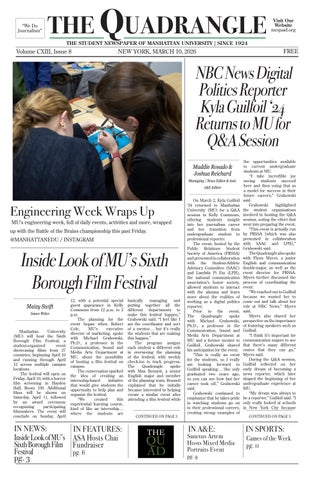
Engineering Week Wraps Up
MU’s engineering week, full of daily events, activities and more, wrapped up with the Battle of the Brains championship this past Friday. @MANHATTANEDU / INSTAGRAM
MU’s engineering week, full of daily events, activities and more, wrapped up with the Battle of the Brains championship this past Friday. @MANHATTANEDU / INSTAGRAM
Maizy Swift Senior Writer
Manhattan University (MU) will host the Sixth Borough Film Festival, a student-organized event showcasing films from 27 countries, beginning April 10 and running through April 12 across multiple campus locations.
The festival will open on Friday, April 10, with a horror film screening in Hayden Hall, Room 100. Additional films will be shown on Saturday, April 11, followed by an award ceremony recognizing participating filmmakers. The event will conclude on Sunday, April
12, with a potential special guest appearance in Kelly Commons from 12 p.m. to 2 p.m.
The planning for the event began when Robert Cole, MU’s executive director of marketing, spoke with Michael Grabowski, Ph.D., a professor in the Communication, Sound and Media Arts Department at MU, about the possibility of hosting a film festival on campus.
The conversation sparked the idea of creating an internship-based initiative that would give students the opportunity to help plan and organize the festival.
“We created this experiential learning course, kind of like an internship… where the students are
basically managing and putting together all the different departments to make this festival happen,” Grabowski said. “I feel like I am the coordinator and sort of a mentor… but it’s really the students that are making this happen.”
The program assigns each student a different role in overseeing the planning of the festival, with weekly check-ins to track progress. The Quadrangle spoke with Max Bennett, a senior English major and member of the planning team. Bennett explained that he initially became interested in helping create a similar event after attending a film festival while
Managing / News Editor & Asst.
A&E Editor
On March 2, Kyla Guilfoil ‘24 returned to Manhattan University (MU) for a Q&A session in Kelly Commons, offering students insight into her journalism career and her transition from undergraduate student to professional reporter.
The event, hosted by the Public Relations Student Society of America (PRSSA) and presented in collaboration with the Student-Athlete Advisory Committee (SAAC) and Lambda Pi Eta (LPH), the national communication association’s honor society, allowed students to interact with the alumna and learn more about the realities of working as a digital politics reporter.
Prior to the event, The Quadrangle spoke with Michael Grabowski, Ph.D., a professor in the Communication, Sound and Media Arts Department at MU and a former mentor to Guilfoil. Grabowski shared his anticipation for the event.
“This is really an event for the students, so I really am looking forward to Guilfoil speaking… She only graduated two years ago, so you can see how fast her career took off,” Grabowski said.
Grabowski continued to emphasize that he takes pride in watching students go on to their professional careers, creating strong examples of
the opportunities available to current undergraduate students at MU.
“I take incredible joy seeing students succeed here and then using that as a model for success in their future careers,” Grabowski said.
Grabowski highlighted the student organizations involved in hosting the Q&A session, noting the effort that went into preparing the event.
“This event is actually run by PRSSA [which was also presented in collaboration with SAAC and LPH],” Grabowski said.
The Quadrangle also spoke with Flynn Myers, a junior English and communication double-major, as well as the event director for PRSSA. Myers further discussed the process of coordinating the event.
“We reached out to Guilfoil because we wanted her to come out and talk about her role at NBC News,” Myers said.
Myers also shared her perspective on the importance of featuring speakers such as Guilfoil.
“I think it’s important for communication majors to see that there’s many different routes that they can go,” Myers said.
During the Q&A session, Guilfoil reflected on her early dream of becoming a news reporter, which later shaped the beginning of her undergraduate experience at MU.
“My dream was always to be a reporter,” Guilfoil said. “I only really looked at schools in New York City because
CONTINUED ON PAGE 3
Volume CXIII, Issue 8 MARCH 10, 2026
The Editorial Board
Laili Shahrestani and Barbara Vasquez Editors-in-Chief Maddie Rosado Managing Editor
Leyla Mercado Features Editor
Sarah Rolka Asst. Features Editor
Zeke Jazwinski Sports Editor
Emmamuel Sofillas Asst. Sports Editor
Leyla Mercado & Elaina Batista Asst. Social Media Editors
Maddie Rosado News Editor
Zendrah Bonnick Asst. News Editor
Maria Castaño Arts & Entertainment Editor
Joshua Reichard Asst. Arts & Entertainment Editor
Amy Forster Production Editor
Lois Boateng Social Media Editor Thom Gencarelli Faculty Advisor
Misha Jabal-Abadi Asst. Production Editor
Alba Kortoci Web Editor
About The Quadrangle

A tradition since 1924, The Quadrangle is a news organization run by the students of Manhattan University. We strive to cover news around campus and the greater community, publishing weekly in print and daily online. Our goal is always accuracy, relevancy and professionalism.
The opinions expressed in The Quadrangle are those of the individual writer and do not necessarily reflect the views of the Editorial Board, the University or the student body.
Join The Quadrangle
The Quadrangle’s staff holds weekly open meetings on Tuesdays at 4 p.m. in Kelly Commons. All are welcome to come and join the club. If interested, please email thequad@manhattan.edu!
Connect with The Quadrangle mcquad.org @mu_quad @mu_quad mcquad
Hello everyone and welcome to issue 8!
I hope everyone has enjoyed their unusually warm weekend, and fingers crossed this warm weather continues! I am personally tired of the eyesore that is the dirty snow still lingering everywhere, and I know I’m not the only one waiting for spring to come so it can melt already.
Now moving into our issue, we begin with news of our very own Quad alumna Kyla Guilfoil! Kyla served as the editor-in-chief of The Quadrangle for the 2022 academic year, and now works as a reporter for NBC News. She returned to campus for a Q&A session with students, which you can read about in our first story of this issue! Next, we give a sneakpeak into the Sixth Borough Film Festival, coming up later this semester. Finally, our Manhattan Caucus gives an overview on the United States and Israel’s recent attacks on Iran. Our caucus is published with every issue and is a great way to keep up to date with the news if you don’t have the time throughout the week to - be sure to give it a read!
Up next in features, we cover events from MU’s Hellenic Student Association (Greek Club) and the Asian Student Association. Greek Club hosted a cultural bracelet making event, encouraging students to create their own Mati / Marti bracelets, representing the transition from winter to spring. ASA held a chai fundraiser, making homemade chai to sell to students during midterms week. Give these articles a read to find out more!
In A&E, we begin with my very own article covering Scatterbomb’s latest performance. I had a blast covering this show - if you haven’t been to a Scatterbomb performance for any reason, take this as your sign to start going. The show, themed around ancient Greece, was super fun and a great way to end my week. Next, we cover Sanctus Artem’s latest club event where students created portraits using various media. The section ends off with a good ol’ Jasper Jams, reviewing Don Toliver’s latest album.
Finally, in sports, you can take a deeper look in to MU’s sports media production program. Students in the program are responsible for producing our sports games that get streamed to ESPN+, which is super exciting and you can learn more about in the piece. Finally, we end off with a games of the week, covering the women’s basketball team’s win against Marist, and the men’s unforutnate loss against Fairfield University.




That’s all for this week - I hope you enjoy this issue!
See you at the same time next week,
it was where I wanted to be while studying journalism.”
Guilfoil continued by sharing that double-majoring in communication and political science was not always a part of her original plan. However, it was a path that felt natural to her career development.
“It was my first semester… I was always really interested in politics,” Guilfoil said. “I was in a position where one of my professors literally showed me how they [politics and media] intersect.”
Later in the event, Guilfoil was asked what experiences and undergraduate work helped prepare her for her current role at NBC. She pointed to The Quadrangle, describing it as the beginning of her true pursuit in journalism.
“I was a Quadrangle Scholar… I remember writing my first article for The Quadrangle in my dorm, and one of the senior editors tore it to shreds,” Guilfoil said. “So many edits and so many comments were made in that Google Doc., but it was
actually a great lesson.”
As Guilfoil gained more experience as a staff member on The Quadrangle, she also noted that writing for Manhattan Caucus helped her develop skills in reporting on national political news.
“[Manhattan] Caucus was my first time writing about national political news,” Guilfoil said. “I really loved it, and I definitely felt a draw towards it.”
Guilfoil’s growth as a student journalist did not go unnoticed. In a separate interview, Margaret Groarke, Ph.D., professor and chair of the History, Political and International Studies Department, as well as one of Guilfoil’s mentors, shared her experience with watching Guilfoil develop as a student at MU.
“She was very professional about her work in The Quadrangle, and I think the quality of the newspaper really showed that,” Groarke said.
Groarke continued by noting the hard work and dedication Guilfoil demonstrated during her time as an undergraduate student.
“She [Guilfoil] had interned at ABC, NBC, CBS and [had a] fellowship at Politico, all while she served in various leadership roles in The Quadrangle, including editor-in-chief,” Groarke said.
When asked how her undergraduate work translated into her current position, Guilfoil provided a brief overview of the demands of her current career.
“Now, I live blog almost every day… especially under the current administration, everything just moves at a rapid pace,” Guilfoil said. “Essentially, when I’m listening to a speech in real time, I’m grabbing bites and turning into posts.”
After the event, The Quadrangle spoke with Guilfoil about her lasting thoughts on sharing her early career journey with current undergraduate students at MU.
“I’m so grateful that I was asked to come back,” Guilfoil said. “I feel like I’ve gotten to do so much since I graduated, and I’m so honored to get to share it with the next generation.”
Guilfoil’s reflections on returning to campus

A flyer shared on social media and posted around campus ahead of the event.
were echoed by Groarke, who emphasized the range of opportunities Guilfoil embraced as a student.
“[Guilfoil] did a lot of stuff on campus and took advantage of a lot of opportunities here,”
Groarke said. “She was one of those like ‘all around’ Jaspers, who just did it all with joy.”
Guilfoil left current MU undergraduates with one
final message, encouraging students to pursue opportunities freely and avoid limiting themselves early in their careers.
“Find where opportunity is… don’t put yourself into a box when you’re young because it’s gonna make your life so much harder,” Guilfoil said.
CONTINUED FROM PAGE 1 studying abroad.
“I studied abroad last spring in Rome, and they have their own film festival,” Bennett said. “I was telling Grabowski about it, and as it turns out, he was already planning on running a class that was going to teach [students] how to manage and plan a film festival… then one thing led to another, and it was decided that in this class we’re going to be running an actual film festival.”
Bennett provided further insight into his role, as well as the teams and current operations behind the festival.
“There’s a team for awards, filmmaker hospitality, social media, press production, post production… With my role, I make sure that we are all on the same page,” Bennett said. “I’m a helping hand in whatever ways that they need me.”
When asked how the festival was able to achieve such a wide outreach, Bennett pointed to Grabowski’s professional network.
“Grabowski has lived many lives… so he started asking his friends and previous colleagues if anyone would be interested in collaborating on this project,” Bennett said.
The festival received a large amount of submissions through the Film Freeway website, allowing filmmakers to submit their work from all over the world.
“We have films from such a wide variety of places,” Grabowski said. “When we set out our calls for nominations, I thought maybe we would get 20 films, maybe 25 if we were lucky, and we ended up getting 183 submissions, [from] 30 different countries.”
The films were reviewed by a panel of judges based on category, with the best in each section selected for awards.
“Once we sent out acceptances, we set up a panel of three judges,” Grabowski said. “We had students judge the student category of films, which is where we had the largest number of entries.”
Kara Horn, a senior communication major and director of communication for the film festival, continued to speak about the wide range of films that will be shown.
“We have short films, we have long feature films, we have documentaries, we have narratives, we have horror films, we even have music videos all over the place,” Horn said.
Additionally, the festival will give attendees the opportunity to interact with
filmmakers through Q&A sessions following the select screenings.
“So far, we’ve had 20 filmmakers say that they’re going to show up and do Q&As with their movies, so this is a great opportunity not only to see the films, but to actually talk with some of the filmmakers,” Grabowski said.
There will also be a special screening on Saturday night during the festival.
“Our featured presentation on Saturday at 7:30 p.m. is the hit Netflix documentary ‘Secret Mall Apartment,’” Grabowski said. “We have the producer and possibly the director coming to talk about the film after we screen it.”
Grabowski continued to highlight the dedication students have shown while preparing for the event.
“The students are really the ones putting this together, and it’s been so joyful to see,” Grabowski said. “They’re running social media accounts on Instagram, TikTok and Facebook, and doing outreach through those platforms. The press team is also finding ways to connect with audiences to let them know tickets are available and that they can come not only to meet the

filmmakers, but also to visit our campus and see what it’s like.”
Bennett echoed Grabowski’s sentiments and expressed hope for the event’s success.
“I hope this event is successful personally,” Bennett said. “I know Grabowski is building this from the ground up. It would be really nice to see this become something he can be proud of and hopefully continue next year and beyond.”
Horn continues to encourage students to take advantage of the opportunity to attend the festival, emphasizing its accessibility, networking potential, and the chance to engage directly
with filmmakers about their creative processes.
“Why wouldn’t you go? It’s free, it’s going to be super cool, and you have the opportunity to meet and listen to filmmakers talk about their process,” Horn said. “It’s a great networking opportunity, especially if you want to get into the industry. Most college campuses don’t have a film festival, so it’s really unique what we’re doing, and we’re working hard to make it worth everyone’s while.”
Tickets for the Sixth Borough Film Festival will be free for all MU students and accessible through email, while members of the general public can attend for $5.
Elaina Batista
Asst. Social Media Editor
On Feb. 28, the United States and Israel launched coordinated airstrikes against multiple targets in Iran, marking the beginning of a significant escalation in the ongoing conflict.
President Trump accused Iran of building nuclear weapons that could potentially threaten the U.S. and its allies. Iran’s supreme leader, Ayatollah Ali Khamenei, was assassinated that same day during a predawn attack by the United States and Israel. According to President Trump’s announcement on Truth Social, his passing was later verified by Iranian state media.
In Trump’s speech, he
stated, “Our objective is to defend the American people by eliminating imminent threats from the Iranian regime, a vicious group of very hard, terrible people. Its menacing activities directly endanger the United States, our troops, our bases overseas, and our allies throughout the world.”
The statement released by Trump after the joint attack contradicts the government 2025 assessment that said Iran is years away from the ability to produce long-range missiles.
In the early mornings of March 4, NATO air defenses shot down an Iranian ballistic missile headed toward Turkey. Additionally, the United States sank an Iranian navy ship in international waters with several European nations deploying military assets to the region to protect their interests.
On March 4, republicans blocked a bill that would have limited President Trump’s ability to wage war on Iran without congressional approval. Thus, rejecting a democratic attempt to require Congress to provide input on a broad and unrestricted military campaign.
At least six American service members have died since the United States and Israel launched coordinated attacks on Iran on Saturday. The Trump administration has stated that more American casualties are anticipated and that the war may continue for weeks.
The four U.S. service members were identified as Capt. Cody A. Khork and Sgts. Nicole M. Amor, Declan J. Coady and Noah L. Tietjens. Later on Wednesday, the fifth
member was identified in the morning as Maj. Jeffrey R. O’Brien. The Department of Defense believes the sixth member to be Chief Warrant Officer 3 Robert M. Marzan. They were all reported to have been killed Sunday, during an unmanned aircraft system attack in the Shuaiba port in Kuwait.
Following the initial strike, several Middle Eastern countries have been targets or intercepted attack drones, missiles and bombers: Jordan, Iraq, Kuwait, Lebanon, Oman, Bahrain, Saudi Arabia, the United Arab Emirates and Qatar have been involved in the conflict. In addition, France, the United Kingdom and Greece are allies and supporters of the United States.
It has been found that there have been 788 distinct attacks
and 1,860 missile and drone launches. Since the attack, more than 1,300 Iranians have been killed and more than 160 children have lost their lives after a strike on an all-girls school. Additionally, according to the Associated Press, oil prices surged to their highest level since September 2023 because of the war.
It has also been reported that Russia is providing Iran with targeting information to attack American forces in the Middle East. Iran continues to launch missiles and drones toward Gulf Arab nations that collaborate with the U.S. military. The U.S. military’s Central Command said Iran fired seven attack drones at residential neighborhoods in Bahrain.
wrote as to why HSA hosted the event
to traditions that have been passed down for generations.”
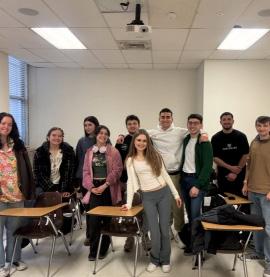
Manhattan University’s (MU) Hellenic Student Association (HSA) held an event March 3 to make mati and marti bracelets. This was their first major event this spring semester, and was met with a decent turnout.
According to hellenicaesthetic.com, “The tradition of Martis/Marti [derived from the Greek word for March], is said to date back to ancient Greek times, as a way to usher in the transition from winter to spring…we honor this tradition by tying a bracelet of red and white string onto our wrists March 1…We add an evil eye charm to our March bracelets to bring the wearer good luck.”
Marina Stavrou, junior marketing major and social media coordinator for HSA,
“The purpose of this event was to bring people together and share Greek traditions,” Stavrou said. “Marti bracelets are worn throughout the entire month of March, so we thought it would be a great way to welcome both the month of March and the beginning of spring. Since the mati, or evil eye, is more widely recognized, we combined the two so people could learn about both traditions.”
Stavrou additionally commented on this ancient tradition and what it means to her personally.
“I believe these bracelets are important because they create a sense of identity that ties me to my heritage,” Stavrou wrote. “Both the mati and marti bracelets date back thousands of years and continue to hold meaning in Greek culture today.
Wearing them is a small but powerful way to stay connected
Irene Papakanakis, a junior adolescent education major and a member of HSA, agreed with what Stavrou wrote, and added her own thoughts as well.
“These bracelets are a symbol of Greek identity,” Papakanakis wrote. “While many other cultures wear the evil eye or a variation of it, it also largely speaks to one’s Greek heritage and ethnicity, as it does for me.”
Papakanakis attended the event and wrote her thoughts on how at an event like this, she was able to interact with other fellow students a part or interested in Greek culture.
“I attended the event in order to interact with other Greek Americans who share the same love for their ancestry and heritage as I do,” Papakanakis said. “More specifically, attending the event was not just about making the ‘mati bracelets,’ but also about sharing their meaning with other Greek Americans and MU students interested in Greek culture.”
As previously mentioned, in Greek culture and others who believe the same, these bracelets represent good luck for the person wearing them. Stavrou wrote to The Quadrangle on what she’s lucky for in life.
“I believe I’m lucky for where I stand in life right now,” Stavrou wrote. “I’m grateful to be surrounded by loving people and to have the opportunity to attend university, work and take part in leadership roles. Those are things I never take for granted, and they’re what truly make me feel lucky.”
Within recent years, the mati and marti bracelets have become more popular in daily life, even for people who are not Greek. Papakanakis wrote to The Quadrangle about this, and mentioned how sharing
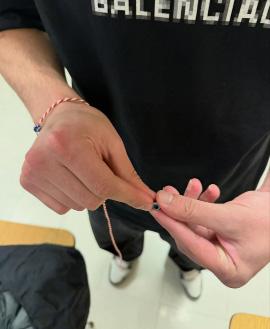
Mati/Marti bracelet making during the event . @MUGREEKCLUB / INSTAGRAM
a tradition like this helps in maintaining a sense of community.
“Events like the recent bracelet making one are vital in maintaining a sense of community amongst Greek Americans that connects us back to our cultural roots, which inform our sense of identity,” Papakanakis wrote. “Furthermore, part of preserving our culture is sharing it with non-Greeks as well. Greek culture heavily focuses on unity and community, and I think the recent bracelet making event emphasized this key facet of our culture.”
Stavrou acknowledges this, and also writes how for her, it’s been great to see people embrace the tradition with proper representation. She also agrees on how it brings different cultures together.
“I believe that with proper representation and understanding, it’s a positive thing that evil eye jewelry is becoming more well known,” Stavrou wrote. “The evil eye doesn’t belong only to Greece - it exists in many cultures around the world. It’s a beautiful tradition, and it’s nice to see people appreciating and embracing it.”
Emmanouel Sofillas
Asst. Sports Editor
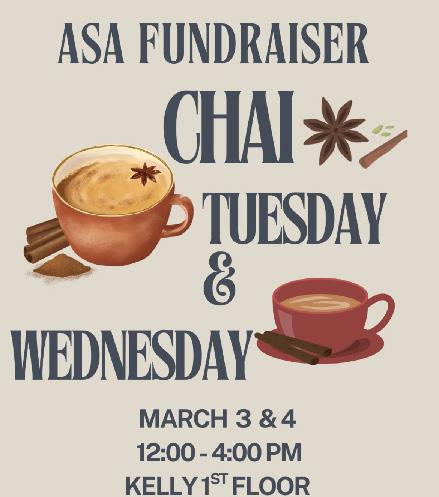
M The Asian Student Association (ASA) brought the warmth of homemade chai to campus this week as part of a two-day fundraiser aimed at supporting the club’s programming and events.
Junior computer engineering major Farhan Bishal prepared the homemade chai, sharing a recipe rooted in his upbringing. Bishal said the drink represents both tradition and authenticity.
“This Chai itself is my recipe,” Bishal said. “I learned, I grew up making it from my mom, and what I want to do is share that authenticity that I have with this Chai with everyone else on this campus.”
Bishal described chai as a beverage with deep roots in the Indian subcontinent, noting that its flavor can be difficult to define.
“Chai itself is actually…a type of tea that originated in the sub Indian continent,” Bishal said. “The point is that it’s such a hard flavor to distinguish and describe that you cannot associate it with an actual flavor. It’s hard to say what it is unless you’ve actually had it.”
Bishal compared the taste to Thai tea, emphasizing its distinctiveness from more commercialized versions often found in the United States.
“Chai has its own unique flavor that is not the same as the conventional American chai tea,” Bishal said.
To make the drink more accessible to a wider audience, Bishal said he adjusted the traditional preparation.
“This chai is actually a watered down version of what
is usually sold in Bangladesh, India, Pakistan and those desi countries,” Bishal said. “I did not add any extra spices, just to keep it a plain and very simple drink that has a lot of flavor.”
ASA founder and president Shu Amanuma, a junior majoring in international studies with a concentration in global affairs, said the fundraiser plays a key role in sustaining the club’s programming throughout the semester.
“Generally, we do not get funding from the school,” Amanuma said. “Hence, for us to do a lot of events, such as the paw marks or the K town dinners, that has been very popular. It requires us to do a fundraiser, raise the money so that we can give back to the community that we’re serving. So it’s a cyclical system.”
Amanuma said the organization set a goal of raising between $200 and $250 each day of the two-day event to maintain its operating budget.
“This event, I think we are targeting to raise about $250 — yeah, $200 to $250 today,” Amanuma said.
Although the fundraiser coincided with midterms, Amanuma said the executive board spent several weeks preparing.
“We definitely spent two to three weeks on the planning,” Amanuma said. “The actual preparations, like physical preparations, just happened yesterday and today.”
Beyond fundraising, Amanuma emphasized ASA’s broader mission of building community and fostering cultural exploration on campus.
“My mission and the mission of ASA is to create a safe community for students with Asian backgrounds and identity, so for them to explore and further expand
understanding of their own cultural identity through sharing and just experiencing other people’s culture,” Amanuma said.
Raphael Alcober, a junior computer engineering major and the club’s secretary, said he joined ASA to help cultivate that sense of belonging.
“I joined because I wanted to join a small, close knit community,” Alcober said. “I thought that ASA…had good potential, and I wanted to
be part of the reason why it grows.”
Alcober added that ASA provides representation and a welcoming environment for Asian students on campus.
“I say that ASA provides a safe space,” Alcober said.
The chai fundraiser is part of a series of themed events ASA has hosted throughout the year. Amanuma said the club previously sold boba and plans to introduce additional items in the future.
“We did boba last time. We’re doing Chai this time,” Amanuma said. “And then in the future…when the outside environment gets warmer, we can sell colder drinks. Matcha would be wonderful.”
As students stopped by for a warm cup between exams, the event served as both a cultural introduction and a reminder of ASA’s growing presence on campus — one cup of chai at a time.
Editor-in-Chief
Manhattan University’s (MU) improv group, Scatterbomb, brought students back in time this past Friday with their latest performance, themed around “traveling back” from a trip to ancient Greece.
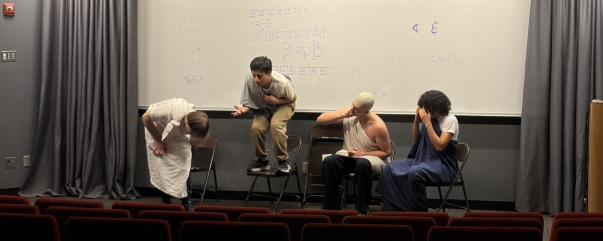
Scatterbomb members entered Hayden Hall, room 100, dressed in outfits ranging from togas made of sheets to sets of armor with fake swords included. The whiteboard background featured a rendition of the name “Scatterbomb,” written using the Greek alphabet, alongside multiple other Greek symbols.
Colby Hicks, a sophomore political science and communications double major and member of Scatterbomb, shared how this theme, and others in general, typically come to be.
“People pitch something, and usually we come to a general consensus,” Hicks said. “It’s got to be something not too distracting and general, costume-wise. Sometimes it plays into the show, like today, all the words were [related to the theme]. That’s the thing with getting a lot of personality in the audience, sometimes they play in.”
The actual show began with a dance segment, with Hicks taking center stage during the moment. The cast members then delved into their usual routine of asking audience members to shout out words
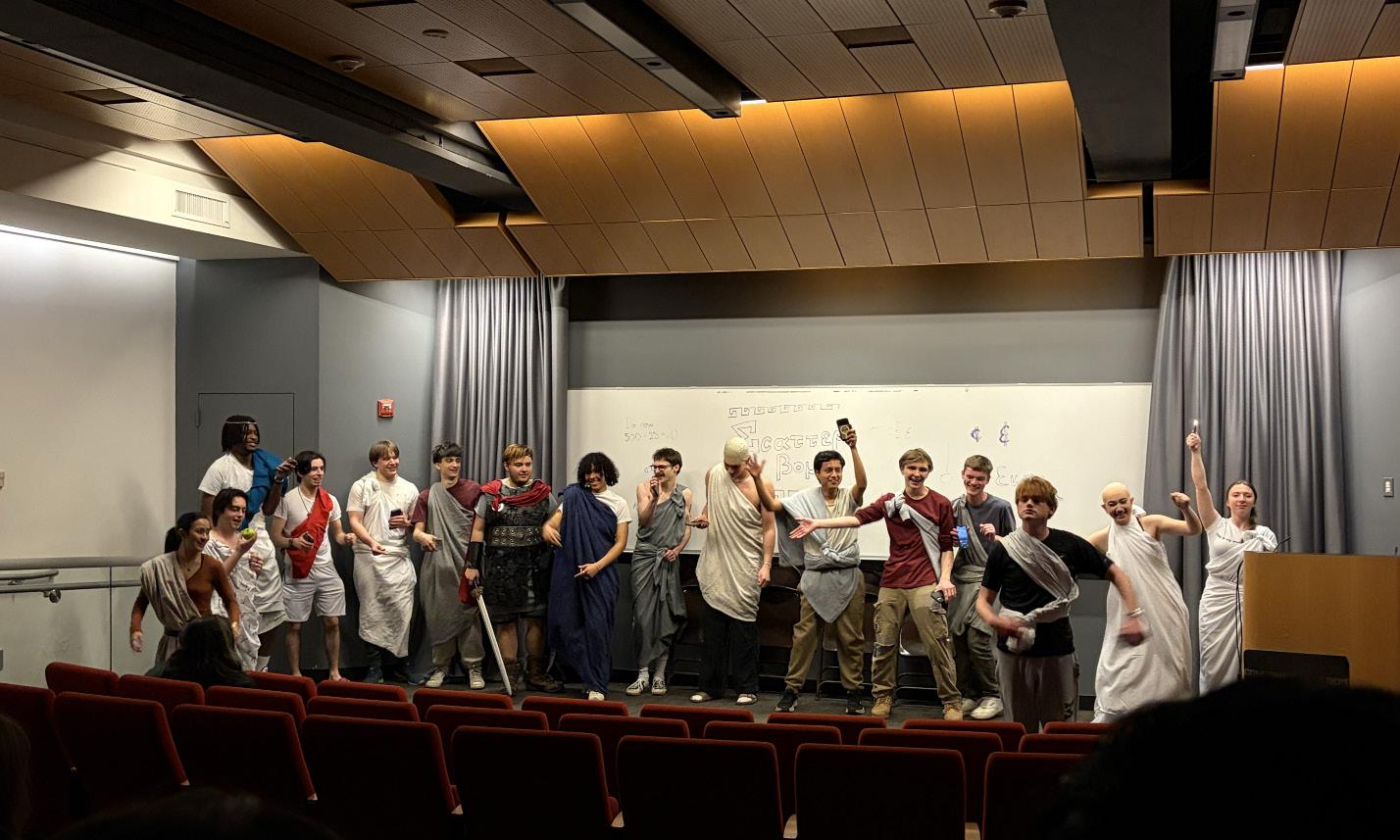
to get the night rolling, such as the Olympics, borgs and Greek life.
Finally, cast members jumped right into their skits.
For Hicks, trust is especially important among members when it comes to performing these improvised scenes.
“Everybody’s got to have each other’s back,” Hicks said.
“If someone comes up with an idea, you have to be willing to just throw away what you had in your head and go with it, or else it’s going to be a problem. You have to trust everybody.”
Alex Castello, a sophomore mechanical engineering major and member of Scatterbomb, shares a similar opinion to Hicks when it comes to supporting the ideas of other castmates.
“The key to a successful Scatterbomb show is to work together and not shut anything down,” Castello said. “The smoothness of it comes from everyone doing ‘yes, and then’... and trying to make sure everybody’s ideas stay there, because you never get to the best part if you don’t let things
build. If you shoot something down too early, it never has the chance to really blossom.”
Castello went on to tell The Quadrangle about the importance of being friends with members of Scatterbomb, and how a good relationship can be vital to a smoothrunning show.
“Especially for improv, [a good relationship] is so important because you always have to try and be on each other’s page,” Castello said.
“You start to really understand people. Being friends with these guys is really helpful when you try to make other people laugh. Sometimes miscommunication works, but you have to understand each other to really have a good show.”
This relationship amongst the cast is built through the days of practice and time spent with each other, according to members. Lucia Kobayashi, junior political science major and Scatterbomb’s historian, spoke about the pre-show specifically and how everyone interacts to let loose of any jitters.
“We’re getting dressed, and we always text in this GroupMe that we have, a bunch of jokes to get ourselves ready to go,”
Kobayashi said. “It’s really funny and makes me excited to see everybody because it’s so fun. Before we go on, we’re hanging out for like an hour. It’s just really fun.”
This chemistry amongst cast members paid off for Friday night’s show, as audience members were lit up with giggles and laughter throughout the performance. For audience member David Appih, the show was overall fun and quite enjoyable.
“I think tonight was a really fun, good show,” Appih said. “The improv was really good and these out-of-nowhere moments were really fun… They played around with [the theme] well.”
In terms of upcoming Scatterbomb performances, Kobayashi shared what students can expect in the future.
“We do full send here,” Kobayashi said. “We get injured, we do whatever we can to fit the bill. So come for spontaneity, injuries and maybe some inappropriate joking.”
To stay up to date with Scatterbomb and not miss their next performance, be sure to follow them on Instagram: @scatterbombmu.
Writer
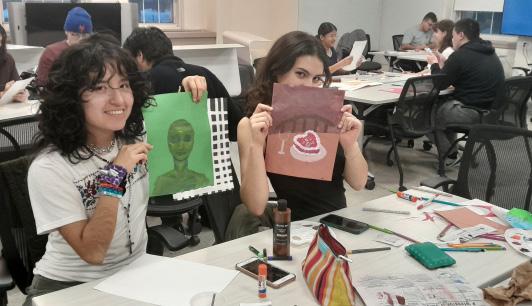
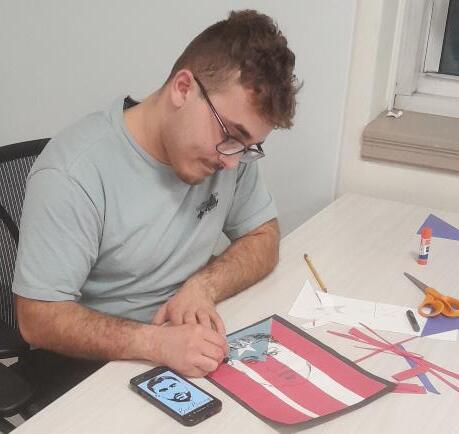
On March 3, Manhattan University’s (MU) art club Sanctus Artem hosted a “Mixed Media Art” event, where students could showcase their artistic talents and get creative by drawing, painting, coloring, or cutting various materials to create a collage.
Lucas Haas, a senior environmental studies major and the president of Sanctus Artem, spoke to The Quadrangle about why he chose mixed portrait activities for the event.
“We had some inquiries about doing portraits before from other people,” Haas said. “Whether it’s painting or paper portraits… we were kind of tossing around ideas and then [decided to] include all of it [together in one event].”
Haas has been a member of the club since his freshman year. As a senior preparing to graduate, The Quadrangle asked about his plans to help maintain Sanctus Artem’s momentum.
“We’re going to be having an art show that will be announced soon enough, on April 9,” Haas said. “That’s one way we’re going to be expanding our outreach to people and really show off everyone’s skills on campus… so that [I] could leave the club
in good hands with the next e-board.”
Roman Einhorn, a junior psychology major, spoke with The Quadrangle about why he attended Sanctus Artem’s event and how it contributed to his experience at MU.
“I really came because my friend, [Olivia Wagner],
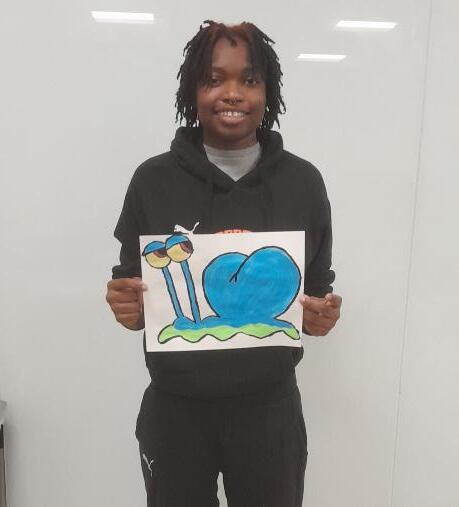
asked me to come,” Einhorn said. “She helps run the club as she’s the treasurer. And as for my experience, I’ve been to [a] Sanctus Artem [event] before. It’s always nice to chill, do some drawing and just give your mind a break.”
Einhorn also spoke with The Quadrangle about what he plans to do with his artwork once it is completed.
“I’m really just practicing some designs,” Einhorn said. “I’m supposed to be making a drawing for my friend, and I hope she appreciates it.”
Johlana Tatum (JT), a freshman criminology major, spoke with The Quadrangle about why she chose to attend the Sanctus Artem event and how it has influenced her experience at MU.
“The club is very welcoming and inclusive,” Tatum said. “It’s honestly very awesome to be in a community like this.”
Tatum also spoke with The Quadrangle about what she plans to do with her artwork once she finishes it.
“I will probably hang it up in my room,” Tatum said.
As the event came to a close, Haas also spoke to The Quadrangle about why he believes it is important for students to have spaces on campus where they can freely
express their creativity.
“I think when you’re sitting in a classroom all day, and there’s a professor or someone telling you, ‘you have to do this assignment this way, my way,’ it’s nice to have a space to come and relax and let your own creative juices flow,” Haas said. “It’s always super chill, we play chill music, and it’s a chill group of people. It’s really just a
nice zen vibe.”
Haas added that events like these allow students to step away from academic pressures and engage with their peers in a more relaxed environment.
“That’s why I feel it’s important to have these safe havens on campus,” Haas said. “It gives people a place where they can unwind and create.”
Zeke Jazwinski Sports Editor
Don Toliver first caught mainstream attention with his standout feature on “Astroworld,” appearing on the track “Can’t Say.” Since then, he has carved out his own lane and created a strong fanbase with breakout hits like “After Party,” “Bandit” and “No Pole.”
Now with his new album “Octane,” Toliver looks to keep that momentum going while continuing to evolve his melodic trap style and expand his place in hip-hop. While the album is solid throughout, a few songs stand out as highlights worth checking out.
E85 by Don Toliver
Toliver starts off the album with a banger, which immediately sets the tone for the project. The song starts with a smooth melody that slowly builds up to a heavy trap beat. Toliver has been known for having a great vocal range, and it shows on this song. If you like atmospheric trap with strong melodies, this is definitely one of the standout tracks to start with.
Body by Don Toliver
Toliver follows up “E85” with a song called “Body,” which has been gaining popularity through TikTok. Toliver leans more towards his melodic style for this song rather than making it rapheavy. With its catchy hook and smooth delivery, this is definitely a song that highlights Toliver’s ability to blend R&B melodies with trap production.
ATM by Don Toliver
Toliver decides to switch gears. This song is more energetic than the others, with a fast-paced beat and heavy bass
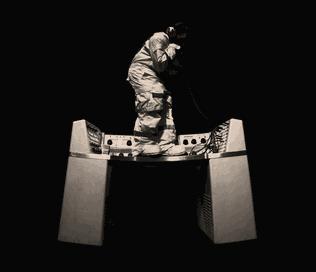
that immediately grabs your attention. This song feels like it’s built for the car or the club. He does another great job with a catchy hook that gets stuck in your head. Overall, this is a good switch-up from the other songs, with it bringing more energy.
Tiramisu by Don Toliver
“Tiarmisu” goes back to the smoother side of songs that Toliver has been doing recently. In this one, you can definitely
see the R&B influence that’s in Toliver’s work. This song, being slower paced, allows Toliver to use that great voice to shine through. This is one of the more laid-back songs, so if that matches your vibe, you should definitely check it out.
Rosary by Don Toliver ft. Travis Scott
It makes sense that the collaboration between these two artists was included on this list, as their past work together
has consistently produced standout songs. “Rosary” brings a darker and more atmospheric feel to the album, with echoing production and a steady beat that slowly pulls you into the track. The beat doesn’t do too much, which allows Toliver and Scott to do what they do so well with their vocals. If you need music late at night, try putting this one on.
Gemstone by Don Toliver
Concluding this list, the
most popular song stands out for its strong reception and memorable, catchy composition. “Gemstone” starts off with a hard beat and repetition that just gets stuck in your head. Toliver leans more toward rap for this song, showing off his skills as a rapper. The reputation doesn’t overdo it, but makes the song better. If you are looking for more of a hype song, this is definitely for you.

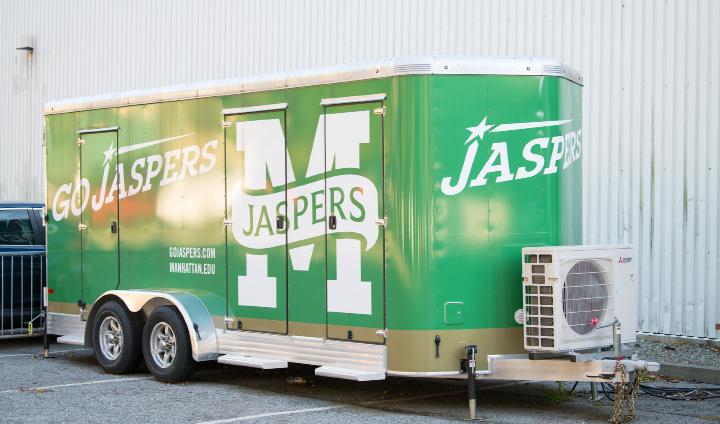
Manhattan University’s (MU) sports media production has been live-streaming games with ESPN+ as part of its coursework for the past few years. The Quadrangle was able to obtain interviews with some members of the sports production team including Sadie Fox, Vivian Nartey and Joe Ruggiero, sports producer and director, to gain more insight on the program.
Ruggiero, who teaches advanced sports media production, spoke to The Quadrangle about how sports media production first came to MU.
“It had just started right as I came in,” Ruggiero said. “The communication department at Manhattan University purchased a production truck to facilitate the needs of the conference that we’re in… once they had the production truck and [sports media production] concentration in place, they then reached out and did the process to hire the producer and director, and that’s where my role came in.”
During his interview, Ruggiero later discussed how students get involved with sports production at MU.
“You can take my classes as an elective, [whether] you took [similar] classes before, or just want to get involved,” Ruggiero said. “Even if you’re not working games, if you’re just a student that’s super
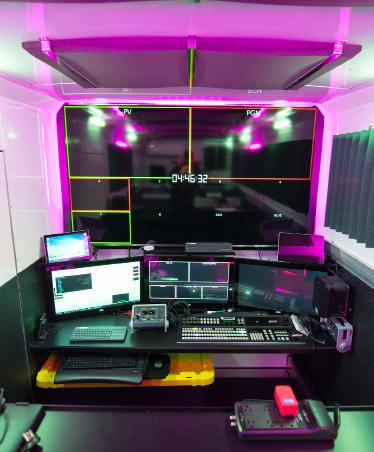
interested and you want to get involved in the production truck, I invite everybody to make an appointment. I’ll show them around the production truck...we’ll train on a specific piece of equipment in the truck, or cameras, or replay system, graphic system, whatever it might be.”
Sadie Fox, a junior studying English and communication with a sports media concentration, commented on her experience as a part of the sports production team during an interview over email with The Quadrangle.
“I had previous experience in production technology through my experience with Manhattan Media Network and some other personal projects,” Fox wrote in an email to the Quadrangle. “However, previous experience is not necessary. Our producer, Joe Ruggerio, and returning classmates all work together to teach each other how to do everything and make the experience as easy as possible.
Most of the things I have needed for the class I have learned over time through trial and error and from the other people in the class.”
Ruggiero further elaborated on the different ways students learn production in a more hands-on course.
“They can shadow a game, they can sit next to somebody and watch a position how they do, they can shadow how we set up the broadcast and how we break down the broadcast,” Ruggiero said. “A lot of the helpful teaching, even if people get to my class for the first
time and they haven’t done any [production] before that, a lot of the great teaching comes from the other students in the class.”
Vivian Nartey, a senior majoring in communication with a concentration in sports media production, commented on training, and about how producing live television can be a daunting and exciting opportunity. She told The Quadrangle what advice she had for students who want to get involved, but are nervous.
“Go to the games first because that’s probably the best experience…” Nartey said. “Pay attention to how they’re doing stuff during their production. What kind of story are they trying to tell? Because a lot of it is storytelling about ‘who’s the favorite to win this game?’ or ‘who are the best
players in this game?’ and you’ll see the story come alive through the way that the announcers talk about certain players, or certain camera cuts.”
Fox elaborated further on the many roles that go into live sports production at MU.
“At a normal game, we have about nine students working in different positions,” Fox wrote.
“There are students working cameras on the court, a student working to let the officials know when to resume play after time-outs and four students in a truck outside that work the switchboard, graphics, stats and instant replay... Joe Ruggiero has to plan a lot before and after games, along with teaching us during live broadcasts, to make the games run smoothly, but also make it fun for the students.”
Ruggiero told The Quadrangle about the growth of the sports production program, and how high morale and teamwork played a big role in the production team’s successes.
“It started with two students in the class, because nobody knew what it was yet, now our class has a roster of 19, which is the most we’ve ever had,” Ruggiero said. “Every year, it goes up a few and a few, and it seems like we’re getting pretty popular. I’m liking that because we’re only as good as the students that we have… I rely on them because they really do produce a lot of what we do in our productions. Without them, I don’t have a job, [so] I am always very thankful to my students.”
Sarah Rolka Asst. Features Editor
As the MAAC conference games begin, the Manhattan Jaspers women’s basketball secured the win from the Marist University Red Foxes, 64-55, last Thursday afternoon inside Jim Whelan Boardwalk Hall in Atlantic City, N.J.
By the end of the first round, senior guard Brianna Davis anchored 25 points which secured a decent lead against Marist. Additionally, Davis, Agar Farrés Garcia and Elisa Solé Sanchez teamed up again to score the first nine points with a jumper to force an early timeout against Marist. Hana Mühl kept the energy up through the rest of the first round with an additional seven points, with Jaspers achieving a double-digit lead after the first 10 minutes.
Manhattan kicked off the second round with an 11-2, stretching their advantage against Marist out to 20 after Davis scored the first threepointer of the game. Kristina Juric, a freshman forward, was back in the game action for the first time since Jan. 24 and scored her first two points of the game midway through the second round.
During an 11-2, the Red Foxes caught up to the Jaspers within six points; yet, freshman guard Celeste Harper found her footing and helped the Jaspers attain an 11 point advantage right before the halftime break horn.
As the players came back onto the court, graduate student forward Collette Mulderig hit two jump shots during the third round. At the same time, the Jaspers had a 10+ point advantage for the rest of the quarter. Mühl and Mulderig came together on the last two Jasper field goals to end the third round with a 13 point advantage.
However, during the last nine minutes on the clock of the fourth round, Marist scored 10 points and caught up to Manhattan with only a five point deficit with two minutes left on the clock.
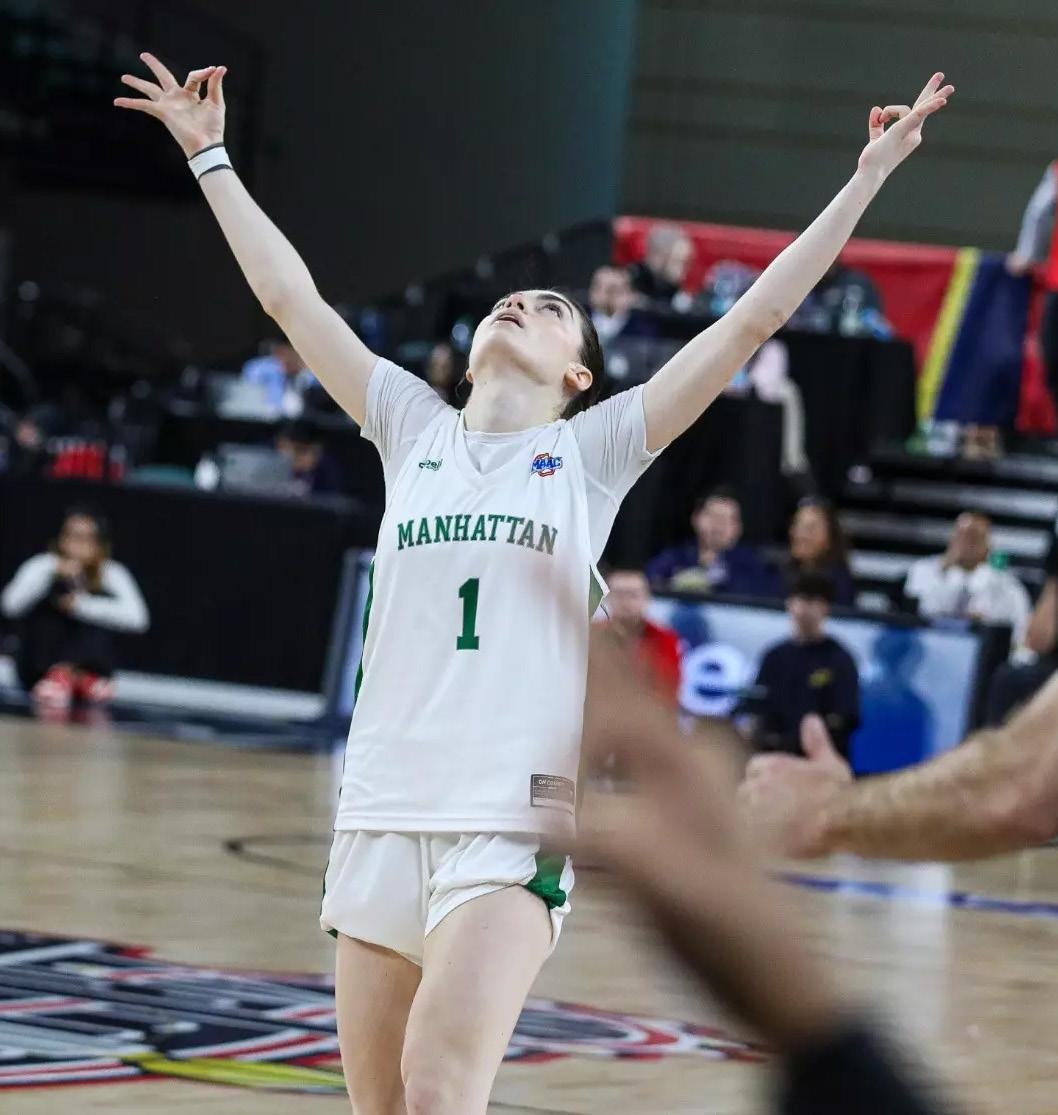
Farrés Garcia found Juric open in the paint with 35 seconds remaining, which Juric easily knocked down. Juric helped eliminate any signs of Marist winning during the first round matchup and the Manhattan Jaspers took the victory.
The Manhattan Jaspers men’s basketball ended their
season with a fall to Fairfield University Stags, 71-60, at Jim Whelan Boardwalk Hall last Thursday evening.
Hoping to attain their first victory in Atlantic City since the turn of the decade, the Jaspers tried their best against the Stags after their last game against them during the regular season.
In the pinnacle in the first half, Manhattan traded baskets with the Stags for the first five
minutes of the game. Terrance Jones, a graduate guard, helped cut the deficit to three points as he was on a second-chance.
The Jaspers caught back up with the Stags’ lead again when Fairfield turned the ball over with a travel. Fraser Roxburgh, sophomore forward, was also able to score with a hook shot and cut the deficit 21-17 near the end of the first half.
Terrance Jones helped tie the game at 22 points with a
three-pointer out of a media timeout after Roxburgh missed a three-pointer. Jones has helped build momentum for the Jaspers this past season, and this game has rounded off his efforts.
However in the second half, the Jaspers were unable to catch up to a double-digit deficit even when freshman guard Jaden Winston was able to take his third steal and bury the basket.